NEWS
a life well planned is a life well lived
The Captain’s Log Fall 2018
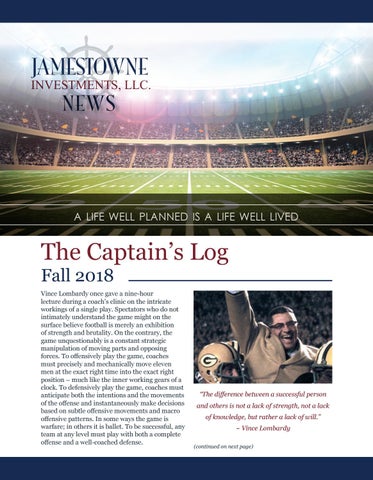
Vince Lombardy once gave a nine-hour lecture during a coach’s clinic on the intricate workings of a single play. Spectators who do not intimately understand the game might on the surface believe football is merely an exhibition of strength and brutality. On the contrary, the game unquestionably is a constant strategic manipulation of moving parts and opposing forces. To offensively play the game, coaches must precisely and mechanically move eleven men at the exact right time into the exact right position – much like the inner working gears of a clock. To defensively play the game, coaches must anticipate both the intentions and the movements of the offense and instantaneously make decisions based on subtle offensive movements and macro offensive patterns. In some ways the game is warfare; in others it is ballet. To be successful, any team at any level must play with both a complete offense and a well-coached defense.
“The difference between a successful person and others is not a lack of strength, not a lack of knowledge, but rather a lack of will.” ~ Vince Lombardy (continued on next page)
JAMESTOWNE INVESTMENTS NEWS What’s Inside: The Captain’s Log Save and Invest Even if Money is Tight Quarterly Economic Update Three Phases of Consideration for Retirement Social Media Rules of the Road for Parents and Grandparents Accessing Your Account Online Game Day Tailgate Recipes
Ensure your financial plan addresses all of your life’s events. A life well planned is a life well lived.
We are here for you through all your life’s events.
Your referral is the highest compliment we can receive.
A MESSAGE FROM CLAYTON Your Trusted Advisor
continued from 1st page
I find success in business and more pointedly success in investing to be agnate to successful football coaching. I believe everyone has the ability and opportunity to be a successful investor, but as Vince Lombardy has suggested, most lack the will. Like a wellplayed football game, successful investing is not easy and does not come without great sacrifice. Successful investing is always an act of differed gratification and like success on the gridiron it takes patience, backbone, fortitude, and perseverance. To be more poignant, successful investing requires both an unshakable offensive plan and a vigilant defensive strategy.
CLAYTON JAMES FINANCIAL ADVISOR
An unshakable offensive investment plan involves making long term purchasing decisions while disregarding all inconsequential distractions and diversions. You have confidence in what you own because you believe that against all odds these companies will continue to research, create, and advance the quality of life for all humans. It is not just about profits for these companies, it is about betterment of the human condition and you want to be a part of these amazing opportunities.
A vigilant defensive strategy involves knowing that with your upside opportunity comes inherent market risks. You know intuitively that down market cycles are a part of the process, but to be a winner someone else must lose and you must be willing to stay the course, ignore the headlines, and remain confident in your convictions as the world around you seems to be failing. You know your companies have real staying power and regardless of geopolitical turmoil these investment choices are where you need to be for your long-term success.
4 / ďťż
Like a good football game, the investment business is always a balancing act between opportunistic growth (your offense) and the constant fear of loss and destruction (your defense). I hope the next time you have the opportunity to enjoy a closely matched game you briefly reflect back to the words of Vince Lombardy and remember, “Success is like anything worthwhile. It has a price. You must pay the price to win and you must pay the price to get to the point where success is possible. Most important, you must pay the price to stay there.” I hope everyone has a tremendous fall, and I almost forgot…
ROLL TIDE! Clayton W. James, CFM, AAMS Managing Director
Our daughter, Kathryn James (left), and friends at a University of Alabama football game.
5 /
Save and Invest Even if Money is Tight For millenials, today is the right time.
Recognize the potential advantages of an early start.
If you are under 30, you have likely heard that now is the ideal time to save and invest.
you are projected to have $214,946 after 40 years, off just $41,600 in total contributions.2 This scenario needs adjustment considering a strong probability: the You know that the power of compound interest is on probability that your account contributions will grow your side; you recognize the potential advantages of an over time. So, assume that you have $14,876 after ten early start. years, and then you start contributing $175 a week to the There is only one problem: you do not earn account earning 7% annually starting at age 35. By age 2 enough money to invest. You are barely getting by 65, you are projected to have $1,003,159. as it is. Even if you stop your $20-per-week saving and investing effort entirely after 10 years at age 35, the $14,876 Regardless, the saving and investing effort generated in that first decade keeps growing to $113,240 can still be made. Even a minimal effort could have at age 65 thanks to 7% annual compounded interest.2 a meaningful impact later.
Can you invest $20 a week? There are 52 weeks
in a year. What would saving and investing $1,040 a year do for you at age 25? Suppose the invested assets earn 7% a year, an assumption that is not unreasonable. (The average yearly return of the S&P 500 through history is roughly 10%; during 2013-17, its average return was +13.4%.) At a 7% return and annual compounding, you end up with $14,876 after a decade in this scenario, according to Bankrate’s compound interest calculator. By year 10, your investment account is earning nearly as much annually ($939) as you are putting into it ($1,040).1,2 You certainly cannot retire on $14,876, but the early start really matters. Extending the scenario out, say you keep investing $20 a week under the same conditions for 40 years, until age 65. As you started at age 25,
How do you find the money to do this? It is not
so much a matter of finding it as assigning it. A budgeting app can help: you can look at your monthly cash flow and designate a small part of it for saving and investing.
Should you start an emergency savings fund first, then invest? One school of thought says that is the way to go – but rather than think either/or, think both. Put a ten or twenty (or a fifty) toward each cause, if your budget allows. As ValuePenguin notes, many deposit accounts are yielding 0.01% interest.3
It does not take much to start saving and investing for retirement. Get the ball rolling
with anything, any amount, today, for the power of compounding is there for you to harness. If you delay the effort for a decade or two, building adequate retirement savings could prove difficult.
1 - nerdwallet.com/blog/investing/average-stock-market-return/ [2/28/18] 2 - bankrate.com/calculators/savings/compound-savings-calculator-tool.aspx [7/26/18] 3 - valuepenguin.com/average-savings-account-interest-rates [7/26/18] 6 / ďťż
Quarterly Economic Update A Review of Q2 2018 In this Q2 recap: tariffs take center stage, U.S. data signals solid growth, oil gains 18.4%, and the S&P 500 rises nearly 3%. THE QUARTER IN BRIEF At the end of 2018, economists and journalists may look back on the second quarter and see the moment when a global trade war began. Whether one is truly underway or not, the fact is that Q2 was a good quarter for equities. The S&P 500 gained 2.93% in three months, and while the blue chips had their struggles, tech shares ascended once again. Many foreign benchmarks also had a good quarter, even as the Trump administration’s planned import taxes on U.S. trading partners drew tariffs in kind and bred pessimism overseas. Our labor market and manufacturing and service industries continued to look healthy, and consumer confidence and spending reports were largely encouraging. Existing home sales tailed off. Oil made quite a comeback, aided by supply concerns. It was a quarter in which relatively strong economic data was overshadowed by a shift in the playing field for global trade.1 DOMESTIC ECONOMIC HEALTH The Trump administration had begun imposing import taxes early in the year, but in the second quarter, the international tariff spat truly grew heated. U.S. duties against metals imported from Mexico, Canada, and European Union nations were met by 25% taxes levied by the E.U. on American jeans, bourbon, orange juice, and other products, and Canada, India, and Mexico announced duties on select imports from America as well. Then the U.S. supplemented its earlier tariffs with new 25% taxes on $34 billion of Chinese imports (set to take effect July 6), and threatened to impose further 10% duties on another $200 billion of Chinese products and a 20% tariff on autos coming out of the E.U. China replied to the new tariff on $34 billion of its exports with an equal tariff on U.S. goods, to be implemented July 6.2 Interest rates moved north in Q2. The Federal Reserve made its second rate move of the year on June 13, taking the target range for the federal funds rate 0.25% higher to 1.75%-2.00%. A new wrinkle was found in the Federal Open Market Committee’s latest dot-plot consensus projection: it suggested four quarter-point rate hikes would occur this year rather than three.3 April saw consumer spending jump 0.6%, but the May number was just a third of that. Consumer wages were up 0.3% in April, then advanced another 0.4% a month later. Retail purchases were up 0.4% in April; then, 0.8% for May.4,5 Some of the data in the previous paragraph might seem a bit contradictory, but the takeaway was clear: consumers were playing a strong role in keeping the economy healthy. While consumer confidence indices fell during Q2, they were still at lofty levels. The University of Michigan’s index came in at 98.8 in April, then 98.0 in May and 98.2 in June; its historical average is 86.4. The Conference Board announced successive readings of 128.7, 128.0, and 126.4 for its consumer confidence index in April, May, and June, respectively.6,7
/ 7
Inflation pressure also mounted during the quarter. The headline Consumer Price Index showed a 2.5% annualized gain through April, and that increased to 2.8% in May; core consumer prices were up 2.1% in a year through April; then, 2.2% as of May. Yearly wholesale inflation jumped from 2.6% in April to 3.1% in May.5 Even with those production costs rising, the manufacturing and service sectors of the economy continued their fast growth. The Institute for Supply Management’s factory purchasing manager index improved from 57.3 in April to 58.7 in May, and its service sector PMI also rose across those two months, ascending from 56.8 to 58.6. (At the top of July, more good news rolled in: the factory PMI had climbed to 60.2 in June.) Perhaps these readings would decline in summer, as the federal government reported hard goods orders declined 1.0% in April and 0.6% in May.4,5 Unemployment declined even further in the second quarter. The headline rate was just 3.9% in April, and it ticked down to 3.8% a month later. In tandem, the U-6 rate, encompassing underemployed workers, fell to 7.6% in May from 7.8% in April. April brought 159,000 net new jobs to the economy, and the Department of Labor said that 223,000 more were created in May.5 In late June, the Bureau of Economic Analysis concluded that the economy grew at a middling 2.0% annual pace in Q1. That was still the best first-quarter number since 2015. As the third quarter started, the Federal Reserve Bank of Atlanta’s GDPNow model estimated 3.8% GDP for Q2 (the estimate had been up at 4.8% as recently as June 14).4,8 GLOBAL ECONOMIC HEALTH China is coping with U.S. tariffs at an inopportune time. While its official growth target of 6.5% for 2018 may still be met, several signs point to its economy decelerating. Through May, its annualized retail sales pace was the slowest in 15 years, and its year-over-year export growth slipped from 3.7% in April to 3.2% in May. Fixed asset investment growth also tailed off to an 18-month low in the quarter. Given that consumer spending, capital investment, and exports are the pillars of the nation’s economy, this news was troubling. Additionally, the yuan hit a 6-month low versus the dollar in May. China’s central bank had been tightening in step with the Federal Reserve, but it broke ranks in Q2 and left its benchmark interest rate unchanged; it also cut its reserve requirement ratio for commercial banks by 1% in April and another 0.5% in June. Japan, meanwhile, warned the U.S. that it could impose import taxes of its own on U.S. products, especially if the Trump administration announced car tariffs in addition to the existing levies on steel and aluminum from Japan.9,10
8 /
The European Union held its breath as power struggles played out in Italy and Spain: the ascension of the Five-Star Movement and League party in the former country, the replacement of one Prime Minister (Mariano Rajoy) with another (Pedro Sanchez) in the latter. So far, neither country has made noise about exiting the euro. Eurozone yearly inflation accelerated during the quarter, reaching 1.9% in May – the most in 13 months, just beneath the European Central Bank’s 2.0% target. This was a factor contributing to the sunset of the ECB’s longstanding asset-purchase campaign. The ECB announced it will gradually phase out this effort in the fourth quarter and stop buying bonds entirely in 2019. At their June 14 meeting, ECB policymakers also pledged to hold interest rates at current levels through the summer of 2019.11 WORLD MARKETS The MSCI Emerging Markets index took it on the chin during the quarter: it slipped 8.66% (and was down 7.68% after six months of 2018). The MSCI World index, on the other hand, gained 1.09% in three months.12 How did other major benchmarks do in the quarter? Results were mostly positive. The winners included the CAC 40 in France, +3.02%; the United Kingdom’s FTSE 100, +8.22%; Japan’s Nikkei 225, +3.96%; India’s Sensex, +7.45%; Australia’s All Ordinaries, +6.89%; Canada’s TSX Composite, +5.92%. The losers included the German DAX index, -0.82%; Hong Kong’s Hang Seng, -3.78%; China’s Shanghai Composite, -10.14%.13 COMMODITIES MARKETS WTI crude soared 18.42% in the second quarter, leading all commodities except for the international oil benchmark, Brent crude (up 18.92%). WTI crude ended the quarter at $74.25, with supply concerns pushing up the NYMEX price by about $10 during the second half of June alone. Other notable Q2 gains: orange juice, 12.72%; lumber, 12.64%; RBOB gasoline, 9.70%; wheat, 6.19%; the U.S. Dollar Index, 5.56%; cotton, 4.38%; natural gas, 3.85%; palladium, 3.02%.14,15 Numerous commodities suffered Q2 setbacks. Some of the significant losses: silver, 1.53%; copper, 3.73%; cocoa, 4.18%; sugar, 4.82%; coffee, 7.24%; gold, 7.25%; platinum, 8.60%; corn, 11.61%; soybeans, 18.66%. Gold finished the quarter at $1,254.20 on the COMEX; silver, at $16.06.14,15 REAL ESTATE Once again, mortgage rates ascended. As a look at Freddie Mac’s March 29 and June 28 Primary Mortgage Market Surveys shows, interest rates on adjustable-rate home loans made the biggest move. The mean rate on a 5/1-year ARM was 3.66% on March 29, but 3.87% on June 28. Rates on 30-year FRMs averaged 4.55% in the June 28 PMMS, up from 4.44% in late March. Regarding the refinancer’s favorite, the 15-year FRM, the story was similar: a 3.90% mean interest rate on March 29, a 4.04% mean rate on June 28.16 With the housing market presenting buyers with gradually rising mortgage rates, thin inventory, and high prices, it is little wonder that the pace of home buying decelerated in Q2. The National Association of Realtors found sales slowing 2.7% in April, and then another 0.4% in May. NAR’s pending home sales index, the nation’s top measure of housing contract activity, also weakened. It retreated 1.3% in April and then 0.5% a month later.4,5 As for new home sales, the story told by Census Bureau reports was slightly different. They were up 14.1% year-over-year through May; they fell 3.7% in April, but surged 6.7% a month later. The median sale price had declined $10,600 in 12 months to $313,000, and the inventory of new homes on the market actually grew 1% from April to May.17 Groundbreaking, as tracked by the Census Bureau, increased 5.0% for May after a 3.1% reversal during April. Building permits fell 1.8% for April and 4.6% a month afterward.5
/ 9
Tip of the Quarter Are you a freelancer? Here is a mid-year reminder to get ready for taxes. See if you can calculate how much you'll have to pay the I.R.S. in April 2018. Start setting aside a little money per month, so that you can pay the bill with ease. LOOKING BACK... LOOKING FORWARD The small caps came in first in the second quarter: the Russell 2000 rose 7.43% to 1,643.07. After its sizable Q2 advance, the Nasdaq Composite stood at 7,510.30. The Dow ended the quarter at 24,271.41, the S&P 500 at 2,718.37. The CBOE VIX? The stock market’s primary fear gauge settled at 16.09 on June 29, down 19.43% in three months.1 % CHANGE
YTD
Q2 CHG
1-YR CHG
10-YR AVG
DIJA
-1.81
0.70
14.02
11.38
NASDAQ
8.79
6.33
22.23
22.75
S&P 500
1.67
2.93
12.34
11.24
REAL YIELD (%)
6/29 RATE
1 YR AGO
5 YRS AGO
10 YRS AGO
10 YR TIPS
0.74
0.55
0.53
1.48
Sources: wsj.com, bigcharts.com, treasury.gov - 6/29/181,18,19,20,21 Indices are unmanaged, do not incur fees or expenses, and cannot be invested into directly. These returns do not include dividends. 10-year TIPS real yield = projected return at maturity given expected inflation.
So, what could this third quarter hold for equities? Can the market retain its upward bias, maybe even strengthen it as the summer proceeds? It is possible, but bulls will have to overcome some big factors: the major headwinds from the multinational tariffs fight, perceptions that growth may be slowing or moderating in China and the European Union, rising inflation, and the ongoing normalization of monetary policy by the Federal Reserve. Then again, the recent ISM PMIs, consumer confidence surveys, the labor market, and decent-to-good retail sales and consumer spending figures seemed to affirm the economy’s health this spring; the first estimate of Q2 GDP may also impress investors. In addition, the Fed’s monetary policy remains essentially supportive. If the trade battles continue to siphon enthusiasm from Wall Street, however, bulls may trot to the sidelines and stay there for much of the quarter. 1 - quotes.wsj.com/index/SPX [6/29/18] 2 - marketwatch.com/story/trade-war-tracker-here-are-the-new-levies-imposed-and-threatened-2018-06-22 [6/22/18] 3 - forbes.com/sites/advisor/2018/06/19/fed-now-hinting-at-four-potential-rate-hikes-in-2018/ [6/19/18] 4 - marketwatch.com/economy-politics/calendars/economic [6/29/18] 5 - investing.com/economic-calendar/ [6/30/18] 6 - ycharts.com/indicators/consumer_sentiment [7/2/18] 7 - investing.com/economic-calendar/cb-consumer-confidence-48 [7/2/18] 8 - forbes.com/sites/chuckjones/2018/07/01/second-quarter-u-s-gdp-growth-forecast-drops-1-in-two-weeks/ [7/1/18] 9 - scmp.com/week-asia/opinion/article/2153142/trade-war-looms-us-looks-confident-china-not-so-much [6/30/18] 10 - tinyurl.com/yafqsgwk [6/29/18] 11 - focus-economics.com/regions/euro-area [6/27/18] 12 - msci.com/end-of-day-data-search [6/29/18] 13 - news.morningstar.com/index/indexReturn.html [6/30/18] 14 - barchart.com/futures/performance-leaders?viewName=chart&timeFrame=3m [7/1/18] 15 - money.cnn.com/data/commodities/ [6/29/18] 16 - freddiemac.com/pmms/archive.html [7/2/18] 17 - tradingeconomics.com/united-states/new-home-sales [6/25/18] 18 - markets.wsj.com/us [6/29/18] 19 - bigcharts.marketwatch.com/historical/default.asp?symb=DJIA&closeDate=6%2F29%2F17&x=0&y=0 [6/29/18] 19 - bigcharts.marketwatch.com/historical/default.asp?symb=COMP&closeDate=6%2F29%2F17&x=0&y=0 [6/29/18] 19 - bigcharts.marketwatch.com/historical/default.asp?symb=SPX&closeDate=6%2F29%2F17&x=0&y=0 [6/29/18] 19 - bigcharts.marketwatch.com/historical/default.asp?symb=DJIA&closeDate=6%2F30%2F08&x=0&y=0 [6/29/18] 19 - bigcharts.marketwatch.com/historical/default.asp?symb=COMP&closeDate=6%2F30%2F08&x=0&y=0 [6/29/18] 19 - bigcharts.marketwatch.com/historical/default.asp?symb=SPX&closeDate=6%2F30%2F08&x=0&y=0 [6/29/18] 20 - treasury.gov/resource-center/data-chart-center/interest-rates/Pages/TextView.aspx?data=realyield [6/29/18] 21 - treasury.gov/resource-center/data-chart-center/interest-rates/Pages/TextView.aspx?data=realyieldAll [6/29/18]
Three Phases of Consideration for Retirement THINK OF YOUR RETIREMENT IN THREE PHASES Phases, stages, acts, chapters, steps. Whatever you want to call them, consider that your retirement may unfold in a way many others have, in three successive financial segments. Your budget and income could see adjustments as you move from one phase into the next. In the first phase of retirement, is not uncommon to arrange some “peak experiences” and live some longstanding dreams. These adventures sometimes cost more than new retirees expect, which can be a major financial concern given two possibilities: the prospect of retiring before you are eligible for your full Social Security benefits, and a probable reduction in your household income. If you retire early, you might want to tap tax-advantaged retirement savings accounts first. If you retire to a lower tax bracket, then shifting tax-deferred investments into a Roth IRA could be wise. A Roth IRA conversion is a taxable event, but the tax paid upon the conversion may be at a lower rate than you would pay later when taking Required Minimum Distributions (RMDs). After age 70, retirement may start to become more about relaxation; one key is to keep RMDs from pushing you into a higher tax bracket. After 85, paying for long term care may become the biggest financial worry – and so you may want to look at forms of LTC coverage now, as that coverage could help you avoid spending down your savings.1 WHO SHOULD YOU HAVE IN YOUR CORNER IN RETIREMENT? If you spend time with great people, will you elevate your life and experiences? It’s certainly possible. How does this apply after you retire? Who are the friends you need most? Your spouse or partner is probably your best friend, and no doubt at the top of the list. Beyond him or her, others count. A lifelong friend, one who has known you since childhood, can be a candid, understanding confidante. A friend you meet through a hobby or pastime, one you share that interest with, can keep you social. A friend who volunteers or works part-time can inspire you to do the same. Lastly, a good friend who knows something about financial matters can be a sounding board and a resource – and yes, a financial professional sometimes becomes that good friend to a retiree household. Research from the Psychology Bulletin finds that people have the most friends in their twenties, and the number tends to gradually lessen with age. Quality, not quantity, is what is important.2 ON THE BRIGHT SIDE If you can work past Social Security’s Full Retirement Age, you will realize greater monthly retirement benefits. The average 67-year-old who retires at FRA today gets about $1,400 a month from Social Security; if they keep working and claim Social Security at age 70, that monthly benefit will rise to $1,736. Waiting three more years to retire projects to an additional $80,640 in Social Security income over 20 years.4 (continued on next page)
/ 11
1 - twincities.com/2018/08/11/your-money-budgeting-for-the-phases-of-retirement/ [8/11/18] 2 - lovebeingretired.com/2017/11/24/the-4-friends-everyone-needs-for-a-happy-retirement/ [11/24/17] 3 - listverse.com/2017/06/27/10-little-known-facts-from-history-that-are-truly-outrageous/ [6/27/18] 4 - money.cnn.com/2018/08/07/retirement/boost-retirement-income/index.html [8/7/18]
12 / ďťż
Social Media Rules of the Road for Parents and Grandparents Social Media, i.e. Facebook, Instagram, Twitter and Snap Chat, usage skills and comfort levels vary dramatically from generation to generation and family member to family member. In today’s transient world all forms of social media make staying connected with your children and grandchildren fun and convenient. However, with the development of these new forms of communication, the world has created an unwritten code of conduct that every Parent and Grandparent should be familiar. Some rules are intuitive while others are far less obvious yet just as important. The good news is that most of these sites are user friendly enough to allow most “tech challenged” grandparents basic level participation and exchange in the social media daily lives of the people they love the most.
Rule 01: Don’t post unflattering photos:
This rule is very important to your children and grandchildren. Always remember you are sharing something incredibly personal with the world, not just your grandchild. If a photo of the family, child, or you is not flattering or might be considered embarrassing leave it on your book shelf. Once the picture is posted it becomes viewable by the entire social media universe and your grandchildren may have a far different personal perception of a family photo than you. If you wonder what your kids think of a certain picture, privately email them and ask for their opinions before you post it into their social media world.
Rule 02: Friending your kid’s friends:
While you are expanding your on-line social media presence it is considered appropriate for your children’s friends to follow or “friend” you. This is not a two-way street and you should not actively pursue the "friending" of your children’s social media crowd. This is a completely opposite logic of what we as adults have been taught about leading / 13
by example and this is the only time you will hear us say “let the kids decide”. Here is a great example: if your grandson has a new girlfriend that you love, let her approach you on-line to ask you to friend her social network. With the younger generation it is considered extremely intrusive for parents and grandparents to pursue the social connections of the younger generation.
Rule 03: Jumping in on conversations:
When your children or grandchildren make an on-line post it is highly appropriate and encouraged for you to "like" what they have shared. However, it is important to remember that if you want to include a personal comment on any public posts your comments must be only positive, supportive, and specifically about the original topic. Make sure your comments are concise, clear, and understandable to everyone who reads your child’s original post. Your children and grandchildren’s friends do not care about your personal ailments, what doctor you visited, and who’s funeral you recently attended.
Rule 04: Your profile picture should be a photo of You:
Choose your profile picture carefully and make sure your picture depicts the best of YOU. Everyone is extremely proud of their kids and grandkids; however, do not use pictures of your children and grandchildren as YOUR profile photo. When creating your profile and expanding your social media presence, it is extremely important for you to be yourself. This is your opportunity to share with the world all the good you have to offer and to make a statement about your life. Younger generations do not want their grandparents hijacking their social media presence, profiles and pictures.
Rule 05: Getting political:
Keep your political (and religious) comments to a minimum. One of the great advantages of all social media platforms is the ability to share, discuss, and disagree openly with one another without grandstanding. It is vital to your children’s social media lives that you do not over burden their sites with your strong opinions. Please refer to Rule #3 about keeping all comments positive, uplifting, and concise. It is considered OK to have and share an opinion about all posted topics, but it is not OK to grandstand on a topic while expressing your personal opinions.
Rule 06: Posting personal information:
Prior to taking a vacation, would you write an Op Ed piece for the local paper telling all readers about your upcoming two-week vacation or would you include an article in the paper about your scheduled prostate exam? Avoid posting personal, medical and/or travel info on any social media sites. Some vagueness in this regard is best for everyone. Keep private and personal details to a minimum and trust that the readers who know you best will understand the unsaid meaning of your comments. It is OK and encouraged to post pictures and comments about special experiences and vacations but only after the vacation is over and after you have returned home. Technology can be a great tool to bridge the generational divide between you, your children and your grandchildren. We have learned that social media instantly brings multi-generational families together and the older generation can provide a tremendous amount of advice and knowledge in this space. Being a positive role model and a supportive cheerleader is always the best way for Parents and Grandparents to strengthen their social media connections and their overall relationships with the younger generations.
One last closing rule:
Never use CAPS ON when making statements or comments. This is considered "rude" and "yelling", and you will immediately offend all readers of your posts and comments.
Follow Jamestowne Investments on Facebook and Instagram. 14 /
Access Your Account Online
Receive up-to-the-minute real-time account info
1. Click on "Client Login" from the Jamestowne website
2. Login, or to set up online access, click "Sign Up>" on the account login page.
3. Once set up and logged in, save to your toolbar / favorites.
ďťż / 15
Game Day Tailgate Recipes Kick-off Dip
Recipe by Beth James Longest
Ingredients
8 oz. cream cheese, room temperature 4 green onions, sliced Salt and pepper to taste Texas Pete’s hot sauce ½ c. Dried cranberries ½ c. Shredded coconut ½ c. Sliced almonds Chutney (Major Grey’s or comparable)
Preparation
Mix together cream cheese, 1 teaspoons of Tx. Pete’s, 2 sliced green onions, salt and pepper to taste. Form into a cheese ball. In a separate bowl, mix together remaining 2 sliced green onions, ½ c. coconut, ½ c. cranberries and ½ c. sliced almonds. Roll cheese ball in chutney to coat and then roll in the coconut mixture, cranberries and almonds. Refrigerate. Pour remaining chutney and sprinkle remaining coconut mixture on top of the cheese ball. Serve with wheat thins or rice crackers!
Ham and Cheese Sliders
Ingredients
12-15 rolls, cut in half 12-15 slices of cheese (whatever kind of cheese you get fired up about, I used Swiss) 1 lb. deli ham, thinly sliced (you may use a different amount depending on how much ham you want on your sliders) GLAZE: ¼ c. butter, melted ¾ t. poppy seeds ¾ T. spicy mustard ½ t. onion powder, or to taste ½ t. Worcestershire sauce
Preparation
Layer ham and cheese on split rolls. Mix all glaze ingredients together. Brush glaze over tops of sliders. Bake at 350 degrees for 10-15 minutes, or until tops are golden brown and cheese and ham are warm! This recipe is easily doubled to serve more!
Newsletter Disclosures Securities and advisory services offered through Prospera Financial Services, Inc. Member FINRA, SIPC. 5429 LBJ Freeway, Suite 400 - Dallas, TX 75240 This material was prepared by MarketingPro, Inc., and does not necessarily represent the views of the presenting party, nor their affiliates. The information herein has been derived from sources believed to be accurate. Please note - investing involves risk, and past performance is no guarantee of future results. Investments will fluctuate and when redeemed may be worth more or less than when originally invested. This information should not be construed as investment, tax or legal advice and may not be relied on for the purpose of avoiding any Federal tax penalty. This is neither a solicitation nor recommendation to purchase or sell any investment or insurance product or service, and should not be relied upon as such. Indices do not incur management fees, costs and expenses, and cannot be invested into directly. All economic and performance data is historical and not indicative of future results. The Dow Jones Industrial Average is a price-weighted index of 30 actively traded blue-chip stocks. The NASDAQ Composite Index is a market-weighted index of all over-the-counter common stocks traded on the National Association of Securities Dealers Automated Quotation System. The Standard & Poor's 500 (S&P 500) is a market-cap weighted index composed of the common stocks of 500 leading companies in leading industries of the U.S. economy. NYSE Group, Inc. (NYSE:NYX) operates two securities exchanges: the New York Stock Exchange (the “NYSE”) and NYSE Arca (formerly known as the Archipelago Exchange, or ArcaEx®, and the Pacific Exchange). NYSE Group is a leading provider of securities listing, trading and market data products and services. The New York Mercantile Exchange, Inc. (NYMEX) is the world's largest physical commodity futures exchange and the preeminent trading forum for energy and precious metals, with trading conducted through two divisions – the NYMEX Division, home to the energy, platinum, and palladium markets, and the COMEX Division, on which all other metals trade. The MSCI Emerging Markets Index is a float-adjusted market capitalization index consisting of indices in more than 25 emerging economies. The MSCI World Index is a free-float weighted equity index that includes developed world markets, and does not include emerging markets. The CAC-40 Index is a narrow-based, modified capitalization-weighted index of 40 companies listed on the Paris Bourse. The FTSE 100 Index is a share index of the 100 most highly capitalized companies listed on the London Stock Exchange. Nikkei 225 (Ticker: ^N225) is a stock market index for the Tokyo Stock Exchange (TSE). The Nikkei average is the most watched index of Asian stocks. BSE Sensex or Bombay Stock Exchange Sensitivity Index is a value-weighted index composed of 30 stocks that started January 1, 1986. The All Ordinaries (XAO) is considered a total market barometer for the Australian stock market and contains the 500 largest ASX-listed companies by way of market capitalization. The S&P/TSX Composite Index is an index of the stock (equity) prices of the largest companies on the Toronto Stock Exchange (TSX) as measured by market capitalization. The DAX 30 is a Blue Chip stock market index consisting of the 30 major German companies trading on the Frankfurt Stock Exchange. The Hang Seng Index is a free float-adjusted market capitalization-weighted stock market index that is the main indicator of the overall market performance in Hong Kong. The SSE Composite Index is an index of all stocks (A shares and B shares) that are traded at the Shanghai Stock Exchange. The Russell 2000 Index is a small-cap stock market index of the bottom 2,000 stocks in the Russell 3000 Index. The CBOE Volatility Index® is a key measure of market expectations of near-term volatility conveyed by S&P 500 stock index option prices. Additional risks are associated with international investing, such as currency fluctuations, political and economic instability and differences in accounting standards. This material represents an assessment of the market environment at a specific point in time and is not intended to be a forecast of future events, or a guarantee of future results. MarketingPro, Inc. is not affiliated with any person or firm that may be providing this information to you. The publisher is not engaged in rendering legal, accounting or other professional services. If assistance is needed, the reader is advised to engage the services of a competent professional. Save and Invest Even if Money is Tight Quarterly Economic Update Three Phases of Consideration for Retirement Social Media No-No's for Parents and Grandparents
/ 17
JAMESTOWNEINVESTMENTS.COM 263 MCLAWS CIRCLE | SUITE 101 | WILLIAMSBURG, VA 757.941.5150
By providing the highest level of customer service and communication, we strive to personally guide and inspire each client’s unique journey towards financial success, investment confidence, and fiscal well-being.
Securities and advisory services offered through Prospera Financial Services, Inc. Member FINRA/SIPC.