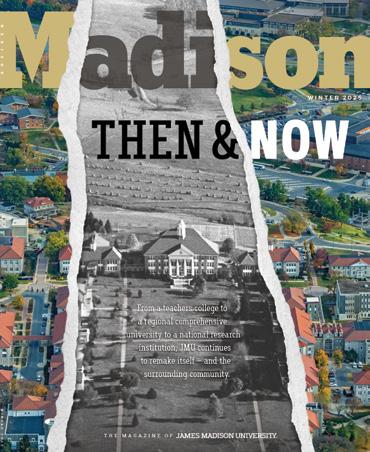
JMU researchers unearth evidence of Hernando de Soto’s 16th-century, quasimilitary campaign in rural Georgia PAGE 24
OF THE SHADOWS Intelligence Analysis students’ research earns global recognition PAGE 32
JMU researchers unearth evidence of Hernando de Soto’s 16th-century, quasimilitary campaign in rural Georgia PAGE 24
OF THE SHADOWS Intelligence Analysis students’ research earns global recognition PAGE 32

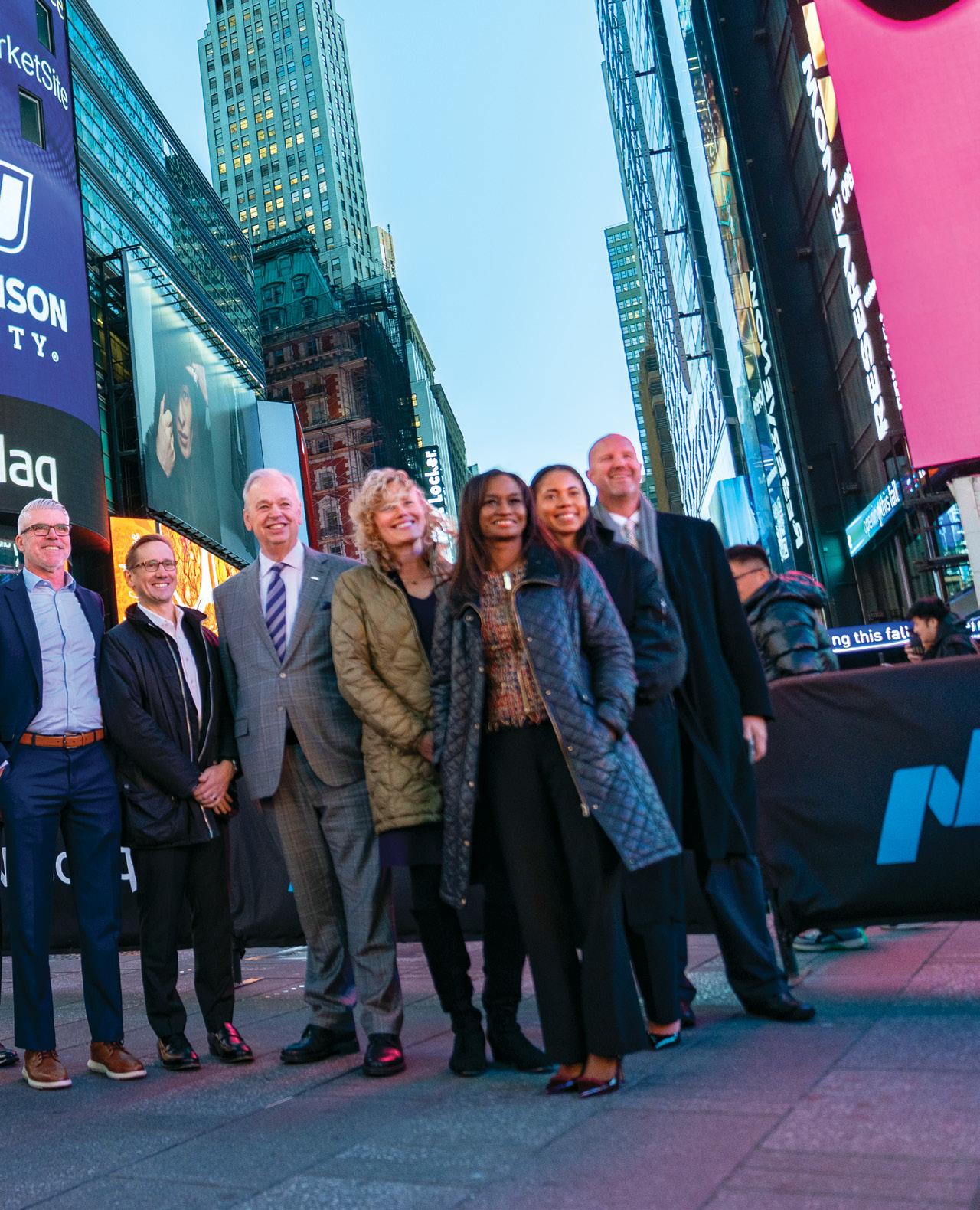
President James C. Schmidt and a company of Dukes gathered for a special event at the Nasdaq marketplace on Nov. 17. Hosted by David Lawn (’98), Nasdaq’s head of U.S. Market Operations, the group toured the stock exchange and were on hand for the closing bell.
Every so often, a moment arrives that reminds us just how far we’ve come and how far we can go. In November, James Madison University was named an Innovation and Economic Prosperity University by the Association of Public and Land-grant Universities. I couldn’t be more excited about what this means for JMU.
The IEP designation is national recognition that JMU is helping drive economic development, innovation and talent creation in ways that matter deeply to our region, our commonwealth and the country. Only 94 public universities — out of more than 1,800 in the U.S. — have earned this distinction, and to be counted among them is a powerful affirmation that JMU is stepping confidently into its role as a national research university.
This milestone arrives at exactly the right time. Also this past November, the JMU Board of Visitors adopted our draft strategic pillars, which will guide our work over the next decade. This vision is the product of months of listening, learning and gathering feedback from across the university, throughout the commonwealth, and up and down the Eastern Seaboard.
Our new vision is bold. By 2040, JMU will be nationally recognized for creating a new model of higher education, one that blends academic excellence, research strength, community partnership and student empowerment in new ways to prepare graduates for a future that will demand their innovation, energy and courage. This is no small undertaking. It calls on us to rethink what a public university can be and to lead with joy, audacity, and public purpose. I am utterly confident JMU is up to the challenge.
We will expand graduate education, strengthen interdisciplinary research, grow our research infrastructure and create centers of excellence that tackle society’s most pressing challenges. We will continue to be a place where undergraduates don’t just learn about discovery; they participate in it.
Third, we will foster partnerships that meet the needs of the Shenandoah Valley, the commonwealth and the nation. JMU will be Virginia’s preferred partner, connecting our talent, research and expertise with the industries, communities and organizations that are shaping our shared future. Whether it’s workforce development, rural health, education, sustainability or entrepreneurship, JMU will bring people together to solve real problems with real solutions.
Fourth, we will create an innovative campus community that supports next-generation learning, research and collaboration. To fulfill our vision, we must invest in spaces and practices that bring students, faculty and partners together in new ways — spaces that integrate living and learning, practices that spark creativity and strengthen our connections to each other. The campus of the future will be deeply connected and engaged with the greater community around it, and it will expand the reach and impact of our academic mission.
Our strategic plan begins with four initial pillars that reflect both our unique identity and our ambition.
To reach this vision, our strategic plan begins with four initial pillars that reflect both our unique identity and our ambition. These will undoubtedly shift and change as our Vision Teams engage with them, but an ambitious vision for our future is starting to take shape.
First, we will deliver a transformational student experience through the Madison Promise. The Madison Promise is our guarantee that a JMU education will prepare students with the power skills they need to succeed in a rapidly changing workforce: communication, collaboration, ethical reasoning, problem-solving and the ability to engage across differences. It commits us to giving students an experience rooted in curiosity, discovery and real-world learning, and it commits students to embracing the opportunities that define the Madison Experience. This is at the heart of who we are.
Second, we will chart a new path as a national research university. The IEP designation is only one sign of our momentum.
As this edition of Madison lands, Vision Teams are hard at work fleshing out action-focused initiatives guided by the pillars. As they do, I’m filled with gratitude for the people who make JMU exceptional: our faculty and staff, students, alumni, and families. Their contributions to our vision have been so important, because these pillars are more than strategic priorities. They are commitments to ourselves, our students, our partners and the public we serve. They represent the next chapter in a story that began long before any of us arrived at JMU and one that will continue long after we’re gone.
JMU, our moment is here. Our direction is clear. And the future we are building together is nothing short of extraordinary.
Go Dukes,
Dr. James C. Schmidt President, James Madison University
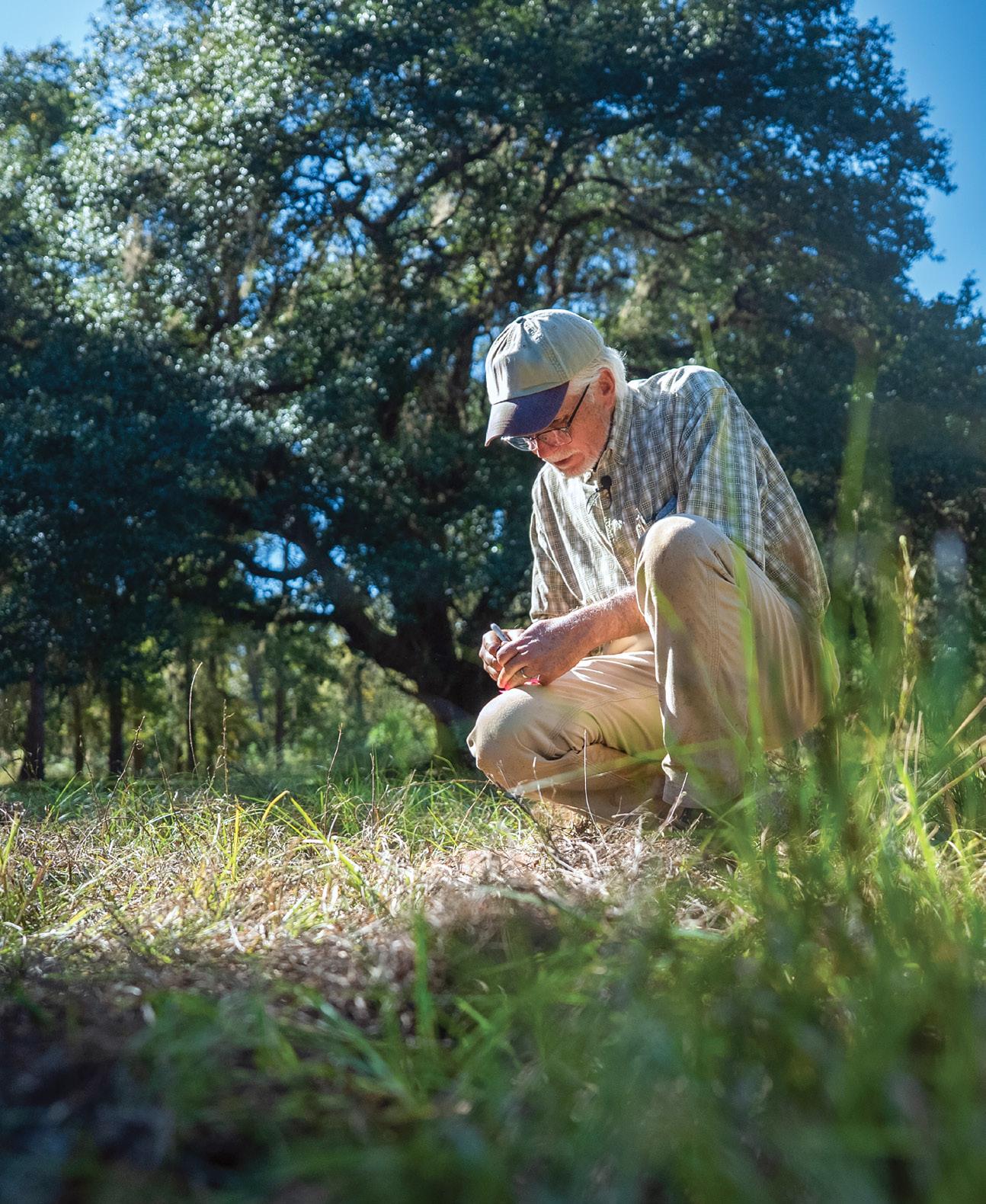
After nearly 20 years digging into the story of 16th-century explorer Hernando de Soto, anthropology professor Dr. Dennis Blanton and his team have unearthed a collection of artifacts in the remnants of a Native American village in Georgia
BY JOSETTE KEELOR
Giangiuseppe
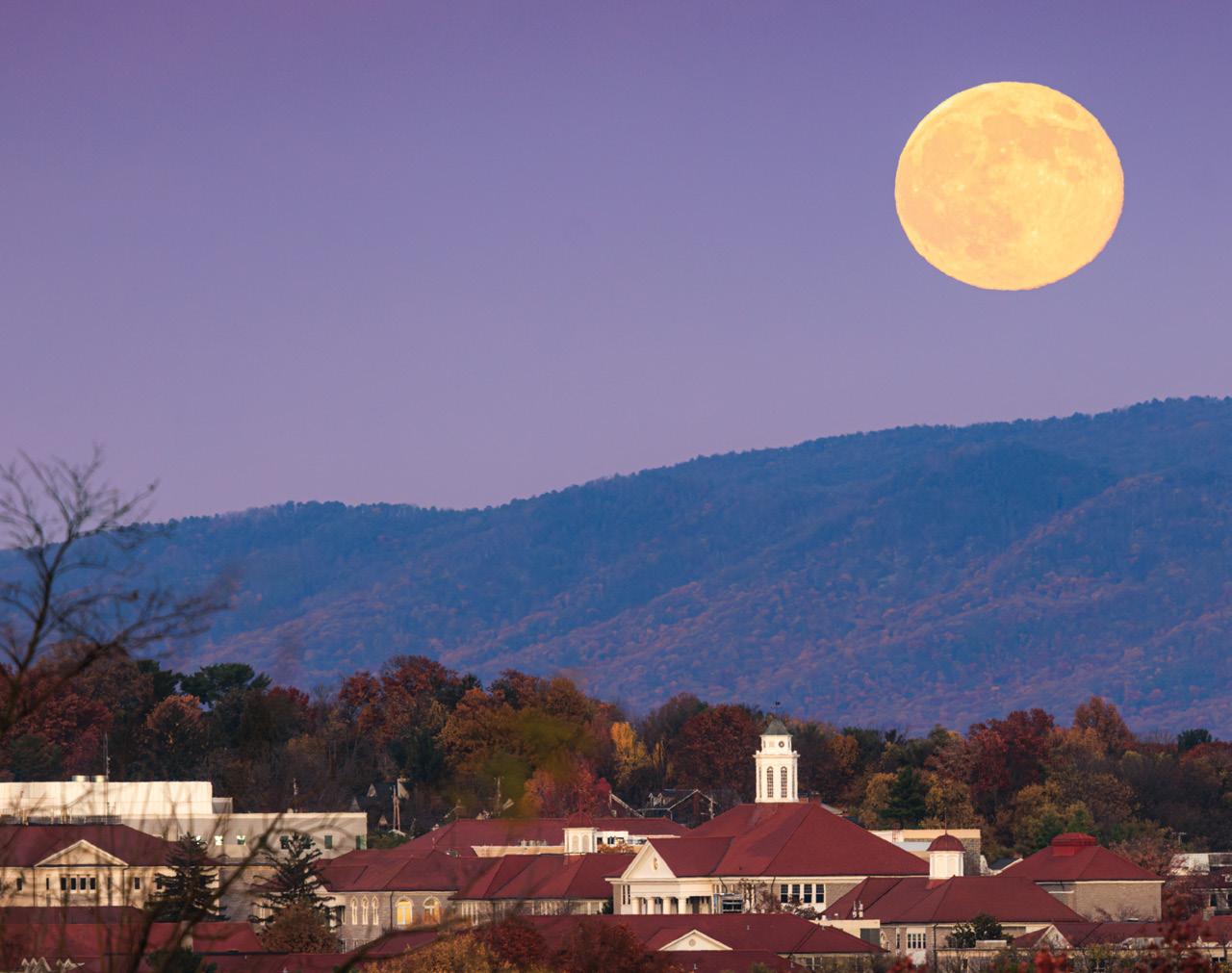
The beaver full moon reached peak illumination over a purple-and-gold campus on Nov. 5.
BY
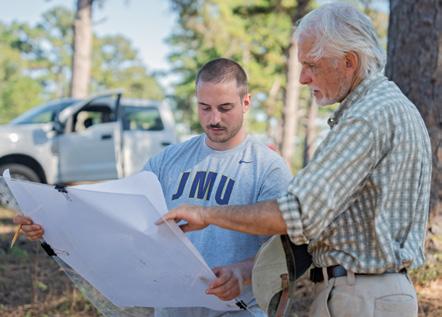
for 16th-century artifacts at Deer Run Plantation.
JMU recognized for innovation and economic prosperity with national designation; federal grant to build on Madison's leadership in civics education; strong showings in U.S. News , Niche reports; new first-generation student honor society
Spotlighting JMU professors and faculty members through the lenses of scholarship, awards and service
Forever Loyal Dukes make $1 million unrestricted gift; Women for Madison member Dr. Ebony Parker Waugh (’93) inspires women to lead with heart
Young Children’s Program expands preschool services; JMU senior invited to participate in summer medical research program in
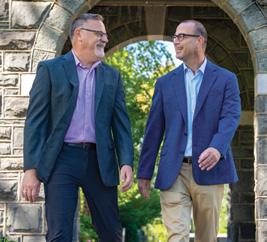
Alan Leffers (’87, ’90M), left, nicknamed JMU “Happyville” during his undergraduate years.
The evolution of the Dukes football program, from humble beginnings to the national
Chris Schroeder (’05) and Johnny Selman (’05) create
Homecoming 2025; John Lucas (’93) leads new medical school in Chicago; JMUAA president’s letter; alumniowned, small-business endeavors; Mixed Media;
Staff Emeriti
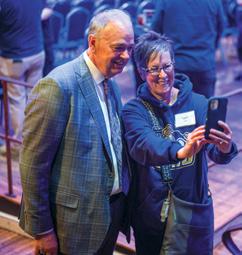
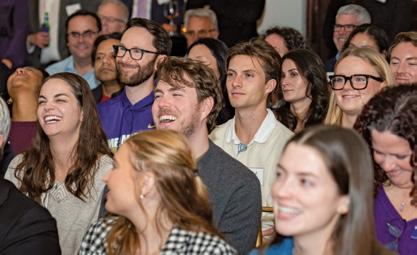
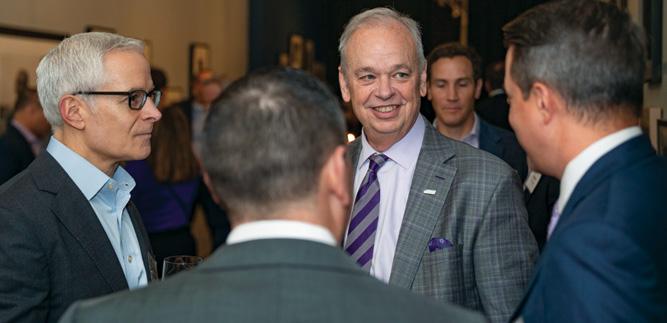
President Jim addresses ‘the head and the heart’ of
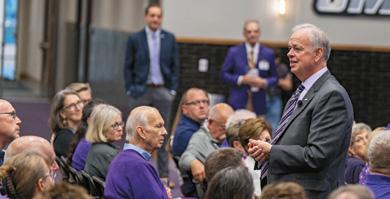
President Jim kicked off his Presidential Tour in September and traveled across the region and country, meeting alumni, parents, students and friends of the university to invite input for JMU’s next strategic plan. While the conversations included many bold new ideas, he made sure to reassure the JMU faithful that despite growth and evolution, maintaining JMU’s small-school culture and the “hold-the-door” ethos remains his top priority. Across the tour, his central message remained consistent: JMU should “dream big,” stay true to its community values, expand opportunities for all Dukes, and build a distinctive future through bold ambition, joy, audacity and public purpose.





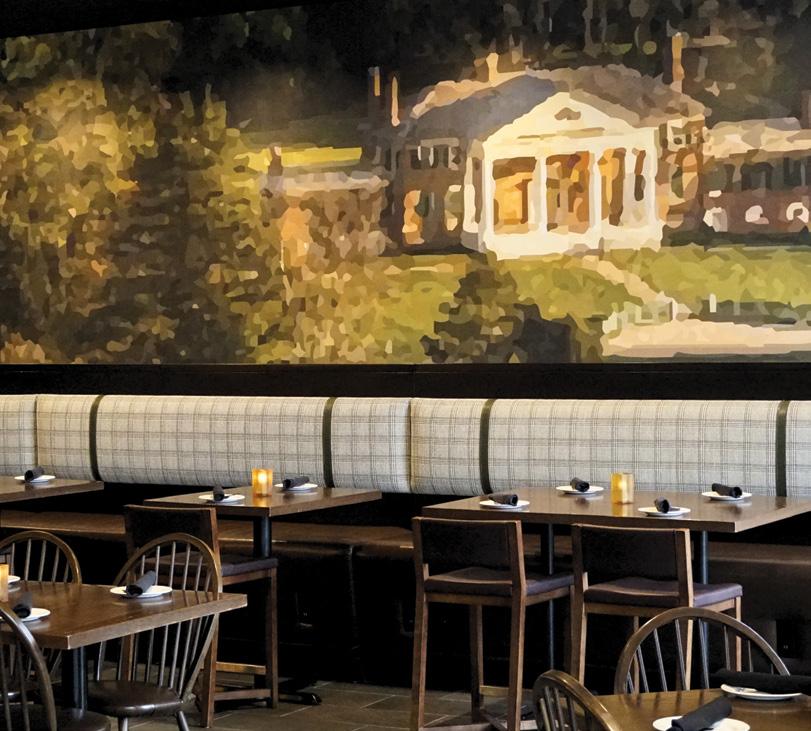
Inspired by the vibrant local scene and cherished guests, award-winning and JMU celebrity Chef Tassie Pippert (pictured) carefully crafted a Monty’s menu showcasing quality ingredients and dishes made from scratch. Each offers a familiar taste, elevated with a unique, modern flair, all served in a warm and inviting atmosphere.
■ Comfort food with a modern twist
■ Extensive wine collection

■ Great flavors, drinks & good company
■ Fun community happenings
BONUS: Private Dining Room available to reserve for your special events!
Walk-ins welcome; reservations suggested.
Stay on campus like you used to!
Sign up in the top menu of hotelmadison.com to receive:
■ 10% off our Standard Daily Rate
■ 20% off event space rental
■ Exclusive promotions
■ Priority access to hotelsponsored events
Winter Wine Weekend February 27-28, 2026
JMU Arboretum wedding package
Monty’s Restaurant
Menu by the one-and-only Tassie Pippert
Quills Lobby Bar live music
Schedule on our website
Grace+Main cafe
Specialty drinks, Neapolitan pizza & more!
WINTER 2026
Vol. 49, No.1
EXECUTIVE EDITOR
Andy Perrine (’86)
EDITOR
Jim Heffernan (’96, ’17M)
DEPUTY EDITOR
Amy Crockett (’10)
ASSOCIATE EDITOR
Josette Keelor
CREATIVE DIRECTOR
Bill Thompson
ART DIRECTOR
Carolyn Windmiller (’81)
DESIGN ASSISTANTS
Lea Dorcus
Georgia Pinkston
Kasey Thompson
EDITORIAL ASSISTANTS
Lillian Johns
Taylor Moore
PHOTO AND VIDEO TEAM
Steve Aderton (’19)
Rachel Holderman
Olive Santos (’20)
Cody Troyer
ATHLETICS PHOTOGRAPHY
Cathy Kushner (’87)
CAMPUS CONTRIBUTORS
Alumni Relations
Athletics
Donor Relations
Family Engagement University Marketing & Branding
FOR ADDRESS UPDATES:
Email: advancementgr@jmu.edu or call 1-855-568-4483
CONTACT THE MADISON STAFF: Email: madisonmag@jmu.edu or call 540-568-2664
Madison magazine, JMU, 127 W. Bruce St., MSC 3610, Harrisonburg, VA 22807
For Class Notes, go to http://alumni.jmu.edu Madison is an official publication of James Madison University and is produced by the Division of University Advancement for alumni, parents of JMU students, faculty, staff and friends of JMU.
Editorial office: JMU, 127 W. Bruce St., MSC 3610, Harrisonburg, VA 22807
NOTICE OF NONDISCRIMINATION AND EQUAL OPPORTUNITY:
James Madison University does not discriminate on the basis of age, disability, race or color, height or weight, national or ethnic origin, political affiliation or belief, religion, sex, sexual orientation, gender identity or expression, veteran status, parental status (including pregnancy), marital status, family medical or genetic information in its employment, educational programs, activities and admissions. JMU complies with all applicable federal and state laws regarding nondiscrimination, affirmative action and anti-harassment. JMU prohibits sexual and gender-based harassment, including sexual assault, and other forms of interpersonal violence. The responsibility for overall coordination, monitoring and information dissemination about JMU’s program of equal opportunity, nondiscrimination, Title IX and affirmative action is assigned to the Office of Equal Opportunity & Title IX. Inquiries or complaints may be directed to the Office of Equal Opportunity & Title IX: Amy Sirocky-Meck, Title IX Coordinator, 540-568-5219, http://jmu.edu/oeo, oeo@jmu.edu
(REVISED JANUARY 2020)
Ilike puzzles. Crossword puzzles. Code puzzles. Jigsaw puzzles. There’s something inherently gratifying in piecing together clues to come up with a missing word, crack the code or frame a bucolic scene. As humans, we’re wired to solve puzzles, especially ones that are just the right level of difficulty for us — not too easy, not impossibly hard but enough to make us want to lean in, focus and feel that spark of achievement. Puzzles also engage both sides of the brain — the left side, which focuses on logic, patterns and sequence; and the right side, which handles creativity, intuition and imagination. Of course, solving puzzles isn’t just a solo sport. Working on a puzzle as a group can be its own reward, helping build communication, teamwork and trust.
This issue of Madison features some of our best and brightest puzzle-solving Dukes. We begin with Dr. Dennis Blanton, an archaeologist and associate professor of anthropology who for nearly two decades has been on the trail of 16th-century Spanish conquistador Hernando de Soto’s encounters with Native Americans in what is now the southeastern United States. Madison first reported on Blanton’s work at a series of field sites in Georgia in 2016, not long after he joined the faculty. Blanton generously involves undergraduate students and sometimes alumni in his research. A group of JMU students was there when researchers unearthed a Venetian glass bead at one of the sites, offering early support for Blanton’s belief that Soto and his men had been in the region in 1540. And, in 2019, two Dukes found evidence of Soto’s presence within the remains of a Native American village. Now, after years of uncovering, cataloging and analyzing such discoveries, Blanton and his colleagues believe they



have found the first proven Soto encampment outside of Florida on a plantation near Albany, Georgia. Madison senior writer Josette Keelor’s captivating account begins on Page 24.
Not to be outdone, JMU Intelligence Analysis professors and students are solving some impressive puzzles of their own. Lynn Radocha (’18), director of marketing and communications for the College of Integrated Science and Engineering, writes about how IA majors under the direction of Dr. Giangiuseppe Pili are using satellite data, campaign modeling and open-source intelligence to track geopolitical behavior and emerging threats around the world. Examples of their analysis from the Spring 2025 semester include evidence of Chinese military exercises in the Taiwan Strait, how disappearing sea ice is making trade routes more accessible to Russia and China, and how Iran-supplied drones have shifted Russia’s battlefield strategy in Ukraine. The students’ research has been published, presented at national symposiums, and accepted by NATO-affiliated outlets and think tanks. Read the full story beginning on Page 32.
Digging in the dirt and digging through data are two sides of the same coin of discovery at JMU. The work is painstaking and at times frustrating. But Dukes don’t shy away from a challenge. And in so doing, we often succeed in uncovering truths about who we are as humans, where we’ve been and where we’re going. Go Dukes!
Good afternoon. The Fall 2025 Madison magazine was one of the best I’ve ever had the pleasure of reading! Ciara Brennan’s (’17) story on Lt. Col. Justin Constantine (’92) was incredibly moving and wonderfully written. Please share this feedback with the entire staff and keep up the fantastic work.
Always proud and always true, — Kyle (‘03) and Lindsay Payne (‘04, ‘06M), Huntersville, NC
I have two sons who are now JMU alumni, ’20 and ’25. The family magazine comes to my home, which works because one son lives just a mile down the road and the other is still here with us, for now.
I am writing to commend and congratulate you all on the magazine that you send out for Dukes’ families. I especially enjoyed this past fall edition. It was so wonderful to read all of the positive stories and amazing achievements of past and present JMU students. The Harrisonburg community is so
blessed to have such a wonderful university in their town.
I am a UVA grad, and if I am being honest, there are times that after just collecting my mail and seeing the front cover of the alumni magazine I receive from UVA, it cannot hit the garbage can fast enough. It has more ads for multimillion-dollar estates than content. The “content” is usually filled with biased political nonsense. Luckily, being a nursing school grad, I occasionally get a second magazine that helps keep me connected to my alma mater. (Not that it has been perfect, but definitely more tolerable).
“The world met Lt. Col. Justin Constantine (’92) after he survived a gunshot to the head while serving in Iraq. But his Madison family knew him long before, as a connector who drew people in by his dedication to empowering others.”
— Ciara Brennan ( ‘17)
Email letters and comments to madisonmag@jmu.edu or send by mail to: Madison magazine
MSC 3608, 127 W. Bruce St. Harrisonburg, VA 22807
It is my recommendation that you all keep the path in which you are on for your alumni to enjoy the magazines you send to them and for them to want to keep coming back to JMU for visits. I know my university has made it very difficult for many alumni to even want to come back to Charlottesville. It should not be that way … as the love I had for UVA is the same adoration and joy that both of my young men have for their days at JMU. In fact, my ’25 grad just enjoyed alumni weekend with many friends! So wonderful to go back to college and enjoy the “good ole days” with those you love and cherish! Wishing you all much success and happiness in your future endeavors. You are off to a great start at JMU and your efforts on the magazine. Extremely impressive and honorable work! All the best,
— Jenni Farber (’20P, ’25P), proud mom of two Dukes grads!
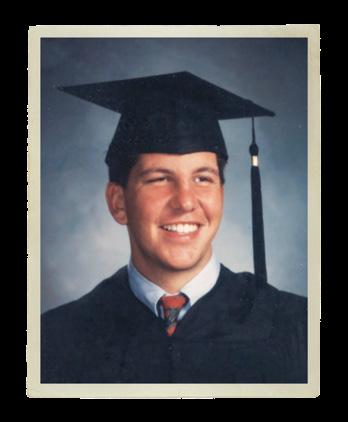
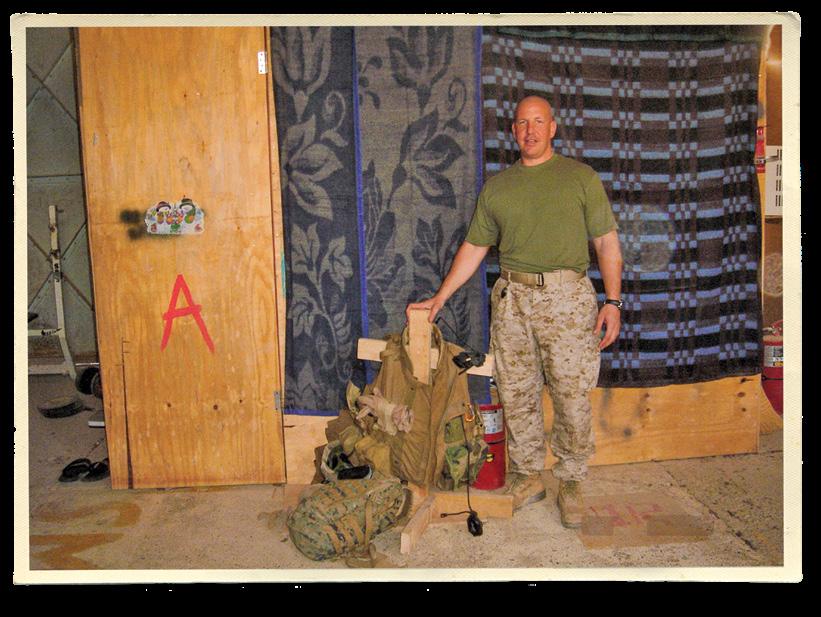
Lt. Col. Justin Constantine (’92) during a tour of duty in Iraq in October 2006; (inset): posing for his JMU commencement photo in 1992
WINTER 2026
Vol .49, No.1
BOARD OF VISITORS 2025–26
Suzanne Obenshain, Rector
Teresa “Terrie” Edwards (’80), Vice Rector
Jeff Bolander (’80)
Larry W. Caudle Jr. (’82)
Carly Fiorina
Tom Galati
Heather Hedrick (’00)
Kay Coles James
Joely K. Mauck (’90)
Dave Rexrode (’01)
Steve Smith (’79)
Michael Stoltzfus
Nikki Thacker (’11)
Jack White
Nicole Palya Wood (’96)
Sydney Stafford, Student Representative
Kathy Ott Walter, Faculty Representative
David Kirkpatrick, Secretary
PRESIDENT
Dr. James C. Schmidt
ADMINISTRATORS
Dr. David Kirkpatrick, Vice President, Chief of Staff
Jack Knight, Senior Assistant Attorney General & University Counsel
Dr. Bob Kolvoord, Provost & Senior Vice President, Academic Affairs (interim)
Dr. Nick Langridge (’00, ’07M, ’14Ph.D.), Vice President, University Advancement
Dr. Tim Miller (’96, ’00M), Vice President, Student Affairs
Towana Moore, Vice President, Administration & Finance
Matt Roan, Director of Athletics
Dr. Anthony Tongen, Vice President, Research, Econ. Development & Innovation
Melinda Wood, Vice President, Access & Enrollment
VICE PROVOSTS
Dr. Fletcher Linder (’86), Associate Provost for Online Strategy
Dr. Rudy Molina Jr., Student Academic Success
Dr. Elizabeth Oldmixon, Faculty Affairs & Curriculum
DEANS
Dr. Bethany Blackstone, Honors
Dr. Michael Busing, Business
Rubén Graciani, Visual and Performing Arts
Dr. Jeffrey Tang, Integrated Science & Engineering (interim)
Dr. Mark L’Esperance, Education
Dr. Fletcher Linder (’86), University Studies
Dr. Sharon Lovell (’85), Health & Behavioral Studies
Dr. Bethany Nowviskie, Libraries
Dr. Samantha Prins, Science & Mathematics
Dr. Nick Swartz, Professional & Continuing Education
Dr. Linda Thomas, The Graduate School
Dr. Traci Zimmerman (’92, ’94M), Arts & Letters
ALUMNI ASSOCIATION OFFICER
Ellen Hineman (’89), President
PARENTS COUNCIL CHAIRS
Brad and Tracey Martin (’26P)
Abigail Johnson is a senior Media Arts and Design major with a concentration in Journalism and a minor in Communication Studies. The Annapolis, Maryland, native works as a writing assistant in the Office of Alumni Relations. She loves staying involved on campus through Student Ambassadors and her sorority, Phi Mu. In her free time, she enjoys reading, writing and singing. Johnson highlighted four alumni-owned, small businesses on Page 40.
Georgia Pinkston is a senior Graphic Design major and Political Science minor. The Arlington, Virginia, resident also works as a design assistant for University Marketing and Branding. She is an active member of the honorary arts fraternity Kappa Pi and the marketing assistant for Iris Literature and Arts Magazine. Pinkston designed this issue’s By the Numbers on Page 48.
Khushi Rajkarnikar (’25) is a senior Economics major and Music Industry minor. Originally from Nepal and now based in Northern Virginia, she is a media relations intern for University Communications, where she writes media pitches and news stories with a focus on the College of Education. Rajkarnikar is also the founding president of the Nepali Student Association. She wrote about the COE’s Young Children’s Program on Page 17.

Sarahy Mora Rincon is a Communication Studies and Media Arts and Design double major at JMU. The Richmond, Virginia, native works as a media relations intern for University Communications. Rincon also serves as president of Club Gymnastics, where she helps lead the team and support its events and outreach. Her account of JMU senior Aubrey Grove’s medical research in New York City last summer appears on Page 17.
◆ Subscribe today to get Madison delivered to your home three times a year, every year.
◆ Don’t miss another issue.
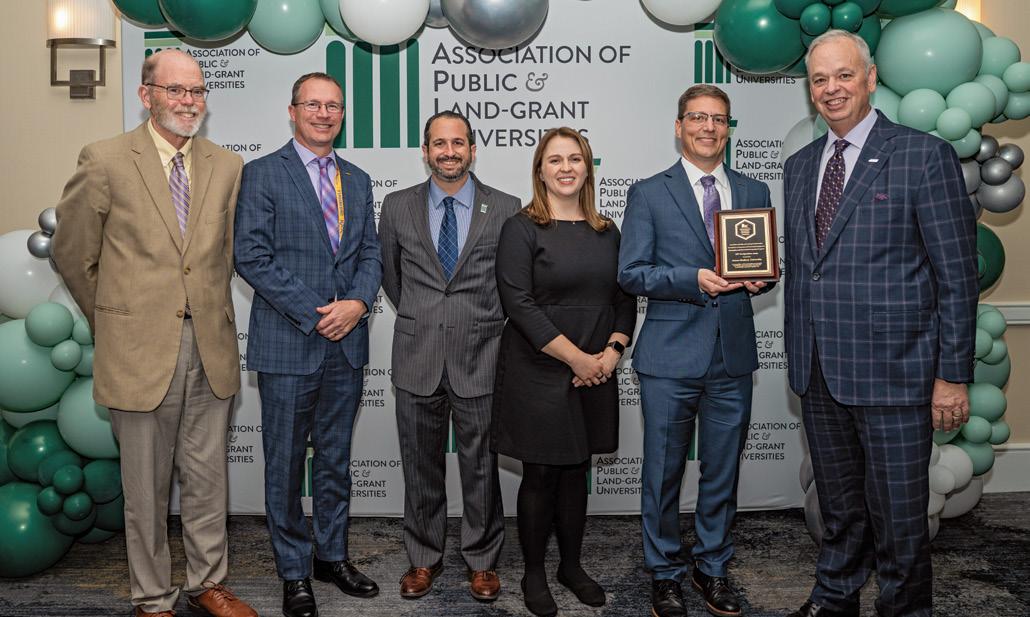
In recognition of JMU’s strong commitment to economic engagement, the Association of Public and Land-grant Universities has designated Madison as an Innovation and Economic Prosperity University.
The national designation recognizes public universities that collaborate with public- and private-sector partners in their states and regions to support economic development through various activities, including innovation and entrepreneurship, talent and workforce development, and community engagement.
The IEP designation acknowledges JMU’s deep commitment to building a stronger future for its region by working with public and private partners to prepare students for the workforce of the future, foster innovation and entrepreneurship on campus, and strengthen communities,
from local to global.
(L-R): Dr. Bob Kolvoord, Dr. Anthony Tongen, APLU's Alvaro J. Muñiz, Nora Sutton (’21M), Dr. Keith Holland (’00), President James C. Schmidt
“This designation is a powerful affirmation of James Madison University’s commitment to economic engagement and thriving community partnerships,” JMU President Jim Schmidt said. “It also places JMU among a national network of forward-thinking institutions and validates the collaborative work happening across our campus toward the common goal of community vitality.”
JMU earned this distinguished designation after a rigorous process, which involved a thorough self-assessment of its economic engagement initiatives that were enriched by valuable insights from external stakeholders.
■ Developing educated and enlightened citizens
Ninety-five percent of 2024 graduates report a positive career outcome. JMU also ranks high nationally for student voter registration and turnout.
■ Strengthening communities
JMU maintains longstanding partnerships that address health, education and cultural needs. Innovative K-12 collaborations and the College of Education’s launch of the Lab School expand academic and career opportunities.
■ Fostering creativity, innovation and entrepreneurship
JMU’s teacher-scholar model integrates teaching and research to support faculty and student growth. Innovation also thrives, especially in JMU X-Labs.
JMU has received more than $2.1 million from the U.S. Department of Education — one of the largest competitively awarded grants in the university’s history — to expand its national leadership in civics education.
The funding is part of a historic, $153 million federal investment in American history and civics education. It will support the work of grant recipient the James Madison Center for Civic Engagement, in collaboration with the College of Education and JMU CARE.
The funding, awarded through the American History and Civics Seminars Program, will support JMU’s efforts to deepen nonpartisan civic literacy and historical understanding among students and educators across the commonwealth and beyond.
Through this initiative, JMU will host a series of expert-led seminars focused on America’s founding principles, constitutional study and civil discourse. These seminars will be offered in collaboration with local school districts and community partners, providing immersive learning experiences rooted in understanding the nation’s primary documents through deliberative dialogue.
“There is a growing need for robust civic education in our country, and James Madison University continues to lead nationally in meeting that need,” said Dr. David Kirkpatrick, JMU vice president and chief of staff. “This grant will have an immediate impact across our region and will help shape civic understanding and engagement nationwide for years to come.”
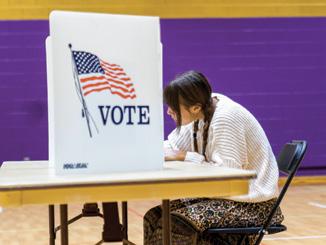
The Madison Center for Civic Engagement also serves as the campus lead for JMU’s Virginia 250/America 250 efforts.
“The James Madison Center for Civic Engagement has consistently demonstrated excellence in developing evidence-based, civic discourse training and skill-building opportunities,” said Aimee Guidera, Virginia secretary of education. “Their work is both timely and essential — providing pre-K-12 educators with the tools, training and coaching needed to foster meaningful deliberative dialogue in classrooms grounded in our founding documents. This initiative will empower teachers and students to engage in thoughtful conversations about America’s past and its future, especially as we approach the 250th anniversary of our nation.”
“As James Madison himself believed, deliberation is the cornerstone of democracy,” said Dr. Kara Dillard, the project’s director and executive director of the Madison Center for Civic Engagement.
“The national recognition makes JMU uniquely positioned to support students and teachers practicing the kind of democratic and deliberative talk that shaped our country 250 years ago.”
— DR. KARA DILLARD, director of the James Madison Center for Civic Engagement
“With America’s 250th anniversary on the horizon, we have a responsibility to ensure that young people not only learn about our history but also practice the skills of civic dialogue and democratic decision-making when shaping what they want our next 250 years to look like.”
JMU is also proud to partner with the National Issues Forums Institute, Montpelier, and local and national school districts to train the next generation of students in civic discourse and deliberation.
By
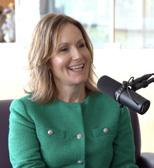
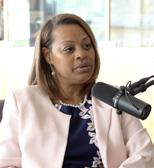
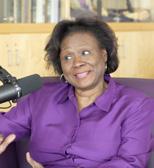
Her Story Podcast features conversation from some of JMU’s most impactful Dukes and alumni who’ve come together to share their experiences and insight from multiple walks of life.

MU continues to shine in national rankings, earning recognition in the 2026 edition of U.S. News & World Report “Best Colleges.” Now in its fourth year of being ranked among national universities, Madison is listed at No. 22 for Best Undergraduate Teaching. This ranking highlights the university’s commitment to high-quality instruction and student engagement.
The Sept. 23 report also ranks JMU No. 56 among Most Innovative Schools.
Those in the “National Universities” category offer a full range of undergraduate majors, plus master’s and doctoral programs. The rankings are based on in-depth analyses of a wide variety of data points. The 2026 edition evaluates more than 1,700 U.S. colleges and universities.
Other notable JMU rankings from U.S. News & World Report include:
Earlier this year, Niche recognized JMU for its vibrant campus life, ranking it: No. 29
Best Undergraduate Engineering Program (nondoctorate) No. 58
Best Undergraduate Nursing Program
Best First-Year Experience No. 8 Best College Campus in America No. 8 Best College Food No. 29 Best Student Life No. 98
JMMU has launched a chap ter of Tri-Alpha (Alpha Alpha Alpha), a national honor society recogniz ing the academic achieve ments of first-generation college students.
With this new chapter, Madison joins a growing network of institutions across Virginia and the nation that are committed to supporting first-gen students in their academic and professional journeys.
Tri-Alpha membership is by invitation and open to undergraduates and graduate students, faculty, and staff, who are the first in their families to complete a bachelor’s degree.
Scan to visit the JMU Tri-Alpha website and explore studentmembership opportunities.
Become a panelist at Madison Trust
adison Trust turns visionary ideas into REAL IMPACT. Panelists like you step into the boardroom as both philanthropist and decision-maker, evaluating bold faculty and staff pitches. As a donor, you’re not only giving—you’re helping decide which projects come to life.
Take your seat at the table on MARCH 13, and ignite innovation at JMU.
learn more & REGISTER
www.jmu.edu/give/ignite



Dr. Barron, professor in the Department of Psychology, and colleagues at the University of Virginia’s Motivate Lab created the Resilient Mindsets in Medicine program, partnering with the American Association of Colleges of Osteopathic Medicine to rethink medical education to improve student motivation, well-being and success. Their article, “Learning Mindsets and Well-Being and Ill-Being Among Osteopathic Medical Students,” was published in JAMA Network Open.
Ed Brantmeier
EDUCATION

Dr. Brantmeier, director of global engagement research and special projects for the College of Education, received the Provost Award for Excellence in Global Education. The award recognizes a faculty member who is dedicated to providing international and crosscultural learning experiences. His experience as a FulbrightNehru scholar in India formed an ethos based on cultural exchange that he incorporates into his teaching: “Those global, crosscultural, immersive experiences have the potential to multiply mutual understanding.”
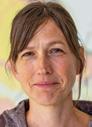
Dr. Brown, assistant professor of biology, leads undergraduates who are working with the Virginia Bluebird Society to glean insights from nearly two decades of citizen science collected. Their experience, “Unboxing Bluebird Nest Box Success,” was summarized in Birdbox, the newsletter for the Virginia Bluebird Society.

Dr. Kellogg, director of professional development for the School of Professional and Continuing Education, has co-authored a chapter in the new collection Shakespeare in the Age of Mass Incarceration. Her chapter, “Wasps and Falcons: Figurative Language and Teaching Shakespeare’s Women,” draws on her experience teaching in jails and prisons. The co-author of the piece, student Karrah Davidson, participated in one of those courses.
Dr. Knopp, associate director for graduate programs, and Dr. Corey, professor of nursing, were inducted as fellows in the American Academy of Nursing, honoring their impact on the profession.

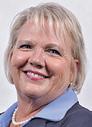
“It’s the highest award you can receive as a nurse,” Knopp said. Only a few nurses around the world receive this recognition. The induction ceremony was held in October at the AAN gala in Washington, D.C., following the AAN’s annual Health Policy Conference.
As fellows, Corey and Knopp will keep contributing to the nursing profession through research and advocacy, along with identifying and sponsoring new inductees.
Corey is coordinator for the graduate Healthy Policy certificate program. She teaches graduate nursing classes and has mentored nursing doctoral students.
Knopp, also a professor of nursing, has contributed to the profession primarily through international health-care work.
“For me at JMU, one of the reasons I’m here is because of the collaborative nature of our relationships, particularly in the School of Nursing.”
— DR. ANDREA KNOPP, professor of nursing
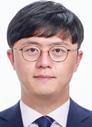
Dr. Lee, assistant professor of music theory, along with support from Dr. Seung Hee Han, was selected as the grant recipient of The Seed Program for Korean Studies, which is run and managed by the Academy of Korean Studies. As a result, JMU will be awarded approximately $210,000 in total from 2025-28. The program is a three-year, universitywide project to promote new courses, workshops, cultural and scholarly events, and student scholarships on Korean language and culture.

Dr. Piker, associate professor of communication sciences and disorders, and researchers in CHBS developed a method to diagnose balance disorders.
Piker’s team places electrodes on the skin around the eyes and neck of volunteers, then plays a stimulus through a bone vibrator. “This type of stimulus causes the skull to vibrate and gives us a detectable reaction from the muscles we placed the electrodes over,” Piker said. “The stimulus is more complex than what is typically used and allows us to make new kinds of measurements.”
Piker’s research could help address balance system changes that occur with health concerns like Meniere’s disease.

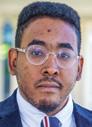
Dr. Sawyer and Dr. Wolfe, assistant professors in the College of Education, were honored with the 2025 National Technology Leadership Initiative Fellowship, presented by the Association of Mathematics Teacher Educators. Their paper, “Artificial Intelligence Chatbot as a Mathematics Curriculum Developer: Discovering Preservice Teachers’ Overconfidence in ChatGPT,” explores how future teachers use AI tools like ChatGPT to create and adapt math lessons.
Sawyer and Wolfe were inspired to study AI because of the rise of online tools, which make it easy for students to use AI-generated resources. They say students who rely on AI-generated resources aren’t challenged to think deeply while planning a curriculum and don’t question the AI’s content. Their solution was a unit that helps students critically evaluate AI-generated teaching materials.

Dr. Surrett, associate vice president for Career, Experiential Learning, Transitions and Accessibility, has been named a Fulbright Scholar. The honor, through the U.S.-Germany International Education Administrators Award, has allowed him to engage in an intensive, two-week seminar to learn about the host country’s education system and establish networks.
Surrett is also a faculty associate for study-abroad efforts and serves as the liaison to the Center for Global Engagement’s Global Advisory Council.
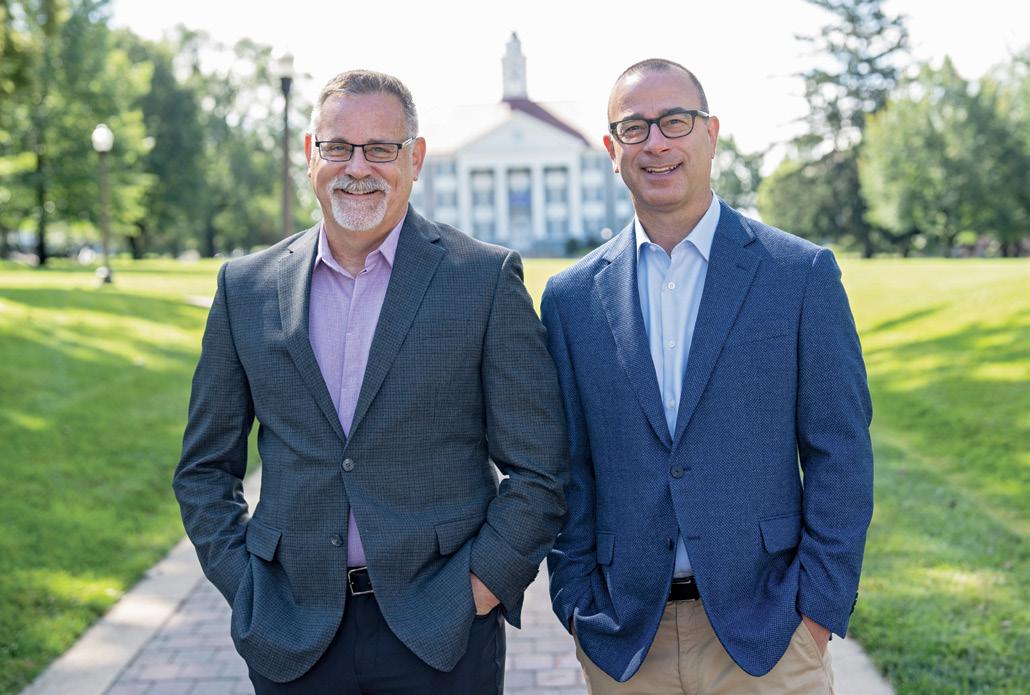
Dr. Alan Leffers (’87, ’90M) doesn’t think of his recent, $1 million planned gift as just a donation — it’s a vote of confidence in the people leading JMU and a way to fuel the university’s future in the most flexible, impactful way possible.
“I want the leadership of this institution to have the tools they need to do their best work,” said Leffers, who holds a master’s degree in Counseling. “Unrestricted giving says, ‘I trust you. Now go do something great.’”
For Leffers, a faculty member at the University of Virginia, and his husband, Michael Longo, giving to JMU has been a nearly 40-year journey of commitment. Together, they’ve supported 28 funds — from scholarships to student-success initiatives — and have been consistent contributors through every major campaign, including Diggin’ Dukes and Giving Day. However, this gift goes beyond any single fund or initiative — it’s about giving the university freedom to respond to whatever opportunities or challenges arise. “Unrestricted funds are where the real magic happens,” Leffers said. “They give the university the ability to be nimble and responsive. That kind of trust in the institution is essential.”
In the mid-1980s, Leffers affectionately referred to JMU as “Happyville.”
(L-R): Leffers and Longo have been making gifts across the university for almost four decades.
“I wasn’t that intellectually deep about my college search,” he said with a laugh. “I just knew JMU was the right fit and was a place I would be supported and able to grow.” The supportive campus atmosphere came from the very top; Leffers recalls seeing “Uncle Ron” — former President Dr. Ronald E. Carrier — around campus daily.
An on-campus job deepened his connections: “JMU was pivotal in shaping who I became, especially working the front desk in Warren Hall, which back then was like the prestige job,” he said. “It was the first time I really saw what it meant to be part of a tight-knit community where you were expected to contribute, to lead.”
He also worked at summer orientation, where helping nervous pa rents became a highlight. “They put me in the middle of the parent storm,” he explained, “and I got to deal with all the parents and answer all their questions. They all loved me, and I loved them. It was just amazing.”
“We go to JMU all the time. ... It’s still a Happyville and always feels like coming home.”
— MICHAEL LONGO
These experiences planted the seed for his 25-year career in student affairs and enrollment management at institutions in Massachusetts, New York and Pennsylvania. Leffers is now an assistant professor in UVA’s School of Education and Human Development, teaching graduate students who are preparing to shape higher education themselves. His areas of expertise include higher-education law, collegestudent retention, strategic planning and higher-education finance.
Living in Charlottesville makes it easy to visit Happyville, according to Longo, who works as a hospitalist at the Augusta Medical Center. “We go to JMU all the time. We drive over for football games and farmers markets — it’s still a Happyville and always feels like coming home.
“I didn’t attend as a student, but I enjoy being part of something that’s so meaningful to Alan. I’m incredibly proud of Alan, his commitment to JMU, his generosity.”
Leffers’ first gift to JMU came the same year he graduated. “I don’t recall that exactly,” he said with a grin. “I didn’t have two pennies to put together, so maybe it was just five dollars, but I do remember I felt like it was important to be grateful.”
But his $1 million gift isn’t just about gratitude for his own Madison Experience. “Now it’s also a commitment to new Dukes. I believe in the school and the people leading it, which is why I put my gift into the unrestricted fund. I know JMU’s leaders will use it where it’s needed most, and that they’ll keep the spirit of Happyville alive for the next generation.”
— Jamie
Marsh
When Dr. Ebony Parker Waugh (’93) first laid eyes on the Quad, she didn’t know if JMU even offered a nursing degree. But that didn’t matter. She knew something deep in her heart: This was where she belonged.
“I saw this campus and said, ‘Oh, I’m coming here.’ I didn’t know if JMU had my major or not, but I was coming here,” she said. And she never looked back.
A first-generation college student from Baltimore, Maryland, Waugh calls JMU her forever home. “I came here as a young girl who had already faced so many challenges. But this campus became my launching pad — the place where I found my courage, my voice and the confidence to dream bigger than I ever imagined.”
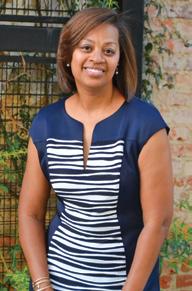
Dr.
In the School of Nursing, Waugh joined the largest cohort in program history at the time — 44 students who would learn from a faculty she describes as “small but mighty.” These teachers didn’t just prepare students to pass tests; they taught them to care deeply, with empathy and strength.
“Dr. Vida Huber led the department, and her heart was enormous,” Waugh recalled. “She showed us what it means to serve, to care and to never forget the humanity in every patient we touch. That helped shape the nurse — and the woman — I became.”
More than three decades later, Waugh’s story has grown into something bigger
than herself. After earning her doctorate, she decided to teach, guiding new generations of nurses to see their potential. And now, as the leader of EPW Consulting, she coaches women to step into their confidence, embrace their purpose and walk boldly in their power.
“I’ve taken care of women at some of the most vulnerable moments of their lives,” Waugh said. “And I realized I could take that same care and attention — that same love — and help women discover their own light.”
Earlier this year, Waugh shared that light at the 2025 Women Who Amaze Summit, speaking to a room of women gathered to celebrate leadership, courage and their connection with JMU. She encouraged them to embrace lifelong learning, honor their stories and remember their dreams are meant to be lived — not just imagined.
JMU.
No matter where life has taken her — as a nurse, an educator, an entrepreneur, a mentor and a mother — Waugh always comes home to Madison. “When I come back, I feel like I’ve returned to a place that holds my roots and my wings,” she said.
Her advice for the next generation? “Your undergraduate years are a canvas. Paint boldly. Take risks. Fall in love with what you’re creating, and let JMU become a place that lifts you up. It certainly did that for me.”
— Jamie Marsh
“Dr. Vida Huber showed us what it means to serve, to care and to never forget the humanity in every patient we touch.”
— DR. EBONY PARKER WAUGH (’93)
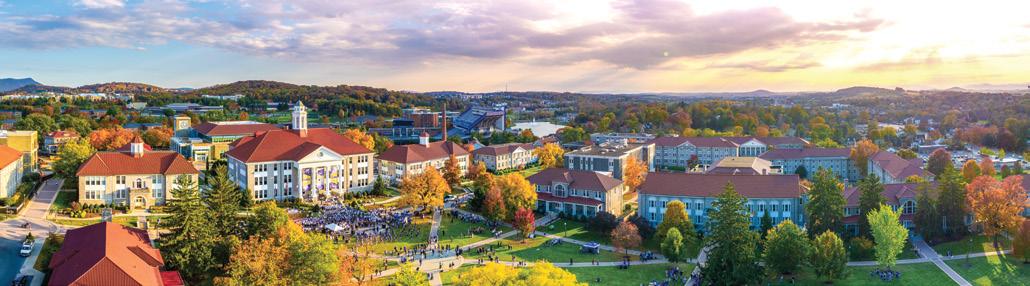
As the first recipient of the landmark Frances Weir (’49) Scholarship Endowment to graduate from JMU, Abigail Killmon (’25) is already putting that opportunity to work in the field of physical therapy.
When Killmon arrived at JMU four years ago, she and her freshman roommate made a bold pact: join every club that sounded interesting at Student Org Night.
“We signed up for everything,” Killmon said with a laugh. “Any club that sounded remotely interesting, we put our name down. It was like, ‘We’re just going to do it all.’”
That mindset led Killmon to a deeply involved Madison Experience — one she says was made possible by the Frances Weir Scholarship. In 2023, Col. Frances Weir (’49), a retired officer in the Women’s Army Corps, bequeathed her $6 million estate to JMU exclusively for scholarships, providing approximately $240,000 annually in perpetuity.
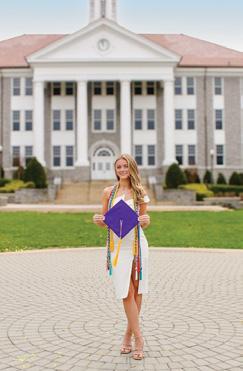
A Kinesiology major from Onancock, Virginia, Killmon received the scholarship to cover all four years thanks to Weir’s decision to start the endowment before her passing. Now the first recipient to graduate from JMU, Killmon says the award opened countless doors. “It allowed me to fill my schedule with everything JMU had to offer,” she said. “Without that financial support, I couldn’t have done it all.”
“Having the scholarship helped so much. It allowed me to fill my schedule with everything JMU had to offer.”
– ABIGAIL KILLMON (’25)
Killmon’s commitment to helping others has shaped her studies and her career path. After graduating in May, she began working full time in the Physical Medicine and Rehabilitation Department at MedStar Georgetown University Hospital, where she’s gaining hands-on experience in neurological physical therapy under the mentorship of Lisa Ebb-Chesky, inpatient physical therapy clinical leader. “She’s shared her knowledge of patient care and neurological conditions, and given me the opportunity to shadow her and other clinicians,” Killmon said.
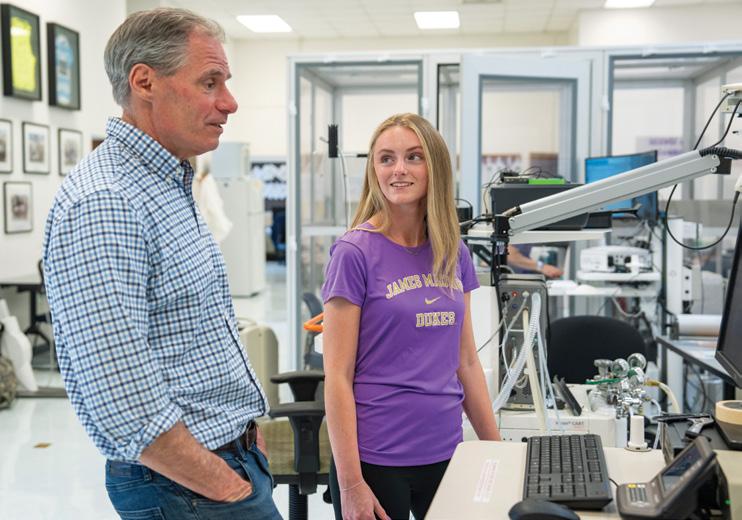
This experience is preparing Killmon for her next chapter — pursuing a Doctor of Physical Therapy degree. She has already been accepted into programs at Virginia Commonwealth University and Shenandoah University.
Reflecting on her time at JMU, Killmon says the scholarship and kinesiology department instilled in her the confidence and compassion that now guide her work. “My professors’ dedication and the scholarship’s support shaped my growth and my outlook,” she said. “Those lessons continue to influence how I show up every day — with confidence, curiosity and kindness.”
As the first graduate of the Frances Weir Scholarship, Killmon is already living out the legacy of opportunity and impact that the scholarship was meant to inspire — making the most of every moment.
— Ciara Brennan (’17) and Jamie Marsh

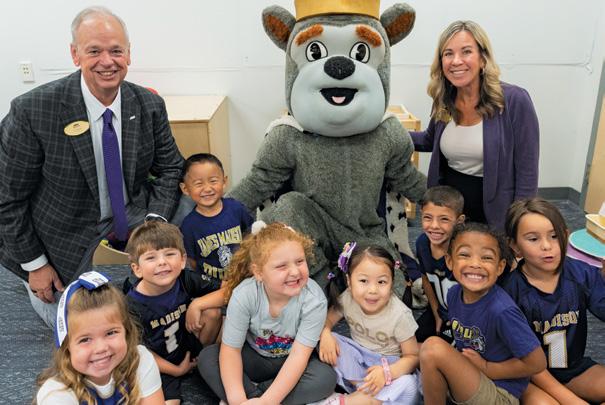
JPresident Jim, Duke Dog and Amy Taylor celebrate the YCP’s grand opening.
MU’s Young Children’s Program opened a new space in Memorial Hall this past year, expanding its preschool education services. This new location is an addition to the YCP’s existing space in AnthonySeeger Hall. Now, the program operates across both locations, serving children ages 2 to 5 years old at Anthony-Seeger and 3 to 5 years old at Memorial Hall, with an infant and toddler wing expected to open soon.
The YCP, which operates under the College of Education, strives to provide highquality teaching, research and outreach that foster lifelong learning. Its goals are to encourage self-regulation, independence and healthy social interaction while enhancing motor skills, critical thinking and informed decision-making. Overall, the program aims to support well-rounded personal and intellectual growth among young learners.
“This new space allows us to further extend our work with children and expand hands-on training for future educators,” said Amy Taylor, YCP program director. “It’s exciting to see the growth of the YCP and to think of all of the future possibilities.”
The YCP also includes observation rooms attached to four classrooms with oneway windows, cameras and microphones; these features allow JMU faculty and students to conduct research and collect data without disrupting the class environment, further strengthening YCP’s connection to the university’s academic community.
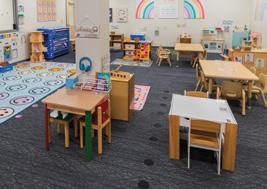
This past fall, Dr. Rachel Grimsby, assistant professor of music education, led the first research study conducted in the new YCP space, alongside COE associate professors Dr. Maryam Sharifian and Dr. Chelsey Bahlmann Bollinger, and consulted by Dr. Julian Knight, a former Fulbright Scholar-in-Residence at JMU who led a similar study in the U.K. The 12-week study explores how weekly music activities influence language development and early literacy skills in preschoolers. The research also promotes interdisciplinary collaboration.
— Khushi Rajkarnikar (’25)
Aubrey Grove studied energymaking process in cells in New York City last summer
AJMU student was chosen to complete medical research in a highly competitive program at Albert Einstein College of Medicine in New York City.
Senior Aubrey Grove, a Health Sciences major, studied how the energy-making process in cells, known as mitochondrial respiration, influences the behavior of vascular smooth muscle cells. These cells can “switch” their roles when under stress from conditions like atherosclerosis, heart attacks or coronary artery disease. Grove’s work focused on altering certain genes to better understand why these changes happen and how they contribute to cardiovascular disease.

The undergraduate program took place in the college’s Department of Developmental and Molecular Biology and the Wilf Family Cardiovascular Research Institute. Grove was one of 15 students selected from a pool of more than 700.
“I grew a lot this summer in simply believing that I could do the hard science that I was so nervous about,” Grove said.
— Sarahy Mora Rincon
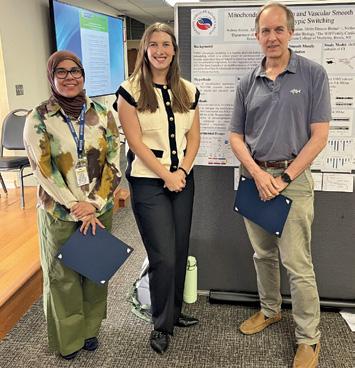
Senior Aubrey Grove presents her research, “Mitochondrial Respiration and Vascular Smooth Muscle Cell Phenotypic Switching,” at the AECM in the Bronx, New York City.
ABY KEVIN WARNER
(’02), associate athletic director for communications and strategic initiatives
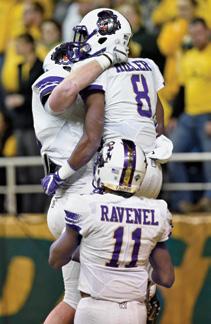
t his introductory press conference Dec. 17, 2018, JMU head football coach Curt Cignetti was asked why he chose to leave a playoff-caliber, Football Championship Subdivision school in Elon University to head to a conference rival still at the FCS level. His response?
“There’s only one JMU.”
Cignetti saw what we, the members of JMU Nation, have known for five decades. You can accomplish the unimaginable at Madison. Each step of the way, the Dukes have checked boxes no one thought possible:
■ A Division I-AA national title in 2004
■ The only school to win a I-AA/FCS national title entirely on the road
The football program evolved from Division III to I-AA, and opponents like Hampden-Sydney and Randolph-Macon were replaced by Yankee Conference traditional powers like UConn, UMass, William and Mary, Richmond, and Delaware. As the league evolved to the Atlantic 10 Conference and then the Colonial Athletic Association, JMU occasionally appeared in top 25 polls and made sporadic postseason appearances, but was not a consistent power.
“There’s only one JMU.”
— CURT C IGNETTI
■ The only nonpower-conference school to host three ESPN College GameDays
■ The first school to break the North Dakota State machine and win in the Fargodome (and the only one to do so until Dec. 6)
■ The first school since 1999 to play a full Football Bowl Subdivision schedule in year one
■ The most wins by a program in each of its first two years of FBS reclassification
■ A 40-10 record during its first four years at the FBS level
■ A College Football Playoff berth in 2025
“There’s only one JMU.”
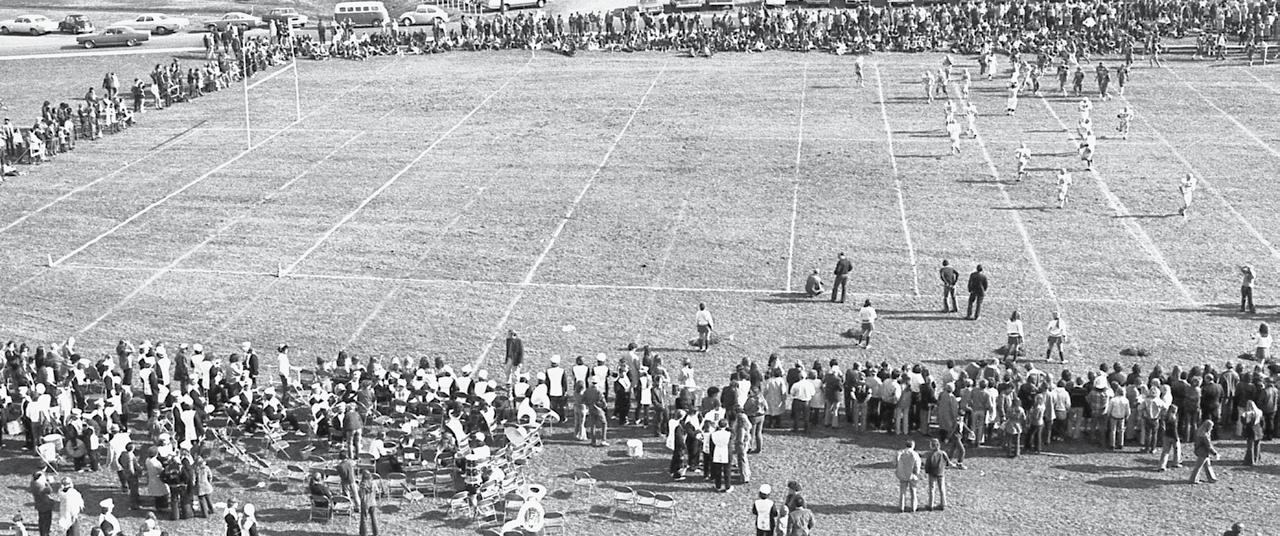
Around 1970, Madison College envisioned men’s sports as a key strategy to transition a women’s institution to co-ed. Class registration lines were used to recruit members of the first football team, and the first games were played on a paint-lined grass field with fans in folding chairs.
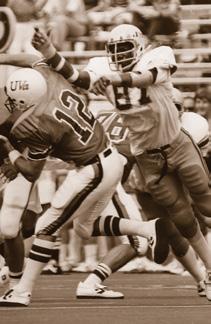
Yet, the growth continued. Players like Charles Haley (’87), Gary Clark (’84) and Scott Norwood (’82) proved that good talent could originate from “little James Madison,” as the late John Madden used to quip.
In 1999, a guy named Mickey Matthews entered the picture as the new head coach. In his first season, JMU shocked the Atlantic 10 by capturing a league title with a senior-dominated team. Behind the scenes, leaders like former Presidents Dr. Linwood Rose and Charlie King, as well as former Athletic Director Jeff Bourne, aligned on a vision of how athletics could reshape a growing, regional university. The build was slow. Matthews had to fix roster composition issues. In the 2003 home finale, fans chanted for his exit. But the administration stuck with his rebuild. JMU finished 6-6 and has not had a losing season since.
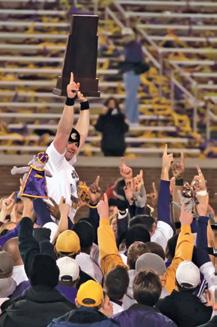
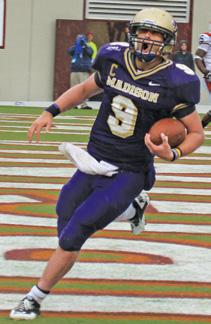
Godwin Field hosted Madison‘s first football game in 1972. (Insets, L-R): Charles Haley (’87) was a force at JMU and during his NFL career. Fans celebrated with QB Matt LeZotte (’05) as I-AA national champs in 2004. Drew Dudzik (’10, ’11M) scored the gamewinning touchdown as JMU upset Virginia Tech in 2010. The Dukes stunned North Dakota State in the Fargodome in 2016.
In 2004, JMU emerged on the scene as a national champion, an improbable run that saw the Dukes win three straight true road games before upending I-AA power Montana in Chattanooga, Tennessee. As fans jumped the high wall at Finley Stadium, clumps of turf clinging to their shoes, the bar had been raised.
Sometimes timing is providential. The title aligned with the opening of a dedicated football support building. And plans fast-tracked to expand Bridgeforth Stadium from 15,000 to 25,000 seats.
JMU remained near the top of I-AA/ FCS through 2008 but was upset as the top seed that year by Montana in the first home semifinal game. The Dukes started to fall back slightly in the national discussion. In 2013, the school made the difficult decision to replace a Hall of Fame coach.
In stepped Everett Withers to bring some juice to JMU football, along with an electric former Atlantic Coast Conference starting quarterback in Vad Lee (’15).
Lee and the Dukes made noise early in the season, including an energizing win at SMU, and attracted a rare FCS visit by College GameDay. The college football world learned more about a hidden gem in Virginia’s Shenandoah Valley.
In 2016, Withers left for Texas State, a nd Mike Houston took the helm. He brought a hard-nosed toughness to the Dukes with memorable locker-room speeches. JMU won a CAA title and earned a high seed for the postseason. The reward was a semifinal trip to North Dakota State, where no one had ever won in the postseason against the five-time defending national champions. But QB Bryan Schor (’18) and the Dukes did the unthinkable and followed with the school’s second national title.
JMU was solidified as a national power. Murmurs spread among fans questioning if JMU should move up a level to FBS, but the school was steadfast that it would not move unless the opportunity was set up for sustained success.
Houston’s Dukes reeled off 28 straight victories, falling in a return trip to the national championship in 2017. After

2018, Houston left for East Carolina. Enter Curt Cignetti, a football lifer who saw a rare opportunity to lead a special program, even turning down Group-ofFive FBS offers to be the JMU coach. Cignetti’s Dukes were consistent FCS semifinalists and top-five ranked.
In the summer of 2021, conference realignment kicked into high gear. JMU’s patience in waiting for the right opportunity paid off with an invite to the geographically aligned Sun Belt Conference. JMU reunited with many former peers that made the move to FBS before the Dukes.
Folks wondered how JMU would do leveling up. JMU immediately played 10 FBS opponents and beat seven of them to finish 8-3. In 2022, the team started 5-0, and in year one found itself nationally ranked by the Associated Press.
The following year, JMU started 10-0 to climb as high as No. 18 in the AP poll and drew its third College GameDay visit, as fans and media alike clamored, “Let us bowl!” The rules didn’t account for a team that had transitioned unlike any other team in college football history, so a New Year’s Six Bowl was not to be. Instead, the Dukes made their first bowl appearance in the Armed Forces Bowl.
To their credit, Indiana recognized something unique in Cignetti, and Bob Chesney entered the picture for JMU’s first
fully reclassified season in 2024. A new athletic director also entered the mix in Matt Roan, following Bourne’s retirement. So much change, but the winning continued. With a completely depleted roster, Chesney reloaded and led JMU to a 9-4 season and its first bowl win in the Boca Raton Bowl.
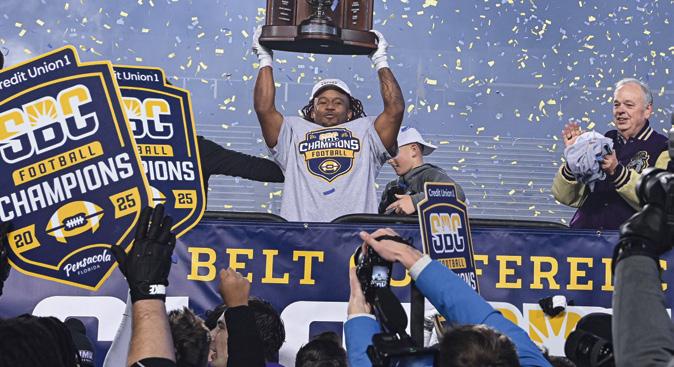
JMU entered 2025 predicted to win the Sun Belt and with some discussion of national impact. With a quarterback coming off a significant nine-month injury, the Dukes hung tough with Louisville but couldn’t finish the victory. But then JMU reeled off 11 straight victories to earn national rankings for the third time in four FBS seasons, capturing its first Sun Belt Championship.
JMU finished as one of the top five conference champions, higher than any teams in the ACC. Hello, College Football Playoff.
Even as the program anticipates another coaching leadership change, all signs point to raising the trajectory and profile even further under new coach Billy Napier. JMU is 40-10 in four seasons at the FBS level, an unprecedented debut at the sport’s highest level.
Success is not new at Madison, a community that never saw perceived barriers as limitations to what could be possible. Now, college football knows that, too.
“There’s only one JMU.”
BY LILLIAN JOHNS
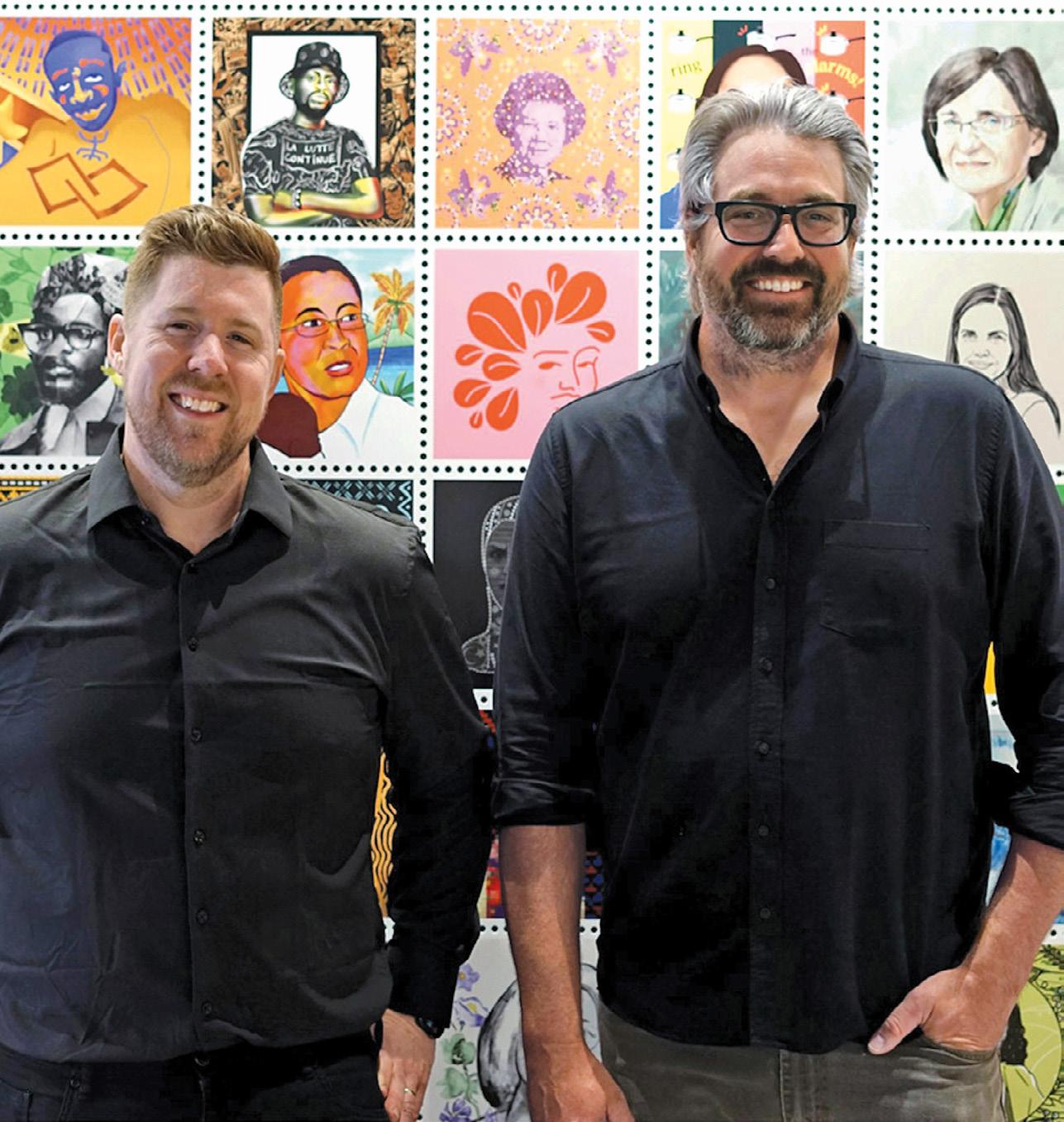
At the Brooklyn-based design studio Selman, Chris Schroeder (’05) and Johnny Selman (’05) are reimagining the postage stamp through their international, award-winning art collection, Peace Post.
The digital stamp collection aims to “shine a light on some of the individuals who stand against injustice and advocate for peace” around the world by “featuring portraits of these heroes, one from each sovereign nation,” according to Peace Post’s homepage.
“The whole idea behind Peace Po st is communication, and stamps are really symbolic of communication,” Schroeder said. “Also, they have a rich history of showcasing heroic people and peacemakers. So, we wanted to embrace that a little bit, and in doing that, level the playing field.
“It was largely done in-house for the first few years,” Selman explained, “and then we gradually started to commission out illustrations to different folks, and a lot of those illustrators were from the country that the advocate was from.”
Over its first eight years, Peace Post successfully collaborated with more than 100 artists from all corners of the world.
“It’s not just Mother Teresa and folks of that status, but also local heroes and advocates from smaller nations who are less known and doing equally as important work.”
“It’s not just Martin Luther King Jr. It’s not just Mother Teresa and folks of that status, but also local heroes and advocates from smaller nations who are less known and doing equally as important work in their communities and in their countries.”
— CHRIS SCHROEDER (’05)
Peace Post launched in 2016 as “a mountain of a project” — 198 portraits representing 198 countries, Selman said.
“It kind of has this bigness, and it has an educational component,” he said. “You’re researching different advocates from each country. You’re learning about the country itself. You’re learning about the artistic traditions of the country. And it’s a wonderful, creative exercise to try and interpret and represent these advocates — that was the beginning of it.”
Originally, Peace Post was set to finish in four years, but as the scale of the project and the extensive research involved became clear, the timeline was doubled.
“We would do a lot of research and try to come up with a few advocates that we felt were worthy of inclusion in the project,” Schroeder said. “With the ones we were doing ourselves, we made a choice based on the research and discussion within our team. But we found that when we would reach out to an artist from that country, it was nice to present them with options and ask for suggestions.”
Each new installment in the co llection demands a hands-on approach that involves stepping away from the computer and working with art supplies in the company’s production room. “One of the things we wanted to do was be inspired by the art of the [advocate’s home] country,” Selman explained. “It wa s a really rich kind of process. … I just think that’s a wonderful way to connect to a medium and the story in a more tangible way.”
The decision to display the art in postage-stamp form also ca rries a design benefit — an element of cohesiveness.
“We knew that this was going to be almost 200 illustrations that aren’t really connected by any sort of co lor palette or style or medium,” Selman said. “So, we needed to have a common through line through all of them, and the stamp border kind of does that. From the very beginning, you see it and you relate it to the project.”
(L-R): Chris Schroeder (’05) and Johnny Selman (‘05) are the creative force behind the award-winning Peace Post collection of portraits.
The Peace Post collection is immortalized and widely distributed online, but has also made several in-person appearances at various exhibits.
The International Peace Museum in Dayton, Ohio, hosted Peace Post’s exhibit premiere. While in Dayton, the team also partnered with a local school group on its inaugural workshop, challenging students to create their version of the stamps and showcasing what peace means to them. Participants of each showcase were gifted a hardcover book providing supplementary information about the Peace Post art.
Since then, Selman and Schroeder have hosted workshops back home at the Brooklyn Public Library and elsewhere around New York City, and hope to host more exhibit displays. When the art is not on display, it
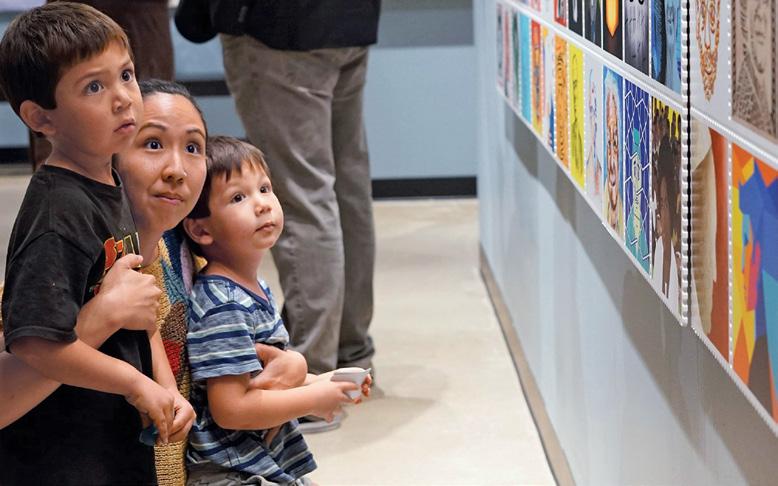
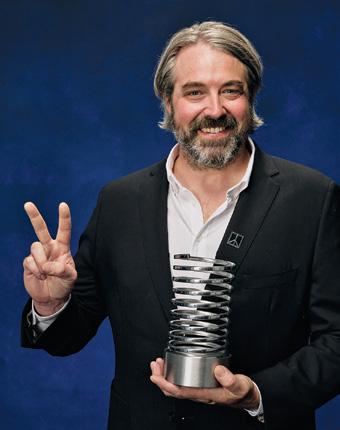
A family admires the Peace Post exhibit at its premiere in the International Museum of Peace in Dayton, Ohio. (Below): A selection of Peace Post portraits; (inset): Johnny Selman (‘05) accepts the Webby Award for Best Cultural Website.
is housed in the Selman studio, built to assemble and disassemble with ease as it travels from museums to schools to libraries.
In May 2025, Peace Post won a prestigious Webby Award, which honors excellence on the internet. Nominated in the category of Activism Websites and taking home the win in the category for Cultural Blog, Selman and Schroeder expressed their gratitude. “The Webby was a huge honor, because we’ve worked on this for eight-plus years. We’re learning a lot, and we hear from people that they’ve gained

a lot from the project, but to get this kind of affirmation of your efforts is time well spent,” Selman said.
To further add to the achievement, they received a People’s Voice Webby, which is chosen by the public, independent of the Webby’s executive judges. “I think that’s just the highest honor, honestly, because this project, from conception, was always based online. That is where, globally, you can connect to the most people,” he said.
“One of the things we wanted to do was be inspired by the art of the [advocate’s home] country. … I just think that’s a wonderful way to connect to a medium and the story in a more tangible way.”
— JOHNNY SELMAN (’05)
As for what’s next for these JMU classmates, completion of the Peace Post collection and their growing recognition has opened the door to further collaborative efforts. Through new partnerships, they plan to facilitate more focused discussions on regional peace activists.
In October, the exhibit and workshops came to Selman’s hometown of Martinsville, Virginia, where art students from Martinsville High School researched advocates and artistic traditions. “The cool thing about this is it was more regionally focused on advocates, and then the goal ther e was to display their peace posts along with our exhibit at the Piedmont Arts,” Selman shared.
Similarly, in Richmond, Virginia, they a re partnering with the nonprofit Art 180 that will focus on the Jackson Ward neighborhood, a community negatively impacted by the construction of Interstate 95 in the mid-1950s, and the local heroes and advocates who champion its residents.
“We were just so pleasantly surprised at the evolution of it and how it’s found wind in its sails when it comes to focusing more on specific areas of the country and finding these regional heroes,” Selman said. “And I just think that’s more than we could have dreamed of in how this project kind of continues on.”
“The hope is that [people] take away the idea that they are not locked into their circumstances, and that there are always opportunities to promote peace and take peaceful action toward righting wrongs in their communities and in society,” Schroeder said. “It may not be that each individual has to do something, but to go out and support those who are and to rally behind the people who step up and are brave and outspoken.
Scan to visit the Peace Post website to learn more and view the complete collection of portraits:
“Peace is something we have to actively choose to engage in, and I hope that the project represents just a small portion of people who are out there doing that.”

Photographs By Steve Aderton (’19)
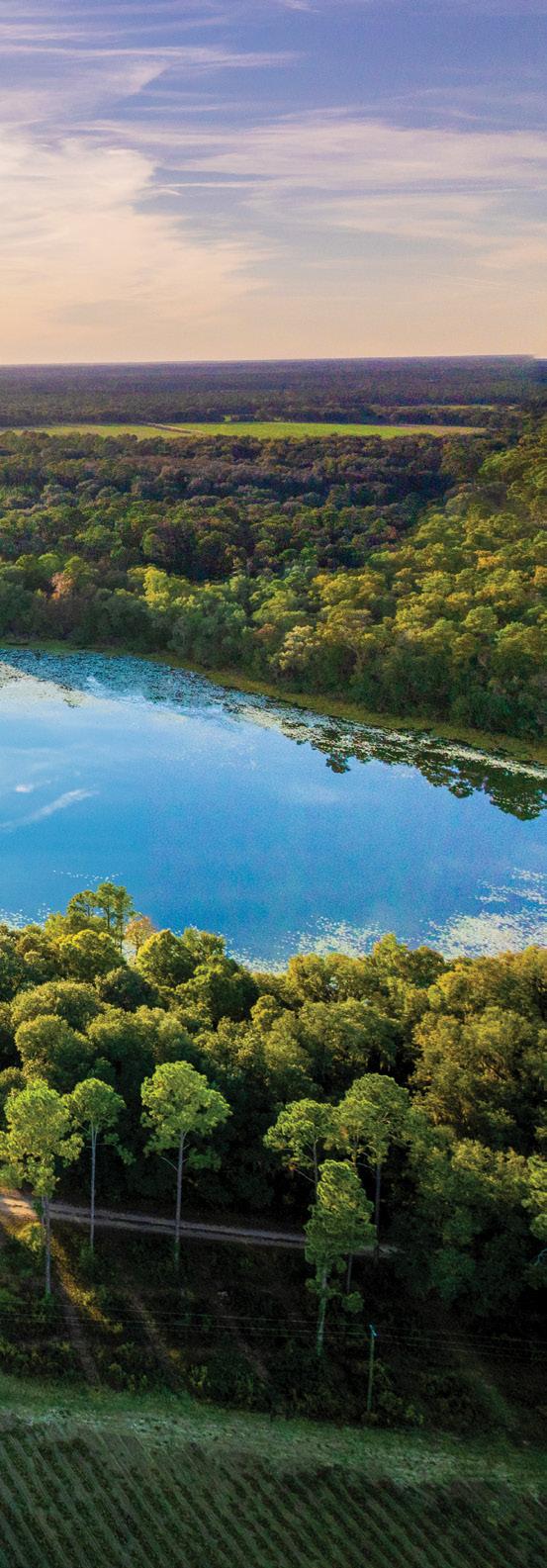
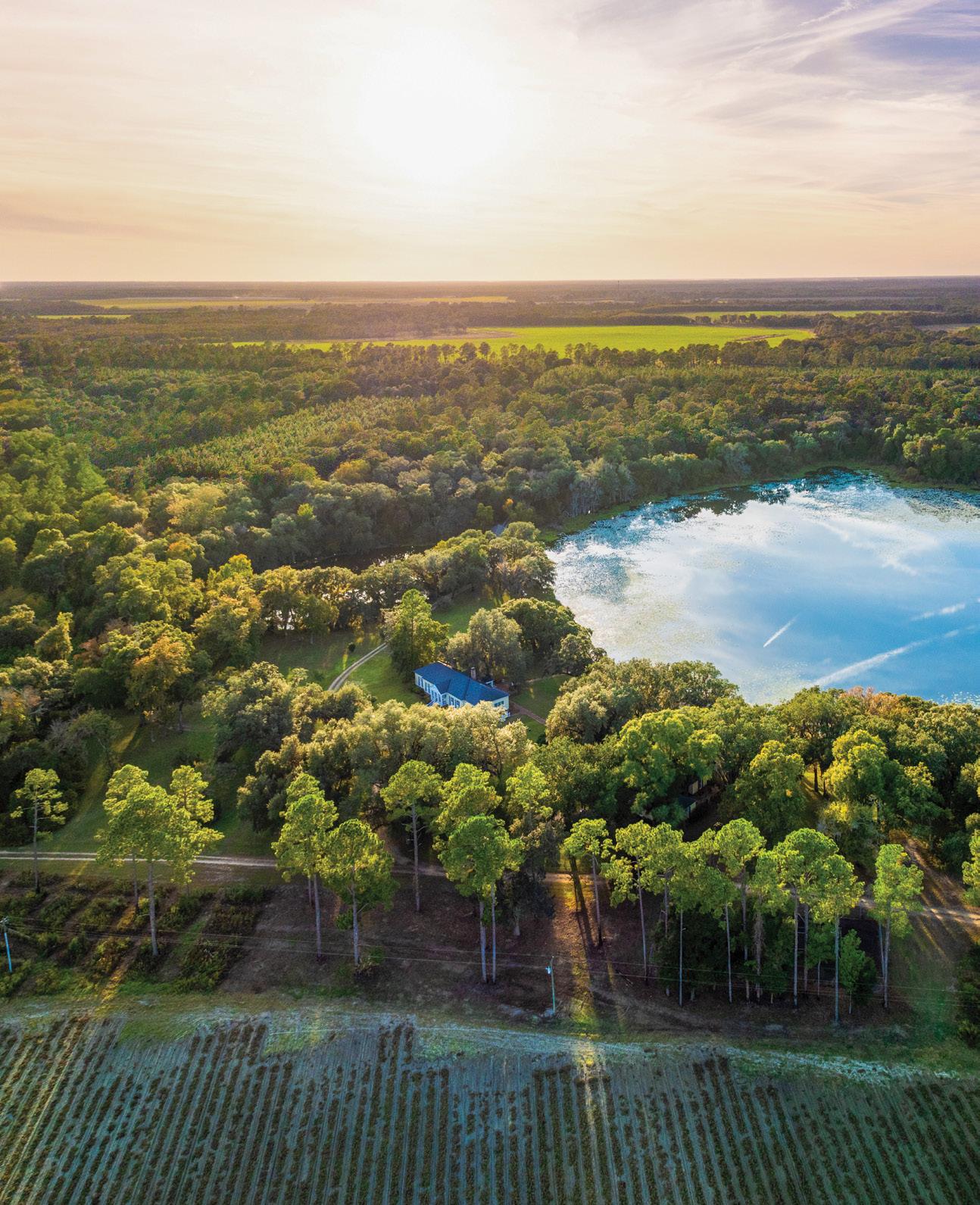
Largely untouched by development, the 25,000acre Deer Run Plantation in southern Georgia hides Native American and 16thcentury Spanish artifacts, recently uncovered by JMU professor Dr. Dennis Blanton and his colleagues.
By Josette Keelor
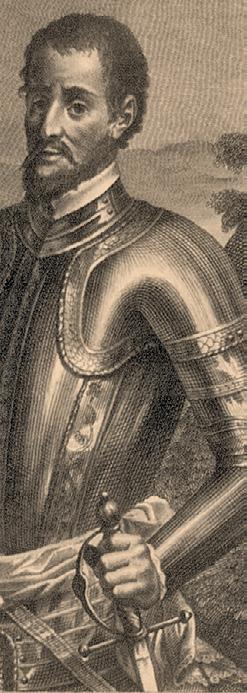
or nearly 20 years, anthropologist and JMU professor Dr. Dennis Blanton has been digging into the story of Spanish explorer Hernando de Soto. Blanton’s goal had been to find physical proof of Soto’s time in present-day Georgia in the year 1540, during his multiyear quest for riches and greater information about the New World.
Now, almost 500 years after Soto marched through Georgia with 600 men and 250 horses, a small team of researchers has uncovered what Blanton is calling “the find of a lifetime.”
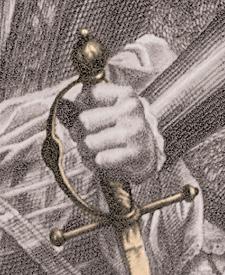
In late October, the team unearthed the pommel of a 16th-century Spanish sword — rare evidence that Soto not only traveled through rural southwestern Georgia, but also set up camp there with a small army.
The pommel — the end of a sword handle that’s crucial for counterbalance — is “one of those artifacts we only dreamed of finding,” Blanton said. “It’s absolutely electrifying.”
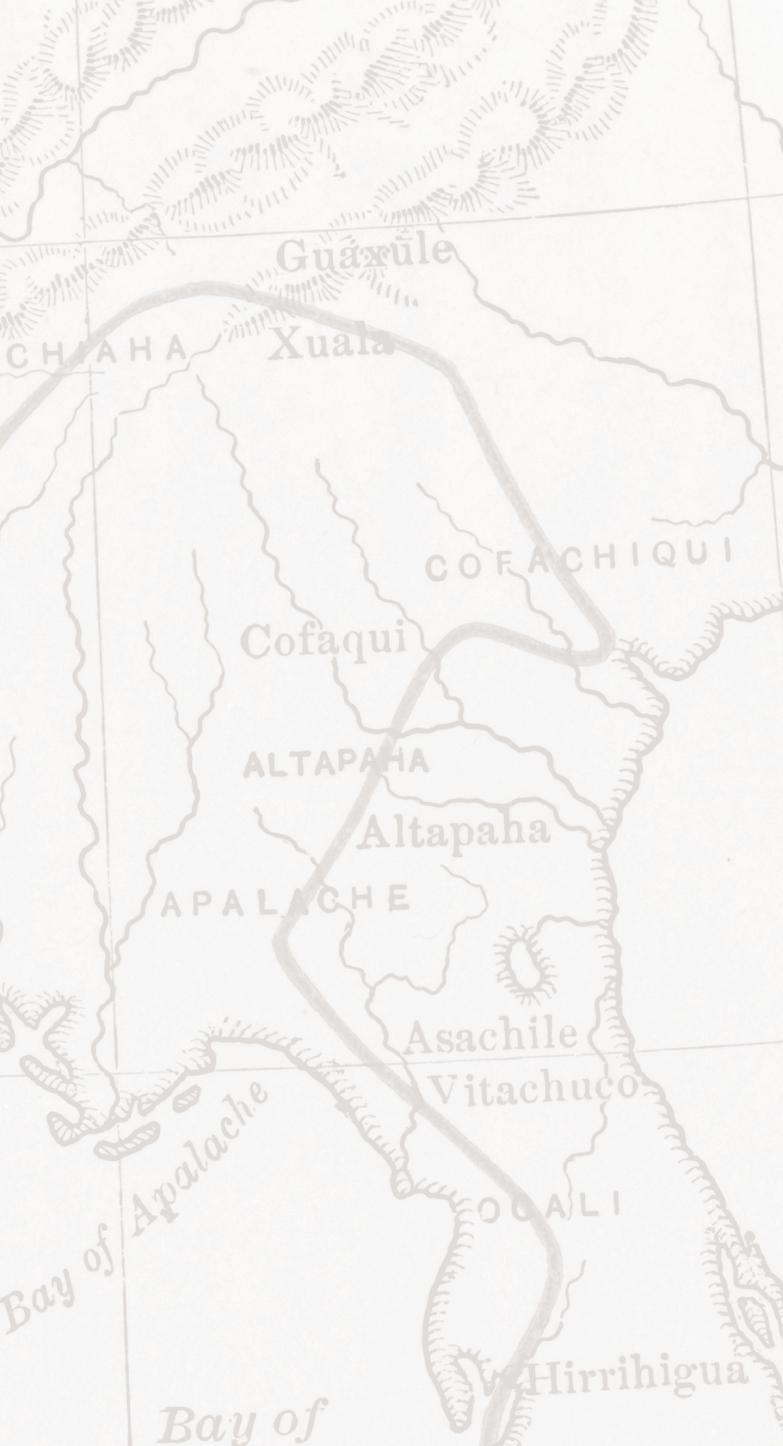
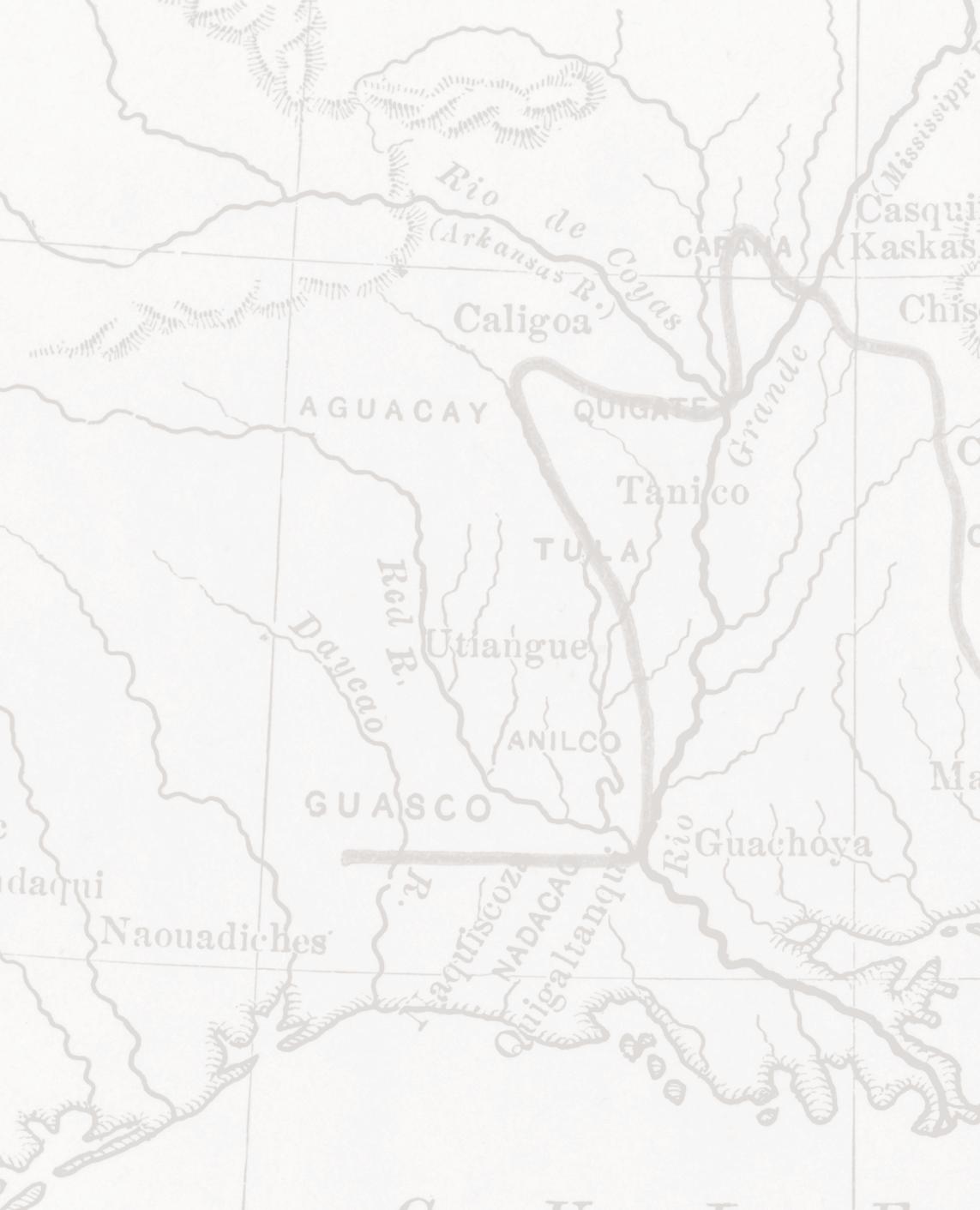
Blanton has been attempting to track the Soto expedition’s path for 18 years, ever since he identified artifacts on a separate site in south-central Georgia that he could link to Soto’s era. Now, after discovering a trove of 16th-century Spanish artifacts at a second location in Georgia, Blanton is making significant progress in his Soto studies. Before he began his work, there was no concrete proof of Soto’s passage between Florida and the Appalachian foothills of North Carolina other than records from his fellow explorers. Blanton said the site where he and other researchers have been digging near Albany, Georgia, is the first proven Soto encampment outside of Florida.
And yet, this landmark discovery might never have happened if not for a phone call from former Coca-Cola CEO Doug Ivester.
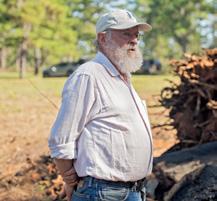
In 2007, Blanton was curator of Native American archaeology at the Fernbank Museum of Natural History in Atlanta, Georgia, when Ivester called to ask the museum’s president, Susan Neugent, if she would send someone to his country estate to examine the thousands of Native American artifacts that one of his employees had found. Eric Kimbrel, son of longtime land manager Mack Kimbrel, had filled nearly every flat surface in one of the plantation’s houses with Native American
“I knew that the area of Deer Run was one of those places people thought Soto might be, and that’s all I could think about on my first visit there.”
— Dr. Dennis Blanton
tools he had picked up around the property. But Blanton, who traveled there with Neugent, was more interested in the 5-gallon bucket of Spanish pottery the young employee had found while deer hunting.
Blanton already had Soto on the brain after a student researcher found a multilayered glass bead matching Soto’s time period on what’s known as the Glass Site, a good 80 miles from where most scholars believed Soto’s route would have taken him (through Macon, Georgia). Blanton saw this as a sign of imperfection in the accepted understanding of Soto’s journey among archaeological experts. His goal became explaining why there was evidence of Soto at a site where he wasn’t believed to have traveled. When Ivester called the museum, Blanton was in the process of documenting the numerous Soto-era artifacts he had not expected to find at the Glass Site starting in 2006.
“I knew that the area of Deer Run was one of those places people thought Soto might be, and that’s all I could think about on my first visit there,” Blanton said. “So that’s what started it really ... that unexpected invitation to examine Deer Run artifacts. And thank goodness. When Doug Ivester saw my excitement and asked, ‘Would you like to work here? Would you like to study?’ — I was like, ‘Are you kidding? Of course.’ And so, Doug says, ‘Why don’t you come back?’”
A few months later, Blanton returned to Deer Run Plantation with a team to start his research, but they didn’t find any Soto artifacts. In fact, it would be six more years before he saw anything there that he could link to Soto. “It took a little while,” Blanton said. “This was before I came to JMU, and it wasn’t until I came to JMU and began to bring our students to the site that we found Soto artifacts.”
Blanton grew up in South Carolina before moving with his family to the small southeastern Georgia town of Alma. There, he attended Bacon County High School before earning his bachelor’s in Anthropology from the University of Georgia.
“It was a great time to be there,” Blanton said. “I was at the University of Georgia when one of my mentors rekindled Soto studies. ... The atmosphere was just thick with Soto, so I was sort of schooled in it.”
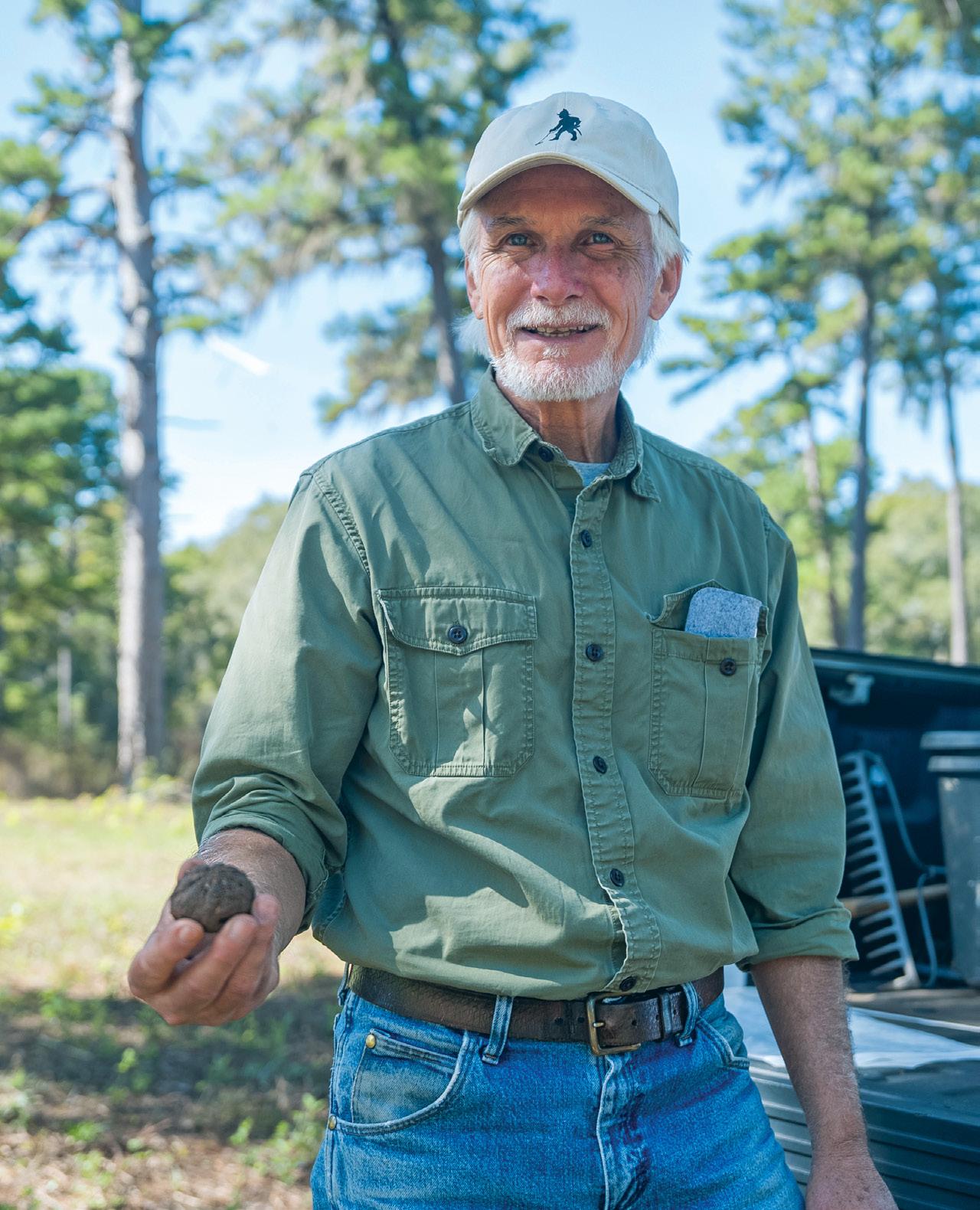
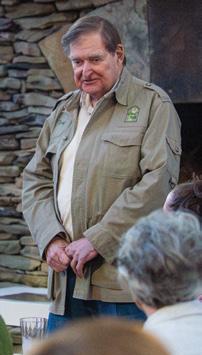
That mentor was the late Dr. Charles M. Hudson Jr., Blanton’s anthropology professor and a leading Soto authority. Around the same time, Blanton met longtime friend and colleague Dr. Chester DePratter through The Society for Georgia Archaeology. “I just wanted to breathe the same air as him,” Blanton recalled. Now a professor emeritus with the University of South Carolina, DePratter was one of several experts to attend the recent Deer Run dig.
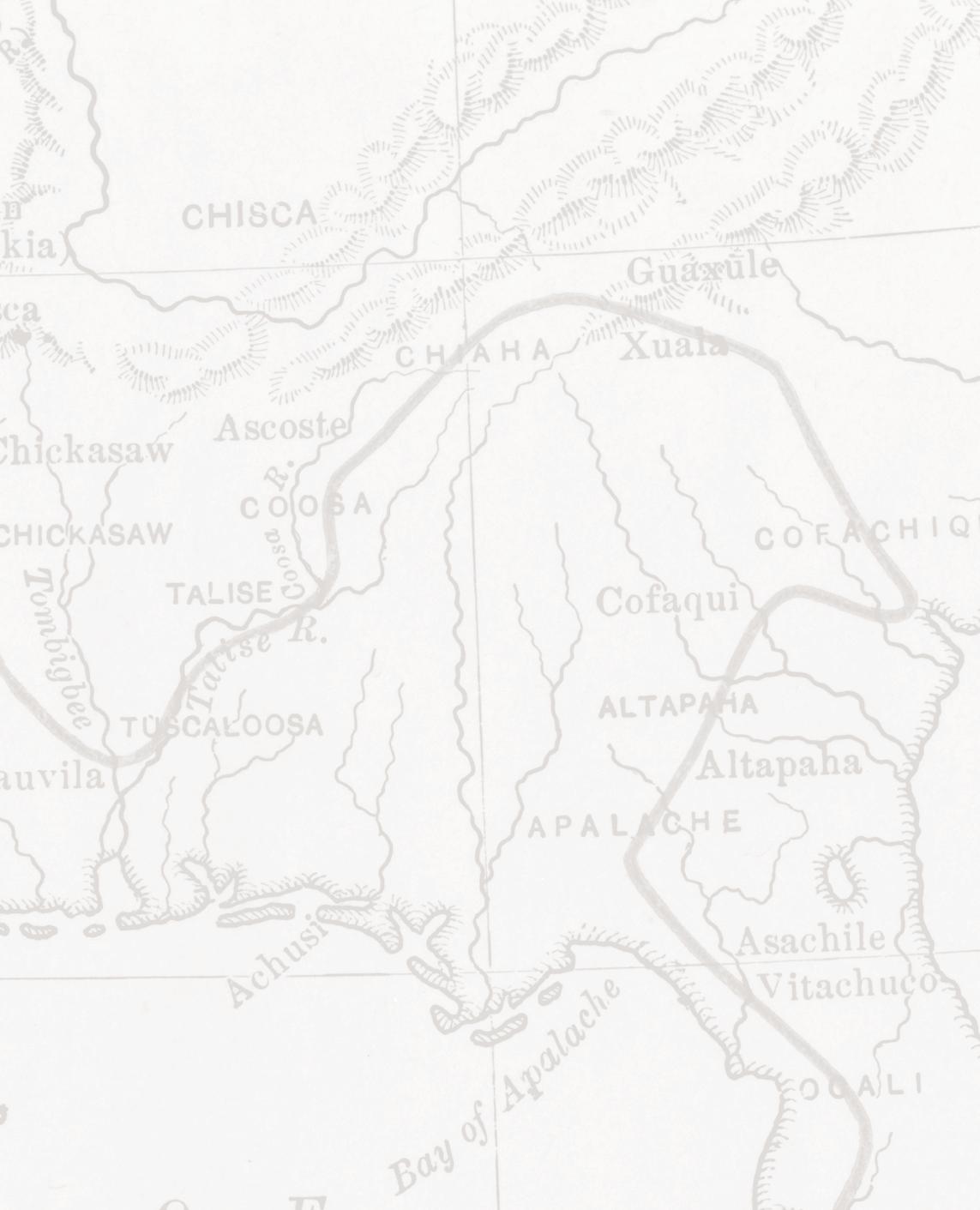
As a graduate student at the University of Georgia in 1976, DePratter joined Hudson in researching Soto’s 1539-1543 American entrada and co-authoring several papers tracking the explorer across the American southeast before his death from a fever in 1543 along the Mississippi River. In 1983, Hudson and DePratter mapped Soto’s route with Dr. Marvin T. Smith, professor emeritus of sociology, anthropology and criminal justice at Valdosta State University in Georgia. Hudson included the map in his book, Knights of Spain, Warriors of the Sun.
“[That was] almost 50 years ago — and we still don’t have a good campsite,” DePratter said at the October dig. “That’s why we’re out here still looking, because Dennis is pretty sure that this is the area where Soto stopped.”
Before arriving on-site, the team didn’t know what to expect, DePratter said, “because nobody’s ever found a campsite. So, whatever we find here is informing not only us, but other people in other states who are looking for Soto campsites.”
With the team’s discovery of the pommel on Oct. 21, DePratter said, “We’ve found just what we came to find.”
Blanton has two main reasons why he’s sure he’s found a true Soto encampment: “There are more artifacts there than at any other place at Deer Run, and there’s more variety
of Spanish artifacts, which fits the bill for a prolonged Spanish campsite,” he said.
“It’s only in the last four years, I would say, that we’ve gained this confidence that there’s no question that’s what we have. And the students have been there every step of the way.”
Returning to Deer Run, sometimes several times a year, Blanton and his students, colleagues and various volunteers have found hundreds of 16th-century Native American and Spanish artifacts.
“The very first year we went down there with a bunch of JMU students, we found a Spanish artifact, and it was a huge deal,” he said. “And I would say that lit a fire. It kept me going back. It kept students busy. But we lurched along. And that’s just the nature of archaeology. It really just has to be this sort of tenacious, relentless kind of searching.”
For a while, they weren’t sure exactly where to look. That all changed when Blanton realized the critical connection between Soto and the Native American villages built at Capachequi — a Native American territory that Soto’s expedition described in March 1540 and which Blanton has been studying.
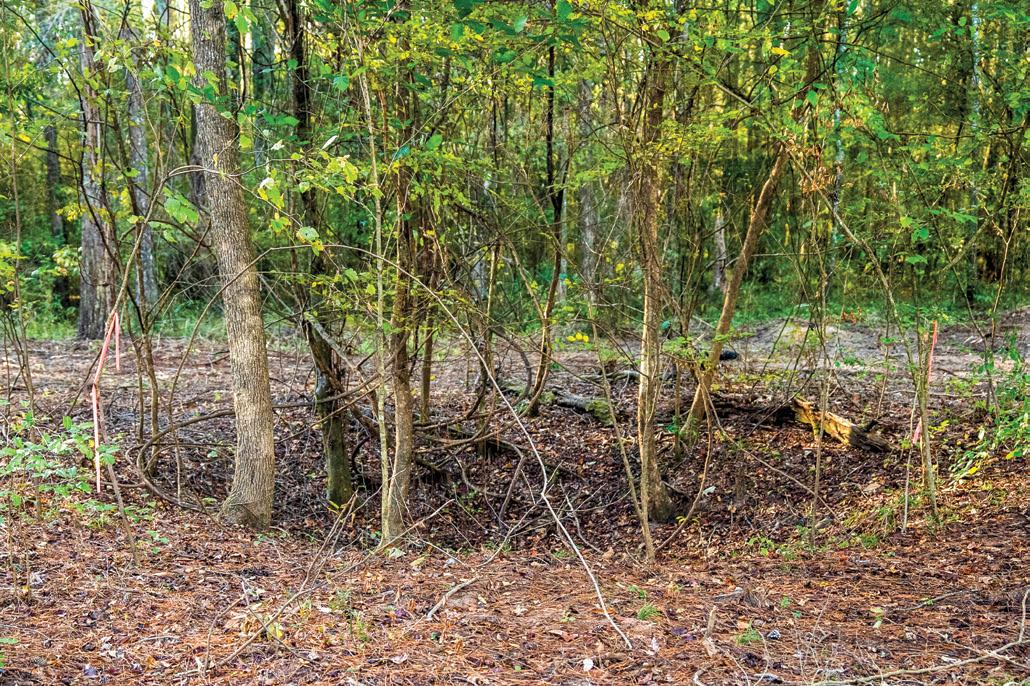
“I had heard a rumor of some sites that have these peculiar features on the landscape,” Blanton said. “They look like giant, earthen bird nests. Sometimes I call them bagels or doughnuts, because that’s what they look like. I wanted to go map these things. They were on a plantation that’s near Deer Run, not on Deer Run, but I thought they were important.”
The features are former Capachequi houses that once looked like giant anthills but have
Some of the main finds from his searches have been lead bullets, fragments of bladed weapons and an abundance of chains.
since collapsed in the middle. “The ring is a vestige of a Native American dwelling,” Blanton said. “That’s the key point.”
After Blanton documented these extremely rare features at the nearby property, the land manager told him to look for them at Deer Run. “I said, ‘What are you talking about? I’ve been all over Deer Run. Haven’t seen these things before.’” But the manager had spotted these land oddities in his previous work as a timber cruiser, evaluating trees to calculate their timber value.
“He gave me an approximate location,” Blanton said. “I went back to it on one of my spring trips, one of these one-week deals. I was out there by myself, and I thrashed around in the woods with a machete ... and, lo and behold, I found ‘doughnuts.’ And I’ll tell you what, it was the most exciting thing. It was like walking into a Native American ghost town.”
Once he knew what to look for, Blanton was spotting them everywhere. He remembered how survivors of Soto’s expedition had written about the Capachequi houses looking different from the Native American houses they had encountered in Florida. “They were used to seeing all these Native American dwellings down there that were lightly built,” Blanton said. “They were like Florida verandas, you know, with thatch roofs and more open to the air.”
with a new plan. They didn’t find Spanish artifacts, but they learned a lot about “doughnuts.” At their next field school in 2021, two students found a Spanish-made iron tool that Blanton first mistook for a piece of pottery. “It was right where the Indians left it inside one of these doughnuts,” Blanton said. “It was like, touchdown.” The discovery provided a compelling indication of Soto’s encounter with Capachequi’s native population.
The same year, another student working alongside Blanton’s colleagues with a metal detector found what Blanton called one of “the rarest Spanish artifacts you could find.”
“So now, honest to gosh, we had this equation. If you find a doughnut, you’re going to find Spanish artifacts,” Blanton said. “The majority of the Spanish artifacts we find are either in one of these earth-covered dwellings, or they’re in very close proximity to them.”
Learning the connection between the Capachequi dwellings and the Spanish artifacts makes sense, Blanton said. Soto had 600 hungry soldiers, and the Native American villages were the places most likely to have stores of easy food and, possibly, the precious materials that Soto was hoping to find.
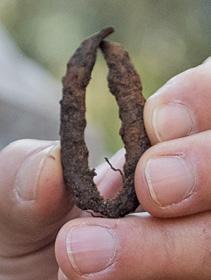
Soto’s entrada was a quasi-military expedition, Blanton said. And the artifacts his team has been unearthing make that clear. Some of the main finds from his searches have been lead bullets, fragments of bladed weapons and an abundance of chains. The chains, especially, point to what Blanton called a grim aspect of American history.
“These would have essentially been the first slave chains in the New World,” he said. “When the Spanish came, they were very aggressive ... taking captives and taking over houses. It’s a very sobering kind of an artifact.”
Instead, Soto’s men described the Capachequi houses like “caves under the ground,” Blanton said. “And that’s what we’re finding. These doughnuts are the surviving vestiges of the earth-covered Indian houses. ... And I was like, ‘Oh my gosh, this is what Soto talked about. These are the caves under the ground.’”
With that revelation, Blanton and his students returned for their 2019 summer field school
Blanton’s latest visit also helped validate a hypothesis he made in 2015, when his students found artifacts that he guessed were left behind after soldiers commandeered a Capachequi residence. Ten years later, while retracing the site with a metal detector, Dr. Aaron Ellrich, an archaeologist with the Coastal Georgia Historical Society, unearthed the sword pommel precisely where that native residence was located. “What in the world is the real story behind that sword pommel?” Blanton wondered. “I mean, they were made to not come apart.”
Blanton hopes that through his research, he can reconstruct the story of Soto’s six days at Capachequi with archaeological evidence and at an unprecedented level of detail. He regards the Deer Run property as an unmatched laboratory for investigating such events.
“We have this contrast between the places where Indians were gifted these objects by the Spanish, and they took them back to their communities. And then we have this other place where the Spanish were planted for about a week, and they just littered it up with whatever they had,” Blanton said. “It’s really fascinating, and no one has ever had this opportunity to look at the full sweep of what one of these encounters in a discrete Native American territory looked like.”
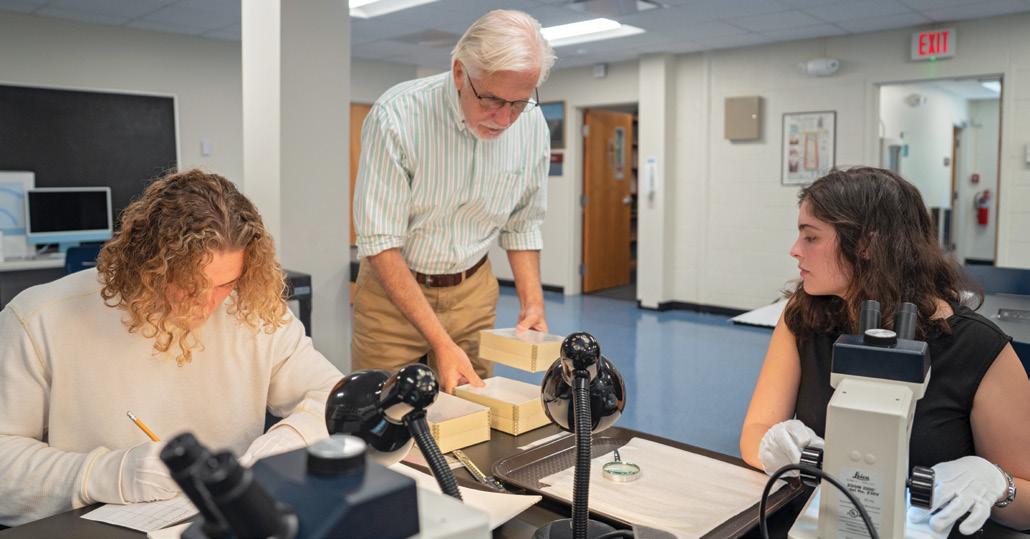
Though not part of the excavation at Deer Run, JMU Anthropology students and lab assistants Anna Leo and Jonah Friedman have been thrilled for the chance to study Soto artifacts. In the JMU Archaeology Research Lab, they’ve been examining metal objects that
Soto and his men might have fashioned from old barrel hoops for the purpose of trading with people at Capachequi.
“It’s not something that you find every day,” Leo said. “And even though these are small things, they lead to a bigger understanding of how people worked with these artifacts and how they saw something that was already there, and then they made something different. It’s really cool.”
For Leo, a second-year Cultural Anthropology major, the lab work is giving her a chance to learn more about archaeology, which isn’t required for her major. “This is just something that I’m also interested in,” she said. “A lot of people think that archaeology is all dig, but 90% of it is right here.”
Thinking she might pursue a career in museum curation, Leo likes working with artifacts and knowing she’s one of the first to see them up close.
Friedman, a third-year Anthropology major with a concentration in Archaeology, is enjoying this rare opportunity, and each day brings something new. “We’re the first people
to do analysis on these,” he said. “Maybe I’ll be able to see something extraordinary.”
Many of Blanton’s students have been part of the Soto research through his summer field study, which provides an essential step for JMU Anthropology students to become fully fledged archaeologists. “It is a very important course for an archaeology student, because it is the critical credential for employment in the archaeological field,” he said. “The bachelor’s degree is not the critical piece. ... Your entry-level credential is completing that field-school course.”
At JMU, the archaeological field school i s completed through ANTH 494: Field Techniques in Archaeology. But it isn’t the only way interested students can participate in Blanton’s research, and the work Leo and Friedman are doing is groundbreaking.
Other students have worked with Soto artifacts, but Leo and Friedman are the first to do a use-wear analysis normally applied to prehistoric stone tools, which Blanton has adopted for documenting metal artifacts. “It’s really a pioneering analysis that’s never been done,” he said.
He hopes to include Leo and Friedman at an upcoming professional conference and offer them professional publication credits when he starts writing up his artifact study. “These are some of the rarest artifacts,” he said, “not only in the country, but in the whole hemisphere.”
And yet, Blanton’s research is about more than artifacts. In conducting this research through the College of Arts and Letters and the Department of Sociology and Anthropology, Blanton said he and his students are pursuing “a sophisticated, groundbreaking example of archaeological research.”
“It’s fundamentally aimed at improving our understanding of modern world history, which began with Europe’s expansion into far-flung corners of the globe,” he explained. “The legacy of the associated events shaped the history that defines much about our world today. And because the ‘official’ written records about those events that we have inherited are often so vague, it is left to archaeology to fill out the story. All to say, it’s about far more than the evocative artifacts themselves and, in the end, about the humans who participated in those events ”
While at JMU, Kyle Mitchell (’24) took three classes with Blanton and also worked with artifacts in the archaeology lab. His fieldschool course was in North Carolina, and he participated in other field projects in Virginia. But he didn’t make it to the Deer Run site
until after earning a Bachelor of Science in Anthropology and pivoting to a career in law enforcement. Having stayed in touch with Blanton, Mitchell eagerly accepted an invitation to join Blanton’s team of experts on their fact-finding mission.
“We’re finding a lot of cool stuff out here, and this is the first site I’ve been on that they’ve done systematic metal detecting like they are down here,” Mitchell said. “I’ve been mapping all of the grid points and all of the finds that they’ve had — so all these shovel tests, all the metal-detecting finds they’ve had, I’ve been mapping all of that. I’m helping Dr. Blanton do the documentation portion.”
Now a police officer in North Carolina, Mitchell said he still enjoys archaeology and didn’t want to abandon that passion. “I wanted to stick with it and get to be out on sites like this, and help him document and learn everything we can. ... They’ve found a lot over the years, but we’re
“These are some of the rarest artifacts, not only in the country but in the whole hemisphere.”
— Dr. Dennis Blanton
really just starting to learn more and more about the Spanish encampment that was out here.”
Asked about future opportunities, Mitchell said, “Whenever Dr. Blanton needs me down here, I’ll be here.”
Joining him were several independent consultants, longtime volunteers, and Blanton’s colleagues from the University of South Carolina, armed with notebooks, metal detectors, GPS devices, ground-penetrating radar, and a magnetometer to help uncover artifacts of a Soto encampment, define the lay of the land, and map the site.
“The footprint would be considerable,” Blanton said. “We’re trying to understand, really, for the first time, what one of these things would actually look like. Sort of theoretically we know, but in reality, we don’t. When our surveying begins to find nothing, that tells us where the encampment is not.”
Chet Walker and Aundrea Thompson, archaeological geophysicists from ArchaeoGeophysical Associates based in Austin, Texas, were conducting magnetometer and groundpenetrating radar surveys. “The archaeology kind of tells you the date of things,” Walker said, “... and geophysics allows you to see bigger patterns across the landscape.”
While in the field, their work mainly involves walking back and forth to collect data
before taking it back to their lab. The groundpenetrating radar is a cart with a transmitter and receiver, which transmits and receives a signal to record on a computer. The fluxgate gradiometer is more of a passive instrument that records ambient magnetic fields to map the subsurface of the land. Eventually, the data can be uploaded to a geographic information system, so future researchers will know where to access the Soto encampment or how to apply it to a greater understanding of Soto’s path. “What we’ve done this trip we’ll find out in a couple of weeks when we’re processing the data and writing the reports for Dennis,” Walker said. “It’s a great honor to be involved with a project like this. Regardless of whether or not it turns out to be a big find, the process of doing archaeology is kind of the same — what drives me, personally. The big finds are great, but it’s more the process of looking that I enjoy.”
Blanton’s latest visit to Deer Run with several of today’s leading Soto experts was one of a few major next steps in his research after facilitating an archaeological salon, which he and Ivester hosted and Fernbank Museum cohosted at the plantation in March 2024. There, Blanton, DePratter and several other archaeologists trying to pin down the sites of various 16th-century Spanish entradas across the American interior, compared notes before journeying on horseback along the path that Blanton believes Soto might have taken across the Deer Run property to where about 24 earthen doughnuts marked the location of a suspected Capachequi village.
Blanton recalled the moment Dr. John Worth, an anthropologist with the University of West Florida, turned to him in awe at witnessing the site he had only read about and imagined. “He looked at me and said, ‘This is it,’ and I about fell off my horse,” Blanton said.
Though his peers are not always easily persuaded, Blanton said the revelations from the salon marked a pivotal moment in the search for Soto and other Spanish colonialists. Unlike many other archaeological finds, this one hasn’t been contested by those who have seen it up close. “There’s 100% consensus, which is unheard of,” Blanton said. “There is 100% consensus that we are dealing with Soto.”
The site at Deer Run is also the first confirmed location in North America where researchers believe Soto set up camp, besides his long-believed winter encampment in Tallahassee, Florida.
A major outcome of the 2024 salon was the formation of the Colonial Encounters Research Consortium, which met formally under the CERCa name at Fernbank Museum in the spring of 2025 and plans to meet yearly to discuss developments in its members’ mutual search for Spanish artifacts in the U.S. In May, CERCa will meet again at Deer Run.
Over the years, Fernbank has supported Blanton’s archaeological fieldwork as well as laboratory work, artifact analysis and artifact conservation, a museum statement explains.
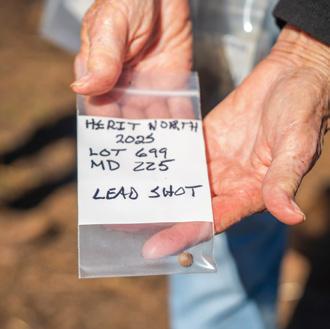
As part of the museum’s educational programming, they have presented exhibitions and lectures on the Spanish contact period, fulfilling its ongoing mission “to ignite a passion for science, nature, and human culture through exploration and discovery,” the statement explains.
“We are honored to be a part of the search for the elusive Hernando de Soto and the groundbreaking archaeological research that is truly rewriting history of the early Spanish period in this region,” says Jennifer Grant Warner, president and CEO at Fernbank. “While defining Soto’s route is certainly important, perhaps the real significance of this research is that it will continue to inform discussions around early Native communities and the impact of Spanish contact that can be viewed on a more global scale. As a museum
of natural history, we believe these stories are important to highlight.”
One big reason Blanton and his colleagues have been able to find so much at the Deer Run site is because the land has been largely untouched by development.
After retiring from Coca-Cola in 2000, Ivester grew Deer Run Plantation from four separate farms he purchased over the next 13 years. His initial goal was to have a place for quail hunting. He quickly became invested in the property’s already thriving pecan business. But it wasn’t long before he learned of his vast collection of Native American arrowheads.
Having lived and worked in Atlanta for more than 20 years, he was a previous board member of the Fernbank Museum and knew who to call to find out if the arrowheads were important.
“I grew up in the brand business,” Ivester said. “My belief is that when you have a brand, you either polish it every day or you diminish it every day. There’s no standing still. You’re either improving it or you’re taking away from it a little bit.”
Viewing himself and his wife, Kay, as temporary stewards of the land, he’s thrilled to provide a legacy for his 25,000 acres and the two dozen people who work and live there, many with their families.
“For us, it’s a real package deal,” Ivester said. “It’s about the land, it’s about the people, it’s about the reputation, and in the end it’s about the brand. We’re fortunate in this legacy or heritage that is here because of what Dennis Blanton has found.”
Blanton, who plans to retire from JMU in the spring, will continue his Soto research for the foreseeable future, recording and analyzing artifacts, and continuing periodic field studies. Over the years, the successful partnership of Blanton as the academic expert, Ivester and his wife as project supporters and hosts, and Fernbank as the lead sponsor has enabled the work to continue and Blanton’s team to keep making landmark discoveries.
Calling Blanton a great friend and a mentor in terms of his anthropological expertise, Ivester is in it for the long haul. “When we started, I didn’t know where it would lead,” Ivester said. “I thought the journey was more important than the destination, and, at this point, I still don’t feel like we have achieved a destination. We’re still on the journey.”

A vessel surfaces near the Black Sea, appearing only as a shadow on satellite images. Its name doesn’t appear on official records, and its route defies logic. Only after tracing it back — through open-source logs, quiet ports and international waters — can the entity’s origin be confirmed: a tanker that vanished off the Libyan coast days earlier.
This is how modern conflict hides in plain sight, and students in JMU’s Intelligence Analysis program are exposing it.
By Lynn Radocha (’18)
GLOBAL CONFLICT
Armed with the same analytical frameworks used in professional intelligence work, these students are making it their mission to understand how modern conflict moves — quietly, strategically and often just out of view.
Using a combination of satellite data, campaign modeling and open-source intelligence tools, Intelligence Analysis students are mapping international behavior and forecasting potential developments. It’s the kind of analysis they’ve learned to conduct — carefully, methodically and with a global perspective.
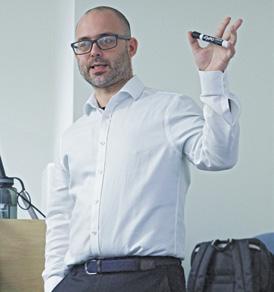
“This isn’t theory,” said Dr. Giangiuseppe Pili, assistant professor of I A. “They’re analyzing global conflict as it unfolds and figuring out what it means.”
(Above): Tanker in the Black Sea; (right): Dr. Giangiuseppe Pili, IA assistant professor, says scores of ships engage in shadowy operations to evade oil sanctions.
Each project begins with a question — often sparked by a media inquiry or a need identified in the analytic community. Then the real work begins. Students gather fragmented information from public sources, organize and analyze data, test assumptions, and build a coherent picture of what’s really happening.
Using the open-source intelligence tools, students extract data from shipping logs and port authorities, cross-check locations against satellite imagery, analyze patterns in state-run media, and track construction in contested territories. In one case, IA students Samantha Rickwalder and Jason Clark noticed changes in Chinese military exercises in the Taiwan Strait. Rickwalder presented their research at the JMU Board of Visitors meeting on Nov. 13.
Sometimes the data is clear, but often it’s a mess — and that’s part of the point. “They’re learning to deal with ambiguity,” Pili explained. “To make sense of partial information. That’s what intelligence work really is.”
IA students aren’t just learning. They’re producing work that’s gaining international attention.
Ivanna Renderos, Andrew Corbett and Luke Velasquez produced a report on Arctic security, analyzing the geopolitical consequences of a rapidly melting region. Their research combined satellite mapping, economic forecasts, and infrastructure analysis to explore how Russia and China might adjust their strategies as sea ice disappears and trade routes become accessible.
“This isn’t a classroom simulation. It’s applied, experiential learning, and students are beginning to see that their research has real-world value.”
— Dr. Giangiuseppe Pili
Brett Evans and Ryder Finn co-authored a paper with Pili on Russian artillery warfare, published by the Royal United Services Institute, the world’s oldest independent defense and security think tank. The article was widely shared by international experts and picked up by major news outlets across Europe and the United States — a rare achievement for undergraduate researchers.
At a symposium in Washington, D.C., Victoria Jones (’25), Katie Fricke (’25) and Taylor Hankins (’25) presented their research on the growing military alliance between Iran and Russia. Their analysis, which focused on how Iran-supplied drones have shifted battlefield strategies in Ukraine and are now being deployed in the Middle East, was recently featured by the NATO Defense College.
These projects, along with additional r eports by Sam Rooker, Joel Kurien and Ryan Stevens, have been accepted for review and inclusion in a NATO-affiliated research outlet. This archive houses reports reviewed by international experts in security and defense strategy, and undergraduate inclusion represents an almost unprec -
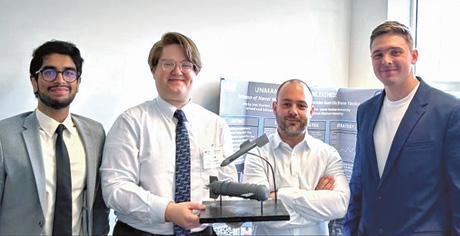
edented recognition of student-authored intelligence analysis.
Pili views this as a turning point, not just for his students, but for how undergraduate research is perceived. “This isn’t a classroom simulation,” he said. “It’s applied, experiential learning, and students are beginning to see that their research has real-world value.”
With growing fluency in professional intelligence methodologies, students are refining drone warfare models, expanding threat assessments on Russian partnerships, and deepening their analysis of strategic shifts in the Mediterranean.
This methodological approach builds directly on Pili’s professional experience and recent research. In 2024, he authored a report detailing Russia’s presence in the Mediterranean, which was accepted by the NATO’s Defense College’s Research Division under the leadership of Dr. Florence Gaub, a prominent voice in European security. “None of this would have been possible without Dr. Gaub’s trust and belief in the importance of our research,” Pili said.
His report suggests that Russia’s aging Mediterranean Squadron isn’t intended to fight NATO head-on. “It’s meant to be visible, but not threatening,” Pili said. “It’s anchored by port access in Syria and backed by a ‘ghost fleet’ of unmarked oil tankers that help finance the war effort while quietly evading sanctions.
“These tankers operate in the shadows,” Pili said. “They shut off tracking, swap flags and disguise their cargo. But they’re still
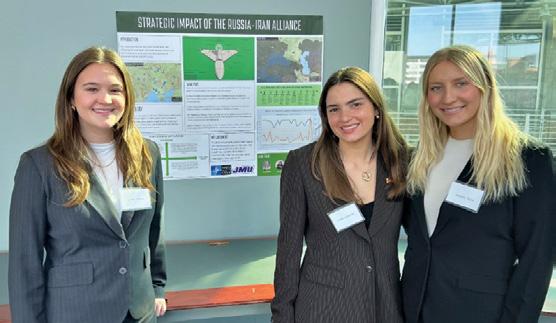
there. You just have to know how to look.”
That report became a case study for his st udents, demonstrating how open-source intelligence tools can reveal hidden patterns in global conflict. Now, many of them are carrying it forward — expanding their research, applying the same analytical tools to track Chinese vessels and other players — moving just under the radar.
One of Pili’s core principles states that security clearance isn’t needed for real intelligence work. What matters is having the right tools, critical thinking skills, strong methodologies, a solid analytical framework and the persistence to ask better questions.
Students are quietly producing threat assessments and strategic forecasts that could one day inform national security or privatesector decision-making — but for them it’s not about recognition. It’s about seeing the world more clearly — through ambiguity, noise and the gaps where most people stop looking.
As the Spring 2025 semester wrapped up, students delivered their final presentations — briefings built on months of research, analysis and iteration. Some expanded on previous projects, treating them as evolving case files. Others launched entirely new inquiries, scanning the global landscape for emerging threats and overlooked trends.
The topics covered new ground and extended earlier research, from maritime tensions and arms diplomacy to shifts in regional influence. Each presentation reflected the same core strengths: critical thinking, strategic modeling, a strong technical skill set and a deep curiosity about how power operates in the world.
Pili offers feedback and nudges students to refine their logic, test their assumptions and go deeper. While he may pose the initial question, he encourages students to develop new problems and questions as their work unfolds. “They’re often in a better position to define what matters,” he said.
Dorian Crawford, a Computer Science and Computer Information Systems double major with a minor in Honors Interdisciplinary Studies, contributed to this story.
Dr.
Giangiuseppe Pili and IA students investigate illegal oil laundering
in the
Pili’s team relied on satellite imagery provided by the European Space Agency, business and maritime records, automatic identification system logs, and other data. AIS is crucial, as all ships are required to keep it activated. If a ship turns off AIS — an illegal act — it often indicates a suspicious activity or an attempt to avoid detection.
Countries under oil export/import sanctions that rely on ship-to-ship (STS) transshipments:
In his report, “Red Flags: Russian Oil Tradecraft in the Mediterranean Sea,” Pili says oil-laundering operations primarily occur in the Mediterranean, where calmer waters and a central location are ideal for such risky maneuvers.


Every fall, JMU is transformed into a spirited sea of purple and gold — and Homecoming 2025 was no exception. From Oct. 17 to 19, alumni, students, faculty and friends gathered in Harrisonburg to reconnect, celebrate tradition, and make new memories together. The weekend featured tailgates brimming with energy, activities and family-friendly fun across the Quad, and a thrilling football showdown that brought Dukes fans to their feet.
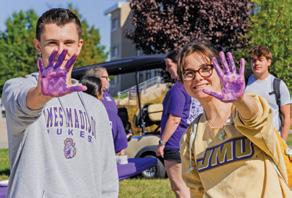
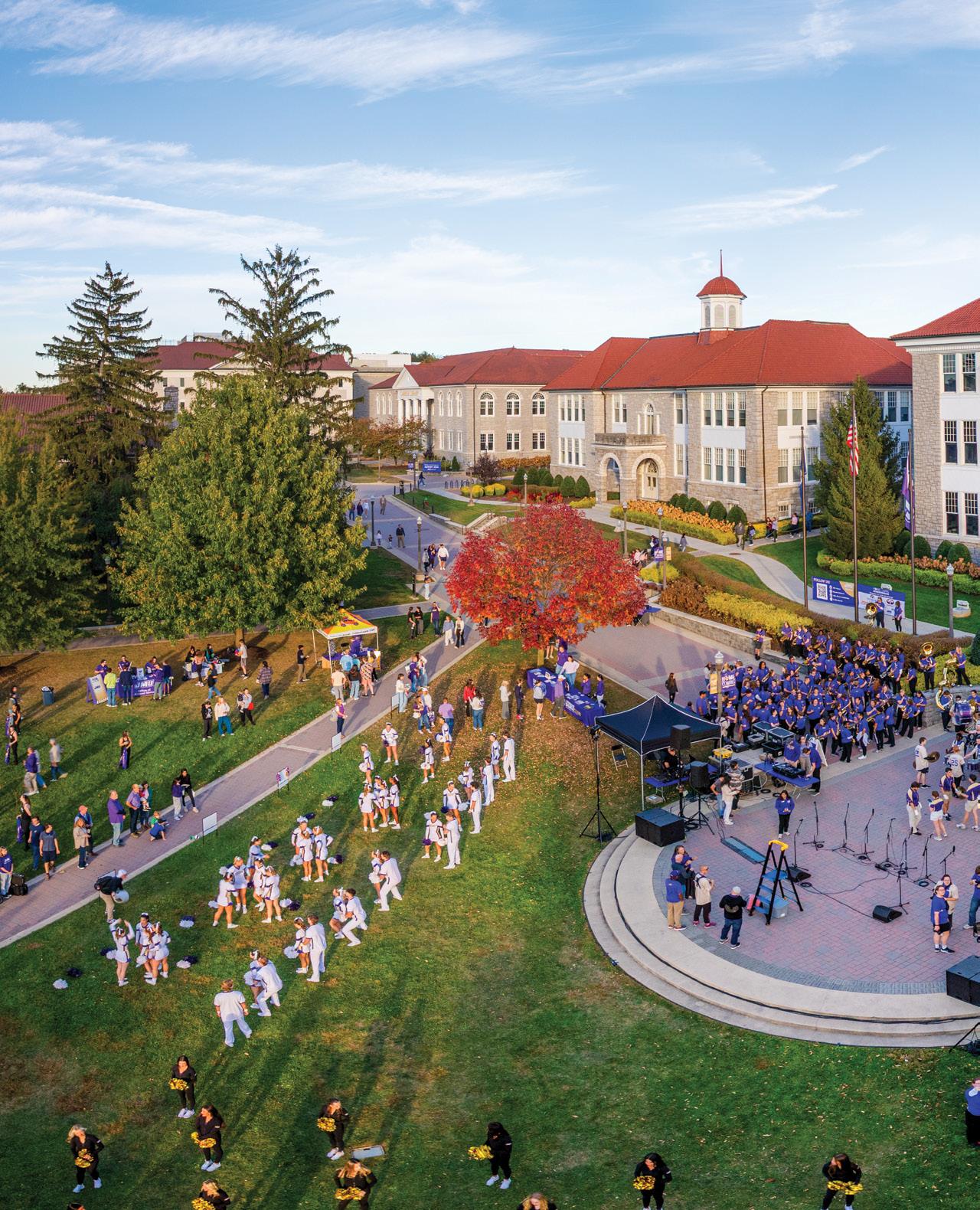
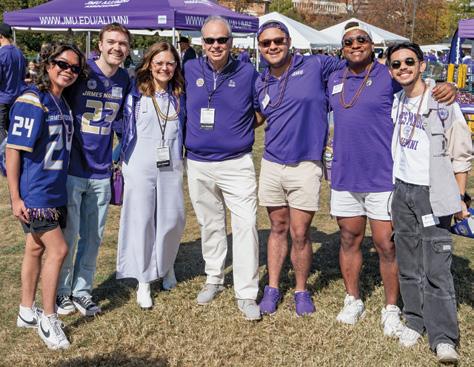
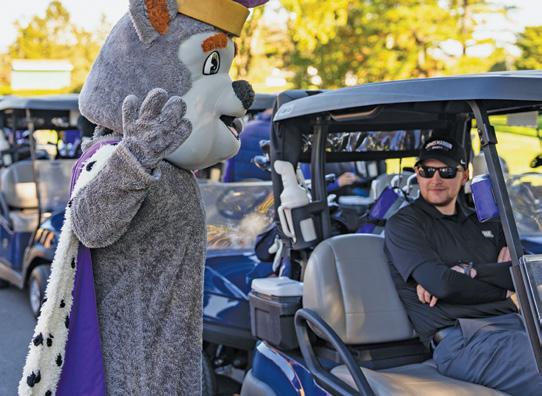

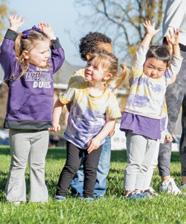
The Marching
on the steps of Wilson
Students literally lend a (purple) hand to paint the Spirit Rock. Duke Dog joins the fun at the 26th annual Homecoming Golf Tournament. Dukes at the Official Alumni Tailgate on Hanson Field pose with President Jim Schmidt (center). Little Dashers from the Young Children’s Program stretch on Duke Lawn. (Opposite): Members of the JMU Colorguard wave their flags during JMU’s 63-27 win over Old Dominion University. Madison Majesties take the stage during QuadFest.
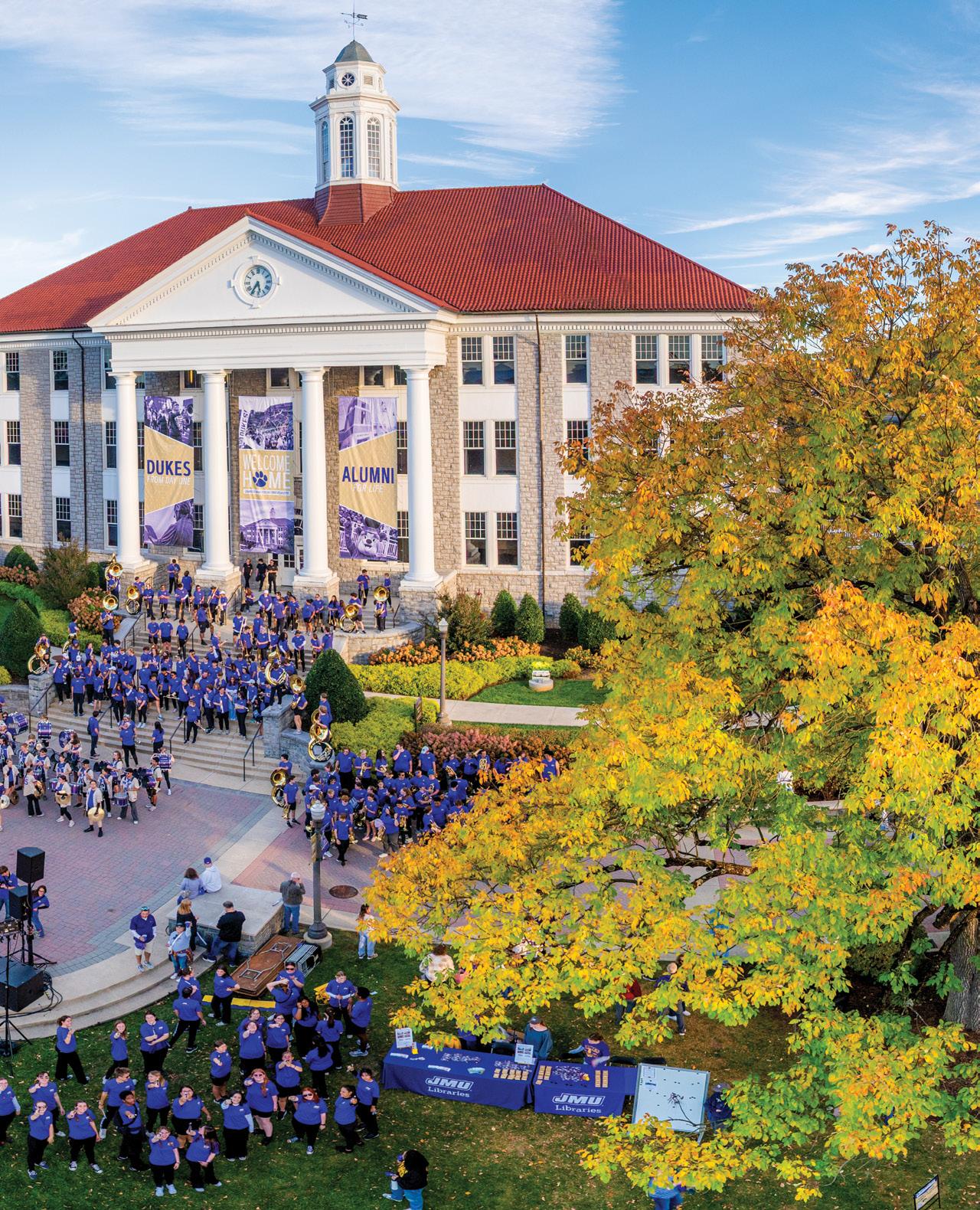
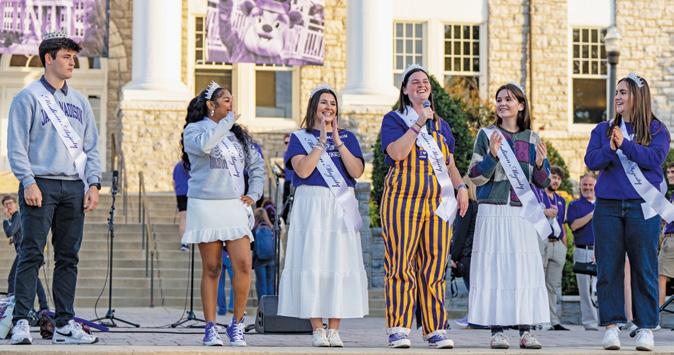
BY JIM HEFFERNAN (’96, ’17M)
Dr. John Lucas Jr. (’93) says his leadership style is modeled after some of his coaches in high school and college, including at JMU.
“I use the athletics analogy all the time,” said Lucas, the founding dean and chief academic officer of the new Illinois College of Osteopathic Medicine at The Chicago School. “These are amazingly intelligent, high-performing, highly trained people — anatomists, physiologists, internal medicine doctors, surgeons. My job is not to do their job better than them. I could never do that. I just want to get the best out of them every day, so that they have what they need to succeed.”
Lucas draws inspiration from his playing days as the long snapper on the Dukes football team. He spent two seasons in the early 1990s under then-head coach Rip Scherer. “He was a great leader and a great motivator,” Lucas said. “I still quote him 30 years later.”
Lucas’ passion for sports — h e tried out twice for the JMU baseball team and played one summer in the Rockingham County Baseball League — is rivaled
(Clockwise): John Lucas (’93) played on the Dukes football team in the early 1990s. He is currently the chief academic officer of the new Illinois College of Osteopathic Medicine at The Chicago School. Lucas with his wife, Rina, and their two dogs, Ariel and Eli.
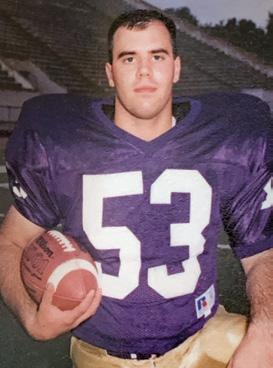
only by his passion for medicine. “I’ve wanted to be a doctor since I was 8 years old,” he said.
A pre-med student who majored in Psychology at JMU, Lucas attended medical school at the Lake Erie College of Osteopathic Medicine in his native Pennsylvania. Osteopathic medicine involves a holistic approach to care that emphasizes the connection between the mind, body and spirit, he explained. “A lot of people don’t know about osteopathic medicine, but we make up one-quarter of the medical students in the United States, and we practice in every specialty. It’s mainly a difference in philosophy and approach to care.”
Lucas completed his residency in emergency medicine in Allentown, Pennsylvania, before working as an emergency-room doctor for a decade at Carilion Clinic in Roanoke, Virginia. He then made
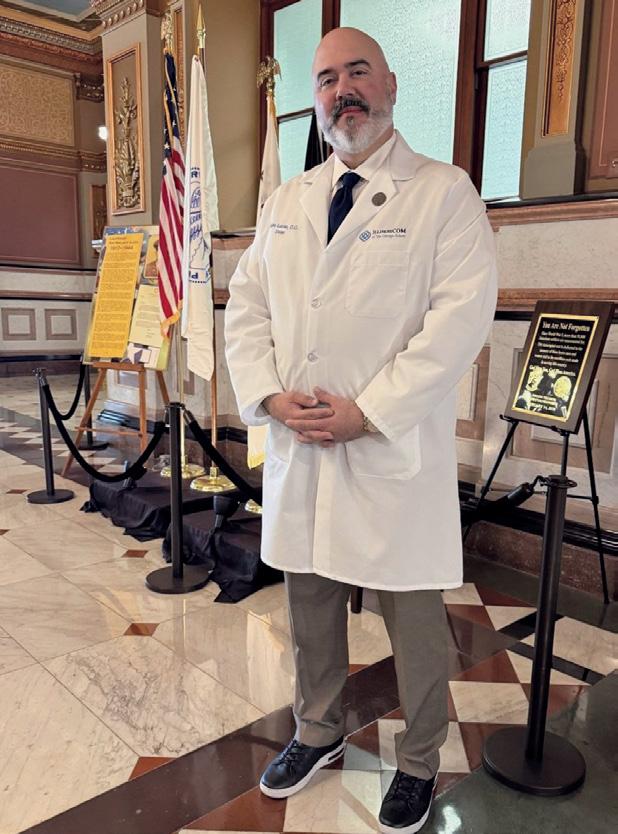
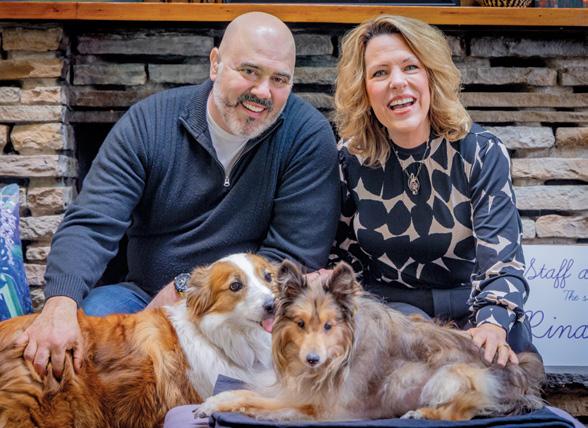
“I’ve wanted to be a doctor since I was 8 years old.”
— DR. JOHN LUCAS (’93)
the leap into academia. For three years, he served as associate dean of the Virginia College of Osteopathic Medicine’s campus in Blacksburg, Virginia. Then he moved to Charleston, South Carolina, to help build residency programs throughout the Southeast for HCA Healthcare, the largest for-profit health-care company in the U.S.
After rejoining the leadership team at VCOM during the COVID-19 pandemic and serving as dean of one of its campuses in Auburn, Alabama, Lucas heard of an opening for a dean of a new medical school in Chicago, the Windy City’s first in nearly 100 years. The Illinois College of Osteopathic Medicine at The Chicago School will welcome its inaugural class in July.
Lucas said the college will place greater emphasis on the intersection of mental and physical health, and the personal wellness of its students. “There are a lot of medical schools that are putting more time into student wellness, but I don’t know of any that have embraced the concept as fully or as completely as we have,” he said.
As a former ER doctor, Lucas is all too familiar with the emotional toll on physicians. “You’re caught in this space where you’re surrounded by tragedy. Most of the patients you see are having their worst day, but you can’t really dwell on the humanity of it. … Doctors like to think of themselves as superhuman somehow. But I’m telling you, we’re not. We’re just regular people with regular gray matter [in our brains], and it’s affected just like everybody else.”
Lucas said he wants his students “to have that resilience, that sense of wellness, [and] to know how to take care of themselves so they can have long careers in medicine.”
Lucas and his wife, Rina (’94), a professional singer, painter and poet, are working with JMU Planned Giving Director Kathy Sarver (’03M) on a legacy gift that could include scholarships for aspiring artists and student-athletes looking to go on to medical school.
“We’re kicking around all of those ideas and how we could make an impact that would be lasting and in line with things that we’re really passionate about,” he said.
During my senior year at JMU, a friend who was on the steering committee for the Senior Class Challenge asked if I would pledge $92 in honor of being a member of the Class of 1992. The $92 was divided over three years, with the smallest increment of $20 marking the year I was still a student. I said yes — because my friend asked me, but also to show my gratitude for my Madison Experience.
I’ve never stopped supporting JMU. That first $20 gift turned into 37 years of giving to my alma mater. The gifts have increased and are more personal and purposeful, but the reasons remain very similar — wanting to be a part of something bigger and showing gratitude for my education, enduring friendships, and the network that JMU provides. One reason I will add is a gesture that was not talked about as much when I was an undergrad: holding the door open for the person behind you. I love the symbolism that a philanthropic gift to JMU truly can hold the door open for a student, a professor or a program.
Recently, I’ve heard from several people that they will give “when”… When their last child goes off to college, when they sell their company, when they retire, etc. They want to wait to make an impact. My response is always, “Don’t wait! Give $25 now!” Set up a recurring gift of $8.33 a month to give $100 a year. Find a JMU fund that inspires you, and support that. Your annual gifts matter.
One of my favorite days at JMU is approaching in the spring: Giving Day. This year, the 24-hour day of giving will be March 26, the 10th anniversary of Giving Day! It’s a great way to start giving to JMU or to build on what you already do. Giving Day is all about participation. So, give to an area of JMU that you love — and ask another alum to do the same. My ask to all alumni is to support our alma mater on Giving Day and beyond. Let’s make this the best JMU Giving Day yet.
I’d be remiss if I didn’t give a heartfelt thank you to the alumni who have been supporting JMU year after year. Your consistency matters more than you might realize. Annual gifts — especially recurring ones — create stability for scholarships, fund innovative programs and allow JMU to plan boldly for the future. When thousands of alumni give this way, the impact is transformational. You truly are Forever Loyal. You are a JMU philanthropist.
So, here’s my challenge to you: Start today. Your gift — no matter the size — creates opportunities, opens doors and strengthens the JMU experience for future generations.
Join us on Giving Day, March 26, and let’s make the 10th annivers ary our most impactful yet.
— Paula Polglase (’92,
’96M),
director of Alumni Relations and executive director of JMU Alumni Association
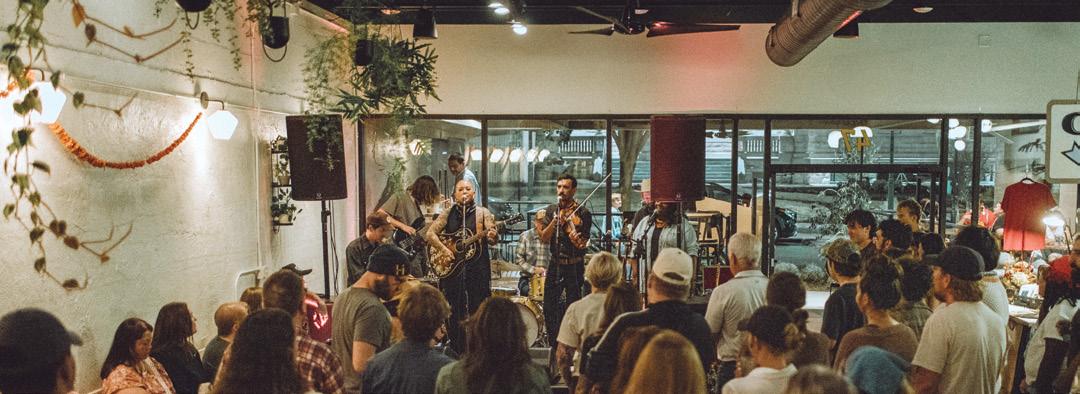
BY ABIGAIL JOHNSON, Alumni Relations student writing assistant

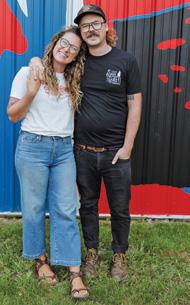
Amberlee Carlson (’14, ’15M) and Zach Carlson (’14) are the co-owners of Sage Bird Ciderworks in downtown Harrisonburg. The couple first experimented with cider-making shortly after graduating from JMU while living together in Harrisonburg. What started as an at-home project quickly became a passion for cider creation.
Amberlee recalls visiting Melrose Caverns, her favorite spot for JMU InterVarsity formals, where the two decided to get married.
“As business owners now, we love that JMU is still a part of our lives,” she said. “We get invited to campus to teach students about our professional experiences; we get to host classes in our taproom; and we hope to have more social and happy hours with JMU offices.”
“I ended up working as a graphic designer in Harrisonburg for a number of years after graduating and before starting Sage Bird,” Zach said. “My time working at UREC in the marketing department was really formative and helped me learn design with real-world applications. Branding is a big part of what we do now at Sage Bird.”

Cheri Greenfield (’15M) earned a master’s degree in Graduate Psychology, and after graduating, completed a residency at the JMU Counseling Center. During her time there, she was able to gain real-life experience with clients and working as part of a professional team. The support and mentorship she received inspired her to open her own practice. Today, she owns Rooted Therapy Practice, a counseling center in downtown Harrisonburg that offers mental health therapy to adults.
“I learned so much from my program and coursework. I really appreciated the experiential aspect of JMU’s counseling programs. I felt well prepared in becoming a mental health counselor, and I continue to feel supported by faculty in the graduate psychology department.”
(Above): Porter sings and plays acoustic guitar with musicians from Holding All The Roses Presents.
Rebecca Porter (’16) is the founder and owner of Holding All The Roses Presents. After studying Health Sciences and Public Health Education, she discovered her passion within the music industry. Holding All The Roses Presents is a contemporary music company dedicated to artist services, event production and promotion in the Harrisonburg area. It has since led to the release of Porter’s own music with her debut record, Roll With the Punches.
“My time at JMU taught me about persistence and overcoming adversity. Although my career is not in the public health education field, my degree and those lessons have enabled me to be a parent and champion for my son and his needs, as well as the adversities life brings my way.”
Nathalie Capelluto (’01, ’16M) formed Studio Links Jewelry in April to express her creativity and newfound passion for permanent jewelry. Studio Links Jewelry sells necklaces, bracelets, anklets and rings, as well as customizable chains and charms.
Capelluto graduated from the College of Business with a Bachelor of Business Administration in Computer Information Systems but couldn’t stay away. She returned to JMU and in 2016 earned her Master of Business Administration, concentrating in Innovation. JMU gave her not only the strong business background she needed, but also the foundation that guides her today.
“I wouldn’t take back a second of it. I still bleed purple. Being in finance for over 20 years, the brain power that it took and sucked out of me really drove me toward my creative side.”
For more on this story, scan the QR code:

BY HOLLY STADTLER
Dream Catcher Films Entertainment Inc.
Narrated by Martin Sheen, this one-hour documentary is based on a book by Jim Kurtz: The Green Box. The film tells the story of Jim’s decades-long search to learn about his father, Robert Kurtz, who died when he was only 2 years old.
Executive producer Holly Stadtler combed archives and libraries to find World War II footage and pictures that bring the story to life. “This film reveals the many ways in which a family was deeply and irrevocably impacted by WWII — even decades after the fighting ended,” said Stadtler, who studied Broadcast Journalism. “It illustrates how no one involved in any war, directly or indirectly, comes away uninjured — not the combatants, their families, their children or their communities.”
BY DAVE PRUETT
George F. Thompson Publishing
ISBN-13: 978-1960521071
Dr. C. David Pruett, professor emeritus of mathematics, shares his journey of hiking all 559 miles of the Appalachian Trail that pass through Virginia and West Virginia, beginning with his retirement at 65 and completing it at age 75. Perhaps no other stretch of the trail provides such awe, diversity and wonder. Pruett’s informative and beautifully illustrated book conveys what it is like to experience the trail’s vistas, bridges, flora, meadows, shelters, weather, water sources, wildlife and magic — in an unforgettable adventure. For those who seek a sense of what it is like to walk and hike the AT in the Virginias, Pruett’s book is perhaps the best guide.
BY ALEXANDER J. CARROLL (’10)
ALA Neal-Schuman
ISBN-13: 979-8892555845
Amid overall falling enrollment figures for higher education, the growing success of STEM programs bucks the trend. Ensuring that these programs flourish has become a priority for administrators at the provost level and above. But this emphasis on science, technology, engineering and math poses challenges for academic libraries, many of which have instead historically focused on the humanities and social sciences. This primer helps to fill that knowledge gap, demystifying the scientific teaching and research processes for Library and Information Science students and librarians.
A Bachelor of Arts in History, Alex Carroll serves as the associate director of the Science and Engineering Library at Vanderbilt University. He is also an associate editor of the Journal of the Medical Library Association.
BY AMBER MCBRIDE (’10)
Feiwel and Friends
ISBN-13: 978-1250908087
Gospel is the Keeper of the Leaving Room ― a place young people must phase through when they die. The young are never ready to leave; they need a moment to remember and a Keeper to help their wispy souls along. When a door opens and a Keeper named Melodee arrives, their souls become entangled. Gospel’s seriousness melts and Melodee’s fear of connection fades, but still ― are Keepers allowed to fall in love? Now they must find a way out of the Leaving Room and be unafraid of their love. In a novel that takes place over four minutes, Amber McBride, a Bachelor of Arts in English, explores connection, memory and hope in ways that are unforgettable and poignant.
BY
LYNN AND CELE SELDON (’84)
Reedy Press
ISBN-13: 978-1681065960
Nestled between Charleston and Savannah, the South Carolina Lowcountry is rich in history, natural landscapes, Gullah culture, and oh-so-Southern charm and hospitality. This book makes the perfect travel companion for a visit to this destination.

For outdoors lovers, explore Hilton Head Island’s miles of beaches, bike the rails-to-trails Spanish Moss Trail, kayak the waterways and salt marshes, climb to the top of a lighthouse, or stay overnight in a Civilian Conservation Corps-built cabin. Immerse yourself in the Reconstruction Era and Gullah culture at St. Helena Island’s Penn Center, Beaufort’s Reconstruction Era National Historical Park, or on a trip to Daufuskie Island. And take a bite out of the region at Lowcountry Produce, Harold’s Country Club and many other tasty restaurants.
BY MATT POCIASK (’13)
Element and Ember Books
ISBN-13: 979-8999526014
Detective Ava Clarke didn’t ask for the Emily Rose case. And she certainly didn’t care to chase down the ghost of a missing heiress born into wealth and privilege. Raised in the foster system, Ava knew what it meant to be forgotten. But when she opens the case file, something doesn’t sit right. The deeper she digs, the more the cracks begin to show. As the investigation tightens, Ava begins to realize the truth isn’t buried in the past.
Matt Pociask, a Marketing major, says his debut novel was “written during off-hours as a creative challenge and a way to finally bring a long-running story idea to life.” He is a management consultant based in the Washington, D.C., area.
BY NANCY SHINABERRY (’73)
Independently published
ISBN-13: 979-8290336220
Mary Magdalene, who was she? The Illumination of The Magdalene brings her out of the shadows into the light, unmasking her for the first time, giving her a face and a deep understanding of her young life. Everyone who has read the New Testament has seen glimpses of her, though never fully knowing she was there. Her story has never been told, not like this. You will hear the voice of a maiden, caught in the dread of her future, uncertain of her destiny, reluctant to face her future for all that has been laid before her. In trying to grasp her essence and place in history, many have been inspired to seek her out. This bit of prose seeks to convey these ideas of hope and aspiration.
BY NINA WILLNER (’82)
Dutton | ISBN-13: 978-0593471272
At 16, Eddie Willner, the author’s father, was among the millions of European Jews rounded up by Adolf Hitler’s Nazis. He was forced into slave labor alongside his father and his best friend, Mike, and spent the next three years of his life surviving multiple death camps, including Auschwitz. Meanwhile, in the United States, boys only a few years older than Eddie were joining the Army and heading toward their own precarious futures. Once farmers, factory workers and coal miners, they were suddenly untested soldiers, thrust into the brutal conflicts of World War II.
The Boys in the Light is a testament to survival against all odds, the strength of the bonds forged during war and the resilience of the human spirit.
BY JOHN CARIO (’83)
KWE Publishing
ISBN-13: 979-8999033109
John Cario, who studied Hospitality Management and Business Administration, has managed hotels for decades. In his memoir, he shares the humor, challenges and leadership lessons he learned along the way — insights he hopes will inspire today’s students and tomorrow’s leaders.
From quirky guests to middle-of-the-night emergencies, Cario has lived the stories that bring hospitality management to life. But beyond the anecdotes, his book reveals the skills that apply not only in hotels, but in any field where people and problem-solving come first.
“As a JMU graduate, it’s exciting to share this with the community that shaped me,” Cario said. “I hope students and instructors alike will find value in the stories as a way to learn about hospitality, leadership and life.”
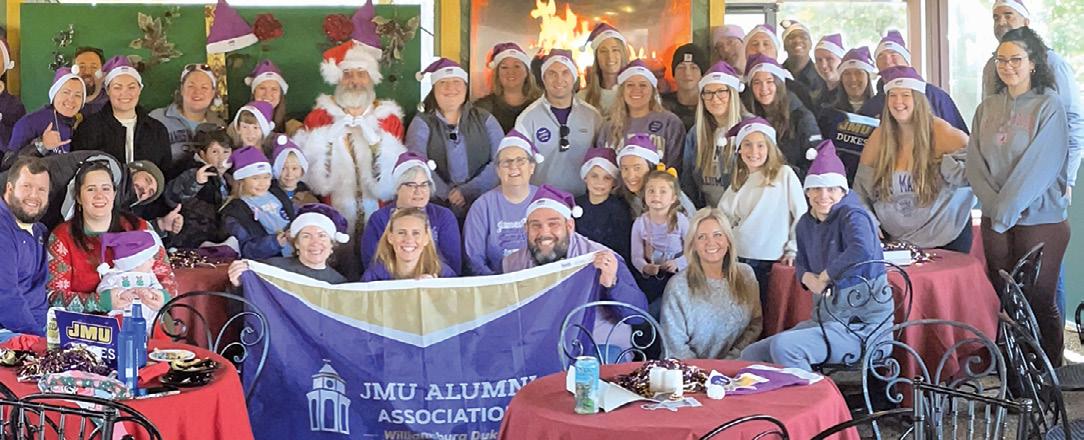
BY PAULA POLGLASE (’92, ’96M), director of Alumni Relations
Each December, the Williamsburg Dukes chapter creates a special experience at Christmas Town in Busch Gardens, inviting JMU alumni, family and friends to gather for a reception before heading into the park. This beloved tradition blends the magic of the season with the spirit of the Madison community — and this year’s celebration was bigger and brighter than ever.
On Dec. 13, Dukes met for a private reception from 12:30 to 2 p.m. in the heated Black Forest Pavilion tent, enjoying hors d’oeuvres, wine, beer and nonalcoholic beverages. The highlight? A special visit from Santa, who spent time taking photos and visiting with the group. After the reception, everyone went to the park to take in the dazzling lights, festive shows and holiday-themed rides that make Christmas Town a seasonal favorite.
This year, the Williamsburg Dukes extended the invitation to neighboring chapters in Richmond and Hampton Roads, creating an even larger network of alumni and friends to share in the celebration. It’s a perfect opportunity to reconnect, make new memories and enjoy the warmth of the JMU community amid the glow of more than 10 million lights.
“I love seeing the excitement on everyone’s faces when Dukes from across the state gather to kick off the holidays together,” said
Save the date: May 1-2, 2026
Carmen Jones (’05, ’06M), Williamsburg chapter president. “It’s a magical mix of Christmas cheer and JMU spirit. You can’t help but feel proud to be part of such a fun and supportive community.”
Santa celebrated with Williamsburg Dukes during their annual holiday reception .
Beyond Christmas Town, the Williamsburg Dukes host a variety of fun and engaging events throughout the year, including the Dukes Classic Putt-Putt Tournament, paint nights led by Bottles ’n Brushes by A L, and spirited Watch Parties at Revolution Golf and Grille. These gatherings offer great ways to stay connected and celebrate your Purple Pride locally.
“Come once, and you’ll be hooked!” Jones continued. “The energy, the friendships and the shared JMU pride make every event special. It’s the perfect way to keep that JMU spirit alive long after graduation. … There is something for everyone.”
Follow Williamsburg Dukes on Instagram and Facebook to stay up to date and get involved with this vibrant alumni community!
Not being invited to local chapter events? The JMU Alumni Association sends out invites based on your current address in our database. Scan the QR code or visit jmu.edu/myinfo to update your information:
Welcoming all alums who graduated 50-plus years ago for a weekend of activities around campus with a special invite to the Class of 1976, who will be inducted into the Bluestone Society on Saturday

JMU X-Labs opened as an interactive space where people from different areas of study could create new solutions.
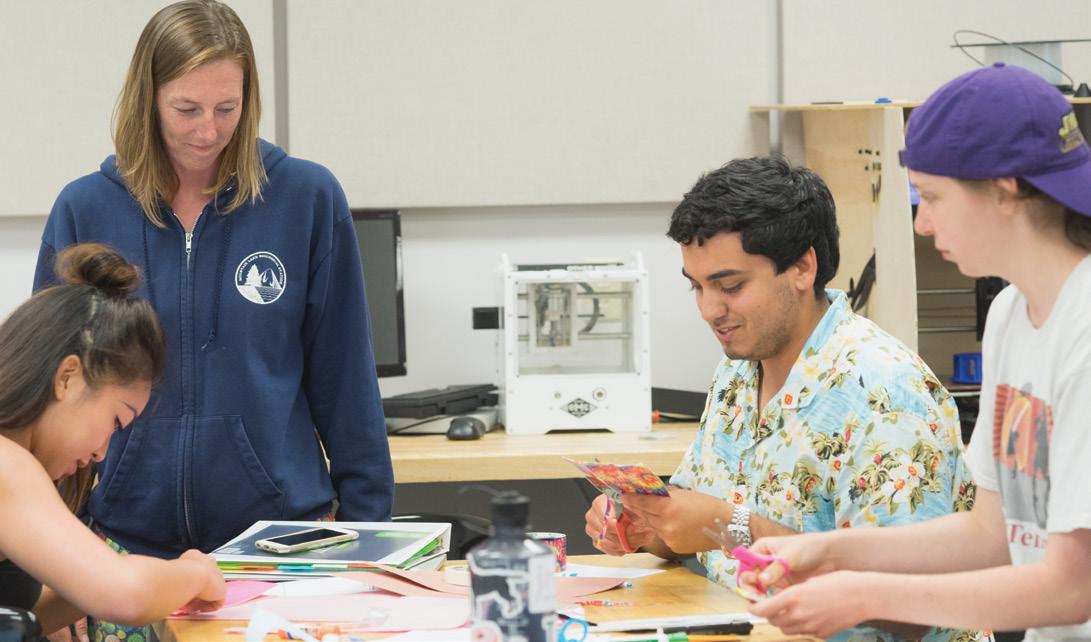
70
Carol Davis reunited with five of her classmates in late September in Spring Lake, New Jersey.
74
Sam Baker, Les Branich (’76) and Dennis Evans (’76) met for the first time in 40 years to reminisce about their Madison College days.
84
Cindy Slagle Flickinger, a Bachelor of Fine Arts in Interior Design and a JMU track-and-field Hall of Famer, retired in 2024 after 23 years of teaching art at Montross Middle School in Westmoreland County, Virginia. The birth of her first grandson in California was the incentive to put the paints and pencils away. She spent the past year traveling to California, North Carolina and Italy for a once-in-a-lifetime
adventure with her husband of almost 39 years, Scott. The couple also added another grandson in North Carolina.
85
Andy Hayden, a Bachelor of Arts in History and Political Science, retired Aug. 30 after 40 years of federal government service. He was hired by the CIA in 1985 and worked in the geospatial intelligence field, first at the National Photographic Interpretation Center and later at the National GeospatialIntelligence Agency. His final
(L-R): Class of 1970 friends Carol Appling Hannah, Barbara Thompson Brown, Carol Burke Davis, Linda Liebno Stoltz, Betty Schuler Grimm and Kathy Patton Jenkins traveled from six states to see each other.
position was director of mission management at NGA.
86
Bob Gusella, a Bachelor of Business Administration in Hospitality, was named general manager/chief operating officer at The Club at Morningside in Rancho Mirage, California. A lifelong industry professional, he has managed premier private clubs for
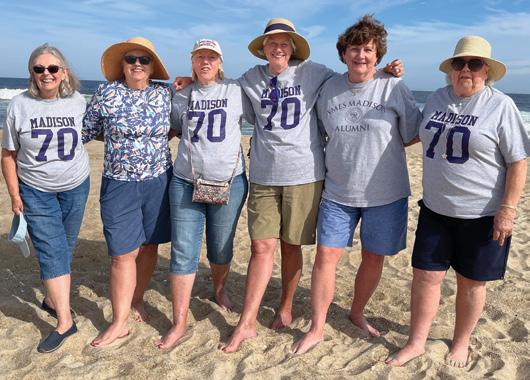
the last 30-plus years in six different states. Gusella is a former two-time chairman and longtime member of JMU’s Hart School advisory board and was named a CMAA Fellow by the Club Management Association of America in 2022.
90 Joe Livingood, a Bachelor of Science in Public Administration and Political Science, competed alongside 90 police and civilian riders in the eighth Annual Keystone State Motorcycle Skills Rodeo. Demonstrating exceptional teamwork and riding precision, Livingood’s team proudly secured third place in the Team Ride event. Go Dukes!
91 Heather Norris, a Bachelor of Business Administration in Finance, was formally installed as the eighth chancellor of Appalachian State University on Oct. 3. Former JMU President Charlie King, an ASU alumnus, gave the greetings during her ceremony in the Holmes Convocation Center on the campus in
Boone, North Carolina. He highlighted his and Norris’ shared background “in business, a focus on the intentional growth of our institutions, and a commitment to cultivating a strong student body, ready to make a difference in their own communities.”
94
Audra Yuki-Wright Jones, a Chemistry major, was inducted Sept. 13 into the International College of Dentists, an honor society of dentists from more than 140 countries. Reserved for those with exceptional service and achievement, it’s a recognition that less than 3% of U.S. dentists receive. ■ Prissie Nguyen, a Bachelor of Business Administration in Computer Information Systems, ran the 50th Marine Corps Marathon with Joe Uglialoro (’93) in October. “This was Joe’s second marathon and my 52nd!” she said. Uglialoro, a Bachelor of Business Administration in Accounting, was diagnosed with multiple myeloma 15 years
(Counterclockwise from below): Sam Baker (’74), Les Branich (’76) and Dennis Evans (’76); Andy Hayden, second from left, with his wife, Susan, and two eldest sons at his retirement ceremony; Joe Livingood (’90) at the Keystone State Motorcycle Skills Competition; Prissie Nguyen (’94) and Joe Uglialoro (’93); Cindy Flickinger (’84) with her husband, Scott, enjoying Italy.
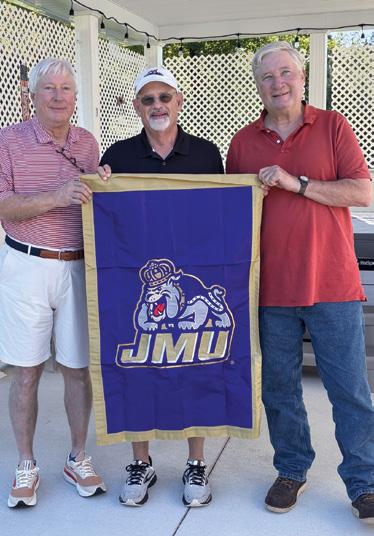
ago and was the top fundraiser for the Multiple Myeloma Research Foundation for this race.
95
Mark Miller attended the Homecoming Alumni Reunion in the Hall of Presidents on Oct. 17. “All of us met freshman year 1991,” Miller said. Class years ending in 0’s and 5’s celebrated their milestone reunions at the special reception.
97
Matt Horn (’02)
Jody Stell, a Bachelor of Business Administration in Accounting, and her husband completed their second Camino de Santiago, hiking 395 miles across northern Spain in September and October 2024, and 315 miles on the Camino Francés and Camino del Norte from August to October 2015. Now she gives presentations at her local library’s annual How-To Festival and is
happy to help others plan for their Caminos!
02
Matt Horn, a Bachelor of Science in Public Administration, was named national director of strategic growth and development for the infrastructure and localgovernment operations firm MRB Group after serving six years as the firm’s director of local government services. He also serves as an ex-officio member of MRB Group’s board of directors. Horn resides in Geneva, New York, with his wife, Courtney, and their sons.
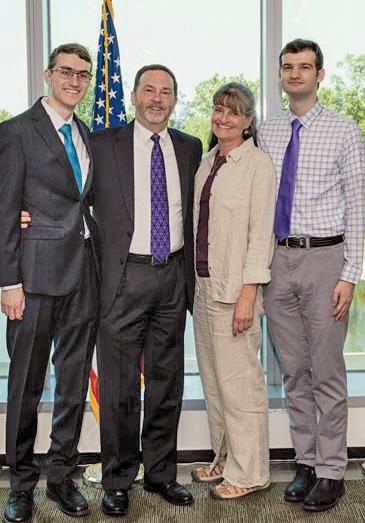

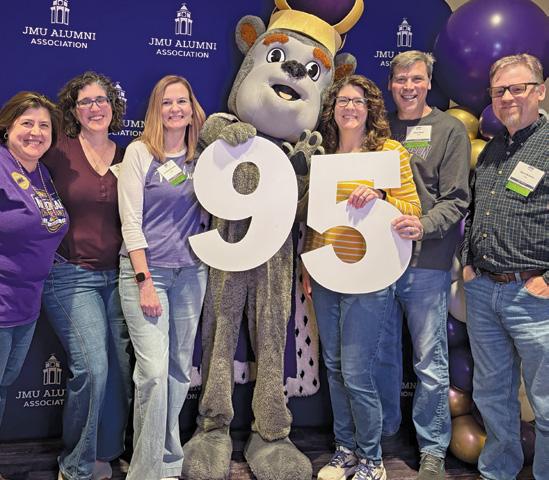
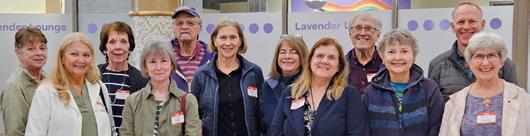
SEA is a JMU Human Resources-sponsored program and a multifaceted organization open to retired full-time, classified employees who have earned emerita/emeritus status approved by the JMU president. This dynamic and fun organization provides opportunities for Staff Emeriti to continue association with colleagues, and maintain ties to the university through activities. Privileges and benefits of being Staff Emeriti include:
■ JACard
■ JMU email account
■ Microsoft 365 (online only)
■ Emeritus parking decal
■ Library privileges
■ JMU Bookstore discounts
■ On-campus waiver of tuition
■ University events participation
■ Use of recreational facilities
■ Ability to purchase a meal plan
To learn more about the Staff Emeriti Association, visit https://jmu.edu/staffemeriti or email staffemeriti@jmu.edu.
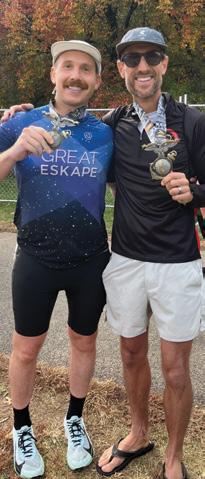
05
Jenn Cox (’06M), a registered client service associate at Raymond James and Associates Inc., was named 2025 Branch Associate of the Year for her outstanding contributions.
“Jenn’s knowledge, instincts and way of operating are beyond measure. She is a culture carrier, a leader by example and a force multiplier for our team’s success,” said Austin Storck, financial adviser for Raymond James.
08
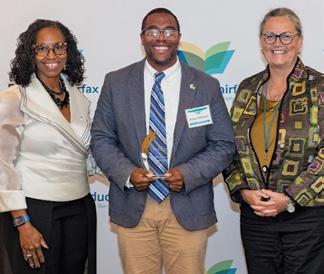
(L-R): Duke Dog joins Mark Miller (’95), second from right, and his classmates at the Homecoming Alumni Reunion reception. Michael Thompson (’08) and Matt Hotaling (’08) celebrate after the 2025 Marine Corps Marathon. Philip Wilkerson (’08), center, with Lynnette Henry of Educate Fairfax (left) and FCPS Superintendent Michelle Reid (right)

Jenn Cox (’05, ’06M)

Ethan Pits III (’24)
done a triathlon together before! But this year’s Marine Corps Marathon was a special moment.
“After the race, we caught up again,” Hotaling said, “and reflected on the crazy journey that started back at JMU’s Hillside dorms and brought us to the finish line of a 26.2mile race!” ■ Philip Wilkerson, a Bachelor of Arts in History, was inducted into the Fairfax County Public Schools Alumni Hall of Fame, which, since 2022, has recognized former FCPS students who have made significant contributions to their field and their communities. Wilkerson is an employer engagement consultant with George Mason University Career Services. He also gave his first TEDx speech this year.

IN MEMORIAM: Ben Delp (’05, ’08M) died Sept. 14 in Harrisonburg. He served as director of federal relations and communications for JMU’s division of Research, Economic Development and Innovation, and was employed by the university for 20 years. Delp, a Bachelor of Arts in Political Science and Master of Public Administration, was also a steward of charitable community work, serving on the Walk to End Alzheimer’s Planning Committee and leading an annual food drive in support of the Blue Ridge Area Food Bank. His family has created the Benjamin T. Delp (’05, ’08M) Memorial Fund at JMU.
Matt Hotaling, a social studies teacher in Virginia Beach, Virginia, participated in the 2025 Marine Corps Marathon with classmate Michael Thompson (’08), an Integrated Science and Technology major and technical sales engineer in cybersecurity.
They were freshman-year hallmates in McGraw-Long and roommates for the next three years in Stonegate apartments. “We have managed to stay in touch since our time at JMU through big moments like weddings and the birth of our children,” Hotaling said. “We’ve even
24
Ethan Pits III, who studied Kinesiology and Exercise Science, graduated cum laude and was recently accepted into the VCU Doctor of Physical Therapy program. He hopes to enroll in the Sports Residency Program to be able to tailor his physical-therapy work to rehabilitating athletes.
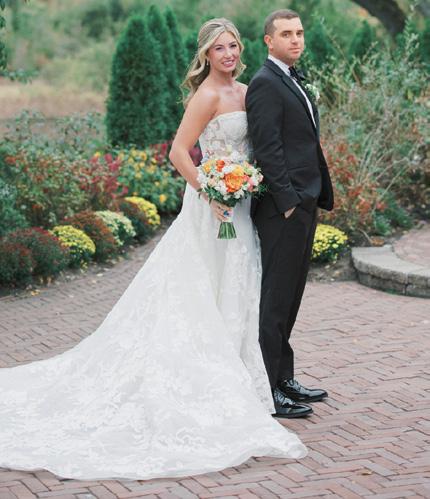
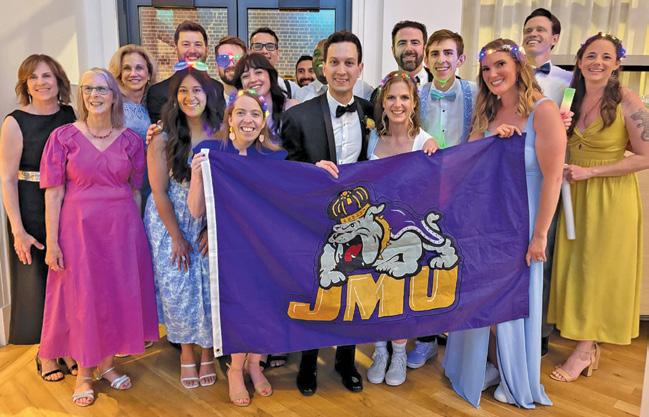
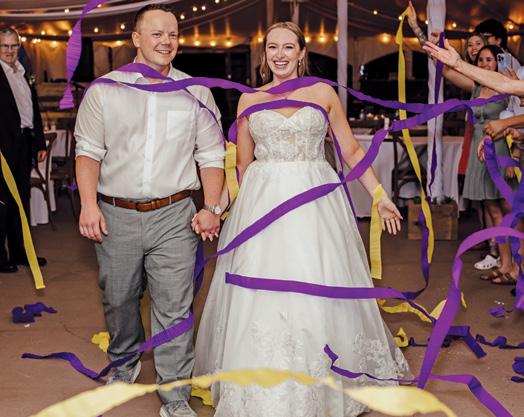
1. Jordan DeCesare (’19) and Tyler Shupack (’19) married Oct. 10 in Spring Lake, New Jersey. They met during the summer of 2017 in Antwerp, Belgium, as part of the College of Business’ COB 300 study-abroad program. “We were fortunate to be able to travel throughout Europe with our fellow Dukes and had the best time,” said DeCesare. “We often look back on that time fondly and will always cherish those special memories of when we first met. Antwerp will always hold a special place in our hearts!” 2. Kristen Fannon (’13, ’14M), an Interdisciplinary Liberal Studies major, and Matthew Sese (’13), a Bachelor of Science in Integrated Science and Technology, celebrated their wedding ceremony and reception May 31 in Old Town Alexandria, Virginia. 3. Chandler Hatfield (’20, ’21M), a Bachelor of Arts in History and Master of Arts in Teaching, and Kaitlyn Young (’20, ’21M), a Bachelor of Science in Mathematics and Master of Arts in Teaching, married June 7 in Harrisonburg. Their final send-off into the night included purple-and-gold streamers!
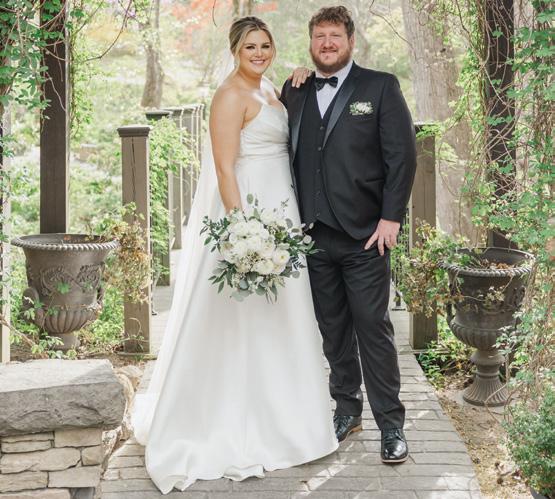
4. Charlotte Mitchell (’23), a Bachelor of Business Administration in Marketing, and her fiance, Tristan Yowell (’22), met at JMU and recently shared their engagement journey, which features a handcrafted ring designed by Emily Warden (’17). According to Warden, the couple’s story reflects a growing shift in the bridal world. “Couples today are looking for something truly one of a kind. Jewelry is no longer just about style or price; it is about capturing a piece of their story in a way that feels authentic.” Mitchell, of Doswell, Virginia, recalled how personal the shopping experience felt compared to traditional jewelry stores. “We loved how friendly everyone was and how easy they made the shopping experience,” she said. “It was also a bonus that there was a JMU connection.” 5. McKenna Kendrick (’16), a Bachelor of Science in Sport and Recreation Management with a Business minor, married Nick Watts on April 4 at The Mill at Fine Creek in Powhatan, Virginia. Many Dukes from various class years were in attendance, including Road Dawg.
W
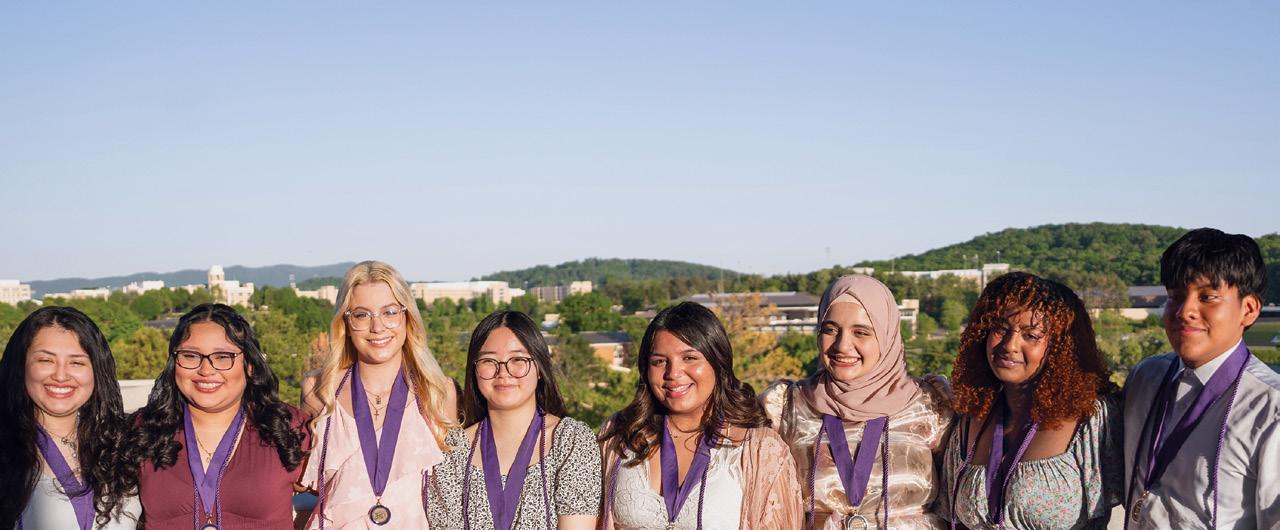
The Valley Scholars Program helps talented local students become the first in their families to earn their college degree. The program offers educational enrichment opportunities beginning in middle school and continuing throughout high school, with the goal of helping students achieve the academic success necessary for college attendance.
7 92% students from the program enrolled at JMU since 2019
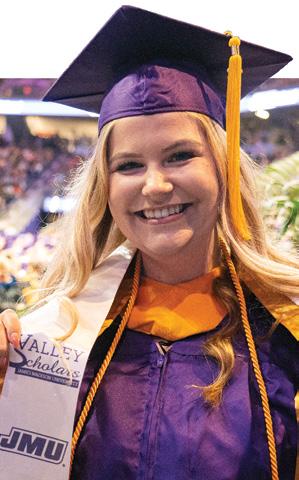
Local school-district partners: Augusta County, Harrisonburg, Page County, Rockingham County, Shenandoah County, Staunton and Waynesboro of Valley Scholars students pursue higher education
96%
80+ middle- and highschool students in the pipeline
49 JMU graduates to date
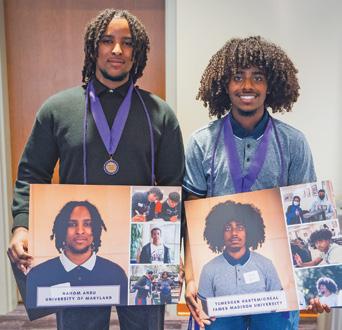
of participants take Advanced Placement classes in high school or are dual-enrolled in high school and community college
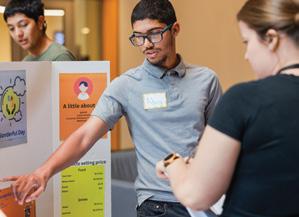
210
Interested in learning more about the Valley Scholars Program? Scan the QR code.
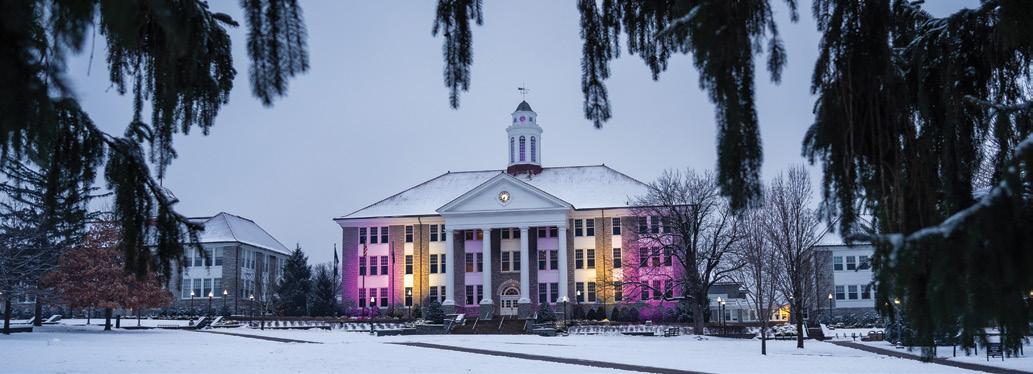
As director of the Virginia Retirement System, Patricia Schwab Bishop (’92) seeks to be a resource for state employees
he summer after graduating from JMU, Patricia “Trish” Schwab Bishop (’92) was a Governor’s Fellow in L. Douglas Wilder’s office in Richmond, Virginia. “That experience launched my career in state government,” she said. “The fellowship truly is an incubator for future public employees. A number of JMU students have ended up applying for and participating in the program, and quite a few remain in state government today.”
That list includes Bishop, now director of the Virginia Retirement System. She originally considered a career in law, but life took her down a different path, and she ran with it. “I probably never would have said, ‘Oh, I’m going to be the director of the 14th-largest pension plan in the United States, with approximately 860,000 members and beneficiaries.’”
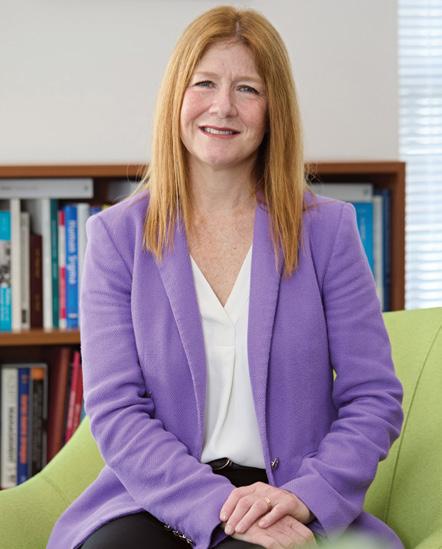
A northern New Jersey native, Bishop studied Political Science at JMU, then added a History major after studying British history during the Semester in London program. She was also a member of Tri Sigma sorority, worked with the Proud and True Fund, and was in the president’s cabinet.
“I learned a lot at JMU,” Bishop said. “I had exposure to excel-
lent academic and leadership experiences.”
After her summer fellowship, she was a policy assistant in the governor’s office, then worked for the Virginia Senate. Next, she moved to the Joint Legislative Audit and Review Commission as an analyst conducting applied social science research and was later responsible for oversight of the VRS. In 2008, she applied for the job of VRS policy director and has held various positions at the VRS ever since, including deputy director and, as of 2015, director.
Most rewarding in her career is the opportunity for growth and new challenges. “I think one of the best parts about my career path has been the commitment to service and helping the commonwealth’s public servants, including our teachers, our first responders and others who make such a difference in the lives of all of us,” she said.
Looking back, she credits JMU with giving her “the foundation for a career with purpose.”
“If I have any advice,” she said, “it’s to never underestimate the value of showing up, staying curious and building relationships. Public service is full of purpose and opportunities for those willing to raise their hand.”
— Josette Keelor
For more stories, scan then visit http://jmu.edu/beingthechange.