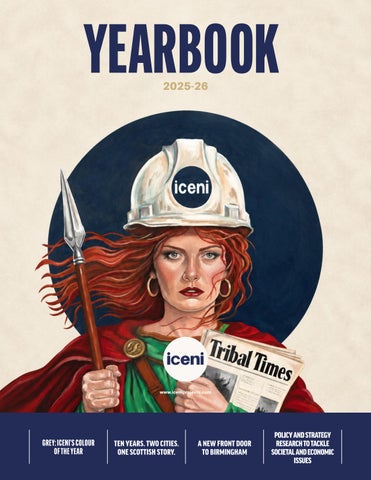
YEARBOOK 2025-26
www.iceniprojects.com
GREY: ICENI’S COLOUR OF THE YEAR
TEN YEARS. TWO CITIES. ONE SCOTTISH STORY.
A NEW FRONT DOOR TO BIRMINGHAM
POLICY AND STRATEGY RESEARCH TO TACKLE SOCIETAL AND ECONOMIC ISSUES
FOREWORD −
By Ian Anderson, Chief Executive
In an era of polarisation, our business is no different. Separate conversations with two of Iceni’s trusted clients at UKREiiF in Leeds in May of this year illustrated the point perfectly. One, a housebuilder focused on London, remarked that 2026 feels worse than 2008. Another, focused on strategic land promotion, commented that it was the best planning environment in which to promote development since the Second World War.
2 | The Yearbook | 2025 - 2026
Both statements are playing out in boardrooms around the country as we speak, and Iceni’s workload reflects the same contradictions.
Sites that we might once have anticipated becoming hallmark residential developments are instead being promoted for industrial and logistics, film studios and data centres.
Whilst we continue to enjoy a rich variety of town and city-led projects, the amount of work centred around private-for-sale housing has markedly reduced. In some places it has been replaced by exciting build-to-rent and purpose-built student housing schemes; elsewhere, by entirely different land uses.
Our retail work continues to proliferate, underpinned by our ongoing strategic relationships with Marks & Spencer in England and Home Bargains in Scotland. But perhaps the biggest changes to Iceni over the past year can be grouped into six themes. And yes, apparently there can be a “sixthly”.
A YEAR OF PROGRESS ACROSS 6 THEMES
1
Firstly, our public sector work has continued to grow. Our Economics teams in London and Manchester have worked on everything from Strategic Development Area growth plans for combined authorities through to successful funding bids for Southport Pier. Our Heritage & Townscape team in Scotland has worked with City of Edinburgh Council on the development of the recently adopted Princes Street and Waverley Valley Statement of Heritage Significance, which supports the area’s emerging strategy.
2
Secondly, our multidisciplinary appointments have increased significantly. This has come partly through the use of our planners as capable project managers, but increasingly through the rapid expansion of our nonplanning teams in their own right. Landscape and Heritage & Townscape, in particular, have grown rapidly.
3
Thirdly, we have continued to expand our regional footprint. Manchester has been transformed by the establishment of our Economics presence in the region and the addition of Ruth Jackson Planning to our existing planning team.
4
Fourthly, our work on strategic infrastructure and Development Consent Order-scale projects has grown across virtually every discipline, led by the appointment of Anna Sutherland-Bamber.
5
Fifthly, our established footprint in strategic land promotion has resulted in us working on major Green and Grey Belt development proposals – including some sites that have been on our books since before Iceni itself was established in 2005. Patience, it turns out, remains a planning skill.
6
And sixthly – I did check – our industrial, logistics and data centre workload has continued to grow, from strategic needs and site assessment work by our Economics team through to major planning applications involving almost every discipline across the business.
EMPLOYEE OWNERSHIP FOR A STRONGER TOMORROW I am particularly pleased that, in our first full year of employee ownership, I can say that the business is in the best shape I have ever seen it. You will not find much about it in the pages of this Yearbook – internal governance being notoriously difficult to photograph – but the changes behind the scenes have been every bit as important as the projects featured within it. A new executive structure, greater devolved power and authority, the formation of an Employee Council and continued investment in career development are setting Iceni on a positive path for the next decade. Most importantly, we do so safe in the knowledge that Iceni will continue to be owned by our people, for the benefit of our people, while securing positive outcomes for our clients for many years to come.
Before closing, I cannot look back on the past 12 months without reflecting on the desperately sad news of Fred Peters’ untimely passing in April. As one of the founding fathers of Iceni, Fred had only just begun to enjoy his retirement, having hung up his dayglo transport coat in June 2025. On page 45 of this Yearbook you will find reflections from his close friend and former business partner, Rob Amey, who took over the leadership of our Transport team upon Fred’s retirement. Rob captures the thoughts of all of us far more eloquently than I could here. I will therefore simply say that Fred may be gone, but he will never be forgotten. This Yearbook is rightly dedicated to him.
−
Ian Anderson, Chief Executive The Yearbook | 2025 - 2026 | 3
GREY
ICENI’S COLOUR OF THE YEAR 2025-26
−
By Lorna O’Carroll, Director, Strategic Planning
For decades, the story for Green Belt sites was one of waiting for Local Plans to progress. Sustainably located, deliverable sites sat in limbo, because the plan-making system that should have allocated them was moving at glacial pace. Green Belt boundaries drawn in the 1950s went unreviewed for decades. As a consequence, local housing needs went unmet in many areas across the country, compounding the housing crisis. The tide changed quickly after the December 2024 NPPF restored a mandatory standard method for assessing housing need and introduced grey belt.
Grey belt, constituting land that is PDL and/or does not strongly contribute to Green Belt purposes (a), (b) and (d) which, subject to not fundamentally undermining the remaining Green Belt, being able to demonstrate unmet need, sustainably located and able to achieve the Golden Rules, is no longer considered inappropriate development in principle. Significantly, this meant that many sites the plan-led system had failed to reach finally had a route through the system. Recent research suggests that grey belt policy has a major impact on housing planning permissions, with 76% of major residential appeals approved since the policy’s introduction.
THE GREY BELT IN ACTION Iceni has been at the forefront of delivering on the new policy. In the past year, we have secured local decisions and positive appeal decisions on Green Belt / grey belt land, including:
01
02
03
04
05
06
COMMERCIAL AND RESIDENTIAL DEVELOPMENT AT SWANLEY, KENT UNDER DELEGATED POWERS
2,100 HOMES IN A RESIDENTIAL-LED NEW SETTLEMENT AT WEST HORNDON, THURROCK
412 HOMES AT CORRINGHAM, THURROCK
1.2M SQ FT OF COMMERCIAL DEVELOPMENT AT BURNT MILLS, BASILDON
500,000 SQ FT OF COMMERCIAL DEVELOPMENT IN ELMBRIDGE
A VERY SPECIAL CIRCUMSTANCES APPEAL FOR UP TO 1,000 HOMES AT EAST TILBURY, THURROCK
4 | The Yearbook | 2025 - 2026
WEST HORNDON
BURNT MILLS, BASILDON
CORRINGHAM EAST TILBURY
LONDON
SWANLEY
ELMBRIDGE
NEW PLAN PROMOTION
LONDON IS BACK IN PLAY
NEW PLAN PROMOTION
The requirement to meet housing need in full, combined with providing exceptional circumstances to allow for the alteration of Green Belt boundaries, means that we are seeing updated Green Belt reviews and proposed releases — albeit reasonably conservative in most instances. The new plan-making regulations came into force on 25 March 2026, with legacy plans to be submitted by 31 December and transitional authorities required to reach Gateway 1 self-assessment by 31 October, with other plans to follow closely thereafter. As a result, we are seeing a definite uptick in plan-making activity and consultations being launched weekly, if not daily, and we expect land promotion to be the focus for the year ahead.
The draft London Plan is out for consultation until 15 October and takes a different approach to the Green Belt from its predecessors. Where previous plans treated Green Belt release as all but unthinkable, this one opens the door to development. However, this has been limited to the identified Broad Locations for Growth (BLGs) and does not account for grey belt, which it could be argued is contrary to national policy.
In terms of ongoing policy reform, the direction has been set by the new Framework which was published in August. Grey belt policy is reinforced in planmaking and decision-making policies, hopefully meaning it is here to stay, at least until the next General Election. It also introduces support for railway station growth that would represent another landmark policy to help unlock sustainable development opportunities. The beauty of strategic land is that all of Iceni’s disciplines can be involved — from planning and economics to transport, landscape, heritage, design, EIA, sustainability and engagement — bringing in the full breadth of Iceni’s expertise on delivering sites from promotion through to permission.
The Yearbook | 2025 - 2026 | 5
RETAIL WANTS TO GROW. IS PLANNING POLICY KEEPING UP?
−
By Craig Stewart, Senior Planner, Planning
Retailers want to invest in physical stores. The problem is increasingly finding the right space in which to do it. Recent research, reported by the Financial Times, points to a shortage of available retail warehouse floorspace across the UK after years of limited development. That ought to be a positive story for retail: demand is there, investment is there and customers still value welllocated physical stores. But there is a problem. Planning policy has barely moved. The new NPPF puts economic growth, productivity and investment firmly back on the agenda. Yet retail is largely absent from that conversation, while the policies governing where and how new retail development should happen remain broadly unchanged. The draft London Plan illustrates the tension particularly well. Policy PV3 rightly recognises that successful town centres need to evolve, with a mix of retail, leisure, employment, residential and 6 | The Yearbook | 2025 - 2026
community uses. All good stuff. But when it comes to retail parks and other modern retail formats, the emphasis remains on “optimising” existing sites and making more efficient use of land. The implication is difficult to miss: these are uses to be intensified or repurposed, rather than successful commercial locations capable of supporting investment in their own right. That feels increasingly at odds with what the market is telling us. Part of the challenge is that retail policy was shaped at a time when the principal concern was protecting town centres from the rapid growth of out-of-centre development. Today, the issues facing town centres are very different. The growth of online shopping, changing consumer behaviour and shifts accelerated by the pandemic have transformed many centres, with leisure, food and drink, independent businesses and community uses playing an increasingly important role. In that context, the debate should not simply be about retaining retail floorspace at all costs, but ensuring communities have access to the facilities they need in the right locations.
Rather than pitching retail investment against good placemaking, there is an opportunity to do both: creating modern retail space that meets customer demand while contributing to regeneration, sustainability and better places. For retailers, developers and investors, this tension creates opportunity. The next generation of retail development will need to demonstrate not only commercial demand, but how investment can support the wider objectives that planning policy increasingly expects development to deliver. Demand for retail floorspace is there. The question is whether planning policy is ready to make room for it. Iceni advises retailers, developers and investors on retail planning strategy, planning applications, Local Plan promotions and town centre regeneration. Our Retail and Town Centres team works across the UK to unlock development opportunities and secure planning permission for new investment.
CIRCUIT BREAK: NEWS FROM OUR NEW TOWN PLANNING DIRECTOR IN MANCHESTER
−
By Ruth Jackson, Director, Manchester Planning
90 88 5000
SECONDS
POWER OUTAGE
+
+ OPERATORS AFFECTED OPERATORS AFFECTED
ELECTRICITY CUSTOMERS AFFECTED
Signalling was restored later that evening, but disruption continued into the following morning.
2026 has been memorable for our Iceni Manchester team. I’m drafting this article on 7 August, the morning after thousands of rail passengers experienced cancellations and delays caused by a power outage affecting signalling on the north of England rail network. It was a 90-second power outage. It had a big impact. You’ll be pleased to learn we survived the rail disruption. Our Manchester Economics Director, Danny Collins, did get home safely, eventually, from his trip to Birmingham, and our rail commuters to Eccles, Urmston, Flint, Marple and Stockport made it home too (thankfully the tram was back up and running for the rest of us). A couple of weeks earlier, Andy Burnham in his first speech as Prime Minister talked of his arrival into power being a ‘circuit breaker’. I’m going to take a leap here and assume rail disruption was not what he meant! Instead, he was talking about how disruption can bring change, and change can be for the better, especially when it’s planned for, and designed to enhance connectivity! And that has been the reality of 2026 for us in the Iceni Manchester office. Our Tribe continues to undergo planned rewiring as we grow and diversify. Justine, Lucy, Tom and Jordan have warmly welcomed me, along with Associate Town Planners Tillie Baker and Marc Zablotny back in February.
Danny, Maisie and Dan have rolled out the red carpet for Senior Economist George Fitzpatrick Morgan in September and waved a fond farewell to Abi Rhodes who has joined our new client at Homes England. And we haven’t stopped there, September also saw our north of England environmental capabilities extend when we welcomed Associate Director Emily Budd to the office. We are planning for our growth trajectory to continue at a steady pace, focused on investment in capacity. Let’s keep hoping the railway can get the investment it needs too. We are working every day to continue to deepen our residential, industrial, educational and retrofit sector expertise, and to reinforce our growing capabilities in national-scale infrastructure projects including energy and transport. While we do this, we are keeping our focus firmly on delivering the best service for our clients, understanding how we can contribute to their success. We are ready for what the world of planning and development can throw at us next, from policy and statutory changes to international market shifts. We have built in resilience and intelligence, and we are positively charged for 2027 to help advise and guide our clients to successfully deliver their projects.
The Yearbook | 2025 - 2026 | 7
TEN YEARS. TWO CITIES. ONE SCOTTISH STORY.
−
By Gary Mappin, Director, Scotland Planning
8 | The Yearbook | 2025 - 2026
In June, Iceni Scotland turned ten. A decade on from opening our first Scottish office in Glasgow, it feels like the right moment to pause, take stock and say a very simple thing: what a ride. Over the same decade, Glasgow has continued to prove itself on a global stage: hosting COP26 at the SEC in 2021, welcoming major sporting moments such as the 2018 European Championships and 2023 UCI Cycling World Championships, before staging the Commonwealth Games again earlier this year. It has been a period in which the city has shown confidence, resilience and an ability to bring people together — qualities that have also shaped our own journey here. We arrived in Scotland in 2016 with ambition, energy and a belief that planning should be about more than process. It
should be about people. About place. About helping ideas become projects, and projects become parts of cities, towns and communities that work better than they did before. Since then, we have had the privilege of working on an extraordinary range of projects across Scotland: unlocking difficult sites, supporting investment, navigating policy and politics, and helping clients find a clear route through complexity. Some projects have been high-profile. Some have been quietly transformational. All have mattered. Our work has included projects such as Moda Living’s Holland Park build-to-rent development in Glasgow, major student accommodation and co-living proposals in Glasgow city centre, strategic housing growth in West Edinburgh, heritageled retrofit at Thistle Street, new retail
investment for Home Bargains, and complex brownfield regeneration projects such as Govan Graving Docks. Different sectors, different clients, different politics — but the same basic job: understanding the place, getting under the skin of the issues, and helping good projects find a way forward.
Central Belt and a broader platform for growth. Our core planning team remains at the heart of the business, but we now bring specialist heritage, townscape and urban design expertise to the table, giving clients a richer, more joined-up service from the first sketch of an idea to the final decision.
Our own story has changed too. Edinburgh followed Glasgow in 2019, giving us a stronger foothold across the
Most of all, this has been a people story. We have been lucky to work with brilliant colleagues: talented, generous, bold and
good fun. Some remain with us; others have gone on to new adventures, and we wish them well. Each has helped shape the Scottish business we are today. Ten years in, we are proud of what has been built: the offices, the projects, the relationships and the reputation. But Iceni has never been a business that stands still. Scotland’s next decade will demand confidence, imagination and delivery. That suits us just fine.
TEN YEARS IN, WE ARE PROUD OF WHAT HAS BEEN BUILT: THE OFFICES, THE PROJECTS, THE RELATIONSHIPS AND THE REPUTATION.” The Yearbook | 2025 - 2026 | 9
THE TALLEST BUILDING IN WALES
A NEW LANDMARK FOR CARDIFF
−
By Georgia Foy, Director, Built Heritage and Townscape
BEING APPROACHED TO DELIVER ‘THE TALLEST BUILDING IN WALES’ IS TRULY A TOWNSCAPE CONSULTANT’S DREAM!” 10 | The Yearbook | 2025 - 2026
TRANSFORMING CARDIFF’S SKYLINE AND CREATING A MORE CONNECTED, VIBRANT CITY FOR FUTURE GENERATIONS. Being approached to deliver ‘the tallest building in Wales’ is truly a townscape consultant’s dream! So we were certainly excited when Bluecastle Capital appointed a multi-disciplinary Iceni team to work on one of the most strategically important sites in the Welsh capital. The site is at the heart of the ‘Central Square Masterplan’, adjacent to the iconic Principality Stadium, and presents an opportunity to showcase the best Cardiff has to offer. Iceni provided Planning, Heritage and Townscape, Economic, EIA and Engagement services from project inception to determination, culminating in a new landmark build-to-rent development. Approved in April 2026, Central Square Plot 4 and 5 will provide 528 homes, a market-leading amenity offer, commercial floorspace and new public realm centred on a unique pavilion building. And at 50 storeys, there is no doubt it will be the tallest building in Wales and an excellent addition to the Cardiff skyline!
50
STOREYS
528
APPROVED
HOMES
APRIL 2026
THE NEW LONDON PLAN
−
The draft London Plan consultation was eagerly awaited by the development industry, particularly given the significant challenges facing housebuilding in the capital.
for growth, but that it must be grounded in reality, and higher housing numbers are only possible alongside delivery of the strategic transport infrastructure needed to support them.
The recently published streamlined draft brings with it a shift in tone, with a focus on enabling delivery, although the targets for new homes are significantly below London’s need when compared to the Government’s standard method. The GLA have been clear that the Plan is intended to provide a credible framework
Whilst the draft Plan has many positives, there are also several missed opportunities and an apparent lack of ambition (particularly around housing and Green Belt release) that is likely to generate significant debate in the run-up to examination in 2027 and final publication in early 2028.
By Kate Goldie, Associate, Iceni Planning
2026 Consultation
2027 Examination
EARLY 2028 Final Publication
DELIVERY
HOUSING
INFRASTRUCTURE
A focus on enabling delivery and providing a credible framework for growth.
Targets for new homes remain significantly below London’s need when compared to the Government’s standard method.
Higher housing numbers are only achievable alongside delivery of the strategic transport infrastructure needed to support them. The Yearbook | 2025 - 2026 | 11
FROM DEMAND TO NEED: PLANNING FOR THE UK’S DATA CENTRE FUTURE 2026 marks the sixth year of annual research by Iceni’s Industrial, Logistics and Data group. This year, we have picked up the topical debate around data centre ‘demand vs need’, looking in more detail at the balance between a rising tide of demand for data centres and the case for individual sites or a planned level of need. In particular, this highlights the importance of site-specific locational attributes, including infrastructure, as well as data centre typology and connectivity. This applies at the individual application level, but also to organisations and bodies looking across subregional geographies.
1 PLANNING FOR THE UK’S DATA CENTRE FUTURE
2 THE UK NEEDS MORE DATA CENTRE CAPACITY
3 WHY DEMAND DOES NOT EQUAL NEED
Few sectors have moved from specialist interest to national policy priority as quickly as data centres. Once regarded as a niche form of commercial development, they are now recognised as critical infrastructure underpinning almost every aspect of modern life. Every online transaction, cloudbased business application, AI query, digital healthcare record and financial payment relies on data centre capacity.
Demand for digital infrastructure will continue to rise. Businesses across every sector are becoming increasingly dependent on cloud-based systems, automation and real-time data processing, while artificial intelligence is emerging as a major driver of future growth.
One common misconception is that data centres are interchangeable. In reality, different facility types perform different functions and have distinct location requirements.
However, while the scale of demand is increasingly understood, a key challenge remains: how should growing demand be translated into an evidence-based need for development in a particular location?
AI’s impact extends far beyond technology companies. Manufacturing, logistics, healthcare, education and financial services increasingly rely on dataintensive applications requiring substantial computing power. As organisations adopt these technologies, demand for highquality data centre capacity will grow. The shift from traditional on-site servers to scalable cloud-based solutions is another major driver. However, while these trends demonstrate rising demand, they do not automatically justify every proposed data centre development.
12 | The Yearbook | 2025 - 2026
Hyperscale facilities, colocation centres, edge data centres and AI-focused infrastructure serve different users. Some require extremely low-latency connections close to customers, while others can operate more remotely where sufficient power and connectivity are available. AI training facilities may prioritise largescale power infrastructure and land availability, while latency-sensitive cloud applications may need to sit within established digital clusters and availability zones. As a result, the location requirements of individual data centres can vary considerably.
4 THE GROWING IMPORTANCE OF GEOGRAPHY
5 POWER HAS BECOME THE CRITICAL CONSTRAINT
6 FROM DEMAND TO NEED
Historically, data centre locations were shaped mainly by connectivity and proximity to users. These factors remain important, but wider infrastructure constraints are increasingly influencing where development can take place.
Perhaps the most significant finding of Iceni’s research is the growing role of electricity infrastructure in shaping the future geography of data centre development.
The UK’s need for additional data centre capacity is clear. However, the strongest planning and investment decisions will not be based solely on national projections of growth.
While fibre connectivity remains essential, access to large-scale and resilient power supplies is increasingly becoming the defining factor in site selection. Put simply, a data centre cannot operate without power, and securing timely connections is becoming more challenging across many parts of the country.
Instead, successful schemes will need to demonstrate what type of capacity is required, where it needs to be located, whether existing and committed supply can meet demand, and how infrastructure constraints influence deliverability.
Cloud operators often organise facilities into interconnected availability zones, providing resilience, redundancy and operational efficiency through low-latency links. Demand within one zone cannot always be met by capacity elsewhere, even where spare capacity exists. Planning assessments therefore need to look beyond administrative boundaries and consider the functional geography of the digital economy. The key question is not simply whether more capacity is needed nationally, but whether it is needed in a particular market area and why.
A meaningful assessment of need must consider not only market demand but also the realistic prospects for delivery, including power availability, infrastructure readiness and project maturity.
The ability to translate demand into a robust and place-based assessment of need will become ever more important. That transition represents the next stage in the evolution of planning for digital infrastructure and provides the foundation for more informed decision-making across the sector.
The Yearbook | 2025 - 2026 | 13
PERMISSION TO.... BE PROUD.... BE DIFFERENT.... TO DELIVER
REFLECTIONS FROM UKREIIF
−
By Anna Sutherland-Bamber, Director, DCOs and Planning
14 | The Yearbook | 2025 - 2026
We brought clients and industry partners together at UKREiiF for a roundtable under the theme: ‘Permission to Deliver: unlocking essential infrastructure’. The conversation highlighted the pace of change across the industry, from consenting reform and evolving policy to the growing demand for energy, water and digital infrastructure. Participants shared their practical experience and different perspectives on delivering critical infrastructure efficiently, while maintaining strong stakeholder relationships and positive outcomes for communities and the environment. A recurring theme was the importance of collaboration and honest conversations. We agreed that many of the challenges facing the sector cannot be solved by any single organisation or team. The roundtable demonstrated the value of bringing together planners, developers, consultants and decision-makers to exchange ideas and identify solutions. We also identified the need to deliver differently to meet the infrastructure challenge – which the recently published National Infrastructure Guidance gives us permission to do.
DCO REFORM:
A NEW ERA FOR INFRASTRUCTURE CONSENTING
−
By Anna Sutherland-Bamber, Director, DCOs and Planning
THE CHALLENGE WILL BE STRIKING THE RIGHT BALANCE BETWEEN STREAMLINING PROJECT DEVELOPMENT AND MAINTAINING THE TRUST, TRANSPARENCY AND STAKEHOLDER RELATIONSHIPS THAT REMAIN CRITICAL TO SECURING DEVELOPMENT CONSENT.”
The Government’s reforms to the Development Consent Order (DCO) regime represent the most significant change to the NSIP process since the Planning Act 2008. The reforms remove the statutory pre-application consultation requirements, including the requirement to publish a Preliminary Environmental Information Report. Importantly, consultation and engagement requirements have not disappeared. The new guidance promotes a more flexible, proportionate and project-specific approach to engagement, while continuing to encourage meaningful dialogue where it helps identify issues, improve project design and reduce examination risk. These changes will require a significant mindset shift for everyone involved in DCO projects. Reworking a well-established process into something new is never easy. It demands flexibility, sound judgement and the confidence to make decisions without having every detail available from the outset. The challenge will be striking the right balance between streamlining project development and maintaining the trust, transparency and stakeholder relationships that remain critical to securing development consent. At Iceni, we see this as an opportunity rather than an obstacle. The reforms have re-energised our team to think differently, work collaboratively and help shape a more efficient consenting process that continues to deliver the national infrastructure the UK needs. The Yearbook | 2025 - 2026 | 15
THE YEAR WITH RTPI SCOTLAND
−
By Maura McCormack, Associate, Glasgow Planning
Serving as RTPI Scotland Convenor this year has provided a valuable opportunity for me to engage with planners and built environment professionals across the country during a period of significant change for planning in Scotland. Many of the discussions have centred on some of the biggest challenges facing Scotland, including the housing emergency, economic growth, infrastructure delivery and the transition to net zero, all against a backdrop of change within the planning system. What has struck me most is how closely planning is woven into so many aspects of society. Successful places are rarely the product of a single discipline. They emerge through the collective efforts of those involved in
shaping, delivering and managing our built and natural environment. Through RTPI volunteering, the Scottish Planning Awards, conferences and engagement with colleagues across the country, I have seen first-hand the quality, ambition and creativity that exists throughout the profession. While there is often a focus on the challenges we face, this experience has reinforced my belief that planning remains central to delivering sustainable growth, supporting investment and creating better places for people and communities across Scotland. I would encourage anyone considering RTPI volunteering to get involved. It is a fantastic way to broaden your perspective, learn from others across the profession and contribute to the future of planning.
WHAT HAS STRUCK ME MOST IS HOW CLOSELY PLANNING IS WOVEN INTO SO MANY ASPECTS OF SOCIETY. SUCCESSFUL PLACES ARE RARELY THE PRODUCT OF A SINGLE DISCIPLINE.” 16 | The Yearbook | 2025 - 2026
At Iceni, we believe that great advisers are not simply technical experts—they are trusted partners who understand clients, anticipate challenges and create opportunities. Developing those skills is fundamental to our future.
DEVELOPING TOMORROW’S TRUSTED ADVISERS
−
By Kieron Hodgson, Director, Planning
ICENI ACADEMY FACT FILE
−
By Lucy Morris, Associate Director, Strategic Planning
Business Development School is our investment in the next generation of client leaders. Through a programme of monthly interactive sessions, colleagues develop the commercial awareness, relationship-building skills and strategic thinking that underpin long-term client success. Drawing on expertise from across the business, the programme encourages curiosity, collaboration and the confidence to engage with clients in new and meaningful ways. By nurturing commercially minded professionals alongside technical excellence, we are creating a culture where every colleague is equipped to build trusted relationships and deliver lasting value. It is an investment in our people, our clients and the future of Iceni.
At Iceni, we believe learning never stops. In an industry shaped by constant policy change over recent years, staying curious and informed is essential to delivering the best outcomes for our clients and projects. That’s why we created Iceni Academy. Through regular interactive sessions, we support colleagues in the early stages of their careers, helping them build skills ranging from site appraisals to high-quality consultancy skills. Our multi-disciplinary business also creates opportunities to learn from one another, sharing expertise across teams and strengthening both individual development and our collective offer to clients. But Iceni Academy isn’t just for those in their early careers. Even the most experienced practitioners find themselves adapting to new policy frameworks and emerging challenges – take recent amendments to the appeals process and Local Plans. With the publication of the new NPPF, the Academy will be more important than ever and will continue to grow and adapt to ensure we continue to offer the best service to our clients and to foster home-grown talent.
LEARNING NEVER STOPS INTERACTIVE SESSIONS EARLY-CAREER SKILLS
SHARED EXPERTISE
Staying curious and informed in a changing industry.
Learning across teams strengthens both people and Iceni’s collective offer.
Regular learning through collaboration and discussion.
From site appraisals to highquality consultancy skills.
The Yearbook | 2025 - 2026 | 17
ICENI AFTER HOURS: WHAT’S NEXT FOR AFFORDABLE HOUSING
−
By Finn O’Donoghue, Senior Planner, Planning
In March, we threw open the doors at Da Vinci House for an evening dedicated to affordable housing discussion. Organised with Ashleigh Bullough, the after hours, informal format gave us the chance to talk informally over drinks and nibbles as opposed to the formality of a CPD or roundtable type session, making for a genuinely enjoyable, refreshingly candid session. What stood out most was the mix and strength of voices in the room. Many guests joined us from across registered providers, housebuilders, architects and consultants, and the range of perspectives brought some brilliantly honest, occasionally challenging discussion. There’s been no shortage of doom and gloom in the sector lately, but pockets of real optimism came through too. Labour’s planning reforms and funding changes, SAHP, longer term settlements, the £39 billion commitment, gave us all something to genuinely feel positive about, even as viability pressures and rising costs for RPs remain a persistent sticking point. We look forward to continuing the conversation and helping to deliver plenty of affordable housing in the coming months.
WHAT STOOD OUT MOST WAS THE MIX AND STRENGTH OF VOICES IN THE ROOM. THE RANGE OF PERSPECTIVES BROUGHT SOME BRILLIANTLY HONEST, OCCASIONALLY CHALLENGING DISCUSSION.”
ICENI AND CENTREPOINT – A GROWING RELATIONSHIP
−
By Simon Fowler, Director, Planning
Iceni’s relationship with Centrepoint has continued to strengthen over the past year, built on a shared commitment to tackling youth homelessness through innovative housing solutions. A particular highlight was Iceni’s participation in Centrepoint’s National Youth Homelessness Conference in Coventry, where I joined a panel discussion on the role of planning in delivering affordable ‘stepping-stone’ homes for young people moving towards independent living. On a project level, Iceni’s multi-disciplinary Planning, Design and Landscape offer collaborated to support Centrepoint’s emerging residential scheme at Tirrell Road, Croydon, where engagement with stakeholders has been overwhelmingly positive. We also worked closely with Centrepoint to raise awareness of stepping-stone homes. This work included engaging with central government, the GLA and local planning authorities to advocate for explicit recognition of Centrepoint’s model within planning policy, helping to create the conditions for wider delivery across the country.
18 | The Yearbook | 2025 - 2026
NOT JUST ANY SECONDMENT, AN M&S SECONDMENT
−
By Archie Noden, Senior Planner
From May 2025 to March 2026, I had the privilege of completing a 10-month secondment with the Marks & Spencer Planning Team. During this period, I worked on a diverse portfolio of sites across the UK and Ireland, supporting planning strategies and securing a range of planning consents for the business. The secondment provided invaluable exposure to the complexities of planning within a major national retailer. Working directly for a company with the scale, reputation and heritage of M&S enabled me to broaden my commercial understanding and gain first-hand experience of balancing planning, operational and business objectives. I was fortunate to contribute during a significant period of growth for the company, making the experience particularly rewarding. I had always wanted to undertake a secondment and the opportunity to do so with M&S exceeded my expectations. I even got to work in store for two days in the Christmas period!
WORKING DIRECTLY WITH M&S BROADENED MY COMMERCIAL UNDERSTANDING AND GAVE ME FIRST-HAND EXPERIENCE OF BALANCING PLANNING, OPERATIONAL AND BUSINESS OBJECTIVES.” The Yearbook | 2025 - 2026 | 19
WEST HORNDON: KICK OFF AT LAST
−
By Matias Iversson Piazza, Associate Director, Masterplanning & Urban Design
IT’S A GOOD EXAMPLE OF ONE ICENI IN PRACTICE: NOT A SINGLE TEAM’S WIN, BUT NEARLY EVERY DISCIPLINE IN THE BUSINESS PULLING IN THE SAME DIRECTION OVER SEVERAL YEARS” 20 | The Yearbook | 2025 - 2026
2,100
HOMES
New mixed-use community around West Horndon station
50%
AFFORDABLE
Half of the homes proposed as affordable housing
8
STOREYS AT THE CENTRE
Taller typologies focused around the new town centre by the station
1,025
MORE HOMES
Proposed at Horndon Rise as part of the wider West Horndon vision
2
PRIMARY SCHOOLS PLANNED ACROSS THE AREA
One within Horndon St Marys and another proposed at Horndon Rise
11
ICENI DISCIPLINES
Working together across planning, design, landscape, heritage, economics, transport and more
Horndon St Marys took a major step forward this year, with a resolution to grant secured at committee in February representing one of the larger permissions not just in Thurrock, but across South Essex. Acting for Horndon St Marys LLP, Iceni has helped shape land around West Horndon railway station, on the Brentwood/ Thurrock boundary, into a new sustainable, mixed-use community; 2,100 homes, 50% affordable, a new town centre, land for a primary school, improved bus, cycling and walking infrastructure, and more. Behind the permission sits a landscape-led design responding to the site’s fenland character; green and blue infrastructure woven through a series of neighbourhoods, with a mix of typologies rising up to eight storeys around a new town centre by the station. Getting there took the full range of Iceni’s disciplines, working as one. Strategic Planning, Urban Design & Masterplanning, Landscape, Heritage, EIA, Economics, Sustainability, Transport, Archaeology, Engagement and Graphic Design each played a key role in shaping the vision, evidencing the case for it, bringing stakeholders on board, and turning an ambitious idea into something deliverable. It’s a good example of One Iceni in practice: not a single team’s win, but nearly every discipline in the business pulling in the same direction over several years.
So, what does permission actually mean? It gives West Horndon an agreed, shared vision. The plan for how the area should grow. As Robbie and Ian put it a few weeks ago, the pitch now has clear markings, sensible rules and a referee. All this work, over all these years, has been to get to the kick-off whistle. The real work begins now. But we’re not stopping there. In March 2026, we also submitted an outline application for Horndon Rise in Brentwood, just across the road from Horndon St Marys. This includes around 1,025 homes, employment space, a new vehicular access off the A127, another primary school, playing fields and infrastructure upgrades, sharing the same masterplanning logic and a complementary approach to infrastructure, and setting out a wider vision for West Horndon. We’re looking forward to what comes next. In future yearbooks, we hope to be celebrating CGIs giving way to photos of spades in the ground, the first reserved matters approval, and the first residents moving in.
GOING NUCLEAR: WHAT’S NEXT?
−
By Daniel Ramsay, Senior Consultant, EIA and Strategic Planning
Small Modular Reactors (SMRs) are rapidly emerging as one of the UK’s most exciting infrastructure sectors. Backed by government support and growing demand for secure, lowcarbon energy, SMRs are expected to play a key role in the future energy mix, helping to meet net zero ambitions while supporting major power users and industrial growth. The next chapter for nuclear extends beyond electricity generation, with opportunities linked to hydrogen production, industrial clusters, data centres and wider energy infrastructure. Advanced nuclear technologies are increasingly being viewed as a catalyst for economic growth, energy security and decarbonisation.
For Iceni, SMRs present a significant opportunity. As the sector continues to evolve, new opportunities are emerging. As a multi-disciplinary consultancy, we are well placed to provide planning and infrastructure delivery support, Environmental Impact Assessment and stakeholder engagement, supported by a broad range of technical specialists. By building relationships with developers, land promoters and energy clients, we are laying the foundations to establish Iceni as a trusted partner within one of the UK’s fastest-growing infrastructure sectors. This is an exciting and rapidly developing market, and one that aligns closely with our ambition to grow within the nuclear sector. Watch this space.
ADVANCED NUCLEAR TECHNOLOGIES ARE INCREASINGLY BEING VIEWED AS A CATALYST FOR ECONOMIC GROWTH, ENERGY SECURITY AND DECARBONISATION.” 22 | The Yearbook | 2025 - 2026
SOLAR SUCCESS AND THE ONE ICENI APPROACH
−
By Ben Gurney, Associate Director, Landscape
In July 2026, the UK Government approved One Earth Solar Farm, the 30th nationally significant clean energy project consented in this Parliament and the second biggest solar farm ever consented in the UK. With a generating capacity of 740 megawatts (enough to power over 200,000 homes), PS Renewables and Perigus Energy are bringing forward this exciting scheme, which builds on Iceni’s growing portfolio of consented nationally significant infrastructure projects. With Iceni appointed as Design Lead, as well as advising on Landscape, Heritage, Archaeology and Health Impact, the project’s success also demonstrates the benefits of the One Iceni approach. At its core, One Iceni is the principle that Iceni operates as a single integrated business rather than a collection of separate technical disciplines. This intrinsic collaborative approach allowed us to identify key environmental issues early and turn them into positive design drivers, with targeted mitigation and effective engagement with stakeholders – particularly important for the success of large infrastructure projects.
740 MW
GENERATING CAPACITY
Equivalent to 9.9 million 75 W light bulbs switched on simultaneously
200,000+
HOMES POWERED
Enough to power every home in Bristol
30TH
NATIONALLY SIGNIFICANT CLEAN ENERGY PROJECT CONSENTED IN THIS PARLIAMENT
The Yearbook | 2025 - 2026 | 23
A NEW FRONT DOOR FOR BIRMINGHAM
−
By Nick Grant, Director, Planning
24 | The Yearbook | 2025 - 2026
It’s been another exciting and busy year for Iceni with Bluecastle Capital, and in July, we submitted a major detailed planning application to Birmingham City Council for the redevelopment of the former M&S department store at 42 High Street. The submission marks a significant moment for Bluecastle, following 12 months of collaboration and design development with the Council and key stakeholders. There was some fantastic momentum following the Council’s launch of the Central Heart Prospectus at MIPIM earlier in the year, with the site taking a prominent position in their promotional material. Being the first of a number of new major development sites coming forward in the Central Heart marks the start of an exciting time for planning and development in Birmingham City Centre. The site itself represents one of the most strategically important sites in Birmingham, occupying a prominent position within the Central Heart Growth Zone and sitting opposite the new Curzon Street HS2 station. The development would form the backdrop to a visitor’s first view of Birmingham as they arrive by high-speed and emerge from the station, creating a new iconic front door to the City.
play a significant role in the ongoing regeneration process in the City Centre and the wider West Midlands region. The proposals comprise a new landmark 53-storey building, 729 BTR apartments, a grand colonnade with new retail space wrapping around the base of the building, 51% of the site being given back to the City as new public realm, a 65 ft art wall, and a new large city sculpture, together with lighting and art installations across the public realm. Iceni has led the planning process from the outset, bringing together our expertise across Planning, Heritage and Townscape, Economic Impact, EIA, Engagement and Archaeology. For Bluecastle, the project represents another major step forward in the rapid growth of their national portfolio.
53 729 51 65
STOREYS BUILD-TO-RENT APARTMENTS
OF THE SITE RETURNED % AS PUBLIC REALM FT ART WALL
The submission marks a significant milestone, and our focus is now on navigating our way through the planning application process. As Birmingham continues its transformation around HS2 and the emerging Birmingham East Mayoral Development Corporation, the project has the potential to become a catalyst for further investment and regeneration, reinforcing the City’s status on the international stage.
Designed by Squire & Partners and Layer Studio, the development would The Yearbook | 2025 - 2026 | 25
POLICY AND STRATEGY RESEARCH TACKLING SOCIETAL AND ECONOMIC ISSUES
−
By Danny Collins, Economic Director and Head of English Regions
Over the past year, we have supported clients across the country to develop policies, strategies and plans to tackle some of the most pressing societal and economic challenges facing our places and communities. This work builds on our expertise in economic and social value research, and increasingly means bringing together our multidisciplinary teams to understand complex issues, test solutions and turn evidence into action. In Leicester, we worked with the Council on challenges surrounding domestic abuse accommodation. This included considerations such as the availability and suitability of accommodation for survivors, the costs to councils and government of providing adequate space, the diverse needs of survivors, and what an effective future delivery model could look like. In Halton, we faced a similar challenge around accommodation for children’s services. The Council was spending millions of pounds on out-of-area accommodation that did not always meet the needs of some of the most vulnerable children and young people. We reviewed asset use, identified opportunities for greater efficiency and improvement, and explored potential funding routes to support a more coordinated, sustainable service. These are not isolated challenges. Across the country, our research has focused on the issues that shape how places function, grow and respond to changing economic and social needs as discussed throughout this article. 26 | The Yearbook | 2025 - 2026
TOWN CENTRES AND REGENERATION We led the masterplan for Ellesmere Port Town Centre, creating a vision for more than 1,500 new homes, alongside public realm, placemaking, temporary and meanwhile uses designed to transform perceptions of the town. We also supported the masterplan for more than 1,700 homes in Crawley, alongside continued work to deliver Grade A commercial space and capture new economic opportunities.
AFFORDABLE BUSINESS SPACE Across South Warwickshire and Greater Cambridge, we examined demand for affordable workspace and the practical challenges of viability, delivery and bringing schemes to market. These projects share a common approach: understanding the challenge, building the evidence, and identifying the policy, strategy and funding needed to unlock change. Our research goes beyond diagnosing problems, giving places the confidence, tools and direction to make better decisions and transform them for the better.
NIGHT-TIME ECONOMY In Conwy, we coordinated a community and business-led approach to Purple Flag accreditation, bringing together local stakeholders to create ambitious plans for strengthening the town’s evening and night-time economy.
REGENERATING HERITAGE ASSETS Working with Historic England, we explored strategies for bringing vacant upper floors above retail back into residential use in historic town centres, considering policy interventions as well as value for money.
FROM EVIDENCE TO ACTION
OUR RESEARCH IS NOT SIMPLY ABOUT DIAGNOSING PROBLEMS. IT IS ABOUT GIVING PLACES THE CONFIDENCE, TOOLS AND DIRECTION TO MAKE BETTER DECISIONS — AND ULTIMATELY TRANSFORM THEM FOR THE BETTER.”
A collaborative, evidence-based approach to achieving real change.
1
UNDERSTAND THE CHALLENGE
2
BUILD THE EVIDENCE
3
TEST OPTIONS
4
IDENTIFY POLICY AND FUNDING ROUTES
5
UNLOCK CHANGE TOGETHER
These projects share a common approach: Understanding the challenge, building the evidence and then identifying the policy, strategy and funding needed to unlock change. Our research is not simply about diagnosing problems. It is about giving places the confidence, tools and direction to make better decisions—and ultimately transform them for the better. The Yearbook | 2025 - 2026 | 27
OUR FOCUS IS ON SOLUTIONS: TURNING STALLED SCHEMES INTO INVESTABLE DELIVERY PROJECTS.”
FINDING SOLUTIONS TO VIABILITY CHALLENGES
−
By Danny Collins, Director, Economics
Viability is one of the main factors affecting the delivery of schemes across the country. While cost inflation has made delivery harder, viability is also shaped by the cost of finance, land acquisition and site assembly, delivery timeframes, planning and professional fees, land remediation, upfront infrastructure, end values, building regulations, public realm and placemaking requirements. Often these issues affect the places that need investment most; low-value town centres ripe for regeneration, heritage assets with significant community value that need repurposing, affordable workspace that could strengthen local economies, and investments in new or innovative markets. In each case, the potential benefits extend beyond the individual project, creating value for communities and places. Economically, these circumstances are evidence of market failure. They are situations where the private sector alone cannot unlock the best outcomes for communities and the economy. This can include coordination failures, where restrictive policies or missing infrastructure prevent development, ‘public-good’
benefits where projects create value that cannot readily be captured commercially, and information failures – where future market opportunities exist but there is insufficient evidence on values to support a conventional viability case. Where market failure exists, public intervention is justified.
the city’s first new-build Grade A office scheme in 15 years. We are also preparing bids for £30 million of Combined Authority funding for Hemisphere One - an innovative lab space scheme – as well as £5 million for Belper Mill near Derby, and grant and finance support for more than 4,000 homes across the Digbeth estate in Birmingham.
We have been successful in making the case for public funding on numerous schemes this year, helping private-sector clients speak the language of government and secure support through grants or finance packages.
Our service now also extends to assessing the financial viability of schemes. At Iceni, however, in the spirit of staying different, our focus is on solutions! Testing scenarios, shaping phasing, combining public and private finance, and turning stalled schemes into investable delivery projects is incredibly rewarding work.
One example is Southport Pier, where we helped develop the case for £20 million of funding to restore a Victorian heritage asset. Its commercial use value was limited, but its cultural, heritage, tourism and community value was substantial. The case demonstrated how public investment could unlock benefits that commercial appraisal would not capture. That approach is also being applied to regeneration and commercial schemes. For Pall Mall, a 100,000 sq ft Grade A office development in Liverpool, our case supports a 100% funded programme delivering £60 million of investment and bringing forward
£20m
£60m
£30m
£5m
4,000+
Restoring a Victorian heritage asset
100,000 sq ft Grade A office development
Innovative lab space scheme
Heritage-led regeneration
Grant and finance support across the estate
SOUTHPORT PIER
PALL MALL, LIVERPOOL
28 | The Yearbook | 2025 - 2026
HEMISPHERE ONE
BELPER MILL
DIGBETH HOMES
NEW HOMES AT HAYES PARK WEST
−
By Finn O’Donoghue, Senior Planner, Planning
52
HOMES
69%
FAMILY UNITS
GRADE II* SETTING
IT IS LANDSCAPE AND HERITAGE-LED PLANNING DOING EXACTLY WHAT IT SHOULD”
A LANDSCAPE AND HERITAGE-LED SCHEME REPLACING A REDUNDANT CAR PARK WITH 52 NEW HOMES AT THE HEART OF THE HAYES PARK ESTATE. This year marked a real milestone for the team: securing a resolution to grant for Hayes Park West, the final phase of the wider Hayes Park regeneration in Hillingdon. It’s been highly rewarding to see this project through, transforming a redundant multi-storey car park into 52 much-needed new homes, right alongside two Grade II* listed buildings designed by Gordon Bunshaft. Working closely with Studio Egret West and a brilliant Iceni multidisciplinary team, we tackled one of the trickier challenges in planning — proving that redeveloping previously developed land could preserve openness in the Green Belt while actually enhancing the setting of nationally important heritage assets. Getting Hillingdon, the GLA and Historic England aligned with a shared vision took real graft, but the extensive engagement paid off. The result is a scheme we can be proud of. 52 high-quality homes around a landscaped courtyard, 69% family units, plus affordable housing, generous amenity space, retained concrete structure, significant biodiversity enhancements and serious investment in landscaping. It is landscape and heritage-led planning doing exactly what it should: replacing something visually intrusive with a scheme that strengthens the whole estate’s long-term future. The Yearbook | 2025 - 2026 | 29
BEYOND THE BCO CONFERENCE: FIVE REFLECTIONS ON WHERE THE OFFICE MARKET IS HEADING
−
By Kieron Hodgson, Director, Planning
One of the benefits of attending the BCO Conference each year is that it provides an opportunity to test your own thinking against the views of the wider industry. Presentations are valuable, but I’ve always found that the most interesting insights emerge in the conversations between them. Having spent the weeks before this year’s conference publishing a series of thought leadership articles on the future of the office market, I arrived in Edinburgh with a number of questions in my mind. Has the market really moved on? Is retrofit genuinely becoming mainstream? Has confidence returned? And what role might artificial intelligence play in shaping the next generation of workplaces? I left with five clear reflections.
THE CONVERSATION IS NO LONGER ABOUT WHETHER OFFICES SURVIVE, BUT ABOUT WHAT KIND OF OFFICES DESERVE TO SUCCEED” 30 | The Yearbook | 2025 - 2026
1. CONFIDENCE HAS RETURNED—BUT VIABILITY REMAINS THE DEFINING CHALLENGE The first thing that struck me was that the mood across the conference was considerably more optimistic than I had expected. Developers, investors and occupiers all appeared more confident about the medium-term outlook for the office sector. The existential debates of recent years have largely subsided. There is a growing acceptance that offices remain fundamental to successful businesses and vibrant city centres. However, optimism should not be confused with ease. Almost every meaningful conversation eventually returned to the same issue: viability. Construction costs, financing, planning obligations and market expectations continue to challenge project delivery. The industry’s confidence is real, but so too is the need to find commercially viable solutions.
2. SUSTAINABILITY HAS BECOME PART OF THE FURNITURE A few years ago, almost every conference session revolved around ESG, EPC ratings and operational carbon. This year felt different. Not because sustainability matters less, but because it has become embedded. Good buildings are now expected to perform well environmentally, so the debate has moved on. Instead, conversations focused on creating places people genuinely want to occupy. Amenity, flexibility, wellness, hospitality and user experience are increasingly defining successful workplaces, while social value, community and placemaking offer further ways to differentiate. Sustainability is no longer a specialist agenda — it has become the baseline.
3. THE WINNERS WILL CREATE DESTINATIONS, NOT SIMPLY OFFICES
4. AI WILL ACCELERATE THE FLIGHT TO QUALITY
If there was one recurring theme throughout Edinburgh, it was quality.
Artificial intelligence featured in countless conversations, though perhaps not always in the way I expected. Much of the discussion centred on productivity and automation, but its impact on the property market may be more profound. If AI enables organisations to automate routine tasks and operate with leaner teams, demand may shift towards fewer workstations — but that does not necessarily mean less demand for offices.
The office is evolving away from being somewhere people have to work and towards somewhere they choose to work. The most successful schemes increasingly resemble high-quality hotels, private members’ clubs or civic spaces rather than the traditional office environments of twenty years ago. Hospitality, wellbeing, food and beverage, outdoor space and community are becoming integral parts of the workplace offer rather than optional extras. As hybrid working matures, this shift feels inevitable. If employees are making a conscious decision to travel into the office, that experience has to offer something that cannot be replicated at home.
Instead, it may mean less space overall, but significantly better space. The office’s primary purpose is increasingly becoming collaboration, creativity, mentoring and relationship-building — the activities where human interaction creates the greatest value. In that sense, AI is likely to accelerate the flight from mediocre space. Functional offices designed around rows of desks will struggle to compete, while exceptional workplaces that foster collaboration and culture will become increasingly valuable.
5. PLANNING HAS NEVER BEEN MORE IMPORTANT
LOOKING AHEAD
Finally, I came away convinced that planning has an increasingly strategic role to play.
If I had to summarise this year’s BCO Conference in one sentence, it would be this: the office market has moved from questioning its future to redefining its purpose. That feels like an important distinction.
Many of the opportunities discussed throughout the conference are not about building more — they are about unlocking the potential of what already exists. Whether through retrofit, extension, refurbishment or repositioning, the challenge is increasingly one of imagination rather than demolition. Planning, at its best, helps clients see opportunity where others see constraint. That feels more relevant today than at any point in my career.
The conversation is no longer about whether offices survive, but about what kind of offices deserve to succeed. Those that deliver quality, experience, flexibility and genuine reasons for people to come together will continue to prosper. As our industry embraces AI, adapts to new ways of working and responds to changing occupier expectations, I suspect the future office will look rather different from the one we inherited. Perhaps less like a factory for desks. And rather more like a destination for people.
The Yearbook | 2025 - 2026 | 31
BROMLEY-BY-BOW GASWORKS 3 YEARS PLANNING PERMISSION OF THE YEAR
OF ENGAGEMENT
Working with local communities, schools and stakeholders
−
By Ruby Maynard Smith Associate, Engagement and Place
300+
YOUNG PEOPLE
Engaged through workshops, educational activities and work experience. Bromley-by-Bow Gasworks is one of London’s most significant heritageled regeneration projects. Over three years, Iceni Engagement delivered a programme of intensive activity with local communities, schools and stakeholders to help shape the Site’s future. A key focus was opening the historic Gasworks to the public through free heritage tours, sketching tours and community events, welcoming hundreds
of visitors and providing rare behindthe-scenes access. The programme also engaged more than 300 young people through workshops, educational activities and work experience opportunities. Our sensitive approach to engagement helped build a detailed understanding of the Site’s heritage and supported its successful progression through planning. We were delighted to see the project awarded Planning Permission of the Year 2026.
HUNDREDS OF VISITORS Welcomed through free heritage tours, sketching tours and community events
2026 PLANNING PERMISSION OF THE YEAR Recognition for the project’s successful progression through planning
OUR SENSITIVE APPROACH TO ENGAGEMENT HELPED BUILD A DETAILED UNDERSTANDING OF THE SITE’S HERITAGE AND SUPPORTED ITS SUCCESSFUL PROGRESSION THROUGH PLANNING.” 32 | The Yearbook | 2025 - 2026
CAMDEN FILM QUARTER: PUTTING YOUNG PEOPLE AT THE HEART OF REGENERATION
−
By Ruby Maynard Smith, Associate, Engagement and Place
THE PUBLICATION PROVED A POWERFUL TOOL AT WIDER CONSULTATION EVENTS, HELPING TO BRING YOUTH PERSPECTIVES INTO THE PLANNING PROCESS.” The Camden Film Quarter is a landmark £1 billion regeneration project by Yoo Capital and Places for People that will transform a key site in Kentish Town into a vibrant new destination for film, creativity and community. The scheme will deliver new film and production space, affordable workspace for creative industries, 485 new homes, improved public realm, and enhanced local amenities. Iceni Engagement led a comprehensive engagement programme designed to ensure local communities, particularly those not often heard through traditional consultation methods, had a meaningful voice in shaping the proposals. Alongside a series of outreach pop-ups which engaged hundreds of passers-by and digital engagement activities maximising our reach, a key focus was engaging young people and ensuring their
perspectives informed the emerging vision for the site.
£1BN
Working with a local artist and five nearby schools, we delivered a programme of creative workshops exploring what makes Kentish Town special and how it could evolve in the future. Using drawing, sketching and collage, students co-created ‘An Alternative Guide to Kentish Town’, a zine capturing the area through the eyes of its younger generation. The publication proved a powerful tool at wider consultation events, helping to bring youth perspectives into the planning process and ensuring the aspirations of young people were reflected in the emerging proposals.
A major new destination for film, creativity and community
485
REGENERATION PROJECT
NEW HOMES
Alongside film and production space and improved public realm
5 LOCAL SCHOOLS
Involved in creative workshops with a local artist
JUNE 2026 PLANNING PERMISSION Secured for the Camden Film Quarter proposals
The Yearbook | 2025 - 2026 | 33
CAN’T SKI WON’T SKI
−
By Weronika Pietrzela Executive Assistant
Iceni is always busy delivering amazing projects, both big and small, but no matter how packed the schedule gets, there’s always time to bring everyone together. At the beginning of June, Can’t Ski, Won’t Ski, an Iceni tradition that started long before my time, returned, and I had the pleasure of organising it. So this year, 45 people from across the business headed to Pontardawe in Wales. The weather certainly didn’t get the memo, but that didn’t dampen anyone’s spirits. We spent the weekend enjoying beautiful views, an incredible manor house, endless games of beer pong, a spectacular fire show, and more jacuzzis than anyone knew what to do with. Seriously, they seemed to be around every corner. There were plenty of memorable moments along the way. We had our CEO Ian showing off his ‘horse whisperer’ skills and Matt Bacon proving to be the ultimate crowd-pleaser. A special mention has to go to Emma Milner, our Finance Director, who showed absolute care for every single person throughout the weekend. We finished the weekend in true Iceni style with ‘Sundown at Iceni Ranch’. There wasn’t much of a sundown, but the cowboy hats, boots, and water pistols more than made up for it before our seven-hour coach journey back to London.
34 | The Yearbook | 2025 - 2026
PROPERTY NETWORKING, BUT FASTER
−
By James Bompas, Director, Business Development & Strategic Planning
In April, around 30 runners arrived at the Iceni office for one of Property Sports Network’s London runs. We provided the base, Property Sports Network provided the route and everyone headed out for around 40 minutes. It was a lovely evening, the pace was sensible and there was plenty of time for a chat along the way. We probably over-catered for the return, but nobody complained. Pizza, antipasti, cheese boards and hummus covered most of the office, with beer, wine, soft drinks and cold-pressed juices alongside. People stayed for a good while afterwards, eating, drinking and catching up. We’ve supported Property Sports Network for a number of years and usually open up the office for a couple of runs each year. It’s an affiliation we really enjoy being part of. Thanks to everyone who came in April. We’ll be doing it again and hopefully we’ll see plenty of you at the next one.
INTERNATIONAL WOMEN’S DAY SPIN CLASS
−
By Rebecca Hampson, Associate, Planning This year, International Women’s Day provided a great opportunity for colleagues and clients to come together at Revolt Cycling in Holborn for an early morning spin session. Away from the day-to-day demands of work, the event offered a chance to make new connections, catch up with familiar faces and spend time together in a more informal setting. Set to an uplifting soundtrack and followed by wellearned protein smoothies, the class was a fitting way to celebrate International Women’s Day as we recognised the value of supportive professional networks, shared experiences and the connections that help people learn, develop and progress throughout their careers.
The Yearbook | 2025 - 2026 | 35
ICENI IN THE COMMUNITY: GIVE A DAY, GET A DAY Iceni offers our employees the opportunity to spend a day volunteering for a charitable cause in exchange for an additional day of annual leave. This encourages team members to give back to local communities while contributing to our social value targets.
HACKNEY In December, Oliver Ricketts and Archie Noden spent the day with Tree Musketeers, a Hackney-based charity dedicated to growing, planting and caring for trees, as well as protecting and enhancing green spaces across the borough. Based at the Hackney Community Tree Nursery, they worked alongside local volunteers on a range of planting and maintenance activities to support biodiversity efforts. The day concluded with a tour of the nursery, providing an in-depth insight into the charity’s work and the important role it plays in creating a greener and healthier environment for the local community. Colleagues from across Iceni also spent the day litter-picking in Hackney in October last year. It was a rewarding chance to give back to the communities we work in, make a tangible difference to the local environment, and connect as a team beyond the office.
36 | The Yearbook | 2025 - 2026
GLASGOW In September last year, we spent the day at Port Dundas, Glasgow doing some work for Scottish Canals. This included some minor gardening work (weeding and cutting back trees) and doing some litter-picking and pulling debris out of the canal. It was extremely rewarding to see the space looking so good after we had finished a hard day’s work. Helen Turnbull and Nick Walker collected funds for Glasgow Children’s Hospital Charity at Kelvingrove Bandstand as part of the summer concert series this year. It was a lovely, sunny evening and they managed to raise hundreds of pounds before enjoying the main act of the evening — Orchestral Manoeuvres in the Dark! — Helen Turnbull & Nick Walker
SOUTHWARK
KENSINGTON AND CHELSEA
Colleagues spent the day gardening on behalf of Centrepoint at the Reuben House development in Peckham. It was a fantastic way to support a local charity, get our hands dirty, and make a positive difference.
Sian Buckley, Ruby Maynard-Smith and Charlie Gilmartin from our Engagement Team returned to The Dalgarno Trust this year to complete their ‘Give a Day, Get a Day’ volunteering at the Thursday foodbank near Ladbroke Grove. The Dalgarno Trust is a community centre in the heart of North Kensington, running projects and services promoting health, wellbeing and inclusion – this includes a holiday club for young people and a weekly foodbank. Our day of volunteering at the foodbank included unpacking and sorting fruit and vegetables, distributing all the food and cutting up gigantic cakes to give out.
The Yearbook | 2025 - 2026 | 37
MY TIME AS CBO (CHIEF BABY OFFICER) −
By Richard Jay, Associate Director, Transport
Like the majority of new fathers, I had my two weeks of paternity leave straight after my daughter was born. It was a magical, yet very busy time. Looking back, I realised that I spent almost all of it running round like a maniac helping my wife out however I could, without much actual bonding time with the little one. I therefore decided to take advantage of Iceni’s shared parental leave policy and had a further two months away from work across May and June. This gave me the opportunity to look after my daughter as she grew from 9 months to 11 months – a very different experience to when she was only a couple of weeks old! I absolutely loved my time on parental leave, and I’m extremely grateful to have had the privilege of spending uninterrupted time with my daughter as she developed all kinds of skills. It was a remarkable period, filled with milestones that might otherwise have been missed in the rush of daily life. Every day brought something new, whether it was her increased confidence in moving around, discovering new sounds and expressions, or a record number of dirty nappies! Seeing her personality emerge and strengthen has been both fascinating and rewarding. Beyond her development, the experience has allowed me to build a stronger bond with my daughter and gain a greater appreciation for the challenges and joys of parenting. The opportunity to be fully present during this important stage of her life is something I will always value, and the memories created during these two months will stay with me for years to come.
38 | The Yearbook | 2025 - 2026
In December, we brought Alumniceni back together for a slightly overdue reunion.
ONCE ICENI, ALWAYS ICENI
−
Nearly 200 current and former Iceni people descended on Forge in the City. Some had left relatively recently. Others hadn’t seen each other for years. Within about ten minutes, none of that seemed to matter very much.
By James Bompas, Director, Business Development & Strategic Planning
Old teams were reunited. There were plenty of familiar faces, with a lot of catching up and probably a few stories that are better left at Forge. Alumniceni has always been a slightly unusual idea. People leave businesses. That’s normal. But leaving Iceni doesn’t mean we should suddenly lose touch with people we worked alongside, learnt from and, in many cases, became good friends with. The turnout rather proved that point. Thanks to everyone who came. We won’t leave it quite so long before the next one.
INTERNAL NETWORKING AT CULTURE CLUB
−
By Lou Hirrien, Planner, Strategic Planning Iceni’s Culture Club brings colleagues together after work to enjoy a drink, some snacks and a good chat. Books are often the starting point, but conversation can quickly move on to podcasts, films, TV series and anything else people are enjoying. Everyone is welcome to join, recommend something and share their thoughts, whether they are a regular reader or simply looking for something new to discover. As Iceni continues to grow, the club is a great way to meet colleagues across the business. With plenty of different interests and opinions around the table, conversations are always varied and often take some unexpected turns. Most importantly, it is a chance to switch off after work, get to know colleagues a little better and have some fun!
The Yearbook | 2025 - 2026 | 39
FROM ONE MARATHON TO ANOTHER
−
By Kerry Dunn, Managing Director
What do you do when you’ve been working flat out on converting your company into employee ownership, and you are anticipating a bit of a void? You sign up for a marathon, of course. 40 | The Yearbook | 2025 - 2026
The Cape Town Marathon, scheduled for October 2025, seemed the perfect challenge to focus on next. Not only is Cape Town where I’m from originally, but 2025 was also set to be the year it qualified to become an Abbott World Marathon Major, the first in Africa. I’d done marathons before — New York and Berlin, to name two — but, much like Iceni turning 20, that was also 20 years ago, and I wasn’t sure if I still had it in me. I hadn’t planned on supporting a charity while doing the marathon. Maybe because I wasn’t sure I could do it. And then, sadly and unexpectedly, our friend and colleague, Jennine Romeo, passed away in May 2025. Like many across Iceni, I felt the loss deeply. Running in her memory and raising funds for the
British Heart Foundation felt like a fitting way to honour Jennine. The generosity, encouragement and kindness shown by colleagues, friends, family and clients was incredible. Every donation, message and conversation reminded me just how special the Iceni community is, and how much strength can be found in coming together during difficult times. By the time I arrived in Cape Town, the nerves were real. Months of training had all led to this moment. Standing at the start line, surrounded by thousands of runners and moments away from setting off, I reminded myself of all those messages of support. Then, just fifteen minutes before the race was due to begin, it was cancelled due to strong overnight winds blowing part of the race village over. After all the preparation, travel and emotion invested in the journey, the disappointment was hard to describe.
IF THE CAPE TOWN EXPERIENCE TAUGHT ME ANYTHING, IT IS THAT A MARATHON IS NEVER REALLY ABOUT THE RUNNING. The organisers rescheduled the marathon for May 2026. I wasn’t sure whether to go again, but I felt like I had unfinished business. I wanted to do my bit for all the support I’d been shown. What initially felt like disappointment became an opportunity to regroup, refocus and come back stronger. While extending the training block by several more months, or training through winter, was not what I had planned, it reinforced an important lesson: sometimes resilience is not about crossing the finish line, but about finding the motivation to keep going when things do not go your way. At the end of May this year, I went back to Cape Town and finished the race. It turns out I can still do marathons! It felt like the right ending to a journey that had taken far more resilience than I had expected when I first signed up. In June, Abbott World Marathon Majors confirmed that
Cape Town had passed the final stage of assessment to become the eighth World Marathon Major, joining Tokyo, Boston, London, Sydney, Berlin, Chicago and New York as one of the world’s premier marathon events. And so, the journey continues. With three of the eight Abbott stars in the bag, next on the horizon is the London Marathon in April 2027. This time it will be in support of Momentum Children’s Charity, which helps families of seriously ill children across London, Surrey and Sussex, ensuring no family faces their toughest moments alone. If the Cape Town experience taught me anything, it is that a marathon is never really about the running. It is about the people who inspire you, the memories you carry with you, and the causes that make every mile matter. The Yearbook | 2025 - 2026 | 41
THE YEAR AHEAD
−
By Charlie Gilmartin, Associate, Iceni Engagement
42 | The Yearbook | 2025 - 2026
BURNHAM HAS SPENT YEARS CAMPAIGNING IN POETRY; NOW HE MUST PROVE HE CAN GOVERN IN PROSE.” Andy Burnham entered No. 10 with a diagnosis for why Britain has failed working people, and with a longheld belief that devolution is the remedy for delivering ‘good growth in every postcode’. And with few popular, realistic options for taxation or borrowing, planning remains one of few tools at his disposal to improve living standards, whether it’s reducing energy costs, creating jobs or building homes. Burnham inherited the patient, thoughtful planning reforms driven through by his predecessor Keir Starmer. The new NPPF, National Scheme of Delegation, Spatial Development Strategies and New Towns Draft Programme will likely be packaged together as an announcement for Labour Party Conference in September. He will be keen to present these policies as faithful to his devolutionary instincts, delivering placebased growth through local consensus. But beyond this, Burnham needs to determine his own vision for planning. His record as Metro mayor, and as the greatest beneficiary of devolved powers granted to any English city-region outside
London, should offer the sector some comfort. He has worked successfully with developers to stimulate private investment through the Greater Manchester Housing Investment Loans Fund (GMHILF), notably Renaker, whose buildings now adorn the Manchester skyline. He can also claim credit for assembling investment to redevelop the former Boddingtons brewery with Clarion, which will see 60% affordable housing once complete, and the first new social rent homes built in Manchester city centre in forty years. On education, Burnham’s Manchester Baccalaureate (MBacc) recognised that different parts of the UK have different employment needs, reflecting local industry demand for labour, particularly for technical skills. This is nowhere more apparent than in the construction sector, where there is a persistent shortage of trained workers that is stifling delivery certainty. Burnham has campaigned in poetry but must now govern in prose. The year ahead will determine whether Burnham’s ‘Manchesterism’ survives the transition from the GMCA to the national arena in a turbulent world. The Yearbook | 2025 - 2026 | 43
44 | The Yearbook | 2025 - 2026
A TRIBUTE TO FRED PETERS
−
By Rob Amey, Director, Transport Everyone at Iceni is deeply saddened by the unexpected passing of Fred Peters. Fred was a family man and an immensely proud husband, father, son and brother. He was also an incredible friend to many and a hugely successful professional. Fred co-founded the Iceni transport team and became one of the people who helped shape Iceni, its culture and its success. One of the things he took most satisfaction from was building and motivating a team. A genuine people person, it was always
“we”, not “I” with Fred. He would stand back and give the credit to everyone else and, if something went wrong, he was always first in line to take responsibility. He took pleasure in mentoring people, both personally and professionally. If you had a work or personal issue, you asked Fred. Looking for a watch? Fred would know someone. I genuinely don’t know how he did it, but he always had time for everyone. He leaves a feeling of loss that cannot be put into words.
IT WAS ALWAYS ‘WE’, NOT ‘I’ WITH FRED.”
A true one-off.
The Yearbook | 2025 - 2026 | 45