How Small Acts of Volunteering Change Communities by James Warring

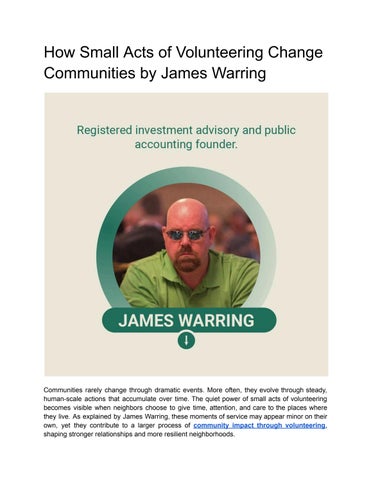
Communities rarely change through dramatic events. More often, they evolve through steady, human-scale actions that accumulate over time The quiet power of small acts of volunteering becomes visible when neighbors choose to give time, attention, and care to the places where they live As explained by James Warring, these moments of service may appear minor on their own, yet they contribute to a larger process of community impact through volunteering, shaping stronger relationships and more resilient neighborhoods.
The influence of volunteering rarely begins with strategy or formal planning Instead, it begins with a simple decision: someone shows up. A person helps distribute food at a local pantry, assists with a neighborhood cleanup, or spends an hour mentoring a student These contributions may seem modest, but they often spark something deeper When others witness these efforts, they begin to see possibilities rather than limitations.
What makes small-scale service powerful is its visibility People tend to respond to what they observe in their immediate environment. A single volunteer repairing a playground bench sends a message that the space matters Another neighbor may follow by planting flowers Soon, what started as a solitary effort evolves into shared ownership This chain reaction transforms passive spaces into active communities.
Small volunteer efforts also rebuild social trust In many communities, people live side by side without meaningful interaction. Volunteering changes that dynamic. Shared projects create natural opportunities for conversation, collaboration, and empathy Over time, individuals who were once strangers become familiar faces working toward common goals This social connection often proves just as valuable as the practical work.
Another important effect lies in perception Communities often struggle with narratives of decline or neglect. However, visible acts of service challenge those assumptions. When residents see neighbors investing time in local schools, shelters, parks, or food drives, the community's story begins to shift The environment becomes defined less by its problems and more by the people willing to address them.
Organizations and civic leaders frequently focus on large initiatives, yet grassroots volunteering often drives the most sustainable change. Small commitments repeat consistently. They are flexible, personal, and easy for others to join As participation grows, these acts form a network of support that strengthens the social fabric as a whole
In the end, the most powerful transformation often begins quietly A few hours offered freely can ripple outward in ways no formal program can fully predict Over time, the cumulative effect of small acts of volunteering creates measurable progress and lasting relationships. When individuals continue contributing in simple, consistent ways, the true community impact through volunteering becomes undeniable reshaping neighborhoods one generous action at a time