PUBLISHED BY TAUCHEN
#9 – SEPTEMBER 2026
In the test Mares: Quad vs. Quad Ci Camaro: Icon DiveSystem: Ratio models Gallery Tribute to the Red Sea Whale sharks Research between sea and desert
Lake Geiseltal Spectacular underwater forest Breathing regulators Technician Course: From Basic to Professional Readers’ trip Solar Eclipse with a liveaboard
Discover
The Bahamas: The other side of the Caribbean Sulawesi: The undiscovered south Lahami Bay: Extra Divers take over Raja Ampat: Island hopping
Celebrating 30 years of excellence For three decades, Wakatobi has offered privileged access to one of the most pristine and biodiverse marine environments on Earth, made possible through our expanding private marine sanctuary and private guest flight direct to the resort. Our dive team, private guides, culinary staff, and management team craft your experience with love and care, ensuring that you leave with memories to last a lifetime. You need only ask, and our team will happily take care of any request you may have. This unmatched combination of worldrenowned reefs and elevated comforts put Wakatobi in a category all its own— still an experience without equal.
Photos: Kaßler (1); Shutterstock (1)
I’ve had enough! No, I’m not quitting my job. Quite the opposite, in fact. After more than two decades, I still really enjoy it. Of course, sometimes I wish I had more space in the magazine and more time for all the ideas buzzing round in my head. But you can’t have everything. What I’ve had enough of, though, is this never-ending stream of bad news. No sooner do you wake up in the morning than you’re confronted with war, crises, disasters and outrage. And before you’ve even finished your first coffee, the algorithm is already dishing out the next helping. Yes, I know – I’m part of this media world myself. We, too, don’t just report on the positive aspects. That would be neither honest nor journalistically responsible. This is particularly true when it comes to our waters, the oceans and their inhabitants. Only by being aware of the problems can we bring about change. Yesterday, however, I asked myself a question: why do I let all the world’s crises enter my mind unfiltered? Most of them are beyond my control at this moment anyway. The trigger was trivial. At dinner, instead of our usual radio station, I switched on the news. After a few minutes, the mood was ruined. My wife summed it up in a single sentence: ‘Well, why don’t you just switch it off?’ Admittedly, that doesn’t solve any conflicts or tackle climate change. But in that moment, it solved my very personal problem. Suddenly, there was peace and quiet again.
And that brings me round to our shared hobby. Underwater, the news doesn’t matter. There are no push notifications, no breaking news and no opinion columns. What counts here is the present moment: your own breath, the depth, your buoyancy, your buddy and what’s happening right in front of your mask. Perhaps that’s why thoughts feel so free underwater. Perhaps we should be more conscious about deciding what information we let into our lives and what we keep out. It won’t make the world a better place straight away – but it might just clear your own head. With that in mind, I hope you enjoy many peaceful moments both in and out of the water. And if you have any other thoughts on the matter, please do drop me a line. As always, my inbox is open. P.S.: A photography tutorial was accidentally published twice in issues #5 and #8. I would like to apologise for this.
Alexander Kaßler Editor-in-Chief, TAUCHEN alexander.kassler@tauchen.de
CONTENT #9 – SEPTEMBER 2026
28 LAHAMI BAY 18 SULAWESI
56 CAMARO
36 RAJA AMPAT OUR DESTINATIONS IN THIS ISSUE Germany 48
Bahamas 42
Mexico 70
Egypt 28
Indonesia 18 + 36
Across all channels
6 RED SEA 70 WHALE SHARKS
GEISELTAL LAKE 48
Photos: Alexander Kaßler (1); Wolfgang Pölzer (1); Jess Zenner (1); Martin Strmiska (1); Kathrin Kaßler (1); Tobias Friedrich (1); Alberto Garcia Baciero (1)
MAGAZINE Gallery: Homage to the Red Sea Local and online news Readers’ Trip: Solar Eclipse 2027
6 12 14
TRAVEL News from the travel industry Indonesia: Bira in South Sulawesi Egypt: Extra Divers Lahami Bay Indonesia: Raja Ampat Bahamas: Bahamas Aggressor II Germany: Geiseltalsee,
16 18 28 36 42 48
GEAR New products on the equipment market 54 Review: Icon wetsuit by Camaro 56 Review: Mares Quad vs. Quad CI 60 Product review: Ratio 64 dive computer
Cover No. 9.26
Did you know that TAUCHEN is also available digitally? This includes our social media channels Facebook and Instagram as well as our website and our YouTube channel. You can also listen to our podcast channel. Just drop by and listen. Follow the links below. Do you want to read TAUCHEN digitally? Download our TAUCHEN app for iOS and Android. We look forward to hearing from you.
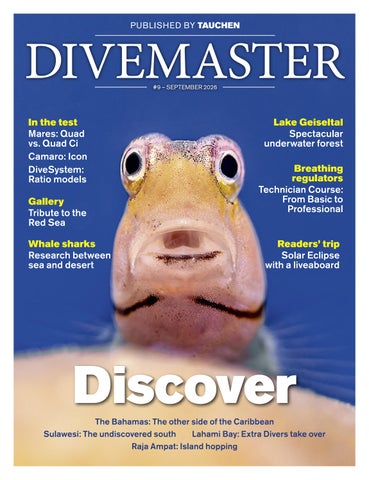
The photograph is from Tobias Friedrich. It shows a blenny (Ecsenius minutus), which was photographed near the Raffles Meradhoo Resort in Gaafu Alifu Atoll in the Maldives.
EXPERTS News from Science & Research 68 La Paz: Whale shark researcher 70 Feature: Becoming an Regulator Technician 76 How to: What are gradient factors? 78 Freediving: Freddiving at an Older Age 80 Medicine: Diving with cancer 84
FOCUS Photographing Fast-Moving Subjects Readers’ Photo Competition
CONTACT & MORE EDITORIAL TEAM
Jahr Artopé Media GmbH & Co. KG Bajuwarenring 9, 82041 Oberhaching Tel. 089/5 52 41-0, Fax 089/5 52 41-244 E-mail: redaktion@tauchen.de ADVERTISEMENT
86 88
089/5 52 41-225 Email: sales@tauchen.de TAUCHEN SUBSCRIPTION + ADDRESS CHANGES
Tel. 040/5555 7991, email: jam@dpv.de EPAPER TAUCHEN
www.tauchen.de/epaper
• Website: tauchen.de • Facebook: facebook.com/ tauchenmagazin • Instagram: instagram.com/ tauchen.magazin/ • Podcast: podcaster.de/podcasts#/ podcast/tauchen-talks • Youtube: TAUCHENDASMAGAZIN • TAUCHEN-App: Android & iOS
SABRI BABA WRECK UHROB/ELBA REEF
Despite the challenges of recent months, the Red Sea remains one of the most fascinating diving destinations in the world. Its extraordinary biodiversity, spectacular reefs and mesmerising play of light are strikingly captured in the photographs of underwater photographer Tobias Friedrich
A TRIBUTE TO THE RED SEA
A PAIR OF CLOWNFISH ON THE SHAB MAKSUR REEF
gallery °
BROTHER ISLANDS/BIG BROTHER
BROTHER ISLANDS/BIG BROTHER
RAS KATI/SINAI PENINSULA
A HAMMERHEAD SHARK ON THE DAEDALUS REEF
gallery ° BLUE-SPOTTED STINGRAYS ON THE NIGHT DIVE OFF HURGHADA
at. Nus. Sed unto consersped ut ipic tem lam int, es seque con nusdam quas is sum et pe ma quia custotatet officiur minctaspicia dit quos non consent incipsunt arumquidunt alicitius de porepel ectati dolorepudae voloresciis e
A LOGGERHEAD TURTLE IN THE CORAL REEF NEAR RAS MOHAMMED ON THE SINAI PENINSULA
A PAIR OF DWARF GOBIES IN A CORAL REEF OFF MARSA ALAM
MAGAZINE MANTA RAYS ARE WORTH BILLIONS
PEMUTERAN IS SET TO HOST THE UNDERWATER ELITE The CMAS World Championship in Underwater Photography and Videography will take place in Bali from 5 to 11 October 2026. The venue is Pemuteran in the north-west of the island – a region renowned for its biodiverse coral reefs, the successful ‘Biorock’ reef conservation project and excellent conditions for underwater photographers. The World Championships are being organised in collaboration with Karang Divers and the Indonesian diving federation, PB POSSI. National teams from around the world are expected to compete for the coveted World Championship titles in various photography and videography categories. karangdivers.com
WANTED: SHARK PHOTOGRAPHERS The Shark Trust has launched the ‘Shark Photographer of the Year 2026’ competition. It is seeking impressive photographs of sharks from around the world, which should also highlight the importance of protecting them. Both amateur and professional photographers are eligible to enter. The winning photographs will be published internationally. www.sharktrust.org/ Event/flos26
CONGRATULATIONS ON 30 YEARS OF THE ABYSS DIVING SCHOOL! For 30 years, the Abyss Meißen diving school has stood for passion, expertise and a vibrant diving community. What began in Meißen in 1996 has now become a well-established part of the Saxon diving scene, with centres in Meißen and Dresden, its own Riesenstein diving centre, and a wide range of services – from divingtraining and trips to equipment servicing. The TAUCHEN team would like to offer its warmest congratulations to Karsten Wiche, Mandy Wiche and the entire Abyss team on this anniversary! www.tauchschule-abyss.com
PATD EVENT AT THE NUTTLAR COLLIERY Around 90 divers gathered at the Nuttlar mine at the end of June for the PATD’s cave diving event. Alongside specialist talks on decompression, diving medicine, cave exploration and the history of technical diving, the focus was primarily on practical dives. More than 40 participants gained their first experience of overhead diving under the guidance of experienced instructors. Due to the positive feedback, a repeat of the event is planned. patd.de & bergkwerktauchen.de
Photos: Organisers, deep.com, PATD, Michael Ley
2026 CMAS WORLD PHOTOGRAPHY AND VIDEO CHAMPIONSHIPS IN BALI:
Manta rays are not only fascinating encounters underwater, but also a significant economic factor. A recent study by the Manta Trust estimates the tourism value of these animals to the Maldives at around 8.6 billion US dollars over their lifetime. The findings underline the enormous importance of consistently protecting these endangered rays and their habitats.
UNDERWATER LABORATORY INAUGURATED A new underwater laboratory, the Habitat Vanguard, has been installed in the Florida Keys National Marine Sanctuary. The station is designed to enable scientists to spend longer periods underwater and to provide new insights into coral reefs, marine conservation and life in the deep. The project is regarded as an important step for future underwater research. www.deep.com/vanguard
Franz. Polynesien · Fiji Inseln · Palau Papua Neuguinea · Yap · Salomonen Vanuatu · Tonga · Neukaledonien
… mit Pacific Travel House – dem Spezialisten seit über 35 Jahren! 21 Tage Französisch Polynesien Tahiti, Rangiroa und Fakarava
Fantastisches Großfischtauchen an den Riffen und in den Passagen der Atolle · Inkl. 21 Tauchgängen, Flügen, Übernachtungen/Frühstück/Transfer
ab 7.550 € p.P. / DZ
21 Tage Fiji Inseln Viti Levu, Taveuni, und Beqa Lagune
Aufregendes Tauchen zwischen farbig leuchtenden Korallen, bunten Rifffischschwärmen und beeindruckenden Großfischen · Inkl. 22 Tauchgängen, Flügen, Übernachtungen/Frühstück/Transfers
SHARK KNOWLEDGE MAKES YOU (MORE) CLEVER … What does the Serengeti have to do with a great white shark? A) F rank Schätzing used the Serengeti as an example to show why sharks, as apex predators, are essential to the balance of an ecosystem. B) T he Serengeti used to be part of a primeval ocean inhabited by great white sharks. Answer: A is correct. Schätzing compares the role of lions in the Serengeti to that of sharks in the sea: if the apex predators disappear, the entire ecosystem is thrown out of balance. You can find these and other facts and figures about sharks in Ocean Heroes’ new shark quiz. It’s both entertaining and educational, and available at a charity price (100 per cent goes to charity) of 25 euros. Buy it at: ocean-heroes.shop
ab 6.945 € p.P. / DZ
17 Tage Mikronesien Palau und Yap
Faszinierendes Tauchen an steilen Außenriffen, in Strömungen und Lagunen mit zahlreichen Großfischen · Inkl. 20 Tauchgängen, Flügen, Übernachtungen/Frühstück/Transfers
ab 5.475 € p.P. / DZ
18 Tage Papua Neuguinea Lissenung Island und Tufi Resort
Reiche Artenvielfalt, Sichtweiten bis zu 30 Meter, unberührte Korallenriffe und große Fischschwärme · Inkl. 20 Tauchgängen, Flügen, Übernachtungen/Mahlzeiten/Transfers
ab 6.550 € p.P. / DZ
You can find out more about the artist Michel Ley at: Facebook/michels.imbaerium, Instagram (“michels.imbaerium”) and www.michels-imbaerium.de
Weitere Vorschläge, ausführliche Beschreibungen und kostenlose individuelle Ausarbeitung unter:
pacific.travel.house Pacific Travel House Reiseveranstaltungs GmbH Schwanthalerstraße 100, D-80336 München info@pth-muc.de, 089-543 21-80
www.pacific-travel-house.com
TRAVEL° READERS‘ TRIP
SIX MINUTES OF ETERNITY
When one of the Red Sea’s most modern liveaboard vessels is combined with one of the 21st century’s most extraordinary natural phenomena, the result is an expedition of a very special kind. In collaboration with TAUCHEN, Beluga Reisen is organising an exclusive readers’ trip aboard the M/Y AVO in the summer of 2027. Built as recently as 2024, this premium liveaboard accommodates a maximum of 24 guests, offering plenty of space, a high level of comfort
and a relaxed atmosphere – ideal conditions for an extraordinary week in the Red Sea. The journey begins in Port Ghalib and takes you to the legendary St John’s Reefs in the far south of Egypt. Colourful coral landscapes, spectacular drop-offs and encounters with sharks, dolphins and turtles are among the highlights of this diving area. But the real spectacle takes place above the water’s surface.
On 2 August 2027, the M/Y AVO will be situated exactly on the centre line of the total solar eclipse south of Ras Banas. Lasting more than six minutes, it will be one of the longest total phases of the entire 21st century. The next solar eclipse of comparable duration will not occur until 2114. Even shortly before totality, the atmosphere changes noticeably. The light takes on a silvery hue, colours fade, the temperature drops, and an almost eerie silence deTAUCHEN.DE
Photos: M. Strmiska, MY Avo, ChatGPT
Diving cruise to witness the longest solar eclipse of the century
EXCLUSIVELY: TAUCHEN READERS’ TRIP • Exclusively on board the premium liveaboard M/Y AVO • Total solar eclipse directly on the central path (approx. 6 mins 19 secs of totality) • A unique view of the moon’s shadow hurtling towards us at over 2,000 km/h • A biologist on board acting as a German-speaking tour guide, offering fascinating insights into the behaviour of marine life during the solar eclipse • Exclusive solar eclipse T-shirt for all participants • A high-quality water bottle as a memento of the expedition • Certified solar eclipse glasses for safe viewing Exclusively for readers of the magazine TAUCHEN • 7 nights on board the M/Y AVO • 31 July to 7 August 2027 • from 1,999 euros per person
scends upon the sea. Then the moon’s shadow appears on the horizon. Within a matter of seconds, bright daylight gives way to deep twilight. Stars and planets emerge, and a fascinating 360-degree sunset unfolds around the horizon, whilst the delicate solar corona surrounds the completely obscured Sun – a sight that many experienced eclipse chasers describe as the most impressive natural spectacle of their lives. The trip is accompanied by a marine biologist who explains how seabirds, reef fish and other marine life react to the abrupt transition from day to night. Many animals suddenly seek shelter or behave as though night has already fallen – a rarely observed natural phenomenon that can only be experienced during a total solar eclipse. This readers’ trip combines first-class dives at the St John’s Reefs with an astronomical event of historic proportions. A total
solar eclipse of this duration, experienced from a safari vessel on the central path in the Red Sea, is likely to remain a once-in-alifetime experience for most participants.
In collaboration with:
Your trip already includes: • All transfers between the airport and the ship • 7 nights aboard the premium liveaboard M/Y AVO • Accommodation in a comfortable double cabin • Full board, including snacks, coffee, tea and soft drinks • 16 to 18 spectacular dives at the St Johns Reefs and in the southern Red Sea • Nitrox included for certified divers • Observation of the total solar eclipse directly on the path of totality (approx. 6 mins 19 secs of totality) • A unique view of the moon’s shadow hurtling across the desert and the Red Sea at over 2,000 km/h • Biologist on board as a German-speaking tour guide, giving fascinating talks on the behaviour of marine fauna during the solar eclipse • Stargazing and background information on this natural phenomenon • Diving at some of the Red Sea’s most beautiful reefs, with the chance to see sharks, dolphins, turtles and large fish Here’s your chance! Fancy joining in? Email us at redaktion@ tauchen.de with the subject line ‘Solar eclipse’
TRAVEL WIRODIVE SPECIAL TOUR: MALPELO ISLAND – MAY 2027
MARATUA ATOLL WITH A PROFESSIONAL PHOTOGRAPHER Fancy an exclusive group tour to Indonesia from 15 May to 30 May 2027? This trip combines nature experiences on Borneo with diving in the Maratua Atoll, one of the most beautiful diving areas in East Borneo. The group will be accompanied by underwater photographer Gerald Nowak, who will share his many years’ experience of diving and underwater photography with the participants. The programme includes stays at the Samboja Lodge, with opportunities to observe orangutans and sun bears, as well as at the Nabucco Island Resort and on Virgin Cocoa Island. Another highlight is the trip to the jellyfish lake on Kakaban. The tour price starts at 3,998 euros per person in a twin room and includes flights with Singapore Airlines, domestic flights and accommodation. reisecenter-federsee.de
EXCLUSIVE NILE CRUISES & DIVING Beluga Reisen is expanding its Egypt programme to include the luxurious dahabiya ‘Escaleeh’. This elegant sailing vessel accommodates up to 20 guests and follows the classic route between Aswan and Luxor. Away from the large cruise ships, travellers can experience the Nile at a leisurely pace, with personalised insights into the culture, landscape and life along the river. For divers, it is the ideal complement to a holiday on the Red Sea. A special highlight awaits guests on 1 January: Beluga’s Managing Director, Axel Becker, will be there in person. He lived in Egypt for nine years himself and has known the country for over 50 years. A tour featuring authentic encounters, in-depth insights and shared experiences – in true Beluga Reisen style. The trip lasts four days and three nights and costs from 840 euros per person. belugareisen.de
New dive centre management at Extra Divers El Quseir: There has been a change in management at Extra Divers El Quseir, based at the Mövenpick Resort El Quseir: with immediate effect, Carla Leibner and Tobias Baumann are taking over the running of the popular dive centre in southern Egypt. At the same time, Extra Divers are saying farewell to the previous dive centre managers, Tanja Eichenberger and Stefan Österreich. The whole team would like to express their heartfelt thanks for their many years of dedication, their passion for diving and the many unforgettable experiences they have created together with the guests. With Carla and Tobi at the helm, Extra Divers El Quseir look forward to showing guests from all over the world the fascinating underwater world of El Quadim Bay. www.extradivers-worldwide.com
Wakatobi celebrates its 30th anniversary The Indonesian Wakatobi Dive Resort will mark its 30th anniversary in 2026. What began as a vision of its founder, Lorenz Mäder, has grown into one of the world’s most renowned dive resorts – featuring a private marine protected area that now encompasses more than 60 kilometres of reef. The conservation approach is based on close collaboration with local communities and is internationally regarded as a model for sustainable diving tourism and successful marine conservation. Congratulations! www.wakatobi.com
A COMBINED HOLIDAY TO PARADISE Rangiroa and Fakarava in French Polynesia are among the world’s most spectacular dive sites for large fish. This trip combines the very best hotspots. Dive with dolphins, manta rays, turtles and various species of shark, including hammerhead sharks (seasonal), at the Tiputa & Avatoru Passes in Rangiroa, and marvel at the ‘Wall of Sharks’ – hundreds of grey reef sharks – at the Tumakohua South Pass in Fakarava. Book your Polynesian underwater adventure now. pacific-travel-house.com
Photos: Organisers
500 kilometres off the coast of Colombia, in the middle of the Pacific Ocean, a rock rises out of the water. Beneath it are hundreds of hammerhead sharks: Malpelo is one of the most remote and species-rich diving destinations in the world, a UNESCO World Natural Heritage Site that truly deserves its status. Silky sharks, schools of hammerhead sharks, large pelagic fish and sheer walls plunging into the depths as far as the light reaches. The island is accessible only by liveaboard. In May 2027, Wirodive is setting off for the island. Steep walls, currents, schools of hammerhead sharks – for experienced divers who really want to find out what it’s all about. Price: from 5,550 euros per person. (plus flights and additional costs). wirodive.de
IN BRIEF
Dive. Discover. Experience. Relax.
READERS’ TRIPS 2026
Join our Dive Safari
ORCAS & NORTHERN LIGHTS For readers of *Tauchen* magazine, Wirodive is offering an exclusive readers’ trip to Orca Camp in Northern Norway in November 2026: in the fjord landscape around Hamneidet, participants will see orcas and humpback whales in the wild and – on clear nights – spectacular Northern Lights. The week includes up to six boat trips and nature programmes, including an introduction to aurora photography. Travel dates: 15 to 22 November 2026; €3,590 per person (excluding travel to the destination and any stopovers). Further information: www.tauchen.de/leserreisen/
JOIN IN THE RESEARCH ON THE TURTLE SAFARI From 25 November to 2 December 2026, the TAUCHEN readers’ trip ‘Turtle Safari’ will accompany the TurtleWatch Egypt 2.0 research project to the southern Red Sea. On board the Alia Soul, participants will assist scientists with the documentation and photo-identification of sea turtles at the Fury Shoals. Anyone interested can apply by emailing redaktion@tauchen.de, quoting the keyword ‘Turtle Safari’. Prices start at 1,650 euros per person, plus port charges.
Come aboard for unforgettable dive safaris to the world's most spectacular and remote spots! • Top dive spots & exclusive locations • Expert guidance & small groups • Perfectly organized trips – you dive, we handle the rest!
FREE DIVING GUIDE TO FRENCH POLYNESIA Hardly any other destination combines turquoise lagoons, spectacular dives and the laid-back South Sea way of life quite as impressively as French Polynesia. But which island best suits your diving preferences? Where can you find sharks, manta rays and dolphins? And when is the best time to visit? With the new free 12-page diving guide to French Polynesia, Aqua Active Agency provides valuable tips for planning your trip. The guide offers information on the most beautiful dive sites, hotels, liveaboards, encounters with marine life and personal insider tips from our Polynesia expert. This makes planning your own dream holiday to the South Seas even easier. aquaactive.de – scan the QR code now and download the free diving guide!
RCF Dive Safari Palau
aboard the M/Y Black Pearl 16.02.2028 - 26.02.2028
10-night dive safari timed to the new moon phase – accompanied by Caro from our Sales Team
from 5.627 € per person Highlights: • Blue Corner with sharks, barracudas & schooling fish
EXCLUSIVE COMBINED TOUR: ECUADOR & THE GALÁPAGOS Absolut Scuba is expanding its travel programme to include an extraordinary combination of nature experiences and world-class diving in Ecuador and the Galápagos Islands. The new tour takes travellers from the colonial old town of Quito through the impressive Andes to the Ecuadorian Amazon, where guests can experience the tropical rainforest up close at the Itamandi Lodge. The highlight is a liveaboard trip aboard the Aqua Yacht to the legendary Galápagos Islands. The itinerary includes, amongst other things, the world-famous dive sites of Darwin and Wolf. Unforgettable nature experiences also await on land – from giant tortoises and marine iguanas to the Charles Darwin Research Station. Price: from 7,449 euros per person (plus international flights from/to Germany to Quito). as-tauchreisen.de
• Manta encounters at German Channel • Ulong Channel with stunning coral formations • Chandelier Cave – mystical cave formations
• Jellyfish Lake with thousands of jellyfish
• Bumphead parrotfish spawning at new moon Find all details on this trip and more dive safaris on our website.
WELTWEIT MEER ERLEBEN
reisen@reisecenter-federsee.de www.rcf-tauchreisen.de
rcftauchreisen
tauchreisen_rcf
TRAVEL° BIRA
With its news center Bira, diving.DE has opened its first centre on Sulawesi. But is it really worth the long journey to the southern tip of the island?
SULAWESI THE UNKNOWN SOUTH T & F Alexander Kassler
TRAVEL° BIRA
The fascination of the house reef and its surroundings: the entire southern tip around Bira is a continuous reef. Part of it forms part of the Akasha Beach Club’s house reef. Well worth a visit for surprises both big and small. What’s more, the area also offers interesting spots above water, which are not to be missed.
TRAVEL° BIRA
The first sip of ice-cold white wine feels like a revelation. After more than three weeks, I’m now sitting back and relaxing in an armchair in the ‘Plaza Premium First Lounge’ at Kuala Lumpur Airport. I’ve just had a hot shower, there are dumplings on a plate in front of me, and in a few hours I’ll be boarding a ten-hour return flight to Germany. The 50-euro ‘entry fee’ was worth every cent. At last, I have time to look back over the past 18 days.
On a test mission This time, our journey took us to Bira, a small coastal town on the southernmost tip of Sulawesi. The occasion was the opening of the new Diving.de dive centre – and the question of whether the long journey to a region that even many Indonesia connoisseurs are barely aware of is worth it. Joining us was Mirko Obermann, one of the managing directors of Diving.de. The company is already familiar to many divers thanks to its centres in Bali and Egypt, but is now venturing into southern Sulawesi. Our small travel group could hardly be more diverse: whilst Mirko and I have several thousand dives under our belts, three of our fellow travellers – cliff divers – are still at the very start of their diving careers. Different expectations, different levels of experience – you could
hardly ask for better conditions for testing out a new destination.
A long journey and first impressions After a brief stopover in Bali (see TAUCHEN 8/26), a short flight takes us to Makassar. From there, we travel a further six hours south by road. The route takes us past rice fields, small villages and the famous shipyards where Phinisi vessels are still built almost entirely by hand to this day. Since 2017, this centuries-old craft has even been recognised as part of UNESCO’s Intangible Cultural Heritage. At the same time, the journey also reveals the less attractive sides of Sulawesi: rubbish lining many roads and the visible signs of a country whose infrastructure is still under development in many places. The finish line in sight The closer we get to Bira, the lighter the traffic becomes. Amidst palm trees, small houses and boat-building yards, the landscape appears increasingly unspoilt. Many of the residents belong to the Bugis and Konjo ethnic groups, whose lives have been closely linked to seafaring and traditional shipbuilding for generations. In recent years, Bira itself has
BIRA / SULAWESI / INDONESIA HOW TO GET THERE
The journey to Makassar (UPG) usually involves a stopover in Jakarta, Singapore or Kuala Lumpur. From there, it is around 200 kilometres – or approximately six hours’ drive – to Bira. Depending on traffic, the journey may take longer. The transfer can be arranged through diving.DE or the resort. ACCOMMODATION
The Akasha Beach Club is situated above a quiet sandy cove just a few minutes outside Bira. The small resort offers double rooms, pool-cliff villas and a family suite. The restaurant, bar and terrace offer sweeping views across the cove. A private access path leads to the long sandy beach and the offshore house reef. DIVING
Around Bira, there are more than 20 varied dive sites featuring coral gardens, drop-offs, sandy slopes and a house reef situated right in front of the centre. The sites are suitable for both beginners and experienced divers. Turtles, whitetip reef sharks, eagle rays, barracudas and large schools of fish are regularly spotted. With a bit of luck, depending on the season, manta rays, whale sharks or hammerhead sharks may also make an appearance. Water temperatures range between 27 and 30 degrees Celsius all year round, and visibility often reaches 20 to 40 metres. DIVING.DE BIRA
The German-speaking diving centre, diving.DE Bira, is located at the Akasha Beach Club and offers a friendly, family-like atmosphere, accommoda-
ting a maximum of 25 divers at any one time. The centre offers daily guided boat and house reef dives, snorkelling trips and SSI diving courses ranging from Open Water Diver to Instructor. The centre has modern hire equipment, Nitrox, a lockable equipment room, a sink for rinsing photography equipment, drying facilities, a training room, a shop and a spacious divers’ lounge with sea views. BEST TIME TO VISIT & DIVE
Diving is possible all year round. The best time to visit is from April to October, when the sea and weather are generally calm and visibility is at its best. Conditions are usually at their most stable from May to September. During the rainy season from November to March, wind and swell can affect some boat trips. Further information: www.diving.de; www.akasha-beach.com; www.mangga-lodge.com PRICE EXAMPLES • Akasha Beach Club: 14 nights’ accommodation with breakfast in a
standard room, transfers to and from Makassar, and ten house reef dives, from 2,339 euros per person based on double occupancy, including flights to and from Frankfurt with Singapore Airlines, for the travel period of November 2026. Bookings: Aqua Active Agency, aquaactive.de • Mangga Lodge: 14 nights’ accommodation with breakfast in a bungalow, transfer from/to Makassar, ten house reef dives, from 2,070 euros per person in a double room, including flights from/to Frankfurt with Singapore Airlines. Booking: Sun & Fun Diving Holidays, sunandfun.de
TRAVEL° BIRA evolved from an insider’s tip into a popular holiday destination. During the COVID-19 pandemic, many Indonesians from the greater Makassar area discovered the coastal resort as an easily accessible destination. To this day, the resort remains particularly busy at weekends. Small hotels, restaurants and homestays line the long sandy beach that has made Bira famous far beyond Sulawesi.
Boutique resort with its own diving centre The Akasha Beach Club is situated just a few minutes outside the town centre. The name sounds like a beach bar. In fact, it is a modern boutique resort with a restaurant, bungalows and several guesthouses overlooking the beach. From the terrace, the view stretches across the bay as far as the sunset – one of the most beautiful views in the entire region. Host Stefan Reinhard runs the resort as an evolution of the Bara Beach Bungalows, founded by his parents, which are located just a few minutes away. Over the past few years, the Akasha has developed into a tastefully designed complex that is now one of the most popular destinations in the Bira area. Families can rent self-contained accommodation units with their own terrace. Couples stay in spacious bungalows, some of which even have a private pool. The excellent restaurant combines Indonesian and international cuisine and has long been a favourite with locals too. Since April 2026, it has also been home to Diving.de’s new diving centre. New base, old territory “The resort fits in perfectly with our concept,” explains Mirko Obermann. “There have been very few dive centres around Bira so far. At the same time, the region offers an exceptionally large number of interesting dive sites.” In fact, it is the former base of the Mangga Lodge, which diving.DE has taken over and fully integrated into the Akasha Beach Club. The reception, equipment room, workshop and lounge area are now centrally located on the resort grounds. From September, two compressors and the new nitrox membrane system will be in operation there (nitrox will then be available free of charge). The boat fleet is also set to be modernised. For the time being, however, Mirko is pleased to have taken on the experienced crew. The long-serving skipper, in particular, knows the surrounding dive sites like no other – a wealth of experience that is often worth more to guests than any new boat.
Small, cosy and with direct access to the beach and the house reef: The new diving.DE centre and the Akasha Beach Club are a perfect match. They offer exactly what you’d expect: excellent service and a ‘table laden with delights’ as well as an enormous variety both above and below the water.
SULAWESI
Makassar Bira
Situated in the heart of the Indonesian archipelago, Sulawesi is one of the top diving destinations. Less ‘famous’ than the north – Bira, in the very south, is more of an insider’s tip.
Diving amongst coral gardens and steep walls Around 200 metres of shallow-water diving – that’s the price you have to pay on the house reef to reach the reef edge. Alternatively, you can use a snorkel and marvel at the seagrass meadow and a varied stretch of hard corals teeming with bustling inhabitants. The rest of the reef then lies at a depth of eight to 25 metres and gradually slopes down into a sandy slope. Worth a visit? Absolutely. Small whitetip sharks, turtles, plenty of reef fish in general, moray eels and a whole host of ‘little creatures’. Well worth a daily dive. Around the southern tip and Bira (‘Cape Bira’), there are further dive sites featuring this type of reef structure. However, the currents here are considerably stronger, but so too are the chances of encountering large fish. The guides regularly report sightings of whale sharks, manta rays, as well as hammerhead and reef sharks. Although we didn’t see any of these big fish during our dive, the spot more than made up for it with its enormous biodiversity, right down to the shallows. The only dive we did there was particularly impressive towards the end, as countless macro subjects were waiting in the shallows as we prepared to surface. Bira’s real diving gems are situated around a small island about 20 minutes by boat to the south, in the area around ‘Kambing’. ‘The Cave’ and ‘Coral Gardens’ are, to put it simply, absolutely brilliant: a smorgasbord of reef fish, a hotspot for whitetip sharks, a coral paradise. It’s hard to put into words. In the end, we all agreed: every member of our small, mixed group of divers would come back time and time again just for these spots alone. It was well worth the trip. The beauty of these sites is that there’s something for everyone here. Deep-dive enthusiasts can head down to the depths. And those who prefer shallower waters are still treated to the full spectrum of marine life – and sometimes see even more than at greater
TRAVEL° BIRA depths. After several days underwater, one impression stands out above all: Bira certainly doesn’t need to take a back seat to Indonesia’s better-known diving regions. The combination of healthy corals, varied topography, high fish density and a pleasant mix of macro and wide-angle subjects makes the region a destination that delights both beginners and experienced divers alike. Precisely because the sites have so far been relatively little visited, many reefs appear astonishingly unspoilt – a state we’d like to preserve for as long as possible. “You’ve done it all right, Mirko. The dive sites are spot on. A bit of everything. And plenty of alternative options if one spot isn’t suitable. And your crew are great too,” is my unsolicited verdict to Mirko and his team after the final dive. Dive centre manager Harald “Harry” Garstner is pulling the strings and is currently learning about the sites and their special features from chief guide Ihwan.
Above water A day off from diving. Now it’s my travelling companions’ turn to shine. They’d already scouted the cliffs around the southern tip for ‘spots’ beforehand. It’s all about jumping from great heights with all sorts of tricks and spins. Pictureperfect and thrilling. This takes us on a short tour around Bira. I end up with a few bruises after my first 14-metre jump, whilst the lads get some spectacular video footage. Just before we leave, Bobby Reinhard, the owner of Mangga Lodge, shows me the area’s above-water highlights. We visit two caves, clamber around several Phinisi hulls under construction and marvel at idyllic beaches that are still stunning even when it’s raining. You should definitely plan a day like this for sightseeing – but it’s better to go with Bobby or Stefan (the Reinhard brothers), as they know their way around. What remains Looking back on those days now, I have to say that I thoroughly enjoyed my first visit to Sulawesi. It was yet another of those trips which – as grand as it may sound – broadened my horizons. The country, the people, the landscapes above and below the water: I saw a lot, learnt a lot, marvelled at a lot, and enjoyed it all immensely. And for me, that really means something. It’s less about what you see whilst diving, and more about the whole experience. And here, that experience is a perfect blend of adventure, exploration and, at the same time, a sense of being well looked after. Highly recommended! <<
OUR YOUTUBE VIDEOS
Akasha Beach Club: https://tinyurl.com/AkashaBeach diving.DE Centre: https://tinyurl.com/DivingDe Mangga Lodge: https://tinyurl.com/ManggaLodge
TRAVEL DIARY & CLIFF DIVING https://tinyurl.com/BiraTagebuch
TAUCHEN.DE
Gedruckt. Oder digital! Oder beides zusammen. Suchen Sie sich einfach das zu Ihnen passende Modell aus!
JETZT BEI
Abo! Ab 23,80 Euro*
*Preisbeispiel für das Test- bzw. Probeabo. Im Jahres-Abonnement erhalten Sie zum Beispiel 12 Ausgaben TAUCHEN für zzt. 142,80 € (DE) / 154,80 € (AT) / 226,80 CHF (CH) (inkl. MwSt. und Versand). Zahlungsziel: 14 Tage nach Rechnungserhalt. Es besteht ein 14-tägiges Widerrufsrecht. Anbieter des Abonnements ist JAHR Artopé Media GmbH & Co. KG. Belieferung, Betreuung und Abrechnung erfolgen durch DPV Deutscher Pressevertrieb GmbH als leistenden Unternehmer.
TRAVEL° LAHAMI BAY
LAHAMI BAY T & F Barbara & Wolfgang Pölzer
A wide variety of house reef dives, relaxed trips to the Fury Shoals, and sensational dolphin snorkelling to boot. Extra Divers have taken over Egypt’s southernmost dive centre. We paid them a visit.
RIGHT DOWN IN THE SOUTH
TRAVEL° LAHAMI BAY
Good vibes: Turtles, the odd intact stony coral and colourful nudibranchs aren’t the only things you’ll spot here. We also came across a rather rare marine creature: the common guitarfish, which forms a link between rays and sharks.
After a good two-hour private transfer from Marsa Alam Airport, the charming Lahami Bay Beach Resort & Gardens appears almost like a snow-white mirage against a deep blue sky. Neither ostentatious nor flashy, yet stylish, the sprawling four-star resort blends seamlessly into the expansive bay with its kilometre-long sandy beach. High-quality facilities, remarkably spacious rooms and, last but not least, the excellent cuisine set this Red Sea resort apart from the often rather canteen-style catering found in many Egyptian hotels. One interesting detail: time really does tick a little differently here. The resort is thought to be the only hotel in the country to use its own hotel time. Upon arrival, watches are set forward by one hour – that is, official Egyptian time plus one hour. The advantage of this is particularly noticeable in winter, when daylight lasts longer and it doesn’t get dark as early as 4.30 pm. Lahami Bay has always been an insider’s tip for divers who appreciate peace and quiet and largely unspoilt reefs. Following its takeover by Extra Divers, the dive centre now boasts a fresh new look. The friendly couple running the centre, Nicole Iseli and Ali Shata, combine Swiss thoroughness with Egyptian calm and local knowledge.
Consequently, operations are already running smoothly just a few days after the official opening. Even the online check-in via smartphone or a provided tablet – which is still in its trial phase – is working without a hitch. It’s a solution that is as practical as it is sustainable, effectively and completely replacing what would otherwise be a lot of paperwork.
Turtles, Rays & Co. The early afternoon is the perfect time for a first exploratory dive on the house reef. That certainly doesn’t sound like a compromise. After all, many guests spend their entire holiday exclusively on the extensive reefs of the vast bay. Instead of being dropped off by Zodiac at one of the eight house reef entry points, we decide to enter the water directly from the beach. It’s more convenient than expected: from the dive centre’s main building on the hotel grounds, a shuttle bus takes us the 400 metres or so to the beach base. We check the nitrox levels, put on our gear – and off we go into the Red Sea. We glide over a gently sloping sandy seabed towards a sparsely vegetated seagrass meadow, where the first green sea turtle is already tucking into the nutrient-rich rhizomes with relish. There isn’t much time for observation, however, as a massive cloud of sand on the horizon catches our attention. We approach cautiously and only at the last moment spot a huge feather-tailed stingray churning up the sandy seabed. Unfazed, it continues its search for food, digging with
its powerful suction mouth for hidden delicacies. We quickly snap a photo before we disappear completely into the cloud of churning sediment, and the stingray vanishes just as suddenly. As visibility improves again, we reach Banana Reef. The barrier reef, which is over a kilometre long, shields a large part of the bay and, in places, extends right up to just below the water’s surface. Clownfish, lionfish, sleeping soldierfish and feeding surgeonfish inhabit the reef. There are also the occasional small groupers, pufferfish and bright orange anthias. Large moray eels, tiny gobies, prawns and even a colourfully striped pyjama snail reveal themselves to the attentive observer. To our trained eye, there is something new to discover at every turn. The highlight of our 90-minute dive, however, awaits us amongst the seagrass: a guitarfish! An encounter that is by no means an everyday occurrence, even in the Red Sea. There is, however, one small fly in the ointment. Back at the dive centre, we learn that another group of divers not far from us had been visited by two bottlenose dolphins. “That’s not all that rare on our house reef,” says Nicole. “Sometimes they even stay with the divers for ten minutes or
Atmospheric: colourful rock formations, reef crevices glistening in the sunlight, fascinating shallow-water canyons and mysterious grottos – that’s what the Fury Shoals are all about.
TRAVEL °LAHAMI BAY more and seem to be practically inviting them to play.” Well, never mind – we’ve still got a few days to go. And we’re also absolutely thrilled with our dive.
Fury Shoals The following morning, we set off eastwards on the hotel’s own 30-metre day boat from the jetty. Less than ten nautical miles off the coast lie the famous Fury Shoals: an extensive reef system visited almost exclusively by safari boats and regarded as one of the most diverse diving areas in the Red Sea thanks to its varied coral gardens, lightfilled canyons and mysterious grottoes. The outer reefs delight divers with walls dropping steeply into the blue, current-filled plateaus and good chances of encounters with large fish. However, the majority of the Fury Shoals is all about relaxed diving – exploring, marvelling and enjoying the experience. Our guide, Ziad, leads us through a labyrinth of rugged canyons, whose fasci-
nating play of light is almost reminiscent of an underwater cathedral. Indeed, the route ends in a huge grotto flooded with sunlight, where a dense school of fusiliers has gathered. Suddenly, things spring into action. The metallic-sheened plankton-eaters, barely a hand’s length long, find themselves in the sights of a school of spiny mackerel. Lightning-fast evasive manoeuvres follow attacks by the agile predators that are scarcely any slower. Right in the thick of it, we become a calming presence amidst the chaos – observers and, at the same time, an unwitting shield. It is impossible to follow the rapid twists and turns in detail. For several minutes we watch the spectacle, until the mackerels clear the scene just as abruptly as they appeared. We continue the dive. Passing a whitetip reef shark, which has retreated deep into a crevice – not exactly photogenic – we emerge back onto the reef edge. Blue-spot-
ted stingrays glide over the light-coloured sandy seabed at a depth of just under 20 metres. Just a few metres away, a giant pufferfish – living up to its name – rests completely unfazed beneath a massive table coral. Ziad waves us on. Before we head back, he wants to show us a small field of anemones. Living amongst the anemones are exceptionally large clownfish, which vigorously defend their territories yet, at the same time, allow themselves to be photographed with astonishing patience. Back on board, a freshly prepared lunch is already waiting for us. It is not until much later that the boat sets off again, heading for the day’s second dive site. Several offshore reef towers rise out of the blue. Shoals of small reef perch dart about amongst the colourful stony corals. We are particularly fascinated by the outer towers, however. Exposed to stronger currents, their overhangs and horizontal crevices are densely covered with small soft corals. Sha-
EXTRA DIVERS LAHAMI BAY / EGYPT IN EXISTENCE SINCE: April 2026
diving certificate, logbook and a valid medical certificate of fitness for diving or a selfdeclaration of medical fitness. Compulsory check dive (known as a ‘Welcome Dive’).
electricity during the day. The hotel also has a seawater desalination plant and its own sewage treatment plant. Drinking water dispensers are available on the day trip boat, helping to reduce single-use plastic. Digital online check-in saves paper and even allows guests to register for their first day of diving before they arrive, in the event of flight delays.
DIVING: Divers with fewer than 25 logged
SNORKELLING: The house reef is ideal for
LEAD CO-ORDINATORS: Nicole Iseli and Ali
Shata (Swiss and Egyptian).
DIVING REGULATIONS: Presentation of a
dives are accompanied by a guide. After that, independent diving in a buddy team is possible. For certified solo divers, solo diving is available on the house reef. Two dive sites, reaching a maximum depth of 15 metres, can be accessed directly from the shore. Alongside shallow coral reefs, there is an extensive seagrass bay home to green sea turtles and guitar, feathertail and leopard rays. With a bit of luck, you might even spot seahorses. A further eight entry points to the house reef can be reached by Zodiac. In addition, a total of 22 boat dive sites are available, accessible either by speedboat or the comfortable day boat. Those looking for a change of scenery can also take a half-day trip to the wreck of the Hamada near Abu Ghusun. Maximum diving depth: 30 metres BOATS: a Zodiac for the house reef, accom-
modating up to eight divers; a speedboat for up to ten divers; and a 30-metre-long day boat for up to 25 divers. From autumn 2026, a 27-metre-long day boat, built specifically for Extra Divers to accommodate a further 25 divers, will join the fleet. PRICES: One dive, including a tank and
weights, costs 31 euros. 10-dive package: 295 euros Boat surcharges: Zodiac: 6 euros; speedboat: 16 euros Double Tank: 24 euros; day boat: from 20 euros. There is also a national park fee of 12 euros per diver per day of diving. Lunch on the day trip boat: 9 euros, including unlimited drinking water. Money-saving tip: A 3 per cent discount is offered for cash payments. Payment can also be made in euros. LOCATION: Egypt’s southernmost diving
resort is situated at the northern tip of the Berenice Peninsula. SUSTAINABILITY: The hotel’s own solar panel system supplies the entire resort with
snorkelling, particularly for encounters with sea turtles and various species of ray. Almost all boat trips are also suitable for snorkellers. The highlight is the trip to Sataya Reef (Dolphin House), where large groups of spinner dolphins can regularly be spotted. BEST TIME TO VISIT AND DIVE:
all year round ACCOMMODATION: The Lahami Bay Beach
Resort & Gardens opened in 2002 and was last extensively refurbished in 2025. The 220 exceptionally spacious rooms, available in three categories, can accommodate up to 450 guests and feature air conditioning, a minibar, satellite TV, a bathroom with toilet, and a balcony or terrace. The resort features a spacious pool area, several restaurants and bars, and a modern surfing and kitesurfing centre. The six-kilometre-long, finesandy bay is ideal for swimming, snorkelling, diving and long walks along the beach. ORGANISER:
Reisecenter Federsee (RCF) Telephone 07582 932 07 90 www.rcf-tauchreisen.de Price example (from RCF): Seven nights at the four-star Lahami Bay Beach Resort & Gardens in a twin room, half board, direct flight from/to Germany to Marsa Alam, transfers, from 938 euros per person.
10 dives (including tank and weights): from 289 euros per person. CONTACT:
www.extradivers-worldwide.com
TRAVEL °LAHAMI BAY rienced divers with unpleasant memories due to their painful stings – that have suffered the most. Today, they are significantly rarer in many places.
des of red, orange and pink blend together to create a veritable explosion of colour. One overhang, with its numerous openings, actually resembles Swiss cheese and is simply a must-photograph. Yet even this sight is overshadowed by a hawksbill turtle feeding. Just a few metres away, it is nibbling, completely at ease, at an old coral reef to get at the sponges growing on it. We are able to watch it at close quarters for more than five minutes without it being disturbed by our presence. Only then do we withdraw as quietly as we arrived.
Fish & Co. are back. And corals are on the rise There is no denying that the Red Sea has suffered from severe coral bleaching on several occasions over the past decade and a half. The events of recent years, in particular, have left visible traces in many places. Fortunately, many reefs are already showing the first clear signs of regeneration. Fast-growing Acropora species in shades of light blue and pink, in particular, are repopulating numerous areas of the reef. It is still too early to sound the all-clear, but developments give cause for cautious optimism. The marine life, too, appears to be thriving. Colourful reef fish, curious sea turtles and large rays have by no means abandoned their habitats. There is certainly no question of a destroyed underwater world here. Sweeping statements such as ‘Everything in southern Egypt is ruined anyway’ certainly do not do justice to the reality of the situation. During the rest of our diving days, this impression was confirmed time and again. Extensive table corals, impressive Porites blocks and, above all, magnificent soft corals continue to characterise many sections of the reef. Ironically, it is the fire corals – which often leave snorkellers and inexpe-
Dolphins galore! A very special trip is on the programme for our final day of diving. Our destination is Sataya Reef – better known as Dolphin House – which is about an hour and a half ’s boat ride away. The almost five-kilometre-long, arc-shaped reef forms the southernmost part of the Fury Shoals and delights divers with its expansive, fish-rich coral gardens as well as the chance to encounter large fish. But Sataya’s appeal is by no means limited to diving alone. The area takes its name from the vast lagoon, which serves as a protected haven for a large population of spinner dolphins. Here, the animals rest during the day, socialise, mate and raise their young. For snorkellers, Sataya is therefore one of the most impressive dolphin habitats in the Red Sea. However, anyone entering the water here should treat the dolphins with respect. It goes without saying that you should behave calmly: no frantic swimming after them, no touching and no attempts to actively lure the animals. Unfortunately, not all tour operators adhere to this basic rule. Time and again, speedboats chase dolphin pods or herd them together using Zodiacs in order to get their guests as close as possible to the animals. This causes considerable stress for the dolphins. Fortunately, our trip with Extra Divers is a completely different experience. The boat maintains a respectful distance, and we wait patiently. After just a few minutes, it becomes clear that it is precisely this restraint that is the key to meaningful encounters. The first spinner dolphins approach of their own accord, driven by curiosity. Some of them seem particularly playful. They swim right past us, perform pirouettes, circle round us and accompany us with their characteristic whistling calls. We are particularly fascinated by one dolphin that keeps pushing a jellyfish along in front of it.
Time and again, it drops the slimy ‘plaything’ in front of us, turns away, returns and picks it up once more. It would be hard to observe more unambiguous evidence of playful behaviour. Time flies. Time and again, we observe courtship and mating behaviour – sometimes just a few metres away. At the same time, the whole group remains remarkably calm. The dolphins decide for themselves at all times how close they want to come and when to keep their distance again. It is only at lunchtime that we climb back on board, exhausted but over the moon. Whilst lunch is being served, we flick through the first photos and try to make sense of our impressions. It soon becomes clear that encounters like this can hardly be captured in pictures – you have to experience them for yourself. Next up is one final dive on Sataya’s outer reef. An abundance of fish, beautiful corals in places, several turtles, two Napoleon wrasse and an eagle ray passing by far out at sea make for a perfect finale. Yet the verdict is easy to reach: however impressive this final dive may have been, even it pales in comparison to the encounters with the wild spinner dolphins – it is merely an encore.
Conclusion Lahami Bay offers precisely the kind of mix that has become increasingly rare in the Red Sea: relaxed house reef diving with sea turtles, various species of ray and regular dolphin sightings – combined with varied boat trips to the Fury Shoals. Add to that a pleasantly peaceful resort, a superbly organised dive centre and a team that combines professionalism with genuine hospitality. Anyone wishing to experience southern Egypt away from the major tourist centres will find an exceptionally relaxing base here.
TRAVEL° RAJA AMPAT
T Jess Zenner
JOURNEY BETWEEN THE SEA AND PEOPLE
Photos: Jess Zenner
RAJA AMPAT WITH A DIFFERENCE:
Instead of travelling in isolation on a liveaboard, our author has opted for a very special way of ‘experiencing’ the destination: after diving, she stays with locals.
TRAVEL° RAJA AMPAT Tucked away in the far east of Indonesia lies a place that is at the very top of many keen divers’ wish lists: Raja Ampat. The archipelago in West Papua comprises more than 1,500 islands and is impressive even from above the water, with its white sandy beaches, dense jungle and rugged cliffs. The real gem, however, lies beneath the surface: this is home to one of the most biodiverse and spectacular underwater worlds on our planet. It is not without reason that Raja Ampat is also known as ‘the last paradise’. Divers here glide through reefs teeming with corals in countless shades of colour, past huge schools of fish and through crystal-clear waters – dives that will stay with you forever.
The adventure begins As a newly qualified Divemaster, I’m particularly excited as I hop, with my heavy dive bag, across the narrow gap from the jetty onto the dive boat, which I’ll almost call home for the next five days. Almost, because we won’t be sleeping on it. The dive operator Scuba Republic has developed a unique concept for its dive safari: unlike on a traditional liveaboard, in the evenings after the dives we head ashore to stay with the locals. We spend the night in simple wooden and thatched huts, sometimes on stilts in the water, sometimes right on the beach. For me, it’s an unbeatable model that benefits both sides. After all, it not only gives you the chance to discover Raja Ampat’s unique dive sites, but also to explore various islands in the region, interact with the locals and experience Raja Ampat in a particularly authentic way. Friwen Wall The safari boat is fully booked. It can accommodate a total of ten guests and six crew members. It is already midday by the time we leave Waigeo, heading west. As a result, we have just one dive planned for the first day. We start off at the ‘Friwen Wall’ to get acclimatised. Although this dive is primarily intended to assess our diving abilities, it’s already becoming clear to me why so many divers rave about this region. With minimal current and visibility of up to 30 metres, we swim past batfish, bannerfish, angelfish, colourful anemones and beautiful gorgonians. Beneath a rock, we spot a crocodilefish and a giant grouper. I see a Picasso triggerfish for the first time in my life and fall in love with it straight away – little did I know that this was just the beginning. In the evening, we are taken to Besir Bay. As the little dinghy glides into the bay, I can hardly believe my eyes. Our accommodation – a hut on stilts out on the water – is situated off a small, secluded island with rugged cliffs and crystal-clear blue water. Behind it, the most beautiful sunset I have ever seen unfolds. And I’m not exaggerating.
The Raja Ampat region and its waters, situated west of Papua, are currently among the world’s best diving spots. Pristine coral reefs and what is currently the world’s greatest biodiversity make this archipelago, comprising over 1,500 islands, Indonesia’s most popular diving destination.
Photos: Martin Strmiska, Shutterstock
the rules: special permits are required for some dive sites. Furthermore, the number of divers per site is regulated.
Amongst manta rays and barracudas The second day gets off to just as spectacular a start as the first. Immediately after diving down at ‘Citrus Ridge’, I find myself in the midst of a swirling shoal of barracudas and fusiliers. In the distance, we spot a manta ray accompanied by mobula rays. My first manta – unfortunately too far away to take a photo. ‘Mayhem Reef ’ and ‘Keruwo Channel’ are also impressive dive sites. Whilst at Mayhem Reef we once again enjoy superb visibility, large schools of fish and our first sightings of sharks, at ‘Keruwo Channel’ we do our first drift dive. We spend the night on Fam Island in a thatched-roof hut on the beach. Our hostess treated us to some excellent nasi goreng, and we sat together long into the evening. Our dive guide Nikson, a true local, captivated us with anecdotes and stories from his life in Raja Ampat. A large part of the region is now designated as a marine protected area. Within these protected areas, marine life such as sharks, manta rays, dugongs and turtles are given special protection – an important step towards keeping the reefs intact, as they also form the basis of livelihoods for many local people. It’s not uncommon to see locals out and about, catching fish for their evening meal from the jetty using a homemade fishing rod. Divers must also follow
Off through the garden Of course, we also pay a visit to the famous ‘Melissa’s Garden’. The name says it all: I really do feel as though I’m diving through a living garden. The vast coral field is teeming with tiny fish that find shelter here. And although Melissa’s Garden seems almost impossible to beat, the second dive of the day is even more beautiful. At Batu Rufas, we also find corals and fish in countless varieties. There’s even a window in the rock through which we swim during our safety stop. In theory, we could descend to 30 metres, but even at depths of twelve to six metres, a breathtaking scene unfolds before us. The sunlight makes the corals and fish glow in intense colours, so we spend most of our time in the shallows. The rocks are teeming with pufferfish, bannerfish and sweetlips. The leopard triggerfish is also at home here. Raja Ampat from above The ‘Piaynemo Viewpoint’ is one of Raja Ampat’s landmarks and is practically a must-see. The view of the small, idyllic islands and the turquoise-blue water is so iconic that Raja Ampat is even featured on the Indonesian 100,000-rupiah banknote. It’s lucky for us that the viewpoint is part of our tour. In the afternoon, we swap our diving tanks for walking boots and climb the steps up to the viewpoint. Our next accommodation is on Arborek Island, where we’ll once again be staying in one of the iconic stilt huts. After dinner, we set off in search of epaulette sharks. The English name ‘walking shark’ is apt, as these small sharks can use their pectoral and pelvic fins to move across the seabed and through extremely shallow water. We find one on the beach in the shallow water. At first, it actually moves across the sandy seabed as if walking, before swimming away.
TRAVEL° RAJA AMPAT
Right in the thick of it, rather than just on the sidelines: simple huts, authentic food and a close-up glimpse into the lives of the locals. It makes your diving holiday feel like a journey back in time. Yet you still get to enjoy the extraordinary beauty of the underwater world to the full.
On the way back from our exploration, we come across a group of local children who are practising a dance. As I watch them, it strikes me just how important this diving safari is for the people on the remote islands. Raja Ampat is vast, and very few travellers make their way to the more distant islands. On traditional liveaboards in particular, there is usually little contact with the mainland. This safari, on the other hand, enables the locals to benefit directly from the visitors – for example, through accommodation and meals. At the same time, it gives us the chance to discover one of the most beautiful diving areas in the world and gain an authentic insight into local life.
Photos: Jess Zenner
Fish salad and tortoise fights The fourth day turns out to be the highlight of my trip. During our morning dive at the ‘Manta Sandy’ site, there’s more sand than manta rays. But the subsequent dives at ‘Sauwandarek Jetty’ and, above all, at ‘Cape Kri’ more than make up for it. Right at
TAUCHEN.DE
the jetty, we literally dive into a sea full of turtles. Mainly green sea turtles and hawksbill turtles call the reef beneath the jetty home. Time and again, they swim leisurely past us to take a breath at the surface. ‘Cape Kri’ manages to top even that. Amidst butterflyfish, angelfish and barracudas, we spot a green sea turtle here too. Hang on, no – there are two of them. One swims towards the other and bites its tail. We are clearly witnessing an attempt at mating. But instead of a happy ending, a fullblown turtle squabble ensues. The other one doesn’t seem to think much of the advances. Whilst the two swim off arguing, a blacktip reef shark cruises by. Right behind it, a huge Napoleon wrasse appears. To my left, a small shoal of batfish accompanies me until we finally resurface.
Kri Island We spend our last night on Kri Island. This time, however, the pretty beachside hut offers no rest: I find bedbugs and don’t get a wink of sleep. Anyone expecting luxury from the homestays is in for a surprise on this tour. This carefree simplicity is part and parcel of local life in Raja Ampat. Anyone wishing to experience it in an authentic way shouldn’t have high expectations. The huts usually contain nothing more than a bed with a mosquito net and a fan. The toilets are often on the mainland, and running water isn’t a given everywhere. However, if you’re willing to go with the flow, you can have a truly unique experience. On the final day, there’s still a drift dive at ‘Chicken Reef ’ to come – and with it, the last of a total of ten wonderful dives, before the boat takes us back to Waigeo and we all
go our separate ways. And me? I look back on an intense time full of experiences that I need to take in first: the encounters and conversations with the locals, the accommodation, the local food, life on the islands and, of course, the spectacular dives in a picture-perfect underwater world. The diving safari was a great success, one that I hope will stay with me for a long time to come.
SICHERHEIT ist kein Extra. Sie ist STANDARD. Mit ENOS® orten Sie vermisste Taucher in Echtzeit – direkt zur Crew, ohne monatliche Kosten, ohne Umwege. Wenn Strömung, Wind oder Distanz entscheiden, liefert ENOS® präzise GPS-Positionen genau dorthin, wo sie gebraucht werden: an Bord. ENOS® – weil Sekunden zählen.
NRC International GmbH Karlstrasse 21a 51702 Bergneustadt
Tel: +49 22 61 / 500 414 WhatsApp: +49 151 41834317 info@nrc-international.com
nrc-international.com
TRAVEL° BAHAMAS
Why the Bahamas reveal their true colours between the Exumas and Eleuthera. A diving cruise on the Bahamas Aggressor II. T & F Richard Condlyffe
BIG WALLS, SMALL WONDERS
TRAVEL° BAHAMAS
“BETWEEN THE EXUMAS AND ELEUTHERA LIES AN UNDERWATER WORLD OF PRISTINE REEFS, SHEER WALLS, WRECKS AND DIVE SITES, WHICH OFFER A DIFFERENT EXPERIENCE EVERY TIME.”
Twelve metres. That’s where the seabed ends. Not gradually. Not gently. The coral plateau drops off abruptly and disappears into the deep blue of the Atlantic. I break away from the wall, float out into the open water and turn round. Only now do I realise its scale: tube sponges grow out of the rock, black corals cover the overhangs, and canyons open up between them. A shadow emerges from the blue. A Caribbean reef shark (Carcharhinus perezeii) glides silently along the wall, casts a brief glance in our direction and vanishes into the depths. No one moves. For a moment, even the bubbling of the regulators seems to fall silent. Moments like these explain why divers have been dreaming of the Bahamas for decades. When you think of this island nation, you picture turquoise waters, white beaches
and palm trees. The cliché is true. But it only tells half the story. Between the Exumas and Eleuthera lies an underwater world of pristine reefs, drop-offs, wrecks and dive sites that offer a different experience every time. A week aboard the Bahamas Aggressor II is enough to understand why this area is considered one of the Caribbean’s classic diving destinations.
The rhythm of the sea As the mooring lines are cast off in Nassau, everyday life on the quay is left behind. Lying ahead of the bow are the Exumas – more than 350 islands and cays, a turquoise string of pearls in the shallow sea. Fishing has been banned in the Exuma Cays Land and Sea Park for decades. The moment you take your first dip in the water, it becomes clear that this decision was the right one.
Feather stars (Crinoidea) spread their feathery arms in the current and filter plankton from the water. During the day they often hide away; at night they display their full splendour. A hawksbill turtle (Eretmochelys imbricata) takes a rest in front of the coral wall. This critically endangered species feeds mainly on sponges, thereby contributing to the ecological balance of the reefs. The nurse shark and the goby complete the spectrum between the very large and the very small.
The daily routine is simple: dive, eat, rest, dive again. The sea sets the pace.
Silence in the Blue Hole The first highlight awaits south of Nassau. The Lost Blue Hole is often overshadowed by its famous namesake in Belize. Unfairly so. Even at the edge of the circular opening, life abounds. Southern stingrays (Hypanus americanus) glide across the sand. Nassau groupers (Epinephelus striatus) stand amongst blocks of coral. Caribbean spiny lobsters (Panulirus argus) watch everything from their hiding places. Slowly, we descend deeper. Metre by metre, the wall swallows up the sunlight. From a crevice, a spotted moray eel (Gymnothorax moringa) peeks out into the open water. Beneath us, the blue vanishes into unreachable depths. This dive site does not thrive on encounters with large fish. It thrives on silence and the feeling of floating on the threshold of a world that remains hidden from humans. Back on board, some rave about the loggerhead turtle (Caretta caretta) at the crater’s edge, others about the moray eel or the lobsters. Everyone takes something different away with them. And the week has only just begun.
DRIVE & DIVE BONAIRE
Where the blue begins With every nautical mile, the landscape changes. The coral gardens of the Exumas give way to the drop-offs off Eleuthera. The plateau often ends at a depth of just twelve or 15 metres. Beyond that, the Atlantic opens up. Deep. Boundless. The current brings nutrient-rich water to the wall, and with it, fish. Schools
Your Buddies
RESERVIERUNGEN: +599 717 5080 WWW.BUDDYDIVE.COM INFO@BUDDYDIVE.COM
Tauchen Sie Bonaire auf Ihre Weise.
Entdecken Sie Bonaire mit dem Drive & Dive Paket von Buddy Dive Resort: über 60 Tauchplätze, eigener Pick-up, unbegrenzte Luft und Nitrox, Unterkunft, Transfers, Frühstück und Versicherung inklusive.
TRAVEL° BAHAMAS
“NOTHING HERE FEELS STAGED, THE SHARK ISN’T A SPECTACLE. IT’S SIMPLY PART OF THE LANDSCAPE.”
of snappers (Lutjanidae) and grunts (Haemulidae) glide over the reef. Tube sponges (Aplysina spp.), gorgonians (Alcyonacea) and black corals (Antipatharia) transform the rock into a garden. Amidst it all, Caribbean reef sharks swim their course – calm, composed, as if it were the most natural thing in the world. Nothing here feels staged. Here, the shark is not a spectacle. It is simply part of the scene. Dog Rocks is the most impressive spot on this trip. I let myself drift away from the wall and look back. It is only from a distance that its sheer scale becomes apparent. Light dances across the rock, vanishes into crevices and makes the corals glow. Then another reef shark appears. Slowly. Elegantly. Almost weightlessly. It glides past beneath us and vanishes once more into the blue. When we resurface, nobody says a word at first. Sometimes a single glance is enough.
A second look As spectacular as the sheer walls may be – anyone looking solely for sharks is missing out on half of this dive site. A trumpetfish (Aulostomus maculatus) camouflages itself amongst the gorgonians with stoic patience. Beneath the overhangs, Caribbean spiny lobsters sit alongside giant clinging crabs (Maguimithrax spinosissimus). Time and again, green sea turtles (Chelonia mydas) swim across the reef and disappear into the blue. For underwater photographers, this is where the daily dilemma begins. Macro or
wide-angle? Both would be the right choice. On the steep wall, sharks, coral landscapes and all the sponges call for the fisheye lens; between the corals, a whole new world reveals itself. The flamingo tongue (Cyphoma gibbosum) glows on a sea fan. Yellow-headed wrasse (Opistognathus aurifrons) hover above their burrows and vanish into the sand at the slightest flick of a fin. A few metres further on, two eyes betray the presence of a buried southern stingray. The Bahamas reward patience. The slower you dive, the more you discover.
Wrecks that tell stories Two wrecks stand out in particular. The Austin Smith, a former patrol cutter of the Royal Bahamas Defence Force, lies upright on the seabed at a depth of around 21 metres. Corals and sponges have reclaimed the steel. Snapper and grunts swim amongst the superstructure, whilst Caribbean reef sharks circle the bow and bridge. The wreck does not look like an artificial dive site, but rather like part of the reef itself. Smuggler’s Plane is a completely different story. The small aeroplane lies on light-coloured sand at a depth of just five metres. It is said to have once been used by drug smugglers. Today, nature takes centre stage. The afternoon sun casts a dancing pattern across the fuselage. Giant anemones (Condylactis gigantea) and spotted cleaner shrimp (Periclimenes yucatanicus) have colonised the wreck. Snappers and
Sponges, corals and reef fish have taken up residence amongst the wings and fuselage sections – a striking example of how aircraft wrecks become new habitats on the seabed. Curious Caribbean reef sharks (Carcharhinus perezii) circle the divers. The Bahamas are among the few regions in the world where these elegant hunters can still be observed in large numbers, thanks to consistent shark conservation efforts.
grunts swim amongst the structures, whilst nurse sharks (Ginglymostoma cirratum) and stingrays rest in the sand. These are not spectacular wrecks. But they are exceptionally photogenic.
Why people return Friday comes far too quickly. As the Bahamas Aggressor II sets course for Nassau, wetsuits are drying on the sun deck. The cameras are stowed away, the logbooks almost full. It’s time to say goodbye. Strangers have become buddies. On the flight home, I think back on this week. On the silence in the Lost Blue Hole. On the sheer wall of Dog Rocks. To the reef shark that emerged silently from the blue and vanished just as silently. Perhaps that is precisely where the secret of the Bahamas lies. Not in that one big moment, but in the many small ones: the shark on the wall, the moray eel in the Blue Hole, the flamingo tongue on the sea fan, the golden light over an old aeroplane wreck. Together, they paint a picture of an underwater world that has nothing to prove. It is simply there – unspoilt, teeming with life and full of biodiversity. And at some point, long after you’ve returned home, this image resurfaces in your mind’s eye. Twelve metres. That’s where the seabed ends. And beyond it, the longing to return begins.
BAHAMAS AGGRESSOR II The Bahamas Aggressor II is a comfortable liveaboard for diving trips, accommodating up to 20 guests. Depending on the season, she sails to the Exuma Cays or Tiger Beach and offers full board, dives and drinks on board. Home ports: Nassau; for Tiger Beach cruises: Freeport, Grand Bahama Dimensions: 33 m x 8 m Passengers: 20 Cabins: 10 Crew: 7 Trip schedule: Saturday to Saturday, 7 nights each time Routes: Exuma Cays from July to March, Tiger Beach from April to June Price: from US$3,495 per person for a 7-night charter SERVICES INCLUDED
Accommodation in the booked cabin category, full board with three meals a day, dives on board, as well as coffee, tea, water, soft drinks and local alcoholic drinks. NOT INCLUDED
Airport transfers, marine park and harbour fees, tips, Nitrox, equipment hire and other additional services. SPECIAL FEATURES
Up to 5 dives a day, some of which are night dives. Encounters with sharks off Tiger Beach. Reef and open-water dives in the Exumas. INFORMATION & BOOKINGS:
www.aggressor.com or various diving tour operators
TRAVEL° GEISELTALSEE
THE FOREST THAT GOES TO HEAVEN
A slightly different story about one of Germany’s most impressive lakes: the Geiseltalsee. T Martin Strmiska/Alexander Kaßler F Martin Strmiska
For some diving destinations, the adventure begins long before you even get into the water. Months before a trip to the Galápagos Islands, divers dream of endless schools of hammerhead sharks. Weeks before a major cave expedition, they spend their evenings ordering new components, tweaking set-ups and fine-tuning their kit down to the smallest detail. And anyone travelling to the remote regions of Indonesia takes three days of airports, ferries and endless boat journeys in their stride. At Geiseltalsee in Saxony-Anhalt, on the other hand, they’re starting by loading the kit into the camper van. Even the preparations seem unusually relaxed. A quick glance at the tanks is enough – they’re full. One nitrox bailout tank is more than enough. Even a camera with a half-full battery would hardly faze anyone these days. Nobody is in a hurry. There’s no weather window closing, no safari boat waiting for us and no complicated logistics that have to run smoothly. This has nothing to do with carelessness. It’s simply the special atmosphere of a local divesite, where time suddenly ceases to matter much. Looking back, that was precisely the first clue. Fifteen minutes later, we reach Mücheln. The lakeshore looks just as you’d expect from a popular local recreation area in central Germany. Cyclists are doing laps along the promenade. Families are strolling along the water’s edge. Sailing boats drift almost motionless across the lake. The spring sunshine glistens on the smooth surface of the water, whilst small waves lap gently against the shore. There is nothing to suggest that a completely different landscape lies hidden beneath the surface.
Recording at a high ‘bitrate’ Visibility is surprisingly good for this time of year. The first few metres of the descent feel familiar. Large rocks are covered in bright green
TRAVEL° GEISELTALSEE
algae. Here and there, sunken tree trunks protrude from the greenish water, with a few man-made structures appearing amongst them. Nothing that particularly challenges the brain. Nothing that needs to be analysed in detail. Most of the information is compressed, stored and filed away. Then a canal appears below us. For the first time, the brain switches to a kind of ‘high-bitrate recording’. It maps the surroundings as usual, yet keeps returning to the same image. The canal stretches in a dead straight line into the distance and slowly fades into the green water. Trees line its banks. Further ahead, a bridge comes into view. Taken on their own, none of these elements is unusual. Together, however, they create a scene on Lake Geiseltal that defies any familiar categorisation. As the depth increases, the water becomes clearer. Another bank reinforcement comes into view. Another bridge. Another row of trees. It all seems perfectly logical. And that is precisely why it is so hard to comprehend. Bridges belong on the surface. So do trees. Canals too. Everything we see is exactly where it ought to be. Except for one thing: we are underwater.
The final point of reference At first, the canal still provides a point of reference for our brains. However contradictory the scene may seem, its geometry remains familiar. That changes the moment we leave the last bridge behind us. A vast canyon opens up before us. To the left, a steep rock face rises up. To the right, a dense forest follows the course of the valley. Suddenly, the landscape becomes larger than the structures that have provided our bearings until now. The last point of reference disappears almost imperceptibly. The further we glide into the canyon, the more difficult it becomes to reconcile what we see with a familiar environment. The boundary between the underwater world and the dry landscape begins to dissolve. Both seem to exist simultaneously.
The ‘Loop’ At a depth of 32 metres, something emerges that completely throws the brain off balance. A pale yellowish-white strip stretches across the bottom of the canyon. It winds its way through the valley like a shallow stream. It follows every contour of the terrain, nestles into depressions, traces gentle curves and disappears into the distance. That is exactly how water would flow. Except that no water is flowing here. At least, not this sort. The pale strip is nothing more than a relic of the open-cast mine – a former track, criss-crossed in places by concrete debris and a rusted metal grating. To the right of it rises the flooded forest. The treetops vanish far above us in the shimmering green water. With the rebreather, I glide almost silently through the canyon. There’s no gurgling to accompany my breaths. Only now and then does my buddy’s open-circuit system break the silence. Every few seconds, a cloud of silvery bubbles rises to the surface. This sound becomes the last acoustic anchor in a world that defies all familiar perception. It reminds me of the steady ticking in space. That sound which signals to astronauts that, somewhere beyond their reality, time continues to pass. Taking photographs suddenly becomes secondary. Up to this point, I’d still been trying to decide what I was actually seeing before me. An underwater landscape? Or a landscape on land? The canal. The bridges. The trees. Everything pulls my perception in two directions at once. I stop looking for an explanation. The loop closes. With it, any sense of time disappears too. I wonder if my buddy is experiencing the same thing. Layers of time In the heart of the canyon, it becomes increasingly impossible to tell which part of this landscape belongs to which era. The valley was here long before the lake. The lake existed long before the mussels. And the mussels continue to shape the valley to this day. We are moving through all three time periods simultaneously. Unlike many inland lakes, Lake Geiseltal does not hide its past beneath a thick layer of sediment. It
lies openly before us. The original topography has been preserved. The scars of lignite mining are still visible. And even the ongoing ecological change can be observed. Past and present exist side by side here. The canyon was once created by massive bucket-wheel excavators, which transformed the original landscape over decades. After mining came to an end, the lake began to grow slowly. It took almost eight years for the enormous pit to fill with water. Roads disappeared. Forests were submerged. Valleys were lost. Or perhaps not. Because much of it is still here. Submerged. Preserved. And waiting.
Sorting machines 90 minutes later, we dive down again. The surface interval is just long enough to change our tanks, exchange a few impressi-
Cold, clear water: Visibility in Lake Geiseltal varies with the seasons and weather conditions. Below a depth of 20 metres, however, the water is usually ‘crystal-clear’ and cold.
The ground drops away to a depth of 18 metres. The former mining face initially leads to a depth of around 25 metres, where it then extends into a wide area dotted with small copses. Right: Brick-lined inlets lead the way from the bank down into the depths.
09°2026 DIVING
51
TRAVEL° GEISELTALSEE
SAXONY-ANHALT Mücheln/ Geiseltalsee
In the area of the former inlet, where the waters of the Saale flowed into the lake and carved out a deep channel, a river still flows today. A river within the lake. Combined with the incredibly clear visibility and the forest that stretches down into the depths, it is a dreamlike landscape.
ons and reassure one another that what we saw on the first dive really does exist. Then we head back down. This time, we make our way towards the ‘forest’ near the peninsula. The seabed slopes gently at first. Scattered small trees emerge from the greenish water. Nothing out of the ordinary. Nothing that demands attention. Until, suddenly, a forest appears on the horizon. And reality loses its contours once more. The inner conflict within me returns immediately. One part of my brain knows that I’m diving through a flooded forest. The other simply sees a forest – exactly where a forest belongs. This time, however, a new perspective opens up. We leave the forest floor behind and slowly rise above the treetops. For a brief moment, we are no longer divers. We
become birds. Silently, we glide over the forest – with a freedom otherwise reserved for creatures of the air. The treetops disappear into the shimmering green water, just as a forest slowly dissolves into the morning mist. The further the canopy stretches into the distance, the more complete the illusion becomes. We remain there. Hovering. Flying. Only when we’ve had enough do we sink back down amongst the trunks. Beneath the canopy of the forest. And once again, time seems to stand still. At first, the branches look as though they’re covered in a pale coating. It’s only up close that it becomes clear what we’re actually seeing. Mussels. Billions of zebra mussels. Every trunk. Every branch. Every root. The entire forest seems to be covered by a living layer that is
GERMANY
slowly transforming it. In many lakes and rivers, zebra mussels are considered an invasive species. Here, they play a completely different role. They are the invisible architects of the view. Day and night, they filter vast quantities of water. Suspended matter disappears, the water becomes clearer, and the Geiseltalsee is slowly becoming one of the clearest inland bodies of water in Germany. Whilst older mussel shells die off and sink to the bottom, new mussels colonise the areas that have become available. The forest is constantly changing. White mussel shells cover the ground. In some
places, they merge to form an almost continuous surface. In others, they are completely absent. In between, pale bands emerge, winding their way through the forest like narrow paths. For a fleeting moment, it seems as though someone might emerge from between the trees at any moment and continue a walk that came to an abrupt end decades ago.
Photos: Martin Strmiska (1); Shutterstock (2)
The forest that stretches along the Heaven awaits At some point, the illusion begins to fade. Reality, on the other hand, does not. After the third dive, my buddy complains of severe pain in his shoulder. Shortly afterwards, we notice a livid mottled pattern on his stomach. The symptoms leave little room for doubt: a decompression sickness incident. As we go through the day’s events again, another detail catches our attention. One of the dives is only partially recorded on his
dive computer. Depth and dive time were logged, but the actual dive profile is missing. Whether this was due to a technical fault or some other error cannot be determined later on. The irony remains striking. The lake had thrown our perception of space and time into disarray. Apparently, that dive computer had also struggled to record the entire dive that day. The difference, however, is obvious. Computers lose data. Divers bear the consequences. It is only after my buddy has undergone two hyperbaric chamber treatments that things slowly return to normal. To reduce Lake Geiseltal in southern Saxony-Anhalt to this story, however, would not do it justice. Roads were flooded. Forests were submerged. Valleys vanished. Or perhaps not, after all. For they are still there. The trees continue to stretch their branches towards the light. The paths
still seem to lead somewhere. Everything looks as though the water were merely a temporary state of affairs. As though the lake might one day disappear again. As though this forest were still waiting to see the sky once more. Yet that day will never come. <<
GEAR COMPRESSOR FOR DEMANDING APPLICATIONS IDE is expanding its range to include the Bavaria Profi, with flow rates of 220 to 320 litres per minute. The three-stage compressor is designed for continuous operation and features, amongst other things, a lowpressure oil pump, grey cast iron cylinders, a stainless steel cooler, as well as an automatic condensate drain and final pressure cut-out as standard. The manufacturer offers a five-year full warranty. ide.de
SEALINK SYSTEM NOW WITH WMT DiveVolk is expanding its SeaLink system with the Wireless Microphone Transmitter (WMT). The module transmits audio from compatible full-face masks via Bluetooth to the smartphone housed in the SeaLink casing. This allows both video and audio to be streamed live to the surface simultaneously. The system is primarily aimed at diving instructors, research institutions, aquariums and content creators. divevolkdiving.com
MICRO 3.0 REEF EDITION With the new Micro 3.0 Reef Edition, SeaLife is launching its underwater camera complete with a wide-angle dome lens. It increases the field of view by more than 40 per cent, enables close-ups down to 12.7 centimetres and ensures high sharpness right into the corners of the frame. The permanently sealed camera captures 16-megapixel photos and 4K videos. Price: 1,129 euros. sealife-cameras.com
GREATER SECURITY AT A LOWER PRICE SeaLife has revamped its range of smartphone cases. The SportDiver now incorporates the safety features of the SportDiver Ultra, including a sealed electronics module and a new moisture sensor. At the same time, the price of the new SportDiver S has been reduced to 219 euros. The SportDiver costs 299 euros, whilst the Ultra costs 359 euros. sealife-cameras.com
TITANIUM RANGE AND NEOPREN SOCKS Camaro is expanding its diving range with new products for cold and warm waters. New additions include a 1-millimetre-thick Titanium full-body suit made from SCS Titanium Open-Cell neoprene, three new 5-millimetre booty models, as well as Titanium socks and trainers to be worn as base layers or for extra warmth. Depending on the model, the footies are available with or without a zip and feature reinforced soles and fin stops. The Titanium wetsuit costs €249.95, the footies range from €89.95 to €129.95, and the socks and trainers range from €44.95 to €59.95. camaro.at
PHOTO CORNER BACKGROUND – TRUE OR FALSE?
Photos: Manufacturer/supplier
One of the dilemmas of underwater photography quite often centres on the background of an underwater shot. You don’t always have control over this, particularly when photographing coral fish, divers or when using extreme wide-angle lenses. That’s just how it goes. Fish, divers or even a wreck rarely swim, move or lie in such a way that a discerning photographer can be satisfied with the background. When it comes to fish, it is possible to isolate them from the background by using a wide aperture. But that’s often where the problems begin. The shutter speed also needs adjusting, otherwise there’s a risk of overexposure. Sometimes you have to tweak the ISO setting too. No problem with a mirrorless camera, tricky with a compact, and virtually impossible with a smartphone. There we go again. Small image sensors simply can’t be reconciled with selective focus in any meaningful way. Are there any solutions? Yes, but not in the conventional sense of ‘out-of-camera’ (OOC) photos, even though these conservative underwater photographers regard them as the only true form. The real background, however distracting it may be, is defended as if it were the fatherland – floating particles and all. Image editing as a ‘tutor’ is only grudgingly accepted, but is often the only alternative. So are these images genuine or fakes? It’s important to realise that such ‘enhancements’ were already being used 50 years ago. Back then, it involved hours of fiddling about, as digital technology was still a long way off. Nowadays, there are not only programmes that offer a dozen backgrounds at the click of a mouse. They aren’t always suitable for the underwater world, but sometimes a truly remarkable shot even comes to light – bizarre and sure to catch the eye. Those who specialise in split-level shots will find plenty of skies to swap in. This is because, with split-level images, the above-water section is usually the problem. The focus should be on the underwater subject, which can sometimes mean that the part of the image above the dividing line isn’t rendered quite as sharply. Or perhaps you’ve photographed a completely overexposed sky. In that case, it’s perfectly legitimate to replace it using AI. Why on earth should you delete a successful split-level image just because of that? You’re simply helping nature achieve the ideal line. Falsification or a creative work of art? In the past, such mishaps were actively resolved using analogue filters. In principle, it was no different, just more laborious. Well, replacing the sky was a real chore even back then. Herbert Frei
Jetztabab Jetzt
0000 3.765, €€3.765, Lieferzeit 48 Stunden Lieferzeit 48 Stunden
LIGHTWEIGHT TRAVEL KIT With air travel in mind, Scubapro has brought together a range of particularly lightweight products for divers. These include the foldable Navigator Lite buoyancy compensator, the Go Sport fins with a bungee heel strap, and the wetsuits made from solvent-free bonded neoprene. The aim is to provide kit that is easier to transport without compromising on comfort or functionality. scubapro.com
APEKS RECALLS XL4 REGULATORS HEAD Watersports is recalling the second stages of the Apeks XL4, XL4+ and Ocea regulators. The recall affects products with serial numbers ranging from 250402212 to 260402893, manufactured between April 2025 and April 2026. The reason for this is a potential manufacturing fault which may restrict the flow of breathing gas at depths exceeding 45 metres. Affected regulators should no longer be used and should be inspected free of charge by an authorised Apeks dealer or service centre. apeksdiving.com
55 5 Jahre 5 Jahre Garantie Garantie
BAVARIANAUTIC NAUTIC BAVARIA
Atemluftkompressor DerDerAtemluftkompressor Taucherund undYachten. Yachten. fürfürTaucher www.ide.de www.ide.de
IDE-COMPRESSORS IDE-COMPRESSORS e.K.e.K. 83098 Brannenburg, Deutschland 83098 Brannenburg, Deutschland
GEAR ° CAMARO WETSUIT T Alexander Kaßler
FROM HEAD TO TOE … … encased in neoprene – designed and tailored in Austria. Dive in with the long-established Camaro brand and its new ICON neoprene range.
CAMARO ICON 5 MM Type: Semi-dry wetsuit Material: 5 mm neoprene, super-soft and stretchy, with a Dry-Stretch terry cloth inner lining Features / Workmanship: • water-repellent G-Lock back zip • Front relief zip • Velcro fastenings on arm and leg cuffs to minimise water ingress • extra-warm version Sizes: • Women’s: 20–23, 36–46, 72–80 • Queen: 20–24, 36–48 • Men: 26–29, 48–60, 94–106 • King: 25–29, 50–60 RRP: 449.95 euros Optional accessories Side Pocket: 40 euros Titanium 4 mm hood: 69.95 euros Thermo Zippless 6mm boots: 99.95 euros Sales: From an authorised Camaro dealer (see the Camaro website) or at www.camaro.at
First contact No sooner said than done. “Strange, it feels a bit too big,” was my first thought as I slipped my leg into the suit. Or rather, slid it in. Before I carried on getting dressed, I took a look at the size: 54. Just what I’d ordered. And the fact that I could still easily fit into a size 52, just like ten years ago, is contradicted by what the scales currently say and by a glance in the mirror. All right, let’s carry on then. And in no time at all, my upper body is in the wetsuit too. Here, that familiar and much-loved ‘tightness’ is back. The neoprene suit fits like a glove. Take a deep breath, stretch out my arms, bend my knees. Then comes the big moment: the zip needs zipping up. How delightful: the zip pull seems to have been lengthened. No gymnastic contortions, no help from a buddy (there wouldn’t have been one there anyway). Even less flexible divers should find closing and opening it a joy. Then the suit is zipped up. And it’s the same old story again: puff out your chest – take a deep breath, stretch your arms, squat – it fits like a glove. Now just one more little hurdle, and then the rest can follow: closing the neck zip. This is backed by a small chest flap that needs to be properly secured with
the Velcro first. The first attempt fails, as does the second. On the third go, the Velcro sticks, although it does feel a bit tight around the neck. Now quickly zip it up – and that’s it. However, in my case, my swimmer’s build and broad chest mean it’s a bit snug around the neck and shoulder area. But it’s still not uncomfortable. And if it helps ward off the cold snap, I’m happy to put up with it. Looking in the mirror, the size 54 fits me perfectly. And so the wetsuit and I have our first tête-à-tête behind us.
Accessories Next come the boot liners. No zip, but made from a particularly stretchy material that allows the foot to slide easily into the boot. What immediately stands out is that the boots are ‘lined’. The same lining as in the suit ensures they feel comfortable straight away. The sole is sturdy, and there’s plenty of room at the top of the foot without your foot slipping around inside the boot. A sewn-in Velcro strap ensures a tight seal at the top. Then on to the 4-millimetre hood. Its inner lining has a silver titanium coating and is extremely comfortable to wear. And the really great thing is: it has a wide extended collar that reaches right up to the base of the sternum. This promises a perfect fit and prevents that annoying flapping of the hood’s collar. We’ll see whether I end up wearing it over or under (underneath the suit) later on. The beauty of the water-repellent inner coating Photos: Kathrin Kassler
Two issues ago, there was the big announcement of Camaro’s new range of wetsuits. This included the models from the Icon series. Following the manufacturer’s bold promises, it was now time to put them to the test. Fortunately, the weather in Germany at the start of July is just right for testing the five-millimetre model. And to round the whole thing off nicely, Camaro
also sent along matching booties, threemillimetre gloves and a titanium hood. As always before heading underwater, the kit was first checked on land to ensure it was complete and fitted properly.
Fits like a glove: whilst Camaro has deliberately prioritised even greater flexibility around the arms and legs to make the suit easier to put on and take off – thereby eliminating the need for zips – the reinforced panels and cut at the knees and elbows not only keep the suit in shape, but also protect these areas from wear and tear. And if something does happen? Then there’s the three-year free repair service.
GEAR ° CAMARO WETSUIT Velcro instead of a zip: Velcro straps act as a water barrier both at the lower calf and on the forearm – just wrap them tightly and you’re sorted. The same applies to the optional ‘Thermo Zippless’ foot warmers. Recommended: the 3-millimetre gloves. Inside: the terry cloth lining ensures cosy warmth. ‘Vulnerable’ seams are provided with additional protection.
is that it dries in no time. Final item: the 3-millimetre gloves. They fit me perfectly in size L. Ultra-flexible and, once again, a nice length extending beyond the wrist. The more surface area, the less water gets in. Very good freedom of movement. These go under the suit’s arm cuffs. And to ensure a perfect seal between the suit and the gloves, there are additional Velcro straps that let you ‘fasten everything together’ at the forearm. To be honest: this whole neoprene package is lovely and warm and feels very comfortable against the skin. It feels as if you’re wrapped in soft wadding. No pressure, no constriction. Let’s see how it goes once I’m in the water.
Neck and head area: A small neoprene guard has been fitted behind the neck zip and acts as an additional ‘water seal’. Optional and recommended: the Titanium hood and the additional leg pocket, which can be ordered ex-works. Also available: a fully bespoke wetsuit. Photos: Kathrin Kassler
Off into the water The decision has been made: the hood collar is tucked into the wetsuit. It fits well right up to where the chest panel starts. Even so, there’s no slipping – the collar stays in the wetsuit. And once again, the freedom of movement offered by the flexible neoprene is striking. Lovely. Water ingress: minimal in the upper neck area. I’m waiting for water to get in around the zip near the spine – it doesn’t happen. The zip is fitted with a narrow lip that compresses when closed. Beneath this is a wide seal – rapid water ingress stands no chance here. The Titanium hood also insulates well. The temperature drop occurs at a depth of eight metres. Not only visible, but also clearly noticeable on the face – a temperature drop from 24 to 15 degrees. After 20 minutes at depth, this is only noticeable on the face. Body, hands, head – no chill at all. Brilliant! It feels as though it’s getting warmer with every passing minute. This is because the water flow is so minimal that the small amount of water in the suit is gradually ‘heated up’ by the body. Positive thinking probably plays a small part too.
TAUCHEN.DE
The back zip comes into its own even before you reach the transition layer. It can be ‘operated’ with no trouble at all, even without assistance. As well as the wide neoprene underlay, another distinctive feature is a neoprene flap directly at the teeth, which together act as an optimal water barrier.
Conclusion First dive with a positive outcome. There are a few more to come. That’s all for this first report. The suit has a long summer ahead of it, as well as a special test in the Eastern Pacific. Let’s see how it performs in the end. For now, at least: impeccable. There’s nothing negative to report when it comes to taking it off and drying it either. Yes, sharp fingernails and being too rough with
the arm and leg cuffs could cause the first few nicks and scrapes. But then it’s thewearer’s own fault. And it remains to be seen how long the Velcro strips will hold on to the suit and the foot covers on their own. At least replacements can be sourced quickly. And never forget: you’re wearing a Camaro product. Repairs are free within the first three years. Alterations and bespoke fittings are also available. That alone puts Camaro
right at the top of the recommendations list. But in my view, the Icon speaks for itself. The accessories are also impressive both in appearance and in the water. It’s best to try them out for yourself. I’m thrilled. One last look at the price: including the three-year free repair service, the price of 449 euros is reasonable. Only the foot warmers are a bit ‘steep’ at a RRP of 99 euros, but they’re warm and ultra-comfortable. <<
GEAR ° MARES
T & F Benjamin Schulze
SAME GENES, TWO PHILOSOPHIES With the Quad Ci and the Quad 2, Mares offers two dive computers, both of which are based on the same technology – but with a price difference of 150 euros. Our hands-on test shows who will find the extra cost worthwhile.
TECHNICAL SPECIFICATIONS
MARES QUAD CI
MARES QUAD 2
Display
MIP colour display
LCD segment display
Algorithm
Bühlmann ZHL-16C
Bühlmann ZHL-16C
Gradient factors
Presets + fully customisable
Presets + fully customisable
Personalisation
yes
yes
Air integration
Yes (up to 5 channels)
no
Digital compass
Yes, 3D
no
Power
Lithium-polymer battery, up to 20 hours
CR2450 (replaceable by the user), approx. 100 hours
Gas mixtures / modes
Air, Nitrox, Trimix, Bottom Timer
Air, Nitrox, Trimix, Bottom Timer
Gas switching
Yes, up to 5 gases
Yes, up to 5 gases
Bluetooth
Yes, via the Mares and SSI apps
Yes, via the Mares and SSI apps
Logbook
Yes, up to 100 hours of diving
Yes, up to 100 hours of diving
Firmware updates
Yes, via the Mares app
Yes, via the Mares app
Display lighting
2 brightness settings
Backlight
Fastening
Wrist strap, optional bungee mount
Wrist strap, optional bungee mount
Optional accessories
LED Tank Module 2.0 (Price: 249 euros) Quad Bungee Mount (Price: 24.95 euros)
Quad Bungee Mount (price: 24.95 euros)
Price in euros
499,-
349,-
Website
mares.com
mares.com
creational divers and holiday divers. The differences do not lie in the decompression calculations, but primarily in the features. The Quad Ci enhances the shared platform with a MIP colour display, air integration, a digital 3D compass and an integrated lithium-polymer battery. The Quad 2, on the other hand, deliberately features a highcontrast LCD segment display and a userreplaceable battery. The question remains: are these convenience features worth the extra €150? To find out, we tested both dive computers side by side underwater for a week.
At first glance, the Quad Ci and Quad 2 are almost indistinguishable. The casing, dimensions and layout of the four buttons are identical. It is only upon closer inspection that the differences become apparent. Whilst the Quad Ci is available exclusively in a black and silver colour combination, Mares also offers the Quad 2 in several other colour variants. Technically, however, there is far more that unites the two than divides them. Both dive computers use the same Bühlmann ZHL-16C algorithm, support multiple nitrox gases and are aimed at both local re-
Operation The device is operated using four buttons positioned on the side. They are clearly labelled, so it is easy to get to grips with it. Each button has two functions: a short press and a long press. The Quad Ci features a modern, multilingual menu system with plain text and logically structured menus. Settings can be found quickly and adjusted without needing to consult the user manual. The Quad 2 initially appears more traditional with its abbreviations, but after a short period of familiarisation, it also proved to be clear and suitable for everyday use. The Quad Ci showed room for improvement when it came
to warning tones. Although all audible warnings had been deactivated, the ascent rate warning initially remained active and was very sensitive. The warning tone could only be switched off completely by using the mute mode. This menu logic could be made more intuitive.
Display: Colour versus contrast One difference between the two computers lies in the display. Whilst the Quad Ci features an eight-colour MIP colour display, the Quad 2 uses a monochrome LCD segment display. In a direct comparison, both displays impressed with their excellent readability – albeit in different ways. The Quad Ci stands out thanks to its well-organised layout and clearly separated information. However, the display only really shows its strengths at the higher of the two brightness settings. At that setting, it remains easy to read even on a very bright water surface. The Quad 2 proved surprisingly impressive. Despite its simple segment display, large digits and high contrast ensure that all key information can be taken in at a glance, particularly – or perhaps precisely – from any angle. In everyday diving, the Quad 2’s classic display is slightly easier to read at extreme angles and in bright light –
GEAR ° MARES though this does not mean that the Quad Ci’s display causes any problems. The colour display also remains clearly visible in every situation.
Underwater It soon became clear that both dive computers are based on the same technical platform. During all the comparative dives, they provided almost identical readings for depth, no-decompression time and decompression. We were unable to detect any differences in the actual dive calculations. However, the Quad Ci offers additional convenience features. The digital 3D compass, in particular, made a very good impression. Once calibrated, it worked reliably, responded quickly and was a pleasure to use thanks to its clear display. The wireless connection also proved to be generally reliable during the test. On a few occasions, there were brief interruptions in the connection between the transmitter and the computer only after the transmitter had indicated a low battery level. It seems likely that there is a link between the two. It is possible that the battery in our test transmitter had already deteriorated, as it was a test unit that had been used on several previous occasions. We found the way the safety stop was depicted on both computers to be well done – however, the fact that, on the Quad Ci, it is completely hidden when there is a slight change in depth, at the expense of the ascent rate warning, is unnecessary and may cause confusion during the safety stop. Energy supply The models follow different approaches here. The Quad Ci has a built-in lithium-ion battery. The Quad 2 uses a user-replaceable CR2450 button cell. In practical testing, the Quad Ci’s battery lasted around nine and a half hours, or seven dives, which was below the manufacturer’s specification of a maximum of 20 hours. This result needs to be put into context. Before the actual test, the computer was extensively set up: it was paired with the Mares app for firmware updates, Bluetooth connections were tested,
TEST CONDITIONS: REAL-WORLD CONDITIONS RATHER THAN LABORATORY CONDITIONS TEST LOCATION:
Red Sea, Egypt
DURATION OF THE TEST:
one-week liveaboard trip DIVES:
9 comparative dives MAXIMUM DEPTH: 28 metres TEMPERATURE: 26–28 °C THE FOLLOWING FEATURES WERE TESTED: ease of use, readability,
menu navigation, compass, air integration, energy consumption, decompression calculations, safety stops, app connectivity and suitability for everyday use. SPECIAL FEATURE: Both computers
were worn simultaneously during all dives and compared directly with one another.
Pairing the transmitter with the dive computer took a little time during the initial set-up. You must follow the user manual exactly. Once set up, the connection is recognised straight away.
The display comparison is important, as it highlights the main difference between the two computers. Shown above are both computers in the blazing Egyptian midday sun, viewed at an angle of around 45 degrees. At the bottom right, also exposed to direct sunlight, is the front view. Next to it, at the bottom left, is the same angle – but photographed in the shade, as can be seen from the absence of the device’s shadow. No drawbacks are apparent. The Ci is running at maximum brightness.
data was transferred and virtually all menu options were tried out. Throughout the entire test week, air integration was also active and the display brightness was set permanently to the highest level. According to Mares, the maximum display brightness in particular has a noticeable effect on battery life. Our usage therefore resembled an intensive endurance test rather than the typical day-to-day use of a holiday diver, and is likely to have increased energy consumption accordingly. The charging time was impressive: after just around 90 minutes, the battery was fully charged again. One peculiarity became apparent during charging. During the test, the Quad Ci could only be charged using the supplied USB-A-toUSB-C cable. The newer USB-C-to-USB-C cables did not work with various power adaptors or with a power bank.
App integration Both computers connected to the Mares app without any problems. The most reliable way to pair them was via the ‘Firmware Update’ menu option, where new devices were automatically recognised. Dives could then be quickly transferred and analysed. Sharing dives and connecting directly to the SSI app is also consistently possible at any time. Conclusion After nine dives together, one thing became particularly clear: the Quad Ci does not dive any better than the Quad 2. It is simply more comfortable to use. This is precisely where the added value of the top-of-the-
De
ep Dive
Optional accessories: At the top is the pressure transmitter for the Quad Ci. It transmits tank data to the dive computer. The bungee kit shown below can be easily replaced by the user. On the left is a screenshot of the Mares app displaying computer data.
range dive computer lies – not in a different decompression calculation, but in the colour display, air integration, digital compass and the associated convenience features. Those who can do without these features will find the Mares Quad 2 to be an exceptionally easy-to-read and straightforward dive computer at a fair price. Those who use these extras regularly will find the Mares Quad Ci, including the LED Tank Module 2.0, to be a well-rounded package.
K it
Cr ea
r to
K it
Macr o
K
SeaTouch 4 Max
it
Full-Touchscreen-Unterwasser Smartphone-Gehäuse
Mehr erfahren
Scan the QR code and watch the comparison video featuring both computers.
GEAR ° DIVE SYSTEM
Introducing the wide range of Ratio models made in Italy.
DIVE COMPUTER WITH UNUSUAL »DEPTH«
Ratio’s dive computers are produced by the Italian manufacturer DiveSystem and are developed in Tuscany. The current range is divided into two clearly distinct series: the iDive models combine the dimensions of a wristwatch with the functions of a fully-fledged dive computer, whilst the large-format iX3M2 units are designed specifically for maximum readability and an extended range of functi-
ons for recreational, sidemount, mixed-gas and rebreather divers. Within both ranges, Ratio follows a logical progression: ‘Easy’ and ‘Pro’ are aimed at recreational divers. ‘Deep’ extends the scope of use to include normoxic trimix (oxygen content ≥ 18 per cent). ‘Tech+’ covers full trimix, including hypoxic mixtures, and diving with closed-circuit rebreathers (CCR).
Photos: Manufacturer
T Alexander Kaßler
IDIVE TX SERIES The iDive TX series is the entry-level range. The units feature a high-contrast, backlit monochrome display rather than a colour screen. This keeps them compact and more affordable than the colour models. Even the iDive TX Easy supports air and Nitrox, manages two breathing gases and can optionally display tank pressure via a transmitter. It also features a digital compass and basic outdoor functions. The model is aimed at recreational divers who wish to use their computer as a robust watch in everyday life as well.
The iDive TX Deep expands the range of functions to include normoxic trimix and additional gas-switching options. It is therefore suitable for divers taking their first steps into technical diving without having to switch to a large handheld unit. At the top of the range is the iDive TX Tech+: it supports air, Nitrox, full trimix and CCR, manages up to ten mixtures and, despite its watch-like design, offers a range of functions usually reserved for larger technical diving computers. All TX versions are compatible with air systems and feature a compass.
IDIVE COLOUR SERIES A step above this is the iDive Colour series, featuring an IPS colour display. Here too, the range begins with the iDive Colour Easy, which is designed for air, nitrox and various gas mixtures. Even this version supports operation with multiple transmitters. The colour display makes it easier to quickly identify warnings, tank pressure and decompression data, without the housing reaching the dimensions of traditional large-display computers.
The iDive Colour Deep complements normoxic trimix and expands the range of applications to include more demanding decompression dives. It thus occupies a middle ground: compact enough for everyday use and travel, powerful enough for technical dive profiles involving moderate use of helium. The iDive Colour Tech+ supports full trimix, CCR and up to ten gas mixtures. For divers who place particular importance on a durable cover glass, Ratio also offers the iDive Colour Sapphire Tech+, which is technically identical but fitted with scratch-resistant sapphire glass.
GEAR ° DIVE SYSTEM IX3M2 SERIES The second main model range is the iX3M2. Featuring a large-format IPS colour display (320 × 240 pixels), four mechanical buttons and vibration, audio and visual alarms, it is designed for use in demanding conditions, such as when wearing thick gloves or in situations where visibility is limited. The battery is charged via USB and, depending on usage, provides up to 20 hours of diving time. The logbook stores extensive diving data over long periods, depending on the selected recording interval. The maximum operating depth is 220 metres.
The iX3M2 Deep expands the system to include normoxic trimix and additional decompression options. Users can choose between various algorithms, including Bühlmann ZHL-16B, ZHL-16C and VPM-B. Safety parameters such as gradient factors can be customised. A complete decompression overview is available during the dive. Up to three transmitters can be used simultaneously, making the computer particularly appealing to advanced decompression and sidemount divers. The top-of-the-range iX3M2 Tech+ model supports air, nitrox, full trimix and CCR. It manages up to ten gas mixtures as well as mul-
tiple diluents and can be paired with a wide range of pressure transmitters. Gradient factors and decompression parameters can be freely defined. Ratio offers a special feature for sidemount and multi-tank divers: the computer can detect which tank is actively in use based on changes in pressure, and display the corresponding pressure and remaining gas time. This feature aids gas management but does not replace the diver’s own conscious monitoring. In addition, iX3M2 models with an integrated GPS function are available. This enables position tracking and navigation on the surface, for example to mark dive sites or to record entry and exit points. Due to physical limitations, GPS is not available underwater.
MODEL
Ø ONLINE PRICE
AIR INTEGRATION
TRIMIX
CCR
GPS
IDIVE COLOUR EASY
approx. €400
–
–
–
–
IDIVE COLOUR DEEP
approx. €500
–
✓
–
–
IDIVE COLOUR TECH+
approx. €575
–
✓
✓
–
IX3M2 TX EASY
approx. €550
✓
–
–
–
IX3M2 PRO
approx. €650
✓
–
–
–
IX3M2 DEEP
approx. €800
✓
✓
–
–
IX3M2 TECH+
approx. €1,000
✓
✓
✓
–
IX3M2 GPS PRO
approx. €850
✓
–
–
✓
IX3M2 GPS DEEP
approx. €1,000
✓
✓
–
✓
IX3M2 GPS TECH+
approx. €1,200
✓
✓
✓
✓
Photos: Hersteller
The iX3M2 Easy is aimed at air and nitrox divers who want a large, easy-to-read display and optional air integration. The iX3M2 Pro is positioned above this; it also supports gauge mode and multiple gas mixtures, and uses the Bühlmann ZHL-16C algorithm. Up to three transmitters can be paired, making it an attractive option for diving instructors and ambitious recreational divers.
Another advantage is the well-thought-out upgrade concept. Rather than having to buy a new dive computer as your requirements increase, many models can be upgraded with additional functions using an activation code. This means the computer grows in line with your own skills – from recreational diver to technical or CCR diver. Ratio provides firmware updates free of charge. The system is complemented by accessories such as radio transmitters for air integration, oxygen analysers, screen protectors and bungee kits. It is also striking that the high street prices of many models are significantly below the recommended retail price, which currently offers very good value for money.
Radio transmitter The colour-coded radio transmitters not only transmit the cylinder pressure to the computer, but also display it via LED signals. This enables diving buddies or instructors to quickly assess the pressure status. Combined with multi-transmitter operation, flexible decompression models and integrated analysis functions, Ratio positions itself as a technically oriented supplier for divers with increasingly demanding requirements. The range of models follows a clear system: TX stands for the value-for-money entry-level model, Colour for improved readability in watch format, and iX3M2 for maximum clarity on the large display. The designations Easy, Pro, Deep and Tech+ each define the range of functions and area of application.
Special functions A key feature of Ratio computers is the combination of several specialised functions. These include an optional oxygen sensor, which allows the computer to be used as a nitrox or trimix analyser. The measured gas data can be transferred directly to the gas management system. In addition, an integrated gas blending function calculates how existing fills can be adjusted to produce a desired mixture. Prices, accessories and upgrade options ACCESSORIES
Ø ONLINE PRICE
WIRELESS TRANSMITTER
approx. 350 to 400 EUR
OXYGEN ANALYSER
approx. 250 to 300 EUR
SCREEN PROTECTOR (AIRSHIELD)
approx. 15 EUR
AIRSHIELD SET OF 3
approx. 35 EUR
BUNGEE KIT
approx. 10 EUR
UPGRADE
PRICE (RRP)
FIRMWARE UPDATES
free of charge
EASY → DEEP
149.99 EUR
DEEP → TECH+
149.99 EUR
EASY → TECH+
299.98 EUR
Further information: Real-world tests to follow! Manufacturer information: www.ratio-computers.com
EXPERTS The conditions for the preservation of wooden shipwrecks in the Baltic Sea are exceptionally good. Even after almost 500 years, this wreck – the Danish ship Gribshunden – is still intact and provides researchers with unique insights.
ENDANGERED CULTURAL HERITAGE ON THE SEABED: NEW INVESTIGATIONS INTO HISTORIC SHIPWRECKS OFF THE COAST OF RÜGEN
OUR EXPERT DR FLORIAN HUBER reports here every month on news from the world of scientific underwater research. He himself is an underwater archaeologist and a research diver (florian-huber.info).
operation in researching these sites: “The project demonstrates how vital international cooperation is when it comes to researching archaeological sites.” She also highlighted the scientific value of the finds for regional shipbuilding research: “Centuries ago, the Baltic Sea was already a key trade route between Central and Northern Europe and, unfortunately, was also repeatedly the scene of armed conflicts. The shipwrecks are evidence of this. The wrecks can also provide numerous insights into the study of shipbuilding in Western Pomerania.” The preservation of archaeological sites in coastal areas is posing increasing challenges for experts. In addition to natural factors such as currents, waves and coastal erosion, the spread of the shipworm *Teredo navalis* in particular poses a threat to the wooden remains of historic ships. This shipworm can cause significant damage to exposed wood within a short space of time. Added to this are the consequences of changing environmental conditions. More frequent storms are exacerbating erosion, whilst infrastructure and offshore projects are increasing the pressure on these sites. International cooperation for the protection of Baltic Sea sites For the LAKD, the project serves as a model. Dr Ramona Dornbusch, Director of the State Office, highlights the link between research, international cooperation and public engagement: “The archaeological heritage of the Baltic Sea is one of Mecklenburg-Western Pomerania’s great cultural treasures. From submerged Stone Age settlements to shipwrecks from historical times, the history of the Baltic Sea region is reflected here. Projects such as the one in the Greifswald Bodden bring the significance of this cultural heritage to the attention of the wider public.”
Scientists at work
Photos: Florian Huber (4), Georg Häussler/LAKD
A
n international research team has investigated one of MecklenburgWestern Pomerania’s most significant underwater heritage sites. In the Greifswald Bodden, the scientists documented several wrecks dating from the 17th and early 18th centuries, including two Swedish warships that fell victim to ice drifts in 1714. Located at the entrance to the Greifswald Bodden, between the islands of Rügen and Usedom, lies one of Mecklenburg-Western Pomerania’s most significant underwater monuments. Around a dozen sunken 17th-century merchant ships rest on the seabed of the Baltic Sea there. During recent investigations, archaeologists from the Mecklenburg-Western Pomerania State Office for Culture and Monument Preservation (LAKD) were also able to locate two Swedish warships that were destroyed by ice drifts in 1714. The investigations took place as part of a multi-year research project on Swedish naval history. The project is led by the Stockholm-based Wreck Museum. The aim of the project is to comprehensively document the wrecks and assess their state of preservation. At the same time, the archaeologists took measures to protect the sites from further erosion and progressive decay. The shipwrecks illustrate the historical significance of the Baltic Sea as a trading area between Central and Northern Europe, whilst also serving as a theatre of military conflict. The wrecks preserve information about trade relations, shipping routes and the region’s maritime military history. Minister for Culture Bettina Martin emphasised the importance of international co-
EIGHT RECOMMENDATIONS FOR EUROPE’S SEAGRASS MEADOWS
Octopuses such as this Octopus vulgaris are regarded as the cleverest creatures in the sea and possess incredible cognitive abilities.
UNDERSTANDING OCTOPUSES : REFLECTIONS Octopuses are among the most fascinating creatures in the oceans. Their ability to solve problems, use tools and display complex behaviours has fascinated scientists for decades. Now, a recent study provides further evidence of the astonishing mental abilities of these intelligent cephalopods: they appear to be able to recognise their own reflection and use it deliberately to find their way. In an experiment involving California two-spot octopuses (Octopus bimaculoides), researchers presented the animals with a virtual crab that they could only see via a mirror. In order to reach the supposed prey, the octopuses had to realise that the object was not where it appeared in the mirror, but at a different position in the room. The laboratory animals performed this task with remarkable success. Once they had grasped the principle, they turned deliberately in the right direction and moved towards the actual location of the prey. Their decisions were significantly better than chance and improved as they gained experience. The findings are of particular significance, as such an understanding of mirror images has so far been demonstrated primarily in vertebrates. The study thus provides the first convincing evidence that an invertebrate can also use mirror information to perceive its environment.
How can Europe’s seagrass beds be effectively protected and restored? For the first time, more than 50 scientists from 17 European countries have drawn up joint recommendations on this issue. The recently published ‘European Seagrass Recommendations 2026’ set out eight specific recommendations for action aimed at policymakers, public authorities, funding bodies and practitioners. On behalf of Germany, researchers from the GEOMAR Helmholtz Centre for Ocean Research Kiel and the SeaStore research consortium were involved in drafting the recommendations. The recommendations are intended to help halt the loss of seagrass beds and promote their restoration across Europe. Link to the recommendations: → https://zenodo.org/records/20055164
Seagrass beds are among Europe’s most valuable habitats. They filter seawater, store carbon, provide shelter and food for numerous animal species, and dampen the force of waves along the coast. Nevertheless, seagrass beds have declined sharply in many European regions over the past few decades. Rising water temperatures, algal growth, coastal development and intensive use are taking their toll on these underwater meadows.
WHAT USED TO BE A ONCE-IN-A-CENTURY STORM SURGE NOW OCCURS EVERY EIGHT YEARS
A new study published in the journal *Nature Climate Change* shows that what, around 1900, was statistically expected to occur only once every 100 years now happens, on average, about every eight years globally. This represents an increase by a factor of about twelve.
The factor of twelve is very worrying, says Prof. Ben Marzeion from the Institute of Geography and MARUM – Centre for Marine Environmental Sciences at the University of Bremen. It shows just how significantly
even a moderate rise in sea level can alter the frequency of storm surges and extreme water levels. Human activity is just one factor among many. However, our study shows that man-made sea-level rise is now the main cause of the increase in such extreme events. Storm surges and extreme weather events are on the rise worldwide.
EXPERTS ° MEXICO
SEA. DESERT.
Photos: XXXXXXX
WHALE SHARKS
Photos: Martin Specht (1); Shutterstock (1)
T Martin Specht
The sea ahead, the desert behind. “That’s my drug,” says Alberto García Baciero. The marine biologist is referring to diving around La Paz in the Mexican state of Baja California Sur.
EXPERTS ° MEXICO
The Mystery of the Whale Shark Whale sharks are among the most mysterious inhabitants of the world’s oceans. Based on current knowledge, they are thought to be capable of living for more than 100 years. They probably do not reach sexual maturity until they are around eight to nine metres in length – and possibly even later. In La Paz Bay, however, scientists encounter almost exclusively young whales. Biologists suspect that the animals’ annual appearance between late October and April is linked to their reproductive cycle. “To this day, nobody knows where whale sharks actually reproduce,” says García Baciero. “Why is this species so difficult to study? Because it undertakes enormous migrations. We are still a long way from understanding all aspects of their lives, particularly those of the adult animals. They live predominantly in the open ocean. And it is extremely difficult to collect data there.” This makes the population off La Paz all the more valuable. Here, researchers can collect genetic samples with relatively little effort and track individual animals over many years. Every whale shark has a uni-
que pattern of markings that acts like a fingerprint. Using AI-powered software, the animals are uniquely identified and recognised from underwater photographs. “The Gulf is something of a nursery for whale sharks.”
The World’s Aquarium Just a few metres away from Alberto García Baciero, Jacques-Yves Cousteau also gazes out to sea – at least in the form of a bronze statue. With an underwater camera slung over his shoulder and diving goggles in his hand, the monument pays tribute to the famous French oceanographer. Cousteau once described the Sea of Cortés as the ‘world’s aquarium’. When he dived here with his crew, he was overwhelmed by the extraordinary biodiversity and the visibility underwater. Has Alberto García Baciero had similar experiences? He smiles. “Good and bad.” A surprising answer. After all, the waters around Baja California enjoy an excellent reputation worldwide. “I’ve been lucky enough to dive in many places around the world,” he explains. “Many dive sites in the Sea of Cortez suffered as a result of intensive fishing in the 1980s and 1990s. You can still see the consequences today. That’s the
The crystal-clear water not only makes it easier for the biologists at ‘Whale Shark Mexico’ to carry out their work and spot the animals, but also makes diving amongst the rock formations around the Espíritu Santo Archipelago a pleasure.
Photos: Alberto Garcia Baciero, Martin Specht
For several years now, Alberto García Baciero has been working primarily in the Sea of Cortez, where he is researching the genetics of whale sharks (Rhincodon typus). “I’m from Madrid,” he explains. “When I was twelve, we went on holiday to the Canary Islands. That’s where I went diving for the first time in my life. At 18, I started university and, at the same time, completed numerous diving courses.” Now aged 34, the divemaster came to La Paz via the Whale Shark Mexico Foundation (Tiburón Ballena México). The organisation was founded in 2001 by Dr Deni Ramírez Macías. “She was one of the first female biologists in the world to study whale shark genetics in depth. She carried out truly pioneering work. To this end, she conducted research in the Philippines, in Australia – and, of course, here in La Paz.” La Paz, the capital of the Mexican state of Baja California Sur, has a population of around 250,000. With its harbour and international airport, it serves as the starting point for numerous diving expeditions to the Sea of Cortez. The bay on which La Paz now stands was named ‘Bahía de la Santa Cruz’ by Hernán Cortés around 1535. It was there that the Spanish conquistador founded the first settlement.
IN LA PAZ BAY, YOU CAN WATCH YOUNG WHALE SHARKS FEEDING. TODAY, THEY ARE THE CITY’S SYMBOL. ON THE SEAFRONT PROMENADE, THE MALECÓN, THERE IS EVEN A BRONZE STATUE OF ONE.
EXPERTS ° MEXICO
Dream destinations Cabo Pulmo has been under strict protection for around 30 years and is now regarded as one of the world’s most successful examples of marine conservation. The Espíritu Santo Archipelago forms part of a national park and is a UNESCO World Natural Heritage Site. Around the main islands, there are some 20 designated dive sites spread
across a protected marine area of just under 48,700 hectares. From La Paz, numerous dive centres offer trips into the protected area. As both the number of boats and the number of divers permitted at any one time are limited, it is advisable to book well in advance, particularly during the peak season and the hurricane season. Most dives take place at depths of between ten and 25 metres. In autumn, the water reaches temperatures of around 30 degrees Celsius; in winter, it drops to around 16 to 18 degrees Celsius. At the northern tip of the rocky Isla Partida lies Los Islotes – one of Al-
berto García Baciero’s favourite spots. The dive site is famous above all for its sea lion colony. The young sea lions in particular are hardly shy at all and repeatedly seek out contact with the divers out of curiosity.
From the ‘ ’ to a nature experience Diving and whale shark tourism, along with the associated infrastructure, has developed rapidly in La Paz, particularly over the past 15 years. However, people have been diving here for much longer. As far back as the 1920s, pearl divers sought their
Los Islotes dive site (Espíritu Santo/Isla Partida): Young sea lions are, quite literally, not at all shy; they are curious and seek out the company of divers. Adult males, on the other hand, can behave aggressively.
Photos: Martin Specht
downside. At the same time, there are places that never fail to inspire me. For me, Cabo Pulmo and the Espíritu Santo Archipelago are among the top spots.”
Alberto García Baciero and his famous predecessor, Jacques-Yves Cousteau, are in agreement: La Paz is special. A barren landscape, plenty of local colour and a unique marine fauna. The professional diving operators who head for the region’s top dive sites are well aware of this too.
fortune in the bay – and, not infrequently, their deaths. A veteran pearl diver recounts an old custom: at the end of every working day, the last pearl found was dedicated to the Virgin Mary. One day, however, a diver wanted to descend one more time. His colleagues reminded him that the pearl for Mary had already been found. ‘Then the last one is for the devil,’ he is said to have replied before slipping into the water. He never returned. Today, the greatest mystery is no longer the pearl, but the lives of the whale sharks – and it is precisely these that must be protected.
Finding balance “More and more visitors are coming. And more and more operators are offering tours to see the whale sharks,” says García Baciero. “This is putting increasing pressure on the animals.” At the same time, La Paz is benefiting significantly from sustainable tourism. Even the public buses feature the characteristic spotted pattern of the whale sharks. The big advantage is that the activities are concentrated in the bay and can therefore be easily monitored. There are clear rules governing how boats are permitted to operate and how visitors must behave whilst swim-
ming with the whale sharks. “The tour operators accept these regulations,” says García Baciero. “I would even go so far as to say that La Paz is now one of the best places in the world to experience whale sharks at close quarters.” And even when there are no whale sharks in the bay, the Espíritu Santo Archipelago, with its spectacular underwater landscape, its sea lion colonies and its enormous biodiversity, offers world-class diving. The combination of whale shark encounters and first-class diving makes La Paz a destination that is unrivalled anywhere in the world. <<
EXPERTS ° REGULATOR SERVICING
T Gerald Nowak
UNDERSTANDING TECHNOLOGY MY JOURNEY TO BECOMING A MARES SERVICE TECHNICIAN From a conversation to a technical course As the evening of the trade fair was drawing to a close, I had a chat with Mathis Kaufmann, the Mares representative, about my rather rudimentary attempts at repairs whilst travelling. After a drink or two, he made a suggestion: as a Mares Ambassador and journalist covering the diving industry, why not enrol on the technician course and tackle the matter professionally? Mares offers specialised technician courses for staff at diving centres and dive shops, where participants learn how to service, repair and adjust regulators properly. I liked the idea straight away. Shortly before the end of the year, there was still one place
left, so I signed up on the spur of the moment. At the time, however, I didn’t realise that the course actually began before the first day of the seminar.
Homework before the course begins I was given access to a comprehensive online seminar via a link. The preparatory work was considerably more extensive than I had expected and already covered many of the basics regarding the design, function and maintenance of modern breathing regulators. It was particularly helpful that the videos not only explained the technology but also provided a clear explanation of the
Photos: Gerald Nowak
I’ve always been the sort of person who doesn’t just put broken things aside, but takes a closer look at them first. Often, with a bit of patience and common sense, you can repair a surprising amount. However, there are situations where my skills reach their limits – particularly when it comes to safetycritical diving equipment. Up until now, I’ve usually been the one to tackle a problem and just start tinkering away. Sometimes successfully, sometimes less so. The sticking regulator or the leaky valve didn’t always work any better after my repair attempts than they did before. At some point, it dawned on me: if I want to understand how diving equipment works, I need more than just a knack for improvisation.
Inside the first stage: Whilst taking it apart is no problem, putting it back together can be trickier – especially if you haven’t memorised the order. This is vital for a regulator.
numerous technical terms. This made it much easier later on to understand the individual components and their functions. Despite this preparation, Mathis and his assistant Christoph began the first day of the course with a detailed theoretical introduction. It was just as well, as the subject matter is more complex than one might initially assume.
A day full of theory The first day was entirely devoted to theory. Regulators, BCDs, valves, intermediate pressure, airflow and the specific features of various Mares patents – there was no shortage of topics. The deeper we delved into the subject matter, the more fascinating it all became. At the same time, our heads were spinning by the evening. When we finally called it a day, well after the scheduled end of the course, it was already dark outside. It was all worth the effort, though: all participants passed the Basic Seminar and thus qualified for the professional part of the course, which began on the second day. Now it’s time to get to work The next morning, it was finally time to get down to business. In front of me lay the first stage of a 52X regulator, with the right tools beside it. This was exactly the moment I’d been waiting for. Full of enthusiasm, I set about taking it apart. It was astonishing to see just how few components are actually fitted into a first stage and, at the same time, how precisely they work together. Before long, all the components were neatly laid out in front of me on the work surface.Then Mathis came over to my table. “Now comes the exciting bit,” he said with a grin. “Do you remember the order in which you took everything apart?” Of course I nodded. Deep down, however, I suddenly realised that whilst taking it apart, I’d been focusing more on the screws than on the or-
der of assembly. ‘This is going to be interesting,’ Mathis simply said and carried on. As my pulse quickened slightly, I tried to remember. I actually managed to reassemble the first stage correctly, piece by piece. Or so I thought.
Small mistakes, big impact We then moved on to the second stage. This time, I’d learnt from my mistake. Each part was carefully placed in the correct order. “That’s exactly how it’s done,” praised Mathis, making sure that all participants were working according to this principle. The assembly went surprisingly well. But the real challenge only began afterwards. After replacing the worn components, the regulators had to be tested on the test bench and correctly adjusted. What looked simple at first turned out to be a real fine-tuning job. Even the slightest deviations had a noticeable effect on how it worked. Setting the correct intermediate pressure whilst ensuring a smooth response from the second stage required far more finesse than expected. More than one participant – myself included – had to open their freshly assembled regulator straight away to search for the fault. Some even had to do so several times. Only when the test values were correct and the test bench gave the all-clear was the task deemed to have been passed. And so the day passed as we gradually dismantled, serviced and reassembled almost the entire range of current Mares regulators. The Day of Truth On the third day, the programme covered further components. Inflators, valves and various BCD parts also needed servicing. Here, too, it quickly became clear just how helpful it is to really understand how the individual systems work. The final exam took place in the afternoon. We were presented with a first and a second stage, in
which various errors and incorrectly fitted components were hidden. Our task was to find and correct them. After two and a half days of intensive work, this shouldn’t really be much of a hurdle anymore. But Mathis and Christoph had come up with a few nasty little tricks. Some components looked correct at first glance, but weren’t. “Only those who find all the faults will pass!” Oh, Mathis – that really does put the pressure on again. Whilst I’d been relatively calm about the practical exam, the theory part worried me far more. As soon as I had the exam paper in front of me, it quickly became clear why.
Passed! By late afternoon, all the exams had been marked. The tension in the room was palpable. Mathis looked round the room and began to announce the results. “I’m surprised by you all. It’s been a while since I’ve taught a course in which every student passed. You’re now part of that group. Congratulations!” There was a moment of silence. Then a palpable sense of relief spread through the room. I, too, had fully expected to have lost a few marks, particularly in the theory section. That made me all the more delighted to have passed the exam. Is a course like this worth it? Who would benefit from a technical course like this? Anyone who has their diving equipment serviced regularly will benefit from having it professionally inspected and repaired by certified service technicians. Qualified maintenance is essential, particularly for regulators, which are classified as personal protective equipment (PPE). Personally, I wouldn’t have missed this training course for the world. Over three days, it provides practical knowledge and a wealth of detail on assembly and maintenance. It was well worth taking part – not just because of the certification, but above all because I now have a much better understanding of just how much precision goes into a regulator.
EXPERTS ° HOW TO …
50/85 OR 30/70
In recent years, there has been a great deal of discussion about an aspect that has been hyped up as the key issue for supposedly safe decompression: ‘gradient factors’.
There are even suppliers on the market who offer a system for recording (air) bubbles after a dive, which ‘calculates personalised gradient factors’ based on the dive data and a bubble measurement taken by the user after the dive. In this article, we aim to try and shed some light on this mystery for you, illustrate the connections and put their relevance into the right perspective.
Gradient factors – using the Bühlmann model conservatively Virtually all modern dive computers are now based on the Bühlmann ZH-L16 decompression model. It is a so-called singlephase model and is based on gas absorption and release processes occurring at different rates in various tissue compartments. It describes the absorption and release of inert
gases in various tissue compartments and defines a maximum permissible supersaturation pressure for each compartment – the so-called M-value. Using the gradient factors (GF) developed by Erik C. Baker, this model can be applied in a deliberately more conservative manner. Particularly in technical diving, they are now standard practice in decompression planning.
Photos: KI generiert
T Tessenvon Glasow
What are gradient factors? Gradient factors reduce the permissible tissue supersaturation compared with the original Bühlmann M-values. A GF of 100 per cent corresponds to the original Bühlmann limit values; a GF of 0 per cent would not permit any supersaturation whatsoever, thereby making surfacing practically impossible. Gradient factors are specified as a pair of values, for example 50/85. The first value denotes the so-called ‘GF low’, the second the ‘GF high’. The setting 100/100 corresponds to the unmodified Bühlmann model. For example, a GF of 80 per cent means that only 80 per cent of the supersaturation permitted according to Bühlmann may be utilised. The lower the GF values selected, the further the permissible supersaturation is reduced and the more conservative the calculation becomes. Or, to put it another way, ‘the lower the value, the more conservative the no-decompression time, ceiling depth and decompression calculation become’. GF high GF high determines the maximum permissible supersaturation upon reaching the surface. A ‘GF high of 85’ means that no leading compartment may exceed 85 per cent of its permissible M-value when the surface is reached. GF low The GF low determines the maximum permissible supersaturation during ascent and thus specifies when the first decompression stop must be made, namely when the leading tissue compartment has reached or exceeded the set supersaturation value. A lower GF low value results in a deeper first stop. Decompression therefore begins earlier and at a higher ambient pressure. In short: • GF low limits supersaturation at the first decompression stop. • The GF high limits supersaturation at the surface. The computer interpolates the permissible values linearly between the two points. Therefore, the following always applies: GF
low ≤ GF high. The effect of deep stops is often misunderstood. Whilst fast tissues are relieved by an early stop, slower tissues can continue to absorb inert gas during this phase. The consequence becomes apparent later: whilst the fast compartments are already desaturating, the slow tissues require longer dwell times at shallower depths. Part of the decompression load is shifted from fast to slow compartments. Consequently, gradient factors always represent a compromise between deep and shallow decompression.
The original idea Today, gradient factors are often understood as a universal ‘conservatism factor’. Originally, however, they were developed to address a much more specific problem: the decompression of deep trimix dives. Whilst the nitrogen parameters of the Bühlmann model were based on extensive data, the helium M-values were significantly less empirically substantiated. Many technical divers feared that the model allowed excessively high supersaturations during the early stages of deep trimix decompression. Baker therefore developed a method to limit the permissible supersaturations without altering the Bühlmann model itself. Low GF-low values were intended, in particular, to make the early phases of helium decompression more conservative. It was only later that gradient factors became standard for air and nitrox dives as well. The Deep Stop debate In the 1990s and early 2000s, Baker’s original idea gave rise to the widely held view that first decompression stops at the deepest possible depth were, in principle, beneficial. Typical gradient factor settings were often ‘20/85’ or ‘30/85’. This view was further supported by bubble models (twophase models) such as VPM or RGBM, which attached great importance to the control of microscopic gas bubbles. However, as research progressed, it became apparent that deep stops do not only have advantages. As already mentioned, whilst fast-exchange tissues are off-loaded,
slower-exchange tissues can continue to absorb inert gas, thereby increasing the subsequent decompression load. The discussion gained particular attention following the publication of the NEDU study (NEDU = Navy Experimental Diving Unit) in 2011. It showed that an air profile with deeper stops can result in a higher incidence of decompression symptoms than a profile with more heavily weighted shallow decompression, even when the total dive time is the same. Although the study did not examine specific gradient factors, it challenged the thenwidespread assumption that deeper stops were automatically safer.
The current view Nowadays, many decompression experts view gradient factors less as a tool for determining the depth of stops and more as a means of managing the overall ascent strategy. The focus is no longer on how deep the first stop should be, but rather on how the permissible tissue stress is distributed throughout the entire ascent. For this reason, more moderate settings such as 50/80, 50/85, 60/80 or 70/85 are frequently used today. They shift part of the decompression time from deep stops to shallower ones and are regarded by many divers as more balanced. However, there is no single scientifically proven optimal GF combination. The choice depends on factors such as dive depth, dive duration, breathing gas, environmental conditions, individual stress levels and personal risk assessment. Conclusion Gradient factors do not alter the Bühlmann model itself, but rather its application. GF low determines how conservatively decompression begins. And GF high determines how conservatively it ends. Editor’s note: When it comes to setting these factors, you should be fully aware of exactly what you are doing. And if in doubt, err on the side of caution.
EXPERTS ° APNOEA
Too old for freediving? Quite the opposite. Anyone who is in good health and enjoys being in the water can take up the sport at any age. The focus at the start is not on peak performance, but on technique, relaxation and safety.
T Nik Linder
MAKE IT EASY Am I too old? Would it be better to do my first course whilst on holiday? Which organisation is the right one? Anyone wanting to take up freediving often has more questions than answers. Yet getting started is usually easier than many people think.
Photos: Phil Simha, Nik Linder
Time and again, I hear the same concerns: “I’m too old.” “I’m not fit enough.” Or “I’m too heavy.” After the first freediving course, there’s often a surprise. Most participants are neither competitive athletes nor particularly young. Many don’t even want to dive as deep or for as long as possible. They’re looking for a new experience, want to improve their breathing, or simply want to feel more relaxed underwater. At the same time, more and more young people are discovering the sport for themselves. Documentaries such as *Waterwoman*, featuring freediver Anna von Boetticher, as well as countless videos on YouTube and TikTok, have introduced freediving to a wider audience. As a result, many training organisations now offer courses for children as young as ten. The profile of participants has also changed. Whilst in the past it was predominantly men who took part in the courses, women are now often in the majority. At the same time, the number of older beginners is growing. This is because freediving is not just about performance or breaking records. Calmness, body awareness and relaxation are at least as important. As everyone learns at their own pace and dives with relatively lightweight equipment, there is practically no age limit.
Breathing and relaxation techniques are key components of the training. They not only help with free diving, but also ensure lower air consumption and greater composure when scuba diving.
How do you get started? Almost all training organisations offer beginner’s courses. However, the content can vary considerably in some cases. Some programmes already include performance tests such as a 30-metre distance dive, a 1:30-minute static breath-hold or a dive to a depth of ten metres. For experienced snorkellers or scuba divers, these requirements are usually easy to meet. However, those with little experience of using a mask, snorkel and fins can quickly feel overwhelmed. That is why many schools offer various entry-level options: SNORKELLING COURSE: Here, beginners le-
arn how to use a mask, snorkel and fins safely, how to dive down correctly, how to equalise pressure, and simple self-help
A clean swimming position, the right amount of weight and an efficient fin stroke make distance diving much easier. Technique is more important than muscle power.
EXPERTS ° APNOEA
techniques such as relieving a calf cramp. TRY FREEDIVING: An introductory course
teaching basic breathing and relaxation techniques. Many participants find that they can already significantly extend their breath-hold time without any effort. RELAQUA: The focus is on breathing, floa-
ting and meditation. The aim is to activate the natural diving reflex and develop body awareness. BEGINNERS’ COURSES SUCH AS AIDA, SSI BASIC FREEDIVER OR
SIMILAR PROGRAMMES: These courses teach breathing techniques, finning, ear equalisation, and rescue and self-rescue procedures. Initially, the focus is not on passing assessments. The key is to master the basics confidently and develop confidence in one’s own abilities.
What do you learn on the beginners’ course? Nowadays, participants usually prepare for the theory part of the course from the comfort of their own homes. In many places, digital teaching materials have replaced traditional classroom-based lessons. This leaves more time during the course for
Safety is the top priority in every freediving course. Rescue and selfrescue exercises are therefore an integral part of every training programme, regardless of the organisation.
what really matters: questions, practical exercises and the trainer’s expertise. Before heading into the water, the programme includes breathing and relaxation techniques. These form the basis of freediving and are not just useful for holding your breath. Scuba divers also benefit from calmer breathing, lower air consumption and greater composure underwater. In the swimming pool, practical training usually begins with static apnea. The aim here is not to hold one’s breath for as long as possible, but to get to know one’s own body and to recognise the urge to breathe correctly. Relaxation and mental techniques are more important here than sheer willpower. This is followed by distance diving. With the correct amount of weight, a streamlined position in the water and a clean fin stroke, the required distances can often be covered more easily than expected. The instructor supervises each exercise, corrects movement patterns and, where necessary, analyses video footage together with the participants. Only then do you move on to open water. The initial aim is not to dive as deep as possible, but to learn a proper duck dive technique, to traverse the buoyancy zone in
an energy-efficient manner, and to equalise pressure early and regularly. Once you have mastered these basics, you will have laid the foundations for all subsequent training levels. However, the most important aspect of any training course is safety. Rescue and self-rescue exercises are therefore part of the course programme right from the start – regardless of which organisation provides the training. Being able to look after oneself and one’s buddy safely at all times is the most important skill a freediver learns.
Would you rather be on holiday or at home? Whether it’s better to take your first freediving course at home or whilst on holiday depends mainly on your personal circumstances. If you live near a diving school or a club that offers freediving training, you’ll benefit from short journeys and regular training opportunities. As a large part of the training takes place in a swimming pool anyway, there are many good reasons to get started right on your doorstep. Many organisations split the basic course into a pool-based and an open-water section. For example, those who start in winter complete the pool-based training
Photos: Phil Simha, Nik Linder
Those who take the plunge and start out locally often benefit from regular training opportunities and a regular training group – ideal conditions for making steady progress.
first and then go on to the open-water section in spring or summer. This allows plenty of time to consolidate the basics without feeling rushed. Another advantage is that, once the course is complete, there is often the opportunity to join a training group straight away. This makes it much easier to continue, particularly in freediving, where regular practice is crucial. Of course, taking a course whilst on holiday has its own appeal. Warm water, good visibility and relaxed conditions create the ideal setting for open-water training. That is why many divers opt for a combination: they learn the basics at home, whilst completing advanced courses or deep-diving training whilst on holiday. In this way, they combine continuous training with the best possible conditions for the next stage of their training. Anyone taking up freediving for the first time will quickly come across various training organisations. Among the best known are AIDA, CMAS/ VDST, SSI, PADI, Molchanovs and IAC. For beginners, however, the differences are less significant than many might think. All organisations teach the same basic skills: breathing techniques, ear equalisation, open-water and deep diving, as well as rescue and self-rescue procedures. Differences usually only become apparent at the more advanced training levels or in the specialist courses on offer. When choosing your first course, therefore, it is the quality of the instructor that matters more than the name of the organisation. An experienced instructor who caters to each participant’s individual needs, explains things clearly and creates a relaxed learning atmosphere contributes far more to your success than the logo on your certificate. If you have the opportunity, you should compare diving schools, enquire about group sizes and take note of recommendations from other divers. Even the best organisation or club is of little use if the training does not suit your own learning pace.
What if I don’t pass the course? Many beginners put themselves under un-
AIDA is closely linked to the international competitive sport organisation, and organises freediving competitions worldwide as well as recognising official records.
necessary pressure. However, a freediving course is not about obtaining a certificate as quickly as possible, but about mastering the basics properly. If a performance requirement has not yet been met by the end of the course, that is not a failure. Everyone learns at their own pace. Often, all that is needed is a bit more practice or experience. Depending on the organisation, there are various options. Any missing performance assessments can be made up at a later date, the course can be continued at a later stage or – depending on the training system – it can be completed initially at a lower certification level. Knowing your own limits is more important than any certificate. No reputable instructor will pressure participants into completing an exercise at the expense of safety.
Why get certified in freediving? Freediving has become much more professional in recent years. Many dive centres and training facilities now require proof of training before equipment is loaned out or open-water training is permitted. A recognised freediving certification is often a prerequisite for borrowing a weight belt or freediving buoy, or for training at facilities such as Y-40, Deepspot or Dive4Life. However, the most important reason for taking a course is not the certificate itself, but safety. Participants learn to recognise
warning signs correctly, to secure their buddy reliably and to react appropriately in an emergency. These skills can save lives in an emergency. A certification therefore documents far more than just passing an exam; it confirms that fundamental safety standards have been taught and practised.
Conclusion Getting started in freediving is easier than many people realise. Age, fitness and previous experience play a much smaller role than motivation, patience and a willingness to learn. Anyone who opts for a reputable beginners’ course will not only improve their diving technique, but will also develop better body awareness, greater composure and a stronger sense of safety. Which organisation is shown on the certification card is of secondary importance. What really matters is an experienced instructor, regular training and enjoying the sport of diving. That’s how those first breaths at the surface often mark the start of a lifelong passion.
EXPERTS ° DIVING MEDICINE
HEY DOC, AM I FIT TO DIVE WITH THIS? In this column, we answer readers’ questions about fitness for diving. This instalment focuses on diving after cancer.
Dear Dr Philipp, I was diagnosed with breast cancer at the start of the year. I first underwent chemotherapy, followed by breastconserving surgery (BCS). I am currently undergoing a final course of radiotherapy, which is expected to finish in the autumn. When, if at all, can I expect to be able to go diving again? A cancer diagnosis marks a profound turning point in the lives of those affected.
Alongside concerns about the illness itself, many divers also wonder whether they will ever be able to dive again. The good news is that, in many cases, it is possible to return to diving. However, this requires a careful, individual assessment, taking into account the underlying condition, the treatment received and any potential long-term effects. Not all cancers are the same From a diving medicine perspective, there
is no one-size-fits-all answer to the question of fitness to dive following a malignant, i.e. cancerous, condition. The decisive factors are the type and stage of the tumour, the treatment undertaken, and the individual’s current physical fitness. The recommendations of the leading international diving medicine societies (GTÜM, EUBS, UHMS, UKDMC and SPUMS) unanimously emphasise that it is not the previ-
Photo: AI-generated
T Dr Dr Philipp Stahl, Deputy Medical Director, MHW/aqua med Medical Board
OUR EXPERT Dr Philipp Stahl, Deputy Medical Director, MHW/aqua med Medical Board is a specialist in internal medicine, emergency medicine, diving medicine and travel medicine aqua med has been the medical emergency hotline for divers for 20 years. Behind the brand is the dedicated team at Medical Helpline Worldwide (MHW) in Bremen. The team of medical assistants and doctors is on hand for you 24 hours a day. www.aqua-med.eu Do you have any questions for our Doc? Email: redaktion@tauchen.de, subject line: ‘Hey Doc’.
ous cancer itself, but rather its potential consequences and the consequences of the treatment received that are the primary considerations for diving safety.
Effects of cancer treatments Many cancers, such as prostate or breast cancer, can be treated surgically. Once the wound has healed, there are often no longterm limitations. The situation is different for operations on the lungs or the chest. In such cases, it is necessary to assess whether changes to the lung tissue or residual air pockets increase the risk of pulmonary barotrauma. Chemotherapy can also have long-term effects. Some drugs can cause significant damage to the heart muscle, lungs or peripheral nerves and are no longer compatible with diving. For divers, the main concerns are limitations on physical capacity, cardiac arrhythmias, neuropathies and balance disorders. Following radiotherapy, permanent changes may also occur in the area treated, depending on the part of the body that has been irradiated. For example, radiotherapy to the chest area can lead to scarring of the lung tissue, whilst radiotherapy to the head and neck area can occasionally cause problems with pressure equalisation. Before a further assessment of fitness for diving is carried out, potential organ-related complications should therefore be specifically investigated. This always includes an ECG, a stress ECG, a lung function test and, depending on the patient’s medical history, further specialist examinations.
When will recreational diving be possible again? There is no fixed timeframe. The specialist diving medicine societies recommend that a medical assessment for diving fitness should only be carried out once primary treatment has been fully completed and the patient has had sufficient time to recover. This recommendation also applies to the reader’s enquiry. The requirements for this are: • stable tumour control or remission • sufficient physical stamina • no relevant side effects of the treatment, and • no restrictions that could compromise safety underwater The decision should always be made on a case-by-case basis and, where possible, by an experienced diving medicine specialist in close consultation with the specialist disciplines involved in the treatment of the tumour, particularly oncology and radiotherapy.
The psychological aspect of returning to diving In addition to the medical aspects, the psychological factor plays an important role. The weightlessness underwater, the focus on breathing and the surroundings, and the intense experience of nature are found by many participants to be relaxing. Reaching new diving goals can also strengthen the feeling of regaining control over one’s own life. Exercise as part of recovery Many oncological professional bodies now recommend physical activity as an important part of rehabilitation. For former cancer patients, diving offers a combination of moderate endurance training, social interaction and the chance to experience nature. However, this is subject to the individual meeting the necessary physical requirements and there being no medical risks associated with diving.
Conclusion Having survived cancer does not automatically mean the end of a diving career. In many cases, following successful treatment and a thorough diving medical assessment, it is possible to return safely to the water. It is not so much the diagnosis itself that is decisive, but rather the potential long-term effects of surgery, chemotherapy or radiotherapy. At the same time, diving can make a valuable contribution to those affected in terms of quality of life, self-confidence and physical activity, thereby restoring a sense of normality.
WARNING SIGNS BEFORE RETURNING TO DIVING General warning signs ■ severe tumour- or treatment-related fatigue ■ unintentional weight loss ■ chronic pain requiring regular use of strong painkillers, particularly opiates ■ active tumour disease with ongoing, debilitating treatment ■ fever, infections or unexplained symptoms Heart and Circulation ■ shortness of breath even with minimal exertion ■ chest pain or irregular heartbeat ■ reduced physical capacity following chemotherapy or radiotherapy ■ known heart muscle damage (cardiomyopathy) Lungs and breathing ■ persistent shortness of breath ■ significantly impaired lung function ■ scarring or pulmonary fibrosis following radiotherapy ■ condition following lung surgery with unclear residual lung function ■ pre-existing or residual risks of pneumothorax Nervous system ■ neuropathies with sensory disturbances in the hands or feet ■ dizziness or balance problems ■ problems with concentration or orientation ■ seizures; neurological deficits
EXPERTS ° PHOTOGRAPHY
SWIFT ROBBERS TAKING GOOD PHOTOGRAPHS Our expert explains how it’s done. T & F Martin Strmiska
Hunting sequences involving sea lions, sailfish or pelagic sharks are among the most challenging subjects in underwater photography. Unlike encounters that can be planned, predators and prey fish do not move along predictable paths. The school of fish constantly tightens and spreads out, whilst the predators attack from varying directions. The entire dynamic changes within a matter of seconds.
Learning to read animals behaviour The key to successful photographs therefore lies not in following the predator, but in observing the school of prey fish. Their behaviour often reveals, even before the actual attack, where the next hunting scene will unfold. If the school becomes more compact or changes direction abruptly, this usually signals that the next attack is imminent. Anyone
RECORDING DETAILS Camera: Canon EOS R5 Underwater housing: Seacam underwater housing with a 9-inch dome port Lens: Canon EF 8–15 mm Fisheye with Kenko 300 PRO 1.4× teleconverter Lighting: ambient light only (no flash) Camera settings: f/7.1 · 1/640 s · ISO 1250 Location: Magdalena Bay, Baja California, Mexico Date of recording: November 2021
OUR EXPERT
who recognises these changes early can adjust their position in good time.
MARTIN STRMISKA He has been photographing the wonders of the underwater world for years and shares his experience with others. His photographs have already won him several prizes and awards (aquasphere.sk).
Provide space Equally important is maintaining the correct distance from the school of fish. If the photographer gets too close, many prey fish will seek shelter near him. This disrupts the hunt, and the dynamism of the scene is lost. If, on the other hand, the distance is too great, the images appear restless and lose their impact. The aim is to find a position that is close enough to follow the action, whilst leaving the predators sufficient space to hunt. The best equipment As the action is constantly shifting, your kit also plays a very important role. Large flash systems significantly increase drag and make it harder to change position quickly. At events such as the Sardine Run off Baja California, it therefore often makes sense to work exclusively with the available light. Compact camera kit allows for quicker movements and makes it easier to stay at the heart of the action. Determining positions The most striking images usually result when three elements complement one another simultaneously: the predator’s direction of attack, the shape of the school of fish, and the camera’s angle of view. Ideally, the photographer should be positioned on the opposite side of the school to the predator. This ensures that the movement of the
attack runs through the entire frame, creating a clear visual flow. The position relative to the sun also influences the result. If the sun is behind the photographer wherever possible, the subject and colours are evenly lit and distracting backlighting is reduced. At the same time, holding the camera horizontally or pointing it slightly downwards ensures that the water’s surface does not take up unnecessary space in the frame and that the spatial depth of the scene is preserved.
Settings Without a flash, the shutter speed plays a crucial role in composing the image. For fast-moving subjects, shutter speeds bet-
ween 1/640 and 1/1000 of a second are recommended. Apertures between f/5.6 and f/7.1 offer a good balance between light intake and depth of field. Even in good lighting conditions, higher ISO settings are often required for this – sometimes as high as ISO 3200 when the sky is overcast. Shooting in continuous mode at the maximum frame rate further increases the likelihood of capturing the decisive moment. Although modern autofocus systems are very reliable these days, they can reach their limits during extremely rapid changes of direction. In such situations, it can be helpful to pre-focus at a set distance to avoid unnecessary autofocus hunting. Fast predator-prey interactions are impossible to control. Successful underwater photographers therefore do not try to influence what is happening, but rather to understand how it unfolds. Those who correctly interpret the reactions of the school of fish and position themselves accordingly increase their chances of capturing the decisive moment.
FOCUS ° PHOTOGRAPHY
YOUR FAVOURITE PHOTOS IN SEPTEMBER Every month, TAUCHEN.de hosts a new photography competition open to a underwater photographer. You decide who wins.
JURY
1ST PLACE
2ND PLACE
PHOTO VOTE
FOCUS ° PHOTOGRAPHY
HERE’S WHAT YOU CAN WIN
3RD PLACE
4TH PLACE
The three new bag designs from Camaro. The jury’s winner will choose one of them for themselves.
JURY FRANZ BEHRMANN
"SMILE, PLEASE!" Taken with an Olympus TG7 off the coast of Playa del Carmen, Spain. ISO 800, f/4.9, 1/100 sec, @18mm TAUCHEN says: This wonderful photograph shows just what you can achieve with a compact camera if you know how. Great subject, brilliant execution!
1ST PLACE ARIANE HINKEL
“MANICURE, PLEASE” Taken with an Olympus OM-1 MKII off the coast of Tulamben, Indonesia. ISO 200, f/22, 1/250 sec. @ 90 mm TAUCHEN says: The framing, exposure, post-processing and, above all, the subject matter make this picture a well-deserved audience favourite. Brilliant!
2ND PLACE BEATE STRASSAACKER
‘BOUQUET’ Taken with an Olympus TG4 at Lake Banda, Indonesia. ISO 100, f/14, 1/60 sec, @11 mm TAUCHEN says: A fisheye converter was used here? Unfortunately, the edges are cropped. But the image sharpness in the centre is brilliant. Great idea!
3RD PLACE MARKUS KONRATH
“LET ME GIVE YOU A HUG” Taken with a Canon GX7 MKII off the coast of Elba, Italy. ISO 200, f/9, 1/200 sec, @26.5 mm TAUCHEN says: A simple shot with perfect composition and ideal lighting, complemented by precise post-processing. Deserves a place in the top 3. We’d love to see more like this!
THE PRIZES! CAMARO presents a new collection of bags and rucksacks for divers and adventurers. Sturdy materials, reinforced seams, corrosion-resistant zips, padded carrying straps and functional internal and external compartments ensure optimum protection and comfort. Choose from the versatile Messenger Bag (rucksack/shoulder bag), the spacious 2-Part Cargo Duffle Bag with wheels for diving trips, and the convertible Travel Bag with three carrying options. Ideal for everyday use, travel and diving holidays.
The WINNER OF THE READERS’ VOTE will receive the handy ‘Smarty Multi Tool’ from Mares (mares.com). This small, useful tool combines a bottle opener, an Allen key, various hex keys and a screwdriver all in one (10 cm). Value: 29 euros.
GET INVOLVED! Our readers’ photo vote is open to all underwater photographers – whatever your camera model or subject! You have a full month to upload your photo to www.tauchen.de (www.tauchen.de/ foto-voting/teilnehmen). Voting will then take place the following month, and all users are invited to take part. In addition, a jury – which includes editor-in-chief Alexander Kaßler – will select a photo of the month. As a prize, the jury’s winner will receive one of the three bag models (of their choice; see above). Why not pop over and have a look?
° DIVE MARKET Entdecken Sie die Welt unter Wasser mit uns an Ihrer Seite.
Your diving centre or your hotel presented to perfection in the
DIVE S MARKET Width x height 56 x 105 mm just €300 per advert Your contact for advertisements: Tanja Karg dispo@tauchen.de +49 (0) 89 55 241-222
Mehr als Tauchen – ein Erlebnis unter Wasser. Persönliche Betreuung, professionelle Ausbildung und unvergessliche Taucherlebnisse für jedes Level. Ihr Partner für anspruchsvolles Tauchen. www.darkdiving.de
Take the fun to the next level! technical diving Enjoy the tec dive side of life! Bei uns bist Du genau richtig – vom Anfänger bis zum TEC Instructor!
info@lagona-divers-technical.com
lagona-divers-technical.com
Einfach mal abtauchen! Tauchen, Camping, Campinghütten, Mietwohnwagen, Leihequipment
Jetzt
online
buchen!
DIVE MARKET ° GRUPPEN MEGA DEAL FRÜHBUCHER FÜR CLUBS & VEREINE
Tauchbasis Riesenstein
Tauchschule Hochrhein
… ein Erlebnis über und
unter Wasser
• Schwimm-, Schnorchelund Tauchzubehör • Tauchausbildung vom Anfänger bis zum Profi • Service, Verleih und Verkauf von Tauchausrüstung
Hol Dir den TOP Deal bis zu 25% für deine Gruppenreise 2025 ! April - Juni, September - Oktober Schiff für 25 TaucherInnen
• Verleih von StandUp Boards
gültig bei Reservierung inkl. Anzahlung bis 31.12.2024
Baron Gautsch Coriolanus Banjol selbst ausbilden Hausbucht Seepferdchen
Tauchschule Hochrhein im „Gasthaus zum Loewen“
Niederauer Str.39, 01662 Meißen
Tel.: 0172-3725914 tauchbasis-riesenstein.com.
Tauchausbildung ÄGYPTEN, Safaga, Rotes Meer
DEUTSCHE TAUCHBASIS familiäre Atmosphäre traumhafte Riffe wie Panorama, Abu Kafen & Tobia Arba täglich Bootstauchen á 2 TG Hausriff mit Schildkröten SSI Tauchkurse seit über 40 Jahren in Safaga deutschsprachiges Team
Ausflüge& Reisen Verkauf& Beratung Reparatur&Revision Verleih&Füllservice Tauchsport Gläßer
BESUCHE UNS UNTER www.safaga-paradise.de
Auweg 24 | 85464 Finsing 089 8563 1006 info@tauchsport-glaesser.de
Hauptstraße 36 D-79801 Hohentengen a. H. +49 77 42 / 92 16 20 info@tauchschule-hochrhein.de www.tauchschule-hochrhein.de
° DIVE MARKET
Attraktive
Angebote für Gruppen
Die dicken Tekkies Tauchausbildung • •
OC-Tec (BM & SM) bis Full Trimix CCR (rEvo-SF2-JJ) bis Full Trimix
•
SCR (Horizon)
Füllstation •
Luft – Nitrox - Trimix
Service •
Beratung – Verkauf – Revision (Apeks Atemregler / CCR Geräte)
Wir tauchen ab •
in Berlin/Brandenburg, bundesweit,
Taucher beraten Taucher
TAUCHEN mit Freunden gegründet 1998
Wir veranstalten Tauch-Safaris & -Reisen Ägypten & Malediven sowie andere Tauchgebiete
Charly Reisen GmbH
www.die-dicken.tekkies.com lars@die-dicken-tekkies.com
DEINE deutschsprachige
Tauchschule
SSI Tauchkurse Bootstouren Hausriff Wrack Lina Nachttauchen Gruppenangebote
Web: www.tauch-safari.de E-Mail: info@tauch-safari.de Telefon: +49 (0) 9129 - 38 37
Ägypten, Kroatien, Sardinien Sperbersloherstr 60 90530 Wendelstein Hintergrund © Konstiantyn - Fotolia
DIVING CRES
JETZT BUCHEN office@diving-cres.de
www.diving-cres.de +385 51 571 706 +43 676 777 666 1
IN KROATIEN
DIVE MARKET °
men
women
divers
Do you gender?
Flug, Hotel, Transfer & Tauchen
TAUCHREISEN WELTWEIT ÄGYPTEN Safaga, Marsa Alam, El Quseir, Sinai, Tauchsafari Süd-Tour 26 MEXIKO Socorro, Cabo San Lucas, San José del Cabo SRI LANKA Bentota, Passikudah KENIA Watamu
Enjoy the dive side of life!
Safaga Tauchreise inkl. Flug, 4*Hotel HP, Transfer & Tauchen
ab 680 €
info@lagona-divers.com
lagona-divers.com
Dolphin House Resort SPA Diving
*****
In Symbiosis with the Reef
Atemregler Service OWL
White Beach, Moalboal Cebu- island, PHILIPPINEN
Weststraße 51 – 32657 Lemgo Telefon 05261/6251 info@atemreglerservice-owl.de www.atemreglerservice-owl.de Öffnungszeiten: Mo.–Fr. 14.00–18.00 Uhr
Tripadvisor: “10% best in the world wide” “
100
%S
olar
pow e
red !
Deluxe Bungalow 4* DZ-ÜF, Sommerpreise! Jul .Aug. Sep. Oct. Inkl. Transfers, Mineral-Wasser. € 650,- p. P. 7 Nächte In HP + € 22 p. Nacht, Sterne Menu 10 Boots TG € 475 +4€ /Tg. Nitrox-32
Atemregler-Revision Instandhaltung Flaschenventile Flaschen-TÜV
www.dolphin-house.com dhinfo@dolphin-house.com WhatsApp Rudy: +639158249265
Tauchen.SPA.Wohlfühlen.Schlemmen
ZU DEN TAUCHREISEN www.volkert-touristik.de 09357/97490
° DIVE MARKET Tauchmasken in Ihrer Sehstärke www.brillenladen.de T. 069 - 89 90 63 26
www.driveanddivecuracao.com
Tauchen - Unterkünfte Mietwagen
72 Std. Service f. Automatenwartung
www.hilpertsport.de
Meeresbiologie Workshops & Reef Check
www.greencorals.de/meeresbiologie · info@marinebiologyworkshops.de
... der S er um‘s T vicepartner r u aucheq uipmen nd t!
TRITON-Tauchsport-Studio
info@triton-tauchsport.de Triton_Tauchsport_Studio.indd 1
02.01.12 12:28
Become a diving instructor at the www.vit.info Tauchreisen Indonesien www.dive-and-dream.de
www.tauchen.de taucher-schmuck.de
eva baumgartner
Zakynthos/Griechenland 35 Jahre Nero Sport In gemütlicher Atmosphäre familienfreundliches Tauchen im Ionischen Meer erleben. • Kostenlose Kinderbetreuung • Eigene Appartements • Taverne „Dive Inn“ • Direktflüge • Einzel-/Doppel-/Tagesfahrten
www.nero-sport.de Telefon: 02361-32041 Mobil: 0173-8931673 Email: info@nero-sport.de
DIE ZEIT DRÄNGT Wale und Meere schützen: Jetzt eine Walpatenschaft übernehmen! whales.org/patenschaft
PREVIEW ° #10/2026
RED SEA EXPLORER (EGYPT)
NEPTUNE ISLAND (AUSTRALIA)
LEGAL NOTICE
READ ABOUT THAT AND MORE IN THE NEXT ISSUE TRAVEL WORLDS
The Philippines: visiting Dauin on the island of Negros Egypt: on a grand voyage aboard the Red Sea Explorer
EQUIPMENT
Computer comparison: Garmin, Halcyon, Shearwater and Suunto Reviews: Aqualung, Cressi and Divesystem
PHOTOGRAPHY & VIDEOGRAPHY
Review: Sea&Sea YS-D130R Pro strobe Review: Sealife micro 3.0 Colour Boost Set Introduction: DiveVolk accessories
FEATURE
Australia: unknown depths off Neptune Island
NO. 10.2026 WILL BE AVAILABLE AT YOUR NEWSAGENT’S FROM TUESDAY, 8 SEPTEMBER 2026.
Photos: Martin Strmiska (1), Wolfgang Pölzer (1), Lars von Ritter-Zahony (1), manufacturer (1)
DAUIN, NEGROS, PHILIPPINES
Editorial office & publisher TAUCHEN JAHR Artopé Media GmbH & Co. KG Management: Alexandra Jahr, Philip-A. Artopé Bajuwarenring 19, 82041 Oberhaching Telephone: 089/5 52 41-0, Fax: 089/5 52 41-2 44 Editor: Alexandra Jahr Editor-in-chief: Alexander Kassler (responsible for the content) Art Director: Achim Matschiner Editors: Lars Brinkmann, Benjamin Schulze Freelancers: Tobias Friedrich, Heike Gehrmann, Rose & Udo Kefrig, Dr Florian Huber, Barbara & Wolfgang Pölzer, Martin Strmiska Marketing/Partnerships: Kathrin Stapelfeld, Tel. 040/38 906 269, kathrin.stapelfeld@jahr-tsv.de Advertising: JAHR Artopé Media GmbH & Co. KG Bajuwarenring 19, 82041 Oberhaching Advert sales: Tel. 089/5 52 41-225, sales@tauchen.de Advertising Co-ordination: Tanja Karg, Tel. 089/5 52 41-222, dispo@tauchen.de Current advertising rate card: 2026 rate card dated 1 November 2025 Production management: Ilja Badekow, Sybille Hagen, Andreas Meyer Graphics: JAHR Artopé Media GmbH & Co. KG; Conny Anders, Kerstin Meister Printed by: Walstead Central Europe, ul. Obr. Modlina 11, 30-733 Kraków Prices: Subscription price: 12 issues, within Germany: 142.80 euros including postage, Austria: 154.80 euros, Switzerland: 226.80 Swiss francs, other European countries (by land): 168.00 euros, other European countries (by air): 210 euros, non-European countries: 235.20 euros. Ordering individual issues: By direct debit from a bank or credit card only (total price: number of issues multiplied by the issue price of 11.90 euros plus postage) via the Tauchen subscription service or by email: abo@tauchen.de, website: www.tauchen.de Sales: Retail distribution: DMV Der Medienvertrieb GmbH & Co. KG, Meßberg 1, 20086 Hamburg, www.dermedienvertrieb.de Subscription sales: DPV Deutscher Pressevertrieb GmbH, PO Box, 20080 Hamburg, www.dpv.de Price per issue: 11.90 euros Copyright: © TAUCHEN, unless otherwise stated. TAUCHEN IS a joint venture between TAUCHEN and UNTERWASSER, published by JAHR Artopé Media GmbH & Co. KG since September 2020. TAUCHEN may only be used in reading circles with the publisher’s permission. The export of Tauchen and its distribution abroad are permitted only with the publisher’s authorisation. The magazine and all articles and illustrations contained therein are protected by copyright. Any use without the publisher’s permission is a criminal offence. The editorial team reserves the right to abridge and edit articles. The publisher and the editorial team accept no liability for unsolicited manuscripts, CD-ROMs, photographs and illustrations. There is no entitlement to compensation for non-delivery or archive fees. In cases of force majeure, there is no entitlement to delivery or a refund of the subscription price. The place of performance and jurisdiction is Munich. ISSN 0170-4001 SUBSCRIPTIONS AND READER SERVICES: TAUCHEN SUBSCRIPTION SERVICE, PO Box 10 40 40, 20027 Hamburg, Tel. 040/5555 7991, Email: jam@dpv.de Reordering individual issues: Tel. 089/5 52 41-0, Fax 089/5 52 41-2 44, Email: ausgabe@tauchen.de Enquiries to the editorial team: redaktion@tauchen.de
Foto: iStock - Michael Zeigler
TAUCH- ,SCHNORCHEL,- & REISEMESSE SAVE 24.– 27. SEPT. 2026 THE Messe Friedrichshafen, Halle B5
DATE
Die legendäre Tauchsportmesse am Bodensee: • • • •
Attraktive Angebote und Reiseschnäppchen Günstige Eintrittspreise Interessante Bühnenvorträge Parallel zur Interboot: 2 Messen – 1 Ticket!
Alle aktuellen Infos zu Ausstellern, Programm, Anfahrt & Tickets:
inter-dive.de
MesseInterDive
interdive-tauchmesse