PUBLISHED BY TAUCHEN
#8 – AUGUST 2026
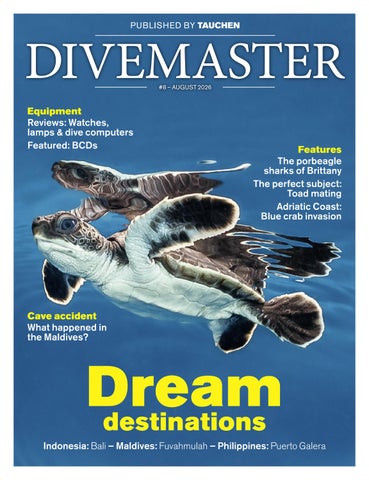
Equipment Reviews: Watches, lamps & dive computers Featured: BCDs
Features The porbeagle sharks of Brittany The perfect subject: Toad mating Adriatic Coast: Blue crab invasion
Cave accident What happened in the Maldives?
Dream destinations Indonesia: Bali – Maldives: Fuvahmulah – Philippines: Puerto Galera
Aggressor-Fan Stephen Jorgensen hat mit uns 57 Abenteuer erlebt und plant bereits die nächsten.
Warum kommt er immer wieder zurück? Nun, lassen wir ihn selbst zu Wort kommen:
„Ich habe mich 57 Mal für Tauchkreuzfahrten mit Aggressor entschieden, weil sie phänomenale Tauchgebiete anfahren, über hervorragendes Personal verfügen und exzellentes Essen auf makellos sauberen Schiffen bieten. Ich werde die ganze Woche über wie ein Familienmitglied und wie ein König behandelt.“ Stephen Jorgensen, Missouri, USA Ganz gleich, ob es Ihre erste Tauchsafari ist oder Ihre 57. – Aggressor garantiert Tauchgebiete, die fünf Sterne verdienen, was auch für unseren Service und unsere Annehmlichkeiten gilt, genau wie Stephen es jedes Mal erlebt. Buchen Sie Ihr nächstes Abenteuer mit Aggressor und, wer weiß, vielleicht steigen Sie ja gemeinsam mit Stephen ins Wasser...
· Bahamas · Belize · Kaimaninseln · Kokos-Insel, Costa Rica · Dominikanische Republik · Galapagos · Komodo, Indonesien · · Nil, Ägypten · Malediven · Palau · Philippinen · Raja Ampat, Indonesien · Rotes Meer, Ägypten · Roatán, Islas de la Bahía, Honduras · · Sri Lanka · Thailand-Andamanensee · Thailand-Chiang Mai · Turks- und Caicosinseln ·
Ob Ligurien, Ägypten oder Mauritius
Fotos: Shutterstock
Paddeln, Tauchen & Golf…
… liegen oft näher zusammen, als man glaubt!
kanumagazin.de www.kanumagazin.de/abo
tauchen.de www.tauchen.de/abo
golfmagazin.de www.golfmagazin.de/abo
SARDINEN SARDINIEN IN
Ab sofort Teil des Schwarms!
Photos: Kaßler (1); Shutterstock (1)
Something completely different The world is currently sweltering. The outdoor swimming pools are packed to the brim, and people are ‘swimming’ in lakes and rivers. Unfortunately, as is sadly common at thi time of the year, we’ve already had the first reports of tragic swimming accidents involving children with tragic outcomes. Why? Because the children simply can’t swim, or can’t swim well enough – regardless of whether there were lapses in supervision or not. As a former competitive and lifeguard, now a children’s swimming coach and a father, this issue is close to my heart. Send your kids to swimming lessons, practise with them, enrol them in clubs. And you, dear diving clubs, offer swimming lessons – recruit tomorrows‘s young divers in the pool. Training agencies such as SSI recognised the signs of the times long ago and now offer swimming lessons for adults as well. The only hurdle here in Germany is the closeure and loss of swimming pools. More and more indoor pools are closing, and fewer and fewer clubs or commercial swimming coaches have enough pool and lane time available. We divers are taking action here too – specifically, the VDST Executive Board is already on the case and, through its support for the ‘Bäderinitiative Deutschland’ (German Swimming Pool Initiative), is ensu-
ring that people become aware of the issue. And we are doing the same here. And what about you? Talk to your neighbours, friends, politicians, your clubs and diving schools – put this issue on the agenda. Or simply become a swimming coach and offer swimming lessons for children as well as OWD courses for adults. It may sound a bit corny, but it’s true: a child who passes their ‘Seepferdchen’ swimming test today will be the diver of tomorrow. That’s all I have to say on the subject. Do you have any experiences or thoughts on this? Drop me a line. One more thing: the holiday season – and therefore the diving season – is in full swing. Check that you and your kit are in good shape before you set off on holiday, and stay within your limits. Look after yourselves. You know, I speak from personal experience. And now: turne the page and enjoy!
Das Mittelmeer wollte offenbar auch ein Palau haben!
ALL YOU CAN DIVE ... Alexander Kaßler Editor-in-Chief of TAUCHEN alexander.kassler@tauchen.de
Telefon 0551 63451340 www.belugareisen.de info@belugareisen.de
CONTENT #8 – AUGUST 2026
36 MALDIVES 52 AQUARIS DIVER
74 TOAD WEDDING
INDONESIA 26 OUR DESTINATIONS IN THIS ISSUE France 62
Italy 68 Philippines 32
Maldives 36 Indonesia 26
Across all channels
56 AQUALUNG-JACKETS
BLUE CRAB INVASION 68 MAGAZINE Gallery: UN World Ocean Days 2026 Latest: Cave accident in the Maldives Local and online news
8 14 18
48 CRESSI DAVINCI
TRAVEL
Photos: Sina Ritter (1); Alexander Kaßler (2); Aqualung (1); Pietro Formis (1); Alexander Rauch (1); Dietmar Steinbach (1)
News from the travel industry Advertorial: Malikia Young Ocean Creators Award Advertorial: Extra Divers Tobago Indonesia: Bali Villa Dive Resort Philippines: Scandi Divers Puerto Galera Maldives: Fuvahmulah
20 22 24 26 32 36
GEAR New products on the equipment market Review: DiveVolk torches Review: Cressi DaVinci Review: Junghans Aquaris Diver Product overview: Aqualung BCDs
42 44 48 52 56
EXPERTS News from Science & Research Feature: Porbeagle sharks in Brittany Feature: Blue Crab Invasion Feature: Toad Wedding How to: Choosing the right diving mask Freediving: Safety aspects Diving Medicine: Diving later in life
60 62 68 74 78 80 84
FOCUS Preparing for a photo shoot Readers’ Photo Competition
86 88
SECTIONS Editorial 5 Preview 98 Legal notice 97
Did you know that TAUCHEN is also available digitally? This includes our social media channels Facebook and Instagram as well as our website and our YouTube channel. You can also listen to our podcast channel. Just drop by and listen. Follow the links below. Do you want to read TAUCHEN digitally? Download our TAUCHEN app for iOS and Android. We look forward to hearing from you.
The cover image shows a young green sea turtle (Chelonia mydas). Photographed by Tobias Friedrich off Vadoo in South Male Atoll, the Maldives.
CONTACT & MORE EDITORIAL TEAM
Jahr Artopé Media GmbH & Co. KG Bajuwarenring 9, 82041 Oberhaching Tel. 089/5 52 41-0, Fax 089/5 52 41-244 E-mail: redaktion@tauchen.de ADVERTISEMENT
089/5 52 41-225 Email: sales@tauchen.de TAUCHEN SUBSCRIPTION + ADDRESS CHANGES
Tel. 040/5555 7991, email: jam@dpv.de EPAPER TAUCHEN
www.tauchen.de/epaper
• Website: tauchen.de • Facebook: facebook.com/ tauchenmagazin • Instagram: instagram.com/ tauchen.magazin/ • Podcast: podcaster.de/podcasts#/ podcast/tauchen-talks • Youtube: TAUCHENDASMAGAZIN • TAUCHEN-App: Android & iOS
GALLERY °
Selected images from the UN World Oceans Day 2026 (unworldoceansday.org)
OCEANS IN FOCUS
‘Above Water Seascapes’ 2nd PLACE: James Ferrara ‘Blue Cypress Lake’ in Florida, with the Milky Way captured in a longexposure photograph.
GALLERY ° ‘Above Water Seascapes’ 1st PLACE: Bruce Sudweeks Two grizzly bears off Kodiak Island are playing at sunrise.
‘Underwater Seascapes’ 1st PLACE: Ysabela Coll Water lilies in the entrance to a Mexican cenote.
‘Big and Small Underwater Faces’ 1st PLACE: Kaushiik Subramaniam A young grey whale in a lagoon in Baja California, Mexico.
GALLERY °
‘Underwater Seascapes’ 2nd PLACE: Bingqian Gao A large school of devil rays in the Sea of Cortez, Mexico.
‘Connecting Oceans’ 1st PLACE: Valentina Cucchiara Interior view of the ‘Nariz’ cenote on the Yucatán Peninsula, Mexico.
‘Connecting Oceans’ 2nd PLACE: James Ferrara A shot taken in a small cave featuring a freediver surrounded by a school of fish.
MAGAZINE
THE CAVEDIVING
DISASTER
IN THE MALDIVES Here we compile verified facts, background information and original quotes from the rescue team and experts regarding the accident in the Maldives.
What was the group of five looking for in the cave? What equipment were they carrying? And what ultimately led to this dramatic accident, in which a rescue diver from the Maldivian naval unit also lost his life? Excerpts from statements made by the rescue divers and facts established so far are provided here to put the events into context. Unfortunately, by the time of going to press, there was no reliable information
available that would allow us to provide definitive answers to all the relevant questions. We’ll keep you posted! Here is what we have been able to establish so far:
Confirmed facts about the accident The accident occurred on 14 May 2026 in the ‘Alimathà Cave’, also known as the ‘Thinwana Kandu Cave’, in the Vaavu Atoll of the Maldives. The victims were five Itali-
an nationals: marine ecologist Monica Montefalcone (51), her daughter Giorgia Sommacal (23), diving instructor Gianluca Benedetti (44), and researchers Muriel Oddenino (31) and Federico Gualtieri (31). Montefalcone had been cave-certified since 2018. It was the most serious diving accident in the history of the Maldives. In addition to the five divers, a member of the Maldivian armed forces died during the re-
Photos: Shaff Naeem (2), DAN Europe (1)
T Alexander Kaßler & Benjamin Schulze
scue operation – bringing the total number of fatalities to six. According to official statements, Sergeant Mohamed Mahudhee died as a result of a decompression accident during the ascent.
The victims and their backgrounds All three scientists and Giorgia Sommacal were on board the M/V Duke of York as part of an annual research expedition organised by the University of Genoa, which has been taking place regularly since 1997. The diving operations were led by diving instructor Gianluca Benedetti, who had already been working in the Maldives for several years. The Cave The Thinwana Kandu Cave consists of two chambers. The entrance to the first chamber lies at a depth of 58 metres. A threemetre-wide tunnel connects it to the second, larger and completely dark chamber. The sandy floor can significantly reduce visibility when stirred up. During the recovery operations, a previously uncharted tunnel was discovered in the second chamber
TAUCHEN.DE
– running off to the side of the main entrance tunnel and ending in a dead end. This part of the cave was missing from all existing maps. The cave has been known for years, was known mainly to insiders and, according to our research, was regularly explored by divers. We are refraining from publishing any existing maps of the cave, as there are neither thoroughly documented nor officially approved maps.
Locations where the bodies were found Four bodies were found together in the same part of the cave – in the dead-end tunnel. The body of the fifth diver (diving instructor Gianluca Benedetti) had already been recovered. Benedetti was lying in the first chamber, near the entrance. Approval status Three of the five divers had been granted special permission by the Maldivian authorities to dive to depths of up to 50 metres as part of the research mission – exceeding the usual recreational depth limit of 30 metres. A Maldivian government spokesper-
son made it clear that Montefalcone’s permit did not cover cave diving.
The rescue mission In addition to Maldivian forces, specialists from DAN Europe were also involved in the international recovery operation. A team of technical divers from Finland, some of whom had already been involved in the Pluragrotta incident in 2014, was deployed for the recovery operation.
Finnish recovery diver Jenni Westerlund has experience in cave diving as well as in technical diving using rebreather systems and other technical equipment.
magazinE ° was on exploring the cave system and locating and documenting the four missing divers – a task that was successfully completed. In the process, the team discovered a previously unknown dead-end tunnel branching off to the side of the second chamber. All four missing divers were found in this tunnel. The team recovered the bodies under complex operational conditions. The plan was to recover two bodies per day. The Finnish divers brought the deceased down to a depth of 30 metres, from where Coast Guard divers took over. The bodies were subsequently transferred to Italy. Enquiries to the Italian authorities regarding the post-mortem examinations have so far gone unanswered. Finally, the team carried out the socalled ‘scene clean-up’ phase: all guide lines, markings and items of equipment introduced during the recovery were removed. In addition, any remaining items that might be relevant to the ongoing investigation were recovered – including the victims’ equipment and material from previous rescue teams. The items were handed over to the Maldivian police and formally seized. The Finnish recovery team’s final dive lasted around three hours, despite difficult conditions (strong winds, surface currents), with approximately 50 minutes of work inside the cave. The mission was completed on 21 May 2026.
Contradictions and unanswered questions Following the accident, the University of Genoa stated that deep-sea diving had not been part of the planned scientific mission. Lawyers representing the Montefalcone family expressed surprise at this statement, as the expeditions have been taking place annually for years and the university must have been aware of them. The contradiction remains unresolved in legal and public debate. The group led by Monica Montefalcone apparently dived to a depth of up to 60 metres, even though the the special permit allowed dives only to a maximum depth of 50 metres. The authorities are investigating why the group exceeded the authorised depth. As of 12 June 2026, no official cause of the accident has been established. The authorities and specialists are continuing their investigations. Photos: Shaff Naeem (1), DAN Europe (5)
The diving vessel M/V Duke of York raised the alarm on 14 May 2026 after the group failed to return. On 15 May 2026, the Maldivian government initially dispatched military divers to recover the bodies. The body of diving instructor Benedetti was recovered first: he was lying in the first chamber of the cave, near the entrance. His diving cylinder was empty. However, this initial recovery operation was abandoned when Sergeant Major Mohamed Mahudhee ‘fell ill’ during the ascent and died as a result of a decompression accident. The search for the four other missing persons also had to be suspended temporarily due to bad weather. The international search and rescue mission was carried out as a jointly coordinated operation between the Maldives National Defence Force (MNDF), the Maldives Police Service, DAN Europe, the Nakai Resort Alimatha, Water Solutions Pvt Ltd and Foresight Surveyors Pvt Ltd, the Finnish specialist diving team and the Italian Ministry of Foreign Affairs. The operational team consisted of three Finnish specialist divers: Sami Paakkarinen, Patrik Grönqvist and Jenni Westerlund. The specialists dived using an underwater scooter, a stage cylinder, a rebreather system and cave lines (a line system). The Maldivian authorities established an exclusion zone and blocked all boats in the area so that the investigations could be carried out. The recovery mission spanned four operational days, beginning on 18 May 2026. The focus
Unsubstantiated assumptions Several media outlets referred to the cave as the ‘Shark Cave’. This is a popular tourist name and not an official geographical term. It conjures up an image that has nothing to do with the actual accident. The divers did not die as a result of sharks, but presumably due to disorientation, a lack of gas and a cascade of errors. Various opinion columns and social media posts have discussed a failure on the part of the dive leader, Benedetti, who was involved in the accident. To date, this remains entirely unsubstantiated. Specific figures regarding the current strength on the day of the accident are circulating in some reports, but are not supported by any official measurements. The authorities have not issued any statements regarding the diving equipment used by the victims. According to current unofficial reports, the group was using conventional recreational diving equipment (open-circuit systems). There is also only speculation regarding the breathing gas used and the size of the diving cylinders. Controversial issues and questions The current depth limit for diving in the Maldives is 30 metres. Why was this not adhered to? And why was the authorised 50-metre depth limit also exceeded? Why was the group not diving with the appropriate equipment and training? Why do the Maldivian authorities not provide training in technical diving and/or rescue diving operations at greater depths? We have put all these questions – and many more besi-
Rescue diver Patrick Grönqvist before his mission. Sami Paakarinen (top right) after the dive. Teamwork: (left) Ahmed Siyam, Maritime Operations MNDF, Guy Thomas, DAN Europe, Dr Abdulla Niyaf, Chief Medical Officer.
des – to the operators of the liveaboard M/V Duke of York, as well as to the Maldivian and Italian authorities. Either we were referred to lawyers, or there was no response at all, or we were rightly referred to the ongoing investigations. Only DAN Europe provided us with information and statements that led to our findings to date. We would like to take this opportunity to thank them. There are conflicting accounts regarding the death of the Maldivian rescue diver, Staff Sergeant Mohamed Mahudhee. Officially, his death was attributed to decompression illness. The editorial team has received differing accounts from
sources within the local diving community. However, these have not yet been independently confirmed and are therefore not presented as a verified sequence of events: official sources report that he died in a decompression chamber. Our source reports that, during his rescue mission, he dived into the second chamber of the cave due to the onset of nitrogen narcosis, even though his gas supply was insufficient for the task – and that he died there. His team members, however, decided to turn back so as not to put themselves at risk. He was reportedly found later in the second chamber, sitting on the floor without a regulator in his mouth.
Conclusion and official statement The joint statement issued by DAN Europe and the Maldivian authorities on 22 May 2026 states that, based on current information, it is highly likely that the Italian divers became disoriented within the cave system and were unable to find their way out. Any further determination of the causes and circumstances is a matter for the relevant investigating authorities. The statement expressly calls on the public and the media not to circulate any unverified assumptions. As soon as conclusive and reliable information becomes available, we will publish it.
magazinE °
FIRST FREEDIVING SCHOOL IN THE SALZKAMMERGUT Austria’s most successful freediver, Viktoria Urbanek, has founded the freediving school One Breath Austria together with Mickey Edtinger and Andre Schneider. According to the operators, the new centre on Lake Attersee is the first dedicated freediving school in the Salzkammergut region and in Upper Austria. It offers courses, training sessions and taster dives for beginners and advanced divers. Training takes place at the Watersports dive site in Weyregg in cooperation with the Under Pressure diving school. www.onebreath.at
DIVERS AS CONSERVATIONISTS Go straight to the programme overview Photos: A. Kassler, Ocean Heroes, Onebreath, ChatGPT, the organisers
With its new project, the ’Global Shark & Ray Census`, PADI aims to build the world’s largest database on sharks and rays. Divers can report their sightings via the PADI app, thereby providing valuable information for research and marine conservation. The data is intended to help improve our understanding of population trends and support more targeted conservation measures. As many species of sharks and rays are considered to be threatened, scientists are hoping for widespread participation from the international diving community. www.padi.com
WORLD SHOOTOUT 2025–2026: ENTER NOW! The World Shootout, an international underwater photography and videography competition, is entering its next round. We are looking for the best images from the underwater world – ranging from macro and wide-angle photography to underwater videos. As well as attractive prizes, participants can look forward to international recognition and features in prestigious media outlets. Entries must have been taken between 2 November 2024 and 1 November 2026. Information and registration: www. worldshootout.org
UNDERWATER AWARDS AUSTRALASIA 2026 PT
URE • A
M
U
A
S
REPE
BM
E •
ERGE
Z
•
A
A
C
The Underwater Awards Austra lasia 2026 are now accepting entries at. This prestigious comAustr a l asi a 2026 petition for underwater photography and videography in the Australasia region is organised by Underwater Australasia, SUBMISSIONS NOW OPEN DivePhotoGuide and UW Images. Entrants can submit their images and videos in nine categories, including the new special category ‘Only Water’. Prizes worth around 70,000 Australian dollars will be awarded in total. The closing date for entries is 19 July 2026. www.underwatercompetition.com
Underwater Awards
T
W I N N E R S P R E S E N T E D AT GO DIVING SHOW ANZ
You can find out more about the artist Michel Ley at: , Facebook/michels.imbaerium, , Instagram (‘michels.imbaerium’) and , www.michels-imbaerium.de
P R I Z E S W O RT H A$70,000
W W W. U N D E R W AT E R A W A R D S . C O M
S Y D N E Y, A U S T R A L I A SEPTEMBER 5–6, 2026
EXCITING PHOTO A N D V I D E O C AT E G O R I E S PRESTIGIOUS J U D G I N G PA N E L
ORGANISERS
UWAA 2025 WINNING IMAGES (LEFT–RIGHT): VADIM BELAKHOV, JAMES FERRARA, JAKE WILTON, MARCIA RIEDERER
SHARK KNOWLEDGE MAKES YOU (MORE) CLEVER … The Megalodon is an extinct prehistoric shark. So far, only teeth have been found as fossils, which have been dated to between 1.9 and 17 million years ago. Despite these sparse remains, scientists are certain that: A)... T he Megalodon is a direct ancestor of the great white shark. B)... The Megalodon is a distinct, extinct order
PROTECTION FOR THE SOUTH ATLANTIC With the Albardão National Marine Park, Brazil has established one of the largest marine protected areas in the South Atlantic. The area covers more than one million hectares and protects vital habitats for whales, dolphins, sharks and numerous species of fish. Conservation organisations have welcomed the move as an important contribution to the preservation of marine biodiversity. In the long term, the region could also develop into an attractive destination for nature and diving tourism.
Solution: Although the teeth of the prehistoric shark bear a strong resemblance to those of the great white shark, and it was therefore classified as ‘Carcharodon megalodon’ within the genus of great white sharks, the latest research indicates that it belongs to the genus ‘Otodus’ and thus to the extinct family ‘Otodontidae’. You can find these and more facts and figures about sharks at in Ocean Heroes’ new shark quiz. It’s both entertaining and educational, available at a charity price (100 per cent donation) of 25 euros. Available to buy at: www. ocean-heroes.shop
TRAVEL
SPECIAL TOUR: THE AZORES WITH SHARKVOICE – JULY 2027
The Azores are among the few places in Europe where whale sharks, hammerhead sharks, mobula rays and huge schools of fish are not the exception but the norm. Alongside the Princess Alice Bank, the itinerary for July 2027 includes the Condor Bank – renowned for blue sharks and mako sharks – as well as dives around Pico and whale watching for sperm whales and other marine mammals. Specialist Dirk Schwedler from Sharkvoice Germany will be accompanying the trip and sharing his extensive knowledge of sharks with guests during evening talks. A highlight for anyone who knows that the Atlantic has more to offer than just waves. Price: from 2,490 Euros (plus flights and additional costs). www.wirodive.de
From 4 to 6 September 2026, the Wetnotes Event 2026 will take place at Kreidesee Hemmoor – a major gathering for recreational and technical divers. The highlight will be on Saturday, featuring a diving fair with over 70 exhibitors, opportunities to test equipment in the lake, and fascinating talks. We, the TAUCHEN team, will also be there. In the evening, a buffet (25 Euros, booking required) offers a chance to round off the day together. Entry is free; the usual fees charged by the dive centre apply for diving. Information: jens.hoener@ wetnotes.eu.
TOURMARE LAUNCHES A NEW PLATFORM FOR DIVING CRUISES WORLDWIDE The specialist tour operator tourmare is digitising travel planning for divers: on the new platform liveaboard.tourmare. de, it is now possible for the first time to compare liveaboard trips worldwide in one place and book them online. Using state-of-the-art AI technology, customers can filter offers by destination, dates or diving experience. Two labels provide guidance: ‘Selection’ stands for high service quality, whilst ‘greenline’ highlights sustainable, environmentally friendly providers. Despite the option to book online, the team based in Hanover continues to offer a free, personalised consultation. www.tourmare.de
AUSTRALIA: ROAD TRIP AND LIVEABOARD DIVING HOLIDAY A new 22-day self-drive tour from Beluga Reisen combines an east coast road trip from Sydney to the tropical north with spectacular diving experiences. Along the way, national parks, rainforests and Australia’s wildlife await. The highlights: unspoilt reefs away from the crowds on the Southern Great Barrier Reef (with Dive Spear and Sport in Town of 1770) and snorkelling with humpback whales in Hervey Bay (July to October). This action-packed combination of a self-drive road trip, nature and diving can be booked for under 5,000 Euros – ideal for adventurers who want to experience Australia off the beaten track. www.belugareisen.de
THE GALÁPAGOS WITH AQUA ACTIVE With spectacular encounters with large fish and a unique array of marine life, the Galápagos Islands are among the world’s most sought-after diving destinations. As a new highlight in Aqua Active Agency’s programme, the liveaboard M/Y Aqua takes divers right into the heart of this fascinating underwater world. The itinerary takes you to the world-famous dive sites around Darwin and Wolf, where large schools of hammerhead sharks, eagle rays, Galápagos sharks, sea lions and, in season, whale sharks are among the highlights. Comfortable cabins, a friendly, family-like atmosphere and an experienced crew ensure the perfect blend of adventure and relaxation. For anyone wishing to discover more of Ecuador, the liveaboard trip can be perfectly combined with other travel experiences. Whether it’s a jungle adventure, a visit to the capital Quito or island-hopping above water – the possibilities are as varied as the country itself. Scan the QR code now and discover the Galápagos Islands aboard the M/Y Aqua!
BAHAMAS VIDEO & DISCOUNT Aggressor Adventures has released a new video about the Bahamas Aggressor II. It showcases the liveaboard’s two main dive sites: the coral reefs of the Exuma Cays and the famous tiger shark dives off Tiger Beach. To mark the launch of the video, Aggressor is offering a discount of US$500 on selected trips aboard the Bahamas Aggressor II in August and September 2026. aggressor.com
Photos: Nicolas Remy (1), organisers
WETNOTES EVENT 2026 AT KREIDESEE HEMMOOR
Stylish Hotel & fantastic house reef
READERS’ TOURS 2026 ORCAS & NORTHERN LIGHTS
Mövenpick Resort
For readers of TAUCHEN magazine, Wirodive is offering an exclusive readers’ trip to Orca Camp in Northern Norway in November 2026: in the fjord landscape around Hamneidet, participants will see orcas and humpback whales in the wild and – on clear nights – spectacular Northern Lights. The week includes up to six boat trips and nature programmes, including an introduction to aurora photography. Travel dates: 15 to 22 November 2026. Price: 3,590 Euros (excluding travel to the destination and any stopovers). www.tauchen.de/leserreisen/ & mail: redaktion@tauchen.de
SOLAR ECLIPSE 2027 From 29 July to 5 August 2027, TAUCHEN magazine, in collaboration with Beluga Reisen, is organising an extraordinary readers’ trip to the Red Sea. On board the M/Y Avo from SeaMad Liveaboards, participants will enjoy a liveaboard dive safari to the most beautiful reefs in southern Egypt – combined with the longest total solar eclipse of the 21st century. On 2 August 2027, the vessel will anchor directly on the central path of the eclipse, allowing the totality – lasting more than six minutes – to be observed under ideal conditions. The trip will be accompanied by a marine biologist who will explain the effects of this rare natural spectacle on life on the coral reef. The trip starts and ends in Port Ghalib. The price is 1,999 Euros per person, including all fees, in a standard cabin. Premium cabins are available for an additional 100 Euros extra, and suites from 200 Euros extra. Fancy joining us? Email us with the subject line: ‘Solar Eclipse’ at redaktion@tauchen.de
JOIN IN THE RESEARCH ON THE TURTLE SAFARI rom 25 November to 2 December 2026, the TAUCHEN readers’ trip F ‘Turtle Safari’ will accompany the TurtleWatch Egypt 2.0 research project to the southern Red Sea. On board the Alia Soul, participants will assist scientists with the documentation and photo-identification of sea turtles at the Fury Shoals. Anyone interested can apply by emailing redaktion@ tauchen.de, quoting the keyword “Turtle Safari”. Prices start at 1,650 Euros plus port charges.
The picturesque El Quadim Bay delights divers and snorkellers with unforgettable underwater moments, while a private sandy beach and traditional Nubian architecture create a relaxed and welcoming atmosphere. New: Both pools have been completely renovated and are looking better than ever. The large main pool El Quadim has been ready to enjoy since the end of April.
PALAU, YAP & TRUK IN ONE TRIP Experience Micronesia’s most spectacular diving destinations on a unique journey: Palau, Yap and Truk. Encounter sharks and huge schools of fish around Palau, observe the famous manta rays of Yap and explore the legendary Second World War wrecks in Truk Lagoon. Look forward to 24 days packed with unforgettable underwater experiences and the fascinating culture of Micronesia. www.pacific-travel-house.com
Experience the Red Sea at its most beautiful.
SAVE THE DATE: INTERDIVE FRIEDRICHSHAFEN 2026 Any plans yet for the period between 24 and 27 September 2026? The major German-language diving fair is back – featuring new kit, dream destinations, talks and INTERBOOT as a bonus. One ticket, two fairs. Tickets & Information: www.inter-dive.de
Mövenpick Resort el Quseir 7 nights in a Superior Garden View Double Room with half board, incl. flights and transfers
from 949 € p. person More information on our website
WELTWEIT MEER ERLEBEN
reisen@reisecenter-federsee.de www.rcf-tauchreisen.de
rcftauchreisen
tauchreisen_rcf
TRAVEL °
Advertorial
Malikia Young Ocean Creators Award New youth competition in Marsa Alam: Young divers and snorkellers showcase the Red Sea through photos and social media clips.
A
new event format for young divers and snorkellers, the ‘Malikia Young Ocean Creators Award’, is launching in Marsa Alam, Egypt. During the 2026 Christmas holidays, budding photographers and young filmmakers aged between 12 and 18 will have the chance to showcase their perspective on the underwater world of the Red Sea. Workshops, professional guidance and attractive family activities will complement the competition. Supporting young creative talent in the Red Sea The ‘Malikia Young Ocean Creators Award’ marks the launch of a new event format in Marsa Alam, which creatively connects young divers and snorkellers with the underwater world. During the 2026 Christmas holidays, from 27 December 2026 to 3 January 2027, the Malikia Resort Abu Dabbab will, for the first time, be transformed into a stage for budding photographers and young filmmakers aged between 12 and 18.
Photos: Malikia Beach Resort, Beluga Reisen
Joint project The Malikia Resort Abu Dabbab is organising the competition in collaboration with Beluga Reisen, ProShot, Scubapro and SSI. The partners aim to inspire young people to take an interest in the sea, diving and creative storytelling, whilst at the same time raising their environmental awareness.
Free for children under 18 There is a special highlight for families here: children and young people up to and including the age of 18 stay free of charge at the Malikia Resort during the Christmas period. For every full-paying adult, one child can stay free of charge. In this way, the resort is sending a clear signal in favour of family-friendly diving tourism and making the Christmas holidays particularly attractive for families who enjoy diving. For parents, a week’s stay (all-inclusive, 7 nights in a family room) costs 975 euros per person (including transfers to and from Hurghada). Up to eight dives for participating children are also included in the package. Our own presentations and workshops Competition entrants can submit either an underwater photograph or a social media clip. Video entries should be produced in the contemporary portrait format and be suitable for platforms such as Instagram Reels or TikTok. Workshops on underwater photography, film production, safety and marine conservation round off the competition programme. All activities take place under professional supervision and in accordance with international SSI standards. New Award The best entries will first be selected by a jury made up of representatives from the participating partner companies. The entries will then be published online. The community will decide on
the final winners by voting via ‘likes’ on Instagram and TikTok. With the ‘Malikia Young Ocean Creators Award’, Marsa Alam could soon be hosting another extraordinary event. The concept combines the promotion of young talent, modern media formats and environmental awareness. At the same time, it conveys a clear message: the next generation is discovering, documenting and protecting the underwater world in its own way. Prizes worth over 5,000 euros What would an award ceremony be without prizes for the best entries in the various categories? Prizes with a total value of over 5,000 euros are up for grabs. Events like this would not be possible without sponsors. The following organisations have come on board to support the Malikia Young Ocean Creators Award: • Beluga Travel • Malikia Resort, Abu Dabbab • SSI Egypt • Scubapro Egypt • ProShot • Diving.de • TAUCHEN Magazine Booking options & participation Further information and booking options are available from Beluga Reisen at and www.belugareisen.de, or by email at and info@belugareisen.de.
TRAVEL °EXTRA DIVERS
EXTRA DIVERS Tobago
A natural paradise nestled amongst rainforests, reefs and Caribbean tranquillity
TOBAGO
Photos: Tobago Tourism Agency; Extra Divers Worldwide
Advertorial
Tobago, Trinidad’s smaller sister island, lies in the southern Caribbean, not far from the coast of South America. Despite its modest size, the island boasts an extraordinary variety of landscapes: palmfringed beaches, dense rainforests and a relaxed atmosphere, full of Caribbean zest for life. The island is equally suited to active holidaymakers and those seeking relaxation. Off the coast, colourful coral reefs are perfect for diving and snorkelling. Inland, the Main Ridge Forest Reserve – the oldest protected rainforest in the Western Hemisphere – offers impressive walking trails through virtually untouched natural surroundings. Birdwatchers will also find plenty to enjoy on Tobago: with over 260 documented species, including endemic birds such as the Tobago Greenlet, the island is one of the most exciting birdwatching destinations in the Caribbean. Large hotel complexes are rare in Tobago. Instead, small accommodation options and warm, family-style hospitality define the holiday experience. Tobago is therefore more than just a holiday destination – here, you can still experience the authentic Caribbean without mass tourism.
Nabucco’s Speyside Inn Resort & Extra Divers Speyside In the quiet fishing village of Speyside in north-eastern Tobago lies the family-run Nabucco’s Resort Speyside Inn, home to the Extra Divers Speyside diving centre. This small resort, with just 19 rooms, offers simple, authentic Caribbean accommodation with sea views, a swimming pool and a restaurant right by the water’s edge. Tobago is regarded as one of the best diving spots in the Caribbean. Just off the coast lie the famous diving sites around Goat Island and Little Tobago, renowned for their exceptional biodiversity. Here, divers encounter pristine coral reefs, large schools of fish, turtles, eagle rays and, with a bit of luck, manta rays too. The dive sites are characterised by two very different worlds: whilst the sheltered Caribbean side offers calm, colourful reefs, the Atlantic side provides nutrient-rich conditions, stronger currents and spectacular drift dives. Extra Divers Speyside organises daily boat trips with two dives to the surrounding sites. The variety of dive sites and the pleasant water temperatures of around 28 degrees Celsius all year round make Tobago an ideal destination for divers.
FURTHER INFORMATION: info@extradivers.org & www.extradivers-worldwide.com Package holidays can be booked via the Federsee Travel Centre at info@reisecenter-federsee.de
TRAVEL ° BALI
Back again and gladly so … … Bali keeps drawing us back. This time, we return to Bali Villa Dive Resort.
Photos: Alexander Rausch
T Alexander Kaßler
B
aliis certainly no longer an insider’s tip. For me, however, the island is still well worth a visit and, above all, well worth recommending. Whenever friends ask me where I find it ‘lovely’, Bali always features in my list. Even my parents, both in their late 60s, have already taken my advice and visited the Island of the Gods. And whilst they didn’t find it divine, they did describe it as ‘beautiful, varied and impressive’. At the end of April, I’m landing at Denpasar Airport for the ninth time now. As dusk falls, I’m sitting with my small tour group in a car that’s turned out to be far too cramped this time (my own poor planning) and facing a long three-hour drive northeast. Right through the night. Not a good choice. Admittedly, the flight from Istanbul was perfect. But if you have the option, you should either treat yourself to a flight that lands early in the day, or simply spend a night somewhere around Denpasar or Kuta.
That way, you simply see more of the country and its people on the journey and arrive less exhausted in the middle of the night. There is one good thing about the late arrival and the uncomfortable journey: having arrived here, paradise feels even more like paradise.
A familiar favourite, given a new twist “Welcome to Bali Villa Dive Resort,” and before you know it, a plate of fruit and a sandwich are on the table. The after-midnight snack then turns into a pre-dawn treat, as there’s plenty to talk about with the new coowner, Alexander Rausch, who also runs the resort’s own diving centre. Among other things, we discuss how there’s going to be quite a bit happening at the resort over the coming months: “We’re starting to renovate everything bit by bit and make it even more beautiful. But don’t worry: regular guests will only notice that something has changed
Location, location, location – that’s what counts. And when it comes to this, the BVDR has everything a diver could wish for: very few tourists, a beautiful resort complete with a lush house reef, and a wealth of other attractions both above and below the water. And contrasts that couldn’t be more stunning.
TRAVEL ° BALI at second glance.” New colours, decorative touches in the rooms, bungalows and around the resort, and changes to behindthe-scenes procedures – “small changes with a big impact”. The biggest change: a little more space is being created for guests by “opening up” the staff villa. “An even more relaxing atmosphere,” he sums up.
A destination or a stopover He himself is the founder and owner of EcoProDivers, operating two boats in the Maldives and one off Komodo. The latter, incidentally, makes for the perfect combination with a stay in Bali. Bali is the ideal hub from which to travel further east in Indonesia to dive at sites such as Sulawesi, Borneo, Raja Ampat or even Komodo. You can either use Bali beforehand to go diving or afterwards to relax before heading home. The island itself, however, also offers plenty to see and do, making it well worth spending two or more weeks here.
Places of interest around the resort Our itinerary includes exactly four days at the resort before we carry on via Makassar to Bira (South Sulawesi). This means we’ll have two full days of diving. As it’s been a year since my last trip here – and I’d already explored pretty much every major dive site back then – this time I’m primarily interested in the house reef and the top spots in the immediate vicinity. The first day is a non-diving day, set aside for acclimatisation and a video tour of the resort (Watch the video via the QR code: https://tinyurl.com/balivilladiveresort). On the second day, we’ve got two dives planned at the Gumi Cenik site in Tejakula. The journey takes 20 minutes. From the beach, you head through the stony shallows to a reef wall, which can be dived either on the right-hand side (East – corals) or the left-hand side (West – macro). The most beautiful area is found at depths between 15 and 25 metres. You could go deeper, but it’s
Photos: Alexander Rausch
Let’s be honest: when it comes to encounters with big fish, there are far better spots in Indonesia. As for everything else, you’ll see more than enough of it right in front of your mask along Bali’s coastline. For photographers, the island is a veritable ‘inexhaustible treasure trove’.
not worth it. The reef here could be described as the essence of Bali. Everything here – apart from large fish – is concentrated within a few hundred metres. It’s teeming, swarming and bustling. Soft corals, hard corals, fish of all shapes and colours, sponges, macro life – it’s all there, and by no means can it all be fully explored and photographed in just two dives. My very own personal highlights: a frogfish, unimaginably large, sitting with its fins spread wide on top of two sponges. If it’s out hunting, it certainly needs to refine its hunting technique: something that’s completely black and enormous really shouldn’t be perched on two pink barrel sponges. Unless, of course, it’s targeting prey that can’t see or posing for the ladies. Equally unmissable is a huge gorgonian at a depth of around 25 metres (if you dive the reef on your left). Only off Menjangan, an island off the north-west coast of Bali, are there gorgonians that are even larger. Visibility of over
20 metres, an incredible variety of corals and fish, and the perfect spot to warm up with some photography – that’s my verdict on the first two dives here. The rest of the day is spent filming more footage for the resort video. And on the final day of diving, we’ll head to the house reef.
We have everything we need In the meantime, there has been a ‘guest changeover’. Four guests have left, and a larger group has arrived. The tour group from Hesse, numbering around 20 people, is using the resort as a diving base and will then travel on to Komodo after a week. ‘Our accommodation is ideally suited to groups. The bungalows offer a range of occupancy options, from two to six people. Then there are our double rooms in the main building. At present, we can accommodate a maximum of 28 guests at any one time. That will increase by a few places in future,” promises
Tauchreisen & Tauchsafaris weltweit
Indonesien - Sali Bay
Ursprünglich. Ruhig. Unvergesslich. 7 Nächte (Beach Front Divers Lodge) Vollpension 10 Tauchgänge p.P. inkl. Flasche, Blei Transfer ab/bis Flughafen Labuha
ZWEI EXKLUSIVE
SPECIALS
Reisezeitraum: 01.12.26 - 28.02.27
SOLO ODER BUDDY? Sie entscheiden – die Vorteile bleiben! Kein Einzelzimmerzuschlag 2 Tauchpakete zum Preis von 1
SOLO ab 1.568,-€ 2.478,-€ BUDDY ab 1.018,-€ 1.568,-€
Hier geht´s zum exklusiven Angebot Buchungszeitraum: bis zum 31.08.2026
www.aquaactive.de info@aquaactive.de +49 5507 - 919 818-0
Alexander. The base capacity is similar. For boat trips, two modern, powerful boats are moored right ‘on our doorstep’. Larger groups are no problem when it comes to catering either. As well as the usual staples, the included breakfast features Balinese-Indonesian delicacies. What’s more, you can order a snack at any time – highly recommended! The same applies to dinner. You could take a short walk to the main road and grab a bite to eat at a warung (small roadside restaurants) for very little money. Alternatively, you can simply stay at the resort and work your way through the menu, which is packed with delicious dishes. We wanted for nothing: from vegetarian dishes to fish and meat dishes (burgers and chips) and the obligatory freshly picked coconut with or without a splash of alcohol – everything’s there and available. And if you want to find out exactly how it’s done, book a cookery class including a trip to the market with the kitchen team. Before, after or between dives, you can relax at the resort’s ‘meeting point’ – the beautifully landscaped pool right next to the bar, with a magnificent view of the mountains in the background and the sea on the other side. The ever-present coconut palms provide the perfect backdrop to this paradise setting. You’re guaranteed to feel right at home. The rooms, bungalows and outdoor facilities leave nothing to be desired. And as for the diving: the on-site team are knowledgeable, safe and almost uncannily friendly.
The reef on our doorstep I must admit that I didn’t remember the house reef right in front of the resort as varied and beautiful as it appeared this time. Perhaps it’s because there were fewer waves in the days leading up to our visit, or perhaps my memory simply has some gaps. You enter the house reef about 20 steps from the Rödelbank and, consequently, the diving centre. Initially, the shallow area consists of a few metres of stony seabed, followed by dark sand. You then reach the first coral boulders, where macro photography enthusiasts can easily spend the first 30 minutes of the dive. There are nudibranchs and more to admire here. Anyone who ‘runs out of air’ here will miss out on quite a bit. Like the fingers of a hand, reef formations stretch out from the dark sandy seabed into the depths, each ‘finger’ offering different little gems worth seeing. It isn’t a hotspot for biodiversity, but it is exactly the sort of beautiful house reef right on your doorstep that you can happily visit for several days for leisurely diving and photography. ‘To make it even more appealing, we’ve been working with the coral conservation project “Reefvillage” to explore ways of helping the corals. Ultimately, more and more steel structures are being installed in the sand, to which coral fragments are attached and nurtured, so that they can grow into new habitats.’ Alexander then shows us just how well this works during our final dive. And a sea turtle immediately proves that it really does work, ‘leading’ us straight from the entry point to the steel structure, where she then hands over the ‘presentation’ to an impressively large batfish. A lovely final scene. And with that, our trip to Bali comes to an end here. South Sulawesi awaits. One thing is certain, though: the Bali Villa Dive Resort has certainly not seen the last of us. Fancy a trip to Bali? Then do have a look at the video of our trip (YouTube) or read our travel diary (www.tauchen.de).
Photos: Alexander Kaßler, Alexander Rausch
TRAVEL ° BALI
Bali Villa Dive Resort BALI
BALI VILLA DIVE RESORT / BALI / INDONESIA Getting there: You’ll arrive at Denpasar Airport (DPS) in southern Bali. There are generally no direct flights from Europe. Common routes involve a stopover in Singapore, Doha, Dubai, Abu Dhabi or Istanbul. Depending on traffic and the route chosen, you should allow around three and a half hours for the transfer from the airport to the resort. If you’re landing late in the evening, it’s a good idea to spend the night in southern Bali. LOCATION: The Bali Villa Dive
Resort is situated in the peaceful north-east of Bali, in the coastal area of Sambirenteng/Tejakula, right by the sea. The region is less touristy than the south of the island. Tulamben is about 30 minutes away, Amed around 40 minutes, and Singaraja just under an hour. This makes the resort ideal both as a relaxing diving destination and as a base for tours along the north and
east coasts. RESORT AND ROOMS: This family-
run resort accommodates a maximum of 28 guests and is set in tropical gardens featuring coconut palms, an infinity pool, a restaurant and a bar, with direct views of the Bali Sea. Guests can choose from Garden View Rooms, Sea View Rooms, a Pool Bungalow and twostorey Ocean Bali Villas with sea views. The accommodation is airconditioned. Depending on the category, it features a balcony or terrace, an en-suite bathroom, a sea or garden view, and is within easy reach of the pool, restaurant and diving centre. DIVING: The dive centre is situated
right by the sea, just a few steps from the house reef. Dives take place at the house reef, at spots in the immediate vicinity, and on day trips to well-known locations such
as Tulamben with the wreck of the U.S.A.T. Liberty, Amed, Candidasa, Menjangan or Nusa Penida. The centre has its own dive boats available for these trips. The centre offers equipment hire, 12- and 15-litre aluminium tanks, rinsing and equipment areas, as well as courses in accordance with recognised training standards. The region is particularly appealing to macro enthusiasts, coral lovers and relaxed repeat visitors. BEST TIME TO VISIT: For northern
Bali, the period from March to December is considered particularly recommended. In general, Bali is suitable for diving all year round. If you’re looking for the most stable conditions, plan your trip for the drier season. ACTIVITIES: As well as diving, the
region is ideal for excursions to the north and east of Bali. Possible
tours include trips to Singaraja, to waterfalls, hot springs, temples and markets, as well as excursions to Karangasem featuring Tirta Gangga and other cultural attractions. Those looking for a more active holiday can plan a Mount Batur sunrise tour, rafting or longer day trips towards Ubud. The resort also offers spa treatments, massages and Indonesian cookery classes – ideal for days off from diving or for travelling companions. PRICE, BOOKING & INFORMATION:
7 nights’ accommodation with breakfast from 349 euros per person; + 5% discount when booked in combination with a Komodo liveaboard on the Duyung Baru. www.ecoprodivers.com info@ecoprodivers.com info@balivilladiveresort.com
TRAVEL ° SCANDI DIVERS
PUERTO GALERA:
AT THE HEART OF BIODIVERSITY This month’s destination profile focuses on ‘Scandi Divers’ in Puerto Galera.
I
f you dream of extraordinary biodiversity, Puerto Galera is a must-visit destination. This region on the Philippine island of Mindoro is regarded as the ‘heart of the heart’ of marine biodiversity. Nowhere else does the underwater world seem as diverse and varied as it is here. We’re setting off on a voyage of discovery there with Scandi Divers. Even the very first dive reveals what makes Puerto Galera so special. Dungon Reef is teeming with life. Amongst the colourful corals, clownfish, shrimps and an impressive variety of nudibranchs can be seen among the corals. Our guide Larry, known at the resort as ‘Eagle-Eyed Larry’, spots even the tiniest creatures with apparent ease. No sooner have you photogra-
T & F Daan Kleinbussink
phed one subject than the next highlight is already waiting. The range of dive sites around Sabang is enormous. In the morning, we drift with the current at Sinandigan Wall, keeping an eye out for a very special visitor. Then, suddenly, he emerges from the blue: a thresher shark. The predator, over four metres long, glides elegantly past us before disappearing back into the depths. A magical moment. Just a few minutes’ boat ride away, the M/V Alma Jane offers a completely different diving experience. The sunken cargo ship has long since been transformed into an artificial reef. Corals cover the steel structure, shoals of reef fish circle the wreck, and exploring the interior also provides a real sense of adventure. The region’s famous muck-
diving spots are at least as fascinating. At first glance, the sandy seabed seems unremarkable. But if you look more closely, you’ll discover a world full of curiosities. Seahorses, tiny anglerfish, flamboyant cuttlefish and rare nudibranchs are seen regulary. Puerto Galera impressively demonstrates why macro photographers from all over the world keep coming back here time and again. A day trip to Verde Island is an absolute must. For many divers, the island is considered one of the best dive sites in the Philippines. As soon as you descend, a spectacular scene unfolds: thousands of fish swim past the steep drop-off, whilst colourful soft corals, huge gorgonians and massive sponges adorn the reef. The sheer abun-
TRAVEL ° SCANDI DIVERS PHILIPPINES
Mindoro
SCANDI DIVERS AT A GLANCE • Location: Sabang , Puerto Galera, Mindoro Island, Philippines • Getting there: Flight to Manila, followed by a transfer by car and water taxi • Water temperature: 24 to 28°C • Highlights: thresher sharks, wreck diving, macro photography, Verde Island, night and blackwater dives • Diving centre: up to four guided dives a day, as well as numerous specialist courses • Website: www.scandidivers.com
dance of life is overwhelming. Scandi Divers also makes a lasting impression on land. The multi-award-winning resort offers comfortable accommodation, a professionally run dive centre and a superbly equipped camera room for underwater photographers. Above all, however, the team wins guests over with their warm hospitality and personalised service. This is precisely why so many guests keep coming back. On the last day of diving, there’s just
one item left on our wish list: a pygmy seahorse. Our search takes us to the gorgonians at Kilima Steps. It seems we’re not having any luck for a long time, until Larry suddenly waves excitedly. Sure enough, there it is, perfectly camouflaged amongst the polyps: one of the tiny seahorses. Barely bigger than a pinhead – and yet the perfect finale to an extraordinary week of diving. Puerto Galera isn’t just a delight because of its spectacular dive sites and incredible biodiversity. It’s the combination of big
fish, macro life, wrecks and warm Filipino hospitality that makes this place so special. Anyone who’s dived here once will quickly understand why so many divers keep coming back.
SICHERHEIT ist kein Extra. Sie ist STANDARD. Mit ENOS® orten Sie vermisste Taucher in Echtzeit – direkt zur Crew, ohne monatliche Kosten, ohne Umwege. Wenn Strömung, Wind oder Distanz entscheiden, liefert ENOS® präzise GPS-Positionen genau dorthin, wo sie gebraucht werden: an Bord. ENOS® – weil Sekunden zählen.
NRC International GmbH Karlstrasse 21a 51702 Bergneustadt
Tel: +49 22 61 / 500 414 WhatsApp: +49 151 41834317 info@nrc-international.com
nrc-international.com
TRAVEL ° FUVAHMULAH
Fuvahmulah Diving into the world of large pelagic animals
B
T & F Sina Ritter
efore your first dive, there’s usually a picture in your mind: deep, dark water, teeth. A mixture of documentaries, newspaper headlines and cinematic myths that you can never quite shake off, even though you ought to know better. Then Fuvahmulah lies beneath you. No tranquil lagoon blue, no sheltered coral garden, but the open ocean. At depths of between eight and 30 metres, the light reveails sandy patches, ledges and a blue that, after just a few metres, seems heavy and boundless. Out of this blue, a tiger shark glides towards you. Slowly, without haste, without drama. Not to make an impression, but because this is where it lives. Marco, an underwater photographer from Munich, is visiting Fuvahmulah for the first time. He holds the camera in front of him, his finger on the shutter release. Yet he waits. A breath, then another. It is one of those moments when you don’t take the photograph straight away, because what is happening before you first needs to be understood. That is precisely where the power of this place lies: Fuvahmulah does not strip the shark of its wildness. But it corrects the image that many people bring with them.
Fuvahmulah: An island without a protective ring Fuvahmulah lies 497 kilometres south of Malé and is very different from the typical Maldivian islands. There is no protective atoll, no outer reef, no lagoon to keep the sea at bay. The island stands alone in the open ocean. Deep water begins close to the shore — and with it comes the world of large pelagic animals. This location makes Fuvahmulah one of the most reliable diving spots for encounters
TRAVEL ° FUVAHMULAH with large marine creatures. Tiger sharks are not a rare surprise here, but a regular sight. Added to these are thresher sharks at the cleaner stations on the northern and southern tips, oceanic manta rays, hammerhead sharks, and, in spring, whale sharks too. And sometimes something appears in the blue that wasn’t on anyone’s itinerary. Underwater, the island is rugged, deep and characterised by strong currents. At ‘Tiger Point’, Fuvahmulah’s most famous dive site, a sandy terrace drops away into the open blue at a depth of around 30 metres. There, tiger sharks patrol the sides, often calmly and close enough that every movement the diver makes carries weight. At the tips of the island, currents push nutrient-rich water upwards along the walls. This is where the treasure sharks’ cleaning stations are found — places where the long upper tail fin of a fox shark sometimes glides through the diver’s field of vision as if in slow motion. Even above water, Fuvahmulah is no typical picture-postcard island. Freshwater lakes, dense tropical vegetation and its own microclimate make it wilder and less manicured than the usual image of the Maldives. The island is part of a UNESCO Biosphere Reserve and, in many ways, feels more unspoilt than staged. For me, it was precisely this blend that made the difference. Fuvahmulah is not an easy place, but it is an authentic one. Depth, currents, blue-water entry points and large marine creatures demand your full attention. Anyone who dives here quickly learns that good photographs depend not only on technical skill, but on calmness, positioning, respect and a clear understanding of the situation. The tiger sharks offer photographers something rare: a subject that returns regularly yet is never quite the same. You can practise — lighting, distance, composition, timing. And, above all, patience.
This special dive Fuvahmulah has become better known in recent years. Many reports focus on Tiger Point, the high likelihood of shark encounters, and the adrenaline rush. That’s understandable. But anyone who only talks
about that is missing the point. At ‘Liquid Shark Divers’, one of around 14 diving centres on the island, the focus is less on the immediate thrill and more on how a dive is structured. How is the briefing conducted? How much space is given to a photographer? How is nervousness dealt with? How close is close enough? And when is it better to stay calm and not force anything? The centre was set up as a diving centre and meeting place for people who don’t just want to ‘consume’ underwater experiences, but want to take a closer look. Groups are deliberately kept small. Anyone working on a specific shot is given time and guidance. Anyone diving with sharks for the first time is given clear procedures, visible safety measures and the feeling that they are not being sent into a situation alone. After a few days of diving, Marco highlights this difference above all else: it doesn’t feel like mass processing. Nobody is simply shunted through the programme. You are acknowledged — with your skills, your uncertainty, your camera and your questions.
Safety – Storytelling – Education At Liquid Shark Divers, three things take centre stage: safety, mindful storytelling and learning. Fuvahmulah is no easy dive site: depth, currents, open water and large marine life all demand clear procedures. That is why every dive begins long before we enter the water: with small groups, precise briefings, conservative planning and a high ratio of safety divers to guests. Those diving with sharks for the first time, in particular, really feel the difference. When position, signals and behaviour are clear, there’s room for calm — and for fascination. Here, storytelling means more than just a good photo. It’s about showing sharks not as trophies, but as part of a living ecosystem. In photography mentorship programmes and photography packages, I work with guests on technique, lighting, distance and posture: which perspective tells more than just ‘I was there’? Education happens in the water. The daily tiger shark encounters hone your eye, patience and control. Those who maintain proper buoyancy, stay
Fuvahmulah is the wild side of the Maldives: a solitary island in the midst of the blue Indian Ocean, famous for tiger sharks, powerful surf, lush greenery, freshwater lakes and authentic island culture, far removed from the typical resort setting.
MALDIVES
Fuvamulah
FUVAHMULAH BEST TIME TO VISIT:
Suitable for diving all year round. Tiger sharks are present all year round. Thresher sharks are present all year round, with seasonal variations. Whale sharks and oceanic manta rays are more common from February to May. Hammerhead sharks are variable. DIVING REQUIREMENTS:
Advanced Open Water recommended DIVING PROGRAMME:
Three dives a day: one tiger shark dive and two reef or pelagic dives. Small groups, personalised guidance, and several safety divers. Photo packages and mentorship programmes available on request. ACCOMMODATION:
Hikers Villa: a local guesthouse, about 100 metres from the sea, offering a personal and warm welcome. CONTACT:
Liquid Shark Divers, Fuvahmulah Instagram: @liquidsharkdivers Website: liquidsharkdivers-fvm.com
TAUCHEN.DE
TRAVEL ° FUVAHMULAH The power of the deep is reflected in the eye of the tiger shark: calm, alert and ancient. A gaze that commands respect and brings to life the fascination of the oceans – wild, elegant and unforgettably close. The magic of Fuvahmulah, captured in a single moment.
calm and read the animals’ behaviour not only become safer divers, but also tell better stories about sharks.
Arriving by water After the dives, there’s time to explore the island: freshwater lakes, palm groves, fruit stalls, fresh coconuts and evenings when the light falls low over the beach. Fuvahmulah isn’t a resort cocoon. You find yourself on a real island, with everyday life, streets, houses, conversations and sounds. Accommodation is available, for example, at Hikers Villa, a local guesthouse just about a hundred metres from the sea. It doesn’t promise great luxury, but something that’s often more important after a long day of diving: a simple place to come home to. Personal, welcoming, close to the water and close enough to island life that you don’t feel as though you’re merely visiting a backdrop. Encounters rather than mere backdrops Many dive centres sell dives: times, depths, tank fills, boat trips. That’s all part of the service. But at Fuvahmulah – particularly when it comes to the tiger sharks – this description isn’t enough. Anyone who faces a tiger shark calmly, from a safe distance, with clear rules and trust in their own group, usually takes away more than just a photograph. Not necessarily a dramatic change. More of a shift. An animal that was previously perceived primarily as a danger suddenly takes on a more distinct form: its movement, behaviour, presence, individuality. Shark conservation also depends on the stories people tell about these animals. Images can perpetuate fear. But they can also show that a shark is not merely a symbol of risk, but a wild animal with a place in the ecosystem. This does not require any romanticisation. Respect does not come from trivialising sharks, but of treating them with due consideration: with knowledge, distance, discipline and a willingness not to exploit every moment for the sake of a photograph.
On the last evening, Marco sits on the terrace of the guesthouse and goes through his photos. Hundreds of shots, some technically superb, others less so. He lingers a little longer on one particular photo. Not a perfect moment, not a dramatically gaping maws, not a photo that seeks to make a statement. Just a tiger shark in the blue water, close enough for you to make out its gaze. He says he has photographed many sharks before. But here, for the first time, he felt as though he had looked at her for a little longer before pressing the shutter button. The pregnant female tiger shark from this morning has long since vanished into the blue. It is not just her silhouette that remains in the photographs. What remains is the stillness of the moment when she passed by. <<
AUF GEHTS AUF DIE ALIA SOUL!
ODER BIST DU EHER EINE
LANDRATTE? Dann schau auf unserer Website vorbei: WWW.ORCA-DIVECLUBS.COM
ABOUT THE AUTHOR Sina Ritter is a multi-award-winning international underwater photographer, expedition leader and founder of Liquid Shark Divers Fuvahmulah. She regularly leads international expeditions and photography workshops and is committed to the protection of sharks and whales, as well as to responsible diving practices. Instagram: @sina.ritter
SCANN MICH
GEAR PHOTO CORNER DIVING CULTURE ON YOUR WRIST Mido is expanding its Ocean Star collection with the Ocean Star 200. This 41-millimetre stainless-steel diver’s watch is water-resistant to 200 metres and is powered by the Calibre 80 automatic movement with a Nivachron balance spring and a power reserve of up to 80 hours. Striking orange accents ensure high brand recognition. Price: 950 euros. Further information: midowatches.com
THE BRILLIANT STEVEN SASSON Very few people know his name, but without him, digital photography would probably not exist. Steven Sasson is the inventor of the digital camera. His idea revolutionised photography – and, with it, underwater photography too. It all began in 1974 at Kodak. Sasson was working as an engineer when his boss, Gareth A. Lloyd, handed him two newly developed CCD image sensors from Fairchild. His task: to work out how these light-sensitive components could be used in a camera. Neither Sasson nor his superior had any idea of the potential held by these tiny chips, with a resolution of just 0.01 megapixels. Although Sasson knew little about photography, he was electrified. A radical idea took shape in his mind: a camera without film. However, he kept this thought to himself. At the time, Kodak was the world’s largest film manufacturer, and film was regarded as an untouchable corporate dogma. In a research laboratory on the outskirts of the factory site, Kodak’s very own Gyro Gearloose began tinkering away. Far removed from production pressures and cost controls, he experimented with his team. His boss would drop by occasionally, but usually failed to understand what Sasson was working on. The electrical engineer soon realised that the pixels on a CCD chip could be read out line by line and converted into digital information. However, it was initially unclear how this could be turned into an image. Eventually, Sasson found a way to digitise, store and reproduce the signals. For the prototype, he sourced a lens, a converter and a compact cassette from discarded devices. The first photograph he took was of his laboratory technician, Joy Marshall. The exposure took more than 30 seconds. The subject was recognisable, but the resolution and image quality were rather poor. So the fine-tuning began. When Sasson finally presented his camera to Kodak’s management, their enthusiasm was rather muted. The digital camera weighed 3.6 kilograms, produced mediocre black-and-white images, and the pictures could only be viewed on a television. Who would buy such a thing? Sasson was unable to answer questions about colour photography, storage media or digital photo albums. PCs, laptops, memory cards and smartphones did not yet exist. Much of this could only be found, at best, in science fiction novels.
Tekky is a lightweight, modular diving kit featuring a sturdy doughnut-shaped buoyancy chamber (providing approximately 132 newtons of buoyancy, equivalent to around 13.5 kilograms) and an adjustable harness for a perfect fit. It features a Cordura 1000 outer shell, a replaceable polyurethane inner bladder, weight pockets and a plexiglass plate for lightness and stability. It is optionally compatible with full-size technical backplates made from stainless steel, aluminium or carbon fibre. Weight approx. 2.6 kilos. Ideal for technical divers seeking flexibility and comfort. Price: 650 euros. Further information: divesystem. com
42
DIVE 08°2026
For Kodak’s management, the matter was clear: an interesting gadget, but no threat to film. The first digital camera was tucked away in a display cabinet. With this decision, Kodak squandered its future. Whilst Asian manufacturers recognised the potential of digital technology and consistently developed it further, Kodak invested billions in film technology. By the time the company finally changed course, others already had a technological lead of almost ten years. The irony of the story is that the basic principle behind Sasson’s camera is still at the heart of modern digital cameras, action cameras and smartphones today. Kodak, on the other hand, went into administration in 2012. Bad luck? No, just tragic! Herbert Frei
TAUCHEN.DE
Photos: Manufacturer
MODULAR AND ROBUST
UV PROTECTION FOR – WATER AND LAND Fourth Element presents the new Rash guard from the Hydro-T series. The short- and long-sleeved models are made from 27 per cent recycled polyester, dry quickly, wick away moisture effectively and offer UPF 30 sun protection. They are available in three colours each, as well as in Classic Fit (close-fitting) and Loose Fit (loose-fitting). Long-sleeved: €67.65, short-sleeved: €65.60. Leggings for women are also available in the same material. Prices start at €65.60. Further information: fourthelement.com
VIBRANT COLOUR DISPLAY With the DaVinci, Cressi is expanding its range to include a new dive computer with a full-colour display, digital compass and Bluetooth connectivity. The DaVinci supports up to four Nitrox mixes, uses the Bühlmann ZHL-16C algorithm and offers a battery life of up to 30 hours. Price: 329 euros. Further information: cressi.com Please note: In this issue, you’ll find a detailed article about this product.
Jetztabab Jetzt
0000 2.760, €€2.760,
Lieferzeit Stunden Lieferzeit 4848 Stunden
LIGHTWEIGHT WITH A CLEAR VIEW With the Zoom Lite, Scubapro is expanding its mask range to include a lightweight twin-lens mask with polycarbonate lenses. A replaceable anti-fog film ensures a clear view. The mask is available in seven colours and can be fitted with prescription lenses. Price: 69 euros. Further information: scubapro.com
NEW PERDIX 3 IN A TITAN CASE With the Perdix 3, Shearwater is launching its most powerful full-size dive computer to date. Highlights include a 6.1-centimetre AMOLED display with four times the resolution of its predecessors, a titanium casing with a robust protective design, and extensive customisation options. The Perdix 3 is available in black and silver. Price: 1,395 euros. Further information: shearwater.com
55 5 Jahre 5 Jahre Garantie Garantie
BAVARIAFUN FUN BAVARIA
Atemluftkompressor DerDerAtemluftkompressor Taucherund undYachten. Yachten. fürfürTaucher www.ide.de www.ide.de
IDE-COMPRESSORS IDE-COMPRESSORS e.K.e.K. 83098 Brannenburg, Deutschland 83098 Brannenburg, Deutschland
GEAR ° DIVEVOLK
LIGHT CONTROL
AT THE TOUCH OF A BUTTON T & F Benjamin Schulze
In this practical test, the Divevolk SL50 diving torch is used in combination with a convenient remote control.
Taken as a whole, the system – comprising a smartphone case, tray, lens holder, two lamps, remote control, Bluetooth shutter release, coiled cable and buoyancy arms – is rather reminiscent of a bulky large-format camera setup. Yet it costs far less and uses the ubiquitous mobile phone as its central processing unit.
A
nyone who takes photos or films underwater with a smartphone will be familiar with the problem: whilst camera technology is constantly improving, without sufficient light, colours, contrast and detail often suffer. With the SL50, Divevolk offers a compact video light with a wide beam angle, specially designed to meet the needs of modern smartphone photographers. Combined with the optional remote control, it creates a system that makes operation underwater much easier. During the test, the SL50 was used with a SeaTouch system in conjunction with an iPhone 13 Pro. In total, the system completed ten dives in freshwater. The tests were carried out in Blausteinsee near Eschweiler, in Fühlinger See near Cologne and in Kulkwitzer See near Leipzig. The dives ranged from shallow water to depths of around 30 metres.
BRIEF REVIEW PLUS +
• even illumination without any distracting hotspots • pleasant light colour • easy to use, even when wearing thick gloves • high-quality workmanship • comprehensive scope of delivery • a very handy remote control • short charging time MINUS –
• short duration at maximum power • Lamps generate a lot of negative buoyancy
Compact and well thought-out The torch makes a positive impression right from the moment you unpack it. The body is made from an aluminium alloy with military-grade III anodisation and feels very well made. At just 13.5 centimetres long, the SL50 remains pleasantly compact. It is attached to the rig using a standard mounting ball with the appropriate clamps and buoyancy arms. Assembly takes just a few minutes. The scope of delivery is also pleasingly comprehensive. As well as the torch and battery, the package includes a charger, cables, spare O-rings, silicone grease and a carry bag. For the asking price of 429 euros per torch, Divevolk thus offers a well-rounded package overall. Underwater, light is what matters The SL50 offers nine brightness levels ranging from 1,150 to 5,600 lumens. According to the manufacturer, the beam angle is 120 degrees. This is borne out in practical use. The beam is broad and even, with virtually no distracting hotspots. Instead, the light
fades pleasantly and smoothly towards the edges of the image. The torch really comes into its own, particularly at greater depths or in poor visibility conditions. Colours become clearly visible again, and subjects gain significantly in contrast. The light has a pleasantly neutral colour and helps to reproduce colours and textures naturally. However, in shallow water under strong sunlight, even the SL50 reaches its physical limits. Despite its maximum output of 5,600 lumens, the photographer must move relatively close to the subject to achieve a clearly visible lighting effect. This is not a problem for macro and close-up shots, but the effect is naturally less pronounced with larger subjects. The operation is particularly impressive. Even when wearing thick neoprene or drysuit gloves, the buttons can be operated safely and precisely. Switching between the individual power levels is immediate and reliable. The only way to make it even more convenient is to use the optional wired remote control. If you wish to optimise the light colour even further using a filter, or adapt it to specific conditions in the sea or open water, you’ll find suitable optional blue light filters in the DiveVolk range.
Remote control as an added benefit The real highlight of the system is the optional remote control. This is a compact aluminium controller that is mounted directly onto the handle of the camera rig. It is connected to the lights via optical coiled cables, each 120 centimetres long. Installation requires a few tools and takes around ten minutes. All the necessary screws and components are included in the scope of delivery. The controller can be mounted on either the left or the right, making it equally suitable for right- and left-handers. In practical testing, the control system worked reliably at all times. There were no connection dropouts. A particularly handy
GEAR ° DIVEVOLK feature is the ability to adjust the brightness whilst filming, without having to take your hands off the handles or reach the lights themselves. Even when focusing on a small macro subject on the screen, it’s great not to have to take your hands off the handle, but simply to be able to optimise the lighting with your thumb. If you’re working with two lights, you can control both simultaneously and adjust their output in a fraction of a second to suit the situation. The practical benefits are surprisingly significant. When filming, in particular, the brightness is often adjusted as subjects or distances change. The remote control makes these adjustments much more convenient and precise. Response times are well under a second, as these are, after all, optical cables – that is, fibre-optic cables.
A compromise on compactness However, the compact design comes at a price. At the highest power setting, the running time is only around 34 minutes. Whilst this increases significantly at lower power settings, ambitious photographers and videographers should still allow for at least one spare battery per light. A positive feature is the short charging time of around 90 minutes.
The light signals in the square box are powered by a CR2032 button cell. With a bit of skill, users can replace it themselves.
Three buttons – one to switch the lamp on and off, one to reduce the output, and one to increase the output – a simple design. A plug-in connection on the lamp for the optical cable is also a simple and water-resistant solution.
TECHNICAL SPECIFICATIONS
DIVEVOLK SL50 VIDEO LIGHT
Light output
1,150 to 5,600 lumens
Power levels
9
Beam angle
120 degrees
Runtime
34 to 200 minutes
Charging time
approx. 1.5 hours
Maximum diving depth
100 metres
Material
Aluminium alloy, Military Grade III
Dimensions in millimetres
135 x 46 x 56 mm
Weight on land (grams)
506 g including battery
In-water weight (grams)
295 g including the battery
Power supply
Replaceable 3000mAh lithium-ion battery
Price of lamp
429 euros
Price of remote control
199 euros
Price of replacement battery
68 euros
Compatibility
All systems with a mounting ball bracket
Web
divevolkdiving.com
On the rig itself, the Video Light Controller is secured with a small bracket and an Allen screw. It can be fitted on either the left or the right-hand side.
The fibre-optic coiled cables transmit the red light signal from the controller to the lamps, enabling them to be controlled. The electronics are well protected against water.
It is also important to bear in mind the negative buoyancy. The overall system becomes noticeably heavy, particularly when using two lamps. It is therefore advisable to use buoyancy arms to balance the rig underwater.
The lamp is switched on either using the remote control or by pressing both buttons on the lamp simultaneously. This also allows you to adjust the brightness directly on the lamp. The LED is a wide-angle light. This means that, whilst it does not project light very far forwards, it does illuminate the area directly in front of it with a wide beam.
A compact carrying case and a comprehensive set of accessories – comprising a USB-C charger, cables, spare O-rings, silicone grease and a user manual – make it easier to transport the device safely and carry out maintenance. In our view, the spare battery – which we consider essential – would also have easily fitted into the carrying case.
Conclusion In testing, the Divevolk SL50 proved itself to be a well-designed video light for smartphone photographers and videographers. Its build quality, ease of use and light quality are all of a high standard. The price is reasonable. The even illumination and pleasant light colour are particularly impressive in practical use. The optional remote control proves to be far more than just an accessory. Anyone who regularly works with two lights will quickly appreciate the added convenience. The ability to control both lights directly from the handle makes working underwater noticeably easier. The only slight drawback is that the runtime at maximum power is a little on the short side. However, this can be mitigated by having one or two spare batteries to hand. The remote control is also useful here. A quick press of a button – and the lights are off. When used correctly, this saves power for those all-important moments. For smartphone photographers who wish to add a high-performance lighting system to their SeaTouch system or other camera systems, such as action cameras or similar, the combination of the SL50 and the remote control is currently one of the most interesting solutions on the market. We would like to thank the BlueMarlin diving centre in Cologne for their support during the test dives and for providing the necessary facilities.
If there’s one criticism of the lamp, it’s the poor battery life. It only runs at full power for just over 30 minutes. That’s reason enough to use the remote control, as it makes it easy to switch both lamps on and off simultaneously at the touch of a button. It’s also worth getting one or two spare batteries, which cost 68 euros each.
GEAR ° CRESSI DAVINCI
When a product is already flying off the shelves at before its official launch, that says a lot. We took a dive with Cressi’s new best-seller, the DaVinci T Alexander Kaßler
Photos: Kaßler, ChatGPT (1)
IN DEPTH: CRESSI DAVINCI
With the DaVinci, Cressi is expanding its range to include a modern dive computer designed to bridge the gap between simple entry-level models and complex technical diving computers. A colour display, Bluetooth connectivity, the Bühlmann algorithm and multi-gas functionality are now standard features on many of today’s devices. What matters, therefore, is not just the features themselves, but how practical and intuitive they are in everyday use. This is precisely where the DaVinci comes into its own.
Appearance and Concept The DaVinci is a classic wrist-mounted computer with a case measuring 56 x 60 millimetres. Although its thickness of just under 29 millimetres makes it significantly bulkier than a diving watch, it remains more compact than many technical models with large displays. In practical use, this proves to be a good compromise between readability and comfort. The rubberised casing looks robust and reliably protects the computer from the rigours of everyday diving. A welcome feature is that Cressi fits a screen protector as standard. The DaVinci is available in blue, yellow and grey. At first glance, those familiar with the market will inevitably be reminded of the Aqua Lung i330R when looking at the DaVinci. However, this impression is only partly accurate. In the DaVinci, Cressi uses the now widely adopted BühlmannZHL16C algorithm, including individually adjustable gradient factors. Added to this are an integrated digital compass and the bungee kit supplied as standard. This means that, despite the obvious visual similarities, the DaVinci positions itself as a modern alternative. Whether both models are based on a similar hardware platform cannot be conclusively confirmed on the basis of publicly available information. What is certain is that the DaVinci sets its own standards in terms of software and range of functions. At the heart of the computer is the 1.54-inch TFT-LCD colour display. The display uses up to 15 colours and features a
In test mode (above): The three key parameters (depth, NDL and dive time) are clearly visible. Shown in a smaller format: the breathing gas mix and the corresponding MOD. A German-language update for the display will be available from autumn. Below: The Divesync app allows you to change computer settings and view dive data in detail. The ‘Gas Details’ tab shows that the app can do even more. However, according to Cressi, there are no plans for air integration.
clear visual hierarchy. Depth, no-decompression time and other safety-related information are shown in large, high-contrast text, whilst colour-coding makes it easier to find your way around. This allows you to quickly take in the most important data, even whilst underwater.
Modes and gases For its decompression calculations, Cressi relies on the widely used Bühlmann ZHL16C algorithm. In doing so, the manufacturer adheres to a standard that is currently
used by numerous well-known manufacturers. For many divers, this is an advantage, as it makes it easier to compare calculations within a buddy team. The algorithm’s conservatism can be customised. Furthermore, gradient factors are available, allowing experienced divers to tailor the decompression calculations to their personal needs. Safety and depth stops can also be enabled or disabled. The DaVinci offers the three classic operating modes: Air, Nitrox and Gauge. In Nitrox mode, oxygen levels can be set between 22 and 99 per cent. In total, up to
GEAR ° CRESSI DAVINCI four different gas mixtures can be managed during a single dive, giving the computer additional flexibility for more demanding recreational dives. This means the DaVinci is already well above the level of a typical entry-level device, whilst remaining firmly within the realm of ambitious recreational diving.
Bluetooth and the DiveSync app The Bluetooth interface connects the DaVinci to the free Cressi DiveSync app for Android and iOS. This is where one of the system’s greatest practical advantages becomes apparent. It is much more convenient to adjust settings on a smartphone than using the two control buttons on the device. Furthermore, dives can be transferred, analysed in detail and archived for the long term. Whilst the internal memory records around 60 dives, the app offers virtually unlimited space for your personal dive history. Rechargeable battery instead of replaceable batteries Cressi has opted not to include a replaceable battery in the DaVinci, relying instead on a built-in rechargeable battery that is charged via USB-C (adapter included, charging cable not supplied). According to the manufacturer, at maximum display brightness, the device offers around 30 hours of diving per charge. This is more than sufficient for a typical week’s holiday or club dives. One welcome feature is the display of the charge level as a percentage. This provides significantly more precise information than the bar graphs often found on other models.
TECHNICAL SPECIFICATIONS CRESSI DAVINCI • Website: cressi .com • Distributor: Cressi specialist diving retailers • Price: 329 euros (RRP) • Type: Wrist-worn computer • Display: 1 .54-inch TFT-LCD colour display • Algorithm: Bühlmann ZHL-16C • Modes: Air, Nitrox, Gauge
• Gases: up to four nitrox mixtures (22–99 per cent O₂) • Compass: digitally integrated • Battery: rechargeable via USB-C • Duration: approx . 30 hours of diving • Connectivity: Bluetooth , ‘DiveSync’ app • Memory: approx. 60 dives • Air integration: no
On the left: two buttons with a good grip and a plastic screen protector already fitted. Right: Charging is via a USBC adapter. You’ll need to bring your own charging cable . Press and hold the right button – and you’ll be in compass mode in no time.
Photos: Kaßler, Cressi (1)
Digital compass Another feature is the built-in digital compass. It displays both bearings and reciprocal bearings, thereby simplifying traditional ‘there and back’ navigation. A particularly useful feature is the ability to overlay the compass information directly onto the main screen. This means that depth, no-decompression time and heading remain visible at the same time, without having to switch between different screens.
The DaVinci is available in three different colour options.
Details and safety features One feature that you wouldn’t necessarily expect in this price range is the standard bungee kit. Alongside the long silicone strap, Cressi supplies elastic bungee cords, complete with a matching Allen key. Bungee cords really come into their own, particularly with dry suits or thick wet suits. This eliminates the need to readjust strap lengths for different cold-weather protection systems. The DaVinci features audible warning signals for all key situations during a dive. These include alerts for excessive ascent rates, when preset depth limits are reached, when decompression stops are required, and when set oxygen partial pressures are exceeded. The alarms complement the visual indicators and make critical information harder to miss. Conclusion With the DaVinci, Cressi has succeeded in creating a well-balanced all-round package. The computer combines a modern colour display with the tried-and-tested Bühlmann ZHL-16C algorithm, Bluetooth connectivity and multi-gas functionality. The app integration significantly enhances ease of use, whilst the standard bungee kit is likely to be particularly popular with cold-water and drysuit divers. The DaVinci is clearly aimed at ambitious recreational divers, diving instructors and frequent divers who want modern features without having to venture into the price range of highly specialised technical diving computers. With its gradient factors and integrated compass, Cressi sets itself apart in this price category. The only real compromise is the lack of air integration. However, the app’s logbook data has already been designed with this option in mind. Perhaps something will be added in the future?!
'MY OWN PERSONAL IMPRESSION' The DaVinci accompanied me on eight dives. A few quick notes: I’d use the bungee strap, as it allows the computer to be positioned on the back of the hand when using the compass function. The pre-fitted screen protector does the job, but is prone to reflections. Ever since my early days in the diving world, I’ve been a fan of straightforward gear that does exactly what it’s designed to do. Twenty years ago, colour wasn’t a factor. Back then, it was all about having easy-to-use and easy-to-read computers on your wrist. Safe, reliable, robust and compatible. And that’s still the case today. So the DaVinci ticks all my boxes. Compared to back then, it’s naturally a quantum leap forward with its four calculable gases, digital compass and Bluetooth connectivity. Not to mention the display resolution. And so, amongst its current competitors, it’s a rock-solid entry-level model offering excellent value for money. Of course, you can always have more features and a larger screen. But that comes at a higher price. So: thumbs up and a recommendation from me for all recreational divers who aren’t planning to go deep-diving with trimix next year. Plus Minus • a very well-organised TFT colour display • No wireless air integration • Bühlmann ZHL-16C algorithm with adjustable gradient factors • Management of up to four nitrox gases • Bluetooth connectivity and convenient app control • Digital compass • Bungee kit included
We’ve made some changes: a bungee wrist strap is now included in the package. It’s quick and easy to fit yourself.
GEAR ° JUNGHANS AQUARIS DIVER
JUNGHANS AQUARIS
TIME TO DIVE
T Alexander Kaßler
The long-established company Junghans is venturing into the segment and, with the Aquaris Diver, is presenting its first watch designed for water sports enthusiasts, divers and watch lovers.
Photos: Kaßler, Junghans
Do you still need a mechanical watch when diving these days? Not usually. Modern dive computers can do much more. They display depth, no-decompression time, ascent rate, decompression information and surface interval, and also log the dive. Anyone who dives safely and in line with modern standards is therefore unlikely to rely solely on a mechanical watch. And yet diving watches have lost none of their appeal. Perhaps precisely because they cannot do everything. They boil down the art of diving to one of its oldest and most important elements: time. Visible, mechanical, without a display, without a battery, without a menu. A good diving watch is less a substitute for modern technology than a very deliberate piece of kit – and sometimes simply a stylish statement on the wrist. With the Aquaris, Junghans is now launching a watch that one might not necessarily have expected from this brand. For many, Junghans is synonymous with clean, Bauhaus-style lines, German watchmaking, chronographs and a certain design restraint. The Aquaris is different. It is large, heavy and robust. Yet it does not seem out of place in the range. Rather, it appears to be an attempt to translate the Junghans philosophy of function and design into a distinctly sportier format.
Not one to beat about the bush The Aquaris is anything but inconspicuous. With a diameter of 46.9 millimetres and a height of 14.5 millimetres, it’s not the sort of watch you wear without noticing. It makes a statement – this watch makes no secret of its size. Whether you like that is a matter of taste. On sturdy wrists, over neoprene or on a dry suit, this size certainly
works. Anyone who prefers smaller, flatter watches should definitely try it on before buying. On paper, 46.9 millimetres is just a number. On the wrist, it makes a statement. In fact, it measures just 46 millimetres ‘lugto-lug’ and therefore sits very comfortably even on smaller wrists. It is water-resistant to 50 bar or 500 metres. For the average recreational diver, that’s far more than is practically necessary. Nobody buys this watch because they actually want to dive down to 500 metres. The figure is more a symbol of reserves, robustness and the claim that this is not merely a ‘desk-bound’ diving watch. Added to this are a solid stainless steel case, sapphire crystal, two screw-down crowns, a robust case back and well-positioned luminous markers. The dial remains uncluttered and easy to read at a glance. Especially underwater, it is not the number of details a watch offers that counts, but how quickly you can identify the crucial information.
The issue with the inner bezel Instead of a traditional external rotating bezel, Junghans has opted for an internal diving scale. This is operated via the second crown. It looks neat and suits the brand well, as it keeps the case design cleaner. Furthermore, the rotating ring is protected beneath the sapphire crystal. Sand, salt, dirt or rough contact with equipment are far less likely to damage it there. This solution also has its merits from a safety perspective: accidental adjustment whilst diving is virtually impossible. At the same time, however, it must be said that this design is not ideal for every diver. A screw-down crown cannot be opened underwater. The dive time is therefore set be-
A BRIEF OVERVIEW Key strenghts of the Aquaris: it is robust, has a distinctive design, is very easy to read and, with water resistance to 50 bar, an internal bezel, sapphire crystal, magnetic field protection and two strap options, offers a well-rounded package. It is particularly pleasing that Junghans has not simply copied a familiar diver’s watch design, but has instead developed its own distinctive style. What you should know: it’s large. The inner bezel is protected, but not as easy to operate on the spur of the moment as a classic outer bezel. Its value lies less in technical necessity than in redundancy, style and a passion for mechanical engineering. CONCLUSION The Junghans Aquaris is a watch that is
very easy to ‘understand’. It combines robust technology, a distinctive design and a clear sense of emotion. It is not intended to replace a dive computer, but to complement it – as a mechanical companion, a visible tribute to the underwater world and a watch for people who not only want to measure time, but also to wear it. DETAILS OF THE ‘JUNGHANS AQUARIS’ Case: stainless steel, 46.9 mm x 14.5 mm Water resistance: 50 bar / 500 metres Movement: Automatic J830 Power reserve: 48 hours Protection: Protection against magnetic
fields provided by soft-iron shielding Features: internal dive time scale, two screw-down crowns Glass: sapphire crystal with anti-reflective coating on both sides Strap: Stainless steel bracelet with a diver’s clasp and quick-release system, plus a synthetic rubber strap Variants: Blue, Red, Diver with ‘ ’ in an orange or green bezel Price: from 2,690 euros Distribution & Sales: Specialist watch retailers Web & Info: www.junghans.de
GEAR ° JUNGHANS AQUARIS DIVER fore descending. Anyone who wishes to readjust their bezel regularly during a dive will find a classic external bezel more intuitive to use. That doesn’t make the Aquaris any worse, just different. It is not a copy of well-known diving watches, but follows its own concept. And that is precisely what suits it so well.
What she can do when diving – and what she can’t A mechanical watch is no substitute for a dive computer. That needs to be made clear. It does not provide depth information, does not calculate no-decompression time, does not give decompression instructions and does not warn against ascending too quickly. It would be out of step with the times to rely on it as the sole safety device. It can still be useful as an additional time reference. It is independent of the batte-
ry, software and display. It shows at a glance how long you have been underwater. It can be helpful for bottom time, safety stops or surface intervals. Above all, however, it serves as a reminder that dive time is not simply a number on the computer, but something that should be consciously planned and monitored. For many, however, the real reason for wearing this watch will be something else entirely. The Aquaris is a piece of kit, but it is also a piece of jewellery. It is functional, but not plain. You don’t just wear it because you need it. You wear it because you want it.
Technology with practical everyday applications Inside, the J830 automatic movement operates with a 48-hour power reserve. It also features protection against magnetic fields provided by a soft-iron shield. Whilst this
This is definitely our favourite version with a rubber strap: the ‘Aquaris Diver’ impresses in every detail with its attractive design, options for use both above and below water, ease of use and unique ‘Junghans’ features such as the adjustable internal bezel. There are also other Aquaris colour variants available: green, blue and red.
‘MY TIME WITH THE AQUARIS DIVER’ Editor-in-chief Alexander Kaßler on his two-month trial of the Aquaris
What really won me over were the readability, the secure fit and the straightforward handling before the dive. The lack of an outer bezel is a bit of a nuisance at first, but the protected inner ring has its own charm. You just need to know how to use it: set it before you go underwater, and then everything stays exactly where it should be. If it weren’t for the fact that around 2,700 euros stand between us, the Aquaris would probably still be my stylish diving buddy. As it is, all that remains is a white mark on my wrist and the memory of dives and trips we’ve shared to Bali, Sulawesi, Lake Geiseltal and Lake Kulkwitz. And because my star sign happens to be Aquarius, the name would actually have been quite fitting. Perhaps our time together is still to come. In any case, for Junghans fans and collectors of mechanical diving watches, it definitely belongs on the list – the ‘must-have’ list.
Photos: Alexander Kaßler, Junghans (2)
“Why do you need a watch when diving? The practical answer would be: as an independent timekeeping device. A mechanical diver’s watch can help you keep track of your bottom time, safety stop or surface interval. It provides redundancy and, to some extent, forces you to be more mindful of your own dive. Personally, however, I don’t see it primarily as a safety tool. For me, it’s a statement. And yes, quite clearly: it’s also a piece of jewellery. Rarely have I been asked about a watch as often as I have been about the Aquaris. Many were surprised that Junghans is now actually venturing into the diving watch segment. The reactions were consistently positive. It felt as though the watch was mentally purchased on the spot by the lake on several occasions – at least by those who saw it on my wrist. Visually, it’s exactly my sort of thing. Though I particularly prefer it on the rubber strap. The stainless steel bracelet is high-quality, no question, but it looks much bulkier and, for my taste, a bit more ostentatious. With the rubber strap, the watch sits more comfortably, looks sportier and is closer to what I expect from a diving watch. Size and weight? They suit me just fine. A diver’s watch is allowed to make a statement. It’s allowed to stand out underwater and remain noticeable on the wrist. Even over thick neoprene or on a drysuit, it doesn’t look oversized, but rather quite balanced.
may initially sound like a detail of interest only to watch enthusiasts, it is actually quite practical in everyday life. Smartphones, laptops, loudspeakers, magnetic fastenings on bags – magnetic influences are everywhere these days. A robust watch should be able to cope with them. Junghans has also taken a practical approach to the strap design. The Aquaris comes with a stainless steel strap, a quick-release system, a diver’s clasp and an additional rubber strap. This means it can be worn just as easily at a dive site as in everyday life. Personally, the rubber strap is likely to be the better choice for many divers. It has a sportier look and feel, looks less bulky and is simply better suited to use in the water. The steel strap, on the other hand, makes the watch stand out even more – impressive in every day wear, but also significantly heavier on your wrist.
Who is the Aquaris suitable for? The Aquaris is not a watch for minimalists. Nor is it for divers looking for as many features as possible for as little money as possible. For that, there are dive computers, bottom timers and significantly cheaper mechanical alternatives. It’s more suited to people who like mechanical dive watches and are looking for a unique solution. To Junghans fans who believe the brand is capable of a sportier look. For collectors who don’t want yet another variation on the same old diving watch design. And for divers looking for a watch they’ll enjoy wearing not only in the water but also in everyday life. Those who prefer small watches should proceed with caution. The same goes for anyone expecting a classic external bezel. For those who don’t judge a diver’s watch purely on its functionality, the price starting at around 2,690 euros won’t be a problem either – after all, it is a very special Junghans timepiece.
"A HIGHLIGHT FOR WATER SPORTS ENTHUSIASTS" HANNES STEIM 5 questions for Junghans CEO Hannes Steim Mr Steim, the Aquaris measures almost 47 millimetres. What design requirements dictated this size – and where did Junghans draw the line between functionality and wearability? It is difficult to judge a watch solely on the basis of its case size. Many customers are surprised when they compare the case size on paper with how it actually feels on the wrist. The comfort and ergonomics of the case on the wrist are perceived very positively and as ‘smaller’. There are a number of design requirements that necessitate a certain case size. These include, for example, the fact that the Aquaris is water-resistant to 500 metres and the sapphire crystal is therefore 2.8 millimetres thick. The soft-iron shield surrounding the movement also requires a certain height. Junghans is known to many for its minimalist, elegant watches. How does one translate this design DNA into a robust diver’s watch without it looking generic or interchangeable? That is precisely where the challenge lies. Many people associate Junghans with simple, elegant models. But our rich history and tradition have much more to offer. Junghans has also produced sports watches – and even water sports watches – in the past, and we want to bring this fact back into the public consciousness. With the Aquaris Diver, we have succeeded in creating a technically sophisticated and sporty, functional diving watch. We will continue to work in future to show our fans that Junghans stands for so much more than just minimalist designs. Why did Junghans opt for an internal dive time scale? Was this primarily for protection, to prevent accidental adjustment, or to achieve a clean case design? As we wanted to launch a watch featuring an internal dive time scale, we had to devise a technical solution to achieve this. We really enjoyed this process, although it did present us with some technical challenges. And that is precisely what lies at the heart of our DNA: not always taking the easiest route when it comes to the technical realisation of our ideas, but finding an innovative solution. As the rotating bezel is situated beneath the crystal, it is very well protected against dirt and external influences, which has a positive effect on the longevity of the watch and its functions. The Aquaris comes with a steel and rubber strap. Where do you see the watch more often: actually at a dive site or as a sporty fashion statement in everyday life? We’ve found a great solution to this very problem. Thanks to an interchangeable spring bar, you don’t have to settle on one strap or the other for good and can switch quite easily from a steel strap to a rubber one. For us, the Aquaris Diver is a genuine tool watch in terms of its appearance, whilst the Aquaris Red and Aquaris Blue are ‘cocktail divers’ – watches that are perfect for daydreaming about diving whilst sitting at the bar. Is the Aquaris a one-off highlight in the range – or the start of a more sporty line-up at Junghans? I believe that, with our collection over the last few years, we have demonstrated that we are also well at home in the world of sports watches. With the Aquaris, we have launched a standout model for water sports enthusiasts this year, which will enable us to further strengthen our sports range alongside our classically elegant models.
GEAR ° AQUALUNG BCDS
PIONEERING SPIRIT,
PERFECTED
Scan this code to go straight to the BCDs.
Photos: Aqualung
THE EVOLUTION OF BUOYANCY CONTROL
Advertorial
Hardly any piece of equipment has transformed recreational diving as profoundly as the buoyancy control device. What today seems to go without saying – precise buoyancy control, a stable position in the water and a high level of comfort – was still a distant dream just a few decades ago. The development of modern BCDs (Buoyancy Control Devices) ranks amongst the most significant innovations in the history of diving. In the early days of recreational diving, divers had to carefully adjust their weighting for different depths to compensate for the loss of buoyancy caused by the compression of their wetsuits. The first aids consisted of small emergency buoyancy systems with CO₂ cartridges. These were later followed by the so-called ‘horse collar’ vests, which had their origins in aviation life BCDs. However, these systems were neither particularly comfortable nor precise. The introduction of the first buoyancy compensators designed specifically for divers marked the start of a development that continues to this day. Modern BCDs not only provide buoyancy control but are an integral part of the overall ergonomic design of a diving system. Weight distribution, cylinder position, trim and freedom of movement are now considered as a whole. Aqualung has consistently played a key role in this development. The company was among the manufacturers that consistently refined the classic BCD design and introduced new approaches to comfort and stability. In particular, the aim of adapting the equipment to the diver – and not the other way round – characterises today’s generation of Aqualung BCDs. For example, the harness transfers the load to the hips, thereby relieving pressure on the shoulders and back and promoting a stable position in the water.
on land significantly more comfortable. The SureLock II weight system allows for secure attachment of the weight pockets with an audible click and easy release with a single tug. Added to this are the GripLock tank strap for secure tank attachment and the Bladder Retraction System, which keeps the bladder compact when deflated, thereby reducing drag.
cutting systems ensure that fabrics and technical textiles are cut precisely to the specified requirements. Even minor deviations could affect the fit or function later on. In the welding area, the airtight bladders – which form the heart of every BCD – are
Where quality is created When you look at a modern buoyancy compensator device (BCD), you usually only see the finished product. Behind every BCD, however, lie numerous production stages that require the utmost precision. A significant part of this manufacturing process takes place at the Aqualung factory in Mexicali, in northern Mexico. Here, the BCDs are produced using a combination of automated processes and skilled manual work. The production process begins with the cutting of the materials. Modern Gerber The factory in northern Mexico is synonymous with quality and reliability – thanks to a combination of manual work and automation.
Modern Aqualung BCDs Many technical solutions are now found across all models in Aqualung’s BCDs. The Wrapture harness system keeps the cylinder closer to the diver’s centre of gravity and distributes the weight in a similar way to a modern rucksack. This not only improves buoyancy but also makes walking 08°2026 DIVING
57
GEAR ° AQUALUNG BCDS produced. Here, the materials are permanently bonded together using high-frequency or thermal welding processes. The quality of these bonds is a key factor in determining reliability and durability. The sewing department then takes over. Shoulder straps, pockets, weight systems and other components are assembled and joined together. Many of these steps are still carried out by hand to ensure a consistently high standard of workmanship. In the warehouse, components and finished products are organised before being dispatched to retailers and dive centres worldwide.
Four models – four concepts Axiom The Axiom is the classic premium jacket in the Aqualung range. At its heart is the Wrapture harness system, which positions the cylinder close to the body’s centre of gravity. Together with the swivel shoulder buckles, this creates a particularly comfortable fit. The integrated SureLock II system and numerous attachment options ma-
ke the Axiom a versatile all-rounder for ambitious recreational divers and one of the most popular BCDs in the recreational diving community.
Adjustable strap systems, robust materials and the integrated SureLock II weight system make it a versatile companion for both holiday and recreational divers.
Dimension The Dimension is designed Rogue With the Rogue, Aqualung is tafor divers who want to enjoy the benefits of king a different approach. This modular a wing-style back-inflation system without back-inflation BCD is designed for maxicompromising on comfort. The ResisteK mum customisation. The patented Modmaterial used has been developed to withLock system allows for 27 different size and stand the stresses of salt and chlorinated configuration options. Back pads, shoulder water over the long term. Thanks to the elements and hip belts can be combined inWrapture harness and SureLock II system, dividually and swapped out as required. Dethe Dimension jacket offers The Dimension-BCD’s horseshoe-shaped buoyancy chamber excellent stability and a very ensures excellent buoyancy. The pressure gauge and octopus tidy profile in the water. can be securely stowed in their usual places. Pro HD The Pro HD has been one of the best-selling jackets in the range for years. Its wrap-around design combines excellent stability on the surface with balanced performance underwater.
AXIOM Hybrid Jacket 120–210 N up to 18 kg possible Wrapture Harness System Comfortable all-in-one jacket 649 euros The fit and feel of the Axiom are among the reasons why the vest is so popular.
58
DIVE 08°2026
DIMENSION Design type Byoyancy Weight capacity Sizes Distinctive feature Price
Back Inflation / Wing 120 - 180 N up to 13.5 kg possible SM – XL ResisteK material & Wrapture harness 649 euros
TAUCHEN.DE
Photos: Aqualung
Design type Byoyancy Weight capacity Sizes Distinctive feature Price
Advertorial
PRO HD
ROGUE
Design type Byoyancy Weight capacity Sizes Distinctive feature Price
Design type Byoyancy Weight capacity Sizes Distinctive feature Price
Hybrid Jacket (ADV style) 100 - 240 N up to 18 kg XS – XL high versatility and comfort 479 euros The popular classic, the Pro HD, is synonymous with reliability, comfort and precise buoyancy control. It features large pockets whilst still having integrated weights.
spite its light weight of around 2.2 kilos, the Rogue offers all the essential functions of a full-featured buoyancy compensator. Divers who travel frequently and minimalists in particular will find this an interesting alternative to the classic jacket. It is compact and can be folded down to a very small size.
Conclusion Buoyancy compensators have long been more than just buoyancy devices. They combine ergonomics, safety and comfort to form a key component of diving equipment. A wide range of technical developments spans the period from the first buoyancy systems of the 1950s to modular designs such as the Rogue. With models such as the
modular wing 155 N up to 9 kg possible SM – LG ModLock system with 27 configurations 599 euros
Minimalist, without compromising on essential extras. With its modular design, the Rogue is unique on the market.
Axiom, Dimension, Pro HD and Rogue, Aqualung now caters to a range of needs – from the classic jacket diver and the travel diver to the experienced individualist. What all of this manufacturer’s models have in common is their aim to make diving easier, more comfortable and more efficient. Aqualung products incorporate not only modern technology but also decades of experience in development, manufacturing and practical application.
Model
Design
Bubble mould / Buoyancy chamber
Character
Axiom
Hybrid
All-round bladder with side and rear air chambers
A premium BCD designed for comfort, with high surface stability
Dimension
Wing/Back Inflation
a buoyancy element located in the back area
A sporty, slim-fit wing design offering great freedom of movement
Pro HD
Hybrid (ADV style)
A combination of ADV construction and a rear buoyancy chamber
combines the comfort on the surface of a jacket with the buoyancy of a wing
Rogue
modular wing
compact, horseshoe- or doughnut-shaped buoyancy device for the back
A minimalist travel and performance BCD for experienced divers
TAUCHEN.DE
08°2026 DIVING
59
EXPERTS RESEARCH IMPROVES EARLY WARNING OF VIBRIO BACTERIA USING ARTIFICIAL INTELLIGENCE
T
he Leibniz Institute for Baltic Sea Research Warnemünde (IOW) has developed a new method that, for the first time, enables the potentially dangerous marine bacterium Vibrio vulnificus to be predicted in the Baltic Sea up to five weeks in advance. This is made possible by the use of artificial intelligence (AI), which analyses large volumes of environmental, satellite and microbiome data. Vibrio bacteria are a natural part of marine bacterial communities and are particularly prevalent in warm coastal and brackish waters. Some species can cause disease – including Vibrio vulnificus. The bacterium can enter the body through even minor skin breaks whilst swimming and cause severe infections or even septicaemia. Older people and those with weakened immune systems are particularly at risk. As rising sea temperatures are promoting the spread of the bacteria, the Baltic Sea is now considered a high-risk region in Europe for Vibrio infections. For the study, the researchers examined a total of 15 monitoring stations along the Baltic Sea coast and at the mouth of the Warnow near Rostock. Water samples were taken twice a week and analysed alongside weather, environmental and satellite data. In total, more than 1,500 water samples were included in the analysis. The results showed that Vibrio vulnificus occurs primarily during the summer months between late June and early September – particularly at water tem-
IOW staff at work on Warnemünde beach during one of the drone test flights aimed at improving the early warning system for vibrio bacteria.
peratures above 18 degrees Celsius and specific salinity levels. The high temporal and spatial resolution of the data was crucial in this regard. This enabled the researchers to identify ecological changes that precede the appearance of the bacteria. The AI used these so-called biological precursor signals to train predictive models. The most effective models were able to reliably predict the occurrence of Vibrio up to four to five weeks in advance. Models that took into account changes in microbial communities, in addition to physical environmental factors, proved particularly successful. Freely available satellite data also proved promising for future early-warning systems. Based on these findings, the IOW is now working on a practical warning system for coastal regions. As part of the KIVib-Küste project, researchers are currently testing an AI-supported drone monitoring programme along the coast of Mecklenburg-Western Pomerania. The drones record environmental parameters such as water temperature, salinity, currents and blue-green algae blooms directly in the bathing area. The data is automatically analysed to enable a local risk assessment within a few minutes. The plan is to
introduce a traffic-light system that can provide specific warnings to bathers and the authorities. Researchers see this as an important step in the face of climate change. Warmer summers are extending the vibrio season, whilst at the same time the number of people at risk is increasing. Particularly for regions on the Baltic Sea that are popular with tourists, accurate, short-notice warning systems could play an important role in protecting public health and supporting tourism in the future.
OUR EXPERT DR FLORIAN HUBER reports here every month on the latest news from the world of underwater science. He himself is an underwater archaeologist and a research diver (florian-huber.info).
SURROUNDED BY STARDUST
Photos: Daniel Herlemann, IOW, Florian Huber (4), Alfred Wegener Institute / B. Schröder/HZDR/NASA/Goddard/Adler/University of Chicago/Wesleyan
Researchers at the Alfred Wegener Institute (AWI) have discovered traces of the rare radioactive isotope iron-60, which is produced during stellar explosions, in the Antarctic ice. The analysis shows that our solar system is currently travelling through a so-called Local Interstellar Cloud of gas and dust, which contains the remnants of past supernovae. To this end, the scientists examined Antarctic ice dating back up to 80,000 years. In doing so, they were able to demonstrate that the Earth continues to absorb tiny amounts of this stellar dust to this day. The findings provide new insights into how past stellar explosions have shaped our cosmic environment. To confirm this, the researchers had to analyse enormous quantities of ice and use highly sensitive measurement techniques to isolate individual iron-60 atoms. The study now opens up new possibilities for better understanding the history of our galactic environment and for detecting traces of past supernovae in geological archives.
More than half of the world’s oceans have not been adequately explored.
BLUE PLANET WITH A WHITE SPOT A new study by the Senckenberg Society shows that more than half of the world’s oceans have been scarcely explored scientifically. The deep sea, as well as tropical and polar regions, are particularly affected. To this end, researchers analysed around 48 million data records on over 184,000 marine species – the most comprehensive study of its kind to date. The results reveal major gaps in our knowledge: there is hardly any usable data on biodiversity, particularly from deep-sea areas below a depth of 200 metres. Very little information is available from tropical regions either, even though a particularly large number of species are thought to live there. At the same time, scientists estimate that around 90 per cent of all marine species have not yet been scientifically described. The study highlights that conservation measures for the oceans are often based on incomplete data. In order to better understand and protect marine biodiversity, the researchers are calling for greater international cooperation, long-term research programmes and improved collection and digitisation of biodiversity data.
CRACKING CRABS INSTEAD OF PEELING PRAWNS?? Researchers at the Thünen Institute are investigating how coastal fisheries in the North Sea might benefit from offshore wind farms in the future. As traditional fishing grounds are being lost to wind farms and nature reserves, scientists are looking for new, sustainable fishing opportunities. The focus is on edible crabs and lobsters, which are increasingly colonising the rock fill around wind turbines. Instead of catching mainly crabs, as has been the case to date, crab species could become an economically viable alternative for coastal fisheries in future. The researchers are therefore investigating where suitable fishing grounds are located and whether so-called passive fishing using crab traps is economically viable. The project aims to help make coastal fishing more sustainable and viable for the future. At the same time, new regional marketing opportunities for the hospitality industry and tourism could emerge. The results of the research project are due to be presented in 2028. The European lobster (Homarus gammarus) is a large crustacean, found in the north-eastern Atlantic from the Lofoten Islands to the coast of Morocco. In the North Sea, the European lobster is found, amongst other places, off Heligoland. The edible crab (Cancer pagurus) is a species of crab found in the eastern Atlantic and the North Sea, and is considered a delicacy.
EXPERTS ° BRITTANY
T & F Lars von Ritter Zahony
BRITTANY IN THE FOOTSTEPS OF THE PORBEAGLE SHARK Our author, sets out in search of the porbeagle shark in one of Europe’s most unique diving regions.
EXPERTS ° BRITTANY
T
he morning begins grey. Not a dramatic grey, but rather that dull, salty grey that settles over jackets, camera bags and faces in Brittany. A thin veil hangs over the coast, whilst the Atlantic pounds heavily against the rocks. No roaring like in the films, but rather a steady pounding and receding. As if the sea were taking a brief breath, only to start all over again straight away. In Brittany, this isn’t bad weather. It’s the norm. Anyone who comes here to dive knows this: this sea is no amusement park. It is a sea of labour, a sea of hunting – and, for centuries, a sea of loss as well. Nestled amongst rugged granite cliffs, small harbours and currents that are best not underestimated lies one of Europe’s most unique diving regions. The tides dictate almost everything here. They shape the landscape, direct the currents and determine whether a dive is even possible. Twice a day, the sea is transformed. It recedes, exposing rocks, seaweed and sand, then returns
– faster and more powerfully than is typical of many other European coasts. Beneath the surface, this creates a world of rugged beauty. Kelp forests here grow to impressive sizes. Their thick stems and long leaves stand in the green semi-darkness like columns in a sunken hall. The light reaches the seabed only in filtered form. Even on fine days, the water remains cool, greenish and somewhat forbidding. Those who dive here do not do so to be seen. They dive to take a closer look.
Tough diving, a rich life Diving in Brittany is challenging. Visibility is often limited, the water is cool even in summer, and currents demand planning that isn’t based solely on hope. Sometimes a window of just a few minutes determines whether a site is diveable or not. Anyone who arrives too late soon realises this. Yet it is precisely these conditions that have given rise to a remarkably resilient marine life. amongst rocky plateaus and sandy areas lie
Whilst the porbeagle, as a mackerel shark, is closely related to the great white shark, the cat sharks (below) belong to the the order Carcharhiniformes, which also includes hammerhead sharks
cat sharks, almost motionless, their spotted bodies well camouflaged against the seabed. Rays rest buried in the sediment, often betrayed only by the movement of their eyes or a barely visible outline in the sand. Large pocket crabs and lobsters sit deep in crevices, whilst nudibranchs, sea squirts and anemones cover the rocks with splashes of colour. It’s not spectacular diving in the tropical sense. No warm colours, no effortless visibility stretching to the horizon. But it’s unvarnished. Cold, sometimes dark, often uncomfortable – and precisely for that reason, authentic.
Sept Îles – Islands of Retreat A few nautical miles off Perros-Guirec, in the Côtes-d’Armor department, lies the Sept Îles archipelago. Even the journey there feels different. The boat battles against the waves and wind; there’s a smell of wet rope, diesel and seaweed in the air. Then the islands come into view: rocky, light in colour, rugged. Above the water, they are a
realm of seabirds. Thousands of birds breed here on steep cliffs and narrow ledges. Particularly impressive are the Northern gannets, which circle above the cliffs with their pale bodies and black wing tips. Beneath the water’s surface, a whole new world begins. Vast kelp forests grow all around the islands, and with a bit of luck you might spot grey seals there. Whilst snorkelling or diving, they sometimes seem to appear out of nowhere. At first, there’s just a flutter amongst the green; then a head, large dark eyes, a brief hesitation. They glide closer, turn away, then return. Not tame, not really shy. Rather, they’re curious in a way that makes us humans seem rather awkward for a few seconds. These encounters feel light-hearted, almost playful. Yet they’re part of a much more complex system. The waters off Brittany aren’t just a habitat for seals, fish, birds and invertebrates. They’re also a migration route and habitat for one of the most enigmatic predatory fish in the North Atlantic.
“A DIFFERENT WORLD. KELP FORESTS GROW ALL AROUND THE ISLANDS. AND WITH A BIT OF LUCK, YOU MIGHT SPOT HARBOUR SEALS THAT SUDDENLY APPEAR OUT OF NOWHERE.”
The porbeagle shark – hunter of the cold seas The porbeagle (Lamna nasus) belongs to the family of mackerel sharks – the same family as the great white shark. It is a shark of cold and temperate seas, powerfully built, fast and efficient. An animal of the open water, it rarely appears where people usually look. In the nutrient-rich waters of the North Atlantic, it plays the role of a great hunter. It follows fish such as herring and mackerel through aquatic environments that, viewed from above, appear empty but are in fact characterised by currents, depth gradients and migratory movements. The porbeagle does not live on the reef nor within the field of view of ordinary recreational dives. Its domain is the open water. Its particular strength >
EXPERTS ° BRITTANY
lies within. The porbeagle is no ordinary cold-blooded creature. Through a sophisticated heat-exchange system, known as the ‘rete mirabile’, it can keep certain parts of its body warmer than the surrounding sea. This internal warmth gives it stamina, faster reactions and efficiency – even where the water is cold and other predators slow down. The paradox is that it is precisely such a well-adapted predator that is now itself under threat. Porbeagle sharks grow slowly, reach sexual maturity late and give birth to only a few pups. What works in stable ecosystems quickly becomes a problem under the pressure of intensive fishing. For a long time, they were caught as by-catch in nets or targeted by fishermen.
The quiet decline Just over a hundred years ago, the porbeagle shark was no myth, but a significant economic factor. It was fished intensively in the North Atlantic, particularly in the waters off Great Britain, Ireland, Norway and France.
Its meat was considered valuable, its liver oil was used, and little was known about the species’ vulnerability. Fishing for the species reached its peak between the 1930s and 1950s. Entire fleets specialised in catching porbeagle sharks. At the time, hardly anyone realised how slowly this species reproduces. Females give birth to only a few pups after a long gestation period and do not reach sexual maturity until many years later. The consequences are still being felt today. Stocks have declined sharply. In some regions, the porbeagle has almost completely disappeared from the daily lives of fishermen and observers. Not a dramatic collapse that can be seen in a single day, but rather a gradual disappearance. Fewer catches, fewer sightings, fewer stories. Eventually, only the memory remained.
When a predator is missing The decline in large sharks is causing changes to marine ecosystems. As apex predators, they influence fish stocks, keep populations in check and can prevent individual
species from becoming overabundant. Their disappearance leaves gaps, even if these are not always easy to measure. In Brittany, such changes cannot be explained by a single dive. The sea is too complex for that. However, shifts in fish stocks, changes in fish shoals or increased vulnerability of individual populations may, in the long term, be linked to the loss of large predators. One thing is certain: a sea without its large predators is not simply the same sea with fewer sharks. It is a different system. Research behind the scenes The organisation ‘Des requins et des Hommes’ operates within this context. Its aim is to build up knowledge in an area where, for a long time, speculation has largely prevailed. At the heart of its work is a photo-ID project in which porbeagle sharks are identified on the basis of individual characteristics. Every scar, every notch on a fin, every distinctive patch of pigmentation can be significant. What at first glance looks like a single photograph becomes a data set in research. Over the years, this builds up a re-
Grey seals (Halichoerus grypus) are among the largest seals in Europe. Males can grow up to 2.5 metres in length and weigh up to 300 kilograms.
cord of individual animals: when was a shark sighted? Does it reappear? Does it frequent certain areas regularly? Does it stay only briefly, or does it return seasonally? The observations made so far are cautiously encouraging. They show that porbeagle sharks do not merely pass through the waters off Brittany by chance. They apparently make targeted use of this region – as a hunting ground, and possibly also as a seasonal habitat. Above all, however, they show that the species is still there.
The Search for the Shadow Encounters with porbeagle sharks are virtually unheard of during ordinary recreational dives. They spend most of their time in open water, often outside the depth ranges, locations and time frames where divers usually operate. Anyone hoping to spot a porbeagle shark here needs more than just luck. They need a scientific project, experience, patience – and the willingness to come away empty-handed very often. The photographs of porbeagle sharks from Brittany that exist today were taken over a period of several years as part of research activities, in close collaboration with experienced teams. Behind every image lie long journeys, weather-related decisions, waiting times, hours spent on the water and, sometimes, just a brief moment when a dark form suddenly emerges from the blue. To gather additional data and support the work in the long term, the organisation also involves interested divers and nature lovers in selected cases. They take part in clearly structured research activities. Every usable photograph can help to identify an animal in the photo-ID project and fill in gaps regarding migrations, duration of stay and possible population sizes. In this way, curiosity turns into participation. Individual images provide clues. And these clues
may eventually lead to a clearer picture of the role Brittany actually plays for the porbeagle.
A sea with a memory Brittany is no easy place. It confronts you with cold, strong currents, poor visibility and a coastline that has for centuries told tales of labour, fishing, loss and resistance. That is where its strength lies. You dive into a sea that carries stories – in shipwrecks, in kelp forests, in the cries of seabirds above the rocks, and perhaps also in the fleeting silhouette of a shark that is almost never seen. The porbeagle is part of this story. Not a monster, not a myth, not a guarantee of spectacular encounters. Rather, a quiet reminder that an ecosystem is more than the sum of its visible inhabitants. Whether it remains does not depend on any single project. Every photograph, every observation and every conservation measure can help ensure that it does not disappear for good into the cold blue. Sometimes a brief glance into the water is enough to realise that a story is not yet over. In Brittany, the sea seems as though it remembers. Perhaps that is why we keep looking out to sea.
Franz. Polynesien · Fiji Inseln · Palau Papua Neuguinea · Yap · Salomonen Vanuatu · Tonga · Neukaledonien
… mit Pacific Travel House – dem Spezialisten seit über 35 Jahren! 21 Tage Französisch Polynesien Tahiti, Rangiroa und Fakarava
Fantastisches Großfischtauchen an den Riffen und in den Passagen der Atolle · Inkl. 21 Tauchgängen, Flügen, Übernachtungen/Frühstück/Transfer
ab 7.550 € p.P. / DZ
21 Tage Fiji Inseln Viti Levu, Taveuni, und Beqa Lagune
Aufregendes Tauchen zwischen farbig leuchtenden Korallen, bunten Rifffischschwärmen und beeindruckenden Großfischen · Inkl. 22 Tauchgängen, Flügen, Übernachtungen/Frühstück/Transfers
ab 6.945 € p.P. / DZ
17 Tage Mikronesien Palau und Yap
Faszinierendes Tauchen an steilen Außenriffen, in Strömungen und Lagunen mit zahlreichen Großfischen · Inkl. 20 Tauchgängen, Flügen, Übernachtungen/Frühstück/Transfers
ab 5.475 € p.P. / DZ
18 Tage Papua Neuguinea Lissenung Island und Tufi Resort
Reiche Artenvielfalt, Sichtweiten bis zu 30 Meter, unberührte Korallenriffe und große Fischschwärme · Inkl. 20 Tauchgängen, Flügen, Übernachtungen/Mahlzeiten/Transfers
ab 6.550 € p.P. / DZ
Weitere Vorschläge, ausführliche Beschreibungen und kostenlose individuelle Ausarbeitung unter:
pacific.travel.house Pacific Travel House Reiseveranstaltungs GmbH Schwanthalerstraße 100, D-80336 München info@pth-muc.de, 089-543 21-80
www.pacific-travel-house.com
EXPERTS ° INTRUDERS
68
DIVE 08°2026
TAUCHEN.DE
THE BLUE INTRUDER
T & F Pietro Formis
How the Atlantic blue crab is changing the lagoons of the northern Adriatic.
TAUCHEN.DE
08°2026 DIVING
69
EXPERTS ° INTRUDERS
S
een from the air, the Sacca degli Scardovari looks peaceful. A flat mosaic of water, sandbanks, rows of mussels and the delicate contours of the lagoon, where the River Po flows into the Adriatic. Beneath the surface, however, a war is raging: claws snap, shells glide through the murky brackish water, and amongst the ropes of the mussel farms, a creature is devouring an ecosystem that was not prepared for this pace.
The ‘handsome swimmer’ Its scientific name sounds almost elegant: Callinectes sapidus — ‘beautiful, tasty swimmer’. In Italy, it is now known as the ‘granchio blu’, whilst here it is called the Atlantic blue crab or blue swimming crab. It is native to the western Atlantic. It is thought to have reached the Mediterranean
A male blue crab is hiding in the sand of the brackish waters of the Caorle Lagoon in Veneto, Italy.
region via ships’ ballast water, in which larvae were transported across the oceans. This introduction via shipping is considered a highly probable route of entry in the specialist literature. The blue crab is not a newcomer to the Mediterranean. The first records in Italy and the Adriatic date back to 1949 in the Grado Lagoon. For decades, the species has been turning up time and again along European Mediterranean coasts. What is new, however, is the scale of the problem. What used to appear to be an isolated occurrence has now become an ecological and economic crisis in parts of the northern Adriatic.
A perfect fit The blue crab is a consummate opportunist. It tolerates widely fluctuating salinity levels, thrives in marine, brackish and, in some cases, low-salinity coastal waters, and
moves through the water with astonishing speed using its paddle-like hind legs. Lagoons, estuaries and shallow transitional zones in particular offer it ideal conditions. It is precisely in these areas that the most productive mussel and clam beds of the northern Adriatic are found. Their reproductive capacity is immense. Females can store sperm after mating and use it later for several spawning events. During mating, the male guards the female during the delicate moulting phase, when her carapace is soft and she is vulnerable. Depending on conditions, females can produce millions of eggs per spawning event. Scientists often cite figures of around two to eight million eggs.
Attack on the mussel beds These traits create ideal conditions for an invasion: a hardy species, high fertility,
The Po Delta, situated between Emilia Romagna and Veneto, is one of the areas most severely affected by the invasive spread of this species of crab.
Every day, fishermen and shellfish gatherers collect tonnes of crabs to be destroyed.
EXPERTS ° INTRUDERS
great ecological tolerance — and a habitat that is already under pressure from heat, nutrient inputs, intensive use and hydrological extremes. Studies of the northern Adriatic and the Po Delta describe a marked increase in sightings and catches, particularly since 2023. Very high densities have been documented in the Sacca del Canarin and Sacca degli Scardovari lagoons. For fishermen and mussel farmers, the crisis is not an abstract concept. It begins at the bottom of the lagoon, where the Manila clam (Ruditapes philippinarum) has played a pivotal role in local aquaculture for decades. These clams serve as food for the blue crab. Young clams, market-ready clams, weakened stocks — everything falls prey to a predator that cracks shells, decimates stocks and, in some areas, causes almost total losses. Scientific studies report severe damage to clam farms in the affected lagoons.
Even mussels aren’t safe. Anyone who dives in the Sacca Scardovari farms or checks the lines will see that the crabs aren’t just on the seabed. They climb, swim, grab hold and help themselves to the rows of mussels. For the farms, this means harvesting earlier, testing protective measures, setting up traps, rearranging them and improvising. Some farmers are experimenting with oysters, whose harder shells are considered more resistant to blue crabs. This isn’t a solution yet, but rather an attempt to salvage the situation whilst operations continue.
Tons of crabs In some areas, tonnes of blue crabs are now caught every day. However, simply removing them from the water has so far proved insufficient. Some end up on the market, whilst a large proportion is disposed of.
ATTEMPTS TO MARKET CRABS AS FOOD HAVE NOT YET BEEN VERY SUCCESSFUL. IN CONTRAST, THEY ARE CONSIDERED A DELICACY IN THE USA. Although the fact that the species is edible and considered a delicacy in its native habitat has prompted new marketing initiatives in Italy, demand in many places still lags behind the environmental problem. Recent research emphasises that commercial exploitation can help to alleviate the pressure. However, it is no substitute for comprehensive management.
When the food web collapses The real danger extends beyond the mussel beds. When an invasive species feeds on mussels and other benthic organisms in large numbers, it alters food webs. Mussels filter water, stabilise sediments and provide food for other species. If their numbers de-
Researchers carrying out sampling and surveying work in order to classify the population scientifically.
72
DIVE 08°2026
TAUCHEN.DE
cline, it is not only yields that are lost, but also ecological functions. As early as 2023, the European Commission described the outbreak of the blue crab in the northern Adriatic as a development that could threaten biodiversity and commercial mussel stocks. The blue crab has now been recorded along many Italian coasts — from the northern Adriatic to Sardinia, Sicily, Apulia and Tuscany. The pattern is not the same everywhere, but the trend is clear: the species is spreading, and those habitats that are already weakened — by intensive fishing, monocultures, altered freshwater inflows, heatwaves and the loss of natural structure — are particularly vulnerable.
Research to manage the invasion The story of the blue crab is more than just that of a single invader. It tells of coastal ecosystems that are losing their resilience. Of lagoons that are expected to serve simultaneously as production areas, natural habitats and buffer zones. Of a fishing industry that suddenly finds itself battling not only market prices and the weather, but also an animal that adapts more quickly than many management plans. There is no simple answer. Research teams are working to gain a better understanding of population dynamics, improve fishing methods, establish early-warning systems and develop management strategies. The General Fisheries Commission for the Mediterranean is carrying out a research programme on blue crabs in the Mediterranean region in order to gain a better understanding of their biology, ecology and management options. The Lesson of the Blue Crab In the long term, simply removing crabs from the water will not be enough. Where habitats are monotonous, overexploited or ecologically impoverished, invasive species often have an easier time of it. The first line of defence against the blue invader is therefore restoring resilience to the marine environment: more diverse habitats, healthier lagoons, adapted fishing practices and aquaculture that does not rely solely on a single vulnerable species. The Sacca Scardovari still lies still in the morning light. The mussel ropes draw dark lines through the water. Fishermen lift baskets, count their losses, sort through the crabs. In their hands lies a creature that is both a warning sign and a symptom: beautiful, tasty, alien — and long since part of a new reality in the Adriatic.
TAUCHEN.DE
08°2026 DIVING
73
The blue crab also inhabits the mussel farming lines installed in the lagoon, where it finds food undisturbed.
EXPERTS ° TOAD WEDDING T & F Dietmar Steinbach
TOAD MATING I WAS THERE
O
Invitation to a toad wedding h, look at that, she looks so cute!’ It’s hard to imagine anyone saying that about a common toad. At least at first glance, by human standards, there are plenty of reasons not to: common toads (Bufo bufo)
have a plump body, covered in warty skin dotted with poison glands. Nor do their shiny, golden ‘bulging eyes’ exactly make the animals any more likeable. It is only when you take a closer look at toads that their astonishing abilities become apparent. Gradually, your attitude towards these animals changes. At some point – at least that’s how it was for me –
you come to see them not only as extraordinarily interesting, but also, at the very least, as ‘ugly yet beautiful’. Every spring, I set out to witness one of the truly great wonders of nature, literally on our doorstep: the reproduction of common toads. You don’t need a degree in biology to do this, but some basic knowledge helps you to properly appreciate the spectacle.
Mating: During this process, the female toad releases two strands of spawn, which are immediately fertilised by the male.
Common toads can also be found every year during the spawning season in the Giegenstein quarry lake near Giegengrün in the Ore Mountains.
A dark past Historically, toads have had a hard time because of their appearance and their preference for damp places. Well into the Middle Ages, they were regarded as ‘the ugliest creatures in creation’, as ‘harbingers of doom’ and as ‘the dregs of hell’. Even today, the idiom ‘The German expression “eine Kröte schlucken”’ bears witness to this long-stand-
The so-called ‘Toad Pond’ near Wilkau-Haßlau, close to Zwickau, lives up to its name. Unfortunately, the bottom of the pond is very muddy and visibility underwater is consistently poor – a challenge for any underwater photographer.
The great migration of common toads is often a spectacular mass event. Even whilst migrating to their spawning grounds, many female toads carry the males on their backs.
ing aversion. The toad migration: a spectacle driven by instinct As soon as the temperature rises above five degrees Celsius for several days running, these peaceful and beneficial insect predators set off. They migrate from woods, meadows and cellars to the waters where they were born. As a result of cli-
mate change, this journey is starting earlier and earlier, sometimes as early as February. Shortly after sunset, they set off, as if guided by an inner compass. Even whilst on their migration, many female toads already have a mate ‘hitching a ride’ on their backs. Love makes even toads blind: if something moves nearby, the love-struck male immediately mistakes it
As soon as the grass frogs’ spawn clumps become visible in the shallow waters along the banks of certain bodies of water, it won’t be long before the common toads begin to breed.
EXPERTS ° TOAD WEDDING
It is often not that easy to produce nature image on site.
for a female toad and clings to it. If they accidentally grab a rival, the rival signals the mistake with warning calls, whereupon the attacker lets go.
A matter close to our hearts: protecting toads Driven by a primal instinct, by an internal clock, the toads are unstoppable on their migration. Not by obstacles on the ground, not by bushes, and not even by most fences – but, sadly, not by roads either. When this migratory instinct became genetically ingrained in the animals, there were no tarmac roads yet. Nor could evolution prepare the toads for this danger. Torn to shreds by car tyres, their mangled remains are, sadly, a common sight for everyone on roads and paths during the spawning season. But these days, the toads have plenty of friends. Together with other members of the Grüne Liga in Zwickau, I’m also there to help erect amphibian fences along dangerous stretches of road. The animals make their way along the fence and fall into collection buckets buried in the ground. Every day, we check these buckets and carry common toads and newts safely across the road so that they can continue their migration without harm. Fascinating observations in and under the water However, it is only in and under the water
Roads: a death trap: In many places, warning signs alert motorists to this danger. The greatest danger to common toads on their migration is probably when they cross roads. Every year, numerous nature lovers now take a variety of measures to protect the common toads.
Amphibian fences installed along various sections of road prevent common toads from being run over by vehicles – arguably the most effective measure for protecting common toads as they cross roads.
that common toads really get down to business. In many cases, this can be observed very clearly from the bank. Often, that’s all you can do in these shallow, murky spawning waters. But if you want to capture the action on film or in photographs, you’ll have to get into the water yourself. A wetsuit and snorkelling gear are often all you need. I have, however, also come across common toads in deeper waters – for example, in old quarries filled with water – at depths of up to just under ten metres. I have been monitoring the breeding of common toads for many years now in the quarry lakes near Giegenstein in the Ore Mountains, in the ‘Schieferloch’ near Lößnitz in the Ore Mountains, and in the ‘Krötenteich’ near Wilkau-Haßlau, close to Zwickau. Real dramas often unfold there. It’s worth remembering that toads have to return to the water’s surface every 20 to 30 minutes to breathe. If the female is unlucky, several suitors may take an interest in her at once and cling to her. I have counted as many as five love-struck male toads clinging to a single female, which often leads to her death from exhaustion and suffocation. In such cases, it does not help the females that they are significantly larger than the males, measuring up to 15 centimetres. The key to successfully photographing these animals is to spend regular, extended periods of time at their spawning grounds
during the breeding season. A tell-tale sign is when the eggs of grass frogs can be found as enormous spawning clumps along the banks of the water bodies. Amongst amphibians, common toads usually follow these early breeders a little later in the reproductive cycle. As soon as the first pairs of common toads are in and under the water, I visit them every day so as not to miss the start of egg-laying.
Rain of toads The actual mating usually lasts only one or two days. The female releases two-metrelong strands of eggs, containing up to 8,000 eggs, which are immediately fertilised by the male. It is fascinating to observe this intimate process right in front of your diving mask. This is all the more so as egg-laying usually takes place at dusk or at night. The eggs first develop into small black lines that look like commas, and later into tadpoles. Then begins what is arguably the most impressive part of the entire reproductive process: the metamorphosis from tadpole to fully-formed common toad – a biological masterpiece. In around three months, the little creatures make the transition from purely aquatic gill-breathers to lung-breathing land-dwelling creatures. Observing this in open water is extremely difficult, let alone photographing it. Many photos and films of the stages of metamorphosis – legs growing, gills disappearing, lungs developing, the tail
The common toad (Bufo bufo) is the largest and most common true toad species in Europe.
When several male toads try their luck with a female toad, a tangle of toad bodies forms. After the frenzied struggle, the female toad is often left lying dead on the ground.
regressing, the transition to life on land – are likely to have been taken of animals in aquariums or terrariums. But please note: common toads are a protected species. Neither the animals nor their spawn may be removed from the water. To make the dark eggs visible against the dark background in both quarry lakes, I used a light-coloured plastic sheet as a backdrop when taking the photographs. Ultimately, the young toads leave the water in late June and into July, often in vast numbers – a phenomenon known as a ‘rain of toads’.
Summary My work is also often marked by setbacks: sometimes the animals don’t turn up, sometimes the timing isn’t right. But that doesn’t matter. I don’t have to travel far to capture these images of nature, nor do I have to book expensive holidays. The challenge of taking compelling photographs when visibility is often no more than 30 centimetres is timeless. What continues to grow is my respect for nature and the desire to play a small part in its conservation.
If danger threatens – whatever the source – the toad rears itself up to appear larger. This display of strength signals: ‘Watch out, I’ll fight back!’
THE AUTHOR DIETMAR STEINBACH
pages, 12.99 euros.
Common toads have poison glands on their bodies for self-defence. However, their spawn and tadpoles are also poisonous. Nevertheless, carp and catfish in particular eat toad spawn; they eat tadpoles less frequently, and only in exceptional circumstances – for example, when they are very hungry – do they eat adult toads.
and his late wife Alena (deceased) are experts on diving in Germany. They have documented their countless visits to Germany’s best diving spots in the *Tauchführer Deutschland*. Published by KOSMOS-Verlag: 256
EXPERTS ° MASKS
HOW TO FIND THE RIGHT DIVING MASK
A well-fitting diving mask is one of the most important pieces of diving equipment. It ensures a clear view and, as a result, comfort and safety underwater. T & F Harro Cats
Why is the fit so important? Diving masks come in a wide variety of shapes and sizes. A model that fits your diving buddy perfectly may cause pressure marks
on you or let water in constantly. That is why you should always try on a new diving mask to make sure it fits you properly. The classic fit test is simple: press the mask lightly against your face without the straps. Then breathe in gently through your nose and hold your breath briefly. If the mask stays in place against your face and seals without letting any air in, this indicates that the basic requirements for a good fit are met. At the same time, you should also check that the edge of the mask is neither pressing against your eye sockets nor
sitting too far out. Pressure points on the bridge of the nose or the nasal septum above the lip can also become very uncomfortable.
Test with a regulator A common mistake when buying a mask is to test it only ‘dry’. Underwater, however, the regulator mouthpiece is always in your mouth. This changes the shape of your upper lip and, consequently, the contact surface of the mask. Anyone who has found a mask that looks like it might fit should the-
Photos: Shutterstock (cover)
the importance of choosing the right diving mask is often underestimated. Many people base their choice on design, colour or recommendations from friends. However, one thing is crucial above all else: the fit. Even high-quality models can cause problems if they do not fit the wearer’s face properly.
refore use a regulator, or at least a comparable mouthpiece or even just a snorkel, when trying it on. Only then can you assess whether the mask will sit comfortably and remain watertight during a dive.
The role of the mask strap It is not only the material of the mask body but also the design of the strap that affects the fit. In classic models, the strap is attached directly to the frame. In this case, the tension of the strap has little effect on the actual fit. The situation is different for masks where the strap is attached to the silicone body. In this case, the shape of the mask body can change when the strap is tightened. As a result, the mask becomes wider or narrower depending on the shape of the face. Modern masks even make deliberate use of this effect. Some manufacturers employ three-dimensional fit-adjustment designs in which the mask strap actively contributes to the fit. Such models should always be tested with the strap fully in place and correctly adjusted. A comparison carried out without the strap often yields a completely different result. Testing a mask with an adjustment strap whilst the strap is not fastened is like buying hiking boots without tying the laces. The result tells you very little about how it actually fits. Soft silicone for greater comfort A key difference in quality lies in the material used for the mask body. High-quality diving masks generally use soft silicone. Cheaper models are often made of PVC or harder plastics. The softer the material, the more comfortably the mask sits against the face. At the same time, the silicone moulds better to individual facial contours. A good indication of the quality of the fit becomes apparent after the dive: the fewer pressure marks that are visible, the better the mask fits the diver’s face. Ergonomically shaped mask straps can also enhance comfort. They follow the contours of the back of the head better than flat standard straps and
are therefore less likely to slip. Neoprene cover – useful or a nuisance? Many divers wear a neoprene cover over the mask strap. This makes it easier to put the mask on and take it off, particularly for people with long hair, as it prevents the hair from getting caught so easily. However, neoprene provides a slight buoyancy. This can cause the mask strap to be pulled up ever so slightly, which may affect the fit. Divers who wear a hood usually do not need such a cover and often achieve a more secure fit without it.
Colour influences the diving experience As well as fit and material, colour schemes also play a part. Eye-catching frame colours or brightly coloured silicone bodies often look attractive on land and increase visibility underwater. When diving, however, these colours are constantly in your field of vision. Bright colours can be distracting over time, particularly with transparent mask bodies. Many experienced divers therefore prefer subtle colours and darker silicone bodies, which cause less distraction. Conclusion The best diving mask isn’t necessarily the most expensive or the most eye-catching. What really matters is a watertight seal, comfort and a personalised fit. If you take your time when buying, try out different models with a regulator and look for highquality materials, you’ll be rewarded in the long run with greater comfort and fewer problems underwater. A well-fitting mask is barely noticeable whilst diving – and that’s precisely its greatest advantage.
It makes a difference whether the mask strap is attached to the soft silicone body or to the hard mask frame. Put it on and press it against your face: this gives you a first impression – but it’s hardly enough to make a fully informed, confident purchasing decision.
CHECKLIST: THE PERFECT DIVING MASK ■ Test the mask for a tight fit without the straps. ■ Check for pressure marks on the eye sockets and nose. ■ Also check the fit with the regulator in your mouth. ■ Adjust the mask strap correctly and test it. ■ Opt for soft silicone. ■ Look out for ergonomically shaped mask straps. ■ Use neoprene covers only when necessary. ■ Choose subtle colours for a calmer field of vision.
EXPERTS ° APNOEA T Nik Linder
ON SAFETY IN
FREEDIVING How accidents occur in freediving and how they can be prevented.
>
‘Freediver drowns during swimming pool training’. Unfortunately, one comes across reports like this all too often. In fact, only a very small proportion of these athletes are actually freedivers. Very often, students on a beginner’s course tell me that they have been training on their own for quite some time. I’m always very grateful that they’ve survived until the start of this freediving course. Because the likelihood of them losing their lives whilst freediving from now on is relatively low. In a beginners’ course, you learn above all how to practise freediving safely. In every course, a rescue drill is taught and practised for each individual discipline. Above all, however, participants learn that you must never, ever, ever dive alone. This is an ironclad rule that anyone who values their life at all must follow. ‘Never (ever) freedive alone.’ This rule is further expanded upon in the training materials from the Association for the Promotion of Apnoea Sports (AIDA): ‘A lifeguard is
not a buddy.’ Some freedivers like to befriend a lifeguard. This lifeguard is, so to speak, the undisputed king of the indoor swimming pool. If he agrees, you can even train with long fins or even a monofin whilst the pool is open to the public. This partnership exists because many lifeguards have great respect for freedivers and their abilities. Freediving exercises, in particular, pose problems for most lifeguards during their training. A lifeguard, however, hardly pays any attention to the freediver whilst they are training. After all, how is he supposed to tell whether the freediver is lying motionless because he’s doing a breathhold exercise, or whether he’s lying so still because he’s dead? A freediver friend of mine once told me how, before a maximum distance diving attempt, he’d agreed with the lifeguard that the latter would supervise the attempt. However, when he surfaced after a 150-metre dive, the lifeguard was outside the pool, busy mowing the lawn.
Photos: Phil Simha
‘Blow, Tap, Talk’ is the name of the rescue procedure taught in all freediving disciplines. This involves bringing the diver quickly to the surface and removing their mask. The rescuer then attempts to trigger the inhalation reflex by blowing into the diver’s airways. Touching the diver’s face and speaking to them – ideally by name – also helps the diver to regain consciousness very quickly. If the diver does not regain consciousness immediately following this rescue manoeuvre, the blockage of the glottis is too severe, and the airways must be opened using rescue breathing.
Thank goodness it all turned out all right in the end. From then on, he realised why a lifeguard on duty cannot be a buddy.
Why are there so many blackouts during competitions? As interest in freediving grows, competitions are also being streamed online more frequently. In deep diving, for example, this often leads to ‘loss of motor control’ – a mild form of hypoxia in which the diver shivers briefly until their oxygen supply is restored – or, somewhat less frequently, to a blackout, where they lose consciousness due to a lack of oxygen. The reasons why this occurs more frequently in pool and open-water competitions than in training are, first and foremost, that divers are more likely to push themselves to the limit in order to dive further, deeper or for longer than their competitors. Often, the same results are expected in competition as in training. But what comes easily in training is
EXPERTS ° APNOEA
HOW CAN ACCIDENTS BE PREVENTED?
Which is the most dangerous freediving discipline? By a wide margin, the majority of serious accidents have occurred in the ‘sled disciplines’ such as ‘No Limits’ or ‘Variable
You can learn freediving on a beginner’s course run by an experienced freediving instructor. Never dive alone; always dive with a buddy who is also qualified.
‘No Limits’ is considered one of the most dangerous freediving disciplines. Pictured here is Herbert Nitsch, who suffered a serious accident following a world record attempt.
Correct recovery breathing ensures that the body is quickly supplied with oxygen, thereby helping to prevent hypoxia. It’s always best to use a safety lanyard when deep diving. Gradual increases help you avoid pushing yourself too hard and enable you to stay calm even in unfamiliar situations. Do not use too much lead, either on your body or as a bottom weight on the buoy. Incorporate rescue scenarios into your training. Particularly when diving long distances or at depth, the rescue exercises learnt on the course should be practised regularly. This provides confidence in the event of an emergency. You should also practise occasionally hauling up the bottom weight with a diver suspended from the lanyard. Dive within the limits of the least experienced diver. Anyone who struggles to reach a depth of ten to 15 metres cannot provide safety for anyone at that depth, let alone rescue them. Boating, currents, cold water, waves and difficult disembarkations can be dangerous and should be avoided.
In deep diving, the diver pulls on the rope when turning at depth. This way, the diver at the surface knows that they must now dive towards the other diver. At a depth of approximately onethird of the total dive depth, the diver and their buddy meet up. Most blackouts during deep dives occur in the final ten metres as the ambient pressure drops. This safety system ensures that, during this critical phase of the dive, the diver is safely escorted to the surface by their partner.
Photos: Phil Simha
significantly harder to achieve in competition due to nerves. Sometimes, conditions also change during deep-diving competitions held in the sea. A choppy water surface, currents or a sleepless night beforehand can impair performance on the day of the competition – performance that otherwise seemed so straightforward. However, the depth must be registered one or more days in advance, and under the pressure of competition, some athletes decide to push through a dive to the registered depth rather than abort it and turn back early. They hope for the best, and sometimes it simply doesn’t work out. The athletes are also aware, however, that they are optimally secured during the competition and that nothing can happen to them, which is why they push themselves to, and occasionally beyond, their own limits. In training, if there is any doubt, a diver is rescued by keeping their airways above water and using the ‘Blow, Tap, Talk’ method. In competition, however, the officials wait until the diver has actually blacked out before rescuing them. This is because a diver who is touched too soon can lodge a protest with the competition organisers. Anyone who needs to be rescued is given a red card, and the dive is not counted. If the safety diver intervened too early, the athlete can claim that they would have made it without assistance, and the dive must be repeated. To remove all doubt, the competition organisers therefore wait until it is a clear-cut red card.
As with any sport, there is always a risk of injury when freediving. To ensure you can move as safely as possible on a single breath, it is important to bear in mind the following points and guidelines, which are by no means exhaustive:
A safety lanyard connects the diver to the line. In the unlikely event of a blackout at depth, the diver is pulled back up along with their bottom weight. Safety lanyards have evolved considerably over the last 20 years; it is therefore not advisable to use homemade lanyards.
Weight’. In these disciplines, athletes are pulled down to extreme depths; in ‘No Limits’, they are assisted back to the surface, for example using a lift bag. In ‘Variable Weight’, they ascend under their own power. Accidents have become more frequent in recent years, which is why the AIDA competition federation has suspended the recognition of these records to this day. Ot-
Lightweight equipment makes it easy to dive even in hard-to-reach places, such as here in the Verzasca valley in Switzerland. But what are the worst-case scenarios when it comes to escape routes and the rescue of an injured diver?
In recovery breathing, upon surfacing, a passive exhalation is followed very quickly by a rapid, active inhalation, then a brief breath-hold, followed by an exhalation against the pressure of the exhaling through pursed lips. The whole sequence is repeated at least three times.
her areas, such as freediving under ice, are also very dangerous and require careful planning. However, this is not a traditional freediving discipline. There are some wonderful places to dive, and normally they pose no problem at all. But the saying ‘Hope for the best …’ ends with ‘… and prepare for the worst’. And this applies particularly to diving. What are the escape routes
in an emergency? Is my mobile phone charged? Am I even physically capable of rescuing a partner who is considerably heavier than me? Do I feel fit enough today to react reliably in an emergency? These are all questions you should ask yourself time and again. Freediving can be a very safe sport, provided you are properly trained, well prepared and never dive alone.
EXPERTS ° DIVING MEDICINE
HEY DOC, AM I FIT TO DIVE WITH THIS? In this column, we answer readers’ questions about fitness for diving. This instalment focuses on diving in later life.
I have been very involved in sailing for many years. Now that my wife and I have retired, we are planning a round-the-world sailing trip and would like to get a diving certificate beforehand. Is this even possible from a health perspective at our age (67)? Worldwide, the number of older divers is steadily increasing, both amongst recreational divers who have been active for ma-
ny years and amongst people who only take up diving later in life. Professional bodies are unanimous in emphasising that it is not chronological age that determines fitness to dive, but rather an individual’s physical and mental capacity, which means that there is no upper age limit for recreational diving. It is clear that diving often makes a valuable contribution to an individual’s quality of life.
Growing older as a diver Those who have been diving for decades often have one crucial advantage: experience. Older divers tend to act in a calmer, more defensive and less risky manner. They handle stressful situations with greater composure, their air consumption and buoyancy control are usually more efficient, and many develop a strong sense of safety awareness over the years. Experienced di-
Photos: ChatGPT
T Dr Dr Philipp Stahl, Deputy Medical Director, MHW/aqua med Medical Board
OUR EXPERT
vers, in particular, often adapt their diving activities to the limitations brought about by ageing. At the same time, however, ageing alters the body’s physiology. As we get older, frailty and the use of medication increase, whilst maximum physical capacity decreases. Similarly, cardiovascular reserve, muscle strength, mobility, reaction speed, eyesight and thermoregulation all decline. These changes can be particularly significant when underwater.
Taking up diving in later life More and more people are only discovering diving once they are in their 50s or 60s. In principle, this is possible; however, beginners must, in addition to coping with the physical strain, first learn and master buoyancy control, breathing techniques, equipment management, emergency procedures and underwater orientation. Older beginners in particular often have a lower level of physical fitness for diving, combined with a lack of experience. Professional organisations therefore recommend a particularly thorough pre-diving medical assessment and conservative training conditions. Small training groups, shallow depths, warm waters, good visibility and conservative dive planning are all advisable.
DIVERS BECOME CONSERVATIVE AS THEY GET OLDER As we get older, safe diving becomes increasingly important. International guidelines advise older divers to: ■ shallower and shorter dives ■ slow ascents ■ consistent safety stops ■ longer surface breaks ■ good hydration ■ Avoiding the cold and overexertion ■ fewer repeat dives (ideally 2 dives per day)
Pre-existing conditions – individual assessment! Modern guidelines on diving medicine are taking an increasingly nuanced approach to chronic conditions. Many older people take medication regularly or live with managed pre-existing conditions, without this necessarily precluding them from diving. Not every pre-existing condition automatically means a ban on diving. What matters most are an individual’s resilience and fitness, a stable medical condition, and the ability to manage potential risks safely. The increase in typical pre-existing conditions is particularly significant in old age: ■ Arterial hypertension (Issue 03/25) ■ Coronary heart disease (Issue 11/25) ■ Cardiac Arrhythmias (Issue 05/26) ■ Diabetes mellitus (Issue 06/25), Obesity ■ COPD and other chronic lung diseases (Issue 12/25) ■ cerebrovascular diseases and dementia ■ Musculoskeletal disorders / orthopaedic limitations (Issue 02/26) ■ Presbyopia/Eye conditions (Issue 06/26) ■ Malignant tumours (planned for 2026)
Special features Cardiac conditions, in particular, are now regarded as one of the most common actual causes of death in diving accidents involving older recreational divers (drowning merely reflects the environment in which the accident occurs). Previously undiagnosed coronary heart disease or cardiac arrhythmias, which suddenly become symptomatic under physical strain whilst underwater, are particularly problematic. Decompression sickness occurs more frequently with increasing age, and a more conservative approach should generally be adopted when planning and carrying out dives. Furthermore, fluid intake is often underestimated. Older people often drink less, whilst immersion simultaneously increases urine output. Dehydration also increases the risk of a decompression accident. Another topic that is increasingly being discussed is so-called immersion pulmonary oedema. Older divers in particular, espe-
Dr Philipp Stahl, Deputy Medical Director, MHW/aqua med Medical Board is a specialist in internal medicine, emergency medicine, diving medicine and travel medicine aqua med has been the medical emergency hotline for divers for 20 years. Behind the brand is the dedicated team at Medical Helpline Worldwide (MHW) in Bremen. The team of medical assistants and doctors is on hand for you 24 hours a day. www.aqua-med.eu Do you have any questions for our Doc? Email: redaktion@tauchen.de, subject line: ‘Hey Doc’.
cially those with hypertension or cardiac risk factors, appear to be more susceptible to this condition. It is therefore crucial to ensure that blood pressure is properly controlled and to identify any cardiac conditions. All diving medicine guidelines recommend regular diving medical examinations with a particular focus on the cardiovascular system. The GTÜM’s recommendations provide for annual examinations from the age of 40, including an ECG, a lung function test and a stress ECG, as well as further investigations where necessary, such as a chest X-ray or a heart ultrasound.
Conclusion Diving and ageing are by no means mutually exclusive. Many people remain safe and active divers well into old age. Experience, composure and a cautious approach often help to minimise risks. At the same time, getting older requires an honest selfassessment and a willingness to adapt one’s diving behaviour. It is not one’s date of birth that determines fitness to dive, but rather physical fitness, experience, good health, responsible behaviour and sound judgement.
EXPERTS ° PHOTOGRAPHY
THOUGHTS BEFORE DIVING Martin Strmiska explains why the best underwater photos are taken at the surface. T & F Martin Strmiska
Most divers believe that underwater photography begins the moment they descend. In fact, it begins long before that – during the briefing, on the shore or on the dive boat. The crucial decisions are already being made whilst the camera is still dry. The photographer defines the story they want to tell, decides on the visual language and technique, and determines how this idea is to be realised underwater later on. Anyone who skips this step will simply be reacting to chance occurrences underwater. However, consistent image quality does not come about through luck, but through preparation.
Planning models Broadly speaking, there are two types of planning. The first is structured planning. This is used wherever the environment is predictable. The second is the probabilistic strategy, which was developed for dynamic and difficult-to-predict situations. A good underwater photographer masters both approaches and recognises, even before the dive, which one needs to be used. A classic example of architectural planning is the Verzasca in Switzerland. Even before setting out, the key variables are known: crystal-clear water, a clearly defined canyon structure, consistent lighting conditions and a virtually unchanging landscape. This makes it possible to plan
the shots whilst still on dry land. The direction of the sunlight, the orientation of the gorge, possible rays of light and safe positions for the model can all be analysed in advance. The photographic decision is therefore clear-cut: a wide-angle lens is essential, light becomes the actual subject, and the diver serves as a scale within the landscape. In such an environment, underwater photography largely follows a pre-established concept. The photographer does not search for subjects, but instead carries out a composition plan devised in advance. Beams of light, contrasts and the diver’s position are deliberately controlled. The actual
photograph is simply the realisation of an idea that was conceived whilst still on the surface. The situation is quite different when it comes to encounters with pelagic animals. A great hammerhead shark beneath a boat off the island of Bimini is an example of a situation in which uncertainty becomes the dominant factor. Although the photographer knows before the dive that sharks may be in the area, neither the time nor the direction, depth, distance nor behaviour can be reliably predicted. This is where traditional image planning loses its significance. This is replaced by the probability strategy. The aim is no longer to compose a specific image, but to increase the likelihood of being in the right place at the right time. The camera is set up so that it can cover as many situations as possible. The position underwater is constantly adjusted to take account of the current, fish activity and the animals’ movement patterns. Anyone who works successfully with large fish does not plan compositions – they plan positions.
This distinction explains why some photographers seem to be constantly lucky. In reality, they analyse the situation before they even take the plunge, make deliberate decisions and thereby systematically increase their chances of success. What looks like chance from the outside is usually the result of careful preparation.
Preparatory phase A set routine is therefore essential before every dive. The memory card and batteries are checked, the exposure is reset to a defined default setting, and the autofocus and flash system are checked. Nothing should be left to chance. Taking a camera into the water with the settings from the previous dive is one of the most common mistakes in underwater photography. Planning underwater The planning process does not stop even underwater. After each shot, you should critically assess whether the subject is sufficiently prominent, whether the foreground and background are clearly separated,
whether the lighting appears controlled, and whether the composition is well-structured. Good photographers do not stop taking pictures once they have found a subject. They carry on taking pictures until the quality of the image matches the strength of the subject. The most important lesson, therefore, is this: don’t plan the photograph. Plan your decisions before the dive. If the environment is predictable, develop a compositional plan. If it is unpredictable, be flexible. This is precisely the difference between a photographer who merely reacts to circumstances underwater and one who enters the water well prepared.
OUR EXPERT MARTIN STRMISKA He has been photographing the wonders of the underwater world for years and shares his experiences with others. His photographs have already won him several prizes and awards (aquasphere.sk).
EXPERTS ° COMPETITION JURY
YOUR FAVOURITE PHOTOS IN AUGUST Every month, TAUCHEN.DE hosts A new photography competition open to a underwater photographer. You decide who wins.
1ST PLACE
2ND PLACE
PHOTO VOTE
EXPERTS ° COMPETITION
HERE’S WHAT YOU CAN WIN
3RD PLACE
JURY ARIANA HINKEL
‘PAPAFISCH’ Photographed off Lembeh, Indonesia, with an Olympus OM-1 MKII. 1/250 sec, f/18, ISO 200, 90 mm
4TH PLACE
The three new bag designs from Camaro. The jury’s winner will choose one of them for themselves.
THE PRIZES! CAMARO presents a new collection of bags and rucksacks for divers and adventurers. Sturdy materials, reinforced seams, corrosion-resistant zips, padded carrying straps and functional internal and external compartments ensure optimum protection and comfort. Choose from the versatile Messenger Bag (rucksack/shoulder bag), the spacious 2-Part Cargo Duffle Bag with wheels for diving trips, and the convertible Travel Bag with three carrying options. Ideal for everyday use, travel and diving holidays.
TAUCHEN says: You could hardly have captured the cardinalfish with its fry in its mouth any better. Focus, exposure, framing and post-processing: Wow!
1STPLACE SVEN KAHLBROCK
‘BIGMOUTH’ Photographed in the Red Sea, Egypt, with a Sony Cyber-shot RX100 III. 1/200 sec, f/5, ISO 200, 8.8 mm TAUCHEN says: This placing proves that everything was done just right with this shot. A uniquely brilliant, ‘thrilling’ and captivating scene, perfect camera angle and post-production – one image, one story. Brilliant!
2ND PLACE FABIO OLDANI
“UNASSUMING GUARDIAN” Photographed with a Sony Alpha 7RIII off the coast of Tulamben, Bali, Indonesia. 1/250 sec., f/14, ISO 100, 90 mm TAUCHEN says: A classic: a dwarf goby, no more than four centimetres in length, on a whip coral. Lovely sharpness, spot-on exposure and first-class post-processing and image composition. Well and truly deserves its place in the best-of list!
3RDPLACE ROLF PFÄNDER
‘NURSE SHARK’ Taken in the Maldives with an Olympus E-510. 1/100, f/8, ISO 100, 42 mm TAUCHEN says: Lovely composition! The post-processing is a bit rough.
The WINNER OF THE READERS’ VOTE will be delighted to receive the handy ‘Smarty Multi Tool’ from Mares (mares.com). This small, useful tool combines a bottle opener, an Allen key, various hex keys and a screwdriver all in one (10 cm). Value: 29 euros.
GET INVOLVED! Our readers’ photo vote is open to all underwater photographers – whatever your camera model or subject! You have a full month to upload your photo to www.tauchen.de: www.tauchen.de/foto-voting/teilnehmen
The vote will then take place the following month, and all users are invited to take part. In addition, a jury – which includes editorin-chief Alexander Kaßler – will select a photo to be the winner of the month. As a prize, the jury’s winner will receive one of the three bag designs (of their choice; see above). Why not pop by and have a look?
° DIVE MARKET Entdecken Sie die Welt unter Wasser mit uns an Ihrer Seite.
Your diving centre or your hotel presented to perfection in the
DIVE S MARKET Width x height 56 x 105 mm just €300 per advert Your contact for advertising: Tanja Karg dispo@tauchen.de +49 (0) 89 55 241-222
Mehr als Tauchen – ein Erlebnis unter Wasser. Persönliche Betreuung, professionelle Ausbildung und unvergessliche Taucherlebnisse für jedes Level. Ihr Partner für anspruchsvolles Tauchen. www.darkdiving.de
Take the fun to the next level! technical diving Enjoy the tec dive side of life! Bei uns bist Du genau richtig – vom Anfänger bis zum TEC Instructor!
info@lagona-divers-technical.com
lagona-divers-technical.com
Einfach mal abtauchen! Tauchen, Camping, Campinghütten, Mietwohnwagen, Leihequipment
Jetzt
online
buchen!
DIVE MARKET ° GRUPPEN MEGA DEAL FRÜHBUCHER FÜR CLUBS & VEREINE
Tauchbasis Riesenstein
Tauchschule Hochrhein
… ein Erlebnis über und
unter Wasser
• Schwimm-, Schnorchelund Tauchzubehör • Tauchausbildung vom Anfänger bis zum Profi • Service, Verleih und Verkauf von Tauchausrüstung
Hol Dir den TOP Deal bis zu 25% für deine Gruppenreise 2025 ! April - Juni, September - Oktober Schiff für 25 TaucherInnen
• Verleih von StandUp Boards
gültig bei Reservierung inkl. Anzahlung bis 31.12.2024
Baron Gautsch Coriolanus Banjol selbst ausbilden Hausbucht Seepferdchen
Tauchschule Hochrhein im „Gasthaus zum Loewen“
Niederauer Str.39, 01662 Meißen
Tel.: 0172-3725914 tauchbasis-riesenstein.com.
Tauchausbildung ÄGYPTEN, Safaga, Rotes Meer
DEUTSCHE TAUCHBASIS familiäre Atmosphäre traumhafte Riffe wie Panorama, Abu Kafen & Tobia Arba täglich Bootstauchen á 2 TG Hausriff mit Schildkröten SSI Tauchkurse seit über 40 Jahren in Safaga deutschsprachiges Team
Ausflüge& Reisen Verkauf& Beratung Reparatur&Revision Verleih&Füllservice Tauchsport Gläßer
BESUCHE UNS UNTER www.safaga-paradise.de
Auweg 24 | 85464 Finsing 089 8563 1006 info@tauchsport-glaesser.de
Hauptstraße 36 D-79801 Hohentengen a. H. +49 77 42 / 92 16 20 info@tauchschule-hochrhein.de www.tauchschule-hochrhein.de
° DIVE MARKET
Attraktive
Angebote für Gruppen
Die dicken Tekkies Tauchausbildung • •
OC-Tec (BM & SM) bis Full Trimix CCR (rEvo-SF2-JJ) bis Full Trimix
•
SCR (Horizon)
Füllstation •
Luft – Nitrox - Trimix
Service •
Beratung – Verkauf – Revision (Apeks Atemregler / CCR Geräte)
Wir tauchen ab •
in Berlin/Brandenburg, bundesweit,
Taucher beraten Taucher
TAUCHEN mit Freunden gegründet 1998
Wir veranstalten Tauch-Safaris & -Reisen Ägypten & Malediven sowie andere Tauchgebiete
Charly Reisen GmbH
www.die-dicken.tekkies.com lars@die-dicken-tekkies.com
DEINE deutschsprachige
Tauchschule
SSI Tauchkurse Bootstouren Hausriff Wrack Lina Nachttauchen Gruppenangebote
Web: www.tauch-safari.de E-Mail: info@tauch-safari.de Telefon: +49 (0) 9129 - 38 37
Ägypten, Kroatien, Sardinien Sperbersloherstr 60 90530 Wendelstein Hintergrund © Konstiantyn - Fotolia
DIVING CRES
JETZT BUCHEN office@diving-cres.de
www.diving-cres.de +385 51 571 706 +43 676 777 666 1
IN KROATIEN
DIVE MARKET °
men
women
divers
Do you gender?
Flug, Hotel, Transfer & Tauchen
TAUCHREISEN WELTWEIT ÄGYPTEN Safaga, Marsa Alam, El Quseir, Sinai, Tauchsafari Süd-Tour 26 MEXIKO Socorro, Cabo San Lucas, San José del Cabo SRI LANKA Bentota, Passikudah KENIA Watamu
Enjoy the dive side of life!
Safaga Tauchreise inkl. Flug, 4*Hotel HP, Transfer & Tauchen
ab 680 €
info@lagona-divers.com
lagona-divers.com
Dolphin House Resort SPA Diving
*****
In Symbiosis with the Reef
Atemregler Service OWL
White Beach, Moalboal Cebu- island, PHILIPPINEN
Weststraße 51 – 32657 Lemgo Telefon 05261/6251 info@atemreglerservice-owl.de www.atemreglerservice-owl.de Öffnungszeiten: Mo.–Fr. 14.00–18.00 Uhr
Tripadvisor: “10% best in the world wide” “
100
%S
olar
pow e
red !
Deluxe Bungalow 4* DZ-ÜF, Sommerpreise! Jul .Aug. Sep. Oct. Inkl. Transfers, Mineral-Wasser. € 650,- p. P. 7 Nächte In HP + € 22 p. Nacht, Sterne Menu 10 Boots TG € 475 +4€ /Tg. Nitrox-32
Atemregler-Revision Instandhaltung Flaschenventile Flaschen-TÜV
www.dolphin-house.com dhinfo@dolphin-house.com WhatsApp Rudy: +639158249265
Tauchen.SPA.Wohlfühlen.Schlemmen
ZU DEN TAUCHREISEN www.volkert-touristik.de 09357/97490
° DIVE MARKET
16
Tauchmasken in Ihrer Sehstärke www.brillenladen.de T. 069 - 89 90 63 26
www.driveanddivecuracao.com
Tauchen - Unterkünfte Mietwagen
72 Std. Service f. Automatenwartung
www.hilpertsport.de
Meeresbiologie Workshops & Reef Check
www.greencorals.de/meeresbiologie · info@marinebiologyworkshops.de
... der S er um‘s T vicepartner r u aucheq uipmen nd t!
TRITON-Tauchsport-Studio
info@triton-tauchsport.de Triton_Tauchsport_Studio.indd 1
02.01.12 12:28
Become a diving instructor at the www.vit.info Tauchreisen Indonesien www.dive-and-dream.de
www.tauchen.de taucher-schmuck.de
eva baumgartner
Zakynthos/Griechenland 35 Jahre Nero Sport In gemütlicher Atmosphäre familienfreundliches Tauchen im Ionischen Meer erleben. • Kostenlose Kinderbetreuung • Eigene Appartements • Taverne „Dive Inn“ • Direktflüge • Einzel-/Doppel-/Tagesfahrten
www.nero-sport.de Telefon: 02361-32041 Mobil: 0173-8931673 Email: info@nero-sport.de
PREVIEW ° #9/2026
GEISELTALSEE LAHMI BAY
SULAWESI
DIVING SYSTEM
LEGAL NOTICE
READ ABOUT THIS AND MORE IN THE NEXT ISSUE EQUIPMENT
Mares Quad vs Quad Ci: a side-by-side comparison of the two wrist-mounted models. Divesystem: Diving with Dyneema – what do you think of the new drysuit?
TRAVEL & FEATURES
Geiseltalsee: a special story about a special lake. Lahmi Bay: a visit to the southern part of Egypt’s Red Sea. Sulawesi: Visiting Bira in the far south-east. We’re also setting off on a trip to Raja Ampat, off the beaten track.
KNOWLEDGE
Gradient factors & regulator servicing: what you need to know.
Photos: Martin Strmiska (1), Divesystem (1), Wolfgang Pölzer (1), Gerald Nowak (1), Alexander Kaßler (1)
REGULATOR SERVICES
Editorial office & publisher TAUCHEN JAHR Artopé Media GmbH & Co. KG Management: Alexandra Jahr, Philip-A. Artopé Bajuwarenring 19, 82041 Oberhaching Telephone: 089/5 52 41-0, Fax: 089/5 52 41-2 44 Editor: Alexandra Jahr Editor-in-chief: Alexander Kassler (responsible for the content) Art Director: Achim Matschiner Editors: Lars Brinkmann, Benjamin Schulze Freelancers: Tobias Friedrich, Heike Gehrmann, Rose & Udo Kefrig, Dr Florian Huber, Barbara & Wolfgang Pölzer, Martin Strmiska Marketing/Partnerships: Kathrin Stapelfeld, Tel. 040/38 906 269, kathrin.stapelfeld@jahr-tsv.de Advertising: JAHR Artopé Media GmbH & Co. KG Bajuwarenring 19, 82041 Oberhaching Advert sales: Tel. 089/5 52 41-225, sales@tauchen.de Advertising Co-ordination: Tanja Karg, Tel. 089/5 52 41-222, dispo@tauchen.de Current advertising rate card: 2026 rate card dated 1 November 2025 Production management: Ilja Badekow, Sybille Hagen, Andreas Meyer Graphics: JAHR Artopé Media GmbH & Co. KG; Conny Anders, Kerstin Meister Printed by: Walstead Central Europe, ul. Obr. Modlina 11, 30-733 Kraków Prices: Subscription price: 12 issues, within Germany: 142.80 euros including postage, Austria: 154.80 euros, Switzerland: 226.80 Swiss francs, other European countries (by land): 168.00 euros, other European countries (by air): 210 euros, non-European countries: 235.20 euros. Ordering individual issues: By direct debit from a bank or credit card only (total price: number of issues multiplied by the issue price of 11.90 euros plus postage) via the Tauchen subscription service or by email: abo@tauchen.de, website: www.tauchen.de Sales: Retail distribution: DMV Der Medienvertrieb GmbH & Co. KG, Meßberg 1, 20086 Hamburg, www.dermedienvertrieb.de Subscription sales: DPV Deutscher Pressevertrieb GmbH, PO Box, 20080 Hamburg, www.dpv.de Price per issue: 11.90 euros Copyright: © TAUCHEN, unless otherwise stated. TAUCHEN IS a joint venture between TAUCHEN and UNTERWASSER, published by JAHR Artopé Media GmbH & Co. KG since September 2020. TAUCHEN may only be used in reading circles with the publisher’s permission. The export of Tauchen and its distribution abroad are permitted only with the publisher’s authorisation. The magazine and all articles and illustrations contained therein are protected by copyright. Any use without the publisher’s permission is a criminal offence. The editorial team reserves the right to abridge and edit articles. The publisher and the editorial team accept no liability for unsolicited manuscripts, CD-ROMs, photographs and illustrations. There is no entitlement to compensation for non-delivery or archive fees. In cases of force majeure, there is no entitlement to delivery or a refund of the subscription price. The place of performance and jurisdiction is Munich. ISSN 0170-4001 SUBSCRIPTIONS AND READER SERVICES: TAUCHEN SUBSCRIPTION SERVICE, PO Box 10 40 40, 20027 Hamburg, Tel. 040/5555 7991, Email: jam@dpv.de Reordering individual issues: Tel. 089/5 52 41-0, Fax 089/5 52 41-2 44, Email: ausgabe@tauchen.de Enquiries to the editorial team: redaktion@tauchen.de