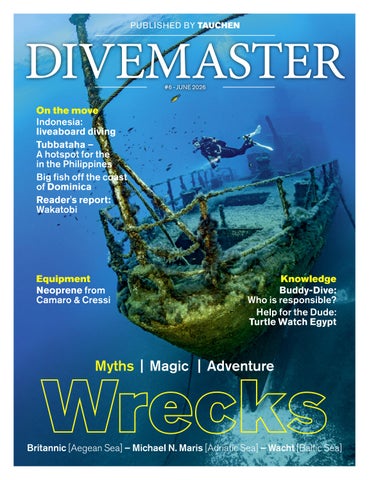
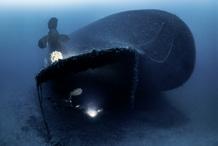
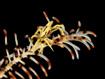
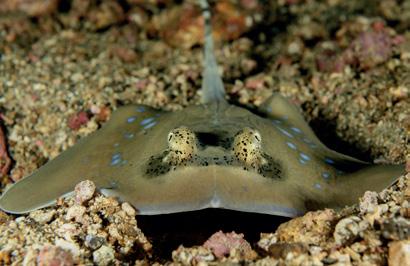
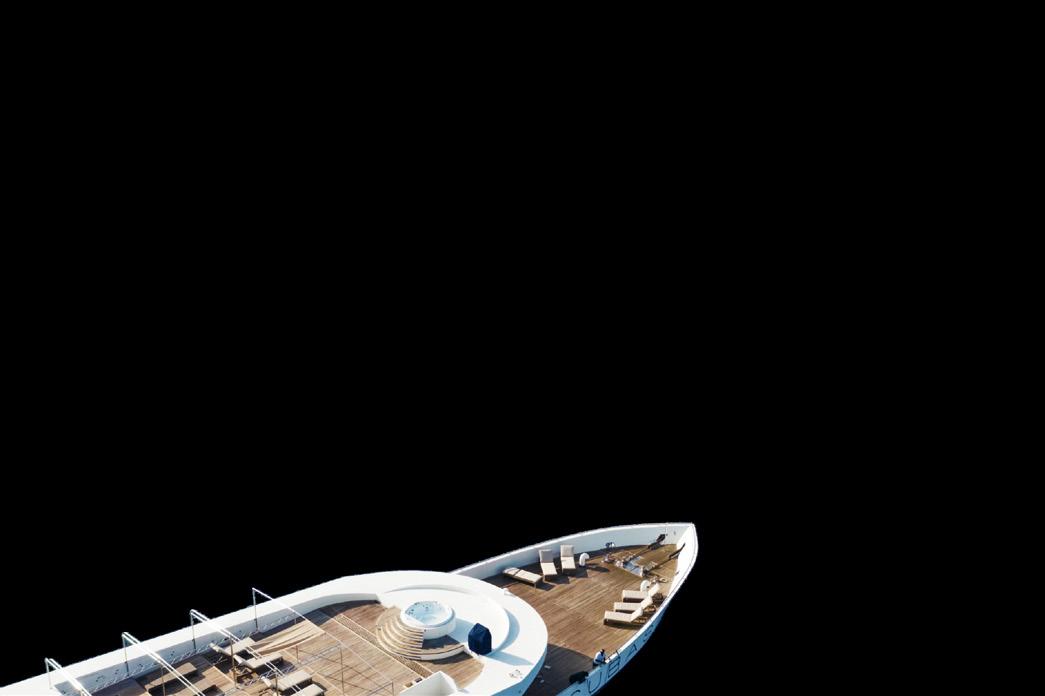
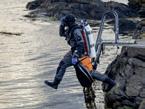
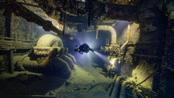
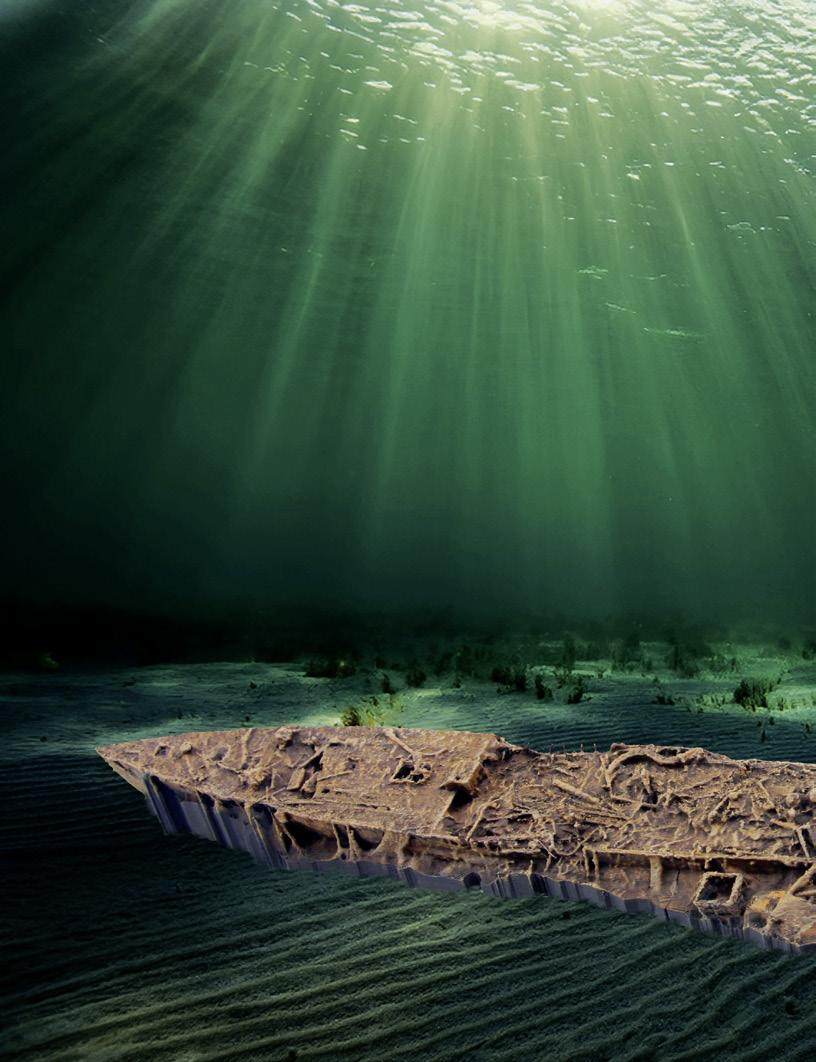
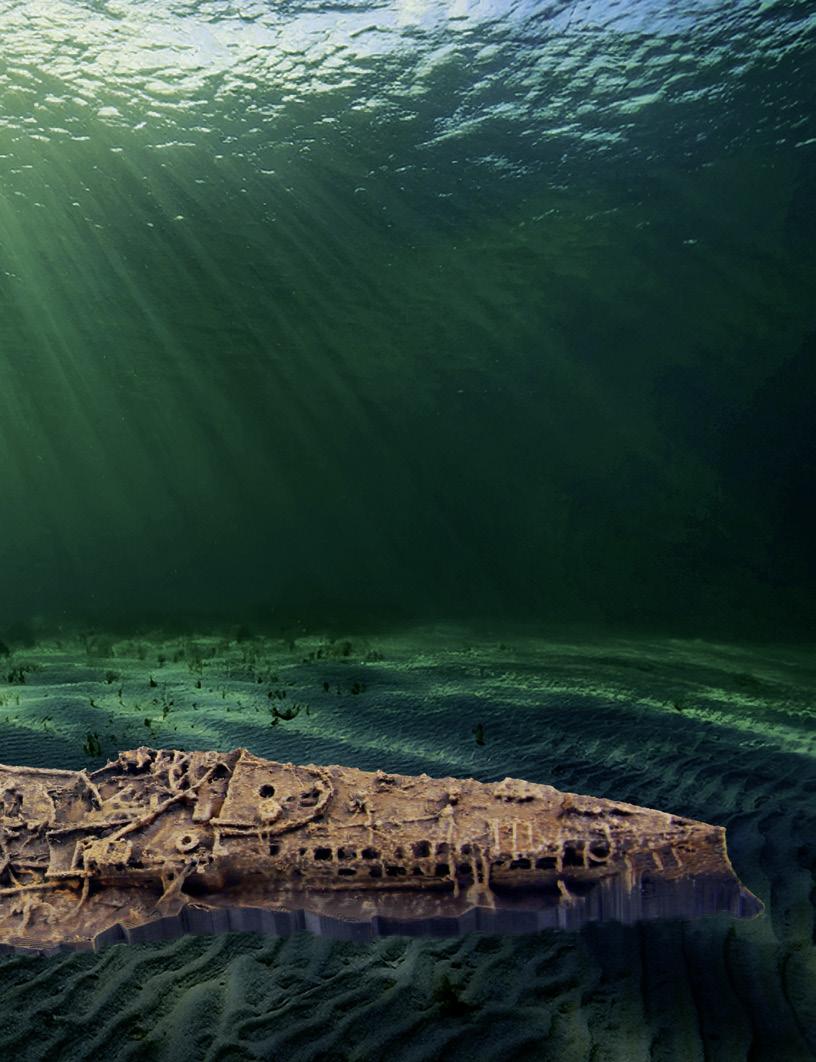
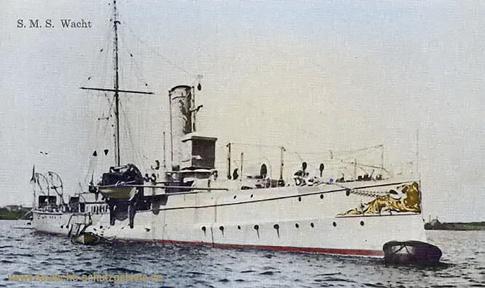
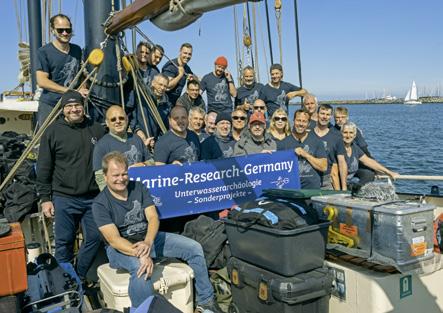
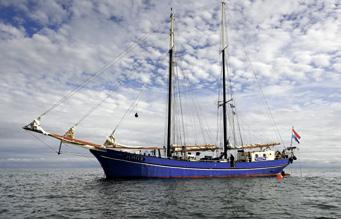
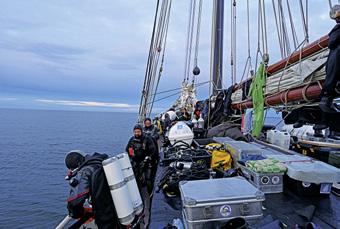
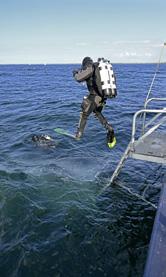
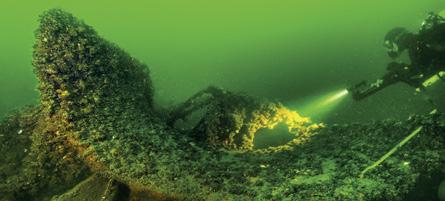
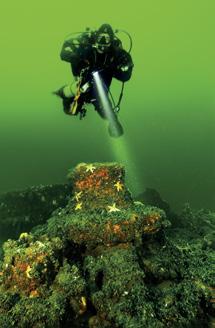
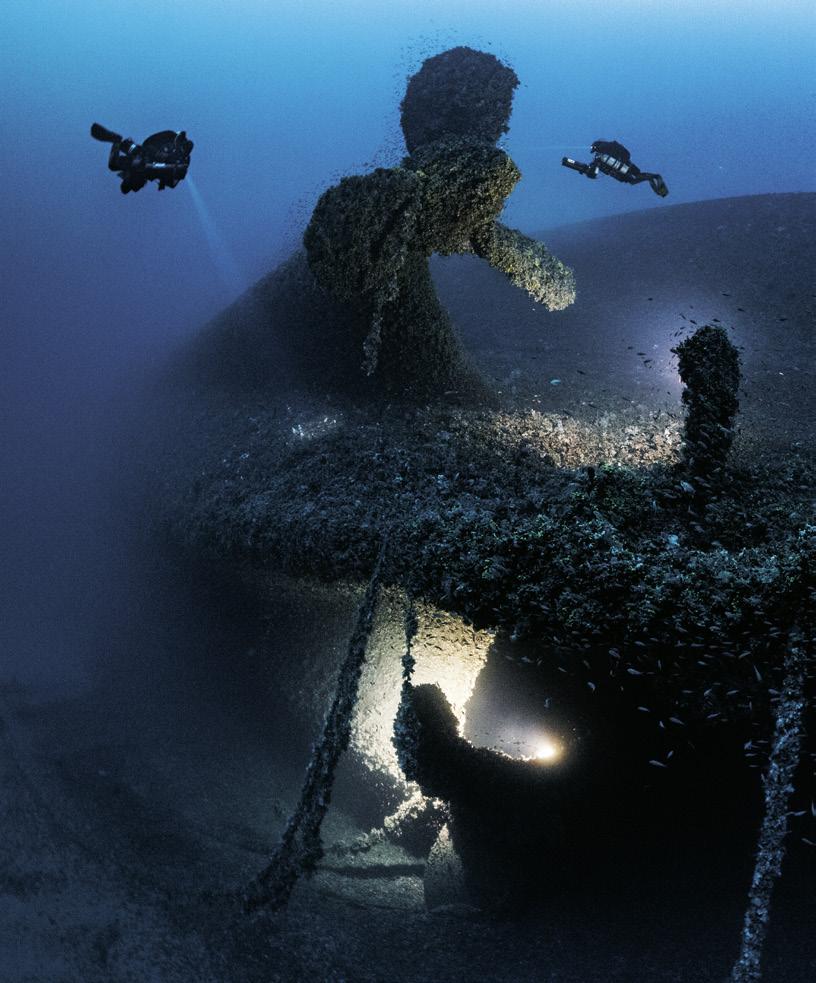
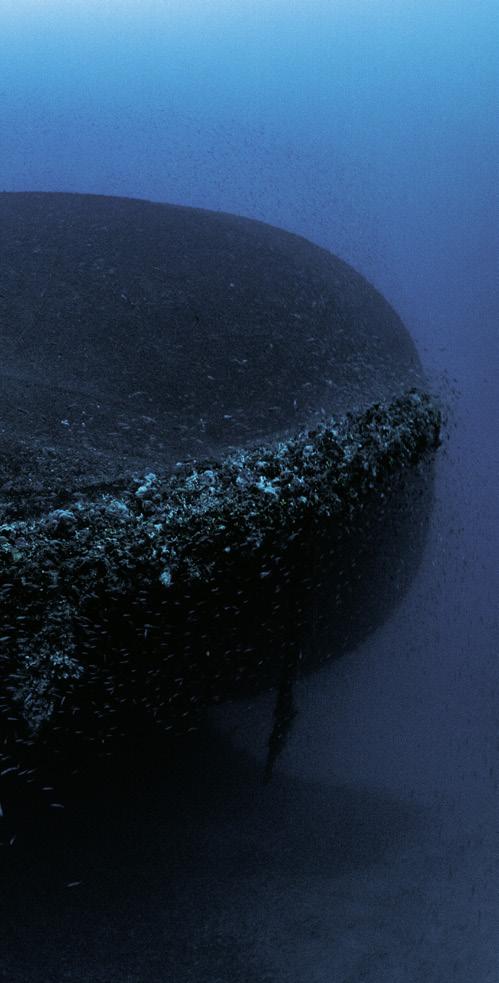
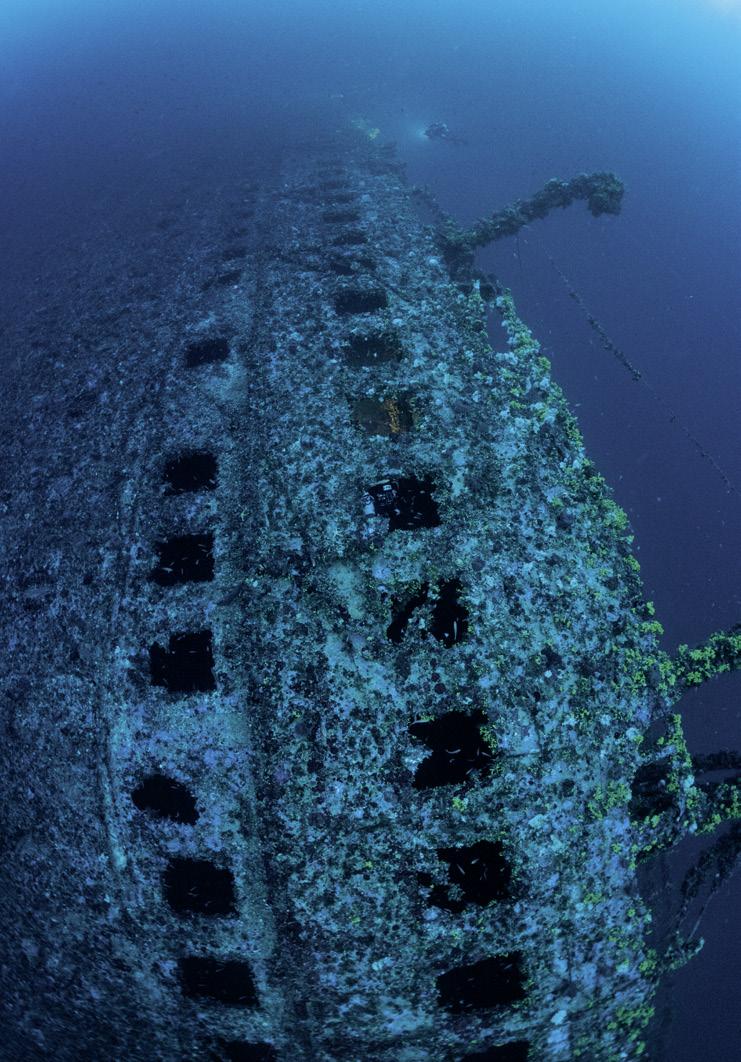
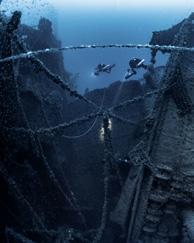
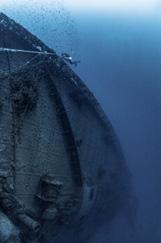
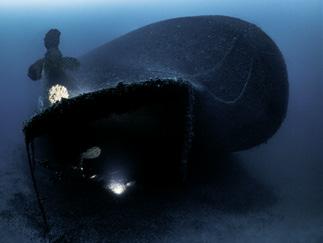
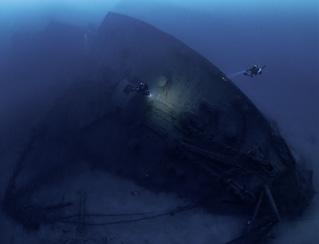
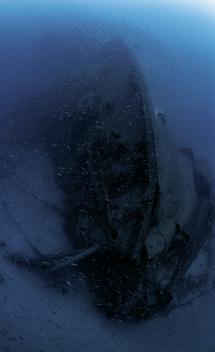
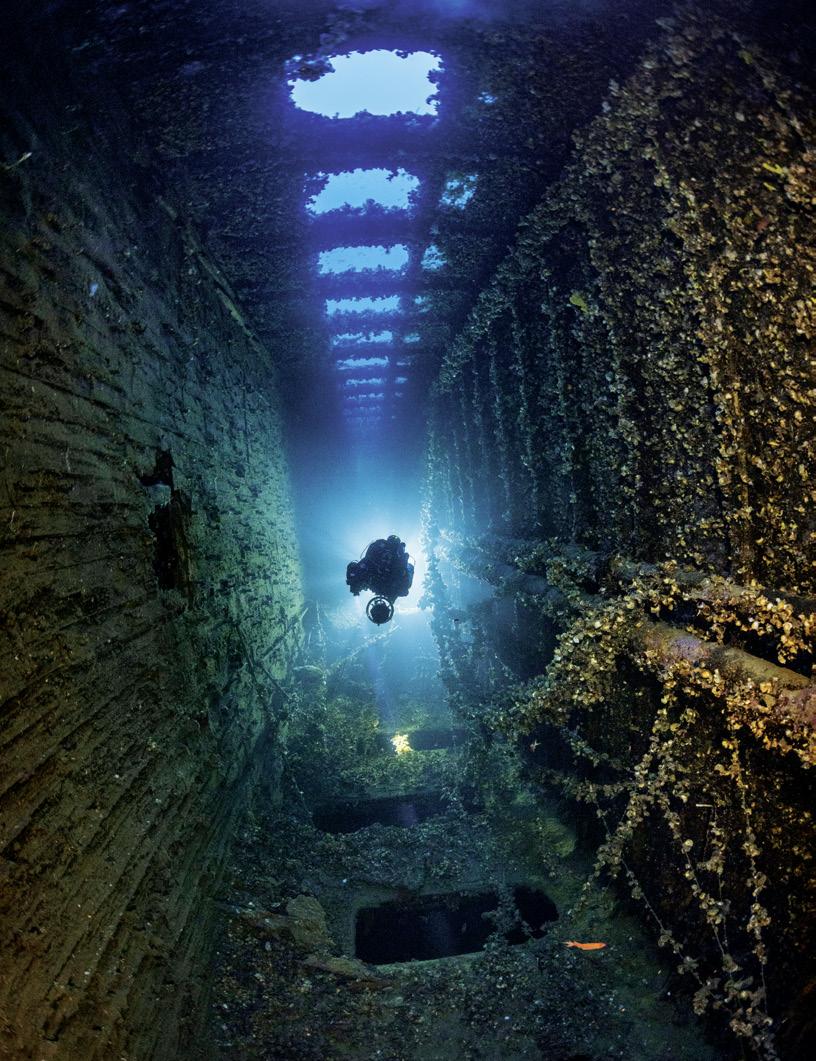
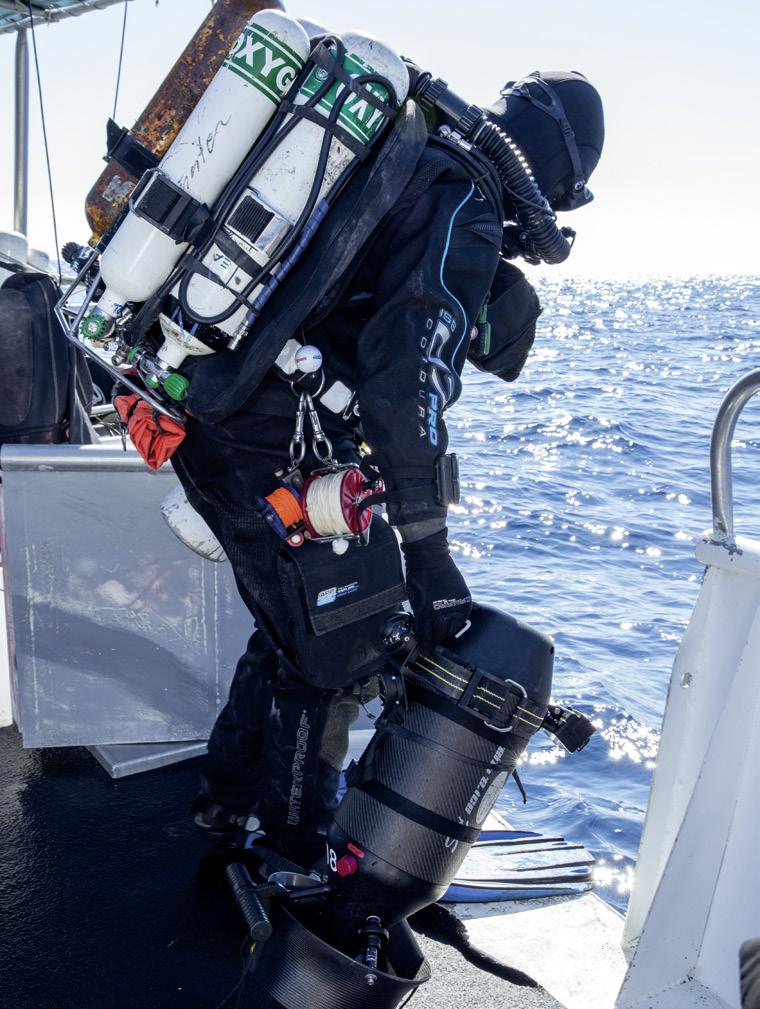
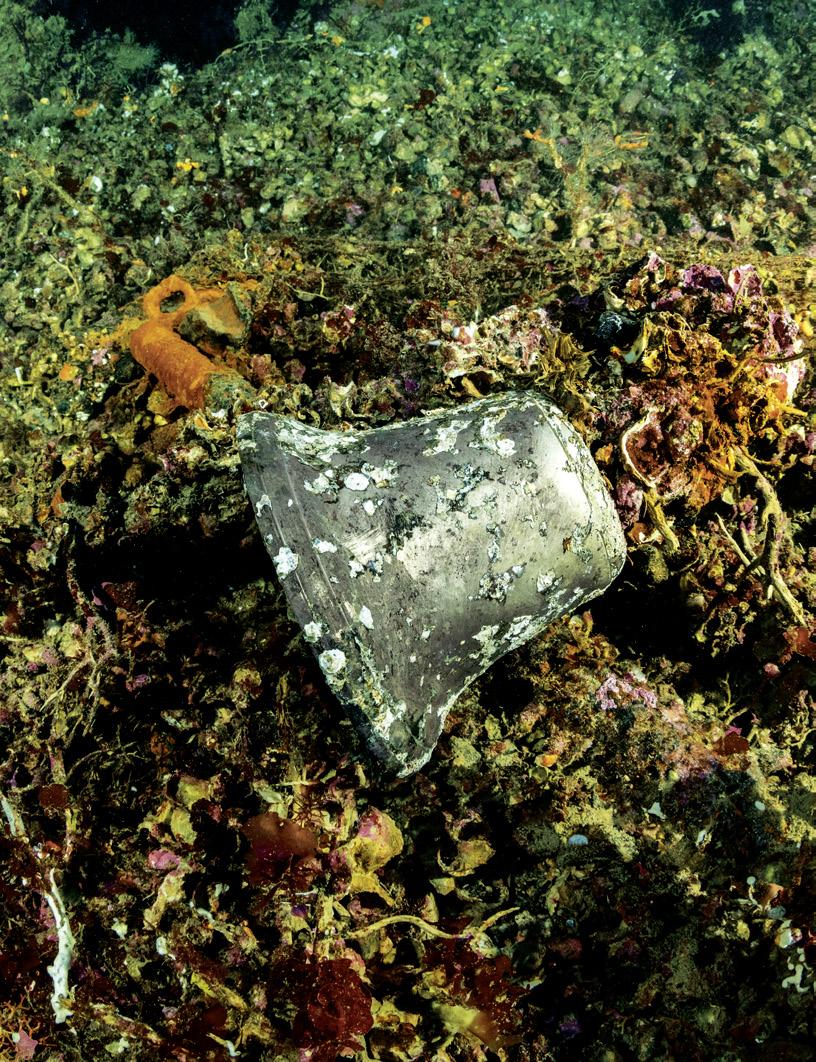
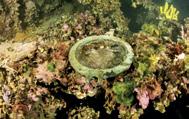
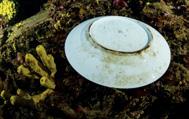
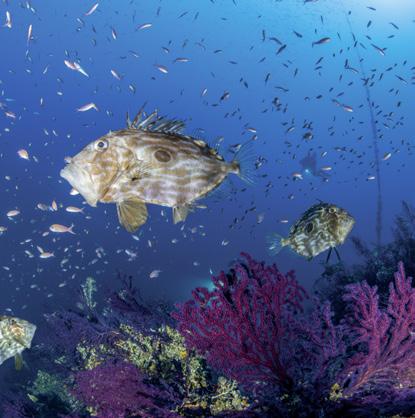
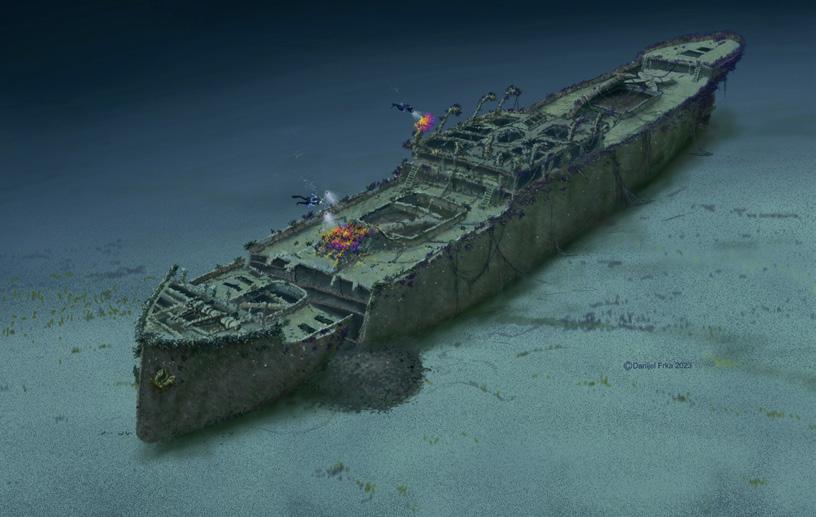
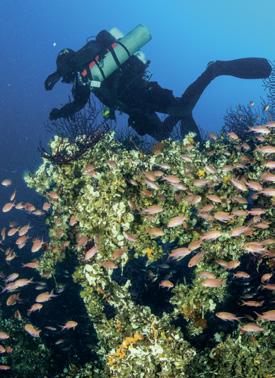
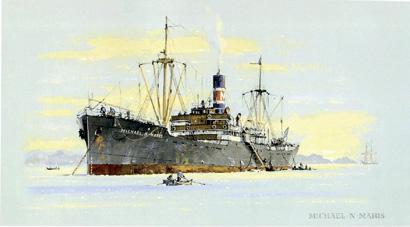
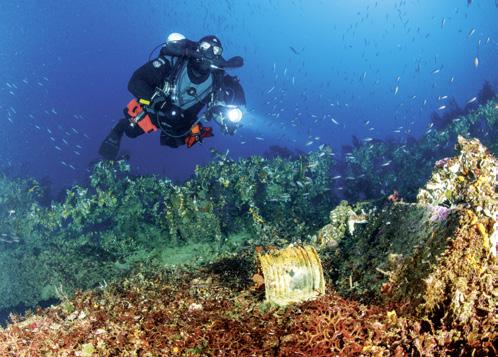
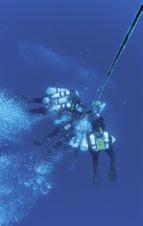
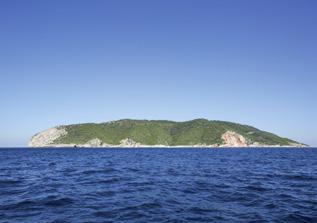
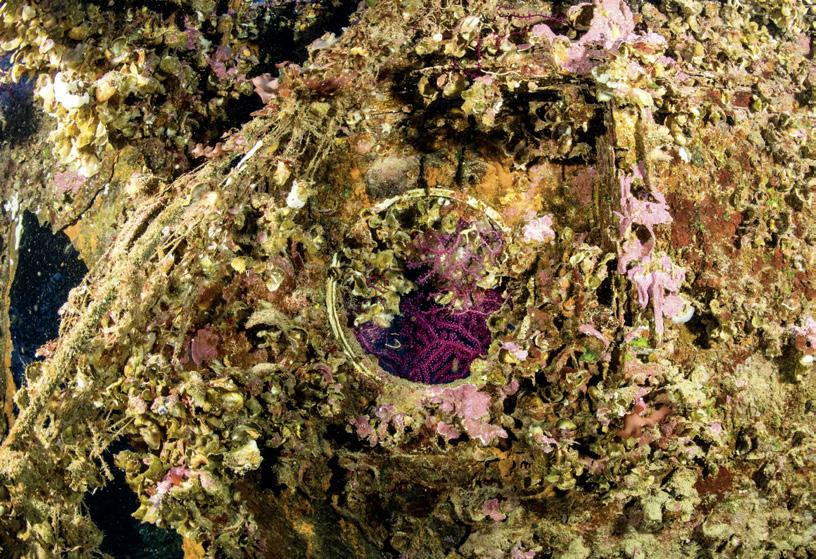
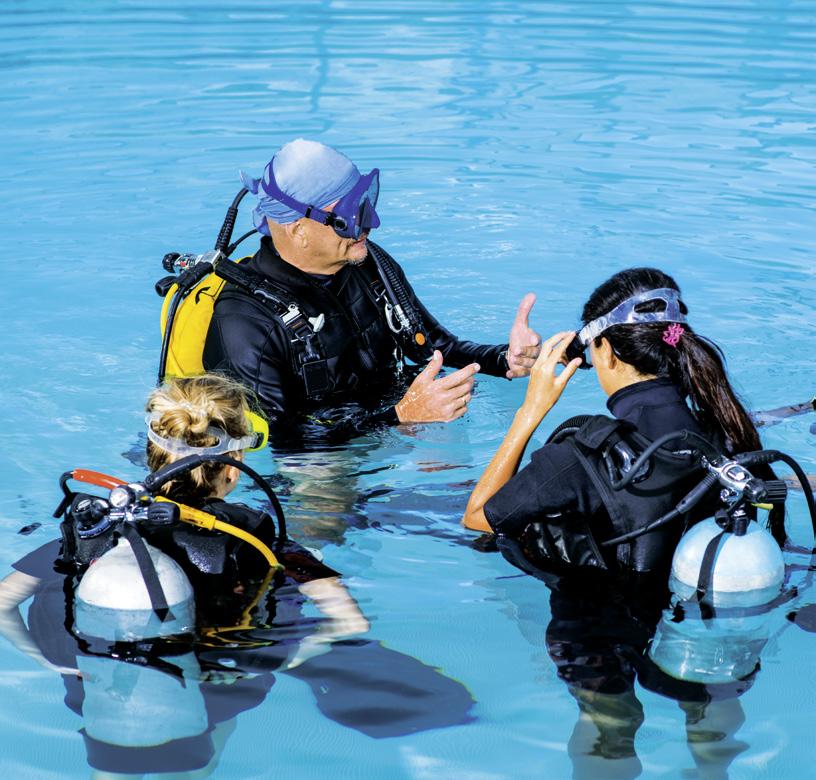
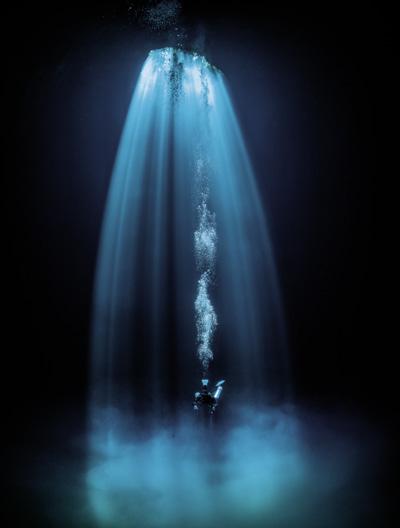
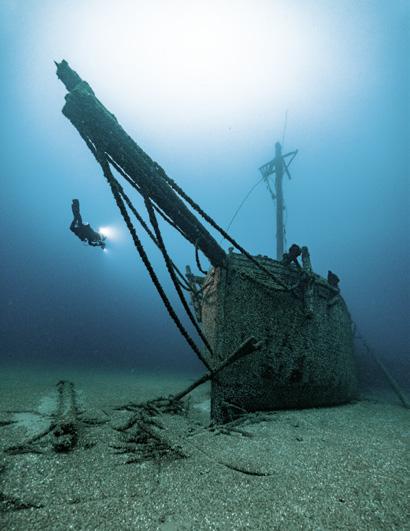
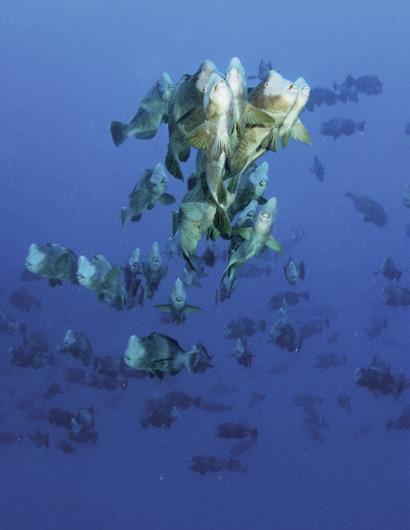
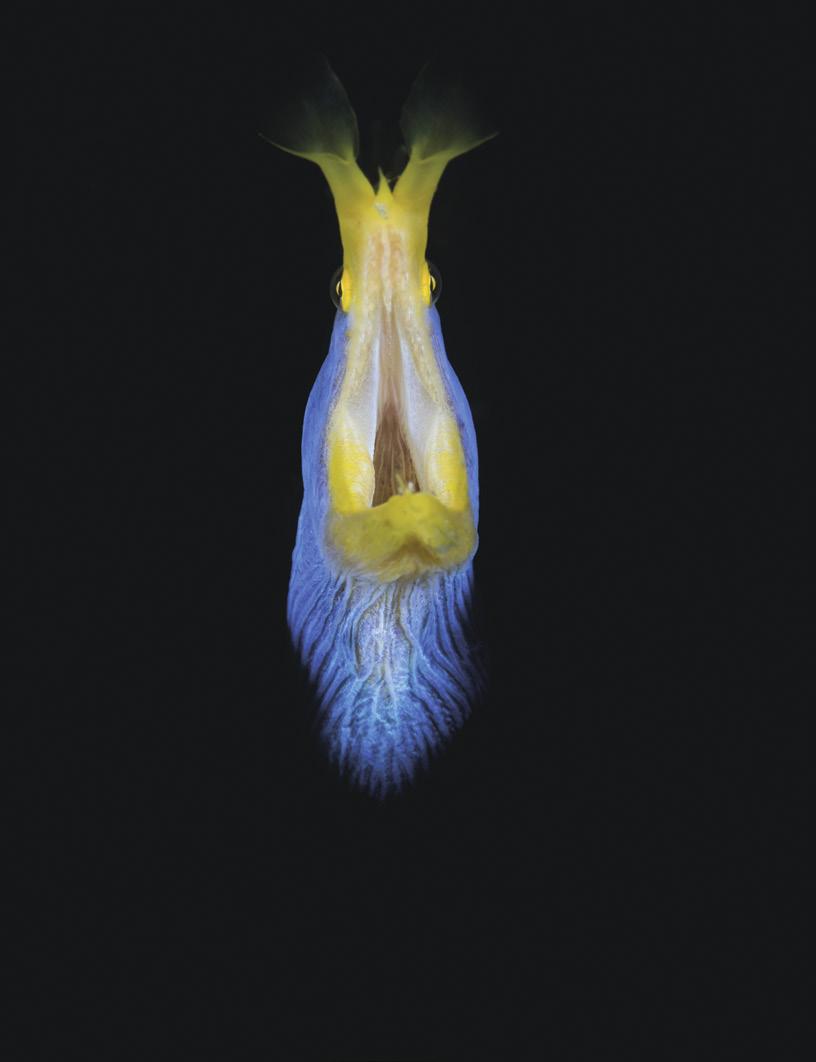
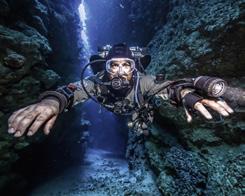
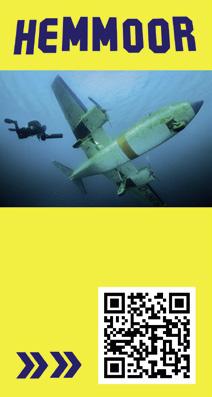
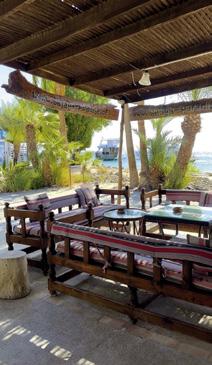
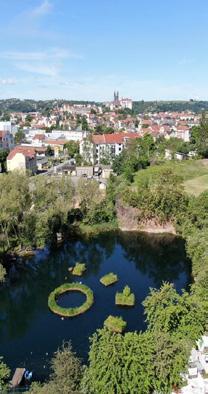
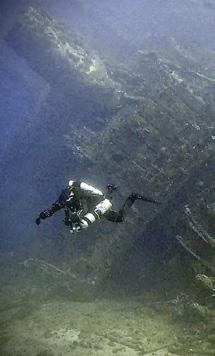
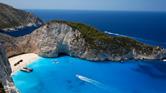
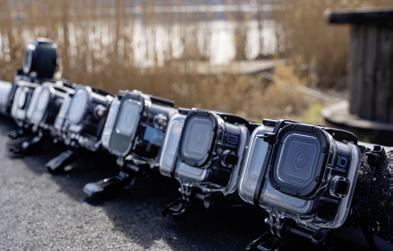
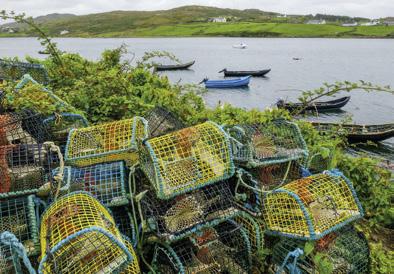
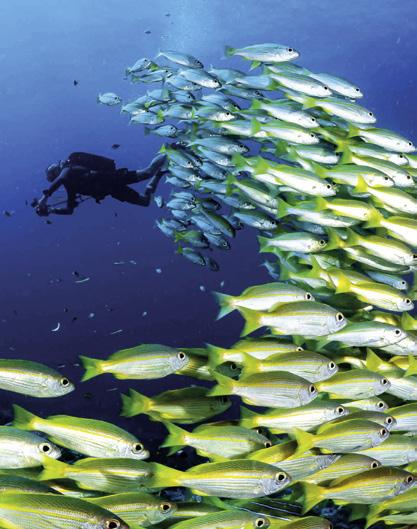
Britannic [Aegean Sea] – Michael N. Maris [Adriatic Sea] – Wacht [Baltic Sea]
Die Seele eines Entdeckers kommt niemals zur Ruhe
Die Seele eines Entdeckers kommt niemals zur Ruhe
Neue Abenteuer warten bereits am Horizont
Sie sind auf der Suche nach Ihrer nächsten außergewöhnlichen Expedition?
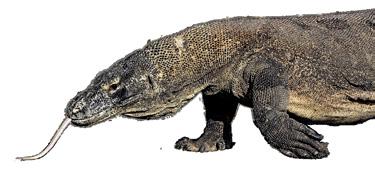
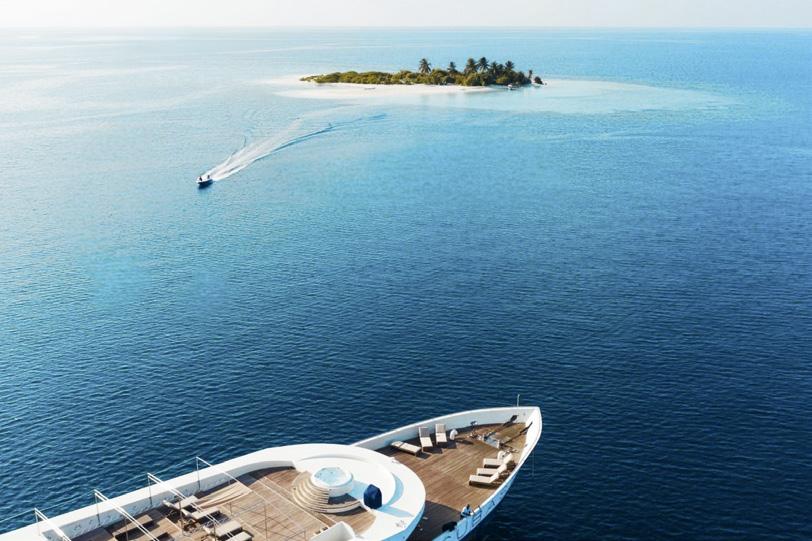
Möchten Sie neue „Drachen” im Leben bezwingen –oder vielleicht wortwörtlich einem Komodo-Waran von Angesicht zu Angesicht begegnen? Dann entdecken Sie die beeindruckende Auswahl an Abenteuern von Aggressor Adventures, die garantiert den Entdeckergeist in Ihnen wecken.
Ob an Land oder auf See – Ihre Reise wird mit unvergesslichen Momenten belohnt, die ein Leben lang in Erinnerung bleiben.
N eue R oute N & D esti N atio N e N :
· Placencia & Glovers Reef, Belize Süd
· Coron–Batangas, Philippinen
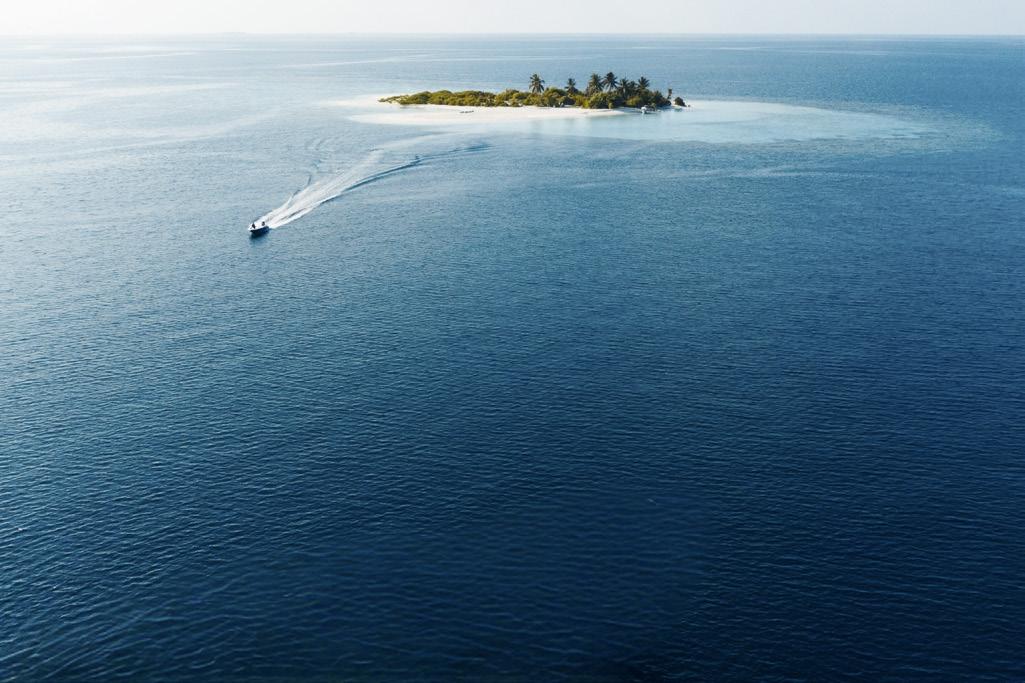
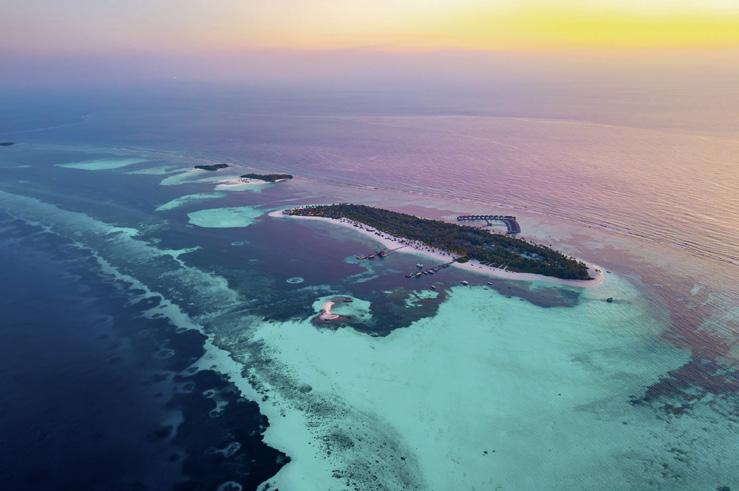
· Meemu-Atoll, Malediven
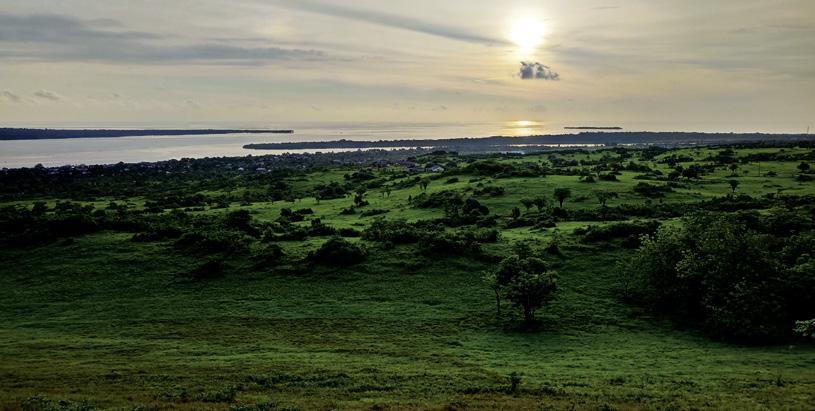
· Sumbawa–Komodo, Indonesien
· Chiang Mai, Thailand
Jetzt scannen und von aktuellen Angeboten profitieren.
· Bahamas · Belize · Cayman Islands · Cocos Island, Costa Rica · Dominican Republic · Galapagos Komodo, Indonesia Nile River, Egypt Maldives Palau · Philippines · Raja Ampat, Indonesia
Red Sea, Egypt
Roatan, Bay Islands of Honduras
Sri Lanka
Thailand-Andaman Sea Thailand-Chiang Mai
Turks & Caicos
DER NEUE ICON
DER NEUE ICON – KONZIPIERT FÜR DIE ALLERHÖCHSTEN ANSPRÜCHE
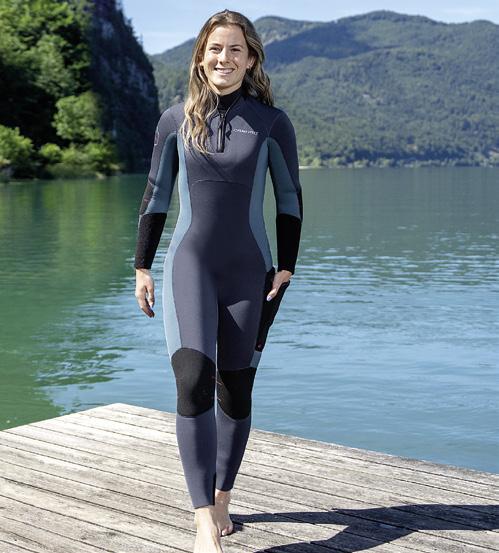
Maximale Bewegungsfreiheit trifft auf erstklassige Wärmeisolierung. Die neue Schnittführung bietet ideale Passform und Top-Tragekomfort –SEMI DRY DIVING AT ITS FINEST!
Weitere Informationen? Besuche uns auf CAMARO.AT
The Whale Drama
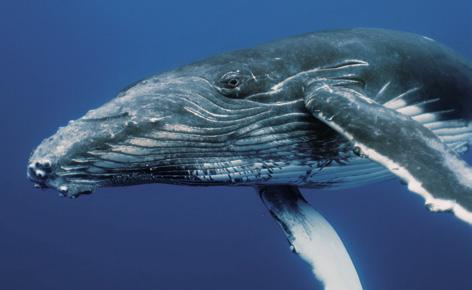
A humpback whale, apparently seriously ill and entangled in fishing nets, has become stranded several times on the German Baltic coast. According to experts, its injuries and illnesses mean there is no hope of rescue or recovery. Nevertheless, the animal’s suffering is being publicly followed, commented on and exploited for emotional gain. The only positive aspect is that the issue is attracting widespread attention. The problem is that ignorance and knee-jerk reactions often cause additional stress for a dying animal.
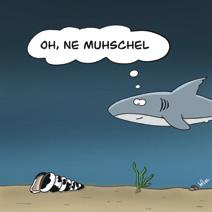
Our cartoonist Michael Ley addressed this development in a deliberately provocative cartoon. The reactions were fierce, ranging from ‘tasteless’ to ‘macabre, but good’. We took the post down after a few hours because we do not want to be part of a strategy that relies on outrage to boost reach.
Why aren’t we reporting on the whale in more detail? Because we have been giving space to marine conservation for years, including through our annual *Save the Ocean* booklet. Because we work behind
the scenes with aid organisations, scientists and marine conservationists. Above all, however, because our only honest stance on this case would be: let the animal die in peace. Given everything we know, it had no real chance of survival in the Baltic Sea. We cannot judge exactly what lies behind the stranding and the illnesses. The only certainty is this: our consumption of fish, shipping traffic and the overexploitation of the seas are partly to blame for the deaths of such animals. What do you think?
Now please turn the page! On the following pages, we’ll be looking at, among other things, exciting wreck dives steeped in history. Enjoy!
Alexander Kaßler Editor-in-Chief of TAUCHEN alexander.kassler@tauchen.de
Photos: Franco Banfi (1); Martin Strmiska (1); Wolfgang Pölzer (1); Henley Spiers (1); Manufacturer (1); Michael Hannich (1); Win Schumacher (1)
MAGAZINE
Gallery: Henley Spiers – Part 1/2
TRAVEL
News from the travel industry 16
Indonesia: Safari vessel KLM Sunshine 18
Philippines: The Tubbataha Reef 24
Dominica: Spectacular sights above and below the water 32
Indonesia: Reader’s report from Wakatobi 38
TECHNOLOGY
New products on the equipment market 42
Camaro's new semi-dry suits 44
Cressi: Semi-dry suit vs. Neoprene drysuit 48
Overview: Dive computers under €400 52
EXPERTS
News from Science & Research 54
Wreck I: The ‘Watch’ in the Baltic Sea 56 Wreck II: The ‘Britannic’ in the Aegean Sea 60 Wreck III: The ‘Michael N. Maris’ in the Adriatic 66
Buddy Dive: Who is responsible? 72
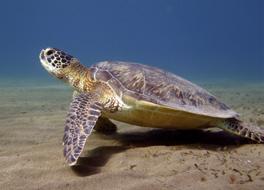
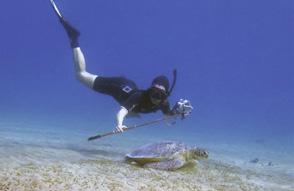
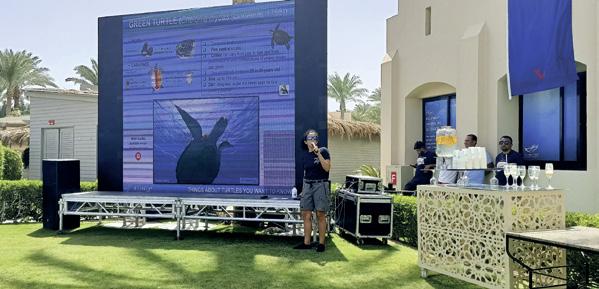
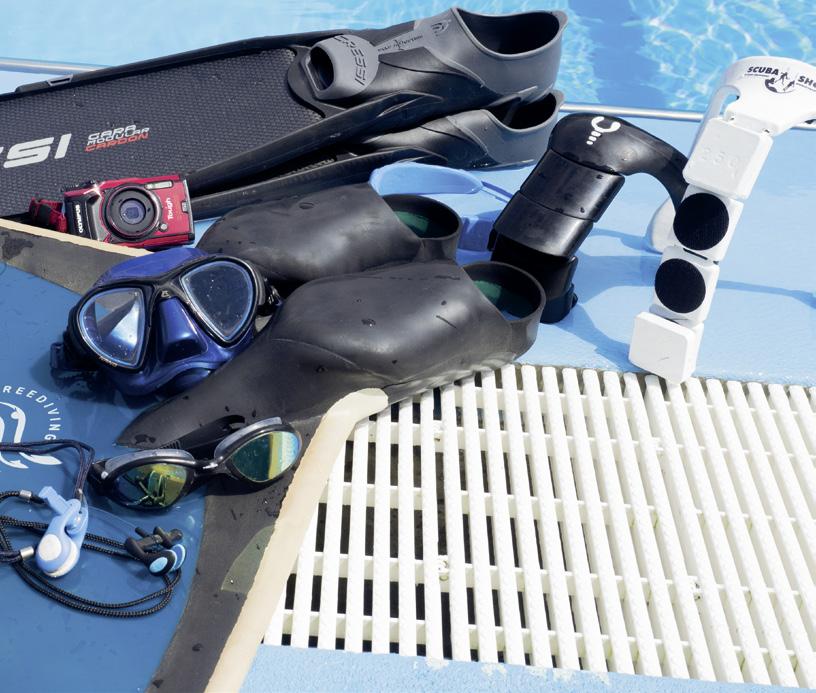
Feature: Turtle Watch Egypt –Turtle Watchers of the Red Sea 76
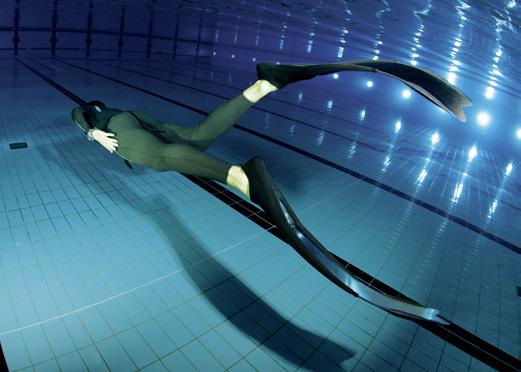
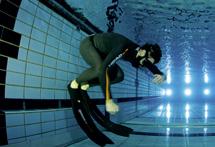
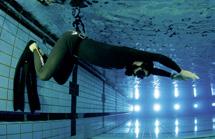
Apnoea: Distance diving 80
Medicine: Diving after eye surgery 84
FOCUS
Photography School: Planning Your Photos 86 Readers' Photo Competition 88
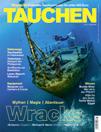
Cover No. 6.26
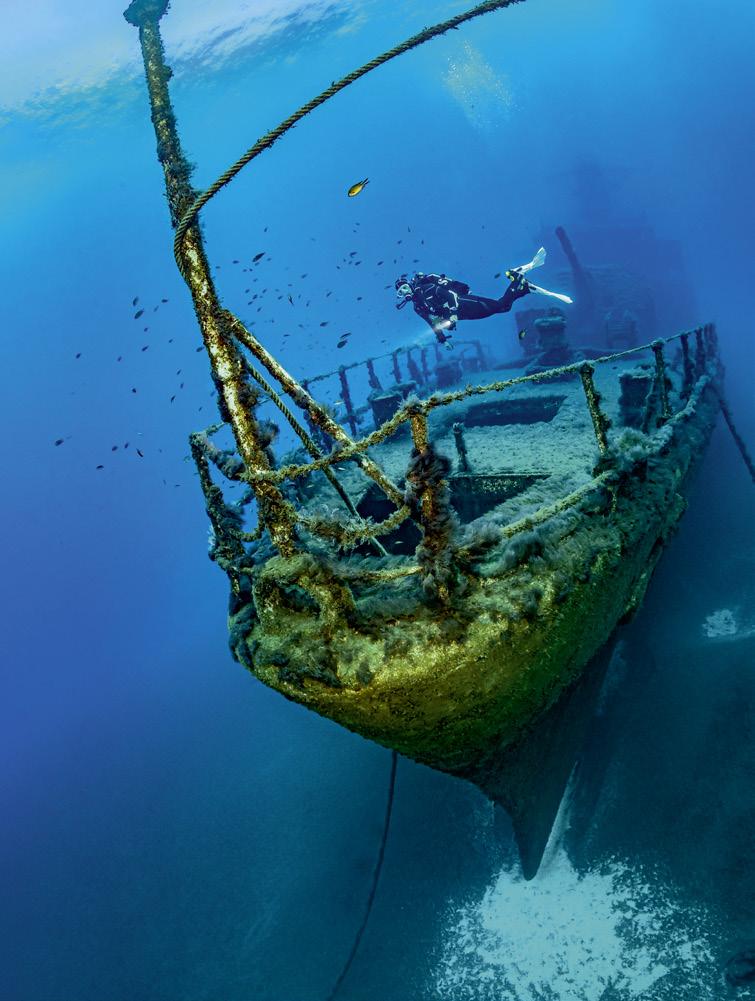
The fascination of wreck diving: The cover image for this issue is by Tobias Friedrich, and shows the wreck of the ‘Corveta Afonso Cerqueira’ off the Portuguese island of Madeira.
CONTACT & MORE
EDITORIAL TEAM
Jahr Artopé Media GmbH & Co. KG Bajuwarenring 9, 82041 Oberhaching Tel. 089/5 52 41-0, Fax 089/5 52 41-244
E-mail: redaktion@tauchen.de
ADVERTISEMENT
089/5 52 41-225
Email: sales@tauchen.de
TAUCHEN SUBSCRIPTION + ADDRESS CHANGES
Tel. 040/5555 7991, email: jam@dpv.de
EPAPER TAUCHEN www.tauchen.de/epaper
Did you know that TAUCHEN is also available digitally? This includes our social media channels Facebook and Instagram as well as our website and our YouTube channel. You can also listen to our podcast channel. Just drop by and listen. Follow the links below. Do you want to read TAUCHEN digitally? Download our TAUCHEN app for iOS and Android. We look forward to hearing from you.
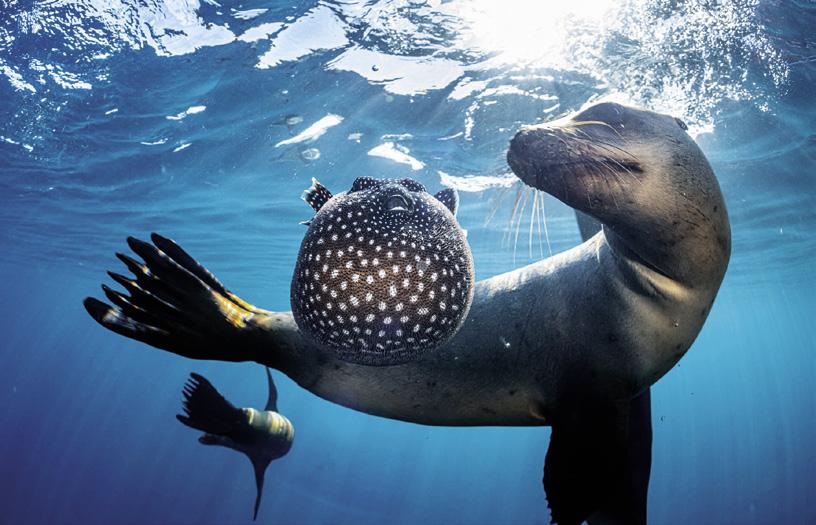
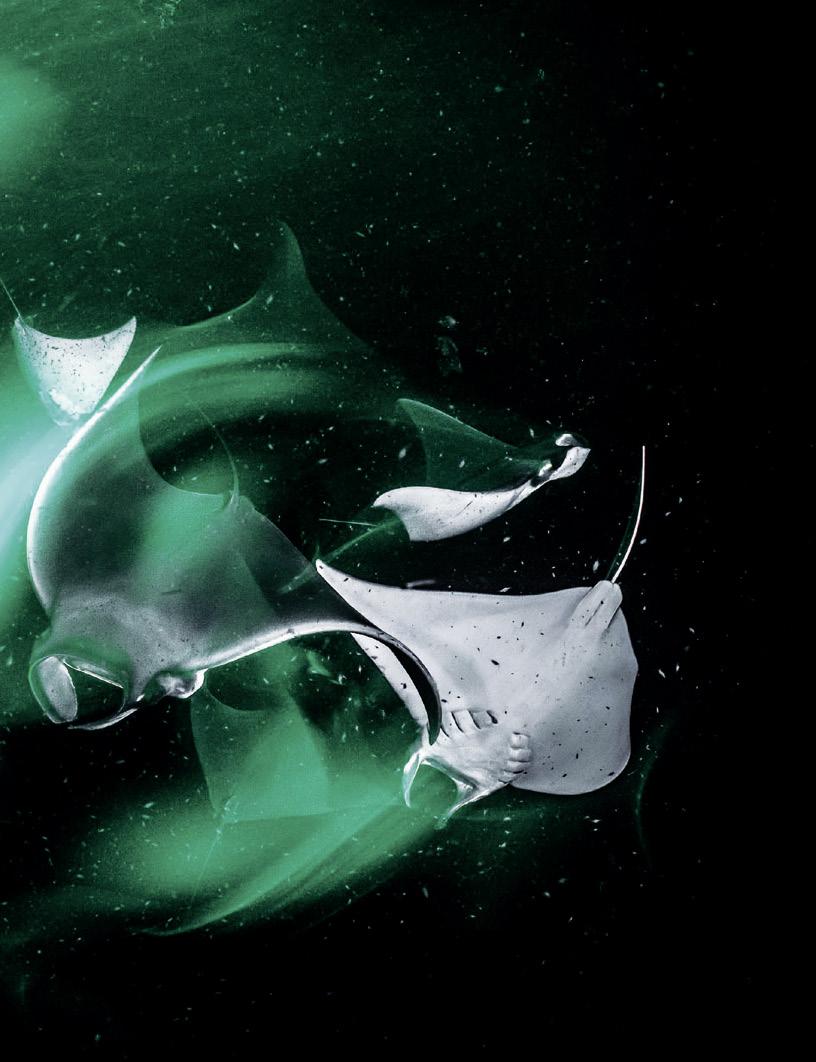
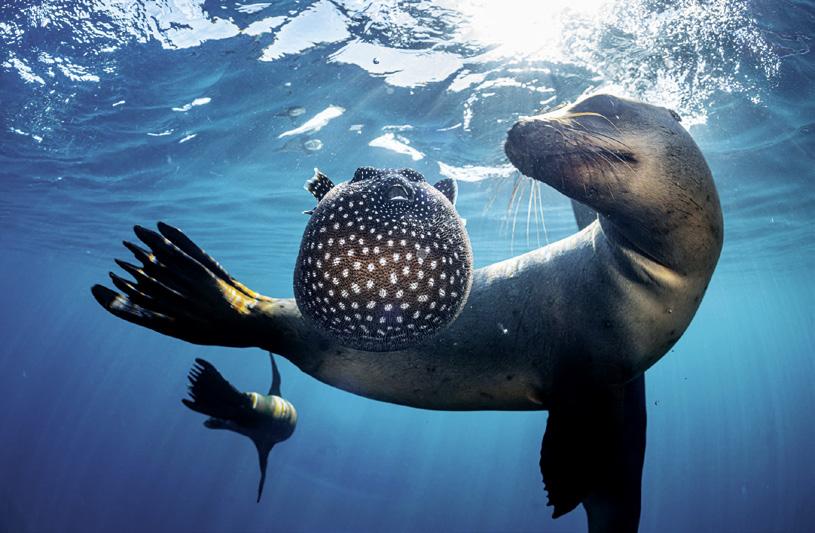
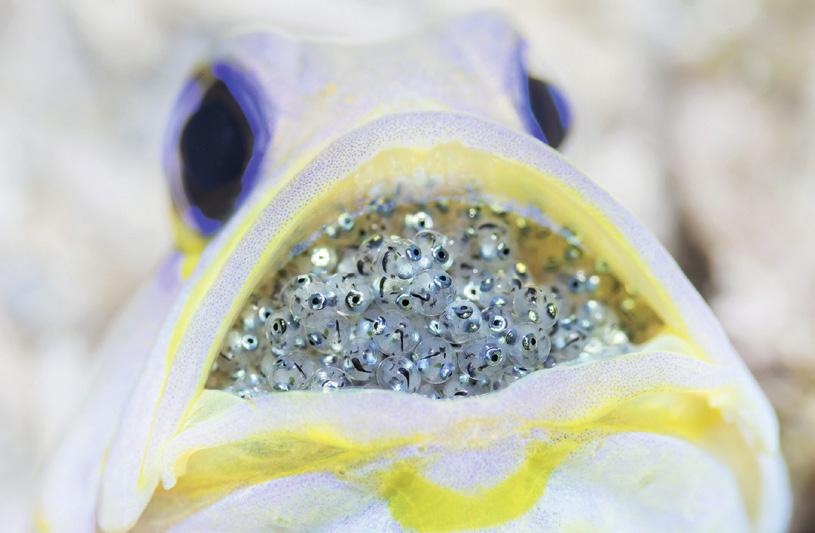
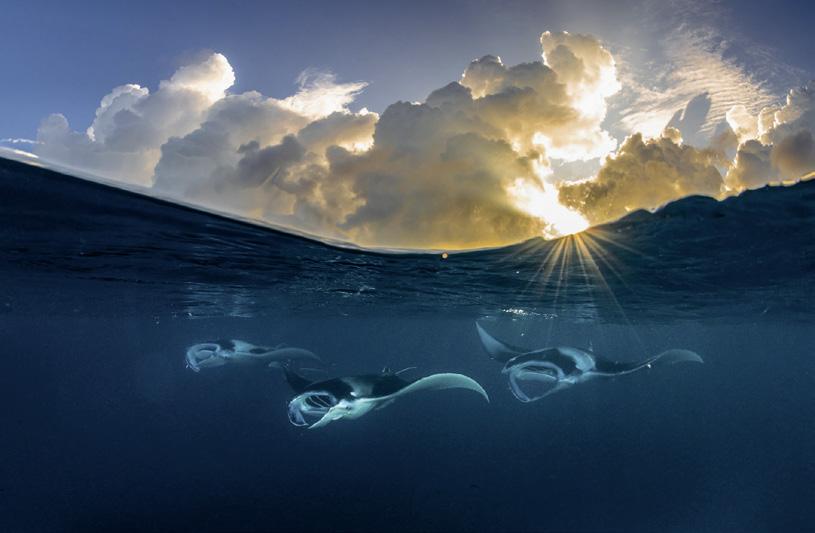
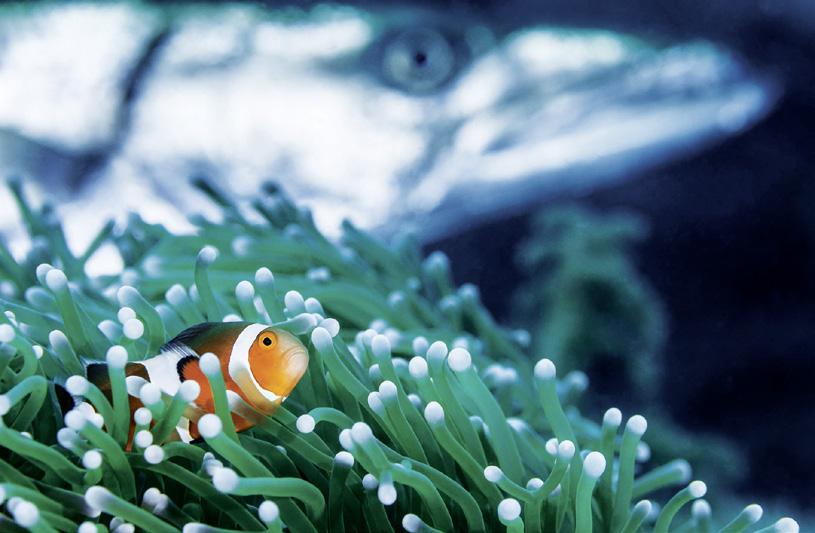
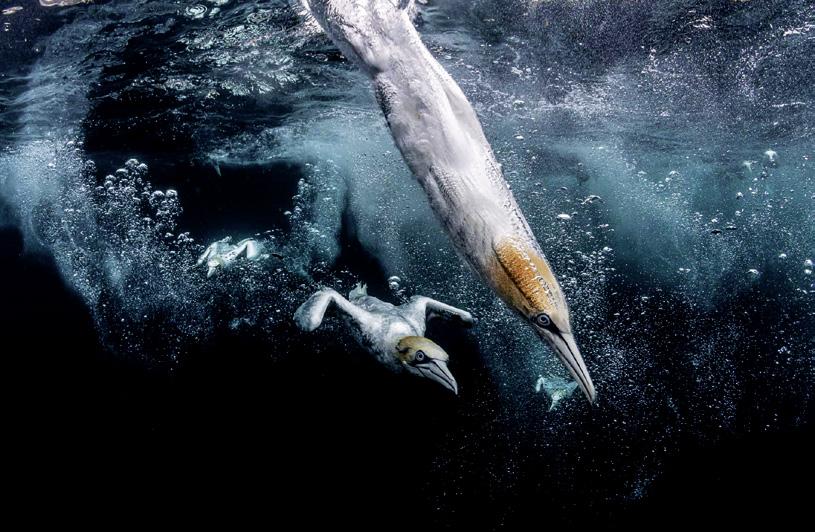
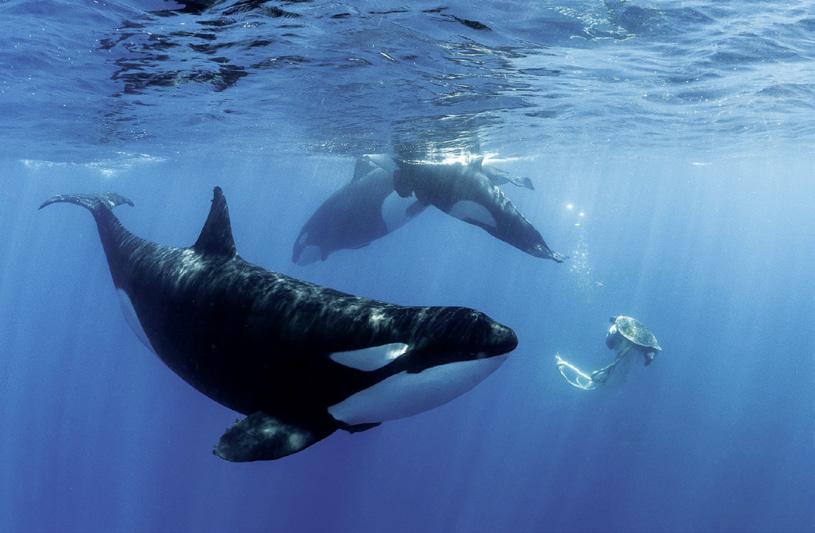
… are the passion of the award-winning wildlife photographer Henley Spiers. We are delighted to present some of his photographs.
Sea lions 'tease' pufferfish
Pike are mouthbrooders
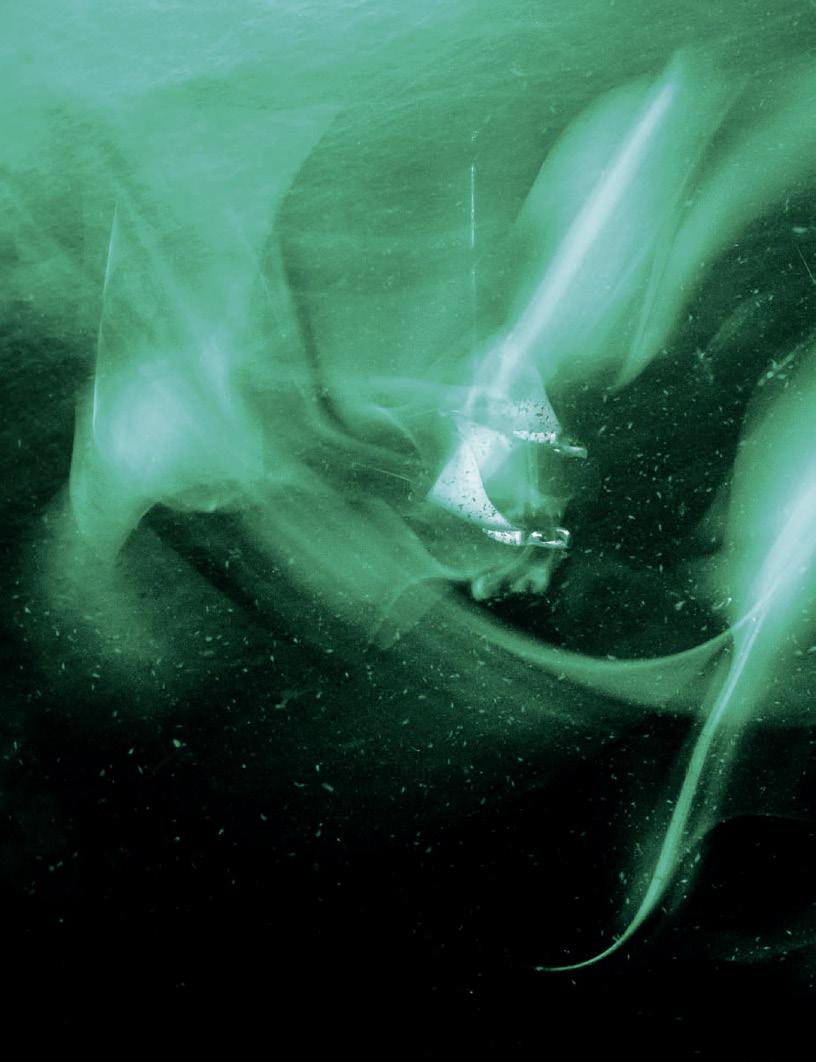
Giant oceanic manta rays
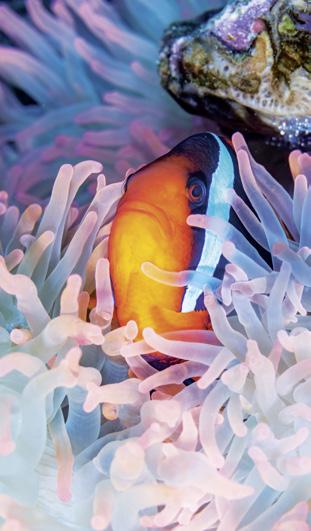
Neighbours: Barracuda and clownfish
Hunting scenes: Boobies dart through the water
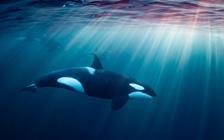
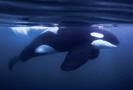
Orcas hunting a sea turtle
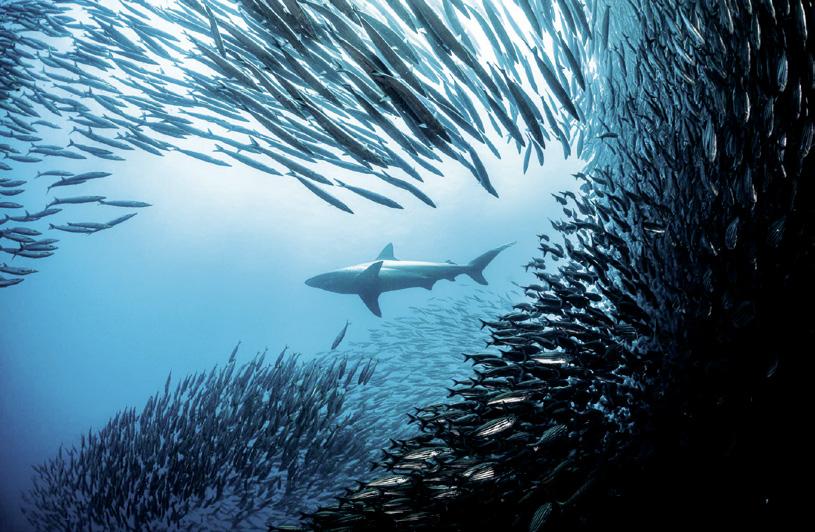
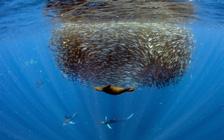
Food in abundance: the Sardine Run
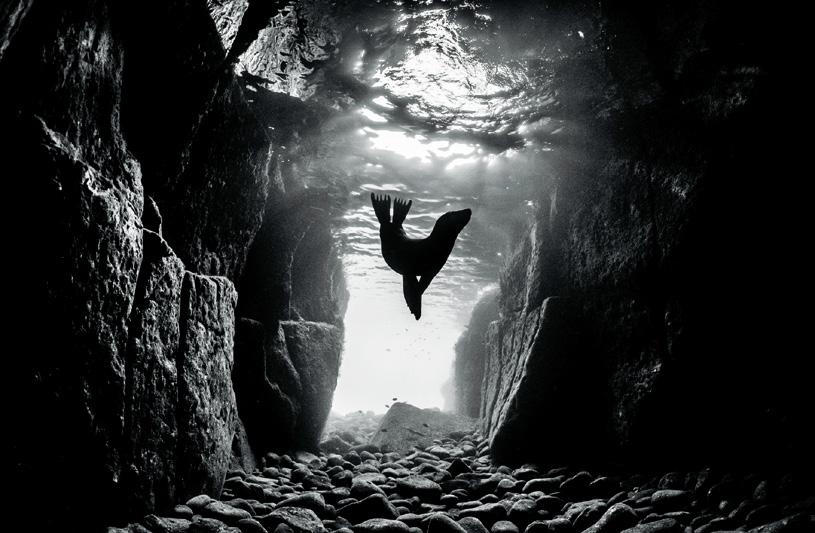
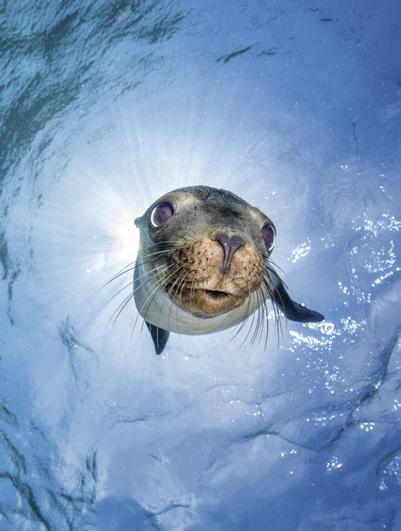
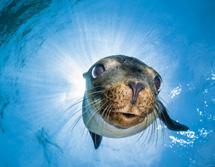
In focus: Sea lion observed by photographer
MAGAZINE
IS IT TRUE THAT SHARKS CAN’T CHEW?
A) Yes and no // B) Yes // C) No // Correct answer: A) Yes and no
Explanation: Most sharks cannot chew their food. Instead, they swallow small prey whole or use their sharp teeth to tear chunks from larger prey. To do this, they clamp down and move their upper jaw back and forth until a bite-sized piece is formed. Bamboo sharks are an exception: They are the only sharks that can actually chew their food. You can find these and more facts and figures about sharks in the new Shark Quiz from Ocean Heroes. Entertaining and educational, available at a charity price (100% donation) of 25 euros. Buy it here: www.oceanheroes.shop
NEW STUDY IN THE RED SEA EXAMINES INDIVIDUAL SUSCEPTIBILITY TO DCS
CIGARETTE BUTTS ON THE BEACH
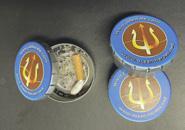
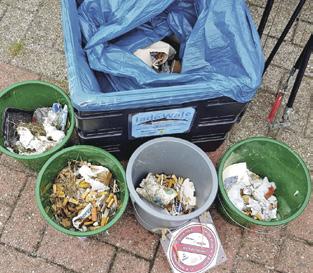
Ocean Heroes and JadeWale e.V. are launching a joint campaign to raise awareness of the environmental dangers posed by carelessly discarded cigarette butts. The initiative focuses on providing free travel ashtrays for smokers and organising regular beach clean-ups. JadeWale was awarded the Golden Ocean-H Pin of Honour as early as 2025 for its commitment. The financial support associated with this was used in 2026 to purchase 1,000 travel ashtrays. www.jadewal.com & www.ocean-heroes.net
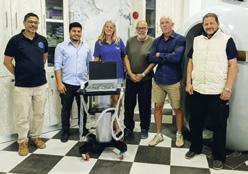
Why does one diver experience discomfort after the same dive profile, whilst another remains symptom-free? A new research project in the Red Sea is addressing this question. Initiated by Hypermed Red Sea and Baromedical Red Sea, and supported by Emperor Divers, the study uses Doppler ultrasound to investigate individual susceptibility to dive-related stress and decompression problems. The focus is on observing bubble formation after dives in recreational and technical divers. The aim is to focus more closely on the individual diver and to better understand why identical dives can lead to different physical reactions. In the long term, the project aims to contribute to more personalised and safer decompression strategies. The Doppler device used was funded by Emperor Divers and its guests. Furthermore, the project aims to help identify risk factors such as a patent foramen ovale (PFO) at an earlier stage and provide more targeted medical care for affected divers. There will also be an opportunity to participate directly in the project. We are looking for volunteer divers, particularly on safaris, who dive as a buddy team, are of a similar age and gender and have a comparable physical constitution, and are willing to complete dive profiles that are as similar as possible during a trip. Selected participants will be invited to take part in the study and, in return, will receive a discount on their trip as well as a special limited-edition project T-shirt. Think this might be for you? Click here to get in touch: wecare@emperordivers.com
You can find more from the artist Michel Ley at: Facebook/michels.imbaerium, Instagram (»michels.imbaerium«) and www.michels-imbaerium.de
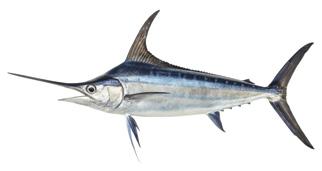
90 KM/H
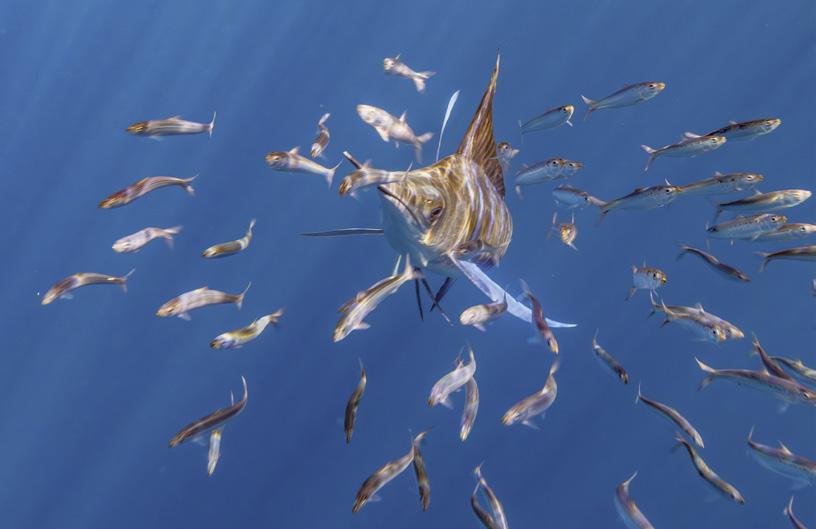
Swordfish are fast; thanks to their streamlined bodies and muscular strength, they are among the fastest creatures in the sea.
DIVING CALENDAR 2026 – BIG GAME & WHALES
TAUCHKALENDER 2026 – Großfisch & Wale
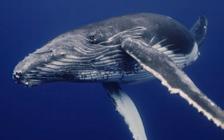
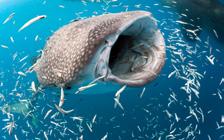
The diving season gets off to a busy start: from January to March, the focus in the Dominican Republic is primarily on humpback whales at Silver Bank. Impressive encounters are also possible in Tonga during this period. The animals are particularly active at this time of year as they are mating and raising their young, and with a bit of luck they will come very close to the boat. At the same time, the Bahamas, with Tiger Beach, are among the most reliable places to see tiger sharks. In the Philippines, the whale shark season is also beginning around Donsol and Leyte, where the experience tends to be rather calm and relaxed.
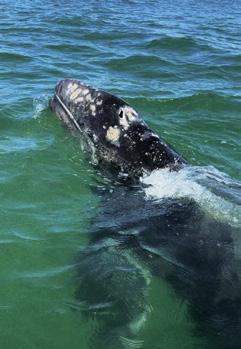
In spring, the action shifts to Mexico: in Magdalena Bay, grey whales can often be observed at very close quarters, whilst whale sharks are regularly spotted off Isla Mujeres and Holbox. For experienced divers, the Galápagos and Malpelo then offer particularly impressive encounters with hammerhead sharks and other large fish. In Norway, the orca season slowly winds down in late winter, although sightings are still possible.
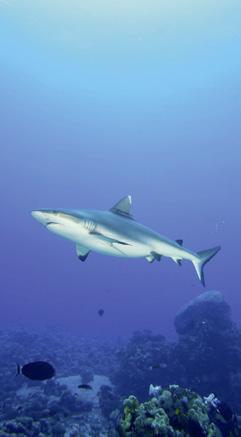
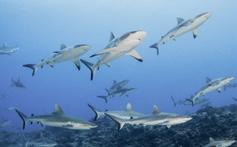
Summer brings spectacular encounters with megafauna in several locations: humpback whales can be spotted in Norway, Iceland and French Polynesia, for example. Whale sharks also reach their peak season in some regions, including the Maldives, Mexico and off the coast of Tanzania on Mafia Island. In Fiji, tiger and bull sharks make for exciting dives, whilst Cocos Island, with its dense schools of sharks and abundance of large fish, ranks among the world’s most spectacular diving destinations. Autumn is a particularly exciting time in some regions: off the coast of Baja California, you can witness large-scale fish hunts and numerous marine mammals. At the same time, the waters off Guadalupe are particularly attractive for great white sharks, as are parts of South Africa. In Norway, the orcas return with the shoals of herring, putting on spectacular hunting displays. Bull sharks off Playa del Carmen can now often be reliably spotted, whilst thresher sharks can be observed in the Philippines under good conditions. Throughout the year, certain regions offer consistent highlights: manta rays can regularly be seen at cleaning stations in Indonesia and the Maldives, whilst reef sharks are almost always present in many parts of the Red Sea and the Indian Ocean.
14.– 21.11.2026
Erlebe die Hai-MenschInteraktion nach Dr. Erich Ritter hautnah!
Begleitet wirst du von Trainerin Heike Schönthal aus seinem Team.
Die SharkSchool® Riviera Maya bietet dir 5 Tage Tauchen mit Bullenhaien mit 2 Tauchgängen täglich sowie ein tägliches 1,5-stündiges SHARKSCHOOL®-Seminar. Zum Einstieg erwartet dich ein Orientierungstauchgang am lokalen Riff.
Genieße 7 Nächte im 4Sterne-Resort Allegro Playacar im Superior-Doppelzimmer mit All-Inclusive-Verpflegung, bequemen Flughafentransfers und kostenlosem Nitrox für zertifizierte Taucher.
ab 2.179 € pro Person
Mehr Infos zu unserem Special findest du auf unserer Webseite.
Aqua Active Agency is expanding its Africa portfolio and focusing on the ideal combination of tour packages and diving holidays – perfect for combining the country, its people and wildlife with fascinating underwater experiences. New to the programme is a tour of Kenya featuring a visit to the famous Masai Mara, which can be combined with a beach and diving holiday on the Indian Ocean. On Mafia Island , a new resort has been added to the range. The island remains a real hidden gem with unspoilt charm – also ideal as an extension to a Tanzania safari. South Africa has been expanded: in Sodwana Bay and Margate, divers can look forward to varied reefs, encounters with sharks and – depending on the season – the spectacular natural spectacle of the Sardine Run. South Africa is also ideal for individual round trips or a stay in Cape Town. www.aquaactive.de
GREY WHALES OFF SAN IGNACIO/BAJA CALIFORNIA
Nestled between the desert and the ocean, San Ignacio Lagoon offers an experience that truly gets under your skin. At this stylish glamping camp, you can get up close and personal with grey whales. Three daily trips take guests out onto the water. In partnership with Baja Expeditions and Nautilus, this becomes more than just a stay: glamping with an adventurefeel, which can be combined with the ‘Gallant Lady’ on the Sea of Cortez for additional encounters with humpback and blue whales. The season runs from January to March. Condor flies directly from Frankfurt to San José del Cabo. belugareisen.de & info@ belugareisen.de
BRITANNIC-EXPEDITIONS 2027
With two extraordinary expeditions to the HMHS Britannic, the Liberty Divers Club is set to make a significant mark on technical wreck diving next year. The legendary shipwreck is regarded within the diving community as the ‘Everest of wreck diving’ and is synonymous with immense dimensions, great depth and a diving experience that is considered exceptional even among experienced technical divers. The trips are aimed at experienced technical divers who wish to explore one of the world’s most famous wrecks under challenging conditions. Two dates are planned: from 15 to 20 October 2027 and from 21 to 26 October 2027. For further information and bookings, please contact libertydivers.com.
CAPE VERDE: AN INSIDER'S TIP
Nestled between Africa and the Atlantic lies a destination that many divers still consider an insider’s tip: Cape Verde. Far from the crowds, divers can expect unspoilt nature, spectacular volcanic underwater landscapes and an impressive variety of marine life. Diving in Cape Verde is suitable for all levels of experience. Above water, the island of São Nicolau charms visitors with its authenticity and relaxed atmosphere. In addition to São Nicolau, the diving holiday specialist Reisecenter Federsee now offers even more opportunities to discover the Cape Verde Islands both above and below the water: for example, with an island combination including Sal. rcf-tauchreisen.de
PARADISE TWICE OVER
Queensland in eastern Australia delights divers with sites on the world-famous Great Barrier Reef and in the Coral Sea. The liveaboard trip aboard the ‘Spoilsport’ takes you to these two contrasting marine ecosystems: in the Coral Sea, steep walls teeming with sharks and large fish await. Along the Ribbon Reefs in the Great Barrier Reef, you’ll encounter colourful coralgardens and huge potato cods (spinyperch). Price example: from/to Germany from 5109 euros. pacifictravel-house.com
READERS' TOURS 2026
Bonaire Unlimited shore diving, short distances and an infrastructure perfectly tailored to divers: the TAUCHEN Readers’ Trip 2026 takes place from 29 August to 4 September 2026 at the Buddy Dive Resort on Bonaire. The package includes, amongst other things, seven nights’ accommodation, a hire car, six days’ unlimited house reef diving with Nitrox, as well as a guided boat dive. The trip is aimed at divers seeking maximum freedom and plenty of time underwater. Information and registration: redaktion@tauchen.de, keyword “Buddy Dive Bonaire”.
Orcas & Northern Lights For readers of *Tauchen*, Wirodive is offering an exclusive readers’ trip to Orca Camp in Northern Norway in November 2026: in the fjord landscape around Hamneidet, participants will encounter orcas and humpback whales in the wild and – on clear nights – spectacular Northern Lights. The week includes up to six boat trips and nature programmes, including an introduction to aurora photography. Travel dates: 15 to 22 November 2026. €3,590 per person (excluding travel to the destination and any stopovers). Further information: tauchen.de/leserreisen/ & email: redaktion@tauchen.de
Family liveaboard in the Maldives
In partnership with EcoProDivers, TAUCHEN invites you to join a special readers’ trip to the Maldives. On board the 43-metre-long EcoPro Seascape, up to 28 guests will enjoy a week-long liveaboard trip featuring dives in the North Malé and Ari Atolls, snorkelling, island visits and activities such as stand-up paddleboarding and kayaking. Children and non-divers are also welcome; introductory dives and courses are available for them. Dates: 26 July to 2 August 2026. Information and booking: redaktion@tauchen.de, keyword: Family Safari
Cap de Creus In collaboration with the Ulla & Paul diving centre, TAUCHEN is inviting readers to join an exclusive trip to the Cap de Creus Natural Park on the Catalan Mediterranean coast from 19 to 26 September 2026. Five boat dives at spectacular sites within the nature reserve, as well as unlimited shore dives right in front of the centre, offer ideal conditions for exploring steep walls, caves, gorgonian forests, large groupers, octopuses and dense schools of fish. The centre’s location right by the water ensures short distances and relaxed dives in the sheltered bay. Price: €599 including accommodation in a 4 to 8-person self-catering apartment, five boat dives, unlimited shore dives, tank and weights. Travel to the location is at your own expense. Maximum number of participants: 12. Information and booking: redaktion@tauchen.de, keyword “Cadaques2026”.
Discover the Galápagos Due to the trip being fully booked, a second one has been added: Tauchen & Reisen Weltweit is offering a second very special Galapagos trip for March 2027. In collaboration with Tauchschule Sauerland, participants can look forward to a varied programme from 9 to 22 March 2027, featuring dives at well-known sites such as Kicker Rock, Gordon Rocks and Floreana, as well as selected nature experiences on land. The trip will be led by Matthias Richter, head of the Sauerland Diving School (Nuttlar Mine Diving & Sorpesee Diving School). The group trip is available from €5,790 per person and is aimed at divers holding at least an Open Water Diver certification with a minimum of 50 logged dives. The trip is also aimed at non-divers, who will be offered a special land-based programme. tauchen-weltweit.de. Go directly to the trip:
COMING SOON
Money-saving benefits: Aggressor Adventures is offering limited-time travel specials for 2026. With discounted rates on various liveaboard routes, at its Signature Lodges, and on selected trips to some of the world’s most sought-after destinations, Aggressor combines exceptional travel experiences with excellent value for money. These include the introductory price for the ‘Belize South’ route from US$2,795 per person, discounts of up to US$1,200 per person at the ‘Chiang Mai Signature Lodges’, discounts of up to US$1,500 on the “Thailand Aggressor”, and further special offers for trips to Roatan, Raja Ampat, Tubbataha, Turks & Caicos, Belize, Komodo, the Red Sea, the Maldives and the Bahamas. The offers apply to selected travel dates in 2026 and are available for a limited time only. Further information and full details of the current special offers can be found at www.aggressor.com/pages/specials. www.aggressor. com
Liguria Intensive: Liberty Divers invites experienced wreck divers to join a challenging “Ligurian Adventure” trip to Arenzano and Portofino in 2026. The trip takes place from 13 to 21 June 2026, includes six days of diving and eight nights’ accommodation in a hotel with breakfast, and costs €2,150. The itinerary features some of the region’s most famous wrecks, including the MT Haven, the submarine hunter Uj2216, the steamship Genova and Submarine 455 (including six dives, twin-sharing accommodation). libertydivers. com. View the offer ––>
Reopening – Extra Divers: The legendary Extra Divers Resort Speyside Inn on Tobago is set to reopen its doors in November. Tobago is regarded as one of the Caribbean’s most unspoilt destinations, captivating visitors with its tropical rainforest, small fishing villages, secluded coves and long sandy beaches. Speyside is also one of the most attractive diving regions in the Caribbean. The family-run Nabucco Resort Speyside Inn, with just 19 rooms, is situated in the north-east of Tobago. The Extra Divers centre is located directly on the hotel grounds, enabling convenient dives to around 20 nearby sites. To mark the reopening, guests can look forward to an affordable special offer. The journey is via Condor from Frankfurt. Additional connections are available from Switzerland and Austria. info@extradivers.org & extradivers-worldwide.com
FAR AWAY
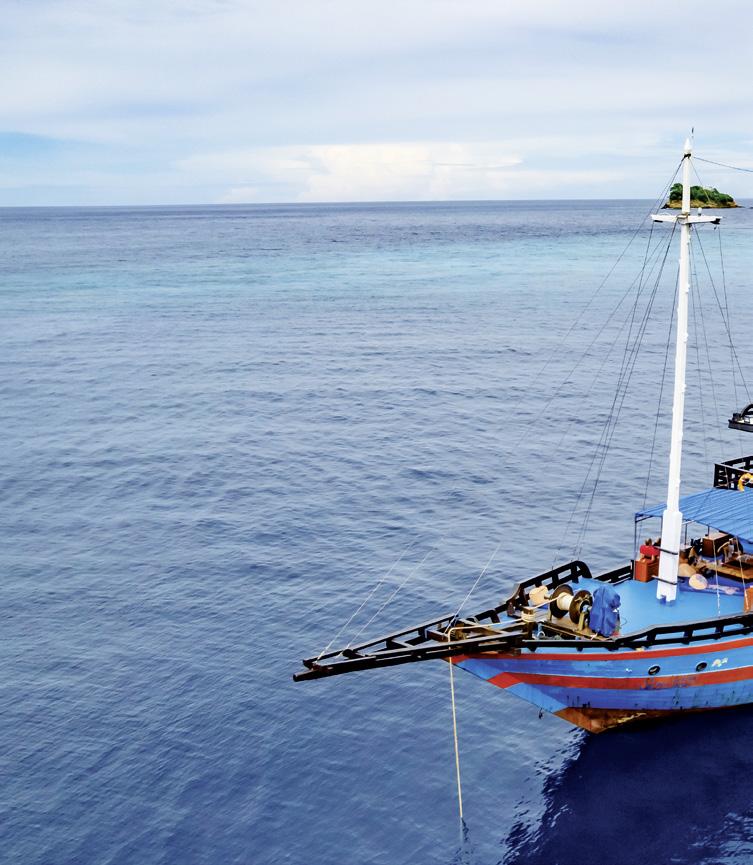
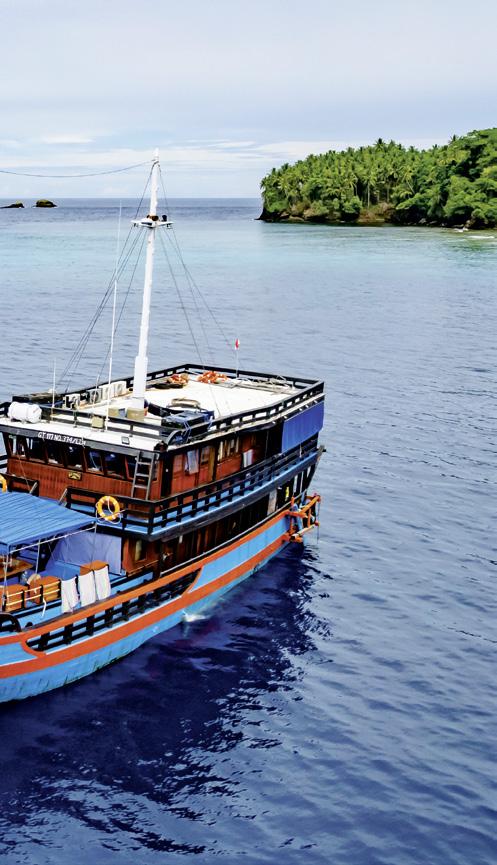
It doesn’t always have to be luxury. But spending ten days cruising through Halmahera with no other dive boat in sight –is a true luxury. Join us on board the ‘KLM Sunshine’ as we head east from Lembeh.
Halmahera is all the rage. No wonder, given that the North Moluccas archipelago lies right between North Sulawesi and Raja Ampat – two absolute dream destinations for divers. Diving here is a privilege that doesn’t necessarily require you to break the bank. Upon arrival, we’re greeted by the hustle and bustle of Bitung’s harbour district. Our luggage is quickly loaded onto the sturdy-looking tender, and then we’re off, slaloming between fishing boats, buoys and thick ropes out into the Lembeh Strait. Yet neither a gleaming 50-metre yacht nor a mighty three-masted ship is our destination – and yet our liveaboard for the coming days immediately stands out: the KLM Sunshine. With its light blue and orange striped hull and gleaming white masts, it makes an instant positive impression.
The relaxed, informal atmosphere is immediately noticeable on board too. Built in the traditional style with great attention to detail, the motor-sailer is no longer brand new, but is in good condition. Anyone who can do without vast amounts of space, gold-coloured cushions and a butler with a pre-warmed bathrobe will feel right at home here. A major advantage: the KLM Sunshine, at just under 31 metres long, has only five cabins. That means there’s a maximum of ten divers on board. So it is a form of luxury after all.
Lembeh – as good as ever
On the Sunshine, there’s no time to waste. No hours-long boat briefings or instructions – just a quick run-through of the essentials, and off we go for the first dive. Because what makes this safari special is that the first and last days are full diving days with at least three dives. So, before long, we’re diving in at Tandu Rusa, one of the many classic sites in the famous Lembeh Strait, with a backward roll into the water. Split into three guided groups – meaning we’re practically on our own with our guide. That’s what makes diving fun. We float over gently sloping, dark volcanic sand. At first glance, just an empty desert. In reality, however, it is a world full of masters of ca-
T & F Barbara & Wolfgang Pölzer
TRAVEL °INDONESIA
mouflage, ranging from leaf-shaped snails barely two millimetres in size to half-metre-long rays. The motto is: take a deep breath, reduce your speed to almost zero and focus on the few centimetres in front of your diving mask – and the emptiness quickly reveals itself as a true macro paradise. Every irregularity, no matter how small – be it just an inconspicuous tuft of seaweed, a seemingly broken-off piece of sponge or a sunken coconut shell – is worth a close inspection. Tiny shrimp here, beautiful nudibranchs there. Often, only the head of a snake eel or, barely visible, the eyes and mouth of a poisonous lionfish protrude from the seabed.
We quickly get back into the familiar routine of searching and soon spot one photo opportunity after another: comically gazing pipefish, baby anglerfish barely the size of a fingernail, a cuttlefish as long as a span that looks downright monstrous by comparison, and, as a highly sought-after, photogenic highlight, a pair of rare harlequin shrimp. No wonder we only resurface more or less voluntarily after 80 minutes instead of the planned 60.
Swarms to swoon over
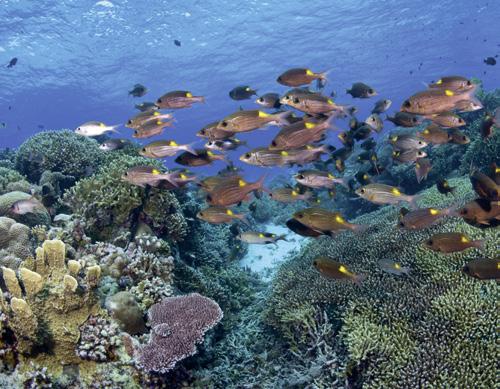
After three excellent macro dives, we leave Lembeh Strait in the late afternoon and set off on our first long crossing. The Sunshine’s engine runs all night, and early in the morning we reach a pictureperfect coconut island right on schedule. Roughly in the middle of the 250-kilometre-wide channel between North Sulawesi and Halmahera, the four-kilometre-long island rises from the Molucca Sea, which is well over 1,000 metres deep here. Within sight of the island, we quickly get into the water. A shoal rises up to five metres. A mixture of a richly overgrown coral slope and a vertical cliff face disappears into the deep blue void. Our subsequent logbook entry – ‘absolute top spot’ – becomes apparent after just a few minutes. An unusually large number of fish, wherever you look. Whole swarms of colourful reef bass and metallic-shimmering fusiliers frolic close to the reef,whilst schools of bannerfish andsurgeonfish, eagerly snapping up plankton, arefurther out.
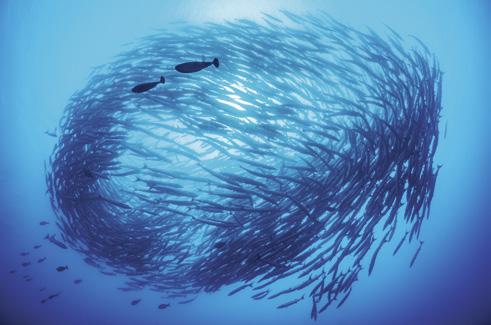
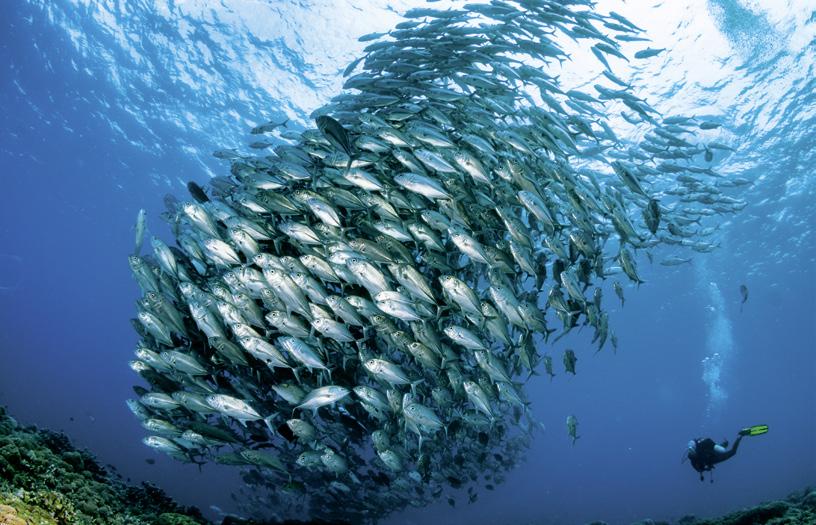
And the best thing about this dive site is that we’re just hanging back, completely relaxed, at a depth of just 15 metres, anchored to the current hook. The fish glide past us as if in an aquarium – until the scene suddenly darkens and swallows up the sun’s rays. Looking up, the supposed cloud turns out to be a gigantic school of fish. A seemingly endless shoal of barracudas drifts leisurely over our heads. Packed tightly together, the fish, each over half a metre long, turn gently in circles, seemingly paying us no mind at all, and slowly push their way out into the open sea.
Not wanting to miss out on this sensational photo opportunity, we simply glance at our buddy: we release the current hooks and paddle after the school into the open water, against the current that is already easing. Just a few fin strokes later, the school is back in front of us. It even turns round. The mackerel come straight towards us, take us into their midst, block our view completely, and circle us within arm’s reach. Unbelievable! Almost like a fish among fish, we savour the moment and can hardly get enough of
the silvery shimmering shoal. Until the school thins out as if on a secret signal, and the open water comes back into view. A quick glance back: everything’s fine. The reef is just within sight. In the heat of the moment, we haven’tdrifted far off course.
Anyone who thinks that’s all there is to it is sorely mistaken. No sooner have we escaped the school of mackerel than the next surprise awaits us. At first, we can only make out a gigantic dark silhouette, taller than it is wide. A second school! Similar to the previous one, yet different. Not spiny
mackerel, but barracudas – and what magnificent specimens they are. Even less shy than the mackerel, they push themselves close together in a circle, readily taking us into their midst and sending our adrenaline levels soaring to new heights. It is fascinating to be at the centre of this spiral of tooth-baring predators. Any sense of time has vanished – our full concentration is now on observing, taking photographs and filming. No idea how many times we spin round in a circle together with the silvery, reflective fish bodies, each just under a metre long. Until the shoal around us gradually disperses, as if on a secret signal. The barracudas release us once more and leave us in the middle of the blue. Just within sight of our thoughtful dive guide Jenly, who shows us the way back to the reef.
It’s not always about size: the variety of quirky and often rare creatures is often even more fascinating. There are plenty of them to see on this liveaboard trip.
Colourful fish soup
After another 140-kilometre night-time journey, we reach a small archipelago around the island of Siko the following morning. Once again, it is the shallow waters that delight us with an abundance of fish. Above all, schools of surgeonfish in densities we have never seen before, often just an arm’s length from our cameras, remain etched in our memories.
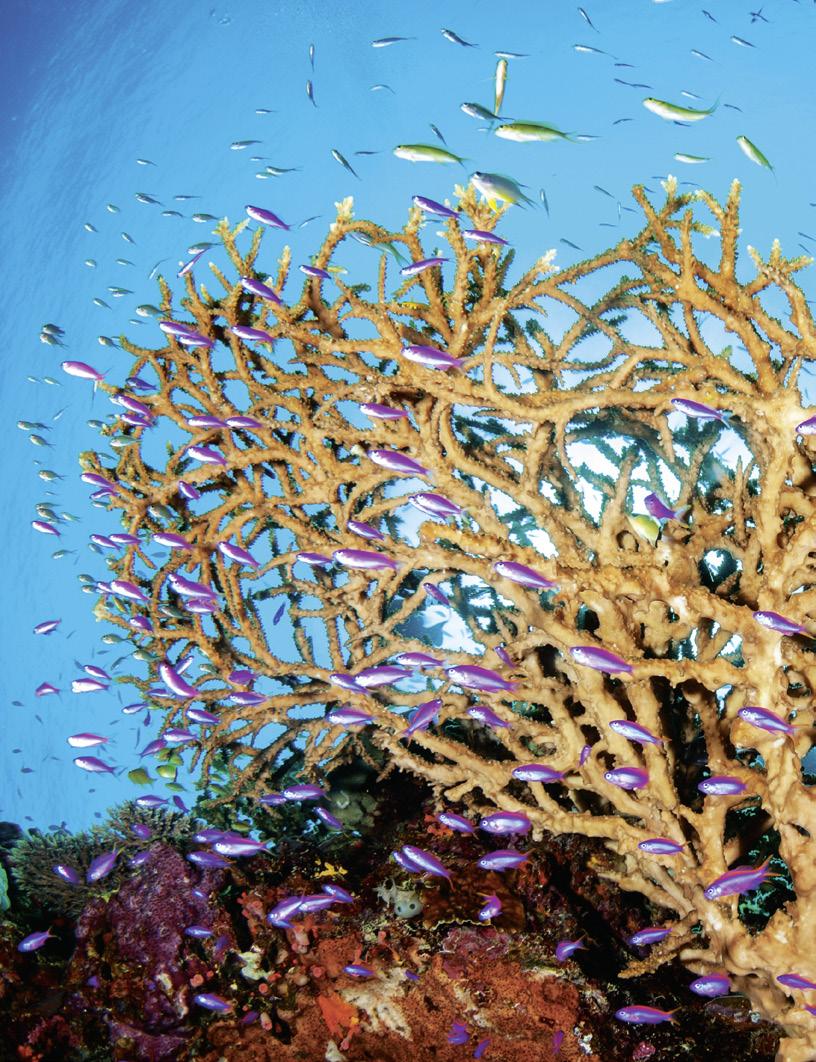
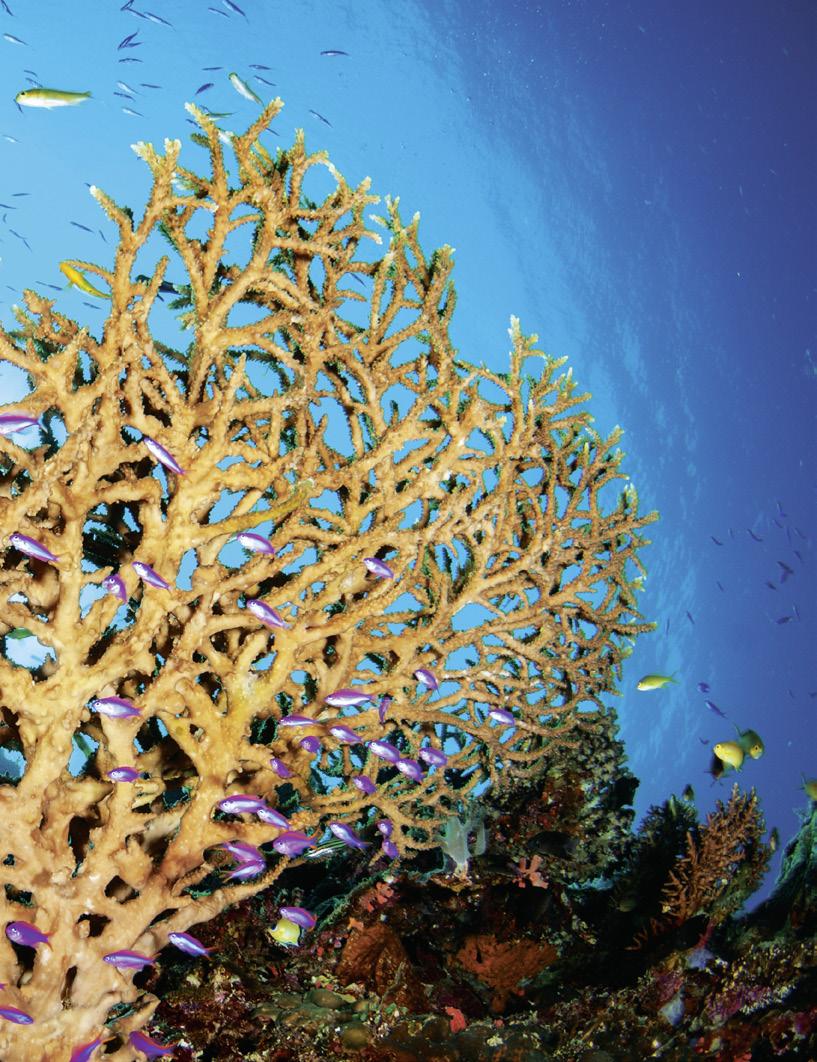
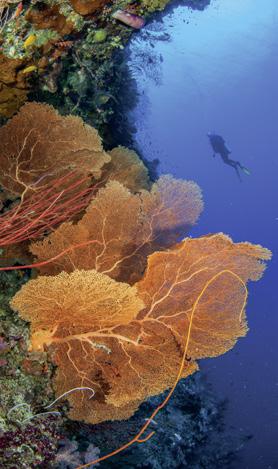
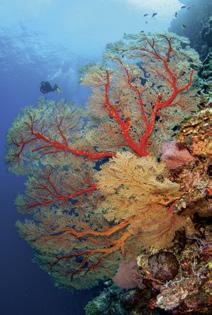
The schools of fusiliers, groups of hunting barracudas and rainbow trevally, as well as individual wahoo, tuna and grey reef sharks, are also a sight to behold. The corals are impressive too! We admire huge, intact table and salad corals alongside the rather rare, tree-shaped soft corals in bright orange hues, as well as lush horn coral fans and bushy broom gorgonians.
Mantaspot
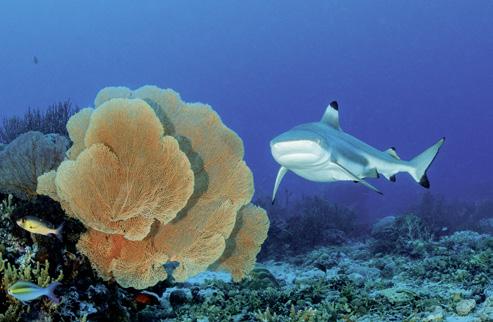
Over the following days, we make our way southwards from island to island. With unbridled enthusiasm. For since leaving the Lembeh Strait, we’ve remained the only dive boat for miles around. This makes diving twice as much fun. In a system that looks absolutely stunning from above— with turquoise-blue lagoons, lush green islets and deep-blue channels—manta rays are frequently spotted. We give the popular giant manta rays a chance to show themselves during two dives, each lasting 80 minutes. Unfortunately, to no avail. More than just a consolation prize, however, is a good dozen hunting blacktip reef sharks, which, in the heat of the chase, come within photo range, as well as a group of magnificent buffalohead parrotfish. The night dives in the area then allow us to finally forget the missed manta rays. Three epaulette sharks, with their golden-brown spots, comical expressions and almost clumsy way of crawling through the reef, delight us just as much as the superbly camouflaged mini octopuses and a rare grey beaked sea snake.
In horse heaven
Two more islands on, having reached the southernmost point of our tour, we top up our shower water supplies in a somewhat
Pure nature: There are still unspoilt places with huge schools of fish, a rich variety of species and a natural shark population.
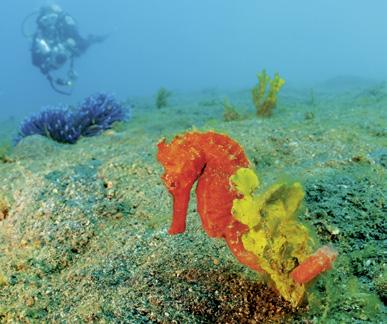
adventurous manner – though quite common in these parts –using a pump and a long hose at a freshwater spring near the coast. Not far from there, an unspectacular dive site right in front of a small fishing village surprises us with a vast number of pygmy seahorses. Almost every one of the many gorgonian fans on the current-swept slope at a depth of 15 to 20 metres is home to at least one Bargibanti or Denise’s pygmy seahorse. A paradise for macro photographers! Because if you don’t like the position of one of these mini beauties, you simply swim a few metres further, where the dive guide is already pointing out the next one.
Second chance
The turning point means we’re well past the halfway stage of our tour. We’re heading back along a similar route – with the chance to dive the absolute highlights all over again. Better weather, different currents or a different time of day often make a huge difference, especially at an exposed shoal. In any case, it becomes clear to us that the sheer abundance of fish at some spots was no exception. So, in places, we once again feel as though we are in an overcrowded aquarium, surrounded by surgeonfish, triggerfish and bannerfish, fusiliers, reef groupers and a wide variety of mackerel and tuna species, as well as repeated sightings of whitetip, blacktip and grey reef sharks. And, of course, the incredible school of barracuda and trevally described earlier, right in the middle of the channel between Halmahera and Sulawesi, is still there. This time, it’s even in the sunshine, which works in our favour for the photos. The obligatory finale to this safari is a full day’s diving in the Lembeh Strait, which treats us to a rare Rhinopias scorpionfish. Back on board, we look back on the tour: it is a fantastic and, above all, affordable alternative to luxury liveaboard trips in North Sulawesi and Halmahera. The tour described here is still considered an insider’s tip for exclusive diving on largely untouched reefs with an extraordinary abundance of fish. Experience with currents is required. Thanks to the friendly, relaxed atmosphere on board the KLM Sunshine, unwinding after the underwater adventures is easy.
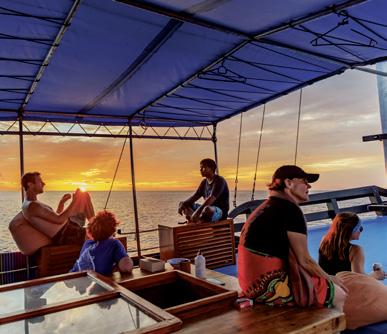
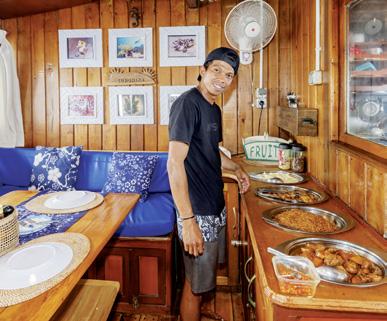
Diving and relaxation: as well as the underwater world, there’s plenty to enjoy on board too. Traditional Indonesian cuisine is served. Simple, but delicious!
KLM SUNSHINE
Year of manufacture: 2012
Owner: Blue Bay Divers
Cruise Director/Tour Guide: Yustus Mananggung (an Indonesian who speaks good English)
Crew: 8 crew members and 3 dive guides
Length: 31 metres (7 metres wide)
Type of vessel: traditional wooden motorsailer (Pinisi)
Cabins: 2 on the upper deck and 3 on the lower deck, accommodating up to 10 guests. One of the lower-deck cabins is the extralarge owner’s cabin. All cabins feature ensuite bathrooms and individually controlled air conditioning.
Facilities: In addition to the restaurant and camera table inside, there are covered areas on the foredeck and aft deck where you can relax. There are two showers and a camera rinse basin on the dive deck. Depending on the tour, the fresh water tanks are topped up halfway through the trip in a village.
DIVING REQUIREMENTS: Diving certificate (minimum OWD and 50 dives), logbook, medical certificate of fitness for diving, and travel and diving accident insurance covering overseas travel. Experience of diving in currents and a head for the sea are an advantage.
DIVING: Dives usually take place three to four times a day in guided groups of no more than four divers per guide, always from the sturdy tender boat. 12-litre DIN/INT aluminium tanks are available; 15-litre steel tanks are available for an additional charge of 5 euros per dive. No adaptor required. Rental equipment available on request and by prior arrangement. Wetsuit: A 3–5 mm wetsuit and a thin hood to protect against jellyfish are recommended. Water temperatures in the region usually range between 26 and 29 degrees Celsius. Maximum depth: 30 metres, no decompression dives.
SUSTAINABILITY: We avoid using plastic wherever possible. There is a drinking water dispenser on board.
SNORKELLING: Due to the prevailing currents, the Halmahera tour described is not suitable for snorkellers. On other tours, snorkelling is almost always possible at the dive sites.
PRICES: The price of the trip always includes three dives per day. A fourth dive per day costs an additional 30 euros. Depending on the length of the trip, 32% nitrox costs an additional 50 to 100 euros per person. A nitrox course costs 100 euros.
BEST TIME TO VISIT: all year round, except for January and February, when the KLM Sunshine is in dry dock. Underwater visibility depends on the tides and currents and usually ranges between 15 and 25 metres.
TOURS: The most popular tours are the 12-day Halmahera liveaboard trips from and to Bitung. We also offer tours to Bolsel, Gorontalo and Saronde, as well as Lembeh, Bangka and Bunaken. In the pipeline: Saronde–Donggala and Gorontalo–Togian.
SPECIAL FEATURE: A 12-day tour on the KLM Sunshine means 12 full days of diving – over 11 nights. This means that if you don’t have a hotel booking near the port of call before or after the trip, you can stay on board for an additional charge of 50 euros per day either before and/or after the trip. Contact and further information: www.sunshineliveaboard.com
11 nights (12 full days of diving) on the KLM Sunshine, lower deck double cabin including full board, coffee, tea and drinking water, as well as three dives per day (including tank, weights and guide), one night’s accommodation in Manado including breakfast, flights to and from Germany, transfers, fuel surcharge, port charges and Halmahera fees: from €3,840 per person.
GENERAL TRAVEL INFORMATION
Getting there: The international arrival airports are Jakarta, Bali or Singapore. From there, there are daily domestic flights to Manado, followed by a 1.5-hour transfer by car to the port of Bitung. Entry: with a passport (valid for at least another six months). On arrival, you can obtain a 30-day tourist visa for just under 30 euros. An e-visa (B1 visa) applied for in advance in Europe costs the same but is processed more quickly: https://evisa.imigrasi. go.id/
TOURIST INFORMATION: Indonesian National Tourist Office: www.indonesia.travel
… mit Pacific Travel House –dem Spezialisten seit über 35 Jahren!
21 Tage Französisch Polynesien
Tahiti, Rangiroa und Fakarava Fantastisches Großfischtauchen an den Riffen und in den Passagen der Atolle · Inkl. 21 Tauchgängen, Flügen, Übernachtungen/Frühstück/Transfer ab 7.550 € p.P. / DZ
21 Tage Fiji Inseln
Viti Levu, Taveuni, und Beqa Lagune
Aufregendes Tauchen zwischen farbig leuchtenden Korallen, bunten Rifffischschwärmen und beeindruckenden Großfischen · Inkl. 22 Tauchgängen, Flügen, Übernachtungen/Frühstück/Transfers
ab 6.945 € p.P. / DZ
17 Tage Mikronesien
Palau und Yap Faszinierendes Tauchen an steilen Außenriffen, in Strömungen und Lagunen mit zahlreichen Großfischen · Inkl. 20 Tauchgängen, Flügen, Übernachtungen/Frühstück/Transfers ab 5.475 € p.P. / DZ
18 Tage Papua Neuguinea
Lissenung Island und Tufi Resort
Reiche Artenvielfalt, Sichtweiten bis zu 30 Meter, unberührte Korallenriffe und große Fischschwärme
Weitere Vorschläge, ausführliche Beschreibungen und kostenlose individuelle Ausarbeitung unter:
pacific.travel.house
Pacific Travel House Reiseveranstaltungs GmbH Schwanthalerstraße 100, D-80336 München info@pth-muc.de, 089-543 21-80
There are diving trips. And then there are places like Tubbataha. Anyone who makes it to this remote reef system in the middle of the Sulu Sea doesn’t simply arrive at a dream destination –but at a place that reminds you why you fell in love with the ocean in the first place.
PILGRIMAGE TO THE HEART OF THE CORAL TRIANGULAR
T & F Martin Strmiska
Tubbataha isn’t the sort of place you just pop in to see. There are no day trips, no beach resorts, and no quick transfers from an international airport. Tubbataha Reefs Natural Park, situated in the middle of the Sulu Sea, is remote, strictly protected, and only open to divers during a brief window each year. It is precisely this that makes it far more than just another destination on a long wish list.
A trip here feels a bit like a pilgrimage. The cost is considerable: complex logistics, a few thousand euros and a long journey. The international flight to Manila is followed by a domestic flight to Puerto Princesa – and this combination alone can easily take up two days of your holiday. But those who take the plunge are rewarded with something that has become rare in Asia: true seclusion and an abundance of marine life that is hard to find anywhere else.
Blue Wilderness
Unlike many other diving destinations in the Philippines, Tubbataha isn’t somewhere you just happen to stumble upon. Manila is more of a place you’d want to leave behind as quickly as possible. Puerto Princesa, the capital of Palawan, on the other hand, welcomes you with
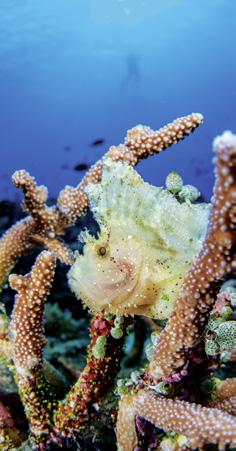
Above: In addition to the obvious diversity, there is also an enormous variety of species on a ‘small’ scale, as exemplified by the wobberfish.
that warm, relaxed atmosphere that immediately puts you in holiday mode. But even there, you haven’t quite reached your destination yet. The final leg follows: a ten-hour crossing across the open Sulu Sea.
This trip is available through ‘Level3-Divers’ (www.libertydivers.com).
Philippines | 10–24 October 2026
Liveaboard dive cruise on the ‘Solitude One’, calling at Tubbataha, Cagayancillo, El Nido, Coron, Apo Reef and Verde Island. The trip is advertised as a CCR trip for experienced divers (minimum level MOD1).
Highlights of the safari include sheer cliffs, pristine coral reefs, encounters with large fish, and the wrecks of Coron.
The price of €8,500 per person includes 13 nights on board, the diving programme, full board and non-alcoholic drinks. Additional costs include, amongst other things, tank refills (gases), Sofnolime, parking fees, flights and tips.
The liveaboard vessel Solitude One leaves Puerto Princesa in the evening and heads out into the open ocean overnight. At dawn, the engines slow down. Two dark patches appear on the horizon – the North and South Atolls of Tubbataha. The good news is that there are no other boats in sight.
Only the expected brilliant blue is missing for now. The sky hangs low and grey. And with no white crests dancing across the water’s surface, the sea looks almost black. Yet countless seabirds all around lend a sense of lightness to the scene, and the anticipation does the rest. For beneath this rough surface lies one of the most extraordinary ecosystems in the Coral Triangle.
As a UNESCO World Natural Heritage Site, Tubbataha is a hub of marine biodiversity. The area’s isolation has spared it from many of the pressures to which coastal reefs have long been exposed. Strict conservation laws, a constant presence of rangers and a short diving season
TUBBATAHA
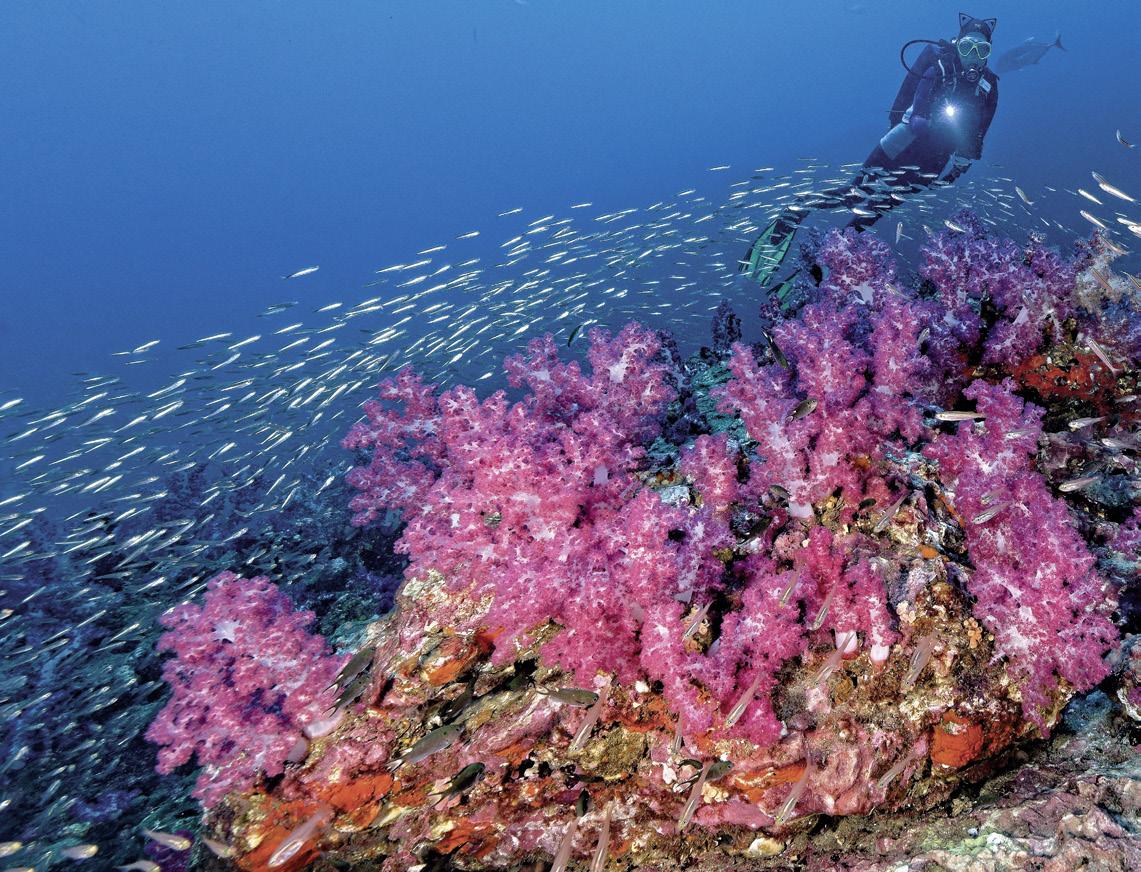
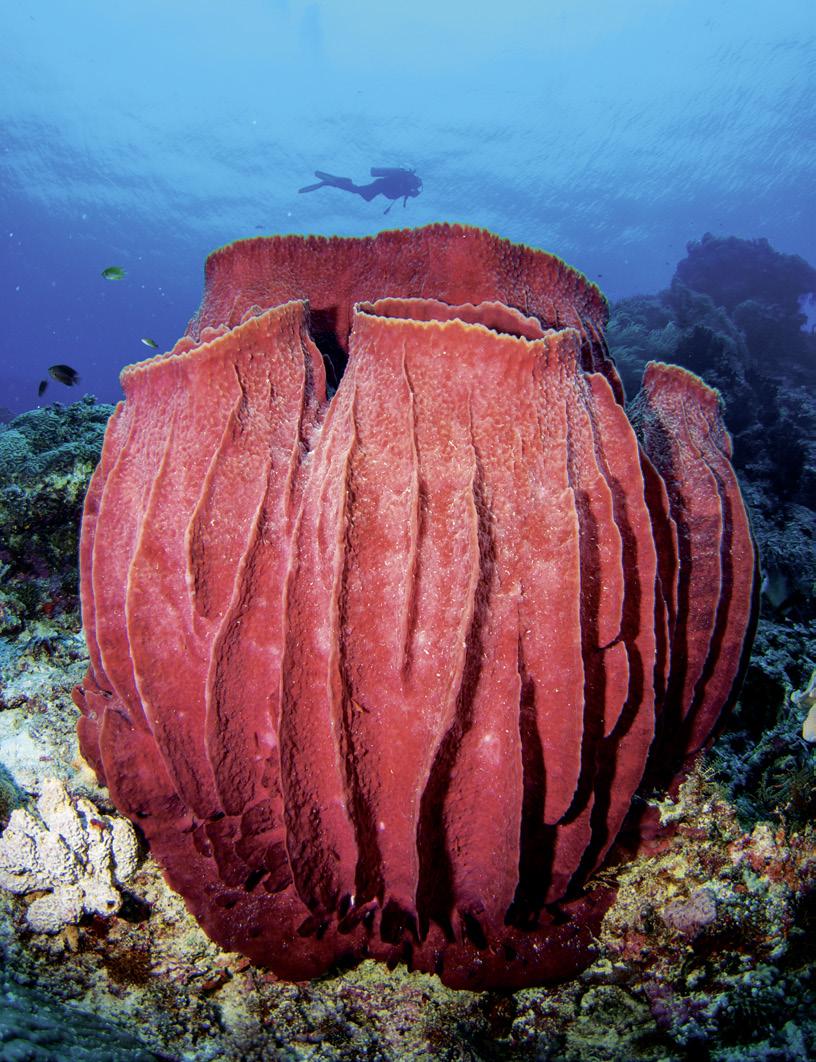
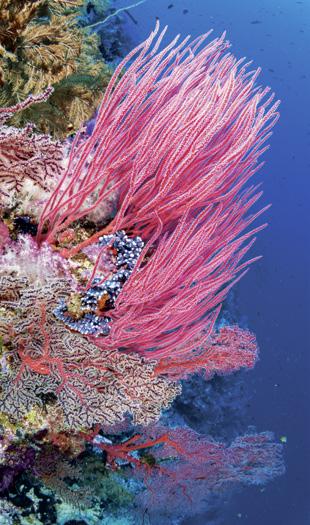
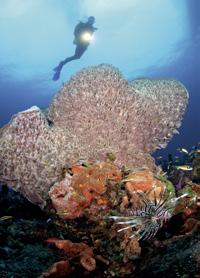
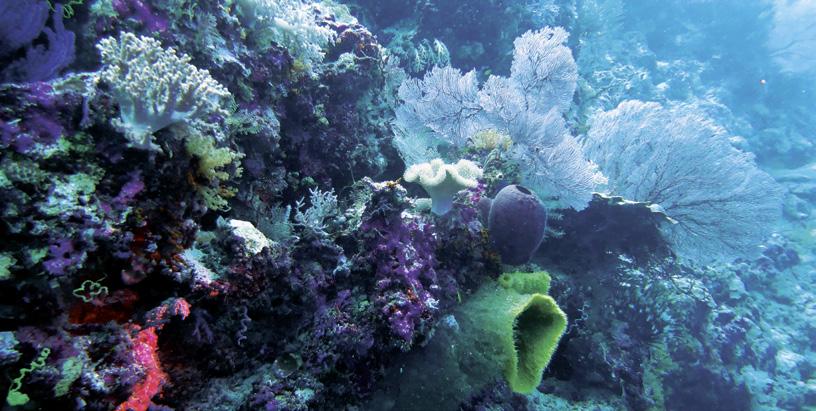
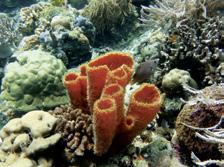
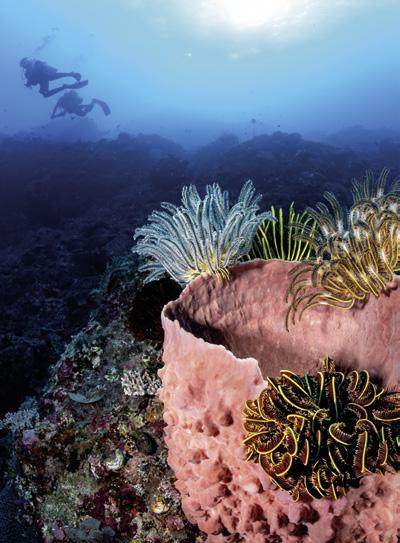
Left: Like sculptures rising from the reef, the massive barrel sponges tower above the water – a symbol of Tubbataha’s pristine, strictly protected coral gardens.
It’s not just the big fish that are a highlight in
boasts an incredible variety of colours and shapes in its smaller inhabitants.
Tubbataha: the reef also
As well as sharks and schools of fish, it is often the small, quiet moments that make a dive off Tubbataha truly memorable.
Tauchreisen & Tauchsafaris weltweit
from March to June have ensured that the reef has remained in remarkably good condition. Only one question remains: what is it like underwater?
At first glance
As the Solitude One moors at a buoy and the first briefing begins, it immediately becomes clear that Tubbataha is not a destination for beginners. It is an open-ocean system: vast, dynamic and shaped by currents. Conditions can change rapidly, and much is decided within a matter of minutes. For experienced divers, however, this is precisely part of the fascination. You know that your own luck in such places can never be planned. So you let go of expectations and focus on what the ocean has to offer at that moment. That first glimpse underwater is always special. Especially when you’ve had a long journey behind you. And the beauty of Tubbataha is this: there are no bad dives here. The programme begins with a dive site that immediately lives up to this claim: Amos Rock. Even under a dark sky, in subdued light, the visibility seems almost limitless. The water appears to glow from within. The walls drop steeply into the depths and at first are rather reminiscent of reefs in the Red Sea. But on closer inspection, the coral landscape tells a different story. Massive table corals jut out from the reef like natural balconies. In between stand large barrel sponges, like monumental vessels in a garden of hard and soft corals. The mighty gorgonians, swaying in the current, may evoke memories of Egypt’s underwater world, but the density of life and the riot of colours point clearly towards Indonesia.
Tahiti • Rangiroa
Fakarava
Tikehau
Bora Bora
Tauchsafari im Tuamotu Atoll
Tauchsafaripreis schon ab 3.990,- € pro Person, zzgl. Anreise
Inseln individuell kombinierbar
Kleine persönliche Unterkünfte Maßgeschneiderte Reiseplanung
Mehr Infos finden Sie hier: Französisch-Polynesien Tauchen
"EVERY SQUARE METRE IS OCCUPIED. EVERY NOOK AND CRANNY IS BUSTLING. TUBBATAHA IS NOT STAGED, IT’S OPEN AND INFINITE.”
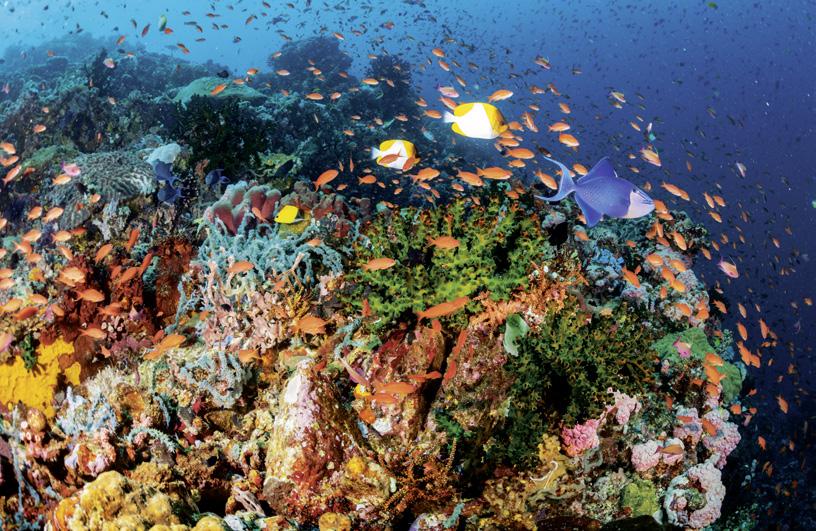
In many ways, the Philippines is a land of butterflies – and underwater, this association suddenly becomes very real. Millions of bright purple Tuka bannerfish (Pseudanthias tuka) above the coral garden look like a field of fluttering petals. Unlike many reefs, which today bear the marks of coral bleaching or mechanical damage, Tubbataha appears robust, powerful and full of life – like a cathedral of the sea that has grown over millennia.
Every square metre is occupied, every nook and cranny teeming with life. And yet this perfect density, the stuff of photographers’ dreams, always remains just out of reach. It is precisely this that reveals the untamed nature of this place. Tubbataha is not staged. It is open and boundless.
Sharks in the current
Tubbataha is rightly regarded as a true shark sanctuary. Anyone who loves sharks is bound to feel their pulse quicken during a dive at the Washing Machine – and not just because of the chance of sightings. After a reverse roll entry from the tender, we descend rapidly to the side of the reef fa-
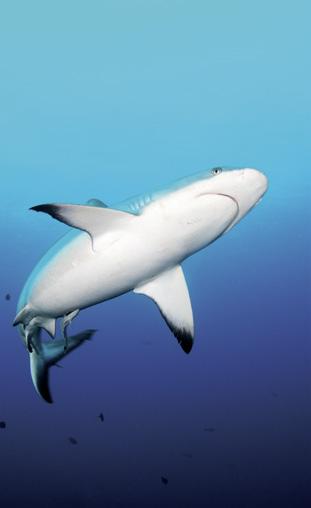
Grey reef sharks are one of Tubbataha’s main attractions. Especially in places where the current makes the water seem to boil.
cing the current. Anyone who doesn’t reach the tip in time stands little chance against the current. So you hold on to the rock and watch as grey reef sharks cut elegantly through the ‘boiling’ water. Unlike us, they seem to be thoroughly enjoying the energy of the current. The stronger the water flows, the more confident they appear.
A school of hunting giant mackerel is also making the most of the conditions. Like fighter planes, they shoot through dense shoals of fusiliers, which have little chance of escaping against the current. Both scenes unfold simultaneously and almost look like superimposed sequences: the calm, controlled movement of the sharks, and above them the explosive speed of the hunting predators.
These are exhilarating moments. And yet, the same applies here: sometimes, a good encounter isn’t quite enough to capture the perfect shot. So you take your hand off the rock and let the current carry you along the edge of the drop-off.
As soon as the pressure of the current eases, the dive takes on a different character. Suddenly, the quiet beauty of the dive site comes to the fore. For photographers, a whole new world of scenes now opens up: small schools of harlequin wrasse over table corals, whitetip reef sharks on sandy flats, flanked by bigeye trevally, along with swirling formations of chevron barracuda. Against the backdrop of some of Southeast Asia’s healthiest coral reefs, it all looks almost unreal in its photogenic beauty.
Jessie Beazley
A trip to Tubbataha would be incomplete without a dive at Jessie Beazley, the solitary pinnacle to the north-west of the North Atoll. As impressive as the underwater world of the Philippines can be, the history of destructive fishing methods is equally long. Dynamite and cyanide fishing have caused massive damage in many places. Before Jessie Beazley Reef was incorporated into the Tubbataha Reefs Natural Park in 2007, it had been so badly destroyed that even explosions no longer yielded a catch – simply because there were no fish left. Today, the reef shows clear signs of recovery. Sightings of larger pelagic species are becoming more frequent again. However, it has not yet fully returned to its former abundance. During the coronavirus pandemic, when the presence of rangers was temporarily reduced, this recovery process suffered further setbacks. And yet the last two dives there were among the most impressive of the whole liveaboard trip. They demonstrate just how resilient a reef can be and the potential that lies in consistent conservation efforts.
Coron and beyond
Then it’s time to secure our gear, stow the cameras and make sure everything is seaworthy. A twelve-hour crossing takes us
on to Coron, where the character of the trip changes. The dive programme moves on from the pristine reefs of Tubbataha to legendary yet surprisingly uncrowded wrecks.
Hardly any other destination offers such a wide range of underwater experiences all along a single route: endless coral gardens, encounters with pelagic fish in the open blue water, spectacular Second World War wrecks and legendary macro subjects that sit right in front of you yet are easy to overlook. In the Philippines, you don’t have to choose just one passion. You can have it all.
DRIVE & DIVE MANIA
PHILIPPINES
Lake Sulu
Tubbataha Reef
Your Buddies
Erhalte 50 % Rabatt auf deinen Mietwagen.
18. Juli – 28. August 2026
T Win Schumacher
SPERM WHALES, VOLCANOES & CORALS
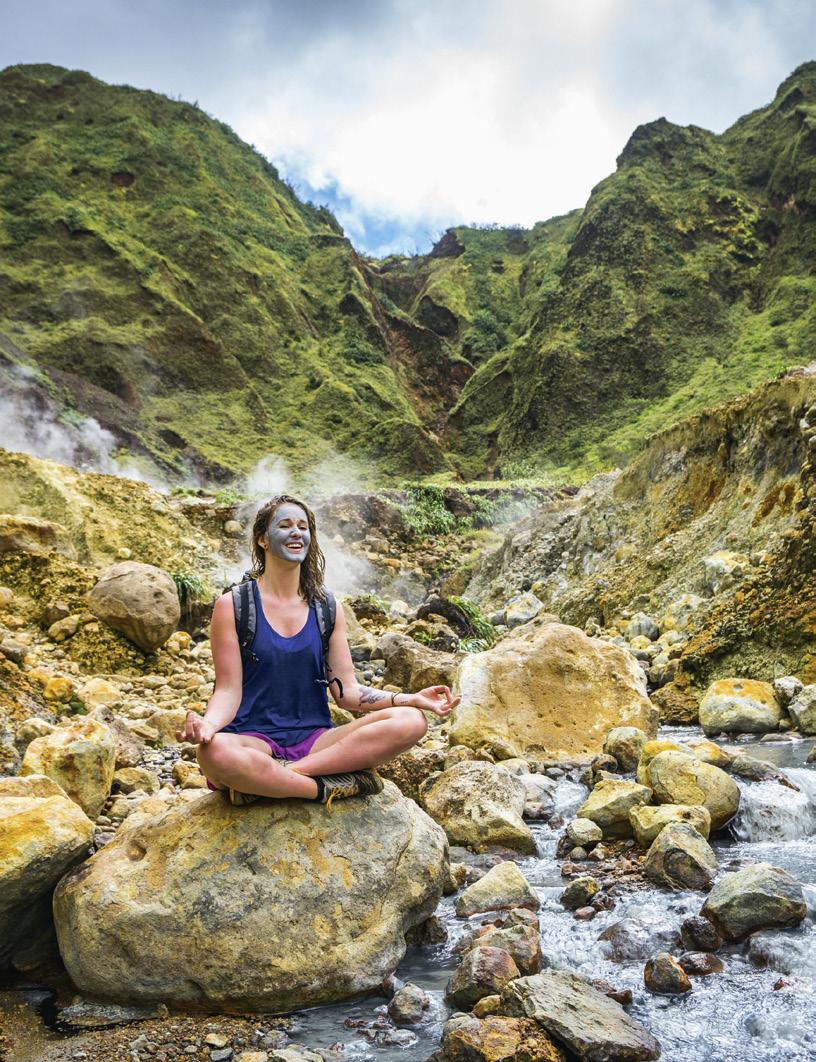
Dominica captivates you from the very first moment: with its wild rainforests, vibrant reefs and the rare opportunity to experience the Caribbean in all its unspoilt beauty.
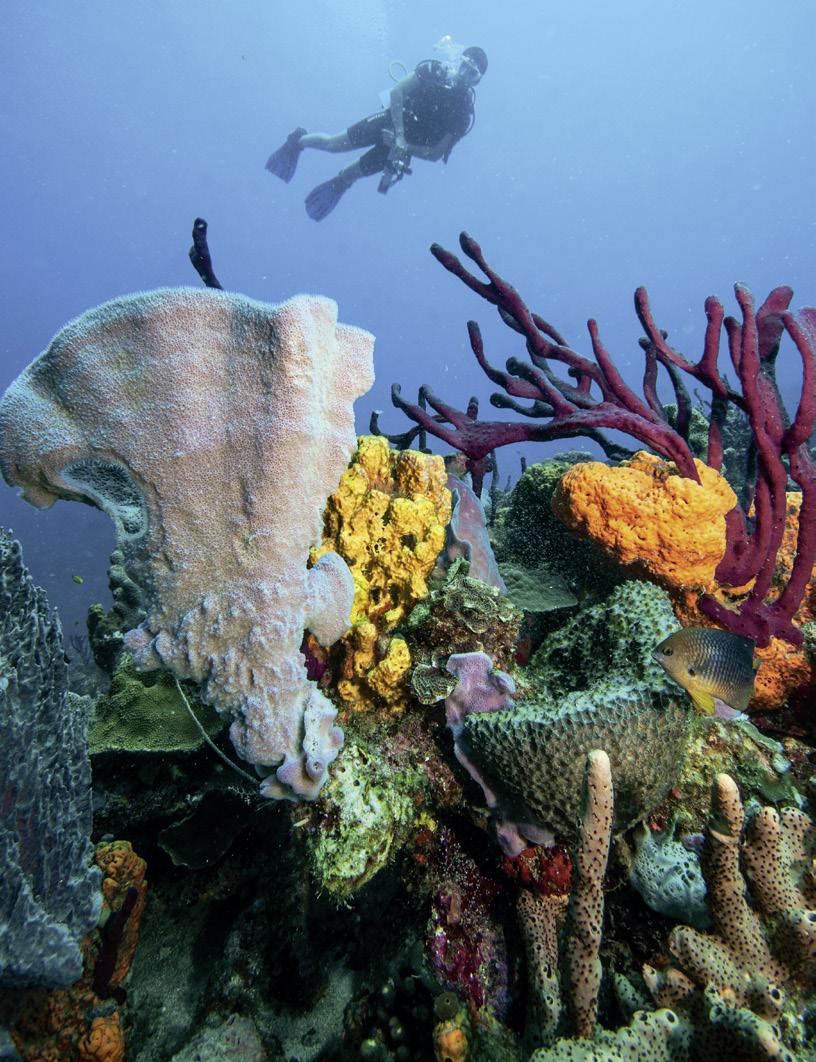
Where the Caribbean and the Atlantic meet, life is teeming. Even the first glance through the diving mask makes it clear: this is no ordinary Antillean reef. We drift down through schools of iridescent soldierfish and hussarfish into a world of vibrant colours. Violet-blue vase sponges and orange drill sponges alongside red corals are reminiscent of the colourful diversity of Indonesian reefs. Thanks to the clarity of the water and often excellent visibility, the Scott’s Head Marine Reserve in south-west Dominica is considered one of the most beautiful diving areas in the Caribbean – and yet it is rarely overcrowded.
Underwater variety
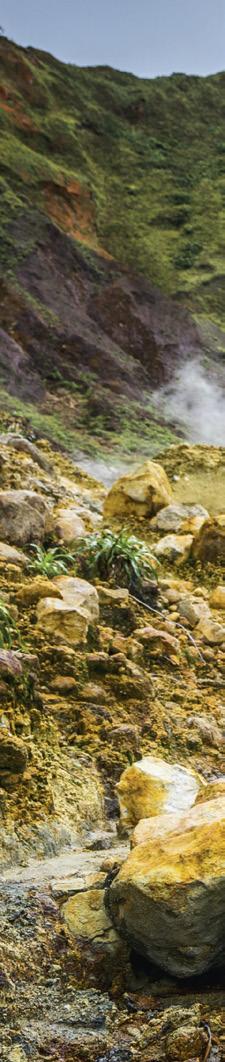
Although the underwater volcanic landscape, with its spectacular sheer walls and bizarre rocky outcrops, has been attracting increasing numbers of divers for several years now, the crowds are still relatively small compared to many other popular diving destinations in the Lesser Antilles. Colourful parrotfish, emperor fish and surgeonfish, shoals of neon-yellow and turquoise-striped grunts, and brightly coloured filefish lend the underwater world in some places almost the same radiance as Raja Ampat. With a bit of luck, you might also encounter moray eels, sea turtles and dolphins on a diving trip. The marine reserve is also famous for Champagne Reef, where volcanic gases rise like the bubbles in a glass of sparkling wine – a truly unique sensation, gliding through a glass of bubbly as a diver. The di-
Photos: Tobias Friedrich, Scot Sporleder
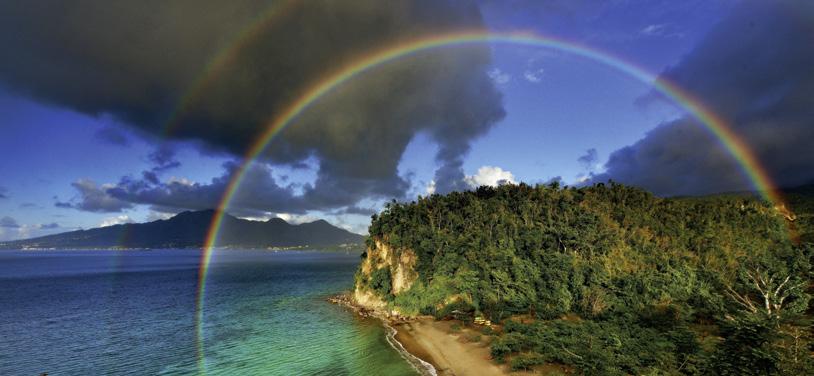
A break amidst colourful reefs and rugged mountains: on Dominica, visitors can discover the wild side of the Caribbean.
TRAVEL °DOMINICA
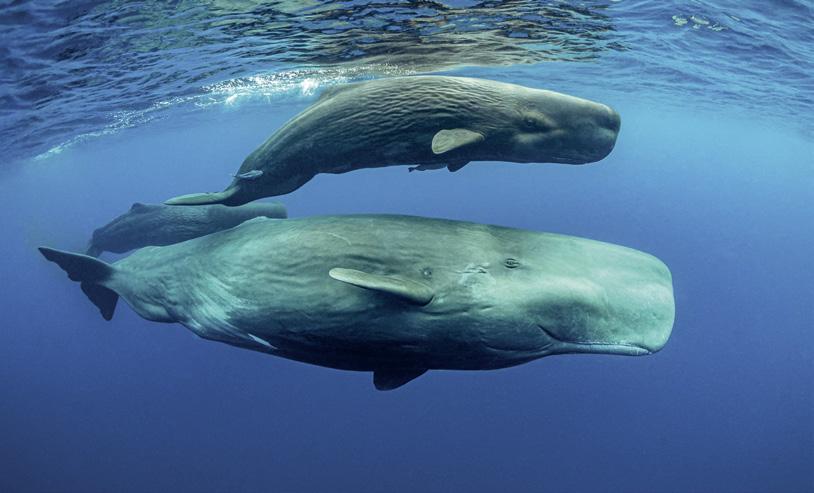
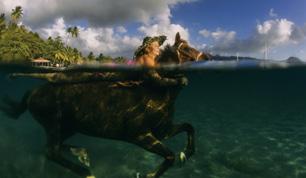
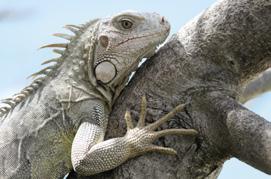
Encounters with sparkling little creatures and gentle giants: the wildlife leaves holidaymakers in awe –whether snorkelling with sperm whales, watching hummingbirds, swimming with horses or spotting iguanas.
versity of Dominica’s underwater landscape knows almost no bounds. Whether you’re gliding through a cave in the Toucari Bay Caves, surrounded by pipefish and wrasse, diving under a rock arch at Secret Arch, floating along a wall at Witches Point, or circling the rock spires of the Soufrière Pinnacles: neither beginners nor advanced divers will find it boring here.
Face to face with sperm whales
If all that isn’t exciting enough for you, Dominica has a very special highlight in store. This Caribbean island is one of the few places in the world where you have a good chance of snorkelling with sperm whales. An encounter with the largest toothed whale – and also the largest predator on Earth –is a breathtaking experience. Thanks to the unique underwater topography, which of-
fers protection from the rough Atlantic off the island’s coast, but above all because of the abundant supply of giant squid – the sperm whales’ favourite prey – the animals can be observed here all year round.
Distinctive
Unlike its neighbouring islands in the Lesser Antilles, which mainly attract beach holidaymakers, Dominica is still known to only a few tourists. The island lies in the eastern Caribbean between the French overseas territories of Guadeloupe and Martinique. Among Caribbean connoisseurs, it is regarded as the most unspoilt. Some say it is probably the only one of the islands sighted by Columbus that he would still recognise today. Whilst elsewhere hotel complexes, marinas and jetties for cruise giants dominate the landscape, Dominica has preserved
its wild nature – both above and below the water.
The ultimate for nature lovers
Anyone wishing to experience the spectacular diversity of Dominica should not limit themselves to exploring its unique landscapes on diving trips. There is plenty to discover on land too – by 4x4, on a mountain bike, in hiking boots or on horseback. “No, our horses aren’t afraid of water at all!” says Collata Francis, and rides her mare straight into the sea. The sun has only just risen over the mountains of Dominica, but in Cabrits National Park the jungle birdshave longbeen awake. Their squawking drowns out the ocean waves lapping against the dark volcanic sand at the edge of the jungle. The rider loves to ride along the beach early in the morning with her mother
TRAVEL °
Valerie and go swimming with the horses when they still have the bay all to themselves. Afterwards, they disappear onto hiking trails that wind their way through the jungle on Dominica’s Cabrits Peninsula. The family also offers horse rides to holidaymakers from their riding centre, not far from Cabrits National Park. “First diving or riding through the mountain jungle, then swimming in the ocean with the horses – that’s pretty unique in the Caribbean,” says Collata, as she keeps an eye out for Antillean doves and hummingbirds by the side of the path. “For people who love nature, there’s no better place than Dominica.”
An
eventful history
Anyone exploring the rainforest with Collata and Valerie feels like the first sailors to reach this island. Columbus was the first European to discover Dominica, back in 1493, but he probably never set foot on it due to its uninviting cliffs and dense primeval forests. The island was given its Latin name after the day of its discovery, a Sunday. From the 16th to the end of the 18th century, the Spanish, French and English vied for control of Dominica, until it finally came under the rule of the British Crown. Due to the island’s rugged terrain and the slow pace of development, the indigenous Kalinago people managed to retain a degree of self-determination. Today, Dominica is one of the few islands in the Caribbean where a small indigenous minority still lives. The island nation, with a current population of around 72,000, has been independent since 1978.
The longest nature trail in the Caribbean
Dominica’s most famous hiking trail ends in Cabrits National Park. At almost 200 kilometres, the Waitukubuli Trail is the longest in the West Indies. On the most strenuous sections in the island’s interior, you traverse secluded cloud forests and discover waterfalls plunging into deep gorges. The Morne Trois Pitons and Morne Diablotins National Parks are particularly impressive, with their unique birdlife. “There are 186 species on Dominica,” says Bertrand Jno Baptiste, “I’ve seen every single one.” Anyone who hikes through the mountain forest with Dr Birdy, as everyone here calls the local bird expert, sees the jungle through different eyes.
“Dominica attracts a particularly large number of birdwatchers because there is still so much unspoilt vegetation here,” he explains. “Sometimes you can spot more than 50 species in a single day.” Bright red-throated bearded finches, lemon-bellied sugarbirds and pearl-eyed mockingbirds flit through the branches above the bird guide. The tiny purple-throated hummingbird elicits a gasp of wonder from Bertrand’s companions. Like nimble bumblebees, the sparkling little creatures flit from flower to flower.
The Last Tropical Idyll
When planning a break in the West Indies, today’s tourists expect more than just sunbathing on selfie-worthy beaches and cocktails under coconut palms. The tropical idyll touted by tour operators and online travel sites rarely fully lives up to the dream of an un-
spoilt natural paradise. Even the colourful Instagram photos of the coral reefs often look disappointingly pale when seen in person. There are hardly any islands left in the Antilles that remain truly untouched by mass tourism. Dominica, however, has retained much of its unspoilt character both above and below the water and proudly calls itself the Nature Island.
National bird
In Morne Diablotins National Park, a squawking sound above the treetops betrays the presence of a group of blue-crowned parakeets. Bertrand hopes that his guests will spot at least one imperial parakeet from a viewpoint overlooking a primeval forest valley. This sister species, threatened with extinction, shimmers in a glossy violet from head to tail. As the national bird, the imperial Amazon adorns the flag of Dominica. No other parrot in the world is accorded this honour.
Pirates of the Caribbean
After a diving trip to Scott’s Head or a hike through the mountain forest, divers and birdwatchers have earned themselves a relaxing day on the beach. At Batibou Beach in the north of the island, you can while away a whole day in the hot sand with a good book under the coconut palms. Film fans will recognise one of the stunning backdrops from the ‘Pirates of the Caribbean’ blockbusters at nearby Hampstead Beach. The locals, on the other hand, tend to be drawn to Mero Beach on the west coast.
Photos: Eric Hanson, Tobias Friedrich, Scott Sporleder
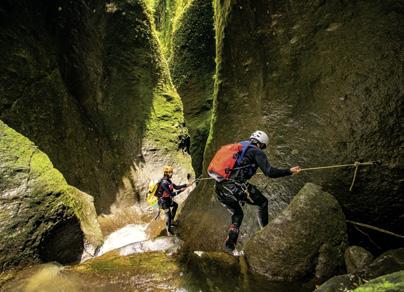
A Caribbean island for the adventurous: it’s not just divers who discover new worlds here. After a canyoning trip or a hike to the hidden waterfalls, the deserted coastline – which can be found in many places at – awaits.
There is every reason to believe that the island will not become a mass tourism destination in the future either. “The people of Dominica have realised that nature is their true asset,” says Bertrand. “They are committed to ensuring that it is preserved for the future.“
DOMINICA / ANTILLES / CARIBBEAN
GETTING THERE: For example, fly with Air France (airfrance. com) or KLM (klm.com) via Paris or Amsterdam to St Martin. From there, Winair (fly-winair.sx) offers direct flights to Dominica.
ACCOMMODATION: Perched on steep cliffs above Salisbury Beach lies the laid-back Tamarind Tree Hotel. From here, it’s a short trip to the dive sites to the west and to Morne Diablotins National Park. → tamarindtreedominica.com
Overlooking the neighbouring island of Martinique, the luxurious Coulibri Ridge opened just a few years ago – a fantastic base for diving trips in the south of the island. → coulibriridge.com
FOOD & DRINK: Enjoy a meal in complete relaxation at Pagua Bay House, overlooking the idyllic bay of the same name. → paguabayhouse.com At sunset, Plantation Grove in Dublanc offers the perfect setting and serves freshly caught fish, lobster and other seafood.
DIVING & ADVENTURES: Nature Island Dive organises diving and snorkelling trips to the best spots in southern Dominica.→natureislanddive.dm
The Francis family organises horse riding trips and longer expeditions in Cabrits National Park and in the north of the island. → rainforestriding.com
ORGANISER: Geoplan Privatreisen organises tailor-made tours of Dominica and other Caribbean islands, including for divers. → geoplan-reisen.de
FURTHER INFORMATION: → discoverdominica.com
WAKATOBI – A TRULY BEAUTIFUL PLACE
There is no doubt that the archipelago off the south-east coast of Sulawesi is remote. However, as our readers report, anyone who has a bit of time, flexibility and a spirit of adventure will be rewarded with an unspoilt underwater world and enchanting island scenery.
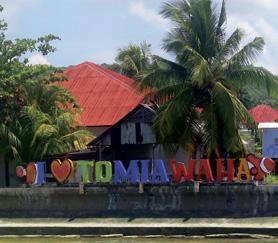
Those who like their travel to be comfortable or prefer the easiest possible journey can reach the Wakatobi Dive Resort by charter flight from Bali. A much more personalised alternative in January was the Marind Dive Eco Resort on the island of Tomia – the‘To’ in Wakatobi, which comprises the islands of Wangi Wangi, Kaledupa, Tomia and Binongko.
Travelling at the island's pace
Marcel, the resort’s co-owner, had already provided detailed information in advance about the various ways to get there, as well as the costs of accommodation and dives. With a bit of luck, it was possible to fly from Kendari to Wangi Wangi. Small boats and a ferry run regularly between the islands. However, timetables can change at any time and are heavily dependent on the weather. Marcel compiled all the available information for travelling to and from Wakatobi from Kendari or Bau Bau and also organised the transfer to and from the port. Particularly in a region like this, whe-
T & F Mandy Groß
re things don’t always go to plan, this is a service you quickly come to appreciate.
Feel at home on Tomia
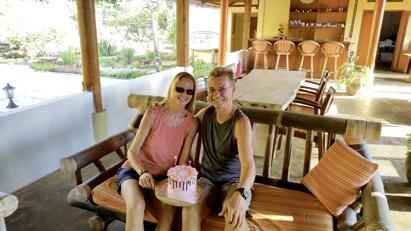
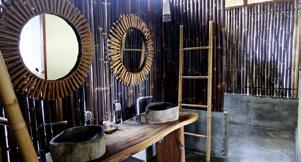
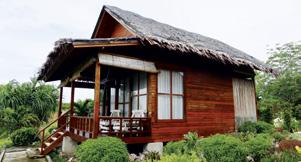
As soon as we arrived on Tomia, we had the feeling that we’d come to the right place. The comfortable and very clean bungalow immediately created a relaxed atmosphere. The stylish, spacious bathroom and the hot shower were a real treat, especially after the dives. From the terrace, the view looked out over palm trees and the sea – the perfect spot to round off the day with an ice-cold Bintang beer at sunset.
Fantastic dive sites in the ' ' right on your doorstep
Wakatobi has long been renowned for its dive sites, many of which are well documented on the luxury resort’s website. The dives here were organised by Marcel together with Ahmad from Wakatobi Marine Dive. Over the course of seven days, depending on the weather and tides, we travelled to the relevant harbours and from
there out to the dive sites in a simple wooden boat. A particularly nice touch: every day, Marcel provided a bag containing towels, water bottles and biscuits. It was pleasing to note that the resort consistently avoids using single-use plastic bottles. Water in glass bottles is also provided in the bungalow. A small detail that leaves a very positive impression.
A feast of coral instead of a mere list of fish from
Even the very first dive was impressive, with a coral wall overgrown with life in every colour and shape. Turtles, small Napoleon wrasse, batfish, clownfish, various groupers, prawns and hunting mackerel almost seemed to fade into the background amidst this riot of colour. The experience remained just as overwhelming on subsequent dives. Alongside magnificent coral landscapes, schools of bannerfish, yellow pyramid butterflyfish and red-toothed triggerfish made an appearance. These were joined by wobberfish in various colour va-
Cuisine with a heart
riations, sea snakes, octopuses, lobsters, stonefish and scorpionfish, nudibranchs and pygmy seahorses.
Time and again, eagle rays and bluespotted stingrays glided through the reef, whilst a shy blacktip reef shark darted past. With a bit of luck, you might also spot a perfectly camouflaged crocodilefish, a large cuttlefish and even tiny orangutan crabs.
The resort also impressed on land. Mama Cantika served varied and exceptionally tasty meals, whilst being flexible in accommodating requests. Breakfast included, for example, Soto Ayam, an Indonesian chicken soup, or Dadar Gulung – green-coloured pancakes filled with coconut and palm sugar. These were accompanied by papaya, pineapple, guava juice and coffee –an aromatic start to the day. There were pleasant surprises even between dives. After an afternoon dive, for instance, a fish soup was waiting – simple, but just right.
A night dive – like something from another world
One night dive in particular left a lasting
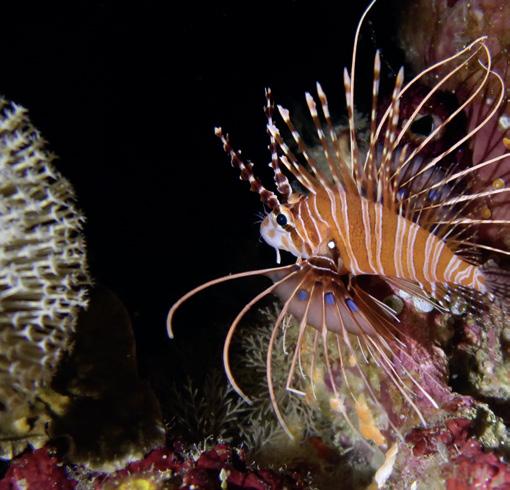
impression. In the gently flowing, fascinatingly overgrown coral landscape, everything seemed like something out of this world. The comparison with Alice in Wonderland almost sprang to mind. The pinhead-sized eyes of countless tiny shrimps glowed amongst the hard corals. Crabs and wandering hermit crabs were about, a turtle slumbered beneath an overhang, and a sea snake rested in the reef. Meanwhile, colourful spiny lionfish seemed to stride across the seabed with their pectoral fins outstretched. The tentacles of the feather stars moved almost as if dancing in the light of the torches. When the dive ended and the group surfaced, it was completely silent. Only the starry sky stretched out over the dark sea.
Everyday life on the island: mopeds, the mosque and sea views
It wasn’t just the underwater world that made the stay so special. The people of Tomia also left a lasting impression – friendly, open and always with a smile or a greeting as you ride your moped across the island or walk to Café Kedai Selly Water Tomia. Every village has a mosque, and it
Wakatobi
takes a while to get used to the muezzin’s call. Sometimes the wind carries the sound away; sometimes earplugs or headphones help. From the hilly interior of the island, there are frequent beautiful views across the green landscape all the way to the island of Sawa. And it’s well worth exploring the local cuisine too: the portion of fried bananas with chocolate and cheese at Café Ershi K20 is considered legendary for good reason – and is easily enough for two.
Beauty with a dark side
As idyllic as Wakatobi may seem in many places, the trip is not without its downsides. Rubbish is a recurring sight on what are otherwise stunning beaches. Even in paradise, the problem of waste is evident. It is a difficult issue that affects many remote island regions.
That is precisely why people like Marcel are remembered so fondly. With great dedication and palpable passion, he has created a place that makes visitors feel as though they have found a home away from home. A ‘homeaway fromhome’ from which to dive into one of Indonesia’s most beautiful underwater worlds.
Conclusion
Wakatobi is not a destination for those in a hurry. Getting there requires flexibility, patience and, at times, a bit of improvisation. But those who are willing to embrace this will be rewarded with an exceptionally pristine underwater world, warm hospitality and the feeling of having arrived in a truly special place. Tomia and the Marind Dive Eco Resort prove that Wakatobi is not just for luxury travellers. Independent travellers, too, will find the perfect conditions here for spectacular dives and authentic island experiences – far removed from mass tourism and right at the heart of what makes a trip unforgettable.
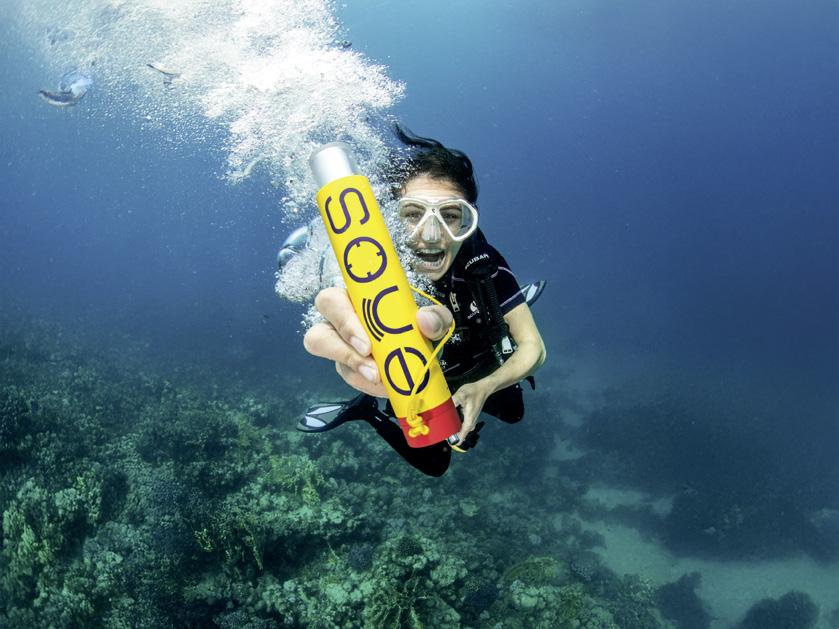
SICHERHEIT ist kein Extra. Sie ist STANDARD.
Mit ENOS® orten Sie vermisste Taucher in Echtzeit – direkt zur Crew, ohne monatliche Kosten, ohne Umwege.
Wenn Strömung, Wind oder Distanz entscheiden, liefert ENOS® präzise GPS-Positionen genau dorthin, wo sie gebraucht werden: an Bord.
ENOS® – weil Sekunden zählen.
GEAR
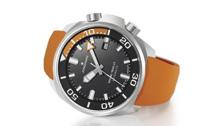
AUTOMATIC WATCH BY JUNGHANS
With the Aquaris, Junghans presents a new range of sporty diving watches. The Diver, Red and Blue models combine striking design with functional technology. An automatic movement with a power reserve of around 48 hours provides the drive, whilst an internal, unidirectional rotating bezel handles typical dive timing. The stainless steel cases are water-resistant to 50 bar and are therefore also designed for more demanding underwater use. Price: €2,690. junghans.de
IDE KOMPRESSOR KICKS OFF THE 2026 SEASON WITH
To mark the start of the 2026 season, IDE Kompressor is highlighting its Fun 110L and Nautic 150L models as versatile highpressure compressors for divers, sport shooters, paintball players and motorsport enthusiasts at . Both units come fully equipped at and feature, amongst other things, an automatic condensate drain with collection canister, automatic endpressure shut-off, a filling connection each for 200 and 300 bar, filter saturation monitoring, an operating hours counter and service interval monitoring. Particularly practical: both pressure ranges can be filled simultaneously, eliminating the need to switch over. The package is rounded off by a five-year full warranty. ide.de
BONUS FOR THE DIVING COURSE
Santi is launching a promotional offer on the Avatar Airon 102 drysuit and the Santi Kango undersuit. When purchasing both items together, customers receive a €200 discount on a diving course. The aim is to promote training, safety and yearround diving. The promotion is designed as a dealer campaign, applies only to new orders and runs until 30 June 2026. Find out more about the promotion at reeldiving.com
CCR AND DPV TESTS IN SLOVAKIA
With the Liberty CCR Test Centre at Lake Košariská, LEVEL3 offers a specialist facility in Slovakia for divers who wish to familiarise themselves with modern rebreather and DPV technology in real-world conditions. The lake, which is up to 40 metres deep, provides ideal conditions for this –both for relaxed recreational diving and for training and practical test dives. As the only official test centre for the Liberty CCR rebreather from Divesoft in Slovakia, LEVEL3 offers all configurations of the system: Liberty Backmount, Liberty Sidemount and Liberty Light. The offering is complemented by the opportunity to test all Seacraft DPV models. Anyone wishing to experience innovative diving technology directly in the water will find optimal conditions for a personalised practical test at Lake Košariská. libertydivers.com
PHOTO CORNER
DAZZLED
Anyone who takes photos with a ‘proper’ camera can’t avoid thinking about the aperture – unless they rely exclusively on programme mode or a smartphone. However, the likelihood of such users taking a serious interest in photography is about as high as a dog stockpiling sausages.
In simple terms, the lens aperture can be compared to a tap: a small opening means a low flow rate; a large opening means a high flow rate. The shutter speed determines how long ‘the water runs’. But the aperture can do more. When it is closed, the depth of field increases – an advantage for close-up and macro photography. At the same time, however, the overall image sharpness decreases. Extreme values such as f/64 or f/90 are therefore not found; for full-frame cameras, f/32 is usually considered the limit. With smaller sensors, this range shifts accordingly. Aperture values are dimensionless ratios. Identical values result in the same exposure – provided the shutter speed and ISO are the same – regardless of the camera system. However, with very small apertures, diffraction occurs: light rays are ‘restricted’, resulting in diffraction spots. If these become larger than the distance between two pixels, the level of detail is compromised. The decisive factor is the pixel spacing, known as the pixel pitch.
The aperture at which depth of field and resolution are in the best balance is referred to as the ‘
’. It can be calculated from the pixel pitch by dividing it by 0.61. If the pixel pitch is multiplied by three, this yields a range above this optimum that, in practice, still operates without any visible loss of sharpness.
Note: The optimal aperture is a compromise between depth of field and diffraction blur. By using it, you can enlarge images significantly without any noticeable loss of sharpness. There is also the ‘critical aperture’, which is the theoretical point of maximum resolution. But that is a topic for another chapter.
Herbert Frei
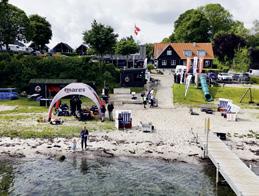
MARES STRENGTHENS ITS PRESENCE IN DENMARK
Mares is expanding its partner network in Northern Europe: With Gl. Aalbo on the Little Belt in Denmark, a new location is being established within the catchment area of Northern Germany. Operator Martin Pedersen is setting up the “Mares Nordic Dive Hub” there – a centre for training, product testing and community events under realworld conditions. The aim is to enhance practical testing and foster dialogue with divers. mares.com and gl-aalbo .dk
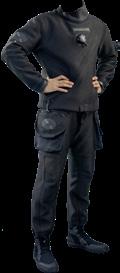
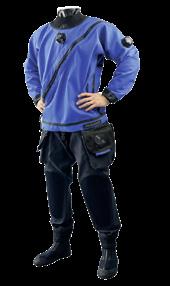
DIVESYSTEM UNVEILS ITS NEW DRY SUITS
With the Solo N Dyneema ,DiveSystem presents a technical drysuit designed for demanding conditions. Highdensity neoprene with a Dyneema outer layer and a titanium inner layer is designed to combine insulation with durability. Pre-shaped sections and reinforcements enhance mobility and durability. Price: from €3,199. Solo Ranger is positioned as a robust trilaminate model in the entry-level range. Lightweight, quick-drying fabric, double-sealed seams and additional reinforcements make it a great choice for beginners with higher expectations. Find divesystem.com and abyssmarine.eu.
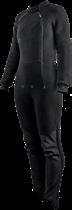
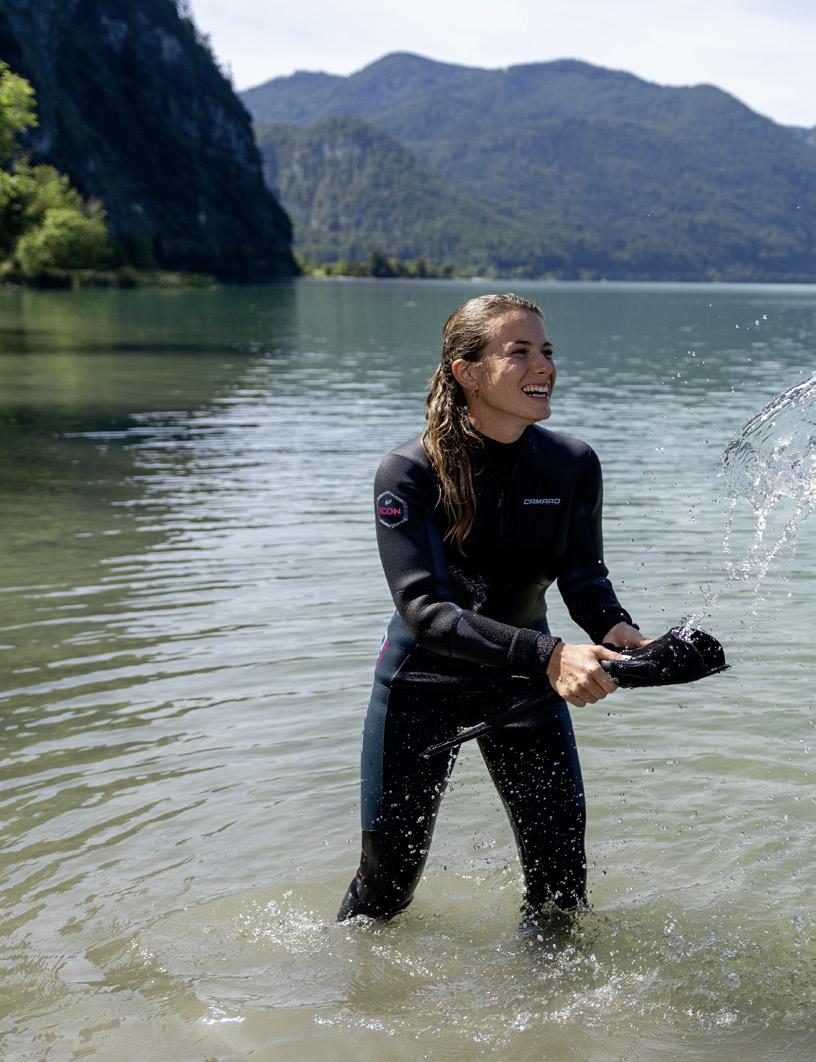
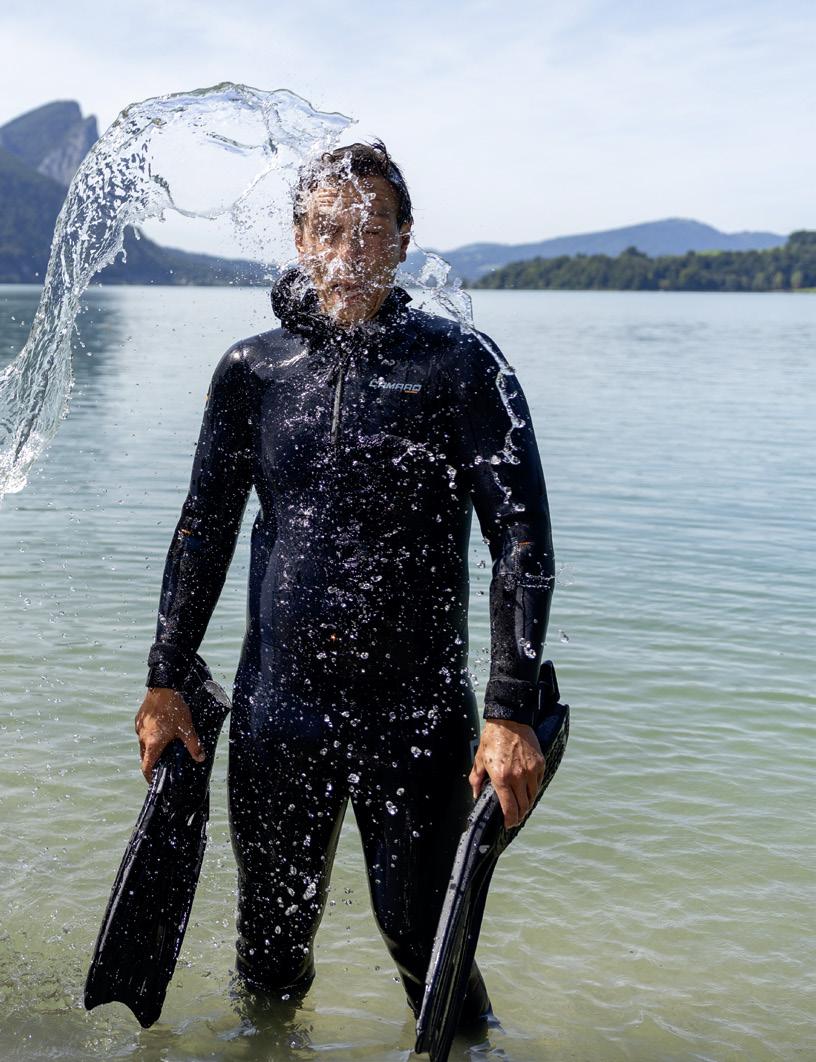
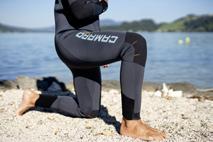
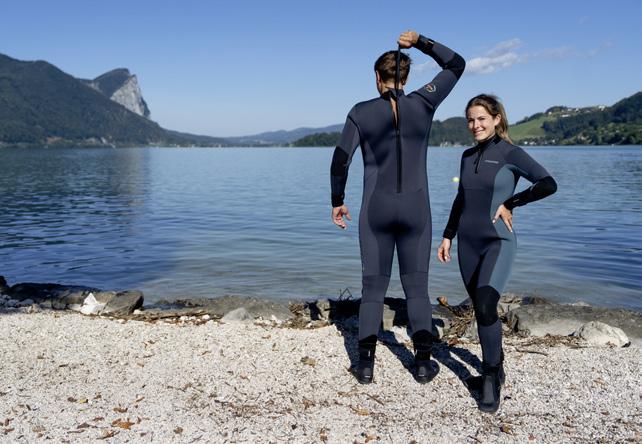
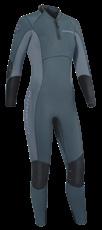
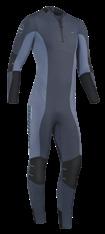
CAMARO IS EXPANDING ITS SEMI-DRY SERIES WITH A NEW MODEL, THE ‘ICON’
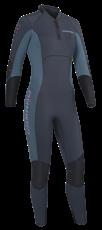
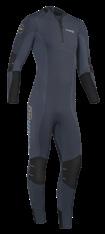
Camaro is launching a new semi-dry wetsuit, the ‘Icon’.
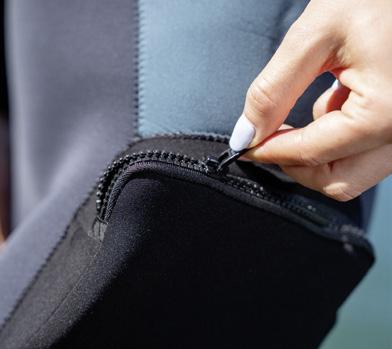
A distinctive feature of the new model is the combination of a back zip and an additional vent zip in the chest and collar area. This design is intended to provide greater comfort, particularly after a dive, when many wetsuits are often felt to be tight and warm around the neck and chest. At the same time, the back zip is designed to make it easier to take the suit off over the shoulders.
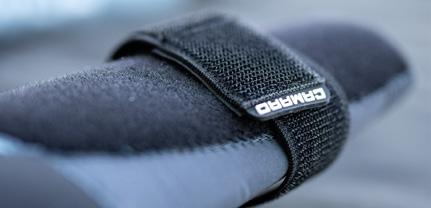
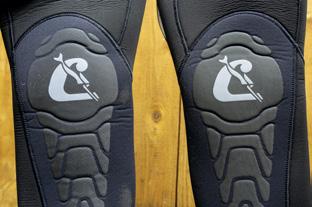
The Icon also features pre-shaped elbows and knees, designed to provide an ergonomic fit, excellent freedom of movement and optimal hydrodynamics. In addition, there is a new wrap-around seal system on the arms and legs. According to the manufacturer, this system is easy to use and can be operated easily even when wearing gloves.
Focus on fit, comfort and waterproofing
The new semi-dry suit is designed to offer freedom of movement and thermal insulation. Its sporty cut is intended to ensure a good fit and a comfortable feel. Pockets are available as an optional extra on the left and right sides.
When it comes to entry, the Camaro features not only a back zip but also the new wrap-around system with Velcro fastenings, which is designed to allow for seamless adjustment and minimise water ingress. In addition, an SCS coating on the inside of the arms and legs makes it easier to put the suit on and take it off.
A G-Lock zip is used at the back, designed to reduce water ingress and thus enhance thermal performance. The front reli-
In addition to the extremely flexible and ‘warm’ fabric, it is the back and neck zips, as well as the Velcro fastenings (wrap-around Velcro) on the arms and legs, that ensure minimal water ingress and a high level of comfort, whilst also making the suit easier to put on and take off.
Photos: Camaro
ef zip on the collar is intended to provide greater freedom of movement and breathability after the dive. This is complemented by an inner collar cuff, which is designed to help ensure the suit’s watertightness. The new collar design is also adjustable in width.
In this model, the new hook-and-loop fastening system on the arms and legs replaces the previous double-cuff system. Whilst the previous system was designed to ensure a tight seal, the new solution is intended to make the suit easier to put on and take off, whilst also allowing for a personalised fit.
More than 50 sizes available
According to the manufacturer, the fit plays a key role in comfort and thermal performance. Consequently, the model is available in an extended range of sizes, with more than 50 options, including king and queen sizes.
The following sizes are available:
• Women: 20–23, 36–46, 72–80
• Queen size: 20–24, 36–48
• Men: 25–29, 48–60, 94–106
• King size: 25–29, 50–60
Furthermore, according to Camaro, adjustments to standard dimensions and bespoke manufacturing are also possible. These services are offered with reference to the manufacturing facilities in Austria.
Available in two thicknesses
The new Icon model is available in 5mm and 7mm thicknesses. According to the manufacturer, the main difference between the two versions, apart from the thickness, is an additional SpinPad in the back section, which is fitted exclusively to the 7mm model.
With the Icon, Camaro is expanding its range of semi-dry wetsuits with a model that focuses on easier donning and doffing, a flexible fit and a redesigned seal construction.
CAMARO
ICON 7 MM
TYPE: Semi-dry wetsuit
MATERIAL:
7 mm neoprene, super-soft and stretchy, with a Dry-Stretch terry cloth inner lining
FEATURES / WORKMANSHIP:
• water-repellent G-Lock back zip
• Front vent zip
• Velcro fastenings on arm and leg cuffs to minimise water ingress
• extra-warm version
SIZES:
Women: 20–23, 36–46, 72–80
Queen: 20–24, 36–48
Men: 26–29, 48–60, 94–106
King: 25–29, 50–60
ITEM NUMBERS:
Women: 69 812 61–99
Men: 79 812 61–99
Queen: 89 812 61-99
King: 99 812 61-99
RRP: €549.95
CAMARO ICON 5 MM
TYPE: Semi-dry wetsuit
MATERIAL:
5 mm neoprene, super-soft and stretchy, with a Dry-Stretch terry cloth inner lining
FEATURES / WORKMANSHIP:
• water-repellent G-Lock back zip
• Front vent zip
• Velcro fastenings on arm and leg cuffs to minimise water ingress
• extra-warm version
SIZES:
Women: 20–23, 36–46, 72–80
Queen: 20–24, 36–48
Men: 25–29, 48–60, 94–106
King: 25–29, 50–60
ITEM NUMBERS:
Women: 69 812 60–99
Men: 79 812 60–99
Queen: 89 812 60-99
King: 99 812 60-99
RRP: €449.95
OPTIONAL ACCESSORIES
A side pocket is available as an optional extra for both versions.
Surcharge: €40.00
SALES: Available from authorised Camaro dealers (see the Camaro website) or at www.camaro.at
HOW CLOSE DOES THE CRESSI LOGICA COME TO A DRYSUIT?
T & F Benjamin Schulze
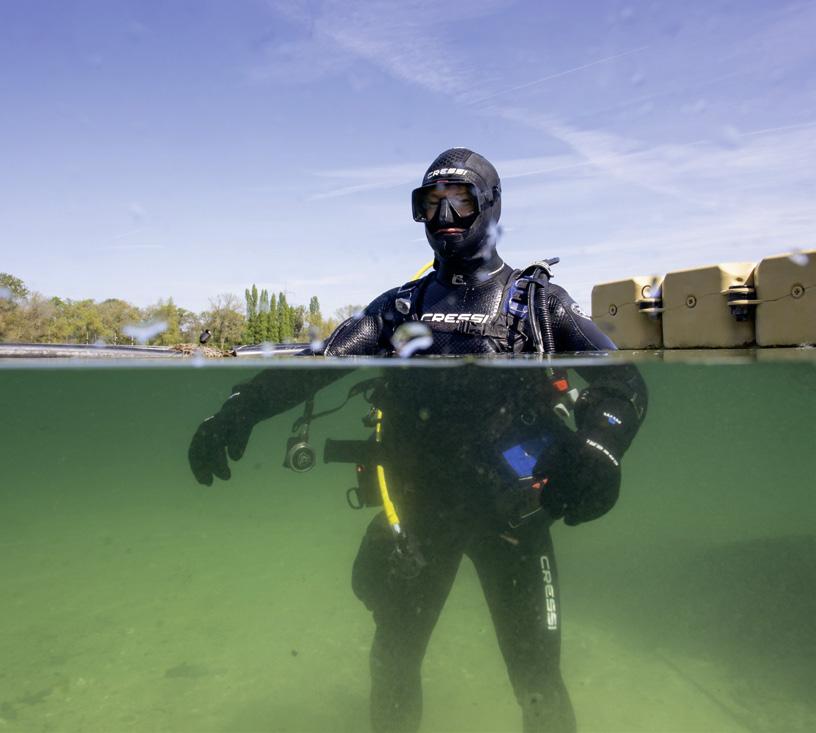
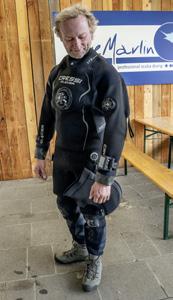
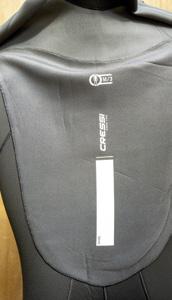
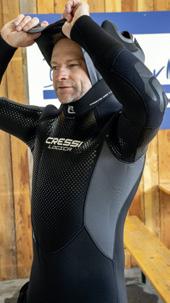
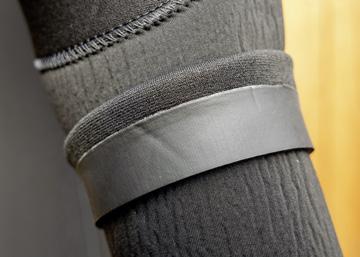
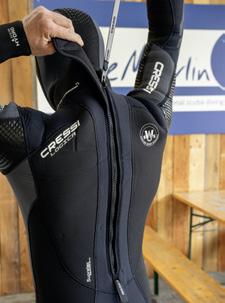
Cressi promises exceptional thermal performance for its Logica semi-dry suit. A practical test in cold water shows just how close the system actually comes to a drysuit.
With a surface temperature of around 16 degrees Celsius, Cressi’s Logica wetsuit does more than just keep you warm. Water flows very slowly into the semi-dry, well-sealed cold-protection suit.
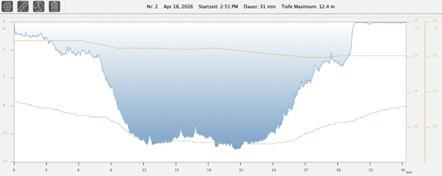
DIVE DATA
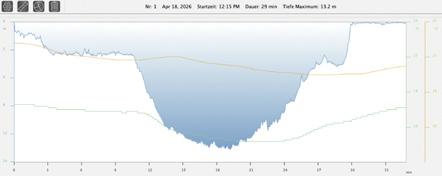
Location: Fühlinger See, Cologne
Water temperature: 6.4 to 16.4°C
Air temperature: 18°C, sunny
DIVE 1 –
CRESSI LOGICA (SEMI-DRY)
Dive time: 29 minutes
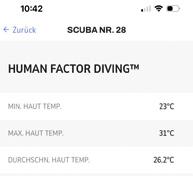
Minimum skin temperature: 23°C
Max. skin temperature: 31°C
Average: 26.2°C
Surface break: 2 hours 6 minutes
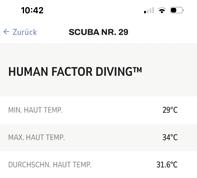
DIVE 2 – CRESSI GLACIER + BASE LAYER (DRY)
Minimum skin temperature: 29°C
Max. skin temperature: 34°C
Average: 31.6°C
Measuring system: Scubapro Galileo G2 with heart rate and skin temperature sensor
The bar has been set high. With the Logica, Cressi is launching a semi-dry suit which, according to the manufacturer’s claims made at this year’s boot trade fair in Düsseldorf, is said to come close to a dry suit in terms of thermal performance. A claim that we must, of course, put to the test.
Feedback from the field is positive. As we prepare the test and look at the two models being compared – a Cressi Logica and a Cressi Glacier – dive centre operator Sebastian Reinwald from BlueMarlin remarks: “The semi-dry suit is probably warmer on a single dive.” It is precisely this impression that the test aims to verify – under realistic conditions and using measurable data.
Test condition
The test took place in Lake Fühlinger near Cologne. Conditions were typical of Central European inland waters: water temperatures ranging from 6.4°C (at a depth of around eight metres) to 16.4°C (at the surface, with an air temperature of 18°C and sunny weather). Two almost identical dives were carried out. First, the Logica semi-dry suit was used. After a warm-up phase of around two hours, this was followed by a comparative dive using the Glacier drysuit in combination with the Cressi baselayer.
To enable an objective assessment, skin temperature was measured continuously. The Scubapro Galileo G2 device, when used in conjunction with a heart rate monitor, records the surface skin temperature at chest level and displays it as a smoothed time series in the logbook. This data allows for a reliable assessment of heat loss during the dive.
Differences
Even on land, a fundamental difference between the two systems becomes apparent. As a one-piece semi-dry suit, the Logica is significantly easier to handle. The soft material makes it easier to get into. The integrated ice vest is pulled over the head from behind. The back zip can be fastened independently. Overall, this results in a ve-
ry straightforward setup that requires no assistance.
The design is well thought out. Smooth-skin neoprene around the neck and face minimises water exchange, whilst internal sealing lips on the arms and legs act as water barriers. Particularly striking is the permanently integrated hood, which extends well into the face, thereby reducing heat loss. At the same time, it requires a little care when putting on the diving mask to avoid leaks at the mask’s sealing lip.
Underwater, that initial positive impression is confirmed. Water enters the suit much more slowly than with many other semi-dry suits. Water ingress remains minimal, particularly around the neck and back. This is very noticeable when moving your head. In this respect, the Cressi Logica is significantly better sealed than many of its wet and semi-dry competitors on the market. After about ten to twelve minutes at depth, cooler water reaches the upper body. Until then, the temperature remains stable.
As the test continued, it became apparent that the measured skin temperature dropped steadily and stabilised at a significantly lower level of 23 degrees Celsius than was later recorded during the second dive with the reference drysuit. Subjectively, the first signs of feeling chilly became noticeable after around 15 minutes. It should be noted that this was in the water layer with a minimum temperature of around six degrees Celsius.
There is a surface interval of just over two hours between the two dives. This time is intended to allow the body to return as closely as possible to its baseline condition. Peripheral areas in particular, such as the hands and feet, take significantly longer to recover fully after a cold-water dive. However, complete rewarming cannot be guaranteed in every case. Theoretically, this could be a potential disadvantage for the second dive in a drysuit. In practice, however, it is evident that, both subjectively and according to the measurement data, the temperature inside the drysuit is higher
MANUFACTURER
CRESSI
Logica
Semi-dry suit
Super-stretch neoprene 8/7/6 mm
One-piece suit with built-in ice vest and hood
Thermospan (chest and back)
internal sealing lips made of smooth-skinned neoprene
Back, YKK plastic
Supratex on the knees, shoulders, buttocks and back
Leg pocket with D-rings
integrated
approx. 2.5 kg
PRICE (RRP)
WEB
€449.99
cressi.com
The Glacier reference drysuit is made from 4mm-thick neoprene. It is designed to match the Logica in terms of insulation properties, including a thin base layer.
The ice vest provides extensive protection for the back against water ingress. It is stitched and bonded – solidly constructed.
The suit is put on from the front. The hood is then pulled over the head from behind.
The suit can be fastened easily on your own without assistance, ensuring a very good seal around the neck.
Internal water drains on the arms and legs further reduce water penetration.
Abrasion-resistant Supratex reinforces not only the knees, but also the elbows, buttocks, shoulders and back.
from the outset and remains more stable throughout the entire dive.
During the subsequent dive in the Cressi Glacier drysuit, a different thermal profile becomes apparent right from the start. The initially higher skin temperature is primarily due to the warming base layer. As the dive progresses, however, the decisive difference is determined by the system itself: the insulating layer of air within the suit prevents water exchange, thereby significantly reducing heat loss. Consequently, the drop in
temperature at chest level. Whilst the drysuit keeps the temperature fairly constant, the semi-dry suit shows a more pronounced and larger ‘dip’ in the curve.
temperature is much slower, and the readings remain more stable overall. This impression is also confirmed subjectively: particularly at depth, at around six degrees Celsius, the system feels noticeably warmer and allows for longer dwell times without a pronounced sensation of cold.
Our test results clearly confirm this impression. The drysuit outperforms the semi-drysuit in all relevant parameters. Nevertheless, it is striking how close the Cressi Logica comes to these figures. For a semi-drysuit, the measured performance is above average.
The assessment is correspondingly nuanced. The Logica does not match the performance of a dry suit, particularly in single-digit temperatures. At the same time, it offers an unusually high level of thermal insulation for this type of suit. In waters with double-digit temperatures, it can be a realistic alternative.
There are also many practical advantages. The Logica costs less than half the price to buy, requires significantly less lead – around four kilograms – and is easier to transport. Underwater mobility is excellent. This is because the suit is eight millimetres thick in the temperature-sensitive
areas on the front and back. On the arms, legs and elbows, it is only seven or six millimetres thick for greater mobility. Furthermore, the suit is three-dimensionally preshaped. Putting it on and taking it off is straightforward, as you don’t need a partner’s help. Unlike a drysuit, no additional diving skills or experience are required. This positions the Logica as a comfortable all-rounder for ambitious recreational divers who regularly dive in cooler waters without wanting to put up with the complexity of a drysuit system.
Conclusion
The Cressi Logica is one of the most highperformance semi-dry suits currently available on the market. It comes closer to matching the thermal performance of a drysuit than many comparable systems. However, one thing is clear: even this suit does not quite match the insulation performance of a drysuit.
Its strengths lie in the combination of comfort, ease of use, impressive insulation and a reasonable price of €449.99. It is a serious contender for moderate to cool waters. In very cold water, however, the drysuit remains the gold standard. This assessment
was also confirmed by dive centre operator Sebastian Reinwald following the test.
An important point to remember with all wetsuits: it’s all about the fit. When buying one, we therefore recommend seeking expert advice from a specialist shop with experienced staff.
Acknowledgements
The practical tests were carried out with the support of Tauchsport BlueMarlin. Many thanks for the logistical assistance on site.
You can find a video of the suit being tested on our YouTube channel.
The image above shows the Glacier drysuit, and the one below shows the Logica semi-dry suit. Green indicates water temperature, and yellow indicates skin
MANUFACTURER
Model name
Type (watch/classic)
Dive modes
Battery type
Battery life
computational model
Material
Weight (g)
Colours
Display type
Connectivity
Website address
Price (RRP)
T Benjamin Schulze
DIVE COMPUTERS UP TO € 400 –AN OVERVIEW OF NINE MODELS
Somewhere between entry-level and upper mid-range: in the € 400 price bracket, simple user interfaces meet colour displays, modern algorithms and, for the first time, genuine differences in features.
The range is growing – and so are the differences. Whilst traditional segment displays continue to focus on robustness and clarity, newer models offer colour screens and BT connectivity. The following overview compares nine current devices side by side. There are devices
in watch format, but also those with extra-large, easy-to-read displays. Some are even tubeless and gas-integrated. The transmitters are, of course, not included in the price. That would be asking a bit too much for a price under 400 euros. <<
SPACE MEETS OCEAN: RESEARCH INTO SEAGRASS BEDS IN THE MALDIVES
Seagrass forms extensive meadows in many of the world’s marine regions and provides a vital habitat for numerous species. At the same time, these ecosystems play a key role in the global climate system, as they sequester carbon in the seabed over the long term. As part of the international research project COASTS, the companies Submaris, Fugro, EOMAP and the Maldives Space Research Organisation (MSRO) are working together with local partner organisations in several countries to systematically map the extent and condition of these valuable ecosystems.
In April, research divers from Submaris were deployed in the Maldives, where a total of eight different species of seagrass are found. The seabed off selected islands was examined in detail using a towed camera system. The seagrass species present were identified and sediment samples were taken using coring tubes. These samples were then analysed in the laboratory to determine their carbon content. Carbon plays a key role in the climate system, as it can be sequestered in organic material over the long term, thereby contributing to the reduction of greenhouse gases.
Another key component of the project is the integration of underwater observations with satellite data. The underwater images captured by Submaris are used by the Maldives Space Research Organisation (MSRO) to develop and refine algorithms for the automated detection of seagrass beds in satellite images. The aim is to enable large-scale and efficient mapping of these ecosystems from space in the future.
Despite challenging conditions – including a severe heatwave that pushed both the researchers involved and the camera systems to their limits – the work was a success. The team is documenting numerous healthy seagrass beds and gathering important data for the protection and sustainable management of these habitats. Through the COASTS project, the participating partners are making a significant contribution to a better understanding of marine carbon sinks and to the development of innovative methods for their global monitoring.
Photos: Florian Huber (4), Alfred Wegener Institute / Hanna Knahl, Patrick Scholz
One of the islands studied was Kanuhura in the Noonu Atoll.
Marine biologist , along with Philipp and Schubert, is investigating the shoot density of a seagrass bed.
Stingrays also thrive in seagrass beds.
A nurse shark swims through a seagrass bed off in search of food.
BOOK
RECOMMENDATION:
THE WORLD’S MOST FAMOUS SHIP AND ITS GREAT SECRET
The story of the Titanic continues to fascinate millions of people to this day. More than 100 years after it sank, the legendary ship lies at a depth of around 3,800 metres on the floor of the North Atlantic – and still poses a mystery to researchers. In *WAS IST WAS Titanic*, author Dr Florian Huber takes children aged eight and above on an exciting journey into the past and down into the mysterious depths of the ocean. With impressive images, children explore the famous shipwreck. The book vividly and grippingly recounts the dramatic events surrounding the ocean liner’s maiden voyage – from its construction in Belfast to the collision with the iceberg in the North Atlantic. Why was it considered unsinkable? Who was on board the ship? What happened on the night of 14 April? In 1985, the wreck of the Titanic was discovered by Robert Ballard. Since then, scientists have been exploring the ship’s remains using stateof-the-art technology. Diving robots, special cameras and deep-sea submarines are constantly providing new insights into the course of the disaster. Available from 22 June 2026 for 24 euros.
HOW DID THE EARTH’S MOST POWERFUL OCEAN CURRENT— —COME INTO BEING?
It carries well over 100 times as much water as all the world’s rivers combined: The Antarctic Circumpolar Current flows unimpeded by landmasses around the southern continent, making it a fundamental component of the climate system. A new study by the Alfred-Wegener Institute (AWI) reveals how the Earth’s most powerful ocean current, the Antarctic Circumpolar Current, came into being. For a long time, the opening of sea passages around Antarctica was considered the main cause, but that alone is not enough. Rather, the decisive factor was the interplay of continental drift and strong westerly winds, which really set the current in motion. Around 34 million years ago, this process led to a fundamental climate shift from a greenhouse to an icehouse climate. It is also surprising that the current developed unevenly at first, and the Southern Ocean was at times divided into two distinct regions. To investigate this, the researchers used complex climate simulations that link the ocean, atmosphere and ice sheets. The results help to better understand past climate changes and predict future developments more accurately.
A model of the Antarctic Circumpolar Current in its early stages.
OUR EXPERT
DR FLORIAN HUBER reports here every month on the latest news from the world of underwater science. He himself is an underwater archaeologist and a research diver (florian-huber.info).
GERMANY’S
FUTURE WATER IS LOCATED ON THE
It is thanks to this quote that there are also German wrecks from the Imperial era in the Baltic Sea. The Imperial cruiser ‘Wacht’ has lain dormant in the depths for 125 years. Only a few divers have ever reached this remote location north-east of Rügen.
T Elmar Klemm F Erhard Schulz
Photo: Montage by Holger Buss & Erhard Schulz
EXPERTS °BALTIC
In 1887, the German Empirewasfully in the grip of industrialisation. Steam-powered machinery was replacing traditional craftsmanship and reshaping the economy, whilst cities were growing at a rapid pace. Emperor Wilhelm II sought to establish global power and prestige through a farreaching colonial policy. To achieve this, he needed a strong naval fleet.
A clear example of his determination is the opening of the Kiel Canal in 1895 – then still known as the Kaiser Wilhelm Canal. His zealous ally, Admiral Alfred von Tirpitz, drove this development forward with a series of naval laws. Shipyards expanded in response to the new volume of orders. There was talk of the enthusiastic spirit of a ‘naval nation’, and orders were eventually placed for, among other things, 17 battleships, eight armoured ships and 35 cruisers.
At the opening of the port of Stettin, the Emperor declared: ‘Germany’s future lies on the water.’ The arms race with the maritime power of Great Britain was now in full swing.
Flexing one's muscles
Politics at sea took on a new significance, closely linked to Europe’s colonial ambitions. As part of the naval rearmament programme, the reconnaissance vessel *Wacht* was commissioned in 1888, amongst other vessels. Although this type of ship is regarded today as a modest feat of engineering, the vessels of this *Aviso* class primarily fulfilled ceremonial duties. Not least, the elegant bow figurehead, crafted from colonial teak, is reminiscent of the elaborately carved figureheads of earlier warships. A deliberate impression: those who can afford these ships build not only quantity, but also quality.
Latest exchange rate for Poland
After several voyages and periods in dry dock, the small cruiser Wacht was ordered
to the Baltic Sea in August 1901 for the autumn manoeuvres. From Kiel Bay, the entire manoeuvre fleet set sail towards Danzig Bay. North of Rügen, the SMS Hela and the Wacht were ordered to break through to port side through the fleet steaming in a line abreast.
During this manoeuvre, however, the Wacht ended up in front of the SMS Sachsen and was rammed amidships. All 144 crew members were rescued. The ship, however, was lost. It sank about eight nautical miles off Cape Arkona. There, the Emperor’s proud ship still lies on an even keel to this day. It was not until 1980 that the wreck was rediscovered by the Institute of Marine Research.
war debris
Reinhard Öser has been organising expeditions on the Baltic Sea for 20 years. As part of projects with Marine Research Germany, he has also carried out several surveys of the Wacht wreck since the start of the century.
A safe yet rewarding dive to a wreck such as the Wacht, lying 40 metres deep in the middle of the Baltic Sea, depends on a number of factors. Firstly, you need a large, seaworthy boat that is tailored to the needs
of divers. It requires an experienced skipper who can accurately assess the weather and sea conditions and thus determine the best day and time for the descent. It is also essential to have an expert on board who can locate the wreck using side-scan sonar and echo sounder. The shotline can then be set and its anchor positioned as close as possible to the wreck.
The experienced underwater photographer Erhard Schulz has been on several of these dives and has also dived the watch: “Our two-masted schooner, the Zephyr, with 22 divers on board, heads towards the set shotline with an elegant sweep and comes to a halt ten metres in front of it. The dive leader gives us the go-ahead. We jump into the choppy Baltic Sea in pairs and, with just a few fin strokes and aided by the current, drift towards the shotline buoy. After a brief discussion, we begin our descent. We push the pace to save as much breathing gas as possible for our time at the wreck. The visibility is excellent today. The first outlines of the Wacht become visible at just 30 metres. We stop at the bow; the view is breathtaking: for a ‘small’ cruiser, this is a mighty ship. We attach our strobe light. It flashes at regular intervals, enabling us later to locate the shotline for the ascent.”
The “Öser Tours” are now the only Baltic Sea liveaboard trips that take place on a regular basis. Places are therefore in high demand and the waiting lists are long. Here is the 2025 tour team.
Dive to the SMS Wacht
Then the exploration begins. The towering bow alone is a highlight. Most of its elaborate ornamentation has disappeared – either through decay or due to unforgivable looting of the wreck. The anchor lockers and the remains of a foremast are also visible.
We drift towards the central nave, passing a massive anchor winch, and see beautifully overgrown mooring bollards, ventilation pipes and many deck structures that are no longer clearly identifiable. For the flora and fauna covering everything sometimes seem like a mask.
We descend on the starboard side and can peer into the interior through holes caused by rust. On the port side, other divers are currently illuminating the scene with their powerful torches – a fascinating sight. We could dive into these cabins, but we shy away from the risk: our rising air bubbles would dislodge rust particles and sediment from the ceiling and potentially reduce visibility to zero within seconds. We have now been exploring the wreck for 18 minutes at depths of between 35 and 40 metres; our gauges read 80 and 90 bar. It is time to turn back. Thanks to the flashes of light, we head straight for the shot line. Then begins the long ascent with its decompression stops.
A descent to the Wacht is only suitable for very experienced divers. Given the often limited visibility in the Baltic Sea, diving in pairs is ideal. Groups of no more than three should be the maximum. The length of time spent at a deep-lying wreck depends on the divers’ level of experience, the equipment used, and their specific objectives – such as exploration, photography or video. Given the significant logistical and undoubtedly financial costs involved, hardly anyone would want to spend just five minutes at such an enticing site. Consequently, much longer dive times are planned – meaning that decompression stops of
For a week, up to 30 divers are on board a gaff-rigged schooner. This means that everything has to be organised down to the last detail. It’s well worth the effort: this long voyage makes it possible to reach even the most remote locations. Not many people have ‘watch’ written in their logbook.
varying lengths are necessary during the ascent. The SMS Wacht and the SMS Undine enjoy a special status among Baltic Sea divers. They are the only artefacts discovered to date from the period before or around the First World War in our waters.
The fact that both wrecks lie at depths of between 40 and 50 metres must almost be regarded as a stroke of luck, as this spares them from mass tourism and all its associated consequences.
Although they can only be visited by highly experienced or technical divers, much of these historically significant shipwrecks has already been lost. It is to be hoped that these unique monuments in the Baltic Sea will not suffer further damage.
HMHS BRITANNIC
T & F Martin Strmiska
Off the coast of the Greek island of Kea, the Britannic – the world’s largest passenger shipwreck – lies on the seabed. A dive to this ship is more than just a technical project – it is a journey into the depths, into history and to the limits of what is possible.
Thedescent along the shotline takes six minutes. Six minutes during which the visibility and colour of the water keep changing, until the light blue gives way to a uniform, deep dark blue. The dive computer reads 80 metres when, suddenly, something huge takes shape beneath me. For a moment, everything goes blank. Images flash through my mind: the arid coast of Kea, the face of our guide Jorgos, historical photographs of the Titanic, fragments of the preparations. A wave of heat courses through my body. With my finger on the inflator valve of the drysuit, I slow the rapid descent. Only when I am neutrally buoyant does calm return. Time and space fall back into place. I am here. And yet the line leads further down. The hull of the wreck at a depth of 90 metres looks like a vast plateau that vanishes into the blue in every direction. Only the small window openings reveal that this is not a rock formation, but a man-made structure. The seabed remains invisible. The final stop on this starry journey lies another 30 metres deeper.
The rear
I clip my marker to the shotline and check the second rebreather before making my way towards the stern. Only now does the true scale of the ship become apparent. As I descend slowly along the distinctive shape of the stern, the massive propellers come into view.
If there is one truly monumental scene underwater, it is the stern of the Britannic. Thanks to the exceptional visibility and the enormous dimensions, this is the largest scene I have ever photographed. Divers attempting to illuminate parts of the wreck appear almost unrealistically small next to the seven-metrewide ship’s propellers. These propellers, which once propelled the 269-metre-long steamship at around 43 kilometres per hour, now lie motionless, overgrown with mussels and sponges. From a depth of 100 metres, the seabed at 120 metres is still clearly visible. Even the view from above of the massive structure, which disappears down into nothingness, has an almost mystical effect. The perspective from below, however, is majestic.
But here’s the thing: this approach is time-consuming. Every minute spent at a depth of 115 metres requires around ten minutes of decompression. The sheer size of the wreck means that every movement, every shot and every change of position takes time. Dive time is precious. And it slips away quickly. It is only during the long decompression that the mind begins to link the experience with the ship’s history.
The third ship
The Britannic was an Olympic-class passenger ship, built by Harland & Wolff in Belfast. The first ships in this class to be built were the Olympic and the Titanic – vessels
designed not for top speed, but for size, comfort and prestige. Both were colossal for their time: over 269 metres long and just under 29 metres wide.
Construction of the third ship in the class began on 30 November 1911. Following the sinking of the Titanic in April 1912, the Britannic was redesigned and fitted with additional safety measures. More lifeboats were installed, and the number of watertight compartments was increased from 16 to 17. The ship was launched on 26 February 1914.
However, the Britannic was never to serve as a luxury transatlantic liner. With the outbreak of the First World War, she was requisitioned and converted into a hospital ship. The luxurious interior gave way to a functional layout with space for 3,300 wounded. Even the first-class dining room was converted into an intensive care unit.
The Downfall
On 12 November 1916, the Britannic left Southampton bound for Lemnos on her sixth voyage. On the morning of 21 November, some three kilometres off the Greek island of Kea, she struck a mine believed to have been laid by U-73. Although the explosion caused severe damage, initially only six of the 17 watertight compartments flooded. The ship therefore remained afloat for the time being and could actually have survived the accident. However,
portholes along the lower deck were open. As the list increased, they fell below the waterline, and water flooded into further critical areas.
Captain Charles Bartlett tried to run the ship aground near Kea. But there was no time left to do so. Shortly after 9 o’clock in the morning, the Britannic sank. Unlike the Titanic, 1,036 people were rescued when the Britannic sank. Only 30 people lost their lives – though this was due to a tragic error during the evacuation. Two lifeboats were lowered into the water too early and without the captain’s permission. As the stern rose, the boats were caught in the still-rotating propellers. The propellers smashed them to pieces. 30 people died.
A wreck instead of Atlantis
On 3 December 1975, Jacques-Yves Cousteau discovered the wreck of the Britannic more or less by chance. His expedition had actually been searching for the legendary city of Atlantis. Instead, they found the Britannic lying on its starboard side at a depth of 119 metres.To this day, it remains the largest passenger shipwreck in the world on the seabed. Only a few hundred divers have so far had the opportunity to see it at all. In 1996, the wreck was purchased by maritime historian Simon Mills for £15,000 – allegedly to ensure its best possible preservation.
Monumental in appearance, tragic in detail: when the bow of the HMHS Britannic struck the seabed in the Aegean Sea, the stern was still above water –the scar on the hull still bears witness to its sinking to this day. The propellers of the HMHS Britannic give an immediate sense of its immense scale: the diver appears tiny next to a structure that measures almost 30 metres from the deck to the deepest propeller blade.
EXPERTS °BRITANNIC
Kea decides
On the next day of the expedition, the weather isn’t playing ball. The sea doesn’t look particularly rough. But for a three-and-ahalf-hour technical dive in these conditions, it’s not a question of what’s feasible, but of what’s sensible. The Kea Divers crew opts for a conservative approach.
Added to this is the shipping traffic. Large tankers and container ships en route to Greek and Turkish ports cross the Kea Strait, which is just 14 kilometres wide –right where the Britannic lies. Any unintended drift during decompression would be extremely dangerous here.
So, a break. And actually, a day off from diving between several demanding trimix dives is no loss at all. Gazing out to sea from the Agios Nikolaos lighthouse is part of the same story. Somewhere around here must have stood those islanders who spotted the Britannic in distress and alerted the Greek fishermen, who later pulled many people from the water.
Bridge, bow, shadow
On the second dive, my mind is calmer. A 200-metre journey on the DPV across a semi-open promenade deck leads to the bridge. On the left-hand side, a wooden inlaid floor has survived more than 110 years underwater.
Yet one’s attention inevitably drifts to the doors and openings that lead deep into the ship’s interior. It is hard to shake off the thought of those spaces and the artefacts that might still be hidden there. However, entry is strictly forbidden. So all that remains is to look from the outside.
At the bow, the scene takes on an almost sacred quality. The dim light, the darkness and the sheer scale lend this part of the wreck a special atmosphere. The crack in the hull bears witness to the force of the explosion. It is remarkable that, although there was 119 metres of water beneath the ship as it sank, the bow had already struck the seabed whilst the stern was still protruding from the water. In the process, the bow broke off partially and was deformed
Boilers: 24 double-ended and 5 single-ended coal-fired boilers
Chimneys: 4
Masts: 2
Propellers: 3
Power: 51,000 IHP
Waves: 3
Speed: 43 km/h
Capacity for wounded: 3,300
Medical staff: 437
Officers and crew: 724
Passengers on the final journey: 1,066
under the ship’s enormous weight. And yet the fore section is in surprisingly good condition. Steel cables hang down as if they still intended to raise the mast. Heavy chains lie coiled on the deck as if the anchoring manoeuvre were still to come. Several lanterns rest in a crevice as if they might one day be lit again.
The site’s excellent condition makes this dive a truly exceptional visual experience. Here, history isn’t confined to the pages of books, but lies right before your eyes – in steel, shadows and structure. Yet underwater, time passes differently. On the one hand, it seems to stretch out; on the other, it races by. No sooner have I captured a few striking images than the dive computer is already indicating three hours of decompression.
The long road to the top
The return journey is long and monotonous. Yet that is precisely where its value lies. The decompression gives the mind time to process the impressions. With a wreck of this size, 30 minutes of bottom time is barely enough to really take in even a single section. Dozens of dives would be needed for a thorough exploration. The Britannic is not a wreck that you simply ‘dive’. It is a project, a logistical feat, a historical space and a place that demands humility. That is precisely why it remains one of the most spectacular wrecks in the world – and one that is accessible exclusively to technical divers. Fancy a trip to the ‘Britannic’? See Travel News on pages 16/17.
FACTS: HMHS BRITANNIC
EXPERTS°
WRECK MICHAEL N. MARIS
T Sabrina Belloni & Ph : Franco Banfi
SILENT GIANT
Off the coast of the island of Vis, at a depth of 80 metres, lies the ‘Michael N. Maris’, one of the most spectacular wrecks in the Adriatic. Its discovery combines maritime investigation, technical precision and the fascination of deep wreck diving.
EXPERTS°
WRECK MICHAEL N. MARIS
Deepbeneath the surface of the Adriatic Sea, off the rugged coast of Sika od Brusnika in the Vis archipelago, a ship has lain in complete silence for decades. Enveloped by the sea, overgrown with gorgonians and almost forgotten by time, there lies the Michael N. Maris, formerly the Adriatico – a cargo steamer that sank in the summer of 1932 on its final voyage. The wreck was discovered by Lorenz Marović and his son Andy, who set out with remarkable perseverance in search of traces of a long-lostship. Over the course of months, they gathered accounts from elderly islanders, compared memories, studied historical sources and analysed nautical charts. What began as a vague lead gradually became a focused search.
Eventually, they fitted their boat with a high-resolution side-scan sonar and began systematically mapping the seabed – particularly in those areas that had been familiar to local fishermen for generations. Such
Depth and diversity – plenty of everything at : coral and fish life abound in the zone between 60 and 80 metres. These are joined by ‘remnants’ from the days when the wreck was still a ship. However, its location off the island of Brusnik means that it is only accessible to experienced technical divers.
a sonar system emits sound waves, the echoes of which are recorded after they have been reflected off the seabed or objects. This produces precise images of the underwater landscape. Moving in fan-shaped patterns, the device scans the seabed far to both sides, revealing what remains hidden from view.
Then came the moment that makes every search worthwhile: clear contours appeared on the screen, providing clear evidence of a large object on the seabed. The sonar image left little room for doubt. Down there lay a ship.
This marked the start of the second phase of the expedition: verifying the sonar data through technical dives. I joined a team of professional divers and technicians to photographically document this extraordinary discovery. Together with Tom Baier and three other technical divers, I planned the dives down to the smallest detail. After all, at depths of between 60 and 80 metres, nothing is left to chance. We decided to use closed-circuit rebreathers as well as additional bailout tanks containing various gas mixtures of helium, nitrogen and oxygen. Only with such equipment is it possible to remain at this depth for sufficiently long periods whilst ensuring safety. The aim was to gather as much information as possible in order to identify the wreck beyond doubt and capture it on camera.
Precise dive planning is essential, parti-
cularly on an expedition of this kind. Every step must be thought through in advance, every reserve must be in place, and every eventuality must be taken into account. Redundancy is not a luxury, but a necessity –even if this means more equipment, more weight and significantly greater logistical demands. Equally crucial is experience in handling the equipment: both in ideal conditions and in an emergency.
On the first day of the mission, we descended to the spot where the sonar had detected a large ship at a depth of 80 metres. Even before we began our descent, the tension was palpable. The silhouette of the wreck had been clearly visible on the monitor, and with every passing minute, the certainty grew that an extraordinary discovery awaited us down there. The thought of diving down to a place that no one before us had ever explored lent the moment an almost surreal intensity.
But at such depths, enthusiasm must immediately give way to discipline. Anyone taking photographs at a depth of 80 metres is working under conditions that allow for
absolutely no margin for error. The ambient pressure there is around 9.5 bar, and the same rule applies to both the diver and the equipment: every move must be precise. There is no room for improvisation. There is no time to experiment with camera settings or to reconsider decisions. At such depths, an underwater photographer must not only master the technical and creative fundamentals of their craft, but also have a detailed understanding of the requirements of technical diving, dive planning and the equipment used.
Our no-decompression limit was just 45 minutes, but the entire dive lasted 161 minutes. Of these, 113 minutes were spent on decompression stops at various depths –a long, controlled ascent to the surface, necessary to safely desaturate the body.
What we found down there was as impressive as it was moving: the wreck of the Michael N. Maris, a large steamship which, on 12 July 1932, presumably as a result of a navigational error, ran aground on a reef near the small island of Brusnik and sank shortly afterwards after taking
TECHNICAL SPECIFICATIONS
Type: Cargo steamer
Name: Michael N. Maris
(formerly ‘Adriatico’)
Nationality: Greece
Year of construction: 1899
Shipyard: Russel & Co., Port , Glasgow, United Kingdom
Overall length: 105.1 m
Width: 15.2 m
Height: 8.71 m
Displacement: 3,963 tonnes
Tonnage: 1358 GRT
Propulsion: triple expansion
steam engine by Blackwood & Gordon, Paisley, 345 hp, one propeller
Sinking: on 12 July 1932, the * * ran aground; the * * sank on 13 July 1932
Cause: probably a navigation error
Location: Sika od Brusnika
Coordinates: 42° 59.970′ N, 15° 47.899′ E
Maximum depth: 82 m
Minimum depth: 61 m
Current: usually weak
Visibility: usually very good
Historical significance: high
EXPERTS° WRECK
MICHAEL N. MARIS
on large amounts of water. On its final voyage, it was transporting coal from Danzig, now Gdańsk, to Trieste. Measuring 105.1 metres in length, 15.2 metres in width and with a draught of 5.5 metres, it is still considered the largest shipwreck in the waters around Vis.
From the steamship Adriatico to the Michael N. Maris
The ship was built in 1899 by the Russel & Co. shipyard in Port Glasgow, Scotland, for the shipping company Eredi C. Cav. Gerolimich & Co. of Lussinpiccolo, now known as Mali Lošinj. At that time, Port Glasgow
Shipowners in the Austro-Hungarian merchant navy also followed this trend. They sold their sailing ships and invested in modern steamships, which they had built either at home or abroad, depending on availability. The Adriatico was a typical cargo steamer of its time – and at the same time a remarkably large ship. Its steel hull had four cargo holds, two masts and a superstructure situated amidships. Its displacement was 3,963 tonnes, and its freeboard was 8.7 metres.
According to the historian Julijano Sokolić from Mali Lošinj, the ship belonged to a shipping company that was experien-
was a major centre of international shipbuilding. By the end of the 19th century, the steam engine had long since proven its superiority in merchant shipping. Compared to sailing ships, it was less dependent on the weather and wind, more predictable in operation and more economically efficient. The elegant sailing ships with their white rigging were increasingly supplanted by smoky, sturdy steamships, which, although less graceful in appearance, were able to transport larger loads more reliably.
cing a period of rapid growth at the time. Following the acquisition of the steamers Bolivar and Quarnero, the Adriatico represented a further significant step in the expansion of the fleet. By the end of 1903, the company already had nine ships at its disposal, thereby occupying a leading position among the freely operating steamship companies of the Austro-Hungarian merchant navy.
A wreck from with an extraordinary presence
Today, the Michael N. Maris presents itself as a wreck of extraordinary charm. The sunken cargo steamer is not only remarkably well preserved, but also almost entirely covered in marine life. Thick layers of gorgonians cover large parts of the structure, red fan corals cling to the steel and railings, and bright yellow sponges add splashes of colour to the blue of the Adriatic Sea.
The marine life around the wreck is also impressive. On good days, you’ll encounter dozens of John Dory (Zeus faber), which appear to be standing motionless in the water. If you dive from the bow back to the midsection, you can sometimes count over ten of them. In the open water, European seabream (Dentex dentex) swim past, scorpionfish linger amongst the gorgonians, and in sheltered areas of the wreck, you can spot lobsters and moray eels.
The condition of many of the details is particularly fascinating. For a long time, portholes, lamps, a chronometer, crockery, bottles and numerous everyday items from life on board remained visible – relics of a crew whose daily routine came to an abrupt end when the ship sank. Even the ship’s bell was initially still visible, but was later removed by unknown persons.
Between adventure and responsibility
As with all significant shipwreck discoveries, the story does not end with the discovery itself. In accordance with Croatian law, the wreck was reported to the relevant state and military authorities. Following an official investigation, diving is now permitted when accompanied by local diving centres, provided they hold the necessary permits and comply with legal requirements.
This is precisely where the significance of a discovery such as the Michael N. Maris lies. Such wrecks are far more than just spectacular dive sites. They are maritime cultural monuments, preserved testimonies to the history of technology, trade and human destiny. Those who dive down to them encounter not only steel, marine
growth and schools of fish, but also a past that lives on at the bottom of the sea. The Michael N. Maris is more than just a wreck. It is a silent witness to a bygone era. A ship that, almost a century after its sinking, still tells stories. For those who are prepared to dive deep enough.
TRAVEL INFORMATION
BEST TIME TO VISIT
The climate on the Croatian island of Vis is milder than in many parts of the Dalmatian coast. The season for recreational divers runs from early May to late September. For experienced technical divers, dives are generally possible there from March to October.
HOW TO GET THERE
The island of Vis can be reached by ferry from Split and Hvar. Split has an international airport.
DIVING CENTRE
Manta Diving Centre, Komiža, Island of Vis, www.crodive.info
Availability is limited during the high season. In addition to a few small hotels on the island, there are private rooms and apartments available through diving centres or booking platforms.
DECOMPRESSION CHAMBER
The nearest decompression chamber is in Split. In an emergency, patients are transported by speedboat or helicopter.
WHO IS RESPONSIBLE?
WHO IS TO BLAME?
T Tessen von Glasow
We examine the issue of divers’ legal responsibility towards one another and take a look at the circumstances in which a diving accident may also lead to criminal consequences.
Regardlessof which training organisation they belong to, all recreational divers are familiar with the rule: ‘Never dive alone!’ Your buddy is there not only to share enjoyable dives with you, but also to ensure your mutual safety and to help in an emergency. This is precisely where legal obligations come into play.
An example:
Diving instructor Tom and his student Kai are diving together in a quarry lake. It is Kai’s third open-water dive. The plan includes exercises such as clearing the mask and buoyancy control. It is the weekend, and there are other divers in the lake. Suddenly, at a depth of 12 metres, Kai loses consciousness and his regulator slips from his mouth, and he sinks to the bottom at a depth of 13 metres. The diving instructor reacts immediately, ascends and initiates the rescue chain. Two other divers observe the incident but do not intervene, as they realise that the diving instructor has already reached the surface. A rescue diver from the DLRG is able to recover the drowned student diver shortly afterwards, but he is already dead.
From a legal perspective, the question arises as to whether those involved have committed a criminal offence. The starting point is Section 222 of the German Criminal Code (StGB): ‘Anyone who causes the death of another person through negligence shall be punished with imprisonment for up to five years or a fine.’ If an accident does not result in a fatality, Section 229 of the German Criminal Code (StGB), which deals with negligent bodily harm, may also apply. In our example, however, a fatality has occurred.
The prerequisite under Section 222 of the German Criminal Code (StGB) is that the death was caused through negligence. Negligence must be distinguished from intent: a person acts with intent if they wish for the outcome to occur or, at the very least, accept it as a reasonable consequence. By contrast, a person acts negligently if they are aware of what they are doing but rely on the fact that no harm will result. Accidents therefore typically involve offences of negligence.
Negligence means failing to exercise the necessary care. The level of care required in a specific situation is determined by regulations and recognised standards. Although there are no detailed statutory regulations governing recreational diving in Germany, there are standards and training guidelines issued by diving associations from which duties of care can be derived.
General principles also apply across all diving organisations, such as: ‘Never dive alone’ or ‘40 metres is enough’ – at least for recreational divers. Other guidelines stem from general physical conditions, such as the fact that a regulator can freeze in cold water, which is why a second, separately shut-off first stage is required. Anyone who dives should therefore be familiar with the safety standards of at least their own organisation.
However, the specific situation is always the decisive factor. Before a dive, you should ask yourself critically: Can I carry out this dive safely with these people and this equipment under the given conditions – such as the weather, visibility and current? Added to this is preparation for emergencies, in particular clarifying how the rescue chain can be initiated.
Dive instructor, dive guide or the diver with the ‘highest qualification’: who’s in charge? Who bears responsibility? Who can be held liable if something happens during the dive?
EXPERTS °RESPONSIBILITY
In addition to these objective criteria, there is also a subjective element. The decisive factor is what could reasonably be expected of the individual in their specific circumstances. Qualifications and experience play a key role here: higher standards are expected of a diving instructor or a highly experienced diver than of a newly certified Open Water Diver.
A typical feature of accident scenarios – as in the present example – is that the outcome is caused not by active action but by omission, that is, by a failure to provide necessary assistance. Under criminal law, negligent homicide by omission may also be established. However, this generally requires that the perpetrator be in a position of duty of care towards the victim.
Role of guarantor in the Buddy Team
A duty of care means that someone is legally responsible for ensuring that another person does not come to any harm. A distinction is made between the duty of supervision, which requires a person to control a source of danger, and the duty of protection, which requires a person to protect a specific individual from danger. A duty of care may arise from the law, but also from a contract or actual assumption of responsibility – for example, when a diving instructor takes on the training of a student or a dive guide leads a dive.
If, on the other hand, it is a standard buddy team, there is usually no explicit contractual agreement. Buddy teams can form spontaneously, for example at a lake or via social media. Even in such cases, however, a duty of care may arise from the shared risk. This is the case when people knowingly enter a situation together that involves typical risks, such as when mountaineering or diving. They descend and resurface together and rely on the other person to help in an emergency. It is therefore important to be familiar with the buddy’s equipment and how to use it, so that in a serious situation one does not fail to find the octopus or operate the buddy’s jacket. There is frequent debate as to whether the
THE MOST IMPORTANT THING IS RISK PREVENTION: KNOWING THE STANDARDS, UNDERSTANDING THE DIVE SITE, PLANNING THE DIVE AND STICKING TO THE PLAN. CARRY OUT A BUDDY CHECK TO FIND OUT WHAT EQUIPMENT YOUR BUDDY IS USING.
injured diver can be held responsible for self-endangerment because they knowingly exposed themselves to a known risk. As a rule, however, this does not negate the assumption of a duty of care. The concept of shared risk usually prevails, as does the responsibility of a dive guide, who is more familiar with the specific circumstances of the dive than a diver inexperienced in such conditions, such as cold water, darkness or currents.
Negligence seems likely here
Applying these principles to our example, the diving instructor, as a trainer, naturally had a duty of care towards his pupil. By leaving the unconscious pupil at the bottom of the lake, he failed to carry out a proper rescue. He should have brought the pupil to the surface. It therefore seems likely that he was negligent.
The situation is different for the uninvolved divers. Although they should have intervened when they saw that an uncon-
scious diver had been left alone at the bottom of the lake, they were not under a duty of care, as they were diving independently of the diving instructor and his pupil. However, liability under Section 323c of the German Criminal Code (StGB) for failure to render assistance may apply here. According to this provision, everyone must render assistance in the event of an accident, insofar as this is necessary and can reasonably be expected of them under the circumstances. It is not reasonable to expect assistance if rendering it would put oneself or others in danger.
The difference from manslaughter is significant: whilst Section 222 of the German Criminal Code (StGB) provides for a prison sentence of up to five years or a fine, failure to render assistance under Section 323c of the StGB is punishable by a prison sentence of up to one year or a fine. This in particular highlights just how important the question of whether a duty of care exists is.
In addition to criminal liability, civil liability may also arise. However, this is decided in separate proceedings. For this reason alone, appropriate liability insurance is essential, particularly for diving instructors.
Published court rulings on these matters are rare and usually originate only from magistrates’ courts or county courts. It is therefore often difficult to predict the outcome of a specific case. This makes risk prevention all the more important: divers should be familiar with and adhere to the standards, prepare for the dive site, recognise potential hazards and know how to initiate the rescue chain in an emergency. A thorough buddy check also helps to properly assess your buddy and equipment, so as to avoid accidents wherever possible and be able to provide appropriate assistance in an emergency.
That leaves no room for accusations of negligence – and the focus returns to what diving is really all about: having fun together.
MARINE TURTLES
… are ancient sea creatures that deserve our respect, but also need our help. The organisation ‘TurtleWatch Egypt 2.0’ explains how we can help .
T Michael Hannich
EXPERTS °SEA TURTLES
Education and field research: Talks for holidaymakers at are just as much a part of Turtlewatch Egypt’s educational work as visits to schools and nurseries, and training for park rangers and boat captains. However, the main focus of the work is on surveying and monitoring sea turtle populations along Egypt’s Red Sea coast. Holiday divers can also help with this. Citizen science is the key concept here.
For many divers and snorkellers,encounteringa sea turtle is one of the most memorable moments of their holiday. But what feels magical to us can be stressful for the animals. The TurtleWatch Egypt 2.0 project is therefore committed to ensuring that encounters with sea turtles in the Red Sea are respectful, considerate and sustainable.
Sea turtles are among the oldest living creatures on our planet. They have inhabited the oceans for more than 110 million years. Today, all seven known species are considered threatened – their conservation status ranges from vulnerable to critically endangered. In the Red Sea, the green sea turtle (Chelonia mydas) and the hawksbill turtle (Eretmochelys imbricata) are particularly common. Both species are frequently observed in shallower waters and are therefore spotted particularly often. Other species, such as the loggerhead turtle (Caretta caretta), the olive ridley turtle (Lepidochelys olivacea) and the leatherback turtle (Dermochelys coriacea), usually live further offshore and are observed much less frequently. Yet each of these species fulfils an important function within the ecosystem. Green sea turtles, for example, contribute to the health of seagrass beds, whilst hawksbill sea turtles help maintain the balance in coral reefs by feeding on sponges.
Sea turtles also display a strong sense of site fidelity. They repeatedly return to specific locations to rest, forage for food, mate or lay their eggs. If these habitats are disturbed by boats, divers or snorkellers, the animals may start to avoid them. This makes foraging more difficult, impairs reproduction and can contribute to a decline in populations in the long term.
CODE OF CONDUCT: – OBSERVE RATHER THAN HARASS
TurtleWatch Egypt 2.0 emphasises that responsible behaviour is the best way to protect sea turtles. That is why the project starts at an early stage: children in schools are made aware of the issue. In addition, diving centres, guides, skippers and tourists are informed about appropriate behaviour.
The main rules are simple:
• Never touch a tortoise.
• Never feed a tortoise.
• Move slowly and keep a distance of at least two to three metres.
• Approach slowly from behind or, if unavoidable, from the side, and then swim alongside the animal.
• Do not swim directly above the turtle, as this may prevent it from surfacing to breathe.
• If the animal retreats, you should leave it alone immediately.
These principles minimise human impact and ensure that sea turtles can maintain their natural rhythms – whilst still allowing divers to enjoy unforgettable encounters.
Amazing self-healing powers
Thanks to the extensive data collected by TurtleWatch Egypt 2.0 and the comparative analysis of repeated photographs of individual animals taken over extended periods, researchers have been able to document a remarkable natural recovery process in injured sea turtles in the Red Sea. Even serious injuries, such as those caused by boat propellers or shark bites, healed completely in the wild –without direct human intervention.
These findings, which are presented in a study currently in press, highlight the extraordinary resilience of the green sea turtle (Chelonia mydas) and the hawksbill sea turtle (Eretmochelys imbricata). At the same time, they demonstrate the importance of longterm monitoring and scientific research. This is the only way to identify critical habitats and develop effective conservation measures in collaboration with the relevant authorities – particularly in regions where there are no rehabilitation centres.
More than 11,750 sightings – 1,000 turtles identified
Since 2018, TurtleWatch Egypt 2.0 has been systematically documenting sea turtles in the Red Sea, with a particular focus on the Egyptian coast. This citizen science project thrives on collaboration between researchers, dive centres and tourists. Anyone can submit photos that help identify individual animals. This creates a valuable long-term monitoring programme – without any interference in the animals’ lives. To date, more than 11,750 sightings have been reported. Using the individual facial scale patterns, 1,000 individual turtles have already been distinguished through photo identification.
For the future of sea turtles
When you encounter a sea turtle, you are witnessing millions of years of evolution. Such an encounter is a privilege – and, at the same time, a responsibility. Thanks to projects such as TurtleWatch Egypt 2.0, we now know more than ever about the ecology of these animals, the dangers they face, and their remarkable healing processes in the Red Sea. But knowledge alone is not enough. Only if we act responsibly whilst diving and snorkelling will future generations also be able to experience the magic of these silent, ancient travellers. <<
Further information and contact details: www.turtlewatchegypt.net
FURTHER THAN YOU THINK…
T Nik Linder
Whilst the last instalment of our freediving series focused on time diving and –where the key is to avoid moving at all costs – this instalment takes a more dynamic approach: In distance diving, the focus is on energy-efficient movement, a hydrodynamic body position and mastering the use of long freediving fins.
Ilike to joke with the participants in my beginners’ courses: “Congratulations, you’ve managed tohold your breathfortwo minutes or more without any troubleduring a static hold. In distance diving, you’ll be travelling at a speed of about one metre per second. That should take you 120 metres.”
It is, of course, true that static apnea or time diving forms the basis for the other disciplines in freediving. Furthermore, the effects of the diving reflex – such as reduced blood flow to the extremities, a lowered heart rate and the urge to breathe – can only be experienced as clearly as they are in static apnea, whilst one is motionless and free from distraction. As soon as you start moving, the body consumes energy, which reduces the dive time and thus the distance
Preparing the body
covered. In distance diving, also known as dynamic diving, the aim is therefore to travel as far as possible on a single breath whilst conserving as much energy as possible.
Warm-up dives
Short dives help to reawaken the diving reflex. But they also help you to work your way up to longer distances. Just like theO2 table featured in the latest issue of TAUCHEN, gradually increasing your distance helps you to slowly expand your comfort zone. For example, if you’re aiming for a distance of 75 metres, you can dive 25 metres in the first warm-up, then 50 metres after a break, and finally attempt the 75 metres after another break.
It is not only the diving reflex and the associated reduced blood flow to the extremities, but also the long fin blade and the unfamiliar movement involved that can lead to cramps during freediving.
Stretching prepares the body for the physical exertion ahead. Focusing on specific muscles during the stretch also improves body awareness, making it clearer where the power for the fin stroke needs to come from and which muscles can remain relaxed, thereby consuming less oxygen.
Stretching
EXPERTS° APNOEA
No warm-up
The longer the dives become, the more of a negative impact warm-up dives have on the maximum attempt. Energy is expended during every dive, meaning the diver is no longer completely fresh when it comes to the actual attempt. Many athletes eventually switch to a ‘no warm-up’ approach. The ‘warm-up’ then takes place mentally; in a trained freediver, the diving reflex kicks in very quickly.
Servant of the Spirit
The distance covered in a maximum depth attempt can be long. For example, if you want to dive to 75 metres or deeper, you can mentally break the distance down into sections and visualise it. In my prime, I managed just over 150 metres – a total of six lengths of a 25-metre pool. The urge to breathe set in after just 40 metres.
So, before diving in, as I slowly breathed my way down using abdominal breathing, I told myself: ‘The first two lengths are relaxed, because I’m still in the easy-going phase. After that comes the most difficult leg between 50 and 75 metres, because it’s always exhausting to transition from relaxation to the first breathing stimuli and to know that you still have such a long way to go. On the 75- to 100-metre leg, I slowly get into the flow; the contractions are easier to manage. On the fifth lap, between 100 and 125 metres, the end is already in sight, and on the one hand I’m glad to have got this far, but on the other, I wouldn’t want to abort the dive now, so close to a good result. In this phase, I talk to myself a lot and motivate myself to dive a little further. After the 125-metre turn, I’ve agreed that I can surface at any time. I try another two or three kicks. If that goes well, I’m now almost at 150 metres and can decide whether to try to make it to the end or surface. All of this happens mentally, and I approach the dive prepared. Every reaction from my body is anticipated and doesn’t unsettle me.
Two important tips for distance diving: always make an extra turn and never vary your speed.
The equipment
The correct amount of weight ensures that no effort is required to maintain depth. When you are perfectly balanced, you can use all your energy to move forward. In distance diving, divers usually wear thin wetsuits, which are used less for thermal protection and more for improved buoyancy. A wetsuit glides through the water more efficiently than your own skin. Furthermore, the athlete is in motion during the dive and thus generates heat. It is not only the flexible weight belt, which we already encountered in issue 4/2026, that helps here, but also the neck weight. Whereas these used to be homemade, there are now a number of manufacturers who sell them and, using a modular system, ensure that weight can be added or removed in the smallest of quantities. The neck weight ensures that the diver is not only neutrally buoyant but optimally trimmed, so that the weight distribution counterbalances the positive buoyancy of the lungs.
The start of the dive
The start of the dive is similar to a buoyancy check:
❶ Inhale
❷ Sinking
❸ Push off
❹ Arm swing
❺ Using the fin kick
Points 1 to 4 describe the buoyancy check. However, whilst during the buoyancy check you wait for the moment you come to a standstill to see whether you are sinking because you are over-weighted or rising because you are under-weighted, during the actual dive you begin kicking your fins immediately after the arm swing. Those with good shoulder flexibility can, just as in monofin diving, clasp their hands together and hold their arms above their head. Most people relax their back muscles and keep their arms close to their body.
The Turning Point
An optimal start to the dive is just as important as a perfect turn. Every turn costs strength and energy. And that is precisely what you lack at the end to cover a few more metres. Ultimately, it doesn’t really matter which of the many turns you perform.
Photos: Phil Simha, Nik Linder
Only those who are fully neutralised can save energy.
Neck weights such as those from C4 counteract the buoyancy of the lungs.
What matters is that the turn works well.
Like the fin stroke, the start of the dive and the ascent, it should be perfected and repeated over and over in training. That way, the movements become ingrained in your muscle memory and turn into a habit. Only when you no longer have to think about these basics is there room in your head to concentrate on subtle adjustments, such as changing speed or incorporating a gliding phase. I therefore always use the same turn, regardless of whether I’m using a monofin, no fins, or bifins:
❶ At the ‘T’ in the pelvic floor, I extend my right arm to support myself against the wall.
❷ Almost at the same time, I turn my left shoulder towards the water’s surface.
❸ As soon as my hand touches the wall, I pull my legs up so that they touch the wall.
❹ I stretchmy arms out in front of me.
❺ I push off with my legs.
❻ Now comes the arm swing.
Steps 3 to 6 are identical to the buoyancy check and the start of the dive. This is no coincidence: I want to repeat as few movements as possible as often as I can, so that they become second nature.
The Appearance
The leg kick starts at the hip and continues through the thighs to the whole leg: very few people really understand what this means. I advise my course participants to work from the thighs. It is easier to concentrate solely on this area. And anyone who works from the strong, muscular thighs will also engage the rest of the leg. The range of motion should be neither too large nor too small. The speed should be a steady, slow pace; the head should not be tilted back, but should remain directed towards the black line on the floor.
As soon as you feel the urge to surface, leave the black line and head towards the edge of the pool. The buddy who is belaying you should snorkel alongside you on the open side, ensuring the path to the edge of the pool is clear. If you are unlucky enough not to have been allocated a lane near the edge, your diving buddy should carry a buoy and offer it to you for support as you surface. A diver continues to consume oxygen even after surfacing. Therefore, support yourself on the buoy or the pool edge and concentrate on recovery breathing. This involves exhaling briefly and passively after surfacing, then inhaling quickly and actively, pausing briefly, and exhaling against the pressure of the pursed-lip breath-hold. Repeat this at least three times. This technique ensures that the oxygen can dissolve into the blood more quickly. Then give your dive partner the OK sign.
HEY DOC, AM I FIT TO DIVE WITH THIS?
In this column, we answer readers’ questions about fitness to dive. This section focuses on diving following eye surgery.
Dr Philipp Stahl, Deputy Medical Director of the MHW/aqua med Medical Board
Hey Doc, I had an operation for a detached retina four months ago whilst on holiday in South Africa. When will it be safe for me to go diving again?
The eyes and good vision are key factors in safe diving. Eye surgery, ranging from refractive procedures (LASIK/PRK/TransPRK) to implantable contact lenses (ICL)
and cataract surgery, as well as retinal treatments and detachments, are among the most common surgical procedures in modern ophthalmology. For all these procedures, diving is only safe again after the operation once healing, visual stability and barotrauma risks have been assessed. National and international diving medicine so-
cieties consistently emphasise the need for an individual medical assessment before clearance to dive is granted.
Guidelines following eye surgery
Eye surgery, even when the procedure is minimally invasive, can cause injury or structural changes to tissue (e.g. the cor-
nea, lens or retina). Underwater, these factors can put strain on the operated eye:
• Pressure changes inside the diving mask: When descending, pressure differences arise between the surrounding environment and the interior of the mask. This can lead to negative pressure barotrauma.
• Risk of infection: Open wounds that have not yet fully healed can act as entry points for germs.
• Gas in the eye after surgery: The use of gas in the eye during certain retinal procedures can have serious consequences for freedivers and scuba divers, as changes in pressure have a negative effect on the volume of gas remaining in the eye.
• Recovery times: Depending on the procedure, it may take months for the eye to regain its full structural strength, even if visual acuity already appears to be good.
The following table sets out practical minimum diving rest periods for selected ophthalmic procedures, based on clinical experience.
Refractive surgery
AIM: To correct refractive errors (shortsightedness, long-sightedness, astigmatism) in order to avoid the need for glasses or contact lenses.
• LASIK: The cornea is reshaped using a laser, and a corneal flap is created.
• PRK / Trans-PRK: The outermost layer of the cornea is removed and then regenerated.
RISKS: Following LASIK, the flap and the underlying cornea must be completely stable and firmly attached; otherwise, changes in pressure and contact with the mask could, in theory, lead to complications. With PRK/Trans-PRK, the surface heals more slowly. Epithelial regeneration takes time.
The recommended waiting period before diving following LASIK or PRK/ Trans-PRK is at least twelve weeks after the operation has fully healed, or possibly slightly longer, depending on how the healing process progresses.
Implantable lenses & lens surgery
CATARACT SURGERY: removal of the clouded lens (cataract) and insertion of an artificial lens. Diving is usually possible, but only once the eye has fully healed and there have been no complications. Many ophthalmologists recommend waiting six to eight weeks, or in some cases two to three months.
ICL: An artificial lens is implanted into the eye without removing the natural lens. It is important to ensure that the wound has healed and that there is no inflammation. Once healing is complete, neither ICL nor cataract surgery directly affects intraocular pressure or the structure of the eye. However, an eye examination is required before diving.
Glaucoma
Glaucoma can often, though not always, lead to damage to the optic nerve as a result of increased intraocular pressure. Regular follow-up checks with an ophthalmologist are recommended. In the case of untreated angle-closure glaucoma, diving is strictly prohibited, as diving can trigger a glaucoma attack, with the risk of permanent damage. Following surgical or laser treatment for angle-closure glaucoma, diving is generally possible once the eye has fully healed, usually three months after receiving clearance from an ophthalmologist. An absolute contraindication exists in cases of glaucoma with poorly controlled intraocular pressure and where there is existing optic nerve damage and visual field defects.
Retinal tears and detachments
Retinal disorders and their surgical treatment are among the most serious eye problems associated with diving, as they can lead to pressure-related effects within the eye and potentially to vision loss. Surgical procedures typically involve the use of intraocular gas, which must be completely absorbed before diving (usually after one month). Until then, diving is strictly contraindicated.
• Retinal laser treatment for retinal holes or degeneration: following a successful pro-
Dr Philipp Stahl, Deputy Medical Director, MHW/aqua med Medical Board is a specialist in internal medicine, emergency medicine, diving medicine and travel medicine aqua med has been the medical emergency hotline for divers for 20 years. Behind the brand is the dedicated team at Medical Helpline Worldwide (MHW) in Bremen. The team of medical assistants and doctors is on hand for you 24 hours a day. www.aqua-med.eu
Do you have any questions for our Doc? Email: redaktion@tauchen.de, subject line: ‘Hey Doc’.
cedure, complete healing and the reabsorption of the gas, many ophthalmologists consider diving to be safe.
• Retinal detachment surgery (vitrectomy, detachment repair): Diving is permitted once the gas has been completely absorbed and the tissue structure has stabilised; this is often two to three months or longer, depending on the procedure and the healing process.
Regular eye examinations to check the retina are also important in cases of severe myopia, as this condition carries a risk of (recurrent) retinal holes or retinal detachments.
Recommendations for divers
1. Always consult an ophthalmologist and a diving medicine specialist before planning to dive following eye surgery.
2. Please observe the curing times; the intervals mentioned above are guidelines only, not fixed release times.
3. The treatment must be straightforward and free from pain, infection or visual impairment.
4. Adjust the pressure in the mask chamber deliberately and slowly to avoid mask barotrauma.
Conclusion
Eye surgery does not generally prevent you from diving. Before returning to the water, you must ensure that your eyes have fully healed and that your ophthalmologist has confirmed your full recovery. Returning to the water too soon can carry risks of infection, scar instability or barotrauma. <<
OUR EXPERT
FOCUS
° PHOTOGRAPHY SCHOOL
T & F Martin Strmiska
READING OCEANIC SYSTEMS
How underwater stories should take shape even before the first shot is taken.
Many underwater photographers start by looking for subjects: a shark, a turtle, a school of fish or a wreck. This approach is obvious, but it falls short. For the ocean is not a collection of isolated objects, but a network of systems in constant motion. Currents carry water. Light changes with the surface, depth and time of day. Fish react to predators. Sand reflects light, and reefs, wrecks or caves shape the space. Anyone taking photographs underwater therefore captures not just animals or objects, but processes, relationships and interactions.
More than just seeing
This also changes the photographer’s role. Beginners usually focus on a single subject. More experienced photographers pay closer attention to the context in which it appears. Experienced photographers observe the system behind the scene and wait until its elements align in such a way that an image can be created. A powerful photo is therefore often not the result of a frantic search, but the outcome of observation, context and correct positioning. The first task underwater is not to press the shutter, but to read the situation.
Four-stage system
Most underwater scenes can be categorised into four basic systems. The first are biological systems. These arise from the behaviour of animals, such as in schools of fish, baitballs, cleaning stations, hunting scenes or migratory movements. Such systems are dynamic and often change within a matter of seconds. It is precisely for this reason
that they produce particularly vivid and dramatic images. A baitball, for example, is not simply a collection of small fish, but a mobile defensive formation that constantly reshapes itself in response to threats. Understanding this behaviour allows one to better assess where the scene is intensifying and when a decisive moment is imminent.
A second category is that of spatial systems. Some underwater scenes are not primarily defined by behaviour, but by their structure. This applies to wrecks, reefs, caves, sandy areas or striking rock formations. Here, it is not the individual animal that is the most important element, but the space itself. It determines perspective, proportions, composition and visual stability. A wreck is therefore not merely an object on the seabed, but a structure that directs light, sediment and the movements of animals. Those who recognise this spatial order can compose their shots with greater awareness.
A third element is light. Underwater, it creates depth, direction and atmosphere, often even when there are hardly any visible objects in the frame. Sunbursts, rays of light, surface patterns, reflections or beams of light in caves and cenotes are typical examples of light. They often determine the emotional impact of an image. In some images, the actual main subject is not an animal or a diver, but the light itself. Finally, there are interaction systems – scenes in which people become part of the underwater world. Divers beside wrecks, divers in rays of light or curious animals in front of the camera create more than mere observation. They provide scale, narrative power
and emotional tension. In this context, the human figure becomes the point of reference within the system.
Integration of multiple systems
The most powerful underwater photographs are usually taken where several elements come together. A hammerhead shark swimming above a sandy seabed combines biological behaviour with a clear spatial setting. A sailfish attacking a baitball captures the intensity of biological dynamics. A diver in a cenote unites space and light. The more systems interlock meaningfully, the more powerful the image becomes. Therefore, an underwater photographer should ask themselves one key question before every shot: Which system am I currently observing? Is it primarily about behaviour, space, light or interaction? Those who can answer this question no longer take photographs by chance, but begin to consciously shape the scene. Underwater photography is not primarily about finding a subject. The crucial thing is to recognise the system that creates a story. Every powerful underwater photograph begins not with the camera, but with understanding. <<
OUR EXPERT
MARTIN STRMISKA has been photographing the wonders of the underwater world for years and shares his expertise. His photographs have won him several prizes and awards (aquasphere.sk).
JURY + 1ST PLACE
YOUR FAVOURITE PHOTOS IN JUNE
Every month, we host a new photography competition open to all underwater photographers. You decide who wins.
2ND PLACE
3RD PLACE
4TH PLACE
JURY + 1ST PLACE
LEONID BAUR
UNTITLED
Taken with a Nikon D810 off the coast of Lembeh, Indonesia. 1/250 sec., f/25, ISO 200
TAUCHEN says: The nose moray has indeed been appearing more frequently in the ‘entry photos’ over the last few months. This month, it has taken first place – in the eyes of both readers and the jury. A brilliant interplay of colours, good perspective, even if not a classic (with the focus on the eyes), and brilliant post-processing that makes the portrait look like ‘art’. In any case, a picture that belongs in a frame on the wall.
2ND PLACE
FRANK ULLRICHTSKÖTTER
“THE REAL MERMAID”
Taken off the coast of Marsa Alam, Egypt, with a Sony RX100 III. 1/320 sec., f/8, ISO 200
TAUCHEN says: Anyone who manages to encourage their fans to vote and can also present a fantastic photo will quickly find themselves in second place in our rankings. A sharp, perfectly exposed subject with a well-composed background.
3RD PLACE
RENÉ SCHRÖDER
“SEAHORSE IN THE SPOTLIGHT”
Taken with an Olympus OM-1 MKII off the coast of Lembeh, Indonesia. 1/250 sec., f/10, ISO 200
TAUCHEN says: A beautiful portrait. Great post-processing.
4TH PLACE
EVA SCHÜBEL
“THE SHEEP AT ITS BEST”
Taken with an Olympus TG7 off the coast of Lembeh, Indonesia. 1/100 sec., f/4.9, ISO 100
TAUCHEN says: Great shot, even better post-processing.
PHOTO VOTE
HERE’S WHAT YOU CAN WIN
The three new bag designs from Camaro. The winner of the competition will choose one of them for themselves.
THE PRICES! CAMARO presents a new collection of bags and rucksacks for divers and adventurers . Sturdy materials, reinforced seams, corrosion-resistant zips, padded straps and functional internal and external compartments ensure optimum protection and comfort. Choose from the versatile Messenger Bag (backpack/shoulder bag), the spacious 2-Part Cargo Duffle Bag with wheels for diving trips, and the convertible Travel Bag with three carrying options. Ideal for everyday use, travel and diving holidays.
The WINNER OF THE READERS’ VOTE will receive the handy ‘Smarty Multi Tool’ from Mares (mares.com). This small, useful tool combines a bottle opener, Allen key, various hex keys and a screwdriver in a single tool (10 cm). Value: €29.
GET INVOLVED! Our reader photo vote is open to all underwater photographers – regardless of camera model or subject! You have a full month to upload your photo to www.tauchen.de (www.tauchen.de/ foto-voting/teilnehmen). Voting will then take place the following month, and all users are invited to take part. In addition, a jury –which includes editor-in-chief Alexander Kaßler – will select a monthly winning photo. As a prize, the jury’s winner will receive one of the three bag models (of their choice, see above). Why not pop by and have a look!
Ihre Tauchbasis oder Ihr Hotel bestens präsentiert im
DIVE MARKET
Breite x Höhe 56 x 105 mm nur € 300,- pro Anzeige
Ihre Ansprechpartnerin für Anzeigen: Tanja Karg dispo@tauchen.de +49 (0) 89 55 241-222
Entdecken Sie die Welt unter Wassermit uns an Ihrer Seite.
Mehr als Tauchen – ein Erlebnis unter Wasser. Persönliche Betreuung, professionelle Ausbildung und unvergessliche Taucherlebnisse für jedes Level
Ihr Partner für anspruchsvolles Tauchen. www.darkdiving.de
GRUPPEN MEGA DEAL
FRÜHBUCHER FÜR
CLUBS & VEREINE
Hol Dir den TOP Deal bis zu 25% für deine Gruppenreise 2025 ! April - Juni, September - Oktober Schiff für 25 TaucherInnen gültig bei Reservierung inkl. Anzahlung bis 31.12.2024
Baron Gautsch
Coriolanus
Banjol
selbst ausbilden
Hausbucht
Seepferdchen
Tauchbasis Riesenstein
… ein Erlebnis über und unter Wasser
ÄGYPTEN, Safaga, Rotes Meer DEUTSCHE TAUCHBASIS
SSI Tauchkurse seit über 40 Jahren in Safaga
familiäre Atmosphäre traumhafte Riffe wie Panorama, Abu Kafen & Tobia Arba deutschsprachiges Team täglich Bootstauchen á 2 TG Hausriff mit Schildkröten
Flug, Hotel, Transfer & Tauchen TAUCHREISEN WELTWEIT
ÄGYPTEN MEXIKO SRI LANKA KENIA Safaga, Marsa Alam, El Quseir, Sinai, Tauchsafari Süd-Tour 26 Socorro, Cabo San Lucas, San José del Cabo Bentota, Passikudah Watamu
Safaga Tauchreise inkl. Flug, 4*Hotel HP, Transfer & Tauchen ab 680 €
ZU DEN TAUCHREISEN www.volkert-touristik.de 09357/97490
Zakynthos/Griechenland
35 Jahre Nero Sport
In gemütlicher Atmosphäre familienfreundliches Tauchen im Ionischen Meer erleben.
• Kostenlose Kinderbetreuung
• Eigene Appartements
• Taverne „Dive Inn“
• Direktflüge
• Einzel-/Doppel-/Tagesfahrten
BAJA CALIFORNIA
ACTION CAMERAS
IRELAND
MADAGASCAR
READ ABOUT THAT AND MORE IN THE NEXT ISSUE
TRAVEL DREAMS
Komodo: What does the underwater world in Komodo National Park look like?
Baja California: Mexico’s hotspot for encounters with large marine mammals
Madagascar: Diving stories from Nosy Be Cape Verde: Readers reporting for readers
KNOW
Feature: Ireland’s wild side below sea level
Feature: Avoiding scams: How to protect yourself against – the rip-off at the holiday doctor
EQUIPMENT
Review: A head-to-head comparison of the latest action cameras
°7.2026 WILL BE AVAILABLE AT YOUR NEWSAGENT FROM TUESDAY, 9 JUNE 2026.
LEGAL NOTICE
Editorial Office & Publisher TAUCHEN
JAHR Artopé Media GmbH & Co. KG
Management: Alexandra Jahr, Philip-A. Artopé
Bajuwarenring 19, 82041 Oberhaching
Telephone: 089/5 52 41-0, Fax: 089/5 52 41-2 44
Publisher: Alexandra Jahr
Editor-in-chief: Alexander Kassler (responsible for the content)
Art Director: Achim Matschiner
Editors: Lars Brinkmann, Benjamin Schulze
Freelancers: Tobias Friedrich, Heike Gehrmann, Rose & Udo Kefrig, Dr Florian Huber, Barbara & Wolfgang Pölzer, Martin Strmiska
Current advertising rate card: 2026 rate card dated 1 November 2025
Production management: Ilja Badekow, Sybille Hagen, Andreas Meyer
Graphic design: JAHR Artopé Media GmbH & Co. KG; Conny Anders, Kerstin Meister
Printed by: Walstead Central Europe, ul. Obr. Modlina 11, 30-733 Kraków
Prices:
Subscription price: 12 issues, within Germany: 142.80 euros incl. postage, Austria: 154.80 euros, Switzerland: 226.80 Swiss francs, other European countries (by land): 168 euros, other European countries (by air): 210 euros, non-European countries: 235.20 euros. Ordering individual issues: By bank or credit card direct debit only (total price: number of issues multiplied by the issue price of 11.90 euros plus postage) via the Tauchen subscription service or email: abo@tauchen.de, website: www.tauchen.de