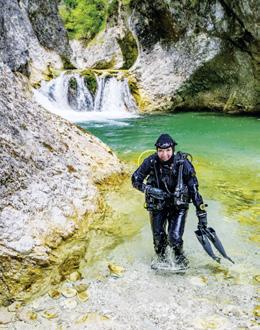
Austria river diving in the Salzkammergut
Features Fjords: Submarine Borderlands
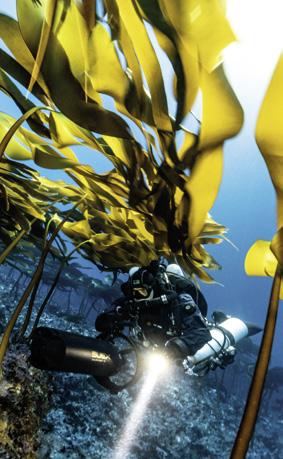
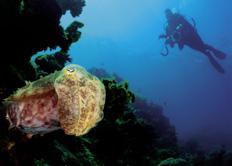
Kelp forest in the Strait of Messina
The winners of the ‘DPG Masters’
Overview: Sidemounts Knowledge: Safety Stop
Austria river diving in the Salzkammergut
Features Fjords: Submarine Borderlands
Kelp forest in the Strait of Messina
The winners of the ‘DPG Masters’
Overview: Sidemounts Knowledge: Safety Stop
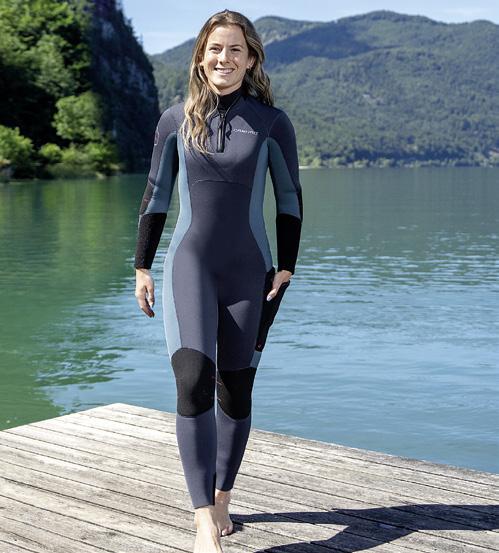


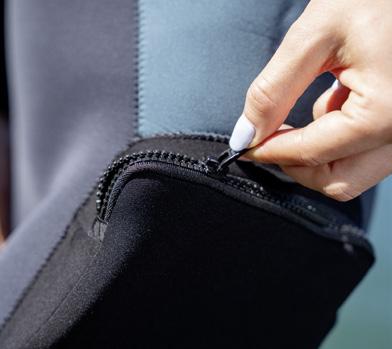
DER NEUE ICON – KONZIPIERT FÜR DIE ALLERHÖCHSTEN ANSPRÜCHE
Maximale Bewegungsfreiheit trifft auf erstklassige Wärmeisolierung. Die neue Schnittführung bietet ideale Passform und Top-Tragekomfort –SEMI DRY DIVING AT ITS FINEST!
Weitere Informationen? Besuche uns auf CAMARO.AT
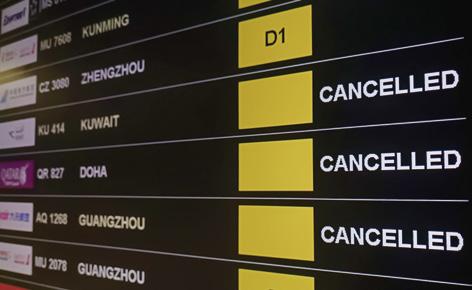
I’m sorry. Once again, I can’t help but turn our attention to world politics at this point. The current turmoil in the Middle East simply has too many implications for your hobby, your holidays and your leisure activities – not to mention the fact that nobody can find anything positive in a war, no matter how close or far away it may be.
When the chaos began – sadly, several weeks ago now – some of the world’s most important international aviation hubs were closed. Doors shut, no one could get in or out. It was just like back in the days of the coronavirus pandemic. I wouldn’t have wanted to be in the tour operators’ shoes then, and I certainly don’t want to be in them now. Numerous guests were stranded; trips had to be and still have to be cancelled. As of today (24 March 2026), fortunately, only isolated ‘restrictions’ are to be expected. For how long? Meanwhile, airfares are skyrocketing.
To be honest, at the start of this year I had a faint hope that the global political situation might calm down a bit, and that we might finally see an end to the war in Ukraine. Instead – well, you can see for yourselves. Unfortunately, the suggestion ‘Just go diving at home’ is only of limited practical use. Because here too, the hammer has been brought down and fuel prices have been sent skyrocketing. In the end, there’s only one conclu-
sion to be drawn at the moment: you can’t plan anymore. Neither on a small scale nor on a large one. Or am I the only one seeing things so bleakly? How are you coping with the situation?
Unfortunately, the current global situation is affecting us too – and consequently what we provide for you to read and dream about: the travel recommendations we’ve put together and planned for you are currently only possible to a limited extent. I hope you’ll forgive us for still including destinations in the magazine that you may only be able to visit at a later date. And this doesn’t exactly make producing our own reports and reviews any easier either. But – as much as I hate to overuse this quote – we can do it. Stay tuned and feel free to drop us a line to let us know how you’re coping at the moment and where you’ll be heading for a dive this year. Finally, just one more thing: stay hopeful and be kind to one another!

Alexander Kaßler Editor-in-Chief of TAUCHEN alexander.kassler@tauchen.de

Photos: James Ferrara (1); Roberto Rinaldi (1); South African Tourism (1); Wolfgang Pölzer (1); Martin Strmiska (1); Lars Ritter von Zahony (1); Richard Condlyffe (1)
South Africa: Diving around the Cape
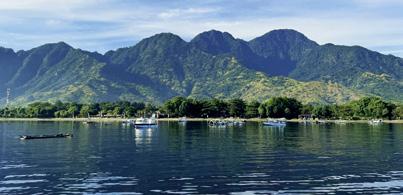
Indonesia: A visit to Saronde Island
Austria: Cliff diving at Lake Attersee
Advertorial: Euro-Divers centres
Bahamas: On board the Aggressor
New products on the equipment market
Review: Camaro dry suits
Sidemount systems
Feature: Kelp forest in the Strait of Messina
How to: Safety stop
Feature: In the fjords of Norway
Apnoea: Feeling the Water
Medicine: Diving with atrial fibrillation
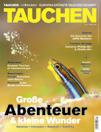
Cover No. 5.26
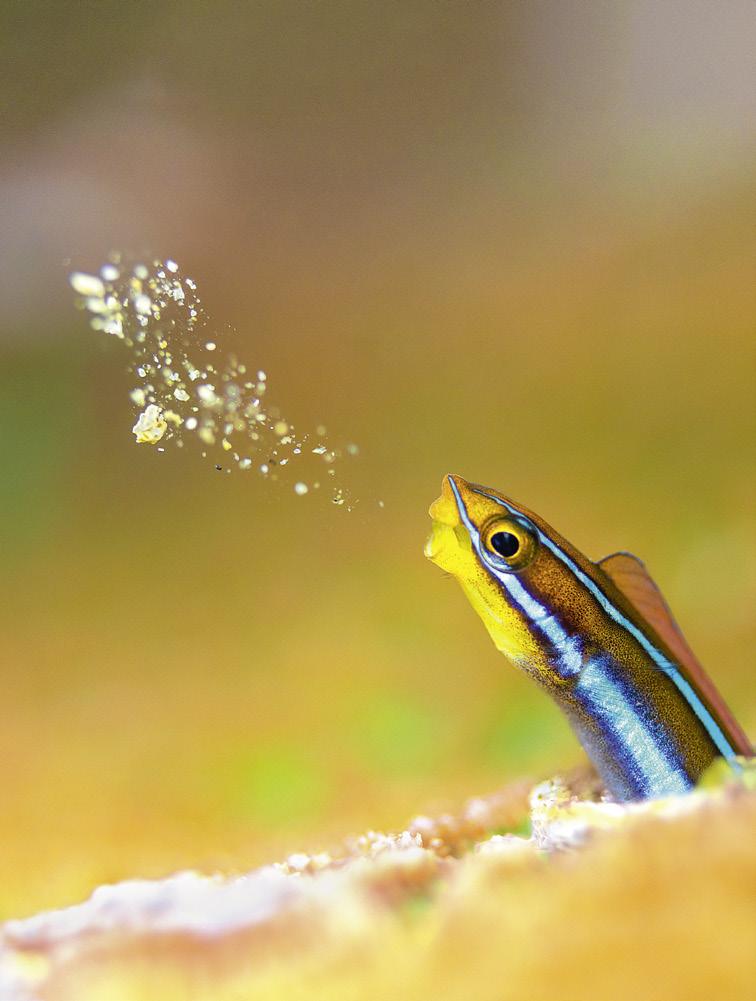
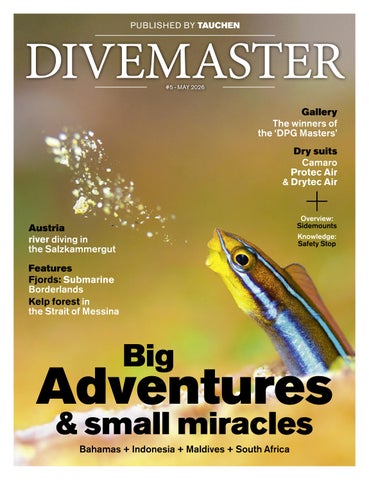
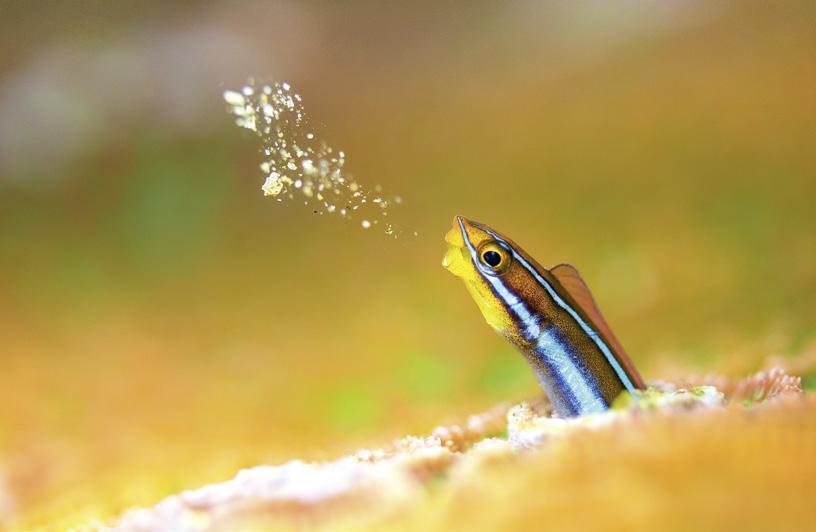
The cover photo is by Sunbong Jung (South Korea) and shows a blenny cleaning its home and spitting out sand. Taken off Anilao, Philippines. This photograph won first place in the ‘Macro’ category at the DPG Masters 2025.
EDITORIAL TEAM
Jahr Artopé Media GmbH & Co. KG Bajuwarenring 9, 82041 Oberhaching Tel. 089/5 52 41-0, Fax 089/5 52 41-244
E-mail: redaktion@tauchen.de
ADVERTISEMENT
089/5 52 41-225
Email: sales@tauchen.de
TAUCHEN SUBSCRIPTION + ADDRESS CHANGES
Tel. 040/5555 7991, email: jam@dpv.de
EPAPER TAUCHEN www.tauchen.de/epaper

Did you know that TAUCHEN is also available digitally? This includes our social media channels Facebook and Instagram as well as our website and our YouTube channel. You can also listen to our podcast channel. Just drop by and listen. Follow the links below. Do you want to read TAUCHEN digitally? Download our TAUCHEN app for iOS and Android. We look forward to hearing from you.


• Website: tauchen.de
• Facebook: facebook.com/ tauchenmagazin
• Instagram: instagram.com/ tauchen.magazin/
• Podcast: podcaster.de/podcasts#/ podcast/tauchen-talks
• Youtube: TAUCHENDASMAGAZIN
• TAUCHEN-App: Android & iOS
“COMPACT”
Manuel Wüthrich
“CONSERVATION”
“TRADITIONAL”
“WIDE
“PORTFOLIO”
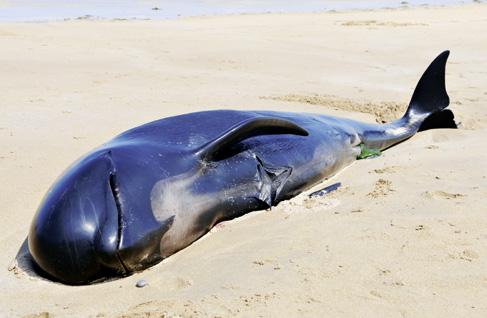
55 pilot whales beached themselves on the Isle of Lewis in Scotland — a dramatic example of just how vulnerable even highly social marine mammals are in shallow
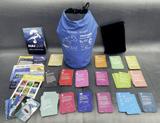
What type of prey do sharks with small, flat or conical teeth specialise in?
A) jellyfish
B) squid
C) prey with hard shells or carapaces
Answer: C
Some species of shark, such as the Port Jackson shark, have what is known as ‘nutcracker teeth’. These sharks mainly feed on animals with hard shells, such as mussels or crabs. Their blunt or cone-shaped teeth are perfectly suited to cracking hard shells.
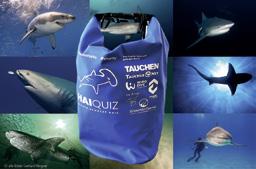
You can find these and more facts and figures about sharks in Ocean Heroes’ new shark quiz. It’s both entertaining and educational and is available at a donation price (100% donation) of 25 euros. Available to purchase via www.ocean-heroes.shop.

A new research project is using artificial intelligence to improve our understanding of sensitive deep-sea ecosystems. To this end, large archives of underwater images and video data will be analysed automatically. The aim is to map habitats that have previously been only partially documented – such as cold-water coral reefs or sensitive structures on seamounts – in greater detail (phys.org). This is an important step for marine conservation. In the deep sea in particular, there is often a lack of data needed to identify sensitive areas in good time and protect them effectively. Automated analyses could help to implement conservation measures in a more targeted and rapid manner in future.

It is with great sadness that we say goodbye to Wayne B. Brown, CEO of Aggressor Adventures, who passed away on 3 March 2026 at the age of 65. Wayne Brown was not only an entrepreneur, but also a passionate diver and visionary who shaped the world of diving over many years. He had been at the helm of Aggressor Adventures since 2007 and continued to develop the company with great dedication. Many people will remember him as an inspiring figure. Our deepest sympathies go to his wife Dana, his family and all those close to him.
The editorial team at TAUCHEN
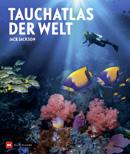
This diving atlas, exceptional in both scope and depth of information, showcases the 500 most beautiful dive sites in the world and provides comprehensive information to help you plan the perfect diving trip. Expert descriptions by renowned diving authors, around 340 brilliant colour photographs, 120 detailed maps and numerous overview maps provide a vivid picture of the dive sites, their underwater fauna and the respective local surroundings. The work is complemented by many practical tips, advice and contact details for preparing diving trips and dives. Spanning 300 large-format pages, the Diving Atlas presents everything you need to know about the world’s most fascinating dive sites. Detailed overviews are provided for all oceans, highlighting the key features of interest to divers. Divided into 38 main destination areas, the book contains information on climate, best diving times, environmental regulations, as well as specific flora and fauna, current conditions, safety aspects and decompression chambers. Publisher: Delius Klasing, ISBN: 978-3-667-13148-5, 304 pages, format: 27.7 x 32.7 cm, 336 photos and illustrations, price: €39.90.
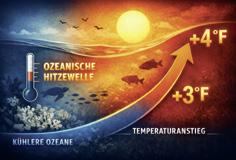
A large-scale marine heatwave has once again developed off the west coast of the USA. NOAA reports that unusually warm water masses have persisted since last summer. Along extensive stretches of coastline, temperatures have at times been around three to four degrees Fahrenheit above the long-term average. According to the agency, this is only the third known event of this magnitude to develop for such a prolonged period without El Niño conditions (fisheries.noaa.gov). Such heatwaves are considered a serious threat to marine ecosystems. NOAA highlights potential consequences such as shifts in species distribution, disruptions to food webs, increased algal blooms and stress on fish stocks and marine mammals. Such changes may also have long-term effects on traditional diving sites.
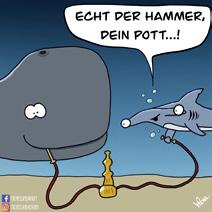
You can find more from the artist Michel Ley at: , Facebook/michels.imbaerium, , Instagram (»michels.imbaerium«) and , www.michels-imbaerium.de
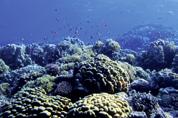
An exceptionally large coral colony has been discovered off the coast of Queensland. According to ABC News , it is a colony of Pavona clavus, measuring around 111 metres in length and covering an area of approximately 3,971 square metres. The discovery was announced at the end of February 2026, and the Great Barrier Reef Marine Park Authority is currently assessing its classification. The discovery is significant for reef research because it shows that even in heavily stressed coral systems, large-scale structures that have barely been documented still exist. At the same time, the find is seen as an indication that individual areas of the Great Barrier Reef may have developed considerable resilience despite repeated episodes of heat stress and bleaching.
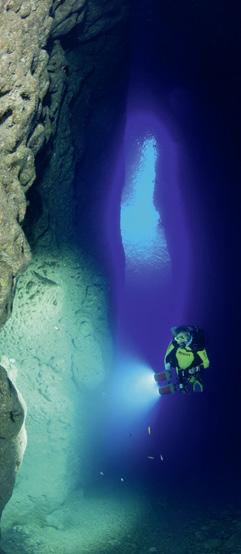
Crystal-clear water, fascinating dive spots and short distances –ideal for a relaxed diving holiday.
Grand Hotel Gozo
7 nights in a double room with land view & breakfast, including flights and transfers from € 599 per person
Gozo’s underwater world impresses with reefs, caves, caverns and exciting wrecks –with visibility of up to 30 m.
5 days / 10 dives 2 dives per day, jeep transport, tank & weights € 340 per person
More information on our website
T&F David Mittig
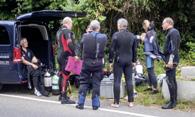
In this issue, the Hohentengen Swimming Club (Schwimmclub Hohentengen e.V.) and the Hochrhein Diving School introduce themselves.
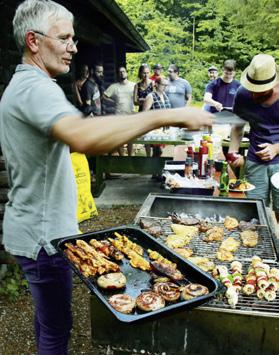
Since its foundation in 2008, Schwimmclub Hohentengen e.V. has stood for a genuine passion for water, camaraderie and safe experiences in and around the water. What began as a meeting place for group dives has developed into an active community in which diving plays a central role – in a relaxed and responsible manner, and with a love of nature and technology.
Our diving club brings together people who appreciate the tranquil world beneath the water’s surface and who value training, thorough preparation and team spirit. We organise regular dives in the region and run a regular programme of activities throughout the year.
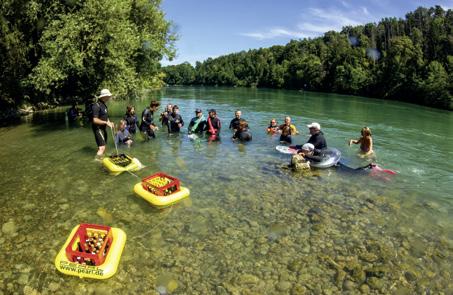
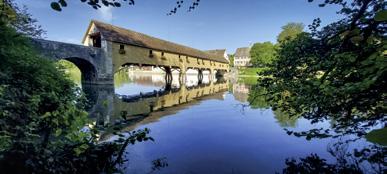
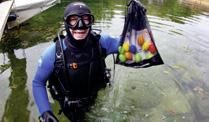
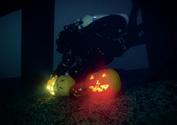
One of the highlights is the Easter dive at the Rheinau dive site, where teams search for surprises hidden underwater. The Halloween dive also combines creativity with safe diving practices. More challenging activities such as ice diving are also part of the programme. Here, preparation, routine and clear procedures are crucial. Accordingly, we ensure we have suitable equipment and carry out targeted training sessions so that every move is perfect before we head into the cold water.
An integral part of our club life is the relaxed after-work dives during the warmer months: short journeys, clear arrange-
ments, and time afterwards for a chat and socialising. The programme is complemented by onshore events such as our summer party or the Rhine drift, where exercise and club life come together.
We place great importance on training. In winter we meet at the indoor pool, and in summer at the outdoor pool. These sessions help to improve technique, safety and team spirit. Those wishing to develop their skills further can take part in workshops, refresher courses and themed training sessions with a strong practical focus.
What sets us apart is the balance bet-
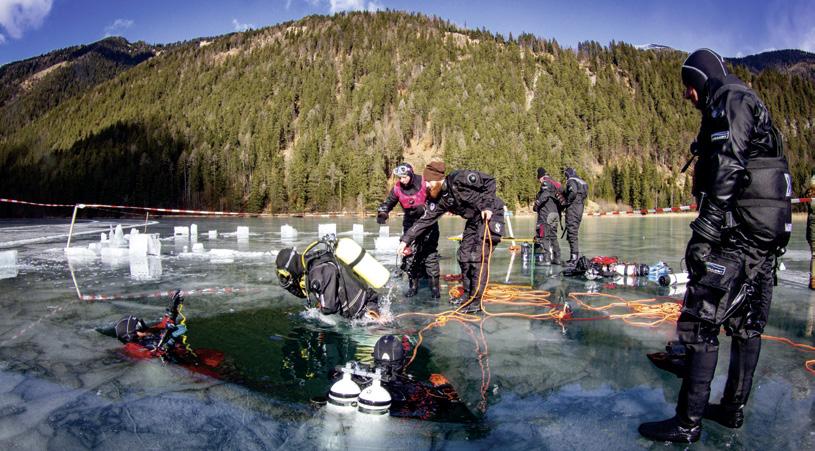
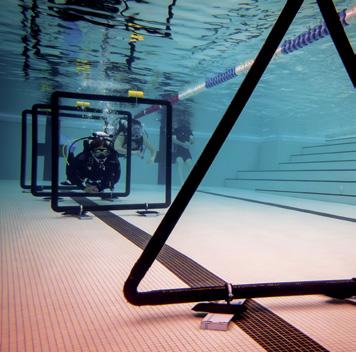
ween structure and a relaxed atmosphere. Clear roles, buddy checks and good organisation are a given – without compromising on fun. New members are welcome, whether they are beginners or experienced divers. Respect for nature and the water is a given for us. Proper buoyancy control, controlled finning and a mindful approach to flora and fauna are our priorities.
The Hohentengen Swimming Club works closely with the Hochrhein Diving School. Dates and events can be found under ‘Trips & Events’ on the diving school’s website. You can contact them by email at david@ schwimmclub-hohentengen.de. After every
Contact: www.schwimmclub-hohentengen.de & www.tauchschule-hochrhein.de

Many of the swimming club’s and diving school’s activities can be viewed on this YouTube channel: https://www.youtube.com/@DivePixEmotions. (dives in Rheinau and Egypt, as well as clips from the diving course).
dive, we take time for a brief debrief: what went well, where is there room for improvement, and which equipment proved its worth? This open collaboration helps beginners get started and offers experienced divers a space to exchange knowledge. For us, diving is not just about technique and organisation, but also about experiencing tranquillity, the play of light and weightlessness. If you’re looking for a sense of community, reliable planning and the joy of being in and around the water, you’ll find a dedicated team here – both above and below the surface.
Would you like to introduce yourselves as an association, club or diving club? Then please write to: alexander.kassler@tauchen.de
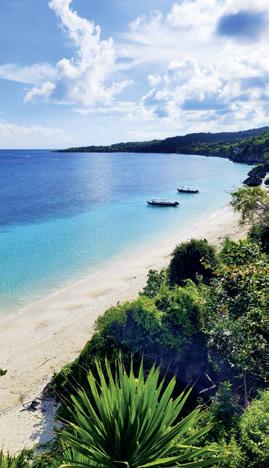
On 1 March 2026, diving.DE opened a new dive centre in Bira, at the southern tip of Sulawesi. It is located within the German-run Akasha Beach Club Resort, overlooking a long bay with its own beach access and one of Indonesia’s longest house reefs. From here, numerous dive sites around the archipelago off Bira and the large island of Selayar can be easily reached by the resort’s own boat. The centre deliberately focuses on small groups of no more than 25 divers and a friendly, family-like atmosphere. The boutique resort offers five rooms, two pool-cliff villas and a family suite. At the same time, diving.DE is also taking over the Mangga Dive Centre at the nearby Mangga Lodge, which was built up over 20 years by diving pioneers Elvis and Achim. Many of the dive sites they discovered, featuring barracudas, turtles, sharks, rays and macro highlights, are now among the best in the region. Guests at Mangga Lodge can easily reach the new base at the Akasha Beach Club Resort by boat. Bookings can be made through numerous dive tour operators. diving.de, akasha-beach. com, manga-lodge.com
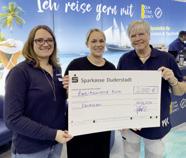
Aqua Active Agency remains committed to marine conservation in 2026 and presented a donation of €2,000 to the organisation Elasmocean at the boot trade fair in Düsseldorf. Elasmocean supports international research projects and educational initiatives aimed at protecting the oceans. Together, the two partners have also produced a guide to sustainable travel, which is available to download via a QR code on the Aqua Active Agency website. aquactive.de

Exclusive and unique, on the unspoilt north-west coast of Bali in Pemuteran , the private Villa Campo Beluga awaits you for the seven-day ‘Into the Deep’ retreat. Explore the depths of the ocean whilst freediving as part of the PADI Freediver course with Natalie from “Holidives”. Complemented by daily yoga and meditation sessions with Lydia Fichtner, you’ll find inner peace and balance. Surrounded by tropical nature, just a few steps from the house reef, the 20- -metre-long pool is at your disposal at all times – a place where two worlds come together perfectly. Dates: 17–23 November 2026 and 24–30 November 2026. In detail: 6 nights/ double room, freediving & yoga sessions, daily meditation, PADI Freediver certification, day boat trip with freediving in Menjangan National Park, two healthy meals per day, fruit & drinks, equipment and transfers to and from the airport, from €1939 per person (international flight can be arranged). www.lydiafichtner.de/retreat & info@belugareisen.de
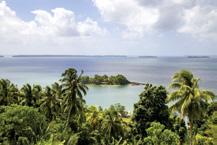
The Solomon Islands in the Pacific captivate visitors with their unspoilt and pristine underwater landscapes. The trip offered by Pacific specialist combines two of the most spectacular diving areas and the most beautiful accommodation in this archipelago: Gizo with the Fatboys Resort and the Marovo Lagoon with the Uepi Island Resort. At Fatboys, you’ll find unspoilt nature, coral reefs with colourful soft and hard corals, gorgonians, rays, sharks and wrecks from the Second World War. The Uepi Island Resort offers fantastic wall diving practically on your doorstep. You’ll encounter large fish, rays, schools of fish and healthy coral gardens on the reef tops. Price example from/to Germany: per person from 71,150 euros. pacific-travel-house.com
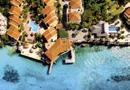
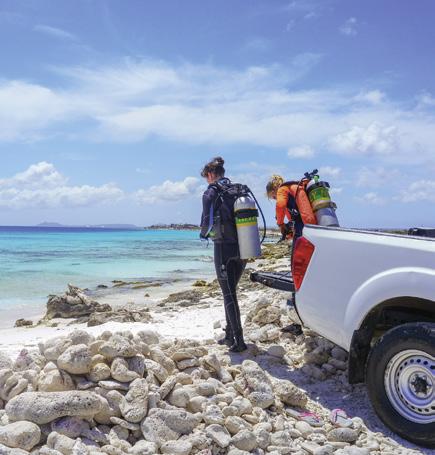
Unlimited shore diving, short distances and facilities perfectly tailored to divers: the TAUCHEN Readers’ Trip 2026 takes place from 29 August to 4 September 2026 at the Buddy Dive Resort on Bonaire. The package includes, among other things, seven nights’ accommodation, a hire car, six days of unlimited house reef diving with Nitrox, and a guided boat dive. The trip is aimed at divers seeking maximum freedom and plenty of time underwater. Information & booking: redaktion@tauchen.de, keyword ‘Buddy Dive Bonaire’.
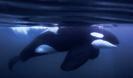
Wirodive is offering TAUCHEN-readers an exclusive reader trip to Orca Camp Northern Norway in November 2026: in the fjord landscape around Hamneidet, participants will experience orcas and humpback whales in the wild and – on clear nights – spectacular Northern Lights. The week includes up to six boat trips and nature programmes, including an introduction to Northern Lights photography. Travel dates: 15–22 November 2026, €3,590 per person (excluding travel to the destination and any stopovers). Info: www.tauchen.de/leserreisen/ & email: redaktion@tauchen.de, keyword ‘Orcas’
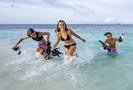
In partnership with EcoProDivers, TAUCHEN invites readers on a special trip to the Maldives. On board the 43-metre-long EcoPro Seascape, up to 28 guests can enjoy a week-long liveaboard with dives in the North Malé and Ari Atolls, snorkelling, island visits and activities such as stand-up paddleboarding or kayaking. Children and non-divers are also welcome; introductory dives and courses are available for them. Dates: 26 July to 2 August 2026 & 1 August to 8 August 2027. Info: redaktion@tauchen.de, keyword ‘Family Safari’
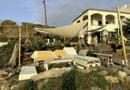
In collaboration with the Ulla & Paul diving centre, TAUCHEN invites you to an exclusive readers’ trip to the Cap de Creus Natural Park on the Catalan Mediterranean coast from 19 to 26 September 2026. Five boat dives at spectacular sites within the nature reserve, as well as unlimited shore dives right in front of the centre, offer ideal conditions for experiencing steep walls, caves, gorgonian forests, large groupers, octopuses and dense schools of fish. The centre’s location right on the water ensures short distances and relaxed dives in the sheltered bay. Price: €599 including accommodation in a four- to eight-person self-catering apartment, five boat dives, unlimited shore dives, tank & weights. Travel arrangements to be made individually. Maximum number of participants: 12. Information & registration: redaktion@tauchen.de, keyword ‘Cadaques2026’.
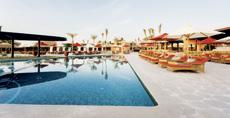
In 2026 , Extra Divers El Quseir will once again be hosting an exclusive photography workshop. Under the guidance of renowned photographer and travel journalist Wolfgang Pölzer, participants can take their underwater photography to the next level. The photography courses will take place from 11 to 16 September 2026 and can be booked either as individual day courses or as a complete package. The workshops cover everything from model, wreck and macro photography to creative image composition. These are complemented by inspiring eveningpresentations on image editing, as well as the opportunity to discuss your own shots with Wolfgang Pölzer and receive valuable tips. The price for a photo workshop dive is 99 euros and includes a house reef dive. Two house reef dives on the same theme cost 179 euros. Info & booking: quseir@extradivers.org
New hotel & German-run dive centre in South Africa: The Lookout Guesthouse in Shelly Beach offers divers modern accommodation under German management –ideally situated for impressive shark dives at the Protea Banks. The complex comprises eight comfortably furnished accommodation units as well as a large heated pool, which has been specially designed for diving courses. Just a few minutes from the harbour is the South Coast Diving centre, which is also German-run. This combination of accommodation and a professional diving centre creates the perfect conditions for varied diving adventures. The Protea Banks are renowned for spectacular shark encounters, including bull sharks, hammerhead sharks, blacktip sharks, tiger sharks and sand tiger sharks. sunandfun.de
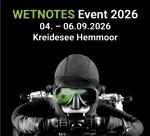
WETNOTES Event 2026: From 4 to 6 September 2026, the WETNOTES Event 2026 will take place at Kreidesee Hemmoor – a major gathering for recreational and technical divers. The highlight will be Saturday, featuring a diving exhibition with over 70 exhibitors, opportunities to test equipment directly in the lake, and fascinating talks. We, the TAUCHEN team, will also be there. In the evening, a buffet (€25, booking required) invites you to round off the day together. Entry is free; diving fees charged by the centre apply. Info: jens.hoener@ wetnotes.eu.
Liveaboard with a special highlight: From 16 to 26 February 2028, Reisecenter Federsee is offering a ten-night liveaboard trip on the M/Y Black Pearl in Palau. The trip is timed to coincide with the new moon – ideal conditions for witnessing the spectacular spawning of the buffalo-head parrotfish in the Rock Islands. The itinerary also includes top dive sites such as Blue Corner, German Channel with manta rays and Ulong Channel. Price per person from €5,627 including full board, up to three dives per day and Nitrox.
Info: reisecenter-federsee.de
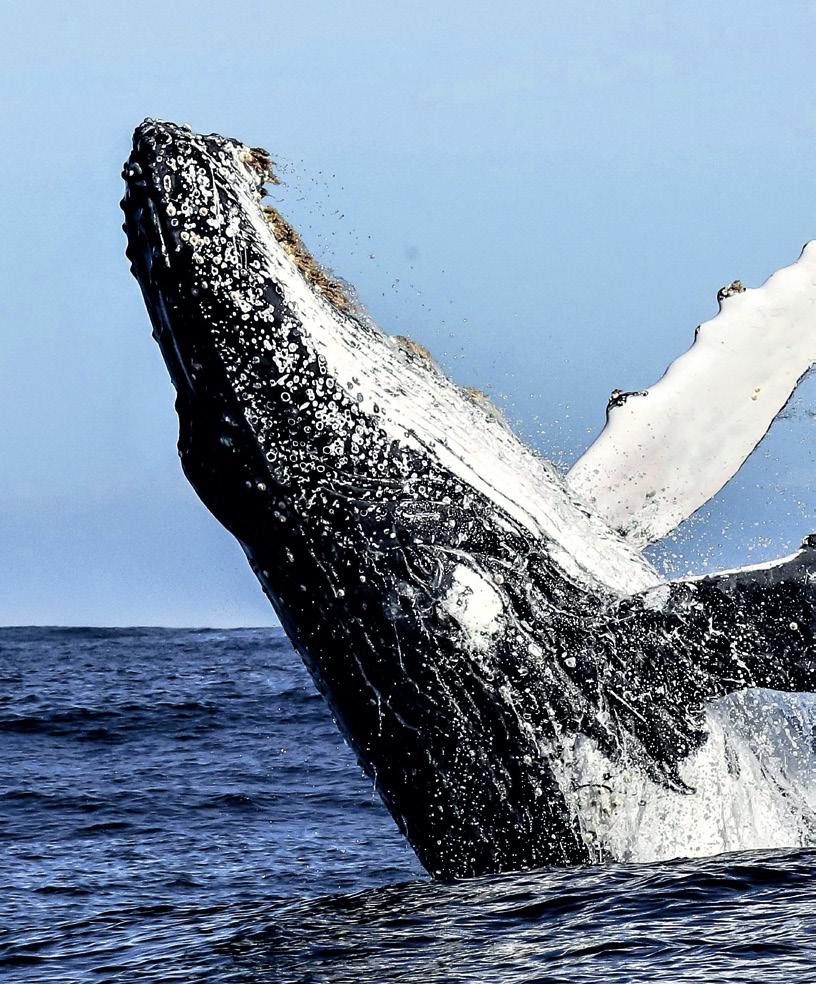
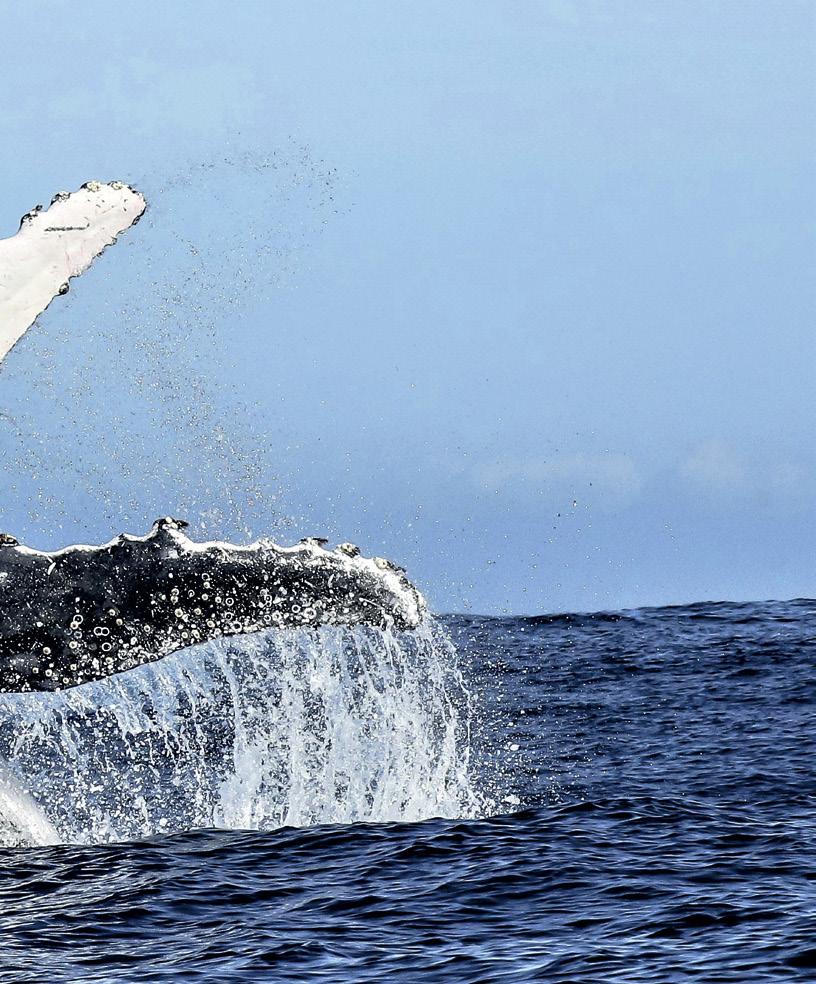
South Africa is home to the savannah’s Big Five. But some of the true giants of the animal kingdom live beyond the Cape of Good Hope: the Ocean’s Big Five – whales, dolphins, sharks, seals and penguins. On diving and snorkelling trips, you can sometimes get right up close to them.
By Win Schumacher
Is this simply pure bliss or just sheer negligence? A man dressed as a seal amidst a cheerful swarm of South African fur seals twirling about – or rather a welcome breakfast treat, a clumsy side dish on a lavish buffet for the great white sharks off the Cape?
Watching Hanli Prinsloo through the diving mask as she glides through the kelp forest like a mermaid – surrounded by a pod of curious marine mammals – the television images of shark monsters hurling sea lion carcasses through the air and Steven Spielberg’s blockbuster behemoth are suddenly forgotten. The sea-bear-bewitched man takes another breath through his snorkel and tries to follow the free diver through the swaying seaweed.
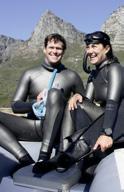
“Discover the seal within you!” Prinsloo had told her freediving protégés during breathing training. “As humans, we share the diving reflex with sea lions, dolphins and whales –that is, the ability to reach unimagined depths on a single breath.” She’s in a good position to say so: now aged 47, she broke her first South African record in free diving more than 20 years ago. Several more followed. The South African can reach depths of up to 60 metres and stay underwater for up to six minutes on a single breath. Today, she takes tourists to the most beautiful dive spots around the Cape and, through her “I am Water” foundation, works as a dedicated marine conservationist to introduce disadvantaged children from the coast to South Africa’s endangered wildlife. “Only when people from all walks of life in South Africa have the opportunity to get to know the ocean will they also commit to protecting it,” says Prinsloo.
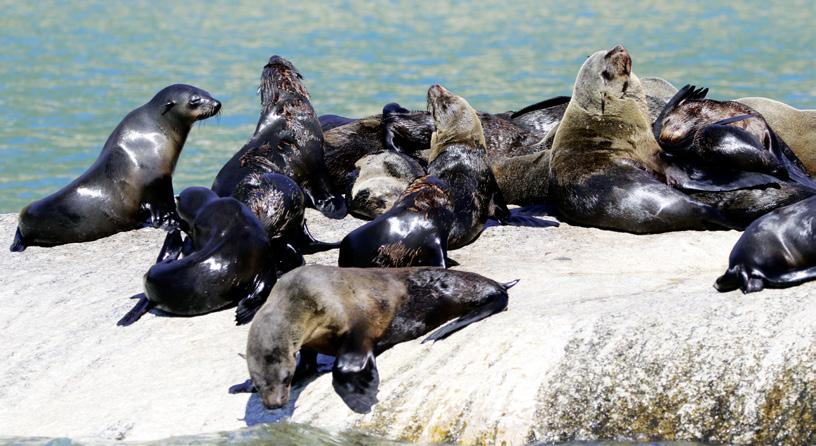
Anyone who follows the freediver into the depths of the kelp forest off the Cape will immediately understand the South African’s passion. Nowhere else can you get closer to South African fur seals than on a snorkelling trip with Prinsloo in Cosy Bay near Cape Town. Dozens of seals lounge side by side, packed tightly together, on a few rocky islets at the foot of the world-famous ‘Twelve Apostles’ mountain range. They allow human intruders into their territory to come surprisingly close to them in the water and show little fear even when you surface directly in front of their bathing rock. Then they simply stare at the clumsy novice free divers with the astonished gaze of puppies. For many, an encounter with the sea lions becomes the initial spark for the protection of their habitat.
But where are the great white sharks? “We can’t say for certain,” replies Alison Towner, gazing out to sea at Gansbaai, ab-
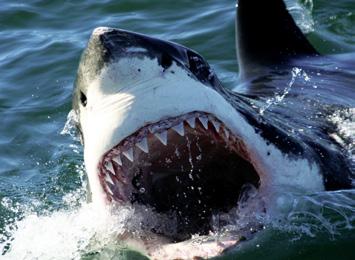
out a two-hour drive east of Cape Town. Gansbaai is, in fact, widely known as the “great white shark capital of the world”. Numerous film shots of the notorious predators hunting seals have been filmed here off the South African coast. Growing up to five metres in length, they are sometimes longer than a white rhinoceros and can sometimes weigh just as much.
Tourists from all over the world come to Gansbaai for cage diving to encounter them. But the face-to-face encounters with these feared predators, which used to be almost guaranteed here, are now a thing of the past. “We found the first white shark carcasses near Gansbaai in 2017,” explains the British marine biologist, “their livers had been ripped out.” Two showed clear signs that they had fallen victim to orcas. “At the same time, we observed two orcas that had already been known in South Africa for some time,” says the 41-year-old researcher. “We call them Port and Starboard.” They had been given their names because, like many animals kept in dolphinariums, their fins drooped to the left and right. They are not only blamed for the disappearance of the great white sharks around Gansbaai, but now also along almost the entire coast between Cape Town and Mossel Bay, where they have been a frequent target for cage divers for decades. Towner believes that a number of great white sharks fell victim to the orca duo Port and Starboard – the latter having specialised in hunting sharks, a behaviour unusual among orcas. Others likely fled from the orcas towards Mozambique and Madagas-
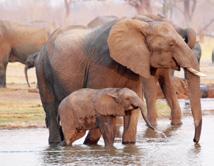
In South Africa, it’s not just the savannah’s Big Five that are worth seeing (below: elephants, leopards and lions). The marine wildlife is also well worth a safari (above: South African fur seals).
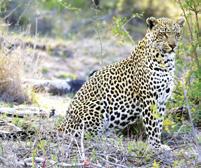
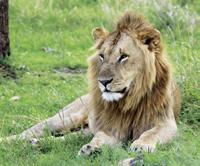
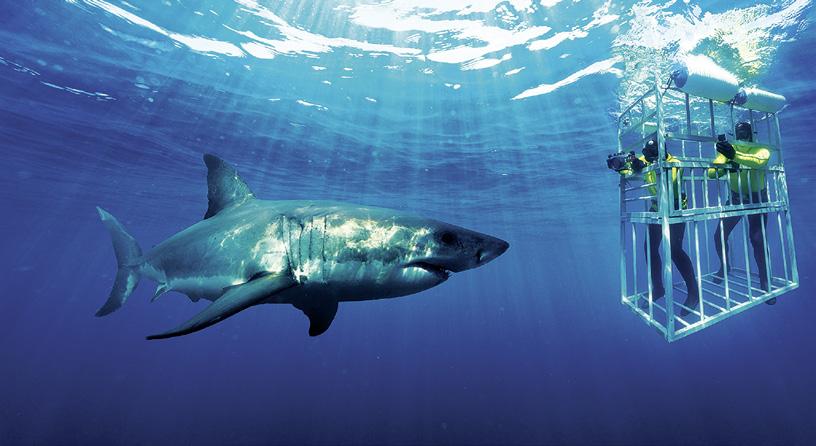
car. Whether and when they will return currently seems uncertain. Gansbaai has lost its main attraction. “There are actually people who say in all seriousness: ‘Let’s shoot the orcas,’” says Towner. The marine biologist, who is well aware of the value of sharks to tourism, sees the situation in a much more nuanced light, however. “Humans are responsible for the sharp decline in most shark populations,” says Towner. She believes that what is more crucial for the survival of sharks is to consider the impact of overfishing, the use of shark nets and the ever-present threat of climate change.
However, anyone wishing to encounter sharks in a cage in Gansbaai still has a good chance of doing so. “Bronze sharks have now, surprisingly, taken the place of the great white sharks for tourists,” says Towner. For the time being, tourists in Gansbaai will have to make do with a relative of the great white shark that is only about two metres long. “But who knows how long that will last,” says Towner. “The orcas could be back at any time.” They don’t turn their noses up at bronze sharks either.
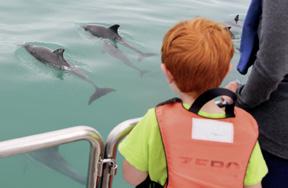
From Gansbaai, marine biologist Sandra Hörbst set off on a whale-watching boat to the offshore Dyer Island. The island is known for its large colony of fur seals. There is probably nowhere else where the chances of spotting the ocean’s ‘Big Five’ on a single boat trip are better. Hörbst and her colleagues not only explain South Africa’s unique marine fauna to tourists, they also draw their attention to the threats facing these species. At the same time, they collect data on various species. Hörbst has been researching dolphins and whales in South Africa since 2013. The 34-year-old, who grew up in the Tannheimer Valley in Tyrol, can now announce the first sighting of a marine mammal to her guests shortly after leaving the harbour. In the distance, the dorsal fins of several dolphins are breaking the surface of the sea. “Dusky dolphins,” says Hörbst happily.
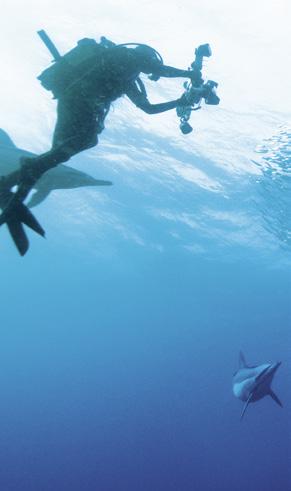
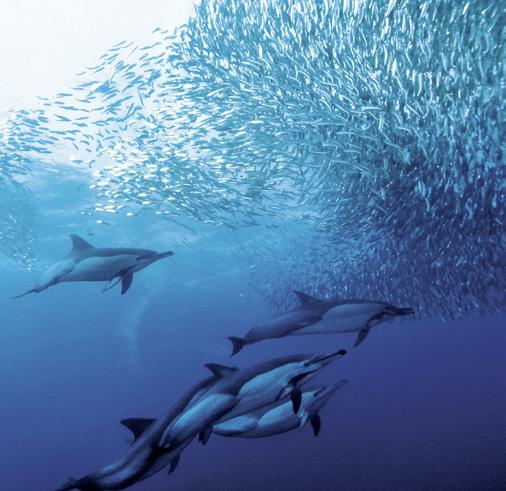
An undisputed highlight for divers is seeing South Africa’s dolphins during the Sardine Run. Usually between late May and early August, large pods can often be seen along the coastline from Gqeberha to KwaZulu-Natal as they chase huge shoals of sardines. Occasionally, sharks, whales and various seabirds join in the hunting spectacle – a breathtaking experience not only for underwater photographers.
Three species of dolphin can usually be spotted at the Cape: bottlenose dolphins, common dolphins and dusky dolphins. The latter are considered the most endangered species. “We only have about 500 of them left along the South African coast,” says Hörbst, “increasing coastal development, marine pollution and fishing nets are still contributing to the decline in the population.“
The undisputed highlight of many liveaboard trips is the Sardine Run, , where dolphins chase huge schools of fish. Boat trips are also available to see the ocean’s ‘Big Five’, during which you can often spot southern right whales and African penguins.
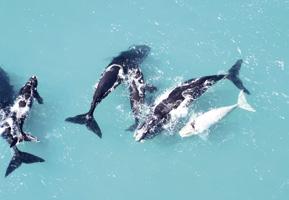
But there is good news from the Cape too. As the first whale’s tail appears in front of the excursion boat, a cheer ripples through the rows of passengers at the railing. The tourists soon approach a mother whale with a strikingly white calf. The slowly approaching boat does not seem to disturb the marine mammals. On the contrary: the pair are practically swimming towards it. Southern right whales grow up to 18 metres long and weigh a maximum of 80 tonnes, which is equivalent to the weight of at least eight stately male elephants. They were once on the brink of extinction. But their numbers have recovered significantly since the ban on commercial whaling in South Africa in 1986. “We’ve recently seen more animals than we’ve rarely seen before,” says Hörbst. In recent years, the highest population figures since 1969 have even been recorded. “We are absolutely delighted that we now encounter several whales on virtually every boat trip during the season,” says Hörbst, “sometimes the boats are practically surrounded by the animals.”
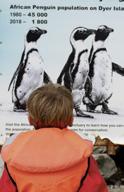
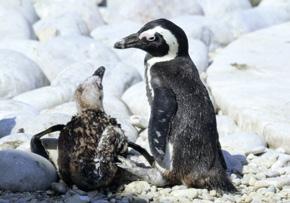
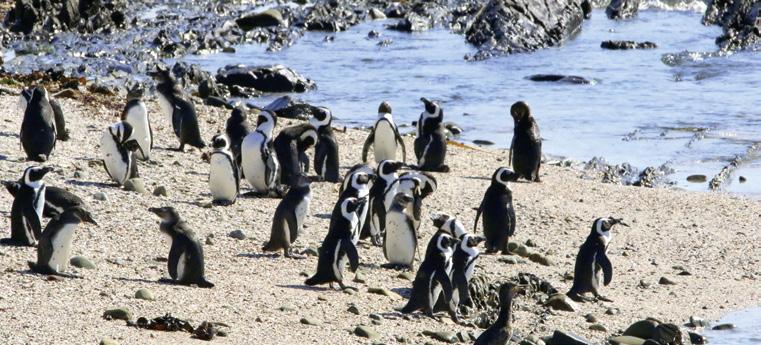
However, it is not just marine biologists who have long been concerned about the smallest member of the ‘Big Five of the Ocean’, the African penguin. At the Penguin and Seabird Centre in Gansbaai, a group of these endearing creatures waddles around a small pool before the beaming eyes of children. They are waiting to be fed. “We have lost 99 per cent of the original
population over the last 100 years,” says Pinkey Ngewu of the conservation organisation Dyer Island Conservation Trust. Scientists attribute the dramatic decline in numbers to factors including the deterioration of food supplies due to overfishing and marine pollution. “If we cannot halt this trend, the species could be extinct within a few years.” Given its maximum height of 70 centimetres, it is not entirely clear why the African penguin is counted among the ‘Big Five’ of the ocean. What is certainly huge, however, is the affection with which South Africans regard it. It is the only penguin species native to Africa.
In 2015, the Dyer Island Conservation Trust opened the rescue centre in Gansbaai. Here, vet Liezl Pretorius cares for injured penguins and nurses orphaned chicks back to health to prepare them for life in the wild. “Many animals get tangled in fishing nets or injure themselves on rubbish that

Reisezeitraum
29. August – 3. Oktober 2026
Erleben Sie ein unvergleichliches Tauchabenteuer! Buchen Sie ein Drive & Dive Paket während der Super Shore Dive Wochen und genießen Sie unbegrenztes Tauchen vom Land – exibel, unabhängig und voller unvergesslicher Momente unter Wasser.
ends up in the sea,” says the 44-year-old, “while others are weakened by disease.”
“There are many reasons why penguin numbers are still declining,” says Pretorius. “For me, the lack of food is a key factor. If we fail to ensure that the animals have just as much fish to eat as we humans do, their survival will remain in doubt.”
For decades, human activity – including guano mining – has also deprived the birds of the substrate they need for their nesting pits. As they are now forced to lay their eggs on exposed rock in many places, their chicks are left defenceless against the elements and nest predators. For years, artificial nesting boxes specially designed for the penguins have been set up along the coast. However, even this measure has so far failed to significantly stem the enormous decline in numbers. “Of the original population of more than a million breeding pairs, fewer than 15,000 remain today,” explains Pinkey Ngewu.
The South African government plans to ban fishing around six key breeding grounds for African penguins in future. “This could be vital for the survival of the remaining population,” says Pinkey Ngewu, “but it has not yet been put into practice.”
The conservation centre in Gansbaai is intended not only to serve as a clinic for the birds, but also to raise awareness among local and international visitors about the threats facing African penguins. Ngewu sees visitors as ambassadors for the large and small members of the ‘Big Five of the Ocean’. “We need to get more people on board with protecting the oceans,” she says. “It is not yet too late for many of its inhabitants.” <<
GETTING THERE:
For example, fly non-stop to Cape Town with Lufthansa (www.lufthansa.com).
ORGANISER:
The Africa specialist Abendsonne Afrika offers tailor-made, bespoke tours – including for divers – to South Africa’s marine giants. Drawing on extensive expertise, passion and personalised advice, Abendsonne Afrika creates trips to the African continent that are perfectly tailored to the customer’s wishes. As well as safaris to see the Big Five, South Africa offers the unique opportunity to combine diving and snorkelling experiences with the Big Five of the ocean. A self-drive tour is the best way to combine these two nature experiences in a single trip. For advice, please call +49 (0) 7343 929980 or email info@ abendsonneafrika.de
→ www.abendsonneafrika.de
Through her I am Water Foundation , Hanli Prinsloo also organises diving and snorkelling trips for tourists.
→ www.iamwaterfoundation.org
ACCOMMODATION TIPS:
Grootbos Forest Lodge, situated in a private nature reserve just a short distance from Gansbaai, offers its guests a wide range of activities centred around the 'Big Five' of the ocean.
→ www.grootbos.com
Several marine reserves around Cape Town also attract divers. The iconic Cape Grace on the V&A Waterfront and the upmarket La Residence are particularly popular hotels serving as a base.
→ www.capegrace.com
→ www.theroyalportfolio.com
FURTHER INFORMATION:
→ www.southafrica.net
T & F Barbara & Wolfgang Pölzer
Sulawesi
with a difference:
a visit to a hidden gem in the middle of nowhere. The only problem: should I go diving or just relax?
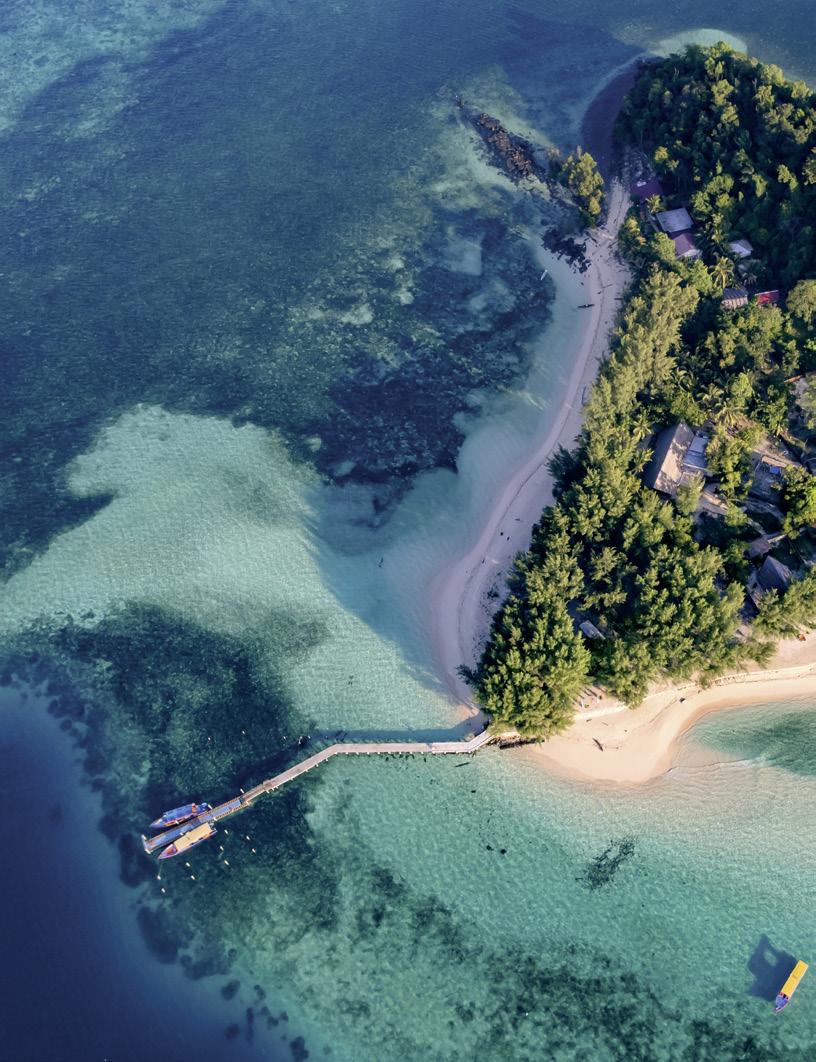
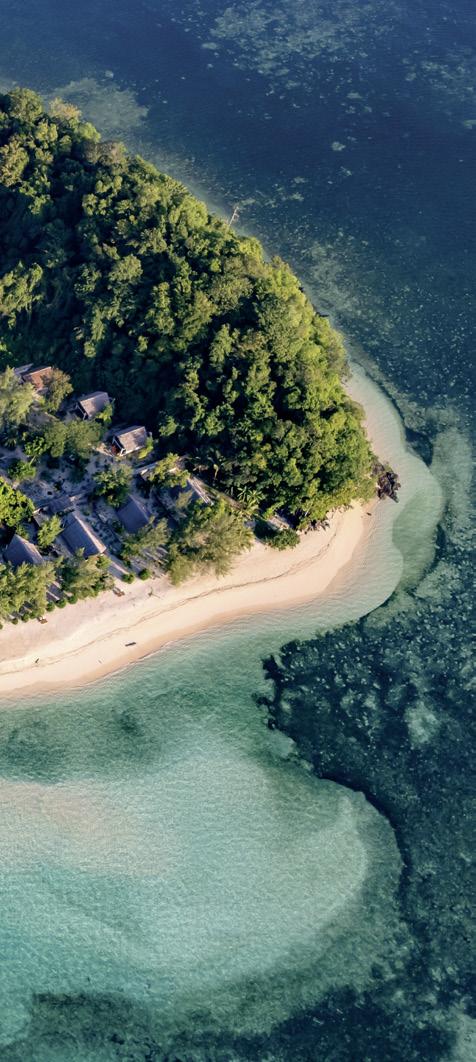
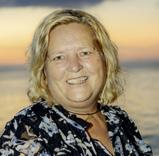
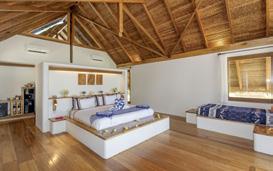
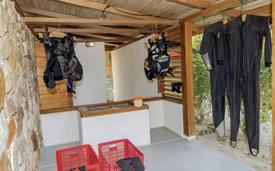
What a transformation! When we were among the first guests to stay in what was then the only beach villa at Saronde three years ago, the concept already sounded promising: affordable luxury with a feelgood atmosphere. Today, it has become an impressive diving resort. Anke Andree guides us through her labour of love with well-deserved pride. The German, who has been living in Indonesia for almost 25 years, knows exactly what discerning guests appreciate: privacy in six spacious beach villas and three two-storey garden villas, all crafted from fine local woods, thoughtfully and stylishly designed. At the heart of it all is the open-plan restaurant, bar and lobby area – a relaxed oasis of well-being with views of spectacular sunsets. One detail is particularly impressive: each villa has its own small diving centre. The equipment is cleaned in a private sink and hung up to dry in the shade, whilst you can slip straight into the open-air bathroom. Photographers will also be delighted by a dedicated camera room with a sink, charging station and compressed air. A level of comfort rarely found even in high-end resorts.
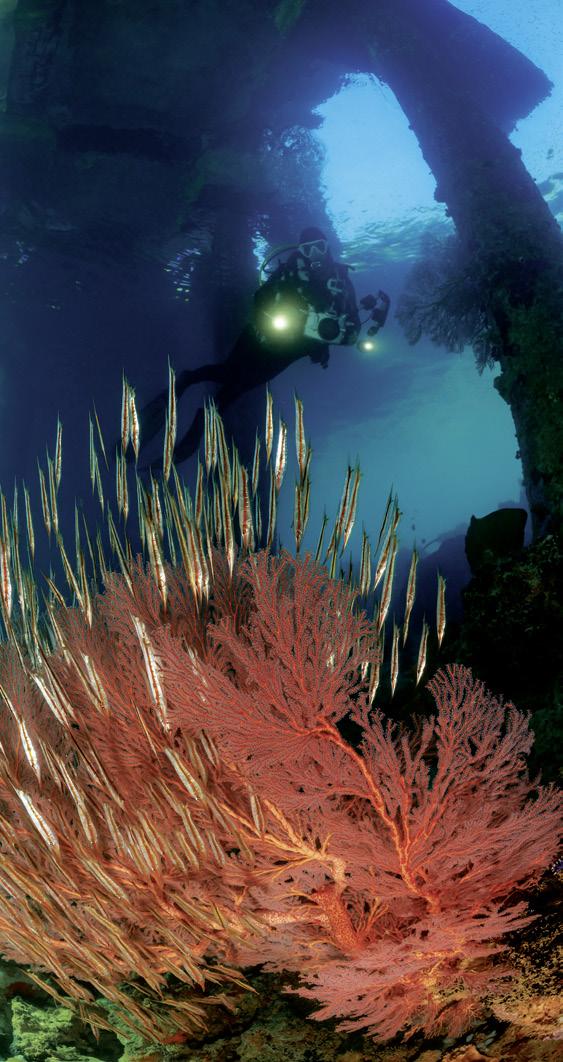
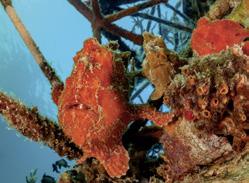
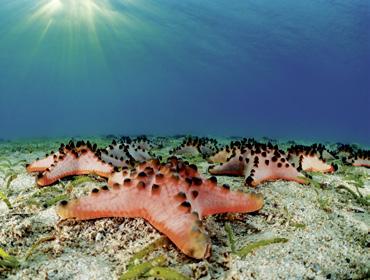
There’s plenty to see under the jetty! From gorgonians and schools of fish to colourful sights and even a sea snake that looks just like an ostrich!
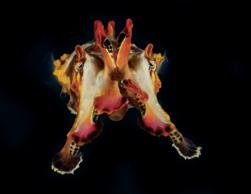
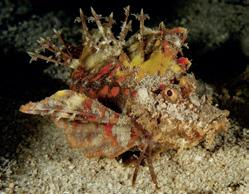
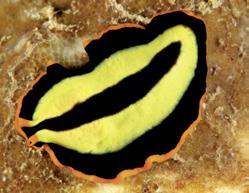
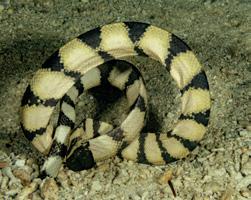
House reef with added value
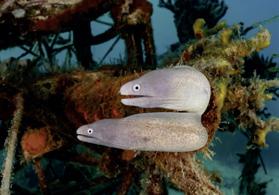
After so much marvelling, it’s time to get in the water. The diving gear is already waiting at the jetty. Together with our guide Boa, we first explore the house reef. Directly beneath the jetty, with visibility surprisingly good, we’re surprised by a school of young ox-eye mackerel. Over seagrass beds and past barrel starfish, we reach an artificial reef at a depth of five metres. The steel structure is only two years old, but is already densely overgrown and teeming with life – from scorpionfish and moray eels to several perfectly camouflaged anglerfish, positioned almost side by side. A few fin strokes further on, we spot a yellow seahorse, pipefish, snake eels and dozens of nudibranchs. Boa leads us down the sandy muck slope and finds various smaller subjects: pygmy squid, tiny shrimps, butterfly snails. After just under 100 minutes, we resurface just in time for sunset and are thrilled by our first impressions.
From
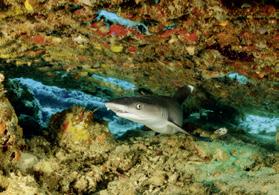
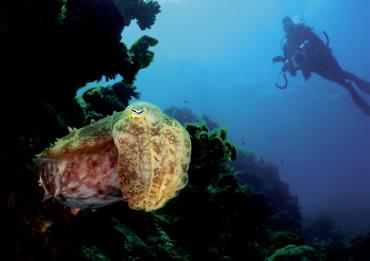
The following morning, we take a boat to a nearby shoal. Along an intact coral slope dotted with barrel sponges and gorgonians, baby whitetip reef sharks can be seen beneath a table coral, whilst cuttlefish lay their eggs. Our guide, Boa, spots nudibranchs, rare tiger shrimp and even a small blue-ringed octopus. An eagle ray glides past in the blue. On the opposite side of the shoal, a light-coloured muck slope with coral debris awaits us – ideal for macro enthusiasts. Leaf-shaped sea snails, butterfly snails, a Melibe nudibranch, boxer crabs and more tiger shrimps keep us grinning from ear to ear behind our masks.
In the afternoon, we descend near a large jetty heading towards the mainland. The concrete pillars are covered in sponges, tunicates and fan corals. Batfish, knifejaws, a solitary barracuda and a cuttlefish swim past. After 40 minutes in the shallows, Boa leads us to a coral boulder at a depth of ten metres. There, he proudly presents a Lembeh pipefish (often also called a Lembeh seadragon) – barely two centimetres long and a real photographic challenge. Described only around 20 years ago, this extremely slender species of pipefish is fascinating not so much for its rarity as for the difficulty of capturing it well in a photograph.
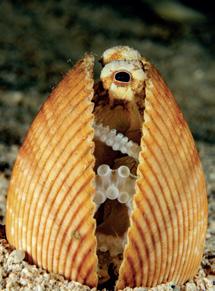
The following days are all about macro life and small creatures. Anke likes to call the area ‘Lembeh in White’ – there’s no black volcanic sand, but there’s no shortage of biodiversity. A night dive confirms this impressively. Ambon scorpionfish, a baby flying gurnard, a small anglerfish, sea spiders and several snake eels appear in the light of our torches. Two finger-length cuttlefish float above the sand, changing colour. A special highlight: a coconut octopus, holed up between two mussel shells, which closes its mobile hideaway in a flash when danger threatens. La-
“LEMBEH IN WHITE! THERE’S NO BETTER WAY TO DESCRIBE THE EXPLOSION OF PHOTOGENIC CREATURES, DESPITE THE LACK OF BLACK VOLCANIC SAND.”
Established in: Summer 2022
Base manager: Anke Andree, the German owner of Blue Bay Divers, who also operates the liveaboard vessel KLM Sunshine.
Training: PADI courses from Open Water Diver to Divemaster. Children’s diving for ages ten and above available on request.
Diving requirements: presentation of diving certificate, logbook and medical certificate.
DIVING: Each Beach Villa has its own small private diving centre with a sink, hanging racks and a camera room with a charging station and its own sink. Garden Villas have only their own diving centre (without a camera room).
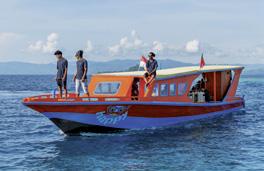
Dives take place up to three times a day in small groups of no more than three divers per guide, using the three covered wooden dive boats, each of which can accommodate six to eight divers. There is a morning trip with two dives and an afternoon trip with one dive. In total, around 30 different dive sites can be reached by boat within five to 30 minutes. In addition, you can explore the house reef in front of the villa and jetty independently and free of charge as part of a buddy team. The Whale Shark Tour is offered as a full-day excursion by boat and bus to Gorontalo, combined with a visit to Olele National Park (Dali Sponges).
Maximum depth: 30 m
Diving instructors: 3 instructors and 8 guides
Equipment: 20 full sets (rental fee: €21 per day).
Tanks: 12-litre DIN/INT aluminium tanks; 15-litre steel tanks available on request for an additional charge of five euros per dive. No adapter required.
Prices: The daily rate of €300 per beach villa (for two people) or €200 for the garden villa includes accommodation, full board and unlimited beach dives without a guide. Two boat dives cost €70 per person. The full-day whale shark tour to Gorontalo costs an additional €100, a night dive from the jetty €30 and an OWD course €400. Nitrox 32% is available for an additional €10 per dive.
Location: This stunningly beautiful little tropical island lies around ten kilometres off the north coast of Sulawesi in the province of Gorontalo.
Best time/season for diving: from March to November. From December to early March, it is (theoretically) the rainy season. Visibility varies depending on the current and is usually between five and 20 metres. The resort is open all year round, except in January.
ACCOMMODATION: The four-star resort currently comprises six beach villas and three garden villas (which can also be used as family villas) built in Balinese style on a Maldivesstyle sandy beach. Nestled beneath shady tropical trees is the superbly appointed restaurant, featuring a spacious terrace and lounge with unobstructed views of stunning sunsets. The exceptionally spacious and comfortable villas are tastefully furnished and feature a large double bed, air conditioning, minibar, kettle, water dispenser, safe, desk and sofa bed for a third guest, as well as a
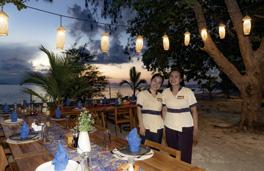
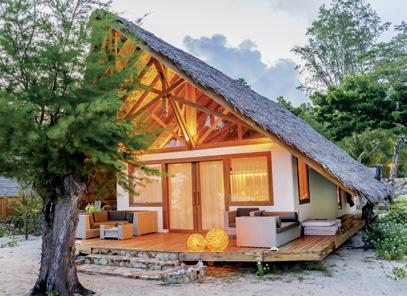
large bathroom with an outdoor shower. In total, there is room for 18 to 24 guests (based on triple occupancy). An additional spa/massage area and a boutique selling locally produced souvenirs are due to be completed in 2026.
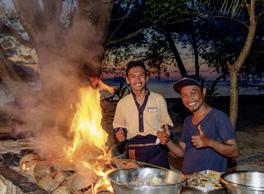
OTHER ACTIVITIES: Several ocean kayaks and SUPs are available free of charge. Guided jungle tours (including a waterfall and a visit to the market) on the mainland are available, as are cookery classes, half-day mangrove tours with flying fox sightings, as well as a free trip to the neighbouring island of Bogisa, which belongs to the Saronde Island Resort, boasts stunning beaches and is the perfect spot for sundowner tours on the beach or a private candlelit dinner. Not to be forgotten: daily yoga sessions with the resort’s own yoga instructor.
SUSTAINABILITY: A great deal is being done here, ranging from the resort’s own conservation initiative – which focuses on waste management, reducing plastic waste and raising awareness among the local community – to the creation of a marine protected area. In addition, vigorous action is being taken against illegal fishing, artificial reefs are being sunk in the resort’s house reef, and the resort has largely eliminated the use of plastic. A no-fishing
zone has already been established around Saronde.
Snorkelling: Not all, but some of the reefs are also ideal for snorkellers. Snorkellers can travel on the dive boats free of charge. Dedicated snorkelling trips are available on request.
CONTACT & INFORMATION:
www.sarondeisland.com
Organiser: Aquaventure
Telephone: 0511 690 999 00 www.aquaventure-tauchreisen.de
Price example (from Aquaventure): Two weeks (13 nights) at Saronde Island Resort in a beach villa with full board, water, coffee/tea, unlimited beach dives (including tank and weights), 20 boat dives (including tank, weights and guide), all transfers, flights to and from Germany, plus a domestic flight and one night’s accommodation in Jakarta: from €4,000 per person (including all fees and airport taxes).
GENERAL INFORMATION
Arrival: The international arrival airport is Jakarta. From there, take a domestic flight to the provincial capital, Gorontalo, and then travel by car and boat for around 1.5 hours to Saronde Island. A passport (valid for at least another six months) is required. On arrival, you can obtain a 30-day tourist visa for just under
€30. For the same price, but much quicker, you can apply for an e-visa (B1 visa) in advance from Europe: https://evisa. imigrasi.go.id/
Language: The official language is Indonesian. German and English are spoken at the resort.
Wetsuit: A 3–5 mm wetsuit and a thin hood to protect against jellyfish are recommended. Water temperatures range between 27 and 29 degrees Celsius throughout the year.
Mobile/Email: There is mobile phone coverage and free Wi-Fi at the resort. Travel medicine: The nearest hyperbaric chamber is in Manado, with others in Bali, Makassar and Singapore. There are good international hospitals in Manado, Jakarta, Bali and Singapore. Please consult your GP regarding vaccinations and malaria prophylaxis.
Useful information is also available from the German Society for Tropical Medicine: http://dtg.org
Tourist Information: Indonesian Tourist Board: www.indonesia.travel
ter, we spot a Bobbit worm – only its head protrudes from the sand, the rest of its body stretching up to three metres in length. A fascinating, if somewhat eerie, hunter.
Saronde has developed enormously since our first visit. As well as introducing new top spots, Anke is deeply committed to environmental protection. Through the Saronde Conservation Fund, almost 20 tonnes of plastic have been collected in a short space of time, awareness-raising work has been carried out, and a no-fishing zone has been established. As an optional extra, a whale shark tour to Gorontalo beckons, where the animals regularly appear near the coast at a prawn farm – of their own accord and without nets. But even without a whale shark encounter, Saronde offers more than enough to enjoy both above and below the water.
Our verdict? Saronde is a destination for connoisseurs and explorers. Manta ray enthusiasts, in particular, will be in their element. And thanks to whale shark spotting, big-game fishing enthusiasts will be too. And yet this Indonesian island is almost too good to visit just for the diving. It’s the combination of comfort, relaxation and varied dives that gives it its special appeal. <<
Franz. Polynesien · Fiji Inseln · Palau Papua Neuguinea · Yap · Salomonen Vanuatu · Tonga · Neukaledonien
… mit Pacific Travel House –dem Spezialisten seit über 35 Jahren!
21 Tage Französisch Polynesien
Tahiti, Rangiroa und Fakarava Fantastisches Großfischtauchen an den Riffen und in den Passagen der Atolle · Inkl. 21 Tauchgängen, Flügen, Übernachtungen/Frühstück/Transfer ab 7.550 € p.P. / DZ
21 Tage Fiji Inseln
Viti Levu, Taveuni, und Beqa Lagune
Aufregendes Tauchen zwischen farbig leuchtenden Korallen, bunten Rifffischschwärmen und beeindruckenden Großfischen
· Inkl. 22 Tauchgängen, Flügen, Übernachtungen/Frühstück/Transfers
ab 6.945 € p.P. / DZ
17 Tage Mikronesien
Palau und Yap Faszinierendes Tauchen an steilen Außenriffen, in Strömungen und Lagunen mit zahlreichen Großfischen · Inkl. 20 Tauchgängen, Flügen, Übernachtungen/Frühstück/Transfers ab 5.475 € p.P. / DZ
18 Tage Papua Neuguinea
Lissenung Island und Tufi Resort
Reiche Artenvielfalt, Sichtweiten bis zu 30 Meter, unberührte Korallenriffe und große Fischschwärme
· Inkl. 20 Tauchgängen, Flügen, Übernachtungen/Mahlzeiten/Transfers
ab 6.550 € p.P. / DZ
Weitere Vorschläge, ausführliche Beschreibungen und kostenlose individuelle Ausarbeitung unter:
pacific.travel.house
Pacific Travel House Reiseveranstaltungs GmbH Schwanthalerstraße 100, D-80336 München info@pth-muc.de, 089-543 21-80
T & F Martin Strmiska
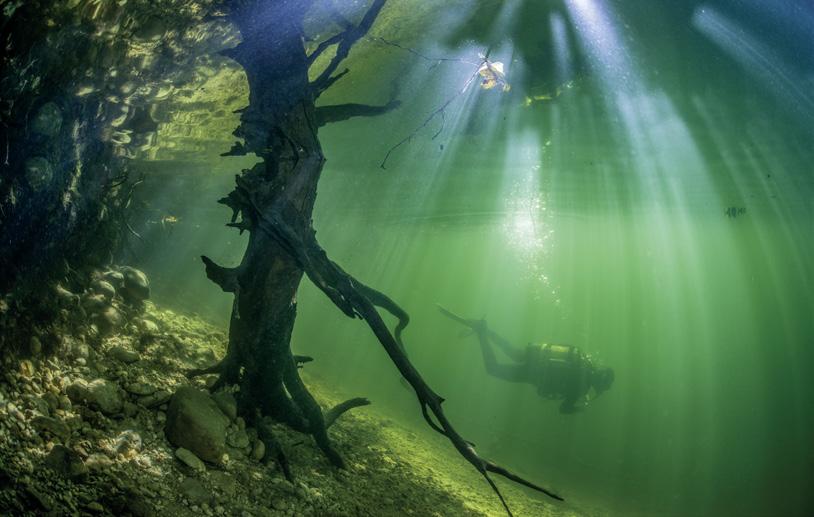
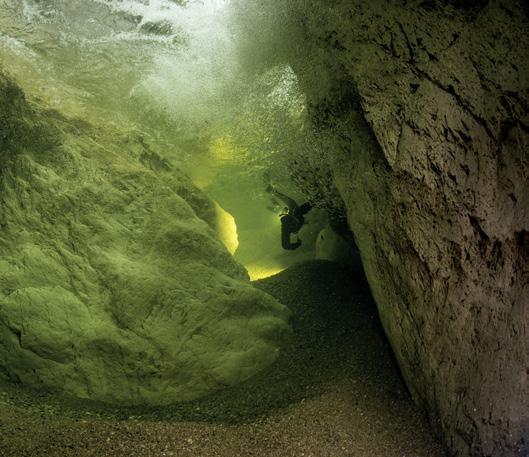
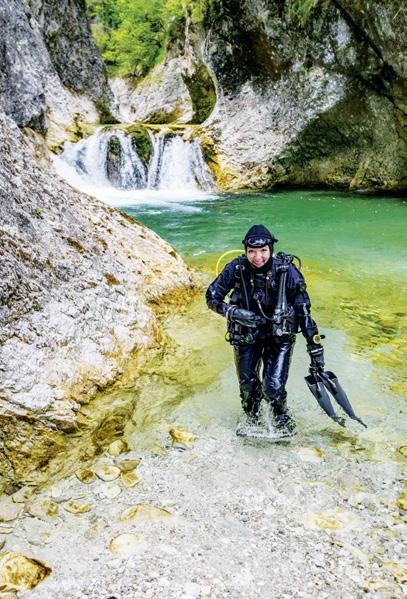
The Salzkammergut attracts us underwater sports enthusiasts with a wide range of opportunities, from lake to river diving.
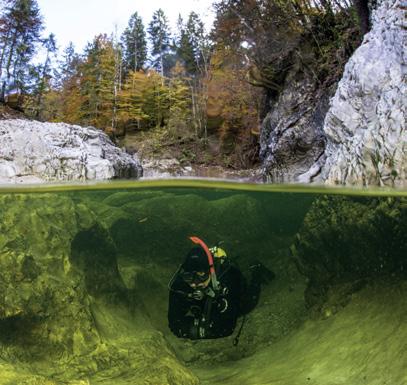
35 degrees Celsius in the shade. Lake Attersee glistens, sailing boats glide across the water, and cyclists struggle along the lakeside road. High summer in the Salzkammergut – lovely, but not exactly spectacular for diving. Visibility suffers, the beaches are packed, the water is warm. But if you look a little closer, you’ll discover an alternative: just a few kilometres away, ice-cold mountain streams cut through limestone, forming pools and cascades, creating emeraldgreen basins far away from the hustle and bustle. A combination of lake and river diving, a chance to cool off and experience nature –and perhaps even the opportunity for extraordinary split-level shots. Lake Attersee remains no classic diving mecca. Those willing to venture off the beaten track will discover it anew.
This traditional Austrian holiday destination, some 200 kilometres from Munich, hardly needs any introduction. In summer, it is teeming with tourists, cyclists, campers and sailors who enjoy spending their holidays in slightly cooler temperatures and an alpine atmosphere. Although ‘cooler’ is a relative term – temperatures here now regularly rise well above 30 degrees Celsius.
Even from a diving perspective, Lake Attersee isn’t necessarily considered a ‘must-see destination’ in the height of summer: visibility during the peak season is usually not ideal for keen divers. However, if you could combine dives in Lake Attersee with river dives, escape the crowds, cool off and get much closer to nature than the lake alone allows, it would significantly enhance your holiday. Perhaps the region won’t remain a purely diving destination – but it certainly gains in terms of the overall experience.
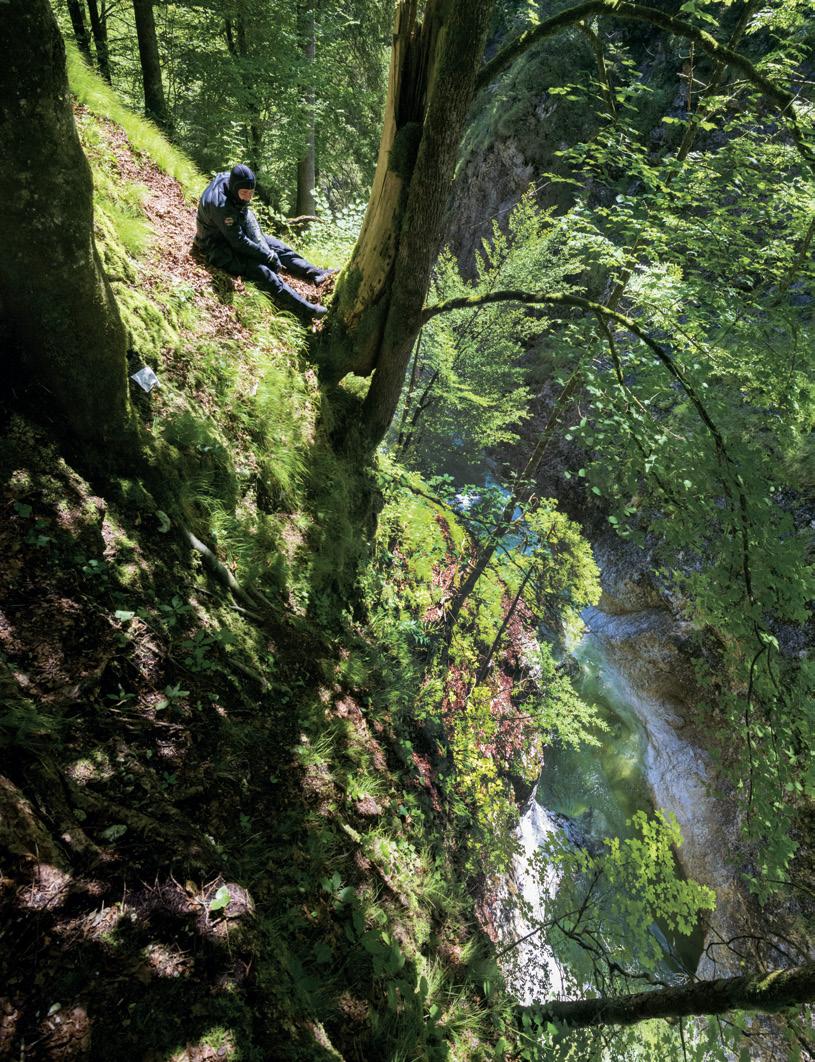
Although daytime temperatures climb well above 30 degrees Celsius on these July days, the early morning hours in the Weißenbach Valley feel refreshing. A fine mist hangs between the trees, and dewdrops glisten on the moss and grass. As you carry your gear down to the river, your senses automatically
sharpen. The scent of the forest, the chirping of birds and the babbling of a stream in the distance make you pause and take a deep breath. With that breath, new energy flows through your body. Time seems to stand still. The diving tank on your shoulder and the camera in your hands suddenly feel lighter. There is no doubt about it – this is the right place at the right time.
Down in the canyon, the emerald-green stream further enhances the refreshing atmosphere and whets the appetite for underwater exploration. But even if nothing else happens – the experience has already begun.
Chapel / ‘Kappele’ (9.6 km)
GPS 47.766815, 13.637374
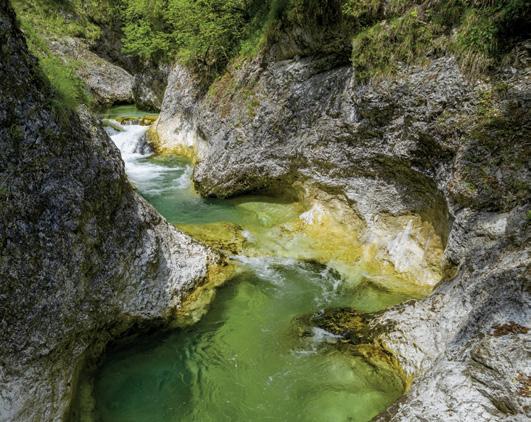
At the highest point of the Mitterweißenbach Valley, a small trickle that collects surface water from the surrounding high ground becomes a steady stream.
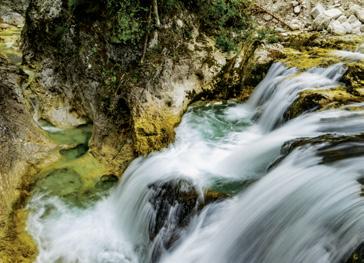
During the last Ice Age, a glacier carved a canyon around 30 metres deep into the limestone. Later, the flowing water, with considerably less force, formed a series of cascades no more than three to four metres deep.
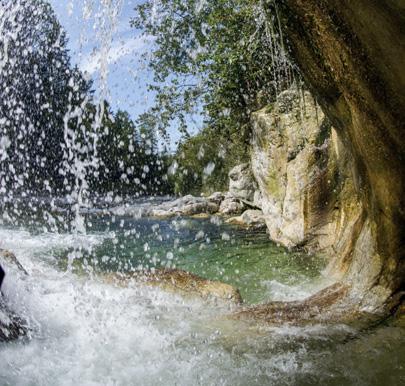
A small waterfall, framed by steep rock faces, and a bright green pool mark the first access point. It is located at kilometre 9.6, right next to a chapel, with a large car park.
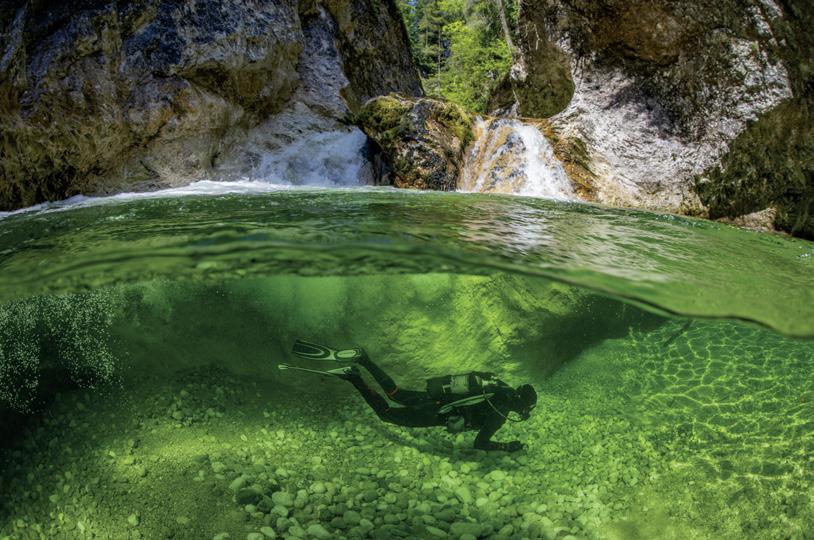
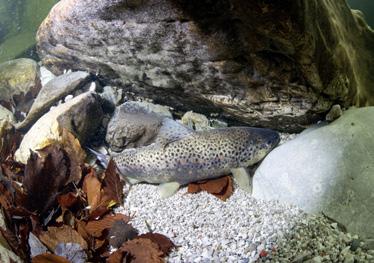
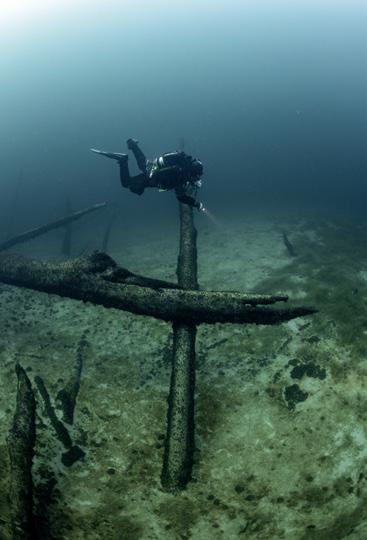
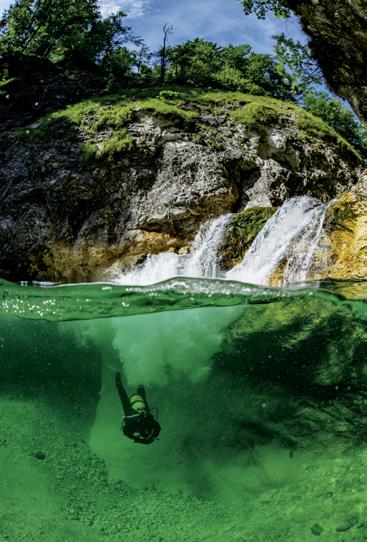
You might think that diving equipment would be unnecessary at such a shallow depth. However, floating beneath the waterfall amidst the rushing spray and observing brown trout at close quarters is much easier with scuba gear. For underwater photographers, the waterfall also offers an excellent opportunity for striking split-level shots with a diver positioned below the cascade.
However, it is important to check the weather forecast: heavy rain can quickly turn the otherwise gentle stream into a raging torrent with poor visibility and conditions unsuitable for diving.
The fun continues ‘one level up’. To reach the upper cascade, you have to climb up the rock face – there’s usually a rope hanging to the right of the waterfall. With a mask, snorkel and fins, this is still relatively easy, but with a scuba tank and camera, it’s a real challenge.
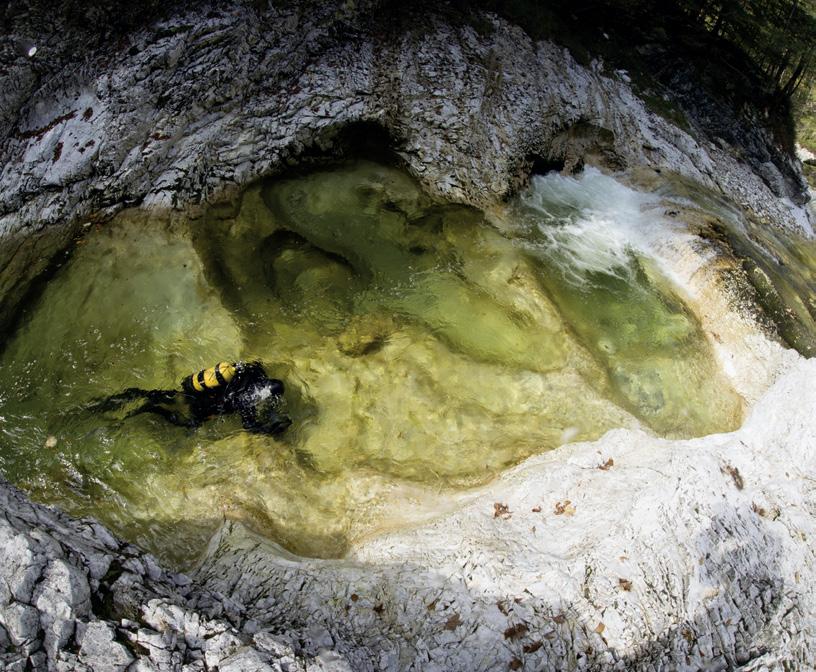
Further up, the canyon narrows and the water picks up speed, resembling a giant whirlpool with smooth, rounded rock faces. A series of small pools leads to another waterfall – the end point of our snorkelling expedition and our turning point.
Weißenbach (10.8 km)
GPS 47.760835, 13.654588
Further downstream towards Ebensee, the canyon widens considerably. The water flows more calmly and the stream takes on a more relaxed character. At kilometre 10.8, there is a small makeshift car park with space for two vehicles. The walk down to the river with your equipment is short and straightforward.
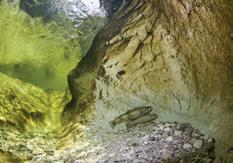
In June and July, the sun shines directly into the canyon in the early afternoon. The morning mist has cleared, as has the intense scent of the forest. In the clear, shimmering green pool, brown trout lie in the current. These fish are significantly larger than those near the chapel. They remain almost motionless in the water, watching the surface of the water and their surroundings intently. Lowflying insects become prey in the blink of an eye.
Anyone who sees the trout standing so effortlessly against the current might think that divers could swim upstream without any trouble too. The reality is quite different. The smooth, rounded rocks offer no foothold. No sooner have you entered the water than the current grips you and carries you inexorably downstream.
The desire to capture perfect portraits of trout quickly fades as soon as the shy fish spot the large, potentially threatening intruder struggling desperately against the current. Some trout retreat immediately. Others disappear into hollows in the limestone, where the water swirls in the opposite direction. For the diver, the only place of refuge is a recess beneath a waterfall.
Amidst the roar of the cascading water and amidst rising bubbles, the scene can be observed from the trout’s perspective.
After several hours of snorkelling and diving in the Weißenbach, the 35-degree heat suddenly no longer feels oppressive. The heat loses its intensity, and the day seems to slow down.
Perhaps that is precisely what makes this region so special: not spectacular depths, not record-breaking visibility – but the interplay between lake, stream and mountain.
Sometimes the real highlight of Lake Attersee isn’t the lake itself, but the cold, clear water that flows into it.
Dive centre recommendations for Lake Attersee and the surrounding area: UNDER PRESSURE: up-divecenter.at NAUTILUS: nautilus.at

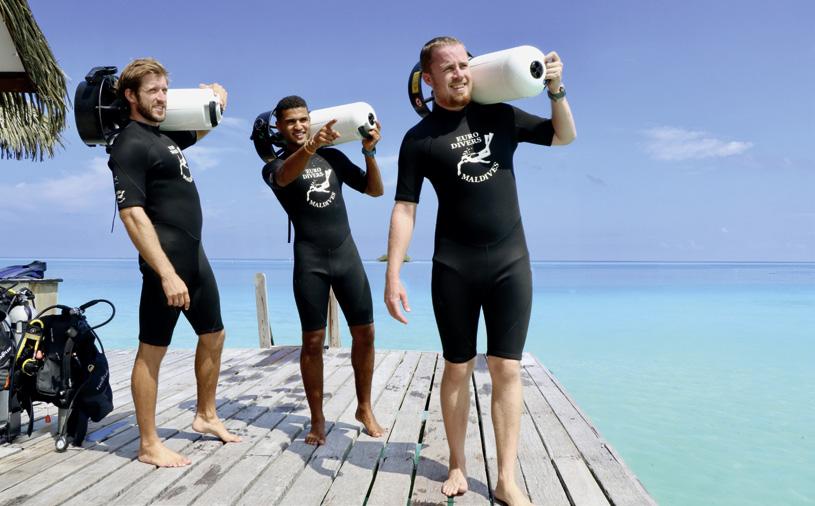
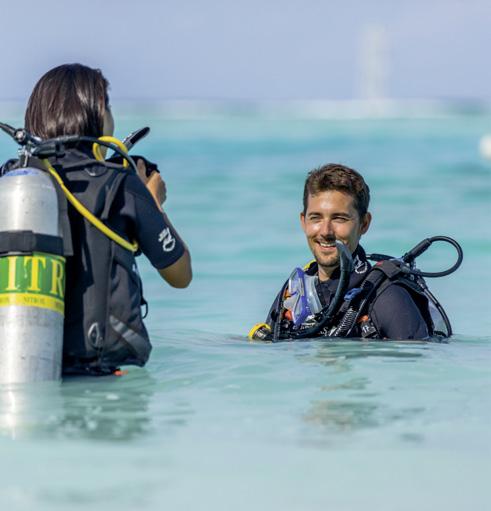
Euro-Divers has been diving with friends since 1972. With over 50 years of experience, Euro-Divers is a highly customer-focused and professional organisation that offers safe, enjoyable and unforgettable diving experiences. Euro-Divers currently operates ten PADI 5 Star dive centres on resort islands in the Maldives, as well as in Egypt, Spain, Thailand, Japan and Mauritius. The company offers recreational diving, snorkelling, water sports



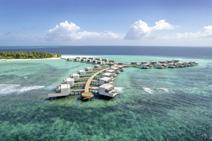
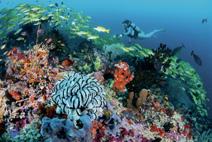
and excursions. The multilingual instructors offer courses ranging from beginner to Divemaster, with personalised guidance and a high standard of service. Euro-Divers is committed to marine conservation and sustainable tourism, enabling guests to discover the underwater world whilst contributing to the protection of marine ecosystems. The focus is not just on the dives themselves, but on creating lifelong memories with friends underwater.


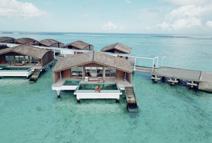
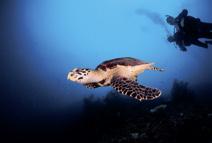

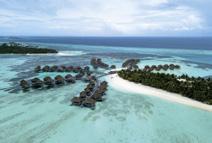
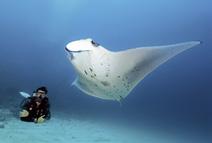
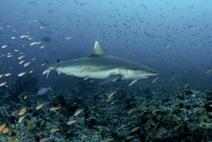
of turtles, reef sharks, manta rays, eagle rays and schools of fish such as fusiliers, tuna and trevally. Suitable for divers of all experience levels.

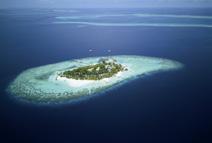
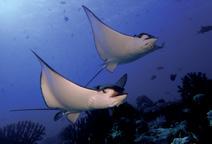
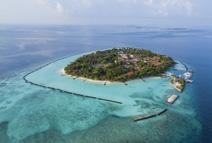
An easily accessible house reef featuring reef sharks, turtles and rays. Night dives offer the chance to witness trevally feeding frenzies. Dive sites such as Finger Point, Woshimas Thila and Bodu Hithi Thila feature schools of eagle rays, grey sharks and manta rays.

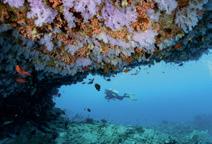
An attractive house reef featuring blacktip reef sharks, eagle rays, moray eels and turtles. Famous dive sites such as Banana Reef, HP Reef, Okobe Thila, Nassimo Thila, Lankan Manta Point and Embudhoo Express are all within easy reach. Ideal for pre- or post-programmes for safaris and for families looking for simple, relaxed dives.

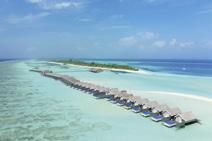
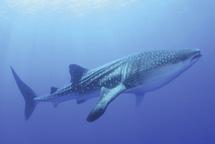
Diving in Whale Shark National Park in South Ari Atoll, where whale shark encounters are available all year round. Dive sites in the Dhigurah Channel, such as Kuda Rah Thila, the Kudhimaa wreck, Reethi Thila and Broken Rock, offer colourful reefs, manta rays, drift dives and encounters with large marine life.

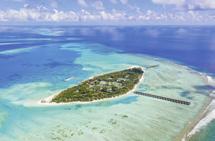
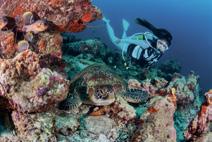
Family-friendly diving with over 50 dive sites, ranging from coral gardens to channel dives and wrecks. Encounters with manta rays and reef sharks. Suitable for beginners and experienced divers.

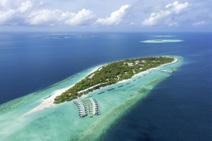
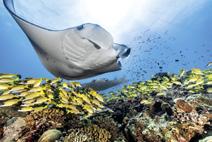
Unspoilt reefs in Raa Atoll. Encounters with manta rays all year round . Less crowded dive sites, ideal for underwater photographers. House reef with turtles, eagle rays, reef sharks and macro life for relaxed buddy dives.

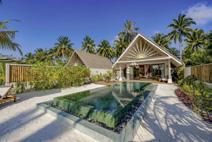
Trench dives with large fish in South Male Atoll. Ran Thila, Guraidhoo Corner and Losfushi Canyon offer reef sharks, eagle rays, dogtooth tuna, green sea turtles and large schools of fish. Close to a quiet dolphin sanctuary.

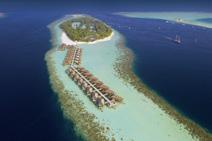
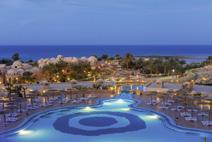
Vilamendhoo Island Resort & Spa
A spectacular house reef with ten entry points directly from the beach. Year-round encounters with whale sharks and manta rays. Dive sites such as Kuda Rah Thila, 7th Heaven and Lucky Hell in the Dhigurah Channel offer challenging and varied dive profiles.

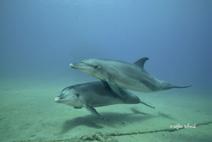
Diving in the southern Red Sea, with a calm house reef, dolphins and occasional sightings of dugongs. Visits to the Salem Express wreck. Suitable for divers who want to dive away from the main beaches.

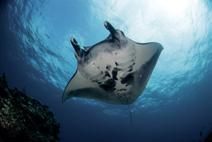
Diving
Spain - Euro Divers Roses (Cap de Creus)
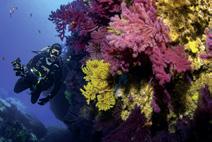
For groups and club trips in the Cap de Creus Nature Reserve on the Costa Brava. A modern diving centre with excellent facilities for groups. Access to protected dive sites within the marine reserve, home to a diverse range of Mediterranean wildlife.

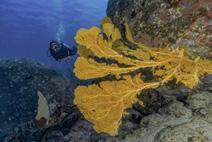
- Club Med Albion
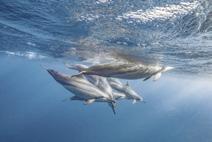
Dives along the west coast featuring coral reefs, turtles and tropical reef fish. Dolphins are regularly spotted during the trips. Relaxed all-inclusive diving.

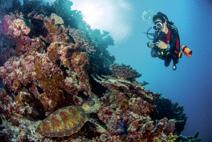
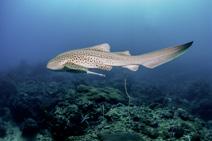
Thailand - Club Med Phuket
Dive centre at Kata Beach with access to the best dive sites in southern Thailand. Colourful coral reefs and a diverse underwater world. Organised boat dives with an experienced team for comfortable tropical diving.
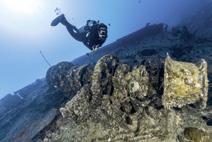
Mauritius - Club Med La
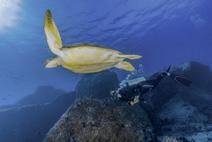
Dive sites on the north coast featuring coral reefs and shipwrecks. Encounters with turtles , and reef fish. Whales and dolphins may be spotted from May to October.
In this brief profile, we introduce a family resort on the Caribbean island: the Kunuku Aqua Resort.
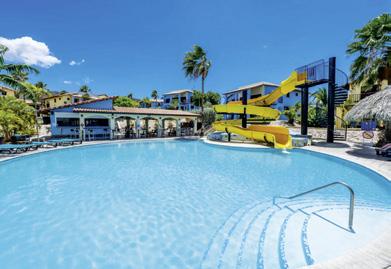
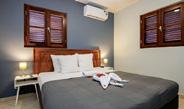
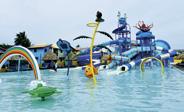
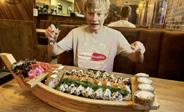
Resorts with multiple pools, water slides and a wide range of family-friendly activities often seem, at first glance, to be the exact opposite of a relaxing Caribbean holiday. So it’s all the more surprising when such a place turns out to be far more charming than expected. That is exactly the case with the Kunuku Aqua Resort on Curaçao.
To round off a week’s autumn holiday on this Caribbean island, the resort makes for a hassle-free base for a few relaxing days. Although it isn’t situated right by the sea – being about 20 minutes from Willemstad – it more than makes up for this with plenty of space, a laid-back atmosphere and a strikingly welcoming design. Upon entering the complex, the impression is more of a small, colourful village than that of a classic holiday resort. The buildings, painted in a variety of colours, lend the area a cheerful, almost playful atmosphere. Some of the ground-floor rooms offer direct views of one of the six pools. Despite its clear focus on families, the resort feels more pleasant and peaceful than the number of pools might initially suggest. You can also sit and relax on the terrace without being constantly surrounded by loud hustle and bustle. Naturally, much of the focus here is on water. And that is precisely where the resort’s
strength lies. Those staying for several days will have ample opportunity to try out the various pools to their heart’s content. The real highlight, however, is Waterworld, the separate water park right next to the entrance. There, numerous slides of various types await: fast, winding, leisurely or set against a backdrop of light effects. The facilities are by no means aimed solely at children. Adults clearly have a great time too – and that is precisely what makes this complex so appealing. Families with older children or teenagers in particular are likely to find themselves surprisingly well catered for here.
The resort offers a range of dining options. There is a buffet restaurant, as well as a pizzeria that specialises in seafood pizzas. Kunuku’s “Sushi & More” left a particularly positive impression: for an additional charge, they serve a generous selection of sushi, which not only looks impressive on a decorative boat but also tastes delicious.
The BBQ evening, on the other hand, is not quite as impressive. The idea of grilling the meat yourself sounds good at first, but the actual offering doesn’t quite live up to expectations. Anyone still feeling peckish afterwards will find additional classics such as chips and dessert in the buffet restaurant. During the day, “De Hut” serves guests light snacks. Breakfast and lunch are also served as a buffet.
A great location for day trips on Curaçao
One clear advantage is the location. The Kunuku Aqua Resort is not only ideal for relaxing days spent on the resort grounds, but also serves as a convenient base for day trips. Destinations such as Westpunt and Willemstad are easily accessible from here, adding variety to your stay. The resort thus combines the atmosphere of a water park with a location from which the Caribbean island can be explored with ease.
Conclusion: The Kunuku Aqua Resort is one of those places that quickly dispels any preconceptions. Those who actually prefer peace and quiet and tend to avoid large family resorts might nevertheless be pleasantly surprised here. For a few days, the concept works extremely well: everything is provided, the atmosphere is relaxed, the complex is colourful, and the slides aren’t just fun for children. Not a classic beach resort, but an all-round uncomplicated and surprisingly entertaining place to stay on Curaçao. Further information: www.kunukuresort.com


The route through the Exumas and Eleuthera brings together everything that divers associate with the Bahamas and the Caribbean – and adds depth and dynamism to the picture. With its sheltered reefs, spectacular drop-offs and shipwrecks, this area truly lives up to its reputation.
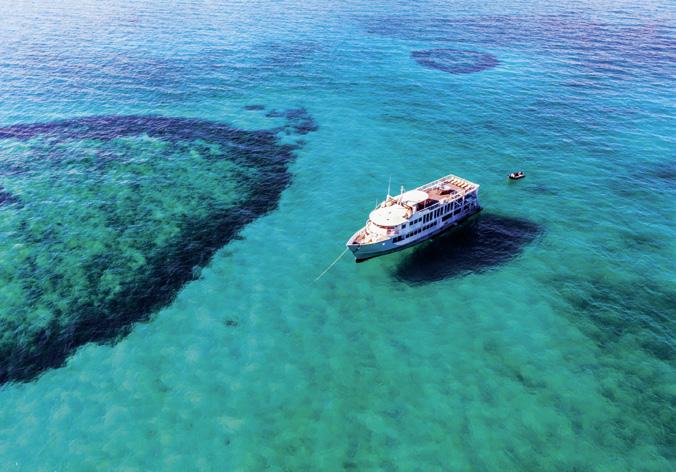
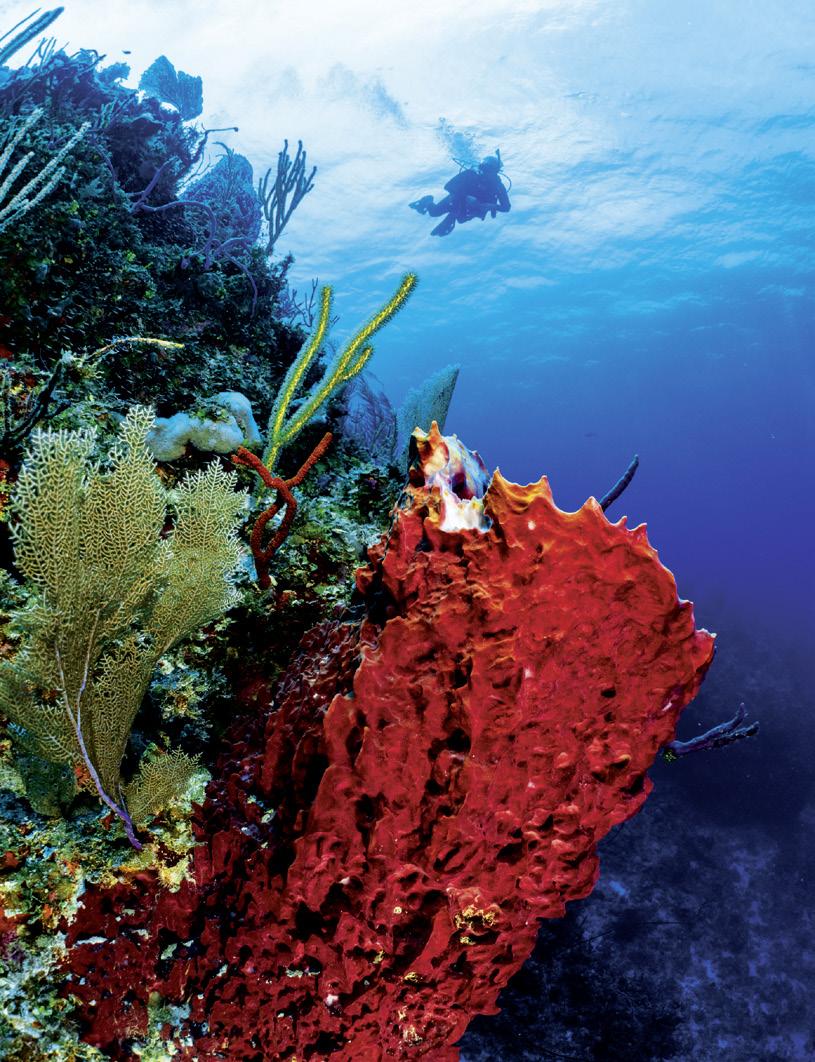
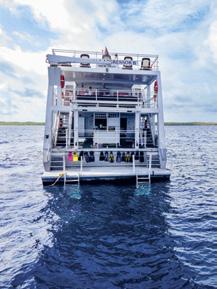
When divers think of the Caribbean, images of turquoise waters, vast coral reefs and sunsets in warm pastel shades immediately spring to mind. Hardly any other destination epitomises this image quite like the Bahamas. A week-long liveaboard trip aboard the Bahamas Aggressor II took us from Nassau in the central Bahamas to the Exumas and Eleuthera. A classic Caribbean experience that, on closer inspection, reveals an astonishing diversity beneath the waves.
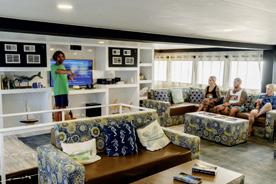
Embarking in Nassau is all about organisation and routine at first: settling into cabins, setting up gear at your designated spot on the dive deck, and attending briefings in the spacious saloon. The motto for the safari week is quickly established: eat, sleep, dive. By the very first evening, it becomes clear just how international the group of guests is – experienced safari-goers alongside those new to live-aboard trips.
The yacht leaves the harbour early on Sunday morning. The first dives take place south of Nassau, en route to the Exumas. One of the highlights: the Lost Blue Hole. With a diameter of around 30 metres, this circular structure opens up in the shallow water. Caribbean stingrays patrol the edge,
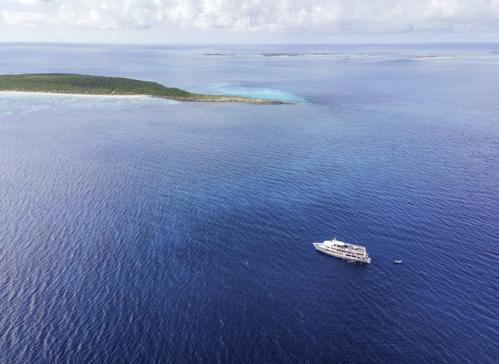
varied menu and fresh ingredients. A level of comfort that is just as much appreciated on liveaboard trips as the fantastic
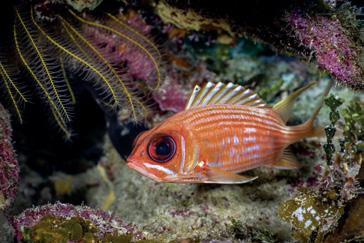
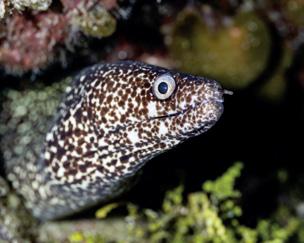
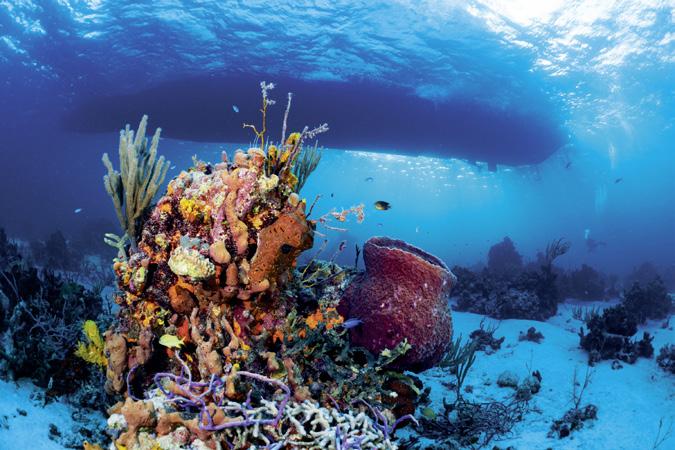
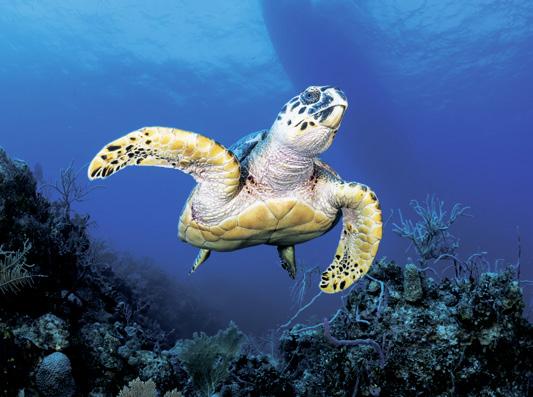
Nassau groupers stand beneath overhangs, and a loggerhead turtle drifts leisurely past. As you descend along the wall, a spotted moray eel emerges from its crevice. The actual bottom of the Blue Hole lies beyond the reach of recreational divers. Blacktip sharks occasionally rise up from the dark depths. Compared to the famous Blue Hole in Belize, this spot is marketed as less spectacular, yet underwater it is by no means any less impressive.
After a three-hour crossing, we reach the Exumas. The chain of islands stretches for more than 160 kilometres from northwest to south-east. Large parts have been protected since 1996 as a ‘Land and Sea Park’ – a no-take zone with strict regulations on fishing and use. This protected status is clearly evident underwater. The coral reefs appear intact, schools of fish are dense, and the feeling of seclusion is ever-present.
The topography varies considerably. Steep walls alternate with flatter patch reefs, interspersed with sandy areas and isolated wrecks. ‘Dog Rocks’ on the northern edge of the Exuma Cays is one of the most striking sites. The reef top lies at around 12 metres, then the wall drops vertically into the deep blue. Underwater canyons and passages shape the terrain. Black corals, massive tube sponges and extensive elephant-ear sponges dominate the scene.
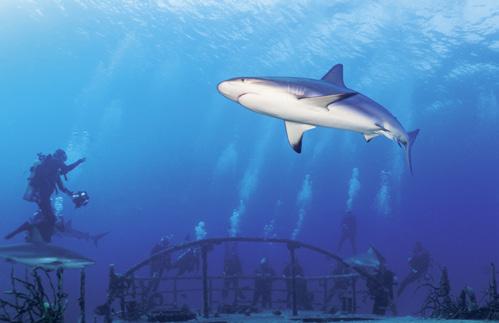
Caribbean reef sharks swim along the edge of the drop-off, whilst Atlantic batfish appear to hover motionless in the open water. With visibility of around 30 metres, the steep wall reveals its full scale – particularly impressive when you move a short distance away from the reef and take in the vertical structure in its entirety.
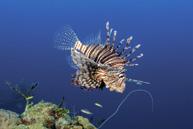
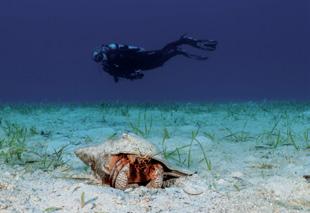
In contrast, sites such as ‘Crab Mountain’ or ‘3 Peaks’ offer a different scene. Here, shallower areas dominated by coral heads and sand prevail. Trumpetfish stand upright amongst the gorgonians. Lobsters and large pocket crabs hide beneath overhangs. Green sea turtles appear regularly, surfacing to breathe and returning to the reef at a leisurely pace. For photographers, it is often the smaller subjects that deserve special attention: the vibrantly coloured flamingo tongue on fan corals or yellowheaded jawfish, which hover above their sandy burrows and vanish in a flash at the slightest movement. Even seemingly empty
sandy areas turn out, on closer inspection, to be teeming with life, with burrowing stingrays, hermit crabs and tracks in the sediment.
To the east of Nassau lies Eleuthera, a narrow island situated between the Caribbean Sea and the Atlantic Ocean. Its exposed location shapes the dive sites there. Flat reef tops give way abruptly to steep walls. Nutrient-rich currents encourage schools of fish and larger encounters. Caribbean reef sharks patrol the drop-offs, whilst snappers gather in dense schools at the
transition to the open water. Impressive sponges and gorgonians cover the wall structures. Dives here feel more dynamic and require constant attention to depth and current, but reward divers with stunning scenery.
The range of underwater wrecks is expanding: the ‘Austin Smith’ lies at a depth of around 21 metres. The former patrol boat was decommissioned and sunk in the 1990s. Today it serves as an artificial reef, regularly visited by reef sharks. One of the ‘shark-richest’ dives of this safari week.
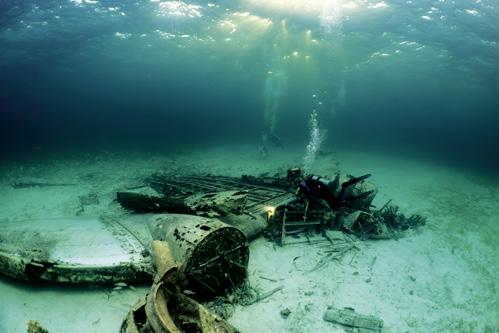
The “Smuggler’s Plane”, lying in just five metres of water, is a completely different
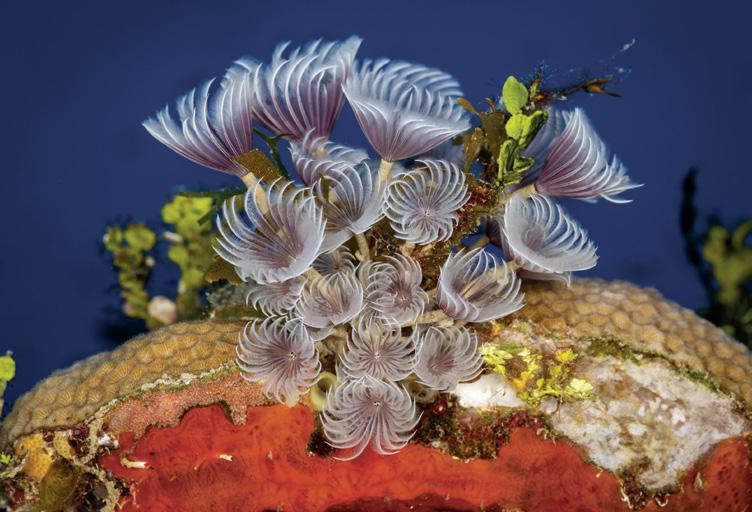
story: the small aircraft, which was presumably used for drug trafficking in the 1970s or 1980s, still lies where it came to rest after a failed take-off attempt. In the late afternoon, filtered sunlight falls through the water’s surface, bathing the small wreck in shifting patterns. Large sea anemones with cleaner shrimp colonise parts of the structure, whilst shoals of snapper seek shelter in the fuselage. During night dives, nurse sharks and rays appear on the adjacent sandy areas.
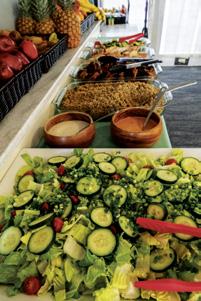
The daily routine on board follows the classic safari schedule: a light snack before the first dive, a hot breakfast afterwards, lunch, snacks and dinner. Given the limited space, the quality of the food on board never ceases to impress. Between dives, there’s time to make logbook entries, sort through photos or watch the sunset from the sun deck. On Friday, the yacht returns to Nassau. The equipment is rinsed and laid out to dry, followed by a farewell party on board in the evening.
This route through the Exumas and Eleuthera showcases just how diverse the
Bahamas are. Steep walls and blue holes, shark encounters and macro subjects, historic wrecks and aircraft remains in shallow water: a dive area that delivers classic Caribbean imagery whilst offering something more. Divers here will find not only picture-postcard scenes, but a varied underwater landscape with a distinct character. Classic Caribbean – in the best sense of the word.
Area: the central Bahamas
Port of departure: Nassau, New Providence
Best time to visit: all year round. Peak season with stable conditions: spring to autumn
Water temperature: 24 to 29 degrees Celsius, depending on the season
Visibility: usually 25 to 30 metres
Dive profile: steep walls, blue holes, reefs and wrecks
Current: moderate to strong depending on the dive site, particularly on steep walls
Recommended experience: OWD with experience on rope walls, confident handling of depth and buoyancy.
Highlights: Exuma Cays Land and Sea Park (no-take zone), regular encounters with Caribbean reef sharks, a mix of large-game and macro subjects
Further information: www.aggressor.com
With the Solo N Dyneema, DiveSystem presents a new technical drysuit designed for demanding conditions. Made from 1-millimetre high-density neoprene with a Dyneema outer layer and a double Alpha Titanium inner layer, the suit is designed to combine low weight with high thermal performance. Pre-shaped knees and elbows enhance freedom of movement. Reinforced knee pads, robust materials and durable seams are designed for harsh environments and ensure high durability even with intensive use. Price : from €3,199. www.divesystem.com www.abyssmarine.eu

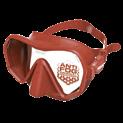
Seac introduces three new anti-fog diving masks: Pura, Clear and Wild. A special plasma treatment makes the lenses hydrophilic and permanently reduces fogging without the need for pre-treatment. The frameless Pura offers a wide field of vision and a low internal volume. The twin-lens Clear mask features a robust construction for training and recreational use. With its low-volume design and extended field of vision, the Wild is particularly aimed at freedivers.
Prices: Pura €69.90, Wild €66.50, Clear €52.90. seacsub.com
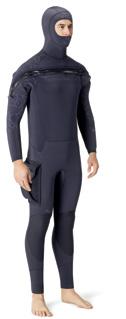
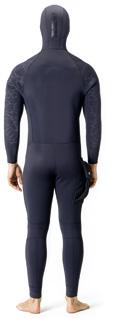
Bare has launched the Velocity Ultra 2.0, a semi-dry wetsuit designed for cold waters. The 8/7-millimetre suit combines Progressive FullStretch neoprene with Omniredinfrared technology, which is designed to reflect body heat and thus provide greater thermal performance. Features include an integrated hood, a Front-Dry zip and sealing cuffs on the arms and legs to minimise water ingress. The suit is designed for longer dives in cold water. Price: US$699.95. A recommended retail price for Europe was not yet available at the time of going to press. baresports.com
In mid-March 2026, Halcyon Dive Systems expanded the global availability of the Symbios chestmounted rebreather. Following a limited launch phase involving instructors and explorers, the compact closed-circuit system is now entering series production. The chest-mounted CCR combines galvanic and digital oxygen sensors, features a patented ADV/BOV regulator and communicates wirelessly with handsets and HUDs. An app enables system configuration and logbook analysis. Training programmes are already underway at IANTD, TDI and GUE. Price: from approx. US$10,000. halcyon.net
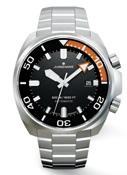
Junghans is introducing a new range of diving watches with the Aquaris. The Aquaris Diver, Red and Blue models feature a 46.9-millimetre stainless steel case and are water-resistant to 50 bar. They are powered by the J830 automatic movement, which offers a 48-hour power reserve and protection against magnetic fields. An internal, unidirectional rotating bezel is operated via a second crown. Price: from €2,690. junghans.de
The digital photography revolution was sparked in Japan. In 1987, Sony unveiled the Mavica (Magnetic Video Camera), the first mass-produced camera with electronic recording, priced at US$650. With this move, Sony took the market leaders – Canon, Nikon, Minolta, Olympus and Pentax – by surprise. However, its success was limited. Technically, the camera proved to be a dead end because it was based on video technology and produced analogue video stills – strictly speaking, therefore, not a true digital camera. Furthermore, during video recording, part of the optical resolution had to be sacrificed in favour of colour reproduction. The images were stored on a floppy disk with a maximum capacity of 50 shots. An expensive adapter was required to view them on a television.
Sony’s Mavica range initially failed to achieve much success, and in 1996 the company replaced it with the Cybershot series of compact cameras, which used Memory Stick memory cards. The further-developed Cyber-shot RX series, featuring a one-inch sensor, is now regarded as a high-performance compact camera for underwater photography and 4K video. The early Mavica models have since achieved cult status and, looking back, mark the beginning of the digital revolution.
In 1990, the software company Adobe launched its Photoshop programme. The software became the go-to tool for editing digital images in RAW format and, for many underwater photographers, became an integral part of digital photography.
The first true digital camera was unveiled in 1991 by the Californian company Dycam at the CeBIT computer trade fair under the name Model 1. Its CCD sensor had a resolution of 376 × 284 pixels. It could only take black-and-white photographs. The business magazine *Fortune* predicted the imminent end of film, chemicals and darkrooms. At Photokina 1992 in Cologne, virtually all the major camera manufacturers unveiled digital models. Canon started with the ION camera and later the PowerShot range, Nikon with the Coolpix models, whilst Minolta, Olympus, Panasonic and Pentax also entered the new market. All digital cameras featured a rear monitor for image review – a decisive advantage over analogue technology.
The year 1994 is regarded as the turning point for digital photography in Germany. It was then that Vogelsänger Studios, renowned for interior photography, began working with digital cameras. This accelerated the uptake of professional systems. In the consumer market, however, high prices of around 1,600 euros prevented a breakthrough. Experts therefore predicted that affordable prints from digital data, made available by retail chains and discounters, would open up the mass market. That is exactly what happened.

Herbert Frei
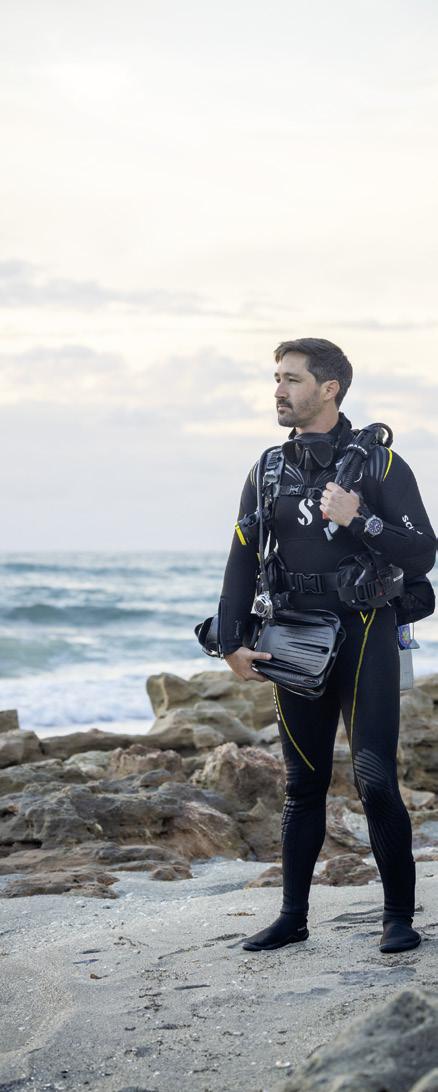




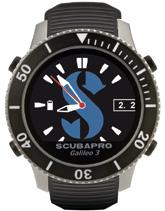
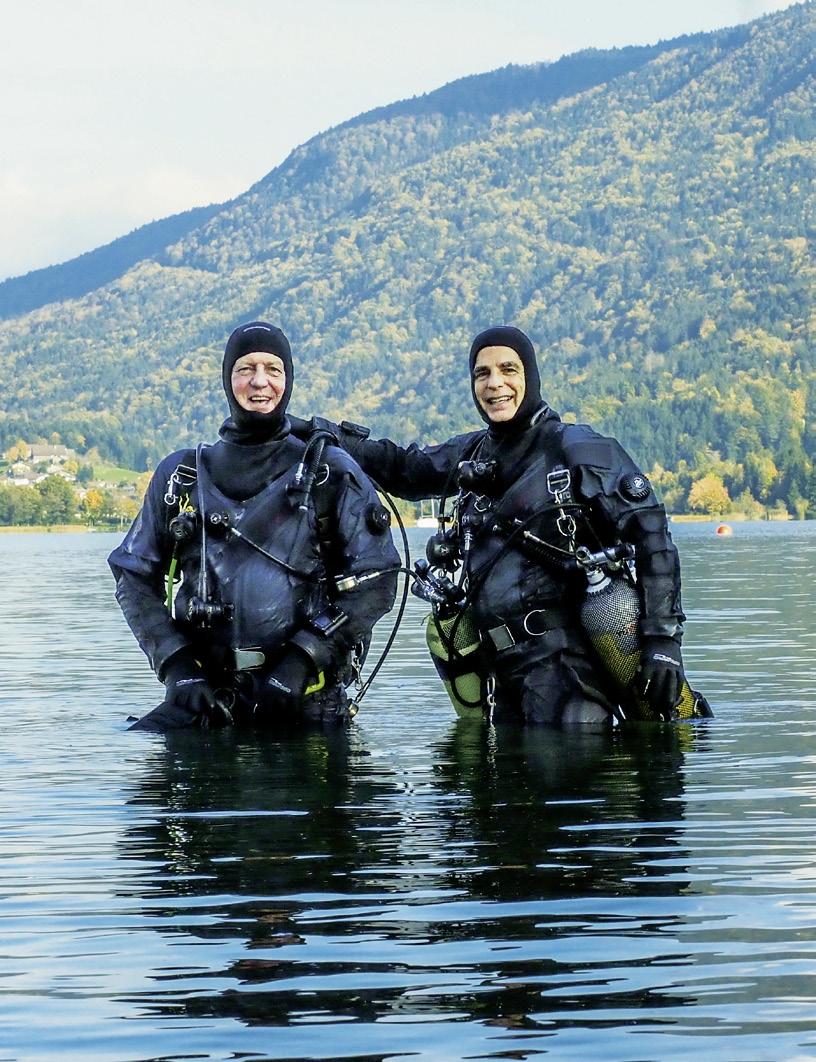
Field test in Mondsee: The newdry suits are being tested in backmount and sidemount configurations.
In the clear waters of Lake Mondsee in Austria, we tested the latest generation of Camaro dry suits . A visit to this long-established family business reveals just how much development work has gone into the new models.
T Carlo Vreugde & F Carola Lockhorst
Inmany companies, the phrase “the customer is king” is merely a marketing slogan. At Camaro, it’s part of everyday life. This Austrian family-run business has been developing diving suits and water sports clothing for decades – and staying close to its customers is central to its philosophy.
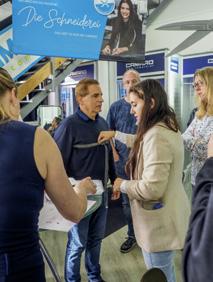
Anyone who speaks to staff at trade fairs such as boot Düsseldorf or Duikvaker in the Netherlands will quickly realise that designers, tailors and divers work closely together here. Ideas and feedback from the field are gathered, analysed and incorporated directly into new products.
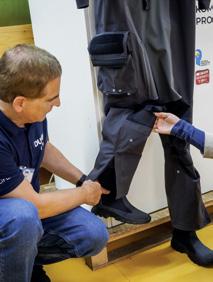
This is also evident during a visit to the production facility. Whilst I’m there, the neoprene neck seal on my own drysuit is replaced. The seamstresses take precise measurements of my neck circumference. Just a few minutes later, the fitting process begins in the workshop. Two days later, the suit is ready – a perfect example of the close link between development, service and the user.
Feedback from repairs and service cases is systematically documented. This re-
sults in a constantly growing list of potential improvements – the basis for new generations of dry suits.
The development of the current model range was overseen by project manager Michelle Porsche. The aim was to develop a technically improved drysuit that is both more comfortable and more functional.
The previous model, the Drytec 3.0, had already won over many diving schools.
The lightweight, breathable three-layer fabric offers significantly greater freedom of movement than traditional dry suits.
The new generation
One of the most striking new features is an integrated thermal collar. It allows the hood to be neatly tucked away beneath an elasticated panel, whilst providing additional insulation for the neck. The solution seems surprisingly simple – which is precisely why one wonders why it hasn’t
been implemented more widely until now.
The entry point has also been redesigned. The zip now runs diagonally across the shoulder and is longer than on the previous model. This makes the suit easier to put on and take off, and significantly reduces the strain on the shoulders and back.
Inside, a smoother fabric texture ensures that the diver literally glides into the suit. A detail that may seem unremarkable at first glance, but makes a huge difference in a diver’s day-to-day life.
In addition, the elbows and knees have been pre-shaped. The benefit is particularly noticeable underwater: the fabric moves with you rather than against you. This makes fin strokes feel more natural and less restricted.
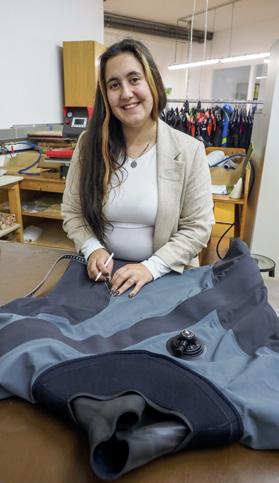
Camaro offers the new generation in two versions. The Drytec AIR model is the basic version and also the direct successor to the Drytec 3.0. Technically, the suit is based on the tried-and-tested design, but has been improved in many details. The even higherquality version is called Protec AIR. It features additional functions and more comprehensive equipment.
The suit comes as standard with a large technical thigh pocket; a second one is available as an optional extra. An interesting feature is the option to position the pockets further forward – a particular advantage for sidemount divers.
Robust expedition diving boots with extra-thick soles are also included as standard. Their tread pattern is similar to that of hiking boots and provides good grip on stony banks or dams.
Camaro also uses high-quality components for its valves: Apeks valves come as standard.
A flexible abrasion-resistant layer is applied to areas subject to particular wear and tear – the knees, elbows and seat. It moves with the fabric whilst preventing premature wear.
The Protec AIR features an unusual design element on the forearm: a MOLLE system with elastic bungee fastenings. This allows small items of equipment, such as writing boards, carabiners or line markers, to be secured in place. The advantage is that the diver does not need to open any pockets.
In testing, the mounting system proves to be practical even for a dive computer. The extended strap of a Garmin Descent can be secured under the bungee loop. The watch remains firmly in place without feeling uncomfortably tight.
Whilst many manufacturers focus exclusively on functionality, Camaro also takes a design-led approach. The fabric panels are first sewn together from the inside and
then bonded. This creates a smooth outer surface with no visible overlaps – a detail that gives the suit a much neater appearance. Colour accents on seams, logos and details allow for a personalised look. Overall, there are several colour combinations to choose from.
The inspiration behind the cut is also unusual: the designers drew some of their inspiration from modern skiwear. The result is a drysuit that remains functional but looks significantly more modern than many classic models.
The trouser legs sit over the boots and are fastened with an internal zip. As well as looking good, this also ensures that water runs off the suit cleanly.
Environmental regulations are also becoming increasingly important in the diving industry. Stricter regulations now apply, particularly when it comes to waterproofing dry suits. Today, the water-repellent treatment of fabrics is carried out entirely without PFAS. Camaro uses special cleaning and waterproofing agents tailored to the materials. Additional treatment is rarely required. As a rule of thumb, the suit should be washed and re-waterproofed after about a year or around a hundred dives.
Around 30 divers from the Benelux countries tested the new models in Lake Mondsee. The high level of comfort was noticeable as soon as they entered the water. The lightweight three-layer laminate allows plenty of freedom of movement without compromising on stability. The pre-shaped joint areas are particularly noticeable during longer dives. An advantage was also evident at the water’s surface: the suit is relatively easy to put on and take off – an aspect that is often underestimated. After several test dives, the participants’ verdict was overwhelmingly positive. Alongside praise for comfort and mobility, the developers also gathered feedback for further refinements.
Conclusion
With the new Drytec range, Camaro demonstrates that technical functionality and modern design are not mutually exclusive.
The combination of flexible three-layer fabric, well-thought-out details and customisable design sets these models apart from the crowd of traditional dry suits.
For divers who value comfort, freedom of movement and high-quality craftsmanship, the Drytec AIR and the Protec AIR are an attractive option – whether for training and everyday dives or for more demanding missions.
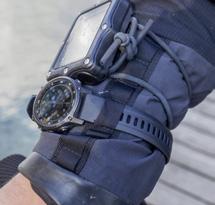
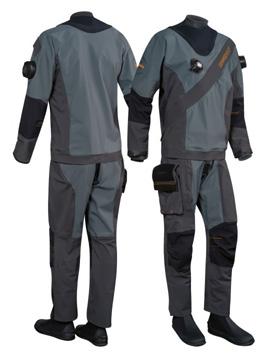
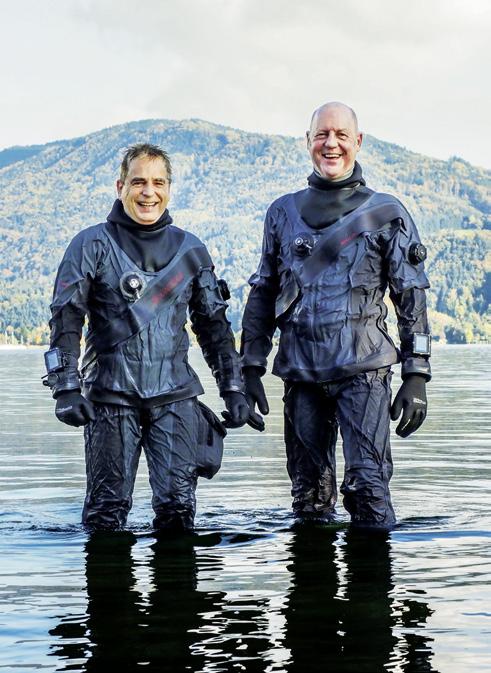
Model
Type
Material
Colours
zip
Valves
Ankle socks
neck collar
Arm cuffs
Knee / Elbow
Pockets
MOLLE system
Additional protection
Options
PROTEC AIR
Trilaminate drysuit
3---ply stretch laminate
blue, green or black
Across the shoulder (Easy Entry)
Apeks or SI-Tech
PRO boots
Latex or neoprene
latex
pre-shaped + additional abrasion protection
1 bag as standard, second optional Molle system on the forearm
Abrasion protection for knees, elbows and buttocks
Thermal footies, neoprene socks, detachable hood, second pocket, Name tag, silicone wristbands, Glove system, urinal valve
2,695 euros
camaro-watersports.com
Trilaminate drysuit
AIR
3---ply stretch laminate
blue, green or black
across the shoulder (Easy Entry)
Apeks or SI-Tech
Thermo---Socks
Latex or neoprene
latex
pre-formed
1 bag (optional)
––
PRO boots, neoprene socks, detachable hood, second pocket, Name tag, silicone wristbands, Glove system, urinal valve
1,795 euros
camaro-watersports.com
Systems, regulators, rigging and components – what’s available from specialist retailers in Germany and which market segments the manufacturers cover.
T Benjamin Schulze
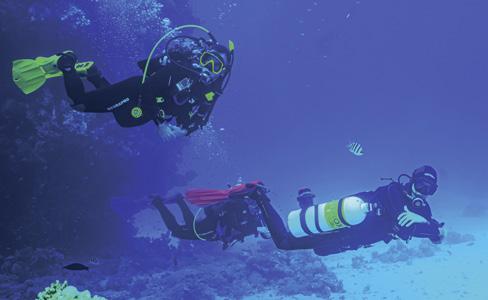
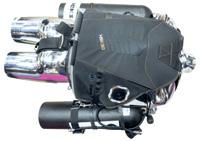
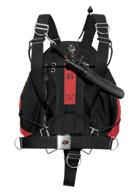
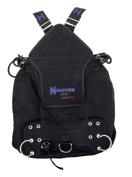
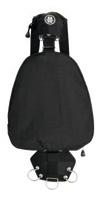
Over the past two decades,sidemounthas evolved in Germany from a niche concept for cave divers into a distinct configuration philosophy. In addition to traditional technical diving applications, recreational divers now routinely use side-mounted tanks – for example, when travelling with aluminium tanks or in modular coldwater setups. The market has become correspondingly diverse: some manufacturers offer complete systems comprising a wing and harness. Others specialise in regulator sets or supply hardware, rigging and components. This overview focuses on open-circuit (OC) systems – i.e. classic sidemount configurations with regulators – and highlights which brands are relevant in the German market. Sidemount rebreathers, as a distinct, highly specialised segment, have been deliberately excluded.
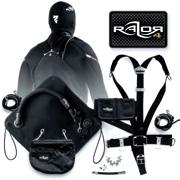
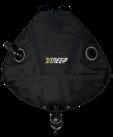
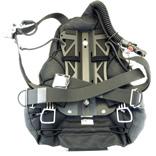
APEKS
With the WSX sidemount system, Apeks is firmly establishing itself in the technical diving segment. The modular design appeals to experienced divers who value robust construction and a clear configuration logic. The brand also offers specialised sidemount regulator sets and technical hardware. apeksdiving.com
FINNSUB
With wings such as Flyside and Speleo, Finnsub caters to a wide range of cold-water, recreational and cave divers. The systems are regarded as robust and functional, not overly fancy, but practical. The out-of-the-box setup is relatively straightforward. finnsub.com
HALCYON
The Zero Gravity system embodies Halcyon’s signature commitment to premium quality: solidly built, clearly structured and thoughtfully modular. Suitable controller configurations with a fifth output are also available. halcyon.net
HOLLIS
With its Katana 2 models, Hollis has been a leading name in the sidemount market for years. The systems are regarded as tried-and-tested all-in-one solutions, particularly for divers who prefer a ready-to-use setup. Regulator configurations are also available. hollis.com
OMS
OMS has traditionally been known for its technically oriented systems. The SideStream model is designed for experienced divers who prefer a minimalist, functional setup. OMS also offers suitable regulator configurations for sidemount applications. omsdive.com
RAZOR
Razor is one of the leading brands in the side-mount sector. Its modular system, which offers a range of bladder options, is particularly popular in the caving and technical diving communities. The brand’s many years of market experience are reflected in its consistently minimalist, practical design. razorgosidemount.com
SCUBAFORCE
With the Blade, Scubaforce offers a versatile, modular sidemount system designed for both travel and demanding cold-water and technical diving applications. The range is complemented by pre-configured sidemount regulator sets and a comprehensive range of hardware. The brand is clearly positioned in the technically advanced segment. scubaforce.com
TECLINE
Tecline offers a complete sidemount setup: in addition to sidemount regulator sets (featuring a
fifth port, swivel and pre-set hose lengths), the brand offers its own sidemount wings, such as the Side 16 Avenger, as well as matching accessories. The focus is clearly technical. At the same time, the system is marketed as being ‘ready’ for cave and recreational diving. teclinediving.eu
Toddy Style follows a unique, modular design that allows you to switch between backmount and sidemount configurations. The systems are particularly appealing to divers seeking maximum flexibility and customisation. toddy-style. com
With the Stealth 2.0 series, xDEEP has become one of the most prominent brands in the international sidemount market
. The modular design, integrated weight systems and various bladder options make these systems extremely versatile. xdeep.eu
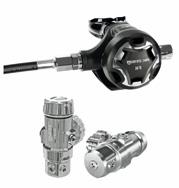
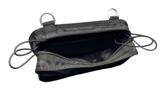
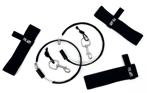
Polaris is best known in the German-speaking market for its rigging kits, valve and cylinder options, and hardware components. The products are particularly suitable for retrofitting or customising existing systems and are widely available from specialist retailers. polaris-diving. com
AQOR offers backplates, harness components and adapter solutions that can also be used for sidemount diving. The range is aimed at technically minded users with modular requirements. aqor.de
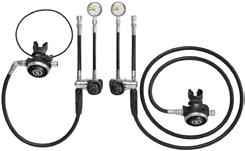
Within the XR range, Mares offers pre-configured sidemount regulator sets with optimised hose routing. Since the merger with Apeks, the brand no longer offers its own sidemount systems. Nevertheless, the brand remains a key player in the regulator segment, as its regulators are renowned for their reliability and safety, even under particularly harsh conditions. mares.com
Scubapro offers customised sidemount regulator kits featuring specific hose routing and suitable port configurations. These kits are primarily aimed at divers who prefer tried-and-tested standard regulators in a customised configuration. scubapro.com
International brands
Note: These brands are not widely available in specialist shops in German-speaking countries and are therefore not listed as core suppliers in the main section.
Dive Rite: A US manufacturer of the Nomad Ray sidemount system, designed for both technical and recreational sidemount divers; available in Europe through specialist retailers. diverite.com
DTD (Dare To Dive): an EU brand offering its own sidemount components and system parts (wings, backplates, rigging), available via its online shop; a technically oriented range. daretodive. eu
Arecent archaeological discovery could shed new light on the history of the so-called Elgin Marbles. Researchers have discovered a small fragment of marble in the wreck of the Mentor, a ship that sank in 1802, which may have originated from the Parthenon in Athens. The Mentor was once sailing on behalf of Lord Elgin, transporting ancient works of art from Greece to Britain. When the ship sank off the Greek coast, part of its cargo was lost. Although numerous objects were recovered shortly after the disaster, part of the cargo was long considered lost. The discovery now made is a unique find: for the first time, a marble element has been recovered directly from the wreck that is highly likely to have been part of the original cargo. The fragment is a decorative architectural element whose shape and dimensions bear striking similarities to known elements of the Parthenon.
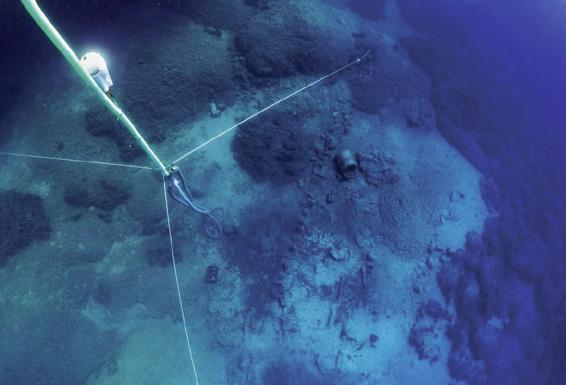
The artefact is currently undergoing scientific examination and restoration. Only detailed analyses will be able to definitively confirm whether it is indeed a fragment of the world-famous temple. Should this suspicion be confirmed, the discovery would be of particular historical significance. It would provide the first direct material evidence that parts of the Parthenon were among the cargo carried by the Mentor. At the same time, the discovery could give new impetus to the ongoing debate regarding the whereabouts and possible return of the Elgin Marbles.
A recent study shows that disease poses a greater threat to the reintroduction of the European oyster in Europe than previously thought. Researchers at the GEOMAR Helmholtz Centre for Ocean Research Kiel have investigated how pathogens spread between oyster beds – with worrying results. According to the study, free-floating pathogens can spread across ocean currents over distances of around 30 kilometres, whilst infected larvae can travel distances of up to 60 kilometres. As a result, many existing and planned reintroduction sites are interconnected and potentially at risk. The analyses show that around a third of the sites studied are exposed to a persistently high risk of infection. Regions that are in close contact with areas already infected are particularly affected. Using a digital model, the researchers were able to simulate the spread of the disease and identify high-risk areas. This tool is intended to help select suitable sites for reintroduction projects in a more targeted manner and to better control the spread of disease in future. The results make it clear that the protection and restoration of oyster beds depend not only on suitable environmental conditions, but also require effective management of disease risks.
New scientific research paints a surprisingly hospitable picture of the Doggerland landscape, which now lies beneath the North Sea. As recent analyses show, this area served as an important refuge for animals – and possibly also for humans – as early as the last Ice Age. Doggerland, which once connected Great Britain to the European mainland, existed as a vast, river-criss-crossed landscape. Between around 12,000 and 8,000 years ago, it was eventually flooded by rising sea levels. New research now shows that parts of this region were ice-free and ecologically diverse much earlier than previously thought. As early as around 16,000 years ago, dense deciduous forests with oaks, elms, alders and hazel bushes grew in southern Doggerland. These findings are based on the analysis of sediment DNA and pollen samples. It is particularly remarkable that these forested and species-rich areas existed whilst large parts of the surrounding regions were still characterised by barren cold steppes. Doggerland thus apparently represented a climatically favoured refuge that provided habitats for numerous animal species. Archaeological finds such as worked animal bones and antlers also suggest that humans utilised and settled this fertile landscape. The new findings provide important insights into environmental conditions during the last Ice Age and fundamentally alter the previous understanding of Doggerland. Instead of an inhospitable cold steppe, the region now appears as a comparatively mild habitat that served as an early refuge for flora and fauna.
A mammoth bone, found around 20 kilometres west of Heligoland. Discoveries such as this make the North Sea one of the world’s most important sites for Ice Age fossils.

DR FLORIAN HUBER reports monthly on the latest news from the world of underwater science. He himself is an underwater archaeologist and a research diver (florian-huber.info).
An international research team has successfully retrieved a 228-metre-long sediment core from beneath the Ross Ice Shelf in West Antarctica – a recordbreaking find that offers new insights into the region’s climate history. To carry out the drilling, a hole several hundred metres deep was first cut through the ice before the sediments were extracted. The samples are thought to date back as far as 23 million years and originate from a period of significantly warmer climatic conditions. The analyses aim to show how the West Antarctic ice sheet responded to rising temperatures during past warm periods. This is crucial for better assessing how stable the ice is today and what contribution it might make to sea-level rise in the future. Initial evidence suggests that the region was ice-free at times in the past. Further analysis of the samples should
now help to refine climate models and predict future developments more accurately. Carrying out the expedition presented the team with enormous logistical challenges. For several weeks, the researchers lived in a remote camp on the ice and worked round the clock in extreme weather conditions. Over the coming months and years, the sediment samples will be further analysed in specialist laboratories around the world. The aim is to reconstruct the climatic conditions of past warm periods more accurately and to draw conclusions about the future stability of the West Antarctic ice sheet.
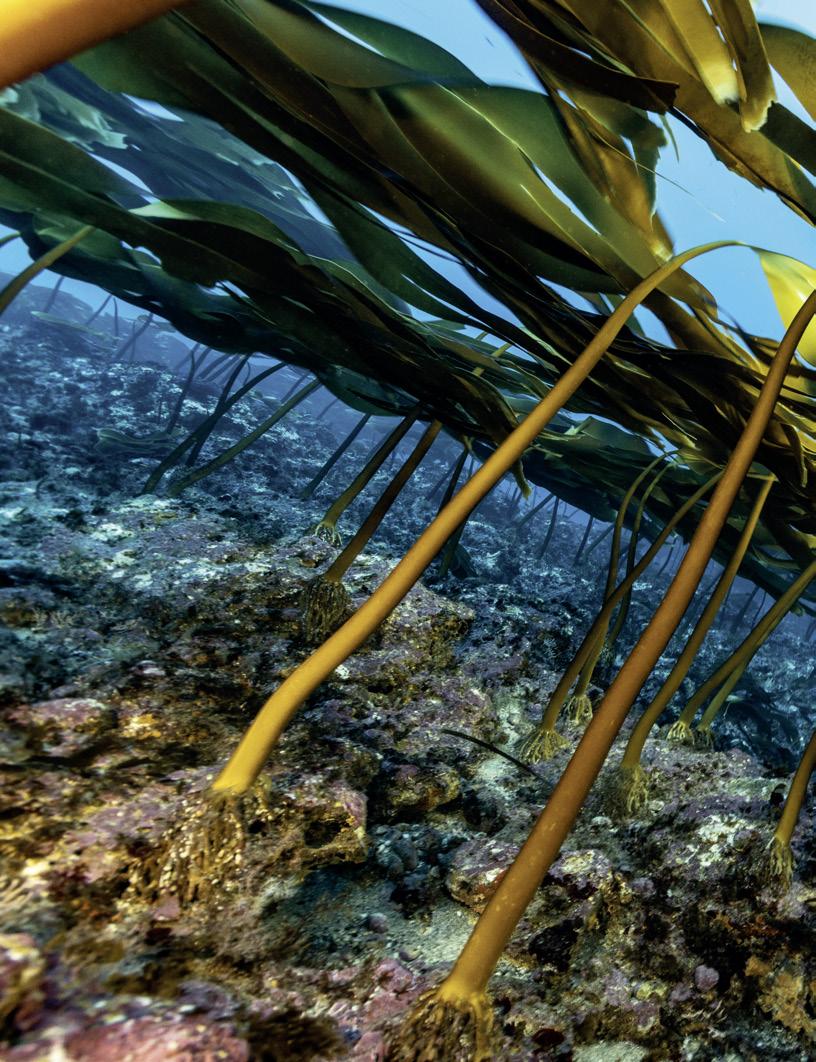
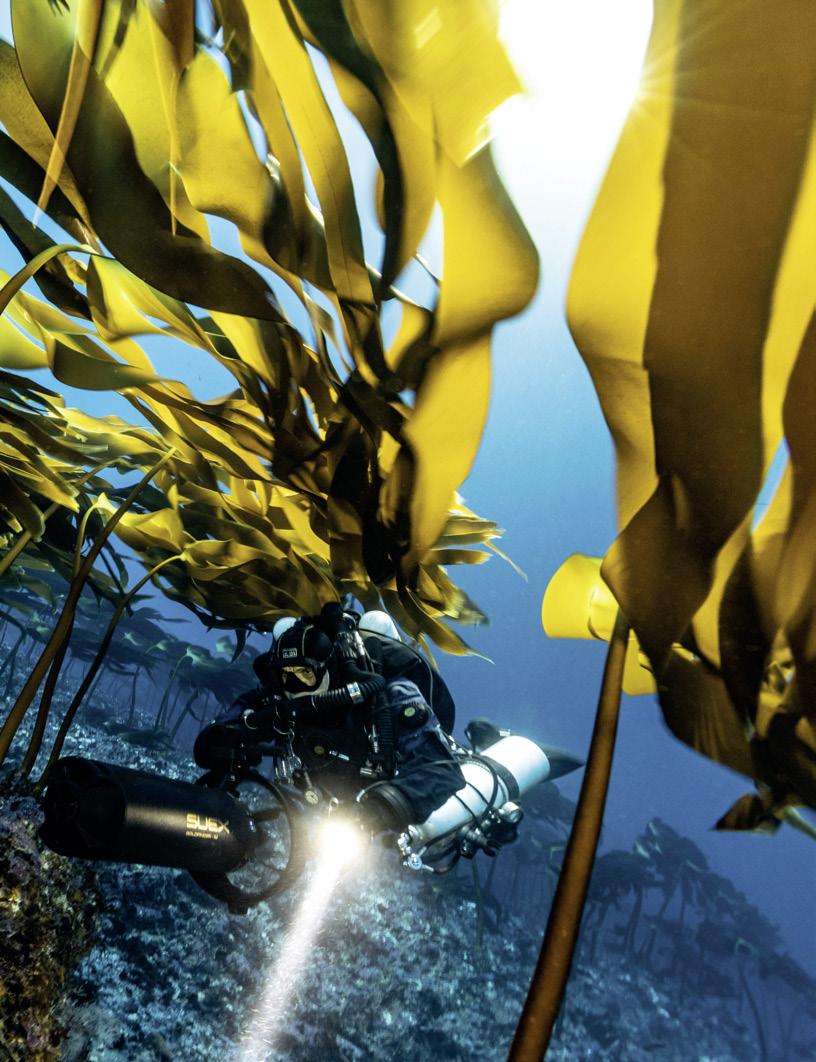
Thescene seems almost unreal. Using our underwater scooters, we make our way forward, metre by metre, through a forest of seaweed. The current is not steady – it grips us, eases off, then strikes again. At times, it shakes us about as if we were flying through turbulence. Then, suddenly, it grows calmer. The seabed becomes flatter, rockier, almost empty. Hardly any life, just polished stone. And suddenly they stand before us: towering trunks, vertical, densely packed. Above us, a canopy of leaves closes in, stretched by the current like a giant sail. Laminaria: not just a few scattered plants – a whole forest. And all this in the Mediterranean.
The depth gauge reads 70 metres. The light is subdued, but surprisingly clear. What dominates here is not the swell, but the current. It gives this place its character – and its magic. We are diving in the Strait
of Messina, between Sicily and the Italian mainland. A strait that looks unremarkable on the map, but is anything but so underwater.
A glance at the map shows why this is the case: two sea basins meet here: the Tyrrhenian Sea to the west and the Ionian Sea to the east. Underwater, the seabed rises steeply from a depth of over 2,000 metres, narrows to around 70 metres – and then drops away again. When the water masses move, they have to pass through this narrow passage. They are accelerated as if through a jet. Currents of five knots are not uncommon. Anyone wishing to dive here cannot do without the tide tables. Between two current phases lies what is known as ‘slack water’ – a brief moment when the water stands almost still before changing directi-
on. This window of opportunity determines whether a dive is feasible or simply impossible. On paper, it sounds straightforward. In practice, you quickly learn that currents have a mind of their own.
I’ve been diving here for many years. Wrecks, steep slopes, granite boulders – I’m familiar with most of it. I’d heard about kelp time and again, but for a long time I only ever found individual plants. The specific reason for this expedition was a shoot for ARTE. We weren’t looking for a single specimen, but for a forest. So we began a systematic search – starting from the shore, along the coast, equipped with rebreathers (closed-circuit breathing apparatus) and DPVs (underwater scooters) to help counter the current. At a depth of 50 metres, the first tufts appear, unspectacular, barely a
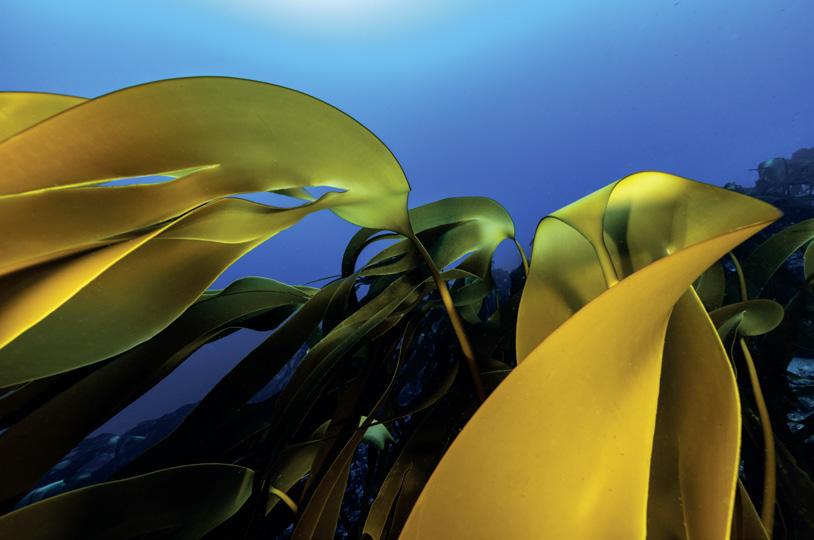
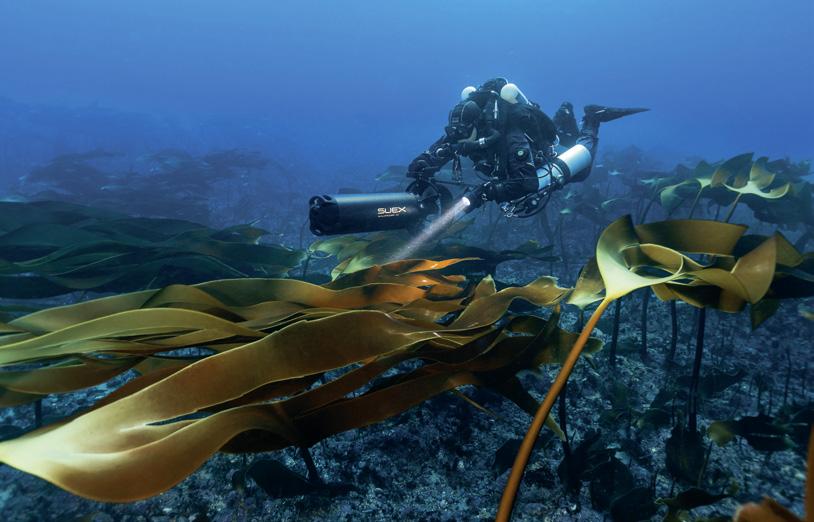
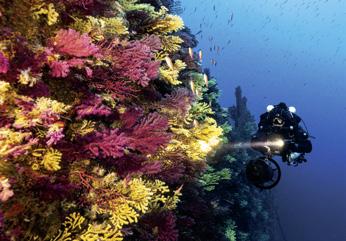
Getting there: As previously mentioned, this dive is strictly reserved for very experienced divers with high-spec technical equipment. It is hardly realistic to fly to Messina whilst carrying a drysuit, DPVs, a rebreather (CCR) and other heavy equipment. It makes more sense to travel by car, for example by ferry from Genoa or Livorno to Palermo, or from Salerno directly to Messina.
Once there: Once there, head towards ‘Torre Faro’ and follow the coastal road. After passing Lago di Ganzirri, you’ll reach a stretch of coastline where the houses are on the left and the sea on the right. After a few hundred metres, you’ll come to a small marina – a simple jetty made of large boulders, the first of several in this area. Behind this small harbour, the road winds its way between the houses, blocking the direct view of the sea. This is where you should stop.
The dive: Entering the water from the beach is simple and straightforward. Orientation underwater is also straightforward, as you can follow the slope of the seabed on the way back. To reach the kelp forest, dive from here towards the open sea and deeper waters. If the forest does not begin at a depth of around 60 metres, follow the slope with your right shoulder facing towards the city of Messina. The kelp should start to appear after a short distance.
The wreck site: Just a few hundred metres away there is also an attractive wreck that can be reached from land. Follow the coastal road until you reach a small square with a church. A drinking fountain by the pavement marks the ideal entry point. At a depth of around 35 metres, you come across the bow of the wreck, which is overgrown with gorgonians and extends down to a depth of about 70 metres.
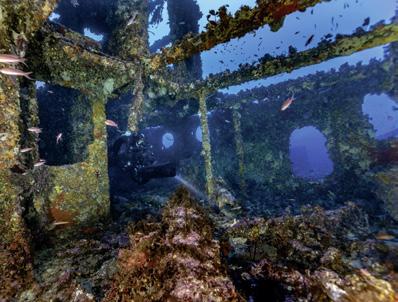
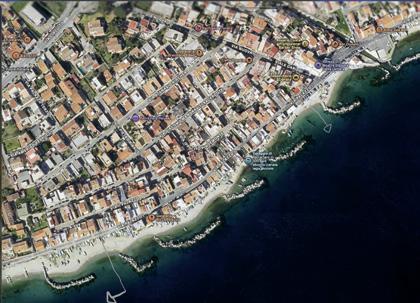
metre high. But at a depth of around 60 metres, it becomes denser. Then we are right in the middle of it. It really is a forest. Diving between the trunks is a strange sensation. The kelp fronds, up to three metres long, are taut and stretched, aligned horizontally by the current. Above us, they form a closed canopy that catches the little light that still reaches us down here.
At a depth of 70 metres, light is scarce. Laminaria ochroleuca – as this species is known – responds to this with sheer surface area. Wide leaves, making the most of the available energy. In the ocean, kelp usually grows flat, close to the water’s surface. Here, however, the plant has adapted to the conditions. The constant current keeps it upright, stretching its leaves. When the current changes direction, the leaves turn too, every six hours. Without the current, the forest would collapse – it is the movement alone that keeps it standing.
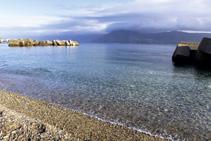
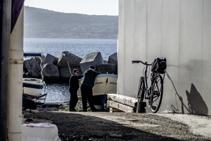
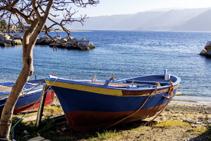
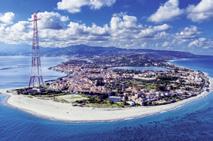
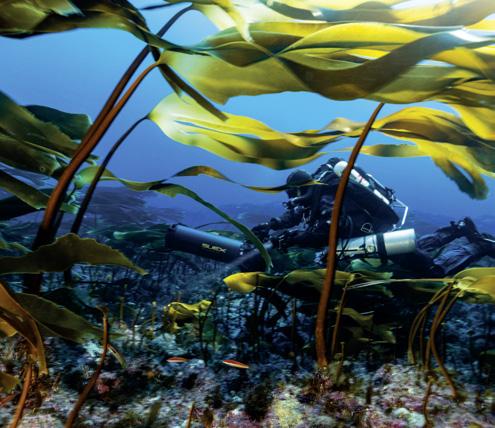
As fascinating as this place is – it commands respect. Depth, shifting currents, navigation: this is not a dive you plan on the spur of the moment. We made a conscious decision not to use a support boat. In these conditions, assistance from the surface would have been hardly realistic. Instead, we relied on teamwork, sufficient bailout gas and a clear strategy: a direct descent to the kelp forest, a subsequent ascent along the slope, and decompression in shallower areas where the current usually subsides. It is a dive that rewards planning – and does not forgive carelessness.
The kelp clings to granite that is almost entirely covered in pink calcareous algae. Large lobsters sit amongst the crevices. Rays glide across the seabed, whilst starfish add splashes of colour. One would expect to find such kelp forests in the Pacific. Yet here, between Sicily and Calabria, lies a small patch of underwater world that does not fit the familiar image of the Mediterranean. Those who visit at the right time of year will discover a kelp forest here that one would not expect to find in the Mare nostrum.
The dives described in this article are quite challenging. The need to use an underwater scooter (DPV) to counter the current and dive from the shore, as well as a rebreather for long dives, makes planning a flight quite difficult. It is therefore advisable to plan a longer drive to southern Italy. The advantage of this option is that the entire journey can be covered comfortably via the motorway.
Once you arrive in Reggio Calabria at the southern tip of the ‘boot’, you can take the ferry to Messina. Ferries run continuously (every 30 minutes); no booking is required. Alternatively, you can travel to Genoa and from there take the ferry to Palermo in northern Sicily. If you opt for this option, here is a
recommendation for a bed and breakfast in Messina: B&B Scilla e Cariddi. You can drive straight there; there is a large car park where you can leave your equipment, and a kitchen is also available:
For anyone wishing to fly to the Strait of Messina, the following airports are available: Lamezia Terme Airport, Reggio Calabria Airport and Catania Airport. In any case, it is advisable to make arrangements for a hire car in advance.
To find the dive site described, enter “Torre Faro Messina” into a map app: the entry point to the wreck is opposite the small church. A little further away is the entry
point to the kelp forests. My advice if you’re travelling by plane is to contact Scilla Diving. The dive centre is not located on the Sicilian coast, but on the Calabrian coast. It is the oldest dive centre here (since 1990), and Paolo and Cristina are experts in the use of rebreathers. Nitrox fills are also available. The instructors are RAID-certified, and the dive guides are certified for JJ-CCR to lead divers using this equipment. A supply of oxygen and calcium hydroxide (Sofnolime) can be guaranteed, as can assistance with tank hire. The dive centre, which is open all year round, has a large dinghy that can reach the dive sites on both coasts in just a few minutes. Weather conditions are often excellent, even in winter. Scilla

ENOS® – weil Sekunden zählen.

ACCOMMODATION
There are good places to stay and restaurants in Scilla.
Interesting fact
: According to ancient legend, this is where Scylla, the sea monster from Greek mythology, is said to have lived, whilst her counterpart, Charybdis, is said to have lived on the opposite side in Messina, Sicily.
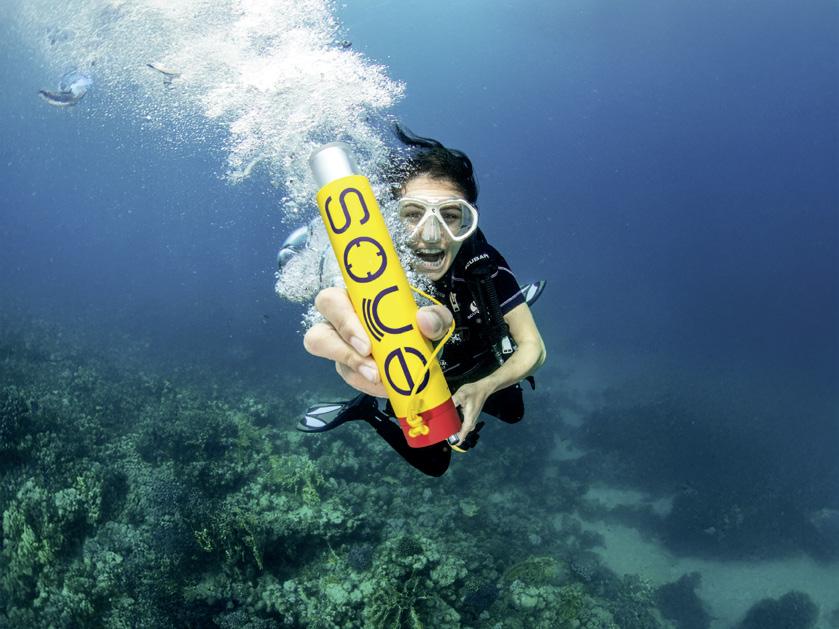
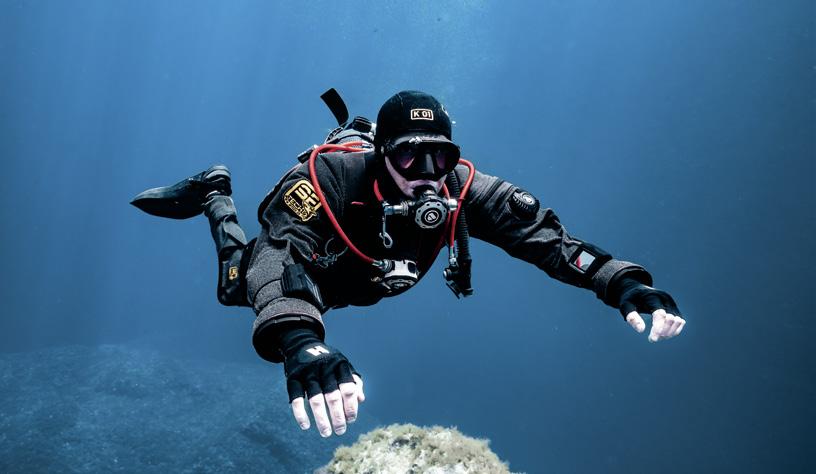
T & F Benjamin Schulze
The safety stop is now standard practice in recreational diving. A three-minute stop at a depth of five metres is considered a basic safety margin at the end of a dive. But why is this pause important –and how do you carry it out correctly?
Avery important phase beginsaroundthe last third of the dive: the ascent. During the descent and the period leading up to the ascent, the body absorbs nitrogen due to increased ambient pressure. When surfacing, the ambient pressure drops – the dissolved gas must be expelled from the body through breathing. If the ascent is too rapid, the nitrogen bubbles out and gas bubbles can form in the tissue. This can lead to symptoms of decompression sickness.
This is where the safety stop comes into play. This refers to a short pause during the ascent, usually lasting three minutes at a depth of between five and three metres. This stop is not mandatory for dives within the no-decompression limit. Nevertheless, it is regarded as a sensible safety measure in all training systems.
The reason is simple: in the shallow water zone, from a depth of ten metres onwards, the difference in pressure compared to the water’s surface is relatively large. Between this depth of ten metres and the wa-
ter’s surface, the ambient pressure is halved. It is precisely in this range that dissolved gases are particularly sensitive to rapid changes in pressure. A short pause during the ascent slows down the transition to the surface and gives the diver extra time to exhale nitrogen.
Studies using Doppler ultrasound show that small gas bubbles can be detected in the blood after many dives. These so-called microbubbles occur even after seemingly ‘safe’ no-decompression profiles. A safety stop has been shown to reduce their num-
ber. For this reason, all organisations recommend that a safety stop be included as a standard part of every dive.
A safety stop is particularly advisable after deeper dives, when the no-decompression limit has almost been reached, or when several dives are undertaken in a single day or over several days. Factors such as cold and physical exertion also increase the strain on the body. In such situations, an extended safety stop is a simple way to dive more conservatively. So, you can turn the three minutes into five minutes if the dive was particularly strenuous or cold.
For the stop to be effective, it should be performed in a stable manner. Ideally, the depth should be kept as constant as possible between five and three metres. Good buoyancy control is crucial here. Small changes in breathing volume are usually sufficient to control your position. It is best to perform the stop in a horizontal body position. In this position, the hydrostatic pressure difference between the head, lungs and extremities remains low, and blood circulation is distributed more evenly than in an
• Stabilise the trim
• Check the air supply and computer readings
• Buddy check: enough air, is the ascent plan okay?
• Deploy ae signal buoy (SMB)
• Practise navigation – a quick compass check
• Secure the camera and prepare it for handover at the water’s surface
• Practise basic skills: Blow out the mask, breathe through the secondary regulator
• Observe your surroundings – Discover the shallow-water fauna
• Prepare to get out: direction of exit, Keep an eye on the boat or the bank
• Observe the water’s surface
Important: Keep the depth as constant as possible between three and five metres.
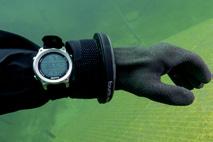
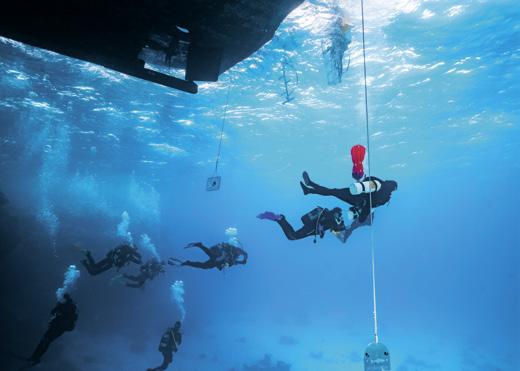
upright position. This supports more stable gas exchange and at the same time facilitates precise buoyancy control without unwanted depth fluctuations.
During the safety stop, it’s worth staying calm and letting the dive come to a gentle close. Many divers use this time to take a final look around or to check their equipment. Of course, you can also take in the surroundings or swim around at a leisurely pace – provided the depth remains as constant as possible. A well-chosen dive site with a varied underwater landscape or an experienced guide can help make the safety stop a relaxed, enjoyable and controlled experience. Above all, it is important not to constantly fluctuate between different depths. Dropping down to six metres is not a problem. However, you should not go deeper than eight metres. A steady pressure gradient is better for the body than frequent ups and downs.
Modern dive computers assist with this process. Many devices automatically display a countdown for the safety stop as soon as the relevant depth is reached. Some models even recommend extended stops if the dive profile has been particularly demanding. Nevertheless, the computer remains an aid. What matters most is the diver’s behaviour – in particular, maintaining a controlled ascent rate – even after the safety stop has ended, right up until the diver has fully surfaced.
In practice, it is often routine and distraction that lead to surfacing too quickly. The boat is waiting at the surface, the current is picking up, or your attention is already on the exit. Consciously planning a safety stop during this phase helps you to finish the dive calmly and in a controlled manner. You can also deploy a surface marker buoy here, either as a mandatory procedure or as a drill – always with your buddy’s support.
Whether you’re a beginner or an experienced diver, the safety stop is a good habit that makes a big difference. Three minutes at a depth of five metres takes hardly any time, but can play a crucial role in ensuring you finish your dive safely.
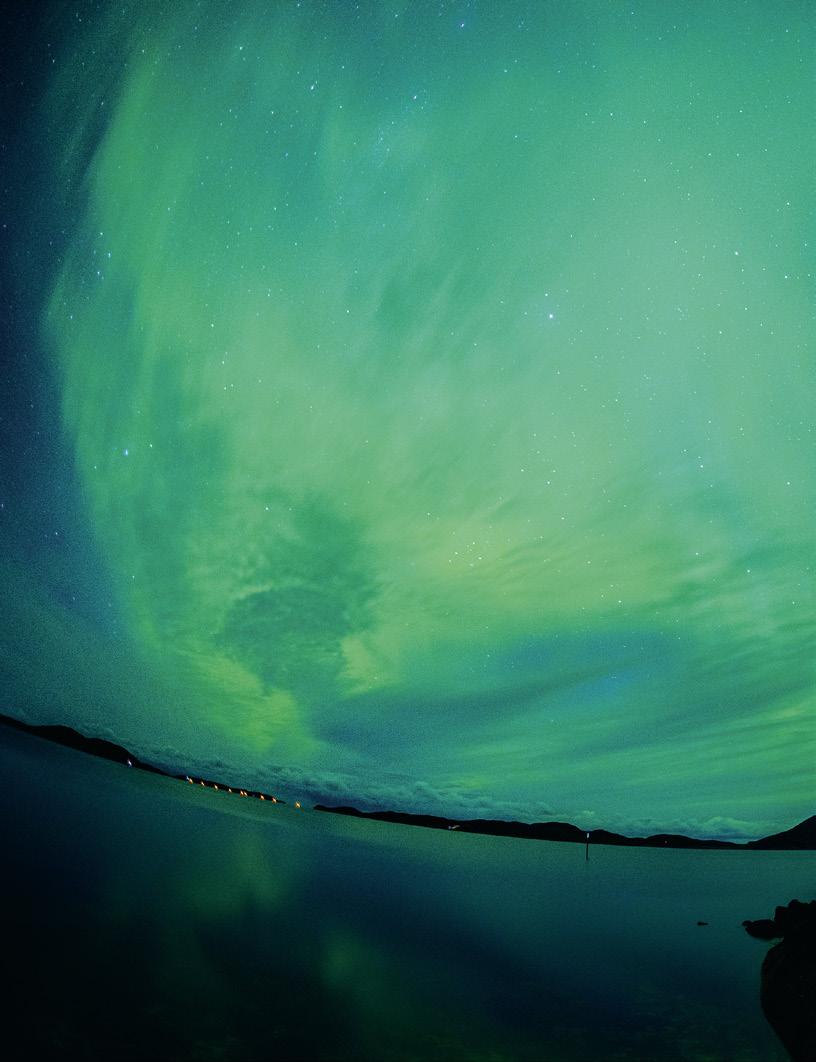
We are setting off for an expedition into Norway’s hidden depths, which await us in the countless fjords.
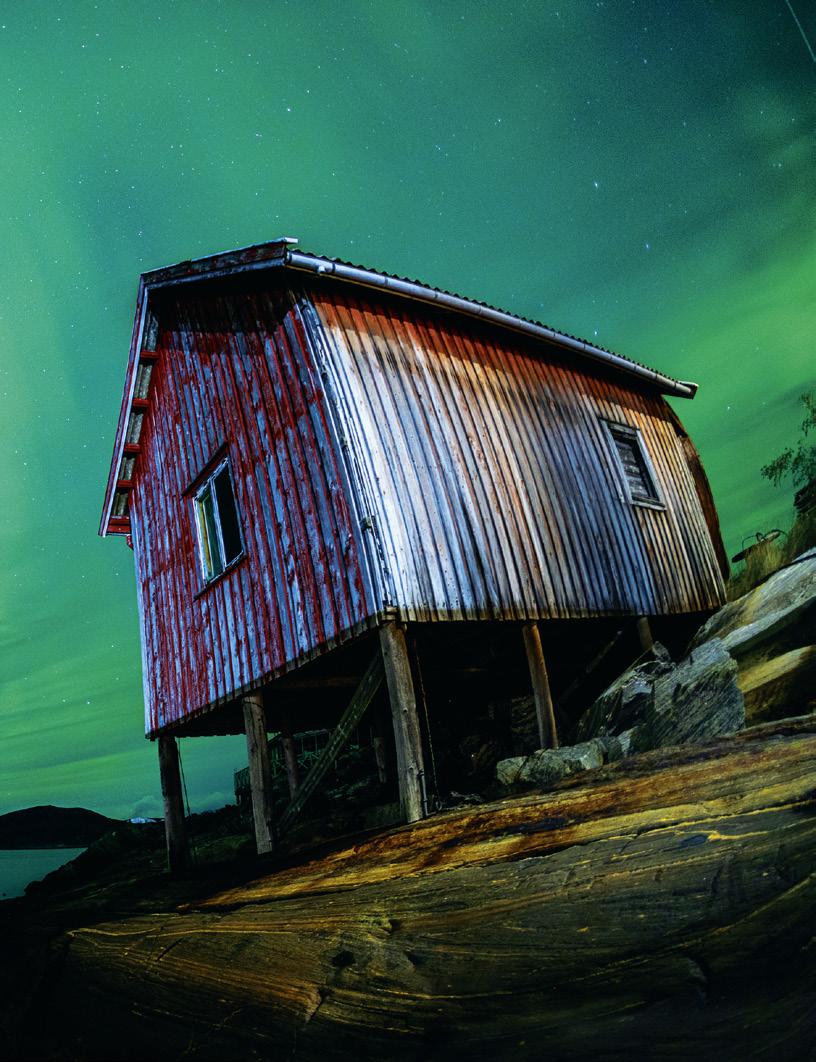
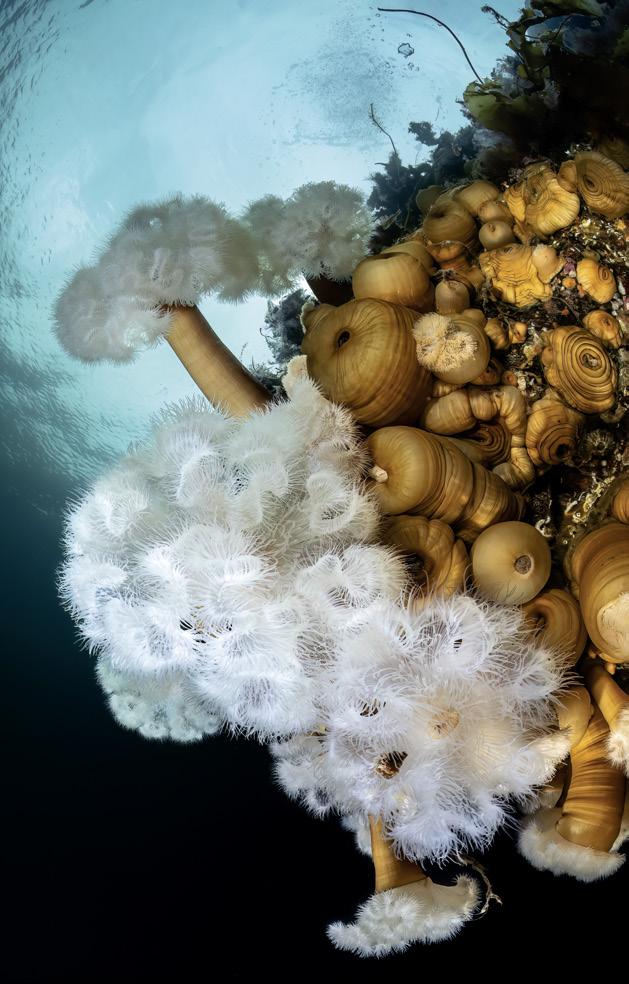
An encounter in the dark “Every creature emerging from the depths – be it a jellyfish, a chimera or a spotted shark –serves as a reminder that these landscapes are closer to the deep sea than to the familiar coastal waters.”
A fishing boat lies moored on the rocky shore of the harbour, whilst underwater a deep-sea shark appears before the camera lens. Finally, in the depths, the chimera emerges head-on into the light – a silent messenger from the dark depths of the fjord.
A waterfall plunges down over the fjord, whilst deep beneath the surface a bright red jellyfish glides through the darkness. On the kelp, however, brittle stars climb upwards like glimmering sparks – small glimmers of light in the vast silence of the North.
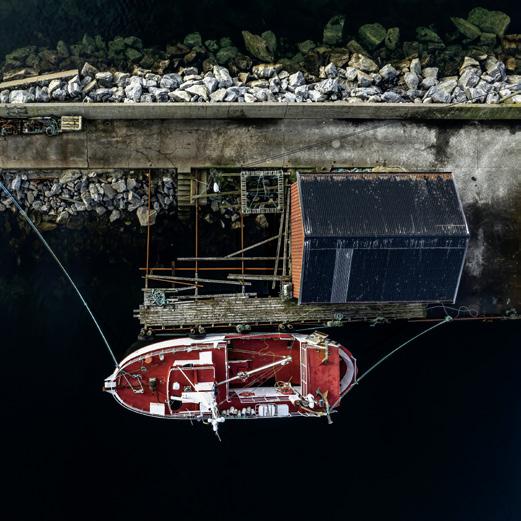
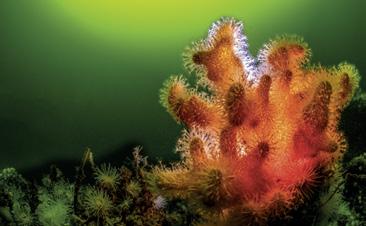
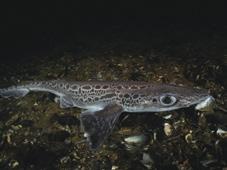
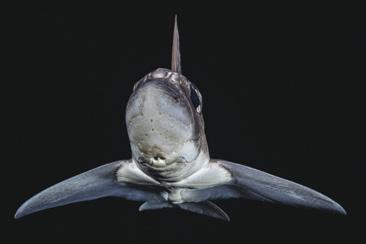
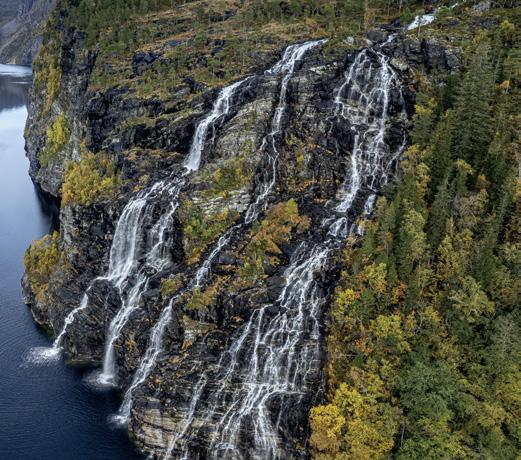
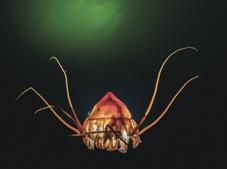
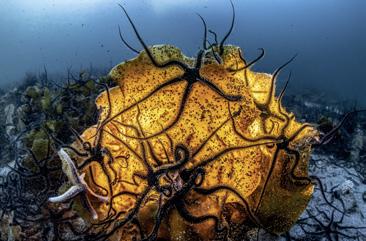
Who doesn’t dream of a diving holiday in tropical waters?
Comfortable hotels, excellent food, colourful reefs and perfectly organised dive centres. Yet sometimes another call stirs within us – quiet, but unmistakable: the call of the unknown. Of true adventure. Of a world that doesn’t exist on postcards, but lies hidden in the depths of the North. It was precisely this call that led us to the fjords of Norway, to a region that is rugged, wild and mystical – and whose underwater world still holds secrets. Diving in the deep fjords of Norway is an experience full of magic and discovery, but also full of challenges. They challenge the diver on several levels – physically, technically and mentally.
The journey was to be a road trip through the fjords’ diverse habitats – with the aim of finding rare, mysterious creatures that hardly anyone knows about. And as the landscape transforms into a sea of colours – gold, red and copper – the Norwegian ‘IndianSummer’ – moose roam the forests and white-tailed eagles circle above the fjords. And at night, if luck is on your side, the Northern Lights dance across the sky like whispering spirits. This is no ordinary diving holiday. This is an expedition. A journey into the frontier lands beneath the water.
Our first destination: the offshore archipelagos around Hammarøya and Skingen. Here, where the fjord opens out into the Norwegian Sea, hundreds of small rocky
islets cut through the coastline, forming a vast labyrinth. Every crevice, every bay, every channel could be a new dive site –and many are still unnamed, undived and unexplored.
The water is clear, cold and teeming with life. The kelp forests, made up of giant brown algae, are home to crabs, young fish, nudibranchs and even the majestic monkfish. The steep slopes are dotted with sea anemones, starfish and brittle stars, which move across the sandy seabed like dancers. The strong current brings plankton – and with it a feast for the underwater world.
The Namsenfjord in Trøndelag is not only scenically stunning – it also harbours relics from a dark past. Our first dive takes us to the wreck of the HMT Aston Villa, a trawler sunk during the Second World War. Once we had passed through the top layer of dark brown freshwater, it suddenly went dark. The wreck lies at a steep angle – the stern at 18 metres, the bow at around 30 metres. As we descend, time seems to stand still. Among the rusted plates live cod, coalfish, flatfish, lobsters and colourful nudibranchs. The wreckage is colonised by anemones, sea urchins and crabs – a living monument, an underwater time capsule.
Our subsequent dives take us deeper into the fjords – in search of a creature that seems to belong to another world: the hagfish (Myxine glutinosa). These prehistoric animals live on soft seabeds at depths ranging from 30 to over 1,300 metres. They are not exactly beautiful, but they are fascinating. Jawless vertebrates, over 300 million
The heart of the adventure
“The steep fjord walls reveal just how closely adventure and discovery are linked: every metre of descent opens a chapter that hardly anyone has read before.”
years old, which produce slime when threatened to deter predators. They are the grave-diggers of the seas, cleansing the ocean and maintaining its balance. The mystical atmosphere, the darkness, the alien creatures – all of this can be overwhelming. Diving in these waters is not only physically demanding but also mentally intense. It requires calm, focus and a willingness to embrace the unknown.
We continue our journey, now heading inland – to the wild salmon rivers of the Bindal-Terråk region. In crystal-clear water at a temperature of around six degrees Celsius, we watch migrating salmon and sea trout as they battle their way through rapids and waterfalls to reach the rivers where they were born. In late autumn, spawning begins – an ancient ritual that has been repeated for millennia. Yet the stocks are under threat: overfishing, climate change and habitat loss are taking their toll on the king of the rivers. This makes every glimpse of these majestic creatures all the more precious.
The final stop on our tour took us to Trondheimfjord – a place that seems tailormade for those seeking the unknown. The water’s surface may appear calm, framed by picturesque cottages and rural sheep pastures. Yet beneath the surface lies a world that ranks among Norway’s best-kept secrets. Here, where the steep walls of the fjord landscape drop a hundred metres into the darkness just a few metres from the shore,

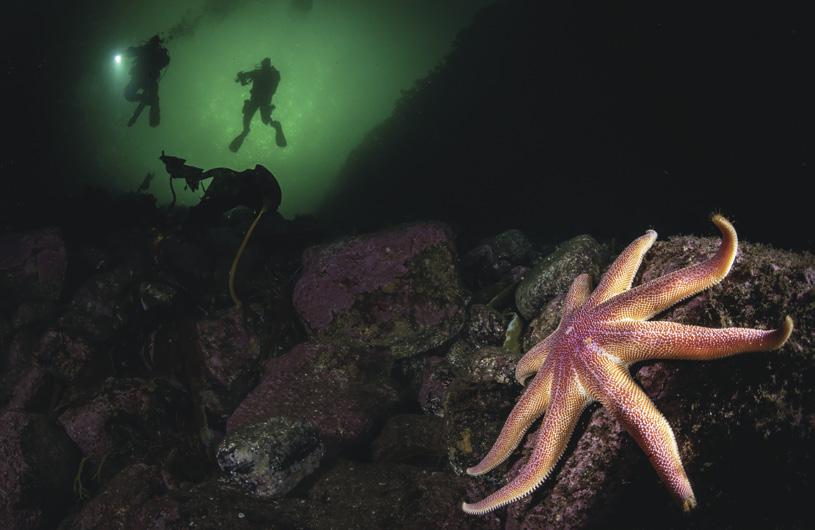
The first traces of snow from the approaching winter lie over the forest, a fine powder on the dark fir trees. Underwater, the divers follow a steeply sloping rock face until a glowing starfish appears in the depths. A sign of life in the cold shadow of the fjord.
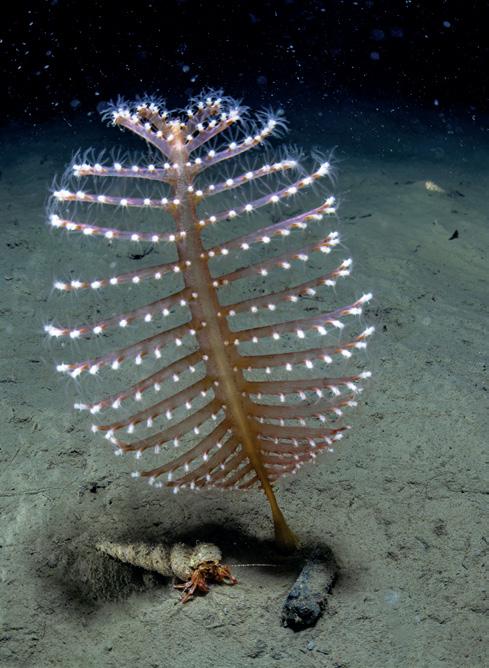
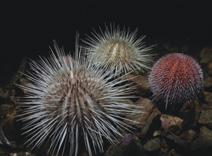
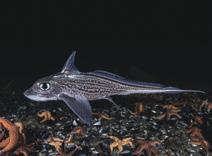
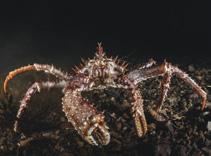
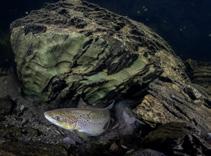
the realm of deep-sea organisms begins. In areas with strong currents, where cold, nutrient-rich water meets ancient rock formations, one encounters creatures that are otherwise thought to exist only in the depths of the oceans. The fjords often drop steeply and abruptly – from the shore, the depth plunges to a hundred metres. This is fascinating, but also dangerous. Anyone who gets lost in the depths or loses their bearings can quickly find themselves in critical situations. Good navigation, depth control and the buddy system are vital for survival here.
The first dive began on a cold, overcast, rainy day. Fresh snow already lay on the mountain peaks – a silent harbinger of the approaching winter. Yet underwater, there was no sign of it. From the very first descent into Trondheimfjord, we sensed that this was no ordinary dive. After just a few metres, it suddenly went dark, as if we were on a night dive. At a depth of around 30 metres, it happened: like an apparition in the night, the deep-red bell of a deep-sea jellyfish (Periphylla periphylla) appeared, almost 40 centimetres in diameter. Its tentacles pulsating, its body floating – a creature straight out of a dream. Then came the next one. And another. Soon we were surrounded by these mysterious creatures, rising silently from the unlit depths – on their way to destinations known only to them.
On further dives in the fjord, we encountered other inhabitants: crabs living in the rubble zones, and deep-sea corals growing on the rocks in bright yellow and orange. And then – the chimera (Chimaera monstrosa), also known as the sea cat. With its huge, bulging eyes and bizarrely shaped snout, it looks like a creature from another world. During night dives, we watched it glide slowly across the seabed – in search of crustaceans and mussels. But that wasn’t all. The spotted dogfish (Galeus melastomus), a small, elegant deep-sea shark, also
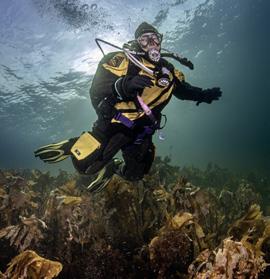
The allure of the fjord
“In the Norwegian fjords, the unknown does not begin in the depths – it begins where the light fades and the limits of our perception become apparent.”
made an appearance. It usually lives at depths of between 200 and 500 metres. But here, in Trondheim Fjord, it is within reach of divers. Such encounters are rare – and precious. They remind us why it is worth stepping out of our comfort zone.
The Trondheim Fjord is more than just a dive site. It is a gateway to another world. A world where time stands still, where ancient creatures dwell, and where light rarely reaches the seabed. Those who dive here are not merely diving into water – but into history, into myth, into the unknown. And that is precisely what makes this place so special. For in a world that is becoming ever more mapped out, calculated and predictable, they still exist – the places that fill us with wonder. That teach us humility. And that show us that true adventure begins where the darkness deepens.
Whilst people on land prepare for winter, life in the water goes on. Norway’s fjords and rivers follow a rhythm that has remained unchanged for millennia. Down here, there are no seasons, no rush – just the quiet pulse of life. Norway’s fjords are no place for package holidaymakers. They are a frontier – wild, mystical, challenging. But those who venture here are rewarded with encounters usually seen only in deep-sea films. With nature that is primeval and untouched. And with a feeling that lingers: out here, in the depths of the Norwegian fjord landscape, the real adventure begins.
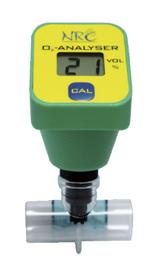


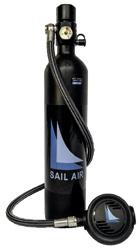





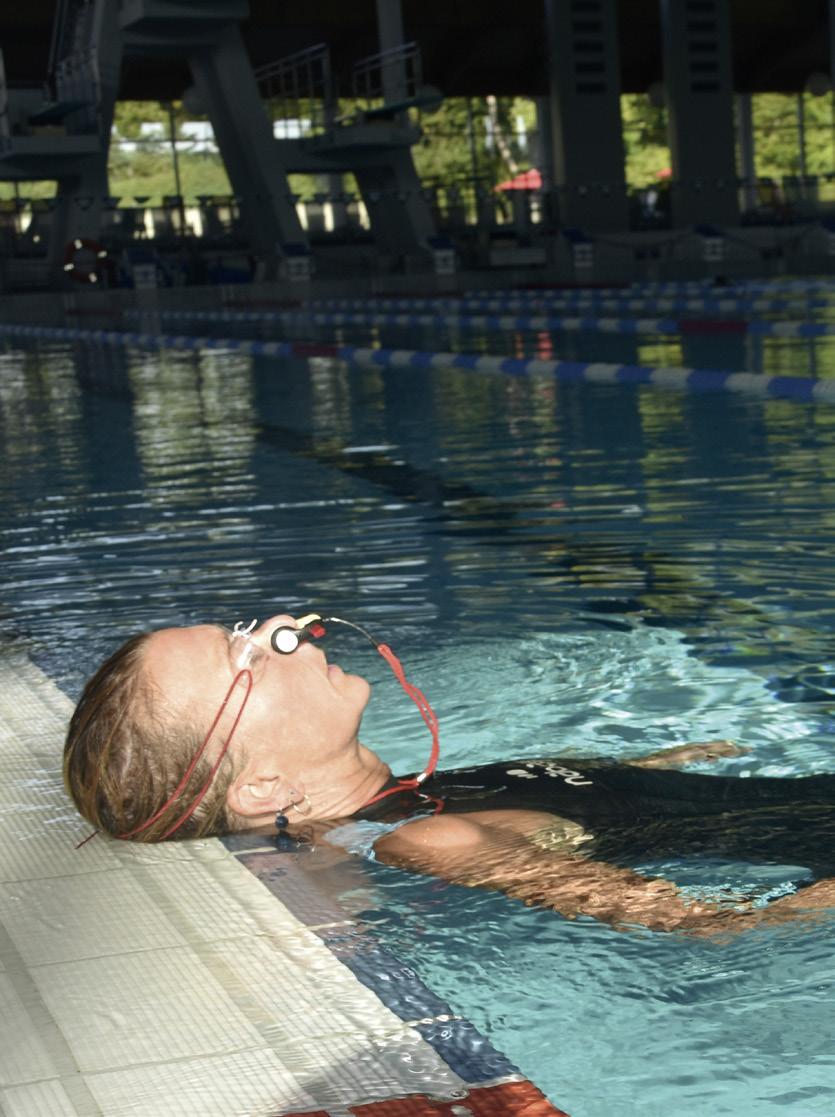
T Nik Linder
In the fourth instalment of the freediving series, our author Nik Linder sets out to discover the dolphin within us. Why do we feel so at ease in the water ? And how can we harness this sense of relaxation and adaptability to hold our breath for longer?
It was early on in my freediving career when my diving instructor told me about the book *Homo Delphinus – The Dolphin Within Man *. There’s no question that the author, Jacques Mayol, impressed me – after all, he was an athlete who placed great emphasis on breathing exercises, yoga and spirituality, and who coined the phrase “Freediving is about silence … the silence that comes from within ”. An athlete who could dive to incredible depths for his time and who sought depth and meaning not only in diving. Among other things, the book dealt with the human body’s adaptation to water . It is not only indigenous peoples such as the Ama – Japanese female divers who, in a centuries-old tradition, harvest seafood from the depths of the sea – who possess physical adaptations. Every human being is capable of adapting to water. This diving reflex is particularly strong in babies, perhaps because they have already been ‘diving’ for nine months. Over time, we lose this adaptation. The good news, however, is that it can actually be trained.
Receptors in the face trigger the diving reflex when the diver enters the water. The heart rate slows down, leading to reduced energy consumption and, consequently, lower oxygen consumption. Blood flow is redirected to the vital organs, of which the lungs and heart are particularly important for diving. This conserves oxygen and ensures it is supplied to the vital organs. This is why long apnea periods in trained athle-
tes do not pose a risk to the brain, as can easily be seen in the case of the world record holder for static apnea, Heike Schwerdtner. She holds her breath for an unimaginable 9 minutes and 30 seconds.
Everything is one – a connection with water
The extent to which you experience a sense of calm and relaxation during a time dive depends largely on your own inner peace. The motionless floating, the slowing heartbeat, the feeling of weightlessness and the absence of distractions – because your ears are underwater and your eyes are usually closed – all combine to create a very special sensation.
Some describe a sense of oneness in which the boundaries between body and water are no longer discernible. Others feel as though they are retreating deep into their own bodies in this meditative setting. Still others say they feel as though they have found their own ‘standby’ button. Although they are aware of their surroundings, they do not feel fully present, which may also be due to the associated calmness of mind.
Relaxation is a skill that needs to be learnt I wasn’t really into the whole esoteric thing at first either. But I realised that willpower and discipline alone weren’t getting me an-
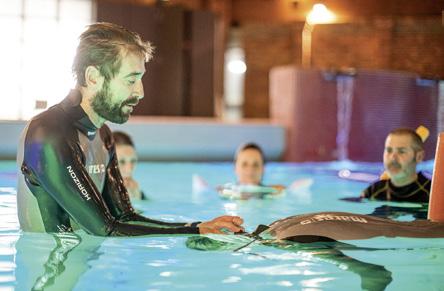
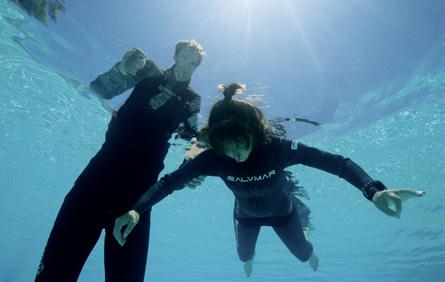
ywhere. So I began to study and practise breathing and relaxation techniques. I know from my own experience that nobody is born a master. Anyone who’s never had anything to do with these techniques before needs a bit of time to get used to them. Freediving requires relaxation – and you have to train for that just as much as you do for the right fin stroke or a clean turn. That is certainly what defines this sport: a large part of it is relaxation. Even though I wasn’t personally seeking balance in everyday life or even enlightenment, after a while I did notice the many benefits that emerged in my daily life. I became calmer and more patient with myself and those around me; I slept better and was better able to cope with life’s ups and downs. Exercises such as the body scan or mindful breathing improve self-awareness. As a result, I have got to know myself better over the last few years.
My diving instructor once replied to my question about what I should think about when holding my breath for so long: “Nik, don’t think about the clock.” Actually, that’s quite clever. Because if you think about the clock, you never really manage to relax properly; instead, you just keep focusing on
the seconds, which then seem to tick by ever more slowly.
However, as an eager student, I soon realised that I couldn’t ‘not thinkabout the clock ’. The brain can’t handle negatives. I had to give my mind something to focus on so that it wouldn’t think about the clock. On land, we mainly have our breathing, which we’ve already learnt about in the 03/2026 issue of TAUCHEN. If I concentrate on my
breathing, there’s no room for automatic and often negative thoughts.
Breathing meditations such as alternate nostril breathing are simple and effective. The downside during time diving is that we aren’t breathing. So we need a different focal point. One popular method, for example, is the body scan from Jon Kabat-Zinn’s Mindfulness-Based Stress Reduction programme. Here, you ‘scan’ your whole body with your attention, starting from your feet. The special thing about this is that your mind is occupied with relaxing your body.
When freediving, you very quickly realise that body and mind are inseparable. A restless mind leads to stress, which is particularly noticeable as tension in the neck and shoulder area. Another option is to focus on your own slow heartbeat or to talk yourself through it. All of this can leadto a ‘nomind’ state, a deep relaxation in which, for a few moments, absolute calm reigns in the mind and we feel a sense of relaxation unlike anything we have ever experienced before.
Every freedive consists of two phases: the ‘easy-going phase’ and the ‘struggle phase’.
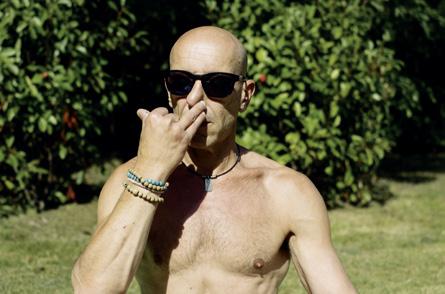
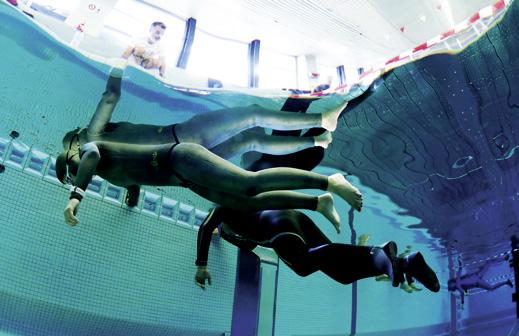
The easy-going phase is characterised by complete deep relaxation and calm. The struggle phase begins with the first respiratory stimulus, which manifests itself as a sensation of warmth, a swallowing reflex, but above all as a pumping movement of the diaphragm. The urge to breathe is triggered by an increased CO₂ level, not by a low O₂ level. As we are not breathing, the CO₂ level continues to rise. The CO₂ level in the blood is primarily responsible for regulating breathing. During contractions, the relaxation techniques described above are very important: they help us to remain calm despite the contractions. A form of resilience training in which we learn to manage negative thoughts.
In static apnea, there are various training and diving tables that help us gradually hold our breath for longer. With an ‘O₂ table’, the apnea duration is increased by 20 to 30 seconds with each round. This gradual increase serves two purposes: 1. Each round is a warm-up that helps us trigger the diving reflex.
2. With every lap, we realise that everything is still relaxed, and we feel a bit more confident going into the next lap. When it comes to freediving (and probably many other areas too), the saying ‘Life begins where the comfort zone ends’ doesn’t apply. Rather, it’s about gradually expanding your comfort zone and surfacing each time with the satisfying feeling that you can push yourself just a little further.
can I hold my breath for three minutes or longer?
You can practise an O₂ table like the one below on the sofa or on a yoga mat. As soon as you start doing it in the water, you’ll need a partner who is also trained in freediving to act as your safety buddy. With this table, you take a two-minute breathing break between dives. For the first 90 seconds, bre-
athe calmly into your abdomen, and before descending , take two or three very deep, full breaths; the last one is the deepest. Please also read my article in the 03/2026 issue of TAUCHEN, which describes the breathing exercises in detail. Or watch our video on the TAUCHEN YouTube page.
And here is the freediving table:
• Breathe for 2 minutes
• Hold your breath for 20 seconds
• Breathe for 2 minutes
• Hold your breath for 40 seconds
• Breathe for 2 minutes
• Hold your breath for 60 seconds
And so on – for as long as you like. Make sure your jaw and neck are relaxed. As soon as the urge to breathe kicks in after about 2 to 2.5 minutes, try to stay relaxed – perhaps by talking yourself through it or counting.
Good luck with that! Please do let us know how it went: redaktion@tauchen.de





































In this column, we answer readers’ questions about fitness for diving. This instalment focuses on diving with atrial fibrillation.
Dr Philipp Stahl, Deputy Medical Director of the MHW/aqua med Medical Board
Hey Doc, I was diagnosed with atrial fibrillation during a routine check-up with my GP. Can I go diving with this condition and the blood-thinning medication I’ve been prescribed?
Atrial fibrillation is the most common persistent cardiac arrhythmia and primarily affects older people, though increasingly also younger, physically active individuals.
Many people with this condition wish to continue diving despite their diagnosis. In addition to the arrhythmia itself, the necessary oral anticoagulation (blood-thinning medication) plays a role in this (see TAUCHEN 03/26). The leading diving medicine societies, such as GTÜM, SPUMS, EUBS, UHMS and UKDMC, are unanimous in emphasising that diving is not automatical-
ly ruled out in cases of atrial fibrillation, but requires an individual medical assessment.
What is atrial fibrillation?
In atrial fibrillation, the heart’s atria beat in a disorderly manner and usually too quickly. The electrical activity is chaotic, meaning that the atria largely lose their pum-
ping function. The result is irregular ventricular activity and potentially reduced physical performance. Some people affected experience hardly any symptoms. Others suffer from heart palpitations, shortness of breath, dizziness or a sudden drop in energy levels. A key risk is the formation of blood clots in the atrium, which can lead to strokes. The most common cause of atrial fibrillation is high blood pressure (arterial hypertension, see DIVING 03/25), often in conjunction with age, obesity, diabetes and sleep apnoea. Heart failure, coronary heart disease (CHD) and heart valve defects are also significant risk factors that lead to structural changes which predispose the patient to atrial fibrillation.
Why is atrial fibrillation relevant when diving?
Diving places particular demands on the cardiovascular system. Water pressure, exposure to cold, the density of the breathing gas and physical exertion cause blood to pool in the chest cavity and place increased strain on the heart. In the case of atrial fibrillation, this gives rise to several risks: Reserve capacity: If you have an irregular heart rhythm, your physical capacity may be limited. Unexpected exertion, strong currents or stressful situations can lead to physical and mental overload.
Dizziness or loss of consciousness: Heart rhythm disturbances can be accompanied by a drop in blood pressure or reduced blood flow to the brain – which can be lifethreatening underwater.
Risk of embolism: The increased risk of stroke usually requires long-term anticoagulation, which in turn affects the risk of bleeding whilst diving.
Can you go diving if you have atrial fibrillation and are on anticoagulant medication?
In summary, the professional bodies mentioned above emphasise that cardiovascu-
lar diseases are among the leading causes of diving-related fatalities, and that heart conditions carrying a risk of sudden loss of consciousness or a sudden drop in performance must be viewed with particular caution in the context of diving. Diving is only acceptable if sufficient reserve capacity, without significant arrhythmias, has been demonstrated under stress. Consequently, cardiac arrhythmias such as atrial fibrillation always require a structured cardiological and diving medical assessment, as well as an individual fitness-for-diving examination. The absence of symptoms, sufficient physical capacity and stable control of atrial fibrillation are crucial. Medications with relevant side effects, such as beta-blockers, must be taken into account.
Specialist articles on diving medicine emphasise that atrial fibrillation does not constitute a blanket exclusion criterion for diving. Therefore, diving may generally be possible if the atrial fibrillation is well controlled, there are no pronounced symptoms such as dizziness, syncope or severe shortness of breath, no dangerous arrhythmias occur during exertion, physical fitness is adequate, anticoagulation is well controlled and there are no relevant bleeding complications. However, people with frequent or unpredictable episodes of atrial fibrillation, fainting spells or severe dizziness, severe heart failure, and recent strokes or embolisms are generally not suitable for diving.
Most people with atrial fibrillation are prescribed oral anticoagulants – either vitamin K antagonists (such as phenprocoumon or warfarin) or so-called DOACs (such as apixaban, rivaroxaban or dabigatran). These medicines significantly reduce the risk of stroke, but increase the risk of bleeding (see TAUCHEN 03/26). The professional societies mentioned above do not regard anticoagulation as an absolute contraindication, but call for increased caution and a clear assessment of the benefits and risks.
OUR EXPERT

Dr Philipp Stahl, Deputy Medical Director, MHW/aqua med Medical Board, is a specialist in internal medicine, emergency medicine, diving medicine and travel medicine
aqua med has been the medical emergency service for divers for 20 years. Behind the brand is the dedicated team at Medical Helpline Worldwide (MHW) in Bremen. The team of medical assistants and doctors is on hand for you 24 hours a day. www.aqua-med.eu
Do you have any questions for our Doc? Email: redaktion@tauchen.de, subject line: “Hey Doc”.
Important precautions for divers with atrial fibrillation
❶ Regular cardiological check-ups and fitness-for-diving assessments by an experienced diving doctor
Stress ECG, Holter monitoring and echocardiography are important for assessing cardiac function and rhythm stability.
❷ Information for diving partners
Your buddy should be informed about any medical conditions and medication.
❸ Conservative dive profiles
Shallow dives in warm water, little current, no high physical exertion.
❹ Minimise the risk of injury
Take care around boats, rocks and coral
❺ Do not dive if you are currently experiencing symptoms
Palpitations, dizziness, chest pain or unusual tiredness are clear warning signs.
Conclusion
Atrial fibrillation whilst on oral anticoagulants does not automatically spell the end of a diving career. To address the reader’s enquiry, the general consensus is that diving is acceptable provided the condition is stable, well-controlled and compatible with sufficient physical fitness. A key factor is an individual medical assessment by a cardiologist and a diving medicine specialist. Those who dive conservatively, avoid risks and take warning signs seriously can still enjoy diving safely even with atrial fibrillation.
The manufacturer INON has unveiled two new wide-angle conversion lenses for action cameras: the UFL-GR140 ZD (acrylic) and the UFL-GR140 Pro ZD (glass). The lenses are designed for devices with large sensors and wide angles of view, such as the GoPro HERO11/12 or Insta360 Ace Pro. They enable shooting in 8:7 format and at the maximum field of view without vignetting – even underwater, where the imageangle would otherwise shrink significantly.
Price: from 370 euros.
Isotta has unveiled a new underwater housing for the Canon EOS R5 C. The compact aluminium housing follows the contours of the mirrorless camera and allows full access to all controls. Ergonomic handles, double O-ring seals, a moisture sensor and numerous accessory ports ensure reliability and flexible expansion options. The design is waterproof to 100 metres and is designed for professional photography and video use. Price: €3,865.
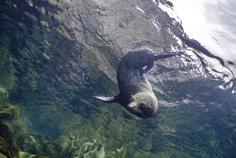
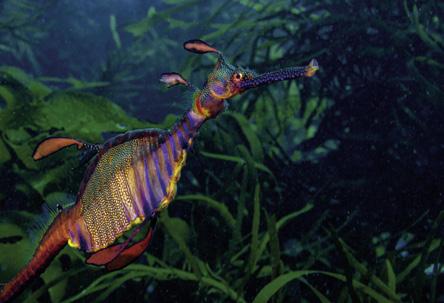
PanOceanPhoto offers a combined photography and film trip to Tasmania, aimed particularly at underwater photographers and filmmakers. The trip starts in Hobart with the tour based at Eaglehawk Neck on the Tasman Peninsula. The itinerary includes up to 16 dives to encounter species characteristic of the region, such as weedy seadragons, draughtsboard sharks, handfish and seals. The programme is complemented by workshops on underwater photography and videography, image reviews, and excursions to explore the island’s coastal landscapes and wildlife. Price: from €3,580 per person in a twin room (excluding flights to Hobart, national park fees and travel cancellation insurance).
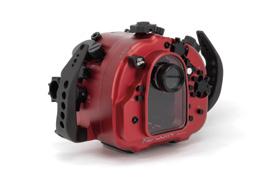
The Marelux Aquista 130 is a wide-angle wet lens for underwater photography, offering a diagonal field of view of up to 130 degrees. A wet lens is an attachment lens that sits externally in front of the housing port and can be fitted or removed whilst underwater during a dive. The optical system consists of six lens elements in five groups with anti-reflective coating and a hard-anodised aluminium housing. It is particularly suitable for wide-angle and closefocus wide-angle shots and is designed for depths of up to 100 metres.
Price: 1975 euros.
Product and travel information at panocean.de
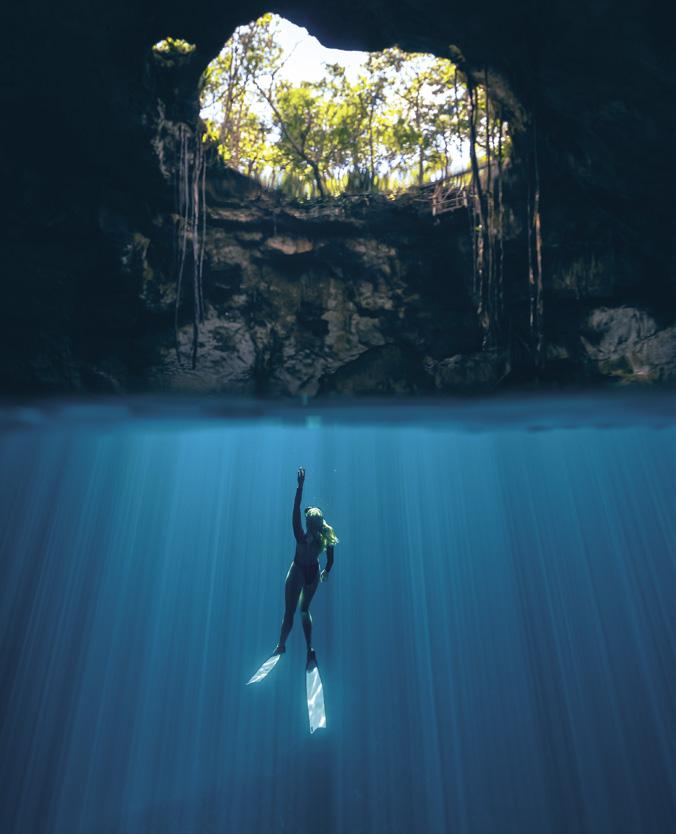
Seemingly arbitrary customs regulations can cost underwater photographers a great deal of money. Our author had to learn this the hard way on several occasions.
Holidaysin Mexico are in high demand, even though the country has been making the headlines recently. For me, Mexico has been in the headlines for quite some time. Customs, in particular, has annoyed me no end. As an underwater photographer, I always travel with a bit more photographic kit than the average holidaymaker. Whilst the average tourist might have a larger camera and a smartphone with them, I lug around two large SLR cameras, a drone (if it’s permitted in the country and you’re allowed to fly it), plus a small compact camera. So, purely in terms of numbers, I have five cameras with me. On top of that, there’s the large underwa-
ter housing plus two strobes, not to mention the lights and the laptop, which is also allowed to come along.
Four years ago, due to widespread flight disruption, I had to fly via Mexico City. Once I’d landed there, I had to go through immigration, as my connecting flight had been rescheduled for the following day. So I went through immigration and customs. The customs officials saw my hand luggage and immediately asked me to come over for an inspection. It was clear to me that I was allowed to bring in two cameras. I had them with me. What I didn’t know, however, was that drones, smartphones and mini-cameras also count. I could, after all, sell the devices in the coun-
try, and that is, of course, subject to duty. Consequently, a duty of just under 400 euros was due, which I couldn’t argue my way out of. Annoyed, I pulled out my credit card and paid, hoping to be reimbursed for everything upon departure. When I left the country two weeks later, however, there was no one willing to refund my money. My enquiry at customs was merely met with a smirk, and I was told that a refund was not provided for, even if I were to reexport the devices. In other words, this is not a customs duty, but rather a form of highway robbery. I pay customs duty on my own property, which I carry with me and also take out of the country again. We in Europe are familiar with such practices
from the Middle Ages, when this was the norm for travellers. I was unaware that this is still the case in Mexico today.
At the end of January this year, I had the chance to travel to Mexico again, this time to Cabo San Lucas. This time, it was an official trip at the invitation of the Mexican Tourist Board. To avoid attracting attention, I had brought a mini-drone with me specifically for this purpose and handed it over to the representative from the agency accompanying us. I also placed my smartphone in the drone’s case so as not to exceed the permitted limit of two cameras. Of course, I –just like a colleague travelling with me – was stopped at customs and our luggage inspected. I was in good spirits, as I really did only have the ‘permitted’ two cameras with me. What a surprise! The customs officers were hardly interested in the number of cameras, but all the more so in the underwater housing and the flash units. A Seacam housing is, of course, not a small item that can be easily hidden. And so it came to pass: the customs officials told us we’d have to pay duty on our Seacam housings. As they hadn’t found any serial numbers on the housings and were therefore unable to look up the price online, they were initially satisfied with the statement that such a housing costs just under 2,000 euros. We were less so, as we now had to fork out 400 dollars (20 per cent) in customs duty. Just like years ago in Mexico City – naturally with no chance of getting the money back.
On our trip across the Baja California peninsula, we visited several dive centres, all of which told us that customs officials regularly check divers and sometimes even impose duties on GoPro housings. The officials are constantly on the lookout for items they can levy duties on under their regulations. As a tourist, you’re in no position to dispute this and simply have to put up with this ‘highwayman’s customs’. It’s unclear how this will play out in the future. Will jewellery, more expensive clothing and other items also be subject to customs duties in future? Is the Mexican state so strapped for
cash that it has to fleece the desperately needed tourists? After all, national park fees in Socorro have been raised in recent years from 300 US dollars to 1,000 US dollars. In Yucatán, there are now exorbitant fees for photographers who want to take their cameras into the cenotes. Where is this all heading? Who were the people who put Mexico, the cenotes and Baja California on the map among European travellers and divers? The photographers who
brought back amazing pictures. It is precisely these people who are now being punished for promoting this country.
'Thanks a lot, you lot – you won't be seeing me again! What a shame!'
Anyone travelling to Mexico with underwater photography or video equipment is subject to the regulations of the Mexican customs authority, ANAM. The definition of ‘personal luggage’ applies:
PERSONAL LUGGAGE
Items that may be brought in duty-free include two cameras or video cameras, as well as limited quantities of other electronic devices (e.g. laptops, mobile phones). The official luggage list applies: https://www. anam.gob.mx/equipaje-y-franquicia/ Accessories are generally considered to be part of the camera. However, specialist components such as large underwater housings, flashes or video lights are not explicitly listed separately and may be assessed on a case-by-case basis.
For air travellers, the duty-free allowance is USD 500 per person. If this limit is exceeded, a flat-rate duty of 19 per cent may be levied on the excess value under the simplified passenger procedure, provided that the total value of the goods remains within the permitted limit (approximately USD 3,000).
Payment details:
https://www.anam.gob.mx/pago-de-contribuciones-por-excedente-de-franquicia-depasajeros/
This payment is an import duty, not a deposit. There is no provision for an automatic refund upon departure.
A Mexican customs agent is usually required when:
• the value limit for the simplified procedure is exceeded,
• a formal temporary import is required
• the use is for commercial purposes For private travel, provided you stay within the limits for luggage and valuables, you do
not need a customs agent.
COMMERCIAL USE / ATA CARNET
In the course of business, temporary importation may be necessary, either via an ATA Carnet or through a formal import procedure.
International information: https://iccwbo.org/global-issues-trends/ trade-facilitation/ata-carnet/ Germany (IHK/DIHK): https://www.dihk.de
Austria (WKO): https://www.wko.at/service/ aussenwirtschaft/ata-carnet.html
PREPARATION
We recommend:
• Equipment list with serial numbers
• digital receipts
• Market value figures
• optional proof of export in the country of origin
Germany: https://www.zoll.de
Austria: https://www.bmf.gv.at
Switzerland: https://www.bazg.admin.ch If no proof of value is provided, customs may estimate the value of the goods.
FURTHER PROVISIONS
Drones are subject to additional aviation regulations: https://www.gob.mx/afac. Protected areas and national parks (e.g. Revillagigedo) may require separate fees or permits: https://www.gob.mx/conanp
CONCLUSION
Two cameras are considered personal luggage. Items worth over 500 USD may be subject to a 19% duty
. If the value of the goods is higher or they are for commercial use, a formal procedure involving a customs agent may be required. It is advisable to check official sources before departure.
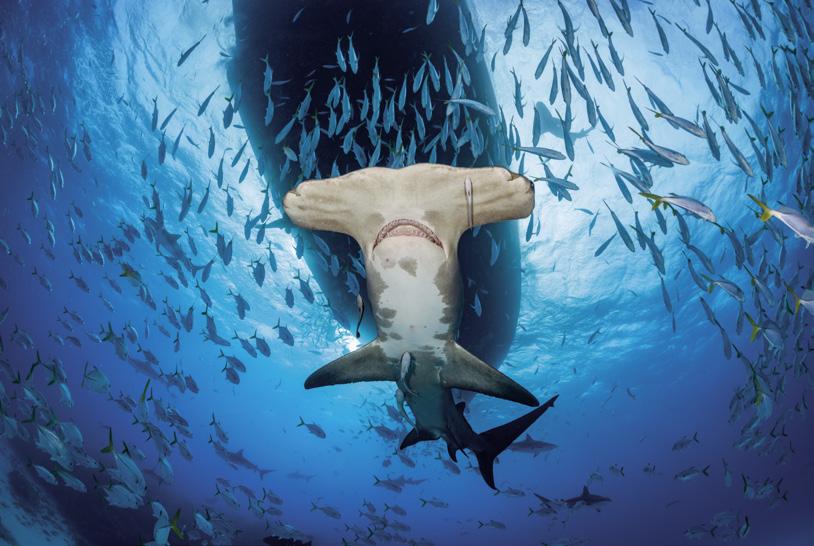
Underwater photographybegins long before we dive. It starts during the briefing, on the shore, on the boat. Even whilst we’re still dry, we’re already making the crucial creative decisions. If you don’t plan at this stage, you’ll end up merely reacting later on.
Before every dive, we take on several roles at once: we are the creative mind, the director, the technician and, ultimately, the one who brings it all to life underwater. Without this preparatory planning, photography becomes a gamble. With it, it becomes a systematic process.
Broadly speaking, there are two distinct strategic approaches. One works in predictable environments, the other in dy-
namic, uncertain situations. Anyone who wants to develop their photography must master both.
In the clear waters of the Verzasca, for example, the setting is already in place. Rock formations, the canyon’s structure and the fixed position of the sun create a stable architecture of light and space. Even from the bank, you can see how the sun falls into the gorge in Ticino, where beams of light form, and in which positions a diver can serve as a scale. This is where the image is conceived before you enter the water. The decision to use an extreme wideangle lens is logical. Artificial light recedes
into the background; ambient light takes centre stage. Exposure and perspective can be prepared at leisure. Underwater, it is no longer about searching, but about precision. The photographer moves deliberately through the space, positions the diver, pays attention to symmetry, to lines, to the balance between light and shadow. The shot follows a preconceived vision. This is architectural planning.
The situation is quite different out in the open blue waters off Bimini. A possible hammerhead shark beneath the boat, perhaps a current, perhaps a school of fish, perhaps nothing at all. Out here off this Ba-

hamian island, nothing can be planned except one’s own preparation. The timing, direction and distance are all uncertain. Instead of forming a concrete picture, one works with probabilities.
Here, too, the choice is a wide-angle lens, though this time for a different reason: maximum coverage, maximum responsiveness. The shutter speed and ISO are set so that fast movement can be frozen. There’s no time for adjustments when the shark appears. The first chance is often the only one.
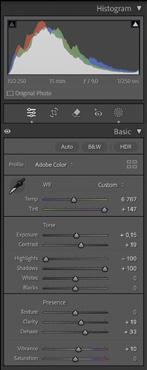
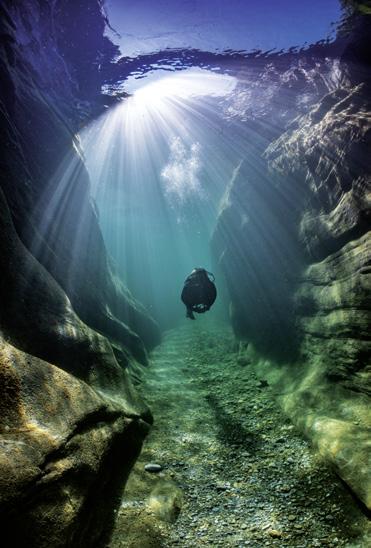
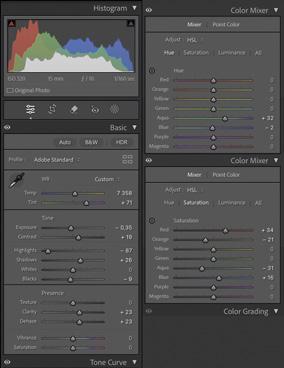
Underwater, this means planning your position rather than your subject. Staying below the boat to have a visual reference point in the frame. Remaining flexible at medium depths. Constantly monitoring the current, fish density and directions of movement. If you position yourself strategically, you increase the likelihood of being in the right place at the right time when everything falls into place. That is probabilistic strategy.
Both approaches require discipline. Before every dive, the basics must be in order: an empty memory card, fully charged batteries, pre-set default settings, correct autofocus, and a working flash system. Nothing is more disastrous than jumping into the water with leftover data from the last dive.
Good underwater photographers often seem enviably happy. In reality, they analyse, plan ahead and constantly adapt. After every shot, they check: Does the subject dominate the frame? Is the background calm enough? Is the lighting under control? Does the composition work?
Ultimately, it’s not about planning a single image. It’s about developing a decision-making system. If the environment is stable, I design architecture. If it’s unpredictable, I design flexibility. That is precisely the difference between chance and reproducible quality.
Powerful images aren’t the result of luck. They are the result of thinking things through before you dive in.
Every month, TAUCHEN.de hosts a new photography competition open to all underwater photographers . You decide who wins.
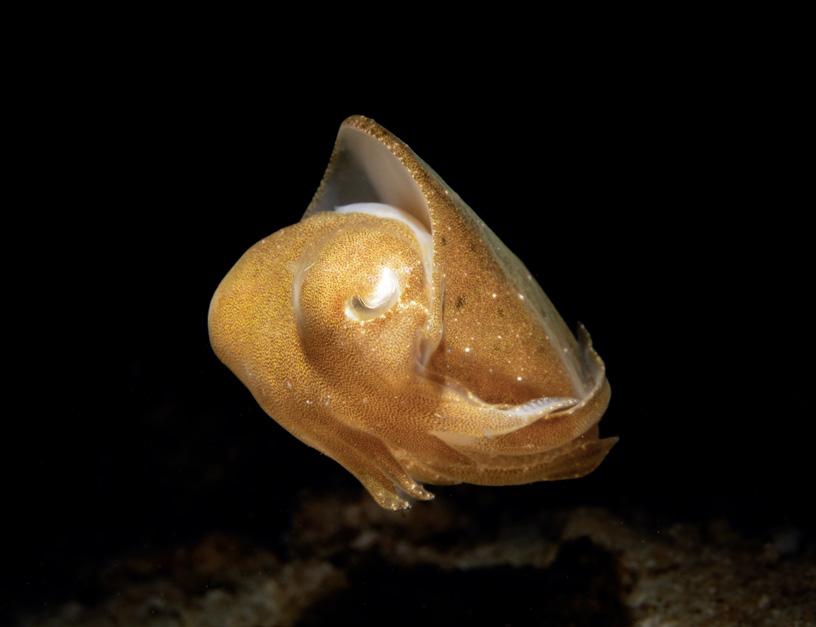
1ST PLACE
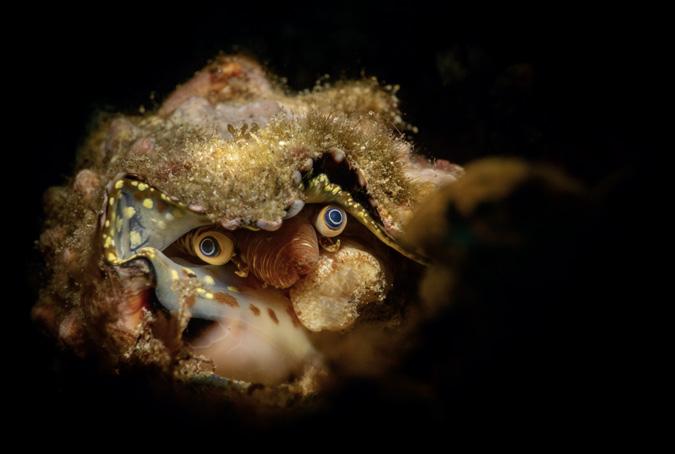
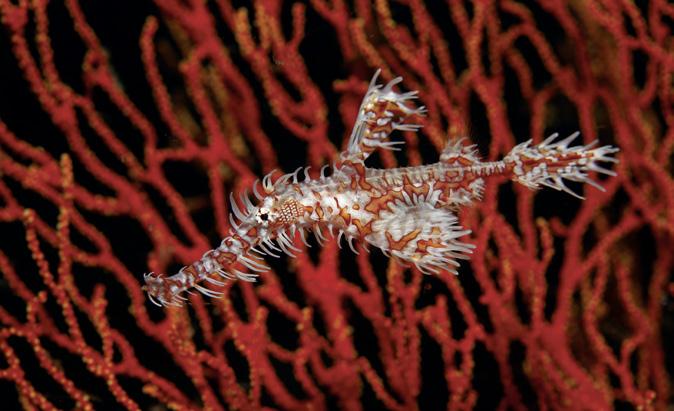
2ND PLACE
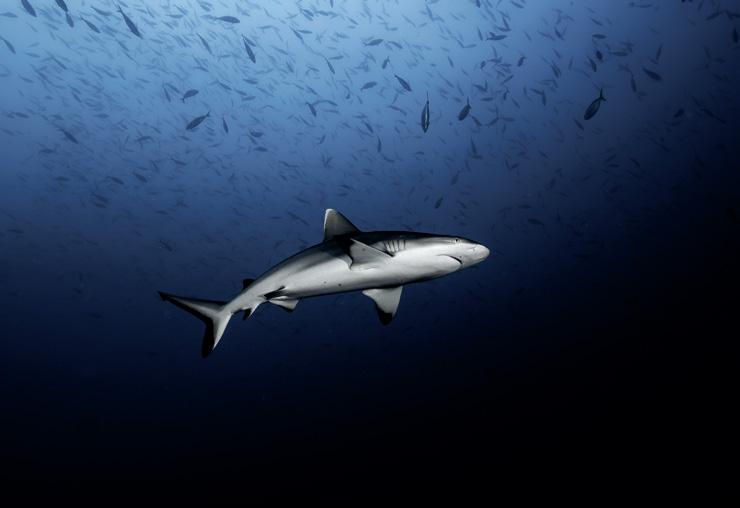
TIMO PISTERNICK
“SHY SNAIL”
Taken with a Sony RX100VA off the coast of Alor Island, Indonesia. 1/200 sec., f/11, ISO 200
TAUCHEN says: At first glance, images can tell stories and evoke emotions. This month’s jury-winning photo demonstrates this particularly well. The image editing and composition, the subtly coloured main subject framed in darkness, the sharpness of the image and the apparent ‘image flaw’ – a piece of coral in the front right-hand corner: all these individual elements combine to create a brilliant visual effect. Brilliant. Our winner!
RENÉ SCHRÖDER
“TRUST WITH CAUTION”
Taken with an Olympus OM-1 Mark II off the coast of Lembeh, Indonesia. 1/250 sec., f/13, ISO 200
TAUCHEN says: The little octopus rightly took first place in your poll this month. The focus, exposure and, ultimately, the post-processing and framing are flawless. Congratulations!
JÖRG MENGE
“GHOST”
Taken with a Canon M5 MKII in Indonesia. 1/200 sec., f/10, ISO 200
TAUCHEN says: The ghost pipefish is a real eye-catcher in its own right. But to capture it against the perfect ‘backdrop’, with spot-on lighting, and with the animal’s eye perfectly in focus! Absolutely brilliant and well-deserved in the rankings.
JANNIS REIF
“GREY REEF SHARK”
Photographed with a Sony Alpha 7 MKIII in the Maldives. 1/250 sec., f/5, ISO 100
TAUCHEN says: Sharpness, framing, post-processing: top marks!
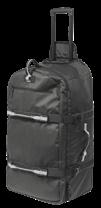
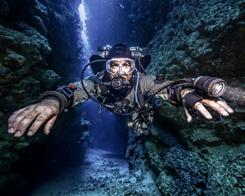
THE PRICES! CAMARO presents a new collection of bags and rucksacks for divers and adventurers . Sturdy materials, reinforced seams, corrosion-resistant zips, padded shoulder straps and functional internal and external com partments ensure optimum protection and comfort. Choose from the versatile Messenger Bag (rucksack/shoulder bag), the spacious 2-Part Cargo Duffle Bag with wheels for diving trips, and the convertible Travel Bag with three carry ing options. Ideal for everyday use, travel and diving holidays.
The WINNER OF THE READERS’ VOTE will receive the handy ‘Smarty Multi Tool’ from Mares (mares.com). This small, useful tool combines a bottle opener, Allen key, various hex keys and a screwdriver in a single tool (10 cm). Value: €29.
GET INVOLVED! Our reader photo vote is open to all underwater photographers – regardless of camera model or subject! You have a full month to upload your photo to www.tauchen.de (tauchen.de/foto-voting/teilnehmen). Voting will then take place the following month, and all users are invited to take part. In addition, a jury – which includes editor-in-chief Alexander Kaßler – will select a monthly winning photo. As a prize, the jury’s winner will receive one of the three bag models (of their choice, see above). Why not pop over and have a look!


GRUPPEN MEGA DEAL
FRÜHBUCHER FÜR
CLUBS & VEREINE
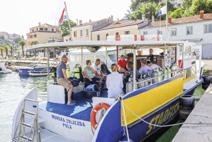
Hol Dir den TOP Deal bis zu 25% für deine Gruppenreise 2025 ! April - Juni, September - Oktober Schiff für 25 TaucherInnen gültig bei Reservierung inkl. Anzahlung bis 31.12.2024
Baron Gautsch
Coriolanus
Banjol
selbst ausbilden
Hausbucht
Seepferdchen


… ein Erlebnis über und unter Wasser


ÄGYPTEN, Safaga, Rotes Meer DEUTSCHE TAUCHBASIS
SSI Tauchkurse seit über 40 Jahren in Safaga
familiäre Atmosphäre traumhafte Riffe wie Panorama, Abu Kafen & Tobia Arba deutschsprachiges Team täglich Bootstauchen á 2 TG Hausriff mit Schildkröten

BESUCHE UNS UNTER www.safaga-paradise.de

Niederauer Str.39, 01662 Meißen Tel.: 0172-3725914 tauchbasis-riesenstein.com.

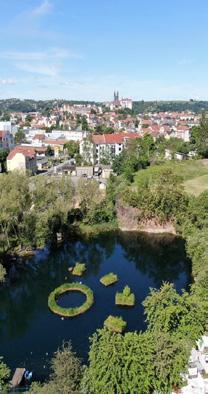





Tauchausbildung
Ausflüge Reisen
Verkauf Beratung
Reparatur Revision
Verleih Füllservice& & & &
Tauchsport Gläßer
Auweg 24 | 85464 Finsing 089 8563 1006 info@tauchsport-glaesser.de





• Schwimm-, Schnorchelund Tauchzubehör
• Tauchausbildung vom Anfänger bis zum Profi
• Service, Verleih und Verkauf von Tauchausrüstung
• Verleih von StandUp Boards
Tauchschule Hochrhein im „Gasthaus zum Loewen“ Hauptstraße 36 D-79801 Hohentengen a. H. +49 77 42 / 92 16 20 info@tauchschule-hochrhein.de www.tauchschule-hochrhein.de



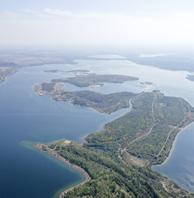
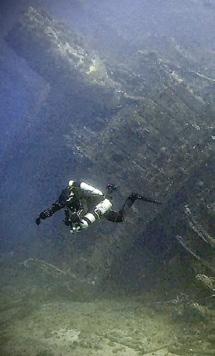

Die dicken Tekkies

Tauchausbildung
• OC-Tec (BM & SM) bis Full Trimix
• CCR (rEvo-SF2-JJ) bis Full Trimix


• SCR (Horizon)


Füllstation

• Luft – Nitrox - Trimix Service

• Beratung – Verkauf – Revision (Apeks Atemregler / CCR Geräte)


Wir tauchen ab

• in Berlin/Brandenburg, bundesweit, Ägypten, Kroatien, Sardinien

www.die-dicken.tekkies.com lars@die-dicken-tekkies.com




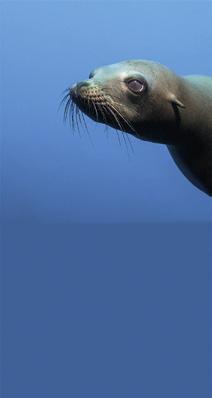







Weststraße 51 – 32657 Lemgo Telefon 05261/6251 info@atemreglerservice-owl.de www.atemreglerservice-owl.de Öffnungszeiten: Mo.–Fr. 14.00–18.00 Uhr

Flug, Hotel, Transfer & Tauchen TAUCHREISEN WELTWEIT
ÄGYPTEN MEXIKO SRI LANKA KENIA Safaga, Marsa Alam, El Quseir, Sinai, Tauchsafari Süd-Tour 26 Socorro, Cabo San Lucas, San José del Cabo Bentota, Passikudah Watamu
Safaga Tauchreise inkl. Flug, 4*Hotel HP, Transfer & Tauchen ab 680 €

ZU DEN TAUCHREISEN www.volkert-touristik.de 09357/97490








Zakynthos/Griechenland
35 Jahre Nero Sport In gemütlicher Atmosphäre familienfreundliches Tauchen im Ionischen Meer erleben.
• Kostenlose Kinderbetreuung
• Eigene Appartements
• Taverne „Dive Inn“
• Direktflüge
• Einzel-/Doppel-/Tagesfahrten
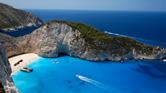
Telefon: 02361-32041 Mobil: 0173-8931673
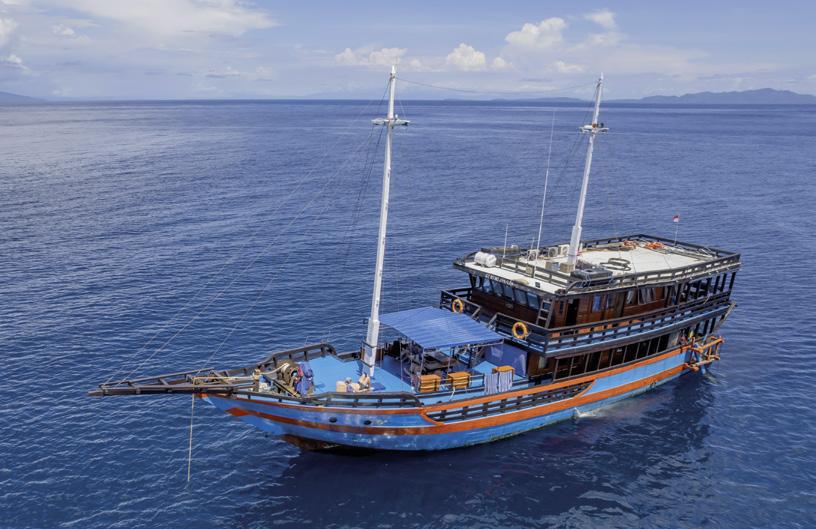
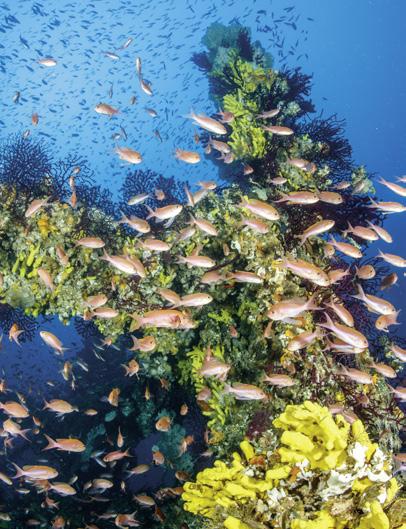
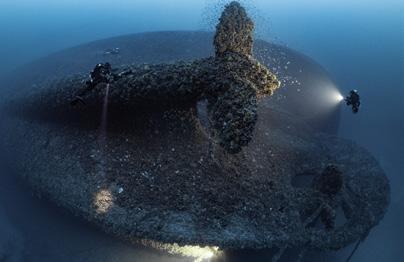
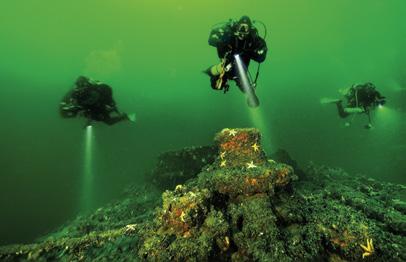
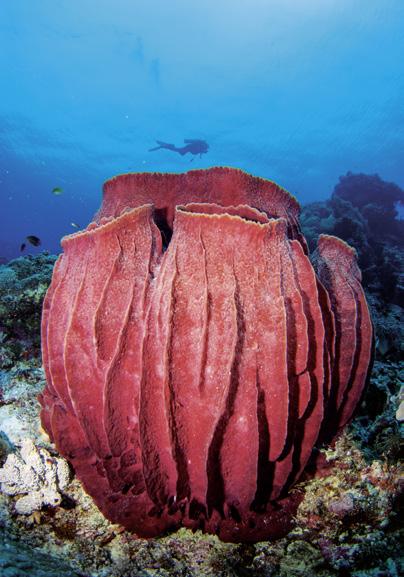
TRAVEL
• Wakatobi: Readers writing for readers
• Liveaboard diving with the KLM Sunshine in Indonesia
• Dominica: snorkellingwith whales
• Philippines: the vibrant colours of Tubbataha Reef
FEATURES
• Found: the wreck of the ‘Wacht’ in the Baltic Sea
• Greece: at the wreck of the famous ‘Britannic’
• Rarely dived: the ‘Michael N. Maris’ in the Croatian Adriatic
The next issue will be available at your newsagent from Tuesday, 12 May 2026.
Editorial Office & Publisher TAUCHEN
JAHR Artopé Media GmbH & Co. KG
Management: Alexandra Jahr, Philip-A. Artopé
Bajuwarenring 19, 82041 Oberhaching
Telephone: 089/5 52 41-0, Fax: 089/5 52 41-2 44
Publisher: Alexandra Jahr
Editor-in-chief: Alexander Kassler (responsible for the content)
Art Director: Achim Matschiner
Editors: Lars Brinkmann, Benjamin Schulze
Freelancers: Tobias Friedrich, Heike Gehrmann, Rose & Udo Kefrig, Dr Florian Huber, Barbara & Wolfgang Pölzer, Martin Strmiska
Marketing/Partnerships: Kathrin Stapelfeld, Tel. 040 38 906 269, kathrin.stapelfeld@jahr-tsv.de
Advertising:
JAHR Artopé Media GmbH & Co. KG
Bajuwarenring 19, 82041 Oberhaching
Advertising sales: Tel. 089/5 52 41-225, sales@tauchen.de
Advertising Co-ordination: Tanja Karg, Tel. 089/5 52 41-222, dispo@tauchen.de
Current advertising rate card: 2026 rate card dated 1 November 2025
Production management: Ilja Badekow, Sybille Hagen, Andreas Meyer
Graphic design: JAHR Artopé Media GmbH & Co. KG; Conny Anders, Kerstin Meister
Printed by: Walstead Central Europe, ul. Obr. Modlina 11, 30-733 Kraków
Prices:
Subscription price: 12 issues, within Germany: 142.80 euros incl. postage, Austria: 154.80 euros, Switzerland: 226.80 Swiss francs, other European countries (by land): 168 euros, other European countries (by air): 210 euros, non-European countries: 235.20 euros. Ordering individual issues: By bank or credit card direct debit only (total price: number of issues multiplied by the issue price of 9.90 euros plus postage) via the Tauchen subscription service or email: abo@tauchen.de, website: www.tauchen.de
Sales:
Retail distribution: DMV Der Medienvertrieb GmbH & Co. KG, Meßberg 1, 20086 Hamburg, www.dermedienvertrieb.de
Subscription sales: DPV Deutscher Pressevertrieb GmbH, PO Box, 20080 Hamburg, www.dpv.de
Price per issue: €11.90
Copyright: © TAUCHEN, unless otherwise stated. TAUCHEN IS a joint venture between TAUCHEN and UNTERWASSER, published by JAHR Artopé Media GmbH & Co. KG since September 2020. TAUCHEN may only be used in reading circles with the publisher’s permission. The export of Tauchen and its distribution abroad are only permitted with the publisher’s consent. The magazine and all articles and illustrations contained therein are protected by copyright. Any use without the publisher’sconsent is punishable by law. The editorial team reserves the right to shorten and edit articles. The publisher and editorial team accept no liability for unsolicited manuscripts, CD-ROMs, photographs and illustrations. There is no entitlement to compensation for loss of earnings or archive fees. In cases of force majeure, there is no entitlement to delivery or a refund of the subscription price. The place of performance and jurisdiction is Munich.
ISSN 0170-4001