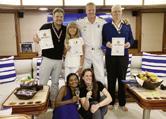
If you start conversations with, “Remember our dive trip way back when...”
“Remember our dive trip way back when...”
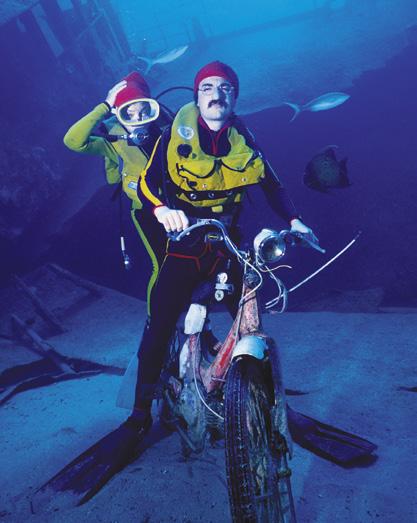
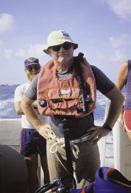
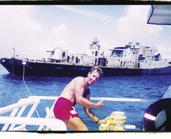
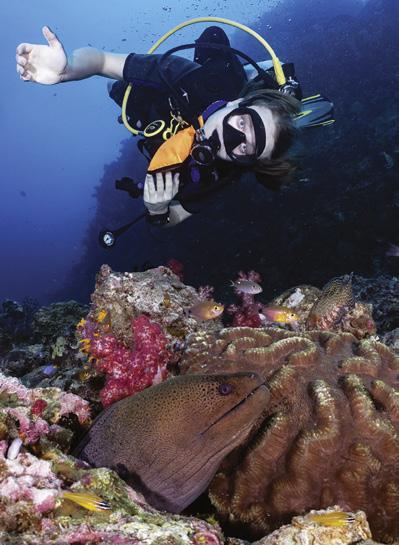
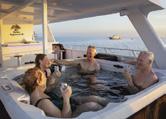
Oro Verde Wreck, Cayman Aggressor 1986, Mike Mesgleski
Sinking of Russian Destroyer 1996, Cayman Brac, Tom Gebhardt
Bay Islands Aggressor, Honduras 1989 Alan Roberts
Turks & Caicos Aggressor, 1992
Having Fun! Palau Aggressor, 1996, Jim Church
Bahamas
Belize
Cayman Islands
Cocos Island, Costa Rica
Dominican Republic
Galapagos
Komodo, Indonesia
Nile River, Egypt
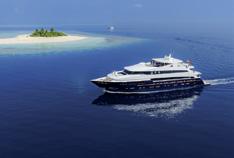
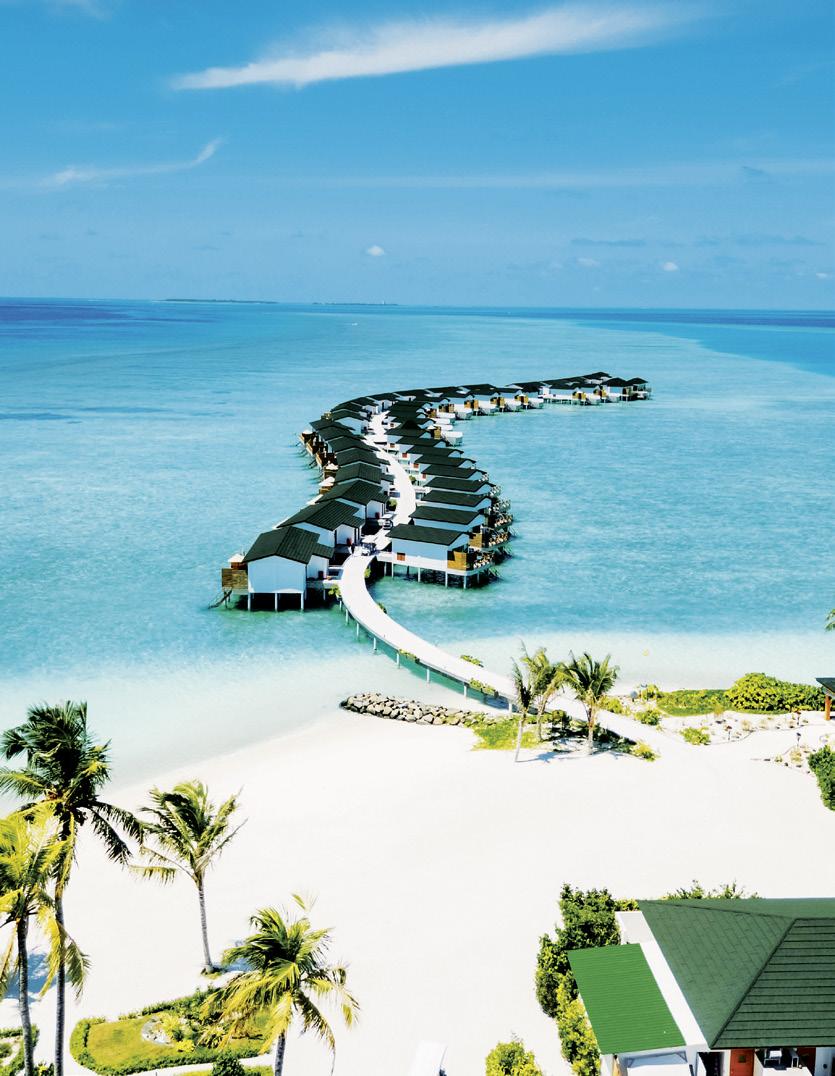
Maldives
Palau
Philippines
Raja Ampat, Indonesia
Red Sea, Egypt
Roatan, Bay Islands of Honduras
Sri Lanka
Thailand-Andaman Sea
Thailand-Chiang Mai
Turks & Caicos
My first time
We went on a family holiday to Egypt during the short winter break. Why not, I thought to myself. My son would spend the whole day on the slides, my wife would get the sunshine she’d been longing for, and I could do a few dives. Fat chance. Our absolutely brilliant family hotel was in the second row, with no access to the beach. It soon became clear that the daily holiday routine of splashing about in the pool, the water slide park and the bumper cars was completely unsuitable for diving – the day started late and ended early. I came to terms with not diving relatively quickly, even though it hurt to be ‘so close and yet so far’. But it got even worse. We visited the hotel’s own remote stretch of beach. A shock. The sun-worshipping, sardine-can atmosphere was coupled here with a 300-metre, calf-deep trek across a broken reef top to the drop-off edge. My plan to show my son the splendour of the Red Sea was thus quickly scrapped. A shame. Postponed until next time. Next time, we’ll book a beach hotel with snorkelling facilities for toddlers.
Luckily, the local lakes aren’t far away. So the first dive of 2026 took place in mid-February, water at three degrees. It’s a real pain when first the regulator starts playing up, and then the silicone seal on the mask slips out of its frame, and at a depth of ten metres, taking
the mask off causes body and mind to scream for an immediate ascent. It had been a long time since I’d come so close to making a panic ascent. I got a grip on myself, calmed down and slowly swam towards the shore without looking at my mask. Adjusted the mask and restarted the dive. Along with the cameras for photos and video, I also had to manage an underwater scooter. Haven’t done that in ages. But it worked out. After 35 minutes and a maximum depth of 34.5 metres, my hands were frozen stiff. Despite the freezing cold, initial stress and equipment chaos: my first dive of 2026 was wonderful. How and when are you stareting your diving year?
Now please turn the page and dive in. No freezing, no chaos and no need to worry about gear. Just sit back – and enjoy!
Alexander Kaßler Editor-in-Chief of TAUCHEN alexander.kassler@tauchen.de
MAGAZINE
JOURNEY
Advertorial: The Chogogo Resort on Curaçao
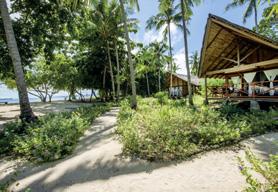
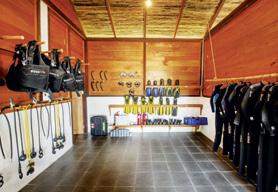
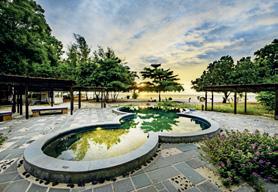
Advertorial: Lotus Bay Resort & Liveaboard
Italy: A visit to Omnisub Elba
Japan: Diving around Honshu
Spain: Costa Brava classics
Readers' reviews: Holidays in the Maldives
TECHNOLOGY
Cressi diving torches
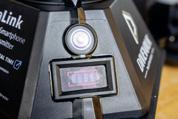
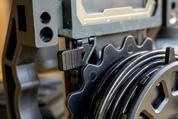
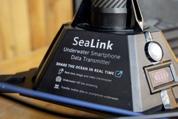
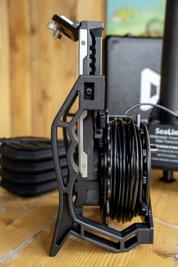
Sealink transmitter from Divevolk
EXPERTS
The Gribshunden Shipwreck
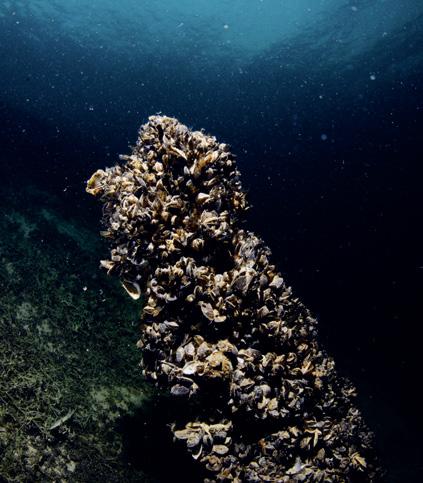
Mussel invasion in Alpine lakes
Essential equipment
Diving after surgery
to: What can a semi-dry wetsuit do?
FOCUS
CATEGORIES
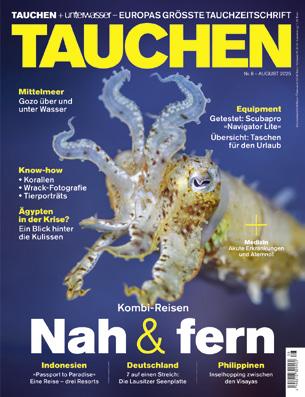
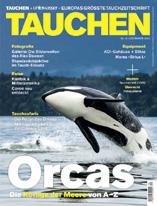
Cover No. 4.26
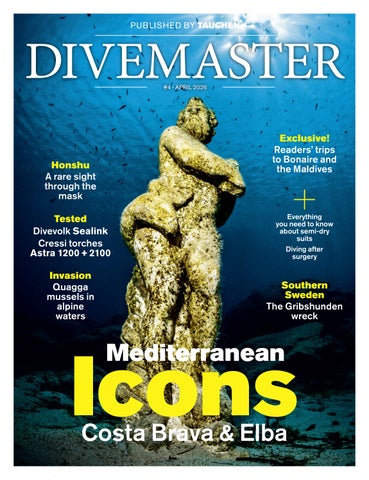
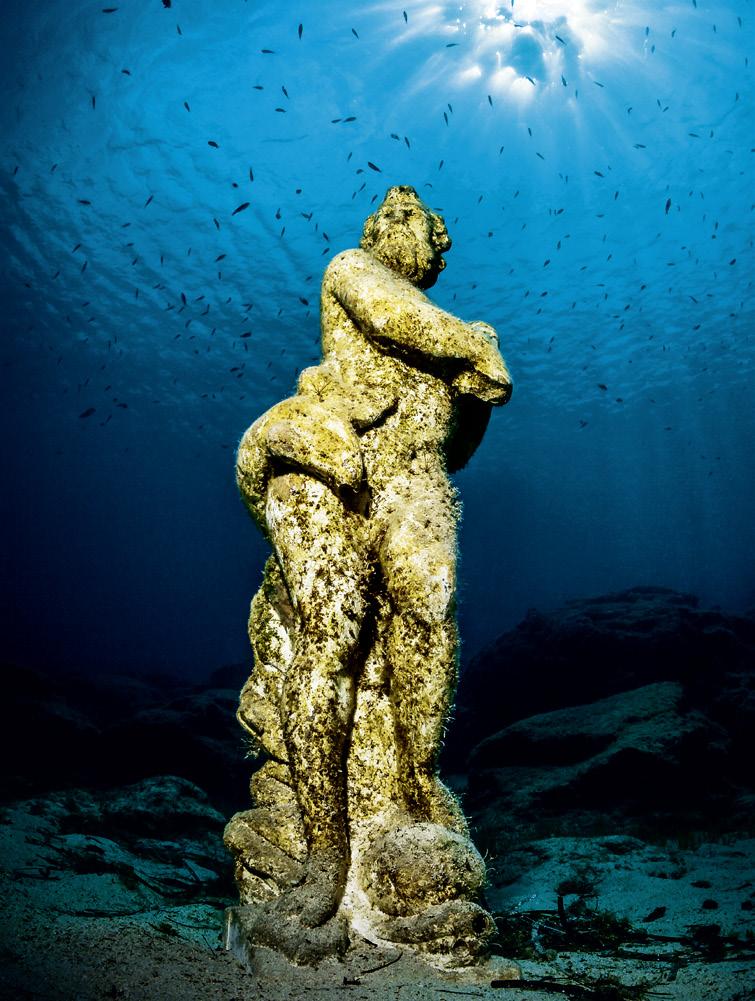
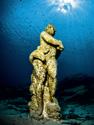
The cover photo for this issue shows a statue of Poseidon at Cape Greco on the Greek island of Cyprus, near Larnaca. The photograph was taken by Tobias Friedrich.
CONTACT & MORE
EDITORIAL TEAM
Jahr Artopé Media GmbH & Co. KG
Bajuwarenring 9, 82041 Oberhaching
Tel. 089/5 52 41-0, Fax 089/5 52 41-244
E-mail: redaktion@tauchen.de
DISPLAY
089/5 52 41-225
Email: sales@tauchen.de
DIVING SUBSCRIPTION + ADDRESS CHANGES
Tel. 040/5555 7991, email: jam@dpv.de
EPAPER TAUCHEN www.tauchen.de/epaper
Did you know that TAUCHEN is also available digitally? This includes our social media channels Facebook and Instagram as well as our website and our YouTube channel. You can also listen to our podcast channel. Just drop by and listen. Follow the links below. Do you want to read TAUCHEN digitally? Download our TAUCHEN app for iOS and Android. We look forward to hearing from you.
We are pleased to present the winners of the photo competition: ‘Festival Galathea 2025’
www.festival-galathea.com
‘AMATEUR’ series
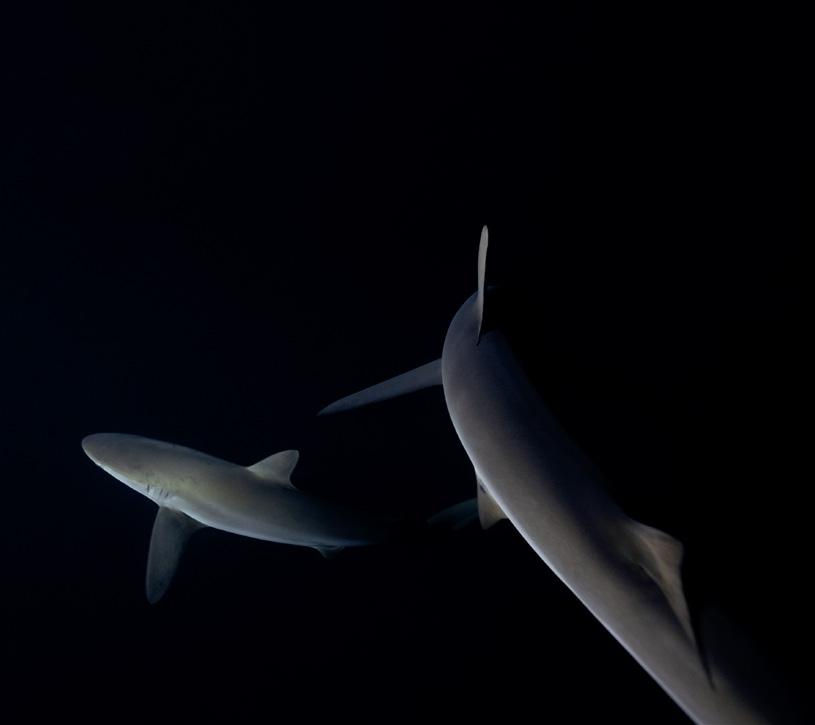
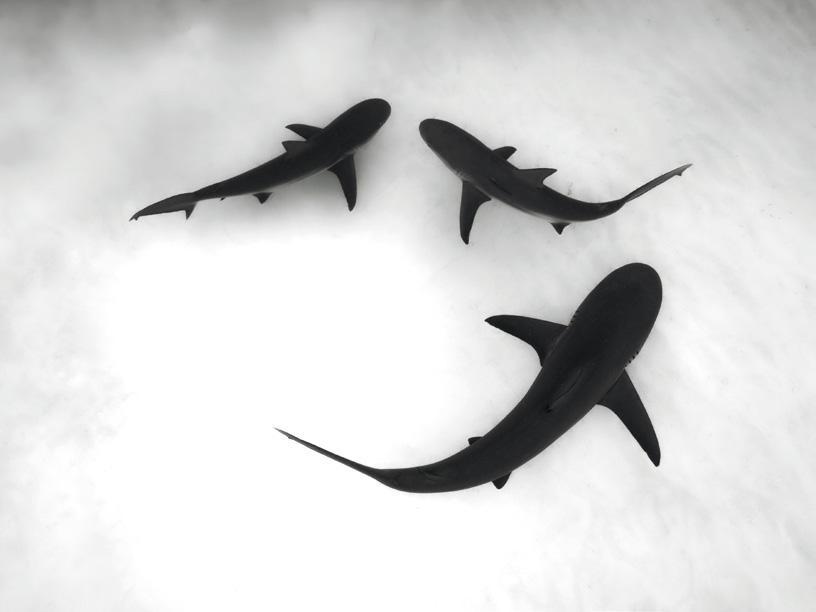
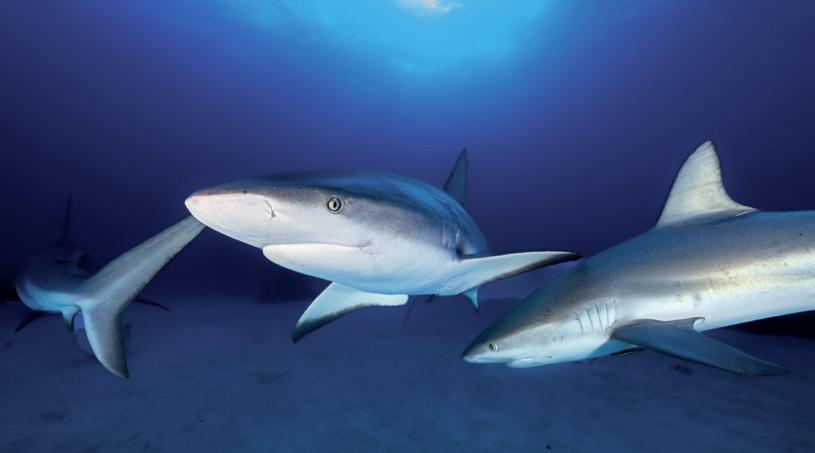
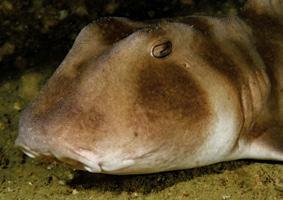
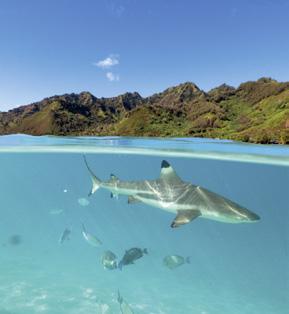
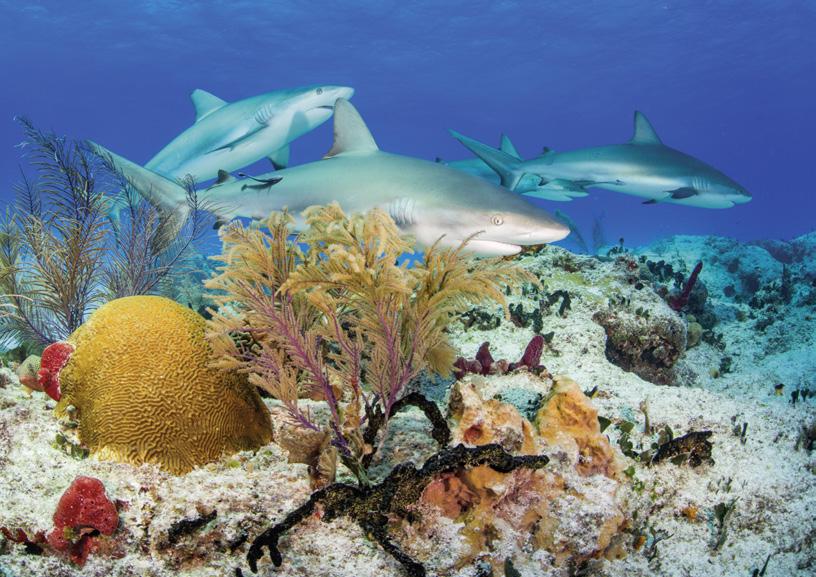
The three shark photographs were taken by Arthur Godfroy.
by
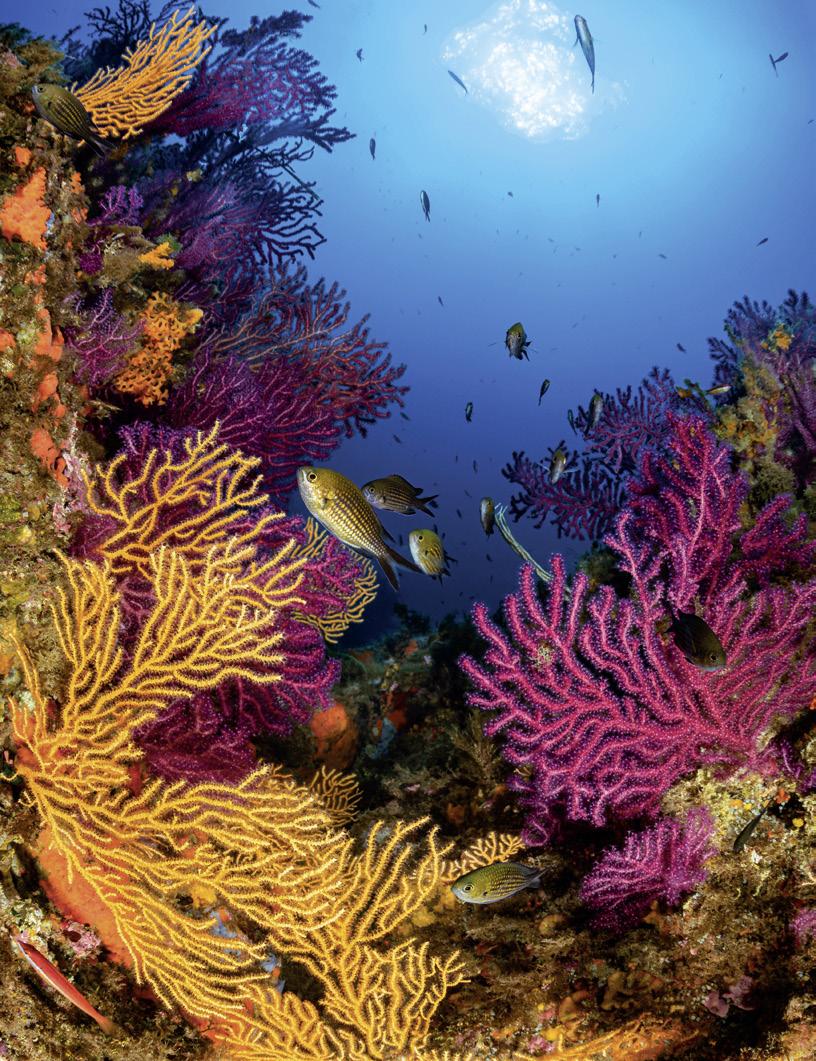
“MEDITERRANEAN”
Patrick Désormais
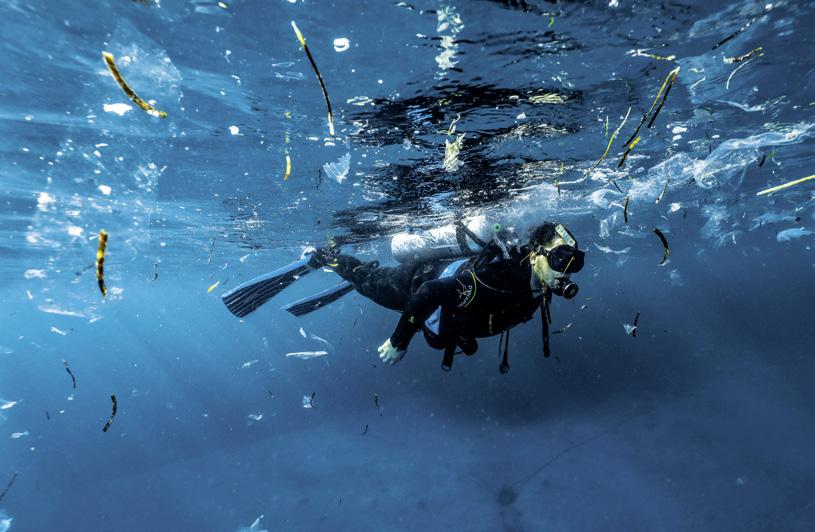
“IMPACT POLLUTION”
by Timo Dersch
“BLACKWATER”
by Franco Tulli
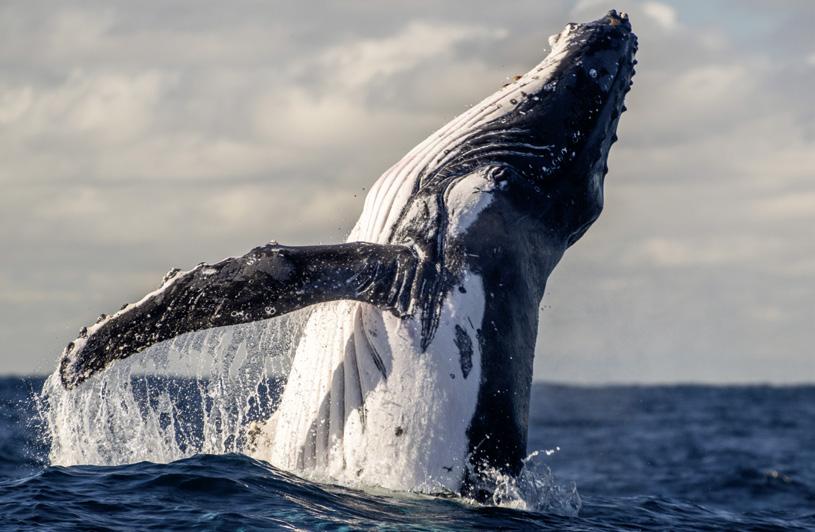
“MONDE MARIN”
by Daniel Sly
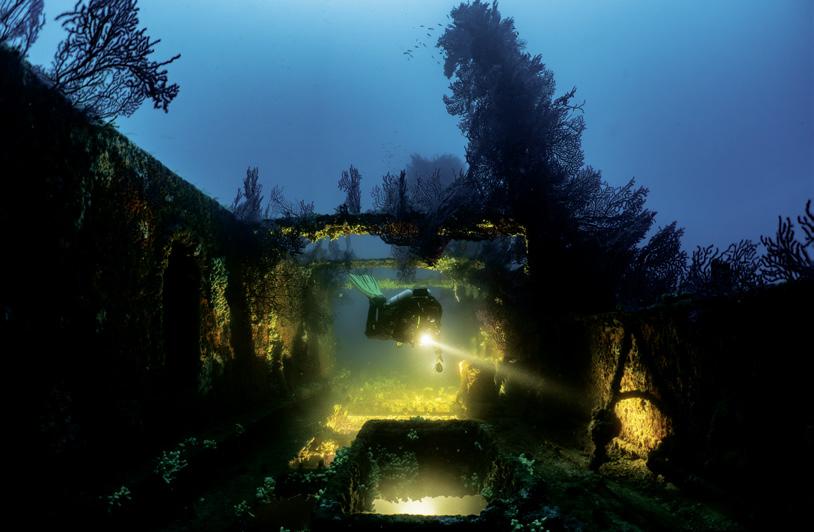
“EPAVES” by Baptiste Cazajous
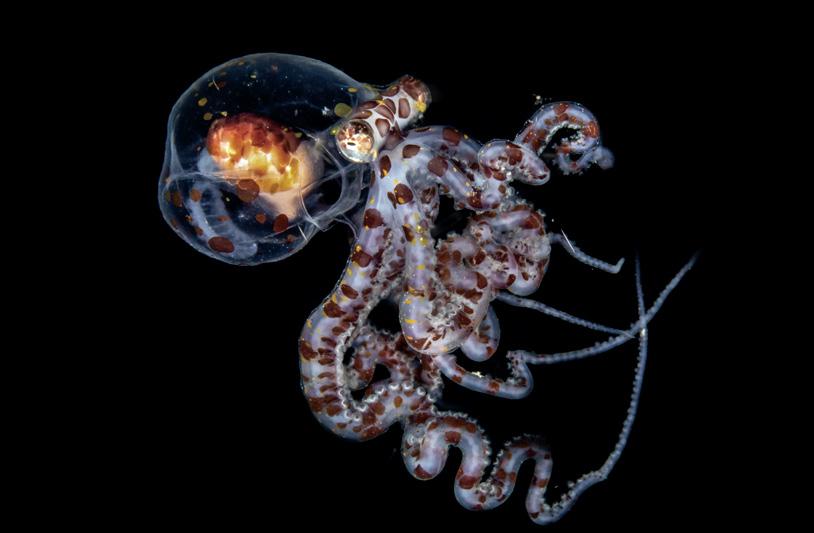
‘EXPERT’ series
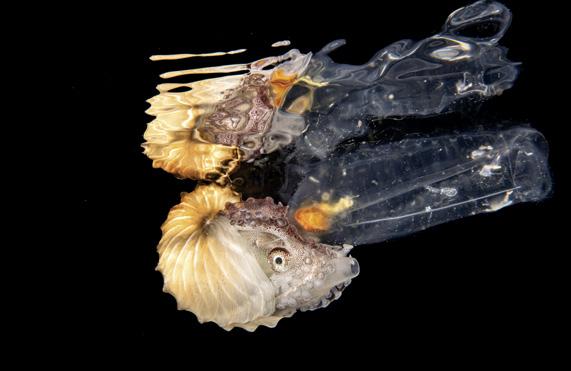
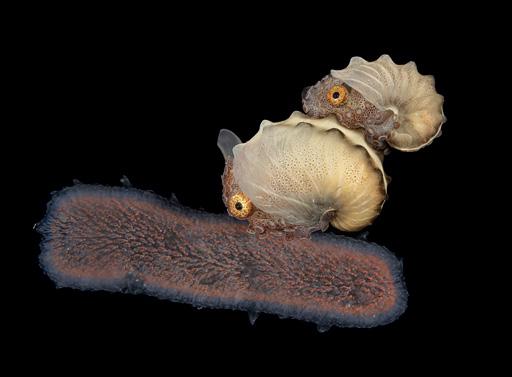
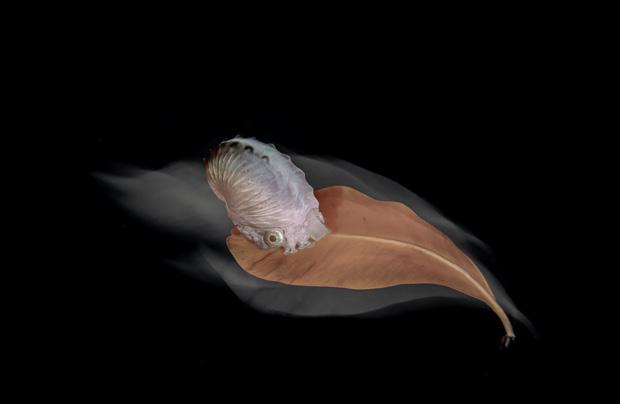
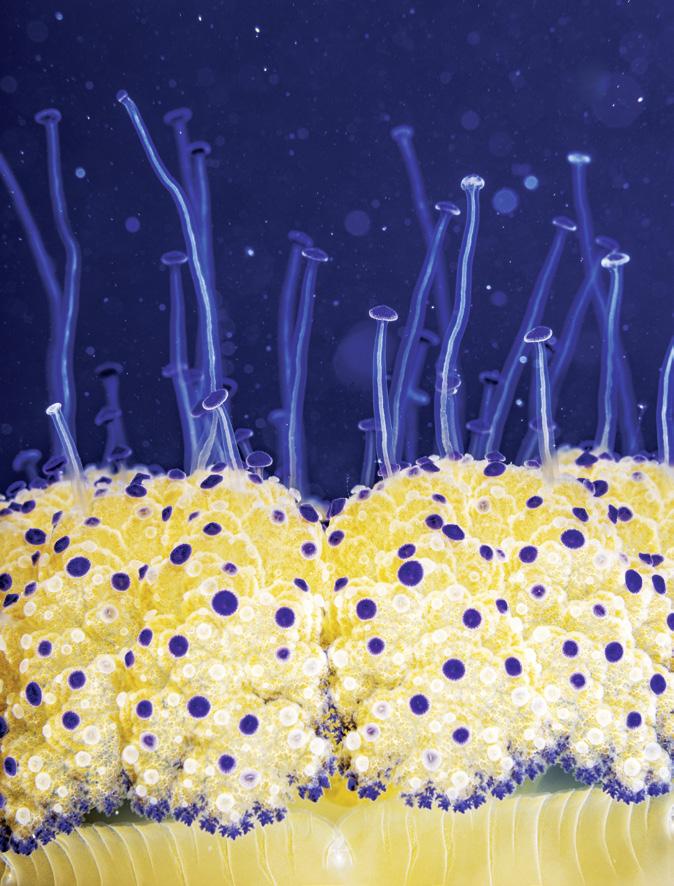
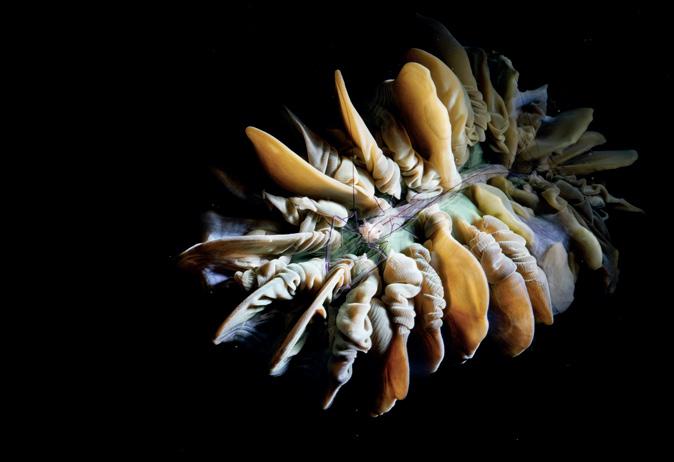
The three photographs of the Argonaut octopus were taken by André Moyo.
What makes this trip special
• Unlimited shore diving at one of the Caribbean’s best house reefs
• Your own hire car for maximum flexibility
• Nitrox included
• short distances, relaxed logistics, diverfriendly facilities
Key figures
Dates: 29 August to 4 September 2026
Duration: 7 nights
Accommodation: Buddy Dive Resort on Bonaire
Dive centre: Buddy Dive Resort
Tour price: from 895.92 USD per person
Included services
• 7 nights’ accommodation in your chosen apartment type
• Return transfer from the airport
• 7-day car hire (manual transmission, insurance included)
• 6 days of unlimited shore diving (Nitrox & Air included)
• 1 guided boat dive
• daily breakfast
Accommodation
Studio (2 people from $1,156.20 per person); 1-bedroom apartment (2 people from $1,266.50 per person); 2-bedroom apartment (4 people/from $994.13 per person); 3-bedroom apartment (6 people/from $895.92 per person)
Additional costs
International flight to Bonaire: from €800 to €1,100
Bonaire Marine Park fee: US$40, payable in advance at [www.bonairenaturefee.org] (http://www.bonairenaturefee.org); Visitor Entry Tax: US$75, payable in advance at https://tourismtax.bonairegov.com/)
Optional services
Diving equipment hire, guided dives (subject to availability; please book on site at least 24 hours in advance)
*All prices are in USD. Subject to change.* Are you interested in this trip? Then get in touch: redaktion@tauchen.de. Please quote the keyword ‘Buddy Dive Bonaire’.
BONAIRE. BUDDY DIVE. ENDLESS TIME UNDERWATER. FORTAUCHENREADERS
Ahouse reef instead of a hotel pool, a pick-up truck instead of a coach, a tank strapped to your back – and off into the blue. The Caribbean island of Bonaire isn’t a diving destination for show, but for substance. For everyone who’d rather dive than plan. And that’s exactly what the TAU-
CHEN Readers’ Trip 2026 is all about. From 29 August to 4 September 2026, we invite you to an intensive week of diving at the Buddy Dive Resort – right on the coast of one of the world’s best shore-diving spots. No set programme, no pressure, no stress. Instead: maximum freedom, short distances and as much time underwater as your computer allows. Whether early in the morning before breakfast, relaxing in the afternoon or spontaneously for a night dive – on Bonaire, you decide for yourself when and how you dive. Exactly the way divers like it. Whether you’re travelling alone, with a buddy or as a small group: By the end of the week, you’ll go home not only with a full logbook, but also with new friends, conversations about reefs, currents and favourite spots – and the feeling that you’ve made exactly the right choice. Exclusively for all participants on the TAUCHEN readers’ trip: unlimited shore diving is included. Places are limited. Anyone who knows Bonaire knows why.
Exclusive FAMILY‘S LIVEABOARD MALDIVES: CRUISE, DIVE AND CHILL
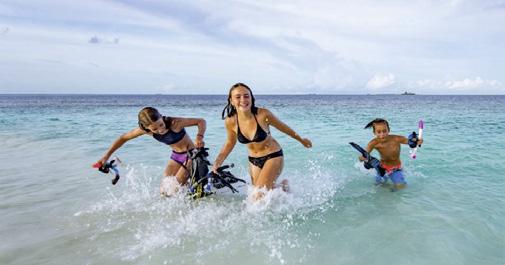
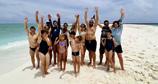
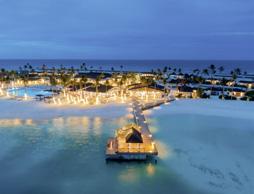
The Maldives are a classic paradise for divers. But this special reader trip makes the underwater adventure accessible to families too. In partnership with EcoProDivers, TAUCHEN is offering a seven-day liveaboard trip that promises unforgettable experiences in this Indian Ocean archipelago for experienced divers, children and non-divers alike.
The Maldives for the whole family
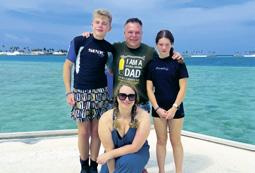
This trip was first launched five years ago and was immediately fully booked. Now it’s back – with a modern Safari-liveaboard serving as a comfortable base. The only requirements for participation are that children are over six years old and can swim. Otherwise, no advanced diving qualifications are required: “We want to appeal to families and diving be-
ginners alike and enable them to experience the Maldivian dream world together,” say EcoProDivers boss Alexander Rausch and TAUCHEN editor-in-chief Alexander Kaßler.
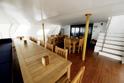
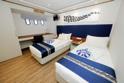
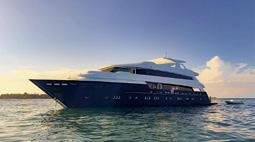
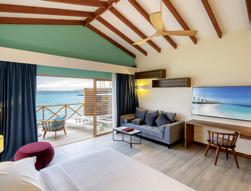
The centrepiece is the 43-metrelong “EcoPro Seascape”, which accommodates up to 28 guests in spacious cabins with en-suite bathrooms and air conditioning. Built in 2023, the vessel offers plenty of space across three decks for relaxation and exploration – both above and below the water.
The itinerary has been deliberately designed to be varied. As well as classic dives, the programme includes activities such as snor kelling at spectacular sites, SUP‑ and canoeing for teenagers, as well as visits to local islands
FORDIVING READERS
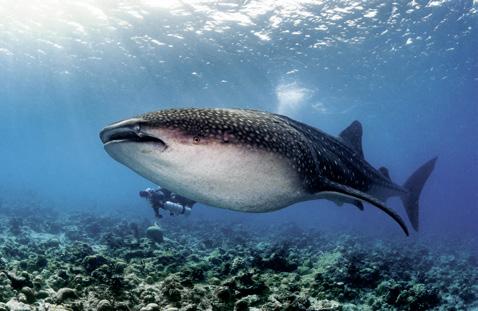
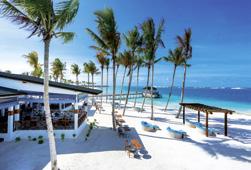
Here, participants gain an insight into authentic life in the Maldives. The itinerary also includes so-called Robinson-Crusoe-islands, where guests are greeted by nothing but pristine beaches and palm trees –including beach-barbecues on the sandy shore. For certified divers, up to two dives per day are included, with encounters with whale sharks and manta rays possible but not guaranteed. For children and teenagers, introductory dives and diving courses are offered, ranging from the Bubblemaker-programme to the Junior Open Water Diver course. In addition, the ship offers daily island visits and leisure activities such as kayaking.
The dates for this reader trip are from 26 July to 2 August 2026 and from 1 to 8 August 2027. The itinerary begins with arrival at Malé Airport and transfer to the ‘EcoPro Seascape’, followed by the crossing to the first dive‑ and snorkelling sites in the North Male Atoll and Ari-Atolls. On the final day, an island tour of Malé is on the programme before returning to the airport. The package includes accommodation in a twin cabin, full board, transfers, two dives per day for certified divers, island visits and all on ‑ board activities. Not included are flights, green tax, alcoholic drinks, equipment hire, diving courses and tips. The minimum number of participants is 16, with a maximum of 26 guests. This family-friendly liveaboard combines adventure, diving fun and shared experiences in one of the world’s most spectacular underwater landscapes – ideal for families wishing to discover new horizons together.
Price: €1,799 (adults), €999 (14 to 18 years), €899 (6 to 12 years), plus international flight.
Interested? Then get in touch: redaktion@tauchen. de, quoting “Family Liveabo pard Maldives”.
Please specify your preferred dates: 2026 or 2027.
MAGAZINE
BABY BOOM AMONG THE “RAREST OF THE RARE”
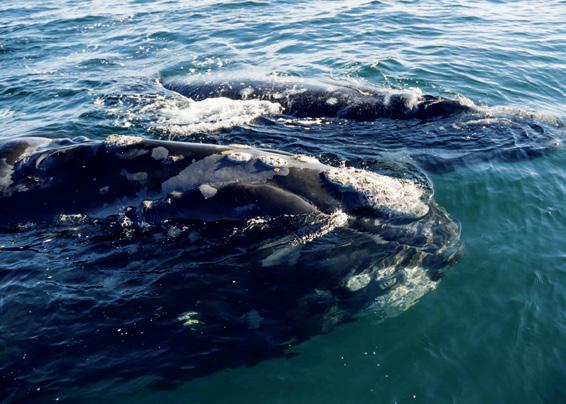
A potentially record ‑ breaking calving season for North Atlantic right whales. At the start of the season, conservationists had already reported 19 newborn North Atlantic right whales (Eubalaena glacialis). This is a small but extremely important ray of hope for a species of which only a few hundred individuals remain. Every calf is a victory against extinction. For divers and those interested in the ocean, it is a symbol that conservation measures (such as speed and restrictionson ships in breeding grounds) are actually bearing fruit.
THE ‘DARTH VADER’ ISOPOD & THE ‘DEATH BALL’ SPONGES
New deep sea species are fascinating researchers
At the start of 2026, the Ocean Census initiative presented an impressive summary of its most recent expeditions. Thanks to modern ROV technology (remotely operated vehicles), hundreds of new species have been discovered, which are sure to delight any marine biology enthusiast.
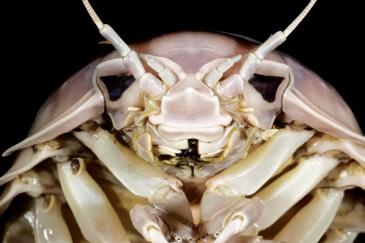
• The Star of the Deep: A giant isopod (Bathynomus vaderi), named for its striking resemblance to the Star Wars villain ‘Darth Vader’. These isopods can grow to over 30 centimetres in length and look like prehistoric monsters from another world.
• The carnivorous ‘death ball’: At a depth of over 3,600 metres, researchers came across an ancient, carnivorous sponge (Chondrocladia) that catches its prey with sticky tentacles – a fascinating example of the bizarre survival strategies found in the eternal darkness.
OBITUARY
On 30 December 2025, Monika Florian (born 14 April 1945) – a legend of the diving world in Leipzig – passed away completely unexpectedly. With her Florian Diving School, which included a diving centre on Lake Kulkwitz and a dive shop in Leipzig, she was the first port of call for all water sports enthusiasts interested in diving for 35 years. She and her husband Dieter Florian had caught the diving bug from an early age. They were among the pioneers of diving in East Germany. Together, they published their experiences in numerous documentaries and illustrated works.
The diving school was the life’s work of Monika Florian, which she ran successfully with heart and soul right up until the age of 78. She lived for diving and was there for her customers seven days a week. Many of them loved visiting her shop on Leipziger Karli. Her warm and friendly interactions with customers quickly fostered personal trust and countless friendships. People simply loved her for her open-hearted warmth!
We are so grateful for all the wonderful moments we shared with you, Moni – you had so much still to do. Farewell, dear Moni. You will always be in our thoughts.
Stefan & Conny Schwarzer
5TH SYMPOSIUM OF THE GERMAN SOCIETY FOR DIVING MEDICINE
The fifth edition of this successful symposium will take place this year on 21 March in Wiesbaden. It is dedicated to presenting diving medicine content in a clear and practical way for instructors, doctors and parents. Key topics include ADHD, current DAN statistics, pulmonology, ENT, diabetology, cardiology, emergency care, travel medicine and the VDST’s accident statistics.
A particular highlight is the digitally accessible, a unique digital GTÜM questionnaire for children and adolescents, which has now become established in clinical practice.
Further information about the event can be found at: https://tinyurl.com/8drn6wmj
JUNIOR II AWARDED FOR LAHNTAUCHER E.V.
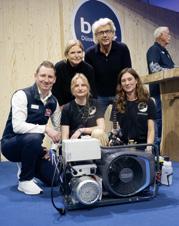
At boot 2026, the Lahntaucher e.V. association was presented with the JUNIOR II diving compressor in recognition of its environmental commitment. The special prize from the “Better Oceans” initiative (Dive Award 2025, “Climate” category) was presented by Maike Grützedieck. The ten-member association carries out extensive operations to remove hazardous waste from the River Lahn near Marburg. In addition to bicycles and washing machines, car parts and motorbikes have also been retrieved from the river. www.lahntaucher.de & www.better oceans.com
SHARKS –MYTH OR REALITY?
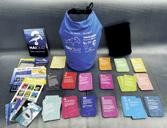
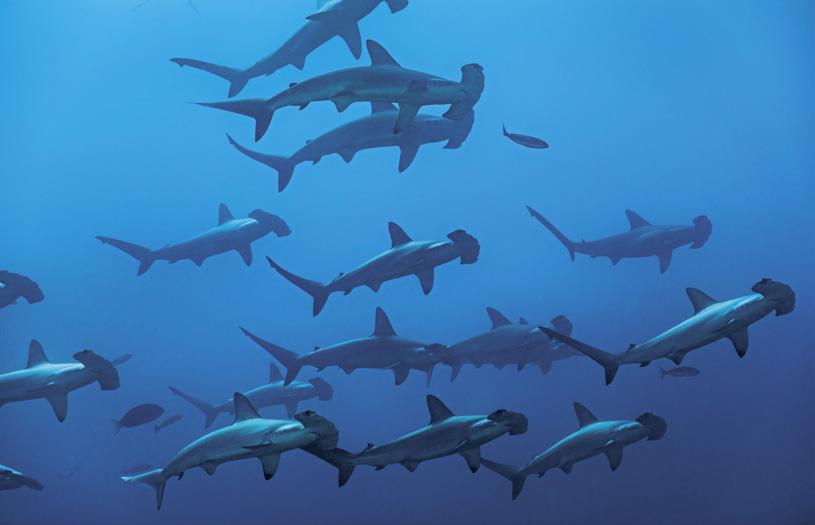
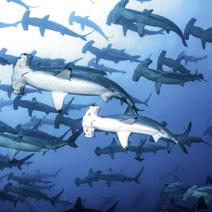
In 2007, researchers found large quantities of seagrass in the stomachs of scalloped hammerhead sharks. They thought it was a mistake. But then shark researcher Samantha Leigh discovered that this species of shark can actually utilise the nutrients in the seagrass. This marked the discovery of the first shark species known to feed on plants. These and more facts and figures about sharks can be found in the new shark quiz from Ocean Heroes. Entertaining and educational, available for the donation price (100% donation) of 25 euros.
Available to buy: www.ocean heroes.shop
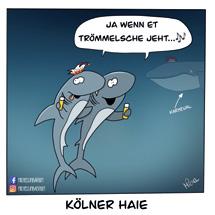
You can find more from the artist Michel Ley at: , Facebook/michels.imbaerium, , Instagram (»michels.imbaerium«) and , www.michels imbaerium.de
3 Islands 1 Paradise
Nabucco Island Resort, Nabucco’s Nunukan and Virgin Cocoa –three exclusive island resorts in the Maratua Atoll.
Arrive.
Dive in.
Breathe out.
Off the beaten track, they blend tranquility, comfort and a commitment to sustainability along the east coast of Borneo, Indonesia.
World-Class Diving.
Extra Divers Dive Center
Spectacular dives await: a vast house reef and the top spot Big Fish Country, home to barracuda schools, eagle rays, tuna and reef sharks.
Underwater Highlights
Mantas, sharks, turtles, a jellyfish lake and vibrant, healthy reefs make the Maratua Atoll one of the most diverse diving destinations in the region.
KNOWING ABOUT SHARKS MAKES YOU SMARTER... HERBIVOROUS
TRAVEL
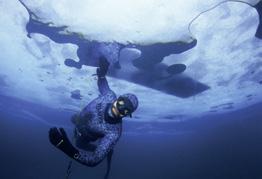
APNOEA UNDER ICE
15. SILENT WEEK
From 8 to 19 June 2026, the Orca Dive Club Soma Bay invites you to the 15th Silent Week dedicated to rebreather diving. The programme focuses on silent house reef dives, speedboat trips and full-day tours. Rebreather divers with their own equipment will receive a special package comprising five days of boat diving, including bail-out tanks, oxygen, a T-shirt and a BBQ, for €490, excluding helium and soda lime. Extensions cost €75 per day of boat diving or €45 for house reef dives. Equipment hire and training are available. For more information, visit info@orca-diveclubs.com. Book flights via info@holidayanddive.com. orca diveclubs.com
Diving under ice is extreme in every sense of the word. The cold, the impenetrable layer of ice above you, and the extreme strain placed not only on the diver but also on the diving equipment make ice diving a pursuit that very few dare to attempt. It becomes even more extreme when you dive under ice on a single breath – in other words, freediving. How do you manage when diving under the ice? Our author Nik Linder is a multiple world record holder in diving under ice. Every winter, he takes advanced freedivers with cold-water experience under the ice of Lake Weissensee. Interested? Then take a look here or get in touch: niklinder.com & office@nikolaylinder.de
PARADISIACAL PAPUA
Papua New Guinea captivates with its unspoilt diving sites. This tour, organised by diving specialist Pacific Travelhouse, takes you to two of the region’s most spectacular diving destinations: the Bismarck Sea and Milne Bay. In Tufi, you can look forward to unique fjords, steep reef walls and an outer reef featuring colourful corals, crystal-clear blue water and stunning drop-offs. Lissenung Island offers unspoilt coral gardens, crystal-clear water and relaxed diving around the private island. Price example from/to Germany per person from 6,380 euros. pacific-travel-house.com
Go directly to the offer at
OFF THE BEATEN TRACK
Discover the rarely dived Elba Reef in Sudanese waters. A true expedition experience for experienced divers! With special permission, we’ll head to this unspoilt reef, nestled within the classic route from the Brother Islands via Daedalus to Rocky & Zabargad. Eleven-day liveaboard with up to 28 dives, including eleven at Elba Reef, Nitrox and full board on board the comfortable M/V Royal Evolution. The liveaboard is accompanied by diving physician Tanja Bayer and her TaWo Diving team, who incorporate their expertise into the daily itinerary. Price example 4–14 June 2026: Lower deck cabin, 10 nights full board and 28 dives per person from €1,975 (plus €260 fuel surcharge, €260 marine park and port fees, plus flights from Germany). belugareisen.de
NEW BASE LINE
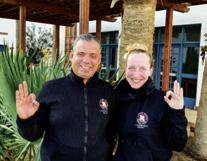
The management team at the new Extra Divers centre in southern Egypt, Extra Divers Lahami Bay, introduces itself: Nicole Iseli and Ali Shata bring years of experience and a passion for diving to one of the most beautiful regions of the Red Sea. Nicole Iseli, who grew up in central Switzerland, found her calling in diving in 2018. “It is particularly important to me that guests who feel uncertain underwater also feel safe,” she says. Her husband Ali Shata, born on the Egyptian Mediterranean coast, brings extensive operational experience to the new centre, having logged over 10,000 dives. As well as diving, Ali is a passionate cook. His calm demeanour and sense of humour ensure that guests always feel well looked after. The new diving centre focuses on safety, quality and personalised support. extradivers worldwide.com
Photos: Dr Matthias Siebert, Freiburg, organiser
READERS' TRIPS
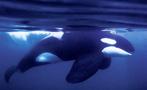
Orcas & Northern Lights
Wirodive is offering an exclusive readers’ trip to Orca Camp in Northern Norway in November 2026 for TAUCHEN readers: in the fjord landscape around Hamneidet, participants will encounter orcas and humpback whales in the wild and – on clear nights –spectacular Northern Lights. The week includes up to six boat trips and nature programmes, including an introduction to aurora photography. Travel dates: 15–22 November 2026. €3,590 per person (excluding travel to the destination and any stopovers). Information: www.tauchen.de/ leserreisen/ & email: redak tion@tauchen.de
Off to Spain –Cap de Creus
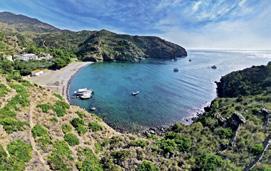
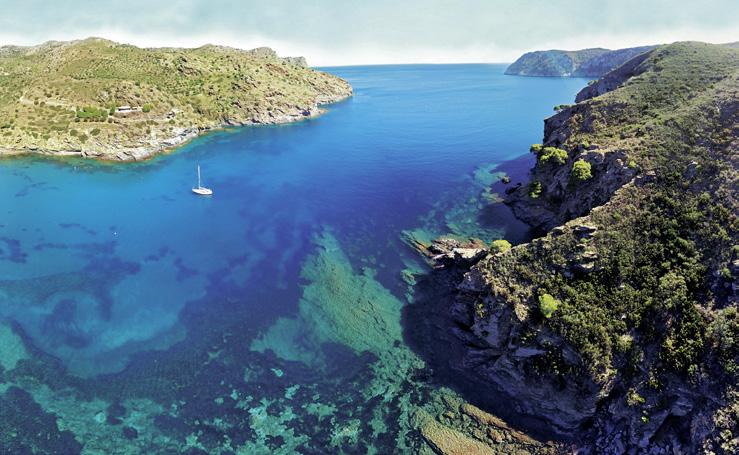
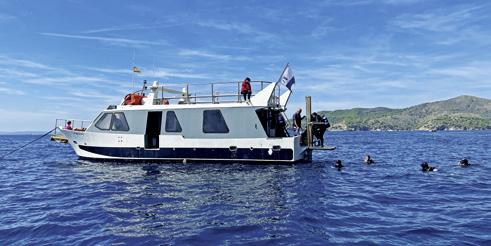
In collaboration with the Ulla & Paul diving centre, TAUCHEN invites you to an exclusive readers’ trip to the Cap de Creus Natural Park on the Catalan Mediterranean coast from 19 to 26 September 2026. Five boat dives at spectacular sites within the nature reserve, as well as unlimited shore dives right in front of the centre, offer ideal conditions for exploring steep walls, caves, gorgonian forests, large groupers, octopuses and dense schools of fish. The centre’s location right by the water ensures short distances and relaxed dives in the sheltered bay. Price: €599 per person, including accommodation in a 4–8-person self-catering apartment, 5 boat dives, unlimited shore dives, tank & weights. Travel arrangements to be made individually. Maximum number of participants: 12. Information & boo‑ king: redaktion@tauchen.de, keyword ‘Cadaques2026’.
A PHOTOGRAPHY AND ADVENTURE TOUR NEAR MILAN
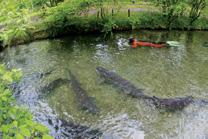
At Parco Ittico, a maximum of 12 participants can experience European freshwater fish up close. Thanks to biologist Dr Armando Picinnini, exclusive snorkelling is available in five sections of the stream. Four spots offer unique sights, featuring sturgeon ranging from 60 centimetres to over 2.5 metres in length. The highlight is the tank housing Siberian sturgeon and two enormous beluga sturgeon. Other species include koi, catfish, sterlets, trout, char and carp. Dates: 25 to 28 October 2026: three nights’ accommodation with breakfast, two days in the park with snorkelling permit and dinner included (from €750). Bookings: Franz Pramendorfer (franzpramendorfer@hotmail.com).
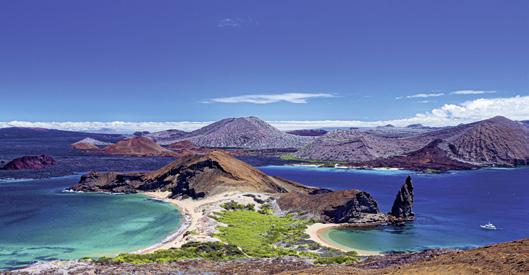
GALAPAGOS – A WORLD APART
RED SEA AGGRESSOR IV WILL LAUNCH A NEW YACHT IN 2026
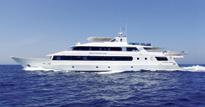
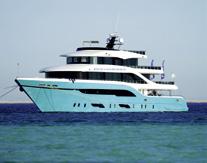
Aggressor Adventures is modernising the Red Sea Aggressor IV: from 28 February 2026, the larger, five-deck vessel will be operating in the southern Red Sea. The spacious yacht “Turquoise” is now operating as the Red Sea Aggressor IV. At 42 metres in length, it is the largest vessel in the fleet. Although it has a capacity of 34 people, the number of guests is limited to 26 to ensure greater comfort. On board there are four master cabins and nine deluxe cabins, as well as spacious communal areas. Existing bookings remain valid. aggressor.com
This special group tour offers a completely new way to experience this dream destination on the other side of the world: rather than spending several days on a liveaboard crossing to Wolf and Darwin, you’ll stay directly on the main islands and dive the archipelago’s best spots on day trips. Organised by the Tauchschule Sauerland, the trip takes place from 22 February to 7 March 2027 (with arrival days beforehand). You’ll stay on Baltra and San Cristobal in the Galapagos, go on two dives a day, have time to explore the islands, and be offered several land tours. Also ideal for non-divers, who are offered additional excursions during the day-trip dives. Price of the trip: from €5,790 per person (in a twin room, including breakfast, plus international flight). More info: info@tauchen-weltweit.de and here: tauchen weltweit.de
Curaçao beckons...
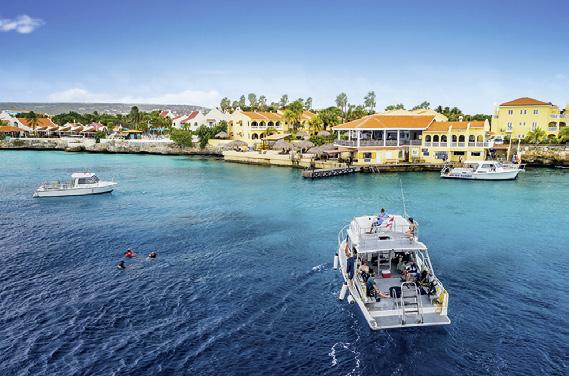
5 reasons why divers should stay at the Chogogo Dive
Anyonefamiliar with Curaçao knows that this Caribbean island is a paradise for independent divers. But choosing the right accommodation determines just how relaxing and action-packed your diving holiday will actually be. Here are five good reasons why the Chogogo Dive & Beach Resort should be right at the top of your list.
1. The perfect base for shore diving
Curaçao is famous for its hassle-free shore dives. From the resort, you can reach numerous dive sites quickly and easily. No rigid boat schedule, no time pressure – just fill your tank, grab a buddy and dive in. For many divers, that is the very essence of freedom.
2. Diving as a way of life, not just a side activity
At Chogogo, having salt water in your hair is part of everyday life.
The atmosphereis relaxed, diving-friendly and informal. Short distances, plenty of space for equipment and facilities designed with active guests in mind ensure that you feel welcome straight away.
3. Caribbean underwater biodiversity
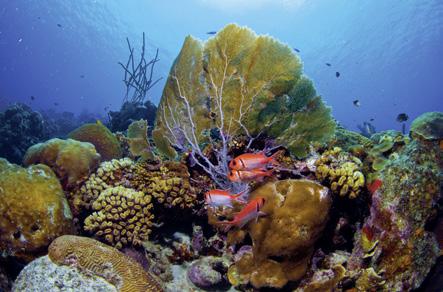
Steep walls, coral gardens, brightly coloured sponges and an impressive variety of fish – underwater, Curaçao shows why the island
& Beach Resort on Curaçao
is one of the Caribbean’s most popular diving destinations. With a bit of luck, you might spot turtles or rays. The visibility, which is usually excellent, makes every dive a delight.
4. Comfort after the last dive
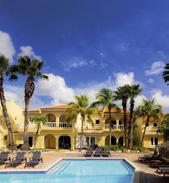
After two or three dives, there’s one thing that matters most: relaxation. The spacious resort features swimming pools, restaurants and plenty of quiet spots with sea views. Here, you can round off the day with a drink and start thinking about your next dive spot.
5. The perfect blend of independence and resort-style comfort
Chogogo combines personal freedom with the amenities of a modern resort. You can plan your day’s diving to suit your own schedule – whilst still enjoying excellent service, comfort and a Caribbean atmosphere. It is precisely this combination that makes all the difference.
In conclusion: if you want to explore Curaçao underwater and relax in style above water, the Chogogo Dive & Beach Resort is the perfect choice for a thoroughly enjoyable diving holiday. Information & booking: www.chogogocuracao.com
Photos: chogogo dive & beach resort
Mit TAUCHEN die Welt
North Halmahera Indonesia's last great diving adventure in the Coral Triangle
Tucked away in the north-eastern part of Indonesia, North Halmahera is emerging as one of the most exciting yet relatively unexplored diving regions in the Coral Triangle.
Vast, unspoilt reef systems, a high level of biodiversity and very few dive centres or liveaboards give the region a real sense of discovery – an experience that has long since been lost in many of the archipelago’s well-known destinations. North Halmahera is located in the province of Maluku, the historic Moluccas. Further north lies only the island of Morotai. Whilst these islands
are well known to Indonesians, the region has remained largely undiscovered by the international diving scene until now.
Oceanographic: Distinctive features and biodiversity
The Halmahera Sea plays a central role in one of the most important marine systems on our planet: the ‘Indonesian Throughflow’. This powerful ocean current trans-
ports water masses from the western Pacific to the south-eastern Indian Ocean. In addition to its influence on the climate and global water exchange, it ensures an enormous circulation of nutrients – the basis for the region’s high biodiversity. Underwater, divers are greeted by a riot of colour and life: schools of fusiliers, surgeonfish and batfish glide over the reefs, accompanied by snappers, humphead wrasse, >
TRAVEL
giant trevally, turtles and reef sharks. Even the experienced Dive Pro and PADI Course
Director Minni Vangsgaard from Bali Crystal Divers was amazed by the sheer number of schooling fish after her dives around Morotai. In such a remote, little-visited area, such density is by no means a given – for her, the region is a real hidden gem.
Intact reefs of rare value
Thanks to minimal human impact, the
coral reefs around North Halmahera are exceptionally well preserved. Reef Check surveys documented some of the highest coral cover in Indonesia as far back as 15 years ago. International experts also confirm that the coral reefs here are exceptionally healthy. Vincent Chalias, founder of Ocean Gardener, highlights the fascinating diversity of the coral communities: soft coral gardens on exposed, wave-swept stretches of coastline contrast with dense hard coral formations in calmer zones.
Russell Kelley, founder of BYO Guides, further emphasises the unique combination of geological drama and biological abundance. Morotai’s location supports species found nowhere else outside the Coral Triangle – a place that still feels wild and holds enormous potential for discovery.
New facilities for experienced divers
For a long time, North Halmahera’s remote location and lack of infrastructure prevented the area from developing further as a
tourist destination. However, facilities specifically tailored to divers are now emerging, including the Metita Beach & Dive Resort, part of the Lotus Hotels Group. Getting there requires some planning – either by air or via a combination of boat and road – but upon arrival, visitors are rewarded with the discovery of virtually untouched dive sites. The region offers ideal conditions for underwater photographers: excellent visibility, healthy reefs and an enormous variety of subjects.
Liveaboard adventures and wreck dives
The Malaillo, the latest addition to the portfolio of the Lotus Hotels Group –which has over 20 years’ experience in dive resort management – offers multi-day exploration tours of North Halmahera and Morotai. The itinerary features spectacular drop-offs, caves, swim-throughs, extensive reef plateaus, gentle slopes and Second World War wrecks. A particular highlight: the small number of liveaboards ensures that you usually share the dive sites only with the local marine life.
A special ten-night itinerary combines North Halmahera and Morotai, offering a wide variety of landscapes and marine habitats. Few destinations worldwide can offer such a concentration of these features.
A destination for explorers
Garry Bevan, an experienced diving professional, cruise director and superyacht guide, believes the North Halmahera region is home to numerous areas that remain unexplored. In his view, some of the newly discovered dive sites in the north of the Indonesian islands are on a par with top destinations such as Komodo or Raja Ampat. However, much of the area still needs to be explored in greater depth. North Halmahera is thus one of the last real hidden gems in the Coral Triangle: a place for divers seeking the thrill of breaking new ground. Those who travel there today will experience a region in its unspoilt state – with that now rare sense of genuine exploration.
NOTES & INFORMATION
This article was produced in collaboration with the Lotus Hotels Group and aims to showcase North Halmahera as a diving destination.
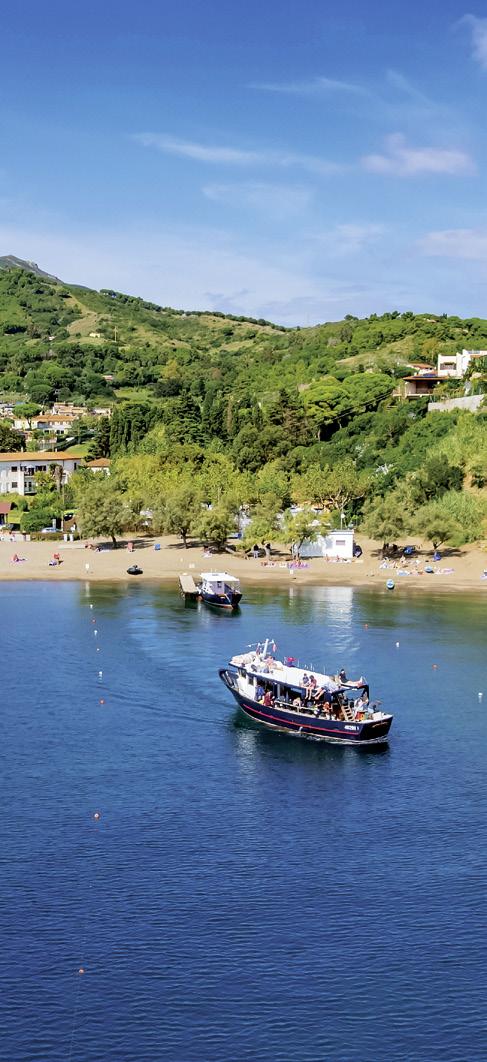
A colourful variety in Bella Italia! Steep walls teeming with fish, undulating seagrass beds and two fascinating wrecks. But best of all: a cosy dive centre in a charming, idyllic bay. Barbara and Wolfgang Pölzer visited OmniSub Elba.
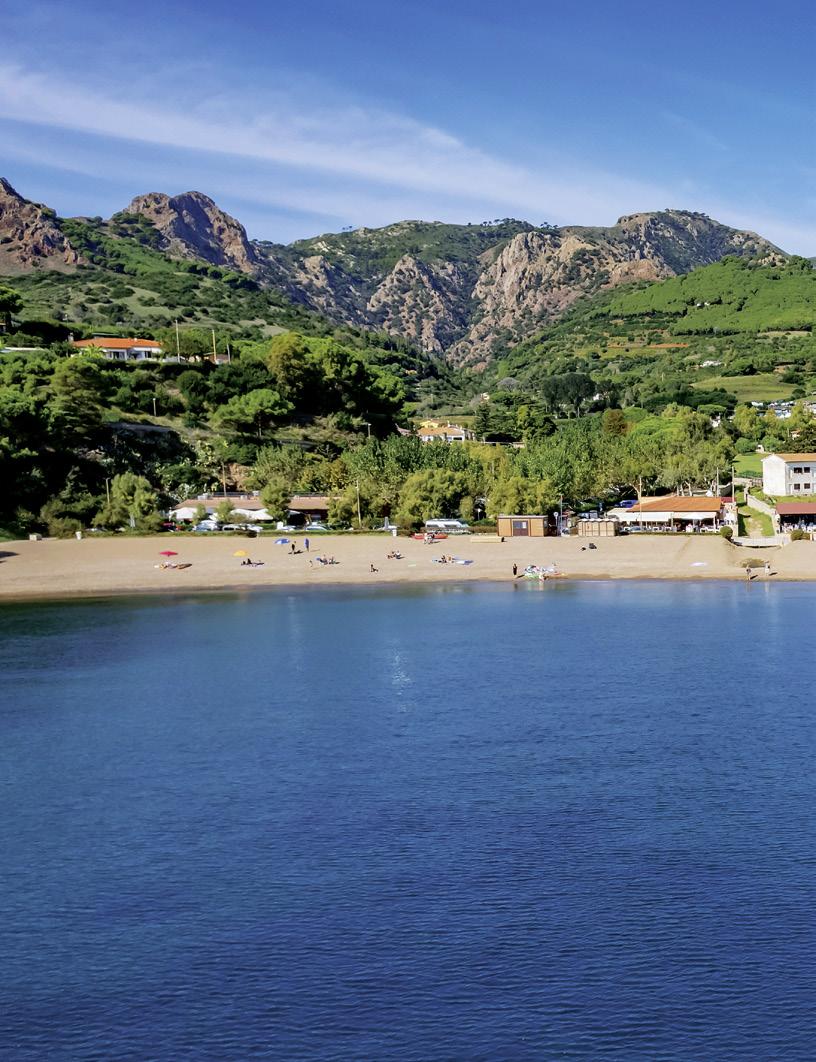
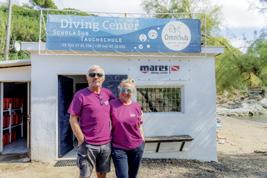
Just under 30 yearsago, Markus Schempp, a native of Swabia, and his wife Mirjana realised their long-held dream of running their own diving centre. Luck was on the young couple’s side, as they managed to acquire one of Elba’s oldest diving schools –in what is arguably one of the best locations on this Mediterranean island.
A picturesque cove with a jetty
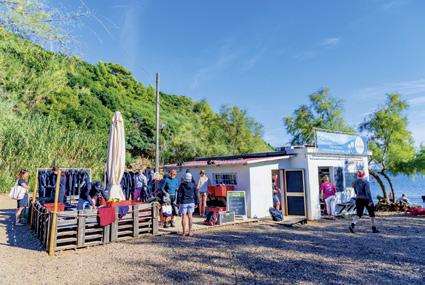
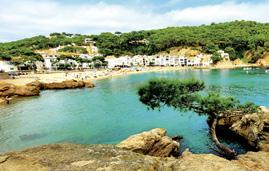
Even today, this spot remains almost unchanged: a stunning little bathing cove, framed by rocky cliffs, with just two cosy restaurants, a small campsite and a few apartments behind it. The scent of pine trees hangs in the air as we take a few steps across the base’s jetty to board the Matteo Sandro. It is a sturdy steel cutter with plenty of space, a large sun deck, a decent toilet and a powerful air compressor that saves us the hassle of lugging around cylinders.
Steep wall and more
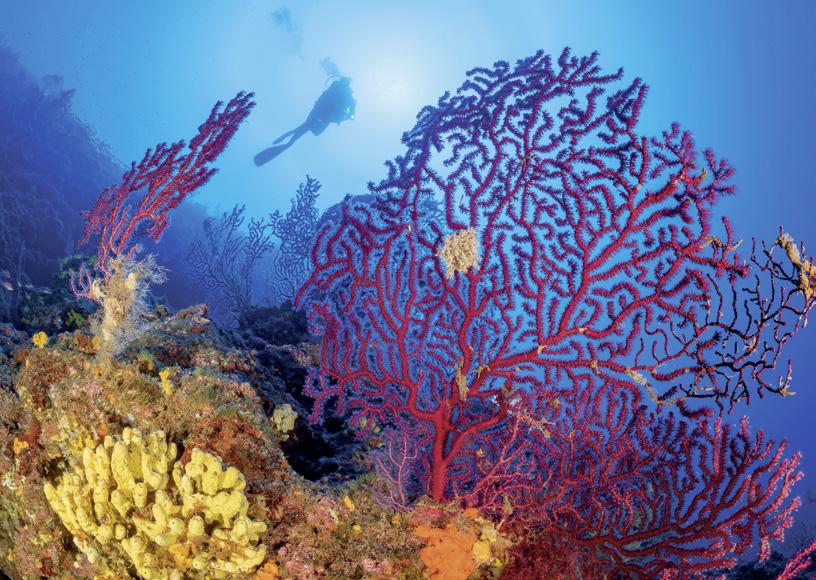
After about half an hour, we reach the south-eastern tip of Elba, where one interesting dive site follows another. Steep walls, shallows and pitted rocky reefs at their finest. Remaiolo is the evocative name of a small offshore islet, where we moor to a permanently anchored buoy. Water at 24 degrees, crystal clear, awaits us – this is the way to enjoy autumn in Tuscany! Against a distinctly noticeable current, we head out the first few metres towards the open sea, before a step-like drop-off lures us into the depths. Passing schools of damselfish and bream in the sun-drenched blue, we enjoy the descent. From a depth of around 30 metres, the thick, fluffy algae gives way to individual gorgonian fans, which gradually form a deep-red forest. In the spotlight, bright pink anthias snap at plankton, whilst forkbeards as long as a forearm retreat even deeper into their rock crevices. We see sulphur-yellow, luxuriantly growing sponges alongside delicate branches of bryozoan colonies in a soft orange, interspersed with crust-like and leafy red algae – every square centimetre of space is utilised. We float gently through the enchanted gorgonian forest, just within recreational > Watch the video:
T & F Barbara & Wolfgang Pölzer
TRAVEL °
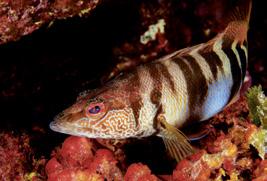
diving limits, always on the lookout for perfectly camouflaged beauties. Sometimes you are lucky enough to encounter one of the extremely bizarrely shaped, high-backed Cuckoo Wrasse here. Today we have to make do with two magnificent scorpionfish and a handful of lobsters, which would be easy to overlook without a torch.
The no-decompression time slips by far too quickly. It’s only now, as we ascend, that we notice the many grouper, barely a metre long. Always within sight, but unfortunately never close enough for decent photos, they dart away in a flash and disappear into small caves and crevices. Looking out into the open water, a school of barracudas swims past, but we have to continue towards the surface. Finally back at the rock in the shallows, we have all the time in the world for a leisurely safety stop. There, schools of goldstripe, two-banded bream and even sardines can be admired in the blue. Or would you rather focus on the immediate vicinity and keep an eye out for the brightly coloured, yet tiny nudibranchs?
Water temperature, air supply and time allow for both.
La dolce vita
Comparing the Mediterranean to tropical waters is pointless – Markus and I agree on that. Fortunately, his other guests see it that way too. It’s no coincidence that many of our fellow divers on board today are regulars, or at least repeat visitors, who love precisely this atmosphere of a leisurely boat trip, Mediterranean diving at its best, a chat amongst like-minded people, and a bit of relaxation on the sun deck. Back at the jetty just in time for lunch, Da Mario, a cosy beach restaurant serving delicious food, beckons. But don’t eat too much, as we’re heading back down into the depths this afternoon. A quick, obligatory coffee and then off to the boat.
Once again, we’re heading for the south of Elba. Yet with such a variety of dive sites, there’s no chance of getting bored. Next on the programme is a reef just off the coast, which boasts not only a spectacular dropoff but also a small grotto at a depth of 32
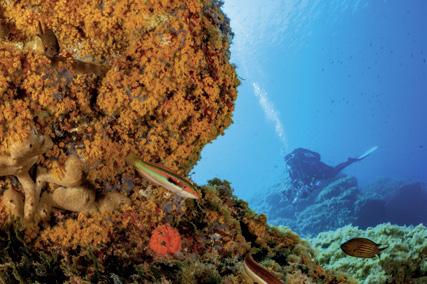
metres. There, too, you’ll find scorpionfish, schools of bream, two Mediterranean moray eels and several lobsters. But the tenmetre depth range here is also impressive. In particular, the shady spots on the north side of the rocky outcrop are covered from top to bottom with orange-yellow crust anemones, which not only make for fantastic photo opportunities but also create a very colourful scene to explore. If you look closely, you’ll spot tiny nudibranchs, shrimps and flatworms amongst the flowerlike anemones.
A top-class alternative venue
To give us a bit more of a taste of Elba, the weather gods decided to send a strong easterly wind the following morning. It’s rare, but it does happen – and it doesn’t bode well for any interesting boat trips. But on an island, there’s always a side sheltered
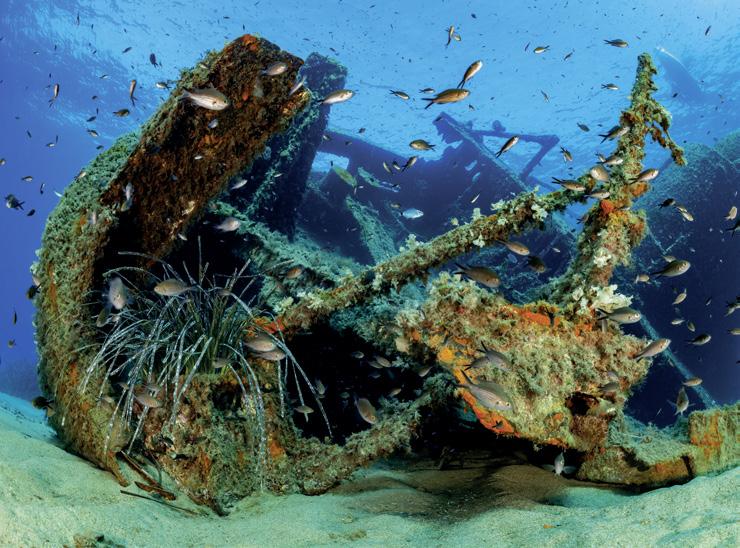
from the wind – and that’s exactly where, easily accessible from the shore, lies one of Elba’s few wrecks suitable for diving. So, into the car and across the island to the sleepy little village of Pomonte. There’s a large car park there and the sea is as smooth as glass at the entry point, even though the wind is howling high above our heads, blowing out to sea from behind. Quickly into the fins and snorkel attached to the mask, because the wreck isn’t on the beach, but crashed into a group of small rocks just 200 metres ahead of us and sank. This fate befell the wreck, the 62-metre-long steel freighter Elviscot, 54 years ago. At the sight of the first wreckage just below the water’s surface, nestled between rocks, sand and seaweed, we are amazed at how much of the former ship remains after all this time and countless winter storms.
We swim further out to sea past the
Close by and perfect: the OmniSub diving centre, with its own jetty, is situated right by the sea. Colourful dive sites are within easy reach. What more could you ask for?
completely destroyed stern – which has been reduced to individual twisted and eroded steel parts beyond recognition – to discover the actual wreck behind the rocks. The highlight is the surprisingly well-preserved bow section, which points towards the open sea as if in mockery. At least the
entire front half of the ship lies here in one piece at a maximum depth of 12 metres, tilted diagonally to port. Floating just above the sandy seabed directly in front of the wreck, the former steamer, together with the remains of its superstructure and the massive funnel, still makes for an excellent
photo opportunity. Damselfish dart between the steel and seaweed in search of plankton, bringing life to the scene. Things become a little more colourful in the engine room, where, alongside red sea bream, you can even make out the remains of the engines, overgrown with delicate pink cal-
The perfect ingredients for a Mediterranean diving experience: exciting reefs covered in gorgonians, a rich variety of Mediterranean marine life, a renowned, welcoming dive centre, and impressive schools of fish in the open water.
TRAVEL °
careous red algae. Groupers have also made their home here. In the shallow water, you have plenty of time to inspect every detail of the wreck. Once you’ve had your fill of the scrap metal, it’s worth searching the surrounding seagrass for scorpionfish, night snails and seahorses.
A swarm to swoon over
The following morning, the wind has died down again, and we are able to set sail on the dive boat as planned. After 20 minutes, we moor in a sheltered bay near Capo Calvo. Crossing a vast seagrass meadow, we head for the rocky outcrop at the righthand exit of the bay. To save no-decompression time and air, we stay in the shallows in open water and make the most of the excellent visibility, only descending after a few minutes once we spot the first dropoff at a depth of 20 metres. Here, we adjust our fin strokes and glide almost like ea-
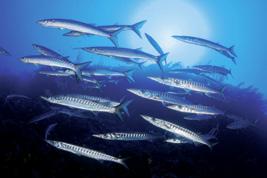
gles over the stepped reef down to the 40–-metre range. We float along small steep walls covered in sponges and gorgonians, round a bend – and suddenly we can hardly believe our eyes! Has the thrill of the deep overwhelmed us during the rapid descent? Right in front of us, a school of well over 50 barracudas is nestled against the rock face! At least as surprised as we are, the shoal suddenly comes to life. The predatory fish, each a good half a metre long, move out into the open water, very slowly but steadily, forming a circle and could hardly strike a better pose for us! Fortunately, they even ascend a little higher in the process, thereby extending our no-decompression time. This is just as well, because out of the corner of my eye, having taken plenty of barracuda photos, I notice an irregularity on a narrow sandy ledge. And sure enough, there is indeed a star-gazer – a species rather rare in these parts – crouching there,
half-buried in the sand, living up to its name. What a dive – two absolute Mediterranean highlights in the space of no time! The cameras are working overtime, but unfortunately there’s no way around the brisk ascent. Back in the seagrass meadow, there’s no chance of boredom even during the extended safety stop. Mantis shrimp and scorpionfish, schools of striped beakfish –but above all, the fantastic play of light as the sun’s rays dance through the crystalclear water is enchanting. This is what makes diving in the Mediterranean such fun.
Conclusion
To put it in historical terms: Napoleon could have fared much worse than being exiled to Elba. This island, which is part of Tuscany, is a feast for the eyes both above and below the water and is well worth a visit for a relaxing diving holiday.
Photography workshop with professional underwater photographer and TAUCHEN contributor Wolfgang Pölzer From 19 to 23 July 2026, one of our author’s popular photography courses will once again take place at OmniSub Elba.
BASIC PROFILE: OMNISUB ELBA
Established in: 1997
Owners/Centre Managers: Mirjana and Markus Schempp
Training: SSI and CMAS courses from Open Water Diver (OWD) to Divemaster (DM), as well as all standard specialist courses.
Diving regulations: Presentation of diving certificate, logbook and medical certificate.
Diving: Two boat trips are offered each day, as well as at least one night dive per week from the beach in the bay. In total, there are around 25 different dive sites, which can be reached in 15 to 45 minutes. Diving is done independently in buddy teams or, on request, in guided small groups (maximum four divers per guide). For up to 25 logged dives, diving is only permitted with a guide.
Maximum depth: 40 metres
Diving instructors: 4
Boats: The centre has two spacious vessels, each equipped with an air compressor and on-board toilet: the 13.5-metre-long Matteo Sandro can accommodate 18 divers and features an additional sun canopy. The 10-metrelong Sisto is designed for 12 divers and can also be hired for groups, complete with a captain, on request.
Equipment: 30 full sets of hire equipment (hire fee: €25 per dive).
Cylinders: 10-, 12- and 15-litre DIN/INT steel cylinders. No adapter required.
Prices: A boat trip (including tank and weights) costs 55 euros; a 10-dive package for boat diving costs 440 euros. NTG from the beach: no extra charge; OWD course (including certification): 530 euros. Nitrox 32 available at an extra charge of 9 euros per dive (10–15-litre tank).
Location: right on the beach with its own jetty in the picturesque Barbarossa Bay, east of Porto Azzurro.
Sustainability: Drinks on the boats are served in returnable glass bottles to reduce plastic waste. Waste separation.
Snorkelling: In the bay’s generally very calm shallow waters, you can enjoy wonderful snorkelling over pristine seagrass beds and along the adjacent rocky coastline. Private snorkelling trips and free diving courses are available on request.
Best time/season for diving: Open from Easter until the end of October. Water temperatures are at their lowest in April, at 16 degrees Celsius, and at their highest between July and September, reaching up to 26 degrees Celsius.
Accommodation: Just behind the base is Camping Arrighi, a cosy, very clean three-star campsite which, in addition to 70 pitches, also offers its own bungalows and apartments. www.campingarrighi.it
The diving centre can arrange a range of accommodation options, from holiday flats and apartments to hotels of various categories.
Contact, information & bookings: Tel. 0039- 335/57 35 536, www.omnisub.com
Price example:
Seven nights in an apartment start at 500 euros for two people; a 10-dive package (including tank and weights) costs 440 euros per person. The car ferry for two people and a car: from around 120 euros (return).
GENERAL TRAVEL INFORMATION
Getting there: Most guests travel by car. The journey from Munich to Elba is around 800 kilometres. Alternatively: fly to Pisa and continue by train, bus or car transfer to Elba.
Entry: passport or identity card (EU)
Language: The official language is Italian. German is spoken locally.
Wetsuit: 7mm wetsuit in summer. Semi-dry or drysuit in the early season.
Electricity: Euro plug (220 V)
Mobile/Email: German mobile phones work perfectly. There is free Wi-Fi at the campsite
Medicine: The nearest operational hyperbaric chamber is located at the hospital in the island’s capital, Portoferraio.
Tourist information: Official tourism website: www.italia.it
Food tip: You can enjoy an excellent meal at Ristorante Da Mario, located at the start of the beach – an insider’s tip for fish and pasta dishes, as well as the best pizza on the beach.
im Programm: Die perfekte Kombination zur Duyung Baru Komodo Tauchsafari:
Bali Villa Dive Resort by EcoProDivers Indonesien - Bali
Nachhaltig & verantwortungsvoll
Kleine Gruppen & moderne Schiffe
Persönlich, flexibel & erfahren Deutsche Leitung
HONSHŪ, JAPAN
Spectacular diving along Japan’s southern central coast.
T & F Brandon Cole
The urge to explore new waters and photograph bizarre yet fascinating creatures I had never seen before led me to find myself face to face with an anglerfish at a depth of 24 metres off Osezaki on the Izu Peninsula – just a few hours from Tokyo. The locals call it a Kiankō. The bearded monster, about a metre long, grinned manically at me. With perfect camouflage, fearsome teeth, a huge mouth and its irresistible dangling bait thread (esca), this hunter makes its prey vanish without a trace. What an incredible fish!
Osezaki – Encounter The Monster
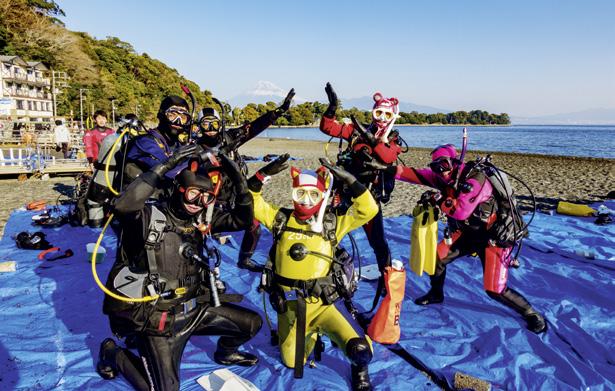
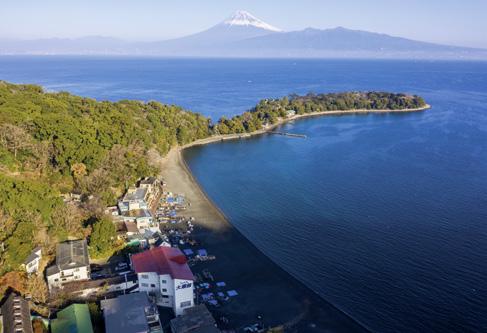
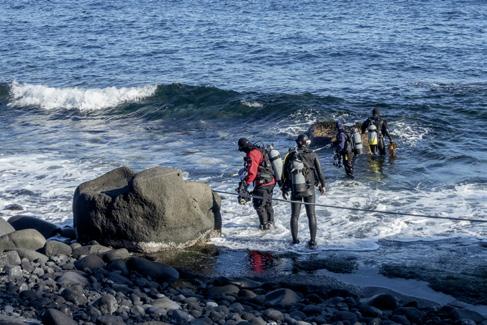
On summer weekends, Osezaki is often bustling with several hundred Japanese divers, most of whom travel from Tokyo on the Shinkansen for a day trip. However, when we arrived on this cold January day in a hire van packed with cameras, diving gear and dry suits, only a few dozen people were preparing for their dives – no Americans, no Europeans. They were getting kitted out, neatly arranged on blue tarpaulins spread out across the black pebble beach of Ose Beach.
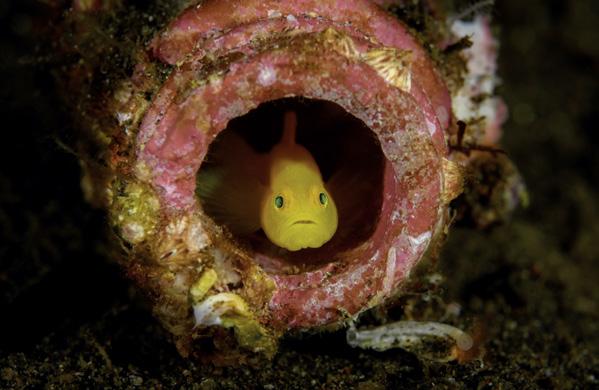
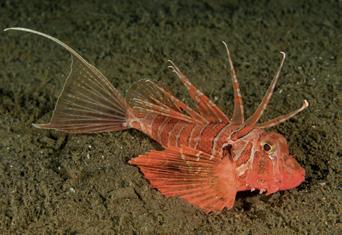
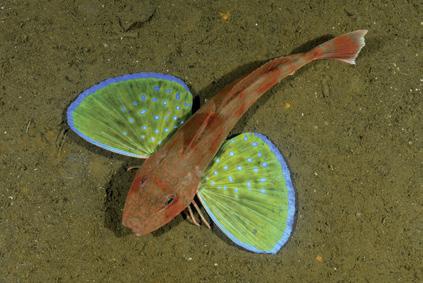
During our daytime dives in the bay, alongside the anglerfish and pipefish, we spotted a tiny yellow dwarf goby living inside a bottle, lionfish with their spines rai-
Cheerful Japanese recreational divers are having a laugh on Osezaki Beach. Mount Fuji can be seen in the background. Osezaki is one of the most popular diving areas in the whole of Japan. There are three main dive sites in this area. The shore entries within the sheltered bay are straightforward.
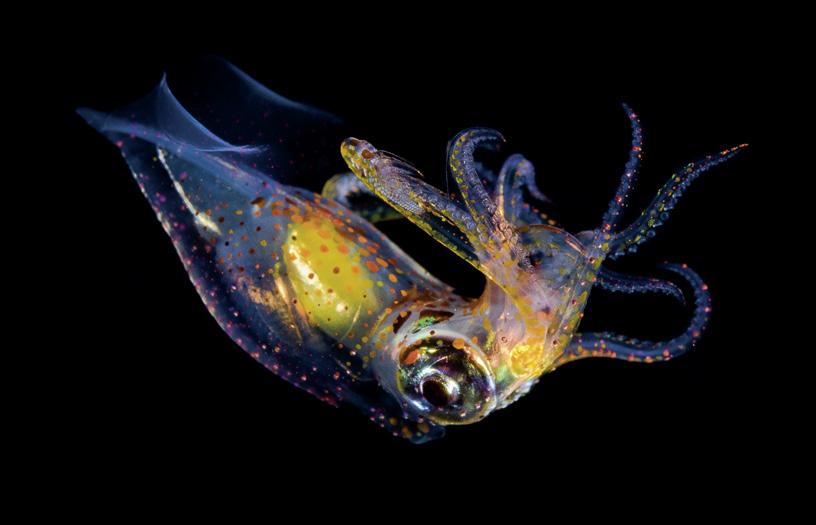
sed, and gurnards with their pectoral fins spread wide, shimmering green and blue. After sunset, we dived down again for a blackwater dive, using the same simple entry point from the shore. Our torches illuminated pelagic flatfish larvae, coin-sized squid in pulsating rainbow colours and a paper nautilus (Argonauta). As well as copepods, which ‘captured’ salps and converted them into mobile nurseries for their tiny, spider-like offspring – a glimpse into marine biology that was as eerie as it was fascinating.
Suruga Bay –
Life from the Depths
Osezaki, situated at the north-western tip of the Izu Peninsula in Shizuoka Prefecture, lies directly on the shores of the extremely deep Suruga Bay. This explains the relatively frequent, albeit unpredictable, encounters with rare marine creatures: from deep-sea anglerfish to ribbonfish. In winter, bizarre creatures rise from the depths on cold upwelling currents. Other rarities drift in on warm, subtropical currents from the south.
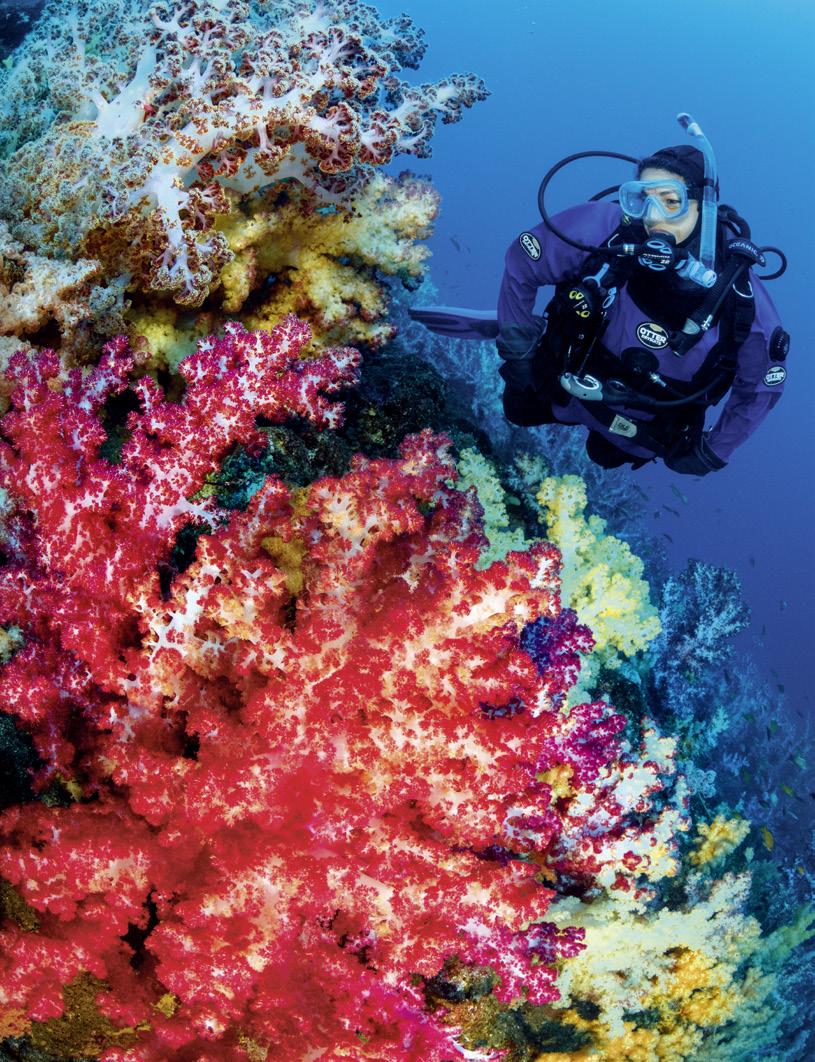
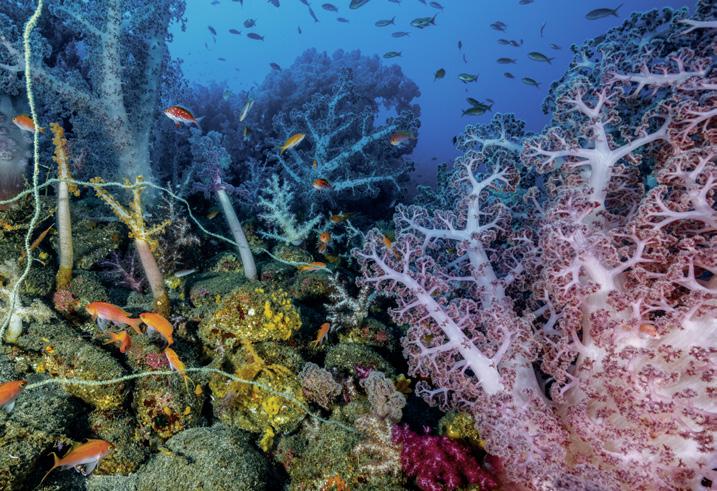
Off Cape Ose, at a dive site called Sentan, I saw exotic anthias, schools of neoncoloured reef fish and shield-breasted wrasse. I was also completely overwhelmed by the lush soft coral that flourished in the current along a steep scree slope at depths
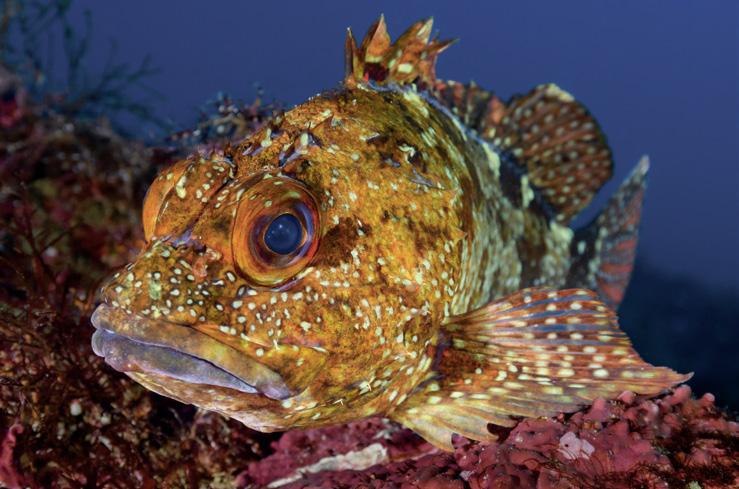
Top: The marbled rockfish (Sebastiscus marmoratus) is found from Japan southwards to the Philippines. Bottom: Crevices between huge boulders provide shelter for fish.
of between 25 and 45 metres. Huge ‘coral trees’ in pastel pink and apricot orange towered upwards, interspersed with bright lime-green wire corals. My wife Melissa later remarked that her brain had been constantly protesting that a drysuit was completely out of place amidst these tropical colours – the scene looked like a reef in Fiji. Her dive computer showed a water temperature of just 15 degrees Celsius, which didn’t fit at all with the warm visual impressions. Sango kirei – ‘beautiful, magnificent soft corals’ – are a hallmark of many reefs in the Izu region. On the east coast of Izu, off the port of Atami, we dived with around 12 metres of visibility to the Asahi Maru, a sunken ship that now resembles a natural reef and is completely overgrown with Sango kirei. It was here that I took my wideangle shots of a magnificent vertical garden of gorgonians, soft corals and sea fans, swarmed by bright pink cherry anthias.
At Seamountain
On a cold, windy and rainy day, we set out from the town of Ito in a spartan fishing boat, its hull weathered by years of hard
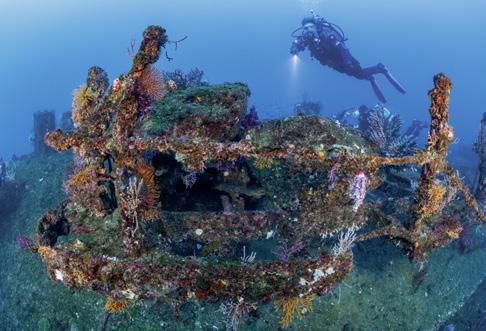
A 30-metredeep rocky reef off the Izu Peninsula on the south coast of Honshu. Below: parts of the Asahi wreck, which lies on the seabed at a depth of 30 metres.
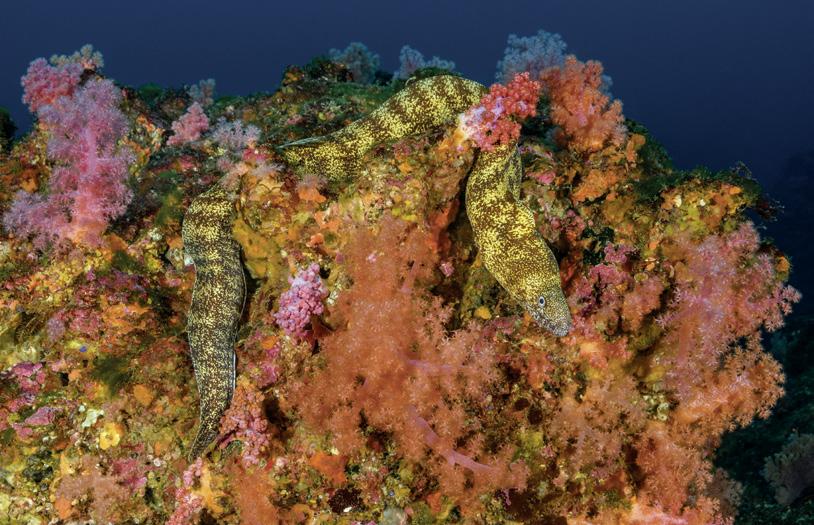
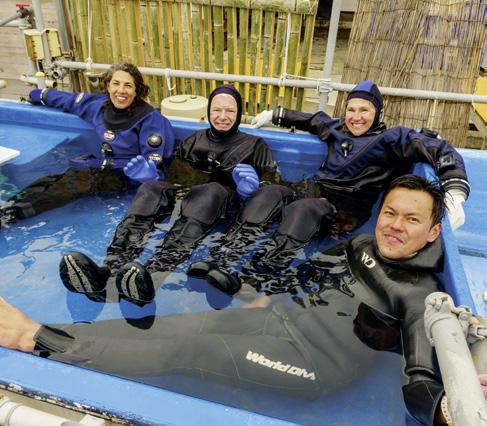
work. Such traditional boats are regularly chartered by dive centres – a long-standing partnership deeply rooted in Japanese diving culture. We completed three excellent dives at Shira-ne South Point, a seamount with several peaks. Our guides showed us a variety of marine life, but my focus was on moray eels: Kidako morays, lying around with yellow-brown markings like carelessly discarded feather boas; morays posing in fans; and an ominous-looking net-toothed moray lurking in a soft bed of particularly magnificent Sango kirei. Afterwards, we celebrated our day of diving in the dive centre’s hot tub – albeit in the Japanese style. We kept our dry suits on and relaxed in a decommissioned, cleverly converted little fishing boat filled with hot water: an ‘Onsen Maru’.
Macro diving in Hayama
My ongoing quest for new subjects took us on to Hayama on the Miura Peninsula in Kanagawa Prefecture. Here we practised what is known as ‘tatami mat diving’: close
Divers warm up in an ‘Onsen Maru’ at a diving centre in Ito. This is no ordinary hot tub: this ingeniously designed pool is a decommissioned fishing boat.
A squid (species unknown) at night, with its tentacles raised. Special, neurally controlled pigment cells (chromatophores, iridophores and leukophores) enable squids and other cephalopods (octopuses, cuttlefish) to change the colour and pattern of their skin.
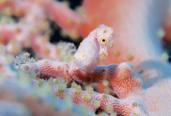
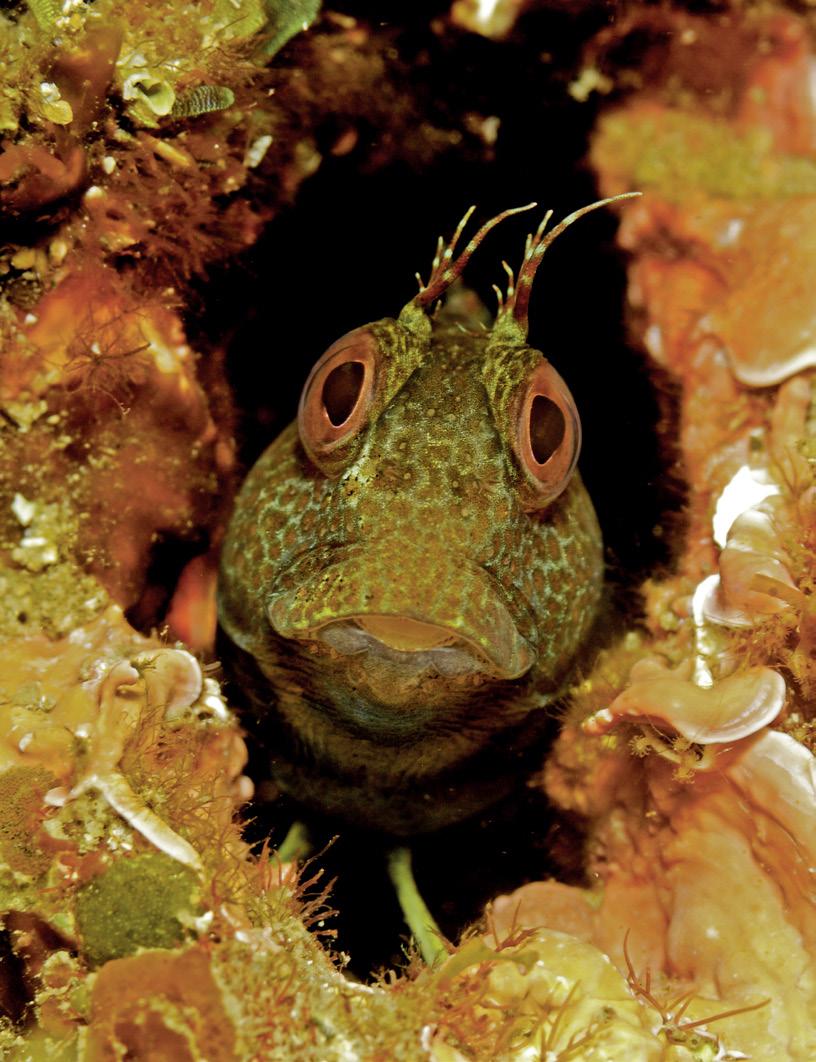
together, in confined spaces, moving slowly, close to the seabed. Armed with macro lenses, we completed four long dives over two days at the Yugiro and Goyotei mae sites. We found tiny fringed blennies with enormous charisma, Shiho seahorses well camouflaged in the seaweed beds, and a family of pineapple fish amongst the branches of a black coral. They looked like glittering Christmas baubles on an olive-green Christmas tree.
A shark spot of the highest order
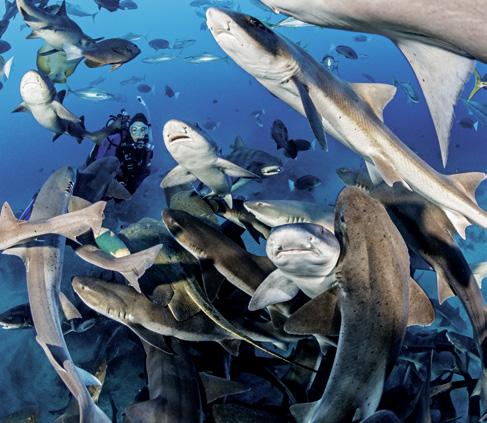
The grand finale of our road-and-dive adventure along the south coast of Honshū was Ito Tateyama (yes, another Ito – this one is in Chiba Prefecture). “Lots of little attacks,” our guide Tatsuya-san explained as we prepared to take the giant leap from the boat at the famous Shark City. “But don’t worry.” What followed surpassed everything: between 50 and 100 Japanese smooth-hound sharks swirled around the foul-smelling bait box like a pack of metrelong aquatic puppies. The swirling mass of
Banded dogfish (Triakis scyllium), dozens of which have gathered at a feedingstation for recreational divers. A small, harmless species, about 1.5 metres long.
sharks completely engulfed me. They bumped into me, knocked against my camera, swam through my legs – and made it almost impossible to take any decent photos. Being in the middle of this “Sharknado” was pure bliss – including thousands of encounters with sharks.
Conclusion
After years of visiting the same diving spots in the Pacific time and time again, the move away from the mainstream and into Japan’s completely different, surprisingly spectacular underwater world turned out to be one of my best diving trips ever.
QUICK INFO: DIVING IN HONSHŪ
(SOUTH COAST)
• Diving season: all year round
• Water temperatures: approx. 13 to 25 degrees Celsius
• Equipment: drysuit in winter, 5–7 mm wetsuit in summer
• Visibility: 5 to 20+ metres; often better in winter
• Diving: many shore dives, some boat dives
• Current: strong in places, but often very moderate
Info: Dive in Japan (www.divein-japan.com) – an English-language platform covering dive centres, marine life and logistics.
Tip: A local guide makes organisation, communication and access to the best dive sites much easier.
… mit Pacific Travel House –dem Spezialisten seit über 35 Jahren!
21 Tage Französisch Polynesien
Tahiti, Rangiroa und Fakarava Fantastisches Großfischtauchen an den Riffen und in den Passagen der Atolle · Inkl. 21 Tauchgängen, Flügen, Übernachtungen/Frühstück/Transfer ab 7.550 € p.P. / DZ
21 Tage Fiji Inseln
Viti Levu, Taveuni, und Beqa Lagune
Aufregendes Tauchen zwischen farbig leuchtenden Korallen, bunten Rifffischschwärmen und beeindruckenden Großfischen
Palau und Yap Faszinierendes Tauchen an steilen Außenriffen, in Strömungen und Lagunen mit zahlreichen Großfischen · Inkl. 20 Tauchgängen, Flügen, Übernachtungen/Frühstück/Transfers ab 5.475 € p.P. / DZ
18 Tage Papua Neuguinea
Lissenung Island und Tufi Resort
Reiche Artenvielfalt, Sichtweiten bis zu 30 Meter, unberührte Korallenriffe und große Fischschwärme
Weitere Vorschläge, ausführliche Beschreibungen und kostenlose individuelle Ausarbeitung unter:
pacific.travel.house
Pacific Travel House Reiseveranstaltungs GmbH Schwanthalerstraße 100, D-80336 München info@pth-muc.de, 089-543 21-80
Ose Beach
SurugaBay Photo:
EL CLÁSICO –THE COSTA BRAVA
Cala Jóncols & Tamariu: Among Spanish diving spots, these are the Champions League contenders of the European diving spot league.
T & F Paul Munzinger
Cala Jóncols Tamariu
The ‘wild coast’, as the Costa Brava translates, stretches from Port Bou on the French border to Blanes in Spain. There are numerous dive sites along its more than 160 kilometres of coastline. That’s why it’s common to divide the area into northern and southern sectors. Let’s be honest: not all places where dive centres are located are surroun-
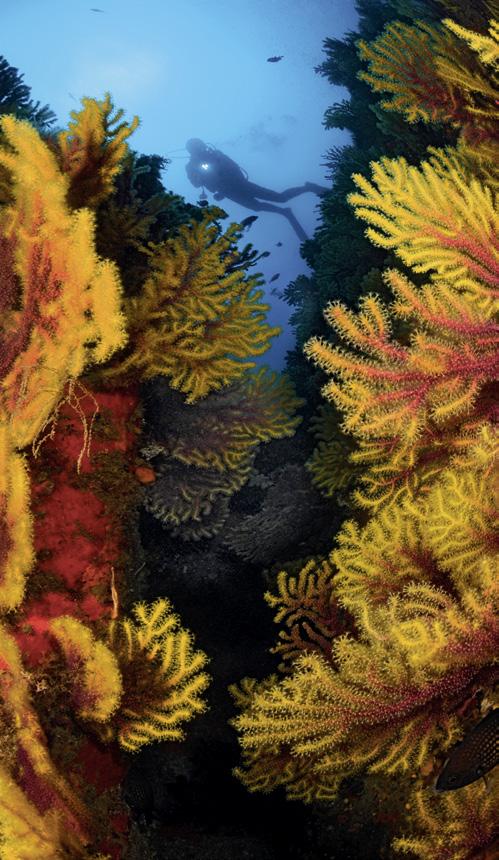
ded by top spots, but ours certainly are. Right at the northernmost tip and in the heart of the Cap de Creus Land and Marine Park – established back in 1998 – stands the legendary Hotel Cala Jóncols in the secluded bay of the same name – known to many seasoned divers as ‘the divers’ hotel’. And in the south, those in the know imme-
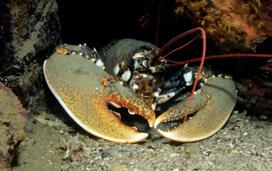
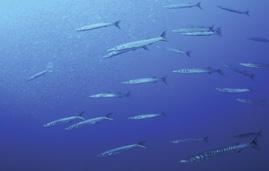
A stately lobster watches the situation from its sheltered den. The barracudas patrol the open water.
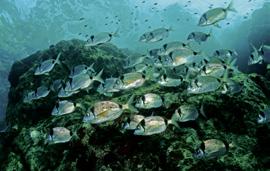
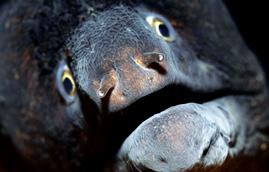
Bream are found in schools whilst the moray eel is a solitary creature.
diately associate the pretty little village of Tamariu with one of the diving pioneers: ‘Stolli’, who, after underwater escapades all over the world, has been based here with his Stollis Divebase since the very beginning of diving tourism.
Top picks
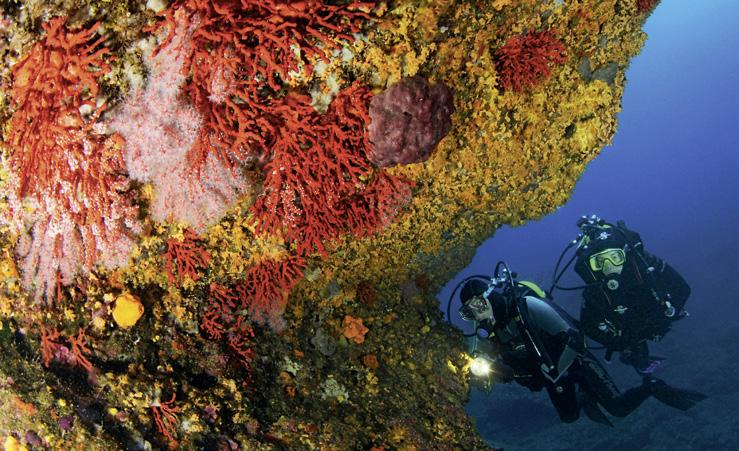
Just beyond the French-Spanish border, Cap de Creus—the easternmost tip of the Iberian Peninsula—juts out some ten kilometres into the Mediterranean. Cala Jóncols can only be reached by car from Rosas via a route that is, in parts, quite an adventure. The foothills of the Pyrenees continue here in particularly impressive fashion, rapidly reaching depths of around 50 metres in the Mediterranean with colourful sheer walls. Buoys have been installed at the best spots, and it’s first come, first served – without the daily rotation of spot allocation due to overcrowding, as is the case at the more southerly Islas Medas. Connoisseurs of the area love to rave about the ‘Cat and Mouse’: around the ‘Cat’, the striking rock at Cap Norfeu, the underwater world is a real highlight and, what’s more, just a stone’s throw from the hotel. It’s obvious, for example, that the current can get quite strong at the ‘Tooth’. From a depth of 15 metres, the rocks glow pink all the way down to the 40-plus-metre range, with gorgonians that are swarmed by fish. There are fish of all sizes, including plenty of groupers. The nearby ‘Garage’ is ideal for a calm ascent.
Pure diversity
In the area around the central Cala Jóncols, there are over a dozen fantastic dive sites spread across some 18 kilometres of coastline: caves home to armoured knights, plump lobsters and rock lobsters, as well as corals, nudibranchs, barracudas, sea bream, moray eels and even seasonal sunfish. And the Mouse? It’s the furthest away and, due to weather conditions, can’t be visited very often: La Rata at Masa d’Oro is an exposed spot with sometimes fierce currents, which, in terms of flora and fauna, can simply be summed up as ‘it’s all there’.
Infrastructure
On the subject of the dive boat, dive centre and hotel: the large boat has a lift – it couldn’t be more comfortable or safer. A small number of divers head out in a dinghy. The former Euro Divers team led by Jan Boelen are no longer here. The centre has now been scaled down, has moved closer to the beach, is currently still a bit more rustic, and is now run by the hotel owners Michael and Manuel, who are also divers. Veteran Jan continues to help out, but has moved to Rosas with Euro Divers due to the hotel’s restructuring. This has led to a
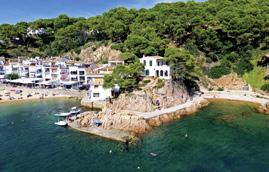
Palafrugell, it takes just fifteen minutes by car to reach the bay, which is barely 180 metres wide. Since 1971, the cosy base has been situated at its northern end in a tiny space, true to the motto ‘small but mighty’! Hotels, guesthouses, holiday flats and a campsite are available and can be arranged by the base. Stolli, the grand old man and pioneer of underwater photography, has been watching over it all for ten years from diving heaven and can be very satisfied: The current owners are the two friendly Palatinate natives, Anja and Stefan Felz. Trips
tremendous improvement in terms of both accommodation and dining. The Gomez family is rightly proud to be the first sustainable hotel on the Costa Brava to hold Biosphere certification. Much of what is served in the hotel – which is open all year round except in January – is produced on-site. And it’s all top quality: hats off to them!
Stollis Divebase
The long-established dive centre on the Costa Brava is called Stollis Divebase in Tamariu. This charming little village is so tiny that you have to look for it on a map. From
“Top marks: the diving sites around Tamariu and Cap de Creus.”
out to sea have always been made on the Gabriela, the dive boat with cult status: five divers each take their places on the left and right of the cabin roof, all geared up, and off we go – just a few steps away from the base.
The thrill of steep walls
When the Cala Nova chart is pulled out during the briefing and the dive site is explained, everyone’s eyes light up. We’ll head out of the bay in a moment, then turn left, and we’ll be there in no time. Four narrow rocky reefs with steep, densely overgrown walls –the ‘canyons’ – stretch from south-west to
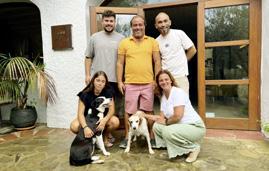
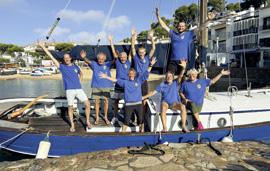
The Gomez family from Cala Joncols, Jan Boelen’s Euro Divers dive centre in Rosas, the team at Stolli’s Divebase in Tamariu, and their famous house reef.
north-east. “Watch out, there’s a bit of a current,” is the brief warning, then we’re quickly down. The camera and flash then have their work cut out for them: heading east, it gets even more beautiful, and at the end of the second reef, the ‘Bommel’ rises from a depth of 40 metres up to 22 metres, completely covered in colour-changing gorgonians. It’s clear we’ll be doing a decompression stop here. But no problem – we’ve got a spot sorted for the later hang-time. Not just for me, but one of the best spots in the whole Mediterranean when it comes to corals! A little further west lies Cala Nova Outside, and in the immediate vicinity, Furio de Aigua and Never Come Back are further worthwhile spots.
But south of Tamariu, about a 20-minute drive away, conditions are also excellent, with waves ranging from nine to over 40 metres. No fewer than three reefs bear the name Los Ullastres. On the north-facing cliffs, gorgonians are a sight to behold, with vast swarms of them, from large to small.
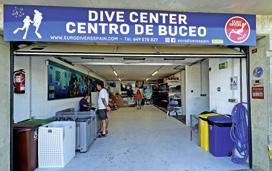
A house reef in a class of its own
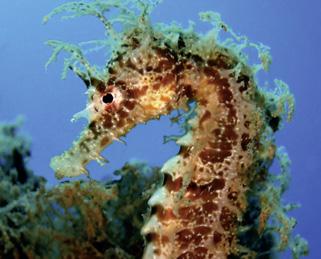
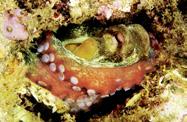
Another highlight is the local house reef, which is around 200 metres long and ranks among the best in Europe. The entry point is just 50 steps from the centre, and this part of the bay is reserved exclusively for divers and swimmers: a macro wonderland down to a depth of 15 metres, home to seahorses, sky-gazers, numerous species of snails, scorpionfish, octopuses and more. Family-friendly, personalised service and short distances are further plus points of the centre, one of the very best spots in the
TRAVEL INFORMATION: COSTA BRAVA / SPAIN
GETTING HERE
By car or by plane to Girona or Barcelona. Transfers from the airport to the resorts can be arranged.
ACCOMMODATION
Cala Jóncols: a family-run hotel and the only one in the bay of the same name within the Cap de Creus Nature Reserve.
Rosas: Hotel Univers, bookable through Euro Divers.
Tamariu: Hotel Tamariu, various apartments, bookable through Stollis Divebase.
CATERING
Cala Jóncols: B&B, serving an excellent three- or four-course menu at lunchtime and in the evening.
Rosas: there are plenty of restaurants. Tamariu: a dozen restaurants along the promenade.
DIVING / BOAT
Cala Jóncols: two trips a day on a large dive
boat with a lift, or alternatively a dinghy. Dive centre with a wide range of equipment for hire, offering SSI certified training.
Rosas: Trips by arrangement, usually twotank dives, plenty of equipment available for hire, PADI certified training.
Tamariu: several trips a day by dive boat and dinghy, independent dives on the house reef, training courses through SSI and IAC.
BEST TIME OF YEAR FOR DIVING
May, June, September and October. July and August are the peak season.
Mediterranean. My verdict? When it comes to biodiversity, the Costa Brava is hard to beat in our local waters. Thanks to the influence of the Gulf of Lyon and the topography, the underwater flora and fauna deserve top marks.
FRANCE
SPAIN
TRAVEL
JOY ISLAND – DIVING WITH PASSION AND PERFECTION
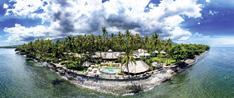
Our readers were travelling in the Maldives and have shared their experiences of the small, barefoot island of Joy Island in words and pictures.
T & F Ramona & Franz Fehlner
Anyone setting off for the Maldives with their diving gear feels that special thrill – the sense that a real adventure is about to begin. Even as you approach Malé, the turquoise lagoons glisten below, with white sandy shores framing emerald-green islands. After landing, you don’t board a bus, but head straight onto a speedboat. The crossing to Joy Island is the first chapter of a holiday that slows down both body and soul.
Arrive and breathe a sigh of relief
Joy Island isn’t just another faceless resort; it’s a small, laid-back island with around 150 villas, where people like Shify welcome
guests with genuine warmth. She takes you on a tour of the island, explaining the restaurants, spa and pool – and you immediately realise: here you’re not just a guest, but part of a community. Our first accommodation, a Garden Villa, was right on the beach. After three nights came the highlight: an upgrade to the water bungalow. Trumpetfish, rays and baby sharks glided past beneath the terrace. An unforgettable spectacle that brings the ocean tangibly closer.
Barefoot luxury meets warmth
Joy Island combines a light-hearted atmosphere with perfection. The service is attentive but never intrusive, and the food is outstanding. Head chef Anton and pasta wizard Ravin manage to blend international diversity with a real sense of warmth –from fresh fish and sushi to Italian pasta, which even had our son raving about it.
Dive Mission: Diving with a Heart
The Dive Mission dive centre, run by
Adam, is far more than just a place to fill tanks. Clean, well-organised and run with passion, you can immediately sense Adam’s enthusiasm – and how it rubs off on the whole team. Every guest is given their own locker. The equipment is transported, cleaned and dried – perfect for families. Technically, everything is top-notch: 12- and 15-litre cylinders, Nitrox included, INT and DIN connections, an L&W compressor from Germany. Over 29 dive sites are regularly visited – from gentle reefs for beginners to drift dives with reef sharks. ‘Snapper Point’ in particular is unforgettable: schools of fish, sharks, eagle rays – pure magic. Diving takes place in small groups with experienced guides. Briefings are precise, with a focus on safety. Our highlight: the night dive, when a blacktip reef shark suddenly emerged from the darkness.
The fascination of the underwater world
The waters around Joy Island showcase the full diversity of the Maldives: clownfish, moray eels, nudibranchs – and the ‘big ones’: grey reef sharks, eagle rays, guitarfish, and sometimes even manta rays or
A week’s all-inclusive holiday on Joy Island is currently available at from €2,500 per person.
dolphins during surface breaks. The centre works closely with its sister island, You & Me Maldives – opening up even more spectacular dive sites. The best time to visit is from September to May. That’s when you’ll find clear visibility, warm water and intense light.
More than just diving
Joy Island has plenty to offer away from the water too. The spa is the perfect place to unwind, the pool offers sea views, and Aqua Mission has SUPs, kayaks and windsurf boards available. In the evenings, you can enjoy live music, film nights or simply gaze up at the starry sky.
Conclusion
Joy Island & Dive Mission bring together everything that makes a diving holiday unforgettable: an island where you can unwind, a centre that prioritises safety, and people who love what they do. Shify, Adam, Anton and Ravin work together to create that ‘welcome to paradise’ feeling. Whether you’re a beginner, a family, a photographer or an experienced diver: there’s something for everyone here. And once you’ve dived in, you’re guaranteed to want to come back. Joy Island plus Dive Mission – dive in, experience it, come back.
Would you like to tell us about your travel experiences? Then write to: alexander.kassler@tauchen.de, quoting the reference ‘Readers for Readers’.
Joy Island
The underwater world of North Malé Atoll showcases the full diversity of the island nation – from the smallest to the largest.
EQUIPMENT
SUIT MADE FROM NATURAL FIBRES
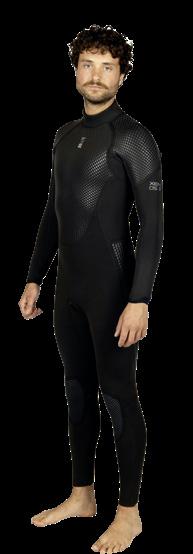
Fourth Element has launched the Xenos ARC, an innovative wetsuit made from sustainably produced Ocena material. The suit combines excellent mobility and thermal performance with ease of donning and doffing, and is available in 3mm, 5mm and 7mm versions. The 7mm suit is priced at €529. The other versions are priced lower. fourthelement.com
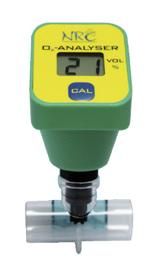
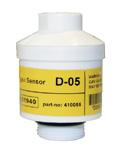
NRC LAUNCHES LEAD-FREE OXYGEN SENSORS
NRC has announced the first generation of lead free oxygen sensors, which are based on environmentally friendly technology and no longer contain any toxic lead. Such sensors are considered to be more durable, less prone to leakage and gentler on both people and the environment, as they do not contain any heavy metals. With only slightly higher costs and an extended service life, the investment pays for itself quickly, which is why this development is of great interest in nitrox analysis and rebreather diving. nrc-international.com
SEMI-DRY WITH DOUBLE ZIP SYSTEM
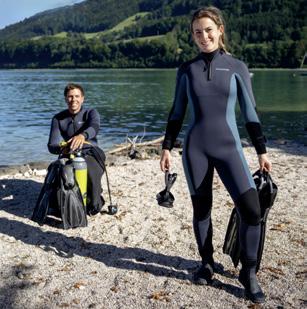
With the Icon, Camaro is reintroducing a new semidry suit with a back zip to its range. This is combined with a front relief zip, which ensures greater comfort after the dive. Pre-shaped elbows and knees, as well as a new wrap around sealing system, improve fit and mobility. Available in 5 and 7 millimetres and over 50 sizes. Price: from €549.95. camaro-watersports.com
TUSA PRESENTS THE NEW FLOSEE XENTRA
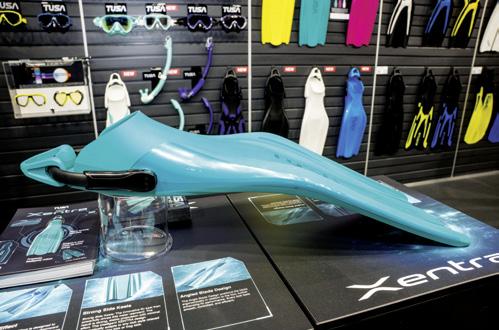
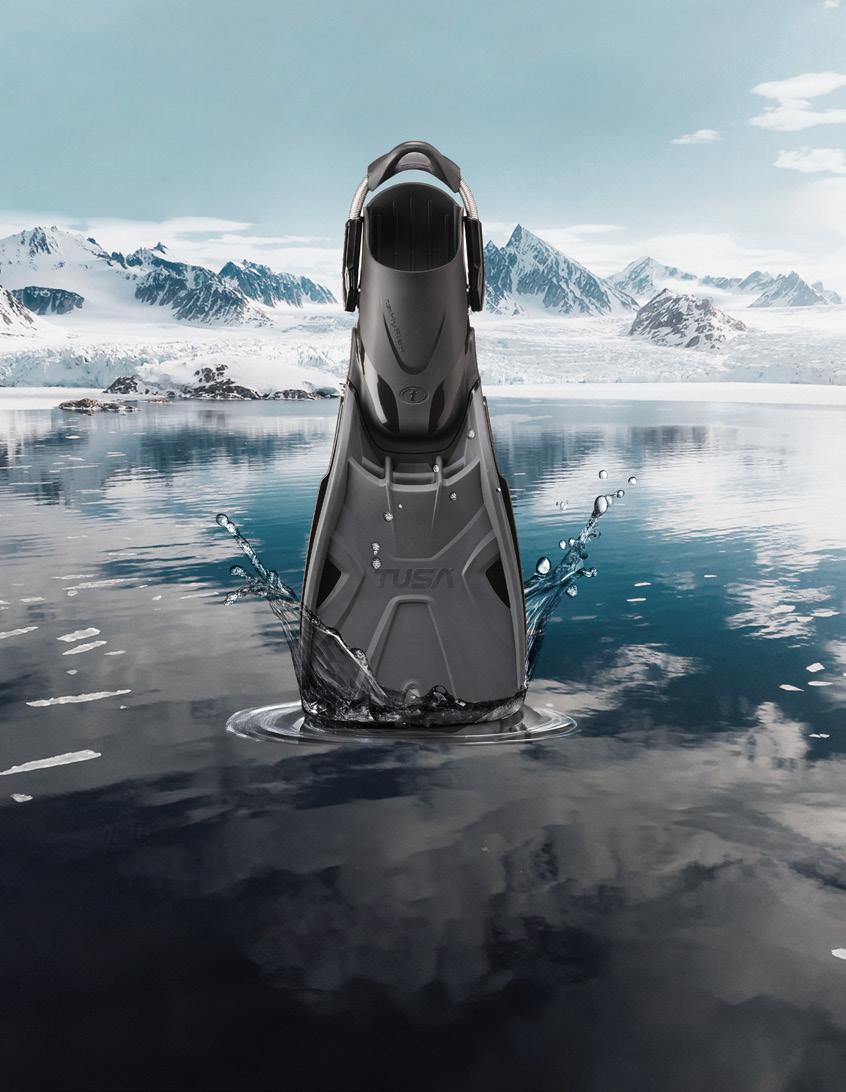
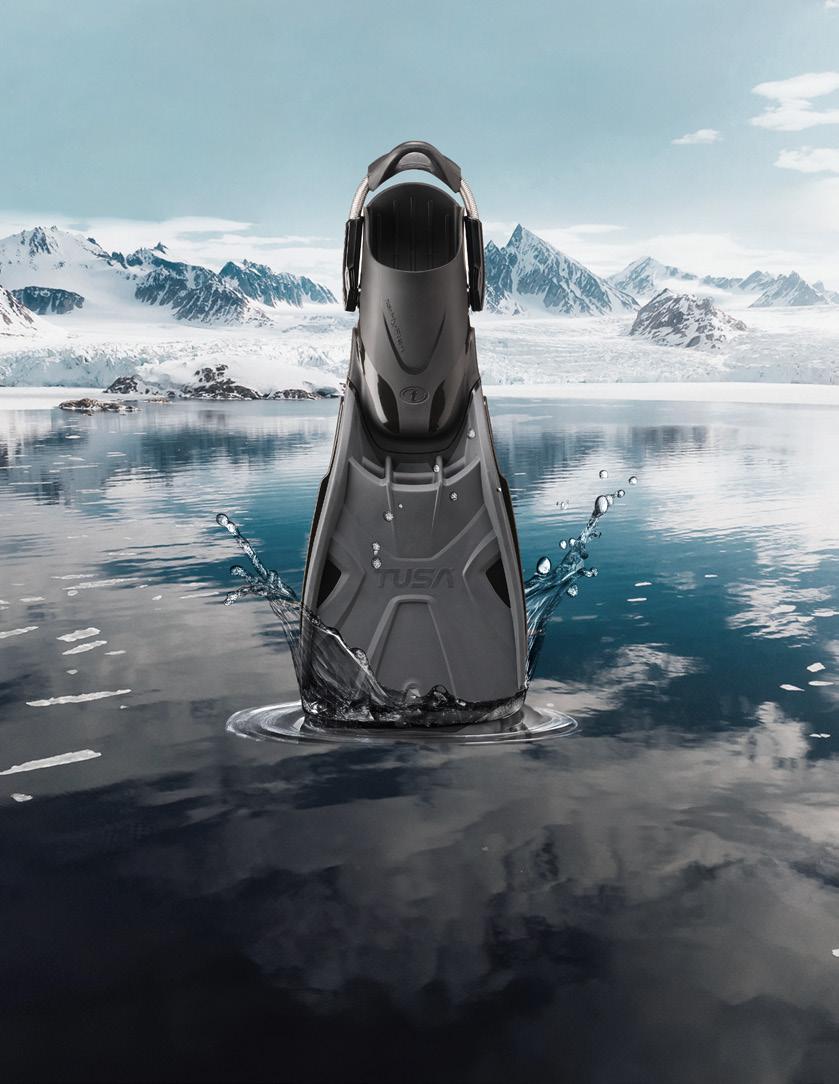
With the Xentra Fin, Tusa is launching a new fin designed for propulsion and efficiency. The flexible blade utilises the company’s proprietary Channel Effect Technology and curves into a spoon shape during the fin stroke to channel water effectively. The three-dimensional, aerodynamically optimised design is designed to reduce drag and ensure powerful, precise movements. Available in six colours. Price: €139. tusa.com
PHOTO CORNER
THE RESOLUTION OF THE HUMAN EYE
The human eye can distinguish structures and details down to one arcminute. This means that resolution is normally limited to 1/60°. The field of visual perception typically covers a visual field of 30° in height and 40° in width. Mathematically, this works out as:
Image height = 30° × 60 arcminutes = 1,800 pixels
Image width = 40° × 60 arcminutes = 2400 images
According to this calculation, the average maximum resolution for the human eye is: 1800 × 2400 = 4.32 million pixels
Eyes with particularly good vision and high resolution might be able to capture a few hundred thousand more pixels, but they cannot go beyond five million. If one takes into account all the imponderables (optical losses in the lens, diffraction blur caused by the aperture, signal-to-noise ratio, compression rates, anti-noise effects, algorithmic calculation errors, etc.), eight to ten megapixels in a digital camera would be sufficient for practical purposes
Can and should we calculate it this way? There is a second approach to the calculation. In a figurative sense, humans have a built-in, automatic HDR function (HDR = High Dynamic Range). We can therefore still make out details in both bright and dark areas where the image sensor fails due to its linear mode of operation. Furthermore, studies and calculations have shown that the retina is designed for a resolution of around 22 megapixels. However, due to the optical limitations of the pupil and data loss during transmission to the brain, the actual resolution in humans is estimated to be between eight and twelve megapixels. In this respect, experts believe that humans are likely capable of perceiving a resolution of eight megapixels, but never more than 12 megapixels. This means that images with a maximum of 12 megapixels can be resolved by the human eye, but those with an excessive number of pixels beyond the 12-megapixel limit cannot. So do cameras with 50 or 60 megapixels make any sense at all? Absolutely. Because a high native resolution enables you to create large image sections and to print posters, advertising columns and photo wallpapers. Furthermore, images with an extremely high pixel count always appear sharper, more brilliant and with less noise than a genuine 8-megapixel image, even on 4K monitors and in 4K projectors, where they are downscaled.
Herbert Frei
LIVE STREAM WITH A TALK
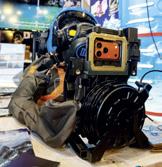
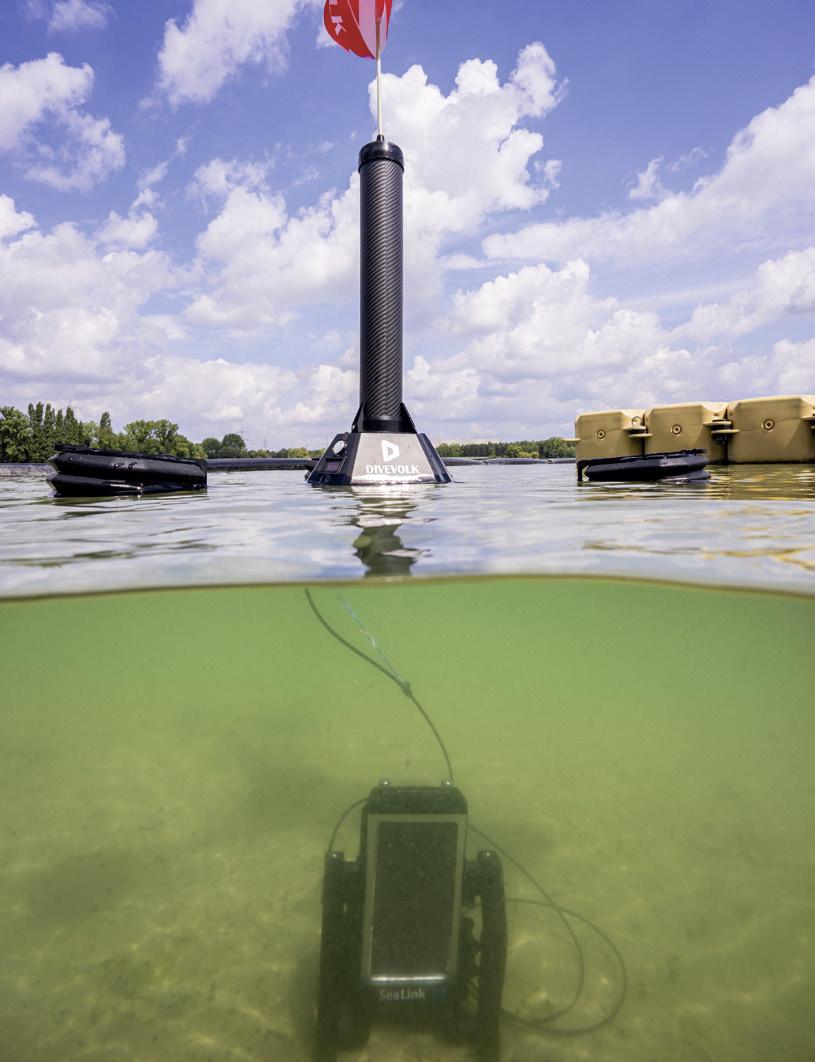
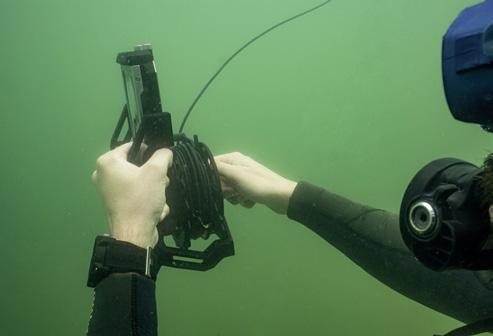
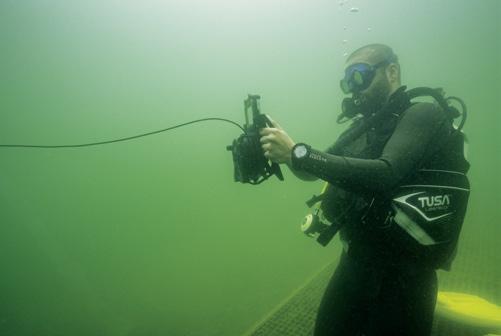
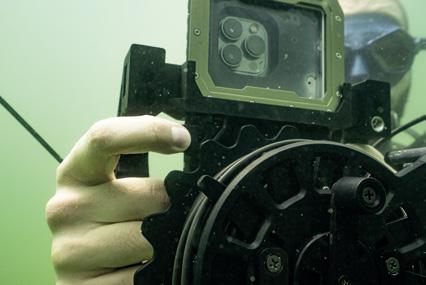
DiveVolk is expanding its SeaLink system: an integrated communication solution for Ocean Reef full-face masks is set to be available shortly. This will enable not only live streaming but also direct voice transmission from depths up to 30 metres. Another step towards fully connected underwater communication. Price not yet announced.
divevolkdiving.com
COMPACT OPEN-SOURCE DIVE COMPUTER
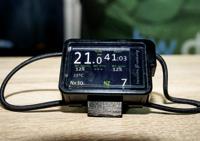
With the OSTC nano, Heinrichs-Weikamp offers a compact open-source dive computer for recreational and technical divers. It uses the same software as the larger OSTC models, but is significantly smaller in size. Equipped with a 2.0-inch TFT display, a 3D compass and support for multigas and trimix, the system operates without a subscription or account. Price: from €515. hwdiving.com
SIDEWINDER 2 RECEIVES CE CERTIFICATION
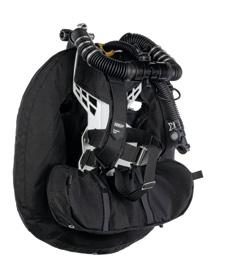
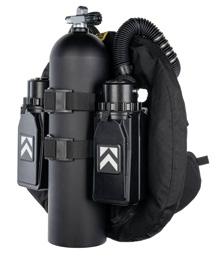
The Sidewinder 2 rebreather from Kiss has received CE certification and therefore meets European safety and performance standards. The modular system can be used in sidemount, backmount or chestmount configurations. According to the manufacturer, it offers a scrubber runtime of up to 240 minutes at 4 degrees Celsius, high resistance to overbreathing and improved flood tolerance. Four international patents protect this new development. The first courses are scheduled for late summer. An official retail price for the Sidewinder 2 has not yet been announced. Comparable CCR systems from the brand are priced in the mid to high four figure euro range, depending on the specifications. kisssidewinder.com
LIGHTS ON! CRESSI ASTRA 1200 & 2100
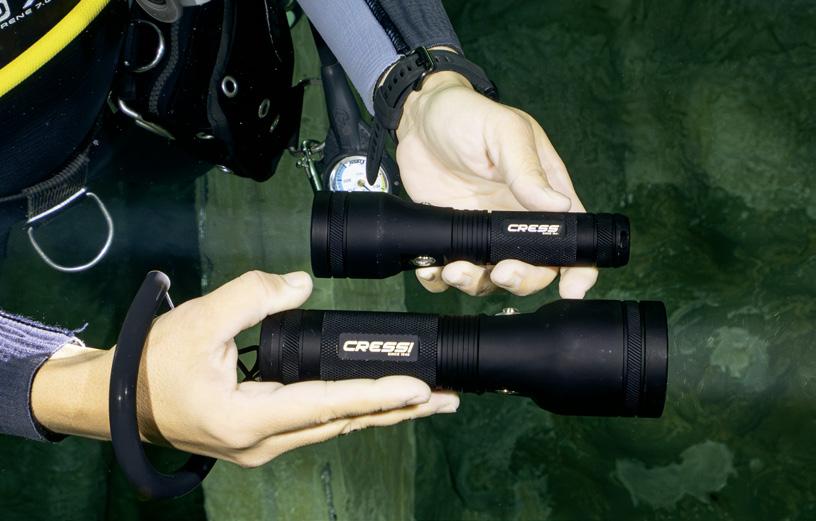
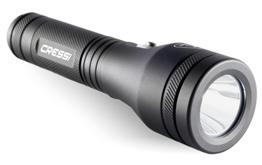
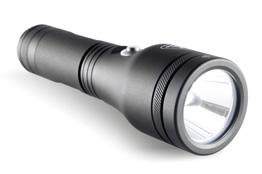
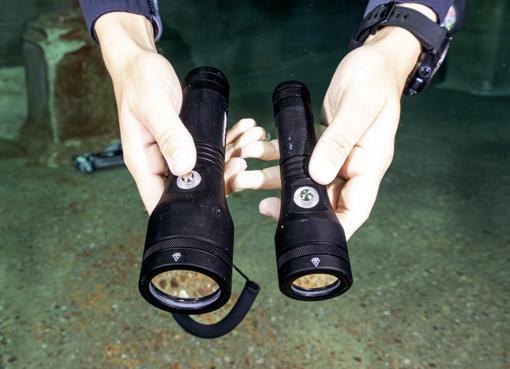
Two new torches, two distinct roles: the Astra 1200 is the perfect backup companion, whilst the Astra 2100 is a reliable workhorse for recreational dives. No overkill, no cave-diving headlamp –just right for anyone who wants to see clearly what’s swimming in front of them in the dark.
T & F Benjamin Schulze
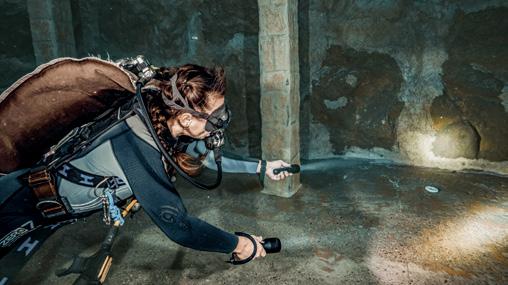
Naturallightis dimmed and colours fade. After just a few metres, the underwater world appears cooler and less vivid. This is where modern diving torches come into their own – and this is where we wanted to find out how Cressi’s two new models, the
Astra 1200 and Astra 2100, perform in everyday use. Not everyone needs a searchlight capable of illuminating half a lake. Sometimes it’s enough simply to see what’s in the crevice of the reef and to have sufficient light for a normal night dive. Both torches
were tested during ten open-water dives as well as at the Dive4Life indoor centre (thanks for the support).
Clear division of roles
Cressi positions the Astra series as high-
Photos: Benjamin Schulze, manufacturer
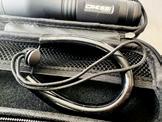
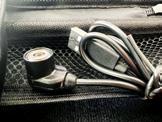
performance all-round diving torches for recreational and sport divers. Both models are based on a similar design principle: a compact aluminium housing, three lighting modes, a magnetic charging system and a clearly focused spot beam.
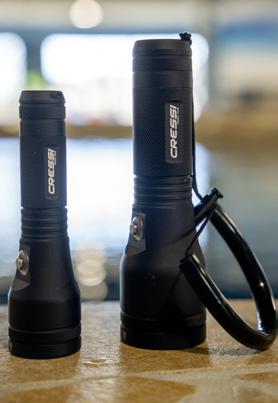
The difference lies in the performance:
• The Astra 1200: a handy, lightweight companion
• Astra 2100: a more powerful version with greater range and performance reserves.
Or to put it another way: the Astra 1200 is better suited as a backup torch and for illuminating crevices, whilst the Astra 2100 is a reliable workhorse for standard recreational dives. It’s not suitable for extreme cave diving or technical expeditions. But it’s just right for anyone looking for good, straightforward lighting.
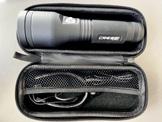
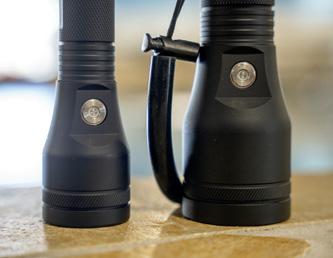
It’s clear from the moment you unpack them: both lamps feel well-made, with a matt black finish that’s pleasantly soft to the touch. The shape is a real pleasure to hold –not angular, not slippery, but exactly as you’d expect even when wearing wet gloves.
Easy to use
A major plus point in the test: the extremely simple operation. Both lights are controlled via a central magnetic push-button. The available modes are: 100% → 50% → strobe. Press twice and the light starts at full power; press again and it switches to half power. Holding the button down for longer activates the strobe. Press twice and the light switches off. This works reliably and without delay. A particular highlight: the buttons can be pressed easily even when wearing thick neoprene gloves. No fiddling about, no “Hold on, I just need to…” – just switch the light on. An LED charge indicator surrounds the switch, clearly showing the battery status via colour-coded signals.
Spotlight with a vivid colour effect
Both torches use modern CREE LEDs and produce a narrow beam angle of 8.6 degrees. This means no floodlight, but a focused beam that really comes into its own in bright environments and on mysterious night dives.
Astra 1200 – lightweight and always with you
With 1,200 lumens, the Astra 1200 is surprisingly powerful for its compact design. It is ideal as a backup torch or as a companion for holiday dives when you’re looking for something handy.
It’s ideal for peering into small crevices or for a quick glance. But let’s be honest: anyone expecting to illuminate a wreck like a film set is likely to be disappointed. The Astra 1200 isn’t stadium lighting – it’s more like a torch for underwater details. Colours are visibly enhanced in the spotlight and close-up range. Details, whether on wrecks, in crevices or in small grottos, stand out clearly.
The
sturdy main lamp
The Astra 2100 is a noticeable step up: more light, greater range (up to 250 metres on land) and a significantly ‘richer’ beam. It performs well even in bright daylight and is
Astra 2100
Astra 1200
EQUIPMENT
able to bring out details perfectly in a wide variety of situations. In a direct comparison, the Astra 2100 doesn’t just appear brighter, but also more capable when it comes to illuminating longer distances. For simple recreational dives, it is therefore a very good primary torch, whether at night or during the day. The same applies here: this is not an extreme technical tool for caves, wrecks or expeditions. Rather, it is a reliable companion for exactly what most divers actually do: holidays in accessible diving areas in the sea or lakes, as well as relaxed, well-planned night dives. The Astra 2100 is certainly more than enough to send a quick “Hello! Stop!” to a buddy who is slowly drifting away.
Battery life and charging times
Cressi provides very realistic burn times for both torches, and our own experience confirms this:
• Astra 1200: 3–5 hours depending on the mode
• Astra 2100: up to 8.5 hours in 50% mode This means that even longer days of diving are easily covered.
Temperature trend
Heat is a key consideration, particularly with high-performance lamps. Both Astra models were also tested on land without water cooling – with positive results. Heat build-up remains low. This is a plus in terms of handling and air travel. Cressi spokesperson Mig Wehrle explains: “Thanks to modern electronics, the torch automatically maintains a maximum temperature of 50 degrees Celsius – no risk of fire.” This means the Astra range is not only suitable for use on land, but is also protected from unpleasant surprises when packed in luggage.
Charging system
A real highlight is the magnetic charging system. The cable connects securely, as sand or salt water are quickly washed off. It worked reliably in testing. According to Mig Wehrle, this makes the Astra models ideal for anyone who needs a long service life: “By using the magnetic charging connection, Cressi has deliberately dispensed with O-rings, thereby avoiding potential leaks caused by ageing or crushing.”
Point of criticism: The charging cable is
currently only available as a USB-A version. At a time when USB-C is becoming the standard and will have to become even more widespread in future due to EU regulations, a USB-C cable – or at least an adapter – would be a useful addition. Nevertheless, Cressi points to the international nature of the torches: Mig Wehrle explains: “Of course, we have considered using a USB-C cable. However, as our torches are used worldwide, and USB-C is not as widespread everywhere as it is in Europe, we have opted for maximum compatibility.”
Battery permanently installed
One notable feature: the batteries are not removable.
This has clear advantages:
• no risk of water ingress due to improper opening
• ideal for diving centres and equipment hire businesses
• less maintenance
However, it also has its drawbacks:
• quick battery replacement not available
• requires clarification when travelling by air
Important: Lithium-ion batteries must always be carried in hand luggage. It is essential to bear this in mind when using these torches. On the plus side, they generate very little heat, which can be helpful when explaining this to security staff.
Processing
After ten dives, both lights showed excellent durability. The matt black finish remains intact, even though slight scratches may become visible. However, the paint does not flake off.
The wrist strap is a good size, and the carrying case is sturdy – a detail you’ll soon come to appreciate when travelling.
Conclusion
Cressi offers two modern, practical diving torches that not only stand out for their ease of use, excellent light output and robust design, but also for their outstanding value for money!
• The Astra 1200 is the ideal compact lamp
Photos: Benjamin Schulze, manufacturer
for travel, leisure and as a backup – for just €129.99.
• The Astra 2100 offers greater performance for more demanding conditions in recreational diving and is well suited as a main torch for everyday use – for just 20 euros more than its smaller counterpart.
Both models impress with their magnetic charging, excellent handling and solid build quality. An update to USB-C would be welcome. Otherwise, both models come highly recommended for divers looking for a good, reliable light.
At the end of the dive, back on the surface, the impression remains: these torches do exactly what they’re supposed to do –reliably illuminate the darkness. No fuss. And sometimes that’s exactly what makes them so good.
• Astra 1200: a handy, lightweight companion
• Astra 2100: a significantly more powerful version with greater range and performance reserves
The charging system is completely sealed off from the environment as it operates magnetically. There is no longer any need to open the lamps.
A high-quality case is provided for transport. There is plenty of room inside for the charging cable and wrist strap. Both lamps are lightweight and ideal for travelling. Both models are robust, stylish and userfriendly.
TECHNICAL SPECIFICATIONS
Technical specifica tions
LED chip
Brightness (100%)
Brightness (50%)
Modes
Duration
Charging time
Colour
Beam angle
Beam width on land
battery
Weight
Dimensions
Waterproof
Impact resistance
Price in euros
Web
ASTRA 1200
CREE XPL2
1,200 lumens
600 lumens
100% / 50% / Strobe
3–5 hours (depending on the mode)
ASTRA 2100
CREE XHP50
2100 lumens
970 lumens
100% / 50% / Strobe
4–8.5 hours (depending on the mode)
2-3
mAh
K
129,99 cressi.com
In other words: the Astra 1200 is the little ‘shrimp blender’, whilst the Astra 2100 is a sturdy workhorse for standard recreational dives. Not suited to extreme cave diving or technical expeditions – but just right for anyone looking for a straightforward light for their underwater explorations. We’re absolutely thrilled.
ASTRA 2100 Plus
• very compact and lightweight
• easy to use, even when wearing gloves
• No O-rings, leakage impossible
• magnetic charging system reliable and robust
• is not exactly a welcome sight on land either
• sturdy finish, well-made, high quality
minus
• rather limited range
• Charging cable is USB-A only; a USB-to-USB-C adapter would be useful
Who is it suitable for?
For holiday divers, beginners and anyone looking for a small, reliable second torch. Perfect as a backup or for short night dives – not intended for demanding dives requiring a powerful light.
• significantly greater light output
• No O-rings, so leakage is impossible
• – excellent battery life
• easy to use, clear modes
• Wireless charging works brilliantly
• a reliable main torch for recreational diving
• low heat generation even on land
• sturdy carry case and premium feel
minus
• USB-A instead of USB-C no longer seems quite up to date
Who is it suitable for?
For recreational divers looking for a non-, powerful main torch for openwater, lake and night dives. Plenty of light without being excessive, but not designed for extreme technical diving.
CRESSI ASTRA 1200 Plus
CRESSI
LIVE STREAM FROM A DEPTH OF 30 METRES
DiveVolk’s SeaLink Wi-Fi transmitter put through its paces in a six-month field test.
T & F Benjamin Schulze
Live streamingfrom the depths has long been considered the preserve of research, the military and industry. With DiveVolk’s SeaLink, this technology is now available for the first time in a compact, portable system that is practical for serious recreational use even by ambitious amateur divers. We tested the system in outdoor conditions for over six months.
“There are millions of apps for smartphones on land – but virtually none underwater.” With this observation, Louis Chen of DiveVolk highlights a key problem in modern underwater communication. Smartphones are powerful all-rounders. However, their capabilities usually end where water
begins. This is precisely where the SeaLink Wi-Fi transmitter comes in. The fact that this approach is not only visionary but also practical is underlined by the boot Dive Award for best innovation.
Function and system architecture
The SeaLink is based on DiveVolk’s universal underwater touchscreen housing, the SeaTouch 4 Pro Max. Inside this housing is a smartphone, which is connected to a surface transmitter unit via a 30-metre cable and can be fully operated. The cable is wound onto an integrated reel and acts as a data link. On the surface, the antenna sits on a float with three stabilising arms. The radio unit uses a standard SIM card. The antenna is powered by four 21700 batteries. As soon as mobile phone reception is avai-
Streaming in portrait mode works very well. Rolling it up whilst filming is difficult.
lable, an internet connection is available underwater – including real-time streaming.
Chen explains that the SeaTouch case initially solved the problem of physical access to the smartphone whilst underwater. SeaLink now adds the crucial next step: an internet connection. Only then can the smartphone reach its full potential, including cloud-based applications – something that was previously unthinkable underwater.
Recognised innovation
The fact that SeaLink is more than just a technical experiment was also confirmed by the jury of the boot Dive Award at this year’s boot trade fair in Düsseldorf. The system received the coveted award for best innovation. The jury particularly praised the approach of making existing smartphone technology fully usable underwater for the first time, thereby opening up new areas of application for media, training, science and technology.
Six-month field trial
Our practical test ran for a period of six months and was conducted exclusively under real-world outdoor conditions. Even during transport, the compact, well-designed package stands out. Despite the extensive range of components, the system remains easy to handle. Setting it up in the field takes around ten minutes, whilst the initial setup – including the SIM card and Wi-Fi connection – takes a maximum of 20 minutes.
We used a standard prepaid SIM card and an iPhone 13 Pro. Once switched on, the smartphone connects to the antenna via Wi-Fi; a security code from the user manual is entered – and the setup is complete. We were able to confirm the manufacturer’s stated battery life of around 60 hours without any issues. In practice, this means it easily exceeds the requirements
even for very long, shallow dives. Performance underwater
We carried out tests at locations including Blausteinsee near Eschweiler, in the dark and at a depth of 30 metres. The connection remained stable throughout, provided the mobile network on the surface was reliable. The underwater unit does not require its own power supply, as the smartphone operates independently. Apps such as Teams, FaceTime or WhatsApp can be used without any problems. The person on the other end can be heard clearly, and replies can be sent via the touchscreen using chat, provided the app in question supports this. Additional voice communication is already in the pipeline: together with OceanReef, DiveVolk is working on a solution for full-face masks and has already demonstrated a working prototype at the boot trade fair.
Handling and ergonomics
The cable is fed out in a controlled manner
via a small lever that can be operated safely even when wearing thick gloves in water at six degrees. Thanks to the guide, the cable winds back neatly without getting tangled. Due to the design, it is difficult to stream and wind the cable back at the same time; therefore, it is recommended that you either wait until the stream has finished before winding the cable back, or stop the stream before winding it back.
The underwater unit is ideally positioned upright. A horizontal orientation is also possible, but is somewhat less manoeuvrable. Two 1/4-inch threads allow for the attachment of buoyancy arms or lights. In fresh water, the downforce is around 400 grams, which should be balanced out for longer shoots to ensure steady footage and relieve strain on the arms. The ergonomics still have room for improvement, particularly when filming in landscape orientation.
Surface unit and safety
TECHNICAL SPECIFICATIONS
Manufacturer
Product
Frequency
Maximum depth / cable length
Operating temperature
Total weight of the contents
Buoyancy of radio unit on surface
Underwater unit drive
Power supply interface
Maximum duration
CE marking
Price
Web DiveVolk
+3750 g
-360 g (saltwater), -400 g (freshwater)
4 x 21700 rechargeable batteries approx. 60 hours yes
€3,199 divevolkdiving.com
The float provides sufficient buoyancy; the three stabiliser fins serve primarily to stabilise the unit. The battery compartment, containing the four rechargeable batteries, is securely sealed by a triple O-ring seal. Some care is required when assembling the antenna, as the main antenna is fitted using a twist-lock mechanism. The maximum tensile force on the main cable is five kilograms. From a diving perspective, its use requires experience and concentration, particularly in surface currents. Light currents posed no problems during testing, whilst stronger currents were noticeable. The unit being washed over by waves is not a critical issue. A complete roll-over, such that the antenna is submerged, will interrupt transmission but will not damage the unit.
Areas of application and conclusion
Its applications range from live explorations and sporting events to scientific documentation and engineering work. Particularly noteworthy is the approach of making all communication apps available above water usable underwater as well. The SeaLink is not a toy, but a specialised tool. Anyone with the necessary diving experience who can ensure stable mobile network coverage will have a system that redefines underwater communication.
DOES LIVE STREAMING DISTURB THE PEACE AND QUIET UNDERWATER?
The introduction of new technology in diving is often met with scepticism. Experienced divers, in particular, value the seclusion, tranquillity and focus they find underwater. The concern is: will the ocean become a place where we are constantly online?
However, practical testing has shown that the SeaLink does not cause any additional noise or visual disturbances. There are no audible signals, no flashing lights and no active radio transmission underwater. The connection to the surface is made exclusively via a cable. Its use usually goes unnoticed by surrounding divers. Whether and where such systems are best used ultimately comes down to a matter of personal preference. Whilst research, media relations and training stand to benefit significantly, recreational divers will continue to decide for themselves whether they view this innovation as an asset or an unnecessary intrusion.
Social media posts
Pro: “At last, we can share research, training and the diving experience live .”
Cons
“I want to switch off when I’m underwater. If I need the internet, I stay on land.”
What do you think of this development?
Please email us at redaktion@tauchen.de
We would like to thank the BlueMarlin diving centre at Fühlinger See in Cologne for their support with this test.
EXPERTS
TONS OF RUBBISH HEADING FOR THE SEA
• THE NEW RHINE STUDY •
The Rhine – one of Europe’s largest rivers – is not only a vital lifeline for ecosystems and people, but also an alarming transport route for waste: scientists from Bonn and Tübingen, together with numerous volunteers, have carried out a 16-month study that paints a shockingly clear picture. As part of the study, a floating rubbish trap named the ‘Rheinkrake’ was installed near Cologne to collect waste from the river floating on the surface and up to around 80 centimetres below. Every item larger than one centimetre was collected, weighed and classified. In total, the researchers collected over 17,500 individual pieces of rubbish weighing just under two tonnes within a year. Extrapolated to the total flow rate, this yields a shocking figure: between around 3,000 and 4,700 tonnes of rubbish flow past Cologne alone in the Rhine towards the North Sea every year –that is an average of around ten tonnes per day.
The composition of the rubbish shows where the problem mainly stems from:
More than 70 per cent of the items were made of plastic – ranging from toys and packaging to cigarette filters – although plastic accounted for only around 15 per cent of the total weight. Over half of the items can be attributed to private consumers, such as packaging waste from snacks and drinks. Particularly striking were the remains of New Year’s Eve fireworks, which were found in large numbers in the water. These data show the extent to which rivers such as the Rhine have become a transport route for terrestrial waste into marine ecosystems. Every year, an enormous amount of waste enters the North Sea via the Rhine, where it not only pollutes the Wadden Sea nature reserve but also has far-reaching consequences for animals, plants and, indirectly, for humans – ranging from physical harm to marine life to the spread of pollutants through the food chain.
OUR EXPERT
DR FLORIAN HUBER reports monthly on the latest news from the world of underwater science. He himself is an underwater archaeologist and a research diver (florian-huber.info).
Another equally significant aspect of river pollution is microplastic pollution: previous studies have shown that the Rhine is one of the world’s most heavily microplastic-polluted rivers and carries millions of tiny plastic particles into the North Sea every day. Although these particles are less conspicuous in terms of volume than macro debris, they contribute significantly to the pollution of water bodies and aquatic food chains.
A key feature of the current study is the methodology itself: whilst previous estimates were often based on sporadic samples, continuous monitoring using a physical trap shows that the transport of litter in the river fluctuates significantly, and long term measurements yield figures that are considerably higher than previous estimates.
Photos: Leandra Hamann (2), Cap Arcona Museum, Neustadt in Holstein, Submaris,
Using a litter trap, researchers have, for the first time, conducted a comprehensive study to determine how much litter is floating in the Rhine.
The floating rubbish trap known as the ‘Rheinkrake’ was stationed in the Rhine near Cologne.
EXPLORATION OF THE CAP ARCONA WRECK SITE
Over the past few weeks, research divers from Submaris have been investigating the site of the Cap Arcona’s sinking in Neustadt Bay on behalf of the Schleswig Holstein State Office for Archaeology (ALSH). The aim of the work was to document as accurately as possible the current condition of the remaining wreckage and debris. Divers, an ROV (remotely operated vehicle) and side-scan sonar were used for this purpose.
The Cap Arcona was originally a passenger ship and the flagship of the Hamburg-South America Line, and was deployed on transatlantic routes from 1927 onwards. Towards the end of the Second World War, the unseaworthy ship was misused by the SS as an internment ship for thousands of concentration camp prisoners. On 3 May 1945, the Cap Arcona was severely damaged during a British air raid, caught fire and capsized. Over 7,000 people lost their lives in the incident.
The wreck was scrapped in 1948. Debris and human remains, believed to belong to the many victims whose bodies were never recovered, can still be found in the area where the ship sank.
The current investigation aims to provide a scientific record of this historically significant site and contributes to the ongoing process of coming to terms with the events.
Freshwater confirmed beneath the seabedd uring the IODP³-NSF Expedition 501, ‘Hydrogeology of the New England Shelf’, researchers collected water and sediment samples from the New England Shelf for the first time in order to better understand this phenomenon.
The Cap Arcona was a trans atlantic liner and the flagship of the Hamburg-South America Line.
Mass grave: Shortly after 3 pm, the “Cap Arcona” capsized, carrying the bodies of thousands of concentration camp prisoners. The SS had brought them on board in the weeks prior.
Divers and underwater robots have documented the remaining wreckage of the Cap Arcona.
EXTENSIVE FRESHWATER RESERVES BENEATH THE SEABED HAVE BEEN CONFIRMED FOR THE FIRST TIME
For the first time, researchers have confirmed and extensively sampled the existence of large freshwater reservoirs beneath the ocean floor – a phenomenon that had been suspected for decades but had never before been directly documented. This milestone was achieved as part of the IODP³-NSF Expedition 501 ‘Hydrogeology of the New England Shelf’, during which scientists collected sediment cores and porewater samples from the seabed off the coast of New England (USA). The samples collected are currently being analysed jointly by international experts at MARUM – Centre for Marine Environmental Sciences at the University of Bremen. The aim is not only to determine the composition of this sub-seabed groundwater, but also to understand how and when this freshwater formed there and what significance it might have for coastal regions and global aquatic cycles. Particular attention is being paid to the different types of sediment: the researchers have detected freshwater in sandy layers that act as aquifers, as well as in clayey layers that retain the water (aquitards). Such structures play an important role in how water is stored and transported. Although around 70 per cent of the Earth’s surface is covered by water, a significant proportion is also found beneath the surface – including in the form of these previously little-studied freshwater zones beneath the seabed. Whilst these systems have been known since 1976 but have remained virtually unexplored, the expedition’s scientists were able to document and sample water from a zone in the seabed nearly 200 metres thick.
Taking samples from a sediment core collected off the coast of New England.
EXPERTS ° GRIBSHUNDEN
SÖLDNER, SAFRAN & SEA MONSTER
What the Gribshunden wreck reveals.
T & F Dr Florian Huber
ship
the
a
a de -
A
of
Kraweel type with
dog-like monster on the bow, based on
scription of a pilgrimage from Venice to Jerusalem by Conrad Grünenberg in 1486. The ship sails under the Ottoman flag. The original is held at the Badische Landesbibliothek (public domain).
Among other things, a fragment of chain mail was found during the excavations.
The Gribshunden,King John I of Denmark and Norway’s floating palace, sank in 1495 under mysterious circumstances and was forgotten for almost 500 years.
In the summer of 1495, King John I, known as Hans, set off on a diplomatic mission to Sweden. His aim was to persuade the Swedish Council of the Realm to cede the crown to him without a fight. To make an impression, the 40-year-old monarch travelled with several ships and all the status symbols of his time. He himself sailed on his flagship, the Gribshunden – also known as the Grifun ( ). Built in the early 1480s, the ship was considered technologically pioneering and combined elements of northern and southern European shipbuilding.
However, the voyage came to a premature end: during a stopover near Ronneby, a fire broke out on board. When the flames reached the gunpowder, which was thought to be stored in the forecastle, an explosion occurred. The Gribshunden, anchored off
the island of Stora Ekön, sank. King Hans was in a dinghy at the time. However, contemporary sources report that many of the approximately 150 crew members lost their lives.
A local diving club discovered the wreck in 1971. However, its exceptional significance was not recognised until decades later. Its state of preservation is remarkable – partly because the destructive shipworm Teredo navalis is not found in this part of the Baltic Sea. Today, the Gribshunden is one of the best-preserved ships from the late Middle Ages. Archaeological investigations provide valuable insights into the structure, fittings and life on board the warship, which is over 30 metres long.
A spectacular wooden sculpture was recovered as early as 2015. It was originally mounted beneath the bowsprit and depicts a monster devouring a screaming human. Similar motifs can be found in contemporary ecclesiastical art and heraldry, such as in the coat of arms of the Sforza family. As a figurehead, it is likely to have served a psychological warfare purpose: in a naval
battle, the tall bow towered over enemy ships – arrows, projectiles and a menacing sea monster all within the enemy’s field of vision.
In the forecastle, archaeologists also found the remains of a small wooden box containing lead balls, moulds and flints –presumably a toolbox for making ammunition. Isotope analyses show that the lead likely originated from central Germany. The find suggests that there were German mercenaries on board, who were intended to protect the ship and carry out possible land operations.
Another outstanding find is a fragment of a chainmail shirt made from finely riveted rings of a copper alloy, presumably brass. A stamped signature (+VL. FEVRER) allows it to be attributed to Ulrich Feurer, a chainmail smith from Nuremberg who was active around 1416. In the late Middle Ages, Nuremberg was a leading centre of European arms production. The fact that the chainmail was already old at the time of the shipwreck suggests that it had been reused over generations or com-
The research vessel Ocean Rose is moored at the spot where the Gribshunden exploded and sank over 500 years ago.
The coat of arms of the powerful northern Italian Renaissance princely family, the Sforza, features, amongst other things, a so-called ‘Bisconte’: a heraldic serpent devouring a human. It dates from the period between 1475 and 1500. The monster’s head bears a striking resemblance to that of the Gribshund. Could the serpent monster perhaps have been a direct inspiration for it?
The recovered wooden figure (left) and a reconstruction of its original position in the bow of the ship.
and
Could Gribshunden have served as the model for this carving?
A carving
drawing from the church in Sæby, Denmark, depicting an early modern ship with a distinctive figurehead.
Illustration: Wernigerode Coat of Arms Book
The photo mosaic provides an overview of the site. On the left are the two anchor lockers, and on the right is the massive rudder.
Photo: Rodrigo Pacheco-Ruiz and Florian Huber
EXPERTS ° GRIBSHUNDEN
bined with other pieces of armour – presumably worn by one of the mercenaries on board.
Particularly impressive is the royal spice collection, which has been preserved almost in its entirety. Pepper, ginger, cloves, caraway, dill – and above all saffron, which still has an intense fragrance even after more than 500 years underwater. These expensive imports from Asia were not only used in cooking, but were also powerful status symbols. The find is complemented by seeds of the poisonous henbane, which was used at the time for medicinal, ritual or intoxicating purposes.
Dendrochronological analyses show that the timber used in the Gribshunden originates from the upper reaches of the
Toolbox for the production of ammunition, with contents. The solid line indicates the long side of the chest; the dotted lines indicate the approximate position of the sides. Contents: (1) Lead plates, (2-3) Moulds, (4) the long side of the chest together with iron corrosion (from the lock and fittings?), (5) cylindrical tins (possibly powder containers) and (6) mould.
Below is a scene from Ludwig von Eyb’s *War Book* (c. 1500).
One of the rings is stamped with the name +VL. FEVRER (the V should be read as a U).
The rudder, which is approximately 6.5 metres long, lies a few metres to starboard of the stern. It has two through-holes: the lower one was used to attach a safety line in case the rudder should come loose from the rudder sockets. The upper hole was presumably connected to the mounting of the rudder shaft, which lies between the rudder and the stern.
Meuse – an economically significant region between Flanders, Brabant and the Kingdom of Burgundy. The ship may have been built in a shipyard in this area, where the kraweel construction method had already been introduced by the mid-15th century. The Gribshunden combines Kraweel and clinker planking and is considered one of the earliest surviving hybrid ships in Northern Europe. Massive anchor lockers and an exceptionally large rudder bear witness to its size and seaworthiness. Furthermore, it was designed for the use of fire-
which, even after more than 500 years underwater, still gives off its characteristic scent and has retained its reddish-orange colour.
arms. The combination of cannons and ships built specifically for this purpose marked a decisive technological step that significantly influenced Europe’s maritime dominance after 1492. The Gribshunden
SICHERHEIT ist kein Extra. Sie ist STANDARD.
Mit ENOS® orten Sie vermisste Taucher in Echtzeit – direkt zur Crew, ohne monatliche Kosten, ohne Umwege.
Wenn Strömung, Wind oder Distanz entscheiden, liefert ENOS® präzise GPS-Positionen genau dorthin, wo sie gebraucht werden: an Bord.
ENOS® – weil Sekunden zählen.
thus exemplifies the transition from the Middle Ages to the early modern period –and the dawn of a new, global era.
A chainmail maker sits at his workbench, using pliers to crimp the metal rings of the chainmail.
finished chainmail hangs from the wall bracket. Date: c. 1425.
Saffron,
Nuremberg, home to the world-famous Imperial Castle. In the Middle Ages, the city was a major centre for the production of weapons and armour.
Image: Nuremberg House Registers
Photo:
SILENT INVASION
The invasive quagga mussel is spreading further and further, not only in Austria’s lakes. What can we do about it?
The quagga mussel, scientifically known mostly as Dreissena rostriformis bugensis and less commonly as Dreissena bugensis, is a freshwater mussel native to the Black Sea region which, as an invasive species, has been causing significant ecological and technical problems in Central Europe for decades. In Austria, it is increasingly found in lowland and inland waters in the Alpine region, thereby also affecting divers, particularly in waters that are heavily used for recreational purposes.
Biology and characteristics
The quagga mussel is closely related to the better-known zebra mussel (Dreissena polymorpha) and belongs to the family of zebra mussels. It is characterised by its excellent ability to attach itself to hard substrates such as stones, wood, wooden substructures and engineering structures using byssus threads. Unlike the zebra mussel, it is also capable of colonising fine-grained sediments. Although filtering large quantities of plankton and suspended matter increases water transparency, this simultaneously
causes lasting damage to existing food chains. Its extremely successful spread and reproduction, combined with relatively broad environmental tolerances – for example at greater depths or in weaker currents – make it a particularly effective invasive organism.
Distribution in Austria
The first confirmed sighting of the quagga mussel in Austria was recorded in 2016 in Lake Constance. Since then, it has been detected in numerous other Austrian la-
T & F Martin Schrack
Lake Traunsee (Salzkammergut, Upper Austria) is one of the most heavily overgrown bodies of water. Even on the steep banks, the vegetation is extremely dense.
EXPERTS ° INVASIVE SPECIES
kes, including Lake Attersee, Lake Traunsee, Lake Mondsee, Lake Wörthersee, Lake Millstätter See, Lake Weißensee and the Old Danube. In Upper Austria, a significant increase in its distribution has been documented since 2022. According to information from ARGE Tauchen, water bodies are classified into two categories: ‘Type Red’ with confirmed evidence of the quagga mussel and ‘Type Green’ with no evidence. DNA evidence of the mussel has already been found in Salzburg lakes such as Lake Wolfgang and Lake Mondsee.
Consequences
Ecologically, the quagga mussel displaces native mussel and mollusc species, as it dominates and monopolises substrates, food resources and habitat. According to recent studies, the resulting changes in nutrient and sediment dynamics are considered to be virtually irreversible, particularly in deep alpine lakes, which are common in Austria. The technical and economic impacts are also significant. The mussels clog pipes, filter systems and intake and distribution systems for drinking and process water, thereby incurring high costs for cleaning, maintenance and repair.
In Lake Attersee (Salzkammergut, Upper Austria), near the well-known diving spot ‘Hausboot’ in Nussdorf: this sunken workboat is also heavily infested.
Sources: Province of Upper Austria, Salzburg; ORF.at; neobiota-austria.at; ARGE Tauchen; science.apa.at; neobiota-austria.at; ebensee.at
Relevance to diving
For divers, this raises several important considerations: waters where quagga mussels have been detected are considered high-risk and require particular care when moving between different dive sites. Furthermore, in shallow coastal areas, there is an increased risk of cuts and injuries from the sharp-edged mussel shells, both for swimmers and divers.
Countermeasures are required
The spread of the quagga mussel in Austrian waters is already well advanced, and it seems highly unlikely that it can be completely contained. Future measures should therefore focus primarily on slowing down its further spread and preventing further introductions, for example through the thorough cleaning of boats and diving
“If you want to help as a diver, it’s usually enough to give your equipment a thorough clean before moving to a different body of water.”
equipment, as well as through information and awareness-raising campaigns. Divers play an important role in this regard, as they often notice changes in the underwater environment at an early stage and can thus contribute to documentation as attentive observers.
This overview aims to raise awareness of the significance of this invasive mussel in local diving waters and, at the same time, to show how each individual can make a contribution by behaving responsibly.
Recommendations for divers
• Equipment check: Before moving from one body of water to another, clean, dry and, if necessary, disinfect your equipment thoroughly – in accordance with the guidelines issued by ARGE Tauchen (Check – Clean – Dry – Disinfect) for
waters where quagga mussels have been detected.
• Please note the diving guidelines: Observe the water body classifications (RED/GREEN) provided by ARGE Tauchen and exercise caution in waters where quagga mussels have been confirmed.
• Be aware of underwater conditions: In heavily infested waters, dense mussel growth can lead to changes in sediment or light conditions. This may affect dives.
LESS IS MORE
Even though freediving is the purest form of diving and could, in theory, be done entirely without equipment, there are a few things you really shouldn’t do without.
T Nik Linder
JacquesMayol is said to have once remarked: “A freediver doesn’t look at things; he looks within.”
On the one hand, this is true; on the other, it isn’t. A freediver’s focus is a balance between perceiving the world around him and self-awareness. They observe their own body and pay attention to tension in the muscles. Physical tension makes mental relaxation more difficult, increases oxygen consumption and can make pressure equalisation more difficult.
Mask or no mask?
In competitive sport, particularly during competitions, athletes – especially in deep diving – often choose not to wear a diving mask. The surroundings are less important to them; rather, the focus is on their inner state. Those who have only one breath available prefer to use the inhaled air for equalising pressure in the middle ear rather than for equalising pressure in the mask. During rope dives, therefore, divers often use only a nose clip, which allows pressure equalisation to be carried out without using their hands.
Anyone using a mask should ensure not only that it fits properly but, above all, that the internal volume is as small as possible. This reduces the risk of mask-related discomfort and allows more air for pressure equalisation in the middle ear. On the other hand, anyone diving for the sheer pleasure of exploring the reef or swimming with dolphins or whales will be reluctant to do without a mask.
As it is removed from the mouth when diving down, many freedivers either leave the snorkel in the buoy or tuck it under the mask strap.
For training and emergency rescue procedures, masks with clear lenses are used so that the dive partner can assess the diver’s condition.
Nose clips prevent water from entering the and allow for pressure equalisation without using your hands.
Why wear a freediving wetsuit?
Just like with scuba diving, the wetsuit protects the wearer – whether from the cold, jellyfish or accidental contact with the reef. The difference lies in the softness of the material. Those who don’t carry any equipment on their backs have significantly greater freedom of movement. Unfamiliar perspectives whilst lying on your back, gazing up at the water’s surface, are just as much a part of the fascination as dancing with a dolphin in the open ocean.
All this is possible because freediving wetsuits are much more flexible and therefore offer greater freedom of movement. Furthermore, the suit must not restrict breathing. However, soft neoprene also provides less insulation, as it compresses more at depth. This is not a problem for freedivers, as they spend more time at the surface and, compared to scuba divers, only make brief forays into the depths. However, anyone who sets out to scuba dive in their freediving wetsuit will quickly notice that it loses a significant amount of its insulating effect as the depth increases. Most freediving wetsuits consist of trousers and a jacket. Zips are rare, as they reduce flexibility. It takes a bit of practice – and usually plenty of soapy water – to get into the suit.
Why are the fins so long?
The challenge of freediving is to travel as far or as deep as possible with the least possible physical effort. The better the ratio of effort to result, the greater the distance covered or the depth reached. This is achie-
Apnoea masks are characterised by a very small internal volume.
EXPERTS ° APNOEA
The thickness of the suit depends, on the one hand, on the individual’s sensitivity to the cold and, on the other hand, on the specific discipline.
ved, on the one hand, through efficient technique and, on the other, by using the right fins.
Freediving fins are significantly longer than those used for snorkelling or scuba diving. The reason is that, when freediving, you only achieve neutral buoyancy at a depth of around ten metres. Initially, you
In distance freediving, wetsuits tend to be quite thin, as the freediver is constantly on the move. The smooth surface glides more easily than the skin. In this case, the suits serve less to protect against the cold and more to allow the diver to go deeper on a single breath.
In static apnea diving, i.e. time diving, a five-millimetre wetsuit is often worn even in warm water, as body heat is lost very quickly due to the complete lack of movement.
Photos: Phil Simha, Predrag Vuckovic
Plastic fins are available from around 120 euros. Fibreglass blades are significantly more expensive. Carbon offers the best propulsion with the least effort, but, as points out, it comes at a price. Pure carbon fins usually cost around 500 euros.
have to work against the buoyancy of your lungs and wetsuit to cover the first few metres as quickly as possible. Whilst long fins place greater strain on the muscles, they also generate significantly more propulsion. Fins are now available in different lengths, so that smaller freedivers do not have to use the same fin length as very tall divers. Various degrees of stiffness are also available, usually categorised as soft, medium and hard. The trend is increasingly towards softer fins, which, whilst less explosive at the start, are significantly more energy-efficient.
Weighing systems
Elastic straps are used in freediving. These do not restrict breathing and are less likely to slip as you descend. Weights ranging from 0.5 to one kilogram are distributed evenly along the strap. In distance diving, neck weights are very popular. They counteract the positive buoyancy of the lungs and ensure not only neutral buoyancy but also optimal trim. If you are well-balanced, you can use all your strength to dive further instead of correcting your depth. Once the body is in motion, the amount of lead carried becomes less important. Compared to deep diving, however, more weight is used in distance diving, as you want to be neutral at a depth of around 1.80 metres.
Dive computer
Compared to a conventional dive computer, a freediving computer has a higher sampling rate, meaning that the depth reached is recorded more accurately. Freedivers have significantly higher descent and ascent speeds. In addition, there are audible signals that indicate pre-set depths. As the freediver does not look at the computer during deep dives, these signals aid orientation. Surface signals ensure that sufficient surface interval is maintained between dives. Some models even measure heart rate. There is a whole range of other equipment, such as buoys, lanyards, action cameras and much more. As we delve deeper into the individual disciplines in future issues, we will also be introducing these items of
equipment. In the next issue, however, we will move away from external aids and – in the spirit of Jacques Mayol – look inwards once more. We will then focus on the diving reflex and how to awaken it.
is usually between nine and twelve metres. Too much weight makes it difficult to ascend and, in particular, to breathe comfortably at the surface. For safety reasons, the diver retains sufficient buoyancy at the surface even when exhaling.
Anyone wishing to dive with a monofin should take a course or practise intensively. The movement comes mainly from the core and trunk muscles rather than the legs. This unfamiliar technique can be learnt through special swimming drills and stretching exercises.
When deep diving to a depth of 30 metres, the neutral buoyancy point
Most modern freediving computers can now be connected via Bluetooth, allowing the data to be transferred to an electronic logbook.
HEY DOC, AM I FIT TO DIVE WITH THIS?
In this column, we answer readers’ questions about fitness for diving. This section focuses on diving following surgical procedures.
DrPhilipp Stahl, Deputy Medical Director of the MHW/aqua med Medical Board
Hey Doc, two weeks ago I had an acute gallbladder infection and had to have an operation. During the procedure, my gallbladder was removed. I’ve already booked a diving holiday for early summer. What do I need to bear in mind? And do I need to retake my diving medical examination, which I successfully passed just three months ago?
Surgical procedures, ranging from straightforward appendectomies to gallbladder removals or more extensive abdominal surgery, temporarily alter the criteria for diving fitness. Divers therefore often wonder when and under what conditions they can safely dive again following an operation.
Personalised assessment and complete recovery
All the leading diving medicine societies (GTÜM, SPUMS, EUBS, UHMS and UKDMC) emphasise that there are no blanket time guidelines for returning to diving after surgery; instead, an individual diving medical assessment should be carried out. The decisive factors are therefore complete wound healing, the absence of pain or com-
plications, and a full restoration of physical function and performance.
Examples of surgical procedures
Both appendectomy (removal of the appendix) and cholecystectomy (laparoscopic removal of the gallbladder) are now among the most common and generally uncomplicated routine surgical procedures. As a rule, these procedures are curative and resolve the underlying problem (appendicitis = inflammation of the appendix, cholecystitis = inflammation of the gallbladder). The recovery time depends heavily on the individual healing process. Provided the wound has healed completely, there is no pain or complications such as infections, wound healing disorders or incisional hernias, and physical fitness has been restored, diving can in principle be resumed. Many diving doctors recommend a waiting period of 4 to 6 weeks following an appendectomy and a diving rest period of 6 to 8 weeks following a laparoscopic cholecystectomy to ensure complete tissue healing and physical recovery. With regard to the reader’s enquiry, diving is possible within the timeframe mentioned above provided there have been no complications. Once full physical recovery has been achieved, consultation with a diving physician is recommended. However, a full repeat of the diving medical examination is not strictly necessary.
Following hernia surgery, you will usually need to wait 6 to 8 weeks before returning to the water, provided you are symptom-free and can exercise without any pain. There is a risk of recurrence if you start diving too soon, as this places strain on the area.
Orthopaedic procedures such as fracture repair (plate/pin), knee or shoulder arthroscopy, or joint re-
placement: the decision depends primarily on comprehensive functional rehabilitation and the ability to bear weight pain-free on the affected joint. Waiting period before diving ranges from four weeks (arthroscopies) to 12 weeks (fracture repair and joint replacement) and longer (see, for example, DIVING 02/26).
Surgery for a slipped disc usually involves a waiting period of 12 weeks or more. It is essential to have strong core muscles and to be free of pain, particularly when kicking and when carrying equipment.
Heart or thoracic surgery: A longer abstinence period of six months (for thoracic procedures) to 12 months (for cardiac procedures such as bypass surgery) is required, along with a detailed cardiac assessment.
Following ENT surgery, a diving ban of 4 to 8 weeks is usually recommended. Unproblematic, painfree pressure equalisation and the absence of mucosal swelling are essential prerequisites. It is important to be aware of the increased risk of barotrauma if diving is undertaken too soon.
Conclusion
It is possible to return to diving safely after surgery once full recovery and physical rehabilitation have been achieved and medical clearance has been granted by a diving medicine specialist. It is not advisable to set fixed timeframes, as there are individual differences between patients and surgical procedures. Instead, what matters is an individual assessment by a diving medicine specialist, combined with a cautious, gradual return to diving.
OUR EXPERT
is a specialist in internal medicine, emergency medicine, diving medicine, travel medicine aqua med is the medical emergency call centre for divers and can look back on over 20 years of experience in medical assistance. Behind the well-known brand is the dedicated team at Medical Helpline Worldwide (MHW) in Bremen. Whether it's organising an ambulance, providing a hyperbaric chamber in an emergency or personal medical advicethe team of assistants and doctors is there for divers around the clock.
In our new column "Hey doc, am I fit to dive with this?" aqua med is now answering medical questions about diving fitness. Dr Dr Philipp Stahl, deputy medical director at aqua med, will be leading this column and is looking forward to answering readers' questions and providing well-founded insights. Send us your questions to: redaktion@tauchen.de, keyword "Hey Doc".
Diving with scuba gear or free diving before full recovery carries the following risks:
• Wounds that have not healed properly can cause pain and impair wound healing when subjected to pressure variations.
• Infections or serous wound exudate increase the risk of complications and the risk of decompression sickness.
• Reduced physical performance can lead to physical and mental strain even under moderate stress during a dive.
• Painkillers (such as opioid-based
painkillers) can significantly impair your ability to react whilst underwater.
These points are illustrated at: The timing of the operation alone is not sufficient to inform decisionmaking.
The leading professional societies in the field of diving medicine mentioned above therefore recommend, in summary, the following procedure for di vers following surgery:
1. Consultation with surgeon regarding the healing process, risks and physical capacity.
2. Wound healing completed without pain, infection or instability.
3. Individual medical assessment by a qualified diving doctor.
4. Exercise test to assess cardiorespiratory fitness (where indicated).
5. Return to moderate, controlled dives (for example, shallow, short dives) before undertaking intensive dives.
DR DR PHILIPP STAHL, MHW/ AQUA MED MEDICAL BOARD
SEMI-DRY
T Benjamin Schulze
AT THE START OF THE SEASON
Semi-dry wetsuits provide a significantly tighter seal than traditional wetsuits and thus offer noticeably more warmth. What matters when it comes to lining, zips, cuffs and workmanship – an overview of the key factors to consider when buying.
The days are getting longer, the first trips are planned – but the water is still rather chilly. This is exactly when the semi-dry wetsuit really comes into its own. It keeps you significantly warmer than a traditional wetsuit, yet is easier to handle and maintain than a drysuit. The key point is this: not every semi-dry wetsuit keeps you equally warm. The material, cut and details make all the difference.
Outer lamination:
Protection versus flexibility
Lycra or nylon continue to provide the neoprene with a protective outer layer. Without this lining, the material would quickly become susceptible to abrasion and damage. The thicker and more robust the outer lining, the more durable – but also the stiffer – the wetsuit becomes. In 2025, many
manufacturers are opting for particularly durable yet more elastic fabrics to better combine protection and flexibility. A practical test is still a good idea: if the neoprene underneath becomes visible when stretched, the protective layer is likely to be rather thin.
Inner lining: Comfort and thermal performance
Now more than ever, the inner lining is a key factor when choosing a wetsuit. Modern linings combine warmth, high comfort and, in many cases, faster drying times. Alongside classic terry-like fabrics, soft high-tech fibres are increasingly common, some of which are made from recycled materials. This means that two wetsuits with the same neoprene thickness can feel completely different – simply because of the in-
ner material. That’s why the advice remains the same: try them on, move around in them, stretch them – ideally in a specialist shop under expert guidance.
Zip: Position is key
Zips in 2025 are significantly more advanced than they were a few years ago. Flexible plastic zips and improved sealing profiles have become standard features in many high-quality semi-dry suits. The position remains crucial:
• Back zips are the least obtrusive under a jacket and when carrying a cylinder, and are still considered the most comfortable option.
• Front zips make it easier to put the jacket on, but can dig into the chest area and make you feel water seeping in more quickly there.
Underside protection and zip cover: – the secret weapon
The inner flap behind the zip remains the most important feature for preventing water ingress. Wide panels of smooth-skin neoprene can effectively seal against each other, significantly reducing water exchange. Modern models often combine these gussets with additional outer covers to provide even better protection for the zip – however, when purchasing, you should check whether pressure marks form beneath the cylinder.
Cuffs
and water traps: essential for effective heat retention
For spring use, tight seals at the arms and legs are essential. Smooth-skin cuffs fit particularly snugly, but are less comfortable to put on. In 2025, many manufacturers are focusing on optimised seal designs with skin-friendly inner surfaces that further minimise water ingress without compromising comfort too much.
Zips on sleeves and legs: practical, but prone to wear and tear
Additional zips make the garment easier to put on, but they are potential weak points. The small teeth on zips at the arms and legs, in particular, are more likely to break or get caught. Some modern designs use more robust profiles, but the rule still applies: less technology often means greater durability.
Reinforcements and seams: Durability
in detail
Shoulders, knees, elbows and the seat are usually provided with additional protection. Rubberised panels are extremely durable, but make the suit stiffer. Thin plastic layers maintain flexibility, but show signs of wear more quickly. The same applies to the seams: the more carefully they are glued, stitched and sealed, the more watertight they are – and the fewer seams there are, the fewer potential weak points there are.
Neoprene type: fewer differences between than expected
In 2025, many manufacturers will still be using similar grades of neoprene, with closed-cell neoprene being the standard. The differences lie mainly in the inner lining, cut and finish. Soft neoprene is comfortable to wear but provides slightly less insulation in deep water – this can be offset by an inner lining with a warming honeycomb structure.
Conclusion
Especially at the start of the season in March, it’s worth investing in a good semidry wetsuit, which ideally can be used for diving in the Mediterranean all year round. The basic principles have remained the same for years – but modern materials, optimised linings and advanced sealing solutions make today’s models more comfortable and often noticeably warmer. Those who pay attention to fit, watertightness and neat workmanship will be off to a great start in the new diving season.
CHECKLIST FOR BUYING A SEMI DRY SUIT
• Durable outer lamination, without becoming too stiff
• The inner lining determines warmth, comfort and drying time
• A back zip is usually more comfortable under a jacket
• Undercuts and water falls are crucial
• Cuffs: tight, but still easy to put on
• Additional zips only, if absolutely necessary
• Always try on your outfit with the full range
The Cressi Logica wetsuit features an integrated ice vest with a hood to minimise water flow even further.
Cuffs made from smooth neoprene are delicate, but when turned inside out, they reduce water exchange.
The inner linings are soft and fluffy, providing extra warmth for the upper body.
back zip running across the shoulder to shoulder.
FOCUS
AOI INTRODUCES THE MDS MODULAR ‘ACCESSORY SYSTEM
With the Modular System (MDS), AOI is launching a flexibly expandable range of accessories for unterwaterproof action cameras. Depending on requirements, various handle and arm configurations can be created, including for vertical shots. The system is compatible with other AOI accessories. Price: 119 euros.
COMPACT LIGHTING POWERFOR SUPER MACRO PHOTOGRAPHY
With the Ring Light 3000 PRO, Weefine presents a versatile macro light source for compact cameras through to DSLRs. The ring light offers white, blue and red light as well as a flash function with up to 3000 lumens; in continuousmode, it delivers a maximum of 1800 lumens across four settings. It is mounted via an M67 thread and ensures even, soft illumination, particularly at very short working distances. Power is supplied via a 26650 battery, which is included in the scope of delivery. Price: €399.
NAUTICAM HOUSINGS NOW FOR THE INSTA360 X5
With the X5, Insta360 has launched a further-developed 360-degree camera featuring 1/1.28-inch sensors and AI-powered image processing. It records 8K 360° videos, offers interchangeable lenses, longer battery life and is waterproof to a depth of 15 metres. Now available is the combination of the with a high-quality Nauticam aluminium housing (rated to a depth of 100 metres). It is aimed at ambitious underwater filmmakers. Each glass element through which the camera films has a 190° angle of view. These lenses are coated with an anti-reflective material and have a working distance of 0 to infinity. Price: €890.
ISOTTA HOUSING FOR THE NIKON Z6II/Z7II IS NOW AVAILABLE
Isotta presents an underwater housing for Nikon’s mirrorless Z6, Z7, Z6II and Z7II cameras. The anodised aluminium housing offers access to all controls, adjustable handles and a large viewing window. External viewfinders are compatible. It is sealed using a one-handed twist knob. Price: €3,390.
Product information at panocean.de
FOCUS °GALLIPOLI
T
& F
Martin Strmiska
One of the most challenging photography competitions of the year took place in Gallipoli, Turkey. Here, our professional photographer reveals what he experienced there, which photo earned him success, and what there is to discover in depth.
MY BATTLE IN THE CURRENTS OF THE DARDANELLES
As the dive boat moors at the large yellow buoy and cuts its engines, a sense of calm descends. Small waves lap gently against the hull; the sky is clear. In the distance, the coastline of the Gallipoli
Peninsula comes into view. A perfect day at sea – ideal conditions for wreck diving. Only the huge container ships passing through the Dardanelles serve as a reminder of just how busy this waterway is. During the First World War, the Dardanelles
– a narrow, approximately 100-kilometrelong strait between Europe and Asia – were of enormous strategic importance. The Gallipoli campaign was the Allies’ failed attempt to control the passage. Over 250,000 soldiers and several hundred ships
FOCUS
were lost. Many wrecks have been salvaged, whilst others remain waiting to be discovered to this day.
Beneath the calm surface
There is no wind, yet a small wave behind the buoy betrays the strong current. A surface current of five kilometres per hour makes it difficult to descend along the massive chain. At a depth of 20 metres, it eases off and the descent gradually becomes calmer. At 50 metres, visibility suddenly drops; only the chain remains as a point of reference. On the sandy seabed at 74 metres, there is nothing to be seen apart from sand and a concrete block – no wreck. A cautious diver would call it a day, but the photographer and his model decide to continue the search. Finally, a dark shadow appears in the blue. A short ride on the underwater scooter takes them to their destination. Despite growing tension, the desire to photograph the 139-metre-long wreck prevails.
His Majesty's Ship
The battlecruiser was built in 1910 and renamed Midilli in 1914. As part of the Ottoman fleet, it was deployed in the Black Sea, laying mines and attacking Russian ships. Four years later, it was one of the most powerful vessels in the Ottoman Empire.
During the Battle of Imbros, the Midilli sank two British monitor ships, but on the
return journey she herself struck mines and sank within 30 minutes. Today she lies at a depth of 74 metres, leaning slightly to starboard.
After a short time at the wreck, it becomes clear: the search has taken too long. Over an hour of decompression lies ahead – and the chain has vanished. The decompression time is rising rapidly; the compu-
Wrocław
HMS Majestic
ter shows 90 minutes ‘Time to Surface’. An open-water ascent in the current would be life-threatening. A 30-metre spool line is attached to the wreck, and the ascent is carried out in a controlled manner. In shallower water, a miracle occurs: the visibility clears, and the chain appears in the distance. The decompression ends safely. Our own little ‘Battle of Gallipoli’ has been won.
The steamship Carthage
The following day, the descent takes us to the Carthage, a 121-metre-long French Navy supply ship. In 1915, it was torpedoed and sunk by the German submarine U-21 near Cape Helles.
The wreck stands upright at a depth of 84 metres. From a distance, it appears to be floating; up close, the details are striking: the wooden deck, the ornamental carvings, the chains hanging from the bow. As the photographer and his model search for the perfect shot, time flies by. The bow becomes the most striking image – and the photograph that ultimately clinches victory in the competition.
Further information: www.gallipoliwrecks.com
MARTIN STRMISKA has been photographing the wonders of the underwater world for years and shares his experiences with others. His photographs have already won him several prizes and awards (aquasphere.sk).
OUR EXPERT
Carthage
COMBINING ELEMENTS
Powerful shark photos aren’t just about portraits. When you combine movement, foreground and light, you convey more than just a pose.
T & F Martin Strmiska
Whenit comes to capturing a striking portrait of a shark, the classic approach is to place the shark at the centre as the clear focal point, with strong eye contact and a composition that directs all elements towards it. This method produces highly effective images and works well with many species of shark, but it often yields similar results: comparable poses, similar compositions and a uniform visual impression. There is often a desire for images with a stronger behavioural focus, showing sharks in their natural environment without them reacting to the camera or the viewer. Such photographs, in which the shark is not necessarily the dominant subject, are less ico-
RECORDING DETAILS
Camera: Nikon D7200
Housing: Seacam with 9-inch dome port
Lens: Tokina 10–17 mm at 15 mm
Settings: f11, 1/160, ISO 200.
Lighting: 2 Seacam Seaflash 150 set to three-quarters power.
Location: Tiger Beach, Bahamas
Date: January 2018
nic than classic portraits, but often tell a much richer story. The photographic approach is fundamentally different in this respect.
Analyse movement patterns
Regardless of whether you’re taking photographs on a ‘baited dive’ or a regular shark dive, the number of sharks at a particular spot has a significant impact on the photographic opportunities. However, what matters is not proximity to the animal, but observing its behaviour. Sharks usually follow clear movement patterns, such as along the reef or when approaching the bait against the current (‘up current’). It is important to recognise these recurring routes and make targeted use of them.
Choosing the foreground deliberately
Unlike a traditional portrait, the first step is to define a foreground element, such as a coral or a school of fish. This forms the backdrop to the shot and the focal point of the image. The foreground is always composed with the shark’s path in mind. A test shot ensures that the camera and flash settings are correct.
Equipment and perspective
Perspective and compression play a key role. An ultra-wide-angle lens is not always ideal, as the distance to the shark usually remains greater. A zoom lens offers greater flexibility and stronger compression. The decisive factor in choosing a focal length is
the distance between the shark and the foreground, not the distance to the camera.
Exposure and light balance
The aim is to achieve a well-balanced lighting of the foreground whilst also illuminating the shark in the background. The starting point is the exposure based on the ambient light. A narrow aperture ensures sufficient depth of field, whilst the shutter speed and ISO setting are adjusted to suit the movement and lighting conditions. The flash output is fine-tuned last, taking care to avoid overexposure in the foreground. Distance, angle and flash position are crucial for a harmonious result.
Positioning and Performance of the flashes
The flashes are positioned well to the side and above the optical axis. In certain situations, a single flash positioned above the lens is sufficient. Power, recycle time and light characteristics are crucial factors here. The more ambient light there is, the more effectively flash can be used. When taking vertical shots, the rule is to set the lower flash to half the power of the upper flash.
Practical tips
• Keep your distance, as perspective and compression determine the overall impression of the image.
• Use the focus plane to selectively separate the foreground from the background.
• Align the subject and the shark’s line of sight to enhance the narrative impact of the shot.
OUR EXPERT
MARTIN STRMISKA has been photographing the wonders of the underwater world for years and shares his experiences with others. His photographs have already won him several prizes and awards (aquasphere.sk).
Every month, TAUCHEN.DE hosts a new photography competition open to all underwater photographers . You decide who wins.
YOUR FAVOURITE PHOTOS IN APRIL
1ST PLACE
JURY
2ND PLACE
PHOTO VOTE HERE’S WHAT YOU CAN WIN
THE PRIZES! CAMARO presents a new collection of bags and rucksacks for divers and adventurers . Sturdy materials, reinforced seams, corrosion-resistant zips, padded shoulder straps and functional internal and external com partments ensure optimum protection and comfort. Choose from the versatile Messenger Bag (backpack/shoulder bag), the spacious 2-Part Cargo Duffle Bag with wheels for diving trips, and the convertible Travel Bag with three carry ing options. Ideal for everyday use, travel and diving holidays.
The WINNER OF THE READERS’ VOTE will receive the handy ‘Smarty Multi Tool’ from Mares (mares.com). This small, useful tool combines a bottle opener, Allen key, various hex keys and a screwdriver in a single tool (10 cm). Value: €29.
GET INVOLVED! Our reader photo vote is open to all underwater photographers – regardless of camera model or subject! You have a full month to upload your photo to www.tauchen.de (tauchen.de/foto voting/teilnehmen). Voting will then take place the following month, and all users are invited to take part. In addition, a jury – which includes editor-in-chief Alexander Kaßler – will select a monthly winning photo. As a prize, the jury’s winner will receive one of the three bag models (of their choice, see above). Why not pop over and have a look!
The three new bag designs from Camaro. The winner of the jury will choose one of them for themselves.
JURY
PHILLIPP EILERS
“BEAUTY IN THE DETAILS”
Taken with a Sony Alpha 7CII near Moalboal, Philippines.
1/200 sec., f/20, ISO 200
TAUCHEN says: Centred, minimalist and focused on the essential essence of the subject: it’s appealing and invites repeated viewing. In this case, the post-processing and the image’s message are key to its top ranking. A picture worthy of a frame on the wall!
1ST PLACE
TOM DREVES
“MIRROR JELLYFISH COSMOS”
Taken with a Canon R6 off the coast of Gozo in the Mediterranean. No shooting details
TAUCHEN says: This month, readers, reviewers and voters have chosen a wonderful close-up shot that transports us to a completely different world. Stunning, never-before-seen details of mirror jellyfish.
The tiny, outstretched tentacles seem to grow skywards like mushrooms. A keen eye, precise focus and skilful post-processing.
2ND PLACE
RENÉ SCHRÖDER
“THE NEXT GENERATION”
Taken with an Olympus OM-1 MKII off the coast of Lembeh, Indonesia.
1/250 sec., f/11, ISO 250
TAUCHEN says: Brilliant subject, razor-sharp. The framing is spot on. The exposure is perfect, and the post-processing is almost picture-perfect. The vignetting could have been a little wider to reveal a few more details. A fantastic close-up and wide-angle view of a mantis shrimp with its eggs – beautifully done.
3RD PLACE
CHRISTOPH DÖRNEMANN
“X-RAY”
Taken with an Olympus OM1 off the coast of Lembeh, Indonesia 1/200 sec., f/16, ISO 200
TAUCHEN says: What an exceptionally well-executed concept and visual idea. Making a leaf scorpion fish ‘glow’ through backlighting – brilliant. The framing is very well chosen, and the sharpness is outstanding. A very good visual concept has been executed professionally, resulting in a fantastic outcome. In fact, this shot came very close to winning the jury’s prize. Keep up the good work!
GRUPPEN MEGA DEAL
FRÜHBUCHER FÜR
CLUBS & VEREINE
Hol Dir den TOP Deal bis zu 25% für deine Gruppenreise 2025 ! April - Juni, September - Oktober Schiff für 25 TaucherInnen gültig bei Reservierung inkl. Anzahlung bis 31.12.2024
Baron Gautsch
Coriolanus
Banjol
selbst ausbilden
Hausbucht
Seepferdchen
Tauchbasis Riesenstein
… ein Erlebnis über und unter Wasser
ÄGYPTEN, Safaga, Rotes Meer DEUTSCHE TAUCHBASIS
SSI Tauchkurse seit über 40 Jahren in Safaga
familiäre Atmosphäre traumhafte Riffe wie Panorama, Abu Kafen & Tobia Arba deutschsprachiges Team täglich Bootstauchen á 2 TG Hausriff mit Schildkröten
Flug, Hotel, Transfer & Tauchen TAUCHREISEN WELTWEIT
ÄGYPTEN MEXIKO SRI LANKA KENIA Safaga, Marsa Alam, El Quseir, Sinai, Tauchsafari Süd-Tour 26 Socorro, Cabo San Lucas, San José del Cabo Bentota, Passikudah Watamu
Safaga Tauchreise inkl. Flug, 4*Hotel HP, Transfer & Tauchen ab 680 €
ZU DEN TAUCHREISEN www.volkert-touristik.de 09357/97490
Zakynthos/Griechenland
35 Jahre Nero Sport
In gemütlicher Atmosphäre familienfreundliches Tauchen im Ionischen Meer erleben.
Valid advertising price list: Price list 2025 from 1 November 2024
Production management: Ilja Badekow, Sybille Hagen, Andreas Meyer
Design: JAHR Artopé Media GmbH & Co KG; Conny Anders, Kerstin Meister
Printed by: Walstead Central Europe, ul. Obr. Modlina 11, 30-733 Kraków
Prices:
Subscription price: 12 issues, Germany: 118.80 euros incl. postage, Austria: 130.80 euros, Switzerland: 194.40 sFr, other European countries (land route): 144,- Euro, other European countries (by air): 186,- Euro, non-European countries: 211,20 Euro. Ordering single issues: Only against bank or credit card debit, (total price: number of issues times issue price of 9.90 euros plus postage) from the diving subscription service or e-mail: abo@tauchen.de, Internet: www.tauchen.de