PUBLISHED BY TAUCHEN
#2 - FEBUARY 2026
Travel Coiba: Panama's Jurassic Park Eastern Borneo: Maratua Atoll
In the test Mares "Planet 88X TBP" DiveVolk "Sea Touch 4 Max" Diving at home Nuttlar & Geiseltalsee
Experts Fascination Antarctica Madeira‘s Deep Sea
Writing underwater Diving with prostheses
Indonesia
Komodo & Alor Exclusive
Luxurious
island feeling
Cruise around Dragon Island
Crossing from Komodo to Alor
The most beautiful aspects of Alor
Trade fair news: boot Düsseldorf 2026
Spür den Ruf des Abenteuers
Abfall
Akzeptieren
+1-706-993-2531
Das Abenteuer deines Lebens wartet. Wirst du dem Ruf folgen? Bist du bereit für magische, hautnahe Begegnungen mit riesigen Hammerhaischwärmen und majestätischen Walhaien? Für das Gefühl, eins zu werden mit der unendlichen Schönheit des Ozeans? Dann folge Aggressors unwiderstehlichem Ruf nach Abenteuer. Hier erwarten dich Adrenalinmomente, die dein Herz rasen lassen – vereint mit außergewöhnlichem Komfort, erstklassigen Annehmlichkeiten und Fünf-Sterne-Service auf unseren exklusiven Liveaboards.
+1-706-993-2531 · info@aggressor.com · www.aggressor.com
DER NEUE PROTEC AIR PREMIERE AUF DER BOOT! Er überzeugt durch technisch orientierte Features, robuste Verarbeitung und hohe Atmungsaktivität. Mit über 50 Optionen kannst Du Deinen brandneuen CAMARO-Trockentauchanzug perfekt auf Deine Bedürfnisse abstimmen. Nur bei CAMARO gratis: 3-Jahre-Reparaturservice und Teilmaß-Service
MADE IN AUSTRIA
VISIT US 17.-25.01.2026 Hall 12, Booth E 21
SPECIAL MESSE BOOT Beim Kauf eines TT-Anzuges gibt‘s 50% RABATT auf einen Unterzieher! Gutschein ausschneiden und zur Boot mitbringen. Schneiderin vor Ort!
CAMARO.AT
DANKE an unsere Partner & Besucher der BOOT!
Photos: Kaßler (1); Shutterstock (1)
And again... ... we have to get used to the new year. Yes, I will spare you the endless refrain of "time is passing faster and faster". Nevertheless, at this point (today is 15 December 2025), I’d like to take a brief, slightly wistful look back. 2025 wasn’t a terrible year — but it wasn’t a great one either.. Neither for the diving industry nor for the oceans and marine conservation. In the latter case, there were many small steps in the right direction: more protected areas and a protected areas and a global pledge to protect them. Unfortunately, there is one caveat: autocracy and short-sightedness are undoing all the small steps forward. "If the big players aren't participating, why should we?" It sounds childish — but it’s global politics.. Sorry for breaking my rule of not getting political or arguing about politics again. The reason for this is to look back and ahead at what's in store for us, what we expect, and what baggage we'll be carrying with us from 2025 as we set out to make the world a better place. I want you to be on my side – and I want you to see the glass as half full too. Research in neuroscience shows that everything our brain is repeatedly exposed to becomes engraved in our memory, and it acts accordingly. It doesn't matter whether something is true or not, whether something is
good or bad. The more often we are confronted with something, the more our mind seeks confirmation of it. Completely primitive. But – and this is the great thing about it – it can be controlled. Simply reading the sentence "2026 will be a great, successful and healthy year for all my friends and me" twice a day can be enough to make us see the positive rather than the negative. Give it a try. And please let me know what you expect from the coming year – not just from a diving perspective. And now it's that time again: please turn the page! But not without mentioning that we look forward to seeing you at the nine-day "boot" trade fair in Düsseldorf. Either to pick up your subscription gift, take out a new subscription or just to have a chat. See you soon – and stay positive.
Mit euch tauchen wir in die nächste Reisesaison ein! Alexander Kaßler Editor-in-chief, TAUCHEN alexander.kassler@tauchen.de
ALL YOU CAN DIVE ... Telefon 0551 63451340 www.belugareisen.de info@belugareisen.de
CONTENT #2 FEBRUARY 2026
36 KOMODO / ALOR 76 ANTARCTICA
28 MARATUA-ATOLL OUR DESTINATIONS IN THIS ISSUE Germany 56 + 62 Indonesia 28 + 36
Panama 22 Madeira 84
Antarctica 76
84 MADEIRAS DEEP SEA
on all channels
56 GEISELTALSEE 22 PANAMA
104 PHOTO COMPETITION MAGAZINE Gallery: Workshop portfolio Trade fair news: boot preview Scene and online news
8 14 20
Photos: Lars von Ritter Zahony (1); Wolfgang Pölzer (2); Dr Florian Huber (1); Malte Merten (1); Alexander Kaßler (1); Jan Finsterbusch (1)
TRAVEL Panama: Diving off Coiba Indonesia: Maratua Atoll Indonesia: From Komodo to Alor Germany: Geiseltalsee Germany: Nuttlar Mine
22 28 36 56 62
GEAR
Cover 2.26
Under review: Mares "Planet 88X" regulator 68 Overview: Writing underwater 72
EXPERTS News from science and research 74 Report: Snorkelling in Antarctica 76 Report: 1,000 metres below Madeira 84 Apnoea: The Fascination of Apnoea 90 Consultation hours: Diving with prostheses 94 How to: Assign living structures 96
FOCUS News & Products 98 Under review: Trigger for Divevolk housing 99 Photography school: The right angle 102 Reader photo competition 104
CATEGORIES Editorial Imprint Crossword puzzle
.3 e 112 preview 113 e 114
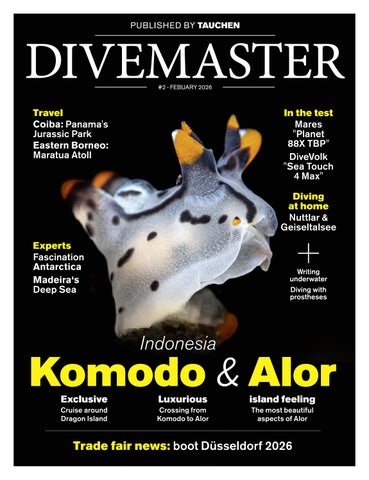
The cover photo was taken by Tobias Friedrich and shows a nudibranch (Thecacera picta) photographed off Raja Ampat/ Indonesia.
Did you know that TAUCHEN is also available in the digital world? This includes our social media channels Facebook and Instagram as well as our website and our YouTube channel. And on our podcast channel there is „something to listen to“. Just drop by and listen. Just follow the links below. Do you want to read TAUCHEN digitally? Then download our TAUCHEN app for iOS and Android onto your end device. We look forward to hearing from you.
CONTACT & MORE DIVING EDITORIAL TEAM
YEAR Artopé Media GmbH & Co. KG Bajuwarenring 9, 82041 Oberhaching Tel. 089/5 52 41-0, Fax 089/5 52 41-244 E-mail: redaktion@tauchen.de DISPLAY
089/5 52 41-225 Email: sales@tauchen.de DIVING SUBSCRIPTION + ADDRESS CHANGES
Tel. 040/5555 7991, email: jam@dpv.de DIGITAL DIVING
www.tauchen.de/epaper
• Webseite: tauchen.de • Facebook: facebook.com/ tauchenmagazin • Instagram: instagram.com/ tauchen.magazin/ • Podcast: podcaster.de/podcasts#/ podcast/tauchen-talks • Youtube: TAUCHENDASMAGAZIN • TAUCHEN-App: Android & iOS
GALLERY
KNOW HOW! The following fascinating photographs "don't just happen by themselves" – they show what you can learn in a workshop. Anna Ewa Manzel: Dwarf goby on a sea squirt
Mike Otto: Dwarf seahorse
Dr Georg Nies: Neon star snail
GALLERY
Thomas Zumbrunnen: Mouthbrooder Dusky pinefish
Manfred Ebert: Leaf-sheep snail
Patrick Neumann: Juvenile batfish
Selective exposure and snooting, backlighting the subject with flashes or lamps, natural and artificial bokeh, panning shots, and photography with tubes or creative filters – all these techniques, which are currently popular in underwater photography, were used by the 16 participants at the workshop at the Solitude Resort in Lembeh. Supported by Patrik Neumann, Anna Ewa Manzel and Dr Georg Nies, these wonderful images were produced. Anyone interested in participating in such workshops can find further dates at solitude. world/solitude-lembeh-resort/ photography/ and uwf.de.
GALLERY
Holger Massmann: Dwarf squid
Thomas Zumbrunnen: hatching Flamboyantsquid
Dr Georg Nies: Anglerfish
Anna Ewa Manzel: Coral catfish
ANALYSER
ENOS
BOOSTER
SENSOREN
Höchste Qualität und Standards. Kompaktes Gerät zur Messung der Sauerstoffkonzentration
Sämtliche Booster sind für die Verwendungmit 100% Sauerstoff ausgelegt
Sicherheit für Taucher durch einzigartiges Rettungssystem. Immer im Blick durch Echtzeit-Tracking
Garantiert höchste Qualitätssicherung und kurze Lieferzeiten. Made in Germany
MADE IN GERMANY
NRC International GmbH Karlstrasse 21a 51702 Bergneustadt
Tel: +49 22 61 / 500 414 WhatsApp: +49 151 41834317 info@nrc-international.com
nrc-international.com
Magazine ° BOAT NEWS
THE WORLD TRADE FAIR INVITES YOU All "new divers" who obtained their diving licence in 2025 will receive a free ticket. The world's largest water sports fair presents this and much more.
STAGE PROGRAMME
One of the crowd pullers in the diving halls is the stage of the Dive Centre in Hall 12. Presenters Anna von Boetticher and Jan Schulte will be guiding visitors through the programme for nine days. Guests include renowned exhibitors and representatives of diving destinations and diving centres from all over the world. In addition to many well-known underwater photographers, visitors will also meet actor and environmental journalist Hannes Jaenicke and science journalist Dirk Steffens.
TRY IT OUT AND JOIN IN
At boot, the motto is once again: Give it a try! Many new divers have already been born during the daily Try Scuba programme at the Dive Centre. Young mermaids take their first strokes in the Try Mermaid programme. Try Freediving for beginners is also on the programme. Advanced divers (OWD/JOWD or equivalent or Freediver Level I/AIDA**) can get down to business in the almost five-metre-deep diving tower. In addition
UNDERWATER SHOWS IN THE DIVING TOWER
Those who prefer not to get wet can watch the action from outside the glass diving tower: The competitive athletes of the VDST will play a few games of underwater rugby, the German Armed Forces' navy divers will give a live demonstration of combat swimmers and helmet divers, professional mermaids will thrill children and adults alike, and the German Red Cross will be on hand with an underwater rescue robot. The divers of the Baltic Sea Heritage Rescue Project led by Sabine Kerkau will be drawing attention to the issue of ghost nets in the Baltic Sea. Divers from GUE (Global Underwater Explorers) will also be on display in the diving tower.
BOOT DIVE AWARD 2026 POWERED BY BAUER COMPRESSORS
The boot dive award will also be presented again. The boot initiative for a strong and sustainable diving industry is now in its fourth year and has become a fixture in the trade fair calendar. Five winners will receive the boot dive award. There are three nominees in each of the five categories: Personality, Product, Climate, Innovation and Destination. The nominees in the Personality category are Antonio Cressi, Dr Angela Ziltener and Dieter Heinz; in the Product category, the Mares Planet 88X TBP regulator, the Garmin Descent S1 communication buoy and Halcyon with the Symbios Trisense Gas Analyser. Nominated in the Innovation category are NautiTrack, the Hydros Pro 2 Weight Pocket System from Scubapro and the SeaLink Under-
water Smartphone Data Transmitter from Divevolk. Curaçao, French Polynesia and Omnisub Elba are in the running as destinations. Nominated in the Climate category are Aquatil - Underwater education & research, actor Hannes Jaenicke and Angel Shark Project. With the boot dive award, boot Düsseldorf continues to position itself as a close partner of the diving industry and promotes cooperation, networking and development. The winners will be honoured on the evening of 23 January 2026.
TICKET SHOP FOR BOOT 2026 NOW OPEN – FREE ADMISSION FOR DIVING BEGINNERS
The busy phase of the trade fair began with the opening of the ticket shop in September. The cheapest way to enjoy the trade fair to the fullest is to purchase a ticket for www.boot.club-Mitglieder (free membership and access to the boot.club lounges in Halls 7 and 13 with free Wi-Fi included): it costs only €19 for two days of trade fair experience. Children under the age of 13 continue to visit boot Düsseldorf free of charge, while older teenagers pay €14. Tickets are available here: www.boot.de/1130. In addition, boot places a special focus on supporting young sailors and diving beginners. Last year, new recreational boat licence holders received a free day ticket to the trade fair upon presentation of their licence (issued by the German Motor Yacht Association (DMYV) or the German Sailing Association (DSV)). Starting this year, beginner divers can also enjoy this benefit. Anyone who has passed their exam this year at iac, PADI, SSI or the Association of German Sport Divers (VDST) can look forward to free admission and a visit to their boot diving centre. www.boot.de
Photos: Organiser
b
oot Düsseldorf will open its doors from 17 to 25 January 2026 and has been thrilling water sports enthusiasts of all disciplines for more than 50 years. International diving will be showcasing its full diversity in Halls 11 and 12. Visitors to the Dive Centre in Hall 12 can look forward to a high-quality stage programme centred around the diving tower. The diving programme in the almost five-metre-deep diving tower and the shallower taster diving pool is one of the crowd pullers at the world's largest water sports fair. Whether you take part yourself or watch the divers from outside – both are great fun.
to the popular Fun Dive, there are various workshops such as diving with the SUEX Scooter and with full-face masks from OceanReef. A new trend with a special aesthetic is the combination of freediving and underwater dance: Dance'n Depth. Those who prefer classic freediving are in good hands in the freediving workshops with Nik Linder. All handson activities are free of charge for trade fair visitors and can be booked on site or in advance at www.boot.de.
WE LOOK FORWARD TO SEEING YOU!
We will once again be exhibiting at this year's boot trade fair in Düsseldorf. Small but mighty – as always with trade fair offers and, this year, with a few special promotions: Michael Ley (Michels Imbärium) will be showing his comics and live action on 17/18 and 24/25 January and revealing how his comics are created and from what "depths" he draws his ideas. Our second guest is no less interesting: Gerhard Wegner (Ocean Heroes & former Sharkproject President) will be signing copies of his book "Hailights" on 18 January. This book and the book "Tiefenschärfe" by Kurt Amsler and Jürgen Gangoly are available free of charge to all new subscribers. We look forward to seeing you! We will also keep you up to date with the latest news and developments in the diving industry on our social media channels and our website. www.tauchen.de//Hall 12 / J36
Hall 12 / B35
GROUP TRIPS TO THE S WITH ABSOLUT SCUBA
Absolut Scuba will be presenting its new portfolio of guided group tours for 2026 and 2027 at boot 2026. The focus is on extraordinary diving experiences, encounters with large marine animals and innovative travel formats that combine adventure, nature and personal development. Highlights include: Egypt – diving/snorkelling, meditating, transforming with Susanne Rossbach, Baja California – Orcas, whale sharks & sea lions with Joe Graham, Madagascar – Diving and experiencing the sea with Kevin Heser, Kalimantan – Expedition off the beaten track with Nadine Dubois, Silver Banks – Humpback whale adventure with Joe Graham, Egypt – Exclusive diving cruise to the 2027 solar eclipse. Visitors to boot 2026 can find out more about all the trips, concepts and dates in person. www.as-tauchreisen.de
Abyssmarine, founded in 2025 by Étienne Mackensen, has secured exclusive distribution rights for Dive System, Ratio, Pandora Lab and DiverTug in Germany, Austria and Switzerland. At boot Düsseldorf, the team presents new products such as the particularly bright and robust Pandora Lab rescue lamp for emergencies at sea. Abyssmarine sets new standards in the distribution of diving equipment in the region. www.abyssmarine.eu
AQUA ACTIVE AGENCY – DIVE, DREAM, SECURE BENEFITS
Aqua Active Agency will be represented at boot Düsseldorf again this year, offering personal advice on diving trips and safaris worldwide. Partners Horizon III and Dive into Lembeh & Raja Ampat will be presenting themselves at the stand. Visitors can also expect a booklet full of trade fair discounts, a competition and a warm welcome with beer or sparkling wine. The team looks forward to seeing familiar faces and meeting new people. Scan the QR code to go directly to the offer at www.aquaactive.de.
VISIT US AT BOOT IN DÜSSELDORF!
You will find us in Hall 12, Stand H54, where our trade fair team will advise you on the services and advantages of the dive card. A diving doctor will also be available at the stand on both weekends to answer your medical questions. To mark our 25th anniversary, we have prepared a special surprise for all aqua med customers, and new customers/newbies will receive a dive card trade fair discount. It's worth stopping by! We look forward to seeing you and to a great boot 2026. www.aqua-med.eu
Hall 12A / 31.24
ABYSSMARINE – EVERYTHING FROM A SINGLE SOURCE
Hall 11 / K56
Hall 12 / H54
Hall 12/B05
PSS WITH NEW PROGRAMMES
PSS has been considered the benchmark in diving training for years – in 2026, we will take the next step. Our online system, which is already the market leader, will be further expanded with new IT functions and services for instructors. Dutch, Polish and Japanese have already been added as languages; other versions that are still missing – including Mandarin – will follow. www.worldwide.com
FREE ENTRY TO BOOT 2026 WITH YOUR DIVING LICENCE
Secure your free ticket now and immerse yourself in a world full of adventure. Become part of the international water sports community! How do I get a free ticket? The following groups of people are eligible to receive a free ticket for boot 2026: Holders of a certificate issued in the calendar year 2025: 1-star diver // Open Water Diver (OWD) // Freediver (1 star). Simply register online at the boot ticket shop and show your diving certificate at the ticket office during boot 2026 (17-25 January 2026). With the "Free admission to boot with your diving licence" promotion, boot Düsseldorf would like to thank everyone who obtained their diving licence in 2025. Together with the associations of the Diving Industry Association (IAC, PADI, SSI, VDST) and the exhibiting associations at boot 2026, newcomers to diving will receive a free one-day ticket to the trade fair.
Magazine ° BOAT NEWS Hall 12 / E32
BELUGA & PARTNERS
Beluga Reisen will once again be represented at boot Düsseldorf in 2026. We look forward to seeing you there, along with numerous international partners from Palau to French Polynesia to Condor Airlines and many other destination experts from around the world – and, of course, the entire Beluga team. With brand new destinations such as Mozambique, Madagascar and PapuaNew Guinea, as well as exclusive trade fair specials, we will be presenting our expanded programme live in our app. Come and visit us! www.belugareisen.de
Hall 12 / A69
WATERSPORTS – MANY BRANDS UNDER ONE ROOF
Hall 12 / A19
DIVESYSTEM & RATIO: NEW PRODUCT LINE
Dive System and Ratio are expanding their distribution channels and opening a new branch near Cologne, which will serve Germany and the D-A-CH region in future. A new product line has been developed exclusively for specialist diving shops. This line will be premiered at the boot trade fair in Düsseldorf. This will strengthen both brands' presence and service for dealers and customers in Germany, Austria and Switzerland. www. divesystem.com
Hall 12 / A69
WIN & NETWORK
At boot 2026, HEAD Watersports will once again be showcasing exciting innovations for divers with its Apeks, Aqualung and Mares brands: Mares will be presenting the Planet 88X TBP, the first regulator with a pneumatic second stage. It will also be showcasing the robust XR Plura dry suit and the powerful Avanti Quattro 4X fin. Apeks will be presenting a new sidemount system that offers maximum adjustability, comfort and reliability. All products set new standards in terms of performance, safety and underwater comfort. www.mares.com Hall 12 / A39 + A49
TWICE THE FUN IN THE PHILIPPINES WITH MAGIC RESORTS
Discover at boot why the two boutique dive resorts on Cebu and Bohol are the perfect destination for your tropical diving holiday. Experience schools of sardines and Pescador Island in Moalboal or healthy reefs and rare critters in Anda. Visit us in Hall 12 (A35/A49). There will be trade fair offers and information about the TAUCHEN reader trip in August 2026. www.magicresorts.online
With its official launch in January 2026, Scubago, the new global portal for worldwide diving offers and reservations, will be presented at boot 2026. One highlight is the wheel of fortune with great instant prizes and the daily chance to win these main prizes:
The prize draw takes place daily at 4.30 p.m. at the stand. www.scubago.com
Hall 12 / F42 Hall 12 / E51
3 IN ONE
Sun+Fun, Sub Aqua and Nautilus will once again be presenting themselves together under one roof at boot 2026. Covering an area of almost 100 square metres, they will not only be offering professional advice on travel destinations. The popular Cuba Libre Bar will also be providing the right travel atmosphere. Destinations represented at the stand: Maldives, Egypt and Indonesia – Emperor Fleet; Maldives – DivePoint; Indonesia – Kubu Indah, Mangga Lodge & South Sulawesi Dive Centre; Kenya – Temple Point; Bonaire – Captain Don's Habitat. New destination for 2026: Philippines – Ticao. www. sunandfun.com
EGYPT SPECIALISTS
Volkert Dive Centre is a German-speaking dive centre in Safaga on the Red Sea. We have been welcoming our guests in a family atmosphere for over 40 years. Enjoy relaxing days on our day boat with two to three dives, complete SSI courses or explore our diverse house reef. Book your next diving trip to Egypt now as a complete package (flight, hotel, direct transfer and diving) or visit us at boot Düsseldorf. www.volkert-touristik.de Photos: Organiser
• 1 week Egypt liveaboard from LiveAboard.com, www.liveaboard. com • 1-week diving safari in Egypt from Extra Divers, www.extradivers-worldwide.com • 1-year insurance from Dive Assure, www. diveassure.com • 1 regulator & 1 dive computer each from Mares, www.mares.com • 1 regulator & 1 dive computer each from Aqualung, www.aqualung.com • 1 week at Camel Dive Club including diving package, www.cameldive.com
Hall 12 / J50
SCUBA NATIVE GOES "WILD WILD EAST"
We will be back again in 2026 with fresh ideas, familiar faces and a special focus on Indonesia's wild east. Komodo & Alor combine currents, big fish, manta rays and unspoilt island worlds – a unique mix that we have been tailoring individually for our guests since 2017. Also joining us are Pulisan Resort from North Sulawesi and Papua Explorers from Raja Ampat. Look forward to new ideas and inspiring conversations. www.scuba-native.de
Hall 12 / E49
INNOVATIVE + NEW PRODUCTS Hall 12 / E21
GENERATIONAL CHANGE AT DRY SUITS
Camaro presents the new generation of Dry Diving dry suits at the boot trade fair. Modern design, flexible three-layer stretch laminate and optimised details ensure maximum comfort and freedom of movement. Over 50 sizes, free partial measurements and custom-made suits in Austria guarantee a perfect fit. The three-year free repair service is unique. Experience Camaro's innovation, fit and service live at the trade fair and have your measurements taken on site. www. camaro.at
Scubapro will be presenting exciting new and innovative products as well as core equipment at boot 2026. Visitors will be able to see and try out the new Hydros Pro 2, which has been nominated for the boot dive Award 2026 in the Innovation category. Its modular design, high-quality materials and travelfriendliness make the Hydros Pro 2 the ultimate buoyancy compensator for all conditions. Also on display will be a new UPF rashguard collection, a new regulator combination and new masks. Visit the Scubapro stand, see the extensive range of new and proven core products, and meet the team to exchange ideas. www.scubapro.com
Hall 12 / E31
GREATER SUSTAINABILITY Hall 12 / A49
EXCLUSIVE AND EXCEPTIONALLY
Whether it's orcas, tiger sharks or humpback whales: the Big Animal Season 2026/2027 marks the next level at Wirodive. What used to be a matter of chance is now an expedition craft: trips carefully put together by the experienced Wiro team and accompanied by professionals such as Robert, Marcus or Georg, who are on the move where extraordinary experiences begin. After its 30th anniversary, Wirodive is not slowing down – on the contrary! With Fiji & Tonga 2027, the tour operator combines iconic shark experiences with emotional whale encounters. The future of diving begins where adventure is part of everyday life. www.wirodive.de
Hall 12 / A31.16
BEAUTIFUL DIVING BACK AGAIN!
After a five-year absence, the diving travel specialist is back with a small stand at the taucher.net stand at the boot trade fair. Schöner Tauchen offers expert advice and trade fair offers from diving resorts and cruise ships from all over the world. The office in Bremen will also be staffed throughout the trade fair, so that binding travel offers can be prepared quickly. www.schoener-tauchen.de
Fourth Element presents two highlights at boot 2026: the Xenos ARC, the first diving suit made from Ocena natural rubber, which surpasses neoprene in terms of sustainability, comfort and performance. It will also be showcasing the Arctic X undersuit, the next generation of the Arctic. With new recycled outer material, X-Core panels and an optimised fit, the Arctic X offers more warmth, functionality and durability than ever before. www.fourthelement.com
Hall 12 / H49
WE CELEBRATE WITH YOU
The Orca Dive Clubs will be back at boot Düsseldorf in 2026 and look forward to meeting acquaintances, friends and partners. Daily raffles, attractive anniversary offers, exciting news about the Orca bases and safaris with the Alia Soul await you at the stand – and, of course, many surprises in this anniversary year! "Let's celebrate 35 years of passion for diving together – with the people who made Orca great: you! On Monday, 19 January 2026, we will toast 35 years of Orca Dive Clubs with you at our stand." www.orca-diveclubs.com
Hall 12 / A31.4
DIVING.DE – TWO NEW INDONESIA BASES
diving.de is expanding its activities in Indonesia and will be offering two new destinations from spring 2026: a new diving centre in Bira in South Sulawesi and another on the Gili Islands. You can already win dives at these and other diving.de centres at the popular roulette game "Dives" at the diving.de stand at the 2026 boot trade fair. www.diving.de
Magazine ° BOAT NEWS
INDONESIA EXPERIENCE Do you dream of white beaches, turquoise waters and unforgettable adventures above and below the sea? Then visit the Indonesia Pavilion at boot 2026 in Düsseldorf and be inspired by all the providers united under one roof!
ADELAAR
ALAM BATU
In the northeast of Bali, the Alam Batu Beach Bungalow Resort offers everything divers could wish for: nearby coral and sand diving sites, an 800-metre-long house reef and fast boats that can reach all dive spots in 20 minutes. The small resort for 30 guests offers comfortable bungalows, a modern diving centre with a camera room and PADI courses from Open Water to Divemaster. alam-batu.com
ALOR TANAPI
D'LAGOON
ARUNA FLEET
ECOPRODIVERS
Alor offers an unspoilt diving experience far away from mass tourism. The Alor Tanapi Dive Resort, with six sea-view bungalows, guarantees a personal atmosphere and access to spectacular reefs. Steep walls, coral gardens, lava sand and rare critters await. After diving: relax, enjoy, watch the sunsets. Boot offer: ten per cent discount on diving packages. alortanapi.com
Discover Aruna Odyssey and Aruna Voyager – safari ships in Indonesia and Thailand. The Voyager has been exploring the Andaman Sea since 2021, while the Odyssey has been visiting Indonesia's top spots such as Alor, Banda Arc, Komodo and Raja Ampat since 2025. Luxury, comfort, spa, stylish lounges and excellent service for only 20 guests. Meet us at boot 2026 and discover the Aruna Fleet. arunafleet.com
In the heart of the Coral Triangle on the Lembeh Strait lies D'Lagoon Dive Resort – an exclusive hideaway with five sea view and two garden villas for only 14 guests. Modern 50 m² villas offer comfort and style. Experience the Mecca of muck diving with experienced guides and discover unique critters. After diving, relax in tropical tranquillity with a sea view. dlagoon.com
The liveaboard Ilike sails to top spots such as Raja Ampat, Komodo, Banda Sea, Alor, Maluku, Triton Bay and Halmahera. With room for 16 divers and 16 crew members, guests experience the traditional Phinisi atmosphere. The EcoPro Duyung Baru in Komodo National Park offers diving for eight guests, snorkelling and shore excursions. Visit us at boot 2026 in the Indonesia Pavilion! ecoprodivers.com
Photos: Resorts, shutterstock.com
Welcome aboard the 120-year-old Dutch schooner. With four cabins and a master suite, it is ideal for small groups. Discover Raja Ampat, Komodo, Alor, Triton Bay and Banda Sea in 2026. Diving, snorkelling, relaxation, gourmet cuisine and five-star service. Exclusive charter available. Exclusive trade fair special offers will be available during the boot trade fair. adelaar-cruises.com
MARI LIVEABOARD
The 34-metre Mari, a traditional phinisi sailing vessel made of ironwood, offers diving adventures in Indonesia from Raja Ampat to Triton Bay and the Banda Sea to Komodo. Accommodating 14 guests in seven cabins, it offers comfort, a family atmosphere, lounge areas, sun decks and local cuisine. Experience manta rays, sharks and colourful reefs. Attractive Mari specials await you at boot 2026. maridivecruises.com
SARONDE ISLAND & SUNSHINE
TOMPOTIKA DIVE LODGE
sarondeisland.com & sunshineliveaboard.com
Experience magnificent reefs, critters and marine conservation at Tompotika Dive Lodge, run by Wallacea Dive Cruises. The only resort in the region offers 30 dive sites, small groups and five bungalows for ten guests. Top reefs and macro highlights await. Every dive supports a marine conservation area. At boot 2026, there is a 20 per cent discount on diving packages. divingsulawesi-tompotika.com
RAJA4DIVERS
SAVU SOUTH ALOR
VIFA HOLIDAY INDONESIA
SAMAMBAIA LIVEABOARD
SELAYAR DIVE RESORT
Pulau Pef in Raja Ampat is a natural paradise. Raja4Divers offers access to over 60 dive sites with barracudas, pygmy seahorses, wobbegongs and epaulette sharks. Snorkellers can enjoy a house reef with turtles and reef sharks. The island offers lagoons, bays and jungle. Under Swiss management, eleven stylish water bungalows with sunset views await. raja4divers.com
The Samambaia, a phinisi wooden ship for only 14 guests, has been offering exclusive diving safaris in Indonesia since 2015. Seven stylish cabins, including a master cabin with a 180° sea view, ensure comfort. A 22-strong crew, international cuisine and a sun deck invite you to enjoy yourself. Discover Raja Ampat, Banda Sea, Alor and Komodo in small groups! samambaia-liveaboard.com
Blue Bay Divers is opening a new paradise on Saronde Island/Gorontalo – for photographers, families and relaxed diving. Private beach and garden villas invite you to enjoy yourself. The KLM Sunshine travels to Halmahera, Sangihe and new routes such as Lembeh – Gorontalo and Bangka – Saronde with secluded bays, spectacular dive sites and an expedition feeling.
Savu is a small boutique resort on Alor with just seven bungalows – ideal for those seeking peace and quiet and nature lovers. Five beach cottages are located on the white sandy beach, while two cliff villas offer spectacular views of Savu Lake and a paddling pool. Sustainably operated, Savu spoils its guests with fresh cuisine. Untouched reefs, steep walls and caves await experienced divers and snorkellers. savusouthalor.com
In Selayar National Park, you can expect unspoilt nature, a barefoot feeling and a breathtaking underwater world with healthy reefs and large fish. At boot 2026, we are offering a ten per cent discount on resort stays and diving. Visit us at the trade fair or write to info@selayar-dive-resort.de. We look forward to introducing you to Selayar Dive Resort. selayar-dive-resort.com
Vifa Holiday Indonesia has been making travel planning easy since 2005 – despite complex flight routes and surprises. We combine flights, transfers, hotels and diving schedules to create seamless trips and solve problems such as delays or lost luggage. With clear administration, insider knowledge and 20 years of experience, we support agencies and travellers. Travel planning made easy. vifaholidayindonesia.com
INDONESIA PAVILION Everything under one roof: For the second time, selected resorts, tour operators and liveaboard providers are presenting themselves under one roof at the boot trade fair. The "Indonesian Pavilion" can be found in Hall 11/K55.
MAGAZINES MORE SPACE, MORE CHOICE, MORE DIVING
Why come to the Mirko Diving centre on the island of Rab in Croatia? It's simple: Rab is known as the island of love – perhaps you too will fall in love with this Adriatic island. Enjoy a stress-free holiday in a family atmosphere with plenty of time for yourself. Everything moves a little slower on Rab – perfect for really switching off and finding peace. The Mediterranean Sea surrounding the island is clean, crystal clear and offers excellent visibility – ideal conditions for unforgettable dives. The season begins in April, but with the right equipment, you can also dive in winter. In addition to attractive prices, there are family and group discounts of up to 20 per cent. mirkodivingcentre.com
NATURALCOSMETICS
Li Lé blue – skincare that works with the ocean, not against it. "Our skincare products are specifically developed for the needs of water sports enthusiasts: salt water, sun and wind put strain on skin and hair, and we give back what the sea takes away. With natural active ingredients and consistent marine-conscious standards, Li Lé Blue products protect and regenerate without harming the fragile ecosystems of our oceans. For everyone who loves the water." liliblue.com
COMBINED TRIP TO PAPUA NEW GUINEA & SOLOMON ISLANDS
For anyone planning something special in 2027: Reisecenter Federsee's group tour in May 2027 combines two dream destinations in the Pacific. Participants will spend eight nights in Papua New Guinea at the Tawali Resort in Milne Bay, a small hideaway surrounded by unspoilt nature. This will be followed by a ten-day diving safari on the Emperor Bilikiki. The ship has been sailing in the Solomon Islands for many years and, at 40 metres in length with ten cabins, offers a relaxed atmosphere. The Solomon Islands are among the least dived regions in the Pacific: there are spectacular coral gardens, a great variety of fish and hardly any other divers. Dates: 10 to 29 May 2027, from €9,885 per person. reisecenter-federsee.de
PHILIPPINES SPECIAL TRIP FOR TAUCHEN READERS 2026
Together with Magic Oceans Resort, TAUCHEN is inviting readers to an exclusive trip to Bohol from 29 July to 8 August 2026. In addition to ten dives at the house reef and spectacular boat trips, participants can look forward to special highlights: a chocolate tour, a Filipino cooking class and a sightseeing tour including the tarsier sanctuary, Loboc River and Chocolate Hills. The idyllic resort with a pool, restaurant and comfortable cottages offers the best conditions for divers, families and those seeking peace and quiet. Prices: €1,965 for divers, €1,785 for non-divers, children from €350. Flights from €1,100. Minimum number of participants: 16. Information & booking: redaktion@tauchen.de, Keyword "MagicOceans".
10 PER CENT DISCOUNT AT IN MARATUA ATOLL
Extra Divers Worldwide is offering an attractive deal for 2026 for the paradise Maratua resorts Nabucco, Nunukan and Virgin Cocoa. Guests booking for 2026 will receive a ten percent discount on accommodation and diving packages. The three island resorts are located in the remote Maratua Atoll, known for its intact reefs and large fish. Just a few minutes' drive from Nabucco is the Big Fish Country channel, where various species of sharks, tuna, eagle rays, mackerel and a huge school of barracuda can be seen. Another highlight is Jellyfish Lake on Kakaban Island, home to non-stinging jellyfish. Around Kakaban, spectacular steep walls attract turtles, thresher sharks and eagle rays. The ten per cent discount applies to new bookings made between 17 January and 10 February 2026 and offers the perfect opportunity to discover the extraordinary underwater world of Maratua Atoll. Information and booking via your diving tour operator and extradivers-worldwide.com
Photos: Organiser
ADRIA DIVING OFF ON THE ISLAND OF RAB
In 2015, Friedrich Schäuble founded the Hochrhein diving school with the vision of establishing professional diving in the Upper Rhine region. It quickly became a regional meeting place with a strong community. In 2025, moved to larger, modern premises in the centre of Hohentengen. There, the school now offers more space, an expanded range of services and a true centre of excellence for training, advice and diving. diving-school-high-rhine.co.uk
NEU
HYDROS PRO 2 JACKET STREBE NACH PERFEKTION
ROBUSTER SCHNELLTROCKNENDER BLASENBEHÄLTER
VERBESSERTE KONTROLLE
Monorail-Gewichtssystem
scubapro.com
TRAVEL ° PANAMA
COIBA – WILD DIVING IN THE PACIFIC Wild, unpredictable and full of big fish moments: anyone with a bit of adventurous spirit will be rewarded with extremely diverse "Pacific diving". T & F Jan Finsterbusch
TRAVEL ° PANAMA
Bocas del Toro
Panama City Panama Canal
Boquete
W
hilewell-known hotspots such as the Maldives, Raja Ampat and Egypt are firmly anchored in divers' minds, other destinations lead a shadowy existence. One of these is Panama. Not because of tropical beaches or Caribbean clichés, but because of a place that is one of the most pristine diving areas in the Pacific: Coiba. A national park since 2001 and a World Heritage Site since 2005, the archipelago remained virtually untouched for decades. The reason: the main island served as a penal colony. Overfishing, tourism, infrastructure – none of these things existed here. A blessing for the underwater world.
Departure for Santa Catalina The journey begins in Panama City. From there, it's just under 400 kilometres west to Santa Catalina, the gateway to Coiba National Park. The small town has remained unspoilt. No huge hotels, no artificial amusement parks. Instead, there are surfers, divers, backpackers – and a relaxed serenity that is immediately contagious. We check into our room at the Hotel Santa Catalina and register at "Scuba Coiba", a Germanspeaking diving school. For us, it's a return visit. Our last visit was during the dry season. This time, we are deliberately travelling during the rainy season – exactly when the humpback whales and their calves rest in the warm waters. Full speed ahead into adventure The next morning, the speedboat thunders across the grey sea. The crew prepares our diving equipment while the first rain showers pass over us. Shortly afterwards, we slide over the side of the boat and dive into a world that can do anything: calm conditions or brutal currents, murky soup or crystal-clear 25-metre visibility. Coiba is unpredictable. And that's exactly what makes it so appealing. Whitetip reef sharks are among the reliable encounters. So are large schools of mackerel, mobulas, barracudas and countless species of mackerel. Everything moves, everything hunts, everything lives – Coiba breathes wilderness. >
DIVING CONDITIONS THROUGHOUT THE YEAR Coiba can be dived all year round, but it shows very different sides depending on the season. In the dry season from December to April, the sea and weather are much more stable. Visibility often ranges from ten to 25 metres or more, and the currents are usually more moderate. During this phase, there is a good chance of encountering hammerhead sharks – especially at the Contreras – as well as large schools of mackerel, barracuda and jacks. Encounters with giant manta rays are also possible, and overall, the underwater world is clearer and more predictable.
During the rainy season from May to November, conditions are harsher and more pristine. Regular showers, stronger currents and visibility between five and 15 metres characterise diving. At the same time, the sea is teeming with life: the nutrient-rich water attracts large shoals and pelagic predators, and the plankton bloom provides excellent opportunities to see giant manta rays. These months are also the best time to observe humpback whales – especially female whales with their calves, which rest in the warm waters. Bull sharks are also particularly common during this period.
Water temperatures range between 25 and 29 degrees Celsius all year round, but can drop unexpectedly to 22 degrees Celsius in cold thermoclines. Visibility can vary greatly within a single dive – typical of the dynamic Pacific conditions. Whitetip sharks, eagle rays, mobulas, Napoleon wrasse and impressive schools of fish are almost always part of the repertoire. Those who dive in Coiba should therefore be flexible and enjoy unpredictable, nutrient-rich conditions. They will be rewarded with one of the wildest and most productive underwater worlds in the eastern Pacific.
TRAVEL ° PANAMA bulls – sometimes close, sometimes far away. Underwater, we only experience them acoustically. But their song is omnipresent. Depending on the dive site, it sounds like a deep rumbling from afar or a vibrating call directly behind the nearest rocky outcrop. It makes you forget about your air consumption and gives you goose bumps under your wetsuit. While we have no luck snorkelling, the second boat hits the jackpot: a whale cow swims with her calf close under its keel.
The Contreras – where hammerhead sharks circle The first dives take us to the Contreras, two striking underwater mountains. Although visibility is poor at first, the first shadows await us in the depths: individual hammerhead sharks. No huge schools like off Cocos or the Galapagos – instead, intimate encounters, often lasting only a few breaths. As we ascend, we experience a wow moment: a massive school of mackerel sweeps over the pinnacle like a metallic storm front. Seconds later, we are right in the middle of it. Sounds fall silent, only the clicking of cameras remains. Life below and above the water surface Coiba is more than just a diving spot. It is an ecosystem that rarely exists in this form anymore. Pacific guitarfish lie camouflaged in the sand, electric rays drift stoically by, harlequin shrimp and longnose hawkfish enrich the macro spectrum. But who sets up a macro setup off Coiba when a big fish can appear out of nowhere at any time? Above water, too, this Pacific island is wild: howler monkeys announce the next rain shower, saltwater crocodiles lurk in mangroves, and bird species populate the treetops. Coiba's punitive colonial past has protected it – and today, divers reap the benefits.
Coiba also promises exciting encounters underwater. Giant manta rays and stoic guitarfish are waiting to be admired.
Songs of the Giants Whales accompany us on our trips almost every day. Female whales, calves, individual
From silence to spectacle A dive near Catalina once again demonstrates the drama of Coiba. For 20 minutes, nothing happens. No fish, no shadows. We are already beginning to doubt the spot – until suddenly a gigantic school of mackerel rushes past us. For 15 minutes, we are surrounded by silvery bodies. Coiba delivers. Always. And then comes the moment that divers talk about for the rest of their lives: a curious giant manta ray appears, disappears into the plankton and returns again and again. It circles us, plays with our air bubbles and finally glides right through the middle of our group. You can't help but wonder: who is observing whom here? As the season ends, we move on to Bocas del Toro. Calmer, shallower, more macrooriented – a pleasant end to the intense days in the Pacific. The mountain road there is quite something: Panama also has a wild heart above water. Conclusion The Coiba archipelago in the Pacific is not for divers who only like to take it easy. Currents, visibility fluctuations and unpredictable weather are part of everyday life here. But those who bring experience, curiosity and a thirst for adventure will be richly rewarded. Coiba is like a partner: sometimes moody, sometimes exhausting, often unpredictable – but always exciting, endearing and, above all, breathtakingly beautiful.
Augen
alten:
offen h
LS PECIA boot S CF mit
INFORMATION: SANTA CATALINA & COIBA / PANAMA / PACIFIC OCEAN Most international travellers fly into Tocumen International Airport (PTY) in Panama City. The best way to continue your journey to Santa Catalina, the starting point for diving tours to Coiba, is by shuttle/private transfer. Santa Catalina itself is a quiet, relaxed village with few but good accommodation options – from simple guesthouses to comfortable beach hotels. Speedboats to Coiba Island depart from here. The crossing takes between 60 and 90 minutes, depending on the sea conditions. Diving off Isla Coiba begins early in the morning at one of the diving centres in Santa Catalina, where equipment is checked, parking fees are paid and the day's schedule is discussed. Then it's off to the national park by speedboat, a journey of around 60 to 90 minutes – depending on the weather, it can be a calm or very rough ride, often accompanied by dolphins or whales. Once there, the crew prepares the equipment while a briefing is given on currents, visibility and the chances of seeing large fish. Diving usually takes place directly from the edge of the boat, often in areas with strong currents and visibility that can vary greatly during a single dive. Between dives, the boat stops at one of the unspoilt islands for a break with fruit and snacks before a second or third dive follows. In the early afternoon, the boat returns to Santa Catalina, where the equipment is rinsed and the day of diving comes to a relaxed end. Diving off Coiba is rough, pristine and unpredictable – and that's exactly why it's one of the most impressive wilderness experiences in the Eastern Pacific.
Santa Catalina Hotel
Hotel RIU Plaza; Santa Catalina: 12 nights bed and breakfast at the Hotel Santa Catalina; 16 boat dives on 8 diving days; Panama City (old town): bed and breakfast at the Central Hotel; all transfers included; from €3,589 per person; plus entrance fees to Coiba National Park. OPTION 2 – COMBINATION: DIVING, HIGH MOUNTAINS & BOCAS DEL TORO Flight: from Frankfurt to Panama City Itinerary: Bed and breakfast at Hotel RIU Plaza; Santa Catalina: 7 nights bed and breakfast at Hotel Santa Catalina; 10 boat dives on five diving days; Boquete (highlands): 3 nights bed and breakfast at Bambuda Castle; Bocas del Toro: 4 nights bed and breakfast at Bambuda Bocas Town; Panama City (old town): bed and breakfast at the Central Hotel; all transfers and domestic flight from Bocas del Toro to Panama City included; from €3,293 per person, plus entrance fees to Coiba National Park. Bookable via: Nautilus Diving Trips www.nautilus-tauchreisen.de Tel.: 089/2080 761 70
COMBINED TOURS OPTION 1 – DIVING ONLY: SANTA CATALINA & COIBA Flight: from Frankfurt to Panama City Itinerary: Panama City: bed and breakfast at the
bei R atten en Rab iv t k a r att nen. spiratio und In nserer s auf u Alle Info e it s Web
Die südlichste Tauchbasis Ägyptens! EXTRA DIVERS LAHAMI BAY &
LAHAMI BAY BEACH RESORT Ab April 2026: das Rückzugsparadies fernab vom Alltag. Natur, Komfort und eindrucksvolle Unterwasserwelten in perfekter Harmonie. Idyllisch in einer geschützten Strandbucht gelegen – mit Hausriff direkt vor der Basis und Ausfahrten zu den schönsten Spots rund um Hamata und Berenice.
CARIBBEAN SEA
Map: shutterstock.com
Boquete
Santa Catalina
PACIFIC OCEAN WELTWEIT MEER ERLEBEN
reisen@reisecenter-federsee.de www.rcf-tauchreisen.de
rcftauchreisen
tauchreisen_rcf
TRAVEL ° INDONESIA T & F Barbara & Wolfgang Pölzer
MARATUAATOLL One atoll – three Extra Divers diving resorts. After Virgin Cocoa*, we now visit Nunukan and Nabucco. Diving business class at economy prices.
T
1000-metre hurdles Nunukan, its immediate neighbour, even has a direct land connection to Virgin Cocoa – via a wooden walkway almost a kilometre long! This can and may be used by both sides for visits. Rumour has it that some people also use it for regular jogging. However, most people are content with their island, and Nunukan Island, with its almost 400-metre-long sandy beach lined with coconut palms, is in no way inferior to its counterpart in terms of appearance. Speaking of beaches: the tides don't do what they want here. However, they are comparatively high in this part of Indonesia, with a difference of well over three metres. This means that at high tide you can swim right in front of your beach bungalow, and at low tide you can reach the neighbouring island with almost dry feet. Accordingly, it is hardly worth snorkelling in the huge lagoon. Swiss summit atoll But ultimately, we are here to dive. That's what Beat Waefler, the local base and resort manager, thought too. After more than 13 years, he knows the island like no other. "Without a boat, nothing is possible," the friendly Swiss man explains emphatically. "If you just jump off the diving platform
and paddle east, you won't reach land for another 700 kilometres – the northern tip of Sulawesi." And in between, you descend more than 5,000 metres into the Celebes Basin. Accordingly, we joke that the atoll we are sitting on is much higher than the Alps when viewed from the sea floor. The idea is not so far-fetched, because the closer the deep sea is to the coast, the higher the chance of catching big fish. Large tidal range – strong currents – nutrient-rich water: sounds good! So let's hop on the boat and get going. Less than two minutes to the left of the jetty: backroll entry. Along a more or less vertical cliff face, we follow our guide Novlin into the depths. Huge sponges, colour-
ful gorgonian fans ranging from yellow to orange to red, bushy soft corals, wide-open feather stars as far as the eye can see. As soon as we reach the 20-metre mark, the visibility almost doubles to around 30 metres. A huge school of batfish swimming frantically around, unreachably far below us, fusiliers, triggerfish and snappers right next to us. We drift leisurely on, almost as if in an oversized aquarium. A wide variety of reef fish wherever you look. Just as Novlin points out two whitish leaf fish under a small table coral, a squadron of three eagle rays passes about 20 metres above us. Far beyond a reasonable photo distance, all we can do is enjoy the elegantly moving silhouettes in the backlight before turn- >
*Virgin Cocoa (DIVING 09/2025)
hisdiving gem in the middle of the Celebes Sea between Kalimantan and Sulawesi is by no means reserved exclusively for wealthy five-star resort guests. With only minor compromises in terms of accommodation and cuisine, you can enjoy the same dives at the two sister resorts. Each of the three islands is different and has its own unique charm.
In the realm of diversity: whether large or small, fish, crab or turtle – the Indonesian atoll has it all! Additional highlights include the jellyfish lake on Kakaban and the big fish hotspot "Big Fish Country" right off Nabucco.
TRAVEL ° INDONESIA ing our attention to the nearby area. Especially in bays protected from the current, it is easy to relax and search for snails, shrimp and other creatures. But that's not all. Novlin's eagle eyes even spot a baby frogfish barely the size of a thumbnail and, on the reef top just before surfacing, a beautiful boxer crab.
plateau magic After a leisurely lunch break in the shade of the diving centre, we leave the jetty in the other direction. This makes sense for two reasons. Firstly, the current has changed, and secondly, the topography is slightly different. At a depth of around 30 metres,
the steep wall meets a sandy plateau that is clearly visible when visibility is good, sloping steeply into unreachable blue on the horizon. A few metres above the bottom, we scan the sandy area for anything unusual. This is where feathertail and mangrove stingrays feel at home, searching for food hidden in the sand. At the foot of the steep wall, in small overhangs or in the shadow of offshore blocks, whitetip reef sharks and sometimes their much more powerful relatives, the brown-spotted leopard sharks, like to sleep away the day. Of course, you always need a bit of luck to encounter large fish, but we can tick off both species of ray after just a few minutes. Instead of sleeping
sharks, however, this time we have to content ourselves with a small group of large barracudas, two turtles and a fleeting glimpse of a hammerhead shark in the distance. Brightly coloured small creatures such as nudibranchs, gobies and anthias sweeten our slow ascent back to the reef top.
spoilt for choice Although you can see pretty much everything the Celebes Sea has to offer at the kilometre-long house reef at the south-eastern tip of Maratua Atoll, Beat also offers Breathtakingly beautiful: drift diving along steep walls teeming with fish is just as thrilling as searching for brightly coloured macro creatures.
his guests day trips to the surrounding islands and the uninhabited neighbouring atoll, a good 15 kilometres to the south. This means currents, changing visibility, a good chance of encountering large fish – and, in any case, a wide range of species from pygmy seahorses to turtles. An absolute highlight and not to be missed is the famous jellyfish lake on Kakaban Island, about 20 kilometres off the coast of Kalimantan. Presumably cut off from the sea since the last ice age over 10,000 years ago, a fantastic commu- >
NUNUKAN ISLAND RESORT Established in: 2008 Diving: Even at the house reef, diving is always done from a boat and in small guided groups (maximum four divers per guide). In addition to eight dive sites at the house reef (one to three minutes by boat), another 20 sites can be reached within 20 to 70 minutes. In addition to individual trips, there are also half-day and full-day trips with up to three dives. On request, you can also dive independently in a buddy team. Night dives are available for two or more divers. Prices: A 10-dive package for boat diving at the house reef (including tank and weights) costs €447. Surcharge for more distant spots: from €25. Open Water Diver NUNUKAN course (including certification): €614. Location: at the southern end of Maratua Atoll, approximately 90 kilometres off the coast of Kalimantan/Borneo. Sustainability: Domestic and drinking water is produced on site. Free drinking water is available in rooms, the restaurant and the base. Plastic is avoided as much as possible. Growing our own vegetables is encouraged, and a brand new photovoltaic system is now in operation. Snorkelling: Almost all diving spots are also suitable for snorkelling. Private half-day or full-day snorkelling trips are available for groups of four or more people. Best diving time/season: Conditions are best from April to the end of December. Water temperatures range between 27 and 29 degrees Celsius. Visibility depends entirely on the current and varies between ten and 40 metres. The resort is closed in January and February. Accommodation: The cosy four-star resort has 22 beach bungalows for a maximum of 44 guests. Triple occupancy is also possible on request. All rooms are very spacious, generously equipped and feature air conditioning, fan, mosquito net, minibar, safe, large bathroom, shower with sea view, terrace with comfortable day bed and sun loungers on the beach. Relaxing massages are available on request. The resort also has its own camera room. Those who find diving and snorkelling not enough exercise can use the almost onekilometre-long jetty to the neighbouring island of Virgin Cocoa for jogging or burn off energy playing beach volleyball under the palm trees. Contact: www.nunukan-island.com, www.extradivers-worldwide.com
NABUCCO ISLAND RESORT
NABUCCO
Established in: 2002 Diving: Diving is always done from a boat and in small guided groups (maximum of five divers per guide). The nearest dive site is the highlight of the area (Big Fish Country) and only five minutes away by boat. In addition, another 20 dive spots can be reached within five to 20 minutes. In addition to individual trips, there are also half-day and full-day trips with up to three dives. Prices: A ten-session package for boat diving (including tank and weights) costs €533. Surcharge for day trips: €68. Open Water Diver course (including certification): €614. Location: in the centre of the Maratua Atoll, approximately 90 kilometres off the coast of Kalimantan/Borneo. Sustainability: We produce our own water for domestic use and drinking. Free drinking water is available in rooms, the restaurant and at the base. We avoid plastic as much as possible. We grow our own fruit and vegetables. Snorkelling: Almost all diving spots are also suitable for snorkelling. At high tide, you can also snorkel around the island. Best diving time/season: The best conditions (dry and little wind) prevail from July to September. November to March is the rainy season. However, you can dive all year round – with the exception of January and February, when the resort is closed. Water temperatures vary between 27 and 29 degrees Celsius. Visibility depends solely on the current and the tides and ranges between ten and 40 metres. Accommodation: This cosy three-star resort has 18 bungalows in three different categories (seven garden bungalows, nine seafront bungalows and two suites) for up to 36 guests. Triple occupancy is also possible on request. All rooms are generously equipped and feature air conditioning, fan, mosquito net, minibar, large bathroom with WC and terrace with sun loungers. The two extra-large suites also have a kettle/coffee machine and a hammock on the terrace. Additional comfort is provided by a private camera room, a sunset bar, the open-air restaurant, a cosy reading corner in the centre of the island and massages on request. A beach volleyball court is also available. Contact: www.nabuccos-resorts-indonesien.com and www.extradivers-worldwide.com
>
TRAVEL ° INDONESIA nity of countless jellyfish with virtually no predators has developed in this huge brackish water lake. What makes it special is that, contrary to their name, these cnidarians, which can grow to the size of a handball, are unable to penetrate human skin. Swimming carefree among vast numbers of jellyfish without a wetsuit or fins is a truly amazing experience! In addition, the shore areas attract visitors with their beautifully colourful mangrove roots and branches, where small fish, shrimp and colourful flatworms also thrive. However, the day trip to Kakaban has much more to offer. Steep walls and some of the strongest currents in the entire area promise not only huge schools of barracuda and trevally, but also the chance to see
hammerhead sharks and occasionally even thresher sharks.
Nabucco 1.0 We listen to Beats' explanations with tears in our eyes, but unfortunately we don't have enough time to try our luck there again. After all, we have to continue on to the origin, so to speak, the "birth island" of the now four Nabuccos resorts of Extra Divers in Indonesia. Just under 20 kilometres further north, well protected in the huge lagoon of the Maratua Atoll, lies a small islet that truly has it all! Covering just two hectares, a model diving resort with 18 bungalows is so skilfully nestled between pristine tropical forest, countless coconut palms and beautiful sandy bays, framed by pictu-
resque mangrove greenery and blooming orchid gardens, that it's hard to believe it's real. Built well over 20 years ago, it is still evident today that it was constructed in harmony with the island's vegetation. Somehow, this small island has a very special flair. You arrive and immediately feel at home. And although it is only marketed as a three-star resort, at least the two largest bungalows with private sea access are in no way inferior to the other two resorts in the Maratua Atoll in terms of spaciousness and comfort. Dara, a young, friendly Indonesian woman who has lived in Germany for many years, gives us a warm welcome and shows us around her island kingdom. As resort manager, she oversees the island's fortunes and looks after the well-being of the guests. The land fauna also clearly feels very much at home here. We are amazed when several kingfishers swoop through the air right in front of our bungalow, while a stately monitor lizard climbs a rock a few metres away. The personal highlight is finally a palm thief that we have been looking for for years. Behind this somewhat unfortunate name lies the world's largest land crab, which is not uncommon in Indonesia but is very difficult to spot due to its secretive life-
Adrenaline rush guaranteed: Nabucco's is where the action is! This is ensured by a flow channel with a gigantic school of barracudas, sharks and other large fish, and sometimes even love-struck octopuses.
DIVING.DE
Tauchreisen & Tauchsafaris
THE VISION
Small but beautiful: Original jungle vegetation gives the compact Barfußn island of Nabucco its special flair. Even palm thieves – the world's largest land crabs – feel at home here! The friendly Indonesian manager Dara Dwipaxia is your host on site.
style. This monstrous crustacean, which can grow up to 40 centimetres in length and weigh up to four kilograms, lives hidden in damp earthen burrows during the day and only emerges under the cover of darkness. Then, true to its name, it climbs high into the crowns of coconut palms to open a ripe nut on the spot and consume its contents. On our very first evening, the gardener actually discovers a huge specimen climbing a palm tree right before our eyes – a fantastic experience, at least in the eyes of a biologist!
Big Fish Country If you take a look at Maratua Atoll on Google Earth, you will see that not far from Nabucco, a deep blue channel stretches from the lagoon to the outer reef. And you don't need to be a clairvoyant to guess that strong currents are to be expected, especially at the mouth of the channel. "The best time is when
Musandam - der Geheimtipp im Oman • Walhai-Begegnungen • Makro-Hotspots • Weichkorallen
the water is flowing in," explains Alfonso, a veteran and very experienced dive guide, during the early morning briefing. After just five minutes by boat, we are there. Pleasantly warm water, good visibility – time to dive in quickly. Now it's time to kick hard with our fins to avoid being washed over the reef edge into the lagoon at a depth of 25 metres. Finally, we reach the steep wall at a depth of almost 30 metres and can hook next to Alfonso. Without reef hooks, this dive would not be possible. Now it's time to take a deep breath. Before us lies the open dark blue sea – impenetrable expanses down to the 5,000-metre deep-sea basin. The current pulls us along quite strongly, pushing vast amounts of fresh, clear water into the lagoon every second. Similar to the current channels in the Maldives, this also acts like a magnet for the fish world here. Now it's time to be patient and wait. After a few minutes, >
7 Nächte Tauchsafari The Vision ab/bis Dibba
ab 2.170,- € pro Person (zzgl. Flug nach Dubai)
Alle Termine & Preise und Info´s per QR-Code scannen www.aquaactive.de info@aquaactive.de +49 5507 - 919 818-0
TRAVEL ° INDONESIA NUNUKAN
TRAVEL INFORMATION MARATUA ATOLL Suit tip: Water temperatures fluctuate between 27 and 29 degrees throughout the year and due to currents – a three to five millimetre thick wetsuit is recommended. Getting there: The international destination airport is Jakarta. From there, take a domestic flight to Berau via Balikpapan or Surabaya. Here, you will be picked up not far from the airport by the resort's own transfer boat and taken to Nunukan in around three hours or to Nabucco in around three and a half hours. Transfers from Berau are always on Wednesdays and Saturdays. The two resorts are about ten nautical miles (around 18.5 kilometres) apart. Entry:Passport (valid for at least six months). Upon entry, you can obtain a 30-day tourist visa for just under €30. For the same price, but faster, you can apply for an electronic visa in advance in Europe: www.imigrasi.go.id/wna/ permohonan-visa-republik-indonesia
Organiser: Reisecenter Federsee, telephone 07582-932 07 90, www.rcf-tauchreisen.de Price example Nunukan (from the tour operator): 14 nights at Nunukan Island Resort in a beach bungalow with full board, flight from/ to Germany, for example with Qatar Airways to Jakarta, domestic flights and all transfers: from €3,749 per person. 10Package house reef diving (including tank, weights, guide and boat): €435. Price example Nabucco (from the tour operator): 14 nights at the Nabucco Island Resort in a garden bungalow with full board, flight from/to Germany, for example with Qatar Airways to Jakarta, domestic flights and all transfers: from €2,999 per person. 10Boat diving package (including tank, weights, guide and boat): €519.
NABUCCO
Alfonso releases his reef hook and moves, closely followed by us, bit by bit towards the centre of the channel mouth. Right in the middle, we finally hook in and feel like we're in the middle of a river. A rugged landscape of a few robust hard corals, calcareous red algae and squat wire corals. Even the sponges seem to cower from the current and grow crooked like ancient trees in the high mountains. Finally, something happens. A grey reef shark swims into our field of vision, gliding diagonally to the current like a surfer on a wave, drifting directly towards us and turning away at the last moment. Seemingly effortlessly, it resists the forces pushing against the reef and repeats its ride on the current again and again. But almost unnoticed, a much rarer spectacle is taking place directly behind us: two large octopuses making love. Completely undisturbed by our presence, they pull out all the stops, from "catch me if you can" to colour changes and intimate embraces. The climax is the transfer of a packet of sperm from the deep red male to the almost snow-white female. The minutes tick by, and Alfonso suggests changing location again. We fight our way up to an almost circular rock arena at the edge of the canal mouth and suddenly find ourselves in the middle of a huge school of doctorfish and triggerfish. Finally reaching the top edge of the arena, the view opens up again. But what is that diagonally in front of us, far out in the blue? At first, it is just a large dark shadow, but with every metre we travel parallel to the current, our hope grows and finally becomes certainty – thank goodness. We have found the real highlight of the dive site. A little further out than usual, the gigantic barracuda shoal that made Big Fish Country famous is waiting. And it really does seem to be waiting. Compared to earlier, we make the short journey out to the shoal in open water almost effortlessly. Countless silver-glittering arrowfish, almost a metre long, present themselves perfectly in formation. Completely unafraid at close range, they even take us into their midst for a moment, robbing us of our vision and allowing us to be-
come part of the shoal. Then the curtain of fish slowly opens and we are free again. Leisurely and completely relaxed, the large predatory fish swim away. Wait, stop. A glance at the edge of the reef clears up the misunderstanding. The shoal remains fixed in position – only we are being pulled away by the current and along the reef.
Conclusion The two resorts are a genuine alternative to the five-star luxury island of Virgin Cocoa. Each island has its own advantages. A combination is possible, but makes little sense for bargain hunters. What they all have in Philippinensee common are the often current-rich dive sites with good chances of seeing large fish.
Big fish and more Nabucco is, of course, much more than just Südchinesisches big fish country. But once you're there, you Meer should give this absolute top spot a chance as often as possible – you certainly won't get VIETNAM bored here. There are plenty of fish-rich coral reefs with rays, leopard sharks and lots of turtles, as well as a whole host of macro paradises in the surrounding area. This diving island offers up to four dives per day, and early morning and night dives are also possible. In addition, all the top diving spotlights can be reached on day trips, as can the other two Extra Divers islands. In short: here, you can dive to your heart's content.
PAZIFISCHER OZEAN PHILIPPINEN
Celebessee Nunukan Nabucco
INDONESIEN
TRAVEL ° KOMODO & ALOR / INDONESIA
THE HEART OF INDONESIA
Photos: Claudia Weber-Gebert, Wolfgang Pölzer
On the following pages, we take you on three completely different journeys that have one thing in common: the discovery of incredibly diverse nature. Dive with us by boat and from land between Komodo and Alor.
TRAVEL ° KOMODO & ALOR / INDONESIA
EXCLUSIVE
T & F Barbara & Wolfgang Pölzer
KOMODO SAFARI
Sailing through Komodo National Park with a handful of fellow divers – that's real luxury! The cosy beauty of a traditional sailing ship: the icing on the cake. A diving safari with the M/Y "EcoPro Duyung Baru".
A
Small is beautiful The Indonesian word "duyung" means both mermaid and dugong – both of which give the EcoPro Duyung Baru its name. Traditional construction meets modern technology, complemented by fine tropical woods for durability and stability. This elegant two-masted vessel is our home for eight days. What makes it special is the family atmosphere, as the 27-metre ship has only four guest cabins, plus indoor and outdoor chill-out areas, a sun deck and – even more importantly for us – a nitrox membrane system and a spacious diving zodiac. The starting point for the safari is Labuan Bajo, once a fishing village, now a tourist hub with hotels. Manta, manta! After the acclimatisation dive two nautical miles off Labuan Bajo, the real action begins the following morning : right on the
M/Y ECOPRO DUYUNG BARU Year of construction: 2010 // Owner: Eco Pro Divers (since 2023) // Crew: 6 crew members and 2 dive guides // Length: 27 metres (6 metres wide) // Type of vessel: traditional wooden motor sailer (pinisi) // Cabins: 4 double cabins (3 lower deck and 1 upper deck) for up to 8 guests. All with self-regulating air conditioning, washbasin, safe, shower and WC. // Facilities: ample space inside and outside on the main deck and a large, partially shaded sun deck.
Map: shutterstock.com
diver's dream: encounter the world's largest lizards up close once in a lifetime and explore world-class diving spots! Komodo makes both possible. Long before Raja Ampat was awakened by diving tourism, the archipelago was already considered one of the best destinations in Indonesia. No wonder: around 400 kilometres east of Bali, the warm Flores Sea of the Pacific meets the foothills of the often much colder Indian Ocean. In between, countless islands, rocks and reefs form channels and narrows through which enormous masses of water squeeze, driven by the interplay of the tides. The side effect: strong currents, lots of nutrients and a diving area that is teeming with life. In the biogeographical transition zone known as the Wallacea Line, Asian and Australian species mix – in short: huge biodiversity, abundance of fish and flourishing reefs. The region around Komodo, covering an area of over 1,800 square kilometres, has been protected as a national park since 1980 and as a UNESCO World Heritage Site since 1991.
border of Komodo National Park lies one of the region's most famous manta spots. The beauty of this location is that you don't spend the entire dive sitting on a coral block, but rather drift past several cleaning stations where, in the best case scenario, the mantas spread out into different groups. Currents, cleaner fish and plankton density determine the sequence of events – between grooming sessions, there is always a plankton snack. So roll backwards from the Zodiac into 28-degree water! The visibility of ten metres is not outstanding, but okay. However, the temperature and visibility can change significantly during the di-
ve, with fluctuations of around five degrees being normal. Along a coral slope that still bears witness to the long-gone days of dynamite fishing, we drift with the current at a depth of ten metres. Guide Ito knows what manta rays like. Less than five minutes later, he signals for us to stop – and seconds later, the silhouette of a reef manta ray emerges from the green-blue water. With admirable elegance, it glides directly towards us. While we hold our position with reef hooks, tiny fin strokes are enough for it to "park" right in front of us . Less than an arm's length away, the giant ray floats almost motionless,
TRAVEL ° KOMODO & ALOR / INDONESIA spreading its head fins with relish and presenting every part of its body to the cleaner fish. Although my exhalation bubbles keep hitting it, it remains there for minutes. Then it glides directly over me, brushes me with the tip of its wing and disappears leisurely against the current. Shortly afterwards, more mantas appear. Soon, four animals are circling us, sometimes only faintly visible in the distance, sometimes almost close enough to touch.
The catch with the current It's difficult to top encounters like this. But Ito promises one of Komodo's best dive sites for the next day. Strictly speaking, there are many top spots – the key is to be in the water at the right time and to be able to control the currents. Nobody wants to get caught in strong downwards or upwards currents, or even in the notorious "washing machine" . Safety comes first: if we see whirlpools on the surface of the water, pulling air bubbles down into the depths, we stay out. Nothing can replace the experience of the local guides – on the Duyung Baru, we feel we are in good hands in this regard.
Almost like a private safari: Sensational dive sites with fish-e and extremely intact reefs, plus a cosy, family atmosphere on a great ship with good food. What more could divers want?
40
DIVE 02°2026
Batu Bolong, a tiny rocky island in the centre of the park, impressively demonstrates what currents can do." Dive down quickly, stay close to the reef and always stay behind Ito" is the briefing. We slowly work our way deeper against the current through a squadron of bannerfish. The steep slope is completely covered with hard and soft corals, sponges and orange cup corals. Currents and temperature fluctuations seem to prevent coral bleaching better than any pro-
KOMODO NATIONAL PARK: DIVING & VISITING MONITOR LIZARDS Diving: Diving usually takes place three times a day in guided groups with a maximum of four divers per guide, always from the spacious Zodiac. An additional night dive is offered once or twice a week. However, during a long crossing, only two dives may be possible. Suit tip: A 5 mm wetsuit and a thin hood to protect against jellyfish are recommended. Sustainability: Domestic and drinking water is produced on site. Plastic is avoided as much as possible. Biodegradable shampoo and shower gel as well as reef-friendly sunscreen are provided free of charge. Snorkelling: Almost all diving spots are also suitable for snorkelling. Private snorkelling tours are only possible with a full charter. Travel time: The island-rich region
in and around Komodo National Park is a year-round destination. The best time to visit the south of Komodo National Park is during the rainy season from December to March. Although visibility is often lower during this time, there are usually more manta rays to be seen. In the north, the best time to visit is from April to October. Water temperatures fluctuate daily with the tides/currents between 24 and 30 degrees, slightly less in the north than in the south. Tours: Five- to 13-day diving safaris are offered throughout the year in the Komodo region. They start and end in Labuan Bajo. Land excursions: A visit to Komodo or Rinca to see the famous Komodo dragons is a must, although unfortunately it has become very touristy there too. Also recommended: climb up
to the viewpoint on Padar Island or Lawa Darat Island (admission fee applies).
destinations are Jakarta or Bali. From there, daily domestic flights operate to Labuan Bajo.
Contact & information: www.ecoprodivers.com
Entry: Passport (valid for at least six months). Upon entry, you can obtain a 30-day tourist visa for just under 30 euros. For the same price, but faster, you can apply for an e-visa in advance in Europe at: www.imigrasi.go.id/wna/ permohonan-visa-republikindonesia/
Organiser: Scuba Native Tel. 09281- 860 18 62, www.scuba-native.de Price example (from Scuba Native): 7 nights on the Duyung Baru, lower deck double cabin including full board, coffee, tea, drinking water and three dives per day (including tank, weights and guide), one necessary hotel night in Bali including breakfast, flight from/to the UK as well as domestic flights and all transfers: from €4,526 per person (plus €307 port, marine park and service fees, payable locally). General travel information Getting there: The international
Tourist information: Indonesian Tourist Office: www.indonesia.travel
WATCH THE VIDEO »Interview with Duyung Baru Crew«
TRAVEL ° KOMODO & ALOR / INDONESIA
Countless highlights: the underwater world of Komodo is hard to beat in terms of colour and biodiversity. On land, visitors are captivated not only by the world-famous monitor lizards, but also by the daily flying fox spectacle at sunset and the famous Pink Beach.
INSIDERTIPPS Philippinen - Ticao Ticao Island Resort
tection programme. Schools of fish and reef sharks patrol the open water. A density and diversity that is rarely seen nowadays. In a low-current corner of the steep wall, we encounter a sleeping whitetip reef shark and a turtle against a brightly coloured background. A little later, I discover a brownbanded bamboo shark in a crevice – a rare photo opportunity for me.
Pure diversity Three times a day in the water, eating, dozing and gazing at the sea in between – it's easy to settle into the rhythm on board the Duyung Baru. There are currents, yes, but hardly any waves. Seasickness is rarely an issue, and away from the well-known manta spots, we are often alone. The spots differ in topography, visibility and temperature, with one highlight following another. In addition to rocky islands, shoals in particular provide unusual photo opportunities, such as a football-sized purple-red anglerfish in a barrel sponge. Night dives, for example off the island of Lasa near Komodo Village, turn out to be muck dives with juvenile fish, tiny octopuses and cuttlefish, scorpion fish, pipefish, shrimp and more frogfish in shallow water. Batman & Dragon A detour to Pulau Koabe, better known as Kalong Island near Rinca, has nothing to do with diving, yet it is one of the most magical moments of the trip: tens of thousands of flying foxes use the mangrove-covered island as a roost. Just in time for sunset, they take off in dense formations towards Flores: long black silhouettes with
enormous wingspans pass by against an orange-purple sky. On the sun deck, barefoot with a sundowner in hand, you want to pause the scene. Komodo without monitor lizards would be incomplete. In Komodo Village, a village with a small ranger station, the tourist crowds are relatively easy to avoid. After a quick registration, we climb up the slope. Just beyond the viewpoint, the first monitor lizard lies sleeping in the shade of a tree: a three-metre-long" monster lizard" that normally eats deer and wild boar. In total, only a few thousand animals remain on a few islands around Komodo and in a remote area of West Flores. They appear sedate, but can sprint for short distances and bite their prey. Their saliva, enriched with bacteria and toxins, does the rest: the monitor lizard calmly follows the scent of the dying animal. A second animal appears in the kneehigh grass. Its scales glisten, its forked tongue darts out of its mouth every second. A ranger keeps a respectful distance with a forked wooden stick – that's all it takes, because the monitor lizard just wants to wander into the shade to join its fellow creatures. A quick selfie with the Komodo dragon in the background, then the ship calls – and the sea.
Conclusion Komodo is and remains a diving classic with a wealth of highlights: colourful reefs, biodiversity, encounters with manta rays and Komodo dragons, but also changing visibility and temperatures. Divers experienced in currents will particularly enjoy themselves here.
ab 2.495,- EUR inkl. Flugsteuern
· Flüge mit Cathay Pacific nach Manila · 14 Nächte Beachfront Cabana mit Vollpension · Inlandsflug, Zwischenübernachtung · Alle Transfers · 10 Bootstauchgänge 276,- EUR Uganda & Kenia
ab 5.635,- EUR inkl. Flugsteuern
· Flüge mit Turkish Airlines nach Mombasa · 7 Nächte Temple Point Resort mit Halbpension · 10 Tauchgänge bei den Extra Divers · Transferflug mit Uganda Airlines · 6 Nächte Uganda-Landsafari mit Vollpension · Exkursionen im Nationalpark · Alle Transfers & Gebühren Palau & Yap
ab 5.895,- EUR inkl. Flugsteuern
· Flüge mit China Airlines nach Palau · 7 Nächte Palau Royal Resort mit Frühstück · 10 Bootstauchgänge Palau · Flug Palau – Yap – Palau · 6 Nächte Manta Ray Bay Resort mit Frühstück · 12 Bootstauchgänge · Zwischenübernachtung · Alle Transfers Alle Preise p. P. im Doppelzimmer sunandfun.com Tel.: +49 89-20 80 76 162
tauchreisen
TRAVEL ° KOMODO & ALOR / INDONESIA
FROM KOMODO
T & F Claudia Weber-Gebert
TO ALOR
A
Surrounded by comfort and luxury, the M/S Gaia Love takes you from the Komodo dragons to the hotspots around Alor.
fter the fourth tour on the Gaia Love, arriving on board feels like coming home: familiar faces from the crew of the dive safari ship, and friends among the guests. Once all 18 guests have settled into their spacious cabins, the liveaboard crew is introduced. The cruise managers show us the planned route; weather-related changes are possible.
And then the journey can begin! We start in Labuan Bajo.
Komodo Komodo is one of the most famous destinations for divers and is particularly popular in August because that is when the conditions are at their best. Dive sites such as "Shotgun" and "Crystal Rock" are known worldwide, especially for their strong cur-
rents. After the boat briefing and check dive on the first day, the second day begins with a land excursion to Komodo National Park – to see the most famous dragons in this region: the Komodo dragons. From ten o'clock onwards, day visitors start to arrive and the paths fill up. Our cruise managers therefore take us there at half past six – when it is pleasantly cool and there are no other visitors. Accompanied by two >
M/S GAIA LOVE Length/width in metres: 40/10 // Cabins/max. guests: 10/20 // Food: 3-course meals, international cuisine; snacks and cold drinks available at any time. The modern liveaboard offers everything your heart desires: spacious cabins on the upper deck with balconies, each cabin with a spacious shower room. The beds are large and comfortable, and there is plenty of storage space in the bright cabins. The high-quality concept is well thought out: one of the ship's owners learned to dive specifically
so that he could incorporate his experience as a diver into the design and equipment of the ship and adapt it to the needs of the guests. The Gaia Love is a steel ship. Unlike the usual sailing ships that are often found in Indonesia, it lies very calmly in the water – ideal for guests who are prone to seasickness. Diving: Three to four dives per day are offered. For underwater photographers, there is a separate airconditioned camera room with power sockets where everyone can
assemble and charge their equipment. Everyone has their own water basin for rinsing their camera. After each dive, a fresh towel is provided and a cup of tea is served. Those who do not wish to transport their own equipment on the flight can also hire everything on the Gaia Love. Nitrox is available on request. Routing: The Gaia Love cruises to the most beautiful diving spots throughout Indonesia: Raja Ampat – Triton Bay and Banda Sea – Komodo – Maumere – Alor – Sunda Sea – Forgotten Islands – Ring of
Fire. All tours can be booked directly online. There is also an online schedule with all tours in Indonesia. Flights can also be booked online. If this is too complicated, you can seek advice from a travel agency and book your flights there. INFO & CONTACT: www.divegaia.com, ask@divegaia.com
boat 12/J28
TRAVEL ° KOMODO & ALOR / INDONESIA
guides who are well versed in the behaviour of the animals, we get surprisingly close to the dragons in their natural environment. The monitor lizards are impressive, and we learn that they hunt their food in the park itself, as there is plenty of prey there. At the most popular viewpoint overlooking the bay, a monitor lizard appears in the background as if on cue and then walks along the very path we want to take – as if it were leading the way like a guide. Indescribable! The reefs in Komodo are breathtakingly beautiful and intact. The water is slightly cooler, as currents from the deep Sawu Sea constantly transport cold water northwards. Coral bleaching is rarely found here. The nutrient-rich water brings life in abundance: huge schools of snappers, mackerels and reef fish. Biodiversity is enormous thanks to its location in the Coral Triangle. Komodo is famous for its colourful soft corals, huge gorgonians on steep walls and the typical barrel sponges that characterise the landscape. "Shotgun" is known for strong currents that promise a special drift through a narrow passage. However, our dive is right between the tidal changes – no current, no drift. We enjoy the landscape nonetheless. At Crystal Rock, a strong current awaits us at a depth of about 20 metres. Schools of fish are densely
DIVING.DE
packed in the water – a breathtaking sight. Shortly before surfacing, we are caught in a downward current. At this point, it becomes clear that Komodo is not for absolute beginners. Anyone who wants to dive here should have experience and not be afraid of currents. One special spot is "Batu Bolong", a rock in the middle of the channel. At the water's surface, you can clearly see the water flowing past on the right and left. Whirlpools form. From the upper deck of the Gaia Love, it looks pretty wild. Diving takes place precisely in the shadow of the current – the underwater scenery is rich in life and incredibly impressive. For underwater photographers with large equipment, such currents can be challenging. Often, all that remains is a quick snapshot as you drift by.
Flores – North and East We continue along the coast of Flores towards Maumere. The water is warmer, but visibility decreases slightly. Dive sites such as Gosong Boni and Bacatan are stunningly beautiful, rich in fish and coral. Coral gardens, steep walls and sandy areas for muck dives offer variety. Our guides find tiny critters and large sea creatures: sharks, turtles and Napoleon fish. Schools of fish gather in areas with strong currents. Between dives, the spacious camera room on the Gaia Love offers plenty of space for changing lenses and recharging batteries. For a change of scenery, we stop in a bay where flying foxes spend their days in large trees. The colony is bustling with activity. In addition to kayaking or stand-up paddleboarding during breaks, you can also book professional massages on the massage deck. There are three to four dives a day: early in the morning, mid-morning, afternoon and, if possible, at night. The boat often travels at night, and the comfortable cabins gently rock you to sleep. Pantar Island We continue south through the channel between Lembata and Pantar. The tides ripple the water – a sign of abundant fish. Here, it is teeming with fish of all colours and sizes.
TRAVEL ° KOMODO & ALOR / INDONESIA
Art & Water Photography
Alor
Indonesien Der Wilder Osten Indonesiens 14 Nächte Alor Nord-Süd Kombination Alor Divers Eco Resort u. SAVU South Alor
boot-Special
ab EURO
3.819,-
inkl. VP, 20 Tauchgänge, NITROX zzgl. Parkgebühren, Anschlussprogramm u. Flüge
It is impressive that such healthy natural reefs still exist. Mass tourism is virtually non-existent here – the region can almost exclusively be reached by liveaboard. As cooler water flows in from the south, the temperatures are fresher. While the north coast of Flores had temperatures of around 27 to 29 degrees Celsius, we are now closer to 25 degrees Celsius. After each dive, a hot shower awaits us at the stern of our liveaboard and warm ginger tea on the dive deck – so the cold is quickly forgotten. Then we continue around the southern tip of Pantar towards Alor.
Alor The first dive in South Alor takes us to the house reef of Pak Jans Village on the coast of Pura Island. As soon as we arrive, the village children paddle out to greet us. They know that there will be treats, pens or T-shirts for them. After the dive, the children proudly show off their skills as young fishermen: wearing homemade bamboo goggles, they dive down and harpoon fish. Everyday life in the village is simple, but the residents seem content. Once again, we dive in a channel with tidal currents. The cold waters of the Sawu Sea in the south meet the warm waters of the Flores and Banda Seas here. Temperatures can fluctuate greatly. Despite good planning, unpredictable currents often occur, including downward currents. Not for beginners! We experience drift dives in schools of fish, along magnificent reefs and accompanied by sharks. With a little luck, you may see hammerhead sharks. But as everywhere else, wildlife is not an on-de-
mand service. Due to the cold water, coral bleaching is hardly an issue. Temperatures in South Alor can drop to 22 degrees. Those who usually only wear thin wetsuits should bring a five-millimetre wetsuit or ice vest and hood.
Kalabahi The Gaia Love also visits Kalabahi Bay, a muck dive paradise. It has everything: shrimp, seahorses, nudibranchs, frogfish and the coveted fringed scorpionfish. Our guides discover every tiny creature. After ten eventful days, the tour ends in Kalabahi. We extend our stay in Alor by a few days – in the hope of seeing blue whales. Although it is out of season, we actually see two blue whales during the surface breaks with "Lazy Turtle Dive". Finally, a note: due to wind and weather conditions, it is possible that Alor will not be flown to. We end up being stuck there for two extra days. When planning international flights, it is therefore essential to allow for a stopover.
Duyung Baru
Komodo
40%
EcoProDivers
auf ausgewählte Trips in 2026/27
Exklusive Tauchsafaris im Großfisch-Revier Komodo mit nur 8 Gästen und gewohnt individuellem Serivce.
boot-Special
ab EURO
1.316,-
5 Nächte, VP, 4 Tage Tauchen zzgl. Parkgebühren, Service Fee, ggf. Saisonaufschlag
Scuba Native Tauchreisen auf der boot in Düsseldorf zusammen mit unseren Partnern Duyung Baru, Papua Explorers, Lumbalumba Resort und Pulisan Resort. Wir freuen uns auf Ihren Besuch bei uns am Stand in
Halle 12-J50.
TRAVEL ° KOMODO & ALOR / INDONESIA
ALOR –
T & F Melanie & David Benz
THE WILD SOUTH OF INDONESIA Paradise and challenge come together here in a unique blend whose diversity can only be found in a few places on our planet.
W
hale, there it blows! Right, three o'clock." It is this exclamation that sends everyone on board into raptures. Like a geyser, a blue whale shoots its breath audibly into the air. Seven... eight... nine metres high. The fountain of spray reflects the colours of the rainbow in the sun's rays. Then the giant dives down and all is quiet again. Just a few minutes later, the maritime spectacle repeats itself, and the excitement returns. Unbelievable! A blue whale almost 30 metres long at close range. Its titanic back cuts silently through the surface of the water before its gigantic fluke heralds its descent back into the depths. We wait eagerly for the next breathing cycle, which is not long in coming. Adrenaline-fuelled, we glide with our fins ahead into the unknown adventure of Alor, which is likely to
be completely unknown to most diving enthusiasts.
The Unknown The sun beats down on the volcanic hills of Alors, while fishing boats leisurely ply the coastline. Plumes of smoke rise from small villages, mingling with the salty scent of the sea and painting a picture that is both wild and peaceful. Above water, everything reminds us of the unspoilt nature of this hitherto almost unknown island archipelago. The few resorts here are not attractions, but quiet, elegant retreats.The Alami Alor Dive Resort, the Alor Divers Eco Resort and the Savu South Alor Resort serve primarily as a base from which to dive into the adventure that unfolds beneath the water's surface. The fact that Alor has more to offer than just blue whales and sunfish is revealed to us by what are probably the most challen-
Map: shutterstock.com
ging dives in Indonesia.
Alor is diversity in action: brightly coloured reef landscapes, impressive large fish and perfect muck diving with the most bizarre microorganisms. Whether blue whales, sea snakes or curious coconut octopuses: There is plenty of variety.
Colours in the stream The first dive quickly turns out to be an emotional rollercoaster. Alor immediately shows us its two faces and reveals the duality of this extraordinary diving destination. Torrential currents, shooting through the reefs like invisible rivers, carry us past steep walls, over colourful coral fields and glittering sandy areas. The current becomes our dance partner, each kick of our fins feels like synchronisation with the sea itself. Colours explode, reef roofs are enveloped in clouds of schooling fish. A banded sea snake winds its way out of the labyrinth of corals to the surface. Mackerel glisten silver, a leaf fish glows bright yellow in the sunlight. A few breaths further on, we glide like a roller coaster through gardens of hard and soft corals – a colourful chaos of shapes and structures. Currents, which in Alor sometimes form their own microclimate, can be very challenging depending on the phase of the moon. When the new moon and seasonality coincide, the experience can quickly turn into a frosty adventure. A temperature of 18 degrees Celsius does not in-
TRAVEL ° KOMODO & ALOR / INDONESIA
dicate a faulty dive computer, but rather the wildest side of Indonesia. And right where the turbulent currents of Savu Lake meet the isolated reefs of Alors, life pulsates and amazes even experienced divers. Hammerhead sharks, sunfish and thresher sharks – anything is possible! But when the scenery changes, far away from cold, untamed currents, quiet bays open up with visibility beyond 40 metres. Between densely vegetated drop-offs in the south of the island archipelago, caves and majestic overhangs are hidden. The overhang of "Cinema Paradiso" looks like an open theatre stage, where an abundance of fish and a gentle current perform their own choreography. An underwater cinema so large that we feel almost lost as tiny protagonists. In the Wolang Caves, glass fish shimmer like silver rain, while colourful sponges and delicate gorgonians bathe the walls in bright colours.
Dolphins, silence and a unique system Bringing us one step closer to maritime bliss, hundreds of spinner and bottlenose dolphins accompany us during our surface interval along the south coast of Alors. We enjoy the moment – alone. Mass tourism? Not here. If anything, only the occasional liveaboard breaks the maritime silence – and even these must take second place to the dive sites. A unique booking system gives local resorts priority when choosing di-
ve spots. Overcrowded dive sites are therefore not an issue and offer divers a special luxury.
bubu fisherman In the late afternoon, the low sun bathes the waters around the small island of Pura in mystical light. Spearfishers hunt small reef fish. Fishermen check their traditional fish traps, called "bubu," on the seabed. The fishermen of Alors are masters of free diving and have a close connection to the sea. Wooden spectacles, bubu fish traps – everything bears witness to tradition and authenticity. Jellyfish Overkill After the spearfishers and blooming coral gardens, we are drawn to Kalabahi Bay – the absolute opposite of Alors' colourful current reefs. The bay is a perfect muck diving area. Roll backwards and the bizarre show begins: a tiger shrimp poses bizarrely, two Coleman shrimp dance on their flaming underwater stage, a warty anglerfish sits next to them, a tiny hairy shrimp swings its shaggy "mane". While the legendary Rhinopia fails to appear, a coconut octopus steals the show. Here, far away from the currents, you can feel the magic of the details. Alor is not only big and wild, but also tiny and fantastic. On another dive directly in Kalabahi Bay, we dive into a sea of jellyfish: thousands of medusae float around us and obscure the
view of the water's surface. A surreal cosmos that takes our breath away.
The grand finale No sooner have we arrived at the Savu South Alor Resort, welcome cocktail still in hand, than the resort's Swiss cowbell rings out: a blue whale is passing within sight. Between May and July, these giants of the sea migrate from the Antarctic to the Banda Sea, passing through the Pantar Strait – one of the most important migration routes for more than 20 species of whale. Full of hope for an underwater sighting, our journey slowly comes to an end. Then, finally, the big moment: "Whale, there it blows! Right, three o'clock." A full-grown blue whale surfaces a few metres away. The drone rises, we marvel at its colossal size and glide carefully into the endless blue. Just a few seconds later, the silhouette of a giant appears, bathed in sunlight. It feels like a freight train passing by. Exorbitant! After about 45 seconds, the sea giant disappears into the vastness of the archipelago – and we are one lifetime dream richer. Tears well up in our eyes. Not only because of the largest mammal on our planet, but also because of our impending departure from the wild south of Indonesia. We lean back, the resorts at the edge of our field of vision, and look out over an island that is a place of contradictions: powerful and quiet, wild and delicate, huge and tiny at the same time.
TRAVEL ° KOMODO & ALOR / INDONESIA
Getting there: via Singapore, Doha or Dubai to one of the major Indonesian hubs of Jakarta, Surabaya or Bali. Continue to Kupang (West Timor) and Kalabahi (Alor). Transfer from the airport to the respective resort is by car and boat. Travel time: The best time to visit Alor is from April to October. The best time to see blue whales is between May and July and from late September to early November.
ALAMI ALOR DIVE RESORT
Diving: Alor is a place of sometimes strong currents and fluctuating water temperatures between 20°C and 29°C. Depending on the phase of the moon, seasonality and currents, temperatures can drop to as low as 18°C in some places. There-
fore, due to the conditions at some dive sites, it is advisable to take a safety buoy with you. It is also advisable to wear a five-millimetre diving suit with a hood and to have completed a certain number of dives. ALAMI ALOR DIVE RESORT Accommodation: A small boutique dive resort under British-Spanish management by Alex and Uri. At the centre of the resort is the spacious main building with reception, open-plan restaurant, new infinity pool and lounge with large sun deck. Surrounding the main building are eight bungalows for a maximum of 14 guests. Air-conditioned stone bungalows, modern and attractively furnished, offer views of Kalabahi Bay through huge panoramic windows. The semiopen natural stone bathrooms with cold and hot water rain showers and toilets are spacious and can also be accessed from outside. Diving: Located directly in Kalabahi Bay, two to three boat dives are offered daily. Diving is done in groups of no more than four people per guide. Most dive sites in Kalabahi Bay and in the strait between the islands of Pantar and Alor can be reached by boat within a few minutes. The diving centre has a jetty and an air-conditioned camera room for underwater photographers. Price example Aquaventure diving trips: Flight with Qatar Airways from Frankfurt to Jakarta and from Denpasar to Frankfurt, including 20 kg of free baggage allowance. Domestic flights from Jakarta to Alor and from Alor to Denpasar including 20 kg of free baggage allowance. 12 nights in a double bungalow room including full board. 10 days of diving with two boat dives per day with air or nitrox. Marine park fee included. Transfers from/to Alor Airport included. Price per person in a double room: €4,953. ALOR DIVERS ECO RESORT Accommodation: The resort has a total of four superior and four deluxe bungalows, located along a 400-metre-long sandy beach. The spacious open-plan main building houses the restaurant and a lounge. Sun loungers are available for guests to relax and sunbathe. The
ding 20 kg of free baggage allowance. 12 nights in a superior bungalow double room including full board. 10 days of diving with 2 boat dives per day with air. Surcharge for Nitrox: 3 euros per tank. Plus marine park fee: 1,000,000 IDR per stay (60 euros). Wednesday and Sunday transfers from/to Alor Airport included. Price per person in a double room: 4,120 euros.
ALOR DIVERS ECO RESORT
TRAVEL INFORMATION FOR ALOR:
small, secluded diving resort is run by Irish-Belgian managers Julia and Kevin and is a real insider tip for divers who are willing to travel further afield for exclusive diving spots. Diving: Two boat dives are offered daily, or three on request, to the surrounding dive sites. All dive spots can be reached within five to 30 minutes. In addition to daily diving trips, the diving centre offers limited diving at the house reef un. The three diving boats each have space for eight divers and two guides, so that diving takes place in small groups of a maximum of four divers per guide. Price example Aquaventure diving trips: Flight with Qatar Airways from Frankfurt to Jakarta and from Denpasar to Frankfurt including 20 kg of free baggage allowance. Domestic flights from Jakarta to Alor and from Alor to Denpasar inclu-
SAVU SOUTH ALOR RESORT Accommodation: In the southwest of Alor Island, German-Swiss couple Johannes and Liliane have created a luxury resort called Savu South Alor. Nestled between white sandy beaches and black lava rock, this picturesque resort is located directly in the Pantar Strait Marine Protected Area and within sight of the Savu Lake National Marine Park. Five beach cottages and two cliff villas with their own infinity pools accommodate a maximum of 14 guests in the utmost luxury. Sustainability is a top priority, both on land and at sea. Solar-powered and with its own large organic farm, this exquisite little retreat is almost self-sufficient. The large main building houses an open-plan restaurant, a bar and a lounge. An 18-metre-long infinity pool with a perfect view of Savu Lake invites you to relax and sunbathe. Diving: Two boat dives take place daily as single or two-tank dives. Diving is done in small groups with a maximum of four divers per guide. An air-conditioned camera room is available for photographers and videographers. In addition to the extensive house reef, diving clients can choose from almost 60 dive sites around Alor and the neighbouring islands. A wooden jetty with a floating platform makes it easy to get into the boats. In addition to diving and snorkelling excursions, whale watching tours are also available. Savu Lake, located south of Alor, is perfect for spotting blue whales and other species, as it is a migration corridor for numerous whale and dolphin species. Price example for Aquaventure diving trips: Flight with Qatar Airways from Frankfurt to Jakarta and from Denpasar to Frankfurt, including 20 kg of free baggage
in the deep sea. In cooperation with the resort, this has resulted in responsible whale watching and exciting whale monitoring projects.
SAVU SOUTH ALOR RESORT
Info: www.alamialor.com www.alor-divers.com www.savusouthalor.com www.planetdeep.org Tour operator & booking: Aquaventure diving trips www.aquaventure-tauchreisen.de, info@aquaventure-tauchreisen.de, +49 511- 690 999 00
allowance. Domestic flights from Jakarta to Alor and from Alor to Denpasar, including 20 kg of free baggage allowance. 12 nights in a beach villa double room, including full board. 10 days of diving with 2 boat dives per day with air or nitrox.
Nitrox surcharge of USD 5 per tank. Saturday to Thursday transfers from/to Alor Airport. Price per person in a double room: EUR 5,485. Planet Deep: Johannes Hennicke, founder and owner of the Savu
South Alor Resort, has teamed up with whale expert Benjamin Kahn to launch the non-profit foundation Planet Deep. The foundation focuses on protecting whales and dolphins in the ocean and the conscious management of their habitats
Unsere Vorausbuchungsangebote:
TAU C H E N
T R O RES
H C A E B A I UNSER TEAM P O T IM U FREUT SICH AUF DICH!
www.euro-divers.com
TRAVEL ° GEISELTALSEE
LAKE OF
DREAMS
Not everyone likes diving in lakes. But everyone should try it at least once! At least when it comes to Germany's largest artificial lake. The Geiseltalsee has enchanted everyone so far. T & F Alexander Kaßler
TRAVEL ° GEISELTALSEE
W
From fish-filled and lightflooded to misty green and with artefacts from the ancient and recent past – you can experience everything at Geiseltalsee.
Named after the former mine here in the lake, the Pauline has been lying at the bottom of the water since 2017. Today, it is completely overgrown with mussels.
metres. The "ambience" was a mixture of fairy-tale forest and dream landscape in a green veil. This time, we had already broken through the thermocline at a depth of ten metres. The milky grey-green fog cleared – and there it was again: the scenery that has so far blown everyone away who has sunk below the 20-metre mark here in Lake Geiseltal.
My lake I don't know if the lake captivated me emotionally because it's right on my doorstep.
Photos: Dr. Markus Eßer (top right), Alexander Kaßler
hydive far away when there's so much to see right here? That question popped into my head last November as I watched my diving buddy in fascination from over 30 metres away. He was floating past the top of a tree, the other end of which disappeared a good 12 metres below him into the ground. As if someone had shaken the needles off a bone-dry fir tree, hundreds of fallen shells were piled up in a circle on the ground at the lower end of the trunk. Behind the diver and the tree – another 20 metres away – a steep wall could be seen in the green haze, with small trees standing at its upper end. The pale white of the ground resembled a closed snow cover. Every now and then, another shell trickled down from the tree. What a scene! The dive computer showed a water temperature of nine degrees. That was four degrees warmer than the air temperature. Visibility was only slightly worse than usual due to the approaching darkness, but still well over 30
Whether it has something to do with the fact that I grew up right behind the local vineyard. Or that my grandmother was one of the few women working on a monster excavator in the open-cast lignite mine here during the GDR era. In the end, each of these points plays a role. And the biggest role is played by the lake itself: every dive – even if it's the same spot dozens of times – is different. Every weather condition changes the depth of the thermocline, every season and every position of the sun creates different lighting conditions. And every mood of the lake makes the same dive appear completely different. Sometimes we dive dozens of times in the same spot. No wonder, when you're "roaming" through the underwater forests and your thoughts get lost in the beauty of the scenery instead of memorising the way back.
Giant view Actually, I don't want to give too much away at this point about what awaits divers
The speed with which nature has reclaimed the former open-cast mine is also evident in the diversity of its inhabitants. An entire food chain has been re-established here, from tiny creatures to predatory fish of various species.
here. I can only assure you that it's worth it, that you'll fall in love with the lake and develop something like a "lake addiction". Just one more thing for the shallow divers among us: if you don't want to freeze your bum off below the thermocline and aren't a fan of thick neoprene or dry suits, you'll
still get your money's worth. The shallow water and shore areas benefit from the hard-working mussels in the lake. They filter and reproduce so rapidly that even the visibility above the thermocline is simply amazing. And so, in summer, the endless reed beds and seaweed meadows offer >
TRAVEL ° GEISELTALSEE
The Geiseltalsee lake in SaxonyAnhalt is the result of an extraordinary landscape transformation. Its origins date back millions of years: during the Eocene epoch, the Geiseltal valley sank over depleted salt structures and filled with extensive moors, from which mighty lignite seams emerged. Coal mining has been documented there since 1698, initially on a small commercial scale, then industrialised from the beginning of the 20th century. Large open-cast mines such as
Mücheln and Großkayna produced a total of over 1.4 billion tonnes of coal by 1993 and shaped the Central German mining region. This involved massive interventions: at least 16 villages disappeared, around 12,500 people were resettled, and rivers and railway lines were relocated several times. Towards the end of the GDR, the landscape was considered severely destroyed – an open moonscape of spoil tips, overburden and groundwater depletion.
With the closure of the open-cast mine in 1993, an unprecedented restoration project began under the LMBV. Embankments were secured and modelled before the controlled flooding of the 2,600-hectare residual hole with water from the Saale River began in 2003. On 29 April 2011, the lake reached its final water level. Today, Geiseltalsee is Germany's largest artificial lake, covering an area of almost 19 square kilometres and reaching a depth of up to 80 metres. Forests,
vineyards such as the Goldene Steiger, cycle paths, beaches and new habitats for flora and fauna have sprung up around it. At the same time, places such as the Pfännerhall central workshop are reminders of the industrial past. Lake Geiseltal is thus an example of the profound structural change in the East German lignite mining areas – from an energy centre to a diverse cultural landscape.
Photos: Alexander Kaßler (right), LMBV (left)
THE HISTORY AND FORMATION OF LAKE GEISELTAL
plenty of "attractions" for "five-millimetre neo divers" and their snorkelling companions. Theoretically, the lake is attractive to all "types of divers". Its maximum depth is 84 metres (in the currently undeveloped northern basin) and 53 metres in the currently accessible south-western basin.
numerous water sports including surfing, sailing and kitesurfing, a campsite with amenities in every price range, several beaches, many small private bathing bays and an abundance of nature that has developed in the course of open-cast mining renaturation.
More than "just" diving And if diving in the lake isn't enough for you, there's still no excuse not to visit Geiseltalsee. For one thing, it's only a few minutes away from the A38 motorway exit behind Leipzig and the A9 motorway junction. And secondly, it has everything a holidaymaker could wish for: three harbours, houseboats, a lake steamer, over 40 kilometres of cycling and hiking trails, a vineyard,
Diving infrastructure For us divers, there are minor obstacles, but they are not really obstacles. There are two diving centres offering their services at the lake. My heart belongs to the Geiseltalsee diving centre – perfectly located on the Stöbnitz peninsula. Run with a lot of love and passion, full of ideas and visions for the future, and real doers and "movers and shakers" when it comes to further developing
the lake. You can't just drive to the lake and dive in: registration is essential. And so my story ends as it began – with my memory of the last dive, which was simply amazing despite the bad weather. Thank you, Geiseltalsee, for being the way you are and for "delighting" me again and again. And to you, dear diving enthusiasts, I highly recommend a visit. But be careful, it could be addictive!
The variety of diving spots is almost endless. Anja and Heiko Günzel, who run the "Tauchzentrum Geiseltalsee" (adventure-divelight.com) diving centre directly on the Stöbnitz peninsul , are well aware of this.
TRAVEL ° NUTTLAR
THE ATTRACTIVE MINE
Nuttlar – for ambitious cave divers, this name represents the holy grail among the top European spots for their craft. But even "normal people" can dive here. T Martin Strmiska & Alexander Kaßler
A
Photo: Martin Strmiska
sthe sharp beam of my torch attempts to penetrate the water, brownish particles float in the way and prevent it from reaching further than five metres. Both sides of the passage are lined with neatly stacked slate slabs. But the flooded underground structure does not have the bright blue appearance I know from photos on the internet. As Michael leads us through several "secret" passages, the visibility improves considerably, and the Nuttlar slate mine is now ready to reveal its more than 100-year history.
Slate from the Sauerland region During the Prussian monarchy, long before industrialisation, slate from the Sauerland region became a sought-after building material. As early as 1703, a quarry was being operated in Ossenberg near Nuttlar. Among other things, Nuttlar slate was used to cover the roof of the Kloster Brunnen church in 1742. Due to difficult transport and communication routes, many of these early slate quarries disappeared over the course of the following century, even though demand for slate was increasing. Near the village of Nuttlar, which at that time consisted of around 40 houses and 450 inhabitants, the "W. Geßner & Co. – Commanditgesellschaft" was founded in 1857, and mining shifted to underground operations. The cutting and processing of slate slabs was done entirely by hand and took place only to a limited extent. Ten years later, the company was converted into a public limited company. With the introduction of the first steam engine, productivity increased significantly and the pro-
TRAVEL ° NUTTLAR
duct range was expanded. The construction of the so-called Kaiser Wilhelm Tunnel (an internal conveyor tunnel, not to be confused with the railway tunnel on the Moselle) and the expansion of rail connections solved the logistical problems. At the end of the 19th century, the company employed around 180 workers. Demand for slate pro-
ducts reached record levels, and the slate cutting workshop in Nuttlar was in almost continuous operation. The development of the deposits beneath the Kaiser Wilhelm Tunnel began with the commissioning of an electrically powered underground conveyor. Compressed air drills and jackhammers were now stan-
dard equipment in mining. Many of the areas that can be dived today were created during this period. In 1907, on the company's 50th anniversary, it reached the peak of its success. The following decades saw alternating periods of good and bad fortune, accompanied by several changes of ownership. New pro-
Time capsule: Many parts of the tunnels have not been cleared, which on the one hand creates a unique scenario, but on the other hand also requires caution when diving through them to avoid getting "stuck" anywhere.
Photos: Björn Dorstewitz, Martin Strmiska
ducts, such as electrical insulation boards made of slate, and rising demand kept the business alive. The period after the Second World War provided a final strong impetus, as Germany had to repair countless destroyed buildings. This phase lasted over ten years and continued until the company's 100th anniversary. After that, demand for slate slowly declined, leading to the closure of other mines in the region, including the Eva mine in Bestwig and the Christine mine in Willingen. In December 1984, the Nuttlar mine suffered the same fate: the last operator, Schieferbau Schmelzer & Co. KG, could no longer afford the electricity costs. The pumps failed and water from the Ruhr began to flood the lower levels. The mine today On this cloudy April day, the drive through the villages of the Sauerland region seems somewhat gloomy. As nature in the valley has not yet fully recovered from winter, the sky, roads and slate-covered rooftops appear in various shades of grey. But in Nuttlar, the mood changes: as we cross the bridge to
WHEN FASCINATION TURNS INTO LONGING ... TAUCHEN editor-in-chief Alexander Kaßler has already taken part in a cave diving course in Nuttlar (unsuccessfully). Nevertheless, he has been bitten by the mining bug. His thoughts on the mine... Down here, it smells of slate and history. A beam of light scans the wall, following old drill holes, grazing a rusty mine cart – and suddenly the passage opens up into a hall as high as a cathedral. The Nuttlar slate mine is no ordinary diving site. It is a temporary archive under water: kilometres of tunnels, artfully constructed retaining walls, rails, tools – left behind as if the shift had ended yesterday. Anyone who dives here is immersed in the work of generations. The fact that this place can be experienced in this way today is largely thanks to Matthias Richter. In 2013, the diving pioneer turned a vision into a guided, safe offering – from introductory cave dives to ambitious mine and cave diving courses. His team organises access, orientation and training, making Nuttlar the benchmark for mine diving in Germany. Even in the entrance area – a darkened "surface lake" – you get a real cave feeling. At the same time, a safe air supply remains available: ideal for experiencing introductory diving in the cavern area and discovering the magic of flooded mines. Those who want to delve deeper into the system learn about line management, communication, buoyancy control and light management. Guided tours lead through narrow, sometimes high tunnels, past loading ramps and ore trains. Each dive reveals
new corners of the labyrinth. Visibility and atmosphere change with the seasons – sometimes crystal clear, sometimes with a fine slate mist in the distance. Nuttlar commands respect even before you dive: the path to the entrance is steep, which is particularly noticeable on the way back. The equipment has to be carried uphill and downhill. Only those who sweat here understand why a good dive plan starts on the surface. And down below, the reward awaits: absolute darkness, in which every lamp becomes a narrative voice. Among the relics of the miners, you can sense how work, risk and hope once sounded here. Today, the diving community is writing the next chapter – controlled, respectful, and guaranteed to give you goosebumps. Nuttlar is not a colourful reef dream. It is awe in slate. And for me personally, it's still a story that needs to be written to the end. My first moment of longing came many years ago when I saw the incredible photos taken by Björn Dorstewitz (Instagram: uwpics_bjoern). I had to and wanted to experience this too. So I had to take a cave diving course. For more than three days, I sweated, froze, failed at skills, grew as a person while diving with a blind mask, and was captivated every second by the mountain, which clearly showed me my limits. But I know for sure that we will become "best friends" and want to get to know each other even better. I'll be back, my friend, and I hope you'll welcome me.
TRAVEL ° NUTTLAR
Photos: Björn Dorstewitz, Martin Strmiska
History and stories that remain alive. Parts of the Nuttlar mine have been preserved as a show mine. Here, even non-divers can touch and experience what they will later encounter underwater. A must-see for divers and non-divers alike.
WHO 'INVENTED' IT? Matthias Richter, the man behind mine diving in Nuttlar. He owns and manages the Sorpesee diving school in Sundern, the Biggesee diving school in Olpe and the Bergwerktauchen UG Dortmund Nuttlar company in Nuttlar, all of which offer a wide range of training programmes from beginner Düsseldorf to professional level. The Sorpesee diving NORTH RHINE-WESTPHALIA school, Biggesee diving school and Nuttlar diving centre are also lively meeting places for the community, where joint dives, trips and events take place on a regular basis. The Nuttlar slate mine in the Sauerland region is one of the most extraordinary diving sites in Germany – a place where history and adventure can be felt firsthand. In 2024, the Nuttlar mine even received the boot Dive Award for best diving destination. This was made possible above all by Matthias' commitThe inconspicuous starting point for the mine ment. The passionate diver recognised the potential of the dives is a yellow container. In front of it are disused mine and worked tirelessly to develop it for diving. benches for storing the extensive equipment. Diving is always done in teams. With a great deal of personal commitment, he developed a safe and guided diving concept that offers unique experiences for both beginners in cavern diving and experienced cave divers. Thanks to his initiative, Nuttlar is now not only a place the mine entrance, the gently babbling Ruhr river seems like a border for spectacular underwater photos, but also a piece of preserved industrial culture that can be experienced in an excito another world. The scenery no longer resembles the industrial ting and responsible way. INFORMATION & CONTACT:
bergwerktauchen.de & tauchschule-sauerland.de
image of old photographs. On the contrary: nature is reclaiming what was once taken from it. Tall trees hide the entrances, grass and moss sprout between stacked slate slabs. Only a yellow container at the entrance still hints at the industrial past. A glance at the map of the tunnel system reveals little at first. According to Michael, the underground network comprises over 20 ki-
This unique image by Björn Dorstewitz shows the dimensions of the huge spoil halls in Nuttlar. However, during a "real dive", this view remains hidden from most divers.
Gruppenreisen zu den besten BOOT-Messe 2026 GroßfischHaiWir sind und dabei! Revieren Europas Tauchen Sie ein in
Italien Lampedusa neue-Reiseziele,
Termin: 17. Bis 27.07.21 oder 31.07.21
Gruppenreisen und Flug ab Köln oder München Top-Messeangebote 10 bzw. 14 Nächte mit Frühstück 10 Tauchgänge inkl. Bootsfahrt
Mexiko Sansibar Daniel Brinckmann Pro Person ab 1.997 €* (10 Nächte) Indonesien Pro Person ab 2.152 €* (14 Nächte) AufpreisPhilippinen vier Hochsee-Ausfahrten pro Person: 245 € Madagaskar Azoren – Pico Südsee Termin: 05.-18. August 2021 Flug ab/an Frankfurt Südafrika 13 Übernachtungen mit Frühstück 2 TauchtageKenia Princess Alice Bank 3 Tauchgänge mit Blauhaien Yap 2 Tauchtage Rund umPico 2 Touren Walbeobachtung Ägypten 2 Touren Delfinschwimmen Malediven Begleitung und Fachvorträge durch Besuch Meeresschildkröten Hospital Begleitung und Fachvorträge durch
lometres of passages and shafts on five levels. Since the pumps were shut down in 1984, two of the lower levels have been flooded, creating a 12-kilometre-long underwater labyrinth.
Flooded underworld As soon as you enter the yellow container, daylight disappears completely. The slate walls are so dark that they seem to swallow even the light from our diving torches. Rails leading into a water basin give an idea of the scale of the former mining operation. This openly accessible water area is suitable for guided cavern dives and also gives a first impression of the mine. No special cave diving certification is required for a cavern dive. However, those who want to venture deeper into the darkness will soon find themselves in the realm of true cave diving. Visibility is limited today; large halls and wide tunnels can only be guessed at. Water has always been the miners' greatest enemy, and even today it has a major impact on the flooded underground. In spring, the Ruhr River brings meltwater and pushes it through crevices into the mine, creating clouds of sediment that reduce visibility to a few metres. In more remote areas, the water becomes clearer. We explore the upper, flatter levels with large halls and track systems. The neatly stacked slate slabs look like artistic decoration, but they were once used to make the most of the limited space and keep things tidy. Some of these walls are over 100 years old, demonstrating the durability of the material. Piles of material in the sawmill prove that the closure came unexpectedly. Loaded lorries were ready for transport, crushers for shredding resi-
dual material. After the pumps stopped in 1984, it took years for the two lower levels to be completely flooded. As the processing machinery was damaged, operations could not be resumed. History remained locked in the tunnels – and now awaits divers who are not deterred by darkness and water at a temperature of eight degrees Celsius.
Daniel Brinckmann
u.v.m.
Pro Person ab: 2.549 € 17. -und 25.0Gebühren, *Preis inkl. Flugsteuern 1.2026 Besuchevon basierend auf Teilnahme mind. 2 n S ie uns! Persone Ha lle 12, Stan
d B 35
AUTHOR MARTIN STRMISKA is an international underwater photographer specialising in mining, cave and technical diving environments. His work can be found at: aquasphere.sk. As a CCR rebreather instructor, he trains advanced divers in technical diving. With the Level3 Club – www.level3.club – he offers a platform for challenging training courses, expeditions and workshops for divers who want to combine exploration and professionalism.
Tauch- und Spezialreisen
www.instagram.com/absolutscuba www.instagram.com/absolut scuba
equipment TEST: ATEM REGULATOR
#02.2026
HIDDEN REVOLUTION You might not realise it at first glance, but the new Mares Planet 88X TBP is a small technical marvel and a true all-rounder.
Hall 12/A69
T & F Alexander Kaßler
L
et'sstartthis test with the typical marketing language that manufacturers always use to impress us: "The Mares PLANET 88X TBP sets new standards in regulator development – a completely new way for divers to interact with their breathing gas. From technical divers to recreational divers: the PLANET 88X TBP is designed for anyone looking for a particularly natural, reliable and intuitive underwater experience. AIRMATIC is more than just a name. It's a statement." And what is our impression? First stage: first impression Large, larger than all the others – here you get more for your money, according to first impressions. The drying chamber and the 360-degree rotatable medium-pressure "attachment" give the first stage a handfriendly narrow and, at 10.5 centimetres in length, quite "long exterior". Added to this is the hexagonal hand wheel, made of plastic and extremely comfortable to use because it is easy to grip and does not "cut into" the hand like some other sharp-edged versions. And what else? The first stage does without any design frills. Only the recesses required for the tool to grip during servicing are visible. First stage: Departures Even though the 88X TBP is not the first Mares stage with a swivel outlet, it is one of the pioneers in the Mares catalogue thanks to its new technology – more on that later. This is appealing because a total of five medium-pressure outlets are available to ensu-
re any hose routing that is required. This includes sidemount as well as double and single tank configurations. If the system is used in a double tank configuration and sidemount, one medium-pressure outlet is "lost". In this case, the pressure relief valve (see image below right) must remain installed. Why? Because the 88X TBP works in conjunction with the Planet second stage according to the upstream principle.
ning in the event of a free flow. And to further increase safety, a small mechanical device is used: if breathing gas flows uncontrollably – when jumping in or provoking a blow-off – you press a small button located where you can regulate the inhalation resistance on other stages. Button pressed, blow-off stopped, regulator working normally again.
Second stage: Special feature The breathing gas coming from the first stage closes the valve in the second stage. When inhaling or exhaling, the membrane of the second stage flips inwards and a rocker arm opens the valve. Breathing gas flows in, passes through the bypass (called VAD) into the second stage and can be breathed (see diagram on page 70). This interaction ensures "noticeably greater breathing comfort", promises Dr Sergio Angelini, Chief Technology Officer at Mares. Whether this is the case – more on that in a moment. In the event of an uncontrolled flow of breathing gas from the first stage (icing, free flow), this upstream principle would cause the medium pressure in the hose to become so high that the hose would be damaged. This is precisely why either the aforementioned pressure relief valve or a second stage is required, which operates according to the downstream principle – ope-
TEST DIVES:
Madeira/Porto Santo: 12 dives (max. 34 metres, 23 degrees water temperature) Geiseltalsee/Mücheln: 4 TG (max. 30 metres, 6 degrees water temperature)
equipment ° TEST: ATEM REGULATOR Auditing joys For many workshops that service regulators, new technologies usually mean even more work. This is where the new regulator stands out from the rest. The manufacturer promises "absolute simplicity, reliability and ease of maintenance". "The PLANET 88X TBP regulator is not just an improvement, it's a revolution. The internal structure has been reduced to just three core components: a valve seat, a rubber seal and an O-ring. The result is extremely reliable and consistent performance with minimal maintenance. Its pneumatic valve is not only reliable, but also extremely easy to maintain. At the recommended maintenance interval– two years or 200 dives – a Mares technician can replace the sealing disc and O-ring with simple tools; no spring adjustment is required. Simplicity meets durability."
in the wavy but moderately warm waters around Madeira and Porto Santo. But even in the cold waters of Lake Geiseltal, with a water temperature of six degrees and an outside temperature of three degrees, we descended to a depth of almost 30 metres in November. So we went diving once with a single tank configuration and once with a double pack. For both systems, you can test dozens of positions to find your own optimal hose routing. Very, very commendable and an ingenious occupational therapy for those who love detail. However, my first dive in the Atlantic was very unusual. My personal preference for breathing a little harder was met with "Don't worry, I'll do that for you." Very pleasant and smooth – that's how I would describe the breathing gas supply. Mares
In practice Before we get too deep into theory, let's just dive in. Our test dives took place in October
UPSTREAM PRINCIPLE UNPRESSURISED The spring presses the compensation chamber against the valve, which closes against the seat. The regulator can be flushed, without water entering the hose. As soon as pressure builds up, the closed valve ensures that the intermediate pressure can reach the rear of the valve and pressurise the chamber.
UNDER PRESSURE Not during use or when exhaling. The medium pressure from the first stage reaches the rear of the valve and pressurises the chamber, which in turn presses against the spring until it hits the stop. The spring is now no longer involved in the balance.
INHALATION When inhaling, a minimal drop in pressure occurs, which bends the diaphragm inwards and thus pushes the lever down, opening the valve.
calls it "effortless, steady gas flow." That's right. No objections. Then it was time for a direct comparison in cold water. The 88 had to compete with the 25XR-CR, which is usually my choice for cold water diving. My conclusion: there's a world of difference between them. In the end, it may be a bit like comparing apples and oranges, but it's sets a
Kompatibel mit allen iPhone® und vielen AndroidModellen.
TECHNICAL SPECIFICATIONS Name: Planet 88X TBP Manufacturer: Mares // Distributor : Mares specialist retailers, www.mares.com // Price : 899 Euro First stage: 88X TBP Type: INT DIN 300 bar Weight: 954 g / 33.6 oz 786 g / 27.7 oz HD connections: 2 HP 7/16” UNF ports MD connections: 4 radial LP 3/8” UNF ports, 1 vertical LP 3/8” UNF port
Second stage: Planet Weight: 327 g Material: All-metal technology / Pearl Chrome MD hose type/length: Superflex hose / 75 cm Total weight: (including hose) 1413 g/1245 g Accessories: Carrying bag included
Link to the video explaining the new controller set.
benchmark for tosay‘s maximum breathing comfort. Congratulations to Mares. The advertising promise that this new AIRMATIC system represents a new era can be underlined. The bottom line is that the 88X TBP with Planet stage does exactly what it is supposed to do: it delivers breathing gas. In this case, it is particularly comfortable – in every situation. A true allrounder.
Kompakt und geupdatet für Taucher und Schnorchler. Einfach zu bedienen und ergonomisch gestaltet.
SportDiver S ®
SeaLife-Cameras.com
SeaLifeCameras
EQUIPMENT ° WRITING INSTRUMENTS
WRITING UNDERWATER
Hand signals are the fastest form of communication when diving – until they reach their limits. At the latest when complex procedures need to be explained, positions or sketches need to be made, or decompression data needs to be noted down, a reliable writing system is required.
Classic writing slate Simple, inexpensive, can be used anywhere The flat plastic board is the classic underwater writing device: a light-coloured plastic board, usually measuring ten to 15 centimetres, with a plastic-coated pencil attached to a string. That's all you need to take notes or write short messages underwater. The big advantage lies in its simplicity: the board is ready for immediate use, easy to clean and costs little more than a lunch. It is the ideal choice for training dives, club activities or holiday dives. However, simplicity has its limits. The surface area is usually only sufficient for a
few keywords or sketches; longer notes quickly become confusing. Those who write a lot have to constantly erase, which scratches the surface over time. Handling can also be somewhat awkward, as one hand is needed to hold it in place. It also usually dangles somewhere on your jacket, which can be inconvenient. In practice, this means that it is ideal for short notes and exercise notes, but less suitable for structured communication or technical planning.
Wristboards Writing surface to turn over Arm slates represent a significant improvement in terms of functionality. They consist
Photos: shutterstock.com; manufacturer
WETNOTES & WRITING BOARDS
of curved plastic plates, usually three mounted in a row, which are worn on the forearm with an elastic band or Velcro strap. Each plate can be written on separately and folded away as needed. This creates a kind of "multi-page notepad" on the arm that remains permanently accessible during diving. The big advantage: both hands remain free. Divers can work with their torch or camera at the same time and still have quick access to their notes. What's more, the writing remains legible even in strong currents or poor visibility. Diving instructors, divemasters and underwater photographers particularly appreciate this option, as it is ideal for briefings, position notes or motif planning. The downside is that they require a little more effort: arm slates are bulkier, need to be individually adjusted and thoroughly cleaned after diving – especially in the joints between the panels. They are also more expensive than a simple panel. However, they offer more surface area, a better overview and greater comfort during use.
Wet notes The notebook for professionals Wetnotes are basically small, waterproof notebooks. Inside are several plastic pages that can be written on and wiped clean as
DOS AND DON'TS If you maintain and prepare your underwater writing systems correctly, you will enjoy them for a long time. Here are the most important rules: DO'S
• Label writing surfaces with names or initials – they often get lost. • Always secures with elastic cord, spiral cord or bolt snaps. • Prepare pages before diving: Decompression tables, checklists, tasks. • After diving, rinse with fresh water and leave to dry openly. • Clean regularly to prevent residue and scratches. DON'TS
often as you like with a graphite pencil. You can also buy replacement inserts if they become completely unusable. The cover is made of sturdy Cordura fabric, often with pockets for pens, tables or emergency information. Many divers use them as a logbook for their dives, with prepared checklists, decompression tables or sketches of entry points and line routes. The advantages are obvious. Wetnotes offer plenty of space, are neatly organised and extremely durable. They are ideal for technical dives, cave and wreck diving, but also for experienced recreational divers who like to document their dives in a structured way. At the same time, everything remains analogue and therefore insensitive to failure or moisture. The disadvantages: The notebook is bulkier than a slate, needs to be stowed away and cannot be opened in an instant. It also requires a little more care: after the dive, it should be left open to dry, otherwise moisture marks or even mould will remain. Nevertheless, if you dive regularly and value clean, reusable notes, wetnotes are the way to go.
• Do not use solvents or aggressive cleaners – they will damage the surface. • Never store pens loose in your jacket – breakage or loss is inevitable. • Do not write with too much pressure – as this will permanently scratch the surface. • Never pack wet notes in a closed container – risk of mould and sticking. Old school but reliable
The charcoal pencil is considered the original form of underwater writing. It works like a soft graphite pencil and writes on solid, slightly roughened plastic or foil surfaces. However, this only works if a suitable writing surface is available.
EXPERTS COLOMBIAN SCIENTISTS RECOVER FIRST TREASURES FROM THE "HOLY GRAIL OF SHIPWRECKS"
A
mongthe first items recently recovered from the depths of the Caribbean by Colombian scientists are a cannon, three coins and a porcelain cup. They come from the legendary Spanish galleon San José, which sank in 1708 after an attack by a British fleet. The recovery is part of a scientific investigation approved by the government last year to study the wreck and the causes of its sinking. Colombian researchers had already located the galleon in 2015, which led to legal and diplomatic disputes. Its exact location at a depth of 600 metres is strictly confidential. The San José was laden with treasure on its way back to Europe to finance the War of the Spanish Succession when it was sunk near the Caribbean port city of Cartagena. Also known as the "Holy Grail of shipwrecks," the ship is said to contain around eleven million gold and silver coins, emeralds and other valuable cargo from the Spanish colonies – a fortune potentially worth several billion dollars. The government of President Gustavo Petro emphasises that the deep-sea expedition is for research purposes and not for salvaging or confiscating the treasure. The Colombian Ministry of Culture has announced that the cannon, coins and porcelain
cup will be treated conservatively in a laboratory set up specifically for the expedition. However, the ship is still the subject of various legal disputes in the US, Colombia and Spain concerning ownership rights to the sunken
Colombian President Gustavo Petro (centre) examines a cannon recovered from the wreck of the San José.
treasures. In addition, Colombia is in arbitration proceedings with Sea Search Armada, a group of US investors, over the economic rights to the San José. The company is demanding ten billion dollars – according to its own account, 50 per cent of the value of the treasure it claims to have discovered in 1982.
OUR EXPERT DR FLORIAN HUBER reports here every month on the latest news from the scientific underwater world. He himself is an underwater archaeologist and research Three gold coins recovered from the San José.
diver. (florian-huber.info).
Photos: Colombian Presidency/AFP/Getty Images; Colombian General Directorate of Maritime Transport/AFP/Getty Images; Kory Evans/Rice University; Elizaveta Romashkina; Philippe Saurbeck, Archaeological Soil Research Basel
"Action off Cartagena," 28 May 1708. Undated oil painting by Samuel Scott (1702–1772), National Maritime Museum. Depicts the explosion of the San José.
3D SCAN OF AN ANTARCTIC ICEFISH Researchers have examined the skull of an Antarctic icefish using precise 3D scans. These fish live in the extremely cold Southern Ocean and have developed in an astonishingly diverse manner over a period of more than 30 million years. The scans show that their skull shapes vary greatly – from round and compact to elongated. It is particularly interesting that the upper and lower jaws have evolved independently of the rest of the head. This has allowed the animals to flexibly adapt their biting and sucking techniques. This has resulted in different feeding strategies: some species crush their prey on the sea floor, while others suck in nimble fish in open water. Thanks to this special adaptability, icefish have been able to survive in the harsh and changing environment of Antarctica.
MUSLIM NECROPOLIS DISCOVERED AT THE BOTTOM OF LAKE ISSYK-KÖL Archaeologists have discovered the remains of a medieval settlement at the bottom of Kyrgyzstan's Issyk-Köl Lake. In the shallow shore areas, they came across walls made of fired bricks, collapsed buildings, wooden beams, ceramic vessels and even a millstone. All of these are indications of a bustling everyday life and craft activities in the former city. Of particular significance is the discovery of a Muslim necropolis: several people, including the remains of a man and a woman, were clearly buried according to Islamic rites. These findings suggest that the settlement existed in the 13th or 14th century, when Islam was spreading in the region. Overall, the discoveries confirm that there was a large medieval town under the lake, which was probably an important trading centre on the Silk Road.
Kristina Guseynova from the Institute of Archaeology of the Russian Academy of Sciences with part of an ancient jug.
UNDERWATER: ARCHAEOLOGICAL DISCOVERIES AT THE FOOT OF THE PFALZ IN BASEL During underwater work on the banks of the Rhine below the Basel Palace, the Basel-Stadt Archaeological Soil Research Department discovered Roman coins, a well-preserved late medieval seal stamp and parts of Basel's first outdoor swimming pool, which was built in 1831. The seal stamp apparently belonged to Rudolf Kraft, a cathedral cantor from the late 13th or early 14th century. These finds span the history of the banks of the Rhine from the Roman Empire through the Middle Ages to the 19th century. Late medieval seal stamp (brass, 4.8 centimetres) belonging to cathedral cantor Rudolf Kraft.
EXPERTS ° ANTARCTICA
Snorkelling beyond the comfort zone – our author and photographer shows what this means in Antarctica and reports on it. T & F Lars von Ritter Zahony
UNDER THE SPELL OF WHITE WILDERNESS
EXPERTS ° ANTARCTICA
Five weeks, twelve people, seven nations, one boat – and one destination that defies description: Antarctica. What sounds like the beginning of a novel became reality for the participants – a sailing adventure in one of the last true no-man's lands on earth. The compass pointed south, further and further, until the blue of the ocean merged with the white of the icebergs and the world was enveloped in silence.
Crew, characters and a ship The group was not a typical tourist group. It formed a team – consisting of crew members, photographers, adventurers and dreamers. The sailing boat, the Vinson of Antarctica, robust, weathertested and unique, became a home, a refuge and a starting point for encounters that left a lasting impression. The goal was not sailing – it was immersion. Into the landscape, into nature, into the water. Snorkelling in Antarctica sounds like a contradiction, but it was the heartbeat of the expedition. Wearing dry suits and special equipment, the participants ventured into the ice-cold realm beneath the surface – where light is refracted by ice floes and life exists in bizar-
re forms. The project was rewarded. Even die-hard divers did not miss breathing from compressed air tanks for a second. It became clear that you don't always need traditional diving to feel the soul of the ocean. Simply being in the water creates a connection.
Heading south: Through the Drake Passage When the boat left Puerto Williams in Chile and set course for Cape Horn, no one knew exactly what to expect. The notorious Drake Passage proved to be rough. For three days, the ship was at the mercy of the elements. Most of those on board struggled with themselves. The monotonous rhythm of three hours on watch and six hours off became a fixed routine – wind, waves, spray. Sleep was a luxury, food a minor matter. Then, on the morning of the fourth day: silence. The sea calmed down, as if it had had enough fun. And there it was – the first iceberg. Huge, glowing in the haze, unreal. And on it: three lone penguins. Just there, as if from another world. No one spoke. Everyone stood still, overwhelmed. Tears flowed – not from the cold, but from awe. Antarctica had welcomed
Heading into the unknown – a sailing boat built for the icy wilderness of Antarctica.
EXPERTS ° ANTARCTICA them. And it was clear to everyone: this experience would remain unforgettable.
Snorkelling at the end of the world Snorkelling in Antarctica is not a spontaneous leap into the water. It is a balancing act between curiosity and caution. The sea is not only cold (down to minus 1.5 degrees Celsius), but also unforgiving. The conditions are extreme, the water icy, the environment unpredictable. That is why every snorkelling session begins with a clear focus: safety is the top priority. The day always begins with a look at the weather: wind direction and strength, waves, visibility – everything has to be just right. This is followed by an equipment check. The dry suits are ready, thick and heavy like armour against the cold. Every zip is checked twice, every cuff fits snugly. Because a small mistake can quickly become a big problem here. Underneath their wetsuits, the snorkellers wear several layers of thermal underwear and gloves. The equipment is not comfortable – it is functional. It separates them from the cold, but not from the experience. There is a concentrated silence on deck. Everyone prepares in their own way. Some check their cameras, others stare at the water – as if they want to communicate with the ocean. It is a moment between excitement and awe. Because everyone knows
that what awaits them is not an everyday occurrence. Then comes the leap. Slow, controlled, accompanied by a brief shock as the water envelops the body. But as soon as breathing calms down and the senses sharpen, the real journey begins. A journey into a world that is not made for humans – and yet sometimes welcomes them.
Encounter with humpback whales The water lay still, almost surreal. Beneath the mirror-like surface lay a world that revealed itself only in fragments – reflections of light, shadows, the distant crackling of ice, the rumbling of avalanches in the mountains. One of the snorkellers drifted calmly along, the cold long forgotten, when suddenly everything vibrated. A deep sound, barely audible, but felt to the bone. Then they surfaced. Two humpback whales (Megaptera novaeangliae), enormous yet gentle, glided beneath the person. Their bodies resembled living landscapes – covered with barnacles, patterns and algae growth. Breaths were held, not out of fear, but out of awe. The whales' movements were slow, almost meditative. One turned slightly to the side, its eye meeting that of the snorkeller. There was something ancient in that gaze – as if time had stood still for a moment. Only a few seconds separated humans and animals in the wa-
"Icy beauty, endless challenge", where even perfect weather makes snorkelling a bordere experience.
EXPERTS ° ANTARCTICA
ter. But those seconds stretched out, becoming a space where language played no role. Only presence. Only connection. Then the whales disappeared back into the depths. What remained was a human being – changed, stirred, fulfilled.
Choreography of the penguins And again and again: penguins. Dozens, hundreds of gentoo penguins (Pygoscelis papua) shot out of the water like arrows – elegant, wild, unstoppable. They returned from their daily hunt on the high seas, passing the snorkellers as if they were air. Too fast for the camera, too beautiful for words. Out here, only the moment counted. And it was tremendous. The penguins' movements in the water resembled a spectacle of precision and speed – almost like a choreographed dance in an icy setting. They shot out of the depths like living torpedoes, their bodies stretched out, their wings close to their bodies. With powerful, rhythmic movements, they glided through the water, breaking the surface in an elegant arc, only to disappear again the next moment. Their agility was breathtaking. As they approached the coast, their wild sprint turned into an orderly return. In groups, almost like relay teams, they headed for their colonies. But anyone who tried to photograph them had little chance: too fast, too unpredictable, too
fleeting. What remained was the impression – and the amazement.
Eye to eye with the soul leopard It was one of those days when Antarctica revealed its true nature: silent, overwhelming and full of secrets. The sea was calm, the light was diffuse as the expedition participants squeezed into their dry suits and slowly slid into the icy water. The cold hit them like a blow – a brief moment of shock before the body adjusted and the mind opened up. The group was looking for encounters – not fleeting glances, but genuine moments. And then it appeared: the leopard seal (Hydrurga leptonyx). It emerged silently from nowhere – powerful, elegant, like a shadow detaching itself from the background. Large, muscular, with a body built for speed and strength. His eyes fixed on one of the snorkellers. No hesitation, no fear – just curiosity and presence. The leopard seal circled the person slowly, almost dance-like. Every movement was visible – the light play of its fins, the rhythmic gliding through the water. It was not an attack, not a game – it was communication. An encounter on equal terms. Although the leopard seal is a predator whose prey includes penguins, young seals and even krill, there was no sense of threat. Only respect. The snor-
But with each passing day, the crew grew closer together. They became a unit, united by their common goal and shared experiences. Evenings under the polar stars, conversations over hot tea, the creaking of ice against the hull – all this created an atmosphere that cannot be planned. It only arises where people embrace the unknown. One member of the crew, a photographer by profession, was grateful to be part of this expedition. Penguins, whales and seals were among his favourite subjects. But it was about more than just beautiful pictures. It was about capturing moments that combine wild nature and emotion. The photographs are not just docu-
mentation – they are testimonies to a journey that showed how small humans are and how big the world can be if you are willing to open yourself up to it.
kellers kept their distance, moved calmly and left it up to the animal to decide how close it wanted to come. And it came closer – so close that the patterns on its skin, the scars and the stories became visible. So close that its breath could be felt as it briefly surfaced and then dived back down. For a moment, the world was silent. Only the animal and the human – connected by the water, by curiosity, by something that cannot be put into words. Then the leopard shark disappeared – as suddenly as it had come. Back into the depths, into its realm. The snorkellers remained in the water for a while longer. Not in the hope of seeing it again, but to preserve the moment. To internalise it.
Between storm and stars Life on the boat was intense. Twelve people in a confined space, divided between routine and emergency situations. Weather changes, ice fields, technical challenges – all of this was part of everyday life.
Conclusion: Antarctica remains Antarctica changes people. Not loudly, not dramatically – but deeply and quietly. It takes away their words and gives them images. It asks questions to which there are no easy answers. And it shows that true adventure lies not in conquest, but in wonder. Five weeks. Twelve people. Seven nations. One boat. And a memory that lasts – like the song of a whale in the depths.
Further information: www.pelagic.co.uk/contact.asp; vinsonofantarctica.org; wildplanetexpeditions.com; info@wildplanetexpeditions.com – Telephone: +61 (0) 402 124 453
EXPERTS ° DEEP-SEA RESEARCH
1.006
METRES! Dive into an unknown universe Our author takes you on a journey into the deep sea off Madeira – metre by metre.
Photographs: Rebikoff-Niggeler Foundation
Selfie at a depth of 1,000 metres: the 14-centimetre-thick plexiglass pane is a German custom-made product – formed into a perfect hemisphere from a single block at 150 degrees and high pressure. The result: an almost invisible window with a 150-degree viewing a ngle, enabling razor-sharp film recordings without any distortion.
Looks scary, but it's small: the fangtooth fish (top) grows to just 15 centimetres. The viperfish (bottom) can reach up to 30 centimetres. This makes it one of the larger, but also quite common fish in the upper deep sea.
T & F Dr Florian Huber
S
hortly after sunrise, I stand at the harbour in Funchal and gaze out at the sea. Deep blue and smooth as glass, the Atlantic Ocean lies before me. A light breeze blows across the water, the waves are barely a metre high – perfect conditions for my adventure. I have no idea yet what the next few hours will be like. What will I see down there? Will everything go according to plan? I feel a mixture of excitement and curiosity tingling inside me. There are only a few research submersibles in the world that can explore the largest habitat on our planet. The LULA 1000 from the Rebikoff-Niggeler Foundation is one of them.
Briefing A few minutes later, I am standing on the bridge of the mother ship, the catamaran Ada Rebikoff. Together with Joachim and Kirsten Jakobsen, I discuss our planned dive. Madeira is located around 500 nautical miles west of mainland Portugal – a paradise not only for tourists, but also for deepsea explorers. Joachim, who developed and built the LULA himself, knows the submersible like the back of his hand. Together with his wife Kirsten, he has been on countless expeditions. Most recently, they discovered the German submarine U 581 off the Azores at a depth of 800 metres, which was sunk off Pico in February 1942. After the meeting, Joachim finally shows me the LULA. Below deck, at the rear of the catamaran, rests the yellow capsule – seven and a half metres long, crammed with technology, cameras and powerful spotlights. The entrance is a round hatch, just 61 centimetres wide. We climb in, wit-
Photos: Shutterstock
EXPERTS ° DEEP-SEA RESEARCH
hout shoes, of course. Space is tight, but it's cosy – and I'm glad that I'm only afraid of spiders, not confined spaces. Joachim explains the controls, then gives a safety briefing: fire extinguishers, breathing apparatus, generous oxygen reserves, CO₂ filters, emergency buoy, ballast release. In the worst-case scenario, the LULA could even surface on its own – thanks to a "dead man's alarm" that must be confirmed every 16 minutes. Safety is not left to chance here. I climb back out and think: what could possibly go wrong?
James Bond sends his regards Shortly afterwards, a large hatch opens beneath the LULA, revealing the turquoise waters of the harbour glistening below. Almost like a scene from a James Bond film, the boat glides gently into the water. We tow it behind the catamaran until we reach our destination. Off Madeira, the seabed drops as steeply as the mountains on land – within minutes, you reach a depth of several thousand metres. This is precisely what makes the island so exciting for deep-sea researchers. We transfer to the LULA in a small dinghy, squeezing ourselves inside. The hatch closes above us and Kirsten works through the launch checklist: computer, oxygen, compass, sonar, cameras – everything is ready. Joachim floods the ballast tanks. A soft whooshing sound, the LULA tilts forward, the water crashes down on us – and we sink into the depths. Dive 249 begins. –200 metres We descend rapidly, 75 metres, 100, 200. This is where the light-filled realm of algae ends – from now on, we are in the twilight zone, the mesopelagic zone . Sunlight barely reaches this area, and the world outside gradually darkens.
The LULA 1000 submersible off Funchal on the Atlantic island of Madeira. We try to recover a small fragment using the LULA's gripper arm.
EXPERTS ° DEEP-SEA RESEARCH
THE DEEP SEA he deep sea is the largest habitat on our T planet – and at the same time the least explored. It is characterised by eternal darkness, freezing temperatures, enormous pressure and constant food shortages. Nevertheless, countless highly specialised animals live here. While space probes already provide razor-sharp maps of Mars, less than 0.001 per cent of the deep-sea floor has been seen directly by humans – barely more than a tenth of the area of Belgium.
Underwater archaeology also has huge gaps in its knowledge here. Since the 1940s, regulators and modern diving equipment have enabled fascinating discoveries – but almost exclusively in shallow water up to 50 metres. Technical divers rarely venture below 100 metres . Such missions are dangerous, expensive and very limited in time. According to estimates, we therefore only know of perhaps two to three per cent of all shipwrecks.
bed – even at depths of several thousand metres. Submersibles, remote-controlled robots and autonomous drones locate wrecks, examine them and document every detail. Finds such as the Titanic at a depth of 3,800 metres, the German battleship Bismarck and Ernest Shackleton's expedition ship Endurance have made headlines around the world. Roman ships in perfect condition have been discovered in the Black Sea, and off the coast of Colombia, the Spanish galleon San José, whose cargo is estimated to be worth between three and 17 billion US dollars.
But it is not only spectacular treasures that are significant: often, inconspicuous objects – a ceramic plate, a shoe, a wooden tool handle – tell us more about the lives of the people on board than gold and silver. Each discovery adds another piece to the puzzle of our past and brings the deep sea a little closer to the light.
Small strawberry squid off Madeira – a fascinating inhabitant of the deep sea that impresses with its bright red colours and graceful tentacles .
A 200-year-old iron anchor at a depth of almost 1,000 metres off Funchal. For over 4,000 years, the anchor has been a symbol of safety at sea – and often the last visible relic of a shipwreck. Some were released in an emergency, others still mark the resting place of sunken ships to this day.
Photographs: Karen Osborn
Today, modern deep-sea technology allows access to every point on the sea-
DIVING.DE
– 500 metres At around 80 metres per minute, the descent continues. Silence fills the capsule. Outside the window, bright particles dance in the spotlight – marine snow, tiny remains of living creatures that sink to the bottom like snowflakes and turn into nutrient-rich mud. These layers have been accumulating for thousands of years, some up to a kilometre thick. In the middle of this snowstorm, a viperfish suddenly appears. Barely eight centimetres long, but with powerful fangs. It looks like a miniature version of a sea monster – frightening and comical at the same time – and disappears back into the eternal darkness. – 1,006 metres Time for a chocolate bar. The magical 1,000-metre mark is approaching. Joachim releases compressed air into the diving cells to gently slow our descent. The display jumps to 1,000, then to 1,006 metres. We are briefly in the bathypelagic zone, a world that hardly anyone has ever entered. An Atlantic electric ray flees from our strong beam of light. On the seabed lies a huge iron anchor, which has been down here for 200 to 300 years. Red deep-sea prawns swarm between his
arms. We try to recover a small decorated shard with the grab arm. Who lost it here will probably remain a mystery. Shortly afterwards, we find a small amphora, probably from the 16th or 17th century. According to UNESCO, there are around three million shipwrecks in the world's oceans – each one a silent witness to human discovery and trade routes, but also to losses and tragedies.
Back to the light Much too early for me, Joachim gives the signal to ascend. The LULA climbs leisurely, but I would prefer to stay down here for hours. Then, after a quiet, almost meditative journey, a glistening blue suddenly breaks over us. The water becomes brighter until the sun itself comes into view – a light that is almost blinding after several hours in eternal night. The warm air of Madeira awaits us at the top. Dolphins accompany us on the return journey, leaping out of the water beside us. Kitschy. But somehow beautiful too. I lean back, take a deep breath and know that this glimpse into the deep sea was not just an expedition into a foreign universe. The images, the silence and the feeling of being tiny in an infinite ocean will stay with me forever. <<
EXPERTS ° APNOEA
A BREATH CAN MEAN A WHOLE WORLD
Photographs: Phil Simha
Freediving also means discovering the underwater world in a straightforward way with minimal equipment.
He has been a freediver for almost 25 years, a full-time freediving instructor for ten years, an instructor and author, and an ambassador for diving on a single breath. What began as a sport for our author became a lifestyle.
W
T Nik Linder
hen I ask participants in my beginner courses why they want to learn freediving, I get a wide variety of answers: "I want to stay underwater longer when snorkelling" or " I'm looking for a sporting challenge", " I like the uncomplicated way of exploring the underwater world" or " I enjoy relaxing in the water" or even " I want to get closer to the big animals of the oceans." The participants themselves are as diverse as their wishes. Young and old, male and female, water enthusiasts or not, athletic or couch potatoes. This easy access to diving seems to be an interesting thing for very different people.
Everyone is welcome And, of course, they are all in the right place in an apnoea course. Those looking for a challenge will be thrilled by how quickly they progress, especially at the beginning of their new sporting career. Yes, even in the first day or weekend course, you will achieve things you never thought possible. Those who enjoy relaxation will find enlightening methods of combining relaxation and water, and understand the body's own diving reflex as a way to achieve deeper relaxation. The combination of breathing exercises and breathing breaks can be skilfully used to improve your own wellbeing. Nature lovers who are not primarily interested in diving particularly deep, long or far enjoy discovering the sea or lake with minimal equipment and little effort. They see themselves less as guests in this new world and more as part of what they call a break from everyday life – a breath of fresh air in which a whole world can happen. Encounters with dolphins, whales or other marine animals, which come much closer due to the lack of exhalation noises and with which interactions such as dances and spins underwater are even possible. The secret behind it Since freediving requires not only strength, endurance and discipline, but also relaxation, inner peace and
For most participants in the apnoea course, it is no longer about diving particularly deep or far, but rather about staying relaxed at depth for longer while snorkelling, .
self-awareness, it can also appeal to people who don't enjoy other sports as much. As German record-breaking freediver Kathleen Greubel once said: "You don't have to be big and strong to be successful at freediving." This statement sums up why the ratio of women to men in this sport is surprisingly high. Older people also feel right at home with freediving, as some physical limitations such as joint problems and back pain are not as restrictive as they are when diving with heavy equipment. Since the documentary "Waterwoman" by Anna von Bötticher was broadcast on ARD, more and more young women in their teens have been taking up freediving or marine research. Freedivers share a love of diving and water with scuba divers. That's why more and more divers are pursuing both disciplines and diving with and without tanks. Scuba divers attend freediving courses to learn more about the basics, such as gentle pressure equalisation and energysaving fin strokes, and to use their breathing in a targeted manner to be calmer and more relaxed in the water, which makes buoyancy control easier and reduces air consumption.
EXPERTS ° APNOEA
with suspicion, but see it as a great way to introduce people to the water and teach them how to practise this sport safely and responsibly. Tour operators have recognised that freedivers are looking for special experiences and are just as likely to spend money as scuba divers. And, of course, diving magazines, which is why I have been writing for TAUCHEN magazine for many years. Last but not least, social media uses images and videos of elegant freedivers to draw attention to their products, hotels, ships and travel destinations.
The main reason for apnoea courses is to learn skills and safe diving.
From niche to mainstream The sport has become more widespread over the last 20 years – and that doesn't just mean that wetsuits are now available in very large sizes, but that this sport has really arrived on the diving scene: equipment manufacturers now offer fins in all shoe sizes and suits in all clothing sizes. Diving associations no longer view freediving
Photos: Nik Linder, Phil Simha (2), Matthias Siebert
Apnoea is a fascinating sport for all age groups.
For one's own self For me, freediving was a journey that took me from the urge to break records to greater inner peace. I have spent perfect moments in the oceans, looking into the eyes of sperm whales, diving belly to belly with sharks, dancing with dolphins, watching orcas hunt at close range, and feeling the song of humpback whales vibrate through my entire body. Moments that have left a lasting mark on my soul. Although I wasn't looking for balance, relaxation or even enlightenment at the beginning, I quickly reali-
What helps with freediving, to be relaxed can also have positive effects on everyday life.
Nik Linder has broken several world records in distance diving under ice, written books on freediving and breathing techniques, and developed "Relaqua", a relaxation method that has its roots in freediving.
sed how good freediving was for me. The breathing techniques, the meditation during time diving, the improved self-awareness in the water and much more have changed me and enriched my life. Like every instructor who sees their work as a calling, I take particular pleasure in sharing my knowledge and igniting the same fire in other people that has been burning in me for many years.
The series continues It is a journey that is not yet over, and one that I would like to take you on over the next few months. What is important in apnoea or free diving? Which breathing techniques can help me? What equipment do I need? What experiences and trips are best suited to a single breath? And how can I practise the sport safely? How can the insights gained from apnoea diving benefit everyday life? You can find out all this and much more in the next issues of TAUCHEN.
EXPERTS ° MEDICINE | ASK THE EXPERTS
HEY DOC, AM I FIT FOR DIVING?
In this column, we answer readers' questions about diving fitness. This section deals with diving after fractures, operations and endoprostheses.
Hey Doc, what about diving after bilateral hip replacement? I had surgery in January 2025, and cementless short stems were inserted. My surgeon said I should wait a year before diving and then always put on and take off my equipment in the water if possible. How does diving affect artificial joints? 94
DIVE 02°2026
Recreational diving continues to enjoy steady popularity, increasingly also among older people and those with pre-existing orthopaedic conditions. With the rising incidence of joint replacement surgery and fractures, questions about fitness for diving after orthopaedic procedures are also on the increase. The implantation of total hip DIVING.DE
Photos: aquamed/Shutterstock
T Dr. Philipp Stahl, Deputy Medical Director MHW/aqua med Medical Board
or knee replacements (THR), even on both sides, does not currently represent a general contraindication for diving. This is emphasised by the Society for Diving and Hyperbaric Medicine (GTÜM), the Undersea and Hyperbaric Medical Society (UHMS) and the South Pacific Underwater Medicine Society (SPUMS), provided that healing and function are guaranteed.
Healing and rehabilitation It is recommended to wait at least three to six months before resuming sporting activities, and often up to 12 months in cases of bilateral endoprostheses or complex operations. Material properties Metal and polyethylene components are pressure-stable. There is no evidence of interaction with inert gases or an increased susceptibility to decompression sickness due to implants. Functional resilience The key requirement is safe handling of diving equipment. Strain caused by putting on and taking off tanks or boarding boats can be critical for joints that have undergone surgery. International guidelines therefore recommend putting on and taking off diving equipment in the water whenever possible. Fractures and surgical osteosynthesis The assessment of fitness for diving after fractures depends on the severity of the injury, the therapeutic procedures chosen and the duration of the necessary rehabilitation. If an underlying condition is the cause of a spontaneous fracture – such as osteoporosis, bone tumours or aseptic bone necrosis – this must be diagnosed and, if necessary, treated before diving can be resumed. Complete load stability of the affected limb is a prerequisite for diving suitability. Merely being stable during exercise is not sufficient, as diving places greater functional strain on the body due to both water resistance and the weight of heavy equipment on land. Following surgery, the wound must also have healed without complications and the function of the limb must have been restored. It is debated that altered local blood circulation conditions in the fracture area could theoretically lead to an increased risk of nitrogen supersaturation. Although there is no clear clinical evidence for this, observations indicate that fracture areas may be more susceptible to atypical manifestations of decompression DIVING.DE
sickness. The risk when diving arises primarily from functional limitations: overloading due to heavy equipment, insufficient buoyancy, instability or risk of dislocation due to inadequate muscular control, and possible loosening of implants. In practice, this means that those affected should only return to diving once they have fully healed, regained their full strength and successfully completed rehabilitation. Therefore, after fractures or osteosynthesis with plates, screws or intramedullary nails, the same principle applies as for endoprostheses: diving is possible after complete bone consolidation and a complication-free course. Depending on the fracture and healing process, an interval of three to 12 months is required. Diving may only be resumed after radiologically confirmed consolidation. Osteosynthesis materials are insensitive to pressure changes. There is no increased risk of (inert) gas bubble formation on the material.
Further orthopaedic operations After arthroscopy, ligament reconstruction or spinal surgery, the same basic principles apply: freedom from pain, complete healing, sufficient mobility and safe equipment handling. Wearing heavy diving equipment can be particularly problematic after spinal surgery. In this case, an individual decision is recommended after consulting an orthopaedic specialist. Individual risk factors The orthopaedic situation must not be viewed in isolation. The guidelines emphasise the need to take into account accompanying conditions such as cardiovascular, pulmonary or metabolic disorders. These may be more relevant to diving safety than the presence of an endoprosthesis. It is therefore strongly recommended that a diving fitness examination be carried out by a diving physician.
OUR EXPERT
DR DR PHILIPP STAHL, MHW/ AQUA MED MEDICAL BOARD is a specialist in internal medicine, emergency medicine, diving medicine, travel medicine aqua med is the medical emergency call centre for divers and can look back on over 20 years of experience in medical assistance. Behind the well-known brand is the dedicated team at Medical Helpline Worldwide (MHW) in Bremen. Whether it's organising an ambulance, providing a hyperbaric chamber in an emergency or personal medical advice the team of assistants and doctors is there for divers around the clock. In our new column "Hey doc, am I fit to dive with this?" aqua med is now answering medical questions about diving fitness. Dr Dr Philipp Stahl, deputy medical director at aqua med, will be leading this column and is looking forward to answering readers' questions and providing well-founded insights. Send us your questions to: redaktion@tauchen.de, keyword "Hey Doc".
Hall 12/H54
Conclusion Orthopaedic procedures such as endoprosthesis implantation, fracture surgery or arthroscopy do not preclude diving once healing and functional recovery are complete. Implant materials do not pose any problems in terms of diving medicine. The decision on fitness for diving should be made on an individual basis, taking into account the healing phase, functional resilience and possible concomitant diseases. With adequate rehabilitation and a diving medical examination, there is usually nothing to prevent a return to diving six to 12 months after the surgical procedure. 02°2026 DIVING
95
EXPERTS ° KNOW-HOW?
NI
SI
NG
I
FY
RECOG
PA RT 7
ING
SERIES A N D I D E NT
LIVING STRUCTURES
They do not move, but they are anything but lifeless: Sponges, sea squirts and other sessile animals are the silent architects of the reef. If you look closely, you will see shapes, colours and surface structures that are just as diverse as those of fish or corals. Not all sponges are the same Underwater, we encounter sponges in many shapes and colours. Their structure helps us to classify them: Tubular or vase-shaped: typical of tube sponges (e.g. Aplysina). Large openings (oscula) are clearly visible, from which the filtered water flows. Ball-shaped or lumpy: Many species grow densely, with a fine-pored surface – often difficult to distinguish from coral. Crusty: Thin coatings on rock or coral, usually coloured (violet, orange, greenish). Branched: Finger- or antler-shaped sponges (e.g. Callyspongia), often found on steep walls. Colour is not a reliable distinguishing feature, as – like many underwater creatures – it depends on symbiotic organisms, light and water depth.
Photos: Shutterstock
M
any divers do not really notice sponges and other sessile animals. They are too inconspicuous among the diverse corals and colourful fish. But these organisms are indispensable for the underwater ecosystem: they filter water, recycle nutrients and provide habitat for countless small animals. Sponges (Porifera) belong to the animal kingdom, even though at first glance they resemble plants or fungi. They have no nervous system, no muscles and no organs. Their body is a living filter apparatus consisting of a complex system of channels. Water is sucked in through tiny pores, food particles are filtered out and clean water flows out again.
Sedentary animals In addition to sponges, many other animals live permanently attached to the reef: Sea squirts (ascidians): sac-shaped tunicates with two openings. Often transparent, sometimes brightly coloured. Single animals or colonies. They are among the closest relatives of vertebrates. Tube worms (Sabellidae, Serpulidae): Colourful fans or spirals protruding from protective calcareous tubes. When disturbed, they retreat at lightning speed. They are fascinating and captivate many divers. Bryozoans: Fine, net-like coatings – tiny colonies with calcareous skeletons, often found as thin coatings on hard substrates. Feather polyps (hydrozoans): Transparent, feather-like colonies; related to jellyfish and anemones, but firmly anchored to the substrate.
Interaction: Wandering thread snail (Cratena peregrina) on hydrozoans – the finger-shaped cerata store stinging cells from the prey. An example of the specialisation of many aeolids on feather polyps.
How to recognise fixed animals The most important step is to examine the structure and surface. Does the organism have pores or tubes? Are there any visible openings from which water is escaping? What does the surface look like: soft, leathery, slippery or chalky (do not touch – only examine visually)?
1
2
3
4
5
6
OBSERVATION AID:
■ Sponges → porous, no clear symmetries ■ Sea squirts → two openings, often transparent shell ■ Bryozoans → net-like, filigree ■ Tube worms → solid calcareous tubes with fan or spiral shapes With macro photos and notes on colour, shape and substrate, makes it easy to check after your dive whether you were looking at an animal or a plant.
Who lives with whom? Many sessile animals are not alone: sponges, sea squirts and tube worms are microhabitats and attract many small cohabitants. It is worth taking a closer look, as such partnerships often help with identification and open up opportunities for macro photography. Due to their porous structure, sponges provide perfect hiding places for shrimp, small crabs, brittle stars or juvenile fish. Some species live exclusively in certain sponges – clues that should definitely be followed up on. Tube worms are often used by small shrimp or snails, which find protection between the tubes. Where there is a large fan worm, there is usually someone else sitting next to it. Sea squirts often serve as a camouflage platform for decorator crabs or as special food for some nudibranchs. Colonies can form entire "mini-ecosystems". Bryozoans and hydrozoans are not only sessile, but also typical prey animals of nudibranchs. If you recognise the host animal, you will often find the corresponding nudibranch nearby.
DIVING TIP: Shared habitats reveal a lot about the ecosystem – and often also about the species. If you recognise the host, it is usually easier to identify the species. TOOLS & APPS FOR IDENTIFICATION iNaturalist: for rough identification and uploading to the community. Reeflex.net: contains many entries on sponges, sea squirts and tube
worms. Marine Species Identification Portal: scientifically based database with photos and descriptions. Macro photos & structured light: Side lighting clearly highlights pores and tubes
1) Tube sponges (Aplysina): tubular sponges with clearly visible oscula. Filtered water flows out through these openings. 2) Crustose sponge: flat, coloured coating on coral – most common type of sponge in tropical reefs. 3) Sea squirt colony (Didemnum): transparent, gelatinous colony with many small openings. 4) Tube worm (Sabella spallanzanii): fan-shaped
tentacle crown, retractable at lightning speed. Found worldwide. 5) Bryozoans: Net-like covering on rocks or reefs. Habitat and hiding place for many small animals such as gobies. 6) Feather polyps (Hydrozoa): delicate , feather-like colony on hard substrate . Often a habitat for aolide nudibranchs.
.
DOS ANDDON'TS ■ Approach slowly, use side lights. ■ Observe the structure and arrangement of the openings. ■ Macro shots with a scale (e.g. finger, pen, coin) for comparison. ■ Do not take samples or probe. ■ Do not turn or move animals for photos.
CONCLUSION Sponges and other sessile animals are not colourful decorations, but essential elements of the reef. They filter, stabilise, protect and nourish. Those who recognise them discover a quiet but fundamental dimension of the underwater world.
FOCUS INTENSIVE WORKSHOPIN THE RED SEA
NAUTICAM SPEEDSTER FOR THE NEW CANON With the NA-R6III, Nauticam introduces an underwater housing for the Canon EOS R6 Mark III that is designed for ergonomic operation and high system integration. Key controls are positioned directly on the handles, allowing for intuitive underwater operation. The N120 port system supports both Canon RF and EF lenses, complemented by Nauticam's correction optics for wide-angle and macro applications. An integrated, temperature-compensated vacuum test and leak detection system continuously monitors the tightness of the aluminium housing. Flash triggering can be done optically or electrically. External monitors are also supported via HDMI. The modular design allows for individual customisation for different shootingrequirements. Price: €3,800.
Product and travel information at panocean.de
NEW FLASH TUBE
With the YS-D130R, Sea & Sea introduces a powerful underwater flash with a newly developed circular flash tube. In combination with a special reflector, it provides even, soft illumination without harsh hot spots and produces natural shadows and subtle round catchlights. The colour temperature of 5600 K is matched to daylight and remains colour-accurate even with a diffuser. The flash supports DS-TTL, manual operation and high-speed synchronisation and is officially certified for OM SYSTEM RC mode. A colour LCD clearly displays all relevant settings. The world's first dual battery system allows operation with lithium-ion batteries or AA batteries and enables fast continuous shooting with short charging times. Price: €899.
Photos: Manufacturer/Supplier
MARELUX APOLLO Y
Marelux is expanding its portfolio with the new Apollo Y underwater flash. The compact flash supports TTL, Olympus RC and HSS (each with compatible triggers) and, with its specially developed MTL mode, offers continuous flashes of up to 10 frames per second at GN9. On land, the Apollo Y achieves a guide number of 22, with a beam angle of 120 degrees, which can be expanded to 140 degrees with a diffuser. The short charging time of only 0.6 seconds at full power ensures high operational readiness. Two video light modes are also integrated, with 3000 lumens in white and 1000 lumens in red. The flash is waterproof up to 100 metres and is powered by two 21700 lithium batteries. Price: €655.
In October 2026, an intensive workshop on underwater photography and videography will take place in the northern Red Sea. The seven-day northern tour will visit well-known dive sites such as Thistlegorm, Ras Mohammed and Giannis D and is aimed at photographers and videographers of all experience levels. In a small group with a maximum of 16 participants, the focus will be on practical exercises in lighting, camera handling and motif design. The trip will be accompanied by an experienced photo and video coach and offers plenty of opportunity for individual exchange. Accommodation is on the Sea Serpent Serena with full board, and three to four dives per day, including Nitrox, are planned. Date: 22 to 29 October 2026. Price: €1,490 per person in a double room, plus flight.
FOCUS °DIVEVOLK TRIGGER
TRIGGER WARNING?
The SeaTouch 4 Max Plus from DiveVolk relies on touchscreen operation underwater. An external Bluetooth trigger now specifically expands the system.
T
T & F Benjamin Schulz
he SeaTouch 4 Max Plus is a universal smartphone underwater housing. The touch display of the inserted phone remains operable at depths of up to 60 metres, allowing both native camera apps and special photo and video applications to be used. It is a purely mechanical case and does not require any electronics of its own. The system is complemented by accessories such as wet lenses for macro and wide-angle photography, filters, lamps, and rail and arm systems. The SeaTouch 4 Max Plus is well established on the market and is available for €279, sometimes cheaper. The external trigger now being introduced expands therange with an additional control unit. While the housing remains purely mechanical, the trigger is an electronic component with CE certification.
framework conditions The test period lasted from April to November. During this time, more than 65 dives were completed. The operating conditions ranged from very cold water at around four degrees Celsius to tropical temperatures of around 30 degrees Celsius. Different setups: • Mounted directly on the housing • on a rail with dual handles • horizontal and vertical alignment • Macro and wide-angle setups • with thick gloves An iPhone 13 Pro was used as the test phone. Various photo and video apps were > DIVING.DE
02°2026 DIVING
99
FOCUS ° DIVEVOLK TRIGGER
INSTALLATION AND BLUETOOTH: WHAT MATTERS The external trigger communicates with the smartphone in the housing via Bluetooth. Underwater, the range of this connection is significantly shorter than on the surface. Especially when mounted on a rail, the distance between the trigger and the phone can be relatively large – particularly when the housing is positioned vertically. In such cases, delayed reconnections may occur after the automatic power-saving mode. In practice, it has proven useful to keep the distances between the handles as small as possible and to activate the Bluetooth connection before diving. If the trigger is mounted directly on the housing, these effects hardly occur. An explanatory video on the DiveVolk website helps with setup and answers all important questions.
Installation and handling are extremely simple, and users can replace the battery themselves. Modifications can be carried out quickly. One minor drawback: no backward compatibility. The trigger does not yet fit directly onto older Seatouch housings. This problem does not arise when using a rail. Perhaps DiveVolk will supply a backward-compatible adapter.
used, including the native iOS camera, Filmic Pro, BlackmagicCam, ProCam and UWACAM.
Processing and assembly The external trigger is operated with the right index finger. The first impression of the material is sober: at first glance, the trigger appears to be more functional than high-quality and has a rather plastic-like appearance. However, this impression is put into perspective in practical use. The workmanship proved to be solid in the test. Even with frequent use, many changes, fluctuating temperatures and different
mounting situations, no material problems were found. All components required for installation are included in the scope of delivery. An orange plastic bracket is used as an adapter for direct mounting on the housing. The trigger is securely fastened to this bracket using a twist lock. Installation is self-explanatory and quick. We recommend using the safety cord supplied to further secure the trigger against loss. Alternatively, the trigger can be mounted on a rail. In this case, the orange adapter is not required. Instead, a clamp is used, which is attached to the right handle. Here too, the trigger is secured using the twist
lock. In this position, the trigger is conveniently located under the right index finger. The pressure point is clearly defined and can be operated precisely. After a little practice, it takes no more than two minutes to switch between the different configurations. The button cell battery can be replaced by the user. No battery replacement was necessary during the entire test period.
Bluetooth connection in practice Pairing the external shutter release with your smartphone is easy. Press and hold the trigger to activate pairing mode, which is indicated by a blue LED. The trigger appears by name in the phone's Bluetooth menu and is paired once. For further use, it is sufficient to leave Bluetooth activated on the smartphone and switch on the trigger. The connection is then established automatically. After longer breaks in use, manual pairing was occasionally necessary, at least with the iPhone used. After ten minutes of inactivity, the trigger switches to energy-saving mode and disconnects. When reactivated, it automatically re-establishes the Bluetooth connection. Underwater, however, this process can take a few seconds, which should be taken into account when shooting fast-moving subjects. Overall, the Bluetooth connection worked reliably when properly installed.
After optimising the grip distances, no further connection problems occurred during the rest of the test.
Operation and benefits In practical use, it is clear that the external shutter release is often superior to touch controls. The shutter delay is at least equivalent, and subjectively even slightly shorter in some cases. Photos and videos can be started and stopped reliably, as can continuous shooting and self-timer functions. All tested apps responded quickly and consistently. No trigger errors or connection interruptions occurred during the entire test period. The greatest ergonomic advantage is evident when using a rail. There is no need to move directly from the handle to the touchscreen, which significantly increases ease of use, especially for smaller hands. The benefits are particularly noticeable in macro photography. Once the camera has been set up, the photographer can concentrate fully on the image section and timing. Mechanical triggering reduces camera shake and prevents unwanted movements that can occur when tapping the screen. The benefits are less noticeable in wide-angle photography, but they are still there. Continuous shooting and quick reactions to moving subjects are more precise
EXTERNAL BLUETOOTH TRIGGER FOR SEATOUCH 4 MAX PLUS MANUFACTURER
DiveVolk
CONNECTION
Bluetooth
OPERATION
mechanical pressure release
POWER SUPPLY
Button cell battery (user-replaceable, included)
BATTERY LIFE
50 hours (according to the manufacturer)
ENERGY-SAVING MODE
automatically after 10 minutes
TRIGGER SERVICE LIFE
100,000 actuations (according to manufacturer)
WATER RESISTANCE
up to 60 metres
COMPATIBILITY
iOS and Android
ASSEMBLY
on the housing or on the dual handle on the right
PRICE IN EUROS
79,-
WEB ADDRESS
divevolkdiving.com
than when using the display. The same applies to half-and-half shots, provided that a suitable dome lens is used. The trigger offers an additional advantage when diving with thick neoprene or dry diving gloves. While touchscreen operation does not always respond reliably under these conditions, the mechanical shutter release works reliably and reproducibly regardless of glove thickness and material – a practical advantage, especially in cold water.
Conclusion The external Bluetooth trigger for the DiveVolk SeaTouch 4 Max Plus is not an essential accessory, but it is very useful for clearly defined areas of application. In macro photography, it makes precise triggering much easier and leads to more reproducible results with less frustration. When filming and in wide-angle photography, the gain is smaller, but still noticeable. Camera shake can be reduced. Operation becomes more ergonomic, especially with rail systems. The trigger offers added value when diving with thick neoprene or dry diving gloves, as the mechanical release works independently of touchscreen recognition. A minor drawback is the lack of backward compatibility with older SeaTouch enclosures – but this is not a problem with rails. Priced at around €79, this accessory is a useful addition to the modular SeaTouch system. Bluetooth limitations underwater require special installation, but this is easily managed in practice.
TAUCHEN would like to thank the indoor centre Dive4Life for its support.
FOCUS ° PHOTO SCHOOL
AT THE RIGHT ANGLE
Telling a story: wrecks in particular can be used to illustrate this. Our professional photographer reveals how he went about taking this special shot.
T
hewreck of the Salem Express lies on its side in the Red Sea in the Safaga region. As a result, all areas appear at a 45-degree angle. As I browsed through the photo gallery of the wreck, I noticed that the objects and
T & F Martin Strmiska
artefacts photographed did not fully reflect the nature of their former use. The dining room with bar and tables had been transformed into a narrow corridor with metal struts protruding from the sides. The images literally forced me to look at them
at an angle to better understand the scene. Then I rotated the image 45 degrees – and suddenly the scene was completely clear. What a difference. The narrow corridor became a dining room with a bar and table stands again. This drastic change in per-
RECORDING DATA Saloon of the Salem Express wreck Location: Salem Express, Red Sea, Safaga region, Egypt, November 2025 Camera: Canon R5 Lens: Canon RF 14-35/f4 @14mm Housing: Seacam Housing, 9" Domeport Flashes: 2 x Seacam Seaflash 160s @ 1/32, 1 x BigBlue 15000lm lamp behind the diver Setting: f6.3, 1/30s, ISO6400
suited for rotation or vertical flipping are divers or animals directly at the water's surface. It is important to rotate not only the composition, but also your gaze during the shot. This alignment is necessary for precise positioning and clean framing.
ception not only revealed the original story, but also automatically generated new ideas on how to tell it from the divers' perspective. For the second dive, the plan was set: to photograph the saloon at the "right angle" and include a diver. To combine these two parameters, I had to rotate the diver accordingly. A sidemount diver swimming sideways was the solution.
Turn your gaze Whenever you want to compose motifs that appear at a different angle, turn your gaze so that you view them at the "original angle". Wreck interiors are a typical example of how you can better understand a scene simply by rotating your own perception. Other examples of motifs that are well
Develop your story Every shot that is rotated or flipped must speak for itself and make it clear why it was rotated or mirrored. In this particular shot, I used rotation to better show the functional parts of the salon and to further develop the story through correct framing and an additional diver. However, this idea only came about after evaluating the images from the first dive. Therefore, analyse and evaluate your images in detail after the dive and develop the story to perfection. Don't leave the story unfinished! In most cases, a great image requires a test shoot and creative analysis, followed by perfect execution on the second dive. This requires repeatable dives at the same spot. Take notes Often, we don't have the opportunity to repeat the same dive on the same trip, or even if we can, the execution fails for some reason. However, if an idea has strong potential, write it down in your photo diary. Make a sketch, note down the camera and flash settings, and add the date, time of day and all relevant information. Such a note will bring you back to this idea on your next trip. It can serve as a protocol when the next shoot takes place on site and prevents you from repeating the same mistakes you made the first time.
Make a plan and set signals You know your frame and you know the element that complements the overall story. The better your implementation plan, the better the result. Therefore, plan the entire scenario down to the last detail, define and assign all roles for the divers involved in the shoot. Particularly detailed instructions often make a big difference to the final result. Camera settings When it comes to choosing the right lens, wreck interiors are tricky. The barrel distortion of a fisheye lens can often be distracting, so I recommend a super wide-angle lens instead. My personal favourites are the Canon RF 14-35/f4 or the Canon RF 10-20/ f4 in combination with the full-frame Canon R5 camera. But any DSLR combined with an ultra-wide-angle zoom would work well. A large dome port is definitely recommended. <<
OUR EXPERT MARTIN STRMISKA has been photographing the wonders of the underwater world for years and shares his experiences. He has won several prizes and awards for his photographs (aquasphere.sk).
FOCUS° READER PHOTO COMPETITION
FIRST PLACE
YOUR FAVOURITE PHOTOGRAPHS Every month, TAUCHEN.DE holds A new photo competition open to all underwater photographers. You decide who wins.
JURY
SECOND PLACE
FOCUS° READER PHOTO COMPETITION JURY MALTE MERTEN
"JEWEL OF DARKNESS" Shot on an Olympus TG5 off the coast of Bali. 1/100 sec., f14, ISO100 TAUCHEN says: The bright colours, the "cute" motif, the focus on the essentials and the great post-processing, which places the snail "on an island". All of this appealed to me emotionally, so it gets my vote as the jury's picture of the month.
FIRSTPLACE HELMUT THEISS
Shot on a Canon 5D MKIV in Lembeh Strait/North Sulawesi/Indonesia. 1/200 sec., f20, ISO200 TAUCHEN says: Absolutely fantastic detailed shot of the mantis shrimp. Everything about the shot is just right, from the lighting to the focus, as well as the post-processing and editing.
SECOND PLACE JÖRG MENGE
"SPACE" Shot on a Canon 5D MKII off Tulamben/Bali. 1/200 sec., f14, ISO160 TAUCHEN says: Simply brilliant. Giving the beautiful motif enough space to make an impact – ingeniously done, excellently achieved!
THIRDPLACE MARCO SCHULZE
"FLAMBO IN FLIGHT" Shot on an Olympus OM1 off Lembeh/Sulawesi/Indonesia. 1/100 sec., f14, ISO320 TAUCHEN says: Idea or coincidence? Either way, the photo is amazing. Great play of light and shadow. Superb framing. Brilliant!
THIRD PLACE
PHOTO VOTING WHAT YOU CAN WIN
THE PRIZES! FOR the WINNER OFTHE JURY EVALUATION: An ICON wetsuit from Camaro. Maximum freedom of movement, thermal insulation and a sporty fit. A new semi-dry suit with optional side pockets. Easy entry thanks to a back zip and innovative wrap-around system. Pre-shaped elbows and knees for maximum mobility. G-Lock back zip for warmth, front zip for comfort. Wrap-around Velcro replaces double cuffs. Over 50 sizes, partial sizes available. Available in 5 mm and 7 mm. This suit will be presented for the first time at the boot trade fair in Düsseldorf. Available in stores from May 2026. The WINNER OF THE READER VOTE can look forward to receiving the practical "Smarty Multi Tool" from Mares (mares.com). This small, useful helper combines a bottle opener, Allen key, various hex keys and a screwdriver in one tool (10 cm). Value: €29.
The new Camaro ICON: exclusively for the winner of the TAUCHEN photo competition. The suit can be collected directly at boot.
JOIN IN! Our reader photo vote is open to all underwater photographers – regardless of camera model and image motif! You can upload your photo to www.tauchen.de (www.tauchen.de/ foto-voting/teilnehmen) for a full month . Voting will take place the following month, and all users are invited to participate. In addition, a jury, which includes editor-in-chief Alexander Kaßler, will select a photo of the month. The jury winner will receive a wetsuit from Camaro (see above) as a prize. Why not take a look?
° DIVE MARKET
Atemregler Service OWL Weststraße 51 – 32657 Lemgo Telefon 05261/6251 info@atemreglerservice-owl.de www.atemreglerservice-owl.de Öffnungszeiten: Mo.–Fr. 14.00–18.00 Uhr
Ihre Tauchbasis oder Ihr Hotel bestens präsentiert im
DIVE MARKET Breite x Höhe 56 x 105 mm nur € 300,- pro Anzeige Ihre Ansprechpartnerin für Anzeigen: Tanja Karg dispo@tauchen.de +49 (0) 89 55 241-222
Take the fun to the next level!
Atemregler-Revision Instandhaltung Flaschenventile Flaschen-TÜV
Tauchausbildung Ausflüge& Reisen Verkauf& Beratung
technical diving Enjoy the tec dive side of life! Bei uns bist Du genau richtig – vom Anfänger bis zum TEC Instructor!
Reparatur&Revision Verleih&Füllservice
info@lagona-divers-technical.com
Tauchsport Gläßer
lagona-divers-technical.com
Auweg 24 | 85464 Finsing 089 8563 1006 info@tauchsport-glaesser.de
TAUCHEN.DE
02°2026 TAUCHEN 107
DIVE MARKET ° GRUPPEN MEGA DEAL FRÜHBUCHER FÜR CLUBS & VEREINE
Tauchbasis Riesenstein
Tauchschule Hochrhein
… ein Erlebnis über und
unter Wasser
• Schwimm-, Schnorchelund Tauchzubehör • Tauchausbildung vom Anfänger bis zum Profi • Service, Verleih und Verkauf von Tauchausrüstung
Hol Dir den TOP Deal bis zu 25% für deine Gruppenreise 2025 ! April - Juni, September - Oktober Schiff für 25 TaucherInnen
• Verleih von StandUp Boards
gültig bei Reservierung inkl. Anzahlung bis 31.12.2024
Baron Gautsch Coriolanus Banjol selbst ausbilden Hausbucht Seepferdchen
Tauchschule Hochrhein im „Gasthaus zum Loewen“
Niederauer Str.39, 01662 Meißen
Tel.: 0172-3725914 tauchbasis-riesenstein.com.
Hauptstraße 36 D-79801 Hohentengen a. H. +49 77 42 / 92 16 20 info@tauchschule-hochrhein.de www.tauchschule-hochrhein.de
FüllstationHeidelberg Inh. Kai-Uwe Reifgerste
Redtenbacherstr.6 69126 Heidelberg
ÄGYPTEN, Safaga, Rotes Meer
DEUTSCHE TAUCHBASIS
Tel:06221 3950582
Luft 24/7, Nitrox, Trimix, Argon
traumhafte Riffe wie Panorama, Abu Kafen & Tobia Arba
Technischer Service
täglich Bootstauchen á 2 TG
Atemreglerservice m. Prüfbankausdruck
Hausriff mit Schildkröten
Tauchshop
Kurse
familiäre Atmosphäre
SSI Tauchkurse seit über 40 Jahren in Safaga deutschsprachiges Team
Öffnungszeiten: April - Okt. Mo-Fr 8:00 -18:00 Sa. 10:00 -16:00 BESUCHE UNS UNTER www.safaga-paradise.de
108 TAUCHEN 02°2026
Nov - März Mo-Fr 8:00 -16:00 Sa. 10:00 -14:00
www.Fuellstation-Heidelberg.de
TAUCHEN.DE
° DIVE MARKET
Taucher beraten Taucher
gegründet 1998
Wir veranstalten Tauch-Safaris & -Reisen Ägypten & Malediven sowie andere Tauchgebiete Web: www.tauch-safari.de E-Mail: info@tauch-safari.de Telefon: +49 (0) 9129 - 38 37 Charly Reisen GmbH Sperbersloherstr 60 90530 Wendelstein Hintergrund © Konstiantyn - Fotolia
Attraktive
Angebote für Gruppen
Die dicken Tekkies Tauchausbildung • •
OC-Tec (BM & SM) bis Full Trimix CCR (rEvo-SF2-JJ) bis Full Trimix
•
SCR (Horizon)
Füllstation •
Luft – Nitrox - Trimix
Service •
TAUCHEN mit Freunden
DIVING CRES
DEINE deutschsprachige
Tauchschule
SSI Tauchkurse Bootstouren Hausriff Wrack Lina Nachttauchen Gruppenangebote
IN KROATIEN
Beratung – Verkauf – Revision (Apeks Atemregler / CCR Geräte)
Wir tauchen ab •
in Berlin/Brandenburg, bundesweit, Ägypten, Kroatien, Sardinien
JETZT BUCHEN office@diving-cres.de
www.die-dicken.tekkies.com lars@die-dicken-tekkies.com
TAUCHEN.DE
www.diving-cres.de +385 51 571 706 +43 676 777 666 1
02°2026 TAUCHEN 109
DIVE MARKET °
men
women
divers
Do you gender?
Flug, Hotel, Transfer & Tauchen
TAUCHREISEN WELTWEIT ÄGYPTEN Safaga, Marsa Alam, El Quseir, Sinai, Tauchsafari Süd-Tour 26 MEXIKO Socorro, Cabo San Lucas, San José del Cabo SRI LANKA Bentota, Passikudah KENIA Watamu
Enjoy the dive side of life!
Safaga Tauchreise inkl. Flug, 4*Hotel HP, Transfer & Tauchen
ab 680 €
info@lagona-divers.com
lagona-divers.com
ZU DEN TAUCHREISEN www.volkert-touristik.de 09357/97490
Dolphin House Resort SPA Diving
*****
In Symbiosis with the Reef
White Beach, Moalboal Cebu- island, PHILIPPINEN
Tripadvisor: “10% best in the world wide” “
100
%S
olar
pow e
red !
Deluxe Bungalow 4* DZ-ÜF, Sommerpreise! Jul .Aug. Sep. Oct. Inkl. Transfers, Mineral-Wasser. € 650,- p. P. 7 Nächte In HP + € 22 p. Nacht, Sterne Menu 10 Boots TG € 475 +4€ /Tg. Nitrox-32 www.dolphin-house.com dhinfo@dolphin-house.com WhatsApp Rudy: +639158249265
Tauchen.SPA.Wohlfühlen.Schlemmen
110 TAUCHEN 02°2026
TAUCHEN.DE
° DIVE MARKET
16 Nächster Druckdatenschluss für Heft 03/26: 14.01.26
Tauchmasken in Ihrer Sehstärke www.brillenladen.de T. 069 - 89 90 63 26
www.driveanddivecuracao.com
Tauchen - Unterkünfte Mietwagen
Werde Tauchlehrer im www.vit.info taucher-schmuck.de
eva baumgartner
... der S er um‘s T vicepartner r u aucheq uipmen nd t!
Tauchreisen Indonesien www.dive-and-dream.de
Zakynthos/Griechenland 40 Jahre Nero Sport In gemütlicher Atmosphäre familienfreundliches Tauchen im Ionischen Meer erleben. • Kostenlose Kinderbetreuung • Eigene Appartements • Taverne „Dive Inn“ • Einzel-/Doppel-/Tagesfahrten
Wir sind auf der Boot! Halle:12 Stand: B49 www.nero-sport.de
s
MANTA DIVING MADEIRA 9 x GewinneWr dAeRD
EN A Einzige dt. Tauchbasis direkt im TAUCH uchschule Ta e t s UW-Naturschutzpark mit riesigem, „Be ntik“ fischreichen Hausriff inkl. 6 Spots im Atla tifiziert r e z bis 33m Tiefe, nur 20m z. Einstieg. ISO
TRITON-Tauchsport-Studio
www.mantadiving.com www.freedivingmadeira.com
info@triton-tauchsport.de Triton_Tauchsport_Studio.indd 1
TAUCHEN.DE
02.01.12 12:28
02°2026 TAUCHEN 111
PREVIEW ° ISSUE #3 – MARCH 2026
SWITZERLAND
AMMUNITION DIVER
CAP DE CREUS
IMPRINT Address Editorial office & publisher JAHR Artopé Media GmbH & Co. KG TAUCHEN Management: Alexandra Jahr, Philip-A. Artopé Bajuwarenring 19, 82041 Oberhaching Phone: 089/5 52 41-0, Fax: 089/5 52 41-2 44 Publisher: Alexandra Jahr Editor-in-chief: Alexander Kassler (responsible for the content) Art Director: Achim Matschiner Editors: Lars Brinkmann, Benjamin Schulze Freelancers: Tobias Friedrich, Heike Gehrmann, Rose & Udo Kefrig, Dr Florian Huber, Barbara & Wolfgang Pölzer, Martin Strmiska Marketing/Cooperation: Kathrin Stapelfeld, Tel. 040/38 906 269, e-mail: kathrin.stapelfeld@jahr-tsv.de Advertising marketing: JAHR Artopé Media GmbH & Co. KG Bajuwarenring19, 82041 Oberhaching Advertising sales: Tel. 089/5 52 41-225, E-mail: sales@tauchen.de Advertisement scheduling: Tanja Karg, Tel. 089/5 52 41-222, E-Mail: dispo@tauchen.de Valid advertising price list: Price list 2025 from 1 November 2024 Production management: Ilja Badekow, Sybille Hagen, Andreas Meyer Design: JAHR Artopé Media GmbH & Co KG; Conny Anders, Kerstin Meister Printed by: Walstead Central Europe, ul. Obr. Modlina 11, 30-733 Kraków
HEMMOOR
READ ABOUT THIS AND MORE IN THE NEXT ISSUE
Photos: Lars von Ritter-Zahony (1), Franco Banfi (1), Wolfgang Pölzer (1), Phillipp Steiner (1), Antje Diller-Wolf (1)
TRAVEL
Hemmoor: Safety at the lake Switzerland: Lake Lugano Egypt: Equinox Marsa Alam
REPORTS
Ammunition divers in the Baltic Sea Cap de Creus: In the far east of Spain
Prices: Subscription price: 12 issues, Germany: 118.80 euros incl. postage, Austria: 130.80 euros, Switzerland: 194.40 sFr, other European countries (land route): 144,- Euro, other European countries (by air): 186,- Euro, non-European countries: 211,20 Euro. Ordering single issues: Only against bank or credit card debit, (total price: number of issues times issue price of 9.90 euros plus postage) from the diving subscription service or e-mail: abo@tauchen.de, Internet: www.tauchen.de Distribution: Retail distribution: DMV Der Medienvertrieb GmbH & Co. KG, Meßberg 1, 20086 Hamburg, www.dermedienvertrieb.de
EGYPT
Subscription distribution: DPV Deutscher Pressevertrieb GmbH, Postfach 57 04 02, 22773 Hamburg, www.dpv.de Retail price single issue: 9,90 Euro Rights: © TAUCHEN, unless otherwise stated. TAUCHEN is a joint venture between TAUCHEN and UNTERWASSER, published by JAHR Artopé Media GmbH & Co KG since September 2020. TAUCHEN may only be carried in reading circles with the publisher‘s authorisation. Diving may only be exported and distributed abroad with the publisher‘s authorisation. The magazine and all articles and illustrations contained therein are protected by copyright. Utilisation without the publisher‘s consent is punishable by law. The editors reserve the right to shorten and edit contributions. The publisher and editors accept no liability for unsolicited manuscripts, CD-ROMs, photos and illustrationssent in. There is no entitlement to cancellation fees or archive fees. In cases of force majeure, there is no entitlement to delivery or reimbursement of the subscription price. Place of fulfilment and jurisdiction is Munich. ISSN 0170-4001
TAUCHEN °3.2026 WILL BE AVAILABLE AT YOUR NEWSAGENT FROM TUESDAY, 10 FEBRUARY 2026.
SUBSCRIPTION AND READER SERVICE: DIVING SUBSCRIPTION SERVICE, Postfach 10 40 40, 20027 Hamburg, Tel. 040/5555 7991, email: jam@dpv.de Reordering individual issues: Tel. 089/5 52 41-0, Fax 089/5 52 41-2 44, E-mail: ausgabe@tauchen.de Questions for the editorial team: redaktion@tauchen.de
Gedruckt. Oder digital! Oder beides zusammen. Suchen Sie sich einfach das zu Ihnen passende Modell aus!
JETZT BEI
Abo! Ab 20,80 Euro*
*Preisbeispiel für das Test- bzw. Probeabo. Im Jahres-Abonnement erhalten Sie zum Beispiel 12 Ausgaben TAUCHEN für zzt. 118,80 € (DE) / 130,80 € (AT) / 194,40 CHF (CH) (inkl. MwSt. und Versand). Zahlungsziel: 14 Tage nach Rechnungserhalt. Es besteht ein 14-tägiges Widerrufsrecht. Anbieter des Abonnements ist JAHR Artopé Media GmbH & Co. KG. Belieferung, Betreuung und Abrechnung erfolgen durch DPV Deutscher Pressevertrieb GmbH als leistenden Unternehmer.
DER JUNIOR FEIERT JUBILÄUM
Auf unseren JUNIOR II können wir uns zu 100 Prozent verlassen. Uli Kunz (links) und Dr. Florian Huber Forschungstaucher der Kieler Firma Submaris ▸ submaris.com
bauer-kompressoren.de
All water sports. One community.
i: Sei live dabe 26 17 – 25 JANsic2h0ern! Jetzt Tickets