
How
LETTER FROM THE EDITORS
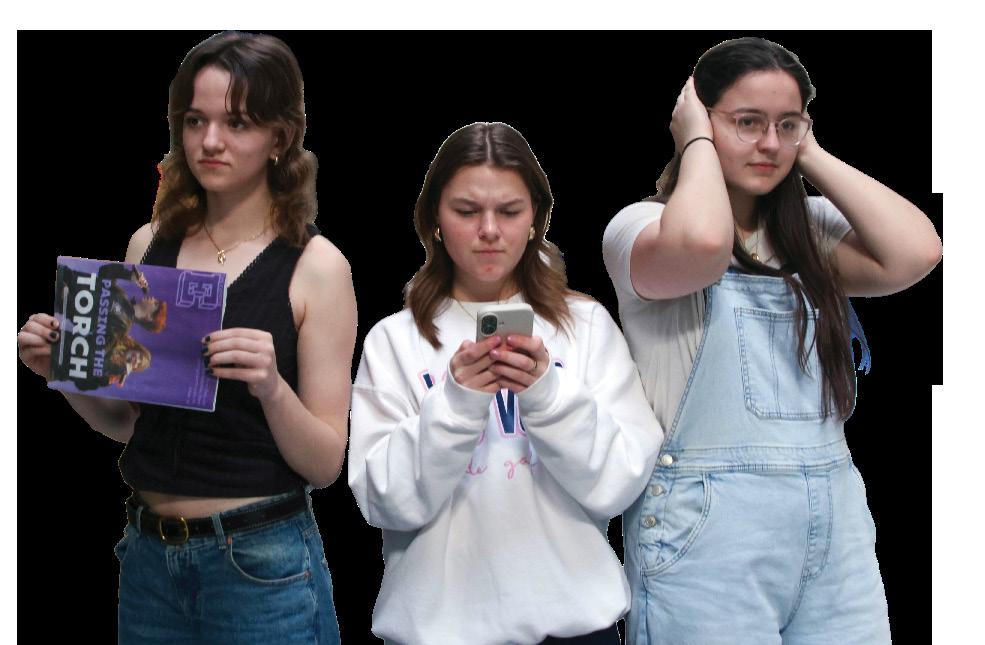
Our generation is living through history being writ- ten. We have witnessed so many polarizing historical events, from COVID-19 to recent military action in Iran.
We as editors are constantly on the lookout for current events to cover, but keeping up with this flood of news isn’t always easy. It can be discouraging and over- whelming to consume so much negative content.
We wondered if this overconsumption was unique to us as journalists, or if this had become a universal experience. Through interviews and research during the production of this issue, we discovered how widespread the desensitization to current events has become within our generation.
Because of social media, we
live in a unique time where we have access to brutal events without traditional news censorship, blocking violent content. We are receiving news of current events instantaneously and processing so much content in little time.
In the middle of making this issue, our state became the center of an important current events discussion. Our coverage of the recent bathroom bill gave us a look into the real impact these events can have. We can now see how these events really do im- pact students at school; no mat- ter how discouraging, they can- not be overlooked.
It’s important to find a balance for your mental health without becoming uninformed. We urge you to take a page out of our book as journalists and stay in- formed despite the discouraging news that floods your feed.
2025-26 JAGWIRE STAFF
Editors in Chief
avery clement
editor in chief
maddie martin
editor in chief
quinlyn peters
editor in chief
Online Editors in Chief
maddie martin
online editor in chief
evan leroy online editor in chief
Photo Editor
eva hernandez photo editor

@millvalleynews1
Copy Editors
madelyn mulryan copy editor
kennedy botkin copy editor
Managing Editors
natalia castillejos ramírez managing editor
gracyn schreiber managing editor
Analytics Manager
oliver feiring analytics manager
JagWire Office
5900 Monticello Road
Shawnee, KS 66226
Phone: (913) 422-4351
Email: jagwirenewspaper@gmail.com
Website: www.mvnews.org
Adviser: Kathy Habiger khabiger@usd232.org



Staff
doreen mahugu writer/photographer
mya franco writer/photographer
ryan bloomer writer/photographer
cal bierl writer/photographer
asher clement writer/photographer
emma cooper writer/photographer
kady coulibaly writer/photographer
avery curry writer/photographer
bella davidson writer/photographer
jason sweany writer/photographer
lucas pennel writer/photographer
@MillValleyNews
JagWire, a monthly publication of Mill Valley High School, is printed by Valley Offset Printing
Censorship Policy
The Kansas Student Publications Act guarantees the same rights for student journalists as are guaranteed for professional journalists. These rights include, but are not limited to, all First Amendment rights, including the rights of freedom of speech and the press, insofar as published items may not contain libelous, slanderous or obscene statements, may not incite or promote illegal conduct and may not cause a substantial disruption to normal school activity. This law also prevents censorship of any kind by the adviser, building or district administration.
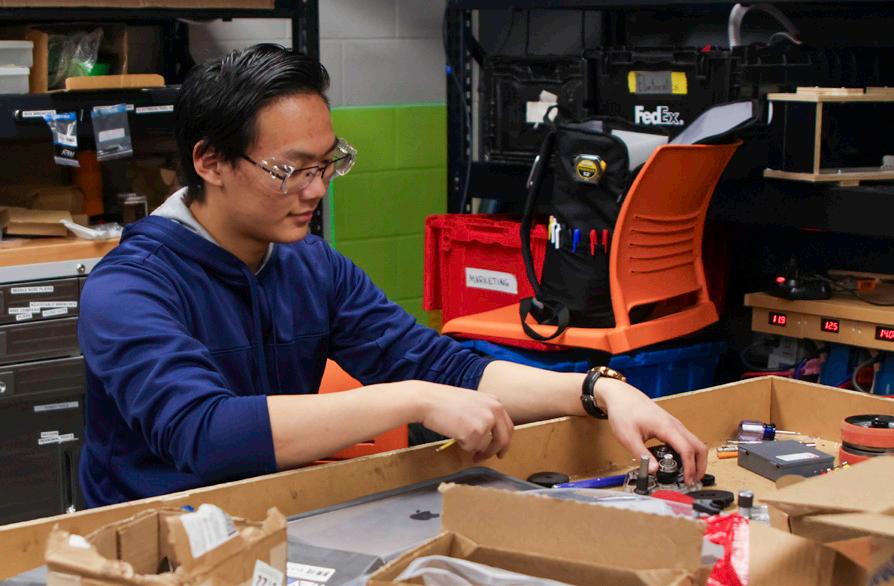
During robotics practice, senior Zach Chang works on a motor at a
tion, Saturday, Feb. 28. photo by evan leroy
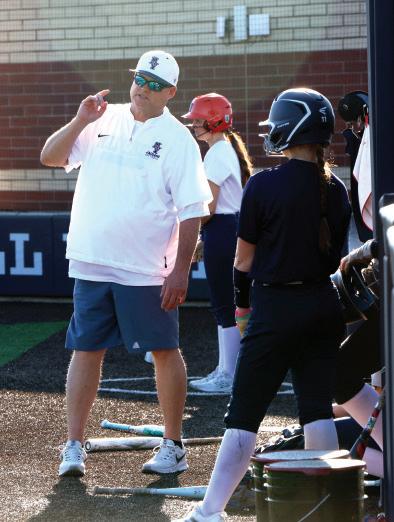
Speaking to freshman Olivia Clark, new head softball coach Kevin Mosher gives her corrections to improve her hitting, Monday, March 9. photo by ryan bloomer
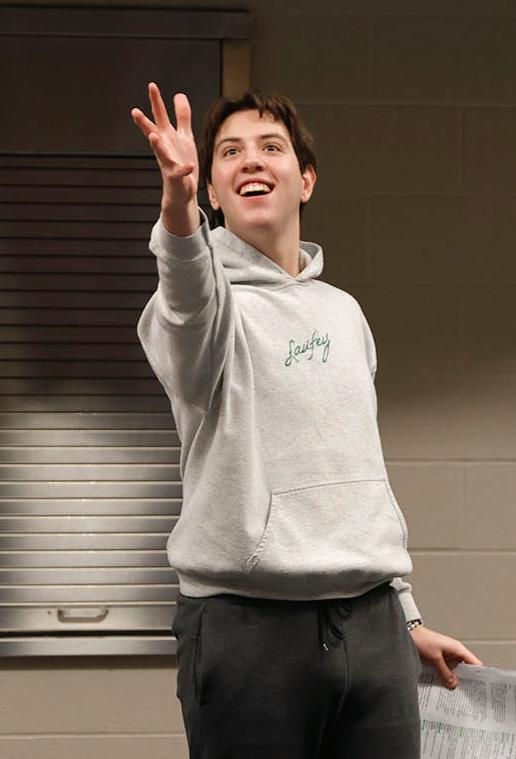
Reaching his arm out, senior Barron Fox rehearses for his part in Shakespeare’s “A Midsummer’s Nights Dream,” Wednesday, Feb 25. photo by jason sweany
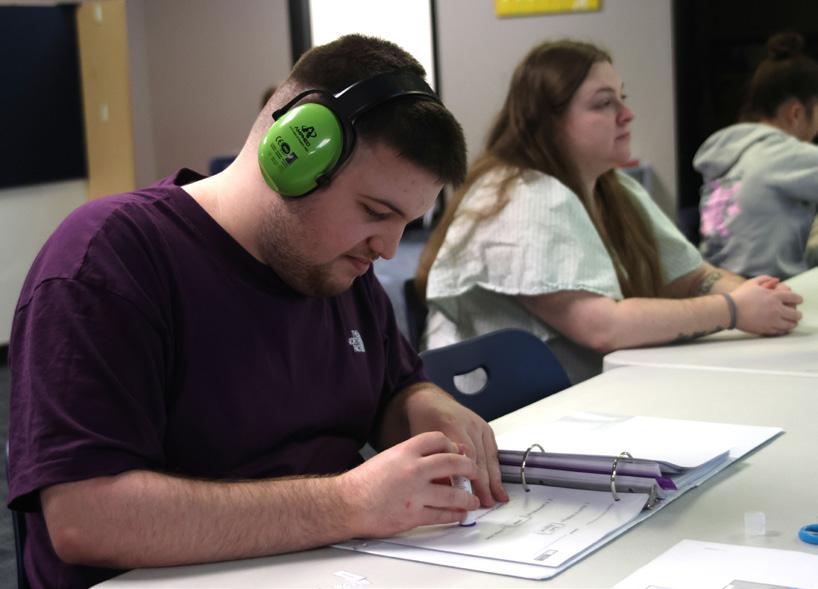
Gluing pieces of paper together to create sentences, senior Hank Moulin participates in the class assignment, Monday, March 9. photo by eva hernandez




Lately, the news has seemed like tragic headlines, heartbreaking posts or one depressing news segment after another. According to a survey done by JagWire, 62% of students feel the news is generally negative. This influx of news leads students to feel more overwhelmed than ever.
Despite the overload of negative news, students may feel disconnected from the global issues because of the privileged environment the school is in. This detachment from current events may lead students to not bring up issues or take them seriously in conversations, leading to an ignorance or detachment that
makes it more challenging to keep up and care about the current events.
Nevertheless, staying informed is beyond crucial as it can
” ” ”
Advocacy can be as simple as having a genuine conversation with someone who is uninformed.
JagWire Staff
bring personal awareness and cultivate a greater understanding of the world. Due to the privileged area the school is in, students have a responsibility to remain up to date. Students should be informed about
current events and be able to advocate for those who cannot speak out for themselves or people who aren’t informed.
Many times, when others think of advocating, they think of taking a loud, strong political stance. Though it can be done by going to protests, donating to organizations or discussing political issues, advocacy can be as simple as having a genuine conversation with someone who is uninformed. Simply reposting a quote or news segment on social media to help bring awareness of current events and issues can be powerful.
On a personal level, being informed can remind people of their secure circumstances and their life’s advantages, fostering more gratitude in their daily lives. Moreover, being informed allows others to acknowledge harm in the mistakes made by society. This helps build a future where others understand the world around them and fosters a kinder world with more respect for one another.
DIVING IN
by jagwire staff
BILL BATHROOM
The effect Senate Bill 244 will have both inside and outside of school for transgender students
BY THE BILL
What Senate Bill 244 actually entails
Requires transgender individuals to use the bathroom of their biological sex
Private citizens can sue transgender people for up to $1,000 if they believe they’ve violated this law
Driver’s licenses and birth certificates must also reflect the person’s biological sex
Effective immediately, so all licenses with gender changes were invalidated
After overriding Governor Laura Kelly’s veto, the state of Kansas recently passed legislation that will force people to use the bathroom of their biological sex in government buildings.
The law, which went into effect Feb. 26, also requires all driver’s licenses and birth certificates to indicate biological sex, invalidating all documents that have been previously issued to transgender individuals.
For transgender students at the school, this means they would have to use the bathroom of their biological sex or use one of the gender neutral bathrooms in the school. Freshman Raine Cormany’s reaction to the bill was one of uncertainty about what this could mean at school.
“I anticipated something like this happening at some point, because we’re in a red state, but then I realized, ‘Oh, crap, schools
by maddie martin editor in chief
by madelyn mulryan copy editor
are government buildings,’ and that part of it made me freak out,” Cormany said. “So when I heard about it, I started thinking to myself, how many gender neutral bathrooms are there? How am I going to be able to get to them?”
The gender neutral restrooms currently in place at the school will not be impacted by this new law. Principal Dr. Gail Holder plans to make any changes necessary in order to be in compliance with the law, but protecting students remains an important goal.
“I want [students] to know this is not about us not supporting you, but this is about us walking the line between, first and foremost, supporting you and your basic needs, but also being in legal compliance with what we need to do as of right now,” Holder said.
The law includes spaces other
than bathrooms such as locker rooms, and will change the current process for locker rooms. Physical education teacher
Christine Preston explains how transgender students used to be allowed to use the locker room that aligns with their gender before Senate Bill 244 was passed.
“We [had a transgender student, male to female], and the only thing we did differently was allow that student access to the locker room by themselves,” Preston said. “They went in, got changed, came out and then the rest of the class went in afterwards. They would get dismissed a few minutes earlier to go into the locker room, too.”
“[The school] enforcing this bill would make me feel like I am not seen as a human being and that I don’t really have a right to exist,” Ayers said. “[The government is] taking away my right to exist and be comfortable in my own skin. It’s not really about bathrooms.”
Another aspect of the bill is the requirement that gender mark-
” ”
While the legislation creates minimal changes with the bathroom system at the school, some, such as Cormany, feel the bill is a part of a larger issue within the state surrounding transgender people.
“This is obviously legislation that’s fueled by hate, fear or some very negative emotions,” Cormany said. “They like to say it’s for protection, but in my opinion, it’s just fueled by fear and anger.”
Sophomore Nik Ayers agrees, believing that this bill could lead to more anti-transgender legislation.
[The government is] taking away my right to exist and be comfortable in my own skin. It’s not really about bathrooms.
Sophomore Nik Ayers
almost always go through surgeries and procedures to make themselves feel more comfortable and look like the gender they are wanting to be,” Ayers said. “If you know someone who looks very clearly like a man but has female on their driver’s license, it will create verification issues because that‘s not a woman.”
Holder has hopes that the changes in legislation won’t affect how safe transgender students feel or how they’re treated at school.
“I hope that the culture of Mill Valley sees this through because we’re a place where hopefully people feel they belong, regardless of who they are,” Holder said. “I look to our students and staff that are currently here to be ones that will continue to support all students, regardless [of the bills passed].”
” ”
ers on driver’s licenses match people’s biological sex. Ayers also believes that having a driver’s license that does not match someone’s gender could create confusion.
“Transgender individuals
TRANS RIGHTS TIMELINE
The timeline of Senate Bill 244 from its proposal to passing
FEB 7 2025
Bill 244 introduced to Kansas Senate
JAN 27 2026
House recommends substitute bill be passed
FEB 19 2025
Bill passed in Senate, sent to House for deliberation
Source: KSLegislature.gov
JAN 28 2026
House substitute for Senate Bill 244 passes 87-36
Ayers also has faith that the school will continue to support transgender students to the best of their ability.
“I like to think that our school is very progressive,” Ayers said. “I feel safe at school, safe with the teachers I have, and I feel that the people working at our school will respect me as a person and will not force me into something that I’m uncomfortable with.”
FEB 16 2026
Bill vetoed by Governor Laura Kelly
FEB 18 2026
Senate (31-9) and House (87-37) override Kelly’s veto and pass House substitute for Senate Bill 244 into law

FROBOT RUNDOWN
Schools’ robotics team works using STEM skills to win competitions
by natalia castillejos ramírez managing editor
rom programming and building robots to hosting international competitions, the robotics team creates a positive environment for students to learn important skills while improving their STEM abilities.
Students join for various reasons, many, like junior Zach Thomas, are joining as it connects to their future.
“It has a lot to do with my future career”, Thomas said. “I don’t necessarily want to do robotics as a future career now, but I still enjoy it, because I’m going down the STEM path right now.”
The robotics program is composed of students from both the
school and De Soto High School to create two teams: Cubatronics, composed of the freshmen and sophomores, and Catatronics, composed of juniors and seniors.
Senior Ben Houdek shares why the teams are split.
“The way we like to think is it’s one team, just two different groups,” Houdek said. “It’s not that one team is better than the other, it’s just more experienced.”
There are different sub sections or sub teams that work on different aspects of each robot. These different sub teams work on the design, electrical, programming and strategy of the robots in order to prepare them to compete.
Robotics senior co-president senior Sam Bowling shares how the department as a whole is a welcoming group of students.
“I’d say my favorite part about [Robotics] is definitely the people,” Bowling said. “I have a pretty core group of friends that I’ve been doing [it] with for the last three years.”
The team’s collaboration has played a key role during competitions, such as the Heartland Regional Competition located in different schools. This year the school hosted the third consecutive time during spring break.
The Heartland Regional competition is sponsored by FIRST Robotics Competitions. According to KC STEM Alliance, it is a, bracket style competition with 41 teams, some even being international. The goal is for each team to demonstrate their engineering and strategy with custom robots that go through a challenging set
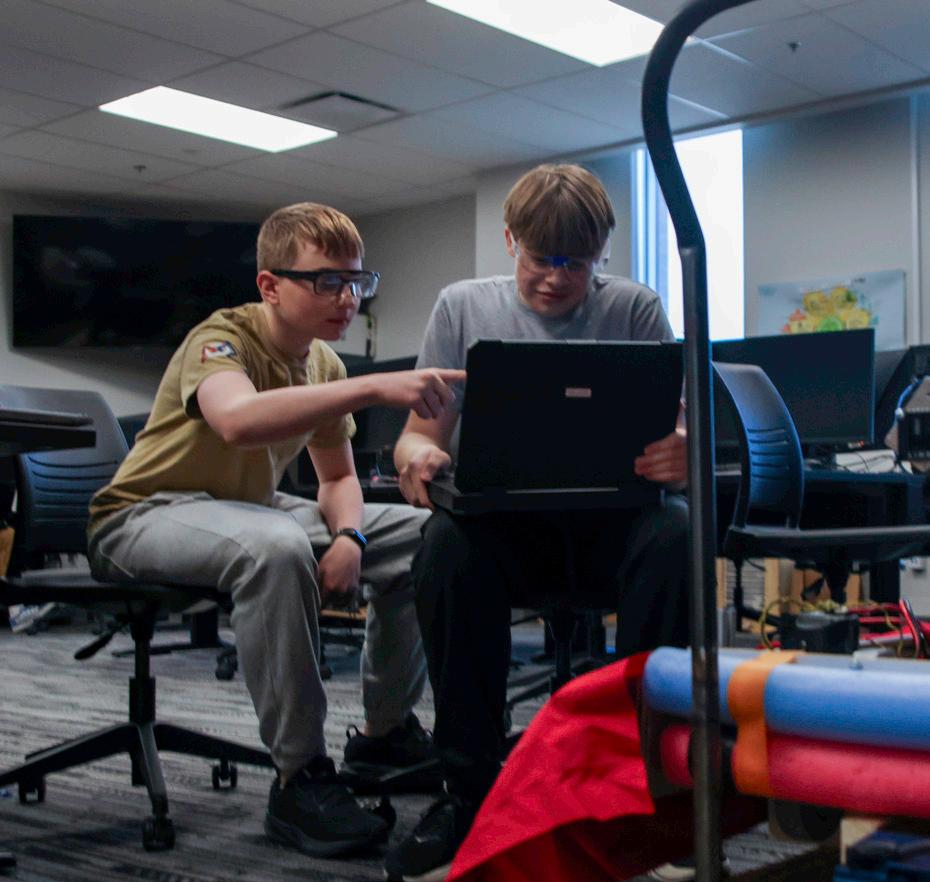
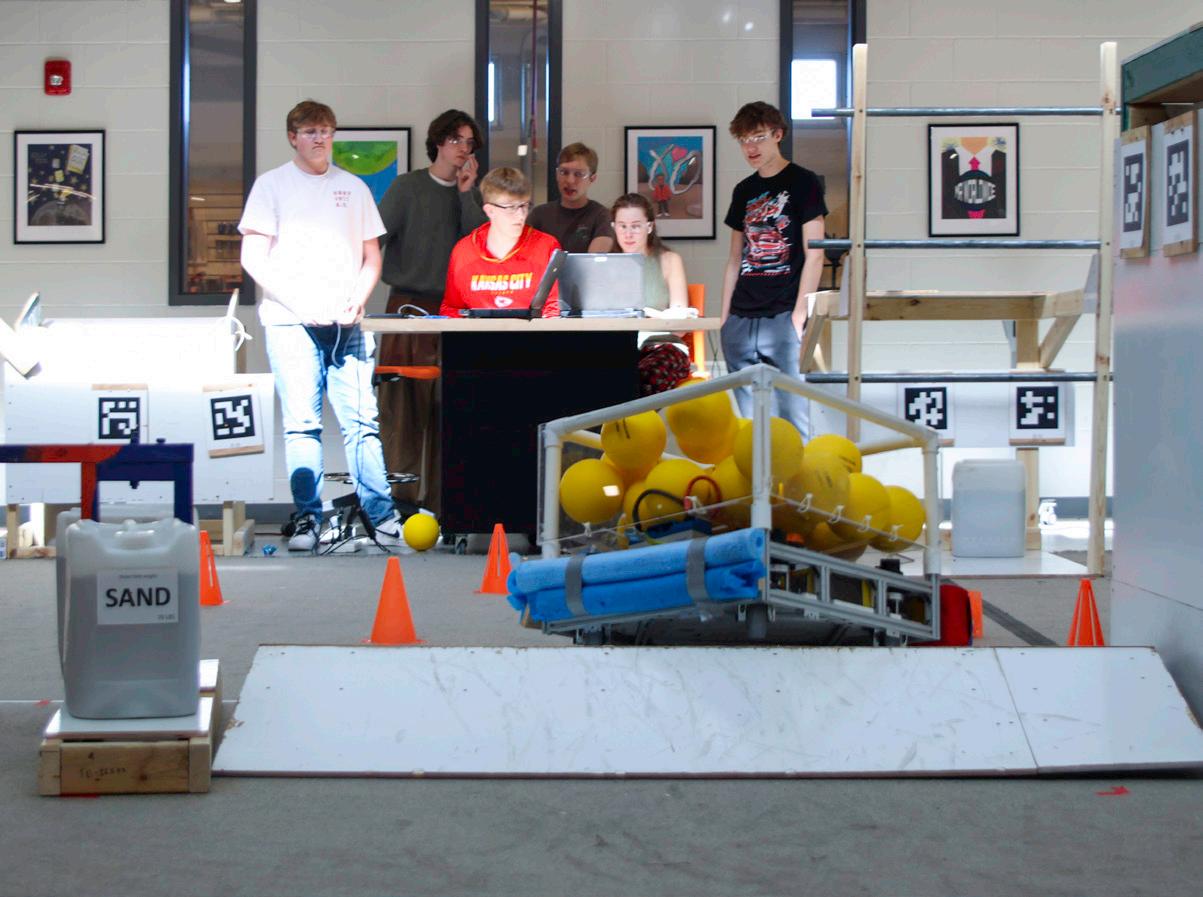
The programming team watches as the test robot navigates the course being driven by junior Donovan Roche, Saturday Feb 28. photos by evan leroy
Freshmen Grant Tuttle and Will Edwards work on programming the robot in the programming lab, Saturday Feb 28. photo by evan leroy
Throughout the matches, each team has its own “pit” to make adjustments.
“It’s kind of like NASCAR,” Houdek said. “We can come back, get everything we need and go back out to the field.”
Bowling, who has led much of the upcoming competition plans, shares the extensive preparation from the entire department.
“Obviously, we’ve been working very hard on our robots, but we’ve had a lot of production with our head mentors behind the scenes,” Bowling said. “Getting people together to help set up everything like concessions and janitorial work during the event.”
er, we would like to win or be finalists at our Heartland Tournament for a second time.”
No matter the result from the competition, seniors, such as Houdek, have confidence in the future of the robotics program.
“It’s not necessarily all about winning,” Houdek said. “I just know the team next year [will be in good hands] and I’ll come back to help, as many students who have graduated also who come back.”
-Finalist at both competitions of matches.
Last year the team was finalists at this competition, junior Molly Gilmore shares how this influenced the team’s goal for the year.
“Our main goal for the tournaments is to just place as high as we can using our hard work that we’ve been doing since earlier in the fall,” Gilmore said. “Howev-
Additionally returning members are open to more people joining the teams, and having them be part of a program with so many benefits.
“To anyone who would want to join robotics, they should just go for it,” Gilmore said. “Robotics provides a unique space for people with all different skill sets to work together and use critical thinking skills.”
OUT WITH THE OLD
Name: Uptown Girl
Facts:
-Placed 2nd at regionals last season
-Won Innovation in control award
Name: Luxo Facts:
-Won Quality award
Name: Rapunzel Facts: -Shooter mechanism -Only went to one competition
Name: Frodo Facts:
-Won Innovation in control
Name: Hoover Facts:
-Won Team Sustainability Award
-Won Industrial Design Award
Name: Ankle Biter Facts: -9316’s first season
-Won Highest Rookie Seed
-Won Rookie
tion
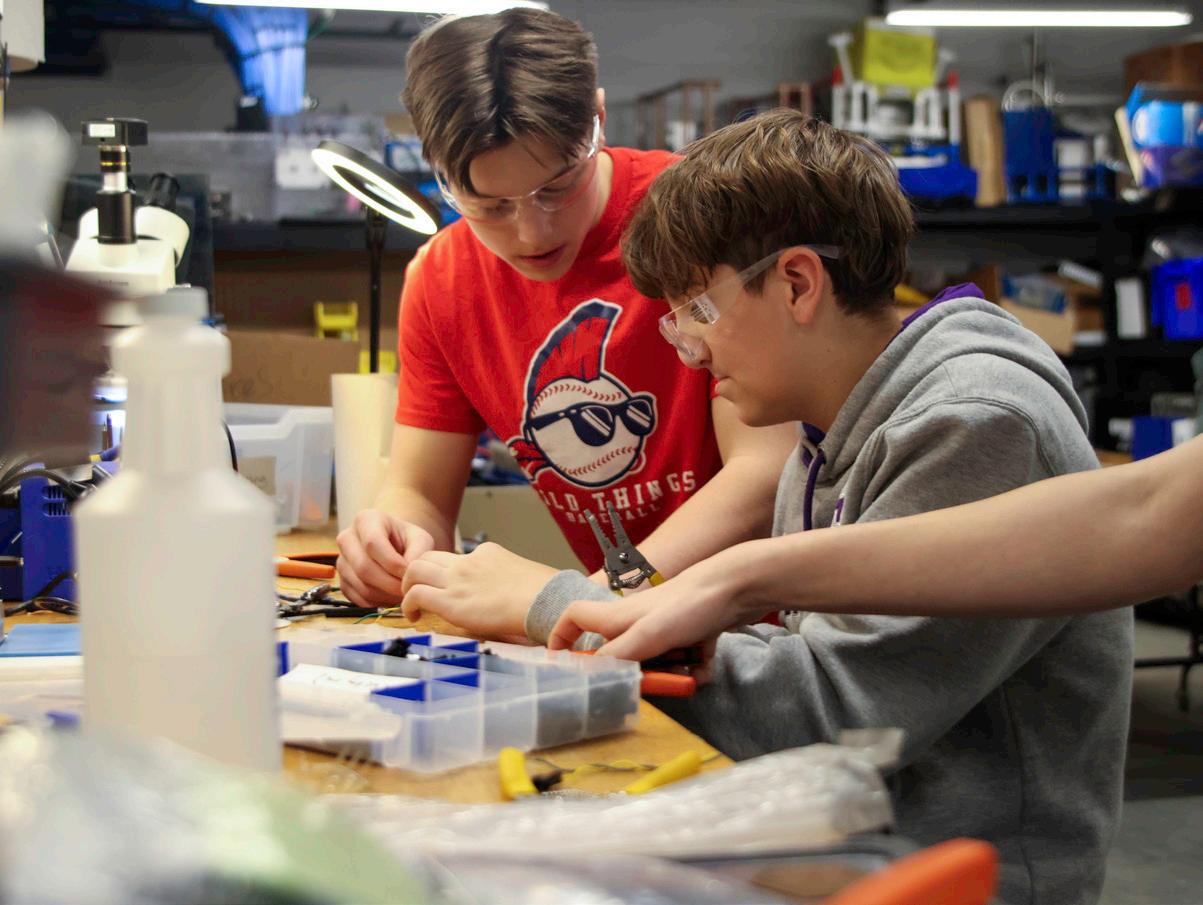
Freshmen Ethan Jennings and Lucas Gilmore cut the wires to solder together that will go inside the robot for the competition, Saturday, Feb. 28. photo by evan leroy
MORE THAN MAINTENANCE
by kennedy botkin copy editor
As the only daytime janitor, Brian Sullivan has many responsibilities throughout his day
Janitors are crucial due to their hard work in keeping schools and classrooms clean for students and teachers. Although the school has many afternoon janitors, there is only one daytime janitor, Brian Sullivan, who cleans until the school day ends and the other janitors arrive.
Sullivan starts his day at 5 a.m., where he cleans the entrances and mops the gym floors and hallways until lunch, when, according to Sullivan, the hardest part of his day begins.
“The biggest and hardest place is the lunch room,” Sullivan said. “Trying to cover everything is too much for one person. Just the trash alone, we fill one dumpster every day just off of trash in the kitchen or lunchroom.”
Being the only janitor in the morning means Sullivan has to take on a large daily workload.
“I very much get overwhelmed every day,” Sullivan said. “We just hired a new person, and training her while trying to get everything else done is very taxing.”
Before working at the school, Sullivan owned and operated his own bakery, which he sold right before COVID started. Despite his love of baking, Sullivan en joys working as a janitor because it is less stressful.
“It was really long hours,” Sullivan said. “I would get there at four in the morning, and some of my days didn’t end until 10 at night. Compared to working as a janitor, you don’t have to wor ry about whether you’ve sold enough to get a paycheck at the end of the week and meet all the bills that come with own ing a bakery.”
Because of all the cleaning they do, janitors are import
A DAY IN THE HALLS
ant in keeping schools running.
Sophomore Madison Stanley is appreciative of the hard work they do every day.
“I honestly don’t think our school would function without janitors,” Stanley said. “If our
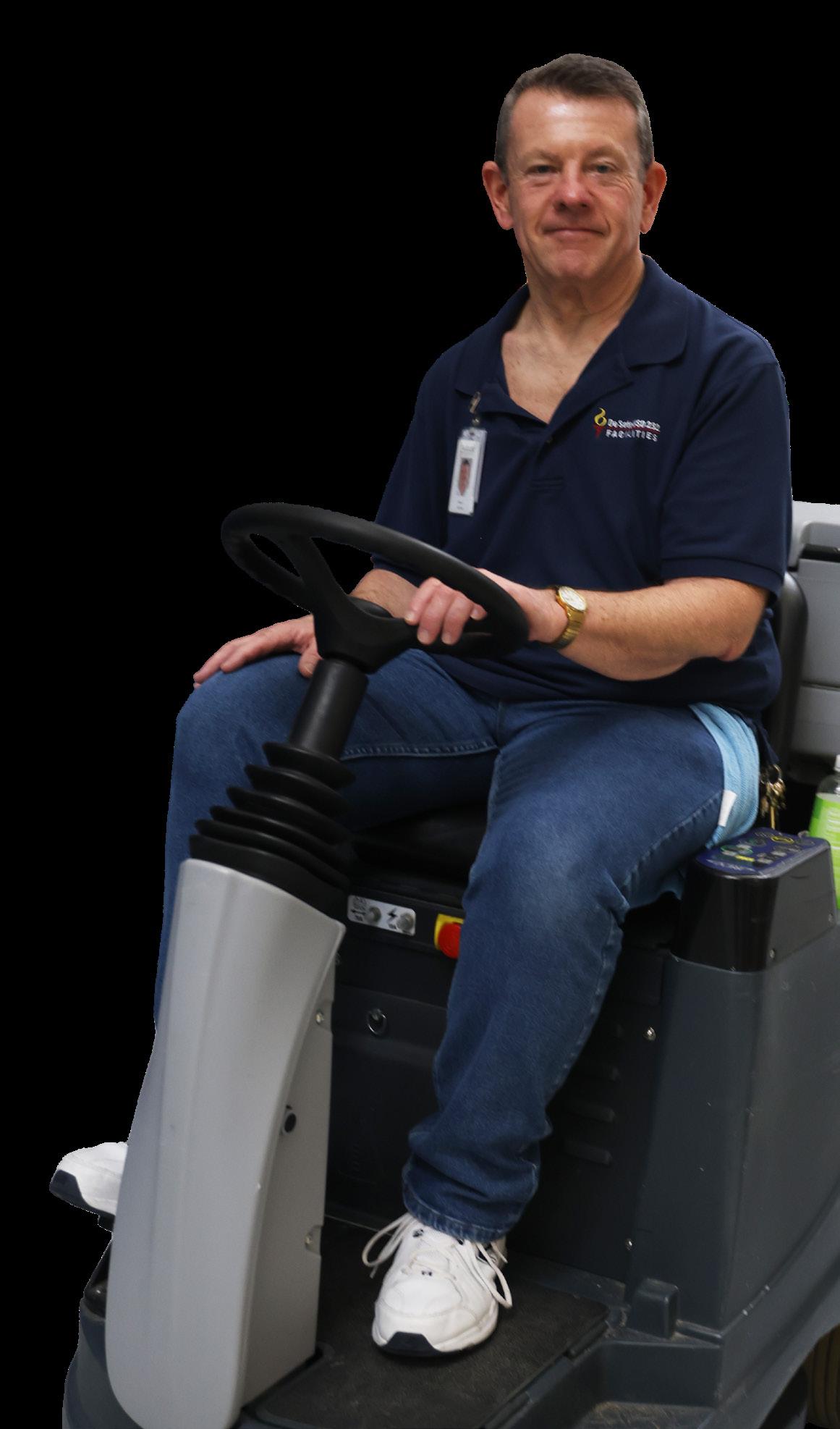
During fifth block, janitor Brian Sullivan cleans the main hallway on his riding floor scrubber, Tuesday, March 3. photo by kady coulibaly
CATTY CRAZE
by avery curry writer/photographer
Catty Shack has become a popular place for students to get their favorite snacks during seminar
SNACK LOVERS
Average amount students go to the Catty Shack in a week
FAN
My favorite part of the Catty Shack is thinking of new promotions, fun ways we can market new items.”
Catty Shack president senior Miley Strathman
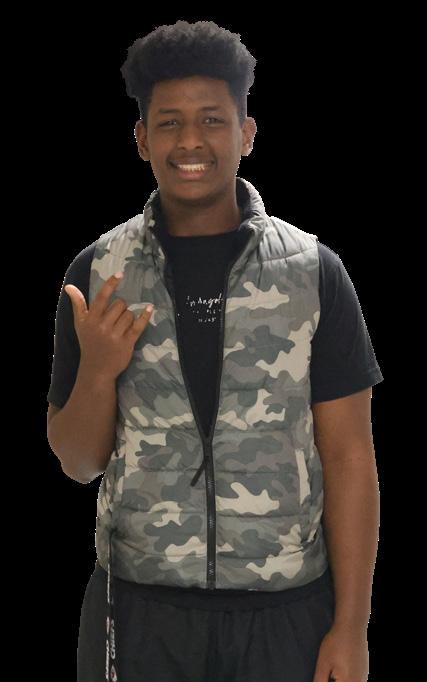
My favorite things are jalapeno chips or pickle chips and Alanis are also really good. I think that combo hits different on certain days.” sophomore Nati Vega
PROFIT PURPOSE
Catty Shack uses its profits to help other organizations
Relay for Life
The Bridge
Back to Catty Shack survey of 55 Catty Shack customers
FAVORITES Students vote on their favorite Catty Shack options
ADAPTED LEARNING
Peers in Learning provides students with special needs opportunities to collaborate
Peers in Learning is a unique program that gives students with special needs a chance to interact with their peers in ways that help them learn and focus better.
The program pairs students with special needs with a peer who accompanies them to a class. During their assigned class, peers complete many different activities that range from academics to daily living skills and community outings, helping them with focusing on these tasks as they learn new things and help them with their social skills.
The program is led by special education teacher Sara Evans, who came here after the program first became available, but knows the intent of the course was to make students with special needs feel more connected to their peers at the school.
with their peers
“The intention of it is to have typical peers working with our students all day,” Sara said. “Most of our students are in the center based program due to their needs and going out to classrooms is not the least restrictive environment for them. In order to have inclusion and interactions with peers, we bring the peers to their environment, which is more conducive to their learning.”
Sara has also seen first hand just how much the peers have helped the students with special needs, in ways ranging from academics to their people skills.
“[The students] benefit greatly because otherwise, it would just be the students and adults all day long,” Sara said. “They learn a lot from their peers’ social skills. Sometimes, it’s just better to be told what to do or what not
JOB OLYMPICS
to do by someone your age rather than an adult.”
This program also gets students with special needs important experiences that they will need later in life, as junior Abby Stidham-Ebberts has seen first hand in her time as a peer.
“They do a lot of real world, hands-on life skills that are very useful for everyone and it’s also really useful how they do Job Olympics,” Stidham-Ebberts said. “Every activity that they do in class is going to help them with the Job Olympics and help them show off their work that they’ve been doing in class, so I think that’s really cool.”
Although the main objective of the program is to help the students with special needs, Sara also believes this program has helped the peers learn things that they wouldn’t learn in any of
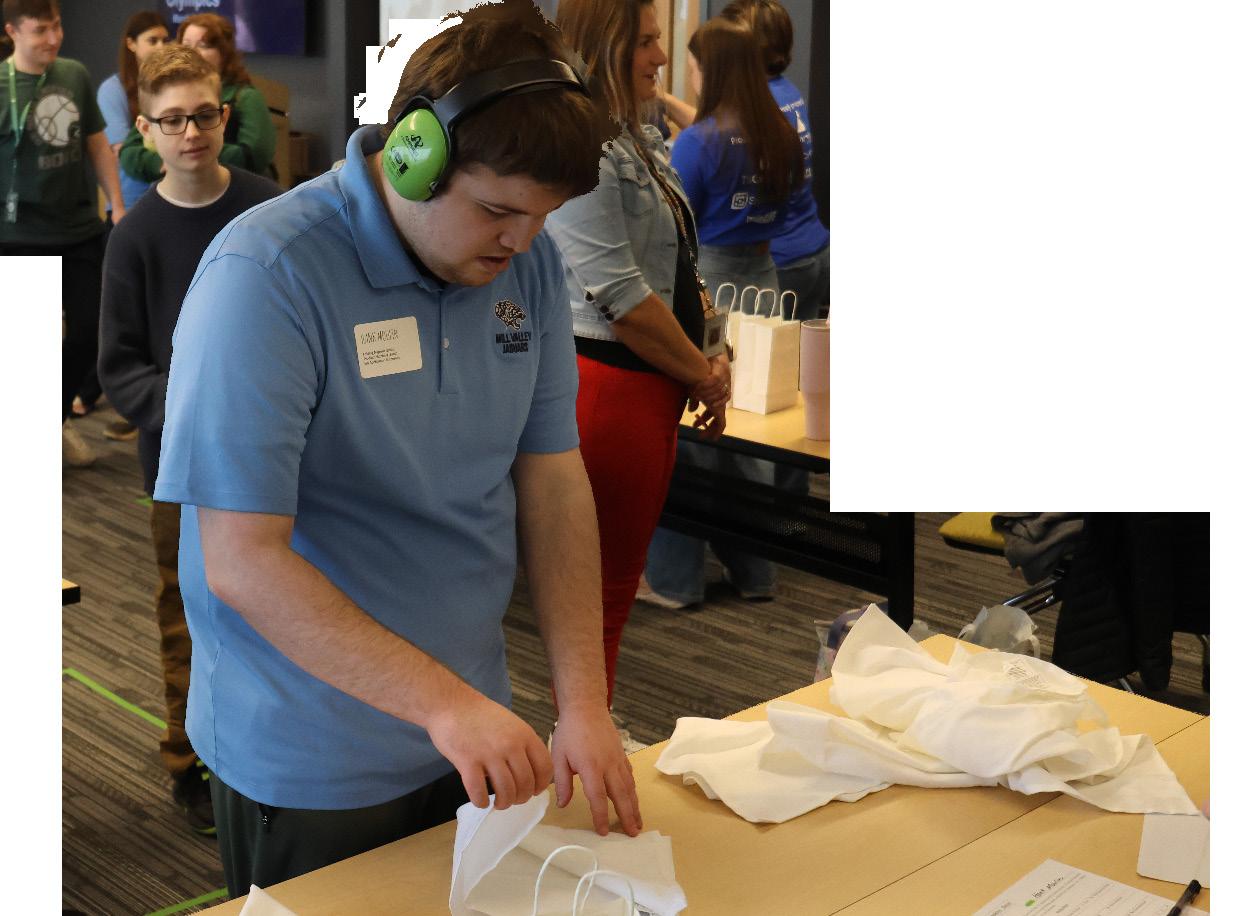
Folding towels and washcloths, senior Hank Moulin completes the task for job olympics, Thursday, March 5. photo by eva hernandez
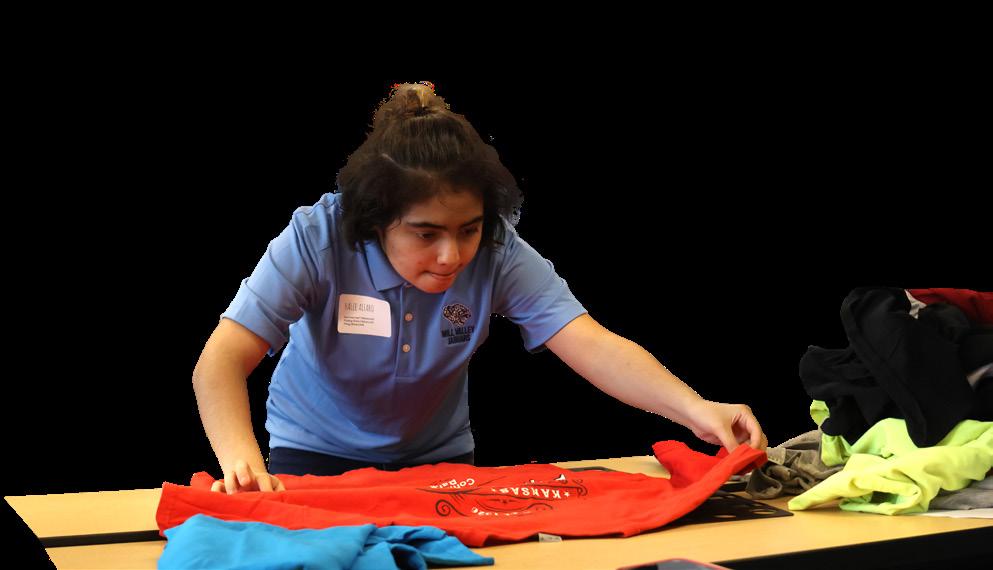
Placed in the advanced folding shirts category, sophomore Halee Alfaro folds shirts for job olympics without losing focus, Thursday, March 5. photo by eva hernandez
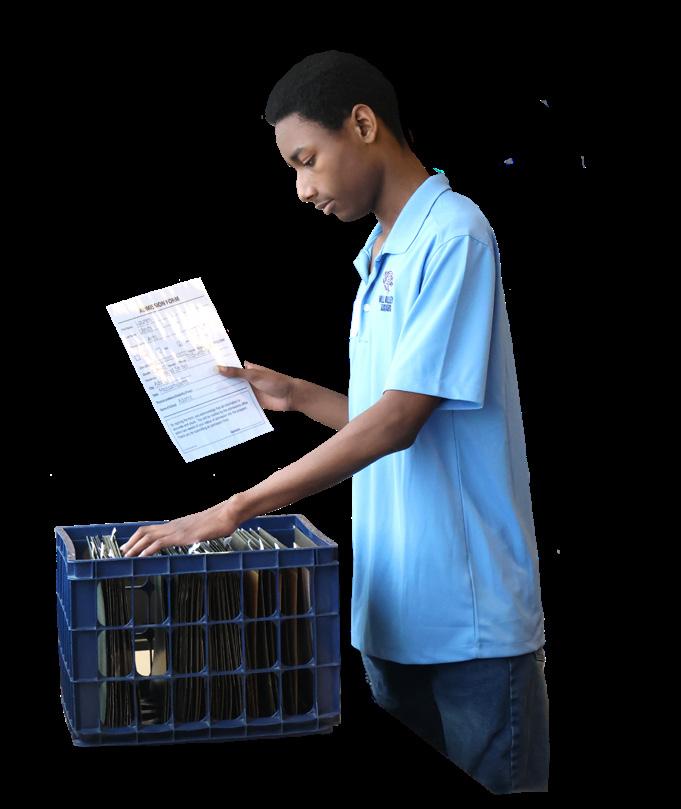
At job Olympics, sophomore Tyrese Davis placed in advanced filing organizes each file given to him, Thursday, March 5. photo by eva hernandez
A DAY IN THE LIFE
First Block
3. Morning meeting and bell work
4. Academic reading and math work
Seminar
5. Pop and mail deliveries
Fourth Block
6. Lunch break
7. Daily living activity and community outings
Fifth Block
8. Science and social studies
9. Pack up and school ends
their classes.
“[The peers] learn a lot about empathy, and they learn a lot about inclusion,” Sara said. “One thing that I’ve noticed is the school is very inclusive, and a lot of that is because of the peers. When they get to know our students, they introduce our students to their friends, and then everybody knows everybody.”
Senior Jason Evans, who has taken this course for four years, believes the connections he has built with the students are the best part of the program.
out
junior Emma Cummings uses these pieces to create sentences with senior Ava Lucht, Monday, March 9.
by Eva Hernandez
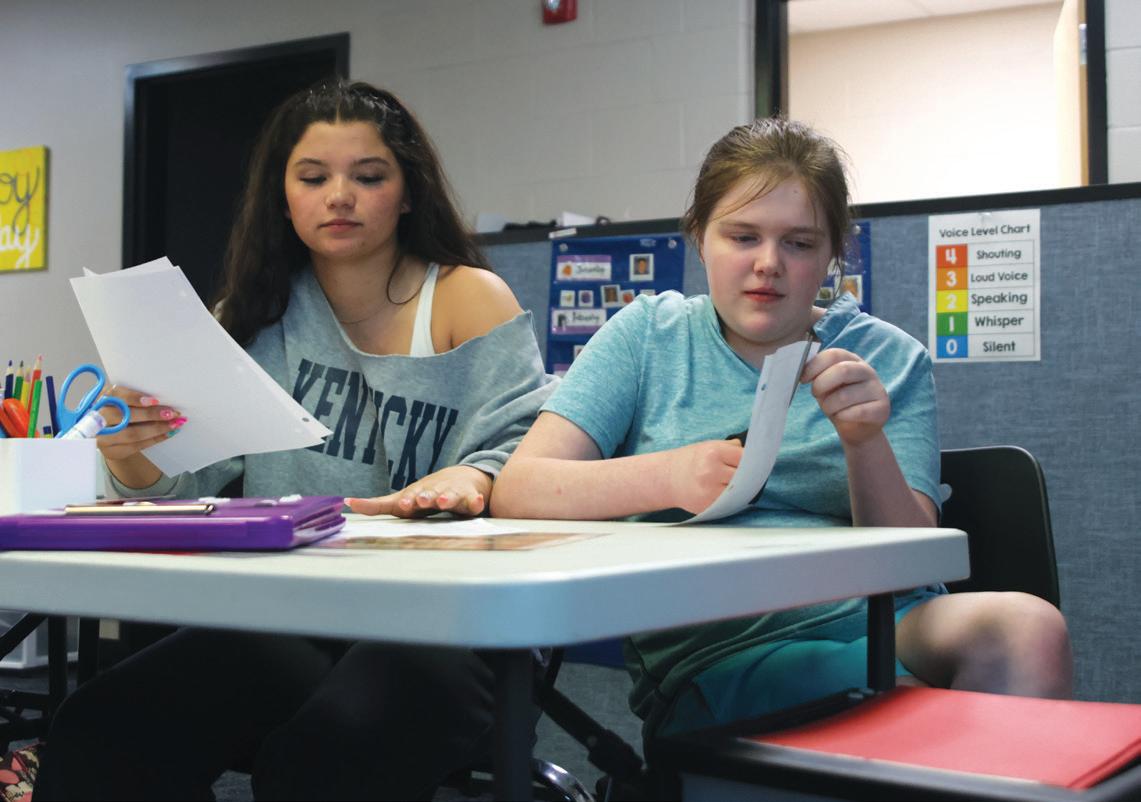
that they can do.”
In his class, Jason gets the students with special needs ready for the rest of their day by watching a variety of educational videos to help them learn different things.
“We do morning meetings and we’ll say the date and days of the week,” Jason said. “[We] watch a lot of videos to help learn the days of the week and help learn
program opens up opportunities for students to accomplish more with their peer interactions.
“Learning disabilities can make [doing some tasks] hard, but when they have people around them motivating them or encouraging and supporting them through their activity, it makes it more fun and easier to complete,” Stidham-Ebberts said.
”“I want to say the field trips [are the best part], but there’s a lot of different kids, and every single one of them is awesome,” Jason said.
Sara also believes that the connection each peer makes with students with special needs helps fight against any stigma surrounding these students.
“This class helps combat a lot of the stigma towards children with disabilities,” Sara said.
“If you see a student in the hall, and you’re not really getting to know them, you automatically assume one thing or another about them, but then actually getting in the classroom you get to see a lot of the amazing things
”[The program] is so fun, and it’s a great way to work on your own skills.
In her first year in the program, sophomore Haylee Myers enjoys helping the students in their Unified Physical Education class, where they play modified versions of popular sports, sometimes even replicating the Super Bowl and Olympic games.
“I really enjoy making them feel welcome in the school,” Myers said.
””different weather and different feelings.”
In her class, Stidham-Ebberts completes tasks with her assigned students that include filling up coolers with snacks and water for the physical education teachers and collecting recycling from the classrooms around the school.
Stidham-Ebberts feels that the
Stidham-Ebberts believes that the program has helped her improve her own skills in many different ways, ranging from self improvement to academics.
“I learned how to have better positive talk to others and to myself, and I’ve learned how to use encouragement to help people,” Stidham-Ebberts said. “[The program] is so fun, and it’s a great way to work on your own skills while also helping others.”
The average day for a student in the peers in learning class
1. Unpack and set up for the day
2. Start classes with an elective
Second Block
Cutting
papers for her assignment,
photo
Junior Abby Stidham-Ebberts
CONSTANT CRISIS
Whether it’s reading the nightly local news, watching CNN 10 in class or a five second TikTok clip, teens are constantly being flooded with current events and news. This overwhelming and constant consumption of content can make students feel hopeless about the state of the world.
According to Pew Research Center, people generally feel more negative emotions when watching the news. 43% of people sometimes feel sad and 39% sometimes feel scared.
The news often highlights negative events such as violence involving immigration or conflicts in Palestine and Ukraine. Sometimes seeing this overflow of negative content can impact students’ mental health. Junior Taleen Elkhatib feels the negativity can get to her.
“I definitely do feel hopelessness whenever I read about Palestine and other things going on in the world, but I also see how Palestinians’ belief in God is very strong, so I try to think the same way,” Elkhatib said.
The American Psychological Association examined this issue, reporting that overconsumption of news, especially negative events, can negatively impact people’s mental health. This in-
MEDIA MOODS
Students’ news content and their reactions
by mya franco writer/photographer
by avery curry writer/photographer
take of news can make people feel overwhelmed or anxious about the future.
The National Institute of Health found that news can affect people’s mood and one study even found that sadness and worries increased after being exposed to negative news reports.
Similarly to Elkhatib, senior Jordan Powell has felt these effects when watching negative news content on social media.
“Sometimes, a TikTok will get me a few times, and I might be pretty sad for the rest of the day,” Powell said. “But most of the time, I do it more to be informed, as opposed to having an extreme emotional reaction.”
Social studies teacher Chris McAfee also believes that a lot of the negativity and hopelessness about current events can come from the sheer amount of content there is for students to consume on social media, and even simply at the school.
“It is hard for students to process a lot of [current events], because it’s getting harder and harder to know what’s real and they are so overwhelmed,” McAfee said. “And so there’s a lot of distractions, both within school and technology life and it’s just overwhelming.”
An increase in negative news leads to anxiety among teens















of students reported seeing a recent increase in negative news coverage










Kansas Senate passes transgender bathroom ban
Mexico cartel leader
‘El Mencho’ killing sparks chaos
FOX NEWS Search for Nancy Guthrie enters fifth week
NEGATIVITY NEGATIVITY

BECOMING DESENSITIZED


Aby maddie martin editor in chief
by cal bierl writer/photographer
to take in so much information and then keep feeling the same amount of emphasis or the amount of emotion as you did when you first read about it, but I do think that the stories change so much and that so many updates happen with every major issue that it’s hard to lose empathy for it.”























ccording to Pew Research, young people are more likely to say the news they get makes them feel scared or confused, with 33% saying news makes them feel each of these emotions often. With this rise in extreme emotion, people have started to become desensitized to the news.
McAfee thinks that overconsuming news can be a danger within itself that students need to be aware of.






Through this constant roll out of news, students like Elkhatib have recently seen the news leaning more negatively.
“[The news] has become more violent,” Elkhatib said. “Social media does play a big role, I look at the comment sections and they’re also very negative. There’s just a lot of violence going on in the world right now.”
Powell doesn’t see herself losing empathy for the situations she sees, even with the same situation being continually run, losing its emphasis.
“I know it’s easy to get desensitized to major issues or things you hear over and over again, like what’s happening with ice in Minnesota, or the protests in Iran,” Powell said. “It’s hard
“[News consumption] gets to a point where it’s raising your anxiety levels,” McAfee said. “I definitely have friends who live in their news bubble, and they’re so worked up all the time. It’s important to be informed, but also not get yourself worked up, allow yourself time to still go and have a life and do other things.”
McAfee has also seen the news change over the years and become more biased, making it harder to get cold hard facts and form an original opinion.
“Big news agencies have become more more opinionated, but it’s passed off as news, and so it’s really hard for people sometimes to find actual facts, because a lot of this is trying to sway your opinion or trying to catch your attention,” McAfee said. “ So unfortunately, on the big news sites you don’t necessarily get news.”
FLOODING THE FEED
How social media algorithms work and their effects on people today
INCREASED ACCESSIBILITY
WAlgorithm (noun)
A process or set of rules to be followed in calculations or other problem-solving operations, especially by a computer. What factors influence alogithms?
User Interation (Likes, comments, shares etc.)
Video Details (Captions and hashtags)
Device/ Account Settings (Country and language)
Recency (Date/ time of post)
ith the rapid expansion of the internet, it has become increasingly difficult to avoid the relentless flow of news and information. Online platforms and social media feeds update constantly, and while this accessibility can keep teens informed and connected, it can also be a cause of overwhelming stress.
According to the Reuters Institute, more than half of people get their news from networks like Facebook, X and Youtube, overtaking TV, news sites and apps. News coverage is becoming more readily available at just
the touch of a button.
With so many stories being exposed to teens at the constant rate at which the world is changing, McAfee thinks it can be easy for teens to disregard information or be unable to keep up with it all.
“There’s so much information at our fingertips,” McAfee said. “There’s no real easy way to sort through what’s real, what’s not real, what’s an opinion, what’s a fact, what’s misleading and what’s not, soI think a lot of students don’t even bother to follow.”
””
“If I see something that hits a little close to home, I surround myself with friends and make sure my loved ones are safe, so I don’t have to worry.”
Sophomore Alexander Rocha
With the wide availability for news distribution, misinformation and opinionated coverage can be spread just as easily and be disguised as factual knowledge. McAfee believes social media has made a great impact on the news industry.
“Especially with the advent of the internet and social media, the big news agencies have become more opinionated,” McAfee said. “So unfortunately, on the big news sites you don’t necessarily get news. You get the things that elicit emotions, but not necessarily things that bring about a more informed citizen both of our country.”
Scrolling online, Elkhatib sees sides of important events that news stations don’t cover.
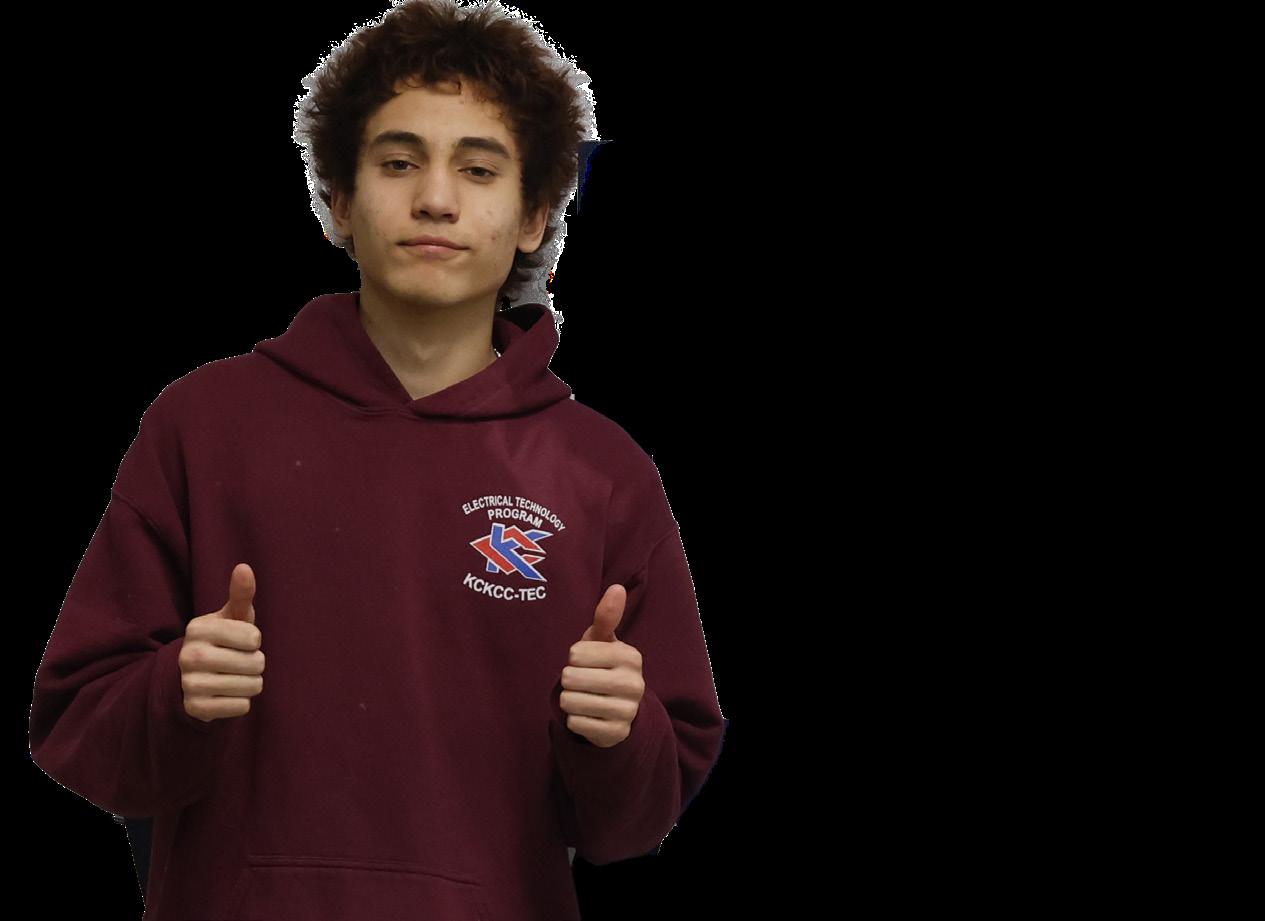
“A lot of social media platforms will get unreleased footage and a lot of the videos that we see on social media are more negative,” Elkhatib said. “Like with ICE and the Renee Good situation, I saw a lot of videos that weren’t aired on news stations and they were more violent, so a lot of the comments were really
With the constant stream of negative news coverage, sophomore Alexander Rocha believes that teens may feel inclined to
step away from reliable sources and opt for more appealing content online.
“On social media, like Instagram, Tiktok or Facebook, you can see all these nice little videos of the wholesome moments in bad areas,” Rocha said. “But if you look out in the news and articles, it’s always showing the negative side of it.”
MAKING A DIFFERENCE
According to Scientific American, researchers recommend a variety of mechanisms for coping with fear-inducing news.
McAfee encourages reflection as the first step to overcoming these feelings.
“Getting to the root of what’s causing somebody to feel in that way can be informative, and then they can change their news-consuming habits,” McAfee said. “They can change what they’re following online.”
to be made aware of current events and talk to people and have conversations about this stuff,” Elkhatib said. “I have conversations with my friends and family all the time about ICE and wars going on.”
Called to action by feelings of discontent, Elkhatib and others who want to make their voices heard participate in activism.
CURRENT CAUSES
Survey of 106 students
Top current events bringing students anxiety
U.S. involvement and conflict with Iran
Actions of Trump Administration
“I try to go to protests regularly, especially for Palestine,” Elkhatib said. “They have a lot in the Plaza, so I go down there and just protest for a bit. I also repost on social media,
Actions of U.S. Immigration and Customs Enforcement
a lot of things on Instagram, I repost about ICE and Palestine.”
”Recognizing that there is a massive amount of upsetting news available, Powell attempts to follow more palatable stories.
“I try to also take in information that might be a little bit more positive,” Powell said. “There’s still plenty of progress that is happening across the world, with many major regions like climate change or issues like that are still important to read about, to have some hope, but most things are pretty negative, and that does kind of hurt a little bit.”
Some students, like Elkhatib, cope by using what they learn to advocate for change and educate their peers.
“[Being updated on news] makes me feel thankful, but also it makes me feel like it’s my duty
”
I try to go to protests regularly, especially for Palestine. I also repost about ICE and about Palestine.”
Junior Taleen Elkhatib
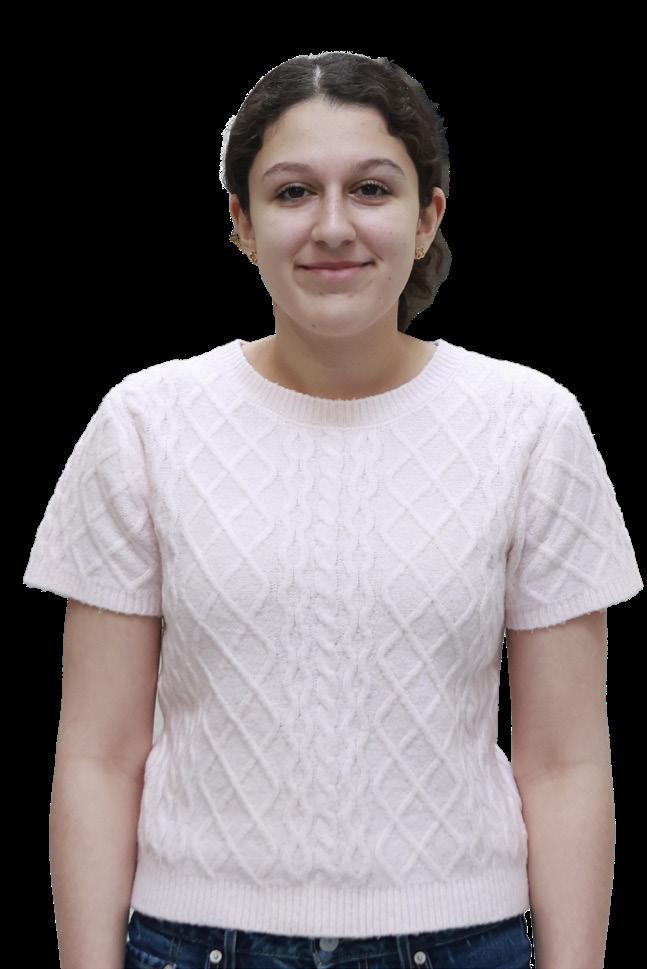
Even though common advice is to stop watching the news, freshman Ethan Jennings believes we need to remain informed. However, finding a way to sit with it is necessary.
“If you think [too much] about all these wars going on, then what you think will be ‘The world’s a bad place, and nothing can get better’,” Jennings said. “We can still listen to it, but we should focus on what we could do and how we can make it possible.”
Ignoring all negative content can be difficult; instead, some students, like Rocha, use their relationships with their friends and family in order to help deal with the stress and anxiety that comes with staying informed.
“If I see something that hits a little close to home, it might affect my mood for maybe a week or a couple of days,” Rocha said. “[So I] surround myself with some friends and make sure my loved ones are safe, so I don’t have to worry.”
photos by lucas pennel
FIGHTING WITH LOVE

UJagWire reporter Natalia Castillejos Ramírez shares how she focuses on staying positive even through political adversity in the world by natalia castillejos ramírez managing editor
tilizing talents for change can be an incredibly powerful tool. The combination of natural gifts and passionate advocacy can create momentum that genuinely comes from the heart making it more impactful. For me, I have tried to use my talents and positivity for advocacy to combat global hardships.
Some people sing, others create art, create films, write, some stay up to date on social media and repost important information. My point is that everyone has a voice; it just comes in different forms. When you choose to use your voice for the greater good, you can make the world a better place.
Of course, this is easier said than done. Advocacy can be overwhelming, especially when the issue feels personal or fright-
ening. For me, a lot of the news about immigration has always been terrifying.
I remember one day when I was younger I came home from school and I started packing all of my most important items. When my mom came home she asked me why, and I said in reply, “because someone at school told me I was going to be deported”.
When you choose to use your voice for the greater good, you can make the world a better place
JagWire reporter Natalia Castillejos Ramírez
ing can advocate for social issues and I love the performing aspect. When I began writing my speech this year, I struggled. The topic made me sad, and even though immigration policies frustrate me, I didn’t want to only be consumed by fury. That just isn’t who I am.
Two things helped me decide the stance I wanted to take. First, I watched the Super Bowl halftime show and loved how Bad Bunny addressed serious issues with so much festivity and pride in his music. Even when there was anger, it was expressed through love. Then I was reminded that my faith is what keeps me rooted in love.
” ”
I was only a child and held much fear but I didn’t fully understand the graveness of what was happening, but it frightened me. Now the issues with immigration are something I understand more deeply. And since they directly affect my community they are conversations I can’t avoid.
It has been hard, but I have tried to avoid that hatred by channeling it into something more positive and productive. I compete in forensics, and I have always loved how public speak-
So I chose a different approach. In my speech, I quote the Good Samaritan (which is a parable in the Bible): “Love your neighbor as you love yourself.” I also bring a lighthearted approach into it through rap and stand-up comedy. When I am competing I sometimes I feel a bit absurd using satire but when I remind myself of why I am addressing the topic in this way it feels right.
Using your voice is especially important today, because many people in the world cannot use theirs. Millions of people live in fear, live in silence, and live unheard. So find what you are passionate about and use your voice. Finding light in dark moments is something I have always tried to do, through it I have learned that laughing and creating moments of joy does not ignore the problem. It taught me that even when something is heartbreaking, it will not stop me from trying to bring love into the world.
As Bad Bunny said, “if we fight we have to do it with love.”
BINAURAL BEATS
Plays two different sound frequencies in each ear to stimulate brainwaves
Source: WebMD
TASK BRACKETING
Structuring tasks with a specfic time period or location
Source: McGovern Institute
BRAINI-HACK
VISUAL TIMERS
Setting a visual timer in a workspace that is constantly visible while working
Source: Time Timer
JagWire reporter Cal Bierl utilizes quick, simple neuroscience hacks to focus better on studying by cal
As a young student, it’s hard to maintain attention with the many distractions of everyday life. There have been many nights that I have tried to focus on my homework without any aids to no avail. However, this is not due to an energy issue, and consuming caffeine-based stimulants such as energy drinks is fruitless. I’ve learned that the best way for me to sustain my focus while doing schoolwork is to adjust my environment with neuroscience-based strategies, something I think everyone would benefit from trying.
When the world gets too noisy for productivity, one way to tune it out is to put on headphones, switch off the stimulating playlist and turn on some binaural beats. Binaural beats are auditory illusions that occur when two slightly different sounds are played in separate ears at the same time. They are accessible as record-
ings through music streaming services. According to Psychology Today, 13 Hz to 30 Hz binaural beats are the best to listen to when trying to focus because they align with beta brain waves associated with concentration.
After setting the mood for a high-attention session, I find it helps to set a specific task to work on.
According to the American Psychological Association, doing more than one task at a time reduces efficiency. Common sense and my past experience dictate that it is easier to direct energy towards one step at a time.
But deep concentration cannot last forever, no matter how resilient you are. That’s why it is important to create time limits. The urgency to finish work before the clock runs out is incredibly motivating, while the end provides the closure needed to take a break, something that will actu-
ally improve productivity in the long run.
Although some may argue that an easier method to cope with a lack of focus is to ingest energy drinks, the neurological hacks I described work better for me because they are more sustainable and avoid side effects. The Food and Drug Administration recommends that teens avoid energy drinks due to the high caffeine levels, which can lead to distracting symptoms such as increased heart rate and anxiety. Using environmental tricks that don’t involve consumable substances are more reliable for me.
No one, especially teens, has complete control over the disorienting aspects of the world. A practical idea for students is to experiment with harmless strategies rooted in neuroscience to increase attentiveness. If the brain is like a computer, it is then possible to hack it.
bierl writer/photographer
photos by jason sweany
PERENNIAL PLAY
This year’s spring play marks the theater department’s fourth production of Shakespeare’s “A Midsummer’s Night Dream”
Every four years, the drama department ventures back into the woods to tell the story of William Shakespeare’s “A Midsummer Night’s Dream.” The show has been staged four times since the school opened, first in 2012, then in 2016, in 2022, and currently in 2026.
Drama director Jon Copeland initially planned to do a different Shakespearean show, but after reading multiple Shakespeare shows this summer, he eventually decided that “A Midsummer Night’s Dream” was his best option.
“I picked it because I felt it was more accessible to audience members who don’t know Shakespeare very
well,” Copeland said. “Because the language is so different, it’s hard to follow and understand all the plot points. In this one, there’s so much physical comedy, and the characters are so boldly drawn.”
This year, not only is the play returning, but a former student is making a comeback as well. The show is being assistant directed by student teacher Mary Fabac, an alumna of the theater department who graduated in 2022.
“We were [going] to do it in 2020 when I was a sophomore, and then it didn’t work out. We all went home [because of COVID-19],” Fabac said. “Copeland did it again my senior year, and I got to be Flute, which was my dream role.”
For Copeland, the tradition of staging a Shakespearean play exists to
by evan leroy online editor in chief
help prepare students for the future.
“It’s important for my program to do at least one Shakespeare play because he is so massive,” Copeland said. “He’s his own genre. [Kids, especially] those who are going to go into theater, really need the experience of this. It’s so unique that, if I had not exposed my students to [Shakespeare], I’ve done them a disservice.”
Senior Izzy Simms finds that Shakespeare not only helps her in performing, but in the classroom as well.
“Understanding Shakespeare is understanding what life was like back then,” Simms said. “In these shows, there’s always royalty, but then there’s always people who aren’t as privileged. It gives people very different perspectives and it’s good to understand that.”
SPOT SWITCH
OPENING NIGHT CLOSING NIGHT
Demetrius: Jack Musil
Helena: Izzy Simms
Hermia: Natalia Castillejos Ramirez
Lysander: Will Ottesen
Oberon: Keegan Wooton
Puck: Pete Williams
Titania: Lily Stewart

Demetrius: Nate Petrowsky
Helena: Katie Davis
Hermia: Ainsly Leithead
Lysander: Harrison Guest
Oberon: Evan LeRoy
Puck: Lacey Jennings
Titania: Madison Davied
Senior Pete Williams rehearses standing on one of the play sets, Wednesday, Feb 25. photo by jason sweany
The two casts of this year’s production
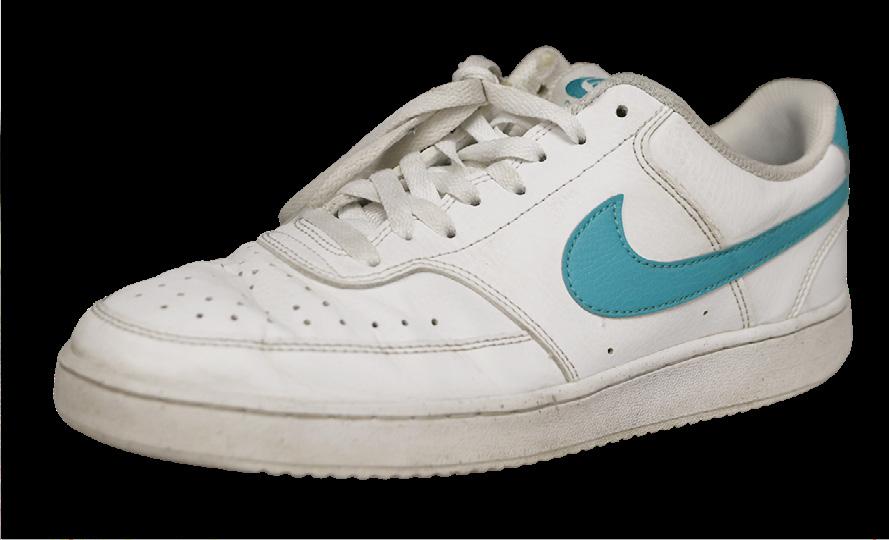
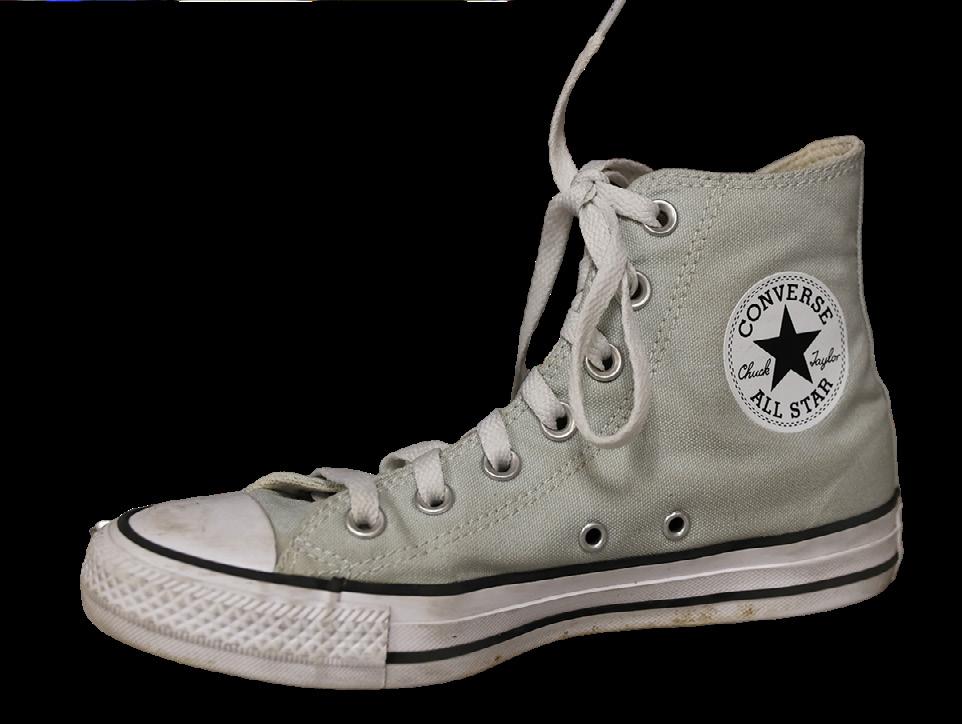
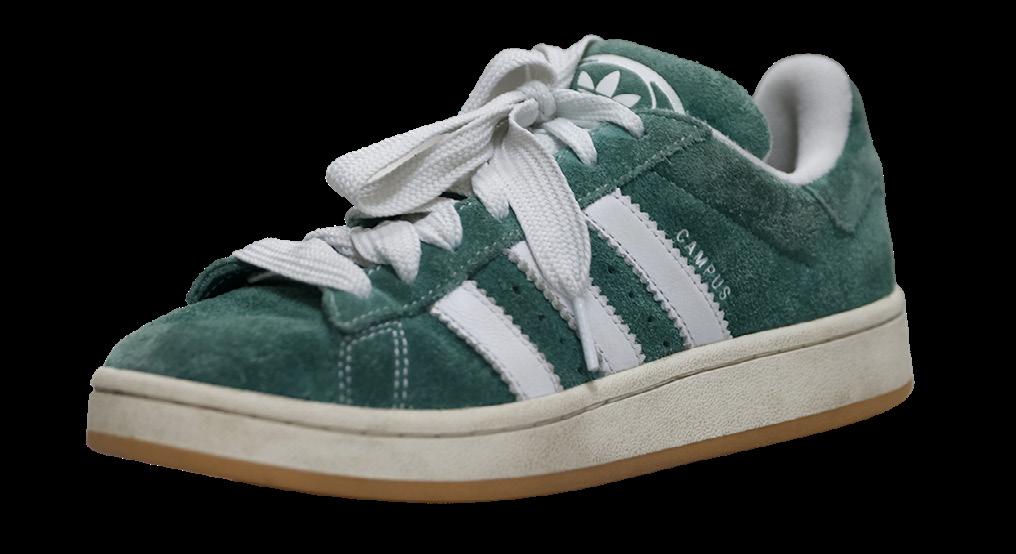
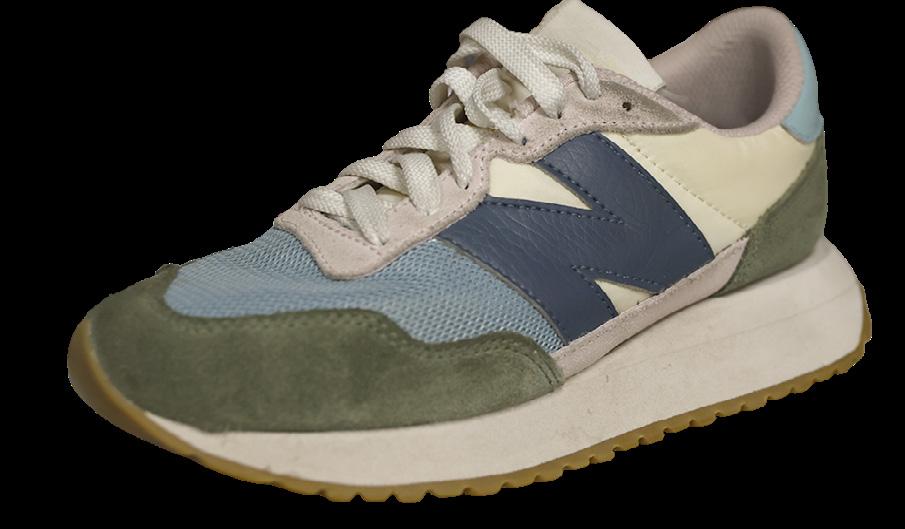
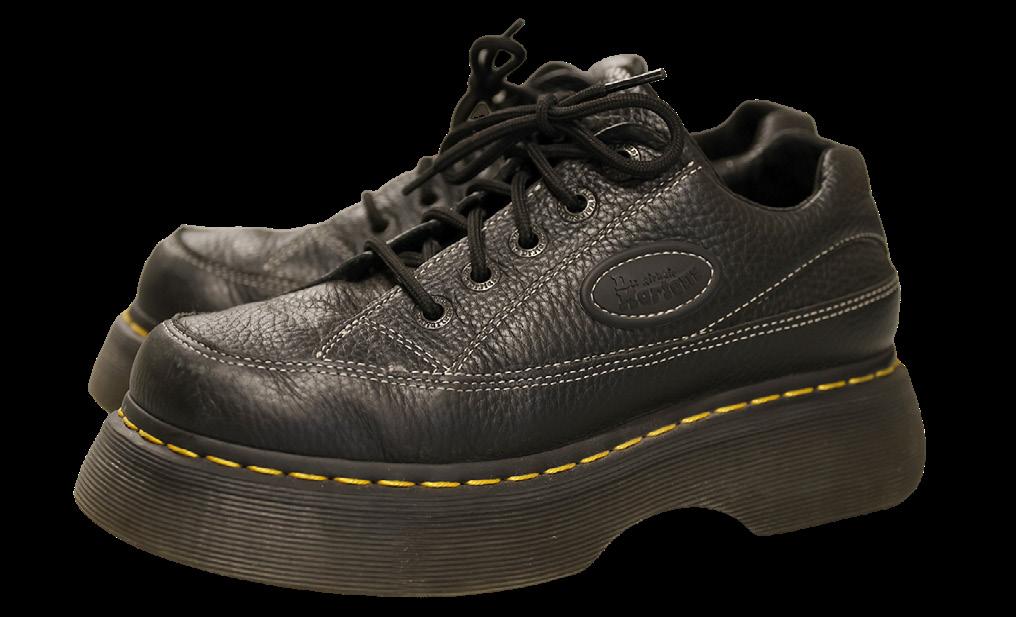
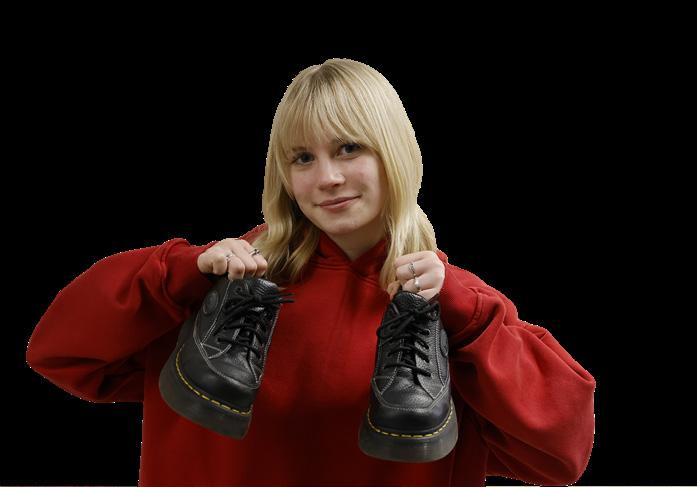
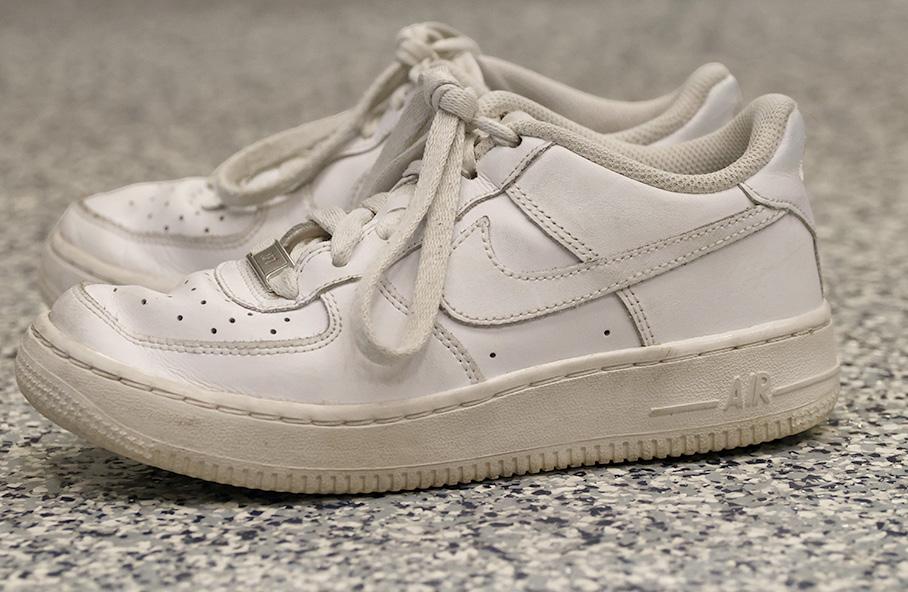
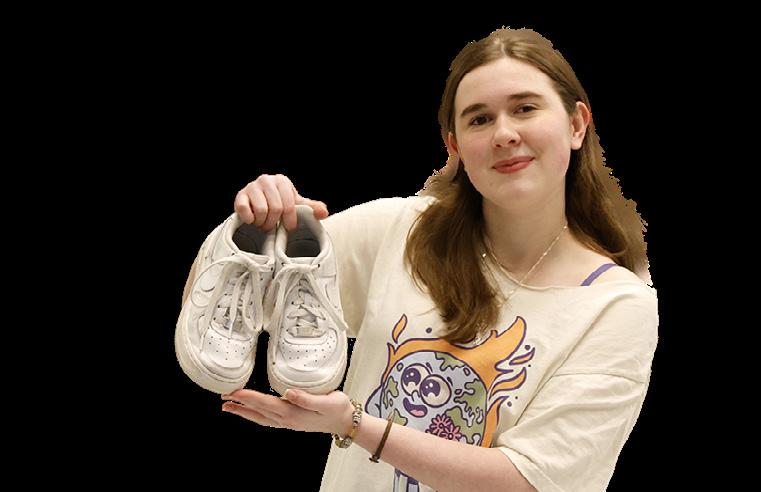
SHOES IN STYLE
Recent shoe trends impact the styles students sport at school Reasoning behind students’ go-to shoe choices
photos by jason sweany
There will be a new face on the softball field this season. The district hired Kevin Mosher as head coach for the season.
Mosher is not new to the sport; he has coached softball for 21 years on multiple different teams, serving as an assistant coach at Olathe South, coaching a club team, and he spent three years as the head coach at Shawnee Mission West. He plans to apply many of the lessons he learned over the years to his coaching at the school.
“We want our players to have a say in how things are going,” Mosher said. “We absolutely want their opinion and guidance on what we want to do in the framework of reaching our goals. We want to continually push to
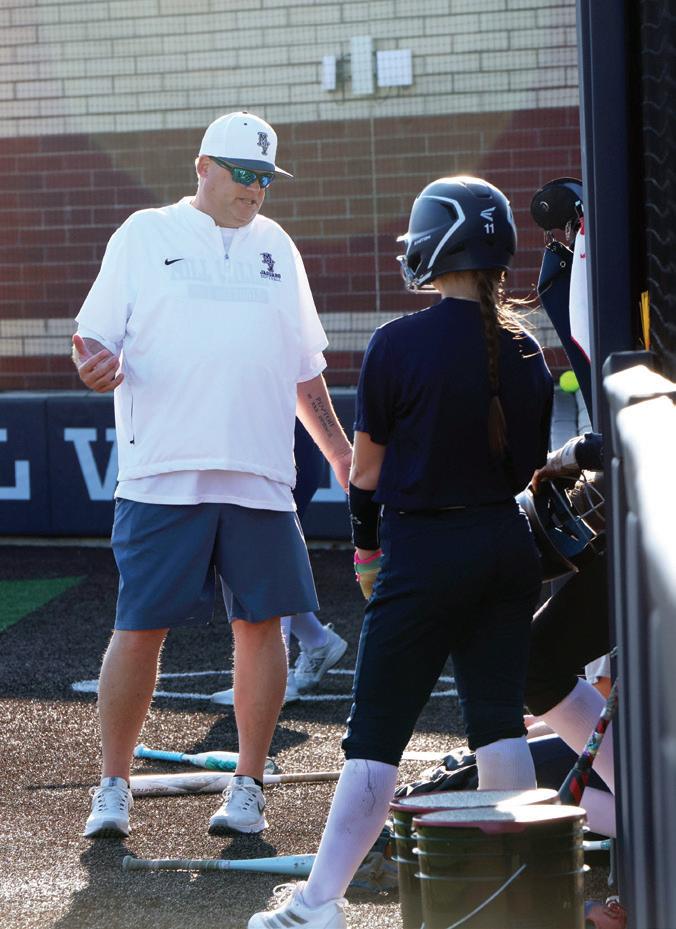
be the best softball team that we can on the field.”
After last year’s fourth-place finish state, which was the farthest into the state tournament the team has been since 2019, ju- nior Addison Moeller was disappointed with the results, but she is hoping for more this season with Mosher as their coach.
“We worked very hard to get to where we were, and we just fell short,” Moeller said. “You can’t blame one person; it’s al- ways a team effort. We all know that we could have done more in that semifinal game to win it and get to thatMoellerchampionship.” believes that Mosher is going to be a positive addition to the program this season hopes that his leadership will help the team make it to state this year.
“He’s so involved with the program, it seems like he really wants us to be exceptional this year,” Moeller said. “All the coaching staff this year is going to be great, and it’s just going to really help the team.”
Junior Olivia Peery is optimistic about Mosher’s coaching style and feels confident about the season because he is prioritizing player feedback and he has a strong track record in the sport.
“Mosher knows what he’s doing,” Peery said. “He’s been in the softball world for a very long time, and we’re all just very excited to get as far as we can and work as hard as we can.”
GUIDING THE TEAM
by evan leroy online editor in chief
TEAM
SEASON GOALS
What softball members’ aim to do differently this upcoming season
Senior Macy Brunner
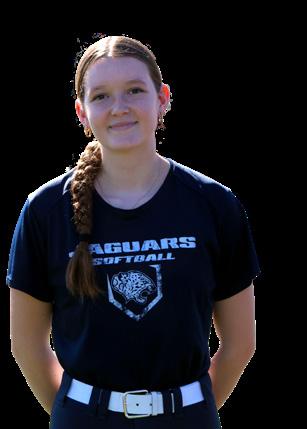
Junior Liv Peery
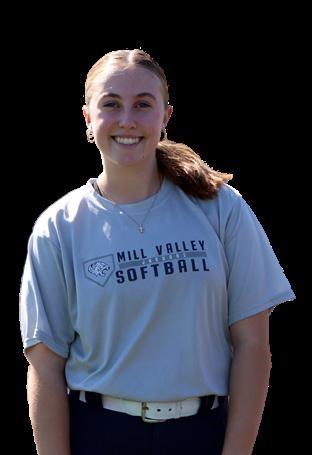
“Being the only senior, I really wanna lead the freshman, especially because the seniors I had as a freshman were really impactful.”
“I just want to make sure everybody knows that they’re not playing for themselves, they’re working for each other.”
Junior Addison Moeller
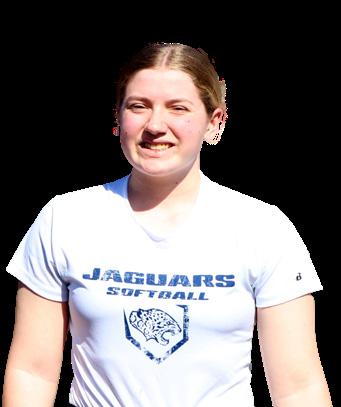
“I’m hoping I can do my part. I don’t need to hit home runs every game to help the team, just making sure I can get on base, and control what I can control.”
New softball head coach Kevin Mosher hopes to have a positive impact on the team in his first year coaching at the school
Providing guidance softball coach Kevin Mosher talks strategy with freshman Olivia Clark at practice, Monday, March 9.
photo by ryan bloomer
photos by ryan bloomer
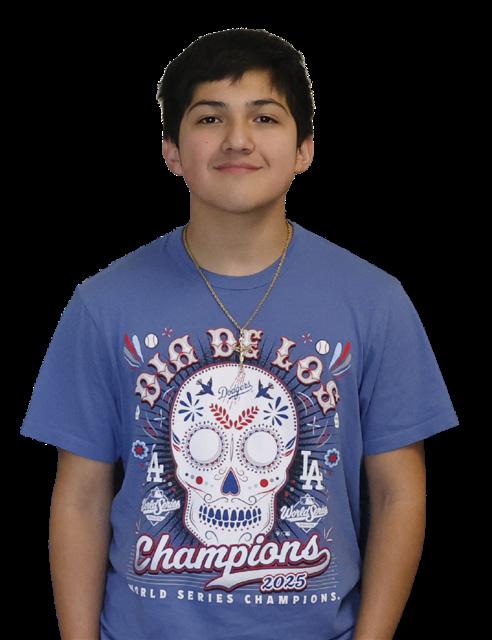
” SOPHOMORE GABRIEL MORALES
I’ve always liked volleyball. I’ve always watched men’s volleyball, especially in the Olympics with the men’s sand volleyball. So might as well just try something new.”
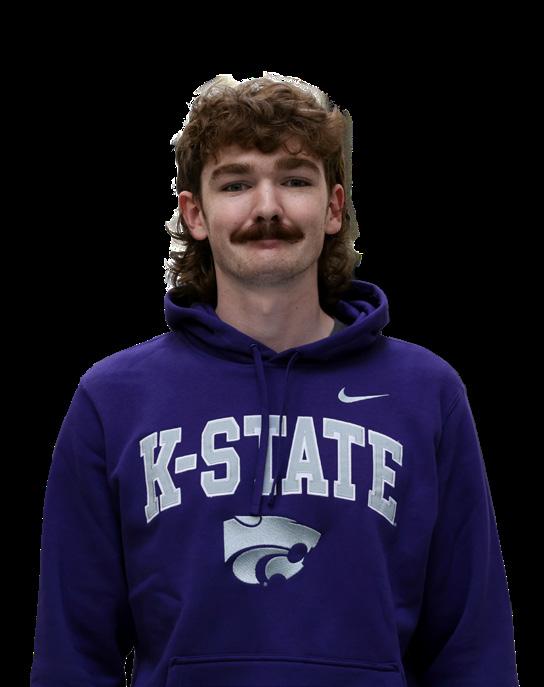
SENIOR GABE SOMMERFELD
I’m very excited to play. I’ve loved volleyball for years. I’m super excited to be represented here at Mill Valley.”
LINEUP LOGIC
A breakdown of all the positions on a volleyball team and the order players serve
In head volleyball coach Ky- lie Corneliusen’s time at the school, she had an idea: create a boys volleyball team. This spring, she will put together thefirst boys volleyball team to compete in a non- KSHSAA league.
The rules between boys and girls volleyball are slightly dif- ferent, such as an increase in net height. The team will have two teams of six people decided by tryouts held March 23-24. Corneliusen is still figuring out a schedule for the team’s practice and how many games the teams will play this season.
“We plan on only playing one night a week, so we would practice one day a week, the day
before the game,” Corneliusen said. “Eventually, it will be more, but we don’t have the space or the resources yet to make it.”
The school already has a population of male volleyball players eager to play, like senior Gabe Sommerfeld. Sommerfeld has been playing volleyball for five years through his club team, United Volleyball Club, he is ex- cited about the opportunity to play for the school.
“I believe we have an incredible amount of great athletes here at the school,” Sommerfeld said. “I’ve got hope that we can go out there and compete, I’m super excited to see the sport I love be represented here at the school”
While there has been interest
in the sport, Corneliusen is wor- ried that not enough people will try out due to their commitment to other spring sports impeding on the team’s schedule.
“It’s hard because you have track, baseball, golf and so many other activities going on,” Corne- liusen said.“I think if it can reach the kids that are in those activities, then it’ll be fun.”
Sommerfeld is especially ex- cited about the insight Corneliu- sen can provide because of her success with the girls program.
“I have a tremendous amount of respect for Coach C,” Som- merfeld said. “I believe she can help us become better volleyball players and I really appreciate her putting this team together.”
COURT DEBUT
The newly formed boys volleyball team will play its first season this year
by ryan bloomer writer/photographer
I AM MV is a series that showcases students at the school and their unique interests, hobbies and talents
MV I AM
to
for
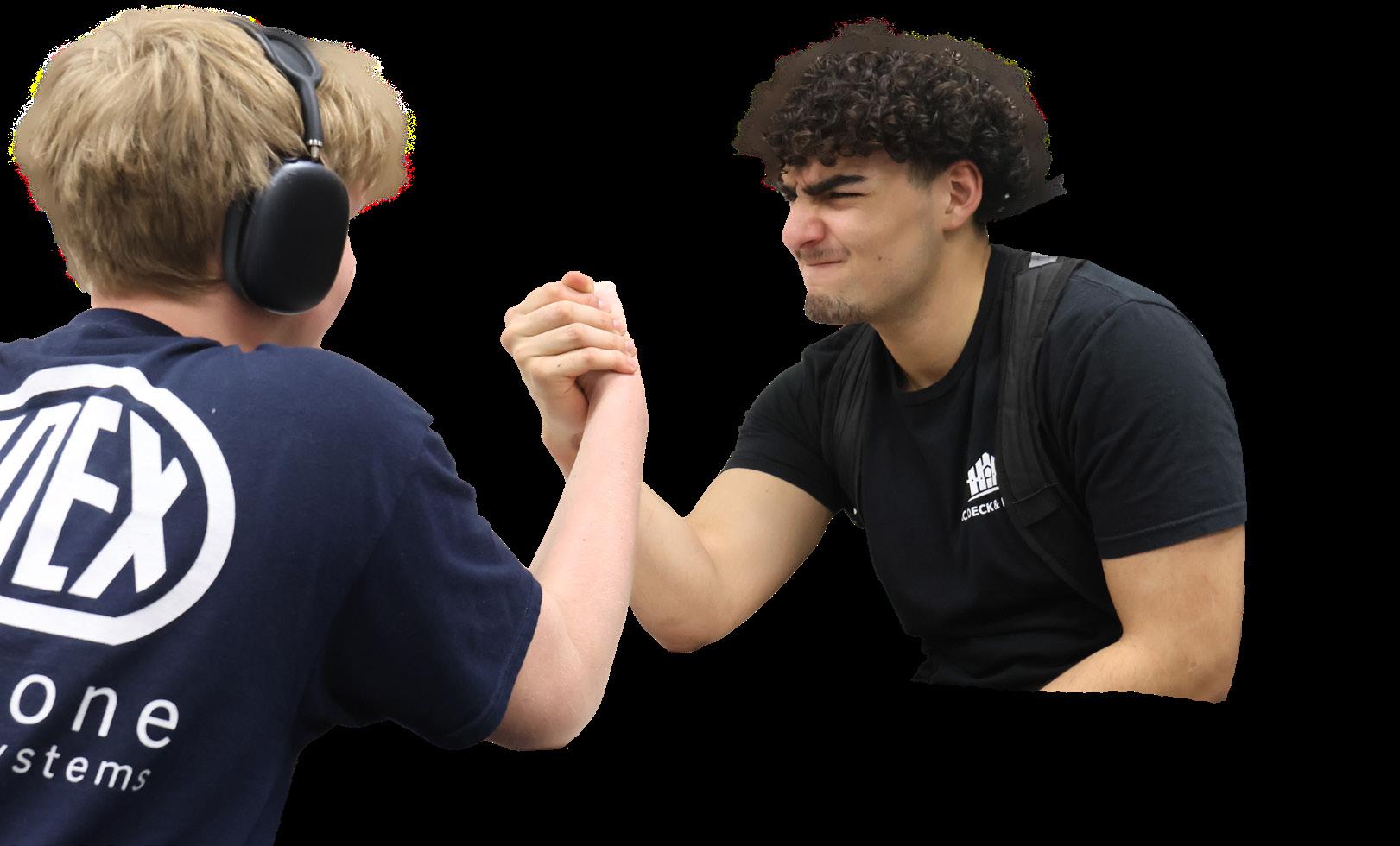
arm wrestling tournaments, junior Ben Diaz wrestles junior Ben Sherman so Diaz can make sure he is always ready for his tournaments, photo by eva hernandez
ery ten pounds. Each bracket consists of 10 people in a weight class, with an A and a B side to it. After winning a match, the victor then faces an opponent from the opposite side of the bracket.
BEN DIAZ BEN DIAZ
Junior Ben Diaz has competed in arm wrestling for five years by mya franco writer/photographer
For the past five years, junior Ben Diaz has been competing in the sport of arm wrestling. His first introduction to the sport was through his dad, who has been competing for 15 years. Since his father introduced him to the sport, Diaz has been practicing with his dad and sees himself catching up to his father.
“It feels good [to compete with him],” Diaz said. “I’ve almost beaten him before [in practice], so it’s like I’m going against him [when I compete].”
Other than his dad’s motivation, Diaz finds that listening to rock music and getting angry before a match helps his performance.
“I just want to send the other guy’s arm through the table, you’ve got to be aggressive [to win],” Diaz said.
Junior Ben Sherman helps
Diaz practice for these tournaments in multiple different ways.
“In his basement, he’s got a bunch of different workouts he does, [and] I do that with him,” Sherman said. “Or, we just arm wrestle together.”
The usual spots for these tournaments range from rented out churches to warehouses. These tournaments consist of a group of men that his father got together to compete. Within this group, there are weight brackets for ev-
Always dedicated to the next competition, Diaz practices every Sunday to train properly.
“You can do specific workouts for it, but really, you just train by actually arm wrestling,” Diaz said.
While Diaz has won more often than not, losing still takes a toll on him
“It’s a little sad [when I lose], but in one-on-one sports, it happens a lot more often,” Diaz said. With a record of about 50 wins and 15 losses in competitions, Diaz feels very fulfilled after he wins.
“[Arm wrestling is] really fun, I like the one-on-one competition, it makes me feel very manly,” Diaz said. “It’s a good feeling [when I win]: it feels like I just got into a fight and won.”
THE WAY TO WRESTLE
The process of an arm wrestling tournament
- Weigh in before match
- First hand to hit the table loses
- One on one matches
- Win 10 matches to win tournament
- Tournament winner earns money and a medal
In order
practice
his