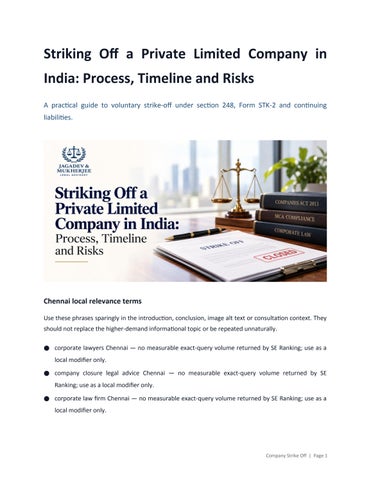
Striking Off a Private Limited Company in India: Process, Timeline and Risks A practical guide to voluntary strike-off under section 248, Form STK-2 and continuing liabilities.
Chennai local relevance terms Use these phrases sparingly in the introduction, conclusion, image alt text or consultation context. They should not replace the higher-demand informational topic or be repeated unnaturally. ● corporate lawyers Chennai — no measurable exact-query volume returned by SE Ranking; use as a local modifier only. ● company closure legal advice Chennai — no measurable exact-query volume returned by SE Ranking; use as a local modifier only. ● corporate law firm Chennai — no measurable exact-query volume returned by SE Ranking; use as a local modifier only.
Company Strike Off | Page 1
What the article should cover ● What strike-off means and how it differs from liquidation or insolvency. ● Eligibility under section 248(2), extinguishment of liabilities and member approval. ● Section 249 restrictions and pre-filing readiness checks. ● Form STK-2 and supporting documents, including statement of accounts, indemnity and affidavit. ● ROC public notice, objection period, final dissolution notice and practical timeline factors. ● Continuing liability, director risks, restoration under section 252 and post-closure record retention.
Striking Off a Private Limited Company in India: Process, Timeline and Risks A company does not cease to exist merely because it has stopped trading, closed its bank account or has no employees. Until its name is removed from the register or it is dissolved through another lawful route, filing obligations and officer exposure may continue. Strike-off is a simplified exit mechanism for an eligible company; it is not a shortcut for avoiding creditors, disputes or incomplete records. This guide explains the voluntary strike-off route under section 248(2) of the Companies Act, 2013 and the Removal of Names Rules. The correct route depends on solvency, liabilities, assets, proceedings and regulatory status. For related corporate advisory, review Jagadev & Mukherjee’s practice areas.
1. What does “company status: strike off” mean? When the Registrar removes a company’s name from the register and publishes the prescribed notice, the company stands dissolved from the date stated in that notice, subject to the Companies Act. “Strike off” may refer to action initiated by the Registrar under section 248(1) or an application made by the company under section 248(2). A status showing “strike off” should therefore be read with the public notice and filing history rather than treated as a complete description of what happened. Strike-off is different from a members’ voluntary liquidation, creditors’ process or insolvency resolution. A company with substantial assets, unresolved debts, litigation or a need for formal liquidation distributions may require another route.
Company Strike Off | Page 2
2. When may a company apply for voluntary strike-off? Section 248(2) permits a company, after extinguishing all its liabilities, to apply to the Registrar for removal of its name on the grounds stated in section 248(1). The application generally follows a special resolution or the consent of members holding 75 per cent of the paid-up share capital. Where another law regulates the company, approval from the relevant regulator may also be required. Before choosing the route, confirm that the company: ● Has genuinely ceased the relevant business or satisfies another statutory ground for removal. ● Has identified and extinguished liabilities, including contingent, employee, tax and contractual exposures. ● Has dealt with bank balances, deposits, receivables, investments, intellectual property and physical assets lawfully. ● Has completed the overdue filings required under the current rules for an STK-2 application. ● Is not using strike-off to prejudice creditors, members, employees, regulators or pending proceedings.
3. Check the restrictions in section 249 A company cannot validly apply if it has carried out specified restricted actions in the previous three months. These include changing its name or shifting its registered office from one State to another; disposing of property or rights held immediately before cessation of trade other than in the ordinary course; engaging in activities other than those necessary for making the application, concluding affairs or complying with law; applying for a compromise or arrangement that remains unresolved; or being wound up under Chapter XX. The three-month review should be documented transaction by transaction. Closing a bank account, collecting receivables or disposing of assets shortly before filing may need careful analysis to confirm that it fits within the permitted winding-down activity.
4. Complete a pre-filing readiness review Workstream
Questions to close
Evidence to retain
Corporate records
Are directors, members, capital and registered-
Master data, registers, minutes and filings.
Company Strike Off | Page 3
office details current?
Annual filings
Assets
Liabilities
Tax and licences
Disputes
Regulators
Which overdue annual returns and financial statements must be completed?
Filed forms, SRNs and challans.
Are bank balances, receivables, deposits and
Statements,
property fully dealt with?
confirmations.
Are trade, employee, lender, lease, tax and
No-dues
contingent exposures extinguished?
confirmations.
Are returns, registrations and cancellation steps
Returns,
complete?
acknowledgements.
Are notices, investigations, prosecutions or claims pending? Is
sector-regulator
approval
or
no-objection
required?
transfers
records,
orders
and
closure
settlements
and
and
cancellation
Legal-status memo and case records.
Approval or no-objection document.
5. Approve the closure and prepare Form STK-2 The board should review the eligibility memorandum, liabilities, recent transactions, accounts and proposed member approval before authorising the application. After the required member approval or consent is obtained, the company applies in Form STK-2 using the current MCA filing process and prescribed fee. The supporting pack commonly includes, subject to the current form and rules: ● An indemnity bond in the prescribed form from the directors. ● An affidavit in the prescribed form from the directors. ● A statement of accounts made up to a date not more than 30 days before the application and certified as prescribed. ● A copy of the special resolution or the prescribed member consent. ● Regulatory approval or no-objection where the company is governed by a special law. ● Other declarations, explanations and attachments required by the live Form STK-2 and instruction kit.
Company Strike Off | Page 4
The numbers in the statement of accounts should reconcile to bank statements, tax records and the company’s explanation of how assets and liabilities were closed. A nil balance sheet without supporting evidence can create avoidable objections.
6. What happens after filing? 1.
The Registrar examines the application and may seek resubmission, clarification or further documents.
2. Notices are sent or published in the prescribed manner so that regulators, creditors and other stakeholders may object. 3. The public-notice stage ordinarily provides the prescribed objection period before final action. 4. If satisfied that the statutory conditions are met, the Registrar publishes the final notice of striking off and dissolution. There is no single guaranteed completion date. The practical timeline depends on filing accuracy, pending forms, objections, tax or regulatory responses, ROC workload and whether the company’s records reconcile. Businesses should plan for queries instead of promising a fixed number of days.
7. Liabilities do not automatically disappear Section 248 preserves the liability of directors, officers and members as if the company had not been dissolved, where the statutory conditions apply. Strike-off therefore does not erase personal guarantees, fraud, misstatements, tax exposure, contractual liability or obligations that the law preserves. The Tribunal may also wind up a company whose name has been struck off. Directors signing the indemnity, affidavit and application should verify the statements personally. An inaccurate declaration that the company has no liabilities or proceedings can create consequences more serious than a delayed closure.
8. Can a struck-off company be restored? Section 252 provides routes to challenge or seek restoration of a struck-off company. A person aggrieved by the Registrar’s order may appeal to the Tribunal within the statutory period. The Registrar, a creditor, member or workman may also use the restoration mechanism within the longer period and on the grounds stated in the section. The exact route, limitation period and evidence depend on who applies and why restoration is sought.
Company Strike Off | Page 5
Restoration can revive filing obligations and operational questions. Preserve corporate, accounting, tax and closure records even after the final notice instead of destroying them immediately.
9. Common strike-off mistakes ● Assuming that inactivity or a closed bank account means the company is already dissolved. ● Applying before extinguishing liabilities or resolving assets and receivables. ● Ignoring section 249 transactions during the three-month look-back period. ● Filing accounts that do not reconcile with bank, tax and statutory records. ● Overlooking a pending charge, prosecution, regulatory approval or stakeholder objection. ● Promising that all director or member exposure ends on the strike-off date.
Conclusion Striking off a private limited company is a structured legal exit, not a form-only exercise. The company should choose the correct closure route, extinguish liabilities, test statutory restrictions, reconcile records and make accurate declarations before filing. Companies seeking advice in Chennai can learn about Jagadev & Mukherjee or use the firm’s contact page.
Important This article provides general information and is not legal advice. It does not create a lawyer-client relationship. Company classification, approvals, thresholds, forms and filing requirements may change or vary with the facts. Check the current Act, rules, notifications, Secretarial Standards and MCA portal before acting.
Company Strike Off | Page 6