•\ JAFMOTORSPORT

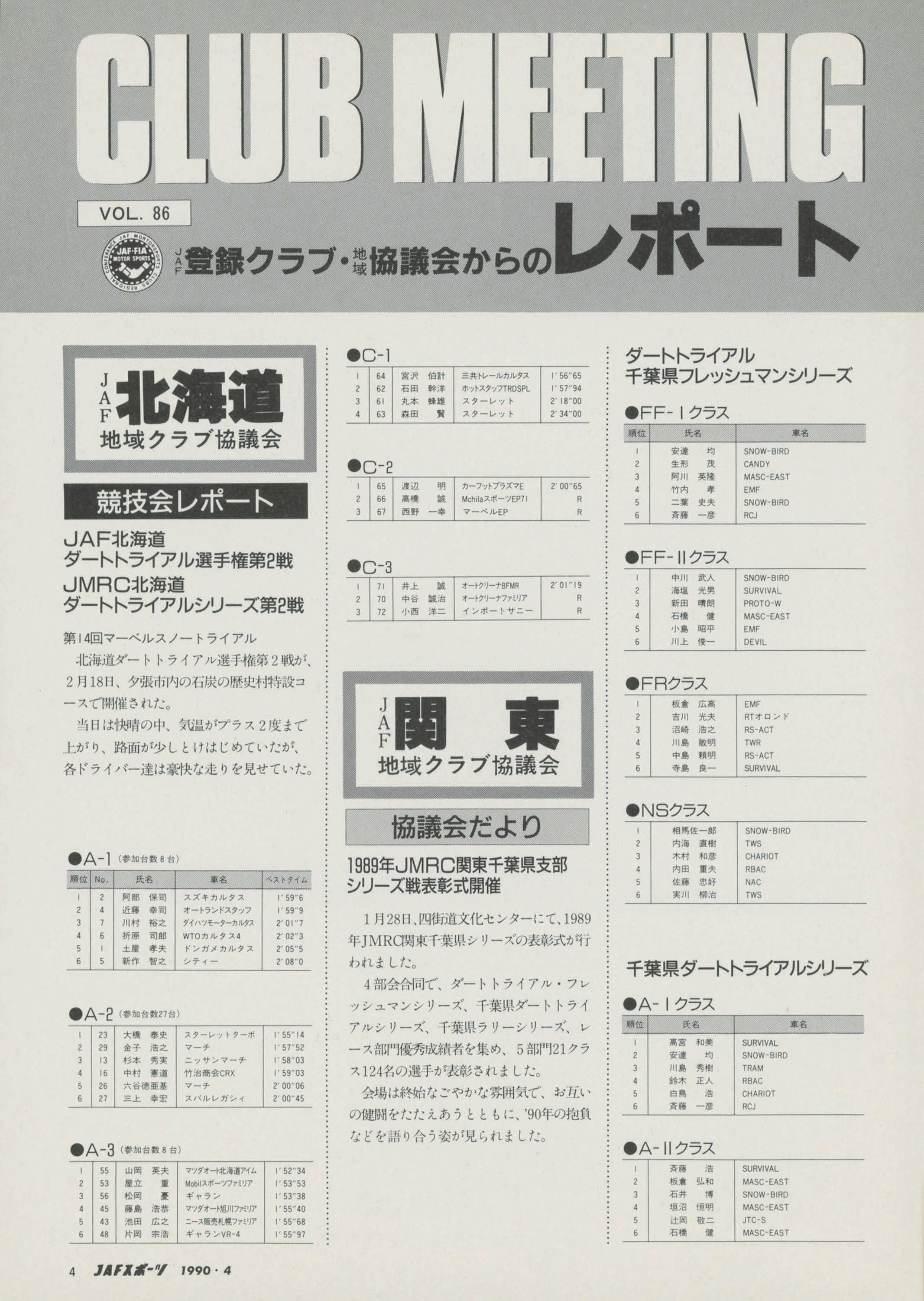
KAZE SURVIVAL AUTUMN SURVIVAL ATOMCLUB SURVIVAL • ,23456
DCCS HAYABUSA AUTUMN
MASC-EAST EMF SNOW-BIRD
RBAC RBAC
SNOW-BIRD SNOW-BIRD OAKS SURVlVAL
MASC-EAST SNOW-BIRD RBAC SURVIVAL RBAC TRSO
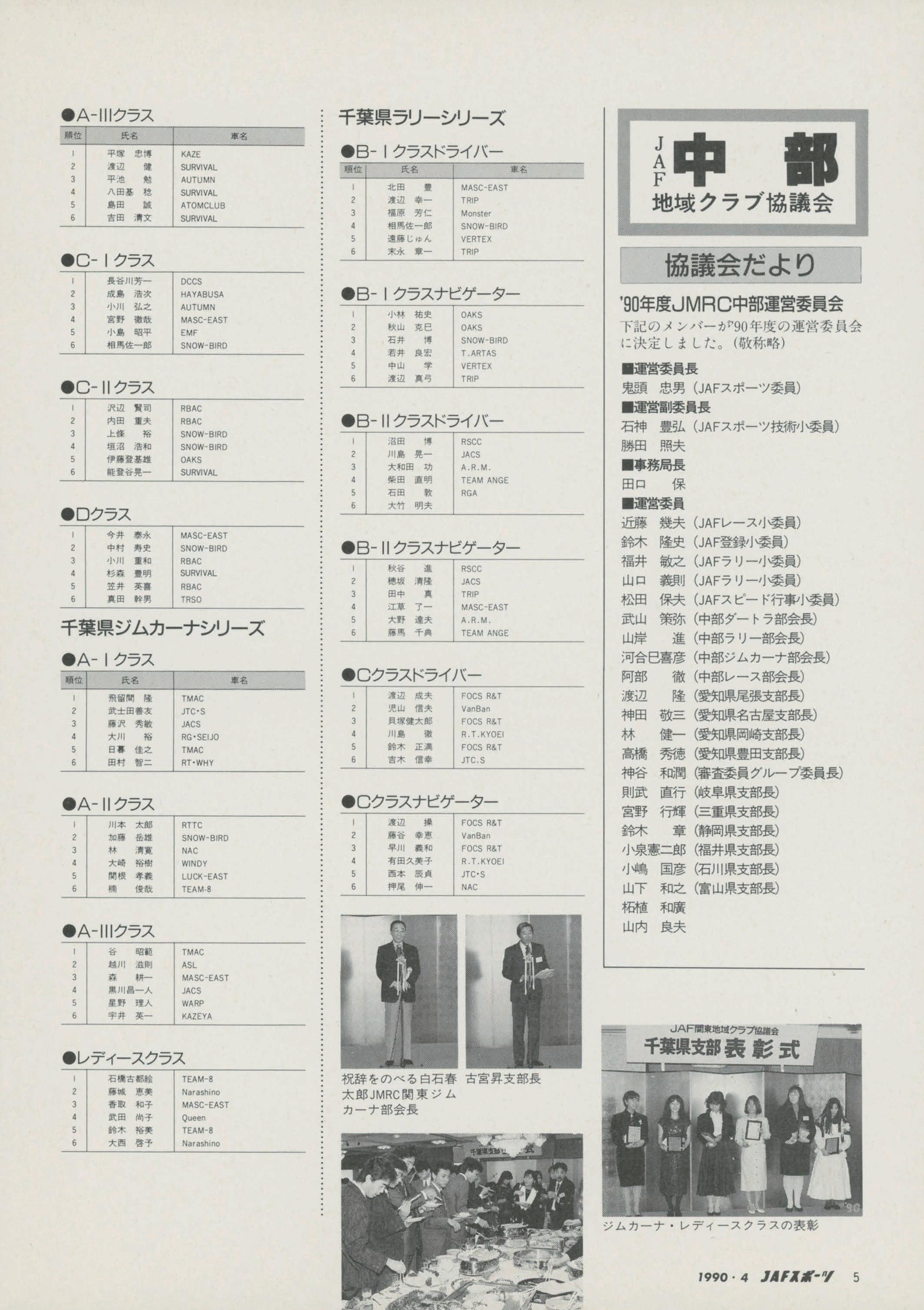
TMAC JTCキS JACS
TMAC RTキWHY
RTTC SNOW-BIRD NAC WINDY
LUCK-EAST TEAM8
TMAC ASL
MASC-EAST JACS WARP KAZEYA
MASC-EAST TRIP Monster
SNOW-BIRO VERTEX TRIP
WEED
T.R.S.K
T.Fairy
SPINERS
BTSC
G-ZZ
R.T-CHAMP
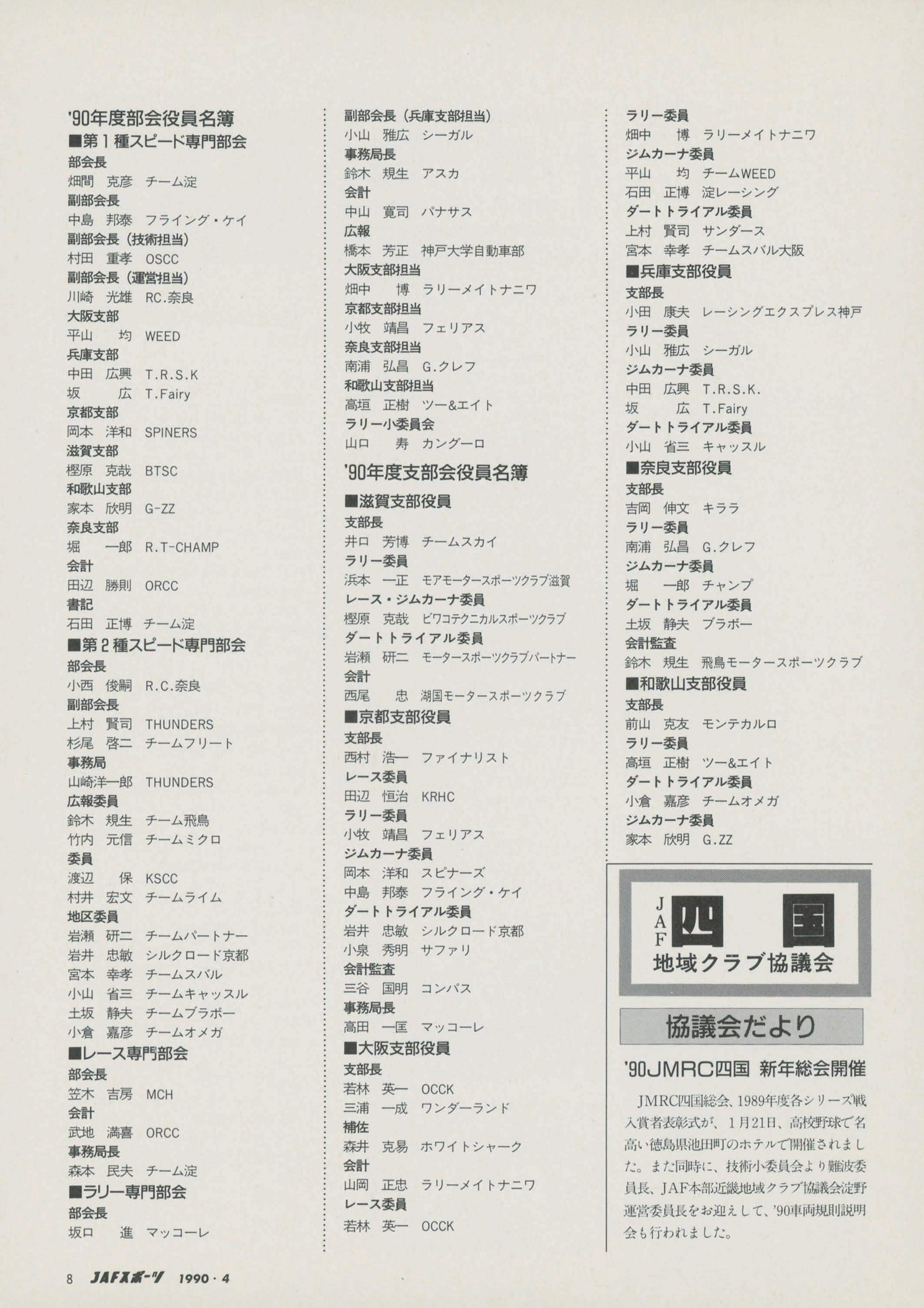
THUNDERS
THUNDERS
KSCC
MCH
KRHC
Fairy
OCCK
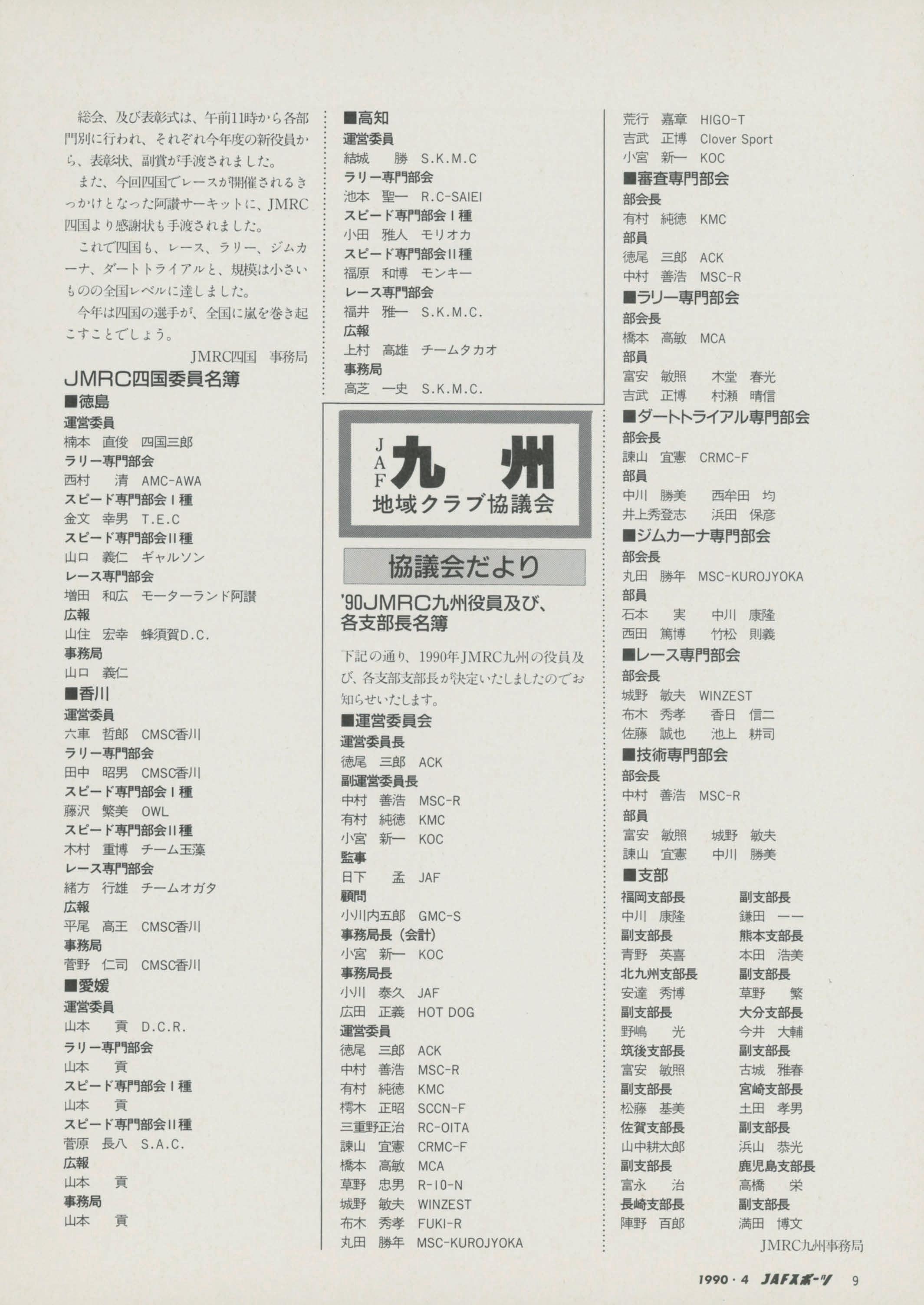
GMC-S
( NE) 26-3 26-8 :
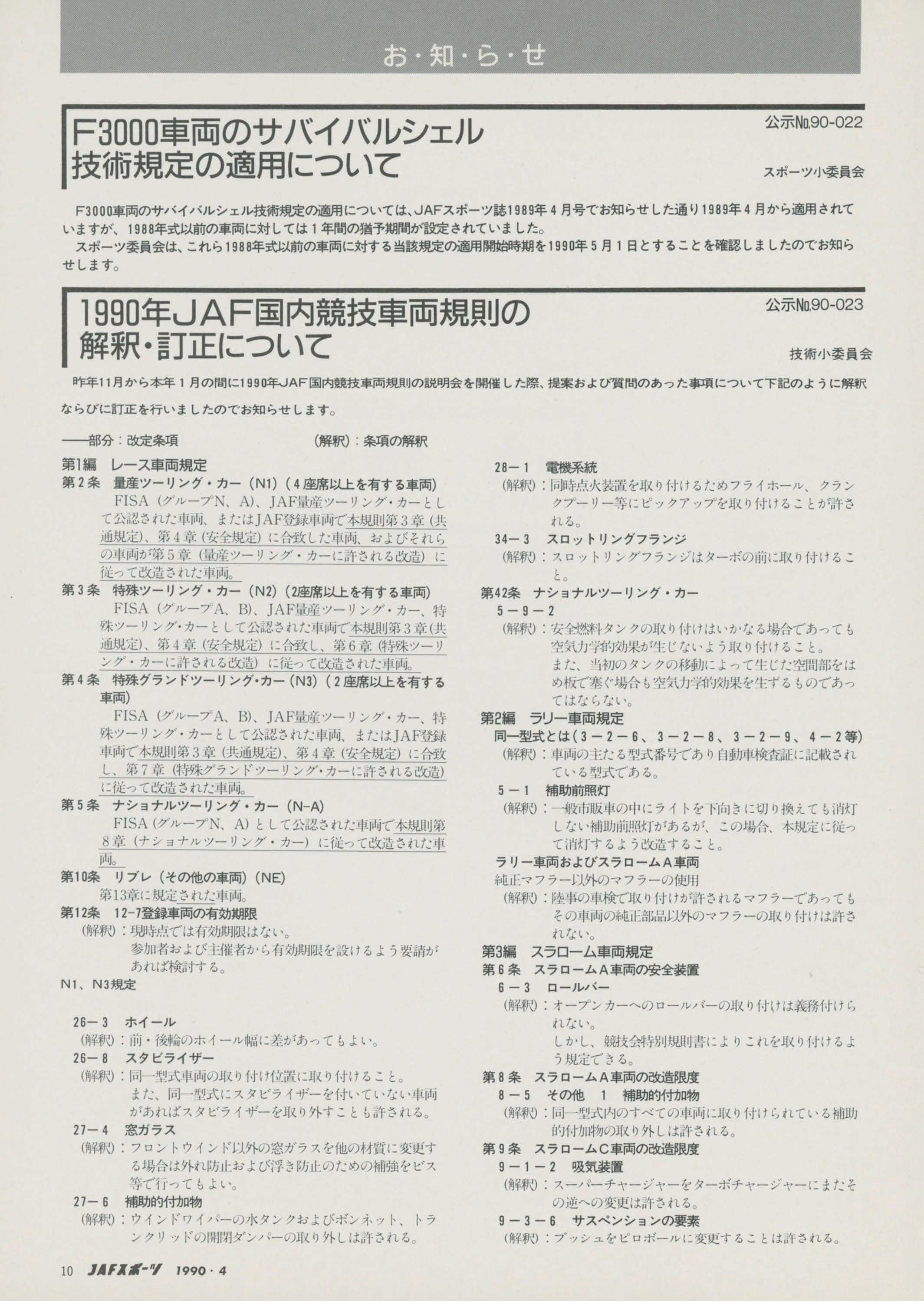
6
3 5-9-2
: 5-1 6-3 8-5 1 :[,ij 9-1-2 9-3-6
9-3-7
lil-1- 2- 2-5-2
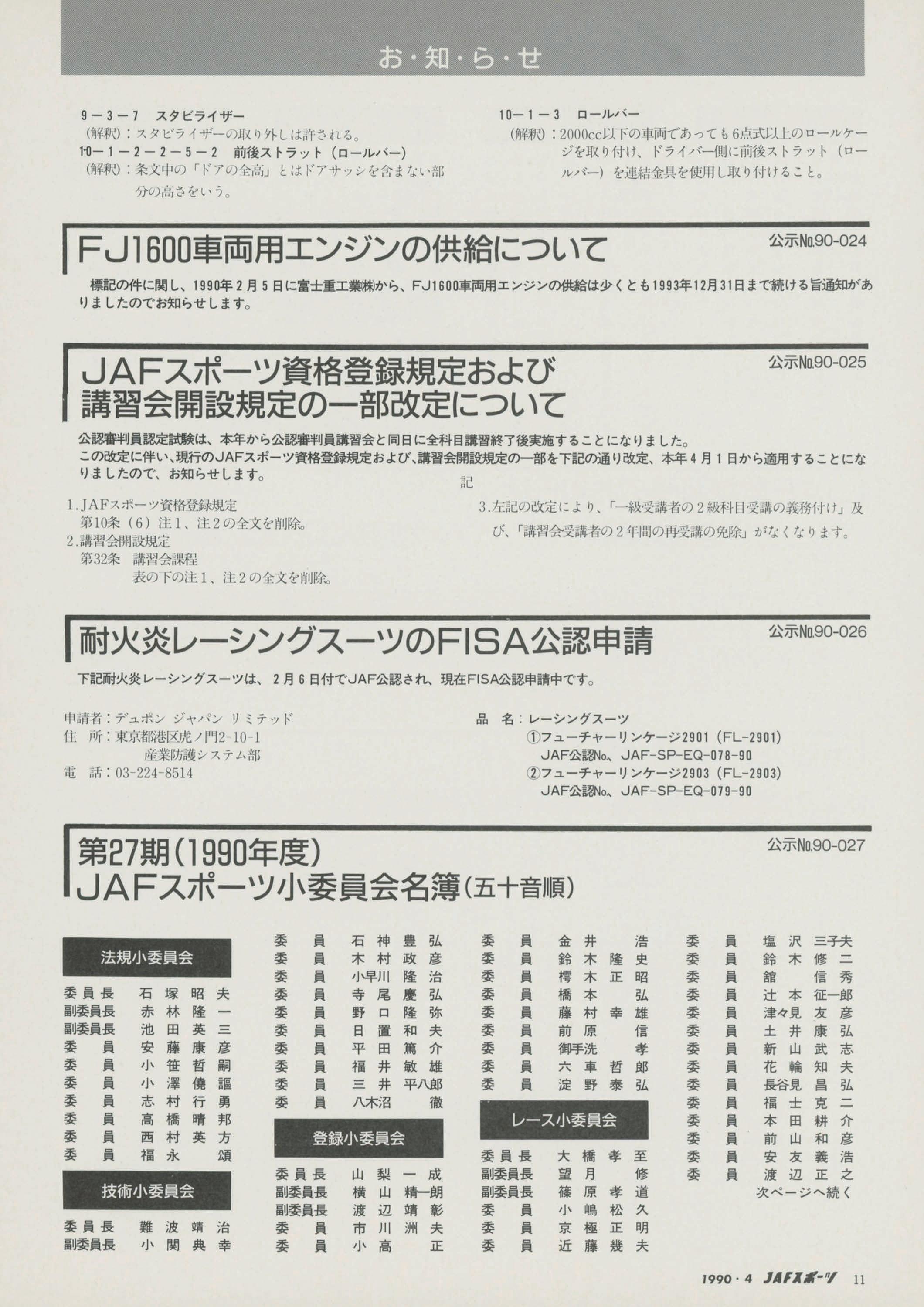
10-1-3
10-1
03-224-8514 (FL-2901) 8-90 (FL-2903) JAF-SP-EQ-079-90
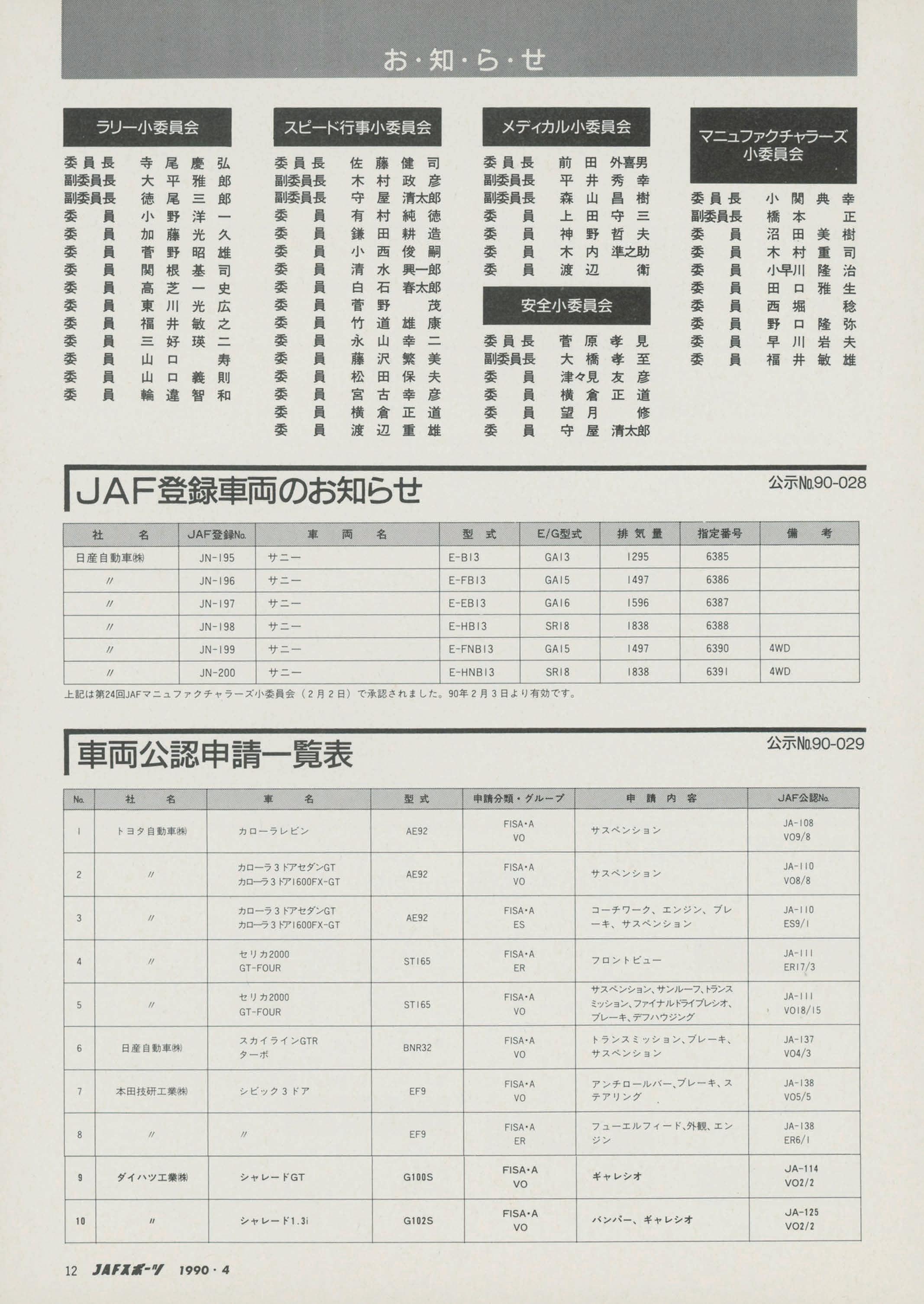
I I
11 :00
18:00
9:00
17 :00 SMSC
9:00
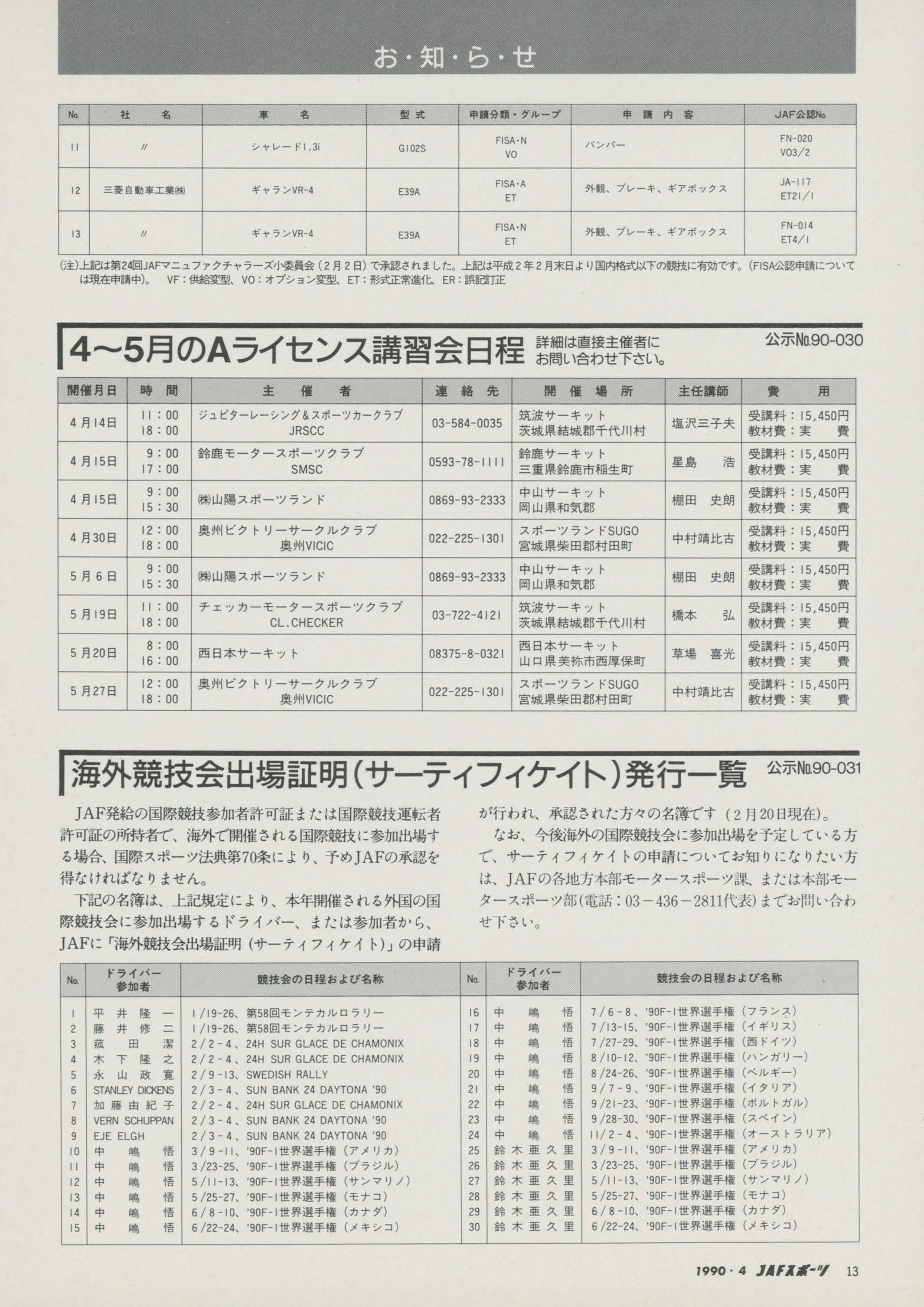
03-584-0035
0593-78-1111
0869-93-2333 15:30
12: 00
18: 00
9 :00
15:30
11 :00
18:00 CL.CHECKER
8:00
16:00
12:00
022-225-1301
0869-93-2333
03-722-4121
08375-8-0321
022-225-1301 18: 00

TEAM DAVEY
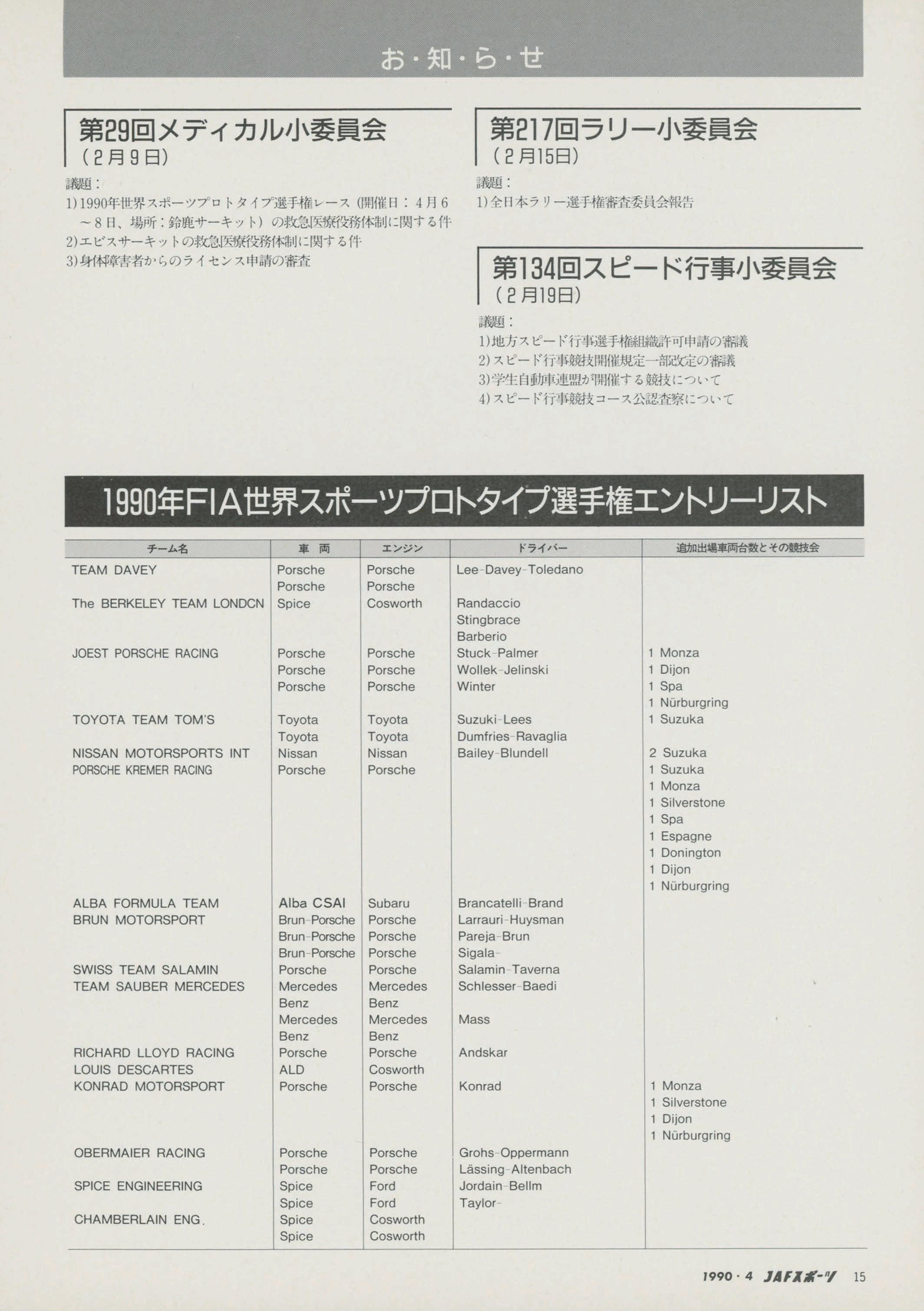
Porsche Porsche Lee-DaveyToledano
Porsche Porsche
The BERKELEYTEAM LONDCN Spice Cosworth Randaccio Stingbrace Barberio
JOESTPORSCHE RACING
TOYOTATEAM TOM'S
Porsche Porsche Stuck Palmer 1Monza
Porsche Porsche Wollek Jelinski 1Dijon
Porsche Porsche W inter 1Spa 1Nurburgring
Toyota Toyota SuzukiLees 1Suzuka
Toyota Toyota Dumfries Ravaglia
NISSAN MOTORSPORTS INT Nissan Nissan Bailey Blundell 2 Suzuka PORSCHEKREMERRACING
Porsche Porsche 1Suzuka 1Monza 1Silverstone 1Spa 1Espagne 1Donington 1Dijon 1Nurburgring
ALBA FORMULA TEAM AlbaCSA! Subaru BrancatelliBrand BRUN MOTORSPORT
SWISS TEAM SALAMIN
TEAM SAUBER MERCEDES
RICHARD LLOYD RACING
Porsche Porsche Larrauri-Huysman
Porsche Porsche Pareja Brun
Brun-Porsche Porsche Sigala
Porsche Porsche Salamin Taverna
Mercedes Mercedes Schlesser Baedi
Benz Benz
Mercedes Mercedes Mass
Benz Benz
Porsche Porsche Andskar
LOUIS DESCARTES ALD Cosworth
KONRAD MOTORSPORT
OBERMAIER RACING
SPICE ENGINEERING
CHAMBERLAIN ENG
Porsche Porsche Konrad 1Monza 1Silverstone 1Dijon 1Nurburgring
Porsche Porsche Grohs-Oppermann
Porsche Lassing Altenbach
Spice Ford Jordain Bellm
Spice Ford Taylor
Spice Cosworth
Spice Cosworth
I--— I
G.P
SILK CUT JAGUAR
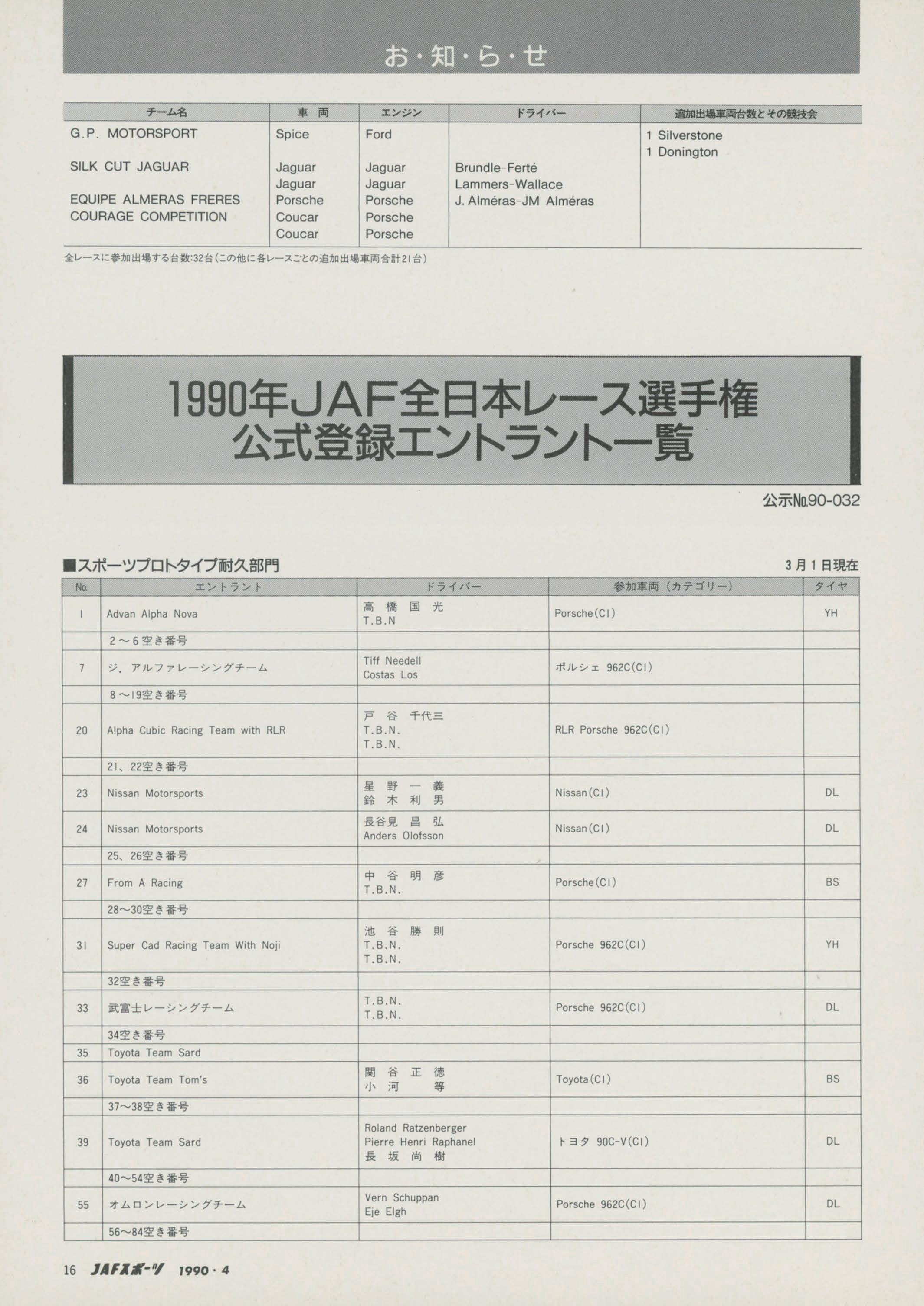
Jaguar Jaguar Brundle-Ferte
Jaguar Jaguar Lammers-Wallace
EQUIPE ALMERAS FRERES Porsche Porsche J Almeras-JM Almeras COURAGE COMPETITION Porsche Coucar Porsche
I Advan Alpha Nova
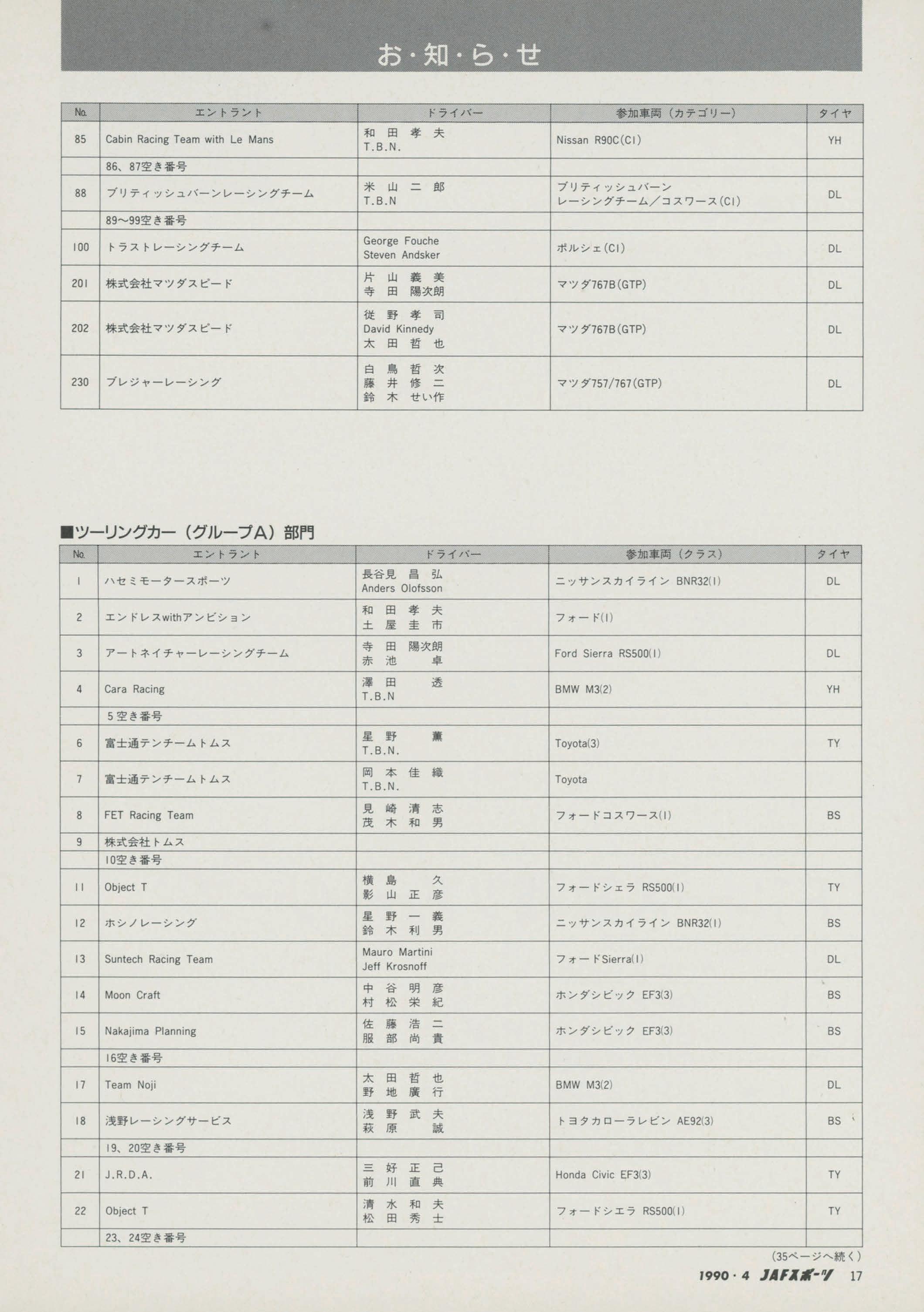
7 TiffNeedell Costas Los
20 Alpha CubicRacingTearn with RLR
23 Nissan Motorsports
24 Nissan Motorsports
27 From A Racing
31 Super Cad RacingTeam With Noji
Anders Olofsson
962C(CI)
35 Toyota Team Sard
36 ToyotaTeam Tom's
Toyota Team
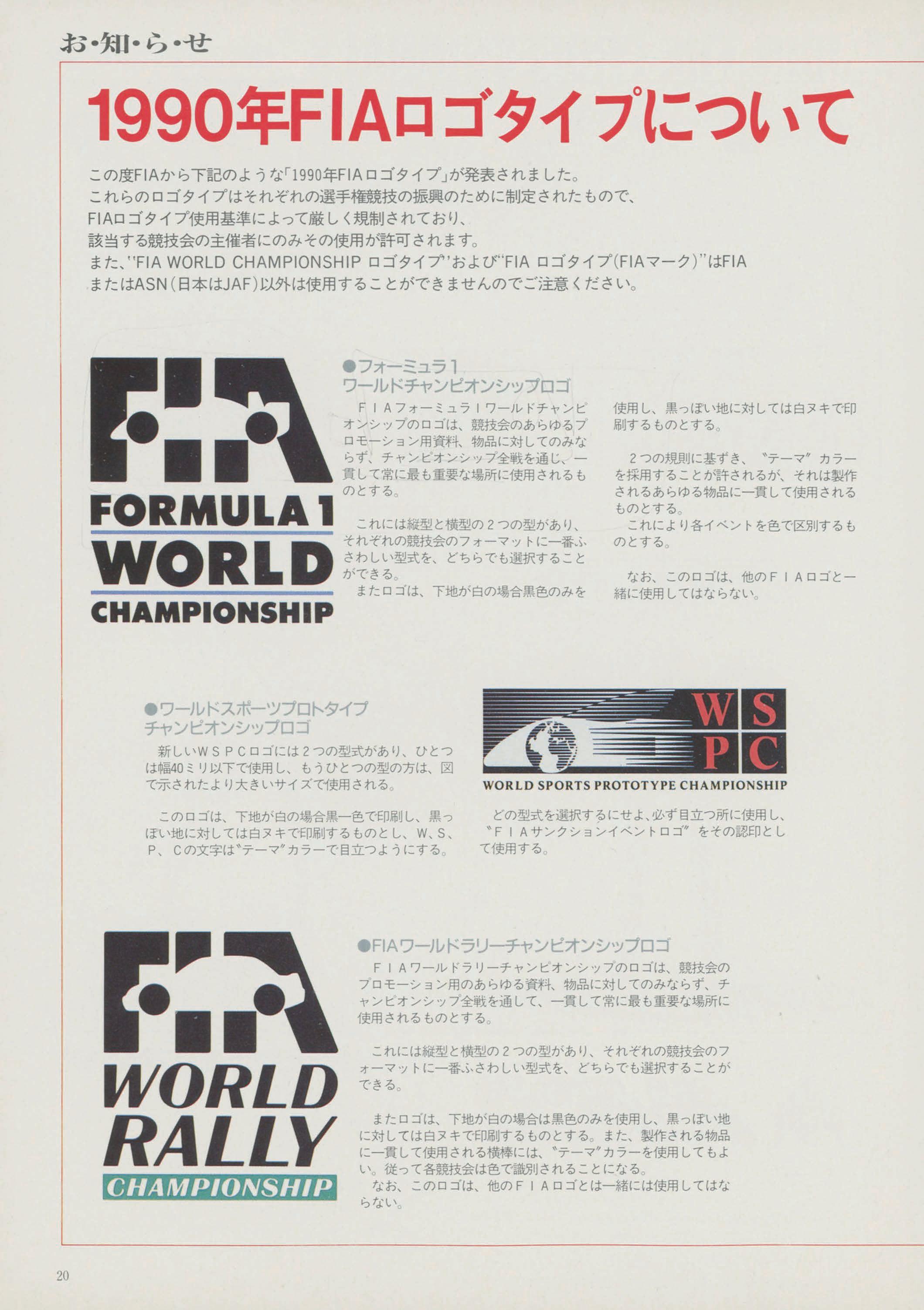
CHAMPIONSHIP
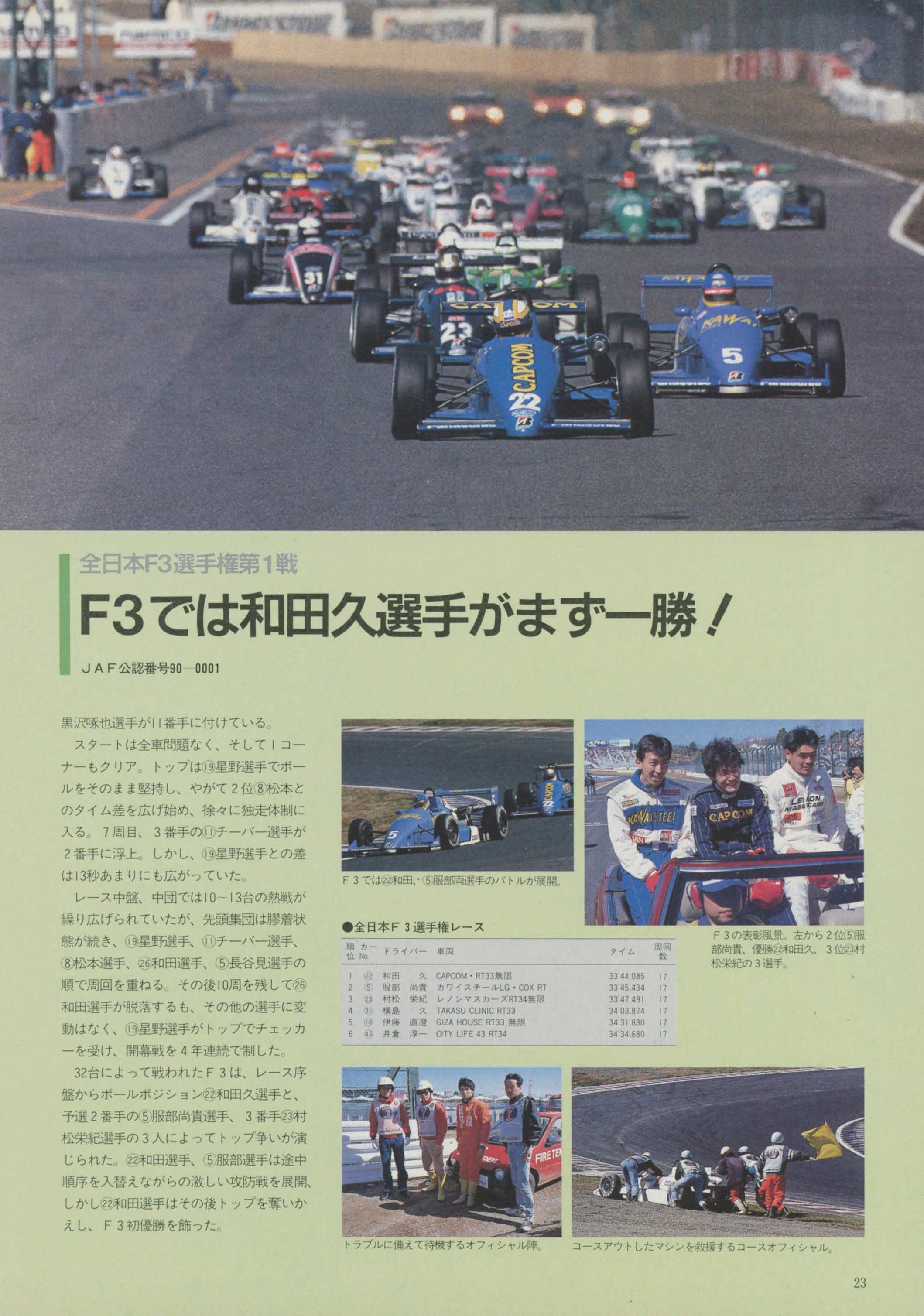
3344.085 17
3345.434 17
3347.491 17
3403.87' 17
3431.830 17
34Jd.680 17

APPENDIX J (GROUPSN. ^. F3, F3000)
l) MODIFICATIONS TO THB AND :
Article 2.5.5 - Cock_eit:
Change the text of this article as follows: "Structural inner volume which accommodates the driver and the passenger(s).•• (as from 1.1.90)
ArticlP. 2.5..7 - Mudg_uard
The first sentence is changed as follows: "A mudguard is the part defined according to drawing n• 251.1 (page 254)."
Drawing 251.1 is changed as follows :
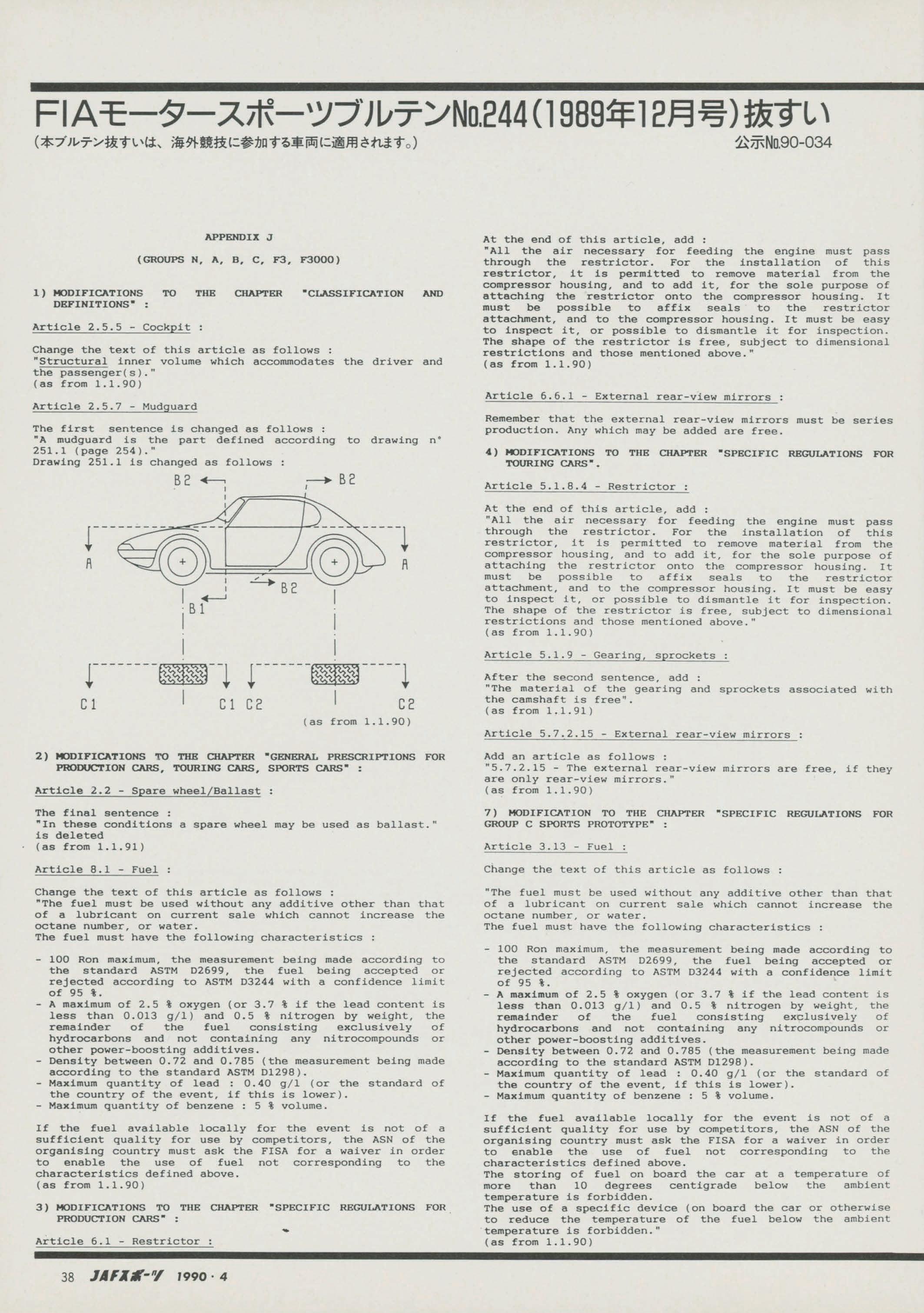
I c1 cc I cc (as from 1.1.90)
2) MODIFICATIONS TO THR OIAPTBR"lENERAL PRESCRIPTIONS FOR PRODUCTION CARS, TOURING CARS, SPORTS CARS" :
~Ballas t :
The final sentence: "In these conditions a spare wheel may be used as ballast." is deleted • (as from 1.1.91)
Article 8.1 - Fuel:
Change the text of this article as follows : "The fuel must be used w.ithout any additive other than that of a lubricant on current sale which cannot increase the octane number, or water.
The fuel must have the following characteristics •
- 100 Ron maximum, the measurement being made according to the standard ASTM 02699, the fuel being accepted or rejected according to ASTM 03244 with a confidence limit of 95 %.
-A maximum of (or the lead content is less than O.013 g/l) and O.5 % nitrogen by weight, the remainder of the fuel consisting exclusively of hydrocarbons and not containing any nitrocompounds or other power-boosting additives.
- Density between 0.72 and 0.785 (the measurement being made according to the standard ASTM 01298).
- Maximum quantity of lead : 0.40 g/1 (or the standard of the country of the event, if this is lower).
- Maximum q,uantity of benzene : 5 % volume.
If the fuel available locally for the event is not of a sufficient quality for use by competitors, the ASN of the organising country must ask the FISA for a waiver in order to enable the use of fuel not corresponding to the characteristics defined above.
(as from l.1.90)
3) MODIFICATIONS TO THE CHAPTER "SPECIFIC REGULATIONS FOR PRODUCTION
Article 6.1 -
At the end of this article, add :
• All the air necessary for feeding the engine must pass through the restrictor. For the installation of this is permitted to remove material from the compressor housing, and to add it, for the sole purpose of attaching the restrictor onto the compressor housing. It must be possible to affix seals to the attachment, and to the compressor housing. It must be easy to inspect possible to dismantle it for inspection. The shape of the restrictor is free, subject to dimensional restrictions and those mentioned above." (as from 1.1.90)
Article 6.6.l - External rear-view mirrors:
Remember that the external rear-view mirrors must be series production. Any which may be added are free.
4) lォlDIFICATIONS TO THE CHAPTER "SPECIFIC FOR TOURING
Article 5.1.8.4 - Restrictor:
At the end of this :
"All the air necessary for feeding the engine must pass through the restrictor. For the installation of this restrictor, it is permitted to remove material from the compressor housing, and to add the sole purpose of attaching the restrictor onto the compressor housing. It must be possible to affix seals to the restrictor attachment, and to the compressor housing. It must be easy to inspect it. or possible to dismantle it for inspection. The shape of the restrictor is to dimensional restrictions and those mentioned above." (as from 1.1.90)
Article 5.1.9 - Gearin9.,__3>_rockets :
7¥fter the second sentence, add: "The material of the gearing and sprockets associated with the camshaft is free".
(as from 1.1.91)
5.7.2.15 - External rear-view mirrors :
Add an article as follows : "5.7.2.15 - The external rear-view mirrors are free, if they are only rear-view mirrors." (as from l.l.90)
7) HODIFICJITION TO THE CIIAPTER REGU.Ll¥TIONS FOR GROUP C SPORTS PROTOTYPE" :
Article 3.13 - Fuel :
Change the tex.t of this article as follows :
"The fuel must be used without any additi.ve other than that of a lubricant on current sale which cannot increase the octane number. or water.
The fuel must have the following characteristics :
- 100 Ron maximum, the measurement being made according to the standard ASTM fuel being accepted or rejected according to ASTM D3244 with a confi.dence limit of
- A maximum of (or the lead content is less than 0.013 g/1) and 0.5 % nitrogen by weight, the remai.nder of the fuel consisting exclusively of hydrocarbons and not containing any nitrocompounds other power-boosting additives.
- Density between 0.72 and 0.785 (the measurement being made according to the standard ASTM D1298).
- Maximum quantity of lead : 0.40 g/1 (or the standard of the country of the event, if this is lower).
- Maximum quantity of benzene : 5 % volume.
If the fuel available locally for the event is not of a sufficient quality for use by competitors, the ASN of the organising country must ask the FlSA for a waiver in order to enable the use of fuel not corresponding to the characteristics defined above.
The storing of fuel on board the car at a temperature of more than 10 degrees centigrade below the ambient temperature is forbidden.
The use of a specific device (on board the car or otherwise to reduce the temperature of the fuel below the ambient temperature is forbidden."
(as from 1.1.90)
8) MODIFICATIONS TO THB C3 SPORTS PROTOTYPE REGULATIONS".
Article 3.14 - Fuel :
See above (Group Cl) for the modifications made to article 3.14. (as from 1.1.90)
9) MODIFICATIONS TO THE CHAPTER •FORMULA 3000" :
Article 14.1 - Fuel :
See above (group Cl) for the modifications made to article 14,l. (as from 1.1.90)
Article l.15 - Definition of the cockoit :
Add the following article : "15)
The structural inner volume in which the driver is located." (as from 1.1.92)
Article 1.16 - Definition of the survival cell :
dd the following article : Survival cell con ti nuous closed structure containing all fuel tanks and the cockpit.キ (as from 1.1.92)
r ti cle 3.7 - AerodYnamic devices
Replace the text with : "7) ,,, erod ynam i c influence
,,, n y specific part of the car influencing its aerodynamic performance must:
- comply with the rules relating to coachwork; - be rigidly secured to the entirely sprung part of the car (rigidly means not having any degree of freedom) ; - remain immobile in relation to the sprung part of the car; - have no contact with a part of the car not entirely sprung.
n y device or construction that is designed to bridge the gap between the sprung part of the car and the ground is prohibited under all circumstances.
No part of the car having an aerodynamic influence and no part of the coachwork may under any circumstances be located below the geometrical plane generated by the plane surface provided for by article 3.3. No part of the coachwork in front of the front wheel axis and more than 20 cm from the longitudinal centre line of the car may be closer than 25 mm to the geometrical plane referred to above." (as from 1.1.92)
Article 6 : Fuel tanks and pipinq :
Replace the text of this article with "l) Fuel tanks:
a. 11 fuel tanks must be rubber bladders conforming to or e><ceeding the specifications of FIA/FT3.
b. All the fuel stored on board the car must be situated between the front face of the engine and the driver's back when viewed in lateral projection. fuel can be stored more than 30 cm forward of the highest point at which the driver's back makes contact with his seat. However, a maximum of 2 litres of fuel may be kept outside the survival only that which is necessary for the normal running of the engine.
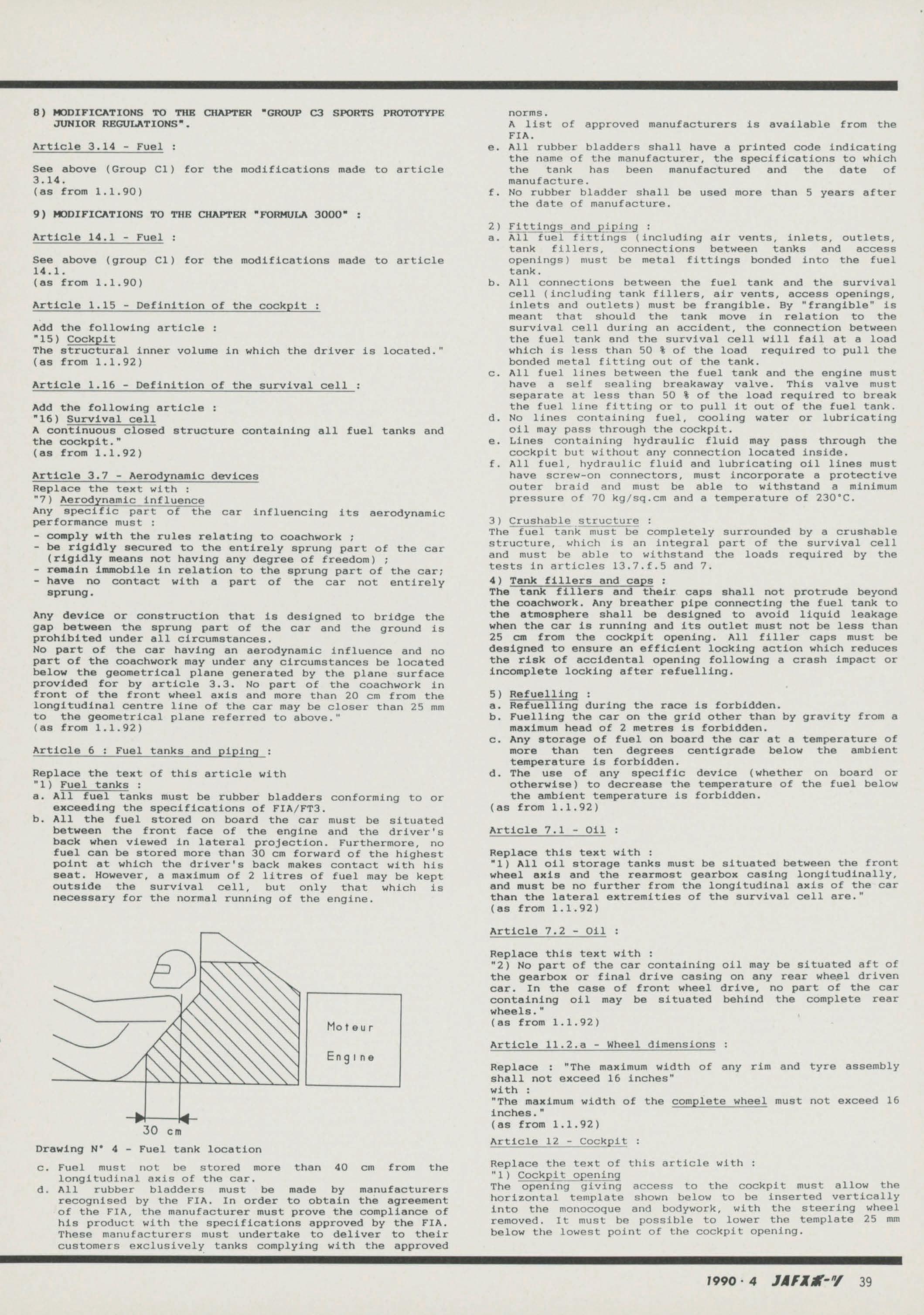
30 cm
Drawing W 4 - Fuel tank location
c. Fuel must not be stored more than 40 cm from the longitudinal axis of the car.
d. All rubber bladders must be made by manufacturers recognised by the FIA. In order to obtain the agreement of the FIA, the manufacturer must prove the compliance of his product with the specifications approved by the FIA. These manufacturers must undertake to deliver to their customers exclusively tanks complying with the approved
norms. II list of approved manufacturers is available from the FlA.
e. All rubber bladders shall have a printed code indicating the name of the manufacturer, the specifications to which the tank has been manufactured and the date of manufacture.
f. No rubber bladder shall be used more than 5 years after the date of manufacture.
2) pipinq :
a. All fuel fittings (including air vents, inlets, outlets, tank fillers, connections between tanks and access openings) must be metal fittings bonded into the fuel tank.
b. All connections between the fuel tank and the survival cell (including tank fillers, air inlets and outlets) must be frangible. By "frangible" is meant that should the tank move in relation to the survival cell during an accident, the connection between the fuel tank end the survival cell will fail at a load which is less than the load required to pull the bonded metal fitting out of the tank.
c. All fuel lines between the fuel tank and the engine must have a self sealing breakaway valve. This valve must separate at less than the load required to break the fuel line fitting or to pull it out of the fuel tank.
d. No lines containing fuel, cooling water or lubricating oil may pass through the cockpit.
e. Lines containing hydraulic fluid may pass through the cockpit but without any connection located inside.
f. All fuel, hydraulic fluid and lubricating oil lines must have screw-on incorporate a protective outer braid and must be able to withstand a minimum pressure of 70 kg/sq.cm and a temperature of 23o•c.
3) Crushable structure :
Thefueita,11<mustbecompletely surrounded by a crushable structure, which is an integral part of the survival cell and must be able to withstand the loads required by the tests in articles 13.7.f.5 and 7.
4) Tank fillers and Caps :
The tank fillers and their caps shall not protrude beyond the coachwork, l¥ny breather pipe connecting the fuel tank to the atmosphere shall be designed to avoid liquid leakage when the car is running and its outlet must not be less than 25 cm from the cockpit opening. All filler caps must be designed to ensure an efficient locking action which reduces the risk of accidental opening following a crash impact or incomplete locking after refuelling.
5)~:
a. Refuelling during the race is forbidden.
b. Fuelling the car on the grid other than by gravity from a maximum head of 2 metres is forbidden.
c. Any storage of fuel on board the car at a temperature of more than ten degrees centigrade below the ambient temperature is forbidden.
d. The use of any specific device (whether on board or otherwise) to decrease the temperature of the fuel below the ambient temperature is forbidden.
(as from 1.1.92)
Article 7.1 - Oil :
Replace this text with : "l) AU oil storage tanks must be s1tuated between the front wheel axis and the rearmost gearbox casing long! and must be no further from the longitudinal axis of the car than the lateral extremities of the survival cell are."
(as from 1.1.92)
Article 7.2 - Oil :
Replace this text with:
"2) No part of the car containing oil may be situated aft of the gearbox or final drive casing on any rear whe.el driven car. In the case of front wheel part of the car containing oil may be situated behind the complete rear wheels."
(as from l.l.92)
Article ll.2.a - Wheel dimensions :
Replace : "The maximum width of any rim and tyre assembly shall not exceed 16 inches" with: "The maximum width of t he~ must not exceed 16 inches."
(as from 1.1.92)
Article 12 - CoCkll_it:
Replace the text of this article with : "l)
The openfog giving access to the cockpit must allow the horizontal template shown below to be inserted vert.ically into the monocoque and bodywork, with the steering wheel removed. It must be possible to lower the template 25 mm below the lowest point of the cockpit opening.
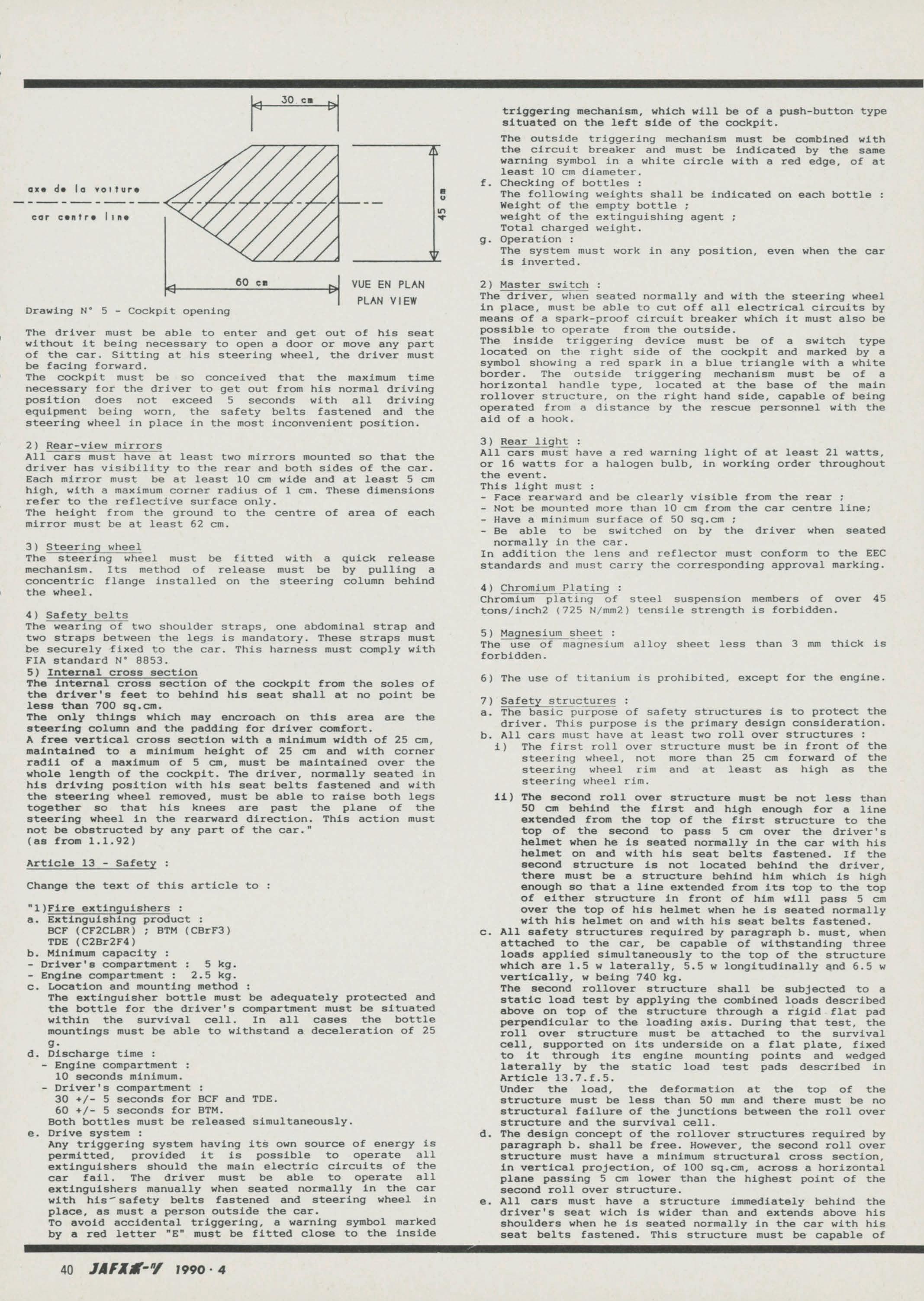
Drawing N" 5 - Cockpit opening
The driver must be able to enter and get out of his seat without it being necessary to open a door or move any part of the car. Sitting at his steering wheel, the driver must be facing forward.
The cockpit must be so conceived that the maximum time necessary tor the driver to get out from his normal driving position does not exceed 5 seconds with all driving equipment being worn, the safety belts fastened and the steering wheel in place in the most inconvenient position.
2) Rear-view mirrors
All cars must have at least two mirrors mounted so that the driver has visibility to the rear and both sides of the car. Each mirror must be at least 10 cm wide and at least 5 cm high, with a maximum corner radius of 1 cm. These dimensions refer to the reflective surface only. The height from the ground to the centre of area of each mirror must be at least 62 cm.
3) Steerinq wheel
The steering wheel must be fitted with a quick release mechanism. Its method of release must be by pulling a concentric flange installed on the steering column behind the wheel.
4) SafetY belts
The wearing of two shoulder straps, one abdominal strap and two straps between the legs is mandatory. These straps must be securely fixed to the car. This harness must comply with FIA standard N'8853.
5) Internal cross section
The internal cross section of the cockpit from the soles of the driver'e feet to behind his seat shall at no point be less tha.n 700 sq.cm.
The only things which may encroach on this area are the steering column and the padding for driver comfort.
A free vertical cross section with a minimum width of 25 cm, maintained to a minimum height of 25 cm and with corner radii of a maximum of 5 cm, must be maintained over the whole length of the cockpit. The driver, normally seated in his driving position with his seat belts fastened and with the steering wheel removed, must be able to raise both legs together so that his knees are past the plane of the steering wheel in the rearward direction. This action must not be obstructed by any part of the car." (as from, 1.1.92)
Article 13 - safety :
Change the text of this article to :
"l)~ :
a. Extinguishing product :
BCF (CF2CLBR) ; BTM (CBrF3) TOE (C2Br2F4)
b. Minimum capacity :
- Driver's compartment : 5 kg.
- Engine compartment : 2.5 kg.
c. Location and mounting method : The extinguisher bottle must be adequately protected and the bottle for the driver's compartment must be situated within the survival cell. In all cases the bottle mountings must be able to withstand a deceleration of 25 g.
d. Discharge time :
- Engine compartment : 10 seconds minimum.
- Driver's compartment : 30 •/- 5 seconds for BCF and TOE. 60 +/- 5 seconds for BTM. Both bottles must be released simultaneously.
e. Drive system:
Any triggering system having its own source of energy is permitted, provided it is possible to operate all extinguishers should the main electric circuits of the car fail. The driver must be able to operate all extinguishers manually when seated normally in the car with his-safety belts fastened and steering wheel in must a person outside the car.
To avoid accidental triggering, a warning symbol marked by a red letter "E" must be fitted close to the inside
triggering mechanism, which will be of a push-button type situated on the left side of the cockpit.
The outside triggering mechanism must be combined with the circuit breaker and must be indicated by the same warning symbol in a white circle with a red edge, of at least 10 cm diameter.
f. Checking of bottles :
The following weights shall be indicated on each bottle :
Weight of the empty bottle; weight of the extinguishing agent ;
Total charged weight.
g. Operation :
The system must work in any position, even when the car is inverted.
2) The seated normally and with the steering wheel in place, must be able to cut off all electrical circuits by means of a spark-proof circuit breaker which it must also be possible to operate from the outside.
The inside triggering device must be of a switch type located on the right side of the cockpit and marked by a symbol showing a red spark in a blue triangle with a white border. The outside triggering mechanism must be of a horizontal handle type, located at the base of the main rollover structure, on the right hand of being operated from a distance by the rescue personnel with the aid of a hook.
3) Rear :
/1.ll cars must have a red warning light of at least 21 watts, or 16 watts for a halogen bulb, in working order throughout the event.
This light must : - Face rearward and be clearly visible from the rear; - Not be mounted more than 10 cm from the car centre line; - !lave a minimum surface of SO sq.cm ;
- Be able to be switched on by the driver when seated normally in the car.
In addition the lens and reflector must conform to the EEC standards and must carry the corresponding approval marking.
4) Chromium :
Chromium of steel suspension members of over 45 tons/inch2 (725 N/mm2) tensile strength is forbidden.
5) MaqnesiuIn : Theus-e of magnesium alloy sheet less than 3 mm thick is forbidden.
6) The use of titanium is prohibited, except for the engine.
7) Safety structures : a. Thebaslc キpurpose of safety structures is to protect the driver. This purpose is the primary design consideration.
b. /1.ll cars must have at least two roll over structures :
i) The first roll over structure must be in front of the steering wheel, not more than 25 cm forward of the steering wheel rim and at least as high as the steering wheel rim.
ii) The second roll over structure must be not less than 50 cm behind the first and high enough for a line extended from the top of the first structure to the top of the second to pass S cm over the driver's helmet when he is seated normally in the car with his helmet on and with his seat belts fastened. If the second structure is not located behind the driver, there must be a structure behind him which is high enough so that a line extended from its top to the top of either structure in front of him will pass S cm over the top of his helmet when he is seated normally with his helmet on and with his seat belts fastened.
c. /1.11 safety structures required by paragraph b. attached to the car, be capable of withstanding three loads applied simultaneously to the top of the structure which are 1.5 w laterally, S.S w longitudinally and 6.S w vertically, w being 740 kg.
The second rollover structure shall be subjected to a static load test by applying the combined loads described abcve on top of the structure through a rigid flat pad perpendicular to the loading axis. During that test, the roll over structure must be attached to the survival on its underside on a flat plate, fixed to it through its engine mounting points and wedged laterally by the static load test pads described in /1.rticle 13.7.f.S.
Under the deformation at the top of the structure must be less than SO mn, and there must be no structural failure of the junctions between the roll over structure and the survival cell.
d. The design concept of the rollover structures required by paragraph b. shall be free. However, the second roll over structure must have a minimum structural cross section, in vertical projection, of 100 sq.cm, across a horizontal plane passing S cm lower than the highest point of the second roll over structure.
e. /1.11 cars must have a structure immediately behind the driver's seat wich is wider than and extends above his shoulders when he is seated normally in the car with his seat belts fastened. This structure must be capable of
sustaining a lateral load of 1.5 w applied to its top, w being 740 kg.
f. Survival cell :
1
- The survival cell must extend from behind the fuel tank in a rearward direction to a point at least 15 cm in front of the driver's feet, with his feet resting on the pedals and the pedals in the inoperative position. The survival cell must have an opening for the driver, the minimum dimensions of which are given in Article 12.1. Any other openings in the survival cell must be of minimum size to allow access to mechanical components. The safety structures described in Articles 13.7.b. and e must be a part of the survival cell or solidly attached to it.
The soles of the feet of the driver, seated in the normal driving position and with his feet on the pedals and the pedals in the inoperative shall not be situated to the fore of the vertical plane passing through the centre line of the front wheels. Should the car not be fitted with pedals, the driver's feet at their maximum forward extension shall not be situated to the fore of the above-mentioned vertical plane.
2- In front of the survival cell, an impact-absorbing structure must be fitted. This structure need not be an integral part of the survival cell but must be solidly attached to it.
3- The minimum external width of the survival cell is 30 cm. This width must be maintained to a minimum height of 25 cm over the whole length of the survival cell. The minimum height of the survival cell between the two roll over structures is 40 cm.
4- The survival cell and frontal absorbing structure shall be subjected to an impact test against a solid vertical barrier placed at right angles to the longitudinal axis of the car. The entire crash structure must be solidly fixed to the trolley but not in such a way as to increase its impact resistance.
For the purpose of this test, the total weight of the trolley and test structure shall be 740 kg and the velocity of impact 11 metres/sec. The resistance of the test structure must be such that during the impact an average deceleration of not more than 25 g is recorded and the final deformation is contained within the zone ahead of the driver's feet. This text must be carried out under the supervision of a FISA technical delegate in testing laboratories in either Italy, Great Japan or France approved by FISA.
A list of approved testing laboratories is available from FISA.
5- In addition to the impact test described above, the survival cell shall be subjected to four separate static lateral load tests:
a. In the cockpit area on a vertical plane passing through the centre of the seat belt lap strap fixing.
b. In the fuel tank area on a vertical plane passing through the centre of area of the fuel tank in side elevation.
c. On a vertical plane passing through the front wheel axis.
d. At a point half way between the tests in a. and c.
For the tests described pad 10 cm long and 30 cm a maximum radius on all edges of 3 mm and conforming to the shape of the survival shall be placed against the outermost sides of the survival cell with the lower edge of the pad at the lowest part of the survival cell at that section. It is permissible to place rubber 3 mm thick, with a hardness of between 60 and 80 Shore, between the pads and the survival cell.
A constant transverse horizontal load of 2000 kgf shall be applied to the pads at their centre of area through a ball-jointed maintained for a minimum of 30 seconds.
Under these load conditions, there shall be no structural failure of the inner surfaces of the survival cell and no permanent deformation after the load is removed. In the case of the test in the cockpit/lap strap no time during the test can there be a deformation of more than 2 cm across the inner surfaces of the survival cell.
6- To test the fixations of the frontal impact absorbing structure to the survival cell, a further side load test shall be performed on a vertical plane passing 40 cm in front of the front wheel axis.
A constant transversal horizontal load of 2000 kgf shall be applied to one side of the impact absorbing structure using a pad identical to the ones used in the lateral tests in paragraph 5.
The centre of area of the pad must pass through the plane mentioned above and the mid point of the height of the stucture. After 30 seconds of there must be no failure of the structure or of any fixation between the structure and the survival cell. During the test the survival cell must be resting on a flat plate and secured to it solidly but not in such a way as to increase the strength of the fixations being tested.
7- A further static load test must be carried out on the survival cell from beneath the fuel tank. A pad of 20 cm diameter must be placed in the centre of area of the fuel tank and a vertical upwards load of 1000 kgf applied through a ball-jointed junction. The load must be applied for 30 seconds.
Under these loads conditions, there shall be no structural failure of the inner surfaces of the survival cell and no permanent deformation after the load has been removed. This test must also be carried out on every survival cell produced.
The static load tests in Article 13.7.c and Articles 13.7.f.5, 6 and 7 must be carried out under the supervision of a FISA technical delegate and using measuring equipment verified by FISA. A dossier defining the structure, test methods and results of all these tests shall be submitted to the FISA before the use of the relevant model of car in an F3000 event.
Any significant modification introduced into any of the areas tested shall require that part to undergo a further test.
g- All cars must be equipped with a headrest which does not deflect more than 5 cm rearwards when a rearward force of 85 kgf is applied. The headrest surface shall not be less than 80 sq.cm. and must be continuous and without protruding parts. The headrest shall be located in a position such that it is the first point of contact with the driver's helmet in the event of an impact projecting the driver's head rearwards, when he is seated in the normal driving position.
h- Continuous panels which, projected on a vertical plane parallel to the longitudinal axis of the car, are at least 20 cm be situated between transverse planes passing through the front rollover structure and the fuel tank rear face on either side and at least 55 cm from the car's longitudinal centre line. These panels shall be made from a composite material of 10 mm minimum thickness with a honeycomb core in metal or nomex giving adequate resistance to compression. The external covering shall be of aluminium alloy, plastic, or carbon fibre of minimum thickness of 0.5 mm or made up of another assembly of materials of equivalent efficiency. The panels must be securely attached to the flat bottom and to the main structure of the car in such a manner as to ensure absorption of a lateral impact. The radiators may play the role of protective panels or of transversal struts.
(as from l.l.92)
Article 5.1 - Enqine :
Change "Number of cylinders : maximum 12" to : "Number of cylinders : maximum 8" (as from 1.1.93)
lO)HODIFICATIONS TO THE • FORMULA 3• :
See above (group C) for the modifications made to article 15.l.
Article 1.16 - Definition of the cock.eit :
Introduce the following text : "16) : "The structural inner volume in which the driver is located". {as from 1.1.92)
Article 1.17 - Oefinition of the survival cell :
Introduce the following text : "17) Survival cell : A continuous closed structure containing the fuel tank and the cockpit". (as from 1.1.92) ~l i nder head :
Add to this article :
• It is permitted to close the unused apertures in the cylinder block and cylinder the only purpose of this operation is that of closing". (as from 1.1.90)
Article 6.1 - Gearbox :
Modify the text of this article as follows : "1) Five gearbox ratios, not including the reverse gear, as maximum. Transversal gearboxes and/or gearboxes forward of the rear wheel axis are forbidden." (as from 1.1.92)
Article 7.1 -Lines :
Replace the text of this article with : "No line containing fuel may pass through the cockpit". (as from 1.1.92)
Article 7.2 - Fuel lines :
Replace the text of this article with : "All fuel lines must have screw-on connectors. must incorporate a protective outer braid and must be able to withstand a pressure of 70 kg/cm2 and a temperature of 230"C." (as from l.l.92)
~4 - Crushable structure (compulsory) :
The title of this article becomes : "4) Crushable structure :" (as from l.l.92)
Article 7.4.b - Crushable structure:
The text of this article is modified to read: "The minimum thickness of the sandwich construction is l c,n." (as from 1.1.92)
Article B.2 - 011 lines :
Replace the text with:
"No Hne containing oil may pass through the cockpit. All oil lines must have screw-on connectors. must incorporate a protective outer braid and must be able to withstand a pressure of 70 kg/cm2 and a temperature of 230•c. " (as from 1.1.92)
Article l2,6 - Steerinq :
Add an article 12.6 as follows: "6)four-wheel steering is forbidden" (as from l.l.92)
^rticle i3.1 - Cockpit :
Replace the existing text with:
"l) The opening giving access to the cockpit must allow the horizontal template shown below to be inserted vertically into.the monocoque and bodywork (not considering the s~eer i n g wheel) down to 25 mm lower than the lowest-point of the cockpit opening".
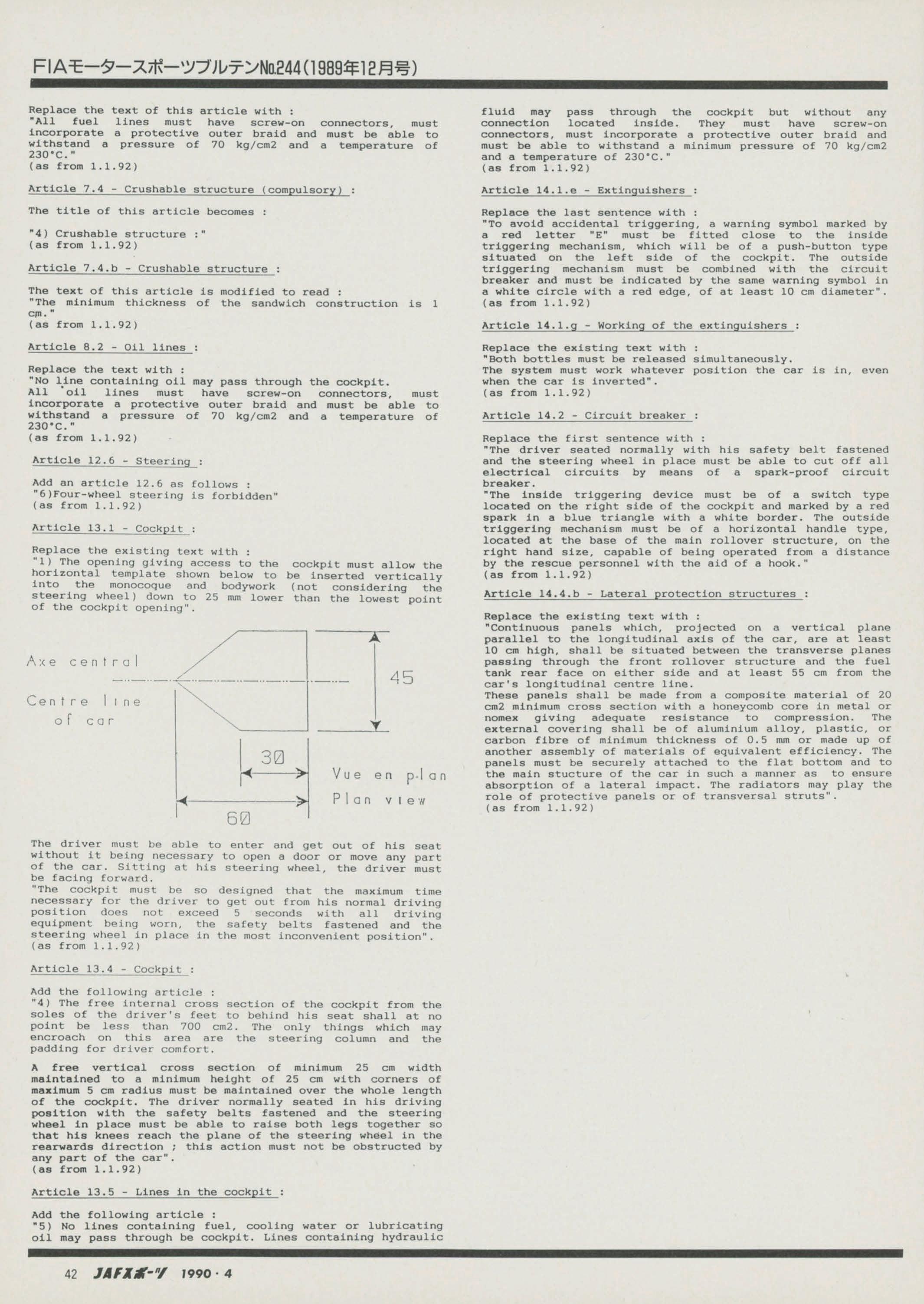
f car I "'-. I~
Vue en p-1an Plan v iew
The driver must be able to enter and get out of his seat without it being necessary to open a door or move any part of the car. Sitting at his steering wheel, the driver must be facing forward.
"The cockpit must be so designed that the maximum time necessary for the driver to get out from his normal driving position does not exceed 5 seconds with all driving equipment being worn, the safety belts fastened and the steering wheel in place in the most inconvenient position". (as from l.l.92)
Article 13.4 - Cockpit :
Add the following article : "4) The free internal cross section of the cockpit from the soles of the driver's feet to behind his seat shall at no point be less than 700 cm2. The only things which may encroach on this area are the steering column and the padding for driver comfort.
A free vertical cross section of minimum 25 cm width maintained to a minimum height of 25 cm with corners of maximum 5 cm radius must be maintained over the whole length of the cockpit. The driver normally seated in his driving poeition with the safety belts fastened and the steering wheel in place must be able to raise both legs together so that his knees reach the plane of the steering wheel in the rearwards direction; this action must not be obstructed by any part of the car".
(as from l.l.92)
Article l3.5 - Lines in the cockpit :
Add the following article : "5) No lines containing fuel, cooling water or lubricating oil may pass through be cockpit. Lines containing hydraulic
fluid may pass through the cockpit but without any connection located inside. They must have screw-on connectors, must incorporate a protective outer braid and must be able to withstand a minimum pressure of 70 kg/cm2 and a temperature of 23o•c."
(as from 1.1.92)
Article 14.1.e - Extinguishers :
Replace the last sentence with :
•To avoid accidental triggering, a warning symbol marked by a red letter "E" must be fitted close to the inside triggering mechanism, which will be of a push-button type situated on the left side of the cockpit. The outside triggering mechanism must be combined with the circuit breaker and must be indicated by the same warning symbol in a white circle with a red edge, of at least 10 cm diameter". (as from l.l.92)
Article 14.l.~u i shers :
Replace the existing text with :
"Both bottles must be released simultaneously. The system must work whatever position the car is in, even when the car is inverted". (as from 1.1.92)
Article 14.2 -Circuit breaker :
Replace the first sentence with :
"The driver seated normally with his safety belt fastened and the steering wheel in place must be able to cut off all electrical circuits by means of a spark-proof circuit breaker.
"The inside triggering device must be of a switch type located on the right side of the cockpit and marked by a red spark in a blue triangle with a white border. The outside triggering mechanism must be of a horizontal handle located at the base of the main rollover structure, on the right hand size, capable of being operated from a distance by the rescue personnel with the aid of a hook."
(as from 1.1.92)
Article 14,4.b - Lateral orotection structures :
Replace the existing text with :
"Continuous panels which, projected on a vertical plane parallel to the longitudinal axis of the car, are at least 10 cm high, shall be situated between the transverse planes passing through the front rollover structure and the fuel tank rear face on either side and at least 55 cm from the car's longitudinal centre line.
These panels shall be made from a composite material of 20 cm2 minimum cross section with a honeycomb core in metal or nomex giving adequate resistance to compression. The external covering shall be of aluminium alloy, plastic, or carbon fibre of minimum thickness of O.5 mm or made up of another assembly of materials of equivalent efficiency. The panels must be securely attached to the flat bottom and to the main stucture of the car in such a manner as to ensure absorption of a lateral impact. The radiators may play the role of protective panels or of transversal struts".
(as from l.l.92)
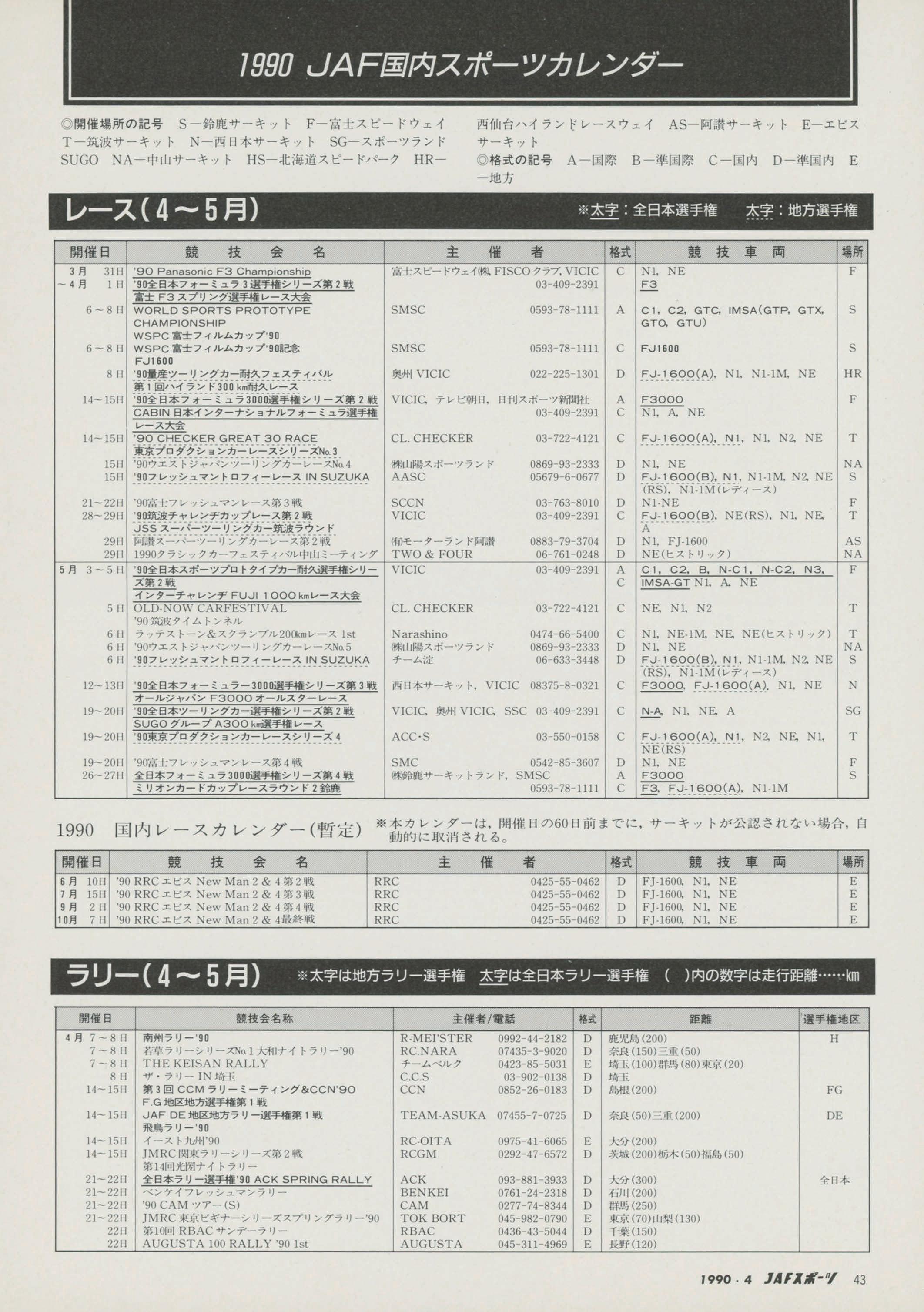
2211
TRCキK 075-231-0857 D 28~2911 TSCC 0425-60-5125 D 28~2911 ROADMASTER 0262-43-6275 D
28-2911
TAO 0729-48-5144 D 11 0197-24-0188 D 5-611
RTN 0582-45-8776 D 5~611 MCA 093-434-I377 D H
5-611
RT-TONBO 0429-58-9542 D '90TONBOSPRINGRALLY 12-1311 JAFD. HELOM 0770-53-0160 D DE
12-1311 JAFB. RTT 0274-64-3051 D BC 12~1311 BetaSport 03-701-4056 D
12-1311
OPUAC 0722-52-1161 D 12~1311 OPUAC 0722-54-5075 D 1311
TキARTAS 0474-63-2323 D 1311 GTS 045-301-0298 E GTSONE
19~2011
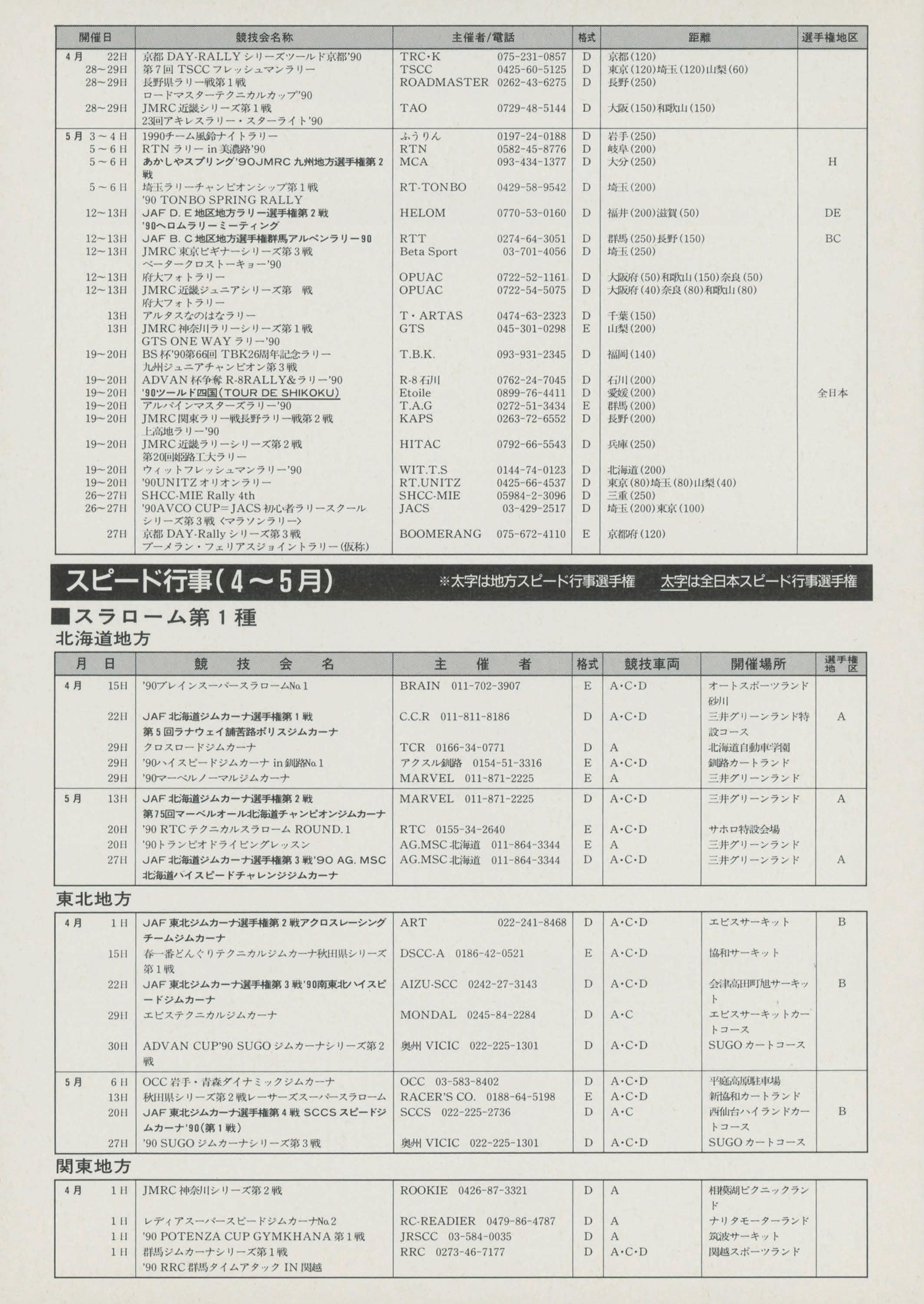
T.B.K. 093-931-2345 D
19~2011 0762-24-7045 D 19~2011 DESHIKOKU) Etoile 0899-76-4411 D 19~2011 T.AG 0272-51-3434 E 19-2011 KAPS 0263-72-6552 D
19~2011 HITAC 0792-66-5543 D
19~2011 WITT.S 0144-74-0123 D 19-2011 RTUNITZ 0425-66-4537 D 26~2711 SHCC-MIERally4th SHCC-MIE 05984-2-3096 D 26-2711 '90AVCOCUP=JACS JACS 03-429-2517 D
075-672-4110 E
TCR 0166-34-0771 D A 0154-51-3316 E AキCキD MARVEL 011-871-2225
MARVEL 011-871-2225
RTC 0155-34-2640
AキCキD 011-864-3344 E A -864-3344 D A•C•D ART 022-241-8468 D
DSCC-A 0186-42-0521 E AキCキD
AIZU-SCC 0242-27-3143 D AキCキD
MONDAL 0245-84-2284 D AキC
022-225-1301 D AキCキD
occ 03-583-8402 D AキCキD
RACER'SCO 0188-64-5198 E AキCキD
SCCS 022-225-2736 D AキC
VICIC 022-225-1301 D AキCキD
ROOKIE 0426-87-3321 D IA
0479-86-4787
Narashino 0474-66-5400
811 T RSANO 0283-25-3335
Betasport 03-701-4056
8II '90 TEAM-RISE 0493-62-8074
811
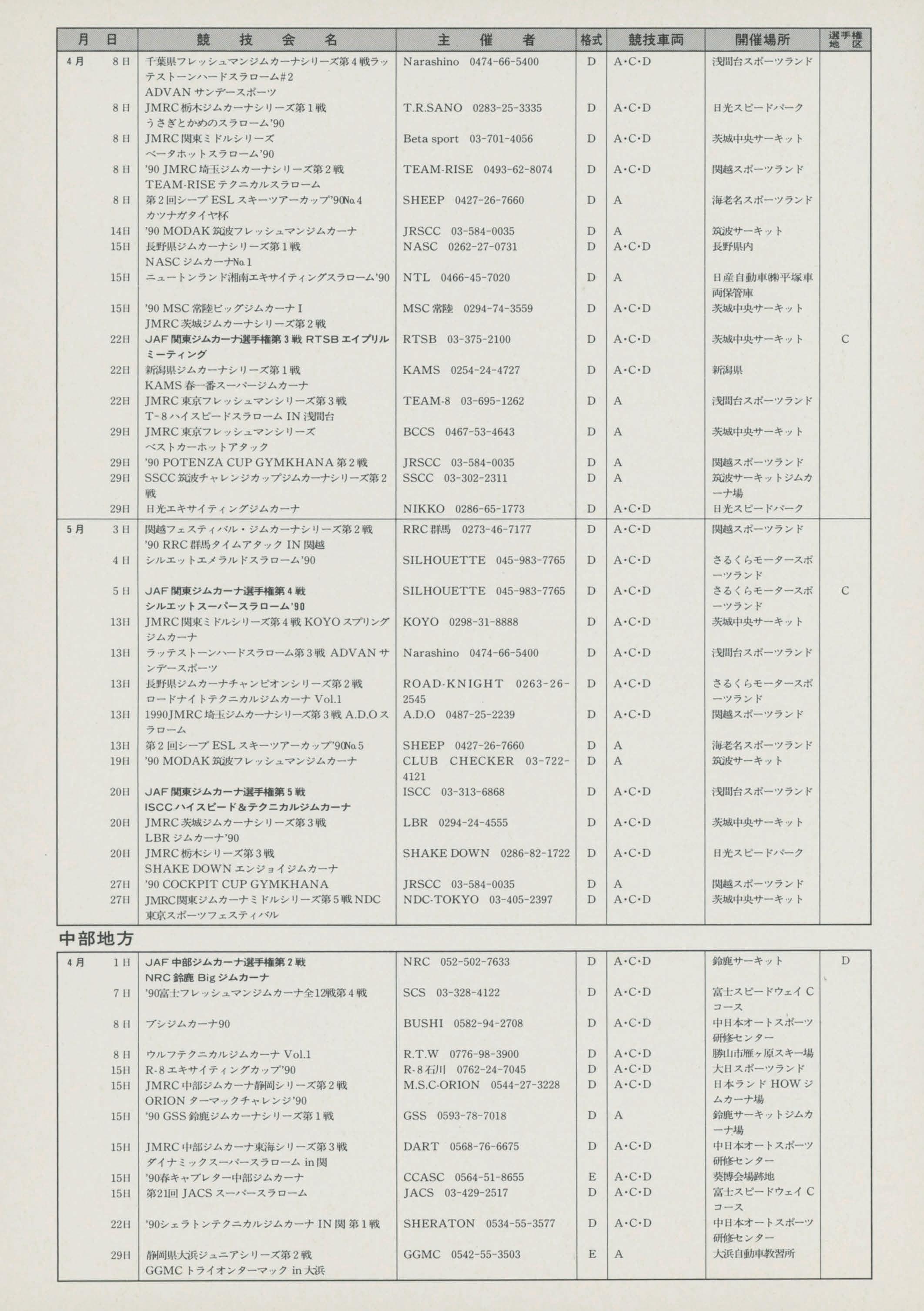
0427-26-7660
0262-27-0731
03-375-2100
0254-24-4727
2911 '90POTENZACUP JRSCC 03-584-0035
0286-65-1773
511
'90
045-983-7765
Narashino 0474-66-5400
ROAD-KNIGHT 0263-26-
AキCキD 2545 1311 A DO 0487-25-2239
AキCキD 1311 SHEEP 0427-26-7660
A 1911 CLUB CHECKER 03-722- D A 4121
ISCC 03-313-6868
LBR 0294-24-4555
AキCキD
AキCキD 2011 SHAKEDOWN 0286-82-1722 D AキCキD 2711 '90COCKPITCUPGYMKHANA JRSCC 03-584-0035
A 2711 NOC-TOKYO 03-405-2397 D AキCキD
811 BUSHI 0582-94-2708
0776-98-3900
0544-27-3228
0564-51-8655
03-429-2517
2911
2911
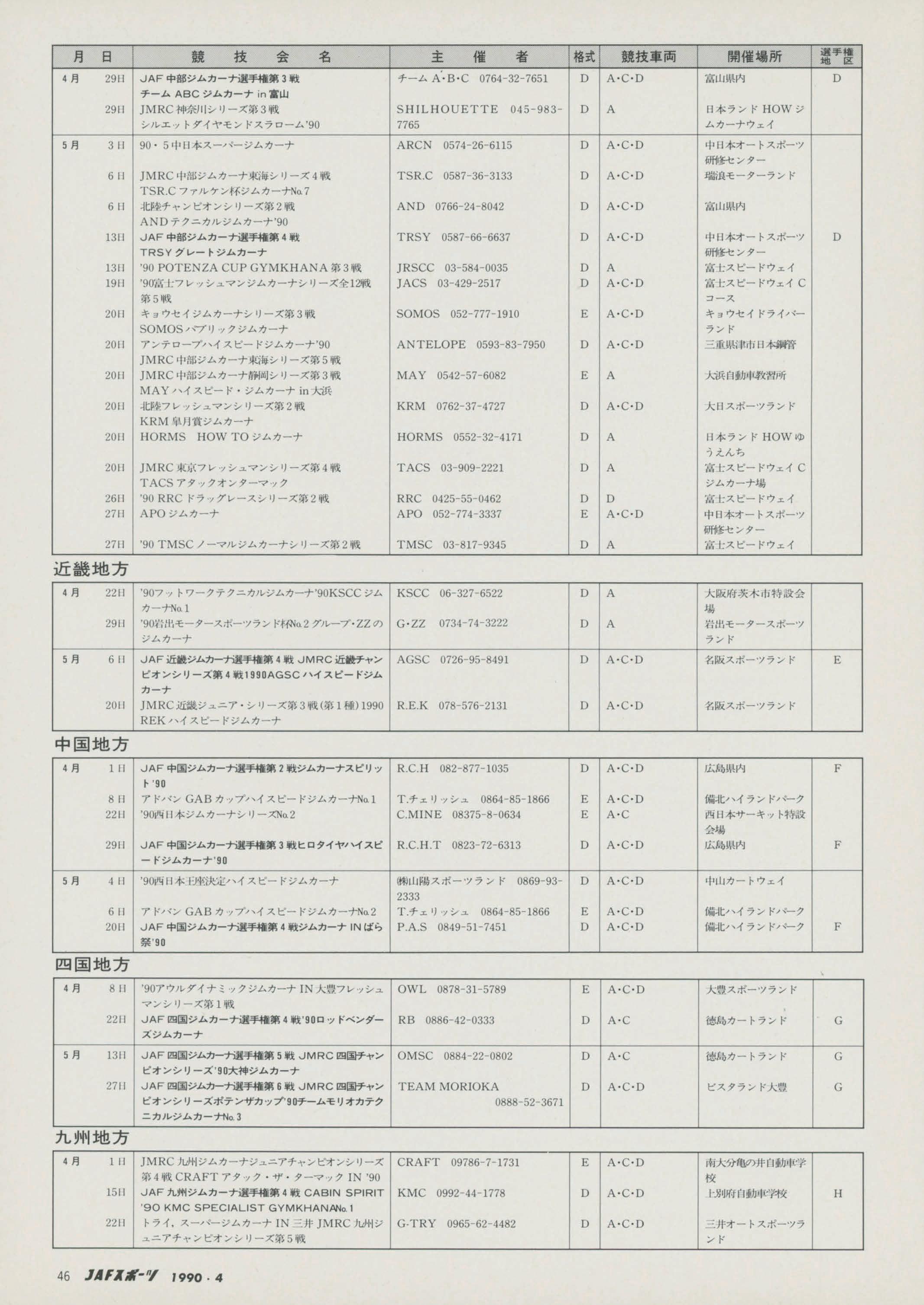
0764-32-7651
SHILHOUETTE 045-9837765
311 90• ARCN 0574-26-6115
6II
611
1311
1311 '90POTENZACUP
TSR.C 0587-36-3133
AND 0766-24-8042
TRSY 0587-66-6637
JRSCC 03-584-0035 1911 JACS 03-429-2517
2011
2011
SOMOS 052-777-1910
ANTELOPE 0593-83-7950
2011 MAY 0542-57-6082 2011 KRM 0762-37-4727 2011 HORMS
HORMS 0552-32-4171 2011
2611 '90
D AキCキD D A
D AキCキD
D AキCキD
D AキCキD
D AキCキD
D A
D AキCキD
E AキCキD
D AキCキD E A
AキCキD
TACS 03-909-2221
RRC 0425-55-0462 2711 APO 052-774-3337
2711 '90
2211
2911
611
TMSC 03-817-9345
KSCC 06-327-6522
G•ZZ 0734-74-3222
AGSC 0726-95-8491 2011
Ill
R.EK 078-576-2131
R.C.H 082-877-1035
811 0864-85-1866 2211
2911
C.MINE 08375-8-063,1
R.C.HT 0823-72-6313
41l 0869-932333
611 0864-85-1866
2011 PA.S 0849-51-7451
811
2211
OWL 0878-31-5789
RB 0886-42-0333 1311
OMSC 0884-22-0802
TEAMMORIOKA 0888-52-367] 111 I CRAFT 09786-7-1731
1511 I SPIRITIKMC 0992-44-1778 '90KMCSPECIALIST 2211
G-TRY 0965-62-4482
D AキCキD
D AキCキD
D AキCキD
E AキCキD
E AキC
D AキCキD
D AキCキD
E AキCキD
D AキCキD
E AキCキD
D AキC
D AキC
D AキCキD
FUKI-R 0977-66-2894 D AキCキD
0992-22 E AキCキD -6220 MASH 093-602-3666 E AキCキD
M キCキOキH 0944-53-7207 E
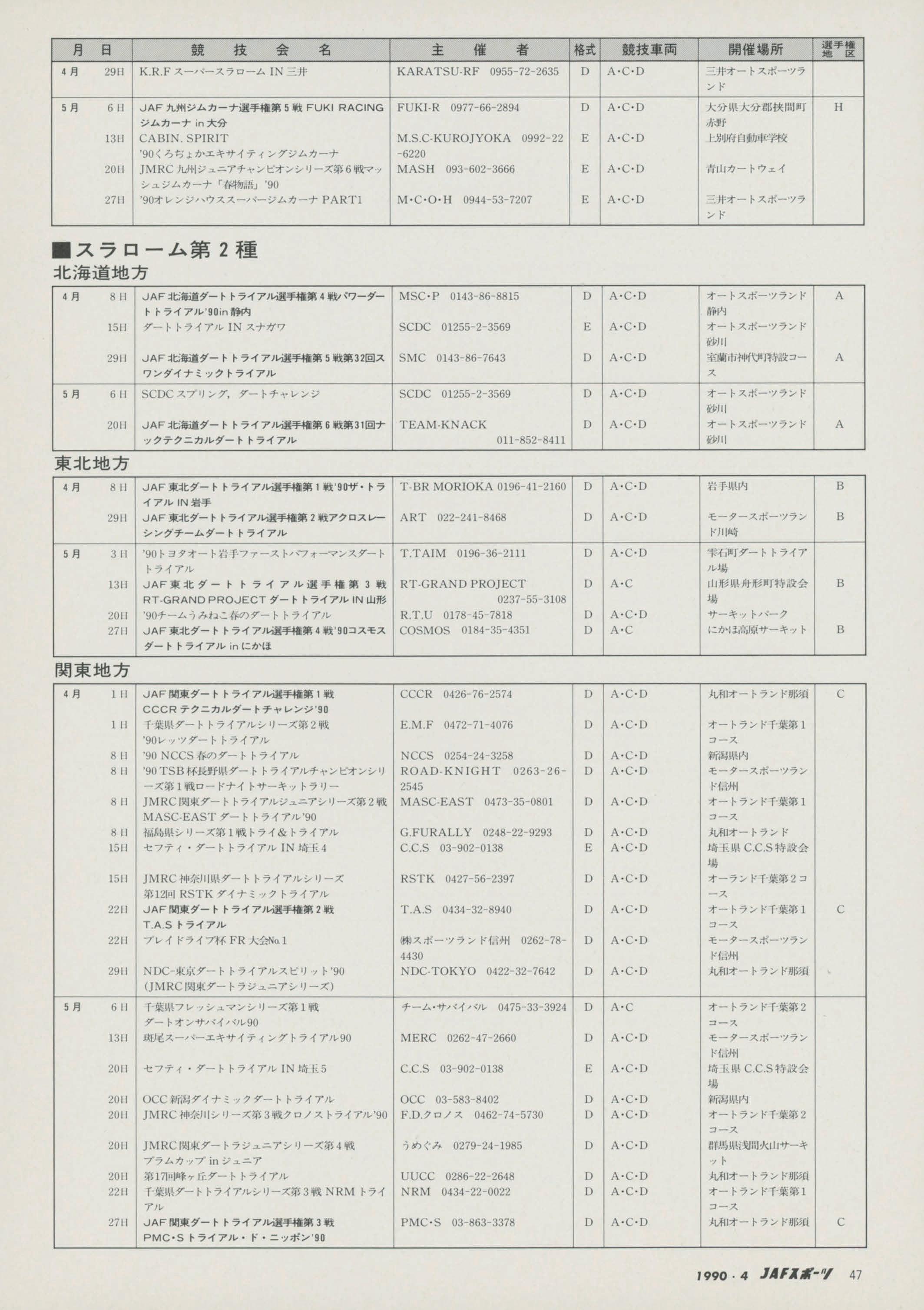
MSCキP 0143-86-8815 D AキCキD
SCDC 01255-2-3569 E AキCキD
SMC 0143-86-7643
SCDC 01255-2-3569 D AキCキD
TEAM-KNACK D AキCキD
011-852-8411
T-BRMORIOKA0196-41-2160
ART 022-241-8468 D AキCキD
TTAIM 0196-36-2111 D AキCキD
RT-GRANDPROJECT D
0237-553108
RT.U 0178-45-7818 D AキCキD COSMOS 0184-35-4351 D AキC
CCCR 0426-76-2574 D AキCキD
EMF 0472-7l-4076 D AキCキD
NCCS 0254-24-3258 D AキCキD ROAD-KNIGHT 0263-26- D AキCキD 2545
MASC-EAST 0473-35-0801 D AキCキD
GFURALLY 0248-22-9293 D AキCキD CCS 03-902-0138 E AキCキD
RSTK 0427-56-2397 D AキCキD
T.AS 0434-32-8940 D AキCキD C
0262-78- D AキCキD 4430
NOC-TOKYO 0422-32-7642 D AキCキD
0•175-33-3924 D AキC
MERC 0262-47-2660 D AキCキD
C.C.S 03-902-0138 E
occ 03-583-8402 D AキCキD 0462-74-5730 D AキCキD
0279-24-1985 D AキCキD
Uucc 0286-22-2648 D AキCキD
NRM 0434-22-0022 D AキCキD
P~!C·S 03-863-3378 D AキCキD C
111
811
8II
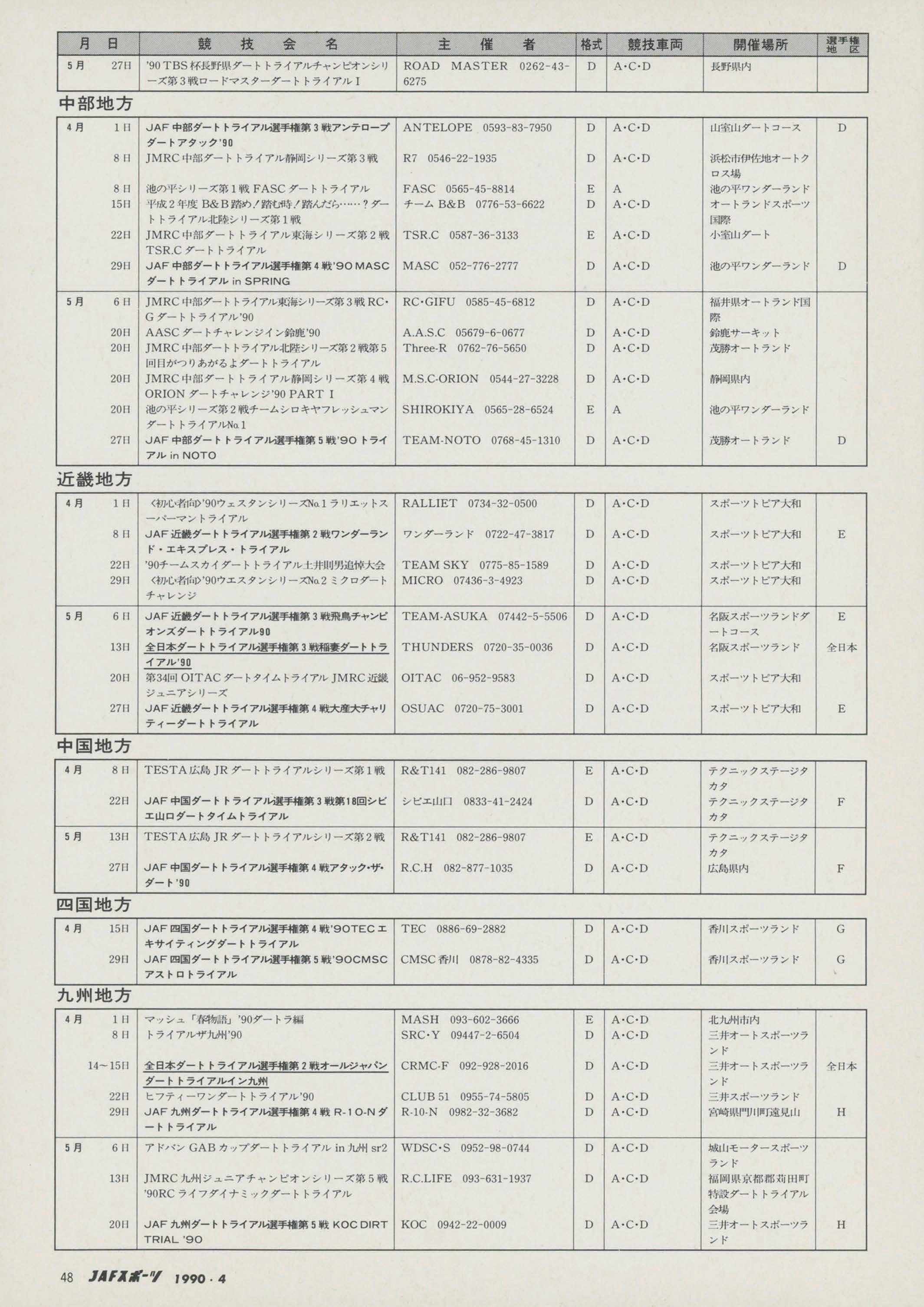
ROAD MASTER 0262-43-I D IAキCキD I6275
ANTELOPE 0593-83-7950
R7 0546-22-1935
FASC 0565-45-8814 1511 0776-53-6622
2211
TSR.C 0587-36-3133
2911 MASC 052-776-2777
SPRING
6II
2011
RCキGIFU 0585-45-6812
A A S.C 05679-6-0677 2011 Three-R 0762-76-5650
2011
MS.C-ORION 0544-27-3228 PARTI 20n SHIROKIYA 0565-28-6524
2711
TEAM-NOTO 0768-45-1310 NOTO
III RALLIET 0734-32-0500
8II 0722-47-3817
2211
TEAMSKY 0775-85-1589 2911 MICRO 07436-3-4923
611
TEAM-ASUKA 07442-5-5506 1311 THUNDERS 0720-35-0036
201I
OITAC 06-952-9583
271l OSUAC 0720-75-3001
811
R&Tl41 082-286-9807
2211 0833-41-2424
1311
2711
1511 I
R&Tl41 082-286-9807
RCH 082-877-1035
TEC 0886-69-2882
2911 I I 0878-82-4335
111
811
D AキCキD
D AキCキD
E A
D AキCキD
E AキCキD
D AキCキD
D AキCキD
D AキCキD D
D AキCキD
E A
D AキCキD
D AキCキD
D AキCキD
D AキCキD
D AキCキD
D AキCキD
D AキCキD
D AキCキD
D AキCキD
E AキCキD
D AキCキD
E AキCキD
D AキCキD
MASH 093-602-3666
SRCキY 09447-2-6504 14~1511 092-928-2016
2211
CLUB51 0955-74-5805 2911 R-10-N 0982-32-3682
E AキCキD
D AキCキD
D AキCキD
D AキCキD
D AキCキD
D AキCキD
D AキCキD
D AキCキD
4/I
4/1
4/I
4/8
4/8
4/8
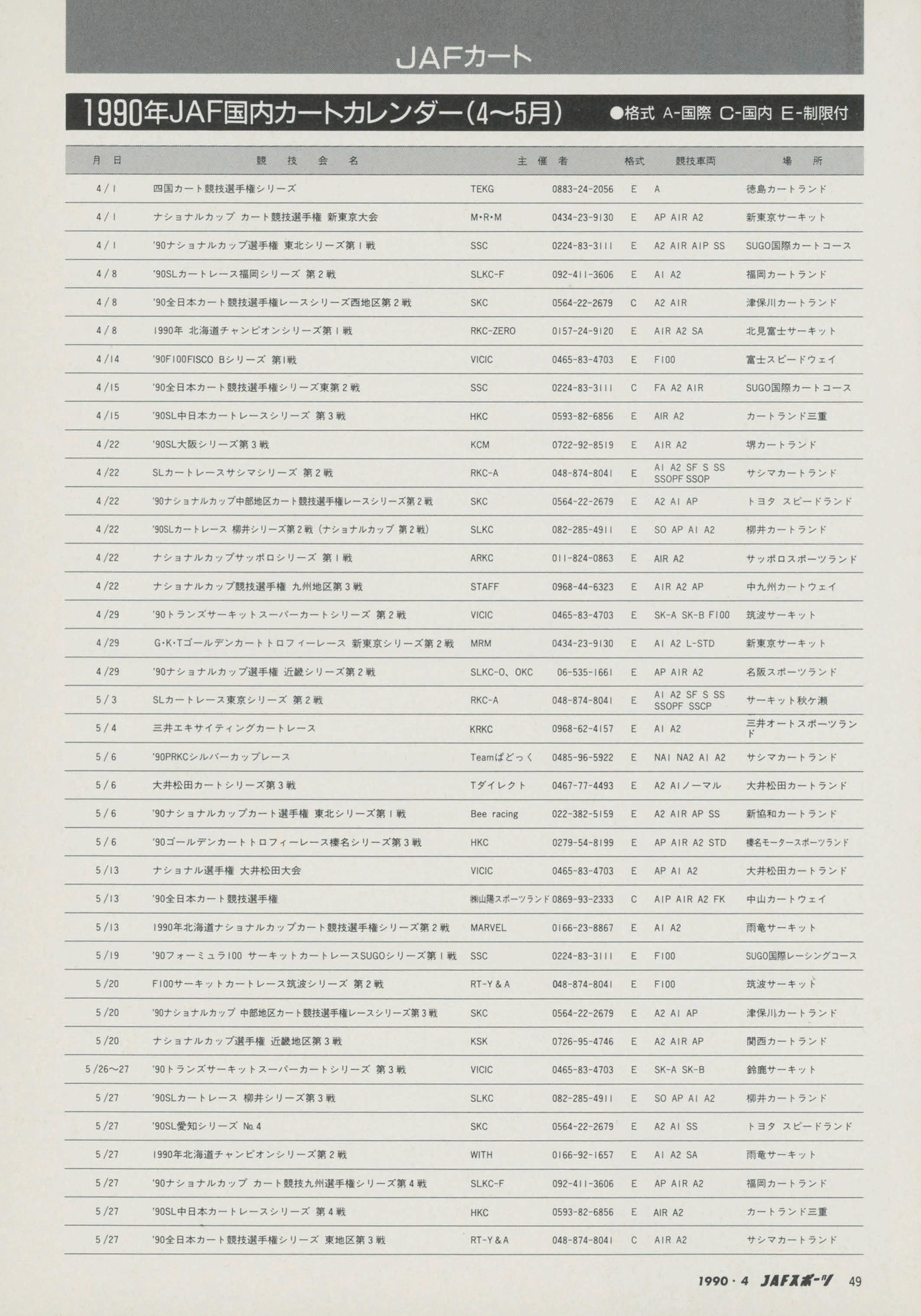
TEKG 0883-24-2056 E A
MキRキM 0434-23-9130 E APAIRA2
SSC 0224-83-3111 E A2 AIRAIPSS
SLKC-F 092-411-3606 E AIAZ
SKC 0564-22-2679 C AZAIR
RKC-ZERO
4/14 '90FIOOFISCO VICIC
4/IS SSC
4/22
4/22 RKC-A
4/22 SKC
4/ZZ SLKC
4/22 ARKC
4/22 STAFF
4/29 VICIC
4/29
4/29
5/3
5/4
5/6
5/13
5/19
5/20
5/20
5/20
5/26~27
S/27
S/27 4
MRM
RKC-A KRKC
0157-24-9120 E AIR A2 SA
0465-83-4703 E FI00
0224-83-3111 C FA A2 AIR
0593-82-6856 E AIR A2
0722-92-8519 E AIRA2
048-874-8041 E Al A2 SFS SS SSOPFSSOP
0564-22-2679 E AZAl AP
082-285-4911 E SOAPAIA2
011-824-0863 E AIRA2
0968-44-6323 E AIRA2AP
0465-83-4703 E SK-A SK-BFl00
0434-23-9130 E Al A2 L-STD
06-535-1661 E APAIRA2
048-874-8041 E Al A2 SF S SS SSOPF SSCP
0968-62-4157 E Al AZ
0485-96-5922 E NAINA2AIA2
0467-77-4493 E A2
Bee racmg 022-382-5159 E A2AIRAPSS
HKC 0279-54-8199 E APAIRA2STD
VICIC 0465-83-4703 E APAl A2 C AIPAIRA2 FK
MARVEL 0166-23-8867 E Al A2
SSC 0224-83-3111 E Fl00
RT-Y&A
048-874-8041 E FJOO
SKC 0564-22-2679 E A2Al AP
KSK 0726-95-4746 E AZ AIRAP
VICIC 0465-83-4703 E SK-A SK-8
SLKC 082-285-491I E SO APAIA2
SKC 0564-22-2679 E A2AISS
5/27 WITH 0166-92-1657 E Al AZ SA
5/27
5/27
5/27
092-411-3606 E APAIRAZ
SLKC-F
HKC 0593-82-6856 E AIRA2
048-874-8041 C AIRA2
RT-Y&A
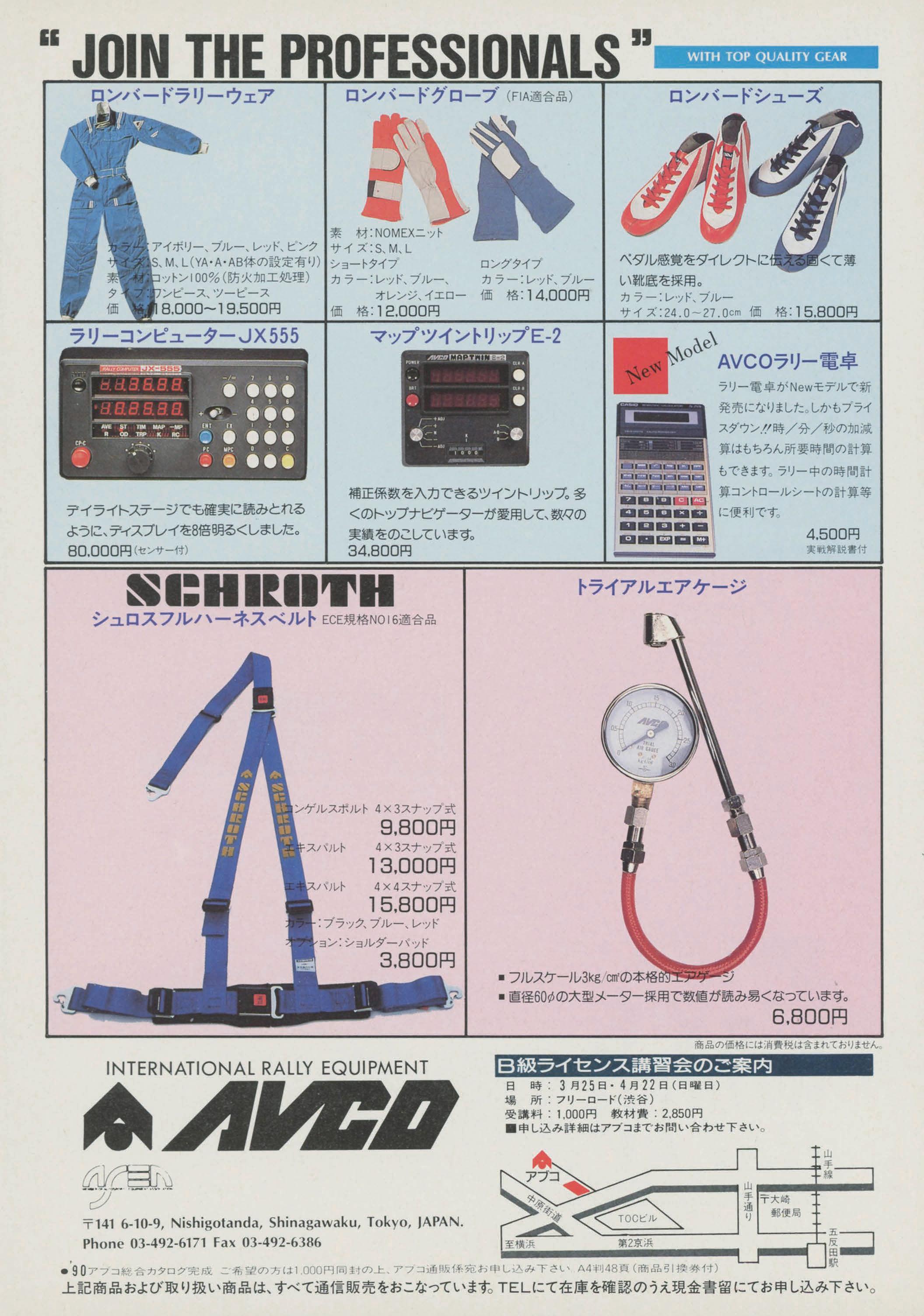
SLALOMSPECIALSEAT
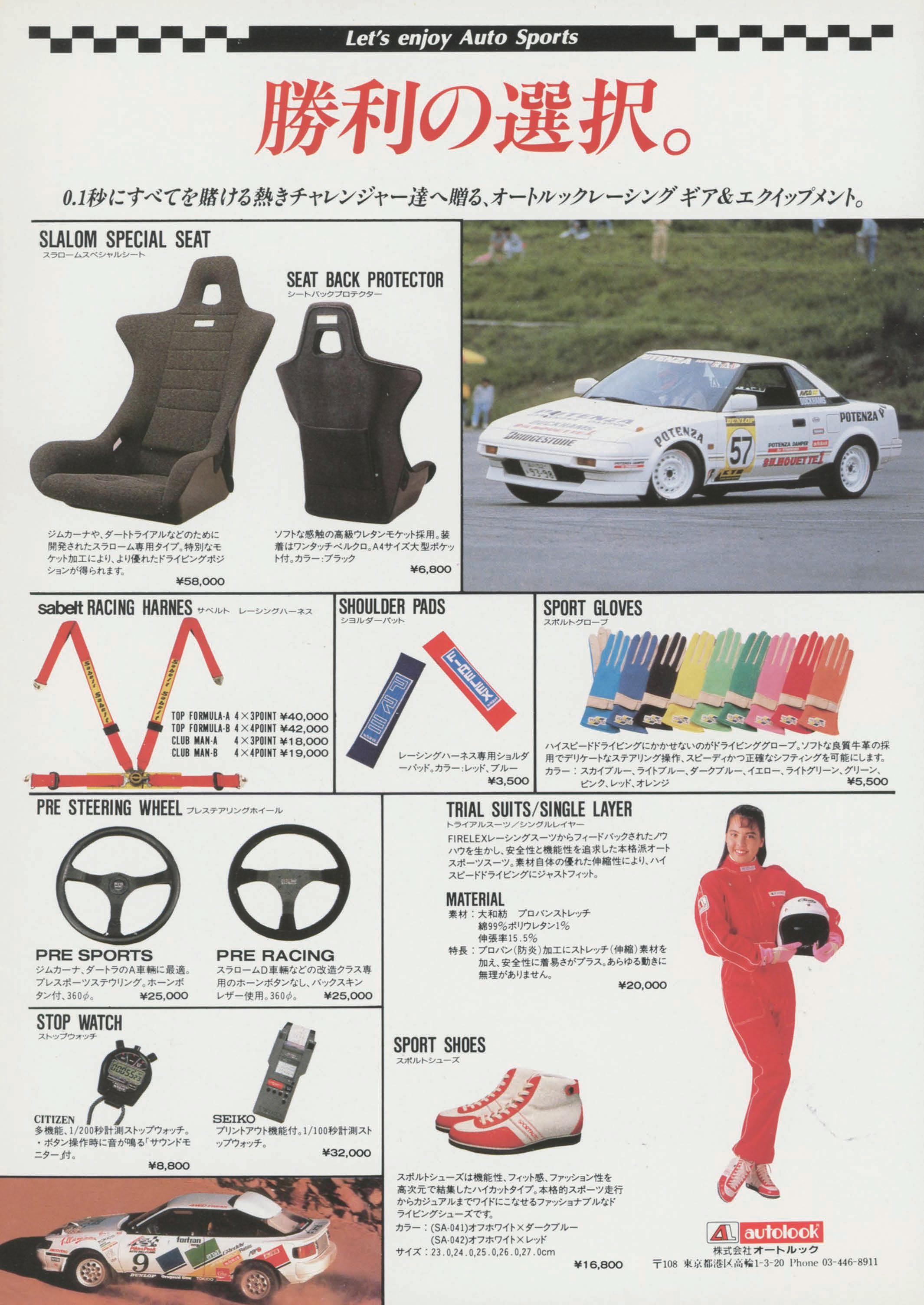
SHOULDERPADS
SPORTSHOES