Tiny Treasures with Big Personality: Exploring Porcelain Critters
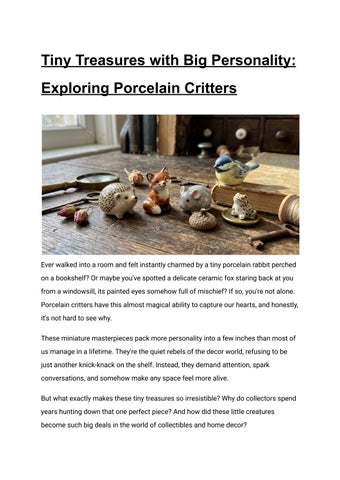
Ever walked into a room and felt instantly charmed by a tiny porcelain rabbit perched on a bookshelf? Or maybe you've spotted a delicate ceramic fox staring back at you from a windowsill, its painted eyes somehow full of mischief? If so, you're not alone. Porcelain critters have this almost magical ability to capture our hearts, and honestly, it's not hard to see why. These miniature masterpieces pack more personality into a few inches than most of us manage in a lifetime. They're the quiet rebels of the decor world, refusing to be just another knick-knack on the shelf. Instead, they demand attention, spark conversations, and somehow make any space feel more alive. But what exactly makes these tiny treasures so irresistible? Why do collectors spend years hunting down that one perfect piece? And how did these little creatures become such big deals in the world of collectibles and home decor?
Let's dive into the wonderfully whimsical world of porcelain critters and discover why these small wonders continue to captivate us generation after generation.
The Unexpected History Behind Those Tiny Faces You might think porcelain animals are a relatively modern invention, something dreamed up in the 1950s to sit on grandma's mantel. But here's the thing: these little guys have been around for centuries, and their story is way more fascinating than you'd expect. Porcelain itself originated in China over a thousand years ago, but it wasn't until the 1700s that European manufacturers started getting really creative with it. The Meissen factory in Germany, often credited as the first European porcelain manufacturer, began producing animal figures in the early 18th century. These weren't just random creatures, though. They were elaborate, often life-sized representations of animals from the royal menageries. Imagine being a European aristocrat in the 1700s. You've never seen a real elephant or tiger, but suddenly here's this exquisite porcelain version sitting in your parlor. It was like having a piece of the exotic world right in your home, minus the danger of actually owning a live tiger. Pretty clever, right? As porcelain production spread across Europe, different regions developed their own styles. The French created elegant, almost romantic animal figures. German manufacturers perfected the art of realistic detail. And English potteries? They went for charm and whimsy, producing animals that seemed ready to spring to life at any moment. Today, collectors can visit Camp Hollow to explore timeless porcelain jewelry and collectible keepsakes featuring charming figurines that appeal to people of all ages. By the Victorian era, porcelain animals had become the ultimate status symbol. Having a collection of these delicate creatures showed you had taste, wealth, and an
appreciation for fine craftsmanship. Plus, they were just plain adorable, which never hurts.
What Makes Porcelain Critters So Special? Let's get real for a second. In a world full of mass-produced plastic everything, why do we still go crazy for porcelain critters? What sets them apart from the thousands of other decorative items fighting for shelf space? First off, there's the craftsmanship factor. Each porcelain critter is essentially a tiny sculpture. Artists spend hours perfecting every curve, every expression, every whisker. When you hold one of these pieces, you're holding something that required genuine skill and artistry to create. That's pretty special in our fast-paced, automated world. Then there's the emotional connection. Porcelain animals have this uncanny ability to trigger feelings of nostalgia, comfort, and joy. Maybe they remind you of a childhood pet, or perhaps they simply bring a smile to your face on a rough day. Whatever the reason, these little creatures have serious emotional power. The variety is another huge draw. Whether you're into realistic wildlife, whimsical cartoon-style creatures, or elegant abstract interpretations, there's a porcelain critter out there with your name on it. From tiny ladybugs that fit on your fingertip to elaborate multi-piece scenes featuring entire animal families, the possibilities are endless. And let's not forget about the collecting aspect. Porcelain critters are like potato chips; it's nearly impossible to stop at just one. Each piece tells a story, represents a different style or era, or simply catches your eye in a way you can't resist. Before you know it, you're rearranging your entire living room to accommodate your growing menagerie.
The Art of Collecting: More Than Just Pretty Faces If you've ever caught the collecting bug, you know it's about way more than just accumulating stuff. It's about the thrill of the hunt, the joy of discovery, and the satisfaction of finding that perfect piece to complete a set. Porcelain critter collecting is no different. In fact, it might be one of the most accessible and rewarding collecting hobbies out there. You don't need a fortune to get started, and the variety available means there's something for every taste and budget. Some collectors focus on specific manufacturers. Companies like Lladró, Herend, and Royal Copenhagen have produced stunning porcelain animals for decades, each with their own distinctive style and quality level. Others prefer to hunt for vintage pieces from defunct manufacturers, searching flea markets and estate sales for hidden gems. Then there are the thematic collectors. Maybe you're all about woodland creatures, or perhaps farm animals are more your speed. Some people collect only cats, while others focus on birds or sea creatures. The beauty of porcelain critter collecting is that you get to make your own rules. Condition is obviously important when collecting. A pristine piece will always be worth more than one with chips or cracks, but don't let perfect condition be the enemy of good collecting. Sometimes a slightly imperfect piece has more character and tells a better story. Plus, it's usually more affordable, which means you can buy more critters. Win-win, right?
Popular Types of Porcelain Critters
The world of porcelain animals is incredibly diverse, but certain types have proven consistently popular over the years. Here's a quick look at some of the most beloved categories: Table 1: Popular Porcelain Critter Categories Category
Common Examples
Typical Style
Collector Appeal
Farm Animals
Pigs, cows,
Realistic or
Nostalgic charm
chickens
whimsical
Woodland
Foxes, rabbits,
Naturalistic
Storybook appeal
Creatures
squirrels
Domestic Pets
Cats, dogs, birds
Expressive
Emotional connection
Wildlife
Elephants, tigers,
Majestic
Exotic allure
Imaginative
Whimsical fun
bears
Fantasy
Dragons, unicorns
Creatures
Each category has its own devoted following, but many collectors enjoy mixing and matching. After all, who says your porcelain pig can't hang out with your ceramic dragon? It's your collection, your rules.
Table 2: Caring for Your Porcelain Collection Care Aspect
Best Practices
Common Mistakes to Avoid
Cleaning
Soft cloth, mild soap
Harsh chemicals, abrasive materials
Display
Stable surfaces, away from
High traffic areas, direct sunlight
edges
Storage
Individual wrapping, padded
Stacking without protection
containers
Handling
Clean hands, firm grip
Wearing rings, rushed movements
Environmen
Stable temperature and
Extreme temperature changes
t
humidity
Taking care of your porcelain critters isn't complicated, but it does require some attention to detail. These pieces might be durable, but they're not indestructible. A little TLC goes a long way in keeping your collection looking its best for years to come.
The Psychology Behind Our Love for Miniatures Have you ever wondered why we're so drawn to tiny things? There's actually some fascinating psychology behind our love for miniatures, and it helps explain why porcelain critters have such universal appeal. Psychologists call it "cute response," and it's the same reason we go gaga over puppies and kittens. Small things with big eyes and rounded features trigger our nurturing instincts. Porcelain critters often embody these characteristics perfectly, which is why we find them so irresistibly charming. There's also something called the "miniature effect," where we perceive small objects as more precious and valuable than their larger counterparts. A life-sized ceramic
dog might be impressive, but a tiny porcelain version feels more special somehow. It's like we're seeing the essence of the creature distilled down to its most perfect form. Miniatures also give us a sense of control and mastery. In a world that often feels chaotic and overwhelming, a tiny porcelain world where everything is perfectly arranged and eternally frozen in a moment of charm can be incredibly comforting. It's like having a little pocket of order and beauty that you can visit anytime. And let's be honest, there's just something inherently delightful about small things. They make us smile, they spark our imagination, and they remind us not to take everything so seriously. In a world that can sometimes feel heavy, porcelain critters offer a lighthearted escape.
Modern Trends in Porcelain Critter Design While traditional porcelain animals will always have their place, contemporary artists and manufacturers are pushing the boundaries of what's possible with these tiny treasures. Today's porcelain critters are more diverse, more creative, and more reflective of our modern sensibilities than ever before. We're seeing a move toward more stylized and abstract interpretations. Instead of perfectly realistic representations, many artists are creating pieces that capture the essence of an animal through simplified forms and bold colors. These contemporary critters feel fresh and modern while still maintaining that timeless porcelain charm. There's also a growing trend toward customization and personalization. Some manufacturers now offer pieces that can be customized with different colors, patterns, or even personalized messages. This makes porcelain critters perfect for commemorating special occasions or creating truly one-of-a-kind gifts. Sustainability is another important trend in the porcelain world. Many manufacturers are now focusing on eco-friendly production methods and materials, appealing to
environmentally conscious consumers who want their collections to reflect their values. And perhaps most excitingly, we're seeing greater diversity in the types of creatures being immortalized in porcelain. While traditional favorites like cats and dogs remain popular, there's been an explosion of interest in more unusual animals. From axolotls to pangolins to tardigrades (yes, really), if it exists in nature, there's probably a porcelain version of it somewhere.
Starting Your Own Porcelain Critter Adventure Ready to jump into the wonderful world of porcelain critters? Great choice! But before you start filling your shopping cart, let's talk strategy. First, figure out what speaks to you. Do you love realistic wildlife? Whimsical cartoon-style creatures? Elegant, minimalist designs? There's no right or wrong answer here, but having some direction will help you build a collection that feels cohesive and meaningful. Set a budget that works for you. Porcelain critters can range from a few dollars for mass-produced pieces to thousands for rare, handcrafted items. There's no need to break the bank, especially when you're just starting out. Some of the most charming pieces are surprisingly affordable. Do your homework on manufacturers and artists. Learning about different makers, their histories, and their signature styles will help you make informed decisions and spot quality pieces. Plus, it's just plain interesting to know the story behind your treasures. Don't be afraid to mix old and new. Vintage pieces have character and history, while contemporary pieces offer fresh designs and often better condition. A well-curated collection can include both beautifully.
And most importantly, buy what you love. At the end of the day, your collection should bring you joy. Whether it's a $5 flea market find or a $500 gallery piece, if it makes you smile every time you look at it, it's worth having.
The Enduring Magic of Tiny Treasures In our fast-paced, digital world, there's something deeply satisfying about surrounding ourselves with tangible, beautiful objects. Porcelain critters offer us a connection to craftsmanship, artistry, and the natural world, all wrapped up in packages small enough to hold in the palm of our hand. These tiny treasures remind us to appreciate the small things in life, to find joy in unexpected places, and to never underestimate the power of a well-placed porcelain hedgehog to brighten a room. They're conversation starters, memory keepers, and silent companions that ask nothing of us except a little shelf space and an appreciative glance now and then. Whether you're a serious collector with hundreds of pieces or someone who just has a few special critters scattered around your home, you're part of a tradition that stretches back centuries. You're keeping alive an art form that has brought joy to countless people throughout history, and that's pretty special. So the next time you spot a porcelain critter that catches your eye, don't hesitate. Bring it home, give it a place of honor, and let it work its quiet magic. After all, in a world that often feels too big and too complicated, sometimes the smallest treasures bring the greatest joy.