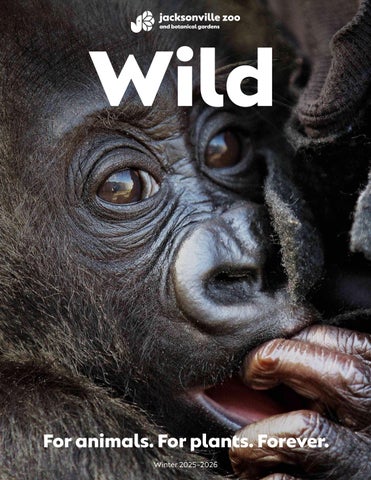
Wild
For animals. For plants. Forever. Winter 2025–2026
Manatee River Opening March 2026 A Happy Place To Heal
Colors of the Wild
Select nights through February 8th
Ring in the New Year with dazzling lights and family fun. Join us to experience the glow of Colors of the Wild and enjoy special seasonal activities: • 1/16 Pokémon Go • 1/19 Live Cultural Performances • 1/24 Live Cultural Performances • 1/29 Wine and Pigments • 2/7 Dungeons and Dragons
Wi n t e r
Contents
2026
2
Manatee River
4
Colors of the Wild
8
ReZOOvenation Realized
14
Animal Highlights: Mongoose Lemur
16
Horticulture: Manatee River Habitat A Living Landscape
20
Education Programs
22
Botanical Highlights Santa Cruz Waterlily
24
How to Photograph Animals Through Glass
29
A Baby Gorilla With Many Mothers
35
Dinosauria
36
What’s New Births, Hatchings and Acquisitions
40
Who’s Who
Cover photo: Jessie Williams © 2026 Jacksonville Zoo and Botanical Gardens. All rights reserved.
PHILANTHROPY
ReZOOvenation Realized Celebrating the Team Behind a Transformational Year
By Brenna Blake, Senior Philanthropy Officer Principal Gifts Entrance photos by Cullen Richart, Construction Projects Manager
The Zoo’s new entrance is an investment in conservation, infrastructure and future growth. It’s being built to serve animals, guests and the community for decades.
S
tepping under the Vystar skyscape canopy toward the J. Wayne and Delores Barr Weaver Manatee River, one truth is clear: Jacksonville Zoo and Botanical Gardens has entered a new era. “This phase of ReZOOvenation represents one of the most ambitious undertakings in our history,” said Dr. Jeff Ettling, President and CEO. “When I walked through there, I thought: Is this really ours? We’ve really grown up.” What began as a reconfigured parking lot is now a bold new entrance, community gathering space, and one of the nation’s most advanced manatee rehabilitation facilities. But it’s not just about structures; it’s about the people who made it happen.
A Vision Carried Forward: Jeff’s Leadership Jeff guided the project at every step, balancing guest experience, animal care and operational needs. Rising from a $17 million concept to over $70 million due to inflation and global supply chain challenges, the project never wavered under his leadership. “When the structure of the canopy went up, I could finally sleep,” he said. “You could see how everything tied together. This is really happening.”
10
Wild
For Dr. Ettling, the canopy and plaza reflect timeless design, while the manatee habitat embodies the Zoo’s mission: rescue, stabilization, rehabilitation and release. “Ideally, no animal will be a permanent resident,” he said. A Historic Campaign: Nikki Smith’s Determination Philanthropy is often the quiet force behind major progress, and ReZOOvenation was no exception. Beginning in 2019, Nikki Smith, Chief Philanthropy and Marketing Officer, stepped into a campaign that would become larger and more complex than anyone initially imagined. As costs rose nationally, fundraising became a moving target. “I’m proud of all the money we raised and all the hard work that went into it,” she said. “People sometimes forget that Philanthropy is what actually helps fund projects like this.” Her persistence helped secure the City of Jacksonville’s transformative matching commitment and inspired more than 600 donors, now recognized on the ReZOOvenation donor wall.
Winter 2025–2026
11
Mastering the Build: Cullen Richart’s Expertise Working in a living Zoo presented unique challenges. Sensitive animal habitats, daily guest operations, aging infrastructure and emergency protocols all had to be considered with every move. From the start, Cullen Richart, Construction Projects Manager, guided the construction team through the complexities of the Zoo, ensuring equipment and pathways moved safely, animals were undisturbed and daily operations continued seamlessly. “Every decision we made had a ripple effect—on animals, keepers, guests and construction,” he said. “There was no such thing as a small choice on this project.” His ability to anticipate challenges earned praise from Patrick Skahill, Danis Senior Project Manager. “I’ve built all over the country, and I’ve never worked with someone who can see around corners like Cullen. He thinks three steps ahead, and it made all the difference,” Skahill said. A Partner, Not a Contractor: Patrick Skahill and the Danis Team Patrick and his team approached ReZOOvenation as collaborators, not just builders. They adapted plans to match the Zoo’s vision, navigated nationwide equipment delays and constructed the highly complex life support systems that allow manatees to recover safely. “The finished product needed to be exactly what the Zoo envisioned,” Skahill said. “If that meant revisiting something or adjusting details, then that’s what we did. We’re only building this once.” Amid the pressure, Skahill kept the team connected and motivated, balancing humor, dedication and meticulous attention to detail. The project also became a
12 Wild
learning opportunity, documenting solutions for Danis teams across the country. “This isn’t just construction,” he said. “This is a legacy project. It’s part of the community.” A Purposeful Icon, Built for the Future The new entrance and Manatee River habitat are more than impressive structures; they are physical expressions of the Zoo’s mission. Guests witness conservation in action, learning that the manatees are patients recovering with the goal of returning to the wild. The Zoo has created a space that inspires awe while reinforcing its commitment to protecting Florida’s natural heritage. At the same time, the VyStar SkyScape canopy, plaza and surrounding amenities have positioned Jacksonville Zoo and Botanical Gardens as a city icon, a destination that connects the community, elevates the Zoo’s profile and strengthens its role in regional and global conservation. This phase of ReZOOvenation also lays out the groundwork for everything to come. Pathways, utilities and infrastructure were designed with future growth in mind, ensuring that upcoming habitats, programs and guest experiences can expand seamlessly. Every decision made today is a step toward tomorrow’s possibilities. ReZOOvenation is not just a milestone; it’s a statement of purpose, a symbol of the Zoo’s place in the city and a foundation for the future. Thanks to the vision, leadership and dedication of everyone involved, Jacksonville Zoo and Botanical Gardens has truly “grown up”—and the best is yet to come.
ANIMAL HIGHLIGHTS
Mongoose Lemur Photos by John Reed
14
Wild
Winter 2025–2026
15
HORTICULTURE
Manatee River Habitat: A Living Landscape Story and photos by Chris Dailey, Curator of Horticulture
We are opening the Manatee River Habitat, recreating a Florida spring with native plants to support manatees and local plants and wildlife. Over 200 trees will be planted, helping protect ecosystems and manatee food sources. 16 Wild
Soon, guests at Jacksonville Zoo and Botanical Gardens will be welcomed into the J. Wayne and Delores Barr Weaver Manatee River Habitat, our new immersive manatee rescue habitat, designed to educate visitors about manatees and their conservation. Visitors will be transported to the manatee’s natural habitat, a crystal-clear Florida spring run, set in the forest among limestone rock outcrops. Plants play a major role in bringing this habitat to life. Many species of Florida native forest plants will greet those who seek to spot a manatee in the clear river. Trees like Bald Cypress, Cabbage Palm, Southern
Magnolia and Red Cedar will surround the area, while a unique understory tree called Fringe Tree (or Old Man’s Beard) will lean gracefully over the limestone outcrops. Familiar Saw Palmetto, Coontie and Fakahatchee Grass will weave the landscape together and define pathways. Colorful fruit-bearing shrubs such as Yaupon Holly, Beautyberry, and Simpson’s Stopper will dot the scenery, adding vibrancy and texture. Just beyond the Manatee River, a path through Wild Florida has been renovated among preserved trees planted 25 years ago. Florida native gardens now line the path under these mature trees.
18 Wild
“We encourage everyone to plant at least one tree this year, wherever possible.” These spaces are inspired by unique Florida plant communities and aim to encourage residents to incorporate Florida native plants into their own landscapes. Including Florida native plants at home is an excellent way for residents to support wildlife conservation. Native plants provide food for birds and mammals in the form of seeds, berries and leaves. They also sustain native insects, which are a critical food source for songbirds, reptiles and amphibians. Flowering native plants support pollinators such as butterflies, bees and hummingbirds, helping maintain a healthy ecosystem.
Florida residents can also help protect manatees and their habitats by reducing lawn space or carefully managing lawns. Lawns treated with regular fertilizer contribute to algae blooms in natural waterways where manatees feed. These blooms reduce seagrass and other plants that manatees rely on for food. By using less fertilizer or replacing lawns with Florida native gardens, algae blooms decrease, manatee food sources increase and manatees thrive. The new year brings the Zoo and Botanical Gardens an exciting, one-of-a-kind space and the opportunity to plant over 200 Florida native trees. We encourage everyone to plant at least one tree this year, wherever possible. It truly makes a difference!
Winter 2025–2026
19
EDUCATION
Education Programs Natures Newbies
Spring Zoo Camp
Select Dates in March and April Ages 1–3
March 16–20 Ages 5–13
This program will engage your toddler in unstructured, child-directed play stations, songs, a storybook and animal friends! Spring Semester theme: Animal Homes. More Info.
Get ready for some prehistoric fun. Dinos are back, and we are digging it. Take a break from the classroom and enjoy a week of outdoor adventure at the Zoo. Spring Campers will spend their mornings exploring with our education team, discovering a different area of the Zoo each day. Afternoons are filled with Ambassador Animal encounters, camp games, arts and crafts, and themed activities out in nature. All Zoo Camps include exclusive behind-the-scenes moments and up-close experiences with some of our amazing animals. Registration is coming soon: More Info.
Zoo Tots Sessions Available in Februray, March and April Ages 3–5 This classroom readiness program engages your toddler in learning about the natural world with preschool-like lessons, activities, songs, storybooks and animal encounters. Spring Semester theme: Animal Movement. More Info.
20 Wild
Winter 2025–2026
21
BOTANICAL HIGHLIGHTS
Santa Cruz Waterlily Victoria cruziana located in Asian Bamboo Garden
Winter 2025–2026 23
SNAPSHOT SOCIETY
How to Photograph Animals Through Glass Story and photos by John Reed One of the most common problems photographing at the Zoo is shooting through glass. More and more glass is being used as a barrier as opposed to fence or moats or something else. So, shooting through glass is becoming a way of life for zoo photography. In addition, I suspect the new manatee exhibit will feature glass viewing areas. I covered this way back in 2020 but for these reasons, I thought it a good idea to revisit.
24 Wild
Obvious issues are scratches, smudges, dirt, dots, etc on the glass. For all of these, the biggest thing you can do is get your lens right against the glass. If you can’t, then still be sure to get as close as you can and then open your aperture to its largest opening (smallest f/stop number). As you move away from the glass, be aware of another possible issue and it relates to what happens to light as it goes through glass, as well as the reflective nature of glass. Take a look at this shot.
It is full of reflections! In order to deal with reflections, keep the following three things in mind. First, pay attention to environment and direction of light. If you’re in a darker environment and the subject is in bright light, the odds of having reflections are reduced—not eliminated but reduced. When shooting into the light, imperfections on the glass, especially the small dots now often placed on it, are more likely to show up, like this.
In some cases it also can give a sort of hazy or soft effect. Here’s an example showing that a soft image is sometimes caused by the glass rather than the camera or lens. This can also make it almost impossible to focus accurately.
Winter 2025–2026
25
Second, the best chance of success will be if you’re shooting straight at the glass, not at any angle. Of course, some good images have been made shooting at an angle but at an angle, the light passes through more glass than when looking head on. There is no strict rule but generally if you’re looking at greater than a 45 degree angle relative to the glass, the worse the result. The greater your angle, the more glass that light passes through and so the more the likelihood of distortion, leading to a soft/fuzzy image. Avoiding this might mean moving around some and that’s tough on crowded days but just be patient and willing to share the space. Finally, even super sharp images will
26 Wild
be ruined by the reflections as shown earlier. The problem is, you’re so intent on the subject, you don’t notice the reflections until after you’ve taken the shot. Our mind simply blocks them out when we’re aiming the camera because we’re so intent on the subject. Take a moment to observe if you have them or not. If you do, try moving around until you find a spot without them. Be patient and be rewarded. Also available now for many cameras is a flexible “hood” that fits on the front of the lens. Placing this against the glass blocks out all reflections. You can try to put the end of your lens right on the glass but it does not work as well as the flex hood. This one did.
In closing, the good news is that post production can go a long way to removing reflections in your images. Newer software now actually includes reflection removal tools but even without that, basic editing tools can in many cases mitigate the intrusive reflection. Remember the first photo with all the reflections? Below is a one click post production result. But you don’t have to do post processing if you pay attention to the tips mentioned in this post. Good luck and keep shooting. What you don’t get one day, you’ll get the next!
Winter 2025–2026
27
ANIMAL CARE
A Baby Gorilla With Many Mothers Story and photos by Jessie Williams, Ph.D.
This is the story of a baby gorilla nurtured by many surrogate mothers. Not all of them were gorillas.
Winter 2025–2026
29
New Beginning A baby gorilla is always cause for celebration. When Gandai was born at Jacksonville Zoo and Botanical Gardens, she brought not just joy, but hope. Gandai’s lineage was underrepresented in the captive gorilla population, the genetic safety net for their wild counterparts. So, her birth mattered to her species. It also offered Kumbuka a new chance at motherhood, something the Zoo deeply wanted for her. Kumbuka had lost two previous infants. A later evaluation revealed a possible reason: she was deaf. Infants often solicit maternal care with soft vocalizations. Kumbuka couldn’t hear these cues. The staff hoped that maternal-care training might strengthen her other maternal instincts that don’t rely on sound. They had a plan.
Prior to Gandai’s birth, Kumbuka received some pre-training in maternal care. The staff was hopeful but prepared to intervene if needed. Shortly after delivery, it became clear that Kumbuka was struggling to care for her newborn. The care team stepped
30 Wild
in and took over her care. They had a prepared plan for this possibility; it was creative, and it was thorough. Care Begins in Human Hands From the start, Gandai’s human caregivers had a clear goal: provide all the physical and emotional care an infant needs to survive and thrive, while preparing her to reunite safely with her species. It was important for her to identify as a gorilla early in her development. So, her caregivers did something remarkable. If Gandai could not be with her mother, then they decided they would be as gorilla as they could. They wore black clothing and vests with soft tassels so Gandai could cling to them just as she would to a gorilla mother. They crawled on hands and knees so she could ride on their backs, just as a gorilla carries their young. They bottle-fed her, slept beside her and never left her alone. .
Gandai developed normally, reaching milestones of grasping, crawling and exploring. She was wonderfully curious, much like a human baby, turning everyday objects into toys. Baby gorillas share many developmental similarities with humans, and caring for her felt instinctual to the team. Her silliness was familiar too, such as the day Gandai wore a red plastic bowl on her head. Her world was full of consistency, affection and gentle encouragement. As her legs strengthened and her curiosity widened, she had a special place to explore: the large gorilla yard. There, she visited the observation glass, exchanging delighted greetings with children. One unforgettable moment came when she and a young visitor met, two small faces, tiny fingers reaching out to one another through the glass. It was a quiet greeting, a shared recognition, child to child. Gandai grew more confident each day.
Back to the Arms of a Gorilla The team hoped Gandai might eventually reunite with her biological mother. When the day came to test the bond, Gandai was placed in the room with Kumbuka, but the mother showed no interest in her infant. Fortunately, another gorilla was ready to step in. Bulera, a confident and experienced mother who had raised two offspring, was chosen to care for Gandai. When the two were introduced, human caregivers watched with held breaths and hopeful hearts. They didn’t have to wait long. Bulera walked to the tiny infant, gathered her close and immediately displayed the calm, instinctive behavior of a natural mother. It was a moment of relief, gratitude and new beginnings.
Life Restored in the Troop With Bulera now acting as her mother, Gandai began the next phase of her journey. The two were given time to bond, and then came the big day: Bulera carried Gandai into the gorilla yard. First it was just the two of them. Then a large, gentle male joined. Finally, the entire troop was allowed to meet the newcomer. Through every step, Bulera remained steady and protective, guiding Gandai as a gorilla mother should. One challenge remained: Gandai still needed bottle feedings, and Bulera, of course, did not know how to provide them. So, the staff taught Gandai early to come to the fence when called and to take her bottle through the mesh. The system worked beautifully. Bulera was encouraged to
32 Wild
bring Gandai to feeding time with the help of treats, reinforcing their routine. The plan unfolded flawlessly. Soon Bulera was carrying Gandai confidently through the big outdoor habitat, Gandai clinging to her back just like any gorilla infant should. Introductions of other gorillas went smoothly, first the male, then the full troop. Gandai settled into her life with her real family with ease. Gandai had gone home.
Safeguarding a Species Gandai’s story is more than a single success. She represents the larger work modern zoos undertake every day. Zoos today focus on the conservation needs and long-term survival of the species in their care. Western lowland gorillas are listed as Critically Endangered by the International Union for Conservation of Nature (IUCN), having declined by more than 60 percent due to habitat loss, poaching and disease. Even if every threat were removed today, scientists estimate that the species would need at least 75 years to begin to recover its numbers.
This makes the role of captive, genetically managed populations essential. Through coordinated breeding programs like the Species Survival Plan (SSP), zoos create living safety nets for animals whose wild populations are in steep decline. These captive populations preserve genetic diversity and provide a future foundation for the species should wild recovery efforts allow reintroductions or population support Much of this work happens quietly, during late-night feedings, carefully managed introductions, detailed record-keeping and the daily rhythms of animal care. Each successful birth, each thriving infant and each reintegrated youngster like Gandai contributes to the long-term conservation of western lowland gorillas. She is part of a global effort to ensure their future.
Winter 2025–2026
33
A Mother, At Last Now seven years old, Gandai is a thriving, gregarious young gorilla. After rejoining troop life, she remained close to her foster mother, Bulera. But she also formed a very special relationship with one other gorilla—her biological mother, Kumbuka. From the beginning of Gandai’s return to the troop, Kumbuka showed deep interest, staying near and watchful. Over time, the two grew close. Now nearly inseparable, they spend much of their time side by side. This bond proved more important than anyone could have known. Sadly, Bulera unexpectedly passed away in 2024. The steady, close presence of Gandai’s mother, Kumbuka, un-doubtedly helped Gandai navigate her loss and grow into the resilient, thriving young gorilla she is today.
34 Wild
This is a story of many mothers, all of them essential. It is also a story of reunion—of a gorilla finally realizing motherhood, and an infant nurtured all the way home.
Dinosauria
WHAT’S NEW
Births, Hatchings and Acquisitions July, August, September 2025 Births and Hatches Black-faced ibis...................................................................................................................................................................................................................................................1.0.1 Common warthog................................................................................................................................................................................................................................................ 1.2 COQUEREL’S SIFAKA........................................................................................................................................................................................................................................... 0.1 Cownose ray...................................................................................................................................................................................................................................................... 0.0.3 Dyeing poison frog......................................................................................................................................................................................................................................... 0.0.2 Puffing snake*.................................................................................................................................................................................................................................................... 0.0.1 Striped newt †................................................................................................................................................................................................................................................0.0.401
Acquisitions ARUBA ISLAND RATTLESNAKE.....................................................................................................................................................................................................................2.0 Caiman lizard.........................................................................................................................................................................................................................................................1.0 NORTH SULAWESI BABIRUSA........................................................................................................................................................................................................................1.0 First digit male Second digit female Third digit sex unknown Two digits only represent male and female CAPS = Endangered Species * (Asterisk) = First time at the Zoo †(Dagger) = To be released to the wild ‡ (Double dagger) = Stillbirth
Puffing snake
Phrynonax poecilonotus
Nonvenomous, the puffing snake ranges from Mexico to northern South America, including the islands of Trinidad and Tobago. When threatened, they inflate their neck and hiss, giving them their name. While eggs have been laid before at the Zoo, this is the first time we’ve had a viable hatchling. While their coloring is quite dull as juveniles, as they grow, their appearance changes and continues to brighten. Their top half is typically slate or black, while their underbellies showcase striking red, orange or yellow hues. Look for the puffing snake at the Lost Temple.
Winter 2025–2026
37
Poison arrow frog Dendrobates tinctorius
The tinctorius species has more than 30 recognized variations or color morphs. The ones we have at the Zoo are the “azureus” (blue) and the yellowand-blue morphs. These frogs share their exhibit with our green-and-black poison arrow frogs (Dendrobates auratus), a different species distinguished more by genetics than by color.
38 Wild
Both Dendrobates species are highly toxic if consumed, hence their bright coloring to warn animals to stay away. Dendrobates toxicity comes from the food they eat in the wild, so in captivity, Dendrobates aren’t as dangerous to maintain. See how many frogs you can spot in their habitat in the Lost Temple.
North Sulawesi Babirusa Babyrousa celebensis
The North Sulawesi babirusa can only be found on the island of Sulawesi in Indonesia. These wild pigs are identifiable from their curved tusks, the upper and lower canines protruding through their snouts. The male’s tusks are distinctly larger than a female’s. Diurnal and omnivorous, the babirusa forages for food using their hooves, primarily eating fruit
and roots, but also known to catch small mammals and birds. While adult males are usually found alone or with another female, babirusas have been found in groups as large as 13, containing mostly adult females, sub-adults and juveniles. At Land of the Tiger, you can find our little group of babirusa in our mixed-species habitat with Asian small-clawed otters.
Winter 2025–2026 39
WHO’S WHO
Brenna Blake
Brenna Blake, Senior Philanthropy Officer Principal Gifts Portrait by Hannah Favorite
How long have you worked at the Zoo? I have been at Jacksonville Zoo and Botanical Gardens for 3 years. What does a day in your shoes look like? Every day looks a little different, but my focus is always on building meaningful relationships and moving our mission forward. I spend my days meeting with donors and partners, coordinating
40 Wild
major fundraising initiatives, planning events that support conservation and working closely with our team to bring our big projects to life. My job requires a balance of strategy, relationship building, storytelling and logistics.
What were your previous jobs/career paths and how did they lead you here? Before joining the Zoo, I worked in fundraising and conservation-focused roles, including time at the Jacksonville Arboretum. I’ve always been drawn to work that protects natural spaces and connects people to causes that truly matter. That passion led me into philanthropy, where I discovered how powerful it is to help people make a real impact. That path naturally brought me to the Zoo and the conservation world I love being part of today. What is your favorite animal?
Depends on the day! I really love manatees, but I think my current favorite are whale sharks or killer whales. What is your favorite exhibit? I do feel a little biased, but my favorite soon-to-open exhibit is the J. Wayne and Delores Barr Weaver Manatee River habitat. The conservation focus of this space means so much to me. Being able to share the story of rescue, rehabilitation and release right as guests enter the Zoo is incredibly powerful. I’m grateful we get to shine a spotlight on such important work. When or how did you first develop an interest in animals/ the zoo world/education? I’ve always loved animals, and conservation first became important to me when I went to outdoor school in sixth grade. I originally dreamed of becoming
a marine biologist, like many kids do. But I learned pretty quickly that science wasn’t my strongest subject. Finding my way into philanthropy gave me a completely different pathway into the world I care about. I still get to support conservation and make an impact, just from another angle. There’s no single route to our goals, and I’m proud of the path I found. Are you native to Florida? If so, where? If not, where did you grow up? I am not native! I was born and raised in California and my husband’s time in the military brought us to different places around the country. When he got out, we decided to settle in Florida, and we are currently living in St Augustine. What is your favorite part of your career or what is your most memorable experience at the Zoo (or your old zoo)? My favorite part is being part of such a large turning point for the Zoo and Botanical Gardens. Helping lead the fundraising journey during ReZOOvenation, working with incredible donors and partners and seeing the new entrance and Manatee River habitat come to life has been unforgettable. Getting to share that process with supporters makes it even more meaningful. What do you like to do in your free time? I love spending time with my family, exploring nature, hiking, planning trips and working on creative projects. At home, I love watching movies or having themed family nights with my daughter. My newest hobby is also creating book nooks.
Winter 2025–2026
41
Wild Senior Membership Coordinator Sheila Campbell members@jacksonvillezoo.org
Design Mark Sheppe, Senior Graphic Designer Hannah Favorite, Graphic Designer
Editors Emily Long, Marketing Manager Madi Sloan, Communications Specialist
Contributing Photographers Chris Dailey, Hannah Favorite, John Reed, Mark Sheppe, Jessie Williams
STRATEGIC OPERATIONS TEAM Jeff Ettling, Ph.D., President and CEO Paula Shields, Chief People and Culture Officer Nikki Smith, Chief Philanthropy & Marketing Officer David Hagan, Chief Life Sciences Officer Steven Henry, Chief Operating Officer Leanne White, Director of Learning & Conservation Engagement John Lukas, Curator of Wildlife Conservation Mindy Barker, Interim Chief Finance Officer
EXECUTIVE COMMITTEE Lucia Lindsey, Chair Chuck Ged, Immediate Past Chair Kerri Stewart, Chair Elect/Vice Chair Salmaan Wahidi, Treasurer/Finance Committee Chair Jason Spencer, Secretary Kelly Coker, Daniel, Governance Committee Chair John Hayt, Honorary Advisor
FOLLOW US
42
Wild
GENERAL BOARD
Janet Vaksdal Weaver
Ken Amaro John Baker III Martha Frye Baker LeAnna Cumber Mayor Donna Deegan Kenyonn Demps Fredrik Eliasson Mike Gay Steve Gormley Carolyn LaRose Sarah Longenecker Matthew McAfee Kelli O’Leary Missy Peters Hope Selevan Prober Paula Renfro Param Sahni Matthew Wotiz Dr. Jeff Ettling, Ex Officio Member
HONORARY PAST CHAIRS COUNCIL
HONORARY BOARD Danny Berenberg Ivan Clare Dano Davis Diane David Lenore McCullagh Elizabeth Petway Herbert Peyton Clifford Schultz Frank Surface
Martha Baker J.F. Bryan Carl Cannon Howard Coker Charles Commander Jed Davis Matt Fairbairn Chuck Ged Joseph Hixon J. Michael Hughes Lewis Lee David Loeb Richard Martin Frank Miller John A. Mitchell Thomas Schmidt Bill Rowe Carl “Hap” Stewart James Stockton Penny Thompson Courtenay Wilson
Jacksonville Zoo And Botanical Gardens Membership 370 Zoo Parkway Jacksonville Florida 32215 (904) 757-4463 ext 114 · members@jacksonvillezoo.org
Winter 2025–2026
43
Photo: John Reed