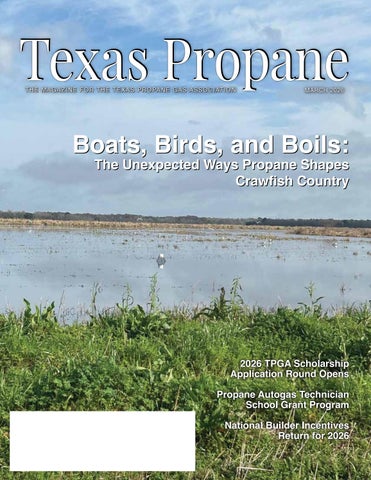
The Unexpected Ways Propane Shapes Crawfish Country
The Unexpected Ways Propane Shapes Crawfish Country Boats, Birds, and
2026 TPGA Scholarship Application Round Opens Propane Autogas Technician School Grant Program
Builder Incentives Return for 2026
Texas Propane
Highlights from Headquarters
Bill Van Hoy
TPGA Executive Director
Welcome to spring! This month we focus our attention on the many different ways propane supports the coastal crawfish industry. While Louisiana is obviously the crawfish capital of the U.S., Texas has a surprisingly large segment of the market. The industry needs a lot of what propane offers: clean fuel, portability and flexibility.
Now is the time to spread the word about TPGA Scholarships for the coming academic year. Employees, children or grandchildren of current TPGA member companies are eligible to apply. Applications must be submitted by May 15, 2026, for this next cycle.
Ever watch someone breeze through a computer chore that takes you twice as long? We’ve included some keyboard tricks to make short work of your time at the keyboard. Just memorize a few of these and you’ll thank us later!
It’s the last chance to apply for the 2026 Propane Autogas Vehicle Inspection Grant Program, which helps technical schools add propane autogas curriculum to local schools. Deadline to apply is March 31, 2026.
Also in this issue check out the details for the National Propane Construction Incentive Program for 2026.
We continue to look back through the propane archives and review the 1940s this issue. The decade was transformational for propane. It went from being a waste byproduct to being a crucial commodity. Its growth through the decade was staggering
Each month we include important information to your business in our Inside the Industry section. We also celebrate our industry members in the People in Propane and In Memoriam departments.
Last, we celebrate the Fish Fry in our Propane with Purpose section. The Friday Fish Fry during Lent is a prime example of how propane is essential in providing powerful, mobile energy for large events.
Texas Propane
TPGA staff
Bill Van Hoy ................. bvanhoy@txpropane.com Executive Director
Jackie Mason................... jmason@txpropane.com Deputy Executive Director
Assoc. At Large Director: Jimmie Grant, Martin Gas Sales, 713-851-6155
Assoc. At Large Alternate: Jim Fulton, 4-J Energy, 832-529-4768
Nominating Chair: John Walter, Schneider Distributing, 800-901-9109
NPGA Director: Mark Garrison, Allstar Fuel, 806-296-6353
Tracy Wells Mike Armstrong East & West Texas South Texas
Boats, Birds, and Boils:
The Unexpected Ways Propane Shapes Crawfish Country
Propane shows up in the crawfish industry long before a trap is pulled from the water—and it stays long after the last boil is served. It powers boats gliding through flooded rice fields at dawn. It moves water across acres that would otherwise sit dry or drain too slowly. It dries rice, scares geese, and fires burners beneath boiling pots in roadside sheds and crowded restaurants. In this corner of the Gulf Coast, propane is not a single solution. It is a network of quiet, overlapping jobs that make the entire system work.
Crawfish production across Southeast Texas and Louisiana depends on a tightly managed agricultural cycle built on timing, water control, and adaptability. Land must perform double duty. Equipment must operate in mud, moisture, and remote conditions. Rice provides structure and shelter. Crawfish provide winter and spring revenue. Propane provides the energy that allows producers to move seamlessly from one phase to the next, often under intense seasonal pressure.
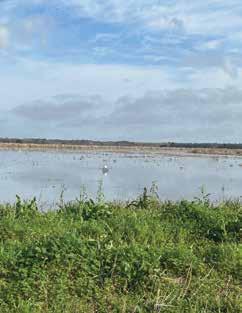
On a cold January morning along the upper Texas coast, the water in a flooded rice field barely ripples. Beneath the surface, crawfish move slowly toward wire traps, drawn by bait and instinct. To most Texans, crawfish season begins at a boil. For producers, it began months earlier—with pumps, propane tanks, and decisions that determined whether this field would make money or barely break even.
Texas Crawfish, by the Numbers
Texas ranks a distant second nationally in crawfish production, behind Louisiana but firmly established as a regional player. According to Texas A&M AgriLife, Texas producers farm roughly 9,500 acres of crawfish annually, producing an estimated 7.1 to 7.6 million pounds per year.
In Texas, most of that production is concentrated in Chambers, Jefferson, and Liberty counties. The area is the “Rice Belt” of Texas and the heart of its crawfish production. About 60 percent of Texas crawfish acres are dual-purpose rice fields—land that produces crawfish until it is drained and replanted for rice. Those acres typically yield about 650 pounds per acre. Dedicated crawfish acreage can produce 900 to 950 pounds per acre and stay in harvest a month or more longer.
Water Is the First Input
Before crawfish or rice ever enter the picture, water does. Fields must be flooded, drained, and reflooded at precisely the right moments. Gravity alone will not do the job.
Propane-powered pumps move water into fields in the spring, manage levels through summer, and flood ponds again in the fall. The ability to move water quickly matters. A delayed flood can mean poor crawfish survival. A late drain can disrupt rice planting. Propane allows producers to respond immediately to weather shifts, drought, or heavy rainfall—often in remote locations far from reliable electric service.
Rice as Living Architecture
Rice planting begins in April, when seed is placed on dry ground. Weeks later, water is introduced to suppress weeds and establish controlled growing conditions. As rice grows, water levels are adjusted constantly to maintain shallow, cool environments.
By midsummer, rice plants form a dense canopy nearly two feet tall. That canopy shades the water below, lowering temperatures and creating ideal habitat for crawfish. Rice is no longer just a crop. It becomes shelter.
Texas Highways magazine calls crawfish cultivation “an intricate seasonal dance,” driven by water, temperature, and timing. Juvenile crawfish are introduced into flooded fields and feed on microorganisms and aquatic life. As fields are drained and refilled, crawfish are encouraged to burrow into levees, waiting for cooler months.
Drying the Rice, Powering the Pivot
When rice harvest begins in late July or early August, propane becomes indispensable. Grain dryers and blowers powered by propane allow producers to harvest efficiently and protect grain quality, regardless of pipeline access or weather disruptions.
At C & J Farms in Crowley, Louisiana—part of the same Gulf Coast production ecosystem—propane has powered grain drying operations for decades. “We use propane grain dryers and blowers,” farmer Chris Sarver said. “We were once on a natural gas pipeline, but were pushed off years ago. Our grain dryers have been on propane for about 25 to 30 years now.”
That reliability matters in a business where harvest windows are tight and delays are expensive.
From Rice Stubble to Crawfish Feed
After harvest, rice fields are not cleared. They are repurposed. Stubble and residue left behind become the primary food source for crawfish.
“We grow rice and harvest it, and the stubble and residue left behind is what the crawfish feed on during the season,” Sarver said.
This rotation allows producers to extract value from the same acre twice. Rice pays in summer. Crawfish pay in winter and spring.
Flooding Back In
By October, crawfish ponds are flooded again using controlled pumping. Water levels are maintained as temperatures drop, triggering crawfish movement and growth. Harvest typically begins in January and peaks by March.
According to Texas A&M AgriLife, extending harvest even one or two weeks can add 70 to 100 pounds per acre. Shorter-
season rice varieties have helped producers push crawfish harvest deeper into the season.
“The beginning of the season pays the farm bills,” AgriLife’s Mark Sink said. “But the crawfish at the end of the season are the profit.”
Keeping the Geese Out
Flooded fields attract more than crawfish. Migratory birds— particularly geese—can devastate a field if left unchecked.
To protect their crop, producers rely on propane-powered wildlife deterrent cannons. Positioned along levees, the cannons emit timed explosive sounds that scare birds away without harming them. For producers, they are an essential line of defense. For propane marketers, they represent a seasonal but critical application that often goes unnoticed.
Propane on the Water
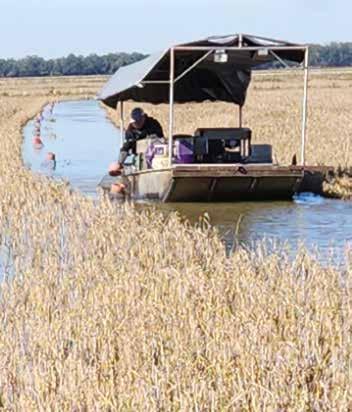
During harvest, propane becomes visible. Shallow-draft boats move slowly through flooded fields, pulling traps and rebaiting lines. Increasingly, those boats run on propane.
“Propane plays a massive part in the industry, no doubt.”
— Shane Spilino, Cajun Claws
"All of our boats are on propane now,” Sarver said.
The switch followed years of frustration with ethanol gasoline. “When the boats sat up, we were having to pull carburetors two or three times at the start of every season. So we ended up converting everything from gasoline, and since then we’ve also bought Kohler propane engines.”
The engines are sourced locally. “There’s a boat builder in the area that builds crawfish boats. He normally installs gasoline Kohler engines, but he can order the propane versions for us,” Sarver said.
The advantages are practical. “Convenience is a big one,” Sarver said. “These boats are parked in remote areas, and gasoline tanks often get stolen. Propane usually doesn’t.”
Fuel cleanliness matters, too. “Our workers prefer propane because it doesn’t spill gasoline on the crawfish, which would ruin them,” he said.
Forklift-style propane cylinders with dip tubes provide liquid withdrawal required for engine operation, reducing downtime and maintenance.
From Field to Table
Once crawfish leave the field, propane remains part of the story—often at an even larger scale. Restaurants, caterers, and wholesalers become the final link in the chain, transforming live crawfish into a product that defines spring across Southeast Texas and Louisiana.
At Cajun Claws of Rayne, Louisiana, owner Shane Spilino sees the season from every angle. Through his restaurant, catering, and wholesale operations, Spilino sells between 2.5 and 3 million pounds of crawfish each year.
Peak crawfish season for Cajun Claws runs from March through May, when quality is high and pricing stabilizes.
“The 40 days of Lent and Holy Week are our busiest weeks,” Spilino said.
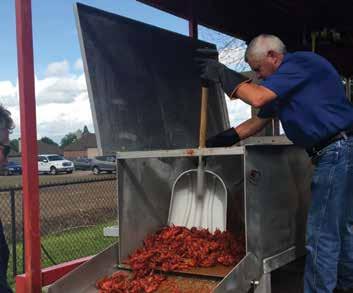
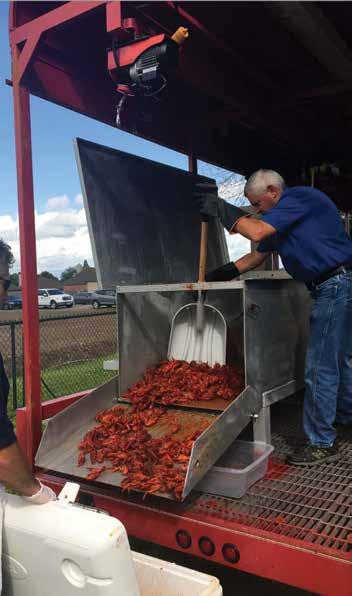
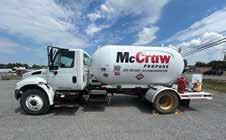
To meet that demand, Spilino operates four catering trailers, all powered by propane from Cajun Propane of Crowley, LA. Those trailers allow Cajun Claws to bring large-scale boiling directly to customers, festivals, and events. The same fuel used upstream to move water, dry rice, scare off predators, and power boats now brings crawfish to the table.
Spilino doesn’t mince words about propane’s role.
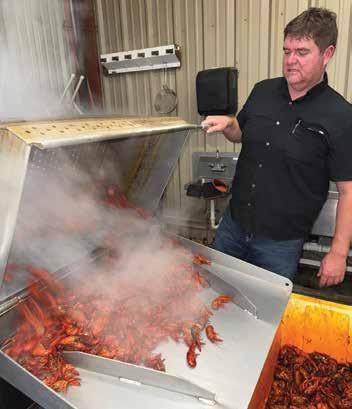
For restaurants and caterers operating at this scale, propane’s portability and heat control are not conveniences—they are requirements. Large batches must come to a rolling boil quickly and consistently. Delays slow service, affect quality, and ripple through already tight schedules during peak season.
In Southeast Texas, TPGA President-Elect Jeremy Gentile of Hill Butane notes that propane’s role doesn’t stop at the farm gate. While storms have disrupted some grain operations in
recent years, propane remains central for producers operating their own dryers—and for the crawfish restaurants that anchor the region’s food culture.
From flooded fields to boiling pots, propane connects every phase of crawfish season.
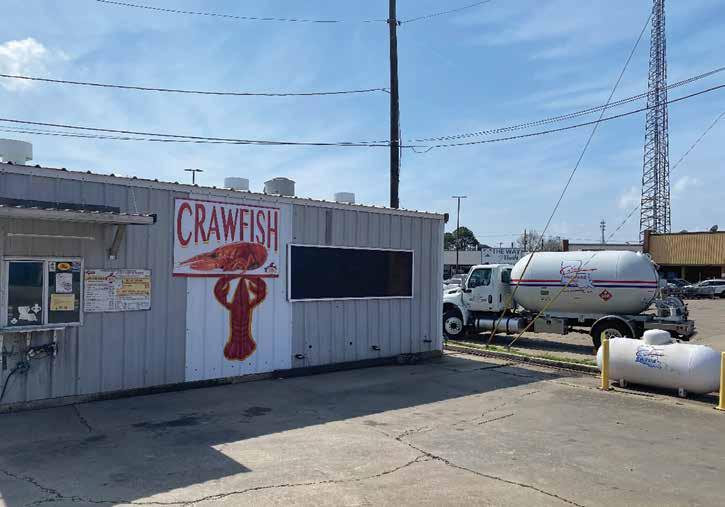
Pook’s Propane of Santa Fe, TX is no stranger to propane. Owner Gregg Vicknair also operates Pook’s Crawfish, now in its 15th season. The seasonal sit-down restaurant operates from January through June and relies on propane for all outside catering operations. Since launching Pook’s Propane in 2023, Pook has brought the two businesses together—selling live crawfish and propane side by side, while also offering crawfish boilers in the propane showroom.
Why This Matters to Propane Marketers
For propane marketers, the rice–crawfish cycle is a reminder that propane’s value lies in adaptability. It moves water, dries grain, protects crops, powers equipment, and finishes food—all within a single system.
In this Gulf Coast balancing act, propane is not an accessory. It is a requirement.
Acknowledgment
This article was made possible with the assistance of Kenny Lucero with Cajun Propane, who connected Texas Propane magazine with producers and industry sources and provided critical insight into propane’s role across the rice and crawfish production cycle as well as photography.
Cajun Claws operates four catering trailers that allow his team to bring large-scale crawfish boils directly to customers, festivals and events.
Fueling Futures: The Most Important Delivery You’ll Ever Make
You know the routine.
A bobtail leaves before sunrise. A transport rolls in before a storm. A service tech double-checks a regulator because details matter. In propane, we plan ahead. We prepare. We invest today so homes, farms, and businesses are taken care of tomorrow.
What if I told you one of the most important deliveries you’ll ever make isn’t measured in gallons?
It’s measured in opportunity.
The Cost of Education Is Rising. So Is the Need.
Whether it’s a four-year university, a two-year college, or a technical or trade program, the cost of education continues to climb. Tuition. Fees. Books. Housing. Tools. Certifications. It adds up quickly — and often lands squarely on the shoulders of families already juggling work, inflation, and everyday life.
For many of our members, that means helping a child or grandchild chase a dream while still keeping trucks running and customers served.
That’s exactly why the Texas Propane Gas Association Scholarship Foundation exists.
Since 1997, the TPGA Scholarship Foundation has invested nearly $250,000 into the children and grandchildren of TPGA member companies, helping
them pursue higher education and skilled trades training.
This isn’t a new idea. It’s a 25+ year commitment to the next generation.
Not Just College — Real-World Careers
One of the things that makes the TPGA Scholarship special is its flexibility. This isn’t limited to one narrow path. Eligible students may pursue:
• A four-year university degree
• A two-year college program
• A full-time vocational or technical school
That means future engineers, nurses, teachers, welders, mechanics, HVAC technicians, accountants, and business owners are all eligible — as long as they are connected to a current TPGA member company and meet the academic criteria.
We all know success doesn’t look the same for every student. Some will wear caps and gowns. Others will wear steeltoed boots. Both matter. Both build Texas.
Who Can Apply?
If you are a TPGA member company (with 2026 dues paid), your family may qualify. Eligible applicants must:
• Be a Texas resident
• Be a Texas high school senior or current undergraduate
• Enroll full-time for the 2026–2027 academic year
• Be an employee, child, or grandchild of an employee of a current TPGA member company
• Be in the upper half of their class academically
Applications open March 1, 2026, and close May 15, 2026, at 11:59 p.m. CST.
Fair. Independent. Earned.
Scholarship applications are reviewed and scored by an independent third-party higher education organization — not by TPGA staff, not by board members, not by industry insiders. Students are evaluated on:
• Financial need
• Academic rigor
• Extracurricular and community involvement
• The quality of their short essay Recipients are notified by email in Summer 2026, and award checks are sent directly to the educational institution to be applied toward tuition and fees.
Don’t Keep This Quiet
Here’s the part that matters most:
• Have you told your employees?
• Have you mentioned this at your next safety meeting?
• Have you forwarded this to your team and said, “If you’ve got a senior or college student at home, you need to look at this”?
Too often, scholarships go unused simply because families don’t realize they qualify.
Don’t let that happen this year.
Action Item! Tear out the poster on the next page and post it in your break room.
The online application will be available at: www.txpropane.com/scholarship
Open to children and grandchildren of TPGA member‐company employees.
Available to students pursuing a 2-year college, 4-year university, or trade school full-time for the 2026-2027 school year
Texas high school seniors and undergraduate students are encouraged to apply.
Applicants must be in the “upper half of class GPA standing” to qualify.
One‐time scholarship award; “previous recipients are not eligible to reapply.”
12 Computer Shortcuts That Save Serious Time
Most of us spend hours a day on our computers — yet few of us use even a fraction of the built-in shortcuts that can save serious time. Whether you’re juggling emails, drafting reports, or man-
aging multiple windows at once, these simple Windows keyboard tricks can streamline your workflow, reduce frustration, and help you work smarter — not harder.
1. Instantly Reopen a Closed Tab
Closed something you still needed? Don’t panic.
Press CTRL + SHIFT + T to reopen the most recently closed browser tab. Keep pressing it to reopen multiple previously closed tabs.
This works in Chrome, Edge, and most modern browsers.
2. Undo (and Redo) Almost Anything
Made a mistake? Fix it in one second.
CTRL + Z = Undo your last action
CTRL + Y = Redo what you just undid
This works in Word, Excel, email, file explorer — even after accidentally deleting text or moving files.
3. Lock Your Computer in One Second
Stepping away from your desk? Lock it immediately.
Press WIN + L
This protects sensitive files, email, and accounts — especially important in shared office environments.
4. Show Your Desktop Instantly
Need everything off your screen fast?
Press WIN + D to minimize all open windows and show your desktop.
Press it again to restore everything.
Much faster than clicking minimize 12 times.
5. Screenshot Only What You Need
No more cropping full-screen screenshots.
Press WIN + SHIFT + S
Select the exact portion of the screen you want.
The image copies to your clipboard so you can paste it directly into email, Word, Teams, etc.
Bonus (Windows 11): The Snipping Tool can now record part of your screen as video.
6. Open a New Window or Document Quickly
Skip File aNew.
Press CTRL + N Works in:
- Word
- Excel
- Outlook
- Browsers
- Many other programs
Browser tip:
Press CTRL + SHIFT + N to open a private/incognito window.
Useful for:
- Testing website changes
- Logging into multiple accounts
- Viewing uncached pages
7. Bring Up the Emoji Keyboard
Press WIN + . or WIN + ; You can search emojis by typing keywords at the top.
8. Quickly Navigate Back Through Web Pages
Right-click the browser’s Back button. You’ll see a list of previously visited pages on that tab — click the one you need.
9. Restart (Not Shut Down)
When something is acting strange, choose Restart, not Shut Down.
Restart clears temporary memory and system glitches in ways that a standard shutdown often doesn’t.
10. Find Text Instantly
Press CTRL + F to search for a word or phrase in:
- Documents
- Emails
- Web pages
- PDFs
11. Rename Files Quickly Select a file and press F2.
12. Copy and Paste Like a Pro CTRL + C = Copy
CTRL + V = Paste
CTRL + X = Cut
Last Chance! Applications Open for the Propane Autogas Vehicle Inspection Grant Program to Training the Next Generation of Propane Technicians
Applications are still open for the 2026 Propane Autogas Vehicle Inspection Grant Program, a national workforce initiative from the Propane Education & Research Council (PERC). The program helps technical schools add propane autogas inspection curriculum while giving the propane industry direct opportunities to engage with students and instructors.
Two Texas schools — Angelina College in Lufkin and the Future Ready Complex — have already been awarded grants. Additional schools are still being selected nationwide. There are spots for up to 9 more schools.
Application Deadline: March 31, 2026.
Grant Overview
Each selected school receives $7,500 in total support:
• Propane autogas training aid valued at more than $5,000 (pickup-frame model showing tank, fuel system, ECU, and components)
• $2,500 for instructor Train-the-Trainer attendance and program promotion
Digital curriculum, instructor tools, and student materials provided through PERC
Key School Requirements
Must be an automotive or technical program willing to add propane autogas curriculum
Instructor attends Train-the-Trainer, June 9–10, 2026, Wake Technical Community College (Raleigh, NC)
Implement the Propane Autogas Vehicle Inspection course by Fall 2026 or Spring 2027
Install and use the provided autogas training aid
Submit final implementation report to PERC by June 1, 2027
Role of the Propane Advisor (Industry Engagement)
Each participating school must identify a Propane Advisor. Propane marketers, fleet operators, service technicians, or industry partners can serve in this role.
Provide technical guidance to instructors
Speak to students at least twice during the course
Discuss propane careers, safety, and real-world applications
Support connections between students and local propane companies
Propane Curriculum
Available through PERC’s Learning Center, Propane Autogas Vehicle Inspection Training: Introduction for Automobile Service Technicians is an introductory course for automobile service technicians looking to understand propane Autogas components, systems, and operations.
There are four lessons in this course:
Propane Fuel, Safety Considerations, Propane Vehicle Systems and Component Operation, and Vehicle Inspections.
Course Objectives
Understand propane Autogas components, systems and operation
Practice Propane Safety Considerations
Be able to use/locate info in NFPA 58 specific to on road propane Autogas systems
Perform Propane Autogas inspections
Present customers the inspection results following the RIM approach
Ability to document and follow the 3 C’s of vehicle repair
Why It Matters to the Propane Industry
The program creates direct connections between propane companies and automotive programs, helping develop technicians familiar with propane autogas systems. Industry members are encouraged to contact local colleges to participate as Propane Advisors and support workforce development.
Learn more and have them apply at https://propane.com/autogasgrantprogram/.
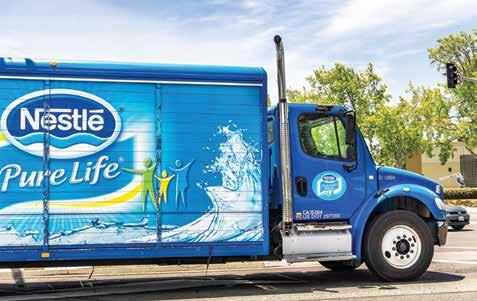
According to reporting by Heavy Duty Trucking, Nestlé Waters North America has expanded its alternative fuel fleet with the addition of 155 propane autogaspowered Ford F-650 beverage delivery trucks. The new medium-duty vehicles join an existing fleet of 30 propane units and were selected to help reduce maintenance expenses, lower fuel costs, and support the company’s environmental goals.
Bill Ardis, national fleet manager for Nestlé Waters North America, noted that the company has operated propane autogas vehicles since 2014 and continues to see strong emissions and cost-saving benefits from the domestically produced fuel. The trucks are equipped with ROUSH CleanTech propane autogas fuel systems that meet California Air Resources Board and EPA standards and feature 45-gallon fuel tanks.
The propane trucks will be used for beverage delivery routes nationwide, with deployment beginning in April. Nestlé Waters reports propane fuel costs averaging about $1 per gallon compared to roughly $2 per gallon for diesel, further supporting the company’s fleet expansion strategy.
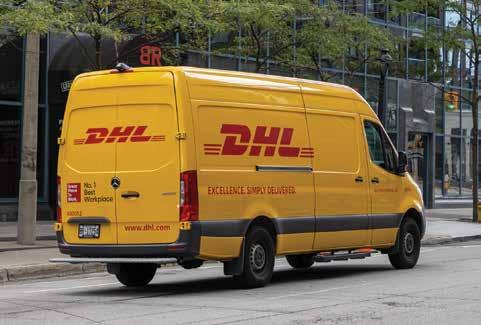
DHL Express Expands Alternative Fuel Fleet with 100 Propane Autogas Delivery Vans
DHL Express has introduced 100 new propane autogas-powered vans into its pickup and delivery operations, continuing the company’s investment in loweremission transportation solutions. The Ford E-250 cargo vans, equipped with
dedicated ROUSH CleanTech propane autogas fuel systems, are expected to begin operating by late August.
The vehicles will support package delivery routes across several states, including California, Florida, Georgia, Missouri, and Texas. DHL Express plans to rely on a combination of existing public propane refueling stations and new on-site fueling infrastructure at select service centers to keep the fleet operating efficiently.
These additions build on propane vehicles already in use by DHL Express in other regions of the country and align with Deutsche Post DHL’s broader sustainability initiatives aimed at improving carbon efficiency across global operations. According to company data, each propane autogas vehicle can significantly reduce greenhouse gas emissions compared with conventional fuel models.
Across its global network, Deutsche Post DHL continues to grow its portfolio of alternative fuel and efficiency-focused vehicles, which includes hybrids, electric trucks, and other low-emission technologies designed to reduce environmental impact while maintaining reliable delivery performance.
National Builder Incentives Return for 2026
The Propane Education & Research Council (PERC) has renewed the National Propane Construction Research Program (PCRP) for 2026, bringing another round of builder incentives designed to encourage propane adoption in residential construction. For Texas propane marketers, the program provides a timely opportunity to start conversations with builders about incorporating propane systems into new homes while helping offset project costs.
The program reopened this March with up to $2.25 million available funding. Builders can earn incentives of up to $1,000 per new home when qualifying propane appliances are installed, making PCRP a valuable tool for marketers looking to position propane as a practical, performance-driven energy solution.
Turning Incentives into Builder Conversations
PCRP was created not only to provide financial incentives but also to collect real-world construction data that demonstrates propane’s role in modern housing. Builders who participate submit basic project information and energy modeling through the Energy Planning Analysis Tool (EPAT), helping PERC better understand how propane appliances perform in residential applications.
For marketers, this creates a straightforward talking point: builders can receive compensation while exploring design flexibility, electrical load management, and performance upgrades that many homeowners already value.
Incentive Structure and Eligible Equipment
Compensation Guidelines
Propane Application Compensation
• Minimum of two appliances with a maximum of $1,000 for new construction.
• Some applications may be eligible for an additional $500 remodel bonus.
At least one of these applications is required:
1. Boiler, Furnace, or Combi Boiler (not a heat pump) $500
2. Water Heater (tankless or storage tank) $300
Eligible additional appliances:
1. $100 per appliance. Cooktop or Range, Clothes Dryer, Standby Generator, Fireplace or Gas Log Set, Propane Gas Piping for Outdoor Equipment (must comply with all codes)
2. Hydronic Air Handler $300
Why This Matters for Texas Marketers
As builders explore all-electric designs, PCRP gives marketers a clear way to reenter the conversation — centered on incentives, performance, and buyer demand.
Propane-equipped homes can lower construction costs, boost marketability, and help manage electrical panel capacity as EV charging and smart technology loads increase.
Helping Builders Navigate Requirements
Builders must be licensed U.S. contrac-
tors, complete homes within the calendar year 2026, and submit required surveys and energy modeling before incentives are issued.
Because funding is limited and awarded on a rolling basis, early coordination and clear communication on qualifying equipment and deadlines are essential.
Learn more at www.propane.com/pcrp.
For questions regarding specific scenarios or what qualifies, call PERC at 202452-8975.
Founded in 1990, American Standard Manufac turing set out to build cylinder exchange displays that worked harder, lasted longer, and raised the bar for the entire industr y. From exchange cabinets to forklift and high-pressure cylinder storage, ever y solution is built with uncompromising qualit y, quick turnaround, and personal ser vice
Celebrate America’s 250 250th Bir thday with A SM at the 2026 NPGA Southeastern & International Propane E xpo, April 19-21, 2026!
BOOTH #94 3
March Madness: NGLs at Work
March Madness delivers heart-stopping finishes, busted brackets and unforgettable moments on the hardwood. Yet beyond the spotlight and the roar of the crowd is a quieter story — the vital role natural gas liquids (NGLs) such as ethane, propane and butane play in making the tournament possible. These versatile resources serve not only as energy sources but also as key ingredients in the materials that shape the modern game.
From Tip-Off to Final Buzzer: Where NGLs Show Up
Take the iconic white net, trimmed and celebrated when champions are crowned. Its strength and flexibility come from nylon, which depends on ethylene — a product derived from ethane — as a primary building block.
The backboard, built to withstand powerful dunks and relentless rebounds, often features polycarbonate, a tough, transparent plastic. Propane plays a role here as well, serving as a feedstock in the production of propylene, which is used to manufacture durable plastics like polycarbonate. Even the performance footwear athletes rely on is connected to NGL chemistry. Modern basketball shoes incorporate advanced plastics and synthetic rubbers, many of which originate from ethylene and propylene. These materials provide the grip, cushioning and flexibility players need to pivot, sprint and soar.
And beneath every fast break is the polished wood court itself. Protective polyurethane coatings — produced using com-
ponents derived from ethane and propane — create the smooth, resilient finish that allows the ball to bounce true and athletes to move safely and confidently.
So when the final net is cut and confetti falls, the celebration reflects more than athletic excellence. It also highlights the often-unseen contribution of natural gas liquids and the chemical innovation that helps bring March Madness to life —
from the court underfoot to the shoes on the players’ feet.
Based on an Energy Transfer article.
Isn’t it time to trust that your insurance works as hard as you do?
• You will receive good old fashioned customer service.
• You will be educated about your policy coverages and shown where you might be vulnerable.
• You will receive multiple options for your insurance.
A Look Back: The 1940s Golden Age
The 1940s in America was a decade of dramatic contrast, where the soulful brass of the Big Band era met the high-stakes tension of a world at war. While families huddled around the radio “hearth” to hear FDR’s steadying “Fireside Chats,” the silver screen was dominated by the smoky shadows of Film Noir and the romantic heroism of Casablanca. It was a time of “Sinatramania,” with bobby-soxers swooning over a young Frank Sinatra, and the emergence of “high-tech” culinary marvels like SPAM and Jell-O salads.
The Drafted Molecule
In the early 1940s, Texas was the beating heart of a massive transition in the American energy landscape. Liquefied petroleum gas (LPG)—primarily propane and butane— underwent a radical metamorphosis from a “waste” product of oil drilling that was often flared off in massive pillars of fire into a valuable, strategic commodity. By 1940, engineers had perfected fractionation, using tall towers to heat and “sort” the raw stream of natural gas liquids based on their boiling points.
During the war years, butane was essentially drafted into military service. Following Japan’s seizure of natural rubber supplies in Southeast Asia, the War Production Board (WPB) prioritized butane for the “Manhattan Project of Chemistry.” Texas refineries diverted massive amounts of the gas to create Butadiene, the primary building block for synthetic rubber used in Jeep and aircraft tires. The Neches Butane Products Company in Port Neches became a top-secret industrial titan, eventually producing over half of the nation’s synthetic rubber by 1944.
The Rise of “Rural Gas”
While butane went to the front lines, propane became the “Rural Liberator.” The industry marketed “Bottled Gas” as “City Comfort for the Country,” finally bringing modern life to those beyond the reach of natural gas lines. In 1941, the first issue of LP-Gas (originally LP-Gas Merchandising) was published, signaling the birth of a pro-
fessionalized trade. Even as the WPB imposed strict rationing on non-essential uses during the height of the war, the demand for portable energy to heat barns and dry crops soared.
Texas farmers, noting that propane cost only 3¢ per gallon compared to 18¢ for gasoline, led a “Tractor Revolution.” By 1941, the Minneapolis-Moline company released the Model U, the first factory-built LP-gas tractor. These machines burned cleaner and required fewer oil changes—a godsend during wartime parts shortages. By 1947, this surge in adoption meant that 62% of all U.S. homes were equipped with either natural gas or propane for cooking.
Marketing “The Pig”
To reach the Texas rancher, the industry had to sell more than just gas; it had to sell a vision of the future. The term “Propane Pig”—originally a driver’s nickname for the stout, four-legged tanks—became a marketing icon. Advertisements in The Cattleman and local circulars featured smiling families and gleaming white gas ranges.
The “Twin-Use” pitch was the industry’s winning move. One iconic ad style featured
a split-screen: one side showed a woman baking a pie in a modern gas oven, and the other showed her husband operating a propane-converted tractor. The message was clear: One fuel, one tank, total modernization. These ads also served as vital education, teaching wary landowners how the “bobtail” delivery system worked and reassuring them that the new “safety scents” (mercaptan) made the gas as safe as any city utility.
Post-War Expansion and the Salt Dome
The end of the war in 1945 brought a quick end to government restrictions and ignited an explosion in sales; it was the first year that annual LP gas sales reached a staggering one billion gallons.
Organizations like the Texas Butane Dealers Association (TBDA), founded in 1944 (the predecessor to today’s TPGA), helped independents navigate the post-war boom, helped with marketing campaigns, fire training school in College Station, and industry training.
By the end of the 1940s, the “waste” gas of the oil fields had been fully domesticated, kitchen appliances to farm tractors.
Inside the Industry
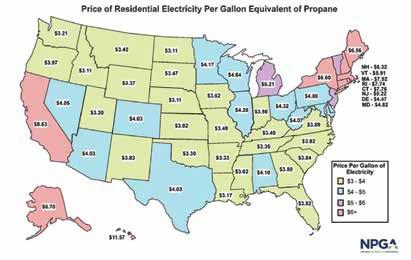
Price of Residential Electricity “Per Gallon” Equivalent of Propane
Since affordability is top of mind right now, the National Propane Gas Association (NPGA) has created a graphic that details the “price of a gallon of electricity.” This allows you to compare the retail price of a gallon of propane in your state to an equivalent amount of electricity from the grid. An overview of the methodology follows.
Electricity price reflects the average kWh rate paid by residential customers in 2024 on a state-by-state basis. 2024 is the latest EIA data available.
Price per gallon equivalent of propane is kWh price x 27 (energy equalizer for a gallon of LPG)
1 gallon of propane = 91,500 BTUs | 1 kWh of electricity = 3,412 BTUs (91,500/3,412 = 26.8)
This is how you end up with the cost for “1 gallon of electricity.”
EIA publishes retail propane prices on a per gallon basis for 38 states. NPGA can confirm that propane (on average) is less expensive than electricity (on average) on a “per gallon” of energy basis in 37 of the 38 states for which NPGA has data.
People in Propane
John Percy’s 30-year career with Gas Equipment Company is a testament to dedication, perseverance, and family legacy. He began as a 16-year-old summer employee in GEC’s Dallas warehouse, working alongside his father, Jack Percy, one of the company’s early employees who helped establish the Dallas branch and later served as Vice President of Sales. When John joined GEC full time, he started in inside sales and went on to work in marketing, credit, warehouse operations, and ultimately sales—building strong relationships with customers across West Texas, New Mexico, and Oklahoma, often in the same regions his father once served.
John retired in May 2025 after three decades with Gas Equipment Company, leaving behind a respected legacy of service and commitment that honors the Percy name.
Congratulations to Debra Michalka, who is retiring in July 2026 after 23 years as office manager for TriCo Propane in Rogers and Granger, TX. Over the past two decades, Debra has been an active and dedicated participant in TPGA. She is now enjoying time with her grandchildren and traveling in her motorhome.
PERC Updates Propane Activity Kits— Adds New Scout Patch
The Propane Education & Research Council (PERC) has redesigned its popular Propane Activity Kits, offering updated, age-appropriate materials for Elementary, Middle School, and High School students. Available as free downloads, the refreshed kits include engaging activities, experiments, and take-home materials tailored to each grade level. From coloring sheets and basic propane safety concepts for younger students to career exploration materials for high school students nearing graduation, the kits are designed to make propane education accessible, interactive, and memorable. These kits provide a readyto-use educational tool that aligns with classroom learning objectives.
Now Available for Scout Troops
The updated kit is now available as a structured learning activity for Scout troops. After completing the program, Scouts can earn the new Propane Adventurer Scout fun patch — a hands-on way to reinforce safety knowledge and explore propane’s role in daily life. The iron-on patch is sold in packs of 10 and can be awarded to Scouts of all levels who complete the Propane Activity Kit for elementary through high school ages.
PERC may mail a limited number of patches free of charge through April 15. After that date — or while supplies last — patches can be purchased through PERC’s resource catalog: https://propane.com/ resource-catalog. Download the Propane Activity Kits: https://propane.com/for-my-business/ propane-in-the-community/propaneeducationresources/.
Propane Learning Center Course Updates
The Propane Education & Research Council has released two new training updates in their FREE Online Learning Center.
The training updates include:
New course: Filling Propane Containers at a Bulk Plant: In this program you’ll learn about filling containers at a bulk plant by weight and volume, commonly used equipment and how to inspect containers.
Updated course: Corrosion Prevention: Corrosion is an ever-present issue for steel tanks, cylinders and piping. This program will help learners understand what corrosion is and how to effectively prevent aboveground and underground steel containers and piping from corrosion.
The Propane Education & Research Council (PERC) was hard at work in 2025.
• Safety programs updated: 53 Modules 8 programs
• New Learning Center courses added: 68 modules 8 programs
Access these hundreds of other FREE courses at www.training.propane.com
WELCOME
In Memoriam
Warren Reese Reynolds, 66, of Bowie, Texas, passed away peacefully on January 10, 2026. A lifelong resident of Bowie, Reese was deeply rooted in his community and took great pride in being part of the family business, Bowie Butane, which he owned and operated for many years. Reese finished out his career with Northwest Propane, managing Decatur Bowie Propane office. Our thoughts are with his family and friends.
Bob Alan Roberts passed away February 5, 2026, at the age of 97. Born in 1928, in San Antonio, Texas, Bob was a longtime South Texas business owner and respected member of the propane community. After graduating from college, Bob served as an Air Force pilot during the Korean War and later retired as a Lieutenant Colonel from the 433rd “Alamo Wing” Air Force Reserve. In 1971, he and his wife, Minnie, purchased Lytle Feed & Seed in Lytle, Texas. In 1984, alongside their son, Bob Jr., they expanded the business to include propane operations, later known as Patriot Gas. Bob was an active member of the Texas Propane Gas Association. TPGA extends sincere condolences to the Roberts family and the team at Patriot Gas.
Inside the Industry
Olympic Flame Powered by BioLPG
The Olympic flame for the Milano Cortina 2026 Olympic Winter Games was lit in Ancient Olympia, the historic birthplace of the Olympic Games. The ceremony marked the beginning of the flame’s journey toward Italy, where it arrived on December 4 to travel across the country on its way to the Opening Ceremony on February 6, 2026.
Over 63 days, the Relay covered 7,456 miles, visiting all of Italy’s 20 regions and 110 provinces, and passing 60 World Heritage Sites before reaching Milan for the Opening Ceremony. In line with Milano Cortina 2026’s sustainability commitments, the Olympic torch burned bioLPG made from renewable sources such as used cooking oil, and each torch was designed to be reused and refilled up to 10 times.
2025 Annual Retail Sales Report
The reporting period for the 2025 Sales Report opened on March 1, 2026.
For over 20 years, the Propane Education & Research Council (PERC) has produced an exclusive annual report on U.S. odorized propane sales by market, region and state. Each year PERC relies on propane professionals like you to provide the data necessary to portray an accurate picture of the industry’s retail sales performance. Additionally, this is way, that PERC allocates PERC funds to the states, like Texas, for Propane Council of Texas (ProCOT) programs. No survey, no money for Texas. Report when you receive your letter.
In early March 2026, a letter will be sent to the company or parent company that will provide information on how to report 2025 gallons. There will only be one contact per company.
Individual responses are kept confidential and anonymous.
Questions? salesreport@propane.com.
Acquisition News
Hino Gas of Harlingen was recently purchased by Lettermen’s Energy Holdings. Hino Gas was originally founded by Alejandro Hinojosa, Sr., in 1963 and was later run by his son, Alex. Both have served on the TPGA Board of Directors over the years.
Lettermen’s Energy Holdings, LLC
was founded in 2021 by a group of seasoned professionals with decades of experience in the propane industry. Today, Lettermen’s Energy manages 18 brands across 16 states.
Pico Propane has acquired Williamson LP Gas, which was founded by W.B. Williamson in 1953 and has served the Dayton area for nearly 75 years. Former TPGA Board Member Chuck Williamson joined his father in the business in 1978 and has retired following the sale of the company.
Mark Your Calendars: August 6-8, 2026 hosted by the Texas Propane Gas Association & Oklahoma Propane Gas Association
Location: Westin & Irving Convention Center | Irving, TX (only 10 minutes from the airport)
Schedule Preview
Thursday, August 6, 2026
• Regulatory Training
• Welcome Reception
• Dinner on Your Own / Supplier Dinners
Friday, August 7, 2026
• Skeet Tournament
• Golf Tournament
• Propane Technical & Technology Workshops
• Exhibitor Move-In
• President’s Happy Hour
• Dinner & Hosted Evening Events
Saturday, August 8, 2026
• Expo featuring the Regulatory Pavilion
More information coming this spring!
Irving Attractions Include
• Mustangs at Las Colinas
• Mandalay Canal Walk
• Las Colinas Gondolas
• Duck Boats on Lake Carolyn
• Toyota Music Factory
Classifieds
PetroStar Equipment Resources
Purchase & Sale Pre-Owned Propane Tanks
5,000 gallons to 90,000 gallons
(6) 30,000 gallon, 250 psi, used stubbies (2) 30,000 gallon, 250psi, NEW 2024
Contact: Jim Oliver C: 832-643-7968 petrostar@pdq.net Garrett Insurance Agency, Inc
NPGA Spring Technology, Standards & Safety Committee Meeting Tucson, AZ 3-4
TPGA Board & Committee Meetings Kerrville, TX 10
Texas Propane Magazine Ad Deadline 12
NPGA Spring Benchmarking Meeting Long Beach, CA
APRIL
TPGA office closed for Good Friday 10
Texas Propane Magazine Ad Deadline 19-21
Southeastern & International Propane Expo Nashville, TN 22
PERC Council Meeting Nashville, TN
MAY
5-6
TPGA Board & Committee Meetings Waco, TX 10
Texas Propane Magazine Ad Deadline 15
TPGA Scholarship Applications Due 19-20
PERC Advisory Committee Meeting Milwaukee, WI 25
TPGA office closed for Memorial Day
JUNE
7-9
NPGA Propane Days Washington, DC 10
Texas Propane Magazine Ad Deadline
JULY 10
Texas Propane Magazine Ad Deadline 14-15
PERC Council Meeting Park City, UT
INDEX TO ADVERTISERS
Texas Propane Texas Propane Texas Propane
PROPANE with PURPOSE
Fueling the Friday Fish Fry
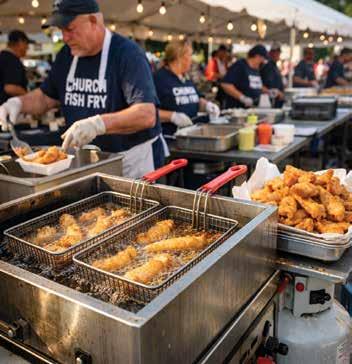
Across Texas throughout Lent, Catholic parishes host Friday fish fries that draw hundreds — sometimes thousands — of families through parish halls and parking lots. What looks like a simple plate of fried catfish and hushpuppies is, in reality, a carefully choreographed operation.
Behind the scenes, commercial propane fryers, propaneheated steam tables, outdoor propane burners, and portable propane griddles work continuously to prepare and serve meals efficiently.
Fish fries are not smallbatch cooking. They are highvolume, high-heat events that require steady output and reliable recovery time. That is where propane does its quiet work.
The Workhorse: Propane Fish Fryers
Large parish fish fries typically rely on 80- to 200-quart propane fryer systems capable of delivering sustained high
turer of thermostatically controlled propane fryer systems
• R & V Works – maker of enclosed Cajun Fryers designed for consistent oil temperature
• Carolina Cooker – supplier of large-capacity propane event cooking systems
Many of these systems operate in the 50,000 to 200,000+ BTU range, delivering the sustained heat required for continuous frying.
Why Propane Dominates Fish Fry Events
BTU output. Electric fryers often struggle to recover oil temperature quickly after each basket drop. Propane systems, by contrast, provide the rapid heat recovery needed to keep batter crisp and lines moving.
Common propane fryer configurations include:
• Multi-basket stainless steel outdoor fryers
• High-BTU cast iron burner systems
• Thermostatically controlled enclosed fryers
• Trailer-mounted commercial frying stations
Recognized Manufacturers
Several established manufacturers produce propane fryers frequently used in church, festival, and event settings:
• Bayou Classic – known for heavy-duty outdoor burners and stainless steel fryer kits
• King Kooker – producer of high-BTU outdoor propane fryers designed for volume cooking
• Cajun Fryer – manufac-
Propane allows parishes to set up temporary outdoor kitchens, avoid overloading church electrical systems, serve high volumes efficiently, and operate safely using portable fuel.
Beyond convenience, propane offers practical advantages: high heat output, mobility, fast startup, and consistent performance in outdoor conditions.