ARCHITECTURE
HOUSE?
FALL 2025
TROPICAL ICECREAM
COOKHOUSE
SPRING 2025
KUNSTHAUS BASELLAND
STRUCTURE MODEL FALL 2025
TUGNET ICEHOUSE ANALYSIS SPRING 2025
COLUMNAR BASALT FALL 2024
INTERN
CONTOURS OF TERROIR THESIS HELPER SPRING 2025
STRUCTURING LINES DESIGN INTERN SUMMER 2025
Taught by
Catherine Chen,
for Fall 2025 core design studio
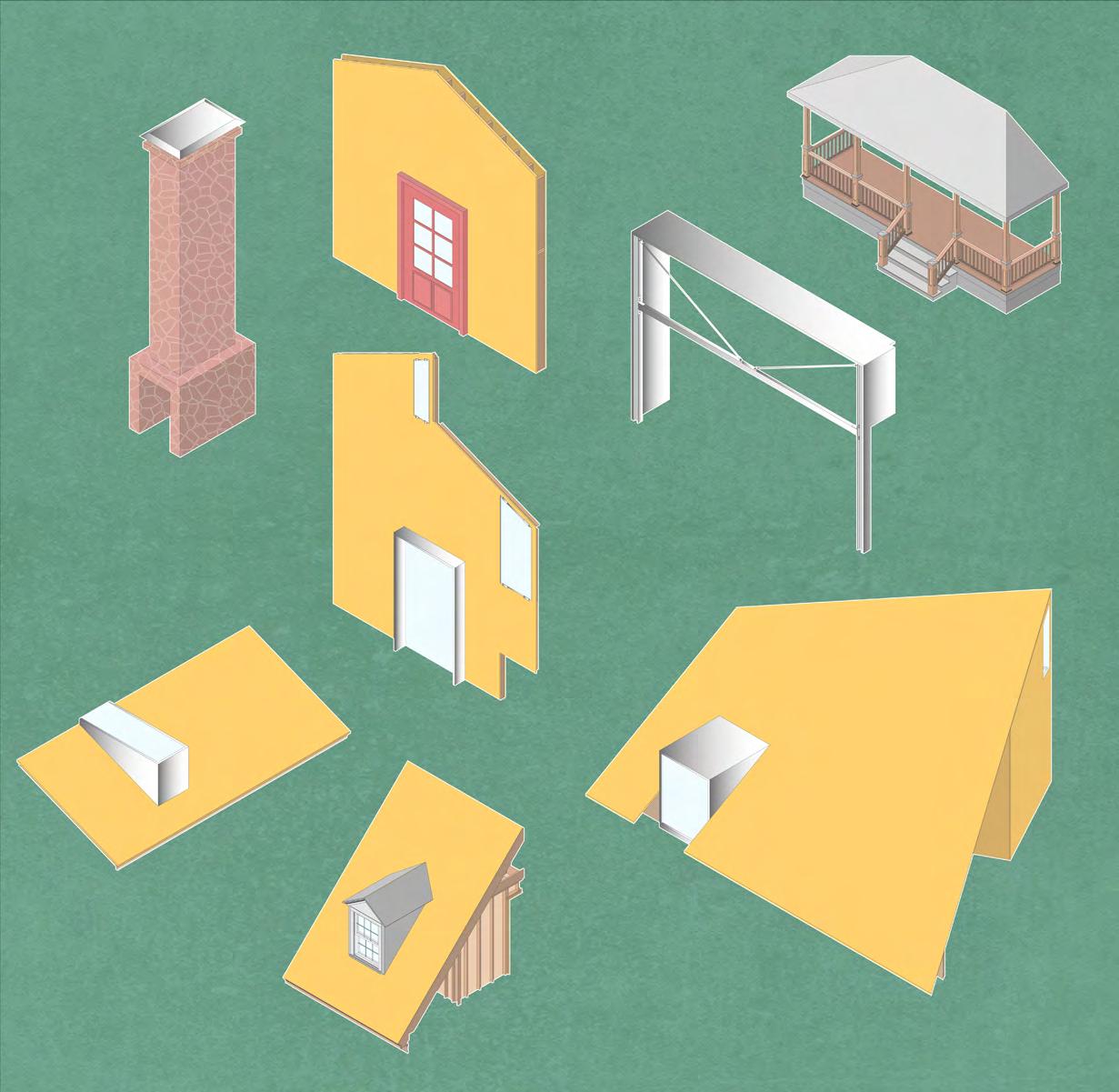
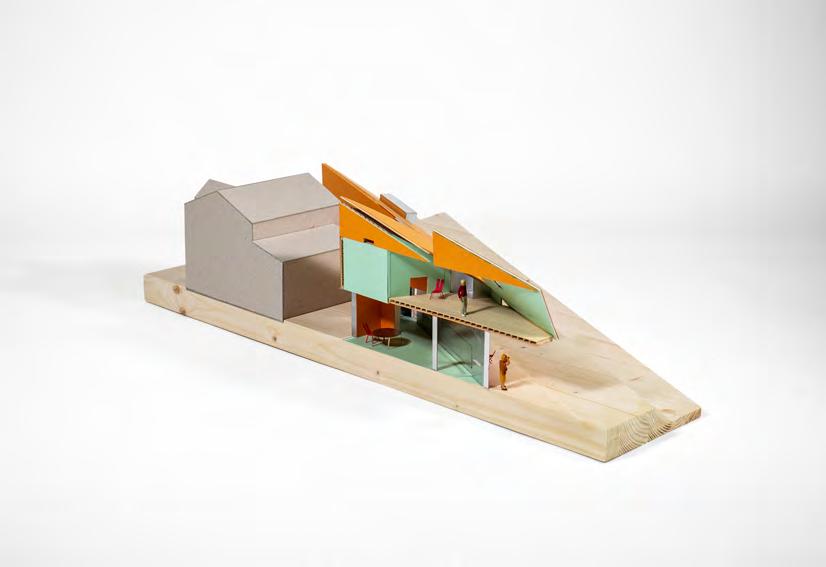
The project attempts to critique the conventional forms of American houses, specifically those in Ithaca. The most apparent formal operation is to extract the parts of a typical American house and deform these elements into new, functional components of the house. The project positions itself as an objection to the banal nature of typicality and the ordinariness of domestic architecture, suggesting a radically different prospect for the house’s possibilities. By taking a weird wedge-shaped site with a small arm that extends out, the first step of departing from the banality of conventional houses is made, making the project highly site-responsive. After a careful look into the familiar elements of houses in Ithaca, a series of questions is being asked: What is a roof? What is a dormer? What is a chimney? What is a porch? What is a window? Ultimately, the design manifests as a visible deformation, a delamination act of these conventional elements, reassembled in a logical way that corresponds to programmatic needs: private dwelling, the threshold between private and public, and a public dining area along Cascadilla Creek. The project also investigates the potential of overlapping views within the limited spatial boundary of the house, where a set of double and half spaces facilitates an intricate play of spatial relations. Each room, each wall, each space, and each surface becomes an opportunity for exploring light, materiality, and fabrication techniques. Half of the house is conceived as the original form: constructed through conventional American platform wood framing, while the other half represents deformation: a gesture toward the contemporary moment, one that compels people to rethink and defamiliarize the known and the built convention. The project thus resists being read merely as a resolved architectural object that rationally fulfills programmatic requirements; instead, it is more of a series of deformations of conventional concepts and conceptual propositions that I explored and discussed throughout this semester.
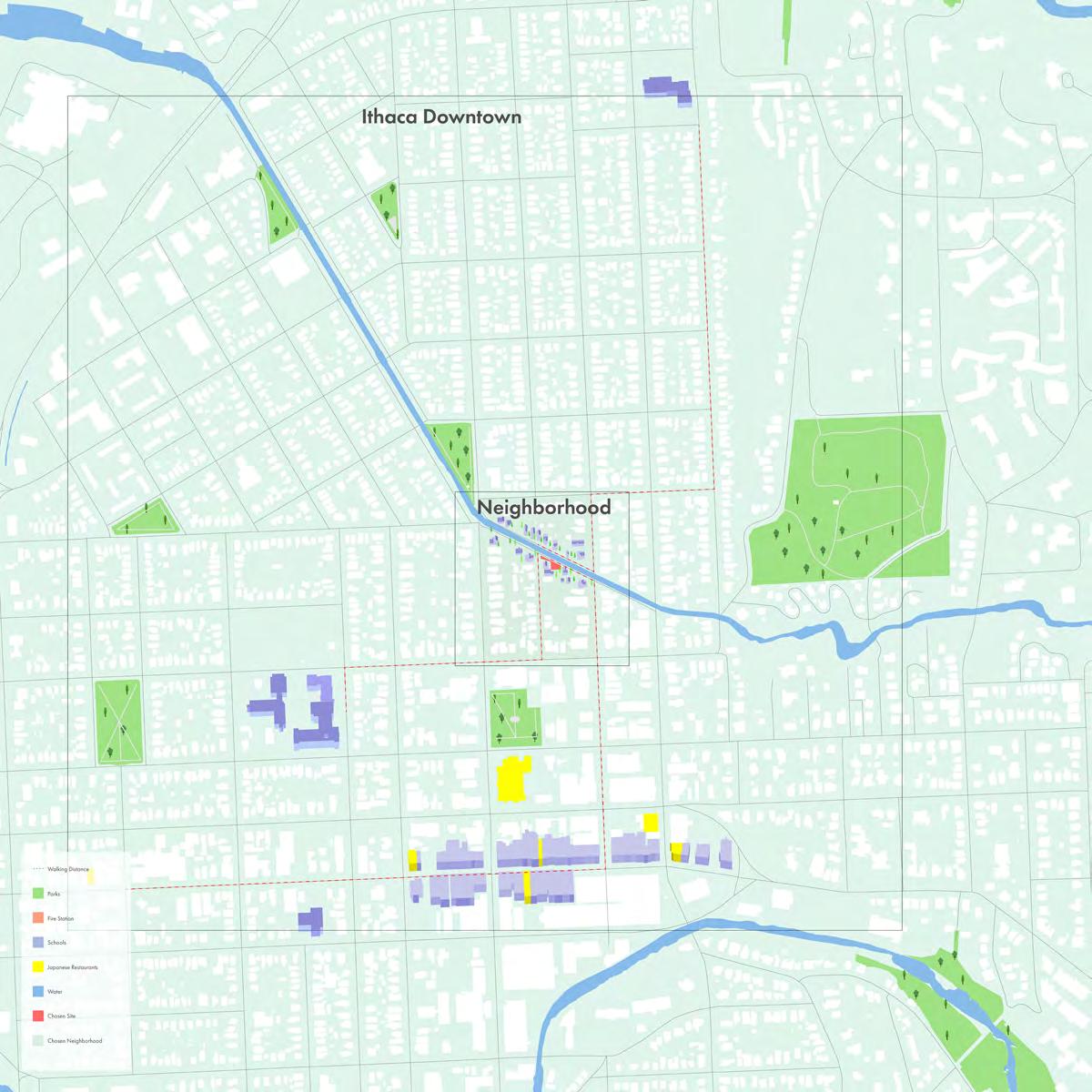
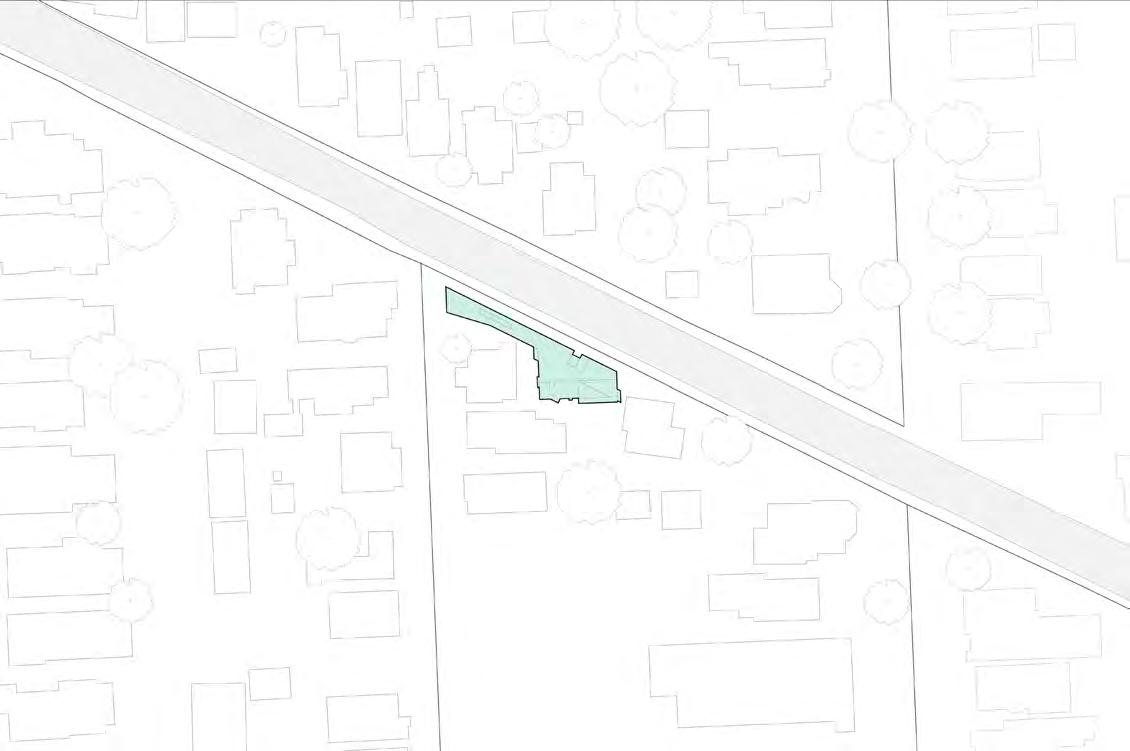
The project is located in a neighborhood along Cascadilla Avenue, Ithaca. The project is designed to be the residence for a Japanese couple, with the additional program set to be a Japanese Ramen bar along the river.
The project is designed through a series of inquiries: What is a chimney? What is a proch? What is a dormer? What is a roof? From this, the architecture departs from the conventional forms and deforms into newly defined objects in the house.
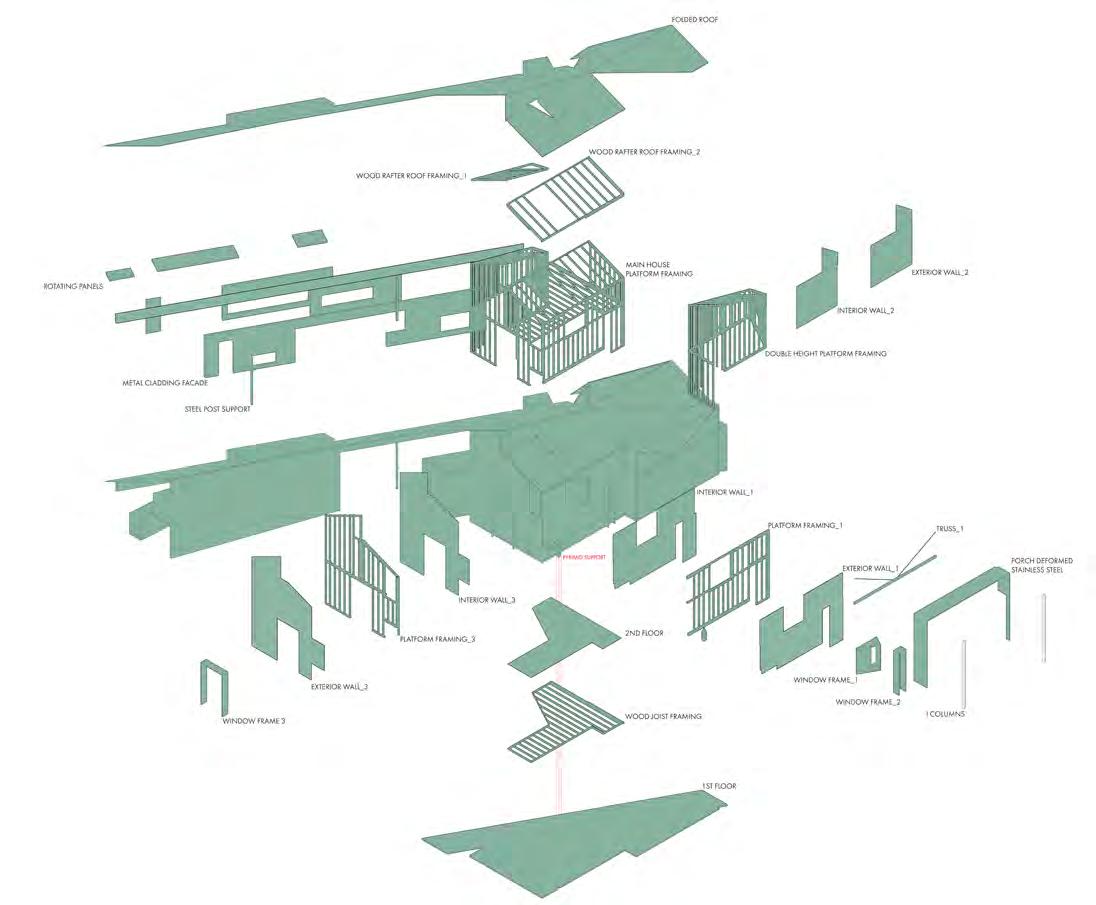
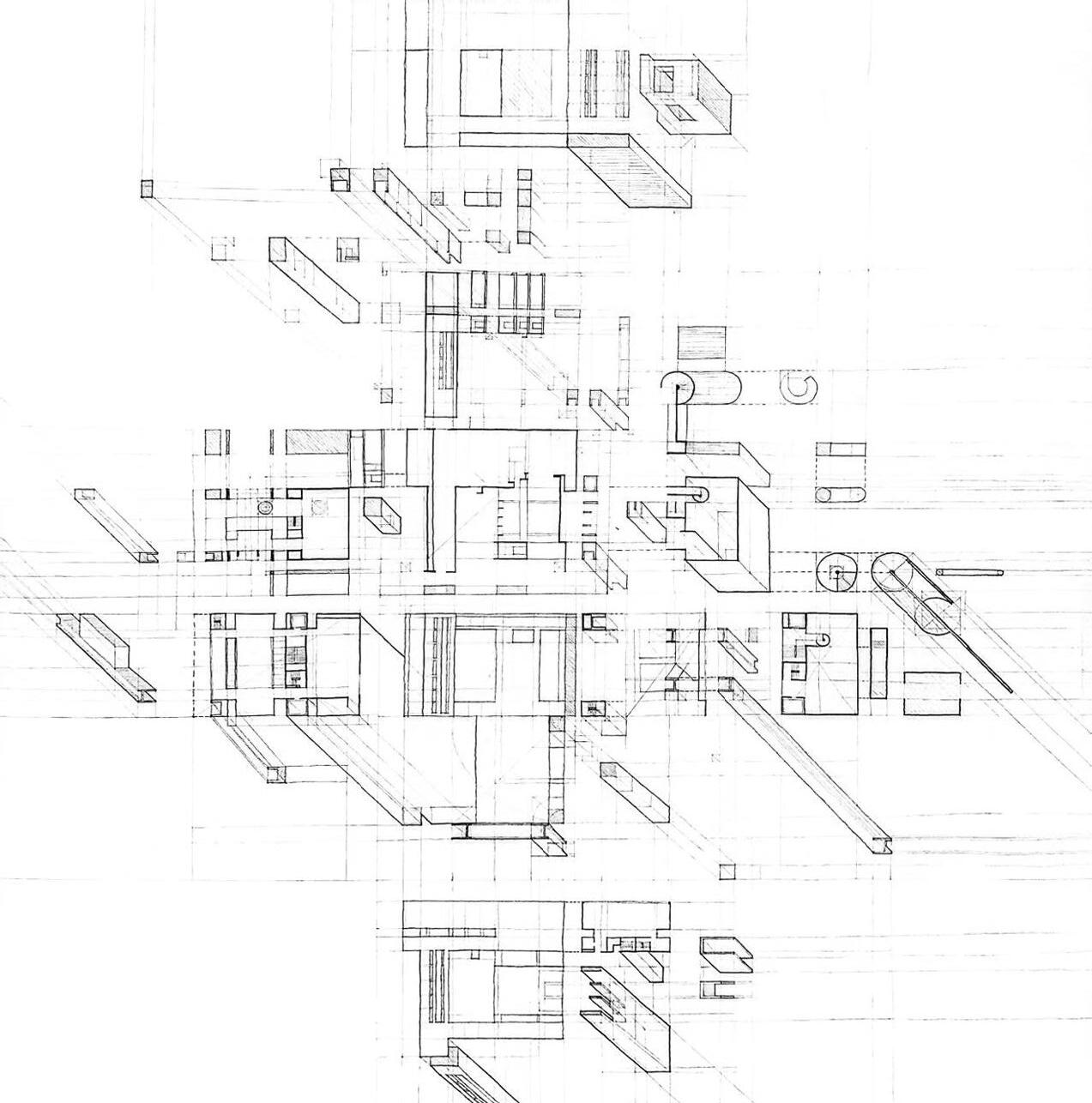
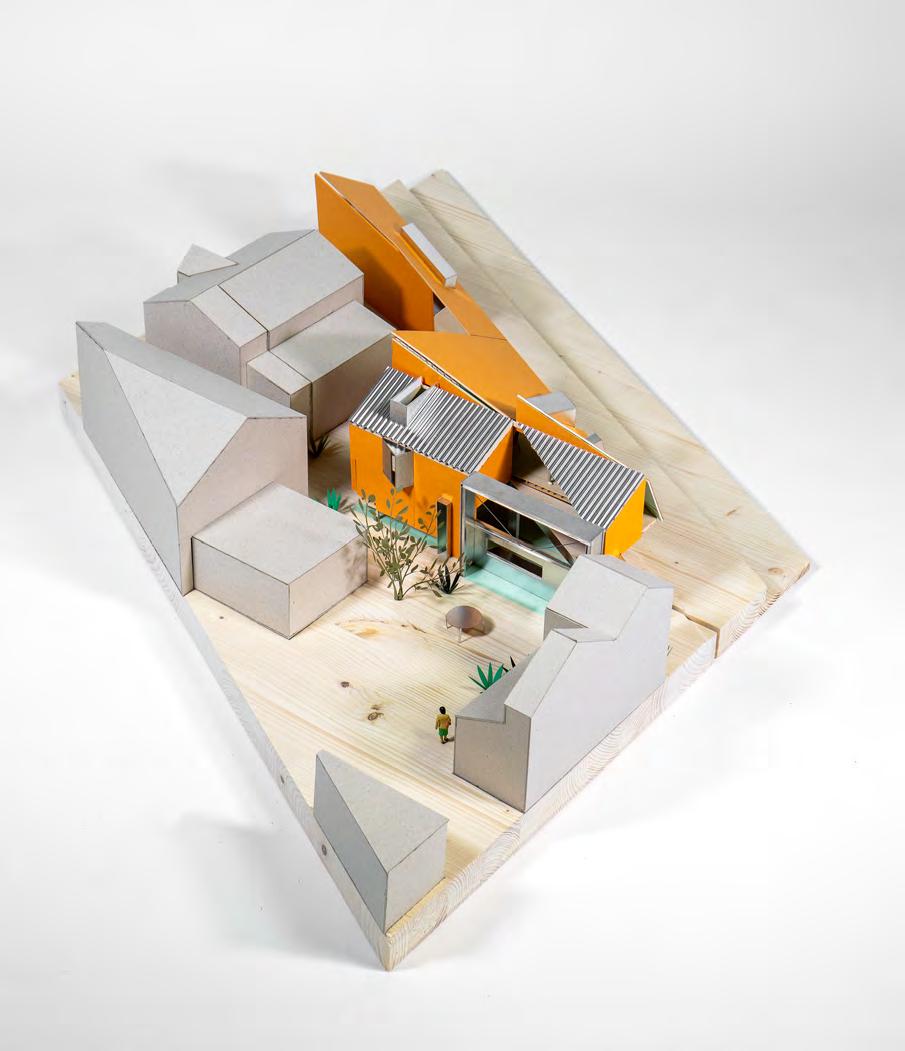
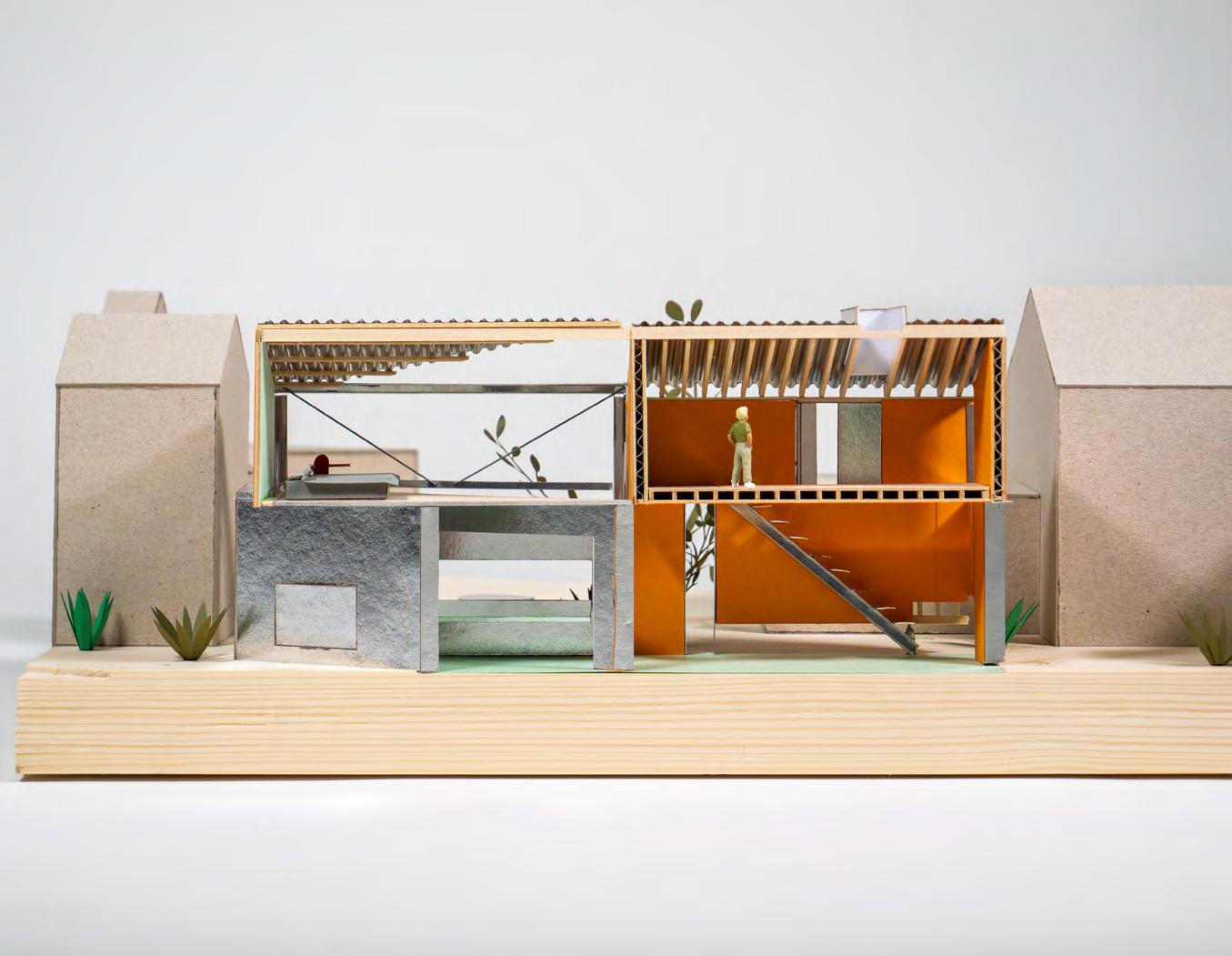
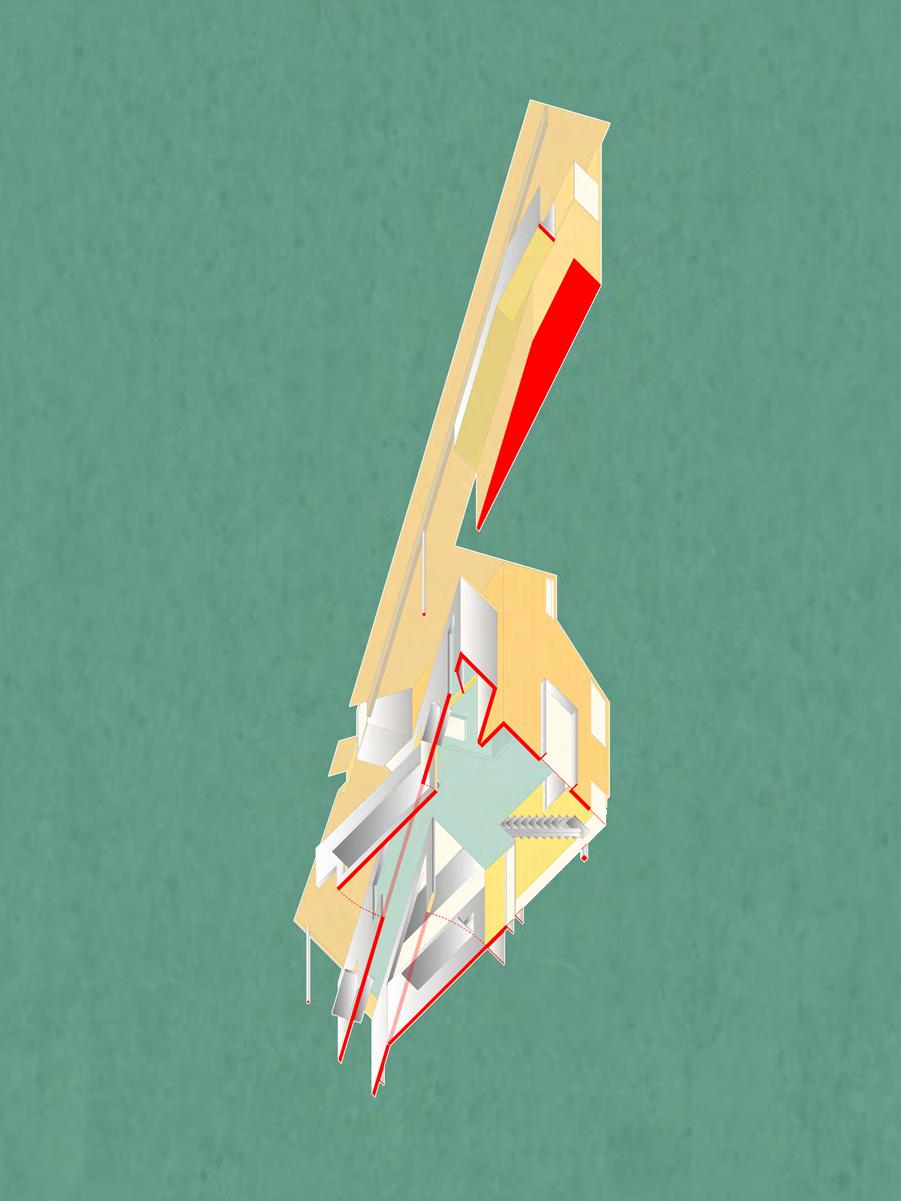
The exploded parts show how the house is structurally constructed, and conceptually deconstructed: Half of the house is built using platform wood framing, while the other half is constructed using steel rigid frames.
The dining room and the kitchen are located on the first floor of the house, while the bedroom area and the more private spaces are on the second floor.
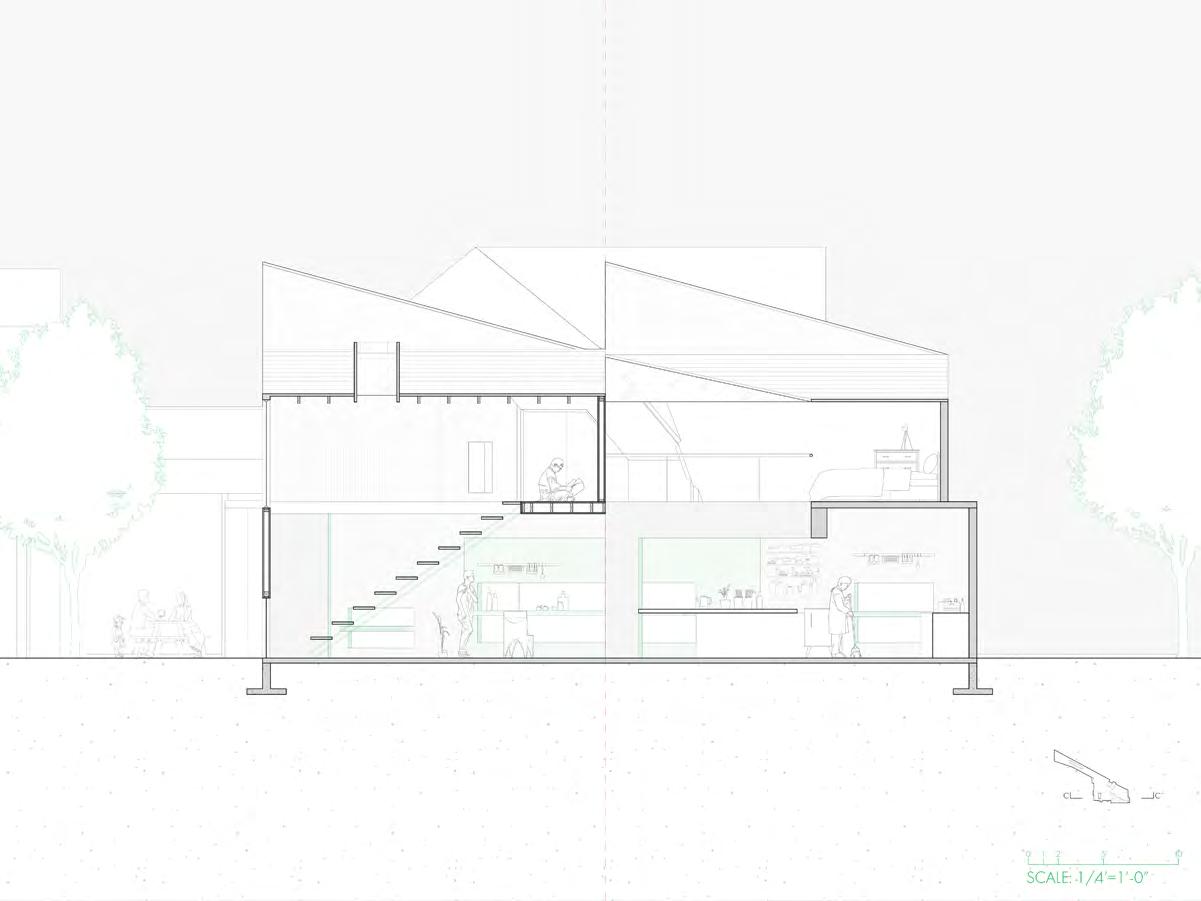
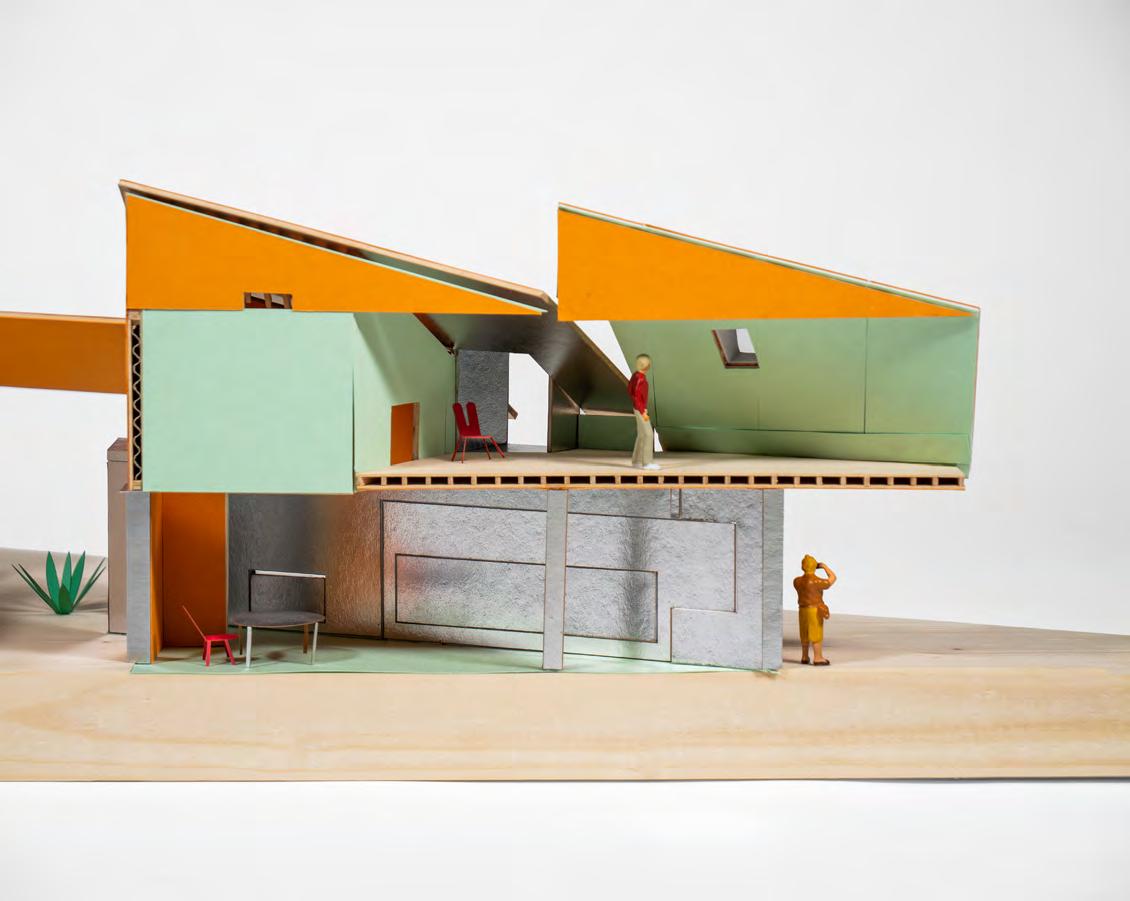
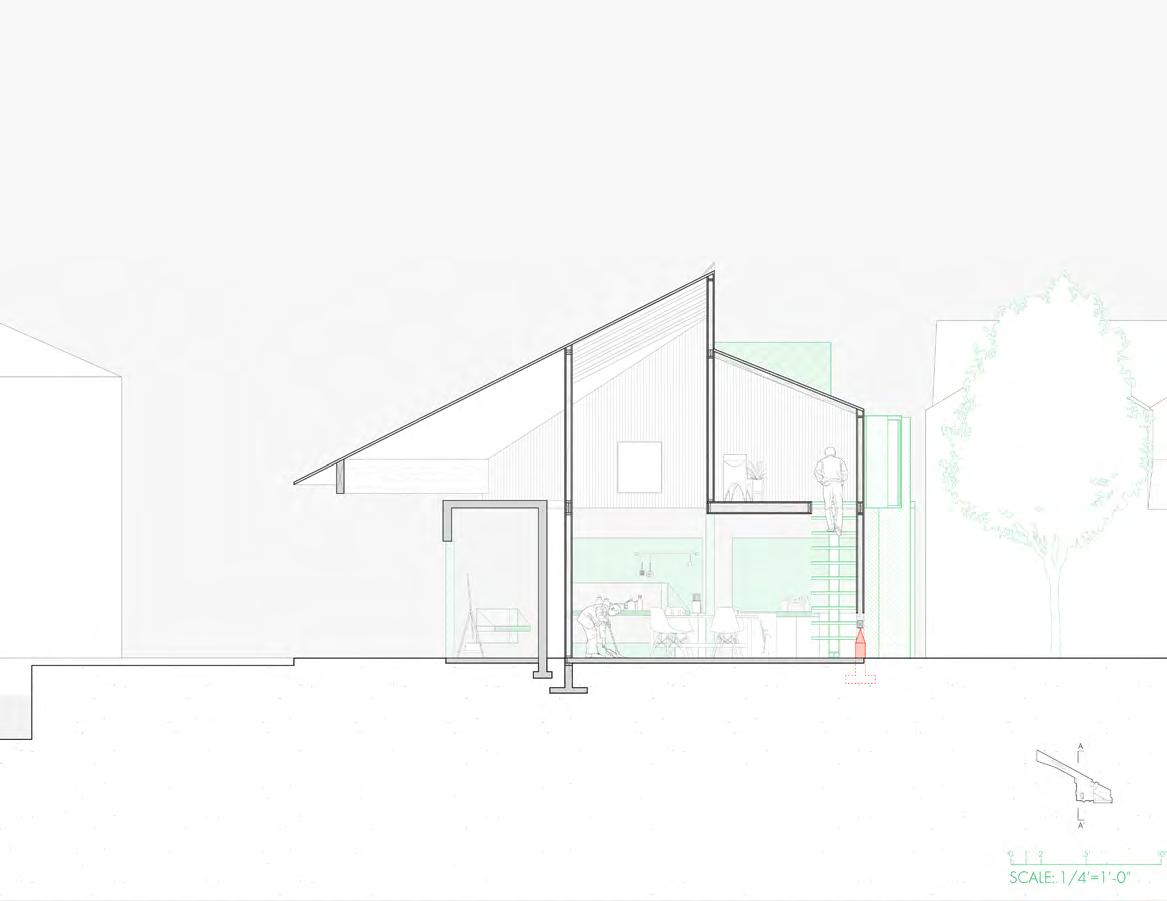
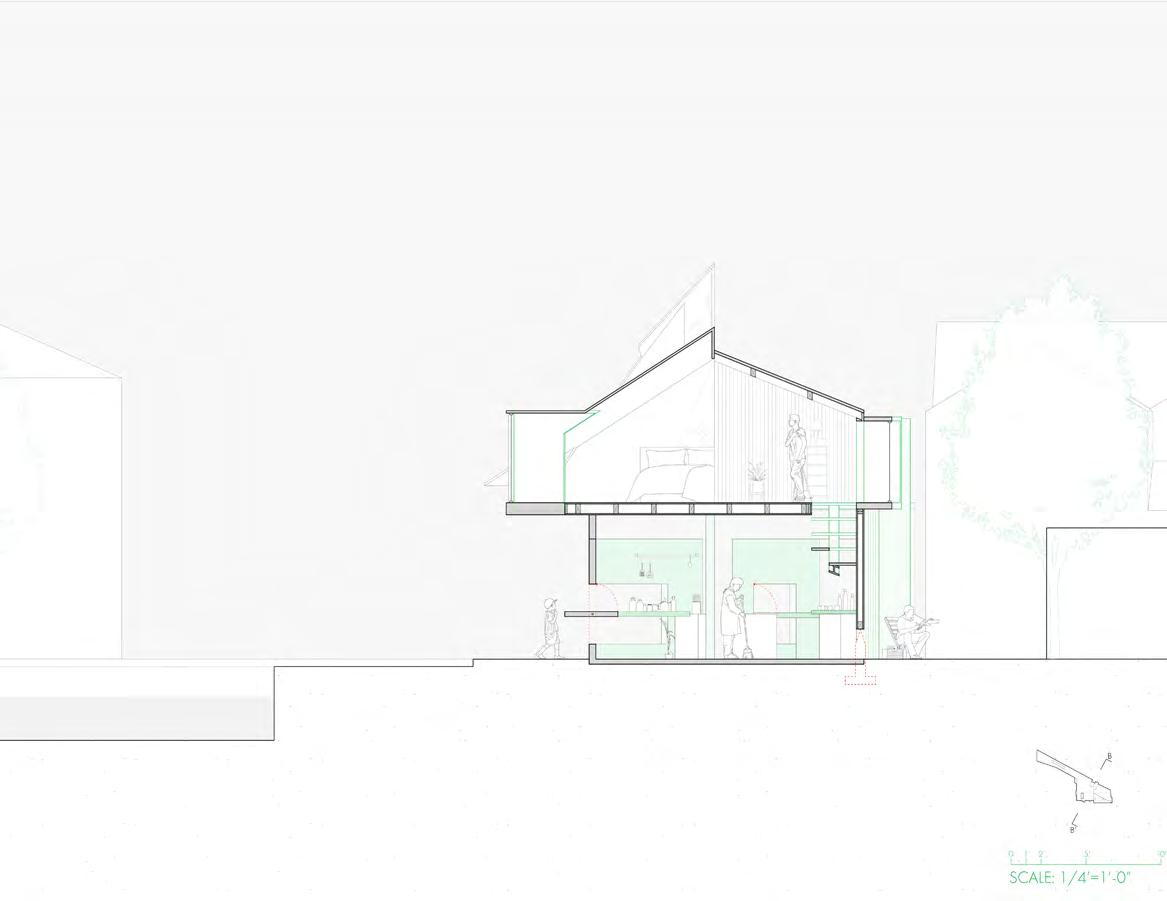
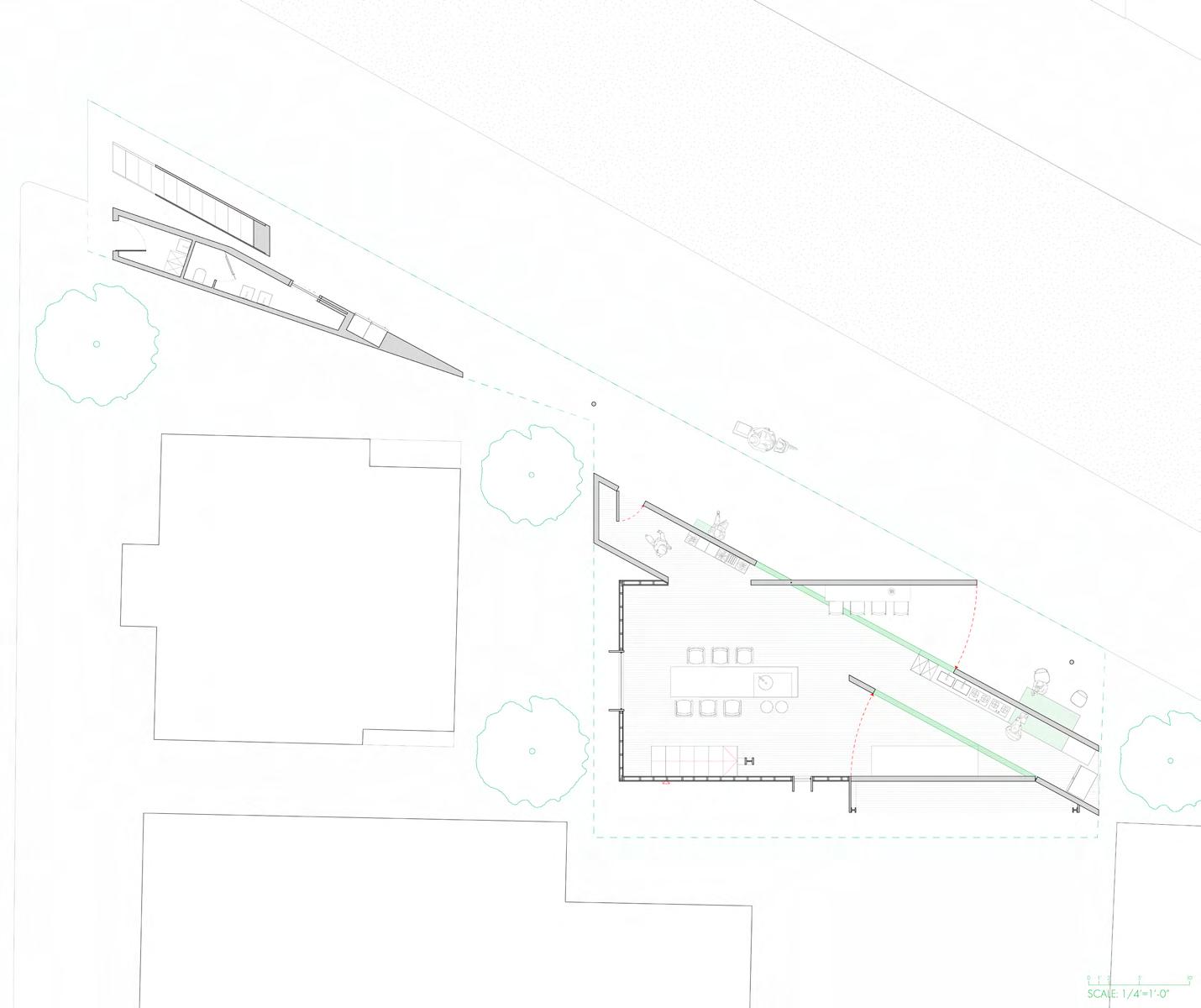
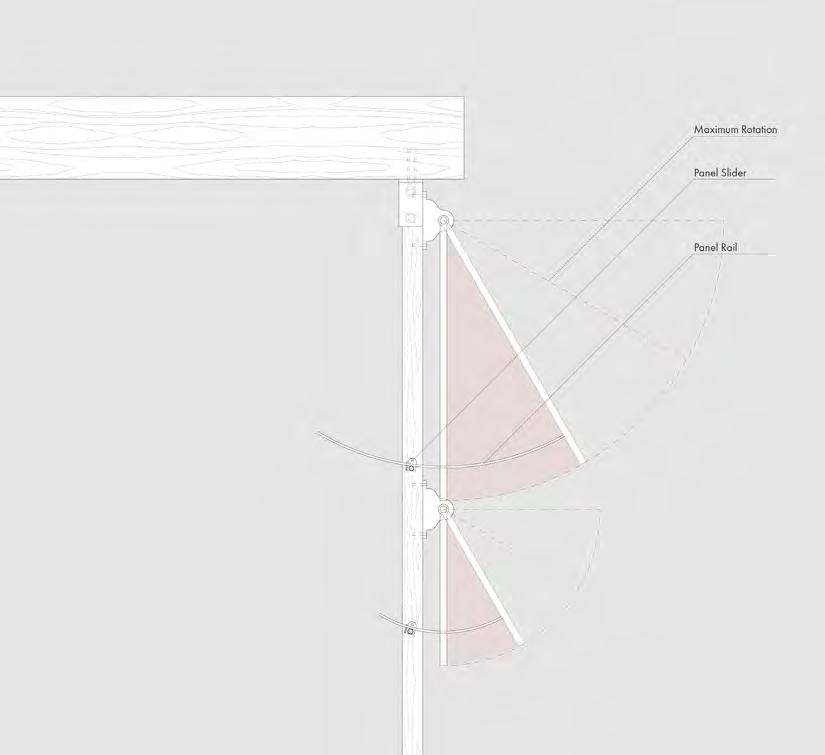
The first floor of the house also acts as the threshold between the private and public of the project: walls are designed so that they can rotate and open the space up to the public for special dining events.
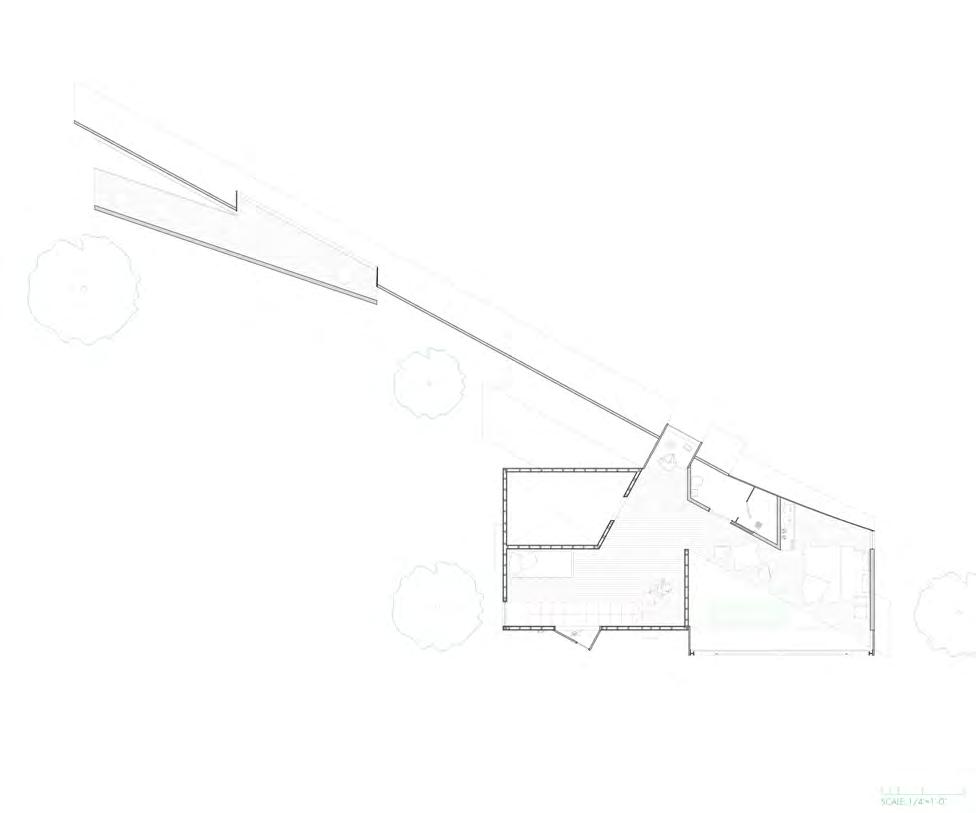
The second-floor plan of the project shows how residents can access the private area via a narrow staircase. An angled corridor leads one towards the river view, then into the bedroom.
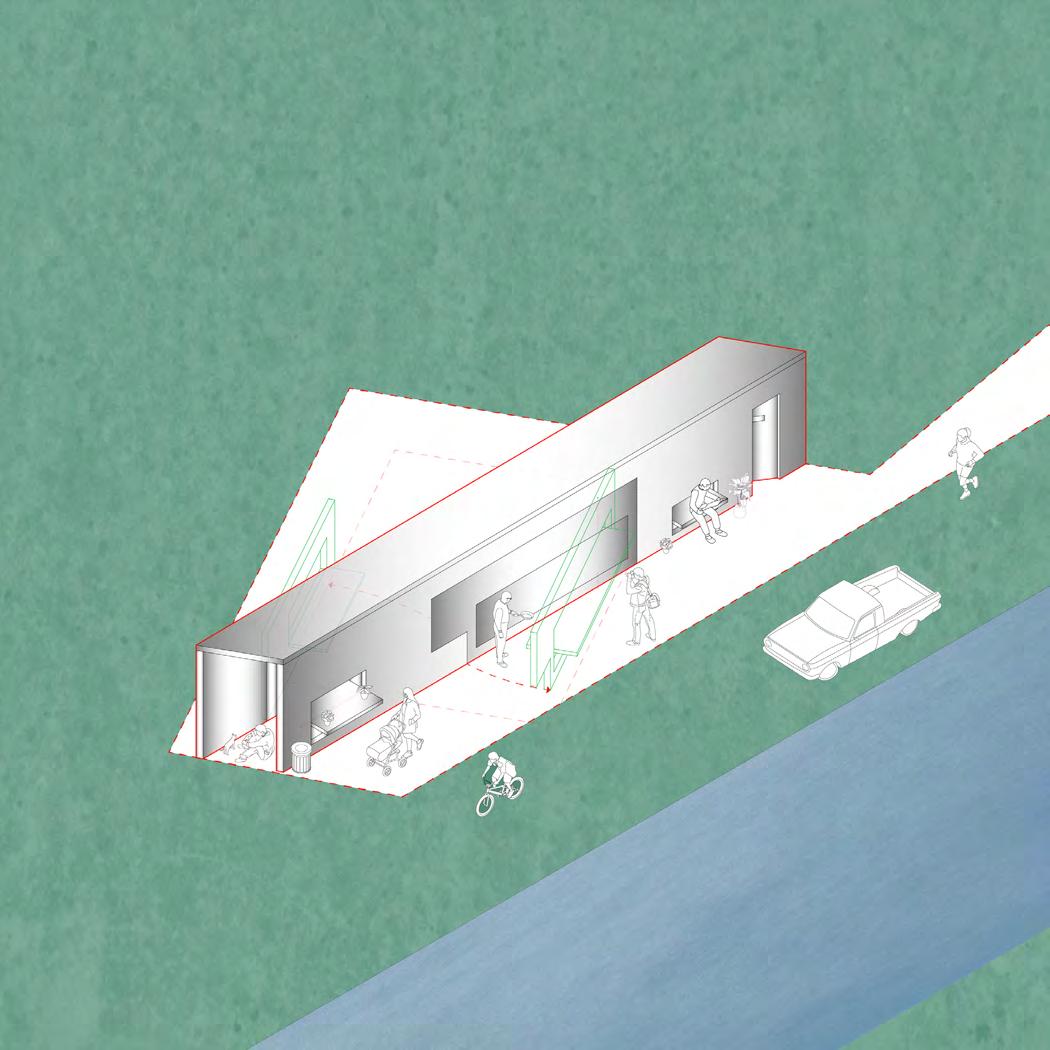
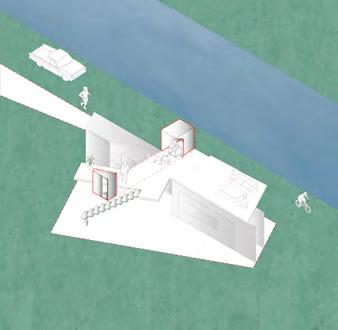
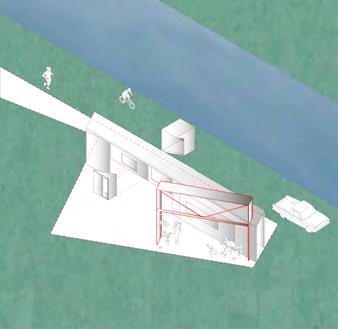
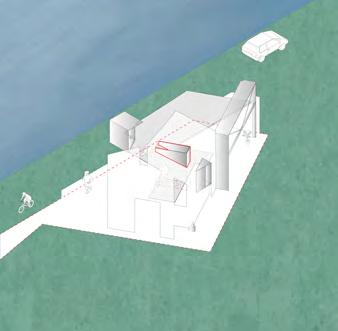
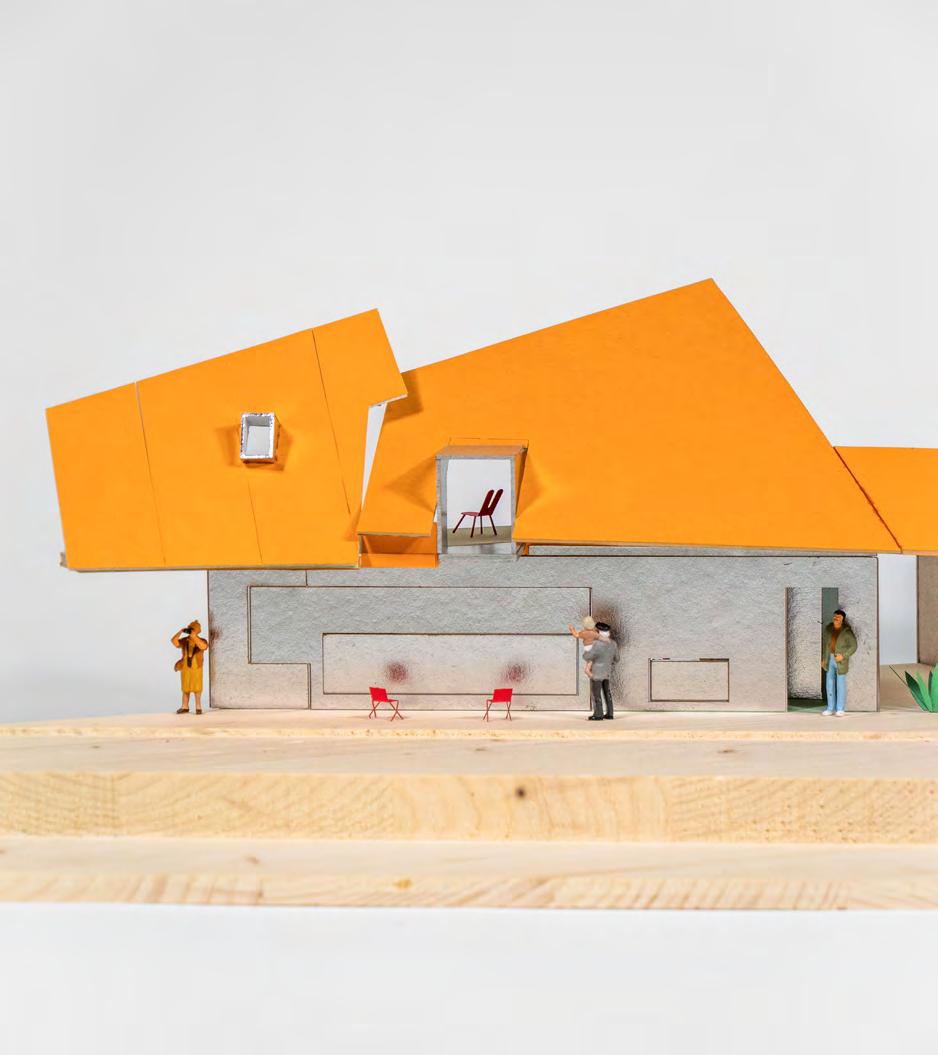
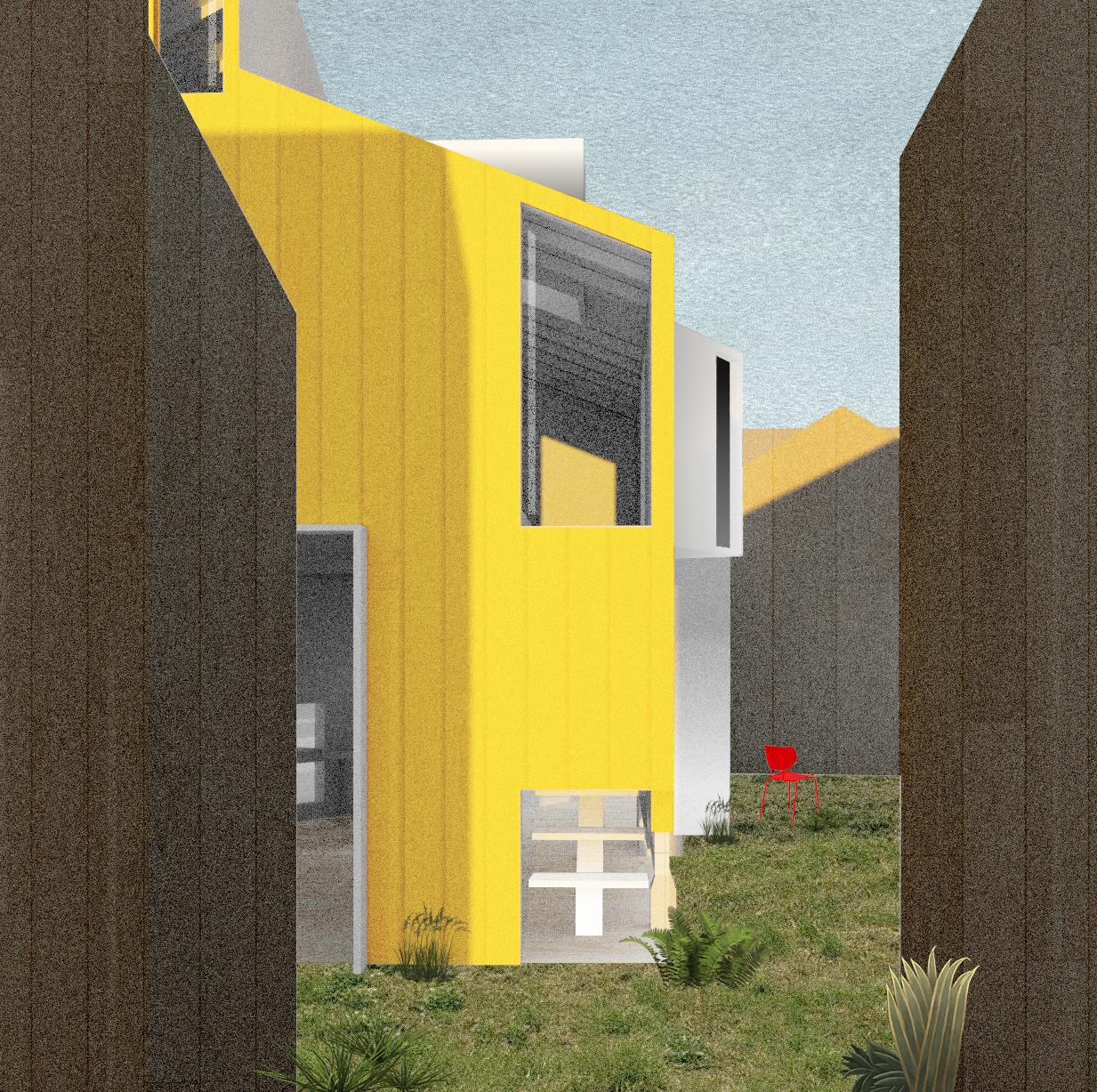
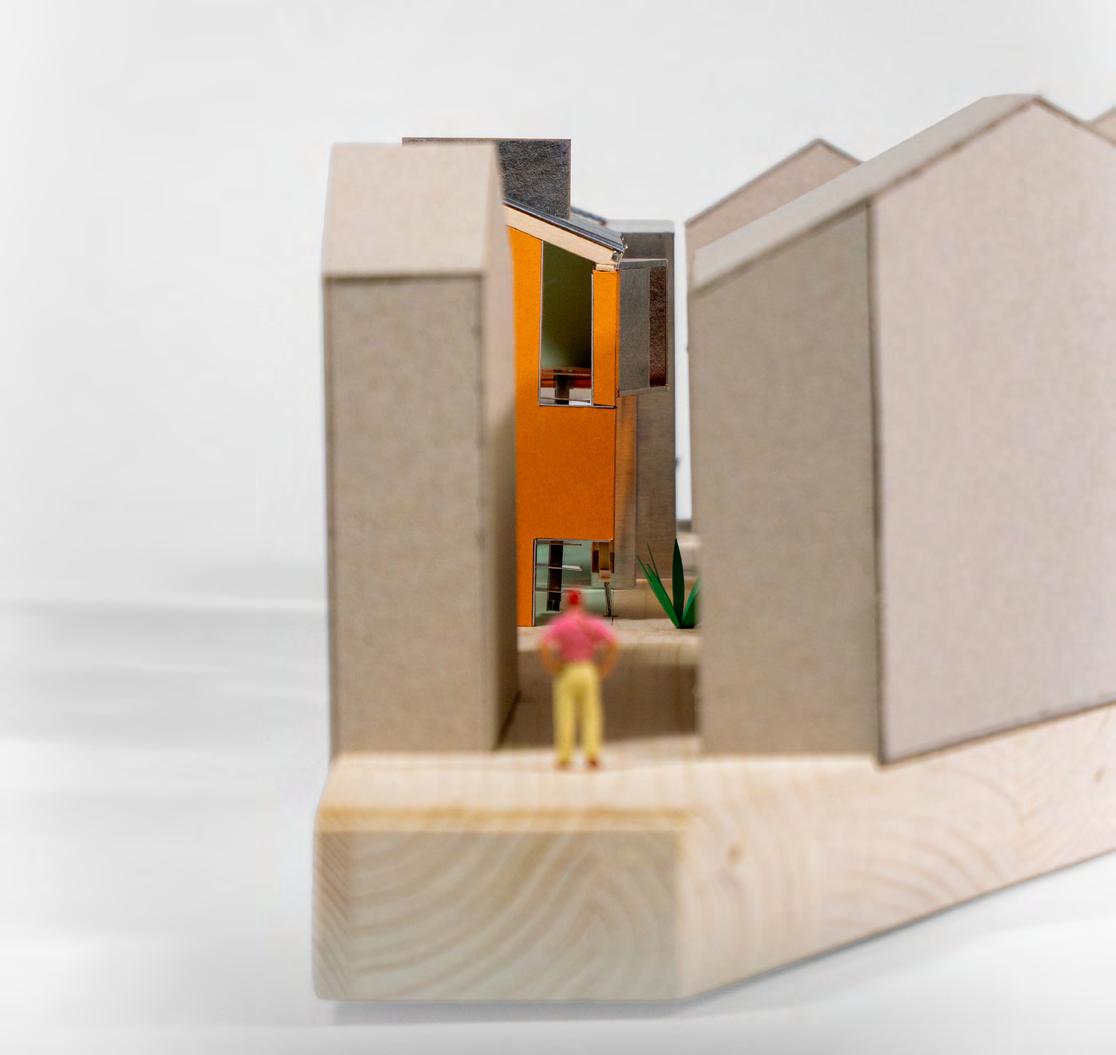
The openings of the project are carefully designed so that they respond to the given site conditions. The front windows of the house align with the gap between the two neighboring houses.
HOUSE?
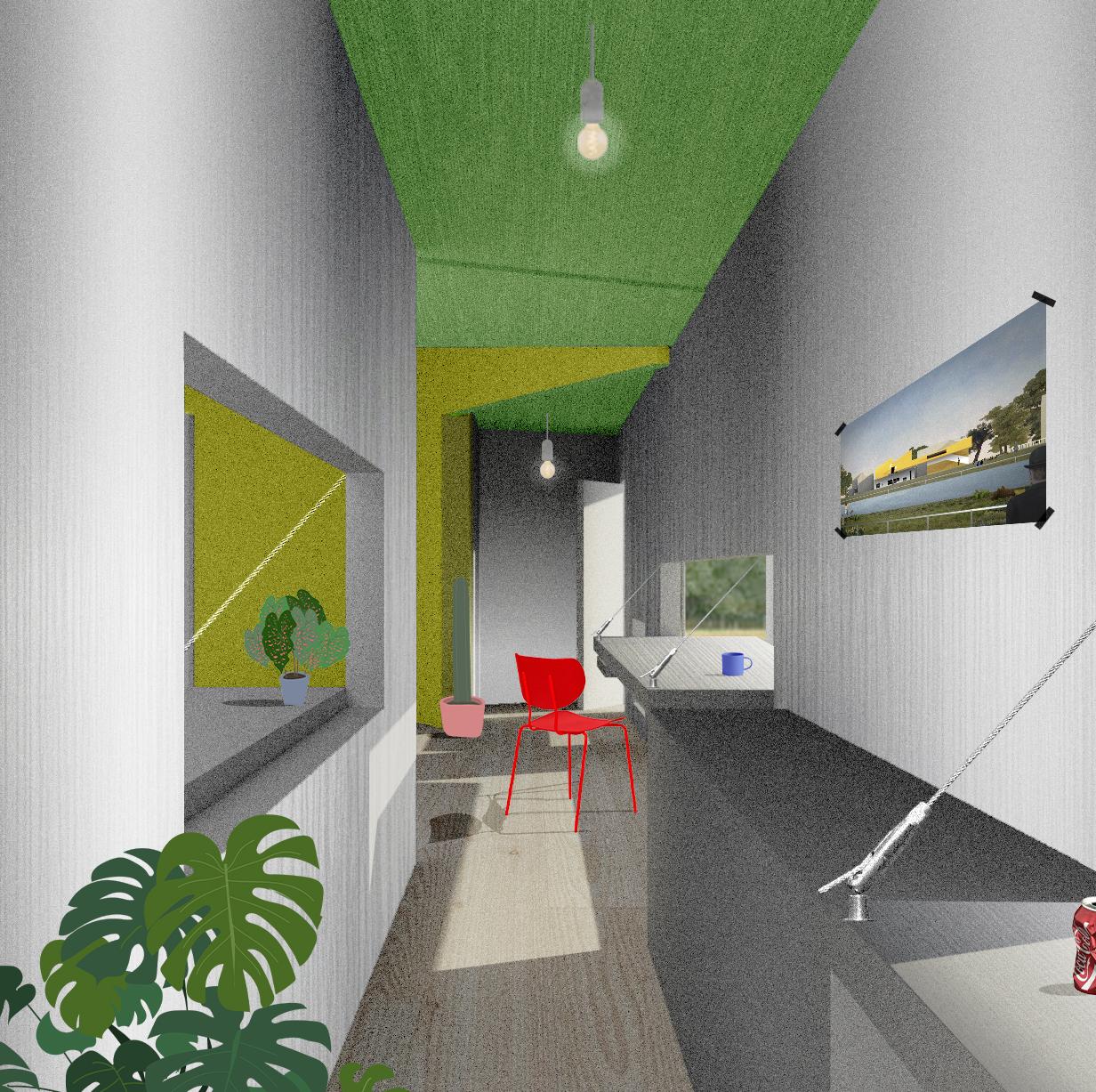
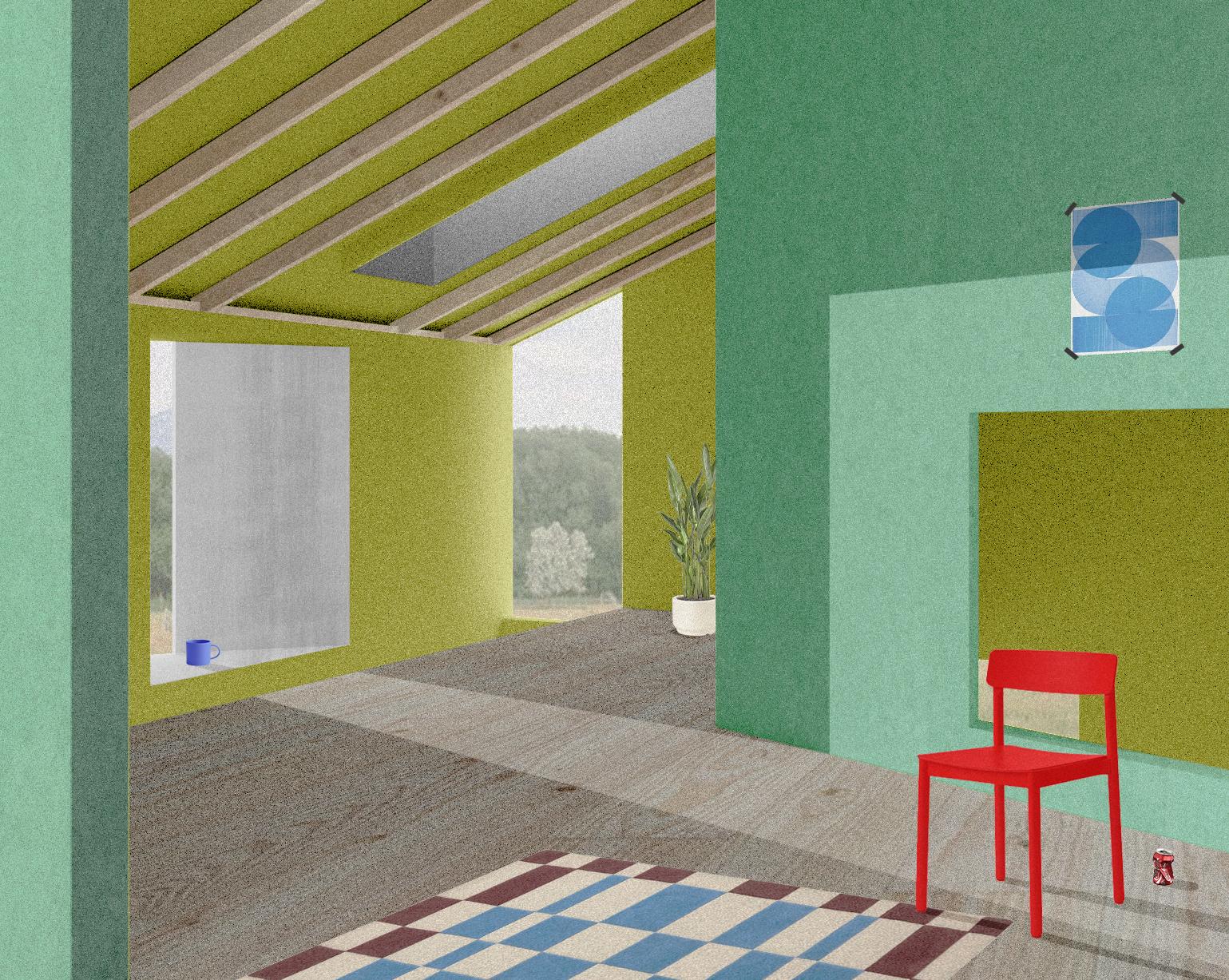
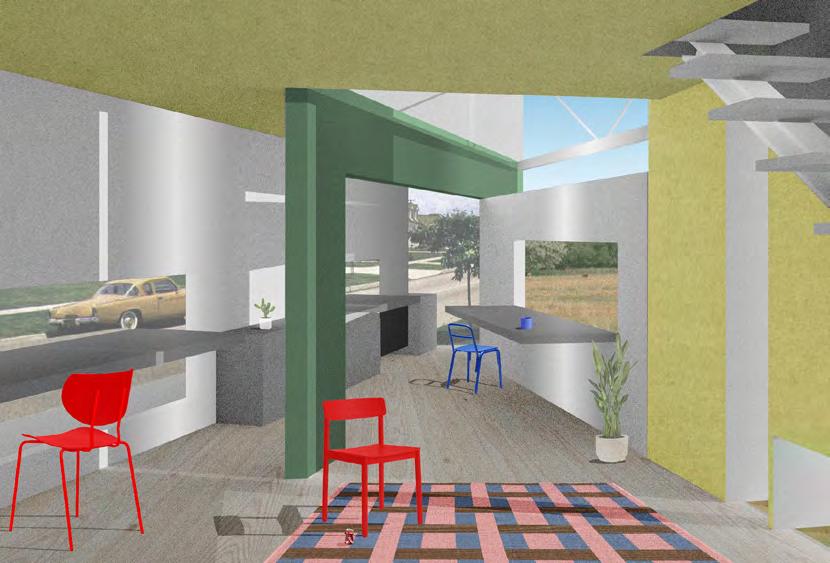
The interior renders of the project aim to show the rebellious character of the house through the vibrant interior colors it has. A high degree of spatial complexity exists within this double-story house through an interplay of double-height spaces and normal spaces.
HOUSE?
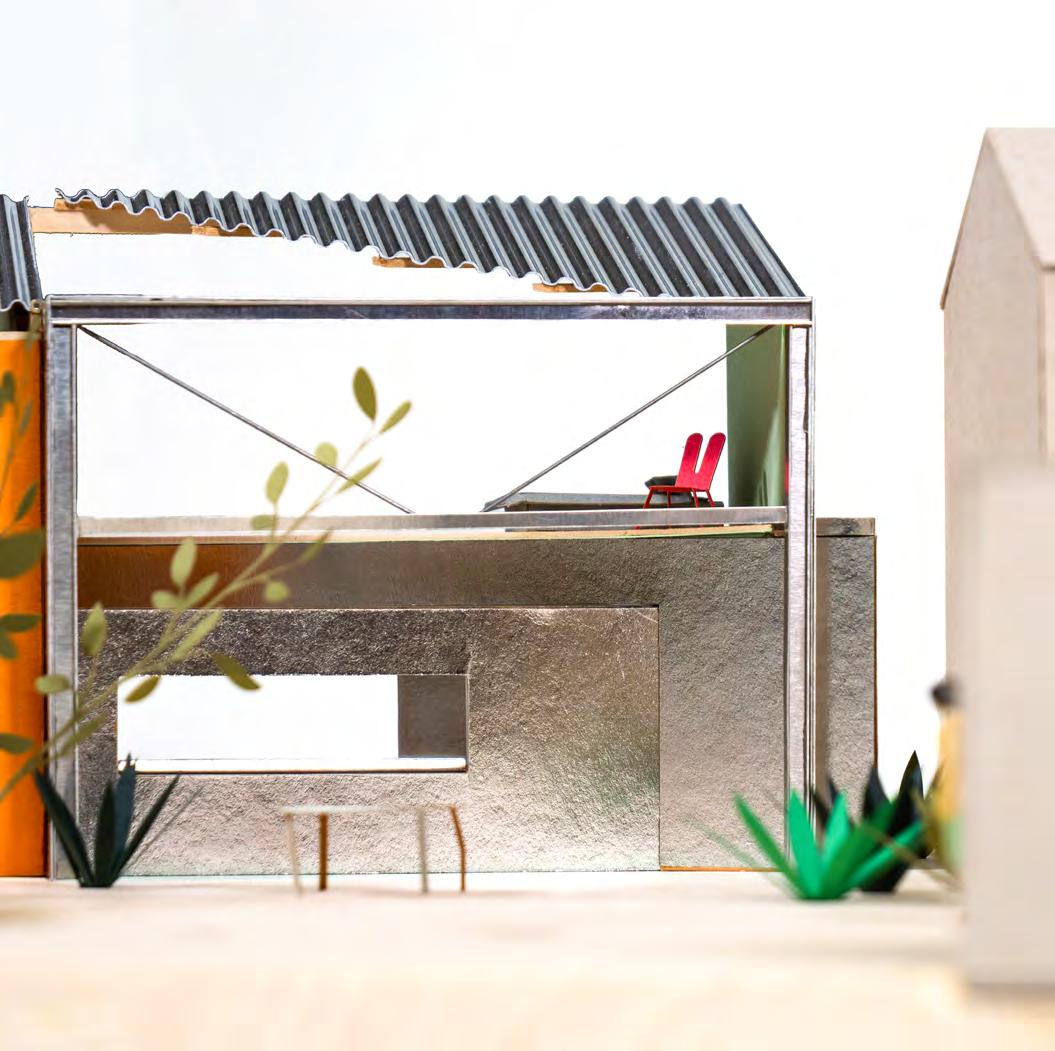
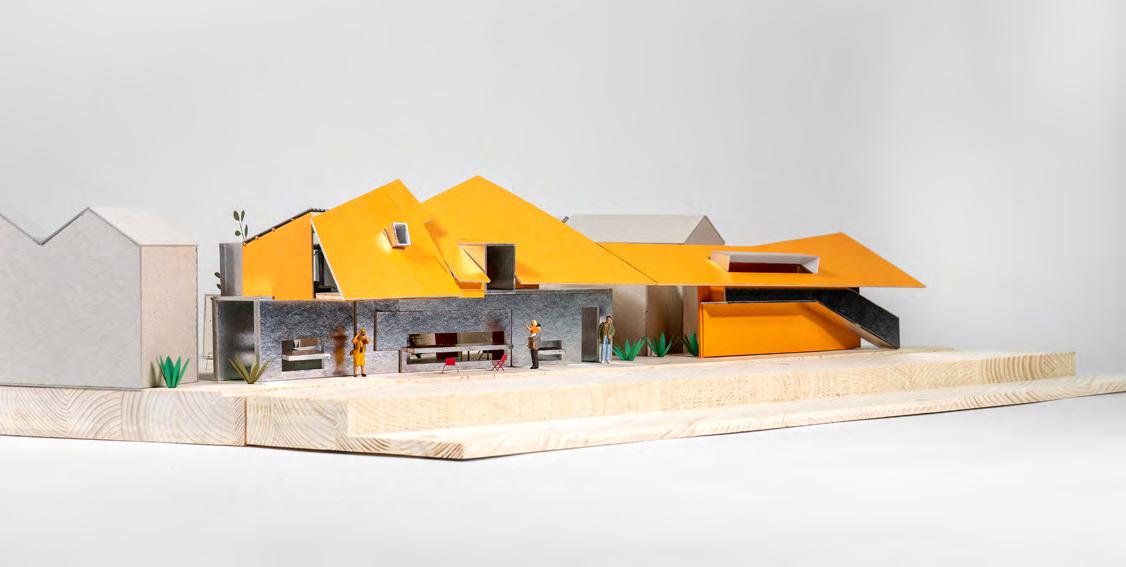
The project presents itself as the most unconventional façade in the neighborhood. The ground-floor façade of the house is reflective, projecting the surrounding scenery. Moreover, a new porch is created under the long roof where people dine, gather, and communicate.
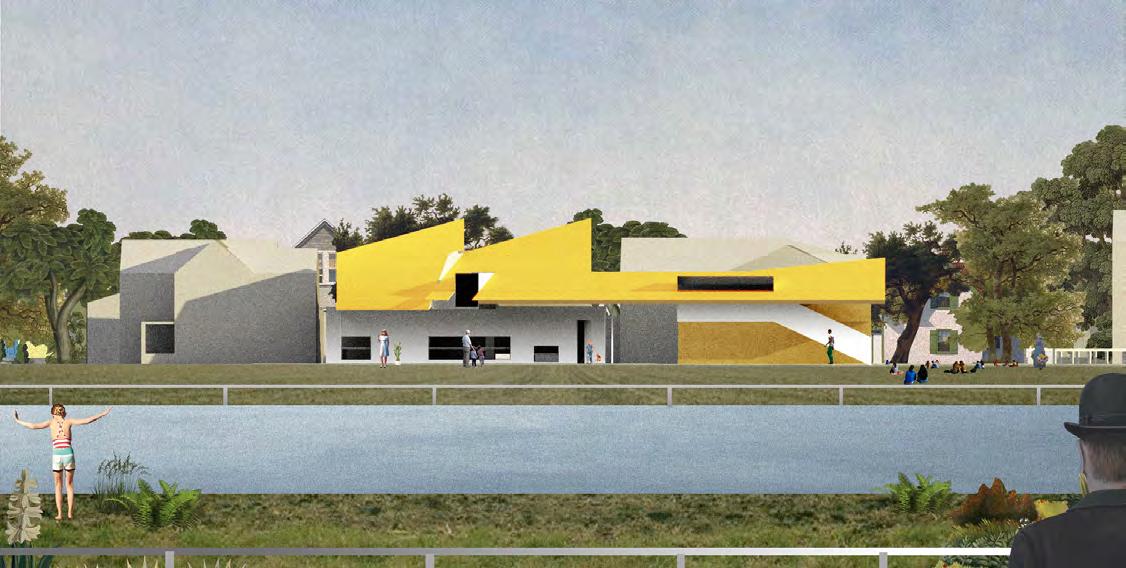
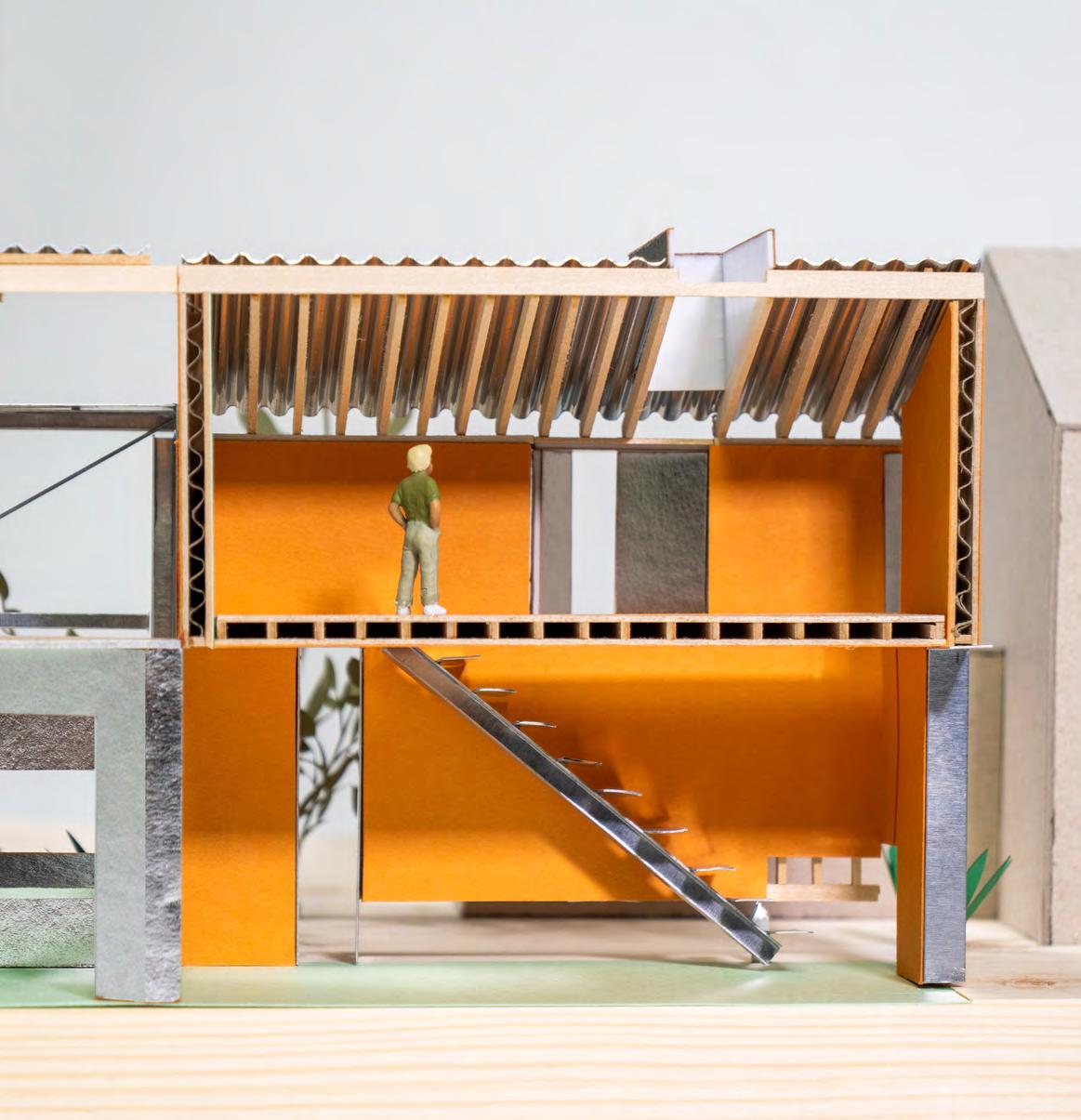
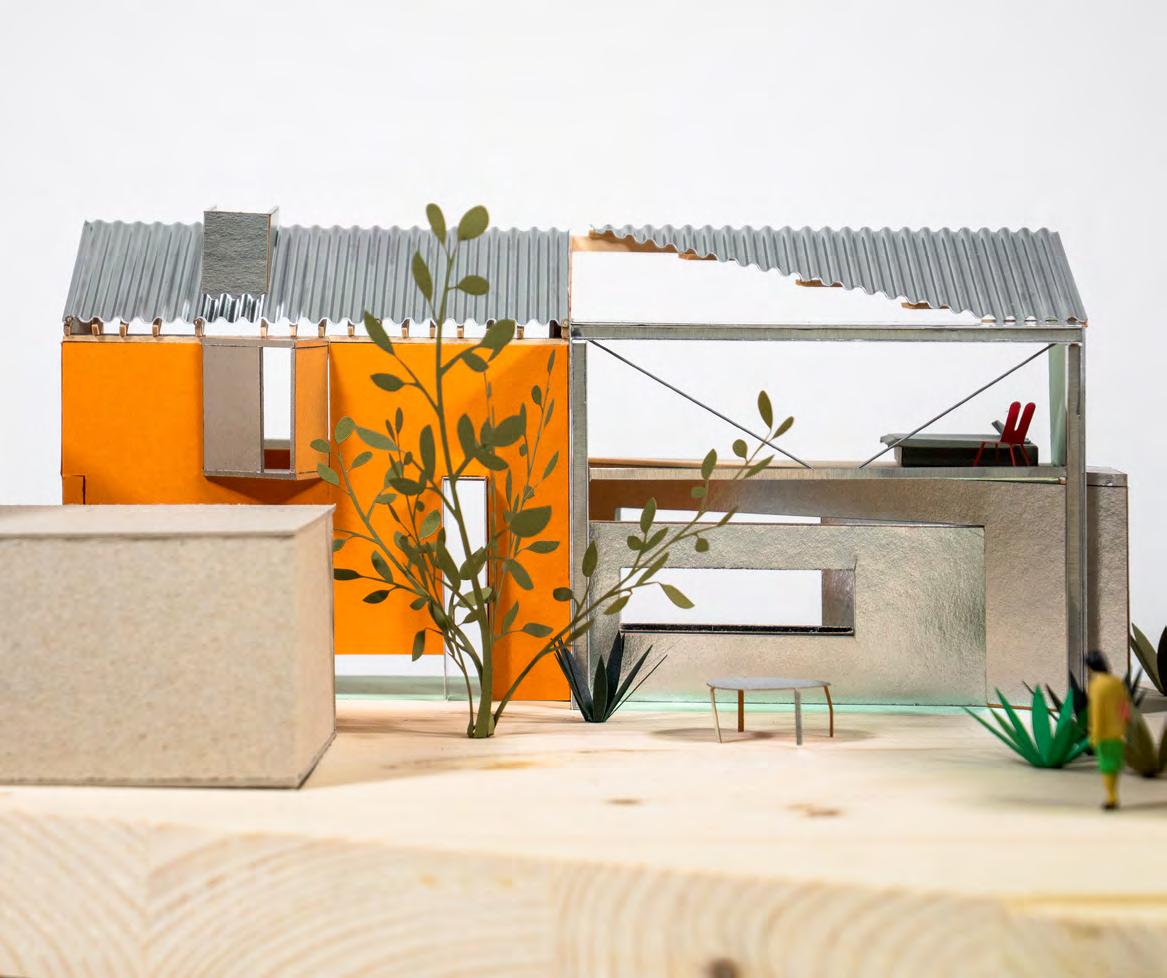
The house is less like a project that’s simply providing a design conclusion that has a high degree of rationality responding to all the programmatic needs, but more of a series of deformations of conventional concepts and conceptual propositions that have been explored and discussed throughout the semester.
Taught by Manuel
Bouzas,
for Spring 2025 core design studio
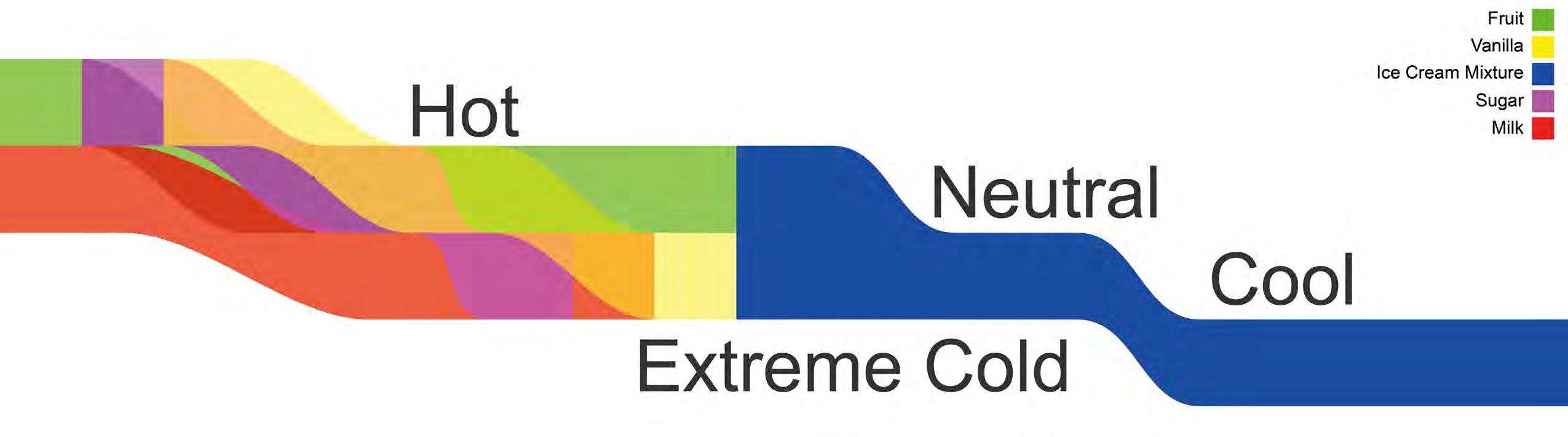
Situated within the lush Amazon rainforest in Brazil, this cookhouse provides both functional space for ice cream production and diverse communal and private dining experiences. The project initiates with a thorough analysis of ice cream production processes, revealing a linear thermal gradient that guides spatial organization. Diagrammatic explorations informed a logical circulation route characterized by descending temperatures. Critical assessments of spatial adjacencies and floor-area distributions led to the designation of four distinct thermal zones: Hot, Neutral, Cool, and Extreme Cold. Connections between these zones are clearly illustrated through architectural diagrams.
Set intentionally within a tropical context, the design concept aims to evoke visual and experiential coolness amidst the heat. The building's form distinguishes between elevated hot zones and subterranean cold spaces. Vertical circulation, facilitated by a central staircase, efficiently connects production areas, whereas a sloped pathway enables visitor tours between elevated and ground levels, clearly delineating production from consumption spaces.
All production activities are internalized within the architectural form, featuring an elevated greenhouse and an offset cow shed at ground level. Semitranslucent atriums penetrate the structure, channeling natural daylight into subterranean production spaces.
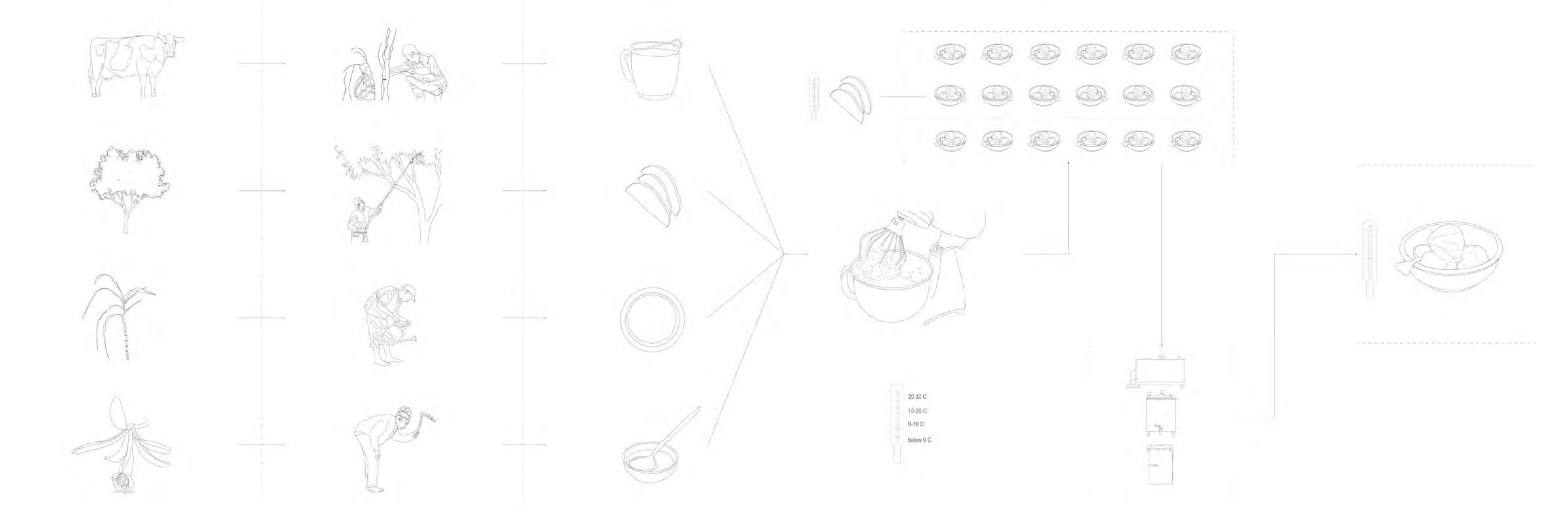
The diagram above shows the steps needed to makes an ice-cream. This sequencial analysis sets the ground for the design of necessary spaces for the production and consumption of ice-cream.
This diagram aims to show that there is a decrease of temperature when the ingredients are being processes. This set the basis of the relative locations of each space to the others.
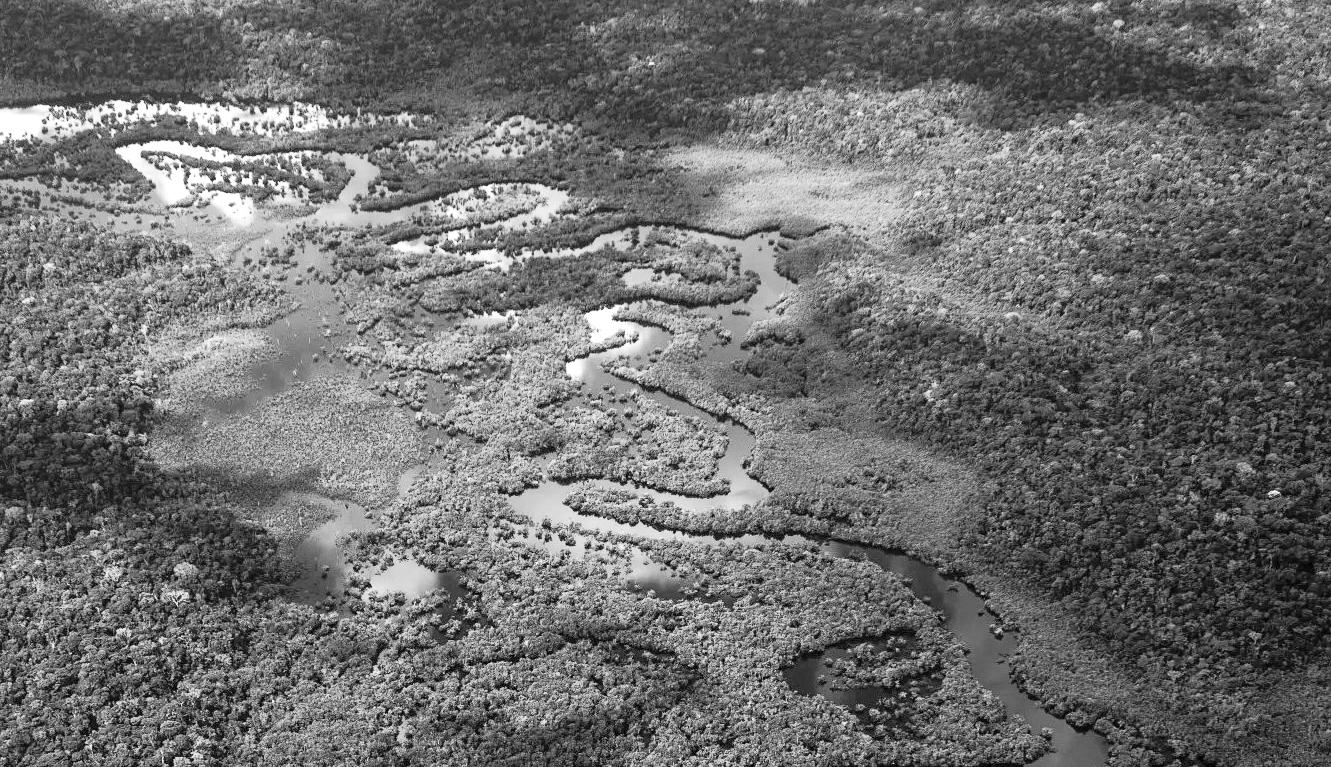
3°01'21"S 60°10'48"W,
AMAZON BRAZIL
The ice-cream cookhouse is located in the center of a large area of Amazon rainforest, the ideal tropical environment to grow crops and serve ice-cream
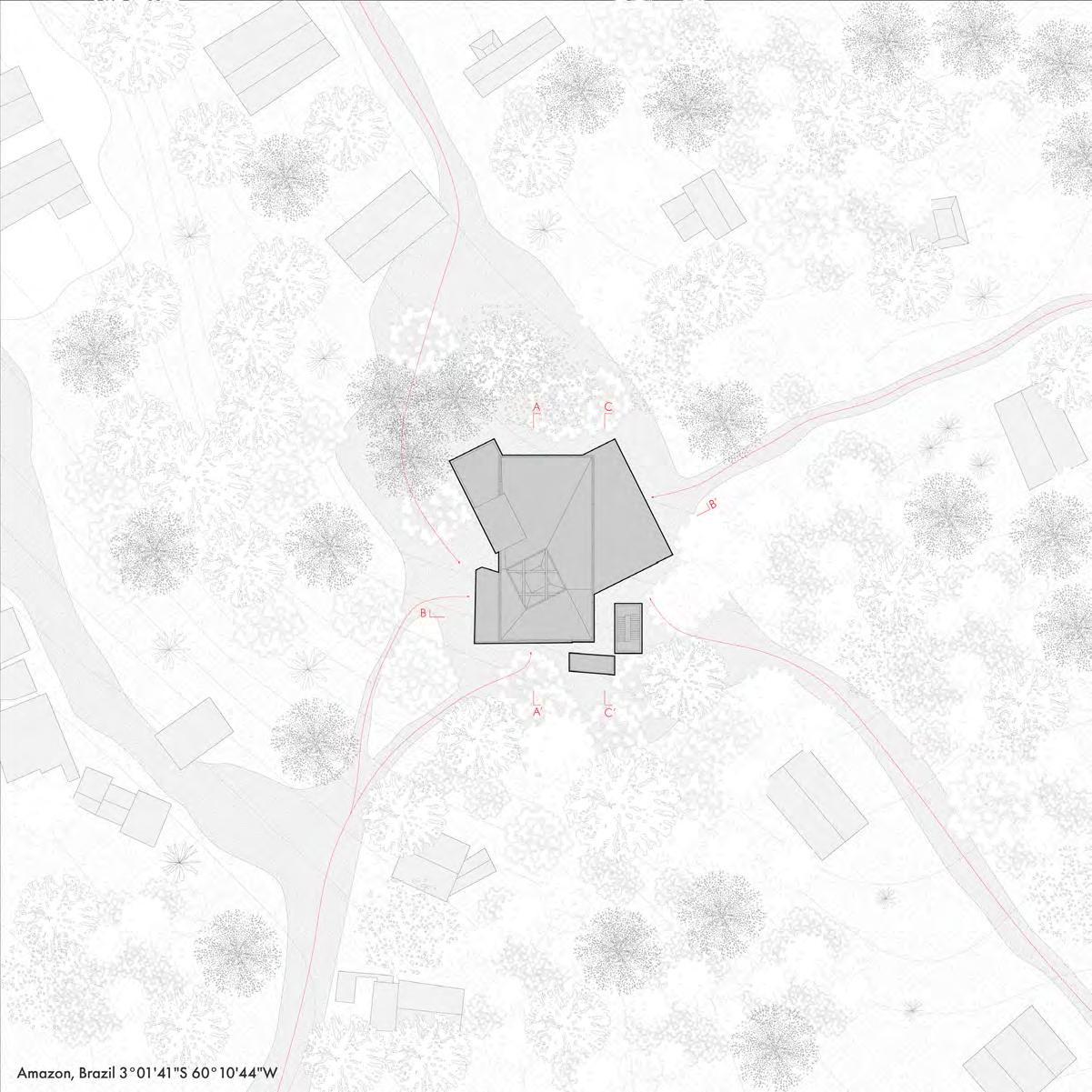
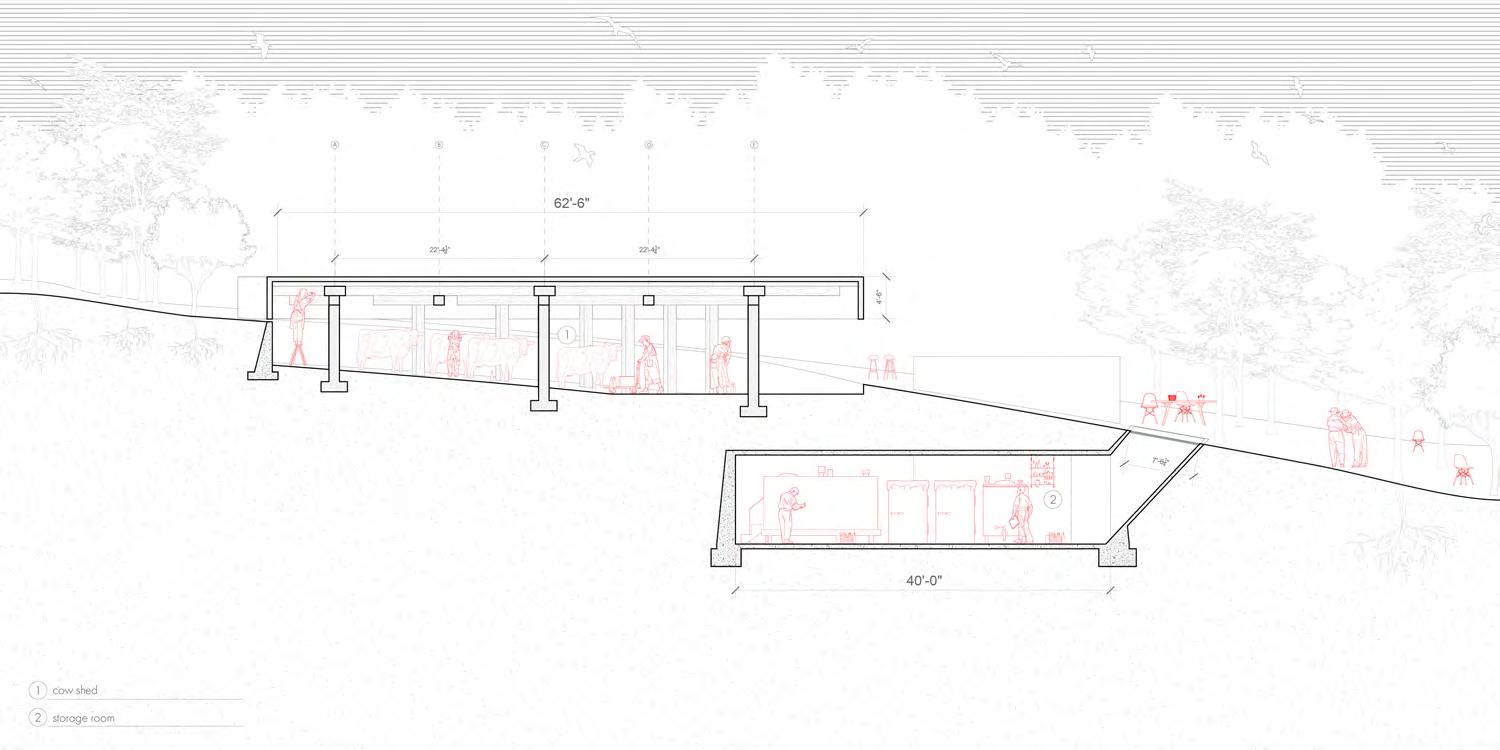
Section A-A' shows the various activities that take place within the program of the cookhouse, including planting, harvesting, milking, dinning, storing, etc.
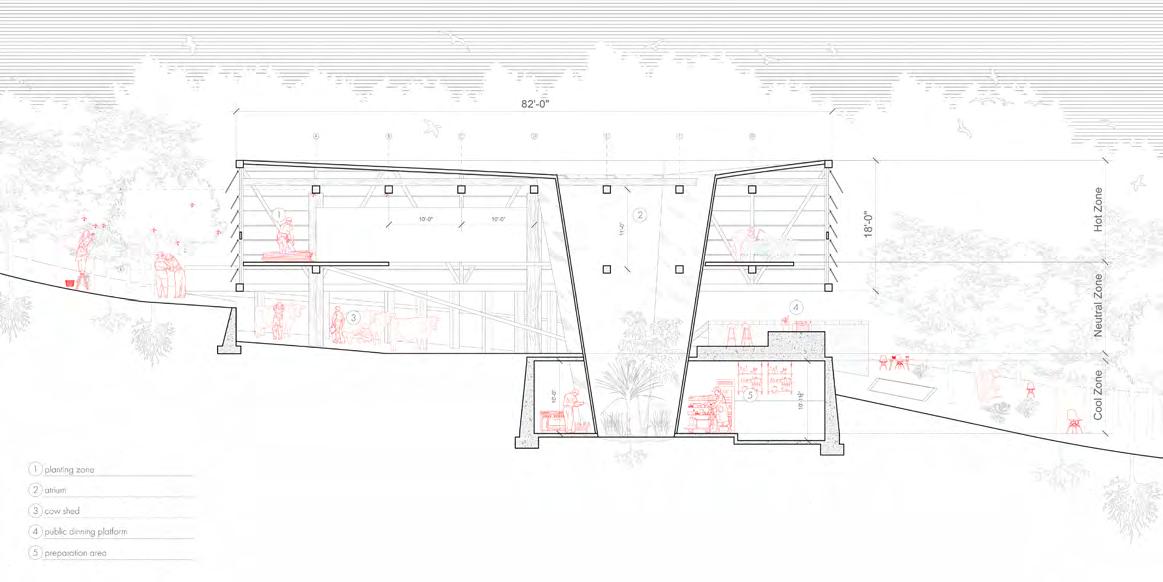
The section diagram shows the various activities that take place within the program of the cookhouse, including planting, harvesting, milking, dinning, storing, etc.
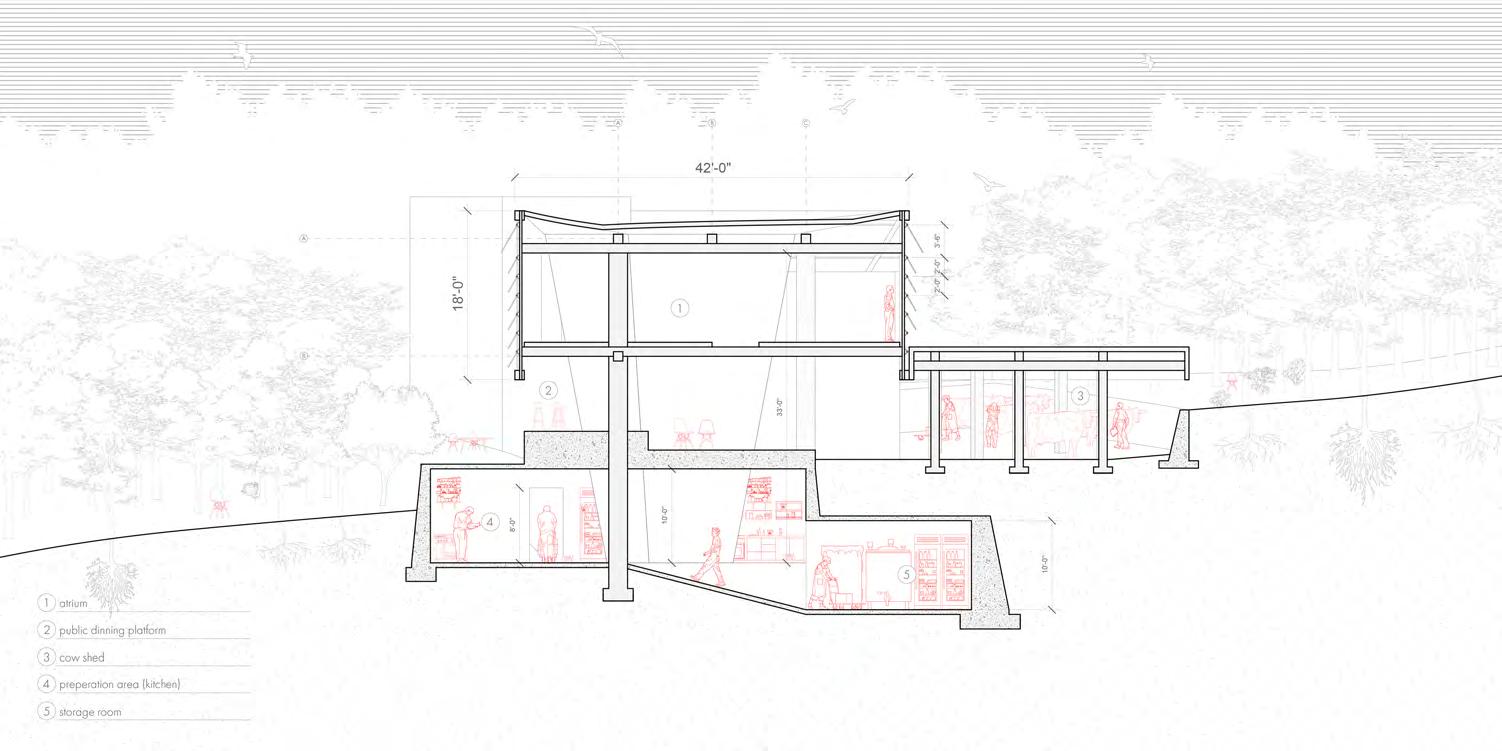
Section diagrams C-C' aims to show the cow shaft and the underground storage space of the cookhouse.
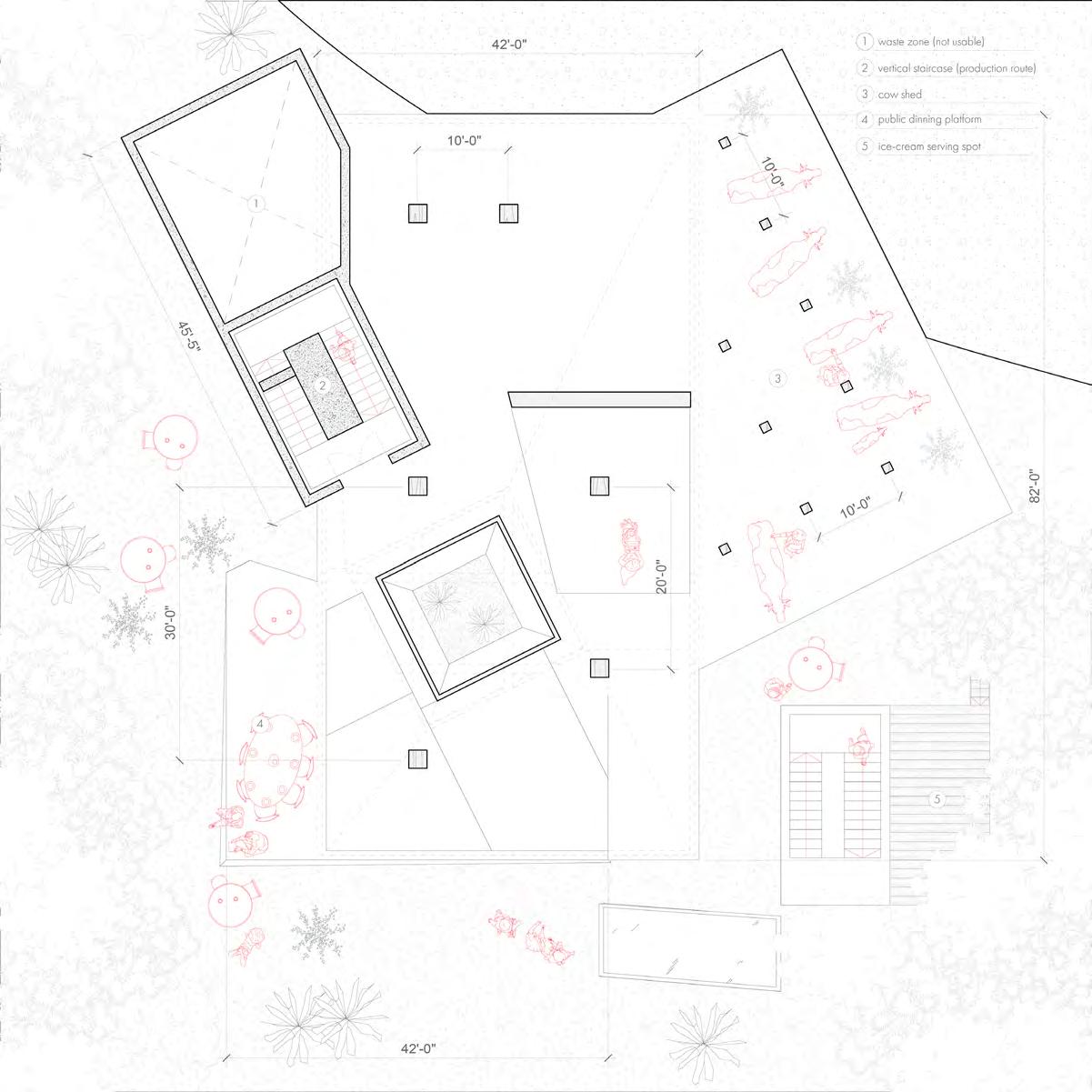
The plan diagram provides a detailed view of the spaces located on the 1st and 2nd floor of the cookhouse. Focusing primarily on the greenhouse on 2nd floor and the public dinning area of the ground floor.
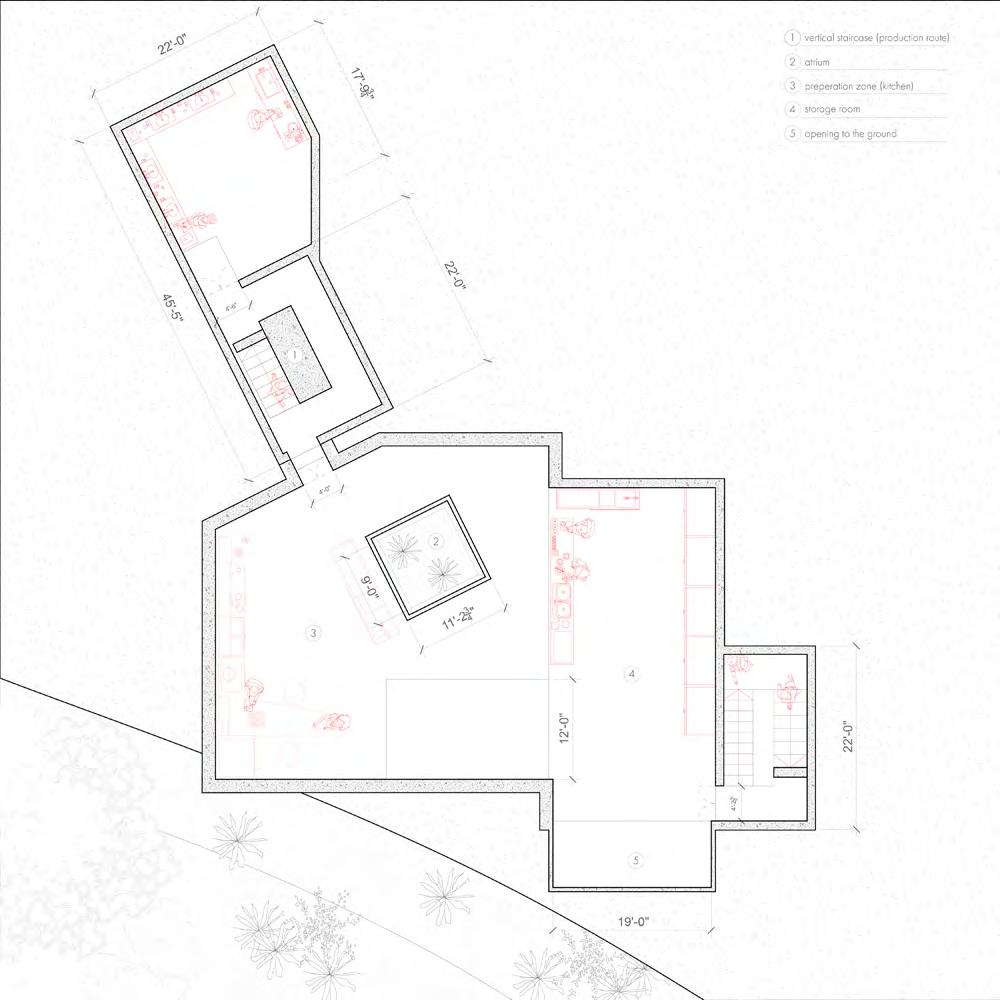
Plan diagram 2 focuses on the underground spaces: the waste zone, preperation zone, and the storage room. It also reveals the inner circulation of the architecture
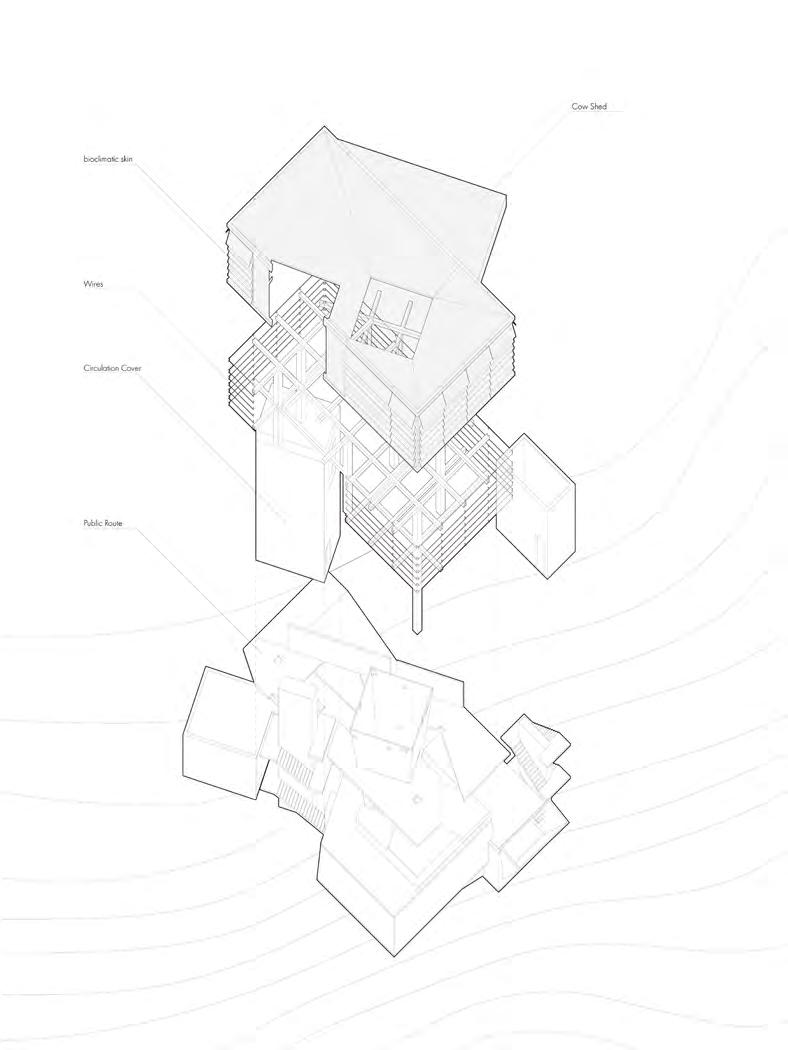
An exploded axonometric view of the entire architecture, aiming to show that the cookhouse is a complex program and circulation system covered with a gigantic semi-translucent shell and wooden frames.
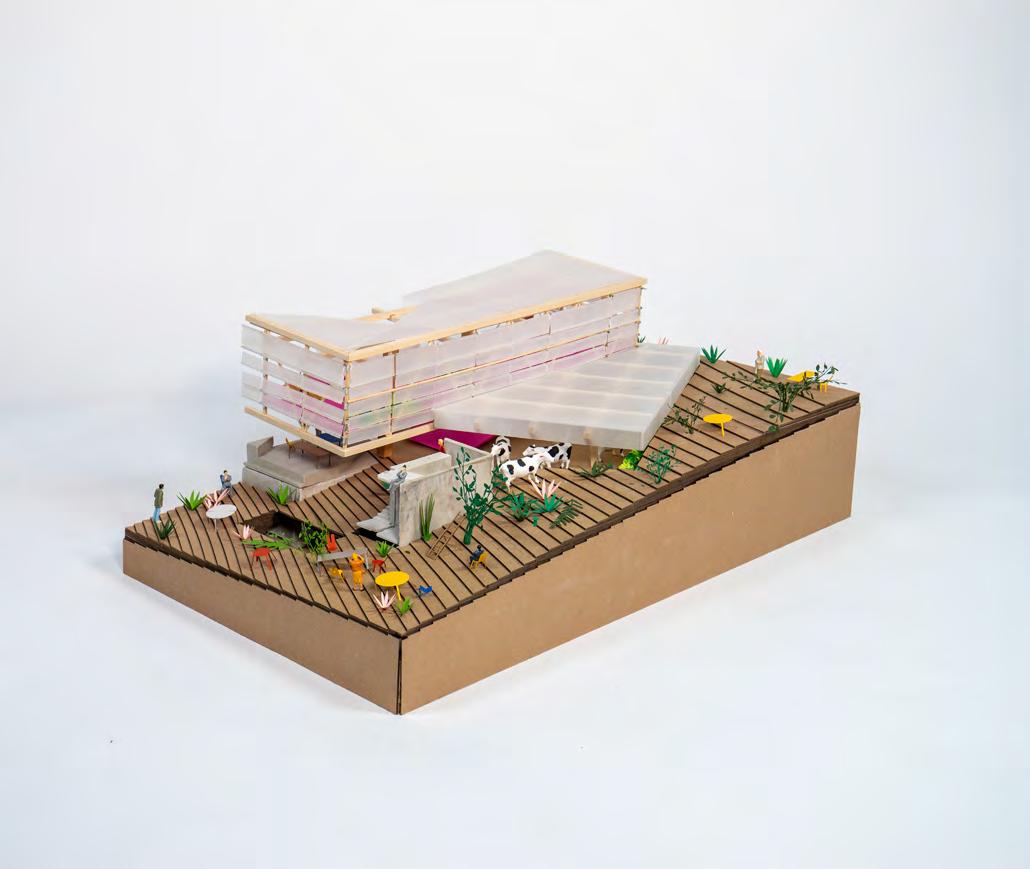
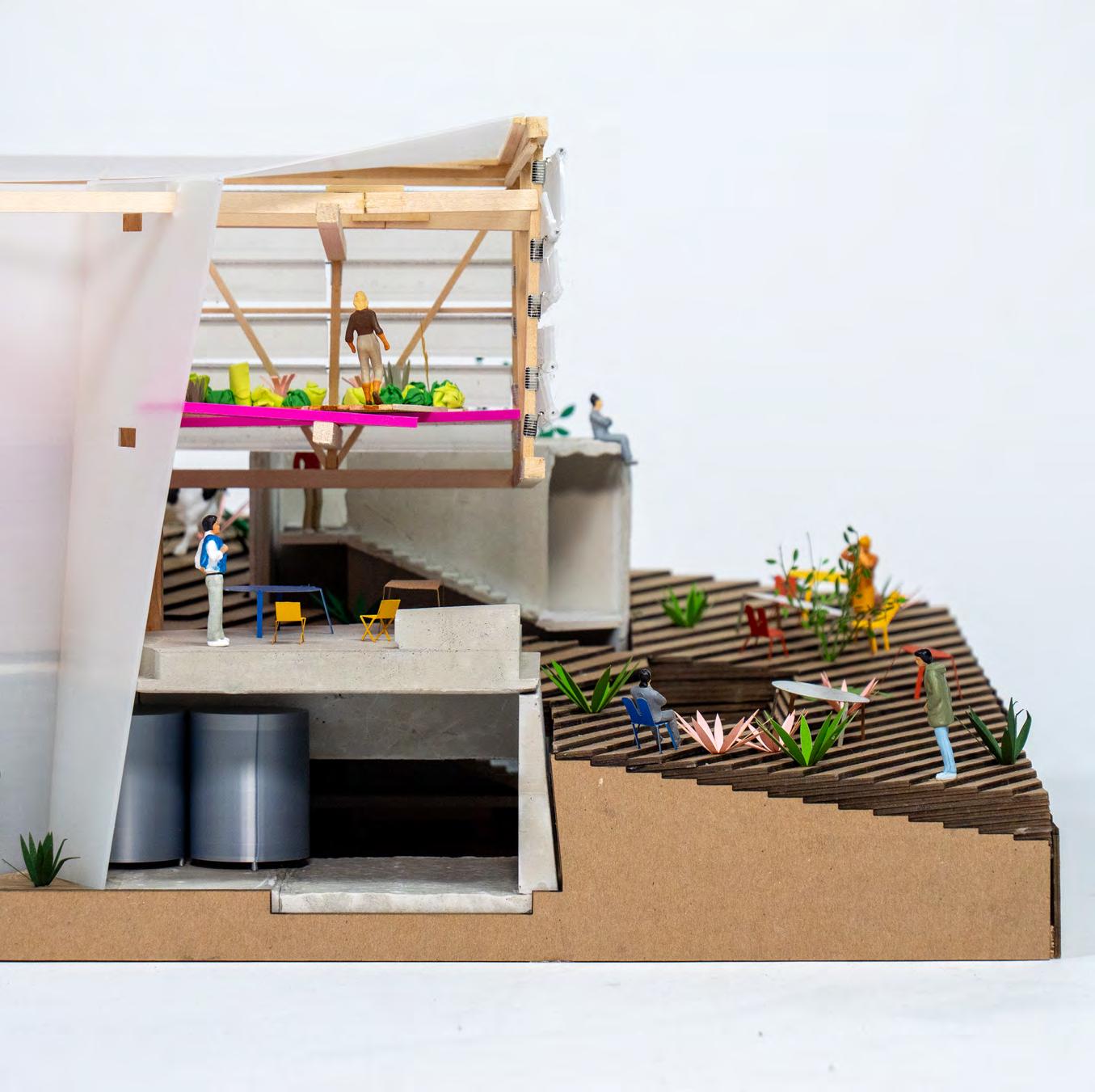
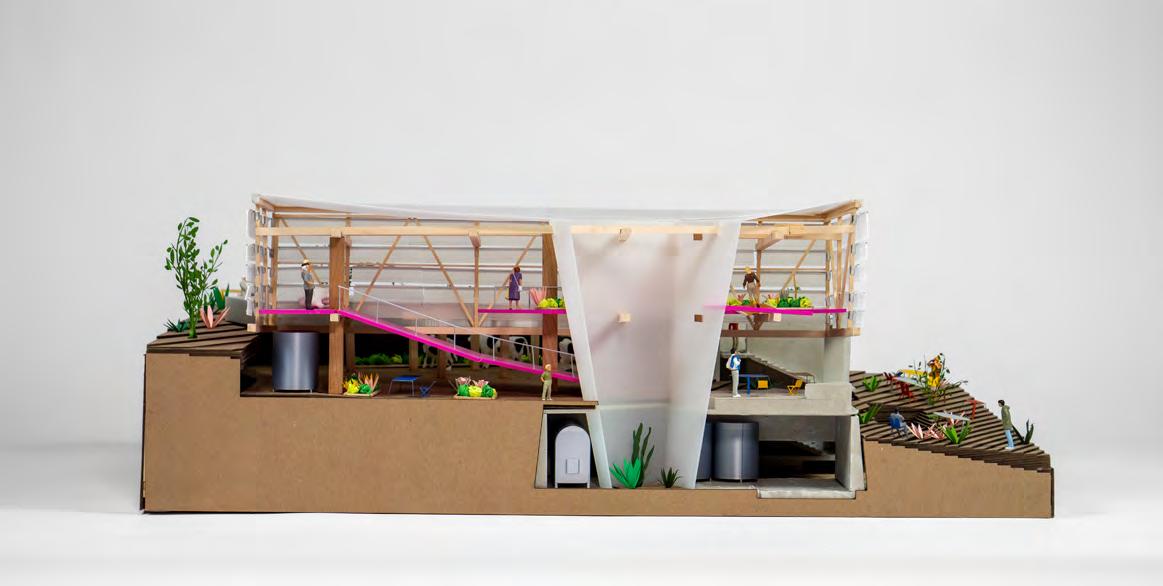
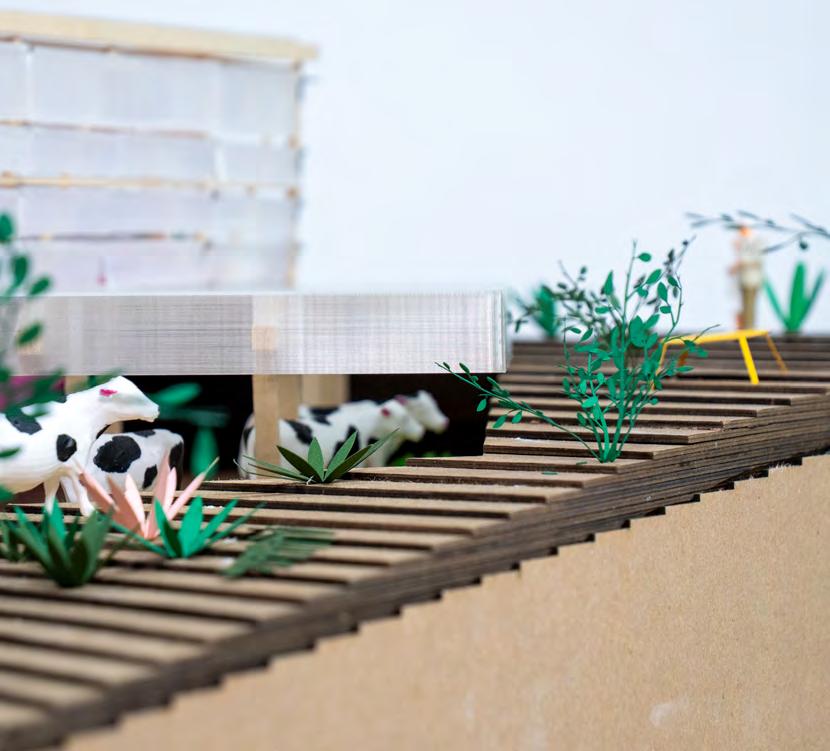
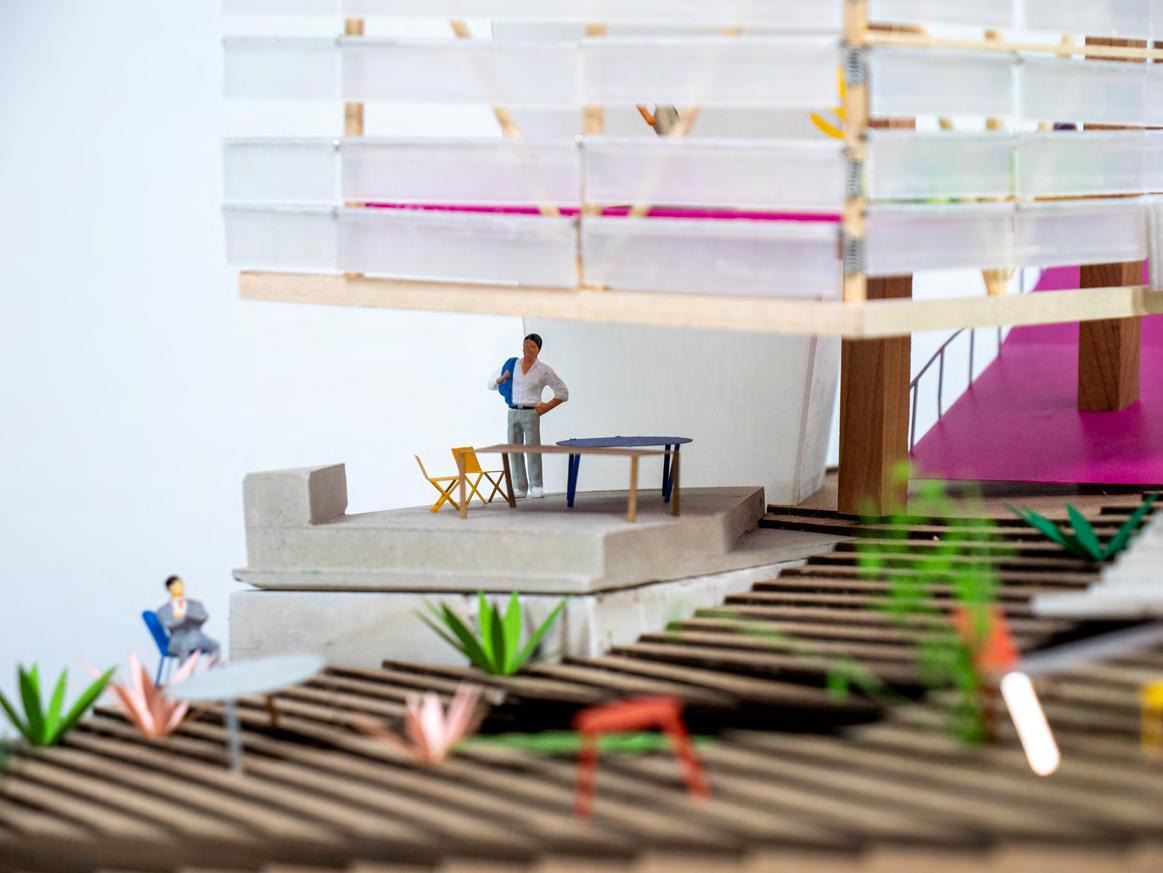
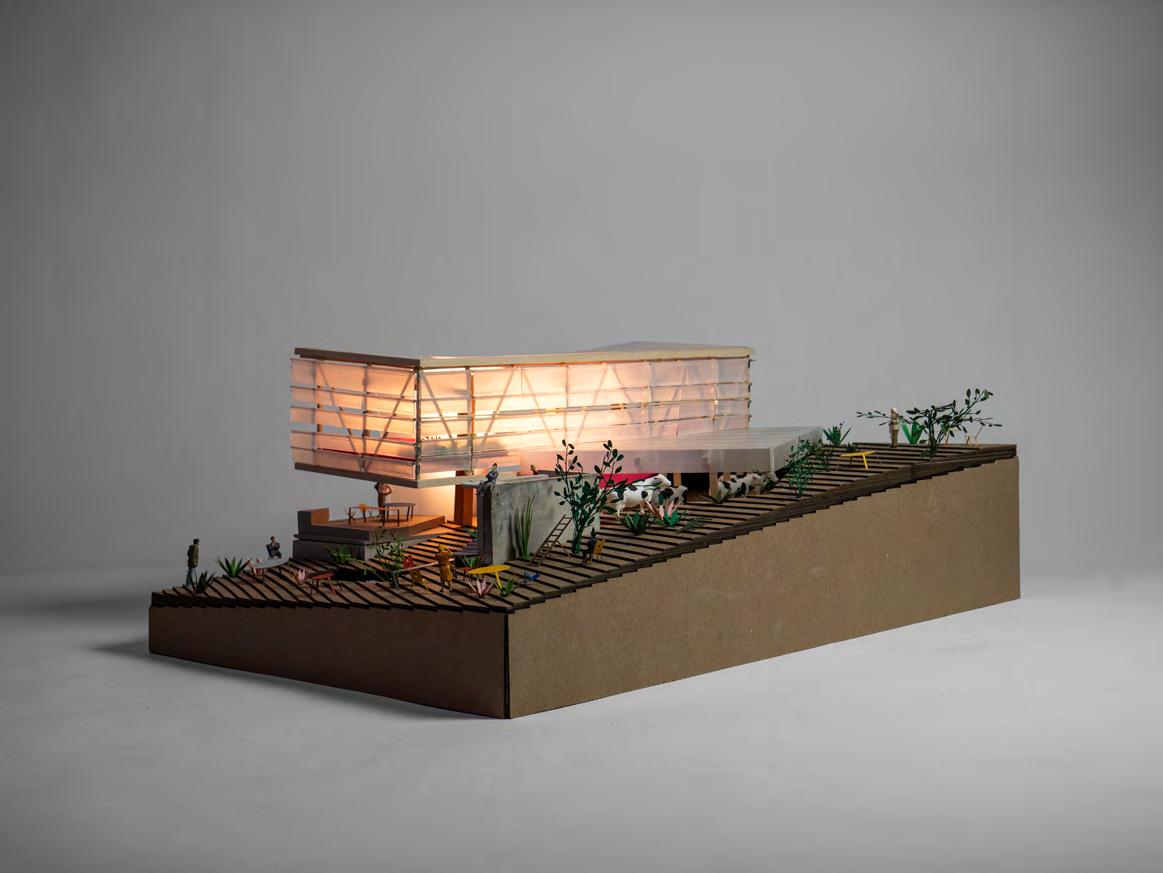
Details of the model showing the scale of the architecture and how humans are imagined to interact with it.
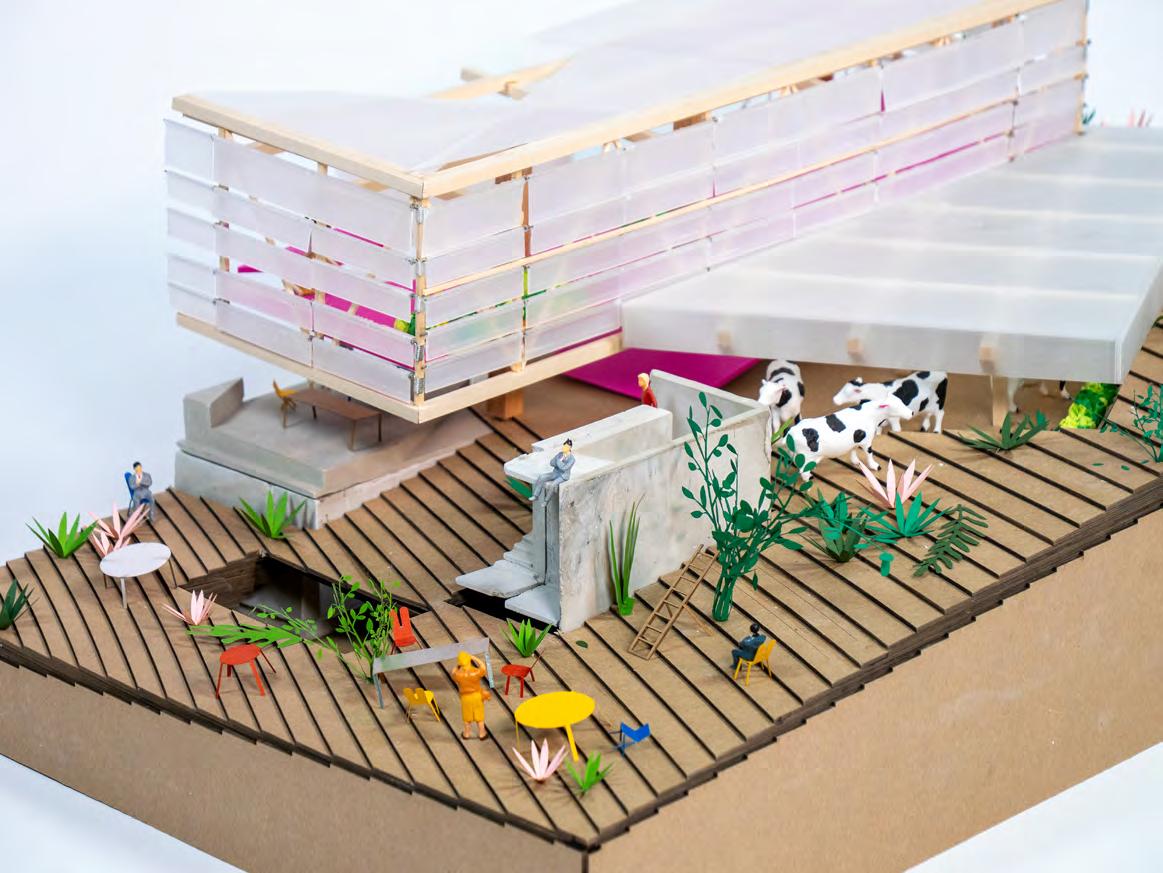
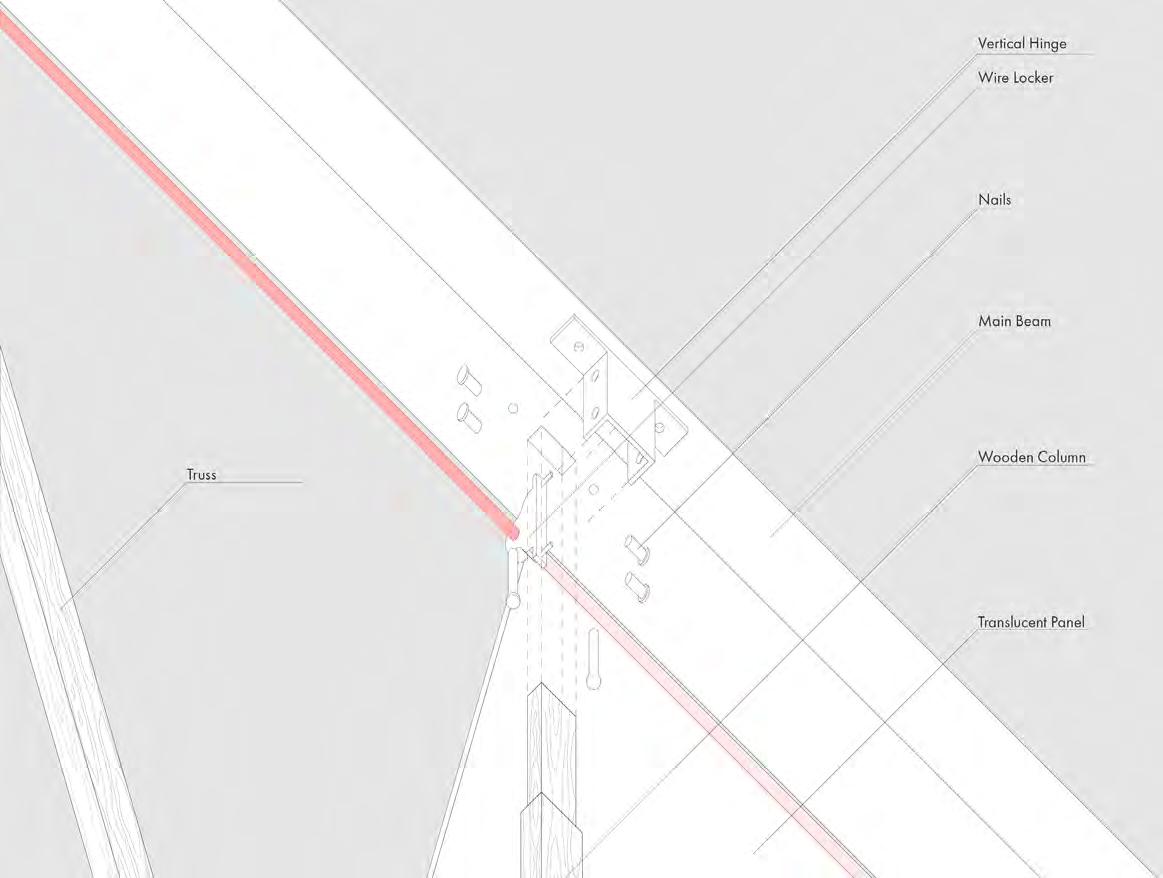
The model is primarily 3D printed, while the rest of the parts are mainly chipboard and color paper. The two pictures below are to show the fine craft of the model and the interaction between a colorful inside and the semitranslucent shell.
Taught by Mark R. Cruvellier, for Fall 2025 ARCH 2613
With Andre Jiang and Heather Zhang
Project by BUCHNER BRUNDLER ARCHITEKTEN
Project done in 2024, Switzerland, Dreispitz
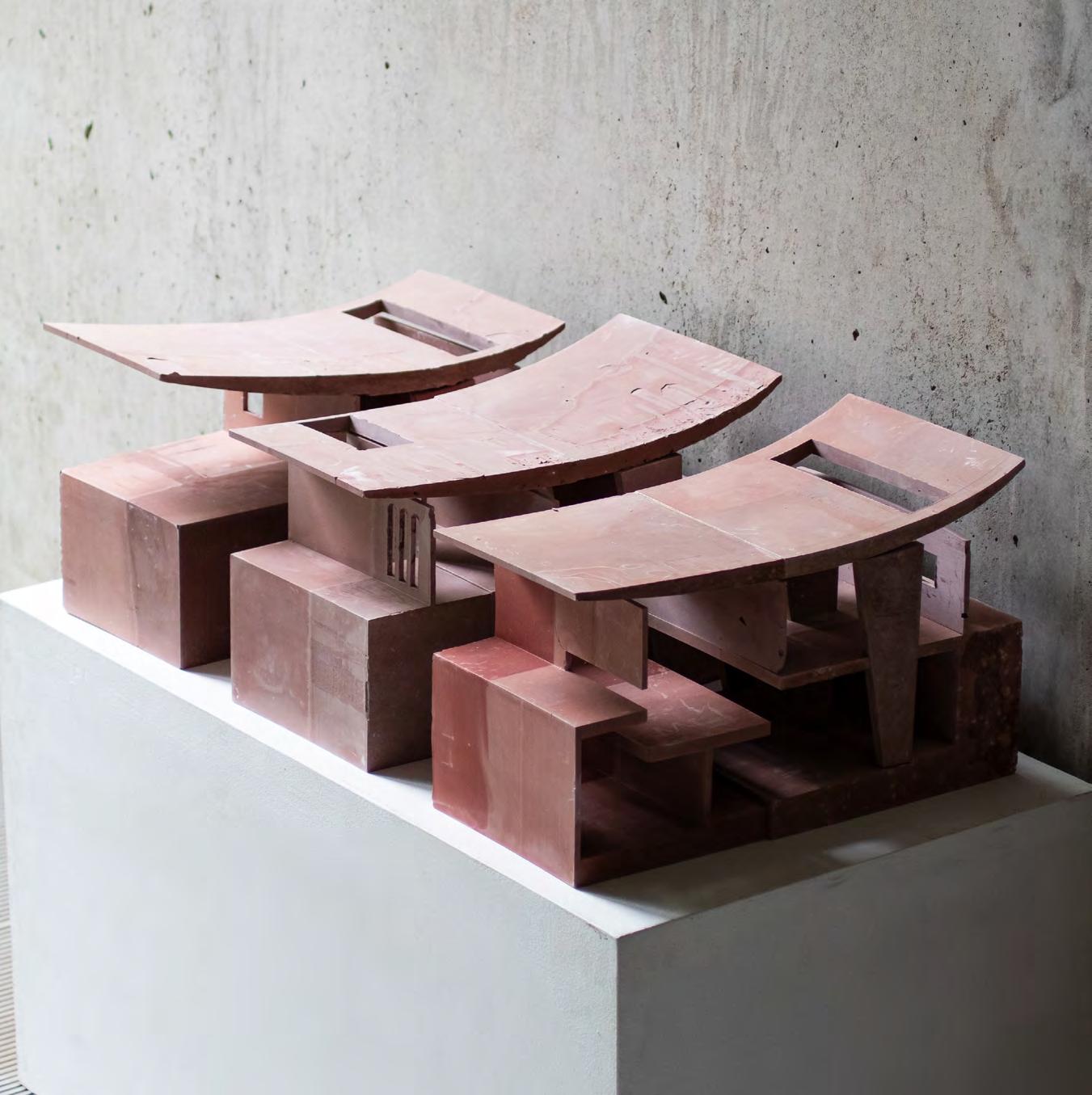
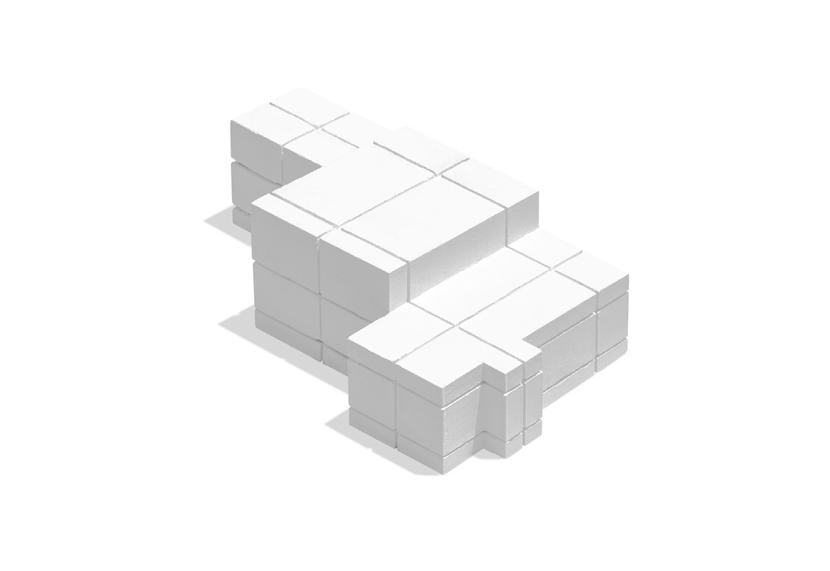
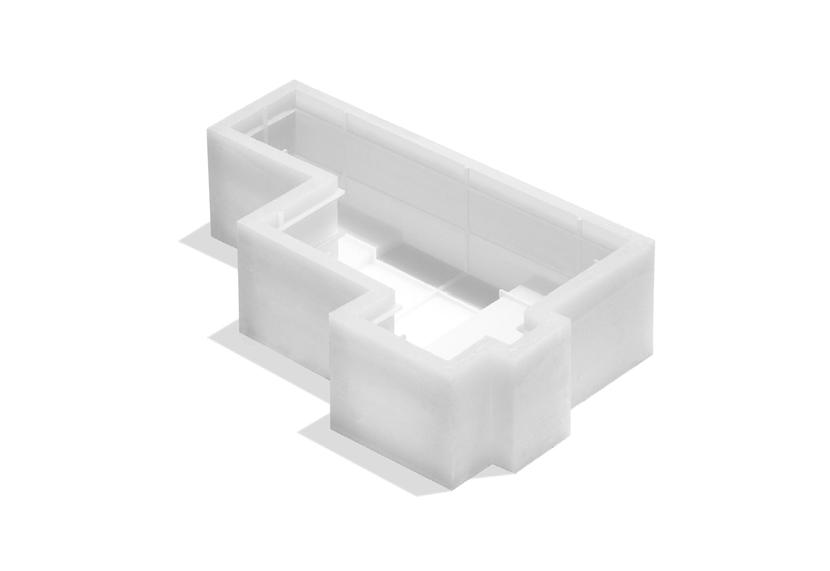
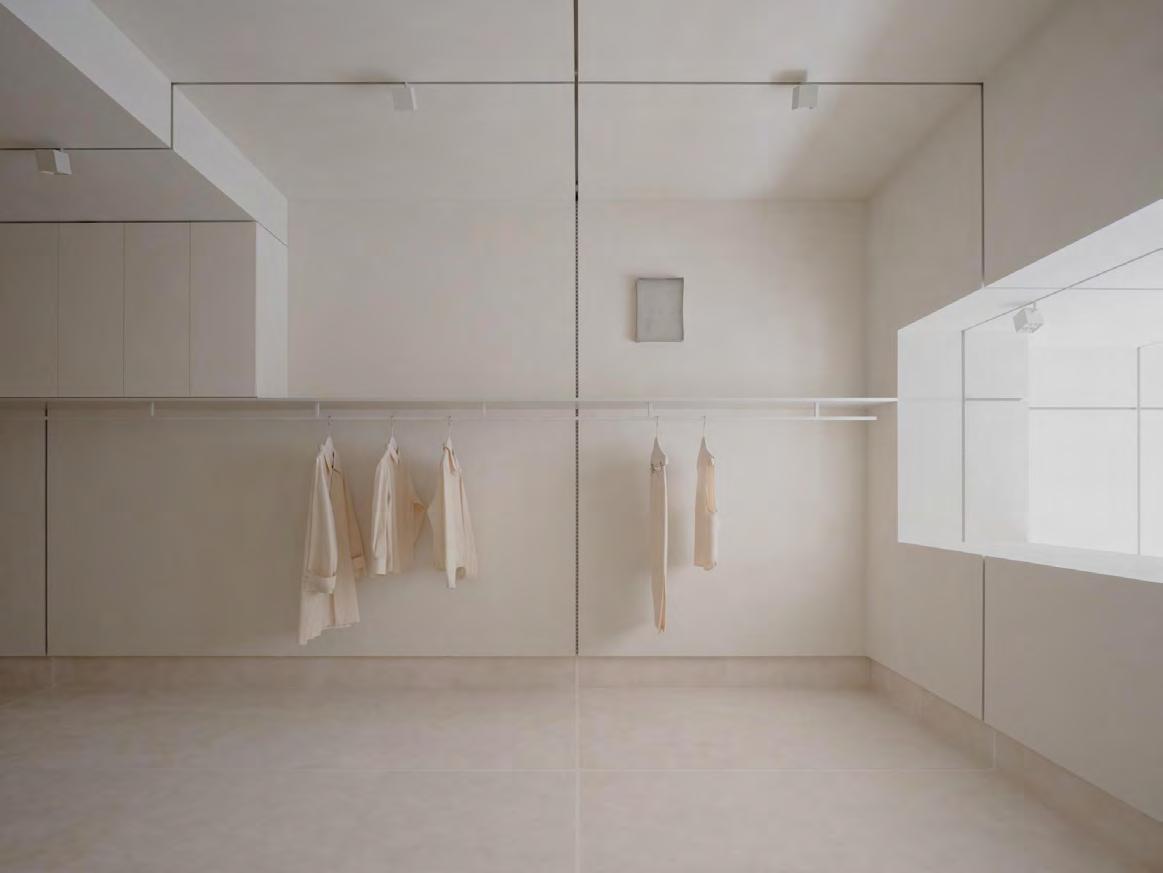
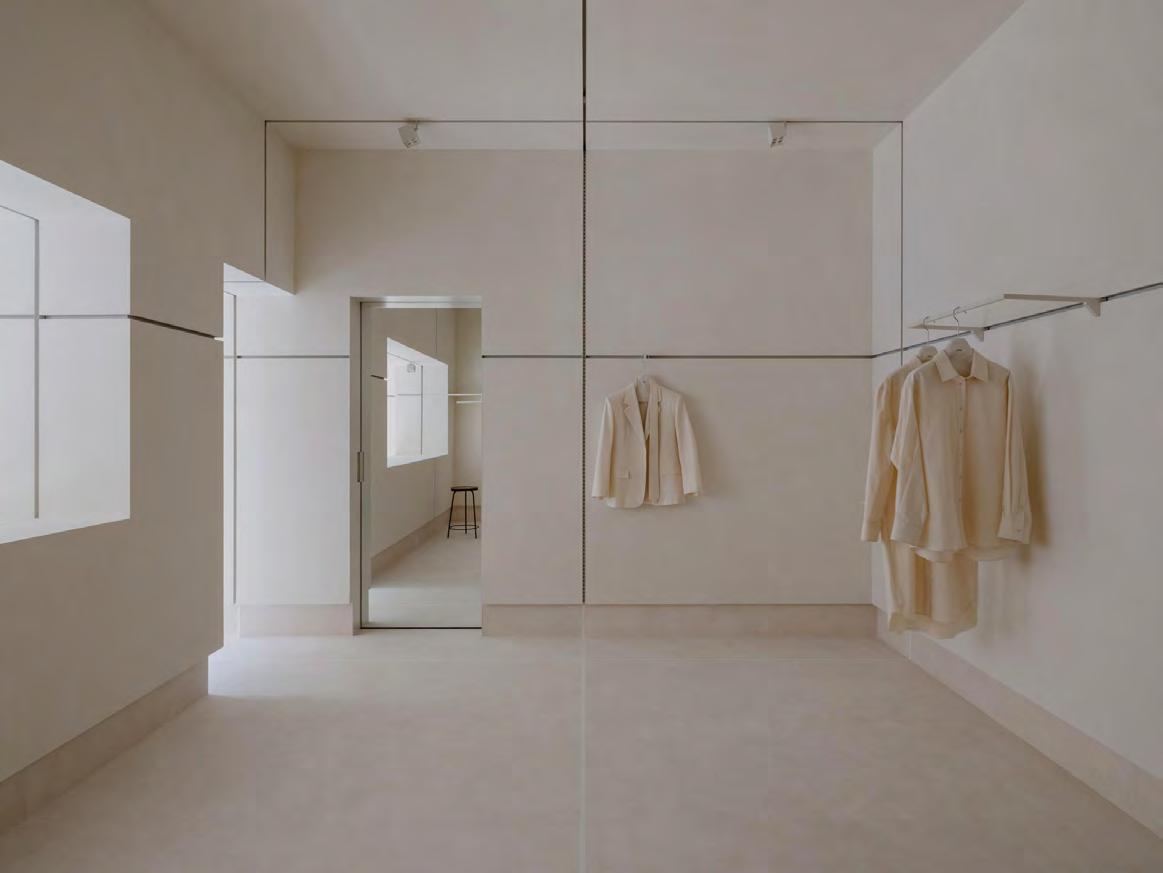
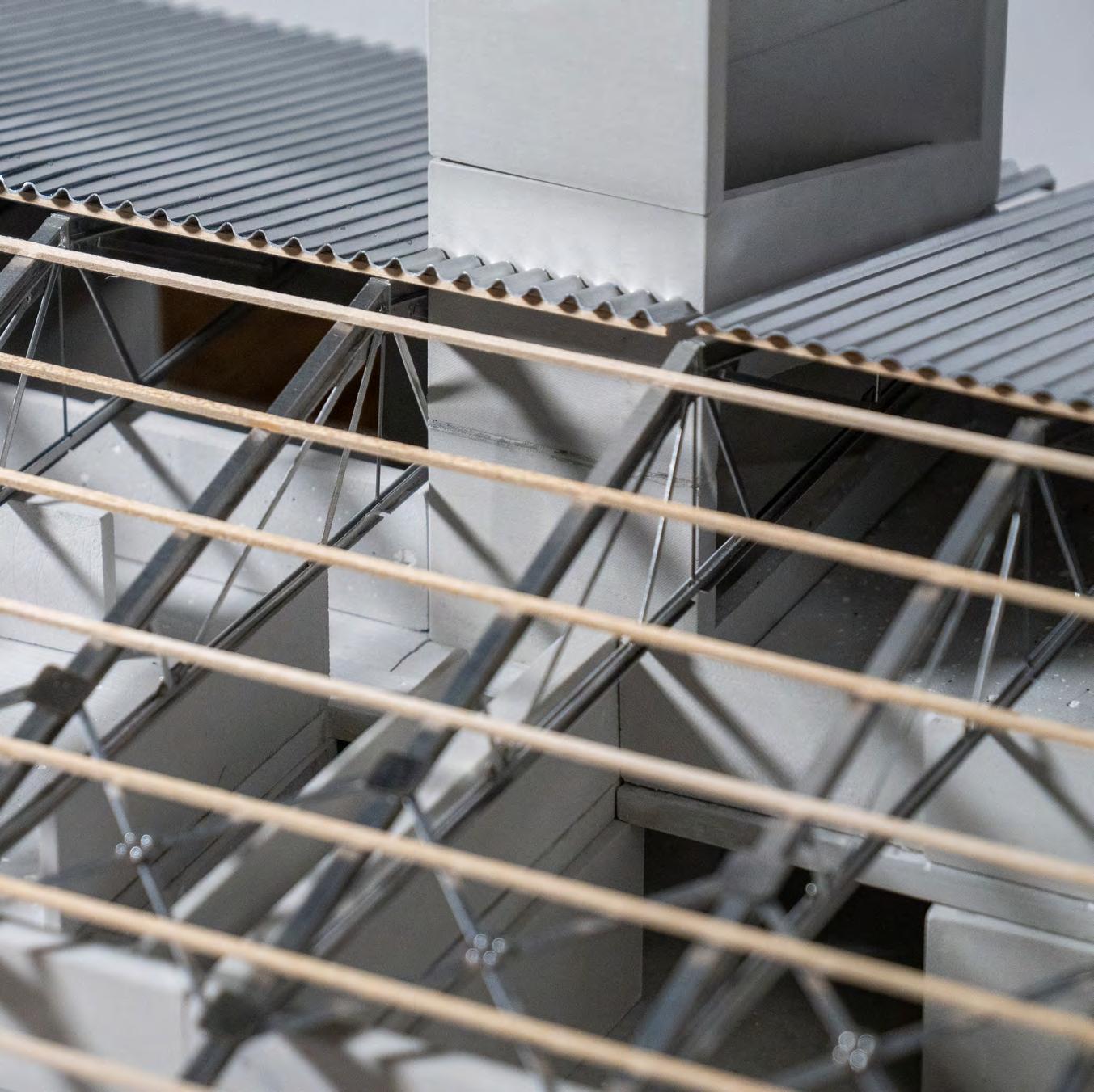
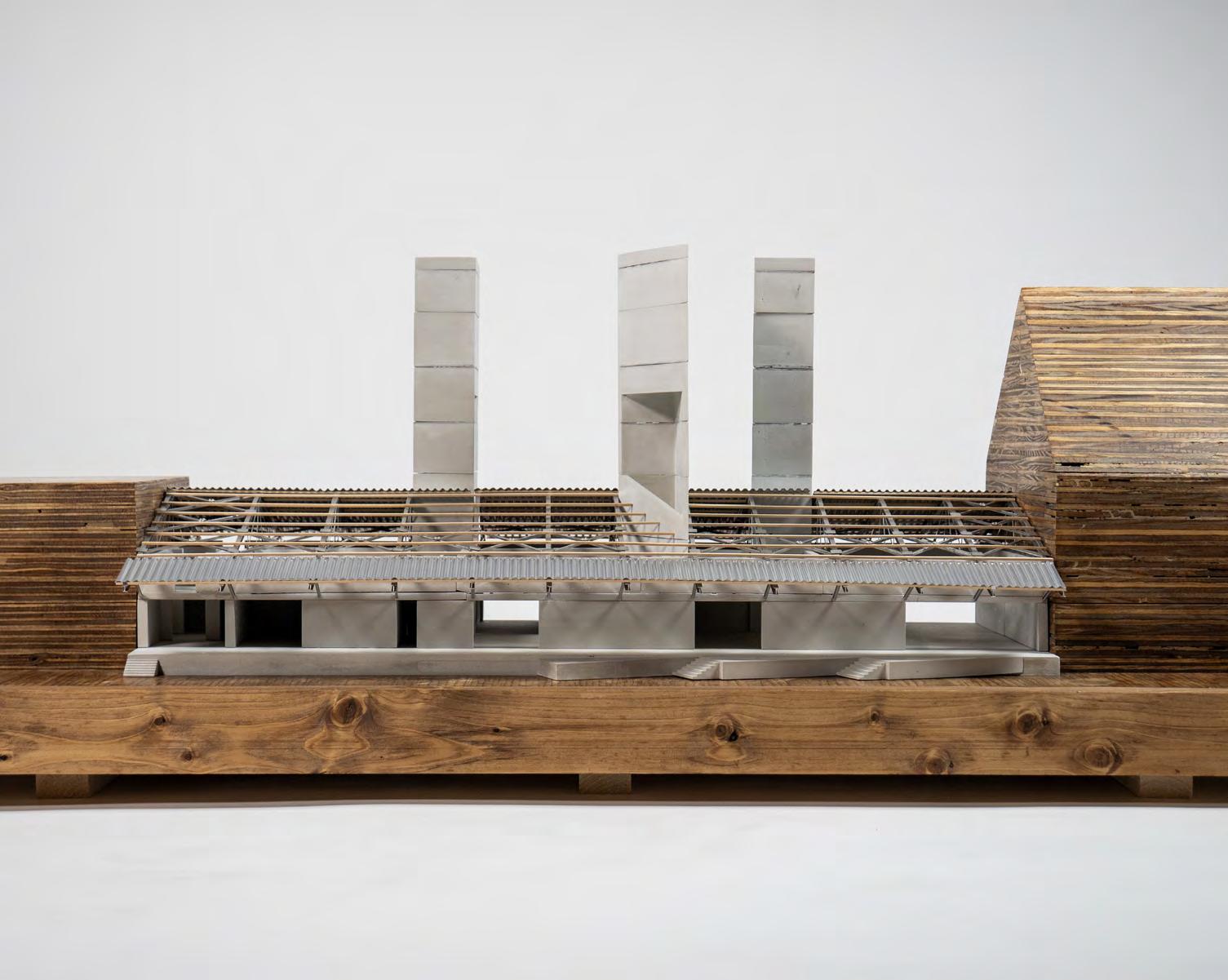
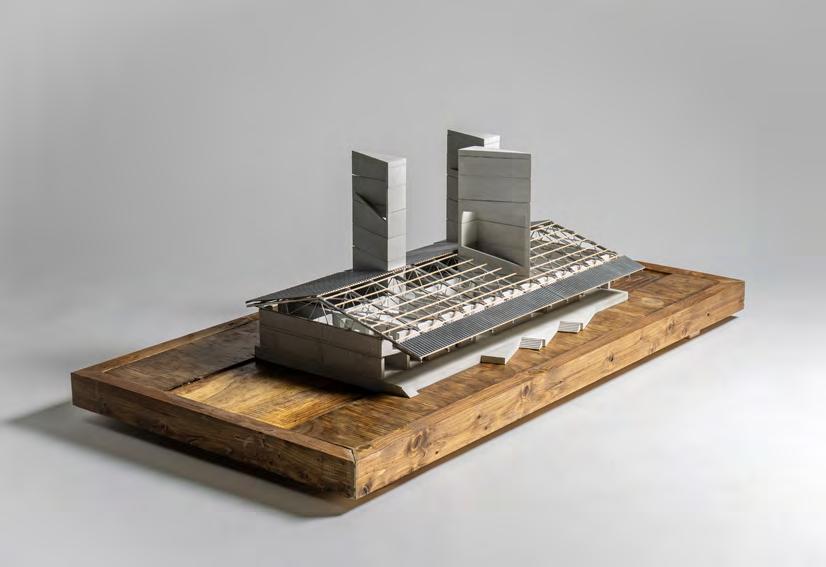
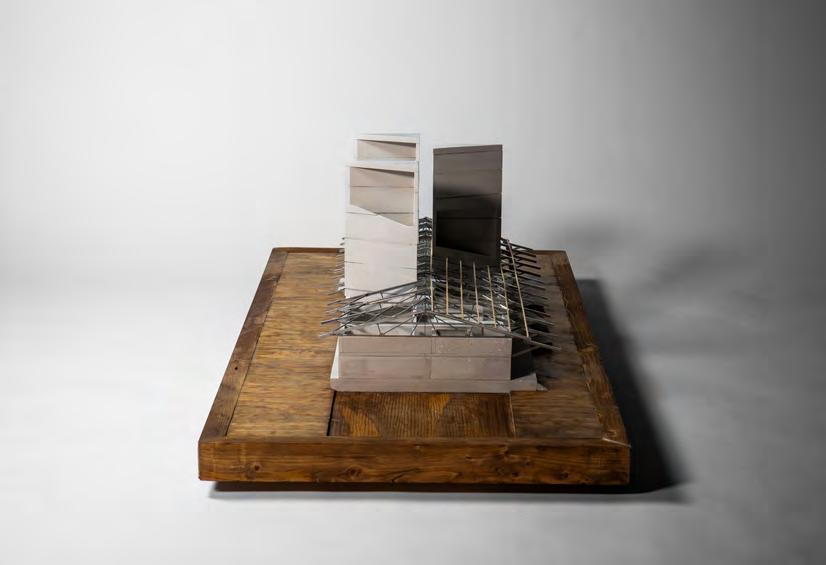
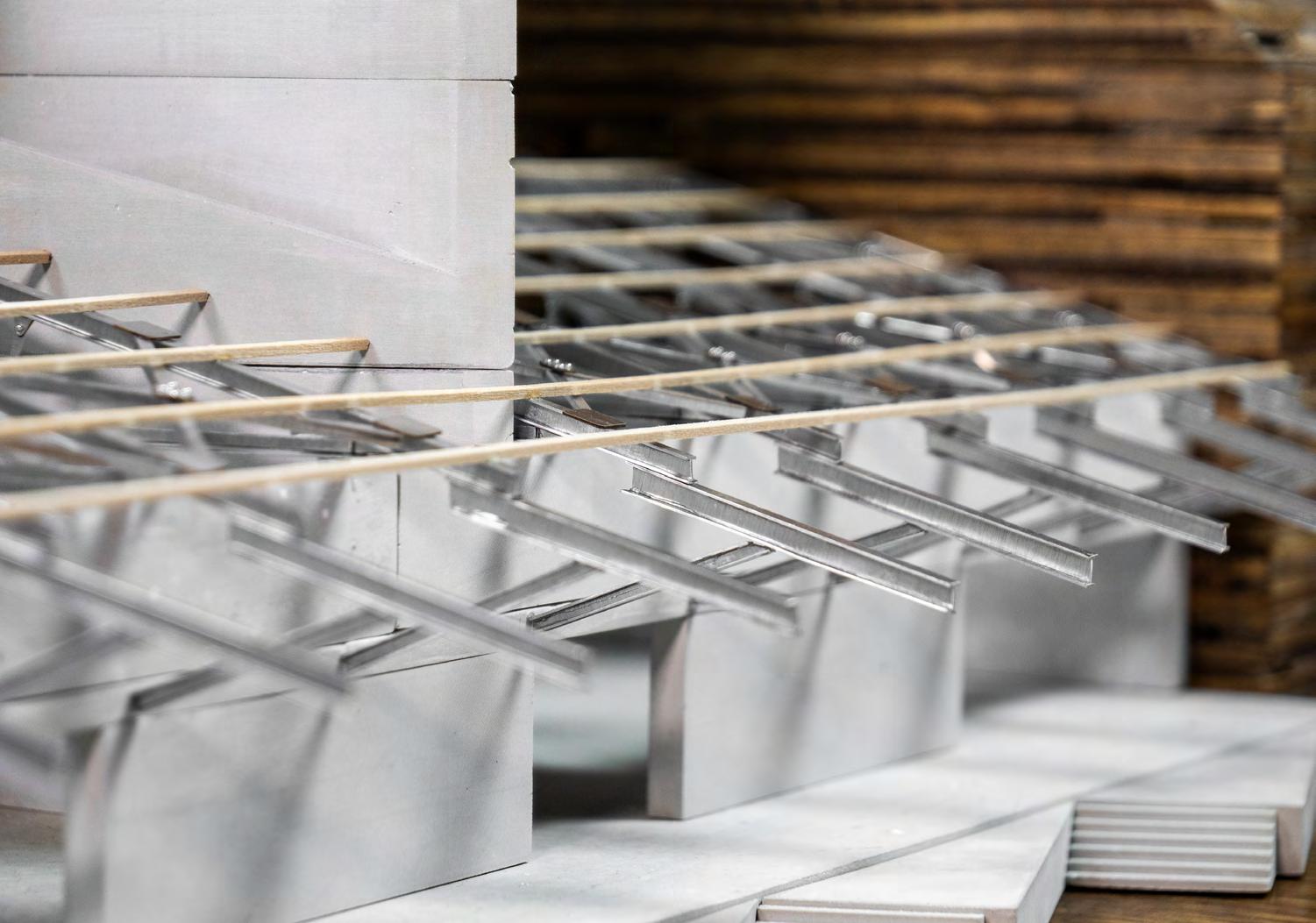
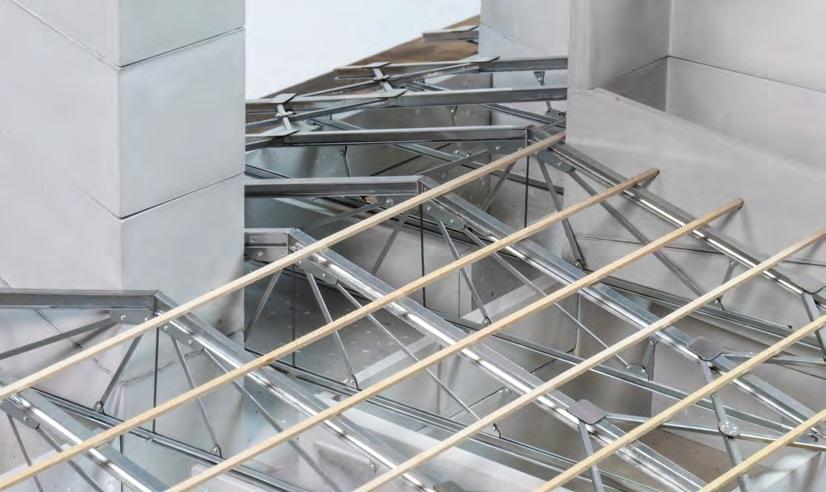
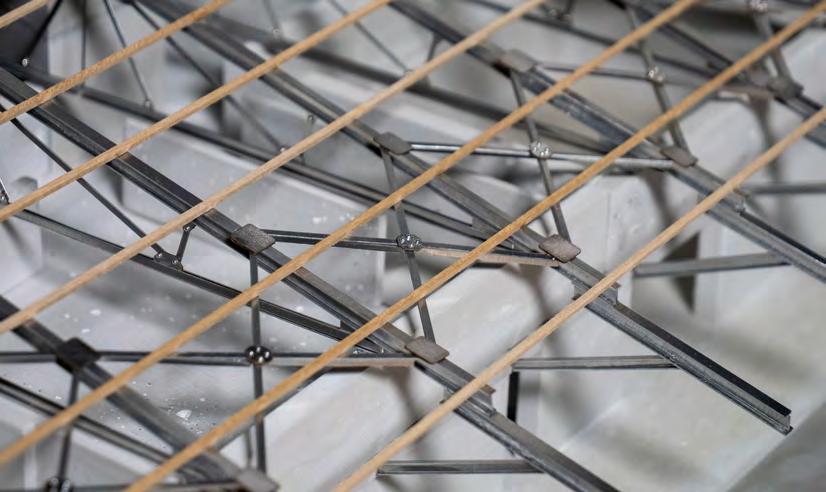
The main concept of Kunsthaus Baselland, designed by Buchner Bründler Architekten, is based on the idea of largely preserving the old warehouse while inserting new volumes into the space to redefine function. Buildings on the Dreispitz site typically have a row structure that is most efficient for transitional purposes. These long buildings are positioned between roads and railway tracks. Originally a champagne warehouse, the building has been adapted into an art gallery where the central architectural gesture is the insertion of three monumental reinforced-concrete prismatic light towers. These vertical prisms pierce the roofline, introducing controlled natural light into the hall space while simultaneously acting as structural anchors that stabilize the long-span roof. The geometry also transfers loads directly down to the foundation, relieving the large horizontal spans of excessive bending stresses. The prismatic light towers are connected by wall-high beams and ceiling panels, resulting in a second exhibition level. In addition, the truss roof structure of the gallery space is supported by the panels and beams mentioned. These parallel wall-high beams function as both structural stabilizers and spatial dividers, reducing the lateral buckling risk of long spans and ensuring seismic resistance. The combination of thick reinforced concrete for vertical load transfer and a lighter roof plate stabilized by the skylight towers forms a hybrid system: heavy elements below for inertia and stability; and lighter, tension-controlled spans above for openness and light.
Taught by Manuel Bouzas, for Spring 2025 core design studio
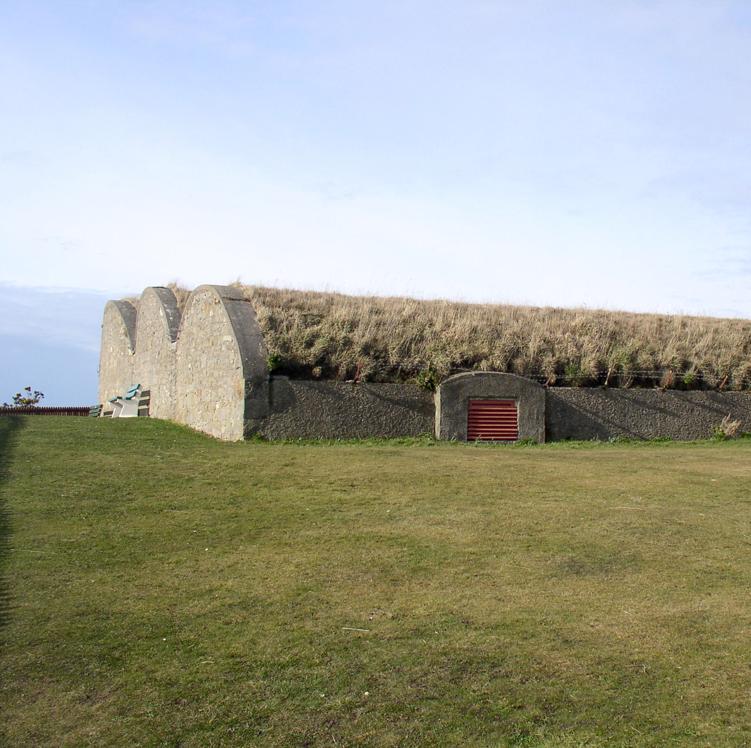
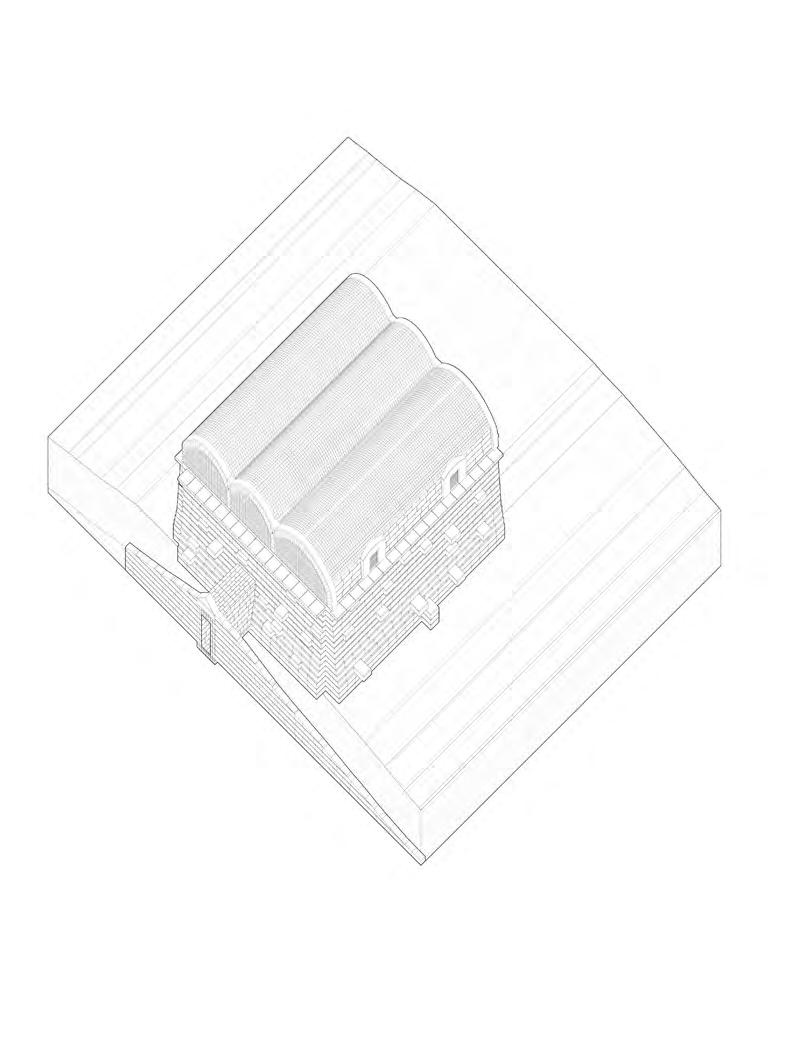
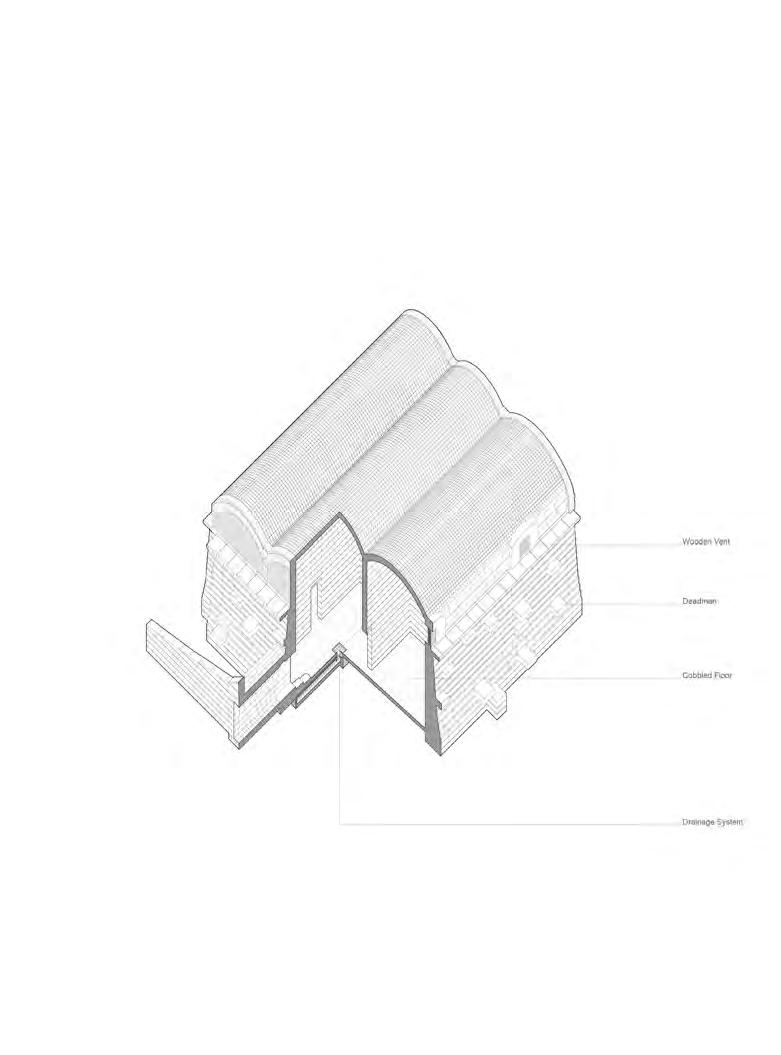
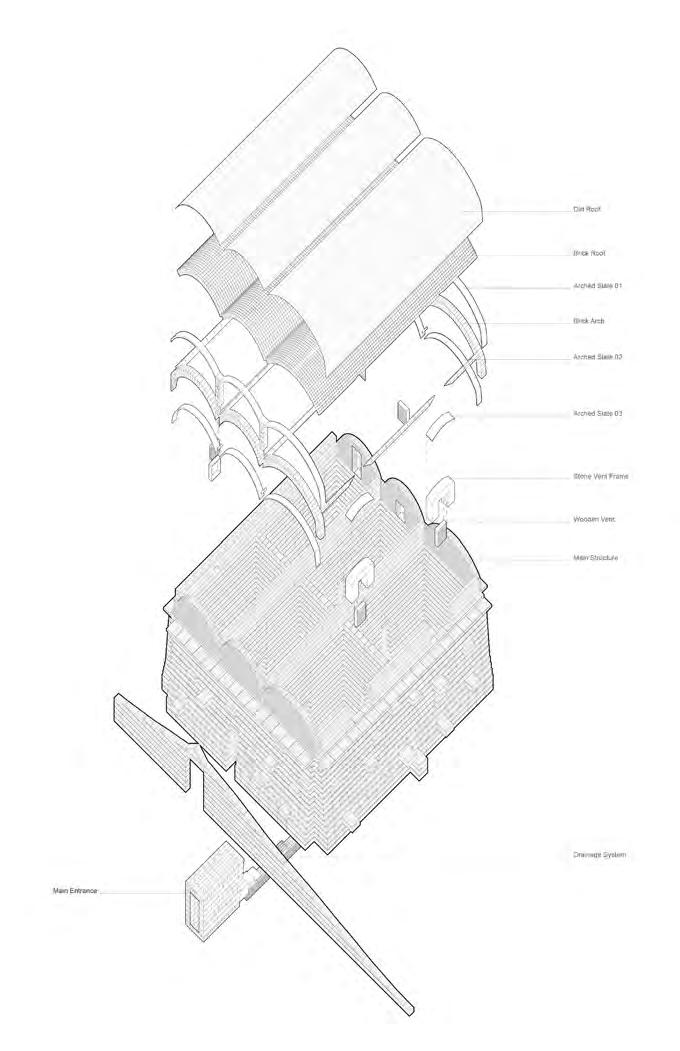
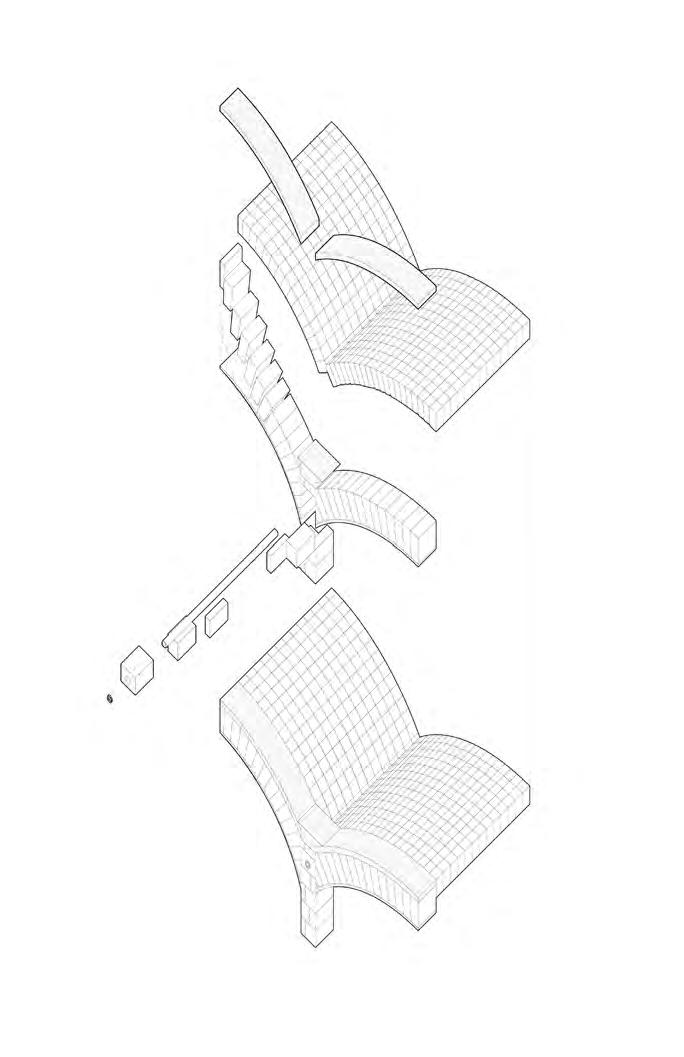
Located in Spey Bay, Scotland, the Tugnet Icehouse, a Category A listed building, historically served the local salmon industry as an ice storage facility. Approximately one-third of its volume rises above ground, while the remaining two-thirds extend underground to maintain optimal low-temperature conditions.
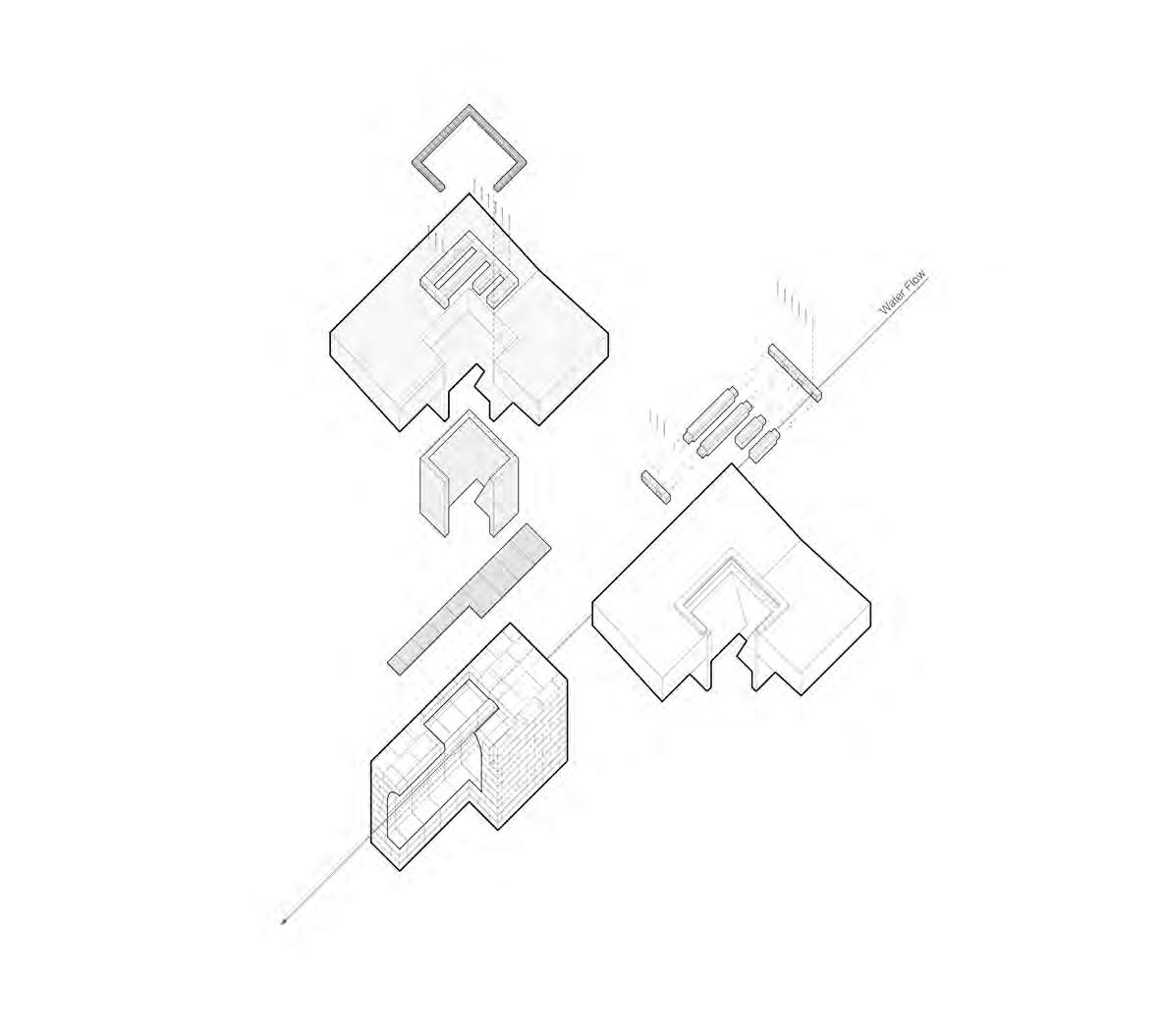
Constructed predominantly of boulders and stones, recent renovations have introduced concrete for structural reinforcement. Due to its subterranean nature, the building employs strategically sloped retaining walls that effectively manage soil pressure. A green roof system prevents heat ingress, complemented by three ventilation openings designed for natural cooling. A historical V-shaped drainage system centrally positioned efficiently directs meltwater away from the storage chamber.
Taught by Fany Kuzmova, for Fall 2024 core design studio
Finalist for the Ratan N. Tata Distinguished Alumni Award trophy
Inspired by the geological formations at Giant’s Causeway and Fingal’s Cave, columnar basalt serves as the conceptual and material foundation for this pavilion. The geometric precision and modular character of basalt columns inform the project's design language, emphasizing rhythmic repetition and natural symmetry.
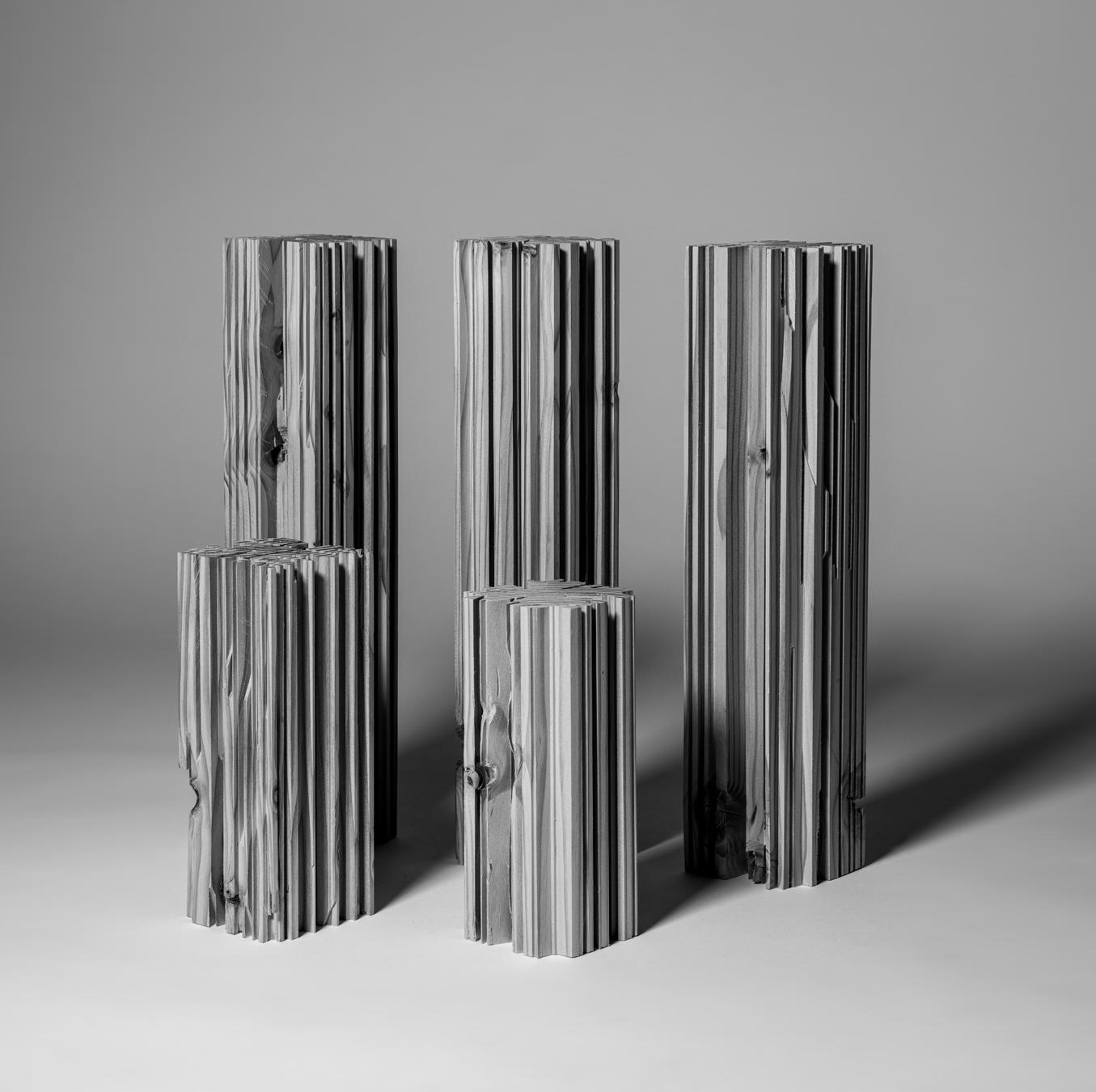
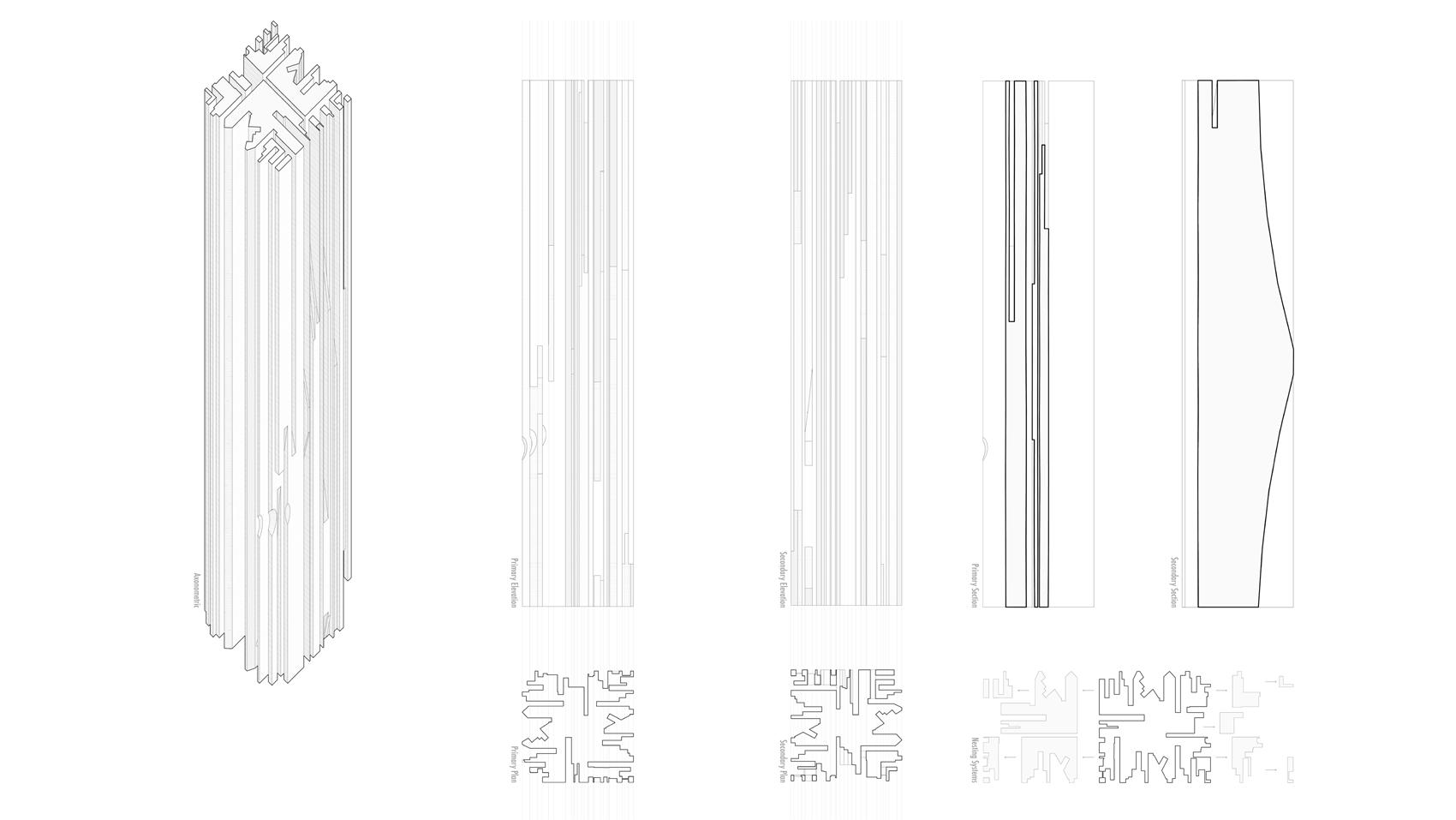
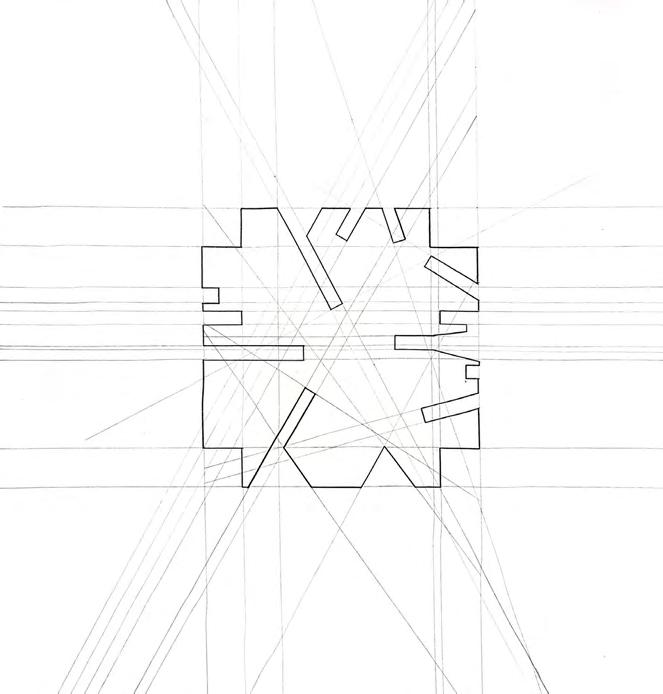
Through exploratory processes employing a table saw, wooden prototypes investigate the complexities of nested vertical forms and varied volumetric depths. Translating these explorations architecturally, the pavilion embodies the verticality and structural logic observed in basalt formations. The finalized plan abstracts the initial wooden explorations, redefining saw-induced cuts as intentional architectural gestures framing visitor viewpoints. The dispersed placement of basaltic volumes across the site transforms and integrates the architecture with its surrounding landscape, utilizing clear geometrical principles of 90-degree and 45-degree cuts.
Visitors experience dynamic spatial transitions, choosing pathways through interconnected pavilions. A central tower provides panoramic views, highlighting interactions between architectural and natural contexts, while intermediate pavilion spaces offer diverse vantage points that emphasize depth, height, and structural rhythm.