LIVING WITH TRIBAL ART
WINTER
2026
I have always been interested in how tribal art lives once it leaves the gallery.
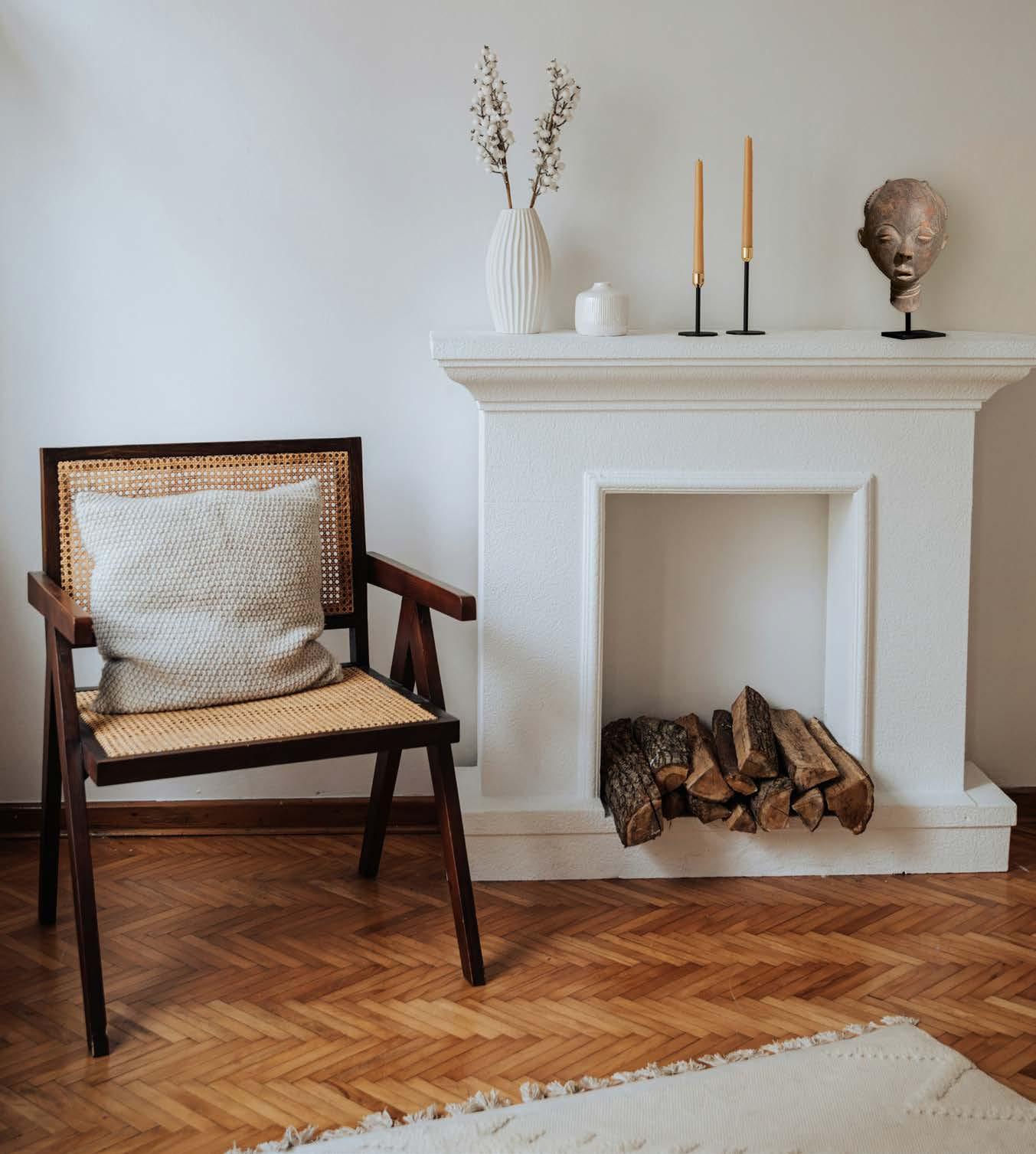
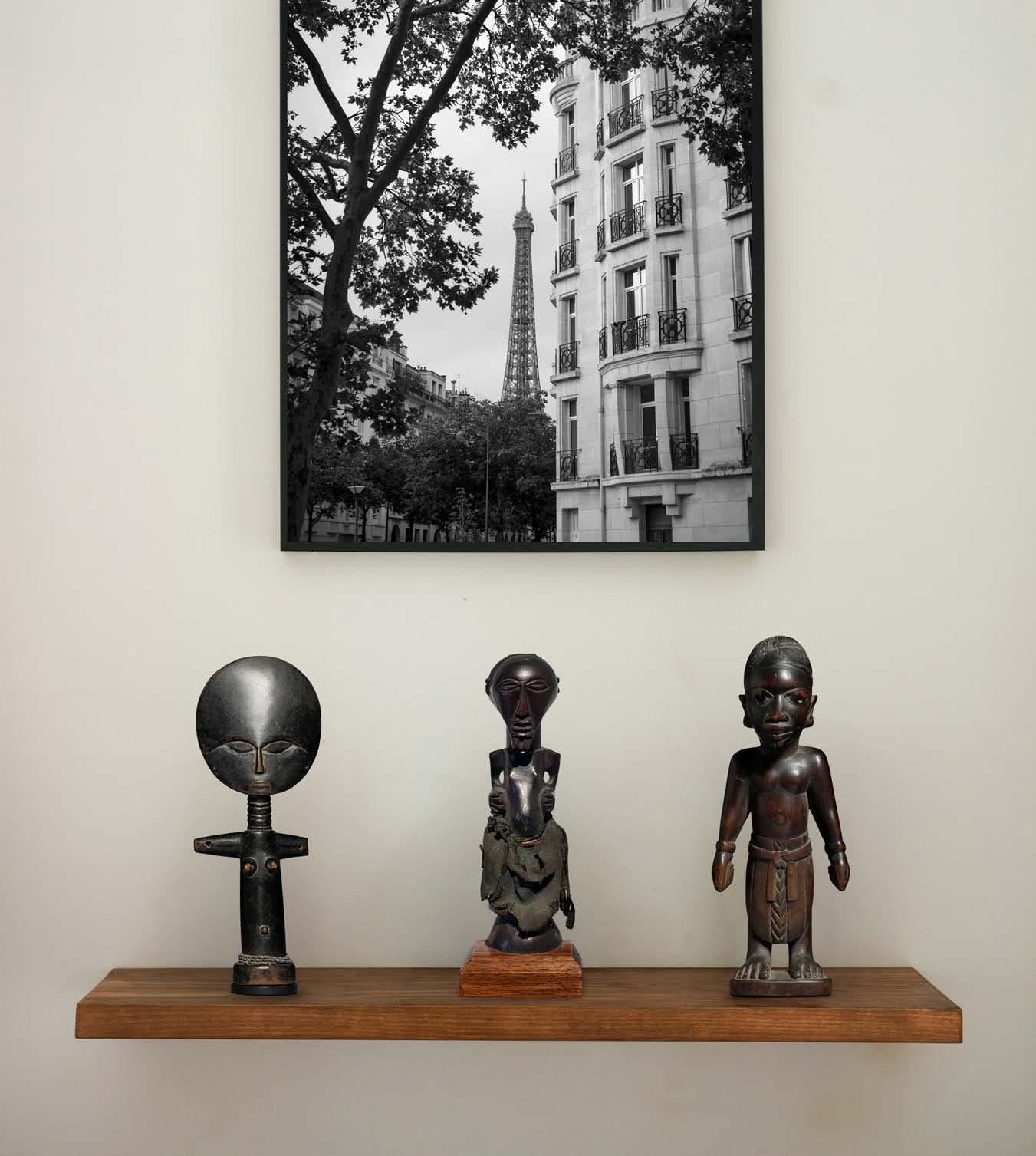
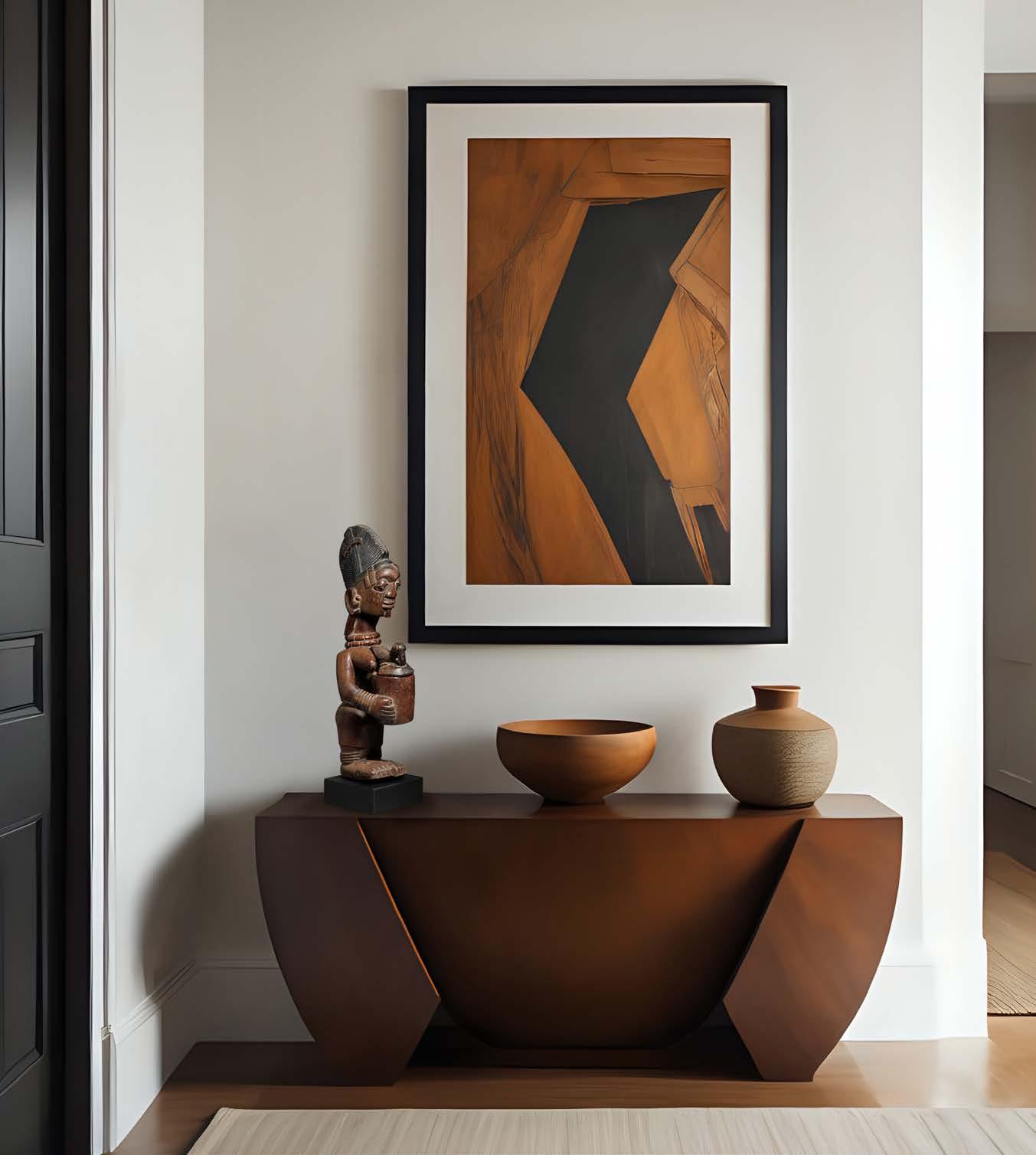
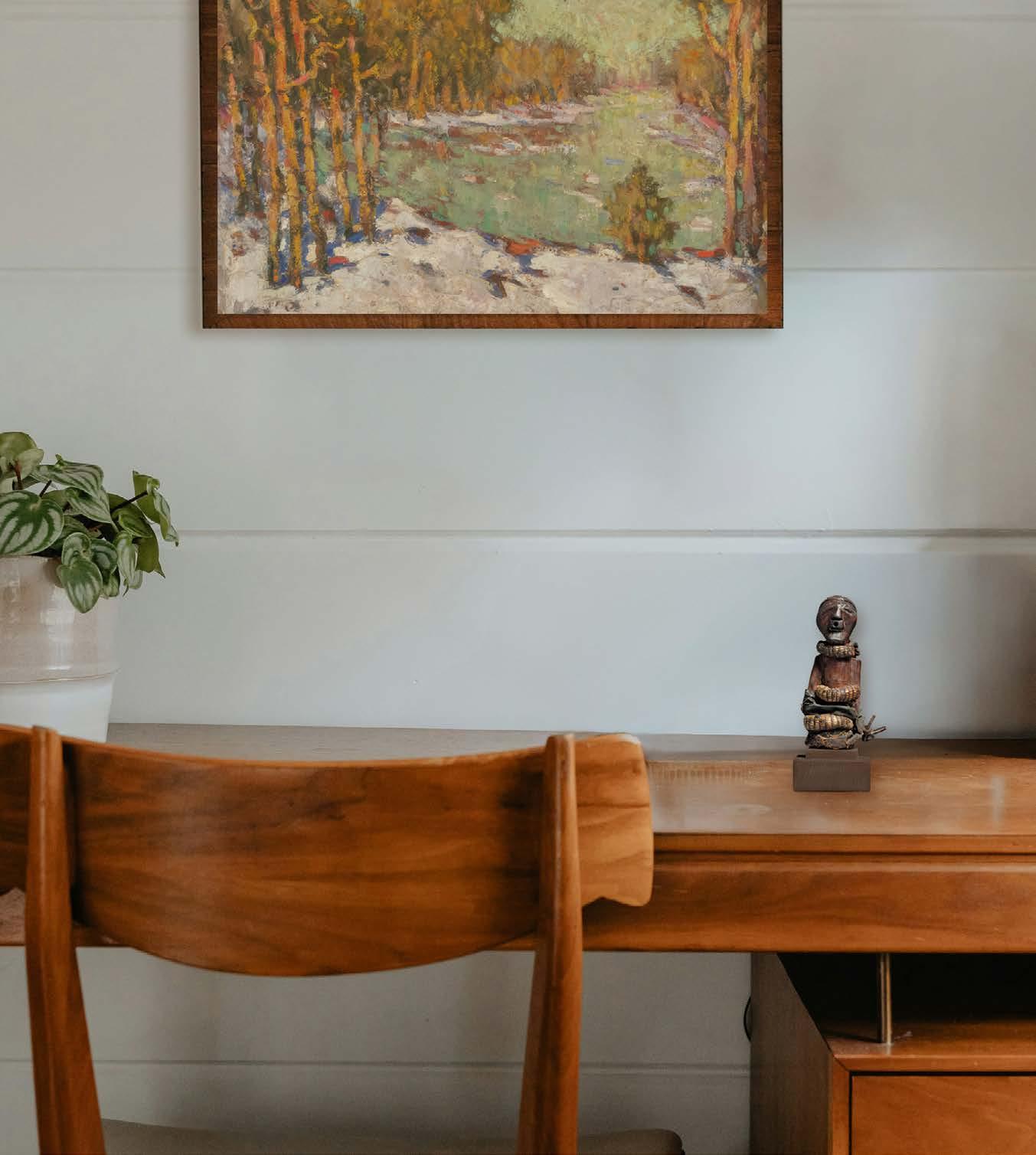
These works seem to adapt effortlessly to their surroundings. In modern interiors especially, a single object can quietly become the soul of a room. Its presence grounds the space, giving it depth and gravity without overpowering it. In more traditional or layered settings, the same work takes on a different role, entering into conversation with furniture, textiles, and light. What remains constant is its authority. These objects do not ask for attention; they hold it.
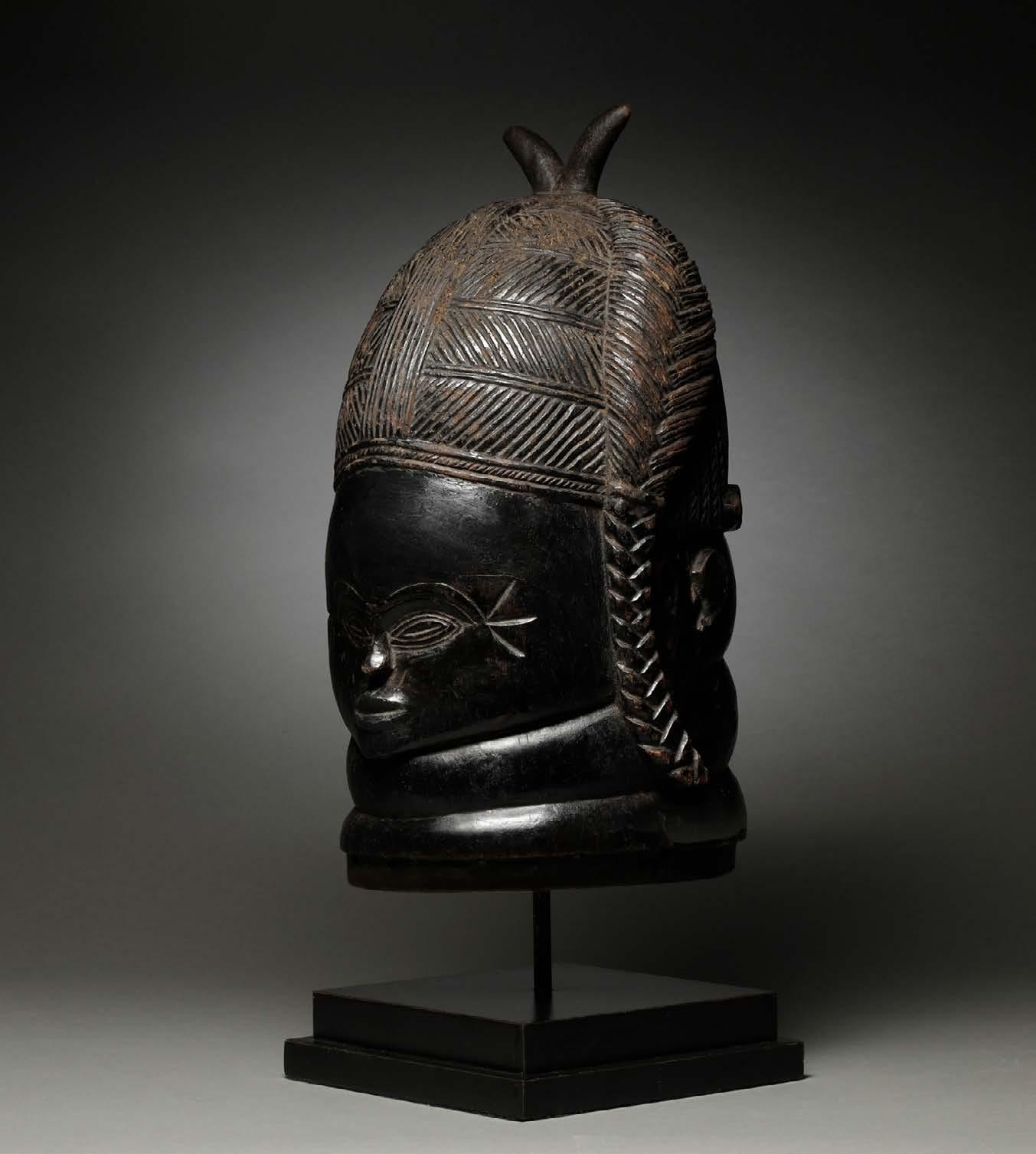
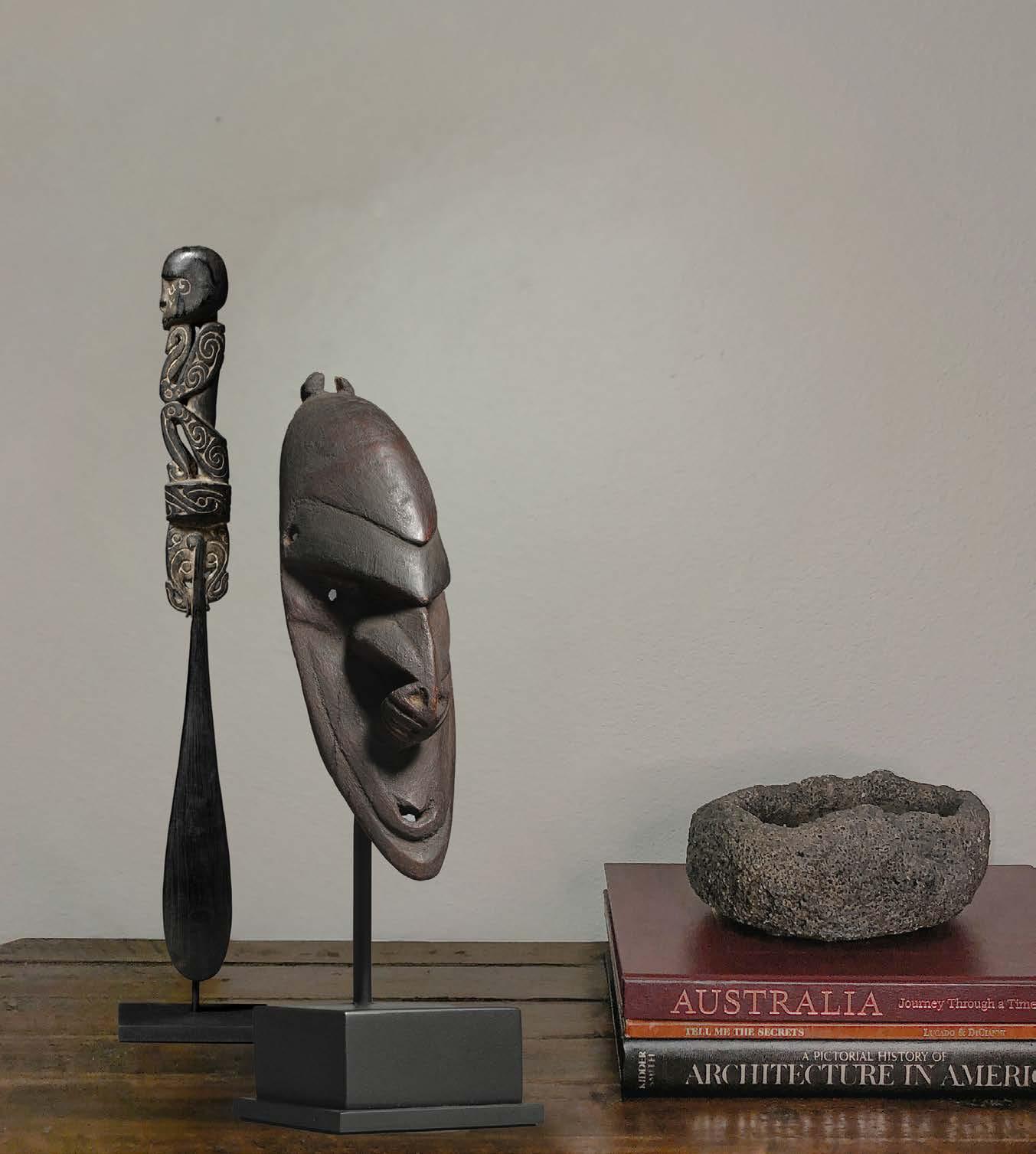
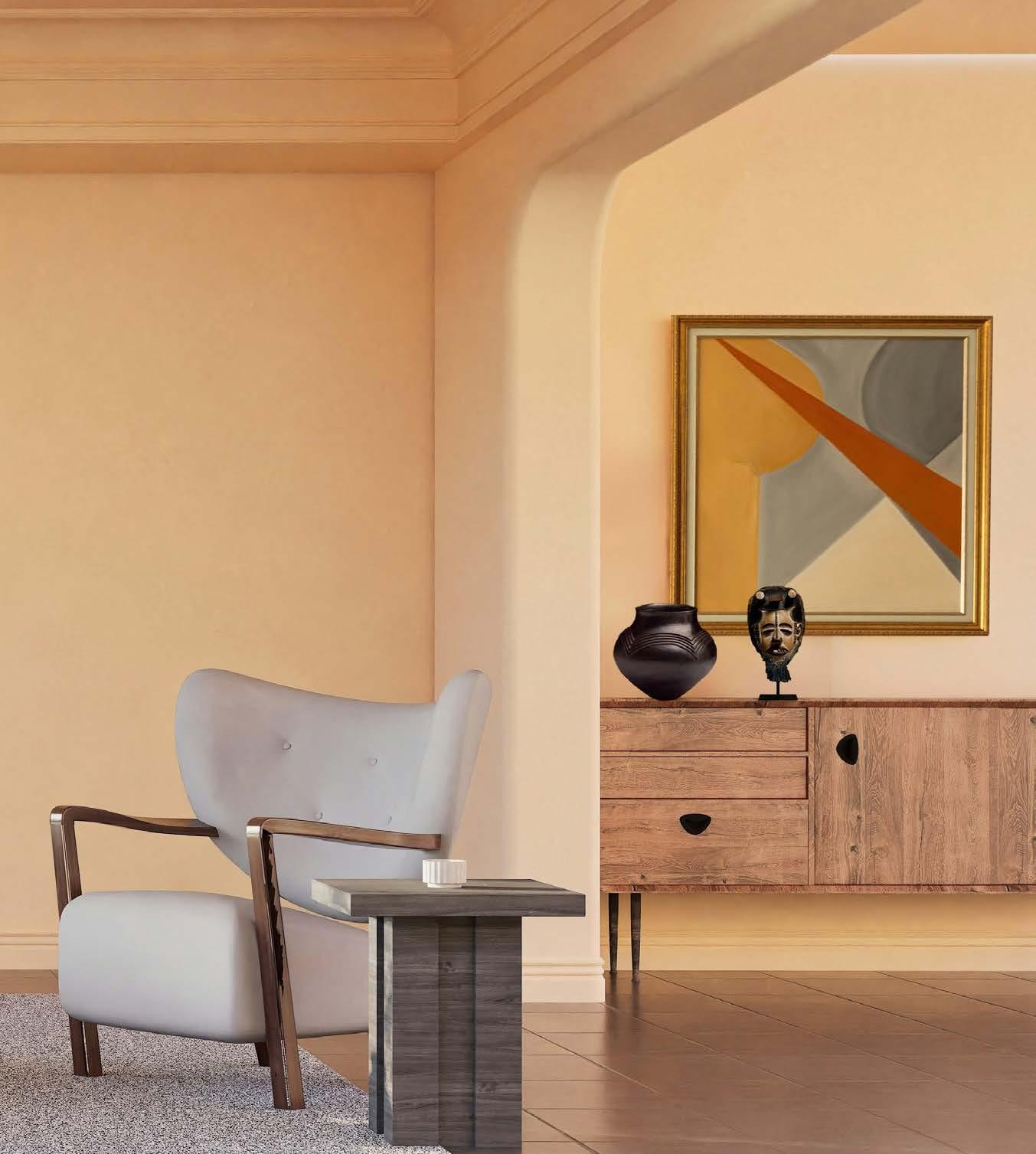
Placed within an interior setting, a Mende sowei mask holds the space with remarkable calm. The compact face, compressed neck rings, and meticulously incised coiffure create a sense of inward concentration. The finely contoured eyes introduce a quiet expressiveness, felt more than seen. Though made for movement and ceremony, the mask remains fully alive in stillness. (catalog no 1)
Perhaps this is because these works were never intended to be art in the way we now define it. They were created to serve specific functions—ritual, spiritual, social—and they were made with great seriousness of purpose. The care, discipline, and mastery involved in their creation are unmistakable. What we admire today as elegance, balance, or abstraction was once inseparable from use and belief. That history is not something to romanticize, but it is something we continue to feel.
Living with tribal art is therefore a particular kind of privilege. I often think of myself—and of my clients—as temporary caregivers. These works have lived many lives before coming to us, and they will live many more after.
They pass through collections, homes, and institutions, accumulating not only patina, but experience. To live with them is not to fix them in time, but to participate briefly in their long trajectory.
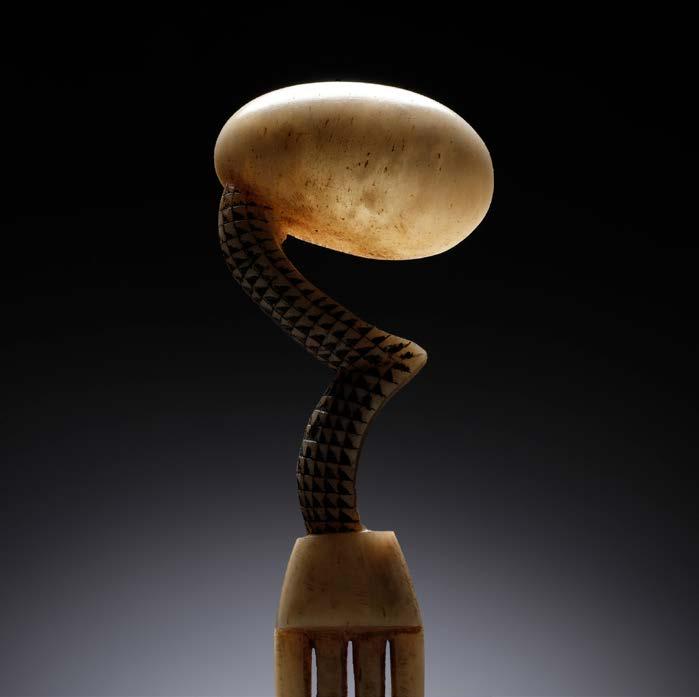
A Zulu snuff spoon reveals how presence can reside in even the most intimate of objects. Designed to be carried, handled, and worn, it brings sculpture into direct contact with the body. Its refined balance of delicacy and tension gives it a quiet authority that unfolds only with closeness. (catalog no 9)
I am continually struck by how these objects reveal themselves slowly. They change with the light, with proximity, with familiarity. The longer one lives with them, the less they feel like possessions and the more they feel like presences. They resist over-interpretation. They do not give everything at once. That resistance is part of their power.
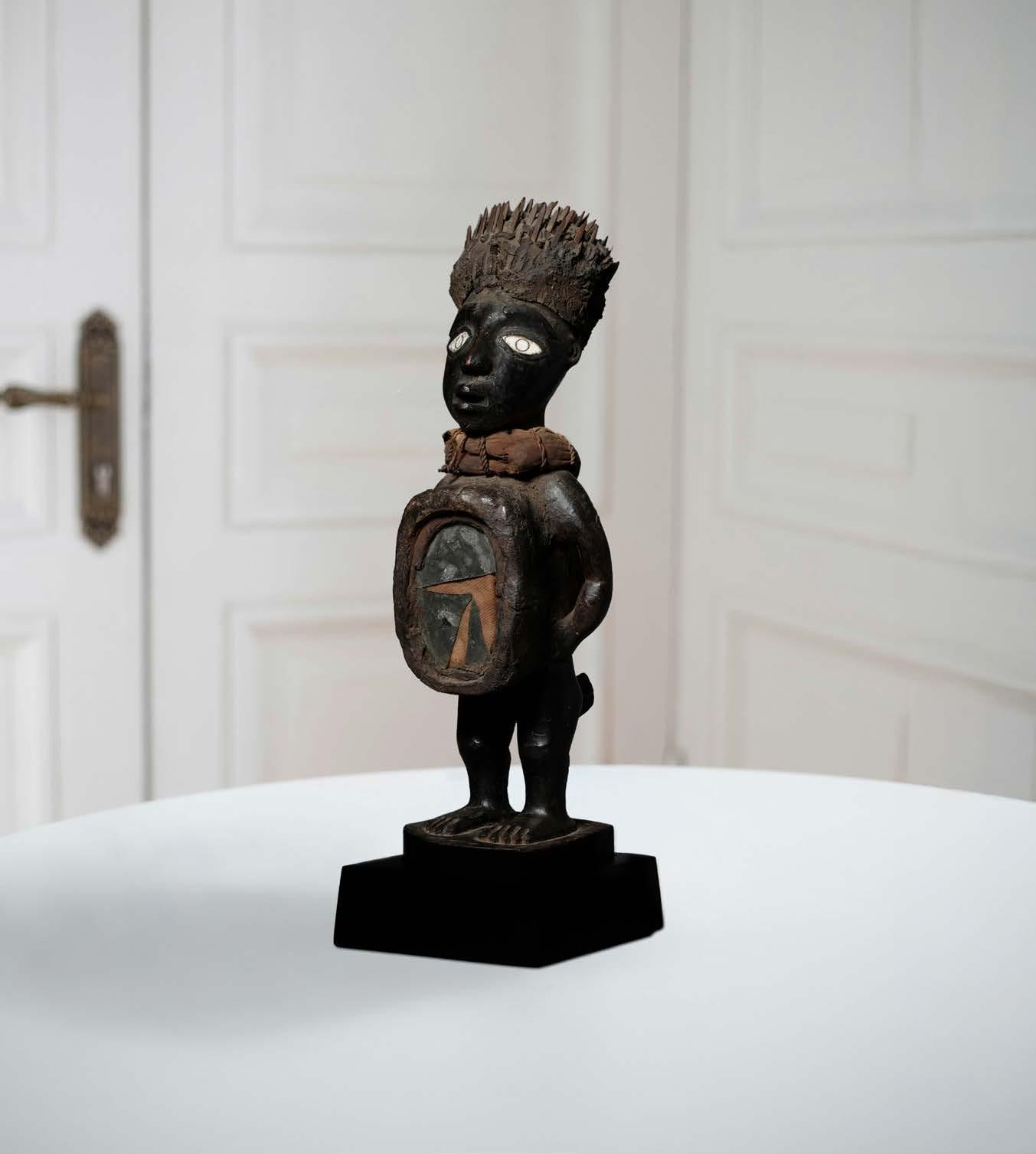
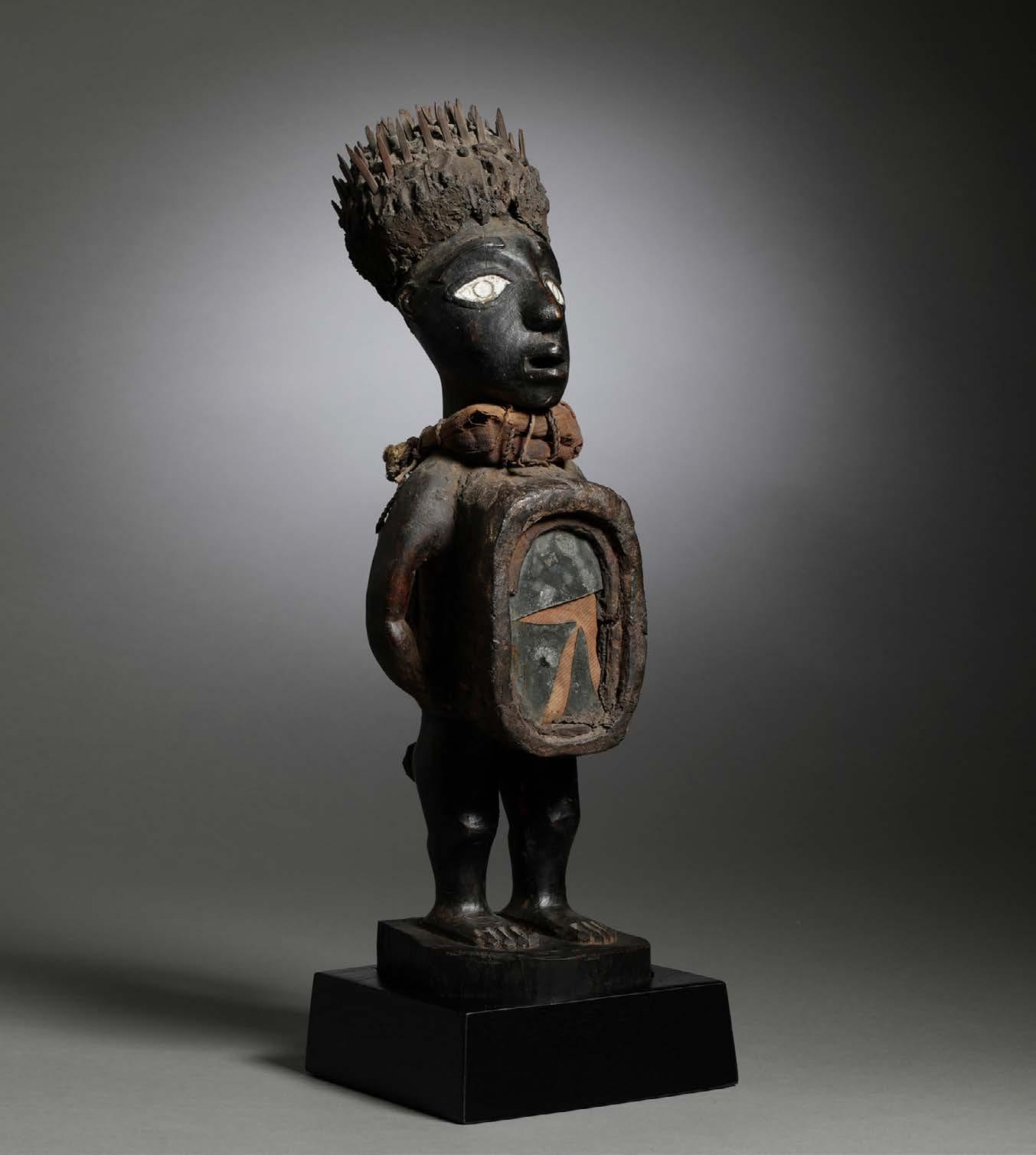
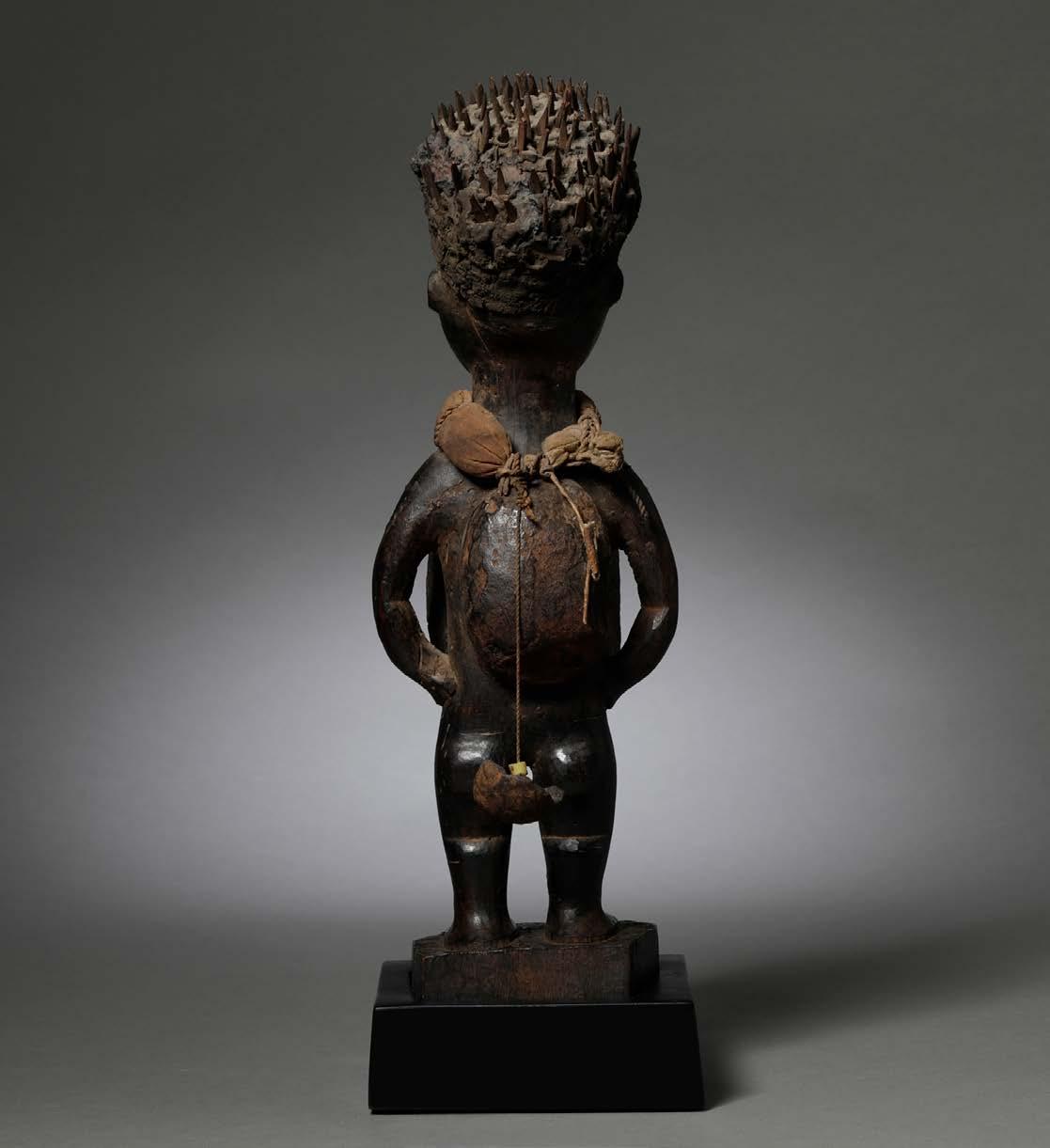
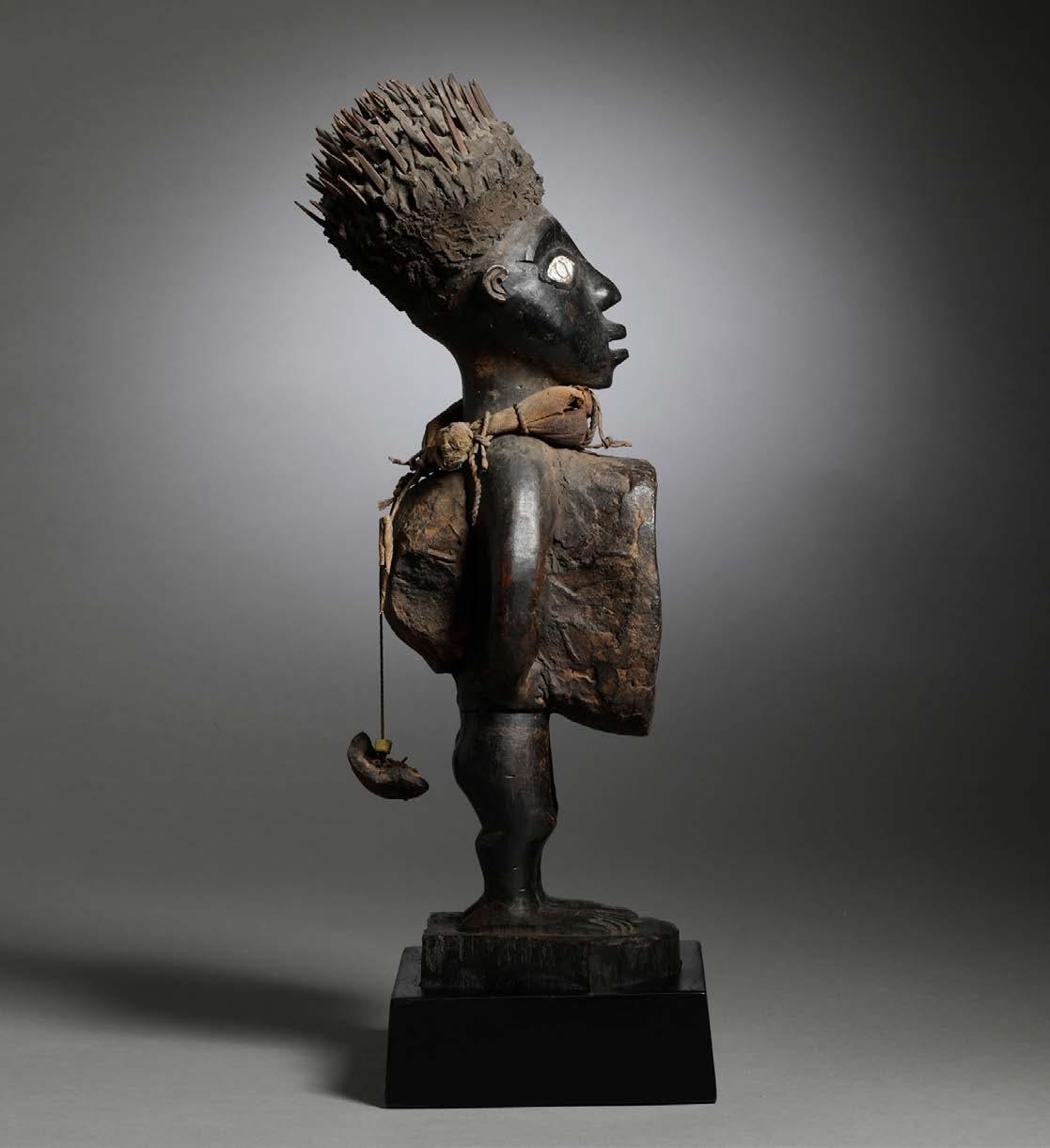
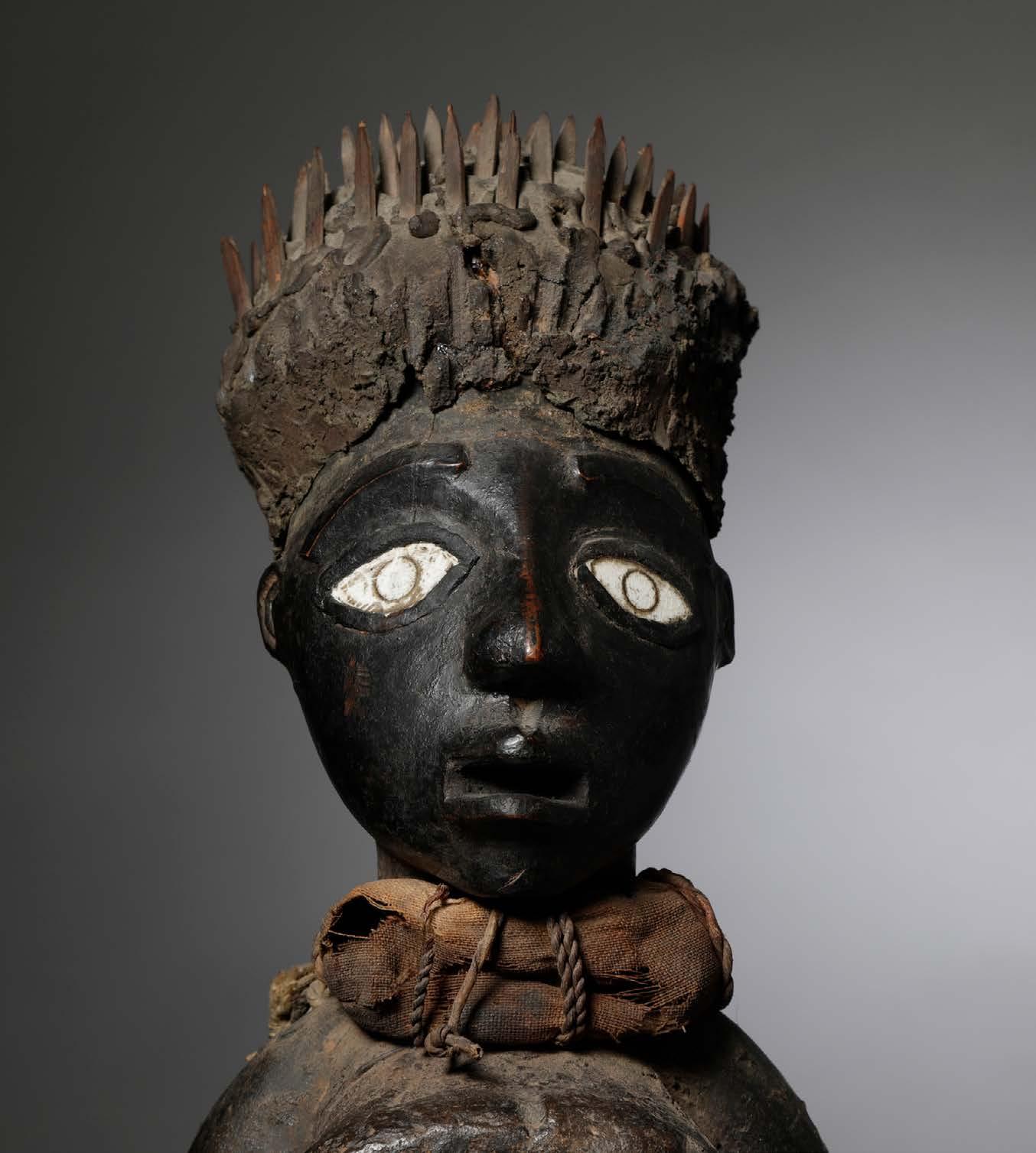
A Kongo nkisi nkondi brings an unmistakable energy to the space it inhabits. Its compact stance, charged gaze, and layered surface register less as form than as something shaped by repeated acts of use. Even removed from ritual context, the figure retains a palpable sense of activation, as if its work has merely paused. (catalog no 3)
This catalog reflects my belief that tribal art does not belong at a distance—behind glass or confined to theory— but can exist fully and meaningfully in daily life. These works were made to inhabit space, to be encountered repeatedly, and to matter. When we allow them to live with us, we do not diminish their histories. We extend them.
Dori
Rootenberg new york city, february 2026
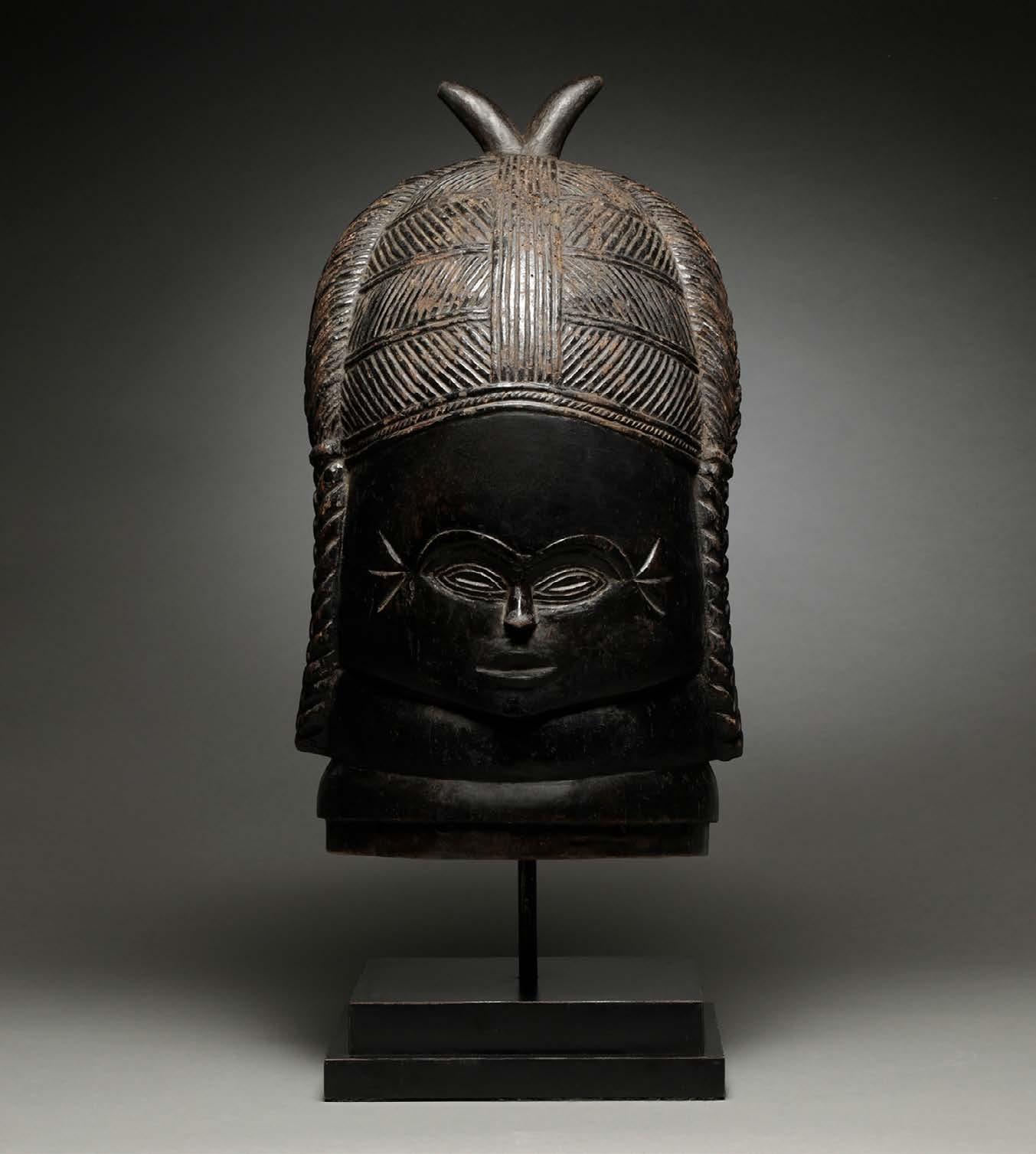
HELMET MASK OF A WOMAN BY THE MASTER OF THE RAINBOW EYES SOWEI
MENDE, SIERRA LEONE
First half 20th century
Wood
Height: 15 in, 38 cm
PROVENANCE
Charles D. Miller, III, St. James, New York, USA, collected in the 1970s
Mende society is governed by a number of esoteric associations, foremost among which are the Sande women’s society and Poro men’s society. Both prepare young initiates for adulthood and make extensive use of masquerade. The helmet mask presented here, known as sowei, represents a Sande guardian spirit. It is utilized by a dance expert (ndoli jowei, a term sometimes used to refer to the mask itself) and appears at a host of Sande rites, as well as birth and funeral ceremonies. From generation to generation, these masks served to induct the new women of the tribe into the next chapter of their lives, revealing and passing on the knowledge of their ancestors.
This stately sowei shows a classic composition with a small, compact face atop bunched neck rings, all overarched by a strikingly detailed and crown-like coiffure. Relative
to some other examples, here the carving of the coiffure is invested less in elaborate structure than it is in pure surface design, employing repeating bands of linear incisions that create broad, patterned panels in the round.
A pair of large, thick braids falls closely about both sides of the head, reaching down the neck in gradual curves. The line work used in the face is notable, with incised ‘wrinkles’ throughout the eyeline creating a slightly more expressive impression than is sometimes seen in sowei
A mask by this unknown Mende carver, known as the Master of the Rainbow Eyes, is in the Yale University Art Gallery collection. Frederick Lamp identified this carver as ‘The Master of the Rainbow Eyes’ because of the exquisite contour lining on closed eyelids and eyebrows that characterize his style.
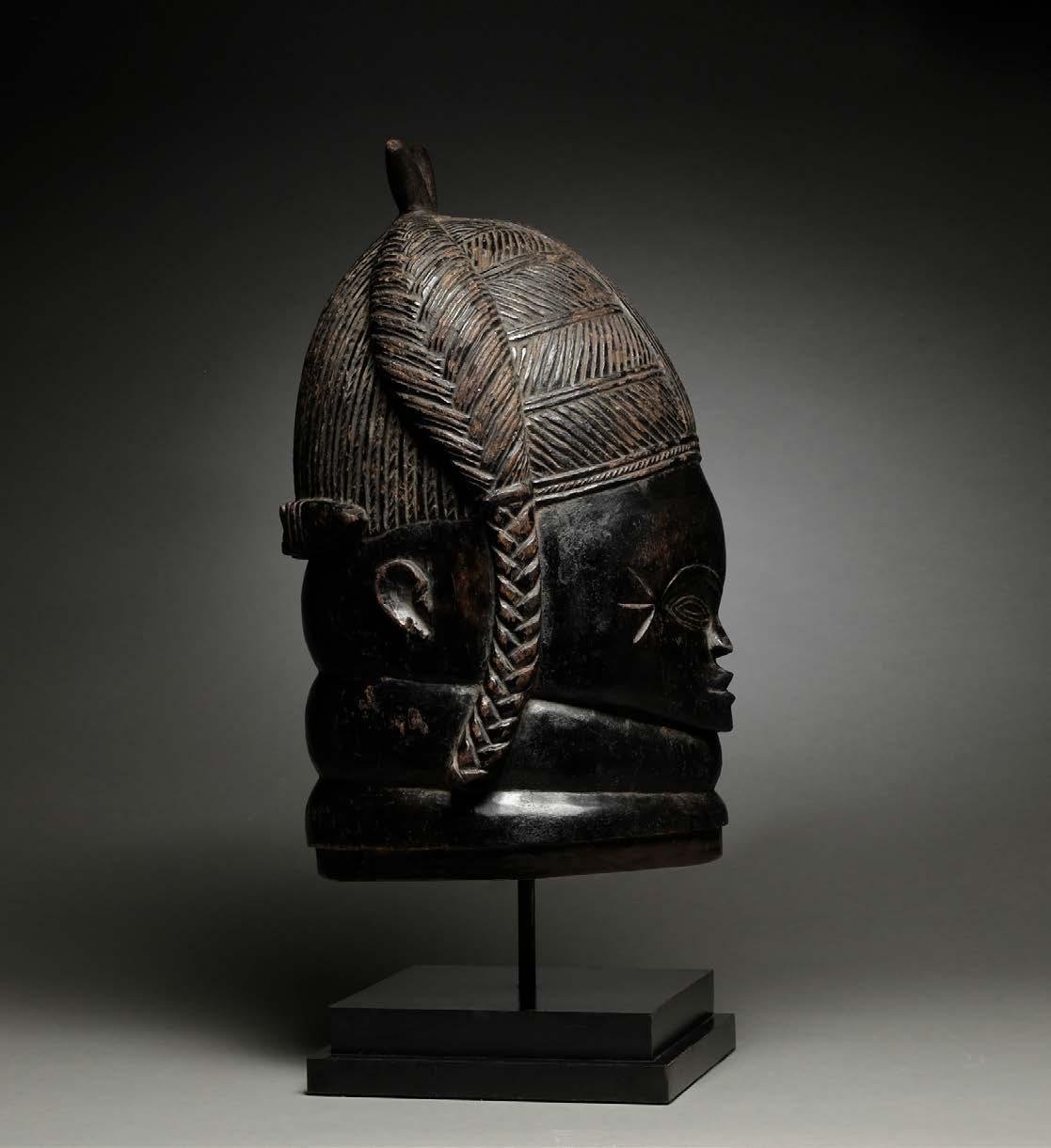
helmet mask of a woman by the master of the rainbow eyes sowei


helmet mask of a woman by the master of the rainbow eyes sowei
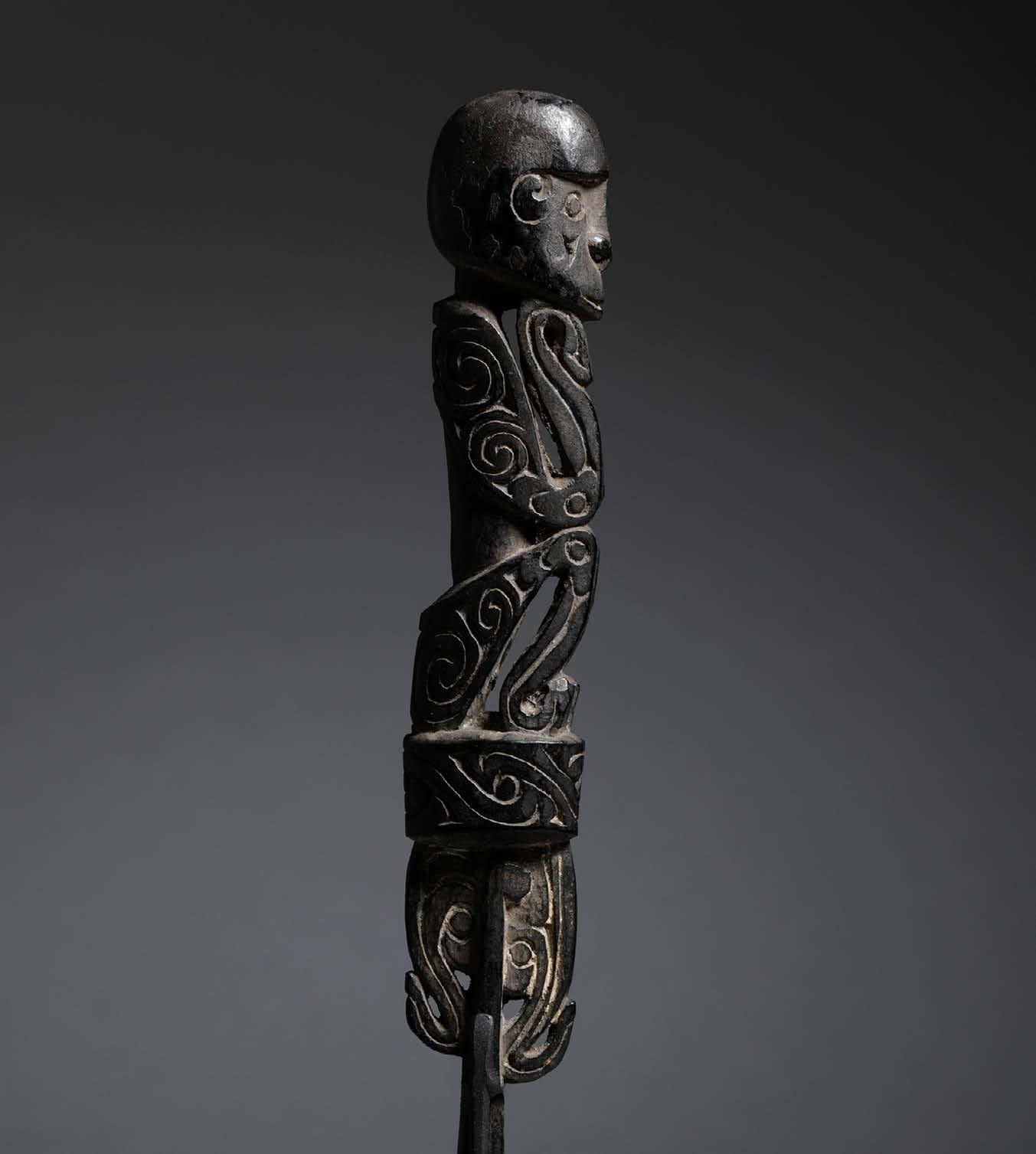
FIGURATIVE LIME SPATULA
TROBRIAND ISLANDS, PAPUA NEW GUINEA
19th century
Wood, pigments
Height: 11 ¾ in, 30 cm
PROVENANCE
Sieber family notes indicate that it was purchased in London around 1964 to 1967, probably from Ernest Ohly or Phillip Goldman.
Roy and Sophie Sieber Collection
The chewing of betel nut (Areca catechu) has been practiced across much of Asia and the Pacific for thousands of years. Wrapped in betel leaves (Piper betle) and mixed with lime, slices of the nut are chewed for the mild psychoactive and stimulating effect the mixture produces. A frequent and ubiquitous indulgence, many cultures have placed a significant degree of importance upon the chewing of betel nut, and have ascribed to it certain metaphorical and spiritual meanings. In the Solomon Islands, betel nut plays a role in gift-giving ceremonies such as betrothal and propitiatory offerings to spirits.
Melanesian artists applied a great deal of artistic energy to the production of betel nut paraphernalia, the most iconic of which is the lime spatula. This implement is used
to extract a dose of lime (made from burnt shells or coral) from a container to be added to the betel packet. The handles and finials of spatulas, which are sometimes quite large, are often carved with elaborate figural or abstract designs distinctive to the maker’s region.
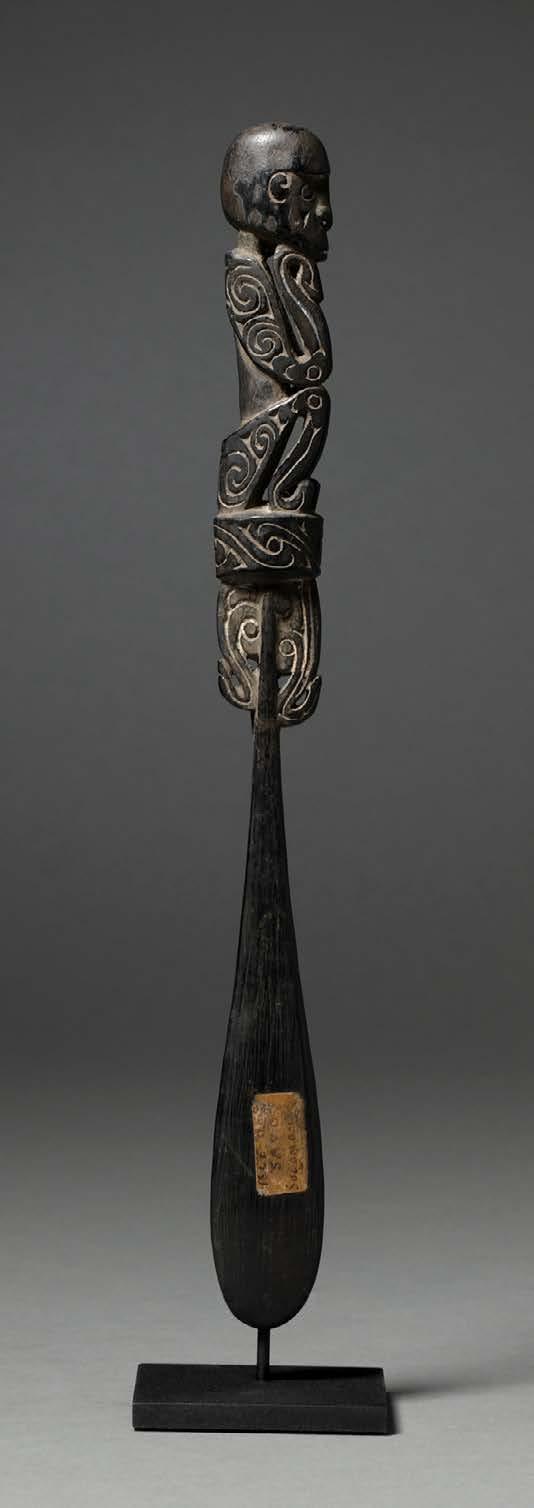
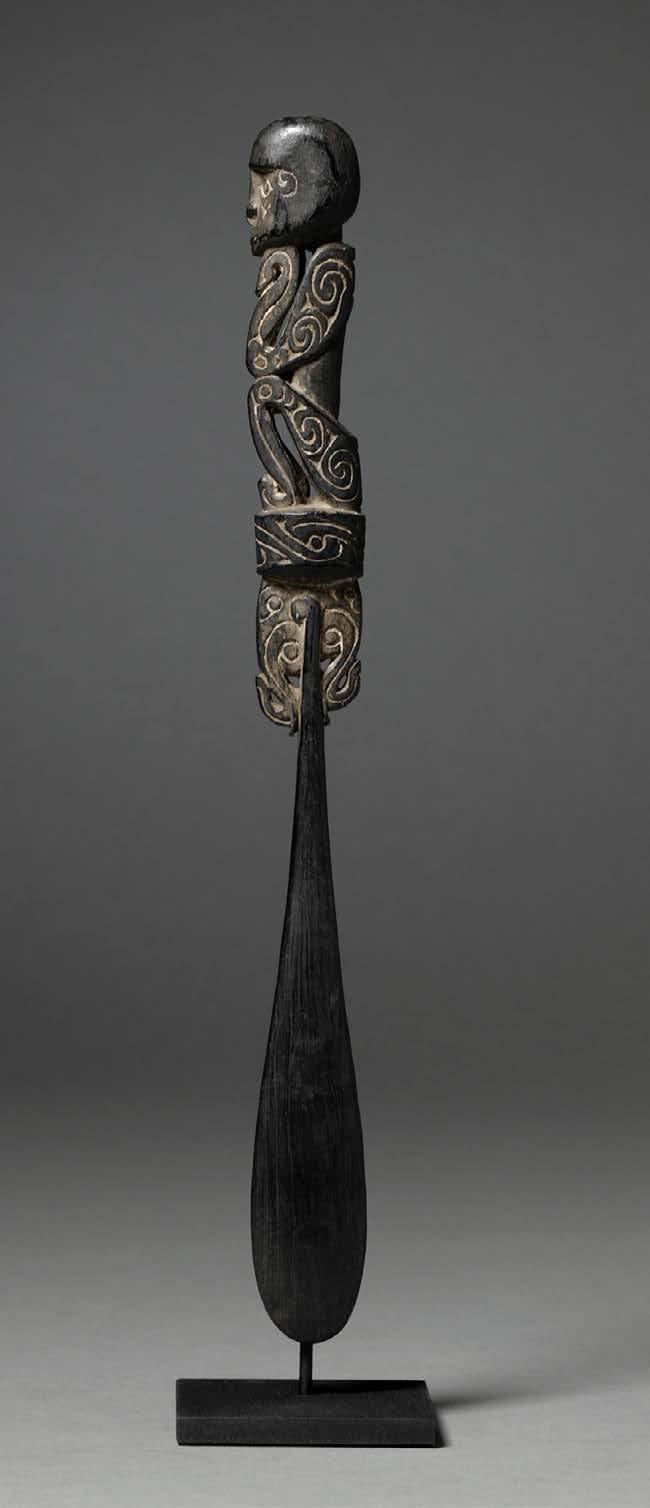
This example is from the Trobriand Islands, now known as the Kiriwina Islands. It shows an exquisitely carved handle depicting a stylized humanoid figure in crouching posture, its body adorned with incised scrolling wave motifs. The tongue of the spatula extends downward in an elongated teardrop shape, growing elegantly from a narrow, delicate junction beneath the figure out to a paddle-like fullness. Old tag, partially illegible, reads ‘Isle of Savo Solomon’.
AN IMPORTANT STANDING MALE POWER FIGURE NKISI
NKONDI
KONGO, DRC
Late 19th century
Wood, metal, glass, vegetable fiber
Height: 14 ½ in, 37 cm
PROVENANCE
Pierre Dartevelle (1940–2022), Brussels, Belgium
Michael Oliver, New York, USA
Charles Mack Collection, Boston, USA November 1988 to Philip Budrose (1920–2000) Collection, Marblehead, Massachusetts, USA
Cheryl Ann Emmons, Wenham, Massachusetts, USA
Private collection, USA
An nkisi (pl. mankishi), in the lore of west-central Africa, is an object or material substance invested with sacred energy and made available for spiritual protection. Mankishi are typically created from vessels or sculptures made of ceramic, cloth, wood, or other material. They contain spiritually potent substances referred to as ‘medicines’ – such as soil, clay, or relics from a grave – to heal and defend against spiritual maladies.
These powerful works are created with the help of an nganga – a spiritual healer, diviner, and mediator – who draws power for the nkisi from the bakisi, messengers from the spirit world. Cosmograms and symbols embodying sacred truths are inscribed on the surface or interior.
Mankishi have many interrelated functions. Healing, diagnosis, and metaphysical protection are among the foremost of these. They also channel outside spirits, effect spells of love and friendship, and repel or inflict harm upon enemies. One of the most iconic nkisi forms is the nkondi (nail figure), which contains bilongo – a ‘medicine’ substance composed of organic ingredients – in the lower belly region, sometimes covered by a mirror. Nails or similar objects are driven into the figure with each magical appeal, activating the nkondi’s powers.
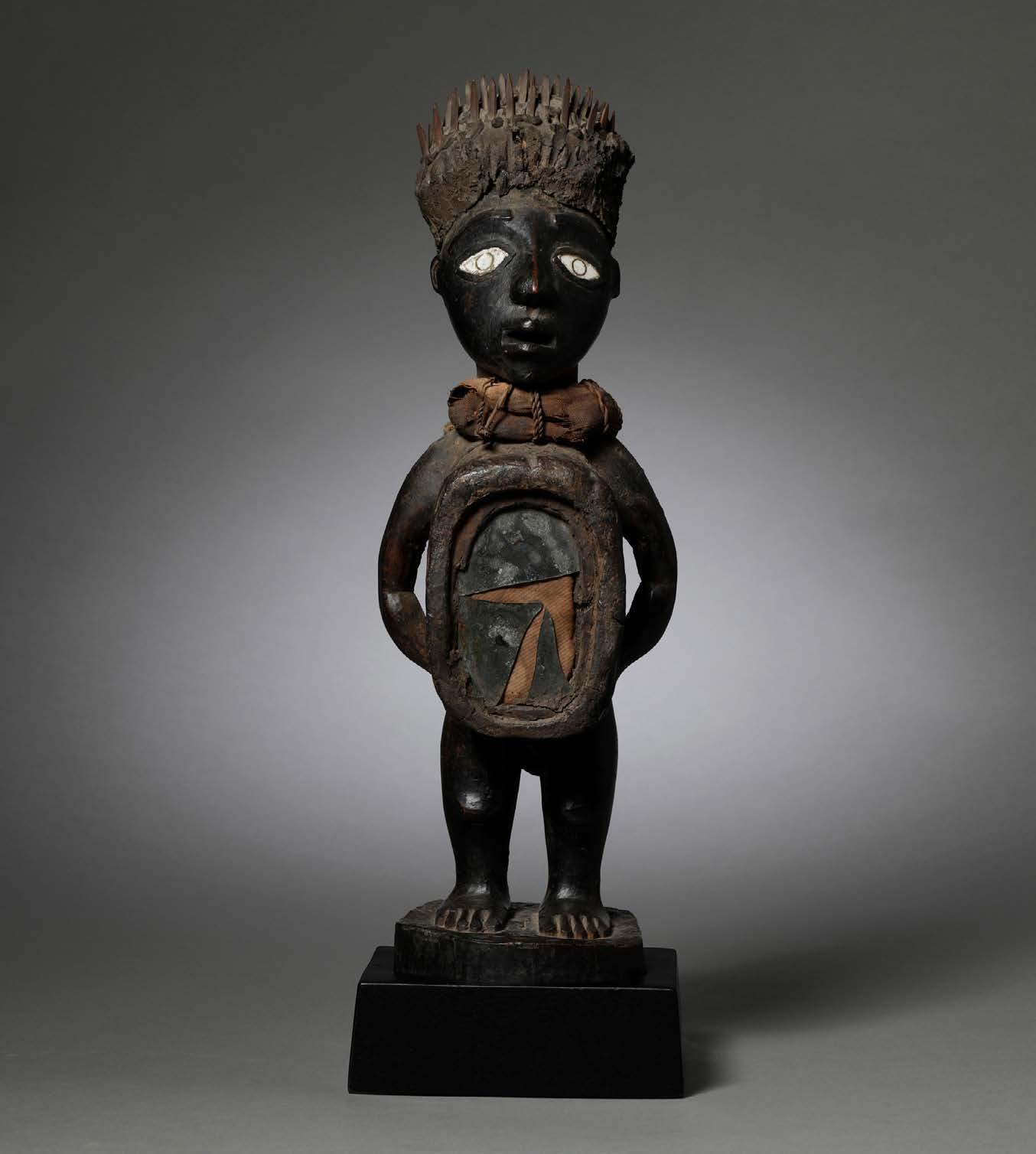
This nkondi is composed in a classic mode, with a large head, strong stance, assertive facial attitude, and an emphasized midsection. The sharp, prickly upward surge of the coiffure and the bright, wild-eyed expression contribute to an aura of vigorous and formidable energy. Around the torso is molded a large chamber for the storage of bilongo, fronted with an embedded mirror which has been damaged. Additional power bundles are wrapped around and suspended from the neck, and a rich, black patina attests to a significant history of ritual use.
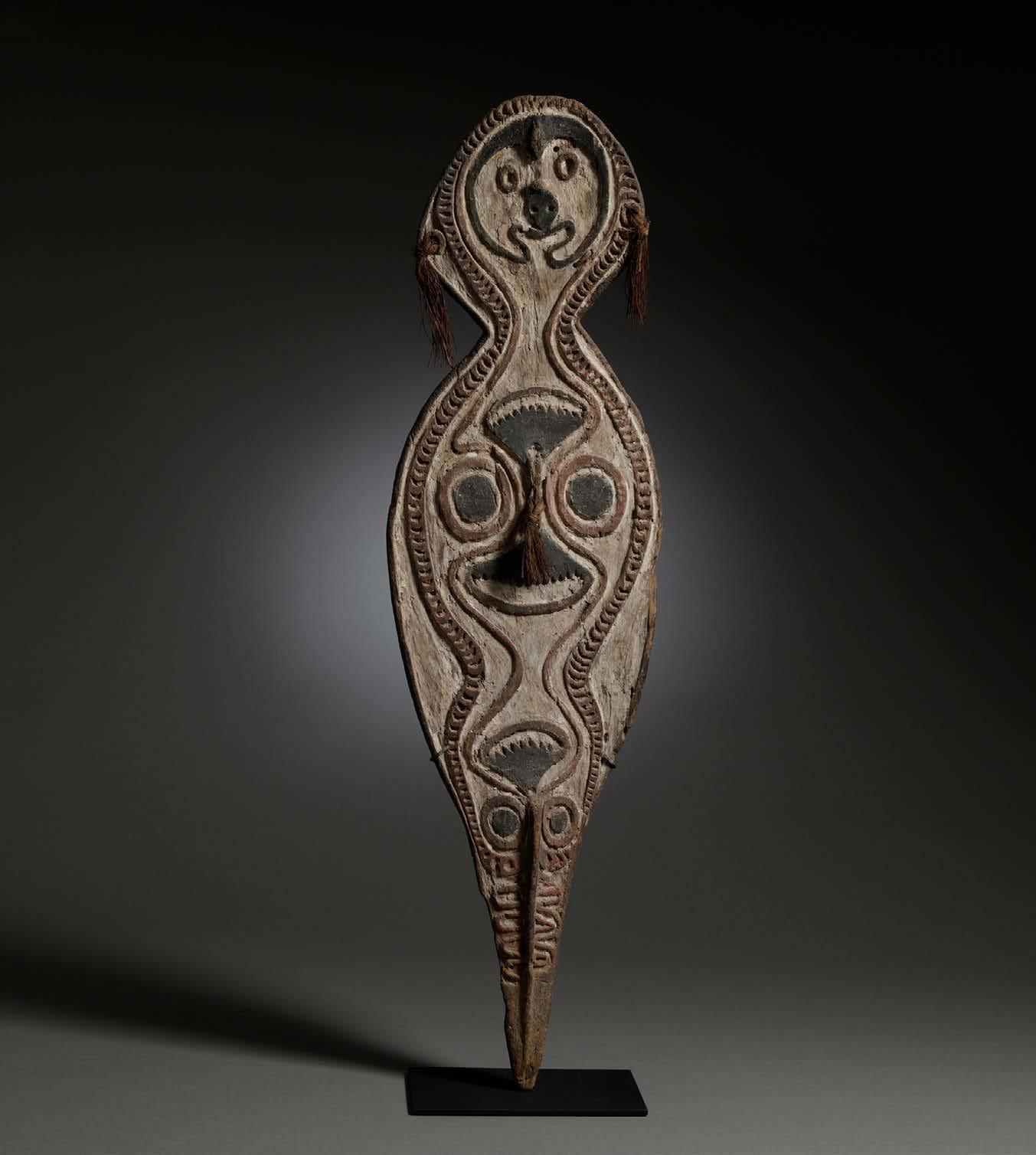
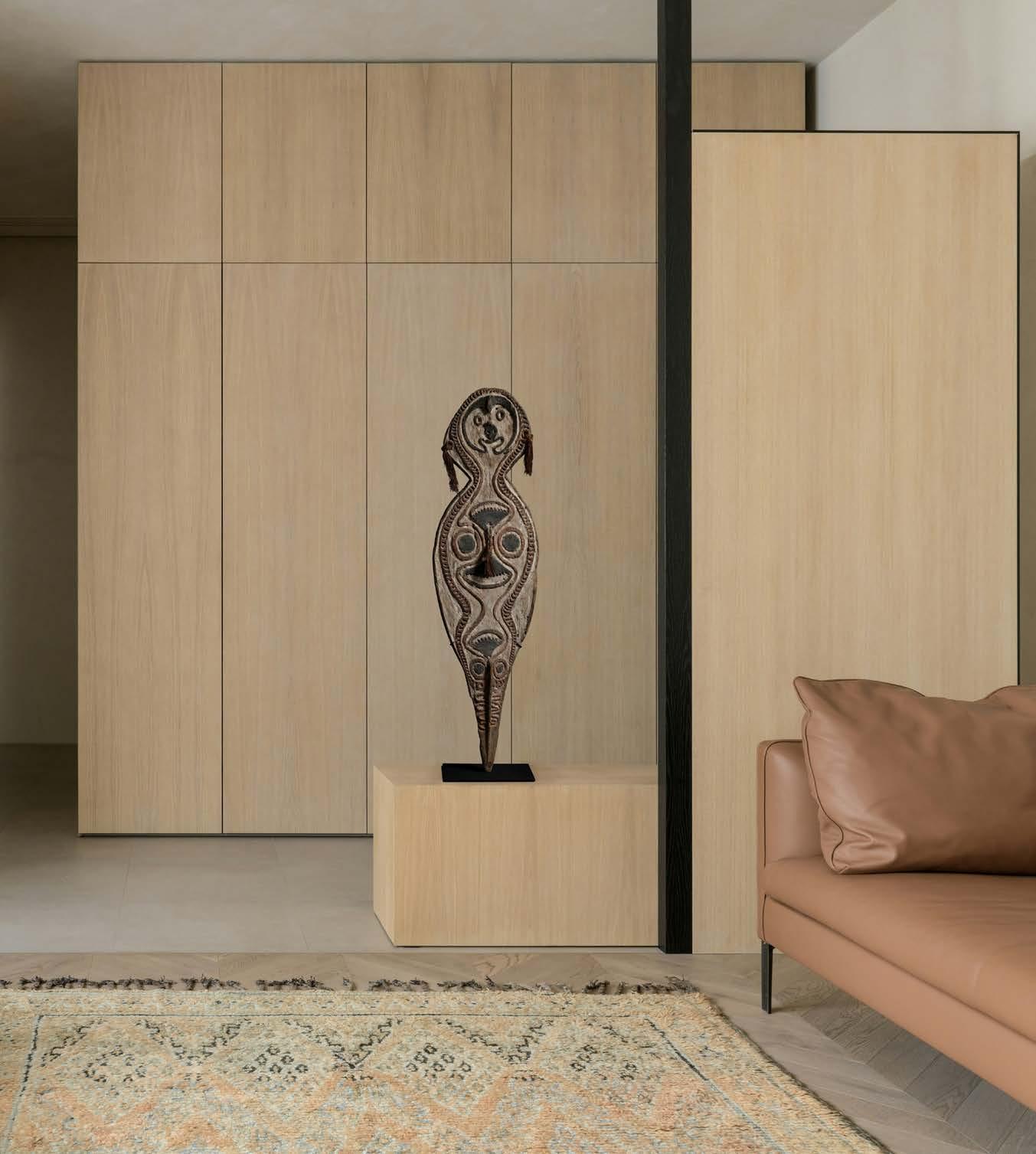
ANCESTRAL SPIRIT BOARD GOPE
PAPUAN GULF, PAPUA NEW GUINEA
Early 20th century
Wood, pigments, natural fibers
Height: 42 in, 106 cm
PROVENANCE
George Craig (1930–2024)
Roy and Sophie Sieber Collection
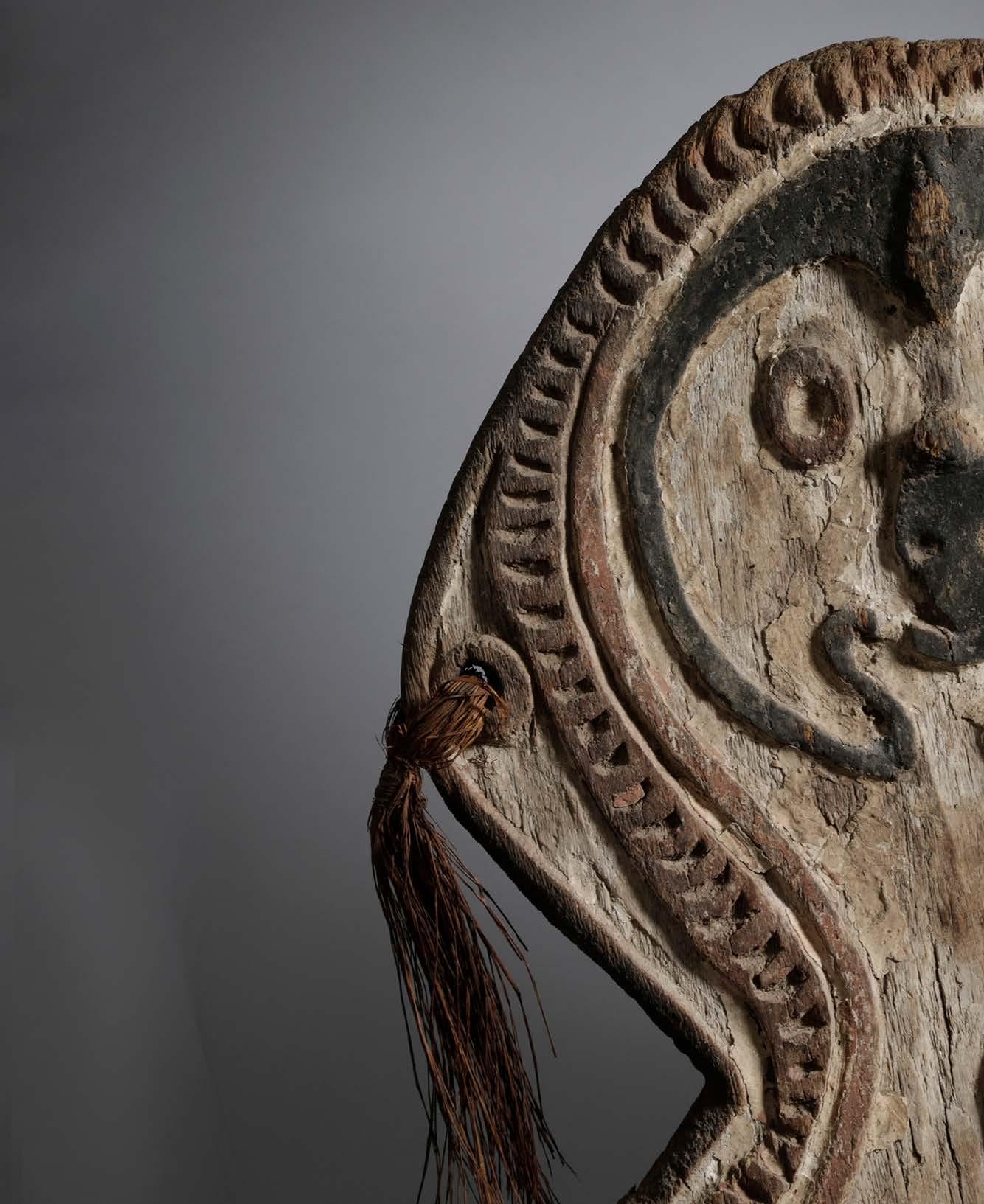
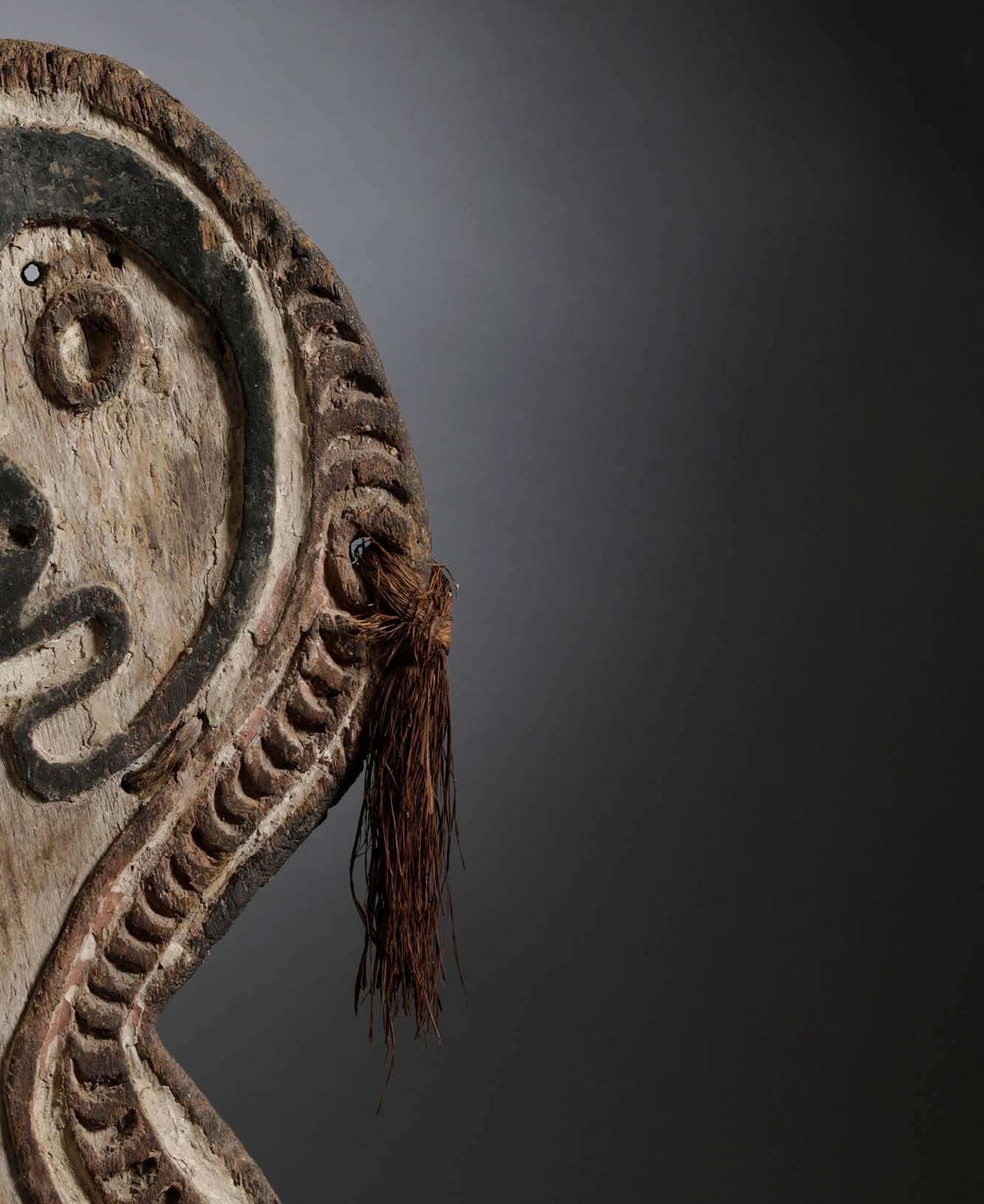
The towering men’s houses of the Papuan Gulf contained a host of sacred objects belonging to local, allied clans. Deeply connected to ancestral and nature spirits, they served to empower the men of the community in their struggles of survival against malevolent entities and neighboring tribes. One of the primary classes of these objects was the gope, or kwoi, also known as a spirit board.
Gope are oblong, vertical boards or panels, carved in relief and bearing vaguely anthropomorphic qualities that reflect their depiction of bodiless ancestral spirits. They are granted as manhood initiation objects and for acts of bravery in battle, and are often made from the remains of an enemy party’s canoe. Before a raid, the gope receive entreaties for guidance on plans of attack and for help in remotely weakening the enemy.
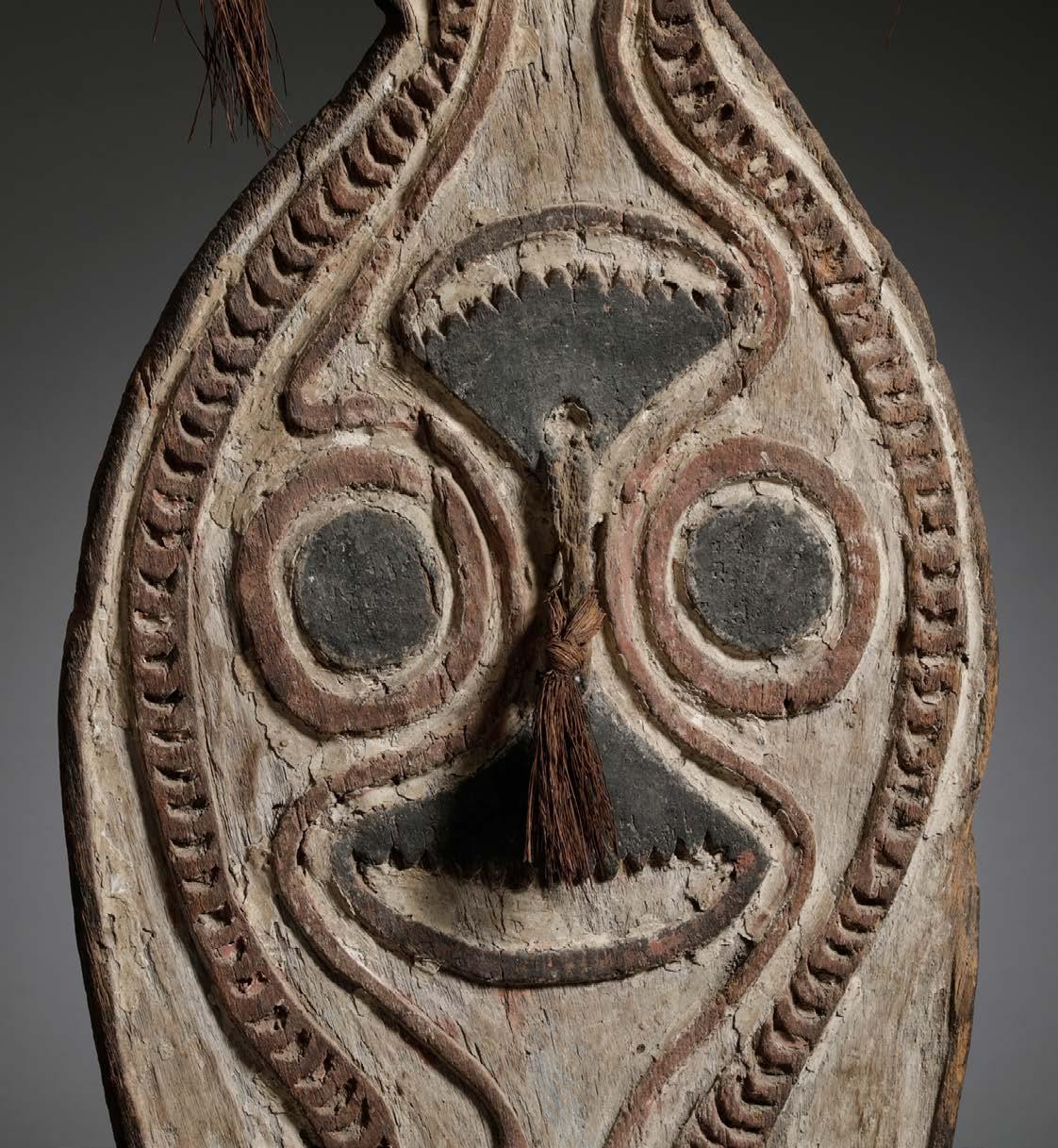
The iconography and composition on display in this example are classic: an undulating and tapered silhouette with sinuous, streaming bands that flow like reflections on dark water, separating the plane of the panel into segments while shaping the contours of faces and abstract anatomy. All details and features are carved in relief
and darkened with ochre and other pigments, standing out boldly against the ghostly white of the limed board. The presence of multiple faces – some merging into one another – conjures an impression of several conjoined consciousnesses, or perhaps a single spirit possessing many facets and potencies.
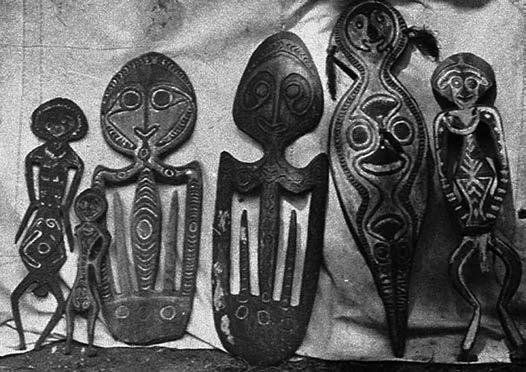
New Guinea objects photographed by Thomas Schulze-Westrum at George Craig’s residence, 1968. Note the spirit board second from right.
MALE STANDING FIGURE IGANGA
LEGA, DEMOCRATIC REPUBLIC OF CONGO
Late 19th/early 20th century
Bone
Height: 4 ½ in, 11 ½ cm
PROVENANCE
Shirley Markin Buchman (1921–2021), New York and Palm Beach and then by descent to her heirs. Buchman was a noted philanthropist. Buchman acquired most of her African collection in New York in the 1960s and 1970s, buying from JJ Klejman as well as Sotheby’s and Christies. Her father, Morris Markin, founded the Checker Motors Corporation. Checker made the iconic American taxi cab, valued by taxicab companies for its durability in heavy use.
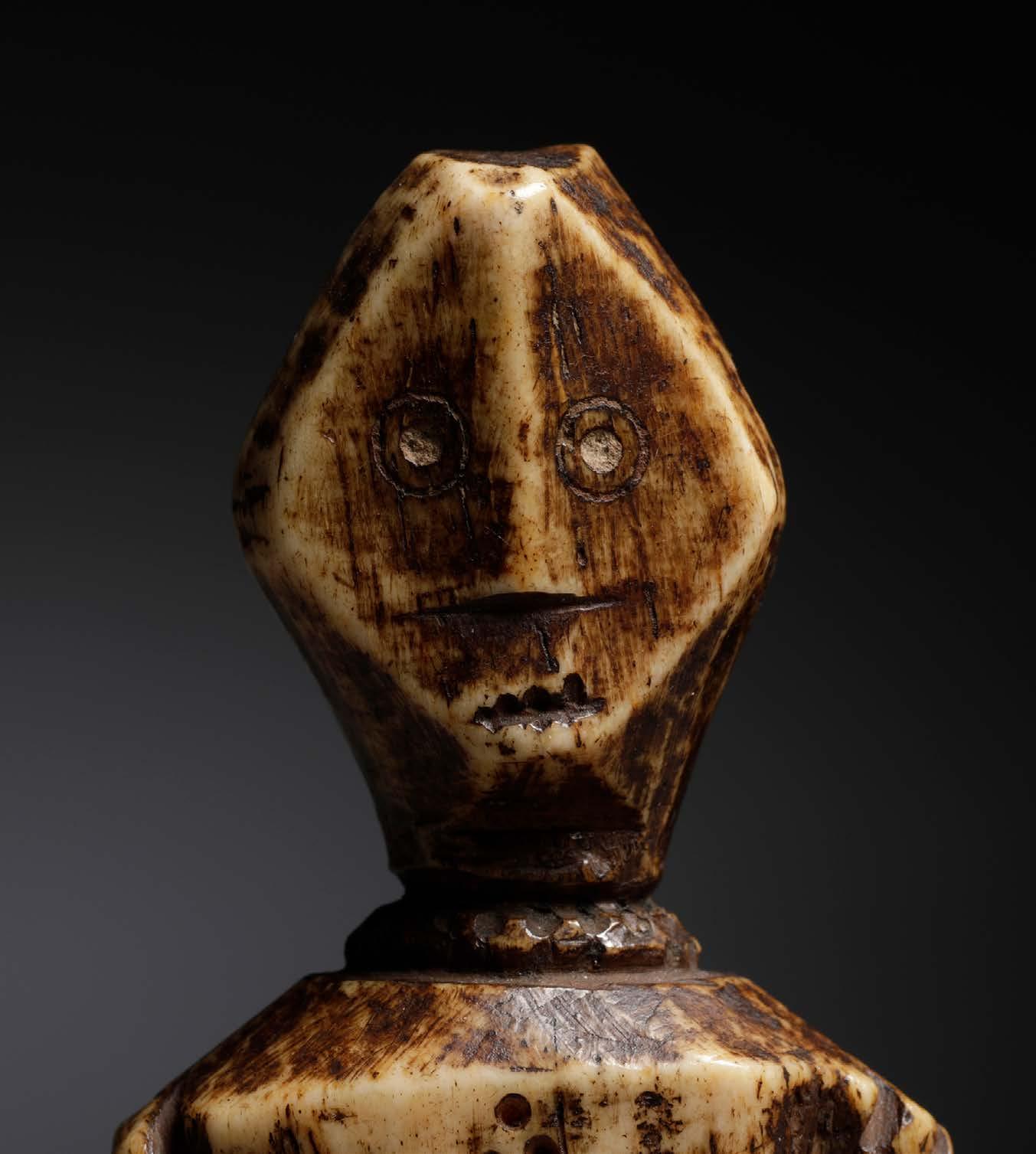
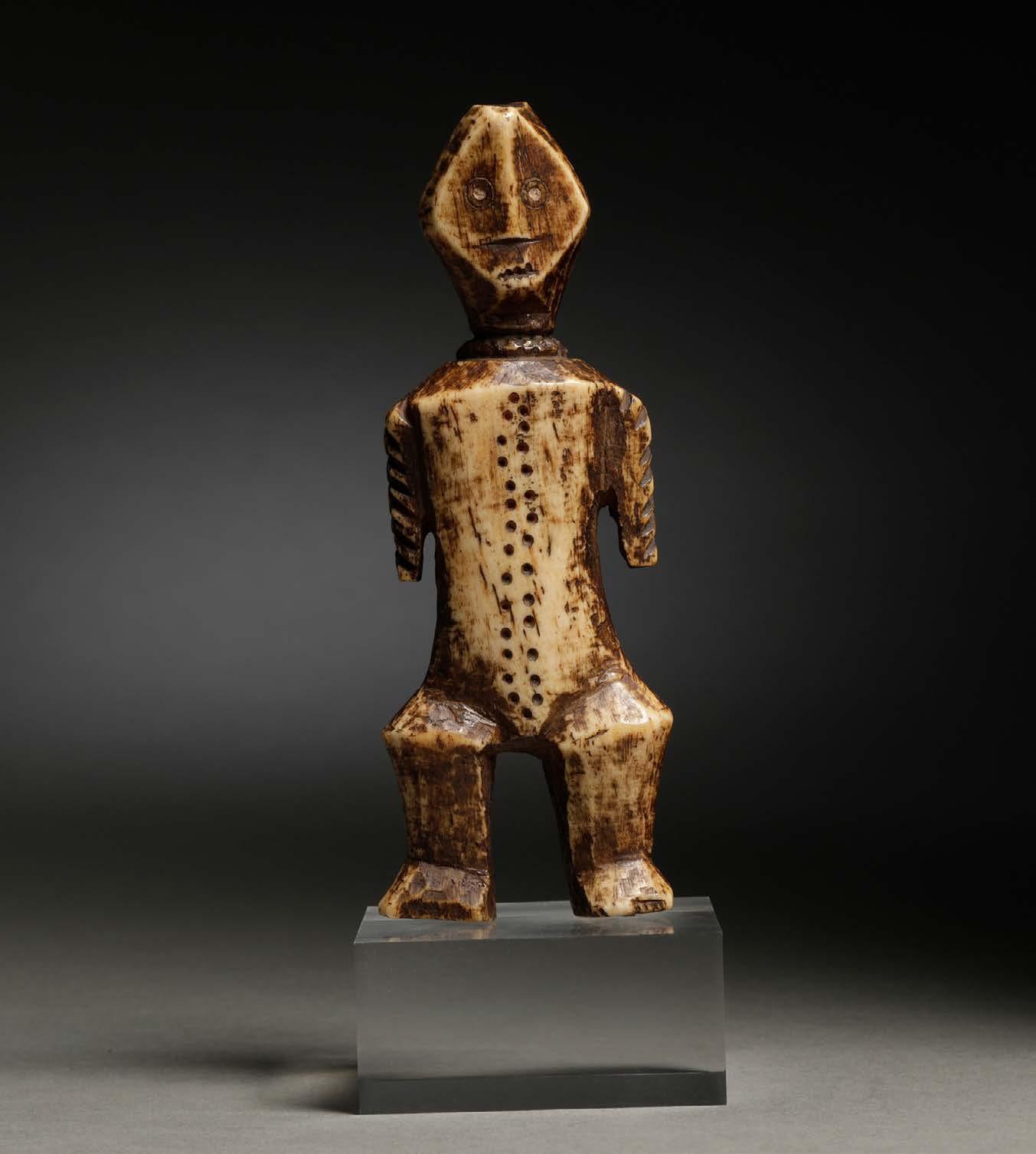
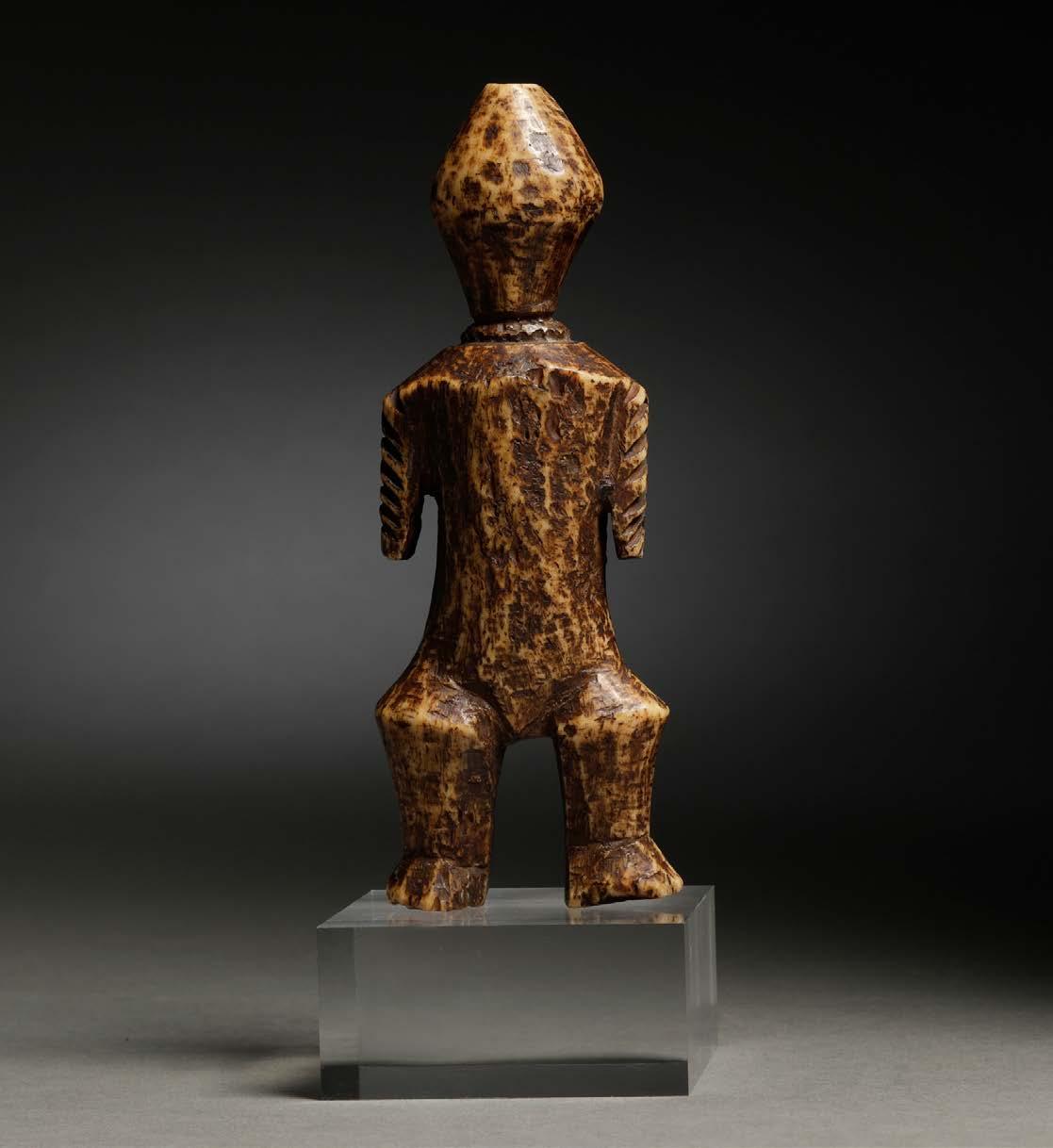
This small male figurine (iganga) is a type used within the Bwami society of the Lega in eastern D. R. Congo. Iganga figures were displayed during initiation rites and moral lessons, accompanied by songs, proverbs, and spiritual instruction. They functioned as mnemonic devices, representing ethical principles and models of both good and ill behavior, and were gradually revealed to Bwami initiates in stages.
Wood, bone, and ivory were Lega artists’ materials of choice for these distinctive statuettes. Bone figures held more prestige than their wooden counterparts, and they were typically reserved for individuals of high rank, often those who had attained the uppermost levels of the Bwami hierarchy, such as yananio or kindi. Associated with genetic
lineage and life essence, bone images carried profound layers of meaning and invited serious reflection on legacy, mortality, and generational wisdom.
Iganga are semi-abstract and are often carved with a strong geometric flavor, as seen in this fine example. Diamond shapes define the forms of both head and face, and echo in the angular ridges of the shoulder line and the flexed, powerful-looking legs. Arms are reduced to stylized bars, and the torso is a simple rectangular shape decorated down its length by a double row of dark pokered points. The effect of wear and aging on the bone surface has created a magnificently mottled and eroded patina that invites long examination and lends a ghostly aura to the figure, a subtly haunting impression that seems doubly expressed in its entranced, remote, and staring gaze.
SNUFF CONTAINER
VERNACULAR:
QHAGA LAMANYAMA,IGUZA (MPONDO)
MFENGU, AMAXHOSA, ABATHEMBU OR MPONDO, EASTERN CAPE (PREVIOUS TRANSKEI AND CISKEI REGIONS)
Mid-19th century
Animal parings (hide scrapings, clay and blood mixture)
Height: 3 ½ in; Length: 5 ½ in (8.89 cm x 13.97 cm)
PROVENANCE
Private European Collection
Agnès Woliner, Galerie Aethiopia, Paris, 2003
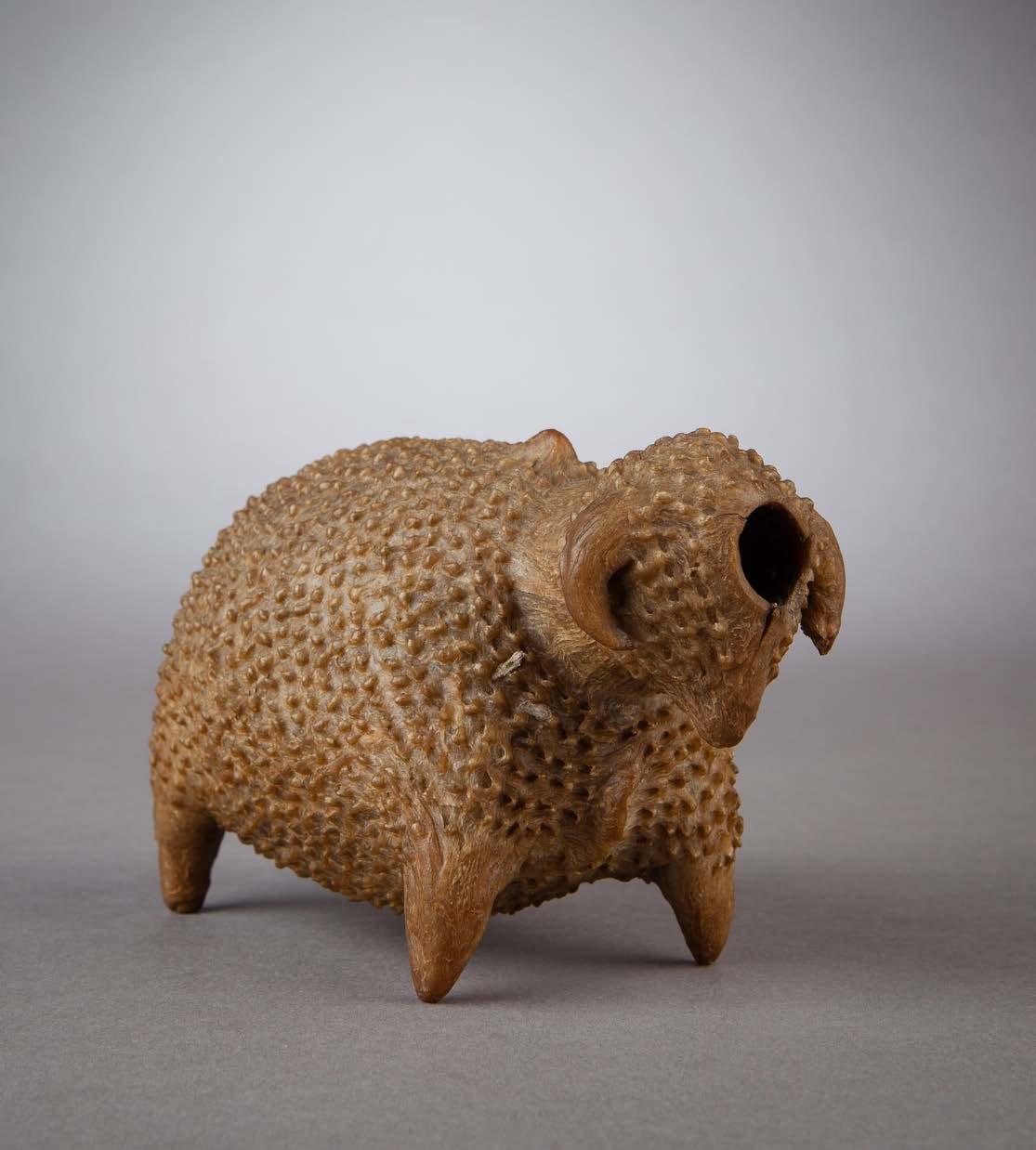
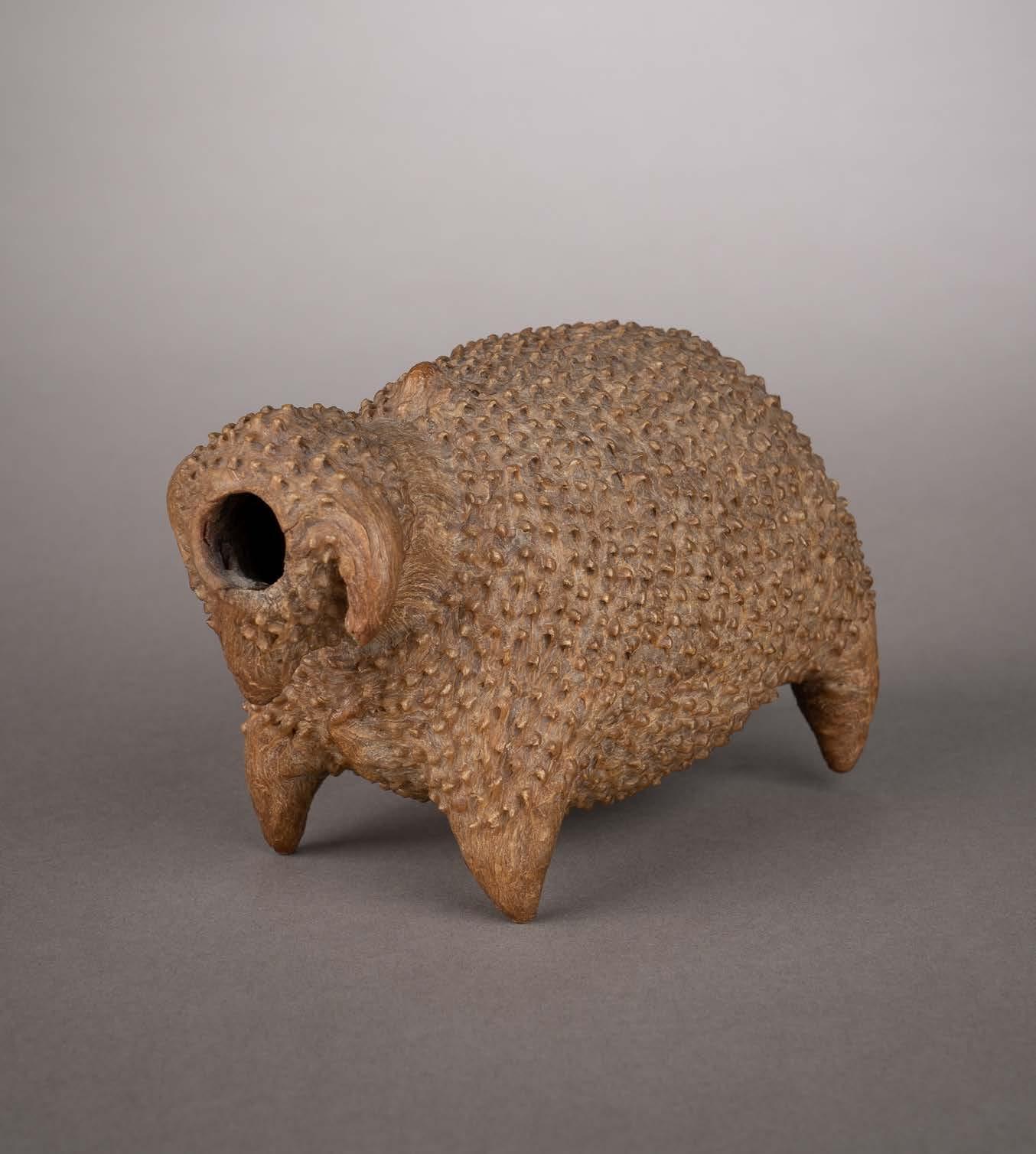
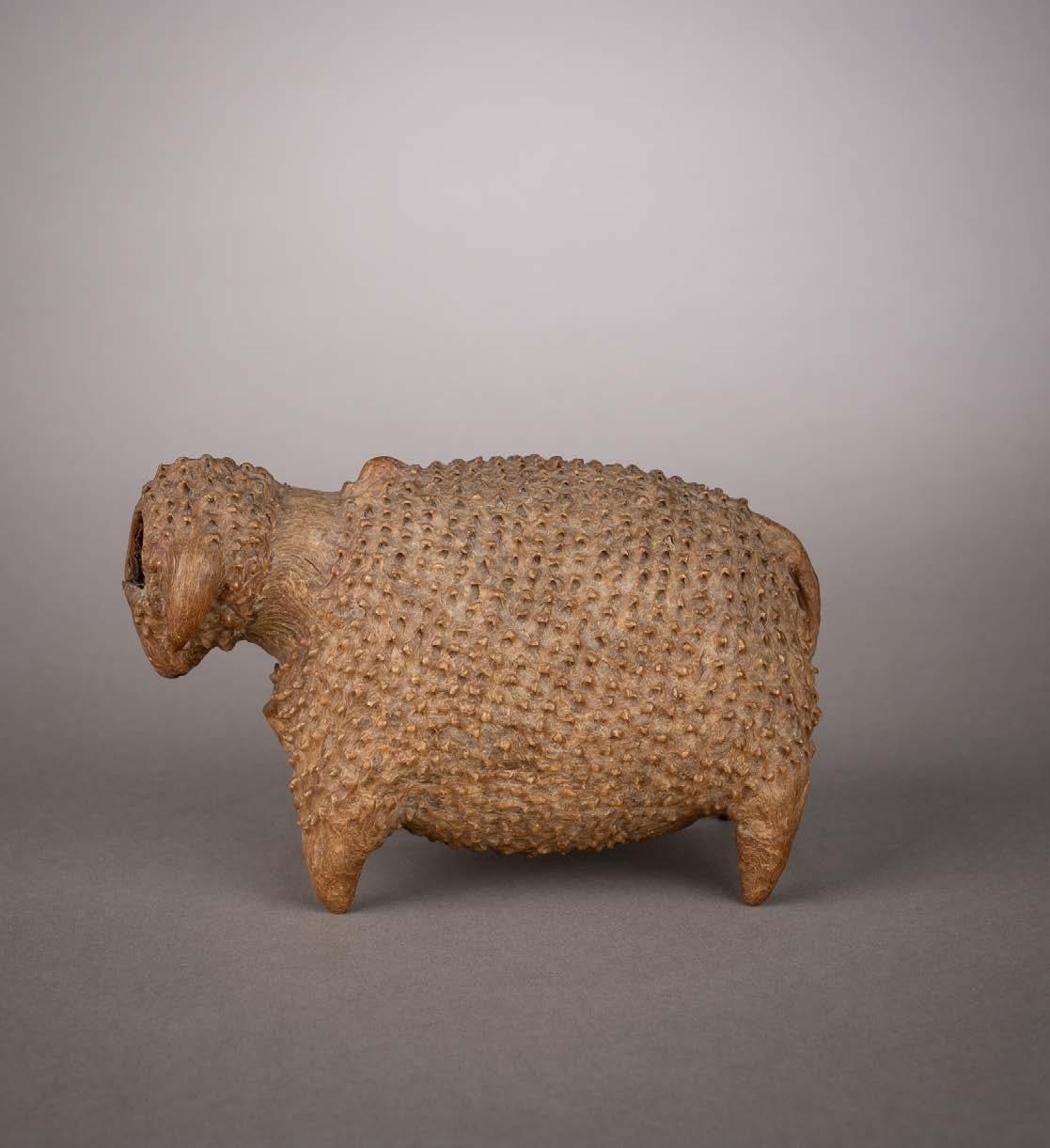
This rare and lovely bovine-shaped snuff container is one of only a few known examples of its type. To create this figure, a special mixture of hide scrapings was first worked over a sculpted core of clay. Allowed to dry to the consistency of leather, the surface was then picked with a sharp implement to produce the pointed protrusions. This raised pattern is reminiscent of the Zulu amasumpa motif, which symbolizes herds of cattle – perhaps the ultimate icon of temporal wealth and ancestral influence for the tribes of South Africa. An excellently crafted piece such as this would have carried with it powerful indications of status. Production of these containers had ceased by the third quarter of the 19th century. Similar examples are to be found in the British Museum collection.
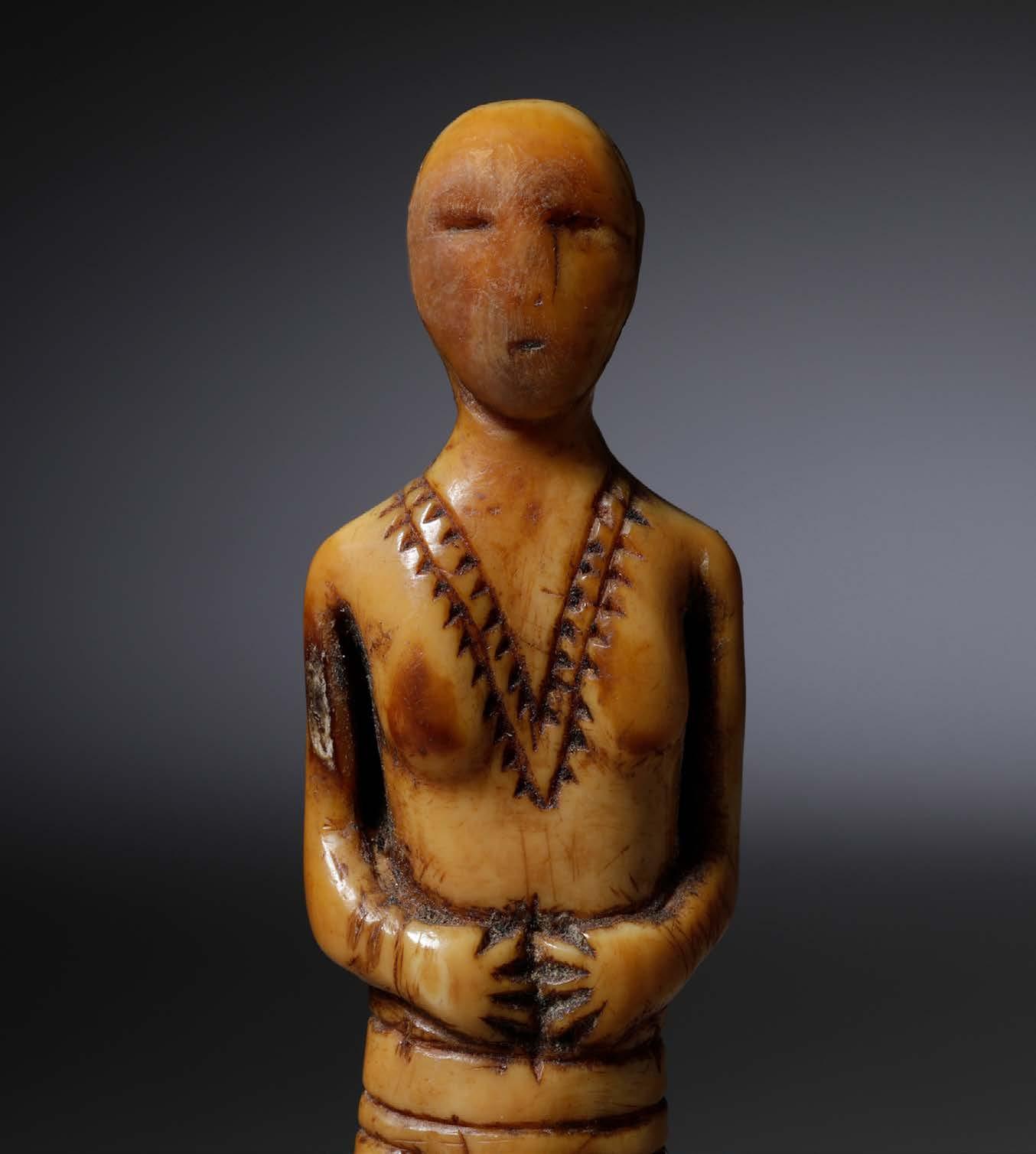
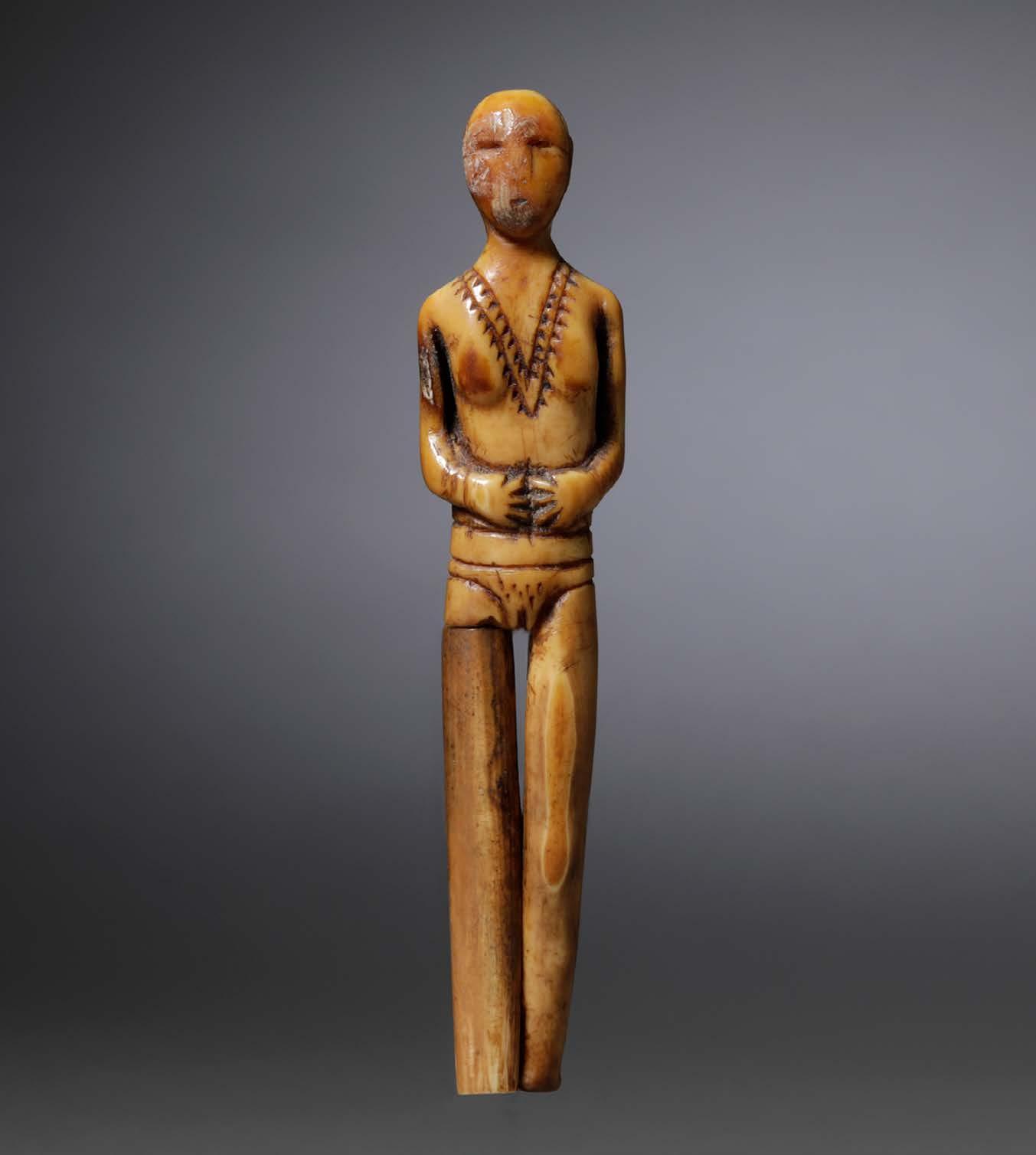
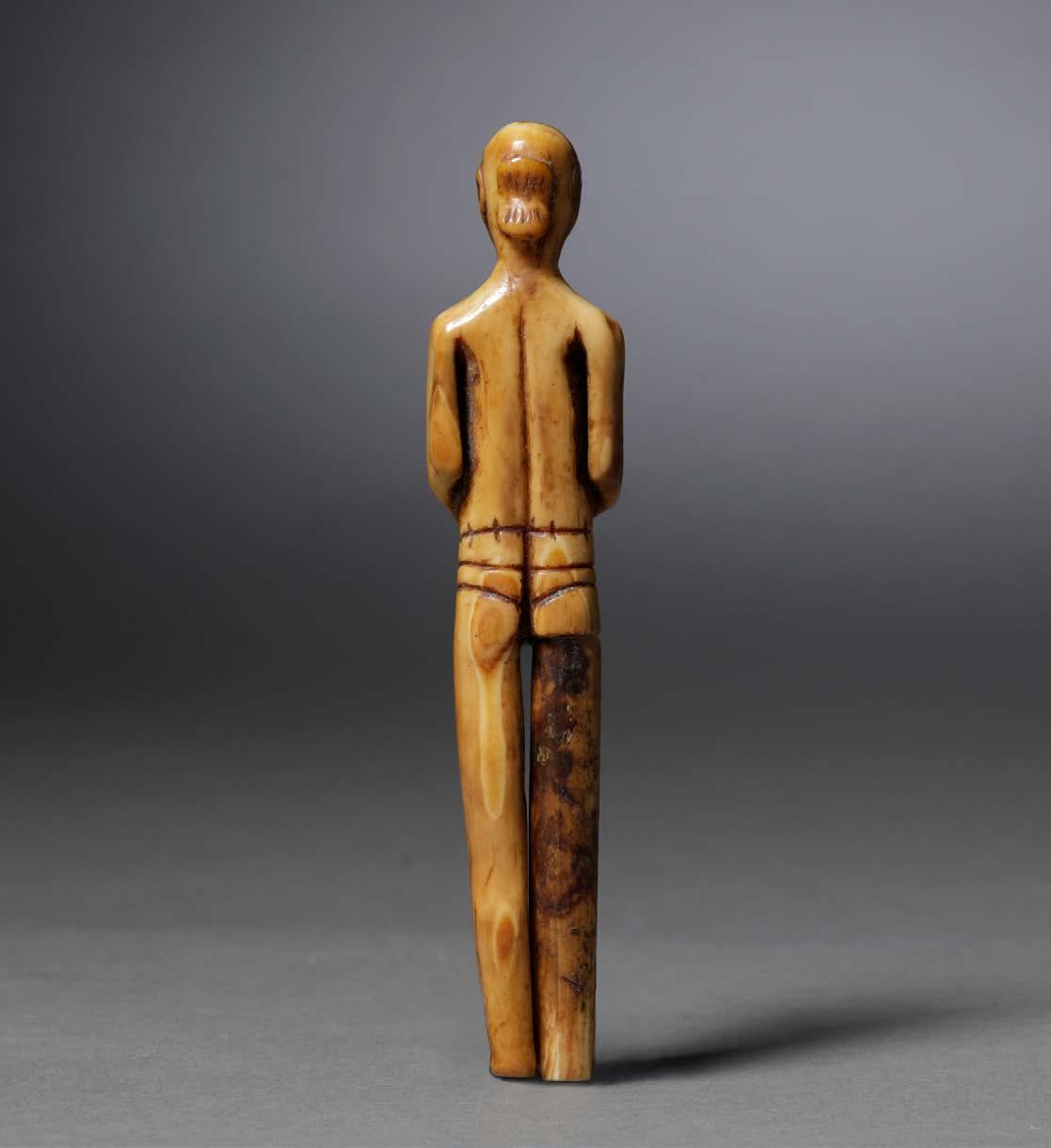
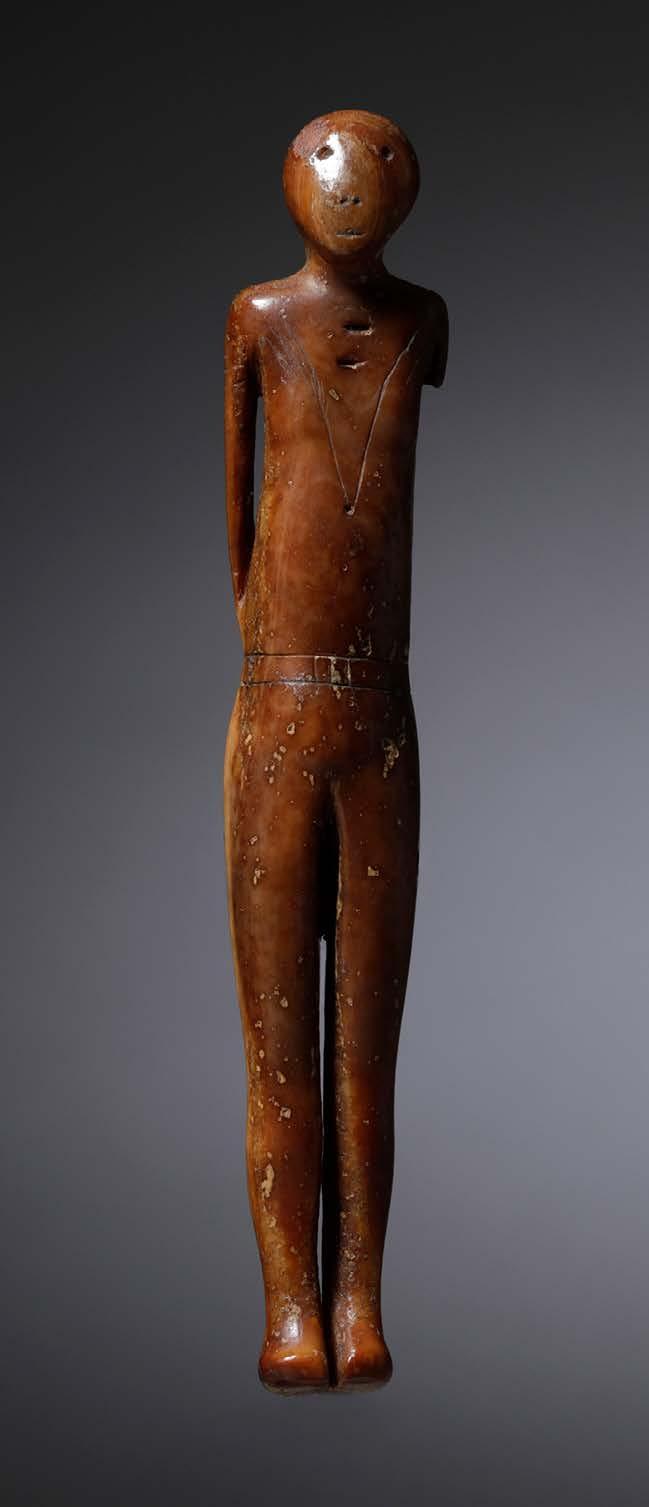
AN EXCEPTIONAL COLLECTION OF MAINLAND DOLLS
THULE CULTURE, MAINLAND ALASKA
(Available individually or as a group)
12th – 17th century
Marine ivory
Height: 3 ¼ – 4 ½ in, 8 ¼ – 11 ½ cm
PROVENANCE
7a–7e – Jeffrey Myers, New York,
7b – Amy and Elliot Lawrence Collection
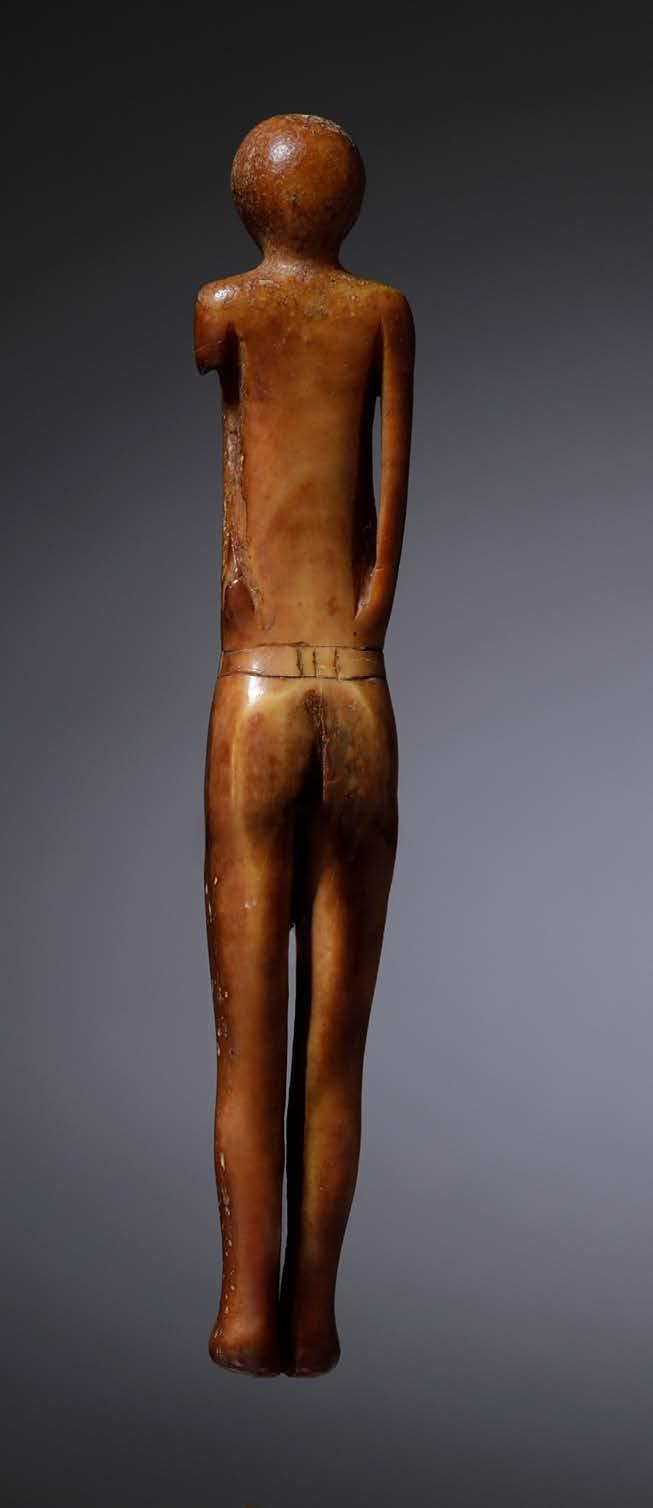
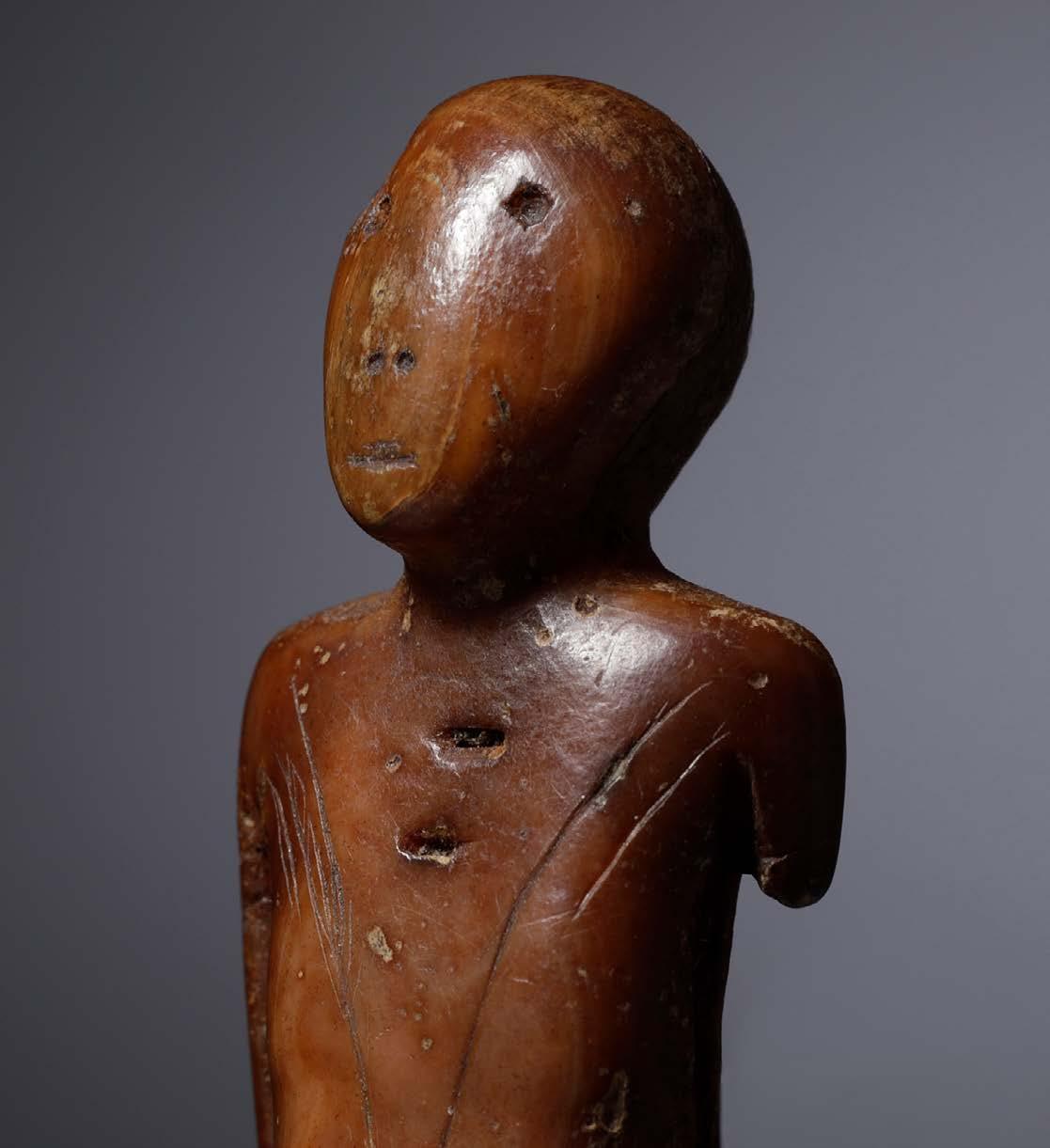
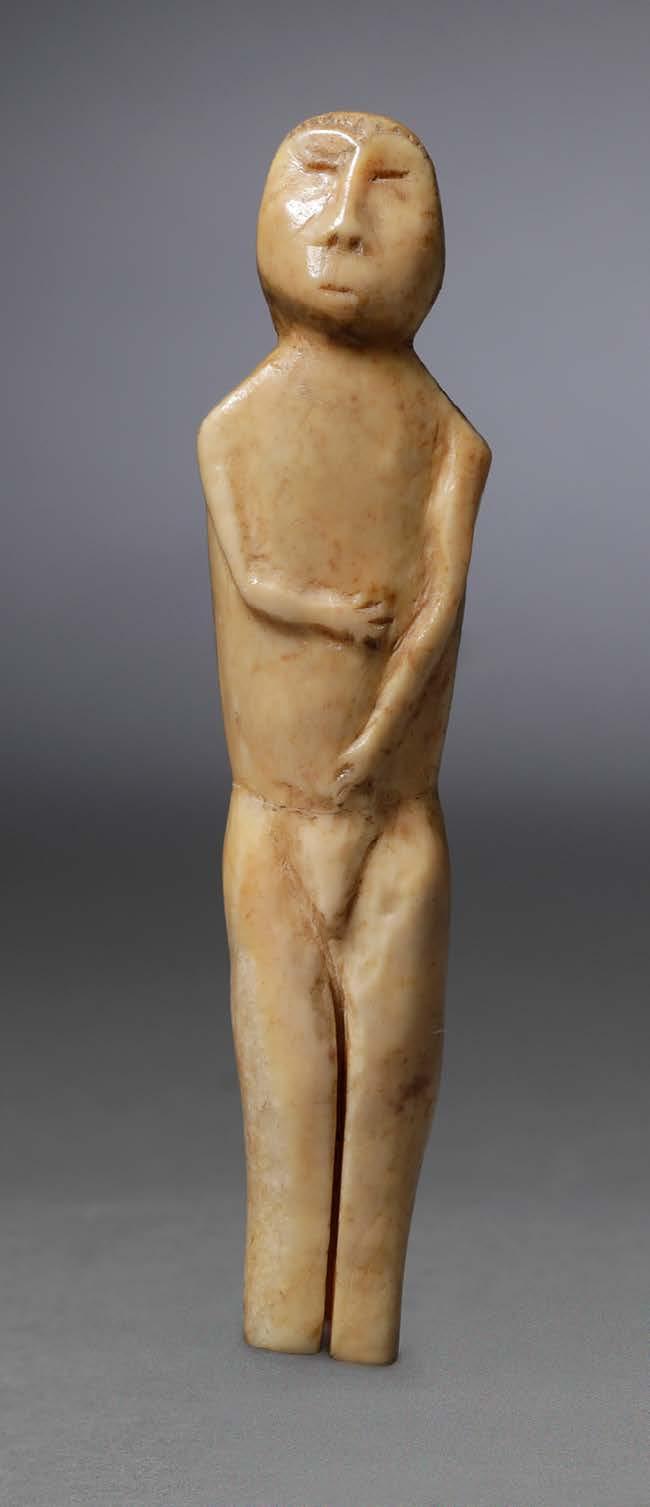
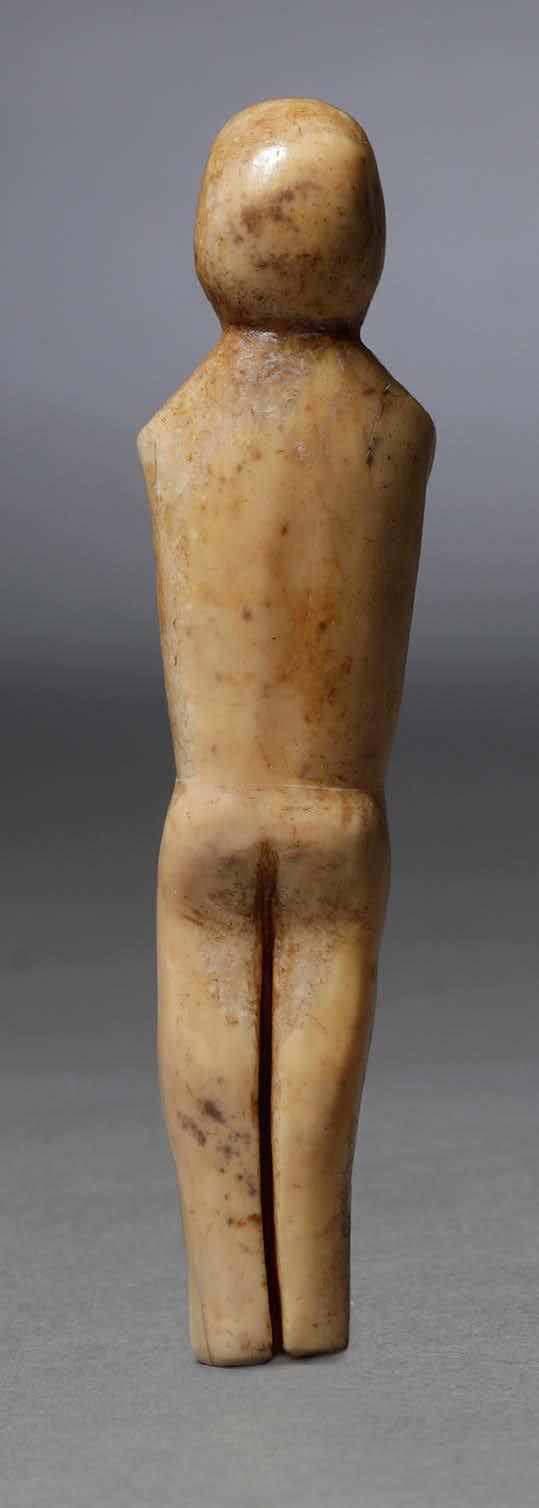
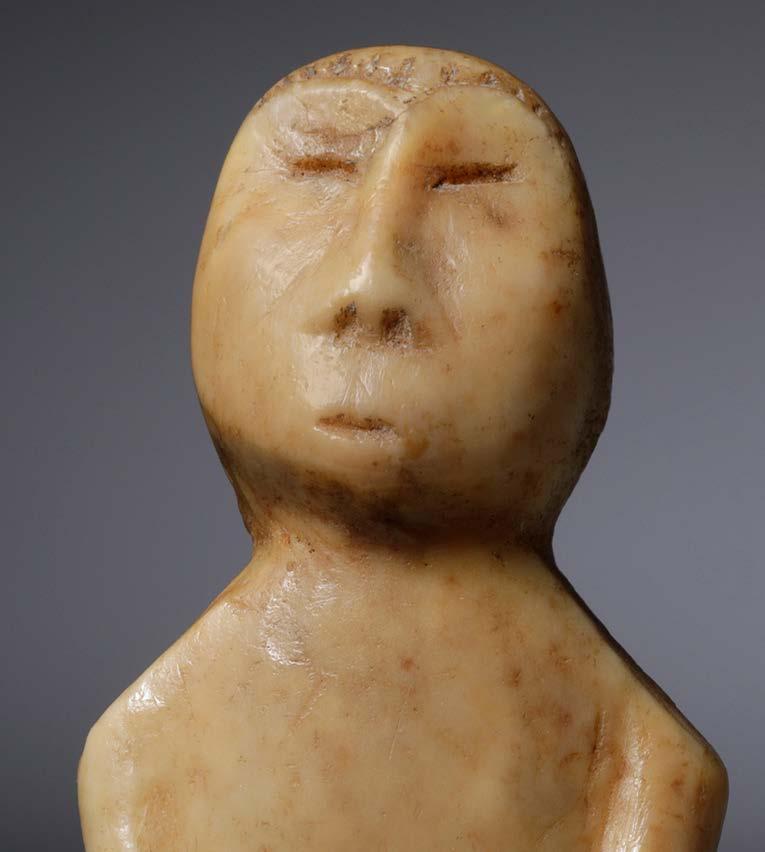
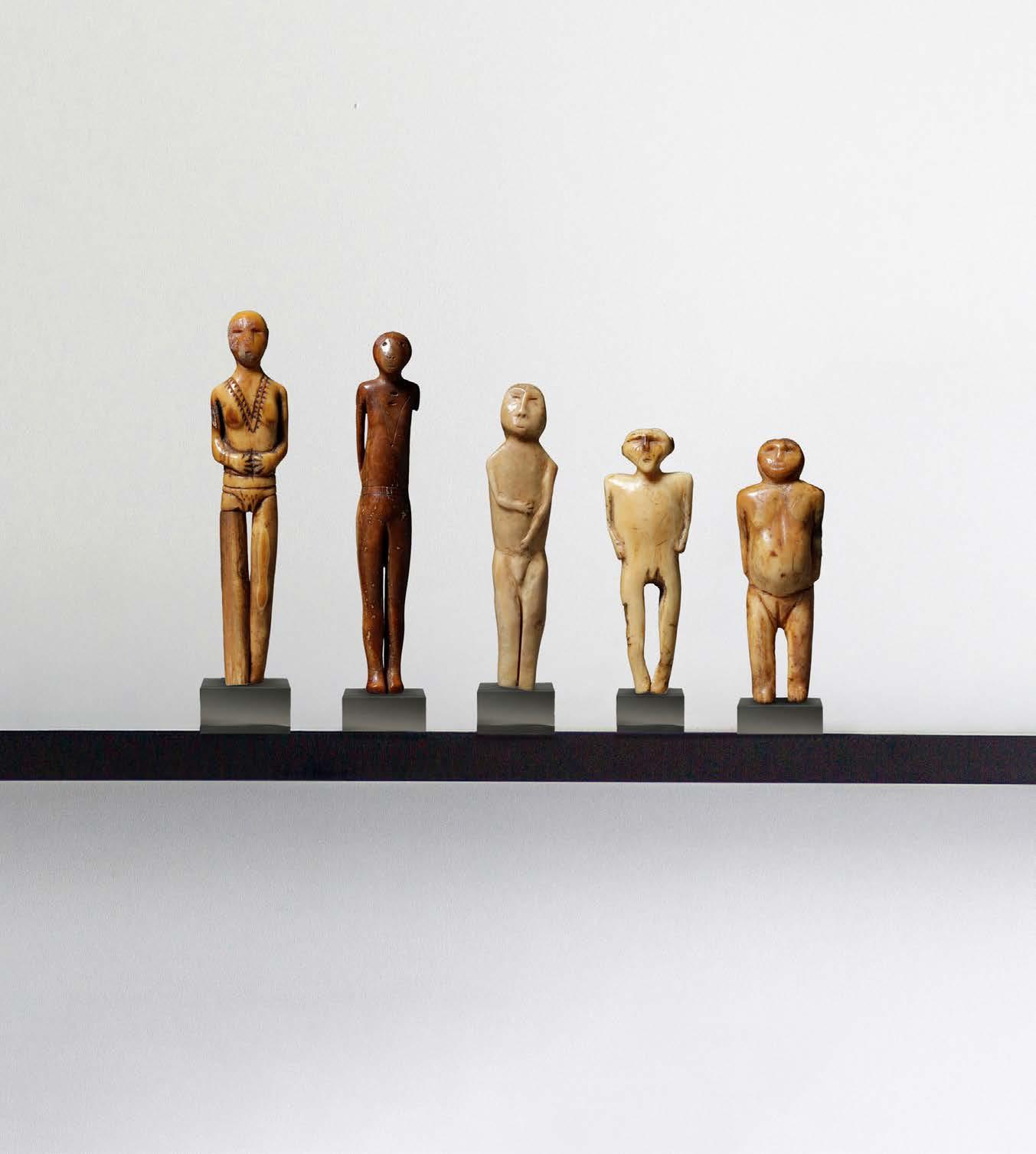
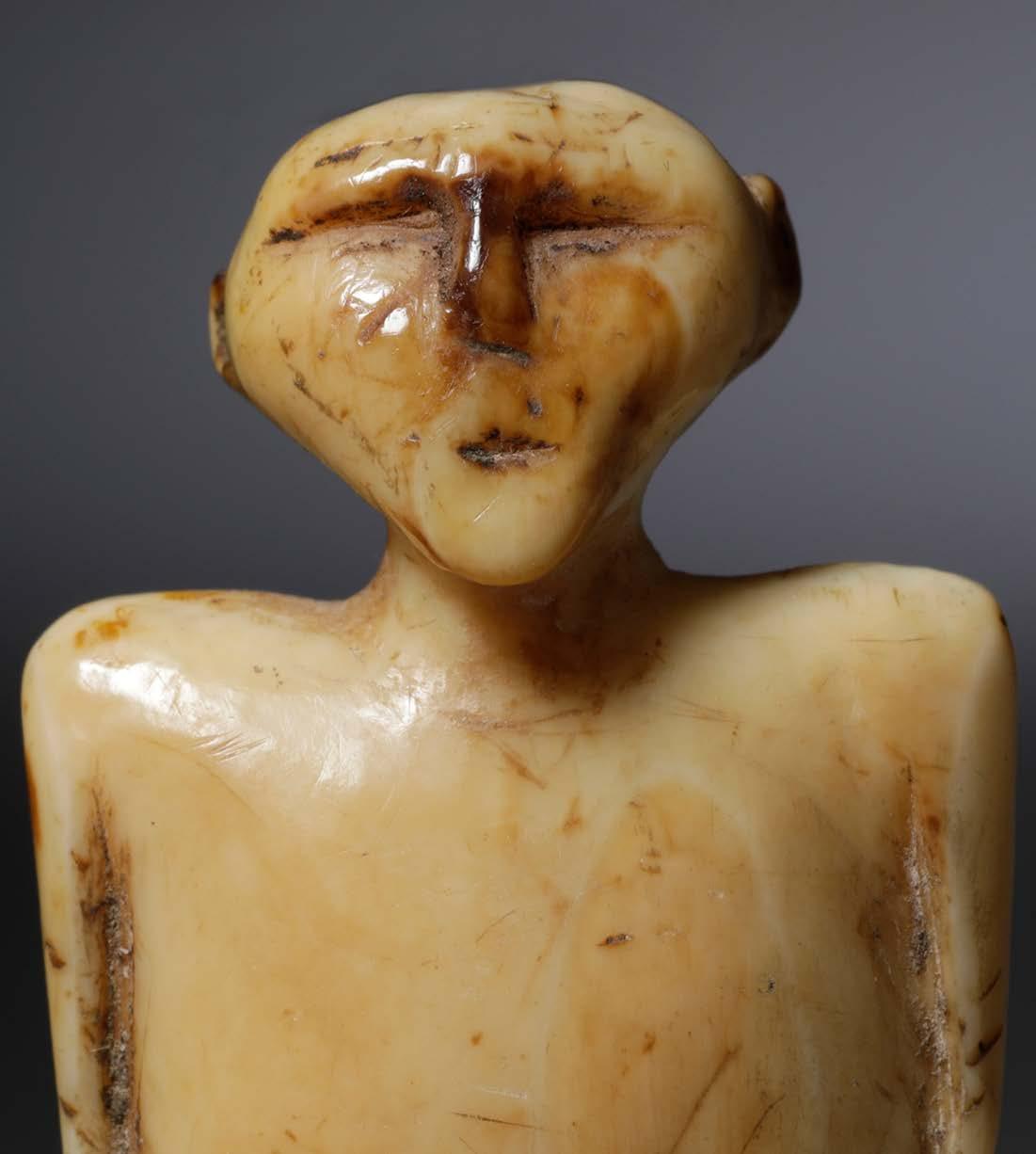
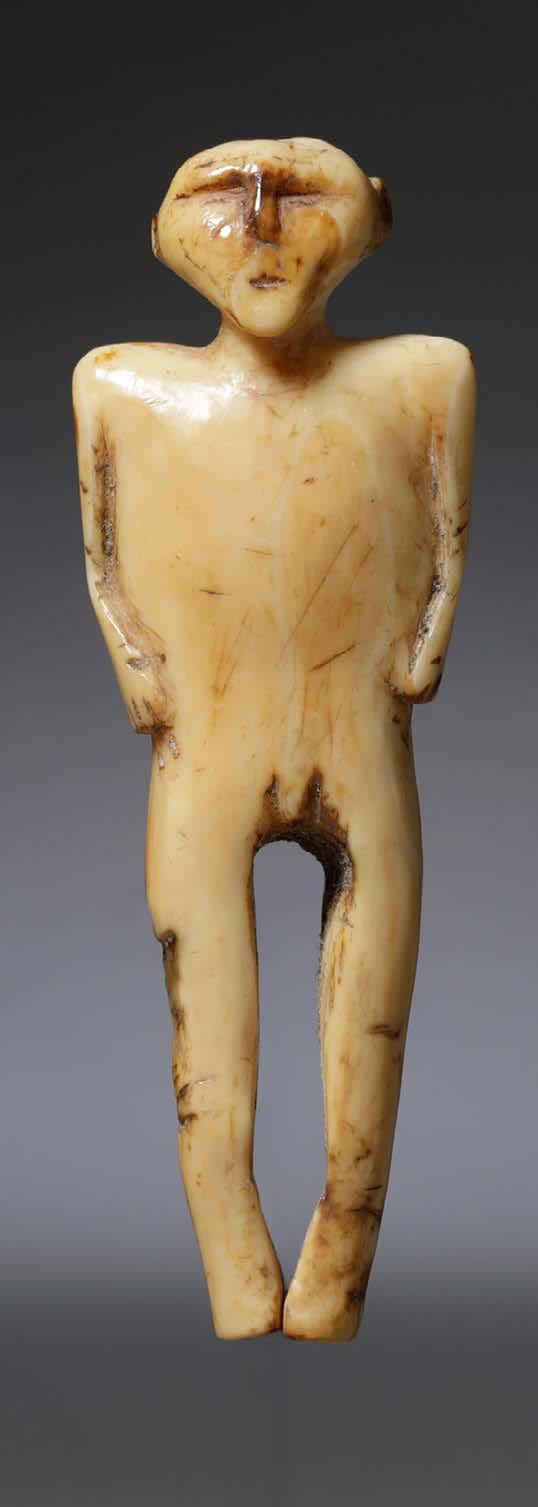
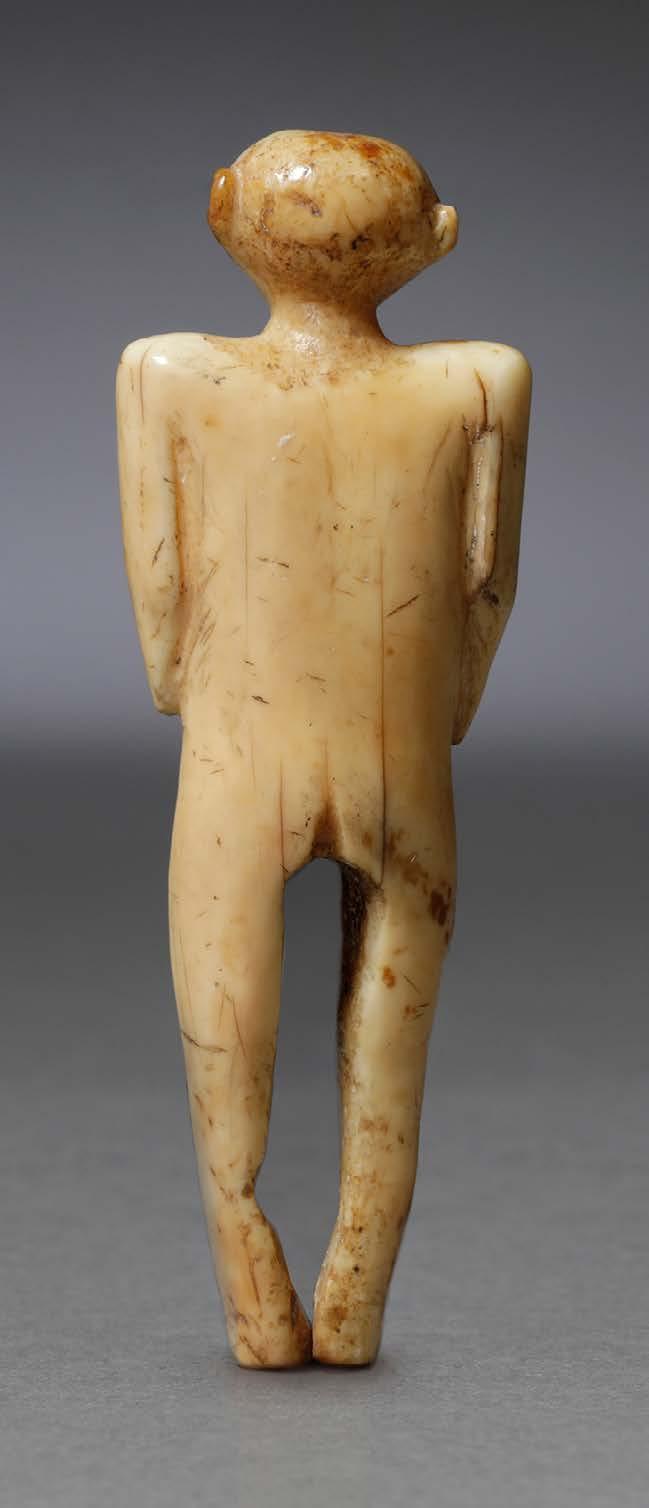
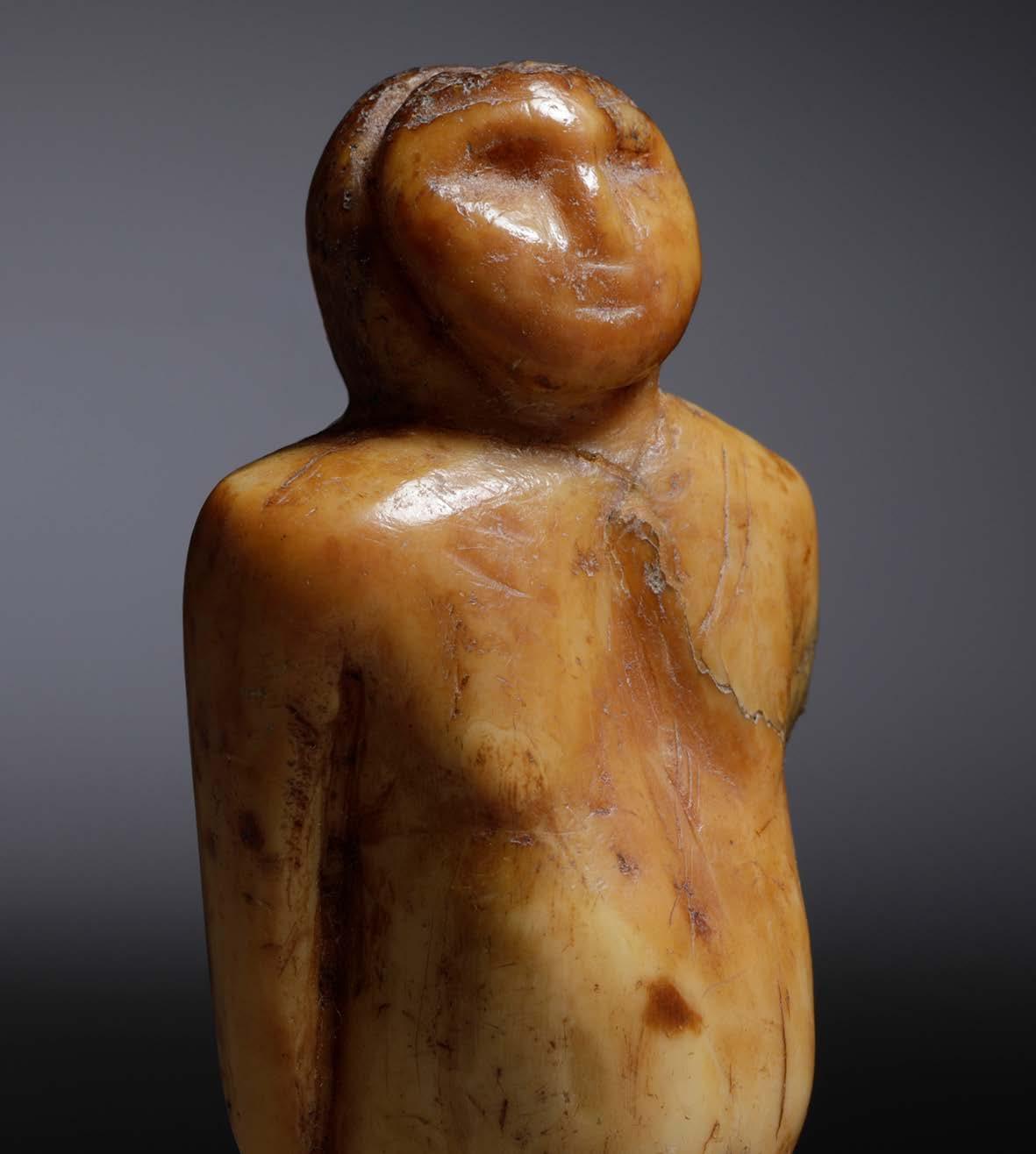
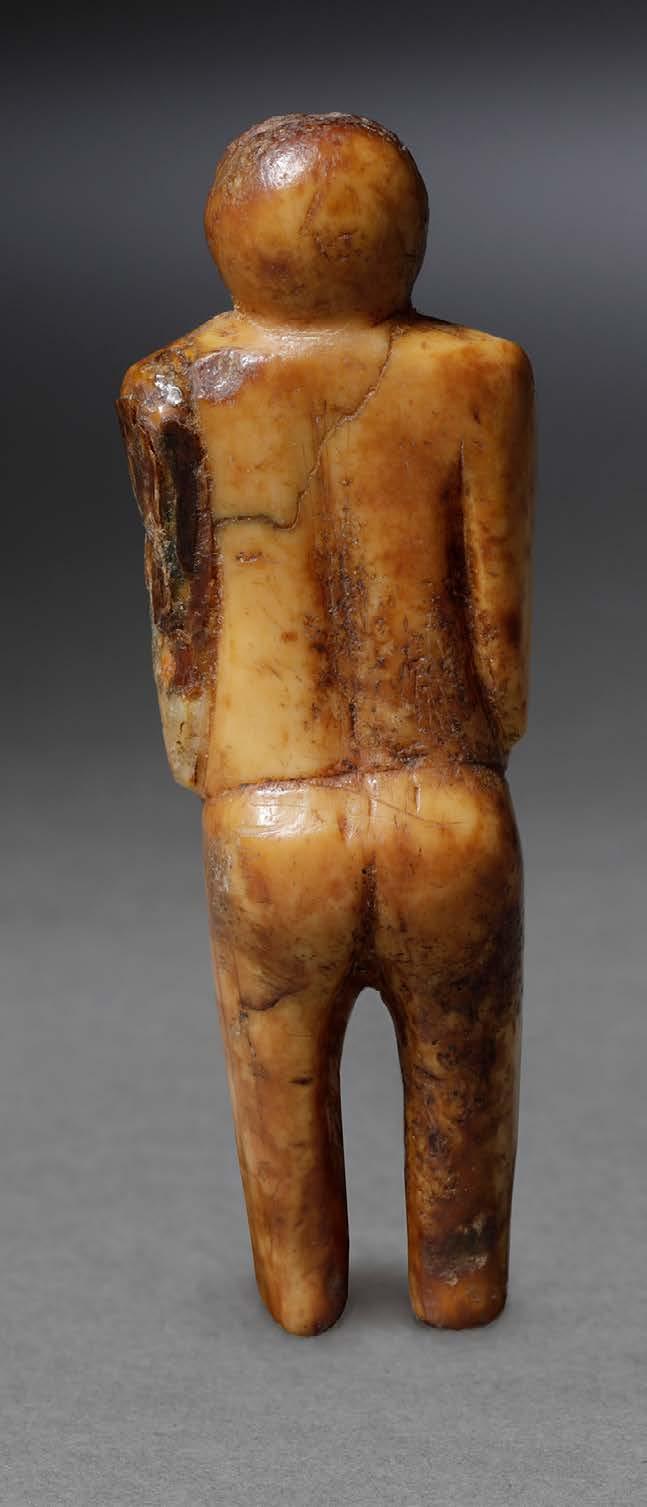
The five works assembled here comprise an exceptionally rare and evocative group of Inuit ivory dolls. Dating from the 17th century or earlier, each of them are lovingly carved with remarkable sensitivity and cultural depth. Fashioned from walrus ivory, a material prized for its durability and luminous surface, these miniature figures embody the history and storytelling traditions of Arctic life.
The collection showcases a variety of regional styles and techniques, from delicately incised facial features to subtleties of posture, the rendering of traditional garments, and degrees of abstraction. While some hint at joviality and others express a more reserved attitude, they all share a sense of candid and honest, humble humanity. Each doll reflects the sculptor’s unique perspective on form and proportion as well as the cultural significance of play, family, and identity within Inuit life.
Carved by both men and women, these figures would have served as children’s toys and teaching tools, introducing young hands to the family roles, clothing, customs, and skills essential to survival in the far North. The dolls often wore miniature parkas, boots, and mittens, teaching children how garments were constructed and layered for warmth. In some cases, small carved figures held ritual or spiritual meaning, perhaps as amulets or representations of ancestors or spirits. In the nineteenth century and beyond, some ivory dolls were also made for trade with outsiders, including whalers and explorers. These were often slightly larger or more elaborately carved. In good condition. In what is believed to be a unique example, item 16a was excavated together with a replacement leg.

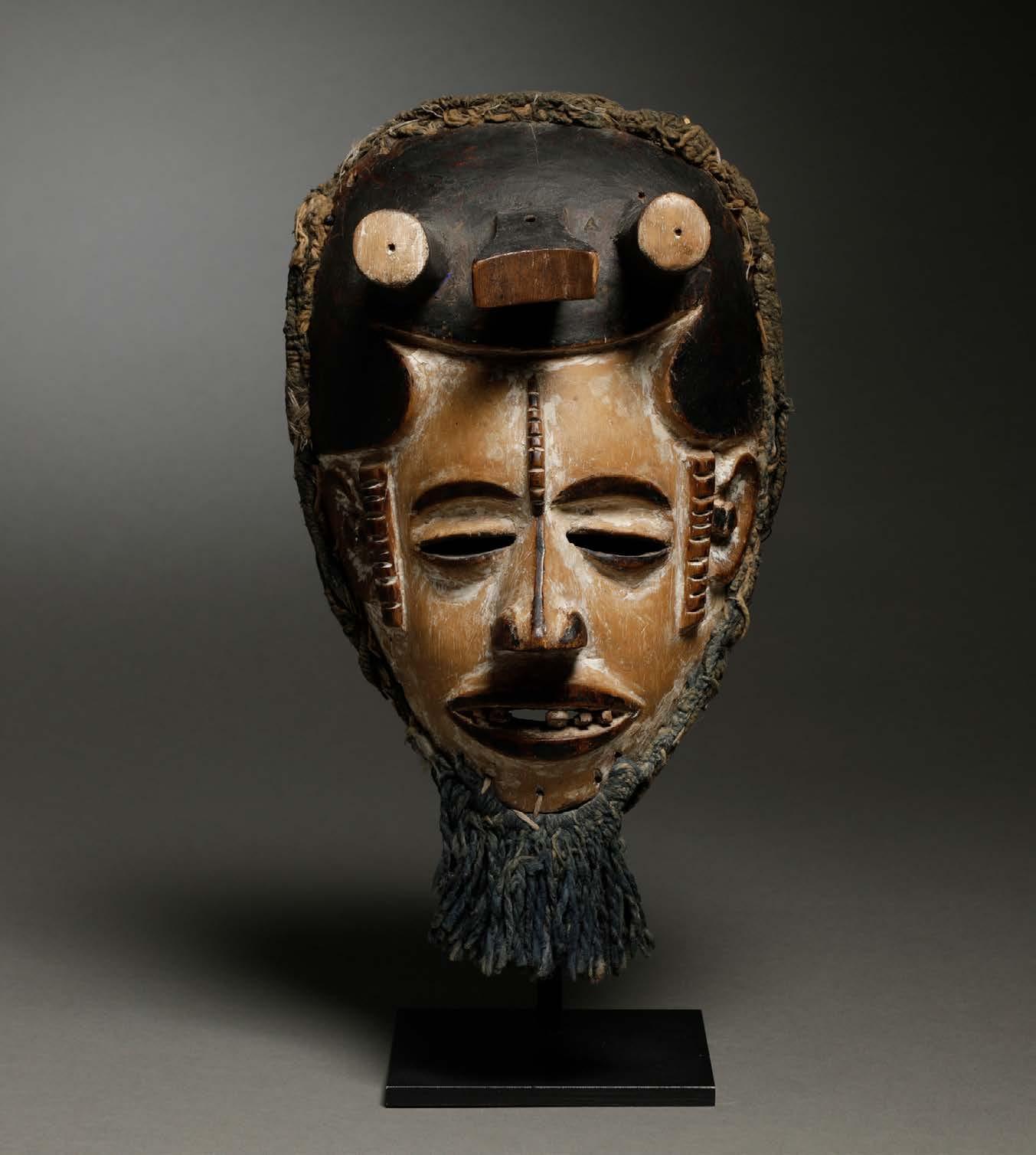
MASK ATTRIBUTED TO OCHAI OF OTOBI ICHAHOHO
IDOMA, NIGERIA
First half 20th century
Wood, fiber, pigments
Height: 9 in, 23 cm
PROVENANCE
Private New York collection
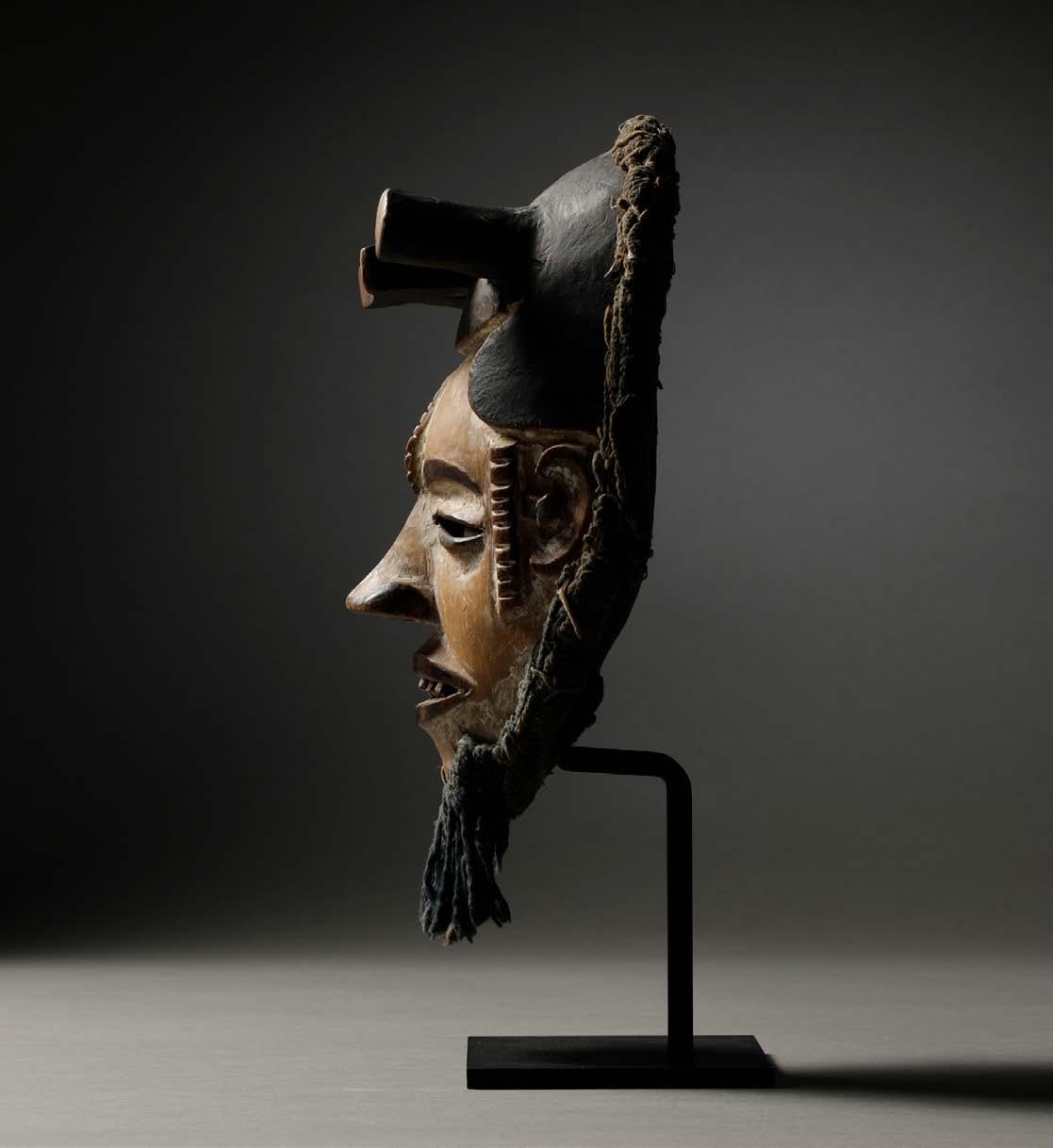
Ichahoho is a warrior’s society and masquerade tradition indigenous to the southern Idoma, regional neighbors to the Igbo, with whom they share some artistic influences. During the dry season, on the day of the dead, costumed ichahoho performers would historically dance with machetes, offering displays of youthful hubris and issuing challenges of mock battle to the older men in attendance. Their aggressive and striking appearance, white-faced with jutting horns and sharp noses, fanned a current of excitement and danger through the assembly.
This fine mask is a powerful example of the ichahoho
form, carved with detailed care without sacrificing the brusque attitude appropriate to the masquerade. Horns and nose project forcefully outward, creating a dramatic profile. The deep black coiffure amplifies the ghostly aspect of the face, with its kaolin pallor and bared teeth. A dense fringe of fiber with a textured beard frames the perimeter of the mask. This piece is attributed to Ochai of Otobi, a master carver who was active between 1910 and 1950. Unlike most other artists, Ochai was a full-time sculptor and had commissions from a wide range of villages beyond the borders of Otobi in south-central Nigeria.
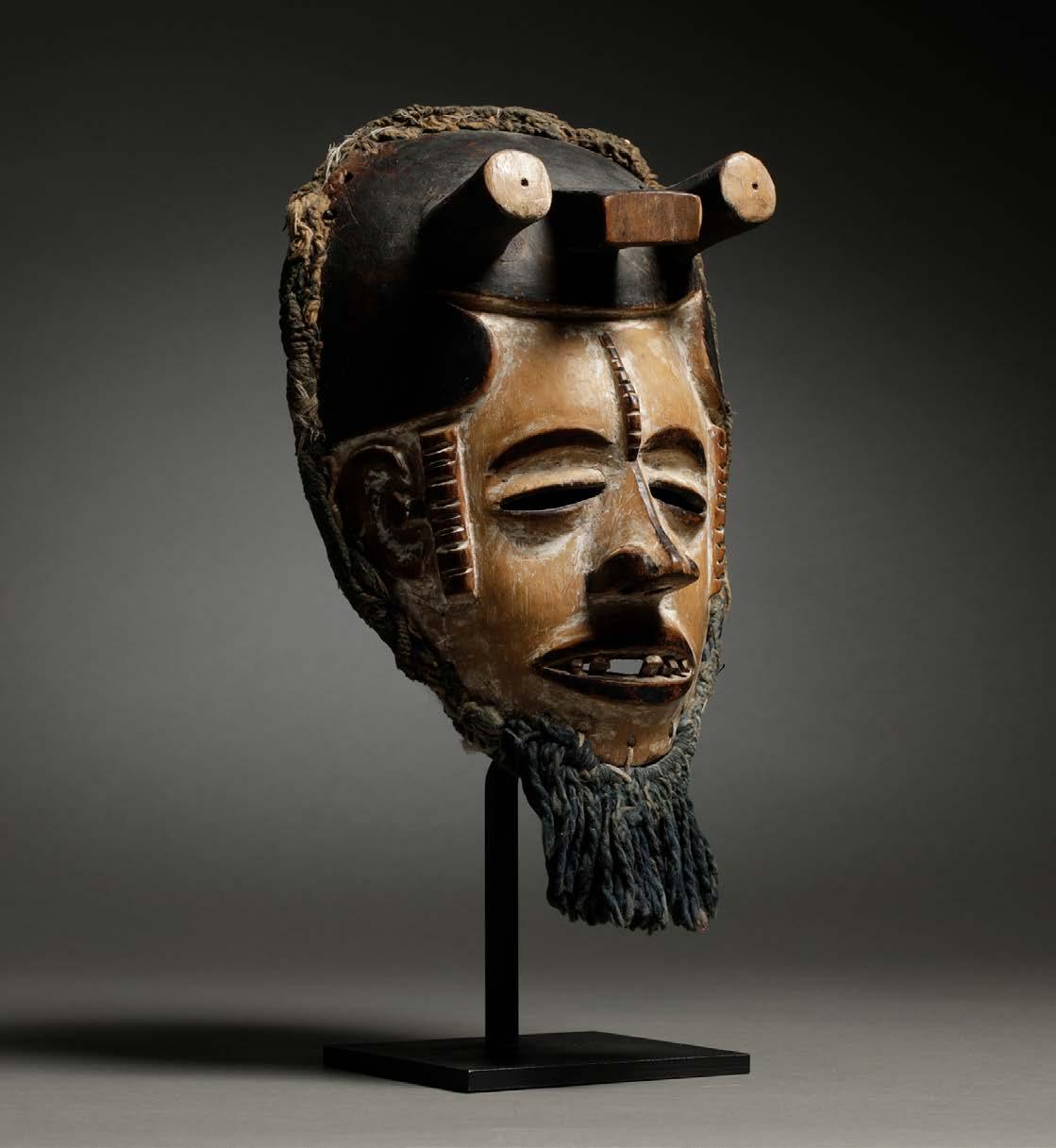
mask attributed to ochai of otobi ichahoho
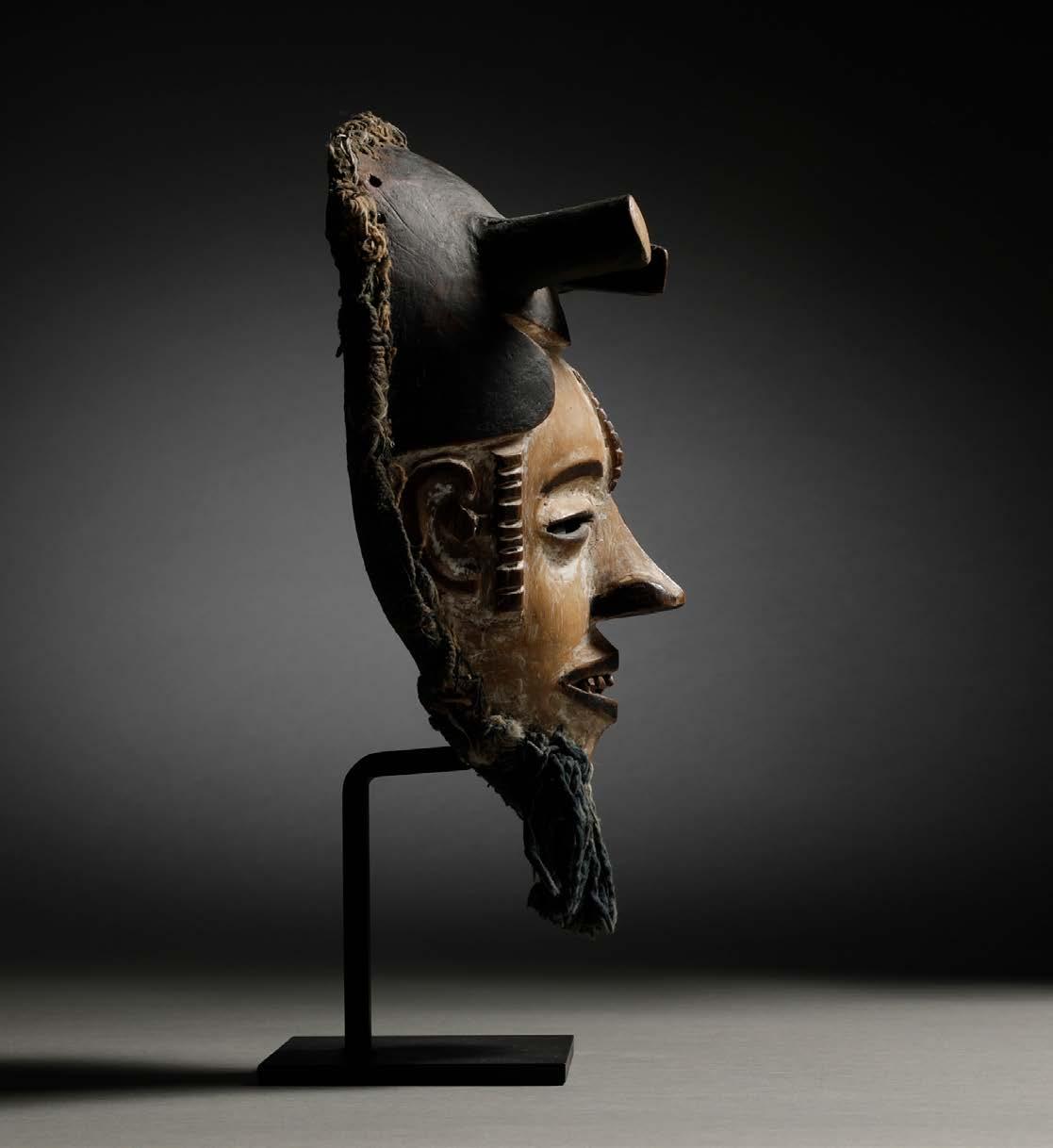
mask attributed to ochai of otobi ichahoho
mask attributed to ochai of otobi ichahoho

AN EXCEPTIONAL SNUFF SPOON/COMB
ZULU PEOPLES, SOUTH AFRICA
Late 19th century
Bone, ash
Height: 7 in, 20 cm
PROVENANCE
Old Australian collection
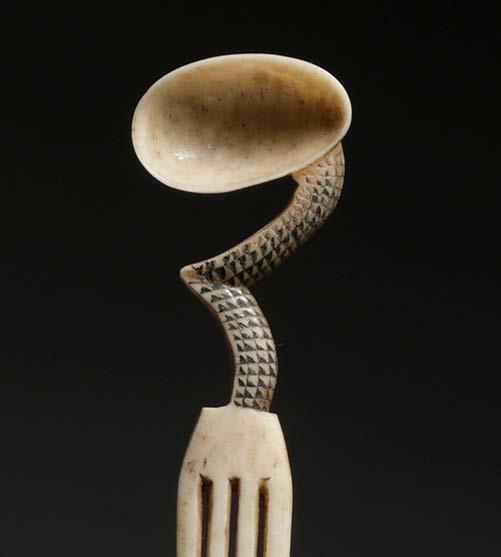
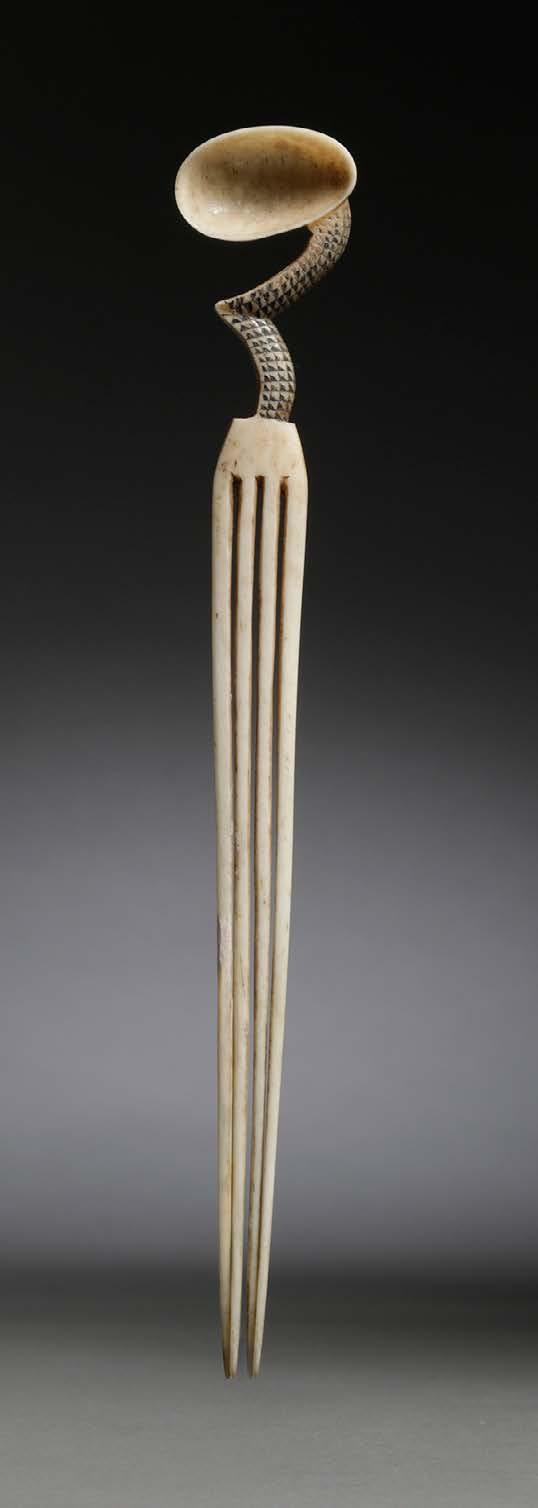
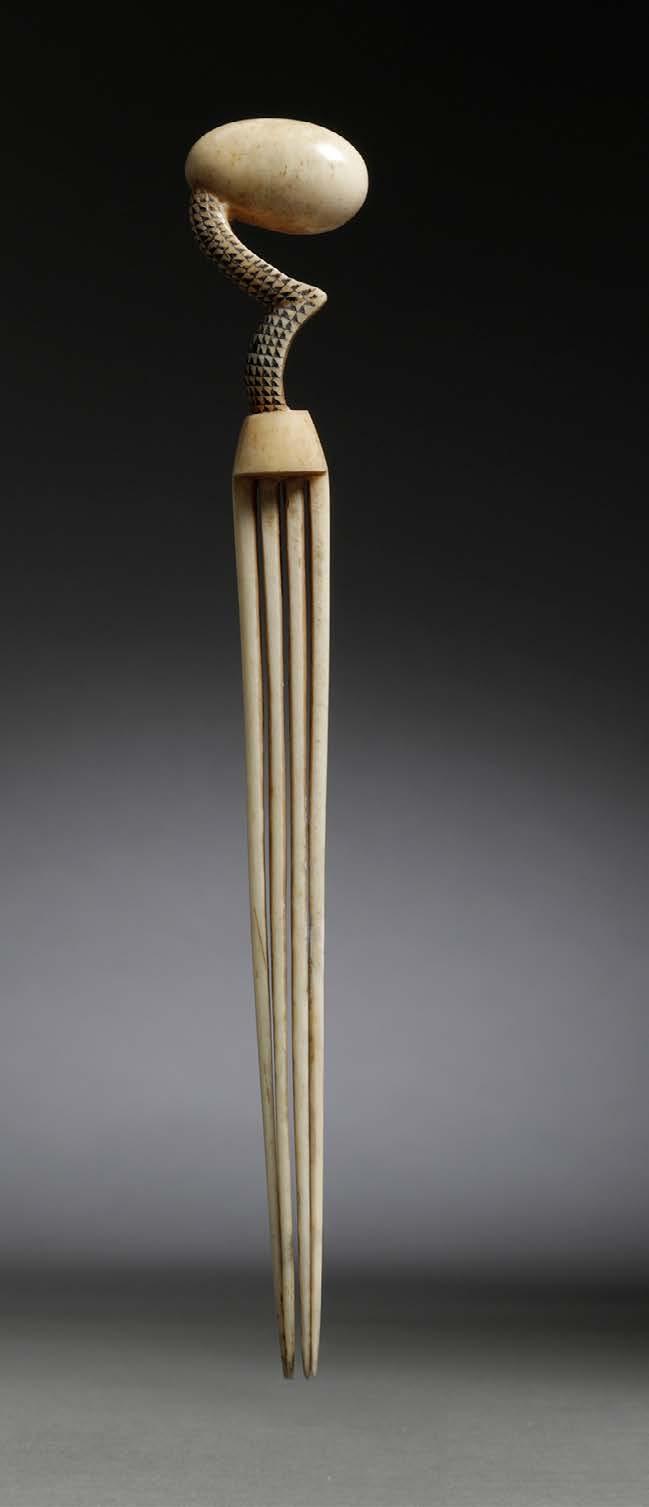
Most southern African peoples had seminomadic lifestyles until the twentieth century. Often on the move, individuals typically limited their personal possessions to a small collection of portable items. Those associated with sleep and tobacco—namely headrests and containers for snuff—were especially important because dreaming and the hallucinogenic use of tobacco were traditional ways to connect with one’s ancestors.
Such circumstances impelled artists to craft items with a clever eye to the multifaceted. This elegant snuff spoon is a splendid example of southern African carvers’ genius in combining functional, spiritual, and aesthetic qualities in a
single object. Here a small scoop for taking snuff doubles as a comb, and serves as a handsome hair ornament when not in use. The form is beautifully refined, cut and smoothed with sensitive delicacy, and its excellent condition attests to the care with which its owners used it. Sculpturally, the piece shows a taut energy of contrast, both sensuous and austere, sinuous and rigid, round and sharp, densely detailed and unembellished. As is often the case with Zulu functional objects, there is a strong figurative element incorporated in the design. Small portion of one tine has been restored.
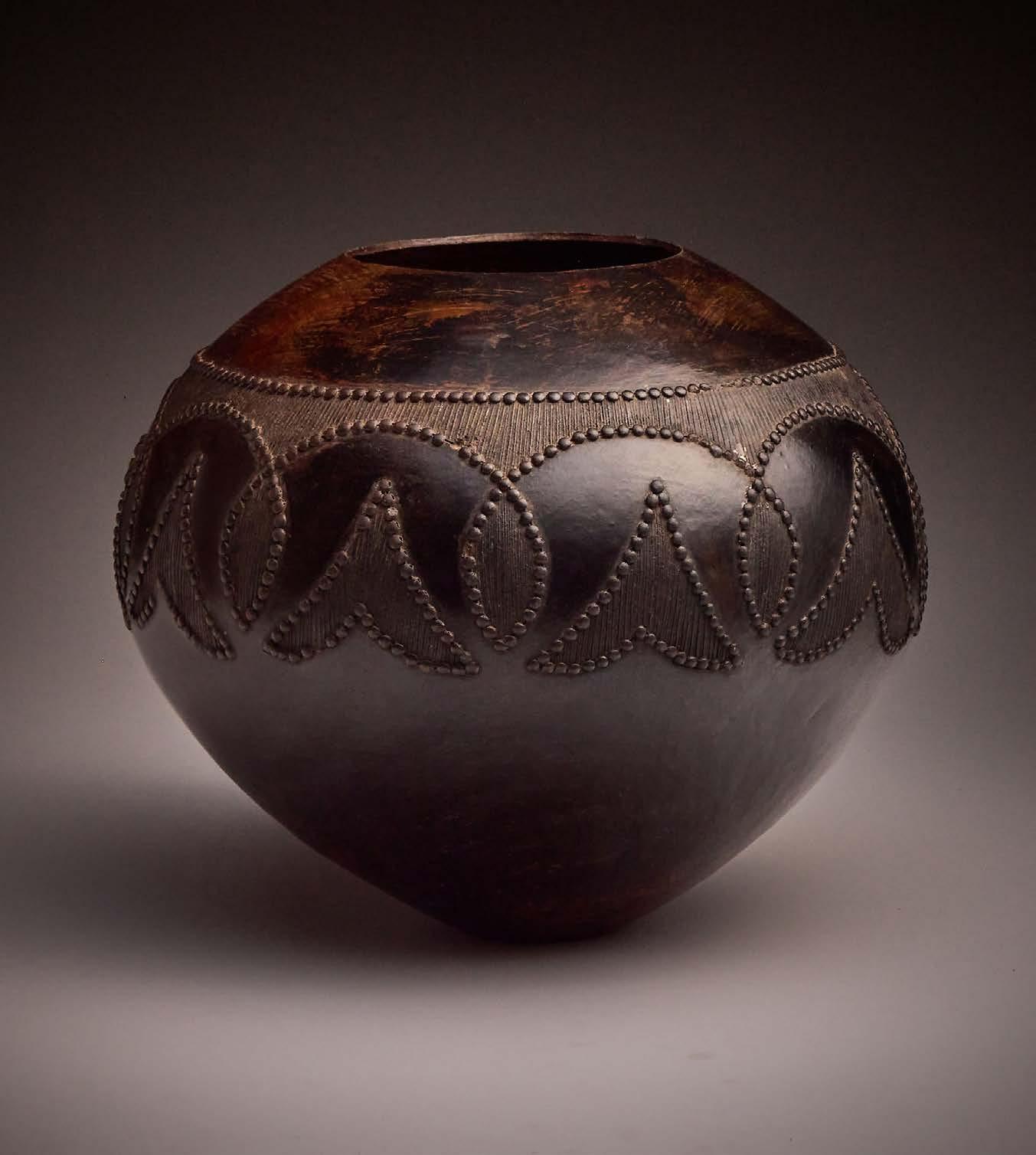
CERAMIC VESSEL BY MNCANE NZUZA UKHAMBA
ZULU PEOPLES, TUGELA RIVER VALLEY, KWAZULUNATAL, SOUTH AFRICA
Mid-20th century
Ceramic
14 ½ in (h) 15 ¾ in (w) 37 cm (h) 40 cm (w)
PROVENANCE
Private Collection
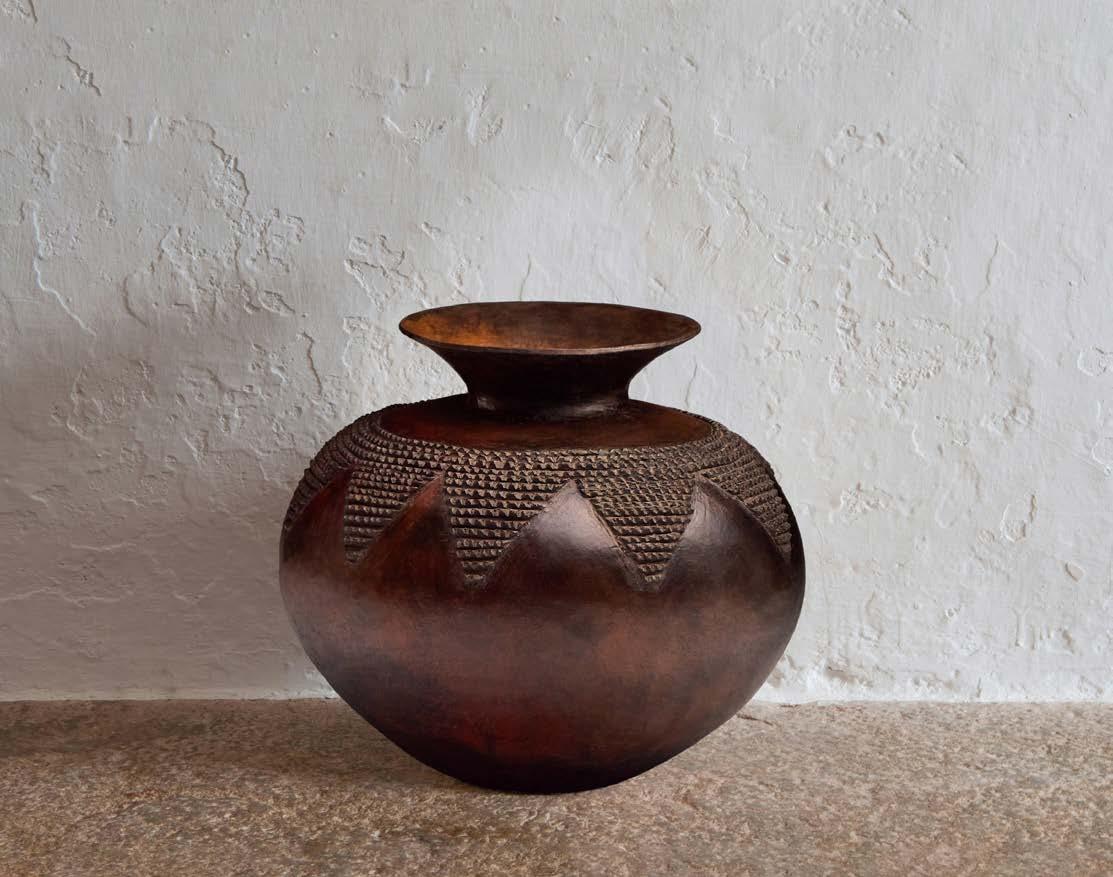
Mncane Nzuza is a renowned South African master Zulu potter, famous for her exceptional, large-scale earthenware ukhamba (beer-drinking vessels). Used in ancestor veneration rituals, these capacious pspatterns. She learned the traditional craft from her grandmother, and blends deep cultural significance with unique artistic expression as she creates for her local community in KwaZulu-Natal. Nzuza’s pots can be found in many museum collections, including the Metropolitan Museum of Art, The Art Institute of Chicago and the Minneapolis Institute of Art.
Ukhamba embody the gentle sophistication of southern African art. Each vessel is crafted by Zulu women, custodians of a knowledge passed down through generations, where making pottery is both a practical skill and a deeply respected cultural role.
The process begins with locally sourced clay, carefully dug, cleaned, and kneaded by hand to achieve the right consistency. Without the use of a wheel, the pot is built slowly using coiling and pinching techniques, allowing the maker to shape the vessel with remarkable precision
and balance. Once formed, the surface is smoothed and often burnished with a stone, then decorated with incised or textured patterns that reflect regional identity and personal expression. Ukhamba are traditionally fired in open ground kilns, a method that produces subtle variations in tone and surface texture, making each piece entirely unique.
Historically used for brewing and serving sorghum beer during communal gatherings and ceremonies, ukhamba symbolize hospitality and unity. More than a functional vessel, they are a testament to women-led craftsmanship, cultural resilience, and artisanal beauty.
This refined pot shows a classic form, swelling generously around the midsection and narrowing elegantly to the base. A dancing, delightful pattern of raised nodes, referencing traditional amasumpa (grouped ‘wart’ motifs), girdles the upper half of the form. The polished, mottled surface is textured with delicate linear grooves within the ‘closed’ sections of the design, creating a play of negative and positive space.
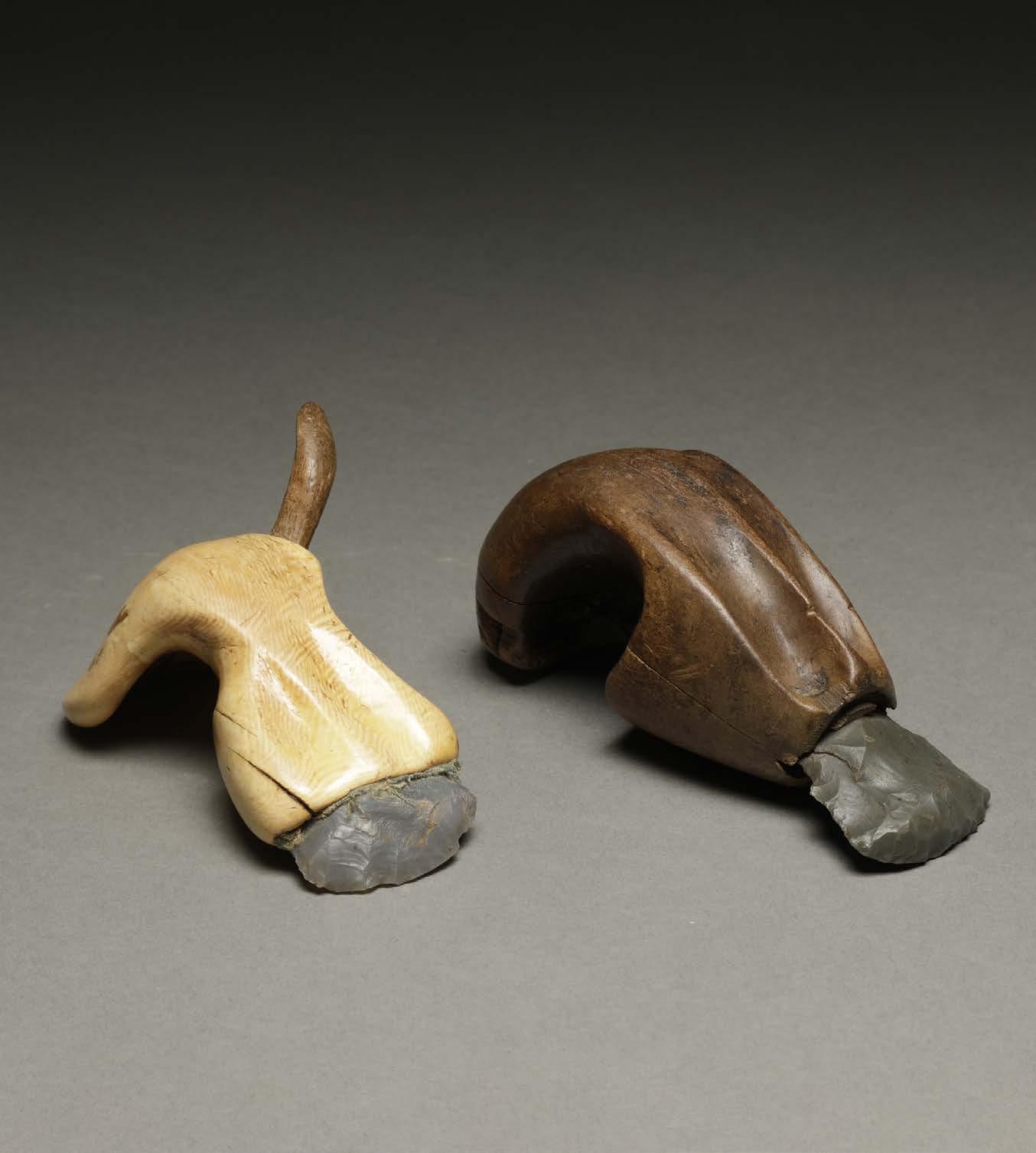
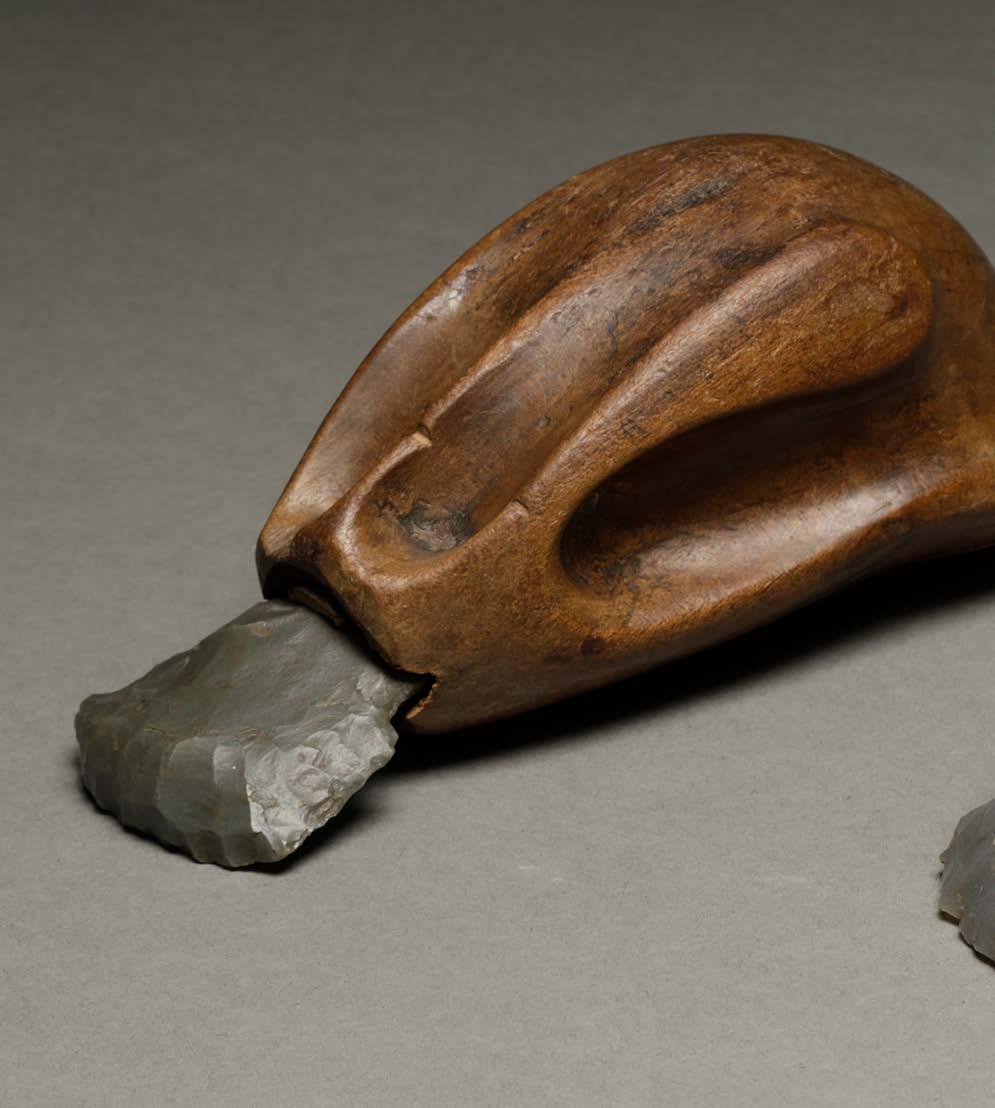
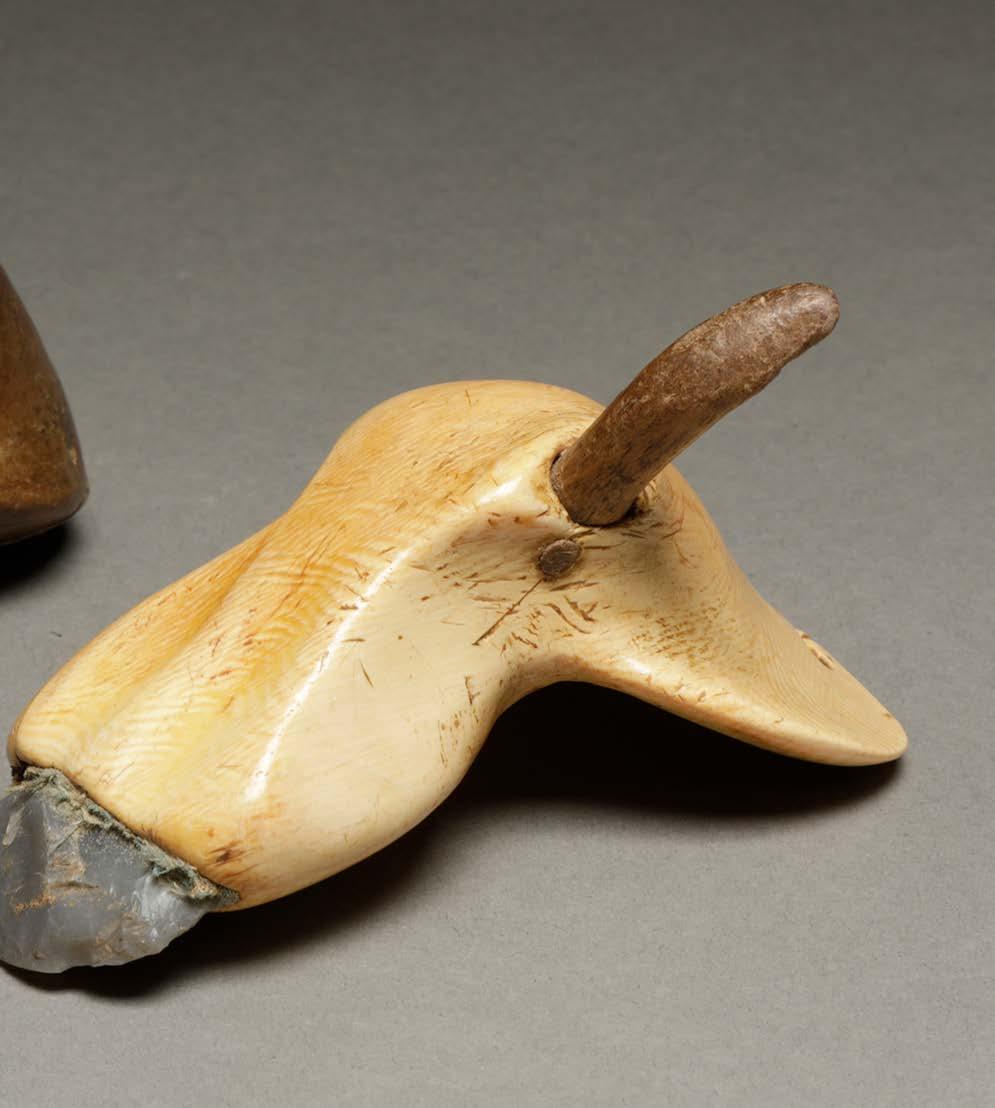
TWO HIDE SCRAPERS
INUIT, ALASKA
19th century or earlier
Marine ivory, wood and jade blade
Length: 4 ½ in, 11 ½ cm (wood); 4 in, 10 cm (marine ivory)
PROVENANCE
Marine ivory – Private Collection, USA
Wood – Brant Mackley Gallery, Santa Fe
These fine Eskimo hide scrapers, dating to the nineteenth century or earlier, are a small showcase of the genius of Arctic craftsmanship. Both tools feature jade blades, a stone valued for its aesthetic beauty as well as its strength and resilience – qualities essential for processing animal hides in harsh Arctic conditions.
One scraper in the pair is crafted with a highly ergonomic hardwood handle, cut with finger grooves that allow the hand to fit perfectly over the tool. Its surface is thoroughly smoothed and weathered from age and long use. The companion scraper is carved from marine ivory, likely a walrus tusk. A carefully shaped and smoothed surface here
again conforms to the shape of the hand, and a slender flyaway guard between the thumb and forefinger placements ensures a firm hold. Both these scrapers were clearly designed with a nuanced knowledge of manual control developed over generations.
Hide scraping was more than a technical task, it was a highly skilled and socially important activity. Properly prepared hides were critical for survival, and were used to make parkas, trousers, mittens, boots, tents, kayak coverings, and dog harnesses. The long and tough job of hide-working was often accompanied by oral tradition and songs.
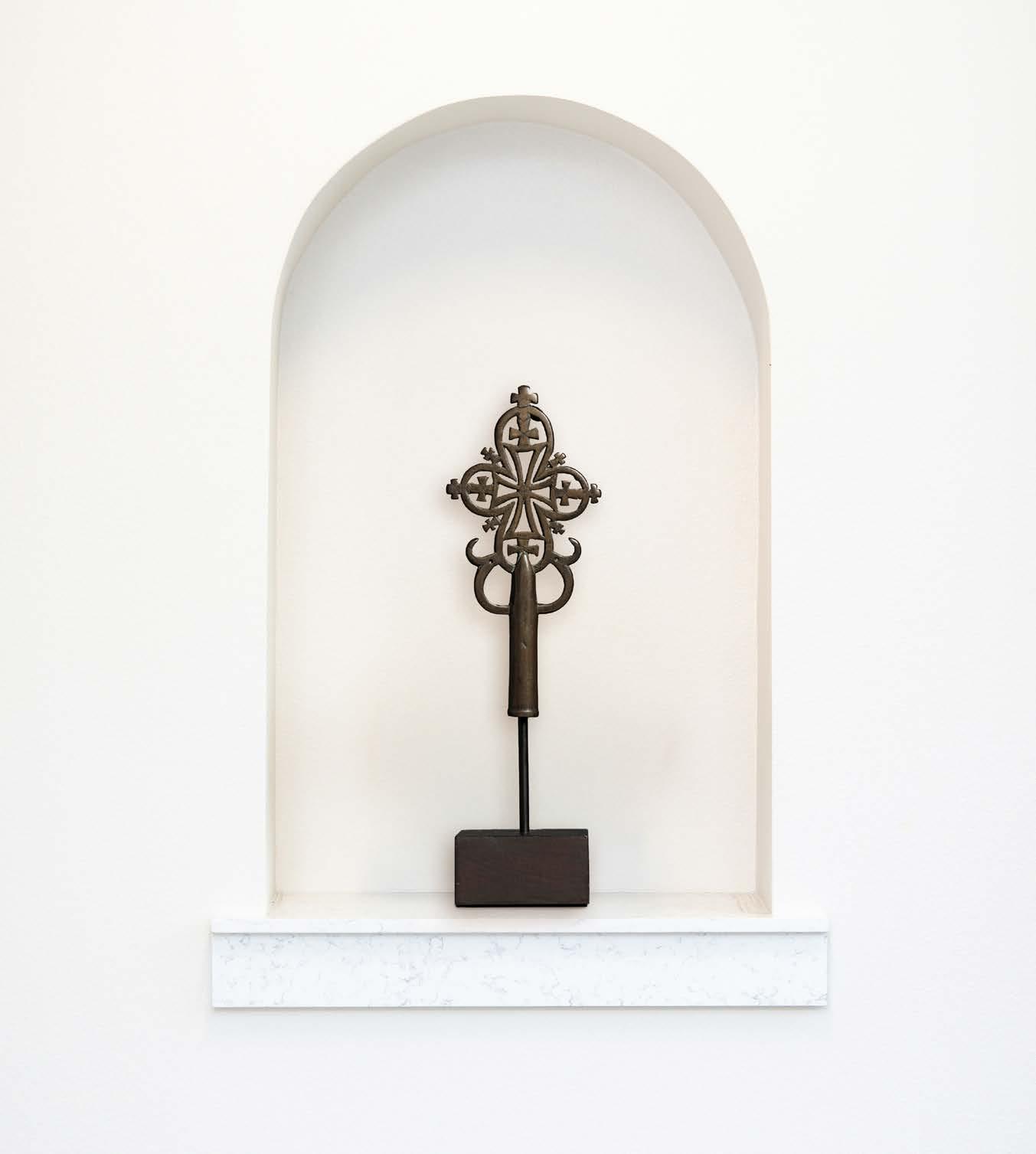
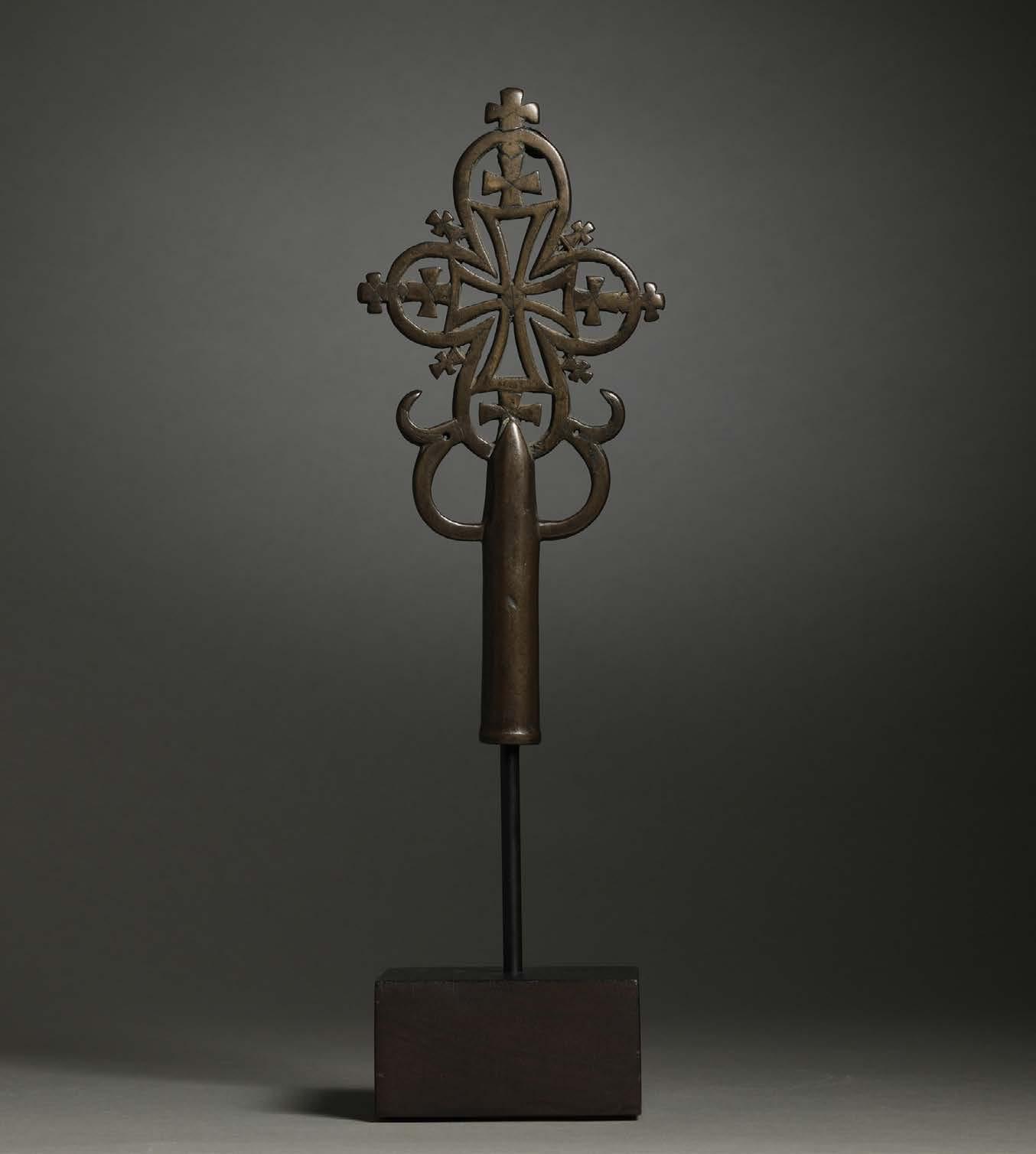
A FINE AND IMPORTANT PROCESSIONAL CROSS
ZAGWE DYNASTY, ETHIOPIA
14th–15th century
Cast bronze
Height: 8 ½ in, 21 ½ cm
PROVENANCE
Frank Augustus Miller (1858–1935)
Mission Inn Collection, California. The Mission Inn Hotel began as a quaint adobe boarding house in 1876, becoming a full-service hotel in the early 1900s. Opened by Frank Miller, it expanded in 1903 with over 200 guestrooms and the addition of the Mission Wing, built in Mission-Revival style while incorporating architectural features from more than 20 different California missions. Three more wings materialized as demand grew, including the Cloister, Spanish Wing and the Rotunda Wing, completed in 1931. Miller filled the hotel with valuable items from across the globe, including artwork, furniture and religious relics. Mission Inn still houses the oldest bell in Christendom, dating back to 1247.
were remembered most for King Gebre Meskel Lalibela, who is credited with having ordered the construction of the rock-hewn, monolithic Christian churches of Lalibela.
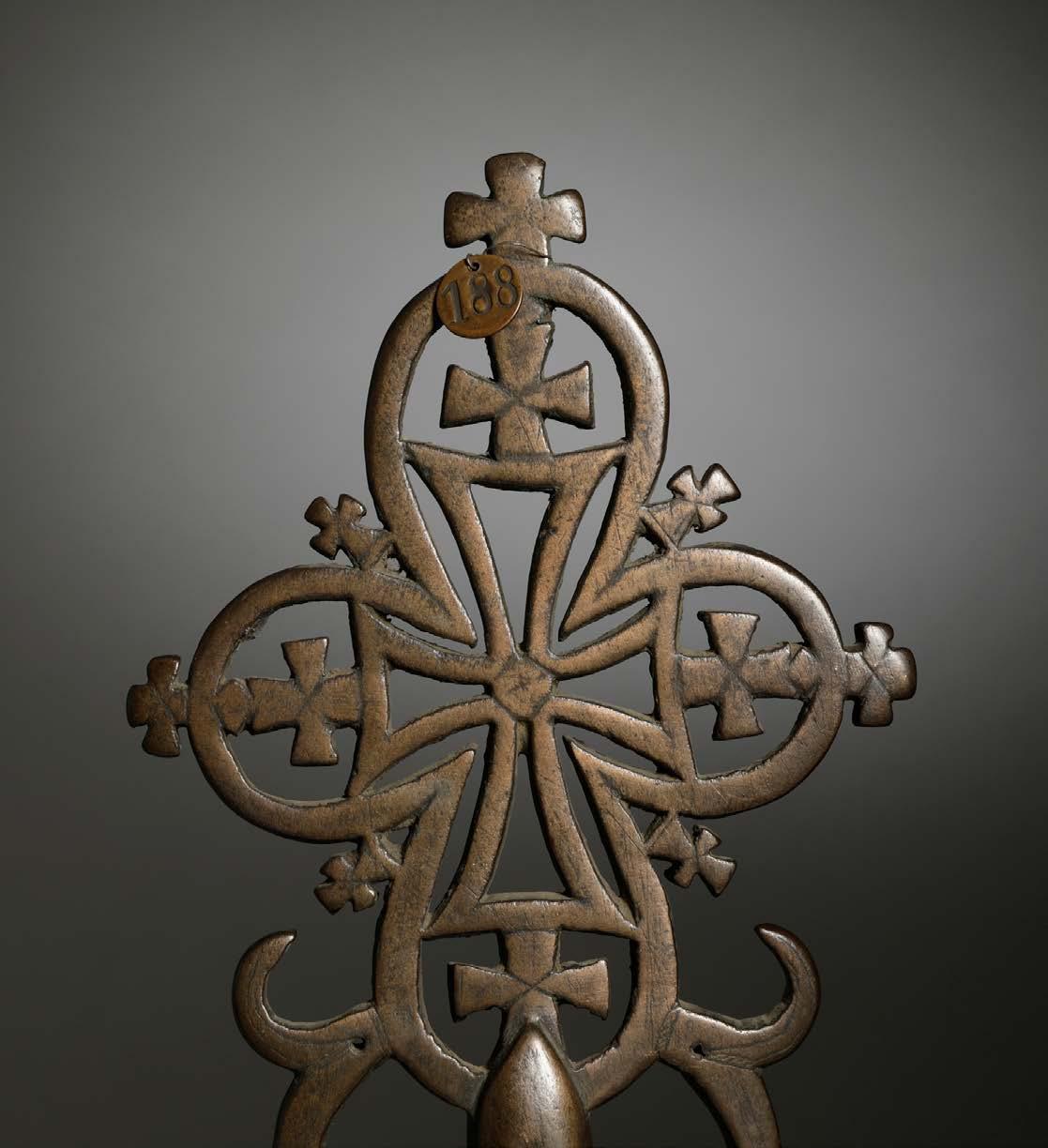
This exquisite processional cross is a superb example of the liturgical metalwork produced in Christian Ethiopia during the later Zagwe or early Solomonic period. Cast in highquality bronze using the lost-wax method, the cross displays a characteristic openwork design. Its expanding and nested cross motifs combine in a kaleidoscopic vision symbolizing the Tree of Life, the Four Gospels, divine light, and the eternal.
The Zagwe dynasty was a medieval Agaw monarchy that once ruled the northern parts of Ethiopia and Eritrea. They
Here we find the distinctive style associated with the Zagwe tradition: symmetry, intricate patterning, and a harmonious blend of abstraction and sacred symbolism. Its finely balanced proportions and crisp casting suggest the hand of a skilled artisan, likely commissioned by a monastic or royal patron. Processional crosses were mounted on staffs and used in liturgical ceremonies and religious processions, signifying the presence and authority of the Church. The subtle wear from handling and devotional use attests to its active role in ecclesiastical life over centuries.
A remarkable testament to Ethiopia’s enduring Christian heritage, this cross not only embodies spiritual significance but also stands as a masterpiece of medieval African metalwork. An old metal collection tag is still affixed with collection number 188 from the Mission Inn Collection. Ethiopian crosses with early provenance are extremely rare and are highly desired by museums and collectors alike.
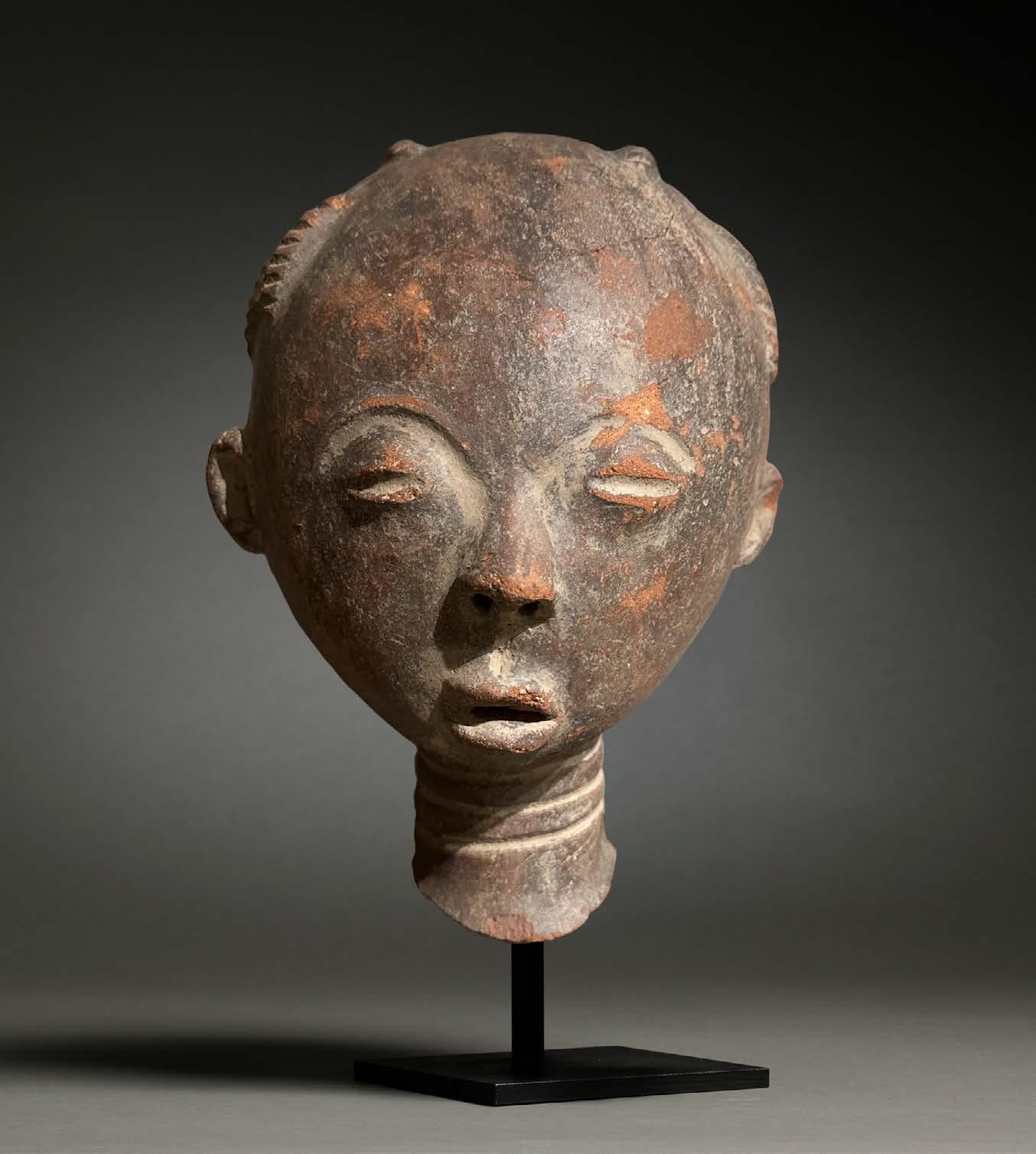
HEAD OF A WOMAN
AKAN, GHANA
Late 19th/early 20th century
Terracotta
Height: 11 in, 28 cm
PROVENANCE
Roy and Sophie Sieber Collection
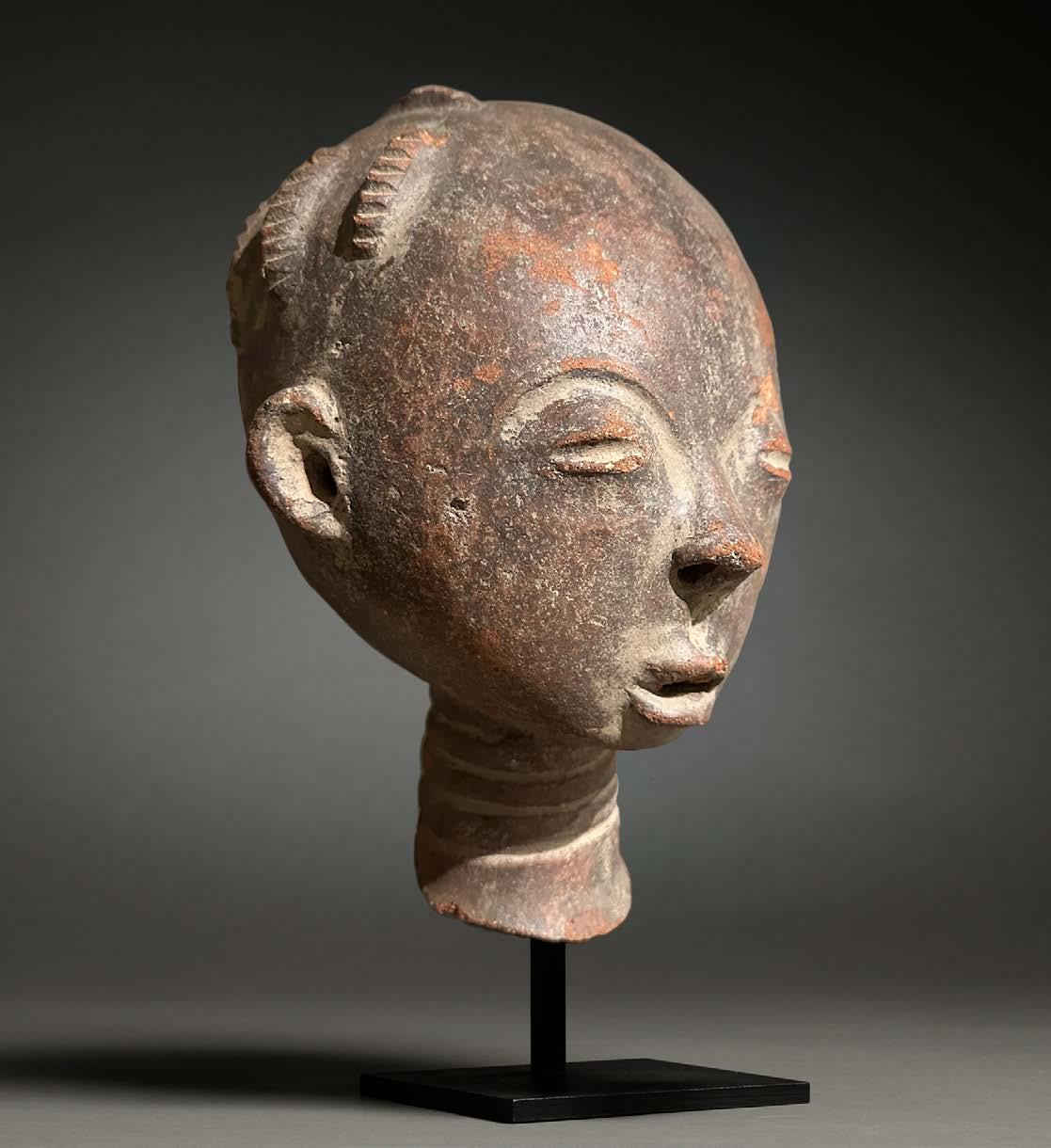
This late-nineteenth-century Akan female ceramic head embodies the refined artistry and spiritual sophistication of Akan funerary traditions. Modeled in warm terracotta, the sculpture presents a serene visage defined by elegantly arched brows, half-closed almond eyes, and a relaxed expression — elements that evoke calm introspection and ancestral dignity.
The bust’s surface is a study in harmonious earth tones, inviting meditation upon the subtle play of color they offer. Smooth uniformity defines the overall shape of the head, broken only by a handful of small, raised, sawtooth
segments of hair suggesting isolated braids. An overall impression of childlike delicacy and innocence radiates from the portrait, heightened by its neotenous features and proportionately slender neck.
Heads and busts were often commissioned within Akan society as commemorative portraits (nsodie) created to honor and immortalize distinguished women. Objects of this caliber bridge the realms of portraiture and spirituality, serving not merely as likenesses, but as enduring vessels of presence, memory, and lineage.
SORCERER’S IMPLEMENT ARHIYE KAIYAM
FLY RIVER, PAPUA NEW GUINEA
Late 19th/early 20th century
Crocodile tooth
Length: 4 ½ in, 11 ½ cm
PROVENANCE
Collected from a village on the lakes region between the Fly River and the border with West Papua near Lake Murray, Papua New Guinea, circa 1952
Private Collection, New Zealand c.1952–c.1985
John ‘Jack’ Charles Edler, Bloomington, IN, USA
Roy and Sophie Sieber Collection
Magical belief and practice were long deeply ingrained in Melanesian society, and echoes of them are still felt in the island complex in the present era. Traditionally, sorcery was used for both harmful and helpful ends, both of which might require the use of an enchanted object. Those who possessed the necessary expertise could create one through the application or insertion of powerful substances like blood or beeswax. In order to heal, a sorcerer could use a magical implement to find and return important things that were missing or stolen, such as the soul of a person afflicted with illness. Or, with harmful intent, they might utter a spell
over the item and symbolically ‘shoot’ it into a victim to bring sickness or death.
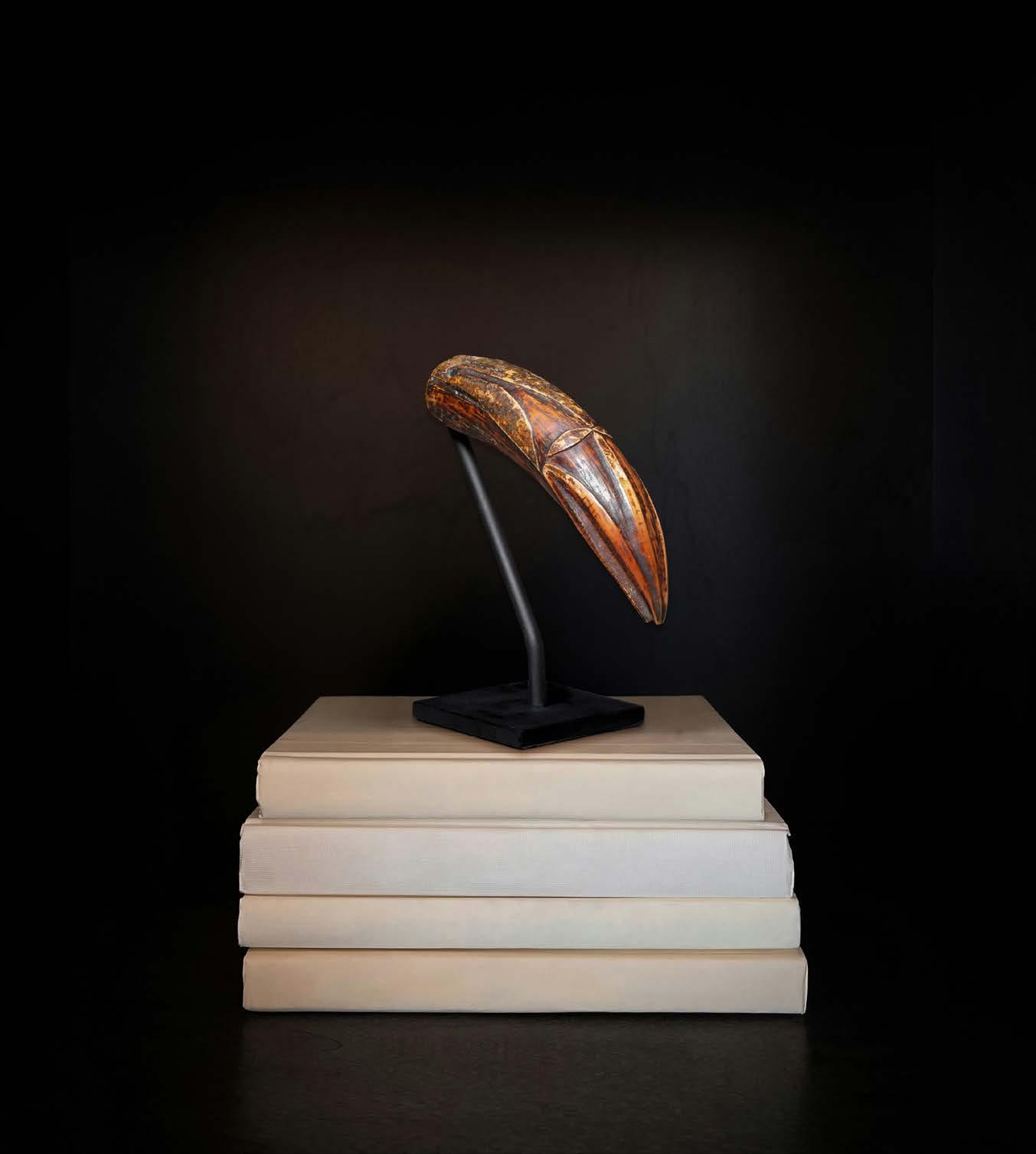
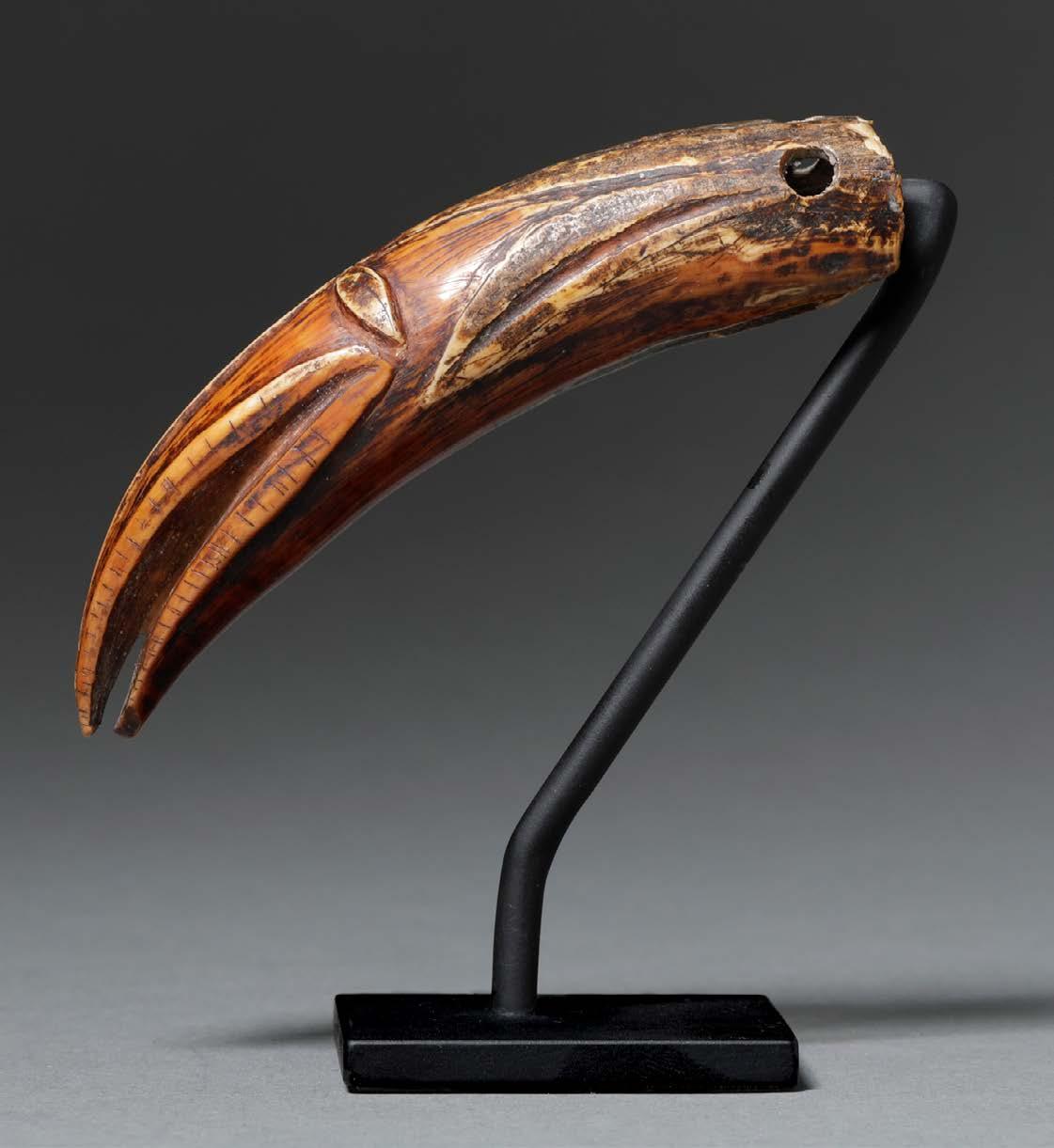
This is a very rare example of just such an implement. Shaped from a crocodile tooth, it is carved in the form of a stylized bird’s head, possibly a Papuan hornbill. The fusion of land, water, and air symbolism in this object possibly granted its user the ability to travel through and between both the physical and spiritual realms. For a similar example, possibly collected from the same village, see object number 61:2000 in the St. Louis Art Museum and featured in Tribal #101, August 2021.
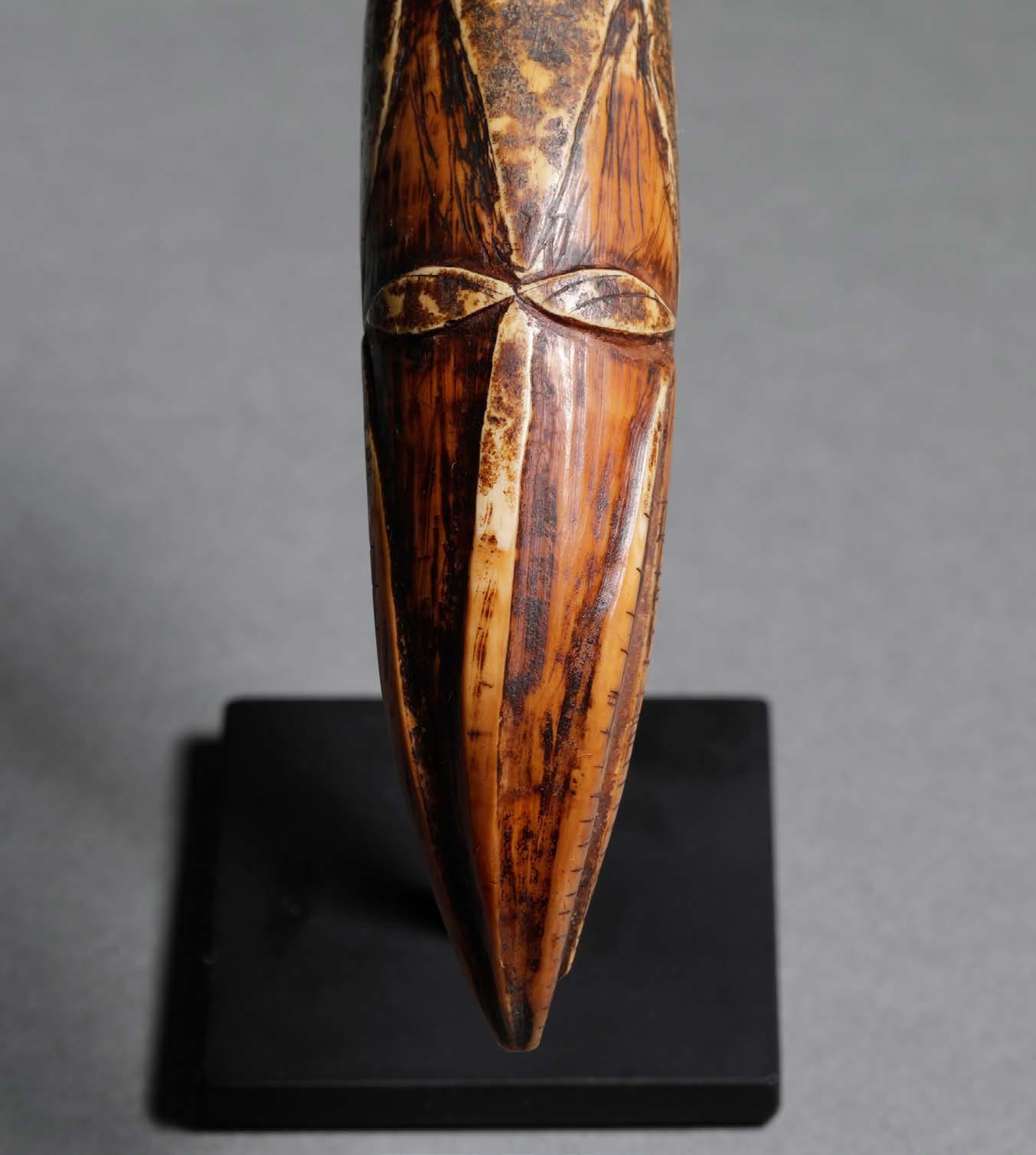

AMULET MASK
LOWER SEPIK REGION, NEW GUINEA
Late 19th/early 20th century
Wood
Height: 7 ½ in, 19 cm
PROVENANCE
F W Schlitter, Germany
Zemanek-Münster Auctions
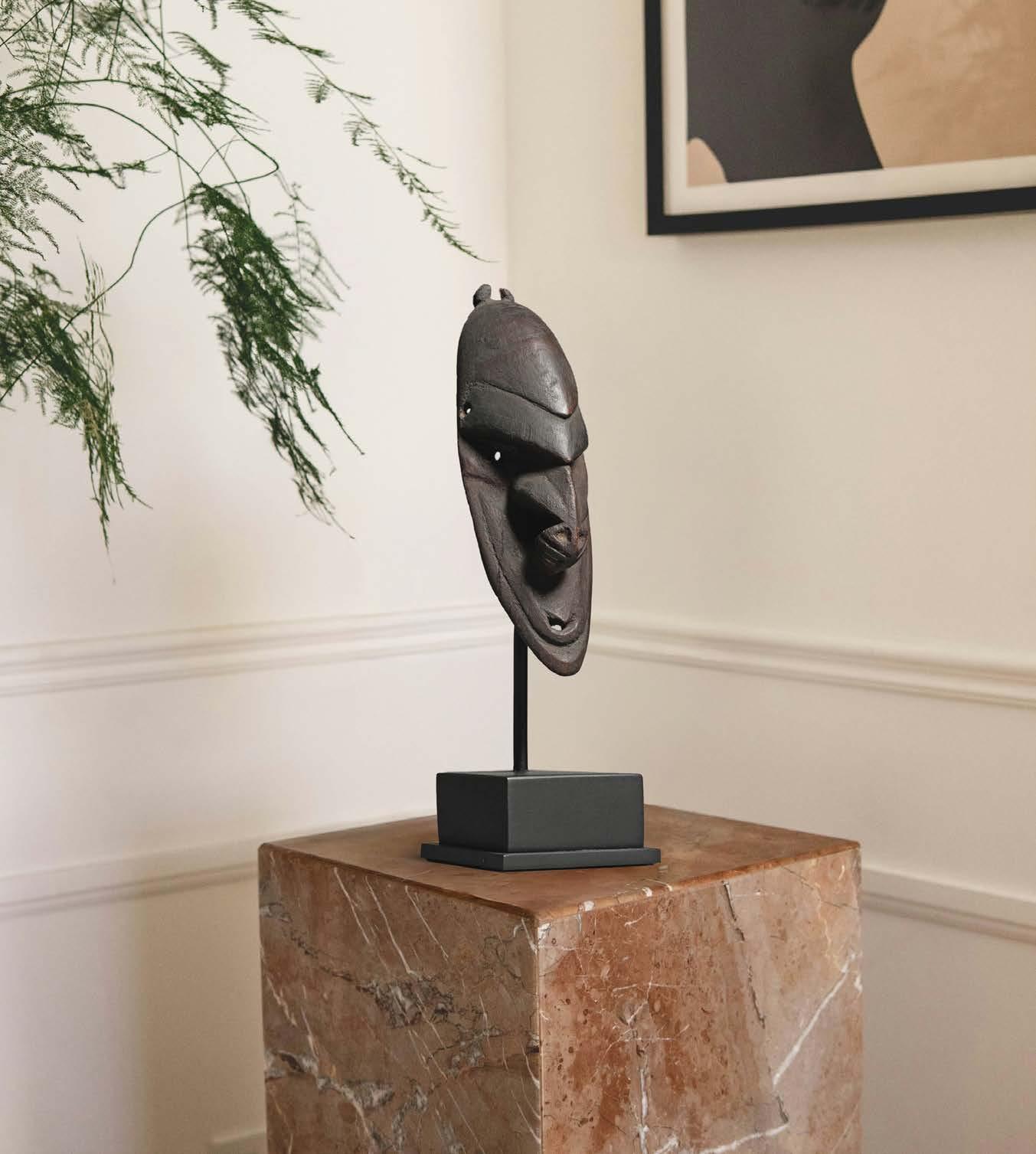
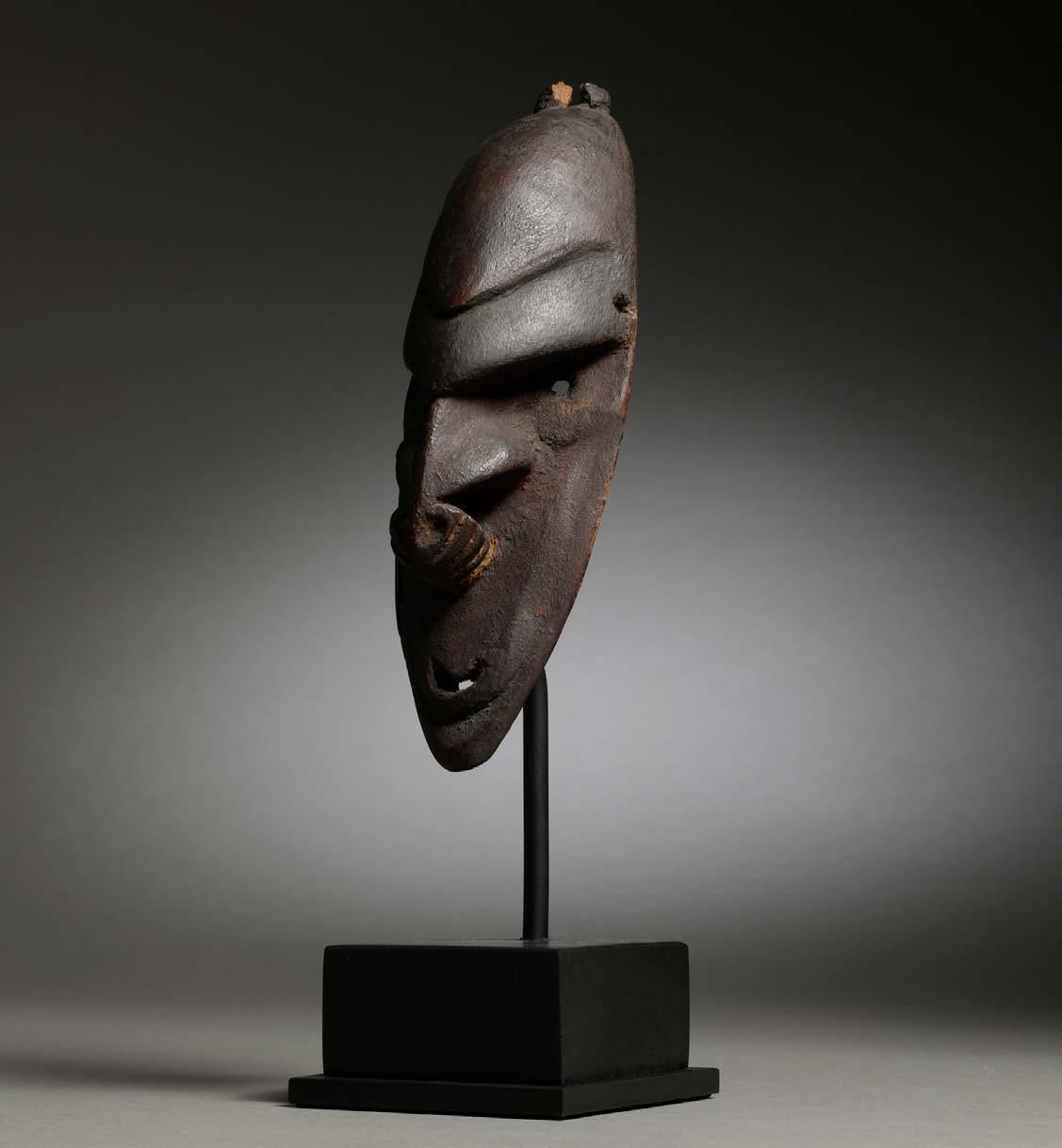
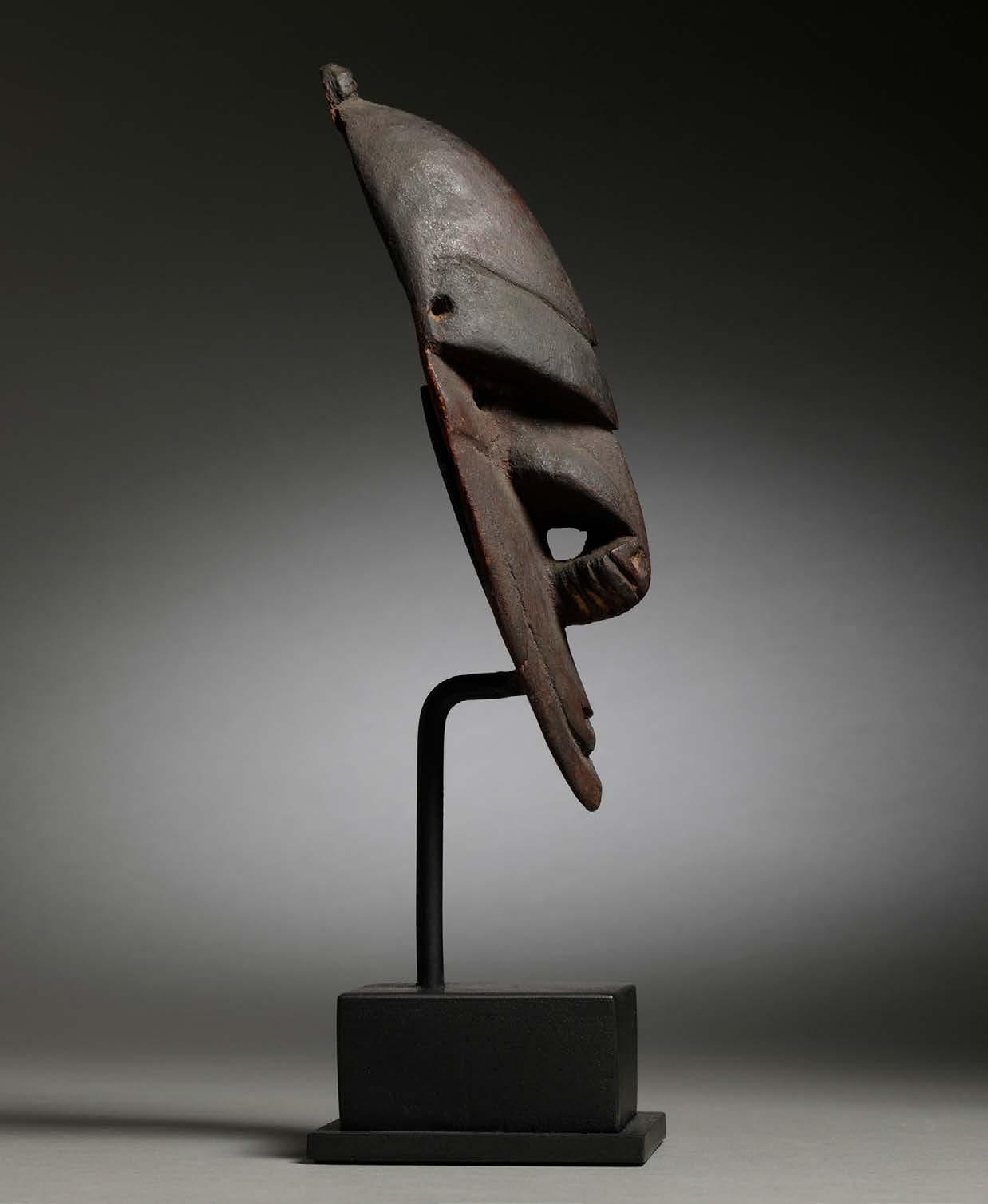
Small amulet masks made by the Sepik peoples of New Guinea, particularly from the Middle and Lower Sepik River regions, were not worn over the face like full-sized masks. Instead, they were worn suspended on necklaces, attached to clothing, or carried in personal bundles as protective charms. Believed to house the spirits of ancestors or protective beings, they played important roles in protection both physical and spiritual, ancestral connection, and ritual practice. Their design often echoed the forms of their large ceremonial counterparts, which were used in dances and rituals.
Some of these miniature masks were kept in men’s longhouses or domestic shrines alongside other sacred items. Offerings of food, betel nut, or tobacco might be
made to them to maintain good relations with the spirits they represented. When carried away from hallowed places of safekeeping, amulet masks served as a portable, personal embodiment of a clan’s spiritual power. During initiation rites, young men might receive a miniature mask as a signifier of identity.
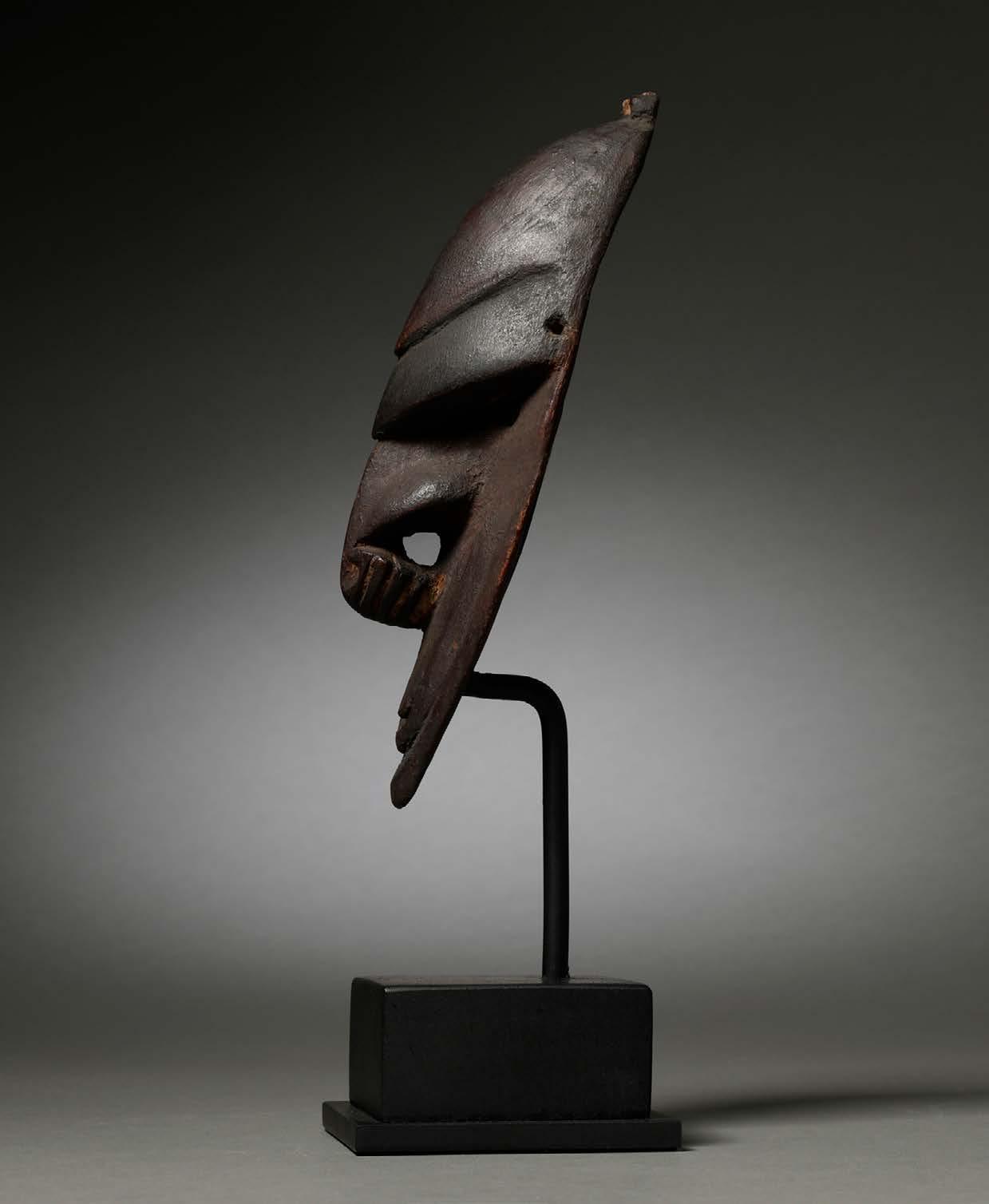
This fine amulet mask shows a sharp, brooding expression defined by a masterfully composed rhythm of cascading and echoing angles. A view in profile reveals a magnificent shift in form and leaves no doubt regarding the expertise of the carver, as the brow and openwork nose jut dramatically over the thin, finely flattened and stepped lower face. Cast shadows are deepened by a finely textured and earthy patina, magnifying the mask’s gravitas.
HARPOON FORESHAFT
INUIT, ALASKA
19th century or earlier
Marine ivory
Length: 19 in, 48 cm
PROVENANCE
George Shaw, Aspen
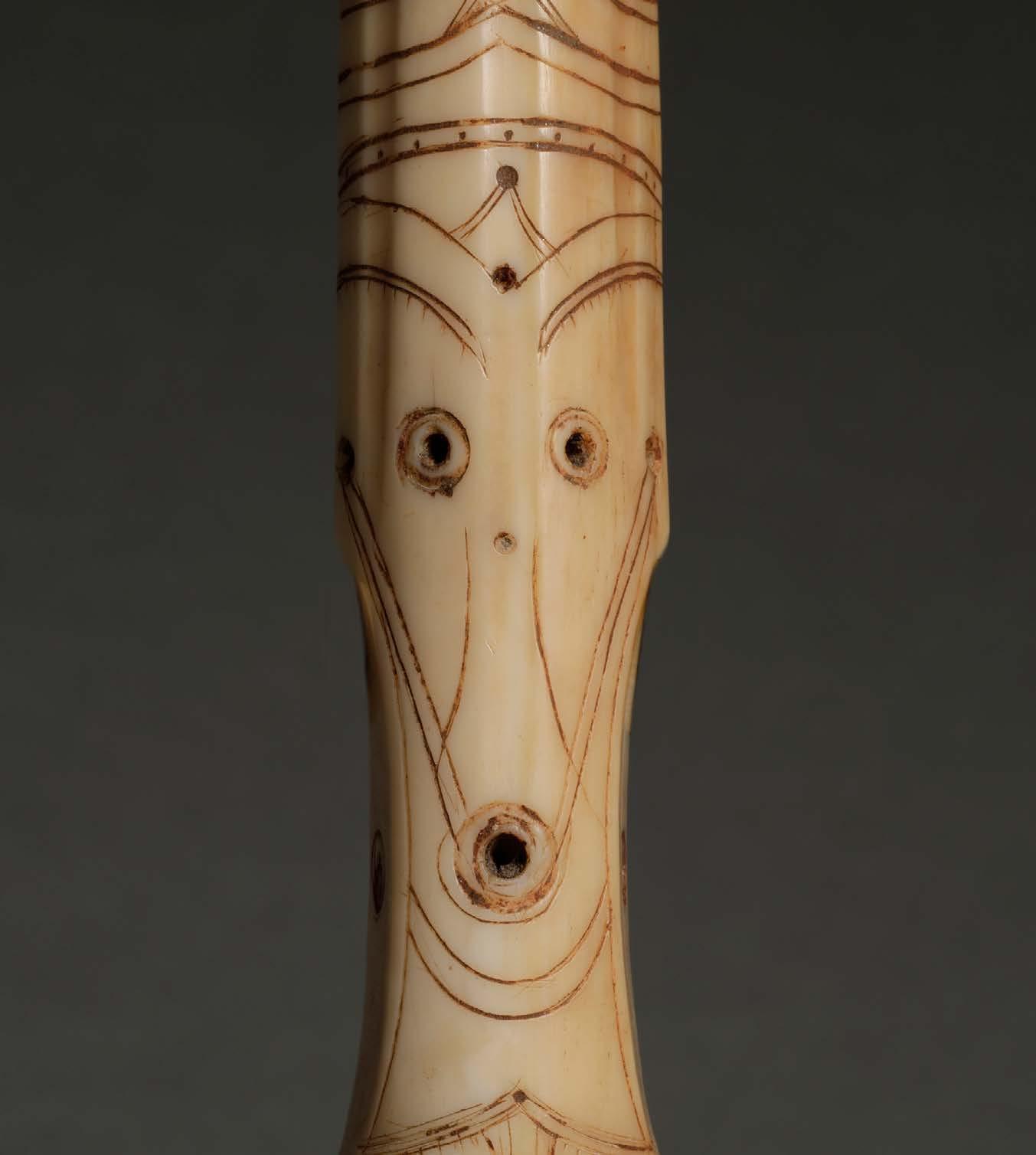
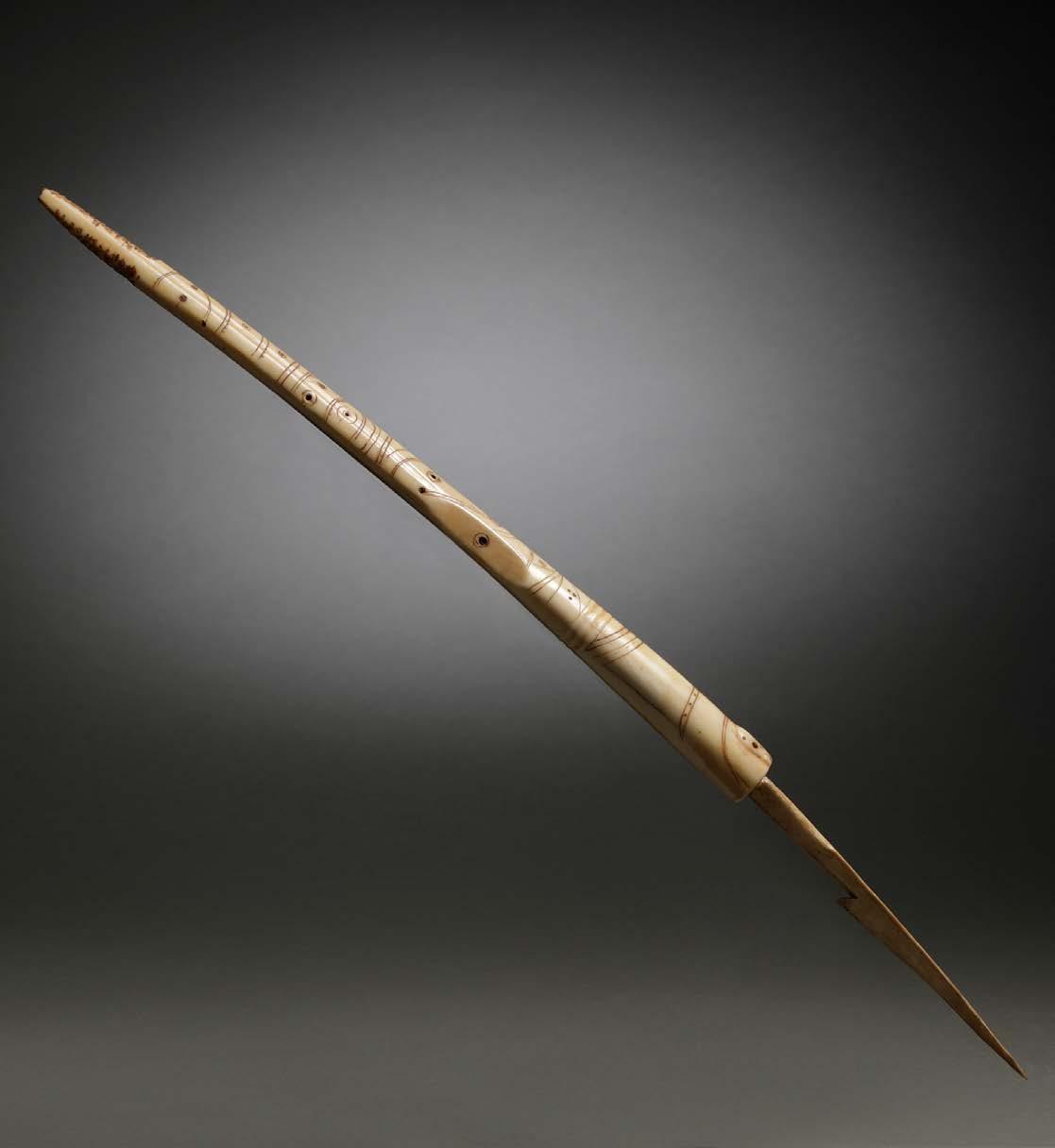
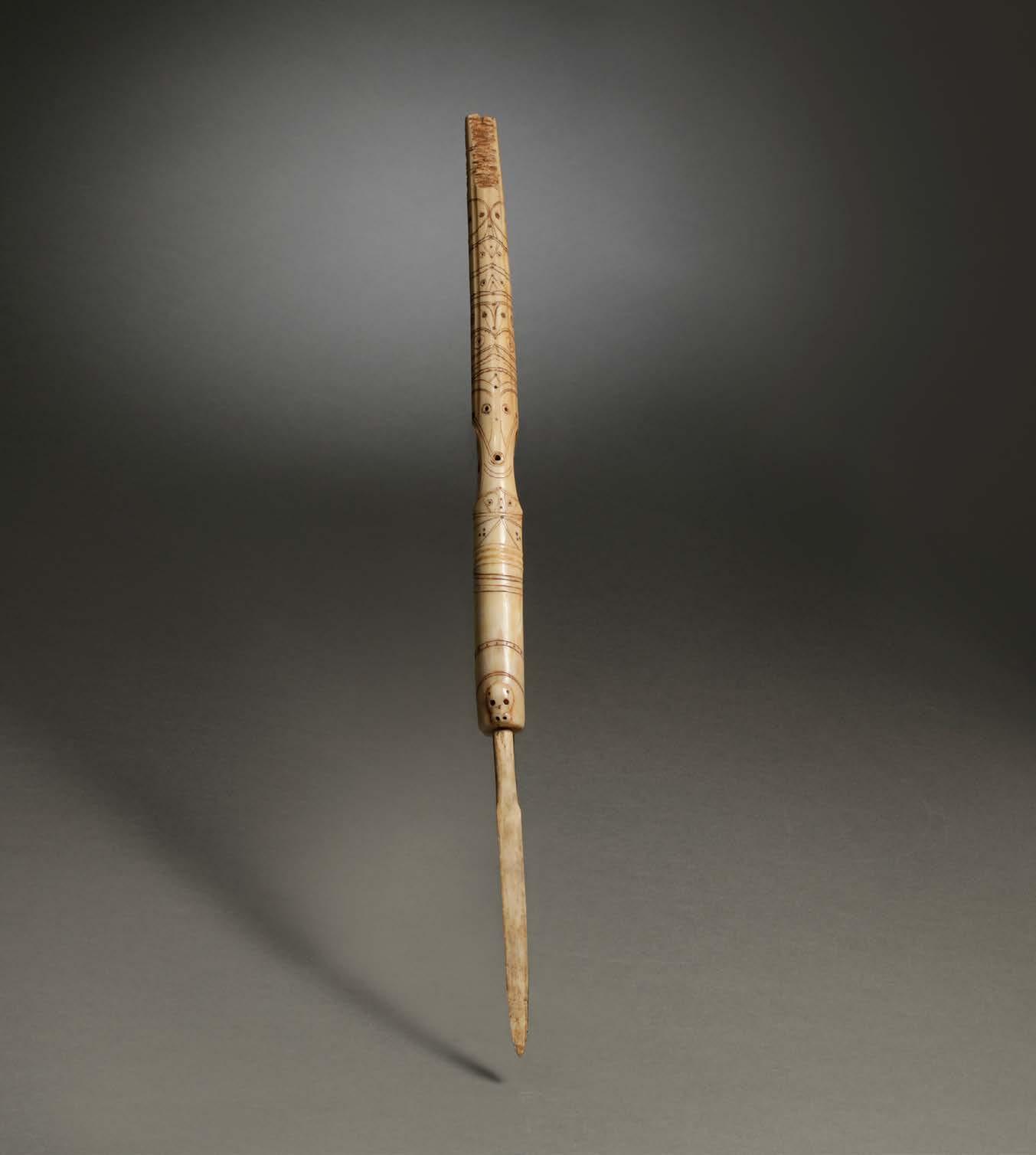
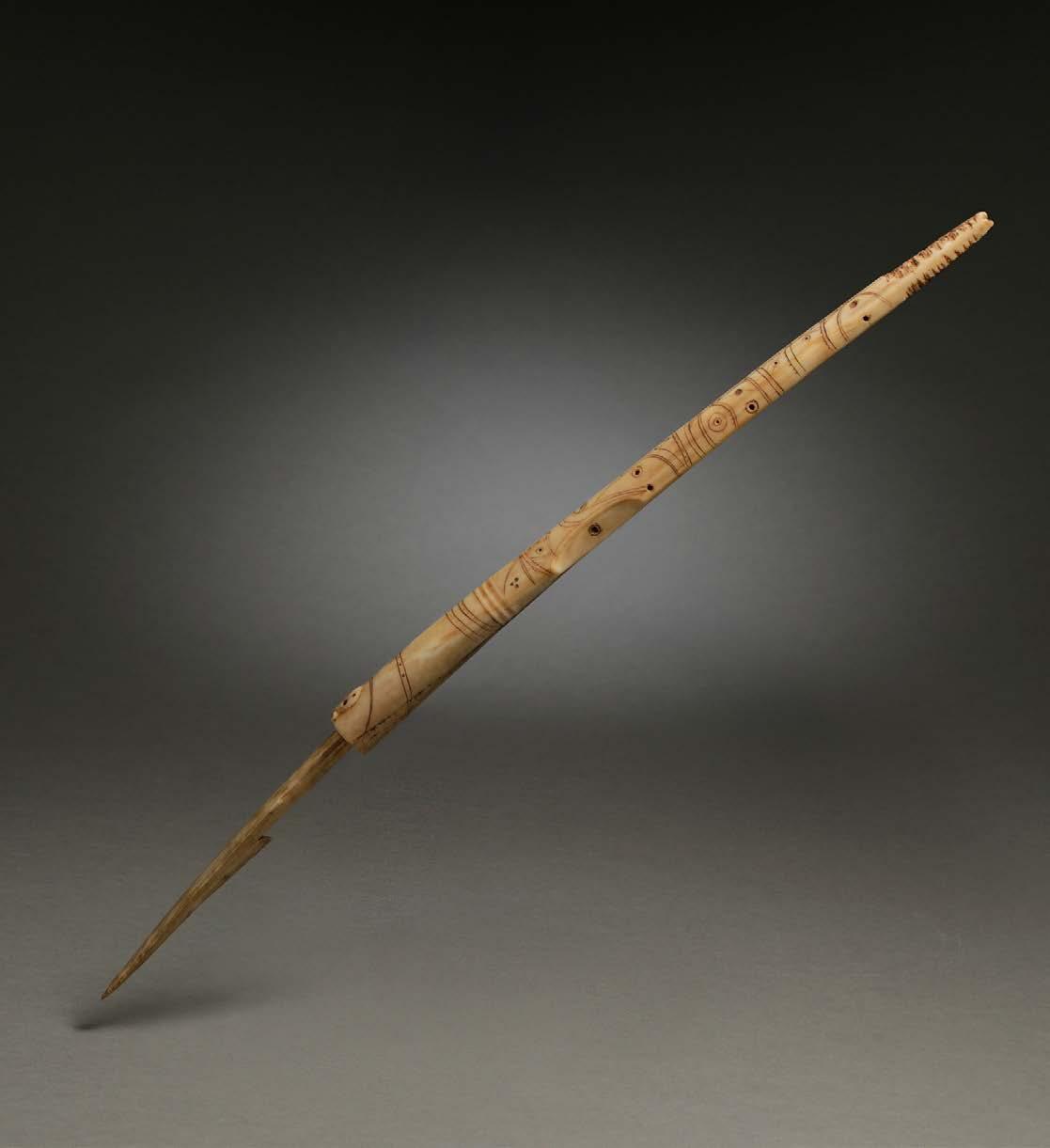
This exceptional walrus ivory harpoon foreshaft is carved with a raised seal head in relief at one end and further embellished with finely incised engravings of a seal’s face and delicate eye-line motifs. The artist’s hand reveals both technical mastery and a deep cultural connection to the animal world, transforming a functional hunting implement into a work of sculptural beauty.
The foreshaft once served as the joining element between the main shaft of a harpoon and the toggling, detachable head. Beyond its utilitarian purpose, this piece reflects a special reverence for the seal, a central figure in Inuit
survival and animistic spirituality. The vital elegance and consummate craftsmanship with which a carver shaped a harpoon truly paid honor to the animals that gave their lives for the human community.
Considering its age and fragility, this piece is preserved in remarkable condition, showing some signs of wear consistent with traditional use, and a warm natural patina throughout. This is an outstanding example of nineteenthcentury Arctic craftsmanship suited for both ethnographic and fine art collections. The point is not original to the piece but is of the period.

TORQUE OR CURRENCY OBJECT
YORUBA, NIGERIA
17th –19th century
Copper alloy
Height: 10 in, 25 cm
PROVENANCE
Roy and Sophie Sieber Collection
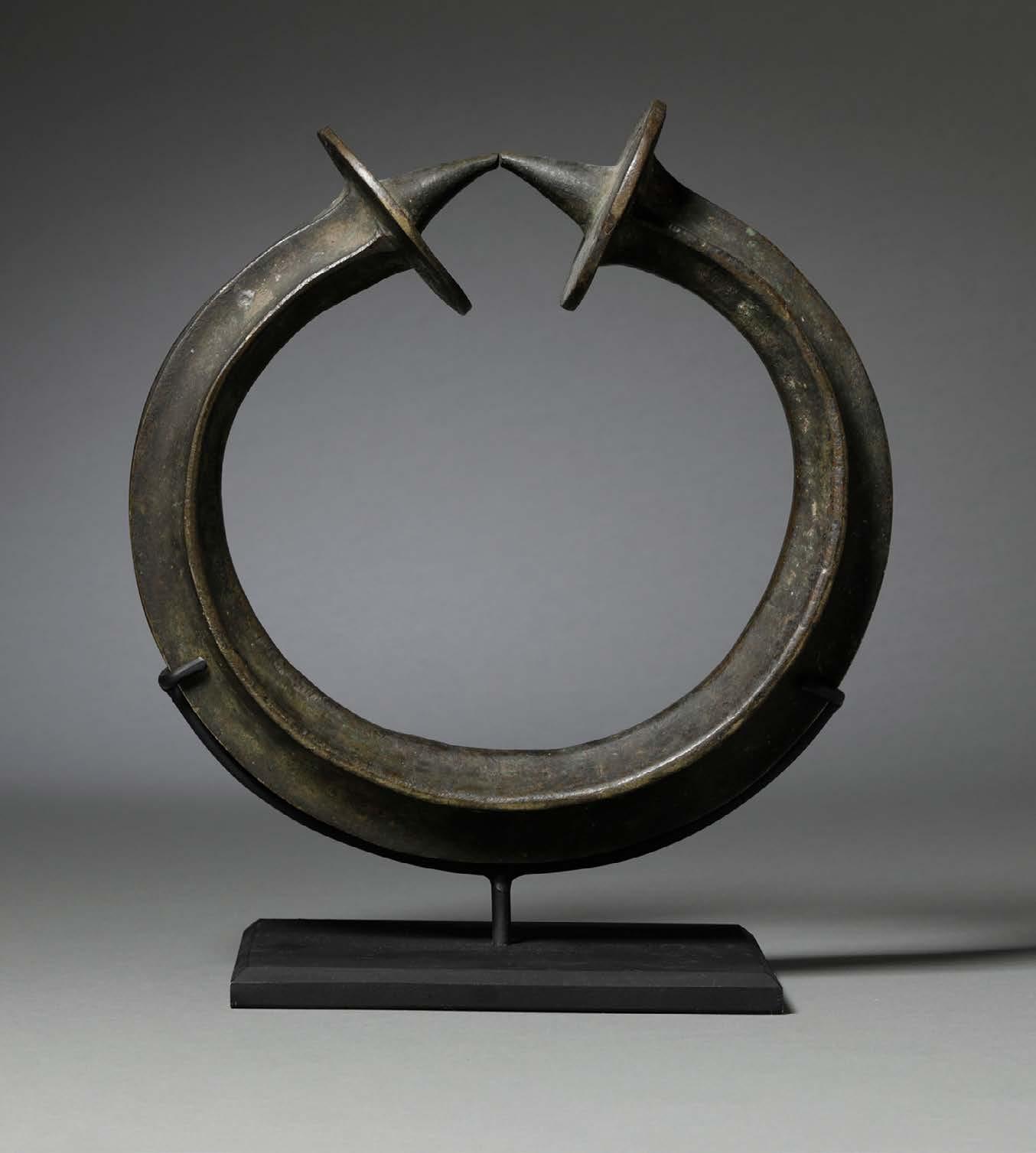
Copper was a rare and highly prized commodity in Africa, attained either through trade with Europe or from select areas on the continent, such as Morocco to the north and Katanga in the Congo. When European ships began arriving along the west coast of Africa during the sixteenth century and later, they carried brass manillas, braceletshaped weights in different sizes that served as a medium of exchange. The Yoruba melted these down, separating the copper and zinc, and recast the copper into similar but much larger objects called torques. The Ogboni society of the Yoruba also created important ritual objects from the metal extracted from manillas.
Owning torques reflected considerable wealth, and flaunting them was a conspicuous display of social prestige. Though some were worn as necklaces by women, others were used according to their size, from small currency objects to large ceremonial pieces.
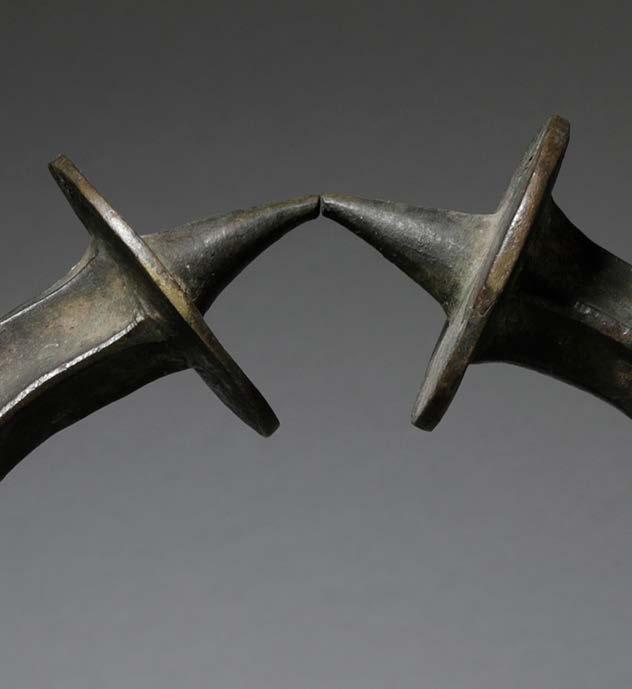
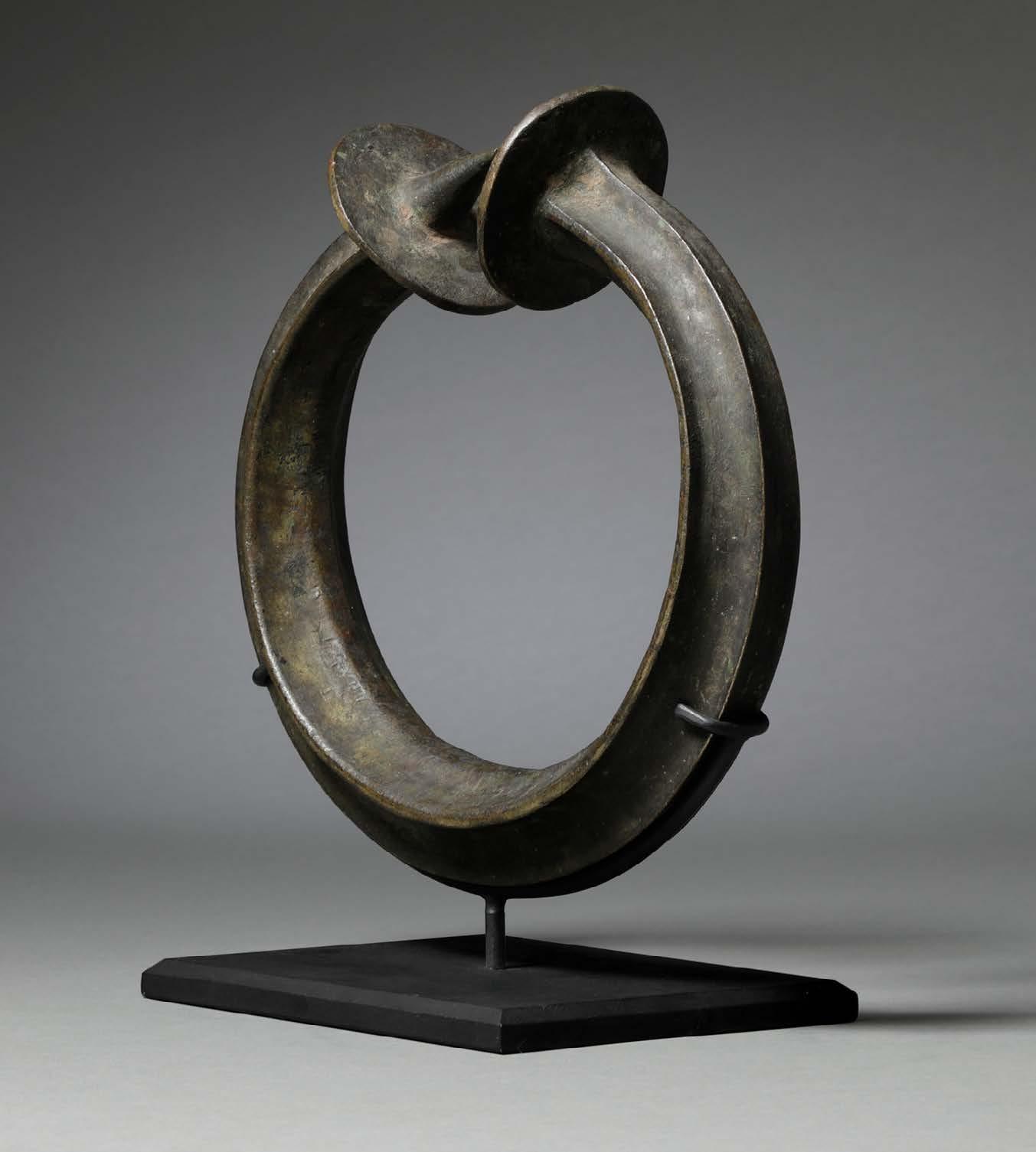
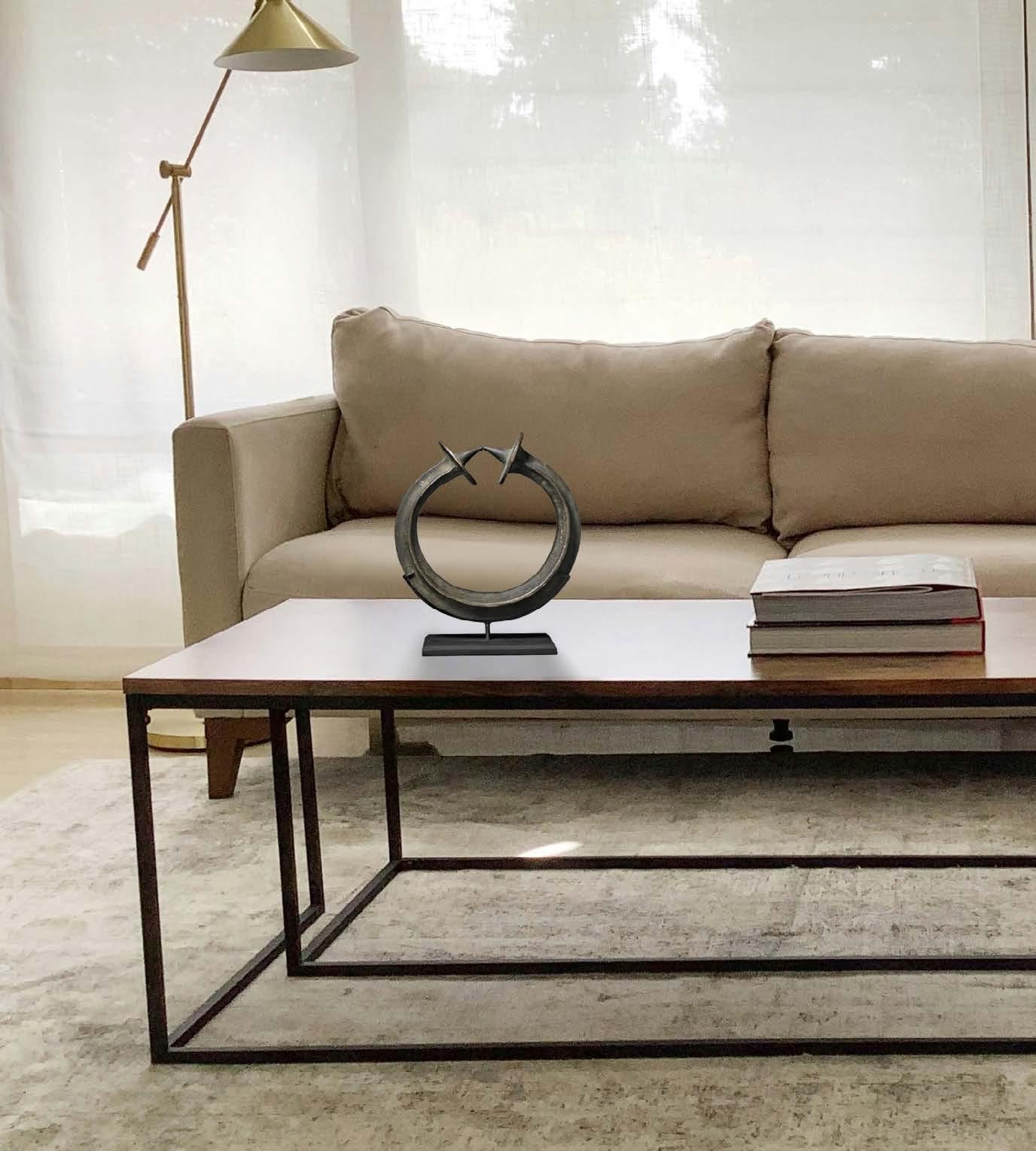
Considering its size, this stunning torque was possibly given as a wedding dowry, and the standing of the owning family was reflected in the weight and symmetry of the piece. An elegant power resonates in its heavy, flexed arc, the girth of which terminates in mirrored, delicate points that emerge from flat disks, barely touching at their tips, expressing great balance, control, and restraint.
AN EXCEPTIONAL CHILKAT BLANKET
TLINGIT, NORTHWEST COAST
Mid to Late 19th century
Mountain goat wool, cedar bark
Height (excluding fringe): 62 in, 157 cm, Width 72 in, 183 cm
PROVENANCE
Philip S. Padelford (1912–2009). Padelford attended the University of Washington as an undergraduate and graduate student. He earned a doctorate in history from Yale in 1942, and served as an officer in the Navy in the Pacific during World War II. Padelford was vice president and director of Wakefield Seafoods, the major company in the Alaskan King crab industry.
PUBLICATION HISTORY
The Box of Daylight, a 1983 exhibition at the Seattle Art Museum, and published in the accompanying catalog. The catalog was written by Bill Holm. Holm (1925–2020) was a highly influential American art historian, artist, and scholar best known for his extensive work on Northwest Coast Native art, including formline design and material culture of Indigenous peoples such as the Tlingit, Haida, and Tsimshian. He served as Curator (later Curator Emeritus) of Northwest Coast Indian Art at the Burke Museum in Seattle and was a Professor of Art History and Anthropology at the University of Washington.
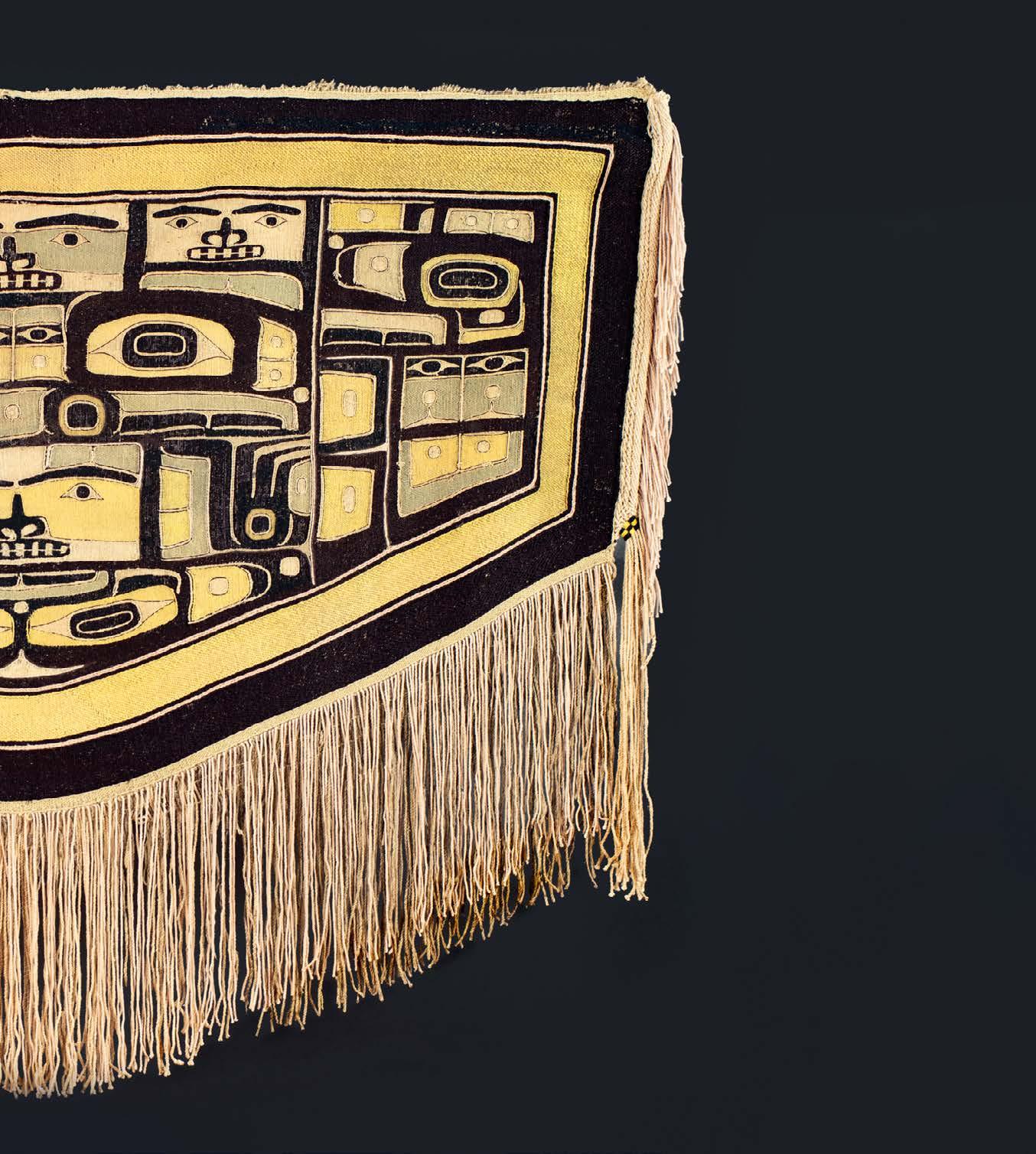
passed through generations and whose work carried great cultural prestige. The process was extraordinarily laborintensive: raw mountain goat wool was collected, cleaned, spun, and combined with shredded cedar bark to create a strong, flexible yarn, then dyed with natural pigments. From preparation to completion, a single blanket could require many months—and often more than a year—of dedicated work. Such blankets were worn during potlatches, dances, and other ceremonial events, where their movement and symbolism reinforced the wearer’s rank and social identity.
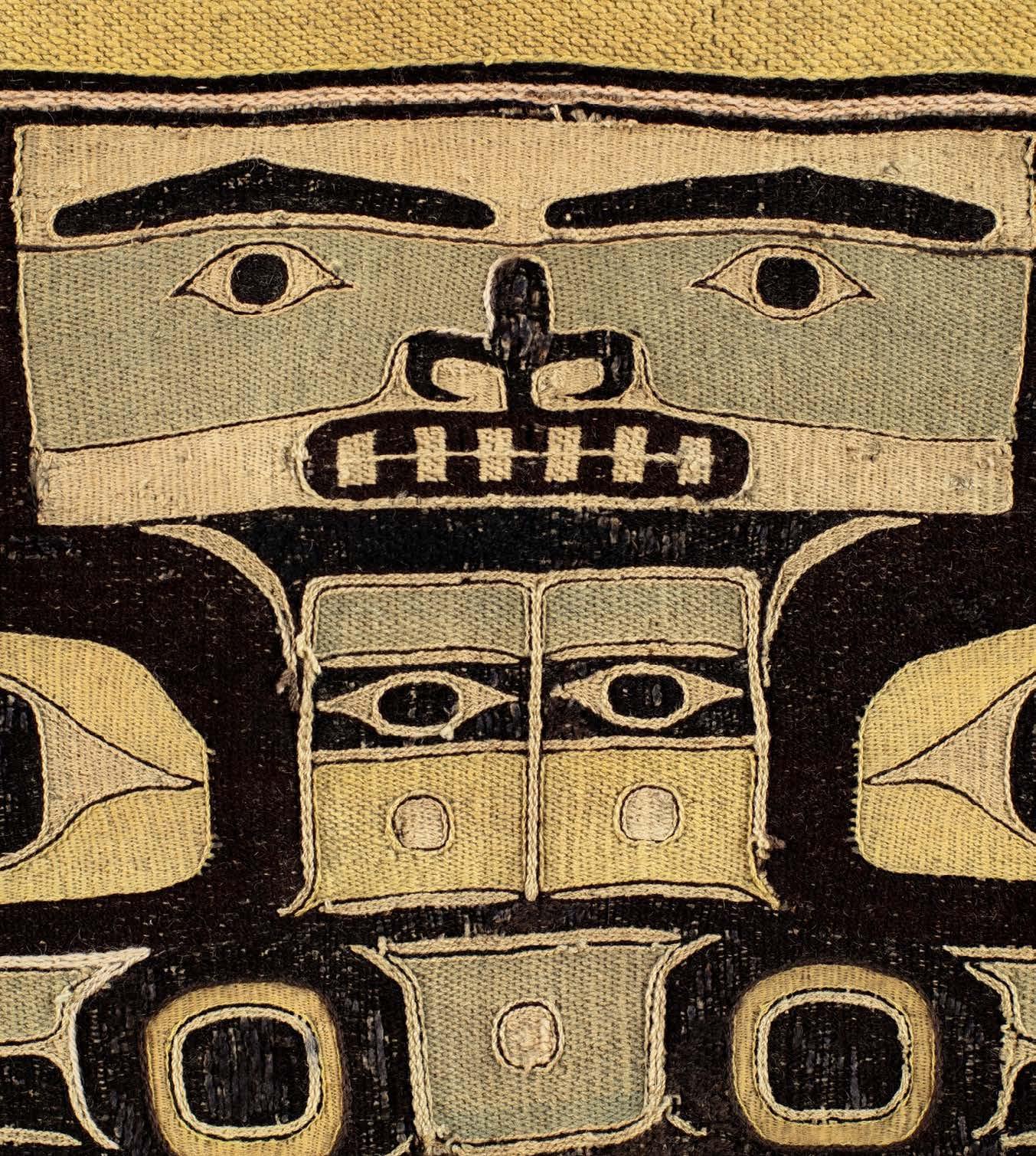
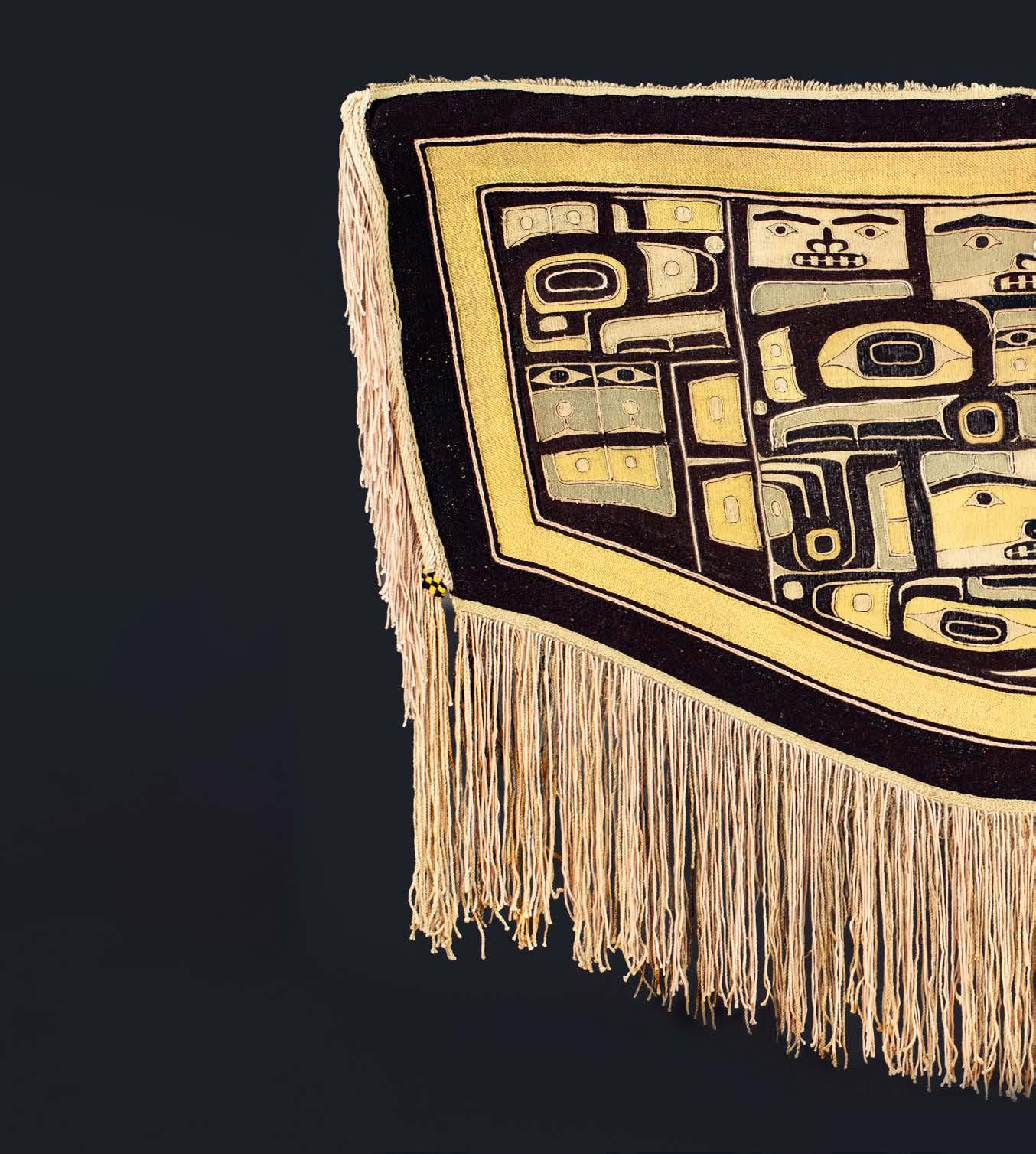
The design is executed in the classic Chilkat weaving technique, allowing curvilinear formline imagery to be woven directly into the fabric rather than embroidered or painted afterward. The composition features powerful crest figures—abstracted animal and supernatural beings associated with clan identity, ancestry, and inherited rights. These designs were not simply decorative, but encoded social status, lineage, and ceremonial privilege.
Within this dense complex of interlocking and nested imagery are found depictions of ravens, eagles, bears, killer whales, and human-like spirit figures, all rendered through flowing lines and geometric shapes that communicate balance, transformation, and spiritual authority. The inclusion of three faces positioned in a row across the top center of the composition is unique in this class of weavings.
The blanket’s refined graphic clarity, spare but powerful color palette, and its long, rhythmic fringe panels present a showcase of early Chilkat weaving at its highest level.
Woven from mountain goat wool and hand-processed cedar bark, this exceptional nineteenth-century Chilkat blanket represents one of the most sophisticated textile traditions of the Indigenous Americas. Chilkat blankets were woven exclusively by highly skilled women, whose knowledge was
Examples of this age and quality are increasingly rare, particularly those retaining strong structure and visual power. This blanket stands as a museum-quality work— an enduring testament to the mastery of Indigenous women weavers and a profound cultural document of the nineteenth-century Pacific Northwest.
SHAMAN’S MASK
INUIT PEOPLES, MAINLAND ALASKA
Late 19th century Wood, pigments
Height: 8 ½ in, 21 ½ cm
PROVENANCE
Private Collection, USA
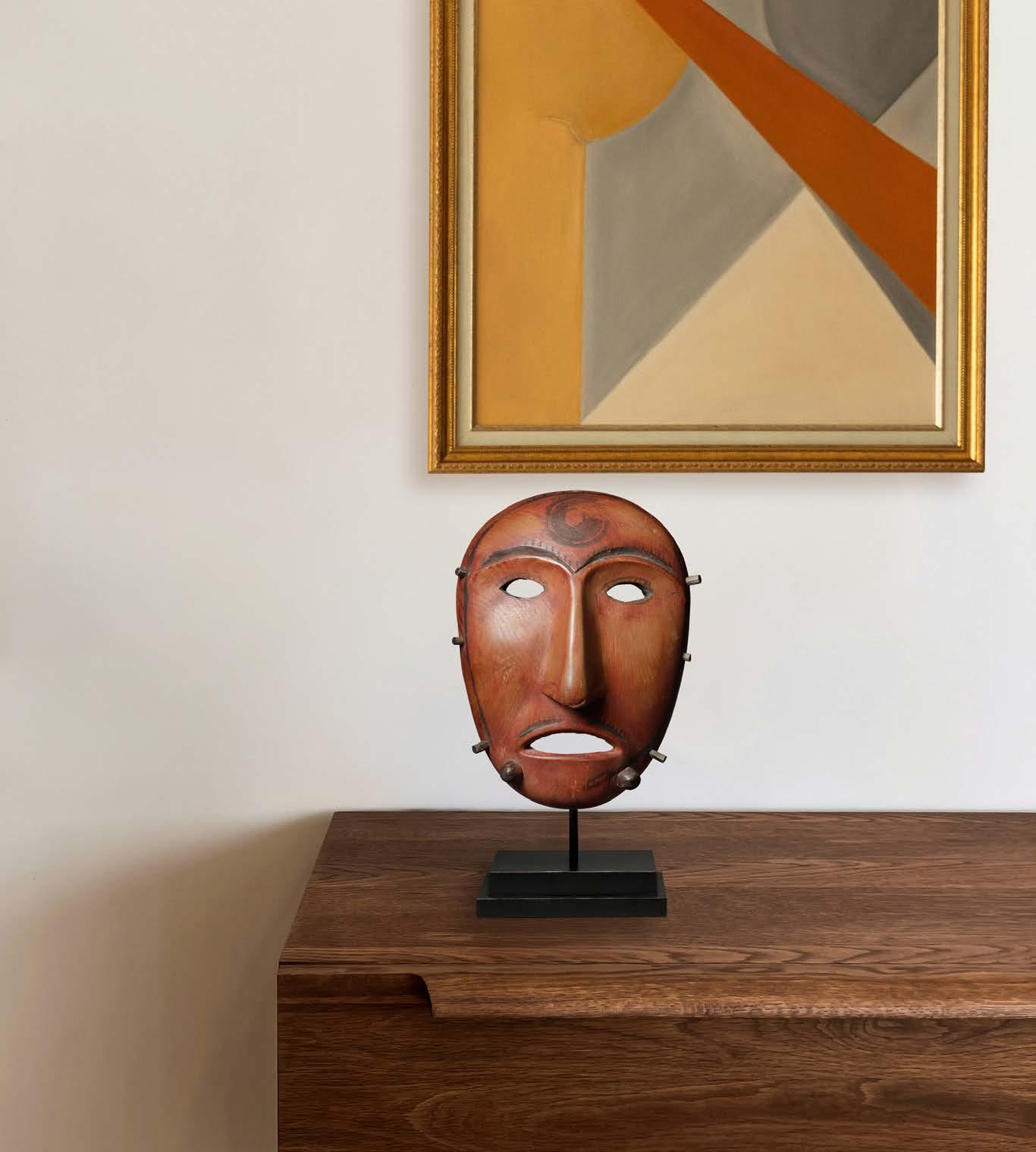
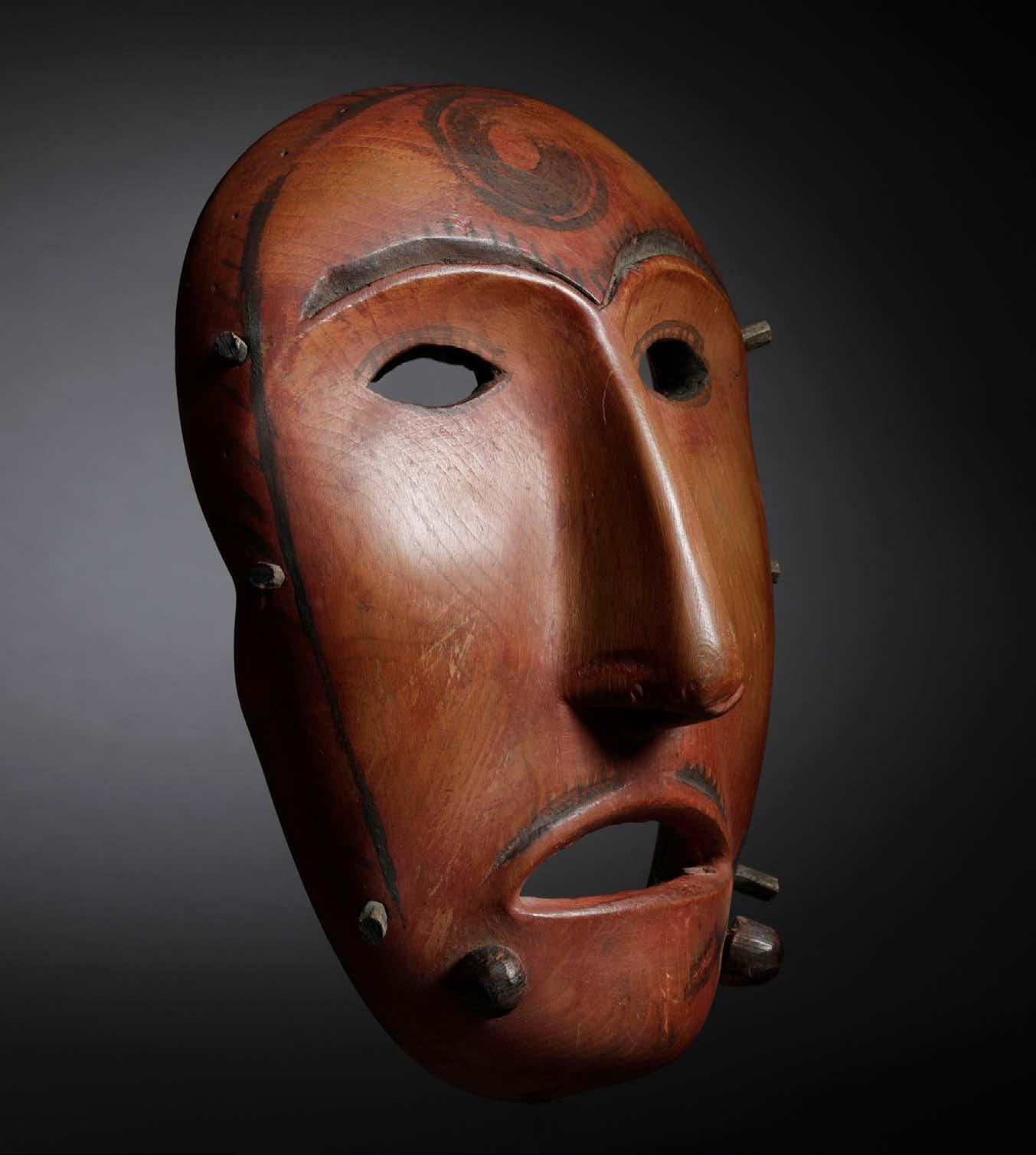
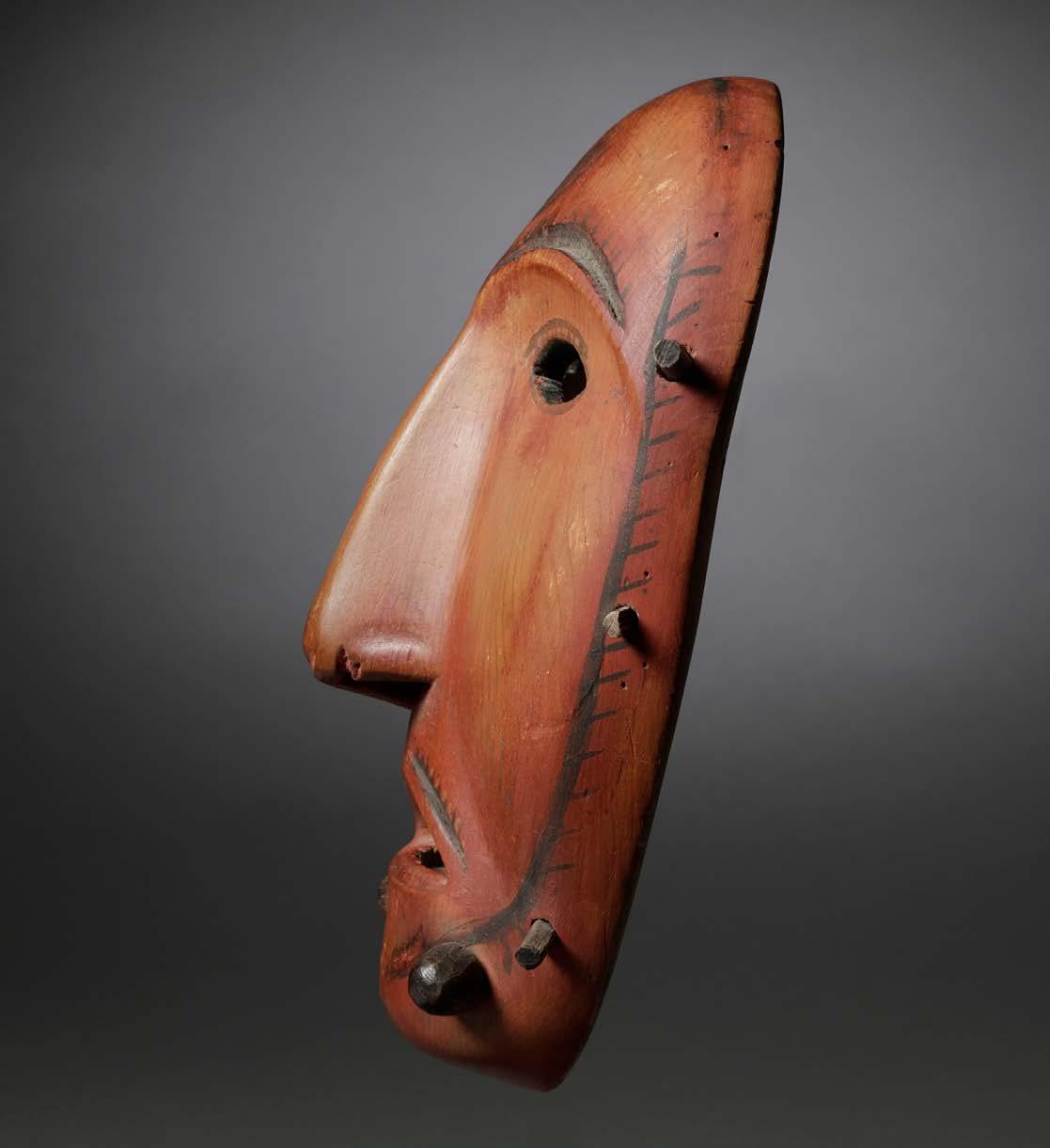
Among Arctic cultures in North America, shamans utilized masks as powerful ritual instruments. During healing rites, divination, and trance performances, masks enabled the shaman to temporarily relinquish personal identity and assume the mantle of various metaphysical benefactors. Through song, drumming, and dance, the mask became animated—serving as a conduit through which spiritual beings could speak, heal, or guide the community. Masking allowed passage between visible and invisible realms.
This rare Inuit mask, rendered with careful symmetry, shows an elongated nose, hollowed eyes, and mouth agape, evoking breath, voice, and transformation—central elements in shamanic practice. The expression is one of
vivid revelation, in which the momentous experiences of trance and spiritual communion are captured.
The surface bears a rich, time-worn patina in warm ochres and deep reddish browns, enhanced by a flowing grain and painted black designs that arc within the center of the brow and trace the borders of the face. A dark browline is cut deeply into the surface, framing the eyes and lending a naturalistic touch. Wooden pegs projecting from the perimeter are a compelling functional and symbolic feature, likely used to secure attachments, suggest radiating energy, or signify spirit emanations during ritual movement. A pair of heavy labrets protrude below both corners of the mouth.
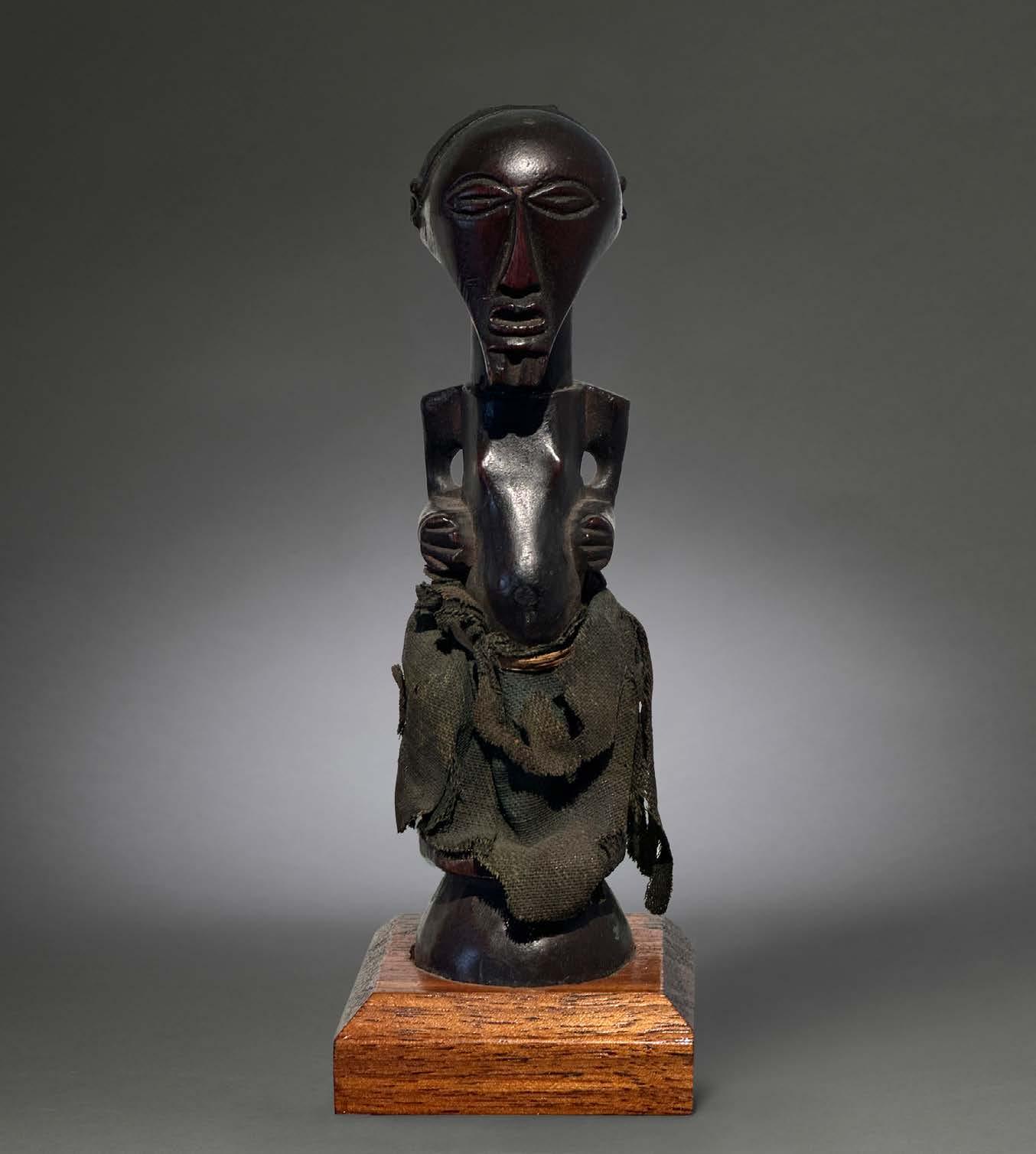
POWER FIGURE NKISI
SONGYE, DRC
Late 19th/early 20th century
Wood, cloth, fiber
Height: 6 in, 15 ½ cm
PROVENANCE
Probably Paul Guillaume (1891–1934), Paris, France
Earl Horter (1880–1940) Collection, Philadelphia, Pennsylvania, USA
Property from the Estate of Elizabeth Lentz Horter, 1985
Private Collection, USA
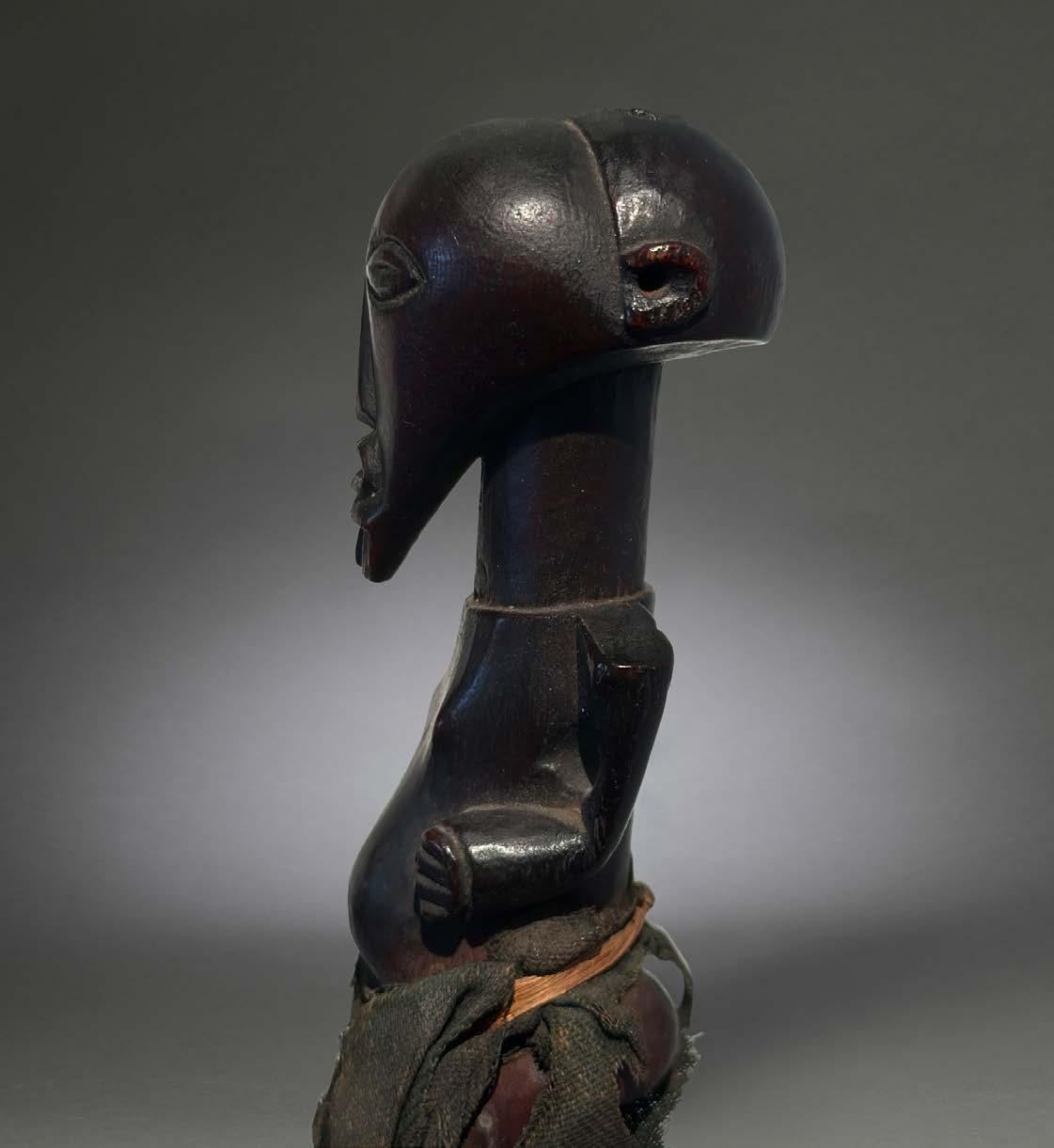
This power figure (nkisi, pl. mankishi) is attributable to Songye artistic and ritual traditions of the central Democratic Republic of the Congo, and was produced under the direction of an nganga, or ritual specialist. Unlike large-scale or publicly activated mankishi intended for communal protection or judicial functions, this example was created for the exclusive use of a single individual, tailored to that person’s specific circumstances, vulnerabilities, and social obligations.
Within Songye belief systems, the nganga served as both diviner and mediator, determining the appropriate form, materials, and medicinal substances (bishimba) incorporated into the figure in accordance with the client’s personal needs. Such privately commissioned figures were understood to operate on an intimate scale, addressing
matters such as personal protection, health, fertility, or conflict resolution, rather than the welfare of the broader community.
Formally, this is a refined and disciplined example that adheres to convention, with an enlarged head and face, commanding expression, and poised stance with abstracted arms framing an extended abdomen. These features underscore concepts of containment and controlled force, which scholars have identified as central to Songye notions of efficacy and power. Olive green fabric is bound around the waist by a length of fiber, concealing blocky legs planted stoutly upon a rounded pedestal. The head and face are magnificently abstracted, with a nearly flat facial profile that tapers sharply down to a pointed chin. A bishimba charge is retained in the belly where it was originally inserted.
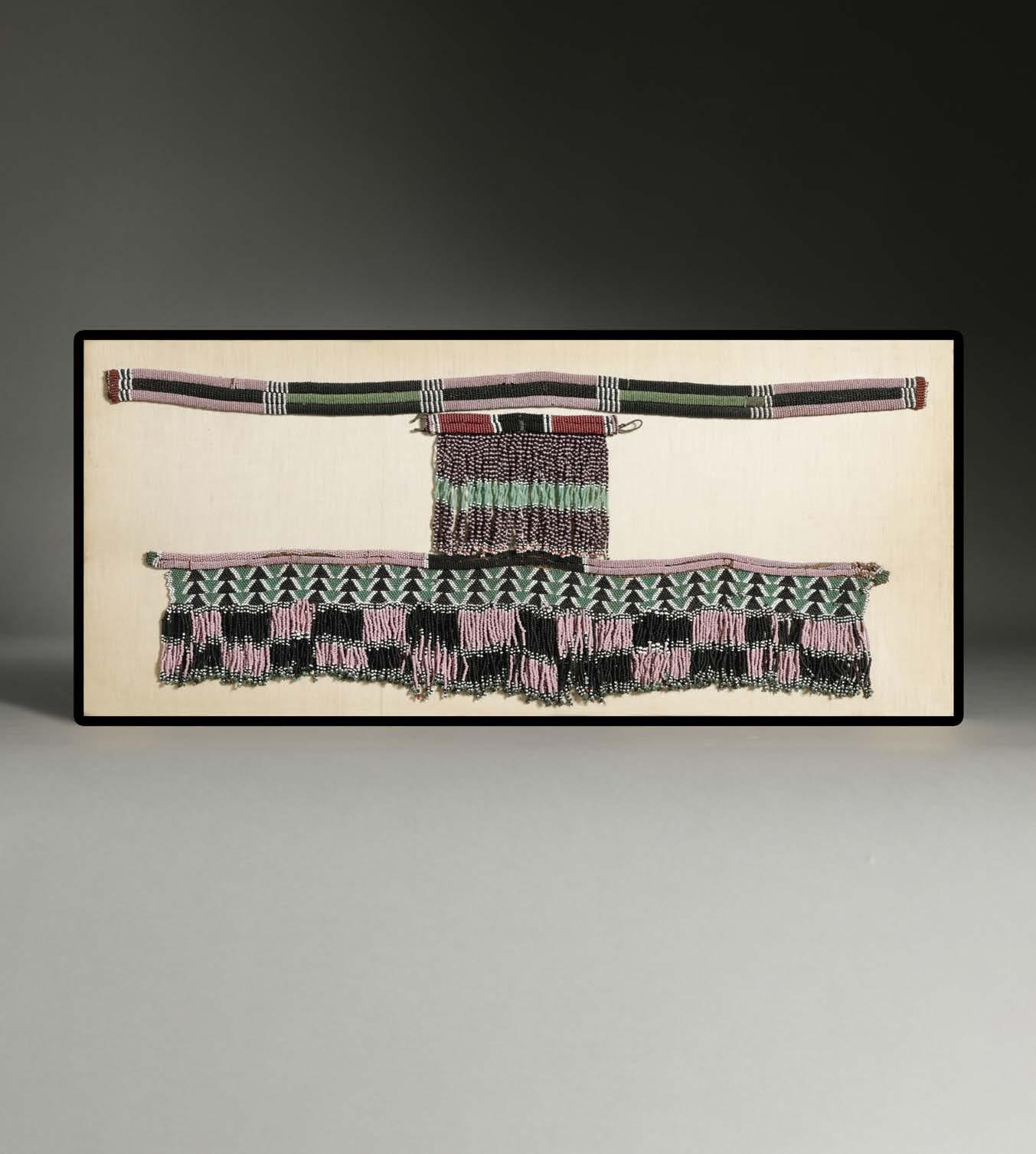
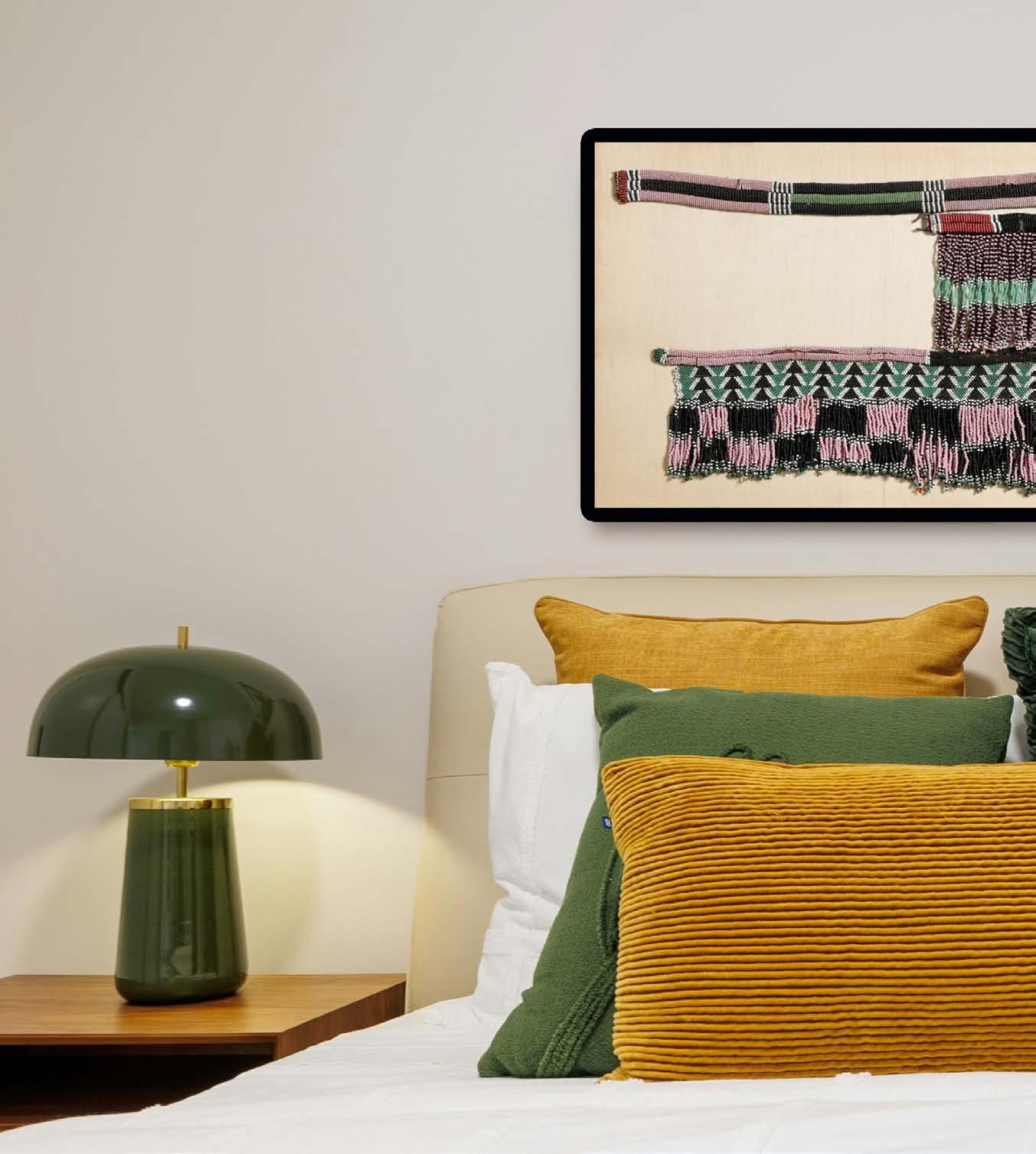
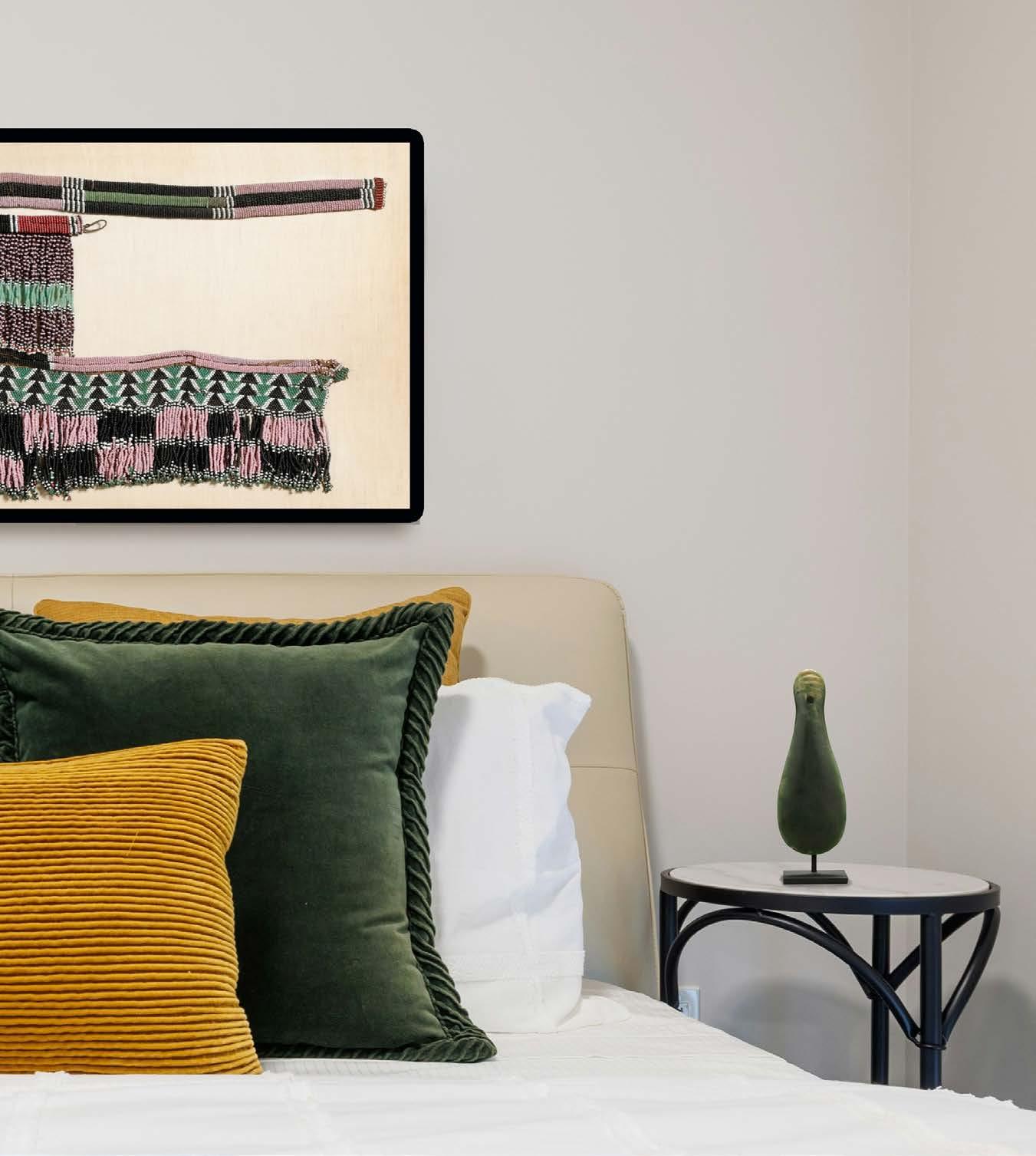
FRAMED GROUP OF BEADWORK
ZULU, SOUTH AFRICA
Late 19th century
European glass beads, sinew, fabric Belt: Length 27 in, Width 1 ½ in
Armlet: Width: 6 in; Height: 4 1/1 in
Waistband: Width 24 in; Height 4 ½ in
PROVENANCE
Colonel George William Maunsell (1859–1937)
By descent to his daughter, Aileen Edith Pauline Gell OBE. (1895–1986) Hopton Hall, Wirksworth, Derbyshire, UK
Sotheby’s Chester, Sale of the Principal Contents of Hopton Hall, Wirkshire, September 5, 1989
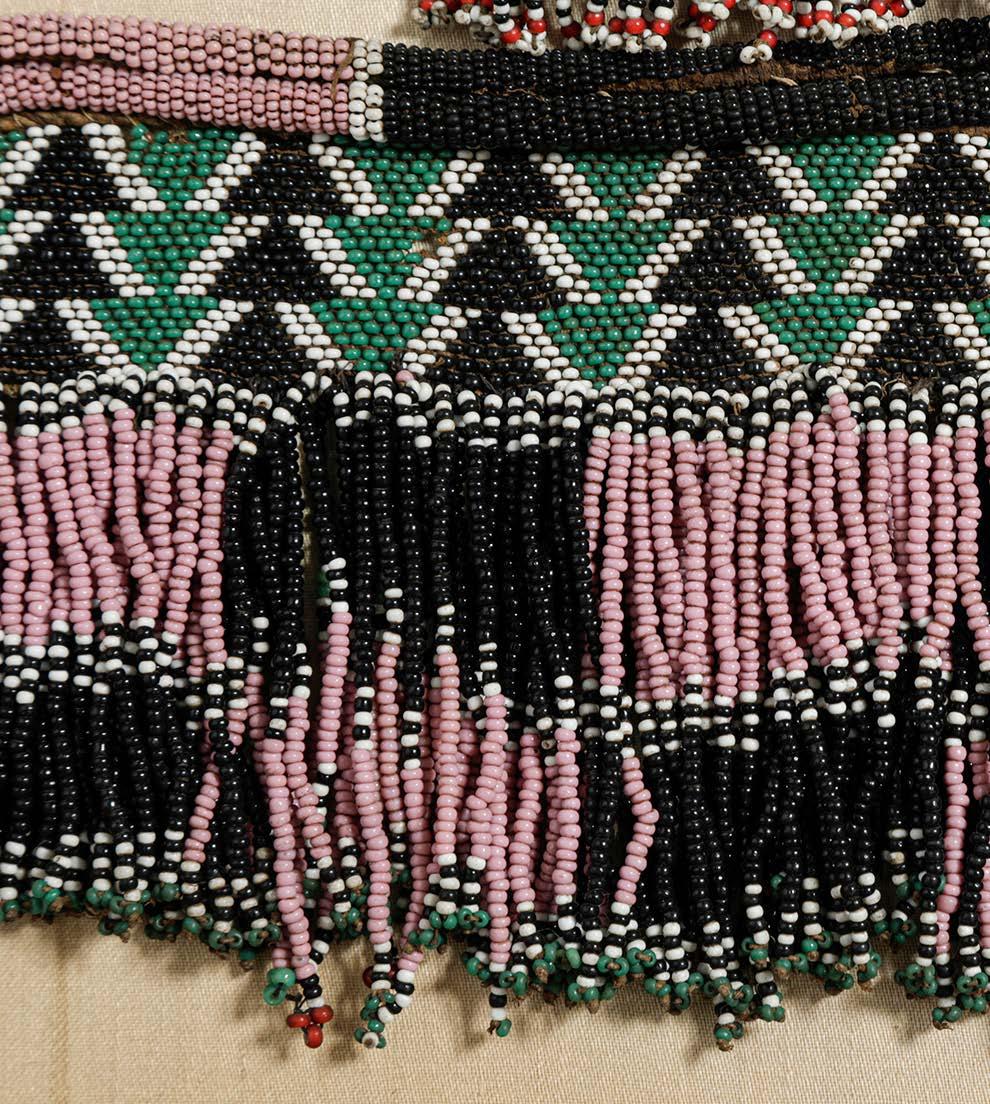
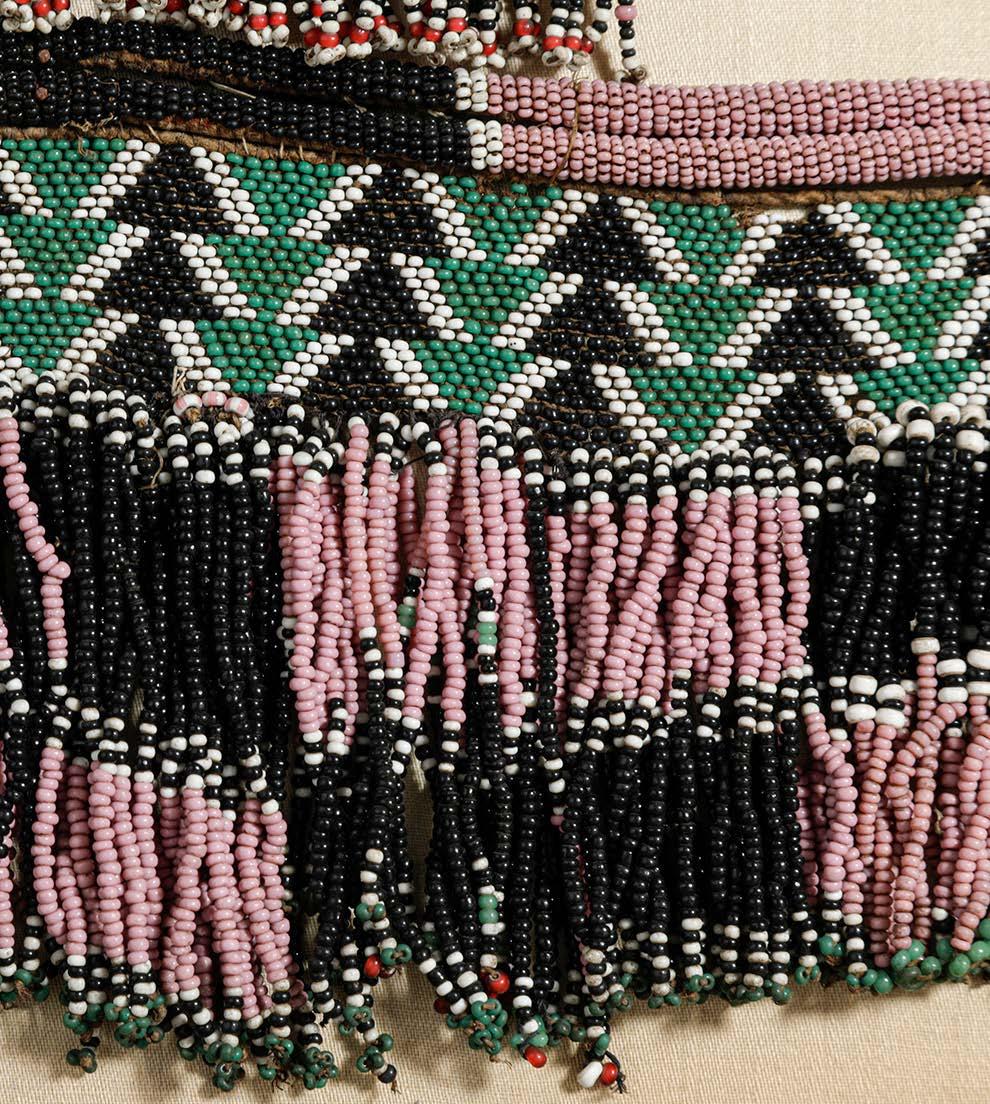
The Zulu and their neighbors often wore beadwork in ensembles, with overlapping pieces that sometimes hung in several layers. The fine set of women’s garb presented here illustrates the vivid display of such combinations. Beaded in a beautiful palette of pink, black, and green with white delineations, the alternating patterns used provide an exciting theme of contrast and an impression of vigorous energy. The set is mounted on an original late 19th/early 20th century frame. Inscribed in ink on the back of the frame is a description reading ‘Zulu Ladies Dress, Zululand 1891, G.W. Maunsell.’ An old typed label is also present, inscribed
‘Mrs. Gell, O.B.E., Hopton Hall, Wirksworth, Derbyshire.’
This group of beadwork was collected in South Africa in 1881 by Colonel George William Maunsell while fighting in the First Boer War. A career soldier and officer in the British Army, Maunsell served in numerous campaigns in South Africa, Egypt, and Sudan, and in the First World War. He held various appointments throughout the years, including Justice of the Peace for London and the title of Companion in the Order of St. Michael and St. George. Apart from his military exploits, he is best remembered for his authorship of The Fisherman’s Vade Mecum.
22
NEEDLE CASE
INUIT PEOPLE, ALASKA
18th or 19th Century
Marine ivory
Height: 4 in, 10 cm
PROVENANCE
Michael Evans, Santa Fe
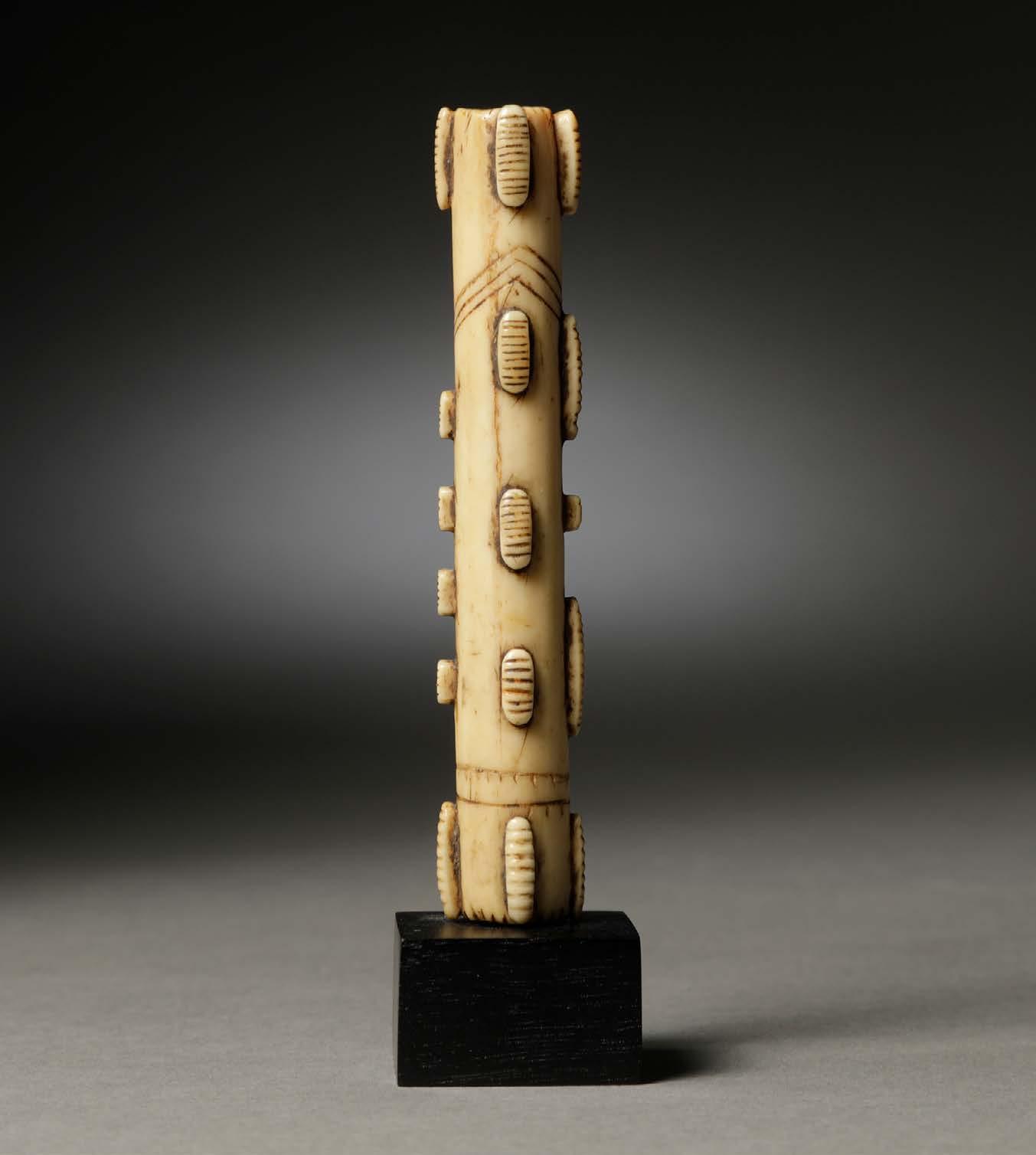
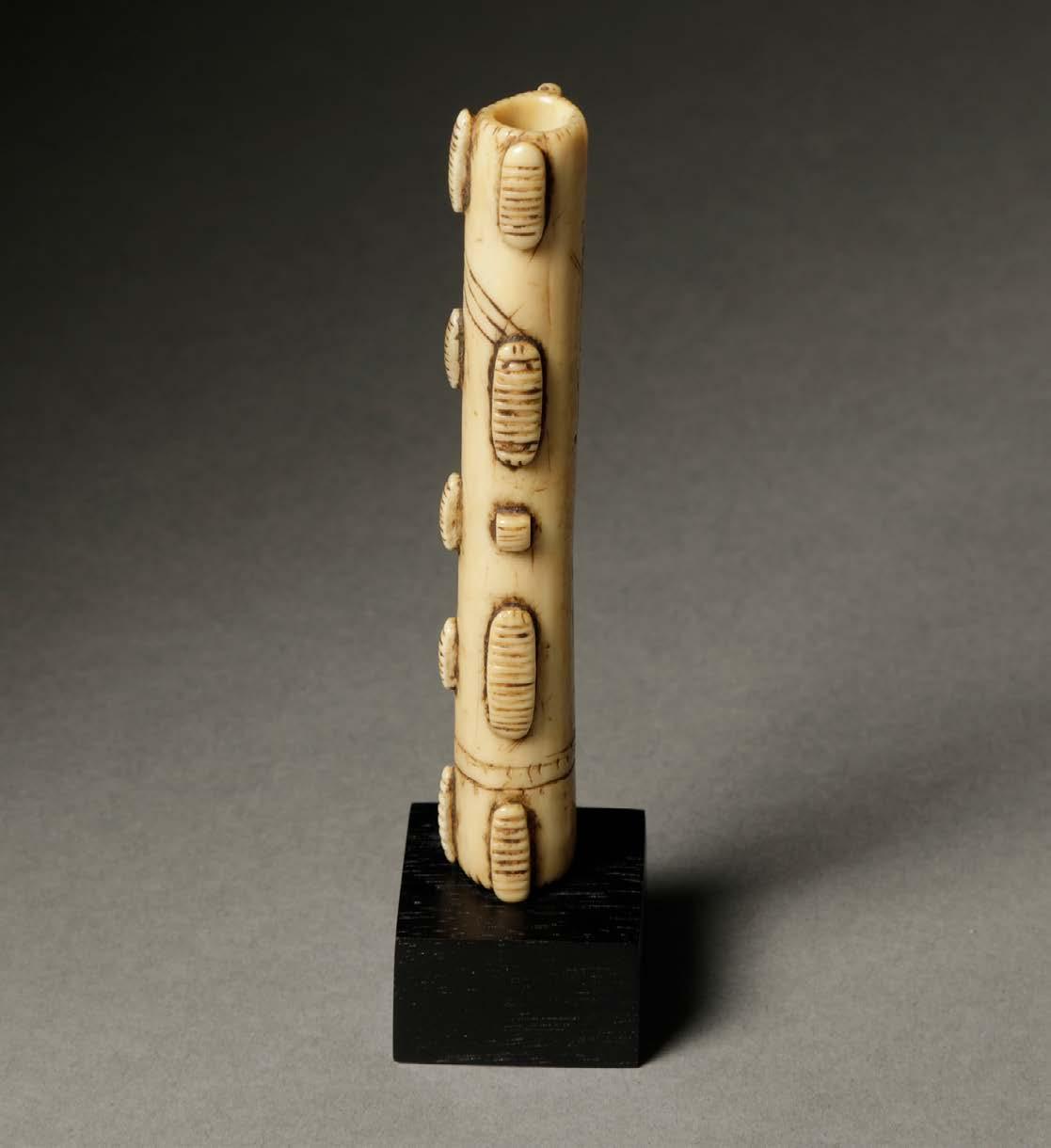
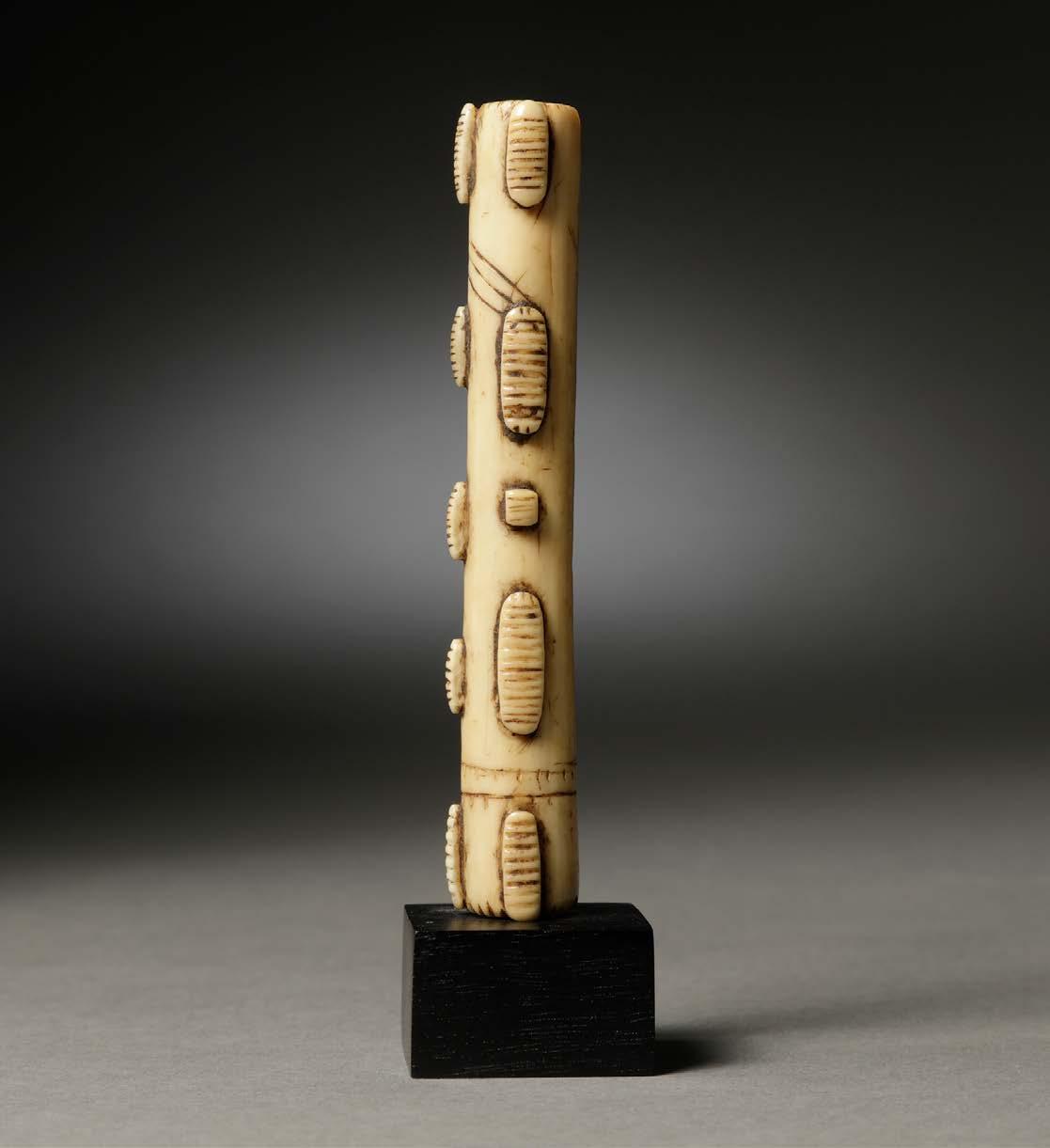
This finely crafted needle case, carved from a single piece of walrus ivory, exemplifies both the utility and aesthetic sensibility of nineteenth-century Inuit material culture. The slender, cylindrical form is elaborated with ovular projections — possibly representing insect larvae – carved in relief around most of its circumference.
Needle cases such as this one were used to store bone or metal sewing needles, essential tools in an Arctic culture where tailored hide and gut clothing was crucial for survival. The case would often be paired with a gut or sinew cord, sometimes attached to a thread waxer or thimble, which together formed a complete sewing kit.
The unmistakable level of artistic care that was invested in this humble tool underlines its importance in daily life. Moreover, the use of ivory, a durable and precious material, speaks to its value as a personal and symbolic item that was likely passed down through generations.
In the animistic view of many indigenous Arctic cultures, animals and indeed all objects in the natural world are inhabited by souls and have distinct spiritual significance. Although less commonly depicted than marine mammals or polar bears, insect forms such as larvae or grubs carry associations with transformation, resilience, perseverance, humility, hidden potential, and the power of the earth itself.

HAND CLUB MADE OF NEPHRITE JADE POUNAMU
MAORI,
NEW ZEALAND
19th century
Nephrite jade
Height: 8 ½ in, 21 ½ cm
PROVENANCE
Private Collection, USA
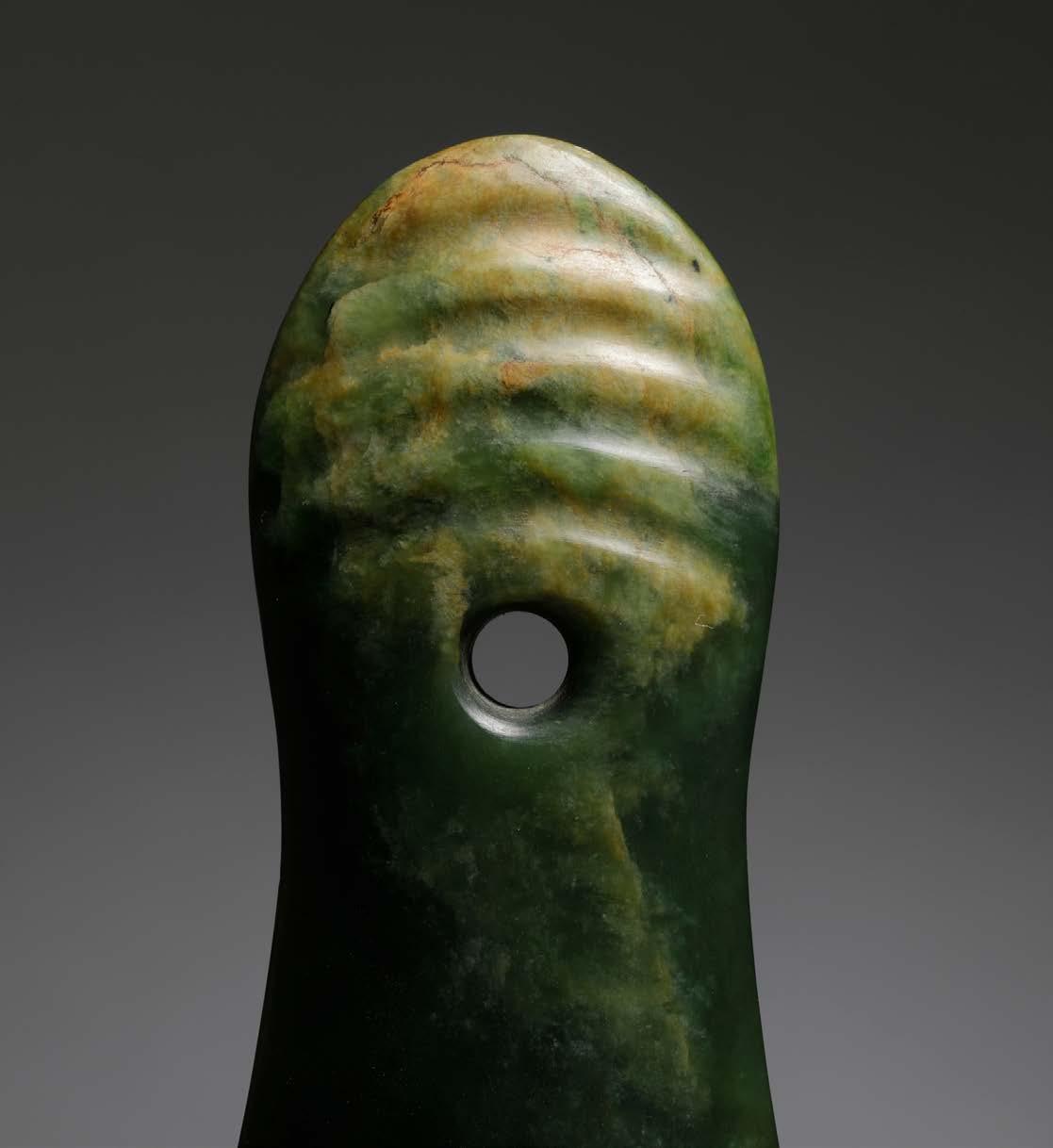
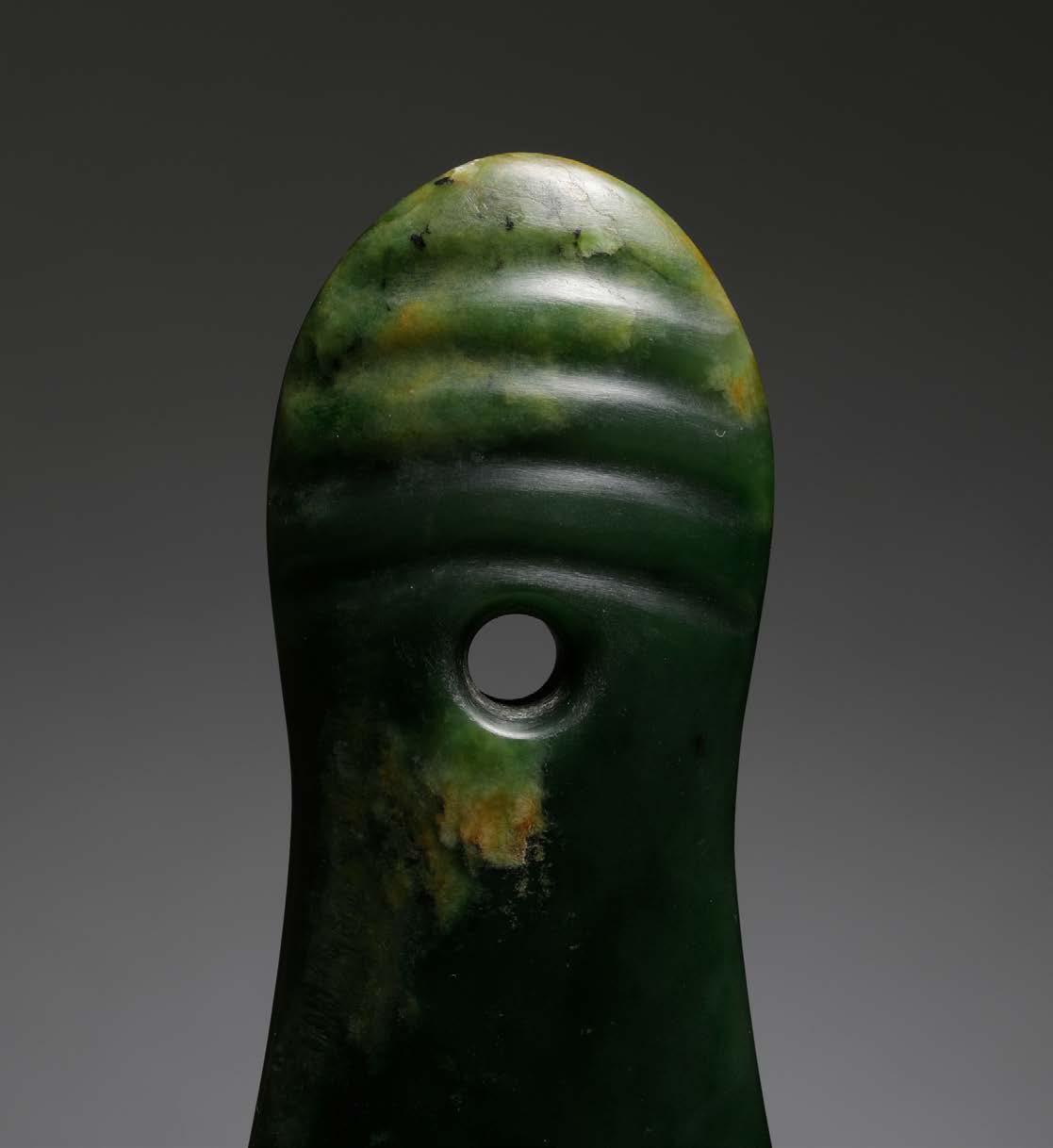
Rare and finely worked nineteenth-century greenstone hand clubs (pounamu patu or mere pounamu) are powerful embodiments of Māori craftsmanship, tradition, and cultural identity. Carved from New Zealand nephrite jade (pounamu) – a material treasured for its beauty, strength, and spiritual significance – patu served both as a closecombat weapon and as a potent symbol of mana (authority, prestige) and whakapapa (ancestral lineage).
This beautiful example features a smooth, polished surface thinned to a broad and keen blade, with a suspension hole at the grip end that allows it to be secured by a wrist cord. Three grooves are carved in shallow relief
on both sides of the grip to assist a firm hold. The stone is of the kawakawa variety, exhibiting a bright green hue with natural mottling of yellow and ochre-colored marsden inclusions, indicative of authentic South Island pounamu sourced from riverbeds and sacred sites.
Fine pounamu weapons were often bestowed upon rangatira (chiefs) and warriors, and were carefully passed down through generations as taonga tuku iho, ancestral treasures of immense cultural and historical value. This example is of slightly smaller dimensions and was most likely carved for a chieftainess or highborn wahine toa (female warrior).
hand club made of nephrite jade pounamu

TWO MINIATURE MASKS
DAN OR MANO, LIBERIA OR IVORY COAST
Early 20th century Wood, bronze
Height (of both): 3 in, 7 ½ cm
PROVENANCE
Shirley Markin Buchman (1921–2021), New York and Palm Beach and then by descent to her heirs. Buchman was a noted philanthropist. Buchman acquired most of her African collection in New York in the 1960s and 1970s, buying from JJ Klejman as well as Sotheby’s and Christies. Her father, Morris Markin, founded the Checker Motors Corporation. Checker made the iconic American taxi cab, valued by taxicab companies for its durability in heavy use.
Most Dan face masks, and those of the culturally related groups of Côte d’Ivoire and Liberia, are commonly executed in a miniature form. Even the largest of these are too small to be worn in front of the face, and they rarely exhibit any means of attachment. Miniature masks are carved as standins to embody tutelary spirits and testify to the presence of the spirit associated with a large masquerade. When a mask’s owner is travelling, the miniature mask serves as an important means of identification and authority outside his immediate community. It is this role that may have given these miniature masks the commonly used name of ‘passport mask.’
In addition to being the property of one single individual, miniature masks may also play a communal role in secret societies. They are displayed at men’s society meetings for collective protection, used as sacred objects for swearing oaths, and can be shown to new initiates. Miniature masks are often attached to other powerful objects such as leather pouches or antelope horns filled with medicines.
Miniature masks bear many names: the most common is ma go (small head), but depending on scholarship it has also been named yi luo po (thing which water is poured over), gba po (thing which is fed), or nyonkula (substitute for the ancestors). One of the most iconic among collectors
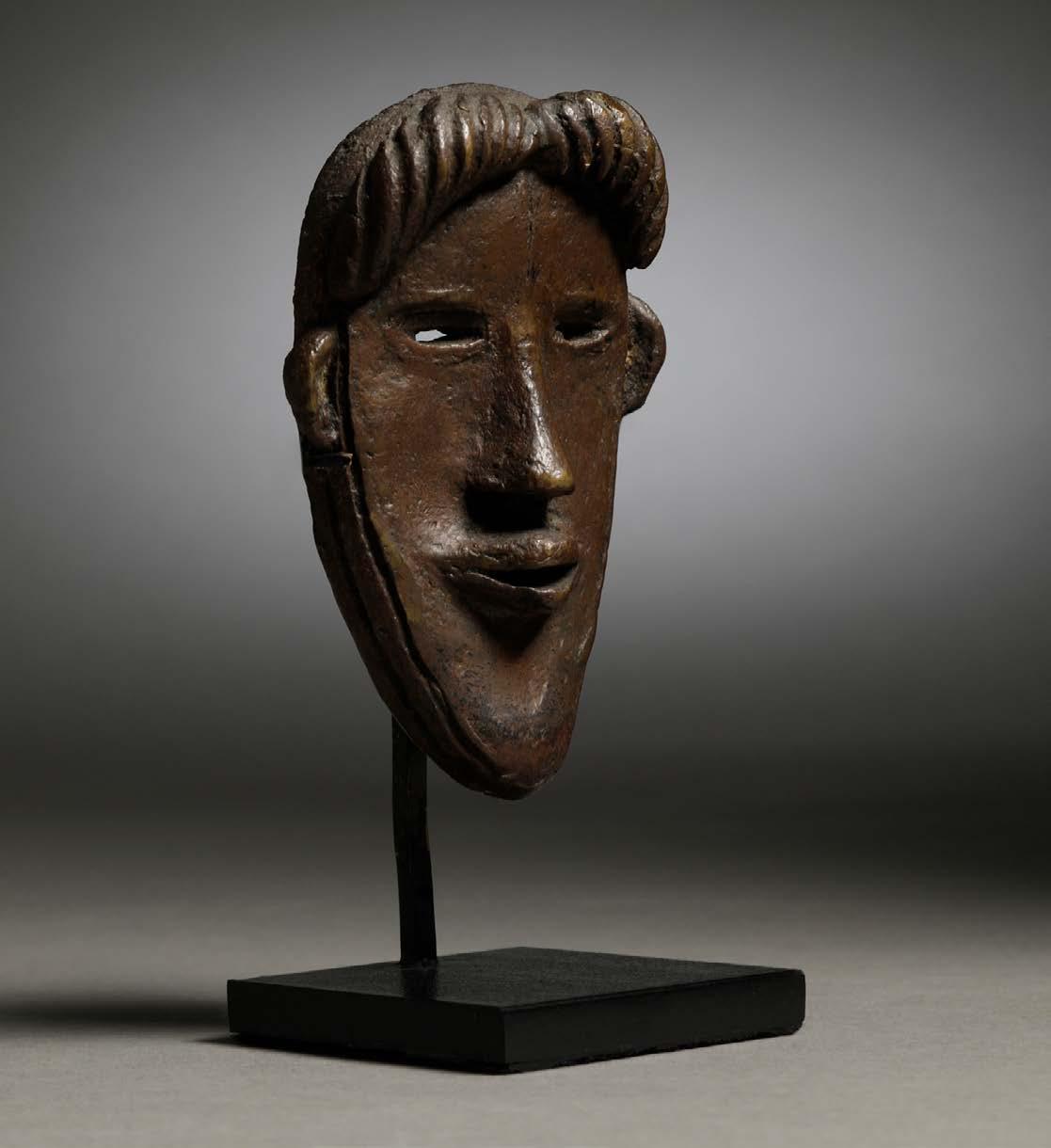
is deangle (an attractive mask with slit eyes, which performs a feminine behavior), while the least common miniature forms are masks with tubular eyes and animal mouths. Rubbed with offerings of oil and food, they share the power and protective force of the full-sized masks they resemble.
Anyone who has a spiritual connection with a mask, or whose family owns an important mask, is entitled to commission a miniature. Diviners can advise this for preventative, protective, or curative purposes. Interestingly, some scholars have stated that although women do not ordinarily have access to masks, those from families that have a strong connection to a specific mask may commission a miniature version as a means of retaining ties
to their own family identity after they marry.
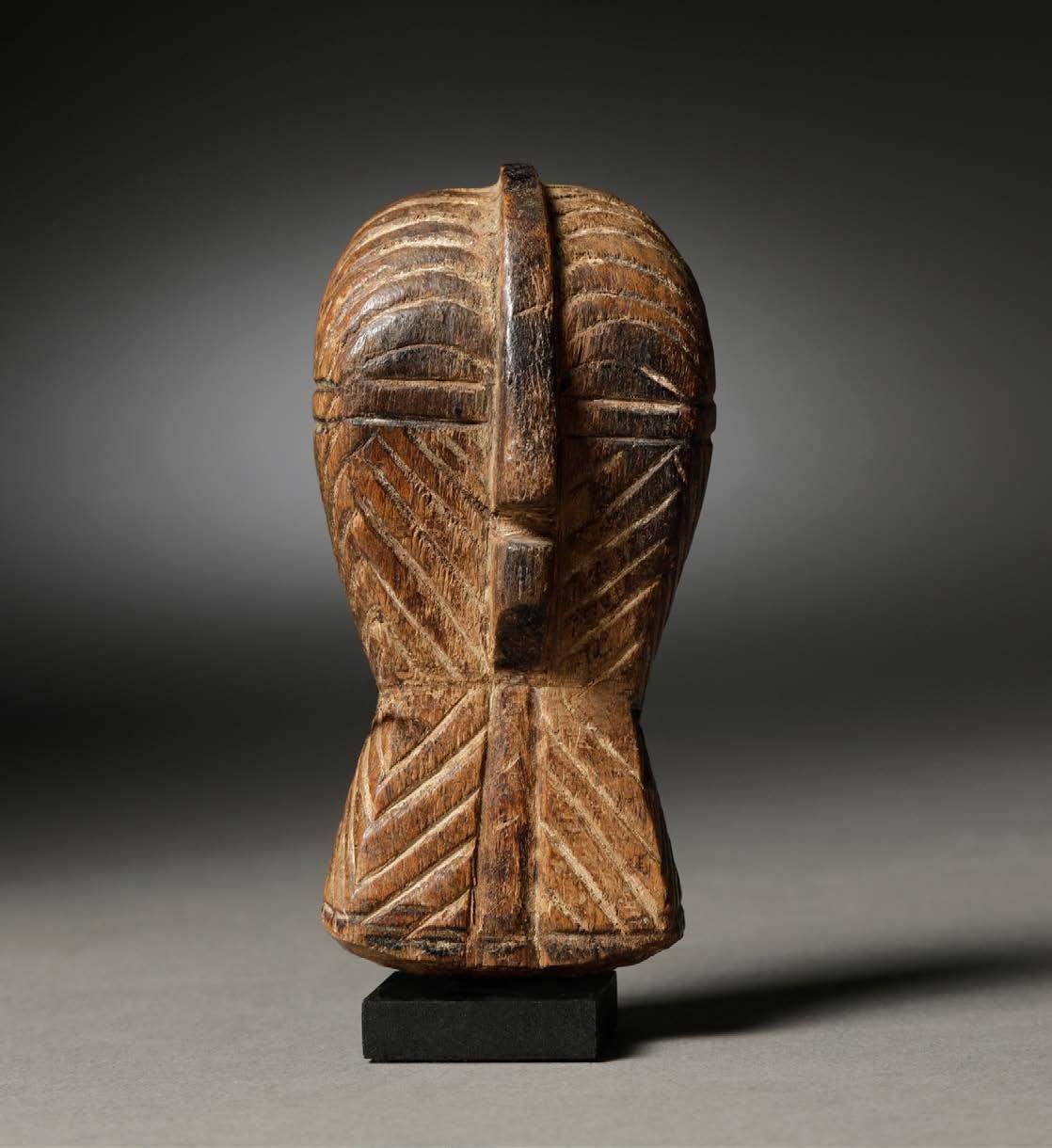
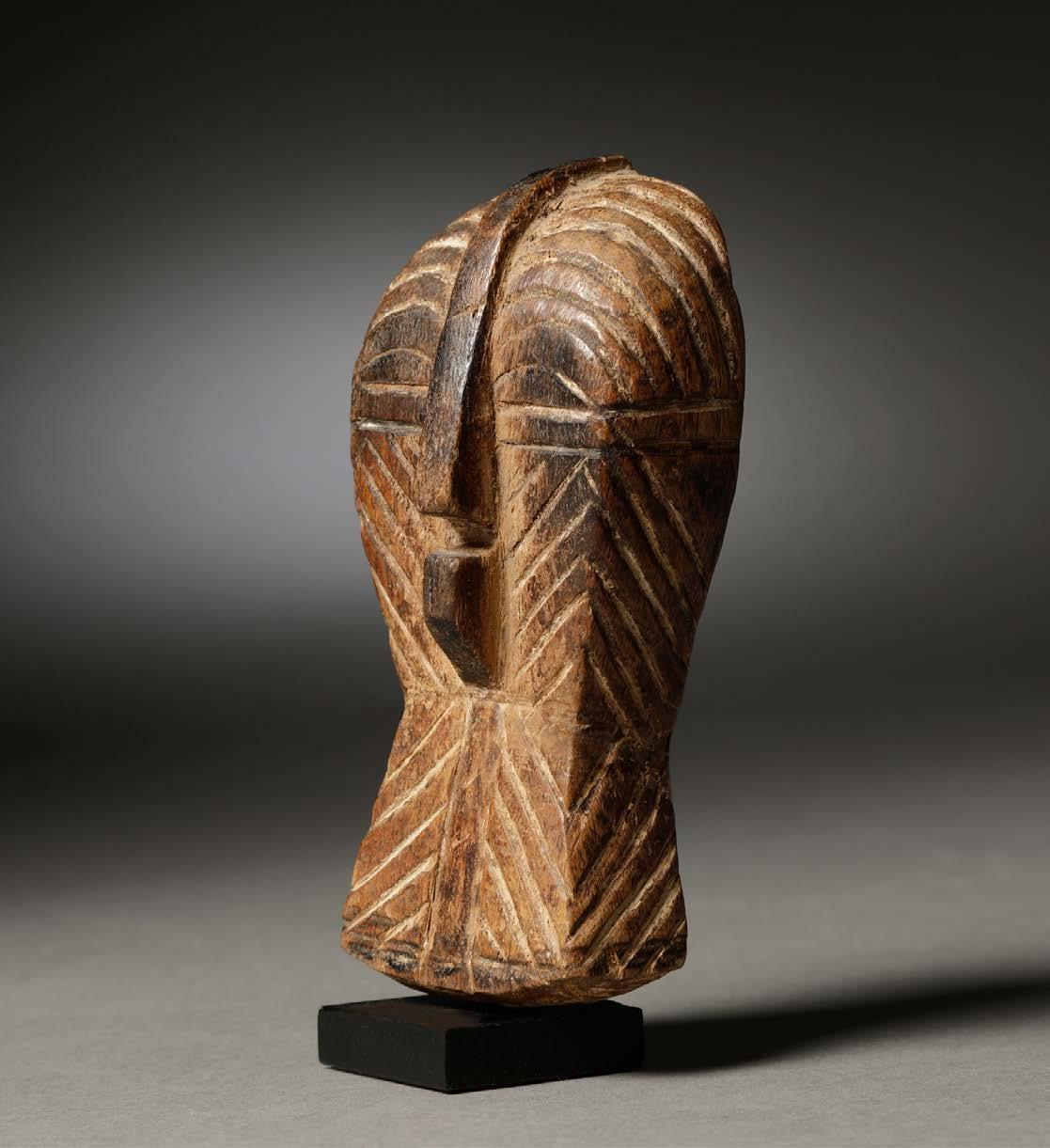
This quartet of miniatures embodies a wide range in regional styles and forms, all with abundant character. A bronze mask with generous features, large chin, and layered coiffure bears resemblance to Bassa masks, with their heavy faces and ridged hairstyles. In two dark, wooden examples we find a peaceful rendition of the classic Dan dean gle –with its high, smooth brow, indented eyeline, and quiet face – and another, more roughly composed and showing a tight hair ridge, small eyes with incised lashes, and a long, narrow nose within a broad face. The fourth maskette, warmer in tone, is a Songye kifwebe with characteristic geometric design unified and enhanced by intense, vibrating linework.
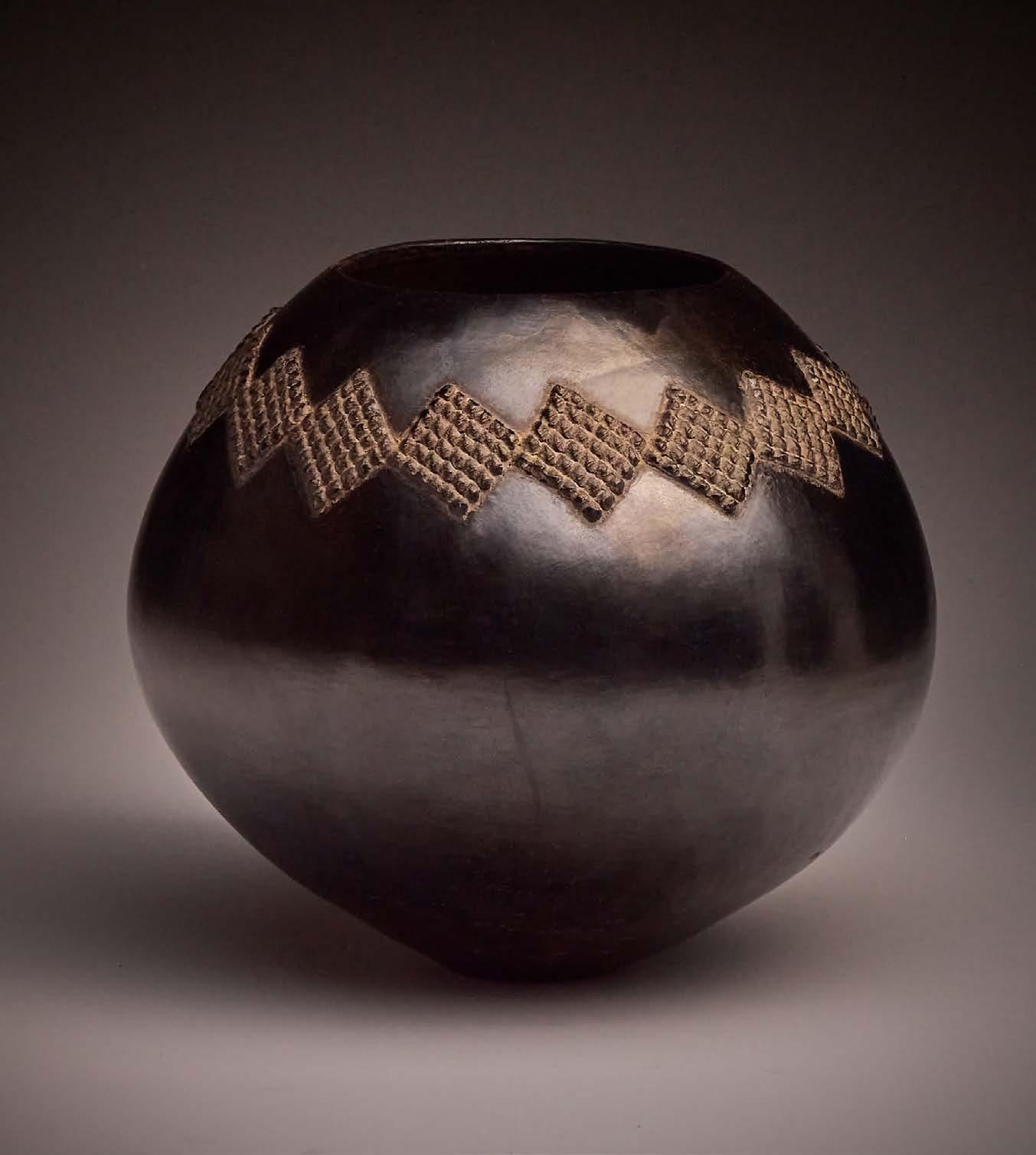
CERAMIC VESSEL BY QOBI LANGA
QUEDENI, CENTRAL ZULULAND
11 3/4in (h) 12¼ (w) 30 cm (h) 31 cm (w)
PROVENANCE
Private Collection

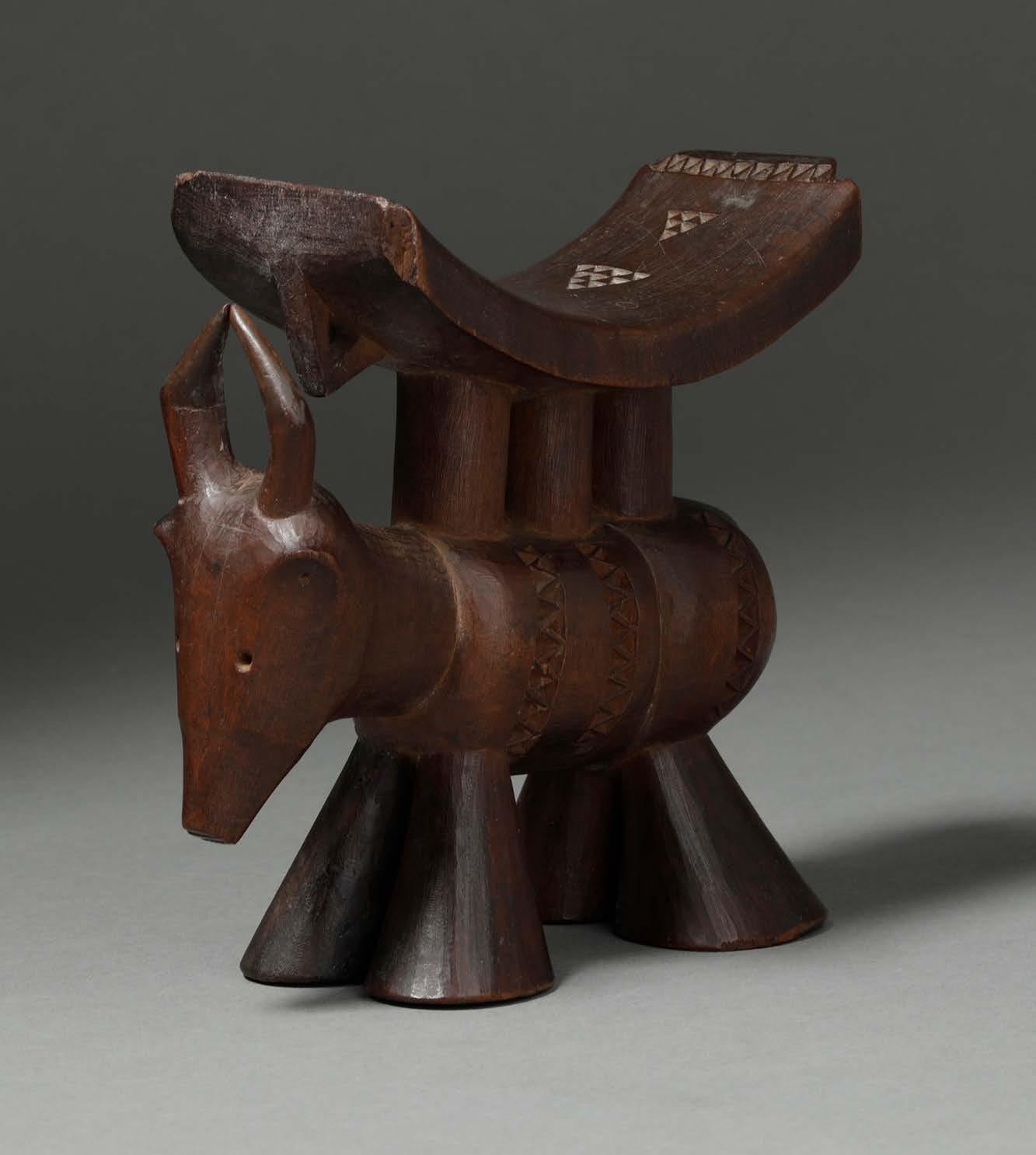
HEADREST MUTSAGO
SHONA/TSONGA, ZIMBABWE
Late 19th/early 20th century
Wood
Height: 6 in, 15 cm
PROVENANCE
Roy and Sophie Sieber Collection
Among the cultures of South Africa, wood carving was produced by men, and the imagery they incorporated into their works reflected their particular concerns. Meat dishes, milk pails, headrests, and staffs held allusions to the cattle men raised and the ancestors they revered.
Headrests were believed to provide a vital link between the living and the spirits of their ancestors by way of dream communication. The rests, which were frequently carved in imaginative and elaborate designs, embodied and enabled this metaphysical support offered by a man’s forebears. They were both common and precious, utilitarian and spiritual. Headrests often formed a part of a bride’s dowry, creating an important connection between her own ancestors and her new husband’s line.
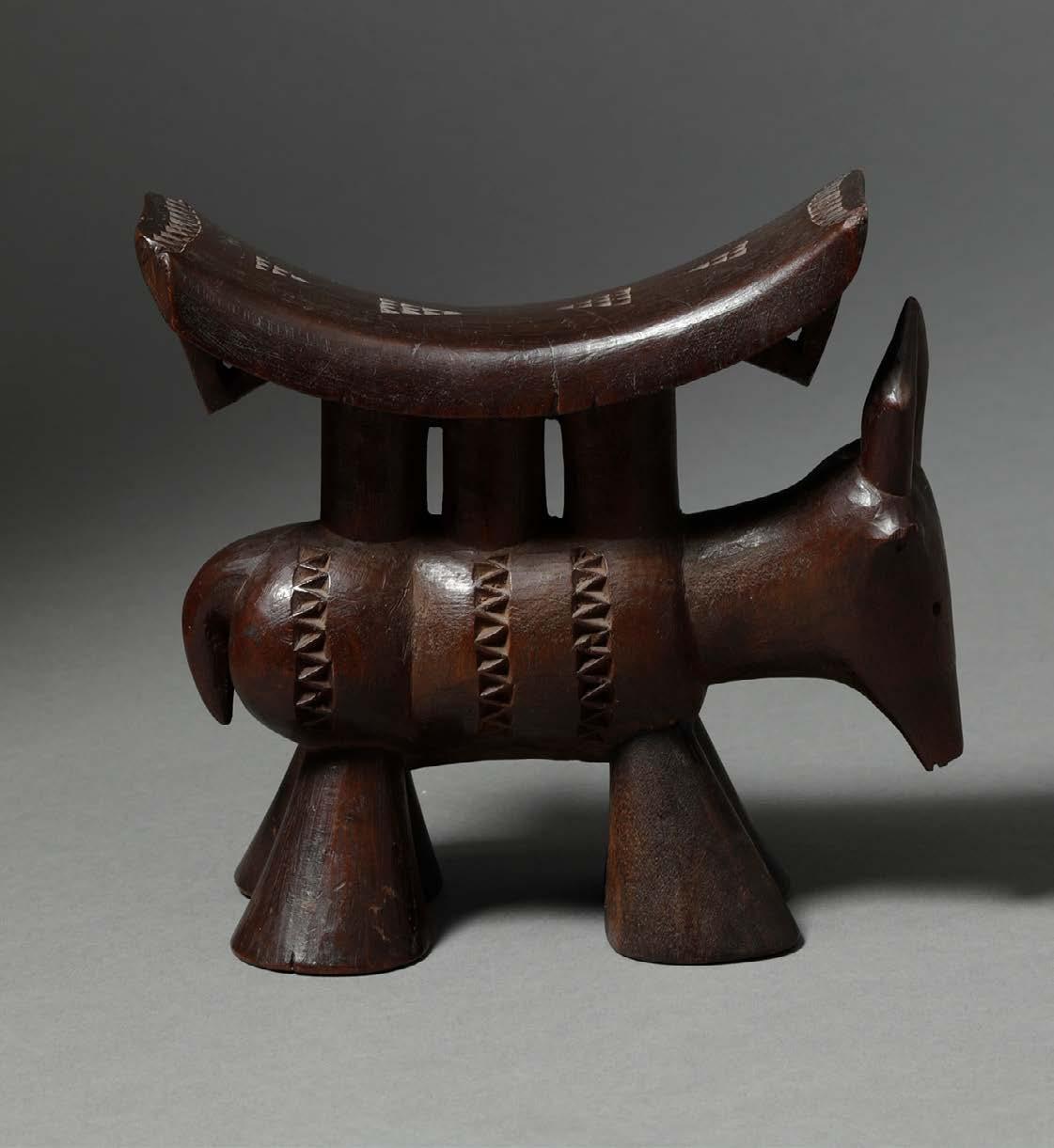
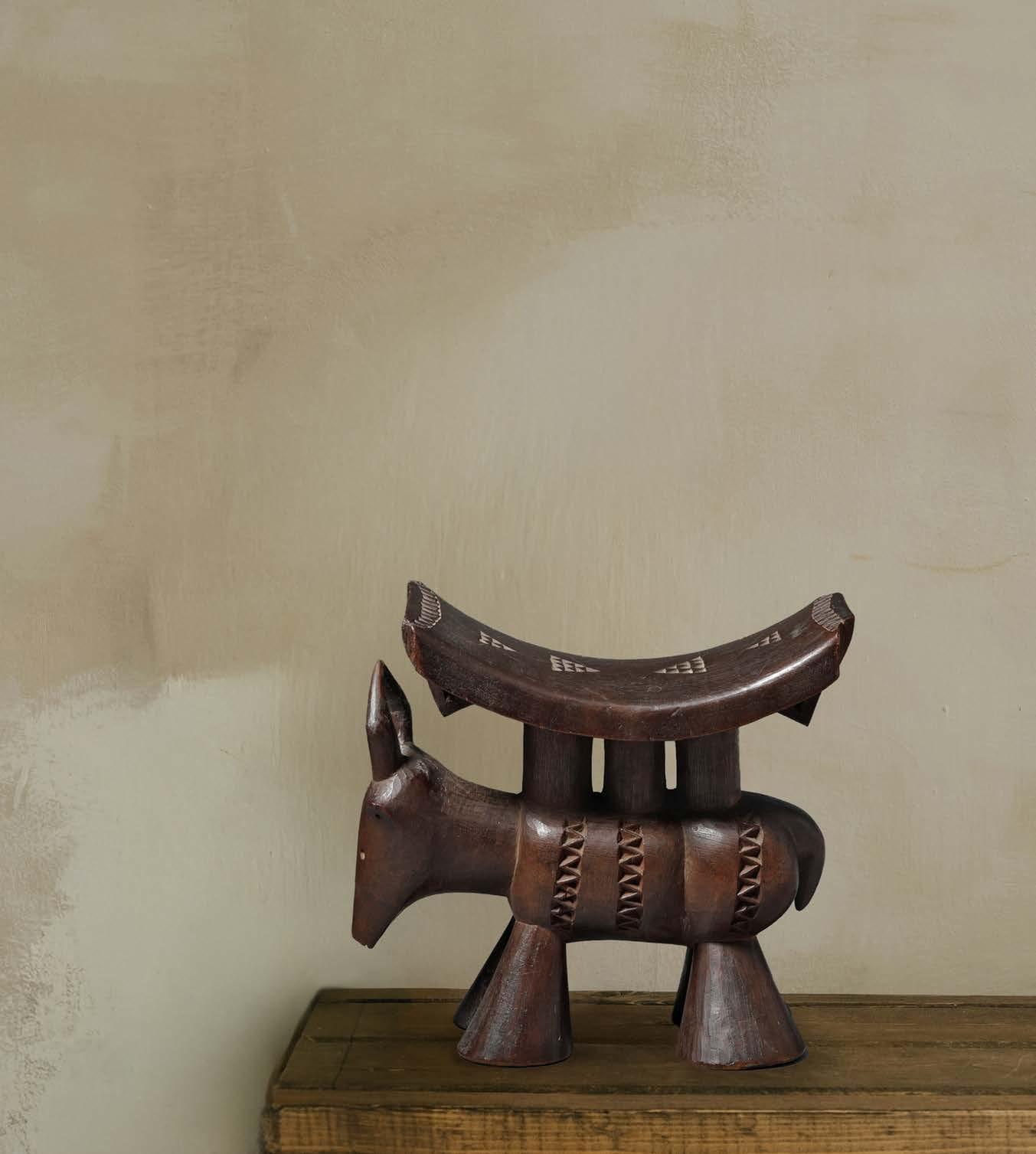
Fine workmanship and imaginative composition distinguish this Shona headrest, which integrates a full ungulate figure (possibly an antelope) and a three-columned rest. Deftly executed triangular motifs adorn the surface of the rest and the flanks of the animal, and are echoed in the conical shape of its stout legs. Clear animal iconography such as this is rarely seen in headrests, suggesting this special piece was carved for a person of high status.
For an example by the same hand, see Royal Museum for Central Africa, Tervuren, Belgium collection number EO.1980.2.481 ex Marie-Jeanne Walschot (1896-1977), Brussels, Belgium.
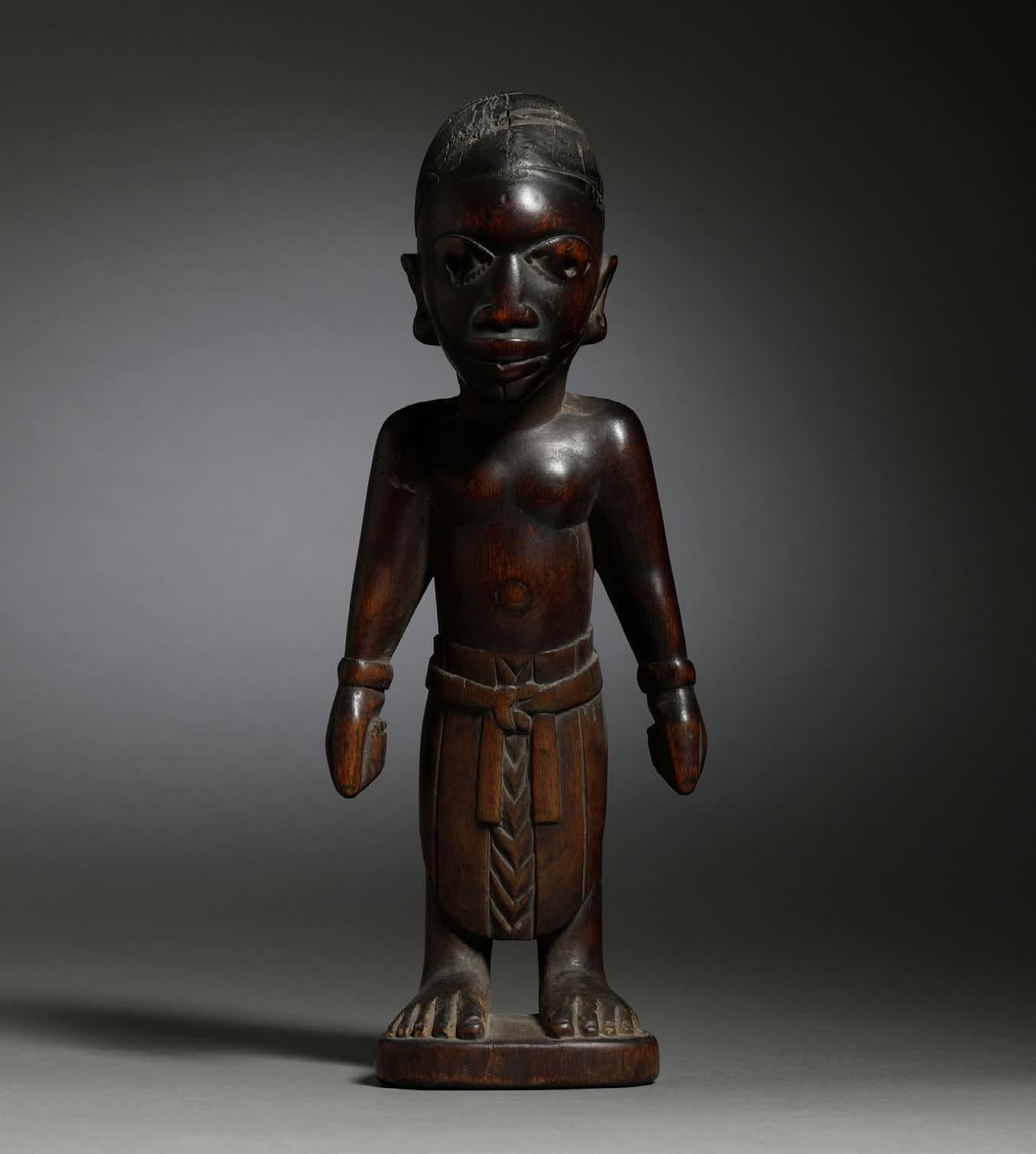
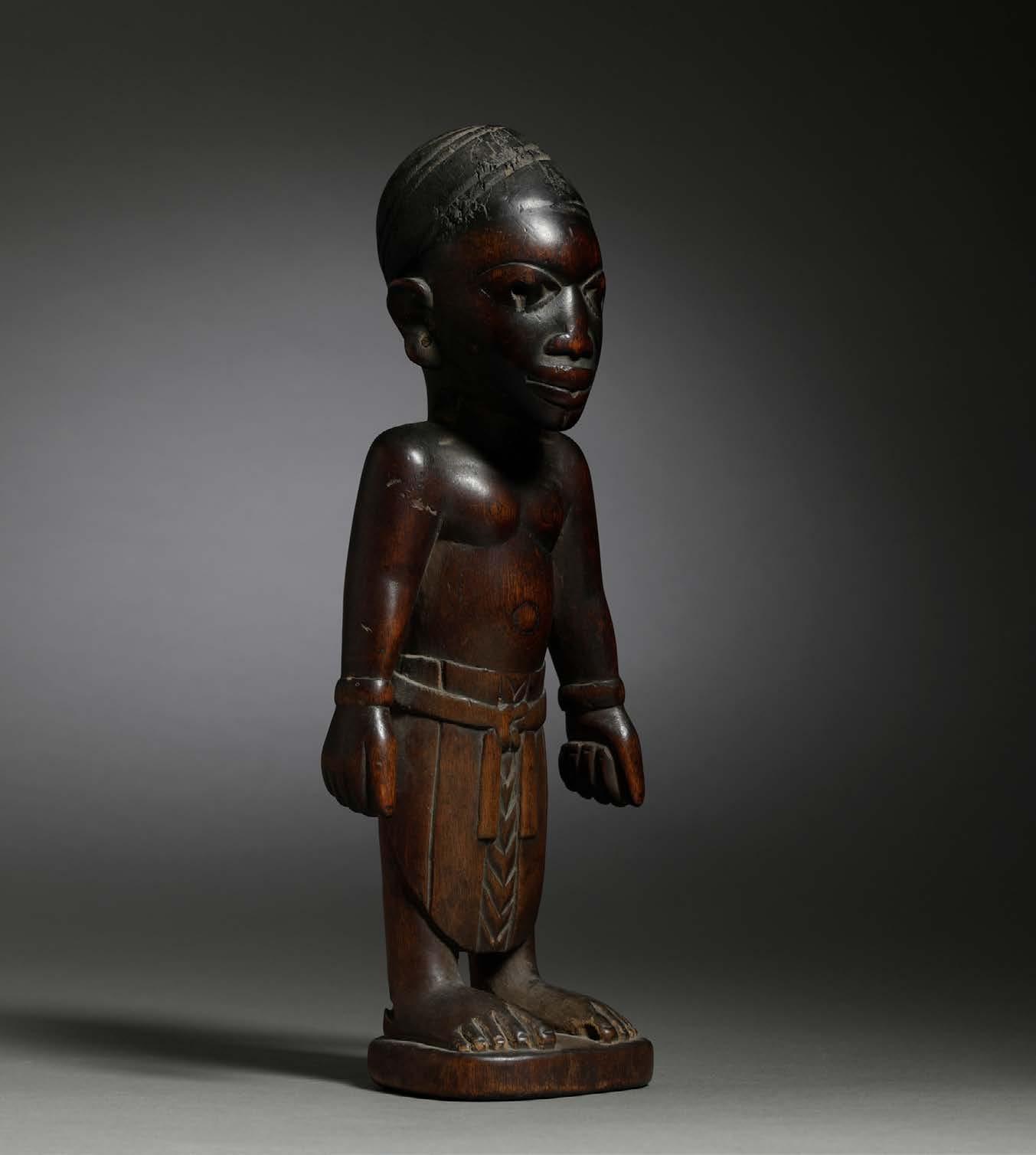
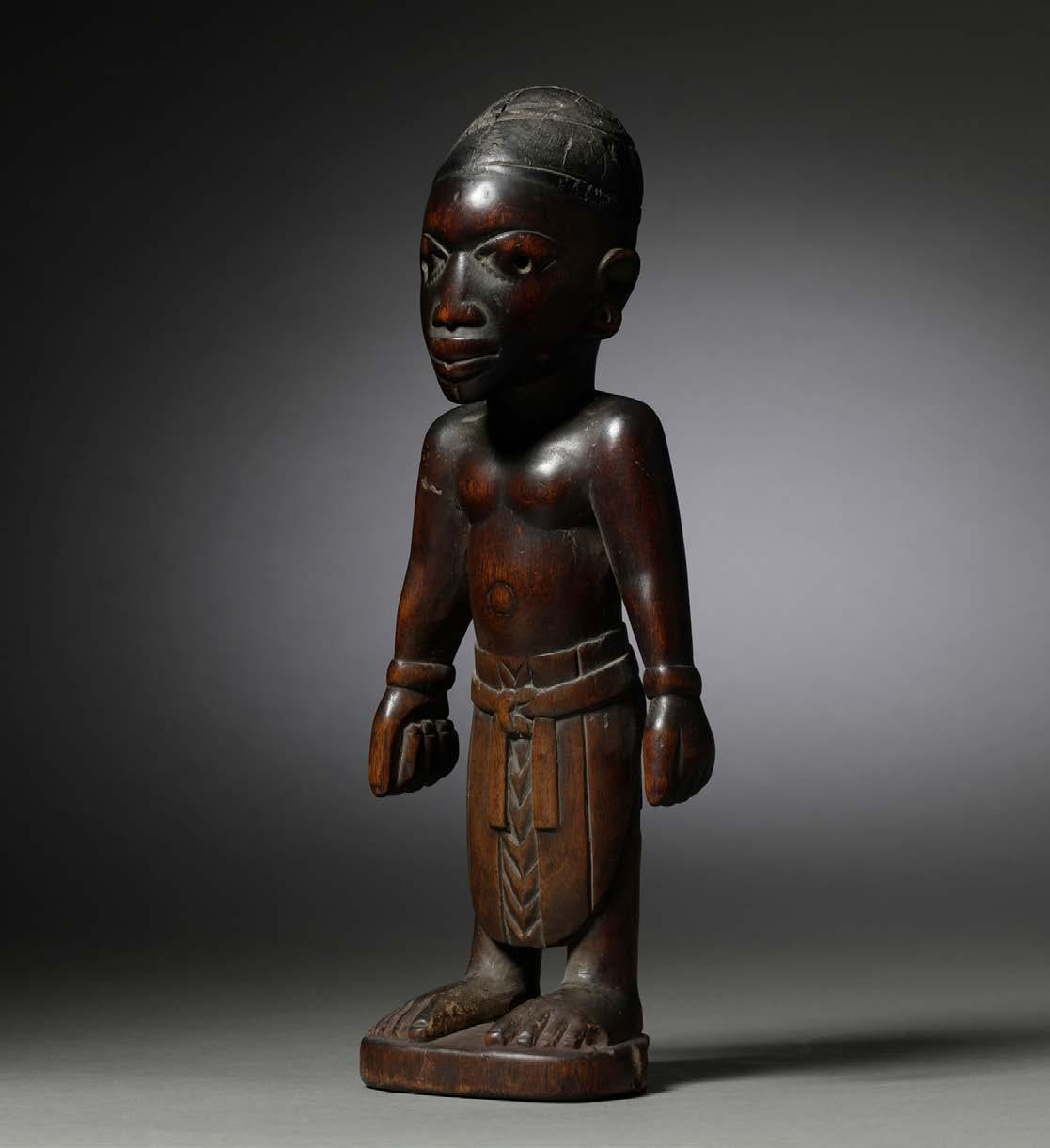
AN EXCEPTIONAL TWIN FIGURE IBEJI
YORUBA PEOPLE, ADO OWO, OGUN STATE, NIGERIA
Late 19th/early 20th century
Wood
Height: 9 in, 23 cm
PROVENANCE
Nancy and John Hyde Devoe, New York
Yoruba peoples have one of the highest incidents of twin births in the world. As a result, twins are regarded as extraordinary beings protected by Sango, the deity of thunder. They are believed to be capable of bestowing immense wealth upon their families or misfortune to those who do not honor them.
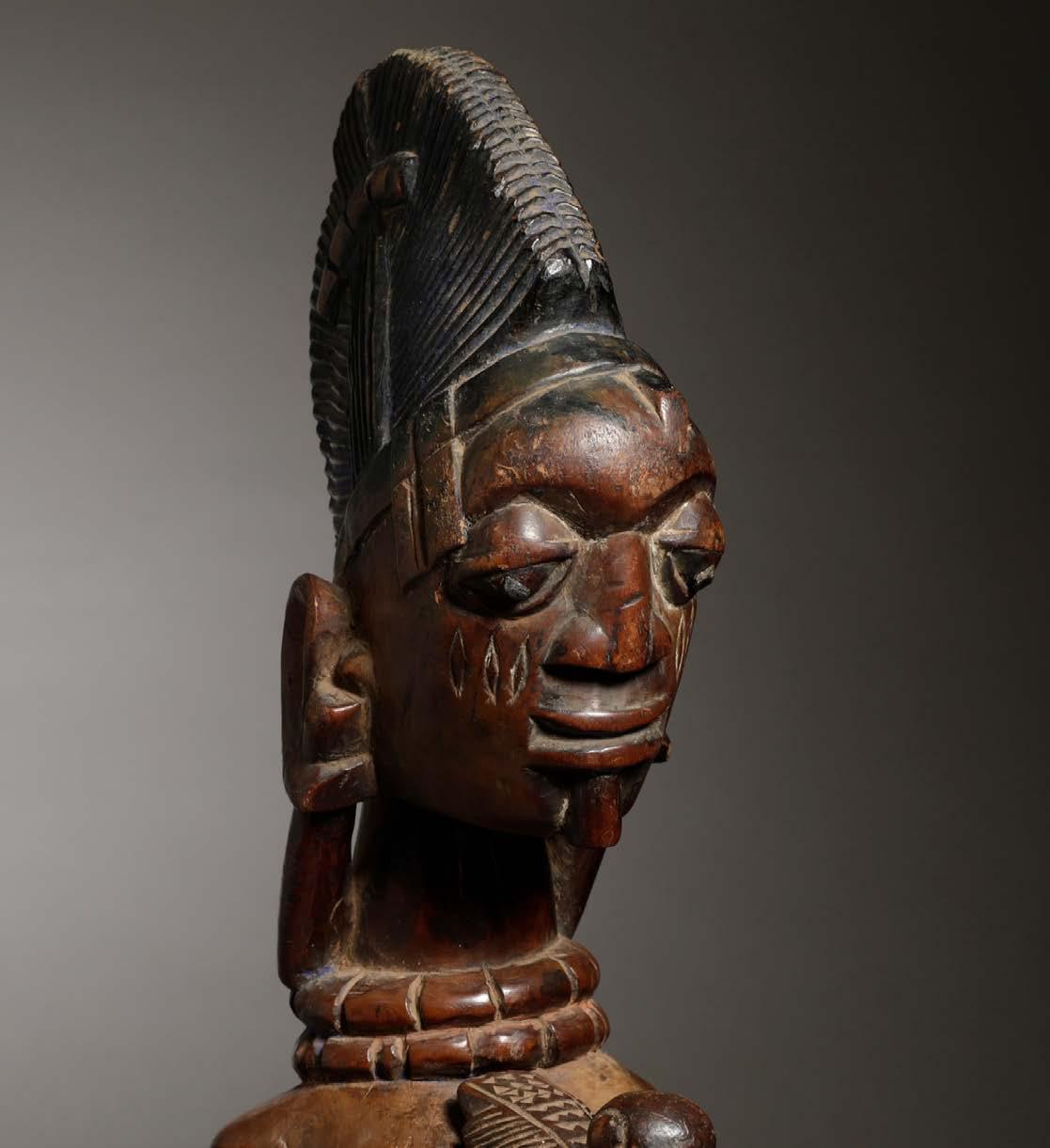
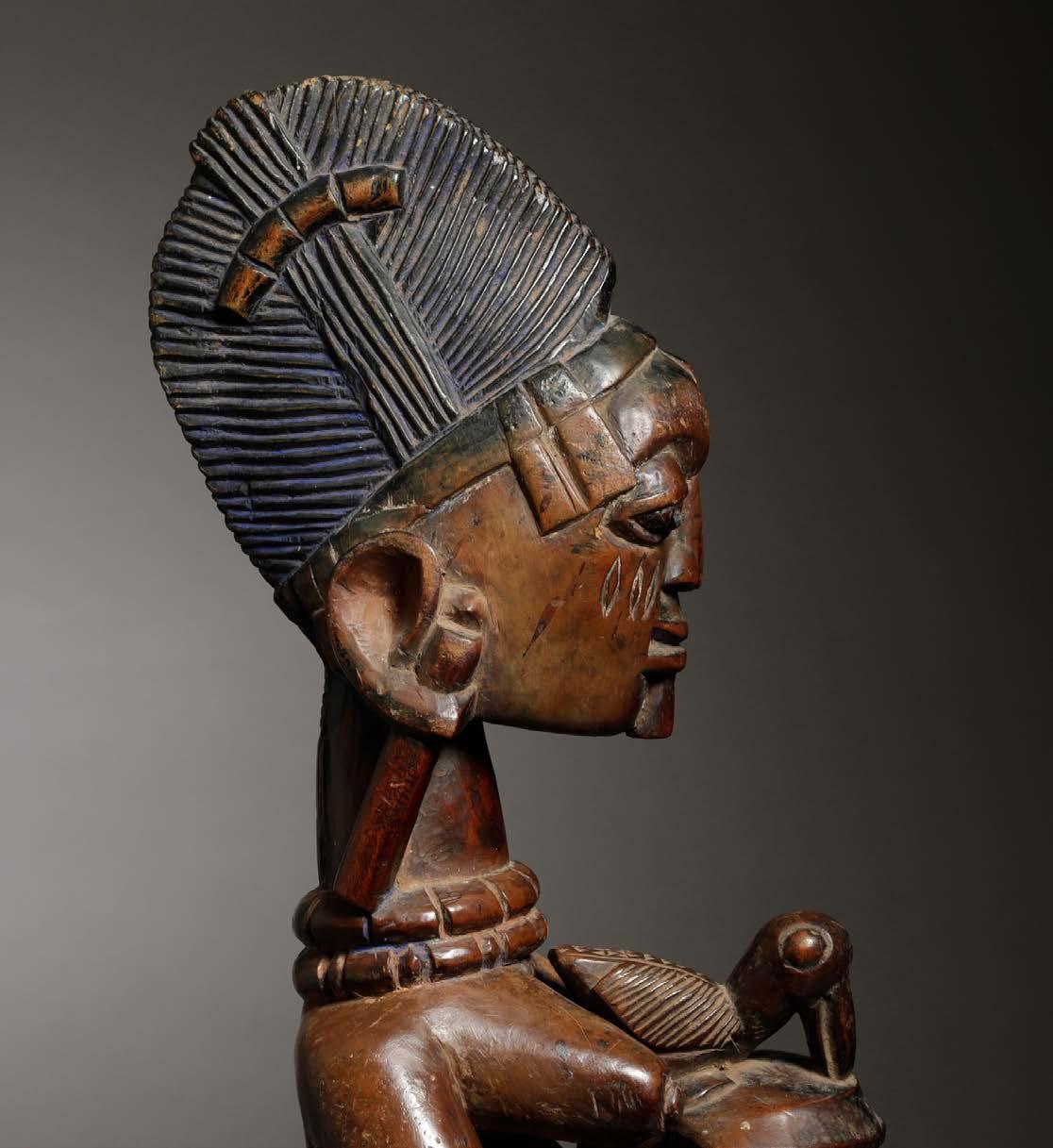
Powerful spirits in life, twins are honored with carved memorial figures when they die. These figures, known as ere ibeji (ere: sacred image; ibi: born; eji: two), remain a point of access to the spirit of the departed individual. The mother provides ritual care to the figures – bathing, dressing, adorning, and feeding them. Such daily handling is responsible for their remarkable patina. Ere ibeji invariably show mature adult physiognomies, and are often crowned with elaborate coiffures.
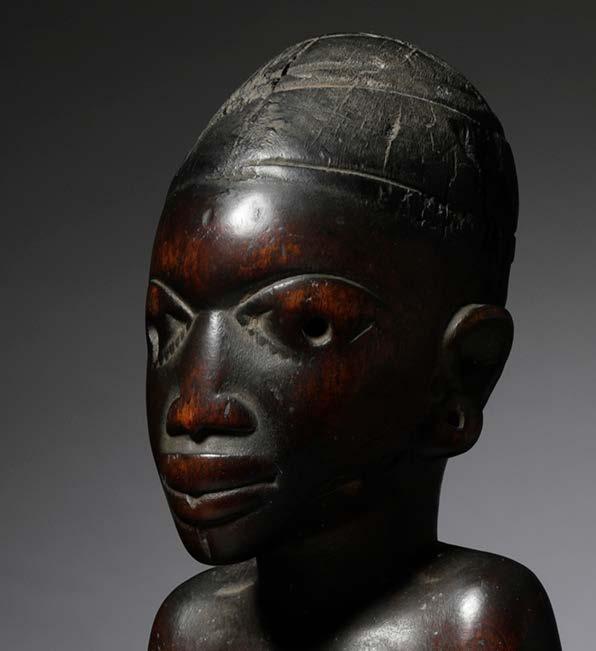
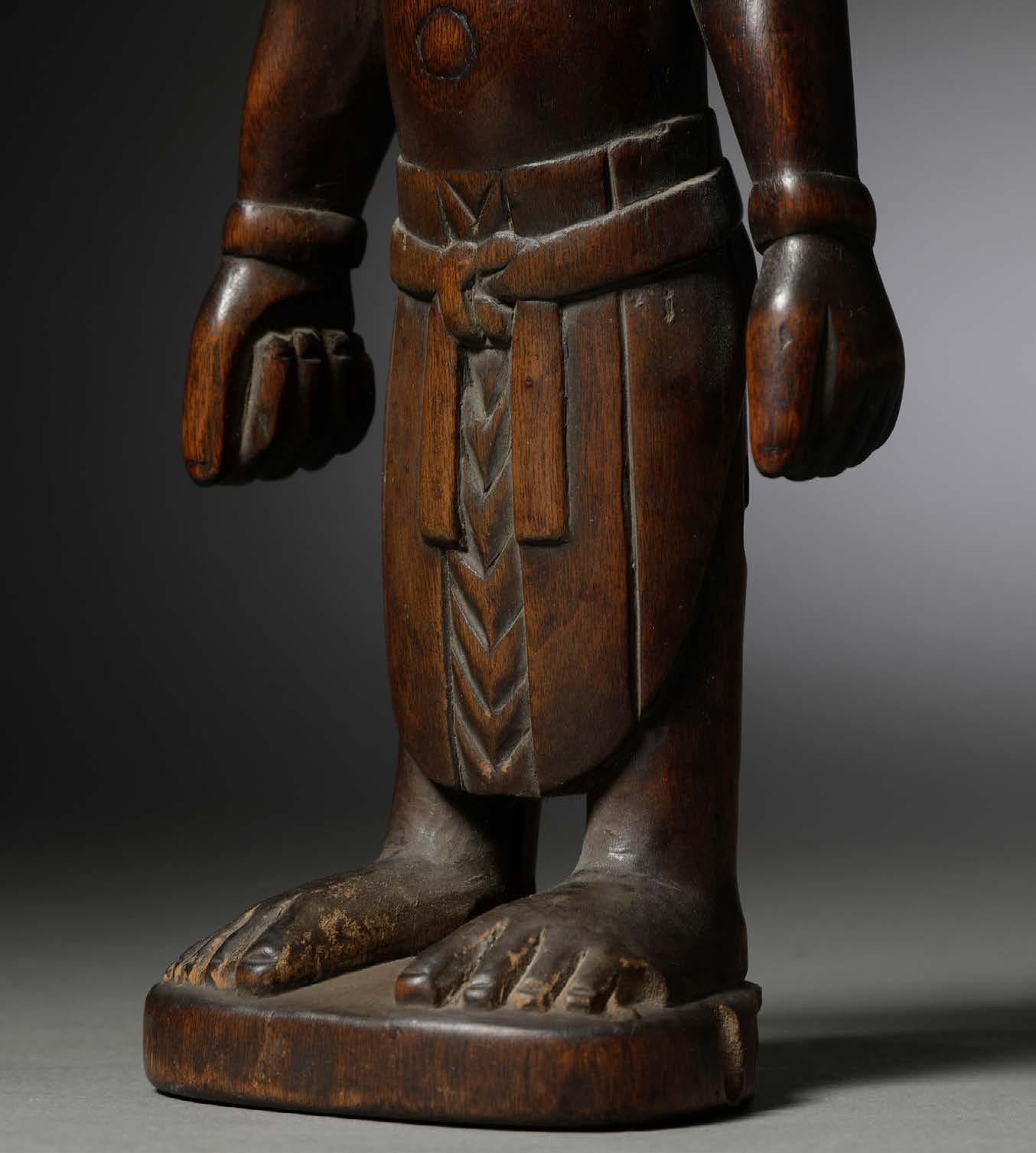
Refined sculptor’s skills are shown in this masterfullycarved ibeji figure, which is confidently shaped with strong proportions and crisp details. The strength of youth shines from the upright posture, sure stance, wide shoulders, and soft features that seem to hint at muscle beneath. Finer detail work is found in the relief-carved garments and the exaggerated, almost elfin features of the face, with its almost supernaturally large eyes and delicately turned ears. The coiffure in this statuette is minimal, cut in an assortment of relatively casual lines incised around the crown of the head. A beautiful patina of deep mahogany and deep, dark brown with glows of warm rust red suggests a long history of cherished use.
FEMALE FERTILITY FIGURE AKUABA
ASANTE, GHANA
First half 20th century
Wood, glass beads
Height: 10 ½ in, 27 cm
PROVENANCE
Shirley Markin Buchman (1921–2021), New York and Palm Beach and then by descent to her heirs. Buchman was a noted philanthropist. Buchman acquired most of her African collection in New York in the 1960s and 1970s, buying from JJ Klejman as well as Sotheby’s and Christies. Her father, Morris Markin, founded the Checker Motors Corporation. Checker made the iconic American taxi cab, valued by taxicab companies for its durability in heavy use.
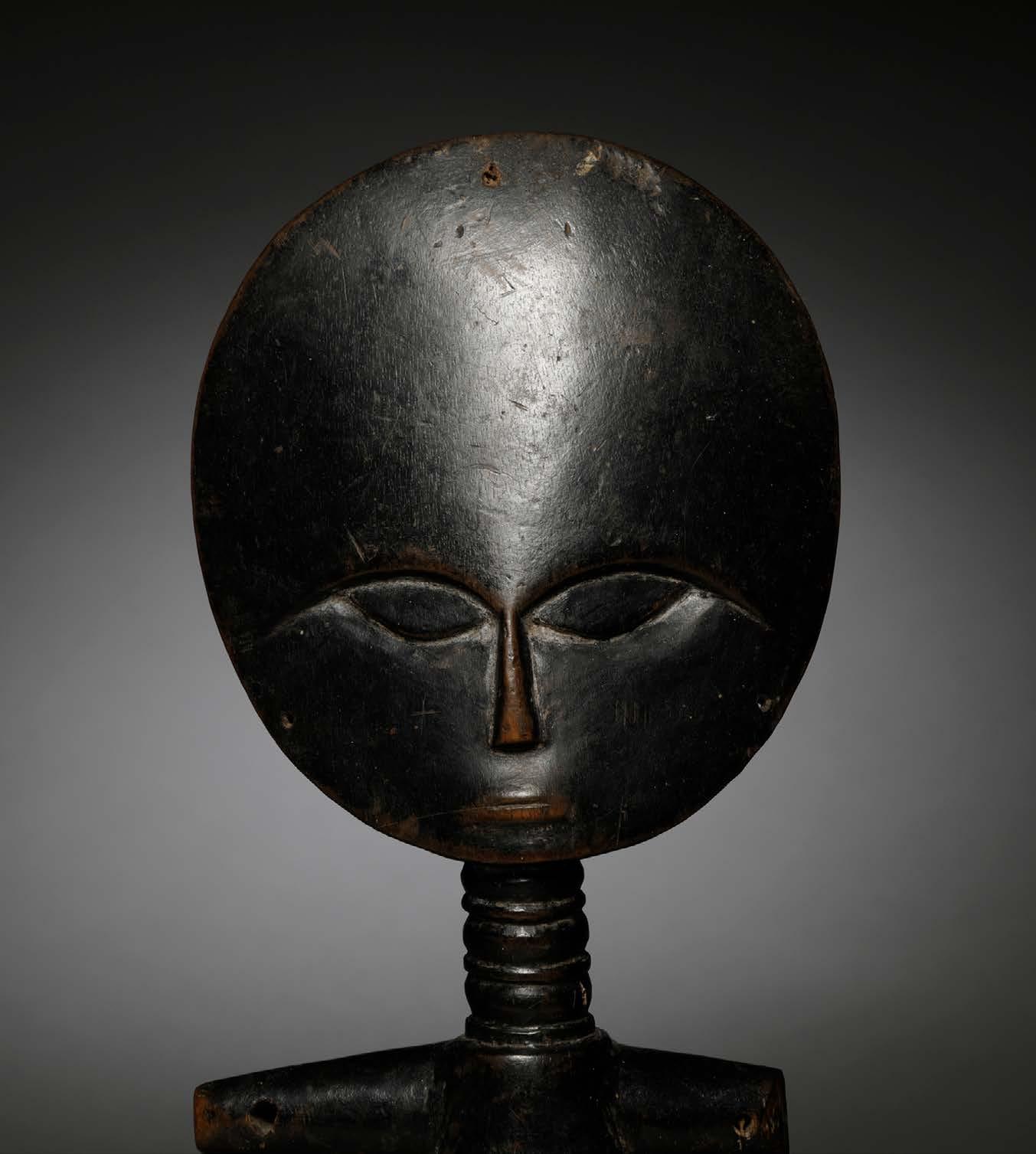
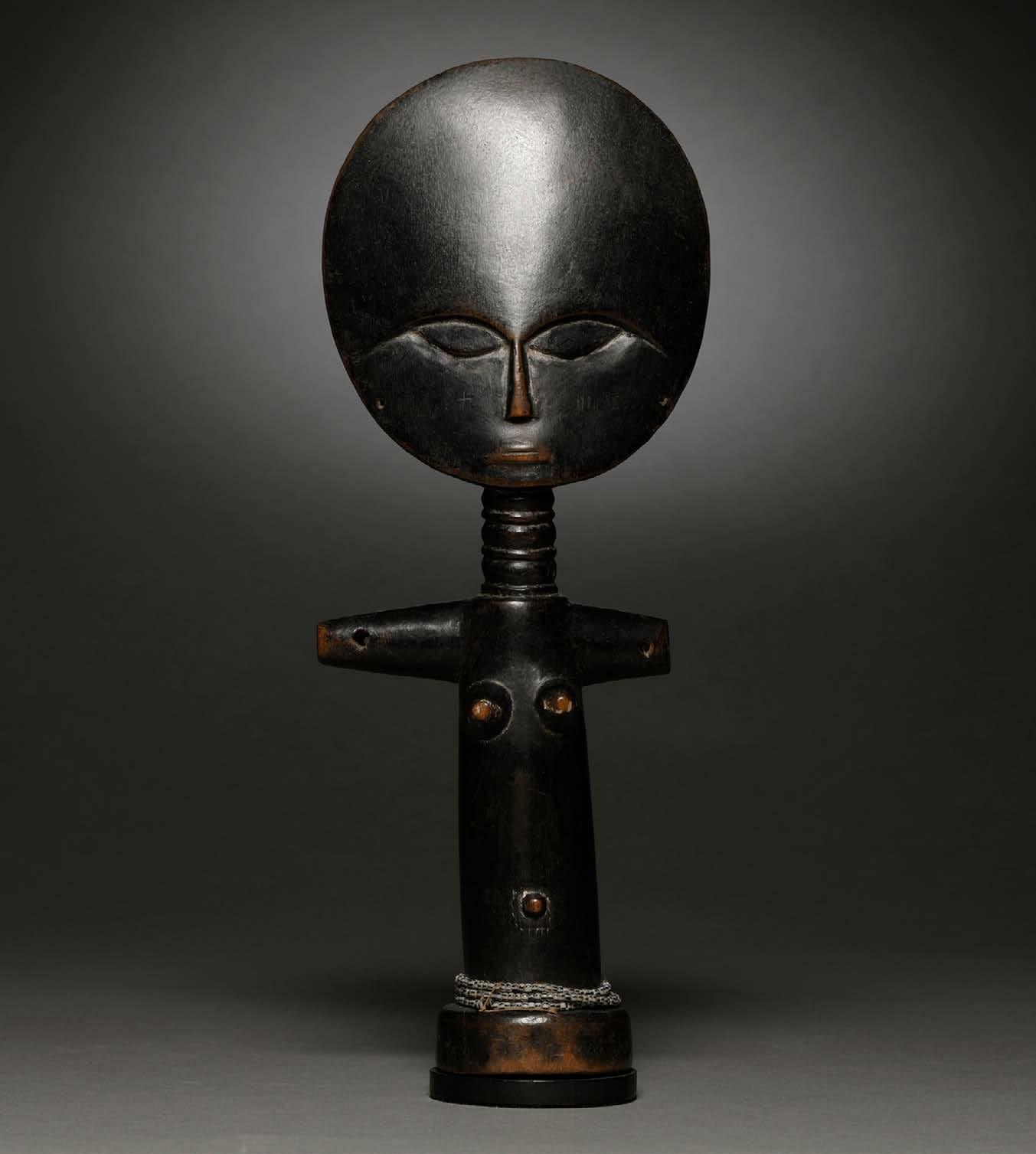
Disk-headed akuaba figures are perhaps one of the most iconic forms in the African sculptural corpus. They are ritually consecrated images of children carried by aspiring mothers who wish to overcome barrenness and conceive through the power of community spirits. Their use arose from an ancestral legend about a woman named Akua who used such a figure for exactly this purpose. Akuaba (‘Akua’s child’) are carried flat against the small of the back and wrapped in skirts, just as a human child would be. After aiding a successful pregnancy, the figures are placed in shrines in testament to the spirits’ power, or kept by the family as a reminder of their child. This beautiful akuaba shows a quite traditional form,
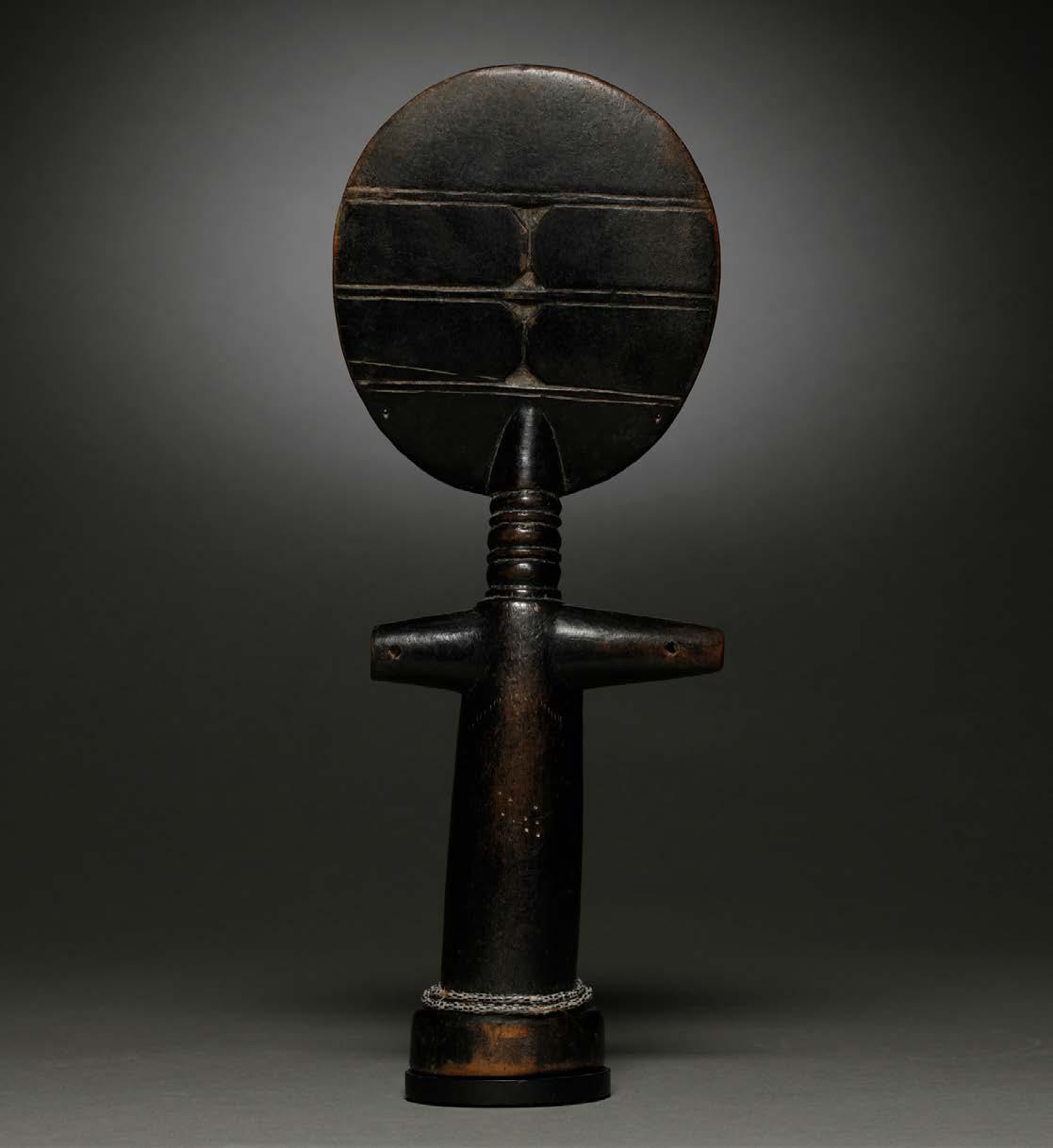
with a wide disk head, horizontal arms, cylindrical torso, small breasts and umbilicus, and a neck of stacked rings suggesting robust health. The rendering of the well-proportioned face holds particular sensitivity, with large eyes that are cut with subtle depressions to define a browline and cheekbones. This gentle working of the surface creates an understated sense of dimension that is heightened by sublime reflections off the refined, lustrous, black patina. Faint linear designs are incised on the cheeks, and beads wrap the base of the figure. The reverse side is engraved with a geometric plan on the head, and light incisions are found on the torso. A portion of the left arm is missing.
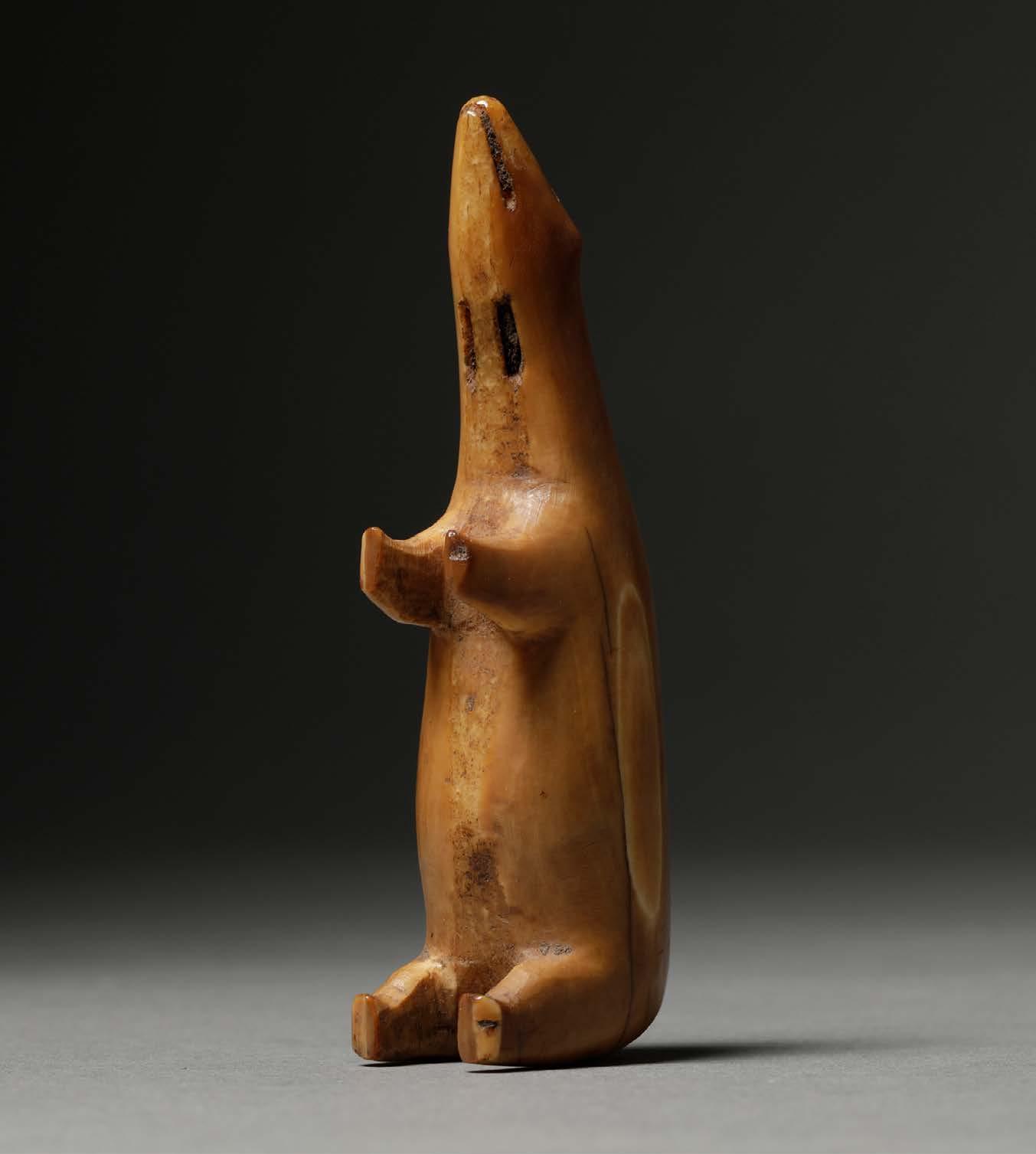
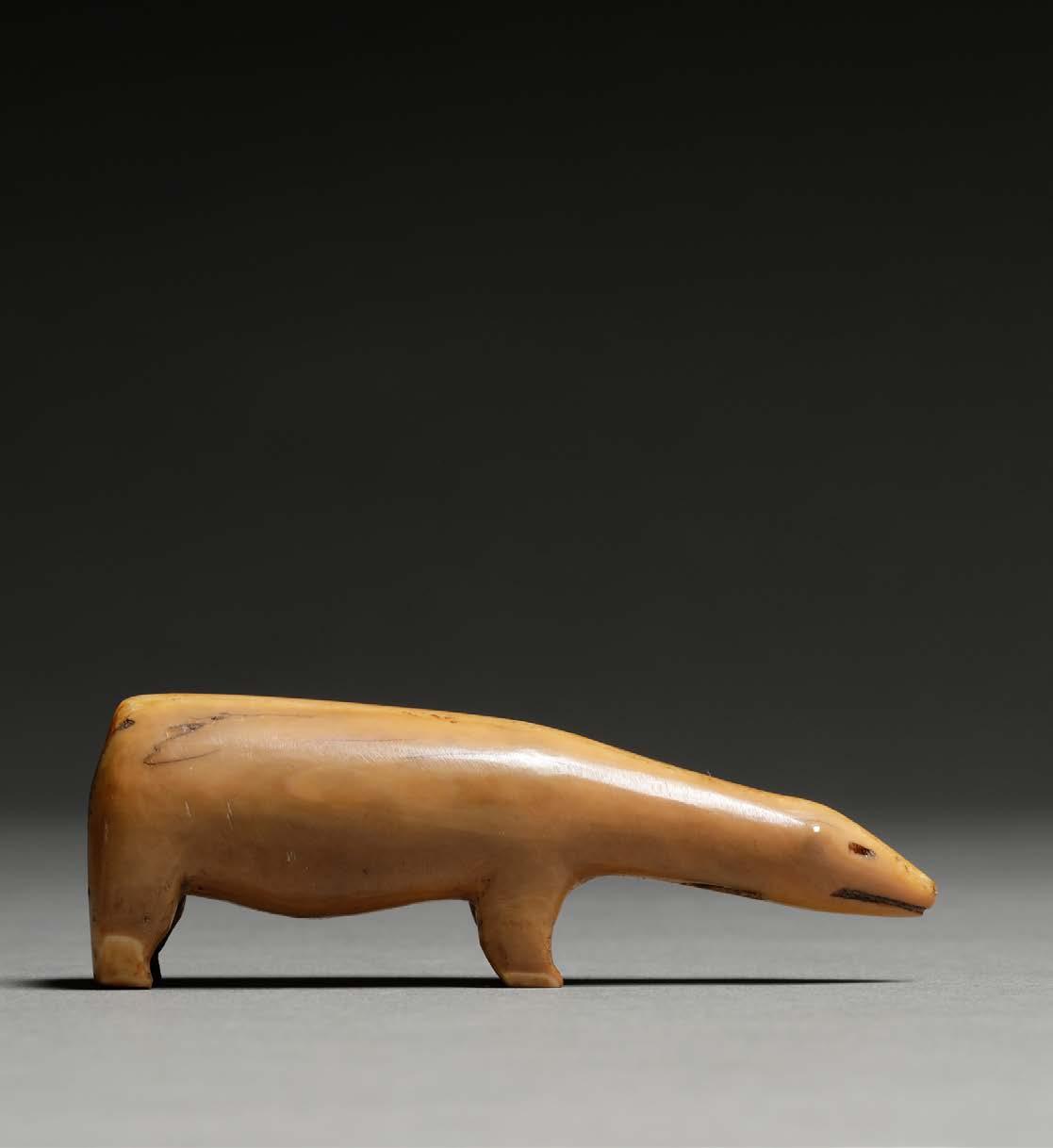
POLAR BEAR AMULET
PUNUK CULTURE, ST LAWRENCE ISLAND
500 to 1000 ce
Marine ivory
Length: 3 ¼ in, 8 cm
PROVENANCE
Nina Newhall, St. Lawrence Island
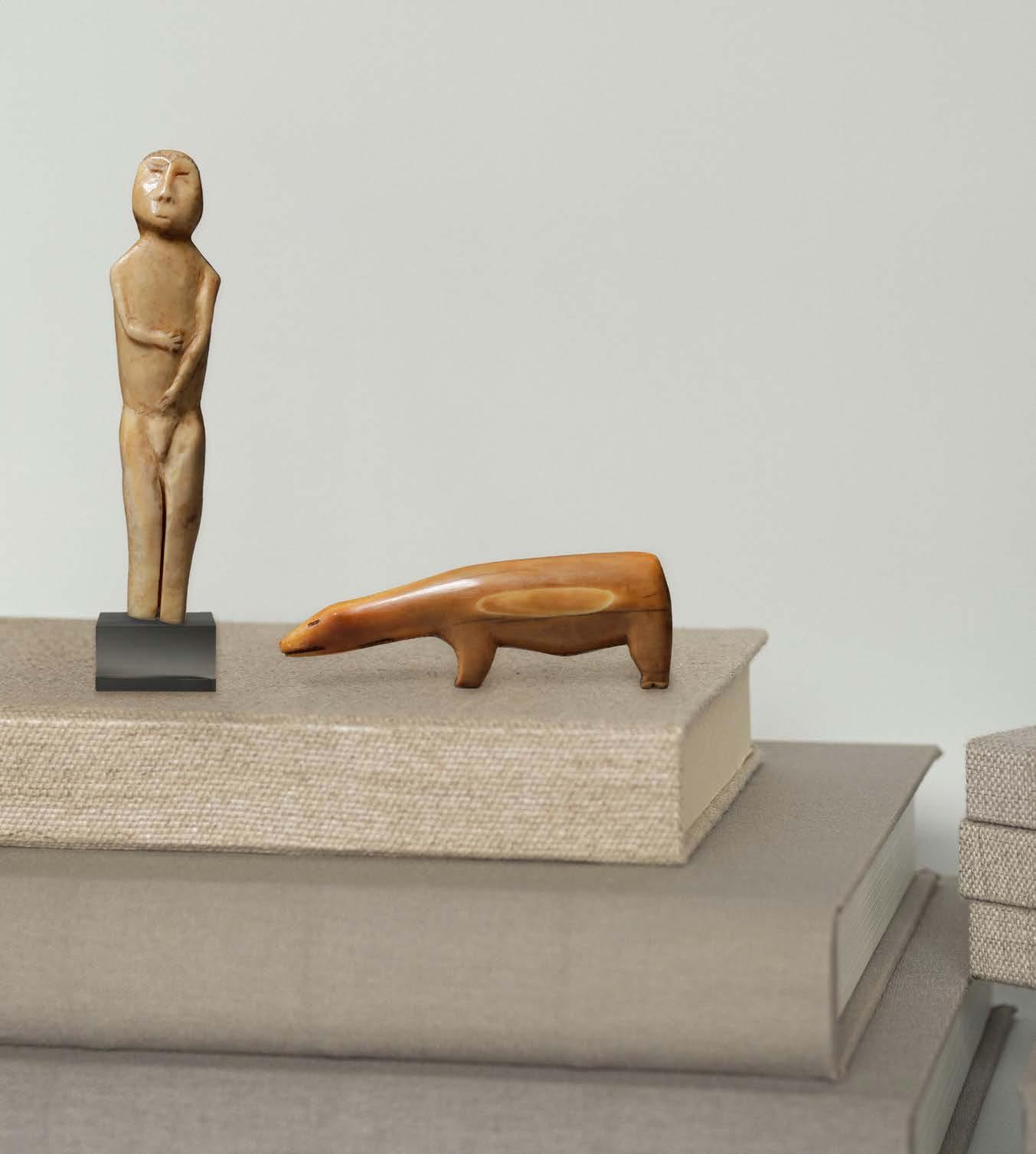
This diminutive amulet, expertly carved from creamy walrus ivory, depicts a stylized polar bear in profile. Despite its small scale, the carving reveals refined craftsmanship: the stout legs, trunk, and powerful haunches are sharply delineated with sensitive contouring and a keen playfulness with proportion. The bear’s head is abstract but purposeful, features sketched in only a few lines, and pierced at the base for suspension or attachment. The surface is smoothly polished, bearing a soft patina from handling and age. It was likely worn on the body or sewn into clothing.
In Thule culture, amulets like this were more than decorative, they were spiritual tools and protective charms. Commonly made of ivory, bone, or antler, amulets were carved into the forms of animals, humans, or hybrid beings, each imbued with symbolic meaning. They were worn or carried to ensure success in hunting, protect against harm
or misfortune, or connect with spirit animals or ancestral powers. Thule carving emphasized clean lines, compact form, and clarity of outline.
The Thule worldview was deeply animistic, regarding animals, humans, and natural phenomena as spiritually interconnected. Their art—especially small-scale carvings like this amulet—reflects this spiritual ecology, where every object had the potential to mediate between the human and non-human worlds. The polar bear in particular was revered as a symbol of strength, endurance, and dominance in the Arctic ecosystem. As apex predators, they were both feared and respected, and in some traditions, thought to possess human-like souls. A polar bear amulet could have served as a spiritual intermediary, granting the wearer attributes of the animal or invoking its favor.
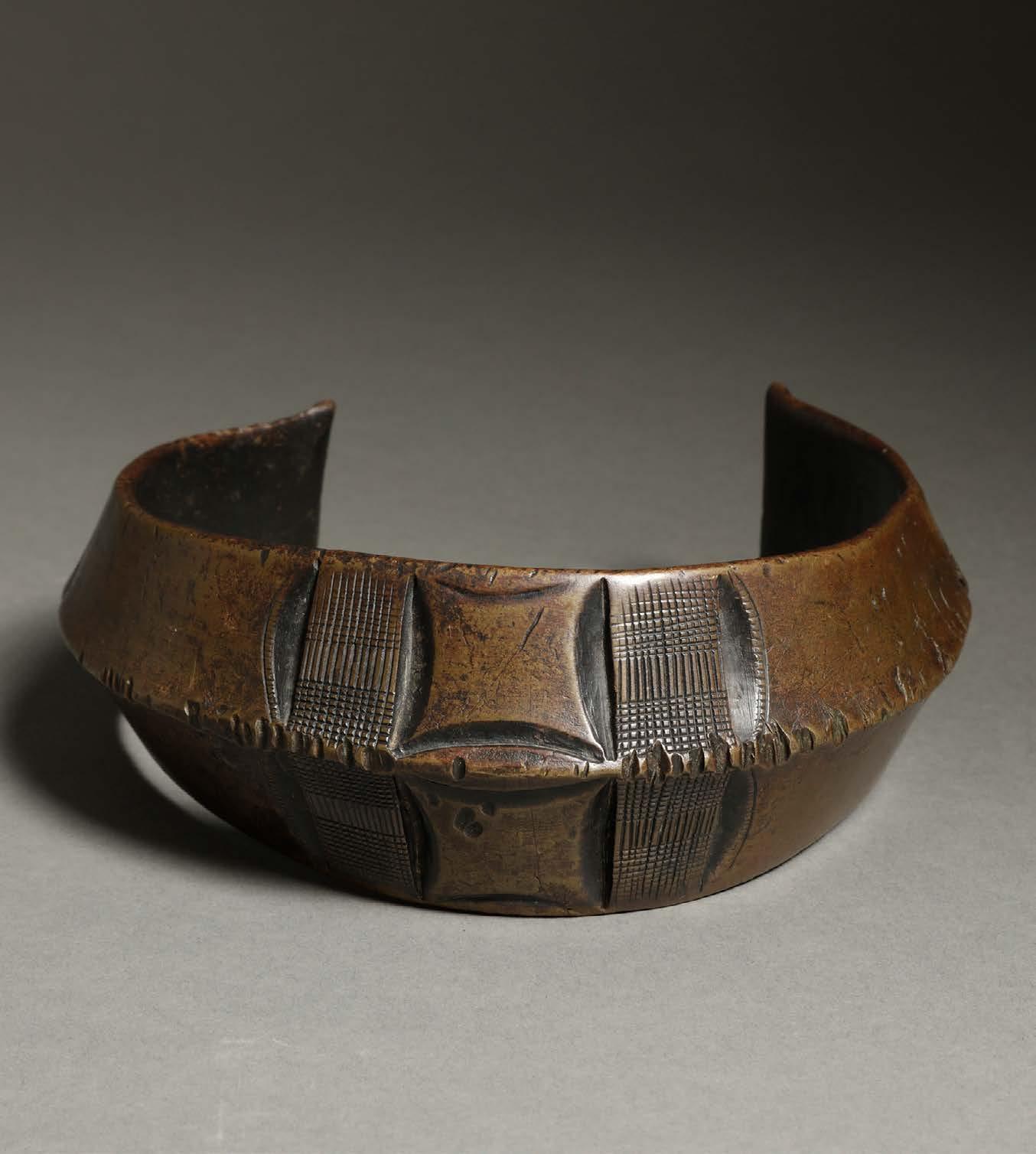
A BRONZE TORQUE
FANG, GABON OR EQUATORIAL GUINEA
19th century
Cast bronze
Diameter: 5 ½ in, 14 cm; Height: 2 in, 5 cm
PROVENANCE
Private European collection
Among the most significant objects in Fang metalwork are a type of heavy neck ring or torque called ngo. Cast in thick brass or bronze, they were decorated with incised designs and closed with a hammer blow around the throat. Once put on, ngo would remain worn until death. Similar torques were sometimes wrapped around the arms.
Ngo were powerful symbols of social status and identity, and possibly had ritual significance. While they were worn by both married women and male warriors, some testimony from cultural elders indicates that the ornaments had a severe purpose concerning wives. Superficially they served
as valuable adornment, but with their considerable weight and permanent attachment to the body, they helped ensure that, if a woman fled from her home, her escape would be hampered and her married status would be impossible to hide.
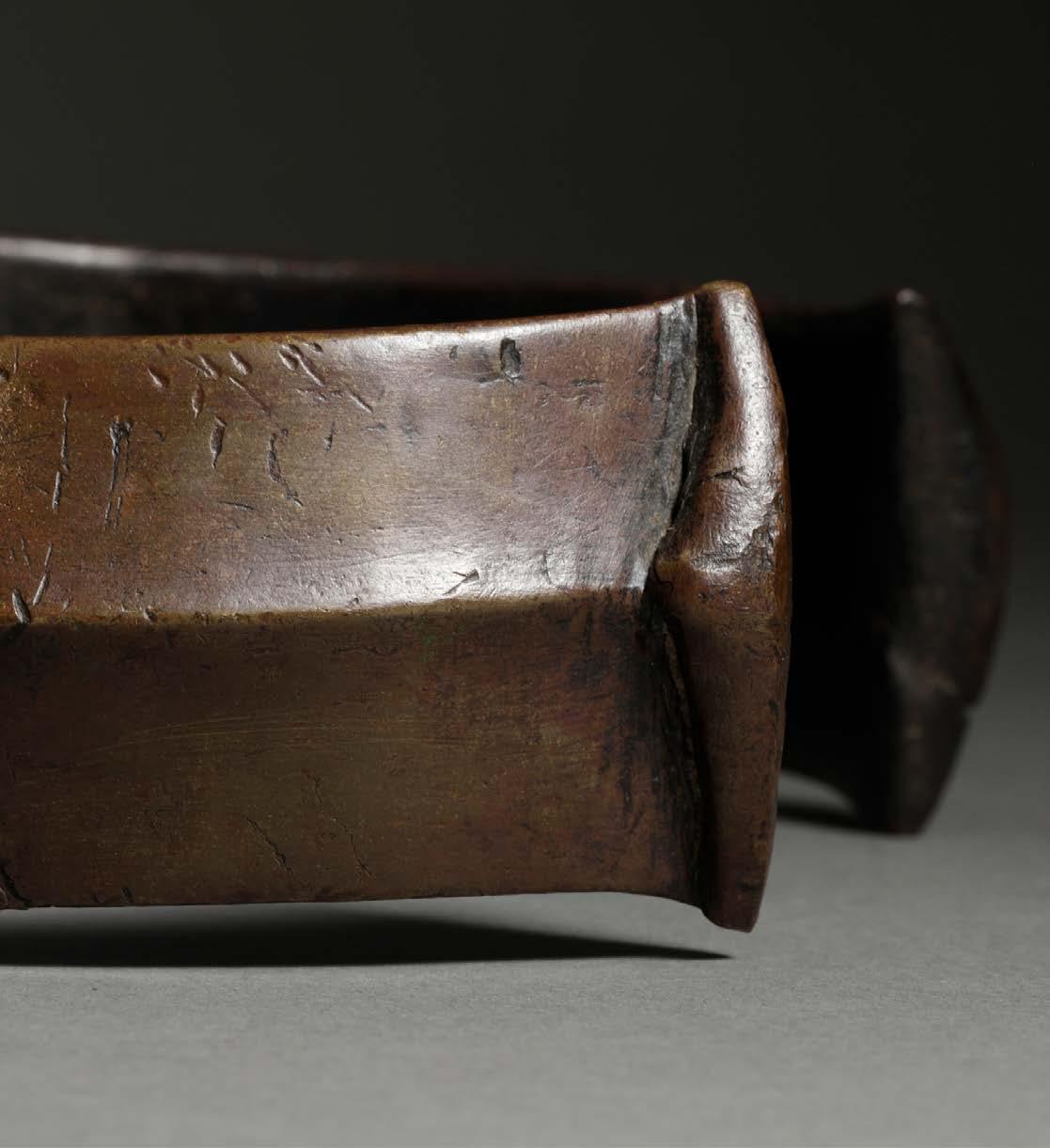
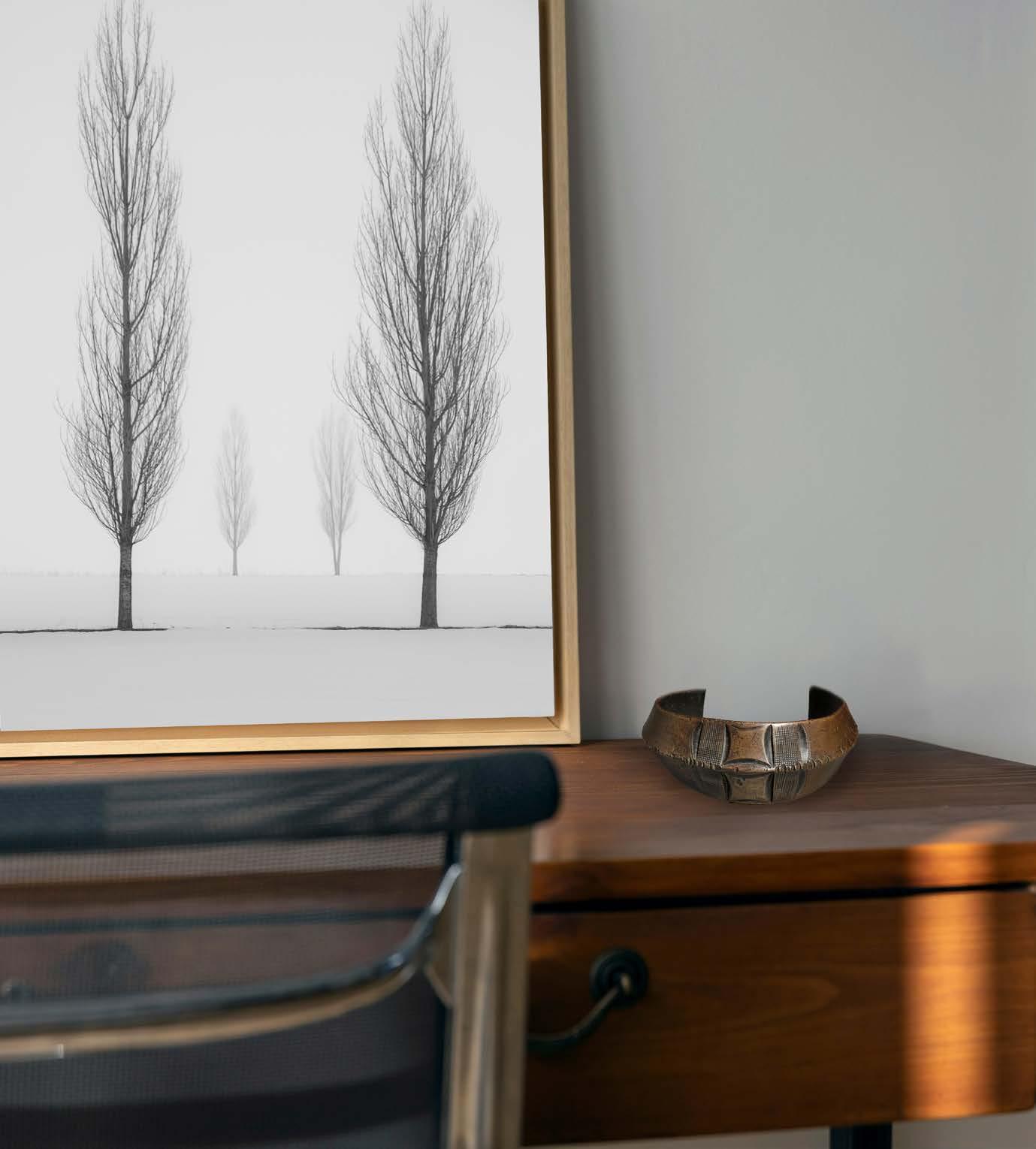
This handsome example shows admirable craftsmanship, shaped with a strong central ridge that bisects the length of the torque and incised geometric panels symmetrically deployed at the midsection. Here, curved outlines are interspersed with sharp, rectilinear shapes, generating an attractive, subtly flexing tension in the design.
FEMALE FIGURE WITH BOWL
YORUBA, NIGERIA
Late 19th / early 20th century
Wood, pigments, nails
Height: 21 in
PROVENANCE
Constance McCormick Fearing (1926–2019), Montecito, California.
McCormick Fearing was an heiress to the McCormick fortune. Her family founded the McCormick Harvesting Machine Company, which later became part of the International Harvester Company. Cyrus McCormick was credited as the inventor of the first mechanical reaper.
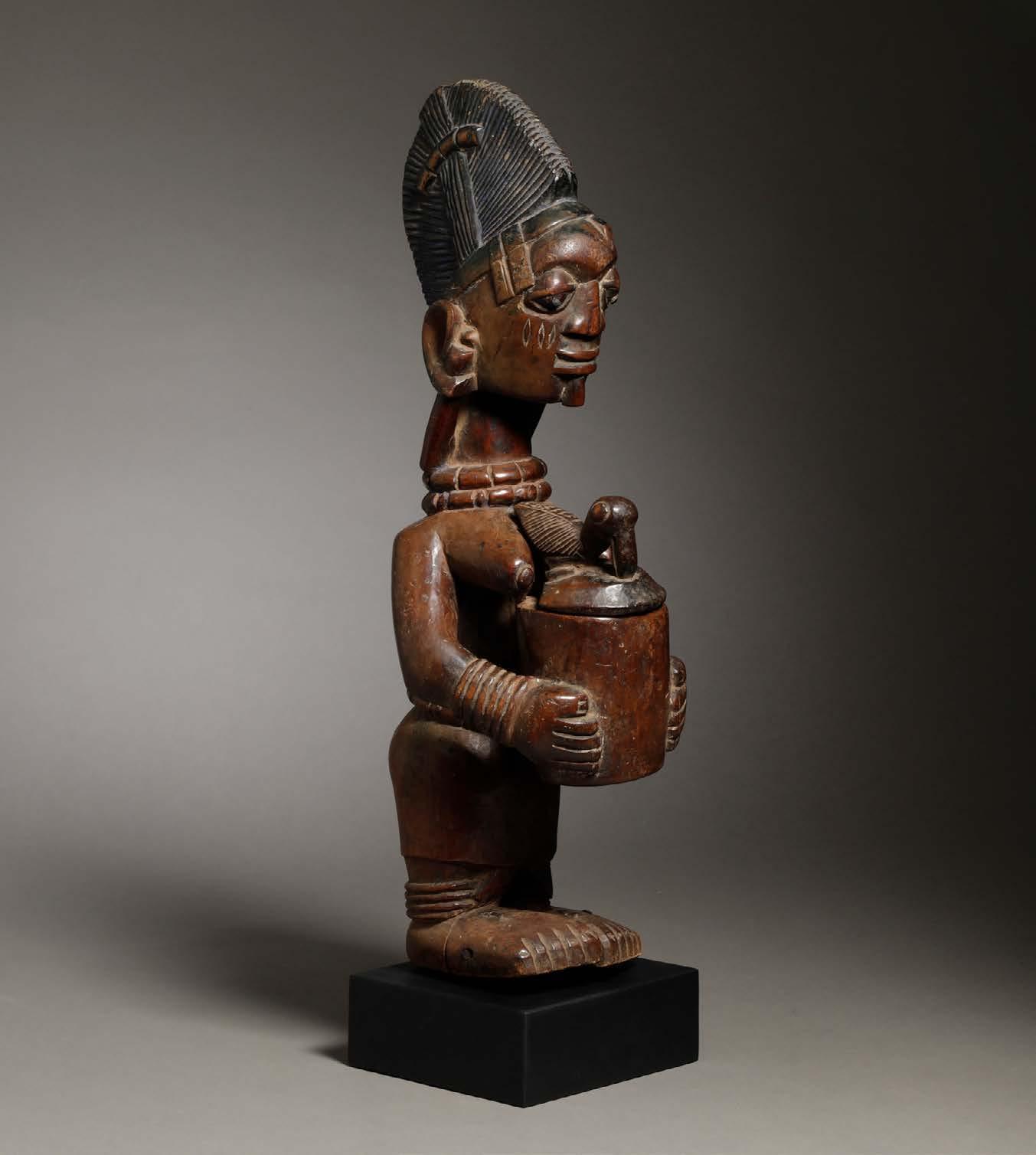
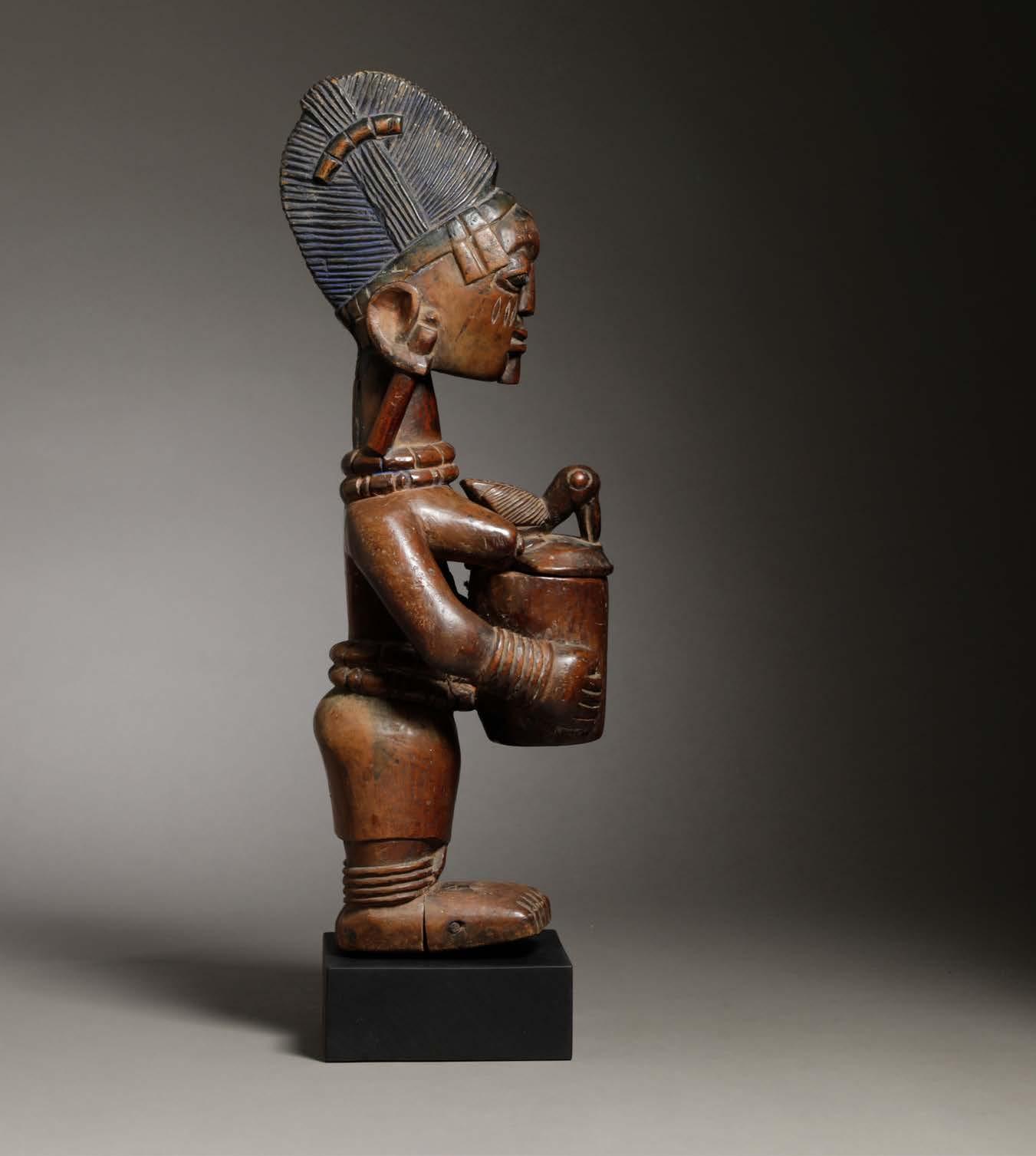
Female bowl-bearers are well-recognized in the Yoruba figure-carving tradition. Known as olumeye, ‘one who knows honor,’ they hold offering bowls whose prominent bird iconography references the sacrificial rooster, a symbol of prosperity. The bowls of olumeye are used to hold kola nuts as an offering of social hospitality or as receptacles for the sixteen sacred palm nuts used in divination. The figure offered here differs markedly from others in its class due to its standing posture. Olumeye are typically carved in a kneeling position, reflecting a spirit of devotion. This straight-backed cup-bearer shows strong, stout limbs and a sure stance, with feet solidly planted. Close between projecting breasts it holds a cylindrical vessel topped with a
small bird figure. Its large head is supported by a relatively slender neck and is crowned with a high, blue-pigmented crest coiffure that contrasts beautifully with the warm brown wood of the body. Abundant details are worked into the figure, with relief-carved adornments to the head, neck, wrists, waist, and ankles, including a prominent pair of rod-shaped earplugs. The figure is wearing a lip plug, an indicator that this is an early carving. Lip plugs were often seen as a symbol of beauty, status, and cultural identity. The size and shape of the lip plug could vary between ethnic groups, and it often signified the wearer’s age, marital status, or social standing.

CERAMIC VESSEL BY MNCANE NZUZA
TUGELA RIVER VALLEY, CENTRAL ZULULAND
14¼ in (h) 14¼ in (w) 36 cm (h) 36 cm (w)
PROVENANCE
Private Collection
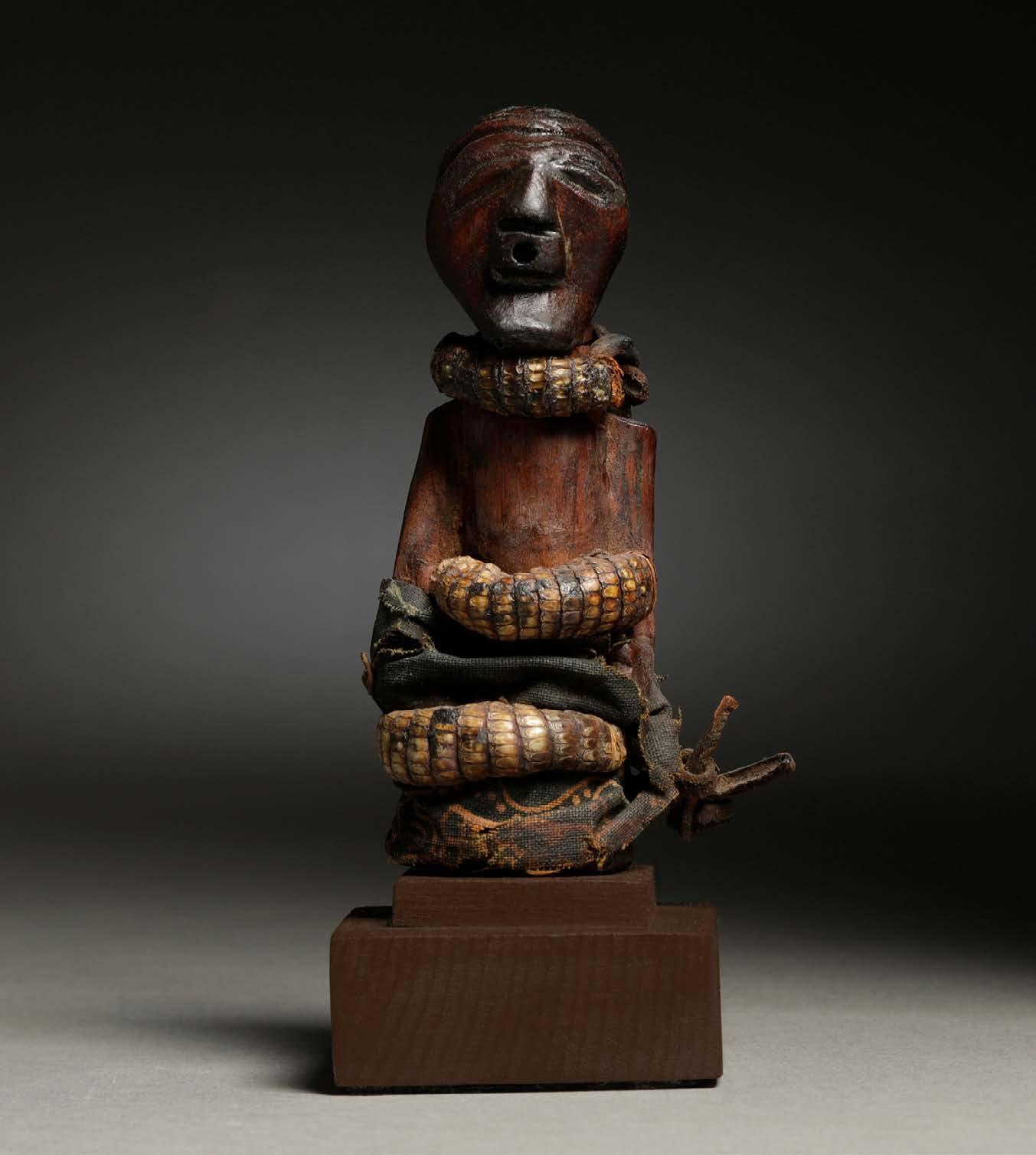
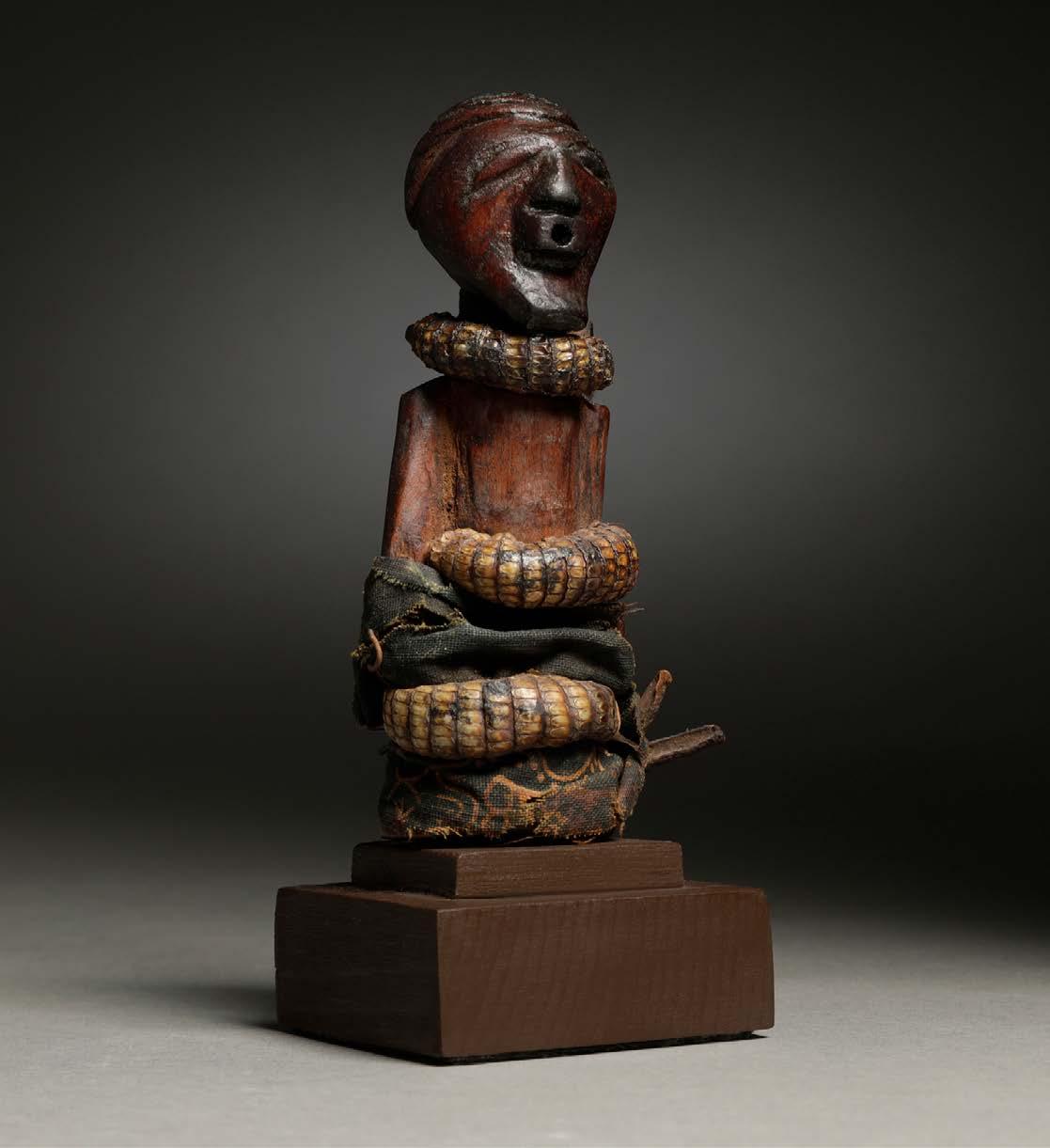
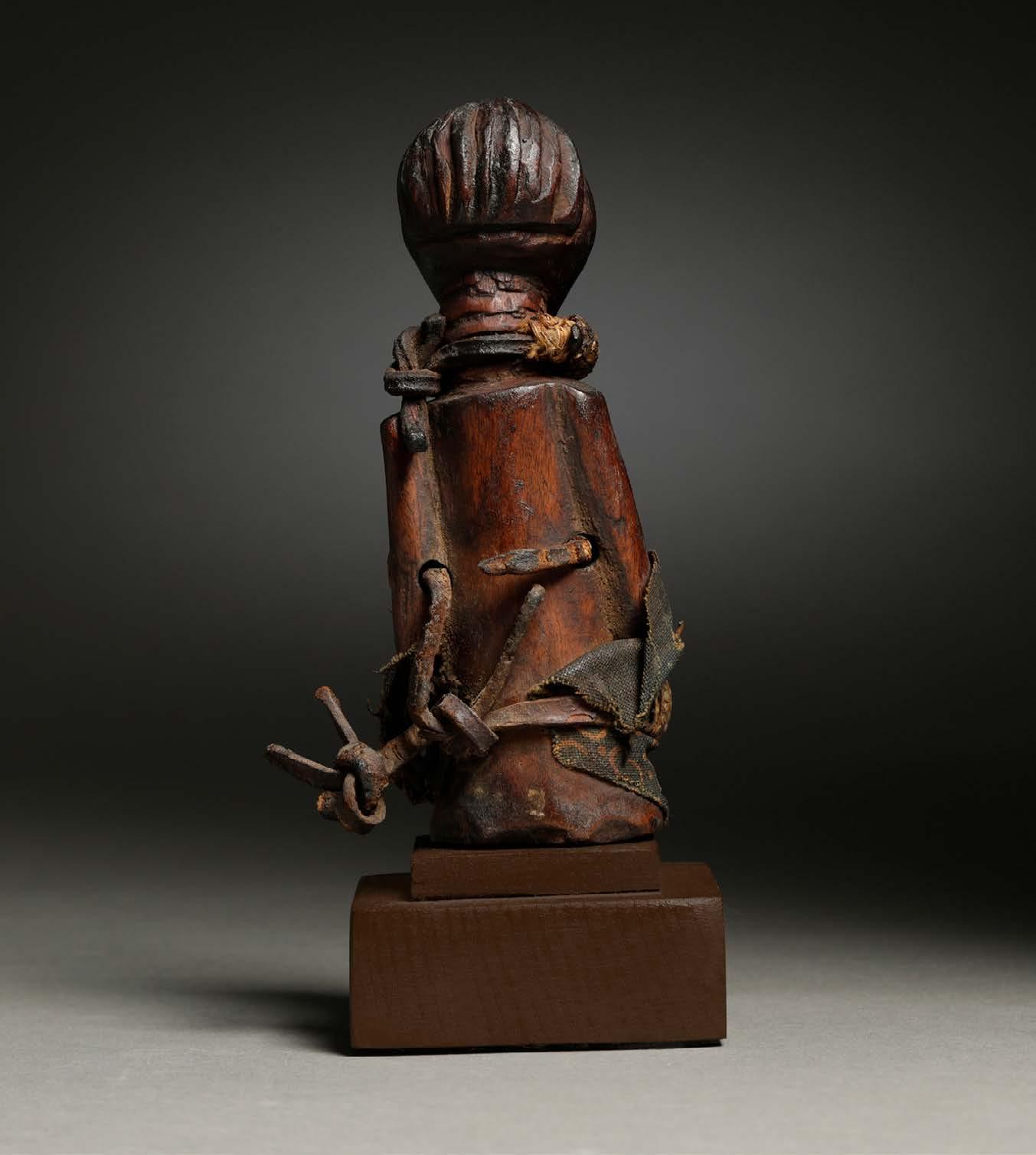
MALE FIGURE NKISI
SONGYE, DRC
Early 20th century
Wood, palm oil, fabric, skin
Height:3 ½ in, 9 ½ cm
PROVENANCE
Affrika Gallery, Washington, DC
Craig DeLora, New Jersey
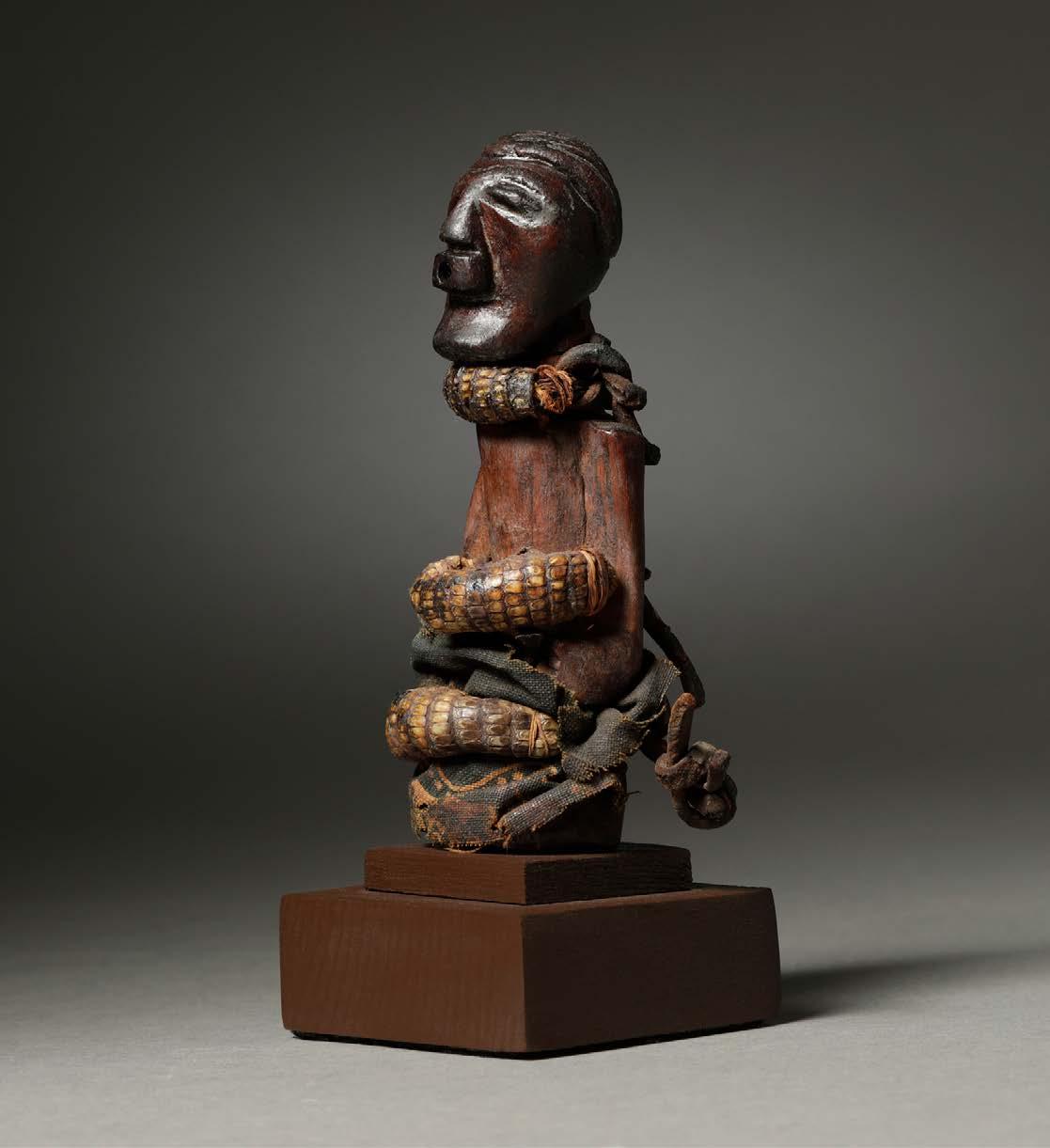
Some cultures in the Congo Basin use the term nkisi or nkishi (pl. minkisi) to refer to spirits or objects that a spirit inhabits. It is a name most commonly associated with power figures, a major class of carvings that were used to counteract malicious sorcery and support abundance and well-being. Minkisi were created jointly by a specialist carver, who shaped the figure’s form, and a ritual practitioner (nganga), who would empower and activate the figure with a magical charge of organic ingredients. The latter was either inserted into a cavity or attached to the body.
Europeans may have first encountered these objects during expeditions in the region as early as the fifteenth century. In the late 1800s, Christian missionaries who had
come among the Songye and Kongo peoples confiscated and destroyed such ‘fetish’ objects, as they were often called, demonizing them as tools of witchcraft and heathenism. Despite their efforts to eradicate these works, many minkisi survived and passed into collections to be appreciated and studied by future generations.
The immediate focal point of this figure is its classic Songye face, darkened by a resinous patina and communicating a marked strength and depth of feeling. Simply but expressively carved, its geometric features and curved profile – into which eyes, coiffure, and chin are all drawn – evoke a transcendent solemnity. A schematic body is decorated and partially obscured by attached coverings of cloth and bundles of reptile skin.
PECTORAL ORNAMENT, TEMA
SANTA CRUZ ISLAND, SOLOMON ISLANDS
Late 19th/early 20th century
Clam shell, turtle shell, fiber 6.5 in Height 6.5 in Width
PROVENANCE
Private Collection, USA
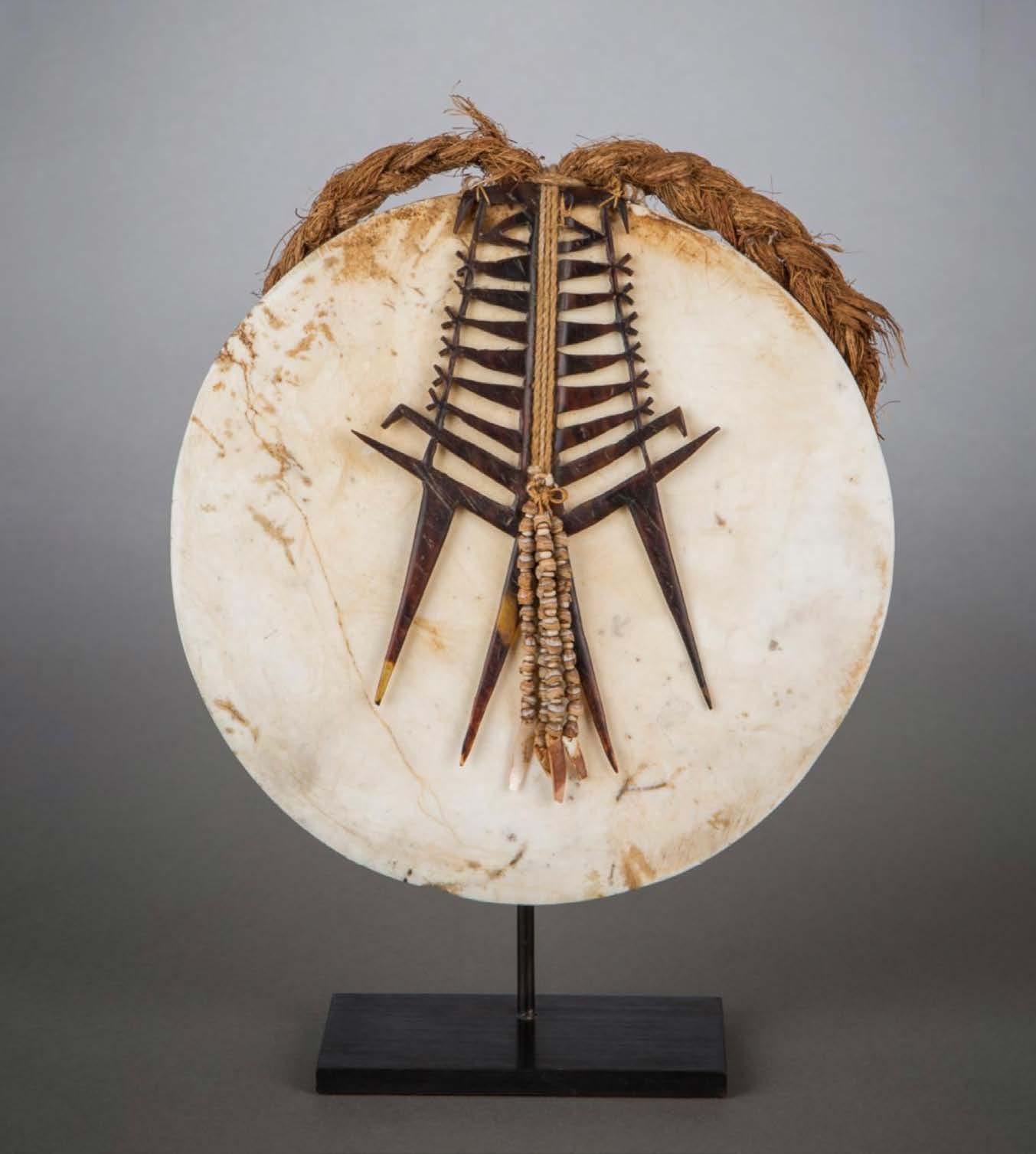
The Solomon Islands, located in the southwest Pacific between New Britain and Vanuatu, is remarkable for the richness of its traditional decorative arts, which served to adorn the human body and embellish ceremonial and utilitarian objects. Artists in the island chain produced ornate jewelry and personal ornaments fashioned from shell, porpoise teeth, turtle shell, and other materials.
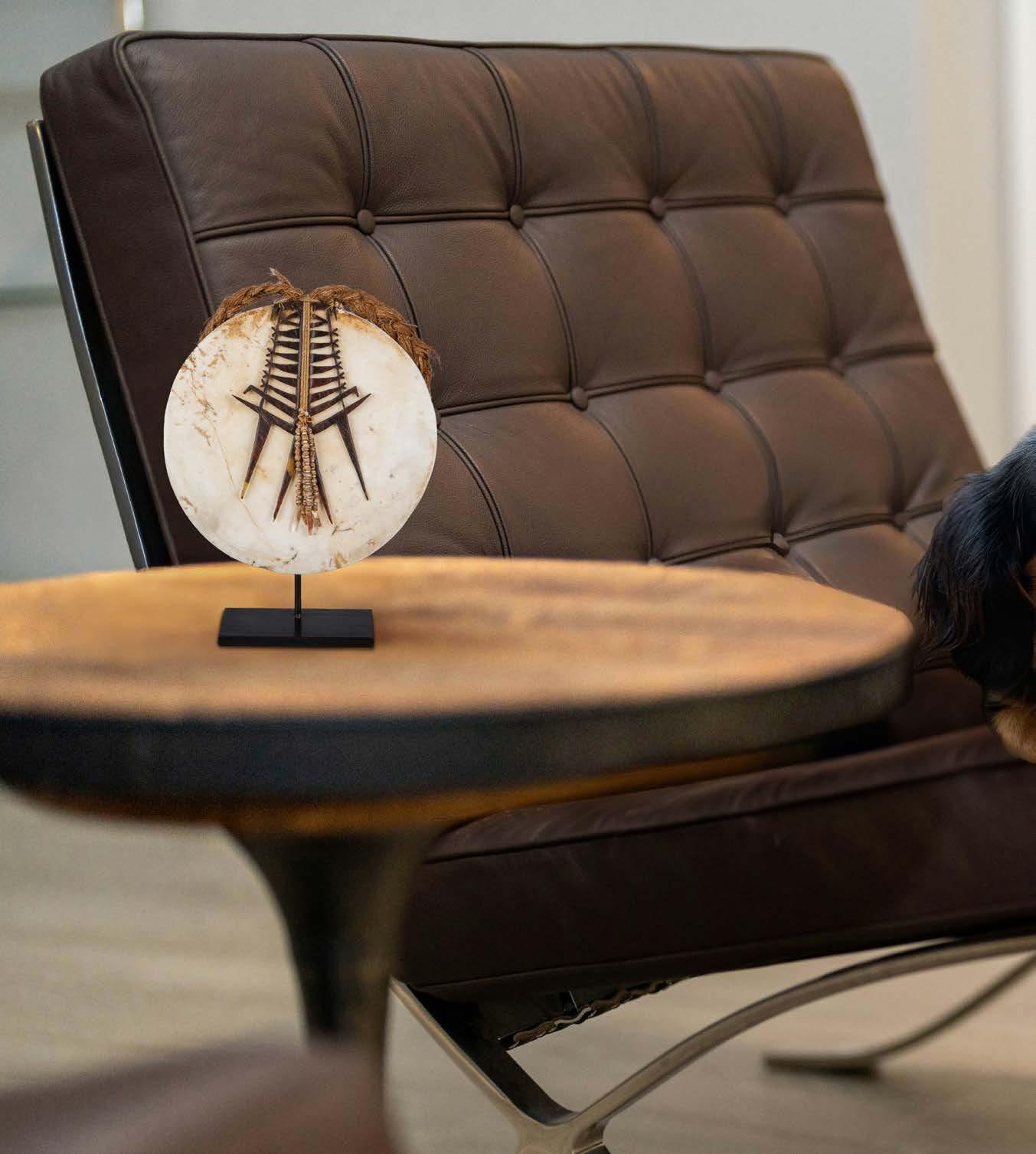
Chest ornaments (tema) are one of the most iconic forms in the Solomon Islands traditions. Worn by men of high
status in the Santa Cruz Group, the tema is the central and most important element of the ceremonial costume and its size and quality are indicative of the owner’s wealth and social importance.
The precise meaning of their iconography is no longer recorded, but it is hypothesized that the temas form represents the silhouette of a frigate bird against the full moon or the sun.