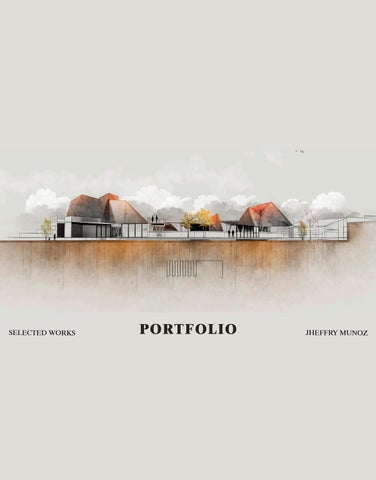
2024 Fourth year project Fall semester

ARTCHITECTURE DESIGN STUDIO
2023 Third year project Fall semester

COMPETITION PROJECT
2025 Summer project

DRAWINGS & PERSONAL WORK 04
2021-2023 Fall and spring Projects
![]()


2024 Fourth year project Fall semester

ARTCHITECTURE DESIGN STUDIO
2023 Third year project Fall semester

COMPETITION PROJECT
2025 Summer project

DRAWINGS & PERSONAL WORK 04
2021-2023 Fall and spring Projects
This project proposes a speculative model for a future city where architecture, agriculture, and infrastructure operate as a single integrated system. Rooted in the Texas Public Land Survey framework, the design reinterprets territorial land division to support sustainable housing, local food production, renewable energy, and low-carbon mobility. Through a scalable grid and modular parcels, the project explores how historic planning logics can be adapted to create resilient, self-sufficient, and environmentally responsible urban environments.
INSTRUCTOR : OSWALD JENEWIN
TEAM : MICHAEL KOFLER
TYPE: RESEARCH/ FUTURISTIC DEVELOPMET
LOCATION: CORPUS CHRISTI, TEXAS


CATTLE DENSITY MAP SUITABLE FARMLAND LOCATION FISH FARMING AND LOCATION
Even though the panhandle is called “cattle country,” the southern prairie region is far more dense in cattle population. This means that there is a greater usage of water for cattle farming in this region.
Texas ranks first in the nation for total number of farms with just over 248,000, which account for more than 127 million acres of agricultural land (managing almost 74 percent of the state’s 268,581 square miles).
Texas ranks in the top four states for catfish production in the United States, but it ranks 11th in the country forthe total number of aquaculture farms. This density map shows how most fish farms in Texas.


Hydroponics is a revolutionary farming method that allows plants to grow without soil, using nutrient-rich water solutions. It is important because it enables efficient resource use, such as water and nutrients, while eliminating the need for arable land.

Farming is vital in Texas due to its significant contribution to the economy, As one of the nation's top agricultural producers, Texas provides essential crops like cotton, grains with livestock products such as beef and dairy.

Fish farming, involves the cultivation of fish and other aquatic species in controlled environments to meet the growing demand for seafood. It is an alternative to traditional fishing and helps reduce overfishing in wild populations.


Sunlight openings in the building create natural light tunnels that channel daylight directly to the fish and oyster farm below, reducing the need for artificial light- ing and lowering energy costs.

Fish farms utilize the Gulf’s warm waters, providing sustainable aquaculture environments, while minimizing environmental impact. The protein coming from the fish farms creates a sustainable alternative to beef that comes from environmentally harmful cattle farming.

Wildflower-covered roofs create a vital habitat for bees, providing nectar and shelter while promoting biodiversi- ty in urban environments.

The housing units in the city are relatively narrow and are placed in groups of three to offer green spaces with pavilions and access to underground rail transportation between each trio. This also allows for increased density while still allowing occupants to own their own lot. Each unit is capable of housing 2-3 beds and 2 bathrooms. In the central core is a large greenhouse rack so occupants can grow their own food.


Oyster farms are situated together in a relational grid. There are circular pools for collecting oysters inside the structure and between the circulation elements of the grid. The oyster farms also have green roofs, which allow workers to grow crops on the roof as well, creating a dual environment farming.
This distribution center acts as a central hub within the master plan, connecting surrounding agricultural zones to markets, residential areas, and communal facilities. Organized around a clear central circulation spine, the layout allows produce to be efficiently collected, sorted, and redistributed through modular nodes. Its proximity to food production areas reduces transportation distance, supports fast distribution, and strengthens a low-carbon, integrated food system.


The unique design of the housing units, with their street-facing projections, combined with the trees planted along the sidewalks and the perforated street, creates comfortably shaded walkways for the inhabitants, keeping the area cool and pleasant.

The integrated greenhouse, filled with hydroponics, creates a self-sustaining environment by growing fresh food year-round. It also improves air quality and contributes to the well-being of the residents due to the natural sunlight entering the building, which enhances mood and promotes overall health.

The south-facing solar panels on each housing unit provide a renewable energy source, reducing electricity costs and dependence on external power. The larger solar panel, which doubles as the greenhouse’s outer wall, enhances to maintain a healthy indoor environment.

UNDERGROUND TRAINSTATION
The underground electric-powered trains serving the housing units reduce the need for car travel, cutting down on carbon emissions. The trains arrive in minute intervals, which minimizes urban congestion and supports a more sustainable, eco-friendly community.


The public land survey system is a method used to organize and distribute land for agricultural purposes. It provides a framework for dividing land into parcels, accommodating both regularly and irregularly shaped farms and ranches.

Featuring 2-acre plots that integrate residential spaces with designated agricultural land, this design supports sustainable living by enabling residents to grow their own crops, fostering self-sufficiency and environmental stewardship.

Recreational spaces are designed to enhance community well-being by providing areas for relaxation, interaction, and physical activities. These spaces often incorporate innovative structures, such as tensile canopies, to create shaded, inviting environments. They feature multifunctional layouts with pathways, seating, and greenery, fostering social engagement.

“Domestic
Integrating a workshop within the home creates a balanced relationship between living and working by allowing a smooth transition between professional and personal activities. This arrangement reduces commute time, supports flexible daily schedules, and enhances overall efficiency. Economically, combining these functions minimizes the costs of maintaining a separate workspace, enabling homeowners to invest more intentionally in a single, adaptable environment.
INSTRUCTOR : SHADON ODOM
YEAR : 2023
TYPE: RESIDENTIAL
LOCATION: DALLAS, TEXAS


Establishes the primary building mass in relation to the site while taking in matter the surroundings.

Residential units are pushed to the site edge to create privacy and a clear boundary.

Spaces are separated to address sound control and functional clarity.

Workshop spaces are consolidated along the left side to contain noise and support productive use.


The central courtyard functions as a green, walkable spine that connects the workshop and residential zones while maintaining clear separation. Workshops are located to the left and housing to the right, with the courtyard serving as a shared gathering and circulation space. Designed as an open showcase, the courtyard allows artwork and metal pieces produced on-site to be displayed, inviting public engagement and reinforcing the relationship between making, living, and community.


This zone accommodates making and fabrication activities within an open, flexible layout. Its consolidated form allows for sound control while supporting collaborative work and efficient circulation.

The cafeteria functions as a social hub, offering an open dining area alongside a more private interior zone. This layered layout allows for both communal interaction and quieter, more intimate use throughout the day.


The landscaped courtyard acts as the social and spatial heart of the project. Designed as a walkable green corridor, it supports gathering, circulation, and outdoor display of artwork and metalwork produced on site.

A public-facing space where work created in the workshops is showcased. This area invites visitors into the project, strengthening the connection between production, community engagement, and daily life.

PERSPECTIVE VIEW 1/8” = 1’ SCALE BUILDING

BUILDING


“Raiz Modular, Integrates seismic with intelligent water maneagemnt”
Compact and sustainable home is designed for a young couple seeking comfor t and self-sufficiency in a region where water scarcity is common. Its arched metal roof not only gives it a distinctive, modern aesthetic but also serves a vital function by channeling rainwater into two large storage tanks protected by a wooden shade structure, allowing the couple to collect and conserve water efficiently. Inside, the floor plan is simple yet purposeful — the ground floor combines a cozy living and dining area with a compact kitchen, creating an open and connected space that maximizes natural light and airflow, while the upper level offers a private bedroom with serene views. Every detail, from the orientation of the windows to the compact layout and integration of sustainable systems, contributes to a lifestyle that is both environmentally responsible and emotionally fulfilling, allowing the couple to live harmoniously and comfortably within a small but thoughtfully crafted home
COMPETETION YEAR: 2025
TEAM : GABRIELA CASCIANI / IVAN RODRIGUEZ
TYPE: MICROHOME
LOCATION: MEXICO CITY, MEXICO


1. Slepping area
2. Closet/shelves
3. Gutter system
4. Balcony

1. Living Room / Working area
2. Kitchen / Dinning area
3. Bathroom
4. Kignspan slimline water takns
5

Curved roof channel rainwater to gitter and kingspan tank supplying bathrooom and kithchen, aiding water reuse in droughtprone areas.


Seismic forces are transferred from the ligthweigth roof and reinforced concrete walls to the grade beams and micropile foundations, stabilizing the
Add roof support and storage space while structural fleibility during seismic movement.
SIDING
Lingthweigth curved strcture reduces seismic load and allows flexible movement on soft lacustrine clay.
MICROPILES FOUNDATION
Reinforced concrete grade beams connect piles, distributing loads and enhancing
CONCRETE WALLS
Provide lateral stiffness resistace, anchored to grade beams for stability
KINGSPAN WATER TANK

Collect and stores reainwater, reducing reliance on poor sewage system and aiding


WALL/FLOOR DETAILED
1. Metal siding
2. Underlayment
3. 12mm Sheathing
4. 35mm Rigid insulation
5. 76mm Batt insulation
6. 14x36mm Steel purling
7. 12mm Gypsum board
8. 15mm Wood finish
9. 18mm Plywood subfloor
10. 38x184mm Timber joist
11. 200,, Air cavity/ batt insulation
12. 15mm Gypsum board
The overall site organization, where individual dwelling units are distributed along a gently winding path and anchored by a repeating system of shared open spaces. The open gathering areas appear three times across the layout, establishing a clear rhythm and hierarchy within the master plan. Each communal space acts as a social node, serving the surrounding homes while maintaining visual and spatial continuity through consistent canopy structures and landscaping. This repetition creates cohesion across the site, balancing private living with collective use and reinforcing a village-like organization that is both legible and adaptable.
MICROPILE DETAILED
1. Adjustable threated rod
2. Cap plate
3. PP300 pier tube
4. Bracket
5. External Sleeve
6. Micropile bar coupler
7. PP350 pier tube
8. PP350 starter tube with collar
9. Grout column from drill bit to plate
10. Hollow micropile bar


I am eager to learn as much as I can from architecture—through experience, collaboration, and continued exploration. This portfolio represents not an end, but a step forward in that process.