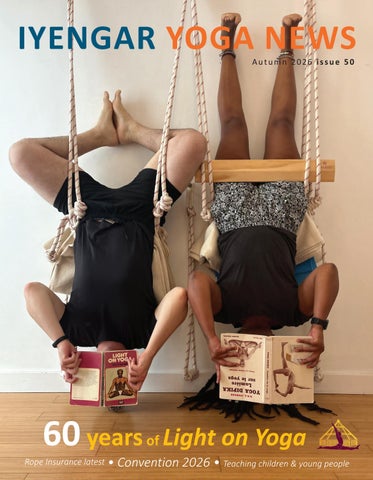
IYENGAR YOGA NEWS Autumn 2026 issue 50
60 years Light on Yoga of
Rope Insurance latest • Convention 2026 • Teaching children & young people
I Y E N G A R® Y O G A ( U K )
In the light of Yogacharya Sri B.K.S. Iyengar
www.iyengaryoga.org.uk
Autumn's here!
T
his year, we celebrate the 60th anniversary of Light on Yoga. Our members share stories about their well-loved copies (page 4 onwards). You can also read about Gerald Yorke, the original editor in 'The Other Man behind the book’ (p. 10). In May, many of us gathered in Glasgow for the convention. Read first-hand impressions of the event beginning on page 14. If you've haven't yet attended a convention, make sure you don't miss out next year! We also tell the story of the foundation of Leeds Bradford Iyengar Yoga in 1991 (p. 32), created thanks to direct permission from BKS Iyengar. On page 36, Claire Ferry reflects on the parallels between the practice of music and Patanjali's Yoga Sutras. Remembering Bobby Clennell We were deeply saddened by the death of Bobby Clennell in May. She inspired many through her gentle and supportive teaching and wonderfully informative books and illustrations. To celebrate her life and immense gift to the Iyengar yoga community, we are planning a special feature for our spring issue. Please get in touch to share your photos, memories, and how Bobby's work touched you or your students.
Editorial team: Minna Alanko-Falola, Mark Jolly and Sara Ledwith Designer: Cathy Tincknell Illustration: pp12-13 Cathy Tincknell, p13 (inset) Vecteezy, pp44-45 (photo) Nick Morales, Unsplash, p44 (inset) Bianca Van Djik, pp 46-47 Svenja Karstens Proofreaders: Charlotte Everitt, Philippe Harari and Jane Howard Suggest article ideas to: editor@iyengaryoga.org.uk Next deadline: 31 January 2027 Please discuss ideas with us before you start work. It saves time, and we will be able to help you.
Membership and Office Manager: Andy Tait 07510 326 997 office@iyengaryoga.org.uk Governance and Support Manager: Bronwen Hopkins bronwen@iyengaryoga.org.uk Finance & Bookings Administrator: Jess Wallwork jess@iyengaryoga.org.uk Assessments Administrator: Kate Woodcock 07914 089 360 kate@iyengaryoga.org.uk This magazine is printed on paper that is sourced under a scheme which ensures minimal environmental impact.
Contents Light on Yoga Anniversary: The Power of Light on Yoga
4
Sara Ledwith
The Other Man behind the Book
10
Mark Jolly
A Companion behind Bars Mark Jolly 12 Light on Yoga Sequence BKS Iyengar/Svenja Karstens
IY(UK) Convention 2026:
Convention 2026 with Birjoo Mehta 14 Kelly Brooks
Your Convention Experience Poppy Pickles
The Foundation of Birjoo's Approach Katie Rutherford Experience the Convention Poppy Pickles
A Pune Primer Sara Ledwith Leeds Bradford Iyengar Yoga Our Story and Community
48
Continuing Professional 49 Development 18 Isabel Jones Fielding
21
Exchange of Learning Days 52 2026/2027
Mentoring and Assessing 56 22 Support Group Shaili Shafai Mentoring and Certification 57 26 Kate Woodcock
32 Safeguarding 58 Marianne Gautier and Noelle Riggott
Jo Lovell and Diana Bayliss
Music, Yoga and "Joining the Silence" Claire Ferry
Teachersʼ Committee Jill Johnson
46
IY(UK) Reports
36 Member Groups and
Teaching Children and Young People 39
59
66 Iyengar Yoga Centres
Sara Ledwith
Executive Council 68 42 and Committees
Karma Yoga Group
44
Kerry Allsop and Kirsty Richardson Reps
Rope Insurance for Teachers
Laura Potts and Helen Clay
Image right and cover: Sara Ledwith
Light on Yoga 60th Anniversary
The
Power Sara Ledwith
of
A
bout 60 years ago, Light on Yoga became the first book to systematically guide Westerners through yoga. Two million Instagram yoga reels later, experienced teachers and a trainee tell us why it still works for them. To hear more, sign up to the Light on Yoga: Living the Practice podcast.
L
ight on Yoga: Yoga Dipika was first
published in the UK in 1965 and in the USA in 1966. The book gives instructions and benefits of more than 200 āsanas and prāņāyāmas including almost 600 photographs, explains bandhas, kriyas, chakras and more, and provides about six years' worth of practice sequences and around 80 "curative" suggestions, for afflictions from acidity to varicose veins. At the back is an extensive glossary of Sanskrit terms. BKS Iyengar introduces it with a general guide to the philosophy that underpins yoga, encompassing historical Sanskrit publications and insights into spiritual development.
4
AUTUMN 2026 Iyengar Yoga News No. 50
First edition front cover image courtesy of John Ferrabee First edition interior image thanks to Kunal Avadhani
The book was a major step in presenting postural yoga to the West. Iyengar yoga teachers in the UK are expected to read, and understand, the introduction. Its images hang on many studio walls and Iyengar Yoga classes refer to it frequently. It was reported in 2005 that nearly three million copies had been sold; today, publishers Harpercollins say they no longer have the data to update this. The book has been translated into many languages and a digital version is available on Kindle.
So what makes it work? At first, ”Light on Yoga was the only book available," said teacher Sallie Sullivan, who came to yoga as a
new mother in 1974 and has since researched the Sanskrit texts that contributed to it. Like many of those we spoke to, she said she didn't really start using Light on Yoga until she began to train as a teacher. It was published when a generation of young Western adults was ready to travel to find new perspectives on the meaning of life. Existing yoga texts were all in Sanskrit, devoid of images and mainly focused on āsanas as seated positions to adopt for meditation — plus a few arcane and risky kriyas or cleansing actions, with āsanas presented in no particular order or progression, said Sallie. Light on Yoga changed this. It allowed yoga to encompass movement. And crucially, it established the body as home to the spirit, open to the transformation that brings the mind to clarity and tranquillity.
The pictures at the back Teacher Sheila Haswell's first copy dropped through her letterbox in February 1974 when she was a student
away from home at Birmingham University. Her mother Lilian Biggs, a well-known teacher, had paid £2.75 for it. "I went straight to the pictures at the back," said Sheila — a reference that shows she was holding a first edition. The book's pagination was later revised, with text and images interspersed. First editions are recognisable by the blue-inked edges to the pages and called bluebacks, said collector and teacher John Ferrabee, who scours the internet for copies and runs Iyengaryogashop.com. A "rough one" today would cost about £1,000, rising to "whatever you want to pay," he said. We use the book as a guide, but BKS Iyengar's son Prashant has often said he only ever saw his father approach asanas the way they are presented in Light on Yoga once — for that book, Dr Rajlaxmi Nidmarti, Head Instructor at the Ramamani Iyengar Yoga Institute (RIMYI), told a recent class. BKS Iyengar was constantly evolving. He said that as soon as the book was published, it was "dead," noted Pune-based teacher Raya Uma Datta. Iyengar may have moved on at that time, he added, but we are far behind in practice.
Left: Sheila's edition
Left: Sheila Haswell Above: John Ferrabee Iyengar Yoga News No. 50 AUTUMN 2026
5
Light on Yoga 60th Anniversary Raya, who returned to yoga at about age 19 after finishing children's classes in RIMYI, sees the book as a "fantastic springboard." He said he started joining RIMYI practice sessions with no idea what to do, so began copying the images — so determinedly that he would get cramp. "I wanted to 'get' how to do that." Sallie Sullivan notes that our brain's visual cortex is designed to imitate what we see, so this response when first seeing the images in Light on Yoga is fundamental to the process of learning. It's hard to overstate how much joy people have found in the process of embodying those images. Sheila, for one, went to university after the death of her father and having failed to reach the national gymnastics team for the 1972 Olympics. She was grieving as she practised, and said the book "gave me a life back." She would work with the pictures twice a day, every day except Sunday — "not to get addicted." When she was training to teach, she and her mother would spend two hours on the phone on a Sunday night, each looking and learning from the pictures in their own copies.
Above: Sallie Sullivan Right: Jayne Orton and Sparky
6
AUTUMN 2026 Iyengar Yoga News No. 50
Teacher Jayne Orton bought her first copy in 1978 from W.H. Smith on Birmingham New Street. By then, she had experienced yoga on TV and in magazines, usually demonstrated by female models. "What struck me was the person in the pictures was actually the author," she said. "It felt authentic." As a "stiff teenager" with a love of poetry, she said her gym teachers always looked past her. Seeing Iyengar show the basics in the book — with options for those who struggled — eventually led to Śīrṣāsana. That really boosted her confidence. Teacher Brenda Booth started practising Iyengar yoga in 1975. She is dyslexic, but said the combination of the pictures and her teacher's encouragement showed her there were "so many ways you could learn and be confident looking at a book again." "When you open up the back and see the photographs — the clarity — you realise what the fuss is all about," said teacher Judi Sweeting, who has been practising for more than 50 years. She and others say the quality of the images in the UK first edition is sharper than any other.
The introduction For some the book's introduction, outlining yogic philosophy with many Sanskrit terms, seemed beyond comprehension. "The words were too hard," said Sheila Haswell. But like BKS Iyengar, yoga practitioners also evolve. Sheila and others said they found that after practice, repeated reading and exposure to Indian culture, some philosophical concepts and Sanskrit terms sink in. "I learned: you have to do the practice before you understand the philosophy." For others, the introduction was the entry point. “The whole reason I started practising is Light on Yoga,” said trainee teacher Vijay Bagalad. He received the book as a gift from his wife in about 2019. He had wanted to develop a meditation practice but was struggling to find mental calm. He read in the introduction that the body could be tempered by āsanas, the mind refined by "the fire Below left: Brenda Booth Below right: Vijay Bagalad
of prāņāyāma" and the senses brought under control by pratyāhāra. “Even after six years of practice, I feel my mind is often preoccupied with many different thoughts,” said Vijay, who was born in Karnataka. “Yoga hasn’t made those thoughts disappear, but it has given me the awareness to recognise them instead of simply being carried along by them. That awareness has been one of the most valuable parts of my practice.” The Sanskrit terminology also felt familiar rather than intimidating for him, as many Sanskrit words share roots with his mother tongue, Kannada. He now studies Light on Yoga alongside other key texts as part of his training, and said it has been remarkable to see how the practice evolved — particularly from the absence of props in Light on Yoga to the sophisticated therapeutic use of props in The Path to Holistic Health (2001). Iyengar Yoga News No. 50 AUTUMN 2026
7
Light on Yoga 60th Anniversary Margaret Gunn King has studied Iyengar yoga since 1963, before the book was published. From the start she found the introduction and its explanation of the yamas and niyamas — the basic moral precepts in which yoga is rooted — most significant. "The whole philosophy made a lot of sense," said Margaret, who was an early visitor at Indian government-sponsored yoga teaching courses and conferences about vegetarianism. "It set me on the right path for health — physical and mental — and stability." Everyone we spoke to said the introduction is something to read and re-read. In the same way that repeating yoga āsanas can reveal new things, new understanding can arise with each fresh reading. "The first section of the book asks 'what is yoga?'" said Raya Uma Datta. "It's the essentials of what is yoga as a mindset, a philosophy set — you can't overlook that."
The pictures, again and again Even so, the images are what many people come back to. And the more you practise, the more the images reveal. Teacher Margaret Austin said that whenever Below left: Margaret Gunn King, Middle: Shaili Shafai
8
AUTUMN 2026 Iyengar Yoga News No. 50
she feels there is ambiguity in instruction, she goes "back to the book to look at how he looks." After a class in Pune, Brenda Booth said, she would go back to her room and find the image of an āsana — especially a twist — then "read" the image and recall what she had felt through her body. "Twists help so much if you're dyslexic," she said. Sheila Haswell said that as a gymnast, "I could do backbends badly.” With Iyengar's teaching and the book, understanding would sometimes come even years after she had been teaching yoga to others. "You see what needs to be kept." "Because I'm not flexible, I used to see the pictures as a target I would never be able to reach," said teacher Shaili Shafai, who bought her first copy in Paris FNAC in 2005. "Now I can enjoy and appreciate there's a symbiotic link between the practice and the pictures." The ease you see in Iyengar's āsanas is of the essence, said teacher Marios Argiros, who started practising in the early 1990s. “His āsanas look like they are moulded out of butter because they are so smooth and soft. His skin is so soft. Nothing looks hard or bulgy,” said Marios. This is Below: A much-used 1982 copy
Left: Marios Argiros Below: students at one of Mark Isaac’s classes
what you can do — gymnastics — but about what you aspire to. "I was mobile — I was fortunate," said Margaret Austin. "I became a much better teacher when I used the book. I'd ask students to try and feel what I felt and do what I saw in the picture. They'd get interested then."
It's not Instagram
part of what shows the practice as yoga, as opposed to gymnastics or just skeletal-muscular work. At first sight, people say 'ooh, isn't he flexible?'" said Jayne Orton. "There's a lot more to it than that." Look closely and you learn to read poses for effort, extension, balance and calm. Or sthira sukham āsanam — from Patanjali's Yoga Sutras, which Iyengar translates as "āsana is perfect firmness of body, steadiness of intelligence and benevolence of spirit." Then, Jayne said, the images become not just about Below left: Sara Ledwith Below right: Judi Sweeting
When Light on Yoga was published there were no stepby-step photographs. Since then, images of exercise — and of yoga as exercise — have become so prevalent that yoga āsanas and acrobatics can, to the beginner or social media scroller, seem like one and the same thing. "On socials, people are bombarded with the fancy stuff," said Jayne Orton. Once on that track, "people want more." But the simplicity, sequencing and context of the work in Light on Yoga develops the practice in ways that random films on Instagram and Youtube — whatever their merits — cannot replicate. She and others said the practice sequences at the back of the book are an essential tool. "There's a safety in those programmes. And the linking between the āsanas is the magic." Margaret Austin says practitioners should explore — read and practise with the book alone — as much as possible, to reach an internal understanding and calm that social media cannot provide. "Bite the bullet and do it," she said. "Discover what works for you."
Iyengar Yoga News No. 50 AUTUMN 2026
9
Light on Yoga 60th Anniversary
The other man behind
Light on Yoga
B
Mark Jolly
KS Iyengar was always ready to acknowledge the vital role of another man in the writing and publication of Light on Yoga.
T
hat man was the book’s editor, Gerald Yorke, a colourful figure who was a member of the British upper classes, educated at Eton and Cambridge. One of his jobs was to source books on Eastern philosophy for Western publishers.
(Photos courtesy of the Yorke family)
He had worked as a news reporter for Reuters during the Chinese civil war. After the invasion of Tibet, he became something of a personal representative in Britain for the exiled Dalai Lama. He worked on all of the Tibetan leader’s outreach attempts in the UK, including the establishment of a Buddhist temple in the Scottish borders. Yorke had fallen in love with the world of Eastern spirituality and did all he could do to bring it to the West. The story goes that when he first heard about Light on Yoga, he said he had been looking for that book for 15 years. Iyengar had been working on the project himself for years before it was published. It was always his plan to take yoga to the world from the niche role it held in India, and writing a book on the subject was a crucial part of that. He faced many challenges, but two in particular stand out. He wanted the book published in English in order to gain the widest audience but his command of the language was not particularly good.
Above: Gerald Yorke as a young man in China, 1933 10
AUTUMN 2026 Iyengar Yoga News No. 50
Even if it had been, it would have been quite another task to put over the philosophy and ideas of the East in a way that was understandable in the West. He needed an editor.
In the early 1960s, Iyengar would regularly travel from Pune to Mumbai to show his handwritten notes to a group of his students. One of them, a legal journalist called BI Taraporewala, offered to ‘re-English’ the book, as they put it. There was talk of it being published in India, but that never happened. Iyengar came to Europe every year, and in 1964, when he was in Switzerland with Yehudi Menuhin at a musical event, he showed two chapters of the book to two of his British students, Angela Marris and Beatrice Harthan, who offered to type it out for him. Iyengar hoped that the book would help them during the 11 months of the year he was not in Europe to teach them face to face. Harthan took the manuscript back to London, to type it on a more familiar British keyboard, and on the day she arrived home, she went to the Buddhist Society Summer School hoping to show Iyengar’s work to a scholar there. There not being many free seats, she just so happened to find herself sitting next to Gerald Yorke. Yorke whispered to Harthan that he was looking for a book to replace Theos Bernard’s work, Hatha Yoga, which had been published 15 years previously. She was able to produce the manuscript of Light on Yoga, and from there it was, as they say, all history. There may well be some poetic licence in play in that story as Yorke was well-known as a man with a fascination with Eastern spirituality and connections to the publishing industry. Once he realised what he had, Yorke did all he could to help Iyengar make the subject accessible to a Western audience. Yorke’s son Michael said: "My father always considered the book to be one of his greatest contributions to Western spiritual thinking. It was a book he was extremely proud of, and I have a personal copy of it. As a very young boy I remember the very many
hours that my father spent working on, rewriting and editing Light on Yoga. "He always felt that Iyengar’s incredibly detailed inner understanding of the meaning of yoga was hiding the meaning from the Western intellect and that what he wrote was invaluably detailed, but needed heavy re-structuring. "He worked in huge detail with BKS and I think and hope that they agreed with the final version. It was most certainly a great labour of love for my father. "However, I was a very young schoolboy at the time and not faintly interested in what dear father was up to, except I was well aware of how important it was for him; and especially that the publishers George Allen and Unwin were with him." Yorke’s older son, John, said: "I do remember that father found Iyengar’s written work fascinating but quite unpublishable, the latter’s knowledge of English being only just better than rudimentary. "So father made every effort to rewrite the book in better English. This took an enormous amount of his time. Iyengar was not the first of his authors whose work he had to edit massively before it was publishable. "Sometimes Iyengar’s original meaning was not clear and I seem to remember that there was a substantial and lengthy correspondence on every aspect. "Father’s knowledge of the theory behind yoga was extensive and at one point he may have wished to write a book on the subject. I am fairly confident that he himself did little or none of the exercises which are the essence of yoga as practised in the UK today." In recent editions, Iyengar recognised Yorke’s work. He said. "In his admonitions about my style, Mr Yorke was as forceful as my guru, Sri T. Krishnamacharya, was about my yoga . . . His encouragement was my touchstone, spurring me to express my thoughts in as exact and precise a form." 11
Light on Yoga 60th Anniversary
Light on Yoga
A companion behind bars Mark Jolly
L
ight on Yoga has helped many people change their lives for the better but few can give a more dramatic example of that than Billy Hayes, the man whose five years in a Turkish prison were dramatised in the Oscar-Winning 1978 film Midnight Express.
A
t the start of that decade, American Hayes was arrested trying to smuggle two kilograms of cannabis out of Turkey and sentenced to four years in prison, later increased to a life sentence. There was very little for Hayes to be positive about. But he had Light on Yoga with him when he was arrested and the daily sessions he learned from it kept him alive. In his book on which the film was based, Hayes says: "I created my own routine. Morning became a ritual. I learned to wake myself at five thirty. For about two years I’d been experimenting with the postures and positions of yoga. Now I really worked at it. I lay on my belly, my back arched stiffly, feet raised off the ground. I held that position for several minutes. Then I relaxed, breathing deeply. Next, I sat on the floor. Slowly I pulled one leg up toward my head. With practice, I was able to bring my leg up behind my neck. The discipline of the postures woke my body. It worked my mind. "I developed my own form of meditation. After yoga in the morning I’d sit on my bed in the
12
AUTUMN 2026 Iyengar Yoga News No. 50
darkness and listen to the sounds of the prison waking around me." He has also said: "Light on Yoga saved my life for five years in prison. And it still saves my life every day. "My practice has shifted and changed over the years as my body ages and I focus on or away from various body parts. But I maintain a breathing prāṇāyāma routine that I perform at the close of my practice and other times of the day, like preparing to go on stage as an actor. "Yoga keeps me healthy, but more importantly for me, emotionally balanced. It helps me organise internal states and brings focus and perspective in this mad whirling thing we call existence." One thing they didn’t mention in the film was that this was not the first time Hayes had smuggled drugs out of Turkey. In fact, it was the fourth. Director Alan Parker has said the film would probably not have been made if they had known that.
Istanbul, where Billy Hayes was arrested for drug smuggling. He had Light on Yoga in his backpack.
Anyone who has seen the film, which stars John Hurt and Brad Davis as Hayes, will have seen the harrowing conditions in the Turkish prison, where beatings and violence were a daily occurrence. In the documentary Midnight Return, Hayes says: "Luckily I had the yoga. Literally, Light on Yoga in my bag as I stood there getting busted. Fortuitous? Yes. I started really working it, and using it, physically, every day in postures, to take some control over an uncontrollable situation because all I could control was me." It certainly kept him in good shape, both mental and physical, and when he escaped from prison after five years inside, he rowed a boat to get away from the prison island, and found his way across a minefield before swimming across a river to arrive at freedom in Greece. Hayes did not stop his practice once he had escaped from jail and continues to this day, teaching yoga in prisons. He added: "In prison, you have no control over anything except you; you still have yourself, your own body, so yoga gives you back that control that the prison takes away."
Iyengar Yoga News No. 50 AUTUMN 2026
13
Convention 2026 with
Birjoo Mehta O
Kelly Brooks
ver three days in Glasgow, Birjoo Mehta returned repeatedly to a theme drawn from one of BKS Iyengar’s final public teachings: yoga is not merely the extension and expansion of the body, but the extension and expansion of consciousness itself.
R
ather than focusing on increasingly complex postures, Birjoo led students through familiar territory: Tāḍāsana, standing poses, back extensions, inversions and prāņāyāma. Yet through these seemingly simple practices, he opened a profound exploration of awareness, perception and intelligence. One of the most striking aspects of Birjoo’s teaching was his invitation to move
14
AUTUMN 2026 Iyengar Yoga News No. 50
away from collecting more instructions and instead learn to observe directly. Birjoo repeatedly directed students inward, asking them to discover where ahaṁkāra, the sense of ‘I’ that identifies consciousness within the body, was expressing itself. Throughout the opening sessions, practitioners sat quietly in Svastikāsana and stood in Tāḍāsana with their eyes closed, observing where
Yoga is not simply “concerned with the extension and expansion of the body, but with the expansion of intelligent consciousness itself
”
discomfort, heaviness or resistance appeared. Rather than correcting these areas mechanically, Birjoo encouraged students to bring their full awareness there. Students observed the same phenomenon: when consciousness settled completely on an area of blockage, something softened, spread or released. Emma Harrison noted: "There was never any need for recourse to the usual set of instructions because our bodies told us, via pain signals, where we needed to bring our attention." Simple actions became vehicles for profound inner exploration. In Svastikāsana, students lifted the occipital bone with two fingers and observed how this brought brightness and illumination. Rubbing the forehead created a sense of clarity that Birjoo associated with the awakening of buddhi, the higher intelligence. Birjoo joked: "If we can experience all this in Tāḍāsana and Svastikāsana, why do any other pose?"
Above: Birjoo Mehta demonstrates during the convention, inviting students to observe and experience rather than simply follow instructions.
The answer emerged over the weekend. Each pose became a laboratory for observation, a means of Iyengar Yoga News No. 50 AUTUMN 2026
15
Above and below right: Birjoo Mehta demonstrates and observes as participants explore the actions and connections within the practice.
exploring consciousness itself rather than achieving a particular physical form. A central thread running through the convention was a talk given by BKS Iyengar on his 95th birthday, which Birjoo returned to repeatedly throughout the weekend. For many practitioners, this provided a key to understanding the weekend. Rather than treating philosophy as something separate from practice, Birjoo demonstrated how it could be experienced directly through āsana, prāņāyāma and observation. Students were repeatedly encouraged to move beyond the mechanical execution of actions and into an investigation of consciousness itself. These were not presented as abstract philosophical concepts but as living experiences that could be observed and refined through practice. The message was clear. Yoga is not simply concerned with the extension and expansion of the body, but with the expansion of intelligent consciousness itself. Throughout the convention, for some, this challenged long-held assumptions about Iyengar yoga as primarily a physical discipline. Birjoo returned to Iyengar’s reminder that the body is not the destination but the vehicle. One of the most memorable explorations of the weekend centred on Iyengar’s concept of the ‘cross’. 16
AUTUMN 2026 Iyengar Yoga News No. 50
Birjoo invited students to experience diagonal relationships throughout the body: shoulder to opposite hip, elbow to opposite knee, wrist to heel. Through these connections, physical action became a pathway for expanded awareness. Marton Vass noted that Birjoo linked these explorations to modern neuroscience, observing that what science is now discovering, yoga has understood experientially for decades. Birjoo referred to the Somato-Cognitive Action Network (SCAN), which integrates movement, breath, physiology and intention across multiple regions of the body. Practitioners were encouraged to experience these diagonal connections directly in a carefully sequenced progression of poses. In Adho Mukha Śvānāsana, students were asked to connect the action of the knees moving towards the heels with the action of the elbows moving towards the wrists. Rather than concentrating on isolated actions, awareness was expanded to encompass multiple points simultaneously. Marton said: "This gave a stillness in the pose that is not achieved when we concentrate on one of those actions at a time."
In Ūrdhva Mukha Śvānāsana, simultaneous actions through wrists and insteps, elbows and knees, hips and chest created an experience of integration throughout the body. Many reported an unprecedented ease in Uṣṭrāsana as the diagonal shoulder-to-hip lines of the cross became more apparent. In Ūrdhva Dhanurāsana, Birjoo encouraged students to press equally through arms and legs, producing a surprising sense of lift and lightness. The cross became far more than a bio-mechanical concept. It became a vehicle through which intelligence, consciousness and presence could permeate the whole being. Perhaps the most profound theme of the convention was Birjoo’s exploration of stillness.
the entry point. Beyond inhalation and exhalation lay a journey through progressively subtler states of awareness, moving from density and resistance towards spaciousness and freedom. The culmination of the weekend arrived unexpectedly in the final session. Standing together in Tāḍāsana, participants entered a depth of stillness that many later described as extraordinary. The exploration culminated in an extended Tāḍāsana practice where students were invited to bring consciousness even into the darker or less perceptible regions of the body. Birjoo offered a memorable analogy, comparing the process to the ‘format painter’ tool in a word processor: first finding brightness in one place, then extending that same quality throughout the body.
Rachel Lovegrove described how Birjoo had used the analogy of music.
One participant wrote: "You could have heard a pin drop in the vast ballroom. The room was completely still and quiet."
He suggested that mastery lies not merely in knowing the notes, but in knowing where the notes end and silence begins.
When Birjoo finally announced that the group had been standing for eight minutes, many found it difficult to believe. Time seemed to have disappeared.
Similarly, in āsanas, practitioners learn actions so thoroughly that they can eventually experience the stillness that remains when action ceases.
As attendees travelled home from Glasgow, many reflected that yoga is not something we do, but a state we gradually learn to inhabit.
This principle extended into prāņāyāma, where Birjoo described the breath not as the destination but as
Katie Rutherford said: "As Birjoo’s amazing teaching recedes, I find myself left with certain impressions of learning that will stay with me."
Yourconvention
Experience Poppy Pickles
B
irjoo's opening metaphor was that he thought of Guruji as the magnet, and the rest of us, including himself, as paperclips, linked one to the other, drawn by Guruji’s magnetism.
O
ver the three days, we were brought together not only through his teaching, but through the piper welcoming us on arrival, the stallholders providing us with quality yoga goods, the joyful ceilidh on Saturday evening, and the meeting with old friends and new. To give a fully rounded flavour of the convention, we have put together feedback from many of the ‘paperclips’ in attendance.
Convention Newbies Simon Tozer Two highlights for me were being adjusted by Birjoo in Taḍāsana – I will remember his precise touch. And later, lifting into Ūrdhva Dhanurāsanaa with straight arms for the first time – and it was easy!
Anikó Pető-Mordovski As a new trainee, I’ve been mostly focusing on the physical aspect of yoga. Birjoo’s teaching was a great reminder not to neglect the philosophical side of my studies. 18
AUTUMN 2026 Iyengar Yoga News No. 50
I particularly enjoyed his analogies, such as how practising different āsanas is like cleaning a window and checking it from different angles to make sure nothing interferes with our observation.
Vijay Bagalad The message of this convention for me was about staying in the conscious world - especially in Śīrṣāsana, it was the first time it had felt so easy and light. As a Level 1 trainee it was great to find a more philosophical way to practise – yoga philosophy in action.
Jo Mitchell
Vinaya Pinto
Birjoo's teaching was amazing. Not what I was expecting, but immensely profound. I think my yoga practice has changed forever. He wove tricky concepts together so well, with crafted repetition over the three days of the convention.
Each session with Birjoo unfolded a deeper layer of understanding and experience in my body, my energy and my breath. We visualised and extended from a cross that was imprinted on our torso and extended out through our limbs. I left Glasgow with a deeper understanding, food for thought, and an excitement to get back on my mat to practise.
Gunjan Dhillon The thing that springs to mind is that I need to have no intention or ‘doing’ but allow the āsana to be done on me. These three days feel ingrained into my consciousness – they have gone into my cells and become a part of me.
Seasoned Convention Attendees Joe Burn There was much mention of ahaṃkāra, manas and buddhi, three terms that are very important in sāṃkhya, and dharma. By asking us to feel these philosophical ideas in our bodies these were some of the most advanced yoga classes I have ever been to. Whilst most of us can make a reasonable physical Tāḍāsana, it is very difficult to make a yogic Tāḍāsana.
Helen Clay His teachings explored the three primary prakŗtic components of mind: ahaṁkāra (our shape and sense of "I-ness"); manas (the lower, thinking, reactive mind connecting us to the outer world via the senses); and buddhi (the higher, most subtle, sattvic, discerning, intuitive aspect) closest to the soul (puruṣa). We learnt methods of inner awareness and sensitivity to find flow with consciousness, divine will and dharma. For example, how, through āsana, to first locate physical (tamasic) blockages of ahamkāra, to then use manas to move such
blockages and through this cleansing enable the pure (sattvic) aspects of buddhi to flow freely, bringing sight of the soul. As we abandoned reliance on ego and willpower, five minutes in Trikoṇāsana became absorbing, effortless, illuminating and profoundly nurturing.
Mira Shirley Initially, I was sceptical, thinking, "he's trying to teach the unteachable!” He opened by stating, "Yoga is NOT doing, it is a state of being." He then proceeded to speak of the three components of citta (consciousness) and how to move through the five sheaths from the ego to a state of buddhi (intelligence, discrimination). Through clear instructions, subtle adjustments, patient and crystal-clear responses to any queries, we began to understand his words in action in the āsanas. The proof that he had brought us round came on the final session on the final day, when we all did Tāḍāsana together. You could have heard a pin drop in the vast Hilton hotel ballroom.
Iyengar Yoga News No. 50 AUTUMN 2026
19
physical posture, but a profound masterclass in intelligence and the true essence of sthiti. Feeling those subtle energetic shifts during the long, intense holdings felt like receiving the direct, undiluted grace of our lineage. Breathing collectively with the IY(UK) family, my heart overflowed with gratitude.
Margaret Blythe Hart Muthukumaran Gourishankar Learning from Birjooji was deeply emotional; his teaching brought Guruji's original words vividly back to life in the room. It wasn't just
The Scientific Approach Maria Sharmina What stayed with me was how Birjoo grounded our practice in recent neuroscience. He pointed us to the Somato-Cognitive Action Network (SCAN), three regions of the motor cortex that integrate the whole-body movement with breath, physiology and intention. This integration made sense of his diagonal ‘cross’ work, where we activated diagonal pairs across the body at the same time (for example in Adho Mukha Śvānāsana: left shoulder to right hip, left elbow to right knee.) The science, it seems, is catching up with what āsana practice has embodied all along.
20
AUTUMN 2026 Iyengar Yoga News No. 50
The journey he took us on, explaining and communicating Guruji's teaching and experiences, as well as his own, was, I can only say, life-altering. And certainly yoga-practice-altering. He was compassionate and patient with everyone.
The Foundation of
Birjoo’s Approach
K
atie Rutherford, transcribed a section of BKS Iyengar’s 95th birthday talk, that Birjoo’s convention teachings were based on.
“Those who follow my system as physical yoga don't know anything because they do not know or experience the totality or depth.
Below:The Saturday evening ceilidh brought participants together for an evening of music, dancing and celebration
"Today I request you to practise so that when you are practising you should not think of the extension and expansion of the body but the extension and expansion of your intelligent consciousness, which should make your body to spread more than it is spreading now. So, use your consciousness, use your intelligence and see that these two inner vehicles of the soul make the fibre, the cells of the body to feel the existence, to link intellectually, consciously and conscientiously the cells of the body. And I am sure that if you use your intelligence as an actor, as an instrument to make the body to spread, you are one with God, you are one with the soul and you are one with the body. "The body is the support of the self. The body is the prop, so if the prop is not there you and I cannot communicate at all or commune with each other. So, the body is the support of the self. It is the bounden duty of each and every one — morality begins there — to keep the body in a stable, sound (state of) wellbeing so the inner mind, the inner intelligence, the inner consciousness, the inner self moves freely by detaching itself from the attachment to the body."
Iyengar Yoga News No. 50 AUTUMN 2026
21
Experience the Convention Poppy Pickles
First Session 9:30 – 12:30pm Sunday
A
fter a lot of information on Saturday, we were all looking forward to another interesting and challenging day. BM (Birhoo Mehta) had asked us to sleep on the information and if we woke up with any burning questions, to ask him. He talked a little about prāṇāyāma. He said that even if you think you’re asleep you still hear “Turn to the side and then come up.” What it is, is that you’re not asleep, you’re just sensing NOTHING. In the state of absorption, you can’t experience anything salient. BM highlighted the difference between breathlessness and when the body becomes breath. The body is free and the body’s requirement for breath is so small that it doesn’t need it. It almost absorbs air like osmosis. The ahaṃkāra needs breath – intention requires breath. TRIKONĀSANA – We went up and down with the inhalation. We inhaled to the left and the right side. BM said that when we remove the internal dialogue, we stop working from ahaṃkāra.
UTTĀNĀSANA – when we press the right heel the chattering stops. A question is asked about tapas – how is it incorporated? BM – Tapas is a process of cleansing from different aspects. There are four stages of tapas, dull, medium, high and very high. It’s not about more and more willpower. On Saturday BM asked if there were too many words. One student stood up and reminded him that’s what he’d asked. She said: “There are too many words. If I don’t feel it, I don’t understand it.” BM’s reply was “More practice is always available to you.” ADHO MUKHA ŚVĀNĀSANA – Follow where the ahaṃkāra goes. Attend to it. Remember that being in state of being, not a state of doing, stills the fidgeting. When there’s less instruction your body speaks to you and you have time to listen to it. BM says that we should listen to BKS’s classes. He gave one instruction and kept students there for a long time. The consciousness is kept there.
quietly – don’t hold too much in the shoulders. The groins need to go back. JANU ŚIRṢĀSANA – Bend the knee out on the straight leg to brighten the groin – don’t allow bumps! PASCHIMOTTĀNĀSANA – Bend knees out first to open groins. Groins become soft (imagine bending the knees out). Go for the healthy part. SARVĀNGĀSANA – We did Eka Pada, Halāsana and dropped back into Setu Bandha. He said we needed to create space underneath the skin, and to lengthen the muscle to the length of the bone. UTTĀNĀSANA – we stayed there a long time. The quieter you are in your head, the longer you can stay. One student said her attention kept being drawn to her knees. BM said to find the strong, quiet part and take the mind there. PRASĀRITA PĀDOTTĀNĀSANA – conflict between getting the head down and keeping the groins lifted. Aim for brightness. BADDHA KOṆĀSANA – Lift knees, lift spine, keep groins soft, then release the knees. TADĀSANA – He had a method of opening the knees outward to open the groins. “Shine the light to the caves of the groins.” Take the knees apart, don’t just push the pelvis forwards.
ŚAVĀSANA – Take the heel down without disturbing the spine. Adjust by lifting the buttocks to open the groins. Brush your forehead as before to keep it light, repeat if needed. The buddhi is like light – if obstacles are removed the light shines. PRĀṆĀYĀMA – Not about doing. Observation begins. Breath and mind still, ānanda samāpati (a state of blissful absorption). Mozart said music is the silence between the notes. Prāṇāyāma is the silence between the breaths. In Patanjali’s sutras he states that prāṇāyāma makes the mind fit for dhārāṇa and samādhi. He didn’t give any actual prāṇāyāma instructions. A lovely Śavāsana at the end.
Internal alignment is buddhi. He gave scoliosis as an example. “Objectively you’ll see crookedness, but you can still feel internal alignment and light. There’ll be internal alignment.” “You can’t see what the practice feels like.” ŚIRṢĀSANA – Head to groin or groin to head. Go into Baddha Koṇāsana in Śīrṣāsana and use it to adjust the spine. Adjust the head until it becomes bright. Go up
Iyengar Yoga News No. 50 AUTUMN 2026
23
24
The convention was a celebration of practice, community and connection. From the shared silence of Tāḍāsana, to the energy of the ceilidh and meeting old friends to making new ones. These images capture some of the many moments that made Convention 2026 such a memorable gathering.
25
A Pune Primer Sara Ledwith
A
RIMYI visit in January was my first to India. Thanks to friends, colleagues and the late Bobby Clennell’s website, I soon got down to practising. Here’s some of what to expect.
I
n the last week of 2025, Mumbai got off to its Monday morning with another tourist joining the dawn chorus of engines and horns. Me, dozing in an a/c car. The thrum of the jet, the hiss of my depressurising ears still resonating through a haze of waltzing rickshaws, buses, motorbikes and taxis. Almost lazily, they did not clash. Coming from the UK, a culture keen on the rules of the road, I was astonished by the absence of mayhem, road rage or punch-ups in that hot, snaky traffic. But so it continued, both on and off the streets. My first visit to the Ramamani Iyengar Yoga Memorial Institute rewrote expectations and biases I wasn’t even aware of. In the yoga hall and beyond, it was impossible to forget that as a visitor I was dipping into a vast, ancient culture that my education had simply not equipped me for. “You people,” Prashant would often call class-goers in frustrated tones, noting some incapacity of
26
AUTUMN 2026 Iyengar Yoga News No. 50
My visit rewrote “expectations and biases I wasn’t even aware of.
ˮ
Right: The ‘musical roundabout’, as students call it, at the end of Hare Krishna Mandir Road
English to encompass his meaning. Over time, I sometimes glimpsed what he might have meant — so much to learn of our bodies, minds, breath, energy. But first, as a nervous traveller, I had questions. What does a reliable cashpoint look like? What jabs do I need? What if I have a dental problem? What size suitcase to take? Should I wear my wedding ring? Will my yoga practice be adequate? Will I get sick? Bobby Clennell’s Pune Guide answered the questions that long-suffering friends and colleagues couldn’t. Following their guidance, I packed: probiotics, antiseptics, electrolytes, citricidal for washing veg, water purifying tablets, tick tweezers, compression socks, earplugs, N95 pollution masks, power pack, converters, charging cables and a mosquito net (which I didn’t need). I bought an e-Sim from Saily which worked like magic. I forgot: my mat. Iyengar Yoga News No. 50 AUTUMN 2026
27
Hare Krishna Mandir Road
D
riving to my lodgings near the Institute on Hare Krishna Mandir Road, we came to a concrete wall surrounding a military compound. Artists had tried to cover the grey with paintings of animals, birds, plants and mystical creatures. Messages like “save our planet” wistfully contradicted the evident pollution. A buzzing city of 7.5 million (up from 580,848 in 1950), Pune was once called “the Oxford of the East” because it has so many educational institutions. It’s still growing.
Above, right and below: Pune’s streets tell a story of constant change
You need a face mask. According to my weather app, where a lower number denotes cleaner air, the air quality index at home was 2. In Pune, it was 302. A medley of petrol fumes, wood smoke, drains, spices, the dry clag of concrete powder, incense, and occasionally sewage, swirled into the nostrils. At first, my head ached. I blamed the fumes, but it cleared after I made sure I was drinking enough water. Hare Krishna Mandir Road is a middle-class patchwork of villas and building sites, its leafy trees dusted with the debris from construction work. 28
AUTUMN 2026 Iyengar Yoga News No. 50
That could be deafening; sometimes the pounding carried on into the small hours. I might have complained, but after intense yoga I would just roll over and fall asleep. Nights were fresh to cold — some students bought quilts. Mornings were dark, cool, and blessedly quiet until about 5:45 am when crows and myna birds started to call. At one class, a teacher drew our attention to a concept that I felt must derive from India’s relatively warm dawns, where there’s less of an urge — at least for me — to snuggle back under the covers. It’s called Brahma Muhurta. The moments around sunrise are deemed to be an auspicious time for meditation — be that sun salutations, prāṇāyāma, or simply being watchful as a mind cleaned by sleep opens up. I asked a few companions what, if anything, they do in pre-dawn moments. Some said they find a prāṇāyāma practice is a great chance to anchor their awareness, to 'reset' themselves. I share that because a clear message was that we
Above: At Brahma Muhurta, someone heads to practise in the park
in the West are generally too keen to let our practice focus on yoga āsanas, so we’re denying ourselves the chance to explore the power of the prāṇa, or life force, as part of our whole.
Left and above: Shorts, a street cobbler and an art fair
Left: Beauty appears in unexpected spots. A doorknob in my accommodation Iyengar Yoga News No. 50 AUTUMN 2026
29
RIMYI Rhythm
T
he Iyengar family home is behind the Institute and BKS Iyengar’s granddaughter Abhijata has children who play in the grounds. From time to time, she calls out to them in Marathi from the practice hall, adding to a sense of ordinary life that warms the place.
• One class daily. A cliche about Iyengar yoga is
that it always involves long holds. These made up a minority of classes, except Prashant’s.
• Chai after early class. Delicious.
People of all ages come and go, for more than 30 classes a week. Some are packed. The maximum that have been in the main hall is 120, Abhijata said. For visitors, this seemed to be a fairly typical shape for the month:
• A 2-3 hour practice session most
afternoons to do our own thing, sometimes with help from others.
• Observe as many
classes as you like. Sessions for children and senior citizens, remedial sessions for people with health problems, classes for those with minor ailments such as knee issues, and special sessions for sports people, for instance.
• For part of the month, teachers certified at Level 2 and higher join a block of therapeutic classes to assist or observe. Then, there’s no practice session. That’s when I missed my mat — fortunately, a colleague had a spare.
• Occasional Q&A sessions with senior teachers. 30
AUTUMN 2026 Iyengar Yoga News No. 50
• Visit the library
A moment from class I wanted to share was when Abhijata spoke of ‘flow’.
— BKS Iyengar’s collection plus books in many languages about or by him. A marble basement of glassfronted cases, slightly musty, it’s a trove of potential nuggets and very calming.
In the West, it’s often used to describe the style of classes where people move from shape to shape. Of course, fluid, dynamic practise also happens in Iyengar classes around the world, but this time Abhijata used it in a different sense. In therapy classes, people have individual sequences that they practise with teachers making sure they are comfortable and the equipment is doing what it should.
• As visitors leave for
lunch, a polite lineup of hawkers sells yoga clothes, parcel delivery services, fruit and veg. Sometimes a coconut seller joins them. We pay 80 rupees (66p) for a fresh nut.
• If class is too tiring
A young woman I was observing was in Supta Vīrāsana. The right knee was hurting; Abhijata was called to help. She placed ropes around the hip and knee joint to gently stretch the student’s upper leg, so knee and hip were extended away from each other. The woman relaxed visibly. Abhijata pointed to the right thigh, inviting the woman’s helper to look at it and compare with the left. I watched over their shoulders, trying to see for myself. “Can you see the flow?” Abhijata asked.
to think of cooking, tiffin is the answer. Fresh, home-cooked food, usually delicious. Mine were delivered by Vivek who invited requests. Great if social energy is low, or else there’s an array of popular eateries and a close source of coffee.
There it was. The skin of the right leg was of an even colour, smooth, even and quiet-seeming. The left side — without ropes — was more blotchy, the flesh faintly lumpy, with a sense that it was twisted slightly around the bone. As clearly as I had seen the traffic moving as I arrived, I saw the flow. Bobby Clennell’s Pune Guide is at www. bobbyclennell.com/pune.html
• Beetroot curry. Lime soda. Ah.
Sara is a Level 1 teacher based in Cambridge, who qualified in July 2024. Find her real-time jottings on Pune, yoga and more at https:// saraledwith.substack.com/
Iyengar Yoga News No. 50 AUTUMN 2026
31
Leeds Bradford
Iyengar Yoga: Our Story and Community
Jo Lovell and Diana Bayliss
F
rom our beginnings in Bradford nearly 35 years ago to the welcoming community we are today, our aim has always been to bring people together through the practise of Iyengar yoga.
T
he Bradford and District Iyengar Yoga Institute, as it was then called, was formed in 1991, officially launched with A Day of Yoga taught by Jeanne Maslen at Nab Wood Sports Centre. From the outset, we attracted a lively and committed membership, quickly growing to more than 200 members across Bradford and the region. The first newsletter was produced later that year by Alan Brown. Annual membership cost just £6, with Yoga Days priced at £4, an early reflection of the inclusive and accessible ethos that continues today. Membership also included discounted events and membership of the national Light on Yoga Association.
32
AUTUMN 2026 Iyengar Yoga News No. 50
Left: The organisation was formerly called the Bradford and District Iyengar Yoga Institute
Lilian Biggs obtained personal permission from BKS Iyengar during a visit to Pune to create the institute. Together with teachers she had trained and students attending her classes, it made Bradford a hub for Iyengar yoga across Yorkshire. Teachers and students travelled near and far including Leeds, Huddersfield, Wakefield, York, Bridlington, East Lancashire and beyond, creating a strong and supportive community. Lilian’s energy, warmth, and vision helped to guide the organisation. Her main role on the committee was that of treasurer, a position she held with dedication until her passing in 2005.
Above: BKS Iyengar with Lilian Biggs, one of the inspirational figures behind Leeds Bradford Iyengar Yoga
A dedicated core of volunteers realised our aims of promoting Iyengar yoga. Alan Brown played a central role, producing and distributing the newsletter for many years before becoming chair. Beryl Bawcombe, who supported Lilian as one of the first qualified Iyengar Yoga teachers in the district, was also a valued contributor. Her light-hearted ‘A Quick Fix’ recipe appeared in the very first newsletter and captured the warmth and humour of those early days:
‘Whisk an egg with half a pint of milk, add a splash of sherry and sugar to taste. Drink and Enjoy!’ Diana Bayliss provided vital support to teachers, initiating regular teachers’ meetings and serving as secretary. At events, she taught children’s classes, told yoga-themed stories, and introduced puppetry, helping to make yoga engaging and accessible for families.
Below:Guruji and Diana Bayliss enjoy a joke with a friend
Iyengar Yoga News No. 50 AUTUMN 2026
33
BDIYI has always been shaped by a strong sense of community, memorable events, and inspiring teachers from the UK and abroad. In the 1980s, BKS Iyengar gave a talk and demonstration at Bingley Arts Centre, organised by Lilian Biggs, an inspirational experience fondly remembered. A year after our formation, in April 1992, members gathered for the first of many country rambles in the Yorkshire Dales. Annual social events, especially lively ceilidhs, became a tradition.
BKS Iyengar in 2008 thanking the organisation for his 90th birthday card. Before the Covid era, we celebrated National Iyengar Yoga Day with inclusive family events in 2019 and 2020. These gatherings stand out as a continuation of our long-standing tradition of inclusivity, community connection, and shared practice.
Above:The very first logo, 1991
The early 2000s marked a period of growth. The launch of the first website in 2001 was followed in 2002 by support for the establishment of the Sheffield & District Iyengar Yoga, through an interestfree loan of £500, demonstrating a commitment to nurturing the wider Iyengar yoga community. Over the years, BDIYI welcomed many internationally respected teachers, including Birjoo Mehta, Rajiv and Swati Chanchani, Devki Desai, Firooza Ali Razvi, and Rajlaxmi Nidmarti. Special moments included a surprise 80th birthday celebration for Lilian Biggs in 2005 and a letter from
Below: Alan Brown and Diana Bayliss practising in the early days
Leadership also evolved, with Alan Brown serving as chair from 2001 until 2023, followed by Caroline Smith.
Our original name reflected our Bradford roots. From the very beginning, however, students travelled from across the region to come together and practise Iyengar yoga. As more teachers established classes, our reach naturally expanded across a wider geographical area. With the opening of the Yoga Metta studio in Leeds, it became even clearer that our community thrives across multiple hubs. As a committee, we felt it was important to recognise and include both Leeds and Bradford as central to the region we serve, acting together as a collective hub for Iyengar yoga. The name Leeds Bradford Iyengar Yoga was chosen to celebrate this wider community. As we approach 35 years of shared practice, Leeds Bradford
34
AUTUMN 2026 Iyengar Yoga News No. 50
Iyengar Yoga remains a warm, welcoming, and evolving community. Inspired by the dedication of our members, teachers, and volunteers, we look forward to continuing this journey together,
Our Current Committee We owe heartfelt thanks to everyone who has volunteered over the years. Our current committee continues this legacy with dedication and care: • Chair: Caroline Smith • Equity, Diversity & Environment: Helen White • Events: Billie France • Marketing & Newsletter: Steph Render • Membership Secretary: Diane Laybourn • Secretary & Ex Rep: Jo Lovell • Social Media & Ex Rep: Gerda Bayliss • Treasurer: Jayesh Mistry • Website & Support: Nicky Wright Below:Rajiv and Swati Chanchani are just two of the renowned teachers who visited Yorkshire
supporting one another and celebrating the enduring practice of Iyengar yoga. Here’s to the next chapter of our shared story.
Founding Committee Members included: • Lilian Biggs (Chairperson) • Beryl Howarth (Secretary) • Marlene Bowkett (Treasurer) • Elaine Cuerdon (LOYA Representative) • Alan Brown (News Editor) and committee members: • Diana Bayliss • Gerard Biggs • Christine Colbeck • Karey Fowler • Peter Nash • Margaret McLaughlin
Music, yoga and
“joining the
silence” Claire Ferry
I
've always been fascinated by how my yoga practice extends into living. It's a topic that regularly comes up with my husband and partner of thirty-plus years, Geoff, who brings the IT brains to our studio, Maitri, in Belfast.
O
n the surface we seem very different personalities – me extrovert with yoga, swimming and camping; him introvert with music, role-playing games, linguistics and science. But we speak the same language about life. We were recently absorbed by an interview with brilliant jazz pianist Aaron Parks that we found on YouTube, where we heard new parallels and connections between the practice of music, yoga and life that echoed Pataṇjali’s Yoga Sutras.
36
Of course, BKS Iyengar and Prashant, his son, have often vividly evoked the similarities. "Yoga is like music: the rhythm of the body, the melody of the mind, and the harmony of the soul create the symphony of life," as BKS wrote in Light on Life. Even so, hearing Parks brought fresh resonance for us. First, the discussion revolved around the combination of feeling the music – get it dancing — and setting constraints, like metronome exercises, which keep you honest. These are two approaches that are integral to yoga practice in the Iyengar method. We are encouraged to move, experiment and feel into the poses, but also to set constraints — for instance by attempting a classical shape, or by using props. Then we observe the response of body, mind and soul to those constraints.
Sutra II.46 ~ sthira sukham āsanam Āsana is perfect firmness of body, steadiness of intelligence and benevolence of spirit. As with any skill, we learn the building blocks first, a framework to give us the ground rules and boundaries for safe, intelligent practice. In music that's the scales, in yoga our foundational Level 1 poses. Then as we develop, we use the building blocks to inform experimentation as we develop sensitivity, and find we can express more subtlety of touch, tone and breath throughout. In the interview, Parks talks about the goal not being perfection, but simply practising until something is just out of reach so there's a motivation to go further. I think that's something we experience in āsana practice also - what would 'perfect' look like anyway? What, in this moment, can we work on? Is there 37
somewhere to breathe or let go? Or can we make peace with whatever shape we have made and live in it? And then know this, trust yourself, and sthira sukham āsanam. Parks also talks about the flow state, being really 'in' what you're doing. In a way, it's not something you can aim for, but it will arise as you embed yourself in practice. To me, that equates to aparigraha — avoiding grasping for something, as described in the yamas (social ethical restraints). It brings to mind another sutra about practice:
Sutra I.12 ~ abhyāsa vairagya ābhyāṁ tan nirodhaḥ Practice and detachment are the means to still the movements of consciousness. When practising music, Geoff uses mindfulness techniques right from the yoga playbook to bring himself back into his body and breath. Paying attention to the way the keys feel under the fingers, the left foot on the floor, and the in-breath and outbreath pulls him back from mental traps and chatter. These are the same tools we have in a yoga practice. Finally, Parks talks about caring a little less about his individual performance: in other words, letting go of the ego. Releasing the attachment to what you're doing creates an opportunity for you to drop into the music as a whole. He says: "playing solo is not playing into a vacuum but ... you're joining the silence. Everything was fine before I started playing as well. I'm joining this party, whether or not there's music happening!" I can definitely identify with this in yoga practice. Things are as they are and it's already OK. Yoga is the practice of dropping into the true nature of being, releasing the ego and being part of the whole, incredible aliveness of the world. Claire has been practising since she was introduced to yoga aged seven, and Iyengar yoga in her early teens. She teaches in Maitri Studio, which she runs in Belfast with her husband Geoff.
38
AUTUMN 2026 Iyengar Yoga News No. 50
Teaching Children and Young People B
KS Iyengar believed that it is important to take yoga to children, and his Yogashastra, a collection of five volumes, can be used as a syllabus for teaching children. The āsanas mentioned in these books are suitable for children of all backgrounds and beliefs, and could be taught in schools.
K
erry Allsop and Kirsty Richardson Reps are members of IY(UK)’s Children, Young Adults and Families Committee, set up to fulfil Guruji’s intention and to improve the provision of classes for children and young adults in the UK and Ireland. Here they share their passion and interest in teaching the younger generations.
Yoga Beyond the Studio: Introducing Yoga through Creative Practice Kerry Allsop
Kerry Allsop and Kirsty Richardson Reps
a strong focus on improvisation and somatic movement practices. In my job as Creative Learning Director at Buxton Opera House, I find ways to weave yoga into my delivery with children and young adults. What began as a way to focus the participants and prepare the body for movement, eventually evolved into a conscious decision to introduce a yoga practice to a cohort of teenage dancers and actors.
Below: Picture by Harry Renton for Outdoor Opera House, 2025
For many children and young people, access to yoga remains limited due to financial limitations, geographical location or the perception that 'yoga isn’t for them'. Introducing yoga into environments such as schools and community settings - where children and young people already feel safe and comfortable - helps remove these barriers and creates opportunities to experience the benefits of yoga. I originally trained in dance, with 39
Above: Three generations practising together
Sometimes this has been met with inquisition: 'Hang on,' as I have offered them the Sanskrit names for āsanas, 'Are you speaking a different language?' Only for them to return the following week telling me they had remembered the name of the pose. Others commented on how they used prāṇāyāma techniques to help with stress leading up to their exams. One experience which reinforced the benefits of this approach was during an environmental arts project with a primary school. As part of the project, I led a group walk into a local woodland, focusing on our five senses and ending with a yoga class by the river. I was told by the class teacher that one child was non-verbal and unlikely to participate. To everyone’s surprise, he chose to join in with the yoga and remained engaged throughout the whole session. To close the class, everyone walked into the circle with something they had found on the woodland floor to tell the class what it reminded them of, at which point the boy walked into the circle with a piece of moss and said 'hair.' It was a pivotal moment that took his teachers aback. 40
AUTUMN 2026 Iyengar Yoga News No. 50
This experience is a powerful reminder that providing a safe, calm and non-pressured environment can create opportunities for children to engage in ways that may surprise us. Kerry Allsop is a Level 1 teacher in Buxton, Derbyshire, working towards Level 2 under the mentorship of Sue Lovell. Instagram @Iyengaryoga_kerry
Children Learn through Play Kirsty Richardson Reps Children learn through play and I believe we can all learn from children. Their innocent, pure joy of movement and ability to explore both their bodies and their environment freely, without worry or excessive ego, is something many adults have forgotten. The energy children bring is vibrant and infectious. As a teacher, I love having children in my yoga classes because they naturally lighten the mood and lift the energy in the room. It never occurred to me that having children attend my general classes was unusual. As a mum of two,
I've always believed it's important to be inclusive. If a parent asked to bring their child along, I was always happy to say yes. It meant that parents who perhaps didn't have childcare could still come and enjoy their practice. The children have generally been of school age. They might join in, play quietly, or do a mixture of both. Even when they're reading, drawing or playing in the corner, I know they're absorbing the practice and the atmosphere of the room. Children learn through observation as much as participation. Children are the future, and I often encourage parents and grandparents to practise at home, in front of and alongside their children. Yoga becomes normalised when simply seen as part of everyday life. Children grow up understanding that taking time to move, breathe and connect with themselves is just another part of living well. I'm often asked whether my own children practise yoga. Now they're teenagers, they probably wouldn't admit to it; yet, I often find my 12-year-old daughter practising handstands or hanging on the ropes in the studio. More importantly, I know that the principles of yoga have been woven into their upbringing, even if they don't have a regular āsana practice on the mat. Over the years, I have taught children of all ages and have learned that the way we teach naturally changes according to their stage of development.
What remains constant, though, is that every child loves to move. In a world where screens and visual stimulation dominate, children need opportunities to move their bodies, explore stillness and discover what they're capable of. It's so important that we continue to encourage them to embrace movement with curiosity and joy, while helping them develop a positive appreciation for their amazing bodies and all they can do. Perhaps that is one of children's greatest gifts to us. They remind us that movement doesn't have to be perfect or performative – it can simply be playful, joyful, and free. Kirsty Richardson Reps teaches yoga full-time in Cornwall. She has studied in Pune three times and continues to visit Iyengar institutes around the world. yogakirsty.co.uk
Above: Seren, age seven, helping in class
Are you are a teacher providing classes for children, young adults or families, or a professional working with these groups? Do you want to help IY(UK) make Iyengar yoga more accessible and better reach the younger members of our communities? We want to hear from you. Contact: minna@iyengaryoga.org.uk
Below: Dylan exploring his backward extensions
41
Rope Insurance for
I
Teachers
yengar Yoga practitioners have been hanging from ropes for decades, but underwriters in the UK seem only recently to have realised this, and that has pushed up the cost of liability insurance for teachers who work on āsanas where we are suspended off the floor.
I
f teachers use ropes but everyone stays on the ground, there is no extra cost, says Wellbeing Insurance, a provider that offers discounted policies to teachers who are registered with IY(UK). But IY(UK) advises that teachers who do work in suspended poses should check that their liability insurance covers potential claims for “aerial yoga”. As yoga offerings have evolved and diversified, the practice of hanging people above the ground has become more widespread, so it is now a “highrated activity” from the point of view of the risk assessments made by the people who would pay out in the event of a claim. The premium increase for yoga teachers of all styles is substantial. A standard policy for IY(UK)-registered teachers runs currently at £39.99 a year with Below:A ‘high-rated’ activity
42
Wellbeing. Adding “aerial yoga” with no other extras brings that to £64.99 a year. Wellbeing gives Iyengar teachers a discount compared with what it charges those who teach other methods. The company told us its standard policies for non-Iyengar teachers cost £57.40 a year. Adding “aerial yoga” to that would bring the premium for non-Iyengar teachers to £86.80. Teachers working from home, or buying cover for other risks such as legal, personal accident or contents insurance, pay extra on top. If any teacher with any insurer is unclear about their cover or charges, the first step is to read their policy schedule. If it is still not clear, contact the insurer. At Wellbeing Insurance, call 01252 735806 or email enquiries@wellbeinginsurance.co.uk
Thanks to students at a workshop in Cambridge hosted by Elspeth Campbell, led by Shaili Shafai
43
Karma Image:Bianca Van Djik
Yoga Group Laura Potts and Helen Clay
How could the transformative potential of Iyengar yoga bring positive action to the climate and nature crises?
A
group of IY(UK) members has been meeting to consider how, as an organisation, we might best respond to the climate and nature breakdowns we face. We have grounded our thinking within the framework of yoga ethics: engaging in dharma, right action; recognising our shared part in all of nature as prakṛti; and basing all we do in the light of our fundamental value: ahiṁsā. Karma Yoga means the yoga of action. In the Bhagavad Gītā it refers to action that is not motivated by selfish desire, reward, expectation or attachment to results. Karma Yoga invites us all to consider our actions and their effects in the world, and what is right action and right relationship, especially in relationship to prakṛti.
44
AUTUMN 2026 Iyengar Yoga News No. 50
This statement, adapted from greenyoga.org and mettaearth.org, clearly articulates our intentions, and suggests how we might all work together to minimise the harmful impacts of our yoga behaviours: The health of all beings depends on clean air, clean water, and clean food. Yoga is grounded in an understanding of this interconnection, what we might understand – in the words of Nobel Peace Prize recipient Albert Schweitzer – as a reverence for life. This reverence towards life is the basis of the yogic teaching of ahiṁsā: non-violence, noninjury, and not harming. The viability of earth’s life systems is in danger. We must learn to live in balance with nature.
The five yamas guide us • Ahiṁsā: non-harming – be kind to Earth (bhūmi), be aware of our impact. • Satya: truthfulness – speak up for life, stand up and be counted, make a difference. • Asteya: non-stealing – give back to the earth, use local resources close to home, compost, recycle. • Aparigraha: non-greed – use only what we need, live lightly. • Brahmacharya: containment – respect and celebrate all life.
Karma Yoga in action • Educate ourselves about the needs of the biosphere as a whole and our local ecosystems in particular. • Cultivate an appreciation for and conscious connection with the natural environments in which we live and all beings. • Include care for the environment in our discussion of yogic ethical practices. •Commit ourselves to policies, products, and actions that minimise environmental harm and maximise environmental benefit.
We are all leaves on the same tree – the tree of yoga. Some of the actions individuals, studios and centres might take relate to enhancing our awareness of the climate and nature crises and the role our behaviours might be playing (jñāna yoga); some are practical and task-oriented, like sharing our resources and reducing consumption; some are supportive and involve sharing our anxieties and fears about the times we are living in (maitri). The group intends to work within IY(UK) structures to find ways to include the tenets above in our Exchange of Learning programmes, in the annual convention, and through the activities of member groups and centres, working compassionately and collectively to bring about changes. We will offer the Executive Council staged and timed proposals for implementing such change – perhaps even giving Nature a place on the Board. We invite everyone to do what they can so that together we can make a difference. Good starting points are the article Decarbonising Our Yoga and a Yoga Space recording on Yoga and Climate Action. We would be glad to work with other members towards these aims, so if you’d like to join Karma Yoga, contact hclay480@gmail.com. Group members as of July 2026 are Angela Hulm, Elena Rodchenko, Helen Clay, Helen White, Ishani Erasmus, Laura Potts. In the light of yoga at this time of crisis, for the next issue of IYN we invite you to share up to 10 lines of poetry, or 100 words of prose, or a small easily reproduced art work, reflecting your response to yoga in a time of climate and biodiversity breakdown. Decarbonising Our Yoga https://iyengaryoga.org.uk/ decarbonising-our-yoga/ Yoga Space recording on Yoga and Climate Action at https:// iyengaryoga.org.uk/yogaspace/.
Image: Nick Morales, Unsplash
Iyengar Yoga News No. 50 AUTUMN 2026
45
Light on Yoga course two A
C
B
F
A Sālamba Śīrṣāsana I (184); B Ūrdhva Daṇḍāsana (188); C Pārśva Śīrṣāsana (202 and 203); D Parivṛttaika Pāda Śīrṣāsana (206 & 207);
A
B
B
D
C
E
D Karṇapīdāsana (246); E Supta Koṇāsana (247)
H E
E Piṇḍāsana in Sarvāngāsana (269) F Pārśva Piṇḍāsana (270 and 271) G Setubandha Sarvāngāsana (259) H Ekapāda Setubandha Sarvāngāsana (260)
C
B
A Jaṭara Parivartanāsana (275); B Supta Pādānguṣṭhāsana (285 to 287)
G
F
A
AUTUMN 2026 Iyengar Yoga News No. 50
I
D
C
A Pārśva Halāsana (249) B Ekapāda Sarvāngāsana (250) C Pārśvaikapāda Sarvāngāsana (251) D Ūrdhva Padmāsana (261)
46
H
E Ekapāda Śīrṣāsana (208 and 209) ; F Pārśvaikapāda Śīrṣāsana (210); G Ūrdhva Padmāsana (211); H Pārśva Ūrdhva Padmāsana (215 and 216); I Piṇḍāsana in Śīrṣāsana (218)
A Sālamba Sarvāngāsana I & II (223 and 235); B Nirālamba Sarvāngāsana I & II (236 and 237); C Halāsana (244);
A
G
E
D
C Chakrāsana (280 to 283); D Paripoorṇa Nāvāsana (78)
D
31st-35th week
Sequence: BKS Iyengar Illustration: Svenja Karstens More information about Svenja's work at: https://svejar.com
C
B
A
D
A Ardha Nāvāsana (79); B Uṣṭrāsana (41); C Vīrāsana (89);
A
D
A Ardha Baddha Padma
Paschimottānāsana (135); B Triang Mukhaikapāda Paschimottānāsana (139); C Krouchāsana (141 and 142);
A
B
G
E
D Marīchyāsana I (144); E Paschimottānāsana (160); F Baddha Padmāsana (118); G Yoga Mudrāsana (120); H≠≠ Parvatāsana (107)
D
A Kukkuṭāsana (115); B Garbha Piṇḍāsana (116) (all the Padmāsana Cycle can be done at one stretch).
B
H
F
C
A
D Supta Vīrāsana (96); E Paryankāsana (97); F Jānu Śīrṣāsana (127);
F
C
B
F
E
C
A Ardha Matsyendrāsana I (311 and 312); B Śalabhāsana (60); C Dhanurāsana (63); D Pārśva Dhanurāsana (64 and 65);
E
C Upaviṣṭa Koṇāsana (151); D Ākarṇa Dhanurāsana (173 and 175); E Baddha Koṇāsana (102); F Marīchyāsana III (303 and 304);
D
E
F
E Uttānāsana (48); F Nāḍī Sodhana Prāṇāyāma (Section 205) without inhalation retention for 10 minutes and Ujjāyī Prāṇāyāma (Section 203) in Śavāsana (592).
Iyengar Yoga News No. 50 AUTUMN 2026
47
Teachers' Committee
Jill Johnson
The Teachers' Committee reflects the continuing evolution of teacher education within the Iyengar tradition. Through complementary areas of work—Continuing Professional Development and Assessing & Mentoring—the committee supports teachers at every stage of their teaching journey; helping to sustain the integrity, depth and continuing development of Iyengar yoga teaching across the UK and Ireland
A message from the Chair The past few years have seen important developments in teacher education within the Iyengar tradition. As our approach to training continues to evolve, so too does the role of the committee that supports teachers throughout their journey. Formerly known as the Assessment and Training Committee (ATC), the Teachers’ Committee reflects this wider purpose. While maintaining professional standards remains fundamental, our work now extends across two closely connected areas: ‘Continuing Professional Development’, which supports teachers throughout their teaching lives, and ‘Assessing & Mentoring’, which guides teacher training, mentoring and qualification. Together, these areas of work reflect a shared commitment to lifelong learning, thoughtful teaching and the continued development of our teaching community. In the pages that follow, Isabel Jones-Fielding introduces the work of the Continuing Professional Development group and this year's Exchange of Learning programme. Lin Craddock presents the EL Day listings. This is followed by updates from Shaili Shafai from the Mentoring and Assessing Support Group and Kate Woodcock, assessments administrator, on current assessments. Photographs: Caroline Earl 'Yoga For All Bodies' EL Day at NEEIY in November 2025 48
Jill Johnson Chair, Teachers’ Committee
AUTUMN 2026 Iyengar Yoga News No. 50
Continuing Professional Development
Learning together throughout our teaching lives
A
s teacher education continues to evolve within the Iyengar tradition, so too does the role of Continuing Professional Development. Teacher education does not end with qualification. It continues through practice, study, dialogue and the relationships that connect teachers with one another, with their mentors, and with the wider Iyengar community. Continuing Professional Development supports this ongoing journey. Alongside maintaining professional standards, it provides opportunities for teachers to deepen their practice, develop their teaching, learn from one another and contribute to a vibrant teaching community. A central part of this work is renewing local teaching communities, strengthening connections across our national Iyengar community, and helping sustain the integrity, depth and continuing development of Iyengar yoga teaching while widening access to high-quality Iyengar yoga across the UK and Ireland.
Exchange of Learning Days Continuing Professional Development is brought to life through the annual Exchange of Learning (EL) Days, held across the UK and Ireland. Organised locally and facilitated by experienced Iyengar yoga teachers, these in-person events provide opportunities to study together, share experience and reflect on both practice and teaching. EL Days strengthen professional relationships while encouraging ongoing learning within a friendly and supportive environment. Evaluation and feedback are integral to the programme, helping shape future events and promote greater access, inclusion and
Isabel Jones Fielding
participation. Qualified teachers are required to attend an EL Day every two years, led by an approved EL Leader, to meet renewal requirements, although annual attendance is strongly encouraged. Teacher trainees are also warmly invited to attend, ideally alongside their mentor, although attendance is not compulsory. This year's programme includes 37 Exchange of Learning Days taking place across the UK and Ireland between October 2026 and March 2027. Attending your local EL Day offers an opportunity to connect with colleagues, deepen your practice, reflect on your teaching and continue learning alongside the wider Iyengar yoga community.
Exchange of Learning Programme 2026/2027 Exploring Prāṇāyāma: Practice, Philosophy and Shared Learning This year's Exchange of Learning programme explores how āsana and yoga philosophy support the practice of prāṇāyāma. Through taught practice, small-group practical sessions and discussion of relevant yoga sūtras, participants will explore both the practical and philosophical foundations of prāṇāyāma. Alongside practical approaches, the programme considers the yamas and niyamas, exploring how these ethical principles—and particularly the principle of equality—inform both personal practice and the teaching of Iyengar yoga. The full programme, together with suggested reading Iyengar Yoga News No. 50 AUTUMN 2026
49
and study materials, will be sent to all registered participants before their EL Day. Those booking later are also encouraged to review these materials in advance, as preparation enriches discussion, practical sessions and shared learning. Note: This year's EL Day programme is directly relevant to Level 1 trainees and mentors. See the ‘Level 1 Training Assignment’ in the ‘IY(UK) Mentoring Manual’: “The Eight Limbs of Yoga, with particular focus on yamas and niyamas: How do they affect your life and yoga practice?”
Listening, Learning and Developing Together Feedback from the annual evaluation surveys continues to play an important role in shaping the Exchange of Learning programme. Over the past three years, more than 580 teachers and trainees have shared their experiences, reflections and suggestions, providing valuable insight into what is working well and where improvements can be made. The feedback demonstrates strong support for the Exchange of Learning format, with 97% of respondents valuing the overall approach and the opportunities for discussion and shared learning. Across the three years of surveys, teachers at different stages of their teaching lives have also highlighted the challenge of reaching new students and sustaining their teaching in a changing environment. In discussion, teachers across the membership have pointed to inclusion as an important part of this enquiry. If we want Iyengar yoga to reach more people, we need to understand what enables people to come to a class, what prevents them from doing so, and how our teaching environments can welcome a wider range of people. The principles of yoga invite us to consider how we meet people as they are, and how we create the conditions for practice to be accessible and meaningful. Abhijata Iyengar has also spoken about the importance of inclusion and widening
50
AUTUMN 2026 Iyengar Yoga News No. 50
participation. Our task is to continue exploring how these principles can be fully realised in the teaching environments we create today. This has led us to ask: how we can learn more about the barriers people experience and what we might do differently? Contributions from teachers with lived experience of discrimination, and from those with professional expertise in equality, diversity and inclusion, have already begun to enrich this conversation. Their insights help us understand experiences that may otherwise remain invisible and broaden our thinking about how we teach and how we create the conditions for people to participate. Diversity in nature is fundamental to resilience, growth and survival; a healthy ecosystem does not depend upon everything being the same. In the same way, creating an environment in which difference can be present and valued is not an additional task alongside Iyengar yoga—it is part of asking how the practice can continue to flourish and reach more people. Last year's programme, ‘Yoga for All Bodies’, generated more than 200 responses, with 98.1% of respondents saying they found the programme valuable. The responses showed a high level of engagement and enthusiasm, with many participants particularly valuing the opportunity to explore body positivity and to read, watch and discuss the accompanying resources. The small-group discussions gave teachers space to reflect on their own assumptions—conscious
and unconscious—about bodies, ability and what a ‘yoga body’ is perceived to look like, and how these assumptions can influence teaching and relationships within our community. The programme also opened up important questions about how we can recognise and remove barriers to participation, rather than assuming that everyone encounters Iyengar yoga in the same way. The surveys have also identified opportunities to improve the programme. Many participants felt previous EL Days were very full, with some sessions feeling rushed. In response, this year's programme has been redesigned with a more balanced pace, allowing greater time for discussion, reflection and integration. Some teachers also shared that they had not always felt safe or welcome attending their local EL Day. We take this feedback seriously. This year's programme has therefore been revised to encourage greater
dialogue, shared ownership and participation, with the aim of ensuring that Continuing Professional Development is welcoming, inclusive and accessible for everyone. Alongside this, we are exploring ways of bringing people with lived experience and particular expertise into the EL Day learning environment, so that their perspectives can contribute directly to the development of the programme and our collective learning. The annual EL Day surveys are anonymous, and teachers are also encouraged to contact the Teachers Committee directly if they wish to discuss their experiences or seek support. As CPD continues to develop, evaluation and dialogue will remain central to this work. We will continue to listen to teachers across the membership, learn from their experiences and use that learning to shape future professional development. Our aim is to build a culture in which teachers can learn from one another, ask difficult questions and contribute to the continuing development of Iyengar yoga teaching, while maintaining the integrity and coherence of the tradition. We look forward to welcoming teachers and trainees from across the UK and Ireland to this year's Exchange of Learning Days—an opportunity to practise together, explore the philosophy that underpins our teaching, and continue learning from one another. This leaves me with a question that I think is worth continuing to explore together: what does it actually mean to make Iyengar yoga accessible to people whose bodies, minds or circumstances are not yet represented within our teaching community—and how might greater diversity among teachers help more people see themselves within the practice?
Iyengar Yoga News No. 50 AUTUMN 2026
51
Exchange of Learning Days 2026/2027 South West England Venue: TBC (Dorset) Organiser contact: DHIY, events@dhiy.org Teacher: Edgar Stringer
Date 10 October 2026
Venue: TBC (Kent) Organiser contact: Kent IY/Louise Percy, louisepercy@hotmail.com or 07825 528898 Teacher: Brenda Booth
Date: 21 November 2026 Venue: Roysse Court, Bridge Street, Abingdon, Oxfordshire, OX14 3HU Organiser contact: Carol Parke, events@oriy.org.uk Teacher: Edgar Stringer
Date: 29 November 2026
Organiser contact: Avon IY/Edgar Stringer,
Venue: TBC (Sussex) Organiser contact: IYS/Cathy Rogers Evans, cathyrogersevans@gmail.com Teacher: Cathy Rogers Evans
avoniyengaryoga.org or edgarstringer@gmail.com
Date: 16 January 2027
Venue: Redland Quaker Meeting House, Bristol BS6 6JE
Teacher: Richard Ward
Date: 14 November 2026 Venue: Boorely Green Community Centre Organiser contact: DHIY, events@dhiy.org Teacher: Rachel Lovegrove
Date: 13 December 2026 Venue: Clarence House, Penzance TR18 2PA Organiser Contact: SWIY/Karen Calder, karencalder@ hotmail.co.uk or 07795034310 Teacher: Judith Van Dop
Date: 24 January 20277 Venue: Otterford Parish Hall, Bishopswood TA20 3RS Organiser contact: Avon IY/Edgar Stringer, avoniyengaryoga.org or edgarstringer@gmail.com Teacher: Lydia Holmes
Date 20 March 2027 52
South East England
AUTUMN 2026 Iyengar Yoga News No. 50
Venue: Maidstone Yoga Centre ME15 6HX (Kent) Organiser contact: Kent IY/Louise Percy, louisepercy@hotmail.com or 07825 528898 Teacher: Lin Craddock
Date: 28 February 2027 Venue: TBC (Oxfordshire) Organiser contact: events@oriy.org.uk Teacher: Sheila Haswell
Date: 20 February 2027
London Venue: Caxton House Community Centre, 129 St John's Way, N19 3RQ. Organiser contact: NELIY/Mags Bee-Quigley, hello@iyogawithmags.co.uk Teacher: Ros Bell
Date: 14 November 2026
Venue: IYISL, 470 New Cross Road, SE14 6TJ Organiser contact: IYISL/Marion Sinclair, marionsinclair@aol.com or 07803 170846 Teacher: Lin Craddock
Venue: Iyengar Yoga Birmingham, 150 Westley Road, Acocks Green, Birmingham B27 7UR Organiser contact: Jayne Orton, jayne@iyengaryoga.uk.com or 0121 608 2229 Teacher: Jayne Orton
Date 15 November 2026
Date: 16 January 2027
Venue: Wimbledon Park Hall, London SW19 8AQ Organiser contact: SWLSIY/Cath Barnes-Holt, cath@cathbarnesholt.co.uk or 07909 995408 Teacher: Judith Richards
Venue: Hereford Yoga Centre, Unit 10, Foley Trading Estate, Hereford HR1 2SF Organiser contact: Jenny-May While, jennymay@herefordyoga.co.uk Teacher: Jenny-May While
Date: 31 January 2027 Venue: Yoga House, Leicester Road, East Finchley, London N2 9EA Organiser contact: Wendy Sykes, info@tiys.co.uk or 020 88151918 Teacher: Kirsten Agar
Date: 14 March 2027
East of England Venue: CIYC, Cambridge CB1 2NG Organiser contact: Sasha Perryman, sashaperryman@yahoo.co.uk or 01223 515929 Teacher: Sasha Perryman
Date: 29 November 2026 and 31 January 2027
West Midlands Venue: Garway Iyengar Yoga Studio, Trolway Brook Cottage, St Weonards HR2 8QQ (South Herefordshire) Organiser contact: Sheila Green, sheilagreenyoga@hotmail.co.uk or 01981 580081 Teacher: Sheila Green
Date: 28 February 2027
East Midlands Venue: Iyengar Yoga Studio West Bridgford, 52 Albert Road, West Bridgford, Nottingham NG2 5GS Organiser contact: Isabel Jones-Fielding, isabel@movement4health.co.uk Teacher: Isabel Jones-Fielding
Date: 29 November 2026
North West England Venue: Cheshire Yoga, Trafalgar House, 110 Manchester Road, Altrincham WA14 1NU Organiser: Jill Johnson, jjyoga@mac.com Teacher: Jill Johnson
Date: 17 October 2026 Venue: MDIY, 134 King Street (entrance on Cecil Street) Dukinfield, SK16 4LG (Greater Manchester) Organiser contact: Clare Tunstall, clare@mdiiy.org.uk Teacher: Debbie Bartholomew
Date: 23 January 2027
Date: 21 November 2026 Iyengar Yoga News No. 50 AUTUMN 2026
53
Yorkshire and Humberside
Scotland
Venue: Sheffield Iyengar Yoga Centre, 270 Burgoyne Road, Sheffield S6 3QF (South Yorkshire)Organiser contact: SADIYA/Pascale Vacher, pascaleyog@gmail.com or 07941 646418 Teacher: Frances Homewood
Venue: The Larick Centre, Tayport, DD6 9EA (Fife) Organiser contact: EDIY/Gordon Jardine, gordieric@hotmail.com Teacher: Julie Anderson
Date: 31 January 2027 Venue: Victoria Hall, Saltaire, Shipley BD18 3JS (West Yorkshire) Organiser contact: BDIYI/Billie France, billie@bdiyi.org.uk Teacher: Debbie Bartholomew
Date: 7 February 2027
North East England Venue: Fulwell Methodist Church, Sunderland SR6 8LN Organiser contact: Caroline Earl, carolinejpearl@yahoo.com Teacher: Isabel Jones-Fielding
Date: 8 November 2026 Venue: Boldon Community Centre, Boldon Colliery NE35 9DS Organiser contact: Caroline Earl, carolinejpearl@yahoo.com Teacher: Trish James
Date: 30 January 2027 Venue: Fulwell Methodist Church, Sunderland SR6 8LN Organiser contact: Caroline Earl, carolinejpearl@yahoo.com Teacher: Margaret Austin
Date: 14 March 2027
54
AUTUMN 2026 Iyengar Yoga News No. 50
Date: 22 November 2026 Venue: Yoga Now, St Margaret's House, Edinburgh EH7 6AE Organiser contact: ESIY/Gordon Jardine, gordieric@ hotmail.com Teacher: Katie Rutherford
Date: 6 February 2027 Venue: TBC (Glasgow) Organiser contact: IY Glasgow/Sarah Hunter, sarahyoga64@gmail.com Teacher: Helen Graham
Date: March 2027, date TBC
Ireland and Northern Ireland Venue: St Anthony's Hall, Clontarf, Dublin Organiser contact: Iyengar Yoga Ireland www. iyengaryogaireland.ie/eol-days Teacher: Aisling Guirke, (087) 289 1664 or aislingmsguirke@gmail.com
Date: 17 October 2026 Venue: Maitri Studio Belfast, BT5 4NA Organiser contact: Claire Ferry, claire@claireferryyoga.net Organiser contact: Iyengar Yoga Ireland www. iyengaryogaireland.ie/eol-days Teachers: Claire Ferry and Ann Traynor
Date: 14 November 2026
Venue: The Monkstown Schoolhouse, Monkstown, Blackrock A94 C6D7 (Dublin) Organiser contact: Iyengar Yoga Ireland www. iyengaryogaireland.ie/eol-days Teacher: Eileen Cameron eileencameron1@gmail.com or +353 (086) 366 7766
Date: 9 January 2027 Venue: Cúla studio, Ballina, Tipperary V94AEX9 Organiser: Iyengar Yoga Ireland www. iyengaryogaireland.ie/eol-days Teacher: Aisling Guirke
Date: 1 February 2027 Venue: Sligo Yoga Centre, Castle Street, Sligo, F91 ND6K Organiser: Iyengar Yoga Ireland www.iyengaryogaireland.ie/eol-days Teacher: Aisling Guirke
Date: 20 February 2027
Iyengar Yoga News No. 50 AUTUMN 2026
55
Mentoring and Assessing Support Group Shaili Shafai, Chair
O
ver the last few months, the Mentoring Manual, Learning Modules and Assessment subcommittees have joined forces with MASG. Bringing these areas of work together reflects the close connection between training, mentoring and assessment, and allows us to work more cohesively in supporting teachers throughout their development. We work closely with Kate Woodcock, assessments administrator IY(UK), and continue to develop different aspects of teacher training and mentoring, including; handling training and mentoring applications, reviewing processes and forms to make them more inclusive and comprehensive, responding to questions from mentors and trainees and providing development and training opportunities for mentors and assessors.
56
AUTUMN 2026 Iyengar Yoga News No. 50
Our MAT meetings are one such initiative, where themes are carefully chosen in response to the needs and requests of our members, with the approval and support of the Teachers’ Committee. Our upcoming MAT meeting in September will focus on Level 2 and 3 mentoring and assessment. Whether you are considering teacher training, are a current trainee, or are an established teacher or mentor, we welcome your questions, feedback and suggestions. Listening to members' experience is an important part of our work, and feedback helps us identify gaps and understand where development support is needed. We look forward to continuing to develop this work together and supporting our teaching community.
Mentoring and
Certification
Kate Woodcock
A
ll IY(UK) members can see information about Mentoring for Level 1 and how to register as a trainee teacher - see the Members’ Dashboard: Mentoring section on the IY(UK) website. Teachers and registered trainees can access the Mentoring Resources page. This is the key source of information
about mentoring at all levels. Here you will find up-to-date paperwork, including the RIMYI Certification and Assessment Guidelines, a PDF of the Mentoring Manual, assessment application paperwork, and so on. Paper copies of the manual may be purchased if required (details on the Mentoring Resources page).
Congratulations to our new Level 1 and Level 2 teachers! Level 1 Ann Curley Susan Doyle Amanda Ellwood Penelope Hulme William Hunter Jane Hutchins
Brenda Hutchinson Hugo Maule Ayako Okusu Joanne Sandell Aliya Stretton Penelope Wright
Moving towards Level 2 and Level 3 Teaching Teachers are reminded that if they wish to start preparing for the next level of assessment, they should formalise a relationship with a suitably qualified mentor and register that intention with IY(UK), via the Registration as L2 or L3 Mentee form on the website, at least a year
Level 2 Ellen Baggs Caroline McKeogh Rachel Overton Linda Stevenson
before they would hope to take assessment – see Section 3.3 of the Mentoring Manual.
Mentor and Assessor Training meetings Mentor and Assessor Training (MAT) meetings are arranged each year. Attendance is free and is a requirement for all mentors and assessors. Meetings are one-hour zoom sessions.
Iyengar Yoga News No. 50 AUTUMN 2026
57
Your Safeguarding
Questions Answered Marianne Gautier and Noelle Riggott IY(UK) Safeguarding Leads
16-22 November is Safeguarding Adults Week. The week covers a whole range of health, education, social care and leisure settings. How is this relevant to us in the world of Iyengar yoga? Let’s consider this year’s overarching theme: Every Voice. Every Choice, which highlights how coproduction is central to safeguarding. If you run a yoga centre or teach a class using a collaborative approach, you are aligning with key Care Act 2014 principles, such as empowerment and prevention. If you attend a class, simply being friendly to your fellow students can make a huge difference to their experience – maybe more than you’ll ever know. Another area of focus is Making Safeguarding Personal, which prioritises outcomes for the individuals, rather than the organisation.
Here is a question to start you off: “Do students
in the class I teach or attend have a voice and are they comfortable using it?” This could be in the context of having a choice in how far they want to go in a challenging pose, or whether they want to be adjusted, or maybe they’re struggling to understand a sutra. Perhaps they have a great idea on a practical matter but they can’t identify a time or place to share it. It’s easy to think that safeguarding is just for when things go wrong, but by reflecting on and applying the key principles when all is ticking along smoothly, you will be creating a safe and protective environment for all. We’re always keen to hear your voices, so do get in touch. Of course, also contact us if you want to talk through a specific concern – no matter how small.
Feel free to submit your queries, anonymously if you wish, although we reserve the right to edit questions featured in Iyengar Yoga News to respect confidentiality. For specific and urgent queries, please contact us directly. You can send your emails to us headed ‘IYN letters’ at safeguarding@iyengaryoga.org.uk. Noelle Riggott
58
AUTUMN 2026 Iyengar Yoga News No. 50
Marianne Gautier
Chair Report
Caroline Earl (Deputy Chair)
I
am writing the Chair's report for this issue of IYN, as Hannah Lovegrove has needed to take a couple of months leave from her duties. I would like to wish her well and look forward to her return.
Administration Update Bronwen Hopkins joined the team in February as Governance and Support Manager. She joins Andy Tait, Membership and Office Manager; Jess Wallwork, Finance and Bookings Administrator and Kate Woodcock, Assessment Administrator. Kelly Brooks, our Marketing and Communications Manager, has been celebrating 60 years of Light on Yoga with a wonderful series of podcasts. Two Yoga Space events on LoY have been scheduled for September and November. Melissa Loddo looks after our website. Non-teacher members can now opt for auto-renewal. She has also been working with the website advisory group on procurement and briefing process for a new/ updated website. More information about this is to follow. I would like to thank all the staff for all their hard work behind the scenes in running our organisation.
Executive Council (EX) Update The EX has seen some new representatives over the last year and said goodbye to others. I would like to thank those of you who have given so freely of your time over recent years. The IY(UK) is very thankful for your help, our organisation is what you, the
members make of it and we would love more of you to get involved. At the AGM, Eileen Cameron stood down as the second ATC Representative, Chair of the Professional Development Group and member of the Equity Sub Committee. We thank Eileen for all her hard work over many years and her contributions to the committee work and wish her well. Rachel Lovegrove has also stood down from her role of Chair of the Therapy Committee and member of the Board of IY(UK). We thank her for all her hard work while serving on the committee.
2026 Convention Those of you who attended this year's convention will, I am sure, have had a wonderful time and enjoyed and been challenged by Birjoo Mehta's teaching. Grateful thanks go to the Glasgow convention team and the volunteers in ensuring the event ran smoothly. They made it the success that it was. Although the Glasgow convention was successful, the work load for the volunteer organisers was excessive. As a result, IY(UK) Board has decided to engage professional services for future conventions. We are delighted to welcome back Isabel Jones Fielding as our Convention Producer and look forward to working with her.
Iyengar Yoga News No. 50 AUTUMN 2026
59
Secretary Report
Minna Alanko-Falola (Deputy Secretary)
I
yengar Yoga (UK) belongs to all of us – the teachers and practitioners of Iyengar yoga across the UK and Ireland. The organisation is entirely run by volunteers, helped by a small team of paid employees. There are many ways for you to get involved with IY(UK), and I encourage you to do so, either through your local member groups, or by getting involved with committee work.
New appointments
We have a number of vacancies at the moment, some available for anyone in the membership:
• Annie Beatty as Chair of Children, Young Adults
Three Individual Representative vacancies – these positions are open for IY(UK) members who are not part of a Member Group, or whose member group is too small to have a representative on the Executive Council, also known as the EX.
• Eileen Cameron from the Teachers' Committee
Events Committee – three vacancies, open for anyone with experience in organising events.
on the Executive Council
Research Committee – one vacancy, open to members with research experience and a passion for promoting the benefits of Iyengar yoga. We list all vacancies on the IY(UK) website. If you are interested, email Bronwen Hopkins, Governance and Support Manager, at bronwen@ iyengaryoga.org.uk.
Sandra Gallagher has been elected as Chair of Marketing and Communications Committee and Louise Robb as Chair of Research Committee. We have a new representative for South West London and Surrey member group in Lis Dixon. Thank you for taking on these roles!
Retirements and Families Committee (formerly Assessments and Training) and from the Equity Committee • Sue Cresswell as Chair of Archives Committee • Vianney Faudemer as an Individual Representative • Geoffrey Fielding as an Individual Representative on the Executive Council • Gael Henry from Ethics and Appeals Committee • Jane Howard as representative for South West London and Surrey Member Group • Rachel Lovegrove as Chair of Therapy Committee • Kate Middleton as representative for Cambridge Iyengar Yoga Member Group • Nivona Sewpal from the Events Committee • Helen Townsend as an Individual Representative on the Executive Council • Clare Tunstall from the Events Committee • Helen White from the Iyengar Yoga Development Fund Committee Thank you so much for your time and dedication.
60
AUTUMN 2026 Iyengar Yoga News No. 50
Treasurer Karen Sherpa
Report
F
inancial Statements for the year 1 January 2025 to 31 December 2025 were approved by the board in May 2026 and presented at the Annual General Meeting on 24 May 2026. Abbreviated accounts were filed at Companies House on 1 June 2026. The combined profit and loss account for 2025 showed a deficit of £57,693 compared to a surplus of £24,204 in 2024. The reserves of IY(UK) as at the end of 2025 are now £211,755 and although this is adequate to support the future financial commitments of the organisation, a repeat of this year’s deficit would leave the organisation in a precarious positon. A full review of costs was undertaken in autumn 2025 and actions were put in place to reduce costs and generate additional income in 2026. This partly mitigated the deficit reported in 2025 and we have now budgeted a surplus in 2026 as a result of those actions.
2025
2024
Development Fund
£82,255
£84,651
General Fund
£129,520
£187,213
Iyengar Yoga (UK) Limited
£211,775
£271,864
The IY(UK) Membership year is April to March. Following the difficuIt financial year in 2025 we have reviewed the membership fees historically. Although costs have gone up with inflation, membership fees were frozen in 2024/25 and 2025/26, which partly contributed to the deficit reported. Teacher fees were agreed at the AGM after recalculating the impact of this. Member Group and individual member rates are to be approved at the September Executive Council meeting and confirmed at an Extraordinary Board meeting shortly after.
The 2027/28 membership year fees agreed are as follows 2026/27 fees
2027/28 fees
Member Groups £16.00 TBC Individual members
£24.80
TBC
Teachers’ supplement
£83.25
£97.50
Teachers’ supplement concessionary
£50.15
£58.80
Late renewal admin fee
£31.00
£36.00
Iyengar Yoga News No. 50 AUTUMN 2026
61
Membership Report
T
he Changing Shape of Our Membership: What do the latest membership figures tell us about the UK and Ireland Iyengar yoga community? Following several years of decline between 2020 and 2023, overall membership has stabilised at around 2,100–2,150 members. At the same time, the balance between teachers and non-teachers has shifted, and Member Groups continue to play a central role in bringing our community together.
A stable membership base Looking back over the past six years, total membership reached 2,457 in 2020–21 before falling steadily to 2,100 in 2023–24.
Over this period, teacher membership decreased by around 6%, while non-teacher membership increased by nearly 9%. In early 2024, teachers accounted for approximately half of the membership. By July 2026, non-teachers represented around 55% of the total. This does not tell us how many people practise Iyengar yoga, or how many people attend classes, but it does tell us something important about the association's membership: our community increasingly includes members who are practising and supporting Iyengar yoga without being teachers themselves.
• 2024 - 25: 2,112 members
That is an important part of the life of the association and reflects the fact that Iyengar yoga is a practice and community that extends well beyond those who teach it.
• 2025 - 26: 2,153 members
Member Groups at the heart of our community
• July 2026: 2,135 members
The figures also highlight the importance of our Member Groups.
• 2023 - 24: 2,100 members
So, while membership remains below the levels seen in 2020–21, the recent figures suggest that we have reached a relatively stable level of around 2,100 members. We hope for more growth in the coming years as more teachers qualify and more Iyengar practitioners join Member Groups.
A changing balance between teachers and non-teachers In January 2024 there were 1,029 teachers and 1,071 non-teachers. By July 2026, there were 969 teachers and 1,166 non-teachers.
62
Tanya De Leersnyder
AUTUMN 2026 Iyengar Yoga News No. 50
In July 2026, 816 teachers and 1,051 non-teachers were recorded as members of groups. Together, that represents 1,867 members — around 87% of the total membership. Our Member Groups provide the local and regional networks through which many members experience the wider Iyengar yoga community. They bring together teachers and practitioners, create opportunities for learning and connection, and help sustain Iyengar yoga in different parts of the UK and Ireland.
We want to continue to build our Iyengar community both at national and regional level. By having more members, groups have a bigger pool of people to draw on for their committees. With strong committees, more local events can be organised for members to meet and practise together.
For our teacher members Being a teacher member of IY(UK) means being part of a recognised and respected tradition of teaching and practice. Our teachers can proudly call themselves Iyengar yoga teachers, benefitting from the reputation built over many years through the dedication, commitment and hard work of teachers and volunteers across the Association. The quality and integrity of Iyengar yoga teaching is supported by a well-established system of mentoring, assessment and continuing professional development (CPD). Together, these provide a strong framework for teachers to develop their knowledge and skills throughout their teaching lives, while maintaining the high standards associated with the Iyengar yoga method.
Membership supports the organisation of conventions and events, the production of Iyengar Yoga News, and the mentoring and continuing professional development of our teachers. It also helps create opportunities for practitioners to deepen their understanding, strengthen their practice and share in the experience of being part of a supportive national community. Every member therefore plays a part in sustaining Iyengar yoga in the UK and Ireland. Whether teacher or practitioner, membership connects us to a shared tradition and helps ensure that the knowledge, practice and values of Iyengar yoga can continue to be passed on to future generations. We also encourage our non-teacher members to help us spread the word about membership among fellow Iyengar yoga practitioners. By encouraging others to join their local member group, we can continue to strengthen and grow our community.
For our non-teacher members Membership is equally important for those who practise Iyengar yoga without teaching. By becoming a member of IY(UK), practitioners help sustain the wider Iyengar yoga community and enable the association to continue its work.
Iyengar Yoga News No. 50 AUTUMN 2026
63
* 2026-27 figure is a partial year to July '26. Nonteachers have outnumbered teachers in every year shown.
Membership of both groups fell steadily to 2023-24. Non-teachers have since recovered strongly while teacher numbers have kept declining.
at a glance
64
AUTUMN 2026 Iyengar Yoga News No. 50
Iyengar Yoga News No. 50 AUTUMN 2026
65
Member Groups Avon Iyengar Yoga (AIY)
Liverpool Iyengar Yoga (LIY)
Cambridge Iyengar Yoga (CIY)
Manchester & District Iyengar Yoga (MDIY)
Sarah Constantinides avoniyengar@gmail.com www.avoniyengar.org
Sasha Perryman sashaperryman@yahoo.co.uk www.cambridgeyoga.co.uk
Dorset & Hampshire Iyengar Yoga (DHIY) Tobias Hector admin@dhiy.org substack.dhiy.org
East of Scotland Iyengar Yoga (ESIY)
Jayne Wilson membership@mdiiy.org.uk. www.manchesteriyengaryoga.org.uk
North East England Iyengar Yoga (NEEIY) Aimi Dunstan info@iyengaryoganortheast.com www.iyengaryoganortheast.com
Jo Mitchell esiyoga@outlook.com www.esiy.co.uk
North East London Iyengar Yoga (NELIY)
Iyengar Yoga Ireland (IYI)
Oxford & Region Iyengar Yoga (ORIY)
info@iyengaryogaireland.ie www.iyengaryogaireland.ie
Iyengar Yoga Sussex (IYS)
Randall Evans admin@iyengaryogasussex.org.uk www.iyengaryogasussex.org.uk
iYoga Glasgow
Michael Wright membership@iyogaglasgow.co.uk www.iyogaglasgow.co.uk
Kent Iyengar Yoga (KIY)
Jane Collins admin@kentiyengaryoga.co.uk www.kentiyengaryoga.co.uk
Leeds Bradford Iyengar Yoga (LBIY) Diane Laybourn membership@lbiyoga.uk www.lbiyoga.uk
66
Elaine Keating liverpooliyengaryoga@gmail.com www.yoga-studio.co.uk
AUTUMN 2026 Iyengar Yoga News No. 50
membership@neliy.org.uk www.facebook.com/NELIYI
Vanessa McNaught membership@oriy.org.uk
Sheffield & District Iyengar Yoga (SADIY) Lorraine Bonete lorraine.bonete@gmail.com www.yogasheffield.org
South West Iyengar Yoga (SWIY) Hannah Benham www.swiyengaryoga.org.uk
South West London & Surrey (SWLSIY) Elaine Morrison swlsiyengaryoga@gmail.com www.swlsiy.org.uk
Iyengar Yoga Centres
To advertise your Centre or Studio here, contact office@iyengaryoga.org.uk
Charlbury Yoga Studio Matthew Greenfield info@matthewgreenfield.com www.charlburyyogastudio.com
Just yoga Melanie Palmer mel@justyoga.co.uk www.justyoga.co.uk
Edinburgh Iyengar Yoga Centre Jane Walker edinburghiyengaryoga.cbs@gmail.com 0131 229 6000 www.yoga-edinburgh.com
Long Wittenham Yoga Centre Evelyn Crosskey longwittenhamyogacentre@gmail.com www.longwittenhamyogacentre.com
Garway Iyengar Yoga Studio. Sheila Green sheilagreenyoga@hotmail.co.uk www.herefordshireyoga.co.uk Hanuman Iyengar Yoga Studio Sarah Delfas sarah@hanumanyogastudio.co.uk 07901 833585 www.hanumanyogastudio.co.uk Hereford Yoga Centre Jenny-May While info@herefordyoga.co.uk 01432 353324 www.herefordyoga.co.uk Iyengar Yoga Birmingham Jayne Orton info@iyengaryoga.uk.com www.iyengaryoga.uk.com Iyengar Yoga Centre for Essex Susan Long info@iyce.com www iyce.com Iyengar Yoga London Maida Vale iyengaryogalondon.co.uk 020 7624 3080 office@iyengaryogalondon.co.uk Iyengar Yoga Studio East Finchley Wendy Sykes, 020 8815 1918 www.theiyengaryogastudio.co.uk Iyengar Yoga Studio West Bridgford Isabel Jones Fielding & Geoffrey Fielding www.iyogawestbridgford.uk 0115 9749975
Maidstone Yoga Centre Lin Craddock www.iyengar-yoga.co.uk 01622 685864 Putney Iyengar Yoga Centre Julie Hodges julieyogaputney@gmail.com https://putneyyogacentre.co.uk Sheffield Iyengar Yoga Centre info@sheffieldyogacentre.co.uk 07944 169238 www.sheffieldyogacentre.co.uk The Studio at Albert Mews Karen Hamer karenhameryoga@gmail.com www.karenhameryoga.com Warwickshire Iyengar Yoga CIC Lynne Myall iyengar.yoga@yahoo.co.uk warwickshireiyengaryoga.co.uk Wye Valley Yoga Cori and Pete Norton www.wyevalleyyoga.com 01497 820021 Yogatree Edgar Stringer and Lydia Holmes www.yogatree.co.uk 01249 247071 YogaSouth Sussex Randall Evans & Cathy Rogers Evans www.yogasouth.com 01903 762850 / 07774 318105 Zagyoga Iyengar Yoga Studio Monica Bejarano Cortes zagyogainfo@gmail.com zagyoga.com
Iyengar Yoga News No. 50 AUTUMN 2026
67
IY(UK) Executive Council Officers:
Chair Hannah Lovegrove chair@iyengaryoga.org.uk Deputy Chair Caroline Earl caroline@iyengaryoga.org.uk Secretary Rachel Overton rachel@iyengaryoga.org.uk Deputy Secretary Minna Alanko-Falola minna@iyengaryoga.org.uk Treasurer Karen Sherpa karen@iyengaryoga.org.uk Deputy Treasurer Nick Johnson nick@iyengaryoga.org.uk Membership Sec. Tanya De Leernsyder info@kalyaproducts.co.uk Deputy Memb. Sec. Elaine Morrison elainemorrison.yoga@gmail.com Constitution Officer Rebecca Baron rebecca@dower24.co.uk Chair of Teachers' Committee Jill Johnson atc@iyengaryoga.org.uk Chair of EA Toni Elliott ethics@iyengaryoga.org.uk Chair of Equity VACANCY Chair of Therapy VACANCY Teachers' Committee Rep VACANCY
Member Group Reps:
Avon Debbie Rivers-Moore riversmooredebbie@gmail.com Bradford & District Jo Lovell info@jolovell.yoga Cambridge VACANCY Dorset & Hampshire Semra O'Reilly semra.dhiy@gmail.com East of Scotland Toni Geyve tgeyve@gmail.com Glasgow Sarah Hunter sarahyoga64@gmail.com Ireland Rachel Overton rachelovertonyoga@gmail.com Kent Angela Hulm angelahulm@hotmail.com Manchester & District VACANCY Manchester & District Clare Tunstall clare@mdiiy.org.uk North East Cuth Earl cuth_earl@yahoo.com North East London Karina Moskowitz ka.moskow@gmail.com Oxford Tanya DeLeersnyder info@kalyaproducts.co.uk Sheffield & District Helen Clay hclay480@gmail.com South West Karen Calder karencalder@hotmail.co.uk South West London & Surrey Lis Dixon liscdixon@gmail.com Sussex Bev Appleby bev.appleby.yoga@gmail.com Individual Uday Bhosale uday@yogawithuday.com Individual Vianney Faudemer howdowebeginagain@gmail.com Individual Sandra Gallagher sandra.gallagher@icloud.com Individual Harshini Wikramanayake harshini@saneepa.com Individual VACANCY Individual VACANCY Individual VACANCY
68
AUTUMN 2026 Iyengar Yoga News No. 50
IY(UK) Committee Members Board
Minna Alanko-Falola, Rebecca Baron, Tanya De Leersnyder, Caroline Earl, Toni Elliott, Nick Johnson, Jill Johnson, Hannah Lovegrove, Rachel Overton, Karen Sherpa
Children, Young Adults & Families Kerry Allsop, Kirsty Richardson Reps
Equity
Lucy Dalley, Cuth Earl, Isabel Jones Fielding, Harshini Wikramanayake
Ethics & Appeals Helen Ayling, Toni Elliott, Georgia Marnham, Norah Phipps
Events
Caroline Earl, Nicky Scott, Pegah Sharghy
Finance & Membership
Tanya De Leernsyder, Nick Johnson, Elaine Morrison, Karen Sherpa, Andy Tait, Jess Wallwork, Kate Woodcock
Iyengar Yoga Development Fund Helen Clay, Jen Henwood
Marketing and Communications Committee
Research Julia Bennett, Sandra Gallagher, Sara Ledwith, Louise Robb
Teachers' Committee (formerly Assessment & Training) Lin Craddock, Isabel Jones Fielding, Aisling Guirke, Sheila Haswell, Lydia Holmes, Jill Johnson, Alicia Lester, Susan Long, Frances McKee, Shaili Shafai, Edgar Stringer Assessments and Timetabling: Jill Johnson, Frances McKee, Kate Woodcock Professional Development: Lin Craddock, Jill Johnson, Isabel Jones Fielding, Edgar Stringer Mentor and Assessor Support: Alicia Lester, Susan Long, Edgar Stringer, Aisling Guirke, Shaili Shafai, Kate Woodcock
Therapy
Uday Bhosale, Tessa Bull, Lydia Holmes, Jo Lovell, Rachel Lovegrove, Korinna Pilafidis-Williams, Patsy Sparksman
Safeguarding Leads
Marianne Gautier, Noelle Riggott
Minna Alanko-Falola, Gerda Baylis, Sandra Gallagher, Angela Hulm, Mark Jolly, Sara Ledwith, Hannah Lovegrove, Rachel Overton, Cathy Tincknell
Note: the Chair of each Committee is in bold
Iyengar Yoga News No. 50 AUTUMN 2026
69
Advertising in IYN
Back cover £230 210mm x 270mm Full page £200 210mm x 270mm Half page £110 210mm x 135mm Quarter page £60 105mm x 135mm Supply files as: • High quality PDF • High res JPEG/TIFF/PS
Could you help design Iyengar Yoga News?
If you have experience with InDesign/ design for print and would like to volunteer, please get in touch: cathytinckelly@gmail.com
Supplying images for articles and ads If you submit an article to IYN, all images need to be supplied as high resolution files as print resolution is 300dpi. All ads need to have at least 3mm bleed. Supply as: • High quality PDF • High res JPEG/TIFF/PSD NB: If you do not own the copyright of the image you will need the owners' consent
MANCHESTER & DISTRICT IYENGAR YOGA CENTRE MDIY WELCOMES YOU!
October 2026 Emergency First Aid at Work Syllabus Study for Teachers Different Ways of Working Towards The Classical Pose Student Only Workshop Jayne Orton November 2026 Syllabus Study for Teachers Covering the Level I, II and III Inversions Student Only Workshop Debbie Bartholomew Workshop Exchange of Learning Day
January 2027 Kick Starting the New Year with Julie Brown (hybrid) Exchange of Learning Day
07747200411
February 2027 Ayurveda and Yoga Asana Workshop - Digestive Health Emergency First Aid at Work Christian Pisano The rest of 2027 Ears and Eyes Therapeutic Workshop Student Only Workshops Jawahar Bangera (online) Hips Therapy Workshop Summer School Back Issues Therapy Workshop First ever visit to MDIY - Level 4 teacher Chis Saudek Jayne Orton
https://manchesteriyengaryoga.org.uk/events/
Iyengaryogamanchester
EARLY BOOKING DISCOUNTS UNTIL 31/12/26
Full & Multi-Day Festival Tickets Available Now Single Day Tickets Released June 2027
IYOGA FESTIVAL
2–5 SEP 2027
Eileen Cameron Sue Lovell Uday Bhosale Edwin Bryant
With Kirtan, Story-Telling, Live Music & Community Stay Onsite : Stay Locally : Drop In
www.iyengaryogafestival.com YMCA Fairthorne Manor, Botley, Hampshire