


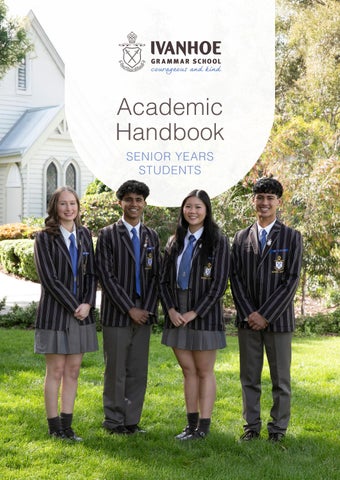
This handbook contains Ivanhoe Grammar School’s policies and procedures for delivery of studies accredited by the Victorian Curriculum and Assessment Authority (VCAA) for the Victorian Certificate of Education (VCE) and the International Baccalaureate Organisation (IBO) for the IB Diploma Program.
Ivanhoe Grammar School Senior Years students follow a program of study which leads to the award of either the VCE or IBDP. The rules relating to the VCE are set by the VCAA and those for the IB Diploma Program by the IBO.
The Senior Years program is a challenging but rewarding period of a student’s secondary education. During this time, a student’s academic program becomes focused on their individual pathway, interests and aspirations. In amongst the vibrant social and co-curricular program of Senior Years, the primary focus remains as always, on students’ academic success. The school offers many systems of support to ensure students have every opportunity to reach their goals.
Friday 28 November 2025
Tuesday 27 January
Final day to change Unit 3 subjects
Final day to change Unit 1 subjects
Schools able to submit applications for Special Exam Arrangements and previously approved SEAs
Friday 30 January Term 1 Starts for students
Final day for lodging:
Friday 6 February
Monday 16 February
Wednesday 18 February
Friday 20 February
Tuesday 3 March
Friday 6 March
Friday 21 March
Wednesday 1 April
Wednesday 1 April
- applications for Statements of Marks for all examinations held in previous year - requests for Confirmation of previous year Grades - requests to inspect scripts for examinations held in previous year
Schools enter VCE Unit 3/4 enrolments by this date. Registration of International Baccalaureate (IB) students (Year 11 and 12).
Last day for schools to: Lodge applications for alternative works/instruments for VCE Music Repertoire Performance
Last day for schools to submit Special Examination Arrangements applications for known, ongoing conditions
Special Examination Arrangements (special provision) applications for all examinations due
Last day for schools to submit Special Examination Arrangements applications for known, ongoing conditions
Student personal email details entered into VASS
Last day to enter or withdraw from Unit 3/4 sequences
Final day for schools to:
• Enter student’s First or Second Language status for Units 3–4 Modern Languages on VASS.
• Last day for universities to enter Higher Education studies (HES) enrolments.
Thursday 2 April Term 1 Ends
Tuesday 20 April Term 2 Starts for students
Friday 22 May End Semester 1
Monday 25 May Start Semester 2
Friday 13 June
Tuesday 17 June
Final day to change Unit 2 subjects
General Achievement Test (GAT)
Friday 19 June
Term 2 Ends
Monday 13 July Term 3 Starts
Friday 4 September Unit 4 Coursework concludes
Friday 4 September
Last day for lodging applications for enrolment in 2027 in Chinese Language, Culture and Society, Chinese Second Language, Chinese Second Language Advanced, Indonesian Second Language, Japanese Second Language, Korean Second Language and Vietnamese Second Language.
Last day for lodging applications for enrolment in 2027 in English as an Additional Language (EAL) (all applications must be returned to the home school and endorsed by the principal).
Monday 7 September Year 12 Revision Program Commences
Friday 18 September Term 3 Ends
Monday 28 September –Wednesday 30 September Unit 3/4 VCE Trial Examinations (Week 2 of holidays)
Monday 5 October Term 4 Starts
Monday 5 October –
Sunday 1 November
Thursday 15 October
VCAA VCE Performance examinations and Languages oral examinations.
The last possible date for students to redeem S/N Status for Unit 4 Studies
Thursday 15 October Year 12 SWOTVAC Commences
Friday 16 October Unit 2 Coursework concludes
Monday 19 October –Friday 30 October
Monday 26 October –Wednesday 18 November
Thursday 5 November
Friday 6 November
Thursday 10 December
Year 10 and VCE Unit 1 – 2 Examinations
VCAA VCE Final Written Examinations
Last day to amend student personal details and consents
The last possible date for students to redeem S/N Status for Unit 2 Studies
VCE External Assessment Rresults available to students. Results available to and schools
Friday 4 December Term 4 Ends
IB Important Dates can be found under the International Baccalaureate section on page 42.
VCAA Victorian Curriculum and Assessment Authority – this is the body which administers the VCE
SAC School Assessed Coursework – an assessment method of the VCE completed at school
SAT School Assessed Task – an assessment method of the VCE, completed at school and at home
ATAR Australian Tertiary Admissions Rank
EAL English as an Additional Language
EE Extended Essay
GAT General Achievement Test
HL Higher Level – A level a student can elect to take an IB subject at
IA Internal Assessment – The name given to assessments in the IB Diploma Program
IB International Baccalaureate
IBO International Baccalaureate Organisation
SL Standard Level – A level a student can elect to take an IB subject at
TOK Theory of Knowledge – The Core subject of the IB Diploma Program
VASS The computer system which handles VCE enrolments and assessments
VCE Victorian Certificate of Education
Victoria Buzzard VCE Coordinator, Ridgeway Campus
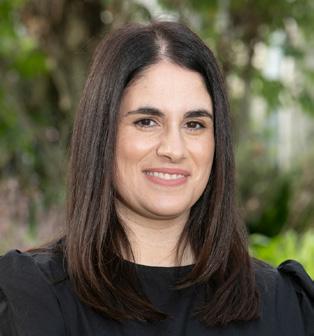
Daniela Curcio Director of Student Futures Learning
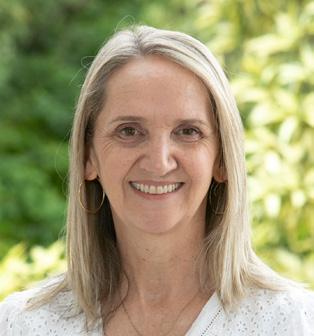
Angela Di Ciocco Deputy Head of Campus, Head of Senior Years, Ridgeway Campus

Nicholas Mercer IB Coordinator, Ridgeway Campus
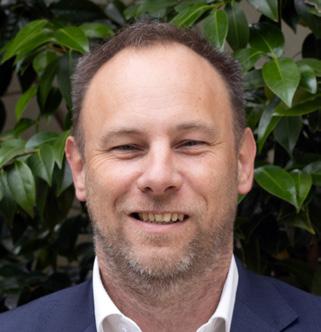
Matt Jenkins Deputy Director of Academic Learning
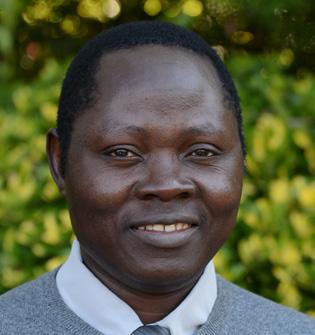
Albert Juma VCE Coordinator, Plenty Campus

Carmel Fry Director of Academic Learning
Carolyn Mansour Deputy Head of Campus, Head of Secondary, Plenty Campus
Careers Advisor, Plenty Campus
Head of Individual Needs
Dean of International Students
Head of House – Athelstane
Head of House – Lincoln
Head of House – Sherwood
Head of House – Thoresby
Narelle McFadden
Anita Kelliher
Leisl Bruhn
Heads of House – Plenty Campus
Angelo Ratskos
Samantha Evans
Michael Callegari
David Hrovat
Deputy Heads of House – Plenty Campus
Deputy Head of House – Athelstane
Deputy Head of House – Lincoln
Deputy Head of House – Sherwood
Deputy Head of House – Thoresby
Head of House – Athelstane
Head of House – Lincoln
Head of House – Sherwood
Head of House – Thoresby
Deputy Head of House – Athelstane
Deputy Head of House – Lincoln
Deputy Head of House – Sherwood
Deputy Head of House – Thoresby
Jess MacDowell
Henry Tyler
Matthew Simpson
Gina Saadeh
Heads of House – Ridgeway Campus
Georgina Mitchell
Dean Voss
Georgia Grant
Falia Burgess
Mentors – Ridgeway Campus
Robert Rizzo
Brenton Aisbett
Laura-Anne Portella
Isabella Verrocchi
Meagan Pool
Stuart Adderley
Kathryn Filbey
Kyle Treloar
Ella Federico
Ben Ernest
Sophie McLaughlin
Stephen van Beek
The Student Futures Team collectively support students to navigate their Senior Years pathway. This includes subject selection, course selection, external enrolments, future pathways planning and the provision of individual needs. The Student Futures team comprises of the Director of Student Futures, Careers Advisors, Head of Individual Needs and the VCE and IB Coordinators.
Year 10
A student will undertake seven subjects comprising of:
• English, *Mathematics, Science, Humanities and Health & Physical Education (compulsory)
• one or two Year 10 Electives
• one or two VCE Unit 1 & 2 subjects
*Mathematics at Year 10 is offered through three courses. Students are placed in an appropriate course by the Curriculum Leader of Mathematics, based on their achievements in Years 7 – 9.
To obtain a VCE certificate students are required to satisfactorily complete 16 units that include:
• at least three units of the English group (English or EAL) with at least two units at Units 3/4 level
• at least three Unit 3/4 studies (other than English)
A Unit is a semester-length study. Students normally study six Unit 1 and 2 subjects (12 units) and five Unit 3 and 4 subjects (10 units). VCE units can be undertaken across a three-year period from Years 10 – 12, with a range of acceleration options.
Year 11
Students will undertake six subjects comprising of:
• English or English as an Additional Language (EAL)
• 3 - 5 Unit 1 & 2 courses
• 1 or 2 Unit 3 & 4 courses
Year 12
Students will undertake five subjects comprising of:
• English or English as an Additional Language (EAL)
• 3 or 4 Unit 3 & 4 courses
• 1 Higher Education subject*
*Higher Education subjects are courses undertaken at tertiary institutions. These pathways are available by consultation with the Director of Student Futures, for students who have been successfully accelerating in their studies for a number of years.
Individual student needs are an important factor is considering a student’s program. The school’s Student Futures Team and Individual Needs Team, as well as the student’s Head of House will advise the most appropriate course program for individuals.
The IB Diploma Programme prepares students for university and encourages them to:
• ask challenging questions
• learn how to learn
• develop a strong sense of their own identity and culture
• develop the ability to communicate with and understand people from other countries and cultures.
The curriculum contains six subject groups together with a core made up of three separate parts. Candidates for the diploma study six subjects selected from the subject groups.
• Three subjects are studied at higher level (HL)
• Three subjects are studied at standard level (SL)
• The compulsory CORE component involves:
- The Extended Essay (EE)
- Theory of Knowledge subject (TOK)
- Creativity, Activity, Service (CAS)
To obtain the award of the IB Diploma, a student must:
• gain a satisfactory mark in the six subjects studied
• complete the Extended Essay of 4000 words in any subject of the IB curriculum
• complete all requirements of the Theory of Knowledge course
• complete all requirements of the extra-curricular CAS program.
VCE Students are required to complete and sign a Personal Details Form and an agreement to abide by the VCAA regulations, which is completed early in the School year. VCE Students have their own identification number provided by the VCAA. VCE Coordinators and the Director of Student Futures keep copies of student VCAA numbers. Students who have enrolled to study a subject at another school, e.g. The Victorian Language School or Virtual Schools Victoria, must ensure that the details of this are given to the VCE Coordinators. According to VCAA regulations, until the enrolment at the other School is recorded at Ivanhoe Grammar (the Home School) the student is not officially enrolled in that unit(s).
Registration and cost of the IB
The usual school fees apply to candidates who enrol in the IB Diploma Programme. In addition, there are extra costs which are associated with the programme. The first cost, which is related to examinations, is applicable to all IB candidates, while the second cost is applicable to students who choose to study a language not offered by Ivanhoe Grammar School.
IB registration occurs at the beginning of Year 12, after which IB candidate numbers are issued
Students considering enrolment in a VCE or IB subjects not offered by the School, or a Higher Education Subject, must discuss this first with the VCE or IB Coordinator, before making arrangements with external providers. These pathway options will be reviewed, approved and your enrolment coordinated by the VCE Coordinator and Director of Student Futures.
A range of VCE Units can be completed at Virtual Schools Victoria the Victorian School of Languages. Higher Education Subjects options can be explained in consultation with the Director of Student Futures.
Responsibilities
Students are responsible for accurately checking VCAA and IB enrolment details and for advising the School of errors in subject enrolment, enrolment in studies offered by outside providers or personal details changes like change of address.
Subject Selection occurs in between May and July for the following academic year. The subject selection process for students and families is supported by a range of information evenings, events, publications and consultation meetings. Students are directly guided by their Head of House, as well as the Student Futures Team in developing a personalised subject selection and pathways plan.
A student’s subject selections will need to adhere to the School’s acceleration policies and individual course prerequites outlined in this Handbook and the Senior Years Subject Selection Handbook.
Event Location Date
What is the IB? Info Night Webinar Thursday 30 April
Ridgeway Campus Year 11 & 12
Subject Forum Webinar Tuesday 2 June Plenty Campus Year 11 & 12 Subject Forum Webinar Monday 1 June
Year 10 Subject Forum Webinar Wednesday 3 June
Futures Expo Buckley Hall, Ridgeway Campus Wednesday 17 June
Most students will have finalised their subject selection by the start of the Early Commencement Period. If a student wishes to change a subject, they must first consult with the subject teacher of the subject they wish to leave, and their Mentor or Head of Year.
A Request to Change Subject form must be submitted, which requires parent/guardian approval and their current subject teacher’s advice. This process should be completed by:
• Friday 28 November - Week 3 of The Early Commencement Program for Unit 1 and 11IB subjects
• Friday 12 June - Week 2 of Semester 2 for Unit 2 subjects
A subject change request will be considered where:
• The change is approved by parents in writing, in the Request to Change Subject form, and the current subject teacher has reported on the student’s progress;
• Class size and timetable feasibility permit the change; and
• The student has investigated the effects on tertiary course selection and career choice of the change.
A change may not be possible when:
• It requires changes to other subject groupings;
• The class the student wishes to enter is already full; and/or
• The student has not successfully completed prerequisite studies or demonstrated sufficient readiness.
A subject may be dropped in exceptional circumstances. Each case will be considered on its merits.
Acceleration is possible in the VCE
• Students can begin their VCE studies in Year 10 with a program developed according to their individual needs, talents and interests.
• Teachers and staff provide guidance and support to ensure an acceleration program matches a student’s academic readiness and future goals.
• When accelerating in VCE, students need to be working at a consistently high standard and must have effective work habits. For these reasons acceleration occurs through approval process, involving a review of the student’s achievement levels and working habits
• Commencing VCE in Year 10 allows the course to be completed in three stages. Each of the three stages enables greater focus and deeper learning on particular topics in preparation for Unit 3 and 4 VCE studies and tertiary studies thereafter.
a. Year 10 students undertake six subjects.
i. One or two of these are at VCE Units 1 and 2 level
b. Year 11 Students normally undertake six subjects:
i. Four or five subjects at VCE Units 1 and 2 level, including an English study.
ii. One or two subjects at VCE Units 3 and 4 level
c. In their final year, students usually undertake five subjects at VCE Units 3 and 4 level, including English.
i. One of these may be substituted with a Higher Education Subject
• Acceleration can be undertaken at three levels –exceptional, standard and conditional. Each of these levels has its own set of requirements for the selection to be approved (see table on page 14)
• The requirement for Standard Acceleration, the most common option, is a B+ weighted average in Year 9 subjects in Semester 1. Reported Learning Behaviour results must also indicate readiness for a Senior Years learning environment, typically being L1 and L2 results.
• In addition, some subjects have individual requirements for acceleration. For example, to accelerate into VCE Biology Units 1 & 2 a student must attain at least B in Year 9 Science in Semester 1. Entry into one of these subjects is not automatic; when a student selects a VCE Units 1 & 2 in their program it is considered an application.
Level of Acceleration Year 10
Tier 1 –Exceptional Acceleration
Tier 2 –Standard Acceleration
2 x Unit 1 & 2 subjects 2 x Unit 3 & 4 Subjects 4 x Unit 3 & 4 subject 1 x HES subject
1 x Unit 1 & 2 subjects in student choice 1 x Unit 3 & 4 Subjects in student choice 5 x Unit 3 & 4 subject
Upon referral by Head of Academic Extension & Director of Student Futures
B+ weighted average across all subjects
Subject specific requirements where relevant
L1 and L2 Learning behaviour results
In circumstances where a student has not achieved a B+ weighted average, their application to accelerate may be considered if certain requirements below are met. These applications will be considered on a case-by-case basis. Addressing this criteria will not necessarily mean an application will be successful.
Tier 3 –Conditional acceleration 1 x Unit 1 & 2 subjects in schoolselected subject/s 1 x Unit 3 & 4 Subjects in schoolselected subject/s 5 x Unit 3 & 4 subject
To obtain a VCE certificate you are required to satisfactorily complete 16 units that include:
• at least three units of the English group (English or EAL) with at least two units at Units 3/4 level
• at least three Unit 3/4 studies (other than English)
Credit for a unit is based on satisfactory completion of all outcomes. Satisfactory completion of an outcome means:
• the work met the required standard as described in the outcomes
• the work was very clearly a student's own
• the work was submitted on time
• there was no substantive breach of rules
• the student attended sufficient class time to complete the work set
An 80% achievement in a Year 9 subject aligned to the acceleration subject
L1 and L2 Learning behaviour results
Supporting standardised testing data
A successful completion of ECP in the accelerated subject to continue
Failure to achieve any of the stated outcomes results in N being awarded for the unit.
A Satisfactory (S) or Not Satisfactory (N) is reported to VCAA for each unit that a student studies.
Students receive a school report at the end of each semester indicating the S or N for the unit and the level of performance (V1, V2 etc) for areas of assessment in each subject studied. These levels of performance are given to provide feedback to you and are not reported to VCAA.
If you are awarded N for a unit, you may appeal to the School. You must lodge the appeal, in writing, to the Head of Senior Years within 14 days of receiving the result.
Can I repeat a unit if I receive an N (Not Satisfactory)?
• Yes, students can repeat units. When repeating a unit, students must complete the full unit again, including all assessments in a subsequent year.
• Repeating a unit is a decision made with the recommendation of the Student Futures Team and must be approved by the VCE Coordinator
• There are no restrictions for repeating a unit, but a student can only count the unit once towards their satisfactory VCE completion. To achieve a study score, the student will need an S (satisfactory completion) for the Unit 3 and 4 sequence in the year they repeat the unit.
What happens if completed assessment tasks do not meet the required standard?
If work does not meet the required standard, students will be required to resubmit the work or complete an additional task to satisfy the outcome. Resubmitted work will not contribute to grades.
The IB Diploma is awarded to students whose total score, including bonus points, reaches or exceeds 24 points provided that:
• grades have been awarded in the six subjects of the Diploma program;
• a course of Theory of Knowledge (TOK) has been followed and the TOK assessment requirements have been met;
• an Extended Essay, of at least a satisfactory quality, has been completed and submitted;
• requirements of the CAS component of the Program have been met;
• the student has not committed any act of malpractice, defined as the attempt by the student to gain unfair advantage in any assessment component.
A Bilingual Diploma is awarded to two categories of students:
• two languages in Group 1 with a grade of 3 or higher in both languages
• a group 3 or 4 subject taken in a language other than the candidate’s language A1. The candidate must attain a grade 3 or higher in both the Group 1 language and the subject from Groups 3 or 4.
The following failing conditions apply:
• CAS requirements have not been met.
• Candidate’s total points are fewer than 24.
• An N has been given for theory of knowledge, extended essay or for a contributing subject.
• A grade E has been awarded for one or both of theory of knowledge and the extended essay.
• There is a grade 1 awarded in a subject/level.
• Grade 2 has been awarded three or more times (HL or SL).
• Grade 3 or below has been awarded four or more times (HL or SL).
• Candidate has gained fewer than 12 points on HL subjects (for candidates who register for four HL subjects, the three highest grades count).
• Candidate has gained fewer than 9 points on SL subjects (candidates who register for two SL subjects must gain at least 5 points at SL).
The student who does not satisfy the requirements of the full Diploma program is awarded a Certificate for the subjects successfully completed. Only some overseas and local universities will accept the IB Certificate for the purposes of tertiary entrance and only under certain circumstances.
ACADEMIC AWARDS IN SENIOR YEARS
Ivanhoe Grammar present academic awards to student with the following aims:
• To recognise that academic achievement is a significant aspect of the program at Ivanhoe Grammar School.
• To recognise that effort is celebrated in addition to achievement.
The following awards are part of celebrating students’ achievement in Senior Years:
• Academic Colours: Presented to Year 10 and 11 students whose weighted average score across their core and elective subjects falls in the top 5% of their cohort. Awarded in Semester 2.
• Academic Half Colours: Presented to Year 10 and 11 students whose weighted average score across their core and elective subjects falls in the top 10% of their cohort. Awarded in Semester 2.
• Subject Awards: Presented to Year 10 and 11 students whose score across Semesters 1 and 2 in a given subject is the highest in the cohort. The award will only be given if the student has attained an A grade or above. Where a semester-elective runs in both Semesters 1 and 2, only one award will be given.
• Year 12 IB Study Awards:
- Theory of Knowledge Award: top score awarded by IBO
- Extended Essay Award: top score awarded by IBO
- Perfect Scores Awards: students who have attained at least one perfect score
• General Academic Excellence: Awarded to Year 12 VCE and IB students achieving at ATAR of 98+
• Dux Award: presented to the Year 10 and 11 student who have the highest weighted average score across their core and elective subjects and the Year 12 student with the highest ATAR.
• Proxime Accessit: awarded to the Year 10 and 11 student who have the second highest weighted average score across their core and elective subjects and the Year 12 student with the second highest ATAR.
• Dux of the IB Diploma: awarded to the IB Diploma student with the highest notional ATAR. Awarded only in the instance where neither the Dux nor Proxime Accessit of the Year 12 cohort is an IB Diploma student.
To be eligible for academic awards, students must meet the following criteria:
• For Academic Colours and Half Colours: must not have missed more than a total of three Key Assessment Task submissions from the year’s coursework, across all subjects
• For Subject Awards, Dux and Proxime Accessit: Have submitted every assessment in the subject assessment program in each Semester 1 and 2
• For all academic awards: Must have submitted all assessments by set due dates, or by approved extension due dates.
Promotion
Ivanhoe seeks to support all students reach their full academic potential. Our rigorous and broad based academic program, our student care system and a three way partnership between the School, students and parents assist in this goal.
Student progress is regularly monitored and additional support and advice offered to students who may be experiencing difficulty achieving their potential. In some cases a student's subject selection for the following year may be reviewed formally if they do not achieve a sound base for continued study in some subjects. In most subjects, proficiency at the preceding year level is required and some subjects have more specific expectations in terms of prior study. It is not in a student's best interest to be promoted to the next year level or undertake a program of academic study for which they are ill-prepared.
Progression to Year 11 is automatic where a student has obtained subject and examination grades of at least D (50 - 55) in a minimum of eight semester (8) units (including English or English as a Second Language) in Year 10. Where a student fails to meet the criterion for automatic progress to Year 11 the student may be required to present a case to a panel which may include the Head of Senior Years, Head of Curriculum, IB or VCE Coordinator and or Head of House/Deputy Head of House, to show cause why they should be permitted to progress to Year 11. Parents and or guardians are required to attend these reviews.
Award of the IB Diploma requires students to achieve a score of 24 points or higher.
Progression to Year 12 is automatic where a student has obtained subject and examination scores of at least 3 in each of their subjects in Year 11 and a minimum combined total of 24 points from their six subjects. Where a student fails to meet the criterion for automatic progress to Year 12 the student may be required to present a case to a panel which may consist of the Head of Senior Years/Secondary, Head of Curriculum, IB Coordinator and Head of House/ Deputy Head of House, to show cause why they should be permitted to progress to Year 12. Parents and or guardians are required to attend these reviews.
Progression to Year 12 is automatic where a student has obtained subject and examination grades of at least D (50 - 55) in a minimum of eight semester (8) units (including English or English as a Second Language) in Year 10. Where a student fails to meet the criterion for automatic progress to Year 11 the student may be required to present a case to a panel which may include the Head of Senior Years, , IB or VCE Coordinator and Head ofHouse / Deputy Head of House, to show cause why they they should be permitted to progress to Year 12. Parents and or guardians are required to attend these reviews.
Factors taken into consideration:
• Work habits developed
• Attendance at classes
• Behaviour that meets the Ivanhoe Grammar student Code of Conduct
• Punctuality of submission of assessment tasks
• Marks obtained on unit examinations
• Satisfactory effort and engagement with all academic studies
• Suitable background knowledge for the subjects under consideration for the following year
• Willingness to seek assistance and take advice from subject teachers
• Application of Special Provision during the year
• Engagement in School co-curricular and pastoral programs.
In some circumstances a student may be required to complete additional work, a summer school program or further study to complete preparation for the year ahead.
In the VCE, a ‘scored assessment’ provides students a more detailed record of what they have achieved and is the best way to maximise their employment opportunities and pathways to further education. However, the VCE provides the flexibility for students to satisfactorily complete units without being assessed for levels of achievement, which is referred to as The Unscored VCE.
• The Unscored VCE Pathway is a program available to Year 11 and 12 students who wish to obtain the VCE Certificate but do not wish to acquire an ATAR (Australian Tertiary Admissions Rank) for entrance into tertiary education
• Students completing The Unscored VCE Pathway will not be required to sit the end of year VCE examinations. However, they must complete all required coursework comprising of SACs (School-assessed coursework), SATs (School-assessed Tasks) or modified versions of these where appropriate. They must be able to satisfactorily demonstrate achievement in all outcomes of their units, and meet attendance requirements to be awarded the VCE.
• Once a student commences an Unscored VCE pathway they cannot transition back to a scored VCE.
• Any student and family considering an Unscored VCE pathway must undertake a consultation and pathways planning process with the school and submit a formal application to the VCE Coordinator and Director of Student Futures.
• Application for the Unscored Pathway forms can be requested from the VCE Coordinator or provided by the Head of House. Students and families should first discuss the Unscored Pathway option with their Head of House, the Head of Individual Needs or The Head of Psychology Services.
• In some cases, students may be recommended by one of the above staff members to undertake the Unscored VCE pathway.

To fulfil the time and work requirements of VCE Unit or IB subject, it is expected that students make every effort to be present each day of the school term, attending at least 80% of timetabled classes. Each course accreditation involves a minimum requirement of attendance hours, per subject.
• VCE units involve at least 50 hours of scheduled classroom instruction per unit
• In the IB Diploma Program, Standard level subjects take up 150 teaching hours and Higher level subjects comprise 240 teaching hours across the two-year Diploma
To be eligible to pass a Unit, students’ absences, whether approved or unapproved, cannot exceed 20% of lessons in any one subject.
• The School must be notified by parents/ guardians of any absences, whether they are expected, unexpected, full-day or part-day. This is done through the School App or via Ivanhoe Connect>Communications>Report an Absence or via by email attendance@ivanhoe.com
• Approved absences include reasons such as dental, psychologist or psychiatrist appointments, illness, counselling, absence at School sporting events or other School business events
• Unapproved absences include unexplained, parent choice, illness in excess of 3 days without a medical certificate
• Family holidays, extended family travel overseas and planned absences are not accepted during VCE or IB studies. Wherever possible, holidays should be scheduled within the term breaks. If this cannot be avoided, students and families are required to seek permission for a family holiday at least four weeks in advance of the proposed leave.
• Students who are absent on any day when Year 11 KATs, VCE School Assessed Coursework (SACs) or School Assessed Tasks (SATs), or IB Internal Assessments (IAs) are due must provide a medical certificate for their absence within 2 days of their return to school.
• A grade of zero will be awarded if absences due to illness are not supported by a medical certificate.
• If a student is absent with an approved reason on the day of a Year 11 KAT, SAC, SAT or IA they are required to complete a Request to Reschedule Online Form within 2 days of returning to school following the absence.
• This form is automatically generated by the School following an absence and will be received by the student via their school email. Once lodged, the VCE or IB Coordinator will review the absence and if approved, coordinate the rescheduling of the assessment.
• Students attending School sport, excursions for other School business must ensure that they inform their class teacher one week before a KAT, SAC, SAT or IA that there is a clash of the two events. Where the SAC is external to the school (and so cannot be rescheduled), the student is required to attend the SAC activity rather than the alternative activity.
Absences related to ‘School business’, illness, or extenuating circumstances, that are considered approved absences, will not impact a student’s coursework completion or grades. In such circumstances, students will sit the missed assessment upon return to school, or will be eligible for an extension. Their work will be assessed without penalty.
In the event of an unapproved absence (such as an extended holiday or truancy), students will receive a zero-achievement score on the missed assessment. The subject teacher may still require the task, or an equivalent, to be completed to meet the learning outcomes, particularly for VCE Units.
Completing Assessments while Absent Assessments that require the integrity of conditions to be supervised by teachers (like tests, SACs, or practical IAs) cannot be completed in absentia.
If the assessment is an extended task, and submitted electronically by the due date while a student is absent, it will be graded as normal, providing the work can be authenticated*.
Authentication involves a teacher having evidence that the work submitted is authentically produced by the student. Authentication practices involve:
• Viewing proposals or planning notes for an assessment
• Having verbal conversations with students on their ideas for an assessment
• Viewing partial or full drafts of an assessment
Students' semester coursework grades are re-weighted only in instances where non-submission is due to approved absence. For unapproved absences, the semester score will be impacted by the zero grade achievement.
There are two types of formal internal assessment in the VCE: school-assessed tasks and school-assessed coursework.
• School-assessed tasks (SAT) – Applied Computing: Software Development, Art Making & Exhibiting, Media, Product Design and Technology, and Visual Communication Design have this component. These are extended project tasks involving class and out-ofclass work.
• School-assessed coursework (SAC) - a series of assessment tasks that are spread throughout the course as specified by VCAA. Most of the work will be completed in class under test conditions.
In most VCE studies the school assessment will take the form of several assessment tasks throughout the year. These tasks will be mainly completed in class time and within a limited time frame (over one or more periods). These assessment tasks will be directly related to class work, and will include tests, experiments, essays, class presentations, etc. Work completed for SACs will also help to reinforce material to be assessed in the examinations. Unapproved absence from any other
classes on the day of, and prior to, a scheduled SAC may result in students completing the SAC without marks awarded.
It is vital for students to maintain accurate, clear, and regular notes in class and to be up to date with work to be completed at home to support their completion of SACs. In some assessment tasks, for example an “open book” test, students may be permitted to refer to their notes while undertaking the task; in other cases, class notes will help students to prepare in advance of the task. Students are given guidelines (a SAC notification) at least two weeks prior to each task.
VCE SACs are assessed by the classroom subject teacher and moderated by other teachers of the study at the School. The School reports teacher assessment grades to the VCAA. Teacher assessments are referred to as school-based results. They are preliminary results only. The total result for each SAC are statistically moderated by the VCAA against the General Achievement Test (GAT) (if applicable) and final examination results.
Moderation is a process of ensuring that the same assessment standards are applied to students from every school doing a particular study. This process adjusts all schools' assessments to the same standard, while maintaining the students' rank order established by the school.
SAC results are subject to statistical moderation both internally and upon submission to the VCAA.
Teachers provide students feedback on different SAC tasks in many different formats. The style of SAC feedback that students receive will be selected to best support their learning. This may take the form of written or annotated-work feedback, verbal recordings or personal conferencing.
The format of SAC feedback may vary within and across subjects. All feedback is intended to give students an indication of the level of performance against the requirements of the task and provide as much support for learning as possible. If, at any stage, a student is unsure about how to interpret and learn from the feedback provided, they should have a discussion with their teacher.
School-assessed Tasks (SATs)
SATs will operate along with SACs in “practical” studies such as Applied Computing: Software Development, Art Making & Exhibiting, Media, Product Design & Technology and Visual Communication Design. In these subjects, SATs will take the form of folio-type work, undertaken over an extended time period. They will be assessed by subject teachers and checked against the performance of Ivanhoe Grammar School students in the GAT (General Achievement Test) to ensure fairness.
All work is to be submitted to subject teachers by the due date. Any work that is submitted late must be supported by a medical certificate and a ‘Request to Reschedule Online form submitted upon returning to School.
Drafting and authentication
With SATs, students may draft their work whereas the nature of SACs means that teachers will not formally assess draft material.
However, drafting enables students to refine their work and gives teachers an opportunity to confirm that the work finally submitted is the student's own. The subject teacher is also able to make written comments on one draft of each task. (This draft, which will also be initialled and dated by the teacher, should be retained and submitted with the final work).
Teachers are required by the VCAA to check the development of SAT work, and this includes monitoring work on the task in class on several occasions.
The rules relating to SATs reflect common sense. They set out the types of assistance it is acceptable for teachers to provide:
• It is vital that students acknowledge the sources of any resources, used in their work - this includes texts, generative AI and any outside assistance.
• Students will also be required to sign a Declaration of Authenticity at the time they hand in the completed work. This declaration states that all unacknowledged work is their own.
• Teachers must be able to see the development of student work.
• Teachers may help guide students in the right direction by posing questions to them about their work, and to suggest alternative strategies which may help them in the completion of their SAT. It is the students responsibility to act on advice given by their teacher.
• It is acceptable for teachers to point out areas needing attention, such as spelling and punctuation, footnoting of any references used, and general expression.
• It is not acceptable for teachers to make detailed written corrections to students work, to rework students SAT draft or to provide students with any content or ideas not already mentioned by them in their draft.
• It is not acceptable for teachers to provide written comments on more than one draft.
• It is NOT acceptable for students to use or copy another person’s work or other resources without acknowledgment.
Work can be assessed only when teachers can be confident that, to the best of their knowledge, all unacknowledged work is the student's own.
Remember, in order to ensure that students meet authentication requirements, they must be in regular communication with their teachers, so they can assist and monitor the progress of work.
It is also encouraged that students be open with their teachers if they have a tutor, and to discuss and show any work done with tutors or family members. This can help iron out any problems there may be in acknowledging assistance students may have received, and in writing up their work in their own words. Such openness can also ensure that a tutor is aware of authentication requirements.
When using computers ensure that:
• there is an alternative system available for use in case of computer or printer malfunction or unavailability
• each time changes are made the work is saved onto a back-up file. The back-up file should not be stored with the computer.
• hard copies of the work in progress should be produced regularly to meet drafting and authentication requirements.

Homework and independent study are an integral part of the learning experience. It is expected that students spend time planning, revising, clarifying and consolidating concepts, skills and understanding. The following home-learning commitment is expected:
Ivanhoe Grammar School promotes the values of students being responsible and disciplined. The promotion of academic rigour can take many forms and one clear avenue is for students to learn to value all aspects of their learning, including major assessment tasks completed during the semester.
It is the aim of this policy to ensure that:
• students submit their work on time and in the specified format;
• a consistent approach to the late submission of work will is implemented;
At peak periods of the year, students are expected to spend more time on home learning. This may include study days, examination periods and school holidays
During Term holidays, all students should expect to devote the equivalent of one day’s study to each Unit 3/4 subject and half a day’s study for each Unit 1/2 subject.
Year 11: Some students may be allocated Private Study periods each week. They are expected to use this time for study. Private Study periods are not to be used for sport or out-of-school activity.
Year 12: The timetable allocates several Private Study periods to each Year 12 student each week. They are expected to use this time for study. Private Study periods are not to be used for sport or out-of-school activity. Students with a Private Study period during the last period of the day may leave the School, after signing out at Reception.
It is essential that students regularly access their school email and Microsoft Teams pages for each subject, to be always informed of learning requirements. Communication with subject teachers and the VCE and IB Coordinators for relevant matters is expected to be of a pro-active and timely nature. Ivanhoe Connect weekly updates will also contain vital information on the Senior Years Program and key events and dates for both students and families.
• Students must submit all required work, and it must be completed to a required standard for satisfactory completion of the subject.
• Loss of a task, either electronic or physical, will not generally be accepted as a valid reason for late or non-submission submission.
• Feedback will be provided for all major assessment tasks even if the work was submitted late.
• Where a student is on ‘approved school-business’ on the day work is due, the task must be handed in the next day and the teacher notified in advance of the expected absence
• Where a student is absent due to illness on the day that work is due, it must be submitted on the day of return to school with a Request to Reschedule form submitted
• If a student wishes to negotiate an extension, they must email their teacher before, or on the due date and complete a Request to Reschedule form . At Year 10, a note from a parent/guardian is required as part of this form. For VCE Units 1 – 4 and Year 11 and 12 IB, a medical certificate must be attached to this request.
• Where a student seeks to apply for an extension due to special circumstances, the Request to Reschedule online form must be submitted in advance of the work being due.
• Requests to reschedule an assessment cannot be made or agreed to verbally with subject teachers
Consequences of unapproved late submission
• If a Key Assessment Task (KAT) is submitted late (taking any extensions into consideration), there will be a penalty of 20% per day for each of two days, and zero marks for work submitted thereafter.
• A weekend constitutes two days late, thus 40% of the total mark will be deducted if submitted on Monday (note: ‘days’ means every day rather than only days that a lesson is scheduled for that subject.
Ivanhoe Grammar School promotes the values of being honest, principled and disciplined. These values are mirrored in the school’s expectations to students’ academic research and integrity in all forms of assessment.
At IGS we aim to:
• Equip students with the knowledge and skills to produce authentic work (work which is based on their own ideas with the contributions of others fully acknowledged);
• Establish a culture of academic honesty where students are encouraged and supported to produce authentic work.
To achieve the above we:
• Provide guidelines for students (including their parents) and staff to enable them to produce authentic work;
• Use scenario based training to educate students and staff in behaviours and practises that compromise the authenticity of their work including unfair advantage, cheating, collusion, plagiarism and paraphrasing without due acknowledgement;
• Enable teachers to scrutinise the authenticity of students work through the provision of training and tools including the use of plagiarism detection software such as ‘Turnitin’;
Academic Honesty Panels are established to:
• evaluate cases of work that may not be authentic,
• evaluate why the cases of work may not be authentic and clearly explain this to the students (and where appropriate their parents)
Where work which is not authentic is detected:
• assist the student to to develop the knowledge and skills to produce authentic work in the future,
• for senior students, or students who have established skills and knowledge required to produce authentic work, consider the degree and extent of compromise and decide appropriate course of action going forward (e.g. resubmission as authentic work, revision of grading).
Students will be given clear guidelines in each subject on when and how to submit work and the conditions under which assessments must take place. These must be adhered to, and the School’s Submission of Work or Academic Honesty Policies apply.
Students must submit only work that is their own. All assistance received in producing the work must be acknowledged and be obvious to the reader.
Students must be responsible for ensuring that their teacher has no difficulty in authenticating work. Teachers cannot authenticate work about which they have doubts until further evidence is provided. To obtain the necessary evidence, students may be required to:
• provide evidence of the development of the work
• discuss the content of the work with the teacher
• provide samples of other work
• complete a supplementary task
• attend an interview
Academic Dishonesty is defined as any of the below:
Academic misconduct – Deliberate behaviour that holds the intention, or result, of gaining advantage in a component of assessment, or that disadvantages others in their access to fair and equitable assessment.
Cheating – copying prepared notes or another person’s work either on paper or electronically. This includes homework, class work, answers to a test or using the same work for more than one subject without the permission of both teachers. Falsification of data presented as being collected by the student.
Collusion – allowing someone else to copy, cheat off a student’s own work or passing on information to another student related to a test or examination.
Plagiarism – the representation of the ideas or work of another person, or of artificial intelligence, as the student’s own, without acknowledging the original author or creator. This may include written work, or works of art, such as music, film, theatre, dance, and visual arts.
Paraphrasing without due acknowledgement – using an author’s ideas by rearranging or rewording the author’s original words without acknowledging the source.
Unfair Advantage –
- receiving unauthorised help from another such as friends, parent, tutors or siblings on what should be an individual assessment
- receiving information regarding a common test or examination from a student that has sat the same or similar assessment at an earlier time. Or, providing information to another student on a common test or exam.
- continuing to complete a timed assessment beyond the designated time limit or writing on or marking an assessment during a designated reading only time
When a potential breach of the Academic Honesty Policy is raised, an Academic Honesty Panel will convene to coordinate an investigation. The findings of the investigation and its outcomes will be communicated with parents/guardians. Any penalties or punitive outcomes of an investigation are determined on a case-by-case basis.
The Academic Honesty Review Panel will comprise a combination of Curriculum Leaders, Subject teachers, VCE Coordinator, Heads of House, IB Coordinator, and Deputy Head of Campus, appropriate to the student/s under investigation.
Cheating, Collusion, Plagiarism or Unfair Advantage –upon report of a breach, subject teachers, Curriculum Leaders, and Heads of House/Year will collate any material or observational evidence. The student will be interviewed by the Academic Honesty Review Panel. Potentially the student will receive a penalty for the assessment, determined by the Panel, and will be expected to resubmit the work to satisfy subject requirements.
Paraphrasing without due acknowledgement – the student will resubmit work with appropriate acknowledgements. A penalty may or may not apply, determined by the subject teachers and applicable Curriculum Leaders.
• All VCE and Year 12 IB students must also abide by the guidelines set out by their respective assessment authorities. Identification of academic dishonesty may result in non-award of the IB Diploma or VCE.
• All student work at Ivanhoe Grammar School is scrutinised using the plagiarism and AI detection software ‘Turnitin’.
• Authentication Policies from The VCE and VCAL Administrative Handbook can be found here and the full Handbook here
• Information on the IB’s Academic Integrity Policy can be found here
The School meets its obligations with respect to authentication by following the VCAA procedures, which state that when a teacher is not satisfied about the authenticity of a student’s work, the work will not be accepted until sufficient evidence is available to show that the work is the student’s own. The VCAA makes it clear that the onus is on the student to provide evidence that the work submitted is the their own. Where necessary, in cases of breaches of authentication, the School will follow the VCAA procedures.
a. S/N Result
If you are awarded N for a unit, you may appeal to the School. You must lodge the appeal, in writing, to the Deputy Head of Campus via your Head of House within 14 days of receiving the result.
b. Adverse Circumstances
You are entitled to appeal if it is believed that you were made to undertake a SAC or IA in adverse circumstances or where an application to sit a missed SAC at another time was denied. Appeals need to be made to the Deputy Head of Campus and will be decided at a meeting attended by the Deputy Head of Campus, the VCE or IB Coordinator and the teacher who is responsible for the VCE study.
c. Grading of individual assessments
There are no appeals on standard of work. Appeals can only be made on the grounds of an administrative error.
d. Special Provisions
If your application for special provision (VCE) or access arrangement (IB) is rejected totally or in part, you must be informed in writing. You have the right to appeal to the school within 14 days of receiving the decision. You must apply in writing to the VCE or IB Coordinator.
Appeal Procedures
Authentication and Breach of Rules
You have the right of appeal to VCAA against penalties imposed by the school for breaches of authentication. An appeal can be lodged on one or both of two grounds:
• that a breach of the rules had not occurred
• that the penalty was too severe
Your intention to appeal must be received in writing at VCAA within 14 days of the Principal's delegate written notification to you. Correspondence must be addressed to the Secretary of VCAA. Refer to the VCE Administrative Handbook.
Special Provision (VCE) and Access Arrangements (IB)
Special Provision and Access Arrangements are designed to allow students who are experiencing significant hardship the opportunity to demonstrate both what they know and what they can do. The objective is, as far as possible, to remove the barriers to a student demonstrating their capabilities.
Special Provision is available to students completing the VCE and Access Arrangements are available for students completing the IBDP. These arrangements apply to classroom learning, School-based Assessment and external assessments and examinations.
Students are eligible for Special Provision or Access Arrangements if, at any time while studying for the VCE or IB, they are:
a. significantly adversely affected by illness (physical or psychological), by factors relating to personal environment or by other serious cause
b. disadvantaged by a disability or impairment including learning disorders
c. If you are experiencing difficulties (medical, psychological, or other factors) that may be affecting your performance you may be eligible for Special Provision or Access Arrangements for your examinations. You should see your Mentor (Head of House or Deputy Head of House) and meet with the Head of Individual Needs if appropriate. The VCE Coordinator will be in contact with your family to determine the nature of the Special Provision. For Units 1 and 2, Special Provisions granted are in line with what would be likely at Units 3 and 4 as much as possible.
Prolonged absence from school or study is not in itself grounds for Special Provision. However, provisions are available to students experiencing severe hardship that may result in prolonged absence. Students granted Special Provision must still complete all school work related to satisfactory completion of the outcomes of a VCE unit or IB subject. Students absent from school for prolonged periods must still comply with the school’s authentication procedures to demonstrate that they have completed the work and that the work is their own.
Special Provision for school-based assessment and classroom learning is decided by the School while Special Exam Arrangements for VCE external examinations are decided by VCAA.
Nature of Special Provision Approving Authority
Unit 1 & 2 VCE and Year 11 IB classroom learning and school-based assessment (incl. examinations) The School
Unit 3 & 4 VCE and Year 12 IB classroom learning and school-based assessment, (incl. trial examinations) The School
VCE external examinations VCAA
IB external examinations IBO
The decision on whether to approve special provision for classroom learning or School-based Assessment must be evidence-based and made using a range of appropriate sources including teacher observations, professional testing and reports or educational assessments. The School will regularly review a student’s special provisions for classroom learning and School-based Assessment to ensure that the provisions remain appropriate to meet the needs of the student.
Special Provision for school-based assessment may take the form of rest breaks, rescheduling assessments, allowing extra time, using assistive technology, or other assistance as deemed appropriate.
Special Exam Arrangements for VCE external examinations may take the form of rest breaks, extra working time, separate rooms, use of computer or assistive technology, readers, scribes, clarifiers or interpreters.
Students may apply to VCAA or the IBO for special examination arrangements in their Units 3 and 4 and IB End of Year exams if they have:
• illness – both acute and chronic
• impairment – long term.
Special arrangements may take the form of:
• Extra working time
• Rest breaks
• Large print or Braille examination papers
• Permission to use technological aids
• Use of a scribe
• Permission to sit examinations in a separate room
• Permission to use a computer
Application forms are available from the VCE and IB Coordinators. The VCE Coordinator will contact families where pre-existing conditions are known by the School.
VCAA must receive an application for any new SEAs by Friday 21 February and for any long-term, ongoing health conditions by Friday 7 March for all 2025 examination periods. In cases where a new diagnosis is reached after the closing date, the VCAA will continue to accept new applications but no applications for long-term, known disability or health conditions will be accepted. Applications during the exam period are permitted for emergency cases only (e.g. broken bones).
If a student’s application for special examination arrangements/special provision is rejected totally or in part, the student must be informed in writing. The student has the right to appeal to the VCAA within 14 days of receiving the decision. The student must apply in writing to the VCE Coordinator.
The Derived Examination Score (DES) is calculated by VCAA and may be used as the student’s examination score where illness, personal trauma or other circumstances occurred immediately before or during the examination period. If the student sat the exam and was successful in their DES application, the highest grade will be taken as the exam result.
The DES will be calculated by the VCAA from the student’s other assessments including:
• moderated coursework scores (SACs)
• School-assessed Task scores
• GAT scores
• Other examination scores, if applicable
• Indicative grades provided by the School
Students who believe that they have a substantiated claim should apply to the VCE Coordinator.
A Derived Examination Score application requires strong evidence such as medical statements that include relevant dates and that clearly outline the nature of the illness or circumstances. Evidence needs to be gathered from up to two days before the relevant exam to up to one day after the relevant exam. If a student experiences illness or trauma that affects more than one exam, an application per exam needs to be made with VCAA.
If the student has sudden onset of illness or trauma at the time of an exam, they have 7 days from that particular exam date to submit their application for a DES. The VCE Coordinator must first be notified if a student wishes to make an application. It is the responsibility of the student to initiate a DES application.
Refer to your individual examination timetables for the final dates for lodgement of DES applications. You will be notified of the outcome of your application. If your application is not approved, you may appeal the decision only if you have further relevant evidence. Appeals must be received by the VCAA no later than seven days post notification. No applications will be considered by the VCAA after the final examination results have been released.
Grades on the Semester 1 Report reflect the teachers' assessment of progress to date. Student’s Semester 2 results are reported through interim reports only. No final Semester 2 report is generated for Year 12 students in Unit 4. It must be noted that all coursework assessment is subject to statistical moderation against the examinations, which may lead to changes of the initial scores reported by subject teachers.
The VCAA offers students a range of options to access VCE Results by Phone, Internet, and SMS. VCE results will be available online in mid-December (VCAA and the School will confirm the specific date once published). You will need your VCE number to do this.
VCAA will issue successful students with a VCE Certificate. In addition, the VCAA is also responsible for releasing assessment grades and a relative position score from 0-50 for each study, known as a study score. A study score above 38 indicates that the student is in the top 15% of students in the study.
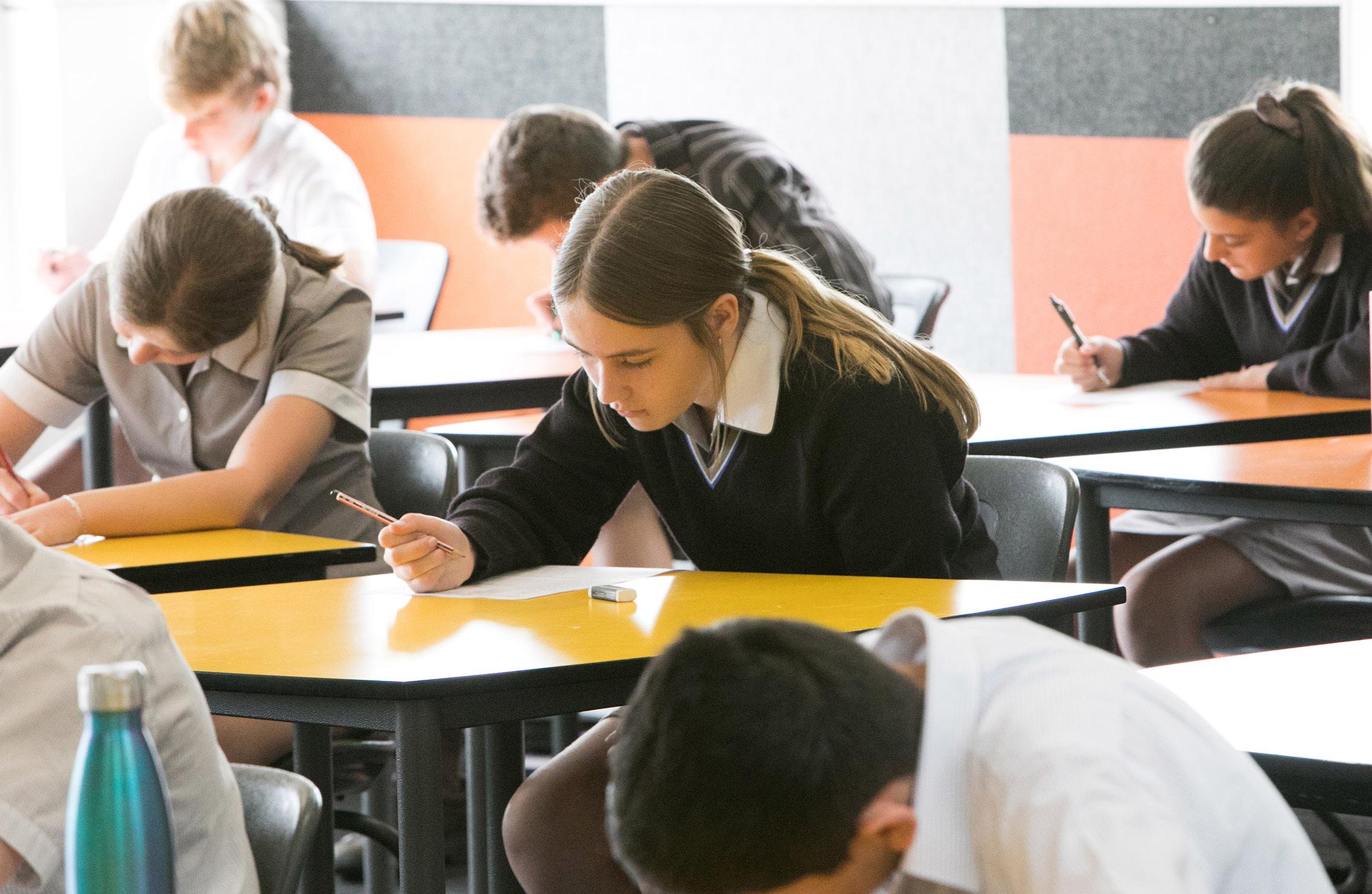
Senior Years students undertake a series of examinations as preparation for their final examinations in the VCE and IB Diploma. These include:
• Year 10 Semester Examinations in all core and elective subjects (excluding Health and Physical Education)
• Year 11 Semester Examinations in VCE Units 1 – 2 and Year 11 IB courses
• Year 12 IB Mid-Year Examinations
• Year 12 Trial Examinations in Units 3 – 4 sequences and IB Year 12 subjects
• VCE Units 3 – 4 External Performance and Written Examinations
• IB External Oral and Written Examinations
All Senior Years students will also undertake the General Achievement Test.
All students undertaking at least one Units 3 – 4 sequence and all Year 12 IB students will be required to complete the externally set and marked General Achievement Test administered by the VCAA. The GAT will take place at all Victorian Schools on Tuesday 16 June 2026. The GAT plays an important role in the quality assurance of VCE assessments. The GAT is used as part of a final check on external assessment scores. The GAT results are also used in the calculation of the Derived Examination Score (DES).
All Australian Year 12 IB students are required to sit the GAT for the calculation of the notional Australian Tertiary Admissions Rank (ATAR).
The GAT covers the following:
• reading comprehension and the ability to communicate ideas and information in writing
• ability to analyse, understand and solve problems in a mathematical, scientific, and technological context
• parallel abilities in a social, cultural, and artistic context
• ability to read and respond to information such as forms, tables, and graphs.
A GAT Statement of Results is mailed to each student.
Their results will also include a score for each GAT component:
• Writing (Section A) and written communication (Section B)
• Numeracy (Section A) and mathematics, science and technology (Section B)
• Reading (Section A) and humanities, the arts and social sciences (Section B).
The GAT is used by the VCAA as a predictor of achievement on other assessments.
Some GAT questions relate more closely to achievement in particular studies. The VCAA takes this into account when it calculates students' expected achievements in each study for each school. For example, GAT results in mathematics, science, and technology play only a minor part in calculating students' expected achievements in humanities studies.
Although GAT results do not count directly towards VCE results, they do play an important role in checking that school assessments and examinations have been accurately assessed. It is important that students sit the GAT and do as well as possible on all parts of the exam.
Student’s literacy and numeracy attainment will be explicitly commented on in their GAT report as ‘demonstrated’ or ‘not demonstrated’ or ‘demonstrated at high level’.
The VCAA will use GAT scores as a basis for:
• contributing to statistical moderation of Schoolassessed Coursework
• reviewing school assessments in School-assessed Tasks
• checking the accuracy of exam marking
VCE examination rules apply to the GAT.
Exemption from the GAT
Students are eligible for exemption from the GAT if they are:
• prevented by accident, illness or other serious cause related to personal environment from sitting the GAT.
Students must see the VCE Coordinator as soon as possible, if they feel that they qualify for an exemption.
Students not completing any graded assessments associated with scored VCE Unit 3–4 sequences are expected to sit the GAT and will not be granted an exemption on these grounds.
Trial Examinations
Formal Trial examinations are an essential part of the preparation for the final VCAA Units 3 and 4 examinations.
Students are required to attend scheduled Trial Examinations in the September holidays. Please plan your holiday break accordingly.
Subject teachers will also provide several practice papers for Unit 3/4 subjects in the revision period.
Schedule
Units 1 & 2 and Year 11IB Examinations
Semester 1: Monday 11 – Friday 22 May
Semester 2: Monday 19 October –Friday 30 October
Units 3 & 4 & 12 IB Examinations
GAT (Students of Unit 3 & 4 and Year 12 IB): Tuesday, 16 June
12 IB Mid-Year Exams: Monday 13 – Monday 20 July
Year 12 IB Trial Exams: Monday 28 September – Friday 2 October
Year 12 VCE English Trial Exam: Thursday 17 September
Year 12 VCE Trial Exams: Monday 28 September – Thursday 1 October
Year 12 IB Final Examinations: Monday 26 October – Friday 13 November
VCAA Performance and Language Oral Examinations: Monday 5 October to Sunday 1 November
VCAA Written Examinations: Monday 26 October to Wednesday 18 November
General Information
• The School’s and VCAA’s Academic Honesty Policies apply to all written, oral and online examinations.
• Full school uniform is to be worn throughout the examination period.
Unit 3 & 4 Examinations
• VCAA student numbers are required for all exams. Students receive their number on their Student Personal Details Form in Term 1. Student must note this number and keep it safe for future reference.
• Sports’ training takes place only for Firsts teams during this period.
• Saturday Sport continues through this period.
Materials permitted in the examination room:
• Pens, pencils and erasers must be in a transparent pencil case or clear plastic bag.
• A single, clear, screw top water bottle with no labelling is permitted. Refilling of a water bottle is not permitted during examinations.
• Dictionaries: Print Dictionaries must not contain any highlighting, annotations or inserts. It may be consulted during reading time. However, no notes may be made during reading time.
- For EAL students in VCE Unit 1/2 subjects: an English or bi-lingual print dictionary may be used in all examinations. In VCE Units 3/4 subjects an English or bi-lingual print dictionary may be used in EAL and Language Exams only
- For all other VCE Unit 1/2 students: an English or bi-lingual printed dictionary may be used in English and Language examinations only.
• Calculators:
- Specific subjects will have calculator types and software functions that are permitted or not permitted. This will be indicated on the examination papers and communicated by subject teachers and examination invigilators
Materials not permitted in the examination room:
• Mobile phones, electronic devices, headphones, watches, smart devices
• Electronic Dictionaries
• Food
• Bags
Students with Special Provisions will have received notification of these provisions prior to the examination period. The most common provisions are rest breaks and extra writing time. Should a student feel that the agreed Special Provisions are not being provided, they should raise their hand and speak to the invigilator during reading or writing time.
• Arrive 15 minutes before the start of the examination.
• Check the Notice Board outside the venue for your Seating Allocation.
• Assemble quietly outside the door to the Examination Room
• Do not enter the Examination Room before being invited to do so by a teacher.
• A Head of House/Year will direct you into the room. Listen very carefully to instructions.
• Enter silently and stand behind the chair at your designated table.
• Sit only when directed by the Chief Supervisor.
• Water bottles are to be placed under your examination table/chair.
• When directed by the Chief Supervisor, commence reading the examination. You should not have a pen or other writing implement in your hand during reading time.
• Do not mark the examination paper during reading time in any way, including thumb or fingernail marks.
• If you have any questions, raise your hand and an examination supervisor will attend to you.
• You may read the examination material, dictionary (if permitted to have one) and any permitted bound references/note sheets.
• Once the Chief Supervisor has informed you that "You may now begin writing", write your name and that of your teacher on the papers in the prescribed places.
• If you have any questions or require additional writing paper, raise your hand and an examination supervisor will attend to you.
• You may not borrow equipment or communicate with another student during the examination period, even if you have completed the examination.
• Throughout the examination, have consideration for others by not fidgeting or making any noise or causing a disturbance.
• Keep an eye on the elapsed time so that you do not spend too much time on one part of the paper to the detriment of the rest of the examination.
• You will not be permitted to leave the examination room until the prescribed time for the examination has elapsed.
• If you need to use the bathroom you should raise your hand and wait to speak quietly to the attending teacher.
• Once the Chief Supervisor on duty informs you to “stop writing”, immediately cease writing and arrange the papers on your desk for collection.
• Remain seated silently until all papers are collected and the Chief Supervisor directs you to leave the examination room. Leave silently and ensure that your chair is pushed under the table.
Units 1 & 2 and 11IB Examinations
• For a student arriving during reading time:
The student will be admitted to the examination room but will not be given any additional reading or writing time. The student will finish the examination at the same time as the cohort.
• For a student arriving during writing time – no acceptable reason for lateness:
The student will be admitted to the examination room. However, they will be given no additional time allowance and will have the remaining writing time of the scheduled paper. Unacceptable reasons for lateness are circumstances reasonably within the control of the student, such as misreading/misunderstanding the examination timetable or oversleeping.
• For a student arriving during writing time – acceptable reason for lateness:
The student will be admitted to the examination room. At the discretion of the invigilator and Head of House, and where there are adequate arrangements for supervision, they may be given the full time allowance for the examination. Acceptable reasons normally arise from circumstances beyond the control of the student (for example, road accident). In the case of acceptable reasons, a parent or guardian must contact the student’s mentor or Head of House and provide the reason for the imminent late arrival of the student. A written declaration from the student and/or a follow-up written explanation from the parent may also be required for School records.
Each VCE written external assessment begins with a reading period that is included in the times shown in the VCE examination timetable. Students must check the starting time of each VCE written external assessment, arrive before the commencement time and familiarise themselves with the rules about late admission. If a student is late, the VCAA reserves the right to determine if their response materials will be accepted.
Students arriving late to VCE written examinations are subject to the VCAA Examination rules.
Written examination, up to 30 minutes late
A student arriving late for a written examination, up to 30 minutes after the scheduled start of writing time, will be admitted to the examination room. The student is allowed the full writing time but is given no allowance for reading time
Written examination, after 30 minutes late
A student arriving late for a written examination, after 30 minutes from the scheduled start of writing time, but before the scheduled finish of writing time, may be admitted only if all the following conditions are met:
• The principal of the host school, or the principal's delegate, recommends the student's admittance.
• The student is admitted into the room on the understanding that their response materials may not be accepted by the VCAA. The student must be advised of this condition and must sign acceptance of this requirement on a statutory declaration.
• The student completes a statutory declaration immediately following the conclusion of the examination declaring:
- the reason for being late to the examination
- the time of admittance to the examination room
- they have not seen or read the examination question book prior to their admittance
- they have not received any information about the contents of the examination question book
- they understand that their response materials may not be accepted by the VCAA.
• Appropriate arrangements can be made to enable the student to complete the examination and that it can be completed without disruption to other students.
The student is allowed the full writing time but is given no allowance for reading time.
Further information on VCAA Examination Rules can be found on the VCAA website
Less than 60 minutes late
During the first 60 minutes of an examination, the coordinator/invigilator may allow late arrivals into the examination room to take the examination, regardless of the reason why a candidate is late. The candidate may be allowed the full time for their examination if there are adequate arrangements for supervision. Whether a late arrival is allowed into an examination is entirely at the discretion of the coordinator.
After 60 minutes—no acceptable reason
If there is no acceptable reason for lateness, the candidate must not be allowed into the examination, neither can the examination be rescheduled for a later time.
If you fall ill during the examination period and cannot attend an examination, you will need to provide your Head of House with a medical certificate. When you have recovered, you will be given the examination paper(s) to be completed at home under parental supervision. The examination paper(s) will be marked but they will not contribute towards your final grade for the subject(s) on your Semester report. If you miss an examination for invalid reasons, such as misreading your timetable, you will receive a zero grade for reporting purposes. This penalty will affect the overall Semester grade.
In the circumstance where a Unit 1 or 2 examination clashes with the schedule of a Unit 3 or 4 SAC, the SAC will take precedence and be sat at the designated time. The Unit 1 or 2 examination missed by the student will instead be given as a take-home paper, following the cohort sitting that examination. This will be submitted by the student for feedback only and the result will not contribute to their semester grade.
Examination responses are moderated by the teaching team for each subject. Students will be given the opportunity to review examination responses and get feedback during a handback session.
If you have any queries about marking of the examination paper, you must follow up with your teacher during the hand-back session. If the query cannot be answered during that session, write a note on the examination paper and leave it with your teacher. Your teacher will then follow up with you. Once you take the examination paper out of the classroom the score is final. You may, of course, follow up on any aspect of the paper after this time, but grades will not be altered.
The IB Diploma Programme prepares students for university and encourages them to:
• ask challenging questions
• learn how to learn
• develop a strong sense of their own identity and culture
• develop the ability to communicate with and understand people from other countries and cultures.
The curriculum contains six subject groups together with a core made up of three separate parts. Candidates for the diploma study six subjects selected from the subject groups.
• Three subjects are studied at higher level (HL) (courses representing 240 teaching hours),
• Three subjects are studied at standard level (SL) (courses representing 150 teaching hours).
• The compulsory CORE component involves:
- The Extended Essay (EE)
- Theory of Knowledge subject (TOK)
- Creativity, Activity, Service (CAS)
To qualify for the award of the IB Diploma, a student must:
• gain a satisfactory mark in the six subjects studied
• complete an Extended Essay of 4000 words in any subject of the IB curriculum
• complete all requirements of the Theory of Knowledge course
• complete all requirements of the extra-curricular CAS program.
Over the two-year period you must spend at least 150 hours engaged in CAS; this does not have to be in equal parts. CAS is an ongoing activity that gives you the opportunity to enhance your personal and interpersonal development through experiential learning. At the same time, it provides an important counterbalance to the academic pressures of the rest of the Diploma Programme. You design your own CAS programs and a good program should be both challenging and enjoyable, a personal journey of self-discovery. It is expected that CAS activities continue throughout the two years although the activities themselves may change.
A very wide range of Creative activities including music, drama, art, etc. is available. Activity includes competitive and non-competitive sport, camping, bushwalking, etc. Service requires involvement in providing voluntary, unpaid assistance both within and outside the school community. Some activities may cover all of the components.
The Theory of Knowledge (TOK) program is central to the educational philosophy of the International Baccalaureate. It challenges you and your teachers to reflect critically on diverse ways of knowing and areas of knowledge, and to consider the role which knowledge plays in a global society. It encourages you to become aware of yourself as a thinker, to become aware of the complexity of knowledge, and to recognise the need to act responsibly in an increasingly interconnected world. Participation in TOK seminars, day excursions etc is required by all IB students.
The Extended Essay, which introduces you to personal research, is based on a topic of your choice, chosen from one of the six groups of subjects. You are assigned a teacher supervisor who assists and guides you during the nine months spent researching and writing the essay. This is excellent preparation for similar tasks given to you once you enter university. Extended Essays are to be completed by the end of Term 2 in Year 12 and are externally marked.
All Extended Essays have an upper limit of 4,000 words or 4,800 Chinese characters. It should be noted that excessive length is penalised across all subjects, and the Essay requires an abstract of 300 words, which is not counted as part of the Essay word length.
Students will be provided with Handbooks for all three Core programs, which can also be found on Ivanhoe Connect and Managebac
Changing a subject and choosing Higher Levels
It may be possible to change subjects until the end of February in Year 11. Students must see their Head of House, in the first instance. Decisions regarding HL and SL subjects will be made in July of Year 11 as part of the school-wide subject selection process.
Students choose the three subjects that they wish to study at the Higher Level early in Term 3 of the first year with the exception of Mathematics, which is selected at the beginning of the first year. If you are considering Mathematics HL Analysis and Approaches/Applications and Interpretation, you are asked to make that choice at the end of Year 10. Students may, of course, later switch to Mathematics SL Analysis and Approaches/ Applications and Interpretation. All Higher Level subjects must be finalised when subject selections are made in June.
Assessment procedures are designed to value both process and content and to achieve a balanced assessment of a student’s overall performance. Rather than just testing the capacity to regurgitate information, the emphasis is on understanding and application of knowledge.
Assessment for the IB Diploma is criterion-referenced not ‘norm’ referenced. This means that your work is assessed against a set of criteria rather than their performance being assessed against that of other students.
In order for students to have the opportunity to demonstrate their abilities, a variety of assessment methods, which take into account the different learning styles of students, are used. All subjects are externally examined. All subjects also require internal assessment, which involves an external moderation procedure to ensure uniform standards are maintained. Within each subject, examinations for Higher Level are longer and more challenging than those for Standard Level.
All examinations are administered on behalf of the IBO at Ivanhoe Grammar School in November in the second year of the course. Practice examinations are conducted throughout the course of the two years, with the final practice in the second week of the September holidayperiod In Year 12.
Each of the six subjects studied is graded on the following scale:
Grade 7 Excellent
Grade 6 Very Good
Grade 5 Good
Grade 4 Satisfactory
Grade 3 Mediocre
Grade 2 Poor
Grade 1 Very Poor
Up to 3 additional points can be awarded to students based on their overall performance in Theory of Knowledge and the Extended Essay. The maximum score for the Diploma is 45 points.
The performance of a candidate in both Diploma requirements, Theory of Knowledge and the Extended Essay, is determined according to the quality of the work, based on the application of the IB assessment criteria. It is described by one of the band descriptors A–E. Using the two performance levels and the Diploma Points Matrix, a maximum of three Diploma points can be awarded for a candidate's combined performance.
*Please note a Grade E in either of the requirements will result in a failing condition.
The Diploma is awarded to students whose total score, including bonus points, reaches or exceeds 24 points provided that:
• grades have been awarded in the six subjects of the Diploma program;
• a course of Theory of Knowledge (TOK) has been followed and the TOK assessment requirements have been met;
• an Extended Essay, of at least a satisfactory quality, has been completed and submitted;
• requirements of the CAS component of the Program has been met;
• the student has not committed any act of malpractice, defined as the attempt by the student to gain unfair advantage in any assessment component.
A Bilingual Diploma is awarded to two categories of students:
• two languages in Group 1 with a grade of 3 or higher in both languages
• a group 3 or 4 subject taken in a language other than the candidate’s language A1. The candidate must attain a grade 3 or higher in both the Group 1 language and the subject from Groups 3 or 4.
The following failing conditions apply:
• CAS requirements have not been met.
• Candidate’s total points are fewer than 24.
• An N has been given for theory of knowledge, extended essay or for a contributing subject.
• A grade E has been awarded for one or both of theory of knowledge and the extended essay.
• There is a grade 1 awarded in a subject/level.
• Grade 2 has been awarded three or more times (HL or SL).
• Grade 3 or below has been awarded four or more times (HL or SL).
• Candidate has gained fewer than 12 points on HL subjects (for candidates who register for four HL subjects, the three highest grades count).
• Candidate has gained fewer than 9 points on SL subjects (candidates who register for two SL subjects must gain at least 5 points at SL).
The student who does not satisfy the requirements of the full Diploma program is awarded a Certificate for the subjects successfully completed. Whilst many overseas universities will accept the IB Certificate for the purposes of tertiary entrance under certain circumstances, universities in Australia, generally, will not accept students for tertiary entrance without the Diploma.
Students are permitted to re-sit one or more subjects provided they present themselves for no more than three examination sessions. Students can re-sit examinations in May of the following year.
IB registration occurs at the beginning of Year 12 so no IB candidate numbers will be issued until then.
The usual School fees apply to candidates who enrol in the IB Diploma program. In addition, there are extra costs which are associated with the program. The first cost, which is related to examinations, is applicable to all IB candidates, while the second cost is applicable to some candidates who study certain Languages.
• Subject Registration and Examination fees. These fees apply to each subject for which the candidate is enrolled.
• Where a candidate elects to study a Language other than those offered by the School as part of its usual language program, alternative arrangements may be made.
Unless there are extenuating circumstances, all work must be submitted by the due date. Any extensions must be negotiated prior to the due date. The School’s Submission of Work Policy applies for all Year 11 IB assessments. Late submission impacts eligibility for academic awards.
OF TIME OR ALTERNATIVE
It is possible, due to illness or other special circumstances, to apply for an extension in order to complete work. The application is to be made to the class teacher prior to the due date. Application forms can be found on Ivanhoe Connect.
If you have lost work, have had work stolen or have damaged work you must complete a written statement describing the circumstances. The statement must be signed, dated and lodged with the IB Coordinator before the due date for submission.
Extended Essay, Written Assignments, TOK essay and all work contributing to internal assessment is your own work. Drafts of all work must be submitted, as required. All drafts should be submitted with the final document. You must therefore ensure that you acknowledge fully, and in detail, the words and/or ideas of another person. Failure to do so will be treated as a case of malpractice and reported to IBCA. Malpractice can render you ineligible for the Diploma. All work is uploaded electronically.
All examinations (May and October sessions) prior to the final examinations held in November of Year 12 are practice examinations and do not contribute towards the final grade for the IB Diploma. They are, however, very important practice and attendance is compulsory.
Trial and practice examinations are an essential part of the preparation for your final examinations. You are required to attend these scheduled practice examinations during the September holidays, during the first week. Please plan your holiday break accordingly.
If you think that you may require special assessment arrangements in Year 12 it is important that you speak to the IB Coordinator or your Head of House. For ongoing conditions, a year’s advance notice is required. For unforeseen circumstances you can apply for recognition of ‘adverse circumstances’.
The following formatting is required for written eCoursework (excluding Visual Arts). This ensures the work can be easily read on-screen by examiners as well as ensuring there is consistency between the diploma subjects:
• Use of fonts such as Arial, minimum font size 11 (where the language / script supports it),
• Single (or greater) line spacing
• Numbered pages
• Portrait orientation (rather than landscape) – except where it is necessary or appropriate.
• The use of landscape orientation may be to accommodate a specific item such as a graph or illustration.
• Candidates are not to use their name, session number or the name or number of their school in their work, whether on the title page, headers, footers or anywhere else on the document, unless instructed to do so.
• Candidate names or session numbers can be used in the document filenames only.
SUBJECT
English A: Literature
Extended Essay
Language and Culture
Theory of Knowledge
Extended Essay
Group 4 Incursion
History
Sports Exercise & Health Science
Psychology
Biology
Physics
Music
Chemistry
English A Literature
Extended Essay
Biology
Psychology
Sports Exercise & Health Science
Theory of Knowledge
Business Management
History
Chemistry
Physics
English A Literature
Extended Essay
Theory of Knowledge
Mathematics AA/AI
Extended Essay
Extended Essay
ASSESSMENT TASK
ECP 2025
Individual Oral (SL/HL)
First meeting and reflection
TERM 1
Autoethnography Final Submission
Exhibition Final Submission
Preliminary draft due
Biology and Chemistry
IA preparation (Practical lab work)
IA Draft
DUE DATE
Wednesday, 12, Thursday 13 November and Friday 14 November 2025
Monday 17 November –Thursday 28 November 2025
Tuesday 2 February 2026
Tuesday 2 February 2026
Monday 3 February 2025
Wednesday 18 February and Friday 20 February 2026
Monday 16 February 2026
IA Draft Friday 20 February 2026
IA Draft Friday 20 February 2026
IA Draft
Friday 6 March 2026
IA Draft Friday 6 March 2026
Exploring Music in Context
Friday 6 March 2026
IA Draft Friday 6 March 2026
HL Essay Draft
Monday 17 March 2026
EE Draft Friday 27 March 2026
IA Final Submission Friday 27 March 2026
IA Final Submission
Thursday 2 April 2026
IA Final Submission Thursday 2 April 2026
Essay Draft
Thursday 2 April 2026
TERM 2
IA Draft Monday 20 April 2026
IA Final Submission Monday 20 April 2026
IA Final Submission Monday 20 April 2026
IA Final Submission Monday 20 April 2026
HL Essay Final Submission
Interim Reflection
Monday 27 April 2026
Tuesday 5 May 2026
Essay Draft Thursday 21 May
IA Draft Monday 25 May 2026
Final EE Submission
Monday 15 June 2026
Final Reflection (Viva Voce) Friday 19 June 2026
12 IB Mid-Year Examinations
Business Management
Mathematics AA/AI
Theory of Knowledge
Music
Visual Arts
Monday 3 August – Monday 10 August 2026
IA Final Submission
IA Final Submission
Essay Final Submission
Monday 3 August 2026
Monday 3 August 2026
Thursday 24 July 2026
Exploring Music in Context Final Submission Monday 10 August 2026
Comparative Study Final Submission
IGS submission deadline for the upload of EEs TOK essays Group 1 Higher Level essays and upload of Group 6 early components
Chinese A: Literature
Economics
Language B and ab initio: French B
Spanish B Chinese B & Indonesian AB
Economics IA
Music HL
Music
Visual Arts
Individual Oral (SL/HL)
IA Final Submission
Individual Oral (HL/SL)
IA Final Submission
Monday 10 August 2026
Monday 10 August 2026
TBA
Thursday 13 August 2026
Monday 17 August, Tuesday 18 and Wednesday 19 August 2026
Thursday 13 August 2026
Contemporary Music Maker Final Submission Monday 7 September 2026
Experimenting with Music Final Submission
Exhibition Final Submission
IGS submission deadline for entry of all internal assessment marks, criteria marks, and predicted grades
CAS
Monday 7 September 2026
Monday 7 September 2026
Tuesday 15 September 2026
CAS final portfolio submission Tuesday 15 September 2025
Music Presenting Music Final Submission Friday 18 September 2026
Visual Arts
Process Portfolio Final Submission Friday 18 September 2026
IGS submission deadline for the upload of Group 6 (The Arts) externally assessed coursework components Tuesday 6 October 2026
Year 12 IB Trial Exams
Deadline for withdrawing candidates
Year 12 IB Final Exams
Monday 28 September – Monday 5 October
Monday 26 October – Friday 13 November
*Dates will be updated once the IB dates for 2026 have been confirmed. The dates published may be subject to change and serve as a guide only.
Year Exams: Monday 13 – Monday 20 July
Trial Exams: Monday 28 September –Friday 2 October
Final IB Exams: Monday 26 October –Friday 13 November 2025
• Full school uniform is to be worn throughout the examination period.
• No mobile phones, watches, or any communication device are allowed
• All pens, pencils and erasers must be in a transparent pencil case or plastic bag.
• No foodstuff is permitted into the examination room.
• A single clear screw top water bottle with no labelling is permitted in the examination room, but it should be noted that students should not expect to be allowed to visit the toilet during examinations.
• The School’s Academic Honesty applies for all examinations.
• Students will not be admitted to the exam room if they arrive after the commencement of writing time. Students will not be given any additional reading or writing time. Students will finish the exam at the same time as the cohort.
In VCE an English and/or English-Second Language printed dictionary may be used by all students in English, English Literature and Second Language subjects. EAL students may use printed dictionaries in all examinations.
In IB, a translating dictionary (student's native language to examination paper language) may be used for Groups 3 to 6 examinations. IB students are not allowed to bring in external dictionaries. Translating dictionaries will be made available by the IB Coordinator to the student/s at the time of the examination. The dictionary may be consulted during reading time. However, no notes may be made during reading time.
Electronic dictionaries are not permitted in any examination.
• Assemble outside the Examination Room.
• Seating positions are listed prior to your entry into the IB examination room. Make sure you know where you are sitting. Check the seating plans before each examination.
• No mobile phones, electronic devices, headphones or smart watches are allowed in the examination room. All mobile phones must be switched off and left outside of the examination room.
• Do not enter the examination room before being invited to do so by the Chief or Exam Invigilator or the IB Coordinator.
• Bags are not to be taken into the examination room.
• The IB Coordinator, Chief or Exam Invigilator will direct you into the examination room. Listen very carefully to their instructions.
• Enter silently and stand behind the chair at your designated table.
• Wrist watches should be placed on your examination table.
• When directed, sit and await direction from the Chief Invigilator. Once you have been instructed that reading time has commenced, you are not permitted to have a pen or other writing implement in your hand.
• Do not mark the examination paper during reading time in any way (including thumb or fingernail marks)
• If you have any questions, raise your hand and an examination supervisor will attend to you.
• Once the Chief Supervisor has informed you that "You may now begin writing", write your name and that of your teacher on the papers in the prescribed places.
• Once again if you have any questions or require additional writing paper, raise your hand and an examination supervisor will attend to you.
• Keep an eye on the elapsed time so that you do not spend too much time on one part of the paper to the detriment of the rest of it.
• Throughout the examination, have consideration for others by not fidgeting or making any noise.
• You will not be permitted to leave the examination room until the prescribed time for the examination has elapsed.
• You may not borrow equipment or communicate with another student during the examination period, even if you have completed the examination.
• Once the Chief Invigilator on duty informs you that "time is up" cease writing and arrange the papers on your desk and await further instruction from the Chief Invigilator. All parts of the examination will be collected.
• Remain seated silently until all papers are collected and the Chief Invigilator directs you to leave the examination room. Ensure your chair is pushed into the table.
Less than 60 minutes
During the first 60 minutes of an examination, the coordinator/invigilator may allow late arrivals into the examination room to take the examination, regardless of the reason why a candidate is late. The candidate may be allowed the full time for their examination if there are adequate arrangements for supervision. Whether a late arrival is allowed into an examination is entirely at the discretion of the coordinator.
After 60 minutes—no acceptable reason If there is no acceptable reason for lateness, the candidate must not be allowed into the examination, neither can the examination be rescheduled for a later time.
If an IB candidate falls ill during an internal school examination period, they will need a medical certificate. When better, the student will be given the paper(s) to be completed in school under teacher supervision. The examination paper(s) will be marked but will not contribute towards the student’s final grade for the subject(s) on the Semester report.
If an IB candidate is absent for an IB DP examination, they will be required to submit formal evidence in support of a ‘Candidate(s) affected by adverse circumstances’ form. The ‘Candidate(s) affected by adverse circumstances’ form will be sent to the Assessment Division, IB Global Centre, Cardiff, for review.
A document outlining the process for examination results will be published later in the year. This document covers the following topics:
• Diploma Award Requirements
• IB Results Day for students graduating
• Results Timeline
• Requesting additional Transcripts
• Payment for additional Transcripts
• How and when the university will receive my transcript
• Important tips for students submitting requests for additional transcripts
• Component Grades
• Change of Preference and Important Dates
• Where can I get assistance during ‘Change of Preference’ period?
• The 2025 IB Combined Rank and Notional ATAR table
• Successful Completion of the Diploma
• Award Ceremony
• IB Diploma
• Merit Certificates
• IB Replacement Documentation
• Unsuccessful Completion of the Diploma
• Retaking Examinations
• Retake Registration
• Remarking of Papers
Ivanhoe Grammar School's mentorship program, embedded within our Futures curriculum, is designed to support students' personal, academic, and career development. The program provides students with structured mentorship opportunities to cultivate essential life skills, build confidence, and navigate their future pathways. Through one-on-one guidance, group mentorship sessions, and industry exposure, students gain invaluable insights into diverse career fields and are empowered to make informed choices about their futures.
The mentor program at Ivanhoe Grammar School is designed to provide tailored career educational support to students in Years 10 through to Year 12.
At Year 10 mentors will conduct compulsory interviews with Year 10 students to discuss their Morrisby profile breakdown in preparation for subject selection. This will help students make informed decisions about their academic path and future career options.
Year 11 student interviews take place to further develop their plan, however this element does not form part of the compulsory process. By incorporating these structured interviews into the mentor program, we aim to ensure that every student receives valuable guidance and support as they navigate critical stages of their educational and professional journey.
Additionally, Year 12 students will be interviewed to explore their future pathways after concluding their studies at the school. These interviews will serve as a platform for mentors to offer personalised advice, share industry insights, and assist students in setting meaningful goals for their post-graduation endeavours.
In deciding their post-school pathway, students are encouraged to utilise the vast range of tools available to them on Ivanhoe Connect.
• Preparing for Tertiary Study in Australia and Preparing for Tertiary Study Abroad
• VTAC Prerequisite and Course Explorer. The VTAC Prerequisite and Course Explorer provides students in Years 11 with the opportunity to explore courses based on an existing Unit 3 and 4 VCE study program or a planned Unit 3 and 4 VCE study program.
• Australian Apprenticeships & Traineeships Information Service: This site provides tools and resources to assist students in researching apprenticeship and traineeship career pathways.
The Ivanhoe Grammar Student Futures Team guide student in pathways decision-making, reflecting on the Careers Cluster framework.
The Career Clusters framework reshapes the way we think about careers by focusing on skills, interests, motivations, and strengths rather than simply on job titles or industries. This approach helps students make career choices based on what truly suits them, leading to more fulfilling and successful career paths. Whether a student’s strengths lie in creativity, working with people, solving technical problems, or managing projects, Career Clusters offer a way to explore options that align with these unique qualities.
Developed from extensive research that began with the Foundation for Young Australians in 2017, Career Clusters have become an essential model in career education globally. This framework allows students to see how their skills and interests fit into various roles across different fields, helping them navigate career choices in a way that is relevant and empowering.
Every workplace requires individuals from each Career Cluster, meaning that a wide range of skills and interests is valuable and needed in every industry. By identifying which Career Clusters resonate with them, students gain insight into career paths that may suit them best. This alignment makes it easier to find roles and industries where they are more likely to thrive, transforming career planning into a journey centred on personal strengths and aspirations.
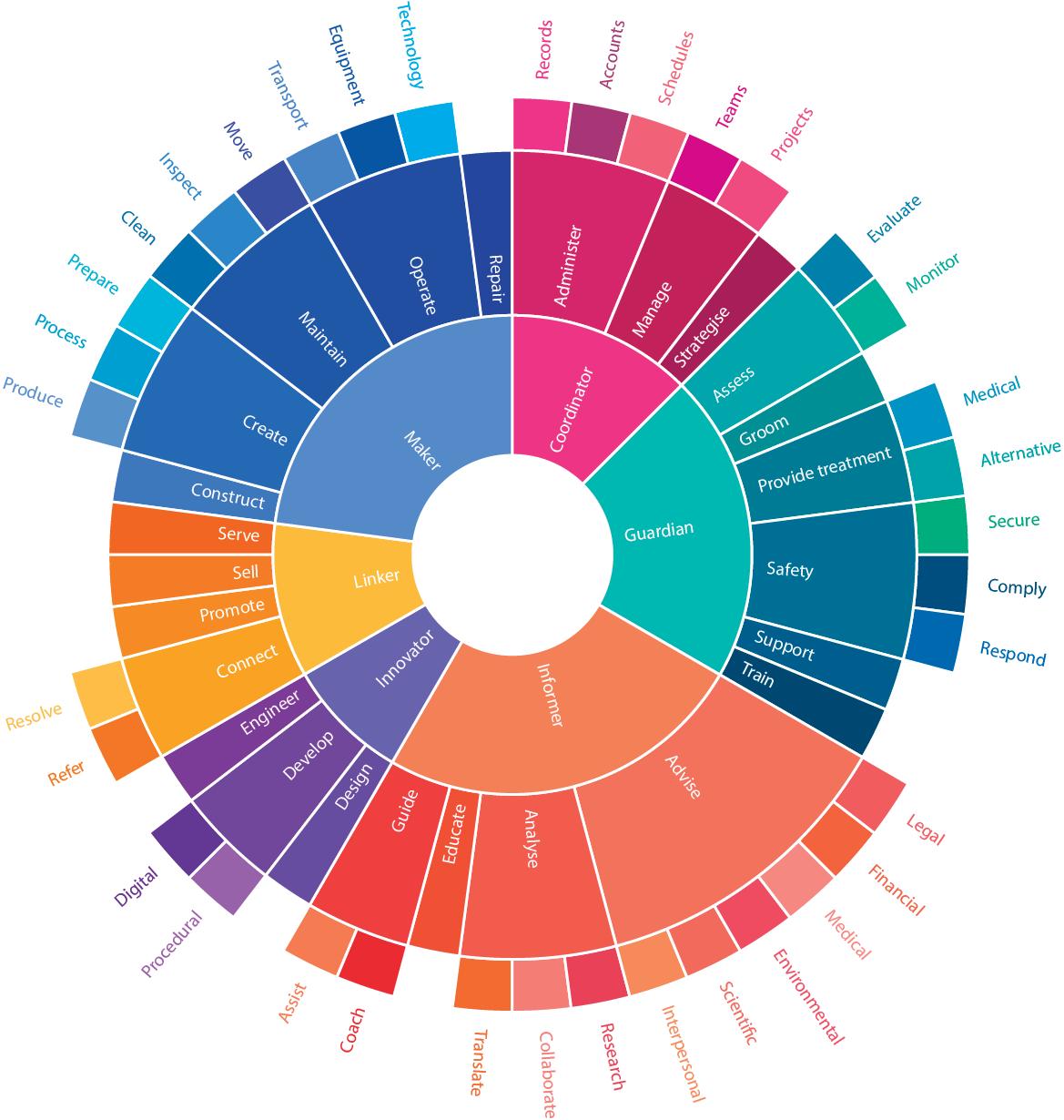
With enterprising skills predicted to become highly sought after by employers, the Ivanhoe Diploma provides students with a mechanism to profile their employability skills developed during their time at school. Underpinned by the IDEALS of Round Square, working towards the Diploma requires students to develop a reflective journal and goal-driven digital portfolio of co-curricular learning experiences across five areas of interaction:
• Action
• Civic engagement
• Creativity
• Intercultural understanding
• Leadership
To be awarded the Ivanhoe Diploma, applicants must demonstrate an ongoing commitment, authentic engagement, and the process of deliberate reflection for each activity they were involved. As a minimum requirement, the Diploma requires students to participate in at least 50 hours of experiences in each of the five areas of interaction of which a minimum of 35 hours must be made up of experiences that directly contribute to the Ivanhoe Grammar School community. Students who accrue more than 70 hours of authentic engagement across a diverse range of activities in each of the five expert areas may be eligible for the Ivanhoe Diploma with Honours.
The Ivanhoe Diploma is awarded in addition to VCE or IB and recognises that lived experiences and commitment are highly desirable qualities tertiary institutions and employers are looking for in people. Students interested in completing the Ivanhoe Diploma can register online.
In order to be eligible for most tertiary courses, you will need an Australian Tertiary Admissions Rank (ATAR). Your ATAR is a number on a scale of 1 to 99.95 showing where you rank compared with other student, who, in that year applied for a tertiary course. For example, if you have obtained an ATAR of 65.0 you would have achieved an overall result equal to or better than 65.0% of the applicants for tertiary study in that year.
The ATAR is used by the majority of Australian universities and TAFE colleges to determine whether you qualify for entry to a particular course.
The Victorian Tertiary Admissions Committee (VTAC) adds together the following scaled study scores:
• English (or EAL);
• your best three other scaled study scores;
• 10% of the next two best scaled study scores
In general, any approved enhancement study will be counted towards your ATAR, in place of a sixth subject.
The total score calculated by this process is then converted to the 1 to 99.95 scale for the purposes of determining your ATAR.
You will not receive an ATAR unless a VTAC application has been made and paid for and you have successfully completed a minimum of four VCE subjects, including an English study.
If you feel that you have been unable to reach your full educational potential or if access to the tertiary courses of your choice has been restricted because of your life circumstances you may apply to have this information brought to the attention of selection officers. SEAS is the umbrella program for all special entry schemes conducted by participating institutions.
VTAC will circulate your SEAS information to the selection authorities of the courses that you have listed on your VTAC application. Institutions will take account of information supplied in accordance with their individual admissions policies. These policies will be published on the VTAC website.
There are two distinct and separate schemes, ‘Access and Equity’ and ‘Year 12 Special Consideration’.
SEAS Access and Equity is open to applicants whose education has been adversely affected by their life circumstances.
This application is comprised of nine categories (refer to SEAS booklet/VTAC website)
This scheme also includes scholarships for various universities. (Refer to the VTAC Web Site for participating Institutions)
Year 12 Special Consideration is aimed at assisting those students who have experienced circumstances that can be demonstrated to have had an adverse impact on their performance in the final year of secondary school.
To apply for Access and Equity or Year 12 Special Consideration, students must lodge an on-line application through VTAC. In addition, documentary evidence may need to be sent to VTAC to support the SEAS application. For application closing dates, refer to the SEAS booklet/ VTAC website. SEAS booklets can be downloaded from the VTAC website by following the links: www.vtac.edu.au schools liaison, publications, SEAS booklet.
VTAC does not accept late applications. A SEAS application is the student’s responsibility.
www.ivanhoe.com.au