Chemistry International | July 2026 | Nanozyme Painting Rhymes
Nanozyme
Painting Rhymes
CHEMISTRY International
The News Magazine of the International Union of Pure and Applied Chemistry (IUPAC)
All information regarding notes for contributors, subscriptions, Access, back volumes and orders is available online at www.degruyter.com/ci
Managing Editor
Fabienne Meyers
IUPAC, c/o Department of Chemistry
Boston University
Metcalf Center for Science and Engineering 590 Commonwealth Ave. Boston, MA 02215, USA
E-mail: edit.ci@iupac.org
Design/Production: Stuart Wilson
Chemistry International
Chemistry International (ISSN 0193-6484) is published 4 times annually in January, April, July, and October by De Gruyter Brill Inc., 121 High St., 3rd Floor, Boston, MA 02110 on behalf of IUPAC. See https://iupac.org/what-we-do/journals/chemistry-international/ or https://www.degruyter.com/ci for more information.
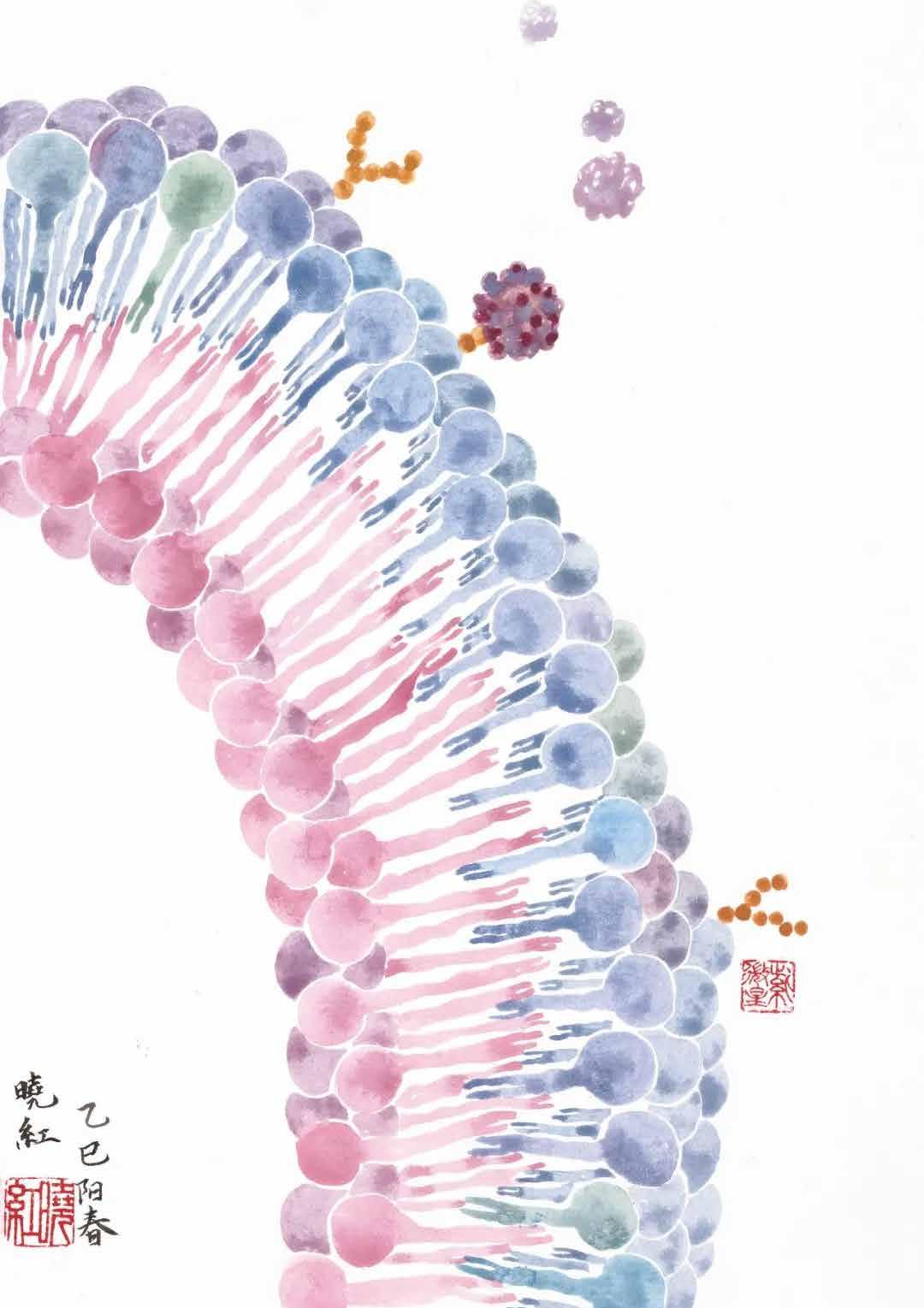
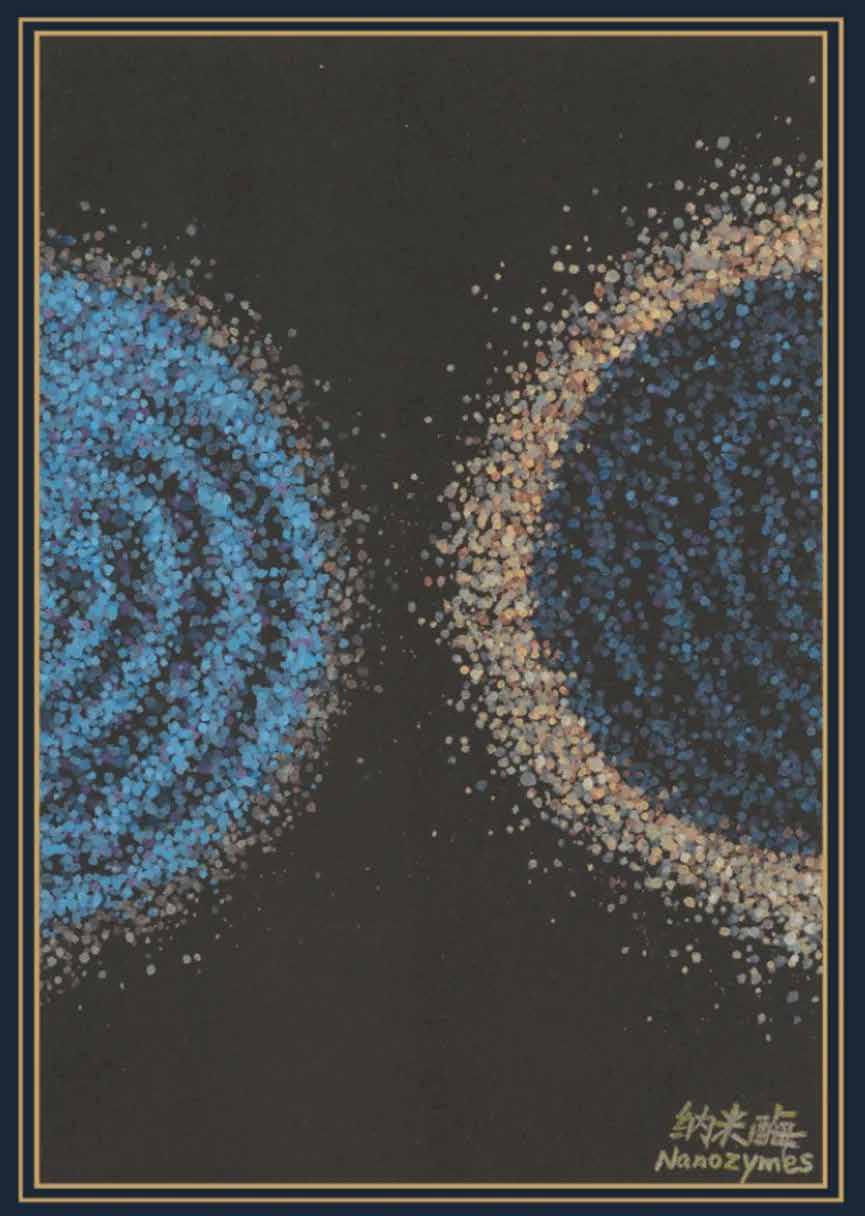
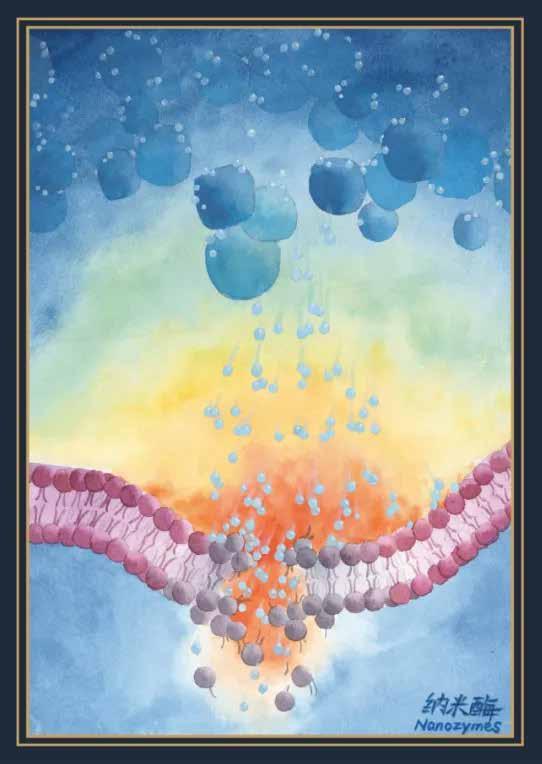
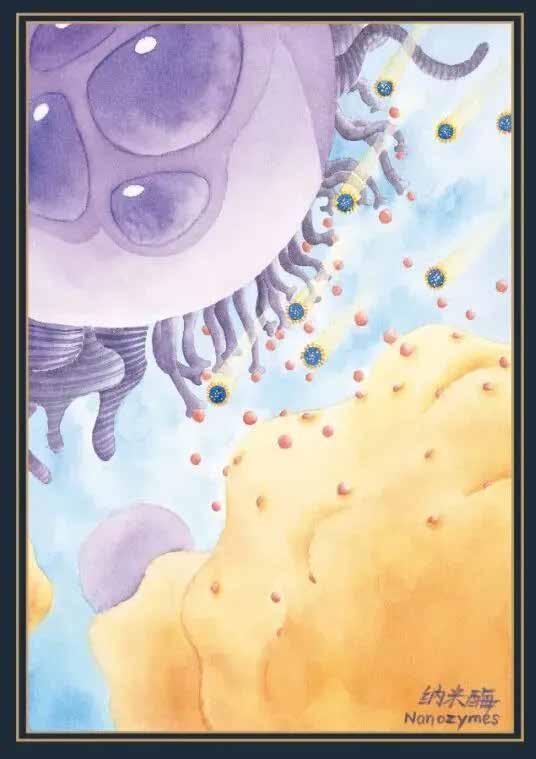
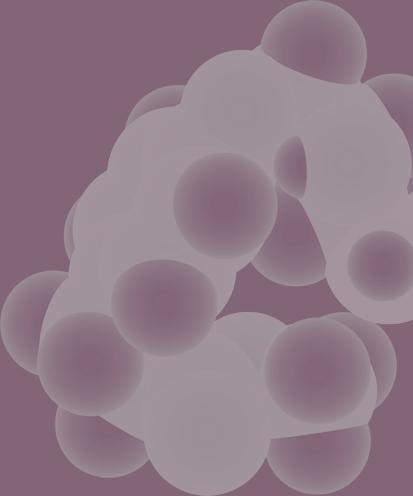
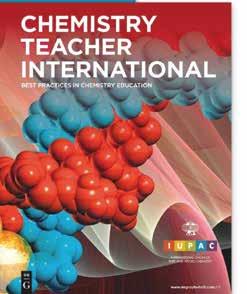
Cover: Advanced Materials invited Gao Lizeng, Wei Hui, Dong Shaojun, and Yan Xiyun to serve as guest editors for a special issue on nanozymes, compiling articles to showcase the latest advancements in the field. The artwork artistically recreates the core imagery of the issue’s cover: the interaction between nanozyme particles and cell membranes. The vibrant colors and complex protrusions represent the meticulously designed surface structure of the nanozymes. The nanozyme spheres are connected to phospholipid surface proteins via these protrusions, suggesting their ability to attach to the cell membrane surface and exert biological effects. See full story on page 8 or a report of the conference on page 48.
Artwork: Chen Xiaohong | Text: Wang Mengshu
Nanozyme Painting Rhymes by Xie Liangyi, Chen Xiaohong and Wang Mengshu
the Door to Discovery by Ilaria Meazzini and Alejandra Palermo
Chemistry and Instrumentation and its Place in Early
to Innovation: The Evolution and Promise of
by Neil Gussman and Christine Luscombe
IUPAC Wire Song Lin is the Thieme–IUPAC Prize Winner 2026
Polymer International–IUPAC Award Goes to Anindita Das
Sawamoto is the recipient of the 2026 Stepto Lecture Award
Officer’s Column
IUPAC at the Research Triangle Park, North Carolina (1997-2026)
by Mary Garson with contributions from past IUPAC Officers
The IUPAC Secretariat recently completed three decades based in the Research Triangle Park, North Carolina. The move to the USA was initiated in 1996 when the retirement of long-standing staff based at the Oxford headquarters of IUPAC created the opportunity for IUPAC to reconsider its global base. An Executive Committee meeting in Oxford in April 1996 recommended relocation to Research Triangle Park (RTP) in North Carolina, and to review the site location every ten years. Bureau minutes from later the same year reveal some concern on the part of European members that the decision had been reached with limited consultation. Nonetheless, the North American Secretariat was established in early 1997 and first housed in a demountable of modest size and appearance. All those who remember this first RTP site refer to it as the “trailer.”
John W. Jost was appointed Executive Director in April 1997 and, according to the Geneva Council records of August 1997, this was against a backdrop of intensive evaluation of IUPAC’s mission and plans for restructuring of the organization! The first event held at RTP was the 125th Executive Committee meeting of April 1998. The staffing arrangements were developed as the new office became fully functional following the transition from Oxford. Linda Tapp joined the staff initially as personal administrative assistant to John Jost, and later
more generally as an administrative manager. Fabienne Meyers joined IUPAC in 1998 as the electronic publications manager and became Associate Director in 2009 in advance of a key role managing IUPAC’s contribution to the International Year of Chemistry (2011). Fabienne relocated in Boston in 2003 and has worked remote since. Enid Weatherwax was recruited as an administrative assistant in 2005 while Tammy Bridges joined as financial controller in 2018. Successors to John Jost as Executive Director were Terry Renner, John Petersen, Lynn Soby, and Greta Heydenrych, and the current incumbent is Fabienne Meyers. Other staff who have worked at RTP at various times include Alan Senzel, Pamela Footman, Lucinda Kelly, Paul LeClair, Erin Carter, Laura Abernathy, Bryan Pearson, Jay Lucindo, and Lisa Musty.
In 2015, the Executive Director Lynn Soby arranged for the Secretariat to move into better quality office space comprising three work offices, a meeting room, a small room housing the historical collection of Comptes Rendus volumes and other books. The new space also housed archival material that had not been transferred
Above: Inside entrance lobby of most recent RTP office, showing far right the portraits of the Officers
The IUPAC trailer (picture by Mei-Hung Chiu)
At left, the entrance to the most recent RTP office
to the Science History Institute in Philadelphia as well as that accumulated subsequently in ongoing records and documentation.
The move to the offices in RTP coincided with a significant growth in and modernization of IUPAC’s work flows and was facilitated by the rapid uptake of email correspondence and teleconferencing for communication with and between members. Around this time, John Jost set up the IUPAC website, and this original website is still accessible by following links to past Executive Committee and Bureau meetings.
At the time of moving to RTP in 1996, there were 109 officially discovered chemical elements, while now in 2026 there are 118, a fundamental and historical contribution of the joint IUPAC-IUPAP working party and the Commission on Isotopic Abundances and Atomic Weights under the Inorganic Chemistry Division (Div II). Following the establishment of the Chemistry and the Environment (Div VI) and the Chemistry and Human Health (Div VII) in 1995, there was a further expansion to eight Divisions with the establishment of Chemical Nomenclature and Structure Representation in 2002. Other highlights of the three decades at RTP included the formation of additional Standing Committees (Interdivisional Committee on Green Chemistry and Sustainable Development in 2016; Committee for Ethics, Diversity, Equity and Inclusion in 2022; incorporation of the International Younger Chemists Network in 2024), or their re-establishment (Committee for Printed and Electronic Publications in 1996, later renamed as the Committee for Publications and Cheminformatic Data Standards in 2013; the Committee on Chemistry Education and the Interdivisional Committee on Terminology, Nomenclature and Symbols, both in 2002). A Fellows program was established in 1998, as were a series of prizes, including the Solvay awards (2001), the Distinguished Women
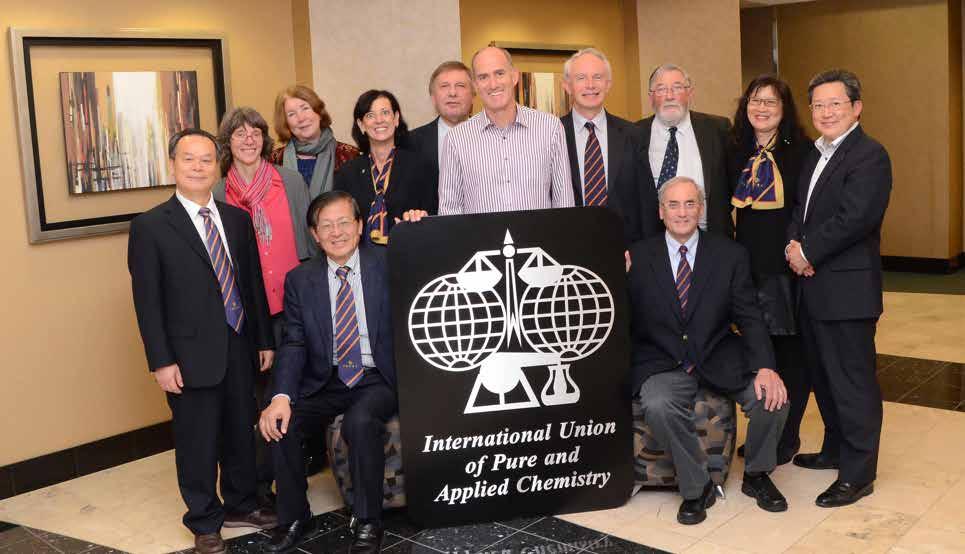
Group photo of the 54th meeting of the Executive Committee held in the Research Triangle Park Office, 31 Oct - 1 Nov 2015; from left, standing: Qi-Feng Zhou, Fabienne Meyers, Natalia Tarasova, Lynn Soby, Colin Humphris, Richard Hartshorn, Chris Brett, John Corish, Mei-Hung Chiu, Kaoru Yamanouchi; seating in the front: Kazuyuki Tatsumi, and Mark Cesa.
in Chemistry/Chemical Engineering awards (2011) and the IUPAC-Soong prize (2025). There were high profile contributions to several UN-badged International Years (Chemistry 2011; Periodic Table 2019; Basic Sciences for Sustainable Development 2022-2023). In 2019 there was also the celebration of IUPAC’s own centenary and with the establishment of the Top Ten Technologies and the Global Women Breakfast. The scientific work of IUPAC is handled through a project system which replaced the earlier Commission system from 2000 onwards, and through numerous symposia, workshops, and more recently webinars. Since 2001, the biennial scientific congress has been run alongside the General Assembly as the World Chemistry Congress. After 2000, Chemistry International and Pure and Applied Chemistry were produced “in house” until 2013 when IUPAC signed with De Gruyter. A third journal Chemistry Teacher International was added in 2019.
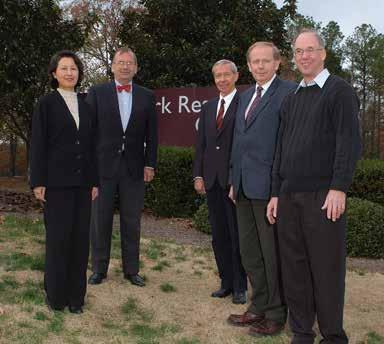
The Officers in the lawn of the RTP Office during their visit on 3 Dec 2005: (from left) Kazuko Matsumoto, Christoph Buxtorf (Treasurer), David StC. Black (Secretary General), Leiv Sydnes (Past President), and Bryan Henry (President)
Officer’s Column
As office work became increasingly online, and notably post the COVID pandemic of 2020, this led to staff often working remotely. Around the same time, it was recognized that the office facilities which had been rent-free for the first ten years at RTP had become a financial impost on IUPAC’s budget. It was time to consider moving!
One of the first decisions made by the newly-established Executive Board in 2024 was to reopen discussions about the location of the Secretariat and to solicit hosting arrangements from member NAOs. Following a global call for proposals, the 2025 Council meeting in Kuala Lumpur confirmed an Executive Board decision to enter into formal contract negotiations with Consiglio Nazionale delle Ricerche, Rome, Italy and the University and City of Malaga, Spain to establish a European based Secretariat for the Union.
IUPAC signed MOUs with both Malaga (December 2025) and CNR (February 2026), and the complex process of transferring office functions to these two locations is currently underway under the direction of Fabienne Meyers and assisted by Liana Vaccari as the project manager.
Financial operations will be located in IUPAC Malaga Office with the IUPAC Rome Office looking
after international affairs, projects, communication and digital matters.
Reflections on RTP
Looking back over three decades of the IUPAC Secretariat at Research Triangle Park, we recognize not only the institution itself but also the people whose dedication has made it an essential pillar of IUPAC’s success and global impact. IUPAC expresses its sincere gratitude to the staff who have served there over the years. Their dedication and professionalism have provided the continuity and support that have enabled IUPAC to fulfil its global mission and advance chemistry worldwide.
Chemistry International reached out to some past members of the IUPAC Executive, in particular those who visited RTP and asked them for their recollections of the RTP office(s). There were a few comments about the physical environment, but mostly there were many warm-hearted comments about staff with whom our volunteers connected. A selection of the comments received follow.
Leiv Sydnes (President 2004-2005): “John Jost, David Black, Ted Becker and I used e-mail a lot, and I called pretty regularly to John and Ted. For me, the trailer is associated with using months and not seasons in all IUPAC contexts. I had the habit of talking about seasons even when I chaired meetings, and at Executive Committee meetings in the trailer, David corrected me every time I said for instance spring instead of March.”
Bryan Henry (President 2006-2007): “I always looked forward to meetings at RTP. They were most productive and always handled efficiently. The best part was the chance to meet and interact with so many interesting and stimulating people.”
David StC Black (Secretary-General (2004-2011): “Although the RTP building was an effective office space, it always struck me as a very lonely place. For that reason, during my time as Secretary-General (2004-2011), I was always keen to schedule suitable meetings there. The RTP staff of John Jost, Linda Tapp, Enid Weatherwax and the late Paul LeClair could not have been more helpful and the atmosphere was always warm despite the bleak location.”
Mark Cesa (President 2014-2015): “I spent quite a bit of time in the “double-width” trailer that was IUPAC’s home in RTP during my time as an officer, and recall that there was a big black snake living underneath it. As
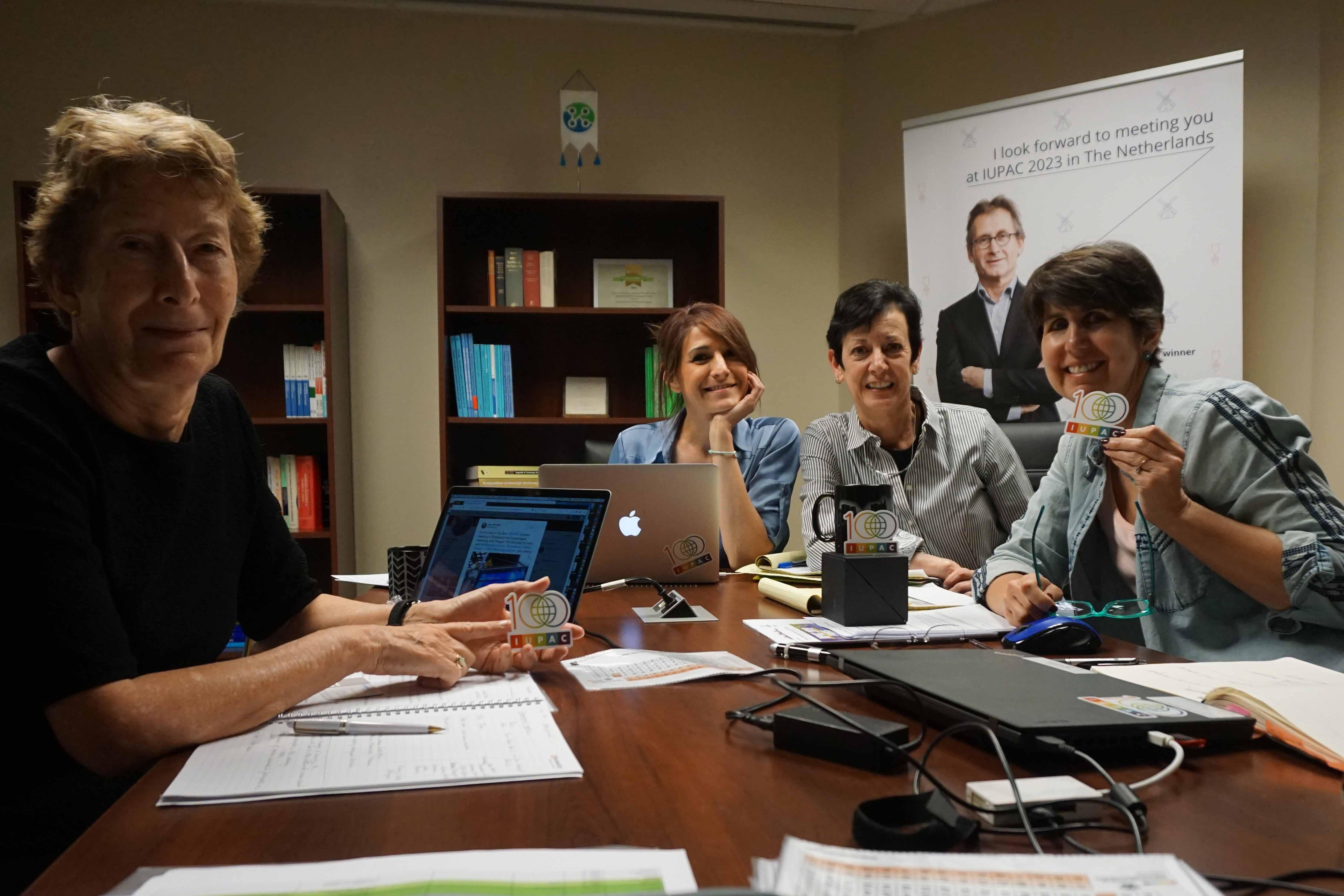
Mary Garson, Gaby Brooks (TheeDesign), Lynn Soby, and Laura McConnell (2018 while prepping for IUPAC100)– image provided by Laura McConnell
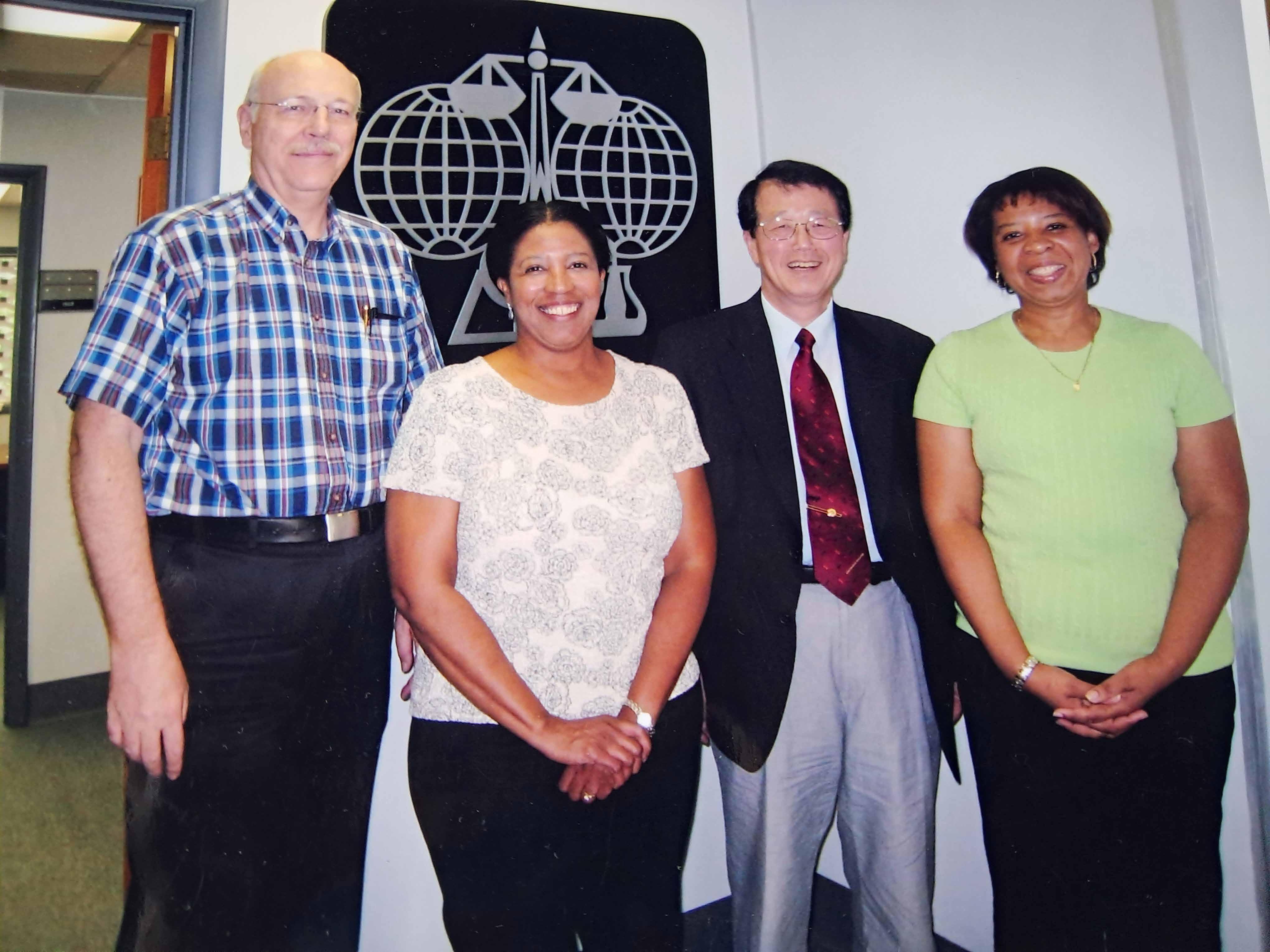
John Jost, Linda Tapp,Jung-Il Jin, and Enid Weatherwax (2008)
Reflections on RTP
chair of COCI, we held an off-year annual meeting in RTP at the old office. After that meeting, COCI also went as a group to a minor-league baseball game in Durham, NC; one game of which was rained out after three innings. Akira Ishitani from Japan enjoyed the baseball especially. At other meetings at RTP I was usually the driver—I’d rent a car at the RDU airport and transport the officers to and from the office. We held our main meeting to develop the 2015 IUPAC Strategic Plan at RTP as well. Lynn Soby made it her task to get IUPAC out of the trailer and into some proper office space. The driving factor was an increase in rent for the trailer. At first the office space she found for IUPAC worked well, but after a while it became more than was needed.”
Laura McConnell (Div VI President 2012–2015: As a dedicated IUPAC volunteer for many years, I was fortunate to be just a short drive from the IUPAC Secretariat in Research Triangle Park, and I gladly took advantage of that opportunity.
On every visit, I was warmly welcomed by the IUPAC staff, Enid, Linda, Tammy and Fabienne, and I was included in lunches and dinners when officers came to town. I will truly miss having IUPAC in my backyard, but I am pleased to see the Union embrace a new future filled with new possibilities.
Chris Brett (President 2020-2021): “I first went to RTP when Sean Corish was still treasurer and Colin Humphris was acting Secretary General. The meeting was in the hotel and we visited the trailer, by then empty. I went to RTP another couple of times when we were in the new premises but my last was in 2019. A planned visit for 2020 was cancelled, of course.
I remember from my last visit (to the “new” premises) the unexpected arrival of a very large and bulky carpet, weighing around 70 kg and depicting the full periodic table. It had been made by some young schoolchildren, I believe in Pakistan or Bangladesh. Their teacher decided to gift it to IUPAC and sent it without asking first, transport costs to be paid by IUPAC. I don´t know what happened to the carpet.”
Richard Hartshorn (Secretary General 20152023): “I visited the Secretariat numerous times during my terms as Secretary General and …. particularly enjoyed the American-style lemonade and the light-hearted competition with Linda for any available chocolate…”
Javier Garcia-Martinez (President 2022-2023): “What I remember most was the people behind the
Secretariat. I thoroughly enjoyed the opportunity to get to know them better, learn about their daily work, and discover the many ways in which they contribute to IUPAC’s mission. Much of this work takes place behind the scenes and often goes unnoticed, yet it is essential to the Union’s success. A particularly memorable moment was signing the visitor book. As I turned its pages and saw the names of many distinguished scientists and leaders who had come before me, I was reminded that while IUPAC’s presidents, officers, and volunteers change over time, the Secretariat provides the continuity that enables the Union to thrive across generations.”
Zoltan Mester (Secretary General 2024-): “I have visited the US offices several times since I took office in 2024. In the postpandemic era, IUPAC’s backoffice support functions have become truly remote and global. Working closely with Enid, Tammy, and Fabienne—and more recently Liana—it has become clear that our core lies less and less in a physical location, and more in the strength and connection of our people. Although we will close our physical offices in North Carolina, on 30 June 2026, the central functions of IUPAC remain intact. Thank you Enid and Tammy for your service. We now look forward to the next chapter in Italy and Spain.”
Mary Garson (President 2026-2027): “These reflections beautifully evoke the warm and dynamic relationship between the Secretariat staff and volunteers these past thirty years. The growth in operations and in scientific activity while based in North Carolina is testament to the contributions of many dedicated office staff. The next chapter in IUPAC’s history now begins in Europe, and we look forward to a productive future ably assisted by a new generation of Secretariat staff together with our wonderful volunteers from around the world.”
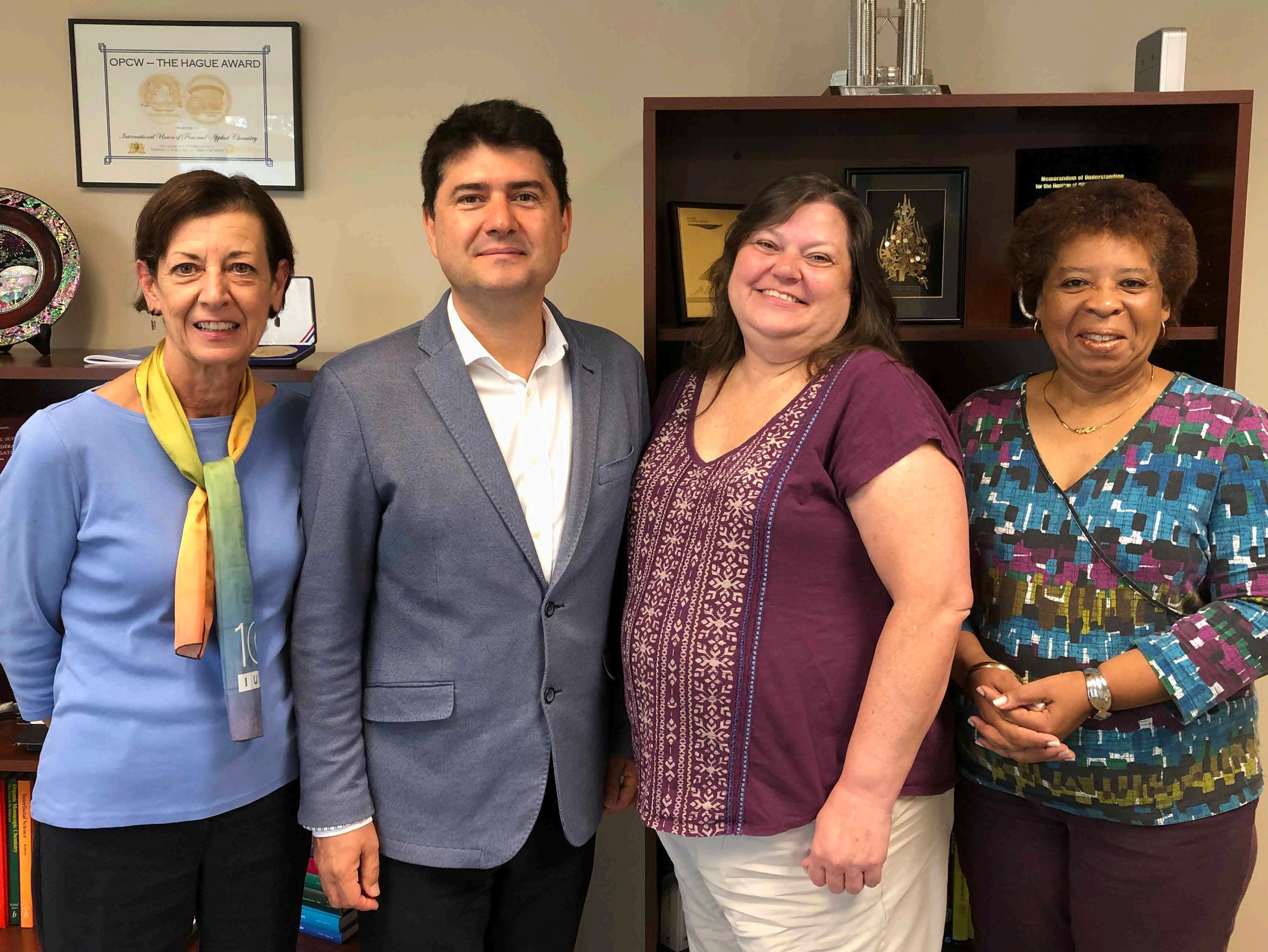
Lynn Soby, Javier Garcia Martinez, Tammy Bridges, and Enid Weatherwax (2022)—supplied by Javier Garcia Martinez
Nanozyme Painting Rhymes
by Xie Liangyi, Chen Xiaohong and Wang Mengshu
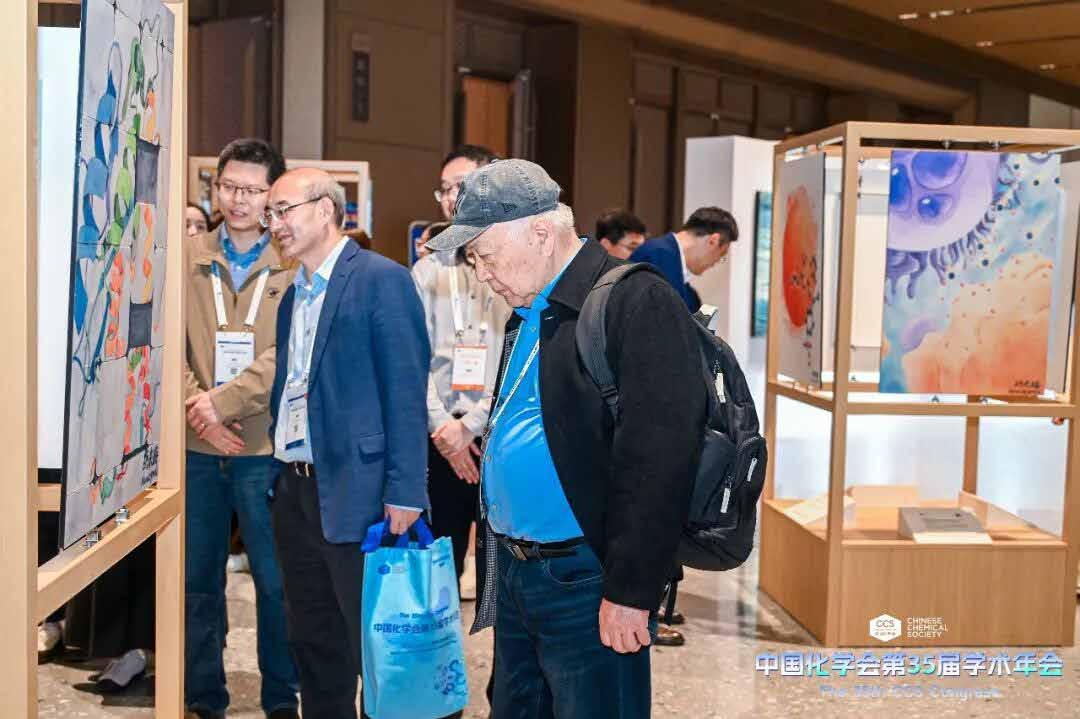
Nanozymes—nanomaterials imbued with enzymatic functions—are expanding our understanding of catalysis and the nanoworld with their unique advantages. They possess both the catalytic efficiency of natural enzymes and superior environmental tolerance and long-term stability. Nanozyme Painting Rhymes was part of the inaugural “Chemistry Everywhere” thematic popular science and art exhibition on display during the 35th Annual Academic Conference of the Chinese Chemical Society (CCS) held from 11-14 April 2026. See report page xx covering the first Chemistry Popularization Forum, organized by the CCS Popularization of Chemistry Committee, took place successfully in Chongqing on April 12.
To highlight the peroxidase-like activity of ferromagnetic nanoparticles, the image uses two opposing hemispheres. The left side uses blue stars to outline magnetic field lines, symbolizing the ferromagnetism of the nanoparticles; the right side emphasizes the golden stars on their surface, marking the researchers' first discovery that ferromagnetic nanoparticles possess peroxidase-like activity.
Artwork: Xie Liangyiqun; Text: Wang Mengshu
In this art exhibition, the language of art is used to tell the scientific story of nanozymes. Here, you will see:
• The first encounter between magnetic field lines and enzyme activity was solidified into a moment of discovery in a symmetrical configuration;
• Sea urchin-shaped nanoenzymes penetrate deep into the joint, using color to outline the boundaries of cartilage repair;
• MXene, a flying bird, picks up new skin and brushes away the old, fiery red marks from the edges of the wound;
• Bubbles like those from ice-cold beer rise beside the blood clot, hiding therapeutic inspiration in the gentle ripples;
• Small Prussian blue flowers bloom between the bones, allowing science and art to quietly meet in the picture.
The image depicts a cascaded catalytic nanocatalyst within an acidic tumor microenvironment. Under ultrasoundmediated illumination, represented by a blue-green-yelloworange color gradient, the nanocatalyst releases small blue, pH-responsive cinnamaldehyde, which reaches and destroys the tumor cell membrane, inducing tumor ferroptosis.
Artwork: Xie Liangyiqun; Text: Wang Mengshu
Whether you are a researcher deeply involved in the field of nanozymes, or a student just getting acquainted with this cutting-edge direction; whether you are a creator interested in scientific illustration and visual communication, or a member of the public simply walking into the exhibition hall out of curiosity—there is a place for you here.
We believe that science not only involves rigorous reasoning, but also possesses a perceptible warmth and beauty.
We welcome you to pause before the artwork, engage with the artist, and discuss with fellow artists, allowing your gaze and thoughts to jointly embark on an exploration that transcends disciplinary boundaries.
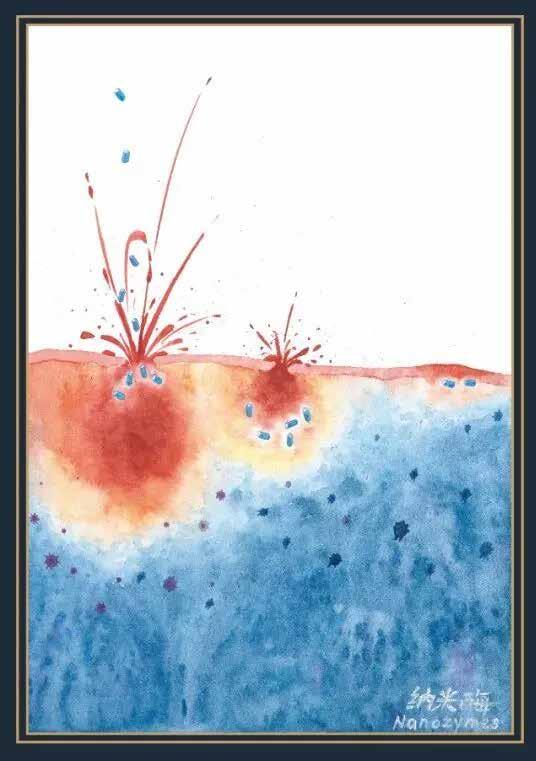
Top right: researchers have developed a MOF-based nanozyme (Ni-HTP) that promotes angiogenesis and accelerates wound healing in diabetic patients by activating TGF-β1 with nickel ions. In the image, the nanozyme is presented as a short blue rod, while the wound is red; the strong red-blue contrast vividly illustrates the gradual healing process under the nanozyme's influence, conveying a sense of vitality and dynamism.
Artwork: Xie Liangyiqun | Text: Wang Mengshu
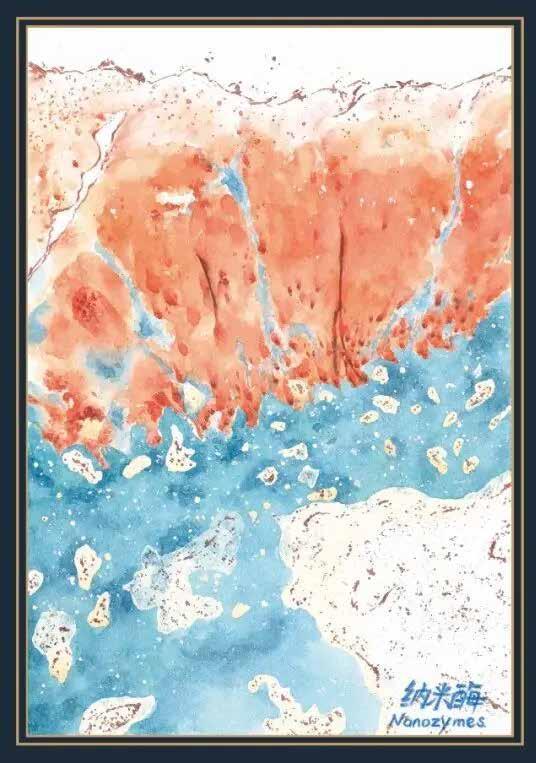
Below left: The painting depicts cartilage sections from osteoarthritis patients using strong contrasting colors. Compared to normal cartilage, the Safranin O-Fix Green stained areas express the destruction and loss of integrity of the articular cartilage, suggesting the application of urchin-shaped cerium oxide nanozymes in enhancing gene therapy for osteoarthritis.
Artwork: Xie Liangyiqun
Text: Wang Mengshu
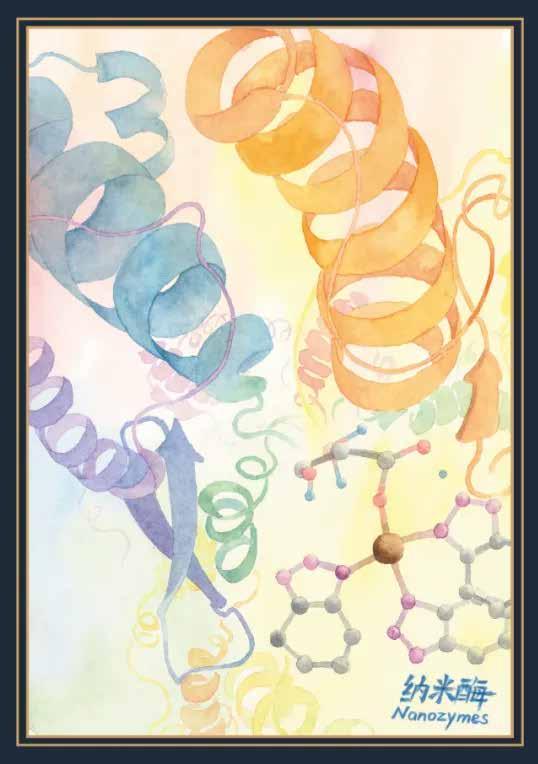
Bottom right: In the lower right corner of the painting, a figurative metal-organic framework artificial enzyme diffuses outwards, exhibiting a three-dimensional structure similar to natural hydrolases, highlighting the high enzymatic catalytic activity of the artificial enzyme system for environmental remediation. The dynamic, shifting light in the background suggests that pollutants are slowly decomposed, restoring clear and vibrant waters.
Artwork: Xie Liangyiqun
Text: Wang Mengshu
Nanozymes
Above: The visuals center around the Prussian blue nanozyme RANKLHPB@ RC-ALN, demonstrating its ability to block the production of the red signaling factor RANKL, thereby inhibiting the senescence of yellow osteoblasts and the activation of purple osteoclasts, ultimately breaking the mechanism of malignant coupling between osteoblasts and osteoclasts in the osteoporotic microenvironment. The overall color scheme is harmonious and technologically advanced. Artwork: Xie Liangyiqun | Text: Wang Mengshu
At right: The image shows the specific morphology of highly active Ru-POD nanozymes: polymer-type surface ligands are attached to Ru nanoparticles, forming a unique ligand functionalization effect, demonstrating the possibility of achieving nanozyme activity that surpasses that of natural enzymes through rational design. Artwork: Xie Liangyiqun Text: Wang Mengshu
Nanozymes
The artistically designed hollow mesh at the foreground represents the hollow axial Mo-Pt nanozyme. The exaggerated perspective depicts how the nanozyme's spin electron rearrangement effectively enhances its enzyme-like activity and anti-tumor capabilities. Behind the hollow mesh, the generation of aquamarine oxygen molecules helps overcome the hypoxic microenvironment of the tumor, while the orange tumor cells, under the attack of radial star-shaped superoxide free radicals, are riddled with holes and on the verge of collapse.
Artwork: Chen Xiaohong | Text: Wang Mengshu
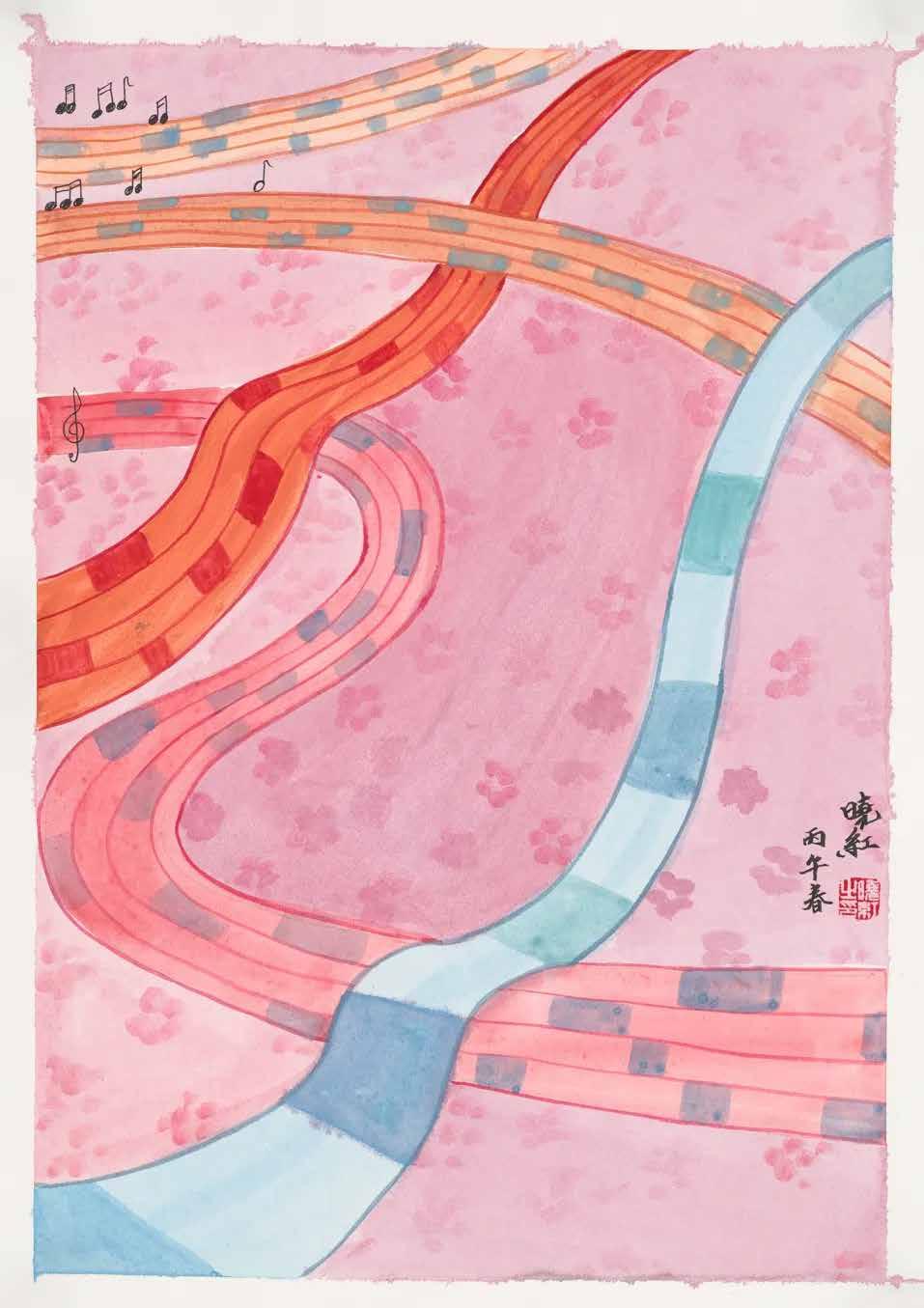
In the illustration the substrate—E. coli— is depicted as small purple-red flowers against a pink background. The copper singleatom nanozyme test strip is portrayed as an interwoven musical score, with the three detection modes—colorimetric, photothermal, and catalytic—represented by the three colors of the score. The test strip bands are arranged in a staggered and varied manner, highlighting the excellent selectivity and specificity of the copper single-atom nanozyme test strip.
Artwork: Chen Xiaohong | Text: Wang Mengshu
Nanozymes
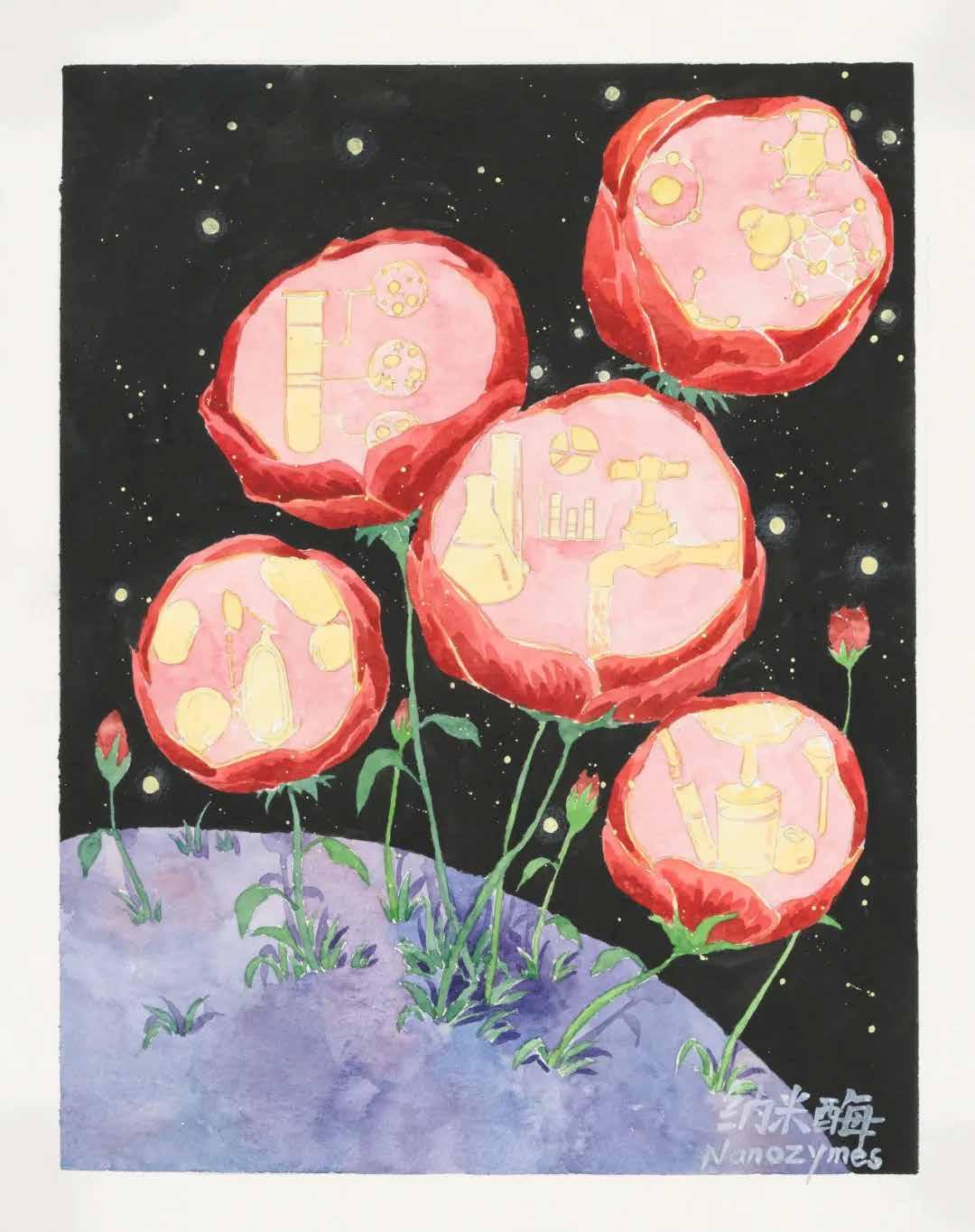
The graphic above uses spherical Fe3O4 nanoparticles as a base, with the flowers growing from them representing different application areas: food analysis, industrial pollutant analysis, and biological sample analysis. The surrounding buds, ready to bloom, embody the expectation and vision for the application potential of Fe3O4 nanoparticles. The overall image resembles a rose growing on a small planet in the universe, full of childlike charm and profound imagery.
Artwork: Xie Liangyiqun | Text: Wang Mengshu
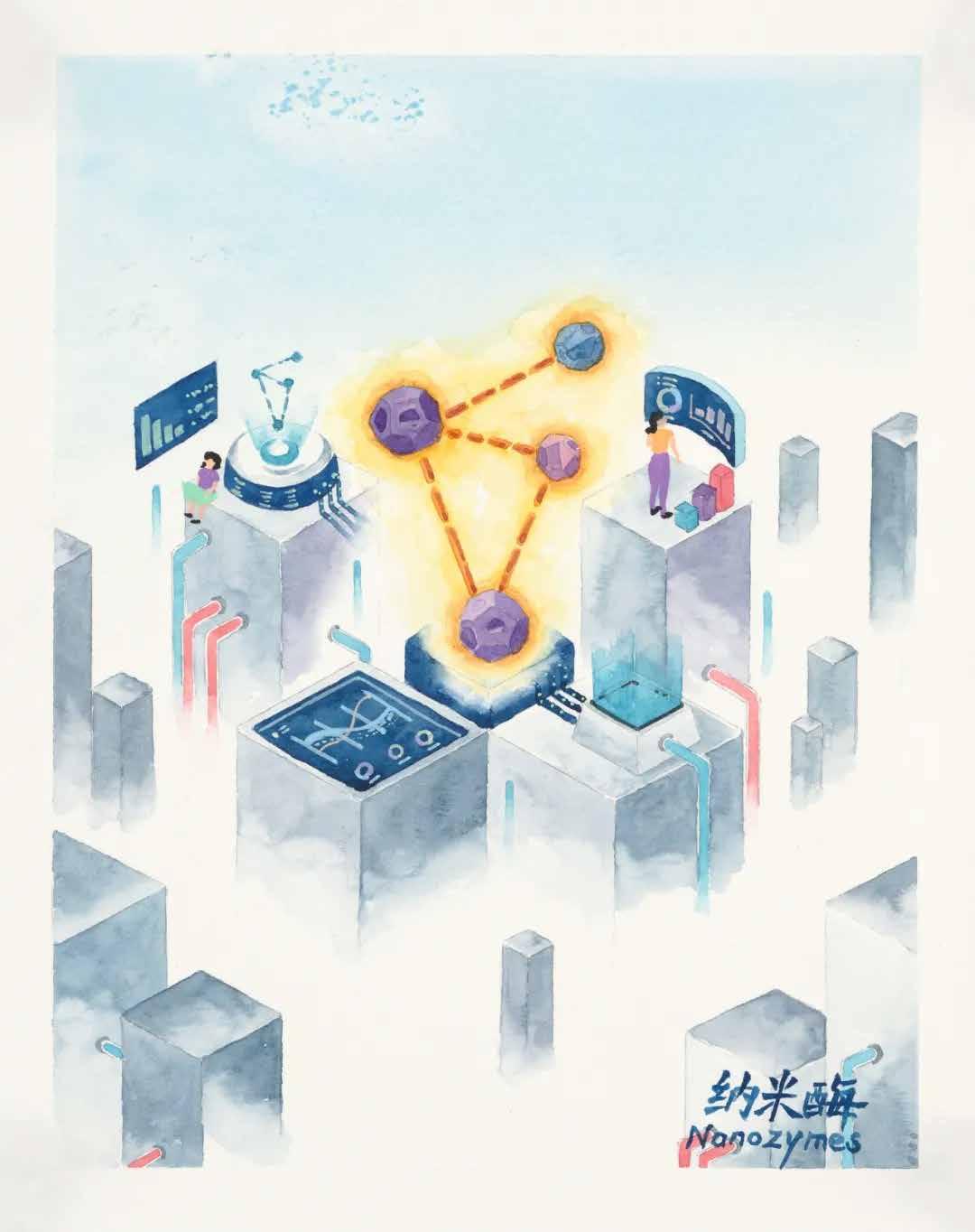
The towering stacked blocks in the image on the left represent the integrated nanozyme data in the database, with the yellow highlight in the center emphasizing the database’s contribution to the rational design of nanozymes. The overall color scheme is blue-gray, consistent with the themes of information, technology, and the future; the lower cloud area is left blank, creating a light and relaxed rhythm in the image.
Artwork: Xie Liangyiqun | Text: Wang Mengshu
Nanozymes
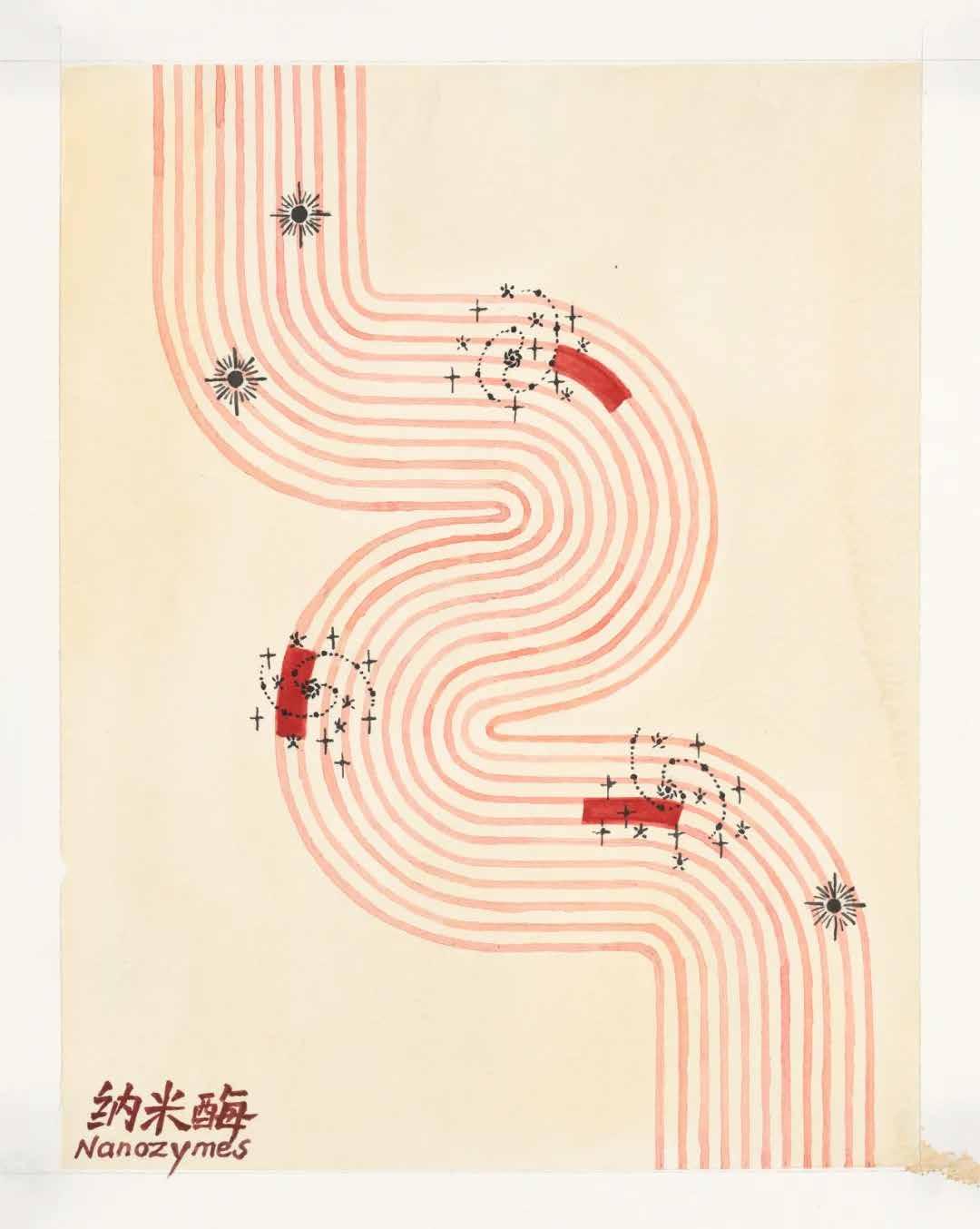
At right: minimalist, abstract pink geometric curves outline the intestinal microenvironment. A star-shaped platinum nanosensor, following the intestinal tract to the deep red inflamed segment, shimmers, indicating that the sensor generates fluorescence and other detection signals at the lesion site. The overall design is minimalist yet full of aesthetic appeal, employing a linear, artistic style. Artwork: Xie Liangyiqun | Text: Wang Mengshu
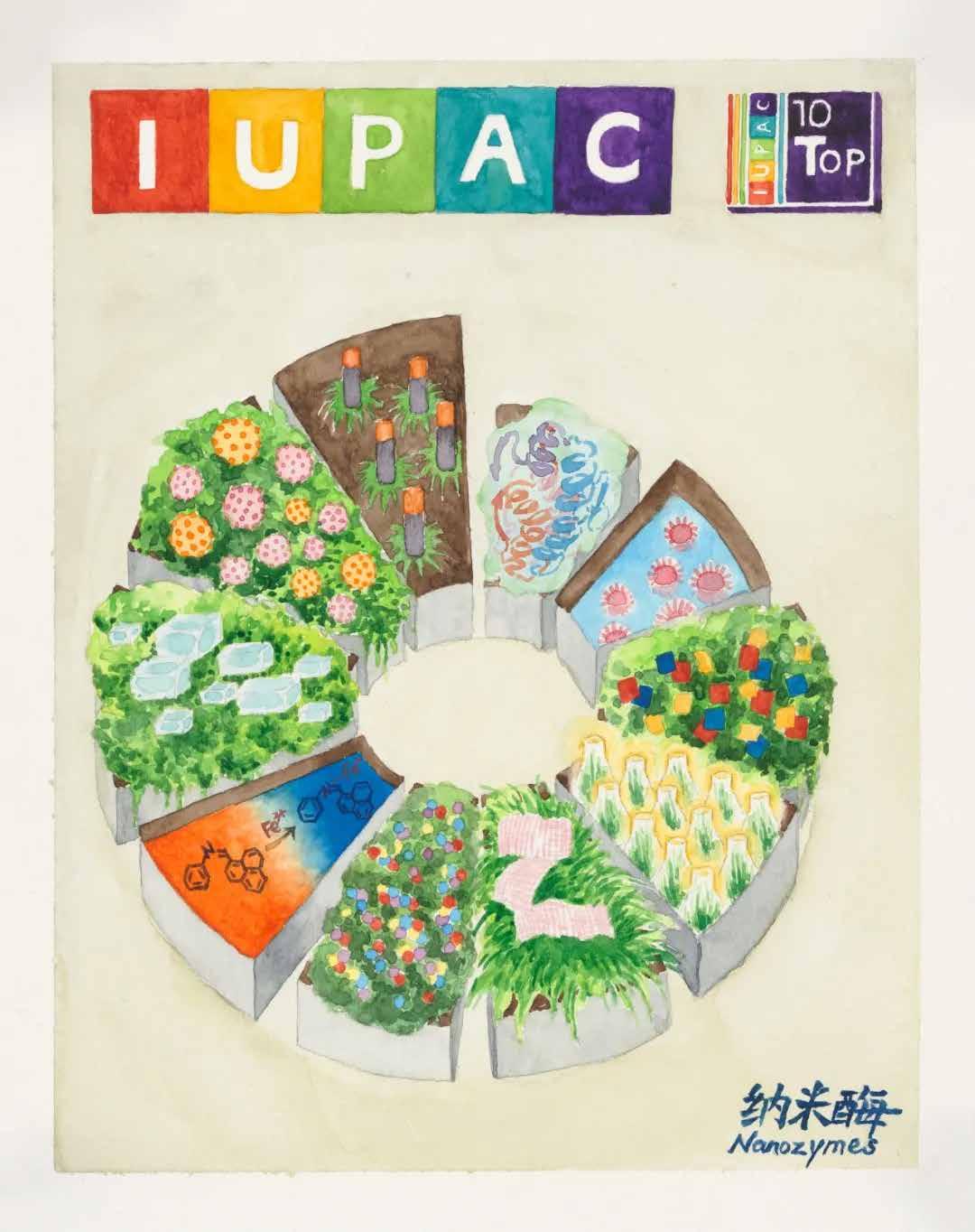
In this painting, IUPAC’s annual emerging applied technologies are depicted as a fragrant, flowerbed-like garden. The ten emerging technologies are arranged in a spiral as various distinctive flowers and plants. The colorful picture means that all technologies are thriving; the main tone is bright green, highlighting the theme of the International Year of Basic Sciences for Sustainable Development (IYBSSD). Nanozymes -the theme of this expo- was identified as one the Top Ten Emerging Technologies in Chemistry in 2022.
Artworks reproduced with permission.
Original Link: https:// mp.weixin.qq.com/s/cwW8NOfyMHVPZIH54mi4Q Translated: DeepSeek
See also report page 48.
Opening the Door to Discovery Disability-Inclusive Laboratories in the Chemical Sciences
by Ilaria Meazzini and Alejandra Palermo
Chemistry thrives on creativity, collaboration, and inclusion of different perspectives. Yet for far too many chemists, the laboratory remains difficult to access and navigate. The Royal Society of Chemistry’s new report, Disability Inclusive Laboratories in the Chemical Sciences, [1] presents evidence from more than 400 survey respondents, 29 case studies, and 15 interviews and sets out 15 recommendations that place accessibility and inclusion at the heart of our discipline. This article shares the core findings from the research and good practices, and offers an invitation to the global community, educators, industry leaders, funders, policymakers, and chemists at every career stage, to help build laboratories where everyone can feel included and do their best science.
Why inclusion in the lab is a scientific imperative
A laboratory that excludes talented people is a laboratory that limits discovery and innovation. Our research shows that disabled chemists continue to encounter physical, cultural and systemic barriers, from fixed height benches and inaccessible fume hoods to inconsistent processes for adjustments and entrenched attitudes which collectively constrain what science can achieve. These barriers do not only harm and inconvenience individuals; they result in the loss of ideas and leadership that our field urgently needs.
The stakes are high. Inaction risks shutting out world class talent and missing potential vital breakthroughs. This is reflected both in the stories of scientists who have advanced knowledge despite significant barriers, and in the growing evidence that disabled chemists are often diverted away from laboratory; not by lack of scientific interest but by the environments designed without accessibility in mind.
Our position is clear: accessibility is both a question of equity and of excellence. We are not calling for laboratories to be torn down and rebuilt. We are calling for the same creative, problem-solving mindset that defines chemistry to be applied to the spaces, tools, and cultures in which chemistry is done.
What the evidence shows
Our report draws on a mixed-methods study, including a large survey of chemists (over 400 respondents), 15 in-depth interviews, and a curated set of 29 case studies from across the chemical sciences community. The findings reveal several patterns that are both striking and consistent:
1. Belonging and culture. More than a quarter of disabled respondents reported that they do not feel a sense of belonging in the chemistry community, an experience compounded by gaps between stated organisational values and day to day realities. Accounts of bullying and discrimination persist at levels that should concern every leader and supervisor in a laboratory.
2. Common barriers. Respondents most frequently cited experiencing the following barriers: a lack of awareness of support needs (75%), time constraints (69%), and sensory overstimulation (61%). Inaccessible working environments were also a persistent concern. Narrow walkways, poorly positioned equipment, and fixed height fume hoods remain everyday obstacles, particularly in settings where standard operating practices assume prolonged standing, fine motor dexterity, or unassisted lifting.
“Labs are not designed for people that need walking or standing aids […] I have been forced to hide my disability in order to continue doing my job and I have to take breaks when my body won’t let me continue to stand. I have fallen repeatedly, which can be dangerous. Needing to carry chemicals up and down the stairs means I can’t use walking aids as I need both hands for carrying.”
– Mid-career, company with > 250 employees, disabled, UK
3. Adjustments and delays. Respondents reported experiencing or witnessing significant delays in the implementation of reasonable adjustments. Many described requests that were never fulfilled, or negative reactions when seeking support. This reactive, ad hoc approach not only delays inclusion but also undermines safety, productivity, and fairness.
4. Impacts on careers. Our findings are consistent with wider evidence on career progression. Disabled chemists are less likely to hold senior roles and are more likely to move into computational or office-based work, not necessarily by preference, but due to exclusionary laboratory environments.
Five principles, fifteen recommendations
Moving from evidence to action, our report proposes five principles for disability inclusive laboratories These principles are intended to be practical, adaptable across a range of settings, and measurable over time:
Accessibility is built into design. Features such as height adjustable benches and fume hoods, variable lighting, automatic doors, clear colour contrast, and space for mobility aids should be viewed as baseline components that benefit all users.
Inclusive culture is part of everyday lab life. Inclusion must be demonstrated in daily practice through transparent adjustment processes, respectful communication, accessible training, and proactive allyship. A key recommendation is the introduction of mandatory disability awareness training for all laboratory users.
Disabled people are empowered and influential. Lived experience must inform decision-making. Departments should embed disabled scientists in governance processes related to laboratory design, procurement, and risk assessment, and must resource staff networks that provide support, advocacy, and visibility.
Allyship and shared responsibility strengthen inclusion. Colleagues, supervisors, estates teams, technicians, health and safety officers, and funders all share responsibility for accessibility. Inclusion cannot rely solely on goodwill; it must be embedded in organisational expectations and measured over time.
Systems and policies sustain lasting change. This includes clear processes for implementing adjustments, dedicated budgets for accessibility, and accountability through audits, policies, and promotion criteria.
Together, these principles provide a practical framework for embedding disability inclusion within laboratory environments. The barriers identified and described here are not inevitable, they are the result of decisions that can and must be changed.
Many of the barriers faced by disabled chemists are not inherent to the discipline, but result from design choices, institutional practices, and cultural assumptions. By creating laboratories that are accessible by design, inclusive in practice, and accountable in delivery, the chemical sciences can better support and retain talented individuals whose contributions are essential to innovation and discovery.
Based on the principles outlined, our recommendations are tailored to five key stakeholder groups:
1. Disabled lab users and their managers/ supervisors:
“I think most people are put off before they get to us, and so what can we do earlier on so that we’re not ruling out a section of the population? But then just generally raising awareness and making sure people see that this has genuine benefits. There are just huge benefits of having a diverse group of people, for our customers, for science.”
– Senior Manager, company with >250 employees, interviewee, disability status unknown, UK
• Require clear guidance on the process for adjustments and available support.
• Engage with staff networks and peer support for advocacy and community building.
• Participate in co-design and advisory roles to shape inclusive lab environments.
2. Non-disabled lab users
• Avoid assumptions; ask respectfully about colleagues’ needs and defer to their expertise.
• Understand, support and lead in inclusive practices and normalise the use of accessible features.
• Participate in visible allyship and disability awareness training.
3. Buildings and facilities managers and heads of departments
• Conduct regular accessibility audits and maintain inclusive infrastructure.
• Embed accessibility into lab design, procurement, and safety planning.
• Clarify and publicise adjustment request processes.
4. Organisational culture leads:
• Promote accessibility as a strategic priority and shared responsibility.
• Encourage and reward inclusive behaviours and acknowledge emotional burden.
• Support staff networks and share learning across departments.
5. Policymakers and funders
• Work in partnership to establish and enable minimum accessibility standards.
• Encourage and support upgrades, inclusive design innovations, and pilot programmes.
• Require institutions to report on accessibility, inclusion, and bullying metrics.
These recommendations are supported by dozens of examples from our case study library and are tailored to different stakeholder groups.
Opening the Door to Discovery
From principle to practice: a living case study library
To ensure that policy translates into meaningful change, we created a living case study library that gathers practical adjustments and the real world benefits they deliver. The library can be filtered by adjustment type and is organised around the five principles.
Examples of case studies include:
• Accessible laboratories by design. Facilities that specify adjustable benches, wider circulation routes, and accessible wayfinding report smoother inductions and improved workflow for all lab users.
• Teaching innovations. Adaptations such as tactile markings on equipment, modified periodic tables, and improved waste disposal tools demonstrate how small changes can significantly enhance learning.
• Sound and communication improvements. Departments that address background noise and provide captioning or communication tools enable better collaboration for colleagues with hearing needs.
• Universal design training. Providing universal design courses to staff improves shared understanding and creates more consistent responses to adjustment requests.
• Grassroots solutions. Examples such as 3D tactile markings or new instrument add-ons highlight how ingenuity from lab users themselves often drives meaningful inclusion.
We encourage laboratories worldwide to submit cases through our online portal to further expand this valuable resource.
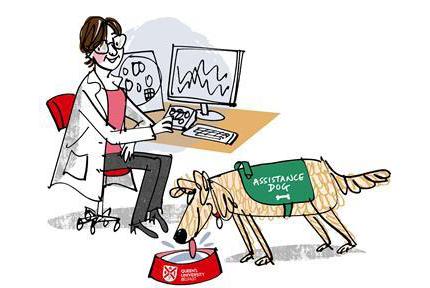
Case study example: Assistance dog
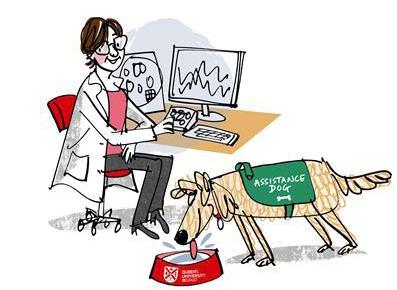
“An early career scientist working in an academic laboratory relies on an assistance dog to support their health and wellbeing. Assistance dogs are highly trained to perform specific tasks and provide alerts for disabled individuals or those with long term health conditions. These include guide dogs for visually impaired people, medical alert dogs which anticipate health episodes, and autism assistance dogs which help manage anxiety and sensory challenges. Having the dog present in the workplace makes a significant difference to the chemical scientist’s daily experience.
Colleagues are generally supportive, enjoy the dog’s presence and respect its boundaries. In this case, the dog does not enter the laboratory; instead, it stays in the upstairs office under the scientist’s desk
while they work in the lab. In case of an emergency, colleagues are prepared to assist by bringing the dog out of the office. However, there are also documented examples of procedures that allow dogs to enter laboratory environments, including protective measures such as specially designed lab coats and safety glasses for dogs.
Working in a postgraduate lab offers the scientist greater flexibility in managing their time, which also allows them to accommodate the dog’s need for regular outdoor breaks. Before the dog was introduced to the department, colleagues received a briefing, and a risk assessment was conducted to meet the requirements of the university estates service. This was the first time the university had accommodated an assistance dog in the workplace. The scientist had to advocate strongly for the arrangement, and the process took 3 months. However, their efforts led to the creation of a new policy, making it easier for future requests to be considered and improved.”
Launching the conversation together
Our report was launched jointly with the “Success for Disabled Acaemics in Science” (Success for disabled academics in science | Royal Society) report by the Royal Society during a webinar in November 2025, chaired by Elise Cartmell (Professor Elise Cartmell : Royal Society of Edinburgh) and joined by Paul Upchurch (Paul Upchurch | About | University College London), Hamied Haroon (Hamied Haroon - Research Explorer The University of Manchester) and Leonie Jones (https://www.linkedin.com/in/leonie-jones-8aa155100?originalSubdomain=uk). The webinar recording remains accessible at https://www. youtube.com/watch?v=xNXyyMRtVok
The Royal Society’s complementary report, Success for Disabled Academic Scientists (SDAS), provides valuable context on academic progression
Disability-Inclusive Laboratories in the Chemical Sciences
for academics in STEM subjects. It identifies five key pillars for improving equity in academia: departmental culture, disability policy, networks, line management, and funder practices. Together, these two reports can guide systemic change across the scientific ecosystem.
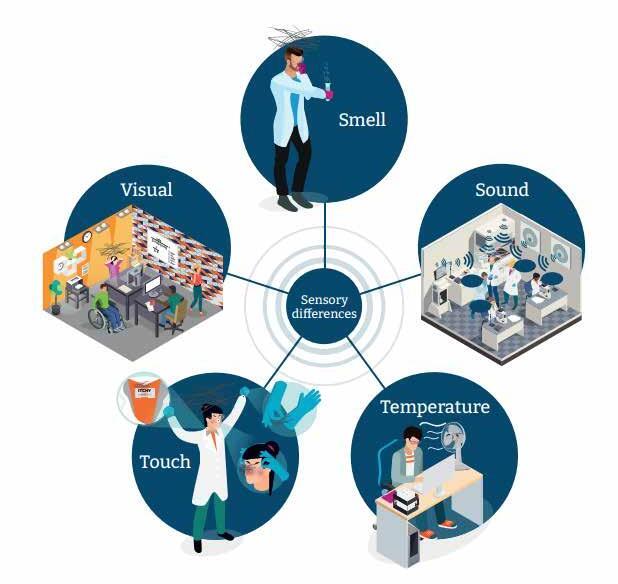
What an inclusive laboratory looks and feels like Chemistry is multisensory. The interplay of lighting, noise, space, and movement affects all users but can be particularly challenging for neurodivergent scientists. Inclusive laboratories adopt predictable layouts, adjustable lighting, quiet zones, captioned training materials, and interfaces compatible with assistive technologies. These interventions improve both safety and productivity. Culture also matters. Transparent processes for adjustments, respectful communication, and accessible meeting practices contribute to a supportive environment.
A call to allyship and to action
At the RSC, we know that sustainable change requires leadership across the community. This work set out the case for urgency and emphasised shared responsibility across institutions.
Inclusion is not an optional extra; it is essential to scientific excellence.
Sustaining momentum: next steps from the RSC
Our work on disability inclusion is part of the broader RSC Inclusion and Diversity strategy to 2030. https:// www.rsc.org/policy-and-campaigning/science-culture/ our-inclusion-and-diversity-strategy-to-2030.
Next steps include:
• Expanding the case study library with more examples across sectors.
• Developing resources to support the community to take part of this change.
• Partner with others to share good practices and learnings and advocate for disabled scientists. We will continue to convene webinars and events to share progress and invite collaboration. The webinar recording remains available for viewing.
How to engage today
• Read and share the report.
• Explore the case study library and select one idea to trial.
• Submit a case study to contribute to the growing evidence base.
• Discuss the findings and recommendations with your team. Working together to address the barriers for disabled scientists: https://www. youtube.com/watch?v=xNXyyMRtVok
Conclusion
Our findings show clearly where chemistry must improve and how. Inclusive laboratories are not just fairer; they are more creative, more innovative, and more productive. Our report and case study library are practical tools to help move the discipline forward. We invite the global chemistry community to partner with us in building laboratories where everyone can thrive.
Disability-inclusive laboratories in the chemical sciences. https://www. rsc.org/policy-and-campaigning/science-culture/disability-inclusivelaboratories-in-the-chemical-sciences
Royal Society of Chemistry, Burlington House, Piccadilly, London, W1J 0BA
Analytical Chemistry and Instrumentation and its Place in Early Education
by Michael N. Quigley
Despite its role as an interdisciplinary science, analytical chemistry, with its instrumentation connections, is frequently unrecognized or marginalized and often ignored entirely in early stages of chemistry education. This article examines why analytical chemistry and instrumentation (ACAI) is often overlooked, together with a compelling argument for why it should play an identifiably more dominant role in early chemistry courses.
The article was written independently of an ongoing IUPAC project “A Review of Current Status of Analytical Chemistry Education” (project 2019-039-3-500) first announced in 2020 [1]. Administered by Patricia Forbes of the Department of Chemistry, University of Pretoria, South Africa, the project’s objective is to recognize an erosion of analytical chemistry interests in academia. Together with this article’s observations regarding entrenched divisions, there seems to be an imbalance to the embracing and teaching of ACAI. While drawing attention to systemic shortfalls, the article seeks to act as a means of promoting ACAI’s prominence to current and future pupils and students.
Consider just one example, in the care and maintenance of volumetric glassware, lab equipment and instrumentation in general, it’s easy to see how adherence to seemingly simple guidelines can be downplayed or overlooked. However, the concerns should not be ignored since accuracy and repeatability can be affected with a concomitant undermining of teaching or research integrity well into the future.
Historical Perspective
ACAI is the branch of chemistry dealing with qualitative and quantitative determinations associated with all types of solids, liquids and gases. Long before the introduction of lab instrumentation that is so familiar today, analytical chemistry’s roots are traceable to an extended period in which alchemy served as a mythical pseudoscience. In their pursuit of the Philosopher’s Stone and transmutation of base metals, the alchemists made stumbling attempts to separate and identify substances and achieved some success in their discoveries. With later advances in gravimetric and volumetric methods of analysis came increasing interest in how substances are comprised, foreshadowing what we know today as assaying. Still later, developments in spectroscopy, chromatography and other instrumental methods of analysis established ACAI’s relevance as an important branch of chemistry.
Importance in Contemporary Science and Engineering
ACAI is critically important in every aspect of our modern lives, and quality control is all pervasive. Quality control labs are operated by a diverse array of manufacturers from those involved with food and drink, through pharmaceuticals production and thousands of other applications. Imagine too, the QC labs involved with steel production for car manufacturing or other labs involved with semiconductor production. ACAI also plays important roles in environmental analysis, clinical analysis, forensic science and agricultural science to name only a few specializations. As such, it isn’t an exaggeration to state that ACAI’s underlying principles are the framework upon which our modern technological society is built. Imagine applied chemistry without analytical balances, volumetric apparatus, analytical instrumentation and the chemistry associated with thousands of procedures. In appreciating this and much more, the full scope of ACAI’s influence is demonstrably all encompassing.
Marginalization
Despite phenomenal advances, there’s a continuing tendency for ACAI to be viewed in academia as merely a support service being assimilated into the organic, inorganic and physical chemistry purviews. It’s an assimilation that is so seamless that the resultant integration has shaped and continues to shape the hierarchical structure of chemistry departments worldwide, together with the dissemination of research funding and the design of chemistry curricula and content of general chemistry textbooks.
There are a number of reasons why ACAI is less well recognized or appreciated as a chemistry discipline compared with the universally more familiar practical disciplines of organic, inorganic and physical chemistry:
1. Tradition. University chemistry departments evolved from an organic and inorganic chemistry hierarchy into the three-branch system over a hundred years ago. Eventually, other specialist or blended disciplines were added to this core. Latterly, theoretical, analytical, biochemistry and chemical biology disciplines have had equal prominence at some universities. However, in most schools, and many smaller colleges and universities, the core of three remains the dominant structure to the detriment of the other disciplines.
2. Curricular Changes and Overload. Changes in curricula content are slow to be accepted, due in large part to adherence to established teaching
practices, standardized testing and textbook publishing. In addition, if new content is added there is a danger that all topics receive a less thorough introduction or else uneven treatment.
3. Financial Constraints. Many schools do not have the resources to justify purchase of appropriate acquisitions.
4. Teacher Training. With their own education following traditional routes, many teachers have limited training in ACAI.
5. Testing Practices. Rote learning is often thought of as a faster means of acquiring knowledge as compared to meaningful or conceptual learning that require critical thinking skills.
6. Finesse and Topicality. There is a tendency to view ACAI as an applied, practical or technical science that lacks the elegance of the core disciplines. Some specializations including molecular biology, materials science and nanotechnology have also struck a chord with the public and professional consciousness. Over many decades, these and other specializations have drawn attention, talent and resources away from ACAI teaching and research.
The unfortunate consequence of all these factors is that generations of young students furthered their education and began their careers with an incomplete view of chemistry. Thus, a self-perpetuating cycle that began decades ago continues to this day. Conscious or not, this epistemic deficiency has led to a lack of appreciation for ACAI in particular.
A New Pedagogical Strategy
Addressing what might be seen as a series of oversights deserves some corrective steps and it takes only a few hours at the start of a school term or college semester to introduce some important and easy to understand ACAI concepts. There are many concepts that could be chosen including sampling, data and results interpretation and an introduction to BIPM JCGM’s “Guide to the Expression of Uncertainty in Measurement” (GUM) protocols [2]. However, an approach that always works well includes teaching the following topics that can be tailored for content and duration:
• Basic statistics
• Volumetric glassware care and maintenance
• Volumetric glassware performance and checking
• Selected simple instrumentation (including pipettors and bottle-top dispensers)
• Instrumentation performance checking and calibration
• Analytical balance performance checking and calibration
• Primary standards for solution preparation
Of course, accompanying lab classes would be the perfect complement.
The rationale follows a logical progression with each topic’s relevance to the next becoming apparent as the introduction proceeds. For instance, the use of basic statistics as well as the cleanliness of volumetric glassware feature prominently in the checking and calibration of glass pipettes and burettes, pipettors and dispensers. Similarly, statistical theory can be invoked during an introduction to simple instrumentation including piston operated volumetric apparatus (POVA) devices and especially those more familiarly known as pipettors and dispensers.
While easy to understand, the topics are deceptively multi-layered in their complexity. The topics could be described as part of a dedicated syllabus or else woven into existing curricula. It’s important at this level though that boundaries between ACAI and the other practical branches are not blurred. It’s especially important with a woven curricula that the concepts are illustrated and identified under the ACAI umbrella. In this way, ACAI’s placement and scant early recognition is replaced by a sense of proper placement among the other practical disciplines.
Didactic Rationale
With reference to the aforementioned list, some topics are easy to appreciate as being important. As mentioned earlier, an understanding of basic statistics is useful in the checking of volumetric glassware and instrumentation, and it’s an easy matter to create a
Analytical Chemistry and its Place in Early Education
spreadsheet to aid in the assessments. Those values that are of particular interest are the determination of the mean dispensed volumes, % accuracy, % coefficient of variation and standard deviation.
Similarly, checking the performance and calibration of analytical balances and instrumentation can be addressed as being part of a preventative maintenance routine. Further, the use of primary standards can be described in terms of the care and attention required in preparation of standard solutions. Considerations could include choice of primary standard, and minimum drying temperature and drying time duration to prevent degradation products being formed.
Perhaps counter-intuitively, the care and attention of volumetric glassware is worthy of the most discussion, and the following should prompt all of us to inspect our own glassware:
All glass volumetric flasks, pipettes and burettes and especially those that have been inherited or retrieved from long-term storage need to be checked before further use. Simple soaking in detergent solution provides no guarantee of cleanliness especially when inspecting glassware that has been allowed to dry. Flasks can easily be checked by adding a little deionized water, sealing, inverting and observing the wetting properties of the glass. Flasks that exhibit beading and streaking in the necks or bodies are contaminated and need thorough cleaning. Similarly, by filling flasks with water to the graduation mark, deviations in the shape of the normal concave meniscus clearly indicate contamination. Only the complete absence of water beading or streaking, and the perfect formation of a concave meniscus will result in compliance with the “To Contain (TC)” specifications of the flasks. Beads and streaks of water in the necks of flasks add to the volume and make nonsense of filling to the graduation mark. In a test of observation, pupils or students could be provided with perfectly clean flasks, and other flasks that have been intentionally contaminated with dichlorodimethylsilane that reverses the normal glass-water characteristics. Potential discrepancies in flasks can be seen to be exacerbated in the use of glass pipettes and burettes and their associated “To Deliver (TD)” specifications.
There are a few ways in which volumetric flasks can be maintained in good condition:
• Use one group of flasks for preparation of aqueous/acidic/basic solutions and another group of flasks for preparation of organic solutions.
• Avoid use of pegged drying boards and use wide
diameter plastic tube racks to angle and dry small volume flasks.
• Do not allow used flasks to dry before cleaning.
• Clean flasks that have been used for preparation of aqueous/acidic/basic solutions with tap water and deionized water only.
• Clean flasks that have been used for preparation of organic solutions by soaking in detergent solution and use a bottle brush prior to normal cleaning with water.
• Consider purchasing a large ultrasonic bath and preferably one with a heat function. Use with detergent solution, orienting the flask necks to face the bath transducers so the pressure waves enter the flasks. To establish the placement of the transducers (and incidentally check on their power), vertically suspend a sheet of aluminium foil parallel to the length and then the width of the bath). Observe in which orientation the sheet is perforated and situate the glassware accordingly.
Summary
Early chemistry education can shape pupil and student awareness and hopefully steer their interest toward the field in general. However, in attracting the next generation of analytical chemists and science technologists, more needs to be done to bring ACAI to the forefront of the chemical sciences. Opportunities are being lost in early education in not recognizing ACAI at all or according it a merely supporting role in furtherance of the traditional core of disciplines. In an age when AI is inadvertently challenging thinking skills, ACAI training with its inherent focus on critical thinking needs to be cultivated and encouraged.
References
1. IUPAC project “A Review of Current Status of Analytical Chemistry Education” (https://iupac.org/ project/2019-039-3-500/) first announced in Chem Int, July 2020, p.29; https://doi.org/10.1515/ci-2020-0320.
2. The multipart GUM is produced by the Joint Committee for Guides in Metrology (JCGM) as administered by the Bureau International des Poids et Measures (BIPM), under JCGM GUM1-2023-BIPM (for example). In addition, the guides are licensed for dissemination by BIPM member bodies such as IUPAC and ISO/IEC. https://www.bipm.org/en/committees/jc/jcgm/publications
Michael N. Quigley is Founder (1997) & CEO at Createc Corporation, former Assistant Director & Manager, Cornell Nutrient Analysis Laboratories; https://orcid.org/0000-0002-2104-0365
From Chaos to Innovation: The Evolution and Promise of Semiconducting Polymers
Adapted from a Plenary talk at 2025 World Chemistry Congress and Okinawa Institute of Science and Technology (OIST) 2023 Provost Lecture <https://youtu.be/PkDkBk41qeM> by Christine Luscombe, Professor, Okinawa Institute of Science and Technology (OIST)
by Neil Gussman and Christine Luscombe
Serendipity of Science
Scientific discovery often occurs out of a series of accidents, but taking pause to learn and understand them can lead to disruptive technologies. The story of semiconducting polymers is one such example. It involved a mistake in the 1970s where a post-doc in the Shirakawa group accidentally added a catalyst concentration 1000 times higher than intended [1]. This resulted in a silvery, metallic-looking film of polyacetylene instead of the usual intractable, insoluble powder. This accident led to the groundbreaking measurements of doped polyacetylene, a material that would earn Alan Heeger, Alan MacDiarmid, and Hideki Shirakawa the 2000 Nobel Prize in Chemistry.
They introduced halogen vapors such as chlorine, bromine, or iodine to polyacetylene, and were able to dope the polymer film, a process by which the polymer donates electrons to an acceptor, in this case the halogen [2]. The polymer is left positively charged, which allows for electrical conductivity. The generally held belief that plastics are insulators was shattered. While this conductivity had been theoretically predicted and observed in inorganic polymers, it had not been shown in organic polymers. The created materials
had conductivities previously thought not possible in organic compounds and conductivities of metals. This marked the birth of a field that continues to revolutionize technology. These early discoveries gave rise to a wide array of organic semiconductors that were lightweight, flexible, and cost-effective with intriguing optical and electronic properties.
Embracing the mess
Realizing the potential of these materials, especially those of polymeric semiconductors, requires overcoming an intrinsic hurdle, which is the nature of polymers themselves. Unlike traditional materials such as metals and ceramics, which possess well-defined periodic structures and chemical formulas, polymers present an intrinsic challenge: disorder. When we synthesize small molecules, we can confirm their exact chemical formulae and structure. In contrast, polymers lack a singular molecular weight or a uniform chemical composition. Polymers are often visualized as tidy, linear chains, but real-world polymers are anything but. They are mixtures of chains of varying lengths often depicted as a bowl of cooked spaghetti where the chains are tangled and overlapping. In addition to the single chain structure, their ensemble structure is also complicated. Depending on the degree of crystallinity of the material, the morphology may comprise of crystalline domains embedded within amorphous matrices or they could be fully amorphous or have network structures. While metals derive their properties from ordered atomic arrangements, polymers owe theirs to entanglements.
In the context of electronic materials, this mess can be problematic. In traditional semiconductors, charge transport relies on order giving them band-transport
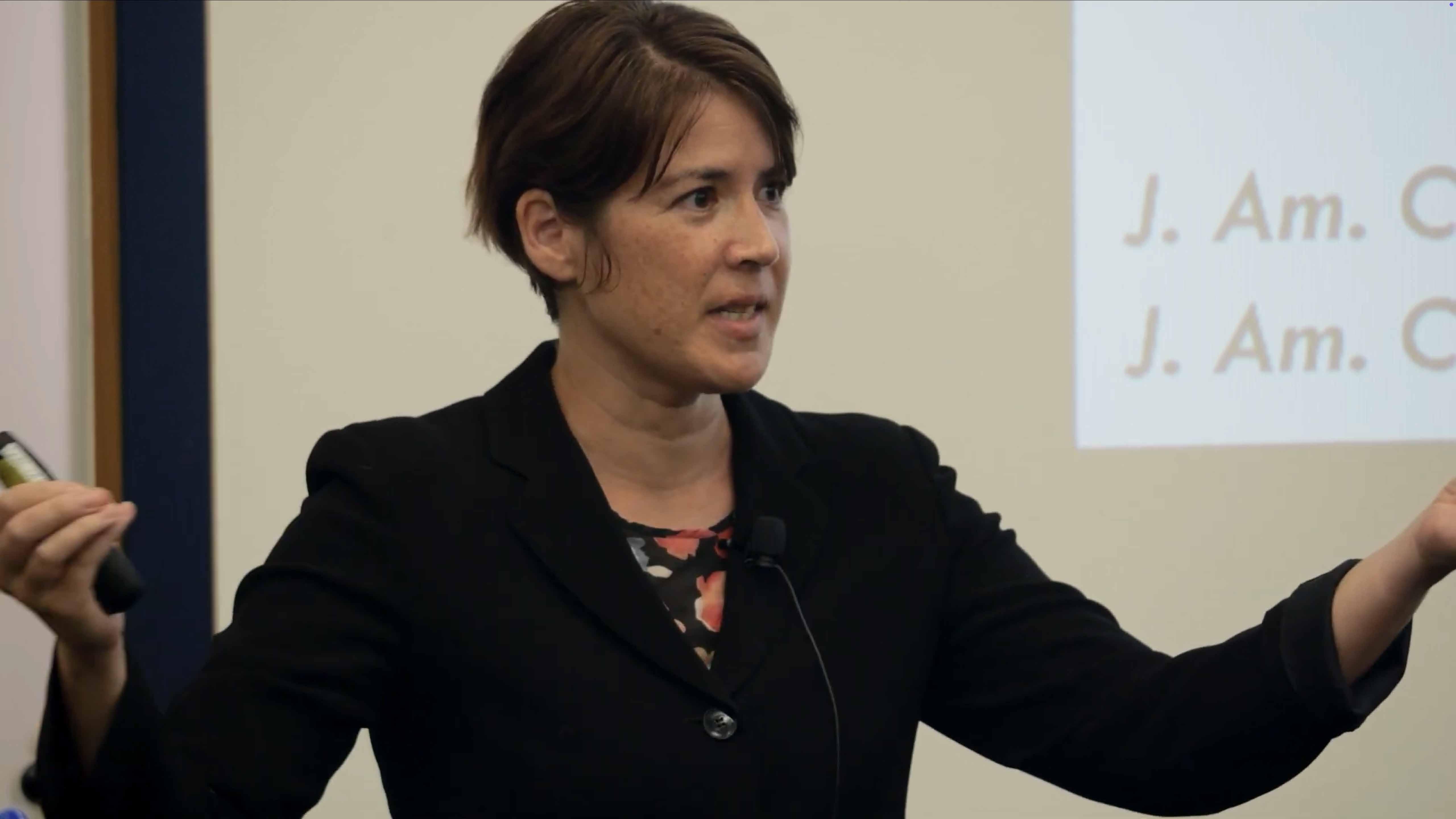
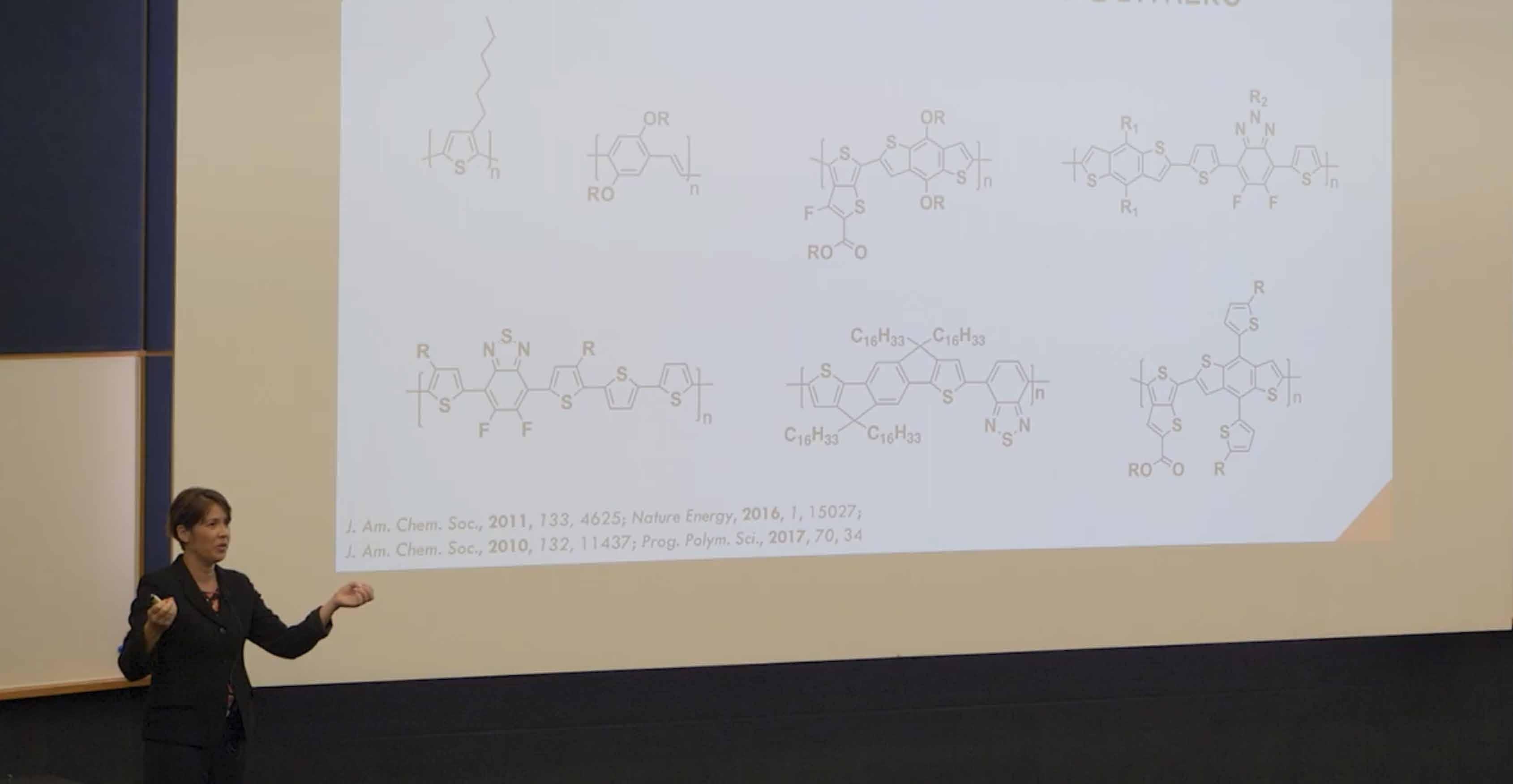
Christine Luscombe presenting at the OIST Provost Lecture Series on 22 Sep 2023
properties. In a polymer, the charge must hop from one chain to another or navigate along an often-twisted polymer backbone.
Turning disorder into design through precision synthesis
To overcome this problem, one could design improved characterization tools, and much work is underway to do so. Another way to do it would be through precision polymer synthesis. By controlling polymer chain length and monomer sequence, polymer researchers would be able to produce materials with predictable and tunable properties. This level of control is especially important in semiconducting applications, where electronic performance is sensitive to even slight changes in molecular architecture. Polymerizations that afford control have been developed for insulating polymers. Examples of these include atom transfer radical polymerization (ATRP), reverse addition-fragmentation chain transfer (RAFT) polymerization, living anionic polymerization, as well as living cationic polymerizations. However, the chemistry is less developed for semiconducting polymers that have a conjugated structure with alternating single and double bonds.
Traditionally, the synthesis of conjugated polymers has relied heavily on polycondensation mechanisms, specifically, metal-catalyzed cross coupling reactions such as standard Suzuki-Miyaura or Stille couplings. While effective for generating bulk material, polycondensation reactions are inherently limited by the Carothers equation; high molecular weights are only achievable at very high conversion, the reaction is very sensitive to monomer purity, and the resulting polymers typically exhibit broad molecular weight distributions (dispersity, Đ > 2). In the context of organic electronics, this heterogeneity can be detrimental. The
batch-to-batch variability in product leads to variable performances in devices.
A class of polymerizations that facilitates control in the synthesis of semiconducting polymers is catalyst transfer polymerizations (CTP). First pioneered by McCullough [3] and Yokozawa [4], these polymerizations offer the possibility of polymerizations with living characteristics where the molecular weight can be controlled by the monomer to catalyst ratio, and chain extension can be observed with addition of more monomer. In CTP, the metal catalyst, often Ni or Pd, is thought to form a p-complex with the growing polymer chain. This association is thought to enable intramolecular transfer along the polymer chain, allowing the catalyst to “walk” along the conjugated backbone to the terminal reactive site, ensuring that one monomer at a time is added to the growing polymer chain. This contrasts with conventional metal-catalyzed cross-coupling reactions where the catalyst is assumed to dissociate from the chain enabling random coupling reactions.
The CTP also addresses the issue of end-group fidelity, which is where the external initiated synthesis of semiconducting polymers developed by Luscombe comes into play [5]. The chemistry allows for the synthesis of 100% regioregular polymers while also allowing for polymers with controlled end-groups on the a and w-ends of the polymer. In a semicrystalline polymer lattice, the chain ends are defects. If the chain ends terminate in the middle of the crystal, the chain end acts as a discontinuity in the conjugation pathway impeding charge transport. Through CTP, the polymer chain length can be made to be commensurate with the dimensions of the crystal ensuring that end-groups are ejected into the amorphous matrix preserving the integrity of charge transport pathways in the crystals.
From Chaos to Innovation: The Evolution and Promise of Semiconducting Polymers
Looking towards more sustainable synthetic methods
Sustainability is another emerging priority. Traditional synthesis routes often involve hazardous reagents and energy-intensive processes. Efforts are now underway to develop greener, more sustainable methods of producing semiconducting polymers. This includes using bio-derived feedstocks and environmentally friendly catalysts, as well as designing polymers that are easier to recycle or degrade at the end of their lifecycle.
Semiconducting polymers show remarkable performances these days and high-performance donor polymers in organic photovoltaics (OPVs), such as the benzodithiophene-based D18, have achieved solar cell efficiencies exceeding 18%, rivaling commercial silicon photovoltaics [6]. However, the synthesis of these polymers is arduous. D18, for instance, requires at least 15 synthetic steps. This translates to months of labor and significant solvent waste. Traditional cross-coupling methods make things worse by requiring the need to use stoichiometric amounts of an organometallic reagent. Furthermore, for cross-coupling reactions such as Stille, the organometallic reagents are toxic.
With this in mind, a reaction known as Direct Arylation Polymerization (DArP) has been popularized by researchers such as Leclerc [7], Kanbara [8], and Thompson [9]. Given the inertness of common C-H bonds, and the presence of numerous C-H bonds in any given molecule, DArP makes reactivity and specificity a challenging issue. However, with judicious catalyst selection one can overcome these challenges. Luscombe discussed using their expertise to go one step further by achieving a controlled polymerization using DArP and using a dual catalytic system to achieve a reaction that a single catalyst cannot perform. [10] She also presented on cross dehydrogenative coupling (CDC) reactions where two unfunctionalized monomers are coupled together to form an alternating copolymer. [11] This reaction is even more challenging in terms of selectivity. Here again, a dual catalytic system can help overcome selectivity challenges.
High performance can be obtained in messy systems too
The final part of the plenary talk discussed a family of polymers known as indacenodithiophene (IDT)-based polymers. Popularized by McCulloch [12], this is a polymer that confused the field of organic electronics by showing limited long-range order while possessing high charge mobility. Luscombe discussed how her
collaborations with the research groups of Spano, Salleo, and Stingelin have helped to uncover, alongside other researchers, that these IDT-based polymers are more like fettucine (if one were to continue the analogy of pasta for polymers), and this structure gives rise to 1D transport instead of 2D transport observed in more traditional semiconducting polymers such as poly(3-hexylthiophene) (P3HT) [13].
Conclusion
Semiconducting polymers represent a remarkable convergence of complexity and utility. They challenge conventional paradigms of material science while opening doors to a future of flexible, lightweight, and sustainable electronic devices. What began as an accidental discovery has grown into a field rich with possibility. While much work remains to be done in order to achieve a highly controlled polymerization for semiconducting polymers, advances in synthesis can provide insight into how these materials function.
1. N. Hall, Chem. Commun., 2003, 1.
2. H. Shirakawa, E. J. Louis, A. G. MacDiarmid, C. K. Chiang and A. J. Heeger, J. Chem. Soc., Chem. Commun., 1977, 578.
3. E. E. Sheina, J. Liu, M. C. Iovu, D. W. Laird and R. D. McCullough, Macromolecules, 2004, 37, 3526.
4. T. Yokozawa and A. Yokoyama, Chem. Rev., 2009, 109, 5595.
5. H. Bronstein and C. K. Luscombe, J. Am. Chem. Soc., 2009, 131, 12894.
6. Q. Liu, Y. Jiang, K. Jin, J. Qin, J. Xu, W. Li, J. Xiong, J. Liu, Z. Xiao, K. Sun, S. Yang, X. Zhang, and L. Ding, Sci. Bull., 2020, 65, 272.
7. J.-R. Pouliot, F. Grenier, J. T. Blaskovits, S. Beaupré and M. Leclerc, Chem. Rev., 2016, 116, 14225.
8. J. Kuwabara, T. Yasuda, S. J. Choi, W. Lu, K. Yamazaki, S. Kagaya, L. Han, T. Kanbara, Adv. Funct. Mater., 2014, 24, 3226.
9. R. M. Pankow and B. C. Thompson, Polym. Chem., 2020, 11, 630.
10. J. Lee and C. K. Luscombe, ACS Macro Lett., 2018, 7, 767.
11. L. Xing, J.-R. Liu, X. Hong, K. N. Houk, C. K. Luscombe, J. Am. Chem. Soc., 2022, 144, 2311.
12. W. Zhang, J. Smith, S. E. Watkins, R. Gysel, M. McGehee, A. Salleo, J. Kirkpatrick, S. Ashraf, T. Anthopoulos, M. Heeney, and Iain McCulloch, J. Am. Chem. Soc., 2010, 132, 11437.
13. G. LeCroy, R. Ghosh, P. Sommerville, C. Burke, H. Makki, K. Rozylowicz, C. Cheng, M. Weber, W. Khelifi, N. Stingelin, A. Troisi, C. Luscombe, F. C. Spano, and A. Salleo, J. Am. Chem. Soc., 2024, 146, 31, 21778.
Hed IUPAC-Solvay Award
25-Year Retrospective
The IUPAC-Solvay International Award for Young Chemists has now been awarded for over 25 years, beginning in 2000 and generously sponsored by Solvay since 2014. The IUPAC-Solvay Award was established to encourage young research scientists at the beginning of their careers, and are given each year for the most outstanding Ph.D. theses in the general area of chemical sciences. IUPAC is proud to reflect on the influence of the IUPAC-Solvay award on the careers of recent winners.
Information about the award and the 2026 application cycle can be found here: https:// iupac.org/what-we-do/awards/iupac-solvayinternational-award-for-young-chemists/
What is the IUPAC-Solvay Award
IUPAC’s strategic plan emphasizes scientific excellence and objectivity as well as diversity and inclusiveness, including particularly the encouragement and support of young scientists. The IUPAC-Solvay Award addresses all of these imperatives.
Entrants must have received their Ph.D. (or equivalent) degree, or completed all Ph.D. requirements including successful defense of their doctoral thesis, in any of the countries that are members (National Adhering Organizations) of IUPAC. The research described in an applicant’s thesis must be in the field of the chemical sciences, defined as “chemistry and those disciplines and technologies that make significant use of chemistry.”
In addition to a 1000-word essay describing their thesis work, applicants for the Award supply two supporting letters, one from their thesis adviser and/or chair of their thesis committee and one from an additional faculty member who is familiar with the applicant’s thesis work, commenting on the qualifications and accomplishments of the applicant and the significance of the thesis work.
Awardees are chosen from among dozens of applicants each year by a Jury that historically comprises members of the IUPAC Bureau (now Executive and Science Boards) along with the advice of a Solvay scientist, and which is led by the immediate IUPAC Past President. Recently, early-career scientists external to IUPAC, including members of the 2019 Periodic Table of Younger Chemists, were appointed to the Jury as well. The Jury makes efforts to ensure inclusivity with respect to gender and geographical distribution in their selection of the winners.
The prize for the winners includes a USD $1,000
cash award along with travel expenses to the IUPAC Congress and General Assembly, where awardees are invited to present a poster on their research and to participate in a plenary award session. They are also expected to submit a review article on their thesis research for publication in Pure and Applied Chemistry. Since 2000 the Award has recognized 128 young scientists and granted Honorable Mention status to many others. Awardees earned their degrees in two dozen different countries, and they now hold academic, government, and industrial positions in chemistry and related sciences and engineering all over the world.
How has this award engaged the winners?
Receiving this award has fueled passion, purpose, and commitment in many of the recent winners. Awardees expressed feeling validation of their work and that the recognition has already opened doors. Importantly, many of these early-career researchers have felt buoyed by the sense of community and the connections they made within IUPAC.
Select quotes from awardees follow.
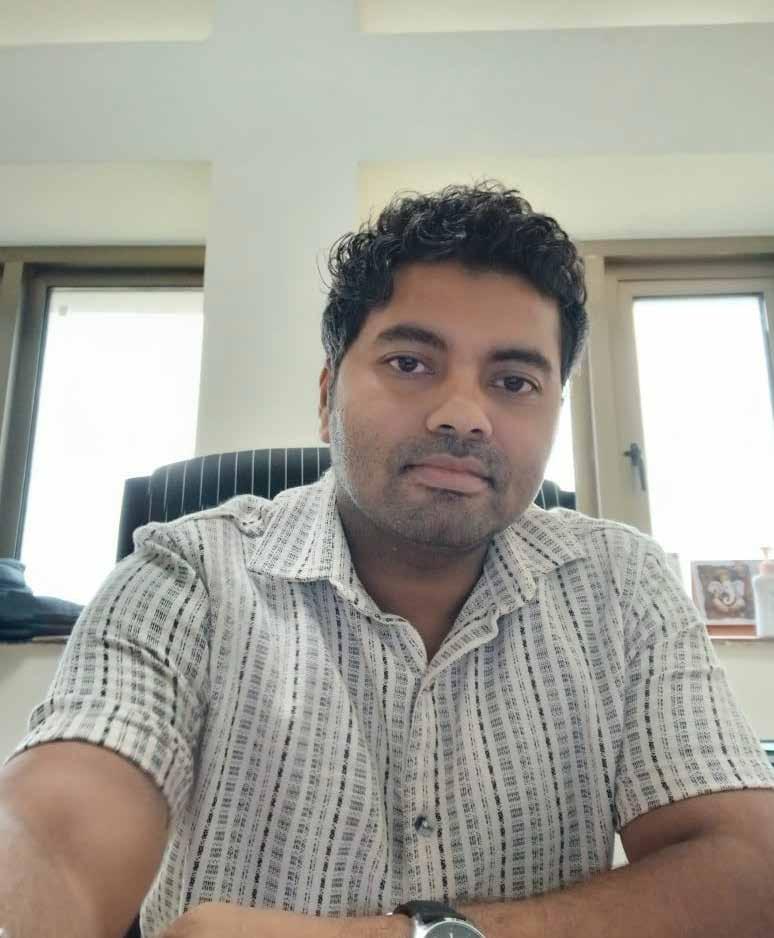
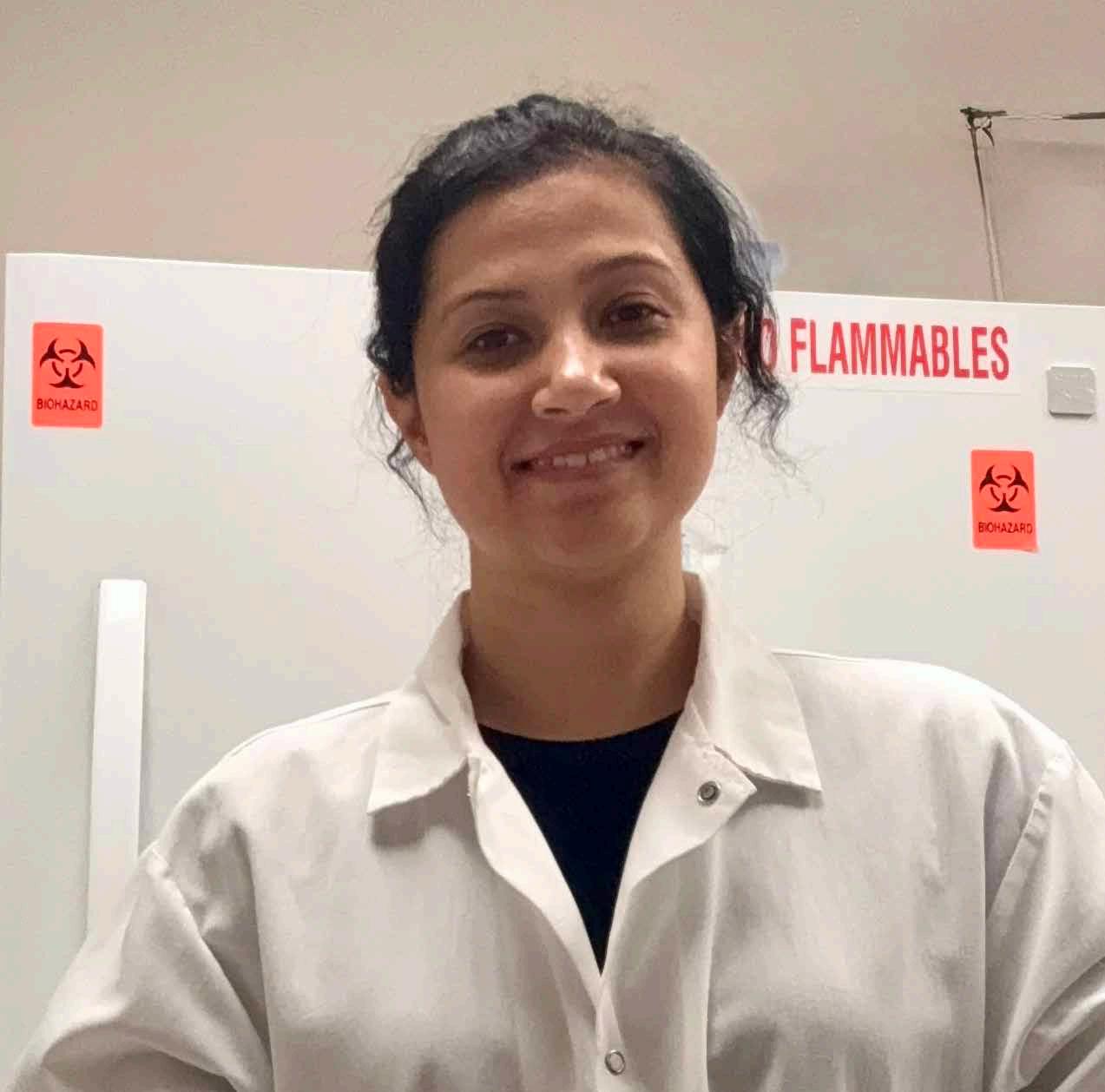
Palas Roy, 2018
Assistant Professor, Indian Institute of Technology Bhubaneswar, India
Winning the IUPAC–Solvay Award transformed recognition into responsibility—fueling my passion to innovate, mentor, and make chemistry a force for global progress.
Receiving the IUPAC–Solvay International Award for Young Chemists (2018) marked a defining milestone in my career as a physical chemist. The recognition brought international visibility to my research, enhanced my professional credibility, and opened new pathways for global collaboration. It also played a pivotal role in fueling my pursuit of independent research and mentorship with renewed enthusiasm as an Assistant Professor at IIT Bhubaneswar. The award inspired me to uphold the highest standards of scientific excellence and strengthened my commitment to nurturing young researchers. Beyond professional advancement, it instilled in me a deep sense of purpose—motivating me to drive sustainable innovation and to promote physical chemistry as a catalyst for societal progress.
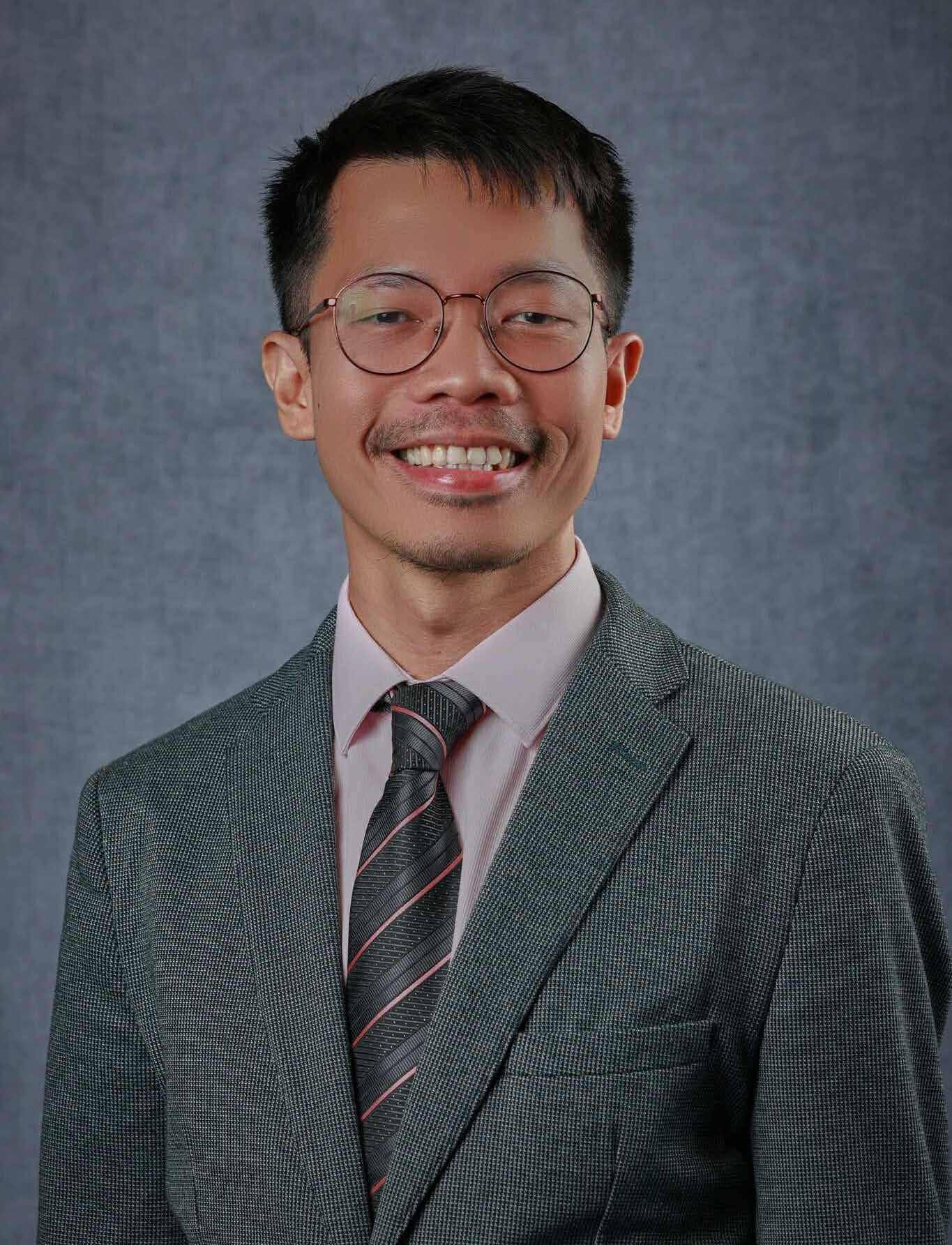
Dane deQuillettes, 2018
Assistant Professor, Princeton University, USA
As a kid I used to have the IUPAC periodic table taped on my bed nightstand—dreaming of one day becoming a scientist. Being recognized by IUPAC for one of the best PhD theses in the chemical sciences was a huge personal honor but also helped me land my dream job as a professor.
Gabriele Laudadio, 2021
Principal Investigator, University of Graz, Austria
as an assistant professor at The Chinese University of Hong Kong, Shenzhen, where I hope to inspire future generations of scientists.
The IUPAC Solvay International Award for Young Chemists was a pivotal milestone that elevated my profile as a scientific leader, providing global recognition for my contributions to chemical sciences and sustainable innovation.
Retrospectively, receiving the IUPAC–Solvay Award marked a significant turning point in my career. This recognition not only gave me confidence in the direction of my research but also reaffirmed the importance of pursuing innovative and sustainable approaches in chemistry. I truly appreciate how the scientific community values this award and actively supports its recipients in achieving their goals.
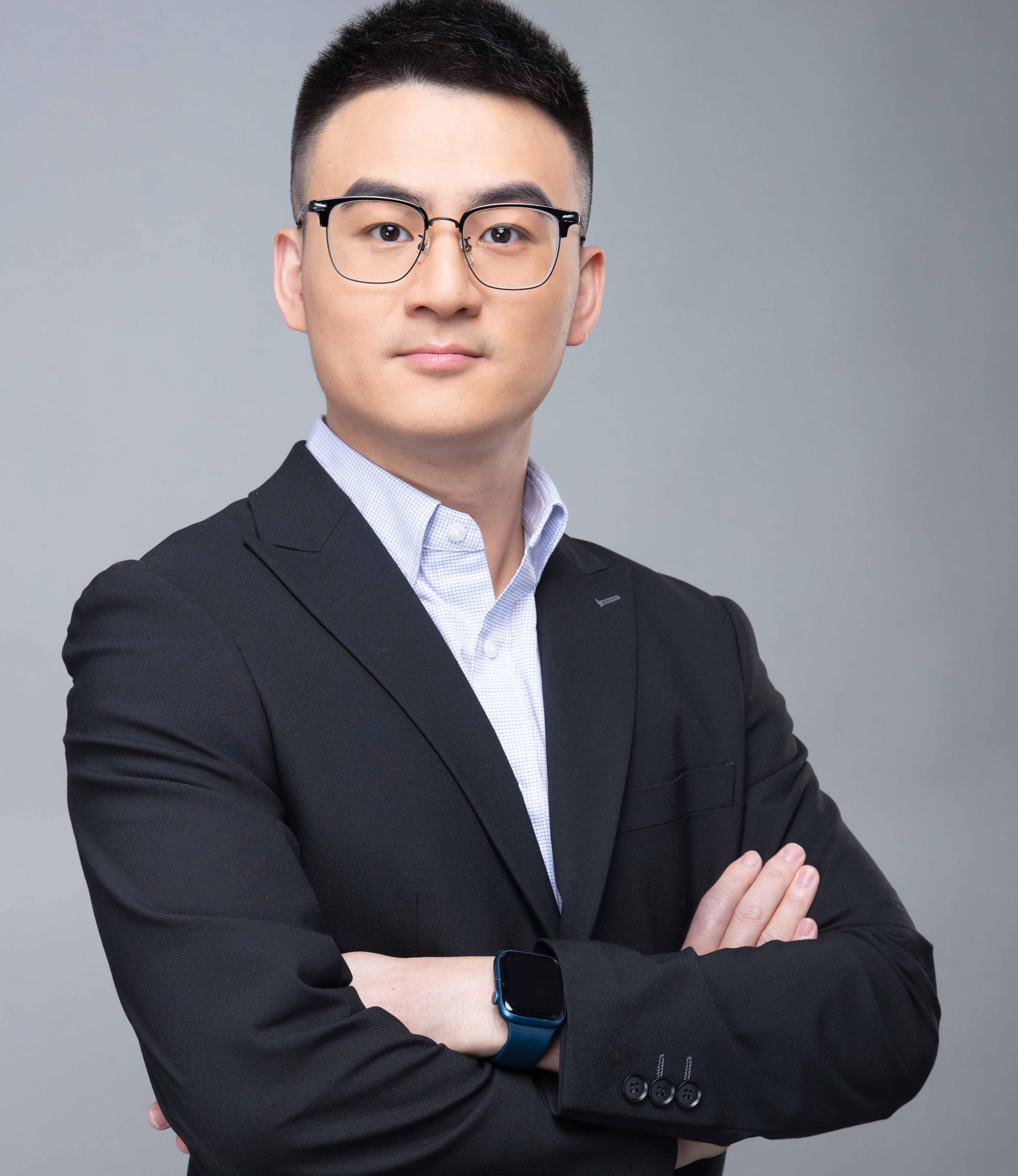
Jianbin Li, 2022
Assistant Professor, Chinese University of Hong Kong, Shenzhen, China/Beijing
This honor opened doors to international collaborations and leadership roles, empowering me to spearhead transformative projects in climate technology and energy transition, notably in national chemical societies (German Chemical Society, American Chemical Society, Belgian Chemical Societies, and American Institute of Chemical Engineers). It also amplified my voice in science communication and policy, enabling me to mentor the next generation of innovators and advocate for sustainable solutions.
Today, the IUPAC Solvay award continues to cement my influence in the climate tech innovation space, fueling my commitment to impactful research and industrial leadership for a sustainable future.
Gabrielle Mandl, 2024 Chemistry Teacher, John Abbott College, Canada
Winning the 2022 IUPAC-Solvay award is a thrilling and profound honor. As my first international award, it validates the work and time I dedicated to my research at McGill. This incredible recognition fuels my passion, strengthening my resolve to pursue a career in scientific research. It inspires me to continuously learn, grow, and aim higher. This achievement is not an endpoint, but a brilliant beginning on my journey to now
Winning this award has given me great confidence in who I am as a chemist. It has also inspired my students to know that they can work hard and become a great chemist if that is what they want to do. It feels good to show these young minds that the scientists who win these awards are not untouchable or unrelatable, they are people just like them!
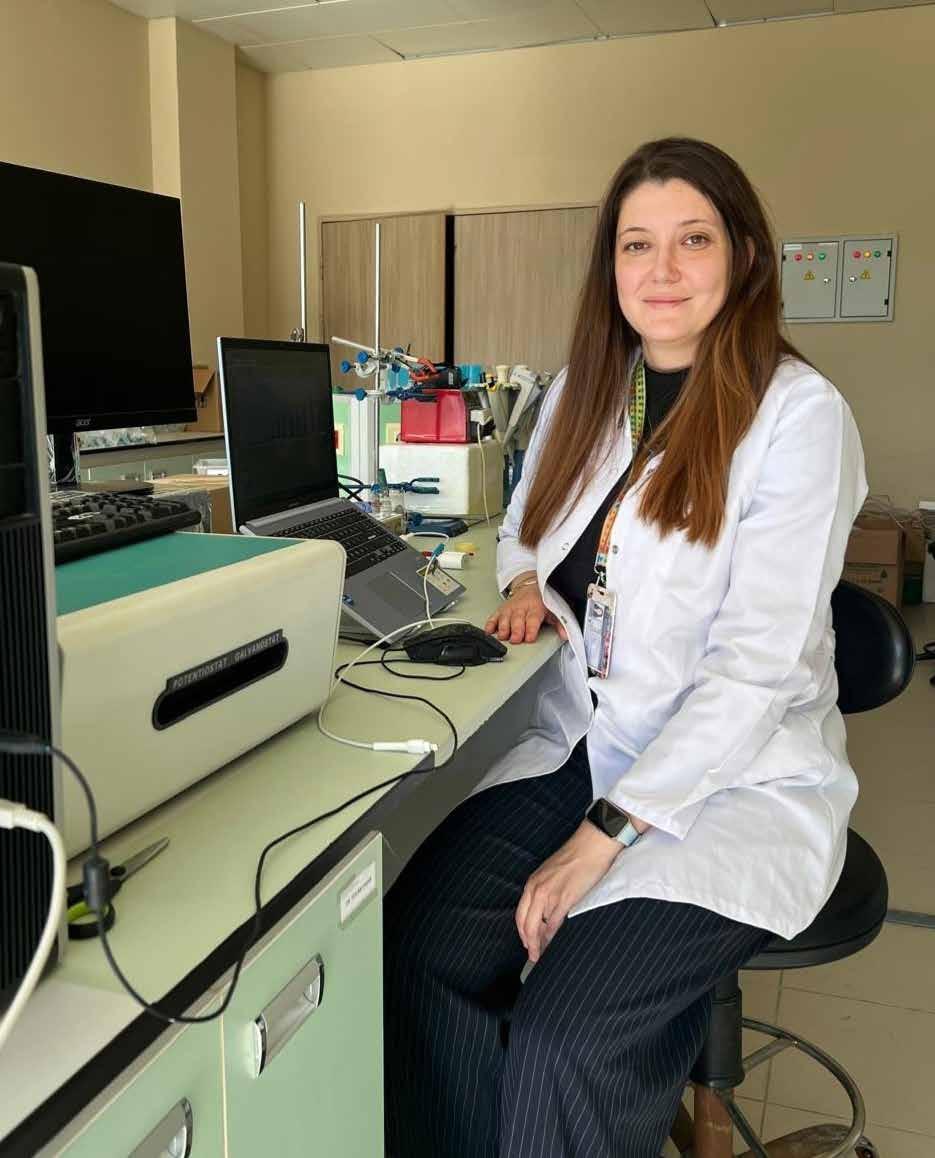
Selen Ayaz, 2025 Research Assistant, Canakkale Onsekiz Mart University, Turkiye
As the inaugural scientist from Türkiye, receiving the IUPAC–Solvay International Young Chemists Award instilled profound pride and elation in me. It was a profoundly emotional occasion—not merely a personal accomplishment but also a significant milestone for
IUPAC-Solvay Award 25-Year Retrospective
my nation’s scientific community. I was thrilled to represent Türkiye on such a prestigious international platform. This recognition strengthened my belief that any part of the world can make important scientific discoveries if they are passionate, dedicated, and supported. The accolade has markedly enhanced my confidence and prominence within the global scientific community. It created fresh avenues for collaboration and motivated me to engage in innovative, multidisciplinary research initiatives. This acknowledgment from IUPAC inspires me to persist in advancing sustainable sensor technology that can tackle global analytical and environmental issues. It has also motivated my students and colleagues, demonstrating that significant research can arise from passion and tenacity. Exhibit curiosity, patience, and audacity in your scientific endeavors. Each experiment, regardless of its outcome, advances you incrementally toward discovery. Engage with mentors who motivate you and colleagues who stimulate your growth. Recognize that your thoughts hold significance—even minor contributions can result in substantial progress. Primarily, relish the experience of acquiring knowledge and engaging in creation. Chemistry has the capacity to alter lives, and you are integral to that metamorphosis.
Further Testimonies
Austin Evans, 2020
Stefano Ippolito, 2022
Postdoctoral Researcher, Institute of Materials Science of Madrid, Spain
Assistant Professor, University of Florida, USA
Looking back, the most important thing about the IUPAC-Solvay International Award for Young Chemists was all the other outstanding researchers from around the world that it facilitates connections with. Despite many of us connecting through the COVID-19 pandemic shutdowns, it led to friendships that endure to this day. The IUPAC Award and these connections certainly helped my career as a researcher in the transition to scientific independence.
In retrospect, I genuinely believe that the “IUPAC-Solvay International Award for Young Chemists” marked a turning point in my scientific career. At first, I thought it was just a recognition for my hard work during the PhD, but it was much more than that. The award and participation in the “49th IUPAC World Congress of Chemistry” sparked in me a desire to further expand my network and embark on new adventures, leading to my postdoctoral studies in the US. While I navigate this experience, I have no doubt this award will help me to secure a Professorship soon.
Juliane Sempionatto, 2022
Assistant Professor, Rice University, USA
The IUPAC award was both an honor and a catalyst—it affirmed the value of my research to the global scientific community, opened doors to remarkable opportunities, and continues to inspire my work as an Assistant Professor at Rice University.
Craig Day, 2023
Assistant Professor, University of Copenhagen, Denmark
The IUPAC-SOLVAY award was a pivotal vote of confidence, transforming my pursuit of academia and validating my scientific instinct to question what others overlook.
IUPAC-Solvay Award 25-Year Retrospective
Apurva Panjla, 2023
Postdoctoral Research Associate, University of Wisconsin-Madison, USA
A reflection of my PhD journey and the inspiration that kept me striving to make a difference in human health
Receiving the esteemed IUPAC-Solvay award for my PhD thesis was one of the most emotionally and personally rewarding moments of my life. It reminded me of every challenge I had overcome and deepened my passion for science. This honor reaffirmed my belief that persistence, curiosity, and integrity pave the way to meaningful impact, inspiring me to continue contributing to research that advances human health.
Jiarui Yang, 2025
GRAP, City University of Hong Kong, China/Beijing
This prize holds a great deal of significance for me. It not only introduces me to a broader world of chemistry, but also allows me to meet and get to know many other scientists during the conference in Malaysia.
Reflection
“One of the most important things we do at IUPAC is to recognize and support the very best early-career scientists. They embody what our discipline can contribute to solving humanity’s most pressing challenges. Their achievements remind us of the power of human ingenuity and the extraordinary potential of the next generation of chemists. We are deeply grateful to Solvay for their continued support, which has made this award possible and impactful for more than a decade.” Javier García Martínez, Chair of the Jury, IUPAC–Solvay Award;
The awards to the 2025 and 2024 recipients of the IUPAC-Solvay International Award for Young Chemists were presented in Kula Lumpur, Malysia, in July 2025. Pictures here with Ehud Keinan, IUPAC President, Javier García Martínez, IUPAC Past President and Ajay Khandkar from Solvay.
Past-President of IUPAC (2024–2025)
IUPAC is proud of the accomplishments of all of the Awardees and Honorable Mentions of the IUPACSolvay Award for Young Chemists in the twenty-five years of its existence. IUPAC is pleased to continue to administer the Award, with the support of Solvay, in the coming years. Current Ph. D. candidates are encouraged to apply, and we look forward to their continued success.
Solvay, a pioneering chemical company with a legacy rooted in founder Ernest Solvay’s pivotal innovations in the soda ash process, is dedicated to delivering essential solutions globally through its workforce of over 9,000 employees. Since 1863, Solvay harnesses the power of chemistry to create innovative, sustainable solutions that answer the world’s most essential needs such as purifying the air we breathe and the water we drink, preserving our food supplies, protecting our health and well-being, creating eco-friendly clothing, making the tires of our cars more sustainable and cleaning and protecting our homes. Solvay’s unwavering commitment drives the transition to a carbon-neutral future by 2050, underscoring its dedication to sustainability and a fair and just transition. As a world-leading company with €4.7 billion in net sales in 2024, Solvay is listed on Euronext Brussels and Paris (SOLB). For more information about Solvay, please visit solvay.com or follow Solvay on Linkedin.
IUPAC Wire
News and information on IUPAC, its fellows, and member organizations. See also www.iupac.org/news
Song Lin is the Thieme–IUPAC Prize Winner 2026
Thieme and the editors of Synthesis, Synlett, Synfacts, and Science of Synthesis together with IUPAC award Song Lin (Cornell University, USA) with the 2026 Thieme–IUPAC Prize in recognition of his pioneering work in electrochemical methods that are advancing organic synthesis and enabling more sustainable chemical processes.
Lin’s research focuses on the development of electrochemical and catalytic strategies for organic synthesis. His work has opened new pathways for forming chemical bonds under mild conditions and reduced reliance on hazardous reagents. By designing practical tools and methodologies, he has helped make electrochemical synthesis more accessible for both academic and industrial applications.
“In the short 10 years since initiating his independent program, Song Lin’s astonishing scientific output has proved him to be one of the most creative, innovative, and cross-disciplinary organic chemists of his generation. It will be very interesting to see the exciting directions Lin will take his program, and there is little doubt he will define the cutting edge of the field of reaction chemistry,” said Erick Carreira, Chair of the selection committee.
Song Lin studied at Peking University (China) and received his PhD from Harvard University under Eric Jacobsen. After postdoctoral research with Chris Chang at the University of California, Berkeley, he joined Cornell University in 2016, where he was promoted to Full Professor in 2023.
The Thieme–IUPAC Prize is awarded every two years to a scientist—within the first 15 years of an independent career—whose research has had a major impact on synthetic organic chemistry. Lin is the 17th recipient of the award which includes a prize of €5,000. The award ceremony will take place on 7 July 2026, at the 24th International Conference on Organic Synthesis (ICOS-24) in Lodz, Poland, where Lin will deliver the Thieme–IUPAC lecture.
About the Thieme–IUPAC Prize
The Thieme–IUPAC Prize is awarded based on scientific merit for independent research dealing with synthesis in the broadest context of organic chemistry, including organometallic chemistry, medicinal and biological chemistry, designed molecules, and materials. It is presented every two years at the IUPAC International Conference on Organic Synthesis (IUPAC–ICOS) to a
Song Lin was awarded the Thieme–IUPAC Prize for his work on new techniques in organic synthesis.
scientist within the first 15 years of their independent career whose research has had a major impact on synthetic organic chemistry.
More at https://www.thieme.com/en-us/who-we-are/awards-promotions/ chemistry/thieme-iupac-prize
10th Polymer International–IUPAC Award Goes to Anindita Das
The SCI® (Society of Chemical Industry), the Editorial Board of Polymer International and the IUPAC Polymer Division are delighted to announce that Anindita Das, Associate Professor at the Indian Association for the Cultivation of Science (IACS), Kolkata, India, is the winner of the 10th Polymer International-IUPAC award for Creativity in Applied Polymer Science.
The award recognizes Dr. Das’s outstanding contributions to the fields of polymer and supramolecular chemistry, particularly her pioneering work in controlled supramolecular polymerization, functional biodegradable polymers, and crystallization-driven self-assembly
Anindita Das, winner of the 10th Polymer International-IUPAC Award
of biopolymers producing organic two-dimensional materials. Through a combination of molecular design, polymer synthesis, and supramolecular engineering, she has developed innovative approaches to functional soft materials with potential applications in optoelectronics, biosensing, photonics, and biomedicine.
A major focus of Dr. Das’s research has been the development of bioinspired strategies for controlled supramolecular polymerization. Her work has revealed new mechanisms for directing the assembly of molecular building blocks into complex architectures with precise control over structure, function, and chirality. These studies have expanded the fundamental understanding of living supramolecular polymerization and opened new opportunities for designing advanced soft materials.
Dr. Das has also made significant contributions to the development of functional biodegradable polymers. Her group introduced versatile synthetic methodologies for preparing structurally diverse polyesters under mild conditions and demonstrated their utility in antibacterial materials, targeted drug delivery systems, and photodynamic therapeutic applications. These advances provide new opportunities for the design of sustainable and functional polymeric materials.
Another hallmark of her research is the creation of luminescent organic two-dimensional materials through crystallization-driven self-assembly of chromophore-functionalized biodegradable polymers. By combining concepts from polymer crystallization and supramolecular assembly, her group has established a new platform for the preparation of precisely defined organic 2D architectures exhibiting efficient energy transfer, tunable optical properties, and potential utility in future optoelectronic and sensing technologies.
Through these and other contributions, Dr. Das has established an internationally recognized research program that bridges polymer science, supramolecular chemistry, and materials science. Her work has generated important new insights into structure–property relationships in functional materials and has significantly advanced several emerging areas of contemporary polymer research.
The Polymer International–IUPAC Award recognizes creativity and excellence in applied polymer science and polymer technology among emerging researchers whose work has had a significant international impact. Dr. Das joins a distinguished group of previous recipients whose research has helped shape the future of polymer science, including Athina Anastasaki (2024), Zachary Hudson (2022), Guihua Yu (2020), Cyrille Boyer (2018), Richard Hoogenboom (2016), William Dichtel (2014), Ali
Khademhosseini (2012), Molly Stevens (2010) and Zhenan Bao (2008).
The award includes USD $5000 of expenses and travel to the IUPAC World Polymer Congress. Dr. Das will receive the award and present the Polymer International–IUPAC Award Lecture at the IUPAC World Polymer Congress (MACRO 2026), this coming July in Kuching, Malaysia.
Mitsuo Sawamoto is the recipient of the 2026 Stepto Lecture Award
Mitsuo Sawamoto, Professor Emeritus of Kyoto University, Japan, will receive the 2026 IUPAC Stepto Lecture Award, established in 2016 to commemorate late Professor Robert (Bob) Stepto (1937–2015), who served IUPAC for 28 years including his presidency of the Polymer Division (2002-05). Following Stepto’s spirit, the award recognizes every two years an exceptional polymer scientist acknowledged not only as a true pioneer in research but as a respectful world leader who has made significant contributions to the polymer science community beyond research, through IUPAC and/or other means.
Mitsuo Sawamoto (b. 1951, Japan) received his B.S. (1974), M.S. (1976), and Ph.D. (1979) degrees in polymer chemistry from Kyoto University. After postdoctoral research at The University of Akron, U.S. (1980–81), he joined the Department of Polymer Chemistry, Kyoto University in 1981 and was Professor of Polymer Chemistry since 1994. In 2017, he retired from the institution and moved to Chubu University, where he was Professor (2017-22), Special Appointed Professor (2022-24), Guest Professor and Executive Advisor (2024-26), and now University Fellow at the Frontier Research Institute.
Sawamoto’s pioneering contributions to polymer science include: Developments of the first living cationic polymerization with Lewis acid catalysts and the first living radical polymerization with transition metal catalysts; the precision synthesis of designed functional polymers (block, amphiphilic, star-shaped, and end-functionalized polymers, etc.); and the sequence regulation in chain-growth polymerization, as published in >525 peer-reviewed original papers, 52 reviews, 46 patents with total citations over 28,000 times (55 papers with >100 citations) and h-Index 78.
These contributions led him to receive, among others: Award of the Society of Polymer Science, Japan (SPSJ) (1992); Divisional Research Award of the Chemical Society of Japan (CSJ) (1999); Macro Group UK Medal (2012); SPSJ Award for Outstanding Achievement (2013); Medal of Honor with Purple Ribbon (2015)*; Alexander von Humboldt Research Award (2016); Benjamin Franklin Medal in Chemistry (2017); Clarivate Citation Laureate in Chemistry (2021); Order of the Sacred Treasure, Gold Rays with Neck Ribbon (2025)*; Person of Cultural Merit (2025)*; and CSJ Honorary Membership (2026). [* Presented by His Majesty the Emperor Akihito, Japan]
To the polymer science community, Mitsuo has extensively contributed in: The IUPAC Polymer Division as Task Group leader (2002-05), Associate Member (2006-08, 2012-14), Titular Member (2008-11, 201518), and National Representative (2018-19); The Science Council, Japan as Executive Member (200514, three terms); The Japan Science and Technology Agency (JST) as Executive Program Director (201424); SPSJ as Vice President (2006-08) and President (2008-10); and CSJ as Executive Director (2017-25).
Mitsuo Sawamoto will deliver the Stepto Award Plenary Lecture at the 51st IUPAC World Polymer Congress (MACRO 2026) in Kuching, Malaysia, July 28-31.
IYCN Mentoring Program—Call for Mentors and Mentees
The IYCN mentoring program is an initiative by the International Younger Chemists Network (IYCN) and IUPAC which aims to support young chemists in their career development. The goal is to connect excellent early career scientists to experienced mentors globally, helping them gain insights into careers and key skills to best prepare them for their future careers.
Through the program both mentors and mentees have valuable opportunities for developing, mentorship, presenting, and other transferable skills. This program also builds a global, multidisciplinary, network of participants, and alumni, who are both able to benefit from each other and well placed to contribute to advancing the chemical sciences through bodies such as IUPAC. The IYCN mentoring program is open for mentor applications and will remain open on a rolling basis. Mentee application for the 2026 - 2027 cohort is open till 1 August 2026.
https://iupac.org/project/2025-027-2-080/
2027 IUPAC-Zhejiang NHU International Award for Advancements in Green Chemistry— Call for Nominations
IUPAC-Zhejiang NHU International Award was established to emphasize the importance of advancements in Green Chemistry and their value to human progress. The awards encourage young and experienced chemists to innovate through Green Chemistry Principles in a wide array of topic areas such as Green and Renewable Feedstocks, Green Synthetic Routes, Green Solvents, Green Catalysis, Green Products, Green Energy, and as broadly defined by OECD, Sustainable Chemistry.
The Award was established in 2019 and is presented every two years. The most recent 2025 recipients for the early career award were Jianbin Li from The Chinese University of Hong Kong, Shenzhen, Philip Stanley from the Technical University of Munich, Germany, and Sahel Fajal from the Indian Institute of Science Education and Research, Pune, India. The experienced chemist awarded was Professor Javier Pérez-Ramírez from ETH Zurich.The 2027 IUPACZhejiang NHU International Award includes three Early Career Chemists Awards (each US $2000) and one Experienced Chemist Award (US $10000).
The work of those receiving the awards demonstrating progress in Green Chemistry will be disseminated to the attention of a wider global audience. All scientists are eligible irrespective of gender and nationality. Winners of this award will be expected to submit a review article for publication in Pure and Applied Chemistry in the year following their award. The awards will be presented at the 2027 IUPAC World Chemistry
Mitsuo Sawamota won the Stepto Lecture Award for his decades of work in polymer science.
IUPAC Wire
Congress to be held in Montreal, Canada, 9-16 July 2027. Awardees will be encouraged to attend the award ceremony and support up to US $1000 to defray travel expenses will be offered.
Complete applications, including references, must be received via the online form no later than 30 September 2026
The IUPAC | CSC 2027 Organizing Committee invites symposia proposals for IUPAC|CSC 2027 to be held at the Palais des congrès de Montréal, 9–16 July 2027, with the theme of “Engaging Chemistry.” The six scale-related themes chosen for this conference will allow a broad scope for symposia, encourage conversations across traditional boundaries, and highlight ways in which Chemistry can be ‘engaged’ or be ‘engaging.’ The submission deadline is September 2, 2026.
Symposia at the conference will play a pivotal role in shaping the scientific conversation. This is your chance to participate and share your ideas. Your involvement is key to the success of IUPAC|CSC 2027!
The Organizing Committee looks forward to reviewing your ideas and curating a program that reflects the breadth and excellence of our community.
Thank you for your interest and support.
Reference
“Engaging Chemistry – IUPAC | CSC 2027”, by Francesca M. Kerton. Chemistry International, vol. 48, no. 2, 2026, pp. 40-42. https://doi.org/10.1515/ci-2026-0231
2027 Distinguished Women in Chemistry/Chemical Engineering Award—Call for Nominations
IUPAC is pleased to announce the call for nominations for the IUPAC 2027 Distinguished Women in Chemistry or Chemical Engineering Awards. The purpose of the awards program, originally initiated as part of the 2011 International Year
of Chemistry celebrations, is to acknowledge and promote the work of women in chemistry/chemical engineering worldwide.
In 2011, 23 women were honored during a ceremony held at the IUPAC Congress in San Juan, Puerto Rico, on 2 August 2011. At each of the subsequent IUPAC Congresses, 12 women received this recognition; in Istanbul in 2013, in Busan, Korea in 2015, in Sao Paulo in 2017, in Paris in 2019, virtually in 2021, in The Hague in 2023, and in Kuala Lumpur in 2025. A similar award ceremony will take place during the 2027 IUPAC Congress in July in Montreal, Canada.
Awardees will be selected based on excellence in basic or applied research, distinguished accomplishments in teaching or education, or demonstrated leadership or managerial excellence in the chemical sciences. The Awards Committee is particularly interested in nominees with a history of leadership and/or community service during their careers.
Each nomination requires a primary nominator and two secondary nominators who must each write a letter of recommendation in support of the nomination. A CV of the nominee is required. Self-nominations will not be accepted. Nominations should be received by 31 October 2026.
https://iupac.org/2027-women-in-chemistry/
IUPAC Standards Online—FREE ACCESS IN 2026
IUPAC Standards Online is a database containing IUPAC standards and recommendations, taken from the journal Pure and Applied Chemistry (PAC). These standards include standard values and procedures, rules for the designation of substances and materials, names and properties of elements in the periodic table, and much more.
Thematically structured and with cross-linked entries, the database’s advanced search function allows for the quick and easy retrieval of IUPAC standards and recommendations which until now have remained unclassified within the extensive Pure and Applied Chemistry archive.
To activate your free access to IUPAC Standards Online, simply create a user account via the webpage below to enjoy the database until the end of the year.
How does a global scientific union help shape the future of chemistry? The newly released Biennial Report 2024–2025 the people, projects, partnerships, and initiatives that are advancing chemistry worldwide.
From developing the common language of chem istry and promoting FAIR data standards to supporting education, sustainability, international collaboration, and scientific outreach, the report highlights the breadth and impact of IUPAC’s work over the past two years. It also showcases major conferences, new awards, global partnerships, and the contributions of hundreds of volunteer scientists working across disciplines and borders.
Explore the achievements, discover emerging initiatives, and see how IUPAC continues to enable chemistry’s contribution to a more sustainable future.
The full report is available on iupac.org and as a supplement to this issue 48, Issue 3, July 2026.
As IUPAC is closing its office in Research Triangle Park (RTP), North Carolina, on 30 June 2026, we would like to acknowledge and thank the dedicated staff who have served the Union from this location over nearly three decades. Since the establishment of the North American Secretariat in 1997, the RTP office has provided continuity, expertise, and unwavering support to IUPAC’s scientific, administrative, financial, publishing, and governance activities, helping the Union navigate a period of significant growth and transformation.
We are especially grateful to the many colleagues who contributed to the success of the RTP office over the years, including Executive Directors John W. Jost, Terry Renner, John Petersen, Lynn Soby, Greta Heydenrych, and Fabienne Meyers, as well as staff members, Linda
IUPAC volunteers and leaders around the world.
The RTP office witnessed major milestones in the Union’s history, including the modernization of its operations, the growth of its project system, the expansion of its scientific and educational activities, and landmark international initiatives that strengthened IUPAC’s global impact. As Secretariat functions transition to the new offices in Málaga and Rome, we express our sincere appreciation to all who worked in RTP and whose contributions have left a lasting legacy for the Union. Their dedication over the past 29 years has been instrumental in advancing IUPAC’s mission and values worldwide.
See recollections in the Officers’ column p. 2.
Project Place
Information about new, current, and complete IUPAC projects and related initiatives. See also www.iupac.org/projects
Increasing Global Participation in the IUPAC Young Observer Program
Building Connections, Advancing Chemistry, and Securing the Union’s Future
In an era where scientific collaboration transcends borders, the need for broad engagement within IUPAC has never been greater. The Young Observer Program, established by the U.S. National Committee in 1977, stands as a testament to the power of connecting emerging researchers with seasoned experts from around the world. Young Observers are early career scientists and engineers from a variety of sectors (e.g., academia, industry, policy), selected by National Adhering Organizations (NAOs) to attend the General Assembly and Council meeting. The Young Observers are provided mentorship and a guided introduction to the governance and scientific structures of IUPAC with its many Divisions and Committees.
Through this work, the Young Observer Program has been enabling knowledge transfer and a steady influx of new perspectives and volunteers into IUPAC, opening doors to lifelong involvement and leadership within the Union (E. P. Przybylowicz, Chem Int 24(1), Jan 2002, pp. 7-9. https://doi.org/10.1515/ci.2002.24.1.7). Yet, global participation is far from universal. Now, as we approach the 50th anniversary of the Young Observer Program, we have an opportunity to build on the program’s legacy, ensuring that its benefits reach every corner of the scientific community.
Why Global Participation Matters
Expanding the Young Observer Program on a global scale is not just a matter of numbers; it is about equity, access, and sustainability. The involvement of volunteers from a wide range of geographical regions is crucial to supporting IUPAC’s mission of providing scientific expertise and guidance in addressing major global challenges. Nevertheless, the majority of NAOs have not yet implemented their own Young Observer Programs, and those that have such a program often operate independently or without continuity. By fostering collaboration among NAOs, we aim to learn from each other, share proven strategies, and maximize benefits for all participants. This initiative is not just about increasing attendance; it is about cultivating a diverse, robust pipeline of volunteers who are committed to advancing the vision and mission of IUPAC.
The Value of Participating in IUPAC
Participation in the Young Observer Program
yields tangible benefits for individuals, the NAOs and the Union. Young Observers gain exposure to and the opportunity to join in the work of developing language and standards for chemistry, build lasting networks, and find mentorship that shapes their careers. Many Young Observers remain actively involved with IUPAC, some rising to leadership roles that influence the future of chemistry. For NAOs and IUPAC committees, engaging new voices ensures a steady influx of fresh perspectives, renewed energy, and enhanced representation. Everyone gains when the program thrives, individuals, IUPAC, NAOs, and the broader chemistry community. Recent interviews published in Chemistry International featuring Young Observers from the U.S. (https://doi.org/10.1515/ci-2025-0406) and Italy (https://doi.org/10.1515/ci-2025-0304) further illustrate how the program supports professional development, international collaboration, and long-term engagement with IUPAC activities.
Expected Outcomes: Tools, Best Practices, and Inclusion
The project aims to strengthen the Young Observer Program by increasing its visibility, highlighting its value, and equipping NAOs with the resources needed for success. We will bring together “how to” guidelines and best practices, tailored to diverse scientific cultures. Examples of successful programs will be shared through publications, webinars, workshops, and a dedicated IUPAC webpage. A centralized web platform will streamline applications and resource sharing. Most importantly, these tools, including increasing use of virtual formats, will promote inclusion, encouraging participation from individuals historically underrepresented in IUPAC membership and leadership. The result will be a sustainable, vibrant Union that reflects the global nature of chemistry.
Call to Action
This project’s success depends on the collective effort of the IUPAC community. NAOs, divisions, committees, and individual members are invited to share their experiences, contribute ideas, and subsequently adopt the guidelines that will be developed. By coming together, we can strengthen the Young Observer Program, build a more inclusive IUPAC, and empower the next generation of leaders in chemistry. Let us make sure all early career professionals with ties to the chemical sciences and engineering community have the opportunity to participate, learn, and lead.
Please share any resources or input you have about Young Observer Programs at this link:
link.iupac.org/yo-program-questionnaire or email Liana.Vaccari@iupac.org.
The task group is composed of Danniebelle N. Haase (Chair), Kamogelo Butsi, Elisa Carignani, Vladimir Gubala, Joanne Harvey, Torsten John, Hooi Ling Lee, Yishin Liu, Brian Li, Christine Luscombe, Alexandra Mole, Fabiana Piscitelli, Daniel Rabinovich, Bipul Behari Saha, Andrew Shore, Liana Vaccari, and Juliana Vidal.
For more information and comments, contact task group Chair Danniebelle N. Haase, dnhaase@gmail.com, task group Member Brian Li, Brian.Li@ iupac.org or task group Member Liana Vaccari, Liana.Vaccari@iupac.org | https://iupac.org/project/2025-024-1-060/
Making NAMs Matter: The PRAGMATIC Path to Smarter Safety
by Amber Goetz, Alison Pecquet, Elaine Freeman
Weight of Evidence (WoE) assessments are fundamental to modern chemical safety evaluation, providing structured approaches for integrating multiple lines of evidence to address regulatory questions. However, despite widespread conceptual acceptance, the application of WoE assessments remains inconsistent across regulatory jurisdictions. Some agencies employ explicit, formalized frameworks with defined evaluation criteria (EFSA, Health Canada, ECHA), while others apply WoE principles implicitly (US EPA, various OECD member countries), and still others do not formally recognize WoE
assessments as satisfying regulatory data requirements. This variability creates significant challenges: divergent evaluations of the same substance across regions, reduced transparency in decision-making, inefficient use of scientific resources, and barriers to capacity-building in emerging regulatory systems.
The absence of harmonized, operationally practical guidance on how to conduct WoE assessments has limited the move towards integrating New Approach Methodologies (NAMs) into human chemical risk assessment. Critical gaps remain regarding when and how WoE should be utilized throughout the assessment lifecycle; transparent criteria for evaluating evidence relevance, reliability, and adequacy; reproducible approaches for weighting and integrating diverse data types (including traditional studies, mechanistic data, epidemiology, and NAMs); and best practices for communicating conclusions and characterizing uncertainty.
This project has developed a conceptual framework for conducting WoE assessments with best practices and criteria to select NAMs when available. Project ‘PRAGMATIC’ (PRacticAl Guidance iMplementing nAms into weighT of evIdenCe) framework is a unified conceptual approach built upon OECD Guiding Principles and existing regulatory best practices that address these challenges. PRAGMATIC emphasizes core principles including problem formulation and structuring the problem into focused, answerable, and testable questions; systematic evidence identification and quality evaluation; transparent weighting and integration of multiple lines of evidence; explicit uncertainty characterization; and clear documentation of the WoE process.
Presentations To Date
• 18-20 August 2025. American Chemical Society (ACS). Using New Approach Methods in Weight of Evidence, Now and in the Future, Keith MorrisSchaffer, Exponent, Inc.
• 22-26 March 2026. 65th Annual Society of Toxicology (SOT) Meeting. A Conceptual Framework Using Weight of Evidence Incorporating New Approach Methods for Risk Assessment. Amber Goetz, Syngenta AG.
Upcoming Presentations
• 13-15 May 2026. CLA RISE: CropLife America & Responsible Industry for a Sound Environment. Arlington, VA, USA. Presenter: Amber Goetz, Syngenta AG.
• 3-6 June 2026. CBTOX: Brazilian Congress of Toxicology. São Palo, SP. Speaker: Shadia Catalano, Corteva.
Keith Morris-Schaffer and Keith Solomon discuss Using New Approach Methods in Weight of Evidence, Now and in the Future at the 2025 ACS.
• 29 June – 2 July 2026. ESTIV Congress: 23rd International Congress on the European Society of Toxicology In Vitro. Maastricht, the Netherlands. Speaker: Maaike Schutte, ADAMA.
• 23-27 August 2026. ACS: American Chemical Society. Chicago, IL, USA. Speaker: Tharacad Ramanarayanan (Rama), Syngenta AG.
• 13-16 September 2026. EUROTOX Congress. Hosted by Austrian Society of Toxicology. Vienna, Austria. Speaker: Amber Goetz, Syngenta AG.
• 2-5 November 2026. SETAC North America 47th Annual Meeting. Society of Environmental Toxicology and Chemistry. Palais des congrès de Montréal, Montreal, Quebec, Canada Speaker: Keith Solomon, University Professor Emeritus; Fellow of the Academy of Toxicological Sciences, Fellow SETAC, Recipient of the IUPAC International Award for Advances in Harmonized Approaches to Crop Protection Chemistry 2023.
• 6-10 December 2026. SRA Annual Meeting. Society for Risk Assessment. Atlanta, GA, USA. Speaker: Alison Pecquet, Syngenta AG.
Insights from the Project Subcommittee Chairs
The success of Project PRAGMATIC relies on the specialized focus of three subcommittees, each designed to dismantle specific barriers to global WoE harmonization. By addressing structural principles, linguistic standardization, and technical criteria for NAMs integration, these groups provide the foundational architecture for the framework. The following insights detail how their respective workstreams: COHERENCE, CONFORMANCE, and CRITERIA converge to create a practical, transparent path for modern safety assessment.
COHERENCE: COre weigHt of Evidence fRamEwork priNCiplEs
Chair: Elaine Freeman
The COHERENCE subcommittee established the framework’s structural foundation by identifying core principles and analyzing the root causes of jurisdictional discord in WoE application. By defining these essential elements, the group ensures the framework remains robust and adaptable across diverse regulatory landscapes. Our objective was to move beyond conceptual theory to create a functional “blueprint” that addresses why assessments often diverge, providing the clarity needed to set the stage for the rest of the project.
Amber Goetz and Elaine Freeman with a poster for A Conceptual Framework Using Weight of Evidence Incorporating New Approach Methods for Risk Assessment at the 2026 Annual Society of Toxicology Meeting.
CONFORMANCE: Consensus ON deFinition
Of teRMs ANd ConcEpts
Chair: Alison Pecquet
Aligning with IUPAC’s mission to provide a common language for chemistry, the CONFORMANCE subcommittee developed a standardized glossary to eliminate ambiguity in WoE terminology. Our objective is to provide a global consensus on key terminology definitions to promote clear, cross-border communication. Harmonized terminology ensures that research remains reproducible and actionable across global regulatory landscapes. By standardizing definitions, the scientific community reduces ambiguity and enhances data interoperability across disciplines, including toxicology, epidemiology, computational modeling, and chemistry. This is particularly critical in WoE assessments, where experts must synthesize heterogeneous data to form robust conclusions. By adopting a common vocabulary, experts across the globe begin with a common understanding and reference point to facilitate consistency in applied concepts. By ensuring all stakeholders use a unified vocabulary, we facilitate the transparency and reproducibility necessary for the PRAGMATIC framework to be adopted internationally.
CRITERIA: CRiteria for relIable inTEgRatIon of NAMs in WoE
Chair: Amber Goetz
The CRITERIA subcommittee focuses on the technical bridge between innovation and regulation. Our objective is to establish a transparent, science-based set of benchmarks for identifying, evaluating, and selecting NAMs. By defining what constitutes reliable
continued on page 38
Up for Discussion
Earlier in January, Chemistry International published in this column a couple of articles concerning the IUPAC definition of the concept of an element. The first contribution by Eric Scerri started with a very brief historical review of how our understanding of this central concept in chemistry has developed and provided an interpretation of the IUPAC Gold Book definition of element (https://doi.org/10.1515/ci-2026-0122). The second contribution by Doug Templeton, suggested how in a compendium of terminology, the word “element” might be handled (https://doi.org/10.1515/ ci-2026-0123).
Follow-up response: A Layered Ontology of Elements, Isotopes, and Allotropes
by Mario Rodríguez Peña, Universidad Alfonso X (UAX), Madrid, Spain
The classical metaphysical distinction between substance and essence articulated by Aristotle holds that substance is a concrete entity that exists in its own right and bears properties, whereas essence designates the principle of identity [1] by virtue of which different individuals are classified as the same kind. In this response, this distinction is applied in dialogue with the philosophy of chemistry of Paneth, who interpreted chemical elements as abstract classificatory principles in one of his definitions [2].
In line with this framework, an element should be understood as an essence defined by having the same number of protons. This shared proton number grounds the same electronic structure, which in turn underlie comparable bonding behaviour and chemical reactivity. The proton number remains the essential constant of an element rather than the electron count because it remains unchanged in chemical reactions, a point established by Moseley [3], even though electrons are the direct agents of chemical reactivity. This understanding is consistent with the first definition of “element” in the IUPAC Gold Book (though not with the second).
Isotopes share the same proton number and the same number of electrons (in the neutral atom). Consequently, they exhibit similar bonding behaviour and chemical reactivity and are treated as the same element in “classical” chemistry (concerned with electronic interactions). However, isotopes differ in an intrinsic nuclear property: the number of nucleons, due to differing numbers of neutrons. This difference
entails distinct nuclear characteristics, including stability, radioactive decay modes, propensities for fission or fusion, and interactions with other nucleons and nuclides. From this perspective, each isotope constitutes a distinct substance. In nuclear chemistry, even the neutron (sometimes referred to as “neutronium” [4]) is treated as a substance with its own half-life and modes of interaction with radiation, nucleons, and nuclides. Nevertheless, the neutron is not an element in “classical” chemistry, since it lacks electrons and therefore cannot participate in chemical bonding. This is why nuclear chemistry employs the Segrè chart of nuclides rather than the periodic table: each isotope (and the neutron) is treated as a distinct entity.
The different nuclear behaviour of isotopes leads to distinct applications. Two examples to illustrate this point.
Protium vs. tritium (both hydrogen, similar chemical reactivity).
As a result of this intrinsic nuclear difference, tritium is radioactive, requires special handling, and decays into helium-3. These properties are absent in protium. The radioactive decay of tritium can be exploited to excite a phosphor in sealed vials to produce self-powered light sources (“betalights”). Filling such devices with protium would be ineffective, since protium does not undergo spontaneous nuclear decay. From an applied standpoint, protium and tritium are therefore not interchangeable substances, even though they share the same chemical essence as hydrogen.
238U vs. 235U (both uranium, similar chemical reactivity).
These isotopes undergo different nuclear decay processes:
They also differ fundamentally in their interactions with neutrons.
Plutonium production from 238U:
238U + 1n 239U + γ followed by
239U 239Np + e⁻ + ν̄ (half-life 23.5 min)
239Np 239Pu + e⁻ + ν̄ (half-life 2.35 days)
This is why uranium must be enriched in 235U for reactor fuel and why the presence of this isotope (and not other uraniums) raises proliferation concerns. In practical terms, 238U and 235U are not interchangeable substances. Again, this supports the view that elements function as abstract essences shared by isotopes within “classical” chemistry, whereas isotopes constitute distinct substances.
On this basis, isotopes may be regarded as intrinsic substances, since their nuclear configurations confer intrinsically different properties and modes of reactivity, whereas elements can be interpreted as intrinsic essences: they group isotopes that share the same electronic structure and hence similar chemical behaviour, while abstracting from nuclear differences. Treating elements as intrinsic essences is consistent with Kripke’s view that natural kinds have necessary essences discovered empirically rather than fixed by superficial features, which supports taking atomic number (and the associated electronic configuration) as the intrinsic essence of an element [5]. Within this framework, isotopes are distinct intrinsic substances that share that essence while differing in other intrinsic (nuclear) properties. This accounts for why nuclear chemists operate with the Segrè chart of nuclides rather than the periodic table: each isotope is treated as a distinct intrinsic substance with its own stability and reactivity. The neutron likewise counts as an intrinsic substance but not as an element, since it lacks the intrinsic essence of possessing an electronic configuration.
Beyond nuclear and electronic properties, further characteristics arise from different bonding arrangements of atoms, which determine many macroscopic properties. For example, chlorine is a gas (covalent bonding), sodium is a metal (metallic bonding), and their combination yields salt (ionic bonding). Likewise, different bonding arrangements within the same elemental essence account for allotropy, as in the classical contrast between graphite and diamond. Because these distinctions arise from relational patterns rather than from the intrinsic constitution of individual atoms, allotropes may be described as extrinsic essences.
This extrinsic essence of allotropy would be shared by a diamond composed of carbon-12 and a diamond composed of carbon-14, since both exhibit the same crystalline structure, transparency, and hardness. Nevertheless, they differ in properties rooted in their nuclear constitution: a carbon-14 diamond would be radioactive and could be exploited as a battery,
whereas a carbon-12 diamond would not. For this reason, allotropes instantiated by specific isotopes may be regarded as extrinsic substances: they combine an extrinsic essence (the allotrope) with the intrinsic substance of a particular isotope.
These considerations yield a four-layered framework of identity, illustrated here with carbon:
Intrinsic substance: isotopes with distinct nuclear properties (e.g., carbon-14).
Intrinsic essence: element shared by different isotopes on the basis of electronic structure and chemical behaviour (e.g., carbon, common to carbon-12 and carbon-14).
Extrinsic essence: allotropes defined by bonding arrangements and macroscopic structure, shared across isotopes (e.g., diamond).
Extrinsic substance: a specific allotrope instantiated by a specific isotope (e.g., carbon-14 diamond).
I adopt the terminology intrinsic and extrinsic in place of Paneth’s distinction between basic and simple [2], since the term basic carries multiple meanings in chemistry and can also be understood as a near-synonym of simple, which may lead to ambiguity.
The paper argues that the element is an abstract concept with no specific properties, citing examples such as carbon in graphite and diamond or the apparent “disappearance” of sodium and chlorine in salt. This claim is correct insofar as most of the properties are macroscopic and borne by extrinsic substances (with some of them shared across different isotopes and thus attributable to an extrinsic essence). However, intrinsic substances can also be observed. A particularly clear case is atomic emission and absorption, which account for the characteristic colours of “d” and “f” block metals in different salts and glass colourants, for flame colours (for instance, the yellow emission associated with sodium, whether present as metal, vapour, or in a salt), for the spectroscopic signatures used in astrochemistry to identify the atoms composing stellar and planetary atmospheres, and in some cases for characteristic fluorescence. These properties arise from electronic configurations and may therefore be regarded as characteristic of an element as an intrinsic essence shared across isotopes. At the same time, isotopes can be distinguished by small shifts in atomic spectra and the gamma radiation emitted by certain nuclides with characteristic energies (gamma spectroscopy). Moreover, isotopic substitution leads to differences in bond strengths through kinetic isotope effects, resulting in measurable shifts in melting and boiling points and in ionisation behaviour. Hence, the actual bearers of intrinsic properties are atoms of specific isotopes (intrinsic substances).
Fission of 235U (basis of nuclear reactors): 235U + 1n 141Ba + 92Kr + 3 1n
Up for Discussion
Despite Paneth’s terminology, I reserve the term simple for cases in which these categories involve a single substance or essence, in contrast to compound when multiple constituents are involved. For example:
Compound intrinsic substance: a compound formed from specific isotopes (e.g., heavy water with deuterium vs. ordinary water with protium).
Compound intrinsic essence: the compound irrespective of isotopic composition (water as such).
Compound extrinsic essence: polymorphs irrespective of isotopic composition (the different crystalline phases of ice).
Compound extrinsic substance: a polymorph formed from specific isotopes (e.g., heavy water ice versus ordinary ice). Notably, heavy-water ice sinks in liquid water and exhibits higher melting point (3.82ºC) than ordinary ice, which floats on water. Taken together, these differences indicate that they are distinct extrinsic substances despite sharing the same extrinsic essence of being ice.
References
1. Aristotle. ca. 350 BCE. Categories, ch. 5; Metaphysics, Book Z (Ζ), chs. 4–6.
2. Paneth, F. A. 1962. “The Epistemological Status of the Chemical Concept of Element”. British Journal for the Philosophy of Science 13:1– 14, 144– 160.
3. Moseley, H. G. J. 1913. “The High-Frequency Spectra of the Elements”. Philosophical Magazine 26:1024–1034.
4. von Antropoff, A. 1926. “Eine neue Form des periodischen Systems der Elementen”. Zeitschrift für Angewandte Chemie 39:722–725.
5. Kripke, S. 1980. “Naming and Necessity” Cambridge, MA: Harvard University Press.
Mario Rodríguez Peña (mavorte1@yahoo.es; maripena@uax.es) is a Lecturer of Biochemistry and Cell Biology at the Universidad Alfonso X (UAX). ORCID: 0000-0002-4587-3863
On the dual nature of “elements”—
A critical assessment
of Templeton’s interpretation by Martín Labarca and Ronei C. Mocellin
The debate between Eric Scerri and Doug Templeton [1,2] concerning the definition of “element” in the IUPAC Gold Book addresses a long-standing issue in the philosophy of chemistry: the nature of “elements” and their relation to atoms and macroscopic substances. While both authors agree on the need for a
dual definition of “element,” they diverge regarding the grounds that justify this duality.
In his critique, Scerri argues that the definition fails to capture the abstract nature of the element. Drawing on Mendeleev and Paneth, he emphasizes the distinction between simple substances (macroscopic, observable materials) and basic substances, or elements, understood as underlying principles that persist through chemical reactions. What persists when sodium reacts with chlorine, Scerri claims, is neither any macroscopic property of sodium nor a particular atom considered individually, but the element sodium understood as defined by its atomic number. In what follows, we examine some of Templeton’s statements mainly from a philosophical standpoint.
From the outset, Templeton makes it clear that his aim is not to contribute to the philosophical debate surrounding the concept of “element,” but rather to suggest how the concept should be treated in a terminological compendium (perhaps intended for professionals) such as the IUPAC Gold Book. Adopting a pragmatic stance, Templeton accepts the need for two definitions but confines his proposal to the semantic realm. He frames the issue largely in terms of reference: the same word “element” is used to designate both a microscopic entity (an atom with a fixed number of protons) and a macroscopic substance that can be isolated and characterized experimentally. For Templeton, this duality does not require invoking an abstract entity; it merely reflects the way chemists speak about and classify concrete objects at different scales.
The first point to highlight is that every problem of interpretation in science is a scientific-philosophical problem and not merely a scientific one, as the majority of scientists believe it to be. This means that there is no philosophically neutral definition of “element.” Any characterization (even in a compendium) is implicitly committed to a particular ontology and presupposes a theoretical framework. Thus, his explicit attempt to isolate terminological clarification from the philosophical field is itself philosophically naïve.
In line with the reductionist approach that currently prevails in science, Templeton’s two-part definition implicitly establishes a physicalist standpoint by appealing to the presence or absence of secondary qualities. This presupposes that the (primary) ontology of particles is more “real” or fundamental than the (secondary) macrochemical ontology (derivative, phenomenological). This position does not amount to charging ontological reductionism with an unacceptable self-contradiction, but rather to conceiving it as a metaphysical thesis in a Kantian sense: that is, as a claim that lies beyond possible empirical evidence [3,4].
Up for Discussion
Templeton’s initial statement “My aim here is not so much to contribute to the well-advanced philosophical debate around ‘element’…” [p. 38] is effectively set aside when, a few paragraphs later, he addresses the abstract sense of “element.” The author claims: “I suggest that if we consider different isotopes and ions as different atomic species of the basic substance, or allotropes as different species of the simple substance, the abstract nature of the problem disappears; Ni2+ and 63Ni are instantiated as different species of nickel, and C₆₀ and diamond are different species of carbon” [p. 39].
Templeton thus reveals his underlying intention: in his view, it is unnecessary to appeal to an abstract sense if isotopes and ions are treated as different species of the basic substance and allotropes as different species of the simple substance. In other words, it is proposed that the conceptual difficulties about the concept of “element” can be dissolved by introducing finer classificatory distinctions. The problem is thereby construed as primarily taxonomic. However, this move may be criticised on several grounds.
First, Templeton assumes that the notion of “abstraction” vanishes once differences are classified more precisely. However, abstraction does not arise from classificatory vagueness. When we speak of “carbon,” we are not referring to a particular isotope (¹²C, ¹³C, or 14C), nor to a specific allotrope (diamond, graphite, fullerene), but to something that underlies and unifies all of them.
The term “substance” (from the Latin substare) literally means “that which stands under” or “underlies.” The substance is what underlies properties, which inhere in it. The properties may change, but the substance remains, subsists. This is the first sense in which “element” was conceived: an abstract entity which not only underneath all other substances but is also the bearer of macroscopic properties. In this sense, an element is an entity consisting of a basic substance whose essential property is its atomic number; it may also possess contingent properties that vary, but which do not affect its identity as such. The concept of “chemical element” thus denotes a purely abstract entity that does not have isolated existence, given that it was identified historically through its mass relations with other chemical elements [5]. This unifying reference cannot be reduced to any single species; it is precisely this generality that introduces an abstract dimension. Templeton appears not to have fully grasped the philosophical depth of this idea.
Secondly, in light of the principle of parsimony, the dual conception of “element” (as basic substance and simple substance) provides greater explanatory power and ontological economy than Templeton’s strategy.
Treating isotopes, ions, and allotropes as distinct species of the basic substance and the simple substance does not eliminate the need for abstraction but merely relocates it, rendering the proposal ad hoc rather than theoretically illuminating. Had Mendeleev adopted this suggestion, his periodic table would have been distorted, as it would have required separate positions for the allotropes of carbon. Similarly, with the discovery of isotopes, the periodic table would have lost its pedagogical relevance, since a new position would have had to be assigned to each isotope (or even to each ion, as suggested by Templeton). It was precisely to resolve the so-called “isotope catastrophe” that Paneth revived the abstract notion of the element proposed by Mendeleev.
Thirdly, from a pluralist standpoint such as the one we support [5] the abstract sense of “element” reflects the layered structure of chemical knowledge. The concept operates across different domains: macroscopic substances, atomic particles, symbolic representations, and periodic classification. Any attempt to oversimplify this multi-level construction amounts to relinquishing centuries of scientific and philosophical knowledge. The philosophical hypothesis of “abstraction” signals the conceptual richness of chemistry rather than a vagueness to be eliminated.
Templeton’s proposed definition of “element” relies upon the distinction between primary and secondary qualities to differentiate atomic species from macroscopic substances. Yet, this strategy effectively shifts an ontological problem into the domain of perception. The dual sense of “element” is not concerned with whether atoms exhibit colour, texture, or other secondary qualities, but with the kind of entity an element is taken to be and the conditions under which its identity is maintained across chemical transformations. What is at stake is the persistence of the element as a basic substance across compounds, isotopes, and allotropes. This persistence is secured by the invariance of atomic number (a structural and theoretical invariant) rather than by any appeal to sensory features.
To sum up, Templeton’s proposal to redefine the concept attempts to move a deep and complex metaphysical problem to the semantic sphere. However, the debate over the nature of “element” is not merely about “a word” as he believes; it concerns how we understand chemical reality itself.
References
1. Scerri, E. 2026. “What is an element, and how is it defined in the IUPAC Gold Book?”, Chemistry International 48, 1: 36–38.
Up for Discussion
2. Templeton, D. 2026. “Follow-up response”, Chemistry International 48, 1: 38–40.
3. Lombardi, O. & Labarca, M. 2011. “On the Autonomous Existence of Chemical Entities”, Current Physical Chemistry, 1, 1: 69–75.
4. Labarca, M. & Lombardi, O. 2010. “Why Orbitals Do Not Exist?”, Foundations of Chemistry, 12, 2: 149–157.
5. Mocellin, R. & Labarca, M. 2024. “For a dialogue between the teaching of chemistry and the history and philosophy of chemistry: the case of the concept of ‘chemical element’”, Substantia. An International Journal of the History of Chemistry 8, 1: 81–89.
Martín Labarca, Department of Philosophy, University of Buenos Aires –CONICET, Argentina. ORCID: https://orcid.org/0000-0002-5763-0623
Ronei Clécio Mocellin, Department of Philosophy, Federal University of Paraná, Brazil. ORCID: https://orcid.org/0000-0003-4093-672X
Doug
Templeton’s response
and closing statement
I thank Labarca and Mocellin for contributing to the discussion, and for a careful reading of my response to Scerri. They correctly pinpoint my intention to provide a semantic definition of element without reference to debate on the abstract nature of an atom. My position is perhaps akin to suggesting that I could consult an English dictionary for an adequate definition of “table” without expecting to be embroiled in a metaphysical discussion of whether the piece of furniture instantiated in my kitchen has universal properties or partakes of the Platonic form. Taking their closing sentence, I suggest that meaningful definitions of “merely words” need not be suspended until we decide how reality, including
Project Place (Continued from page 33)
and actionable data, we ensure that NAMs can be confidently integrated into WoE assessments to support robust regulatory decision-making.
Insights from Project Task Group Members and Presenters
For the members and presenters of Project PRAGMATIC, this initiative represents a critical evolution in chemical safety. The transition from traditional, check-box toxicology to a more holistic, evidence-based approach requires more than just new data; it requires a fundamental shift in how we integrate and trust that data. By participating in global forums from the ACS and
chemical reality, is to be understood. Labarca and Mocellin would prefer a definition that refers to a “purely abstract” substance underlying the properties inherent in it. Indeed, Scerri asks for suggestions for incorporating the abstract sense into a modified definition of “element,” but the call remains unanswered. The issue is not that I have failed to grasp the philosophical implications of abstraction, but rather that I choose not to incorporate the concept in the semantic definition that I think appropriate for chemists to use to talk about instantiated elemental species.
I agree with Labarca and Mocellin that scientific interpretations in general have philosophical undertones; I may dispute their assertion that a majority of scientists would disagree with that position. Nor do I deny taking a physicalist standpoint, which I believe to be a metaphysical doctrine not inconsistent with a normative epistemological approach to science. A major point of contention seems to focus on isotopes, ions and allotropes as species. They exist as individual entities, the IUPAC definition of “species” seems adequate to account for them, and we can speak of them in concrete terms. Soddy’s discovery of isotopes ca. 1910 need not have produced a catastrophe in Mendeleev’s periodic classification, based as it was in part on periodicity of secondary qualities. Indeed, IUPAC has produced a periodic table incorporating isotopes that looks very much like other modern versions of Mendeleev’s table.
This is not a philosophical discussion I intended to engender by commenting on a Gold Book definition in the pages of Chem Int, although to many readers such discussion may be engaging.
Doug Templeton, University of Toronto. ORCID: 0000-0003-0693-662X
SOT to EUROTOX and SETAC our members have observed a universal appetite for a structured path forward. This project is our response to that need. We are not merely proposing a new framework; we are building a bridge between innovative science and regulatory confidence. Our collective goal is to ensure that New Approach Methodologies (NAMs) are not just theoretical alternatives, but actionable tools that lead to more efficient, transparent, and predictive safety assessments worldwide.
For more information and comments, contact task group chair Amber Goetz amber.goetz@sygenta.com | https://iupac.org/project/2023-020-2-600
Conference Call
Isotopic Abundances and Atomic Weights—CIAAW
in Focus: Tokyo Meeting 2025 Highlights and Recent Activities
by Johanna Irrgeher and Philip Dunn
CIAAW met in Tokyo in 2025, advancing work on reference materials, element reviews (Zr, Lu, Yb, Ir), terminology, and digital access to data. An outreach workshop drew strong interest, and a new student observer grant broadened engagement. Founded in 1898, CIAAW may be old—but it is not obsolete.
The IUPAC Commission on Isotopic Abundances and Atomic Weights (CIAAW) met at the University of Tokyo, Japan, in 2025 for its biennial week of focused work, hosted by Professor Yoshio Takahashi and colleagues in the Department of Earth and Planetary Science and supported by the Chemical Society of Japan. The agenda combined subcommittee sessions, plenary discussions, and a public workshop, with time reserved for informal exchanges that help align a diverse international team.
Since its establishment in 1898, CIAAW’s role has been clear and remains essential. Atomic weights are not fixed in nature; they reflect isotopic compositions that can vary across sources and processes. The Commission evaluates measurements, weighs evidence, and communicates values and ranges that laboratories, educators, and industry can use with confidence. This depends on current data, clear terminology, and practical guidance that support consistent application.
The meeting opened with two days of subcommittee work. One area of attention was isotope reference materials: their availability, fitness for purpose, and how they anchor commonly used isotope-delta scales.
Discussions focused on where existing materials perform well, where gaps remain, and what new or improved materials could reduce bias and improve comparability. Another area was the assessment of recent data for selected elements. Coordinated reviews— among others for zirconium, lutetium, ytterbium, and iridium—are being finalized and will inform decisions on whether adjustments to standard atomic weights or to documented natural variability are warranted. These reviews emphasize traceability, transparency, and reproducible statistical treatment.
Terminology received sustained attention. Updates for the next IUPAC Green Book edition aim to bring greater clarity to the language around isotope ratios, delta-notation, scale realization, and the expression of uncertainty. The Commission is working to make definitions and usage of terminology relating to all isotopic analyses unambiguous.
Several threads in Tokyo pointed to nearterm outcomes. Following submission of the updated IUPAC Technical Report on isotopic reference materials to PAC shortly before the CIAAW meeting (see insert page 41), work on improvements to the realization of isotope-delta
scales and addressing gaps where existing materials are scarce or not fully fit for purpose continues. These efforts will be coordinated with partners, stakeholders and standardization committees. For the element reviews, the next steps involve completing assessments and preparing any resulting proposals in line with CIAAW procedures for evaluation and communication.
Digital access to data recurred as a topic, underscoring CIAAW’s established commitment to digitizing atomic-weight data. CIAAW intends to make its recommended values and related information easier to integrate into software and databases through machinereadable formats and clear versioning. The data reduction used to derive standard atomic weights has been refined intensively over the past decade— addressing corrections, propagation of uncertainty, and inter-laboratory differences—to improve reproducibility and ensure that the resulting values are as representative as possible of terrestrial materials.
Beyond the internal sessions, the University of Tokyo organized an outreach event that presented the Commission’s work and highlighted current projects. Speakers included Johanna Irrgeher (Montanuniversität Leoben, Austria) on CIAAW’s history, role, and work; Manfred Gröning (IAEA, Austria) and Philip Dunn (LGC Limited, UK) on recent CIAAW activities; Mizuki Endo (Musashi University, Japan) on the discovery of “Nipponium” in the history of chemistry; and Hiromitsu Haba (RIKEN, Saitama) on nihonium and the challenges of expanding the periodic table. With about 120 attendees (50 attendees at the venue and about 70 online participants), the discussion underscored the need to explain not only what CIAAW recommends, but also why—for example, how anchor materials define scales, and why recommended values may change as new data become available. The workshop provided a useful bridge between specialists and a broader community of students, researchers, and practitioners.
The Tokyo meeting also introduced a student observer grant alongside the established expert observer participation. The first recipient was Luis Fernando Mejía Díaz from University of Guanajuato Mexico after passing interviews with chair and secretary of the Commission. This addition aims to involve earlycareer scientists in the Commission’s work and to build understanding of how recommendations are formed and used. Extracted reflections by Luis Fernando Mejía Díaz are given in the box on page 42.
A similar CIAAW Student Observer Grant will be made available in 2027 for an opportunity to attend the biannual meeting in Beijing, China, 13-17 September 2027. The call will be similar to that of last year (https://
iupac.org/ciaaw-student-observer-grant-2025/) and with an application deadline of March 15, 2027.
The approach complements CIAAW’s broader outreach efforts, including keeping its website up to date with values, tables, and links to reference materials. The Commission’s website, ciaaw.org, remains the central source for current values, background documents and reports, and links to certified reference materials.
The week included time outside the meeting rooms. A one-day-excursion in Tokyo and a cruise dinner provided space to compare experiences across institutions
Forthcoming in Pure and Applied Chemistry (PAC)
An important update of the IUPAC Technical Report “Assessment of international reference materials for isotope-ratio analysis” by Brand et al. (PAC 2014, vol. 86, no. 3, 2014, pp. 425-467; https://doi. org/10.1515/pac-2013-1023), led by Manfred Gröning and Philip Dunn and co-authored by numerous experts in the field, will soon be published in PAC. The paper presents a comprehensive report on the global status of isotope delta scales, covering 53 elements and compiling around 2500 delta values for more than 700 internationally used reference materials.
With detailed, element-by-element tables and associated uncertainty information, the study supports robust uncertainty budgeting and provides best-practice guidance for routine reporting, calibration studies, as well as the realization and maintenance of delta scales. Overall, it represents a key contribution toward ensuring interlaboratory consistency and traceability in isotope measurements worldwide.
and disciplines. These moments help keep a complex program manageable and support continuity for a Commission that, with few exceptions, has met every two years since 1898. The work advances through steady, careful updates, and that approach depends on shared context as much as formal sessions.
Biennium 2026-2027
Membership for the 2026–2027 biennium was elected. The Commission is currently served by Chair Johanna Irrgeher (Montanuniversität Leoben, Austria), Secretary Philip Dunn (National Measurement Laboratory at LGC, UK), with titular members Jochen Vogl (Germany), Federica Camin (IAEA), Antonio Possolo (NIST, USA), and Jun Wang (NIM, China). Associate members are Harro A. J. Meijer (University of Groningen, NL), Thomas Prohaska (Montanuniversität Leoben, AT), Juris Meija (National Research Council Canada, CA), Tetsuya Yokoyama (Institute of Science Tokyo, JP), Tongxiang Ren (NIM, China), and Ryan
Extracts of Student Observer Grantee Report
by Luis Fernando Mejia Diaz
Being selected as the winner of the Student Observer Grant to attend the biannual meeting of the CIAAW was both surprising and meaningful. Probably the most enriching academic experience during my PhD studies. Being part of IUPAC had been a dream of mine since high school- and this opportunity finally made that dream a reality.
Throughout the sessions, as I suspected, I found that the CIAAW´s mission goes beyond merely selecting the best isotopic measurements published each year. It is about ensuring that the data is accurate, consistent, reliable and globally accessible so that scientists, educators and institutions can rely on common trustworthy standards. Achieving a favorable atmosphere for discussion and decision making requires exceptional organizational skills and a thoughtful delegation of responsibilities.
I also noticed how the Commission operates as a collaborative, border-crossing effort that brings together metrology institutes, laboratories, universities, and diverse generations of scientists. This collective expertise becomes public knowledge, benefiting fields from geochemistry and planetary science to physics and environmental research. Here, I understood more deeply the importance of networking as a researcher. The collaborative publications and contributions
Ickert (Purdue University, USA). Honorary members are Ty Coplen (USGS, USA) and Tiping Ding (Chinese Academy of Sciences, CN). This composition reflects the Commission’s international scope and its connections to metrology institutes and research organizations. Looking ahead, the inperson meeting for this biennium will take place in 2027 at the National Institute of Metrology in Beijing, organized by Tongxiang Ren and Jun Wang. CIAAW continues to meet regularly online between inperson meetings and advances its work throughout the biennium. The Beijing program will pick up where Tokyo left off.
As the Commission moves into the new biennium, its priorities remain consistent with its mission since 1898: evaluate the best available data, agree on clear and usable recommendations, and communicate them in a form that serves science and society in a modern, digital context.
https://ciaaw.org/
produced by the Commission are a great example of how international cooperation shapes scientific progress.
I was deeply impressed by the Commission´s culture of respect. Despite the complexity of the topics, the atmosphere was always constructive, generous, and intellectually open. It was clear that every voice mattered, whether from a long-serving expert or from a student like myself. A genuine non-judgment policy was present, and new perspectives and energy were more than welcome.
As an early career researcher from Latin America, this experience was deeply motivating. The environment was inclusive and welcoming, with a genuine interest in mentoring the next generation of isotope analysis scientists.
Being part of the CIAAW meeting was more than just an academic or professional milestone – for me, it felt like a personal awakening. Some of the advice I received from the Commission members helped me clear my mind about the next steps I must take to become the researcher I aspire to be.
I left Japan not only with a deeper understanding of isotope metrology, and with greater appreciation for the work done by the CIAAW, but also with a strengthened sense of purpose: to be part of a global effort that values transparency, education, and collaboration. It reaffirmed my belief that diversity of perspective is a strength, and that international cooperation is not only possible but essential for the progress of humanity and science alike.
Conference Call
Advancing Analytical Standards— Joint IUPAC–DSM Workshop on LC-MS Method Validation and Performance
by Fabiana Piscitelli
A Joint IUPAC–DSM workshop on LC-MS Method Validation and Performance was held 10-11 December 2025, in the beautiful setting of Rome, Italy, bringing together experts from academia, industry, and regulatory environments to address one of the most pressing challenges in analytical chemistry: how to ensure that LC-MS data are reliable, comparable, and truly meaningful.
Organized under the framework of the ongoing IUPAC project on LC-MS method validation (https:// iupac.org/project/2021-036-1-500), the workshop aimed to foster dialogue between stakeholders and to promote best practices in method development, validation, and performance assessment. The event was hosted with the support of the Mass Spectrometry Division of the Italian Chemical Society (DSM-SCI) and was further endorsed by Accredia, Eurachem, and the Department of Chemical Sciences and Materials Technology (DSCTM) of the CNR, highlighting the strong alignment between national, international, and regulatory bodies in advancing analytical quality and standardization.
The increasing reliance on Liquid ChromatographyMass Spectrometry (LC-MS) across diverse fields, from metabolomics and environmental analysis to clinical research and food safety, has emphasized the urgent
need for robust and standardized validation procedures. The workshop provided a unique platform to address these needs and to align perspectives across disciplines.
Perspectives from the Presidents
The workshop was enriched by the contributions and perspectives of the leadership of both DSM-SCI and IUPAC, emphasizing the importance of coordinated efforts in advancing analytical standards at both national and international levels.
Prof. Giuliana Bianco, President Mass Spectrometry Division-Italian Chemical Society (Triennium 2023-2025)
“As President of the Mass Spectrometry Division of the Italian Chemical Society, I regard the Joint IUPAC–DSM Workshop on LC-MS Method Validation and Performance as a highly relevant initiative for the advancement of analytical sciences. Mass spectrometry represents a cornerstone of modern analytical chemistry, and the establishment of robust, harmonized validation approaches for LC-MS methods is essential to ensure data quality and comparability across laboratories. In this framework, the workshop provided an authoritative forum for discussion among leading experts from academia, industry, and regulatory bodies. The involvement of the Mass Spectrometry Division highlights its institutional role in fostering scientific excellence, promoting best practices, and supporting the dissemination of internationally recognized standards. Such initiatives are instrumental in reinforcing the strategic importance of mass spectrometry within the global analytical community.”
Conference Call
Dr. Derek Craston, President Analytical Chemistry Division – IUPAC (Biennium 2024-2025)
“The Analytical Division of IUPAC seeks to promote and facilitate the definition and global adoption of best practice and standards in analytical science, and aims to do this by involving many practitioners to deliver recommendations and reports that represent a consensus of expert opinion. LC-MS is now one of the most used techniques in analytical laboratories across the world and hence the importance of guidance on method development, standardisation and validation. I was delighted to attend the meeting in Rome and listen to the talks and lively debate. Consensus requires active dialogue within the community and this event certainly achieved this aim. I feel sure that the conversations will enhance the output of the current IUPAC project on this topic area, which is due to complete in the months ahead. These perspectives underscored the shared commitment to developing robust, harmonized, and widely adopted analytical practices.”
Scientific Program and Key Topics
The scientific program covered a broad range of topics related to LC-MS method validation and performance, combining theoretical frameworks with practical case studies.
Key sessions focused on:
• principles of LC-MS method validation
• quantitative performance and reproducibility
• matrix effects and analytical challenges
• harmonization of protocols across laboratories
• regulatory perspectives and quality assurance
Speakers highlighted the complexity of LC-MS workflows and the importance of considering both instrumental and biological variability. Particular attention was given to the need for clear definitions and standardized terminology, in line with IUPAC recommendations.
The program also included contributions addressing cutting-edge applications, such as high-resolution mass spectrometry, targeted and untargeted analyses, and the integration of LC-MS data with other omics platforms.
Expanding the Dialogue: Challenges and Opportunities in LC-MS Validation
A recurring message throughout the workshop was that LC-MS method validation is no longer a purely technical exercise, but a multidisciplinary challenge that requires coordination across analytical, biological, and computational domains. As workflows become increasingly complex, particularly in omics-driven applications, the definition of “fit-for-purpose” methods is evolving and requires a more nuanced understanding of performance criteria.
Participants emphasized that traditional validation parameters, such as accuracy, precision, and limits of detection, remain essential, but are often insufficient when dealing with high-dimensional datasets and heterogeneous biological matrices. In these contexts, additional factors such as data processing
Fabiana Piscitelli preparing to welcome participants to the Joint IUPAC–DSM Workshop
Conference Call
pipelines, normalization strategies, and statistical robustness play a critical role in ensuring data quality and reproducibility.
The discussion also highlighted the growing importance of transparency and reporting standards. Inconsistent reporting of validation parameters remains a major barrier to reproducibility and comparability across studies. Several speakers stressed the need for harmonized reporting frameworks that clearly define minimum requirements for method validation in different application areas.
Another key topic was the role of emerging technologies. High-resolution mass spectrometry, data-independent acquisition methods, and advanced imaging approaches are expanding the capabilities of LC-MS, but also introduce new sources of variability and complexity. The workshop provided an opportunity to reflect on how validation strategies must adapt to keep pace with these developments.
Importantly, the workshop underscored the value of cross-sector dialogue. Contributions from industry and regulatory agencies provided insights into quality assurance practices and compliance requirements, while academic researchers highlighted the need for flexibility and innovation in method development. This exchange of perspectives revealed both common challenges and complementary strengths, reinforcing the importance of collaborative approaches.
Finally, the workshop highlighted the need to invest in training and education. As LC-MS technologies become more accessible, ensuring that users have a solid understanding of validation principles is essential. Initiatives aimed at developing training materials, guidelines, and best practices were recognized as critical components of the broader effort to improve analytical standards.
From Guidelines to Practice
A central theme of the workshop was the translation of validation principles into practical workflows. Discussions emphasized that while guidelines exist, their implementation remains inconsistent across laboratories and application domains.
Participants shared experiences from different sectors, illustrating common challenges such as:
• variability in sample preparation
• differences in calibration strategies
• lack of harmonized performance metrics
These discussions reinforced the need for clear, accessible, and widely adopted guidelines that can bridge the gap between theory and practice.
The ongoing IUPAC project on LC-MS method
validation was presented as a key initiative addressing this gap. The project aims to provide an exemplified guide, combining theoretical recommendations with real-world case studies to support the analytical community.
Interactive Discussions and Community Engagement
One of the strengths of the workshop was the high level of interaction among participants. Roundtable discussions and Q&A sessions allowed for open exchange of ideas and highlighted the diversity of perspectives within the community.
The involvement of early-career researchers was particularly notable, reflecting the growing interest in method validation as a critical component of scientific rigor and reproducibility.
The workshop also provided an opportunity to strengthen collaborations between academia, industry, and regulatory bodies, fostering a more integrated approach to analytical standardization.
Outcomes and Future Directions
The workshop successfully achieved its main objectives:
• raising awareness of the importance of LC-MS method validation
• promoting harmonization of analytical practices
• supporting the development of IUPAC guidelines
• Importantly, the discussions highlighted several priorities for future work:
• development of standardized validation workflows
• improved reporting practices
• integration of validation strategies in emerging analytical fields
The outcomes of the workshop will contribute directly to the ongoing IUPAC project and to future recommendations in analytical chemistry.
The Joint IUPAC–DSM workshop represents an important step toward the standardization of LC-MS methodologies. By bringing together a diverse and engaged community, the event demonstrated the value of collaborative efforts in addressing complex analytical challenges. As LC-MS continues to play a central role in scientific research and applied analysis, initiatives such as this workshop are essential to ensure data quality, reproducibility, and global harmonization.
For more information and comment, contact task group chair Fabiana Piscitelli <fabiana.piscitelli@cnr.it> | https://iupac.org/ project/2021-036-1-500
Conference Call
New Intergovernmental SciencePolicy Panel on Chemicals, Waste and Pollution
by Bipul Saha, Jean Pelin, and Stephen A Matlin
A difficult start for the ISP-CWP
Created under the mandate from the 5th Session of the United Nations Environment Assembly in 2022, the Intergovernmental Science-Policy Panel on Chemicals, Waste and Pollution (ISP-CWP) is a new, independent intergovernmental body [1]. It was established at a meeting held on 20 June 2025 in Punta del Este, Uruguay [2], completing a trio of panels that includes the Intergovernmental Panel on Climate Change (IPCC) tackling climate change [3] and the Intergovernmental Science-Policy Platform on Biodiversity and Ecosystem Services (IPBES) tackling biodiversity loss [4]. The three panels aim to strengthen the global science-policy interface concerning the triple, interconnected, systemic environmental planetary crises of climate change, biodiversity loss, and pollution [5].
The first Plenary session of the ISP-CWP took place in Geneva from 2-6 February 2026 [6]. This session had over 700 participants, from 127 Panel members, 232 observer organizations, 11 states that are not members of the Panel, one regional economic integration organization, and 10 UN entities and secretariats of multilateral environmental agreements. We, Bipul Saha, Jean Pelin, and Stephen A Matlin, participated on behalf of IUPAC, one of the Non-Governmental Organizations accredited as observers.
The main objectives of the first Plenary session were (1) to agree the Rules of Procedure (RoP) which had been drafted, but not finalised, at the foundation meeting held in Punta del Este in 2025; and, using these RoP, to agree on (2) the composition of the Panel’s Bureau, whose membership would consist of ten persons, with two nominated by each of five regional groupings, one of whom to be elected by the Panel to serve as Chair and the other nine as Vice-Chairs; (3) the location of the Panel’s Secretariat, with Switzerland (Geneva) and Kenya (Nairobi) competing to host the Panel; (4) the timing of the next panel; (5) financial arrangements—in particular, the establishment and operation of a Trust Fund; and (6) the establishment of and operational rules for an Interdisciplinary Expert Committee (IEC) which would conduct the scientific programme of the Panel.
In the event, there was considerable disappointment among many delegations about the slow pace of the discussions, which were characterised throughout the week by procedural disagreements and some displays of ill-temper and lack of a cooperative spirit [7]. After considerable debate, the first concrete progress was to unanimously elect Mr. Osvaldo Alvarez Perez of Chile as Chair of the Panel/Bureau—but with limited powers pending adoption of the RoP. In addition, seven other members of the Bureau were elected: for the African States—Jean Marie Bope Bope Lapwong (Democratic Republic of the Congo) and Linda Kosgei (Kenya); for the Asia-Pacific States—Chen Haijun (China) and Amal Albawardi (Saudi Arabia); for the Latin American and Caribbean Group (GRULAC)—José Isabel López Arroyo (Mexico); and for the Western European and other States—Bart Rymen (Belgium) and Helena Richards (UK) who was also elected Rapporteur. For the Eastern European Group, the Russian Federation highlighted a lack of consensus on Bureau nominations (a maximum of three nominations were allowed for the two positions, but the Group presently had four and could not agree which one to exclude) and proposed electing the Group’s Bureau members after adoption of the RoP. After further efforts and establishment of a Contact Group, there was agreement on some of the rules (in particular, some of the ‘easier’ ones), including on definitions, membership and operation of the Bureau, decision-making, and the relationship to the Foundational Document [8] which had been agreed in Punta del Este in 2025. However, there remained many areas of disagreement on the RoP and at the end of the Session the meeting was adjourned. The elected Bureau will decide on the date and venue of the next meeting, when this first Session of the Panel will resume.
ISP-CWP: work in progress with the Contact Group, 4 February 2026
Conference Call
Saha (left) co-hosting a session of the Stakeholders and Observers group meeting on 4 February 2026 which was addressed by the elected Chair of the ISP-CWP Plenary Session, Osvaldo Alvarez (right).
Meetings of Stakeholders and Observers
On a more positive note, during this first Plenary session, the Stakeholders and Observers organizations accredited by UNEP to attend met every day in a cordial atmosphere to discuss the issues, work on plans for joint action and prepare a joint statement. Co-chaired by Mohamed Abdul Raouf (Gulf Research Center, Dubai) and Camilla Alexander-White (Royal Society of Chemistry, London), the group met on 1 February 2026 and then every day prior to and sometimes in between the meetings of the Panel during 2-6 February. The Stakeholders and Observers organizations participating in the first Plenary in Geneva represented a wide range of interests, including NGOs focusing on science and technology; gender, women and youth; indigenous people and indigenous knowledge; academia and industry. The group had one meeting with the newly elected Plenary Chair, Osvaldo Alvarez. An important step now being taken is the formation of a Stakeholders and Observers group that will focus specifically on science and technology, which will be the natural home for IUPAC representation.
Observers and the role of IUPAC
The draft RoP under discussion in Geneva included proposals that Observers can attend meetings of the Panel and can, in principle, make interventions in the Plenary discussions; and that they can also be invited to attend meetings of the Interdisciplinary Expert Committee, subject to invitation by the IEC Chair. Once the RoP are agreed, it is anticipated that an important
channel through which Observers will be able to engage in this process is through the Science and Technology Multi-Stakeholder Group being assembled by Mohamed Abdul Raouf and Camilla Alexander-White.
As the global representative of pure and applied chemistry and the world’s only neutral scientific organization dealing with chemicals in general, IUPAC will be able to bring its expertise and non-partisan perspectives to the work of the ISP-CWP. This can be channelled both through active engagement in the Science and Technology Multi-Stakeholder Group and by developing collaborations and partnerships with the ISP-CWP. IUPAC can also work with its National Representatives, helping to inform them on issues of global and national relevance related to the ISP-CWP and encouraging their inputs to their own national delegations accredited to the ISP-CWP.
References
1. Science-policy panel to contribute further to the sound management of chemicals and waste and to prevent pollution. Resolution UNEP/EA.5/Res.8 adopted by the 5th Session of the United Nations Environment Assembly, United Nations Environment Programme, Nairobi, 7 March 2022. Available from: https:// digitallibrary.un.org/record/3999276
2. Intergovernmental Meeting to Consider the Establishment of the new Science-Policy Panel, 19 - 20 June 2025, Punta del Este, Uruguay. United Nations Environment Programme, Nairobi, 2025. Available from: https://www.unep.org/events/conference/ intergovernmental-meeting-consider-establishmentnew-science-policy-panel
3. Intergovernmental Panel on Climate Change (IPCC). Available from: https://www.ipcc.ch/
4. Intergovernmental Science-Policy Platform on Biodiversity and Ecosystem Services (IPBES). Available from: https://www.ipbes.net/
5. What is the Triple Planetary Crisis? UN Climate Change, Bonn, 13 April 2022. Available from: https:// unfccc.int/news/what-is-the-triple-planetary-crisis
6. First Session of the Plenary of the Intergovernmental Science-Policy Panel on Chemicals, Waste and Pollution (ISP-CWP P1), Geneva, 2-6 February 2026. United Nations Environment Programme, Nairobi, 2026. Available from: https://www.unep.org/isp-cwp/plenary/ session-1
7. J. Allan, M. Gutiérrez, and M. Petersmann, 1st Session of the Plenary of the Intergovernmental SciencePolicy Panel on Chemicals, Waste and Pollution Earth Negotiations Bulletin/IISD, 2026, Vol. 37 No. 27. Available from: https://enb.iisd.org/sites/default/ files/2026-02/enb3727e.pdf
8. Foundational document of the Intergovernmental Science-Policy Panel on Chemicals, Waste and
Bipul
Conference Call
Pollution. Intergovernmental Science-Policy Panel on Chemicals, Waste and Pollution: Resources, United Nations Environment Programme, Nairobi, 2025. Available from https://www.unep.org/isp-cwp/resources
See project 2024-005-2-022 “Building strong relationship between UNEP Science Policy Panel and IUPAC”, for follow-up and updates https://iupac.org/project/2024-005-2-022/
Chemistry Everywhere—The Chinese Chemical Society’s First Chemistry Popularization Forum and Science Exhibition
By Hui WEI
To promote the high-quality development of chemistry popularization and cultivate a fertile ground for public scientific literacy, during the 35th Annual Academic Conference of the Chinese Chemical Society (CCS) held from 11-14 April 2026, the first Chemistry Popularization Forum, organized by the CCS Popularization of Chemistry Committee, took place successfully in Chongqing on April 12. At the same time, the inaugural “Chemistry Everywhere” thematic popular science exhibition made a splendid appearance at the conference venue. Unlocking the beauty of chemistry with ingenious design and interpreting the charm of science through vivid scenes, the exhibition added a brilliant chapter of science popularization to the annual conference.
Academician Yong Tang, Member of the Chinese Academy of Sciences, Vice President of CCS and Chairman of its Popularization of Chemistry Committee, and Researcher at the Shanghai Institute of Organic Chemistry, Chinese Academy of Sciences, attended the event and delivered a speech. He stated that chemistry is the central science of natural sciences, and science popularization is an important bridge connecting research with the public. CCS continues to promote science popularization work. The simultaneous holding of this forum and the “Chemistry Everywhere” exhibition aims to build a communication platform and facilitate the deep integration of popularization and academia. He hopes that all science communicators will stay true to their original aspirations, innovate in forms, deepen cooperation, and pool efforts to jointly advance the high-quality development of chemistry popularization.
The forum was co-chaired by Professor Shiyong Liu, Deputy Secretary-General of CCS and Deputy Chairman of its Popularization of Chemistry Committee,
University of Science and Technology of China, and Professor Hai Xu, member of the CCS Popularization of Chemistry Committee, Central South University. Focusing on the hot topics and trends in chemistry popularization development, several authoritative experts in the field were invited to give keynote reports:
• Academician Yongfang Li, Member of the Chinese Academy of Sciences and Researcher at the Institute of Chemistry, Chinese Academy of Sciences, shared practical experiences in science popularization, discussing the integration of professionalism advocacy with solar energy utilization outreach.
• Xiaodong Pang, Party Secretary of the China Research Institute for Science Popularization, provided an in-depth interpretation of the new “Science Popularization Law,” offering theoretical and practical guidance for the high-quality development of science popularization.
• Professor Xuefeng Jiang, East China Normal University, deeply analyzed the construction of science popularization systems and development paths for science education.
• Researcher Long Lyu, Shanghai Institute of Organic Chemistry, Chinese Academy of Sciences, shared the priorities, values, and joys of science popularization work.
• Professor Hai Xu, Central South University, shared insights on creating popular science books.
• Associate Professor Yan Liang, University of Science and Technology of China, showcased the beauty of integrating crystallization art with chemistry.
• Senior Engineer Jin Xue, Suzhou Institute of Nano-Tech and Nano-Bionics, Chinese Academy of Sciences, introduced experiences in building science education bases within research institutions.
• Associate Professor Bin Xue, Shanghai Ocean University, discussed innovative paths for chemistry communication in the era of self-media.
• Professor Yingming Pan, Guangxi Normal University, elaborated on pathways for transforming chemistry popularization by integrating local characteristic resources.
The speakers at the Forum, combining frontline practice, brought professional and practical insights from perspectives such as policy interpretation, creative techniques, communication practices, and base
Conference Call
construction. The lively on-site exchanges provided a high-quality platform for chemistry communicators nationwide to learn, communicate, and promote mutual progress.
The inaugural “Chemistry Everywhere” thematic popular science exhibition made a stunning debut simultaneously. As a practical implementation of CCS’s science popularization philosophy, the exhibition continued the core brand concept of “Chemistry Everywhere,” meticulously setting up five major special zones: Beautiful Chemistry, Journal Covers, Chemistry and Art, Nanozyme Painting Rhymes, and Electron Microscopy Photography. Using diverse formats such as animated videos, artistic creations, and interactive experiences, the exhibition broke down barriers between the microscopic world and macroscopic vision, connected the rhythm of chemical mechanisms with the blending of artistic aesthetics, and layer by layer unveiled the mysteries of cutting-edge research. It transformed abstract chemical knowledge into an immersive experience that could be seen, touched, and appreciated, allowing every visitor to intuitively feel the profound meaning of “Chemistry Everywhere” and gradually approach, understand, and fall in love with chemistry. During the exhibition, the venue became an ocean of science, attracting a large number of participating scholars to stop and explore.
Scene of the “Chemistry Everywhere” thematic popular science exhibition See feature page 6.
This series of science popularization activities, held in conjunction with the 35th Annual Academic Conference of the Chinese Chemical Society, achieved an organic combination of academic exchange and popularization promotion. It not only facilitated the sharing of experiences and innovation in models for chemistry popularization but also brought the discipline of chemistry out of the laboratory and into the public eye, significantly enhancing the social recognition and influence of chemistry. In the future, the CCS Popularization of Chemistry Committee will continue to build high-quality popular science brands, continuously enrich popularization formats, expand outreach platforms, fully promote the high-quality development of chemistry popularization, help improve the scientific literacy of the public, and bring the beauty of chemistry to more people.
https://mp.weixin.qq.com/s/su8MUzo8aANLAGiGhpSBAA
Translated: DeepSeek
Hui WEI is Fellow of the Royal Society of Chemistry, Associate Editor of ACS Nano Medicine listed as a aHighly Cited Researchers (Clarivate), Chair of Department of Biomedical Engineering, College of Engineering and Applied Sciences, Nanjing University
Announcements of conferences, symposia, workshops, meetings, and other upcoming activities
Where 2B & Y
Canadian Traditions at an International Scale
by Francesca M. Kerton Planning for IUPAC|CSC 2027 is well underway. Please consider submitting a symposium proposal. The Canadian Society for Chemistry (CSC) looks forward to welcoming you to Montréal in July 2027— Save the Date!
The 54th IUPAC General Assembly and 51st World Chemistry Congress and together with the 110th Canadian Chemistry Conference and Exhibition will take place from 9-16 July 2027, and there will be a range of activities taking place in addition to scientific lectures. Our meeting will take place on land known as Tiohtià:ke by the Kanien’kéha Nation. This island, known by settlers as Montréal, has been a site of meeting and exchange amongst Indigenous peoples, including the Haudenosaunee and Anishinabeg nations. At our opening ceremony, we will acknowledge and thank the diverse Indigenous peoples whose presence marks this territory on which our global community of chemists will gather. Local Elders will welcome you and open our gathering with Words of Gratitude. We encourage delegates to learn more about the rich Indigenous culture of Canada, and particularly Québec, during their time at IUPAC|CSC 2027.
Early Career Chemists and Inclusive Chemistry
We are developing a program that will put early career scientists at the heart of our meeting, as is tradition at our annual Canadian Society for Chemistry conferences (CSC). Students, and other early career chemists, will have ample opportunity to present their research in oral or poster format in symposia –and we expect symposium organizers to encourage submissions to their sessions from this vibrant and enthusiastic sector of our community. One of our signature events is known as the Transitions Program, which aims to help early career scientists for the next stage of their careers and broaden their (and our) networks. We thank Ramsay Beveridge (Ventus Therapeutics), as the industrial representative on our organizing committee, for leading planning in this regard and we are excited for lots of hands-on sessions and networking opportunities. We will also be linking up with members of the International Younger Chemists Network (IYCN) during our planning and look forward to working with
them. We will warmly welcome a new class of IUPAC Young Observers to Montréal, who are nominated and supported by IUPAC NAOs. We encourage early career chemists and NAOs to explore IUPAC project 2025024-1-060 (https://iupac.org/project/2025-024-1-060/) for further information.
Since our 2017 CSC, in collaboration with our Working for Inclusion, Diversity, and Equity (WIDE) committee colleagues, chemists in Canada have been able to attend symposia that highlight the rich diversity within our community and celebrate achievements and contributions of individuals from all backgrounds. We thank Stephanie MacQuarrie (Cape Breton University), as the EDI representative on our committee, for leading initiatives in this area and ensuring that the 2027 conference will be accessible and inclusive of everyone. In this area, we anticipate a special symposium to highlight the work of IUPAC’s Distinguished Women in Chemistry or Chemical Engineering Awardees.
A reminder to delegates at CSC 2025 in Ottawa to behave in a respectful way during the conference, which will lead to a more inclusive environment for all delegates. A similar code of conduct will be in place in 2027.
Science Communication and Art
As stated in the Guiding Principles for Responsible Chemistry <iupac.org/responsible-chemistry>, it is important to “Communicate knowledge and practices through education and outreach to equip chemists and the public with the necessary understanding, tools, and values to benefit people and the planet.” In Canada, scientists are encouraged to use art to share their discoveries with a broad audience and to this end our national funding agency, NSERC, runs an annual competition called Science Exposed (see <https:// nserc-crsng.canada.ca/en/science-exposed> where breathtaking images are shared, described and then voted on by members of the public. Related to this, “ChemiSTEAM—Putting the A(rt) in STEM” has been organized by Brian Wagner, Louise Dawe and Vance Williams for the past ten years at our annual Canadian Conference. The aim of this contest is to show that chemistry is not merely useful; it is also beautiful. As a celebration of the beauty of chemistry, a call is posted for photographs of experiments, computer-generated representations of theoretical concepts, reproductions of original paintings, or any other images that relate to the field. Winning submissions are then displayed throughout the conference for all delegates to view and discuss, with a public exhibition component as well. (Read about ChemiSTEAM Contest 2024 in the
Canadian Science Publishing Blog, <https://blog.cdnsciencepub.com/chemisteam-contest-2024/>)
Co-chairs for the sub-themes
By the time you read this, the call for symposia will be open! As IUPAC|CSC 2027 is a collaboration across different organizations, we have co-chairs for each sub-theme and they have developed descriptions of potential subjects to be covered, which you can read on the conference website <iupac2027.org>. If you are not sure where your symposium would best fit, do not hesitate to reach out to members of our scientific programming committee, the sub-theme co-chairs are named below and we thank them for their ongoing work.
• Chemistry at the Quantum Scale (Nick Moitessier, Russ Boyd, Sergey Gusarov)
• Chemistry at the Molecular Scale (Shawn Collins, M. Conchita Gimeno, Dan Beach)
• Chemistry at the Nanoscale (Jeff Morin, Dan Rabinovich, Greg Lopinski)
• Chemistry at the Macro- & Supramolecular Scale (Audrey Laventure, John Matson, Alfred Leung)
• Chemistry at the Human Scale (Chris Wilds, Linda Johnston, Adilah Bahadoor)
• Chemistry at the Global Scale (Audrey Moores, Michelle Bailey, Fanny Monteil-Rivera)
Francesca Kerton is a Professor of Chemistry at Memorial University of Newfoundland, Canada. She is the Chair for IUPAC|CSC 2027 World Chemistry Congress & General Assembly. She is the past-chair of the IUPAC Chemical Research Applied to World Needs (CHEMRAWN) standing committee and a member of several task groups including chairing the Promoting Chemistry Applied to World Needs project.
See <https://iupac.org/engaging-chemistry-iupac-csc-2027/>
Upcoming IUPAC-endorsed events
See also www.iupac.org/events
Mark Your Calendar
2026 (starting June)
7–11 Jun 2026 - 20th International Conference on Electroanalysis (ESEAC 2026) - Lisboa, Portugal
Chair: Dr. Felipe Conzuelo felipe.conzuelo@itqb.unl.pt • Instituto de Tecnologia Química e Biológica (ITQB) Av. da Republica 2780-157 Oeiras, Portugal • Contact: eseac2026@chemistry.pt https://eseac2026.events.chemistry.pt/
21–24 Jun 2026 - 14th IUPAC International Conference on Bioorganic Chemistry (ISBOC-14) - Milano, Italy
Co-organizers: Francesco Nicotra, Anna Bernardi, Luigi Lay • E-mail: secretariat@iupac-isboc14.org https://www.iupac-isboc14.org/
22–24 Jun 2026 - Nature Inspires Creativity Engineers - Nice, France
International N.I.C.E. Rendez-vous on Bioinspiration & Biobased Materials – summer 2026
28 Jun – 2 Jul 2026 - Biotechnology - Kobe-city, Japan
The 20th International Biotechnology Symposium and Exhibition Program committee co-chairs: Akihiko Kondo (Kobe University), E-mail: akondo@kobe-u.ac.jp and Haruyuki Atomi (Kyoto University), E-mail: atomi.haruyuki.8r@kyoto-u.ac.jp
29 Jun - 3 Jul 2026 - Science, Technology, Society and WIKIPEDIA - Milano, Italy
Chair: Raos Guido, Dept. of Chemistry, Materials and Chem. Eng. “G. Natta”, Politecnico di Milano, E-mail: guido.raos@polimi.it • Program details at polimi.it and https://iupac.org/project/2025-016-3-400/
5–8 Jul 2026 - Phosphorus Chemistry - Montpellier, France
25th International Conference on Phosphorus Chemistry (ICPC25) Chair: Béatrice Roy beatrice.roy@montpellier.fr, Contact: icpc25@sciencesconf.org https://icpc25.sciencesconf.org
5–10 July 2026 - 24th International Conference on Organic Synthesis - Łódź, Poland
Contact: Prof. Łukasz Albrecht, Conference Chair • Lodz University of Technology, Institute of Organic Chemistry • Żeromskiego 114, 90-543 Lodz • tel. +48 42 631-31-40 • E-mail: contact@icos2026.com https;//icos2026.com
8 –10 Jul 2026 - 13th International Symposium on Microscale Chemistry - London, UK
Contacts: Matthew Smith, MChem, MRSC, Head of Chemistry, St Paul’s School • Bob Worley, MSc, BSc, PGCE, FRSC, Senior Advisor, CLEAPSS • E-mail: 13ismc26@gmail.com. https://sites.google.com/view/13ismc26
12–17 Jul 2026 - 30th IUPAC Symposium on Photochemistry - Zagreb, Croatia
Chair: Prof. Dr. Thorsten Bach (Technische Universitaet Muenchen), E-mail: thorsten.bach@ch.tum.de Chair of the Local Organizing Committee: Dr. Nikola Basarić (Ruđer Bošković Institute, Zagreb), E-mail: nbasaric@irb.hr • photoiupac2026@hkd.hr • https://photoiupac2026.hkd.hr/
13–17 July 2026 - Chemistry Education in the Age of AI - Erzurum, Türkiye 28th International Conference on Chemistry Education (ICCE) with a joint organization of 17th European Conference on Research in Chemical Education (ECRICE)
Contact: Mustafa Sozbilir, Atatürk University, E-mail: sozbilir@atauni.edu.tr • https://iccecrice2026.org
21–23 Jul 2026 - Chemistry that transforms, science that connects - San Jose, Costa Rica
Congreso de Química Costa Rica 2026
Contact: Dr. Carlos Alberto Vega Aguilar, Universidad de Costa Rica, E-mail: Carlos.vegaaguilar@ucr.ac.cr or congresocr@colegioquimicoscr.com * https://congresoquimica.com
28–31 July 2026 - MACRO - Kuching, Sarawak, Malaysia
31 Aug 2026 – 3 Sep 2026 - Solubility Phenomena and Related Equilibrium Processes - Sofia, Bulgaria
22nd International Symposium on Solubility Phenomena and Related Equilibrium Processes
Contact: Prof. Dr. Diana Rabadjieva • Institute of General and Inorganic Chemistry, Bulgarian Academy of Sciences, Acad. G. Bonchev str., bl. 11, 1113, Sofia, Bulgaria | e-mail: didiarab@svr.igic.bas.bg; d_rabadjieva@abv.bg • https://issp2026-igicsofia.uniburgas.bg/
6–9 Sep 2026 - 27th IUPAC International Conference on Physical Organic Chemistry - Munich, Germany
Contact: Prof. Oliver Trapp <oliver.trapp@cup.uni-muenchen.de> Department of Chemistry, Ludwig-MaximiliansUniversität München • https://icpoc27.de/
8–12 Sep 2026 - 11th IUPAC International Conference on Green Chemistry - Lisboa, Portugal
Contact: Ana Aguiar Ricardo, E-mail: air@fct.unl.pt • Department of Chemistry, NOVA School of Science and Technology, 2829-516 Caparica, Portugal • https://www.greeniupac2026.org/
14 –19 Sep 2026 - 21st International Conference on Retinal Proteins - Siena, Italy
Chair/contacts: Chair Massimo Olivucci (University of Siena & Bowling Green State University, USA) olivucci@ unisi.it; co-Chair Kwang-Hwang Jung (Sogang University, Republic of Korea); Organizing secretariat: University of Siena: unieventi@unisi.it • www.congressi.unisi.it/retinalproteins2026
Program Chair: Pavel Drašar, drasarp@vscht.cz, UCT Prague, Czech Republic https://isopsoc.org/Isoprenoids2026.html
28 Sep 2026 – 1 Oct 2026 - Next Horizons in Polymers - Busan, Korea IUPAC-PSK50 International Conference on Next Horizons in Polymers: Beyond the past 50, toward the next 100 Contact: Jonghwi Lee, e-mail: jong@cau.ac.kr Chemical Engineering and Materials Science, Chung Ang University • 84 Heukseok-ro, Dongjak-gu, Seoul, Korea • https://psk50.org/
6 –9 Oct 2026 - Polymer-solvent Complexes and Intercalates (POLYSOLVAT-16) Tutzing, Germany
Contact: Stefano Pasini, E-mail: s.pasini@fz-juelich.de, Jülich Centre for Neutron Science (JCNS) at Heinz MaierLeibnitz Zentrum (MLZ); E-mail: jcns-workshop@fz-juelich.de • https://iffindico.fz-juelich.de/e/polysolvat16
11 –14 Oct 2026 - Chemistry Education for Environmental Restoration and Innovation - Winneba, Ghana
7th African Conference on Research in Chemistry Education (ACRICE)
Contact: Ernest Koranteng <ekoranteng@uew.edu.gh>, Chair of local Organizing Committee, University of Education, Winneba, Ghana, General E-mail: info@acrice2026.com • https://acrice2026.com/
22–25 Nov 2026 - POLY-CHAR 2026 - Chiang Mai, Thailand
Smart, Sustainable & Data-Driven Polymeric Materials: From Molecular Design to Circular Applications
Contact/Chair: Pakorn Opaprakasit, e-mail: pakorn@siit.tu.ac.th, Sirindhorn International Institute of Technology (SIIT), Thammasat University, Pathum Thani, Thailand; polychar2026@gmail.com • https://fametu.com/ polychar2026/
8 –10 Dec 2026 - Nature Inspires Creativity Engineers - Nice, France
International N.I.C.E. Rendez-vous on Bioinspiration & Biobased Materials – winter 2026 Chair Frédéric Guittard, e-mail: frederic.guittard@nice-u.com, contact: contact@nice-conference.com https://www.nice-conference.com/
9–16 Jul 2027 - IUPAC World Chemistry Congress 2027 - Montréal, Québec, Canada 54th IUPAC General Assembly and 51st World Chemistry Congress and together with the 110th Canadian Chemistry Conference and Exhibition www.iupac2027.org
11–15 Oct 2027 - 16th IUPAC International Congress of Crop Protection Chemistry - Thessaloniki, Greece IUPAC2027@artion.com.gr • https://iupac2027.gr/
I U P A C
ADVANCING THE WORLDWIDE ROLE OF CHEMISTRY FOR THE BENEFIT OF MANKIND
The International Union of Pure and Applied Chemistry is the global organization that provides objective scientific expertise and develops the essential tools for the application and communication of chemical knowledge for the benefit of humankind and the world. IUPAC accomplishes its mission by fostering sustainable development, providing a common language for chemistry, and advocating the free exchange of scientific information. In fulfilling this mission, IUPAC effectively contributes to the worldwide understanding and application of the chemical sciences, to the betterment of humankind.
NATIONAL ADHERING ORGANIZATIONS
Australian Academy of Science (Australia)
Österreichische Akademie der Wissenschaften (Austria)
The Royal Academies for the Sciences and Arts of Belgium (Belgium)
Federal Council of Chemistry (Brazil)
Bulgarian Academy of Sciences (Bulgaria)
National Research Council of Canada (Canada)
Sociedad Chilena de Química (Chile)
Chinese Chemical Society (China)
Chemical Society located in Taipei (China)
LANOTEC-CENAT, National Nanotechnology Laboratory (Costa Rica)
Croatian Chemical Society (Croatia)
Czech National Committee for Chemistry (Czech Republic)
Det Kongelige Danske Videnskabernes Selskab (Denmark)
Egyptian Committee for Pure and Applied Chemistry (Egypt)
Estonian Chemical Society (Estonia)
Finnish Chemical Society (Finland)
Comité National Français de la Chimie (France)
Deutscher Zentralausschuss für Chemie (Germany)
Association of Greek Chemists (Greece)
Universidad de San Carlos de Guatemala (Guatemala)
National Autonomous University of Honduras (Honduras)
Hungarian Academy of Sciences (Hungary)
Indian National Science Academy (India)
Royal Irish Academy (Ireland)
Israel Academy of Sciences and Humanities (Israel)
Consiglio Nazionale delle Ricerche (Italy)
Caribbean Academy of Sciences—Jamaica (Jamaica)
Science Council of Japan (Japan)
President
Prof. Mary Garson, Australia
Vice President
Christine Luscombe, Japan
Past President
Prof. Ehud Keinan, Israel
Secretary General Dr. Zoltán Mester, Canada
Treasurer Derek Craston, United Kingdom
Jordanian Chemical Society (Jordan)
B.A. Beremzhanov Kazakhstan Chemical Society (Kazakhstan)
Kuwait Chemical Society (Kuwait)
Institut Kimia Malaysia (Malaysia)
Nepal Polymer Institute (Nepal)
Koninklijke Nederlandse Chemische Vereniging (Netherlands)
Royal Society of New Zealand (New Zealand)
Chemical Society of Nigeria (Nigeria)
Norsk Kjemisk Selskap (Norway)
Colegio de Químicos del Perú (Peru)
Polska Akademia Nauk (Poland)
Sociedade Portuguesa de Química (Portugal)
Colegio de Químicos de Puerto Rico (Puerto Rico)
Russian Academy of Sciences (Russia)
Comité Sénégalais pour la Chimie (Sénégal)
Serbian Chemical Society (Serbia)
Singapore National Institute of Chemistry (Singapore)
Slovak National Committee of Chemistry for IUPAC (Slovakia)
Slovenian Chemical Society (Slovenia)
National Research Foundation (South Africa)
Real Sociedad Española de Quimíca (Spain)
Institute of Chemistry, Ceylon (Sri Lanka)
Svenska Nationalkommittén för Kemi (Sweden)
Swiss Academy of Sciences (Switzerland)
Department of Science Service (Thailand)
Türkiye Kimya Dernegi (Türkiye)
Royal Society of Chemistry (United Kingdom)
National Academy of Sciences (USA)
PEDECIBA Química (Uruguay)
Version last udpated 1 December 2025
BIENNIALREPORT2024–2025
ADVANCINGCHEMISTRYWORLDWIDE
INTRODUCTION
The
International Union of Pure and Applied Chemistry (IUPAC) is a non-governmental organization of member countries that encompasses more than 85% of the world’s chemical sciences and industries. Formed in 1919 by chemists from industry and academia, IUPAC has succeeded in fostering worldwide communication in the chemical sciences and in uniting academic, industrial, and publicsector chemistry through a common language.
IUPAC addresses international issues in the chemical sciences and provides leadership in the validation and naming of new elements and guidance on the standardization of chemical nomenclature and terminology, analytical methods, and atomic weights and other critically evaluated data. IUPAC has been proactive in establishing a wide range of projects designed to promote and stimulate modern developments in chemistry, and to assist in aspects of chemistry education and the public appreciation of chemistry.
IUPAC facilitates and encourages international agreements and the coordination of numerous activities carried out by national and regional chemistry organizations. It also contributes to the work of the International Science Council (ISC) in promoting science and its values in all regions of the world.
IUPAC receives its core financial support from national subscriptions paid by its National Adhering Organizations—primarily national chemical societies or national academies of science. Additional income is derived from investments of its endowment and reserve funds, from publications, and from grants for specific projects. Support is also received from the chemical industry, frequently in the form of grants for prizes and special projects.
Nearly half of IUPAC’s annual budget, approximately USD 1.5 million, goes to the operating expenses of IUPAC’s divisions and committees, as well as commitments related to peer-reviewed projects. The funds are used primarily to cover travel costs for volunteers who serve on committees and project task groups. The other half of the annual budget covers the costs of governance, communications, and a small Secretariat staff.
The work of IUPAC is done almost entirely by approximately 1400 volunteer scientists from many countries who serve on committees, subcommittees, and task groups. IUPAC’s scientific work is conducted largely under a formal project system in which proposals from chemists worldwide are peer reviewed and, if meritorious, are approved and funded. This report illustrates the actions taken during the last two years toward meeting the objectives and priorities as established by the Science Board.
IUPAC’S OBJECTIVES
• promote continuing cooperation among the chemists of the member countries
• study topics of international importance to pure and applied chemistry that need standardization or codification
• cooperate with other international organizations that deal with topics of a chemical nature
• contribute to the advancement and understanding of pure and applied chemistry in all its aspects
IUPAC ENABLES GLOBAL SCIENTIFIC COOPERATION AND COLLABORATION IN THE FOLLOWING WAYS:
• creating a common language for scientific communication in chemistry and related disciplines, including nomenclature, terminology, and symbols
• providing data standards and frameworks for data reporting and management in chemistry and related disciplines according to Findability, Accessibility, Interoperability, and Reuse (FAIR) scientific principles
• providing curated data and fundamental or physical constants in chemistry and related disciplines
• establishing technical guidelines in chemistry and related disciplines and facilitating the exchange of best practices through dissemination and education
• delivering scientific outreach and engagement initiatives, notably those that contribute to the United Nations Sustainable Development Goals
• liaising with key industry, science unions, and governmental and non-governmental partners to guide and deliver IUPAC’s scientific contributions to the future of chemistry
50th
32nd
10th
21st
A COMMON LANGUAGE
The development of a common language for chemical nomenclature, terminology, and symbols is foundational to IUPAC’s work, which is delivered primarily through authoritative resources such as its “color books,” recommendations, and technical reports. More recently, IUPAC has contributed extensive work in digital standards and data formatting, both for machine readability and adherence to FAIR (Findability, Accessibility, Interoperability, and Reuse) principles. Highlights of these activities, including the recently released Guiding Principles of Responsible Chemistry, are presented here. The appendix lists recommendations and technical reports published in 2024–2025, including an abridged Green Book—Quantities, Units and Symbols in Physical Chemistry, as well as projects initiated in the 2024–2025 biennium.
RESOURCES
Guiding Principles of Responsible Chemistry
On July 14, 2025, at the opening of the IUPAC World Chemistry Congress, IUPAC officially launched the Guiding Principles of Responsible Chemistry, a forward-looking framework designed to transform how chemistry is practiced, taught, and perceived worldwide.
The initiative aims to spark a cultural shift across the entire chemistry enterprise—from university labs to multinational corporations. These Guiding Principles are especially targeted toward students and young scientists, encouraging them to lead with purpose and integrity in a rapidly changing world.
The Guiding Principles are more than a code of ethics: they are a call to action for scientists, educators, industry leaders, policymakers, and the next generation of chemists to align their work with humanity’s most urgent needs, and to implement IUPAC’s mission and core values, including transparency, equity, accountability, and sustainability.
E-Waste Resource Page
For years, electronic waste (e-waste) has been the fastest-growing waste stream globally. Considering the valuable metals this type of waste contains, it would be natural to think that a bustling modern industry would handle its recycling sustainably, but that is far from the case. In fact, no other waste is as out of control as e-waste; globally, more than 50% of it is never separated out for recycling, and much of it ends up in several African countries.
As a follow-up to its conference on E-Waste in Africa held in 2021, the IUPAC Committee on Chemical Research Applied to World Needs (CHEMRAWN) published a new section of the IUPAC website in 2022 devoted to e-waste resources for a non-scientific audience.
In general, e-waste is an exceedingly complex mixture of materials with very different chemical compositions and therefore very different properties. To address the e-waste problem properly, it is necessary to have technical insight, chemical knowledge, and regulatory competence; to understand the dynamics of the constantly evolving global e-waste market; and to facilitate close collaboration among organizations dedicated to e-waste handling. As a multidisciplinary challenge, this is reflected in the material posted on the e-waste resource page, which provides a variety of materials, whether IUPAC generated or compiled from other sources in connection with IUPAC conferences and workshops, that has is tagged to various audiences.
Multilingual Polymer Glossary
The Multilingual Polymer Glossary (part of the POLYMER EDU site, managed by the Subcommittee on Polymer Education, https://iupac.org/polymer-edu/) contains translations of terms of polymer science and their definitions in several languages. It is based on the “Glossary of Basic Terms in Polymer Science,” which is one of the chapters of the Compendium of Polymer Terminology and Nomenclature, known as IUPAC Purple Book. This electronic version was first launched in 2012 with translations into seven languages.
Since then, the Subcommittee on Polymer Education has expanded the range of translations into other languages. The current version includes simplified and traditional Chinese, Czech, French, German, Hebrew, Italian, Japanese, Malay, Polish, Portuguese, Russian, and Spanish. It is available at https://iupac.org/polymer-edu/multilingual-polymer-glossary/ or https://multilingual.iupac.org and contains 135 basic terms in polymer science in 14 languages.
DIGITAL & DATA
FAIR Data Chemistry Cookbook
The IUPAC FAIR Chemistry Cookbook is a new living resource developed to enable the chemical sciences community to move toward sharing and reusing data, code, metadata, and more that are Findable, Accessible, Interoperable, and Reusable (FAIR).
Chemistry underlies both living and materials systems, and chemical data are at the heart of data-driven discovery and innovation across the health and environmental science sectors and in many applied engineering fields. Chemical data and analysis tools are increasingly available online, and researchers and practitioners alike are exploring new ways to analyze, visualize, mine, and integrate data and information.
In a digital work environment, well-prepared researchers need to be comfortable working their way around digital data formats, code, and online computing platforms. Proficiency in basic digital data handling skills can empower chemists to exploit FAIR and open data resources and handle real-world chemical data scenarios more effectively. As such, the Cookbook content is designed to train, encourage, and enable chemistry researchers and data professionals to help support practices, workflows, and data that are more FAIR.
This Cookbook and the workshop described below are parts of the project WorldFAIR Chemistry: Making IUPAC Assets FAIR, which itself is part of WorldFAIR: Global Cooperation on FAIR Data Policy and Practice, a collaboration between 19 partners around the world, including prominent research institutions and scholarly organizations from Africa, Australasia, Europe, and North and South America.
Digital Standards
IUPAC hosted a workshop on “Sustainable Business Modeling for Digital Standards Development” on March 25-26, 2024, in Cambridge, UK, to initiate a community roadmap and sustainability blueprint for digital standards in chemistry data reporting. It aimed to outline value propositions and sustainable community approaches to support the adoption and maintenance of these standards across the global chemistry community, aligning with the FAIR data principles. With the rapid advancement of digital technologies, there is an urgent need for consistent reporting and exchange of chemical data worldwide.
Key questions addressed included maximizing opportunities for standards development, identifying necessary deliverables and services for standards adoption, and exploring suitable business models for sustaining pre-competitive community standards. Stakeholder engagement, collective approaches to messaging, and interdisciplinary cooperation were emphasized to ensure the sustainability and broad applicability of chemistry data standards.
The workshop brought together a breadth of stakeholders involved in data standards development and deployment, including representatives from IUPAC, the InChI Trust, the Pistoia Alliance, International Union of Crystallography, the ISC Committee on Data, Research Data Alliance, data initiatives in the chemical sciences, repositories, publishers, software developers, and consultants.
InChI Code Release
The InChI is a widely used standard chemical identifier that enables the connection and interoperability of chemistry data across the web. The core code and development framework of the InChI has been migrated to GitHub, providing a foundation to support future extensions of the standard and associated applications, and to broaden the expertise supporting the standard. The first milestone of this work is the 1.07 version, recently approved by IUPAC and the InChI Trust and available for download at GitHub.
Use of Blockchain in Research Workflow
As a result of both an IUPAC member request in 2019 and the positioning of blockchain technology in the 2021 top ten emerging technologies, a white paper was developed by an IUPAC Task Force. Its main goal was to present an objective overview of the current use of blockchain technology along the scientific research workflow and related areas, such as chemical/drug supply chains and education.
This paper was the culmination of three years of data gathering, including input from multiple interviews with pioneer users of the technology, as well as from more recent adopters and industry technology analysts’ reports. It highlights the potential future uses of the blockchain technology; the pitfalls to avoid when considering its use; when and how legislation and regulatory policies come into play; and how the technology is evolving and growing stronger. The paper also discusses parallel developments in quantum computing, their potential impact on blockchain technology, and ongoing efforts to ensure a stable, provably secure, and quantum-safe alternative to existing blockchain approaches.
DISCIPLINE BUILDING
The keys to the continued growth and impact of chemistry in society are educating the next generation of chemists, celebrating those who have made substantive contributions, and providing platforms for the exchange of ideas. To this end, IUPAC produced a number of educational programs, organized and sponsored conferences around the globe, developed new prizes—including the IUPAC-Soong Prize—and published special issues in Pure and Applied Chemistry on sustainability and for the International Year of Quantum Science and Technology. Below are highlights of these programs, awards, and publications, with a complete list of conferences and awardees from the 2024–2025 biennium included in the appendix.
EDUCATION
Systems Thinking in Chemistry Education
A series of IUPAC projects are providing international leadership in advancing systems thinking as an essential tool for sustainable development. The primary project during this biennium focused on supporting chemistry education’s contributions to systems thinking as one of five key competencies for a sustainable future. The working group behind the project consists of an international contingent of members representing chemistry education, green chemistry, and industry, along with respected leaders in these fields. Together they are collaborating to promote chemistry as a central sustainability science and systems thinking as a foundational skill for students and professionals.
A major output of the project was the creation of a website, SaSTICE, to serve as a valuable resource for educators at all levels to support their understanding of Systems Thinking, guide their classroom implementation, and provide concrete examples of success. The website, developed by the King’s Center for Visualization in Science, has been shared broadly at conferences over the last two years. A useful tool on the website is a Systems- Oriented Concept Map Extension (SOCME) construction app called SOCKit. A new spin-off project provides compelling evidence of SOCKit’s adoption and the expanding role of systems thinking in chemical education: a special edition of IUPAC’s Chemistry Teacher International (Success Stories of Systems Thinking in Chemistry Education), which includes over 40 abstract submissions from educators worldwide, many incorporating SOCKit.
Beyond education, a primary objective of the project was to engage industry and collaboratively examine the opportunities and barriers to applying systems thinking towards sustainable product innovation. Leaders from ten different chemical companies joined IUPAC members in a new 2025 IUPAC project, Systems Thinking, Sustainability & Chemical Industry, to tackle this initiative. Regular online meetings and a dedicated symposium at the World Congress advanced 1) a policy paper to strengthen chemical industry engagement in systems thinking and sustainability; 2) the creation of two representative case studies on using systems thinking to advance sustainability; and 3) strengthening tertiary education and professional development with systems thinking skills.
Summer School on Green Chemistry
The 17th edition of the IUPAC-endorsed Summer School at Ca’ Foscari University, held 7–11 July 2025, in Venice, brought together 75 young scientists from more than 30 countries, including a record number of scholarship recipients from developing nations. Lectures were given by 22 teachers from leading universities and research institutions worldwide, including Christopher Brett (Portugal), Peter Licence (UK), Jonathan Forman (USA), and Philip Jessop (Canada). Representatives of international organizations, including the Organisation for the Prohibition of Chemical Weapons, the European Chemicals Agency, the UNESCO Aid4GEA Chair on technologies and materials for environmentally friendly energy applications at Ca’ Foscari University and Luleå University of Technology in Sweden, attended the event.
In 2025, teachers presented a broad range of topics to students, including routes of chemical synthesis, green catalysis, alternative solvents, renewable and environmentally friendly feedstocks, green chemistry for energy, clean chemical processes, education in green chemistry, and sustainable polymers. In addition, this offering of the Summer School featured a unique seminar on green metrics, complemented by a series of lectures on recent achievements in chemical science. Young researchers presented their projects, with the most promising ideas receiving awards.
Small-Scale Chemistry
While practical laboratory work is essential for students to acquire scientific knowledge and skills, as well as to appreciate science in real life, it is often missing from secondary schools around the world. In particular, chemistry laboratories are more dangerous and risk-filled than other scientific workplaces, mainly due to the exposure to hazardous chemicals. The most practical way to minimize the dangers of chemical exposure are to substitute less hazardous chemicals in experiments whenever possible (green chemistry) and to always use the smallest possible quantity of chemical (small-scale chemistry) for all experiments.
Group Photo of the XVII International Postgraduate Summer School on Green Chemistry
Since 2014, the Chemical Society of Thailand has introduced small-scale chemistry to secondary school teachers in Thailand, Myanmar, Cambodia, Indonesia, Vietnam, the Philippines, Nepal, and Sri Lanka, with great success. Such activities aim to build teachers’ capacity to conduct hands-on experiments safely, conveniently, and quickly, at much lower cost and with less waste. The teachers are encouraged to be creative and design their own experiments using small-scale and green chemistry principles and safety concepts. At the end of the project each year, about ten leading teachers can continue the small-scale chemistry workshop in each country.
Safety Training Program
The Safety Training Program, or STP, is coordinated by the Committee on Chemistry and Industry. The STP Fellowship Training Program promotes interactions between developed and developing countries. It enables mid-level chemical professionals from developing countries to learn more about safety, security, and environmental protection measures from industrialized countries. In 2024, four projects were executed: STP eLearning, STP-Asia, STP-Africa, and STP-Latin America. The activities included courses, workshops, and seminars. More than 531 participants from 26 African, Asian, Eastern European, and Latin American countries attended the activities.
Chemistry Entrepreneurship
Chemistry is a global endeavor that has greatly improved our quality of life. From climate change to our dependence on finite natural resources, many of our most global challenges require technical solutions that only discoveries in science and technology, and in particular in chemistry, can provide.
Steps Involved in the Creation, Growth, and Exit of a Company, duplicated from Frank L. Jaksch, Chapter 1, We Need an Entrepreneurial Culture in Chemistry: Do You Have What It Takes to be a Chemistry Entrepreneur? in Chemistry Entrepreneurship, Wiley-VCH (2022), edited by J. Garcia-Martinez and K. Li.
But if these discoveries remain in the laboratory and don’t reach people, the solutions we need may take too long to be implemented, if they are at all. That is why entrepreneurship is another important part of the equation in unleashing the power of science to tackle our most pressing problems. There is still a significant gap between academia and industry that bold entrepreneurs must bridge, connecting these two worlds and successfully commercializing the new and exciting research conducted in universities.
The webinar series on Catalyzing Chemistry Entrepreneurship aims to provide examples of and foster discussion on how to accelerate the discovery and application of chemical breakthroughs.
Funding Academic Medicinal Chemistry
A project of the IUPAC Division on Chemistry and Human Health is evaluating recent trends towards decreased funding for academic medicinal chemistry programs and has published a summary of a global survey in the Journal of Medicinal Chemistry. The data is now being used to develop recommendations for governments and funding agencies for continued investment in medicinal chemistry, particularly in emerging fields.
MAJOR CONFERENCES
Each year, IUPAC endorses more than a dozen conferences, symposia, and workshops covering a wide range of specialized topics in chemistry. Some of these events are independently organized, and others are part of established series coordinated by an IUPAC committee. In addition, the IUPAC General Assembly and World Chemistry Congress is held every two years and hosted by an IUPAC National Adhering Organization (NAO). In 2025, it was successfully held in Kuala Lumpur, Malaysia.
50th World Chemistry Congress
On 14 July 2025 at the Kuala Lumpur Convention Centre, hundreds gathered from around the globe for the official launch of the 50th IUPAC World Chemistry Congress, held alongside the 53rd IUPAC General Assembly. Under the theme “Chemistry for a Sustainable Future,” this joint opening marked the first time these major IUPAC events took place in a member country of the Association of Southeast Asian Nations, a fact that sparked international attention and regional pride. Following the joint inaugural session, the events offered a large number of symposia and workshops organized under three clusters: Cluster I: Pure and Applied Chemistry, Cluster II: Chemistry and SDGs (Sustainable Development Goals), and Cluster III: Thematic Sessions.
53rd General Assembly and Council Meeting
The 53rd IUPAC Council Meeting took place alongside the General Assembly and the 50th World Chemistry Congress. The Council is the primary IUPAC governing body to which the Science Board, Executive Board, Standing Committees, Divisions, Commissions, and all other IUPAC bodies are responsible. The Council is composed of delegations from the NAOs and each NAO appoints its delegates for every Council meeting. The annual meetings of all the Divisions and Committees were held during the General Assembly, and the Council approved several motions and reports covering governance, scientific recommendations, and organizational matters. Highlights include the following:
1 Governance and Membership: English confirmed as the official record language (2026–2029); new NAOs admitted from Estonia, Guatemala, Peru, and Singapore.
2 Scientific Standards: Adoption of updated recommendations on atomic weights (gadolinium, lutetium, zirconium).
3 Elections and Committees: Appointment starting in January 2026 of new vice president, treasurer, and Executive/Science Board members; reauthorization of commissions and committees (education, younger chemists, ethics, diversity).
4 Finance and Administration: Approval of audited accounts and provisional budgets; negotiations for a European-based Secretariat.
5 Events: Beijing selected as the host city for the 2031 Congress.
The complete record of motions and detailed outcomes, can be found on the IUPAC page for the Council.
World Chemistry Leadership Meeting
The World Chemistry Leadership Meeting at the 2025 General Assembly, focused on “Trust in Science and the Right to Science,” convened a distinguished group of scientific leaders and thinkers to address this issue of growing global importance. In his opening address, IUPAC President Ehud Keinan warned that growing risks to science have escalated into a global crisis, driven by a toxic mix of scientific misconduct, widespread misinformation, and systemic manipulation. He called for a collective scientific response to both diagnose the threats and actively restore public confidence.
The panel discussion that followed comprised David Winkler, Peter Mahaffy, Elizabeth Hall, Dorothy Phillips, Helen Pain, Paul Anastas, and Omar Yaghi. The panelists’ detailed thoughts on the matter were captured in the October 2025 issue of Chemistry International
Delegates raising their voting cards during the IUPAC Council Meeting in Kuala Lumpur
19th International Biotechnology Symposium
The 19th International Biotechnology Symposium was jointly organized with the Congress of the European Federation of Biotechnology and the annual Netherlands Biotechnology Conference in Rotterdam, Netherlands, from 30 June to 3 July 2024. The joint symposium, planned with the support of the IUPAC Subcommittee on Biotechnology, showcased frontline science that will form the basis for future commercial innovation, was organized around the following themes: production of biologicals, genome editing, bioengineering, biocatalysis and metabolic engineering, biotechnology for the environment and energy, and grand challenges for biotechnology.
50th IUPAC World Polymer Congress—MACRO2024
The IUPAC Macro 2024 World Polymer Congress took place in Coventry, England, on 1–4 July 2024. Subsections of the Congress included recent developments in polymer synthesis and kinetics, polymer characterization, polymers for biomedical engineering, polymers for nanotechnology, smart and functional polymers, polymers from renewable resources and biodegradable polymers for a sustainable future, polymer processing, modeling and simulation of polymers, polymers for energy and environmental applications, polymer physics and theory, polymer education, and a non-scientific session for policy and stakeholders.
32nd
IUPAC International Symposium on the Chemistry of Natural Products and 12th International Congress on Biodiversity
The 32nd IUPAC International Symposium on the Chemistry of Natural Products was held in conjunction with the 12th IUPAC International Congress on Biodiversity in Sydney, Australia, on 24–28 of August 2025. It brought together experts from around the world to discuss the latest developments in natural products research, priorities within the fields of life sciences, and new challenges at the frontiers of advancing technology. Scientific themes included isolation and structure elucidation, total synthesis and synthetic methodology, biosynthesis, synthetic biology, chemical ecology, biologically active molecules and medicinal chemistry, and informatics and artificial intelligence.
10th IUPAC International Conference on Green Chemistry
The aims of the IUPAC Conference on Green Chemistry, held 18–22 October 2024 in Beijing, China, were to bring together all relevant stakeholders from across academia, industry, non-governmental organizations (NGOs), and government to exchange and disseminate knowledge and ideas that promote green and sustainable chemistry. The theme of the conference was “Green Chemistry towards Carbon Neutrality,” which is of great significance at present.
Carbon neutrality has attracted worldwide attention, and green chemistry provides an effective way to realize this goal. The scientific program reflected advances in green chemistry related to achieving carbon neutrality, such as CO2 utilization, biomass conversion, upcycling of plastic waste, renewable energy, and related green processes.
The first event in the IUPAC International Conference on Green Chemistry series was held in Germany in 2006, followed by subsequent conferences in Russia (2008), Canada (2010), Brazil (2012), South Africa (2014), Italy (2016), Russia (2017), Thailand (2018), and Greece (2022). The 10th, held in China, confirmed the international standing of the series, while the 11th will be held in Lisbon, Portugal, in 2026.
21st International Symposium on Solubility Phenomena and Related Equilibrium Processes
The 21st IUPAC International Symposium on Solubility Phenomena and Related Equilibrium Processes (ISSP) was held at the University of Novi Sad, Serbia, 9–13 September, 2024. A biennial gathering of international experts, ISSP brings together scientists working on solubility and equilibrium processes to share new research and ideas. The 21st ISSP addressed the general importance of solubility phenomena across a range of settings—from green chemistry to nuclear waste disposal to modern technical applications—and highlighted the importance of chemical thermodynamics and solubility studies in both fundamental and applied science. The symposium featured a wide-ranging agenda, including basic equilibrium measurements, advanced theoretical predictions, molecular-level understanding, and computational simulations, creating a dedicated platform for experimentalists, theoretical scientists, and applied scientists to present, discuss, and promote solubility research.
27th IUPAC International Conference on Chemistry Education
The International Conference on Chemistry Education (ICCE) is a global platform for educators, teachers, chemists, and scientists worldwide to promote sustainable practices in chemical education and contribute to the U.N.’s Sustainable Development Goals. The 27th ICCE 2024, held 15–19 July 2024 in Pattaya, Thailand, also included the 12th International Symposium on Microscale Chemistry. The ICCE program explored chemistry education both in the classroom and within broader society, highlighting novel teaching and learning methods. The program included nine sessions:
• chemistry education in informal settings and life-long learning contexts
• redesigning chemistry laboratory teaching
• innovative technology for chemistry education
• systems thinking in chemistry education
• chemistry and science teacher education and continuous professional development
• chemistry education for environmental and social sustainability
• policy, reform, and quality assurance in chemistry education
• ethics, diversity, equity and inclusion in chemistry education
• emerging educational trends in chemistry in the 21st century
ICCE2024 held in Royal Cliff Grand Hotel, Pattaya, Thailand
PRIZES
IUPAC offers several awards honoring early-career to expert-level chemists. A list of the current awards is available online at https://iupac.org/what-we-do/awards. A few are exemplified below.
IUPAC-Soong Prize for Sustainable Chemistry
The IUPAC-Soong Prize, established in 2024 through a generous $1,000,000 endowment from LITEON founder Raymond Soong, recognizes breakthroughs in sustainable chemistry. This initiative aims to address global sustainability challenges by uniting academia, industry, and society. The prize laureate receives a certificate, a medal, a monetary award of USD 30,000, and travel expenses to reach the prize ceremony. In addition to the prize ceremony, the awardee will be invited to deliver a lecture at National Taiwan University within two years of receiving the award.
In July 2025, the first award was presented to Prof. Omar M. Yaghi at the IUPAC World Chemistry Congress, for pioneering reticular chemistry and its use for carbon capture and water harvesting from air. The second award will be presented during the 10th EuChemS Chemistry Congress, 12–16 July, 2026, in Antwerp, Belgium.
Chemistry Education Awards
The IUPAC Committee on Chemistry Education (CCE) has established three awards that recognize outstanding work anywhere in the world to promote excellence in the teaching and learning of chemistry. These are the Distinguished Contribution to Chemistry Education Award, the Outstanding Early Career Researcher in Chemistry Education Award, and a Special Recognition Award for Excellent Service to the Committee on Chemistry Education.
The Distinguished Contribution to Chemistry Education Award was presented to Professor Emerita Mei-Hung Chiu from the National Taiwan Normal University during the opening ceremony of the 27th International Conference on Chemistry Education, which took place in Pattaya, Thailand, in July 2024. The award recognizes Professor Chiu’s outstanding contribution to improving the teaching and learning of chemistry at both local and international levels, her contribution and leadership in international chemistry education forums and projects, and her leadership and service to IUPAC and CCE over her career.
The inaugural 2024 Outstanding Early Career Researcher in Chemistry Education Award, co-sponsored by the CCE and the ICCE2024 Organizing Committee, recognizes early career researchers who are producing high-quality, and impactful chemical education research as evidenced by their journal articles, conference contributions, and research that translates into practice. The prize consists of a certificate, a plaque, and a waiver of the ICCE registration fee. In 2024, the award was presented at the 27th ICCE to two awardees: Amanda Bongers, Department of Chemistry, Queen’s University, Canada; and Shelley Rap, Department of Chemistry, Weizmann Institute of Science, Israel.
Omar Yaghi received the IUPAC-Soong Prize, at IUPAC2025, in Kuala Lumpur on 16 Jul 2025; pictured with Ehud Keinan, IUPAC President (left) and Chi-Huey Wong.
Stepto Lecture Award
The “Stepto Lecture” award was established in 2016 to honor the memory of Bob Stepto, who passed away in 2015, at the age of 78. Professor Stepto served IUPAC for 28 years, including his tenure as chair of the Commission on Macromolecular Nomenclature (now known as the Subcommittee on Polymer Terminology) from 1991 to 2000, followed by his presidency of the Polymer Division from 2002 to 2005. An essential aspect of this award is that the recipient should not only be an exceptional polymer scientist, acknowledged as a global leader in their research area, but also, in the true spirit of Bob, have made a lasting contribution to the polymer science community beyond their research, whether through IUPAC or other avenues.
In 2024, Professor Christine Luscombe from the Okinawa Institute of Science and Technology received the award, joining the esteemed ranks of polymer scientists recognized for their exceptional contributions to both research and service to the broader community. The award acknowledged her groundbreaking work in precision polymerization, particularly in conjugated polymers for a wide range of optoelectronic applications. Additionally, it recognized her significant service to IUPAC, having served as secretary of the IUPAC Polymer Terminology Committee (2014–2015) and as vice president and subsequently president of IUPAC’s Polymer Division (2016–2019, 2020–2023).
Balarew Award
In 2024, the inaugural Christo Balarew Award for Outstanding Young Scientists working in the field of critical evaluation of solubility and/or related chemical equilibria was given to Märt Lõkov from the University of Tartu, Estonia. The new award was announced during the International Symposium on Solubility Phenomena and Related Equilibrium Processes, held 9–13 September 2024, at the University of Novi Sad, Serbia, where Lõkov presented a talk on “Relative pKa measurements in non-aqueous solvents.”
PUBLICATIONS
IUPAC disseminates the output of its scientific activities through a variety of channels, including the monthly journal Pure and Applied Chemistry, the quarterly magazine Chemistry International, and the open-access journal Chemistry Teacher International.
Activities and Actions Towards a Sustainable Future
Following an initiative by the International Younger Chemists Network, a special issue in the IUPAC journal Pure and Applied Chemistry (PAC) in September 2024 featured and amplified the diverse formats of the “Global Conversation on Sustainability” events organized by individuals, organizations, and institutions worldwide. The special issue summarized activities and contributions toward the U.N. SDGs and sustainability at regional, national, and global levels, and presented original research, reviews, opinions, and perspectives from the global chemistry community on SDG-related strategies—with the aim of inspiring and empowering action toward a diverse, sustainable, and just future.
Year of Chemistry, Quantum Science
The United Nations proclaimed 2025 the International Year of Quantum Science and Technology (IYQ). This year-long, worldwide initiative aimed to increase public awareness of the importance of quantum science and its applications. As the world authority on chemical nomenclature and terminology, standardized methods for measurement, atomic weights, and many other critically evaluated data, IUPAC was naturally a supporter in this effort. Russell Boyd and Manuel Yáñez, acting as co-editors, compiled a three-part special issue of PAC was dedicated to the celebration of IYQ.
Invitations were extended to more than 50 leading researchers in quantum chemistry in late 2024, resulting in a unique collection of about 40 articles with very broad coverage. Some papers describe state-of-the-art research, while others provide authoritative reviews. A few provide fascinating insights into the contributions of leading researchers and the evolution from the early days of quantum and theoretical chemistry to what may be more broadly called computational chemistry.
Chemistry Teacher International
Chemistry Teacher International (CTI) is a peer-reviewed open-access journal published by the IUPAC Committee on Chemistry Education and supported by the Division of Chemistry Education of EuChemS. The journal aims to serve as a platform for teachers at all levels and focuses on research in chemistry education.
CTI is now in its seventh year of publication and has been accepted for inclusion in the ESCI, SCOPUS, and DOAJ listings. The latest impact factors are 2.2 for Clarivate and 3.2 for Scopus, which place it in the second quartile, similar to the Journal of Chemical Education. Mustafa Sözbilir took over as editor in chief from Jan Apotheker in 2024. He expanded the Editorial Board and appointed a 12-member Editorial Advisory Board with balanced gender and geographical representation to promote the journal and strengthen its operation.
Submissions are increasing steadily from a wide range of countries, emphasizing the international character of CTI. Four issues are published per year, including a special issue on Chemistry and Cultural Heritage in 2023 and two special issues on “Effective Teaching Tools and Methods to Learn about e-Waste” and “Teaching Ethics and Core Values in Chemistry Education in 2024.”
PARTNERSHIPS AND OUTREACH
Many of the projects and conferences discussed above were collaborations with external partners to provide scientific support, ensure outputs aligned with those used by other bodies, and engage with relevant expertise from other fields. Two major bodies with whom IUPAC has long-standing associations are the International Science Council and the United Nations. This section touches on some of the work being done in concert with these organizations, including projects addressed in previous sections.
INTERNATIONAL SCIENCE COUNCIL
FAIR Data
Coordinated by the ISC’s Committee on Data (CODATA), with the Research Data Alliance association as a major partner, the WorldFAIR project worked with a set of case studies to advance implementation of the FAIR data principles. The project focused in particular on data principles for Interoperability and developed a set of recommendations and a framework for FAIR assessment in a set of disciplines or cross-disciplinary research areas. The project explored features of an emerging Cross-Domain Interoperability Framework through11 case studies from the physical, social, agricultural, and environmental sciences, and the cultural heritage sector, and prepared FAIR Implementation Profiles, appropriately adapted to each (cross-)discipline. The goal of the project was to develop and help inform a fuller mapping of current best practices, emerging solutions, and initiatives for FAIR data in these domains.
One of the case studies covers chemistry, and that project, led by IUPAC, resulted in the FAIR Chemistry Cookbook discussed above.
Depiction of the WorldFAIR Cross-Domain Interoperability Framework and the 11 disciplinary case studies.
ISC Expert Group on Plastic Pollution
Established in 2024, the ISC Expert Group on Plastic Pollution brings together global experts from diverse disciplines in marine science, toxicology, circular economy, chemistry, and environmental law. The group provides independent, multidisciplinary scientific input to inform the development of an international legally binding instrument to combat plastic pollution and support evidence-based decision-making.
In this ISC Expert group, IUPAC is represented by Christine Luscombe, Past President of the Polymer Division, and Fani Sakellariadou, vice president of the Chemistry and Environment Division.
As governments prepared for the final round of negotiations on a global treaty to end plastic pollution, the ISC Expert Group published a commentary in Nature Sustainability highlighting the critical need to embed robust scientific evidence in the treaty’s development and implementation.
Entitled “Effective progress and implementation of the INC-5 plastics treaty through scientific guidance,” the article outlines science-based priorities to support the development of a global instrument capable of ending plastic pollution and mitigating its widespread impacts on the environment and human health. Convened by the ISC in early 2024, the expert group, comprising 16 researchers from diverse regions and scientific fields, was established to provide independent scientific input throughout the treaty process and to support member states in shaping an effective and inclusive instrument.
Muscat Dialogue
The ISC convened its 3rd General Assembly on 26–30 January 2025 in Muscat, Oman. This event was held alongside the Muscat Global Knowledge Dialogue, fostering discussions on global science policy and collaboration. This significant gathering brought together global leaders in science, policy, and innovation to discuss critical issues shaping the future of science and its role in addressing global challenges.
As a key participant in both the Muscat Global Knowledge Dialogue and the ISC General Assembly, IUPAC reaffirmed its commitment to advancing the role of chemistry in global sustainability efforts. IUPAC representatives included Ehud Keinan, IUPAC President; Javier Garcia Martinez, IUPAC Past President and ISC Fellow; Richard Hartshorn, IUPAC Executive Board member and CODATA vice president; and Frances Separovic, IUPAC Science Board member and Foreign Secretary of the Australian Academy of Science, all of whom contributed to discussions on open science and the impact of chemical sciences on climate action. Notably, IUPAC’s presence underscored the importance of international collaboration in chemical research, particularly in addressing challenges such as green chemistry innovations, digital standards, and gender equity.
Presentation at the Congress in Kuala Lumpur, Malaysia, July 2025. From left: Mary Garson (IUPAC Vice President), Yu-Ju Chen (Institute of Chemistry, Academia Sinica, China/Taipei), Stefanie Dehnen (Karlsruhe Institute of Technology, Germany), Hemda Garelick (Middlesex University, London, UK), Young-Shin Jun (Washington University in St. Louis, Missouri, USA), Zhang Lin (Central South University, Yuelu District, Hunan, China/Beijing), Ehud Keinan (IUPAC President), Jane Catherine Ngila (The African Foundation for Women and Youth in Education, Science, Technology & Innovation, Nairobi, Kenya), AhHyung Alissa Park (UCLA Samueli School of Engineering, University of California, Los Angeles, USA), Vivian W.W. Yam (The University of Hong Kong, Hong Kong, China), and Xuehua Zhang, (University of Alberta, Edmonton, Alberta, Canada) [not present in at the Ceremony: Marie-Claude Heuzey (Polytechnique Montréal, Canada), Tanja Junkers (Monash University, Melbourne, Australia), and Zhimin Liu, Institute of Chemistry (Chinese Academy of Sciences, China/Beijing)
Gender Equality in Science
The ISC project on Advancing Gender Equality in Scientific Organizations aims to identify the main barriers and drivers affecting women scientists' leadership in academies, professional societies, and global disciplinary unions, and to highlight effective strategies. By combining quantitative data with qualitative insights, this initiative aims to assess progress and to provide a holistic understanding of gender barriers and drivers in scientific organizations, informing actionable recommendations for different contexts. IUPAC is represented on this task force by Mark Cesa, chair of the Standing Committee on Ethics, Diversity, Equity, and Inclusion.
IUPAC continues to coordinate annual Global Women’s Breakfast events timed to coincide with the U.N. International Day of Women and Girls in Science, inviting people around the world to join in local conversations about working towards gender parity in chemistry. In addition, IUPAC bestows the Distinguished Women in Chemistry or Chemical Engineering awards each biennium.
UNITED NATIONS
Global
Framework on Chemicals for a Planet Free of Harm from Chemicals and Waste
The Global Framework on Chemicals, adopted in September 2023 in Bonn, Germany, presents five strategic objectives and 28 targets for the sound management of chemicals and waste, with a vision for a safe, healthy and sustainable future. Committee on Chemistry and Industry (COCI) members
Jean Pelin and Bipul Saha represented IUPAC on the Strategic Approach to International Chemicals Management (SAICM), the Global Framework on Chemicals, and the Science Policy Panels convened by the United Nations Environment Program. SAICM has been replaced by the “Global Framework on Chemicals for a Planet Free of Harm from Chemicals and Waste.”
Disaster Risk Reduction
An IUPAC team led by Richard Hartshorn reviewed and updated chemical hazard information profiles (HIPs) published by the United Nations Office for Disaster Risk Reduction. HIPs are a trusted source of scientifically grounded, standardized hazard information used by governments, agencies, researchers and educators worldwide. This high-profile project for the UN aims to reduce disaster risk, and the IUPAC review is designed to account for the evolving nature of disaster risk. The project recognizes IUPAC’s role as an authoritative organization for chemical nomenclature and standards. The revised HIPs were published in 2025.
Digital Transformations
IUPAC has committed to support the development and implementation of the SI Digital Framework The Joint Statement of Intent that IUPAC signed provides a platform for the signatory organizations to come together to indicate, in a way appropriate to their particular organization, their support for the development, implementation, and promotion of the SI Digital Framework as part of a wider digital transformation of the international scientific and quality infrastructure. This is part of an ongoing initiative by the International Committee for Weights and Measures and its Forum on Metrology and Digitalization to develop and establish a worldwide uniform and secure data exchange format based on the International System of Units (SI).
Currently, in addition to IUPAC, ten organizations are signatories, including BIPM (representing CIPM), CIE, CODATA, IEC, ILAC, IMEKO, ISC, ISO, NCSLI, and OIML. These entities focus on metrology, develop standards, and engage metrology institutes, universities, and industry worldwide. Their collective mission is to establish forward-looking, harmonized definitions in metrology.
The signatories have committed to supporting the development and implementation of the SI Digital Framework as part of a broader digital transformation of international scientific and quality infrastructure. This effort aligns with IUPAC’s initiatives to support FAIR digital representation of chemical measurement and data.
LOOKING FORWARD
As part of the ongoing restructuring of IUPAC that led to the creation of the Science Board, the Science Board and many IUPAC volunteers want IUPAC’s outputs to evolve to better meet contemporary demands, and they recommend a more flexible organizational structure to address the future needs of the chemical sciences. Restructuring scenarios were presented to National Adhering Organizations (NAOs) for consideration during the 2025 Council Meeting, and additional feedback was sought through a series of five NAO forums in October–November 2025. Recommendations of the Science Board for a new structure will be presented to Council for approval in 2026.
Separately, following an open international call for proposals attracting several generous and high-quality responses, IUPAC has entered into agreements with both the City and University of Malaga, Spain, and the Consiglio Nazionale delle Ricerche (CNR) in Rome, Italy, leading to the establishment of a European-based Secretariat. The complementary bids from Málaga and Rome provide new opportunities and open a new chapter in the Union’s development by creating additional operational capacity. This milestone marks the relocation of IUPAC’s Secretariat from North Carolina, where it has operated continuously since 1997.
The decision reflects IUPAC’s commitment to ensuring that its operations evolve alongside its scientific mission. The new arrangements will provide the Union with strengthened institutional support and expanded opportunities to implement the scientific restructuring currently under consideration. Central to this transition is enhanced professional staff support for IUPAC’s extensive volunteer community, whose dedication underpins the Union’s work. Both CNR Italy and the University and City of Málaga are offering office space, seconded staff, and general corporate support.
Summarizing my biennium as IUPAC President is a challenge. Still, the report highlights the richness, quality, and diversity of IUPAC's activities, all made possible by the efforts of thousands of volunteers worldwide. Often, we underestimate our contribution to global science, so it's crucial to consider how the outside world perceives IUPAC. More important, we should recognize not just what others say, but what they are willing to do for us. I want to highlight two remarkable testimonials that are unprecedented in our 107-year history. First, Mr. Raymond Soong's single monetary donation of USD 1 million is significantly larger than any philanthropic contribution IUPAC has received in the past. This donation places IUPAC in the "million-dollar club," which could inspire other philanthropic organizations worldwide to support us at comparable levels. The other fantastic achievement is the commitment from esteemed organizations, such as Italy's CNR and Spain's City and University of Málaga, to provide IUPAC with incredibly generous packages of office space and staff to allow its relocation from the USA to Europe. These accomplishments, combined with our ongoing restructuring efforts, have revitalized IUPAC as we approach the new 2026–2027 biennium.
—Prof. Ehud Keinan, 2024–2025 President
APPENDIX
IUPAC TECHNICAL REPORT AND RECOMMENDATIONS PUBLISHED IN PURE AND APPLIED CHEMISTRY IN 2024 AND 2025
A brief guide to measurement uncertainty (IUPAC Technical Report)
Antonio Possolo, David Brynn Hibbert, Jürgen Stohner, Olha Bodnar, and Juris Meija
Pure and Applied Chemistry, vol. 96, no. 1, 2024, pp. 113–134
https://doi.org/10.1515/pac-2022-1203 | see project 2015-024-2-500
Definition of the pnictogen bond (IUPAC Recommendations 2023)
Giuseppe Resnati, David L. Bryce, Gautam R. Desiraju, Antonio Frontera, Ingo Krossing, Anthony C. Legon, Pierangelo Metrangolo, Francesco Nicotra, Kari Rissanen, Steve Scheiner, and Giancarlo Terraneo
Pure and Applied Chemistry, vol. 96, no. 1, 2024, pp. 135–145
https://doi.org/10.1515/pac-2020-1002 | see project 2016-001-2-300
Terms of Latin origin relating to sample characterization (IUPAC Technical Report)
Vanessa K. Peterson, Matteo Bianchini, Karena W. Chapman, Martina Elice, David Brynn Hibbert, Paul Roche, Luigi Silvano, and Lorenzo Stievano
Pure and Applied Chemistry, vol. 96, no. 11, 2024, pp. 1531–1540
https://doi.org/10.1515/pac-2022-1103 | see project 2021-009-2-500
Glossary of terms used in biochar research (IUPAC Technical Report)
Fotis Bilias, Divine Damertey Sewu, Seung Han Woo, Ioannis Anastopoulos, Frank Verheijen, Johannes Lehmann, Wenceslau Geraldes Teixeira, Dionisios Gasparatos, Kathleen Draper, and Dimitrios Kalderis
Pure and Applied Chemistry, vol. 96, no. 11, 2024, pp. 1541–1572
https://doi.org/10.1515/pac-2021-0106 | see project 2015-056-3-600
Properties and units in the clinical laboratory sciences. Part XXVIII. NPU codes for characterizing subpopulations of the hematopoietic lineage, described from their clusters of differentiation molecules (IUPAC Technical Report)
Evita Maria Lindholm, Eli Taraldsrud, Jakob Thaning Bay, Mats Bemark, Jens Magnus Bernth Jensen, Rebecca Ceder, Elisabeth Abrahamsen, Fatma Meric Yilmaz, Sridevi Devaraj, Eline van der Hagen, and Helle Møller Johannessen
Pure and Applied Chemistry, vol. 96, no. 11, 2024, pp. 1573–1582
https://doi.org/10.1515/pac-2023-0806 | see project 2021-022-1-700
Definition of materials chemistry (IUPAC Recommendations 2024)
Milan Drábik, Robin T. Macaluso, Lukáš Krivosudský, and Lidia Armelao
Pure and Applied Chemistry, vol. 96, no. 12, 2024, pp. 1693–1698.
https://doi.org/10.1515/pac-2023-0215 | see project 2020-022-1-200
Diffusion in nanoporous materials with special consideration of the measurement of determining parameters (IUPAC Technical Report)
Jörg Kärger, Rustem Valiullin, Stefano Brandani, Jürgen Caro, Christian Chmelik, Bradley F. Chmelka, Marc-Olivier Coppens, Shamsuzzaman Farooq, Dieter Freude, Hervé Jobic, Margarita Kruteva, Enzo Mangano, Ronny Pini, William S. Price, Arvind Rajendran, Peter I. Ravikovitch, German Sastre, Randall Q. Snurr, Alexander G. Stepanov, Sergey Vasenkov, Yu Wang, and Bert M. Weckhuysen
Pure and Applied Chemistry, vol. 97, no. 1, 2025, pp. 1–89
https://doi.org/10.1515/pac-2023-1126 | see project 2015-002-2-100
Glossary of terms for mass and volume in analytical chemistry (IUPAC Recommendations 2024)
Maria F. Camões, Gary D. Christian, and David Brynn Hibbert
Pure and Applied Chemistry, vol. 97, no. 2, 2025, pp. 137–147. https://doi.org/10.1515/pac-2023-0903 | see project 2021-018-1-500
Toward a definition of valence as a quantity (IUPAC Technical Report)
Pavel Karen, Lidia Armelao, Ian S. Butler, Vladislav Tomišić, and Makoto Yamashita
Pure and Applied Chemistry, vol. 97, no. 2, 2025, pp. 149–187
https://doi.org/10.1515/pac-2023-0402 | see project 2018-030-2-200
Definitions and preferred symbols for mass diffusion coefficients in multicomponent fluid mixtures including electrolytes (IUPAC Technical Report)
Tobias Klein, Chathura J. Kankanamge, Thomas M. Koller, Michael H. Rausch, Andreas P. Fröba, Marc J. Assael, William A. Wakeham, Gabriela Guevara-Carrion, and Jadran Vrabec
Pure and Applied Chemistry, vol. 97, no. 7, 2025, pp. 689–713
https://doi.org/10.1515/pac-2024-0251 | see project 2014-010-1-100
IUPAC/CITAC guide: interlaboratory comparison of categorical characteristics of a substance, material, or object (IUPAC Technical Report)
Ilya Kuselman, Tamar Ilya, Francesca R. Pennecchi, D. Brynn Hibbert, Anastasia A. Semenova, and Angelique Botha
Pure and Applied Chemistry, vol. 97, no. 7, 2025, pp. 715–750
https://doi.org/10.1515/pac-2025-0408 | see project 2021-017-2-500 and 2023-016-1-500
Ivo Leito, Ivari Kaljurand, Mare Piirsalu, Sofja Tshepelevitsh, Jonathan Wenyuan Zheng, Martí Rosés, and Jean-François Gal
Pure and Applied Chemistry, vol. 97, no. 9, 2025, pp. 973–998
https://doi.org/10.1515/pac-2024-0276 | see project 2015-020-2-500
Experimental methods and data evaluation procedures for the determination of radical copolymerization reactivity ratios from composition data (IUPAC Recommendations 2025)
Anton A. A. Autzen, Sabine Beuermann, Marco Drache, Christopher M. Fellows, Simon Harrisson, Alex M. Van Herk, Robin A. Hutchinson, Atsushi Kajiwara, Daniel J. Keddie, Bert Klumperman, and Gregory T. Russell
Pure and Applied Chemistry, vol. 97, no. 11, 2025, pp. 1455–1463. https://doi.org/10.1515/pac-2024-0235 | see project 2019-023-1-400
Kinetic parameters for thermal decomposition of commercially available dialkyldiazenes (IUPAC Technical Report)
Graeme Moad, Sabine Beuermann, Michael Buback, Klaus-Dieter Hungenberg, Atsushi Kajiwara, Gregory T. Russell, and Ernest B. Wysong
Pure and Applied Chemistry, vol. 97, no. 11, 2025, pp. 1465–1478
https://doi.org/10.1515/pac-2024-0252 | see project 2009-050-1-400
FAIRSpec-ready spectroscopic data collections—advice for researchers, authors, and data managers (IUPAC Technical Report)
Mark Archibald, Ian Bruno, Stuart Chalk, Antony N. Davies, Robert M. Hanson, Stefan Kuhn, Robert J. Lancashire, and Henry S. Rzepa
Pure and Applied Chemistry, vol. 97, no. 11, 2025, pp. 1479–1510.
https://doi.org/10.1515/pac-2025-0409 | see project 2019-031-1-024
Ahead of Print
Flow-through analytical systems and microsystems with electrochemical detection for monitoring of biologically active species (IUPAC Technical Report)
Ján Labuda, Craig E. Banks, Jiří Barek, Alberto Escarpa, Annemieke Farenhorst, Jiří Kudr, Frank-Michael Matysik, Arben Merkoçi, Ľubomír Švorc, Joseph Wang, and Ondřej Zítka Pure and Applied Chemistry AOP (14 Nov 2025).
https://doi.org/10.1515/pac-2025-0514 | see project 2023-010-2-500
A brief guide to polymer terminology (IUPAC Technical Report)
Roger C. Hiorns, Jiří Vohlídal, Ray Boucher, Chin H. Chan, Christopher M. Fellows, Michael Hess, Richard G. Jones, Pavel Kratochvíl, Christine K. Luscombe, John B. Matson, Graeme Moad, Olga E. Philippova, Stan Slomkowski, Natalie Stingelin, Patrick Théato, Jean-Pierre Vairon, and Michel Vert Pure and Applied Chemistry (AOP 8 Dec 2025).
https://doi.org/10.1515/pac-2023-0304 | see project 2012-048-3-400
Other release
CIAAW recommends changes to the standard atomic weights of gadolinium, lutetium, and zirconium based on recent determinations and evaluations of their terrestrial isotopic abundances By the Commission on Isotopic Abundances and Atomic Weights, 23 Oct 2024
Technical contact: Johanna Irrgeher, Chair CIAAW <johanna.irrgeher@unileoben.ac.at> https://iupac.org/standard-atomic-weights-of-three-technology-critical-elements-revised/
PROJECTS INITIATED IN THE BIENNIUM
Project Chair(s)
Hemda Garelick
Jean Pelin
Bipul Behari Saha
Carson J. Bruns
Tim Wallington
Pierangelo Metrangolo
Cristina Nativi
Francesca Giuntini
Project Title
Building Strong Relationship Between UNEP Science Policy Panel and IUPAC
Molecular Machine Terminology
Terminology and Classification of Per- and Poly-Fluoroalkyl Substances (PFAS)
Human Wellness and Environmental Sustainability: How Chemistry Can Make the Difference
Glossary of Terms, Quantities and Units Used in Photodynamic Medicine and Related Fields
Francesca (Fran) M. Kerton Promoting Chemistry Applied to World Needs