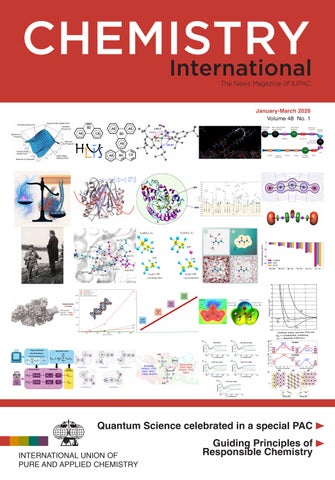
CHEMISTRY International The News Magazine of IUPAC
January-March 2026 Volume 48 No. 1
Quantum Science celebrated in a special PAC INTERNATIONAL UNION OF PURE AND APPLIED CHEMISTRY
Guiding Principles of Responsible Chemistry
Chemistry International CHEMISTRY International The News Magazine of the International Union of Pure and Applied Chemistry (IUPAC)
All information regarding notes for contributors, subscriptions, Access, back volumes and orders is available online at www.degruyter.com/ci Managing Editor Fabienne Meyers IUPAC, c/o Department of Chemistry Boston University Metcalf Center for Science and Engineering 590 Commonwealth Ave. Boston, MA 02215, USA E-mail: edit.ci@iupac.org Design/Production: Stuart Wilson
Chemistry International (ISSN 0193-6484) is published 4 times annually in January, April, July, and October by De Gruyter Brill Inc., 121 High St., 3rd Floor, Boston, MA 02110 on behalf of IUPAC. See https://iupac.org/what-we-do/journals/chemistry-international/ or https://www.degruyter.com/ci for more information. ISSN 0193-6484, eISSN 1365-2192 © 2026 International Union of Pure and Applied Chemistry. This work is licensed under a Creative Commons Attribution-NonCommercial-NoDerivatives 4.0 International License. Cover: Three issues of PAC are devoted to a special topic inspired by the celebration of the International Year of Quantum Science and Technology. This CI cover presents a visual collage drawn from a selection of abstract images submitted with the invited contributions. Guest editors Russell J. Boyd and Manuel Yañez extended invitations to more than 50 leading researchers in quantum chemistry in late 2024, with the aim of assembling 20 or more articles highlighting the impact of quantum science and technology across chemistry, materials science, and related disciplines. The resulting collection is broad in scope. Some papers report state-of-the-art research, while others offer authoritative reviews. Several contributions provide valuable insights into the work of leading researchers and trace the evolution of early quantum and theoretical chemistry into what is now more broadly known as computational chemistry. As expected, there is a strong emphasis on quantum chemistry—the branch of theoretical and computational chemistry that applies the principles of quantum mechanics to understand and predict molecular structure, properties, and chemical reactions. Quantum mechanics underpins our understanding of atomic and molecular interactions and plays a critical role in predicting chemical behavior and enabling new technologies, particularly in materials science and drug design. Read Preface, p. 34.
Contents CHEMISTRY International
January-March 2026 Volume 48 No. 1
President’s Column New Horizons for IUPAC by Mary J. Garson
2
Features IUPAC Launches Guiding Principles of Responsible Chemistry
5
by Mark C. Cesa, Mei-Hung Chiu, Jonathan E. Forman, Javier García-Martínez,
Mary J. Garson*, Richard M. Hartshorn, Tanja Junkers, Peter G. Mahaffy, Leah McEwen, Akiko Nakamura, Daniel O. Reddy, Marvadeen A. Singh-Wilmot, Christine M. Straut Langlinais, Supawan Tantayanon, Rylee Van’t Land
A Glimpse into the Mind of a Cinematic Chemist by Fun Man Fung,
10
The University of Zurich as Enabler of the First Female Doctors of Chemistry by Leo Merz
16
Yvonne S. L. Choo, and Eiichi Nakamura
IUPAC Wire The Top Ten Emerging Technologies in Chemistry—Call for 18 Proposals For 2026 Solvay International Award for Young Chemists—Call for Applicants 18 Grand Prix de la Fondation de la Maison de la Chimie 19 Brazil Rejoins IUPAC, Strengthening Latin American Leadership 19 In Global Chemistry 2026-2027 IUPAC Officers and Boards Members 20 A tribute to Edwin (Ted) D. Becker 21 In Memoriam: Alan Hayes 23 In Memoriam: Alan D. McNaught 24 Project Place Fostering Chemistry Entrepreneurship Safety Training Program in Asia Composition of the Purple Book 3rd Edition Harmonization of Strontium Isotope Data Kappa notation for coordination entities
26 28 31 31 32
Making an imPACt Acid dissociation constants in selected dipolar non-hydrogen33 bond-donor solvents (IUPAC Technical Report) Experimental methods and data evaluation procedures for the 33 determination of radical copolymerization reactivity ratios from composition data (IUPAC Recommendations 2025) Kinetic parameters for thermal decomposition of commercially 33 available dialkyldiazenes (IUPAC Technical Report) FAIRSpec-ready spectroscopic data collections—advice for 34 researchers, authors, and data managers (IUPAC Technical Report) Special triple issue of “The International Year of Quantum Science” 34 Up for Discussion What is an element, and how is it defined in the IUPAC Gold Book? 36 Conference Call Applications of Nanotechnology for Sustainable Agriculture Management of Per and polyfluoroalkyl substances (PFAS) Environmental Impacts of Tyre Use Carbon Sequestration, Utilisation and Capture Chemistry Board Games by TYCN: Making Chemistry Fun and Interactive
41 41 42 43 46
Stamps International
49
Mark Your Calendar
50
President’s Column New Horizons for IUPAC by Mary J. Garson
T
he New Year heralds the start of a new biennium for IUPAC. There is no better way to start this President’s column than by acknowledging the many wonderful volunteers who make up the IUPAC family, and who have energetically contributed to our activities, projects, events and many meetings, online or faceto-face, during the past biennium. I would also like to thank Ehud Keinan for his strong leadership as President during 2024-2025, a role which has included representing IUPAC at numerous international conferences and with the International Science Council. Ehud’s insight and energy have together led to the establishment of the high-profile IUPAC-Soong Prize for Sustainable Chemistry. This award is supported through a generous endowment by LITEON founder Raymond Soong and which will be presented annually. The inaugural recipient, recognised during the World Chemistry Congress in Kuala Lumpur, was Professor Omar Yaghi (USA), acknowledged for his leadership in reticular chemistry and metal-organic frameworks for carbon capture and water harvesting. Professor Yaghi has also been spectacularly acclaimed by the award of the 2025 Nobel prize for chemistry along with Professors Susumu Kitagawa (Japan) and Richard Robson (Australia). Also stepping away from an Officer role in IUPAC is Wolfram Koch, our Treasurer for the last four years who kept a firm hand on the finances. Wolfram has been recently elected as President-elect of EuChemS (2026) followed by a three-year term as President. We congratulate Wolfram and welcome the timely opportunity that this represents for IUPAC to broaden its interactions with EuChemS. And we say goodbye to Javier García Martínez who departs from an Officer role after six years of service, first as President-elect during the COVID era, then as an inspiring and committed President, and for the last two years as Past President. As his legacy, Javier convinced Council to establish a Committee for Ethics, Diversity, Equity and Inclusion (CEDEI). His vision then led to the concept of the Guiding Principles of Responsible Chemistry (see feature page xx and https:// iupac.org/responsible-chemistry/). The eight Principles developed by CEDEI members and other committed
2
Chemistry International
January–March 2026
volunteers over a two-year period provide a strong ethical framework and practical pathways for responsible innovation in chemistry across research, education, and industry and across generations and geographies. I have benefited greatly from the wise counsel of Javier and his treasure trove of knowledge about IUPAC, its history and its various activities. The October issue of Chemistry International contains an excellent summary highlighting his contributions to IUPAC. We welcome Derek Craston (UK) as incoming Treasurer and Christine Luscombe (Japan) as VicePresident/President-elect. I look forward to working with them during my Presidency, and with the other volunteers who have been elected, either to one of our two Boards or into leadership roles in our scientific Divisions and Standing Committees. Welcome also to the many new Titular members, Associate members, and National representatives in our various Divisions and Committees. The start of the 2026 biennium allows us to welcome Estonia, Guatemala and Peru, as well as the return of Singapore and of Brazil, to our family of over 50 National Adhering Organisations (NAOs). Readers of this column will be keen to know the key themes of my Presidency. After the hiatus of COVID impacted so much of our regular scientific activity and converted major conferences into online meetings, IUPAC volunteers appreciated a return to face-to-face interaction. At the same time, there was a decline in our scientific outputs, a change in type of output (fewer technical reports and recommendations, more workshops and web-based initiatives), and reduced funding for key scientific activity. Consequently, a key aim of my Presidency is to lead IUPAC through organizational changes that will secure our financial stability, enhance our scientific reputation, and advance our flexibility and responsiveness. Following a Special Council decision of June 2022 to simplify our governance processes, the 2024-2025 biennium heralded the replacement of the IUPAC Bureau by two governance structures, an Executive Board and a Science Board, each reporting directly to Council. As Vice-President, I have had the privilege of being the inaugural Chair of the Science Board with the remit to set the scientific priorities, long-term scientific strategy and vision of the Union, to define the most efficient ways of fulfilling the priorities, strategy and vision, and to propose allocations of the available science budget for approval by Council. With membership consisting of five elected members of the IUPAC community (Frances Separovic, Lidia Armelao, Igor Lacik, Derek Craston, and Michelle Rogers) and
five Council-elected members (Eva Akesson, Pierre Braunstein, Ale Palermo, Peter Schreiner, and ChiHuey Wong), the Science Board has addressed directly the future scientific work of the Union and how to structure the Union to best achieve these scientific objectives. I take this opportunity to thank the retiring Board members for their contributions. Fundamentally, there is no change to our mission. IUPAC seeks to provide objective scientific expertise and to develop the essential tools for the application and communication of chemistry; this is accomplished by fostering sustainable development, providing a common language for chemistry, and advocating the free exchange of scientific information. But would this mission be different if IUPAC were being established now rather than back in 1919, and how would IUPAC be structured? An organizational structure review group led by (Past President) Mark Cesa recommended in 2020 that IUPAC should reconsider its scientific structure, however existing Divisional/Standing Committee arrangements have continued while a new governance structure was under consideration. The Science Board began its consultation on structural change during a two-day retreat held in January 2025 and graciously hosted by the Royal Society of Chemistry (UK) at the historic Burlington House in London. While recognising IUPAC’s proud history of advancing chemistry through standards, expertise and global partnerships, the Board recognised that the scientific world has changed significantly since IUPAC was founded in 1919. The current scientific structure of IUPAC dates from 1949; by the mid 60’s, five of the eight current Divisions were in place. Since then, there has been a proliferation in adding structure and IUPAC currently has 11 Standing Committees and ~30 different sub-committees, some more active than others; IUPAC is good at setting up structure but not so good at disbanding obsolete structure and committees. The January retreat led to a recommendation from the Science Board that IUPAC consider evolving its outputs to provide flexibility and to meet the demands of modern science. In lengthy consultations with IUPAC volunteers, including at a Town Hall meeting in July and subsequently through a series of online forums with our NAOs, the Science Board has explored multiple sets of plans to create a more streamlined, flexible, and forward-looking organization. Simplification of the current organizational structure will boost the strong reputation of IUPAC, leading to new strategic partnerships, more rapid delivery of critical resources, and increased volunteer engagement.
Mary Garson (right) and guest speaker Alison Rice at the 2024 Global Women’s Breakfast held in Brisbane.
IUPAC is limited by financial constraints, while the reliance on volunteers impacts on delivery of scientific outcomes, and has led to declining scientific output. Despite our best efforts, the interactions between Divisions or between Divisions and Standing Committees have been less than ideal. In the rapidly evolving world of “digital” communication and standards, IUPAC is struggling to contribute despite our committed groups of volunteers. In some key areas, notably in chemistry education and in issues relating to the environment and sustainability, there is overlap with the work of external better-resourced organisation. Engagement with the chemical and allied industries is not as strong as it should be and is held back by a lack of understanding of how to interact effectively with industry. Our strategic vision should be to protect the quality of technical outputs, both digital and traditional, to focus on high-impact projects, to balance funding across agreed priorities, and to build resources by expanding our volunteer base served by a strong Secretariat. We should seek to strengthen external partnerships with industry and other international agencies as well as with NAOs. We should explore with industry how IUPAC scientific activity could help them, such as in efforts to improve sustainability. We will need to plan a more coherent framework for interacting with external stakeholders. In November, the outcomes of consultation with NAOs were reported back to the Science Board. There was consensus towards a simplified model with fewer Divisions and in which much of the scientific activity previously undertaken by Standing Committees Chemistry International January–March 2026
3
President’s Column would instead be designated as “Themes” that would receive an allocated budget for projects. Themes provide greater scientific flexibility and would be formed, repurposed, or closed as necessary by recommendation of the Science Board and in accordance with agreed scientific priorities. Themes would need to be carefully managed with membership determined (as is the case with project task groups) on the basis of expertise. It is anticipated the volunteers will readily find a home in either a Division or in a Theme, ideally through involvement in core project work. Theme topics could include biotechnology, environment, sustainability, chemical safety, food security, computational chemistry, artificial intelligence, drug development, to name a few possibilities. Many Subcommittees would fit well within individual Themes, while some would remain a Divisional responsibility. Industry would be directly represented in individual Divisions through Titular Members drawn from the chemical and allied industries. A high-level Industry Advisory (or Steering) Board supporting the work of the Science Board and providing some general oversight on scientific issues and science policy has been recommended. Meanwhile, Secretary-General Zoltan Mester from Canada leads a major plan that will dramatically affect how and where IUPAC works for the next decade or so, namely the relocation of the IUPAC Secretariat from North Carolina (USA). The 2025 Council meeting held in Kuala Lumpur accepted a recommendation from the Executive Board to enter into formal contract negotiations with two bidders (Consiglio Nazionale Richerche, Italy and the University and City of Malaga, Spain) with the aim of establishing a European based Secretariat for the Union. We anticipate these new horizons after a productive 30-year presence in the USA and thank our American colleagues for their generous support of the Secretariat. A Special Council Meeting will be convened in mid 2026 to consider recommended changes to IUPAC’s organizational structure, and to vote on whether to accept revised Statutes and ByLaws. If approved, transitional arrangements would then be gradually implemented for the remainder of the 2026-2027 biennium. The Special Council meeting will also consider an updated budget proposal that finalises budget allocations for Divisions and Standing Committees as well as costs associated with relocation. An interim allocation of funding Divisions and Standing Committees was agreed at the October meeting of the Executive Board. I finish this column by reflecting on the start of my personal IUPAC journey and its major impact on my professional life. In September 1980, I attended the 12th International Symposium on the Chemistry of
4
Chemistry International
January–March 2026
At the International Conference on Chemistry Education (ICCE2024) in Pattaya, Thailand in July 2024, (from Left) Marietjie Potgieter (Chair of the Committee on Chemistry Education, CCE), Mary Garson, Mei-Hung Chiu (former CCE Chair), and Supawan Tantayanon (ICCE2024 Chair).
Natural Products (12ISCNP, an IUPAC-endorsed conference), where I met Australian chemists working in the emerging field of marine natural products. Intrigued, I later wrote a grant application to study terpene biosynthesis in marine sponges; amazingly, this was funded by the Australian government, and so I migrated to Australia and learnt to SCUBA-dive as preparation for field-based research on the Great Barrier Reef. Since then, I have attended many ISCNP meetings including the recent ISCNP32 in Sydney. To those of you beginning your IUPAC journeys this biennium, I hope your experiences are as profitable as mine have been, and that they provide special and unique memories for you to reflect on in years to come. IUPAC members are welcome to contact me using the email mgarson@iupac.org. A Happy New IUPAC Biennium to you all!
Mary Garson is a Professor Emerita of Chemistry at the University of Queensland (UQ) in Brisbane, Australia. She is IUPAC President since January 2026, following 2 years serving as Vice President and Chair of the Science Board (2024-2025). She is also a Past President of the Organic and Biomolecular Chemistry Division (2014-2015) and was later elected members of the IUPAC Bureau (2018-2021) while she was co-chair of the IUPAC100 Management Committee overseeing the centenary celebrations in 2019. In the 2022-2023 biennium she served as the inaugural Chair of the Committee for Ethics, Diversity, Equity and Inclusion (CEDEI). She is currently serving on the National Committee for Chemistry of the Australian Academy of Science.
IUPAC Launches Guiding Principles of Responsible Chemistry A Project Milestone for IUPAC by Mark C. Cesa, Mei-Hung Chiu, Jonathan E. Forman, Javier García-Martínez, Mary J. Garson*, Richard M. Hartshorn, Tanja Junkers, Peter G. Mahaffy, Leah McEwen, Akiko Nakamura, Daniel O. Reddy, Marvadeen A. Singh-Wilmot, Christine M. Straut Langlinais, Supawan Tantayanon, and Rylee Van’t Land
I
UPAC has launched a new set of Guiding Principles of Responsible Chemistry (GPs), marking an important milestone in its mission to promote ethical, inclusive, and sustainable science worldwide. These eight principles, created by a project task group under the leadership of the Committee on Ethics, Diversity, Equity and Inclusion (CEDEI), provide a shared framework to guide chemists, educators, students, and organizations toward responsible innovation and practice. With endorsement from IUPAC leadership, a public-facing Website containing the Guiding Principles overview and expanded texts was launched at the General Assembly in Kuala Lumpur in July 2025 (Fig. 1). On the website, expanded texts summarize the importance of each Guiding Principle. The materials also encourage students, teachers and chemistry practitioners to
adopt the Guidelines in their work through a series of suggestions for Guiding Future Action and Questions to Guide Discussion. A downloadable Infographic, (Fig.2) reproduced next page (https://iupac.org/responsible-chemistry/download/) summarizes the eight Principles and includes a brief statement of each one.
• • • • • • • •
The eight Principles cover the following themes: Responsible Innovation Safety, Security and Sustainability Ethical Behaviour Inclusivity, Equity and Belonging Communication and Collaboration Equitable Access Integrity and Accuracy Convergence Across Disciplines
This article provides some background to the development of the Principles and in this way illustrates how the project developed.
Origins
The IUPAC Strategic Plan (https://iupac.org/whowe-are/strategic-plan/ ) contains a Vision, Mission, and set of Core Values that guide the conduct of IUPAC and its relationships with and between its volunteers. IUPAC’s mission is to serve as a global organization that provides objective scientific expertise and develops the essential tools for the application and communication of chemical knowledge for the benefit of humankind and the world. IUPAC’s core values emphasize service to
Figure 1: Peter Mahaffy presenting the website launch at the opening of the World Chemistry Congress in Kuala Lumpur, July 15, 2025. Chemistry International January–March 2026
5
IUPAC Launches Guiding Principles of Responsible Chemistry
6
Chemistry International
January–March 2026
IUPAC Launches Guiding Principles of Responsible Chemistry humankind and the chemistry community, collaboration and communication, inclusivity, transparency, responsibility and ethical behaviour. Consistent with IUPAC’s mission and core values, Past President Javier García-Martínez conceived the Guiding Principles initiative: “Since 2019, IUPAC has showcased the potential of chemistry through the Top Ten Emerging Technologies, an excellent demonstration of the power of our discipline. Yet, I felt it was equally important for IUPAC to foster a conversation about the responsible use of that power. With the recent establishment of the Committee for Ethics, Diversity, Equity and Inclusion (CEDEI), the timing was right for IUPAC to demonstrate leadership in shaping the future of the profession, moving beyond the principles of green chemistry, which focus primarily on minimizing environmental harm, toward a broader vision of the responsible and ethical use of chemistry.” This reference was to the 12 Principles of Green Chemistry developed by Paul Anastas and John Warner, (www.acs.org/green-chemistry-sustainability/principles/12-principles-of-green-chemistry.html) widely adopted by the chemistry and chemistry education community. Other international guidelines in place at the time of the initiation of the IUPAC project included The Hague Ethical Guidelines of the Organisation for the Prohibition of Chemical Weapons (https://www. opcw.org/hague-ethical-guidelines). Additionally, the United Nations Sustainable Development Goals (www. un.org/en/exhibits/page/sdgs-17-goals-transformworld ) define global objectives that incorporate ethical principles, whose achievement depends upon contributions from scientists worldwide. National chemical societies offer codes of ethics and/or codes of conduct for their members.
Developing the project
The members of the newly formed CEDEI welcomed the concept of IUPAC contributing leadership on EDEI matters, and proposals for an IUPAC project were first explored during an online meeting in March 2022. At follow-up meetings held in July and December 2022, the group further considered “The Principles of Good Chemistry,” and a task group was formed that was charged with preparing a project proposal. The content was envisaged as contributing to worldwide understanding, practice and application of chemistry (defined in its broadest sense). The idea of a website and a series of images was raised at this point in the project development. A project proposal was submitted in March 2023 and received excellent feedback and valuable comments including from some key reviewers
Fig. 3: Peter Mahaffy and Rylee Van't Land reviewing the development of the website
external to IUPAC. The project, 2022-034-3-060, was approved for funding in June 2023. The budget and scope for the project included provisions for the preparation of a comprehensive website along with visualisation content to be provided by a team of student volunteers at the King’s Centre for Visualization in Science, King’s University, Edmonton, Alberta, Canada (https://www.kcvs.ca/index.html). The project task group next drafted a discussion starter document for use at a brainstorming meeting held at the General Assembly at The Hague in August 2023. There, a 2-hour face-to-face meeting generated a compact set of eight topics for the Guiding Principles (GPs) and provided a brief descriptor of each topic. At this point, the team divided into eight subgroups, each one responsible for development of text and examples for one topic. The next phase of the project involved detailed work on individual topics and review/feedback from task group members working on other topics in the list of GPs. As content developed, ideas were shared back and forth, and examples were chosen to illustrate individual Principles. University students from King’s University, Canada acted as informal reviewers to test content details and accessibility of the content, with the descriptive text targeted to be suitable for a senior high school audience. All text was scanned using modern software to check for authenticity and accuracy, and an external technical editor was engaged to do substantive editing, to verify that not only the content but also the style of the texts were suitable for the intended audience. KCVS students also created a series of graphic images to symbolize each Guiding Principle, and these images were reviewed and accepted by the Chemistry International January–March 2026
7
IUPAC Launches Guiding Principles of Responsible Chemistry
Figure 4. Screen capture of selected content from the website for the Ethical Behaviour Guiding Principle, showing the dropdown menu items for (a) an Overview of the principle, (b) the Examples menu with text for one of the examples, and (c) the Guiding Future Action text and figure. (https://iupac.org/ responsible-chemistry/).
8
Chemistry International
January–March 2026
IUPAC Launches Guiding Principles of Responsible Chemistry project task group. The students and the task group members prepared graphic images to accompany the expanded texts. The result of this work is the set of Guiding Principles shown in <https://iupac.org/responsible-chemistry> reproduced on page 6 (Figure 2):
The Guiding Principles Website
(https://iupac.org/responsible-chemistry/) KCVS students and staff prepared the Guiding Principles website, populating the site with the texts prepared by the project task group and incorporating icons and graphics. The website is intended for use by individuals, groups of students and educators, or professionals in their workplaces, to encourage adoption and application of the Principles. In final released form, the description of each Principle contains: a. A tagline to serve as an overview of the Principle, b. Examples that illustrate the concepts underlying the Principle, c. Suggestions to guide future action pertinent to the Principle, d. Questions to guide discussion, and e. Key references. This is illustrated with several screen captures (Figure 4) from the Guiding Principle on Ethical Behaviour.
The Guiding Principles Launch
The Guiding Principles initiative was officially launched at the opening of the IUPAC World Chemistry Congress and General Assembly in Kuala Lumpur, 12-19 July 2025 during the plenary address of task group member Professor Peter Mahaffy (Fig. 3) along with the comprehensive website dedicated to their distribution and use. A news item featured prominently on the IUPAC website, and a press release was issued (https://iupac.org/guiding-principles-of-responsible-chemistry/). A mini-symposium on the Guiding Principles was also held at the World Chemistry Congress. At the time of the launch in Kuala Lumpur, the IUPAC Shop introduced a range of items including T-shirts, stickers, and mugs promoting the GPs. There was coverage by external organizations. For example, Javier García-Martínez and Mark Cesa were interviewed by the Royal Society of Chemistry’s Chemistry World news magazine (https://www. chemistryworld.com/news/iupac-wants-its-new-responsible-chemistry-principles-in-undergrad-textbooks/4022098.article). The International Science Council posted a news item about the Guiding Principles
on their website (https://council.science/events/iupac2025/). A presentation of the Guiding Principles was made by Mark Cesa at the fall 2025 meeting of the American Chemical Society. Other dissemination is in progress at the time of preparing this report, including an invited editorial for the Journal of Chemical Education’s (Nov 11, 2025 issue), https://doi.org/10.1021/acs.jchemed.5c01467 and a presentation to be given at Pacifichem 2025 in December. The 2026 GWB, scheduled for Feb 10, 2026 and with the theme of “Many Voices, One Science”, will highlight the Guiding Principles of Responsible Chemistry and event organizers are encouraged to share these important resources with their attendees (see https://iupac.org/gwb/2026/).
Next Steps
The launch represented the conclusion of project 2022-034-3-060. Since then, the GPs have been received with interest by the chemistry community, which has encouraged some of the task group members to consider planning for a follow up project. The aim of the proposal will be to ensure that the Guiding Principles are integrated into chemistry education at all levels. This initiative will work with educators, curriculum designers, and professional societies to embed the principles as core components of how chemistry is taught and practiced. By developing adaptable teaching modules, case studies, and discussion frameworks, the proposed project will support instructors in helping students understand the ethical, social, and environmental dimensions of their discipline. The goal is to cultivate a generation of chemists who not only master the science, but who also recognize their responsibility to society and the planet. This educational integration will also create alignment with existing standards and global frameworks, such as the UN SDGs, The Hague Ethical Guidelines, and Green Chemistry principles, ensuring that responsible practice becomes a shared language across classrooms worldwide. Another important outcome given the desire for widespread dissemination of the GPs is to encourage IUPAC volunteers and bodies to implement the GPs in their projects and other work and to publicize the project through articles, news items, and presentations to their colleagues. Please explore the website: https://iupac.org/ responsible-chemistry/ and spread the word in your own networks!
For more information and comments, contact task group Chair Mary Garson m.garson@uq.edu.au | https://iupac.org/project/2022-034-3-060/
Chemistry International January–March 2026
9
A Glimpse into the Mind of a Cinematic Chemist An Interview with Professor Eiichi Nakamura
by Fun Man Fung, Yvonne S. L. Choo, and Eiichi Nakamura
P
rofessor Eiichi Nakamura has long been a notable voice in chemistry, known not only for his contributions at the interface of chemistry, materials and nanoscience through the development of wavy graphene-like network [1] and the pioneering single-molecule atomic-resolution time-resolved electron microscopy (SMART-EM) [2] for the study of molecular dynamics, but also for his creative expression through music and art! During IUPAC 2025, Fun Man Fung and Yvonne Choo, both member of the Committee on Chemistry Education, brought Eiichi for a little stroll in Kuala Lumpur, sampling some local delicacies and durian! Eiichi was the plenary speaker and we had the opportunity of sharing an interview with him.
A New Chapter: From University of Tokyo to Nankai University and the Power of Communication
ran a business for many years, right up until 1949. I have also known people at Nankai University for a long time, especially Professor Qilin Zhou. The 2022 IChO was organized by friends at Nankai, including a talented synthetic chemist, Professor Shou-Fei Zhu, who studied with me about ten years ago and is now the Vice President of the University.
Humility in the Halls of Science: A ForMemRS’s Perspective
Fun Man Fung and/or Yvonne Choo: Your recent journey as a Foreign Member of the Royal Society (ForMemRS) in London must have been an extraordinary experience [5.6]. I was particularly struck by your quip about taking photos of scientific pioneers like Isaac Newton and Robert Boyle, but not your own signature, saying, “someone else in the future can take a photo of that.” This really speaks to a profound humility, a trait that has come up in conversations I’ve had about you with other eminent Japanese scientists, including Nobel Prize and Wolf Prize recipients. Could you elaborate on this perspective and the role humility plays in your view of scientific legacy? EN: After our conversation, I thought I should also have one with myself — so I asked the Royal Society to send me a photo of my signature on the last page of the Charter Book! I am not a particularly humble person,
Fun Man Fung and/or Yvonne Choo: Professor Nakamura, it’s a pleasure to speak with you. I remember vividly the first thing you asked me was if I knew Chinese and how to write my name. Can you share a bit about the significance of that question, especially with your upcoming move to Nankai University’s College of Chemistry, host of the 54th International Chemistry Olympiad (IChO) [3,4] in 2022? Eiichi Nakamura (EN): I was simply curious about your name in Chinese. The pronunciation of Chinese characters can vary greatly from region to region, and even from country to country — Japan included. My own interest in Chinese culture may stem from family history: my grandparents lived in Dalian, where they
Fun Man in Dublin (6 AM) in Dublin, Ireland; Eiichi in Tokyo, Japan (2 PM); and Yvonne in Kuala Lumpur, Malaysia (1PM)
10
Chemistry International
January–March 2026
The paper folder you mention shows photographs of bento boxes that my wife, Yoko, prepared for me over a period of years, starting at the onset of COVID19, when all the restaurants near the university campus were closed. On the reverse side—which is in fact the folder’s front—are flyers for concerts we organized, both our own performances and those by professionals. These were beautifully designed by a good friend of mine. The real reason for creating this folder, however, was to feature a QR code linking to a short film I made on the occasion of receiving an honor from His Highness the Emperor. The URL is provided in two versions, and I hope you will enjoy watching it. http://youtu.be/q6YjabS3ceU
Cinematic Chemistry: Bringing Science to Life
Professor Eiichi Nakamura signing the Charter Book of the Royal Society (Reproduced under CC BY 4.0 licence from The Royal Society. Photograph © Debbie Rowe.)
but I tend to focus on what I am doing now and what I will do in the future. My decision to join Nankai is simply driven by a desire to explore a new lifestyle and pursue new science.
The Melody of Molecules: Music, Logic, and Life
Fun Man Fung and/or Yvonne Choo: Beyond your groundbreaking work in chemistry, I’m fascinated by your interest in music, particularly the flute. You’ve even suggested that music is about logic. Could you expand on this connection between music and logical thinking (a.k.a. retrosynthesis mindset) [7] essential to chemical synthesis? And perhaps you could share a bit about the special paper folder with photos of the bento boxes your wife, Yoko, prepares—it’s a beautiful touch that offers a glimpse into your personal life. EN: In ancient Japan, China, and Greece–Rome, music was regarded as an essential part of a learned person’s education. It is well known that the concepts of consonance and dissonance in tuning were first defined by Pythagoras, based on simple whole-number ratios.
Fun Man Fung and/or Yvonne Choo: You’ve been a pioneer in “cinematic chemistry”, creating publicly available videos that make complex chemical concepts accessible and engaging [8]. What inspired you to use this medium, and what do you hope to achieve through these visual explorations of chemistry? EN: I was trained as a synthetic organic chemist, and I remain a hardcore synthetic chemist to this day. Cinematic chemistry is only one part—but an important part—of my research over the past 20 years. It refers to the atomic-resolution, time-resolved “movie” imaging of chemical reactions made possible by advances in transmission electron microscopy [9]. Like many scientists, I had long dreamed of watching chemical reactions unfold at the atomic scale, though the idea seemed so unrealistic that I never set it as a formal research goal until the end of 1990s. As a first step toward that dream, I began working on quantum chemical calculations with the late Professor Keiji Morokuma in the late 1980s. At that time, the cheapest mobile phone today would vastly outclass the multi-million-dollar mainframe computers we used back then. Still, I grew frustrated with computational “movies” of chemical reactions, because they were not real. Then, in July 1997, I had the chance to ask Professor Sumio Iijima to look for aromatic molecules attached to the tip of a carbon nanotube. He found no trace of them, telling me: “It is not unexpected—organic molecules are known to decompose rapidly under electron irradiation.” That was the moment my dream began to grow, precisely because the world’s leading expert had declared it impossible to see organic molecules with an electron microscope. Your question: What do I hope to achieve through these visual explorations of chemistry? My answer: Chemistry International January–March 2026
11
A Glimpse into the Mind of a Cinematic Chemist
At left: Specially designed paper folder (Credits: Eiichi Nakamura) Above: Professor Eiichi Nakamura performing a Japanese Song with his flute at the Appreciation Dinner of IUPAC 2025. Photo Credit: IUPAC 2025
We made a short video for high school kids, and you will see what we want to achieve in science education. We recently captured even more captivating movies showing diamonds growing from an organic molecule, adamantane. These will inspire more kids to explore the fascinating world of chemistry [10]. https://youtu.be/F4cxfOBLIRA From a scientific perspective, we are exploring the world of statistical mechanics—in particular, the meaning of entropy and the number of microstates—by counting individual chemical events one by one, rather than relying on the statistical averages that chemists typically use. In other words, instead of measuring changes in concentration, we count each event as it occurs, to better understand what Boltzmann meant by the “number of microstates” in chemical processes.
12
Chemistry International
January–March 2026
Enduring Connections: A Half-Century of IUPAC
Fun Man Fung and/or Yvonne Choo: Your long-standing relationship with IUPAC is evident in your connection with IUPAC President Ehud Keinan, dating back nearly 50 years to an encounter in the USA [12]. Could you share some reflections on this enduring friendship and how your involvement with IUPAC has shaped your scientific journey? EN: I first met Udi at Columbia University through our mutual friend, Mudi Sheves, and we got to know each other better when we spent a week together during the IUPAC International Symposium on Organometallic Chemistry Directed Towards Organic Synthesis (OMCOS) meeting in Kyoto in 1985. Participating in IUPAC meetings has been, and remains, a key to professional career development!
An Interview with Professor Eiichi Nakamura
Screen capture of the YouTube video showing the formation of NaCl [8,11]
The Daily Rhythm of Discovery: Tokyo to the Lab
Fun Man Fung and/or Yvonne Choo: I’m told you maintain a remarkable routine of walking to the University of Tokyo daily, logging many steps. This dedication to physical activity, alongside your intense intellectual pursuits, is quite inspiring. How does this daily rhythm influence your scientific thinking and overall well-being? EN: Walking for 40 minutes each morning to my workplace helps me organize my ideas. You can’t do that while riding a bicycle—it’s far too dangerous. Interestingly, I never seem to generate ideas on my way home, perhaps because I’m too eager to get to dinner.
Words of Wisdom: Advice for Aspiring Chemists
Fun Man Fung and/or Yvonne Choo: Finally, Professor Nakamura, based on your vast experience and incredible journey in science, what advice would you offer to young scientists at two crucial stages of their careers? For those pursuing their PhDs: What are the most important lessons you’ve learned that you’d pass on to them? For those just beginning their Assistant Professorships: What guidance can you offer as they
navigate the initial challenges and opportunities of leading their own research groups? EN: For students: Learn to cultivate curiosity about everything. If you find yourself interested in everything you encounter, it may seem inefficient for reaching your goal. But in truth, there is no “efficient” path to a truly worthy goal—because such a goal is often invisible at the beginning of research. For Assistant Professors: Always have two projects. One should be a project whose goal is clearly visible from the start; the other should be one where the goal is only vaguely in sight. This is exactly what I am doing now as I launch new laboratories at Nankai University in Tianjin. Let’s see what interesting discoveries we can make in the coming several years!
References: 1.
2.
Ishikawa, T.; Tanaka, F.; Kurushima, K.; Yasuhara, A.; Sagawa, R.; Fujita, T.; Yonesaki, R.; Iseki, K.; Nakamuro, T.; Harano, K.; Nakamura, E. Wavy Graphene-Like Network Forming during Pyrolysis of Polyacrylonitrile into Carbon Fiber. J. Am. Chem. Soc. 2023, 145 (22), 12244–12254. https://doi.org/10.1021/ jacs.3c02504. Nakamura, E. Atomic-Resolution Transmission Electron Microscopic Movies for Study of Organic Molecules, Assemblies, and Reactions: The First 10 Years of Development. Acc. Chem. Res. 2017, 50 (6), 1281– 1292. https://doi.org/10.1021/acs.accounts.7b00076. Chemistry International January–March 2026
13
A Glimpse into the Mind of a Cinematic Chemist 3.
4.
5.
6.
7.
8.
Fung, F. M.; Putala, M.; Holzhauser, P.; Somsook, E.; Hernandez, C.; Chang, I.-J. Celebrating the Golden Jubilee of the International Chemistry Olympiad: Back to Where It All Began. J. Chem. Educ. 2018, 95 (2), 193–196. https://doi.org/10.1021/acs.jchemed.7b00640. Chang, I.-J.; Fung, F. M. 10 Things You Must Know About the International Chemistry Olympiad (IChO): A Guide to the IChO Competition, Revised Edition.; World Scientific, 2023. https://doi.org/10.1142/11748. Exceptional scientists elected as Fellows of the Royal Society | Royal Society. https://royalsociety.org/ news/2025/05/new-fellows/ (accessed 2025-09-11). Fellow Detail Page | Royal Society. https://royalsociety. org/people/eiichi-nakamura-37429/ (accessed 202509-11). Choo, Y. S. L.; Kolanowski, J. L.; Milić, J. V.; Fung, F. M. The Retrosynthesis Mindset: A Problem-Solving Tool. Synlett 2024. https://doi. org/10.1055/s-0043-1775406. World’s First Video Showing the Moment Salt
Crystals Are Formed; 2021. https://www.youtube.com/ watch?v=F4cxfOBLIRA (accessed 2025-09-11). 9. Nakamuro, T.; Kamei, K.; Sun, K.; Bode, J. W.; Harano, K.; Nakamura, E. Time-Resolved Atomistic Imaging and Statistical Analysis of Daptomycin Oligomers with and without Calcium Ions. J. Am. Chem. Soc. 2022, 144 (30), 13612–13622. https://doi.org/10.1021/ jacs.2c03949.` 10. Fu, J.; Nakamuro, T.; Nakamura, E. Rapid, lowtemperature nanodiamond formation by electron-beam activation of adamantane C–H bonds. Science. 2025, 389, 1024 11. Nakamuro, T.; Sakakibara, M.; Nada, H.; Harano, K.; Nakamura, E. Capturing the Moment of Emergence of Crystal Nucleus from Disorder. J. Am. Chem. Soc. 2021, 143 (4), 1763–1767. https://doi.org/10.1021/ jacs.0c12100. 12. Keinan, E. “A Scientist and A Musician:” Tête-à-Tête with Eiichi Nakamura. ACM 2021, 2 (1). https://doi. org/10.51167/acm00029.
Professor Eiichi Nakamura receiving a certificate after his plenary lecture at IUPAC 2025 from Professor Han Buxing. Photo Credit: IUPAC 2025
14
Chemistry International
January–March 2026
10th EuChemS Chemistry Congress About us
Congress Themes
The 10th EuChemS Chemistry Congress is a prestigious biennial event that brings together the European chemistry and life sciences communities for five days of world-class science across eight diverse themes.
• Catalyzing New Chemistry Solutions • Chemistry Meets Biology & Food Science • Computational Chemistry & AI: The Power of Data • Energy, Environment & Sustainability • Innovative Materials • Molecular Design & Reactivity • Perspectives in Analytical & Physical Chemistry • Responsible Chemistry for Society: Education, Ethics, History & Cultural Heritage
12 - 16 July 2026 Antwerp, Belgium
Plenary Speakers • Markus Antonietti Max Planck Institute of Colloids and Interfaces, DE • Kim Jelfs Imperial College London, UK
Important deadlines • Call for Abstracts closing: 20 December 2025 • Abstract acceptance notification: 10 March 2026 • Registration open: autumn 2025 • Deadline early bird registration: 31 March 2026
• Katrien Keune University of Amsterdam, NL • Roberta Sessoli University of Florence, IT
euchems2026.eu contact@euchems2026.eu Chemistry International January–March 2026
15
The University of Zurich as Enabler of the First Female Doctors of Chemistry by Leo Merz
T
he University of Zurich was the first university in Europe to admit women to study and the first in the world to award a doctorate in chemistry to a woman. The Swiss Academy of Sciences (SCNAT) honors the university as a historically significant site of chemistry with a Chemical Landmark. At Rämistrasse 59, where today the Asia-Orient Institute is located, the University of Zurich made history. In the chemistry lab in the basement of the former cantonal school, Lydia Sesemann researched the chemical properties of dibenzylacetic acid over 150 years ago and discovered a new method for producing homotoluic acid. Both acids are important precursors for the production of medicines. On May 15, 1874, the “high philosophical faculty” of the University of Zurich awarded the chemist her doctorate. The “clever Finn,” as contemporaries called her, was the first woman in the world to earn a PhD in chemistry.
Between science and revolution
For its role as a pioneer for the first female doctors of chemistry, the University of Zurich is now being honored by the Swiss Academy of Sciences (SCNAT) with the Chemical Landmark. With this award, SCNAT recognizes places in Switzerland that are historically significant for chemistry. Dr. Sesemann was not the only pioneer. At the time, the university was a magnet for female chemists from all over the world. Women who were denied an academic career elsewhere were able to satisfy their thirst for knowledge here. Among others, Rachel Lloyd became the first American woman to earn a doctorate (1886), Olga Wohlbrück the first German (1887), Geertruida W. P. van Maarseveen the first Dutch (1897), and Edith E. Humphrey the first British woman (1901)—all in Zurich. In many countries, women were forbidden to travel without the permission of their father or husband. To be able to study in Switzerland, some married hastily or entered into marriages of convenience. A striking number of students came from the Russian Empire, which was undergoing social upheaval. Many of the women were politically active and also connected with revolutionary circles in Zurich. In 1873, the Tsar issued a decree that banned Russian women from studying in Zurich. Most then left the city. Lydia Sesemann, whose homeland at the time was part of the Russian Empire, stayed and completed her doctorate. One of her doctoral supervisors considered
16
Chemistry International
January–March 2026
Unveiling the Plaque - Jean-Marc Piveteau (SCNAT president) and Michael Schaepman (UZH president)
her dissertation “without doubt one of the best works of the faculty.”
Hardly any Swiss women
While foreign women came to study at the University of Zurich and other Swiss universities, Swiss women themselves remained largely excluded at first. To study, they needed a high school diploma (Matura). But girls were not allowed to attend gymnasium (secondary school). To be admitted to a university, they had to take expensive private courses and pass a special entrance exam. The University of Zurich was a trailblazer in opening the doors of science and higher education to women. Nevertheless, Switzerland still requires targeted efforts to achieve a fair gender balance. Successful initiatives at European research institutions can serve as role models.
Award ceremony
The award ceremony took place on 3 September 2025 as part of a public symposium with numerous guests. The program was led by Kathrin Fenner (Eawag & UZH), the first Swiss woman appointed as a full professor of chemistry at UZH. The opening lecture was given by Caspar Hirschi (HSG) with a historical overview of Zurich’s universities in the 19th century, entitled “Freiheit der Forschung und Frauen im Hörsaal.” Gisela Boeck (University of Rostock) then shed light on the dissertations of the first female chemistry doctoral candidates, quoting Wilhelm Weith (1874) about the first chemist at UZH: “The dissertation […] is certainly one of the best our department
Lydia Sesemann worked on her dissertation in the basement of the former cantonal school at Rämistrasse 59 in Zurich.
has ever seen. It clearly demonstrates the female author’s ability to conduct independent research.” Edwin Constable (University of Basel) highlighted in his lecture “Agents of Change” how little is known about the later lives of many pioneers. Although today in many disciplines equal numbers of men and women earn doctorates, equality at the professorial level often
“I was honoured to be invited to speak at this landmark celebrating extraordinary women who pushed geographical, social and intellectual boundaries long before equality was recognised as essential to claiming their place in chemistry. As someone committed to equality in the chemical sciences, and who works towards women’s equality for many years, I was deeply inspired by the courage of the pioneering women we honoured at the University of Zurich. Their stories remind me that progress is possible, but never automatic. We still have a long way to go, and it is up to all of us to ensure that the next generation of chemists can thrive without experiencing barriers and can reach their full potential.” Ale Patermo
remains more of an ideal than a reality. The second part of the symposium focused on current support programs for women in science. Contributions included Frank Baaijens (TU Eindhoven) on the Irène Curie Fellowship Program, Alejandra Palermo (RSC London) on “From Challenges to Change—Breaking the Barriers for Gender Parity,” and Elodie Brun (dsm-firmenich) on the SWC mentoring program. Roland Sigel (UZH) pointed to an inspiring example from UZH’s Faculty of Science: Greta Patzke, who spoke on “Water Splitting for Clean Hydrogen: Strategies and Mechanisms.” The symposium ended with a lively panel discussion. Afterwards, Christian Bochet (University of Fribourg) gave the laudation before the commemorative plaque was ceremoniously unveiled outdoors. Greetings followed from Jean-Marc Piveteau (President SCNAT), Michael Schaepman (President UZH), Miia Mäntymäki (President of the Finnish Chemical Society), Gisela Boeck (Representative of the GDCh), and Edwin Constable (Representative of the RSC). The celebration concluded with a reception.
First published online 3 Sep 2025, https://chem.scnat.ch/en/chemical_ landmarks/chemical_landmark_2024 That page includes link to all video recordings of the day event, starting with this teaser https://youtu. be/8hUIyaKLO0o?si=J2hLOpfwaqkizQAV
Chemistry International January–March 2026
17
IUPAC Wire
News and information on IUPAC, its fellows, and member organizations. See also www.iupac.org/news
The Top Ten Emerging Technologies in Chemistry—Call for Proposals For 2026
T
he International Union of Pure and Applied Chemistry has released its call for proposals to identify the top ten emerging technologies in chemistry with the results to be announced in 2026. This initiative began in 2018 in recognition of IUPAC’s Centenary in 2019, to showcase the value of Chemistry (and chemists!) and to inform the general public as to how the chemical sciences contribute to the well-being of Society and the sustainability of Planet Earth. The most recent finalists for 2025 were announced in October 2025 and detailed in the Oct 2025 issue of Chemistry International (CI). The finalists for previous years are presented online at <iupac.org/what-we-do/ top-ten/> The call for the 2026 proposals is open and till 30 April 2026, anyone can submit one or more proposals. This call for proposals is open to the global science community as well as to the general public.
What is an “Emerging Technology?”
An “Emerging Technology” is one that is between a new scientific discovery and a fully-commercialized technology. It should involve a solid understanding of the technology, some type of prototype, or even better some start-ups working to commercialize the technology. But most importantly, the technology needs to be exciting, have the capacity to open up new opportunities in chemistry and beyond, and most importantly, help to solve major global problems—the focus of IUPAC’s vision and mission. The term “chemistry” is used in its broadest sense, including material science, nanotechnology, and biochemistry. Bottom line, an emerging technology is a discovery that hovers between an embryonic “Eureka” moment in the lab and an industrial application.
For more information, see <iupac.org/what-we-do/top-ten/>
Solvay International Award for Young Chemists—Call for Applicants
T
he call for the 2026 IUPAC—Solvay International Award for Young Chemists is open!
18
Chemistry International
January–March 2026
The IUPAC-SOLVAY International Award for Young Chemists is intended to encourage outstanding young research scientists at the beginning of their careers. The awards are given for the most outstanding Ph.D. theses in the general area of the chemical sciences, as described in a short essay. The award is generously sponsored by Solvay. Each year, IUPAC awards up to five prizes. Each prize consists of an US$ 1000 cash award and up to US$ 1000 towards travel expenses to attend the next IUPAC Congress, where the awards will be presented. In keeping with IUPAC’s status as a global organization, effort is made to ensure fair geographic distribution of prizes.
Who can enter?
You must have completed your PhD in the 2025 calendar year, including your defense. Your PhD must be from an institution based in an IUPAC member country/territory. Your PhD must be in the field of chemical sciences: “chemistry and those disciplines and technologies that make significant use of chemistry”. All entries are due before 15 February 2026 and can be submitted online.
What does the entry include?
Each entry must include a 6000-character essay describing the thesis work in 6000 characters and placed in the context of the broader research field in the chemical sciences. The essay must be written in English. The contact details of people who can write a support letter for the application are required. This next round of awards will be presented at the 2027 IUPAC Congress, to be held in Montreal Canada, from 8-16 July 2027. Each awardee will be invited to present a poster on his/her research and to participate in a plenary award session, and is invited to submit a review article for publication in Pure and Applied Chemistry. For any questions, please contact IUPAC by email at executivedirector@iupac.org.
About Solvay:
Solvay, a pioneering chemical company with a legacy rooted in founder Ernest Solvay’s pivotal innovations in the soda ash process, is dedicated to delivering essential solutions globally through its workforce of over 9,000 employees. Since 1863, Solvay harnesses the power of chemistry to create innovative, sustainable solutions that answer the world’s most
essential needs such as purifying the air we breathe and the water we drink, preserving our food supplies, protecting our health and well-being, creating ecofriendly clothing, making the tires of our cars more sustainable and cleaning and protecting our homes. Solvay’s unwavering commitment drives the transition to a carbon-neutral future by 2050, underscoring its dedication to sustainability and a fair and just transition. As a world-leading company with €4.7 billion in net sales in 2024, Solvay is listed on Euronext Brussels and Paris (SOLB). For more information about Solvay, please visit solvay.com or follow Solvay on Linkedin.
https://iupac.org/2026-iupac-solvay-international-award-for-youngchemists-call-for-applicants/
Grand Prix de la Fondation de la Maison de la Chimie
T
he Prize is intended to reward an original work in chemistry, of benefit to mankind, society or nature. The Grand Prix will be awarded for the twentieth time in 2026 to one or several persons, irrespective of nationality. It carries a monetary award of 35,000 Euros. Entries must imperatively be presented through a scientists’ society or a national or international scientific organisation without any direct link with the nominee. Entry forms, together with a report detailing the arguments for the nomination, must be received at the Fondation de la Maison de la Chimie no later than 30 April 2026. The nomination documents should be sent by e-mail at presidence@maisondelachimie.com The laureate will be invited to deliver a lecture on her/his work at an award ceremony that will take place at the Maison de la Chimie in February 2027.
https://actions.maisondelachimie.com/les-prix-de-la-fondation/grandprix-de-la-fondation/
Brazil Rejoins IUPAC, Strengthening Latin American Leadership In Global Chemistry
T
he International Union of Pure and Applied Chemistry (IUPAC) announced that Brazil has officially resumed its status as a National Adhering Organization (NAO). The NAO status was reviewed and approved by the IUPAC Executive Board in its meeting on October 1, 2025. This renewed membership will now be represented through the Federal Council of Chemistry (Conselho Federal de Química – CFQ), marking a significant milestone for the Brazilian scientific community and restoring Brazil’s role in shaping global chemical standards, policy, education, and collaboration. As a federal public institution, the CFQ oversees Brazil’s professional chemistry system, which includes 21 Regional Councils of Chemistry (CRQs) and represents more than 218,000 professionals and around 50,000 registered legal entities nationwide. Together, they form a unified network that ensures the ethical, technical, and scientific integrity of chemical practice throughout the country. Brazil’s return to IUPAC reaffirms the country’s long-standing contributions to chemistry in research, innovation, and industrial development. The renewed membership is expected to benefit scientists, educators, and professionals nationwide, facilitating deeper cooperation with international partners and supporting the advancement of chemistry across academia and industry. “It is truly excellent news that Brazil is back as an IUPAC National Adhering Organization,” said Prof. Aldo José Gorgatti Zarbin, Permanent Member of the Brazilian Academy of Sciences and Vice President of the Brazilian Association for the Advancement of Science. “The CFQ’s leading role in assuming this responsibility is fundamental as Brazil brings a vibrant and innovative chemistry community. Its return will strengthen both IUPAC and the scientific landscape across Latin America.” The decision follows years of continued engagement by Brazilian institutions, including active participation in global IUPAC initiatives such as the Global Women’s Breakfast, for which Brazil coordinated and hosted more than a dozen events in 2024 alone, helping to foster a more collaborative and inclusive chemical sciences community. Brazil’s chemistry community continues to play a visible role on the international stage and has a recognized tradition of scientific Chemistry International January–March 2026
19
IUPAC Wire leadership. Most notably, Brazil hosted the 2017 IUPAC General Assembly and World Chemistry Congress in São Paulo, the first time the event was held in South America, marking a historic moment that celebrated the breadth and excellence of Brazilian chemical research and collaboration. Looking Ahead. Brazil’s renewed membership comes at a moment of growing regional momentum. Together with the recent inclusion of Peru and Guatemala, the return marks a strengthened Latin American presence in IUPAC and creates new opportunities for cooperation. The CFQ intends to contribute to this regional momentum by promoting initiatives focused on green chemistry, education, and sustainable innovation, aligning Brazil’s chemical sector with IUPAC’s global agenda for responsible science and development.
“I sincerely hope that Brazil’s return, together with the recent adhesion of Peru and Guatemala, will mark the beginning of a stronger and more united Latin American presence in IUPAC,” wrote IUPAC Past President Javier García Martínez, celebrating the news and expressing confidence in the region’s leadership role. A sign of continued international engagement, Brazil will host the Atlantic Basin Conference on Chemistry in Rio de Janeiro in December 2026 under the theme “Chemistry for Global Impact: Strategic Partnerships for Sustainable Innovation.” This event will bring leading researchers, policymakers, and industry innovators together to advance solutions to global challenges through chemical science. “The Federal Council of Chemistry is proud to represent Brazil once again within IUPAC, reinforcing our
2026-2027 IUPAC Officers and Boards Members
Starting in 2024, the IUPAC Bureau and the Executive Committee have been replaced by the Science Board and the Executive Board. The Science Board is to focus on IUPAC’s strategic direction, whereas the Executive Board is to focus on policy, financial and logistic matters.
Officers
May Garson, Australia, President Christine Luscombe, Japan, Vice President Ehud Keinan, Israel, Past President Zoltán Mester, Canada, Secretary General Derek Craston, UK, Treasurer Executive Board Mary Garson (Australia, IUPAC President, Chair) Lidia Armelao (Italy) Richard Hartshorn (New Zealand) Miki Hasegawa (Japan) Bonnie Lawlor (USA) Zhigang Shuai (China/Beijing) Supawan Tantayanon (Thailand)
Ex Officio members Christine Luscombe (Japan, Vice President) Zoltán Mester (Canada, Secretary General) Derek Craston (UK, Treasurer) Ehud Keinan (Israel, Past President) Fabienne Meyers (Executive Director)
Science Board Christine Luscombe (Japan, Vice President, Chair) Abeer Al Bawab (Jordan) Pierre Braunstein (France) Edwin C. Constable (Switzerland, Div VIII Chemical Nomenclature and Structure Representation) Evamarie Hey-Hawkins (Germany) Ari Koskinen (Finland, Div III Organic and Biomolecular) Igor Lacík (Slovakia, Div IV Polymer) Uday Maitra (India, CCE Chemistry Education) Alejandra Palermo (UK) Floris Rutjes (Netherlands) Fani Sakellariadou (Greece, Div VI Chemistry and the Environment) Ex Officio members Mary Garson (Australia, President) Zoltán Mester (Canada, Secretary General) Fabienne Meyers (Executive Director)
20
Chemistry International
January–March 2026
IUPAC Wire shared commitment to the advancement of chemical sciences worldwide,” said Prof. Dr. José de Ribamar Oliveira Filho, President of the CFQ. “This renewed membership strengthens Brazil’s position in the global scientific community and opens new possibilities for joint initiatives that will benefit professionals, researchers, and society as a whole.” About the Federal Council of Chemistry (CFQ) The Federal Council of Chemistry (CFQ) is responsible for regulating and overseeing the professional practice of chemistry in Brazil, promoting the development of the chemical sciences and strengthening the nation’s scientific and industrial sectors. Together with 21 Regional Councils of Chemistry (CRQs), the CFQ forms the System CFQ/CRQs, which represents more than 218,000 professionals and approximately 50,000 registered legal entities across all regions of the country. Beyond its regulatory functions, the CFQ acts as a bridge between science, education, industry, and public policy, fostering innovation and ensuring that chemistry contributes to improving quality of life and environmental sustainability in Brazil. The CFQ’s mission is to promote the full and ethical practice of chemistry, contributing to the sustainable development of Brazil and ensuring that the chemical sciences serve society with safety, quality, and innovation. More information about CFQ: gabinete@cfq.org.br/ Website: www.cfq.org.br
In memoriam
The IUPAC Secretary General during the opening of the IUPAC Workshop: Impact of Scientific Developments on the Chemical Weapons Convention, held in Bergen, Norway, June 30 – July 3, 2002. The meeting was coined The Bergen Meeting. Photo: Lars Ole Ørjasæter.
this institution gave him the opportunity to make meaningful contributions to the world, which was important to him. At the outset Ted focused on Raman spectroscopy, but when NMR instruments started to become commercially available in the late 1950s, he switched to NMR spectroscopy, which he applied to study molecular structures and interactions including hydrogen bonding and molecular self-assembly. He also contributed to the development of NMR methods and the teaching of NMR spectroscopy, which resulted in the publication of
A tribute to Edwin (Ted) D. Becker by Leiv K. Sydnes
A
s announced a few months ago, Ted Becker passed away August 4th, 2025, shortly after his 95th birthday. With his passing, IUPAC has lost a most reliable and friendly volunteer, a passionate supporter, a creative idea generator, and a firm leader when need be. His involvement can be traced all over the Union, and he played a crucial role on several occasions in the history of the organization. Ted received undergraduate education and a B.Sc. in chemistry from the University of Rochester, NY, and after completing the Ph.D. at the University of California at Berkeley in 1955, he joined the staff at National Institutes of Health (NIH) in Bethesda, Maryland. Here he stayed on his whole career because in those days
Ted in focused conversation with Victoria Jamison (former Chemical Disarmament Adviser, Department of Defence, Canberra, Australia), one of the youngest participants at the Bergen Meeting. Photo: Lars Ole Ørjasæter Chemistry International January–March 2026
21
IUPAC Wire an excellent textbook in the field as early as in 1969. As the years passed, he became increasingly involved in administration, and in 1980, he advanced to Associate Director for Research Services. In this capacity, he had a significant impact on the NIH research community at large because his colleagues believed in his ideas and trusted his leadership due to his personal integrity and scientific credibility. Working and living close to Washington DC gave Ted ample opportunity to participate in activities organized by the American Chemical Society. He certainly became involved, and he was repeatedly asked to serve on committees, one of which was the U.S. National Committee for IUPAC, which he chaired for several years. This brought him in close contact with IUPAC, and it did not take long before the Union benefitted from his willingness to serve. When he started his IUPAC service, the scientific work was carried out by commissions, and for Ted the natural choice was the Commission on Molecular Structure and Spectroscopy, which belonged to the Physical Chemistry Division. A visible outcome from this work is the IUPAC Recommendations on NMR nomenclature—Nuclear spin properties and conventions for chemical shifts, which was published in Pure and Applied Chemistry in 2001 (https://doi.org/10.1351/ pac200173111795) and updated a few years later (https://doi.org/10.1351/pac200880010059). He also joined several non-scientific committees, including the Publication Committee, which he chaired from 1990. In these capacities he quickly turned out to be a most reliable and productive volunteer, always presenting constructive ideas, being well prepared even for meetings held at short notice, submitting drafts as promised, and taking time to inform colleagues new to IUPAC about the Union. The 1990s period Ted’s excellent textbook in NMR spectroscopy was revised twice. was in several regards The last edition, shown here, was troublesome for IUPAC. published in 2000 when he was The commission sysSecretary General of IUPAC, which tem was under heavy certainly proves his multitasking criticism due to low procapability. ductivity, the naming of
22
Chemistry International
January–March 2026
Nikola Tesla monument in Zagreb, Croatia.
the transfermium elements made little progress and generated a lot of tension, many NAOs were dissatisfied with how the membership fee was calculated, discussion about moving the secretariat was looming, and on the top of this and totally from the blue, Vice President Staab resigned four months before his Presidency was going to start in January 1994. Therefore, it did not come as a surprise that Secretary General Gerrit den Boef did not run for a second term at the General Assembly (GA) in Guildford, UK, in 1995. This paved the way for Ted’s entry; he was nominated, elected, and then re-elected for a second four-year term at the GA in Berlin in 1999. As Secretary General 1996-2003, Ted’s dedication to IUPAC was certainly put to a test because right away he was exposed to the challenges mentioned above and new ones that followed. In close collaboration with the Executive and several ad-hoc committees, plans to resolve them were worked out and subsequently executed under Ted’s transparent and considerate leadership. In my opinion, three issues stand out. The most demanding was probably the transformation of the Union operation from a commission-driven to a project-driven system, which for some became emotional and fully required Ted’s significant diplomatic skills to carry the process through. Another considerable task was the process leading to the relocation of
IUPAC Wire the Secretariat from Oxford, UK, to Research Triangle Park (RTP), North Carolina, and the concomitant hiring of a new staff. The third achievement was how he paved the way for IUPAC’s close collaboration with the Organization for the Prohibition of Chemical Weapons (OPCW) despite disagreement in the Executive Committee; without Ted’s patience and ability to build fruitful alliances the deal would probably not have landed. Ted invested a lot of energy to reach an agreement with OPCW, and this was probably the reason why he volunteered to become engaged in IUPAC’s work related to chemical weapons for more than a decade after he left the IUPAC leadership. As Secretary General, he was instrumental in the planning and execution of the IUPAC Symposium: Impact of Scientific Developments on the Chemical Weapons Convention held in Bergen, Norway, in June/July 2002 in preparation for the first review of the Chemical Weapons Convention (CWC). Without hesitation he also volunteered to join the team of authors who prepared the symposium report which provided OPCW with an evaluation of scientific and technological advances in the chemical sciences relevant to the CWC. Five years later the act was repeated in preparation for the second review of CWC, and again IUPAC was fortunate to be able to count on Ted’s dedicated involvement as a member of the organizing committee. But he delivered more than expected. The venue this time was Zagreb, Croatia, where there is a grand monument of the great Croatian scientist Nikola Tesla, who has been honored by giving the name tesla (T) to the SI unit for magnetic flux density. Ted was very familiar with Tesla’s research through his own work with NMR, so when a group of symposium participants happened to pass by the Tesla monument, Ted stopped and gave a lucid presentation of Tesla’s work. Both the lecturer and the audience enjoyed the occasion immensely! Ted was also a strong supporter of outreach to raise awareness about the threat chemical weapons represented and he became an active member of the task group for several projects on educational activities to achieve this. And when Graham S. Pearson proposed to develop an IUPAC code-of-conduct and submitted a project proposal to do that, Ted was a member of the task group. A recommendation was indeed finalized, but to the task group’s disappointment, the document was not sent to IUPAC’s members for consideration. In order to overcome this setback, Ted and two other members of the task group wrote an article in Chemistry International and launched A Living Code-of-Conduct, which received positive feedback from a fair number of
colleagues (https://doi.org/10.1515/ci.2011.33.6.7 and https://iupac.org/project/2007-022-2-020/). About a decade ago, Ted’s direct involvement in IUPAC activities came to an end, but he continued to keep a close eye on the Union. And when asked for his opinion, he was always available and more than willing to give advice, which turned out to be sound and helpful. His departure therefore leaves a tremendous void, but for many his impact will remain a tremendous inspiration.
Leiv K. Sydnes (leiv.sydnes@uib.no) is Professor Emeritus at the University of Bergen, Norway. He was a member of the IUPAC Bureau from 1994 through 1999 and the Executive Committee from 2000 through 2007. Thus, his service to IUPAC overlapped with Dr. Becker’s period as Secretary General.
Alan Hayes
D
r. Alan Hayes (1930–2025) was a distinguished industrial chemist and an influential leader within the International Union of Pure and Applied Chemistry (IUPAC). Rising from modest beginnings in Manchester—where he left school at fifteen to work as a laboratory assistant—Hayes built Dr Alan Hayes (UK), IUPAC a remarkable career President 2000-2001 grounded in scientific rigor, organisational excellence, and a lifelong commitment to the role of chemistry in serving society. After early studies undertaken part-time while working in the dyestuffs division of Imperial Chemical Industries (ICI), Hayes went on to earn his BSc degrees and later a PhD in synthetic chemistry under Lord Todd at Cambridge. His subsequent career at ICI spanned research, product development, and high-level management, culminating in global leadership roles in the company’s plant-protection (agrochemical) division. His industrial experience deeply shaped his vision of how chemistry, industry, and international cooperation could work together for global benefit. Hayes’s engagement with IUPAC extended over several decades and became one of the defining Chemistry International January–March 2026
23
IUPAC Wire elements of his professional life. He is perhaps best remembered for his long and transformative association with CHEMRAWN (Chemistry Research Applied to World Needs), IUPAC’s flagship programme addressing major global challenges through chemistry. Serving as Chair of the CHEMRAWN Committee from 1991 to 1997, he provided strategic leadership during a period when CHEMRAWN conferences expanded in scope, strengthened their scientific and policy impact, and deepened collaborations with international agencies. Hayes championed the idea that chemistry must be applied purposefully to issues such as food security, environmental protection, energy, and sustainable development—long before such topics became mainstream in global science policy. His deep commitment to IUPAC led naturally to broader leadership responsibilities. As a long-time delegate to the IUPAC General Assembly and contributor to multiple committees, Hayes developed a reputation for thoughtful governance, clear-headed strategic thinking, and an ability to bridge academia, industry, and international organisations. He was elected President of IUPAC for the 2000–2001 biennium, during which he worked to modernise the Union and strengthen its communication and outreach. Notably, he initiated the Strategy
Alan Hayes at the IUPAC Congress in 2001, presenting to Michelle Coote, one of the first IUPAC Young Scientist Prize.
24
Chemistry International
January–March 2026
Development Committee for Chemistry International, helping to re-shape the magazine’s role in promoting IUPAC’s mission and global scientific engagement. Throughout his service, Hayes consistently emphasised the importance of applying chemistry to real-world needs, nurturing international collaboration, and supporting younger scientists. His writing in Chemistry International reflects a quietly firm belief that scientific organisations must remain outward-looking and socially responsible. Alan Hayes leaves a legacy of sustained commitment to the international chemical sciences community. His leadership of CHEMRAWN, stewardship of IUPAC during a period of transition, and lifelong advocacy for chemistry’s role in improving global wellbeing stand as enduring contributions. He will be remembered with respect and gratitude by colleagues around the world.
Alan D. McNaught—A Steward of Chemical Language
I
t was indeed sad to receive the message that Dr. Alan D. McNaught passed away October 29, 2025 in his home near Cambridge, UK. With his death, the global chemical community has lost a distinguished custodian of nomenclature and terminology in chemistry, a reliable IUPAC volunteer, and a friendly colleague that made the day brighter when you happened to meet him. Throughout the latter decades of the twentieth century and into the new millennium, few figures have shaped the language of chemistry as profoundly as Dr. Alan D. McNaught. A tireless advocate for precision, clarity, and consistency in scientific communication, McNaught dedicated his career to building the frameworks that allow chemists across the world to speak a common tongue. Alan’s long and distinguished association with IUPAC began in the late 1970s, when he joined the Commission on Nomenclature of Organic Chemistry. His meticulous attention to linguistic and structural detail, combined with a generous collaborative spirit, quickly established him as one of IUPAC’s foremost authorities on nomenclature and chemical terminology. By the late 80s, Alan became secretary of IDCNS, the Interdivisional Committee on Nomenclature and Symbols (IDCNS) (committee preceding ICTNS). His contributions extended far beyond organizational leadership. In 1987, he co-authored with Victor Gold, K.L. Loening and P. Shemi the first IUPAC
IUPAC Wire Compendium of Chemical Terminology. Ten years later, in 1997, the second edition of what became the notorious Gold Book was again co edited by Alan with Andrew Wilkinson. Not to stop there, Alan also ensured that generations of chemists would have access to a definitive record of standardized terminology by organizing the very first online Gold Book as a collection of PDF available online for free. The Gold Book remains a cornerstone of IUPAC’s intellectual heritage, its authority grounded in the care and exactitude that Alan brought to every page. Equally visionary was his role in the development of the IUPAC International Chemical Identifier (InChI), a digital standard that revolutionized the representation of chemical structures in databases and information systems. Collaborating with Stephen Heller and colleagues, Alan helped establish the IUPAC InChI Subcommittee and the InChI Trust, bringing to life a universal chemical language for the digital age—one as rigorous and enduring as the printed words he had long championed. Continuing his journey and rising through the organization’s ranks, he went on to serve as the first President of the Division of Chemical Nomenclature and Structure Representation from 2002 to 2005, a post from which he guided IUPAC through a transformative era. Under his leadership, the division united traditional nomenclature work with the emerging field of digital chemical information—ensuring that the fundamental principles of naming and structure were adapted to the needs of a rapidly computerizing discipline. In Chemistry International (Vol. 24, No. 2, 2002), his article “Chemical Nomenclature and Structure Representation” captured the clarity of his vision: Alan saw the future of chemistry as one in which language and data must coexist seamlessly—where names, definitions, and digital identifiers together form the enduring grammar of the molecular sciences. Beyond his work with IUPAC, Alan served as General Manager of the Production Division at the Royal Society of Chemistry, where his quiet authority and commitment to excellence influenced a generation
Alan McNaught during the IUPAC General Assembly in Glasgow in 2009.
of editors, authors, and scientific communicators. His professional life reflected a rare balance of scholarship and service, intellect and humility. Through all his endeavors, Alan McNaught embodied the spirit of IUPAC itselfˆ—patient, precise, and profoundly international. His work forged bridges between disciplines, between the handwritten laboratory record and the global database, between the art of naming and the science of knowing. Today, as IUPAC continues to uphold and extend the standards he helped to define, we remember Dr. McNaught not only for his scholarship but for his enduring belief that the language of chemistry is a shared human enterprise—one that must be tended with care, clarity, and compassion.
Chemistry International January–March 2026
25
Project Place
Information about new, current, and complete IUPAC projects and related initiatives. See also www.iupac.org/projects
Fostering Chemistry Entrepreneurship by Priyanka R. Sakhare, Bipul Saha, Hemda Garelick, and Brian Li The world benefits when research output is commercialized to provide helpful products. This requires an entrepreneurial mindset and understanding of the requirements for starting and running a business unit. This IUPAC project (https://iupac.org/ project/2023-012-2-022/) aims to create awareness about “Chemistry Entrepreneurship” and motivate chemistry students to become entrepreneurs. The project will help create a better understanding of the opportunities and challenges in entrepreneurship and build bridges between academia and industry. This is achieved by organizing webinars where successful entrepreneurs share what they have learned and experienced.
Webinars Conducted So Far
September 10, 2024. Catalyzing Chemistry Entrepreneurship, Javier García Martínez, University of Alicante, IUPAC Past President, and Miguel Jimenez, Boston University. https://register.gotowebinar.com/recording/ 6484902430284114523 November 22, 2024. From Lab to Market: How Organic Chemistry Sparks Entrepreneurship, Vladimir Gubala, Chief Scientific Officer and co-founder, PocDoc, President of IUPAC Chemistry and Human Health Division (Division VII), and Lene Hviid, Shell Global Solutions, Associate Member of IUPAC Committee on Chemistry and Industry (COCI). https://register.gotowebinar.com/recording/ 850971865828239712 February 5, 2025. Entrepreneurial Vision in the Nonprofit Sector: Catalyzing Systemic Change in Chemistry Education through Green Chemistry, Amy S. Cannon, Executive Director and Co-Founder, Beyond Benign, moderated by Fran Kerton, Memorial University of Newfoundland, Chair of IUPAC Committee on Chemical Research Applied to World Needs (CHEMRAWN). https://register.gotowebinar.com/recording/ 7657492002164894045 March 19, 2025. Learning from Green Chemistry Entrepreneurs, John Warner, CEO and CTO of Technology Greenhouse, Philip Jessop, Queen’s University, Canada, and Richard Blackburn, University
26
Chemistry International
January–March 2026
of Leeds, moderated by Fran Kerton, Memorial University of Newfoundland, Chair of IUPAC Committee on Chemical Research Applied to World Needs (CHEMRAWN). https://register.gotowebinar.com/recording/ 5537585206229191086
Insights from the Project Co-Chairs
The webinars were coordinated by the Project Co-Chairs Bipul Saha and Hemda Garelick. Bipul Saha, Project Co-Chair: I was considering new projects to be launched by the Committee on Chemistry and Industry (COCI). This project was originally proposed to the COCI by Javier García Martínez (IUPAC former President), who emphasized that fostering chemistry entrepreneurship is essential to ensure discoveries reach the market and benefit society. Following his proposal, we worked with Hemda Garelick, Francesca Kerton, and other colleagues to develop the project within COCI and launch the webinar series. The objective of this project was to create awareness and motivate chemistry students to become entrepreneurs. After completing their studies, most chemistry students look for employment. Very little is known to them about what it takes to become entrepreneurs. Through the project “Chemistry Entrepreneurship,” we wanted to support chemistry students to start on their own and create value with their technology. The aim of this project is to provide information about “Chemistry Entrepreneurship,” what it takes to be successful, learn from others and build a business case for their technology. We decided to do this through webinars in which successful entrepreneurs share their learning and experiences. Once the decision was taken to initiate the project on “Chemistry Entrepreneurship,” we, at COCI, thought that it should be a multidisciplinary activity and we invited participants from other Divisions and Committees. I have further discussed with Fran Kerton CHEMRAWN), Jan Apotheker and Marietjie Potgieter, Committee on Chemistry Education (CCE), Roberto Terzano and Hemda Garelick, Chemistry and the Environment Division (Division VI). CHEMRAWN, CCE, and Division VI accepted our invitation to join this project. The next step was to invite professionals to join the project team as members of the task group. We received support from eminent scientists and industrial chemists from North America, Latin America, Europe, Asia, and Africa. Hemda Garelick and Anna Makarova
kindly joined as the Co-Chair of this Project. The Task Group held a series of meetings in which possible webinar topics and potential speakers were identified. I would like to thank the Task Group members and Task Group Chairs for their involvement, commitment, and support. We would also like to thank De Gruyter Brill for providing the Webinar platform and technical support. The “Chemistry Entrepreneurship” project is progressing very well. All these webinars have greatly benefited the chemist community. The project is having a very positive impact, and we plan to continue with the webinars. We will also explore the possibility of organizing a Symposium on “Chemistry Entrepreneurship” in 2027 during IUPAC General Assembly. Hemda Garelick, Project Co-Chair: The project provides the opportunity for scientists to discuss how to bridge the gap between academia and industry and highlight how the two interact and influence each other. It has enabled speakers and participants to explore the journey between coming up with scientific ideas to developing full products which can be used on the market. It also enabled speakers to reflect on and explore with their audience, particularly, early career scientists, the challenges and successes which may emerge in this professional journey, a journey which has its ups and downs that need to be recognised. The project is an inter-divisional project and this was reflected in the webinars presented. It also included representatives from the International Younger Chemists’ Network (IYCN), providing the perspective of and insights from early career chemists. We hope to continue this in 2026 when at least two other webinars are already in a planning stage.
Insights from Project Task Group Members and Webinar Speakers Lene Hviid, Project Task Group Member and Webinar Speaker: In a recent IUPAC-hosted webinar, we explored how to evaluate and support startups at the intersection of science, technology, and entrepreneurship. The conversation featured a dynamic exchange between Vlad Gubala and me, who brought deep hands-on experiences from the startup ecosystem. Vlad’s insights into the entrepreneurial journey— what it takes to build, scale, and sustain a startup—offer attendees a grounded view of innovators’ challenges and opportunities. His perspective was especially valuable for understanding how founders think and what they need from investors and partners.
Project Task Group Meeting held on 14 July 2025 during IUPAC 2025 in Kuala Lumpur; from left, Oliver Thomas, Fran Kerton, Vlad Gubala, Hemda Garelick, Bipul Saha, and Brian Li.
From my side, I shared lessons from leading Shell’s GameChanger program, where I was responsible for identifying and nurturing early-stage energy technologies with disruptive potential. I also discussed my experience co-founding an accelerator in partnership with the National Renewable Energy Laboratory (NREL) in the U.S., explicitly designed to bridge the “valley of death”—the critical gap between lab-scale innovation and commercial deployment. To ensure that the session was meaningful and well-structured, Vlad and I held a series of planning calls, during which we developed a term of reference to guide the flow of the conversation. This helped us gather early feedback, align key themes, and shape a narrative that would resonate with a diverse audience. A key takeaway from our discussion was the importance of listening to your potential users and customers early and often. Understanding their needs, pain points, and feedback is essential for shaping solutions that are technically sound but also market-relevant and scalable. This webinar was part of a broader IUPAC initiative to share lessons learned and raise awareness among IUPAC members about the opportunities and challenges in translating scientific innovation into impactful ventures. The project aims to build a more innovation-ready and entrepreneurial minded scientific community by fostering open dialogue and cross-sector collaboration. As the IUPAC project evolves, we believe these conversations will be key in shaping a more connected, forward-looking future. Javier García Martínez, Project Task Group Member and Webinar Speaker: I am very pleased with the progress and impact of the Chemistry Entrepreneurship Chemistry International January–March 2026
27
Project Place Project. The lively, thoughtful interaction with participants during the inaugural webinar was outstanding and underscored how necessary and relevant this IUPAC initiative is to help bring chemical discoveries to the marketplace. I really enjoyed sharing my experience as the founder of Rive Technology and some key personal learnings on how to protect, launch, scale and ultimately commercialize your discovery. Fran Kerton, Project Task Group Member and Discussion Leader: As my own research is in the field of green chemistry, I was happy to reach out to colleagues in this field to see if they would like to share their experiences through this webinar series. I was delighted by the positive responses from those that I approached. I helped with two webinars in this series. The first with Amy Cannon who established Beyond Benign in 2007, which is “dedicated to fostering a green chemistry community that empowers educators to transform chemistry education for a sustainable future.” She was able to provide perspectives on the different approaches that it takes to be successful in the not-for-profit sector and particularly challenges she has faced and the importance of challenging yourself and life-long learning. The second was a panel discussion involving three leaders: John Warner, Philip Jessop, and Richard Blackburn. This was a lively conversation with all three wanting to share their journeys and advice on what it takes to commercialize your chemistry ideas, and answer as many of the attendees’ questions that time would permit—I really wish we could have extended this webinar to allow more to be answered. I also appreciated the honesty of all three on the need for resilience and hard work, as not all start-ups will be successful, and it can be difficult to predict which technologies will succeed and which won’t. Oliver Thomas, Project Member and Webinar Attendee: As an early career scientist myself it has been enormously rewarding to be involved in organizing this series of webinars and I believe that they have been a great success so far. I feel that one of the standout successes of this webinar series is the diversity of speakers that we have been able to secure. Chemistry is a broad field spanning many fields and applications and the approach to entrepreneurship must be appropriate to the product to ensure success. Whether it is product scale-up and commercialization, service provision, or establishing a not-for-profit each requires its own approach and I feel this is something that we have been able to capture in this webinar series.
28
Chemistry International
January–March 2026
We have been incredibly fortunate that our speakers have been willing to be so open and honest about the challenges of entrepreneurship and the need for resilience and perseverance. Of particular benefit has been the ability of our diverse speakers to highlight challenges which may not be immediately obvious to budding entrepreneurs such as the importance of effective customer engagement and securing appropriate seed funding. With the project now well established, we are looking forward to capitalizing on the momentum we have built with several more webinars already in the pipeline. With these we hope to build on the great success we have already had in offering diverse perspectives; inviting speakers at various stages of the entrepreneurial process to complement the success stories already presented along with perspectives from funding bodies. Sakshi Shelke, undergraduate student in chemistry at Indira College, Pune, India, Webinar Attendee: I got to know about this webinar series from my teacher, and it helps me understand the enormous role of chemistry. I have attended two webinars so far, and I will suggest my friends and classmates to attend future events. I appreciate IUPAC and the Chemistry Entrepreneurship Project for such a worthwhile initiative to inspire young chemists like me.
For more information and comment, contact task group member Brian Li <brian@iupac.org> | https://iupac.org/project/2023-012-2-022/
Safety Training Program in Asia The Safety Training Program in Asia continues to strengthen chemical safety culture across the region through seminars, workshops, and capacity-building initiatives. Since its launch, training activities have been held in India, Iraq, Pakistan, Bangladesh, and Nepal, reaching universities, research institutes, and industrial sites. Programs have covered topics such as the Globally Harmonized System (GHS) for chemical classification and labeling, chemical incident management, and environmental aspects of waste handling. Over 2024–2025, national partners—including universities, chemical societies, and regulatory authorities—have hosted events engaging hundreds of participants. The project, coordinated by Bipul Saha (IUPAC COCI), brings together experts from more than a dozen countries to promote sustainable safety education and regional cooperation. Future plans include expanding to additional Asian countries and supporting ongoing local “train-the-trainer”
Project Place
Although Asian countries contribute significantly to global chemical industry, standard of Safety needs improvement. Some of the world’s worst chemical accidents have occurred in Asia. Tianjin (above) Bhopal (right)
initiatives to ensure long-term impact. Asia is a central hub of the global chemical enterprise, accounting for approximately 59 % of global revenues and 69 % of industry employment. Recognizing the importance of strengthening chemical safety culture in the region, the IUPAC Committee on Chemistry and Industry (COCI) launched the Safety Training Program (STP) in Asia (project 2023-019-2022). The aim is to promote safe operation, awareness, and capacity-building in chemical handling through training, workshops, and collaborative networks. The objectives of STP Asia include: • Enhancing understanding of chemical safety, risk management, and security in academic, governmental, and industrial settings. • Supporting adoption and harmonization of GHS (Globally Harmonized System) classification and labeling practices among Asian countries. • Training the trainers—building local capacity so that safety education can become sustainable and embedded in institutional practices. • Establishing regional and national safety networks to share best practices and resources. The Task Group comprises representatives from multiple countries including India, Bangladesh, Nepal,
Pakistan, Iraq, Thailand, Taiwan, Sri Lanka, Russia, UK, France, and others, enabling broad geographic spread and local engagement. Since the project launch early 2024, the following key activities have been carried out: India: Multiple STP events across northern, eastern, and western states. University seminars and workshops under the rubric “Safety in Chemistry” reached diverse academic audiences. Iraq: Two programs focused on GHS classification and chemical storage regimes were held at Al-Faluja, Al-Maarif, Al-Anbar, and Huda Colleges. Pakistan: A Train-the-Trainer workshop (May 2024) on Chemical Incident Management covered topics such as hazard identification, safety frameworks, and incident response protocols. Chemistry International January–March 2026
29
Project Place
STP – Asia: Program in Nepal (above) and in Bangladesh (left)
Bangladesh: National seminar held (March 2025) with contributions from IUPAC experts (Gracia Romero and Hemda Garelick), focusing on GHS implementation and environmental aspects of chemical waste management. Nepal: A three-day STP program hosted by Nepal Polymer Institute and Tribhuvan University, with visits and sessions at satellite campuses including Bhaktapur Multiple Campus, enhancing outreach to multiple institutions. These activities have helped raise awareness, strengthen institutional linkages, and create momentum for improved chemical safety practices in participating regions.
Key Achievements and Impact
Enhanced regional collaboration between IUPAC, national chemical societies, and educational institutions. Capacity development: Numerous local
30
Chemistry International
January–March 2026
participants have been trained and are equipped to propagate safety practices in their own institutions. Momentum for sustainability: Local trainers are being empowered to continue training beyond the project duration. Visibility and advocacy: The project has elevated the importance of chemical safety in national science agendas in participating countries.
Challenges & Lessons Learned
Logistical and administrative coordination across countries is nontrivial, especially in areas with limited infrastructure. Training materials need to be adapted to local languages, regulatory contexts, and institutional capacities demands flexibility. Ensuring long-term sustainability beyond initial training events will require continuing support, institutional buy-in, and follow-up mechanisms.
Project Place Next Steps & Future Plan
Over the remainder of the project period, the plan is to: • Expand STP outreach to additional Asian countries not yet reached. • Sustain momentum in high-activity nations (India, Bangladesh, Iraq, Nepal, Pakistan) with follow-up workshops and refresher training. • Strengthen and formalize regional and national safety networks for continued exchange of best practices, training materials, and peer support. • Encourage integration of chemical safety modules into university curricula and industrial training programs. • Evaluate outcomes in terms of participant feedback, institutional uptake, and measurable improvements in safety practices. “I dream of a day when there will be no accident involving chemicals anywhere in the world.” — B. Saha, IUPAC COCI. The STP Asia project is advancing toward that vision by empowering local actors, fostering sustainable safety cultures, and forging regional cooperation. Over the next phases, the focus will shift progressively from awareness toward institutional embedding and long-term self-sustaining capacity.
For more information and comment, contact task group chairs Bipul Saha <drbsaha@rediffmail.com> or Fabián Benzo < fbenzo@vera.com.uy> | https://iupac.org/project/2023-019-2-022/
Compendium of Polymer Terminology and Nomenclature—Composition of the Purple Book 3rd Edition The 1st Edition of the Purple Book entitled “Compendium of Macromolecular Nomenclature” was published in 1991, containing 9 chapters. The 2nd Edition of the Purple Book entitled “Compendium of Polymer Terminology and Nomenclature—IUPAC Recommendations 2008” unified and harmonized 22 of the most important Recommendations published by the Subcommittee on Polymer Terminology. Since then, 28 new and important documents have been published by the Subcommittee on Polymer Terminology, which have improved and expanded nomenclature and terminology in polymer science. These publications have also made parts of the 2nd Edition obsolete and in some cases the older definitions are contradictory to current guidance.
Therefore, it is now imperative to update the Purple Book. The 3rd Edition of the Purple Book will will comprise selected documents of the Subcommittee on Polymer Terminology that were published until the year 2025. It will bring together the most important Recommendations and Technical Reports in a unified and comprehensive way. This will be done in conjunction with the currently ongoing update of the IUPAC Gold Book. The 3rd Edition will consist of terminological recommendations, nomenclature rules, a new section of Brief Guides as well as other technical reports, and an index. Most chapters in this 3rd Edition of the Purple Book are based on official Recommendations and Technical Reports already published in Pure and Applied Chemistry. Similar to previous editions there will be a harmonization of recommendations and rules, now with respect to the format and minor editing. Selection of chapters to be included will be decided by the task group and approved by the Subcommittee on Polymer Terminology. The original recommendations will be fully respected. In case of superseded definitions and when minor edits might be required, redaction will be done in consultation with the Subcommittee on Polymer Terminology and to ensure integrity.
For more information and comment, contact task group chair Patrick Théato <patrick.theato@kit.edu> | https://iupac.org/project/2025-009-1-400/
Harmonization of Strontium Isotope Data for Certified Reference Materials: Ensuring Traceability to SRM987 Sr isotope ratios (R = 87Sr/86Sr) are widely used in environmental science, geosciences, life sciences, archaeometry, and food provenance. However, a significant challenge arises from the use of differing calibration strategies and normalization protocols across laboratories, which can introduce systematic offsets between datasets. These inconsistencies make it difficult to directly compare or integrate data from different studies, undermining the reliability of regional or global interpretations. This issue is particularly problematic in e.g. forensic or environmental tracing, where small isotopic variations can be critical for legal or regulatory decisions. In geochemistry and paleoclimate research, such calibration discrepancies may obscure long-term trends or mask real geological signals, especially when combining data from multiple sources. Hence, harmonized protocols Chemistry International January–March 2026
31
Project Place
32
and inter-laboratory comparisons are essential to ensure the comparability and scientific utility of Sr isotope datasets. Reference materials that are not officially certified for Sr isotope ratios are widely used as matrix-matched standards, particularly because of their broad availability, chemical homogeneity, and well-documented production quality. In practice, researchers rely on the growing body of published ⁸⁷Sr/⁸⁶Sr data for these materials to establish expected values and to assess instrument performance or correct for mass bias. This strategy is especially valuable when the reference material closely matches the matrix of the actual samples being analyzed, improving the accuracy and reliability of the measurements. However, this approach is only meaningful if the published data are comparable and consistent across laboratories, which is at present only true to a limited degree. If literature values differ due to variations in calibration strategies or normalization methods, the reference material loses its effectiveness as a quality control tool. Therefore, ensuring that measurements of such materials are harmonized and traceable to common standards is essential for their continued use as reliable benchmarks in Sr isotope analysis. This inconsistency hampers inter-laboratory comparability and makes it difficult to assess measurement accuracy or detect analytical biases. By establishing a reliable and commonly accepted set of Sr isotope ratios for such reference materials, the scientific community can ensure greater consistency, traceability, and comparability of datasets across studies, which is especially crucial in disciplines like archaeology, geology, and food provenance where small isotopic differences can carry major interpretive weight. This project aims to harmonize and standardize Sr isotope data (Sr isotope amount ratios (Ri,j = jSr/iSr, j = 88, 87; i = 86, 84)) for commercially available certified reference materials (CRMs not certified for Sr isotope ratios) and align datasets to delta values relative to SRM987 as zero anchor to ensure accuracy, traceability, and comparability of the measured Sr isotope data across scientific disciplines. By compiling and converting literature data to delta values relative to SRM987, the project will establish a globally accepted reference framework, improve data integrity, and support interdisciplinary research and regulatory applications.
Kappa notation for coordination entities
For more information and comment, contact task group chair Thomas Prohaska | https://iupac.org/project/2025-008-2-200/
For more information and comment, contact task group chair Ed Constable <edwin.constable@unibas.ch> | https://iupac.org/ project/2025-006-1-800/
Chemistry International
January–March 2026
This project specifying the connections between central atoms and ligand donor atoms will extend and complete the work performed in project 2017-033-1-800 “Alignment of principles for specifying ligands and substituent groups across various areas of nomenclature.” In particular, the kappa term is being developed for the identification of atoms in ligands that are connected to central atoms in coordination entities. Significant progress has already been made, but there are multiple key issues that need to be resolved to develop an unambiguous kappa notation that will have applications in wider areas of nomenclature, possibly including extending the InChI to metal-containing compounds. The objective of this project is to finalize recommendations for use of the kappa notation. This will also be the basis of a key chapter for the revised Red Book. There are several problems associated with the current use of the kappa descriptor. When chemically equivalent groups in the parent ligand coordinate differently in a coordination entity, an unambiguous specification of coordination often requires modification of the preferred IUPAC name of an organic ligand. The Blue Book nomenclature rules state that names can contain only a single suffix identifying the principal characteristic group. Complications arise with organic ligands in which several groups to be differentiated are identified by a single suffix in the name of the parent ligand. These difficulties occur when principal characteristic groups such as -CO2–, -SO3– or -PO32–, identified as suffixes in the names, coordinate differently depending on which of the ligand donor atoms are connected to the central atom(s). This project will provide clear guidance for the construction and interpretation of the kappa descriptor for both simple and complicated ligands. There are wider implications of an elaborated kappa formalism for solving nomenclature problems, e.g. in the project 2011-035-1-800 “Terminology and Nomenclature of Inorganic and Coordination Polymers,” where nomenclature will be provided for the rapidly growing MoFs research area, for metallacycles (project 2013-030-1-800), and in the extension of the InChI to metal-containing entities. There is also the importance of finalizing kappa recommendations in advance of producing a new edition of the Red Book.
Making an imPACt Acid dissociation constants in selected dipolar non-hydrogenbond-donor solvents (IUPAC Technical Report) Ivo Leito, Ivari Kaljurand, Mare Piirsalu, Sofja Tshepelevitsh, Jonathan Wenyuan Zheng, Martí Rosés and Jean-François Gal Pure and Applied Chemistry, 2025 vol. 97, no. 9, pp. 973-998 https://doi.org/10.1515/pac-2024-0276 This compilation includes more than 9000 pKa values determined in seven dipolar non-hydrogen-bonddonor solvents {dimethyl sulfoxide, acetonitrile, N,N-dimethylformamide, pyridine, acetone, 4-methyl-1,3-dioxolan-2-one (propylene carbonate), oxolane (tetrahydrofuran)} for close to 5000 acids collected from around 800 original works published during the last 60 years. The data have been critically evaluated on the basis of defined quality criteria and depending on situation, kept as they were originally published, marked as doubtful/unreliable (around 2700 values) or corrected (around 2400 values). To enable automated processing and mining, the data are presented as a set of spreadsheets, together with structural codes (SMILES and InChI strings), compound class qualifiers, and comments. The document contains also comprehensive educational background information on the acid-base processes in non-aqueous media, as well as brief descriptions of the main measurement methods, with focus on the reliability of the data and sources of uncertainty. The full dataset is available at the permanent address https://doi.org/10.5281/zenodo.12608876.
https://iupac.org/project/2015-020-2-500/
Experimental methods and data evaluation procedures for the determination of radical copolymerization reactivity ratios from composition data (IUPAC Recommendations 2025) Anton A. A. Autzen, Sabine Beuermann, Marco Drache, Christopher M. Fellows, Simon Harrison, Alex M. Van Herk, Robin A. Hutchinson, Atsushi Kajiwara, Daniel J. Keddie, Bert Klumperman and Gregory T. Russell Pure and Applied Chemistry, 2025 Vol. 97, no. 11, pp. 1455-1463 Https://doi.org/10.1515/pac-2024-0235
Recent IUPAC technical reports and recommendations that affect the many fields of pure and applied chemistry. See also www.iupac.org/what-we-do/journals/ This recommendation defines the preferred methodology for determining reactivity ratios from copolymer composition data using the terminal model for radical copolymerization. The method is based on measuring conversion (X) and copolymer composition (F) of three or more copolymerization reactions conducted with different initial monomer compositions (f0). Both low and high conversion experiments can be combined, or alternatively only low conversion experiments can be used. The method provides parameter estimates, but can also reveal deviations from the terminal model and the presence of systematic errors in the measurements. Special attention is given to error estimation in F and construction of the joint confidence interval for the reactivity ratios. Previous experiments measuring f0 − F (i.e., copolymer composition as a function of varying f0) or f − X (i.e., how f varies with X in an experiment) can also be analyzed with this IUPAC recommended method. The influence of systematic errors in the measurements on the reactivity ratio determinations is addressed. The document has a broad significance in that it seeks to eradicate the use of incorrect methods and common mistakes in determining reactivity ratios in radical copolymerizations.
https://iupac.org/project/2019-023-1-400/
Kinetic parameters for thermal decomposition of commercially available dialkyldiazenes (IUPAC Technical Report) Graeme Moad, Sabine Beuermann, Michael Buback, Klaus-Dieter Hungenberg, Atsushi Kajiwara, Gregory T. Russell and Ernest B. Wysong Pure and Applied Chemistry, 2025 Vol. 97, no. 11, pp. 1465-1478 https://doi.org/10.1515/pac-2024-0252 This report provides a summary of recommended or suggested values of the rate coefficients for thermal decomposition (kd) and of the efficiencies for radical generation (fg) and initiation of polymerization (fi) for some commercially available dialkyldiazene (also known as azo-compound) initiators. These initiators are one of the most important classes of initiators used in both conventional radical polymerization and reversible-deactivation radical polymerization (RDRP). Although values of kd can be cited with confidence for many initiators, it must also be stated that for most initiators there is insufficient quality data in the open Chemistry International January–March 2026
33
Making an ImPACt literature to allow a rigorous statistical analysis. The situation is complicated by some initiators existing as a mixture of diastereomers and decomposition rates being subject to small, yet experimentally significant, solvent dependence. Efficiencies for radical generation (fg) are available for some initiators. Efficiencies for initiation of polymerization (fi) are less common and have been demonstrated to be strongly dependent on the initiator, the complexity of the mechanisms for radical generation and for initiation of polymerization, the reaction medium, the monomers being polymerized and their concentration as determined by the amount of solvent, and the conversion of monomer to polymer. Consequently, only general recommendations for initiator efficiency are possible at this stage.
in the collection and describe ways of organizing the collection such that automated metadata creation is possible. In these guidelines, we emphasize the importance of systematically organizing data throughout the entire research process, not just at the time of publication.
https://iupac.org/project/2009-050-1-400/
On June 7, 2024, the United Nations proclaimed 2025 as the International Year of Quantum Science and Technology (IYQ) following extensive discussions by the United Nations Educational, Scientific and Cultural Organization (UNESCO). The resolution was co-sponsored by over 70 countries, representing over 5 billion people. According to the proclamation, this year-long, worldwide initiative will “be observed through activities at all levels aimed at increasing public awareness of the importance of quantum science and applications.” As the world authority on chemical nomenclature and terminology, standardized methods for measurement, atomic weights and many other critically evaluated data, IUPAC) is naturally a supporter of all UNESCO initiatives relevant to chemistry and allied fields. For example, IUPAC coordinated many events to celebrate the International Year of Chemistry in 2011 (IYC 2011). As early as September 2024, we (RJB and MY) considered editing a special issue of Pure and Applied Chemistry (PAC) dedicated to the celebration of IYQ. . Invitations were extended to more than 50 leading researchers in quantum chemistry in late-2024 with the goal of obtaining about 20 or more articles that celebrate the impact of quantum science and technology in many branches of chemistry, materials science and related disciplines. We did not anticipate high acceptance of our invitations and were pleasantly surprised when our vision of one excellent issue dedicated to the celebration of IYQ rapidly expanded to three impressive issues. We will not attempt to summarize the contents of about 40 articles, but we note that the coverage is
FAIRSpec-ready spectroscopic data collections – advice for researchers, authors, and data managers (IUPAC Technical Report) Mark Archibald, Ian Bruno, Stuart Chalk, Antony N. Davies, Robert M. Hanson, Stefan Kuhn, Robert J. Lancashire and Henry S. Rzepa Pure and Applied Chemistry, 2025 Vol. 97, no. 11, pp. 1479-1510 https://doi.org/10.1515/pac-2025-0409 In this Technical Report, we introduce the application of FAIR (findable, accessible, interoperable, and reusable) data management in the form of a “FAIRSpec-ready spectroscopic data collection” – that is, a collection of instrument data, chemical structure representations, and related digital items that is ready to be automatically or semi-automatically extracted for metadata that will allow the production of an IUPAC FAIRSpec Finding Aid. Associating this finding aid with the collection produces an IUPAC FAIRSpec Data Collection. The challenge we set for researchers is relatively simple: to maintain their data in a form that allows critical metadata to be extracted in a discipline-specific way, increasing the probability that the data will be findable and reusable both during the research process and after publication. We focus on a few specific suggestions that researchers can use to maximize the “fairness” of their spectroscopic data collection. Most importantly, following these guidelines ensures that instrument datasets are unambiguously associated with the chemical structure. The guidelines promote the inclusion of the instrument dataset itself
34
Chemistry International
January–March 2026
https://iupac.org/project/2019-031-1-024/
Special triple issue of “The International Year of Quantum Science and Technology” Pure and Applied Chemistry, 2025, Vol. 97, no. 9-11 Introduction by Russell Jaye Boyd and Manuel Yanez
Making an ImPACt very broad. Some papers describe state-of-the-art research, while others provide authoritative reviews. A few provide fascinating insight into the contributions of leading researchers and the evolution of the early days of quantum and theoretical chemistry into what we may call more broadly computational chemistry. Naturally, there is a heavy emphasis on quantum chemistry, the component of computational and theoretical chemistry that uses the principles of quantum mechanics to understand and predict the behavior of molecules and chemical reactions. Quantum mechanics provides the framework for understanding how atoms and molecules interact with each other. Furthermore, the application of quantum mechanics is crucial for understanding chemical properties, predicting molecular behavior, and developing new technologies in areas like materials science and drug design. While curating this celebration of IYQ, it was natural that we ourselves would reflect upon our careers and experiences as quantum chemists. We received our educations to the PhD level in our respective countries and then pursued postdoctoral research abroad with two legendary figures in quantum chemistry, MY with John A. Pople at Carnegie Mellon University in the USA and RJB with Charles A. Coulson at Oxford University in the UK. Our postdoctoral years were very satisfying and had inestimable effects on our careers. In due course we returned to the countries of our births, and we began our independent careers, MY at the Autonomous University of Madrid in Spain and RJB at Dalhousie University in Halifax, Canada, about 50 years after the introduction of quantum mechanics. At the time, it was possible to carry out modest ab initio calculations with small basis sets on small molecules. All calculations were done on a mainframe computer on our respective campuses. There is no way that we could have foreseen the dramatic advances of the next 50 years. It is interesting to note that we both spent our entire careers at the universities that offered us positions a half century ago and to this day we maintain our associations as Professors Emeriti. We will conclude this brief introduction by highlighting some of the remarkable advances we have observed during our lifetimes. If we take 1970 as a reference year —perhaps simply because the most widely used code in quantum chemistry at the time was Gaussian 70 – we find that the number of published papers employing quantum chemistry methods to analyze chemical systems was somewhere between 600 and 800 per year. Of these, fewer than 400 utilized ab initio self-consistent field (SCF) calculations, with a similar number relying on semi-empirical methods. Who could have imagined that, 54 years later, over 177 000 articles would be published
in a single year in which computational modeling techniques were applied to an ever-expanding range of topics? A similar trend is observed in molecular dynamics (MD). In 1970, fewer than 50 papers reported MD simulations. By 2024, that number had grown to over 75 000 per year. The progress in accessible timescales for simulation has also been remarkable. A major breakthrough occurred in the middle eighties when, for the first time, it became possible to couple quantum electronic structure calculations with atomic motion, enabling the simulation of reaction mechanisms at the atomic level. This innovation laid the foundation for femtochemistry, allowing realistic simulations of bond-breaking/forming processes and photo-induced dynamics on the femtosecond (fs) timescale. Today, simulations can even reach the timescale of electronic motion itself, giving rise to the new and revolutionary field of attochemistry. In the early years, most computational studies focused on molecular ground states, as the theoretical treatment of excited states was far more demanding. In 1970, fewer than 100 papers addressed molecular excited states. By 2024, that number had increased to over 4000 per year. Equally impressive is the evolution in the size of systems that can be modeled. In 1970, ab initio calculations (without electron correlation) on molecules with 4–6 “heavy” atoms were a real challenge and it was not until the late eighties that quantum-chemical calculations (including electron correlation) applied to molecules with more than three heavy atoms became routine. Today, thanks to linear-scaling density-functional theory (DFT), systems with more than 10 000 atoms can be treated computationally. Even the most accurate methods can now be applied to systems with 500 atoms or more – an unimaginable feat just a few decades ago. A direct outcome of this rapid expansion of quantum chemistry, from the late 20th into the early 21st centuries, was the development of extensive databases containing detailed information on 3D molecular geometries, bonding arrangements, and quantum chemical properties, typically computed using DFT, for hundreds of thousands of small molecules, datasets that are widely used in both computational chemistry and molecular machine learning. We trust that this issue of PAC will provide a lasting legacy of the state of quantum chemistry in 2025.
Introduction reprinted from PAC vol. 97, no. 9, 2025, pp. 999-1000. https:// doi.org/10.1515/pac-2025-0592 Special Issue Keyword (degruyterbrill.com/ search): Quantum science and technology The entire collection is made open access and publicly available till April 2026 Chemistry International January–March 2026
35
Up for Discussion What is an element, and how is it defined in the IUPAC Gold Book? by Eric Scerri This article concerns the IUPAC definition of the concept of an element. Before taking up the current definition in order to suggest an amendment, I will provide a very brief historical review of how our understanding of this central concept in chemistry has developed [1]. As is well known, the idea that all substances are comprised of a few most fundamental parts, or elements, was first discussed by the pre-Socratic philosophers who concluded that the elements consisted of earth, fire, water, and air and that the particles of each of them possessed the shapes of the then known Platonic solids, namely the cube, tetrahedron, icosahedron and octahedron respectively. When a fifth Platonic solid, namely the dodecahedron, was discovered, a fifth element, known as the ether, was postulated. These elements were thought to exist as underlying principles as opposed to concrete entities that one generally associates with in modern times. This view has sometimes been described as a metaphysical understanding of the nature of the elements. Moving forward some three thousand years or so, Lavoisier is said to have founded modern chemistry when, among other things, he defined elements concretely to mean the last stage of chemical decomposition of any compound. He also produced his famous list of 33 simple substances, as he called them. This turn away from a metaphysical understanding of elements as principles was enormously productive and contributed to the banishment of alchemy as a viable path to knowledge. Nevertheless, the thinking of elements as underlying principles was never completely forgotten but was only highlighted once again by Dimitri Mendeleev, the leading discoverer of the periodic system. Indeed, Mendeleev went to some lengths to emphasize the need for a dual sense of the concept of an element, namely as Lavoisier’s simple substances but also as underlying principles [2]. Even more surprisingly, perhaps, Mendeleev claimed that his understanding of the periodic system was primarily based on the second meaning of what an element consists of, namely, elements in an abstract sense. In addition, Mendeleev drew attention to the fact that when two simple substances, such as mercury and oxygen, combine to form mercury oxide, the simple substances do not persist in the compound. What persists are the elements as basic substances, which, for Mendeleev, were characterized exclusively by their atomic weights.
36
Chemistry International
January–March 2026
It is useful in this sense to make a clear distinction between the conception of an element as a separate homogeneous substance and as a material but invisible part of a compound. Mercury oxide does not contain two simple bodies, a gas and a metal, but two elements, mercury and oxygen, which, when free, are a gas and a metal. Neither mercury as a metal nor oxygen as a gas is contained in mercury oxide; it only contains the substance of the elements, just as steam only contains the substance of ice, but not ice itself, or as corn contains the substance of the seed but not the seed itself [3]. Moving forward to the 1910s, the discovery of isotopes by Soddy and others required a rethinking of the nature of elements. The fact that carbon, to take an example, occurs as three main isotopes of 12C, 13C, and 14C implies that elements could no longer be characterized by their atomic weights. As it later turned out, the required criterion for elementhood was the possession of the same atomic number. The initial reaction from some chemists, such as Fajans, was that the periodic system had encountered a serious challenge and that it might not survive. Others attempted to expand the existing periodic table to accommodate the profusion of new isotopes that were being discovered, in the belief that they represented genuine new elements. The eventual resolution to this impasse was provided by the Austrian radiochemist Friedrich Paneth, who returned to Mendeleev’s notion of a dual concept of element [4]. Moreover, the dual nature of elements is to this day enshrined in the IUPAC definition as can be found in the Gold Book. However, we wish to propose that Paneth’s resolution has not been fully embraced in the current definition and that it may be time to revisit the issue. Alternatively, it may be that Paneth’s resolution has become somewhat distorted since he first proposed approximately 100 years ago [4]. The fact remains that the current IUPAC definition differs rather markedly from what Paneth proposed and elaborated upon in an article written in 1931. A philosophically nuanced version of Paneth’s proposal, which appeared later was first translated into English in 1962 [5]. Let me now turn to the way that the Gold Book currently attempts to capture the meaning of ‘element’ by way of a dual definition, 1. A species of atoms; all atoms with the same number of protons in the atomic nucleus. 2. A pure chemical substance composed of atoms with the same number of protons in the atomic nucleus. Sometimes this concept is called the
elementary substance as distinct from the chemical element as defined above, but mostly the term chemical element is used for both concepts. The above definitions are rather unclear, since the second one essentially repeats the first one before appealing to “elementary substance,” which is presumably intended to mean Paneth’s abstract sense of an element. We suggest that the abstract nature of an element is not captured by either of the definitions, and we will proceed to explain why such an understanding may still be important.
Why is the abstract sense of element also needed in modern chemistry?
It is easy for a modern chemist to dismiss any notion of an abstract understanding of the concept of an element and to consider that we should only think of elements in the traditional sense of the 118 concrete entities that are classified in the current periodic table. Here is why we believe that the distinction made by Mendeleev and, more recently, by Paneth, still has an important role to play, and why it may be appropriate to consider a modification to what is already a dual definition according to the current Gold Book. First of all, consider what is meant when somebody utters the word “carbon.” Is this name, or that of any other element, intended to mean one particular isotope of the element? Of course, the answer is that it is meant to represent a kind of superposition of all the isotopes of the element. There is no concrete instantiation or any unique case of a concrete atom of carbon in this general sense. This is why the element should also be considered as an abstract entity, as well as the more familiar concrete understanding. Similarly, when somebody utters the word “carbon”, is the intention diamond, graphite, or C60? As in the case of isotopes, the word carbon represents a combination of all three allotropes and cannot be uniquely instantiated by any particular substance. Again, the element carbon is best considered in an abstract underlying sense, which has no specific properties. Finally, consider the following case, which is very much in the spirit of Mendeleev’s example concerning mercury oxide. When the grey poisonous metal sodium combines chemically with the green and highly poisonous gas chlorine, the result is the white crystalline substance sodium chloride, which is essential for life. Neither the simple substance sodium nor chlorine is literally present in sodium chloride. The simple substances seem to have disappeared. What survives of these two components is the element as an abstract or
basic substance, just as their individual atomic weights survive in the compound. We therefore propose a modification to our current definition of element that is more in keeping with Paneth’s suggestion, namely, I suggest that we should use the term “basic substance” whenever we want to designate that which is indestructible in compounds . . . and that we should speak of a “simple substance” when referring to the form in which such a basic substance, not combined with any other, is presented to our senses [5]. The reader may well think that this talk of the need for abstraction and a second definition is unwarranted since we now consider that the macroscopic behavior of elements is governed by the movement of atoms and molecules, which are unobservable but which one would still not wish to describe as abstract. Needless to say, the literal existence of atoms and molecules was a matter of debate at the time of Mendeleev. This might be taken as a reason why Mendeleev appealed to a mysterious-sounding notion of abstract elements. As a matter of historical fact, Mendeleev is known to have objected to the existence of atoms, as many authors have pointed out [6]. On the other hand, Paneth was writing in the 1930s, by which time the reality of atoms had become well-established, as had the usefulness of quantum mechanics in providing fundamental explanations for chemical phenomena. Indeed, Paneth was a personal friend of many of the pioneers of quantum theory, including Niels Bohr. Furthermore, Paneth was involved in the research in which Bohr used quantum mechanics to supposedly predict whether the yet undiscovered element 72 would be a rare earth or a d-block element [7]. The point I am making is that the dual definition of the word “element” was never intended merely to distinguish between macroscopic samples and their underlying atomic components. Instead it was intended to refer to the one single aspect, namely atomic number, that is preserved when an element, as a simple substance reacts with one or more other elements, also as simple substances. The notion of abstraction that Mendeleev and Paneth subsequently stressed, and which has been the focus of much attention in contemporary philosophy of chemistry, is not simply a matter of the reduction of macroscopic phenomena to their fundamental components. It is a question that is independent of that of reduction to unobservable entities, in the same way that it is independent of the realism versus anti-realism debate, as to whether microscopic Chemistry International January–March 2026
37
Up for Discussion entities such as electrons and protons truly exist. It is rather a question of the remaining need to consider abstraction and the role of metaphysical suppositions, even if we can explain virtually everything in chemistry by appeal to the microscopic components and accompanying theories, such as quantum mechanics. To return to the question raised in this article, the precise wording of any modified definition of the word “element” remains to be formulated, and we believe, should make reference to their abstract sense as discussed above. Finally, the author welcomes suggestions from readers, including chemical educators, as to how this might best be achieved.
References and further reading 1. 2.
3.
4.
5.
6. 7.
E.R. Scerri, E. Ghibaudi, (eds.), What is a chemical element? Oxford University Press, New York, 2020. Mendeleev, D. I. 1869. “The Correlation of the Properties and Atomic Weights of the Elements.” Paper read before the Russian Society of Chemistry on March 6, 1869. English translation in Mendeleev on the Periodic Law: Selected Writings, edited by W. Jensen. Cincinnati: Dover, 2002. Mendeleev, D. I. 1891. Principles of Chemistry, vol. 1. 1st English ed. Translated by G. Kamensky. London: Longmans, Green & Co. Paneth, F. A. 1931. “Über die erkenntnistheoretische Stellung des chemischen Elementbegriffs.” Schriften der Königsberger Gelehrten Gesellschaft, Naturwissenschaftliche Klasse, Heft 4. Halle: Max Niemeyer Verlag. Paneth, F. A. 1962. “The Epistemological Status of the Chemical Concept of Element.” British Journal for the Philosophy of Science 13:1– 14, 144– 160. Reprinted in Foundations of Chemistry 5 (2003): 113– 145. Scerri, E.R., The Periodic Table, its Story and its Significance, Oxford University Press, New York, 2020. Scerri, E.R., A Tale of Seven Elements, 2nd edition, Oxford University Press, New York, 2025. See chapter 4 on the discovery of hafnium.
Eric Scerri scerri@g.ucla.edu has been a faculty member in the Department of Chemistry & Biochemistry at the University of California Los Angeles since 2000. He is one of the founders of the study of the philosophy of chemistry and has written, or edited, a total of 15 books on the subject. Scerri is also the founder and editor-in-chief of the journal Foundations of Chemistry, https://link.springer.com/journal/10698. His website is at www.ericscerri.com
Follow-up response by Doug Templeton, University of Toronto In What is an element, and how is it defined in the IUPAC Gold Book?, Eric Scerri draws attention to the
38
Chemistry International
January–March 2026
Gold Book definition of element, which is a two part definition intending to capture both the atom and the bulk substance. He notes the definitions are unclear and repetitive and fail to capture the abstract nature of the atomic element. My aim here is not so much to contribute to the well-advanced philosophical debate around “element” as to suggest how the word ‘element’ might be handled in a compendium of terminology. While Prof. Scerri and I agree on the need for two definitions of “element,” and what they might look like, we differ somewhat in why we think a dual definition is required. As Lavoisier and Mendeleev adopted a theory of much greater sophistication than the ancients, they would still have been rather mystified by attempting to describe the atomic entity at a level we are comfortable with today when we deal with wave functions and atomic structure, and the atomic concept for them must have been more abstract than it is for us, if abstraction is a property that admits of degree. Most chemists today adopt an attitude of scientific realism, that the objects we observe in an external world are real and exist as entities with properties that are independent of our beliefs, conceptual schemes and linguistic conventions. We take them at face value, as it were, and name them in a consistent fashion. That block of copper you hold in your hand may be analyzed and characterized as a pure substance by analytical standards and if so it is appropriate, within the limitations of those standards, to call it elemental copper. In Paneth’s terms [1], an abstract, atomic, unobserved entity inhered within the block was referred to as “basic substance,” whereas the macroscopic block itself wherein “an isolated basic substance uncombined with any other [i.e., in pure form] appears to our senses” was “simple substance.” It is perhaps easier to adopt a stance of anti-realism at the unobservable microscopic level. The view that our descriptions of the microscopic world is only a mathematical construct that serves as a useful instrument to understand our macroscopic phenomena is a form of anti-realism called instrumentalism. In an extreme form, it says that scientific unobservables (like atoms) have no literal meaning and thus no truth value, although they may serve as instruments in constructing coherent theories. In this strict sense, then, atoms have no basis in reality, but remain useful instruments. More generally, instrumentalism is a view that a scientific theory should only be viewed as an instrument of prediction. I believe that most chemists reject at least strict instrumentalism. A preeminent 20th century philosopher of science, Wesley Salmon, states that “One great focus of interest in 20th century philosophy of science has been the controversy over instrumentalism and
Up for Discussion scientific realism. … In recent years, various forms of scientific realism have gained ascendancy, and instrumentalism has few important defenders” [2] (p.213). According to Salmon, so compelling is the evidence for the existence of atoms and molecules now that not to believe in them is almost irrational. I raise these points because on most of them, and on the need for a dual definition of “element.” I think Prof. Scerri and I agree. Scerri specifically rejects any kind of anti-realism as a basis for a separate definition at the atomic level, as do I. He notes that the notion of abstraction is “independent of … reduction to unobservable entities [and] independent of the realism versus anti-realism debate.” So how does the need for the dual definitions of element both as a macroscopic phenomenon and an abstract concept arise? A conundrum for the earlier chemists who embraced the abstract concept of a basic substance was to account for the persistence of the basic substance in compounds; where did the mercury and oxygen “go” when mercuric oxide formed, and where was the saltiness of sodium chloride to be found in chlorine gas or a chunk of sodium? The question that arises for Paneth and earlier chemists is where are the “potential” properties of the basic substance in its “actual” composite or simple substances [1] (p.151). This led to considering the simple substance as an abstract concept. This doesn’t seem to be a problem today as we accept that one atom with a fixed atomic number can combine with others of different atomic number to give rise to properties that neither alone possesses. That new properties emerge does not usually astonish us, and indeed the science of chemistry allows us to predict many of them. If I understand Prof. Scerri’s reference to an abstract nature of the atomic entity, it lies not in abandoning the concrete nature of the atom or adopting an anti-realist position in regard to it, but rather in the need to consider a “role of metaphysical suppositions [in the] one single aspect that is preserved when an element … reacts with one or more other elements … namely its atomic number” [emphasis mine]. To me, the need for two definitions is neither to capture an abstract nature or property of reactivity, nor a metaphysical concept of atomic number, but rather to name that to which we mean to refer, a concrete object with a fixed number of real protons and a disposition to react. Prof. Scerri agrees that the modern chemist is tempted to dismiss the abstract concept and consider the 118 elements of the current periodic table as concrete entities. But he also raises our use of the concept of the elemental symbols to illustrate what he considers an abstract sense of the element. Paraphrasing, when
someone points to the symbol ‘C’ on a periodic table, it does not refer to a concrete instantiation of an atom of carbon, nor does it clarify their intent to refer to diamond, graphite or fullerene. I suggest that if we consider different isotopes and ions as different atomic species of the basic substance, or allotropes as different species of the simple substance, the abstract nature of the problem disappears; Ni2+ and 63Ni are instantiated as different species of nickel, and C60 and diamond are different species of carbon. The elemental symbols Ni and C are used across many languages along with language-specific names to capture members of referent classes, and may be embellished with subscripts, superscripts and charges if we wish to more precisely indicate species. They are used without confusion, as long as we have a dual definition, and they allow us to trace an entity with fixed atomic number through its various atomic species and pure or composite molecular forms. The decision to use the same name and one- or two-letter symbol for both the atomic and macroscopic entities is an unnecessary but obvious choice. The need to have two definitions for a word arises when we use the word to name two distinct things. We choose, for obvious reasons, to use a common word to name a basic substance and its corresponding simple substance (reverting to Paneth’s terms), and can accept that we are denoting two different metaphysical entities while believing in the existence of both. For me, the difference between the atom and the simple substance is not in a degree of abstractness, but in the presence or absence of secondary qualities. Paneth says that “chemistry is the science in which interest is directed towards the secondary qualities of substances” [1] (p.8). I won’t get into distinctions between qualities and properties here, as that’s best left to the true metaphysicians. But note that although we don’t attribute qualities like colour or smoothness (sometimes called secondary qualities) to individual atoms, we still measure properties, even for the more recently created very unstable superheavy elements produced singly or in small numbers, e.g., by fast chemistry. The absence of secondary qualities is a feature setting apart the atom from the bulk substance, and not a distinction between the abstract and the concrete. As a starting point, a simple two-part definition that captures these ideas might retain the essence of the Gold Book definitions with qualifiers, e.g., 1. Atomic species designated by a specified atomic number, Z, having the dispositional property of reactivity. 2. Macroscopic substance consisting of atoms all having the same atomic number, Z, with characteristic Chemistry International January–March 2026
39
Up for Discussion secondary qualities absent in the atomic species. A Note might be added that the macroscopic substance is given the same name and symbol as its constituent atomic species. The concepts of reactivity and secondary qualities embedded in these definitions might themselves be given in Notes, and then we are left with something rather close to the existing Gold Book definition. A remaining problem is vagueness in the transition from basic to simple substance, from atomic scale to bulk element, from an entity devoid of secondary qualities to one possessing them. This is akin to the sorites paradox, in which I remove grains of sand from a heap of sand, one at a time, down to one grain remaining, and am unable to say when it ceases to be a heap. But this need not worry us too much here. We can still refer to the atomic element and the bulk element even if we don’t know precisely how many atoms of a given element must associate to produce secondary qualities, just as we can meaningfully talk about a grain of sand and a heap of sand, and that’s a goal of terminology.
References 1.
2.
3.
Paneth, F. A. (1962). “The epistemological status of the chemical concept of element”, Br. J. Phil. Sci. 13:1-14 (Pt. I), 144-160 (Pt. II). Salmon, W.C. (1984). Scientific Explanation and the Causal Structure of the World, Princeton University Press, Princeton, NJ. Fujishiro, H. & Templeton, D.M. (2017). “Terminology for elemental speciation – An IUPAC perspective”, Coord.
Chem. Rev. 352:424-431.
Acknowledgments
Many thanks to Eric Scerri for raising this important issue in CI, and for providing me with a preprint of his article.
Addendum
While the Gold Book lists over 40 terms beginning with the adjective “chemical,” the noun “chemical” itself is not defined. IUPAC has attempted to dispel the public perception that a chemical is a harmful substance, but this is made more difficult by avoidance of a definition. In an invited review of IUPAC’s current view of chemical speciation [3], I attempted to address the issue in passing by offering “chemical (n): Thing in our natural world that can be, or could potentially be, described accurately by a unique molecular structure; also applied to a macroscopic assembly of these identical structures.” Although I admit this needs a great deal more work, the situation seems to me to mirror the duality described above in naming both a microscopic entity on the one hand, and a macroscopic substance with perceptable secondary qualities on the other.
Doug Templeton (doug.templeton@utoronto.ca) is a Professor of Pathobiology at the University of Toronto. He is a former President of IUPAC’s Division VII (Chemistry and Human Health) and past Chair of the Project Committee. He is currently a member of the Task Group working on revision of the Gold Book.
Feature Articles Wanted Contact the editor for more information at <edit.ci@iupac.org>.
40
Chemistry International
January–March 2026
Conference Call Applications of Nanotechnology for Sustainable Agriculture by Rai Kookana and Melanie Kah
Reports from recent conferences and symposia See also www.iupac.org/events
agrochemicals, highlighting their delivery potential and the need to understand their interactions in biological systems to ensure safe use. Finally, Shrikant P. Aherkar reported that several Nano fertilizer products are being developed and are commercially available in India Dona Manayath which need to be tested in the field. The symposium highlighted the promise of nanotechnology in enhancing agricultural sustainability while stressing the importance of rigorous, forward-looking risk assessment. Hearteningly, the event was not only well-attended but also marked by active audience engagement through questions and discussions. Most rewarding was the conclusion, where the speakers connected with one another, exchanged contact details, and laid the foundation for future collaborations.
Rai Kookana and Melanie Kah organized a symposium on the Applications of Nanotechnology for Sustainable Agriculture at the IUPAC World Chemistry Congress (14–19 July 2025, Kuala Lumpur), associated with two IUPAC projects on Risk Assessment of Nanopesticides. The symposium brought together diverse perspectives and examined the emerging role of nano-agrochemicals, especially nanopesticides and fertilizers, in advancing agricultural practices. While these technologies promise efficiency gains, innovative delivery mechanisms, and reduced environmental impacts, they also raise challenges of performance, safety, and regulatory acceptance. The session opened with the keynote speech by Melanie Kah of the University of Auckland, who discussed Next Generation Risk Assessment (NGRA) Rai Kookana is professor at the University of Adelaide, Australia, https:// as a mechanistic, hypotheorcid.org/0000-0002-0477-3284 and Melanie Kah is professor at from sis-driven, and animal-free the University of Auckland, New Zealand, https://orcid.org/0000-0002framework to advance the 8705-9229 evaluation of nanopesticides. Young-Shin Jun of For more information and comment, contact task group chair Rai Kookana Washington University in St. | https://iupac.org/project/2016-016-2-600 and https://iupac.org/ Louis then presented novel Melanie Kah project/2017-035-2-600/ mineral–hydrogel composites that capture and recycle phosphorus and Management of Per and polyfluoroalnitrogen from wastewater, kyl substances (PFAS) helping to address nutrient by Melanie Kah and Rai Kookana scarcity and harmful algal blooms while producing reusable fertilizers. Kasturi A symposium on the Management of Per and polyfluoroMuthoosamy of the alkyl substances at IUPAC World Chemistry Congress University of Nottingham (14–19 July 2025, Kuala Lumpur) was organized by Young-Shin Jun Malaysia followed with Melanie Kah and Rai Kookana. The symposium was insights from nanomedicine, associated with IUPAC project 2019-029-2-600 on Per presenting chitosan–zinc and polyfluoroalkyl substances (PFAS) in the environoxide nanoemulsion coatment. The symposium brought together international ings for papaya that delayed experts and showcased latest efforts to address the anthracnose disease and growing environmental and health challenges posed by demonstrated the potential these “forever” chemicals. of smart nanocoatings for Keynote speaker Ian Cousins (Stockholm sustainable crop protection. University) opened the session with insights from their Finally, Dona Manayath of the project assessing potential alternatives to PFAS across University of Auckland exam325 applications in 18 industries. He emphasised ined polymer nanocarriers for Kasturi Muthoosamy that while over 500 PFAS-free alternatives have Chemistry International January–March 2026
41
Conference Call From left to right: Rai Kookana, Melanie Kah, Shailja Data, Kapish Gobindlal, Reza Foudazi, Ian Cousins, and Hun Teong Cheah
been identified, more sustainable solutions (through material innovations, process redesign, and entirely new technologies) are needed for developing safer alternatives, rather than simple chemical substitution. Kapish Gobindlal (Environmental Decontamination NZ & University of Auckland) presented promising results from mechanochemical destruction, a technology capable of nearly complete PFAS mineralisation in contaminated soils and firefighting foams. Complementing these perspectives, Rai Kookana (University of Adelaide, Australia) and colleagues reported on widespread PFAS contamination and growing human exposure to these chemicals across Asia, underscoring the urgent need for broader monitoring and regulation in the region. Shailja Data (University of Auckland) discussed PFAS occurrence in New Zealand, where legacy uses and imported products have contributed to measurable but relatively lower contamination compared with other developed nations. Vladimir Beskoski (University of Belgrade) explored microbial transformation of emerging shorter-chain PFAS such as PFBS and PFHxS. Reza Foundazi (New Mexico State University, USA) presented results from foam fractionation experiments to remediate PFAS, and Hun Teaong Cheah (Thermo Fisher Scientific Singapore) closed the session discussing novel analytical strategies using high-resolution mass spectrometry. Together, the presentations reflected both the complexity of the PFAS challenge and the innovation emerging across disciplines—from safer alternatives and advanced remediation technologies to human
42
Chemistry International
January–March 2026
exposure studies and bioremediation. The session underscored the importance of global collaboration in developing effective strategies for managing PFAS risks. The success of the symposium was evident in the high level of audience engagement, with lively discussions following each presentation. Interactions among the speakers and participants also sparked ideas for future collaborations, reinforcing the value of bringing together diverse expertise to address the global challenge of PFAS.
Melanie Kah is professor at from the University of Auckland, New Zealand. Rai Kookana is professor at the University of Adelaide, Australia For more information and comment, contact task group chair Melanie Kah <melanie.kah@auckland.ac.nz> | https://iupac.org/ project/2019-029-1-600/
Environmental Impacts of Tyre Use by Divina Navarro and Rai Kookana Divina Navarro (CSIRO Environment) organised a Symposium on “Understanding and Managing Environmental Impacts of Tyre Use: From Wear Particles and Chemicals to End-of-Life Tyres” at the 2025 IUPAC World Chemistry Congress, bringing together international experts to examine the environmental challenges posed by tyres across their lifecycle—from wear particles and leachates to
Conference Call recycling and end-of-life management. The session highlighted advances in chemical data, environmental fate studies, and circular economy considerations, while underscoring the knowledge gaps that must be addressed to enable safe recycling and sustainable management of tyre-chemicals. The keynote was delivered by Linda Mitchell (Tyre Stewardship Australia), who highlighted the wide-ranging impacts of tyres, from the release of chemicals of concern in tyre and road wear particles to the risks of stockpiling and tyre fires. While circular economy approaches offer opportunities, she cautioned that tyre-derived products can also introduce new risks, calling for systems-level thinking across the tyre lifecycle. Divina Navarro (CSIRO Environment - Australia) presented early findings from the development of a national chemical database for end-of-life tyres. The database provides critical insights into the chemical composition of recycled tyre materials, supporting efforts to prevent hazardous substances from re-entering supply chains. While compounds such as HMMM and 6PPD-quinone are highly leachable and already detected in Australian stormwater, their ecological risks in the Australian context remain poorly understood. These findings highlight the need to better understand chemical risks to avoid reintroducing hazardous substances into new products. Daryll Anne Dimapilis (Tokyo Metropolitan University) reported that recycled rubber degrades faster and releases by-products more readily, while tyre and road wear particles persist longer, having often already undergone environmental
aging. She emphasised the need for improved recycling processes and safer material design. In the final talk, Rai Kookana (University of Adelaide) discussed the mobility of tyre-derived chemicals such as 6PPD and its toxic breakdown product, 6PPD-quinone. He emphasised the importance of understanding partitioning between dissolved and particulate phases for assessing exposure and designing mitigation strategies, such as bioretention ponds. He also highlighted major knowledge gaps around fate, transformation, and toxicity of tyre-associated chemicals. The symposium underscored the urgent need to improve understanding of tyre-related chemicals and their environmental behaviour. It called for collaborative, multidisciplinary solutions to support safe recycling and sustainable management. Active discussion and engagement from participants reinforced the importance of this global challenge and laid the groundwork for potential future collaborations.
Divina Navarro is at CSIRO Environment, Australia, https://orcid.org/00000002-8271-3578 and and Rai Kookana from the University of Adelaide, Australia For more information and comment, contact task group chair Divina Navarro | https://iupac.org/project/2021-028-3-600/
Carbon Sequestration, Utilisation and Capture
From L to R: Ms. Dimapilis, Dr. Navarro, Dr. Mitchell & Prof. Kookana
by Diane Purchase and Weiping Wu The escalating urgency of climate change has intensified global efforts to develop and apply advanced technologies for carbon sequestration, utilisation, and capture (CCUS). To foster international dialogue and knowledge exchange, a one-day symposium titled Evaluation of Advanced Technologies for Carbon Sequestration, Chemistry International January–March 2026
43
Conference Call Presenters and project leads at the symposium (L to R: Dr Sadanari Jindou, Dr Lee Peng Teh, Dr Bipul Saha, Dr Tsuneyuki Yamane, Prof. Diane Purchase, and Dr Michelle Baily).
Utilisation and Capture was convened on 17 July 2025 at the Kuala Lumpur Convention Centre, Malaysia. The symposium was a joint initiative of two IUPAC projects: Harmonizing Carbon Sequestration Measurement (project 2022-010-2-600) and Advanced Technologies for Carbon Sequestration and Capture (project 2023-023-1-600). Both projects are funded the Chemistry and the Environment Division (Div VI), in partnership with the Committee on Chemistry and Industry (COCI) and the Organic and Biomolecular Chemistry Division (Div III). Held under the auspices of the 50th IUPAC World Chemistry Congress, the symposium was chaired by Diane Purchase (Middlesex University, UK) and brought together leading researchers, industry practitioners, and policy experts from across Asia, Europe, and the Americas. Participants explored innovative pathways for reducing atmospheric CO2 through material science, biotechnology, catalysis, and systems engineering. The keynote address, delivered by Peng Wang of the GuangZhou Institute of Energy Conversion, Chinese Academy of Sciences, offered a strategic overview of China’s digital energy transition and set the stage for subsequent discussions. Distinguished invited speakers, including Tsuneyuki Yamane (Toray Techno Co., Ltd., Japan) and Bipul Behari Saha (Shree Chanakya Education Society, India) brought critical perspectives on industrial innovation and challenges faced by developing nations in implementing CCUS. The contributions of each speaker are grouped into four major themes and are as follows:
Theme 1. Digital and Strategic Approaches to Energy Transition and Policy
Speakers in this theme provided strategic and policy-level insights into the global carbon challenge,
44
Chemistry International
January–March 2026
with a particular focus on national implementation and international standardisation. Keynote speaker Peng Wang opened the symposium by setting the scene for China’s national strategy for carbon peaking and neutrality. His presentation highlighted how digital technologies, including smart energy platforms and big data systems, are being integrated into China’s roadmap for achieving carbon neutrality by 2060. As a leading researcher in energy systems, Professor Wang provided a macro-level perspective that grounded the technical sessions in geopolitical and economic context. Bipul Saha, an educator and policy advocate from India, contributed the developing country viewpoint. His talk explored the barriers to implementing CCUS in lower- and middle-income nations, including financial, technical, and regulatory limitations. He highlighted the need for targeted policy support and international cooperation to ensure that CCUS solutions are globally inclusive. Diane Purchase provided an international governance perspective and presented interim findings from two IUPAC projects she leads. These initiatives aim to harmonise carbon accounting practices and develop a standardised assessment framework for CCUS technologies. The projects promote comparability and best practices across sectors, accelerating responsible and transparent CCUS deployment.
Theme 2. Materials Innovation for Carbon Capture
Three researchers presented their research in advanced materials for CO₂ capture, focusing on performance, structure, and stability. Shanshan Shang, from the South China University of Technology, presented her team’s work on
Conference Call Speakers at the symposium From top L: Prof. Peng Wang, Dr Xue (Ida) Chen; from bottom L: Dr Shanshan Shang, Dr Syawal Mohd Yusof, Dr Zixu Yang and Dr Nur Diyan Mohd Ridzuan.
amine-functionalised, hierarchically porous porphyrin-based MOFs. She demonstrated how careful design of pore structure and chemical functionality significantly improved direct air capture performance, particularly under variable humidity. Syawal Mohd Yusof, representing both Universiti Putra Malaysia and Universiti Kebangsaan Malaysia, led an investigation into MnO nanoparticles for CO₂ capture. His research revealed how nanoparticle size directly influences surface area, porosity, and adsorption efficiency, offering valuable insights into the design of next-generation adsorbents. Lee Peng Teh, from the Universiti Kebangsaan Malaysia, led a study on modifying the sulfonated MOF UiO-66-SO₃H using a dual-ligand strategy. Her work focused on enhancing surface area and tuning basic sites to improve CO₂ adsorption. She also evaluated the material’s recyclability and stability, a key parameter for commercial viability.
Theme 3. Industrial and Chemical Engineering Solutions for CO₂ Utilisation
Three speakers addressed real-world industrial challenges and chemical transformation processes for converting captured CO₂ into high-value products. Xue (Ida) Chen, a senior scientist at The Dow Chemical Company (USA), shared her direct experience in developing and scaling amine-based solvents for CO₂ capture. She traced the evolution from laboratory research through pilot-scale testing to full
commercial deployment, demonstrating how these innovations are driving decarbonisation across multiple sectors. Zixu Yang, from the East China University of Science and Technology, presented his research on Fe-based composite catalysts for CO₂ hydrogenation to olefins. He explored structural and mechanistic factors affecting catalytic selectivity and durability, highlighting how operando spectroscopy can guide catalyst optimisation for sustainable petrochemical production. Nur Diyan Mohd Ridzuan, from Universiti Teknologi PETRONAS (Malaysia), presented the use of reduced graphene oxide (rGO) as a support material for Ni-based catalysts in CO₂ methanation. Her results showed that Ni/rGO catalysts achieved higher CO₂ conversion and CH₄ selectivity compared to conventional systems, demonstrating strong potential for integration into power-to-gas technologies.
Theme 4. Circular Economy and Bio-Based CO₂ Conversion
Experts from industry and academia working at the interface of biotechnology and circular material systems presented their research on the transformation of CO₂ into useful resources. Tsuneyuki Yamane, Invited Speaker from Toray Techno Co., Ltd., Japan, presented the Toray Group’s greenhouse gas reduction strategy, grounded in circular economy principles. His talk covered material and chemical recycling, along with the development of CO₂-derived Chemistry International January–March 2026
45
Conference Call and plant-based feedstocks, offering an industry-wide perspective on sustainability and innovation. Sadanari Jindou from Meijo University, Japan, presented a synthetic biology platform using genetically engineered Synechococcus elongatus to convert atmospheric CO₂ into bio-ethylene. He described how engineered enzyme complexes improve catalytic efficiency, illustrating the potential of microbial platforms in carbon-negative manufacturing.
Final word
From digital infrastructure for national energy transitions to nanoscale materials, industrial catalysts, and engineered microbes, the symposium reflected the depth and diversity of current CCUS research and implementation strategies. It highlights the value of international collaboration and knowledge exchange. It was evident that there is a shared commitment to developing practical and scalable solutions for climate mitigation in the scientific community. Continuing interdisciplinary cooperation, supported by enabling policies, will be essential in accelerating the deployment of advanced CCUS technologies worldwide.
Acknowledgements
The authors gratefully acknowledge the financial support of IUPAC Division VI (Chemistry and the Environment), COCI (Committee on Chemistry and Industry), and Division III (Organic and Biomolecular Chemistry) for the projects Harmonizing Carbon Sequestration Measurement (2022-010-2-600) and Advanced Technologies for Carbon Sequestration and Capture (2023-023-1-600). We also extend our sincere thanks to the task group members for their valuable contributions, with special appreciation to Michelle Bailey, co-chair of the first project, for her leadership and support.
Diane Purchase <d.purchase@mdx.ac.uk> is at the Faculty of Science and Technology, Middlesex University, London, UK and Weiping Wu is at the Institute of Optics and Fine Mechanics, Chinese Academy of Sciences, Shanghai, China. https://iupac.org/project/2023-023-1-600/
Chemistry Board Games by TYCN: Making Chemistry Fun and Interactive by Nutchapong Suwanwong and Chanat Aonbangkhen Chemistry education comes alive when learning meets playing, and board games are turning science into an
46
Chemistry International
January–March 2026
exciting, hands-on experience! Since its inception in 2023, Thailand Younger Chemists Network (TYCN) has been pioneering the use of chemistry-themed board games as interactive teaching and networking tools that enhance engagement, stimulate discussion, and inspire curiosity among learners of all ages. These games bridge scientific concepts with play-based learning, transforming abstract chemistry ideas into hands-on experiences that promote teamwork, problem-solving, and creative thinking. It is a new, innovative way to make chemistry more fun for everyone! To put this concept into action, TYCN, in collaboration with the Chemical Society of Thailand (CST), organized “Chemistry Boardgame Day by TYCN” at the 27th IUPAC International Conference on Chemistry Education (ICCE2024) in Pattaya, Thailand, 15-16 July 2024. More than 200 participants, including professors, teachers, students, scientists, and researchers from around the world, joined to explore how this interactive platform can transform chemistry education. A special guest from the IUPAC, Marietjie Potgieter (Chair of IUPAC Committee of Chemistry Education), also joined us to explore this activity which promotes creativity,
Conference Call
the required physico-chemical properties in order to complete the quests. This game is developed by Ratchakorn Wetworanan, one of the co-founders of Edugo Innovation Co., Ltd., and Boss Lab Boardgame Facebook Page. Fragile: a glassware and lab equipment introduction game that teaches the names of glassware and lab equipment (in English) in an interactive way. This game is developed by Ratchakorn Wetworanan as well. The activity received strong praise from both local
teamwork, and a deeper understanding of chemical principles through hands-on experience. The event featured several original Thai-developed games, such as: Consensus Sequence: a peptide synthesis game, where players have to connect (via a condensation reaction) and break (via hydrolysis) the given amino acids to create the desired peptide molecules. This game is developed by Wittawas Handee, Department of Chemistry, Faculty of Science, Silpakorn University, Thailand, and the founder of Got It Boardgame Facebook page. CHEM-Bond: a chemical structure creation game, in which players have to create organic compound structures, using their given molecule fragments and special abilities. This game is developed by Wissawat Sakulsaknimitr, Department of Chemistry, Faculty of Science, Kasetsart University (Sriracha campus), Thailand. He is also the founder of Chemi Boardgame Facebook Page. Periodic: a periodic table quest game, where players have to play their atom cards to match with
Thailand Younger Chemists Network (TYCN) Chanat Aonbangkhen (Chulalongkorn University), Chair Ruchuta Ardkhean (Chulabhorn Royal Academy), Vice-chair Pannaree Srinoi (Kasetsart University), Secretary Natthawat Semakul (Chiang Mai University), Governance and Liaison Officer Wattanapong Sittisaree (Merck Life Sciences Thailand), Governance and Liaison Officer Nichanun Sirasunthorn (Silapakorn University), Co-administrator Suppanat Kosolwattana (Khon Kaen University), Co-administrator Chatchakorn Eurtivong (Mahidol University), Co-administrator Aurapat Ngamnithiporn (Chulabhorn Research Institute), Admission Officer Itthipon Jeerapan (Prince of Songkla University), Admission Officer Watcharaphol Paritmongkol (Vidyasirimedhi Institute of Science and Technology, VISTEC), Committee member Nutchapong Suwanwong (Chulabhorn Graduate Institute), Committee member
Chemistry International January–March 2026
47
Conference Call
and international participants (high school teachers, high school students, undergraduate students, graduate students, researchers, and professors), many of whom said it was their first time playing a chemistry-themed board game. Educators expressed interest in incorporating similar approaches into their classrooms to make chemistry learning more interactive and enjoyable. The winners of these board games received various prizes and souvenirs from TYCN and CST. Beyond education, the event also fostered networking among professionals and students from various chemistry fields, leading to lively exchanges of ideas and new collaborations. Following its success, TYCN extended this initiative to the Pure and Applied Chemistry International Conference 2025 (PACCON 2025 https://paccon2025. sut.ac.th) in Khao Yai, Thailand, on the 13-15 February 2025, co-hosted by Suranaree University of Technology (SUT) and CST, where more than 400 participants joined our boardgame activity. We received great feedback again, confirming that chemistry board games can serve as powerful tools for science communication and community building. Furthermore, we found that these board games turned out to be good educational tools in chemistry, as they provoked students to ask questions
48
Chemistry International
January–March 2026
and discuss the chemistry concepts used in the games. As a result, chemistry knowledge was shared in an interactive manner, and many new friendships were formed and bonded through this unconventional event that we organized. TYCN continues to promote creative science education and invites educators, researchers, and enthusiasts worldwide to collaborate, share feedback, and bring similar experiences to their own communities. Follow our updates and upcoming events at https:// www.facebook.com/TYCN2022 Nutchapong Suwanwong is at the Chulabhorn Graduate Institute (CGI), in Bangkok, Thailand, and Chanat Aonbangkhen is at the Chulalongkorn University, Bangkok, Thailand
Reference 1.
Aonbangkhen, C. (2024). Thailand Younger Chemists Network: Thailand’s first initiative to create bonds among early-career chemists across institutes. Chem. Int., 46(2), 47-49. https://doi.org/10.1515/ci-2024-0228
Stamps International
See also www.iupac.org/ publications/ci/indexes/stamps.html
Ernest Solvay’s Rich Legacy by Daniel Rabinovich Sodium carbonate (Na2CO3), commonly known as soda ash, is one of the most important inorganic chemicals, widely used in an industrial scale to make soda-lime glass, soaps and detergents, water softening agents, and countless other products. Historically, it has been known for over 5,000 years since it was extracted from the ashes of plants grown in sodium-rich soils, which explains its common name (soda ash). World production of soda ash in 2024 was estimated to be a whopping 73 million metric tons, which corresponds to almost nine kilograms per year for each person on Earth! About a third of the world’s total output is obtained from a naturally occurring mineral called trona, a mixed carbonate-bicarbonate of sodium that is found primarily in large deposits in the United States and Türkiye. The rest is synthetically produced from brine (as a source of sodium chloride) and limestone (as a source of calcium carbonate) in the presence of ammonia by a process developed in 1861 by the Belgian chemist, industrialist, and philanthropist Ernest Solvay (1838-1922). The postage stamp illustrated in this note, issued in Belgium in April 2025, honors the eponym of the so-called Solvay process, and features a head portrait of its inventor and colorful molecular representations of the ions present in sodium carbonate. Despite its original focus on the industrial production of a single chemical, the Solvay company,
49
Chemistry International
January–March 2026
founded in 1863 by Ernest and his brother Alfred, quickly expanded and diversified. By the turn of the century, Solvay was the largest multinational company in the world, producing 95 % of the world’s soda ash. It is today a company with 44 production sites in 41 countries, more than 9,000 employees, and about USD 5.5 billion in annual sales. In addition to the renowned Solvay Conferences in physics, chemistry, and (since 2024) biology, the company also sponsors the annual IUPAC-Solvay International Award for Young Chemists, established in 2000 to recognize the best Ph.D. theses or dissertations in the chemical sciences (https://iupac. org/what-we-do/awards/iupac-solvay-internationalaward-for-young-chemists).
Daniel Rabinovich <Dan.Rabinovich@uncg.edu>.
Hed Your Calendar Mark
Upcoming IUPAC-endorsed events See also www.iupac.org/events
2026 10 February 2026 - IUPAC Global Women’s Breakfast - Virtual Held in conjunction with the International Day of Women and Girls in Science, the goal of “The Breakfast” is to establish an active network of people to overcome the barriers to gender equality in science. 7–11 Jun 2026 - 20th International Conference on Electroanalysis (ESEAC 2026) - Lisboa, Portugal Chair: Dr. Felipe Conzuelo felipe.conzuelo@itqb.unl.pt • Instituto de Tecnologia Química e Biológica (ITQB) Av. da Republica 2780-157 Oeiras, Portugal • Contact: eseac2026@chemistry.pt https://eseac2026.events.chemistry.pt/ 21–24 Jun 2026 - 14th IUPAC International Conference on Bioorganic Chemistry (ISBOC-14) - Milano, Italy Co-organizers: Francesco Nicotra, Anna Bernardi, Luigi Lay • E-mail: secretariat@iupac-isboc14.org https://www.iupac-isboc14.org/ 28 Jun – 2 Jul 2026 – Biotechnology - Kobe-city, Japan The 20th International Biotechnology Symposium and Exhibition Program committee co-chairs: Akihiko Kondo (Kobe University), E-mail: akondo@kobe-u.ac.jp and Haruyuki Atomi (Kyoto University), E-mail: atomi.haruyuki.8r@kyoto-u.ac.jp IBS2026 Secretariat E-mail: ibs2026@aeplan.co.jp, https://aeplan.jp/ibs2026/ 5-10 July 2026 - 24th International Conference on Organic Synthesis - Łódź, Poland Contact: Prof. Łukasz Albrecht, Conference Chair • Lodz University of Technology, Institute of Organic Chemistry • Żeromskiego 114, 90-543 Lodz • tel. +48 42 631-31-40 • E-mail: contact@icos2026.com icos2026.com 8–10 Jul 2026 - 13th International Symposium on Microscale Chemistry - London, UK Contacts: Matthew Smith, MChem, MRSC, Head of Chemistry, St Paul’s School • Bob Worley, MSc, BSc, PGCE, FRSC, Senior Advisor, CLEAPSS • E-mail: 13ismc26@gmail.com. https://sites.google.com/view/13ismc26 12–17 Jul 2026 - 30th IUPAC Symposium on Photochemistry - Zagreb, Croatia Chair: Prof. Dr. Thorsten Bach (Technische Universitaet Muenchen), E-mail: thorsten.bach@ch.tum.de Chair of the Local Organizing Committee: Dr. Nikola Basarić (Ruđer Bošković Institute, Zagreb), E-mail: nbasaric@irb.hr • photoiupac2026@hkd.hr 12–16 Jul 2026 - 10th EuChemS Chemistry Congress (ECC10) - Antwerp, Belgium Contact: Ir. Thomas Vranken, ECC10 Co-Chair & KVCV Secretary-General, thomas.vranken@kvcv.be 13–17 July 2026 - Chemistry Education in the Age of AI - Erzurum, Türkiye 28th International Conference on Chemistry Education (ICCE) with a joint organization of 17th European Conference on Research in Chemical Education (ECRICE) Contact: Mustafa Sozbilir, Atatürk University, E-mail: sozbilir@atauni.edu.tr • https://iccecrice2026.org/ 28–31 July 2026 – MACRO - Kuching, Sarawak, Malaysia 51st IUPAC World Polymer Congress Chair, MACRO 2026: Rusli Daik, E-mail: rusli.daik@ukm.edu.my, https://macro2026.org/ 31 Aug 2026 – 3 Sep 2026 - Solubility Phenomena and Related Equilibrium Processes - Sofia, Bulgaria 22nd International Symposium on Solubility Phenomena and Related Equilibrium Processes Contact: Prof. Dr. Diana Rabadjieva • Institute of General and Inorganic Chemistry, Bulgarian Academy of Sciences, Acad. G. Bonchev str., bl. 11, 1113, Sofia, Bulgaria | e-mail: didiarab@svr.igic.bas.bg; d_rabadjieva@abv.bg 6–9 Sep 2026 - 27th IUPAC International Conference on Physical Organic Chemistry - Munich, Germany Contact: Prof. Oliver Trapp <oliver.trapp@cup.uni-muenchen.de> Department of Chemistry, LudwigMaximilians-Universität München • https://icpoc27.de/
50
Chemistry International
January–March 2026
8–12 Sep 2026 - 11th IUPAC International Conference on Green Chemistry - Lisboa, Portugal Contact: Ana Aguiar Ricardo, E-mail: air@fct.unl.pt • Department of Chemistry, NOVA School of Science and Technology, 2829-516 Caparica, Portugal • https://www.greeniupac2026.org/ 15–17 Sep 2026 - 26th Isoprenoid Conference - Novotného Lávka, Prague Program Chair: Pavel Drašar, drasarp@vscht.cz, UCT Prague, Czech Republic https://isopsoc.org/Isoprenoids2026.html 28 Sep 2026 – 1 Oct 2026 - Next Horizons in Polymers - Busan, Korea IUPAC-PSK50 International Conference on Next Horizons in Polymers: Beyond the past 50, toward the next 100 Contact: Jonghwi Lee, e-mail: jong@cau.ac.kr Chemical Engineering and Materials Science, Chung Ang University • 84 Heukseok-ro, Dongjak-gu, Seoul, Korea • https://psk50.org/ 8–16 Jul 2027 - IUPAC World Chemistry Congress 2027 - Montréal, Québec, Canada 54th IUPAC General Assembly and 51st World Chemistry Congress and together with the 110th Canadian Chemistry Conference and Exhibition www.iupac2027.org 11–15 Oct 2027 - 16th IUPAC International Congress of Crop Protection Chemistry - Thessaloniki, Greece IUPAC2027@artion.com.gr
Visas
How to Apply for IUPAC Endorsement
It is a condition of endorsements that organizers of meetings under the auspices of IUPAC, in considering the locations of such meetings, should take all possible steps to ensure the freedom of all bona fide chemists from throughout the world to attend irrespective of race, religion, or political philosophy. IUPAC endorsement implies that entry visas will be granted to all bona fide chemists provided application is made not less than three months in advance. If a visa is not granted one month before the meeting, the IUPAC Secretariat should be notified without delay by the applicant.
Conference organizers are invited to complete an Application for IUPAC Endorsement (AIE) preferably 2 years and at least 12 months before the conference. Further information on granting endorsement is included in the AIE and is available upon request from the IUPAC Secretariat or online. www.iupac.org
IUPAC | CSC
Montréal Montré 2027 July 8-16
54 Assemblée générale de l’IUPAC et 51e Congrès mondial de chimie 110e Conférence canadienne de chimie et exposition e
Palais des congrès de Montréal
Stimuler des liaisons chimiques | Engaging Chemistry 54th IUPAC General Assembly and 51st World Chemistry Congress 110th Canadian Chemistry Conference and Exhibition
Rejoignez-nous à Montréal Join us in Montréal
Du 8 au 16 juillet July 8-16 www.iupac2027.org
Un partenariat entre : / A partnership among:
Vue du Vieux-Port de Montréal La Grande Roue
Approuvé par : / Endorsed by: