




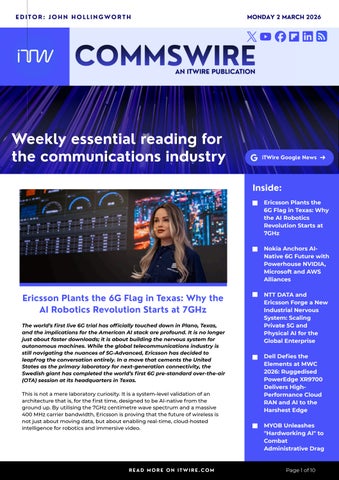
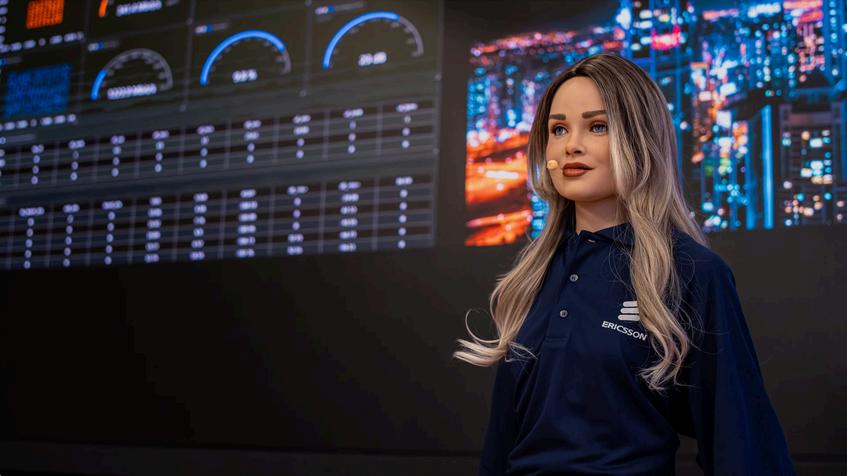
The world’s first live 6G trial has officially touched down in Plano, Texas, and the implications for the American AI stack are profound. It is no longer just about faster downloads; it is about building the nervous system for autonomous machines. While the global telecommunications industry is still navigating the nuances of 5G-Advanced, Ericsson has decided to leapfrog the conversation entirely. In a move that cements the United States as the primary laboratory for next-generation connectivity, the Swedish giant has completed the world’s first 6G pre-standard over-the-air (OTA) session at its headquarters in Texas.
This is not a mere laboratory curiosity It is a system-level validation of an architecture that is, for the first time, designed to be AI-native from the ground up By utilising the 7GHz centimetre wave spectrum and a massive 400 MHz carrier bandwidth, Ericsson is proving that the future of wireless is not just about moving data, but about enabling real-time, cloud-hosted intelligence for robotics and immersive video


Ericsson Plants the 6G Flag in Texas: Why the AI Robotics Revolution Starts at 7GHz
Nokia Anchors AINative 6G Future with Powerhouse NVIDIA, Microsoft and AWS Alliances
NTT DATA and Ericsson Forge a New Industrial Nervous System: Scaling Private 5G and Physical AI for the Global Enterprise
Dell Defies the Elements at MWC 2026: Ruggedised PowerEdge XR9700 Delivers HighPerformance Cloud RAN and AI to the Harshest Edge
MYOB Unleashes "Hardworking AI" to Combat Administrative Drag
The Technical Blueprint: Centimetre Waves and Cloud-Native Cores
The trial marks a significant shift in how we think about spectrum By targeting the 7GHz range, Ericsson is finding the "sweet spot" between the coverage of mid-band and the extreme capacity of millimetre wave The technical highlights of this 6G stack are impressive: a carrier bandwidth of 400 MHz focused on optimised uplink and maximised spectral utilisation.
But the real magic is happening in the software This is a cloudnative, software-defined air interface that can run on standard CPU and GPU platforms. The hardware is becoming a commodity, while the software becomes the intelligence. This allows for a "futureproof" architecture where 6G capabilities can be deployed as code, rather than requiring a forklift upgrade of physical infrastructure every few years.
In the 2026 landscape, "sovereignty" is the word on every executive's lips. 6G is being framed as critical infrastructure for national security and economic competitiveness During the demonstration, the political stakes were made clear through a rare alignment of corporate and government rhetoric.
U S Secretary of Commerce Howard Lutnick described the milestone as one enabled by American ingenuity, stating that the administration will always back trusted partners committed to an American-designed future. This sentiment was echoed by Ericsson President and CEO Börje Ekholm, who provided a broader vision for the technology's role:
"6G will be foundational to how artificial intelligence scales across society and will be critical to the national security, economic prosperity, and global competitiveness of the United States Completing this world's first live 6G trial in the United States is a tangible proof point that advanced wireless innovation, manufacturing, and research is anchored here supporting U S leadership in next-generation connectivity"
6G will be foundational to how artificial intelligence scales across society and will be critical to the national security, economic prosperity, and global competitiveness of the United States. Completing this world's first live 6G trial in the United States is a tangible proof point that advanced wireless innovation, manufacturing, and research is anchored here, supporting U.S. leadership in nextgeneration connectivity."
ABÖRJE EKHOLM ERICSSON PRESIDENT AND CEO
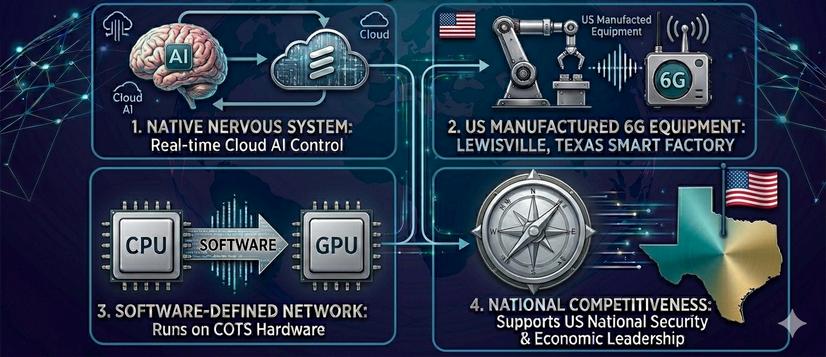
Perhaps the most overlooked part of this story is the domestic supply chain. Ericsson is not just designing 6G in Texas; they are planning to build it there. The company has already invested more than USD 150 million in its 5G USA Smart Factory in Lewisville, Texas
This highly automated, 300,000-square-foot facility already supports more than 550 manufacturing jobs and currently produces advanced 5G radios. As 6G matures toward global standardisation, this factory will serve as the engine room for the next decade of American connectivity In an era where "resilient supply chains" are a mandatory requirement for government contracts, having a 6G-ready facility on U S soil is a massive competitive moat.
Specifically, the trial proved two things that will change the enterprise landscape. First, it showed how 6G can power AI robotics using cloud-hosted Large Language Models (LLMs). By providing instant, reliable connections for real-time control, 6G allows a robot to "think" in the cloud and act in the physical world without the lag that plagues current systems
Second, it enables a new class of real-time video streaming that is essential for industrial automation and immersive applications As AI expands beyond the smartphone, the wireless network becomes a critical layer of the AI stack 6G networks are designed to sense, compute, and adapt in real time This means consistent low latency and a much higher uplink capacity, which are the two "must-haves" for any business looking to deploy autonomous systems at scale
The Plano demonstration is just the beginning Ericsson has indicated it will continue expanding trials across additional spectrum bands and collaborating with chipset partners and the broader ecosystem to accelerate 6G readiness.
The "scrappy challenger" days of 5G are over We are now entering the era of the "AI-Native Network," where the infrastructure itself is as smart as the devices it connects For telecommunications executives, the message is clear: the transition to 6G is not just a speed upgrade; it is a total reimagining of what a network can do for the modern enterprise.
Nokia has signalled a definitive shift in the global telecommunications landscape at MWC26, unveiling a suite of high-profile partnerships designed to accelerate the integration of artificial intelligence into the Radio Access Network. By aligning with industry titans such as NVIDIA, Microsoft, and AWS, the Finnish infrastructure leader is moving beyond traditional connectivity to establish the groundwork for an AInative 6G future. This strategic evolution focuses on transforming the network from a static pipe into an intelligent, self-optimising system capable of meeting the massive data demands of the next decade. For business leaders and operators, this represents a pivotal moment where cloud computing and wireless technology converge to redefine operational efficiency and service delivery on a global scale.
The announcements made in Barcelona underscore a broader industry trend toward the transition of AI-RAN. This architecture represents a significant departure from purpose-built hardware, moving instead toward software defined environments where AI workloads and communication tasks coexist on the very same infrastructure. Nokia’s approach is centred on the foundational belief that the path to 6G is inseparable from the advancement of artificial intelligence, a shift that necessitates a complete rethink of how radio networks are designed, deployed, and managed.
Central to Nokia’s momentum is its significantly deepened relationship with NVIDIA. The two companies are collaborating to bring the full power of accelerated computing to the RAN By utilising the NVIDIA Grace Blackwell Superchip and the NVIDIA Aerial software suite, Nokia aims to deliver a substantial boost in processing power for complex network tasks. This partnership is not just about raw speed; it is about enabling the network to handle real-time AI applications at the edge The collaboration focuses on creating a "Cloud RAN" solution that can dynamically allocate resources between telecommunications tasks and AI inference workloads, ensuring that operators can monetise their infrastructure in entirely new ways
In parallel, Nokia’s work with Microsoft Azure is bringing cloud native simplicity to the telecommunications sector. This partnership focuses on integrating Nokia’s RAN solutions with Azure’s sophisticated AI and cloud management tools By leveraging Microsoft’s global cloud footprint, Nokia is providing operators with the ability to deploy and manage AI-RAN at a massive scale. This integration is expected to reduce the complexity of network management, allowing for automated troubleshooting and real-time performance tuning that was previously considered impossible.
The partnerships announced at MWC26 are the building blocks for a future where the network adapts to the user, rather than the user adapting to the network." Uitto further stated that "by bringing AI to the edge of the network, Nokia is enabling a new class of services that will drive economic growth and digital transformation across every sector of the economy."
TOMMI UITTO PRESIDENT OF MOBILE NETWORKS AT NOKIA
The collaboration with AWS further strengthens this ecosystem by focusing on the development of specialised AI-RAN solutions for the enterprise market By combining Nokia’s radio expertise with AWS’s edge computing capabilities, the two companies are targeting industrial use cases where low latency and high reliability are nonnegotiable requirements. These partnerships collectively demonstrate that the future of the network is a collaborative effort between traditional hardware providers and the world’s leading cloud platforms.
Nokia has backed these announcements with impressive performance metrics that highlight the tangible benefits of an AI-driven approach During live demonstrations at MWC26, Nokia showcased that its AI-RAN solutions can deliver up to a 30% increase in spectral efficiency This means that operators can squeeze more data through their existing frequency bands, effectively increasing capacity without the need for expensive and difficult new spectrum acquisitions.
Furthermore, the integration of AI for power management has shown the potential to reduce energy consumption at the cell site by more than 25%. In an era where sustainability is a top priority for C-suite executives, these energy savings represent a significant reduction in the total cost of ownership. The use of AIdriven "sleep modes" allows the network to intelligently power down components during low traffic periods and wake them up instantly when demand returns, ensuring that performance is never compromised for the sake of efficiency.
Latency, a critical metric for the upcoming 6G era, is also seeing dramatic improvements Nokia’s AI-native algorithms can predict traffic patterns and pre-emptively allocate resources, resulting in a 40% reduction in user plane latency for high demand applications like industrial robotics and augmented reality.
While the current focus remains on enhancing 5GAdvanced, Nokia Bell Labs is already looking toward the 6G horizon. The "AI-native" label for 6G implies that AI will not just be an add-on, but will be built into the very physical layer of the radio interface Nokia’s vision for 6G includes a "network as a sensor" capability, where the radio waves themselves can be used to sense the environment, creating a digital twin of the physical world in real time

Tommi Uitto, President of Mobile Networks at Nokia, emphasised the importance of this transition during the event, offering a clear vision for the company's trajectory. He noted that "the partnerships announced at MWC26 are the building blocks for a future where the network adapts to the user, rather than the user adapting to the network " Uitto further stated that "by bringing AI to the edge of the network, Nokia is enabling a new class of services that will drive economic growth and digital transformation across every sector of the economy."
For telecommunications professionals and business executives, the message from Nokia is clear: the era of the "dumb pipe" is officially over The shift to AI-RAN is a structural change that requires a new set of skills and a completely new approach to vendor relationships Operators who fail to embrace the convergence of AI and RAN risk being left behind in a market where agility and intelligence are the primary competitive advantages
The business case for this transition is built on three central pillars: operational cost reduction through automation, enhanced user experience through superior network performance, and new revenue opportunities through edge AI services. As the industry moves closer to the standardisation of 6G, the groundwork being laid today by Nokia and its partners will determine the leaders of the next generation of global connectivity.
Nokia’s presence at MWC26 has proven that they are not just participating in the AI revolution; they are actively directing its course. By combining their deep heritage in radio technology with the cutting-edge innovations of Silicon Valley giants, they are creating a formidable platform for the future of the connected world. The road to 6G is now visible, and it is paved with artificial intelligence
NTT DATA and Ericsson have announced a major strategic expansion at MWC 2026, creating a unified force to accelerate the global deployment of Private 5G and Physical AI across the enterprise sector. By combining Ericsson’s industry-leading private cellular technology with NTT DATA’s massive global footprint in consulting and managed services, the two organisations are providing a turnkey solution for industries seeking to digitise their physical operations. This collaboration marks a significant milestone in the evolution of the industrial internet, where high-performance connectivity serves as the essential nervous system for artificial intelligence that interacts directly with the physical world. For global executives, this partnership simplifies the path to Industry 4.0 by removing the technical barriers to entry and providing a scalable, secure, and intelligent infrastructure designed for the next era of productivity.
The joint initiative focuses on the convergence of two powerful technological trends: the maturation of Private 5G (P5G) networks and the rise of Physical AI While traditional AI has largely been confined to the digital realm of data centres and screens, Physical AI refers to the integration of machine learning and computer vision into physical assets like robotics, drones, and autonomous vehicles. This transition requires a level of network reliability and low latency that only private cellular infrastructure can provide, making the NTT DATA and Ericsson alliance a critical enabler for the next generation of smart factories and logistics hubs
The joint initiative focuses on the convergence of two powerful technological trends: the maturation of Private 5G (P5G) networks and the rise of Physical AI. While traditional AI has largely been confined to the digital realm of data centres and screens, Physical AI refers to the integration of machine learning and computer vision into physical assets like robotics, drones, and autonomous vehicles. This transition requires a level of network reliability and low latency that only private cellular infrastructure can provide, making the NTT DATA and Ericsson alliance a critical enabler for the next generation of smart factories and logistics hubs

At the heart of this partnership is the integration of Ericsson Private 5G (EP5G) with NTT DATA’s comprehensive suite of managed services and its specialised Physical AI platform This combination allows enterprises to move beyond small-scale pilots and into full production environments By utilising a software-defined approach, the two companies are making it easier for IT and OT (Operational Technology) teams to manage complex deployments across multiple global sites.
The partnership addresses one of the primary pain points for C-suite leaders: the complexity of orchestrating a global digital transformation strategy. Historically, companies have struggled to bridge the gap between connectivity providers and application developers. NTT DATA and Ericsson are effectively closing this gap by offering a pre-integrated stack This allows businesses to deploy Physical AI applications with the confidence that the underlying network will meet the rigorous demands of industrial operations
The concept of Physical AI is central to the value proposition being presented in Barcelona In a traditional manufacturing environment, robots often operate on fixed paths with limited ability to react to their surroundings. With the addition of Physical AI powered by a private 5G network, these machines become aware of their environment, processing vast amounts of sensor data at the edge for split-second decision making
During the announcement, Shahid Ahmed, Group Executive Vice President of Edge Services at NTT DATA, highlighted the transformative nature of this technology. He noted that "Physical AI is the next frontier of digital transformation, where intelligence is embedded directly into the physical assets of an organisation" Ahmed emphasised the strength of the collaboration, stating that "by partnering with Ericsson, NTT DATA is providing the robust, high-capacity connectivity required to bring these intelligent systems to life at scale."
This is not merely a theoretical exercise The two companies have already identified several key verticals where this technology is delivering immediate results, from the automotive sector coordinating fleets of Autonomous Mobile Robots (AMRs) to healthcare systems supporting remote surgical training.
The metrics supporting the shift to Private 5G and Physical AI are compelling for any business leader focused on the bottom line. Early adopters of these joint solutions have reported significant improvements in operational key performance indicators In logistics and warehousing, the automation of manual processes through Physical AI has led to a 20% increase in throughput and a 15% reduction in energy costs
15% 30% 20% reduction in energy costs decrease in workplace accidents increase in throughput
Safety is another area where the impact is measurable By using AI-powered cameras and sensors connected via P5G to monitor hazardous zones, industrial sites have seen a 30% decrease in workplace accidents This reduction not only protects the workforce but also significantly lowers insurance premiums and reduces downtime associated with safety incidents.
Manish Tiwari, Head of Private Cellular Networks at Ericsson, emphasised the importance of a standardised approach to these deployments. He remarked that Ericsson Private 5G is built specifically for the demanding environments of the enterprise, ensuring that customers have access to a global ecosystem of experts who can manage the entire lifecycle of the network
For telecommunications professionals and enterprise executives, the message from MWC 2026 is that the era of experimentation is ending and the era of industrial scale is beginning The partnership between NTT DATA and Ericsson provides a blueprint for how large organisations can navigate the complexities of modernising their physical infrastructure.
The strategic shift toward Physical AI represents a fundamental change in how companies view their physical assets. These assets are no longer just tools; they are becoming intelligent nodes in a global data network. To capitalise on this shift, business leaders must prioritise the deployment of secure, dedicated connectivity that can handle the massive data volumes generated by AI at the edge
As enterprises look toward the remainder of 2026 and beyond, the ability to integrate AI into physical operations will be a primary driver of competitive advantage. The collaboration between NTT DATA and Ericsson is not just about selling technology; it is about providing the foundation for the autonomous enterprise of the future By lowering the barriers to entry and providing a clear path to scale, these two industry leaders are ensuring that the promise of Industry 4.0 becomes a reality for businesses around the world.
Dell Technologies has unveiled its most rugged computing solution to date at MWC 2026, launching the PowerEdge XR9700 server to bring high-performance Cloud RAN and AI capabilities to the most extreme edge environments. By engineering a platform specifically for the harsh conditions found at the base of mobile towers and in industrial settings, the infrastructure leader is bridging the gap between data centre sophistication and field-level durability. This strategic expansion allows telecommunications operators and enterprise leaders to deploy AI-driven workloads and software-defined networking in locations previously deemed too volatile for standard hardware. For business executives, this development represents a critical step in the decentralisation of intelligence, ensuring that the next generation of 6G and autonomous applications can function reliably regardless of temperature, dust, or vibration.
The introduction of the PowerEdge XR9700 signals a major shift in how the industry approaches edge computing. As networks transition toward Open RAN and Cloud RAN architectures, the demand for "telecomgrade" compute that can survive outside of climate-controlled environments has reached a fever pitch. Dell’s latest entry into the XR family is designed to meet this need head-on, offering a compact, short-depth form factor that fits into existing infrastructure footprints while delivering the processing power required for realtime AI inference and 5G signal processing.
The technical specifications of the XR9700 are a testament to Dell’s focus on reliability under pressure. The server is designed to operate in a wide temperature range and is built to withstand significant physical stress. Unlike traditional rack servers, this ruggedised unit uses advanced thermal management to maintain performance even when airflow is restricted or ambient temperatures soar This is particularly vital for telecommunications providers who are increasingly moving their baseband processing from protected hubs to the "far edge" of the network.

Central to the performance of the new server is the integration of the latest Intel Xeon Scalable processors and NVIDIA accelerated computing. This combination allows the XR9700 to handle massive data throughput with minimal latency By placing this level of computing power directly at the source of data generation, Dell is enabling enterprises to process AI workloads, such as computer vision for site security or predictive maintenance for heavy machinery, without the delay associated with sending data back to a central cloud Driving Efficiency through Cloud RAN
Beyond its physical durability, the XR9700 is a cornerstone for the global rollout of Cloud RAN By virtualising the Radio Access Network, operators can significantly reduce their hardware overhead and move toward a more agile, software-defined model. Dell has validated this platform with leading RAN software providers to ensure seamless integration, allowing telcos to scale their 5G-Advanced and early 6G trials with greater confidence
Dennis Hoffman, Senior Vice President and General Manager of the Telecom Systems Business at Dell Technologies, emphasised the strategic importance of this ruggedised approach He noted that "the edge is the next frontier for AI and telecommunications, but it is an unforgiving environment that requires a new breed of infrastructure." Hoffman further stated that "by bringing data centre class performance to the harsh edge, Dell is giving operators the tools they need to modernise their networks and unlock new revenue streams through industrial AI"
The shift to the XR9700 offers measurable benefits for organisations looking to optimise their edge strategy During performance testing, Dell demonstrated that the new architecture can provide up to a 40% improvement in energy efficiency compared to previous-generation edge servers. This reduction in power consumption is a critical metric for telcos managing thousands of remote sites, directly impacting the total cost of ownership and corporate sustainability goals
Furthermore, the short-depth design of the server allows for a 30% reduction in the physical footprint required at the cell site. This space saving is essential for urban deployments where real estate is at a premium, and every centimetre of cabinet space must be utilised effectively
The impact on AI performance is equally significant. With integrated acceleration, the XR9700 can process edge AI tasks up to 2.5x faster than standard ruggedised compute modules. This speed is vital for applications like autonomous drone navigation or real-time traffic management, where a split-second delay can have real-world consequences
For telecommunications executives and IT leaders, the release of the PowerEdge XR9700 represents a maturing of the edge ecosystem. It moves the conversation away from "if" AI can be deployed at the edge to "how" it can be scaled reliably. The partnership between Dell, Intel, and NVIDIA provides a stabilised platform that reduces the risk of hardware failure in the field, which has historically been a major barrier to edge adoption
The business case for ruggedised edge compute is built on three pillars: operational resilience in any climate, reduced latency for critical AI applications, and a simplified path to Cloud RAN. As the industry moves closer to the 6G era, the ability to maintain high performance in harsh environments will be a primary differentiator for successful operators
Dell’s presence at MWC 2026 has confirmed that the company is committed to being the foundational layer for the intelligent edge By solving the physical challenges of heat, dust, and space, they are allowing the software revolution in AI and telecommunications to reach its full potential The edge is no longer a limitation; with the right infrastructure, it is the new centre of innovation.
MYOB has unveiled a sophisticated new suite of artificial intelligence capabilities at its 2026 product showcase, specifically engineered to eliminate the "administrative drag" that costs Australian small and medium enterprises billions in lost productivity annually. By embedding "hardworking intelligence" directly into its core business management platform, the local technology leader is moving beyond simple automation to provide SMEs with a proactive digital assistant. This strategic rollout focuses on three critical pillars: automated financial reconciliation, intelligent debt collection, and deep-dive business analytics. For business owners and finance executives, this represented a decisive shift where AI transition moves from a futuristic concept to a daily operational reality, allowing lean teams to function with the sophistication of a much larger enterprise.
The introduction of these AI-powered features comes at a pivotal moment for the sector Recent data from the MYOB Bi-Annual Business Monitor highlights a "confidence paradox" where, despite ongoing inflationary pressures, 24% of SMEs expect the economy to improve over the next 12 months. To capitalise on this emerging optimism, MYOB is deploying AI to solve the most persistent pain points for Australian businesses: squeezed margins and the chronic "talent scarcity" that has seen tax accountants and auditors added to national shortage lists
Hardworking Intelligence: Beyond the Chatbot
At the heart of the new rollout is the transition from passive software to active "AI agents" Unlike generic generative tools, MYOB’s AI is grounded in the specific financial data and compliance requirements of the Australian regulatory environment. The suite includes several flagship tools designed to operate "behind the scenes," ensuring that business owners stay in control while the software handles the heavy lifting
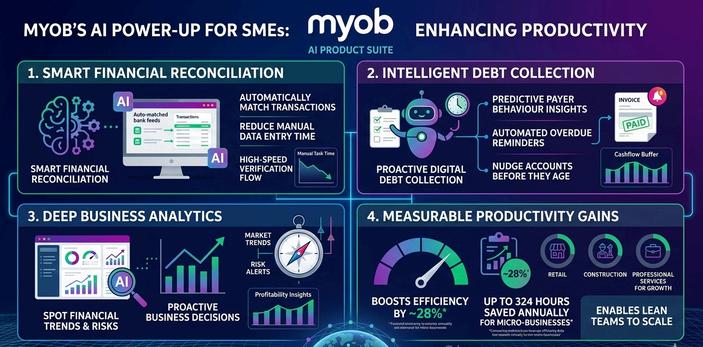
Smart Reconciliation now serves as the network’s automated ledger, matching bank feed transactions and patterns quietly in the background. By the time a user opens their file, the majority of the work is already completed, leaving only a final review This shift transforms reconciliation from a time-consuming chore into a high-speed verification flow, effectively ensuring that the difference between the bank balance and the MYOB account stays at $000
In parallel, Smart Invoice Reminders addresses the critical issue of cashflow management. The tool uses intelligent insights to predict payer behaviour and automatically nudges overdue accounts For an SME, this means fewer manual follow-ups and a significant reduction in days-sales-outstanding, providing a real-time buffer against the rising cost of utilities and fuel.
The impact of these AI integrations is already visible in the performance data of early adopters MYOB’s research into midmarket and SME firms reveals that those leaning into AI are seeing measurable gains in operational efficiency:
324 hours saved: Micro-businesses using AI reported average time savings equivalent to nine working weeks per year.
28% efficiency boost: Over a quarter of businesses report significantly more efficient administration and data management since implementing AI-driven workflows 30% accident reduction: In industrial and warehousing sectors, AI-powered monitoring and sensor integration have led to a marked decrease in workplace safety incidents
234
28%

CEO, Editor in Chief and Advertising / Business Enquiries: Andrew Matler: andrew.matler@itwire.com, Tel: 0412 390 000 CommsWire (ISSN 2202-4549) is published by iTWire Pty Ltd 18 Lansdown St, Hampton, Vic, 3188
AI’s ability to lower cost pressures through automation and smarter resource allocation will allow businesses to remain agile and resilient while enabling their teams to focus on growth." Robson further stated that "by bringing AI to the edge of the business, we are enabling a new class of services that will drive economic growth and digital transformation across every sector of the economy."
PAUL ROBSON CEO OF MYOB
30%