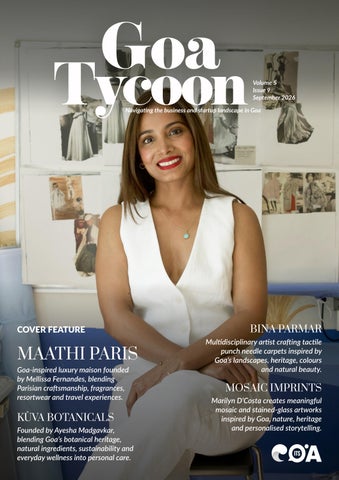
Tycoon
Volume 5
Issue 9
September 2026
Navigating the business and startup landscape in Goa
COVER FEATURE
MAATHI Paris Goa-inspired luxury maison founded by Mellissa Fernandes, blending Parisian craftsmanship, fragrances, resortwear and travel experiences.
Kùva Botanicals
Founded by Ayesha Madgavkar, blending Goa’s botanical heritage, natural ingredients, sustainability and everyday wellness into personal care.
Bina Parmar
Multidisciplinary artist crafting tactile punch needle carpets inspired by Goa’s landscapes, heritage, colours and natural beauty.
Mosaic Imprints
Marilyn D’Costa creates meaningful mosaic and stained-glass artworks inspired by Goa, nature, heritage and personalised storytelling.
Through Mosaic Imprints, Marilyn D’Costa transforms fragments into expressive mosaic and stained-glass artworks inspired by nature, heritage, and Goa, while making creativity accessible through personalised commissions and workshops.
Satellite Farms Goa, led by architect and urban grower Abhijit Sawant, explores hydroponics, aquaponics, and microgreens while combining research, education, and sustainable technology to rethink urban
Editorial
food production.
Founded by architect Shravani, Pakho Shop
Dear Readers,
transforms personal illustrations into handmade products celebrating individuality
As September unfolds across Goa, we
and everyday joy.
celebrate the people, ideas, and businesses shaping the state’s evolving entrepreneurial
Saksham brings innovative refrigeration
landscape. In this issue, we spotlight
solutions to Goa, enhancing food safety,
creativity, sustainability, innovation, and
sustainability, cold-chain practices, and
thoughtful enterprise, while exploring the
operational efficiency.
stories and purpose behind businesses making their mark in Goa.
Together, these stories reveal a key truth about business in Goa: success requires
MAATHI Paris, founded by Mellissa
more than ideas. It calls for understanding
Fernandes, brings Goa’s spirit into a luxury
seasonal rhythms, nurturing loyal customers,
travel maison shaped by Parisian
staying digitally present, managing resources
craftsmanship, creating fragrances,
wisely, and using quieter months to evolve.
resortwear, and experiences rooted in
This mindful approach transforms small
memory and emotion.
ventures into lasting legacies.
Kùva Botanicals, founded by Ayesha
Well, that's all I have for you from my desk
Madgavkar, draws from Goa’s natural
this month. I hope you enjoy reading this
heritage to create thoughtfully crafted
month's issue of Goa Tycoon. Do share it
personal-care products, combining local
with your friends all across the globe.
ingredients, sustainable practices, and everyday wellness.
Until next month, cheers!
Bina Parmar brings Goa’s landscapes and
Warm regards,
heritage to life through tactile punch needle carpets, blending colour, texture, handmade
Jessyl Fernandez
craftsmanship, and environmental awareness
Editor
into distinctive works of art.
www.itsgoa.com
itsgoa_
Itsgoa
Editorial Team
Index 01 MAATHI Paris
02 Kùva Botanicals
03 Bina Parmar
04 Mosaic Imprints
05 Satellite Farms Goa
06 Pakho shop
07 Elanpro Saksham: Smarter Kitchens for Goa’s Hospitality Industry
Introduction Goa, the tiniest state on the western coast of India, boasts golden pristine beaches, palm-fringed avenues, flavourful food, delicious Portuguese-influenced sweets, and warm, hospitable people. Also known as the Ibiza of India for its partying. A tropical paradise of flora and fauna, from the very famous 'almi' (mushrooms) endemic to its forests, that grow only on the red mud anthills, to the solar prawns that are fished immediately after the monsoons, Goa is unique. Tourists are also attracted to Goa for its cultural heritage - from the famous old Portuguese churches like Se Cathedral in Old Goa, the 16th Century Safa Masjid in Ponda and Shree Mangesha Temple in Mardol, the legendary Arvalem or Pandava Caves where the Pandavas of the Mahabharat fame lived, to its two unique festivals - Carnival and Shigmo. Goa plays host to many festivals the International Film Festival of India that promotes cinema, the Serendipity Art Festival, Sunburn Music Festival, to name a few. To showcase this varied heritage of culture, art, tradition, food, and people, in 2015 ItsGoa was born. The main aim was to make it the premier portal for all things Goa. We were able to showcase Goa like never before. Soon our blog-based website transcended the virtual space, with the ItsGoa magazine – a sought-after resource for visitors to Goa from countries like Norway, UK, USA, etc.
E
Jessyl Fernandez
Sales
Donald Fernandez
Chief ditor
Andrea Fernandes
& Social Media
Britney Fernandes
Graphics & Layout
Britney Fernandes
For advertising queries:
+91 7887330620 / 9370502124
Content
ItsGoa Media Group
Nordic Intent HQ - Floor 3, PDA
Colony, Porvorim, Goa 403521
Email: mail@itsgoa.com
Website: itsgoa.com
cover feature
MAATHI Paris Mellissa Fernandes founded MAATHI Paris, a luxury travel maison inspired by Goa and refined through Parisian craftsmanship, creating fragrances, resortwear and travel experiences rooted in memory, culture and emotion. Article by: Team ItsGoa
Images by: MAATHI Paris
www.itsgoa.com
itsgoa_
Itsgoa
For Mellissa Fernandes, the story of MAATHI Paris began with a question she carried from childhood: Where do I come from? Born and raised during her early years in Dubai, she found her sense of belonging through annual visits to her grandparents’ village in Quepem, Goa. Running barefoot beneath cashew trees, spending long days by the sea and gathering around extended family lunches created memories that would eventually become the emotional foundation of her creative journey.
Before settling in Paris, Mellissa travelled the world as a flight attendant. Those years taught her that the most memorable journeys are rarely about destinations alone. They are about the emotions, people, scents and rituals that stay with us long after we return home.
Paris introduced her to a world of craftsmanship, savoir-faire and refined attention to detail. Goa had already shaped her emotional sensibility, while Paris gave her a language through which to express it. Today, as the creative force behind MAATHI Paris, Mellissa brings these influences together through fragrance, resortwear, travel objects and a long-term vision for hospitality.
MAATHI Table, South Goa A Maison Rooted in Soil
The name MAATHI came before the products themselves. In Konkani, Maathi means “soil”, representing roots, origins and the places that shape us. The meaning is particularly personal to Mellissa because her grandfather was a potter in Goa, working with earth to create objects by hand.
For the maison, soil became a powerful metaphor for memory. Just as the earth preserves traces of what came before, MAATHI seeks to create objects and experiences that preserve the emotions attached to journeys. A fragrance can recall a forgotten summer, a garment can become inseparable from a favourite holiday, and a place can eventually become part of a family’s history.
Mellissa Fernandes, Founder of MAATHI
This belief lies at the heart of MAATHI: meaningful luxury is not necessarily about owning more, but about remembering more. The maison invites people to travel slowly, experience places deeply and carry a little of every journey home.
www.itsgoa.com
itsgoa_
Itsgoa
The MAATHI Table with Chef Avinash Martins, South Goa
Discovering Scent at the MAATHI Table
www.itsgoa.com
itsgoa_
Itsgoa
Les Engrammes: Fragrance Through Memory
MAATHI’s debut fragrance collection, Les Engrammes, is scheduled for global launch in October 2026. Named after the term engram, which refers to the trace a memory leaves in the mind, the collection explores the powerful relationship between scent and remembrance.
Unlike fragrance collections that begin with ingredients or olfactory categories, Les Engrammes began with stories. Childhood summers, favourite desserts, loved ones, landscapes, rain on dry earth, sunlight on skin after swimming and the sensation of returning home all became starting points for the fragrances.
MAATHI Fragrance Experience, Saint-Tropez Goa as the Heart of MAATHI
For Mellissa, Goa represents much more than beaches and holidays. It taught her a different relationship with time, one shaped by long lunches, spontaneous gatherings, barefoot childhoods and an instinctive connection with nature. That sense of freedom and unhurried living became central to MAATHI’s philosophy, “Untamed Looks Good On You.”
DROWNING explores surrendering to love, desire, life and instinct. GOLD TEARS - I’LL NEVER FORGET YOU reflects love, gratitude and lasting emotional connections, with jalebi serving as an early reference for its warmth and golden character. TRACE considers the invisible impressions left by people and encounters, while QUEPEM remains the collection’s most personal expression of Mellissa’s Goan childhood. Together, the fragrances invite people to wear memories rather than identities.
Bringing Goa to Saint-Tropez
The maison’s connection to Goa also appears through its founding symbol, the cashew, which is inseparable from Mellissa’s childhood memories in Quepem. It features in the signature Fleur de Cajou print, created by French artist Maïwenn, as well as in custom buttons shaped like cashew nuts.
Before its worldwide launch, Les Engrammes is being introduced through L’Heure MAATHI, an intimate summer experience at Hôtel Sezz Saint-Tropez. Rather than creating a conventional pop-up or highly visible commercial installation, MAATHI chose a quieter approach centred on conversation, curiosity and personal discovery.
The influence extends into fragrance with Quepem, named after her grandparents’ village. Its exclusive cashew accord evokes Goan summers, sea breeze, sun-warmed skin and the shade of cashew trees. Rather than simply reproducing Goa, Mellissa wants MAATHI to capture the feeling a place leaves behind.
The experience begins with earth. Each fragrance is presented in a handcrafted clay vessel made in Quepem, Goa. The clay gently diffuses the fragrance while allowing visitors to first experience the texture and warmth of the material. In doing so, guests physically encounter the maathi—the soil of Goa, before discovering the perfumes.
www.itsgoa.com
itsgoa_
Itsgoa
Les Engrammes, MAATHI’s Debut Fragrance Collection
www.itsgoa.com
itsgoa_
Itsgoa
The emotional storytelling is supported by a rigorous commitment to craftsmanship. MAATHI works with high-quality fragrance ingredients sourced through IFF while also highlighting lesser-known Indian raw materials. Each Les Engrammes fragrance is composed as an Extrait de Parfum and macerated in France using Alcohol Bon Goût, selected for its purity and ability to reveal the character of the ingredients.
The Goa–Paris Connection
Mellissa does not see Goa and Paris as two worlds that need to be balanced. Instead, they represent two complementary aspects of MAATHI. Goa provides the emotional vocabulary, instinct, nature, belonging and an appreciation for time, while Paris contributes structure, precision and craftsmanship.
The Sea Remembers -MAATHI Resortwear The response has become an important part of the experience. Visitors often begin sharing their own memories of grandmothers, first loves, childhood holidays and places they had forgotten. For Mellissa, these moments demonstrate that fragrance can become a deeply personal gateway to memory.
Her professional experience with luxury maisons including Dolce & Gabbana, Tom Ford and Kilian Paris strengthened her understanding of the importance of intention and detail in luxury. At MAATHI, this translates into a belief that every material, finish and element should exist for a reason.
Where Craftsmanship Meets Emotion
Creating a MAATHI fragrance begins with a story rather than a traditional fragrance category. Mellissa develops creative worlds through photographs, films, music, paintings, travel journals and written memories. A landscape, dessert or personal experience can become the emotional starting point for a perfume.
For GOLD TEARS - I’LL NEVER FORGET YOU, jalebi became a reference for comfort, celebration and nostalgia rather than a literal scent to reproduce. For QUEPEM, an image of ripe cashew fruits falling towards the sea beneath the Goan sun inspired the development of the maison’s exclusive cashew accord.
Fleur de Cajou Print, Saint-Tropez
www.itsgoa.com
itsgoa_
Itsgoa
The Sea Remembers - MAATHI Resortwear Campaign
Cashew-Inspired Details by MAATHI
www.itsgoa.com
itsgoa_
Itsgoa
This approach also shapes how the maison engages with cultures beyond Goa. Mellissa wants MAATHI to build genuine relationships with artisans, traditions and communities rather than simply borrow from cultures for their aesthetic appeal. Goa remains its origin, but the maison’s wider ambition is to create a conversation between cultures through travel, craftsmanship and curiosity.
More Than a Fragrance House
MAATHI is being developed as a travel maison, with fragrance representing only one part of a much larger universe. Resortwear, travel objects and hospitality are intended to express the same central belief: that travel changes us and that the things we bring home can become vessels for memory. The maison deliberately avoids building around trends and seasons, choosing instead to create around places, emotions and stories. Mellissa hopes that when people encounter a MAATHI fragrance, they will ask not only what notes it contains, but what it reminds them of.
Hospitality is already becoming part of this vision. The MAATHI Table, hosted at Chef Avinash Martins’ farm in South Goa, brought together chefs, writers, artists, curators, collectors and designers around food, culture, craftsmanship and Goa’s stories. At Saint-Tropez, that philosophy evolved through fragrance. Looking ahead, Mellissa envisions MAATHI boutique hotels and private villas in extraordinary destinations around the world.
Growing with Purpose
Building an independent luxury maison has brought challenges, particularly the need to grow without compromising the identity of a young brand. Since launching its website in September 2025, MAATHI has introduced resortwear, developed Les Engrammes and presented the collection through its Saint-Tropez avant-première. For Mellissa, the most rewarding moments are often the quietest ones, seeing someone connect with a fragrance, listening to a guest share a personal memory or welcoming someone back for another experience. These interactions reassure her that MAATHI is creating something people can genuinely feel.
The Cashew, MAATHI’s Founding Symbol Her long-term vision also includes MAATHI ROOTS, a commitment to land, origin and regeneration beginning with the cashew tree. The initiative aims to support the regeneration of cashew groves and work with family-owned land in Goa, ensuring that the maison’s relationship with its place of origin is based on continuity rather than extraction.
A Global Future, Rooted in Goa
Mellissa’s journey has ultimately brought her back to the question that shaped her childhood: where she comes from. Through MAATHI, she has found an answer rooted in the places, people and experiences that have shaped her. Her advice to aspiring entrepreneurs and creatives from Goa is equally grounded: do not underestimate where you come from. Goa’s cultural heritage, craftsmanship, connection with nature and appreciation for human relationships already carry qualities that can resonate with a global audience.
For Mellissa Fernandes, creativity may begin with inspiration, but excellence requires discipline, curiosity, patience and attention to detail. MAATHI reflects that philosophy, a maison where Goa provides the roots, Paris provides the refinement, and travel provides the stories. Ultimately, MAATHI is an invitation to experience the world differently: to slow down, reconnect with oneself and allow every meaningful journey to leave something behind.
www.itsgoa.com
itsgoa_
Itsgoa
hotel Lua Nova If holidays are inspired by nature and your thirst for rustic solitude and inner peace, Lua Nova is the hotel your heart was yearning for. Located at Goa's celebrated holiday capital at Baga, it overlooks a beautiful Canvasitsgoa_ of village Itsgoa www.itsgoa.com Goa, just 5 minutes walk from the Baga Beach.
Skincare & Personal Care
Kùva Botanicals
Ayesha Madgavkar’s Kùva Botanicals blends Goa-inspired ingredients, natural formulations and sustainable practices, creating thoughtfully crafted personal-care products rooted in heritage, performance, local sourcing and everyday wellness. Article by: Team ItsGoa
Images by: Kùva Botanicals
www.itsgoa.com
itsgoa_
Itsgoa
The experience sparked a deeper interest in formulation. From 2015, Ayesha began seriously developing products at home for family and friends and later completed a natural formulation course with Formula Botanica. Kùva launched in 2019, initially as a hobby, before becoming a full-fledged business in 2023 following the disruptions of the pandemic and the birth of her daughter.
The name Kùva was discovered while Ayesha was researching Goan history. It was an old name for this coast, used by traders who travelled from Arabia and Greece, making it a natural fit for a brand created to represent Goa.
Formulated for Goa
Founder - Ayesha Madgavkar For Ayesha Madgavkar, founder of Kùva Botanicals, Goa is more than a place of residence. It is the inspiration behind the brand’s ingredients, fragrances and philosophy. Growing up in Sangolda in the 1980s, Ayesha remembers a Goa of gardens, hills, village roads and afternoons spent cycling, exploring and searching for berries. Those childhood memories continue to influence Kùva today.
Goa shapes Kùva in both obvious and subtle ways. Its fragrances are built around personal memories and familiar landscapes. Vilamel, with lavender, lemon and ylang ylang, recalls Ayesha’s grandparents’ home in Saligao, while Sangolda Summer, with lemongrass, ginger and sage, reflects childhood holidays spent exploring a kitchen garden.
After studying Arts at St. Xavier’s College in Mapusa and completing a Master’s in Commerce at the University of Melbourne, Ayesha spent 12 years working in the family business. Although personal care was a new industry, an interest in making things eventually led to years of experimenting with natural formulations.
From a Personal Need to a Brand
Kùva’s story began in 2010, when Ayesha’s mother was diagnosed with cancer. Her doctors advised avoiding certain ingredients, prompting Ayesha to begin reading product labels closely. Finding suitable bath and body products in India proved difficult, leading her to create Cocotinie, a simple soap made with pure coconut oil and no added fragrance.
Deodorant sangolda summer www.itsgoa.com
itsgoa_
Itsgoa
Kùva Soaps, nature in every bar
Kuva deodorant balm
www.itsgoa.com
itsgoa_
Itsgoa
Kùva Botanicals, natural care inspired by Goa The climate is equally influential. Goa’s heat, humidity and monsoon conditions provide a demanding testing ground for natural personal-care products. Formulations are developed to remain stable in damp weather, absorb effectively and perform under intense heat. Every product must withstand the realities of a Goan summer and monsoon before it reaches customers.
The connection to heritage is equally direct. Coconut, kokum, mango butter and sea salt have long been part of life in the region. Kùva does not present these ingredients as discoveries but as materials already deeply connected to Goa.
Local Ingredients and Thoughtful Formulation
Kùva uses locally sourced ingredients wherever practical, including coconut oil, kokum butter, mango butter, Goan sea salt and other botanicals. Beyond their suitability for the climate, local sourcing helps the brand build relationships with nearby suppliers that cannot easily be replicated by larger businesses. However, sourcing locally is not always straightforward.
Much of Goa’s raw material is sent elsewhere for processing, while small brands face high minimum order quantities and concerns around adulteration. Ayesha has built the supplier network gradually through testing and long-term relationships.
The range includes deodorant balms, cold-process soaps, lip balms, face oils, cleansing balms, face mists, body lotions and a citronella mosquito repellent gel.
The deodorant balm is the brand’s bestseller and one of its most developed products. Created to withstand Goa’s humidity, it went through years of reformulation before achieving the required performance. It is available in Ilhas, Sangolda Summer, Vilamel, La Siesta and Saligao Hills. Passionfruit, mango and coconut milk lip balms have also become popular, while the mosquito repellent gel has emerged as an unexpected favourite.
Sustainability Beyond the Label
Sustainability is approached through practical choices rather than marketing claims.
www.itsgoa.com
itsgoa_
Itsgoa
Summer Rose Face Balm
www.itsgoa.com
itsgoa_
Itsgoa
Packaging remains one of the biggest challenges for a small brand, particularly because plastic-free alternatives are limited and often require large minimum orders.
Kùva uses aluminium tins for deodorants and lip balms because aluminium is infinitely recyclable and supported by India’s recycling infrastructure. Soaps are packaged in paper, while other products use glass jars. Online orders are packed with recycled shredded paper and paper bubble wrap wherever possible. For Ayesha, sustainability means choosing materials that can actually be recycled or responsibly managed where they are used, rather than simply selecting packaging that appears environmentally friendly.
Building a Business with Purpose
Growing a sustainable personal-care business in Goa has brought challenges, from finding suitable talent to sourcing materials and balancing growth with environmental values.
Every expansion decision can present a cheaper and less sustainable alternative, requiring the brand to remain deliberate about its choices.
For Ayesha, building Kùva alongside motherhood has added another layer to that challenge. Rather than pursuing growth at any cost, the business continues to develop while protecting time with her six-year-old daughter.
One of Kùva’s most distinctive initiatives is its coconut-shell deodorant applicator. Created from discarded coconut shells by artisan Mr. Lotlekar in Parra, each applicator is unique. The initiative gives an abundant local waste material another purpose while avoiding the addition of a disposable plastic accessory.
Outside the brand, Ayesha’s interests include literary fiction, photography, painting, gardening, baking, travel and spending time outdoors. A lifelong fascination with plants and nature naturally complements the philosophy behind Kùva.
Performance Over Trends
Kùva Botanicals remains grounded in the need that first inspired Ayesha: creating products she could not find for someone she loved. That principle continues to guide its approach to formulation and product development.
Kùva does not equate “natural” with automatically being safe, gentle or effective. Ayesha believes formulation, concentration, testing and transparency are more important than marketing terminology.
The brand also avoids placing much emphasis on the term “clean beauty”, which remains unregulated. Instead, its approach is straightforward: short ingredient lists, complete disclosure and a clear purpose for every ingredient.
Affordability is another consideration. Kùva aims to create products for everyday use rather than occasional luxury. The business keeps its operation lean and accepts lower margins rather than compromising ingredient quality or product performance.
A Future Inspired by Goa
The brand is not interested in chasing every skincare trend or promoting complicated routines. Instead, it focuses on simple formulations, natural ingredients and products that genuinely perform.
Its ultimate ambition is to become a skincare brand that represents the wider region, from the Arabian Sea to the Konkan coast and the Western Ghats. For Goans, Kùva hopes to become a brand they are proud to share. For visitors, it aims to offer something more meaningful than a conventional souvenir: a tangible expression of Goa through its ingredients, fragrances and stories.
www.itsgoa.com
itsgoa_
Itsgoa
Art & Textile Studio
Bina Parmar
Bina Parmar is a multidisciplinary artist creating tactile punch needle carpets inspired by Goa’s landscapes, heritage and natural beauty, blending colour, texture and environmental awareness through handmade art. Article by: Team ItsGoa
Images by: Bina Parmar
www.itsgoa.com
itsgoa_
Itsgoa
For Bina Parmar, art has never been simply a profession. It has been a constant presence, beginning with her childhood in Canada and continuing through her years in the UK, Bangalore and now Goa. Her first encounter with clay at around ten years old left a lasting impression. The tactile experience of shaping something with her hands immediately felt intuitive, and from that moment, she knew that creativity would remain an important part of her life.
As a student, Bina pursued art across different disciplines. After moving to the UK, she created glazed clay sculptures and decorative pots at the age of 16 before completing a Diploma in Art Foundation, where she explored sculpture, painting, art history and life drawing. She later earned a BA Hons in Visual Communication and Graphic Design from Surrey, developing a professional career in graphic design while continuing to paint.
Her artistic practice evolved alongside her career. Inspired partly by the British artists she encountered in London's museums, she created an abstract series based on Krishna, which was exhibited at the Hare Krishna Temple in Watford. She also produced a lifesize series of oil paintings featuring belly dancers, with some works later displayed at a hotel in Muscat, Oman.
From Graphic Design to Large-Scale Art
After moving to Bangalore, Bina worked as a graphic designer with Sobha Developers. Yet painting continued to occupy an important space in her life. She created abstract black-and-white acrylic works for the private residence of PNC Menon, the company's CEO, as well as an oil portrait depicting the daughter of Ramakrishna, Sobha's head of contracts, performing Bharatanatyam.
Her work soon found a wider audience. She held two exhibitions in Bangalore, including one at Renaissance Gallery on Cunningham Road, while her belly dancer collection was displayed at Sublime Gallery in UB City. One of her most significant projects followed when she was commissioned to create 150 large abstract, colourful paintings for a hotel in Electronic City, Bangalore.
Ashwin D'Souza - Proprietor and Chief Optometrist Bina Parmar It remains the largest art project she has undertaken. Bina's versatility has also extended beyond canvas. She created wall murals featuring octopuses and koi fish for a seafood restaurant in Indiranagar, demonstrating her ability to adapt her artistic language to different spaces and formats.
Finding a New Dimension Through Punch Needle Art
Four years ago, Bina moved to Goa, a change that would eventually inspire a new direction in her creative practice. While she had spent years working with paint, her fascination with tactile art led her towards punch needle art.
Having seen artists around the world create striking textile murals, Bina became intrigued by the possibilities of working with yarn. Her attraction to the medium was rooted in the same sensory quality that had drawn her to clay as a child. Unlike painting, punch needle art allowed her to engage physically with the surface, combining colour with texture and dimension. For Bina, it became a meeting point between painting and sculpture. She could work with colour as she had always done, while also
www.itsgoa.com
itsgoa_
Itsgoa
A piece of Goa brought indoors — Bina’s textured artwork
www.itsgoa.com
itsgoa_
Itsgoa
creating a surface that could be touched and experienced. The slow, hands-on process became an important part of its appeal.
Seeing Goa from Above
Her latest collection draws directly from the landscape that surrounds her. Whenever Bina flies over Goa, she is captivated by the lush greenery below and the organic shapes formed by its mangroves and waterways. From above, the landscape resembles an abstract artwork, with patches of green appearing to float across the water.
That aerial perspective inspired her latest large handmade carpet, depicting Goa's mangroves through punch needle art. Rather than simply reproducing a landscape, Bina sought to recreate the feeling she experiences while looking down at Goa from the sky. The dimensional quality of yarn allowed her to express the textures and forms in a way that paint could not.
The piece also carries a deeper environmental message. For Bina, the mangroves represent more than a beautiful landscape; they are part of an ecosystem that deserves greater appreciation and protection. By transforming this natural environment into a tactile work of art, she hopes to encourage people to recognise the beauty that can easily be taken for granted.
The Meditative Art of Slowness
Punch needle art has introduced a different rhythm into Bina's creative process. Unlike the immediacy that can sometimes accompany painting, creating large textile pieces demands time, patience and sustained attention. Although punch needle guns can speed up production, Bina values the slower, handmade approach.
She finds the repetitive process meditative and almost addictive, with the satisfaction of completing the textured surface making the effort worthwhile.
organic shapes
www.itsgoa.com
itsgoa_
Itsgoa
It is part of an expanding Goa series through which Bina hopes to capture different facets of the place she now calls home.
While she has several ideas waiting to be explored, she is keeping some of them under wraps for now. Her immediate goal is to complete the collection and potentially exhibit it, before moving towards commissioned works and eventually beginning another artistic series.
Keeping Goa Green Through Art
At the heart of Bina's collection is a simple but powerful message: Goa's natural beauty needs to be protected.
From landscape to textile, Bina Parmar turns inspiration into texture The physical demands are considerable, particularly when working on large pieces, but watching the artwork gradually take shape provides its own motivation.
She hopes her work will resonate with people who love Goa while encouraging greater awareness of its fragile landscapes. For her, the difference between flying over a lush, green environment and looking down at a concrete jungle is profound. The former fills her with a sense of contentment, while the latter serves as a reminder of what can be lost when nature is overlooked.
Her mangrove project presented an unexpected learning curve. She had previously worked mainly on smaller pieces and underestimated the amount of time and yarn required for a larger work. The process involved patience, aching arms and even the occasional mishap, including punching through the material and damaging the wall behind it. Yet these challenges have become part of the hands-on experience she enjoys.
A Growing Collection Celebrating Goa
The mangrove artwork marks the beginning of Bina's larger vision: a collection of handmade carpets celebrating Goa's landscapes, architecture and distinctive character.
Her next piece turns towards the colourful Portuguese houses of Fontainhas. Unlike the freeflowing forms of the mangroves, this artwork will feature a more structured composition and a brighter palette.
Inspired by Goa’s green landscapes and waterways - Mangroves of Goa
www.itsgoa.com
itsgoa_
Itsgoa
Tropical Harvest - Papaya, avocado, pomegranate and custard apple —capturing the colours, textures and beauty of tropical abundance
www.itsgoa.com
itsgoa_
Itsgoa
Art That Begins With Presence
Bina's artistic journey has taken her through multiple countries, mediums and creative disciplines, but the desire to experience art physically and meaningfully has remained constant. From discovering clay as a child to painting large-scale works and now creating intricate textile landscapes, her practice continues to evolve through curiosity.
Her approach to Goa is particularly personal. She does not want to create landscapes solely by studying photographs. She wants to experience them first-hand, to see the places, stand within them and absorb their atmosphere before translating them into art.
Ultimately, Bina's work is both a celebration and a reminder. Goa's landscapes, greenery and heritage are precious precisely because they are living, breathing parts of a place. Through her handmade carpets, she hopes to preserve a sense of that beauty while inspiring others to protect it.
Bina Parmar bringing texture to life
Her message is uncomplicated yet timely: there is only one Goa, and keeping it lush, beautiful and green is everyone's responsibility.
Her art therefore becomes a form of advocacy without losing its sense of beauty. By celebrating mangroves, traditional architecture and other elements that make Goa distinctive, she hopes people will feel more connected to what they are being asked to preserve.
Creativity Beyond the Studio
For Bina, creative work is simultaneously her profession, passion and hobby. When she needs a change of pace or inspiration, she turns to another venture, Ocean in a Drop, which brings together her interests in spirituality, healing and wellbeing.
Through the brand, she hosts spiritual and healing retreats, explores functional nutrition, and works with crystals and natural beauty products. These interests complement her artistic practice, reflecting her broader fascination with experiences that engage the senses and encourage deeper connection.
fontainhas piece www.itsgoa.com
itsgoa_
Itsgoa
Mosaic & Stained Glass Art
Mosaic Imprints
Marilyn D’Costa transforms fragments into meaningful mosaic and stained-glass artworks through Mosaic Imprints, inspired by Goa, nature and heritage, while making creativity accessible through personalised commissions and workshops. Article by: ItsGoa
Images by: Mosaic Imprints
www.itsgoa.com
itsgoa_
Itsgoa
For Marilyn D’Costa, the artist behind Mosaic
Art Shaped by Fragments
Imprints, creativity was never a distant pursuit. Raised in a family where making and drawing were
Mosaic-making is a process of transformation.
part of everyday life, she grew up surrounded by
Individual pieces of ceramic tile or stained glass may
artistic influences.
appear insignificant on their own, but together they can become portraits, landscapes, decorative
Her mother, a nurse with a love for crafting, created
compositions or large-scale installations.
things by hand for the family, while her father, a draftsman and architect, pursued drawing and
This quality is central to Marilyn’s connection with
painting. Although Marilyn eventually began her
the medium. The physical process involves breaking,
professional career in Human Resources, her
cutting, shaping, arranging and fixing each element,
connection with art remained constant.
requiring patience and close attention to detail. Yet it is precisely this hands-on approach that gives the
Today, Mosaic Imprints represents a very different
finished work its character.
chapter in her life, one shaped by creativity, craftsmanship, faith and the courage to follow an
Her practice encompasses customised wall art,
unexpected path.
portraits, decorative pieces, murals, personalised artworks, suncatchers, panels, windows, doors and
From Corporate Life to Creative Pursuit
installations. She works with ceramic tiles, stained glass and other materials, selecting combinations
Marilyn’s introduction to mosaic art came through a
according to the requirements of each project.
summer workshop conducted by Shallu several years ago. Learning to break, cut and arrange tiles opened up a new creative possibility. She was drawn to the transformation that took place when individual fragments were brought together to form something complete.
After stepping away from her corporate career, she returned to this interest during the 2020 lockdown. What began as a way to stay creatively engaged soon developed into making mosaic pieces for friends and family. The response encouraged her to take the next step, leading to the official launch of Mosaic Imprints. The name itself reflects the philosophy behind her work. Since no two mosaics are ever identical, every arrangement of colour, texture, material and form creates its own distinctive imprint.
For Marilyn, building the venture was not a carefully mapped-out career move. It was a decision to trust her instincts and pursue something that brought her genuine happiness. Faith, hope and patience have remained important parts of that journey, particularly during moments when the next step was
Floral mosaic - Patterns Inspired By Nature uncertain.
www.itsgoa.com
itsgoa_
Itsgoa
Color and Light: Rainbow glass window casting interior glow
Architectural Harmony: Stained glass highlights wooden exterior
www.itsgoa.com
itsgoa_
Itsgoa
The appeal of commissioned work lies in its individuality. A favourite colour, personal memory, meaningful subject, interest in nature or the character of a particular space can become the foundation for an artwork. Rather than simply producing something visually appealing, Marilyn aims to create pieces that have a personal connection with the people and spaces they are made for.
Turning Ideas into Personal Artworks
Each commission begins with a conversation. Marilyn first seeks to understand the client's idea, the location where the work will be installed and the meaning they want it to convey. Some projects arrive with detailed concepts and references, while others begin with little more than a theme or colour palette.
From there, she develops the concept and determines the appropriate materials, colours, textures and techniques. The process allows room for collaboration while keeping the client's personality and requirements at the centre of the design. This approach means that a Mosaic Imprints creation can range from an intimate personalised piece to a large architectural feature, with each project developing its own visual language.
Inspired by Goa
Nature is a recurring influence in Marilyn’s work. Flowers, leaves, birds, butterflies and the sea provide an extensive palette of forms and colours. Her surroundings in Goa add another layer to this inspiration. The state's coastline, tropical landscapes, traditional homes, Portuguese-influenced architecture and slower pace of life frequently inform her creative perspective. She is particularly drawn to the mosaic details found in older Goan houses and buildings.
While these heritage references provide a foundation, Marilyn does not seek to simply reproduce traditional designs. Instead, she interprets them through a contemporary lens, combining
Macaw parrot - A Symphony Of Colour elements of Goa's architectural and artistic heritage with modern materials, tools and techniques.
Creating an Accessible Art Experience
Beyond commissioned pieces, Mosaic Imprints has developed into a space where others can discover the medium for themselves. Marilyn conducts beginner-friendly workshops at her studio as well as cafés, creative studios and collaborative spaces across Goa. The sessions introduce participants to the fundamentals of mosaic-making, from selecting and arranging tiles to designing, cutting or shaping
www.itsgoa.com
itsgoa_
Itsgoa
The dog - Artistry Woven Into Figure
www.itsgoa.com
itsgoa_
Itsgoa
The project brought together artistic expression and collective participation, making it an especially rewarding experience.
Marilyn has also designed stained-glass interiors for a treehouse at Nirvana Hill Resort and created bespoke artworks for clients including Bonita, ITC and Masaka. Each commission has presented a different creative challenge and an opportunity to develop work suited to a specific setting. Seeing these creations become permanent parts of homes, businesses, hospitality spaces and institutions is among the aspects of her practice she values most.
Mosaic Christ in a Black Frame pieces, fixing them and completing the artwork. Materials and guidance are provided throughout, allowing participants to focus on the experience rather than worrying about prior preparation. No artistic background is necessary. The workshops are deliberately structured for complete beginners, including those who may not consider themselves creative or confident in drawing.
The Craft Behind the Finished Piece
One of the challenges of working with mosaics is communicating the amount of craftsmanship involved. A completed artwork can appear effortless, while the process behind it may involve hours of planning, cutting, arranging and placing individual pieces.
For Marilyn, one of the most rewarding aspects is watching participants change their perception of their own abilities. Someone who arrives convinced they are “not creative” can leave with a finished artwork made entirely by hand. The workshops also offer an opportunity to step away from everyday routines and spend time immersed in a tactile, creative activity.
Milestones Built Through Collaboration
The evolution of Mosaic Imprints from a personal lockdown project into a professional artistic venture remains one of Marilyn’s most significant milestones. Yet some of her most memorable experiences have come through the people and spaces connected to her work. A particularly meaningful project involved collaborating with the students, teachers and Principal of Carmel College to design and create two mosaic wall murals for the campus.
Warm Mosaic Botanical Wall Art www.itsgoa.com
itsgoa_
Itsgoa
A Doorway Into Art
www.itsgoa.com
itsgoa_
Itsgoa
Material sourcing can present another challenge, particularly when a project requires specific colours, finishes or tile types that may not be readily available locally.
Marilyn has responded by continually developing her techniques, experimenting with materials and upgrading her tools. When a project demands something particularly specific, she even hand-paints her own tiles to achieve the desired result.
Workshops and social media have also helped introduce more people to the medium. In Marilyn’s experience, participating in the process itself often creates a deeper appreciation for the patience, precision and creativity required to make a mosaic.
Looking Ahead
The next chapter for Mosaic Imprints is centred on making mosaic and stained-glass art accessible to an even wider creative community. Marilyn plans to conduct workshops in Mumbai and Bangalore alongside her programmes in Goa, while also introducing advanced mosaic classes for participants who want to develop their skills further.
Stained-glass workshops are another planned addition, giving participants the opportunity to create panels and suncatchers from scratch.
She also sees potential in creative corporate events, using art as a way to encourage mindfulness, teamwork and artistic expression. Beyond workshops, Marilyn is developing a Goa-inspired collection drawing from the state's landscapes, architecture, flora, fauna and everyday character.
Larger installations and collaborations with fellow artists and creative spaces are also part of her vision. Ultimately, she hopes Mosaic Imprints will grow beyond the traditional idea of an art studio and become a creative environment where people can discover the versatility and contemporary possibilities of mosaic and stained glass.
Art That Finds Its Place A Creative Journey in Every Piece
Marilyn's journey offers a reminder that creative careers do not always begin with a defined plan. Sometimes, they emerge from an interest that refuses to disappear.
For her, mosaic art has become more than a profession. It is a practice rooted in patience, experimentation and transformation. The very nature of the medium, turning fragments into something complete, has become a reflection of her own journey.
Her message to aspiring artists is equally simple: there is no need to wait until everything feels perfect before beginning. Art is about exploration, experimentation and discovering an individual voice.
At Mosaic Imprints, every piece begins with fragments. Through time, patience and imagination, those fragments become something whole, carrying not only the imprint of the artist, but also the story of the person or place it was created for.
www.itsgoa.com
itsgoa_
Itsgoa
Urban Farming & Sustainable Agriculture
Satellite Farms Goa
Architect and urban grower Abhijit Sawant explores hydroponics, aquaponics and microgreens through Satellite Farms Goa, combining research, education and sustainable technology to bring food production closer to urban communities. Article by: Team ItsGoa
Images by: Satellite Farms Goa
www.itsgoa.com
itsgoa_
Itsgoa
This prompted him to investigate whether plants could be grown without soil and with greater control over water and nutrients. His experiments with hydroponics gradually became a serious area of research. What initially began as a way to introduce edible greens into architectural projects expanded into a broader question: could food production become part of homes, restaurants, communities and other urban environments?
Satellite Farms emerged from this exploration, challenging the conventional idea that farming must remain separate from urban life.
Making Sustainable Farming More Accessible
Founder - Abhijit Sawant For architect and urban grower Abhijit Sawant, the question of where food comes from has evolved into a larger exploration of how it can be grown closer to where people live. Alongside his wife, Natasha Kumar, Sawant runs Studio Tilt, an architecture and design practice in Goa. His professional work in architecture, interiors and landscaping gradually led him towards another area of interest, sustainable food production.
At the heart of Satellite Farms is the belief that sustainable farming should be practical, accessible and relevant to contemporary living. Climate uncertainty, changing rainfall patterns, rising temperatures and shifting growing seasons are placing increasing pressure on conventional agriculture.
That curiosity became the foundation for Satellite Farms Goa, a passion project focused on hydroponics, aquaponics, microgreens and other controlled growing systems. What began more than a decade ago as an interest in hydroponics has since developed into a platform for experimentation, education and knowledge sharing.
From Architecture to Urban Farming
The origins of Satellite Farms can be traced back to Sawant's architectural and interior projects, where plants and greenery were increasingly becoming an integral part of the spaces he designed. One recurring challenge, however, was maintaining them, particularly ensuring consistent watering.
Building DIY Hydroponics Set ups at the Masterclass www.itsgoa.com itsgoa_ Itsgoa
Certifications at the Masterclass
www.itsgoa.com
itsgoa_
Itsgoa
Controlled growing systems offer another possibility. Hydroponics, aquaponics and related technologies can allow crops to be cultivated with careful management of water, nutrients and growing conditions. Rather than replacing traditional agriculture entirely, Sawant sees these methods as complementary tools that can make food production more resilient and adaptable.
The Cuncolim farm currently grows red cabbage, broccoli and cherry tomatoes through hydroponic and aquaponic methods, alongside edible freshwater Pearl Spot fish. At the Anjuna farm, basil and cherry tomatoes are cultivated using hydroponic and aquaponic systems, with ornamental koi integrated into the setup.
For Satellite Farms, sustainability is therefore not simply about adopting a new technology. It is about creating efficient systems that use resources responsibly while bringing food production closer to consumers.
These farms also serve an important educational purpose. By allowing people to see the systems operating, follow the movement of water, observe plant growth and understand the equipment involved, Satellite Farms turns an abstract concept into something tangible.
Exploring Soilless Growing
The Hydroponics Know-It-All Masterclass
Hydroponics forms a major part of Satellite Farms' work. In these systems, plants grow without soil, receiving essential nutrients through water. Depending on the crop and scale, different methods can be used to deliver the nutrient solution to the roots. Aquaponics takes the concept further by connecting fish and plant cultivation within a shared ecosystem. Nutrient-rich water generated through the fish system is circulated through the plantgrowing system, creating an interconnected cycle between aquaculture and cultivation.
Education is central to Sawant's approach. His three-day Hydroponics Know-It-All Masterclass, conducted in Parra and Anjuna, is designed to move beyond theoretical introductions and give participants the practical knowledge required to understand and establish their own systems. The programme covers the fundamentals of hydroponics and aquaponics, plant nutrition, crop selection, system design, maintenance and automation.
Microgreens provide another avenue for compact food production. Requiring limited space and having relatively short growing cycles, they can be particularly suited to smaller environments.
Together, these approaches offer possibilities across a wide spectrum, from a small residential setup on a balcony or terrace to larger commercial farms.
Researching Hydroponics Under Goan Conditions
Satellite Farms currently operates two academic and research farms in Goa, located in Cuncolim and Anjuna. Rather than functioning solely as production spaces, the farms provide environments where different technologies, crops and methods can be tested under actual local conditions.
Grow towers. Grow around 200 vegetable heads in a space as small as your balcony www.itsgoa.com itsgoa_ Itsgoa
Outdoor Group Learning Sessions
www.itsgoa.com
itsgoa_
Itsgoa
Participants are also introduced to different methods, including Nutrient Film Technique (NFT), Deep Water Culture, Drip and Recovery, Ebb and Flow and Aeroponics.
An important focus is understanding why one system may be more appropriate than another depending on the crop, available space and scale. Nutrient management is another essential component, covering what plants require, how nutrients are delivered and how growing conditions are monitored.
The masterclass also distinguishes between residential and commercial applications. Running a farm involves considerations that extend beyond installing equipment, including crop planning, operational management, automation and the economics and practicalities of maintaining a productive system. Farm visits and hands-on sessions form an integral part of the experience, allowing participants to connect classroom learning with functioning systems.
Food Jungle at the Farm Goa as an Opportunity
The workshops are deliberately designed to be accessible to people from different backgrounds. Participants do not need previous agricultural experience or technical knowledge.
Rather than viewing Goa as a difficult environment for sustainable urban farming, Sawant sees significant potential here. The state's growing interest in healthy living, combined with its extensive restaurant and hospitality ecosystem, creates a natural demand for fresh, locally grown and pesticide-free produce.
A homeowner may attend to learn how to grow fresh food at home. An architect or designer may be interested in integrating food-growing systems into a project. Restaurant owners can explore growing fresh produce closer to their kitchens, while entrepreneurs and existing farmers can investigate the possibilities of commercial or alternative cultivation methods.
At the same time, successful cultivation requires an understanding of local conditions. The Goan monsoon, climate, crop selection and system design all influence how a farm needs to operate. Hydroponics is also not simply a matter of placing plants in water; it requires knowledge of nutrition, water management, equipment and environmental conditions.
The underlying objective is to remove the intimidation surrounding hydroponics. By combining explanation, demonstration and hands-on learning, Satellite Farms aims to give participants the confidence to understand the technology and determine how it could work for them.
Satellite Farms addresses these realities through experimentation. Its two research farms provide an opportunity to test systems under Goan conditions, while the masterclasses translate those observations into practical knowledge that can be shared with others.
Farming Without a Farming Background
www.itsgoa.com
itsgoa_
Itsgoa
Theory Sessions at the Masterclass
www.itsgoa.com
itsgoa_
Itsgoa
Diy microgreens and germination sessions at the Masterclass Where Architecture Meets Agriculture
Building a More Connected Food Future
Sawant's interests outside Satellite Farms remain closely connected to the same principles. His architectural work is particularly influenced by restoration and sustainable construction, including the use of bamboo, mud and lime and the exploration of traditional building techniques for contemporary applications.
Satellite Farms Goa is ultimately positioned as more than a farming initiative. It is a platform for learning, experimentation and knowledge exchange, with an ambition to make sustainable food production part of everyday life. The future Sawant envisions is one in which more homes grow their own greens, restaurants cultivate at least some of their ingredients, and farmers explore efficient technologies alongside established agricultural knowledge.
His interest in farming similarly centres on technologies that can make food production more sustainable and adaptable. Hydroponics, aquaponics and Recirculating Aquaculture Systems (RAS) all form part of this ongoing exploration.
The connection between these disciplines is central to his larger philosophy. Architecture shapes the spaces in which people live, while farming determines how some of the most fundamental resources within those spaces are produced. Bringing the two closer together opens up possibilities for homes, hospitality spaces and communities to become more productive and environmentally conscious.
With its combination of research, education and practical demonstration, Satellite Farms is working towards a model in which food production is no longer viewed as something distant from urban life. For Goa, a state with a strong connection to nature, food and hospitality, this presents an opportunity to explore a more local and resilient approach to growing. At its core, Satellite Farms represents the intersection of architecture, technology, food and sustainability, a space where ideas can be tested, knowledge can be shared and new ways of growing can take root.
www.itsgoa.com
itsgoa_
Itsgoa
Handmade Art & Creative Products
Pakho shop
Pakho Shop, founded by Architect Shravani with Joshua supporting operations and execution, transforms personal illustrations into handmade products celebrating authenticity, individuality and joy, inspired by Goa, emotions and everyday experiences. Article by: Team ItsGoa
Images by: Pakho
www.itsgoa.com
itsgoa_
Itsgoa
A Name Inspired by Growth and Transformation
“Pakho” means butterfly in Konkani, a name Shravani chose for its simplicity, charm and personal connection. More importantly, the butterfly reflects the philosophy behind the brand. Its transformation through different stages represents growth, evolution and the eventual emergence of something beautiful.
Pakho Shop embraces that same journey. It aims to evolve continuously while creating artwork that can brighten someone’s day, uplift their spirits and remind them that every stage of life has its own value. At its heart, the brand seeks to spread joy and encourage self-love through art.
Handmade Creations with a Personal Touch
Shravani matodkar Born from a love for drawing, self-expression and the simple joy of creating, Pakho Shop is a handmade creative venture run by Shravani and Joshua. Shravani is the creative force behind the brand and the sole artist responsible for its distinctive illustrations, while Joshua manages much of the technical, execution and customer-facing aspects, helping transform her ideas into tangible creations.
Pakho’s collection is an eclectic expression of the things that resonate most deeply with its creators. From handmade clay animals and playful illustrations to Goa-inspired designs, each creation carries a sense of familiarity and individuality. Cats, dogs and other animals often draw from Shravani’s experiences with pets, while other illustrations emerge from everyday moments, personal struggles and instances of happiness.
The story of Pakho began during Shravani’s early college years while she was studying architecture. Drawing had always been a source of comfort for her, allowing her to process everything from difficult experiences to moments of happiness. Her artistic style developed into something raw, unfiltered and childlike, reflecting an honest sense of wonder and the freedom to create without fear of judgement.
Although she experimented with products such as Tshirts, tote bags, charms, keychains and fridge magnets for years, Pakho Shop officially took shape in 2021. The initial idea was sparked when her home accumulated an abundance of artwork, prompting her mother to suggest that she either give it away or sell it. Her first attempts at selling her creations proved successful, eventually developing into the brand it is today.
Joshua Rodrigues www.itsgoa.com
itsgoa_
Itsgoa
Joshua and Shravani interacting with customers at a pop-up market
Painting of Shravani and Joshua done by Shravani using natural materials at a Kavi Art workshop
www.itsgoa.com
itsgoa_
Itsgoa
The collection includes fridge magnets, keychains, postcards, bottle openers, pin-back badges, planners, books and more. What began with fridge magnets has grown into a diverse range of functional and decorative products.
Interestingly, the first handmade magnets were inspired by Shravani’s upbringing on Chorão Island, where she lives in a third-generation family bar. Her father would often receive sponsored fridge magnets from beverage brands, giving her the idea to repurpose the magnets and create something of her own. That experiment became one of the earliest steps towards the product-driven creative world of Pakho.
Art That Embraces Authenticity
The piggy clay fridge magnet collection For Pakho, being personal is more than an aesthetic choice; it is central to the brand’s identity. Shravani’s illustrations emerge from her own experiences, emotions, interests and observations, without attempting to filter them according to conventional expectations.
Pakho instead celebrates individuality and encourages people to be comfortable with who they are. Its niche, honest artwork is designed to connect with those who recognise something of themselves within it.
The brand believes that people can sometimes feel judged or excluded for their interests, personalities or ways of expressing themselves.
This philosophy is reflected in Shravani’s childlike approach to illustration. She creates without overthinking, allowing her inner child and genuine emotions to guide the process. The result is artwork that feels intimate, imperfect and sincere, creating space for others to find their own meaning in it.
Every Creation Tells a Story
There is no single favourite product at Pakho because every piece represents a part of the journey. Whether it is a tiny sticker or a larger creation, each carries equal emotional value for the people behind the brand.
That attachment also shapes the way the creations are received. Pakho does not dictate exactly how people should interpret its artwork. Instead, it leaves room for individual experiences and emotions to influence the connection. Some customers may relate to the feelings behind an illustration, while others may simply be drawn to its colours, style or
A collection of cute cat keychains
symbolism.
www.itsgoa.com
itsgoa_
Itsgoa
The much loved Goa Series Postcards with fridge magnet collection
www.itsgoa.com
itsgoa_
Itsgoa
The brand believes that genuine art creates its own connection. When an illustration comes from a place of vulnerability, honesty and emotional release, people are free to discover something within it that speaks specifically to them.
The common thread will remain the same: creating things that empower people, uplift them and encourage them to embrace their genuine selves.
Growing Through People and Experiences
Outside the brand, both founders continue to pursue interests that complement their creative journey. Shravani is currently pursuing a Master’s in Social Work, reflecting her interest in helping people, empowering communities and engaging in meaningful conversations around subjects that are often overlooked. Her empathetic nature and love for deep conversations naturally align with the values that influence Pakho. She also enjoys watching films in her free time.
For Shravani and Joshua, one of the most rewarding aspects of building Pakho has been the opportunity to work together on something deeply personal. Seeing illustrations transform into useful, tangible objects offers a unique sense of fulfilment, but the relationships built along the way are perhaps even more meaningful.
Over the years, the duo has encountered people who have encouraged them, believed in their work and inspired them to keep improving. These interactions have contributed not only to Pakho’s growth but also to their development as individuals and as a team.
Their journey has not been without challenges. Sourcing materials on time, navigating disagreements, balancing other commitments and dealing with personal circumstances are recurring realities of running a creative venture. Yet, through each setback, they return to a simple belief: they are doing their best, and Pakho remains something that belongs to them.
Looking Beyond Boundaries
The future envisioned for Pakho extends well beyond its current form. The duo hopes to see the brand represented in major cities, airports, villages and destinations across the world. Their ambition is not simply to expand distribution but to carry Pakho’s message of authenticity, encouragement and joy to a much wider audience. They are also exploring new ways of translating their artwork into different mediums, including digital formats and experiences that may not necessarily take the shape of physical products.
The People Behind Pakho
Joshua is a music producer who is exploring UI/UX and content creation for brands. He enjoys football and, as an important part of the Pakho partnership, spending time talking with Shravani.
Together, their different strengths create the balance behind the brand: one rooted in artistic expression and emotional storytelling, the other supporting execution, technology and connection.
A Creative Journey Still Unfolding
Pakho Shop represents more than a collection of handmade products. It is an evolving expression of personal experiences, local identity, creativity and the freedom to be genuine. From its beginnings with drawings and repurposed magnets to a growing collection of distinctive products, its journey reflects the very transformation represented by its name.
As Shravani and Joshua look towards taking Pakho onto international platforms, their foundation remains unchanged: create honestly, connect meaningfully and spread a little more joy through every piece. For a brand born from the simple act of drawing as a way to feel lighter, Pakho continues to turn personal expression into something others can carry, use and make their own.
www.itsgoa.com
itsgoa_
Itsgoa
Questions & Answers
Elanpro Saksham: Smarter Kitchens for Goa’s Hospitality Industry Elanpro’s Saksham platform enters Goa to help hospitality businesses improve refrigeration, food safety, sustainability and operational efficiency while reducing food waste and strengthening cold-chain practices.
Article & Images by: Team ItsGoa
www.itsgoa.com
itsgoa_
Itsgoa
With Goa's hospitality sector expanding alongside record tourism, food safety, sustainability and operational efficiency are becoming increasingly important for hotels, restaurants and cafés. Goa Tycoon speaks with Sanjay Jain, Founder & Director of Elan Professional Appliances Pvt. Ltd. (Elanpro), about Saksham, the knowledge platform helping Goan food entrepreneurs strengthen operations, reduce waste and raise service standards.
Goa’s hospitality and tourism industry is one of the biggest drivers of demand for food-service infrastructure. From your experience, what are the key refrigeration and cold-chain challenges you see among businesses in Goa?
with greater expectations around food safety, operational efficiency, sustainability and compliance. We felt there was a need for a platform that could bring these subjects into a practical conversation with the people actually running these businesses.
That is what we want Saksham to do in Goa. It is not simply a one-day seminar, but a platform where businesses can hear from experts, understand emerging requirements and exchange experiences around operational challenges. Goa’s hospitality industry has its own realities, and Saksham allows us to have a more local and relevant conversation rather than applying a one-size-fits-all approach.
Goa’s hospitality industry operates under a unique set of conditions. Businesses have to manage fluctuating demand, high ambient temperatures, coastal humidity and the need for uninterrupted refrigeration, often simultaneously.
Goa has a large number of hotels, restaurants, cafés and food businesses, including many independent and smaller operators. How can better refrigeration technology and sustainable infrastructure help these businesses improve efficiency and reduce food wastage?
During peak tourist seasons, hotels, restaurants, cafés and food outlets see significant increases in volumes, putting greater pressure on refrigeration and cold-storage systems. Maintaining the cold chain consistently—from receiving and storage to preparation and service—is also critical, as even small temperature fluctuations can affect product quality, shelf life and food safety.
SJ: Refrigeration has a direct impact on both operational efficiency and profitability. When ingredients are stored at stable and appropriate temperatures, businesses can protect quality, extend shelf life and reduce unnecessary spoilage. This is particularly important for smaller operators, where even relatively small amounts of daily food wastage can meaningfully impact margins.
Businesses sometimes focus primarily on upfront equipment costs rather than energy consumption, reliability, maintenance, service support and total cost of ownership. Refrigeration therefore needs to be viewed as an important part of business infrastructure, with equipment suited to local conditions, capable of handling peak demand and backed by dependable service.
Saksham came to Goa after editions in several major cities. Why did Elanpro feel Goa was the right market for this platform at this point?
SJ: Goa was a natural next step for Saksham because of the scale and diversity of its hospitality and foodservice ecosystem, which includes hotels, restaurants, cafés, QSRs and independent operators.
As the industry grows, businesses are also dealing
Elanpro Director Sanjay Jain www.itsgoa.com itsgoa_ Itsgoa
Elanpro’s energy-efficient deep freezer, features an attractive and modern design, advanced insulation, low-noise operation and excellent cooling performance
www.itsgoa.com
itsgoa_
Itsgoa
Elanpro’s diverse range of commercial refrigeration solutions ensure efficient storage, cooling and beverage service for the hospitality and food-service sectors With Goa’s tourism industry seeing a steady
around safety, sustainability and compliance more
expansion of its hospitality and food-service
practical and relevant to the day-to-day realities of
ecosystem, do you see a need for greater
the foodservice industry.
awareness around compliance, food safety and refrigeration standards among businesses in the
Looking beyond Saksham Goa, what role does
state?
Elanpro see itself playing in strengthening Goa’s food-service and cold-chain ecosystem, and are
SJ: Absolutely! As Goa’s hospitality ecosystem
there any specific opportunities you are looking to
expands, food safety and compliance need to
explore in the state?
become an integral part of everyday operations, rather than something businesses address only when
SJ: As the hospitality and foodservice industry
an inspection or audit is approaching.
grows, we see our role in Goa going beyond supplying refrigeration equipment. Our objective is
Food safety is closely connected to how food is
not simply to expand our presence, but to build
received, stored, handled and served. Temperature
stronger relationships within the local ecosystem
control is an important part of this process, which
and contribute to an environment where businesses
means refrigeration practices, equipment
have access to the right technology, service support
maintenance and monitoring cannot be looked at in
and knowledge to operate efficiently and
isolation.
responsibly.
Good compliance practices can reduce operational
We see opportunities across hospitality, restaurants,
risks, improve consistency and ultimately protect
cafés, QSRs and food retail, as well as in areas such
both the business and the consumer. This is
as cold rooms and specialised cold-chain
particularly relevant for smaller and independent
applications. At the same time, there is a need for
businesses that may not have dedicated technical or
greater awareness around equipment selection,
compliance teams. Through Saksham, we want to
temperature management, energy efficiency and
make discussions
total cost of ownership.
www.itsgoa.com
itsgoa_
Itsgoa
www.itsgoa.com
itsgoa_
Itsgoa
I t s G o a’ s E - M a g a z i n e s
Advertise
With Us For more details Contact :
+91 9370502124 / +91 9209005127