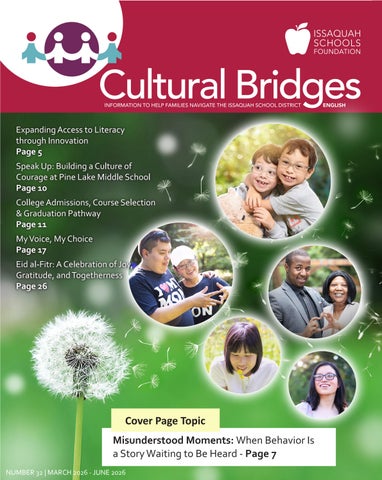
Speak Up: Building a Culture of Courage at Pine Lake Middle School
Page 10
College Admissions, Course Selection & Graduation Pathway
Page 11
My Voice, My Choice
Page 17
Eid al-Fitr: A Celebration of Joy, Gratitude, and Togetherness
Page 26
Cover Page Topic
Misunderstood Moments: When Behavior Is a Story Waiting to Be Heard - Page 7
Dear Readers,
While March signals the arrival of spring, it is also a time to raise awareness of intellectual and developmental disabilities. In this issue of Cultural Bridges, we are honored to share two impactful programs in our school district. Amira Learning (Page 5) is an AI-powered reading tool currently piloted in elementary special education classrooms, offering personalized, real-time feedback to help students build confidence while providing teachers with meaningful insights into reading progress. Misunderstood Moments (Page 7), created by Issaquah School District students, highlights the lived experiences of individuals with IDD (Intellectual and Developmental Disabilities) and their families, using storytelling and art to foster empathy, inclusion, and connection across our community.
March is also a time when many families begin thinking ahead—about course selection, graduation pathways, and college planning (Page 11). In this issue, District parents, students, graduates, and a college counselor share perspectives, feedback, and advice to help families navigate these important decisions. Student voices continues to shine throughout our pages, from Pine Lake Middle School’s Speak Up initiative (Page 10), which empowers students and community members to stand up to discrimination, to My Voice, My Choice, a student reflection on living substance-free with confidence, self-respect, and courage (Page 17).
We are also reminded that we live in a beautifully diverse and caring community. A parent from Pakistan shares how their family celebrates Eid al-Fitr, observed this year from the evening of March 19 through March 20, offering insight into traditions that bring our communities closer together (Page 26). Finally, we extend our gratitude to our valued community partners—including PEPS (Page 19), The Garage, The Circle (Page 24), the Issaquah Food and Clothing Bank (Page 25), and the City of Issaquah (Page 22)— whose ongoing support continues to strengthen our schools and families.
Wishing you a joyful spring ahead,
Laura Ni
Cultural Bridges Lead Editor/Program Manager
Issaquah Schools Foundation laura@isfdn.org
LAURA NI
Lead Editor/Program Manager
CHRISTIANA SCHUMANN
English Editor
CLAUDIA ROMO
Spanish Editor
FELICIA QIANG
Cover Photographer
KSENIA KHOKHLOVA
Russian Editor
Cultural Bridges Team
NANA TSUJINO
Japanese Editor
SEONGEUN YUN
Korean Editor
SHAIMA MANSOUR
Arabic Editor
TU NGUYEN
Vietnamese Editor
VIVIAN KHOANG
Cover Designer
YINGYING CUI
Chinese Editor
JIYOUNG LEE, MENGNA LI & TATYANA TCHIBOVA
Proofreading Helpers
KARINA MACEDO & SOOBIA AMAN
Community Volunteer
Greetings to our Issaquah School District families and community!
I’ve been thinking a lot about community lately. When the world at large feels particularly chaotic, I find a sense of peace in focusing on what is around me and closest to home – my own community. This focus provides a sense of the impact we can have, even when we’re feeling helpless.
That’s part of what I love about the Issaquah Schools Foundation – our goal is to improve the educational experience and outcomes of our students, and we do that by connecting our community to our classrooms. Whether by donating money or by volunteering our time or both, each of us has the power to make a meaningful difference in the lives of students.
It’s also what I love about the Cultural Bridges program. The Issaquah School District community has changed dramatically in the last decade. We’ve transformed from a predominantly white community to one that is less than 40% white, with 95 different languages spoken in district homes! When we talk about making sure that every student, regardless of their personal circumstances, can thrive in school and build a path to success, that means we have to recognize and meet the needs of our incredibly diverse student body.
experiencing new things. Access to things like clubs, the arts, robotics, and career exploration teaches new perspectives and builds the teamwork, problemsolving, and critical thinking skills needed for future success. By supporting the work of the Foundation, our community shows students that we stand with them and that we’re committed to their success.
I hope you’ll join us as part of a community that shows up for students. You can do that by volunteering your time or by making a financial contribution. One great way to show up in the community is by joining us at our Nourish Every Mind Student Showcase and Luncheon Fundraiser on April 30 at the Issaquah Community Center. Each year, nearly 600 members of our community come together to experience firsthand the positive impact of our work on students. Together, we open doors to possibilities for them, and this is our time to hear the amazing things that happen when they walk through those doors. You can visit our website at www.isfdn.org for more information, but I hope to see you there.
Trisha Marshall Executive Director Issaquah Schools Foundation T.Marshall@isfdn.org
Cultural Bridges is one way we do that, but it’s part of a larger portfolio of programs and supports our donors provide for students. For our earliest learners, it means supplementing reading and math lessons with extra tools and support so that every student is building the skills they’ll need to succeed later. Those support programs, like extra tutoring, stay in place for students at every level because we recognize that every student is likely to hit a rough patch at some point, and everyone deserves access to extra help when it’s needed. For those older students, we’re also committed to helping them grow by
Expanding Access to Literacy through Innovation: Amira Learning AI Reading Tutor
A Tool Designed to Meet Diverse Learners Where They Are
BY Carina Piscitelli
Inclusive Elementary Instructional Specialist, Issaquah School District
Across the Issaquah School District, educators work to honor the diversity of learners while ensuring meaningful access for all to high-quality instruction and content. Strengthening literacy for all students remains a foundational priority in the district, particularly for students who benefit from individualized supports. One innovative tool that supports this mission is Amira Reading, an AIpowered reading tutor, instructional assistant, and diagnostic tool that is being piloted in elementary special education classrooms across the district through the generous support of an Issaquah Schools Foundation grant.
Amira is not just another reading app; it’s an AI system designed to listen, assess, and coach students as they read aloud, providing real-time feedback and support rooted in research on how children learn to read. Built on decades of neuroscience and aligned to the Science of Reading, Amira continually analyzes student responses and adjusts instruction, much the way a trained one-onone tutor would. By reading just one story a week, Amira supports reading growth for students, who can engage with it at school or at home.
At its core, Amira works in three major ways:
• Real-time oral reading tutoring: As students read, Amira uses advanced speech recognition to detect pronunciation, fluency, and comprehension challenges, delivering corrective feedback immediately
• Diagnostic assessment: Amira’s integrated assessment tools quickly gauge reading proficiency and pinpoint specific skill gaps in as little as 20 minutes, giving teachers detailed insights into foundational literacy skills, including phonics, fluency, decoding, and comprehension.
• Instructional support for educators: Beyond student practice, Amira gives teachers data with aligned instructional suggestions,
suggesting targeted lesson plans aligned to curriculum standards
Amira is designed to meet students where they are. It supports learners across multiple grade levels and proficiency levels, offering leveled reading passages and books as well as guided practice that adapts according to student progress.
Implementation and Insights from Issaquah Schools
During the 2024-2025 school year, 287 ISD students receiving special education services in elementary schools engaged with Amira. This reflects a broad district commitment to literacy tools that can elevate individualized practice and give teachers more detailed insights into student strengths and areas of need. Much like other districts that have used Amira, many Issaquah educators are finding that the tool offers both quantifiable data and qualitative experiences that support data-based decisions and engagement in learning.
Amira is being used as a complement, not a replacement for strong instruction and core curricula. Teachers report integrating Amira into literacy rotations and independent practice blocks where students benefit from targeted feedback and opportunities to build confidence with reading aloud. This is particularly meaningful for students working on building confidence reading aloud and who benefit from targeted feedback in a low-stakes format. For readers who may feel self-conscious reading in front of peers, Amira provides an opportunity for immediate, supportive, and individualized feedback in a low-pressure environment, which can help students feel more capable and confident while developing literacy skills.
Data from district benchmarks show encouraging signs of reading growth. For students regularly engaging with Amira:
• Nearly half showed growth in Amira Reading Mastery (ARM) scores across benchmark intervals thus far in the pilot
• 37% improved their percentile rank, indicating more rapid movement toward proficiency than normed peers nationwide
• 13% advanced one or more instructional tiers throughout the year
• 29.3% maintained or improved literacy skills across all three benchmark windows, suggesting consistent progress
These results suggest that when students engage regularly, and as suggested for best effect by Amira research, with about 20 minutes per week of usage, measurable literacy gains are possible. District data highlights particularly strong outcomes in third grade, where average ARM growth from mid-year to end-of-year exceeded typical growth expectations.
Student and Teacher Experience
Many students have responded positively to Amira’s interactive design and recent updates, which allow for individualized avatars and more variety than previous versions. Julia, in 2nd grade, likes that “you get to read books you like,” and Isabella, in 4th grade, is excited that “it has words I know, but then shows me about words I don’t know too.” Teachers appreciate the depth of data they receive, which includes performance trends and skill-specific progress. One teacher noted that it’s great for her early learners and readers as “it’s good at helping with pronunciation and showing videos on how to move your mouth,” while another highlighted the “comprehension conversations feature- especially that the students are able to go back and reference it again and again.”
Supporting Learners from Diverse Cultural and Linguistic Backgrounds
Amira also supports the Issaquah School District’s commitment to serving students from diverse cultural and linguistic backgrounds. For multilingual learners and students who are still working on feeling confident reading publicly, Amira provides a private space to engage with a text at their own pace while still receiving consistent feedback. This structure can help reduce performance pressure and support confidence-building alongside literacy development.
Amira’s detailed reporting across core reading components (including decoding, fluency, vocabulary, and comprehension) helps special educators more clearly distinguish between language development and reading skill needs. This level of insight supports more precise, culturally responsive instructional planning when paired with teacher expertise, other data points, and knowledge of student experiences. While it isn’t a replacement for strong instruction, Amira is a complementary tool that’s helping to broaden access to literacy support across diverse learning contexts.
Looking Ahead: A Collaborative Path Forward
Amira Learning has served as one component of the Issaquah School District’s broader exploration of tools that support equity, research-based practice, and student agency in literacy instruction. As a personalized reading tutor, it has complemented classroom instruction by offering additional practice opportunities and providing educators with deeper insight into student reading development and skills.
As the district continues to learn from this pilot implementation, collaboration among teachers, specialists, families, and community partners such as the Issaquah Schools Foundation remains essential. These shared efforts support thoughtful decisionmaking and help ensure literacy initiatives are responsive to student needs, instructional priorities, and the goal of fostering confident, capable readers.
Do You Know…
The Issaquah Schools Foundation funds the Amira Literacy innovative reading support tool to address opportunity and equity gaps in literacy for students receiving special education services.
Misunderstood Moments: When Behavior Is a Story Waiting to Be Heard
BY Florence Qiang and Felicia Qiang Founders of Lens of Youth and Skyline High School students
One afternoon, a group of mothers gathered for tea in the dining room. One of them had placed her infant down for a nap on the couch in the living room. It was calm, and this atmosphere lasted until the host’s six-year-old son returned home from school. While the mothers remained absorbed in conversation, he quietly entered the living room.
Suddenly, the silence was disturbed. As loud cries rang out, the moms rushed into the living room and saw the boy standing near the couch. In that brief moment, an assumption formed – he woke up the baby on purpose. The baby’s mother, startled and upset, scooped up her child and left. One by one, the other moms followed.
Yet, no one knew this: the boy had been taught that it is impolite to watch television while someone is asleep. Wanting to watch his favorite cartoon, he tried to solve the problem the only way he understood: waking up the baby. He was not being mean. His brain simply works differently. Due to his autism, he has a limited ability to consider others’ feelings at that moment. The host was unable to explain right away; rather than a lack of care, she first needed to talk with her son to understand his intention.
Consider this: How did the host feel, standing there afterward? Was it possible for her, not just energywise but emotionally, to explain her son’s behavior to each friend?
In everyday public spaces – classrooms, playgrounds, grocery stores, community gatherings, and beyond –moments like this unfold quietly and quickly. A brief notice of a behavior changes into an assumption, and eventually, a judgment follows. For individuals with Intellectual and/or Developmental Disabilities (IDD) and their families, these moments are not born from occasional misunderstandings. Rather, they shape daily life.
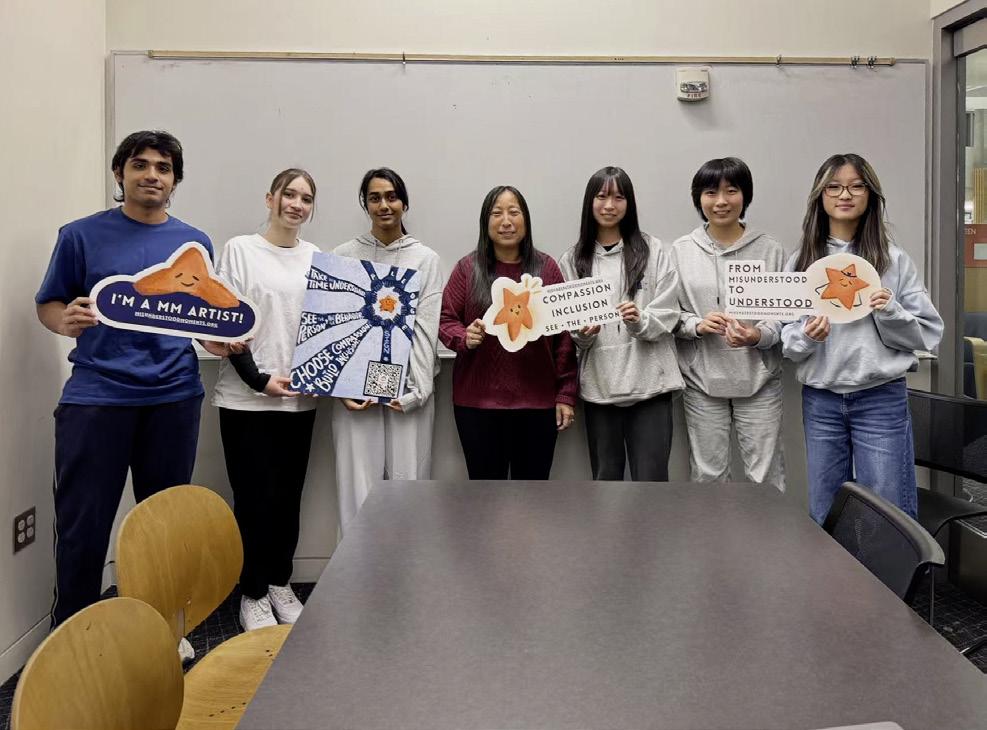
Misunderstood Moments was founded by two high school students who noticed how often classmates on IEPs were misunderstood, made fun of, or treated unfairly. In our school district alone, 11.2% of students have disabilities, yet their experiences are rarely heard. We created Misunderstood Moments to slow people down, help them look past assumptions, and see the real stories behind behaviors. Through storytelling, art, and community conversations, we aim to build empathy and encourage inclusion.
At the heart of Misunderstood Moments are stories from individuals with Intellectual and/or Developmental Disabilities (IDD) and their families. These narratives reveal what is so often missed: these behaviors are not spontaneous, intentional, or outside of societal norms without reason. Rather, they are expressions of communication, self-regulation, emotion, or need. They extend a hand to the public, inviting them to explore beyond what is visible. They are powerful tools that help us delve into the human experience.
Misunderstood Moments is a program operated by the Lens of Youth, a non-profit 501(c)(3) that strives to bring awareness to people with IDD through two unique lenses, from the visual camera lens to the social lens of compassion and kindness. It highlights real-life stories from the IDD community and is complemented by individual artworks that aid in connection and building understanding.
To date, Misunderstood Moments has documented 18 distinct experiences, which will be featured in art exhibitions held in libraries, city halls, schools, and other community spaces. Beyond exhibitions, the program advances IDD awareness through ongoing advocacy and active participation in community events, resulting in an archive of over 900 pledges expressing compassion and support. Misunderstood Moments has also partnered with 15 Awareness Allies, organizations aligned with its mission, to broaden community engagement and understanding. One recent collaboration is the monthly Music Bridge Program, which offers free, inclusive classes for the IDD community to explore Eastern and Western instruments while socializing in a supportive environment.
We envision a world where individuals with intellectual and developmental disabilities are fully understood, embraced, and celebrated; where compassion replaces judgment, empathy replaces ignorance, and connection replaces isolation. With Misunderstood Moments, our future goals are to further expand the awareness of the IDD community and for them to have more inclusive events they can attend. Having an increased public understanding and compassion towards the IDD community through art-based advocacy events. We also aim to actively engage individuals with IDD as creators and advocates within the Misunderstood Moments program, ensuring their voices are seen, heard, and valued.
To deepen the understanding of the IDD community, Misunderstood Moments utilized a survey. The responses revealed a striking consistency in what people wish the world would do differently.
When asked what the IDD community needs during difficult moments, individuals expressed diverse, simple, but powerful hopes: “understand and tolerate,” and sometimes just “let me handle it first.” Sometimes, patience and respect offer more value than direct intervention.
The survey also revealed a widespread understanding of IDD behaviors. Respondents shared that behaviors are often assumed to be intentional or disruptive when, in reality, they are “calming behaviors or coping strategies.” This misunderstanding becomes even more painful when a disability is not visible. Families described the emotional challenge of deciding whether to explain a loved one’s behavior. Explanations can not only be exhausting, but also misunderstood or dismissed as excuses.
When asked what the public should do differently, the message was resounding: “Seek to understand rather than judge.” Respondents urged others to ask respectful questions, consider different perspectives, and choose kindness and curiosity over assumptions, remembering that each individual is unique. Many emphasized the importance of not staring, blaming, or labeling, promoting the recognition that individuals with IDD are “people like any of us.”
The survey also highlighted a deep compassion for families. When the people who have little interaction with the IDD community are invited to speak directly to families with an IDD member, responses poured in with empathy and solidarity:
» “You are not alone.”
» “We care about you.”
Left to Right: Ishaan, Anastasiya, Srinika, State Representative Zahn, Felicia, Florence, Jessie
6
» “Your love, patience, and resilience truly matter.”
Some respondents admitted they didn’t know the perfect words, but even that uncertainty reflected a shared desire to support, understand, and stand alongside families rather than look away.
Together, the stories and survey responses point to the same truth: misunderstanding is not caused by a lack of care, but by a lack of connection. People want to do better, but often don’t know how. Misunderstood Moments exists to bridge that gap—by increasing conversation, visibility, and meaningful interaction within the community.
True inclusion begins when we pause, listen, and allow ourselves to see beyond a single behavior or moment. It begins when we replace judgment with empathy and silence with understanding. And it grows when stories—real, honest, and human—are finally given the space to be heard.
To learn more about the stories, artwork, and ways to get involved, visit www.misunderstoodmoments.org.
The City of Sammamish officially recognizes March as Developmental Disabilities Awareness Month. In honor of this dedication to inclusion, Lens of Youth was proud to receive the city’s official proclamation on March 3, 2026. This recognition celebrates the program's commitment to empowering youth and fostering community awareness. (Developmental Disabilities Awareness Month Proclamation 2026)
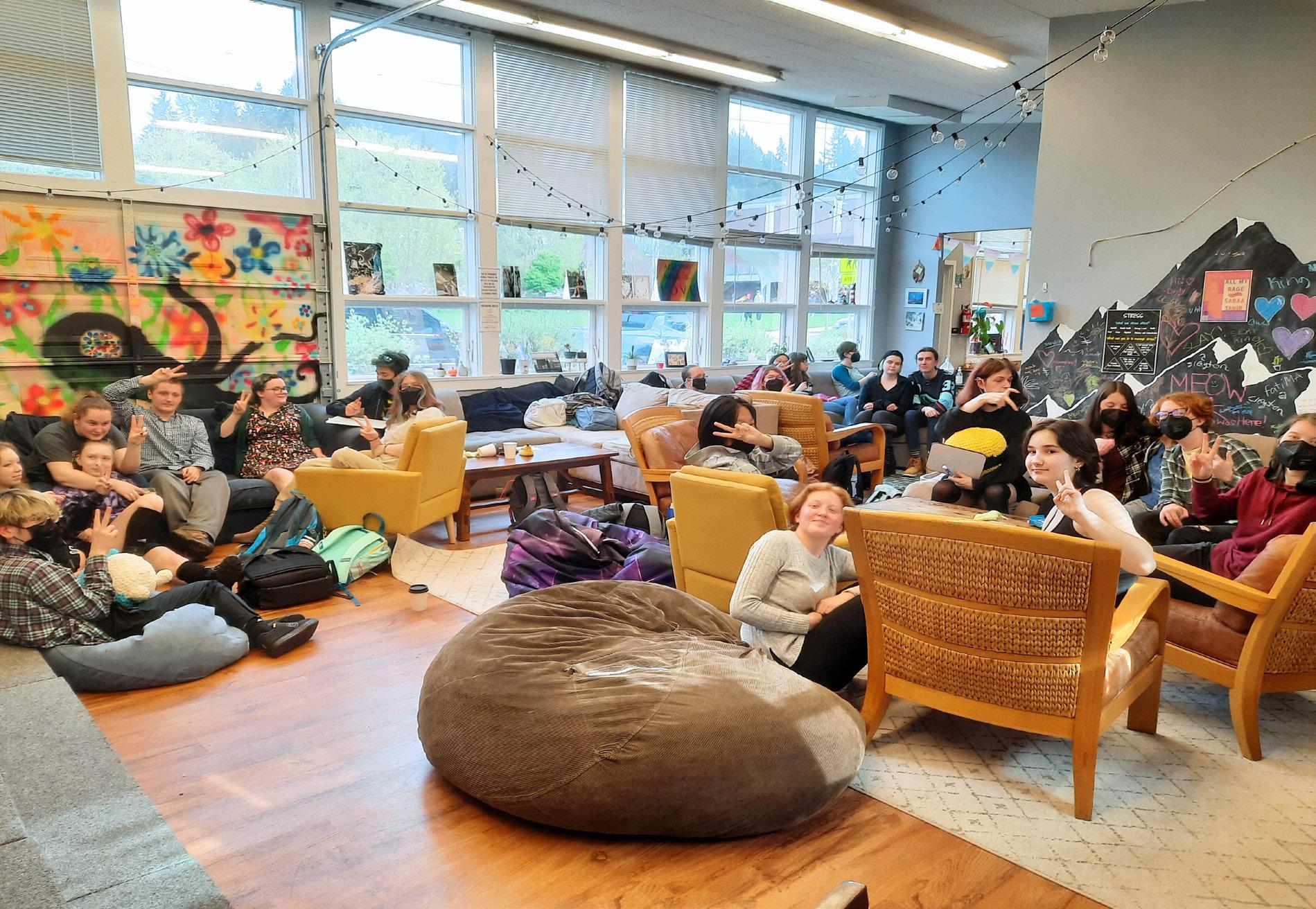
Speak Up: Building a Culture of Courage at Pine Lake Middle School
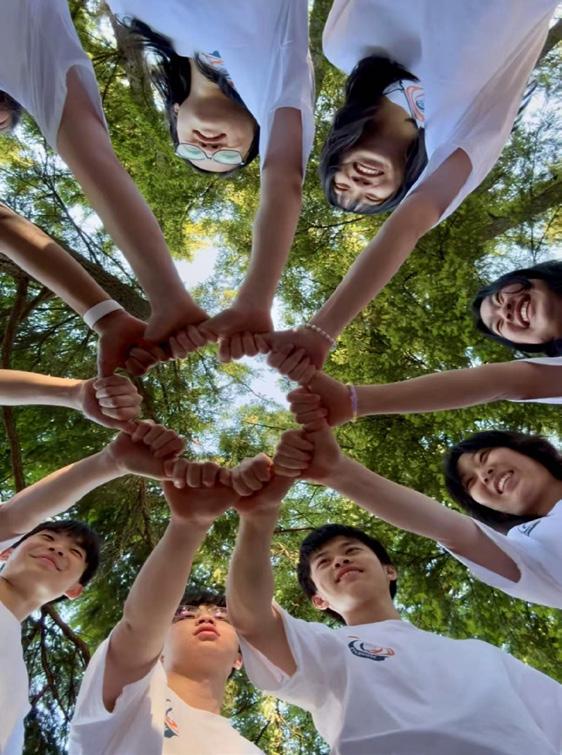
All too often, discrimination under the guise of “jokes” goes unchecked due to its purported humorous nature, but here at Pine Lake Middle School, both students and staff work towards ensuring a safe space free from discrimination, with community-wide education and action. The people of Pine Lake understand that diversity makes their school and wider community stronger. Over the past years, a committee dedicated to empowering this diversity has been formed. The Equity Team, which includes students, parents, and teachers, has worked together to find meaningful ways to celebrate diversity and make a safer, more comfortable school environment for every student. Led by Pine Lake’s Spanish teacher, Kristina Klein, with support from the Issaquah School District’s Equity, Belonging, and Family Partnership group, Pine Lake’s Equity team has risen to the challenge of addressing prejudiced behavior at the school via training and awareness.
In recent times, the Equity Team has identified a need to help students stand up for what matters, especially in these fundamental years of growth and learning. The unfortunate fact is that many students haven’t been taught how to effectively speak up to discrimination, and those who have are still developing those skills. On top of that, many offensive comments come from friends under the disguise of a joke, making it difficult for students to speak up and for the staff to understand and solve the problems that are surfacing at school. The Equity Team was ready to take action. The goal became to empower students to speak up both inside and outside the classroom because it’s essential to us that every student and member of the school community has the skills to stand up and report any form of discriminatory behavior. To achieve this goal, we have offered training to the entire school community, hoping to see their efforts snowball into something beautiful and impactful.
The Equity Team here at Pine Lake has educated over 150 people in our school community, including students, families, staff, and volunteers, since the 2024-2025 school year, in the Speak Up At School training program, engaging with discrimination. This training was provided by the ISD and was created by the organization Teaching Tolerance. Our original goal was to train 100 community members by the end of the school year; we were thrilled to rise above that goal, to 150 people. The students on the Equity team believe that this training helps empower students to stand up to discrimination by using the four strategies: interrupt, question, educate, and echo. Overall, our comprehensive goal was to create a safer and more inclusive environment where everyone feels respected and supported, no matter what. By training even more people, we took an important step towards helping the students confidently stand up to discrimination and make a positive impact on the school community.
Overall, the Equity Team at Pine Lake Middle School has taken action to prevent discrimination in the school community. Through the Speak Up at School program, where members of the community learn strategies and skills to promote a safe and respectful environment, they have educated over 150 people. As they find ways and take steps to increase inclusivity, they strive to keep improving the school and make a difference.
Finding the Right Path: How Families and Students
Navigate Course Choices Together
For many families, choosing courses and graduation pathways is not just an academic exercise—it is an emotional journey shaped by hope, uncertainty, and a desire to do right by their children. Conversations about schedules often become conversations about identity, confidence, and the future.
To better understand this experience, Cultural Bridges gathered insights from current and former Issaquah School District parents, current secondary students, and a recent graduate. Their voices reveal where families feel supported, where they struggle, and what truly helps students thrive.
From Direction to Partnership
Many parents described family involvement in course selection as something that evolves over time. Early on, they step in to help navigate requirements and unfamiliar systems. As students grow older, that role often shifts toward listening, asking questions, and offering reassurance.
“I tried to be involved without taking over,” shared T. M. “We talked through options, but the final choice was always theirs.”
Similarly, another parent reflected, “In the beginning, I was very hands-on, especially when requirements felt confusing. As my child got older, I stepped back.”
Students noticed this shift as well. When parental involvement felt collaborative, it was often
reassuring. One high school student shared that their parents helped them think through choices, “but didn’t pressure me to choose something I didn’t like.” Another acknowledged that while the process could be stressful, “having someone double-check requirements helped.”
Together, these reflections point to a shared understanding: support matters most when it empowers students rather than directs them.
Clear Information, Earlier Conversations
Across parent responses, a common theme emerged— not a lack of information, but a need for clearer and earlier explanations, especially around how high school choices connect to life after graduation.
“I wish someone had explained how high school choices connect to college majors in plain language,” said Juni Wu. Others emphasized the value of community wisdom. One parent noted that hearing from parents who had already gone through the process “would have helped a lot.”
Students echoed the need for clarity but often found it through people rather than documents. “Talking to older students helped more than reading course descriptions,” one student shared. Another explained that when teachers described why a class mattered, it made decisions feel more meaningful and less intimidating.
Passion, Pressure, and Expectations
Parents were intentional about avoiding pressure— even when thinking ahead felt unavoidable.
“I didn’t want to push my own idea of success,” said Krishna Kumar. “My job was to ask questions.”
“We talked about practicality,” added another parent, “but I didn’t want fear to make the decision.”
Students, however, still felt tension between interest and expectation. One student admitted worrying whether the classes they enjoyed would “look good” for college. Another reflected, “Sometimes you don’t know if you’re choosing what you want or what you’re supposed to want.”
These responses suggest that pressure often comes not from a single source, but from a mix of cultural messages, comparison, and uncertainty about the future.
Confidence and Well-Being Go Hand in Hand
One of the strongest findings across the survey was the connection between course alignment and emotional well-being.
“Once my child felt they were on the right path, their confidence completely changed,” shared T. M. . In contrast, a parent noted that being in the wrong classes at the wrong time “really affected their mental health.”
Students felt this too. “When I like what I’m learning, I try harder,” one middle school student explained. Another shared that too much pressure made it difficult to enjoy school at all.
These voices remind us that course selection is not just about credits—it is about engagement, confidence, and feeling seen.
Preparing for an Uncertain Future
When thinking long-term, parents and students approached the future from different angles but arrived at similar conclusions.
“It’s hard to know if today’s pathways will still matter in ten years,” said Juni Wu. For Krishna Kumar, burnout was a greater concern than academic rigor alone.
Students focused on adaptability. “I don’t think anyone really knows what jobs will exist,” one student
reflected, “so learning how to learn matters most.” Another added that flexibility felt more important than choosing a perfect pathway.
Across generations, there was shared agreement that skills like communication, adaptability, and selfadvocacy matter more than any single course.
Learning
with Hindsight
A recent Issaquah School District graduate, Natalya Hardin (Liberty High School, Class of 2024), offered reassurance shaped by experience. Looking back, she shared that uncertainty made decisions stressful at the time, but exploration proved valuable.
“Exploring different options helped me figure out what I didn’t want—and that mattered just as much,” she said. Her advice to current students was gentle and hopeful: “Don’t panic if everything isn’t clear yet. Things make more sense once you’re actually in college.”
A Shared Takeaway
Across parents, students, and graduates, one message stands out clearly: pathways provide structure, but flexibility, exploration, and emotional support are what truly prepare students for life after high school.
Early guidance helps. Honest conversations help more. And sometimes, the most important thing families can offer is permission—to change direction, to ask questions, and to trust that clarity often comes with time.
Issaquah School District offers various course selection options and graduation pathways.
• Middle School Course selection and pathway
• High School Course selection and pathway
• High School Graduation Requirements
From a Professional College
Counselor: College Admissions & Navigating Course Selection and Graduation Pathways
BY Scott Dickens Seattle Area College Counselor
What are the primary factors that determine a college admission decision?
While many lose sleep over extracurriculars and test scores, the data tells a different story. The National Association for College Admission Counseling (NACAC) asks four-year member colleges to rank the most important factors in their admissions decisions (https://www.nacacnet.org/ factors-in-the-admission-decision/).
The top factors are consistently high school course rigor and grades:
• High school grades in college prep courses
• Total high school grades (all courses)
• Strength of the high school curriculum
(If you’re curious, extracurriculars rank 9th on that list of admissions factors - behind positive character attributes, essays, recommendationsand standardized tests rank 11th. For a handful of colleges, these factors do rise in importance; however, those tend to be schools where almost all applicants have impressive course rigor and strong grades, and the colleges need other ways to differentiate candidates.)
Basically, colleges and universities have learned that one of the strongest predictors of college success (and graduation likelihood) is a student’s ability to handle college-level coursework(!).
Thus, the standard advice for college-bound students is simple: take the most challenging courses you can in high school, and earn the best grades you can in those courses.
Within this advice, however, is a lot of nuance that is worth a deeper look.
Everyone’s Pathway Is Their Own
There is no singular “right path.” Rather, there are many pathways that can transport you from high school to college. Not all of those paths are straight; not all of them are perfect or easy. But they are uniquely yours.
Beware the trap of trying to be like everyone else. You will probably hear advice that suggests you must take a particular course sequence. But this is almost always just a suggestion, not a requirement. One of my favorite Peloton instructors, Denis Morton, has a saying that applies perfectly here: “I make suggestions, you make decisions.” Plenty of engineers never took Calculus in high school. Plenty of doctors never took AP or IB Biology in high school.
Take classes that you enjoy and want to take. Discover your interests and your passions. Embrace that your pathway is your own.
Rigor Does Not Have A Standard Definition
There is variation at the high school. Not all schools in this district offer the same courses. In many cases, "college prep" is just the normal progression of courses. Pre-calculus, Physics, World History, and French III are all college preparatory, even though they may not be labeled as AP, IB, or Dual Enrollment.
There is variation at the individual level. To some, taking college-level courses in high school, such as AP, IB, or Dual Enrollment, may be a healthy stretch. To others, it may be overwhelming.
There is variation in the crowd. There is no “magic number” of college-level courses. It is not the case that six AP courses create an outcome that is always better than five. In any graduating high school class, there will be a distribution curve in which students have made wildly different curriculum choices. Yet, for the college-bound student, their choices are all legitimate and valid.
The best you can do is the best you can do. Define rigor for yourself.
It’s OK To Adjust Your Course Selection Plan
Taking college preparatory courses in high school and doing well in them does not always go according to plan.
It is unfortunate that certain decisions impacting high school curriculum have been pushed to middle school - such as math and science tracksbecause it is incredibly difficult to predict at age 13 what you will be capable of at age 18.
Much of the dialogue in parent groups and online seems pointed toward an accelerated track. I get it. Stretching and growing as learners and as humans is an important part of growing up. But there isn't enough public conversation about the potential downsides: you can, in fact, end up on a track that is too challenging. My college counseling colleagues and I often hear from families asking, “My student got a D in an advanced class - what do we do now?”
Don’t be afraid to modify your plan.
Each year, you learn more about your strengths, weaknesses, and interests. Use each course selection period as a fresh planning session. Do not let "momentum" or an aspirational course
progression you wrote down years ago dictate your decisions today; actively choose your curriculum path each year.
Last, know that any one grade (or even a set of grades) is unlikely to have a defining impact on your future. It’s the overall story that matters. This is why most colleges practice holistic admissions: a review of many factors to see the whole person behind the college application.
Scott Dickens is an independent college counselor who holds certification from UC Berkeley and is a member of IECA, PNACAC, and the Seattle Area College Counselors. He publishes the (free) Substack - collegeapplicationguy. substack.com - and is a tech founder in the education space. Formerly, he held product senior leadership roles at Google, Meta, and Microsoft. With one child currently in college and another about to launch (high school Junior at Skyline), he brings both professional expertise and real-life perspective to college admissions.
To check school schedules or PTA/PTSA schedules, please click your school website or PTA/PTSA website for the most recent calendar information.
Issaquah School District Calendar: https://www.isd411.org/calendar
ALL SCHOOLS
Mar 13: 1st Weather Make-up Day, No School
Mar 30: 2nd Weather Make-up Day, No School
Apr 13-17: Spring Break, No School
May 25: Memorial Day, No School
Jun 16: Last Day of School, Half Day
ELEMENTARY SCHOOLS
Jun 16: End of 2nd Semester, Report cards available in Family Access after 4 PM
The District's Family Partnership organizes these events in collaboration with Cultural Bridges. All families with students in the District are welcome to attend.
All sessions are in English, Spanish, and Mandarin. Interpreters in other languages are available upon request. If you need an interpreter in another language, contact Lorna Gilmour at: gilmourl@issaquah.wednet.edu. If you would like to participate in helping at any of these events, contact Laura Ni at: laura@isfdn.org
For more information, visit: https://www.isd411. org/programs-services/equity/parent-events-andworkshops
Family Connections Question and Answer Session
March 16, 2026 - Two Sessions – In Person: 10:30 AM – 12:00 PM and 6:30 PM – 8:00 PM.
May 11, 2026 - Two Sessions – In Person: 10:30 AM – 12:00 PM and 6:30 PM – 8:00 PM.
Issaquah School District Administration Building, 5150 220th AVE SE, Issaquah, WA Register here
Cultural Events
Seattle Cherry Blossom & Japanese Cultural Festival
April 10-12, 2026, at Seattle Center [305 Harrison St, Seattle, WA]
Underscoring the deep friendship between Seattle and Japan as it honors the renewal of life with springtime cherry blossoms, booming Taiko drums, contemporary Japanese arts, and a traditional tea ceremony.
Spirit of Africa
May 16, 2026, at Seattle Center [305 Harrison St, Seattle, WA]
Fostering greater inclusivity, awareness and appreciation for the varied traditions of music, movement and storytelling of the African diaspora.
Pagdiriwang Philippine Festival
June 6-7, 2026, at Seattle Center [305 Harrison St, Seattle, WA]
Observing Philippine independence from colonial rule and the strength of Filipino identity and imagination through art exhibits, songs, spoken word, film, and martial arts.
Indigenous People Festival
June 13, 2026, at Seattle Center [305 Harrison St, Seattle, WA]
Instilling better understanding for American Indian and Alaska Native tribes in the Pacific Northwest through a blending of traditional and contemporary music, dance, drama, and arts.
Seattle Iranian Festival
June 27, 2026, at Seattle Center [305 Harrison St, Seattle, WA]
Deepening community and understanding for the rich culture of Iran with Persian poetry, tea, modern music, and traditional dance.
My Voice, My Choice: Living My Life Substance-Free & Judgement-Free
BY Ardra Arwin
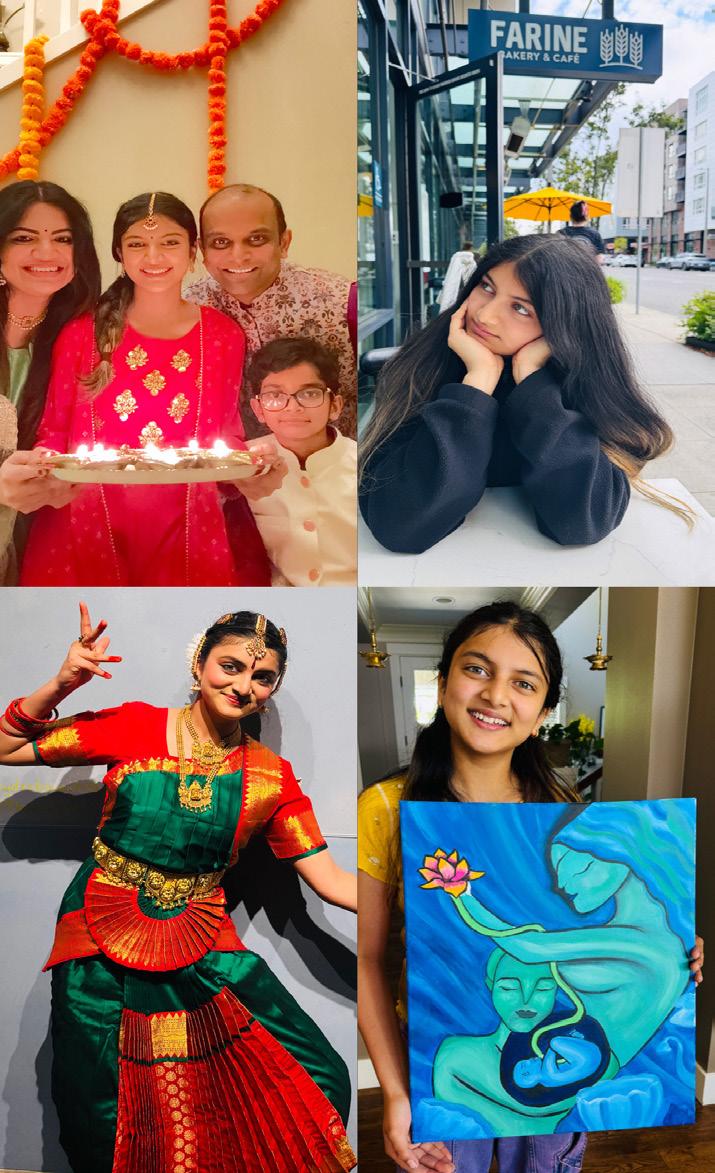
I’ve always believed that you don’t need to change who you are to have fun. You just need to be around the right people, doing the things that make you feel alive. For me, that’s what it means to live substance-free. It’s not about saying “no” to something — it’s about saying “yes” to myself! It’s about protecting the parts of me that make me who I am: my creativity, my curiosity, and my love for life.
When I’m dancing, I lose myself in the rhythm. Every beat feels like it’s syncing with my heartbeat — and in those moments, nothing else matters. When I paint, I find freedom in my colors. My brush tells stories that words sometimes can’t. When I’m paddleboarding with my friends, laughing as the water splashes around us, I feel light — like the world is reminding me how beautiful it is to just be here. And when I’m hiking, surrounded by trees and sunlight, I breathe in peace and exhale gratitude. Those are my highs — the natural ones, the ones that don’t fade when the night is over.
There’s so much pressure sometimes — to fit in, to look cool, to go along with what everyone else is doing. It’s easy to think that trying drugs or alcohol is a “rite of passage,” something that everyone has to experience. But I’ve realized that true confidence doesn’t come from fitting in — it comes from standing out. It’s in saying, this is who I am, and being proud of that.
Living substance-free doesn’t mean my life is boring or limited — it actually feels fuller. My laughter is real. My energy is real. My emotions are real. I get to experience life with a clear mind, and that clarity helps me chase my goals and stay connected to what truly matters. Every time I choose to stay substance-free, I’m choosing to protect my future — the version of me who has big dreams, bright ideas, and endless potential. Embracing my culture and my identity is what makes me who I am, and in a world where everyone has a version of you in their heads, be the best version of you for yourself, not to impress anyone but your own!
Sometimes people assume that being substancefree means you’re “missing out.” But honestly, I
Author’s Note:
I wrote this piece because I know what it feels like to be a teen surrounded by pressure — the kind that whispers, “everyone’s doing it.” But I’ve learned that saying no doesn’t make you weak; it makes you strong enough to stand by what you believe in. I want other teens to see that there’s so much more to life than what you’re told you “should” try. Joy, art, movement, friendship, and nature — they’re all waiting to lift you up, no substances required.
Your voice matters. Your choices matter. And you, too, can be high — on life.
think it’s the opposite. I’m not missing out on anything — I’m showing up for everything. The joy, the challenges, the adventures, the late-night talks, the big dreams — I get to live all of it fully. I don’t need a drink or a smoke to make a moment special. The moment itself is enough.
So, when people ask me what gives me my “high,” I smile and tell them the truth: I’m high on life. On laughter. On creativity. On love. On everything real.
Influence the Choice is a dedicated youth substance use prevention organization, committed to reducing youth substance use and promoting overall well-being by addressing root causes, fostering resilience, and providing education and prevention services to youth,
The Garage is a safe space for high school-aged teens to hangout with friends, get a coffee and a snack, play a game, play music, watch TV, plan an event, and much more.
We also have Mental Health Therapists and a Case Manager on staff.
Monday - Friday, 3:00 - 7:00 p.m.
235 1st Ave SE, Issaquah, WA 98027
Helping Teens Thrive in a Digital World: What Parents & Caregivers Must Know
BY Gloria Martinez
In today’s digital age, screens are integrated into almost every part of teenagers’ lives. Smartphones, tablets, gaming consoles, and laptops provide teens with access to education, connection, and creativity, but they also expose them to stress, misinformation, and unhealthy comparisons.
For many parents, navigating this ever-changing landscape can feel overwhelming. Recognizing both the advantages and the challenges of screen time can help families adopt more mindful, intentional use of technology.
The Benefits
Studies of the scientific literature found evidence that digital engagement (including the internet, video games, and other digital tools) is associated with positive outcomes in brain, cognitive, and social-emotional development when used thoughtfully, intentionally, and in moderation:
• Connection and belonging: Digital platforms allow teens to stay connected with friends and family, explore shared interests, and find supportive communities. For many—especially those who feel isolated—online spaces can foster belonging and offer emotional support.1
• Learning and skill-building: Studies indicate that digital tools such as educational apps and video games can strengthen problem-solving abilities, strategic thinking, and cognitive flexibility, as teens regularly practice analyzing information and adapting to new challenges.2
• Personal growth and identity development: Online spaces can support key aspects of adolescent self-esteem, such as independence, self-expression, connection, and acceptance. Teens can use screens to explore identities, address global issues, organize around causes, and develop a broader understanding of their role in the world.3
The Challenges
While screens offer benefits, excessive or unmonitored use can contribute to several risks:
• Mental health concerns: High levels of screen time, especially on social platforms, are linked to increased rates of depression, anxiety, low self-esteem, and self-harm. Tailored “perfect” images can fuel negative body image and comparison. Constant notifications and the pressure to respond quickly increase stress and decrease attention spans, making it harder for teens to unplug and self-regulate4
• Physical health impacts: Sedentary screen time often replaces physical activity, raising the risk of obesity and musculoskeletal issues like neck or back pain. It can also decrease the time spent outdoors or in face-to-face interactions.5
• Sleep disruption: In adolescence, sleep naturally shifts toward later sleep times. Blue light and stimulating content can worsen this, leading to irregular sleep patterns, insomnia, or fatigue.6
• Exposure to harmful content: Without proper guidance, teens can encounter cyberbullying— whether as victims or unintentionally contributing to it—as well as misinformation, unrealistic standards, and inappropriate material, often long before adults even realize it. They may also be vulnerable to untrustworthy individuals and at risk of manipulation or exploitation.7
How Parents Are Feeling About It
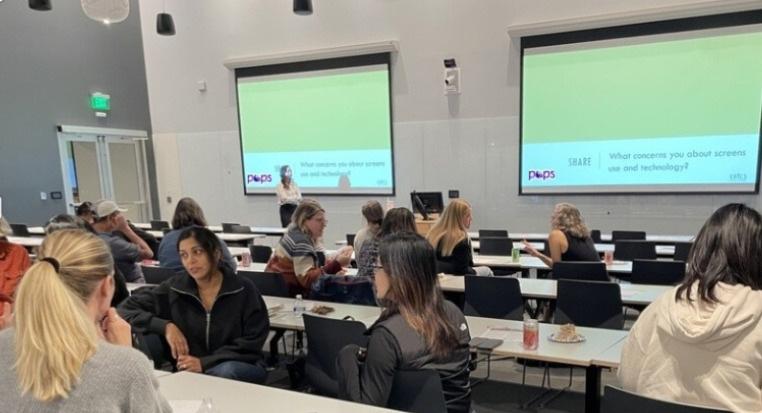
Across PEPS Groups and workshops for Parents of Adolescents and Teens (PAT), caregivers shared common concerns about managing screen use. Many expressed difficulties with boundaries, balancing online and offline time, and staying informed about new apps and platforms. For many, it’s unclear what counts as “too much” screen time or how to enforce limits without daily conflict.
Recognizing this need, PEPS, a local nonprofit that offers peer support groups for families, organized two community gatherings. The events were led by Dr. Jennifer Tininenko, a licensed clinical psychologist and Director of the Child Anxiety Center at Evidence Based Treatment Centers of Seattle (EBTCS). Dr. Tininenko highlighted to the 80+ caregivers who attended that adults act as influential role models for digital habits and promote open communication with clear, predictable boundaries. “Our job is to teach our kids how to use tech, so it works for them—not against them,” she said. This aligns with the American Academy of Pediatrics’ advice to develop a family media plan that reflects the family’s values and routines.
Many parents shared that managing children’s screen time is challenging and frustrating, especially when it’s difficult for adults, too. Co-parenting around technology is taxing when caregivers aren’t on the same page, and stress increases when families feel that schools or community organizations aren’t providing clear, consistent expectations.
As one parent shared: “While we still don't have laws in schools or from the government to protect our children from the dangers of screens, we can create small community rules, so our children don't feel left out for being the only ones without a screen.”
Other caregivers supported the importance of collective work to manage the screens:
“Setting limits with screens should be a collaborative effort—and we need to validate how our kids feel, even when we must set hard boundaries.”
Together, these voices reveal a common truth: Caregivers need guidance, consistency, and community— not just a broad set of rules. Screens are here to stay, and parents are looking for practical ways to support their teens while caring for themselves.
Strategies for a Healthy Balance
1. The first question to consider is: How do I know when it’s the right time to give my child a phone or access to media? Start by assessing your child’s maturity and readiness to understand and follow a family agreement on responsible use, including time limits, privacy rules, and respectful online behavior. Also, pay attention to their social world. Are they feeling left out, struggling to connect with peers, or missing important social interactions where digital access matters? Consider whether they can manage emotions, handle conflicts appropriately, and tell you if something online feels uncomfortable. By noticing these signs and involving your child in the decision, families can build a strong foundation for healthy, balanced, and safe technology use.
2. Create a family media agreement: Collaborate with your teen to set clear, realistic expectations such as no phones at bedtime, limits on certain apps, or designated screen-free zones. Involving teens helps gain their support and cooperation. Be honest about responsibilities and any parental controls you plan to implement.
3. Establish tech-free times and places: Designate screen-free zones such as bedrooms and dining tables, and set times like during meals or before bed. Make screen time a shared activity whenever possible. Limit device use at least 40 minutes before bedtime and aim for a healthy balance between screen activities and offline experiences.
Parents gathered for a presentation hosted by PEPS on "Raising Thriving Teens in a Digital World”, led by Dr. Jennifer Tininenko.
4. Have open conversations about digital safety: Discuss online privacy, sharing personal information, location sharing, and managing negative interactions. Remind teens that online content can stay forever. Encourage them to be upstanders—speaking out or getting help when they see harmful behavior.
5. Teach critical thinking about media: Discuss how images are edited, how AI is challenging our perceptions, how algorithms shape what they see, how influencers earn money, and how to verify information. Encourage teens to seek diverse and trustworthy sources.
As adults, it’s essential to reflect on our own screen habits because we are our children’s main role models. Ask questions before judging; you might discover meaningful interests or skills your teens are developing online. You may also notice when screen time is used to cope with stress or challenges, giving you a chance to support them more effectively.
Screen use among teens is a constantly evolving topic and an ongoing conversation. PEPS offers a variety of peer support groups and workshops to help families as they navigate these changes and learn alongside other parents. Learn more about our PEPS programs for parents of adolescents and teens, subscribe to our monthly newsletter, and get in touch with us through email at programs@peps.org.
Learn More / Sources:
1. Haddock, J., Ward, P., Yu, S., & O’Dea, J. (2022). Positive effects of digital technology use by adolescents.
2. Granic, I., Lobel, A., & Engels, R. (2025). Digital Device Usage and Childhood Cognitive Development.
3. Packiam, T. (2024). Development of the Social Media Benefits Scale.
4. Centers for Disease Control and Prevention. (2025). Associations between screen time use and health outcomes among U.S. teenagers.
5. University of Texas School of Public Health. (2023). Impact of technology use on adolescent health.
6. Naing, L., Hassen, S., & Sharbini, S. (2024). The relationship between the use of screen-based devices and self-reported sleep quality in adolescents aged 13–19 years in Brunei.
7. Pew Research Center. (2025). Teens, social media, and AI chatbots.
GloriaMartinez(she/her/ella)istheProgramforParentsofAdolescentsandTeens(PAT)Bilingual Outreach Manager at PEPS. She has a passion for building tools that support families and create meaningfulchangeinthecommunitiestheyserve.Herexperienceasapsychologistacrossdifferent countriesandcommunities,combinedwithherperspectiveasaparent,hasdeepenedherconviction thatconnectionisthefoundationforcollectivegrowthandlastingimpact.
2026 Issaquah Sustainability Fair
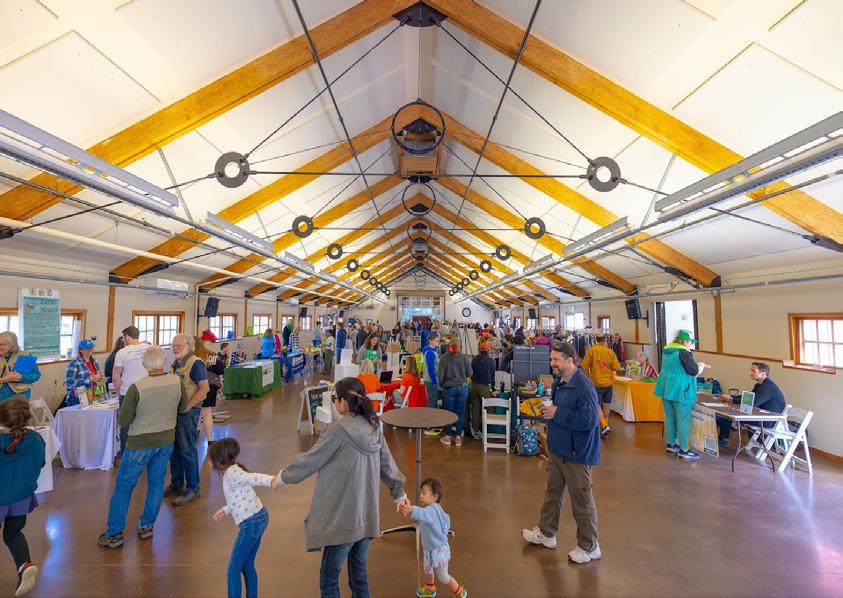
Plan Your Visit to the 2026 Issaquah Sustainability Fair!
Saturday, April 25 | 9 a.m. – 2 p.m. | Pickering Barn
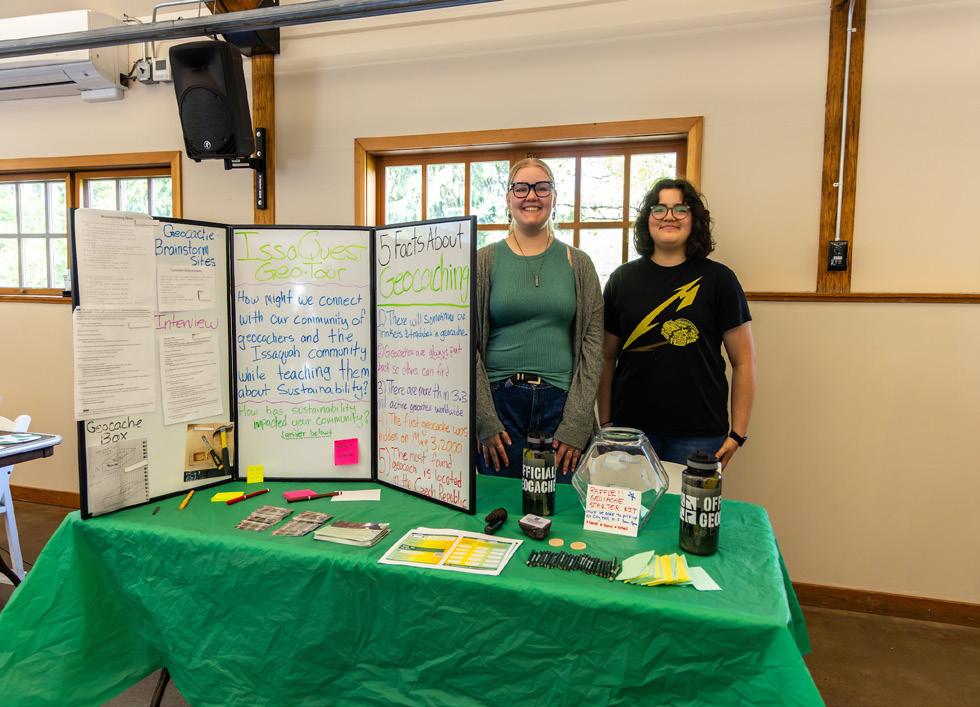
The City of Issaquah’s Sustainability Fair returns for our annual Earth Month event, and you're invited to join us for a day packed with fun, education, and inspiration! The City of Issaquah started the Sustainability Fair in 2023 as a standalone event to provide the community with access to vendors that sell sustainable products or provide resources for greener living. The first Sustainability Fair was supported heavily by students from Gibson Ek High School who interned with the City’s Sustainability Office. The students ran an art and theme contest, recruited volunteers and vendors, organized a clothing swap, and developed a hands-on art project that highlighted the impact of single-use plastics on salmon.
The students were also interviewed by King 5 Evening Magazine to help promote the Sustainability Fair! Since 2023, the event has expanded to partner with the Issaquah Farmers Market for an early season preview of produce and to offer additional demonstrations and hands-on activities. Students are still an integral part of the Sustainability Fair as volunteers who run booths and events and help secure sponsors.
The Sustainability Fair is a family-friendly event that offers resources for anyone looking to create community connections, reduce their environmental footprint, or try out some new techniques or equipment! We are looking to incorporate more arts and culture into the event and welcome suggestions from students and the community.
While we are still finalizing the schedule, here’s a preview of what to expect at the 2026 Sustainability Fair.
Experience Nature Up Close
Step outside and explore the natural world through engaging outdoor adventures and interactive conservation experiences:
• Join the City Nature Challenge – Walk the Pickering Trail with City Staff and help identify local species as part of this global biodiversity project.
• Tree Giveaway – Do your part in making Issaquah greener by taking home a 1-gallon tree and help grow a more sustainable future.
Get Moving
• Electric Bike Test Rides – Try out different e-bikes from local bike stores, including an e-mountain bike, commuter, and multi-use model. Learn about the City and State’s upcoming electric bike rebate programs! Helmets provided!
• Pickering Barn Sustainability Project Tour – Join City staff on a walking tour to learn about the projects that make Pickering Barn a sustainable event space, including heat pump installations and a brand new solar installation!
Hands-On Demos
• Creative Trash Art – Take part in a community art project using clean, repurposed materials you can decorate and take home.
• Sock Mending – Looking to stitch up some socks? Recology will hold a sock mending class to make sure those socks can keep your feet warm a bit longer. Bring your own socks!
Refresh Your Wardrobe Sustainably
• Clothing Swap – Trade gently used clothes for new-to-you fashion finds! Last year’s swap diverted 480 items from landfills—let’s beat that record. All sizes and styles welcome. Please bring items clean and in good condition.
Farmers Market Preview
• Get an early taste of what’s to come at the Issaquah Farmers Market. Vendors will fill the parking lot at Pickering Barn, offering local goods and giving you a preview of the spring season.
Learn More
For a complete list of events and times, visit issaquahwa.gov/SustainabilityFair.
Interested in being a vendor or sponsoring the Fair? Want to volunteer? Please reach out to sustainability@issaquahwa.gov by March 31.
We can’t wait to see you at the 2026 Sustainability Fair!
Our organization was founded by neighbors helping neighbors, a mission that remains at the heart of our work today. Our approach is deeply rooted in the cultural concept of a "comadre" (co-mother or close friend), who often acts as an organic, trusted community helper who bridges the gap between individuals and essential resources. By leveraging shared lived experiences and established trust, our eight Community Navigators help neighbors overcome significant barriers such as language, stigma, and lack of information.
When individuals reach out to us, often through referrals from school counselors or social workers, we schedule personalized meetings either in person at our office or over the phone. Rather than simply providing a list of phone numbers, our Navigators offer in-depth conversations to understand each person's specific needs and then work directly with them to complete applications for services. This includes assisting with forms for rent and utility assistance, as well as helping families apply for recreation program scholarships for their children, health, employment, and immigration services.
Our Community Navigators focus on building personal connections with our neighbors. This shines through in some of the feedback we’ve heard from clients:
“The Circle is very important to us because, honestly, there’s always someone who responds and helps quickly. We’re used to not being listened to and sometimes ignored, but here, everyone makes us feel like family. They treat us with respect, like human beings.”
“At The Circle, they support us with the needs and limitations we encounter upon arriving in this country, where the biggest barrier, in many cases, is not knowing anyone and being afraid to ask questions. The Circle provides us with that support while we start over with our families and become established.”
ADDRESS: 160 NW GILMAN BOULEVARD, SUITE 326, ISSAQUAH, WA 98029
The Circle, Asian American Pacific Islander (AAPI) Event
May 17, 2026, 2PM – 4PM, at Issaquah Community Center
The Asian American Pacific Islander (AAPI) event is an annual community event designed by and for our community to celebrate and share Asian American and Pacific Islander culture. It is free and open to the public. This event includes art workshops, music, dancing, games, and food. This event is also sponsored by the City of Issaquah. Register here: https://www.thecircle-wa.org/event-details-registration/ asian-american-and-pacific-islander-celebration-aapi-2
Fast Express Shopping at the Issaquah Food & Clothing Bank!
The Issaquah Food & Clothing Bank is excited to share a fast and efficient way to access food support – Express Shopping! The goal of the Express Shopping Experience is to serve more neighbors, reduce wait times, and improve the overall experience for those who need or prefer quick pick-up.
When is Express Shopping?
Express Shopping is on Thursdays of shopping weeks from 1pm-5pm. (For a list of shopping weeks, visit: https:// issaquahfoodbank.org/client-service-hours)
What to expect on Express Shopping Thursdays:
1. Select items of your choice from a menu with a volunteer.
2. Check in at the front desk and give them the menu.
3. Wait outside while we pack your groceries—we will bring them out and call your name when they are ready!
What is the same as a regular shopping day?
You will still receive fresh food like produce, milk, eggs, and meat—plus the toiletries we have been offering, like diapers. Just like normal market shopping, most of these items are donations and will depend on availability.
What is different from a regular shopping day?
• The wait on Thursdays will be significantly less than on a normal market day. After 2pm on these Express days, the wait has been consistently less than 10 minutes.
• The produce bags are typically larger than on other days! This shopping is at the end of the week, and we add any extra produce.
• Dry pantry goods will not be offered on Thursdays with express shopping at this time. We’re exploring ways to offer even more items, and we will continue to make improvements as we go.
We are excited for you to try this way of shopping! If you would like further information about the Issaquah Food & Clothing Bank or would like to register for services, please visit: https://issaquahfoodbank.org/
Eid al-Fitr: A Celebration of Joy, Gratitude, and Togetherness
By Soobia Aman Issaquah School District Parent
It’s almost time for Eid — my favorite holiday since I was a child! :) I’ve had the privilege of celebrating this special day in two very different worlds: first in Pakistan, where Eid is a three-day national celebration spent with extended family, and now in the United States, where I celebrate with friends who have become like family. The vibe may differ, but the spirit of joy, community, and gratitude remains the same.
What is Eid al-Fitr?
Eid al-Fitr, the Festival of Breaking the Fast, marks the end of Ramadan — a sacred month when Muslims fast from dawn to sunset. The fast is more than abstaining from food; it’s a time to grow spiritually, practice selfcontrol, and develop empathy for those in need.
When the new moon appears, it signals the end of fasting and the beginning of celebration. The exact date depends on the moon sighting, so anticipation runs high as families wait for the official announcement: “Eid tomorrow!”
Eid in Pakistan: Childhood Memories Full of Color and Flavor
Growing up in Pakistan, Eid excitement always began the night before. Once the moon was sighted, my sister and I would rush to lay out our clothes and jewelry for the next day while my mother busied herself in the kitchen, preparing the morning feast. The first dish was always something sweet — sivaii, a dessert made from semolina cooked in milk and sugar.
Then came one of my favorite traditions: going out to get beautiful henna designs on our hands. The streets glowed with festive lights, and everywhere you looked, people were out shopping, laughing, and soaking in the joy of Eid.
Eid morning started early. My father and his younger brother went to the mosque for prayers while my mother worked her magic in the kitchen. After prayers, we gathered for a lavish breakfast. My sister and I eagerly waited for Eidi — money given to children as a gift. Collecting Eidi was the highlight of the day, and we made sure to greet every neighbor and family member with a cheerful “Eid Mubarak!” so we wouldn’t miss out!
The rest of the day was filled with visits. We’d go from house to house, greeting neighbors, enjoying snacks and sweets, and then drive to meet extended family. By evening, the whole clan gathered at my grandmother’s home for a grand dinner — a heartwarming end to a joyful day.
Eid in America: Keeping the Spirit Alive
Eid in America feels different, but no less special. Here, we take the day off from work or school and celebrate with friends who have become our chosen family. My goal has always been to recreate the same festive magic for my daughter that I experienced growing up.
Just like in Pakistan, our celebration begins the night before. One of our friends hosts a “Chand Raat” (Night of the Moon) party, where we all gather to apply henna, laugh, and enjoy each other’s company. I follow my mother’s tradition and prepare a special breakfast feast for the next morning while my daughter carefully sets out her clothes and jewelry.
On Eid morning, we dress up and head out for community prayers — a beautiful sight with hundreds of people in colorful outfits greeting each other with smiles and hugs. After the prayer, we return home for our grand feast. In the evening, our house becomes a mini festival: string lights twinkling, music playing, children giggling as they collect Eidi, and the aroma of food filling the air. By the end of the day, we’re all tired but deeply grateful — hearts full, stomachs fuller.
Why Eid Matters
Eid teaches us that celebration doesn’t depend on where we are — it lives in the people we share it with. Like many other holidays around the world, Eid brings people together to reflect, give thanks, and share in the joy of life. Whether it's the communal prayers and feasts of Christmas, the family reunions during Lunar New Year, or the solemn yet joyful celebrations of Yom Kippur, Eid shares common themes of renewal, gratitude, and community. So, the next time someone says “Eid Mubarak!”, know that behind those words is a world of warmth, tradition, and togetherness.