See the online ISRF Bulletin (www.isrf.org/blog) for more articles by ISRF Fellows and associates, including earlier versions of some of the pieces included in this print issue.
Editorial
Baindu Kallon
States, international corporations and other global elites
o ften present simplified, linear accounts of political, economic, and social life as settled consensus— accounts whose authority rests on obscuring the limits, contradictions, and crises produced by power. Currently dominant (often right-wing) discourse leans towards a culture of fear as borders are tightened, military spending increases and exclusionary political rhetoric serves to reaffirm strict boundaries of citizenship. None of these sentiments are novel and, in many ways, unmask the motivations behind crafting a strong narrative. Whether political, historical, economic or cultural, such narratives justify the status quo and are used to reinforce the inequalities inherent to the capitalist system.
When examined closely, these narratives quickly unravel, complicated by conflicting material realities and experiences. Edward Said’s Culture and Imperialism called for contrapuntal reading as a method to analyse British and French literature in dialogue with their colonial histories.1 In doing so, one creates “counterpoints” which bring together the diverging perspectives of the coloniser and the colonised to reveal a more nuanced
1 Said, Edward W. 1993. Culture and Imperalism. Knopf Doubleday Publishing Group
understanding of imperialism and resistance to it. Said drew from the theory of the counterpoint in Western classical music, a technique that combines two or more distinct melodies to create a richer and more complex harmony. 2
This issue of the Bulletin is inspired by the idea of the counterpoint as a way in which to interrogate, re-conceptualise and reveal the underlying assumptions that shape our most pressing debates. The contributions emerged from the fifth ISRF Congress in London in June 2025. Bringing together a small group of Fellows, ISRF Congresses create space to engage with the diversity of disciplines, methodologies and insights that our Fellows use to approach and make sense of real-world social problems. Our discussions teased out a shared desire to look beyond dominant discourse to uncover narratives that were missing, misunderstood or ignored.
Our first contribution, from Margot Verdier, unpacks the promises of the Just Transition Mechanism which aims to support energy producing regions in the European Union. Given that gender equity is considered an integral part of this transition, Verdier’s work with women in Western Macedonia explores their high unemployment rates. Contrary to the narrative, the possibility of job opportunities emerging from the transition has not led to gender parity. Instead, the transition of the energy sector presents a continuation of privatisation, which deepens precarity and reduces women’s autonomy.
Anthony Pickles’ contribution de-mystifies political gambling in the US and UK. Often described as an ‘honest’ intellectual pursuit, proponents argue that it cuts through the uncertainty of the political landscape with calculated probabilities.
2 Capitain, Wouter. 2020. “From Counterpoint to Heterophony and Back Again: Reading Edward Said’s Drafts for Culture and Imperialism.” Journal of Musicological Research 41 (1): 1–22. https://doi.org/10.1080/01411896.2020.1787 793
Pickles demonstrates that political gambling is much more complex, an entangled network of gambling interests and political activity. Some politicians have shared inside information to place wagers on elections, while others have cosied up to the gambling industry. This in turn has corrupted politics by facilitating access to and profit from the state via individual politicians.
In her contribution, Yasamin Alkhansa traces how governments attempt to impose historical narratives through school textbooks. In doing so, marginalised voices are silenced and atrocities become hidden while national histories are reimagined to assert political legitimacy. Her contribution focuses on Iran’s theocracy where changes to textbooks happen regularly and are met with resistance through student protests and women’s movements. Alkhansa warns that the battle over knowledge is not unique to authoritarian regimes, but rather part of a growing global trend that seeks to rewrite history.
Milan Babić’s contribution engages with the debate on climate change. The possibilities of a state-led green transition look increasingly limited under the current global political and economic discourse. European governments seem poised to retreat from their green targets along with the US government’s expansion of its oil industry. As scientists warn of impeding environmental catastrophe, how can we counter such negative backlash towards climate politics? Babić outlines three ways to re-frame the conversation and, in doing so, asks us to understand these setbacks not as an inevitable end but as an opportunity to reinvigorate our politics.
Our final contribution, from Beatriz Aragón, takes us to the outskirts of Madrid, the informal settlement of Cañada Real. Here we are introduced to Fátima, a Spanish Romani woman navigating deteriorating living conditions. Aragón illustrates how antigypsyism underpins the government’s housing policies oriented towards the Roma community. Programmes designed to integrate them into
“modern” society isolate them to the margins, where they face infrastructural violence. Framed as respecting cultural differences, the negative stereotypes that state institutions replicate shape the environments of Romani people and trap them in a cycle of chronic crisis.
Women in Transition
Gender Roles and the Privatization of Energy Production
Margot Verdier
In 2020, the European Green Deal (EGD) made the phasing out of fossil fuels the central element of the European Union’s new growth strategy. The Just Transition Mechanism (JTM), created to implement the EGD without ‘leaving anyone behind’, aims at supporting the transition of energy producing regions. In this framework, however, the definition of social justice issues relies on statistical approaches based on single indicators. Gender equality, for instance, while presented as one of JTM’s priorities, is always discussed in reference to employment. The notion of ‘gender’ itself is reduced to the opposition between the categories of ‘men’ and ‘women’, ignoring the issue of gender roles’ construction.1
Over the last decade, some researchers have developed a more comprehensive approach that places gender inequalities in the broader context of productive and reproductive labour
1 See Standal, Karina, Tanja Winther, and Katrine Danielsen. 2020. Review of Energy Politics and Gender. In The Oxford Handbook of Energy Politics , edited by Kathleen J Hancock, Juliann Emmons Allison. Oxford: Oxford University Press.
interactions. 2 In this article, I show how this lens enriches our understanding of social justice as it allows us to connect the development of economic infrastructure with gender roles’ construction. The aim is to confront just transition policies with the limits of their analytical framework. To do this, I discuss the problem of women’s employment central to the JTM and associated public policies.
My analysis is based on a year-long ethnographic study I conducted in the region of Western Macedonia in Greece as part of my ISRF Fellowship. In the late 1950s, the Greek Public Power Corporation (PPC), created by the government to roll out electricity throughout the country, discovered a large lignite deposit between the cities of Kozani and Florina. The region became the centre of Greek electricity production, with a large part of its active population working in the sector. It is also characterised by a high unemployment rate that particularly affects women (61% of all unemployed). 3 In 2019, the right-wing government of Kyriakos Mitsotakis announced the end of lignite-fired electricity production and a transition towards renewables. In Western Macedonia, massive job losses are expected, with repercussions for the entire local economy, which is highly dependent on energy workers’ high wages. In 2021, it became the first region to enter the JTM.
The solution proposed by the policies designed to adapt the JTM to the national context is to increase job opportunities in other sectors and to facilitate the reskilling of energy workers.
2 Bell, Shannon Elizabeth, Cara Daggett, and Christine Labuski. 2020. “Toward Feminist Energy Systems: Why Adding Women and Solar Panels Is Not Enough.” Energy Research & Social Science 68 (October): 101557
3 A Road Map for a Managed Transition of Coal-Dependent Regions in Western Macedonia (Washington D.C., 2020: World Bank Group), online at: http:// documents.worldbank.org/curated/en/103611593562422573.
The organisation of the labour market itself is never put in question.4 I will show that the transition is part of a continuing process of privatisation that has dramatically increased job insecurity. To understand the effects of this casualisation of employment on women, I will begin by discussing the construction of gender roles shaped by the intermingling of cultural representations, economic strategies and political constraints.
Women’s unemployment: a combination of cultural, economic and institutional factors
In Greece, the extended family forms the basic unit of the economic infrastructure. Individual biographies are often influenced by collective strategies aiming at ensuring the family’s financial security. If this seems to be changing with the latest generations, especially in urban environments, responsibilities towards the family tend to be distributed according to gender roles. In Western Macedonia, the development of PPC in the 1980s marked a turning point in the lives of many men. The attractive wages and job security offered by the public company led them to leave their jobs to join the mines. Kristina Florakis5, a schoolteacher born in a nearby village, explains that this choice was sometimes forced on them by their families:
My father had a small company in the construction sector. (...) He didn’t want to work in the mines because he was earning enough money to live and he was independent. It’s my mom who pushed him to go. She wanted him to have a permanent position, to become a public worker, so we would be safe.
4 Vetta, Theodora. 2020. Bondage unemployment and intra-class tensions in Greek energy restructuring. In Grassroots Economies: Living with Austerity in Southern Europe, edited by Susana Narotzky. London: Pluto Press.
5 All names have been changed to preserve participants’ anonymity.
For a long time, men resisted PPC’s recruitment efforts because work in the mines was considered difficult and dangerous. In the 1980s, however, rising salaries and the security of public employment have led families to adapt their strategies. And it was left to the men, to whom the role of breadwinner typically devolves, to go and work there.
The high wages they earned allowed for a strict division of labour between genders. Women stayed at home to look after the household, children and grandparents. Thassos, a young excavator operator, sees it as a particularly beneficial family strategy, though one that is now threatened by the fall in salaries due to the privatisation of PPC in the 2000s:
Before, in the region, women were not working. They were taking care of the children. (...) Now men’s wages are not enough and women have to work. It’s really bad for children’s education.
From this perspective, women’s participation in productive work is not a means of individual emancipation, but a constraint generated by men’s inability to fulfil their role as breadwinner. This representation is more widespread among men and among conservatives, but it is also shared by a part of the women who see it as an additional burden to be added to their care-taker role.
Indeed, women’s participation in productive work does not necessarily lead to the redistribution of tasks within the family. And while their daily schedule is already overloaded, they have to cope with institutional constraints. In particular, the Greek school system makes it difficult for them to pursue a professional career: classes end at lunch break, around 2 pm, and children spend their afternoons in different private schools for sports, music or languages. The responsibility of preparing lunch and transporting children from one school to another often falls to the mother, who is sometimes helped by the grandparents.
This brief account shows that women’s high unemployment rate in Western Macedonia is explained by a combination of factors that contribute to the construction of gender roles (cultural representations, family’s economic strategies, institutional constraints, etc.). As other researchers have shown, creating new job opportunities is thus not enough to establish gender equality, which requires major cultural and political changes. 6 But we also need to look at the economic context in which we are trying to integrate women and its effects on their prospects for emancipation.
The privatisation of the energy sector: emancipation in an uncertain labour market
Men and women are often portrayed as homogeneous social groups. 7 Though, looking at the diversity of their individual experiences allows one to question the conditions under which the energy transition could bring positive outcomes. In Western Macedonia, the construction of gender roles tends to keep women away from productive work. However, many have entered the labour market with or without the support of their families. This is the case, for instance, of those who wish to divorce. Their stories are interesting because their efforts to rebuild their lives, independently of their husbands and families, reveal the conditions that facilitate or prevent women’s empowerment.
Divorce can be a difficult choice in a traditional culture where religion plays a central role. Frowned upon by part of the population, divorced women do not always enjoy the support of their community. They also face financial obstacles: often married young, many have never worked before. Uncompetitive on the
6 Bell Shannon, et al., ‘Toward feminist energy systems’.
7 Cellini, Marco, Sabine Loos, Cloe Mirenda, Lucio Pisacane, Clemens Striebing and Serena Tagliacozzo, ‘Exploring the nexus of gender and energy transitions: A systematic literature review’, Energy Research & Social Science 119 (2025), 11.
labour market, they struggle to find work. For them, the social employment policy implemented by PPC as a public company was a rare opportunity. So says Panayiota, who worked for 30 years as a secretary in the company’s plants:
When I divorced my husband, he was not helping. I had to raise my kids alone and it was tough. (...) I am so grateful for this job because I could make it. I had enough money and I was finishing at 5pm so I could go home and take care of my children.
In addition to its role in the electrification of the country, PPC fulfilled non-commercial functions linked to its nature as a public enterprise. 8 In particular, it had to ensure the economic integration of Western Macedonia’s inhabitants by promoting employment based on social criteria. This policy benefited women who could find working conditions enabling them to juggle reproductive work. Thanks to the high wages, divorced women and single mothers could also lighten their workload by hiring household help. Panayiota, for example, who couldn’t rely on her parents as they had passed away a few years earlier, hired a nanny to look after her children between school and the end of her working day.
Divorced women who started to work after the privatisation of the energy sector tell a different story. In 1999, PPC came into private ownership, became a limited company and changed its employment policy. The privatisation of the energy sector, in response to the EU’s requirements, led to a drastic reduction of the workforce and of wages, the delegation of most of the work to subcontractors and the replacement of permanent positions by short-term contracts. 9
8 Vetta, ‘Bondage unemployment’.
9 Ibid.
Elektra, who divorced her husband in 2006 and had no prior working experience, struggles to find jobs. She alternates between fixed-term contracts for PPC subcontractors, seasonal jobs in other regions of Greece and periods of unemployment:
With the money since the divorce, it’s been very hard. There are times... I’m not well... When I had my son it was worse, but now at least he’s grown up, he can manage. But me, at 55... What can I do?
The dramatic increase in job insecurity particularly affects the most vulnerable social groups, including divorced women. And while they struggle to ensure their financial autonomy, they have to face the exacerbation of economic exploitation. Indeed, with the constant threat of job loss, workers find it difficult to challenge deteriorating working conditions or to demand respect for their basic rights (on-time payment of wages, rest days and vacations, etc.). As Elektra reports, this threat is concrete:
I complained about my rest days because it was the third time [the subcontractor I was working for was] cutting them. The manager said to me: “Why do you complain? They are gonna let you go.” But I didn’t back down. I told him: “Fine!” And they didn’t hire me again.
The remedies available are limited as precarious workers generally have no trade union representation. In Western Macedonia, the energy unions, once the most powerful in Greece, have lost their grip on workers. The reasons for this disengagement are complex and beyond the scope of this article, but it is worth noting that this makes workers even more vulnerable, left alone to cope with increasing economic violence.
Conclusion
The prism of gender allows one to explore the interplay between the productive and reproductive spheres, revealing the entanglement of cultural, economic and political dynamics in the construction of power relationships. The resulting gender roles largely determine women’s participation in productive work. The high unemployment rate of Western Macedonian women thus cannot be explained only by a lack of opportunities.
But these gender inequalities are part of a web of power relationships that feed into each other. Looking at the particular case of women who have chosen to work, I questioned the conditions in which their jobs support a process of emancipation. I have shown that the privatisation of the energy sector has led to an extreme casualisation of employment exposing workers to economic exploitation and reducing women’s autonomy from their husbands and family.
And yet, this casualisation of employment continues through the energy transition initiated in 2019 with the launch of the lignite phase-out. Indeed, policies for the development of renewable energies favour large-scale private projects carried out by national or foreign companies, based on the employment subcontracting system put in place when the Greek public sector was privatised. Under these conditions, achieving a just transition seems more than unlikely.
The Politics in Political Gambling
Anthony Pickles
In my wider anthropological research, I argue that current political gambling is primarily a story about financial capture: the technologically led financialization of politics that repackages political engagement into an extractive pseudoinvestment. In this short piece I instead draw attention to the fact political gambling is part of an extraordinary form of state capture. Fuelled by the ideology of political gambling as a pure form of intellectual brinksmanship, gambling interests gain access to the state via individuals on their way into power and profit from that continued association, which has assisted in making political activity resemble the gambling industry. I want to show both how the idea of politics as gambling disciplines the political imagination and how gambling interests corrupt politics.
Take for instance one-term Conservative Party MP Aaron Bell, a man who in 2024 was reprimanded for sexual misconduct against a member of his staff in a bar inside Parliament. When I met him at Portcullis House in Westminster in 2022, Bell argued politicians should think through gambling to achieve their ends.
“[Coming from the gambling industry] I try to bring into politics the same discipline… Because when I worked in the betting industry, I literally wrote the models that worked out the pricing for, mostly sports events. I did the political betting on the side. I set the odds for that and that’s a very different skill, but I worked out the models that worked out the chances of someone winning the next set in a tennis match, or whatever else it might be. And I think what it does, working in that industry gives you the discipline to think probabilistically about things and often politics is reduced to black or white, you must follow this policy or you do this and this will work… And I think it is a very useful discipline to think about the range of outcomes that might happen and about the chance of a policy working, those sort of things. … You could look at the Spring Statement and say, well, Rishi’s done this, he has done this. What’s the chance this is going to make a meaningful difference when it interacts with world oil prices or whatever and from a political perspective, what’s the chance that that will be seen as an adequate response to the cost-ofliving crisis that we are going through at the moment. So I think, and obviously, you know, any decision, but particularly a financial decision, is all about balancing, you know, you haven’t got unlimited resources, so you need to work out a portfolio of responses that maximises whatever it is you are trying to maximise, whether it is policy success or whether it is electoral success, and the way you do that is by thinking how likely things are to be successful and if you work on the basis that this either will or won’t be successful, I don’t think that’s a very sensible way to proceed, I think you need to think in probability terms.”
I found these thoughts entirely commonplace, permeating both UK and US politics. A creature of Washington DC, I will call him Kevin, agreed to an interview on condition that his name was not used and his material unattributed, but he had a leading role in developing polling techniques and in advocacy within one of the two major political parties. Kevin was messianic about political gambling as a ‘positive social good’, insisting the practice be called prediction markets or forecasting rather than gambling because political gambling is not dependent upon chance. He had been successful in political gambling using multiple accounts on Predictit, a US based platform that restricts the amount an account can bet on a single market.1 Kevin knew a lot of political professionals trading on politics, many of whom have greater access to inside information than he does, and they are trading on endorsements that are yet to come out. Kevin, like many connected to politics and US prediction markets, claimed that they had unique and valuable insights into how politics should be played tactically based on the probabilistic forecasting techniques they had trained themselves in through gambling.
In the politics of Western democracies, it has become a truism to say that the public is disengaged from politics. The notion of ‘zombie democracy’ was coined by anthropologist Insa Koch to describe the idea that democracy lives on as a category that governs our thinking without really reflecting the contemporary milieux. 2 The big question around election time is whether a party or politician can reach those masses through attributes such as authenticity, charisma, populism, with a policy agenda that appeals, or a slogan that cuts through. And yet, Koch observed, many of those disaffected people see politicians and engaged voters as the zombies, those lacking connection to community and place, and just the idea of connecting to politics is seen as buying out of local community struggle and betraying their humanity.
1 See PredictIt website: https://www.predictit.org/
2 Koch, Insa., 2017. “When Politicians Fail: Zombie Democracy and the Anthropology of Actually Existing Politics.” The Sociological Review, 65(1_suppl), 105-120.
Following Koch’s disaffected interlocutors’ ideas, we could say that those who are deeply invested in politics, in playing the game of politics and perceived as removing themselves from the community, exist as a dislocated, calculating, even inhuman subculture. And yet as social scientists we know that humans are unable to escape from society or culture, that even the most instrumental approach to life exists as a community with shared values, expectations and rules. In my research on political gamblers and their intersection with politics, I find that a gambling approach to politics is part of the culture of present-day politics in the UK and US.
In the parlance of politicians and political operatives, a gambling approach to politics presents as a refinement of thinking into a sharp, incisive, probabilistic mode, capable of navigating the uncertain world of politics armed with the weapon of foresight generated by the cauldron of political gambling. For advocates of gambling, wagering is considered an ‘honest’ demonstration of skill because punters’ thoughts are revealed in their bets and the contest is between those opinions. Thus, by these political operators’ own admission, politics and political gambling are intwined. But I maintain that the resemblance between gambling and politics goes beyond this self-serving narrative, encompassing greater complexity and with it a tilted field. Political gambling as a social phenomenon is considerably more culturally embedded and subject of cultural bias than the image of cold-hearted calculation, so the relation between politics and political gambling also takes on that form.
One attribute of the politicians who bet on politics that I had confirmed by many people, was that on constituency betting (i.e. gambling on who would win individual parliamentary constituencies during a general election) Liberal Democrats (the third national party in the UK) are particularly active, and profitable.
Bell said, “You can never beat all the Lib Dems, because Lib Dems are really into constituency betting and they know where they are targeting and that is often under the radar.”
The revolving door and rolling benefits politicians receive contrasts to the professed ‘honesty’ of gambling, revealing it to be a fantasy belied by a board that is stacked against players, whether or not the house takes an edge on a particular game. For example, how honest is it that in 2016 regular political gambler and MP Sir Philip Davies reportedly had his account restrictions lifted by Ladbrokes so that he could pursue a ‘professional strategy’ while professional gamblers and profitable political gamblers meanwhile go to enormous lengths to prevent their accounts being limited or shut down? 3 Davies’ last notable act before leaving Parliament was betting £8,000 that he would lose his seat, softening his landing. 4 Reports of his bet arose during what was known as the ‘political betting scandal’ during the 2024 UK General Election. The scandal was sparked by the revelation that given advance warning that Rishi Sunak would announce a surprise General Election, Craig Williams MP and a host of other Conservative Party insiders each bet on those dates, often at odds of 5/1. Police who provided security to the Prime Minister were then found to have gambled on the election date. Some allegations claim individual politicians placed dozens of bets across different bookies, a tactic commonly employed to maximise the amount of money one can bet without raising alarm bells among the bookies and causing bookies to shorten the odds they were offering.
3 Ellson, Andrew. 2016. Watchdog clears pro-gambling MP of breaching rules The Times. Archived from the original on 30 December 2016. Retrieved 31 December 2016. (subscription required)
4 Sigsworth, Tim. 2024. Senior Tory ‘bet £8,000 he would lose his seat at election’. The Telegraph. ISSN 0307-1235. Retrieved 27 June 2024.
Instead of cold-hearted ruthless politicians treating their careers as professional gamblers, we see politicians trying to manipulate the markets to favour them, sometimes in transparent and hamhanded ways. We see politicians cosy up to the gambling industry to receive favourable treatment and a future payoff. We see politicians using insider information for small-scale marginal gains that come at the cost of their careers. But we also see an army of strategists and wunderkinds who are clever with numbers and who treat political gambling as a powerful strategic tool, legitimising the idea that political gambling among politicians is more than the grubby interest of people heady on their own power and keen to spice up their jobs.
In the end, political careers of gambling-aligned politicians do resemble gambling, not as an idealised practice, a noble wager between principled opponents, but as an industry. After all, Aaron Bell and Sir Philip Davies’ close ties to gambling, their use of the revolving door, and the close correlation between their advocacy and the hospitality and favouritism they received from the industry may not mirror gambling as a noble and honest contest of minds so much as it resembles the mutual enrichment of the industry and those charged with regulating it.
On School History Textbooks
Yasamin Alkhansa
Extraordinary shifts have occurred in political discourse and social practices, both online and offline, with implications for the historical knowledge deemed worthy of teaching to pupils. Rising authoritarianism globally, now empowered by Generative AI and social media personalities, has revealed the growing desire and ability to reframe histories, reintroduce the boundaries of national belonging and redefine identities. Reinvigorated nationalism rife with dis/ misinformation, conspiracy theories, and suspicion about the internal and external ‘other’ is (re)shaping understandings of the past, who ‘we’ are as nations/states and ‘our’ place in the world. Attempts to rewrite history accordingly in schoolbooks seem more concentrated than before; a reflection of this growing appeal to claim a singular historical truth.
This is by no means restricted to well-known authoritarian regimes where the state is the sole author of textbooks. One can recognise these tendencies in liberal democracies as some now seek to directly influence textbook content and pedagogic practices by controlling public funds and opportunities. Others hope to change the school curriculum to glorify the colonial past and mythicize it as a symbol of national pride. In a recent example, a member of Reform UK, emphasized how “[…] the British Empire did much more good for the world than it did bad […and that ] these things
[were] not taught and embedded into British people in the way that they are in many other countries. Go to China, go to Russia, […]” he noted.1
Differences notwithstanding, similarities are no longer negligible between the two contexts. The desire to appropriate and control narratives of the past, is gradually – but surely - turning into a conviction even in well-known democracies. It is acquiring the political will and means to construct a particular version of history, exacerbating nationalist sentiments to benefit political gains.
Battles over school knowledge are not new. Through the use and abuse of history, textbook wars and historical controversies have been salient in authoritarian and democratic countries. The under/mis recognition of minority histories, the silencing of the undesired pasts, the denial or misrepresentation of identities and the construction of historical-political myths in schoolbooks, have long attracted keen observers, from scholars, journalists, memory activists and human rights workers to families and pupils. Hong Kong’s Scholarism movement in 2015 was one such example, where students protested the imposed curriculum change by the Chinese Communist Party. Between 1965 and 1997 the historian Saburo Ienaga, filed three lawsuits against the Japanese government’s treatment of wartime activities which, he argued, denied state atrocities. Protests continued later by other historians in the 2000s. The violent Kanawha County Textbook War in the United States of the early 1970s erupted as a conservative reaction to the selection of multi-ethically informed schoolbooks. Many situate the growing opposition to Critical Race Theory and its application in the writing of history textbooks today, in the rightists’ successful experience from 1974 to 1975.
1 Heren, Kit. 2025. “Young People Must Be Taught to Love the UK,” Reform Claims, with Children Suffering ‘Industrial-Scale Demoralisation” LMB. 3 May 2025. http://lbc.co.uk/article/reform-children-love-uk-farage-yusuf-5Hjd6Gh_2/.
The Reform UK’s account of the colonial past emerged as a reaction to growing post-colonial critique of the British empire. In schoolbooks, this meant breaking silences and addressing difficult questions about Britain’s colonial history. Whether and to what extent it succeeded in actual change in curriculum content is controversial. But it nonetheless caused anxieties amongst those who look at this history of colonialism favorably. In a recent article, historian Naill Ferguson, for instance, appraised the post-colonial critique as ‘one-sided’ and ‘problematic’ referring to the BBC’s three episodes series Empire.2
Even in a theocracy such as Iran’s, criticisms of the official history as constructed in textbooks continues. They have even grown as Islamism and symbols of ancient Persia are merged at schools and beyond appealing to rising nationalism. Once regarded as blasphemous, such icons as Persian kings, have been employed in the service of Islamist ideology, in textbooks and elsewhere. Emblematic of decadence and moral and spiritual corruption, schoolbooks were purged of signs pertaining to Iranian monarchies in the revolutionary 1980s. The Achaemenid’s Darius the Great (550-486 BC) was depicted looking contemptuously at his subjects as they were chained. Today, both Darius and Cyrus the Great are praised. Parallels are even drawn between the latter and the Supreme Leader.
Contrary to the common perception, the Iranian hardliners – differences in their Islamism withstanding – have used their monopoly of school textbook authorship rather creatively. They have adjusted their versions of history to befit their arising needs and vulnerabilities. Challenged by women movements demanding recognition and freedoms, the relative silence over their role in Iran’s history has broken. In the revised textbooks since the late 2000s, they are included and acknowledged for
2 See Goldman, Lawrence. 2025. “David Olusoga’s Empire Exposes the BBC’s History Problem.” The Spectator. 25 November 2025. https://www.spectator. co.uk/article/david-olusogas-empire-exposes-the-bbcs-history-problem/.
their ‘special role’ in the past and today, all in the context of an Islamised historiography that ideologically and highly selectively appropriates their participation.
Such examples are not rare in Iran. Changes in schoolbooks happen regularly. 3 The hardliners have proved agile in tweaking their narratives of the past. But never have they loosened their grip on them. They only tightened it. Acutely aware of their waning legitimacy, they craft accounts that appeal to the youth, while also building a millenarian master narrative of Iran in which pupils –boys and girls - are to act as selfless warriors.
The Islamic Republic is not alone in its efforts to appropriate histories and change its own version of the past. Nor is it the first to do so. They proved highly successful in other authoritarian contexts, such as China after the student-led Tiananmen Square demonstrations, Turkey after the attempted coup of 2016 and Russia following the war with Ukraine. Birds of a feather, they seem to have learned from each other the ‘best practices’ in historical writing for the reinvention of their political legitimacy, starting with the reclaiming of school knowledge. History textbooks continue to be their prime target, a pliable tool in the state’s machinery of hegemonic narrative production and the (re)construction of political power and legitimacy.
The battle over historical knowledge is far from settled in authoritarian regimes, despite victory claims by the respective political elites. In the face of risks, opposition continues in various shapes and forms. In Iran, videos of pupils tearing up their textbooks went viral during the 2022 uprisings known as Women, Life, Freedom movement sparked by the killing of Mahsa/Jina Amini in the custody of morality police. Soon ‘schoolgirl’ became the codeword for unruly politics, synonymous with ‘problem’, in Sara Ahmed’s conception of the ‘Willful Subject’ who, by the
3 For details see Alkhansa, Yasamin. 2026, State Histories: The Politics of Teaching the Past in Iran. Palgrave MacMillan. Funded by ISRF.
virtue of volition, persists in being disobedient, stubborn and obstinate. Their rebellion did not go unpunished. 4 They were violently suppressed. But student dissent continues. It has spread and deepened as evidenced in the ongoing anti-regime uprisings in Iran.
Not too long ago, the authoritarian control of a singular historical truth was rare and restricted to certain regimes. The growing tendencies to do so in liberal contexts are cause for concern. The desire to revise and impose historical narratives (in education) is here with renewed vigor with the Generative AI and algorithms fabricating nationalist sentiments with biases and dis/ misinformation. This promises defining implications for the way history is written and taught to pupils. How schoolbooks will change to reflect the ‘correct history’ may be uncertain as national and international politics play out. But they are set to transform, shaped by new interpretations enforced on the past.
4 Ahmed, Sara. 2014. Willful Subjects. Duke University Press.
Cutting through the noise
Milan Babić
Microsoft founder and billionaire Bill Gates recently irritated serious climate scientists by touting three tough truths about climate.1 While Gates’ suggestions on how to basically give up on serious climate action are based on half-truths and selective reading of data, his pivot is representative of a broader zeitgeist: the uncomfortable feeling that global politics dropped the ball on climate change. While yet another COP in Brazil has passed, we received the news that 2024 hit an all-time-high on carbon emissions, that it was the hottest year in recorded human history, and that, according to the world‘s leading climate scientists, we are hurtling toward climate chaos. Meanwhile, industrial powerhouses like Germany and France are on the brink of scrapping green targets for the sake of industrial competitiveness in a darker and more geopolitical world. The rift between runaway global heating and climate-pivoting politics, is so it seems, growing by the day.
There is plenty of excellent analysis of what is driving this pivot, from Trump providing the US fossil industry with a last lifeline, to the impossibility to govern well in the all-encompassing ‘polycrisis‘.
1 Mann, Michael E. 2025: You can‘t reboot the planet if you crash it Bulletin of the Atomic Scientists. https://thebulletin.org/2025/10/you-cant-reboot-the-planetif-you-crash-it/
I want to ask another important question looking forward, namely: what can we do to keep the light on in a world that is driving towards climate chaos with the brakes off? I propose three ways of thinking constructively about progressive alternatives to geopolitically and geoeconomically infused doomsday thinking. The baseline of what is still possible in a warming world is shifting – which is bad – but it also means that a window for a new politics of dealing with the biggest crisis of all is emerging. I first draw on my own research, then the current research within the broader climate politics field, and finally on current political developments highlighting a practice of hope in a world of shrinking progressive room to manoeuvre.
The next best steps
In a recent article for Global Environmental Politics, Caroline Ahler Christesen, Jacob Hasselbalch and I looked at three arguments that shape the debate on the possibilities of state-led green transitions. 2 As has been widely acknowledged, marketled approaches to climate change have not helped to avoid spiralling emissions, and might have even had a detrimental effect through questionable policies like emissions trading. In addition, state-led approaches are being critiqued not only from market fundamentalists, but also from within. The state, so the glass ceiling thesis goes, is systematically unable to overcome the capitalist impulse to growth and hence to systematically transform the way we (re-)produce our societies and economies. There is simply a hard limit to environmental transformation that cannot be overcome within the current system. Second, the overburdening thesis claims that states are increasingly unable to meet the simultaneous challenges posed by secular trends such as economic stagnation, rising unemployment or environmental
2 Babić, Milan, Caroline Ahler Christesen, and Jacob Hasselbalch. 2025. “What Can the Environmental State Actually Do? Three Critiques and Their Limits.” Global Environmental Politics, October, 1–15. https://doi.org/10.1162/glep.a.18.
breakdown. Third, the lame duck thesis holds that states are bureaucratic slow-movers that have a hard time adapting to the status-quo-breaking nature and speed of the climate crisis. In short, we should put little hope in the possibility of the contemporary capitalist state to solve our climate enigma.
While these critiques are important and instructive, we argue that they also somewhat miss the actual mark. In a world of shifting baselines – from lofty 1.5 degree promises adopted at the Paris Agreement to the reality of runaway global warming – we advocate for a focus on what Robyn Eckersley once called‚ “the next best transition steps”.3 In our case, this would be, for example, to figure out how to decarbonise the global economy by mid-century in order to avoide the worst fallouts of the climate crisis. While this might sound ambitious, much of the criticism levelled at the environmental state deals with its inability to create fundamental, systemic change within global capitalism. Such change would involve much more than just moving towards a low-emissions global economy in roughly three decades.
While we agree that the capitalist state might not be the best agent to retool how the global economy works, it gives us a fighting chance amidst climate catastrophe. Thus, midcentury decarbonisation is a viable and important ‘next best step’. Our specific argument relates to the disaggregation of the environmental state that can lead the way: apparatuses like central banks, state-owned enterprises or other state-controlled economic entities can be employed to quickly decarbonise. Other arguments, going beyond our paper, point out the current rapid ‘electrification‘ of the Chinese state and how this might influence global decarbonisation – with all the caveats and critical scepticism that is appropriate here.4
3 Eckersley, Robyn. 2020. “Greening States and Societies: From Transitions to Great Transformations.” Environmental Politics 30 (1-2): 1–21.
4 Ban, Cornel (2025): VC à la CPC . Substack, https://substack.com/inbox/ post/176680589?publication_id=6302426&post_id=176680589
Global climate politics are changing - fundamentally
In her latest book, Jessica Green points to a key problem of how global climate politics worked in the last four decades. 5 Instead of embracing the fact that green transitions will create winners and losers, arduous negotiations and last-minute halfbaked compromises at COP after COP conveyed the false sense of climate politics as an inter-state bargaining issue. In the last years of increasing climate chaos and loss, the main problem at hand became clearer to see. Obstruction of climate action by those social forces that would lose out on fast and fundamental decarbonisation became possible because governments treat decarbonisation as a collective action problem. Trying to measure emissions, incentivising actors to use market tools to decarbonise and negotiating with the fossil fuel industry not interested in making its business model obsolete — decision-makers wasted precious time, resources and legitimacy for effective climate action.
Green’s arguments resonate with a broader awareness and increasing resoluteness of climate scientists and climate advocates that there is little left to be conceded to those forces that fight tooth and nail to slow down and maybe even reverse global decarbonisation progress. In an age of climate breakdown, it becomes increasingly absurd to treat the business interests of the fossil asset holders driving this breakdown as on par with the interest of humanity to live within the biophysical limits of the earth system. Although the second Trump administration is doing its best to turn the US into a full petro-state, it is still a major advantage that the direction of climate policy is shifting away from stalled multilateral negotiations towards a direct confrontation with fossil asset holders, as Green argues. In other words, we now have a clearer picture of the real levers of rapid and just change. They do not lie in inter-state negotiations, but in the fight against
5 Green, Jessica F. 2025: Existential Politics: Why Global Climate Institutions Are Failing and How to Fix Them. Princeton University Press.
the privileged position of fossil asset-holders and the broader incumbency regimes upholding the status quo. This makes it also easier to mobilise popular support and broad coalitions around targeting the abolishment of fossil fuels, as Kevin Young recently argued in his historical comparison between climate and other successful historical movements.6 Hence, despite the prelimenary defeat of broad decarbinsation coalitions after Joe Biden’s Inflation Reduction Act got dismantled by the Trump administration, the stakes are clearer than ever before –which facilitates political mobilisation around what Green calls ‘existential politics’.
Affordability and the climate crisis
Such successful coalition building can, however, not solely rest on the scientific insight that decarbonisation is objectively necessary. It needs to connect to the everyday life of people and become embedded into the preferences, struggles and political horizons of different social groups. The former mode of global climate politics – top-down, high-level, inter-governmental negotiations to determine the lowest common denominator – were too removed from what a majority of the populations across the major economies was occupied with. Climate politics, like many other issues requiring international cooperation, was after all elite-driven politics. This crystallized in major setbacks and even climate backlashes over the last years, for example during the Yellow Vest protests over fuel taxes in France in 2019. Episodes like these suggest that confronting climate change is not only a technocratic task for a global policy-making elite but also requires deep socio-economic transformations that need to build enduring political coalitions from the bottom-up. A major problem for such a political project was that for a long time the connection between the everyday life of majority populations in the industrial core and the climate crisis was not obvious.
6 Young, Kevin A. 2024: Abolishing Fossil Fuels. Lessons from Movements That Won. Pm Press.
Market-led approaches like emissions trading and carbon pricing were either too technical and removed or perceived as making life more expensive and harder for struggling working people and downward-mobile middle classes. These tendencies were only further exacerbated by economic shocks such as the COVID-19 pandemic that created supply chain bottlenecks; Russia’s war on Ukraine that sent energy prices soaring; and geoeconomic competition that fuels deindustrialisation and makes people wary of the presumed additional costs of decarbonisation.
However, in the middle of these overlapping crises, a renewed focus on issues like costs of living and affordability forges a clear link between climate action and everyday life perspectives. Episodes of especially energy and food price inflation, coupled with still broken housing markets all over the world make this a clear venue for progressive and popular political projects. An electoral campaign centred on affordability brought new life into the vanishing German left populist party Die Linke in 2025; and it also informed the successful run for New York mayor of Zohran Mamdani, a self-described democratic socialist, in the same year.7 While these are only anecdotal episodes, they bear important lessons for serious climate politics: the minimum requirement for building progressive coalitions is to make a credible connection to such kitchen table issues. An obvious link is the issue of food price inflation, which squeezes the working poor and is contributing to push the middle classes of the global industrial core into the arms of fake populists like Donald Trump. Recapturing the political horizon of these groups for serious climate policy can only emerge by taking affordability and its class dimensions, such as the role of rising inequality, seriously. It is abundantly clear that decarbonisation, if done right, can make the lives of ordinary people better – through alleviating climate stress, propelling
7 Carbonell, Javier (2025): ‘It‘s the affordability, stupid: What Mamdani‘s victory means for Europe.’ European Policy Centre Flash Analysis. https://www.epc.eu/ publication/its-the-affordability-stupid-what-mamdanis-victory-means-foreurope/
renewable energy abundance and lowering energy bills, creating jobs for green infrastructure renewal, lowering grocery costs through cheaper energy, and increasing geopolitical resilience through non-decentralised energy systems, for example. The link between affordability and decarbonisation is not an artificial one. It will define the shape of climate policies in the industrial core countries and beyond for the next decades. Progressive politics needs to learn this lesson, quickly.
Keeping the lights on
After the global climate movement had its largest cultural and political successes in the late 2010s, a series of geopolitical, fiscal and political backlashes seemed to deflate its relevance in the first half of the 2020s. Here, I illustrated three ways which can help develop critical optimism in an age of setbacks and challenge the powers delaying substantive decarbonisation. We can and should think differently about what the state can and should do in the climate crisis. We should take the reframing, and in many ways escalation, of climate politics into ’existential politics‘ seriously and we should embrace and work on integrating the cost of living and affordability crisis into the logic of long-term decarbonisation coalitions. These examples are by no means exhaustive and also not a recipe for doing better climate politics. But they might help in developing perspectives that reshape the way we see climate politics in the polycrisis: not as a dead end, but as a means of working against the darker versions of our shared future that global politics is foreshadowing these days.
Lives of Rubble
Beatriz Aragón
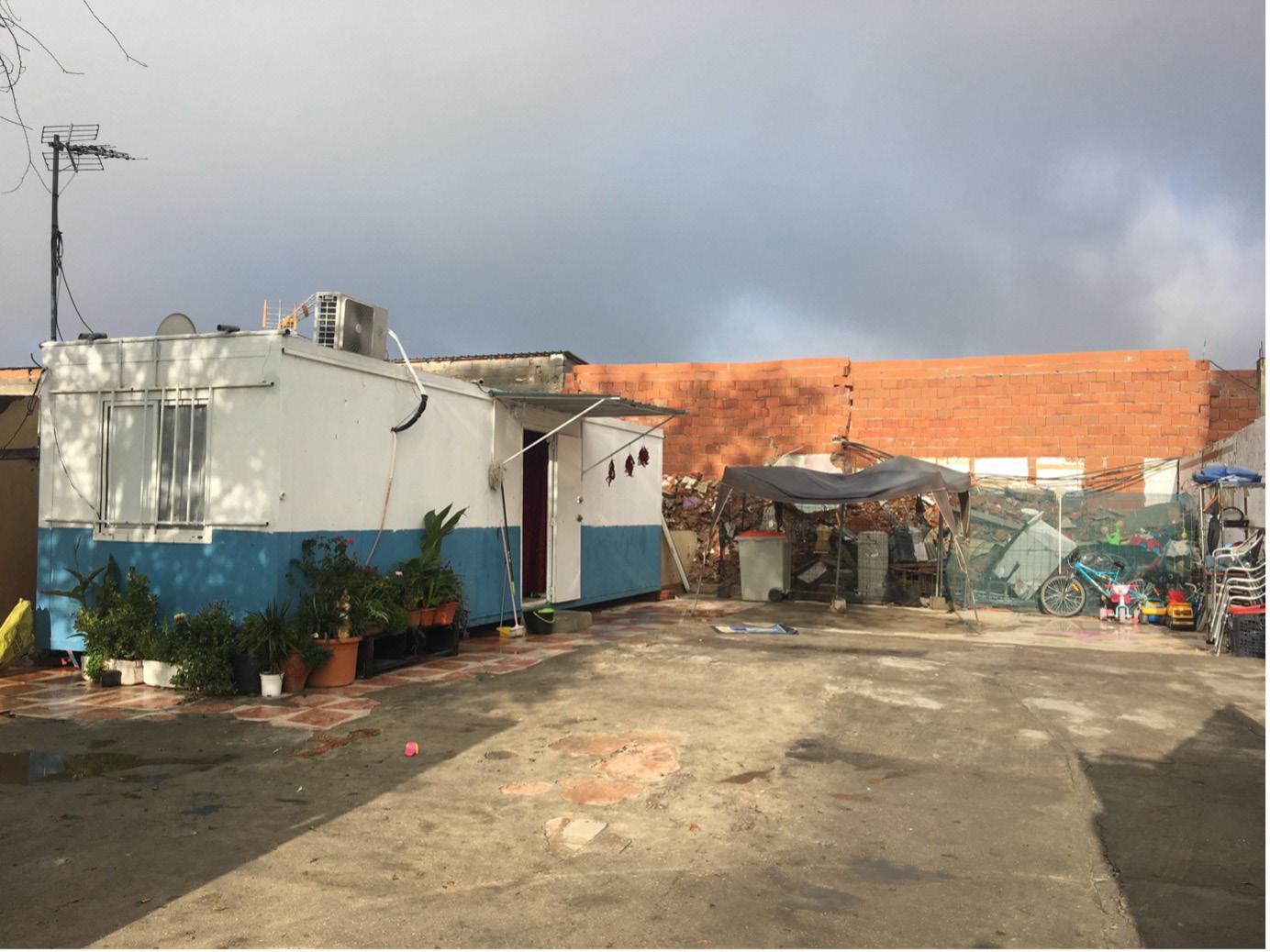
Dressed all in black, Fátima was washing the dishes outside the site cabin that had been her home for the last three years. In her late seventies and widowed for a decade, she moved into this temporary dwelling after her previous house was demolished during a police drug raid on a nearby plot in the settlement. It didn’t matter to the council’s urban discipline officials, who arrived the following day, that no drugs had been found in Fátima’s house, or that she had nowhere else to go if they demolished it. So, she had to move, again, and improvise a solution. After spending a few weeks at one of her daughters’ site cabins, she managed to get one for herself next to theirs, on a piece of land where the remains of tiled floors and foundations evoked more settled times: traces of a better-off past coalescing in the surviving tiles and in the piles of rubble pushed to the back of the plot as an improvised fence.
Fátima invited me into the cabin to talk ‘more calmly,’ as the petrol generators filled the air with their noise, a noise I only realised was so oppressive once I stepped inside and stopped hearing it. Two years have passed since the electricity company cut off power to the settlement. Fátima told me that, at the time, they didn’t have the money to invest in solar panels, a more expensive option in the short term, but more efficient in the long run: “Back then, we didn’t think about it, and now we don’t have the money. We can’t save either; these engines eat up every euro we have.” I empathised with her. I hadn’t expected that blackout, which by no means was the first in the settlement, to become the definitive one.
We began talking about her life in the settlement, and she told me a story I’ve heard many times from different people, with variations, but always following the same arc. Married to Manuel in their teenage years, they lived in the small village where they had grown up and met. There, they started their family, and eight of their eleven children were born. Manuel made a living as a seasonal agricultural worker, mainly in the olive harvest and in olive oil production at the local press. Fátima took care of the household and contributed to the family economy with goods she received from the charity of her female neighbours, women she met while doing laundry by the river or in other women’s spaces.
Fátima recalled a life of hard work, earning just enough to pay the rent on the adobe house they lived in and to feed the family. At some point, “we weren’t earning enough from the fields for so many people,” she said, so they moved to the capital in the late 1970s, like so many other families seeking a better future. For several years, Fátima told me, they never really settled. They moved from one place to another, building shacks out of waste materials until the police tore them down, and then they would move again. Their main means of earning a living was their van, which they used to collect scrap or sell fruit as street vendors, anything that helped them make ends meet.
They kept that nomadic habit, a completely new experience for them, as their families had been settled in the same region for generations, until they were given one of the prefabricated houses in the special typology neighbourhood in the then south outskirts of the city. In her own words, those prefabricated homes were “wonderful, they had everything a house should have.” But they were not relocated when the area became part of a new urban development project and the evictions came: “They threw us out, they cheated us, and they didn’t give us a thing. Some people got houses; they told us we would get one, but they gave us nothing.”
“So we moved to the settlement,” she continued. “There were a lot of payos living here then, with their allotments and orchards, oh!, the women had beautiful gardens here, but they didn’t want to stay anymore. They started selling, and we bought a small piece of land and settled here.”
Twenty years later, she was still there, but the house they built was now in ruins, and the land they had bought was no longer usable. She had to move in with one of her daughters, who had also been unable to leave the settlement. Together, we reminisced about the gradual deterioration of the settlement (and consequently, her living conditions) in recent years, which culminated in the power outage in October 2020.
Photo of settlement taken by author
This was not restored during the snowstorm that left the area in the grip of freezing temperatures. “They are slowly killing us,” said Fátima. “Who can live without electricity like this?”
This is a concise account of the life of a Spanish Romani woman (Gitana) living in an informal settlement on the outskirts of Madrid. When rewriting my fieldnotes for this paper, I deliberately omitted the references to ethnicity and location until the final quotation from Fátima, in which she uses the term ‘payos’ to refer to non-Roma. My aim was to draw the reader’s attention to the many other locales and populations that endure conditions as dire as those experienced by Roma communities. “They are slowly killing us”, Fátima told me, evoking the concept of “slow death” as defined by Laurent Berlant1 , after enduring two years without electricity, just one symptom of the ongoing deterioration of living conditions in Cañada Real.
Since 2007, I have worked in Cañada as a physician witnessing this progressive decline even as the number of programmes ostensibly designed to “integrate” Romani communities has multiplied. For over fifteen years, I have occupied the ambivalent role of representing an institution of both care and control, continually trying to align myself with the interests of the people of Cañada Real. It is from this position that I conduct my academic research, intending to contribute to the dismantling of some of the negative stereotypes that remain so detrimental to Romani populations in Spain. The diverse Romani populations of Cañada Real (who have varied origins, beliefs and livelihoods) provides a productive entry point for understanding the wider patterns of marginalisation experienced by Romanies across the country, and the insidious forms of neoliberal biopower that, in the words of Éric Fassin “may not make them die, but they won’t let them live”. 2
1 Berlant, Lauren. 2011. Cruel Optimism. Durham: Duke University Press.
2 Fassin Éric, Fouteau Carine, Guichard Serge, Windels Aurélie. 2014. Roms & riverains: une politique municipale de la race. Paris: La Fabrique éditions; 227 p.
Fátima’s life story, in its various dimensions, represents a common life trajectory that so many Gitanos (Spanish Roma) in Spain have followed. 3 Despite a brief impasse before the 2008 economic recession, when Spain was considered a model for Romani inclusion, the Gitanos in Spain are the most disadvantaged population, with half of them living in extreme social exclusion. I have focused on Fátima’s housing situation to illustrate how phenomena that are typically understood and explained in cultural terms, or as idiosyncratic of Gitano populations, are shaped by differential trajectories and specific housing policies aimed at Gitano populations. These policies are often informed by antigypsism, both in the way they are devised and implemented.
Let’s start at the end: Cañada Real is an informal settlement where Fátima has lived with her family for the past twenty years. Portrayed in the media as the biggest slum in Europe, Cañada evolved from a cattle path and vegetable garden to a road for trash trucks to Madrid’s dumpsite and a place of arrival for those with nowhere else to go.4 Romanies and North African migrants make up the largest populations. Since 2000, its population has doubled, and it has gained notoriety as a place of conflict, drug dealing and evictions. Power outages and the refusal of regional authorities to intervene were based on claims that electricity was being used to power cannabis farms.5
3 I use the word gitano/a when referring to Romani people who have been settled in Spain for centuries, as it is a term they use to refer to themselves. Although gitano can be used as an offensive adjective in Spanish, it has fewer pejorative connotations than the term ‘gypsy’ in other languages. I use the term ‘Romani communities’ to refer to both ‘Gitano’ and migrant Roma.
4 Gonick, Sophie. 2015. “Interrogating Madrid’s ‘Slum of Shame’: Urban Expansion, Race, and Place-Based Activisms in the Cañada Real Galiana.” Antipode 47 (5): 1224–42.
5 “‘You Kind of Die’: Life without Power in the Cañada Real, Spain.” 2021. The Guardian. October 27, 2021. https://www.theguardian.com/world/2021/oct/27/ you-kind-of-die-life-without-power-in-the-canada-real-spain.
Fátima, too, ended up there when she had nowhere else to go. This was during the construction industry boom of the early 2000s, when the outskirts were transformed into new neighbourhoods. Those living there, in either formal or informal settlements, were evicted. At that time, Fátima was living with her family in a ‘special typology neighbourhood’, a product of policies from the 1980s and 1990s that aimed to eradicate the slums and their association with Madrid’s backward past. These ghetto-like estates were purposefully built by the council agencies in charge of the eradication-relocation programmes to accommodate what, in their view, were the Gitanos’ differences, and they were the sole inhabitants.
The agencies framed these isolating housing policies as inclusive and positive discrimination measures for Gitanos, as they were a means of dealing with a population that had not yet embraced “European modernity”. In the agencies’ logic, isolating Gitanos allowed them to learn how to integrate into modern society while maintaining their traditional way of life. These policies are underpinned by an ambivalent logic that presents inclusion as only possible through exclusion. To foster the participation of Gitanos in society, they must be isolated.6 This exclusionary logic has shaped many of the programmes designed to promote the inclusion of Gitanos in Spain and elsewhere.7
As the city continued to grow, more slums were to be eradicated, and even the isolated special typologies neighbourhoods were in the way of the new urban developments of the 2000s and were to be eradicated too. When their neighbourhood was demolished, Fátima’s family was not offered alternative housing, so they moved to Cañada, which seemed far from the authorities’ demolition
6 Gay y Blasco, Paloma. 2016. “‘It’s the Best Place for Them’: Normalising Roma Segregation in Madrid.” Social Anthropology 24 (4): 446–61. https://doi. org/10.1111/1469-8676.12333.
7 Picker, Giovanni. 2019. Racial Cities Governance and the Segregation of Romani People in Urban Europe. London New York Routledge.
projects. At the time, Cañada was not targeted by eradication programmes, nor was it on the political agenda or in urban planning documents. For council agencies, Cañada was a convenient solution as it provided a place for people who were not offered alternative housing to go. They turned a blind eye to it and Cañada became home to families displaced by the eradication-relocation programmes.
Evictions arrived in Cañada sooner than Fátima expected, this time disguised as a public health measure. Since 2013, when the European High Court of Human Rights ruled against demolitions based on urban infractions8 , demolitions in Cañada after drug raids have become the main institutional mechanism to evict people. In Fátima’s case, the police issued a demolition order after the raid based on the premise that the houses were instrumental in committing a public health offence (drug dealing). The order was issued for all the houses on the plot, even though they did not find any drugs in several of the houses, including Fátima’s. The institutional response to drug dealing targeted not just the offenders, but their entire families.
In other contexts, the practice of demolishing entire homes and evicting people who are not involved in the offence would be inconceivable; no one would dare destroy an entire block of flats due to one apartment’s involvement in drug dealing, thereby rendering other neighbours homeless. The social organisation of the Gitanos in extended families, when connected with drug dealing, is perversely used as an aggravating factor for the offence. It becomes an institutional means of infrastructural violence against Romani populations.
8 “Cuando El Tribunal de Estrasburgo Aplicó La Ley de La Cañada Real. - CAES.” 2025. CAES. October 23, 2025. https://caescooperativa.es/2025/10/tribunal-deestrasburgo-ley-de-la-canada-real/.
In conclusion, I aimed to illustrate through Fátima’s life story how the various forms of antigypsism shape the life trajectories of Romani communities in Spain. Infrastructural violence9 dominates the lives of the Romani people in Cañada, trapping them within a racialised time of chronic crisis.10 This often occurs across multiple generations and leaves them on the margins of citizenship. These forms of violence, which sometimes take the form of neglect, are met with different and creative forms of resistance, but they take their toll on people’s lives. Relying on family ties to cope with housing insecurity is one of the strategies of resistance that paradoxically exposed them to insecurity, as shown in Fátima’s case. However, it also shapes community and support networks in the face of a hostile world.
Fátima’s story thus stands as a reminder that what is too often framed as cultural difference is, in fact, the cumulative effect of antigypsyism that is embedded in the everyday infrastructures of life, and why confronting these structural conditions is essential if Romani futures in Spain are to be imagined beyond mere survival.
9 Rodgers, Dennis, and Bruce O’Neill. 2012. “Infrastructural Violence: Introduction to the Special Issue.” Ethnography 13 (4): 401–12. https://doi. org/10.1177/1466138111435738.
10 Vigh, Henrik. 2008. “Crisis and Chronicity: Anthropological Perspectives on Continuous Conflict and Decline.” Ethnos 73 (1): 5–24.
This edition of the Bulletin brings together contributions from a small group of fellows convened at a ISRF Congress in June 2025. Inspired by the concept of the counterpoint, this Bulletin challenges dominant discourses to offer more nuanced understanding of contemporary social, political, and cultural issues. Featuring contributions from Margot Verdier, Anthony Pickles, Yasamin Alkhansa, Milan Babić, and Beatriz Aragón.
The ISRF funds and supports critical, innovative and rigorous research in the social sciences and humanities through grant competitions, events and publications.