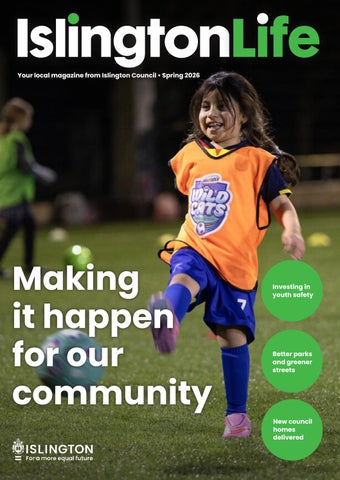
IslingtonLife sping 2026

Page 1


View this and previous issues online at issuu.com/ IslingtonLifeMag

Be the first to hear about the latest news. Visit islingtonlife. london

Follow us on X @IslingtonBC

You can also find us on Facebook and Instagram. Search for Islington Council

Get in touch! Email us at IslingtonLife@islington.gov.uk

Other formats

If you would like IslingtonLife in large print, audiotape or another format, please call 020 7527 7301

Recycle me!

Please recycle this magazine once you’ve finished with it.

Over the first weeks of 2026, Islington has seen exciting progress on the projects and schemes that will make a real difference to people’s everyday lives. As Leader of Islington Council, I’m excited about how we’re making it happen across the borough.

We have announced details of our 2026/27 budget that will fund the essential services that residents most rely upon and provide investment to improve every corner of our borough. As part of this, we are introducing a new £5 million fund that is designed to accelerate work on the issues residents tell us matter most. This fund will enable further investment in the frontline services and local improvements that help create a more equal future for everyone in our community.

Alongside this, our commitment to supporting residents facing financial hardship continues through the Council Tax Support Scheme, ensuring thousands of low‑income households receive substantial reductions, and in many cases pay no council tax at all. This support remains vital as we work to protect the most vulnerable during the cost‑of‑living pressures many are still experiencing.

We were thrilled to reopen the Whittington Park football pitch following significant upgrades. The popular pitch has been fully overhauled with a renewed base and a completely new playing surface a fantastic boost for local sports teams, schools, and families who rely on high‑quality community facilities.

As Leader of the Council, one of my most important responsibilities is ensuring that every resident feels connected to the place they call home.

My role is about delivering projects and services, but also nurturing the sense of belonging, pride and shared purpose that makes Islington a community of communities. That means continuing to listen closely to residents, championing their voices at every level, and making sure our priorities reflect yours.

Over the months ahead, my focus remains on continuing to strengthen these connections and ensuring that the council is a visible, reliable, and compassionate presence in your lives. Whether it’s supporting neighbourhood initiatives that help residents shape decisions that affect them, or creating spaces for people to meet, learn and grow, we are committed to fostering a borough where everyone feels valued and included.

Whatever your plans for the weeks and months ahead, I encourage you to stay engaged, connected, and keep taking part in life in our borough. Islington’s greatest strength has always been its people, and together we will continue to build a fairer, healthier and more vibrant place for all.

To receive news and updates directly to your inbox visit islington.gov.uk/StayUpdated

Re:faces

Keep your eyes peeled around Islington over the coming weeks for vibrant new illustrations by local artist Freddie Yauner.

To celebrate the fact that most people in the borough now recycle their waste, Freddie has transformed everyday items into playful drawings inspired by the people who once used them. These mini artworks are designed to surprise and delight, popping up in unexpected corners of Islington and encourage everyone to think differently about what they throw away.

See if you can spot them as you’re out and about.

Find out more at islingtonlife.london, and explore more of Freddie’s work on Instagram @freddieyauner or at freddieyauner.co.uk.

Free swimming lessons for over 60s

Islington leisure centres are offering free swimming lessons for people aged 60 and over. Lessons are run in partnership with Islington Council. Available for a limited time only.

islingtonlife.london/adultswimming-lessons/

National Year of Reading

Islington is joining the National Year of Reading 2026 with a lively programme of events running across its libraries. Expect author talks, reading challenges and community celebrations designed to spark curiosity and inspire a deeper love of books. Our libraries will host sessions for all ages. With events unfolding month by month, it’s an ideal moment to reconnect with reading and enjoy everything Islington’s libraries offer.

We’ll be posting regular updates on islingtonlife.london with the activities planned for each month.

Active play

SEND Active Play sessions for under‑10s run at Sobell Leisure Centre on Tuesdays from 5–6pm. There is also a quieter, more relaxed option on Saturdays from 9–10am, with reduced capacity and no music, helping children feel more at ease and enjoy the space.

Additionally, the Active

Multi‑Zone hosts inclusive sessions on Fridays from 5–6pm for both children and adults, giving families even more chances to get active together. bookings.better.org.uk/ location/sobell-leisure-centre

Confidence through community

The charity Mencap is offering a community led social inclusion and leisure programme to support people with a learning disability to meet up, develop skills and build confidence. There are lots of different social activities including drama classes, bowling games, gardening and much more. If you live in Islington and have a learning disability, sign up today.

islingtonlife.london/things-todo/me-time-programme

Fresh pitch upgrade

Whittington Park’s much‑loved football pitch is back with a brand‑new surface, supporting local players of all ages. The refurbished pitch includes improved markings for 11v11, 7v7 and a new 3v3 pilot, creating more ways for the community to play and train. The upgrade also supports the growing women’s game, including Islington Borough Ladies FC, and strengthens Islington’s commitment to high‑quality, accessible sports spaces

Google ‘Whittington Park football pitch’ to book the space.

Spring culture picks

Spring in Islington is full of inspiring cultural moments, from creative workshops to exhibitions, performances and community events across the borough.

Whether you’re looking for something hands‑on, something free, or something to enjoy with friends and family, there’s

plenty to explore as the days get brighter.

islingtonlife.london/culturalthings-to-do-jan-march/

Bloomin’ wonderful

Do you grow any plants or food on your windowsill, balcony or tree pit garden? You can get a free bag of compost just by entering Islington in Bloom!

The annual gardening competition opens on Friday 1 May, so now is a perfect time to start planning your entry. The judges aren’t looking for perfect planting, they are more interested in areas that attract wildlife, interesting food growing, or projects that use sustainable materials.

Find out more at islington.gov. uk/inbloom

Making it Happen

Islington Council’s 2026/27 budget is all about one thing: making it happen for residents. The council is investing in communities, protecting vital frontline services – like social care, waste collection, and libraries – as well as supporting local people across the borough.

The budget covers everything from caring for older neighbours to maintaining parks, supporting families, and creating much needed new homes. It’s all part of the council’s efforts to create a more equal future.

Where the budget is being spent

In its budget for 2026/27, Islington Council is looking to spend money on the issues that matter most to local people. It’s estimated that around £597 million will be spent in 2026/27, on the following areas:

Where the money comes from

Islington’s funding comes from a mix of sources – each one plays a vital part in keeping everyday services going and creating positive change.

36%

Council tax

Your council tax helps keep essential services running every day – it keeps the streets clean, helps maintain our parks, keeps libraries open, and supports the most vulnerable.

35%

Revenue Support Grant

This is funding from central Government that councils can use flexibly to support local services. Unlike other grants, it isn’t tied to specific projects or rules – it helps the council respond to local priorities, protect essential services, and support residents where the need is greatest.

21%

Business rates

These are paid by non domestic buildings like shops and offices, and help to keep high streets thriving.

8%

Other government grants

Central Government provides councils with funding to support the services that matter most to local people. Unlike the Revenue Support Grant, these grants are tied to specific projects.

What the budget does

The budget helps keep the everyday services that you rely on going – but it also does much more than that. This year’s budget proposals include:

A new £5 million fund to accelerate progress on the issues that matter most to residents, to help make it happen for Islington.

Support for those most in need through the Council Tax Support Scheme, one of the most generous in the country – estimated to cost £28 million in 2026/27, benefitting around one in five households.

Fixing potholes across the borough and ensuring all can enjoy using Islington’s streets, through a commitment of more than £4 million over the next decade.

Major investment in council homes with a whopping £324 million to improve existing council housing over the next decade – making homes warmer, safer, and more energy efficient.

More homes for local people through a £58 million programme of buying new council homes, that will go to those that need them most.

Why it all matters

Year in, year out, the budget helps the council to spend on projects that make a real, tangible difference to local people of all ages and backgrounds. In recent years, funding has helped deliver some amazing projects:

Building 354 new homes since 2022

Launching a new day and night neighbourhood patrol team, to tackle antisocial behaviour and keep streets safe.

Refurbishing the Sobell Leisure Centre, which has had more than 200,000 visits to the new facilities that opened last May.

Making happenit

Investing more than £2m in parks, open spaces, and playgrounds

Putting £2m into new facilities to improve recycling on our estates, to help tackle the climate crisis.

The budget isn’t just about balancing the books – it’s about building a more equal borough. From new homes to new planting, from support for families to investment in neighbourhoods, every penny helps make life better for local people.

Trophies, poppies and the spirit of Islington

Islington’s highest honour celebrates two very different but equally inspiring stories, from Champions Leaguewinning footballers to a lifelong fundraiser whose kindness and hard work has helped people for decades

From the Emirates to the council chamber

When Arsenal Women walked into the Islington Council chamber in November, it was a proud moment for the whole borough. Fresh from winning the UEFA Women’s Champions League, the team were there to receive the Freedom of the Borough — the highest honour the council can give.

But the ceremony was about more than trophies and football, it was about the team’s roots in Islington, their role in inspiring a new generation of footballers

and their commitment to the community where they are now spending more time than ever.

At the ceremony, the club was represented by Captain Kim Little, Head Coach Renée Slegers, Director of Women’s Football Clare Wheatley, and senior club executives.

Cllr Una O’Halloran, Leader of the Council, spoke of the pride she felt in recognising “sporting greatness” but emphasised that the honour was just as much about community impact. “They’ve helped inspire a new generation of fans to support and engage with women’s sport,” she said — a sentiment echoed by many residents across Islington.

Arsenal Women were formed in 1987 by Arsenal in the Community. From the start, the aim was simple: to create a safe

and welcoming place for girls and women to play football. At a time when women’s sport was often overlooked, the club helped lead the way. Nearly 40 years later, the Freedom of the Borough honours that history. It recognises years of hard work, fairness and commitment, as well as recent wins.

The club’s achievements on the pitch have undoubtedly given the borough much to celebrate and to believe in. With all their league matches for the 2025/26 season set to be played at the Emirates Stadium, the honour cements Arsenal Women’s place not only in football history, but in the heart of Islington too.

David John Dade’s lifetime of service

After celebrating Arsenal Women, the council honoured another remarkable figure: David

John Dade, well known across Islington not for sporting success but for steady, committed service. Joining the Merchant Navy at just 14 years old and later serving in the Army’s Catering Corps, David has dedicated more than 50 years to supporting veterans and their families.

Since 2013, David has led the annual Poppy Appeal in Islington, raising funds through the generosity of residents, local businesses, schools and

volunteers. His efforts have helped to raise nearly half a million pounds — a lifeline for veterans and their families coping with medical needs, housing pressures and other hardships.

Reflecting on the letter which told him he’d be honoured, David admitted: “I cried when I got the letter. I was so surprised. It just came out of the blue, and it was a lovely feeling to know I’m being recognised for what I do.”

For David, the recognition was never about personal glory. He describes his work as his “way of giving back” — a heartfelt commitment to honour those who served in wars and to ensure their sacrifices are never forgotten. “The people that need to be thanked,” he said, “are the people of Islington. Without their generosity, I couldn’t raise the money.”

David a 77 year old great grandfather, shows no signs of slowing though he joked that his wife might prefer he start winding down. For many corner shops, tube stations, schools and pubs across the borough, his familiar presence each autumn continues to symbolise respect, remembrance and community solidarity. Two very different stories united

Two different stories united

While their journeys have been very different, both recipients reflect the commitment and community spirit that the Freedom of the Borough award honours.

For Arsenal Women, the Freedom of the Borough acknowledges not just a Champions League trophy, but a legacy of inclusion and local pride. For David John Dade, it recognises decades of selfless service, loyalty to veterans and ongoing community work that brings people together.

Last year’s Freedom of the Borough awards show how varied contribution can be, from sporting excellence on the European stage to years of grassroots fundraising on our high streets. They both capture the resilience and generosity that define Islington.

Here’s to the team that lifts a trophy and to the man who sells a poppy! Both carrying the spirit of this borough forward.

in civic honour

Support for every career stage

From first jobs to career changes and specialist support, Islington Council’s employment services are helping residents take confident steps towards good and secure work — whatever their background or circumstances

Supporting people at every stage

Each year, thousands of Islington residents take steps towards a new job, a better role, or a fresh start. The council’s employment services are designed to support people at every stage of their working life — whether they are just starting out, changing careers or facing challenges that make job‑seeking more difficult.

From iWork to specialist programmes like Connect to Work, support is local, free and tailored to individual needs. Friendly advisors work alongside

residents to help them develop skills and access opportunities that lead to long term employment.

iWork: support that starts with you

Islington’s iWork service supports people who are out of work, or in low‑paid roles, to move into jobs that match their skills and ambitions. Advisers offer one‑to‑one support, helping with CV’s, applications and interview preparation. Strong partnerships with employers across the borough mean residents can access good‑quality jobs close to home. iWork also connects people to apprenticeships, training and specialist support that can open new routes into employment and progression.

Connect to Work: personalised help when people need it

Connect to Work offers personalised employment support for people who may need extra help because of a disability, long‑term or health condition. Advisers work at a pace that feels right for each individual, offering support with workplace adjustments, interview confidence or practical steps towards finding the right role. The programme is designed to be flexible, ensuring people can move forward in a way that works for them.

Helping young people find their next step

For many young people, deciding what comes next after school or college can feel overwhelming. Islington’s Youth Employment Hubs offers specialist support for 16 to 25 year‑olds, helping them explore different careers, apply for apprenticeships, access training or step into their first job. Support is flexible and available to all young people with a connection to the borough. Strong links with employers and training providers mean advice can quickly turn into real opportunities.

Trailblazer: unlocking potential for care-experienced young people

The Trailblazer – Full Potential Programme supports care‑experienced young people aged 17 to 25 who are not in education, employment or training. The programme provides coordinated, personalised support to help young people access training, volunteering and work opportunities aligned with their aspirations.

Your Choice Programme: paid work that changes lives

One of the council’s most impactful youth initiatives, the

Your Choice Programme, offers paid summer work placements for 16 to 25 year‑olds at risk of serious youth violence. Run by a dedicated team, it provides meaningful work experience. Since launching in 2022, it has supported 62 young people into paid placements with more than 30 employers. An impressive 95.4% of participants stopped committing crime while 62.9% progressed into education, employment or training.

Whether it’s updating a CV, exploring career options, overcoming barriers or taking first steps into work, Islington’s employment services provide practical, responsive support tailored to individual needs.

To find support, visit: islington.gov.uk/jobs-andcareers/support-finding-work

Homegrown Talent: Isaac Bokoko

We speak to Islington-raised filmmaker and creative director Isaac Bokoko, who co-founded NC Productions — a multimedia company dedicated to championing underrepresented voices and creating pathways for the next generation of local talent

I grew up in Islington, and the borough has shaped me into who I am today. Two years ago, I co‑founded NC Productions with my business partner Ryan. We work across film, theatre and events and believe that creativity should be accessible to everyone. Our mission is to create spaces where people feel seen, heard and able to take up space in the arts.

Growing up in inner‑city London meant being surrounded by different cultures, communities and stories. It was inspiring, but class and race barriers often made the creative industries feel out of reach. With ADHD and dyslexia, traditional education didn’t always work for me, deepening that sense of not belonging.

Everything changed in 2018 when I joined a free holiday course at Fully Focused. I was 15 or 16, and for the first time, film gave me a voice. Fully Focused is youth‑led and centred on trusting young people with real responsibility. That experience opened doors, leading to work on major productions including Netflix projects and Call the Midwife.

Through NC Productions, we aim to create those same opportunities for others. Our Shades of Migration exhibition brought together 45 young filmmakers, musicians and artists, offering a platform where young people could step confidently into environments they once felt excluded from. I’m excited about what’s next and proud to be opening doors for young creatives.

For more information on NC Productions, visit: ncproductions. net

Finsbury Park: Safer streets, stronger community

One of London’s busiest and best-connected areas, Finsbury Park, stretches across Islington, Hackney and Haringey

We spoke to Pub Manager, Darlene at local favourite The BlackStock, and Islington Council Community Safety Officer, Sarah Armstrong about improvements to make the area safer.

How is the council improving safety in Finsbury Park?

Sarah: Finsbury Park is a priority area for many council teams. Trading standards work with the police to inspect local businesses and follow up on complaints, ensuring that shops comply with laws designed to protect consumers. The Neighbourhood Patrol team provide a visible presence to deter crime and reassure residents.

The council regularly deep clean the area around the station, jet washing, removing graffiti and making the area more welcoming. Funding has been secured for lighting

improvements around Stroud Green Road bridge and around the station.

Other work includes bike marking events and awareness campaigns about mobile phone theft. Women’s safety is a focus too, with initiatives around reducing street harassment and spiking awareness. We’ve achieved a lot but there’s still more to do.

How do you work with other councils?

Hackney, Haringey and Islington are committed to working

together to make Finsbury Park a safe place for everyone. We share community safety knowledge, support the homeless population, and manage the impacts of events in the parks.

The police have been working hard to crack down on crime in Finsbury Park. How does the council support this work?

We work with the police on their “Clear, Hold, Build” campaign by helping with information, CCTV and other work that has led to arrests and the removal of drugs and weapons from the streets. We focus on maintaining safety in the ‘Clear’ phase as we move into the ‘Hold’ phase and continue with reassurance patrols to deter crime.

What improvements have you seen in Finsbury Park in the past few months?

Darlene: The streets feel safer with visibly less crime in the area. In the past, I felt uneasy going to Sainsbury’s on Stroud Green Road because of groups of people hanging around waiting to target people but that’s changed. It makes me feel safer and more confident.

The BlackStock Pub is a Safe Haven. What does that mean to you?

We look out for everyone; women, men, groups, tourists and people

travelling through as well as locals. We help with directions, charge people’s phones and we provide shelter from the rain. One customer recently left a lovely review of our security guard, Sid. They were passing by and having issues with their phone and Sid went out of his way to help them get home safely. People often compliment us on how well we look after them.

How do you and your staff help people feel safe?

Our security staff monitor who enters, keeping the pub a safe space. We log incidents to learn and improve.

Women’s safety is a top priority. All staff have completed training to prevent sexual harassment and assault and we’re an accredited Good Night Out venue. We know many customers by name and welcome a diverse crowd including a community of Arsenal fans and Gay Gooners.

What makes Finsbury Park special?

Darlene: There’s a strong sense of community, a diverse population, great transport links, lovely green spaces and a lively café culture. It’s vibrant, wholesome and a great place to live, work and spend time in.

Sarah: It’s a growing town centre with people who are invested and passionate about improving the area.

For more info on the council’s work visit: islington.gov.uk/ community-safety

Share your ideas for making Andover and Six Acres estates safer: letstalk.islington.gov. uk/andover-six-acres-saferspaces

Staying safe in Islington

Three ways the council’s Community Safety Interventions team helps keep you safe, supported and protected.

1. Safeguarding people at risk

The team work closely with vulnerable adults and young people who may be at risk of harm. By identifying concerns such as exploitation, abuse or crisis early on, they can step in quickly with tailored support. Working alongside specialist agencies they help reduce risks and prevent situations from escalating.

2. Protecting against extremism and hate

Through the Government’s Prevent programme, the team supports people who may be vulnerable to radicalisation, helping divert them towards positive support. They also work with victims of hate crime — whether based on race, religion, disability, sexual orientation, or gender identity — to ensure incidents are reported, addressed, and taken seriously. This work strengthens community cohesion and makes clear that hate has no place in Islington.

3. Tackling cuckooing

Cuckooing happens when criminals take over a vulnerable person’s home for activities such as drug dealing or storing weapons. The team works with housing providers, police and support services to spot the signs, safeguard victims, remove perpetrators and disrupt criminal networks.

If you’re worried about a friend or neighbour, email: cuckooing@ islington.gov.uk with as much detail as possible.

You can also report concerns to the police on 101 or anonymously to Crimestoppers on 0800 555 1111

Always call 999 in an emergency.

Big nature in little places

From rare spiders to luxuryloving bees, Islington’s green spaces are full of wildlife, and residents are playing a vital role in helping nature thrive

Islington may be one of London’s smallest and most densely populated boroughs, but when it comes to wildlife, it punches well above its weight.

Behind the bustle of streets and squares, a surprising variety of creatures are flourishing. Volunteers and community groups across the borough are giving nature a helping hand and showing just how much difference local action can make.

Projects like the Garden Classroom’s Green Guardians are proving that even the tiniest patches of green can make a big difference, offering refuge for species that normally struggle to survive in the city.

Rare finds on familiar ground

Newington Green recently made headlines after volunteers discovered it is home to the Oak Jumping Spider, a rare species in

urban areas.

Even more exciting was the discovery of an exceptionally rare millipede, spotted for the first time ever in North London.

These finds highlight just how valuable Islington’s green spaces are, even those surrounded by busy roads and housing.

Bees beyond the honey jar

The UK is home to more than 250 species of bee and only one of them is the honeybee. A recent report by the Clerkenwell Pollinators Project revealed that Clerkenwell alone supports a dazzling array of pollinators.

These include the Early Bumblebee, which cleverly makes use of abandoned mouse nests, and the European Wool Carder Bee, known for scraping soft hairs from lamb’s ear leaves to create a cosy nest. There’s even the Cuckoo Bee, which lays its eggs in the nests of other species.

Why small spaces matter

The Clerkenwell Pollinators Project assessed local green sites for how well they provide food, shelter and habitat.

Its findings were clear: green spaces of any size, from community gardens to window boxes, are crucial.

Many smaller species, such as the tiny Harebell Carpenter Bee, which measures just 5mm, can only travel around 150 metres from their nest. Without nearby flowers, they can’t survive, making every planted corner a lifeline.

How can you help?

The good news is that everyone can get involved. Each planted space becomes a “pollinator pit stop”, offering fuel for insects on the move.

No garden? No problem. Window boxes, balconies and community plots all count. Even planting around the base of street trees, can help wildlife flourish.

In Islington, when it comes to nature, small really is beautiful.

Get out and get active

Spring is a great time to get moving and Islington’s parks are the perfect place to start

With brighter days, blossoms on the trees and flowers beginning to bloom, it is a wonderful time to explore all the different ways you can use your local park. Spending time outdoors can lift mood, improve fitness and help us feel more connected to our community. It’s a natural mood booster!

Outdoor gyms are a good option for all abilities, not just regular gym goers. Found across the borough, the equipment has clear instructions, and many pieces are adjustable, making it easy to build strength or let off steam on the way home from work.

For those curious about strength training, free weights are available to borrow at Whittington Park and Highbury Fields. Weight and resistance training can help build muscle — particularly for women as they

get older — and this is a simple way to try it out in a relaxed setting.

Walking and running routes in parks make it easy to keep track of distance and set personal goals. Whether it’s a gentle stroll, a brisk walk or a jog, any type of movement can have a huge impact on your health

Looking for something sociable?

Table tennis tables can be found in 10 parks across the borough and are a fun activity for all ages. Ball courts and pitches are also available for football, basketball, tennis and netball, offering plenty of opportunities to play with friends or join in locally.

For more ideas on staying active in Islington parks, visit findyourislington.gov.uk

Top tips: Pollinator power

Plant pollinator-friendly flowers

Plant up your garden, balcony or window box with pollinator friendly plants — and why not enter it in Islington in Bloom competition which opens in May — all entrants get a free bag of compost!

Join a community garden or park project

Helping out locally not only supports pollinators but strengthens your neighbourhood too.

Create a tree pit garden

Tree pits — the small patches of soil at the base of street trees — can be transformed into mini‑gardens that brighten up your road. They’re a great pit stop for pollinators and an easy way to add a little extra greenery to Islington’s streets.

Leave some spaces wild

A pile of logs, bare earth or sand is the perfect habitat for all sorts of insects, or you could create a bee hotel by drilling 3 8mm holes into a log.

Offer a drink

Set out a shallow tray of water with pebbles for insects to rest on while they hydrate.

Health check: how movement improves mood

A group meets in Highbury Fields every week – even on Christmas Day – to walk, run and connect and we joined them to find out why it means so much to its members

Referred by Islington and Camden mental health services, members enjoy fresh air, movement and reliability.

The sessions, led by occupational therapist Rob, offer consistency — “something the members have often been denied in their lives,” Rob says. “Everything might feel like chaos, but they know that if they come, we’ll be here.”

Before the group sets off, co‑leader John brings some snacks to share. As the group launches into dynamic stretches,

a sausage dog makes a hopeful move toward the treats but is gently turned away. “This is the best part of my working week,” John says, chuckling. “We chat; we see the seasons change. It’s my favourite park anywhere.”

Why it matters

On the walk, participants spoke about their experiences:

Stella

“I’ve been a part of the group since 2017 after being in hospital for three years. Here everyone has experienced mental health challenges; you sympathise, so there’s no judgement. Rob supports me. In lockdown, when I couldn’t leave the house, he checked in on me.

I walk regularly. I have a bad knee and back, but I get further with this group than alone — call it mob mentality! The endorphins give me a sense of achievement, like I’ve earned my smile.

If you want to start exercising, just do it. You’re capable of more than you know!”

Martin

“Exercise supports both my physical and mental difficulties. It’s as much for the feet as it is for the head! Half the time I can’t leave the house because I’m so anxious and depressed. This makes me feel part of the world again.

If my legs aren’t cooperating, I can take breaks, and there’s always someone to chat to who

understands me. We call Rob our “resident angel”. A lot of us here, can slip through the cracks, he catches us when we fall.”

Paul “I’m bipolar, and keeping fit is crucial. Running is like therapy; it helps me regulate my moods. My medication can cause weight gain, but the doctor recently told me my heart rate is very healthy. I thank running for that.”

What makes the group special

Rob explained the group’s purpose: “These sessions work as a one stop shop. We chat, and I identify any further health or social care needs members have and signpost them to services. Most have spent time in psychiatric hospitals, and those experiences break down the fabric of their lives — through activity, socialising, and consistency, we rebuild that fabric.

You must meet people where they are, not pressure them. We just chat in the park, it’s very relaxed. By bringing mental health treatment back to the community, you reduce the stigma of people feeling like lifelong patients.

We provide different sessions every day – football, tennis, swimming. We’re building trust, in partnership with Arsenal in the Community. We’re holding hope and a future for those who feel like they have none.”

Moving more for our mental health

Regular movement is one of the most powerful ways to support our mental wellbeing, being active releases feel-good hormones, eases stress and anxiety and improves sleep.

. Getting started doesn’t have to be complicated. Gentle activities like walking, stretching, or dancing at home can make a real difference, and you can build up gradually in ways that feel enjoyable and sustainable.

1) Build activity into your regular routine

Every movement matters — try stretching while the kettle boils or marching on the spot between meetings.

2) Start slowly and build up

Doing too much too soon could make you feel tired or result in injury. Movement looks different for everyone, so avoid comparing yourself to others.

3) Find local activities you enjoy

You’re more likely to stick with an activity if you enjoy it! Islington offers plenty of low cost and free options to try. To explore, search: islington.gov.uk/active

4) Connect with others

Being active together can strengthen relationships and help you make new friends. Looking after your mental health can be hard. If you’re struggling talk to your GP or visit: islington.gov.uk/ MentalHealth

Leaseholder support

Islington Council is committed to making home ownership on council estates clearer, fairer and more inclusive

From explaining national reforms to creating spaces for residents to be heard, here are five ways the council is supporting leaseholders across the borough.

1. Helping residents understand new reforms

Leaseholders recently joined the council’s Homeowner Forum to learn about the new Leasehold and Freehold Reform Act 2024. This law aims to give leaseholders stronger rights and make things more transparent. Residents also shared their views on proposed changes, such as clearer service charge documents, easy to read annual reports, and updates to the ‘section 20’ consultation process for major works and long term contracts.

2. Encouraging involvement in shaping services

The council wants leaseholders’ voices to be heard. By signing up to the resident involvement register, leaseholders can give feedback and play an active role in shaping how housing services are delivered.

3. Hosting inclusive events for homeowners

In April and October last year, the council held dedicated events for leaseholders, freeholders living on estates, and tenants with live Right to Buy applications. Almost 300 residents attended, creating a welcoming and inclusive space for discussion, shared learning and collaboration.

4. Connecting residents with expert teams

At these events, residents were able to speak directly with council teams covering Home Ownership, Repairs, Major Works, Estate Services and Housing Management. This gave leaseholders the opportunity to raise concerns, ask questions and receive tailored advice on the issues that matter most to them.

5. Providing independent advice and support

The council partnered with the Leasehold Advisory Service to ensure residents had access to free, impartial guidance. This additional support helped attendees feel more confident navigating complex housing matters.

Latest developments: a year of progress

Each issue, we shine a light on the new homes being built in the borough. This time, we’re focusing on Elthorne Estate

Thanks to extra funding, 22 homes that were originally planned for private sale will now be let at social rent, making them genuinely affordable for local people.

A total of 46 new council owned homes are being built on the Elthorne Estate, offering a mix of one to four bedroom properties for individuals, couples, and families. Priority will go to local tenants on the Housing Register who need them most.

This change has been made possible through nearly three million pounds from the Greater London Authority, alongside four million pounds from the council. The houses were finished in January, alongside a new community space and a refreshed Zoffany Park.

The council is dedicated to keeping affordability at the heart of the project, even during challenging times and reflects their commitment to providing safe, decent homes for everyone in Islington.

For more on housing developments, visit: islington. gov.uk/HousingDevelopment

Two years of resident voices

As the Resident Services Improvement Group (RSIG) marks its second year, the council and resident members are reflecting on the impact the group has already made and the momentum it continues to build

RSIG is a group exclusively for Islington council tenants and leaseholders. It was created to ensure that people living in council housing directly influence and shape the services they rely on. Over the past year the group has reviewed key areas including changes to tenancy service, the renewed repairs policy and management of shared spaces.

For resident member Cassandra Flavius, who

joined the group in 2024, getting involved was driven by a desire for meaningful change.

“I wasn’t confident that voices like mine were truly being heard,” she explained. “There were perspectives and concerns within the community that weren’t always reflected in decision making. Rather than assume nothing could change, I chose to step forward.”

Members of the group come from a wide range of backgrounds, bringing insight that goes beyond data and reports. For Cassandra, this diversity has been one of the most rewarding aspects of her involvement.

“Connecting with a diverse group of

members and listening to their experiences, perspectives and ideas has been genuinely insightful,” she said. “It’s also been encouraging to see firsthand how committed the council are to residents and our wellbeing.”

Cassandra’s connection to Islington runs deep. Her family has lived in the borough since the 1960s, and she has experienced a range of housing situations — from family homes to a hostel, and now her own council flat. These experiences shape her understanding of the challenges residents face. “There were moments where I felt the council didn’t truly hear or understand residents like me,” she reflected. “Being part of this group gives me the chance to change that.”

Over the past year, RSIG has helped influence clearer, more accessible communication from the council. “The council has strengthened the

way it approaches policy making and communication, using clearer language and formats that residents can genuinely understand,” Cassandra said.

She believes RSIG’s role is vital in shaping fairer, more responsive services. “We bring lived experience directly into policy making. Our involvement creates a bridge between policy and reality.”

Looking ahead, she hopes the group will evaluate the impact of recent changes and collaborate more closely with other council groups. Above all, she wants more people to get involved.

If you are interested in shaping our housing services, sign up for our resident involvement register at: islington.gov.uk/ GetInvolvedHousing

Taking youth support

to the streets

We chatted with Barry Thomas, deputy team manager of Islington Council’s Targeted Youth Support service, and took a look at the new vehicle taking youth support to where it’s needed most

“You might have already spotted our brand new Youth Van parked in a street or estate near you. It means our teams can offer support, advice and a friendly face to young people right where they are in the community — including those who might never know about or feel able to access the services available to them.

We tend to park the van in the same place at the same time each week. That consistency really matters. It helps us build trust quickly. It’s got WiFi and a TV, so if someone needs help with a CV, we can have a laptop linked up or if someone wants to look something up, we can do it together on the spot.

It’s got a kitchen area where we can make some hot or cold drinks or provide a small snack. Sometimes we’re meeting the young people directly after school, so something as simple as a cup of tea can be a great conversation starter. It’s a social space too — we’ve got radio, Bluetooth speakers, games consoles and board games.

What the van really does is bring services directly to where they’re needed. In the past we’ve had specialists join us to talk about substance misuse, we’ve run sexual health screenings, and we’ve had career workers come on. Instead of a formal appointment in an unfamiliar building, young people can get that support immediately, in a safe and familiar space.

Targeted youth work is a huge part of what we do. Some young people have experienced trauma, have additional needs or simply don’t feel comfortable

engaging with services. For them, the van and detached youth working is vital. When information’s in front of them, and you’ve got skilled practitioners talking things through, they’re more likely to give it a chance. That’s when you can signpost them to other resources because we’ve built up trust and they’re not as wary of the work we do. We become that small but important bridge.

We know that it’s making a difference, especially because it’s delivered in such a unique and child friendly way. A positive experience with the youth van can shift a young person’s whole attitude towards support. If they feel listened to and respected now, they’re more likely to access help throughout the rest of their life too.

The van’s arrived just as the council is launching the new Youth Safety Strategy for the next five years. The van allows our team to play a key role in helping to steer vulnerable young people away from being drawn into criminal lifestyles. This might be through signposting to early mental health support, practical advice, or simply helping them feel safer where they live and spend time.

Last summer, my colleagues from across the council spoke to 450 young people about what it’s like to grow up in Islington and what would help feel safer. The strategy is made for them and with them — and the youth van is a big part of that.”

Read more about the Youth Safety Strategy 2025-2030 at islington.gov.uk/YouthSafety

A healthy start

Celebrity chef Giorgio Locatelli spoke to children and families about the importance of eating healthily during a special appearance at Barnard Park Community Hub

Giorgio recently teamed up with Islington’s holiday activities, early years and health improvement teams to lead a lively cooking session for more than 60 children and parents. Together, they watched him prepare a traditional Italian pasta dish and vibrant winter salad.

The event, part of Islington Council’s Holiday Activities with Food (HAF) programme, celebrated food, family time and the joy of cooking together. Children gathered around to learn new skills, ask questions and taste fresh ingredients, with many leaving proudly clutching recipe cards and imagining themselves as future chefs. For some families, it was also a chance to try ingredients they hadn’t used before, sparking conversations about flavour, and how simple meals can still be nutritious and exciting.

Giorgio encouraged families to see cooking as something enjoyable and familiar. “Cooking must be something that kids are growing up with, playing and being confident with,” he said. “It doesn’t have to be seen as an enemy and something far away. The more they are confident with that, the better their diet will be.”

He also spoke about the importance of sharing meals. “This idea of eating together and

sharing the food is something very human, it’s very deep in us, and I want to inspire children and families to make healthy and nutritious food.” His message resonated with parents, many of whom said the session reminded them how powerful small, shared routines can be in bringing families closer.

The council’s health improvement officer, Margherita, added: “Events like this are good for getting enthusiastic and excited about food; it can be fun, it can be creative, you can get the kids involved, and it makes everyone come together.” She highlighted that HAF sessions offer a welcoming space for families to learn and build confidence around healthy eating.

HAF returns this Easter with free activities and lunch, including SEND specific sessions, ranging from dance and theatre camps to cooking to coding. Events run 30 March - 10 April. See if you’re eligible for HAF and register at islington.gov.uk/HAF

Crossing for half a century

For five decades, Margaret Lonergan has stood at the northern end of Liverpool Road, guiding generations of Holloway’s children safely across the street

To many families, Margaret is as much a part of the school run as packed lunches and forgotten PE kits. As we approach her crossing, it’s clear she’s something of a local celebrity. Parents pause to greet her, children wave with the kind of excitement usually reserved for superheroes, and even nearby shopkeepers call out a warm hello.

How did you get into the job?

I’d worked for the police for 25 years, back

when they were responsible for the crossings, before the council took over. A friend of mine was leaving her post and suggested I apply. I was a housewife at the time, so I thought, why not? Next thing I know, a policewoman is on my doorstep measuring me for a uniform. That was August or September 1975. And I’ve been here ever since!

What’s kept you here all these years?

I enjoy meeting people and I love seeing the children grow up. It’s a lovely job that keeps you motivated. You’re up and out every day, bright and early. Winter can be a bit bleak, you’re here rain or shine but it’s worth it. The younger kids look at you like you’re part of the scenery at first. Then their mum or dad starts chatting, and suddenly you’re getting little waves every morning. It’s adorable.

Some of those children return decades later. I get people in their 50s stopping to say, ‘You’re still here?’ And I tell them, of course I am – I own this corner now.

Do you have a favourite part of the job?

I’m actually quite shy. Before I started, I only had a couple of close friends. This job helped me come out of my shell. At my age, there’s only so much window‑shopping you can do, so meeting parents and little ones really matters. Even one smile a day lifts your mood. You feel part of something.

How have you changed over the years?

When I first started, I was terrified. I’d have nightmares about children getting hurt. It took time to settle in, but I’ve become much more confident. It’s a big responsibility, keeping all these young people safe but I’m proud I get to do it.

Community roots

Since opening in November 2024, the Black Cultural Centre has welcomed more than 3,400 residents, quickly becoming one of Islington’s most vibrant community hubs. Celebrating the borough’s Black African and Caribbean heritage, it has flourished under a series of dynamic operators who each brought their own energy to the space.

Black History Studies kicked things off with lively talks, workshops and film screenings exploring history, health and wellbeing. Carib Eats followed with community canteens, supper clubs and spoken word nights that filled the centre with warmth, food and conversation, alongside entrepreneurship workshops.

Go Africa expanded opportunities further, supporting emerging entrepreneurs and market traders through business hubs and culturally informed health sessions. Sapphire strengthened the offer with employment training, mentoring and wellbeing support.

A standout moment came with She Speaks, an exhibition celebrating women’s stories of migration and belonging. With returning operators scheduled through April, the centre continues to grow as a joyful home for culture and community.

To find out more about the Black Cultural Centre and its operators visit: islington.gov.uk/ BlackCulturalCentre

A COMMUNITY CLASSIC TURNS 40

A big birthday for a big part of Islington

Four decades of doing what they love

Arsenal in the Community celebrated its 40th birthday last year — a milestone for a team that has spent four decades working alongside local residents to help Islington thrive. Since 1985, they’ve been creating opportunities, building confidence and creating a sense of belonging for local to people of all ages. It builds on where Arsenal started: the club was founded by workers who simply wanted to come together and play football, and that sense of community has never faded.

A borough full of heart

Islington is known for its creativity, energy and strong neighbourhood spirit. But it’s also a place where many residents face challenges such as loneliness, unemployment and mental health pressures.

“Football and Arsenal in particular, have a

unique ability to connect and inspire people in ways that others might struggle. We have always felt a sense of duty to our local community and our goal is to create a sense of belonging for the people and communities we connect with – through the safe spaces we provide, the trusted role models who represent us, and the opportunities we give. When people feel they belong, communities thrive,” says Freddie Hudson, Director of Arsenal in the Community.

A long history of helping out

Arsenal’s relationship with Islington stretches back more than a century. After the First World War, the club supported the Islington War Memorial Fund and funded a hospital bed on Holloway Road. By 1985, this long standing tradition of giving back became official when Arsenal launched the country’s first dedicated community department.

“There were particular social challenges in the

1980s and early 1990s — unemployment was high, especially among young adults.

The community team had an ability to engage and address some of these social issues” explains Freddie.

The move to Emirates Stadium in 2006 brought 3000 new homes, new facilities and The Arsenal Hub — now the centre of their community work and a place where thousands of residents take part in activities every week.

What they’re doing today

Based at The Arsenal Hub, the team delivers weekly programmes across sport, education, work skills, social inclusion and health. Some sessions involve football boots, others involve textbooks — all are designed to help people feel supported and connected.

Every week Arsenal in the Community:

• Supports 6,000 local residents

• Delivers 40+ community programmes

• Works with 100+ staff including youth workers, teachers, mentors and health specialists

Looking ahead

As they celebrate 40 years, Arsenal in the Community remains focused on the future continuing to show up, listen and work with local partners to make life brighter for those who need support.

The community team is made up of a dedicated workforce who aren’t just football coaches, but teachers, youth workers, mentors, health workers, employment officers and more.

Because for Arsenal, community isn’t a side project — it’s who they’ve always been.

Learn more about Arsenal in the Community and get involved: arsenal.com/ community

Turn static files into dynamic content formats.

Create a flipbook