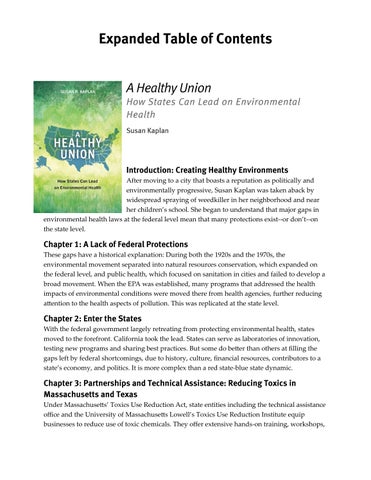
Expanded Table of Contents A Healthy Union How States Can Lead on Environmental Health Susan Kaplan
Introduction: Creating Healthy Environments After moving to a city that boasts a reputation as politically and environmentally progressive, Susan Kaplan was taken aback by widespread spraying of weedkiller in her neighborhood and near her children’s school. She began to understand that major gaps in environmental health laws at the federal level mean that many protections exist--or don’t--on the state level.
Chapter 1: A Lack of Federal Protections These gaps have a historical explanation: During both the 1920s and the 1970s, the environmental movement separated into natural resources conservation, which expanded on the federal level, and public health, which focused on sanitation in cities and failed to develop a broad movement. When the EPA was established, many programs that addressed the health impacts of environmental conditions were moved there from health agencies, further reducing attention to the health aspects of pollution. This was replicated at the state level.
Chapter 2: Enter the States With the federal government largely retreating from protecting environmental health, states moved to the forefront. California took the lead. States can serve as laboratories of innovation, testing new programs and sharing best practices. But some do better than others at filling the gaps left by federal shortcomings, due to history, culture, financial resources, contributors to a state’s economy, and politics. It is more complex than a red state-blue state dynamic.
Chapter 3: Partnerships and Technical Assistance: Reducing Toxics in Massachusetts and Texas Under Massachusetts’ Toxics Use Reduction Act, state entities including the technical assistance office and the University of Massachusetts Lowell’s Toxics Use Reduction Institute equip businesses to reduce use of toxic chemicals. They offer extensive hands-on training, workshops,