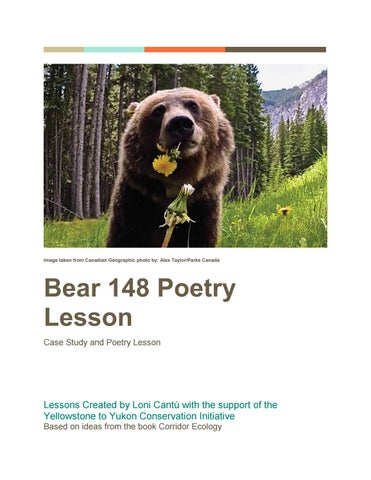
Image taken from Canadian Geographic photo by: Alex Taylor/Parks Canada
Bear 148 Poetry Lesson Case Study and Poetry Lesson
Lessons Created by Loni CantĂş with the support of the Yellowstone to Yukon Conservation Initiative Based on ideas from the book Corridor Ecology
Overview Students will evaluate the Bear 148 case study and create a poem based on their reaction to the case. Bear 148 was a female grizzly bear from the Bow Valley in Alberta Canada. She had negative interactions with people near Banff National Park and Canmore and was eventually relocated to northern British Columbia where she was shot and killed by a hunter. Students will create original poems or songs to express their feelings and thoughts about this real-life story. Students will analyze and discuss the various perspectives on human-wildlife co-existence.
Student Learning Targets Students will produce original poetry based on their evaluation and analysis of a real-life case study. Students will apply research, inquiry, and digital literacy skills to the creation of their poems. Students will practice their listening, communication, and presentation skills. (See appendix for curriculum alignment)
Time Requirements 1-2 hours
Suggested Audience Middle or High School
The Story Read with Students In 2011, Grizzly Bear 148 was born in Banff National Park, Canada. Her mother taught her how to co-exist with people, yet her natural instincts to roam and her contact with humans ultimately lead to her demise. In 2017, Bear 148 was relocated twice because she was roaming onto a rugby field and bluff charging or chasing several people and their dogs in Banff National Park and outside the park near the town of Canmore. Both times, she found her way back to the Bow Valley. She never hurt anyone, but her encounters with people concerned the authorities. Despite the outcry from over nine thousand people who wanted the authorities to let her stay, Bear 148 was eventually moved far north. She was killed by a hunter only days before a ban on grizzly bear hunting went into effect in British Colombia. Bear 148 was 6 years old at the time of her death, just old enough to start having cubs. She was a victim of the wildlifehuman conflict in areas where people want to recreate in bear habitat, and bears perceive humans as threats and will defend themselves. Can humans and bears coexist? What will happen to bears as more people visit parks where bears remain?
Reflecting on the Case After reading the situation with the entire class you can give students time to research this issue further (or listen to the Bear 148 podcast). After students have a strong grasp of the situation ask them the following questions: 1. What are your thoughts and feelings about this problem? 2. Bear 148 lived in parks and forests where people like to recreate (mountain bike, hike, and fish) and people continued to enter Bear 148’s natural habitat. This was her territory that today also encompasses many human uses. Are there ways bears and people can co-exist or live together? What do you think? 3. Was there an alternative solution the authorities could have taken instead of or in addition to relocating Bear 148 far from her home range? 4. Would you have recommended something different? Why?
Poetry Activity 1. Before giving this lesson ensure students have prior knowledge about poetry and can create their own poems. Say: “Now you will be creating a poem or song (songs can be a form of poetry) based on your reaction to the Bear 148 story. We are using poetry to analyze this story and help you discover a deeper meaning and connection between the events of this story and your life. Poetry and song can be used to help us understand and appreciate the world around us. The tragedy of Bear 148 is a perfect case to analyze these connections.” Note: Encourage Students to take a unique perspective or approach. Say: “You can choose to take a unique perspective or point of view to this situation. For example, you can write your poem through the lens of a concerned official, hiker, or even imagine what Bear 148 herself was feeling or thinking.” Poetry video example weblink: https://www.sustainablelearning.com/sites/default/files/videos/original/living_on_the_edgehog_7 0_percent.mp4 Note: Bear and nature poem examples from various perspectives and authors are given in the appendix. You can also encourage students to research additional nature songs/poetry as examples for their Bear 148 song/poem. Say: “You should research this case further by looking online at news and magazine articles. There is even an entire podcast devoted to this bear.” Web Sources: -
Podcast - https://thenarwhal.ca/undercurrent News Articles - https://calgaryherald.com/news/local-news/sadness-frustration-as-wellknown-bear-148-shot-by-hunter-in-b-c
-
https://www.cbc.ca/news/canada/calgary/bear-148-tracking-collar-hunter-kill-1.4312369 Magazine Article - https://www.canadiangeographic.ca/article/lament-bear-148
Note: You can give these sources to your students or allow them to search for their own articles. 2. After students have researched and created their poems, they should present them to the class. (example grading rubric in the appendix)
Appendix Poetry Examples by First Nation/Indigenous Authors Spirits of life Spirit of the mountains Are the stallions that graze, In the meadows and valleys Where the Indians stay, Near the trees and rivers, Where they hunt and spear, For the hides of a buffalo And horns of a deer, That is traded for knives With other tribes, And the eyes of an eagle Watching down on their sides, For their wisdom and strength That will keep them alive, As they live in their life, With the bears and his claws, The wolf and his howl, The moon and the sun And the fox and his brother, Coyote will stand, Looking down all the mountains At the spirit of life. - Lisa Moses (Grade 11) Spirit of the Bear As the bear sits facing west he contemplates the changes that are fast approaching. The change in the air, from the hot summer days to the cool, crisp, autumn nights. He uses his intuition – the intuition needed to survive the changing season ahead. Like the bear, learn to listen to your intuition – the intuition of your soul. - Nancy A. Luis
More Nature/Bear Poem Examples Treat each bear Treat each bear as the last bear. Each wolf the last, each caribou. Each track the last track. Gone spoor, gone scat. There are no more deertrails, No more flyways. Treat each animal as sacred, Each minute our last. Ghost hooves. Ghost skulls. Death rattles and Dry bones. Each bear walking alone In warm night air. - Gary Lawless The Bear The bear puts both arms around the tree above her And draws it down as if it were a lover And its choke cherries lips to kiss good-bye, Then lets it snap back upright in the sky. Her next step rocks a boulder on the wall (She's making her cross-country in the fall). Her great weight creaks the barbed-wire in its staples As she flings over and off down through the maples, Leaving on one wire moth a lock of hair. Such is the uncaged progress of the bear. The world has room to make a bear feel free; The universe seems cramped to you and me. Man acts more like the poor bear in a cage That all day fights a nervous inward rage~ His mood rejecting all his mind suggests. He paces back and forth and never rests The me-nail click and shuffle of his feet, The telescope at one end of his beat~ And at the other end the microscope, Two instruments of nearly equal hope, And in conjunction giving quite a spread. Or if he rests from scientific tread, 'Tis only to sit back and sway his head Through ninety odd degrees of arc, it seems, Between two metaphysical extremes. He sits back on his fundamental butt With lifted snout and eyes (if any) shut, (lie almost looks religious but he's not),
And back and forth he sways from cheek to cheek, At one extreme agreeing with one Greek~ At the other agreeing with another Greek Which may be thought, but only so to speak. A baggy figure, equally pathetic When sedentary and when peripatetic. - Robert Frost
Example Poetry Presentation Rubric Name: ________________________________ Class: __________
Speaks loud and clear
Possible Points Comments points earned 25
Reads at a good pace (not too fast or slow)
25
Looks at audience
25
Reads with intonation (engages audience with pitch, and rise and fall in tone of voice)
25
Total Score _________/100
Common Core Standards Students must be able to comprehend texts of steadily increasing complexity as they progress through school and meet the following standards:
-
Make inferences Cite specific textual evidence to support conclusions and answers Determine and analyze the theme of a text Analyze the way ideas develop over the course of a text Interpret words and phrases Analyze connotative and figurative meanings of words Analyze how word choice shapes a text Analyze the structure of a text Assess how point of view shapes a text Analyze how two texts address the same theme
Alberta Standards English Language Arts Poetry required in ELA 10-1, 20-1, 30-1, 10-2, 20-2, 30-2 in the form of script, oral/visual/ and multimedia presentation. For example: stream-of-consciousness writing, and free verse poetry. b. Use words and expressions appropriately [for example, use words with straightforward denotations to strengthen clarity in informative and persuasive texts, and use words with connotative meanings to evoke images in poetry and narrative texts]