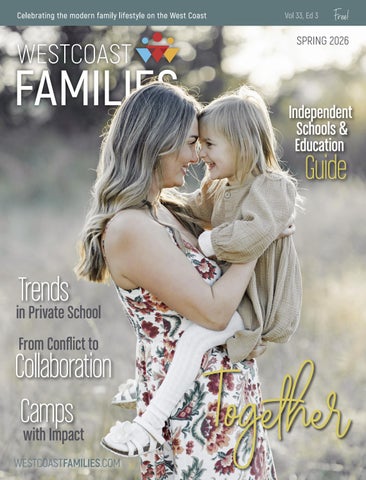
WestCoast Families Spring 2026

Page 1


Ignite your child’s playful joy!

May 25 - May 31, 2026

In-Person Shows on Granville Island

Nimihitowin! Powwow and hoop dance are beautiful expressions of Indigenous Peoples’ rich history and culture. A mesmerizing show with dramatic dancing, spectacular regalia and the subtle beauty of flute songs. All ages

Doodle POP A mischievous duo begins to doodle… and suddenly an imaginative world bursts to life! What surprises await as their drawings carry us into a magical world. Ages 3–8

Comedy on Patrol The stage is set, and the little officers are on patrol... sort of. When prisoner-singer Rizotto refuses to perform, chaos erupts! Acrobatics and comic misfires turn order into hilarious mayhem.

All ages

ARCHIPELAGO Inside a darkened space, a glowing cluster of tiny islands awaits. At every island, children uncover a playful question or request, sparking imagination, reflection, or hands-on interaction.

Ages 7–12

The Merry Marching Band

A zany brass band is ready to whisk you away on a hilarious musical adventure! Under the guidance of a bossy yet bird-brained bandleader, this merry crew sets off to explore the world (and beyond!). All ages

Haida and Squamish Stories & Songs Come hear Haida storyteller Kung Jaadee, bring to life her favourite tales about Raven (Yaahl), the trickster and creator and the Squamish story of The Two Sisters, the mountains we know today as The Lions Ages 5–12

The Pursuit: 1, 2, 3 Let’s Go, Let’s Keep Going!

Missy D is a hip hop, rap & soul artist who makes music as a form of therapy. Missy D will have you feeling all the feels and singing Yes Mama as she embraces diversity in instrumentals, music and most of all, people. All ages

Will and Seeka: Friends with everyone Dance along to catchy songs about colours, the alphabet and family and friends. Kids will leave the show with joyous songs in their hearts and a skip in their step.

Ages 2–8

BENCHED Five fearless dancers transform the everyday bench into a stage for humour, honesty, and breathtaking physicality. The dancers push their limits and explore taking space, sharing space, and sometimes fall right off the edge. Ages 7 and up

Glamily Join Peach Cobblah and local drag talents for a spectacular show that’s part drag show, part lip-sync open mic, part dress up party and 100% fun! All ages

All the Way from Japan

A joyful blend of tradition, comedy, and circus magic! Get ready for a thrilling show that combines contemporary circus with the magic of Japanese tradition. All ages

Baby Space Opera Step into the night sky with your little one and share a moment of awe and wonder. A unique show made especially for babies. Ages 0–2

Will’s Jams: My Best Friends Will’s Jams and special guests will have kids (and parents) dancing, singing, and laughing along to his catchy rock-pop tunes. Ages 2–8

Variety Show

This fun-filled evening is always a hit for kids and adults alike.

Hosted by Missy D, this year’s show features BENCHED, The Merry Marching Band, Nimihitowin! and Comedy Patrol All ages.

Site Activities

Make a day of it! Your In-Person show tickets includes access to our Activity Village with over a dozen hands-on creative arts stations. Spend the day being creatively playful!

Spring 2026 Vol 33, Ed 3

Jim Schneider Publisher publisher@westcoastfamilies.com

Stacie Gaetz Editor editor@westcoastfamilies.com

Kristine Wickheim Account Manager kristine@westcoastfamilies.com

WestCoast Families, published by Island Parent Group Enterprises Ltd., is a bimonthly publication that honours and supports parents by providing information on resources and businesses for west coast families. Views expressed are not necessarily those of the publisher. No material herein may be reproduced without the permission of the publisher.

For distribution inquiries, please email publisher@westcoastfamilies.com

WestCoastFamilies.com

x.com/wcfmag facebook.com/westcoastfamilies pinterest.com/wcfmag @westcoastfamilies

Better Together

At the heart of every thriving family is the spirit of togetherness. In a world that often pulls us in different directions, the moments (big and small) when families unite to learn, grow and support one another are the ones that really matter.

Togetherness begins at home, where siblings learn the invaluable skill of working as a team. Whether it’s resolving a disagreement over chores or brainstorming creative solutions to a shared problem, these early collaborations teach empathy, patience and the art of compromise. By encouraging siblings to listen to each other’s perspectives and celebrate joint victories, families lay the foundation for lifelong cooperation (even if it doesn’t stop every fight every time).

A Yes Day is another joyful way families can embrace togetherness. By setting aside a day to say “yes” to reasonable requests, parents and children create memories filled with laughter, adventure and mutual understanding. These experiences foster trust and remind everyone that family is a safe space for exploration and fun.

For families with neurodivergent or queer children, togetherness means working side by side to understand unique challenges and celebrate individuality. Open conversations, shared learning and unconditional support help every child feel seen and valued. By embracing diversity

within the family, parents model acceptance and resilience, empowering children to navigate the world with confidence. We should also ensure our children are involved in any conversations we have around camps and their schooling. Parents are often seen as the decision makers of a family but the choices we are making have life-long impacts on our kids. That’s a lot of pressure! However, by asking them which camp they are interested in this summer and talking to them about what is working at school and what isn’t, we are showing them they have the power to control their own future.

Finally, coming together as a family to set goals—whether for the week, the year or a lifetime—strengthens bonds and clarifies shared values. Goal setting encourages each member to contribute their voice, fostering a sense of belonging and purpose in the bigger, collective picture.

Put simply—Together, we are stronger.

FROM OUR TO YOURS

What your child wants you to know about being 2SLGBTQIA+

Adolescents are not always known for being the most upfront with their feelings—especially with their parents! For youth who are coming to understand their identities or who already identify as 2SLGBTQIA+, it can feel even more tricky to express themselves and their feelings. Kids may feel like they won’t be understood or could have fears around not being accepted by their parents.

I’ve been a mentor, organizer and advocate for queer youth for more than 15 years and was once a young queer person myself! I’ve spoken to countless young folks in groups and one-on-one who have one thing in common: they just want to feel understood and accepted. Here are four things that youth may want their parents to know about identifying as queer or questioning:

1. “I’m sharing my identity with you because I want you to accept me as I am.”

It’s a brave step for your child to talk to you about their

identity or come out to you as queer. They are not doing this to cause conflict or make dynamics difficult, but to share an important part of themselves with you.

Listening to them and validating their experience will help your child to feel supported, seen and safe. Kids don’t need you to have all the answers right away. They just need to feel reassured that you love them unconditionally.

2. “Your words matter: Respect the pronouns or name that I ask for.”

For youth who identify as trans or gender-diverse, using a different name or pronouns than you have been used to may be an important part of their journey. A critical way to make your child feel validated is to honour these choices and respect how they wish to be referred to.

Your child might need support with trying different pronouns, names or ways of expressing their gender. They may be struggling with gender dysphoria or have questions about

how to navigate their trans or gender-diverse identity. Making space for their feelings and seeking out specialized supports are key ways to help them along this journey.

If you’re struggling with different pronouns or a new name, your feelings are valid—it can be a challenging shift for parents. If you make a mistake, correct yourself and move on. Your intention and respect will be what matters most to them.

Trans Care BC is a provincial health organization that connects trans and gender-diverse people, families and clinicians with gender-affirming support. Find a range of information, learn about how to support your child and connect with local resources in your area.

3. “Be curious about me and educate yourself about the 2SLGBTQIA+ community. If you’re not sure, ask!”

You don’t have to fully understand what your child is sharing with you to be supportive. It’s okay to be unfamiliar with topics or terminology, and it’s normal to feel unsure about

what you don’t know. Leading with love, acceptance and curiosity will go a long way in making your child feel seen and supported.

Don’t be afraid to ask questions from a non-judgmental place: What does this identity mean to them? What feels important about expressing themselves? How can you best support them?

Connecting with local and online resources can be a great way to learn how to show up for your child. It can also help both you and your child to feel less alone or overwhelmed.

Based in Vancouver, QMunity is a hub of support for 2SLGBTQIA+ folks and allies across BC. Online resources and in-person programs are available for both you and your child to find community and get connected with knowledge.

PFLAG is an organization that connects 2SLGBTQIA+ people and their families with a library of resources and real stories from parents. There are local chapters in Vancouver and Surrey where you can meet other parents, share stories and find other sources of support.

Another great resource is My Kid is Gay, an online hub for parents to help them understand their 2SLGBTQIA+ kids. This resource doesn’t shy away from tougher topics like navigating transphobic family members, feeling overwhelmed as a parent and understanding medical ways of transitioning.

4. “Let me be myself, even if that looks different than what you know.”

Perhaps most importantly, kids just want to be themselves. As parents, we get so caught up in worrying about the challenges our kids might face in the world. This might be new territory for you, or you might be struggling with how they will be accepted. It’s important for your child to feel like they can express themselves—don’t ask them to hide who they are or how they feel.

Your child coming to talk to you about their gender identity or sexuality is a sign of trust. It’s important to stay open, but it’s okay—and totally normal—to feel overwhelmed or unsure. Chances are your child may be feeling those ways too!

Patience, understanding, and acceptance at every stage of the journey go a long way.

Allie McFarlane (she/her) is a passionate advocate for queer folks and vulnerable youth. She is a marketing manager who works with local nonprofit organizations to support the community. When she’s not writing blogs or making reels, you might find her hiking around Vancouver Island or volunteering at queer youth groups.

@ 10 Momfluencers

YOU NEED TO KNOW

@sassandsmalls

Deb Balino, creator, voice and personality behind Sass & Smalls, shares her perspective on being a neurodivergent mama and parent caregiver. She is passionate about inspiring other parents to break the burnout cycle and keep their spark after kids. Follow along and check out her podcast, Sass & Small Talk, on Telus StoryHive.

@glamouraspirit_

For fun family things to do in Vancouver, be sure to follow Yvonna Chow’s page. From restaurants and shopping to festivals and places to visit, get inspiration for a vibrant life on the Lower Mainland.

@mommamillsblog

Natasha Mills shares her relatable perspective on all things motherhood, wellness and lifestyle right here on the West Coast. This candid mama of three has built a community of support to celebrate the beautiful (and sometimes messy!) journey of parenthood.

@mamapapabubba

Teacher and homeschool mom Jen Kossowan is a must-follow for activity inspiration. She shares fun family outings, amazing arts and crafts and cozy lifestyle updates—plus cute colouring pages, worksheets and resources for learning.

@angielowis

Angie Lowis is a mom of two sharing a slice of life in Vancouver with familyfriendly events, activities, dining and more. Relatable POV videos make you feel like a friend along for the journey. Scroll her page for inspiration on your next family outing!

@livelaughluci

Lucinda Pak shares her unique-butrelatable voice on motherhood, marriage and mental health. Her content is deeply validating for many moms who are trying to balance it all. Follow along for an always-entertaining mix of humour and candid conversations.

@miriamalden

CEO, founder and creative director of fashion brand Brunette the Label, Miriam Alden balances high-style content with candid real-life stories as a mama. Follow along for travel, vlogs and of course—chic fashion.

@thisvancouvermom

On Maria Reynolds’s page, you’ll find her perspective on parenting, travelling with kids, lifestyle, recipes and things to do in Vancouver. This mom of three provides a peek into a regular family’s life with a refreshingly grounded point of view.

@milansmama__

Follow this mom of two for things to do in Vancouver, travel, lifestyle, recipes, fashion and more. Aiyna Dhillon uplifts parents to balance self-care with a full family life, providing both simple tips and inspiring insights into her own experience.

@foodologyca

Focusing all things cuisine, travel and mom life, Diana Chan is known for her delicious recipes and food blogs. Follow along for fun family outings and tasty treats to try both at home and around Vancouver.

Kitchen Science The Magical Power of Eggs!

The kitchen is a great place for scientific experiments. There is so much magic and science in turning ingredients into delicious recipes. Eggs are particularly cool. They start out as a liquid that turns into a solid with heating. They can be whipped up into an airy foam or used to mix oil and water together. Here are three egg-cellent recipes to explore the science of eggs!

Deviled Eggs

(Prep time: 25 minutes)

Deviled eggs are a fun recipe that kids as young as six can make, with a bit of help from their adults. It’s also a great recipe for

exploring the properties of eggs as they turn from a liquid to solid.

Egg white is made of globular proteins, which means the protein molecule is twisted and folded into a circular glob that floats in water. When the protein is heated up, it uncurls and connects with the other proteins, creating a web that traps the water. The more the protein is heated, the stronger the bonds, until they become like a rubbery hard-boiled egg!

6 eggs

1⁄4 cup of mayonnaise

1 tsp mustard

Pinch of paprika

1. Place the eggs in a pot of cold water. Bring to a boil, then turn off the heat. Set a timer for 10 minutes.

2. After 10 minutes, drain the eggs and fill the pot with cool water.

3. When the eggs are cool, peel them. Slice them in half and scoop out the yolks and place the yolks in a small bowl. Mash the yolks with the mayonnaise and mustard.

4. Using two small spoons, fill the eggs with

the mashed yolks. Sprinkle with a pinch of paprika. Pop in the fridge until you’re ready to eat them.

Meringue Clouds

(Prep Time: 20 minutes, Cook Time: 2 hours)

Meringues are a treat that seem fancy and fussy but are quite easy once you’ve finished with all that whipping. It’s also a great chance to explore another property of the globular egg white protein.

Egg white proteins have a water-loving (hydrophilic) part and a water-fearing part (hydrophobic). When they’re curled up in a glob, the hydrophilic part is on the outside of the glob, and the hydrophobic part is on the inside.

Whipping egg whites causes the proteins to unfold, just like when they cook. Except this time, they’re trapping air in the web as well! The water-loving part sticks in the water, but the water-fearing part sticks into the air. Heating up the protein causes them to solidify, just like with the hard-boiled egg, except this time, there’s a whole lot of air in the mix.

2 eggs at room temperatures

1⁄4 tsp of cream of tarter

1⁄2 cup sugar

1. Preheat the oven to 200°F. Line a baking sheet with parchment paper.

2. Separate the egg whites from the yolks. Do this in a small bowl, moving the yolks to a container for the fridge and placing the egg white in a large bowl. Meringues won’t work if there’s even the smallest bit of yolk in the whites. So, if you end up with a cracked yolk, get a clean bowl and try again.

3. Beat the egg whites with the cream of tartar until it is thick and smooth.

4. Continue mixing while you slowly add the sugar. Keep going until the egg whites are glossy and stiff.

5. Spoon the meringues into little clouds on the baking sheet.

6. Bake for 2 hours, turn off the oven and leave the meringues in the oven until they are cool.

Emulsified Hollandaise

(Prep Time: 15 minutes)

This recipe is perfect for using up the egg yolks from meringues! Hollandaise is the goto sauce for brunch, but it’s also delicious served over steamed asparagus, green beans or broccoli.

Emulsification involves combining two liquids that don’t normally mix together, like oil and vinegar, or oil and water. Egg yolks also have water-loving and water-fearing parts. When you whisk egg yolks with lemon juice and butter, the water-loving part sticks to the lemon juice, and the water-fearing part sticks to the butter, allowing them to mix together.

1⁄2 cup of butter

2 egg yolks

1 Tbsp lemon juice

1⁄4 tsp salt

1. Melt the butter in a glass bowl in the microwave. Melt in 30-second bursts. You want the butter to be completely melted, but not too hot.

2. Place the egg yolks, lemon juice and salt in a blender.

3. Let the blender run on low, then slowly drizzle in the warm butter.

4. Taste, and add more lemon juice or salt if you want.

5. Serve right away

Emillie Parrish loves having adventures with her two busy children. You can find more of her recipes in her cookbook Fermenting Made Simple. fermentingforfoodies.com

From Conflict to Collaboration

The two words that changed everything

When my kids were about six and four, I had enough!

I could not take the fighting and bickering for one more minute. It was just after the pandemic, we were together (and stuck at home) way too much and their ability to argue over the smallest thing was truly astonishing.

That’s when I went out and bought the book Siblings Without Rivalry by Adele Faber and Elaine Mazlish.

The Two Words: Negotiate and Compromise

My two biggest takeaways from the book were:

1. You are not doing anything wrong as a parent when your children fight. As humans, we naturally want to obtain and protect what we perceive as limited resources. Parents’ love, attention and care is viewed that way by growing children.

2. The undeniable importance of compromise and negotiations in the sibling relationship dynamic.

Unlike the lessons I was taught when growing up as a child of the ’90s, things are not always black and white. My daughter is not “mean” for wanting her brother to stop playing Minecraft so she can use the TV to listen to the latest Taylor Swift album. And my son is not “being rude” because he doesn’t want to hear “Fate of Ophelia” for the 1,000th time (that day).

There is a huge grey area here.

He can play for five more minutes (with a timer set) and then she can use her headphones. Or he can take the handheld console to another room so she can use the TV. Or she can use her portable speaker and sing until her heart’s content in another room.

Encouraging your kids to come up with ideas like these for a compromise that work for both parties and guiding them to put the plan into motion teaches them empathy, problem solving and communication skills that they will use their entire lives.

Empathy

The reason negotiating and compromise work is that it causes each party to think (at least briefly) about what the other person wants. When asked to come up with a compromise, you need to consider realistic solutions that the other person is likely to agree to.

This outlook also changes the situation from “me vs you” to “us vs the problem” and that is huge in the world of siblings.

If you have more than one kid, you have probably seen how fast a situation can change if your children have a common foe. Whether it is playfully ganging up on one of their parents before bedtime or an older sibling protecting a younger one on a school playground, nothing bonds them quicker than a “bad guy” for them to defend against together.

Problem Solving

Teaching compromise and negotiation builds problem solving by training kids to see multiple perspectives, think creatively for winwin solutions, evaluate consequences and practice finding fair outcomes. This moves them from impulsive reactions (like grabbing the toy out of their sibling’s hand) to strategic thinking for better relationships and conflict resolution.

They learn a structured process:

1. Define the problem

2. Brainstorm solutions

3. Evaluate options

4. Choose one

5. Try it out

Successfully navigating conflicts also builds confidence and resilience, showing them that they can handle challenges effectively.

Communication

One of the proudest ongoing moments in my parenting journey is when my eight-year-old is faced with a problem and says (all on his own), “Can we compromise?”

Staying calm when he doesn’t get his way, realizing it is an opportunity to negotiate and clearly communicating that he wants to do so is a big win for my little man.

During the “defining the problem” and “brainstorming solutions” portion of the process, kids learn to express needs clearly (using “I” statements) and listen actively to find common ground, crucial for resolving disagreements peacefully.

They get to use their voice and share their opinions during the “evaluate the options” and “choose one” process and they can convey whether the solution is working for them or not while trying it out.

I will conclude this article with an honest warning to parents: I have admittedly created monsters who now use their powers of coercion against me and can negotiate their way out of or into pretty much anything.

But I have also given them a life skill that will help them in every relationship they will ever develop from their bosses and coworkers to their spouses and their own children. That makes all the (sometimes exhausting) bargaining worth it.

Stacie Gaetz is the managing editor of WestCoast Families and the proud mama of a delightful daughter and silly son who fill her days with love and chaos. She thoroughly enjoys supporting, connecting with, and informing parents through interesting articles like this one. Reach her at editor@westcoastfamilies.com.

4 Steps to Compromise

Practical tips you can use to help guide your children toward a solution:

1. State the obvious (calmly). “I see two kids who are getting very upset over who’s turn it is with the TV.”

2. Ask what the problem is. Repeating what your children say back to them can be helpful to clarify the issue in all party’s minds.

3. Lead them towards ideas. Depending on the age of your children, you may need to suggest the ideas: “What if he played with the toy truck for three more minutes (you can press start on the timer on my phone!) and then you got it for five minutes?” Or, if they are older, you can ask them, “Can we think of a solution that might work for all of us?”

4. Come to a solution. As the parent, you may need to help them weed out the ideas that are not feasible (“tie him to a chair so he can’t bother me”) and guide them toward the ones that are plausible (“I use the tablet during screen time on Mondays and Wednesdays and she gets it on Tuesdays and Thursdays).”

Register For Music Lessons Today.

Fresh Finds

These thoughtfully-made products blend learning, creativity and a powerful sense of place, highlighting local stories, skills and makers while encouraging kids and families to explore, imagine and connect with where they live.

Coco Village

Inspired by minimalist, kid-centric design, Coco Village is a Canadian family-friendly brand offering high-quality children’s furniture and activity pieces, including multifunction wooden art tables that double as craft stations and play surfaces. Find Coco Village pieces in local Mastermind Toy Stores or order online. cocovillage.com

A is for Anemone

A Is for Anemone: A First West Coast Alphabet is a children’s board book featuring West Coast flora and fauna. Illustrated by acclaimed Indigenous artist Roy Henry Vickers and co-written with Robert (Lucky) Budd, this is a must-have book for all young ones. harbourpublishing.com

British Columbia-Opoly

British Columbia-Opoly is a themed board game in the classic Monopoly style that highlights iconic places, symbols and culture from across British Columbia. It’s designed as a fun family game that celebrates local pride and regional flair. Find the game in a variety of local stores on the Lower Mainland or order online. outsetmedia.com

MAKE Custom Originals

MAKE is a creative studio based in Vancouver offering custom-engraved and personalized journals, notebooks, bags and more. Their products allow customers to add names, designs or branding to high-quality items, making them popular for gifts or a fun way to show off your unique personality. makevancouver.com

All the Good Things from BC

All the Good Things from BC is an online gift shop based in Whistler that curates handcrafted and locally made products including art, Indigenous-inspired designs and lifestyle goods. The company focuses on supporting local makers and sharing meaningful stories through products inspired by the lands and cultures of BC. allthegoodthingsfrombc.ca

For the Adventures You Find & the Ones that Find You

Iknow camping season is still a long way off (at least for me—you might be braver than I am), but as the days get warmer and longer, I find myself dreaming about all of the adventures I can go on with my children this summer. However, while I am not quite ready to book a campsite, I can go on literary adventures with my kids using the following books. Maybe you can do the same.

The first book that is feeding into my desire to go camping is A Little Camper Love by Rayna Meakin. It is filled with delightful watercolour paintings of birds and vintage campers alongside lovely little affirmations that can apply to both the camper and your child. For example: “Birdie the Boler, you are beautiful inside and out,” and “Sunny the Surfside, you bring out the best in people.” For ages 0 to 3.

The second book in my list is The Necklace by Amy Smart. This middle-grade fantasy novel follows Vanessa as she tries to find her birth father after learning she was adopted. However, while the path to her father is filled with new friends, it is also fraught with dangers, like enemy villagers, wild animals and a growing evil that threatens to destroy everything she loves. The Necklace is my nineyear-old’s favourite read right now. He has read both books in the duology more times than I can count and is rather disappointed that the series doesn’t include more stories. For ages 8 to 12.

If your child is more timid when it comes to looking for adventures, you might enjoy reading Time to Split, which is written by Daniel Fehr, illustrated by Raphaël Kolly, and translated from the German by Marshall Yarbrough. This picture book is about a frog who

is perfectly content to spend every day doing the same thing—to the point where he doesn’t even know what season it is anymore. One day a bird comes to visit, and through food and friendship, the bird encourages the frog to explore the world beyond the greenhouse and try new things. I love how lush the illustrations are in this book; it reminds me of how it feels to be in a greenhouse. And, the fact that the bird packed a whole oven for the journey south just makes me smile. For ages 4 to 7.

While the previous book encourages children to explore beyond the safety of their homes, Butterfly Sea by Cynthia Mackey and illustrated by Marie Laure Couet, shows that this exploration doesn’t have to take you far from your family. In this poetic picture book, a girl decides that she wants to spend the day photographing butterflies. However, as she wanders to the seashore and gardens, her younger sister decides to come too. While this is less than ideal for butterfly hunting, my favourite line in the book is “if trouble follows you, embrace it,” which is placed beside an image of her younger sister following her. This line, along with the ways the older sister

encourages her younger sister’s exploration, showcases the love the siblings have for each other. For ages 4 to 7.

The final book covers heavier themes. It’s about the adventures we don’t choose. The Light of Home: A Story of Family, Creativity and Belonging by Diana Farid and illustrated by Hoda Hadadi is about a young girl who is forced to flee from her home. The only thing she has time to grab is a single painting. But, while this story showcases the reality that many refugees face when they flee, it also reminds us that we can find beauty in hardship. I love the relationship Nur has with her mother and her Baba in this book. I think the author and illustrator effectively captures the connection between a mother and the daughter she is trying to help. For ages 4 to 7.

As I wait for warmer weather so my family can go on outdoor explorations of our own, I am excited to cozy up with some books and discover the world from the comfort of our couch. While many of these books can be enjoyed by our kids alone, I hope you find some time to snuggle in beside them and let these adventures find you.

Christina Van Starkenburg lives with her husband, children and cat. She is the author of One Tiny Turtle: A Story You Can Colour and many articles. To read more of her work and learn about her upcoming books, visit christinavanstarkenburg.com, Facebook: facebook.com/christinavanstarkenburg and X: @Christina_VanS.

Independent Schools & Education Guide

TODDLER, PRESCHOOL & ELEMENTARY PROGRAMS

ACCEPTING APPLICATIONS FOR 2026-2027 SCHOOL YEAR

INFANT & TODDLER PROGRAM

INFANT & TODDLER PROGRAM CASA PRESCHOOL & KINDERGARTEN PROGRAM ELEMENTARY PROGRAM

Ages 1-3

CASA PRESCHOOL & KINDERGARTEN PROGRAM

ELEMENTARY PROGRAM

INFANT & TODDLER PROGRAM CASA PRESCHOOL & KINDERGARTEN PROGRAM ELEMENTARY PROGRAM

Ages 1-3

Ages 1-3

Exploration-Filled Spring Break and Summer Programs

Ages 6-13

Ages 2.5-6

Ages 2.5-6

Ages 2.5-6

Exploration-Filled Spring Break and Summer Programs

Exploration-Filled Spring Break and Summer Programs

Half Day or Full Day Preschool through Kindergarten

Half Day or Full Day Preschool through Kindergarten

Half Day or Full Day Preschool through Kindergarten

Ages 6-13

Ages 6-13

Grades 1 to 7 Curriculum-Aligned Montessori School

Grades 1 to 7

Curriculum-Aligned Montessori School

Our engaging, mixed-age Montessori program and thoughtfully directed lessons nurture independence, confidence and a lifelong love of learning in your child.

Our engaging, mixed-age Montessori program and thoughtfully directed lessons nurture independence, confidence and a lifelong love of learning in your child.

Our engaging, mixed-age Montessori program and thoughtfully directed lessons nurture independence, confidence and a lifelong love of learning in your child.

Grades 1 to 7 Curriculum-Aligned Montessori School ACCEPTING APPLICATIONS FOR 2026-2027 SCHOOL YEAR Apply at westsidemontessori.ca Our Vancouver locations: 4157 Oak Street and 3396 Cambie Street

ACCEPTING APPLICATIONS FOR 2026-2027 SCHOOL YEAR Apply at westsidemontessori.ca Our Vancouver locations: 4157 Oak Street and 3396 Cambie Street TODDLER, PRESCHOOL & ELEMENTARY PROGRAMS

5 Trends Reshaping Private Education Today

In 2026, private education isn’t just about smaller classes or academic prestige. Across Canada and right here in the Lower Mainland, independent schools are embracing new approaches that reflect what parents, educators and researchers now see as essential for thriving in a rapidly changing world. From innovative learning models to a renewed focus on well-being, here’s what’s trending and how local schools are responding.

1. Personalized, TechnologyEnhanced Learning

Gone are the days of one-size-fits-all instruction. Private schools are increasingly integrating adaptive learning tools and educational technology to tailor learning pathways to individual students’ strengths and needs. Some schools are exploring AI-enhanced platforms that offer real-time feedback and personalized instruction. These systems help students progress at their own pace while freeing teachers to focus on higher-order thinking, creativity and mentorship.

This trend is visible at schools that focus on tech-rich, project-based learning for higher grades, and those that blend critical thinking, digital fluency and global learning within their International Baccalaureate (IB) curriculum. Smart use of technology is now less about gimmicks and more about meaningful integration; preparing students for future careers where digital skills will be indispensable.

2. Holistic Education & Well-Being

Academic success is just one part of what families look for in private schooling today. Across North America, private schools are expanding programming to include socialemotional learning (SEL), mental health resources and life skills workshops as core elements of the school experience. In the face of rising youth anxiety and stress, educators see holistic development as non-negotiable. This focus resonates locally with institutions that combine enrichment activities and strong support systems. Some schools offer extensive arts, athletics and leadership programs alongside academics, ensuring students grow socially and emotionally as well as intellectually.

3. Experiential & Outdoor Learning

Educators increasingly recognize that meaningful learning often happens outside

traditional classrooms. Whether it’s environmental stewardship, hands-on projects or outdoor education, schools are creating experiences that connect students with the world around them. Across Canada, independent schools have introduced outdoor expeditions, gardening programs, service projects and community partnerships to foster curiosity, resilience and a sense of responsibility.

In the Lower Mainland, this ethos is reflected in schools that emphasize learning in diverse settings. Many schools showcase project-based and real-world learning, while others integrate field studies and nature-inspired programs into their broader curricula.

4. Global Citizenship & Multilingualism

Families today want schools that prepare their children for global citizenship. Private schools are leaning into international perspectives with language immersion, crosscultural exchanges and globally focused curricula that reflect our interconnected world. A growing number of independent schools also participate in programs that emphasize diversity awareness and international understanding as part of daily learning.

This commitment to global readiness finds expression in institutions that serve diverse communities and often host international students, fostering cross-cultural fluency. Broader programs like IB—offered at several Lower Mainland schools—further support global perspectives.

5. Evolving Enrollment Patterns & Family Expectations

Private education is also shifting in response to demographic and economic realities. Research shows that while some independent schools face enrollment challenges due to broader demographic shifts, others are thriving by meeting families’ heightened expectations around safety, quality and transparency.

Parents today expect clear communication throughout the admissions process, holistic assessment of student potential and robust mental health supports. Many schools are adapting by offering online tours, virtual interviews and data-driven outreach, making the admissions journey more accessible and family friendly.

Local schools are known for welcoming family engagement and offering comprehensive transitions for new students; helping ease concerns and foster a supportive schoolfamily partnership.

Stacie Gaetz is the managing editor of WestCoast Families and the proud mama of a delightful daughter and silly son who fill her days with love and chaos. She thoroughly enjoys supporting, connecting with, and informing parents through interesting articles like this one. Reach her at editor@westcoastfamilies.com.

Independent Schools Directory

Alexander Academy

Blessed Sacrament School

Canada Royal Arts High School

Century High School

Columbia Academy

Corpus Christi School

Crofton House

Eaton Arrowsmith School

Franklin School

Fraser Academy

Immaculate Conception School

Johnathan Academy

King David High School

Little Flower Academy

Lowell High School

Madrona School

Notre Dame Regional Secondary

Our Lady of Perpetual Help

Our Lady of Sorrows

Pacific Spirit School

Pattison High School

Pear Tree Elementary

Qawsain Knowledge House

Royal Canadian College

St Andrew’s

St Anthony of Padua

St Augustine’s

St Francis of Assisi

St Francis Xavier

St George’s School

St John’s Academy

St John’s School

St Joseph’s

St Jude’s

St Mary’s

St Patrick Regional Secondary

St Patrick’s Elementary

Vancouver 9-12

Vancouver K-7

Vancouver 8-12

Vancouver 10-12

Vancouver 9-12

Vancouver K-7

Vancouver K-12

Vancouver 4-10

Vancouver 8-12

Vancouver 2-12

Vancouver K-7

Vancouver 8-12

Vancouver 8-12

Vancouver 8-12

Vancouver 10-12

Vancouver K-9

Vancouver 8-12

Vancouver K-7

Vancouver K-7

Vancouver K-10

Vancouver 10-12

Vancouver 1-7

Vancouver K-9

Vancouver 10-12

Vancouver K-7

Vancouver K-7

Vancouver K-7

Vancouver K-7

Vancouver K-7

Vancouver K-12

Vancouver 9-12

Vancouver K-12

Vancouver K-7

Vancouver K-7

Vancouver K-7

Vancouver 8-12

Vancouver K-7

604-687-8832 alexanderacademy.ca

604-876-7211 ess.vancouver.bc.ca

604-354-1194 ciraschool.com

604-730-8138 centuryhighschool.ca

778-379-6811 columbiaacademy.ca

604-321-1117 cchristi.ca

604-263-3255 croftonhouse.ca

604-264-8327 eatonarrowsmith.com

604-876-8812 franklinschool.ca

604-736-5575 fraseracademy.ca

604-224-5012 cisva.bc.ca

604-971-6888 johnathana.ca

604-263-9700 kdhs.org

604-738-9016 lfabc.org

604-336-0456 lowellhighschool.ca

604-499-7303 madronaschool.com

604-255-5454 ndrs.org

604-228-8811 olphbc.ca

604-253-2434 cisva.bc.ca

604-222-1900 pacificspiritschool.org

604-608-8788 pattisonhighschool.ca

604-355-2155 peartree.school

604-783-9011 qawsain.ca

604-738-2221 royalcanadiancollege.com

604-325-6317 cisva.bc.ca

604-261-4043 sapadua.ca

604-731-8024 cisva.bc.ca

604-253-7311 sfaschool.ca

604-254-2714 sfxschool.ca

604-221-3608 stgeorges.bc.ca

604-683-4572 sjavan.ca

604-732-4434 stjohns.bc.ca

604-872-5715 saintjosephschool.ca

604-434-1633 stjude.ca

604-437-1312 cisva.bc.ca

604-874-6422 stpats.bc.ca

604-879-4411 spev.ca

Stratford Hall

Vancouver Christian

Vancouver College

Vancouver Formosa Academy

Vancouver Hebrew Academy

Vancouver Talmud Torah Elementary

VISST

West Coast Christian School

West Point Grey Academy

LOCATION

Vancouver K-12

Vancouver K-12

Vancouver K-12

Vancouver 7-12

Vancouver K-9

Vancouver K-7

Vancouver 8-9

Vancouver K-12

Vancouver K-12

Westside Montessori

School

604-436-0608 stratfordhall.ca

604-435-3113 vancs.org

604-833-7769 vancouvercollege.ca

604-436-2332 vfa.bc.ca

604-266-1245 vhebrewacademy.com

604-736-7307 talmudtorah.com

604-566-7836 visst.ca

604-255-2990 westcoastchristianschool.ca

604-222-8750 wpga.ca

4157 Oak St & 3396 Cambie St, Vancouver | westsidemontessori.ca

The WMS engaging, mixed-age Toddler, Preschool and Elementary Montessori Programs nurture independence, confidence and a lifelong love of learning in your child.

Ages JK – Gr 7 Gender

York House School

Vancouver K-12

604-736-6551 yorkhouse.ca

Burnaby Community & Continuing Education

Deer Lake SDA School

Fawkes Academy

Burnaby K-12

Burnaby K-12

Holy Cross Elementary School Burnaby K-7

John Knox Christian, Elementary Campus Burnaby K-6

Our Lady of Mercy Burnaby K-7

St Francis de Sales Burnaby K-7

604-434-5844 deerlakeschool.ca

604-299-4144 abacentre.ca

604-299-3530 cisva.bc.ca

604-522-1410 johnknoxbc.org

604-526-7121 ourladyofmercy.ca

604-435-5311 sfdsschool.ca

St Helen’s Burnaby K-7

St Michaels Burnaby K-7

St Thomas More Collegiate Burnaby 8-12

604-299-2234 cisva.bc.ca

604-526-9768 cisva.bc.ca

604-521-1801 stmc.bc.ca

Whytecliff Agile Learning Centre Burnaby 8-12 604-438-4451 walc.ca Coquitlam College, Brookmere Secondary Coquitlam 11-12

604-939-6633 coquitlamcollege.com

Greater Heights Learning Academy

Our Lady of Fatima

Queen of All Saints Elementary

Royal Bridge High School

Traditional Learning Academy

Delta Christian School

Immaculate Conception School

Sacred Heart School

Southpointe Academy

Al-Hidayah School

John Knox Christian, Secondary Campus

Coquitlam K-12

Coquitlam K-7

Coquitlam K-7

Coquitlam 12

Coquitlam K-11

Delta K-7

Delta K-7

Delta K-7

Delta K-12

New Westminster K-7

New Westminster 7-12

PALS Autism Society (School Program) New Westminster 1-12

Purpose Independent Secondary School

Urban Academy

New Westminster 8-12

New Westminster K-12

Bodwell High School

604-937-3641 ghla.ca

604-936-4228 fatimaschool.ca

604-931-9071 qasbc.ca

604-474-3718 royalbridge.ca

604-931-7265 traditionallearning.com

604-946-2514 deltachristianschool.org

604-596-6116 cisva.bc.ca

604-946-2611 shsdelta.org

604-948-8826 southpointe.ca

604-524-2752 alhidayahschool.ca

604-523-1580 johnknoxbc.org

604-251-7257 palsautismschool.ca

604-512-6888 purposesociety.org

604-524-2211 urbanacademy.ca

955 Harbourside Dr, North Vancouver | 604-998-1000 | bodwell.edu

Bodwell is a BC independent high school for university preparation, offering day and boarding options for local and international students. IB-MYP, BC curriculum and AP courses.

Ages

Gr 8–12

Gender Co-ed

Brockton Preparatory School

Location

North Vancouver

Day/Boarding

Both

North Vancouver K-12

Cousteau L’Ecole Francaise Interna’le North Vancouver K-9

Holy Trinity School North Vancouver K-7

Kenneth Gordon

North Vancouver 1-12

Lions Gate Christian Academy North Vancouver K-12

Saplings Nature School

North Vancouver K-4

St Alcuin College for the Liberal Arts North Vancouver K-12

St Edmund’s North Vancouver K-7

St Pius X Elementary School

North Vancouver K-7

604-929-9201 brocktonschool.com

604-924-2457 cousteauschool.org

604-987-4454 holytrinityschool.ca

604-985-5224 kgms.ca

604-984-8226 lgca.ca

778-838-0335 saplingsoutdoorprogram.ca

604-360-8656 alcuin.ca

604-988-7364 stedmunds.ca

604-929-0345 saintpius.ca

St Thomas Aquinas North Vancouver 8-12 604-987-4431 aquinas.org

Vancouver Waldorf School North Vancouver K-12

Archbishop Carney Regional Secondary Port Coquitlam 8-12

British Columbia Christian Academy Port Coquitlam K-12

Hope Lutheran Christian School Port Coquitlam K-8

Our Lady of the Assumption Port Coquitlam K-7

Ark Elementary

Az-Zahraa Islamic Academy

BC Muslim School

Richmond K-4

Richmond K-9

Richmond K-7

604-985-7534 vws.ca

604-942-7465 acrss.org

604-941-8426 bcchristianacademy.ca

604-942-5322 hopelcs.ca

604-942-5522 cisva.bc.ca

778-990-3520 noahsarkschool.ca

604-274-7861 azia.ca

604-270-2511 bcmaschools.ca

Continues on Page 28

An After School Program for High - Performing Students

For over 30 years, Spirit of Math has been transforming how highperforming students experience mathematics. As a world - class afterschool program with more than 30 campuses across Canada and over 35 international partners hosting Spirit of Math contests, the school empowers thousands of students to build confidence, sharpen problemsolving skills, and develop leadership. Students in Grades 1 –8 can even qualify for a prestigious Global Round in Toronto, celebrating excellence L and L collaboration L in L mathematics.

At the core of Spirit of Math is an enriched curriculum that moves well beyond grade level. Students explore advanced topics such as number theory, combinatorics, algebra, and logic often years ahead of the standard school curriculum. Each class follows a structured four - part format: drills, core instruction, problem solving, and collaborative group work This dynamic approach builds deep conceptual understanding, resilience, and strong academic habits.

Designed to prepare students for leading universities and future STEM pathways , the program emphasizes communication and teamwork alongside advanced academics. Through collaborative challenges, students learn to articulate their reasoning, listen actively, and solve complex L problems L together.

In Metro Vancouver, Spirit of Math offers classes for Grades 1 –10 , along with Spirit of English for Grades 3 –4 . Summer camps are available at the Vancouver and West Vancouver campuses for both Spirit of Math and Spirit L of L English.

Pre - registration for the 2026 – 2027 school year will open in April. Families can book a complimentary assessment class to determine placement. Call 604 - 304 - 4032 or visit www.spiritofmath.com to secure your L child ’s L spot.

Discover the Difference at Southridge School

At Southridge, we’ve built something special—on purpose. We are an independent school in South Surrey where academic excellence and character development go hand in hand, and where curiosity, kindness and joy are part of every day. We describe ourselves as a lighthearted place of serious purpose—where students are challenged to grow and are supported to thrive in an environment that’s both joyful and deeply intentional.

Southridge is brimming with energy, connection and curiosity. We believe students do their best learning when they feel safe, seen and supported and we’ve designed every aspect of our K-12 program with that in mind.

Connect with our Admissions team to learn more at admissions@southridge.ca or 604.535.5056.

Join us for our upcoming Country Fair for a day of family fun and check out our campus in-person! Enjoy exciting carnival rides, inflatables, games, face painting and delicious eats from a variety of food trucks. Browse our community recycled treasures garage sale, and shop local at the vibrant outdoor vendor market and garden shop— entrance is FREE for all ages! Southridge Country Fair: Saturday, May 9, 2026 9:00am-4:00pm.

Campuses:

FOUNDATIONS ENGLISH PROGRAM

• Designed for adult learners who want to strengthen their academic English skills in preparation for further studies & employment

• Oral & listening skills are integrated with discussions, presentations & collaborative work

• Develop advanced reading & writing skills

• Flexible in-person schedules: choose classes that fit your life, & enter at the correct level following an assessment

• FREE classes for all BC residents who are Canadian citizens, per manent residents, refugees, or hold work permits (some exceptions may apply)

• New students must complete an English Language Assessment prior to registering for courses

HIGH SCHOOL COURSES – COMPLETION & UPGRADING

• Develop study, writing, & research skills

• Choose in-person, day or evening courses tailored to fit your work, family & life schedule

• Use this as a stepping stone into college, university, trades or better employment

• Gain recognized credentials, stronger marks & the confidence to move forward

• 18 years of age or older

• Tuition-free for eligible students

• BC Ministry approved courses

LINC: LANGUAGE INSTRUCTION FOR NEWCOMERS TO CANADA

• English classes for Permanent Residents, Protected Persons & Convention

• Courses focus on listening, speaking, reading & writing

• Settlement English

CERTIFICATE & DIPLOMA PROGRAMS

Child & Family Studies

• Early Childhood Education Basic Certificate

• Early Childhood Education Post Basic Diploma

• Good Beginnings: Responsible Adult Training

*Qualify for an exciting career working with children 3-5 years of age; students are eligible for ECEBC Bursary funding

Work Toward New Career Opportunities

Education

• Education Assistant Diploma

*An opportunity to qualify to work in Burnaby or another school district & make a difference in the lives of students

GENERAL & SPECIAL INTEREST

COURSES

• Floristry Design (Courses & Diploma)

• Languages (French, Spanish, Mandarin, Japanese & Korean)

• Photography

• Tai Chi & Qi Gong

• Personal Care

• And more!

Industry Certifications

• Building Caretaker Certificate

• Building Service Worker Certificate

Horticulture Programs

• Landscape, hardscape, arborist, pruning, design, permaculture, pesticide, soil health & more

Health Care

• Dental Receptionist Certificate

• Reiki Practitioner & Teacher Certificate

Business & Computers

• Accounting & Payroll Administration Diploma

• Business Training

• Computer Skills (Excel, Word, PowerPoint)

• Accounting, Bookkeeping, Payroll

Parenting Neurodivergent Kids Without Losing Yourself

There is a version of parenting many of us imagine long before we ever become parents—how it will look, how it will feel and who we will be inside of it.

When my own parenting experience looked nothing like that picture, I assumed the gap meant I was lacking something. I blamed myself for not knowing enough, not doing enough or simply not being enough. I loved my child deeply yet quietly questioned myself every day.

What I was experiencing was the invisible weight many parents of neurodivergent children carry. Parenting in this space requires constant flexibility, advocacy and emotional labour, often accompanied by a quiet loss of self and the grief over what could have been. Acceptance didn’t remove that weight, but understanding it helped me stop turning inward, while moving forward.

Letting Go of Judgement: from Others & from Yourself

In the early years, before I had the understanding I needed, I spent a lot of energy trying to help my child fit in. I compared her to others and often left everyday interactions and playdates feeling defeated and disappointed—mostly in myself. I parented from shame because that was my immediate go-to, believing that if I tried harder, things would fall into place and my child would find her “people.” Looking back, I now realize I unknowingly measured her success in meeting such standards as a reflection of my parenting.

With research, and genuine acceptance, I equipped myself with knowledge and strategies recommended by her support team. Over time, I learned that meeting my child where she was mattered more than meeting anyone else’s expectations (mine included). I also learned that I didn’t owe long explanations to protect other people’s comfort. Sharing brief information, when appropriate, became about preserving my child’s dignity rather than managing judgement. I simply stopped putting energy into others’ opinions on how to parent my child.

Parental Well-Being in Neurodivergent Families

Many parents of neurodivergent children step into advocacy roles with pride and love, but the support required can also be met with exhaustion and overwhelm. The overthinking, the endless deep dive scrolling at 3 am, research, appointments, paperwork and constant problem solving create an invisible load that few outside the experience fully see. For so many, the effort can feel never-ending, lonely and isolating.

It wasn’t until I acknowledged my own exhaustion and began tending to my well-being that something shifted. Supporting myself, asking and receiving help, wasn’t selfish, it was necessary. When I was more regulated, so was my child. The vast improvement in her well-being because of this shift in me is a deep reflection of this. Parental well-being isn’t separate from a child’s success, it’s foundational to it.

Talking to Kids About Their Neurodivergence

Honest, age-appropriate conversations can help shape a child’s understanding of who they are—neurodivergent or otherwise. Even before receiving any formal diagnosis, I chose transparency rooted in curiosity and compassion. Our conversations focused on her strengths while also acknowledging challenges, reinforcing that differences didn’t mean deficiency, only that learning and doing might look different. And this would be our family’s way of running our home. It’s okay that we do things that work for us.

As my child gained language for her experiences, that understanding became empowering—for her, and for our family as a whole. Knowing more about herself helped her advocate for what she needed and recognize accommodations as tools, not limitations. Understanding didn’t define her; it gave her permission to be herself.

Tools That Support – Not Fix

In many families, the early response to

3 Anchors for Parenting

1. Let go of comparison. What works for your child and your household is enough, even when it looks different.

2. Your well-being matters. Caring for yourself is one of the most impactful ways to support your child.

3. Understanding builds confidence. Language, tools and knowledge bridge communication and connection, selfadvocacy and growth.

challenges is to try to fix or change what feels difficult. In our experience, progress came when we shifted toward supportive strategies rather than quick fixes.

Tools such as visual schedules, regulation supports and adjusted routines helped reduce daily friction and promoted autonomy. Collaboration and connection over control created space for growth. Letting go of rigid timelines and developmental “shoulds” allowed my child to flourish in ways that couldn’t be rushed or measured. Support didn’t replace effort—it made learning and living everyday life possible.

Parenting neurodivergent children isn’t about fixing, catching up or getting it right. It’s about staying present through complexity, facing the everyday moments honestly and honouring both your child’s needs and your own.

Deb Balino is a writer and mom of two, navigating life in the sandwich generation. She’s the podcast host of Sass & Small Talk on TELUS StoryHive, exploring the mental load of parenthood, sharing honest stories from the trenches of raising a neuro-divergent family, while balancing advocacy, business and caregiving.

A Strong Start Lasts A Lifetime

By age five, most brain development has already taken place. The early years are a powerful window for shaping how children think, feel, learn, and connect with the world.

EARLY LEARNING HELPS BUILD:

Cooperation Skills

Enthusiasm For Lifelong Learning

Emotional, Social And Physical Growth

Learning Capabilities

Stronger Support Systems

Socialization Skills

OUR PRESCHOOLS

Richmond City Centre

Richmond Garden City

Richmond Crestwood

South Surrey

White Rock

COMING SOON

South Delta

Vancouver Marpole

Victoria Colwood

Canada Star Secondary School

Choice School for Gifted Children

Richmond 8-12

Richmond K-8

City Vancouver Academy Richmond 10-12

Cornerstone Christian Academy

Fawkes Academy (DL)

Maple Hill School

Richmond K-7

Richmond 1-12

Richmond 9-12

Maple Leaf School, KPU Richmond 10-12

Pythagoras Academy

Richmond Christian School

Richmond Jewish Day School

Richmond K-8

Richmond K-12

Richmond K-7

Rothewood Academy

Richmond, Surrey, White Rock | rothewood.com

604-285-7766 canadastarsecondary.ca

604-273-2418 choiceschool.org

604-278-6811 cityvanacademy.ca

604-303-9181 cebccanada.com

604-261-8782 abacentre.ca

604-285-9665 maplehilledu.com

604-599-2639 mapleleafworldschool.com

604-370-0199 pythagorasacademy.ca

604-272-8238 myrcs.ca

604-275-3393 rjds.ca

Rothewood Academy offers nature-inspired learning at all our schools. Sunlit classrooms and natural playgrounds provide an inspiring calming space for children to learn and grow.

Ages Baby – JK

St Joseph the Worker

Gender Co-ed

Location Lower Mainland

Richmond K-7

St Paul School Richmond K-7

Windsor Hall

Al-Mustafa School

Bibleway Christian Academy

Cloverdale Catholic School

Diamond School

Fraser Valley School

G.A.D. Elementary School

Gobind Sarvar School

Day/Boarding Day

Richmond 6-8

Surrey K-2

Surrey K-12

Surrey K-7

Surrey K-12

Surrey K-8

Surrey K-9

Surrey K-11

604-277-1115 stjosephtheworker.ca

604-277-4487 stpaulschool.ca

604-285-7766 windsorhall.ca

604-900-2773 amschool.ca

604-576-8188 biblewayacademy.org

604-773-9743 cisva.bc.ca

604-576-1146 diamondschool.ca

604-427-2282 fves.bc.ca

604-595-0888 gadschool.com

604-930-2122 gobindsarvar.ca

Holy Cross Regional High School Surrey 8-12 604-581-3023 holycross.bc.ca

Honour Secondary School Surrey 8-12 604-992-3982 pcrs.ca

iLearn Secondary School Society

Iqra School

Surrey 8-12 604-590-5504 ilearnhighschool.com

Surrey K-7 604-583-7530 iqraschool.com

Khalsa School Newton Surrey K-7 604-591-2248 khalsaschool.ca

Khalsa School Old Yale Road

Khalsa Secondary School

Newbridge Academy

Our Lady of Good Counsel

Pacific Academy

Regent Christian Academy

Surrey K-7 604-951-2333 khalsaschool.ca

Surrey 8-12 604-585-8200 khalsaschool.ca

Surrey K-7 778-291-0110 newbridge-academy.ca

Surrey K-7 604-581-3154 olgcschool.ca

Surrey K-12 604-581-5353 pacificacademy.net

Surrey K-12 604-599-8171 regent.bc.ca

Continues on Page 30

Rothewood Academy

Sikh Academy

Southridge School

Surrey JK

Surrey K-7

Surrey K-12

St Bernadette Surrey K-7

St Matthew’s Elementary Surrey K-7

Star of the Sea

Surrey Christian School

Surrey Muslim School

Traditional Learning Academy Online

Surrey K-7

Surrey K-12

Surrey K-9

Surrey K-12

604-279-1818 rothewood.com

604-599-3828 sikhacademy.ca

604-535-5056 southridge.ca

604-596-1101 cisva.bc.ca

604-589-7545 stmatthewselementary.ca

604-531-6316 sosschool.ca

604-498-3233 surreychristian.com

604-599-6608 bcmaschools.ca

604-575-8596 schoolathome.ca

White Rock Christian Academy Surrey K-12 604-531-9186 wrca.ca

St. Margaret’s School

Since

and

St. Michaels University School

3400 Richmond Rd, Victoria | 250-592-2411 | smus.ca

St. Michaels University School is a co-educational, independent JK–Grade 12 school, offering boarding in Grades 9–12, known for academic excellence and rich programs.

Ages JK – Gr 12 Gender Co-ed

Mulgrave School

Navigate NIDES –Heartwood Learning Community

1-800-663-7925 (Toll Free) | navigatenides.com

Navigate in an award winning K–12 DL school that offers blended learning programs and self-paced courses for online learning. Locations across BC.

Ages K – Gr 12

Co-ed

Power of Words Academy

We cultivate essential communication skills for Grades 1–8 through engaging online and in-person summer camps, courses and school-year programming in reading comprehension, writing, public speaking and debate, inspiring creativity and confidence in young leaders. Virtual Campuses Across Canada | 647-285-4499 | powerofwordsacademy.ca

Ages Gr 1–8

Co-ed

Day

JK – GR 9 SCHOOL YEAR & SUMMER PROGRAMS

School Year: Reading Comprehension, Enrichment Writing, Public Speaking, Debate

Summer: Creative Writing, Drama & Debate Camps, Writing & Public Speaking Courses

Contests: World Scholar’s Cup & Unexpected Voices Speech Competition

CAMPUSES

Toronto • Markham • Mississauga • Virtual 647 285 4499 powerofwordsacademy.ca

What Is a PAC Anyway?

If you’re a parent in British Columbia, you’ve probably seen “PAC” mentioned in school emails, newsletters or on posters near the front office. Maybe you’ve wondered what it means, or maybe you’ve understandably skimmed past it while juggling everything else on your plate. The reality is that Parent Advisory Councils (PAC) are often far more relaxed, welcoming and impactful than many parents expect.

Every public school in BC has a PAC recognized under the School Act. PACs are

equipment, field trip transportation, library resources, classroom technology, sports equipment and special programs.

These additions can have a big impact on how kids experience school. PAC funding often supports the activities and opportunities students remember most, helping school feel engaging, inclusive and supportive.

Creating Connection & Community

PACs also help schools feel like communities rather than just places kids attend each

made up of parents and guardians who work together to support their school community and advocate for students. They don’t run the school or make decisions about curriculum, but they do help shape the overall school experience by bringing parent voices together and collaborating with staff.

Helping Schools Go Beyond the Basics

Fundraising is often what PACs are best known for, but it’s about much more than the occasional fun lunch or fundraiser forms coming home in backpacks. PACs regularly raise money for things that school budgets simply can’t stretch to cover such as playground

weekday. They often organize events that bring families together, such as welcome gatherings, movie nights, fun fairs, dances and cultural celebrations.

A Space for Parent Voices

Another key role of PACs is providing a formal space for parents to share feedback, ideas and concerns. This might include topics like school safety, communication, inclusion and accessibility or overall school culture. While PACs don’t make final decisions, they do create opportunities for respectful dialogue with school administration. When parents come together and speak collectively, their input is more likely to be heard and considered.

Supporting

Teachers & School Staff

PACs also often work to support the teachers and staff who care for students every day. Whether it’s organizing appreciation events, helping fund classroom supplies or simply saying thank you in visible ways, PACs help foster a positive school environment.

Yes, There’s Room for You

If this all sounds great but you’re thinking you don’t have the time or energy to commit, you’re certainly not alone. If you are the parent or guardian of a child in a school, you are automatically a member of the PAC and can have a voice at any time. Involvement doesn’t have to mean taking on a leadership role or attending every meeting. Many parents help occasionally, volunteer behind the scenes or attend meetings just to listen.

Some people bake, some organize, some help with communication and others show up when they can. PACs work best when many people contribute in small, manageable ways. Getting involved can be as simple as joining your school’s PAC mailing list, checking the school website for PAC updates or attending a meeting in person or online so you know what’s going on.

Why It Matters

At their best, PACs help make schools better places to learn and grow. They build important connections, support students and bring opportunities to life that might not exist otherwise. Being involved can also help parents feel more informed, more connected and more confident navigating school life.

Being involved with your school’s PAC isn’t about being the loudest voice in the room. PACS are about showing up in ways that work for you. And sometimes, even a small amount of involvement can make a meaningful difference.

Erika Palmer is a writer living with her husband and daughter. She believes most problems can be solved with a good cup of tea and a huge piece of chocolate.

HER FUTURE BEGINS HERE.

HER FUTURE BEGINS HERE.

Discover a place where she can grow into her true self. Dream boldly, think curiously, and act with compassion.

Discover a place where she can grow into her true self. Dream boldly, think curiously, and act strengths are amplified.

At St. Margaret’s School, her strengths are amplified.

JK–Grade 12 | Day and Boarding | Nature-Based Learning for JK-Kindergarten | Before and After-School Care | Bus Service | Victoria, BC

JK–Grade 12 | Day and Boarding | Nature-Based Learning for JK-Kindergarten | Before and After-School Care | Bus Service | Victoria, BC

Camps with Impact

Camps can be far more than a way to fill school breaks. They’re a chance to help kids explore interests, build confidence and begin imagining what their future might look like. A growing number of camps are designed to introduce young people to real careers through hands-on, age-appropriate experiences. Here are just a few of these interesting, powerful camps to consider this season.

Medics Camp

At Medics Camp, kids explore medical science, health and the human body through hands-on STEM activities. They develop essential life skills like first aid, problem solving, critical thinking, empathy and teamwork that lay the foundation for children to be more successful in school, life and their future careers.

“Here, kids do more than explore STEM and medical careers, they gain real-world skills that can make a difference,” says Amanda Farris, founder and CEO of Medics Camp.

“Last summer, one of our teen campers used the first aid skills she learned at camp to save her brother who was choking! The confidence to act, the knowledge she gained and the curiosity she developed for healthcare all came from her camp experience. This is the power of camps with impact: the benefits don’t end when the week is over, they

Turning Passions into Future Careers

build confidence, spark interests and create lasting results that can truly change lives.” medicscamp.com/vancouver

Compass Outdoor Education & iGen Education Group

Compass Outdoor Education combines outdoor adventure with STEAM learning, offering spring and summer camps that encourage curiosity and critical thinking through nature-based projects, science exploration and creative challenges. Their programs emphasize

problem solving, inquiry and teamwork—strong foundations for future learning and careers in scientific and technical fields.

iGen Education Group complements this approach by delivering outdoor STEAM experiences designed to nurture interdisciplinary literacy and applied learning. These experiences encourage children to explore scientific concepts through hands-on activities in nature, building competencies that align with careers in science, technology and engineering. compassoutdoor.ca

CTS Youth Society

This community organization runs outdoor adventure and leadership camps for teens throughout the summer in Metro Vancouver Regional Parks. Camp activities range from day hikes and ecological exploration to overnight adventures that build self-confidence, resilience and group facilitation skills. This prepares kids for future roles in environmental sciences, outdoor education and community programming.

“CTS Youth Society is a camping program focused on environmental education, that aims to connect every youth in Metro Vancouver with their natural environment, their community and each other through life-changing outdoor experiences,” says Sofia S, CTS Youth Society Program Manager.

“We know that outdoor access can have barriers for many youth, and our goal is to ensure youth get to experience the incredible nature that Metro Vancouver has to offer, regardless of their background.”

For youth and by youth, CTS provides completely free and accessible community education through environmental restoration, leadership programs and public service. ctsyouthsociety.com

UBC STEM Camps

The University of British Columbia’s Geering UP Engineering Outreach program and other ongoing STEM and enrichment camps give campers access to college-level labs, creative spaces and expert instruction on campus.

Participants tackle hands-on experiments, prototype designs and collaborative projects to help young learners envision themselves in future career paths in the STEM fields. geeringup.apsc.ubc.ca

West Coast N.E.S.T

West Coast N.E.S.T. hosts youth career workshops on the West Coast of Vancouver Island that bring teens deep into environmental science and ecological wildlife. These multi-day camps introduce participants to careers in guiding, research and ecosystem stewardship, which encourages them to view outdoor landscapes as both classrooms and career spaces. westcoastnest.org

Sea Smart School

Sea Smart offers adventurous environmental camps and learning programs that connect youth directly with marine ecosystems and sustainability principles. Camp sessions and field opportunities are built around hands-on exploration of beaches, marine habitats and environmental science concepts. This inspires curiosity and environmental stewardship, which are key for careers in ecology, environmental policy, marine biology and conservation. seasmartschool.com

Power of Words Academy

Power of Words Academy offers virtual and summer writing and communication camps that provide the essential skills of storytelling,

public speaking and critical thinking. Youth learn how to structure compelling writing, build persuasive arguments and boost confidence in public speaking through creative, project-based sessions.

“At Power of Words Academy camps, we believe communication is the ultimate superpower!” says Hafsa Esmail, founder and executive director of Power of Words.

“Our camps help children develop essential life skills that extend far beyond the classroom. We trade the traditional school setting for a high-energy, interactive environment where kids learn through ‘debate feuds’ and collaborative projects.” powerofwordsacademy.ca

Erika Palmer is a writer living with her husband and daughter. She believes most problems can be solved with a good cup of tea and a huge piece of chocolate.

Is It Really About the Craft?

Your kids are asking to craft, and the thoughts start flooding in:

“I don’t have time for this right now.”

“I’m not crafty.”

“What would we make? I don’t have supplies”.

And the mess—let’s not even talk about the mess.

But you don’t want your kids watching another show on Netflix, so you check yourself and head to Pinterest. Five minutes later, you’re lost in the scroll before your kids remind you that you’re supposed to be looking for a craft. Oh right, a craft.

Does this sound familiar?

When did we get this way? How did we become so consumed by our phones and online world that we feel like we don’t have time for a simple craft?

I’m Jackie, a mom of two living in Northern BC and the creator behind So Bright Home— an online community of over 100,000 followers, many of whom are moms and caregivers

who want to be creative with their loved ones but often tell me they just don’t have the time. I get it. We all wish for more hours in the day.

But what if it’s not about extra time? What if it’s about being intentional with the time we already have and choosing to spend it on the things that truly matter?

You might be wondering, is a craft really that important?

Probably not. But is it ever really about the craft itself?

As a crafty mom, tapping into my creativity flips a little light on inside me—and why wouldn’t I want that for my kids? Of course, I can think of 100 reasons not to craft: the time, the energy, the mess. Crafting can feel draining, especially when life already feels full. But here’s the thing—those are thoughts, not facts. And sometimes, our thoughts just need a little reality check.

Let’s remind ourselves of a few facts about crafting:

• Crafting engages both sides of the brain and builds hand-eye coordination through tasks like cutting, gluing and colouring— boosting brain development.

• It strengthens critical thinking and problem solving, especially when you’re challenged to “make it work” with whatever supplies you have.

• It encourages open-ended thinking— there’s no single “right” answer—which builds creativity and imagination.

• Slow, repetitive movements can calm the nervous system, improve focus and help us enter a peaceful “flow state.”

• It teaches patience and perseverance.

One of my favourite things about crafting is that flow state. Have you experienced it? That moment when the noise in your head quiets, and you’re fully immersed in what you’re doing. As a mom of two and an entrepreneur, that creative flow is my best medicine. And now, seeing my kids enter their own “crafting flow” is even better.

When we think about crafting with our kids, it’s easy to focus on the negatives—our brain’s default setting—but what if we focused instead on the truth: crafting offers us something much deeper.

Sure, I can list all the research-backed benefits of crafting, but what we really crave is connection. As moms and caregivers liv ing in the smartphone era, we’re constantly distracted. Our kids see it, feel it and learn it. Crafting gives us a simple, hands-on way to reconnect—to slow down and be fully present together.

So, is it really about the craft? I don’t think so. It’s about connection, creativity and creat ing memories that shape us into compassion ate, grounded humans. Isn’t that the ultimate goal?

Next time your child asks you to craft, maybe they’re not just asking to make some thing—they’re asking to spend time with you. How can we say no to that?

If you’re like Jackie Lindsay and can easily get lost in the scroll, she invites you to check out her craft eBook series. Each seasonal eBook is a carefully curated collection of crafts for everyday families. Learn more at sobrighthome.com

IHow to Plan a Yes Day

(Without Regretting it By Noon)

f you’ve ever watched the movie Yes Day and thought about how simultaneously awesome and wildly unrealistic the concept seems, you’re not alone. The idea of saying “yes” all day can feel like a fast track to overtired kids, empty wallets and parents questioning their life choices by lunchtime.

But with a little planning, a Yes Day can be one of the most joyful, connecting days your family has all year. It’s not about tossing out rules—it’s about intentionally saying yes to fun, connection and letting your kids feel trusted and heard.

Start with Clear Expectations

Before the Yes Day begins, take a few minutes to talk through how it will work. Let your kids know you’ll be saying yes as much as possible, as long as everyone stays safe, kind and within reason.

A Yes Day doesn’t need to involve big spending or elaborate plans. In the Lower Mainland, many family-friendly options are simple and affordable. Walking or biking the Seawall, riding the SkyTrain or SeaBus for fun, visiting Granville Island or heading to a local beach or park can easily fill a day.

You may choose to include a small treat,

such as ice cream in Steveston, bubble tea after a park visit or hot chocolate on a rainy afternoon. Involving kids in deciding how to use a set budget helps manage expectations and encourages thoughtful choices.

Let Kids Have Meaningful Input

A successful Yes Day gives kids real input, not just surface-level choices. Ask them ahead of time what they would like to do or eat and look for ways to say yes within your limits. For a whole family Yes Day, this might mean exploring Stanley Park, taking the SeaBus to Lonsdale Quay, wandering Lynn Canyon or spending a long afternoon at a favourite neighbourhood playground or beach followed by an easy takeout dinner at home.

Younger children often enjoy simple freedoms, such as choosing their meals and snacks, wearing fancy clothes all day, visiting multiple playgrounds or spending extra time at places like Science World or the library.

Older children and tweens often appreciate autonomy. Their Yes Day might include choosing a café stop for a frappuccino, browsing the shops along Main Street, picking the family movie, staying up a bit later or inviting a friend to join for part of the day. Being

trusted with decisions can feel especially meaningful at this age.

Pay Attention to the Small Moments

The most impactful parts of a Yes Day are often the quiet ones. Saying yes to extra time together, letting your child choose the music in the car, playing a game you don’t usually make time for or stopping to watch dogs at the beach can create lasting memories.

Stay Flexible

Even with planning, things likely won’t go perfectly. Weather can change, energy levels drop and plans shift. This is normal, especially in the Lower Mainland, where rain is often part of the picture.

Rather than focusing on what didn’t work, offer alternatives and keep the day moving gently forward. Flexibility helps kids learn that boundaries and enjoyment can coexist.

End with Reflection

At the end of the day, take a few minutes to reflect together. Ask what everyone enjoyed most, what felt challenging and what they might want to repeat in the future. These conversations help reinforce the sense of connection the day creates.

Why Yes Days Matter

Yes Days give children a sense of agency and reinforce that their voices matter. They don’t need to happen often (once or twice a year is enough) but they can strengthen relationships and create positive memories that last well beyond the day itself.

Sometimes, the most meaningful gift you can offer your child isn’t a packed schedule or special outing, but the time, attention, and willingness to say yes.

Erika Palmer is a writer living with her husband and daughter. She believes most problems can be solved with a good cup of tea and a huge piece of chocolate.

CREATE MORE THIS YEAR

Spring Break Camps – Make the most of your break by exploring a variety of programming with your peers Summer Camps – Spark creativity all summer long with inspiring instructors and unforgettable experiences Year-Round Programs – Programs for every age and every stage, to help build your skills throughout the year

Register now at artsumbrella.com

Credit: Devan Francis

F inish high school or upgrade your marks Tuition-free for eligible students.

What do want to do?

We o er High School Completion Courses to suit your lifestyle. Take them day or night. Talk to one of our advisors. It’s never too late to graduate.

What do YOU want to do?

YOU want to do?

What do YOU want to do?

Improve your English language skills – Tuition-free for eligible students.

inish high school or upgrade your marks – Tuition-free for eligible students.

F inish high school or upgrade your marks – Tuition-free for eligible students.

We o er High School Completion Courses to suit your lifestyle. Take them day or night. Talk to one of our advisors. It’s never too late to graduate.

We o er High School Completion Courses to suit your lifestyle. Take them day or night. Talk to one of our advisors. It’s never too late to graduate.

upgrade your marks – Tuition-free for eligible students. Courses to suit your lifestyle. Take them day or night. never too late to graduate.

Improve your reading, writing, speaking and listening skills, and meet new friends while taking Literacy Foundations Courses in English.

Improve your English language skills – Tuition-free for eligible students.

language skills – Tuition-free for eligible students.

Improve your English language skills – Tuition-free for eligible students.

LINC Classes focus on speaking, listening, reading, and writing English for day-to-day living, to help you integrate more easily into the community. Childminding is available.

Improve your reading, writing, speaking and listening skills, and meet new friends while taking Literacy Foundations Courses in English.

speaking and listening skills, and meet new friends while taking English.

Improve your reading, writing, speaking and listening skills, and meet new friends while taking Literacy Foundations Courses in English.

Work toward new career opportunities

LINC Classes focus on speaking, listening, reading, and writing English for day-to-day living, to help you integrate more easily into the community. Childminding is available.

We have a variety of study options to suit your needs. Choose part-time or full-time, short term or long term, and daytime or evenings.

listening, reading, and writing English for day-to-day living, into the community. Childminding is available. opportunities

LINC Classes focus on speaking, listening, reading, and writing English for day-to-day living, to help you integrate more easily into the community. Childminding is available.

Work toward new career opportunities

Work toward new career opportunities

• Dental Receptionist

• Arborist ISA

have a variety of study options to suit your needs. Choose part-time or full-time, short term or long term, and daytime or evenings.

options to suit your needs. Choose part-time or full-time, daytime or evenings.

• Early Childhood Education

We have a variety of study options to suit your needs. Choose part-time or full-time, short term or long term, and daytime or evenings.

• Accounting & Payroll

• Education Assistant

Arborist ISA

Dental Receptionist

• Dental Receptionist

• Arborist ISA

• Landscape Horticulture Apprenticeship

• Arborist ISA

• Accounting & Payroll

• Accounting & Payroll

• Accounting & Payroll

Early Childhood Education

• Start a Family Day Care

• Early Childhood Education

Education Assistant

Landscape Horticulture Apprenticeship

• TESOL (ELL Instructor)

• Education Assistant

Start a Family Day Care

• Start a Family Day Care

• Landscape Horticulture Apprenticeship

Residential Landscape Technician

• Floristry Design

TESOL (ELL Instructor)

• TESOL (ELL Instructor)

• Residential Landscape Technician

• Landscape Horticulture Apprenticeship

• Residential Landscape Technician

• Computer Courses: Excel, Word, Power Point, Keyboarding

• Computer Courses: Excel, Word, Power Point, Keyboarding

• Pesticide Application

• Residential Landscape Technician

• Computer Courses: Excel, Word, Power Point, Keyboarding

• Computer Courses: Excel, Word, Power Point, Keyboarding

• Virtual Presentation Skills

• Artificial Intelligence

• Virtual Presentation Skills

• Virtual Presentation Skills

• Virtual Presentation Skills

Floristry Design

• Building Service Worker

• Floristry Design

Pesticide Application

• Tree Pruning

• Pesticide Application

• Pesticide Application

• Artificial Intelligence

• Artificial Intelligence

• Artificial Intelligence

• How to Create a Show from Scratch

Tree Pruning

Building Service Worker

• Building Caretaker

• Building Service Worker

• Tree Pruning

• Tree Pruning

• Restoring Soil Health

Building Caretaker

• Building Caretaker

Restoring Soil Health

• Restoring Soil Health

Hardscape Installation

Try something new

Try something new

Try something new

• Restoring Soil Health

• Hardscape Installation

• Hardscape Installation

• How to Create a Show from Scratch

• How to Create a Show from Scratch

• How to Create a Show from Scratch

• O ce Skills

• O ce Skills

• O ce Skills

• Sustainable Landscape Design

• Hardscape Installation

Sustainable Landscape Design

• Sustainable Landscape Design

• Sustainable Landscape Design

• O ce Skills

• Speaking E ectively

• Speaking E ectively

• Speaking E ectively

• Speaking E ectively

• Voice Over Acting

• Voice Over Acting

• Voice Over Acting

• Voice Over Acting

Choose from a long list of General Interest Courses including: French, Spanish, Mandarin, Japanese, Reiki, Photography, and Soap Making & Self Care.

General Interest Courses including: French, Spanish, Mandarin, and Soap Making & Self Care.

Choose from a long list of General Interest Courses including: French, Spanish, Mandarin, Japanese, Reiki, Photography, and Soap Making & Self Care.

Choose from a long list of General Interest Courses including: French, Spanish, Mandarin, Japanese, Reiki, Photography, and Soap Making & Self Care.

Explore your options.

Explore your options.

Explore your options.

Explore your options.

Turn static files into dynamic content formats.

Create a flipbook