Celebrating the modern family lifestyle on the West Coast
Vol 34, Ed 1
Free!
FALL 2026
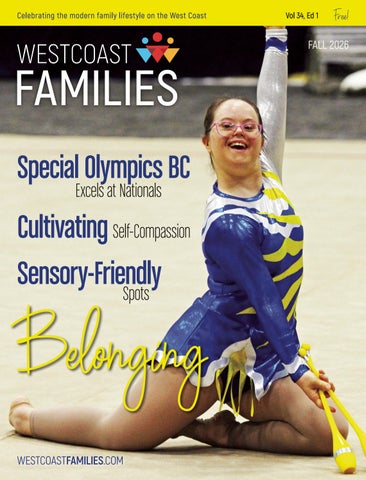
Special Olympics BC Excels at Nationals
Cultivating Self-Compassion Sensory-Friendly Spots
Belonging WESTCOASTFAMILIES.COM
Credit: Devan Francis
A PLACE TO CREATE, EXPLORE & GROW Register today for Arts Umbrella’s 2026-27 year-long and sessional programs in Art & Design, Dance, and Theatre, Music & film. World-class arts training in a fun and inclusive environment where young people ages 2–22 can build confidence, creativity, and lifelong skills.
2
WestCoastFamilies.com
Learn more & register artsumbrella.com
IN THIS ISSUE Fall 2026 Vol 34, Ed 1
4
10 THINGS YOU NEED TO KNOW Jim Schneider Publisher publisher@westcoastfamilies.com Stacie Gaetz Editor editor@westcoastfamilies.com Kristine Wickheim Account Manager kristine@westcoastfamilies.com
WestCoast Families, published by Island Parent Group Enterprises Ltd., is a quarterly publication that honours and supports parents by providing information on resources and businesses for west coast families. Views expressed are not necessarily those of the publisher. No material herein may be reproduced without the permission of the publisher.
For distribution inquiries, please email publisher@westcoastfamilies.com
6
SPECIAL OLYMPICS TEAM BC
8
12
15 DAYS AWAY
14
16
18
DEFIANT BEHAVIOUR
20
MORE THAN A GRADUATION
22
24
26
28
THE ‘IDEAL’ CLASSROOM
SELF-COMPASSION
10
CALM OUTINGS
ACCEPTING DIFFERENCES
Mailing Address 518 Caselton Place, Victoria, BC V8Z 7Y5 250 388 6905
On the Cover Photo Courtesy of Special Olympics BC specialolympics.bc.ca
A proud member of
LUNCH MADE EASY
BC
WestCoastFamilies.com x.com/wcfmag facebook.com/westcoastfamilies pinterest.com/wcfmag @westcoastfamilies
THE CITY AS CLASSROOM
ONLINE SAFETY
THE PARENTING SHIFT Fall 2026
3
10 T hings YOU NEED T O K NO W
Vietnam Festival
This free cultural festival featuring Vietnamese food, lanterns, music, performances and familyfriendly activities will be at the Vancouver Art Gallery North Plaza on September 26 and 27. vietnamfestival.ca
Foundry BC
Pacific Autism Family Network
Word on the Street Festival
Fright Nights at Playland
A one-stop resource for youth ages 12 to 24 offering mental health support, primary care, peer support and family resources. Locations throughout Metro Vancouver and the Fraser Valley. foundrybc.ca
A free celebration of books and literacy with children’s programming, author talks, activities and interactive exhibits at the Vancouver Public Library on September 19. wordvancouver.ca
World-class family resource centres spanning across BC offering services, workshops, recreation and support for families with neurodivergent children. pacificautismfamily.com
Best suited for older kids and teens, this annual Halloween attraction combines thrill rides with haunted houses and spooky entertainment this October. frightnights.ca
Vancouver International Film Festival
StrongStart BC
Heart of the City Festival
Circle Craft Holiday Market
This popular festival runs from October 1 to 11. While many screenings are for adults, VIFF also includes family-friendly films and youth programming. viff.org
Celebrate the stories, history, and diverse cultures of Vancouver’s Downtown Eastside October 30 to November 7, through family-friendly performances, music, walking tours and community events. heartofthecityfestival.com
Enter to win a family four-pack of “Gold Class” tickets on our contest page! westcoastfamilies.com/ category/contests
North Pole Express
Weekends from November 28 to December 20, join the Railway Museum of British Columbia as the North Pole Express finds Santa Claus. Explore his home and the Christmas model railway city. wcra.org
A free early learning program for children under five and their caregivers offered in many elementary schools across the Lower Mainland. gov.bc.ca
Celebrate the start of the holiday market season at the Circle Craft Holiday Market November 11 to 15 at Vancouver Convention Centre. Discover beautiful handmade gifts while supporting Canadian artists. circlecraft.com
PLAY
Special Olympics Team BC Athletes Compete on N
National Stage
early 250 athletes pursued their dreams of representing Canada at the 2026 Special Olympics Canada Summer Games. From August 11 to 15, one of Special Olympics BC’s biggest provincial teams ever pursued their personal bests at the 2026 Special Olympics Canada Summer Games in Medicine Hat. Comprising more than 244 athletes with intellectual and developmental disabilities,
6
WestCoastFamilies.com
75 volunteer coaches, and 22 mission staff from more than 42 communities across British Columbia, Special Olympics Team BC shone on the national stage and showcased their abilities. “My life has changed since getting involved with Special Olympics because I have more opportunities to play sports. I am more social and more outgoing and have made some new friends,” says Michale Andrews, a basketball player from the North Shore.
Andrews has competed in the Special Olympics since 2019 and achieved a gold medal with his basketball team at Provincial games in Prince George 2025. “I have loved travelling around, playing against the greatest and meeting new people,” says Mary Armstrong, a soccer player from Burnaby. Special Olympics Team BC competed in 10 sports in Medicine Hat including 10-pin bowling, basketball, bocce, golf,
FAST FACTS:
• 244 athletes • 75 volunteer coaches • 22 mission staff • More than 42 BC communities represented • 10 sports: - 10-pin bowling - Basketball - Bocce - Golf - Powerlifting - Rhythmic gymnastics - Soccer - Softball - Swimming - Track and field powerlifting, rhythmic gymnastics, soccer, softball, swimming (aquatics) and track and field (athletics). “Our athletes have worked tremendously hard to earn their places on Special Olympics Team BC 2026, and I could not be more proud of how far they have come,” says Michelle Cruickshank, Special Olympics Team BC 2026 chef de mission. “Their commitment to training, their willingness to challenge themselves and the support they show one another embody the very best of Special Olympics.” Since qualifying for their spots on Special Olympics Team BC 2026 through their performances at the 2025 Special Olympics BC Summer Games in Prince George, the provincial team athletes, coaches and mission staff have been hard at work to be at their best at National Games. Training included sport-specific work in their local Special Olympics programs, participating in Club Fit, additional fitness and dryland training, working with sport-specific experts and focusing on diet and nutrition. In Medicine Hat, athletes competed for the opportunity to represent Canada at the 2027 Special Olympics World Summer Games in Santiago, Chile. “I want to extend my heartfelt thanks to our coaches, hometown training coaches, mission staff, families and supporters,” says Cruickshank. “Their unwavering commitment makes these opportunities possible and plays a vital role in every athlete’s success.” The Special Olympics games operate on a four-year cycle for both summer and winter sports. Athletes compete in regional events and then provincial games to advance to National Games. Special Olympics Canada
games are the qualifiers for international Special Olympics competition. “Growing up playing sports and having so many amazing coaches support me, it means a lot for me to help other athletes be successful and take what I’ve learned and hopefully help them in their journey,” says Arjan Basra, a bocce ball coach from Surrey. “I want to help my team build lasting memories and push them to be the best athletes they can be.” Through these competitions and training, Special Olympics athletes build confidence, further develop their skills and make new friends. The 2026 Special Olympics Canada Summer Games saw more than 1,700 athletes
and coaches from across Canada gather in Medicine Hat, creating inspiring experiences of competition and friendship in 10 sports. Being part of Special Olympics Team BC provides athletes with opportunities to build confidence, further develop their skills and make new friends. Fans and supporters can help athletes get to the starting line by donating to transportation and equipment costs. Each gift removes barriers and makes Special Olympics Team BC unstoppable. Learn more about the results of the 2026 Special Olympics Canada Summer Games at specialolympics.bc.ca.
Stacie Gaetz is the managing editor of WestCoast Families and the proud mama of a delightful daughter and silly son who fill her days with love and chaos. She thoroughly enjoys supporting, connecting with, and informing parents through interesting articles like this one. Reach her at editor@westcoastfamilies.com.
Fall 2026
7
LEARN
Letting Go of the ‘Ideal’ Classroom A Different Kind of Back-to-School Success
“M
ommy, I finally feel like myself.” The first time my daughter said those words, I had to stop and let them sink in. Because for years, I don’t think she felt like she could let her true personality shine through.” Seven years ago, we were told our daughter might never develop beyond the abilities of a much younger child. We sat through assessments, listened to difficult predictions and spent years searching for answers while trying to help our daughter fit into a world that didn’t always seem built for her. For a time, homeschooling was exactly what she needed. Surrounded by a wonderful team and supportive community, she made incredible progress, and eventually she felt ready to try school again. But not long after returning to the classroom, we started to notice a shift. Our once quirky, easygoing girl was coming home exhausted and dysregulated every day. We wondered if it was simply the adjustment of going back to brick-and-mortar school, or if our daughter was trying to tell us something we weren’t ready to hear. As parents of neurodivergent children, we become experts at reading between the lines, and for the most part, the loudest truths aren’t spoken at all. Thankfully, we have a team of fighters in our corner. One of them was her behavioural consultant, who we affection-
8
WestCoastFamilies.com
ately refer to as, “Doc Annie.” After a routine school visit, she saw exactly what our daughter had been trying to tell us all along: This class was not the right fit. With Annie’s firm advocacy and the kind support of the inclusive resource teachers, our daughter was immediately transferred into a life-skills classroom designed for students who benefit from individualized support from incredibly compassionate staff, and a different approach to learning. In truth, the only ones not quite ready for this decision were my husband and me. Coming from a generation with fixed ideas about what school looks like, we struggled to let go of our expectations and worried this new path might limit her potential. How wrong we were. On her very first day at pick up, she told me, “Mommy… I finally feel like myself.” Within weeks, she truly began to thrive. She found confidence, community, a support team and friends. She formed a profound bond with a new friend with the most beautiful spirit. On paper, they communicate very differently, but friendship doesn’t happen on paper. It happens in giggles, a shared obsession over K-pop, in dancing, in holding hands and in the quiet understanding that words aren’t necessary to find connection and to be wholly accepted.
For years, my daughter struggled to find her place among peers. Although highly verbal, communication never came easily. She often missed nuance, took comments literally and found herself misunderstood. To cope, she perfected the art of masking, hiding her true comforts and choosing silence until the moment felt safe again. It was disheartening to witness as a parent. But this friendship was different. There was no pressure to perform or brace herself for judgement. When I asked her how she knew, without words, that this friendship was right, she said something I will never forget: “I don’t trust my voice, and sometimes I don’t trust my brain. But I always trust my gut.” It was her instincts telling her she had finally found safety in this friendship. Together, the girls joined an adapted sports event and had their art selected for a local gallery exhibit. Watching my daughter take in the walls showcasing her imagination, was a beautiful reminder that she was finally being seen. As I write this, I realize none of this would have been possible without that first brave step into a classroom built to support her. The world may not always be built with our children in mind. But sometimes, they find a little corner that is a classroom, a community and a friendship that allows them to stop trying to fit in and simply be. At the end of the school year, I was no longer taking the lead in writing my daughter’s story. It was my turn to sit back and relish in her moment. Watching her dance on stage with her class, next to her new friend and later receiving the “Most Inspirational Award” was the ultimate full-circle moment. My husband and I sat in awe, tears in our eyes. Not because she had become someone different. But because she hadn’t. For years we searched for ways to help our daughter fit into the world. But she was never broken. She simply needed a place already made for her—a place where she could finally shine.
Deb Balino is a writer and mom of two, navigating life in the sandwich generation. She’s the podcast host of Sass & Small Talk on TELUS StoryHive, exploring the mental load of parenthood, sharing honest stories from the trenches of raising a neuro-divergent family, while balancing advocacy, business and caregiving. Fall 2026
9
EXPLORE
Calm Outings
for Kids Who Feel Everything a Little More F or families raising sensory-sensitive children, even basic outings can sometimes feel more stressful than relaxing. Crowds, bright lights, loud noises and unexpected changes can quickly become overwhelming. Thankfully, communities across the Lower Mainland are becoming aware of sensory needs, with more businesses and attractions offering quieter, more inclusive experiences for all families.
MUSEUMS & INDOOR ATTRACTIONS
Science World in Vancouver occasionally offers sensoryfriendly mornings, where lighting and sound levels are adjusted so families can explore exhibits in a calmer environment. The Vancouver Aquarium also hosts select sensory-friendly events throughout the year. Reduced attendance, quieter galleries and flexible programming allow families to enjoy marine life at a more comfortable pace.
10
WestCoastFamilies.com
The Museum of Surrey regularly offers inclusive programming and sensory-friendly community events designed to make learning and exploration feel more welcoming for visitors of all abilities.
INDOOR PLAY & MOVEMENT
Some indoor play spaces offer quieter times or are simply easier to enjoy during off-peak hours. Calling ahead can help you find the calmest time to visit. Many local recreation centres across Metro Vancouver offer family swims and skates during less crowded times and some even turn off the music for those with auditory sensitivities. Local libraries are another wonderful option. Most branches throughout the Lower Mainland provide quiet children’s spaces, specific sensory story times and calming reading areas that encourage exploration without overstimulation.
NATURE’S BEST SENSORY SPACE
Sometimes the best sensory-friendly destinations are simply found outdoors. Most parks are fairly accommodating, but here are a few we especially love for their spacious areas and peaceful vibes: • Pacific Spirit Regional Park in Vancouver offers many peaceful forest trails where children can enjoy birdwatching, towering trees and gentle movement away from busy city streets. • Burnaby Lake Regional Park provides wide walking paths, calm water and opportunities to watch birds and wildlife in a naturally soothing environment. • Centennial Beach in Tsawwassen is another excellent choice. Its wide sandy shoreline and expansive open space allow children to explore without feeling crowded. • Queen Elizabeth Park in Vancouver combines beautiful gardens, open lawns and quiet pathways where families can easily find peaceful corners to relax.
SHOPPING WITH LESS OVERWHELM
Several major retailers have participated in sensory-friendly shopping initiatives by dimming lights, lowering music and limiting in-store announcements during designated shopping times. Programs and schedules can change, so it’s always best to check directly with the retailer or visit the Autism BC website for the most up-to-date information. Stores that have previously offered sensory-friendly shop-
ping hours in BC include Save-On-Foods, London Drugs, Real Canadian Superstore, Thrifty Foods and Best Buy.
HELPFUL RESOURCES
• Autism BC provides sensory-friendly shopping information, family resources, educational workshops and advocacy for more inclusive communities throughout the province. • Foundry BC supports young people with mental health and wellness services, including resources for anxiety, emotional regulation and neurodiversity. • Canucks Autism Network (CAN) offers recreation programs, camps, sports and community events specifically designed for autistic children, youth and families across Metro Vancouver. Sensory-friendly doesn’t always mean finding a special event or place that is labelled as sensory safe. Sometimes it’s simply about choosing the right place, the right time of day and creating space for your child to experience the world at their own pace. With a little planning, families across the Lower Mainland can discover countless adventures where every child feels welcome, supported and free to explore. Erika Palmer is a writer living with her husband and son. She believes most problems can be solved with a good cup of tea and a huge piece of chocolate.
Fall 2026
11
PARENTING
What 15 Days Away from My Kids Taught Me About Motherhood
W
hen I first met my husband, we fell in love fast, moved in together and dreamed about travelling the world. I remember saving pictures of Greece to my Pinterest board back in 2015, imagining all the places we’d eventually explore together. Then, without warning, we found out we were pregnant after only five months of dating. Life changed overnight, but in the very best way. At the same time, I remember quietly grieving how short-lived that season of just the two of us would be. So much of what was just taking off—fuelled by spontaneity, adventure and endless possibilities—quickly transitioned into responsibility, routines and raising a family. Then came another surprise. On January 1, 2020, I found out I was pregnant again. A few months later, while the world was shutting down, I sat in an ultrasound room expecting a routine appointment, only to find out we were having twins. I still remember my very first thought after the initial panic: “We’re never going to travel again.” It wasn’t really about the travel. It represented something much bigger: uninterrupted time together as a couple. Time that suddenly felt like it had slipped away before we’d ever really had it. Over the next five years, we embraced the beautiful chaos of raising three young children, and somewhere along the way, our dream trip quietly settled onto the back burner. Until last year. With the blessing of two incredibly generous sets of grandparents, I spent months planning what would become my husband’s 40th birthday trip through Italy and Greece. I feel incredibly privileged that my husband and I got this opportunity. We don’t have regular support, as both our parents live far away. Childcare is something that’s available on occasion, but it’s certainly not the routine, so even monthly date nights are something we must intentionally prioritize and plan for. Looking back, I realize I wasn’t just planning an itinerary. I was planning permission. Permission for us to step away from the daily demands of parenting and invest in the relationship that started it all.
12
WestCoastFamilies.com
But as our departure approached, excitement slowly gave way to guilt. I started realizing just how codependent I’d become with my children. I worried about everything. Would they be upset? Would something happen while we were gone? Would they think we’d chosen ourselves over them? Once we finally arrived in Europe, the adventure was everything we’d hoped for. We wandered the romance of Rome without rushing. We lingered over incredible dinners in Greece. We remembered what it felt like to make decisions with no schedule except our own. And then the homesickness kicked in. Sleep was hard during the first few days, and I’d often find myself awake in the middle of the night checking messages from home. I missed my first born’s baseball game win. I missed the twins’ kindergarten graduation, something that still tugs at my heart. There were moments when I questioned whether we’d made the right decision. But there were moments of clarity, too. We only FaceTimed the kids a handful of times over 15 days, and while I could see they missed us, I also saw something reassuring. They were okay. They were laughing. They were making memories with their grandparents that they’ll carry forever. It reminded me that allowing our children to be deeply loved by other people isn’t taking something away from them. It’s expanding their village. When we finally walked through our front door, all three kids came running toward us and wrapped us in the longest, most heartfelt hug. It was one of those moments I’ll remember for the rest of my life. Since coming home, I’ve noticed subtle shifts. They’re quicker to hug us. Quicker to say, “I love you.” And they’ve made it very clear they don’t want us leaving for that long again. Truthfully, I think I’d agree. Fifteen days was probably about a week too long. Still, if you asked whether I’d do it again, my answer would be yes. Not because I enjoyed being away from my children. I didn’t. I missed them every single day. I’d do it again because somewhere between the airports, the ferries and the slow mornings over coffee, my husband and I remembered who we were before life became so beautifully full. We came home more connected, more patient and more grateful—not only for the trip, but for each other. Motherhood asks so much of us, and it’s easy to believe that choosing ourselves, or choosing our marriage, somehow takes away from our children. This experience taught me the opposite. Investing in your relationship isn’t taking something away from your family. It’s one of the greatest gifts you can give them.
“
Investing in your relationship isn’t taking something away from your family. It’s one of the greatest gifts you can give them.
“
Natasha Mills is a twin mom of three living and raised in Victoria for over 30 years. She is a published author in the parenthood space and a full-time digital creator on social media. Find more of her content on Instagram at @mommamillsblog. Fall 2026
13
PARENTING
The Case for Self-Compassion in Modern Parenthood “S arah” sits across from me describing the moment she “lost it.” The vent fan was on, the dog was barking, the baby was crying and her partner just called and said they were going to be late. The baby had been up every hour the night before. Had Sarah eaten lunch? She wasn’t sure. Then the toddler started asking for Bluey one more time. Sarah described yelling and then started to cry. She tells me that she failed as a mom. She remembers her parents yelling and promised she was going to do things differently. She says other moms keep it together, why can’t she?
14
WestCoastFamilies.com
Curious, I ask Sarah what she would tell her best friend if she told her this story. Sarah hesitates and then tells me that she would tell her best friend that this sounds like it was an overwhelming moment, that everyone loses their temper sometimes and that she’s a good mom. Sarah isn’t unique. Every day I sit with moms who hold themselves to a higher standard than others, who assume that they are the only ones who fall apart sometimes or don’t show up with their kids or partner the way they want to. These women are bombarded with messages about what it means to be a good
mom: a clean house, enriching activities, healthy meals, limited screen time, a thriving career and strong relationships. It’s an impossible standard. What would it be like if Sarah could offer herself the same compassion that she could offer her best friend? What if Sarah could recognize her humanness but also the strength in how she is showing up in a world that expects so much of her? This is self-compassion. Compassion is described as responding to suffering with warmth, understanding and a desire to help. Self-compassion invites us to offer those same qualities to
ourselves, particularly during moments of struggle. Research by Dr. Kristin Neff has shown that practicing self-compassion is associated with greater happiness, hope, gratitude and resilience. This sounds simple but it takes practice, rewiring our self-talk and unpacking our assumptions about what it means to use self-compassion.
Self-Compassion Vs. Self-Indulgence
To effectively act with self-compassion, it is important to understand that self-compassion does not equal self-indulgence. Self-indulgence is closely linked with behaviours that result in short-term pleasure but have more negative long-term impacts. For example, overspending when stressed or binge drinking to unwind. In contrast, research by Dr. Neff has demonstrated that those that utilize self-compassion demonstrate behaviours consistent with health promotion, such as exercise, diet, better sleep hygiene or quitting smoking. Simply put, if you care for yourself, you will take better care of yourself.
Why Self Compassion for Parents?
Parents in 2026 are facing significant financial, digital, socio-cultural and parenting demands. Research out of Concordia University demonstrated that new moms are facing increased pressure to address climate and social crises in addition to the regular demands of motherhood. Many parents I work with feel that something in their lives is always falling short of expectations. Par-
enting in 2026 is both joyful and demanding.
What Does Self-Compassion Look Like for Parents?
Often self-compassion begins with mindfulness; noticing our thoughts and feelings without judgement. In the case of Sarah, this would mean noticing the feelings of dysregulation and overwhelm in that moment with the toddler, the dog and the vent fan and acknowledging the way she is feeling along with her self-talk. The parents I work with often report self-criticism and high expectations of themselves in these moments of dysregulation. Asking what they would say to a dear friend can be a powerful way to reframe self-critical thoughts. Some of this can also be done through normalizing our feelings and finding common humanity. The recognition that many parents struggle with self-regulation, get over stimulated and touched out helps Sarah to see her humanness. Once we notice our overwhelm and approach it with self-compassion it can be easier to take what we need. In the case of Sarah, that may mean grabbing ear plugs, taking a moment to regulate when she needs it or maybe another episode of Bluey so she can get the break she needs. Finally, self-compassion is a practice, not a personality trait. This means coming back to it time and time again. Noticing when we aren’t using it and gently redirecting ourselves, with compassion not judgement.
Tasha Page, RSW, is the founder of Glacier Counselling Services and co-editor of the book Barren: An Exploration of the Journey to Motherhood. Drawing from both professional expertise and lived experience, she supports individuals through infertility, pregnancy, loss and parenthood, while advocating for reproductive mental health. glaciercounselling.com
Fall 2026
15
LEARN
Books to Help Your Child Accept Others’Differences I can’t believe it’s happening—my youngest child is entering kindergarten. She is absolutely thrilled to be going. And the thing she is most excited for: making new friends. While she is a very bubbly and outgoing girl, I know that not every child has the same experience. Both of her older brothers were
Davy – A Garden for Everyone
Ages 4 to 7 I love the illustrations in this book. All the creatures look so soft and snuggly and the story is fantastic. The book is about finding friendships in unlikely places—for example, the overgrown garden down the path. This budding friendship all starts with a kind action from Davy. He sees an old bunny struggling to carry a heavy bucket of water and offers to carry it for her. I love the message that friendships can start with a kind word, but, just like a garden, they take time to grow.
16
WestCoastFamilies.com
far more reserved when it came to making friends. Regardless of which category your child falls into, here are some books to help them meet people and make connections this year as well as strengthen the bonds they already have.
A Day with No Words
Ages 4 to 7 The first book makes it seem like making friends is always easy if you are nice. Unfortunately, that’s not the case. Sometimes children interact through the world in different ways (for example, the boy in this story uses a tablet to communicate with others) and other children tease them or avoid them because of it. A Day with No Words hopes to break the stigma and disprove the myths associated with alternative methods of communication by showing children what a typical day is like for someone who has nonverbal autism.
My Quiet Place
Ages 4 to 7 This beautifully illustrated picture book is about a young girl who struggles with sensory overload. It’s a great book for you to read with your children if they struggle with noise, because it can give both of you some ideas about how you can create a quiet place for your child, even when you’re not home. It’s also a great book for kids who don’t struggle with sensory overload, because it can teach them to be empathetic to those who do, and help them recognize when someone else might need a quiet place.
celebrating someone’s success (or not, in Jackal’s case) and when they are a bit put off by someone’s self-absorption.
Speechless
A Trophy for the Jackal
Ages 4 to 7 Unfortunately, there are some things that can hamper making and keeping friends. Two of them are jealousy and envy, which Jackal has in spades. The
book starts out with a competition and Jackal is convinced he will win. When he doesn’t, he decides to create a contest that only he can win. Wellerdiek does an excellent job of capturing the animals’ different expressions when they are
Ages 8 to 12 Speechless is a graphic novel about a sixth grader who struggles with anxiety and selective mutism. Mira finds solace in creating stop-motion animation, but her desire to hide away in her room doesn’t protect her from school deadlines, friend drama and bullying. While this book doesn’t shy away from the struggles someone with selective mutism has, it doesn’t leave her suffering either. She manages to become friends with Alex, a kid in her class who sticks by her even when Mira’s not the best friend back.
Christina Van Starkenburg lives with her husband, children and cat, and is the author of One Tiny Turtle: A Story You Can Colour and many articles. To read more of her work and learn about her upcoming books, visit christinavanstarkenburg.com.
AT CAPILANO SUSPENSION BRIDGE PARK
spooky season returns
OCTOBER 9–NOVEMBER 1, 2026 Hold onto your brooms and step into the frightful forest. Spooky season returns to Capilano Suspension Bridge Park with ghostly friends and enchanting lights to delight families and Halloween fans of all ages.
TICKETS AT CAPBRIDGE.COM | BC RESIDENTS: FREE ANNUAL PASS WITH ADMISSION Fall 2026
17
PARENTING
Navigating Your Toddler’s
Y
Defiant Behaviour
ou’re getting ready to leave the house for day care. You tell your child to put their shoes on, but they are still playing with their toys and say “NO.” You raise your voice a bit and say, “Come on, we are already late, put your shoes on!” But again, they say “NO.”
Calmly & Efficiently
Then, you’re at the playground and you want to go home and start dinner. You tell your child “Ok sweetie, we’re done here. It’s time to go home.” They say (the now familiar) “NO” and start running away from you. You sigh and think to yourself, “Why does everything have to be a battle?!” You’re frustrated,
tired and maybe a little hungry. Your bandwidth is almost non-existent. And you might be wondering if your child is exceptionally difficult. If you are a parent to a toddler (or two), chances are that you’ve experienced such challenges. But the truth is that defiance in children 18 months to four years old is common. In fact, defiance is the result of your child doing their developmental work.
Why it happens
Starting around 18 months old, children realize they are separate from their parents. As such, they desire more control over their life. They are eager to feel independent and must assert themselves to feel confident and like their own person. They are not being difficult to spite you, but are working hard at hitting their developmental milestones.
How to navigate defiance
1. Understanding that your child’s behaviour is not meant to antagonize you is key. Reminding yourself that their defiance is a part of them becoming their own person might help you to remain calm. You might want to encourage yourself by providing selfempathy. “This is hard, but they are being defiant right now because it’s a part of them growing up as individuals.” 2. Offering choices rather than giving commands might help your child be more cooperative. “Which shirt would you like to put on today? The blue or the yellow one?” “Which shoe shall we put on first, the left or the right?” “Do you need help climbing up to your car seat or can you do it yourself?” Also, using humour and imagination might help. Putting a clean diaper on their doll’s
18
WestCoastFamilies.com
RAILWAY MUSEUM OF BRITISH COLUMBIA
head or giving the teddy bear some water might turn defiance into giggles. 3. Offering empathy and sympathy can help move a child from defiance to compliance. “I’m sorry it’s time to go. I know you would like to play some more.” “I understand you don’t feel like washing your hands right now. You don’t want to lose any time playing.” If you are rushed or impatient and skip the empathic understanding part, your child might up the ante and become louder, angrier and more defiant to show you just how upset they are. We all need to feel understood before moving forward with action and children are no exception. 4. Sticking with the plan is important. Once you’ve decided it’s time to do something, like go home or get out of the house and, once you offer empathy, you can shift to the practical part of the plan. At that point you might add, “But it’s important we wash our hands when we enter our home.” And at the playground you might say “But it’s getting late and we need to go home now.” 5. Using firm but gentle touch might help you to get your child to where you need them to be while maintaining your loving attachment. You might want to narrate what you’re doing. For example, “Now, I am lifting you up and we’re going.” 6. Taking a deep breath and patting yourself on the back is recommended. Parenting is challenging, but you’ve just managed another day in a way that is respectful to your child and yourself, and which fosters a loving bond between you. 7. Taking care of yourself is not a luxury but a must. You can’t give when your container is empty. Defiant behaviour and saying “NO” is very common in toddlers and presents a challenge to many parents. But it’s important to remember that your child’s defiance is a sign that they are developing properly and becoming their own little person. Dr. Michal (Michelle) Regev is a psychologist, marriage and family therapist, and educator. She is a passionate advocate for women and their mental health and has presented at numerous conferences and workshops worldwide. Her newly published children’s book is titled Anjulie’s Worst Day Ever. Learn more at drregev.com.
Squamish, BC
Reserve Your Seats!
wcra.org/npx
(604) 898-9336
Enter to Win a Family Four-Pack of “Gold Class” Tickets to the
North Pole Express!
Enter to win at westcoastfamilies.com/ category/contests
Fall 2026
19
LEARN
More Than a Graduation Cultivating Hope for the Future
A
s we settle into the new school year, I am reminded of an impactful event from the spring that got me thinking about the environments our young people are learning in. On June 15, I woke up full of joy and anticipation. We were celebrating another milestone, our son’s graduation. I looked forward to the event with excitement. When our son was born, I remember lying down on my hospital bed watching him sleep in the bassinet beside me. I was filled with awe and wonder at taking part in the beginning of a new life. I felt so much love and joy and thought how this was going to be the start of a beautiful journey together. Now, he’s graduating from high school. What a privilege it has been for my husband and me to be a part of this chapter of his life.
20
WestCoastFamilies.com
As the graduation presentation started, I felt excited and looked forward to hearing our son’s name. I assumed my attention would naturally be focused on him. Instead, something unexpected happened. One by one, the graduates were introduced with a brief description of their plans after high school, and I found myself inspired by the stories I heard. I was amazed at the vast diversity of students represented in the room. There were students living with disabilities, gifted learners, athletes, artists and adult learners. There was an equestrian balancing scheduled competitions with school, a ballerina pursuing her artistic dreams and a future music therapist already following a calling to help others through music. These graduates were already pursuing their passions.
In addition, there was a graduate who was 45 years old. Out of 158 graduates, only 20 could attend because some of them were living in remote communities throughout British Columbia. Others were unable to attend the ceremony in person because their families lived elsewhere in Canada or around the world. Their stories, circumstances and educational journeys were very different, but they all shared one thing in common—they had found a learning environment that allowed them to thrive. I found myself smiling, because I was inspired and encouraged by the fact that some of these young people were already pursuing interests that reflected who they were in the arts, athletics or other specialized fields. I wondered how many of them had been able to nurture those
interests because their education was flexible enough to adapt to their lives. Having worked with at-risk youth in the past, I have seen how difficult it can be for some young people to find their purpose and a place where they feel they belong. That’s why this graduation touched me so deeply. It gave me a renewed sense of hope to see so many students already discovering their strengths, pursuing their interests and stepping confidently into the next chapter of their lives. When we think about inclusivity and accessibility, we usually focus on physical accommodation. While those are important, true accessibility is also about providing options. It means recognizing that children learn in different ways, have different strengths, face different challenges and succeed in different environments. For some students, a traditional classroom is exactly where they flourish. For others, a different learning environment allows education to fit their lives, rather than expecting them to fit the same educational model. As we were driving to our next destination after the event, we started talking about the graduation ceremony. My husband’s nephew, a musician visiting from Toronto, was especially excited to hear about the student pursuing music therapy. The ceremony sparked conversations about the many different paths these graduates were taking and the opportunities that had helped them get there. That day reminded us that when we create environments where young people can learn in ways that fit their needs, strengths and circumstances, we give them the opportunity to become who they are capable of becoming. There is a lot of bad news out there, but as our students head back to the classroom this fall, let’s recognize that they are our greatest hope for a better tomorrow. And we can help them on their way by encouraging the creation and continuation of learning environments that support them as they are.
Laura Guarin is a parent and Joyful Living & Positive Aging Writer & Facilitator. Through reflective writing, facilitation and well-being practices, she helps women navigate life changes with clarity and courage so they can create lives of greater joy, vitality, purpose and fulfilment. Learn more at embracelifesjourney.thinkific.com.
Fall 2026
21
EAT
Lunch S
Made Easy
eptember comes with the rush of new sneakers, early mornings and brisk air. At my house, school lunches are packed by zombie-like kids and adults, shocked to find themselves thrust into the busy morning routine once more. So how do we get “back into the swing of things?” Here’s our secret to school lunch success: We have a simple school lunch routine. Every container gets the same type of food every day. It is predictable. There’s no need to spend time thinking or panicking. All the work has already been pre-determined. Lunches look a bit like an airline meal (with more appetizing food). Our kids get four containers that are designed to cover all the food groups, and that can be packed without too much thought.
classroom requirements). This box nearly always comes home full, but at least I know that if they had an extra hungry day, they would have something left in their lunchbox to eat. 4. Treat box: The treat box usually gets eaten first. Skip the fruit snacks and choose something with a bit of substance. • Oatmeal cookies or wholegrain muffins are good options. • Cheesy crackers, pretzels and rice crackers are fun and don’t come with a sugar hit. • To save money, make a big batch of stove-top popcorn on Sunday night. It’s a great after-dinner snack. Place the leftovers in a resealable bag, and you’ll have a quick snack option all week long. We like to experiment with flavours, and I’ve shared a few of our favourites below.
The Four Components:
Popcorn is so easy to make that once children are old enough to use the stove, they can safely make it on their own. My kids loved showing off to their friends by making popcorn by themselves. Younger children can help with sprinkling on the flavours and mixing the popcorn. This recipe makes around six cups of popcorn. So be sure to use a large pot!
1. Main dish: This varies based on what we have in the fridge. I usually plan lunches when we do our Sunday trip to the grocery store. However, I make sure that there is always something in the freezer in case things go sideways. • Pre-freeze sandwiches in resealable plastic bags. Just be sure to avoid vegetables or eggs. • Frozen burritos are a great instant lunch. • If your family has a favourite soup or stew, make a large batch and freeze lunch-size servings in straight-sided mason jars. They’re easy to warm up in a microwave. 2. Fruit and Vegetable box: This is how I make sure my kids are getting at least some vegetables every day. • We usually pack a mixture of carrots, cucumber, coloured peppers, cherry tomatoes, grapes and apple slices. • Go with their favourites! Frozen edamame, broccoli, cauliflower, sweet corn, peas. There really aren’t any rules. • Let your kids pack their own vegetables because then you know that they’ll eat them. Even a kindergartner can pack a box of fruits and vegetables. It’s a great way to get them helping in the kitchen. 3. Hungry box: I learned early on that it was always a good idea to include a box of high-protein items (depending on the
22
WestCoastFamilies.com
Stove-top Popcorn
Ingredients 2 Tbsp oil (for the bottom of the pot) 1⁄4 cup popcorn kernels 1⁄4 cup melted butter 1⁄2 tsp salt or use one of the flavour mixes Instructions 1. Put 2 Tbsp of oil in the bottom of a large pot. Add 3 popcorn kernels and put the lid on the pot. 2. Set the stove to medium heat and wait about 3 minutes, depending on how quickly your stovetop heats up. When the test kernels pop, add the remaining kernels and begin shaking the pot. 3. Keep shaking the pot while the kernels pop. This stops
them from burning on the bottom and helps them to pop! When the popping stops, remove the pot from the burner and turn off the stove. 4. Dump the popped corn in a big bowl and top with melted butter and seasonings. 5. Enjoy right away or store in an airtight container as a snack for school lunches. Flavours Sweet Cinnamon 1 Tbsp brown sugar 1⁄2 tsp cinnamon 1⁄4 tsp ginger Maple Mix 2 Tbsp of maple syrup with the butter before pouring over the popcorn. Curry 2 tsp curry powder 1⁄4 tsp salt Cheese
3 tsp powdered cheese 1⁄8 tsp mustard powder 1⁄4 tsp salt Ranch 1⁄2 tsp dried garlic 1⁄2 tsp dried onion 1⁄2 tsp dried dill 1⁄4 tsp salt Pesto 1⁄2 tsp dried garlic 2 Tbsp dried basil 1⁄4 tsp salt 1⁄4 cup of Parmesan
Emillie Parrish loves having adventures with her two busy children. You can find more of her recipes in her cookbook Fermenting Made Simple. fermentingforfoodies.com.
Get ready to nominate your
Family Favourites Who deserves a spot on your family’s “must-have” list?
Discover the
GIANTS of Britannia Mine Museum
The 2026 WestCoast Families Family Favourites nominations are opening October 1: get ready to nominate the people, places and businesses your family loves most!
WestCoastFamilies.com
Climb aboard the NEW Cat® 793C mining truck, one of the largest pieces of equipment on site!
Fall 2026
23
LEARN
The City as Classroom
What a Day Trip to Victoria Can Teach Your Child F
or many Lower Mainland families, a day in the capital city is an exciting summer staycation adventure. Victoria offers something for everyone—cultural sites, beaches, shopping and endless food options. But a day trip to Victoria also means a ferry ride over, and the hustle and bustle of a big city—busy streets, lineups, noise and crowds. For families with neurodivergent children or teens, such as those with ADHD or autism, these travel and city elements come with an extra layer of consideration.
The good news is that these challenges can be turned around, and the whole experience (ferry included) can become a classroom, teaching your family valuable life skills without anyone even realizing it.
How to Turn Travel Challenges into Lessons
Every child manages a busy day differently. Some find the noise and crowds the hardest part. Others find it’s not knowing what comes next. Either way, a little planning goes a long way, and doubles as real skill-building.
If this is your child’s first time on the ferry, walk through what to expect together beforehand: possible wait times at the terminal, boarding announcements, the ship’s horn and crowds or lineups for food once you’re onboard. BC Ferries offers accessibility support for families who may need them, so if boarding or waiting in line feels like it could be difficult for your child, it’s worth looking into what’s available ahead of time. Onboard, the main passenger decks can get loud and crowded, especially near the food court, so packing noisecancelling headphones or a comfort item, and scouting out a quieter seating area early, can make a real difference. For a child prone to motion sickness, planning where to sit and what to eat is part of the same preparation. Naming these moments in advance, rather than letting your child encounter them cold, turns the crossing into a chance to build patience and tolerance for something new.
Once You’re in the City
Sit down together the night before, or over breakfast, and walk through what the day will look like. Where are we going first? What happens after that? Do we have a plan for food, or will we decide once we’re there? This kind of planning is a master class in executive functioning, the skill your child leans on all school year for homework, time and transitions. That plan might even include stops that connect to what they’re learning in school. Seeing the Parliament Buildings in person after a social studies unit can make an abstract lesson concrete, especially valuable for kids who process
24
WestCoastFamilies.com
and retain information best through hands-on, visual experience. Even lunch on the harbour can do double duty, working out the tip together turns percentages from a worksheet problem into something real. For kids who find the unknown harder to manage than the noise, a simple sequence of the day, written out or sketched, is a perfect tool to reduce overwhelm. The goal isn’t a strict itinerary, it’s a shared sense of what’s coming next, and permission to adjust together if the day calls for it. Perhaps you arrive at the BC Museum as planned, only to find the IMAX show is sold out, so you head to lunch and come back for a later show instead. Moments like these can bring real disappointment, but handled together, they become lessons in flexibility and compromise, especially valuable for family members who find sudden pivots hard. Build breathing room into that plan.
Before you go, decide together where a quiet moment might happen: the less-occupied paths of Beacon Hill Park, a bench along the Inner Harbour or a return to the car for a little downtime. Identifying that spot in advance is teaching your child how to plan for their own regulation. If you’ve reserved a return sailing, the exit point takes care of itself, but it’s still worth naming out loud. Talk through what “time to head for the ferry” will look like before you need
to leave, so the deadline feels like a shared plan rather than a sudden interruption. Knowing when it’s time to go, and having the words ready to say so, is a skill that will serve your child well beyond a single day trip. A day trip to Victoria will still have its noisy street corners, long lineups and a ferry crossing on both ends, that’s all part of a busy summer outing. With a plan built together beforehand, it can also be something else: a low-stakes place for the whole family to practice skills that will matter far beyond that one afternoon. The executive functioning, regulation and self-awareness your child builds on an outing like this has a way of showing up again in a September classroom.
Kristi Rigg, BEd, MEd, is the CEO and Founder of West Coast Centre for Learning (WCCL), offering evidencebased, neuroaffirming programs for neurodivergent children, teens and young adults across BC. With over 30 years in education, she leads WCCL’s newest location at Victoria’s Uptown Centre. Learn more at wccl.ca.
Fall 2026
25
PARENTING
Online Safety Focus on Connection, Not Control The #1 factor that keeps kids safe online
F
rom lawsuits alleging child endangerment to headlines about kidnappings and grooming, online games are once again facing scrutiny. While the platforms have rushed to roll out new safety tools—from AI-powered age checks to “trusted connection” systems—local counsellors warn that technology alone cannot keep children safe online. The real question for parents, they say, is more personal: Would your child feel safe enough to tell you if something felt strange or went wrong online? “You don’t need to be a tech expert to protect your kids,” says Devony Baugh, co-founder and registered clinical counsellor with Tapestry Counselling Centre, a Vancouver practice. “The strongest parental control isn’t an app—it’s the connection they have with you. Safety comes from secure
26
WestCoastFamilies.com
relationships, calm conversations and being the adult your child can turn to when something goes wrong.” According to the Canadian Centre for Child Protection, reports of online exploitation in Canada rose eight percent in 2024, with nearly 1,900 incidents reported from British Columbia alone. Globally, researchers estimate that one in 12 youth have been targeted for online sexual exploitation. But exploitation is not the only risk. Experts also point to design features in many popular online games such as reward loops, social pressure and in-game economies that encourage prolonged play. “These platforms are engineered to capture attention and encourage constant engagement,” says Baugh. “That creates a perfect storm: Children are not only spending more unsupervised hours online, but they’re
also more exposed to manipulative design features and, in some cases, unsafe online interactions. Parents need to understand both the safety risks and the wellbeing impact.”
What Doesn’t Work
• Relying only on strict rules or surveillance • Expecting parents to master every app or platform • Fear-based messages that leave kids too ashamed to disclose
What Does Work
• Parental calm: regulated parents = safer kids • Attachment first: trust, not punishment, encourages disclosure • Ongoing dialogue: kids live in digital “third spaces” where connection, not control, keeps them safe “As the…headlines show, platforms will always be playing catch-up,” adds Baugh. “Parents don’t need to know every feature update. What kids need is a caregiver who stays calm, listens without judgement and makes it safe to talk about mistakes.”
Tapestry Counselling Centre, founded to support survivors of childhood abuse, is now expanding its mission to prevention. The team is launching a new parenting group for caregivers of kids nine to 13, blending psychoeducation with peer support to give families practical scripts, safety plans and strategies for raising kids in a hyperconnected world.
Piano
•
Guitar
•
Bass
•
Voice
•
Strings
•
& more!
Register For Music Lessons Today. Why Choose Long & McQuade? Music lessons for all ages, stages, and styles. Professional instructors make learning fun. Convenient lesson times for busy families. No registration fees. Affordable instrument rentals.
With 17 locations across British Columbia. Visit our website to find the location nearest you!
Fall 2026
27
PARENTING
The Parenting
Shift
from Correction to Curiosity
D
o you ever find yourself lying beside your child at the end of a long day, re-experiencing the hard moments— the tears at dinner, the explosive reaction to a simple request and the refusal to get dressed—wondering, “What is wrong with my child?” If so, you’re not alone. We live in a world that urges us to find solutions as quickly as possible when things feel uncomfortable. When children struggle, we’re often surrounded by messages that suggest we need to correct, manage or fix their behaviour immediately. Instead, what if we paused long enough to become curious? What if we asked: “What is my child experiencing right now?” “What is my child’s behaviour trying to communicate?” “What need is hiding beneath the struggle?” “What happened before this moment that may have exceeded their capacity to cope?” Imagine a familiar scene: Your child refuses to get ready for baseball practice, the same team they begged to join, the one you’ve rearranged your schedule around and invested
28
WestCoastFamilies.com
several evenings in. They’re screaming that they don’t want to go. They can’t get their uniform on. They insist they have no friends. They throw themselves onto the bed as you stand in the doorway asking, “What happened?” “Why is this so hard?” It’s easy to see yelling, aggression, avoidance and refusal as the problem. But what if those behaviours are only the tip of the iceberg? Underneath the surface may lie fear of making mistakes, uncertainty, social fatigue, sensory overwhelm, anxiety, impulsivity or an overloaded nervous system. Developmental psychologist Dr. Mona Delahooke reminds us that behaviour commonly reflects a child’s state of the nervous system rather than a lack of motivation or willingness. Similarly, Dr. Ross Greene’s philosophy, “Kids do well if they can,” encourages us to view challenging behaviour through the perspective of lagging skills and unmet needs rather than willful defiance. As a Registered Clinical Counsellor, one of my favourite moments with parents is slowing down difficult situations together. We replay the incident almost frame by frame,
looking beneath the behaviour to uncover the unmet needs, stressors or capacities that were easy to miss in the moment. Time and again, parents leave not with a list of consequences to implement, but with a greater insight into their child. This shift in perspective marks the beginning of belonging. Children don’t all experience the world the same way. Some need movement before they can sit and focus. Some need extra time to process language. Others become overwhelmed by noise, transitions or the social demands of a busy classroom. Inclusive parenting isn’t about lowering expectations; it’s about recognizing that children may need different supports to meet those expectations. Equity means giving each child what they need to succeed, not expecting every child to succeed in the same way. At times of overwhelm, children often need to borrow our regulation before they can access their own. Instead of calling from the kitchen, “Hurry up, we’re going to be late,” try moving closer. Get low. Reduce your language. Offer calm reassurance: “I can see this feels really hard right now. I’m here. Let’s figure out the first step together.” Teaching,
reasoning and problem-solving tasks are far more effective once a child’s nervous system has settled. As families settle into another busy school year, there are simple, practical ways to foster belonging every day. Create predictability with visual schedules, countdowns, family calendars and “first-then” language. Before transitions, consider your child’s sensory and regulation needs by offering a snack, a movement break or a calm moment to reset. Most importantly, remember that support is not the same as dependence. Providing accommodations helps children build confidence while developing the skills they need over time. Back-to-school is also an opportunity to build partnerships with your child’s educators. Attend meetthe-teacher events, share what helps your child thrive and collaborate on strategies that support success at home and at school. When families and teachers approach behaviour with curiosity rather than criticism, children experience greater consistency, safety and a sense of belonging. When we shift from a corrective lens to one of curiosity, we see our children differently. More importantly, they begin to experience themselves differently, not as broken or difficult, but as capable, worthy and deserving of support as they continue to learn and grow. Belonging begins when children feel understood, not when they behave perfectly.
Shae Mellors, RCC, is the founder of Pediatric Power Play and has dedicated her career to helping children and families thrive. She believes every child deserves to feel understood, supported and empowered, and she works alongside parents to foster connection, emotional regulation and belonging.
Fall 2026
29
SHOP
Fresh Finds Support local and prepare your kids for West Coast weather with these BC brands creating warm, comfortable and rain-ready essentials.
Brunette the Label Kids Magali Jacket
Vancouver-based Brunette the Label carries an awesome line of kids’ clothes! The Kids Magali Jacket is a cozy fleece layer that’s perfect for cool fall days. Its soft teddy fabric and relaxed fit make it an easy choice for school, weekend outings and everyday fun. brunettethelabel.com
Jan & Jul Rain Hats
Designed by a Lower Mainland company, Jan & Jul rain hats are waterproof, lightweight and feature a wide brim to help keep little faces dry during rainy school days and outdoor adventures. janandjul.com
Little & Lively Kids Fleece Hoodies
Designed by a Vancouver family-owned company, Little & Lively’s fleece hoodies are made from ultra-soft, sustainably sourced fabrics that keep kids warm and comfortable through the cooler fall months. littleandlively.com
Moojoes Rain Poncho
Moojoes kids’ machine washable rain ponchos are made in North Vancouver and feature waterproof fabric, reflective details and playful designs that make rainy-day outings more fun. moojoes-com.myshopify.com
Stonz Rain Boots
Stonz is a mom-founded Vancouver-based brand hoping to connect kids with the outdoors, no matter the weather. Their rain boots are lightweight, waterproof, non-toxic and safe. Best of all, they are easy for little ones to pull on themselves. stonz.com 30
WestCoastFamilies.com
supreme master
The views, thoughts, and opinions expressed on this website are solely those of Suprememastertv.com and not of IPG Enterprises Ltd.
Fall 2026
31
What do YOU want to do? Finish high school or upgrade your marks – Tuition-free for eligible students. We offer High School Completion Courses to suit your lifestyle. Take them day or night. Talk to one of our advisors. It’s never too late to graduate.
What YOU What dowant do YOU YOU want want to toto do? do? do?
Improve your English skills Tuition-free eligible students. Frade inish Finish high your school high school marks or upgrade orlanguage upgrade – your Tuition-free your marks marks ––Tuition-free for– Tuition-free eligible forfor eligible forstudents. eligible students. students.
Improve your reading, writing, speaking and skills, and meet new friends while taking We Courses offer We High offer School to High suit School Completion your Completion Courses lifestyle. Courses to suit Take your to listening suit lifestyle. your them lifestyle. Takeday them Take day or them night. or day night. or night. ver alk totoo Talk one to of late one our advisors. ofto our graduate. advisors. It’s never It’s never late too to late graduate. to graduate. Literacy Foundations Courses intoo English.
guage mprove your skills your English –language Tuition-free language skillsreading, skills for – Tuition-free eligible – Tuition-free eligible students. for eligible students. LINCImprove Classes focus onEnglish speaking, listening, and for writing English forstudents. day-to-day living, eaking mprove Improve your and reading, yourlistening reading, writing, writing, speaking skills, speaking and and listening and meet listening skills, and new skills, meet and friends new meet friends new friends while taking while taking taking to help you integrate more easily into the community. Childminding is while available.
nglish. teracy Literacy Foundations Foundations Courses Courses in English. in English.
Work new career opportunities stening, NC Classes LINCtoward Classes focus reading, on focus speaking, on speaking, and listening, writing listening, reading, reading, English and writing andfor writing English day-to-day English for day-to-day for day-to-day living, living, living, ointo helphave to you the help integrate community. integrate more easily more into easily Childminding theinto community. theyour community. Childminding is available. Childminding is available. is available. We a you variety of study options to suit needs. Choose part-time or full-time,
shortWork term or long term, and daytime or evenings. Work opportunities toward toward new career new career opportunities opportunities
ns We• have toWe suit ahave variety your a variety of study needs. ofoptions study options Choose to • suit your to suit needs. part-time your needs. Choose Choose part-time or full-time, part-time or• full-time, or full-time, Dental Receptionist Arborist ISA Accounting & Payroll hort ime term short or orterm evenings. longor term, long and term, daytime and daytime or evenings. or evenings. • Early Childhood Education • Landscape Horticulture • Computer Courses:
Word, Power Point, • Education Assistant Dental Arborist • Receptionist DentalISA Receptionist • Arborist •Apprenticeship Arborist ISA ISA • Accounting • Accounting • Accounting &Excel, Payroll & Payroll & Payroll Keyboarding Early Landscape Childhood • Early Childhood Education Horticulture Education• Landscape Landscape Horticulture Horticulture • Computer • Computer Courses: • Computer Courses: Courses: • •Residential Landscape • Start a Family Day Care Apprenticeship Apprenticeship Apprenticeship Excel, Word, Excel, Word, Excel, Power Power Word, Point, Point, Power Point, Education • Education Assistant Assistant Technician • Virtual Presentation Skills • TESOL (ELL Instructor) Keyboarding Keyboarding Keyboarding Residential Landscape • Residential Landscape Landscape Start a•Family Start a Day Family Care Day Care • Residential • Pesticide Application • Artificial Intelligence • Floristry Design Technician Technician Technician • Virtual •Presentation Virtual•Presentation Virtual Presentation Skills Skills Skills TESOL •(ELL TESOL Instructor) (ELL Instructor) • Tree Pruning • How to Create a Show from • Building Service Worker Pesticide Application • Pesticide • Pesticide Application Application • Artificial • Artificial Intelligence • Artificial Intelligence Intelligence Floristry • Floristry Design Design Scratch • •Restoring Soil•Health Tree Pruning Tree Pruning How to• Create How to • How Create a to Create a Show Show afrom Show from from • Building Caretaker Building • Building Service Service Worker Worker • Tree Pruning Scratch Scratch Scratch • Office Skills Restoring Soil Health • Restoring Restoring Soil Health Soil Health • •Hardscape Installation Building • Building Caretaker Caretaker • Office • Skills Office•Skills Office Skills Effectively Hardscape Installation • Hardscape Hardscape Installation Installation • Speaking • •Sustainable Landscape Design • Speaking • Speaking Effectively • Speaking Effectively Effectively Sustainable Landscape • Sustainable Design • Sustainable Landscape Landscape Design Design • Voice Over Acting • Voice Over • Voice•Over Acting Voice Acting Over Acting
Try something new
Try something Try something new new Choose from a long of including: General Interest Courses including: French, Spanish, Mandarin, al Choose Interest Choose from a from long Courses a listlong oflist General list of General Interest Interest Courses French, Courses including: including: Spanish, French,French, Spanish, Mandarin, Spanish, Mandarin, Mandarin, Japanese, Reiki, Photography, and & Self SelfCare. Care. nd apanese, Soap Japanese, Reiki, Making Photography, Reiki, Photography, & Self and Soap Care. andSoap Making SoapMaking Making & Self Care. &
e your Explore Explore options. your your options. options. Explore your options.