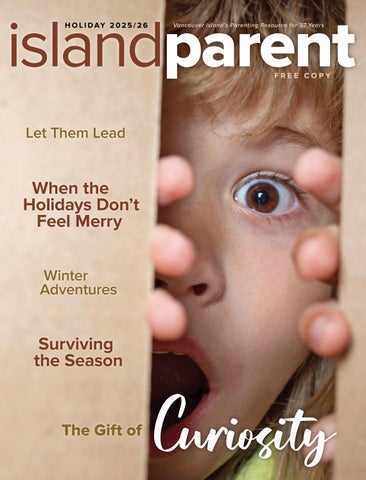
Island Parent Magazine, published by Island Parent Group Enterprises Ltd., is a bimonthly publication that honours and supports parents by providing information on resources and businesses for Vancouver Island families. Views expressed are not necessarily those of the publisher. No material herein may be reproduced without the permission of the publisher. Island Parent is distributed free in selected areas. Annual mail subscriptions (7 issues) are available for $21 (GST included). Canadian Publication Mail Product Sales Agreement 40051398. ISSN 0838-5505 For distribution inquiries, please email publisher@islandparent.ca
Curiosity Never Gets Old
Writer and public relations specialist Jenn Wint recently wrote “curiosity isn’t ignorance, it’s a step towards understanding” and it got me thinking... When was the last time you were truly curious about something and took the steps to learn about it?
Kids are curious by nature. They have to be—it’s how we, as humans, learn. If babies weren’t curious about what would happen if they lifted their heads off the floor when you put them on their tummy, they would never learn to crawl. If toddlers weren’t curious about the noises coming out of your mouth and therefore tried their hardest to replicate them, they would never speak. If kids weren’t curious about what that other kid over there is playing with, they would never learn social skills. If young adults weren’t curious about a certain field of study or trade, they would never become professionals or experts in that area.
But once we reach that point, our natural curiosity tends to wane (or at least “life” gets in the way, and we no longer pursue it). Of course, we still learn and grow through our jobs but how often do we have our interest piqued and take steps to find out more about a topic that truly resonates with us?
Luckily, if you are a parent, there is a good chance your child has brought up an area of interest, and you have had the opportunity to dive into it with them—maybe even a bit deeper than you would have liked. Perhaps you have recently become an expert on Minecraft (I know I have thanks to my eight-year-old son) or maybe you know all there is to know about Taylor Swift (my 11-year-old daughter has made sure of that!).
This is a great reminder to not let your interests pass you by no matter how crazy life gets this holiday season and beyond. Sure, research takes time but look at your child over there building their 100th masterpiece out of the LEGO they got from Santa. They are loving every second of it and you deserve that joy too.
Let your curiosity take you on a journey where you try something new or learn a skill. Take the family skiing for the first time, start a conversation with the new person at work, make this the year you take that trip… Curiosity is not only crucial for human development and progress, it’s also fun. Isn’t it about time you see where yours can take you?
– Stacie Gaetz
Rain or Shine
Winter Adventures for Island Families
Part of what makes Vancouver Island so special is our unique coastal climate. While much of the country is bundled up and blanketed in snow, winter here on the Island is mild enough for year-round family adventures.
But we’ve all been there—it’s another drizzly weekend. Suddenly it’s Sunday night and you realize no one has left the house for days.
Bringing your kids to play outside at a park or connect with nature in the winter is a great way to stay off screens and build new memories. Make this the year you don’t stop adventuring just because the weather is wet.
Winter Playground & Park Tips
• Dress in layers, especially if you’re adventuring near the ocean. Coastal winds can pick up quickly!
• Wear rain boots or waterproof shoes. Even if it’s not raining when you head out, surfaces may be wet and showers can start up anytime.
• Brightly-coloured or highly visible clothing can help kids to stand out at the park or on the trail in foggy weather.
• Look for non-slip surfaces like rubber when it’s raining or wet. Keep the potential for slippery play structures in mind when choosing footwear for your adventure.
• Bring a thermos or snack to share. What could be better than hot cocoa outdoors on a chilly day?
Check out our list of playgrounds, trails and rainy-day activities to keep your kids outdoors, engaged and inspired this winter.
Playgrounds
Old Mill Park, Shawnigan Lake. The wooden play structures at this park make it a great low-slip option for wet weekends. Kids will love exploring and climbing on the unique structures, and you will love how much energy it gets out!
Gyro Park, Sinclair Road, Saanich. A classic neighbourhood playground with plenty of space for running games, swings and sandbox adventures. Everyone loves climbing on the iconic sea creatures!
Esquimalt Memorial Park, Esquimalt. Check out Esquimalt Memorial Park and hop aboard the tugboat play structure! Wide-open fields, playgrounds and walking paths make this park a great spot for family adventures.
Westshore Towne Centre, Langford. Ok, this isn’t technically a park, but it’s perfect for a stormy day when you still want to get out of the house! Westshore Towne Centre has a fun and engaging play area for kids. Plus, make sure to keep an eye on their website for kids’ events and activities.
Brookfield Park, Courtenay. Brookfield Park combines playground fun with open fields and gentle walking trails. Families
Kinsol Trestle
can enjoy climbing structures, swings, a picnic area and open green space.
Rosedale Park, Saanich. This neighbourhood favourite features playground equipment, forested trails and picnic benches. Kids can splash through puddles, explore the paths and create their own adventures, while parents enjoy a peaceful walk or a cozy picnic in nature.
Hikes & Walks
Kinsol Trestle, Cowichan Valley. A short and accessible path brings you to the main event—a beautifully restored train trestle stretching over a roaring river. With higher water levels in the winter, it’s even more spectacular! Enjoy a piece of Vancouver Island’s history and learn with educational signs along the way.
Witty’s Lagoon Regional Park, Metchosin. Kids will love following the trail past a roaring waterfall down to a wide sandy beach. The waterfall is often even more spectacular during the winter, making this a must-see stop in your outdoor adventures this season.
Clover Point, Victoria. Rain or shine, this windy oceanside spot with dramatic skies is great for kite-flying, wave-watching and a seaside stroll.
Lighthouse Country Regional Trail, Qualicum Beach. This accessible trail is perfect for strollers and wheelchairs. With a playground nearby, this is a one-stop spot for all ages and abilities. Everyone can explore the magic of the forest!
Cathedral Grove, Port Alberni. Often buzzing during the summer months, the iconic Cathedral Grove is much quieter during the winter. Take a stroll through the ancient forest on a foggy day and create a magical, enchanted memory. The trails are a short, stroller-friendly trip with parking and washrooms, making this a fantastic spot for even the littlest adventurers.
Englishman River Falls Provincial Park, Parksville. This lush forest park is a magical spot for a family walk. Kids can marvel at the rushing waterfalls, explore mossy trails and feel the mist rise from the canyon below—a true rainforest adventure after the rain.
Katie Thompson is a mom, influencer and photographer who lives in the Cowichan Valley with her family.
After a cross-country move to the island several years ago, Katie was inspired to share her family’s adventures as they explore this magical place we call home.
Don’t Feel Merry
Helping Kids Handle Big Feelings & Big Expectations When Holidays
The holidays are often portrayed as joyful, cozy and magical but for many families, they can also be overwhelming. Between disrupted routines, overstimulation, family dynamics and unspoken expectations, both children and parents can feel emotionally stretched. Joy and frustration often show up together. That doesn’t mean something is wrong, it just means everyone is human.
Children don’t yet have the fully developed brains to regulate big emotions on their own. When their nervous systems become overloaded by noise, disappointment, exhaustion or social pressure, they flip into fight, flight or freeze. What they need most in those moments isn’t a consequence or quick fix, they need connection and co-regulation.
At the same time, parents may be carrying their own stress: financial strain, full schedules, perfection pressure or unresolved family tensions. When a child melts down over a broken cookie or the wrong socks, even a loving parent can feel themselves reaching the edge.
These moments are hard and yet, they’re also where emotional learning happens. How we respond as parents shapes how our children understand themselves, others and relationships. When families move through the messy parts with com-
passion rather than shame, kids learn to do the same and that’s where resilience begins.
When There’s Disappointment
Gift-giving is often where big expectations meet big emotions. Maybe your child didn’t get the gift they were hoping for. Or their sibling got something they secretly wanted. Or they open a present and say, “This isn’t what I wanted.”
In that instant, many parents feel a pang of embarrassment, frustration or hurt. It can feel like a lack of gratitude and our instinct is to correct it: “Say thank you.” “You should be grateful!”
But when we jump straight to teaching gratitude, we sometimes miss what’s really happening underneath. Most often, this isn’t about entitlement, it’s about disappointment. Your child can feel thankful for receiving a gift and still wish it were something different. Those two emotions can coexist.
When we misinterpret disappointment as ungratefulness, we risk shaming kids for being honest about a very normal human experience. But when we pause and make space for both feelings: gratitude and disappointment, joy and sadness, we help them develop emotional flexibility.
You might try saying: “You were really hoping for something else. It’s okay to feel disappointed and we can still show appreciation for what we’re given.”
That balance—empathy first, teaching second—is where real emotional learning happens.
Practical Strategies for Supporting Kids Through Holiday Emotions
Strategy #1: Pause Before Responding. Take a breath, soften your shoulders and speak slowly. Your calm nervous system is the most powerful tool in the room.
Strategy #2: Name the Feeling, Not the Behaviour. Try: “You’re really disappointed your cousin got the gift you wanted.” This helps kids feel understood, which lowers emotional intensity.
Strategy #3: Connection Before Correction. Problem-solving works best after a child feels safe. Once calm, you can talk about gratitude, tone of voice or kindness.
Strategy #4: Repair When Needed. If you snap, it’s okay. Try: “I was feeling overwhelmed and I yelled. I’m sorry. I love you, and I want to try again.”
Simple Scripts for Tricky Moments
• Gift Disappointment: “You were really hoping for something different. It’s okay to feel upset.”
• Overwhelmed in a Busy House: “There’s a lot happening right now. Let’s take a quiet break together.”
• Sibling Conflict: “You both want the same toy. I won’t let anyone get hurt. Let’s figure this out.”
• When a Parent Loses Patience: “I’m feeling overwhelmed too. I’m going to take a breath so I can help better.”
Darcy Harbour, MA, RCC is a family counsellor and director of Harbour Family Counselling in Victoria. She supports parents and children in building emotional resilience, connection, and confidence. Learn more at harbourfamilycounselling.ca
Things YOU NEED TO KNOW
Yoto Players at GVPL
Your little readers can now read along with audiobooks suitable for ages three to 12 with the Yoto to-go kits offered at Greater Victoria Public Library branches. gvpl.ca
Festival of Trees
The BC Children’s Hospital partners with the Victoria Bay Centre and SEAPARC Rec in Sooke to offer the Festival of Trees fundraiser until December 31. fundraise.bcchf.ca 1 2 4 3 5
Festive Bricks of Giving
The Parkside Hotel and Spa is once again partnering with Rainbow Kitchen for Festive Bricks of Giving until December 28 for a celebration of LEGO creations from local artists and families. parksidevictoria.com
Moms, Muffins & Munchkins
A community playgroup for moms and their children under age five at the Shelbourne Street Church of Christ in Victoria every Monday morning. shelbournestreetchurch.com
Students Learning Lifesaving
Lifesaving AEDs and naloxone kits will soon be offered in all Nanaimo Ladysmith School District high schools, with elementary and middle schools being equipped next September. sd68.bc.ca
One Earth Living
One Earth Living offers educators and parents in Canada resources to help their kids win fun prizes while doing good deeds for the environment. oneearthliving.org 6 7 8 9 10
Breakfast with Santa
Get your tickets to Delta Victoria on December 14 or 21 for a buffet breakfast, cookie decorating, Four Frames Photo Booth and a visit from Santa. deltahotelsvictoriaoceanpointeresort. realtimereservation.com
The Victoria Symphony and the Ballet Victoria dancers bring you The Gift of the Nutcracker from December 28 to 30 at the Royal Theatre. balletvictoria.ca
Yellowpoint Christmas
The 17th annual Yellowpoint Christmas Spectacular brings its mix of song, dance and spirit to Courtenay, Nanaimo and Victoria. Showtimes run from December 10 until 20. yellowpointchristmasspectacular.ca
Christmas Express Ride the train through an incredible holiday wonderland at the BC Forest Discovery Centre in Duncan until December 23. bcforestdiscoverycentre.com
A New Way of Learning for Our Curious Kids Let Them Lead
Paper airplanes. Hundreds of them. In every room, every bag, every car cup holder.
If there is a surface in our home that isn’t already covered with them—give it five minutes.
But here’s the thing: When my son is folding those airplanes, I see something in him shift. His focus sharpens. His hands, steady. He becomes calm, grounded, regulated. He’s “in the zone.”
He’s learning through doing—through building—through motion.
And yet, as parents, even when we love our children’s interests, we can find ourselves frustrated by the timing of them.
Like… bedtime. Or minutes before school drop-off. Or any moment when we’re already overwhelmed and running behind.
So, one morning, seeing yet another paper airplane peeking out of his backpack, I made a comment to his teacher that came straight from that old conditioning—the place in me that fears judgement, the place that sees me as a good parent:
“Feel free to take the airplane away if it’s distracting him…”
But her response stopped me in my tracks. She smiled through her bold, chunky glasses and said, “Oh, his airplanes are great! I let him and the other kids test them out in our dedicated ‘classroom neighbourhood,’ next to our room. And if he’s okay with it, I’d like him to teach a lesson in our STEM class sometime this year.”
For once, I was at a loss for words.
She sees him.
She sees his strength.
She doesn’t see the distraction.
She sees a child learning in the way his brain naturally learns.
And in that moment, she also gave me permission to honour my natural inclination to follow his lead. To believe that his way of learning is valid. To stop trying to fit him into a mould that was never made for him.
A few months later, life moved us across the country as we became the primary caregivers for his ailing grandpa. The paper airplanes multiplied and soon became a source of connection. We continued school remotely, and true to her word, his teacher made that STEM lesson happen—via Zoom.
There he was—my son—confidently teaching his entire class of six- and seven-year-olds how to fold paper airplanes, explaining the logic of wing shape and launch force.
Leading.
Confident.
His tiny hands and raspy voice moving in harmony as his classmates enthusiastically let him take the lead.
Learning didn’t stop because our life changed.
It simply found a new shape. One uncannily similar to that of a glider delta wing.
And yes—part of his teacher’s Christmas gift from our family included a replacement ream of printer paper. Because when a teacher chooses to celebrate the spark in a child—when they take what could easily be dismissed as disruptive or “too much” and instead transform it into confidence, community, and belonging—they’re going to need a much bigger paper budget.
His paper airplane obsession was a doorway, not a distraction.
For another child, it might be rearranging the same LEGO structure 20 different ways.
For another, it’s taking apart toys to understand how they work, or climbing everything in sight to test balance and courage or losing themselves in water play. (Lucky for my already overwhelmed brain and my aching LEGO-induced feet trauma, my kiddo dabbles in all the above).
These interests can look messy, loud, inconvenient. But they are also windows into how our children process the world.
This is education.
Hands-on exploration develops resilience, imagination, patience, innovation and confidence.
Learning is not only what happens at a desk. Learning is a child discovering who they are.
And sometimes, all we need to do is step back and say: “Show me how your mind works. I’m here. I’ll follow your lead.
When we follow their curiosity instead of resisting it, that’s where the magic of connection happens.
Supporting Your Child’s Strengths (Without Losing Your Mind)
1. Name the Strength Beneath the Behaviour. Instead of “They won’t stop fidgeting.” Try: “Their body needs movement to learn.” This takes away the need to constantly correct.
2. Build a “Yes Space” for Their Interest. A bin of scrap paper, a LEGO corner, a designated water play towel and bucket that lives close to a sink (this has been a gamechanger for us!), a small basket of child-friendly tools and fixable items. Give their passion a home.
3. Collaborate with Their Teachers and Care Team. Share what lights them up and ask how it can be woven into learning time. When home and school reflect a child back to themselves with acceptance, confidence grows.
Deb Balino is a Victoria-based writer and mom of two, navigating life in the sandwich generation. She’s the podcast host of Sass & Small Talk on TELUS/StoryHive, exploring the mental load of parenthood, sharing stories from the trenches of raising a neurodivergent family, while balancing advocacy, business and caregiving.
They’ll
‘Pop’
When They’re Ready
Learning How Not to Compare Your Kids
About five years ago, my eldest son was enjoying the last few weeks of summer before starting kindergarten.
One night, while reading a bedtime story together, it hit me—he wasn’t recognizing any words when I encouraged him to try. Not even the simple ones.
That familiar wave of mom-guilt crept in. Somewhere along the way, I’d absorbed the idea that kids should be able to read a few basic words before kindergarten. I worried that I hadn’t focused enough on “sight words”—those little connecting helper words like the, and, is, to, was and so on.
After some quick research, I learned these high-frequency words appear so often in books—and don’t always follow regular phonics rules—that it helps when children memorize them by sight.
So, I dove in. We started reading together every night, pointing out the sight words and recalling them as they appeared on the next page. I figured if we repeated them enough times, it would eventually click.
But it didn’t. Not right away.
Then a wise friend told me something that stuck: “When it comes to learning, kids are like popcorn—they pop when they’re ready.”
And that really clicked for me.
My son went off to kindergarten, and in his own time, began recognizing and reading those sight words. Before long, he was reading full books on his own, curled up before bed, softly reading aloud just for the joy of it.
That moment shifted something in me. “Have a little more trust in the universe,” I whispered to myself.
My firstborn taught me to have faith in the natural rhythm of learning and development. But then—my universe tested me again. With twins. Boy-girl twins, who I’ve been told countless times not to compare to one another. And yet, that’s easier said than done.
When you give life to two beings who once shared a womb— who’ve been in sync since their very first heartbeat—it’s hard not to compare. But as fraternal twins, they only share a birthday.
They’ve always had their own pace, their own way. My boy twin, Liam, was born one minute earlier and has often been weeks (sometimes months) ahead in things like crawling, walking and coordination. Mila, on the other hand, has always led with personality—sass, confidence and independence. She’s the boss, and he’s her biggest supporter.
My husband and I sometimes catch ourselves comparing their development to where our eldest was at that age and then remind ourselves that it’s neither constructive nor fair. They had completely different starting lines.
Twins often show what’s called developmental trading—one may advance in language while the other excels in physical or social skills, balancing each other out over time. They also tend to communicate more with each other than with adults, using shared cues, gestures or even their own mini language (which I can absolutely attest to!).
It’s one of my favourite parts of being a twin mom—even if it sometimes makes their speech appear delayed when, in truth, they’re communicating beautifully in their own way.
Now, a few months into kindergarten, I’ve noticed some of those same old worries creeping back in—especially around reading. But this time, I’m doing my best to quiet them. Because what I’ve learned about learning is that our children are our teachers, too. They’ve taught me to slow down, to have faith and to trust the process of popcorn—because they’re always learning. And they’ll pop when they’re ready.
Natasha Mills is a twin mom of three living and raised in Victoria for over 30 years. She is a published author in the parenthood space and a full-time digital creator on social media. Find more of her content at @mommamillsblog.
New classes starting in January. Sign up for a demo today!
A Cook-Together Holiday Lasagna
Red, white and green lasagna is a holiday tradition in my family. My parents always made a massive lasagna on December 24 and it’s a tradition I’ve maintained with my children. There are a few reasons why we make this classic comfort meal part of our holidays:
• The colour scheme is a great shout-out to seasonal décor.
• We make a huge batch, which means there are leftovers for lunch the next day.
a meat and vegetable lasagna, add cooked ground beef to the middle layer of tomato sauce.
Ingredients
1 package of oven-ready lasagna noodles
11⁄2 cups grated mozzarella
1⁄2 cup Parmesan cheese
• This recipe is packed with invisible veggies, which provide a nice balance to the cookies and treats that dominate this time of year.
It’s a great family activity on a day that is usually a bit boring. If your kids are anything like mine, they tend to be grumpy with anticipation and overstimulation. Cooking a big meal together is a nice way to connect and relax.
Here’s how your kids can help:
• The youngest helpers can layer lasagna noodles and sprinkle on cheese.
• Little kids can help with grating cauliflower and cheese and squeezing the water from the spinach.
• Older kids can help make tomato sauce and cook the filling.
Red, White & Green Lasagna
(Prep Time: 30 min, Bake Time: 60 min)
Here is our favourite holiday lasagna. The prep is a bit timeconsuming if you do it on your own, so get everyone to work on it together! You can also save time by using jars of pasta sauce (you need 4 cups), frozen cauliflower florets (about 6 cups) and pre-grated packages of cheese. If you want to make
White Cauliflower Layer
1 medium-sized head of cauliflower
3 cloves of garlic
2 Tbsp olive oil
1 cup of ricotta cheese
1⁄2 tsp salt
1 egg
Red Tomato Sauce Layer
1 large onion
2 cloves of garlic
2 Tbsp olive oil
28 oz can of crushed tomatoes
1 Tbsp of Italian seasoning or mixed basil and oregano
1⁄2 tsp salt and pepper, to taste
Green Spinach Layer
10-ounce package of frozen spinach, thawed
21⁄2 cups of grated mozzarella
2 cups of ricotta cheese
1 egg
1⁄2 tsp salt
Cooking
The White Layer
Coarsely grate the cauliflower, including the core of the head. This can be done with a typical box grater, but it’s faster with a mandolin. Finely dice the garlic.
Heat a frying pan on medium. Add the olive oil, grated cauliflower and garlic. Sauté until the cauliflower is soft, about 5–6 minutes.
Remove from heat and allow to cool for 15 minutes while you prepare the rest of the layers.
When the cauliflower has cooled, mix in the ricotta cheese. Add salt to taste. Then stir in the egg.
The Red Tomato Sauce Layer
Dice the onion and garlic.
Heat the olive oil in a medium-sized saucepan. Add the onion and sauté until soft.
Add the crushed tomatoes, garlic and Italian seasoning. Bring to a simmer, reduce the heat and let the sauce simmer with the lid on while you prepare the rest of the lasagna. Add the salt and pepper, taste and adjust the salt as needed.
The Green Layer
Squeeze the thawed spinach to remove all the excess liquid.
Combine the spinach with the mozzarella, ricotta, egg, and salt in a bowl. Mix well.
Assembly
Preheat the oven to 350°F and grease a 9x13 inch lasagna pan.
To assemble the lasagna, place a 1⁄2 cup of tomato sauce on the bottom of the pan, followed by a layer of noodles. Don’t overlap the noodles, or they won’t cook properly. Add 1 cup of tomato sauce in a thin layer, top with the cauliflower filling.
Lay out a second layer of noodles on top of the cauliflower filling. Cover the noodles with 1 cup of tomato sauce. Top with the green spinach layer.
Place a third layer of noodles on top of the spinach. Pour over the remaining tomato sauce. Make sure all the noodles are fully covered. Sprinkle on 11⁄2 cups of mozzarella and 1⁄2 cup of Parmesan cheese.
Cover the lasagna with tin foil and bake for 45 minutes. Remove the tinfoil, then bake, uncovered, for another 15 minutes, until the cheese is browning and the sauce is bubbling.
Allow to cool for 10 minutes before serving.
Emillie Parrish loves having adventures with her two busy children. You can find more of her recipes in her cookbook Fermenting Made Simple. fermentingforfoodies.com
Noelle Fraser
Don’t Have an Ugly Christmas Sweater?
Make One!
Make December memorable and creative for your kids by spending time crafting, decorating, creating and just having fun while they use their imaginations. One idea for their creative skills is to make a festive “Ugly Christmas Sweater,” which has become a symbol of holiday cheer. The “ugly sweater” trend began in the 1950s when Christmas-themed pullovers called “Jingle Bell Sweaters,” were decorated with traditional symbols such as Santas, snowmen and other whimsical decorations.
This resulted in a comical mismatched look. However, the term “ugly” is used humorously, as ugly sweaters are meant to be cheerful and fun.
To begin, all you need is a plain pullover sweater that you may already own or perhaps you can find a sweater at a thrift shop. You only need minimal sewing skills such as the running stitch as most of the sweater suggestions below
have no-sew directions and the use of fabric glue.
Mitten Sweater
Draw around your fingers and thumb on a piece of paper to create mitten shape templates. Make small mittens and large mittens. Then, cut out the mitten templates and pin them onto colourful fabrics such as red, green or bright pink. Cut out all the mittens and decorate each mitten with trims, lace and whatever you can find in your sewing box. With a needle and thread, sew each mitten randomly onto your sweater with a running stitch or use fabric glue. Now, bling it out! This is the fun part! Add small sparkly pom-poms, buttons, jingle bells, beads and glitter… use whatever you’ve got!
Snowflake Sweater
Put a mug upside down on top of a piece of white fabric. Then draw lightly around the mug with a pencil. Using a
pair of scissors, cut out the circle you have drawn. Then, fold the circle in half, then fold it in half again. Cut triangles of different sizes from each edge of the folded shape. Open out the circle to reveal your snowflake. Make as many snowflakes in different sizes as you like. Glue sequins onto the snowflakes and hand sew the snowflakes onto the front of your sweater. Make different sized snowflakes. Add glitter glue for further decoration.
Colourful Sweater
This is a fast sweater to make. Gather any Christmas decoration you can think of: bows, bells, ornaments, garland, ribbon and place it on a sweater. Then, begin stitching the items onto your sweater with a needle and thread. For further bling, sew on colourful beads and sequins.
Snowman Sweater
Make the snowman by cutting out three round circles onto white fabric. Use a dinner plate for the large circle, a soup bowl for the middle circle and a mug for the snowman’s head. Place each circle onto your sweater and stitch in place using the running stitch to form the snowman. To make the “carrot”nose, cut out a piece of orange felt fabric and stitch in place. For the eyes, cut two circles of black felt and glue into place. Customize your snowman with a colourful scarf, black top hat or even small jingle bell buttons. Then head to that Ugly Christmas Sweater party to show off your creation!
Jerri Carson is is a retired SD61 primary school teacher as well as teaching music and choir. She volunteers on the VOS Musical Theatre costume crew, sewing costumes and working back- stage during costume changes.
HER FUTURE BEGINS
Books to Inspire Your Brave Little Explorer
As a homeschool mom, I am in the thick of learning and teaching right now. While it’s a lot of fun to introduce my children to different subjects or activities, it can also be a challenge (especially when it’s a topic I don’t know a lot about).
Fortunately, I have books to help me out. We can read them to encourage us to try new activities or learn more about the ones we already love. For example, after reading the book about Rubik’s cubes my son and I learned how to solve them. My hope is that by sharing this list with you, you and your kids can find something new to try as well.
As an avid rock-climber, the first book, How to Solve a Problem: The Rise (and Fall) of a Rock-Climbing Champion by Ashima Shiraishi and illustrated by Yao Xiao is close to my heart. This illustrated non-fiction book is written by one of the best climbers in the world and it is about how climbers look at and solve problems (which is what rock climbers call a “bouldering challenge”). While the story’s angle focuses on climbing, the advice Shiraishi gives is applicable to any issue your child might face. For ages 4 to 7.
If you’ve ever tried to solve a Rubik’s cube, you probably know the confusion and struggle of the kids in Me and the Magic Cube by Daniel Fehr with illustrations by Golden Cosmos and translated from German by Marshall Yarbrough. The main character finds a magic cube in a box (which is the actual name of a Rubik’s cube). They think it’s six-coloured sides are beautiful, but after a bit of twisting, the sides don’t match up. No matter how much the main character tries, they can’t get the cube back together and neither can their friends. Alongside the story, the book is filled with facts about the Magic Cube from when it was invented, how it’s made and what’s the fastest it can be solved. If your kids are just getting into this 3D puzzle, they might be interested in learning more—it even has tips on how to understand directions to solve it. For ages 6 to 10.
The third book you might consider reading is Bunny Made Tea by Amanda Baehr Fuller. This cute story is all about a bunny who really wants a cup of tea. However, she is not the only one who wants the cozy beverage, so she must make it repeatedly without ever getting to drink a cup herself. What bunny doesn’t realize is that her guests are not just drinking tea, they’re learning too. For ages 2 to 5.
Another story that might kindle your children’s imaginations and desire to learn and try new things is My Friend the Paintbrush: The Colorful World of Mark Pfister and translated by David Henry Wilson. This book, which is as colourful as promised, is about the different styles and techniques that Pfister uses to create his illustrations. While the poem doesn’t cover precisely how he does it in the story, it shows your children what’s possible. There’s a gallery at the end where Pfister lists his books and explains what he did to create the images. For ages 4 to 7 (though older kids might enjoy reading about the techniques at the end).
The final book isn’t about an activity; it’s about an event.
Welcome Uncle Nowruz: A Persian New Year’s Story by Rashin Kheiriyeh, is about Persian New Year’s and the arrival of spring. It’s a cute story about Nane Sarma who wants to stay awake to meet Uncle Nowruz. All her grandchildren gather to set the table with the seven items they need for the party, but Nane Sarma struggles to stay awake after all her hard work. For ages 4 to 7.
I hope these books encourage you and your children to try
something new. Who knows, maybe you’ll discover a love for rock-climbing, solving Rubik cubes, making tea, painting, studying new holidays or something else.
Christina Van Starkenburg lives with her husband, children and cat. She is the author of One Tiny Turtle: A Story You Can Colour and many articles. To read more of her work and learn about her upcoming books visit christinavanstarkenburg.com
How Jesse’s House Will Transform the Family Care Experience
Each year, thousands of Island families must leave home for health care. In Nanaimo, the nearest hotel is over two kilometers from the hospital. Mothers in early labour from Ucluelet face a 2.5-hour drive, while families from Port Hardy travel 388 kilometres.
Jesse’s House in Nanaimo will bring families closer to care, removing a major barrier to vital health services.
Children’s Health Foundation of Vancouver Island recently announced a $10-million fundraising campaign to build a home away from home for Island families travelling to Nanaimo for their child’s health care. The announcement was made at a special
groundbreaking ceremony held at the future site of the home on the Nanaimo Regional General Hospital campus on October 8.
The 16-bedroom facility, named Jesse’s House, will welcome families from across Vancouver Island and the surrounding islands who need a place to stay while accessing Nanaimo Regional General Hospital and nearby health care services. Construction is estimated to be complete by spring 2027.
Jesse’s House is named after Nanaimo resident Sheri Shanahan’s daughter, the late Jesse Shanahan. Sheri has been an important partner and champion for a home away from home in Nanaimo ever since she stayed at Jeneece Place while Jesse was admitted to the neonatal intensive care unit at Victoria General Hospital.
“When my family stayed at Jeneece Place, it gave us comfort during one of the hardest times of our lives,” said Shanahan.
“I am so excited to have worked alongside Children’s Health Foundation of Vancouver Island to bring the vision of Jesse’s House to life. This home away from home will have a huge impact on the lives of Island families, providing a safe, warm place where they can receive the same support that meant so much to us, and be just steps away from their child.”
Jesse’s House will be the third home in the Foundation’s Homes Away From Home program, with others in Victoria and Campbell River. Jeneece Place was established in 2012, after Jeneece Edroff (now known as Frankie) asked the community to rally behind the development of a home for families to stay while their children received health care in Victoria. In 2021, together with families, health care providers and community groups from northern Vancouver Island, the Foundation expanded the model to open a second home in
Campbell River called Q ’ walayu House.
“It’s wonderful to see the Foundation expand into Nanaimo to support families north of the Malahat who need to travel to access care for their kids,” says Paul Murray, board chair of Children’s Health Foundation of Vancouver Island.
“Jesse’s House will have such a large impact for generations to come, and we are excited to work alongside the community to bring it to life.”
To date, the Foundation has generated $7 million for the project through assurances from the community, including Coastal Community Credit Union, Budget, the Rogers Foundation and an anonymous donor who stepped forward with an astounding $2 million core funding gift.
“The Nanaimo community has stepped up in such a big way to meet the growing demand for a mid-Island home away from home,” said Veronica Carroll, CEO of Children’s Health Foundation of Vancouver Island.
“With no government funding for this project, every bedroom, shared space and moment of support this home provides to families will be thanks to the generosity and foresight of people in this community. It is truly inspiring.”
Through a collaborative agreement with Vancouver Island Health Authority (VIHA), the Foundation has been granted a 40-year lease for a parcel of land on the Nanaimo Regional General Hospital campus.
“Jesse’s House will provide muchneeded comforts of home and familiarity during very difficult times for families,” said Leah Hollins, Island Health board chair.
“We are so thankful to Children’s Health Foundation of Vancouver Island for their support of families, and to Jesse’s mom, Sheri, for creating such a powerful legacy from her own personal hardship. Jesse’s House will take the
You come first at Olive. Always. We understand that every fertility journey is unique. We are here to support you every step of the way on your path to parenthood.
You come first at Olive. Always.
You come first at Olive. Always. We understand that every fertility journey is unique. We are here to support you every step of the way on your path to parenthood.
You come first at Olive. Always.
You come first at Olive. Always. We understand that every fertility journey is unique. We are here to support you every step of the way on your path to parenthood.
We understand that every fertility journey is unique. We are here to support you every step of the way on your path to parenthood.
worry of accommodations away so families can focus their energy on their loved ones receiving care.”
The project’s lead architect is Alan Lowe, who also designed the Foundation’s two other homes, Jeneece Place and Q ’ walayu House. Tectonica Management Inc. of Nanaimo is the project’s construction manager.
Children’s Health Foundation of Vancouver Island is working with a dedicated committee and dozens of community partners to help make this dream a reality.
Learn more and donate at islandkidsfirst.com .
Stacie Gaetz is the managing editor of Island Parent Magazine and the proud mama of a delightful daughter and silly son who fill her days with love and chaos. She thoroughly enjoys supporting, connecting with and informing parents through interesting articles like this one. Reach her at editor@islandparent.ca.
We understand that every fertility journey is unique. We are here to support you every step of the way on your path to parenthood.
Olive Fertility Centre is one of Canada’s leading IVF and prenatal diagnosis centres, with clinics in Vancouver, Surrey, Kelowna and Victoria. We offer inclusive fertility care for those with infertility or secondary infertility, LGBTQ2SIA+ persons and people needing donor sperm, donor eggs or surrogacy, egg freezing, and beyond.
Vancouver Island’s only full-service IVF clinic.
545 Superior St. Victoria, BC | 250-410-1664 | olivefertility.com/victoria
Vancouver Island’s only full-service IVF clinic.
545 Superior St. Victoria, BC | 250-410-1664 | olivefertility.com/victoria
Every December, I make personalized Christmas cards. I love doing a little family photo shoot and choosing the best picture. I love uploading the winner to Vistaprint and I pouring over backgrounds. I love debating what the best family message to include should be.
Once the Christmas cards have been ordered, I wait eagerly for the package to come in the mail, choose the right moment to savour opening the fat envelope and marvel over how our digital image has magically come to life through the heft of cardstock. Then comes the stage of thinking who we should send the cards to: Who we’ve become closer to this year and who we don’t see very often but still feel connected to. I make a spreadsheet with the recipients and their addresses and it’s always a bit of a life assessment—how have our relationships changed over the year? Who are new friends that get added? Who have we grown closer to? Who has drifted away?
As much as I love making and writing and sending custom-
ized Christmas cards, I also dislike doing Christmassy things in November, or worse, anytime earlier than that. I like keeping November relatively empty—a breather between Halloween and Christmas. A month when there aren’t witch or ghost or holly or stocking gel stickies on the windows and the mantel is covered with the usual clutter rather than holiday-themed clutter. I’ll buy some stocking stuffers in November but most of the presents I buy in December. Because well, it’s fun and it feels festive to Christmas shop that time of year. November is a wet and dreary month, not a seasonal one. It’s a time for Halloween recovery, Remembrance Day and soaked soccer practices. Card making isn’t the only holiday tradition I enjoy. I like choosing wrapping paper from Winners and little gift labels from the Papery. I like making a list of who I’m getting presents for and what will go in the stocking. I like making shortbread cookies (because if you don’t make them at Christmas, when do you make them?). I like making photo albums for the grand-
parents or at least finding a couple of good pictures of them with my daughter to print out.
I like all these Christmas traditions, they’re meaningful. They prompt reflection and connection. They make a cold and dark time of year more exciting. Yet, they also happen at the same time as the school Christmas concert, the gymnastics medal ceremony, the “deciding who will host Christmas dinner and when,” the planning our annual New Year’s Day hike and pot luck…
On their own, each of these Christmas traditions is a treat. If the only task was making Christmas cards and sending them, that would be enjoyable. Christmas shopping by itself is enjoyable. Hosting dinner can even be enjoyable—if you have the time to plan and clean and defrost a turkey. But all of them at once? And under a strict timeline? The time pressure and multitasking turn fun activities into panic-induced chores. Half of me likes sending the cards, the satisfying feeling of a stack of envelopes getting dropped into a letter box, while the other half of me starts to simmer: “No one sends us cards anyways! They’d better appreciate this.”
A friend of mine says that she does all her Christmas preparations in November: “I feel way less stressed now that I do everything early, I’d really recommend it.” To which I give her an imaginary middle finger: “Thanks tips.”
This is, of course, the most obvious solution to manage the
mayhem but I am truly not the type who has a spreadsheet for anything other than Christmas cards. The idea of a type-B person like me pulling off all the Christmas prep by November 30 is laughable.
Have I learned from my frenzied Christmases past? Does the ghost of last year’s midnight present wrapping or pre-Christmas party insomnia inform my Christmas present? Not really. I have learned to take a few extra days off leading up to Christmas, favourite a few good photos in November, keep an eye open for cute angels for grandma’s collection whenever I’m shopping. But I still always get stumped on my brother and pull something together last-minute. I still don’t even take the photo that will end up on our cards until early December. Our cards often end up with a “Happy New Year” note scribbled on the envelope. But hey, they get there in the end.
What’s Christmas without a little overwhelm? And who am I without my aversion to November Christmas prep? Maybe one day I’ll learn…but not this year.
Julia Mais is a policy and communications professional in Victoria. She looks for beauty in the everyday through writing, photography and the outdoors. She lives in a messy, cheese-filled home with her husband and young child.
JOURNEYS OF THE HEART Cultural Learning Program at Hulitan Early Years Centre
Journeys of the Heart is a culturally-rooted drop-in program for Indigenous Children aged 0–5 years and their parents/caregivers/relatives.
Participation in the following activities will support positive cultural identity and lifelong learning:
Circle time • Moe the Mouse • Seeds of Empathy • Honoring our Wing Chief Free Play • Curriculum • Snack Time • Outside Play • Physical Activity • Fieldtrips
Program runs Monday and Wednesday 9 to 11:30 am (closed stat holidays) Program starts October 6 and runs until the second week of June
For further information please contact Sarah McDonald at 250-590-5048 or smcdonald@hulitan.ca A program of Hulitan Family & Community Services Society Hulitan Early Years Centre 2125 Sooke Rd 250-590-5048 hulitan.ca
The Surprising Magic of One-Minute Breaks
It was 3 pm on a Tuesday, and I was one sarcastic eyeroll away from losing it. My kids were bickering, my to-do list felt like it had multiplied overnight and I hadn’t even thought about dinner. I remember sitting in my car for exactly 90 seconds, feeling my shoulders drop, and suddenly having the patience and presence I wanted to bring to my family.
That moment changed everything.
Here’s what I know from talking to so many parents: we’re not lazy for not meditating for 30 minutes a day. We’re busy. And we’re also drowning in the myth that self-care must be a luxury ritual with candles and quiet time. The truth? You don’t need a meditation pillow or an empty house. You need intentional pauses—tiny moments woven through your day that remind you who you want to be.
The Real Problem: Our Best Selves Show Up Only 20 Percent of the Time
Most of us don’t realize that even when we want to be at our best, we only access that version of ourselves about 20 percent of the time. The other 80 percent? We’re running on autopilot, driven by what the Positive Intelligence® framework labels “Saboteurs”—those inner voices that push us to overachieve, control everything, people-please, obsess over our to-do lists or get restless for something more. Sound familiar?
That harsh inner critic telling you you’re not doing enough? That’s the Judge, the loudest Saboteur of them all. And it gets really loud during the holiday season.
The good news? There’s science behind this: new neural pathways become visible on MRI imaging within eight weeks of practice. Shirzad Chamine, a Stanford researcher, developed the Positive Intelligence® framework to help us access our “Sage”—that calmer, more present version of ourselves that leads with curiosity and compassion instead of fear and judgement.
The 10-Second Game Changer
Let me introduce you to PQ® Reps—micro-practices that take literally 10 seconds. These are your secret weapon, especially when you’re buried in holiday chaos.
Pick one:
• Feel your coffee cup. Notice the warmth on your palms. Really feel it. That’s it. You’re present.
• Smell something with intention. The pine tree outside. Your kid’s shampoo. Your own hand cream. Breathe it in fully.
• Focus on your daughter’s hair (or look at anything as if you’d never seen it before—your own hand, a leaf, your partner’s face). Just observe.
• Listen to a specific sound. The hum of the fridge. A bird outside. Your kid’s laugh. Really tune in.
These tiny moments snap you out of the hamster wheel. They’re like internal reset buttons that remind your nervous system: I’m safe. I’m here. I can breathe.
The 2-Minute Practice That Actually Works
When you have a little more time, try this:
Focus on your breathing. Notice the air coming into your nostrils—it’s slightly cooler. Then the air leaving your nostrils— it’s slightly warmed. That’s all. Don’t change anything. Just observe. Two minutes (not even!) of this, and your whole nervous system recalibrates with the PQ® approach.
Sounds too simple? Try it when you’re about to snap at your teenager and then tell me it doesn’t work.
When the Holidays Get Loud
The reality is this: our Saboteurs don’t just get louder in November through January—they throw a full party. The Judge tells us we’re not doing enough. The Controller demands we orchestrate the perfect holiday (gifts, decorations, matching PJs...). The Pleaser says yes to everything and doesn’t want to disappoint anyone. The Restless part keeps looking for the next thing instead of savouring what’s in front of us.
And then comes January with its “New Year, New You”
energy, and we pile on more pressure. But what if, instead of adding more to your plate, you just paused? What if you checked in with your intention and said, “Actually, I’m good. I showed up. That’s enough.”
This framework isn’t about becoming someone else. It’s about becoming more of who you already are—the patient version, the present version, the version that enjoys your kids instead of just managing them.
The Invitation
You’ve got this. You don’t need a meditation retreat (although that would be nice!). You need a coffee cup, a breath and 10 seconds.
The beauty of accessing your Sage, even in tiny doses, is that it compounds. After six to eight weeks, you’ll notice your kids are calmer around you. You’re quicker to laugh instead of snap. You’re present instead of mentally three tasks ahead.
That’s not magic. That’s neural rewiring. That’s you, finally, showing up as the parent you always knew you could be. Start today, 10 seconds at a time.
Linda Bartholme is a mom of three, educator and founder of Be Thriving Moms Today in the Comox Valley. She helps modern families boost their energy, overcome overwhelm and strengthen their connections through science-backed coaching and mindfulness. Join her free “Best Year Ever 2026” online workshop or book a complimentary session at bethrivingmomstoday.com
Each creative activity prompt is an opportunity for your child to embrace a new challenge. Through hands-on learning, your child is more likely to remain engaged and to build upon their creative problem-solving skills. Register today for September 2025 enrolment for 3 & 4 year olds
stcmontessori.ca 250-595-3213
2619 Currie Road, Victoria, BC V8S 3B9
Now receiving the new CCFRI (Childcare Fee Reduction Initiative)
A Parent’s Guide to Smoother Ski Trips
There’s nothing quite like seeing your child take their first wobbly glide down a snowy slope—their cheeks rosy, laughter echoing and confidence growing with every run. Skiing with kids can be one of the most rewarding family adventures of the winter—if you’re prepared.
Whether you’re hitting Mount Washington here on Vancouver Island or heading to the mainland for a weekend in Whistler or Cypress, a little planning goes a long way. With the right mindset and preparation, family ski trips can be full of fun, not frustration.
Start Slow
If your child is new to skiing, shorter is better. Think of heading to the hills for a morning adventure rather than a full-day marathon. The key is to stop while everyone’s still happy—even if you only get in a few runs.
Start on the bunny hill and cheer on every success. A little confidence goes a long way, and a few easy wins will make them eager to try again next time.
Dress for the Slopes
Cold kids are typically cranky kids. Proper layers are your best friend on the slopes—a thermal base, a cozy fleece and a waterproof outer layer. Add insulated mittens, a neck warmer and a good helmet. And don’t forget to pack extras because, somehow, gloves always get lost, and socks always get soaked.
Tuck a couple of hand warmers into your jacket, too. They’re like gold when little fingers start freezing.
Invest in a Lesson
Even if you’re an experienced skier, ski school is worth every dime for your kids. Instructors know exactly how to make learning fun, and as most of us know, kids often listen better to anyone but their parents.
Keep Your Expectations Realistic
Let’s be honest: Not every ski day will be perfect. There will be forgotten mittens, cold toes and quite likely tears. That’s okay. Take lots of breaks, keep it calm and don’t force it if everyone’s had enough.
Sometimes, the best memories come from snowball fights in the parking lot or sipping hot chocolate in the lodge instead of hitting every ski run.
Snacks Are the Secret Weapon
Pack a stash of easy, pocket-friendly foods (granola bars, trail mix, cheese sticks or fruit gummies). Keep them in an inside pocket so they stay soft and don’t get wet. Hungry kids lose motivation fast, and mountain food lines can be long.
Make the Journey Part of the Adventure
If you’re heading off-island, the trip can be part of the fun. Catching the ferry, spotting seals and grabbing a warm drink at the ferry terminal can turn a ski weekend into a mini family vacation. Even if you’re just making the trip to Mount Washington on island, pick a fun, scenic place midway there to grab a special treat and take some pictures.
Capture & Celebrate the Little Wins
Whether your child mastered the art of snowman making or made it all the way down the hill smiling, celebrate it! Take photos, laugh together and talk about the day’s adventures on
You’re not just teaching them to ski—you’re teaching them resilience, courage and joy in trying new things.
Pack Smart & Keep the Car Cozy
A well-packed car can save your sanity. Use bins to separate gear, snacks and dry clothes. Bring a cozy change of clothes and maybe a blanket for the ride home—nothing feels better after a day on the slopes.
If you’re driving up a mountain like Washington, make sure your vehicle is winter-ready with snow tires and an emergency kit.
In the end, skiing with kids isn’t about perfect turns or long runs, it’s about time together. So, pack the snacks, embrace the chaos and hit the slopes. You might just start a family tradition that lasts long after the snow melts.
As a way to keep things affordable, check out the SnowStart Kidz Pass. Available for kids ages six to 12, it allows three visits at each of the 60 participating ski areas across Canada—that’s more than 180 lift tickets so it’s like carrying a season’s worth of skiing in your pocket, all for $39.99 + tax!”
Erika Palmer is a writer living in Victoria with her husband and daughter. She believes most problems can
Victoria Butterfly Gardens’ Mango Turns 50
Aflamingo by the name of Mango at Victoria Butterfly Gardens recently celebrated his golden jubilee birthday.
Mango has been part of Victoria’s cultural landscape for decades. Originally seized by Canadian authorities after being smuggled from Cuba to Toronto, Mango was brought to Victoria’s iconic Crystal Garden Tropical Conservatory, where he quickly became a fan favourite.
When the conservatory closed in 2004, Mango and his bonded partner, Houdini (another male Caribbean flamingo), were relocated to Victoria Butterfly Gardens. Houdini has since passed away, leaving Mango as the patriarch of his flamingo pad. Though territorial, he welcomes thousands of human visitors each year, offering a glimpse into the beauty and personality of his species.
“Folks who saw him at Crystal Gardens are astonished that he’s still kicking and looking fabulous,” says Travis Budgeon, a horticulturalist who has been looking after Mango for years.
“I interact with him several times a day and always get cuddled before I leave.”
Mango is a Caribbean flamingo (also known as an American flamingo), a species native to the Yucatán Peninsula, northern South America and Caribbean islands. While these birds typically live up to 30 years in the wild, Mango has far surpassed that, making him one of, if not the, oldest living flamingo in the world.
His milestone age is a testament to the dedicated care he receives at Victoria Butterfly Gardens, where staff provide a customized non-slip habitat and a specialized diet to keep him healthy and vibrant. Known for his trumpets, honks and grunts, Mango is more than just a resident, he’s an ambassador for his species and he’s developed a special bond with Budgeon.
“The bond was unexpected and I cherish it,” says Budgeon.
“I’m a horticulturist and an emotional-support human for an elderly flamingo. Best job ever.”
Mango’s story reflects the broader mission of Victoria Butterfly Gardens: providing a haven for rescued and adopted animals, inspiring conservation awareness and offering immersive
tropical experiences to visitors of all ages. Victoria Butterfly Gardens is also home to thousands of tropical butterflies, free-flying birds, koi, tortoises and a wide range of rescued animals. Visitors can explore a lush indoor ecosystem filled with tropical plants, waterfalls and unique creatures from around the world. Learn more at butterflygardens.com.
Stacie Gaetz is the managing editor of Island Parent Magazine and the proud mama of a delightful daughter and silly son who fill her days with love and chaos. She thoroughly enjoys supporting, connecting with and informing parents through interesting articles like this one. Reach her at editor@islandparent.ca.
These local businesses are family-focused and committed to our community and helping you. Oak and Orca Bioregional School
inclusive, supportive, personalised K-12 education with abalance of inquiry and structure OL At Home Around BC On Campus in Victoria
oakandorca.ca
5 Smart Strategies for Newly Separated Parents
When you separate from your spouse and you have kids, life can be very stressful. As a single mom of two kids, who separated when my youngest was four (and he recently celebrated his 18th birthday), here is what I learned during those first few tender years of co-parenting.
1. Agree on a safe way to communicate. If talking on the phone always escalates to a shouting match, agree to text only for the first few months. Taking small steps to de-escalate the relational trauma that you bring to the co-parenting relationship can help you to detach from the hurt of the break-up. For the immediate future, the two of you are joined daily by the bond of parenthood. If there is a storm, you must go through it together.
2. Always take the high road. The kids come first. No matter what your ex-brother-in-law or therapy-bestie says, the root of the matter is your kids are watching you. Recently separated parents often feel raw, betrayed and most of us feel like lashing out at someone. Nothing adds gas to the fire more readily than fighting in front of the kids about the kids. By handling conflict in private, it will be less damaging for the kids. Try to show your children the best side of your adult selves. They will emulate that maturity and self-regulation sooner and more naturally. Kids learn from their parents and guardians, and newly separated parents need to pull up their socks and get parenting.
3. Embrace flexibility. Plan on changing the dates of big holidays to accom-
modate the other parent. Holiday times become the most stressful events in a child’s world if the parents are struggling to cope with not having them on a specific day. If you can start from the minute you separate to think of special times as being any time you get to spend with your child, then holidays can be smoother for everyone. The trick here is not to lock horns with your ex. No one wins and the children are always the ones who pay for your conflict (think anxiety and depression).
4. Do the paperwork. Do your separation agreement immediately. This document is really important. It doesn’t have to be complicated, but it does need to be finished and signed. You will use it more than you might be able to imagine now. There is no way around it. It requires
some work, some focused time without kids around, some bare basic statements of fact and some witnesses. It can be exclusive of custody agreements, and can be done with a mediator, a friend or a lawyer. It is a document that unzips the zipper of your defunct relationship. The BC government has many tools that recently separated parents can access. Familylawinbc. ca is a good place to start. We used mysupportcalculator.ca every year for the 14 years that we have shared kids and costs. Agreeing on some mutually acceptable tools to use can make the annual tasks much less stressful.
5. Focus on your individual strengths. If one of you is an extrovert and loves hosting the birthday parties, celebrate that! If one of you is really good a filling out school paperwork, own it! If you have a strong skill that you feel is easy for you as a parent, offer to do that for your kids. By voicing what you want to do in the new co-parenting relationship, you are waving a white flag. Think ahead to your next meeting or text: What can I offer to this new reality with my children? How can I contribute to some harmony?
6. Take care of yourselves! Exercise, healthy activities and resting are all parts of parenting well. You are going through an intense experience. It is a big, emotional, physical and psychological change that is happening in and around you. Be gentle to yourselves. Eating cake for dinner and watching sappy movies when you are by yourself is also a normal response to separation. It will pass. Activities that get you out of your head can benefit you, your children and your ex-co-parent relationship.
Take stock of what you have—you have beautiful, vibrant, demanding kids who need you now more than ever. Celebrate what you can achieve in your new normal and name your limitations. You might find you like your ex more as a person once you can establish some routine. Meeting yourself where you are is the biggest part of learning how to be a good parent or guardian.
Rachel Bevington is a member of the Lower Nicola band who lives and works on Salt Spring Island as a restoration biologist and mom. When not working or playing outside, she likes to be knitting and weaving in her studio in the forest.
Preschool & Childcare Directory
Lexie’s Little Bears Childcare Centre
1931 Millstream Road | 250-590-3603
We are a multi-award-winning, licensed, Reggio-inspired nature daycare, on four acres of forest land in the beautiful Highlands. We have four programs for infants/toddlers and pre-school age children. We are open from Mon to Fri, from 7am until 5:30pm.
Ages Infant/Toddler – 5yrs
Location Highlands
Website lexieslittlebears.com
Oak Bay Preschool
1701 Elgin Road | 250-592-1922
Preschool for 3 and 4 yr olds. Our learn through play approach fosters children’s sense of wonderment with the world around them.
Ages 3 & 4 yr olds
Location Oak Bay
Website oakbaypreschool.com
Aspengrove School
7660 Clark Drive, Lantzville | 250-390-2201
A Private University Prep School for Central Vancouver Island. Offering an exceptional International Baccalaureate education, Aspengrove School inspires its community and shapes life-long learners.
Ages 3 & 4 yr olds
Location Nanaimo
Arts Calibre Academy
250-382-3353
Lantzville, BC | www aspengroveschool ca ntzville, UR
Lantzville, BC | www aspengroveschool ca an zville, UR OUR
With a fundamental focus on visual arts, music, dance and theatre, our goal is to enable children to fully explore and express these gifts in an endless variety of ways. Accepting New Students.
Located in downtown Victoria, Christ Church Cathedral School is an independent primary and middle school offering strong academics in a warm and inclusive community.
Secondary Infertility
What you need to know to grow your family
If you are having trouble conceiving baby number two or three, you are not alone. Many women are shocked to find that they can’t get pregnant with a subsequent baby when they had no problem conceiving their first child.
Secondary infertility is defined as the inability to get pregnant following any prior pregnancy or the birth of one or more children. This condition is much more common than most people think. At Olive Fertility, 30 percent of the patients we see are experiencing secondary infertility and according to the Center for Disease Control, it affects approximately 12 percent of women trying to conceive a second child.
Along with the rollercoaster of trying to conceive, the social isolation can be particularly painful for women with secondary infertility. Couples or single parents shouldn’t give up hope. There are several different treatment options, and the good news is: if you’ve had one child, your chances of success with fertility treatments are higher than if you have never had a child.
When should you talk to a doctor?
The most important message is to get your fertility checked sooner rather than later, as age is the number one reason for fertility issues. Talk to a family doctor and get referral to a fertility specialist if:
• You have been trying for four to six months.
• You have a history of Polycystic Ovary Syndrome (PCOS), pelvic inflammatory disease, painful periods, miscarriage, endometriosis, ectopic pregnancy, difficult caesarian section and/or irregular cycles.
• Your partner has a low sperm count
Causes of secondary infertility
Many things can change after the first pregnancy, including the age of the parents, weight and even scarring that can be the result of an ectopic pregnancy, infection or a caesarian section.
Factors that can contribute to secondary infertility in women and men include:
• Advanced maternal age (age 35 and older)
• Impaired sperm production or low sperm count
• Damaged fallopian tubes
• Endometriosis
• Uterine conditions
• PCOS
• Weight gain in both men and women
• Lifestyle factors including smoking, marijuana use and heavy alcohol use
• Certain medications
Finally, secondary infertility—just like primary infertility—can be diagnosed as unexplained. As many as 50 percent of cases of secondary infertility are identified as unexplained.
Treatment options
The first step is to have a complete fertility workup to try and identify the underlying cause. Your fertility specialist will go over the results of your tests with you and discuss an appropriate treatment plan.
Treatments for secondary infertility are like those offered for primary infertility which include:
• Superovulation, where you take oral or injectable fertility medications,
to stimulate your ovaries to produce multiple eggs increasing the chance of fertilization.
• Intrauterine insemination (IUI), during which sperm is placed inside the uterus to promote fertilization. IUI can increase the number of sperm that reach the fallopian tubes, which increases the likelihood of successful fertilization.
• In vitro fertilization (IVF), which involves combining egg and sperm outside the body and then transferring an embryo back into the uterus.
Advances in technology increase IVF success
The chances of having chromosomally abnormal eggs increases significantly in women over 35 and is one of primary reasons for IVF failure. But advances in Assisted Reproductive Technology are increasing the success rates of IVF.
A test called Preimplantation Genetic Testing for Aneuploid (PGT-A), allows us to screen the IVF embryos for chromosome imbalances and determine which ones are the most likely to result in a successful pregnancy.
Studies have shown that IVF with PGT-A can achieve:
• Implantation rates of 70 percent
• Miscarriage rates as low as 10 percent
• A low risk of chromosomal problems such as Down syndrome (diagnostic accuracy is about 98 percent)
In British Columbia, consultation with a fertility specialist and most fertility testing and surgery is fully covered by MSP with a referral from your family doctor or a doctor at a walk-in clinic. IVF funding may also be available depending on family income.
Dr. Riki Dayan earned her BSc (Honours) at UVic and completed medical school and OB-GYN residency at UBC. Inspired by her experiences with infertility and pregnancy loss, she pursued a fellowship in Reproductive Endocrinology and Infertility at McMaster University. She is certified in OB-GYN and Reproductive Endocrinology by the Royal College of Physicians and Surgeons of Canada.
Beyond Behaviours
Spotting the Signals Your Child Needs Extra Support
Have you ever wondered:
“Is my child’s behaviour typical?”
“Is their development on track?”
“Could my child have a mental health challenge or need extra support?”
The answers to these questions aren’t always straightforward. Every child is different, and kids can’t always articulate what they’re experiencing or feeling. So, as parents, how do we know if we should find support for our child’s mental health, and where can we find it?
To help us answer these questions, FamilySmart, together with Karen Peters, created three videos for parents and caregivers: Beyond Behaviors: When Is It More? What It Looks Like Ages 4–8, What It Looks Like Ages 9–12 and for parents of teens, What It Looks Like Ages 13+.
Peters’ expertise as a registered clinical counsellor and her lived experience as a mom helps parents understand typical child development, when it might be helpful to find out more about our kid’s behaviour or feelings and when to reach out for extra help. The videos address a range of kids’ ages.
“We see things like kids getting left out or rules getting broken,” says Peters.
“When struggles are chronic… going on for two years, that’s where the flag happens.”
Each video in this series starts with an animated analogy that compares parenting to swimming in a pool. This helps us to put our parenting challenges into perspective. Some of us parent in the deep end where it’s busy and stressful, others parent in the shallow end with seemingly little effort and some of us spend time on the poolside. And then there’s the lifeguards and life rings that can support us. The videos help explain when and how to reach out for a life ring.
When my kids had some challenges with their mental health, I often swam in the deep end of the pool. Now and then, when things got easier for a brief time, I waded through the shallow end—a little more refreshing and always more relaxing.
After Peters helps us figure out where we are parenting in the pool analogy, she walks us through what to expect physically, socially/emotionally and cognitively with our child’s development, depending on our kid’s age. She gives us practical examples of what typical developments can look like in our kids, and what it can look like when our kids might have some challenges that we need to address.
“We put a lot of pressure on ourselves and when there are opportunities to take tiny breaks, we don’t take them because
Schools
Evening for Fall 2026
we feel guilty for not somehow always being present for our child,” says Peters.
kindergarten in Saanich School District
“Please give yourself permission. It requires you to say, ‘I will let myself take a break when I need to.’ I was able to do this when I recognized it wasn’t just about me feeling better. My child benefited, my partner benefitted, we all benefited.”
Despite all the learning we do as parents, sometimes it’s still hard to tell if our child’s development or behaviour is typical. When this happens, Peters talks about doing our own curiosity assessments with our kids to find out more about what they might be experiencing.
If we discover that our child or teen might need extra support in some areas, or that they might have a mental health challenge, we need to know where to go for help. Peters offers some suggestions for finding the lifeguards or life rings to support us.
“Don’t rule out connecting with other people,” she says.
As we journey through all our child’s developmental stages and challenges, we can learn from our kids, other parents, ourselves and the experts. Sometimes the learning is hard, and sometimes it’s beyond hard.
When it’s hard, asking for support can be hard, too.
FamilySmart’s Family Peer Support Workers are in communities across BC, and they can make it easier. They support parents/caregivers who have kids with mental health challenges, even if their child doesn’t have a diagnosis. They help families find services and provide emotional support and resources. Find out who your Family Peer Support Worker is in your community by going to familysmart.ca/family-peersupport
Saanich Schools
Saanich Schools
“That interactive care offers something we can’t give ourselves. We need to connect with other people to recognize, that truly, we are not alone.”
Saanich Schools
Kindergarten Information Evening for Fall 2026
Saanich Schools
Kindergarten Information Evening for Fall 2026
Colleen Clark, a mom with lived experience, works for FamilySmart, a non-profit organization that offers free support to parents and caregivers of children and youth facing mental health and substance use challenges.
Saanich Schools
Saanich Schools
English registrations
8 pm January 8 at www.saanichschools.ca kindergarten at your neighbourhood school. website: saanichschools.ca Registration for Fall 2026 2026
Saanich Schools
Please join us for an evening of information about kindergarten in Saanich School District
Kindergarten Information Evening for Fall 2026
Schools Kindergarten Information Evening
Kindergarten Information Evening for Fall 2026
Please join us for an evening of information about kindergarten in Saanich School District
Kindergarten Information Evening for Fall 2026
Please join us for an evening of information about kindergarten in Saanich School District
January 8, 2026 7 - 8 pm
Saanich Schools Kindergarten Information Evening for Fall 2026
January 8, 2026 7 - 8 pm Meeting Teams link will be available January 8 at www.saanichschools.ca
Please join us for an evening of information about kindergarten in Saanich School District
Meeting Teams link will be available January 8 at www.saanichschools.ca
January 27 3:30—5:30 pm January 28 12:30—2:30 pm January 29 7:30 —9:30 am
Please join us for an evening of information
Please join us for an evening of information about kindergarten in Saanich School District
January 8, 2026 7 - 8 pm Meeting Teams link will be available January 8 at www.saanichschools.ca
January 8, 2026 7 - 8 pm
Please join us for an evening of information about kindergarten in Saanich School District
All children born in 2021 are eligible to register for kindergarten at your neighbourhood school.
Meeting Teams link will be available January 8 at www.saanichschools.ca
All children born in 2021 are eligible to register for kindergarten at your neighbourhood school.
8, 2026
All children born in 2021 are eligible to register
January 8, 2026 7 - 8 pm
Meeting Teams link will be available January 8 at www.saanichschools.ca
All children born in 2021 are eligible to register for kindergarten at your neighbourhood school.
Kindergarten Registration for Fall 2026
Meeting Teams link will be available January 8 at www.saanichschools.ca
Kindergarten
Brentwood Elementary Cordova Bay Elementary
Kindergarten Registration for Fall 2026 January 2026
All children born in 2021 are eligible to register for kindergarten at your neighbourhood school.
January 2026
Deep Cove Elementary Keating Elementary
French Immersion lottery registrations
Kindergarten Registration for Fall 2026 January 2026
All children born in 2021 are eligible to register for kindergarten at your neighbourhood school.
Kindergarten Registration for Fall 2026: January 2026
French Immersion lottery registrations
Kindergarten
ḰELSET Elementary Lochside Elementary
French Immersion lottery registrations
January 13 3:30 5:30 pm
Kindergarten Registration for Fall 2026 January 2026
English registrations
Registration for January 2026
Prospect Lake Elementary Sidney Elementary
January 14 12:30—2:30 pm
January 13 3:30—5:30 pm
January 14 12:30 2:30 pm
All children born in 2021 are eligible to register for kindergarten at your neighbourhood school. For full information please check our website: saanichschools.ca
English registrations
January 27 3:30 5:30 pm
French Immersion lottery registrations
January 28 12:30—2:30 pm
January 27 3:30—5:30 pm
January 15 7:30 9:30 am
January 28 12:30 2:30 pm
January 13 3:30 5:30 pm
French Immersion lottery registrations
January 15 7:30 9:30 am
January 14 12:30 2:30 pm January 15 7:30 9:30 am
January 14 12:30—2:30 pm
French Immersion lottery registrations
January 13 3:30 5:30 pm
Deep Cove Elementary (North Zone)
January 13 3:30 5:30 pm
January 15 7:30 9:30 am
Deep Cove Elementary (North Zone)
Keating Elementary (South & Central Zone)
January 14 12:30 2:30 pm
January 13 3:30—5:30 pm
January 14 12:30 2:30 pm
Deep Cove Elementary (North Zone)
Keating Elementary (South & Central Zone)
January 15 7:30—9:30 am
January 14 12:30 2:30 pm
Deep Cove Elementary (North Zone)
January 15 7:30—9:30 am
Keating Elementary (South & Central Zone)
January 15 7:30 9:30
Keating Elementary (South & Central Zone)
January 29 7:30—9:30 am
January 13 3:30 5:30 pm
English registrations
January 27 3:30 5:30 pm
English registrations
January 28 12:30 2:30 pm
January 29 7:30 9:30 am
English registrations
January 14 12:30—2:30 pm
Brentwood Elementary Cordova Bay Elementary
January 28 12:30 2:30 pm
January 29 7:30 9:30 am
15 7:30 9:30 am
Deep Cove Elementary Keating Elementary
Brentwood Elementary Cordova Bay Elementary
January 27 3:30 5:30 pm
January 29 7:30—9:30 am
Brentwood Elementary Cordova Bay Elementary
January 27 3:30 5:30 pm
Deep Cove Elementary Keating Elementary
ḰELSET Elementary Lochside Elementary Prospect Lake Elementary Sidney Elementary
January 27 3:30—5:30 pm
January 28 12:30—2:30 pm
Brentwood Elementary Cordova Bay Elementary Deep Cove Elementary Keating Elementary
January 28 12:30 2:30 pm
Cove Elementary (North Zone)
ḰELSET Elementary Lochside Elementary
Deep Cove Elementary Keating Elementary
January 29 7:30 9:30 am
January 28 12:30 2:30 pm
January 29 7:30—9:30 am
Elementary (South & Central Zone)
Prospect Lake Elementary Sidney Elementary
Brentwood Elementary Cordova Bay Elementary
ḰELSET Elementary Lochside Elementary Prospect Lake Elementary Sidney Elementary
January 29 7:30—9:30 am
Brentwood Elementary Cordova Bay Elementary
Elementary Lochside Elementary Prospect Lake Elementary Sidney Elementary
For full information please check our website: saanichschools.ca
Deep Cove Elementary Keating Elementary
For full information please check our website: saanichschools.ca
Brentwood Elementary Cordova Bay Elementary Deep Cove Elementary Keating Elementary
Deep Cove Elementary Keating Elementary
ḰELSET Elementary Lochside Elementary
For full information please check our website: saanichschools.ca
Prospect Lake Elementary Sidney Elementary
Elementary Lochside Elementary Prospect Lake Elementary Sidney Elementary
full information please check our website:
Prospect Lake Elementary Sidney Elementary
For full information please check our website: saanichschools.ca
I ❤ ISLAND PRODUCTS
Gift Edition
Pick up one (or more!) of these unique Vancouver Island-made fun, educational gifts for yourself and your loved ones this holiday season and beyond.
Birch & Beam
Located in Ladysmith, Birch and Beam creates multi-layered lasered wood projects primarily made with Baltic Birch. These educational, nature-themed pieces such as magnifying glasses and maps make great gifts for anyone. instagram.com/birchandbeam.woodcraft
Little Adventurers
Designed and created by a local Vancouver Island author, illustrator and educator, Little Adventurers offers interactive books as well as Hul’q’umi’num’ language cards. Kids and their families will love to read, colour, solve clues and discover with these Vancouver Island-specific books. littleadventurers.ca
The Humble Arbutus
The Humble Arbutus has been offering a variety of homemade, customized items from Nanaimo for over three years. Find something for yourself and for everyone in your life with their selection of baby accessories, art, home dècor and fun seasonal Christmas items. etsy.com/shop/thehumblearbutus
BURNABY ONLINE
SCHOOL
Ministry approved BC curriculum Kindergarten to Grade 12 program
Contemporary Indigenous Studies 12 available for enrollment
Full time or part time available Grade 10 to 12
Adult learning options
Grade 8 to 12: over 50 course options
Innovative learning management system
Experienced online learning teachers
Opportunities for self-paced, flexible, convenient learning
Direct teacher support available
Develop communication and technical online skills registering full-time or for a single course