

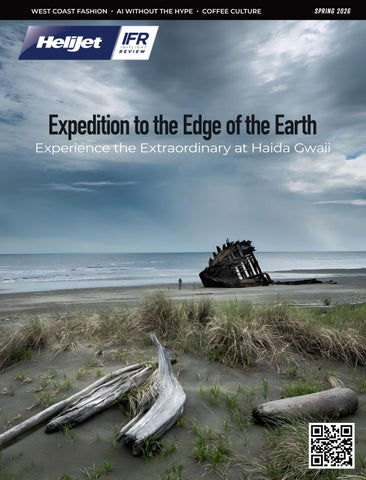
Expedition to the Edge of the Earth
Experience the Extraordinary at Haida Gwaii
IFR Magazine
Publisher
Jim Schneider | jim@ifr-helijet.com
Editor
Stacie Gaetz | editor@islandparent.ca
Graphic Design
Brent Foote
Account Executive
Kristine Wickheim | kristine@ifr-helijet.com
Distribution:
Distribution in all scheduled Helijet aircraft and passenger terminals, including Vancouver Harbour, Victoria, Nanaimo and YVR Airport. Also available at local hotels.
Published by:
Island Parent Magazine
518 Caselton Place
Victoria BC V8Z 7Y5
Tel 250.388.6905
publisher@islandparent.ca
ISSN 1916-5080
In-Flight Review Spring 2026 Vol. 19 No. 1
In-Flight Review (IFR) is a quarterly magazine published by Island Parent Group Enterprises Ltd., for Helijet International Inc. All published material is the copyright of Island Parent Group. No part of this publication, in whole or in part, may be reproduced without the written consent of the publisher. The written and photographic material published in In-Flight Review does not necessarily reflect the views of the air carrier or the publisher. Information and images produced in the magazine are believed to be accurate and truthful, but the publisher assumes no responsibility for errors.
Advertising in In-Flight Review magazine does not indicate an endorsement by Helijet International Inc. or Island Parent Group Enterprises Ltd.
Cover photo courtesy of Haida Tourism
HELIJET FLEET


SIKORSKY


How BC’s Prevention Network is Combatting Human Trafficking
Human trafficking is not a topic that is often talked about. It is seen as a distant problem that “doesn’t happen here.” That could not be further from the truth. It’s happening in our communities, and it is a growing crisis in BC and beyond.
The Human Trafficking Prevention Network of British Columbia is a network of service providers, community organizations, law enforcement agencies and corporate partners dedicated to combatting human trafficking in our province.
Started in 2024, the network aims to create a systemic survivor-centred approach to human trafficking in BC.

“We look at how youth get into human trafficking in order to increase awareness and improve prevention at the community level all the way up to the corporate level,” says Susannah Pierce, co-chair of the Human Trafficking Prevention Network.
“We want to identify the gaps and provide the resources victims need. We all play a part in prevention, awareness and survivor supports.”
The network exists to strengthen coordination, elevate awareness, and align leadership across sectors engaged in anti-human trafficking.
Corporate partners, like Helijet, raise awareness in their organization and allocate resources to educate and target its prevention within their sector.
What is Human Trafficking?
Human Trafficking involves recruiting, transporting, or controlling someone for the purpose of exploitation, primarily forced labour or sexual exploitation. Sexual exploitation is most common, followed by forced labour in agriculture, construction, and domestic work.
“Often times, there is a deep element of fear and shame where victims feel like they can’t go to the authorities or get help because it doesn’t feel safe to do so. For example, some have been coerced into committing a crime themselves,” says Pierce.
“We need to let them know that what’s happening to
them (any form of violence and exploitation) is not okay, while we ensure the trauma-informed wrap-around support is available to them. This involves all parts of society working together.”
Human trafficking is illegal under the Criminal Code of Canada and the Immigration and Refugee Protection Act.
Where Does it Happen?
Human trafficking shows up in everyday places and everyday roles (transportation, hospitality, service environments). It often goes unnoticed because people are unsure what they are seeing or worry about overreacting.
The goal of the Human Trafficking Prevention Network is to increase awareness about the problem and then move from awareness to action.
Human trafficking intersects multiple environments including schools and universities, hotels, restaurants, sporting events, transportation facilities and networks, remote locations, and community spaces.
Why Does it Happen?
Human trafficking is viewed by traffickers as a “lowrisk/high-reward” activity. It can be difficult to detect and has relatively low prosecution rates worldwide.
“Human trafficking is often orchestrated by criminal gangs who may be involved in other activities like drugs and guns,” says Pierce.
“The difference with people is they can sell them multiple times in a day.”
One trafficking victim may generate between $168,000 to $336,000 per year for a trafficker. The United Nations estimates that human trafficking generates approximately $150 billion (USD) annually, making it one of the most profitable criminal industries in the world.
Pierce adds that Indigenous communities are disproportionately impacted by human trafficking. Indigenous women, girls, 2-Spirit and gender diverse individuals are trafficked at a disproportionate rate compared to the mainstream population.
Susannah Pierce co-chair of the Human Trafficking Prevention Network
Signs of Sex Trafficking
The Human Trafficking Prevention Network can help direct training opportunities that teach individuals and staff in high-risk industries the signs to look for.
“As it relates to your family member or friend, things you might see include expensive gifts from a new boyfriend, suddenly being secretive with plans, or a change in personality,” says Pierce.
According to the Canadian Centre to End Human Trafficking, other signs include:
• Sudden Withdrawal: Disconnecting from family, friends, school, or usual activities.
• Rehearsed Answers: Providing scripted or unnatural answers when asked about their life.
• Substance Use: A sudden increase in drug or alcohol use.
• Isolation: The person is rarely alone, always accompanied, or is not allowed to speak for themselves.
• Restricted Movement: The person is not free to leave their work or living premises or is constantly monitored and escorted by someone else.
• Fear and Intimidation: They appear fearful, anxious, or submissive, and may avoid eye contact or seem afraid of authorities.
“Learning about these signs is our opportunity to be more collectively aware and to work together to create an effective and holistic strategy to prevent and stop human trafficking,” adds Pierce.
Canadian Human Trafficking Hotline
The Canadian Human Trafficking Hotline is a confidential, 24/7, multilingual service that connects victims, survivors, and the public to support, safety planning, and local services. Since it was created in 2019, approximately 23,000 calls have been made to the hotline.
In 2024, 5,171 calls were received with:
• 2,311 trafficking cases identified nationally
• 3,317 victims and survivors connected to support
• 83 percent of incidents occurred in large urban centres
British Columbia represents nine percent of identified incidents.
Pierce emphasizes that cases are highly underreported given the coercive nature of the crime.
“Don’t hesitate to make the call if you observe something doesn’t seem right,” adds Pierce.
If you or someone you know is a victim/survivor of human trafficking or you think someone might be, call the hotline at 1-833-900-1010 or 911.
For more information on the Human Trafficking Prevention Network, visit htpnbc.ca


Experience the Extraordinary at Haida Gwaii
“The weather is gorgeous and temperate, and you are surrounded by the raw
power of the ocean on one side and the serenity of the forest on the other.”

Expedition to the Edge of the Earth
Since time immemorial Xaayda Gwaay.yaay Haida Gwaii has enchanted and inspired; forever imprinting a transformative connection between land and self.
Haida Gwaii is an archipelago of more than 150 islands located about 100 kilometres off the northwest coast of British Columbia. Formerly called the Queen Charlotte Islands, this chain lies directly across the Hecate Strait from the mainland and is known for its rugged, temperate rainforest landscapes.
The ancient rainforests, mystical wilderness, treasured heritage sites and living Haida culture make it a top tourism destination and one you don’t want to miss. In fact, it was named as a top travel destination by The New York Times in 2020.
“This truly is one of the most beautiful places in the world,” says Lesley Assu, manager of Haida House, a lodge on Haida Gwaii.
“The water here is that tropical turquoise blue that you see in the photos and videos that seems impossible in a place like this. There are miles and miles of sandy solitary beaches that seem to call to you.”
The Land & Wildlife
Haida Gwaii is a temperate archipelago teeming with wildlife, ancient rainforests, pristine rivers and bays, and Indigenous heritage sites. The Haida People have respected, honoured and protected this sacred place for many years.
“There are so many different kinds of beauty and excitement that draw people here,” says Assu. “The weather is gorgeous and temperate, and you are surrounded by the raw power of the ocean on one side and the serenity of the forest on the other.”
The islands are a haven for wildlife enthusiasts. In fact, six of Haida Gwaii’s 10 native land mammal subspecies are not found anywhere else on Earth, including North America’s largest black bear, known as “taan” in the Xaayda Haida language. In the waters surrounding Haida Gwaii, 20 species of whales and dolphins have been recorded, with grey and humpback whales sighted regularly during spring migration. Over 1.5 million seabirds nest along the coast, and the bald eagle is readily spotted in the skies above.
The People
Historically, and still today, Haida citizens are rich in culture. The land and waters surrounding Haida Gwaii offer sustenance and prosperity. Trade relationships with neighbouring Indigenous communities were critical to survival and continue to be an important part of life among coastal nations. Traditionally, prosperity and status were not measured by the accumulation of goods, but rather by the distribution of wealth. Throughout the harvesting season, families worked together to gather food and goods. During the scarce winter months, Haida families

would host potlatches to redistribute their wealth. This generosity and sharing remain prominent parts of life on Haida Gwaii.
Today, Haida People represent approximately half of the 5,000 people living on the islands. Most are concentrated in two main centres, Gaw Tlagée Old Massett at the north end of Graham Island and HlGaagilda Skidegate at the south end. Beyond this, there are as many as 2,000 Haida scattered throughout the world.
The Haida language is a Language Isolate unique to the people of Haida Gwaii and southern Alaska. There are two main dialects; Xaayda Kil Skidegate dialect used in the south, and Xaad Kíl Old Massett dialect used in the north.
The Haida language, like most other Indigenous languages in British Columbia is in a difficult state. In Gaw Tlagée Old Massett, there are less than a dozen fluent Xaad Kíl speakers, all of whom are septuagenarian or older. Fortunately, many of these Elders are working passionately to preserve their mother tongue.
The Visitors
Tourism plays an increasingly important role in Haida Gwaii’s economy and the value it offers extends far beyond its economic benefits.
Tourism on Haida Gwaii (and Indigenous tourism in general) expands awareness of Haida culture and the importance of preservation and conservation, while providing both the impetus and resources for Haida citizens to continue to develop, preserve and pass down the skills and traditions which their culture is based upon.
In addition to experiencing the rich Haida heritage and culture, Assu says visitors can take part in several exciting adventures such as fishing, hiking, biking, surfing, mountain climbing, boat charters, and more. Exploring by e-bike, or kayak lets you slow down and see the islands in a new way.
“Come and see the Pesuta shipwreck,” adds Assu, referring to the wood-hulled steam freighter that broke free of its towline, running aground deep in the sand in 1928.
“This historic shipwreck is both easily accessible and exceptionally fascinating.”
Despite being subjected to nearly 100 years of punishing coastal weather, the iconic ship’s bow still juts from the sand exposing weathered wood, various metal implements, and rusted portholes.
Visiting Haida Gwaii is more than sightseeing—it is an invitation to connect with Haida culture and the lands and waters that have sustained the Haida Nation since time immemorial.
“Guided by respect, responsibility, and interconnectedness, every journey here is part of something larger,” according to the Indigenous Tourism BC website.
“The lessons of Haida Gwaii stay with you long after your visit, carrying forward the values of travelling lightly and honouring both people and place.”
Learn more about Haida Gwaii and book your trip by visiting haidatourism.ca.
Story by Stacie Gaetz, In-Flight Review Photos courtesy of Haida Tourism (pages 6 & 8) Indigenous Tourism BC (page 7)


Design-Build Services for innovative industrial, commercial, and multi-family developments.

Living Capital
How Biodiverse Food Gardens Increase the Value of Your Home
In real estate conversations, attention tends to focus on kitchens, square footage, and architectural finishes. Landscaping is often treated as decoration, something meant to frame the home rather than contribute meaningfully to its value. Yet the land surrounding a house has the potential to do far more than provide a pleasant view from the window.
When thoughtfully designed, a garden can become one of the most enduring and rewarding assets a property possesses.
Picture stepping outside your back door to gather rosemary for dinner or picking a handful of berries as you walk through the garden on a summer evening. Moments like these change the way people relate to their homes. The landscape becomes part of daily life rather than something admired from a distance. Increasingly, homeowners are recognizing that a welldesigned garden can offer beauty, nourishment, and long-term value.
From Lawn to Living Landscape
Traditional residential yards tend to follow a familiar pattern: a broad lawn, a few ornamental shrubs, perhaps a flower bed along the foundation. While neat and predictable, these landscapes often require continuous effort to maintain. Lawns must be mowed and watered regularly. Annual plantings are replaced each season.
Fertilizers and irrigation become routine inputs simply to keep the yard looking healthy.
Biodiverse food gardens approach the landscape di fferently. Instead of a flat and simplified planting scheme, they are designed as layered systems. Trees provide canopy and structure. Beneath them grow flowering shrubs, fruiting plants, herbs, and perennial vegetables. Groundcovers protect the soil and help suppress weeds. Over time these plant communities begin to stabilize themselves, reducing maintenance while increasing productivity.
Rather than working against natural processes, the garden begins to work with them.
The Value of Mature Plantings
One of the most compelling aspects of a thoughtfully designed landscape is how it improves with age. A young garden can be attractive, but maturity brings a deeper sense of permanence and character.
A fig tree shading a patio, a row of espaliered apples along a sunny wall, or a berry hedge woven through a mixed border cannot be created overnight. These plantings represent years of growth and care. They also represent biological assets that become more valuable as they mature.
Unlike many home upgrades that begin depreciating the moment they are installed, living landscapes often
appreciate over time. Soil health improves, root systems deepen, and the garden becomes increasingly stable and productive. The result is a landscape that feels established and thoughtfully stewarded rather than newly installed.
Gardens That Support Health
Beyond aesthetics and property value, gardens can play a powerful role in everyday wellbeing. Harvesting herbs for cooking, gathering greens for lunch, or picking fruit in the summer creates small but meaningful connections between the household and the landscape.
For professionals whose lives are often defined by demanding schedules and constant information flow, gardens also provide something quieter and more restorative. Spending time among plants introduces a slower rhythm into the day. Watching the seasons unfold in the garden offers a sense of continuity that can be di fficult to find elsewhere.
In this way, a productive garden doesn’t just add value to your home. It supports physical health, mental clarity, and a deeper relationship with the land.
Designed to Grow Easier Over Time
A common assumption about food gardens is that they require constant work. In reality, the opposite is often true when the landscape is designed well.
By integrating trees, flowers, fruits, and vegetables into a cohesive system, the garden gradually becomes easier to manage. Perennial plants return each year. Layered roots stabilize the soil. Denser planting reduces weed pressure and helps retain moisture.
Instead of rebuilding the garden each season, homeowners tend and refine a living system that becomes more resilient over time.
A Landscape That Appreciates
Increasingly, gardens are being understood as part of a home’s infrastructure rather than an optional embellishment. A thoughtfully designed landscape can help manage water, moderate temperature, support pollinators, and produce fresh food throughout the growing season.
Just as importantly, it creates spaces where people want to spend time. Shaded seating areas, paths through layered plantings, and edible harvests invite interaction with the landscape in ways that a conventional lawn rarely does.
In an era when many investments depreciate quickly, it is rare to encounter something that grows more valuable each year. A beautiful, biodiverse food garden is one of those rare exceptions. With time, patience, and thoughtful design, it transforms the land around a home into something both practical and enduring.
By Joshua Clae Wagler, Edible Landscapes Design


SHIFT GEARS FROM BUSINESS TO PLEASURE AT FATHOM

Located on Victoria’s Inner Harbour, Fathom is the perfect post-flight escape. Whether you’re easing into the evening with a hand-crafted cocktail, catching live music in the lounge, or settling in for a relaxing meal.


AI Without the Hype
On an evening on Vancouver Island, a dental clinic closes its doors at 5 pm.
The last staff member switches off the lights and heads home. But the phones keep ringing.
Voicemails begin to stack up. Some callers hang up. Others try again the next morning, but this time, they call a competitor. By the time the clinic reopens, opportunities have already slipped away.
Not because of a lack of demand. But because no one was there to respond. This isn’t a failure of technology. It’s a gap in how the business operates. And it’s exactly where artificial intelligence (AI) is beginning to make a quiet, measurable difference.
A Shift from Hype to Practicality
Across Vancouver Island and the Lower Mainland, AI is no longer confined to headlines or conference stages. It’s showing up in everyday operations, inside businesses that are less interested in innovation for its own sake, and more focused on execution.
Yet much of the public conversation still swings between extremes: AI is either portrayed as a cure-all or dismissed as premature.
The reality is far more grounded: AI is already creating value, but only when applied with clarity and intent.
Where AI is Making a Difference
In many organizations, the earliest benefits are not transformational, they are operational.
Consider that after-hours call at the dental clinic. Today, AI systems can step in to answer, understand the reason for the call, and take appropriate action, whether that’s booking an appointment or routing a request.
A missed call becomes a confirmed visit. A latenight inquiry becomes next-day revenue.
It’s not about replacing the business. It’s about extending it. For service-based organizations like restaurants, clinics, and property managers, this kind of continuity can make a meaningful difference.
When Systems Finally Work Together
Another area where AI is quietly proving its value is behind the scenes.
Most businesses today rely on multiple systems: accounting software, scheduling tools, and customer databases. Each one serves a purpose, but they rarely communicate seamlessly. The result is familiar, manual work, duplicated effort, and small errors that compound over time.
Increasingly, AI is being used not to replace these systems, but to connect them.
Information flows more easily. Data stays consistent. Staff spend less time reconciling and more time deciding. Because better decisions don’t come from more data, they come from connected data.
Beyond Automation
While efficiency gains are valuable, they only scratch the surface.
The more significant shift occurs when organizations ask a different question, not “How do we automate what we already do?” but “Is this still the best way to solve the problem?”
Consider education: For decades, one-on-one tutoring has been one of the most effective ways to teach someone to read. It works, but it has never scaled easily.
The instinctive approach is to digitize tutoring, making it more accessible. But in many cases, that simply improves a model that was never designed to reach everyone.
A project led by a local technology leader takes a different approach. It steps back and asks more fundamental questions:
• What makes a great tutor effective?
• How do they adapt in real time?
• How do they build trust with each learner?
Instead of replicating tutoring, the opportunity becomes redesigning the experience itself.
A Practical Starting Point
For most business leaders, adopting AI doesn’t begin with transformation. It begins with clarity.
A practical approach is straightforward:
1. Identify one point of friction
Where is time being lost? Where are opportunities slipping through?
2. Understand the cause
Is it availability, inconsistency, or disconnected systems?
3. Challenge the process
Don’t assume the current way is the right way.
4. Apply AI where it creates leverage
Not just to save time, but to improve outcomes.
The Real Opportunity
AI is not a future concept. It is already here, quietly reshaping how businesses operate across our region. But its value does not come from just adopting the latest tools. It comes from understanding how those tools can be used to solve problems.
The organizations that will benefit most won’t be the ones doing the same things faster. They’ll be the ones willing to rethink what matters and do it better.
By Alexis Santacruz, OpenWorks Canada


Stress After 50
Tips for retaining the joy in life’s second act
You’d think that by the time we hit 50, stress would evaporate. Haven’t we earned a break after decades of juggling careers, families and life’s unexpected chaos? But somehow, stress sticks around—just in different ways.
Maybe it’s worrying about retirement, managing health changes or suddenly finding yourself as the “goto” person for aging parents and/or grown children. Whatever the cause, stress doesn’t just mess with your head—our bodies are also impacted, showing up as tension, fatigue or that persistently annoying sleeplessness.
So, how do we shake it off? More importantly, how do we make sure stress doesn’t take the joy out of life’s second act?
How Stress Sneaks into Your Mind
Stress isn’t just about feeling anxious—it rewires the brain. Ever walk into a room and forget why you’re there? Or completely blank on a name you know you should remember? That’s not just “getting older”—it’s often a sign of stress overloading your brain and memory.
When stress persists, cortisol (our body’s stress hormone) floods the brain, making it harder to focus, stay emotionally steady or even get a good night’s sleep. Over time, that can take a real toll—raising the risk of anxiety, depression and even memory loss.
Life after 50 brings some big transitions. Retirement, losing loved ones, changes in health or even just feeling like your social circle has shrunk, can leave you feeling more alone than you expected. Stress, left unchecked, feeds into those emotions, making it harder to climb out of the rut.
How Stress Affects Your Body
Stress shows up everywhere. Some people feel it in their gut (digestive issues), others in their shoulders and neck (tension headaches). Over time, chronic stress raises inflammation levels in the body, increasing the risk of heart disease, diabetes and other age-related conditions. Then there’s sleep, or lack of it. Stress turns your brain into an overactive to-do list just as you’re trying to wind down. And when you’re not sleeping well, everything feels harder—moods swing, patience runs thin and even minor problems feel overwhelming.
BREAKING FREE:
Real Ways to Manage Stress
Good news! You don’t have to meditate on a mountaintop or overhaul your entire life to feel better. Small, consistent changes can make a big difference.
Move—But Make It Enjoyable
We all know exercise helps with stress, but not everyone wants to hit the gym or start running marathons. So, the trick is to find movement that feels good.
• Walk outside. Fresh air plus movement is a double win.
• Dance in your kitchen while making dinner. No one’s watching.
• Stretch or do yoga for five minutes before bed to release tension.
• Gardening? Counts. Golf? Also counts. Do what you enjoy!
Breathe—But Make It Easy
Mindfulness doesn’t mean sitting cross-legged for an hour trying to empty your mind. Sometimes, it’s as simple as taking a long, slow, deliberate breath when stress spikes. Try this:
• The 4-7-8 method: Inhale for four seconds, hold for seven, exhale for eight. Repeat a few times.
• Take two minutes to just sit quietly—no phone, no TV, no distractions.
• Before bed, try progressive muscle relaxation—tense and release different muscle groups from head to toe.
Socialize—Even If You Don’t Feel Like It
Stress thrives in isolation. When we’re overwhelmed, we withdraw but that only makes things worse. Staying connected, even in small ways, keeps stress in check.
• Call a friend just because; not just when something’s wrong.
• Find a group; whether it’s a book club, a walking group or volunteering; being part of something helps.
• If you’re feeling stuck, talk to someone who gets it; whether it’s a friend, a support group or a therapist.
Sleep—Your Brain Needs It
If stress is keeping you up, it’s time to reset your sleep habits. A few tweaks can make a world of difference.
• Set a bedtime and wake-up time and stick to it even on weekends. Especially the wake-up time, it’ll reset your natural rhythm.
• Avoid screens 60 minutes before bed. Blue light messes with your ability to get to sleep.
• Keep a notebook by the bed; jot down worries so your brain doesn’t have to hold onto them all night.
• Listen to something calming. Audiobooks, white noise or soft music can work wonders.
Find What Fills You Up
Stress shrinks when you make space for things that bring joy.
• Pick up an old hobby or start a new one. Painting, writing, music, anything creative.
• If faith or spirituality is part of your life, lean into it. Prayer, meditation or gratitude journalling can be grounding.
• Laugh more. Go to a live comedy show, watch a funny movie, listen to a comedy podcast. Get some ideas for funny podcasts on page 26. Laughter is a natural stress reliever.
Get Help When You Need It
If stress feels overwhelming, you’re not meant to handle it alone. A counsellor can help you work through it with practical tools and support. Asking for help isn’t weakness—it’s smart self-care.
Aging with More Joy
Stress is a part of life, but it doesn’t have to take over. With the right tools, you can navigate this stage with more ease and enjoyment. After all, these years are meant for living, not just getting through.
So, take a breath. Call a friend. Go outside. And most importantly: be kind to yourself!
By George Bielay, Waypoint Counselling Network


A plain-language guide to Canada’s most overlooked business tax credit
The Government Will Pay You to Innovate
You ’re already doing the work. You’re solving problems, improving processes, building new tools. The question is: Are you getting paid back for it?
The Scientific Research and Experimental Development program, universally known as SR&ED (pronounced “shred”), is the federal government’s largest single investment in Canadian business innovation. Last year, it returned well over $4 billion to almost 20,000 businesses across the country. Ottawa sees this program as fundamental to Canada’s future: a direct tool for building a stronger, more self-reliant economy and keeping Canadian companies competitive on the world stage.
Yet many eligible companies either don’t know they qualify or assume it’s only for white-coat lab scientists. Neither is true. If your company is trying to solve a technical problem that didn’t have an obvious answer, you may be sitting on a significant tax credit and leaving real money on the table.
What Does the Program Pay For?
SR&ED covers the costs your team incurs while doing genuine technical problem-solving: employee wages, contractor fees, materials, and now, following a recent program update, qualifying capital expenditures as well.
Stack the federal credit with what several provinces offer, and businesses in BC, Alberta, Ontario, and Quebec are recovering close to two-thirds of their eligible spending. That’s a meaningful return on work you were already doing.
What it Looks Like in Practice
According to the most recently published Canada Revenue Agency (CRA) figures, the program delivered $4.5 billion to more than 19,000 claimants in a single year, through over 22,000 claims. That works out to an average of roughly $200,000 per claim—though the range is enormous, from small businesses claiming tens of thousands to large corporations claiming in the millions. The point is that the program serves companies of every size, in every sector. Here are a few examples:
Wilder Harrier (Montreal)
— Small business, big idea
Founded in 2014, Wilder Harrier set out to make sustainable pet food using insect protein and recovered fruit and vegetable pulp. The science behind formulating nutritious, shelf-stable products from unconventional ingredients was genuinely hard work with genuinely uncertain outcomes—exactly what SR&ED is designed to support. The credits funded the research and development (R&D) that turned their concept into a commercial product line now sold across Canada. Paul Shenouda, the company’s founder, has credited the program with accelerating their technical development and freeing up capital to bring the product to market.
Motion Metrics International (Vancouver)
— Made in BC, used worldwide
Motion Metrics International builds machine learning and computer vision systems that make mining operations safer, more efficient, and more environmentally responsible. The Vancouver-based company has grown into a trusted technology partner for mines around the world. Ongoing SR&ED claims have supported the continuous R&D that keeps their products at the 16,000
leading edge. The intellectual property (IP) is Canadian, the jobs are Canadian, and the technology is now deployed globally.
Rio Tinto Fer et Titane (Quebec)
— Industrial scale, Canadian roots
Rio Tinto Fer et Titane has been processing ore from northern Quebec for over 70 years, producing highgrade titanium dioxide and specialty metal powders used in 3D printing, automotive manufacturing, and wind turbines. When they undertook a major R&D project to decouple titanium and iron production— improving both efficiency and environmental impact — SR&ED was part of the funding picture. The program helped a globally operating company keep its research, its people, and its IP anchored in Canada.
Who Qualifies?
Any Canadian business, in any industry. The CRA tests the nature of the work, not the sector. Your work qualifies if it meets all three of the following criteria:
1. Technological uncertainty: You were trying to solve a problem where the answer wasn’t known or findable through standard practice.
2. Systematic investigation: You tested, iterated, and kept records—you didn’t just guess.
3. Advancement: The work aimed to push technical or scientific knowledge forward, even incrementally.
The Bigger Picture
Canada has never lacked for innovation. That tradition has never mattered more than it does right now. SR&ED exists because the federal government believes that supporting homegrown innovation is fundamental to a strong, independent Canadian economy. If your organization is doing work that involves real technical problem-solving, it may be worth a conversation. Start with the CRA’s free resources at canada.ca/sred or raise it with your accountant. The program is there. The question is whether you are using it.
By Jude Brown, Bloom Technical Advisors Ltd.
The Do’s and Don’ts of SR&ED Claims
DO:
Document as you go. Notes, Slack threads, version histories, meeting logs: all of it tells the story of your technical journey.
Claim wages for technical staff, including time spent on eligible projects by engineers, developers, and scientists.
Start with free resources. The CRA offers free webinars, a self-assessment tool, and plain-language guides at canada.ca. Your accountant is also a good first call.
File on time. SR&ED claims must be filed within 18 months of your fiscal year-end.
DON’T:
Assume you don’t qualify without checking. Many businesses are surprised to learn their everyday technical work is eligible.
Overstate your claim. The CRA audits SR&ED and inflated or unsupported claims create legal and financial risk.
Wait until tax season to start tracking. Retroactive documentation is hard to defend; contemporaneous records are worth their weight.
Go it alone on a large or complex claim without getting advice first. Your accountant, the CRA or a specialist can help you get it right.

DANCE VICTORIA PRESENTS BOCA TUYA
April 10 and 11
Dance Victoria presents Cuban contemporary dance company Boca Tuya at the Royal Theatre in Victoria, showcasing energetic choreography inspired by Latin music and storytelling. dancevictoria.com
VANCOUVER WHITECAPS FC HOME MATCHES
April 11, 17, 25
Don’t miss out as the Vancouver Whitecaps host a few Major League Soccer matches at BC Place throughout April before being on the road during the FIFA break. whitecapsfc.com

PACIFIC SALMON FOUNDATION VANCOUVER
GALA DINNER AND AUCTION
April 16
The Pacific Salmon Foundation hosts its annual fundraising gala and auction at the Fairmont Pacific Rim, supporting salmon conservation and habitat restoration across BC. psf.ca
CHEMAINUS THEATRE FESTIVAL
PRESENTS: THE LADIES FOURSOME
April 17 to May 17
Canadian playwright Norm Foster’s comedy about four women reconnecting during a round of golf brings humour and heartfelt moments to the Chemainus stage. chemainustheatrefestival.ca
BELFRY THEATRE PRESENTS: CASEY AND DIANA
April 21 to May 17
Inspired by Princess Diana’s historic visit to Toronto’s Casey House hospice, this powerful Canadian play at the Belfry Theatre in Victoria explores compassion and activism during the AIDS crisis. belfry.bc.ca
VANCOUVER CHERRY
BLOSSOM FESTIVAL
Until April 17
The Vancouver Cherry Blossom Festival celebrates the city’s famous pink blossoms with cultural events, art installations, and community picnics across Vancouver. vcbf.ca

THREE DAYS GRACE: ALIENATION TOUR
April 19
Canadian rock band Three Days Grace brings their latest tour to the Save on Foods Memorial Centre in Victoria, featuring special guests Finger Eleven and Royal Tusk. sofmc.com
VANCOUVER ISLAND
SYMPHONY COMMUNITY DAY
April 25
The Vancouver Island Symphony hosts a free Community Day for all ages with performances, instrument demonstrations, and familyfriendly musical activities at the Port Theatre in Nanaimo. vancouverislandsymphony.com
DIANA KRALL
April 22
Vancouver-born jazz pianist and vocalist Diana Krall performs live at the Orpheum Theatre in Vancouver with selections from her award-winning catalogue. vancouvercivictheatres.com
POWER TO BE HAVE A GO DAY
April 25
Power To Be’s free Have a Go Day invites people of all abilities to try accessible outdoor activities like paddling and hiking while celebrating inclusive recreation at Prospect Lake in Victoria. powertobe.ca

DOXA DOCUMENTARY FILM FESTIVAL
April 30 to May 10
Western Canada’s largest documentary film festival features screenings, filmmaker talks, and discussions exploring global stories and social issues at cinemas across Vancouver. doxafestival.ca
KARAN AUJLA:
P-POP CULTURE TOUR
May 2 to 3
Punjabi music star Karan Aujla brings his Pop Culture Tour to Rogers Arena in Vancouver with a high-energy show featuring hits from his chart-topping albums and global Punjabi hip-hop sound. karanaujlaofficial.com
CANADIAN PREMIER LEAGUE: PACIFIC FC VS VANCOUVER FC
May 3
Pacific FC hosts Vancouver FC in Canadian Premier League action in the BC soccer rivalry matchup at the Royal Athletic Park in Victoria. pacificfc.canpl.ca
ARTS CLUB THEATRE PRESENTS KIMBERLY AKIMBO
Until May 3
The Tony Award-winning musical Kimberly Akimbo comes to the Arts Club Theatre stage in Vancouver with a touching and humorous coming-of-age story and unforgettable songs. artsclub.com
BMO VANCOUVER MARATHON
May 3
Canada’s largest marathon takes runners through Stanley Park, along the seawall, and past some of Vancouver’s most scenic waterfront views. bmovanmarathon.ca
LEWIS CAPALDI
May 6
Scottish singer-songwriter Lewis Capaldi performs his emotional pop ballads at the Rogers Arena in Vancouver. rogersarena.com
STARS ON ICE 2026 TOUR
May 12 – Rogers Arena, Vancouver
May 14 – Save on Foods Memorial Centre, Victoria
The Stars on Ice tour brings Olympic and world champion figure skaters to Vancouver and Victoria for a spectacular ice show. starsonice.ca
AN EVENING WITH DAVID SEDARIS
May 13
Humourist and bestselling author David Sedaris brings his live reading tour featuring new essays and sharp observational comedy at the Queen Elizabeth Theatre in Vancouver. gotickets.com


POWER TO BE POWER TO PLAY SUMMIT & ADVENTURE RACE
May 29 to 31
Hosted by the Victoria-based nonprofit Power To Be, this event promotes accessible outdoor recreation through an adventure race and speaker summit. powertobe.ca
126th
VICTORIA DAY PARADE
May 18
One of Vancouver Island’s longestrunning traditions, the Victoria Day Parade features marching bands, floats, and community groups. gvfs.ca

ARTS CLUB THEATRE COMPANY PRESENTS: COME FROM AWAY
May 28 to July 26
The beloved musical Come From Away tells the true story of how the small Newfoundland town of Gander welcomed stranded airline passengers after 9/11. artsclub.com
MUMFORD & SONS: PRIZEFIGHTER TOUR
June 2
British folk-rock band Mumford & Sons brings their anthems and banjo-driven sound to Rogers Arena in Vancouver. rogersarena.com
FIFA WORLD CUP
June 11 to July 19
Fan Festival at PNE
June 13, 18, 21, 24, 26, July 2, 7
Matches at BC Place
The FIFA World Cup is coming to Vancouver! Take in the Fan festival for fun activities and free viewing, and get your tickets to see the matches live and in person at BC Place. vancouverfwc26.ca
NE-YO & AKON: NIGHTS LIKE THIS TOUR
June 17
R&B stars Ne-Yo and Akon team up for a nostalgic concert featuring early-2000s hits and fan favourites at Rogers Arena in Vancouver. rogersarena.com
Redefining West Coast Fashion
British Columbia’s West Coast style is known for its mix of creativity, comfort, and sustainability and nowhere is that more evident than in the region’s thriving community of independent fashion designers.
Across the Lower Mainland and Vancouver Island, fashion designers are producing everything from cozy lifestyle wear to Indigenous couture and carefully crafted slow-fashion pieces. Whether you’re looking for something stylish, meaningful, or ethically made, these local designers offer plenty of reasons to shop close to home.
Smoking Lily
Victoria
Victoria’s Smoking Lily has been part of the local fashion scene since 1996. The brand is known for its playful screen-printed designs and comfortable, stylish everyday clothing. All pieces are cut and sewn locally using zero fabric waste and feature original artwork printed directly onto fabric. Visitors can explore the brand at its long-running Victoria storefront, where the colourful designs reflect the creative spirit of the city. smokinglily.com
Dorothy Grant
Vancouver/Haida Gwaii
Dorothy Grant is one of Canada’s most respected Indigenous fashion designers. A Kaigani Haida designer from the Raven Clan, she began incorporating traditional Haida formline art into contemporary fashion in the 1980s. In 1989, her breakout collection introduced garments that combined Northwest Coast cultural


designs with modern silhouettes, helping establish Indigenous couture on the global stage. Grant’s coats, dresses, and ceremonial pieces are widely recognized as wearable art and have appeared in museum collections around the world, winning several awards and accolades. dorothygrant.com
Free Label
Vancouver
Founded in Vancouver in 2015, Free Label was created to prove that clothing could be both stylish and ethically produced. The slow-fashion brand focuses on comfortable basics designed to last, including soft bamboo bras, dresses, and everyday wardrobe staples. Free Label produces garments in small batches and works with Canadian factories to ensure fair wages and responsible production. Known for inclusive sizing and minimalist design, their clothing spans size XS to 5XL and their wire-free bras fit up to a K cup. freelabel.com
ANIÁN
Victoria
Victoria-based ANIÁN has become a leader in Canada’s sustainable clothing movement. Founded in 2013, the company focuses on creating durable garments using recycled natural fibres. Many of its signature pieces (like wool overshirts and workwear-inspired jackets) are made from reclaimed wool and cotton sourced from post-consumer textiles. Inspired by West Coast outdoor living, ANIÁN designs clothing for men and women that transitions easily between city streets and coastal adventures. anianmfg.com


Dorothy Grant
ANIÁN
Smoking Lily
Free Label
Ola Dubois
Victoria
Victoria-based brand Ola Dubois blends vintage glamour with modern sustainability. Designer Dani Dubois grew up surrounded by the fashion industry while helping her mother run a swimwear boutique, and she has spent decades refining designs that celebrate flattering, comfortable silhouettes. The brand specializes in dresses inspired by mid-century fashion and supportive retrostyle swimwear, designed to fit a variety of body sizes and shapes. Many pieces are produced in small batches using recycled or remnant fabrics, and swimwear is made using anti-bacterial moisture wicking, recycled high-quality polyester that keeps its shape and lasts. oladubois.ca
Brunette the Label
Vancouver
Founded in 2014 by Vancouver entrepreneur Miriam Alden, Brunette the Label exists to inspire, uplift, and empower all women to become the very best versions of themselves. What began with cozy hair-colour based sweatshirts quickly turned into a full lifestyle brand recognized across Canada. Designed in Vancouver, the brand focuses on relaxed essentials inspired by ‘80s and ‘90s fashion and classic equestrian styles in sizes XS to 5XL. The message of community and inclusivity with “Babes Supporting Babes” has helped build a loyal following. brunettethelabel.com
By Erika Palmer, In-Flight Review


Brunette the Label
Ola Dubois
THE PERFECT GRIND:
A Local’s Guide to Vancouver Island Coffee Culture
Local professionals require a caffeine experience that matches the precision of their schedule and the calibre of their standards.
Whether you are heading into a boardroom in downtown Victoria, scouting property in Tofino, or connecting with clients in Nanaimo, Vancouver Island’s coffee scene offers more than just a quick jolt. It offers a masterclass in craft. From whiskeybarrel-aged beans in Campbell River to meticulous, world-class pour-overs in the capital, these local roasters turn a simple “pick-me-up” into a moment of genuine clarity.
Hey Happy Coffee
560 Johnson Street, Victoria
This downtown gem is bright, energetic, and full of life, drawing in creatives and coffee purists alike. Their coffee program features world-renowned roasters and meticulous brewing methods that make every drink shine.
Caffe Fantastico
965 Kings Road, Victoria
The open-roastery layout and warm ambiance make this café a long-time local favourite. They roast their beans in-house and prioritize sustainability and direct-trade relationships with producers.
Roundhouse Café
935 Cloverdale Avenue, Saanich
This welcoming café overlooks Rutledge Park and has a cozy, neighbourhood vibe with a great little patio. They serve locally air-roasted organic beans and have won multiple Top Choice Awards for their quality and community focus.
French Press Coffee Roasters
692 Primrose Street, Qualicum Beach 425 Stanford Avenue E, Unit 102, Parksville
Featuring locations in both Qualicum Beach and Parksville, you’ll find airy and modern spots that have become favourites for locals and visitors alike. They roast in small batches using beans from direct-trade farms and are known for their excellent light roasts.

Black & White Coffee House
163 Kenneth Street, Duncan blackandwhitecoffeeroasters.com
This artistic café is inviting and cozy, with friendly staff and great local art. They use Drumroaster beans and are known for their precise espresso and beautiful latte art.
White Rabbit Coffee Co.
321 Selby Street, Nanaimo
This bright and welcoming café is a community hub known for its expertly crafted coffee and their housemade vegan, gluten-free treats are a favourite with everyone, no matter what their dietary needs. With a cozy atmosphere and rotating art displays, it’s a perfect spot to relax or catch up with friends.
FoggDukkers Coffee and Roasting
907 S Island Highway, Campbell River
This may be a rustic, oceanfront bait shop turned take out kiosk, but their unique, tasty, certified organic and fair-trade coffee is roasted in-house daily, and their blends are aged in vintage whiskey barrels. Enjoy your brew in a cozy setting on the beach or go for a stroll along the water.
Café Guido & Company
7135 Market Street, Port Hardy
This welcoming café in downtown Port Hardy offers artisan espresso, fresh baking, and a variety of lunch options. Beyond coffee, it houses a bookstore, local artisan market, and boutique clothing shop, making it a community hub for both locals and visitors.
By Erika Palmer, In-Flight Review


BUILDING BC’S ESSENTIAL PLACES
Reinders’ Breadth Across Complex Construction
From cultural landmarks to critical utilities and industrial facilities, Maple Reinders brings integrated delivery and technical depth to some of British Columbia’s most demanding building types.
Across British Columbia, owners are asking more of their builders: navigate tight sites and active operations, coordinate specialty trades, meet evolving sustainability targets, and deliver schedule certainty in a challenging market. Providing construction solutions for over 55 years, Maple Reinders has built a reputation for stepping into that complexity with clear planning, collaborative teams, and a portfolio that spans civic, institutional, industrial, and environmental infrastructure. With a keen focus on building excellence and site safety, Maple Reinders has been a trusted construction partner in British Columbia for over 30 years.
That project breadth is reflected in recent and signature work in the province. At the Royal BC Museum PARC Campus in Colwood, Maple Reinders is helping deliver a multi-facility environment that supports preservation, research, and collections—spaces where environmental control and long-term stewardship drive the details. For national defence, the Comox Canadian Air Forces Training Facility underscores the firm’s ability to execute secure, mission-critical environments with rigorous coordination and quality requirements. In
the industrial and energy transition space, the Lulu Island Biogas Project highlights experience integrating process equipment, mechanical and electrical systems, and civil works to create renewable energy from organic waste streams.
On the water and wastewater side, work at Annacis WWTP demonstrates the controlled execution and stakeholder alignment required for upgrades within essential public infrastructure—where phasing, safety, and maintaining service are non-negotiable. In advanced manufacturing and agri-industrial delivery, the Trouw Nutrition Feed Mill showcases capability in highthroughput facilities that depend on precise material handling, structural coordination, and commissioning discipline. And in the commercial realm, the Ekistics Office Building in Vancouver reflects a commitment to building environments that support modern, flexible workplaces while meeting the expectations of a fast-moving urban market.
Taken together, these projects speak to a consistent approach: align early on scope and constructability, reduce risk through disciplined scheduling and safety planning, and deliver with the end users in mind— whether the outcome is a public-facing campus, a training facility, a
renewable energy system, a wastewater upgrade, or an industrial production plant. It’s a range that matters in BC, where communities and industries alike rely on builders who can perform across sectors without compromising on quality.
Company bio: Maple Reinders is a Canadian construction and services provider delivering new-build, retrofit, and complex infrastructure projects across multiple sectors, including industrial, commercial, institutional, and environmental. With over 55 years of expertise, Maple Reinders is known for its self-perform capability, strong trade partnerships, and a collaborative delivery mindset. The company supports clients from preconstruction through commissioning, bringing practical solutions to technically demanding projects throughout British Columbia and across Canada.


ROYAL BC MUSEUM
LULU ISLAND BIOGAS FACILITY
TROUW NUTRITION FEED MILL
COMOX CANADIAN AIR FORCES TRAINING FACILITY
Podcasts That Will Make You Laugh
Life gets busy, and it’s easy to forget to pause, but sometimes the simplest reset is a good laugh. Funny podcasts are an easy way to unwind and get a quick mood boost while you’re driving, walking, or tackling daily tasks. We’ve curated a mix of popular picks to help you relax, laugh, and take a well-deserved break.

After decades in latenight television, Conan O’Brien decided to start a podcast to make actual friends and the results are hilarious. Celebrity interviews quickly turn into absurd conversations filled with unexpected improv. O’Brien’s comedic instincts make these simple chats wildly entertaining.

Hosted by actors Jason Bateman, Sean Hayes, and Will Arnett, SmartLess is basically three extremely funny friends roasting each other while interviewing surprise celebrity guests. The chemistry of the hosts makes the podcast feel like a comedic group hangout you somehow got invited to.

Hosted by the researchers behind the British show QI, this podcast shares bizarre facts from around the world.
The hosts’ banter and delight in weird information make it consistently funny. You’ll leave smarter and in a better mood.

Hosted by Jack O’Brien and Miles Gray, this podcast breaks down daily news and trends with a comedic twist.
The hosts’ humour keeps things light, even when the topics are serious. It’s informative without ever feeling heavy.
HELIJET CHARTERS


From the moment you step on board, Helijet’s luxurious Citation X business jet is ready to go. This roomy jet can whisk up to 8 passengers in quiet luxury anywhere in North and Central America nonstop... including Hawaii. Your time is valuable, and the Citation X is one of the fastest corporate jets in the sky, with a spacious cabin and amenities that allow you to work smart en route...or just lie back, relax, and recharge.


• Full phone wi-fi, internet and streaming movie service at each seat
• Ample temperature-controlled luggage and cargo compartment
• Private washroom and lavatory facilities
• Up to 8 club-style cabin passenger seating
• Arrive fast, refreshed, and ready for whatever the day (or night) has to offer
• Helijet’s Citation X can also take you from Vancouver to anywhere in Europe with a single fuel stop on the way

Contact Helijet’s Charter Services and let us know where you need to be and when you need to be there, then leave the rest to us.
For additional information or a quotation please contact us at:
or call
between 6 a.m. and 7 p.m.


Idar Bergseth, renowned master goldsmith and jeweller, creates exceptionally designed handmade jewellery intended for everyday use, using time-honoured techniques.
Internationally award-winning jewellery designers and makers since 1972 950 Fort Street Victoria BC | 250-383-3414 | www.idar.com | @idarjewellers
Jewellery