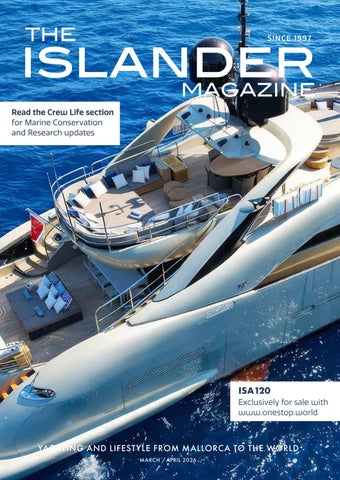
The Islander Magazine April & May 2026

Page 1


Dream destinations Desired timings

With our fixed sailing schedules and dedicated float-on/float-off yacht transport vessels, you can rest assured that your yacht is on time where it needs to be, which gives you the time to relax, enjoy, or reunite. We offer dedicated sailings to the most sought-after destinations and events.

Schedule 2026

APRIL | SEPT | OCT | NOV Palma Port Everglades

MARCH | MAY | SEPT | OCT Port Everglades Palma

OCTOBER Palma St. Thomas

MAY St. Thomas Palma

NOVEMBER Palma Le Marin

MARCH Golfito Palma

A MARINA THAT BREATHES GREEN AND LIVES BLUE

We will soon renovate our facilities to become the most environmentally committed marina in the Mediterranean.

FACILITIES

Berths up to 60m LOA. Side boarding fingers.

SUSTAINABILITY & TECHNOLOGY

Energy self-sufficiency and efficient management.

382 solar panels on roofs and pergolas.

Walkable solar tiles.

Electric charging points.

Aerothermal air conditioning and wind turbine.

EFFICIENT WATER MANAGEMENT

1.000 l/hour desalination plant and 8.000-litre-tank for washing down superyachts.

Rainwater collection system for cleaning pontoons and watering plants.

RECOVERING UNDERWATER LIFE

Pioneer measures to improve marine biodiversity with BioHuts. Improve water quality with nanobubbles and multiparameter probes.

BENEFITS FOR CLIENTS IN STP SHIPYARD PALMA

Marina Port de Mallorca and STP Shipyard Palma, both part of the IPM Group, offer the perfect mix of berthage, repair, and maintenance. Direct access to the services at STP and preference based on availability.

T +34 664 002 269

comercial@group-ipm.com www.portdemallorca.com

The Islander Team

CEO (Creative Enthusiastic Owner) Jens Oomes

Office Manager Natalie Tempelers

Admin & Communications Marlot Cathalina

Design CreArte Studio

Editorial Support Kjell Van Hoecke

Client Relations & Partnerships Sara Vermeulen

Contributors

Marlot Cathalina

Karine Rayson

Clair Minto

Barry D’Arcy

Bec McKeever and Dominique Smit (Virtual Pursers)

Tzarina Mace-Ralph

e3 Systems Alnitak Save The Med

Fundacion Palma Aquarium Love the Med

Contact details

Sales: sara@theislander.online

Editorial contributions & press releases: editor@theislander.online

Admin: admin@theislander.online

Accounts: accounts@theislander.online

Newsletter Event calendar

Note from the CEO*

The Choice

Yachting is an extraordinary sector to be part of. Few industries operate so visibly at the intersection of wealth, wilderness, knowledge, youth, and freedom. Modern media amplifies that visibility, and with it comes an opportunity to change the narrative.

As a sector, yachting has the ability to do many things very wrong, or very right. The difference often lies not in grand gestures, but in the quiet, everyday choices made on board, in marinas, and in the places we visit.

We can choose to pollute, or we can choose to protect the oceans that make our livelihoods and experiences possible. We can burn fuel without thinking, or we can slow down, plan better, and treat the sea as a living system rather than a backdrop.

We can choose to normalise excess substance abuse, exhaustion, and behaviour that would not be acceptable on land or we can rediscover what life at sea has always offered: perspective, rhythm, silence, and reconnection with ourselves and with nature.

We can use the enclosed environment of a yacht to blur boundaries and make young people uncomfortable, or we can turn it into one of the most powerful environments for personal development, responsibility, and confidencebuilding that exists today.

We can hype destinations until they become little more than boxes to tick and photographs to collect, or we can arrive curious, respectful, and willing to engage with the culture and environment that host us.

We can promise guests that anything can be flown in from anywhere, at any cost, or we can choose to support local producers, fishermen, farmers, and communities and discover that authenticity is often the greatest luxury of all.

We can keep reshaping marinas solely to accommodate everlarger yachts and higher rates, or we can ensure that young families and new generations still feel welcome, inspired, and able to develop their own relationship with the sea.

And finally, we can continue to treat yachts as floating status symbols or we can recognise their potential as platforms for education, seamanship, and ocean literacy.

At The Islander Magazine, we believe the future of yachting will be defined not by size or spectacle, but by intention. We see more and more owners and charter guests seeking to add a deeper sense of purpose to their time at sea.

For crew and industry professionals alike, the choice is ours and it is made quietly, every day, in how we engage with clients and how we conduct ourselves on board.

Jens Oomes

Tune in Thursdays

First Pages Industry Insider

Industry updates

Royal Huisman

30. e3 Systems

32. Marina Port de Mallorca

33. OneStop.World Yacht

34. Dubai International Boat Show

36. Ankor Software

38. Balearic Fasteners

39. i3 Systems

42. Fraser Yachts

44. Estela Shipping 47. Neptune

48. SAY Carbon Yachts

Meet The Crew: Adam Hauck

Crew Coach

Chief Stew Shop

Chef Tzarina Spits it out 72. Chef’s Chat 74. Bluewater Books & Charts

76. Ship to Shore: Jill Zwaans

79. MSOS

80. Virtual Pursers

81. Dexlit

82. Fender Design

83. Re-Set & Re-Born

84. Alnitak

86. Save the Med

88. Fundacion Palma Aquarium

90. Love the Med

93. Farsounder

96. Evolution Yacht Agents

OneStopWorld Real Estate

112. What's on in Mallorca
U-Moke
JoyRon Foundation 117. Ibiza Unlocked Yacht Services
La Ruta de la Sal
Andaman Islands

JUDGED BY THE COVER

A UNITED VISION

ONESTOP.WORLD EXPANDS INTO YACHTING IN THE BALEARICS

OneStop.World has built its reputation on a simple yet powerful idea: bringing together property, lifestyle, and investment services under one trusted platform. With an established presence in Balearic real estate, the launch of OneStop.World Yachting marks a natural evolution of that vision, extending the company’s “one stop” philosophy into the maritime world.

The new Yachting Division is led by James Fordham, Yachting and Operations Manager, whose career in the Balearics spans almost two decades. While his personal return to Mallorca carries meaning, the wider story is about alignment. Bringing together experienced professionals across property, yachting, and lifestyle services to create a unified offering for clients.

Written & photos by James Fordham, OneStop.World Yachting

“OneStop.World is about simplicity,” Fordham explains. “Whether a client is purchasing a home, investing in a yacht, chartering for a summer, or relocating to the islands, they can manage everything through one trusted team. That level of integration is rare, and it’s what attracted me to the group.”

While OneStop.World Yachting is new to the islands in name, the team behind it brings decades of experience across brokerage, charter, yacht management, and marine services, supported by longstanding relationships with owners, captains, crews, shipyards, and industry partners throughout Mallorca, Ibiza, and the wider Mediterranean.

The brokerage market, Fordham notes, has changed significantly in recent years. “Anyone can list a yacht online, but not everyone controls the listing or has a relationship with the owner. That creates confusion for buyers and inefficiencies for sellers. Experience, transparency, and accountability are what truly add value.”

Rather than positioning itself as a disruptor, OneStop. World Yachting aims to complement the strong yachting community already established in the Balearics. “Mallorca and Ibiza are home to some excellent brokers, technicians, and marine professionals. We respect that. Our approach is collaborative, working with trusted partners who share the same professional standards.”

A cornerstone of the company’s philosophy is a long-term outlook.

“For both property and yachting, success isn’t about quick wins,” Fordham says. “It’s about building lasting relationships, supporting careers, and creating repeat clients who trust us across multiple aspects of their lifestyle.”

OneStop.World Yachting operates with a comparatively lowcommission model, designed to encourage realistic pricing, increased transaction flow, and fair reward for partners.

“If owners achieve sensible results and partners are treated properly, more yachts move, more refits happen, and more people are drawn to the islands. That benefits the entire ecosystem.”

Beyond brokerage, OneStop.World offers an integrated lifestyle platform. Clients can combine yacht purchase or charter with luxury villa rentals, property acquisition, concierge services, and VIP experiences, all coordinated through one company.

“For many clients, yachting and property go hand in hand,” Fordham explains. “They might buy a home in Mallorca, then decide to purchase or charter a yacht. Being able to handle both under one roof makes the process seamless.”

Within three months of launching, OneStop.World Yachting secured more than 50 yachts for sale and access to over 200 charter yachts across the Balearics, with a similar reach throughout the Mediterranean. The team also maintains close relationships with established and emerging European shipyards, offering new-build and stock opportunities for private owners and charter investors.

Moorings remain a key challenge in the Balearics, and OneStop.World has already identified a number of off-market sale and rental opportunities, often linked to managed investment structures.

Ultimately, the expansion into yachting reflects OneStop. World’s wider ambition: to be a trusted partner for every stage of island life.

“From buying a property, to owning or chartering a yacht, to enjoying the Balearic lifestyle,” Fordham concludes, “OneStop.World is building a platform where everything connects.”. ◆ onestop.world/yachts

TUNE IN THURSDAYS

Our Tune In Thursday networking events continue to be a great success. These gatherings take place on the first Thursday of every other month: March, May, September, and November (we skip July for the summer season).

The January edition, hosted by Invisible Crew and held just after Three Kings Day, offered the perfect opportunity for professionals to ease back into work mode.

We welcomed a diverse and engaging mix of attendees, including yacht owners, yacht crew, brokers, and a wide range of island business owners.

Our CEO, Jens Oomes, delighted guests with a short live music performance, accompanied by the talented guitarist Bruno Rodriguez , a memorable highlight of the evening. We look forward to welcoming you at our next event!

22. Industry Updates

28. Royal Huisman

30. E3 Systems

32. Marina Port de Mallorca

33. OneStop.World Yacht

34. Dubai International Boat Show

36. Ankor Software

FIND HERE

The Islander Magazine can be found in +100 pickup points in Mallorca and in all superyacht marinas of Spain. We are also represented in strategic points in the French Riviera such as at the exclusive Billionaire's Quay in the port of Antibes. And you can also find us in all Cappuccino’s in Spain and Gstaad.

SCANMETOFIND THE ISLANDERMAGAZINE

38. Balearic Fasteners

39. i3 Systems

42. Fraser Yachts

44. Estela Shipping 47. Neptune 48. SAY Carbon Yachts

Industry Updates

STP Shipyard Palma steps up renewable energy generation with new solar power installation in its parking area

STP Shipyard Palma has activated a new solar power installation integrated into the carports of its recently developed parking area, providing clean, renewable energy for the shipyard’s own operations. The project forms part of the yard’s long-term commitment to reducing its environmental footprint and strengthening its sustainable energy model. The installation comprises 420 high-efficiency solar panels, each with a capacity of 660 W, strategically positioned to optimise electricity generation. The power produced is channelled through two 115 kW inverters and fed directly into the shipyard’s lowvoltage network, supplying on-site activities with green energy. The system is expected to generate approximately 373,630 kWh per year, corresponding to a reduction of around 102.2 tonnes of CO₂ emissions annually, marking a significant step in lowering the environmental impact of the shipyard’s industrial operations. To further enhance efficiency, STP Shipyard Palma has installed four battery storage modules on the quay, providing 774 kWh of total capacity and 400 kW of grid injection power. This allows excess solar energy to be stored and used during peak demand, reducing dependence on fossil fuel generators. The project was co-financed by the European Union through the NextGenerationEU programme under Spain’s Recovery, Transformation and Resilience Plan. With this new installation, STP Shipyard Palma continues to lead in sustainable energy integration within the yachting industry. ◆ stp-palma.com

The Delta Powerboats 48 Adventure is designed as the ultimate adventure boat: rugged, versatile, and built for real-world use in all conditions. With deep gunwales, heavy-duty racks, and robust railings, it prioritises safety, confidence, and practicality at sea. Constructed using rigid, vacuum-infused carbon fibre, the Delta 48 Adventure is suited for cold-climate expeditions, watersports, deep-sea fishing, and long-range cruising. It is not a boat that merely extends the season — it removes seasonal limitations altogether. The pilot house and saloon feature wraparound side windows, an expansive glass roof, and an inverted four-part windshield, ensure excellent visibility, secure navigation, and protected comfort. The aft deck is sheltered by an extended coachroof, with an optional openable soft top and full canopy enclosure. Modular layout options allow for flexible configurations for gear storage, sun loungers, life-raft holders, and more. ◆ deltapowerboats.se

Omaya Yachts adds MXG Yachts to dealer portfolio

Omaya Yachts has appointed MXG Yachts as its official dealer for mainland Spain and the Balearic Islands, marking an important step in the brand’s expansion into the Mediterranean market. MXG Yachts is a partnership between Mediterranean Yachts in Mallorca and Pier Zero Yachts in Marbella, bringing together more than 55 years of combined experience representing leading luxury shipyards in Spain. The collaboration focuses on Omaya’s debut model, the OMAYA 50, which has impressed MXG with its high build quality, intelligent layout, and generous outdoor living spaces. Designed for comfort and easy cruising, the power catamaran is well suited to the Spanish climate and boating lifestyle. Alan Gulliver, Director of MXG Yachts, said: “The OMAYA 50 offers outstanding quality and thoughtful design, making it a compelling choice for buyers in this market.”

Kaloyan Radulov, CEO of Omaya Yachts, added that Spain is a key region for the brand and that MXG Yachts is the ideal partner to introduce Omaya’s catamarans to local owners. With growing demand for catamarans in Spain and offices in both Marbella and Mallorca, MXG Yachts is well positioned to represent Omaya across the country’s main yachting hubs. ◆ www.omaya-yachts. com • www.mxgyachts.com

SailGP Valencia: high-speed racing comes to the Mediterranean

Visit our website or request a quote via email

Yacht Support Group - Mr. Paul van Westing

SailGP, the world’s fastest and most dynamic sailing championship, has confirmed that it will race in Valencia in the years ahead, with Marina Port Valencia serving as the event base. The decision reinforces SailGP’s growing status as one of the most innovative and high-profile competitions in global sport. Featuring cutting-edge F50 foiling catamarans, close-quarters racing and a format designed to captivate both seasoned sailing fans and new audiences, SailGP continues to push the boundaries of modern sailing. Valencia now joins a select group of international host cities on the SailGP calendar. The event will bring together the world’s top professional sailing teams, competing in short, tactical races close to shore that are designed for maximum intensity, spectator engagement and global broadcast appeal. SailGP’s arrival in

Valencia strengthens the presence of elitelevel sailing in the region and provides a major platform for international media exposure around the championship. The event will attract teams, technical specialists and sailing enthusiasts from around the world, further integrating Valencia into the upper tier of international competitive sailing. For SailGP, Valencia represents a strategically important Mediterranean venue within its expanding global circuit—one that aligns with the league’s commitment to innovation, high-performance racing and compelling sporting entertainment. With this move, SailGP continues to solidify its position as the leading modern sailing series worldwide. ◆ sailgp.com www.marinaportvalencia.es

5 Reasons You Can’t Miss the Mediterranean Superyacht Forum 2026

1. A forum built on action, not passive discussion

MSF26 is an industry working platform where participants challenge ideas, exchange expertise, and build practical outcomes. The program focuses on urgent themes such as cybersecurity, refit transparency, subcontractor management, marina sustainability, and staff shortages — ensuring the sector truly moves forward.

2. Curated for impact, built around the sector’s real priorities

Every topic, session, and speaker has been carefully selected

based on consultation, market analysis, and feedback from the industry. The program tackles operational bottlenecks, infrastructure, shifting owner expectations, sustainability, regulation, and the need for a stronger, more connected Mediterranean ecosystem.

3. Experience-led content: collaborative formats for a sector ready to shape its future

At MSF26, you take an active role: the future of the sector is shaped by everyone who joins the conversation. Expect keynotes offering broad socio-economic context, interactive formats such as case studies and hackathons, and Think Tanks synthesizing key insights per theme.

4. High-value networking with the people who are shaping the industry

MSF26 brings together decision-makers from the Mediterranean superyacht sector: from shipyard CEOs and refit directors to captains, regulators, technologists, and sustainability leaders. Networking sessions are purposefully designed, featuring targeted lunches, themed meetings, and formats that build lasting relationships.

5. A year-round ecosystem, not just a 2-day event

MSF26 is part of an ongoing Mediterranean ecosystem that includes white papers, working groups, cross-regional collaborations, and pilot projects. The event serves as a launch pad for continuous innovation and competitiveness in a region becoming the strategic hub of the global superyacht industry. ◆ mediterraneansuperyachtforum.com

Launched at BOOT Düsseldorf in January this year, the all new Axopar 38 XC Cross Cabin was one of the glittering highlights of the show, with owners, dealers, and fans of the Axopar brand packing out hall number 4 to get a first glimpse of the new boat as the covers were slowly withdrawn. With an uncompromising drive to innovate, Axopar's new 38 range redefines onboard liveability and comfort while delivering an unrivalled driving experience on one of the best-handling hulls in the world, with the ST Sun Top and XT Cross Top versions due for launch later this year. The legacy of the iconic Axopar 37 with nearly 3,000 units sold since 2019 is a range that has become an industry icon and has shaped boating culture around the world and its DNA is clearly present in the all-new Axopar 38.

Axopar believes that a boat must adapt to different uses with minimal compromise, as boating today is broader, more social, and more versatile than ever. People spend longer days on the water and use their boat for a wider range of activities. The allnew Axopar 38 is created to meet that need and is the result of extensive investments in R&D, continuing the company’s

3D Forward Looking Navigation Sonar

Get real time imagery of what's ahead

See obstacles in the water and shallows Avoid whales with benign sonar Keep

SKY

THE WORLD’S TALLEST SLOOP IS READY TO BUILD

Royal Huisman presents SKY, a rare opportunity for a visionary owner: a pedigree 81 meter / 264 feet sloop crowned by the world’s tallest mast.

Malcolm McKeon Yacht Design (MMYD) developed the ambitious naval architecture and the contemporary, headturning exterior styling.

Winch Design created the elegant and inspiring interior of this super-sized sailing yacht.

Written by Royal Huisman - Photos

SKY is created for world cruising with strong sailing performance. Her long waterline, lift keel, full aluminum construction with optimized weight distribution, combined with a powerful Rondal rig, will make SKY a true XXL superyacht.

She sails faster than the wind and faster than a similar length motoryacht. At the helm, the controls, integrated sailing system and twin carbon composite rudders will provide the maneuverability and simplicity of a performance sailing yacht under 50m / 164ft.

The carbon rig by Rondal will have an air draft of 93 meters / 305 feet, which equals the towering height of the Statue of Liberty from ground to torch.

The flybridge and various seating areas enable the versatility of both open air living, superb visibility and protection from the sun.

Owner and guests will experience a close connection to the water due to the aft beach deck with extendible swim platform, full-beam mid lazarette with folding platforms either side and cockpit with folding bulwarks.

The interior, which is inspired by nature, accommodates ten to twelve owners and guests. SKY’s interior styling will be an architectural sanctuary at sea, featuring

clean, sculptural lines, natural textures and calm palettes refined with subtle luxury detailing. Blurring boundaries between inside and out, evoking coastal landscapes but through an elevated, architectural lens.

The spacious owner’s full-beam stateroom gives direct access to the super large aft beach deck. It is already possible to imagine the floods of daylight which will enter the suite through the various extra-large hull windows.

Onboard amenities and various distinguishing features for owners and guests include a midship wellness spa and a watersports center.

SKY is resolved in design, naval architecture and engineering. Challenges have been identified, addressed and solved. And most importantly, the majority of production engineering is done. This groundwork saves significant development time and creates a unique opportunity for an owner who decides to proceed.

The layout and style can be personalized, while still saving significant development time to the delivery of a bespoke and unique supersized sailing yacht made at Royal Huisman in Vollenhove, The Netherlands: home to the world’s finest superyachts. ◆

SKY in a nutshell:

• World’s tallest flybridge super sloop

• Collaboration of excellence: Royal Huisman, MMYD and Winch Design

• Ready-to-go: the design has been finalized (and can still be personalized), technical challenges are solved and most production engineering is completed

• No need for support vessel: wide arrangement of tenders, watersports / toys and equipment

• Spring 2030 delivery: rather than the customary six or more years for the full process from architect briefings, multiple design meetings until delivery for a custom XXL superyacht

Brochure

royalhuisman.com/sky

30 YEARS OF E3 SYSTEMS

AIt’s hard to believe, but e3 Systems has officially turned 30 this February. Founded back in early 1996 by three partners — Roger Horner, Alan Walker and Jason Abbott — the company has grown from a small, ambitious idea into a global name in marine communications.

Around this same time Roger started writing his first articles for The Islander Magazine, sharing insights into the fast changing world of marine electronics. Alongside building the business, writing about the latest technical development within our sector became a constant for Roger right up until his sudden and tragic passing in early 2024.

Eventually, they upgraded to a Formosa 51-ketch, with big dreams of crossing the Atlantic and heading further afield. Plans were firmly in place for the Caribbean when life threw in a wonderful twist: after struggling to have children, Nicky became pregnant with their first daughter, Lucy. Undeterred, they sailed anyway, with a nine-month-old baby on board.

From turquoise bays to business plans

It didn’t take long for Roger’s restless, creative mind to kick in. He chuckled that he became “a little bored of turquoise bays, palm-fringed beaches and reading books,” so the family sailed back to Europe. During night watches at sea, Roger began sketching out a five-year business plan for an electronics company based in Mallorca, a burgeoning venue for the yachting sector.

When e3 Systems launched, its first office was affectionately described as a “broom cupboard” in Marivent. Even so, the company reached its five-year business target within its very first year.

When the stars align: Alan Walker and Jason Abbott

Meanwhile, connections were forming. Alan Walker first met Jason Abbott in Falmouth, UK, where Jason’s in-laws were building a larger version of the yacht Alan and his wife Linda were themselves commissioning. Jason later bought a Moody of his own and sailed with his wife Sam through the French canals and on to Mallorca.

The early days of connectivity

Originally rooted in marine electronics and the very early days of the internet, e3 wasted no time pushing boundaries. In its first year, the company opened what was essentially Mallorca’s first internet café. Back when there were only around 36 million internet users worldwide.

From there, the focus quickly shifted to telecommunications and technology services, particularly for the marine and superyacht markets. Innovation came thick and fast, including:

• A single-source weather service in 1998

• Early VHF/UHF vessel tracking systems

• GSM communication solutions for yachts in the late 1990s

Growing with marine communications

As internet and mobile technologies evolved, so did e3. The company became a trusted communications integrator for superyachts, building deep expertise in satellite, cellular, and hybrid connectivity. Along the way, e3 hit several major industry milestones:

• Installing the first Inmarsat Fleet 77 on a yacht in 2002

• Introducing the first VSAT satellite system on a yacht in 2004

• Continuing to pioneer hybrid connectivity solutions and flat-panel antennas in the years that followed

From local startup to global player

The e3 story really starts a few years earlier. In 1992, after selling his electronics and software business in the UK, Roger and his wife Nicky decided to do all the things that would be much harder once children arrived. With a shared love of sailing, they bought a Moody 33 and set off to explore the Mediterranean and the Caribbean. Armed with enthusiasm, curiosity, and very little in the way of a fixed plan.

One of their first stops was the 1992 Olympic Games in Barcelona, where at times the boat played host to up to 16 people. Somewhere along the way, they fell in love with Spain and Mallorca in particular. Although it was meant to be just a stopover en route to the eastern Med, it kept pulling them back.

Jason, who was working for Yacht Electronic Services at the time, mentioned he could introduce Alan to some potential work. Alan and Linda thus sailed into Palma and secured an affordable berth thanks to construction firm Huarte, which had recently extended the pontoons at RCNP.

Word spread quickly. Roger and Nicky moved their Formosa 51 over from the T-quay, joined by Diane Franklin (who would go on to be a director of e3 Systems throughout its history) and her partner Les. With several families and small children living boat-to-boat, friendships formed fast and helped along by trips to the English Mums and Toddlers Group at Coleman Hall.

Recognising Jason as a highly respected IT engineer with an entrepreneurial spark, Roger invited him to become a business partner. Alan initially joined as a contractor and later a small shareholder. In 2002, when Jason and Sam decided to return to the UK for their children’s education, Alan bought Jason’s shares. And just like that, e3 Systems was born.

Today, e3 Systems looks very different from that tiny Marivent office, but the spirit of innovation remains the same. The company has grown into a global maritime communications provider, with administration and engineering teams headquartered in Mallorca and a worldwide network of engineers and partners.

Loyalty and continuity are something that works both ways and of the 30 or so staff employed in Palma, 16 have worked for e3 Systems over 10 years, 9 over 15 years and 5 over 20 years. It´s always regarded itself as a particularly close-knit family and a core reason why Roger´s sudden death in 2024 was such a devastating blow to all who knew him - both within and outside the company, through the numerous bonds and friendships that he had made.

Alan Walker, enormously liked and respected with his quiet strength and commitment and a lynchpin of the company’s ongoing developments and success, has taken on the reins of Managing Director in 2025, after heading up the engineering team throughout the company´s history and takes it into its fourth decade. One that will certainly include further extraordinary revolutions in the world of connectivity.

e3 Systems is now one of nine top-level companies within Grupo Arbulu. Headquartered in Spain, Grupo Arbulu is one of the world’s largest specialists in marine electronics and satellite communications, employing more than 600 people globally.

Thirty years on from that crossing in a small boat with a 9-month-old baby, a bold idea and a business plan written on night watches, the adventure is far from over. ◆

Alan Walker & Roger Horner
A boat, a dream - and no fixed plan
Roger Horner - early days at e3 Systems

MARIN A PORT DE MALLORCA

TO H OST SUPERYACHT NE W BUILD HUB AT PALMA INTERNATIONAL BOAT SHOW 2026

Marina Port de Mallorca will be the new home of the Superyacht New Build Hub at the 2026 edition of Palma International Boat Show.

This dedicated space will bring together some of the world's leading shipyards in sailing yacht construction and related industries, bolstering Marina Port de Mallorca's position as a marina equipped to host projects linked to the new build segment in the Mediterranean yachting ecosystem.

The Superyacht New Build Hub will feature twenty premium berths for sailing yachts between 30 and 60 metres LOA, as well as a shore-side exhibition area for more than twenty companies specialising in new-build projects and related services.

Following its first edition last year at another location within the port of Palma, the hub's move to Marina Port de Mallorca marks a new step in consolidating the initiative, offering a modern, functional setting seamlessly connected to the city and the rest of the event venues.

The Superyacht New Build Hub is an initiative to support the local yachting industry, aimed at attracting more boats and customers to Palma. The New Build Hub exhibition at Marina Port de Mallorca will be the largest showcase ever seen at any boat show of large sailing yachts for sale or charter. Sustaining Palma's status as a world-leading sailing destination depends on our commitment to the yacht-building industry. Palma International Boat Show is no longer just another boat show in Spain, but the country's flagship event, now standing proudly alongside leading international shows such as Cannes, Monaco, and Genoa", says Arne Ploch, Director of Palma Superyacht Village.

"Marina Port de Mallorca is pleased to host the Superyacht New Build Hub this year and delighted to be partnering with Palma International Boat Show. We firmly believe

in supporting projects that create real synergies between shipyards, professionals, and yacht owners, while anchoring Marina Port de Mallorca's position as a venue equipped to host large-scale projects and actively partnering with initiatives that help shape the future of the international yachting industry", says Patrick Reynes, CEO of Marina Port de Mallorca.

"The arrival of the Superyacht New Build Hub at Marina Port de Mallorca also provides an opportunity to connect yacht owners, shipyards and specialist companies with a marina that provides the technical capabilities, services and location needed to support new-build projects from their earliest stages", explains Isabel Martínez, Sales Director at Marina Port de Mallorca. "This hub bolsters our position within the superyacht industry and cements the marina as a natural meeting point for the new-build ecosystem in the Mediterranean".

For IPM Group, parent company of the marina, this commitment reflects a clear ambition to advance the yachting industry by creating platforms that foster innovation, raise the profile of new projects and encourage industry-wide collaboration.

In its previous edition, the Superyacht New Build Hub attracted top-tier shipyards and brands from around the world, including Baltic Yachts, which unveiled its cuttingedge Canova and Pink Gin Verde models, and Southern Wind with Kiboko 4. This line-up of industry leaders firmly established the space as a dedicated meeting point within Palma International Boat Show. The shipyards and exhibitors taking part in the 2026 edition will be announced shortly.

With this new partnership, Marina Port de Mallorca is enhancing its role as a strategic infrastructure for major yachting projects, complementing its berths and services with an active role in one of Europe's most important yachting events. ◆ www.portdemallorca.com

A NEW WAY TO EXPERIENCE YACHTING IN THE BALEARICS

The Balearic Islands have long been a magnet for those who see yachting not simply as a pastime, but as a way of life. From the quiet anchorages of Mallorca to the energy of Ibiza’s coastline, the region attracts an international community seeking both freedom and refinement on the water. It is within this setting that OneStop.World has quietly introduced its new yachting division, a concept shaped as much by lifestyle as by logistics.

At the heart of the division is James Fordham, whose career in yachting began in the Balearics more than fifteen years ago.

After building and operating a successful yachting business in Ibiza, Fordham went on to work across Europe, collaborating with leading shipyards, brokers, and marine professionals. That experience, gained across both established and emerging markets, has informed a notably personal and transparent approach to the industry.

Rather than positioning itself as a traditional brokerage, OneStop Yachting operates as a single point of contact for owners, buyers, and charter clients. The emphasis is on clarity and continuity, guiding clients from the early stages of yacht ownership through to operation, charter management, and eventual resale.

New-build yachts from respected European shipyards sit alongside a

carefully selected portfolio of second-hand vessels, while moorings, charter opportunities, and yacht investment advisory form part of a broader, integrated offering.

What distinguishes the division is its connection to life ashore. Working between Mallorca and Ibiza, the team extends its service beyond the marina, coordinating lifestyle concierge support and bespoke holiday experiences that reflect how clients actually use their yachts. The result is a service that feels considered rather than commercial, designed around longterm relationships rather than single transactions.

As the Balearics continue to evolve as a global yachting hub, OneStop Yachting presents a modern interpretation of what yachting services can be: discreet, well-connected, and rooted in genuine local knowledge, offering a seamless way to experience the islands, both at sea and on land. ◆ www.onestop.world/yachts

DUBAI INTERNATIONAL BOAT SHOW 2026

A MARINE MARKETPLACE SHAPING THE REGION’S YACHTING FUTURE

As the global yachting industry continues to expand beyond its traditional centres, the Dubai International Boat Show 2026 (DIBS 2026) is positioning itself as one of the most influential marine gatherings in the Middle East and North Africa.

Returning from 8–12 April 2026, the event marks its 32nd edition, reinforcing its status as the region’s longest-running and largest yacht and marine lifestyle show.

Organised by Dubai World Trade Centre, DIBS 2026 is increasingly defined by its role as a deal-led marketplace rather than a purely lifestyle exhibition. With more than 200 boats and marine craft, participation from over 1,000 international brands, and an expected 35,000-plus visitors, the show reflects both the scale and maturity of the regional marine market.

Dubai’s rise as a year-round yachting hub underpins this growth. The city now hosts 22 marinas with extensive wet and dry berthing capacity, supporting a growing concentration of owners, brokers, and marine services operating beyond the Mediterranean season. Its strategic location allows yachts to operate across the Gulf, the Indian Ocean and wider cruising grounds, positioning Dubai as both a base and a gateway for global yacht movement.

and Services (ESS) sections showcase everything from luxury brands inspired by the ocean to essential marine equipment, refit services and port authorities.

For the professional yachting community and expat readers of The Islander, the appeal of DIBS lies in this diversity. It is a place where serious marine business coexists with lifestyle, where innovation sits alongside heritage, and where regional and international players meet in one focused environment.

As the Middle East continues to attract global wealth and marine investment, the Dubai International Boat Show 2026 offers a clear snapshot of how yachting is evolving in the region. Not simply as a leisure pursuit, but as a dynamic industry shaping the future of maritime life in one of the world’s fastestgrowing coastal cities. ◆ www.boatshowdubai.com

At the heart of the show, Superyacht Avenue returns as a curated showcase of luxury superyachts from leading international and regional shipyards. Alongside it, the Marina Display presents a broad on-water line-up of yachts, specialist craft and marine technology in a working harbour environment. DIBS has increasingly become a preferred platform for yacht debuts, with more than 60 regional and international launches recorded at the 2025 edition, underlining its commercial relevance.

Beyond the yachts themselves, DIBS 2026 places strong emphasis on knowledge exchange and innovation. Port of Call, the show’s talks and content platform, brings together industry voices to explore ownership trends, marine technology and future market direction. Meanwhile, the Innovation Zone has grown year-onyear to more than 10 exhibitors, highlighting growing interest from marine and maritime technology companies seeking access to investors, partners and industry leaders.

The show also reflects the breadth of today’s marine ecosystem. The Dive Zone introduces visitors to underwater exploration and marine education through interactive features, while the Marine Luxury & Lifestyle (MLL) and Equipment, Supplies

Written & photos by Dubai International Boat Show

ANKOR SOFTWARE BRINGS THE SUPERYACHT CHARTER INDUSTRY TOGETHER WITH CALENDARS AND ANKORPAY

The superyacht charter industry is built on precision, trust, and collaboration. Behind every seamless charter experience lies a complex network of brokers, central agents, management companies, captains, and crew working across borders, time zones, and regulatory environments. Ankor Software was created to support this ecosystem with technology designed specifically for the realities of modern superyacht operations.

Founded in Australia by Mike Sager and Elliot Cousins, Ankor Software was built with a clear mission: to bring the yachting world together through powerful, transparent, and easy-to-use technology. Now entering its 5th year, Ankor has grown into one of the most trusted platforms in global yacht charter, supporting thousands of professionals worldwide and connecting markets that have traditionally operated in silos.

From vision to a connected platform

Mike Sager and Elliot Cousins identified a major gap in the charter industry early on. While yachts themselves continued to evolve, the systems supporting charter operations remained fragmented, manual, and inefficient. Brokers and central agents relied on disconnected tools, expired brochures, static availability, and outdated payment processes that slowed down deals and increased operational risk.

Ankor began as an itinerary planning solution built specifically for charter brokers. It quickly became clear that itinerary creation was only one part of a much larger workflow. As the platform evolved through direct feedback from brokers, central agents, captains, and management companies, Ankor expanded to cover availability, proposals, payments, websites, and contracts within a single ecosystem.

Today, Ankor Software is a unified platform that supports the full lifecycle of a charter, from identifying the right yacht to managing availability, presenting proposals, handling APA, and finalising agreements. While each product can be used independently, the real strength of Ankor lies in how seamlessly these tools work together.

Availability as the foundation

Accurate availability remains the foundation of every successful charter. Ankor Superyacht Calendars has become the world’s largest broker-only yacht availability and display platform, setting a new benchmark for transparency and trust.

With access to more than 2,200 yachts worldwide, supported by over 1,080 retail brokers and 330 central agency companies, Calendars delivers real-time availability that is updated directly by central agents. This eliminates guesswork, outdated listings, and unnecessary intermediaries.

Central agents retain full control of their listings; brokers gain confidence in the data they present to clients, and brochure links never expire. Calendars also continues to expand its global footprint, with particularly strong fleet coverage in Asia, the Pacific, and the UAE. The result is a more efficient, professional, and collaborative charter marketplace.

AnkorPay revolutionising APA management

The most transformative development within the Ankor platform is AnkorPay, a modern APA management and payment solution built specifically for the superyacht charter industry.

APA management has long been one of the most complex and inefficient parts of charter operations. Captains and management companies have traditionally relied on

spreadsheets, manual reconciliations, multiple cards, and opaque fee structures. AnkorPay was created to replace this outdated approach with a solution that is transparent, secure, and cost-effective.

Built in partnership with Airwallex, a leading global financial platform operating in over 200 countries, AnkorPay introduces modern financial infrastructure to charter operations. Users can issue multi-currency virtual cards, apply spending limits, monitor transactions in real-time, and manage APA with full visibility across yachts or fleets.

“Ankor Software was built with a clear mission: to bring the yachting world together through powerful, transparent, and easy-to-use technology.”

A key differentiator is pricing. AnkorPay offers highly competitive interchange and FX rates, with no onboarding fees and no loading fees. This alone represents a significant shift in an industry where payment solutions have traditionally come with high costs and limited transparency.

AnkorPay scales effortlessly from individual captains to large fleets, making it equally suitable for single yacht operations and major management companies. Fully compliant with global security standards and supported by free training and dedicated 24/7 support, AnkorPay delivers confidence at every level of operation.

Despite launching only months ago, AnkorPay is already being adopted by yachts and fleets worldwide, driven by demand for a more efficient, modern, and fairly priced APA solution. It is not simply an add-on product, but a fundamental step forward in how charter finances are managed.

From data to client experience

Beyond availability and payments, Ankor enables brokers to transform accurate data into compelling client experiences. Integrated proposal and itinerary tools allow brokers to combine yacht information, routes, and destinations into polished, branded presentations.

With access to thousands of locations, hundreds of predefined routes, and extensive yacht data managed by Ankor and central agents, brokers can respond faster while maintaining full creative control. This reduces manual work, shortens response times, and improves conversion.

Ankor also offers website solutions and contract automation to complete the workflow. These tools are designed to support visibility, compliance, and efficiency, without adding complexity.

Looking ahead to 2026

As Ankor enters its next phase of growth, the focus remains unchanged. Build technology that serves the industry, strengthens relationships, and brings the global yachting community closer together.

With Superyacht Calendars continuing to expand, AnkorPay rapidly gaining traction, and major new platform developments planned for 2026, Ankor Software is positioned to continue shaping the future of superyacht charter through innovation, transparency, and trust. ◆ www.ankor.io

THE SMALL DETAILS THAT KEEP THE MEDITERRANEAN MOVING INSIDE THE WORLD OF BALEARIC FASTENERS

In the yachting industry, perfection rarely announces itself loudly. It lives in the details: a bolt that refuses to corrode, a thread that bites cleanly, a fastening solution that simply does its job — year after year, mile after mile at sea. These are the components that keep superyachts operational, refits on schedule, and captains sleeping well at night.

Based in Palma, Balearic Fasteners has quietly become one of those essential players the industry relies on — often without even realising it. Founded in 2007, the company began with a clear focus: supplying specialist fastening solutions to professionals who know exactly what they need and refuse to compromise on quality. Since those early days, the business has grown steadily, not through flashy marketing, but through consistency, technical knowledge, and an exceptionally deep stockholding.

A visit to the warehouse today feels a bit like stepping into an Aladdin’s cave for engineers, shipyards, and marine technicians. Rows of marine-grade A4 stainless steel fasteners, brass, bronze, aluminium, high-tensile steels, and nylon solutions from M3 to M30 — and that is before moving into more specialised territory such as duplex, super duplex, titanium, imperial UNCn and UNF threads, fine pitch options, and special lengths.

The warehouse itself is clearly structured: all racking and shelving is fitted with clear labels, including product descriptions and barcodes, allowing for fast identification and efficient picking. Each product is individually packaged and supplied with a clear, colour-coded label, on which the product description, dimensions, and material grade are clearly stated. This system ensures clarity on the counter, speed in the warehouse, and reliability for professional users. What truly sets Balearic Fasteners apart is not only what they

stock, but how they operate. Professionals can walk straight up to the counter, whether they need ten bolts or a full supply for a refit project. Orders are processed quickly and advice is practical, and experience-based, and deliveries across Mallorca and beyond are designed to keep projects moving. Beyond fasteners, Balearic Fasteners also supplies stainless steel chain cut to exact length, tailored to the specific requirements of each project. Whether for anchor systems on yachts, industrial applications or technical installations, precision matters.

One of the fastest-growing segments within the assortment is black A4 stainless steel products, including screws. These components combine a clean, modern appearance with the corrosion resistance required in marine environments.

Balearic Fasteners is also a recognised fontanería specialist. In stainless steel, brass and bronze, fittings and stainless steel hose clamps are stocked up to 4 inches.

In the field of deck hardware and fittings, Balearic Fasteners supplies Inox 316 yacht fittings from Marinetech, offered under an exclusive distribution agreement. This range meets the highest marine standards and complements the existing fastening and technical hardware assortment perfectly.

Where standard solutions fall short, Balearic Fasteners provides custom manufacturing. Special bolts and fastening components are produced according to customer drawings. While yachting remains at the core of the business, Balearic Fasteners also supplies other demanding sectors such as shipyards, industrial installations, and energy projects.

The future vision of Balearic Fasteners is clear and deliberately pragmatic: a continued focus on specialisation, stock depth, traceability, and technical competence. ◆ www.balearic- fasteners.com

BEHIND THE SCENES OF I3 SYSTEMS

THE GUYS WHO MAKE IT ALL WORK

Written & photos by i3

Hamza Amin - who holds a degree in Product Design, serves as a highly accomplished design manager for i3 Composites, bringing seven years of dedicated experience to the company.

In his capacity, Hamza is the visionary behind the entire i3 Composites Products line, overseeing the complete design and development lifecycle. His strategic contributions extend far beyond aesthetic design; he was instrumental in implementing significant process improvements, specifically focusing on reducing production costs and optimizing critical workflows across the design and manufacturing departments.

Furthermore, Hamza's commitment to user-centric design led to substantial enhancements in product functionality and usability. Cutting edge designs include, swim ladders, boarding steps, furniture and even weight saving biminis.

The cumulative result of his impactful work has been a growing reputation for raising the bar within the industry and redefining what is possible.

Francisco Lira - Originally from Chile, Francisco’s journey into marine engineering was a natural evolution. After sailing through the fjords of Southern Chile on a 50-foot catamaran, he became obsessed with the symbiosis between aesthetic elegance and technical performance.

A Design Engineer with a Master’s in Innovation and Design, he has forged a career that bridges the gap between traditional craftsmanship and cutting-edge technology. From his early

days as an apprentice boat builder working with wood and carbon fiber, to specializing in digital fabrication processes— including CNC machining and robotics—his focus has always been on technical precision.

After gaining experience as a designer and composite boat builder, he now brings his knowledge to i3 composites in Palma de Mallorca as part of the CAD/CNC team.

Written by JP - Photos by VY Design

2026 sees the evolution of i3 products and services with off island composite installation solutions and 3D scan to CAD service.

Did you know?

Carbon fibre is anisotropic, meaning its strength is directional. If you pull on a carbon fibre strand from both ends, it is five times stronger than steel. However, if you hit it from the side (perpendicular to the fibers), it can be surprisingly fragile. To solve this, engineers layer the sheets at different angles—0°, 45°, and 90°—to create a "quasi-isotropic" material that is strong in every direction.

Jan Soechting – CNC Operator and CAD/CAM specialist at i3 Composites. His primary focus is on the complete digital-to-production workflow for 4-axis CNC machining, specifically creating high-precision polyurethane foam molds for carbon fiber components used in luxury yachts and sailing boats.

His role encompasses 3D modeling, CAM programming (Fusion 360), machining execution, and process optimization. With a background in Mechanical Engineering and Product Design (DUT GMP, France) and industrial experience gained in Germany, he possesses a strong foundation in manufacturing processes, precision machining, and industrial workflows.

Additionally, he has hands-on experience with composite lamination (both wet lay-up and prepreg), which allows him to effectively bridge the gap between design, tooling, and final composite production.

At i3, Jan prioritizes accuracy, efficiency, and continuous improvement. His goal is to reliably translate complex geometries into tooling solutions that meet the demanding quality standards of the marine industry, while also preparing the company's processes for future expansion into more advanced composite manufacturing sectors. ◆

https://i3composites.com

FRASER FIRST & FOREMOST

As the world’s leading yacht brokerage company, Fraser combines the finest yachts for sale and charter with unrivaled expertise. Whether you are looking for the perfect charter vacation, buying a yacht, seeking first-rate yacht management, or are ready to sell, you will find it all in Palma with Fraser – the finest name in superyachts.

Celebrating almost 80 years of multi-award-winning excellence in luxury yachting, Fraser is the largest and longest-established, full-service yacht brokerage in the world. Handling a portfolio worth over 7.4 billion USD (7 billion EUR), Fraser has earned its reputation as the finest name in superyachts by combining deep industry insight with ethical, client-first service to help Owners and Charterers navigate the world of yachting with confidence and care.

Part of a global brokerage team who have bought and sold more yachts for more Owners than any other company, every year for the last 15 years, Fraser Palma’s three dedicated Sales Brokers offer decades of experience across all sizes and style of yacht. Whether you are looking to sell your yacht, upgrade to something new or are a first-time Buyer, the Fraser Palma Brokerage team are standing by.

Fraser Palma is also home to a full-time Yacht Management department, including two Technical Managers, one Crew Manager, and one Yacht Administrator. This on-theground team combines deep regional knowledge and global capability to provide local, responsive, and convenient support for yachts operating throughout the Balearics, while also delivering comprehensive full Yacht Management services to yachts worldwide.

Furthermore, two full-time, dedicated Charter Brokers bring years of combined experience to the Palma team. Yvonne Stern has recently returned to Palma after many successful years at the company’s San Diego hub. With 26 years in the yachting industry, Yvonne has logged over 30,000 offshore miles, including two Atlantic crossings, and brings rich experience from roles on iconic vessels and major regattas around the world. Fluent in Swedish, English and Spanish, she has built a distinguished career that has taken her from deck crew to charter chef and team logistics for America’s Cup campaigns, joining Fraser in 2018 to create unique charters for discerning global clients. Her return to Palma, bringing a remarkable background, expert onboard knowledge and in-depth yacht and destination knowledge, adds a key strength to Fraser’s local charter service.

Fraser is also excited to welcome Charter Broker Sarah Klische to the team. Sarah brings over six years of experience as a Charter Broker, complemented by five years working on board yachts ranging from 30 to 80 metres. Her time at sea saw her travel extensively worldwide, including several years aboard a renowned, globe-travelling Feadship, giving her a deep, first-hand understanding not only of life on board and what truly makes a charter exceptional, and how to deliver it seamlessly.

A passionate sailor, Sarah is committed to creating outstanding charter experiences in all destinations, with a particular love for off-the-beaten-track cruising and helping clients discover hidden gems and local cruising grounds, especially in the Balearics. Known for being honest, open, and highly approachable, Sarah takes pride in building lasting

relationships with her clients. Her exceptional level of repeat business reflects her dedication to delivering memorable, personalised charters worldwide.

Fraser subsidiary The Crew Network (TCN) is the world’s longest-serving dedicated crew recruitment agency, with 35+ years of sourcing the most discreet, skilled and qualified yachting professionals for the finest yachts worldwide. Palma is of course one of the world’s leading crew hubs, attracting experienced professionals from across the industry. Ideally located at the heart of this network, the growing team at TCN Palma is perfectly positioned to source exceptional crew across all departments, seniority levels, and yacht size ranges, ensuring access to the very best talent the market has to offer. With 600+ positions filled each year on yachts across every size range, the TCN team use a combined 90+ years of experience in yachting, HR and business to recruit crews that last, reducing churn and alleviating the administrative burden for Captains.

No matter where your yachting journey takes you next, find the support you need in Palma with Fraser – the finest name in superyachts.

To optimize your yachting experience, contact their Palma team on +34 971 700 445 or spain@fraseryachts.com. ◆ www.fraseryachts.com

Written & photos by Fraser Yachts
Sarah Klische
Yvonne Stern

ESTELA’S PALMA BOAT SHOW 2026 NETWORKING EVENTS FOR SUPERYACHTS

Each year, Palma Boat Show brings the superyacht world together in one of the Mediterranean’s most dynamic maritime hubs. Amid the docks, deckwalks, and bustling stands, Estela creates a different kind of space, one that prioritises meaningful connection over noise, and conversation over congestion.

For 2026, Estela presents an outstanding programme of parallel events designed to align with the natural rhythm of Palma Boat Show week. These moments are carefully positioned around the day’s key touchpoints for networking:

early mornings when the industry gathers with fresh focus, golden-hour sunsets when conversations flow more freely, and one unforgettable evening that has become the social and professional highlight of the week.

Based around Astilleros de Mallorca, a historic and working shipyard at the heart of Palma’s yachting ecosystem, the programme brings together three Breakfast Seminars, two Sunset Cocktails, and the iconic Captains’ Dinner at the Museum. Each event is curated to feel both professional and personal: high-quality, well-attended, and built around real discussions rather than superficial introductions.

Breakfast Seminars (29–30 April & 1 May 2026) - Astilleros de Mallorca

The Estela Breakfast Seminars set the tone for the day. Taking place in the early morning (approximately 08:30–10:30), they offer superyacht professionals a calm, productive start before the intensity of the show floor. Rather than rushing between stands, attendees gather over coffee in a relaxed, purpose-driven environment that encourages open exchange.

Attendance is industry-led and highly targeted, typically including captains, senior crew, yacht managers, brokers, yacht agents, shipyards, marinas, fuel brokers, and key vendors, the decision-makers shaping the Mediterranean season ahead. For many, these breakfasts have become an essential part of Palma week: a place to reconnect, align, and start conversations that continue long after the seminar ends.

Sunset Cocktails (29–30 April 2026)Astilleros de Mallorca

As the day draws to a close and the docks begin to quieten, Estela’s Sunset Cocktails take centre stage. Held from 17:00 to 19:00 at Astilleros de Mallorca, these gatherings have become one of the most effective networking moments of Palma Boat Show week. With the sun dipping behind the marina and yachts lining the waterfront, the setting naturally lends itself to connection.

The atmosphere is relaxed yet professional, less crowded than the show floor, more conversational than a formal reception. Attendees include a strong mix of captains, owners’ representatives, brokers, and industry partners who are there not just to be seen, but to engage.

Information and participation

Estela offers a full programme of participation options for Palma Boat Show week 2026, including partnership opportunities across the Astilleros events and the Captains’ Dinner.

Interested parties can request additional information, presentation decks, and pricing. Estela is also available to arrange short meetings or video calls to tailor a participation package that aligns with individual objectives, whether the goal is brand visibility, relationship-building, or strategic positioning within the superyacht community. ◆

Contact: events@estelashipping.net

+34 638 81 68 03 https://estelashipping.es

Captains’ Dinner at the Museum (1 May 2026) - Pueblo Español, Palma

If the Breakfast Seminars set the day’s clarity and the Sunset Cocktails its unwind, the Captains’ Dinner is the undisputed centrepiece of the week.

Hosted on Friday 1 May 2026 at the iconic Pueblo Español in Palma, this invitation-only evening has earned its place as the most anticipated event in Palma’s yachting calendar. From 19:00 until late, captains and sponsors gather amid historic architecture, Mediterranean ambiance, and worldclass hospitality.

Far more than a networking stop, it’s a carefully crafted evening designed for genuine connection over fleeting encounters. The atmosphere is exclusive yet warm — refined but never rigid.

With a guest list of key decision-makers, conversations deepen, relationships strengthen, and new partnerships take shape. Unlike many industry events that fade from memory, the Captains’ Dinner leaves a lasting impression, both professionally and personally.

by The Islander - Photos by Estela Shipping

A GOOD NIGHT’S SLEEP ON BOARD STARTS WITH NEPTUNE REFINED SLEEP COMFORT, DAY AND NIGHT

On board a yacht, true luxury is felt in the moments of rest. You spend around one third of your time in your bunk and for crew members, often considerably more. It is where the day begins and ends, where time is taken to recharge, read, work, or simply unwind. Comfort and sleep quality are therefore not indulgences, but essentials..

A clear distinction between certification and experience IMO/MED certification is a familiar standard in the maritime world. Issued by the International Maritime Organization (IMO), it focuses exclusively on one critical requirement: fire safety. Products are tested and approved by recognised authorities before carrying the IMO mark.

and an elegant finish that complements the interior of the yacht. A quiet luxury that enhances rest and wellbeing.

While essential, this certification addresses only fire behaviour. It does not consider comfort, hygiene, durability, craftsmanship or long-term performance, elements that define daily life on board.

Designed for owners and crew alike

At Neptune, IMO/MED certification is the foundation, not the finish. Every mattress is designed to meet the distinct expectations of both owners and crew.

For owners, this means refined comfort, premium materials

For crew, it means durability, hygiene and consistent comfort, night after night. A mattress that supports recovery during limited rest periods and stands up to intensive, long-term use. Neptune offers multiple comfort levels, antibacterial protection, roll packed delivery for easy installation on board, a choice of finishes from refined to luxurious, and a seven year warranty against body impressions. All proudly Made in Holland.

Crafted with care

All IMO certified Neptune mattresses are handcrafted in the Netherlands, in our own workshop, under continuous supervision by a recognised inspection authority. Only premium materials are used, including Talalay latex, resilient Nautifoam and a high quality mattress cover enhanced with silver ions for improved hygiene. CMHR foams are deliberately avoided. Instead, safer materials are selected in line with Neptune’s uncompromising standards.

Conclusion

IMO/MED certification guarantees fire safety. Neptune adds what truly matters: comfort, craftsmanship and confidence. Thoughtfully designed for owners, dependable for crew, and unmistakably premium in every detail.

Neptune welcomes clients in its showrooms in Mallorca and in the Netherlands, where materials, comfort levels and finishes can be experienced firsthand. The Mallorca showroom is located at Avenida Joan Miró, 3 Local E, E-07014 Palma de Mallorca. For appointments or enquiries, please contact our local representative Brigitte van Dijk at +34 659 90 87 12 or mallorca@neptune.nl. ◆ www.neptune.nl

Written by Marcel Botman – Owner of Neptune - Photos by Neptune

Spend time in any Mediterranean port and the priorities of today’s day boat owners become clear. The most sought-after day cruisers exist at the intersection of comfort and performance. The SAY 42 Sport reflects a new era of boat ownership.

Across the Mediterranean, the rhythm of a typical day on the water has evolved. Calm afternoons spent at anchor are contrasted by the thrilling journey to get there. The SAY 42 Sport was shaped by this reality.

The yacht did not begin as a clean-sheet idea. Instead, it grew out of observation. Owners and operators of the original SAY 42 spoke highly of its handling and performance, but their days increasingly followed a different pace. They wanted more space to gather, more freedom to move on deck, and a layout that better supported long, social hours on the water. The response was not to chase size or spectacle, but to rethink how the boat lived once it stopped moving.

The goal behind the SAY 42 Sport was simple in principle, though complex in execution: create more functionality on deck without losing the boat’s signature handling. This led to a reworked deck layout that encourages movement and interaction. Social areas are clearly defined, yet fluid.

Guests can circulate easily between sunpads, seating and the water, while the helm remains a purposeful, uninterrupted workspace.

A large swimming platform plays a central role in this experience. In Mediterranean waters, access to the sea is not a feature but a necessity. Repeated swimming stops, paddleboards, and time spent at water level pass the day. By enlarging and prioritising this area, the SAY 42 Sport becomes the ultimate day cruiser.

Although the deck evolved, the hull did not. This decision was deliberate. The original SAY 42 hull had already proven itself as something rare: a shape that delivers speed, efficiency and balance without compromise. Among experienced drivers, it earned a reputation for being one of the most enjoyable hulls to helm.

Changing it would have risked losing the very character that defined the boat. Instead, the hull was retained to preserve its sporty nature and precise handling. For captains, this consistency matters. A familiar hull builds confidence, particularly when operating in crowded anchorages or variable sea states. It also ensures predictable performance and efficient cruising, essential for island-hopping itineraries.

Everything about the SAY 42 Sport points towards its intended environment: it is a day cruiser first and foremost, built for short passages, frequent stops and extended time at anchor. The open bow offers a generous lounging area, providing guests with a place to stretch out while underway or to relax in calm waters. A revised roof structure and windshield provide protection when needed, without enclosing the deck or disrupting airflow.

Practical details support this way of boating. Increased fridge capacity allows drinks and food to stay chilled throughout a full day of hosting. Storage is integrated cleanly, keeping the deck clear and safe even as activity increases.

Below deck, the cabin is compact with all of the amenities needed for spending a day on the water. It offers a place to store gear, escape the heat, or enjoy the option of an occasional overnight stay.

Despite the shift towards deck life, performance remains a priority. Lightweight carbon fibre construction supports strong acceleration and agility, while efficient cruising speeds allow the yacht to cover meaningful distances without excessive fuel consumption. The result is a boat that remains

engaging to drive. It responds quickly at the helm, manoeuvres confidently at high speeds, up to 50 knots, and retains the sporty feel that attracted owners to the original model in the first place.

The SAY 42 Sport was first unveiled on dry land at boot Düsseldorf at the beginning of the year, where interest quickly built around how the revised design would translate on the water. That anticipation now turns south.

This season, the yacht will be visible around Mallorca and Ibiza, placing it firmly in the Mediterranean setting that shaped its development. Sea trials are available, allowing industry professionals, potential owners and crew to experience the SAY 42 Sport in real conditions rather than under exhibition lights.

The SAY 42 Sport tells a familiar story in modern yachting. As time at anchor increasingly defines the onboard experience, successful designs are those that adapt without losing their identity. By keeping a hull that already worked and rethinking how the deck supports life on board, the SAY 42 Sport reflects a clear understanding of how people now spend their days at sea. ◆ www.saycarbonyachts.com

Written by Leah Schildkraut - Photos by SAY Carbon Yachts

Web design

Graphic design

Istanbul Nice
La Rochelle
Kiel Southampton
St. Thomas
Valetta
St. John’s Le Marin
Marmaris
Rotterdam
Palma Genoa Split Lavrion

MARINE ENGINEERING PALMA

66. Meet The Crew: Adam Hauck

68. Crew Coach

69. Chief Stew Shop

70. Chef Tzarina Spits it out

72. Chef’s Chat

74. Bluewater Books & Charts

76. Ship to Shore: Jill Zwaans

79. MSOS

80. Virtual Pursers

81. Dexlit

82. Fender Design

83. Re-Set & Re-Born

84. Alnitak

86. Save the Med

88. Fundacion Palma Aquarium

90. Love the Med

93. Farsounder

96. Evolution Yacht Agents

MEET THE CREW

INTERVIEW WITH CAPTAIN ADAM HAUCK

Adam Hauck is a yacht captain whose career has been shaped as much by conviction and curiosity as by seamanship. From early days sailing in the Pacific Northwest to commanding yachts across some of the world’s most remote waters, his path reflects a steady progression driven by experience, responsibility, and a clear sense of purpose. Adam brings a global perspective to life at sea—one informed not only by miles logged and destinations reached, but by a strong personal compass, a willingness to engage with the world beyond the capital.

Let’s start at the beginning: when did you first fall in love with sailing, and what was it about life on the water that hooked you early on?

My first sailing memories came at 5 or 6 years old, living in Alaska when my parents acquired a 27-foot sailing boat in Seattle. Knowing nothing we hoisted a little pirate flag and spent a few weeks each summer gunkholing. Camping on the water was an influence I did not fully realize until I was in my late 20s.

Growing up around Seattle’s waters is very different from the Mediterranean—how did your early sailing experiences there shape the kind of mariner you would later become?

You learn to be acutely respectful of the elements. Life expectancy in the water is an hour, while tidal currents can flow

faster than swimming or sailing. We train hard for overboard recovery and emergency preparedness. I carry that cautiousness with me still, living by the “better safe than sorry” motto.

What was the moment when sailing shifted from passion to profession for you? Was there a specific job, mentor, or voyage that made you commit to a career at sea?

It was one of those light bulb moments. Escaping to the south Texas coast I realized I missed simply messing about in boats.

So I walked into the only sailing school around and asked what I needed to do for them to pay me to take people out on their boats. A few weeks later I had my first captain’s licence and was running sunset sailing cruises.

Can you walk us through the key milestones—from instructor to delivery skipper to yacht captain—that defined your progression in the yachting industry?

After Texas I dove into the Seattle sailing community, who were receptive and encouraging, setting the framework for my early professional development. Instructing, racing, working the docks and the rigging shop, I absorbed it all. A friend's suggestion to captain full time (no way, they hire salaried captains for 50-60 foot boats?!) saw me flying to Miami where I fell in love with the Bahamas. That opened the door to my first ocean crossing, the Med, and the world of superyachts.

You’ve sailed an unusually wide range of destinations, including some very remote places. Which voyages challenged you the most, and which ones still stand out as personal favourites?

Even the challenging voyages can become some of the most rewarding. My first permanent solo captain job had me seriously considering quitting. The upcoming delivery from Venice to Antigua kept me going and turned out to be one of the best trips of my life.

The wildest voyages were Alaska and French Polynesia. Alaska is so remote it lives up to its name as The Last Frontier.

While the South Pacific somehow slows time down inside the reefs, shedding ideas of what you really need in life.

Captains are often defined as much by character as by competence. How would you describe your leadership style onboard, and what values matter most to you when running a boat and crew?

to your life at sea, and if so, where does that come from?

Growing up camping and volunteering brought out a love of nature and joy in sharing it, developing a conviction that we all hold responsibility in caring for our Earth and respecting people. Yachts are extremely impactful on local communities, and we can help become better tourists and travellers.

You’re also known for having strong opinions about U.S. politics. Without diving too deep, how do global and American political realities influence the way you see the world and your role within it?

“My first permanent solo captain job had me seriously considering quitting.”

I am deeply disturbed by this administration and their domestic and foreign policies. The glaring hypocrisy and blatant disregard for others is front and center. However, the people are standing up to the bigotry in force, giving me hope this can be a catalytic moment for positive change and progress.

Throughout my career I have been described as calm. Being averse to yelling, I stay away from barking captains. I try leading by example, and being a supportive coach. Teaching over telling instils value in the crew.

You were involved in a hurricane relief operation by sea. Can you share that story, and how that experience affected you personally and professionally?

That experience was eye opening and humbling, shaping a new sense of professional benevolence. In late 2017 we partnered with Yacht Aid Global for hurricane relief. Departing Newport, we stopped across Puerto Rico to Dominica.

The BVI resembled a war zone: boats overturned, piled together, and sunk at docks, despite claims of cleaning up. A call from Anguilla, struck twice and nearly destroyed, led us to divert water filters for children’s schools.

In Dominica we delivered cordless tools and solar chargers, where a family showed us the bathroom they sheltered in while the storm destroyed the rest of their home.

There’s a sense that you’re motivated by more than just adventure or career advancement. Do you see an altruistic or service-driven side

What does “success” look like for you now—and where do you hope the next chapter of your journey will take you?

A happy and fulfilling life is a successful one. The feeling of accomplishment, doing what you enjoy and enjoying what you do, learning and growing, being a good example and paying it forward. That ethos holds true while my journey shifts toward family. My fiancée and I look forward to tying the knot and making a home. ◆

CREW COACH

CULTURE RESET: WHAT IT TAKES TO REBUILD TRUST AND MORALE ONBOARD

Cultural breakdowns onboard rarely begin with confrontation. They emerge quietly through shortened handovers, flat conversations, and a noticeable lack of ease among crew. Junior crew retreat inward. Nobody openly complains, yet laughter disappears. When high turnover follows without explanation and crew insist they are “fine,” the warning signs are already present.

created pressure or missed the mark. Conflict must be addressed early and competently, with clear consequences for poor behaviour. Feedback systems must be reset, and psychological-safety practice rather than a slogan. Consistency matters, particularly between captains and heads of department.

Traction: standards that prove the reset is real

CHIEF STEW SHOP

TABLESCAPING WHILST UNDERWAY

How to keep service elegant, safe, and stress-free at sea. We all know the feeling, the table looks flawless at anchor, the stews are happy, and then the call comes, 'we're getting underway.’ Suddenly, that beautifully styled table has to contend with motion, swell, and the very real risk of things sliding, tipping, or smashing.

Tablescaping underway is one of those skills that separates service that simply looks good from service that truly works on board. It’s not about doing less, it’s about doing what works. Mastering this balance will make your life much easier.

Underway-friendly options include:

• Napkins secured with your heavy silver napkin rings

• Simple folds tucked under cutlery

• Flat placements centred on the charger or placemat Avoid free-standing or sculptural folds that look great indoors but collapse within minutes with a breath of wind. Clean, intentional styling always looks more polished than napkins all over the deck!

Candles, flowers, and safety first

Ambience matters, but safety always wins.

Life onboard is intense by design. Long hours, close quarters, and relentless performance expectations place sustained pressure on individuals and teams. When culture erodes, morale and engagement decline rapidly. The consequences extend far beyond atmosphere, affecting safety, guest experience, crew retention, and mental well-being. Culture is not a soft issue at sea; it is operationally critical.

For crew members with leadership influence, a reset is possible. Meaningful change requires clarity, consistency, and action, not intention alone.

The three pillars of an effective reset

An effective culture reset rests on three foundations: transparency, trust, and traction. Without all three, efforts stall or fail to take hold.

Transparency: creating space for what is really happening

Hierarchy and fear of professional consequences often silence honest feedback onboard, leaving underlying issues unresolved. Effective leaders create space for confidential conversations across departments, where possible, allowing patterns to surface without blame. Trust is essential at this stage. Without it, the process becomes ineffective. When neutrality is required, involving the DPA or management company can help facilitate the process. The goal is not to fix individuals, but to name shared experiences. The crew do not expect perfection from leadership. They expect to be heard.

Trust: repairing what has been strained

Trust is fragile and, once fractured, affects every interaction onboard. When leaders are perceived as unpredictable, unfair, or emotionally unsafe, crew often bond against leadership rather than with it. Rebuilding trust requires accountability and reflection. Leaders must acknowledge where decisions

A culture reset fails without visible action. Crew measure credibility through daily experience, not statements. Often, small changes signal the most meaningful shift. Clearer communication, protected rest, fair workload distribution, and enforced zero-tolerance policies for bullying and harassment matter. Leadership styles may need to evolve toward collaboration. These practical adjustments demonstrate that the reset is genuine and not performative.

What changes when it works

When a reset is implemented well and upheld consistently, the shift becomes noticeable. Crew begin raising concerns before issues escalate. Departments stop operating in silos and function as a cohesive unit. Retention improves as crew feel valued rather than trapped. Guest experience improves because calm, connected teams naturally deliver better service. Leadership credibility strengthens, built on respect rather than fear.

The leadership choice that defines everything

A culture reset is not a single intervention or policy update. It is a leadership decision to pause, reflect, and follow through. It sends a clear message to the crew that leadership sees what is happening, is willing to adjust, and values their experience. In an industry driven by performance, the strongest yachts are not those without challenges. They are the ones prepared to address issues directly, rather than leaving them to resolve themselves.

Style for the sea state, not the photo shoot

The first rule of tablescaping underway is accepting that the sea sets the tone. What works beautifully at anchor doesn’t always translate once the yacht is moving.

Calm conditions may allow for light décor and relaxed styling, while any noticeable swell calls for a more streamlined approach. Good stews adjust instinctively. Fewer items, lower profiles, and nothing that requires constant babysitting.

Remember, guests rarely notice what’s not on the table. But they absolutely notice if something slides into their lap!

Choose items that actually stay put When the yacht is underway, every item on the table should earn its place.

Heavier placemats or non-slip under linen placemats help anchor place settings while still looking elegant. Napkin rings with a bit of weight are far more reliable than loose folds, and lower, wider centrepieces are always safer than tall arrangements.

Glassware choice also matters. Shorter-stemmed glasses tend to be more stable, and setting only what’s initially needed, keeps tables calmer and easier to manage.

A simple test before guests sit down 'If the boat rolls, will this move?' If the answer is yes, rethink it.

Napkin styling that survives underway Napkins are often the first casualty once the yacht starts moving.

Underway, hurricanes or enclosed candle holders are the vibe. If you have them, high-quality LED candles are the best option and, when used thoughtfully, still create a warm atmosphere.

Florals should stay low and compact. High arrangements not only tip easily but also block sightlines, which can feel uncomfortable when the yacht is in motion. Fresh flowers are lovely, but fewer stems arranged well often look more elegant than oversized displays.

Keeping it simple with confidence

One of the biggest takeaways is understanding that simpler does not mean lower standard.

A beautifully laid, uncluttered table that feels calm and intentional is far more luxurious than an over-styled one that needs constant fixing. Know when to scale back and be confident in that decision.

Guests feel this confidence. A table that works smoothly underway communicates professionalism, ease, and care.

A quick underway table checklist

Before service, run through this mental checklist:

• Will anything slide or tip?

• Can I clear this quickly if needed?

• Is this enhancing the guest experience or adding stress?

• Will this distract guests or interrupt service if conditions change?

If something doesn’t pass the test, it doesn’t belong on the table. Great tablescaping at sea isn’t about perfection, it’s about adaptability. The best stews know how to read conditions, adjust expectations, and still deliver a beautiful guest experience. ◆

Tzarina Mace-Ralph is a talented yacht chef who appears in season 2 and the current season 3 of reality TV show Below Deck.

Overnight she became a public figure with a large, predominantly U.S. fan base. While the yachting industry may have its own ideas of the show, Tzarina decided intuitively to use her reach to support deep causes. She was quoted in Rolling Stone magazine on how she addressed a sexual assault case. She has been featured in medical trade magazines on the impact of truly healthy food. In her regular Islander column, she shares her thoughts and observations on the yachting industry. Specifically, matters that affect crew. From Below Deck to under the surface.

CHEF TZARINA SPITS IT OUT!
THE GALLEY: WHY IT’S THE HARDEST JOB

IN YACHTING

Written

Over my 18 years as a chef, I’ve worked kitchens around the world. But nothing has tested me like cooking aboard superyachts. In yachting, there’s one role universally whispered to be the toughest: head chef or sole chef in the galley. Today, I want to speak to the chefs reading this. Those who know, those who dream, and those preparing to leave.

When you’re out at sea, guests don’t have much else to do but eat. They sunbathe, gossip, lounge and their expectations of their next meal escalate by the hour. You become the heartbeat of their experience. Meanwhile, you also serve the crew. Their dietary needs, preferences, morale. The pressure is relentless.

The daily reality behind the glamour

• Restaurant quality, in constraints

Yacht chefs must deliver high-end cuisine in tight, sometimes inefficient, galleys. Many are poorly designed without chef input, making workflow and equipment a constant challenge.

• Constant improvisation & logistics

You may run ashore at dawn to source fresh produce, negotiate with local suppliers, and improvise when deliveries fail. Menus shift on the fly, and guests expect perfection regardless.

• Solo responsibility

There’s no one else to blame. The success or failure of a meal, or even the entire charter, often rests on your shoulders alone.

• Crew expectations & crew meals

Crew meals are more than fuel. They influence morale, energy, and the smooth running of the boat. A bad crew meal means tension in the mess. Meanwhile, guests expect Michelin-level execution even in remote ports or rough seas.

• Long hours, little rest, no margin

Days start before dawn and finish after midnight. Some charters go weeks without a break. Regulations may promise rest, but reality often looks very different.

• Isolation & mental load

You live where you work. There’s little privacy. You can’t clock out of “chef mode.” The emotional and physical fatigue builds fast.

What it’s done for me

These pressures shaped me. I developed resilience, adaptability, and a mental toughness few land chefs ever need. The chaos of a charter, a missing ingredient, or equipment failure taught me resourcefulness. I built a calmness under pressure that no training course could ever teach.

Now, when I step into land kitchens or private households, they feel easier in context. The expectations are still high, but the variables are fewer. Yachting taught me to anticipate the impossible.

Advice to yacht chefs & those considering the role

If you’re a chef reading this, here’s what to hold onto:

1. Embrace the challenge. You’re gaining skills few kitchens can offer: cooking in motion, in tiny spaces, with constant unpredictability.

2. Push for design input. If the chance arises, contribute to galley layout. Poor workflow makes every day harder.

3. Prioritize crew food. Crew morale depends on meals. A happy crew makes the whole operation smoother.

4. Guard your mental health. You’re always “on.” Find small breaks and routines to protect your energy.

5. See yachting as your launchpad. The grit and resilience you gain here will serve you far beyond the industry.

To every chef who’s burned garlic at 3 a.m. or plated 25 covers in a rolling sea after provisioning at midnight: I see you. The pressure is real. The sacrifice is real. But so is the growth.

If you walk away from yachting, you carry with you a mastery few others will ever understand. Kitchens ashore will feel lighter. Careers will bend to your strength, your adaptability, and your ability to thrive when nothing else is stable.

To the next chef stepping into the galley: hold your head high. You’re doing one of the hardest jobs in hospitality and no one can take that away from you. ◆

Instagram: @ cheftzarina

CHEF´S CHAT

CHEF CVS: THE GOOD, THE BAD, AND THE UGLY.

As a chef recruitment agent, I’m always amazed at the quality of chef CVs that join our register and apply for positions daily. Some of these CVs make the candidate literally unemployable with the standard of content. You don’t need a glossy four-page CV to make your presence known. I’ve seen one-page CVs that, on first inspection, looked like nothing special. But on second glance, the chef had an impressive background in Michelin-starred restaurants around the world. She managed to write more on one page than most chefs could on 4 pages. Sometimes less is more.

It’s a fine balance between getting your employment experience across on paper in a confident way, without trying to pad up the CV with keywords and writing a CV to impress the person who reads it. You should really be talking about yourself as a chef and what drives you to do the job you have dedicated your life to. Working as a chef is a labour of passion, and this should come across in one way or another, or your CV is bound to end up on the ‘not interested’ pile. After all, you're not filling in a tax return.

A well-written CV should speak volumes about you as a person and a chef. I’ve seen CVs that could have been written in 5 minutes, with the barest information, leaving the recruitment agent wanting to offer the candidate a

position but unable to find a reason to do so. Some of these candidates have good experience, but have not translated that onto paper. I had one chef who worked on yachts for 14 years and expected that, just because he had worked for that long, he didn’t really need a CV outlining his experience.

I can’t overstate the importance of chefs having a food portfolio, something that demonstrates your skills and abilities and showcases your strengths. It supports your CV and addresses some of the questions a client/captain might have. It helps paint a broader picture of the person creating the food. You can tell a lot about a chef from their food portfolio. And with high-quality images now available on mobile phones, there really is no excuse not to have one. If you're proud of the food you create, why wouldn’t you want to show it? Unless you're trying to hide something? And Instagram accounts showing a few dishes and endless holiday snaps don’t really cut it. We're now in 2026, not 1996. It shows professionalism and dedication to your craft when

you don’t blur the lines between work and play. If you want to be taken seriously, present yourself seriously.

I can read a CV in one minute and decide whether the candidate is suitable for the advertised position, and if I want to continue reading it for closer inspection and evaluation. Chefs should realise that these simple pieces of paper can define the trajectory of their careers. A poorly written CV does more harm than good when compared to one which is well written and laid out. And don’t be fooled, it is possible to make yourself almost unemployable.

My tips for writing a compelling CV that recruitment agents will take seriously when considering you for positions are:

1. Have a profile photo of yourself. It adds a more personal touch to the content, helping the reader relate to it. It’s a simple thing that many people don’t bother with.

2. Write the month and year that you started and finished positions. I’ve seen chefs write 2023-2024 when listing a previous employment engagement. What does 2023-2024 mean? Does it mean December 2023 to January 2024 or January 2023 to December 2024? There is a huge difference!

3. Don’t repeat the same information or experience across job listings. Some CVs look like they have copied and pasted for each position they worked. No two positions are alike; there are always standout differences, highlight these.

4. Don’t overqualify yourself with skills. Any skilled recruitment agent will see through this. I’ve seen CVs from 18-year-old chefs straight out of catering college applying for travelling private chef positions earning $14,000 USD per month.

5. Keep the CV information in a clear, organised, and easy-to-read format. Each job experience should flow into the next one, with a brief description outlining the position and your responsibilities. Keep sections separated. As a recruiter, I am not so interested in what school you attended 10 years ago. I’m more interested in the chef journey you have taken and what singles you out from the crowd for the position you have applied for.

6. Always try to get a reference from your last position or, at the very least, a recent position. It’s simple, really, place yourself forward in the best possible light. What’s the alternative? ◆ www.oceanearthchefs.com

SUPERYACHT NAVIGATION AND COMPLIANCE FOR GREENLAND AND BEYOND WITH BLUEWATER BOOKS & CHARTS

Planning a superyacht journey to Greenland or remote destinations? Discover how Bluewater Books & Charts supports yacht navigation, compliance, charts, and passage planning worldwide.

Superyacht navigation to Greenland: preparing for remote voyages

Sitting in the galley during crew lunch, the table is abuzz with talk of the yacht's itinerary.

Where to this year? The South Pacific, the Lesser Antilles, Croatia, or New Zealand? Turns out the yacht owner's dream trip is to Greenland.

Intense preparations are underway, as it is everyone's first trip to the country's capital, the port city of Nuuk. Stews and the chef finalize provisioning lists, deck crew and engineers prepare the vessel for an extended journey, and officers head to Bluewater Books and Charts in Fort Lauderdale, Florida—a trusted resource for worldwide yacht navigation and compliance.

Escape from ordinary: navigating the Northwest Passage

Navigating the Northwest Passage requires specialized cartography. Bluewater’s chart specialists recommend Canadian and Danish charts, both electronic and paper, as they are best suited for the region. According to sales associate Russell Kirby, British Admiralty (BA) chart coverage is limited in these remote waters. The yacht's TimeZero navigation software has been updated to include Icelandic charts, and the Transas software has been checked for coverage.

Essential charts, guides, and yacht compliance materials

Guidebooks are scarce for a trip to Greenland, so BA pilot charts fill in with prevailing winds, currents, air and sea temperatures, wave heights, ice limits, visibility, barometric pressure, and weather. Additional resources include U.S. Coast Guard Light Lists, international courtesy flags, and updated compliance materials covering global maritime regulations for international waters.

Yacht crew are often surprised by the diversity of modern cartography available, including charts from:

• British Admiralty

• NOAA and the National Geospatial-Intelligence Agency (NGA)

• Canada, Denmark, France, Norway, Iceland, New Zealand, Mexico, Ecuador, and Imray.

Tailored itineraries for superyacht owners

Every superyacht voyage is unique, whether cruising the Caribbean, Europe, the South Pacific, or remote polar regions.

Bluewater Books and Charts specializes in custom passage planning and up-to-date international navigation data.

“We are different,” said company president Todd Stricklin. "Our company motto, 'Escape From Ordinary,' hits you as you enter our 16,000-square-foot flagship store. We make travel to remote places possible and are proud that for over 40 years we have been the trusted source for worldwide yacht navigation."

Bluewater recently celebrated its 40th anniversary party, with several team members serving the yacht industry for decades.

Supporting new-build yachts and new captains

Bluewater also plays a critical role before new-build yachts launch. Captains often stock up on compliant materials—paper charts, cruising guides, flags, and digital publications—before taking command, said sales associate Matt Feder. One captain even traveled to a Turkish shipyard, fully equipped with compliant navigation materials, to ensure readiness.

"He was in compliance when he stepped on board the new yacht

and unpacked his electronics into the new computer," Feder said.

He recently helped plan a trip for a navigator to visit remote Pacific Ocean islands, from Hawaii to New Zealand. "There are thousands of small islands and uninhabited islands," Feder said.

On-site yacht compliance checks worldwide

When a new captain steps onboard and isn’t sure what’s compliant, Bluewater offers onsite yacht compliance checks. These inspections cover:

• Electronic navigation systems

• Paper charts and publications

• Fire plans and safety labels

• Flag state and international requirements

This service reduces downtime, prevents duplicate purchases, and ensures yachts meet legal standards. Whether a yacht is flagged in the Cayman Islands, the Bahamas, Jamaica, the Marshall Islands, or elsewhere, Bluewater ensures that crew are aware of the most current requirements.

Chart corrections, digital services, and bridge support

Keeping charts current with Notice to Mariners updates can be time-consuming. Bluewater is one of the few British Admiralty–authorized UKHO license distributors, offering full-time staff to hand-correct BA chart folios for large yachts.

Additional services include:

• Digital and paper logbooks

• Cruising guides and navigation tools

• Marine-themed books

• Bluewater Bridge Advantage and Bluewater Superyacht Bridge Service, offering dedicated specialists, secure chart storage, tech support, and custom voyage planning.

Trusted worldwide yacht navigation experts

Yacht captains and crew have confidence in the staff and products at Bluewater Books and Charts. The Bluewater team has earned the respect of being up to date on what's going on in yachting, said company president Stricklin.

"We literally have clients in every ocean and bay around the world," said Large Yacht Coordinator Rhett Gonzalez. Captain Glenn Shephard is one of the captains on that list. For five seasons, he's been at the helm of Bravo's hit series, Below Deck Sailing Yacht. “Hands down, the best navigational supply store in the world," Captain Shephard said. "I make it a point to stop by every time I am in South Florida."

Take a moment to explore Bluewaterweb.com or contact their team to see how they support extraordinary journeys. ◆ Bluewaterweb.com

Photo by Tom Serio
Photo by Rhett Gonzalez
Photo by Tom Serio

SHIP TO SHORE – JILL ZWAANS

Jill Zwaans is today known in yachting circles as the founder of YACHT STORY, but her connection to the sea began long before brokerage meetings, and charter itineraries. It started aboard her family’s Moody 54, based in Palma de Mallorca, where childhood holidays were spent on Mediterranean waters. Those early experiences laid the quiet foundations for a journey that would eventually lead from a young girl growing up on deck to a respected professional in the world of yacht charter.

Growing up in a sailing family with your family's yacht based in Palma, what are your earliest memories of life around the marina and at sea?

My earliest real memory at sea was joining my father when our Moody yacht was delivered and sailed from Southampton across the North Sea. The conditions were rough and far from idyllic, but I loved every moment of it. It wasn’t postcard sailing, it was real seamanship. Arriving safely in a marina always felt like an achievement, something to celebrate on land with the rest of the crew. That sense of shared accomplishment stayed with me from a very young age.

How did that environment shape your sense of adventure and comfort on the water?

After that maiden trip and several crossings that followed, you quickly learn how vulnerable you can be at sea and that vulnerability is exactly what makes it fascinating. Life on board is dictated by tide, wind, and daylight, and adapting to nature rather than controlling it has always attracted me. Because I started sailing courses at a young age, I felt comfortable and confident on board, even in challenging conditions. I knew what was expected of me. My mother, who hadn’t had that same training, was far less relaxed. She would panic when the boat heeled just 15 degrees, while my siblings and I were shouting for more.

Palma is such a crossroads for the Mediterranean yachting scene. As a young sailor, what did you observe about the mix of cruising families, professional crews, and large yachts that most influenced you?

As a child, especially during sailing camps, I always carried a notebook where I wrote down everything I learned, not just about sailing, but also about the yachts I encountered

and the crews I met. Palma felt like a living playground where everything I had written about came together. I was particularly fascinated by larger yachts, their crews, and the entire operation behind them. Being able to attend events like the Palma Superyacht Cup put me right in the middle of that world, something I still cherish today. I often invited school friends to sail with us, genuinely surprised that not everyone shared my enthusiasm. For me, being at sea felt like something everyone should love.

Family sailing often means learning by doing. What practical skills or “unwritten rules of the sea” did you pick up early that later proved invaluable when you started working with yachts?

My father would enjoy this question. He was very strict about what he called the “principles of the sea.” We learned early on never to step on board with black-soled shoes, to always use correct nautical terminology, to tie the right knots, to lower

the flag only at sundown, to keep one hand on the rail, to climb ladders facing forward, to never bring hard-shell suitcases, and to always keep a firm grip on the ropes when easing a winch. He also taught us never to blindly trust the autopilot. At the time, we laughed about these rules, but today I find myself passing on the exact same lessons to my own children.

Was there a specific voyage or moment during your youth that made you realise the sea would be more than just a family pastime for you? What made that experience stand out?

I spent a lot of time talking about boats and yachts with my grandfather. He had worked closely with Carlo Riva, building some of the very first Riva yachts, including AKALI (now A&A), and later assisting with the construction of VESPUCCI. He eventually purchased AKALI for his own family, and my father spent many of his childhood holidays on board. One day, my grandfather showed me old films of those family trips, waterskiing behind a Riva Aquarama Special, holidays with a full crew, my aunts sunbathing on deck, and my uncles gathered around the table for family and business conversations. Watching those films and seeing the emotion in my grandfather’s eyes made something click. I realised that this feeling, connection, happiness, intensity, and freedom, was something I wanted to share with others.

When you transitioned from sailing with family to working professionally with yachts, what felt familiar and what was a shock to the system?

What felt familiar was the joy, freedom, and sense of adventure that yachting can provide and the satisfaction of creating those experiences for others. What came as a shock was understanding the level of responsibility, precision, and professionalism required when a yacht becomes a business rather than a family asset. The expectations are higher, the pressure is different, and every detail truly matters.

Palma is often a first hub for crew starting out. How did being based there influence your early career opportunities, connections, and understanding of the industry?

Being based in Palma placed me right in the heart of the Mediterranean yachting scene. It allowed me to explore the region by sea, participate in major events like the Superyacht Cups, and build long-lasting industry relationships. Many of the contacts I made back then are still people I call friends today. Having a cousin already working in the industry also helped — he supported me in securing an internship with a major yachting company in Monaco while I was still studying.

In many ways, my childhood notebook started becoming reality.

Looking back, how did your time onboard shape the way you later approached the charter world and client expectations at YACHT STORY?

Yachting is a lifestyle shared by a relatively small community of people who truly understand and appreciate it. To be taken seriously in this industry, you need real experience, you need to have lived it. Most of my clients are first-time charterers or have never stepped on a yacht before, and that’s perfectly fine. My own background allows me to guide them with confidence, speak their language, and make the experience approachable. I know that once someone experiences their first charter, the vast majority come back year after year.

What makes YACHT STORY stand out from other charter brokers?

At YACHT STORY, we focus on making the process for owners and clients first of all easy, accessible, and inspiring. I want to understand the true reason behind each booking and match clients with the yacht that best suits their needs. Our personal approach is what clients appreciate most, along with our in-depth knowledge of exceptional yachting destinations around the world. We don’t just sell charters, we help to make memories at sea. ◆ https://yachtstory.com

HOW YACHT CREWS HANDLE MEDICAL EMERGENCIES AT SEA

In conversation with Sara Grace Butler RN DTN BSc, Expert Yacht Medical Trainer & Intensive Care Nurse Specialist based in Palma.

“In an emergency, crews don’t rise to the level of their certificate, they fall back on what they’ve practised.”

Sara, for those who don’t know you yet — what do you do?

I’m a specialist medical trainer for yacht crew in remote maritime environments. I have been training yacht crew for over 15 years now. I am a certified intensive care specialist nurse, and worked as a nurse on yachts sailing around Europe and the Pacific for a number of years. I now train captains and crew for MSOS to confidently manage medical emergencies at sea — from everyday injuries to serious, timecritical situations.

How is yacht medical care different from “normal” land-based first aid?

On land, help is minutes away, so we often teach things like ‘hands only CPR until the ambulance arrives.’ On a yacht, you are the medical response and so the training changes a lot, because there is no ambulance, no emergency department, just the crew, the medical kit, and a phone call to the TMAS ‘Call the Doctor’ service. That changes everything. Training has to be practical, calm, decision-focused, and realistic, as stress levels will be high, the injured or unwell is often a colleague and friend, and often extended care is required.

What are the most common medical issues you see onboard?

It does vary by yacht type. On sailing yachts, we most commonly see injuries to fingers, toes, and lower limbs, usually from slips and falls on wet decks, down stairwells, or through hatches. Wound infections are also common, particularly from saltwater or tropical bacteria.

On motor yachts, burns, infections, allergic reactions, and mental health concerns are frequent. But in my experience, the real challenge isn’t the condition itself, it’s recognising when something is becoming serious and knowing what to do next.

That’s where we use the RNLI philosophy of “Big Sick versus Little Sick”. It helps crews step back, assess the whole picture, and decide whether to monitor onboard, call for medical advice, or escalate to diversion or evacuation. That decision-making confidence is exactly what good training builds.

You have referred in the past to the “golden triangle” of medical care on yachts, what does that mean?

It’s the three things every yacht must have working together: a well-stocked and appropriate medical kit, properly trained crew, and access to a TMAS doctor service. If one of those

is missing or weak, the whole system fails. Medical kits are useless without training, training is limited without professional backup, and TMAS can only help if the crew knows what they’re seeing and how to act. When all three are strong, yachts can manage medical situations safely and confidently.

Can you give an example of where the golden triangle worked well in a real medical scenario?

Absolutely. We recently had a case where a crew member developed severe chest pain mid-ocean. The captain was well trained and responded calmly, keeping the crew member supported and monitored, but in the back of his mind he was already preparing for a possible diversion or evacuation, which is a complex and costly decision.

He contacted the MSOS TMAS service, where a team of UK consultant-level doctors with years of maritime telemedical experience are available 24/7, 365 days a year. With a structured assessment guided by the doctors, they were able to confidently diagnose acid reflux rather than a cardiac event, and he was given the appropriate medication from the MSOS medical kits.

That outcome brought huge relief to everyone onboard and avoided an unnecessary diversion or evacuation. It’s a perfect example of the golden triangle in action trained crew, the right medical equipment, and expert TMAS support working together to make a safe, informed decision at sea.

Why is regular medical training so important for yacht crews, beyond just certification?

Firstly, you never want to sit in a training course after a medical incident and realise how much difference better preparation could have made, not just for the casualty, but for the crew responding under pressure.

Secondly, medical guidance changes. The way we manage cardiac arrest, CPR, airway support, oxygen use, and postresuscitation care continues to evolve as evidence improves. The latest 2025 updates from the Resuscitation Council UK need to be translated into real-world yacht practice, and

that doesn’t happen through manuals alone. Crews need simulation training and regular drills to embed those updates, practise decision-making under pressure, and build muscle memory. When an emergency happens at sea, people don’t rise to the level of the course they took years ago — they fall back on what they’ve practised recently.

Finally, regulation is reinforcing this responsibility. The Maritime and Coastguard Agency has emphasised in the latest MSN 1905 amendment that captains have a responsibility to implement preventative measures for crew health. Prevention is now clearly part of the duty of care, not just reacting to emergencies, but reducing risk before incidents occur.

How do you make complex medical information usable for crew in real emergencies?

By simplifying it. In an emergency, people don’t remember paragraphs, they remember one-liners, clear visuals, and what they’ve physically practised. That’s why we focus on easy-toremember prompts, visual protocols, and realistic simulation drills. These tools reduce cognitive overload and help crews act calmly and decisively. MSOS trainers are experts in translating medical guidance into practical, yacht-specific actions, so when pressure is high, crews don’t panic, they perform with confidence.

I personally genuinely care about crews. I want them to feel capable, supported, and safe, especially in high-pressure moments. Knowing that training today could prevent panic, harm, or even save a life tomorrow is incredibly meaningful, and I often get messages from the crew who I have trained thanking me for the training after facing a real medical incident either on land or at sea.

What impact does good medical training have on a yacht?

It protects guests, crew, and captains, but it also protects the yacht legally and reputationally. A well-trained crew responds faster, escalates appropriately, and reduces the risk of small problems becoming big emergencies.

What do you wish every yacht understood about medical training?

How important it is! It seems to come last on the list of priorities, but a study by the MCA in 2018 found that many day calls for medical emergencies exceeded all other emergencies combined!

How frequently should yachts be performing medical drills outside of pre season training with an instructor?

At least monthly! Some of my yachts do a weekly drill. For captains new to running medical drills, they can sometimes be complex. I advise a trainer to come onboard as you can learn a lot from them about the way they run their drills. Then start with handing all crew a flow chart from The Ship Captains Medical Guide or Skippers Emergency Medical Handbook included with the MSOS kit, and get them to review, then run a topic based drill such as ‘catastrophic bleeding’ run through first response and where the medical kits are located and the items are in the medical kit to respond in this scenario. If it's your first drill be honest with the crew, this may not be perfect but if we keep practising we will become an expert medical response team!

What do you recommend yachts check when arranging medical training with a provider?

I would always ask for the medical qualification of the instructor and they should have an up-to-date medical license to qualify them to conduct medical training. They should also be experienced in maritime medical procedures, not just a land-based paramedic for example, and they should be affiliated with a maritime medical provider such as MSOS. I would also ensure that as many crew as possible are trained to the highest level, if you can conduct a three-day Medical First Aid Course (MFA) onboard for senior officers that is very beneficial, as it qualifies them to support you with advanced medical procedures such as intramuscular injections.

I know you are training most days to ensure everyone gets their pre-season training or classroom courses and the seas are safer for it, but what do you do when you get some down time?

You will find me on my road bike climbing somewhere in the Tramuntana mountains in Palma. I am currently training again for the 6 Points Charity Cycle in May which is a fantastic 3 day event. In the winter hopefully you'll find me going just as fast on my snowboard somewhere in the Alps! If you are on a training course with me I'd love to talk about bikes or snow conditions in the breaks! ◆

Sara Grace Butler

DTN RN Bsc, Expert Yacht Medical Trainer, MSOS sally@msos.org.uk www.msos.org.uk

ESSENTIAL TIPS FOR REVIEWING A SEAFARER’S

AGREEMENT (SEA) – REPATRIATION

PROVISIONS PART 4 OF 6

Repatriation is one of the most fundamental rights for seafarers, ensuring they can return home at the end of their contract or in specific situations such as medical emergencies. Repatriation provisions in a Seafarer’s Employment Agreement (SEA) safeguard this right, but the specifics can vary depending on the flag state and employer. Reviewing these terms carefully is essential for protecting your well-being and ensuring your rights are upheld.

1. Understand your right to repatriation

Repatriation rights are governed by international standards, such as the Maritime Labour Convention (MLC, 2006), which mandates that seafarers are entitled to return home at the employer’s expense under certain conditions, including:

• Completion of the employment contract.

• Termination of the contract by either party.

• Illness, injury, or other medical reasons that make the seafarer unfit for duty.

• Vessel wreck, abandonment, or other emergencies.

• The SEA should clearly outline these rights and specify the circumstances under which repatriation is applicable.

2.

Identify who covers repatriation

costs

Timeframe for repatriation: Some flag states mandate that repatriation be arranged promptly, typically within a specific number of days after the contract ends. Ensure the SEA aligns with these regulations to avoid unnecessary delays in returning home.

Emergency repatriation procedures: Check whether the SEA includes provisions for expedited repatriation in urgent situations, such as family emergencies or unforeseen crises. Understanding these procedures will help you plan for a smooth return and reduce potential stress or financial strain.

4. Protect against abandonment

“A SEA without clear repatriation provisions is like setting sail without a lifeboat: you only realise how vital it is when you’re stuck in a foreign port and all you want is to get home.”

Abandonment at a foreign port is a serious issue that affects many seafarers. While the MLC requires shipowners to provide financial security to cover repatriation in such cases, your SEA should include explicit guarantees of protection.

Financial security verification: Confirm that your employer complies with the MLC’s requirements for financial guarantees, ensuring repatriation costs will be covered if the shipowner fails to fulfill their obligations.

Most SEAs stipulate that employers are responsible for repatriation costs, including travel expenses, accommodation (if necessary), and subsistence allowances during transit. However, it’s important to verify if there are any exceptions or conditions:

Employer responsibilities: Ensure the SEA explicitly states that repatriation costs will be covered by the employer in cases such as early contract termination or medical emergencies.

Exceptions to coverage: Be cautious of clauses that shift repatriation costs to the seafarer under certain circumstances, such as voluntary resignation or dismissal for misconduct. If you’re working under a flag state with limited or unclear repatriation requirements, confirming these details becomes even more critical.

3. Confirm timing and procedures

Repatriation timing and procedures vary by flag state, but the SEA should define clear expectations for how and when repatriation will occur.

Repatriation provisions in your SEA are vital to ensuring your right to return home safely and promptly at the end of your contract. By understanding your rights, verifying employer responsibilities, and confirming procedures for timing and emergencies, you can protect yourself from unnecessary hardship.

This is the fourth article in our series on SEAs. Stay tuned for Part 5, where we’ll discuss minimum wages and financial provisions to ensure fair compensation for seafarers. ◆

THE LACK OF LIGHT IS DEXLIT AN ELEGANT SOLUTION?

DEXLIT is a highly innovative young startup that offers the world´s first individualised lighting solutions for boats and yachts. Everything is made in Germany by hand, with full dedication to our customers' needs, to ensure that any imagination is brought to shine perfectly.

In September 2025, they had the honour of meeting Espen Øino at the METS Trade Fair and talking to him about lighting on board yachts.

They share the belief that lighting plays an essential role on ships, but that it's often neglected. At METS, Espen presented a beautiful illuminated fender, and after his talk they had the chance to get in contact with him and show him their solution for lighting on board, DEXLIT.

But what is DEXLIT?

Philip didn't want to just install another lamp on board; he wanted to create a whole new feeling. Standing in light and surrounded by light, completely immersed, so to speak, he and his cousin Christopher invented illuminated flooring for maritime use.

Boat owners can create a completely new atmosphere according to their needs, and situation. Coloured running lights that dance to the beat of the music? No problem. A balmy summer evening, the bathing platform reflecting the sunset and illuminating the night in warm white? All achievable with a tap on a cell phone.

And when a deck, paired with DEXLIT’s sensor technology, lights up where someone walks, it becomes almost magical.

Take a look at the website and Instagram, and let their ideas for onboard lighting inspire you for your own boat. ◆ www.dexlit.com - www.instagram.com/welcome_to_ dexlit

Written by Philip Andor, Christopher Urbschat - Photos by Philip Andor

FENDER DESIGN EXPLAINS HOW CHEAP FABRICS

QUICKLY BECOME EXPENSIVE

Sun, salt air, and intensive use define everyday life on yachts in the Mediterranean. What feels like pure enjoyment for crew and guests places significant demands on materials on board. This is most evident on seating and lounging areas, which are used daily and remain exposed to the sun for long periods.

In the Balearics, it quickly becomes clear that inexpensive textiles are rarely designed for these conditions. What may appear attractive at the time of purchase often loses functionality and visual appeal much sooner than expected.

Materials: designed for a specific purpose

Not every outdoor fabric is suitable for marine use. Yacht textiles must retain colour, hold their shape and perform reliably under constant exposure and frequent use. Lowerquality materials often fade and lose elasticity under strong sunlight.

High-quality textile solutions are developed specifically for these stresses. They maintain structure and appearance over multiple seasons—an essential factor in the Mediterranean environment.

Fit and craftsmanship: why custom matters

One of the most significant differences lies in fit. Standard products are based on average dimensions, while yachts are inherently individual. Seating and sunbathing areas vary greatly in shape, radius and cushion thickness.

Made-to-measure covers are tailored precisely to each surface. They sit smoothly, remain stable and do not shift during use. This improves comfort and helps protect the underlying upholstery. Manufacturers such as fender-design, which specialise in custom yacht textiles, regard precise fit as one of the key indicators of quality.

In addition to fit, modern production techniques allow textiles to be personalised directly during manufacturing. Using Jacquard knitting technology, patterns, lettering or yacht names can be integrated into the fabric structure itself

rather than applied afterwards. This approach ensures longlasting visual consistency and avoids additional layers or surface treatments.

“Those who buy cheap often end up buying twice, especially in the Mediterranean,” is a commonly shared observation from the fender-design environment.

Uv resistance: the true test in the balearics

Intense sunlight is the primary challenge for onboard textiles in this region. Budget fabrics tend to age faster, with colours fading visibly and service life shortening considerably.

UV-stable yarns combined with appropriate manufacturing processes significantly slow this ageing. The benefits are evident not only in appearance, but also in long-term cost efficiency.

Why ‘cheap’ becomes expensive over time

Textiles that require frequent replacement generate higher costs in the long run. They also create additional effort and unnecessary material waste. For yachts that are heavily used, it soon becomes apparent that investing in quality from the outset is the more economical choice.

From lounging areas to fender covers

Seating and lounging areas are central to life on board, but they form part of a wider textile concept. Fender covers, cushions and other textile protection elements are exposed to the same environmental conditions. When these components are produced to the same quality standards, they contribute to a cohesive look and consistent performance across the yacht.

The relevance of tailored and durable textile solutions is also reflected in industry exchange. At this year’s Mallorca Boat Show, visitors can find further information at Stand B-27, where textile specialists from fender-design are available for professional discussion and insight into current developments. ◆ www.fender-design.com

BREATH ACT AND ICE ACT WITH RE-SET&RE-BORN

In the evolving world of superyachting, luxury is experiencing a subtle yet meaningful shift. Beyond flawless craftsmanship, advanced technology, and impeccable service, a new dimension is emerging—one defined by presence, recovery, and the emotional quality of time spent at sea. Today’s most discerning yacht owners and charter guests are no longer searching for constant stimulation, but for experiences that allow them to slow down, reconnect, and feel deeply restored.

At the heart of this evolution is Re-Set & Re-Born, a signature wellness concept founded by Luca Usvardi and born in Mallorca. Created specifically for ultra-luxury hospitality, the project integrates seamlessly into life on board, offering refined experiences designed to elevate the guest journey through awareness, balance, and inner clarity.

Life at sea follows its own rhythm. Light, wind, silence, and movement naturally invite a state of presence rarely accessible on land. Increasingly, guests wish to honor this rhythm rather than override it. They are drawn to moments of stillness, depth, and reconnection that respect discretion, privacy, and the unique energy of the marine environment. From this vision emerge two curated wellness experiences: Breath Act and Ice Act.

Breath Act is a guided conscious breathwork journey combining intentional breathing patterns, somatic activation, immersive sound, and grounded voice guidance. The experience supports nervous system regulation, emotional

release, mental clarity, and a deep sense of embodied presence. Guests are invited to shift from doing to being, allowing the breath to become a gateway toward calm awareness and renewed focus.

Ice Act offers a refined and intentional approach to cold exposure. Far from a performance or endurance challenge, it is designed as a ritual of awareness, resilience, and vitality. Through mindful preparation and supported immersion, guests experience heightened clarity, inner calm, and a profound sense of aliveness, always within a safe and controlled framework.

Both experiences are conceived as high-value wellness offerings tailored specifically for life on board. Each session is curated with absolute discretion and full customization, adapting seamlessly to the yacht’s identity, itinerary, guest profile, and daily flow. Nothing is imposed; everything is integrated with elegance and respect.

Re-Set & Re-Born experiences can take place on the sun deck or aft deck, during sunrise or sunset rituals at anchor, throughout quiet navigation days, or as private sessions for owners and charter guests. Optional wellbeing and recovery sessions for crew can also be offered, recognizing the importance of balance behind the scenes.

Integrating Re-Set & Re-Born on board allows yachts to move beyond conventional spa or fitness services and toward a more holistic expression of luxury. It enhances the guest experience through meaningful moments that feel intimate, memorable, and deeply restorative. In a world where true luxury is increasingly defined by how something makes us feel, Re-Set & Re-Born offers something rare: space to breathe, reset, and reconnect at sea. ◆ https://resetandreborn.com

BEAKED WHALE STRANDINGS IN THE MEDITERRANEAN: SONAR RISKS AND SCIENTIFIC EVIDENCE

On the 23rd of January, 5 beaked whales stranded in various locations in the southwest Mediterranean.

This type of stranding is usually linked to military manoeuvres using low-frequency active sonar or seismic surveys using airguns.

In this region of the Mediterranean, such strandings have not been recorded in the Alboran Sea since 2006, mainly as a result of the collaboration of the US Navy Office of Naval Research and NATO, collaborating with Alnitak in mapping high risk areas for beaked whales in the Alboran Sea.

Furthermore, as a result of this achievement, this positive example was scaled up to the entire Mediterranean basin through the ACCOBAMS agreement for the conservation of cetaceans of the Bonn Convention for Migratory Species (CMS – Mediterranean Ziphius initiative).

Unfortunately, these 20 years of self-imposed moratorium by western navies seem to have come to an end last month with Spain and Morocco running a “cultural bridging exercise”.

Before motorised shipping, the oceans were the perfect environment to use sound waves as a tool for orientation and feeding. Cetaceans that colonised the oceans some 60 million years ago took advantage of this. Different species

use different frequencies, being able to use sounds to feed, communicate and find their way. Some sounds we can hear, such as dolphin whistles or sperm whale clicks, but some we can't, as they are low frequencies used to communicate and navigate over thousands of nautical miles. The noise of motors, explosions, SONAR, etc. is one of the greatest habitat alterations we have caused in the oceans.

Most species of cetacean move away from intense and dangerous noise emissions. In most cases noise does not directly kill cetaceans, but we know now that many cetacean populations have inner ear damage due to the constant shipping noise pollution that covers most of the oceans nowadays.

But why are beaked whales dying from seismic surveys and military exercises?

The answer was revealed partially by researchers such as Natacha Aguilar, who was studying beaked whales in the Canary Islands. They found that unlike most deep-diving odontocetes (toothed whales and dolphins) that decompress on the surface after diving at over 1,000 metres, beaked whales take air on the surface and then go down to around 100 m to decompress.

The reason for this could be to avoid being attacked by pilot whales or other species on the surface. Natacha’s research also highlighted how vulnerable cetaceans are during their decompression. This is something good to be aware of when

we are sailing and come across dolphins or whales that appear very calm on the surface. “It seems that they are asleep and they don't move away from us.” is a very common appreciation of sailors. Now we know that when we come across an animal or a pod that is very “slow” on the surface, they are in fact going through critical decompression, so any disturbance can be a threat to their health.

Beaked whales are very shy animals, so when they are quietly decompressing at around 100 m and a loud sound hits them and their reaction is to race for the surface, resulting in a severe

decompression accident. This is why we see dispersed strandings of lone individuals or small groups of beaked whales washing ashore with internal bleeding.

In 2005, a similar stranding of beaked whales occurred in this exact place. The rapid response of researchers coordinated by Eva María Morón (Almería wildlife refuge – Sociedad Española de Cetáceos) allowed a team of veterinary specialists of the University of las Palmas (Antonio Fernández Rodríguez) allowed for a proper necropsy of the stranded animals that was a turning point as it was the first time that there was scientific proof of this type of event.

Last 23rd of January, it was lucky that the person who spotted the first whale called up Eva María. As in 2005, she coordinated the emergency response team with relevant authorities, volunteers and collaborators as crane and truck drivers or the Guardia Civil.

Antonio of ULP and veterinarian Carolina Fernandez Maldonado left aside their professional and personal agendas and took the first flights to Almería. Arriving at 2100 on the same day, the necropsies took several hours of hard work in extreme conditions. But the importance of having adequate necropsies is important now to go after responsibilities.

Why did Spanish and Moroccan frigates not take into consideration that they were operating in a hot spot of sonar risk? When NATO and the US Navy back in 2006 put in place their self-imposed moratorium to avoid the use of dangerous noise sources in these sonar risk hot spots, we always feared what would happen when other navies appeared with less sensitivity. That time has come. ◆ https://alnitak.org

Save the Med is a nonprofit organisation based in Mallorca, devoted to the regeneration of the Mediterranean Sea, starting with the Balearic Sea. At first glance, its work might seem similar to that of many environmental organisations.

Like others in the field, Save the Med runs educational programs with students, raises awareness about plastic pollution and the everyday impacts of human activity on the environment, maps and monitors marine habitats for scientific purposes, and studies threatened species such as sharks and rays to better understand the risks they face and to inform stronger protection measures.

But Save the Med is not just another marine conservation organisation.

From the very beginning, the team understood that challenges like pollution, habitat degradation, and biodiversity loss cannot be solved through isolated actions. Education and

research are essential, but on their own they often address symptoms rather than root causes. What truly sets Save the Med apart is its holistic approach. One that recognises the deep interconnections between land and sea, people and nature, economies and ecosystems.

This way of thinking led to one of Save the Med’s most innovative concepts: Areas Under Regeneration (AURs). Currently active in the municipalities of Andratx, Pollença, and Sóller in Mallorca, an AUR is an environmentally degraded area that still holds the potential to recover its biodiversity. With the right conditions, regeneration can be achieved through a combination of conservation actions, regenerative practices, and strong community involvement.

Crucially, Save the Med understands that the regeneration of damaged marine areas cannot be viewed in isolation. What happens on land; urban development, tourism, waste management, cultural practices, and local economies—has a direct and decisive influence on the health of the sea.

For this reason, the AUR approach goes beyond traditional conservation boundaries. It sees ecosystems as interconnected systems that include both marine and terrestrial areas, along with the social and economic dynamics that shape them. Regeneration, in this sense, is not only ecological—it is also social.

Community participation lies at the heart of this model. Save the Med actively inspires local communities to take part in protecting and regenerating the Mediterranean and the environments that surround it. Through participatory governance forums in Pollença, Andratx, and Sóller, citizens are given a direct role in decision-making about the management of their coastal and marine areas.

This participatory approach is essential. It ensures that environmental strategies are informed by those who know the sea best: fishers, scientists, divers, sailors, and residents who live and work along the coast. By bringing local voices into decision-making processes, these processes become more transparent, inclusive, and ultimately more effective. Environmental protection is no longer seen as something imposed from above, but as a shared endeavor rooted in common values, community spirit, and local action.

Save the Med collaborates with a wide range of partners, including individuals, schools, scientists, businesses, NGOs, and public institutions. Together, they design and implement regeneration projects that span participatory governance, habitat mapping, scientific research on water quality and threatened shark species, and educational initiatives.

Save the Med designates entire coastal communities around Andratx, Pollença, and Sóller as “Areas Under Regeneration,” where not only the sea but also the social fabric is restored step by step, from seagrass to sailors, from fish to local residents.

Save the Med’s story began humbly, with a handwritten note in a shop window inviting people to join a beach clean-up. That small gesture led to the creation of the Ondine Association and later evolved into the Save the Med Foundation. Today, beyond conservation and regeneration, Save the Med stands for community and connection as fundamental values.

Moving forward in 2026, its message remains clear and hopeful: regeneration is possible when we work together, on land and at sea—guided by a shared understanding of the value of connection, both between people and with the natural world that sustains us.◆ www.savethemed.org

Written & photos by Save The Med

BALEARIC SEAS UNDER HEAT: A CALL TO ACTION FOR NAUTICAL ALLIES

Fundación Palma Aquarium is the non-profit foundation of Mallorca’s renowned marine park, Palma Aquarium. Fundación Palma Aquarium drives marine conservation across the Mediterranean, focusing on protecting Balearic ecosystems and enhancing community awareness, for a sustainable future through direct intervention and advocacy.

The Balearic Sea is a beacon of biodiversity within the Mediterranean basin with its hundred thousand year old sea gra ss meadows, its rocky gardens filled with intelligent octopus, odd-looking sea horses and whimsical creatures and the open ocean with the elegant dolphins and the emblematic sea turtles.

This rich paradise is under a very serious threat.

Since 2022 the smart buoy in Sa Dragonera, has registered record-breaking temperatures of more than 31ºC, reaching its peak, at a scorching 31,87ºC (12.08.2024).

Annual Mediterranean heatwaves are becoming longer and more severe. A staggering 108-day streak hit the Western region in 2022

Marine heatwaves are like underwater forest fires: they spread uncontrollably for miles carrying devastation wherever they go: they bleach corals and kill sessile and sedentary animals such as gorgonians, mussel fans, sponges, anemones, sea urchins, starfish, octopus etc.

These thermal extremes also jeopardize sea grass meadows (Posidonia oceanica).

Its decline reduces vital dissolved oxygen and destroys natural barriers against coastal erosion. More importantly, resulting in the loss of fish nurseries that are critical for juvenile fish development before venturing into the open ocean.

Rising temperatures have enabled invasive species to out-compete native ones and destabilise local food web.

This trophic shift causes a domino effect that results in severe changes in foraging behaviours thus leading to nutritional stress and to altering of migratory routes of many marine species such as sea turtles, cetaceans, sharks, tuna and even sea birds including the critically endangered Balearic shearwater (Puffinus mauretanicus).

As 2026 unfolds, rising sea temperatures in the Balearics have made “tropicalisation” a tangible reality.

Within this frame, Fundación Palma Aquarium works tirelessly to ensure that the Balearic Sea remains a biodiversity hub. However, this mission is not an easy feat and not one that ought to be taken upon or achieved alone.

The collaboration of nautical clubs, marinas, residents, and visitors is our most essential ingredient.

This is why we are launching the "Alliance for the Seas 2026" campaign for nautical clubs and ports to bridge maritime leisure with environmental responsibility.

A core focus is delivering interactive marine biology workshops to children participating in summer camps and sailing clubs, transforming children's curiosity into a lifelong passion for the sea.

This campaign actively seeks to expand our network of new entities, nautical clubs, and marinas across the Balearic Archipelago to join this annual campaign. Partnering with us in this collective endeavour, is more than a simple collaboration, it is a formal commitment to protect and preserve Balearic marine heritage.

Together, we can build a legacy of hope and protection, ensuring that future generations inherit the incomparable beauty of the Balearic Islands. ◆ palmaaquarium.com

Written & photos by Palma Aquarium

SEABED PROBLEM

The Balearic Islands are shaped by the sea. Commercial and recreational navigation, ports and marinas, diving, fishing, and nautical tourism all form part of the same reality: intense activity above waters that conceal a seabed still poorly understood. Yet beneath some of the Mediterranean’s most intensively used waters lies a part of the marine environment that has long remained out of sight—and largely undocumented.

On the seabed, large submerged debris quietly accumulates over decades. Known locally as escombreries, this underwater waste includes ghost nets, lost fishing gear, plastics, derelict vessels, boat parts, and construction materials.

Unlike floating litter, these objects can remain in place for years, particularly in bays, anchorages, and high-traffic coastal zones. In many cases, they have never been systematically located or assessed.

The implications are not merely aesthetic. In some locations, marine life adapts around submerged objects; in others, sensitive habitats such as Posidonia oceanica meadows may be damaged or placed under stress.

Plastics and ghost nets can also degrade slowly, releasing trapped pollutants into surrounding water and sediments and affecting ecosystems well beyond the debris itself. Without reliable data, even well-intentioned clean-up efforts risk disturbing the seabed rather than protecting it.

Science before removal

To address this knowledge gap, TrueWorld developed and carried out a pioneering study to locate and identify seabed waste across Mallorca, Menorca, Ibiza and Formentera. The study was commissioned by the Conselleria d’Agricultura, Pesca i Medi Natural, under the supervision of the Servei de Projectes d’Espais Naturals of the Directorate General for Natural Environment and Forest Management. Its purpose was to deliver precise, actionable insight into a largely invisible but increasingly critical issue for coastal management.

The guiding principle was simple: understand before you act. Aligned with the EU Marine Strategy Framework Directive, the methodology prioritised the generation of reliable, verifiable data before any physical intervention on the seabed was considered.

Advanced technology and predictive methodology

One of the study’s most innovative elements is its use of predictive models based on mathematical correlations between satellite remote-sensing data, geographic information systems (GIS), public data sources and physical evidence collected in the field. By combining these layers, the team could anticipate where seabed debris was most likely to accumulate.

Before going to sea, probability maps were developed that integrate variables such as the location of ports and marinas, anchoring zones, fishing areas, urban centres, torrent outflows, historical records, and citizen-science contributions. These maps allow survey efforts to be targeted with precision, reducing time, cost and unnecessary environmental disturbance.

A non-intrusive view of the seabed Fieldwork was carried out along high-precision transects, using advanced sonar technologies including CHIRP, SideScan, DownScan and StructureScan 3D to detect anomalies and generate detailed three-dimensional representations of the seabed.

Potential findings were then validated using professional remotely operated vehicles (ROVs) capable of capturing 4K video and high-resolution imagery. Each object was confirmed, georeferenced and documented together with its environmental context — depth, seabed type, and surrounding habitat — producing a robust, traceable dataset rather than isolated observations.

From data to digital twin

All collected data is integrated into geospatial databases, forming the foundation of a digital twin of the seabed. This digital replica brings together seabed morphology, habitats and debris distribution within a single, dynamic model, enabling the analysis of accumulation patterns and the testing of future scenarios.

More than a static map, the digital twin evolves over time and can be used to support marine planning, port management and evidence-based decisions on if, when and how removal or remediation should take place.

A practical tool for the maritime sector

For local and regional authorities, alongside the maritime sector, this work delivers clear, location-specific evidence to act with confidence. High-resolution seabed data supports enforcement, helps identify illegal dumping, and guides decisions on when removal is justified — and when restraint is the better option. It also marks a shift in how seabed management is approached: away from reactive clean-ups and towards long-term, datadriven stewardship.

Looking ahead

The project is now looking to expand its database across the entire Balearic archipelago, with a long-term vision of establishing a continuous monitoring system built on advanced technology, shared data and seabed digital twins. As pressure on coastal environments continues to grow, this approach represents a quiet but significant shift—moving away from decisions based on assumptions and towards managing the seabed with the same precision and confidence used to navigate the surface.

Acknowledgements

The study acknowledges the valuable contributions of Eulàlia Fons, Toni Font (Marilles), Iñaki Miniño (MAREXI), Eva Marsinyach (IME-OBSAM), Marcial Bardolet (IBANAT), Javier Rodríguez (IBEAM), and Marta Fernández (Es Nàutic Sant Antoni), as well as the Balearic Port Authority (APB), Grupo IPM (Marina Ibiza, STP), Puerto Portals, CNA, RCNP, Es Nàutic, Fundació Palma Aquarium, and the Centre Balear de Biologia Aplicada, whose collaboration was essential to the successful delivery of the study. ◆ www.jovesnavegants.com

Written by TrueWorld - Photos by Love the Mediterranean

ADDING PURPOSE TO THE YACHT EXPERIENCE

OUR ROLE IN MAPPING THE OCEAN, SUPPORTING SCIENCE, AND SAFEGUARDING WHALES

Obtaininga sense of purpose has become one of the most-sought-after achievements in yachting. The most exclusive experiences result in doing something new, discovering new places, and producing an impact that goes beyond just the guests on board.

By creating a bond between guests and the marine world through interesting, exciting, and impactful scientific and conservation activities, the guest perspective of the experience becomes more personal and unique. Participating in scientific initiatives is one of the easiest ways to create this bond and deliver the intangible feeling of purpose.

At its root, getting a yacht to a unique, exclusive location is an act of exploration. By transiting along these often uncharted routes and visiting these secluded destinations, the superyacht fleet becomes a unique resource capable of impacting global endeavors like ocean mapping, citizen science, and whale conservation. The question now becomes, “How can a vessel and its crew actually participate and achieve this sense of purpose while maintaining the level of service expected while guests are on board?”

Many guests, captains, and vessel managers may have a romantic image, inspired by Jacque Cousteau, of what it might be like setting off on a dedicated research expedition. Though inspirational, the idea of a dedicated expedition can be daunting. Yes, yachts can do this, but they don’t necessarily have to commit to this level of involvement. At the simplest level of commitment, a yacht can participate in citizen science initiatives that are as simple as passive logging of vessel sensor data or more participatory, collecting active observations made by guests and crew.

When the development of FarSounder’s technology began over 25 years ago, my original motivation was: “How can we help ships avoid hitting rocks, causing oil spills, and avoid hitting whales, causing shipstrike casualties.” From the beginning, FarSounder’s roots have focused on marrying the operational needs of vessels with an environmental perspective. Of course, accessing the unspoiled (and often uncharted) locales along a yacht’s itinerary safely is not only important to protecting the vessel but also critical in safeguarding the environment. FarSounder’s Argos 3D Forward Looking Sonars are designed to enable yachts to access exclusive locations more safely by providing them with a clear picture of the most important piece of navigational information: What is under the water ahead of the vessel before you get there. Plus, they build a map of the ocean’s depths everywhere you go.

The user interface for FarSounder’s Argos 3D Forward Looking Sonars includes sonar data, nautical charts, AIS/ARPA targets, and SEA.AI target data.

The FarSounder team believes that both them and the industry have a responsibility to participate in ocean stewardship. As part of this commitment, we facilitate citizen science initiatives with anonymous data sharing functionality. A yacht can participate by passively logging vessel sensor data or, in a more participatory way, by collecting active observations from guests, and crew. For example, it is almost unbelievable that more is known about the surface of Mars than the seafloor of Earth. Only about 26% of the seafloor has ever been mapped! Seabed 2030 is a global effort endorsed by the United Nations and supported by the International Hydrographic Organization (IHO) to expand this map.

Argos sonar users can opt-in to anonymously share their depth measurements across the FarSounder fleet. In return, they receive the aggregate map from other contributors, and depth contributions are forwarded on to Seabed 2030 anonymously (via the IHO) on their behalf. For vessels without an Argos sonar installed, both the International SeaKeepers Society and the Yacht Club de Monaco offer a small device that can

be connected to the vessel’s bridge equipment and used to log depth information.

As part of FarSounder’s commitment to supporting Seabed 2030 and the IHO’s CSB initiatives, the Company’s software team built an online dashboard that allows all contributors to easily view their contributions, rank themselves against other contributors, and generate simple status updates optimized for social media. The dashboard is publicly available at mycsb. farsounder.com. Though FarSounder originally developed this dashboard as an easy way for the International SeaKeepers Society and FarSounder to communicate the value of CSB to their contributors, it supports all vessels and all organizations contributing to the IHO’s program.

Another citizen science initiative that can involve both guests and crew is logging whale sightings. Captains are trained to think about the safety of the vessel, guests, and crew. However, there's a broader responsibility that we should be taking just as seriously: the safety of the ecosystems we move through,

including avoiding harm to whales. The two leading causes of death for baleen whales are ship strikes and entanglement. This is where the importance of contributing whale sightings comes into play.

Safeguarding whale populations is more than just protecting amazing creatures for their sake. Whales actually play an important role in the complex systems that support life here on Earth. Phytoplankton are responsible for producing 50% of the planet’s oxygen and absorbing nearly a third of humangenerated carbon dioxide. A primary source of nutrients for phytoplankton comes from a process called the whale pump. This is literally driven by whales diving down to feed at depth, then returning to the surface for air, where they expel large amounts of nutrient-rich faeces. These nutrients contribute to the growth of the carbon-capturing phytoplankton blooms.

Globally, marine phytoplankton capture the equivalent of four Amazon rainforests’ worth of carbon dioxide each year as they photosynthesize. A critical tool in safeguarding whale populations is to know where they are.

Not only are FarSounder’s Argos 3D Forward Looking Sonars safe for whales and benign to the marine environment, but they also include functionality to manually log visual sightings of whales and floating trash. These sightings will soon be shared anonymously with relevant conservation organizations such as Whale Alert and Eyesea.

In addition to facilitating the collection of whale sightings, FarSounder has also developed an online Whale Spotting and Safe Vessel Operation class geared towards superyacht bridge crew, guests, and anyone interested in whale-related citizen science. This class is based on all the things the FarSounder team has learned over the years while working with whales, and all profits are donated to whale conservation. ◆ Learn more at farsounder.com/whales

EVOLUTION YACHT AGENTS STRENGTHENS ITS CUSTOMS AND LOGISTICS NETWORK WITH NEW ADT FACILITIES

Evolution Yacht Agents has strengthened its customs and logistics capabilities in Spain with the official approval of two Temporary Storage Facilities (ADT): first in Mallorca and now in Barcelona.

The move consolidates Evolution’s position as a strategic partner for superyachts, shipyards, and international operators seeking faster, more flexible customs solutions in two of the region’s key yachting hubs.

Integrated customs solutions under one roof In Mallorca, Evolution’s new ADT operates alongside its existing Bonded Warehouse within the same facility. This setup allows goods under different customs regimes to be managed in a single location, eliminating the need to transfer cargo between warehouses and significantly reducing handling times.

A Temporary Storage Facility (ADT) allows non-EU goods to be stored under customs control for up to 90 days. For superyachts — where refit schedules, technical stopovers, and tight itineraries leave little margin for delay — this flexibility is critical. Goods arriving in transit can be stored for 90 days until a final destination is confirmed (onboard delivery, export, or import). Non-transit goods may remain bonded for an unlimited period, exempt from import duties until released into free circulation.

This structure enables the consolidation of shipments from multiple suppliers, optimized planning of international deliveries and financial efficiency through deferred payment of duties and VAT.

Mallorca: efficiency on the island

For vessels operating or refitting in the Balearics, the availability of an ADT in Mallorca represents a qualitative leap. Air freight arriving at the airport can be transferred directly to Evolution’s facility, avoiding unnecessary manual inspections at the port. The result is reduced waiting times, smoother coordination between suppliers, warehouse, vessel, and more punctual on-board deliveries.

Beatriz Alonso, CEO of Evolution Yacht Agents, highlights the operational impact: “Crews managing daily logistics, tenders, provisions and spare parts need processes that are clear and agile. Our objective is to simplify operations so

vessels can focus on performance rather than paperwork.”

Barcelona: strengthening the Mediterranean network

The authorization of Evolution’s second ADT in Barcelona extends this model to one of the Mediterranean’s most important maritime hubs. The city has become a strategic location for major refit projects, technical stopovers, and transit operations.

Strategically located next to Evolution’s main office in the heart of the port, the Barcelona ADT allows for immediate coordination between the customs, logistics, and agency teams, reducing response times at critical operational moments. Having an operational ADT in Barcelona brings customs logistics closer to real-time vessel requirements. Goods arriving by air or ferry can move directly to the warehouse, streamlining procedures and improving response times during refit periods or tight turnaround schedules. “The approval of this second ADT is not just about increasing capacity,” says Beatriz. “It is about being present where our clients operate and delivering integrated, agile solutions.”

Main benefits

• Faster response times for incoming non-EU goods

• Consolidation of multi-supplier shipments

Across both locations, the ADT network delivers measurable advantages:

• Deferral of duties and taxes until goods enter free circulation

• Flexibility to re-export or redirect cargo without relocation

• Secure facilities designed specifically for professional yachting

With ADT facilities in both Mallorca and Barcelona, Evolution Yacht Agents reinforces its commitment to customs efficiency, operational excellence and high-level service — offering superyachts in transit, refit or technical stopover a streamlined logistics framework across Spain.

• Customs: customs@evolutionagents.com

Contact their team of experts for tailored support with customs clearance, technical assistance, and any operational needs:

• Logistics - Palma de Mallorca: logisticspmi@evolutionagents. com

• Logistics - Barcelona: logisticsbcn@evolutionagents.com. ◆ https://evolutionagents.com

ENJOY THE EXCLUSIVITY OF THE LATEST FRENCH RIVIERA ARCHITECTURAL GEM

Nestled in the heart of the French Riviera the International Yacht Club of Antibes welcomes its esteemed members in search of confidentiality and prestige in breathtaking settings.

HOW CAN WE HELP YOU?

PRE ARRIVAL

• Berth & Buoy Booking

• Arrival Formalities

• Visas & Immigration

• Customs Formalities

• Itinerary Planning

• Legal & Licensing

• Accommodation Booking

• Flight Tickets

DURING YOUR STAY

• Concierge Services

• Information & Assistance

• Flowers & Decoration

• Transfers

YARD PERIOD

• Shipyard Booking

• Freight Forwarding

• Scaffold & Covering

• Antifouling & Painting

• Sanitary Inspection

• Water Analysis

• Spares & Chandlery

• Carpentry & Upholstery

ON ARRIVAL

• Cash to Master

• Car Hire

• Logistics & Forwarding

• Repairs

• Storage

• Recruitment

• Laundry

• Logistics

• Events/Entertainment

• Restaurant & Activities Booking

• Medical Support

PRE-DEPARTURE

• Provisioning

• Fuel

• Lube Oil

• Departure Formalities

• Storage

• Accommodation

• Training & ENG1

Estela, always makes your dreams real

More Hats Than Hand

On a pocket superyacht the crew is small, the expectations aren't. The crew have to wear more hats than they have hands. It's amazing what a small crew can do with support that no one sees.

112. What's on in Mallorca 114. U-Moke 116. JoyRon Foundation 117. Ibiza Unlocked Yacht Services 118. La Ruta de la Sal
120. Andaman Islands 123. OneStopWorld Real Estate

WHAT'S ON IN MALLORCA

5 – 7 March XXII Rally Clásico – Puerto Portals

27 March – 4 April - Trofeo Princesa Sofía Mallorca by

FERGUS Hotels

UPCOMING EVENTS IN MARCH AND APRIL

23 April – 3 May

Mid-April (date to be confirmed)

XX Cuttlefish & Nautical fair – Alcúdia

La Larga / Palma Vela regatta –

Each March, Mallorca hosts one of Europe's premier classic car rallies. Participants from around the world tackle a 600-kilometre course through the Serra de Tramuntana, navigating technical challenges like Sa Calobra's famous hairpin curves. While the cars compete, Puerto Portals becomes a gathering place where spectators can enjoy restored vintage machines, a Scalextric track and food trucks. It's as much about nostalgia as it is about the joy of driving, with beautifully restored vehicles from another era taking centre stage. ◆

8 March

www.rallyislamallorca.com

The Galatzó Trail is a challenging mountain race that attracts trail runners from all over, eager to test themselves on steep climbs, rocky paths, and sweeping views over the island. With three distances on offer, a 43km mountain marathon, 23km half marathon, and 12km explorer route, there's a challenge for every level. The longest route takes runners up Puig de Galatzó, which at 1026m is one of the highest peaks of the Tramuntana Mountains. ◆

www.galatzotrail.com

The 55th edition of the SAR Princess Sofia Trophy by FERGUS Hotels opens the 2026 season of the Sailing Grand Slam, a circuit bringing together the world's most prestigious Olympic-class regattas. Established in 1968, its decades of history and high competitive standards have made it one of the most significant events on the international sailing calendar. From the shoreline, you'll see dozens of boats dancing across the water, colourful spinnakers catching the wind, while the marina buzzes with international crews. ◆

Spring in Alcúdia starts with the smell of the sea and fresh seafood drifting through the old town. The ‘Fira Nàutica i Mostra Gastronòmica de la Sípia’ celebrates Mallorcan fishing traditions, maritime culture, and, of course, sepia in all its delicious forms. The weekend brings nautical exhibitions, workshops, traditional dancing, and more than 30 restaurants competing with their best sepia creations. It's a relaxed, authentic event where locals and visitors mingle to honor the sea and those who live from it.

www.trofeoprincesasofia.org

2 – 4 April - XXXVIII Regata La Ruta de la Sal – Barcelona, Ibiza, Denia

25 April

Mallorca 312 – Playa de Muro

April means more world-class sailing in Palma. Palma Vela features two distinct competitions. From 23–27 April, La Larga, the offshore race, celebrated its sixth edition with a marathon around the Balearic Islands, pushing crews through long hours at sea. Then the 22nd Sandberg Palma Vela Regatta took over from 29 April to 3 May, bringing multiclass racing to Real Club Náutico de Palma with technical windward-leeward and coastal courses. Top international fleets, tactical battles, and Mediterranean winds; competitive sailing at its finest. ◆

www.palmavela.com

29 April – 2 May

Palma International Boat Show and Palma Superyacht Village – Palma

www.larutadelasal.com

La Ruta de la Sal isn't stopping in Mallorca this year, but this iconic race between CM Port Ginesta, CN Sant Antoni and RCN Dénia is worth noting. La Ruta de la Sal honors an 1846 race when Barcelona sailors competed to break a salt shortage, transporting "white gold" from the Pitiusas; the winners were paid in real gold. The modern regatta began in 1989 and has become the Mediterranean's largest offshore race, with over 300 boats participating annually. Part sporting challenge, part seafaring tradition, it remains one of the Mediterranean's most celebrated sailing events. ◆

The Mallorca 312 is a prestigious and world-famous amateur cycling event, featuring a challenging 312 km route across the island. The course, starting and finishing in Playa de Muro, winds through the Serra de Tramuntana, passing picturesque villages like Deià, Valldemossa, and Banyalbufar. With over 5000m of elevation gain, it's a serious mountainous challenge. Over 8500 cyclists from around the world will tackle this dream event. Shorter routes of 226 km and 167 km are also on offer. ◆

The Palma International Boat Show and Superyacht Village stand out as Mallorca's top nautical event as they mark the official start of the Mediterranean yachting season. With impressive vessels lining the harbor and industry professionals filling the docks, it’s a fascinating mix of maritime craftsmanship, design, and Islander lifestyle. Whether you're in the business or simply yacht curious, it's well worth spending a day there. With The Islander Magazine everywhere you look, it's one of our personal favourite days in Mallorca. ◆

Palma
Photo: Canva
Photo: mallorca312.com
Photo: Canva
Galatzó Trail Mallorca – Calvià
Photo by Galatzo Trail
Photo by Sailing Energy/Trofeo Princesa Sofía Mallorca
Photo by Rally Clásico Isla de Mallorca
Photo: La Ruta de La Sal

ELECTRIC BEACH CAR IN MALLORCA: A NEW WAY TO EXPLORE THE ISLAND

Mallorca is an island defined by light, sea, and movement. Exploring it should feel simple, open, and connected to the landscape. U-moke offers a modern answer through the electric Mini Moke experience. This Beach Car brings together heritage, sustainability, and island lifestyle.

Originally linked to the French Riviera, the Mini Moke has found a new home in Mallorca.

Here, it reflects a relaxed and authentic Mediterranean rhythm. The electric mini moke suits the island naturally. Its open design matches the climate and the outdoor way of life. U-moke proposes a Beach Car experience designed for discovery. It allows visitors to enjoy Mallorca at a slower, more conscious pace.

From Riviera icon to Mallorcan lifestyle

The Mini Moke became famous during the 1960s. It symbolised freedom, sunshine, and effortless mobility. Once associated with Saint-Tropez, the vehicle has evolved. Today, Mallorca represents its contemporary expression. The electric mini moke fits perfectly into the Mallorcan environment. Its silent motor respects villages, coastlines, and natural spaces.

U-moke reinterprets the Beach Car for modern travellers.

The focus is on simplicity, comfort, and responsible driving. In Mallorca, mobility is part of the experience. The journey matters as much as the destination. This is where the Beach Car becomes essential. It connects travellers directly to the island.

Exploring Mallorca with an electric mini moke

Driving across Mallorca should feel intuitive. The electric mini moke makes this possible. Its compact size suits narrow roads and coastal paths. Parking near beaches or villages becomes easier. The Beach Car allows direct contact with the surroundings. Fresh air, sea views, and sunlight shape every journey.

Mallorca reveals itself through small details. Stone villages, hidden coves, and scenic viewpoints appear naturally. The electric mini moke encourages spontaneous stops. It transforms driving into a relaxed island ritual. U-moke focuses on ease of use. Everything is designed for smooth and enjoyable mobility.

A Beach Car designed for island life

The Beach Car concept goes beyond transport. It represents a lifestyle choice. In Mallorca, outdoor living is essential. The electric mini moke supports this philosophy. Its open structure

enhances connection with nature. Each ride feels immersive and authentic. The Beach Car adapts to different moments. Morning swims, afternoon markets, or sunset drives.

U-moke ensures a consistent experience. Comfort, simplicity, and elegance guide every detail. The electric Mini Moke becomes part of daily island life. It blends naturally into the Mallorcan rhythm.

Ideal mobility for marina and sea connections

Mallorca is closely linked to the sea. Its coastline is shaped by ports and marina spaces. The electric mini moke complements this maritime lifestyle. It offers smooth transitions between land and water. After arriving by boat, mobility on land remains essential. The Beach Car provides a practical solution.

Compact and silent, it suits marina environments. It respects calm areas and pedestrian zones. U-moke understands the needs of boat travellers. Convenience and discretion matter.

The electric mini moke allows quick access to villages and beaches. Journeys remain fluid and stress-free. Mallorca benefits from this seamless connection. Sea and land experiences become continuous.

Supporting yacht and boat lifestyles

Yacht owners and boat travellers value flexibility. Mobility should feel effortless once ashore. The electric mini moke meets these expectations. Its size allows easy transport and storage. At the marina, simplicity is essential. The Beach Car fits naturally into this environment.

U-moke aligns with yacht and boat lifestyles. The focus is on elegance and practicality. Silent driving enhances the marina atmosphere. It preserves the tranquillity of coastal areas. For

yacht travellers, time matters. The electric mini moke saves time without sacrificing pleasure. Mallorca becomes more accessible through this approach. Movement feels fluid and intuitive.

Accessible and family-friendly mobility

The electric mini moke suits shared experiences. It supports relaxed family mobility. Accessible from the age of sixteen with a B1 driving licence, it encourages independence. Young drivers integrate smoothly into island life. The Beach Car remains intuitive and reassuring. Driving feels simple and controlled.

Families appreciate its versatility. Short trips become moments of connection. U-moke promotes calm and responsible driving. Safety and comfort remain priorities. Mallorca offers an ideal setting for shared journeys. The electric mini moke enhances these moments.

U-moke and the future of island mobility

U-moke is more than a rental service. It reflects a vision of sustainable exploration. Mallorca requires thoughtful mobility solutions. The electric mini moke answers this need. The Beach Car supports quieter and cleaner movement. It respects both residents and visitors.

U-moke aligns innovation with heritage. The past inspires a responsible future. Mallorca continues to evolve as a destination. Mobility must follow this transformation. The electric mini moke represents this balance. Freedom, simplicity, and awareness come together. U-moke invites travellers to rediscover the island. Each journey becomes part of the Mallorcan experience. ◆ www.u-moke.com

Written & photos by U-Moke

JOYRON FOUNDATION INFORMATION AND UPDATE

JOYRON FOUNDATION: €735,000 RAISED TO HELP CHILDREN IN NEED IN THE BALEARICS

Our raised funds to-date

Now that 2025 is behind us, maybe now is an ideal time to annotate the funds raised by JoyRon Foundation to “Help Children in Need in the Baleares” since our inception. The magic number to-date as at the end of 2025 is € 735,000. We thank all those corporate and private individual donors who have supported us during 2025, plus of course all of our volunteers and board members who have worked on a gratuitous basis to help us achieve this magic number. Our current focus and objective is to reach, as soon as possible, the target number of € 1,000,000 raised. Thereafter, we will set further, worthy and ambitious objectives. If you have an interest to help us achieve this, (please get in touch, see below).

Recent community service projects funded

€ 14,585.00 donated by JoyRon Foundation to Fundacion Cleanwave Education Department to provide, a second edition of a Nautical Training Program for 2026, for 16 socially challenged youngsters between 16-18 years old from various children's homes and/or underprivileged families in Mallorca. Thereby empowering the course participants to develop their skills during 2026, to be able to seek further additional training and a potential future vocation in the yachting industry.

€ 14,500.00 to purchase some 500 Smart Watches as individual 2025 Christmas Time JoyRon Gifts, for the children in the Children's Homes in Mallorca. One personal watch is provided to each child.

Fund raising events for 2026

The Foundation is currently considering three significant fundraising events for 2026, Identifying dates, venues, content, etc etc.. At the moment provisional dates are, (Watch this space for future updates).

• Saturday May 23rd – A Gala Dinner with all its Trimmings.

• Sunday October 11th – Our fifth, family fun day & go-kart race day at Magaluf Race Track.

• Saturday October 31st – Halloween Dinner and Party Night with all its fancy dress.

In addition to the above, in recent years some Corporations have very kindly organised their own fundraising events and donated the net proceeds to the foundation. Be it just € 1,000 or much larger, every euro helps us achieve the much needed support that we can give to the children in need in the Balearics. (if interested please see our contact details below).◆

JoyRon is here to help the many children in the Balearic Islands who are underprivileged and require support. Interested in event sponsorship, financial corporate or individual donations, or providing an auction item or raffle prize? New Volunteers to support us are also always welcome. Please contact us. Together we can make it happen.

Email: info@joyronfoundation.org or call Ronald at +34 608-531-211 www.joyronfoundation.org

IBIZA UNLOCKED:

SECURING ACCESS IN ONE OF THE MEDITERRANEAN’S MOST COMPETITIVE YACHT HUBS

Real-time marina insight, berth access, and full-service yacht support ahead of peak season

As the Mediterranean yachting season approaches, Ibiza is already showing clear signs of early momentum. While the island is globally associated with lifestyle and nightlife, the operational reality for yacht professionals is far more demanding—shaped by access, timing, and local coordination long before peak summer arrives.

In recent years, Ibiza’s season has continued to accelerate. Yacht movements that once peaked in mid-summer are now beginning much earlier, placing sustained pressure on marinas, anchorages, and shore-based infrastructure from spring onwards. Following the festive period, activity has intensified noticeably, with berthing inquiries increasing, and preferred slots already being secured.

Recent conversations with Ibiza’s marinas point to the same trend: availability is tightening earlier than expected. Berths are being allocated quickly, turnaround windows are narrowing, and flexibility is diminishing. For captains and yacht managers with charter itineraries already confirmed, the ability to move decisively has become a critical advantage. Ibiza remains a high-demand destination with finite marina

capacity. Port procedures are tightly regulated, environmental requirements continue to evolve, and competition for space increases sharply as the season progresses. In this environment, securing the right berth is no longer a last-minute task but the foundation upon which the entire operation depends.

Ibiza Unlocked Yacht Services operates exclusively on the island, working directly with marinas to secure berths and coordinate arrivals. With over twenty-five years of on-theground experience in Ibiza, the team supports yachts not only with berth arrangements but also with technical support, provisioning, logistics, and discreet VIP concierge services once access is confirmed.

In Ibiza, relationships, timing, and local presence matter. Knowing whom to speak to, when to act, and how the island is moving in real time allows yacht operations to stay ahead rather than react under pressure. In peak weeks, crews often measure success here in minutes, not days. These details are rarely visible from afar, but they determine how smoothly a season unfolds.

With berths already moving and itineraries taking shape, early coordination is essential. Ibiza Unlocked Yacht Services is positioned on the ground, in constant dialogue with the marinas, ready to unlock the island without compromise. ◆ https://ibizaunlockedyachtservices.com

Written by C Howard Boyle, Ibiza Unlocked Yacht Services - Photo by Alex Soto
Written & photos by JoyRon Foundation

LA RUTA DE LA SAL RUMBO IBIZA 2026:

SPAIN’S

LEADING OFFSHORE SAILING RACE

With registration opening last December, the countdown began for the 38th edition of La Ruta de la Sal Rumbo Ibiza, one of the most emblematic offshore regattas in the Mediterranean, which will once again bring together a large fleet of cruising yachts and sailors from across Spain and abroad.

Among the defining features of La Ruta de la Sal Rumbo Ibiza is the option to choose between two starting ports: Port Ginesta (Barcelona), with a 140-nautical-mile course, and the Real Club Náutico Dénia, with a 120-mile route, both finishing off Es Nàutic in Sant Antoni de Portmany, Ibiza. As usual, the regatta will be held during Easter Week and will once again include crews of varying profiles, from amateur teams to more competitive outfits.

An inclusive regatta

In addition to an overall classification that will crown the outright winners, the regatta is structured into several categories: fully crewed, A2, Training, and Salina, each with its own ranking. A format that encourages participation by experienced sailors and new teams alike, while also strengthening the visibility of women’s sailing and promoting an open and inclusive competition model.

Among the first teams to register are boats with a distinguished track record in La Ruta de la Sal, such as Aviador (First 53, RCM Sotogrande), line-honors winner in 2024 and runner-up overall in 2025; Plis Play (Swan 80, Real Club de Regatas de Alicante), whose owner Vicente García holds the record for line-honors victories with seven wins; and Aquitat III (Sun Odyssey 409), a six-time winner of the Training category.

They are joined by new high-level competitive entries such as Mowgli of Portsmouth, a Classic Sloop with which her owners, Patrick Harris and Vincent Harris, secured second place overall under ORC and in A2 in the latest edition of the Rolex Middle Sea Race. Also making its debut in La Ruta de la Sal is Emily of Cowes (Elan 450), winner of the racing division of the ARC in 2023.

With the start scheduled for April 2, 2026 (Maundy Thursday), La Ruta de la Sal Rumbo Ibiza will once again

also be the opening scoring event of the Circuito Regatas Ausmar, a series of five offshore races offering a wide variety of destinations and courses, with a calendar spanning much of the sailing season.

With a well-established format and an increasingly competitive fleet, La Ruta de la Sal Rumbo Ibiza reaffirms its position as one of the major offshore sailing events in the Mediterranean. ◆ For more information, visit the regatta website, www.larutadelasal.com

BIG CHANGES IN REGULATIONS FOR VISITING YACHTS

ANDAMAN ISLANDS

NEW ERA FOR SUPERYACHTS

The meeting, hosted by APS co-founder Gordon Fernandes and held at the Yacht Haven Marina in Phuket, featured Rathnam sharing with Captains the highly significant changes in regulations, followed by questions and discussions. He also brought news of how the Andaman Islands are transforming to a high-end tourism and superyacht destination.

The major changes reported at the Captains Meeting explain how much easier it is to visit this remote island group, with peaceful cruising from pristine reefs to primeval rainforest (and the only confirmed active volcano in South Asia). The Andaman Islands are one of the last few remaining paradise destinations on planet Earth, where visitors experience Mother Nature's pristine treasures in total solitude. This most exclusive, remote and spectacular destination is without parallel and now much easier for superyachts to visit.

Restricted area permit

Andaman Islands superyacht cruising permits previously allowed for a maximum visit of 30 days as this came under a Restricted Area Permit, since the region is ecologically sensitive. Fifteen-day extensions were possible, but only for emergencies. Now foreign visitors no longer need the permit. Instead, they can remain as long as their visas are valid. In another major change, owners and guests enjoying Andaman Islands superyacht cruising are now allowed to scuba dive and fish from their yacht.

Visa

Major changes in visiting yacht regulations to the Andaman Islands have now made it a much friendlier and significantly easier yachting destination. Remote destinations of untouched natural beauty are of high interest to yacht owners and guests and the Andaman Islands offer a new era for superyachts with big changes in regulations.

“The region has been challenging to access due to tight visa and cruising permit restrictions. Now yachts visiting the Andaman Islands will find a visit much simpler with big changes in permits, visas and what you can and can’t do in the local waters,” reported R. Rathnam of Asia Pacific Superyachts (APS), travelling from India at a special ‘Captains Meeting’.

In earlier days, one had to apply in person for a visa by visiting the India Embassy and in most cases, apply in their home country. This regulation made getting a visa a time-consuming and challenging process. Now the entire visa process is online and you can apply for a visa for a month, a year or five years with approval emailed back to you in 3-5 days. For eligibility and further information, please visit indianvisaonline.gov.in

Inward clearances

Before the new changes in regulations, there was no timeline available for completion of the inward clearances. Rathnam

reports that, now and in the future, yachts arriving in the morning will receive clearance that evening.

He further reported there is no problem with the quality of the fuel and access to marine fuel is much better now. New fuel stations provide high-quality supplies at fair prices and captains can refuel with confidence, knowing that quality meets international standards. APS Andaman Islands agents have assisted several visiting yachts, none of which had any issues.

Exploring the Andamans

The Andaman Islands are a stunning archipelago located in the Bay of Bengal, to the east of the Indian mainland, geographically, part of India and lying closer to Southeast Asia, with Thailand and Myanmar as neighbours to the east. This tropical paradise is a top destination for superyachts, offering a unique experience for those seeking sailing adventures far away from the ordinary. With lush, rain-fed evergreen forests and an abundance of exotic flora and fauna, the 836 islands of this archipelago stand as a testament to untouched beauty. After an easy arrival and provisioning along with an APS personalised itinerary, yachts can head north or south from the capital, viewing stunning islands along the way with the best anchorages easily reachable as all enjoy a memorable voyage.

For those seeking adventure, the Andamans offer a variety of yachting routes, from island hopping to secluded anchorages and experience the serene beauty of the archipelago. A yachting trip around the Andaman Islands provides the opportunity to discover hidden coves, private beaches, and crystal-clear waters far from the crowds. There are many islands with magnificently pristine white beaches, some several kilometres long with not a single footprint on them. Here you will find wildlife, like monkeys, deer, birds, to name just a few.

Through the Diligent Strait, Peel Island and Henry Lawrence Island offer secluded anchorages for snorkeling and interesting coastal outcrops to explore. Exciting and adventurous island cruising for superyachts is accessible only by boat and includes the islands of Inglis, Sister, Passage, Brother, Barren,

Narcondum, Little Andaman, Interview, Neil, Cinque, Henry, Lawrence, and Button.

In transforming the Andamans to a high-end destination, major hospitality groups are entering the eco-friendly resort development in the islands. Yachting visitors who enjoy combining cruising and shoreside stays will have a handful of eco-oriented resorts from which to choose and over the next several years, resorts will appear on Long Island, Aves Island, and Shaheed Dweep (Neil Island).

The existing Megapode Resort in Sri Vijaya Puram will undergo redevelopment as well, and Rathnam reports the Taj Exotica Resort & Spa is already welcoming visitors along the renowned Radhanagar Beach at Havelock Island. Best time to visit

The Andamans climate and weather is normal for tropical islands of similar latitude. It is always warm but tempered by pleasant sea breezes, though it can be very hot when the sun is northing. The rainfall is irregular but usually dry during the north-east, and very wet during the south-west monsoon. Looking at a broad time range, October until mid-June is the best season in general to visit, with October being the start of the season. The heavy southwest monsoon showers are over by September and the scuba diving season starts with waters turning calm, clear, and flat. ◆

In an increasingly competitive real estate market, standing out is no longer about selling properties alone, but about delivering a complete, seamless experience. This is the philosophy behind ONE STOP WORLD, a modern real estate company created to simplify every step of the property journey while raising standards across the industry.

Founded with the vision of offering far more than traditional brokerage services, ONE STOP WORLD has quickly positioned itself as a trusted partner for buyers, sellers, investors, and developers alike. In just its first year of operation, the company has achieved remarkable growth, closing a wide range of residential and investment transactions while building a strong reputation based on professionalism, transparency, and results.

What truly sets ONE STOP WORLD apart is its all-inone service model. Beyond property sales and rentals, the company provides a full suite of complementary services, including property sourcing, investment advisory, legal and administrative guidance, marketing, relocation support, and

project coordination. Clients benefit from having every aspect managed under one roof, saving time, reducing stress, and ensuring consistency throughout the process.

The company’s success is driven by a dedicated and highly skilled team with international experience and deep local market

knowledge. Multilingual, dynamic, and detail-oriented, the ONE STOP WORLD team understands the importance of listening to clients’ needs and delivering tailored solutions rather than one-size-fits-all answers. This client-centric approach has resulted in strong word-of-mouth recommendations and longterm relationships built on trust.

At its core, ONE STOP WORLD represents a new generation of real estate companies: agile, service-focused, and forwardthinking. By combining market expertise with a comprehensive service offering and a personal approach, the company continues to redefine what clients should expect from a real estate partner.

ONE STOP WORLD is not just about finding properties, it is about creating smooth, successful property journeys from start to finish.

BROKERAGE

Lobster Club what summer feels like

Turn static files into dynamic content formats.

Create a flipbook