Extreme Weather Events:
How Do We Prepare for an Increasingly
How Do We Prepare for an Increasingly
[ This document is one of a series of discussion notes addressing fundamental questions about global health. Its purpose is to transfer scientific knowledge into the public conversation and the decision-making process. These documents are based on the best information available and may be updated as new information comes to light. ]
17 December 2024

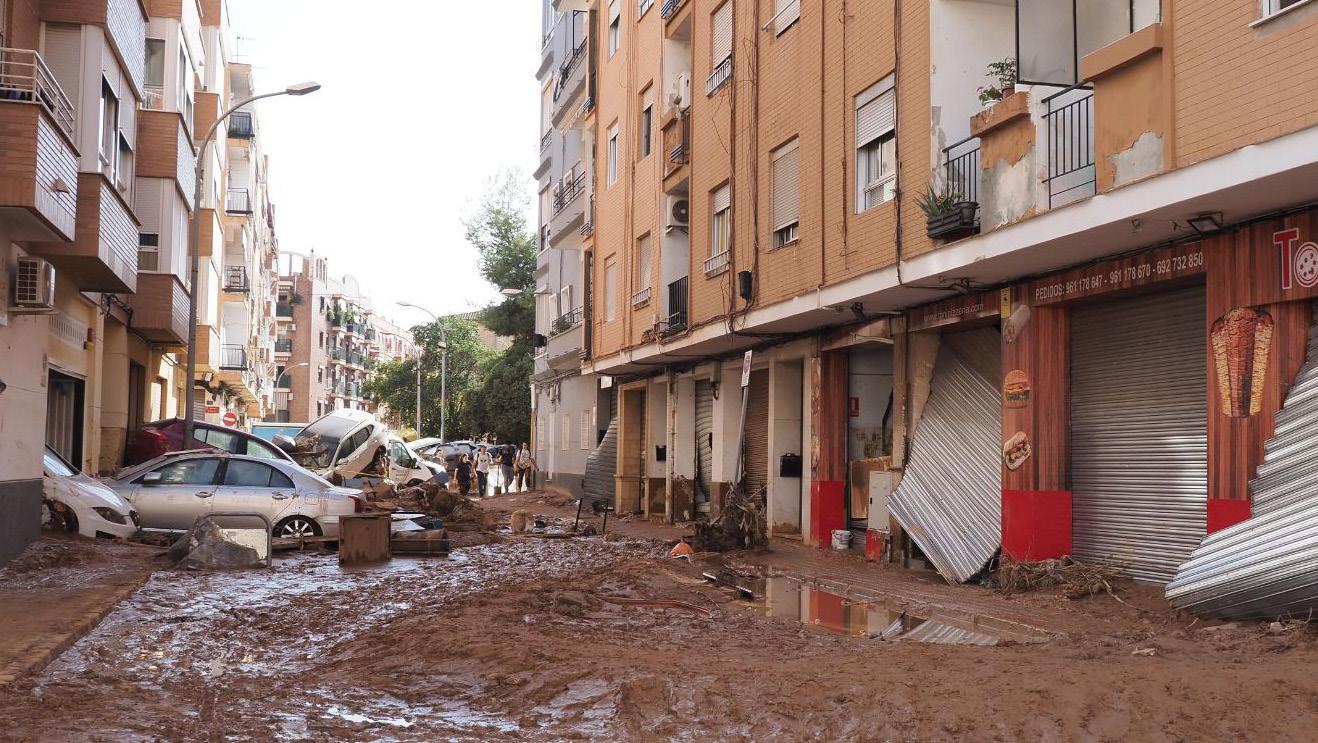
On October 29th 2024, Spain experienced its worst natural disaster in recent history. Severe flash floods in various areas of the Valencia province swept away everything in their path. Flooding was the result of a meteorological phenomenon that resulted in localised torrential rainstorms. This phenomenon is an upper-tropospheric cut-off low, better known in Spain as gota fria (literally “cold drop”) or by the acronym DANA (Depresión Aislada en Niveles Altos). The population had almost no warning or time to react, and many people were trapped by the floods in their houses, businesses or vehicles. Four weeks after the tragedy, on November 26th, the number of confirmed deaths stood at 222.Some people are still missing and not accounted for. The Spanish federation of professional economists (Consejo General de Economistas) has estimated
the economic impact of the disaster as a loss of the order of €16.6 billion.1
Spanish society was deeply shocked by the scale of this tragedy. Mourning gave way to indignation as shortcomings in disaster preparedness and errors in emergency response came to light. On October 25th, four days before the floods, the Spanish National Meteorological Office (AEMET) issued a bulletin warning of a high probability of torrential rainfall in the region. However, most people living in the area received no warning from the public authorities until after the rainstorm had begun, when evacuation was no longer possible for many individuals and families. Although there has not been, as of yet, a full and detailed evaluation of the reasons behind this delay, it is reasonable to attribute at least some of the short-
“913 direct fatalities caused by meteorological events were recorded in Spain between 2000 and 2019.”
comings to a feeling of invulnerability to natural disasters on the part of both institutions and the population as a whole.
Catastrophes of this magnitude are—or were until recently—very rare in Spain. In countries where natural disasters occur on a regular basis—for example the United States and Chile—preparedness and response is a government responsibility, widely supported by all political groups. The general population is well informed about emergency protocols, and these are regularly updated and strictly adhered to. Moreover, compliance with these protocols is assessed after an event. In Spain, by contrast, the Valencian government official responsible for emergency management was unaware that emergency mobile phone alerts could be sent to the general public until late afternoon on the day the flooding occurred This calls into question not only the competence of the regional government, but also the lack of preparedness and response culture in Spain as a whole.
Can we afford to allow this situation to continue? Climate change is making ex-
treme weather events ever more frequent and more severe. Spain, like the rest of the Mediterranean region, has become one of the areas most affected by the climate crisis. And floods are not the only extreme weather events exacerbated by global warming: estimates show that more than 47,000 people died in Spain as a result of high temperatures in 2023.2 Spain needs to urgently develop more effective protocols to address climate change and, even more importantly, public authorities must ensure that everyone is aware of these protocols and adheres to them when necessary. Our institutions must protect us from the worst consequences of these events and society must be educated in order to prepare for and cope with such emergencies and disasters. This paper addresses the importance of extreme weather events in an increasingly hostile climate, the mechanisms in place to protect us, and the challenges to overcome in order to achieve a fully prepared society, followed by specific policy recommendations.
Extreme weather events are defined as “occurrences of unusually severe weather or climate conditions that can cause devastating impacts on communities, as well as agricultural and natural ecosystems.3 Spain is becoming increasingly vulnerable to such phenomena, especially heatwaves and flooding. The environmental NGO Germanwatch produces an annual Global Climate Risk Index, which ranks countries according to the human and economic impact suffered from extreme weather events.4 In 2017, Spain was
ranked 47th on this index; four years later, in 2021, it had climbed 15 positions and was ranked 32nd
The Spanish Directorate General for Civil Protection and Emergencies (DGPCE), which operates within the Ministry of the Interior, recorded 913 direct fatalities caused by meteorological events in Spain between 2000 and 2019. However, the international disaster database EM-DAT shows much higher figures, citing over 15,000 deaths. This disparity is due to the method currently used by the Spanish
2 Gallo, E., Quijal-Zamorano, M., Méndez Turrubiates, R.F. et al. Heat-related mortality in Europe during 2023 and the role of adaptation in protecting health. Nat Med 30, 3101–3105 (2024).
3 US Department of Agriculture Climate Hubs: Extreme Weather
4 Eckstein D., Künzel V., Schäfer L. (2021) Global Climate Risk Index 2021
government to quantify heat-related mortality, which underestimates heat-related deaths. However, official statistics also cite high temperatures as the main cause for weather-related deaths, with the next most lethal events being floods, storms at sea and strong winds on land.5 In 2020, 81% of deaths caused by natural hazards in Spain were due to weather-related events. 6
Weather-related events also have indirect health impacts. People exposed to natural disasters develop more mental health problems.7 The health system infrastructure may be affected by the disaster, making it more difficult to deliver necessary medical care. Moreover, each type of event is associated with specific health risks. For example, floods like the ones that occurred in Valencia can increase the risk of “gastrointestinal infections through in-
gestion of contaminated food or water, and respiratory infections due to inhalation or ingestion of contaminated water” according to the Ministry of Health.8
These events also have profound and lasting economic repercussions. Data from the European Environment Agency show that economic losses due to climate events in the European Union (EU) for the period 2021-2023 are almost three times the amount recorded for the whole of the decade from 2010 to 2019.9 This huge increase is due to severe flooding in 2021 and 2023. Economic losses due to weather events across the EU in 2023 amounted to €44 billion, a figure that further contextualises the estimated €16.6 billion in losses attributable to the Valencia DANA alone.
Figure 1. Extreme weather events with the greatest impact in Spain in recent decades.
Source: EM-DAT. The International Disaster Database. www.emdat.be
5 Institut Cerdà (2022) Observatorio de Riesgos: Incremento
6 Dirección General de Protección Civil y Emergencias (2021) Fallecidos por Riesgos Naturales en España en 2020
7 Keya TA, Leela A, Habib N, et al. (2023) Mental Health Disorders Due to Disaster Exposure: A Systematic
2023 Apr 2;15(4):e37031. doi: 10.7759/cureus.37031. PMID: 37143625; PMCID: PMC10153020.
8 Spanish Ministry of Health (2024) Información sanitaria sobre la DANA
9 European Environmental Agency (2024) Economic
“The Civil Protection Code (Código de Protección Civil—CPC) is the legislative framework that regulates civil defence in Spain.”
Box 1. What impact is climate change having on extreme weather events?
There is clear scientific consensus on the relationship between climate change and the increase in extreme weather events: according to the latest report from the UN Intergovernmental Panel on Climate Change (IPCC), 10 extreme weather events have increased in both frequency and intensity due to the influence on the climate of record greenhouse gas levels.
The international network of academic researchers World Weather Attribution (WWA) carried out a preliminary analysis11 of the catastrophe caused by the DANA in Valencia and concluded that torrential rainfall events in the region are twice as likely and 12% more intense today with a climate that is 1.3°C warmer than pre-industrial levels due to global warming. WWA scientists state that it is indisputable that extreme weather events have become more dangerous and more frequent due to global warming. They have warned that the mitigation policies currently being implemented are insufficient and will expose the planet to a rise in temperature as high as 3°C, which will undoubtedly further increase the human and economic damage caused by extreme weather events.
Preparedness and response systems are the resources, plans, knowledge and capabilities put in place to effectively forecast, respond to and recover from specific risks or events. In the field of health, preparedness for disasters and health emergencies is a fundamental cornerstone of strategies for optimising civil protection.
Early warning systems are a key component of extreme weather preparedness. It is essential to have weather models capable of predicting the likelihood and intensity of extreme weather events.
In Spain, preparation, supply and dissemination of meteorological information and weather forecasts of general interest to the
public is the mandate and responsibility of AEMET. The agency is also tasked with forecasting and monitoring meteorological phenomena that might affect the safety of people or cause material damage, as well as issuing the necessary warnings concerning such events. These warnings are based on data from weather forecasting models that can provide accurate predictions up to 48 hours in advance.
To facilitate early warning, a National Plan for Forecasting and Monitoring Adverse Weather Events has been implemented.12 This plan covers various types of adverse weather phenomena, including rainfall, snowfall, wind, coastal phenomena, heatwaves, cold snaps and cold waves, as well as tropical cyclones. The alerts are
colour coded depending on the predicted danger level:
Yellow: This is the lowest risk alert. It indicates that ¡particularly vulnerable or exposed population groups or infrastructures may be impacted by the event. Recommendation: Be alert. Citizens are advised to keep up to date with the latest weather forecasts to see how the situation evolves.
Amber: This alert implies considerable danger. Vulnerable or exposed population groups and infrastructures could be severely impacted. Recommendation: Be prepared. Citizens should take precautions and closely monitor the latest weather forecasts for up-to-date information.
Red: Exceptional danger. It is likely that infrastructures and vulnerable populations in the affected areas will suffer very severe or catastrophic impacts. Recommendation: Citizens should take preventive measures and follow the advice and instructions of the competent authorities. Everyone should monitor the latest weather forecasts. No one should travel unless their journey is absolutely unavoidable.
The specific recommendations on the precautions that should be taken as preventive measures for each type of risk are described by the DGPCE, see Recommendations.13 These alerts are disseminated by the authorities at different levels of government: by state bodies and institutions, including Civil Protection, and directly to the general public through the AEMET website and social networks.
The General Plan for Civil Defence in Emergencies (Plan Estatal General de Emergencias de Protección Civil—PLEGEM)14 has set up information systems, including the National Alert Network (RAN) and the National Information Network (RENAIN), to alert and inform all competent civil defence authorities when an emergency is expected or predicted. Mechanisms have also been established to mobilise the capacities and capabilities of both the State and regional governments to respond to national and regional threats.
13 Dirección General de Protección Civil (2024) Recomendaciones
14 Ministerio del Interior (2021) Plan Estatal General de Emergencias de Protección Civil (PLEGEM)
Scientists are also working on new early warning systems relating to risks that threaten human health. They have, for example, developed models that can predict the health effects of extreme temperatures by age and sex.15 The United Nations has called for the implementation of early warning systems for extreme weather effects as a preventive measure.16
National and Autonomous Community
The Civil Protection Code (Código de Protección Civil CPC) is the legislative framework that regulates civil defence in Spain.17 This legal code established Spain’s National Civil Protection Strategy, which defines the coordination mechanisms and levels of action of all government bodies, public agencies and other entities involved in civil defence. It also includes the various civil protection plans included in the National Civil Protection System (Sistema Nacional de Protección Civil—SNPC) and defines how these are integrated into the framework of the European Civil Protection Mechanism. The CPC also includes all the civil defence legislation passed by Spain’s Autonomous Communities and the Basic Civil Protection Regulation18 in force since June 2023.
In Spain, civil protection falls within the scope of action of all levels of government: the central government, the governments of the Autonomous Communities, and the local authorities (provincial and municipal). Overall organisation and coordination in the case of national emergencies is the mandate of the SNPC. The SNPC is coordinated by the DGPCE, which falls under the aegis of the Ministry of the Interior.
The SNPC has been in place since 2015.19 Its mandate is to facilitate “the cooperative, coordinated and efficient exercise of the competences distributed across the different Public Administrations in accordance with constitutional doctrine”. Figure 2 shows the various levels of participation in the SNPC.
15 Ballester J, Beas-Moix M, Beltrán-Barrón N, Méndez Turrubiates RF, Peyrusse F, Quijal-Zamorano M. Forecaster.Health. Disponible en: https://forecaster.health/ (2024).
16 United Nations. Early Warnings for All. https://www.un.org/en/climatechange/early-warnings-for-all
17 BOE (2024) Código de Protección Civil
18 BOE (2023) Real Decreto 524/2023, de 20 de junio, por el que se aprueba la Norma Básica de Protección Civil
19 BOE (2015) Ley 17/2015, de 9 de julio, del Sistema Nacional de Protección Civil
Figure 2. Structure of the National Civil Protection System (SNPC), showing the capacities at each level.
National Civil Protection System
Participants
General coordination –SNPC
Ministry of the Interior
Undersecretariat of the Interior
Directorate General of Civil Protection and Emergencies
Armed Forces
National security forces and corps (police and other security forces)
Health services
Various technical services
Autonomous Community Police Force Fire Brigade
Health services
Various technical services
Local police force
Fire brigade
Health services
Various technical services
Volunteers Self-protection
Corporate Citizen
Source: Agencia Estatal-Boletín Oficial del Estado. Biblioteca Jurídica Digital. Código de Protección Civil
Law 17/2015, of 9 July, on the National Civil Protection System (SNPC),17 establishes the right of all citizens to be in-
formed of risks and the recommended measures for reducing their impact.
Figure 3. Regulations governing the National Civil Protection System (SNPC) at the state, autonomous community, and citizen level.
Law on the National Civil Protection System (SNPC).
Norma Básica de Protección Civil. (Basic Standards Framework) Regulación Básica Común (Regulation)
Basic Standards for Self-Protection
Regional Plans (General Risks)
Plans (National)
Special State Plans (Specific Risks)
Disasters
Tsunamis Extreme Weather Events Technological Disasters
Dangerous Materials Aviation Accidents Seismic Events
Self-Protection Plans
Chemical Disaster Operation Strait Crossing (Strait of Gibraltar)
Radiological Threats
Threats
Source: Agencia Estatal-Boletín Oficial del Estado. Biblioteca Jurídica Digital. Código de Protección Civil
The PLEGEM20 establishes the organisational and functional framework for disaster response, the mechanisms for mobilising resources, and the framework for coordinating all public agencies and institutions involved. It also establishes management and coordination of the SNPC by oversight bodies at State level, the integration of State plans with those of the Autonomous Communities, and the incorporation of the SNPC into the National Security System.
PLEGEM is structured by five phases and four operational situations.
New Plans in accordance with Law 17/2015 on the SNPC
The phases are as follows:
1. Continuous alert and monitoring. This phase is active by default.
2. Pre-emergency.
This phase is activated when a local or regional emergency occurs, impacting only one Autonomous Community, which may require resources at the State level or from other regions. It also applies when a special state plan is activated and external resources are required.
3. National emergency.
This is activated when the emergency requires intervention at the national level.
4. Support for other National Systems. This phase applies in SNPC activations to support another country’s National Systems in states of emergency, exception and armed conflict or when Law 36/2015 on National Security is activated.
5. Recovery.
This phase covers the period between the end of phase 3 or 4 and continues until essential services are restored and minimum conditions for normal life are ensured for those affected.
Stages one, two and three—permanent alert and monitoring, pre-emergency, and national emergency—are cumulative, even when not declared successively.
The operative situations during an emergency are 1, 2, 3 and E:
• Situation 1 is declared by the DGPCE when the emergency can be controlled by the competent authorities within the affected Autonomous Communities.
• Situation 2 is declared by the Ministry of the Interior when an emergency cannot be controlled, or there is a risk that it cannot be controlled, with the means available to the Autonomous Community. The Autonomous Community may require the assistance of and the resources and capabilities of other agencies or administrations, including the State.
• Situation 3 is the declaration of a national emergency by the Minister of the Interior. See Box 2.
• Situation E is declared when the Plan to support other National Systems is activated.
Box 2. What does the declaration of a national emergency involve?
Law 17/2015, of 9 July, on the National Civil Protection System (SNPC)21 defines three situations in which a national emergency can be declared:
• Any situation which, for the protection of persons and property, requires the application of Organic Law 4/1981, of 1 June 1981, on the regulation of states of emergency, exception and armed conflict.
• Situations in which it is necessary to plan for the coordination of different agencies and government institutions because the emergency affects several Autonomous Communities and the response needs to draw on national resources.
• Situations which, because of their actual or projected magnitude or scale, require management on the national level.
When a national emergency is declared, the Minister of the Interior assumes command of the entire emergency response operation, including the army, state security forces, the health system, clean-up services, restoration of infrastructure, public transport and many other actors.22
When a national emergency is declared, operational command is centralised. The declaration of a “national emergency” is not the same as the declaration of a “state of emergency”. The latter is a constitutional mechanism which, in addition to centralising command, also allows the government to impose extraordinary measures that affect individual rights, such as the restrictions on the free movement of people during the COVID-19 pandemic.
“Citizens have a key role to play and must actively participate in their own preparation.”
There are a number of key actors involved in extreme weather preparedness and response in Spain.
• The national weather service plays an important role in forecasting adverse weather events and issuing the appropriate warnings to the general public and the authorities.
• Civil protection entities. Fire brigade and other emergency forces.
• Security forces and corps. Security forces at different levels participate in the various phases of the PLEGEM. These include the National Police Force (Policía Nacional) and the Civil Guards (Guardia Civil).
• Armed forces. The collaboration of the armed forces in civil defence activities is carried out primarily through the Military Emergency Unit (UME), although other units can be deployed when needed.
• Spanish Red Cross. The Red Cross is recognised in the SNPC as an official
collaborating organisation: it is involved in the provision and distribution of basic goods (food, clothing, hygiene products), psychosocial interventions, shelter, first aid, search and rescue, personal and medical transport, and the protection of vulnerable people.
• Civil Defence Volunteers. The plan envisages the possibility of using volunteer workforces in emergency response.
• Health Systems. The health system in its broadest sense, including governance, service provision, resource generation and financing, is a key actor. In emergencies of this type the essential health services must be maintained and at the same time medical care must be provided for the direct victims of the disaster.
In certain circumstances, when the emergency caused by extreme weather events exceeds the country’s capacities, assistance can be requested from the European Union Civil Protection Mechanism.
If we are to build a robust preparedness and response system in Spain, a number of structural challenges must be identified and addressed at many levels, ranging from the most technical to those of society itself. Citizens have a key role to play and must actively participate in their own preparation. Being informed is a right, as enshrined in the Law on the National Civil Protection System (SNPC). In this context, not only citizen education but also fighting misinformation is particularly important. The scientific sector can contribute to this effort in many ways: by disseminating information and participating in the public debate, but also at a more strategic level by advising policy makers, public bodies and the government.
In the following section, we outline some of the most important preparedness and response challenges in our country:
a. Conflicts between the different competences at different levels of government
As explained above, the civil protection system in Spain falls under the mandate of multiple actors at the national, regional and local levels, and assigns an important role to citizens and citizen entities. Therefore, when responding to an emergency caused by extreme weather, governance issues may arise because there is always a possibility that the emergency may not viewed in the same terms by all the actors involved.
In very serious situations, the declaration of a national emergency can serve to resolve conflicts between the State and the regional governments. However, centralising command of an emergency operation also limits the autonomy of the regional institutions, which have better knowledge of the local terrain, population, resources and culture. What is gained in operational agility and coordination is lost in terms of specific knowledge, and this option is perhaps most useful when the emergency spans several territories with different leaderships. The declaration of a national emergency is a delicate decision that should not be taken lightly. Decentralising operations during emergencies has been shown to be an effective approach, especially when combined with effective overall management.23
Early warning systems are particularly important in the case of adverse weather events: they are a proven, efficient and cost-effective tool for saving lives and jobs, protecting property and infrastructure, and supporting long-term sustainability.24 In Spain, the AEMET is the body responsible for issuing warnings about extreme weather events. These include events involving rainfall, wind, waves, storms, electric storms, high temperatures, severe cold and snowfall. Thresholds for triggering alerts and classifying the level of danger have been established for each of these situations. They are defined in the National Plan for the Prediction and Monitoring of Adverse Meteorological Phenomena25 and the National Plan for Preventive Action to Combat the Adverse Effects of Extreme Temperatures on Health.26
Some discrepancies exist between the risk perceived by the population or the authorities and the thresholds for issuing warnings. This is the case of temperature thresholds during heatwaves, which are established according to the temperature above which mortality increases in each region. Temperature thresholds, such as
26.4ºC in the Principality of Asturias and 26.8ºC in Cantabria—which scientific evidence has shown to be dangerous in certain circumstances—can be controversial and lead people to dismiss warnings due to their frequency in situations which the general population does not associate with risk.
Another aspect that has a major impact on emergency outcomes is general public preparedness. In the latest EU survey on the disaster risk awareness and preparedness of the European population, 38% of respondents said the risks they feel most vulnerable to are extreme weather events (35% in Spain).27 In Spain, perception of risk regarding the threats that could cause disasters is below the EU average, except in the case of forest fires (29% in Spain vs. 16% in the EU as a whole).28
The percentage of respondents who considered themselves to be well informed about the risks that could affect them was lower in Spain than in the EU as a whole (38% in Spain vs. 48% in the EU). Spanish citizens reported that the sources they use to obtain information on risks are national media (45% vs. 49% in the EU), social networks (35% vs. 29% in the EU), emergency services (33%) and local or regional media (31% vs. 36%).
Of the Spanish respondents, almost 80% consider that they need more information to prepare for disasters and emergencies (as compared to 65% of the Europeans), 50% consider that the emergency services will alert them in the event of an emergency (57% in the EU) and only 37% consider that they know what to do in the event of a disaster, compared to 46% of the Europeans.
These data reflect the need to promote a culture of preparedness and response to different types of hazards and emergencies. The public must be given the necessary information to enable them to protect themselves adequately. Adequate channels of communication must be established to build trust in the local, regional and national authorities.
23 Bae Y., Joo Y.,Won S-Y. (2016) Decentralization and collaborative disaster governance: Evidence from South Korea, Habitat International
24 United Nations. Early Warnings for All. https://www.un.org/en/climatechange/early-warnings-for-all
25 AEMET (2022) Plan Nacional de Predicción y Vigilancia de Fenómenos Meteorológicos Adversos
26 Ministerio de Sanidad (2024) Plan Nacional de actuaciones preventivas de los efectos del exceso de temperatura sobre la salud
27 European Commission (2024) Disaster risk awareness and preparedness of the EU population
28 European Commission (2024) Disaster risk awareness and preparedness of the EU population. Spain
This lack of knowledge and preparedness is compounded by the dangers posed by the spread of misinformation and the way social networks can amplify its reach. According to the Eurobarometer data, Spanish people turn to social media for information on the risks they may face more often than other Europeans, and this increases the risk that they will be unprepared when an emergency happens.29
The factors that increase vulnerability to extreme weather events can be classified into three types:30
• Environmental: these include the exposure of people to specific risks depending on the physical location where they are located. Examples include:
• Environmental degradation, which increases the risks in the affected area.
• Rapid population growth, which may affect the ability of a country to cope with the impacts of extreme weather events due to shortcomings in urban infrastructure and essential services.
• Rapid and inappropriate urban spread. This can lead to construction in high-risk zones, such as areas susceptible to flooding, which will be at greater risk in the event of heavy rainfall. Good water resource management is also essential, ensuring river banks of adequate size and appropriate riparian vegetation.31
• Social: Social risks include demographics, migration and displacement, the level of education of the population in terms of preparedness and risk reduction measures, socio-economic inequalities that prevent equitable access to resources, and governance-related problems (e.g. corruption and mismanagement).
• Economic: this group of factors relates to the capacity of institutions and citizens and to invest in adaptation and resilience measures and, in the event of a disaster, to absorb the economic losses incurred.
Regarding environmental factors, a recent report presented at COP29 predicts catastrophic flooding due to climate change and soil sealing, that is, urban development that creates impermeable surfaces that stop surface water from filtering through to the underlying soil and being absorbed into the ground.32 Urban development also plays a role in certain types of extreme weather events, for example the exacerbation of heat waves caused by the urban heat island effect. 33
In the case of social factors, any approach to preparedness and response must always consider social determinants, which should be taken into account in the development of strategies so as to avoid inequalities in implementation. While economic factors are not currently an obstacle in Spain, funding for disaster preparedness, response and recovery is a central issue in climate negotiation for many countries in the Global South.
“Changes are needed at different scales if we are to meet the challenge of increasingly frequent and intense extreme weather events.”
Changes are needed at different scales if we are to meet the challenge of increasingly frequent and intense extreme weather events. The following are some recommendations that may be useful in improving preparedness and response to extreme weather events in our country:
• Prioritise training the public sector leadership and personnel on the resources and protocols available in disaster and emergency situations, creating a culture of effective preparedness that will have direct positive consequences on disaster management. To ensure that the necessary knowledge and skills have been acquired, outcomes should be assessed by means of exercises and simulations. The scientific sector can also play an advisory role in the development and implementation of new policies to address the inevitable challenges.
• Review regional protocols for managing extreme weather events. It is vital to ensure that these protocols are up to date and that those responsible for implementing them understand the roles of all the actors involved, including that of central government and coordination with the autonomous government.
• Make it mandatory, whether by way of legislation or the PLEGEM, for the competent authorities to carry out comprehensive and systematic assessments of the performance of both the public and private sector following an extreme weather event. The lessons learned from these assessments can be used to identify weaknesses and shortcomings, clarify responsibilities and improve future protocols. These protocols should include long-term epidemiological surveillance designed to evaluate the health impact.
• Promote a culture of preparedness across all strata of our society, ensuring that citizens have the necessary recommendations for self-protection at their disposal. This includes the need to address the proliferation of disinformation. Scientists can provide data and evidence-based solutions and should therefore participate in social debate and dissemination. Preparedness mechanisms should also be informed by the needs and perceptions of the affected population.
• Review the mechanisms of coordination between the central, regional and local government to ensure a clear chain of command, a common understanding of protocols and fluid communication.
• Consider the possibility of setting up “emergency committees” at state, regional and local levels. Each of these committees would gather government representatives, civil defence organisations, law enforcement, private sector and experts in different types of emergencies, including scientists. They would meet regularly in “peacetime” to review protocols and to ensure effective preparation and good communication. In emergencies, the committees would be the decision-makers. This is a suitable model for an all-hazards approach and one that has been implemented in other countries with more experience in disaster management than Spain.34
• Guía de información al ciudadano ante Fenómenos Meteorológicos Adversos: https://www.proteccioncivil.es/documents/20121/0/06-FenomenosFMA_%20accesible.pdf/14678734-22ac-119d-ee06-5074f849450d
How to cite this document:
Marín-Carballo C, Diago-Navarro E and García-Vaz C. Extreme Weather Events: How Do We Prepare for an Increasingly Hostile Climate?
Barcelona Institute for Global Health (ISGlobal). Series: All-Hazards Preparedness and Response, n.º 62. December 2024
https://www.isglobal.org/en/-/fenomenos-meteorologicos-extremos-como-nos-preparamos-para-un-clima-cada-vez-mas-hostil-