Why Is it Urgent to Reach an Agreement on Pandemics? A Proposal for a European Position (58)
Why Is it Urgent to Reach an Agreement on Pandemics? A Proposal for a European Position
Series | All-Hazards Preparedness and Response
[ This document is one of a series of discussion notes addressing fundamental questions about global health. Its purpose is to transfer scientific knowledge into the public conversation and the decisionmaking process. These documents are based on the best information available and may be updated as new information comes to light. ]
21 March 2024
The pandemic that swept our planet between 2020 and 2023 validated a hypothesis already indicated by the scientific evidence: that in the 21st century, in a profoundly interdependent planet, where people, animals and natural resources are all subject to accelerated variations in their habitats, it is no longer a question of whether we will be threatened by systemic health risks but rather when these will occur and the magnitude of their impact. The years leading up to the COVID-19 pandemic saw several international alerts: SARS in 2003, avian flu in 2007, and MERS in 2012. Each one of these outbreaks was a wake-up call that we failed to heed. And all of the available evidence indicates that such events will become increasingly frequent in the future.
Now that we know how devastating the personal and economic consequences of a pandemic can be, the question is what are we going to do about the problem? The
world’s political, social and scientific leaders have the obligation to do everything in their power to prevent the next pandemic—everything from strengthening health systems worldwide to redefining priorities in biomedical innovation and production.
One of the key goals in this endeavour is to achieve universal commitment to the establishment of a multilateral regulatory and institutional framework. In spite of the existence of the International Health Regulations (IHR), the lack of shared rules designed to ensure the optimal and equitable use of resources, while recognising the rights and interests of all the parties involved, became a fundamental obstacle in the response to COVID-19. The Director General of the World Health Organization (WHO), Tedros Adhanom Ghebreyesus, recently pointed out that despite the serious geopolitical differences that separate us, “this is the one thing the world agrees on”.
Authors: Laura Agúndez, Gonzalo Fanjul and Antoni Plasència
*Laura Agúndez is a resident doctor in Hospital Universitario La Paz specialising in Preventive Medicine and Public Health. Gonzalo Fanjul is ISGlobal’s Director of Policy. Antoni Plasència is a distinguished fellow and former director general of ISGlobal. The authors thank Germán Velásquez for his valuable suggestions.
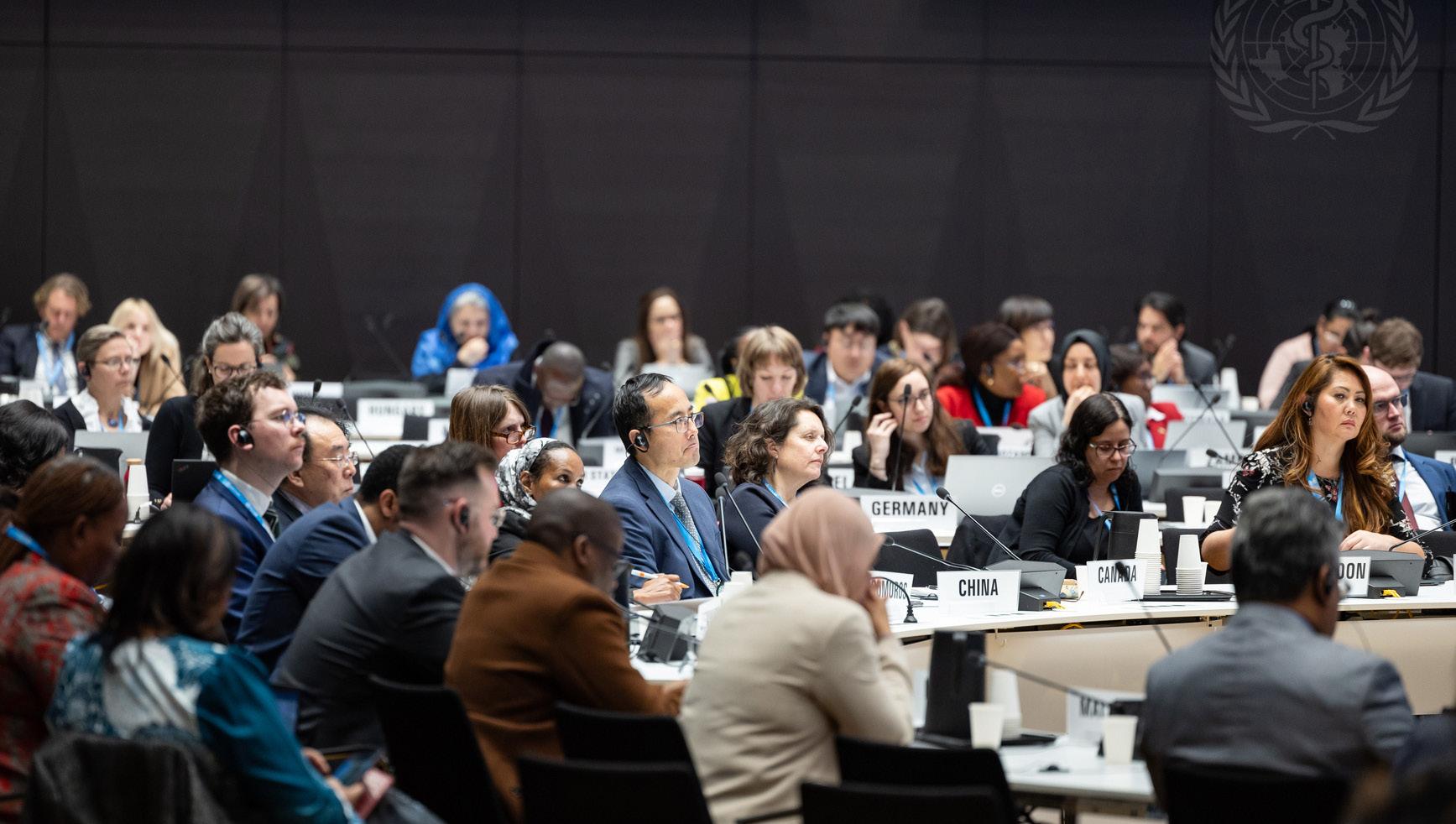
Photo: WHO / Pierre Albouy
“The aim of the team negotiating the multilateral agreement is to create a framework for a preparedness and response model involving the participation of all sectors of our societies, based on equity and informed by a One Health approach. ”
This policy brief offers an analysis of the uncertain prospects for the multilateral accord on pandemic preparedness and response that will be considered for adoption at the upcoming World Health Assembly in May 2024. It also discusses what Spain and the European Union (EU) can do to ensure the Freshen suc-
cess of the project. Despite the firm commitments made by the main negotiating groups throughout the process, negotiations have, at a late stage, entered a perilous holding pattern characterised by a lack of progress that threatens to derail the best hopes for success.
What is the Pandemic Accord and why is it important?
On 1 December 2021, the World Health Assembly began negotiations on an international instrument capable of ensuring the preparedness of all countries for future pandemics; or even better, of preventing them before they start. The creation of such an instrument is, in part, a long-standing aspiration of the global health community, which has been warning the world for decades about the proliferation of rapidly transmissible infectious diseases with the potential to cause enormous disruption worldwide. It also reflects the shortcomings of the response to COVID-19, three of which were highlighted by Adhanom Ghebreyesus: the lack of coordination within and between countries and between different stakeholders, the weight of private interests and the inability of governments and institutions to ensure access to vaccines, treatments and diagnostics for all those who need them.1 The aim of the team negotiating the multilateral agreement is to create a framework for a preparedness and response model involving the participation of all sectors of our societies, based on equity and informed by a One Health approach.2
These negotiations are taking place in a complex political context and in parallel with the revision of the 2005 International Health Regulations. In 2024, national elections will take place in 64 countries, representing some 49% of the world’s population. The possibility that strongly nationalist, isolationist or even denialist governments could gain power in many major countries poses a threat to global health. The pandemic accord could be an instrument that would help to contain these tendencies. The aim of the accord is to secure the commitment to equity and cooperation needed to ensure a coordinated, comprehensive and inclusive response to the health threats posed by infectious diseases in the coming years.3 Technical advances, such as those that made possible the development in record time of vaccines against SARS-CoV-2, will be less effective if we cannot build a cooperative system capable of supplying the world population.
1 WHO. World Health Assembly agrees to launch process to develop historic global accord on pandemic prevention, preparedness and response [Press release]. 1 December 2021. https:// www.who.int/news/item/01-12-2021-world-health-assembly-agrees-to-launch-process-to-develop-historic-global-accord-on-pandemic-prevention-preparedness-and-response
2 WHO. ZERO DRAFT Report of the Member States Working Group on Strengthening WHO Preparedness for and Response to Health Emergencies to the special session of the World Health Assembly. 28 October 2021.
3 Diago-Navarro E, Ramírez O, Rodó M, Fanjul G, Cardis E. How can we be better prepared for the next public health crisis? Lessons learned from the COVID-19 pandemic? ISGlobal, November 2021.
Table 1. The Main Components of the Agreement Currently Under Negotiation
1. 3. 5. 2. 4. 6.
Pandemic prevention and public health surveillance: on the need to develop or consolidate coordinated and strengthened systems to prevent and manage health emergencies more effectively.
Supply and logistics of vaccines, diagnostics and treatments: on the need to link production with the populations and regions that need it and to ensure the supply of products essential to the response to infectious emergencies.
Funding for preparedness and response programs: on the need for a sustainable financing system to fund the preparedness and response activities called for in the provisions of the accord.
The specific type of instrument that should be used to achieve these objectives is also important and must be negotiated. While the initial intention was to negotiate a treaty, this instrument was later abandoned in favour of an accord. However, the capacity of an accord to legally bind the parties is now being called into question. The initial proposal was to use Article 19 of the WHO Constitution to create a binding instrument, the solution used in 2003 for the Framework Convention on Tobacco Control. However, it
Biomedical research and product development: on research collaboration and the need for an inclusive approach in clinical trials.
Transfer of technology and know-how: on the challenges involved in establishing effective mechanisms for sharing expertise, technology and basic information in health responses.
Governance, monitoring and accountability: on the need to set up an effective system to manage participation, decision making and compliance.
now appears likely that the accord will be adopted under Article 21, a non-binding solution that was used in the case of the International Health Regulations.
Timeline of the Negotiation Process to Date
Discussions on the new pandemic pact are being led by an Intergovernmental Negotiating Body (INB), which has been meeting since February 2022. Throughout this period, open sessions have also been held to allow many different stakeholders—including academic and civil society organisations, the private sector and the general public—to provide input and participate in the discussions. The principal milestones of the process to date are shown below.
Second INB meeting
Article 19 of the WHO Constitution identified as the provision offering the best legal basis for the treaty. Jul 2022
Feb-Mar 2023
Fourth INB meeting
The Zero Draft was discussed and Member States and stakeholders provided their input.
Jun 2023
Fifth INB meeting: part 2
The meeting considered the text presented by the INB Bureau earlier in June, with the participation of relevant stakeholders.
Nov-Dec 2023
Seventh INB meeting
The INB published a proposal for a negotiating text incorporating the content drafted in the informal meetings.
Dec 2022
Third INB meeting
Agreement reached on the proposal that the INB Bureau would prepare the Zero Draft , which would then serve as the basis for negotiations.
May 2023
76th World Health Assembly
The progress made by the INB was presented to the Assembly.
Jul 2023
Sixth INB meeting
It was agreed that informal meetings should continue to discuss Articles 4 and 5 (pandemic prevention, public health surveillance and One Health) and Article 11 (codevelopment and transfer of technology and know-how).
Feb-Mar 2024
Eighth INB meeting
A joint meeting was held with the Working Group on Amendments to the International Health Regulations. Civil organisations that participated in some sessions expressed concern about the absence of any mention of the right to health and the lack of a definition for “vulnerable persons” in the text.
“Among the main areas of disagreement, theccess to pathogen information and the sharing of benefits derived from such information (Pathogen Access and Benefitsharing or PABS.”
What are the key issues to the negotiation process?
The negotiations are proving difficult and some internal voices have even suggested that they have stalled. After more than 30 sessions over the past two years, there are officially less than two weeks of negotiation remaining in the ninth meeting of the Intergovernmental Negotiating Body (INB) to finalise the text that will be submitted to the 77th World Health Assembly in Geneva next May.4 In other words, we are in the final sprint for the finish line and facing an uphill battle. It looks like the May 2024 deadline will be very difficult to meet. The positions of the Global South and Global North have been in opposition throughout this whole process. The negotiators for the Global North are influenced by a pharmaceutical industry that openly opposes any threat—real or perceived—to its profits,5 while the groups representing developing countries will reject any text that fails to put equity at the centre of the accord or does not ensure equitable access to essential health products. Their position is more than justified given the experience of the pandemic, during which the distribution of vaccines, diagnostics and treatments depended on the bargaining and purchasing power of each actor.6
The EU position on the future pandemic accord seeks to reconcile the need for cooperation on the one hand and prudence on the other. The EU was the bloc that initially called for an international agreement, speaking with one voice on behalf of its 27 member states on the basis of the European Council decision of March 2022. Its position recognises the need to rebuild trust between countries and the importance for health security of solidarity, inclusivity and equitable access to interventions. The EU is, however, heavily
influenced by its private healthcare sector, in particular the pharmaceutical industry, which recorded a production in excess of €31 billion in 2021 and directly employs some 840,000 people in Europe.7 The economic importance of the biopharmaceutical sector forces European negotiators to make trade-offs in order to loss accommodate the interests of that sector while not renouncing their commitment to an innovative and progressive agreement aimed at serving the common good.
As if it was not facing enough difficulties, the negotiation process has also had to contend with the circulation of false rumours–which the WHO did not hesitate to characterise as “fake news”—alleging that the treaty would undermine the sovereignty of member states, allowing the WHO to force people to be vaccinated or use digital passports to track their movements.8 An example of this kind of disinformation is the message published on 23 March 2023 by Elon Musk on X (formerly Twitter), which received a total of 95,800 likes: “Countries should not cede authority to WHO”. These attempts to turn public opinion against the agreement and to create doubts about the negotiation process jeopardize its results.
The following are three of the main areas of disagreement:
• Access to pathogen information and the sharing of benefits derived from such information (Pathogen Access and Benefit-sharing or PABS).
• The best model for the governance of the agreement and, more specifically, how to ensure compliance and the independent instruments needed to do this.
• How to ensure the necessary funding for preparedness and response plans on
4 The sessions of the eighth meeting of the Intergovernmental Negotiating Body (INB) took place in a hybrid format between 19 February and 1 March 2024.
5 Furlong, A. Why the world’s first pandemic treaty may never happen Politico. January 2024.
6 Mahoney R, Hotez PJ, Bottazzi ME. Global regulatory reforms to promote equitable vaccine access in the next pandemic PLOS Glob Public Health. 2023 Oct 18;3(10):e0002482. doi: 10.1371/journal.pgph.0002482.
7 El Global. La industria farmacéutica de la UE en cifras: el sector observa una desaceleración, June 2022.
8 Gawel A. How misinformation is stalling the pandemic treaty Devex Newswire, January 2023.
both the national and international level, especially in low- and middle-income countries, and the resources needed to strengthen health systems worldwide.
The first contentious point (PABS), which is covered in Article 12 of the draft agreement, has been one of the most hotly debated issues in the evaluation of the overall response to COVID-19. Since the beginning of the negotiations, the EU and the United States have openly disagreed with the countries of the Global South, and to date the INB has been unable to formulate an alternative proposal acceptable to all parties. At the eighth meeting of the INB (February-March 2024), however, a new text was presented proposing that manufacturers producing vaccines, therapeutic or diagnostic products for “pathogens with pandemic potential” should pay an annual fee (relative to their size) “to support the PABS system and strengthen pandemic prevention, preparedness and response capacities in countries”. This has been one of the most insistent demands of the countries of the African continent.
The same text proposes in-kind contributions, such as the transfer of technology and know-how. During a pandemic or a public health emergency with pandemic potential, manufacturers would make “real-time contributions of relevant diagnostics, therapeutics or vaccines” some free of charge and a percentage at not-forprofit prices, to be made available to the WHO upon request (in total, a scant 20% according to the October draft).9 In return, countries would be required to immediately share genomic sequencing data (GSD) and biological material from dangerous pathogens with laboratories and biobanks participating in the WHO-coordinated laboratory networks (CLN) and WHO-recommended sequence databases (SDB). According to the proposed text, all parties would agree that “intellectual property rights may not be sought on biological materials and GSD provided to CLNs and SDBs,” a suggestion that runs contrary to the private sector’s long-established stance on this matter.
The pharmaceutical industry—represented by the International Federation of Pharmaceutical Manufacturers and Associations (IFPMA)—strongly opposes the proposal to compensate countries
for sharing pathogen information. In their view, this measure would slow down the development of vaccines and medicines and lead to excessive bureaucratization, to the detriment of production.
Other stakeholders have expressed disappointment at the increasingly weaker language and fewer hard commitments in successive drafts, despite proposals that have been made to counteract this trend in the context of the World Trade Organization agreement on intellectual property (TRIPS). However, as indicated in a recent article, the director of the initiative for the development of treatments for neglected diseases (DNDi) has said that “Only governments have the power and influence to make this happen”. A new instrument is clearly required to help ensure access to the vital know-how, skills and products needed to prevent or combat future pandemics and achieving this goal will require new commitments from WHO member states. It is no longer enough to simply repeat the same failed procedures, falling back on the status quo and depending on existing instruments.
The second major issue in contention that has stalled negotiations is the choice of a model of governance for the agreement, an aspect covered partially in Articles 8, 14, 15, 19 and 21 of the current draft, among others. The definition of a governance model is certainly very fragmented in this text and currently compliance would rely for the most part on the willingness of the parties to cooperate. As it stands, the text contains no binding clauses and no clear requirements for accountability. Nor is there any mention of the possibility of independent assessment of compliance with the provisions of the accord.
The third key unresolved issue is financing, a topic dealt with in Article 20. It is addressed in very generic terms, closer to aspirational financing than to the definition of economic obligations designed to meet the commitments of the agreement. Given that estimates of the cost of pandemic preparedness and response vary widely–due in large part to the heterogeneity of the methodologies used to calculate them (see Figure 1)–consensus is urgently needed on a reliable estimate of the total and additional financing needed to fund the necessary pandemic prepared-
9 The Lancet. The Pandemic Treaty: shameful an unjust, March 2024. https://www.thelancet.com/journals/lancet/article/PIIS0140-6736(24)00410-0/fulltext
ness and response activities.10 Agreement is also needed on a mechanisms for channelling the funds, which could go beyond the Pandemic Fund. In this respect, it should not be forgotten that COVID-19 caused millions of deaths and resulted in over $13.8 trillion (€12.7 trillion) in economic losses, while less than 1% of our annual national budgets are currently allocated to prevent the impact of future pandemics.11
These three aspects of the accord have already been the focus of a recent letter signed by many very prominent world political and social leaders calling on governments to empower their negotiators to reach an agreement that will lead to a safer and more stable world currently
threatened by the clear and unavoidable risk of future pandemics.12
According to the INB Office, the talks at the recent meeting essentially involved discussions on conceptual aspects of the provisions, while the precise wording of the text will be decided during the decisive round of negotiations that has just started and will continue until 29 March. In the coming weeks, the plan is to finalise the text that will be voted on at the World Health Assembly in May 2024.
Figure 1. Estimated financing needs for global pandemic preparedness and response activities (5-year period).
Several organisations have published their estimates of the global financing needs for pandemic preparedness and response, but differences in the methodologies used give rise to considerable variations. The figure shows the components included in each estimate and the estimated financing required for a five-year period.
Source: Think Global Health (2 May 2023): Rethinking Financial Estimates for Pandemic Preparedness and Response
Georgetown University McKinsey
and WHO
“Even
in a setting where multilateral solutions are complicated by economic, political and military conflicts between countries or blocs, it is possible to establish areas of cooperation based on the protection of the most basic common interests.”
3.
Why we need a multilateral agreement to provide the framework for a complex global pandemic preparedness and response system
The difficulties the international community is experiencing in finalising a multilateral agreement it committed to more than two years ago reflect deeper problems in global preparedness and response to systemic health risks. By 2022, the health budget in 17 OECD countries had declined to levels similar to or lower than those of 2019. The new WHO and World Bank Pandemic Fund—an entity approved at the height of the COVID-19 health scare—has so far received less than $2 billion of the $10 billion (about €9.3 billion) requested from donors to fund a major baseline preparedness and response effort in low- and middle-income countries. While experts regularly warn of the possibility of new health catastrophes, the commitment of governments to preparedness and response systems appears to be waning.
All of these decisions become more complicated when additional political and economic international crises accumulate. The Russian invasion of Ukraine displaced the dominant common concern at that time with surprising ease. And Israel’s invasion of Gaza now threatens to make the conflict in Ukraine a forgotten war. Unfortunately, strengthening preparedness for new global health threats is not something that can be postponed to more prosperous or less turbulent times. Infectious health threats—like threats resulting from nuclear accidents or attacks, biochemical events or extreme natural disasters—are a certain variable in any equation of future international relations. Even in a setting where multilateral solutions are complicated by economic, political and military conflicts between countries or blocs, it is possible to establish areas of cooperation
based on the protection of the most basic common interests.13
Multilateral efforts also reflect the progress made by countries at national and regional levels. And Spain is a good example of the long road ahead. While it is true that the project for a National Public Health Agency—tasked with organising preparedness and response actions, among other functions—has already been submitted to the Spanish parliament for discussion and approval, no other structural changes have yet been observed. The Spanish government has not yet approved a Global Health Strategy to set our national priorities in this essential debate, something which has been done by the EU and several other European countries. And the topic appears to have lost its electoral appeal in parliament: of the 459 health-related initiatives presented in 2023, less than a dozen were directly related to preparedness for future health threats. In 2021, several ministries and regional governments commissioned a panel of independent experts to evaluate and report on the Spanish National Health System’s pandemic response. The report was delivered 18 months later, ended up in a drawer for another eight months and was published in December 2023, having no apparent impact on the public debate.
Interestingly, the recommendations made in this report are closely aligned with the best aspirations of the pandemic agreement. Both documents emphasise the fundamental role of health systems, starting with primary care, the public health services and the need to correct serious deficiencies in coordination between government departments and agencies, the
Rodrik D. and Walt S.
“This is a just aspiration, but— and this is the most important thing—it is also the only option open to us if we want to avoid or mitigate the kind of catastrophes that will be caused by future pandemics. There is no plan B, as impossible as it may seem to us now to reach an agreement.”
flow of information, and the institutional and legal framework.
The report makes reference to multinational mechanisms such as the Pandemic Fund and, in the case of Europe, the new Health Emergency Preparedness and Response Authority (HERA). The authors also emphasise the need for fairer and smarter mechanisms to develop, produce and distribute vaccines and other essen-
tial products and warn against using a piecemeal approach that ignores the complex interconnections between the health of the planet and that of the people and other beings that inhabit it.
Conclusions and recommendations
Not only is there very little time left to negotiate, what is needed now, as the WHO Director General said a few days ago, is “commitment not competition”. He went on to make the point that a solution emerges when the parties identify the problems as common problems: “It’s not the problem of the North. It’s not the problem of the South. It’s our problem”. Finally, he remarked that the WHO’s constitution was negotiated in six months and he considered that the pandemic agreement is “doable even with the remaining time”.14
But it would be naive to reduce the whole issue to a question of goodwill. The historic importance of these negotiations— and therefore their difficulty—lies in their potential to change the status quo of global health, to affect the power of public
and private actors and change the way they relate to each other. This is a just aspiration, but—and this is the most important thing—it is also the only option open to us if we want to avoid or mitigate the kind of catastrophes that will be caused by future pandemics. There is no plan B, as impossible as it may seem to us now to reach an agreement.
As in all complex negotiations, over the next few days we will see strategic and tactical moves by the governments involved and by the many stakeholders that influence them. Spain and the rest of the EU–which is negotiating on behalf of the Member States–must make every effort to reach an agreement, recognising the valuable lessons learned during COVID-19 and the needs of low- and middle-income countries. In particular:
The negotiating countries must resist the temptation to reduce this accord to a list of good intentions devoid of any real mechanisms to ensure compliance. The response to a global health crisis requires immediate and coordinated action by all relevant actors in accordance with an established plan and must transcend the preferences of the government of the day. It would be desirable for the new multilateral framework for pandemic response to have the status of a binding treaty or the closest possible equivalent.
14 Cullinan K. Pandemic Talks: Chasm Between Member States Over How to Share Pathogen Information
The EU should make explicit commitments on the financing of comprehensive preparedness and response plans. The EU’s indispensable role in this area should include a much more generous contribution to the WHO/World Bank Pandemic Fund, but is not limited to that. Several multilateral funds and initiatives—including DNDi, CEPI and GAVI’s vaccination programmes—are key components of any prevention and response system. Strengthening health systems through these institutions and through bilateral assistance programmes is also essential.
The EU should actively facilitate the access of low- and middle-income countries to the know-how needed to build an effective preparedness and response system. The first step is to support the claims of countries with fewer resources for PABS funding. The EU must also guarantee and extend the exceptionalities of the WTO agreement—and other regional trade agreements—relating to intellectual property, ensure efficient knowledge-sharing channels, and guarantee distributed production models for vaccines, treatments and diagnostics. Close collaboration is needed between the Global North and the Global South in shaping epidemiological surveillance systems to ensure continued access by the scientific and technical community to the information they need to respond quickly and effectively to threats.
The multilateral commitment of Spain and the EU to pandemic prevention and response should be a reflection of their strong domestic commitment. The EU must ensure effective mechanisms for political and scientific coordination within the framework of the Health Emergency Response Authority (HERA). The same should be expected from Spain at the national level, with the development of the new national public health agency (Agencia Estatal de Salud Pública), coordination with community and local actors, approval of a national global health strategy, and increases in the science and development aid budgets allocated to financing these priorities.
TO LEARN MORE
• The International Pandemic Treaty: What is at Stake? Germán Velásquez. ISGlobal Policy Paper. Series | COVID-19 and response strategy #48. November 2022.
• How can we be better prepared for the next public health crisis. Lessons learned from the COVID-19 pandemic? ISGlobal Policy Paper. November 2021.
• Pandemic prevention, preparedness and response accord. Questions and answers WHO, June 2023.
How to cite this document:
Agúndez L, Fanjul G and Plasència A. Why is it urgent to reach an agreement on pandemics? A proposal for a European position. Barcelona Institute for Global Health (ISGlobal). Series: All-Hazards Preparedness and Response, #58. March 2024.