Childhood Pneumonia: The Situation Prior to the COVID-19 Pandemic
According to UNICEF, before the pandemic pneumonia mortality had been declining steadily. Nonetheless, in 53 countries the progress had not been sufficient to meet target 3.2 of the Sustainable Development Goals (SDG), which calls for an end to preventable deaths of
newborns and children under five by 2030. Between 2000 and 2008, deaths from childhood pneumonia declined by 54%, compared to reductions of 81% for measles, 64% for diarrhoea, and 59% for malaria (see Figure 2) 4
Source: Fighting for Breath briefing published by Stop Pneumonia. UNICEF analysis based on WHO and Maternal and Child Epidemiology Estimation Group interim estimates produced in September 2019.
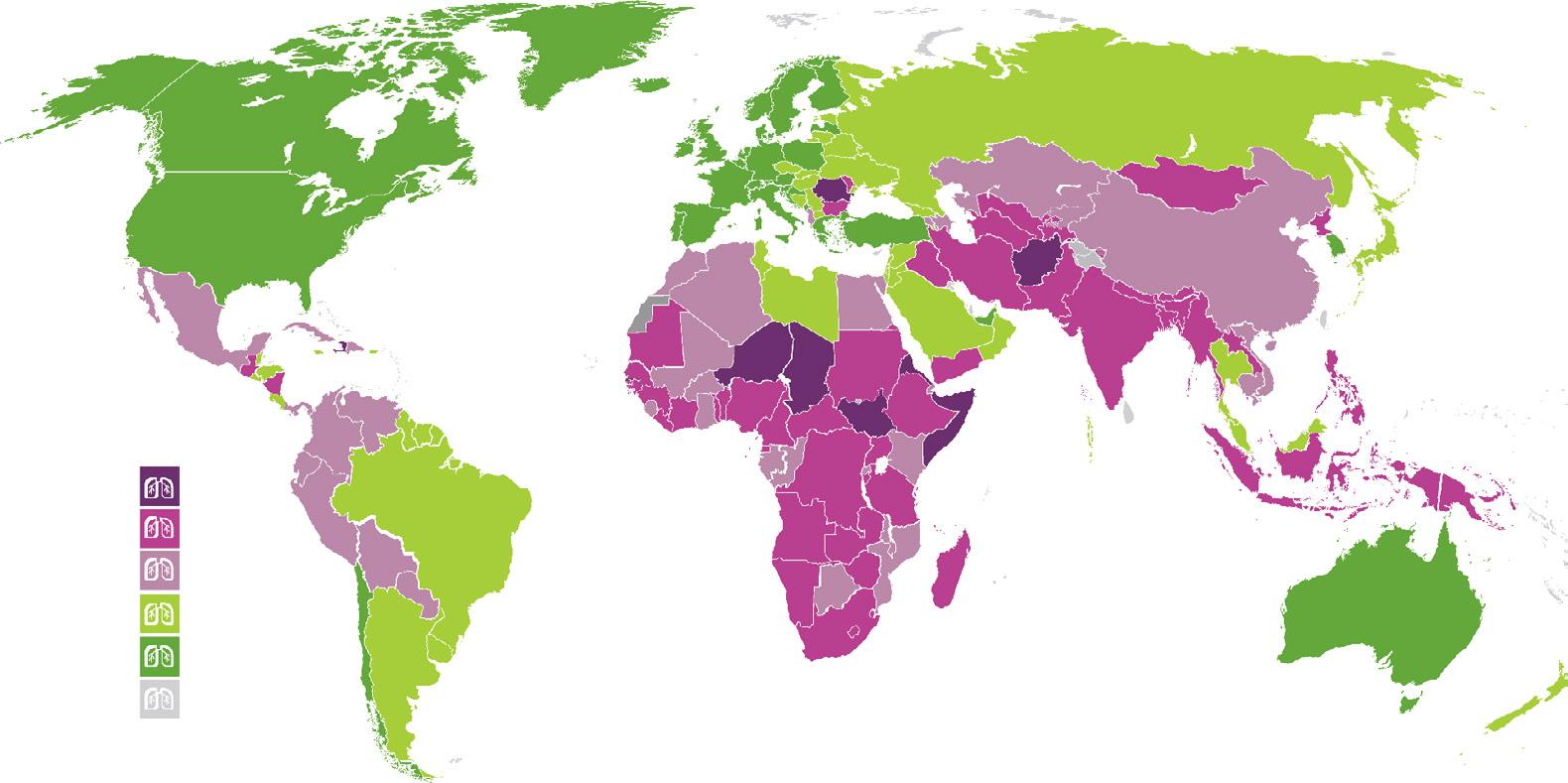
The countries with the highest mortality from childhood pneumonia in 2018 (in descending order) were as follows: Nigeria, India, Pakistan, Democratic Republic of the Congo and Ethiopia. Lowand lower-middle income countries are home to 62% of the world’s population
under five years of age.5 More than half of all pneumonia deaths occur in those countries. In the 30 most affected countries, there is no correspondence between disease burden and the rate of decline (see Figure 3)
3 www.isglobal.org
4 WHO and Maternal and Child Epidemiology Estimation Group estimates, 2017.
5 UNICEF (2016), One is too many. Ending child deaths from pneumonia and diarrhoea.
1.
“Pneumonia mortality was declining steadily. Nonetheless, in 53 countries the progress had not been sufficient to meet target 3.2 of the Sustainable Development Goals (SDGs), which calls for an end to preventable deaths of newborns and children under five by 2030.”
Figure 2. Deaths of children under five by infectious diseases, 2000 vs 2018.
The World Health Organization (WHO) estimates the annual cost of antibiotic treatment for the entire population of children with pneumonia in 66 of the most affected countries to be US$109 million. This figure includes both the cost of antibiotics and of the necessary diagnostic tests. Experience in countries such as Ethiopia and Tanzania has shown that, even with modest funding, organised, needs-based distribution of basic child healthcare products can make a critical difference in treatment coverage.
One of these products, amoxicillin dispersible tablets, offers particularly good value for money and an opportunity for cost savings. The supply of enough medical oxygen to treat a child with severe pneumonia for 3 to 4 days costs between US$40 and US$60.
Despite the moderate cost involved, very little global funding is allocated to tackling the problem of pneumonia.
In Africa, Every Breath Counts, a programme partly funded by the Commission on Lifesaving Commodities, raises awareness about the situation in order to activate global funding for the prevention, diagnosis and treatment of pneumonia. The programme brought together a group of diverse stakeholders involved in advocacy on issues related to pneumonia, such as air pollution, nutrition, immunisation and the use of diagnostics, antibiotics and oxygen.
Pneumonia currently receives only 5% of international development funding and less than 3% of total funding allocated to research into infectious diseases. Since pneumonia is responsible for 15% of the deaths of children under 5 years of age worldwide, this allocation represents a serious imbalance.6
Between 2003 and 2013, global funding for pneumonia and diarrhoea increased by 400%, from US$570 million to
4 www.isglobal.org
Figure 3. What is the relationship between mortality and the rate at which mortality declines in each country? Does higher mortality correlate with a faster rate of decline?
Source: Fighting for Breath brief - Stop pneumonia. UNICEF analysis based on WHO and Maternal and Child Epidemiology Estimation Group interim estimates produced in September 2019.
6 Brown, R.J. and Head M.G. (2018), Sizing up pneumonia research: Assessing global investments in pneumonia research, 2000-2015. University of Southampton, 2018.
US$2.8 billion (see Figure 4). The areas that have seen the greatest increase in funding during this period have been immunisation and nutrition interventions.7 However, the UNICEF report on ending deaths from pneumonia and diarrhoea makes the point that, compared to other
areas of child health, the disbursements for these two diseases are low when viewed in the light of the burden of disease and mortality they cause.
Funding was allocated to the countries with the greatest need. The top five recipients of donor spending were Ethiopia, Bangladesh, Pakistan, India and the Democratic Republic of the Congo, which together received US$642 million over the 11-year period from 2003 to 2013. However, countries in the lower-middleincome group, which account for nearly half of the burden of disease in pneumonia and diarrhoea, received a much smaller proportion of disbursements, an inequitable situation for the most vulnerable children in those countries.
The United States, Canada, the United Kingdom, Japan and Germany were the top bilateral donors for pneumonia and diarrhoea, providing US$4.4 billion between 2003 and 2013 (31% of all disbursements). The main multilateral donors were European Union institutions, the World Bank’s International Development Association and UNICEF, with US$2.8 billion (19% of all funding). The largest donor was GAVI (Global Alliance for Vaccines and Immunization), with US$4.2 billion (29% of the total).
Before the pandemic, it was estimated that the scaling up to 100% coverage of certain interventions (for example, health service integration, community empowerment and the education of girls) in lower-middle-income countries could save an additional 8.9 million lives over the following decade, including some 3.2 million pneumonia deaths.
To achieve these reductions in morbidity and mortality we need to develop more reliable and more frequently updated indicators and to make progress towards achieving universal health coverage in every country. Another priority in the work of monitoring and updating data to gain a better understanding of the problem is to strengthen public health information systems. Since public health services are usually the agencies responsible for heading up health prevention and protection activities, they have a strategic responsibility in the efforts to solve this problem (see Figure 5).
5 www.isglobal.org
7 UNICEF-commissioned analysis of Official Development Assistance to child health
11-year
2003 and 2013
to 2015 Financing
over the
period between
using the Countdown
Group database.
Figure 4. Funds allocated to combatting diarrhoea and pneumonia between 2003 y 2013.
Source: Estimates based on the Countdown to 2015 dataset on ODA+ for reproductive, maternal, newborn and child health.
The Impact of the COVID-19 Pandemic in the Fight against Pneumonia
According to WHO (2022) estimates, the death toll during the recent pandemic in 2020 and 2021 was approximately 14.9 million excess deaths. As explained above, the baseline situation for childhood pneumonia already suffered from significant shortcomings, which help to explain the immense impact of the pandemic on pneumonia care. These shortcomings were further compounded by the oxygen shortage crisis, which began in Latin America in the summer of 2020, quickly spread to Asia, the Middle East, Central and Eastern Europe and Africa, and peaked in India in May 2021. In five months (March-August 2021), COVID-19 killed 270,000 people in India, triggering a surge in the demand for oxygen worldwide.
The pandemic has also had an enormous impact on childhood immuni-
sation programmes. 8 Global coverage fell from 86% in 2019 to 81% in 2021, when an estimated 25 million children under the age of 1 year did not receive basic vaccines through routine immunisation, the highest number since 2009. As a result, the number of children under one year of age who missed out on vaccination altogether was increased by 5 million. In order to tackle this problem, agreements have been made to improve vaccination coverage. For example, since June 2020, low-income countries can access the pneumococcal conjugate vaccine (PCV) at US$2 per dose under an agreement between the Global Alliance for Vaccines and Immunisation, UNICEF and the Serum Institute of India. This represents a discount of 43% on the US$3.5 price per dose for the vaccines available in 2009.
6 www.isglobal.org
Figure 5. Estimated number of lives that could be saved (2015 to 2030) by scaling up protect, prevent and treat interventions proposed by UNICEF (2016).
Source: Johns Hopkins University, Lives saved estimates using the Lives Saved Tool (LiST), October 2016.
2.
“A study carried out at John Hopkins University estimated that disruptions in newborn care, access to antibiotics and the supply of pneumonia vaccines may have resulted in over 25,000 additional child deaths from pneumonia and neonatal sepsis every month.”
8 Munyangaju, I. (2022) What impact has COVID-19 had on childhood immunization programs? ISGlobal. https://www.isglobal.org/-/-que-impacto-ha-tenido-la-covid-19-enlos-programas-de-inmunizacion-infantil-
Analyses of data from health information systems conducted separately by Save the Children and UNICEF in different countries show that the number of children receiving immunisation, diagnosis and treatment declined due to the pandemic. A study carried out at Johns Hopkins University9 modelled three hypothetical scenarios in children under five years of age. In that study, the best case scenario estimated that disruptions in newborn care, access to antibiotics and the supply of pneumonia vaccines may have resulted in over 25,000 additional child deaths from pneumonia and neonatal sepsis every month. Even in the best of the three scenarios modelled, estimates of the impact of the pandemic are shocking:
• Depending on its gravity, the reduction in the availability of oral antibiotic treatment for pneumonia could have caused between 6,920 and 28,710 additional deaths per month in children under five years of age.
• The potential mortality associated with the reduction in diphtheria-tetanuspertussis vaccine coverage was estimated at between 950 and 2,890 additional deaths per month. In the case of vaccination coverage for Haemophilus influenzae type b, the models estimated that reductions could cause between 560 and 1,720 additional deaths per month. The decline in pneumococcal conjugate vaccine coverage was estimated to be responsible for 460 to 1,410 additional deaths per month.
• Neither should we forget the impact of the pandemic on interventions designed to address the social determinants of health—nonmedical variables—that were negatively affected during the pandemic, such as housing improvement, reductions in pollution and access to food. None of these variables were taken into account in the Johns Hopkins study, but their impact is not negligible.
Source: T. Roberton, E. D Carter et al. Early estimates of the indirect effects of the COVID-19 pandemic on maternal and child mortality in low-income and middle-income countries: a modelling study, The Lancet Global Health, 2020. https://doi.org/10.1016/S2214-109X(20)30229-1
In the countries most affected by COVID-19, the crisis had a negative impact on pneumonia strategies. As they did not have personal protection equipment, health professionals were unable to continue house-to-house contact
detection and disease monitoring. Vaccination programmes were also disrupted or discontinued.10,11
Even before the appearance of COVID-19, the world’s poorest countries were already facing acute shortages of
9 Roberton, T., Carter, E.D., Chou, V.B., et al. (2020). Early estimates of the indirect effects of the COVID-19 pandemic on maternal and child mortality in low-income and middle-income countries: A modelling study. The Lancet Global Health, 8(7), e901-e908. https://doi.org/10.1016/S2214-109X(20)30229-1
10 Statement by Dr. Noble, in Nigeria https://elpais.com/especiales/2020/neumonia/
11 https://www.unicef.org/es/comunicados-prensa/no-dejemos-ninos-sean-victimas-ocultas-de-la-pandemia-covid-19
7 www.isglobal.org
Availability of health workers Demand for health services Access to health services Provision of health services Utilisation of health services Coverage of health services Availability of supplies and equipment
Figure 6. Health system components and their relationship to the coverage of health services
medical oxygen systems and supplies, which were further exacerbated by the surge in the demand for oxygen as a result of the pandemic. Since the start of the pandemic, oxygen shortages have gone hand in hand with rising prices in India,12 Bangladesh13 and Nigeria,14 countries with some of the highest numbers of child pneumonia deaths. According to the WHO, the poorest countries are only able to cover between 5% and 20% of their medical oxygen needs.15
Local production of oxygen at an affordable cost offers the possibility of a stable and sustainable supply of this gas to healthcare
3.
services. One important lesson learned during the pandemic is the capacity of international global health actors to mobilise economic resources. The WHO and its partners distributed 30,000 oxygen concentrators. UNICEF alone supplied 15,000 oxygen concentrators to over 90 countries and supported the repair and constructions of production plants in some of them as well as training biomedical engineers and local health personnel. The benefits of these initiatives will endure and will serve to improve the response capacity of the recipient countries.
Recommendations
Post-pandemic strategies for reducing pneumonia morbidity and mortality can be grouped into the following four categories.
a. Prevention
Immunisation is one of the main strategies used to prevent pneumonia. Immunisation programmes also create a connection between families and the health systems, laying the groundwork for numerous other preventive and health interventions. However, vaccination is an intervention that requires institutions, procedures and resources. Two key components of an effective immunisation programmes are the development and implementation of multisectoral strategies for pneumonia control and a strong and robust healthcare system. Investment in health services should focus on working towards universal health coverage and integrated primary care models designed to provide longitudinal care.16 Adequate and
12 https://www.bbc.com/news/world-asia-india-54139112
effective funding of prevention and control programmes is also crucial. There is need to expand international partnerships for innovative financing and to ensure lower vaccine prices and market transparency 17
As well as support for vaccination programmes, there is a need to increase public health budgets, which are chronically underfunded in low- and middle-income countries. Larger budgets are needed to ensure a reliable vaccine supply chain focused on the needs of the most vulnerable children, but also to improve access to safe drinking water, sanitation and hygiene and to improve air quality by moving towards sustainable urban models.
Two additional interventions should immediately be implemented in the regions where immunisation has been most disrupted: ad-hoc (“catch-up”) vaccination campaigns and intensified surveillance to promptly identify cases of the disease
13 https://apnews.com/article/ebola-virus-health-conakry-ap-top-news-virus-outbreak-df97326ec00fb7cc4abf5b3821ace984
14 https://qz.com/africa/1890310/why-africa-has-medical-oxygen-shortages-across-the-continent/
15 Virtual press conference transcript 23 october 2020: https://www.who.int/publications/m/item/covid-19-virtual-press-conference-transcript---23-october-2020
16 A good example of these strategies is Nigeria’s National Integrated Pneumonia Control Strategy & Implementation Plan (2019). https://stoppneumonia.org/wp-content/uploads/2020/02/National_Integrated_Pneumonia_Control_Strategy_Implementation_Plan.pdf
17 https://apps.who.int/gb/ebwha/pdf_files/WHA72/A72_ACONF2Rev1-en.pdf
www.isglobal.org
8
“Immunisation is one of the main strategies used to prevent pneumonia. Immunisation programmes also create a connection between families and their health systems, laying the groundwork for numerous other preventive and health interventions.”
appearing in the most poorly vaccinated populations.
b. Protect
A proper diet is a key component of any comprehensive plan to protect health. A severely malnourished infant is nine times more likely to die from infections, including pneumonia, than a well-nourished child.18 To prevent this, various agencies recommend universal, integrated, community-based care strategies that include programmes designed to combat malnutrition in primary care, both for infants and older children, in addition to nutrition counselling, growth monitoring and activities designed to promote changes in dietary and health-seeking behaviours.19
Breastfeeding and promoting its practice are key to ensuring proper nutrition in infants. Despite the fact that breastfeeding protects infants from pneumonia, less than half of newborns in low-income countries and only one-third of those born in lower-middle-income countries are exclusively breastfed for the first six months of life. It is essential to ascertain why this is happening and to consider structural measures to promote breastfeeding.20
c. Diagnose and treat
For the disease to be diagnosed and the child to receive specialised care when necessary, the family must be in contact with community health workers. It is, therefore, essential to improve healthseeking behaviours and promote greater engagement and communication between health workers, families and the community as a whole. Globally, only 68% of children with pneumonia symptoms are taken to a health care provider. In the most affected countries, this percentage is even lower.21
Greater demand should be met with the provision of more integrated healthcare
services, especially for the most disadvantaged children. These services facilitate infant pneumococcal vaccination and the treatment of pneumonia—the two interventions with the greatest impact on preventable deaths. However, in order to diagnose and treat cases of pneumonia, health providers need a reliable supply of basic health care commodities. An almost complete lack of access to pulse oximetry is common in these countries. Similarly, many children die as a result of hypoxia due to a lack of medical oxygen and amoxicillin (the first-line antibiotic treatment). In an international market characterised by hostile battles for scarce resources, international solidarity has become more vital than ever, as are initiatives that map the needs of different regions around the world.22
Finally, for prevention, diagnostic guidance and treatment, it is imperative to promote the role of community health workers. Support for health workers varies across different countries.23 The world needs around 18 million additional health workers by 2030 to achieve the sustainable development goals for universal coverage.24
d. Innovation and access
As has been indicated throughout this report, innovation is a fundamental issue in a number of areas. Technological innovations must be accelerated to enable higher impact interventions.25 Improving access to affordable and efficient technologies and services for pneumonia is critical to addressing this global health issue. Many areas can be improved through innovation: data collection (epidemiological surveillance) to more accurately estimate the burden of pneumonia and monitor the coverage and quality of treatment; mass immunisation campaigns; vaccine stock and supply chain management; deve-
18 UNICEF. Nutrition and care for children with wasting. https://www.unicef.org/nutrition/index_sam.html, (consulted 10 August 2022).
19 ISGlobal, Save The Children, UNICEF, Every Breath Counts, Unitaid and GAVI. (2019), Fighting for breath call to action: End childhood pneumonia deaths.
20 UNICEF data. Monitoring the Situation of Children and Women – Infant and young children feeding. https://data.unicef.org/topic/nutrition/infant-and-young-child-feeding, consulted 10 August 2022.
21 UNICEF data, based on DHS, MICS and other household surveys, as of August 2019.
22 PATH, Clinton Health Access Initiative (CHAI) and the Every Breath Counts Coalition, 2020. The COVID-19 Oxygen Needs Tracker. https://www.path.org/programs/market-dynamics/covid-19-oxygen-needs-tracker/
23 WHO (2019). WHO Guideline on health policy and system support to optimize community health worker programmes. https://apps.who.int/iris/bitstream/hand le/10665/275474/9789241550369-eng.pdf?ua=1
24 WHO (2016). Health workforce requirements for universal health coverage and the Sustainable Development Goals, Human Resources for Health Observer Series No. 17, Geneva. https://apps.who.int/iris/bitstream/handle/10665/250330/9789241511407-eng.pdf?sequence=1&isAllowed=y
25 Bhutta, Z.A., Das, J.K., Walker, N., et al. (2013). Interventions to address deaths from childhood pneumonia and diarrhoea equitably: What works and at what cost? The Lancet, 381(9875), 1417-1429. https://doi.org/10.1016/S0140-6736(13)60648-0
9
www.isglobal.org
lopment of a respiratory syncytial virus vaccine; simplified vaccination schedules and infant formulations; disease diagnostics (devices that measure vital signs or facilitate better triage and individual risk stratification, as well as radiological methods that can reach more people, such as ultrasound scans), which are key to the more efficient use of antibiotic treatment; the production, storage, distribution and transport of medical oxygen; production of quality sustainable energy for domestic use; new international funding models; and finally, increased funding for research in infectious diseases, including pneumonia 26 Innovation must be targeted to the needs of the population and must involve their participation.
The international global health community is facing an enormous challenge: improving the management of childhood pneumonia. Coordinated and integrated international action is needed to facilitate access to the basic supplies required for the diagnosis and treatment of this infectious disease. At the same time, leadership in terms of health planning from the countries most affected would make it possible to greatly reduce the size of a problem which can no longer be tolerated, is wholly preventable and has an unacceptable impact on a very vulnerable population.
10 www.isglobal.org
26 Brown, R.J., and Head, M.G. (2018). Sizing up pneumonia research: Assessing global investments in pneumonia research 2000–2015.
TO LEARN MORE
• Lam F, Stegmuller A, Chou VB, et al. Oxygen systems strengthening as an intervention to prevent childhood deaths due to pneumonia in low-resource settings: systematic review, meta-analysis and cost-effectiveness. BMJ Global Health 2021;6:e007468
• Chan, M., & Lake, A. (2013). Integrated action for the prevention and control of pneumonia and diarrhoea. The Lancet, 381(9876), 1436-1437. https://doi. org/10.1016/S0140-6736(13)60692-3
• Pneumonia in children. World Health Organization (WHO). November 2022. https://www.who.int/news-room/fact-sheets/detail/pneumonia
• The Missing Piece: Why the global pandemic is an inflection point for pneumonia control. Every Breath Counts. October 2021. https://stoppneumonia.org/the-missing-piece-why-the-global-pandemic-is-an-inflection-point-for-pneumonia-control/
• Gill, C. J., Young, M., Schroder, K., Carvajal-Velez, L., McNabb, M., Aboubaker, S., Qazi, S., & Bhutta, Z. A. (2013). Bottlenecks, barriers, and solutions: Results from multicountry consultations focused on reduction of childhood pneumonia and diarrhoea deaths. The Lancet, 381(9876), 1487-1498. https://doi.org/10.1016/ S0140-6736(13)60314-1
• Chopra, M., Mason, E., Borrazzo, J., Campbell, H., Rudan, I., Liu, L., Black, R. E., & Bhutta, Z. A. (2013). Ending of preventable deaths from pneumonia and diarrhoea: An achievable goal. The Lancet, 381(9876), 1499-1506. https://doi. org/10.1016/S0140-6736(13)60319-0
• Lamberti, L. M., Zakarija-Grković, I., Fischer Walker, C. L., Theodoratou, E., Nair, H., Campbell, H., & Black, R. E. (2013). Breastfeeding for reducing the risk of pneumonia morbidity and mortality in children under two: A systematic literature review and meta-analysis. BMC Public Health, 13(3), S18. https://doi. org/10.1186/1471-2458-13-S3-S18
• Bhutta, Z. A., Das, J. K., Walker, N., Rizvi, A., Campbell, H., Rudan, I., & Black, R. E. (2013). Interventions to address deaths from childhood pneumonia and diarrhoea equitably: What works and at what cost? The Lancet, 381(9875), 1417-1429. https://doi.org/10.1016/S0140-6736(13)60648-0
• Brown, R., & Head, M. (2018). Sizing up pneumonia research: Assessing global investments in pneumonia research 2000–2015. https://eprints.soton. ac.uk/419995/1/PNEUMONIA_REPORT_FINAL_PRINT_2.pdf
11 www.isglobal.org
How to cite this document:
Abiétar, Daniel G., 49. Childhood pneumonia: The impact of the pandemic and what needs to be done now. Barcelona Institute for Global Health (ISGlobal). Series: COVID-19 and other pandemics, No. 49. December 2022.
https://www.isglobal.org/
12 www.isglobal.org

 Authors: Daniel G. Abiétar and Quique Bassat (ISGlobal)*