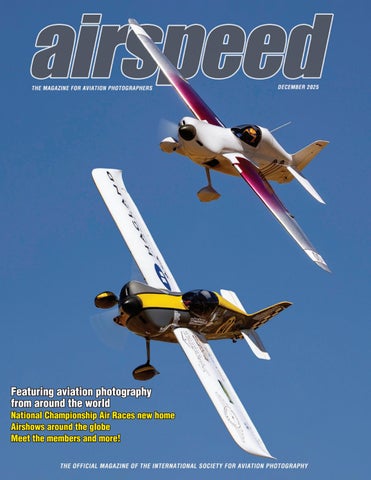
Featuring aviation photography from around the world
National Championship Air Races new home Airshows around the globe Meet the members and more!
Rob Tabor
WELCOME TO THE 2025 DECEMBER ISSUE OF AIRSPEED! How Thunder Rolls Bryan Turner
Dancing with Wind and Rain Marc Schultz
SNAP 2025 Marc Schultz
SoCal Airshow Ricardo Mejia
National Museum of Nuclear Science and History Larry Grace
America’s Air Show 2025 Larry Grace
New Home New Future: Roswell John M. Agather Carolyn Hinton Larry Grace Kevin Hong
Magic in the Air Robert Allen
Go East: Muzeum Lotnictwa Polskiego Marc Schultz USCG Cliff Ops Mark Comon
Shooting the Xtreme Marc Schultz Sky Fiesta 2025 Robin Guess
A Magical Experience Kevin Hong Larry Grace
Wings Over Houston Kevin Hong John Ford Gary Daniels
Inside Bundeswehr Marc Schultz
Hyundai Air and Sea Show Ricardo Mejia
The Great Colorado Airshow Ricardo Mejia
2025 Aviation Adventure Jeff Krueger
SHG Airshow 2025 Ugur Ozkan
Meet the Members John Guzzi Larry Glass
Angels in Paradise Ricardo Mejia
Airplane Silhouettes John Ford
Front Cover Fighting for first at the new home of the National Championship Air Race in Roswell, NM. Photo by Kevin Hong Camera: Canon R6 Mk II Lens: Canon RF 100-500mm f/4-7.1 L IS USM Shutter speed: 1/320 ISO: 100 Exposure: f/11 RAW images processed in Adobe Photoshop Back Cover A salute to Jon Melby retiring from flying airshows after 23 years of thrilling crowds around the country. Photo by Jeff Krueger Camera: Canon R5 Mk II Lens: Canon RF 100-500mm f/4-7.1 L IS USM Shutter speed: 1/320 ISO: 200 Exposure: f/13 RAW images processed in Adobe Photoshop
Robert Allen
NEW AND RETURNING ISAP MEMBERS Jessia Ambats David Barrera Griffey Bostock Michael Corazzelli Deanna Denlinger Robert Eastman
Jim Froneberger Larry Glass Taggart Gorman John Guzzi Kevin Hill Kevin Hong
Gregory Knott Andy Lay Marty Miles James Reeder John Sepp Phillip Sipple
Tom Spanos Rob Tabor Steve Walter Johannes Winkelmann
The goal of International Society for Aviation Photography (ISAP) is to bring together our members who share a love of aviation, and want to preserve its history through their images. Through our organization, members can seek to enhance their artistic quality, advance technical knowledge, and improve safety for all areas of aviation photography while fostering professionalism, high ethical standards, and camaraderie. ISAP continues to help our members to better their photography skills, workflow, and set up resources to help with business questions that our members have. Updates are being made to the ISAP website and member portfolio section, and we are showcasing ISAP members’ images and accomplishments on our social media pages. The new Airspeed magazine will highlight ISAP members and their photography, experiences, and their passion for aviation from around the world. From military and commercial aviation, you’ll be able to see it all while learning about aviation photography, post processing tips in Lightroom and Photoshop, aviation history, air show reports, aviation museums, and more. We look forward to sharing our members’ images and articles with everyone. Enjoy this issue of Airspeed! Sincerely, Larry Grace, ISAP President Kevin Hong, Airspeed Editor International Society for Aviation Photography www.aviationphoto.org • www.facebook.com/ISAPorg Airspeed magazine will highlight ISAP members and their photography, experiences, and their passion for aviation from around the world. From military and commercial aviation, you’ll be able to see it all while learning about aviation photography, post-processing tips in Lightroom and Photoshop, aviation history, air show reports, aviation museums, and more. We look forward to sharing our members’ images and articles with everyone.
For the 2025 Rock the Land Air Show, the USAF Thunderbirds staged their performance from the Cleveland Hopkins International Airport (KCLE). As spectators streamed onto the ramp at the Burke Lakeside Airport under ideal airshow skies, the Team’s maintainers began the rigorous process of preflighting the jets by conducting mechanical and visual inspections, servicing systems, and matching cockpit setups to individual pilot preferences. No matter the rank or job specialty, everyone pitches in to clean and wipe down the jets until each part shines. For the Saturday show, I requested and received access to photograph the show preparation, launch, and recovery from the perspective of the Team’s maintainers. The only audience on the ramp consisted of a
handful of FBO employees, a few curious corporate pilots, and me. But regardless of who or how many people were watching, these select USAF maintainers are consistent and exacting in task execution. Throughout the day, as I took photos of these airmen, what became most compelling was witnessing the immeasurable pride, selfless teamwork, never-ending drive for improvement, and a shared enthusiasm stemming from deep-rooted friendships. Underscoring their work was a silent determination to build upon the Team’s unprecedented 72-year history of not having a single Thunderbird demonstration cancelled due to a maintenance problem. This is a powerful source of pride, as well as a daily challenge happily accepted.
HOW THUNDER Photos and text by Bryan Turner
ROLLS
Bryan Turner
Preflight of the left main gear well – SSgt David Ball.
Bryan Turner Hydraulic system servicing – SSgt Sovann Din.
Bryan Turner Although for today, this D-model is not part of the primary 6-ship lineup, the jet is prepped, made show-ready, and on duty as a ground spare, all prior to pilot step.
Bryan Turner
After hands-on training, practice, rounds of feedback, and heart-felt of words of encouragement from their peers, hopefuls for next season’s Show-Line Crew Chief positions are given the reigns to execute the complete show launch as the jets depart for today’s show. SSgt Trinity Schulze, current #7 Assistant Crew Chief, keeps a watchful eye for safety while evaluating the candidates for their attention to detail, execution, and poise under pressure.
Bryan Turner
SSgt Eloquone Harris. Thunderbird Maintenance works in two shifts, Show-Line followed by Swing Shift. A full maintenance day, depending on what needs to be trouble shot, fixed or replaced, along with follow-on inspections, can range from 9 - 15 hours. A “bad” day with a hard broke jet or an engine change can extend the work day significantly.
Bryan Turner
Post engine run inspection - SSgt Eloy Licona and SSgt Yarely Vega.
Bryan Turner
After show landing gear and gear well scrub down.
Bryan Turner
Capt Natalee Winton, Thunderbird #11, Maintenance Officer. ‘Silk’ is the Officer in charge of overseeing more than 120 maintenance enlisted members, representing nearly 30 career fields. Apart from ensuring all jets are ready and safe to fly, her main duty and passion is taking care of her people.
Bryan Turner
Replacing a static wick high on the vertical tail as the sun begins to set on Swing Shift – TSgt Khari Coleman.
On September 4, 2025, Jagel Air Base in northern Germany became the stage for an impressive presentation of the German Air Force: the “Significance of National Air Power 2025” – SNAP 2025 – exercise. Under a typical northern German sky, LUFTWAFFE demonstrated the full range of its capabilities in a dynamic, hour-long display. Insights for the Next Generation of Bundeswehr Leaders The main goal of SNAP 2025 is to provide around 120 participants from the Bundeswehr Command and Staff College with practical insights into the capabilities of the Air Force. This annual presentation is an essential part of the training that prepares approximately 3,000 course participants for demanding roles in national and international organizations like the UN, NATO, and the EU. The other branches, such as the Army and Navy, will also present their capabilities to the participants in similar showcases as part of this course. In addition to the dynamic aerial displays, a static ground exhibition showcased the German Heron PT reconnaissance aircraft stationed in Jagel, the Eurofighter, and the Multi Role Tornado. This was a perfect opportunity for all participants to inspect state of the art weapon systems up close. The day before, on September 3, a full-scale dress rehearsal was held to ensure the smooth execution of the main demonstration. Overall, SNAP 2025 offered a captivating and insightful demonstration of the modern operational readiness and capabilities of the German Air Force.
SNAP 2025
LUFTWAFFE’s Dynamic Showcase in Jagel Photos and text by Marc Schultz / www.flugsicht.com
Impressive Performance in the Sky and on the Ground The exercise simulated, among other things, the rescue of a hostage from enemy forces. This scenario highlighted the complex and coordinated cooperation of various units. Spectators witnessed the collaboration of: • Tornado combat aircraft from Tactical Air Force Wing 51 “Immelmann” in Jagel and Tactical Air Force Wing 33 in Büchel. • Eurofighters from Tactical Air Force Wing 74 in Neuburg. • Airbus A400M from Air Transport Wing 62 in Wunsdorf. • C-130J Super Hercules from the German-French Air Transport Squadron in Évreux. • Sikorsky CH-53 from Helicopter Wing 64 in Laupheim. • Airbus H-145M from the Light Utility Helicopter Special Operations Forces. • Base protection forces from Schortens, whose Air Mobile Protection Team (AMPT) ensured the safety of air transport missions.
Marc Schultz
Marc Schultz
Marc Schultz
Marc Schultz
Marc Schultz
Marc Schultz
Marc Schultz
Marc Schultz
National Museum of Nuclear Science & History
Photos and text by Larry Grace / ISAP President
On the way to Roswell for the air races, ISAP editor Kevin Hong and I met in Albuquerque. While there, Kevin suggested we visit the museum. This gave me the opportunity to test out a new lens: the Tamron 35-150 f/2-2.8 Di III VXD for my Nikon Z camera. The National Museum of Nuclear Science & History, established in 1969, offers a compelling journey through the story of the Atomic Age—from the earliest research in nuclear development to today’s peaceful applications of nuclear technology. Visitors are invited to explore how nuclear science continues to shape our world. Through a dynamic mix of permanent and rotating exhibits, the museum showcases the diverse uses of nuclear science across history, industry, medicine, and energy. It also honors the pioneers whose work has defined the field, presenting their stories in engaging and accessible ways. The Museum’s mission is “to serve as America’s resource for nuclear
history and science. The Museum presents exhibits and quality educational programs that convey the diversity of individuals and events that shape the historical and technical context of the nuclear age.” The National Museum of Nuclear Science & History’s Nuclear Defense Heritage Collection is composed of more than 120 artifacts, which is the world’s largest and most complete collection of preserved declassified nuclear weapons, handling equipment, and deployment systems, all of which survive from the Manhattan Project and Cold War era. The museum offers a lot for a aviation photographer to see and photography. When in Albuquerque make plans to see and spend time checking out this museum. www.nuclearmuseum.org www.nuclearmuseum.org/assets/uploads/PDFs/Map-Guide.pdf
Larry Grace
Larry Grace
Larry Grace
Larry Grace
Marc Farb
Larry Grace
Larry Grace
Larry Grace
Larry Grace
Larry Grace
Larry Grace
Larry Grace
Larry Grace
Roswell, New Mexico has landed a new set of flying objects. They are fast, sleek, and hard to catch. The National Championship Air Races has a new home that is used to notoriety for unconventional phenomenon in flight. For the last sixty years Reno, Nevada has been home to the National Championship Air Races. Going to Reno at least once became a bucket list item for any aviation enthusiast. The sport has airshow elements in it but is fundamentally different from any other aviation event in the world, including other air races. This is a closed pylon race where the airplanes are competing against each other, not the clock. Think of it as NASCAR in 3D, at 2 ½ times the speed, and in highly unstable air. The move from Reno was not by choice. The Reno Air Racing Association (RARA) was given notice that it would no longer be allowed to conduct its annual event at Stead Airport (25 minutes from downtown Reno but controlled by the Reno/Tahoe Airport Authority). This was an unfortunate situation since the Races contributed an annual local economic impact of over $150,000,000. So, RARA had no option but to look for a new home. Roswell, New Mexico is the perfect choice for the new era of closed pylon air racing. First and foremost are the incredible people of Roswell. There is not a gas station attendant, grocery store clerk, restaurant hostess, firefighter, etc. that is not happy to welcome you to their community. They are very excited to host the Races. There is friendly help from both local and state government, and even the ranch adjoining the airport has pledged partial use of their land where the racetrack is laid out. The other big advantage in Roswell is space, both on the ground and in the air.
In many ways the 2025 Races were a sort of start up venture for such a storied event. The number of Race classes was reduced, at least temporarily, while racecourse parameters are negotiated. Like any first-time experience there were bumps and challenges. However, the overwhelming vibe was the depth of possibility in Roswell. The ability to have large aircraft participate in Reno was limited because ramp space was at a premium. For instance, FIFI, the CAF B-29, could never have attended the races there. She was a star attendee of the inaugural event in Roswell. The other possibility that becomes available are trade shows. In essence the EAA annual gathering in Oshkosh is one giant aviation sales operation. The ability to host commercial ventures gives RARA the financial facility to increase race purses, host more airshow acts, and ultimately better support the educational STEM programs they are pledged to. Another huge advantage in Roswell is the ability to welcome many, many general aviation aircraft, an impossibility in Reno. The new epoch of air racing is upon us, and it has strong wings. One concern, oddly enough, is making sure you have lodging. But, here again, Roswell offers good options like bringing an RV. Those of us who have attended Oshkosh are familiar with this challenge. If you are at all aviation minded, the National Championship Air Races in Roswell, New Mexico are a must see attendance at least once in your life. John M. Agather is a longtime multi-engine, instrument rated pilot and former Chairman of the Reno Air Racing Association.
NEW HOME NEW FUTURE
THE NATIONAL CHAMPIONSHIP AIR RACES IN ROSWELL Article and photos by John M. Agather
John M. Agather
John M. Agather
John M. Agather
John M. Agather
John M. Agather
CAROLYN HINTON
From the Wright brothers to the space program, aviation is part of American culture, and we are nothing if not competitive by nature. We continue finding ways to push the limits of possibility just to prove what can be done. Racing airplanes is perhaps one of the best examples of this. Air racing started humbly, as many things do, with small races here and there throughout the US during the early 1900’s. Then in 1964 the first National Championship Air Races were held in the desert mountains of Reno, Nevada. Over the course of almost sixty years, air racing became a professional motorsport, growing to include seven different types of racing classes. Thousands of spectators, pit crews, pilots, and support personnel, traveled to the Reno-Stead Airport annually to be part of this event. But things change. In early 2023 the Reno Air Racing Association (RARA) publicly announced the 59th year of races would be their last. While RARA was very transparent throughout the whole process, acknowledging the fact that it was not their decision, they still met with contention from many people. But rather than let the event die out, they decided to explore the possibility of finding a new venue. As one can imagine, there was a great deal to figure out. Top priorities include proximity to emergency services and race course feasibility. After two years of taking bids, visiting cities, and event planning, the first races at the Roswell Air Center were held in September of 2025. As with anything when it is done for the first time, this event was not without some issues. For several reasons, the Sport and Unlimited classes were both unable to participate. This left five classes of aircraft racing, Formula 1, Jet, T-6, STOL Drag, and the return of the Bi-Planes. Despite this, there was still a full schedule, with most classes having
two (or more) heats each day, in addition to other show performers. And upon arrival, it was easy to see that the city of Roswell had already invested a great deal into this event, as much of the grounds were covered with blacktop that was obviously new. I was thankful to be traveling with my good friend, Rich Spolar, as this trip provided some challenges. For the first time, I would be doing more than just taking photos. Due to some last minute changes we were the only two from Florida Aviation Network able to attend, so it fell upon us to do video interviews. Since neither of us had ever been to Roswell before, we decided to make the trip a full adventure. We explored the town, visiting local shops, including a stop at the UFO museum, made a point to eat at a different locally owned restaurant each day, and even took up an invitation one night to visit a small drag strip hidden somewhere behind an aircraft boneyard. Then, on our last day in town, we had the opportunity to tour the boneyard itself. And when the races got rained out on Saturday, we traveled to Bottomless Lake State Park where we hiked around for a bit. Everywhere we went, the people in the community were so welcoming, we talked with all sorts of folks who were excited for the air races, and I do hope the aviation community responded in kind. Now that the first flag has flown, work will continue because there is still a great deal to do. While it was definitely sad to see the races forced to leave Reno, one thing is certain, the community and city government of Roswell is committed to the success of the National Championship Air Races. What Reno did for air racing will never be forgotten nor replaced, but now the time has come to build a new legacy.
Carolyn Hinton
Carolyn Hinton
Carolyn Hinton
Carolyn Hinton
Carolyn Hinton
Carolyn Hinton
Carolyn Hinton
Carolyn Hinton
Carolyn Hinton
LARRY GRACE / ISAP PRESIDENT
Larry Grace
Larry Grace
Larry Grace
Larry Grace
Larry Grace
Larry Grace
Larry Grace
Larry Grace
Larry Grace
Larry Grace
KEVIN HONG / AIRSPEED EDITOR
Kevin Hong
Kevin Hong
Kevin Hong
Kevin Hong
Kevin Hong
Kevin Hong
Kevin Hong
Kevin Hong
Kevin Hong
Kevin Hong
Kevin Hong
Kevin Hong
Kevin Hong
Go East - The “Muzeum Lotnictwa Polskiego” in Krakow A photographic exploration of Poland’s National Aviation Museum
Photos and text by Marc Schultz / www.flugsicht.com
Without a doubt, Krakow, with its wonderful Old Town, is always a rewarding travel destination. However, this is especially true for aviation enthusiasts because here, on the historic grounds of the former Rakowice-Czyzyny airfield, you will find the Muzeum Lotnictwa Polskiego, Poland’s National Aviation Museum. Founded in 1963, it is today one of the most significant and interesting aviation collections in Eastern Europe. Numerous exhibits of international aviation technology and history attract an international audience every year and underpin the exhibition’s excellent reputation. The comprehensive collection includes airplanes, gliders, helicopters, aircraft engines, anti-aircraft missiles, and radar systems. A library and an archive with books and photographs complement the offering. Volatile History: The Rakowice-Czyzyny Airfield The museum is located on the site of Poland’s oldest airfield and one of the oldest permanently used airfields in Europe. As early as the turn of the 19th to the 20th century, a balloon company of the 2nd Fortress Artillery Regiment was stationed here. In 1912, the Austrian command
established an aircraft maintenance unit, Flugpark 7. In 1918, Rakowice became an important stopover for the first regular airmail route connecting Vienna with Kyiv and Odesa. On October 31, 1918, Polish military authorities took command, and Rakowice became the first airfield of independent Poland and the founding location of the 1st Fighter Wing. In the late 1920s and 1930s, Rakowice developed into Poland’s second-largest military air base. In September 1939, the site was bombed by the German Luftwaffe and conquered by the Wehrmacht. After the war, the airfield was successively used by the Polish Air Force, the Polish airline LOT, and the Krakow Aero Club. In 1963, it had to be closed due to urban development. However, today, a part of the site is once again used as a landing field for helicopters and light aircraft. Pre- and Post-War Era The exhibits are housed in three hangars, a new multi-purpose building, and an extensive open-air exhibition. The former hangar of the 2nd Air Regiment holds the only surviving Polish pre-war fighter,
This two-seater SB LIM-2A, serial number 27004, was operated by 1st Reconnaissance Squadron of the 7th Naval Aviation Attack Regiment at Siemirowice.
the PZL P.11c, which was operated by the 121st Fighter Squadron in 1939. Other highlights from the Polish pre-war period include the PWS-26 trainer and the RWD-13 and RWD-21 sport aircraft. World War II aircraft are also prominently featured, including the British Supermarine Spitfire LF Mk XVI E fighter and the Soviet Tupolev Tu-2S medium bomber, which was considered one of the best in its class towards the end of the war. Next to it stands the only existing night bomber version of the Polikarpov Po-2. Post-war aircraft such as the Polish TS-8 Bies and TS-9 Junak trainers, as well as the Yak-18 and Aero L-200 Morava airplanes, bear witness to the civil and military aviation of this era. Cold War and “MIG-Alley” The most exciting and visually impressive part of the collection is probably the “MIG-Alley” in the spacious outdoor area. Here, almost all jet fighter aircraft ever operated by the Polish Air Force are gathered. The exhibition offers a comprehensive insight into the
military aviation of the Warsaw Pact. Visitors can follow the evolution of Soviet aircraft design through the different type families. These include the Ilyushin Il-28R reconnaissance aircraft and its training version Sil-28, as well as a complete family of MiG-21 variants, which formed the backbone of Polish fighter units from 1961 to 2003. Also on display are Polish-made license versions of the MiGs – Lim-1, Lim-2, Lim-5, and Lim-6bis. The exhibition also features fighter-bombers such as the Sukhoi Su-7BM, Su-7BKL, Su-7U, Su-20, Su-22M4, and Su-22UM3K, which were designated for the deployment of tactical nuclear weapons under the Warsaw Pact. An interceptor MiG-23MF, formerly stationed with the 28th Fighter Aviation Regiment in Słupsk, and the two-seater MiG-29UB, which is still in service with the Polish Air Force today, complete the lineup of Soviet production. However, the other side of the Iron Curtain is also prominently represented. The Swedish SAAB J35J Draken fighter and the SAAB AJSF37
Viggen reconnaissance aircraft are exemplary of the Scandinavian aviation industry. The American Northrop F-5E Tiger II and the Cessna A-37B Dragonfly represent the Air Force of the Republic of Vietnam. European and American NATO aircraft such as the Belgian Republic F-84F Thunderstreak, the French Dassault Mystère IVA and Dassault Mirage V, the Danish Canadair CF-104 Starfighter, the American LTV A-7 Corsair II, and the Republic F-105 D Thunderchief named “Polish Glider” are also on display.
jet-powered agricultural aircraft, a special design from the 1970s, is the last of 179 built. Due to its high cost, it was never delivered to a customer and went straight into the museum.
Particularly noteworthy in the civil sector are the Ilyushin (VEB) Il-14S and Yakovlev Yak-40 business transport aircraft, used by leading figures of communist and independent Poland. Also exhibited are an Antonov An-26, operated for almost 40 years by the 13th Transport Aviation Regiment in Kraków-Balice, and a Tupolev Tu-134A, which was one of the first jet aircraft in the LOT fleet. The PZL M-15 Belphegor represents a technical curiosity. This
Opening Hours: Current opening hours are generally between 9:00 AM and 5:00 PM. The museum is usually closed on Mondays. Admission is typically free on Tuesdays.
Practical Information Website: Detailed information about the collection, current exhibitions, and events can be found on the museum’s official website: www.muzeumlotnictwa.pl
Accessibility: The museum is located at Aleja Jana Pawła II 39 in Krakow and is easily accessible from the city center and the main train station by tram or city bus.
Marc Schultz
A row of former Polish Air Force MiG/Lim jet fighters on display in the “MIG-Alley” outdoor exhibition area.
A wooden WWI LFG Roland D.VI1b fighter, complete with its rather large propeller and German markings, showcased in the “Small Hangar”
Marc Schultz
Ground-level shot of Cold War-era Sukhoi fighter jets on display in the outside section, highlighting an imposing nose cone against the dramatic cloudy sky.
Marc Schultz
The French-built Dassault Mystère IVA jet fighter on static display, representing several western types in the exhibition.
Marc Schultz
Safety comes first: Before the “man overboard” drill begins, the crew carefully coordinates every step of the operation. Each exercise requires a detailed briefing—because at sea, nothing can be left to chance.
The beautifully preserved PZL P.11c, Poland’s only surviving pre-war WWII fighter aircraft, is displayed prominently inside the WW II hangar.
Marc Schultz
Marc Schultz Front section of an Ilyushin Il-28R jet bomber on static display. Operational between 1952 and 1977, the Polish Air Force purchased around 80 aircraft in several variants.
The rare PZL M-15 Belphegor, the world’s only jet-powered biplane crop duster.
Marc Schultz
The retired Tupolev Tu-134A jet airliner, formerly part of the LOT Polish Airlines fleet, stands on grassy ground as one of the civil exhibits.
Marc Schultz
Close-up view of a Polish Air force LIM-6bis fighter jet.
Marc Schultz
The action was fast, I was frantic. Grab, set, shoot! Did I get it? 1/1000…dang too fast. That’s right 1/60 is right. Overcast, into the light +1. Whew! Did I capture it? I saw the MH-65 Dolphin hovering at eye height from the road. WOW! The US Coast Guard was practicing rescue operations on the cliffs here in Southern California. I pulled over and spoke to one of the guys... “What’s going on?” “Can I take a few pictures?” Yes, sure was the answer. Thirty minutes later it was all over and they were all gone. Lessons learned: 1. Luckily I had my Nikon in the car! 2. Don’t think, shoot first and think later. 3. Know your camera and how it behaves. 4. Know the look of your picture and how to make the camera work.
USCG Cliff Ops Article and photos by Mark Comon
Mark Comon
Mark Comon
Mark Comon
Mark Comon
As a kid I grew up watching airshows in the daytime but over the years I’ve learned to appreciate the twilight shows just as much if not more. Even though they’re is a lot of work that goes into them the result is well what I like to call magical. Larry and I have had the opportunity to work with the Wings Over Batavia Airshow near Buffalo, New York and I can say this has become one of my favorite shows to work during the airshow season. The weather is not only cool but a relief from where I come from in the sweltering humidity of Texas. It’s not just the weather I like but also the people as well. Small town show with the feel of a big airshow is how I look at it. When you drive through some of the neighborhoods you can see American flags posted at every house. For a fireworks, drone, and pyro night display finale for three days in a row I ask why would anyone go to Oshkosh when you can see an amazing show here if not better.
To some people it’s not just a show with airshow performers and the military but also a location for many people to propose. This year there were 11 couples that proposed during the show and we were able to help capture one lucky couple when the magic was going off in the background. As the sun starts to set and the flying begins there are opportunities to capture some great photos of the planes and people. This year was unique to not only capture one of many wedding proposals but to also highlight some of the veterans in the area. There were veterans that attended and a World War II veteran was able to grace the sky once again flying in a P-51 Mustang and B-25 Mitchell bomber. I always look forward to not only see the show but to also spend time with our airshow family and making new friends. One of our friends in the airshow industry always says “It’s great to be us.” I will always agree to that statement.
A MAGICAL EXPERIENCE AT WINGS OVER BATAVIA AIRSHOW Article and photos by Kevin Hong / Airspeed Editor and Larry Grace / ISAP President
Kevin Hong
Kevin Hong
Kevin Hong
Kevin Hong
Kevin Hong
Kevin Hong
Kevin Hong
Kevin Hong
Kevin Hong
LARRY GRACE / ISAP PRESIDENT
Larry Grace
Larry Grace
Larry Grace
Larry Grace
Larry Grace
Larry Grace
Larry Grace
Larry Grace
Larry Grace
INSIDE BUNDESWEHR THE GERMAN ARMED FORCES OPEN DAY 2025 Photos and text by Marc Schultz / www.flugsicht.com
With more than 83,000 visitors, the 2025 Bundeswehr Open Day, held on June 28th at Jagel Air Base in Northern Germany turned into a major public success. The organizers at Tactical Air Force Wing 51 “Immelmann” had initially expected around 50,000 guests – but public interest far exceeded all expectations. Stretching across roughly two kilometers along the runways of the Air Base in Schleswig-Holstein, Bundeswehr and LUFTWAFFE showcased themselves at nearly 70 information stations. The range of exhibits spanned from modern air defense and reconnaissance to medical services. Of particular interest was the Patriot air defense system, as well as a demonstration of airborne reconnaissance using drones followed by image analysis – a core capability of the German Heron TP drone unit based in Jagel. The day’s highlight was LUFTWAFFE’s impressive flight program: ECR Tornados, Eurofighters, C-130J, A400M, and CH-53 helicopters
demonstrated the wide range of air force capabilities in a dynamic “role demo.” A special crowd favorite was the spectacular solo display of the GAF Eurofighter and a precisely flown formation flyover by three A400M transport aircraft. More than 1,700 soldiers and civilian staff were involved in organizing and running the event, contributing to a highly successful day. The above-expected public interest and the professional execution made Bundeswehr Day in Jagel a model example of successful public engagement by the German Armed Forces. All shots in this set were taken with a NIKON Z6 III camera and the NIKKOR 24-120 / f/4 and NIKKOR 70-200 / f/2.8 lenses. The previously mentioned telezoom-lens was also used in combination with Nikon’s 2x teleconverter.
Triple Transport Power - impressive fly-over of three German Air Force Airbus A 400M transport aircraft. Replacing the former C-160 Transall the Airbus A400M today serves as the German Air Force’s primary transport aircraft, combining strategic range with tactical versatility for missions around the globe.
German Air Force ECR Tornado 46+48 from Taktisches Luftwaffengeschwader 51 “Immelmann” under full afterburner.
Marc Schultz
Germany’s First Super Herc - carrying construction number 5930 and tactical registration 55+01, this is the first Super Hercules delivered to the German Air Force in February 2022. Lockheed Martin is building a total of six aircraft for Germany including three KC-130J tankers and three stretched C-130J-30 transports.
Marc Schultz
In service with the Bundeswehr since 1972, the CH-53 now operates in three different variants. Following a structural reform of the German armed forces, all tactical airlift operations were consolidated under the Air Force. As a result, the CH-53 fleet transitioned from Army to Air Force command in January 2013, after 41 years, and is now operated by Helicopter Wing 64.
Marc Schultz
German Air Force Eurofighter EF-2000 31+36 taxiing back after an impressive solo display.
Marc Schultz
Several ECR Panavia Tornado took part in an impressive 45 minute tactical role display, among them was this aircraft from Taktisches Luftwaffengeschwader 51 “Immelmann”.
Marc Schultz
The Dornier Do 27 was the first German-powered aircraft to enter series production after World War II. The Bundeswehr became its largest operator with 428 aircraft and received the first production model in January 1957, delivered to Army Aviation Squadron 811 in Niedermendig. The aircraft pictured here now flies under the civilian registration D-EAJC.
Marc Schultz
Located at Jagel Airbase the German Heron TP drones are based on the Heron TP by Israel Aerospace Industries. The GHTP is technically modified to meet Bundeswehr requirements. Until the Eurodrone enters service around 2030, it will provide reconnaissance, surveillance, and support for ground and naval forces.
Marc Schultz
This Bombardier BD-700 Global Express with tactical registration 14+05 is operated by the Special Air Mission Wing of the German Ministry of Defense, based at Cologne Bonn Airport. The unit’s current fleet includes various fixed-wing and rotary aircraft, among them three Airbus A350-900s, several A319 and A321 variants, three Global 5000s, three Global 6000s, and three AS532 Cougar helicopters.
Marc Schultz
The Great Colorado Air Show at the Northern Colorado Regional Airport in Loveland, CO brought the return to Colorado of the USAF Thunderbirds for the first time since 2015. This was also the first time I’d seen a 6-ship show this year. At El Centro, Nellis AFB, and March ARB they flew 5-ships while “BEAR” was training up to take over the #3 slot. One of the many things I love about attending Thunderbirds shows is meeting family and friends in the Thunderbirds Family & Friends area. I met a couple attending their first ever airshow with their young children. The husband worked at a local hotel assisting the team with their arrangements and were gifted tickets by the team. I met a gentleman stationed at Buckley Space Force Base who worked with former team Executive Officer CAPT Randi Winther. My biggest thrill was meeting four Air Force Academy Cadets, all pilots in training. Meeting the best of America’s youth was indeed a privilege. There may have been a sighting of former boss LTCOL Justin “ASTRO” Elliott. The Air Force Academy parachute team, The Wings of Blue dropped in with the flags of the service branches and of course, Old Glory. Then we were off and running with the aerial demos. The show featured not one, but two Yakovlev Yak-50 aerobatic aircraft that performed individually and together as the Red Thunder Airshows. Tom Larkin in his Sonex Mini Jet was a blast to watch. It’s like the VW Golf-R of the jet world. Something that small shouldn’t be so much fun! There were two glider demos: The first by the Air Force Academy, and the second by Bob Carlton in a twin jet engined FoxJet Glider that can launch itself, shut off the engines and fly as a glider, relight the engines to gain altitude and perform powered maneuvers, then glide again. It was quite the sight! A highlight was the penultimate performance by Bob Freeman, a veteran of over 33 years of aerobatic competition who officially retired at the end of the 2025 airshow season. With many aerobatic championships in his back pocket, Bob brought his signature high energy show to the Rocky Mountains, wringing the neck of his Extra 330SX. Blue skies and tailwinds Bob. Then it was time to bring on the noise!
USAFA Glider Demo.
First up was the West Coast Rhino Demo Team out of NAS Lemoore in California flying the F/A-18 Super Hornet. Quoting Sheldon Cooper “Here’s a fun fact”. The F/A-18 Super Hornet got its nickname of “Rhino” due to a rectangular protrusion on its nose just in front of the canopy that gives it a rhino-like appearance. During the change-over period when the Navy was operating both legacy Hornets and Super Hornets, “Rhino” was a much shorter, easy-to-say call sign to clearly differentiate between the two versions. Then it was time for America’s team. For the Red, White, and Blue. THE THUNDERBIRDS! (queue AC/DC’s Thunderstruck). The layout of the Northern Colorado Regional Airport did not allow for the Team to be positioned along the flight line, so the traditional startup ceremonies were out of sight for most of the crowd. Additionally, the runway was too narrow to allow the 4 planes of the Diamond to launch side-by-side as per usual, so they launched one at a time then formed up into the Diamond once they were airborne. This unusual launch did allow me to take individual photos of ships 1-4. Two days of great flying, and only an hour from home! For once it was nice not having to fly to attend an airshow. Plus, I stopped at Buc-ee’s on the way home. Yes, it is everything you’ve heard. Yes, the brisket sandwich is to-die-for! Unfortunately, I didn’t know at the time that it would be my last Thunderbirds show of the year as the Team had to back out of the Huntington Beach show two weeks later due to the government shutdown. Though the Thunderbirds did perform in Pueblo, CO the following weekend, I was at the Miramar Airshow in San Diego, CA watching the Blue Angels. Until next year!
The Great Colorado Airshow Article and photos by Ricardo Mejia
Tom Larkin Sonex Mini Jet.
Ricardo Mejia
Bob Carlton FoxJet Glider.
Ricardo Mejia
West Coast Rhino Demo Team.
Ricardo Mejia
USAF Thunderbirds Diamond Burner 360.
Ricardo Mejia
USAF Thunderbirds Delta Loop.
Ricardo Mejia
SHG Airshow is an international organization organized annually by Sivrihisar Sportive Aviation Society at Sivrihisar Aviation Center Necati Artan Facilities (near ESKIEHIR city) and it addresses the aviation fans from every age while emphasizing the significance of the aviation culture. SHG Airshows offer an opportunity to gain knowledge about aviation culture especially to children and young people. This organization which came to life first in 2015 attracted lots of attention, developed year by year and became an internationally well-known organization. Today, it has been mentioned that SHG Airshows has become a true international aviation show in comparison to others.
SHG AIRSHOW 2025 ESKİSEHİR-TÜRKİYE Article and photos by Ugur Ozkan
The first certified Turkish aircraft, Vecihi XIV (14), designed by Vecihi Hürkus, who has written his name in gold letters in Turkey’s aviation history, took to the skies again after 90 years at SHG Airshow 2025. The replica aircraft, prepared in collaboration with the M.S.Ö. Air and Space Museum and the Sivrihisar Aviation Club, carries a nostalgic and historical significance for aviation enthusiasts
MiG-15bis, Europe’s fastest civil jet aircraft with a speed of 580 knots, participated in the SHG Airshow in 2025.
Ugur Ozkan
This “still flying” DC-3 was brought to the collection of M.S.Ö. Air & Space Museum in March 2019. This legendary plane’s name became “Turkish Delight” and took its place in Turkish skies.
Ugur Ozkan
The North American Aviation T-28B Trojan, 1955 model with serial number 138354, in flying condition.
Ugur Ozkan
The world-famous Typhoon Jet Demonstration Team of the British Royal Air Force (RAF) presented a breathtaking display in the skies above Türkiye for the first time.The 25-person Typhoon Jet Demonstration Team, affiliated with the Royal Air Force, participated in the demonstrations. The British team performed a high-performance, aerobatic aerial display in their FGR.4 Eurofighter jet.
Ugur Ozkan
In 2024, a TE517 series Spitfire Mk.9 aircraft was purchased by Ali Ismet Öztürk from the MSÖ Air and Space Museum. The aircraft took off from Sywell Airport in England and landed at the Sivrihisar Aviation Center on May 27, 2024. After obtaining permission from the Ministry of National Defense and the Air Force Command, it was repainted in the colors used by the Turkish Air Force in the 1950s and fitted with a square emblem.
Ugur Ozkan
The 1943 model Boeing Stearman with serial number 75-4620 was brought to the M.S.Ö. Air & Space Museum in March 2015 with the contributions of Ali Ismet Öztürk.
Ugur Ozkan
The “Vietnam Veteran” UH-1H features a large yellow “BEE” emblem on its front, symbolizing its identity with the assault team it once served with. One of the most iconic helicopters in the world — the Huey — at SHG Airshow!
Ugur Ozkan
SHG Airshow 2025 airfield.
Ugur Ozkan
Produced in 1942, with serial number T7471, Tiger Moth is in the inventory of M.S.Ö. Air & Space Museum. The most significant aspect of Tiger Moth in our museum is that it is a “film star”. DH 82 Tiger Moth is the aircraft used in the movie “The English Patient”, which was shot in 1996, receiving the Oscar Award in nine branches.
Ugur Ozkan
In late December of 2024, after all the major military demonstration teams had dropped their 2025 schedules, I scrolled through the 2025 show calendar on AirshowStuff.com, looking for a “new” show to attend. It wasn’t long before one particular entry jumped out at me: August 9-10, Kaneohe Bay Air Show, MCB Hawaii, Kaneohe Bay, HI, US Navy Blue Angels/USAF F-22 Raptor Demo. What?! It took me (snaps fingers) that long to decide I had to go! Naturally I made a vacation out of it. I arrived on the island of Oahu on Wednesday and spent the next few days touring the island and doing touristy things: poke, shaved ice, and rum drinks! Post show I flew to the big island of Hawaii and spent a few days with friends before returning to the mainland. Bright and early Saturday morning I left Waikiki and headed towards the Mokapu Peninsula on the windward side of the island, to Marine Corps Base Hawaii (MCBH). It was a beautiful day with a light breeze keeping the humidity in check. The day started with the Marine Corps Color Guard, the Marine Corps Forces Pacific (MarForPac) Band, and the Hawaii Pipe Band (as in bagpipes), followed by opening remarks from Base Commander Col Jeremy Beaven, the invocation by the base Chaplain, and a traditional Hawaiian blessing. The aerial activities started with the SOCOM Para Commandos dropping in with the colors, followed by a North American T-6 Texan trainer aircraft, MV-22 Osprey, KC-135, and F-22 Raptor (not to be confused with the F-22 Demo Team) demos. Then we were treated to a flyby from the mighty B-52 BUFF (Big Ugly Fat Fellow (wink)). Then it was time to turn up the volume. “These go to 11!” (gratuitous Spinal Tap reference). Captain Nick “LAZ” Le Tourneau launched the fearsome F-22 Raptor and put it through its paces, doing things that are not
aerodynamically possible, things that no aircraft should be able to do! I’ll never get tired of this demo. All of this was of course prelude to the main attraction, the U.S. Navy Flight Demonstration Squadron more commonly known as The Blue Angels! Fat Albert warmed up the crowd, and then the pilots mounted their F/A-18 Super Hornets and along with the ground crews executed their carefully choreographed startup procedures. Then the Blues launched into the blue. I was standing next to a family with some teenaged boys that had come over from Maui to attend their first airshow. Throughout the day I had been showing them the photos I was taking and answering questions about the aircraft and the performances. Like many of you, I have seen the Blues many times and have the performance pretty much memorized so I would occasionally clue my neighbors in on things to look for, but I decided not to warn them about the back-toback sneak passes. Their surprised reactions were proof I made the right choice! I’ve seen the Blues many times, and this was one of their better shows. The solos were so tight during the Tuck-Over Roll maneuver that the boys next to me were shocked when they realized that there were two planes flying as one! I love seeing people react like that to something I love so much. Attending the KBay Airshow was a king move. To paraphrase Ferris Bueller: If you have the means, I highly recommend going! Take something you love and drop it into a setting like Oahu. How can you possibly not love that?!
Angels in Paradise 2025 MCBH Kāne’ohe Bay Airshow
Article and photos by Ricardo Mejia
The Blue Angels Diamond in the Double Farvel.
Marine Corps Color Guard and the Marine Corps Forces Pacific (MarForPac) Band.
Ricardo Mejia
MV-22 Osprey.
Ricardo Mejia
B-52 BUFF.
Ricardo Mejia
F-22 Raptor Demo Team.
Ricardo Mejia
Sleeping Angels on a beautiful Hawaiian morning at MCBH Kane’ohe Bay with the Ko’olau Mountains in the background.
Ricardo Mejia
Dancing with Wind and Rain: The 2025 German Open Aerobatic Championships Photos and text by Marc Schultz / www.flugsicht.com
For the second time since 2023, the skies above Dinslaken Schwarze Heide Airfield (EDLD) roared with precision and elegance as the German Aerobatic Championships in the Advanced and Unlimited categories returned from June 25 to 29, 2025. Once again hosted as the “German Open,” this premier event drew approximately 30 pilots from nine countries— Germany, Romania, Hungary, Poland, Great Britain, Luxembourg, the USA, the Czech Republic, and Switzerland— cementing its reputation as a fixture on the European aerobatic calendar. Organized by the German Aero Club (DAeC) and its Federal Motor Flight Commission, and executed under the watchful eye of the German Aerobatic Association, the competition followed a proven format
first established at the same venue in July 2023. It was the second major contest of the current season, following the Sportsman and Intermediate Championships in Lauterbach earlier in June. The season finale, the highly anticipated Reinsdorf Challenge, is scheduled for September and promises another round of world-class performances. Despite the organizers’ meticulous planning, the opening competition day on June 26 - the shots of this feature were taken on that day - tested everyone’s patience and flexibility. A low cloud base, intermittent rain showers, and gusty winds made it impossible to adhere to the strict flight schedule. Only a handful of programs could be flown late in the afternoon under marginal weather conditions.
Fortunately, the weather gradually improved over the following days. With better visibility and calmer winds, the contest was able to proceed as planned, allowing competitors to demonstrate their skills in both compulsory and freestyle sequences. The improved flying conditions paved the way for intense rivalries and technical brilliance in the box, much to the delight of judges and spectators alike. In the Advanced category, Italy’s Riccardo Cresci delivered a commanding performance to take the top spot, ahead of Poland’s Dariusz Mazur. Moritz Kirchberg scored as the highest-ranked German pilot, earning him the title of German National Champion in the Advanced category.
In the Unlimited division, Romania’s Romain Fhal impressed the judges and took first place, with Hungary’s Daniel Genevey finishing second. Germany’s Marcus Extra was crowned German National Champion in the Unlimited category. Fhal also triumphed in the Unlimited Final Freestyle competition, once again showcasing his exceptional skills. Luxembourg’s Alex Hory captured second place, while Marcus Extra rounded out the podium in third. His teammate, Markus Feyerabend, followed closely in fourth place. Shots in this set were taken with the NIKON Z6III and the NIKKOR Z 24-120mm / f4.0 S.
Marc Schultz
Marc Schultz
Marc Schultz
Marc Schultz
Marc Schultz
Marc Schultz
Rick Charles Marc Schultz
Returning to March Air Reserve Base was a sort of home coming. I went to college in nearby Riverside, CA from 1979-1983, and in 1980 I attended an airshow at what was then March Air Force Base, a former Strategic Air Command base. What is most memorable about the 1980 show is that while I was driving towards the entrance, I spotted a black speck in the sky trailing black smoke. As it grew larger I realized that it was an SR-71 on approach to the base! Unfortunately, in 1980 cell phones with cameras didn’t exist so I have no proof. I recently found slides (slides are positive film transparencies for you youngsters) of the Thunderbirds flying T-38’s from that show. I thought about including one for the nostalgia, but they are really bad! LOL The SoCal Air Show had a great variety of aerial performers including aircraft that I had never seen fly before like the E-3 Sentry and the P-63 King Cobra, and a plane I had never heard of before, the A-37 Dragonfly. There was a parade of warbirds that included a C-52, P-38 Lightning, P-40 Warhawk, B-25 Mitchell, a P-51A, several P-51D’s, and the afore mentioned P-63 King Cobra. There were refueling demos with both the KC-135 and its successor the KC-46 Pegasus. C-17 Globemaster demos, B-1B Lancer flyby, etc., etc. Great show. Go! Of course, everything else was a lead up to the headline act, the Thunderbirds. The 2025 season had an unusual beginning in that the #3 Right Wing pilot departed the team during winter training. Having previously flown with the Thunderbirds during the 2021 and 2022 seasons, LTCOL Ian “BEAR” Lee was recalled to take over as the #3 Right Wing pilot. This late change meant that team was performing with only 5 ships while BEAR trained up for recertification. So was the case at the So Cal Air Show. I did have the opportunity to meet BEAR in the Thunderbirds Family & Friends area. Despite the deficit, the Thunderbirds brought the thunder to sunny Southern California.
SoCal Airshow
Article and photos by Ricardo Mejia
P-63 King Cobra.
Ricardo Mejia
P-40 Warhawk.
Ricardo Mejia
A-37 Dragonfly.
Ricardo Mejia
Heritage Flight F-5E and F-35A.
Ricardo Mejia
USAF Thunderbirds 5-Ship Delta.
Ricardo Mejia
That’s a Wrap on America’s Air Show 2025 America’s Air Show returns for the Marine Corps’ 250th birthday
Article by Captain Mikaela F. Frias MCAS Miramar Photos by Larry Grace ISAP President
The sight of thousands of people smiling, the roar of aircraft echoing freedom, the sharp scent of jet fuel mingling with buttery popcorn, and the warmth of sunshine on your skin—it has once again been a thrilling time at America’s Air Show. This year was even bigger and better. As the Marine Corps celebrates 250 years of exceptional warfighting legacy, Marine Corps Air Station Miramar did not disappoint in bringing new performances and demonstrations over the three-day event. Beyond ground-shaking, synchronized footsteps, Miramar also had ground-breaking records with the Marine Air Ground Task Force demonstration. The crowd expected the Marine Corps’ usual outstanding display of joint warfighting capabilities with F-35C Lightning IIs, F/A-18C Hornets, AH-1Z Vipers, UH-1Y Venoms, CH-53E Super Stallions, KC-130J Super
Hercules, MV-22B Ospreys, force reconnaissance Marines from 1st Marine Division, the Helicopter Support Team from 1st Marine Logistics Group, a Joint Light Tactical Vehicle, and an M777 Howitzer artillery cannon—the ultimate show that the Marine Corps is ready to respond to any mission. Then, a strong, warm gust added an unpredicted thrill as the MAGTF demonstration’s Wall of Fire extended beyond 3,300 feet long, shattering the MCAS Miramar historical record. People, planes, and power led the charge for a successful event this year, and as over 350,000 people wind down from experiencing the record-breaking, show-stopping, celebration-filled weekend, you can see why this truly is America’s Air Show and why the Marine Corps proudly celebrates 250 years of esteemed legacy.
Larry Grace
Larry Grace
Larry Grace
Larry Grace
Larry Grace
Larry Grace
Larry Grace
Larry Grace
Larry Grace
Larry Grace
Larry Grace
Larry Grace
Larry Grace
The de Havilland Vampire jet performs a high-speed low pass.
MAGIC IN THE AIR MAGIC VALLEY AIRSHOW Article and photos by Robert Allen
Twin Falls, Idaho soared into the spotlight on August 16–17, 2025, as Joslin Field (Magic Valley Regional Airport) hosted the highly anticipated Magic Valley Airshow. With mostly blue skies and roaring engines, the event was a full-throttle celebration of aviation, drawing crowds from across the region. The show’s headliner, the U.S. Navy Blue Angels, delivered their signature high-speed precision maneuvers. Joining them were the F-35A Lightning II Demo Team, along with aerobatic legends Brad Wursten and Melissa Burns, whose gravity-defying stunts painted the sky with adrenaline. On the ground, attendees explored a wide array of static aircraft displays, indulged in local flavors from food vendors, and enjoyed
shaded relief in open hangars - a welcome escape from the intense summer sun. The VIP section offered premium views and amenities for aviation enthusiasts and community leaders alike. Before the main event, a private twilight airshow on Friday evening gave sponsors an exclusive sneak peek. The golden hour lighting made for unique photo opportunities. From the thunder of jet engines to the quiet awe of vintage aircraft, the 2025 Magic Valley Airshow was more than an event—it was an experience. A tribute to flight, community, and the spirit of aviation, it offered countless moments worth capturing and remembering.
Gregory “Wired” Colyer in the T-33 performing a high g turn in front of the crowd.
Robert Allen
Blue Angels event coordinator Lilly Montana gets ready to sign another program guide for a fan.
Robert Allen
A waive to the crowd from Fat Albert.
Robert Allen
Head on with Fat Albert.
Robert Allen
One of the Blue Angels classic tight formation maneuvers.
Robert Allen
SHOOTING THE XTREME AIR TO AIR WITH THE XA42
Photos and text by Marc Schultz / www.flugsicht.com
For weeks, the idea of an Air2Air photo shoot with one of today’s most spectacular aerobatic aircraft—the XtremeAir XA42—had been in my mind. In early June, the story was taking shape and the team came together swiftly: XA42 owner and pilot Robin Ermen, camera-ship pilot Stefan Kohl, and myself behind the lens as an aerial photographer. Robin’s XA42 (D-EXXR) is based at Dahlemer Binz airfield (EDKV), where he flies competitively in Germany’s Sportsman aerobatic class. Built entirely from carbon composite, the XA42 delivers 315 horsepower from its Lycoming AEIO-580 engine, reaching speeds of over 400 km/h and enduring load limits of ±10G. With its symmetrical wings
and razor-sharp control response, it’s a precision machine built for advanced aerobatics. For the camera platform, Stefan’s Pipistrel SINUS Slovenian built ultralight was the perfect match—fast, quiet, efficient, and equipped with a wide-opening door ideal for photographic missions. Low Approach at Cologne/Bonn Airport Before coming together at the Xtreme’s base at Dahlemer Binz, Stefan and I had to cross the controlled airspace of Cologne/Bonn International Airport (CGN) in the SINUS. CGN ATC offered us a rare treat: a low pass over Runway 31R. Passing the tower, the UPS cargo
hub full of 747s, and the German Air Force’s VIP flight unit, it was an unforgettable experience for an ultralight aircraft. At Dahlemer Binz, we briefed our flight envelope, formation positions, and speeds. With the XA42 cruising at 200–300 km/h and the SINUS around 150 km/h, maintaining tight formation required absolute precision, constant coordination, and intense radio communication. We also removed the SINUS’s right door to eliminate reflections— essential for clean Air2Air shots, though it made the cockpit noticeably colder at altitude.
In the end, everything came together: aircraft, pilots, weather, and light. The result—dynamic, close-range images of a truly exceptional aerobatic aircraft. More than just a photo shoot, this was a memorable aviation encounter with one of the best aerobatic machines in the sport. I used Nikon’s brand new Z6III with AI-powered 3D tracking auto focus, paired with the NIKKOR Z 24–120 mm f/4 S—an ideal combo for fast subjects and changing perspectives. Over 30 minutes, we captured nearly 200 images, of which 10–20% met the high standards typical in Air2Air photography.
Marc Schultz
Slovenian built Pipistrel SINUS D-MART, a perfect platform for Air2Air shootings
Marc Schultz
Sky Fiesta 2025 Article and photos by Robin Guess
After a 2 year proof of concept event called the Las Cruces Air and Space Expo, the event was handed from the city to the privately run event. Sky Fiesta 2025 was held on October 25 at the Las Cruces International Airport in Southern New Mexico. The event is a combination Airshow along with Sport Class Air Races. This year ‘sevent included Brad Wursten in his MX2, Torry Ward Microjet, Undaunted Airshows, The Lone-Star Jet Team, CAF C-47 That’s All Brother and B-25J Yellow Rose and Randy Ball’s Mig-17 3-ship show with pyro. The Air Races had 18 pilots competing in the Gold,
Silver and Bronze divisions. There was also three AT-6’s performing a demonstration race. While the National Championship Air Races were recently held in Roswell, the Sport Class did not participate due to safety concerns. The layout of Las Cruces International Airport with two crossing runways. Along with the primary E – W runway provides the racers multiple options in case of an emergency. Within 50 miles of the event there are four diversion airports if needed.
Friday’s media/practice day had a special Twilight show with Brad Wursten and Undaunted Airshows performing for media and VIP’s offering spectacular lighting at close to sunset. Perhaps the best feature for this event is the lighting as the show line is facing North. Also there are several small hills in the distance offering a great background as well as the Oregon Mountains that separate the City of Las Cruces and White Sands Missile Range to the East.
Even with a few issues that happened during the event it ran smoothly and the 2026 event is scheduled the weekend after the Albuquerque International Balloon Fiesta. The months of September and October in 2026 will be packed full for aviation fans to enjoy in the Land of Enchantment.
Robin Guess
Robin Guess
Robin Guess
Robin Guess
Robin Guess
Robin Guess
Robin Guess
Robin Guess
Robin Guess
Every year I have to plan ahead to work my home show in Houston, Texas, where the weather can be hot or cold in October. This year it was hot and with the government shutdown no one knew what was going to happen and if the Thunderbirds and the military were going to be able to participate. However with sunrise tours and a night shoot and visiting with some fellow ISAP members coming down I definitely had another good show. The good news for us is that we are able to have a show without all the military assets and be able to have a show with the warbirds and civilian acts all located right on the airport property and in the Houston area. And that is exactly what we did. Even United Airlines did a 777 demo which had never been performed at our show. We’re fortunate to have at Ellington Airport, the Tulsa Air National Guard, Army National Guard, Coast Guard, and NASA. Even though they could not participate in the airshow anymore we were able to see some of the military operations go on each day.
We still had a great event with the warbirds and jet noise was still present with the A-4 Skyhawk from the Collings Foundation and the Mig-17 from the Vietnam War Flight Museum performing along with a three ship of CH-46s also based here at the airport. One of the headliners was having the two B-29s, Doc and FIFI, along with the CAF warbirds and other aircraft from around Texas. We even got the AC-47 we are restoring with the Gulf Coast Wing down from Dallas. Even though she was not painted yet we wanted to put another static aircraft on the ramp for people to see. Of course the Tora guys performed and the EOD did a great job blowing up the field with pyro. We hope the T-birds will be back next year and the military will participate at all the airshows at a show near you.
GOOD TIMES OR BAD Article and photos by Kevin Hong / Airspeed Editor
Kevin Hong
Kevin Hong
Kevin Hong
Kevin Hong
Kevin Hong
Kevin Hong
Kevin Hong
Kevin Hong
Kevin Hong
Kevin Hong
Kevin Hong
Kevin Hong
JOHN FORD As many of you know I spend about half the year traveling around the country going from one airshow or event to another. My latest event was the airshow, Wings Over Houston. The last time I was at this show was 2006 so it was about time to head back. I remembered a very good show almost 20 years ago and I wondered if it still was. I called Kevin Hong and he got me set up. I got there several days early and Kevin gave me a VIP tour of the show grounds. It seemed much bigger than the last time I was there. There was a night shoot set up for Friday and dawn shoots on Saturday and Sunday, plus all of the static displays that come with this kind of event. I got to the show Friday evening and I joined a group of about 50 or so photographers eager to shoot some cool WWII aircraft at night. The range of equipment was the latest Nikon and Canon stuff to the newest iPhone. As things came together a couple of snags showed up and Kevin handled them as gracefully as possible. Still the results were very satisfying. The next day at the dawn shoot we got out on the ramp and there was a target rich environment of, TBM’s a couple of Corsairs all of the Tora Tora aircraft, a couple of T-6s, a T-28 and a number of other interesting aircraft. There were two, count them two B-29s what more could you ask for. Suffice to say you would have been blind not to get something interesting. Then next day Sunday was more of the same. I spent more time Sunday shooting some of the static displays and went back to the ramp area to get more images when the sun was a little higher one of the shots was particularly good. For those of you that really enjoy the food, drinks and things to spend your money on there was plenty of tents to keep the whole family happy. By the end of the day Monday I had 9 or 10 very satisfying images edited and several of those will go into my portfolio. All in all the show was fantastic the flying was impressive and for the most part the weather, although humid, and there was 15 minutes of rain on Saturday was a good for the entire weekend. If you can make the show it is worth the price of admission. Thank you Kevin for all your help.
John Ford
John Ford
John Ford
John Ford
John Ford
John Ford
John Ford
GARY DANIELS
Gary Daniels
Gary Daniels
Gary Daniels
Gary Daniels
Gary Daniels
Gary Daniels
Gary Daniels
Freedom Flyover.
Hyundai Air & Sea Show Article and photos by Ricardo Mejia
Forgetting the prelude and skipping ahead to the good stuff. I saw the most amazing thing ever at the Hyundai Air & Sea Show: An F-16 Viper, A-10 Thunderbolt II, B-52 BUFF, B-2 Spirit, B-1 Lancer, F-22 Raptor, and F-15 Eagle flying in formation over Miami Beach! The only thing missing was an F-35. Just check the photo to see how awesome it was. Back to our regularly scheduled program. Going to Miami Beach for the Hyundai Air & Sea Show was a close to game-time decision. Memorial Day Weekend was approaching, and I had no plans, so why not!
This was kind of a “bonus” show as I mainly went to hangout at the beach, so I decided that I would concentrate on taking video rather than stills. I learned two very important lessons: 1) Video is HARD! 2) I SUCK! Fortunately, I got enough photos to share. Enjoy!
B-2, B-52, and B-1 Tri-Bomber Flyby.
Ricardo Mejia
B-52 Flyby.
Ricardo Mejia
USAF 920th Para-Rescue Demo.
Ricardo Mejia
F-22 Raptor.
Ricardo Mejia
2025 AVIATION A D V E N T U R E Photos and text by Jeff Krueger
My 2025 aviation photography was a bit limited this year for a number of reasons. Although I missed EAA AirVenture, the first time in over 30 years, I did have a few opportunities. I was able to get to NAF El Centro for a few days of the Blue Angels and Thunderbirds practices. There were also the Nellis AFB and Davis-Monthan AFB shows which I was able to attend. While my focus was, as usual, all the flying activity at all these events, a little angel (or devil) depending on your perspective, kept telling me, “There is more to an airshow that planes in the air”. “Try to tell a story along with the action”. With that in mind, I tried to select a few images that I hope show both. My goal for 2026, along with getting to more airshows and other aviation events, is to continue down a path of looking beyond what’s in the sky and tell the story. Of course, not missing the flying action. What’s in the sky is a story all on its own.
Jeff Krueger
Jeff Krueger
Jeff Krueger
Jeff Krueger
Titan Aerobatic Team during the Saturday night air show at AirVenture. Sony 300mm f/2.8 G lens on a Sony A1m2. ISO 800; f/2.8 at 1/320 second.
Jeff Krueger
Titan Aerobatic Team during the Saturday night air show at AirVenture. Sony 300mm f/2.8 G lens on a Sony A1m2. ISO 800; f/2.8 at 1/320 second.
Jim Krueger Jeff Koepnick
Titan Aerobatic Team during the Saturday night air show at AirVenture. Sony 300mm f/2.8 G lens on a Sony A1m2. ISO 800; f/2.8 at 1/320 second.
Jeff Krueger
Jeff Krueger
Titan Aerobatic Team during the Saturday night air show at AirVenture. Sony 300mm f/2.8 G lens on a Sony A1m2. ISO 800; f/2.8 at 1/320 second.
I
ational Socie ty ern nt
at
ph
©
y
A
vi
io n
P h otogr
a
MEET THE MEMBERS
John Guzzi
JOHN GUZZI My name is John Guzzi, and I love aviation, military, and wildlife photography. I have always loved planes since I can remember. I live in Johnstown, Colorado. I consider myself an advanced amateur photographer. I started when I was in the Navy, taking pictures of Naval Aircraft with a borrowed Mamiya Sekor 35mm camera. All of my training is from great photographers mentoring me, trial and error, and YouTube videos. I’ve moved from film to digital, from Mirrored to Mirrorless cameras, with Canon being my brand of choice. My current favorite is the Canon R5 MKII. My favorite lens for airshows is my Canon 100-500mm and my Canon 70-200mm f/2.8 lens. I use Adobe Lightroom for most of my processing with several plug-ins from Topaz and Skylum. I use this group because it gives me a wide range of options to be creative. I shoot in RAW and usually save the processed files as a JPEG. I’m in a group called Colorado Aviation Photography. A couple of my friends told me about ISAP, and I thought it would be good for my development to join and learn from a larger group of knowledgeable photographers. I am also a staff photographer for Veterans Life Magazine. I enjoy sharing knowledge with other photographers who are just starting. One tip I always give is how to master prop blur. If you can get that down, your pictures will go to the next level.
John Guzzi
John Guzzi
John Guzzi
John Guzzi
John Guzzi
John Guzzi
John Guzzi
John Guzzi
LARRY GLASS I started my photography journey in 1957 with a Brownie Reflex Camera as a 10 year old military dependent. My dad was in the Army stationed in Italy. We traveled all over Europe for 3 years and I took plenty of black and white pictures. The more technical side of photography was presented to me as an Army Intelligence Officer where I learned to shoot and develop 35mm film. Since that time I have continued as an advanced amateur because to call myself professional or semi-professional would make it a business and I’m in it for the enjoyment, not business. I currently shoot with a Canon R7 and variety of RF lenses. While aviation photography is a main focus I also shoot wildlife and landscapes. I shoot only in RAW and up until this year I used Lightroom and Photoshop to edit my images. This year I switched entirely to ON1 Photo Raw because I wanted to escape the subscription system...we’ll see how that goes. I’m 78 years old and live in the Denver metro area and look forward to many more years of enjoyable photography.
Larry Glass
Larry Glass
Larry Glass
Larry Glass
Larry Glass
Larry Glass
Larry Glass
AIRPLANE SILHOUETTES by John Ford
Identify these aircraft. The answers are found next to the Kenyon Gyro Ad.
1
ww
w. m
in
ds
hi r. c o m
re
na tu
ea
th
wi
f tg
ge
en ga
TH CA E R R CH w YI OIC w NG E w. th SO OF in LU WO kt T I RK an O N IN kp S G F O PR ho R OF to CA E .c M SSI ER O om A NA G E LS AR
| where photography clicks
KelbyOne is an online education community for creative people to help them create the type of images they’ve always wanted.
We are driven by a passion to provide incredible training, with over 800 courses.
kelbyone.com
Our HD-quality lessons, are available to stream 24/7 and taught by world-class industry instructors. Online Access also includes digital editions of Photoshop User magazine and Lightroom Magazine, guided learning tracks, a community forum, brushes, presets and so much more.
Visit kelbyone.com/pricing to view membership plans
Jim Wilson Photography International Distributor for Kenyon Stabilizing Products 214-796-9743 jw@jimwilsonphotography.com
Answers to Airplane Silhouettes 1. Goodyear Zeppelin USS Akron ZRS
The Professionals Source Professionals in the world of imaging rely on the professionals of B&H for their equipment needs. We have experts ready to give courteous service with a phone call, a click of the mouse or a personal visit. Our SuperStore We pay tribute to the wealth of possibilities available for photography, videography and other media industries. We make the wonders of technology available through our complete lines of photo, video, audio, lighting, pro accessories, computers, data storage, optics, entertainment, projection and surveillance devices, to which we add a wonderful, personal experience for professionals, hobbyists and consumers alike.
History We opened our original storefront in 1973. Our reputation for extensive inventory and intelligent conversation about photography began with our first customer. We grew from a small photography shop in Manhattan’s Financial District to a major supplier of photo, video and audio equipment on 17th Street, with customers returning again and again for our low pricing and high reliability. The new millennium’s explosion of affordable technology for pros and consumers alike brought new lines of computers, home entertainment, and consumer devices at our location or online at www.bhphotovideo.com We continue to expand to meet your needs with showrooms, classes, educational and social media, and more.
Photo: John Eckmier
Photo by John E– PAUL’S Team member
PAUL’S PHOTO
Your local camera store, no matter where you live
paulsphoto.com 310-375-7014
IN-STOCK LOW PRICE FINANCING TRADE-INS EXPERT ADVISE
I
onal Soc iet nati r e y nt
at
h
©
y
A
vi
io n
Pho
ap togr
www.aviationphoto.org
WWW.KELBYONE.COM
WWW.REDRIVERPAPER.COM
WWW.FULLCOLOR.COM
WWW.THINKTANKPHOTO.COM
WWW.BHPHOTOVIDEO.COM
WWW.DELKINDEVICES.COM
WWW.PAULSPHOTO.COM
ISAP Board Members President and Board Chairman
Larry Grace
Vice President and Vice Chairman Jim Wilson Treasurer Gary Edwards ISAP Board Member Kevin Hong ISAP Staff Member John Sepp Chairman Emeritus Jay Miller Airspeed Editor Kevin Hong
Airspeed is a periodic publication of the International Society for Aviation Photography (ISAP) and is used to communicate news, functions, convention information, and other information of interest on the local, regional, and national scenes. The views and opinions expressed in this newsletter are those of the authors and should not be construed as the views or opinions of the International Society for Aviation Photography (ISAP). Please contact us at info@aviationphoto.org
Airspeed is a publication to showcase our members’ work capturing aviation.