T H E F R E E D M A N F O U N D AT I O N TRAVELLING SCHOLARSHIP FOR EMERGING ARTISTS
9 August 7 September 2019
Tiyan Baker | Kieran Br yant | Callum McGrath Spence Messih | Laetitia Olivier-Gargano Sara Retallick | Roberta Joy Rich | Alexandra Spence
Curated by Isabella Cornell The 2019 Freedman Foundation Curatorial Scholar UNSW Galleries
Laetitia Olivier-Gargano’s It’s been an uncomfortable year… (2017–18) plays on notions of the uncanny and grotesque in an everyday setting without offering the audience any explanation for their unease, prompting the viewer to address their own experience of the material world. Olivier-Gargano’s encounters with the bizarre utilise curiosity as a reparative affect, moving the viewer beyond a feeling of disgust and agitation towards an exploration of their own embodied contact with the matter which makes up their surroundings. Image: Laetitia Olivier-Gargano, It’s been an uncomfortable year… (detail) 2017–18, mixed media. Courtesy: the artist
An embodied and considered contact with the world around us is also illuminated in Sara Retallick’s photographs. Devoid of human presence, photographs cropped and focused into abstraction with a dual-channel soundscape encourage an expanded field of viewing and listening, based on the audience’s own experience of vision and sound in a natural environment.
Isabella Cornell Curator
Each year, The Freedman Foundation Travelling Scholarship provides a global mobility opportunity for a group of exceptional emerging artists by assisting with overseas travel costs to conduct research and study. The exhibition features work by the four 2019 recipients in dialogue with the four 2017 recipients who have since returned from their respective international projects. All eight artists offer an array of responses and personal reflections on place and site as they prepare for, and return from their travels.
Image: Sara Retallick, In Dirt and Clouds (detail) 2017, 35mm photographs, archival digital print, two-channel sound composition. Courtesy: the artist
The Freedman Foundation Travelling Scholarship has been supporting emerging artists since 2000 to undertake international projects, encouraging recipients to pursue open-ended opportunities that will inspire and enrich their research and practice. The 2017 cohort undertook research in specific archives, residencies, and workshops in countries including the United States, Canada, and South Africa, while the 2019 recipients plan to interrogate particular sites, built structures, and memorials, alongside plans for mentorships and exhibition opportunities in countries including Borneo, Wales, Germany, and Japan. Curating an exhibition featuring work from both returned 2017 scholars and 2019 recipients invites conversation on the significance of international travel in shaping the development of emerging practices. Bringing these artists together allows us to interrogate the shift that occurs as recipients identify the opportunity that geographical and cultural exchange may have, and the tangible impact evident in the work recipients have produced upon their return. The broad scope of research and experiences combined with the shifting sites and temporalities engaged with in these international projects has significantly informed the artists’ practices, as manifested in the refined and considered works exhibited. While the exhibition provides insight into a diversity of practices and unique projects, the navigation of a tumultuous social and political present emerges as a common thread. These uncomfortable narratives are acutely distilled in the exhibited works, attentively resolved through the artists’ mastery of materials. Such an assuredness has a poetic outcome weaving its way through the exhibition, encouraging viewers to move slowly, think deeply, and sit with their own sense of discomfort. These contemplative works resist a prescriptive interpretation by institution, curator or artist; instead, paradoxes are simultaneously felt and considered, privileging subjectivity and multiplicity as paramount.
Image: Tiyan Baker, The Witness: Portrait of r/WatchPeopleDie (video still) 2017, singlechannel video, sound. Courtesy: the artist
This sentiment is continued through the challenging nature of Tiyan Baker’s The Witness: Portrait of r/WatchPeopleDie (2017). This elegiac meditation on death, straddles catharsis and deep questioning. Viewers are offered a guided meditation while simultaneously confronted with thought-provoking questions around digital ‘communities’, voyeurism, and the ethics of distribution.
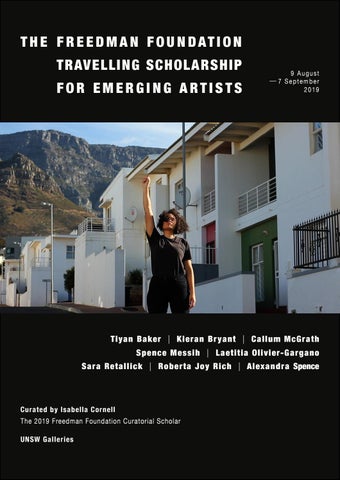
Roberta Joy Rich explores themes of loss and reclamation, drawing from historical and socio-political material, media, and popular culture to engage with notions of ‘authenticity’ and its relationship to constructed identities and their forms of representation. The multiple, repetitive screens in M/other Land (2018) act as an intervention, deconstructing and decolonising the histories of the white cube.
Image: Alexandra Spence, Submerged Tape Loops (detail) 2019, submerged magnetic tape loops, cassette tapes, tape deck, found objects/rubbish, photographs, text. Courtesy: the artist
The memorial-style plaques of Callum McGrath’s ongoing series 1897–1991 (2018–), asks the audience to consider the relationship between site, place, history and materiality in the act of memorialising and actively mobilising. Glowing pink on the floor, McGraths plaques examine historical queer trauma, silently materialising sites of resistance and identification.
Alexandra Spence’s Submerged Tape Loops (2019) are cassette tapes that are literally submerged in water, affected both by the artist’s hand in recording, and material degradation by water. The physical and material contexts become immediately present in the listening experience, deconstructing the distance between the author, the material, and the physical context of the work.
The formal qualities of McGrath’s works can be read alongside Spence Messih’s work, Words are wanting to say what (2019) which speaks broadly to sites of pressure, power structures, materiality and language, and more specifically explores these concepts in relation to their own trans experience. Both artists reference midtwentieth-century minimalist sculpture. Drawing on the aesthetics of an art historical movement commonly known for its anti-subjectivity, both McGrath and Messih cleverly interrogate the ways in which non-figurative, non-representational objects can sit within a queer praxis.
Image: Spence Messih, Words are wanting to say what (installation view) 2019, stained glass. Courtesy: the artist Image: Kieran Bryant, wetness quartet (video still) 2017, single-channel video, sound. Courtesy: the artist
The ‘fluid’ qualities in Spence’s works are continued in Kieran Bryant’s wetness quartet (2018), connecting holes and orifices as sites of passing and escape, with water symbolised as a conduit for emotions such as shame and control. Water as a central element to both works highlights a relationship between the subjective experience of our natural surrounds and the embodied self.
The Freedman Foundation Travelling Scholarship exhibition presents bodies of work by eight artists who interweave complex subject matter with nuance. The audience is invited to engage in sensory immersion, to sit and look, to listen, and to explore their own embodied encounters and experiences in a space where there is always room for contradiction and indifference, desire and discomfort.
Image: Callum McGrath, The Patient (detail) from the series 1897–1991 2018, acrylic, mirror, aluminium, vinyl, MDF. Courtesy: the artist
List of Works Tiyan Baker The Witness: Portrait of r/WatchPeopleDie 2017 Single-channel video, sound, 8:16 minutes Courtesy: the artist; cushions courtesy: Sydney Zen Centre Kieran Bryant wetness quartet 2017 Single-channel video, sound, 34:17 minutes Courtesy: the artist Callum McGrath 1897–1991 2018 / Ross 2018 / The Patient 2018 Acrylic, mirror, aluminium, vinyl, MDF Courtesy: the artist Spence Messih Words are wanting to say what 2019 Stained glass Courtesy: the artist .\\\
Published to coincide with The Freedman Foundation Travelling Scholarship for Emerging Artists exhibition Artists: Tiyan Baker, Kieran Bryant, Callum McGrath, Spence Messih, Laetitia Olivier-Gargano, Sara Retallick, Roberta Joy Rich, and Alexandra Spence Curator: Isabella Cornell, recipient of the 2019 Freedman Foundation Curatorial Scholarship Dates: 9 August – 7 September 2019
Laetitia Olivier-Gargano It’s been an uncomfortable year… 2017–18 Mixed media sculpture Courtesy: the artist Sara Retallick In Dirt and Clouds 2017 35mm film photographs, archival digital print, twochannel sound composition, 6:58 minutes Courtesy: the artist Roberta Joy Rich M/other Land 2018 Four-channel HD video installation, 21:24 minutes Courtesy: the artist Alexandra Spence Submerged tape loops 2019 Submerged magnetic tape loops, cassette tapes, tape deck, found objects/rubbish, photographs, text Courtesy: the artist
Location UNSW Galleries Corner of Oxford Street & Greens Road Paddington NSW 2021 Opening Hours Tuesday to Saturday 10am to 5pm Contact PH: +61 (0) 2 8936 0888 E: unswgalleries@unsw.edu.au W: artdesign.unsw.edu.au/unsw-galleries
We acknowledge the Bidjigal and Gadigal peoples of the Eora nation, the traditional custodians of the land upon which this project has been developed and exhibited. We acknowledge the Aboriginal and Torres Strait Islander peoples as the first inhabitants of the nation, and the traditional custodians of the lands where we live, learn, and work. We acknowledge that sovereignty was never ceded, and pay our deep and humble respect to Elders past, present, and continually emerging. As we share our knowledge, learning, and research practices within this project, we also pay respect to the knowledge embedded within the Aboriginal Custodianship of Country. The Freedman Foundation Travelling Scholarship is administered by the National Association for the Visual Arts (NAVA) on behalf of The Freedman Foundation.
Cover Image: Roberta Joy Rich, M/other Land 2018, four-channel video installation. Courtesy: the artist