NEW NO NORMAL.
Certainty matters most when the market is anything but.
LACA WONG-HAMMOND Managing Director, Head of M&A laca.wong-hammond@lument.com
cian management services organization (MSO) formed by Webster Equity Partners in 2020. Headquartered in Southlake, Texas, RCA has more than 215 physicians across more than 300 locations in 20 states. It was bought by Cencora in 2024 for $4.6 billion.
When the deal is finalized, EyeSouth will remain the MSO for its network of non-retinal ophthalmology and optometry practices, including all clinics and surgery centers, which totals about 300 in 20 states.
The press release noted that this deal builds on Cencora’s mission to expand past drug distribution by adding high-margin health services to its portfolio, a trend we’ve been tracking in our database. Just last year, the company also bought OneOncology, Inc. for $5 billion.
These investments in the physician market help Cencora achieve vertical integration with its prescription drug product line, enabling it to capture profit at both the wholesale and provider levels. And the company is not alone in this endeavor; Cencora’s competitors, McKesson and Cardinal Health, have spent billions
acquiring large physician networks over the past five years.
Private equity activity increased modestly in the first quarter by 8% to 174 deals, bolstered by a jump in investments in life sciences companies (12 deals) and digital health firms (23 deals), alongside typical favorites such as Physician Medical Groups (66 deals). However, the largest transaction was actually for a home health company, Enhabit, Inc., which was purchased by Kinderhook Industries in a $1.1 billion deal.
Enhabit is a leading national home health and hospice provider with headquarters in Dallas, Texas. The company has a footprint spanning 249 home health locations and 117 hospice locations across 34 states. According to its most recent annual filing, it generated $1.06 billion in revenue in 2025.
Health systems were incredibly active in the first quarter, announcing 44 deals, only 12 of them within the Hospital sector itself. The largest was Universal Health Services’ (UHS) $835 million purchase of Talkspace, a
telebehavioral healthcare company. The deal is one of the largest investments by a health system in telehealth and will help UHS expand its reach in outpatient and talk therapy.
Talkspace has a network of about 6,000 professionals offering virtual therapy, psychiatry and medication management. Patients can connect with their clinicians via video, audio, chat or asynchronous text messaging. It serves both employers and health plans.
UHS already has a significant presence in inpatient behavioral health, with nearly 350 facilities nationwide, but Talkspace will help supplement that revenue stream and bring more patients into its ecosystem. While other health systems are focusing on building their outpatient networks through brick-and-mortar locations, UHS is taking a different approach by leaning into telehealth and digital health instead.
Top Stories of March 2026
Medical University of South Carolina Announces $111 Million Acquisition
The largest deal was announced by the Medical University of South Carolina (MUSC), the oldest medical school in the South and the state's largest academic medical center. MUSC acquired Palmetto Primary Care Physicians (PPCP) in North Carolina for $111 million, and, according to our LevinPro HC database, this is MUSC’s first non-hospital transaction after years of exclusively focusing on building its hospital network. It most recently acquired Tidelands Health in September 2025, a system anchored by two acute care hospitals.
PPCP is one of the largest independent multi-specialty group practices in South Carolina. It employs more than 400 clinical and non-clinical staff throughout South Carolina and provides medical care through 30 physicians’ offices in four counties.
The physician group will become a not-for-profit entity within MUSC Health. The acquisition went into effect on March 3, 2026.
This isn’t the first deal from an academic medical center
in 2026, or the first in the physician space. UAB Health System in Alabama acquired Southview Medical Group for an undisclosed sum, adding a network of more than 30 physicians and clinics.
The Money Always Wins: A Healthcare Webinar Wrap Up
In March, Ben Swett, Managing Editor of The SeniorCare Investor, was joined by John Tiedmann, Managing Director at Physician Growth Partners, Bill Hoffman, Shareholder at Polsinelli and Matt Bogle, Managing Director at Intrinsic, to discuss the trends facing the healthcare industry. Based on data in the LevinPro HC database, the conversation covered a wide range of topics, from the post-2022 decline in deal volume to the specific specialties currently attracting the most investor interest.
Although 2025’s deal total in the healthcare services sectors (1,793) marks a steady climb from 2024 (1,676), it still trails the heightened activity seen in 2022 (2,028) and 2021 (1,880). The panel attributed the slowdown chiefly to three factors: rising interest rates, the disconnect between buyer and seller expectations and a broader sense of investor apprehension.
“The most obvious issue has been just the rise in interest rates, making deals kind of harder to finance,” said Bogle. “And also, probably a little bit of snapback from the kind of post-COVID bust where valuations got really out of whack.”
The speakers noted that the dip in deal volume is mostly a matter of perspective; it only appears low when compared to the peaks of 2021 and 2022. While they stopped short of predicting a return to those historic highs, they emphasized that current activity remains fundamentally strong.
Bogle also reinforced the positive outlook by highlighting how the bid/ask spread is closing, which is expected to trigger a rise in deal flow.
“Sellers had in their minds those peak valuations and buyers were getting very conservative; the bid-ask spread got very wide,” added Tiedmann. “Every physician who wanted to sell their practice was thinking some double-digit multiple was the norm.”
Sellers are beginning to face the reality that peak valuations of previous years are no longer attainable. As expectations align with current market conditions, deal flow is anticipated to remain robust.
Another factor contributing to the slowdown in deal volume is the selectivity of buyers. While investors are still eager to make deals, they’re more methodical and careful with their investments. Assets are taking longer to come to market and the deal process has lengthened to accommodate increased scrutiny.
“Buyers generally are being much more disciplined on what they're giving credit for. It's got to be something that is rock solid and proven out of historical data,” commented Bogle. “And a lot of the forward-looking assumptions are just not being looked at the same way as they were maybe four or five years ago.”
While Hoffman did not disagree with his fellow speakers, he placed his emphasis on a different issue: the cost of labor in healthcare.
“There are remaining macro environment issues that are still making buyers nervous and making LPs trepidatious about investing in funds that are healthcare specific,” he said.
Hoffman drew attention to the labor shortages in nursing and specialized clinicians that have caused wage inflation and resulted in EBITDA suppression. This has fueled caution and made investors “look more to the tech-enabled side of health care instead of hospitals, physician practice management and other labor-intensive aspects of the health care sphere.”
But the overall outlook was far from pessimistic, as the speakers remained relatively bullish for the year ahead. The optimism stems from a closing bid/ask spread, more realistic valuation expectations and the anticipation that private equity (PE) firms will soon begin bringing their sidelined portfolio companies to market.
“We came into this year with really high expectations that the logjam was going to break, meaning the platforms that have been owned by PE will be traded to free cap space. That will rejuvenate M&A strategy,” said Tiedmann.
He also noted that he has already begun to see this happening in certain areas, such as retina, gastroenterology and neurology.
“As those trade, you’ll start to see second bites become reality. There’ll be value in rollover equity for some physicians who did deals,” Tiedmann said.
“There’s always a cycle of concern, and at the end of the day the money always wins,” noted Hoffman, alluding to the idea that deal activity will never dwindle entirely because there’s simply too much money to be made.
Another topic that permeated throughout the discussion was the impact of regulations on M&A activity. Regulatory restrictions have long been a topic of conversation, with industry experts fearing tighter regulations that restrict M&A activity and investor growth. However, Hoffman noted that regulatory restrictions, especially in states such as California and Rhode Island, have panned out to almost nothing. The calm sentiment was echoed by both Bogle and Tiedmann.
“We have not seen many states that have actually blocked a transaction in the healthcare space,” said Hoffman. “We’ve seen some that have been modified, but we haven’t seen many, if at all, that have been stopped.”
Regarding the corporate practice of medicine, Hoffman noted that several states (such as Rhode Island, Washington, Oregon, California and Minnesota) were considering bills to ban PE management services organization models, which had been in effect for more than thirty years.
“Fortunately, or unfortunately, depending on your politics, the PE lobby is incredibly strong and the only state where that law has actually passed is Oregon,” he said.
“Some of the concerns in those states have landed in a place that is more favorable for private equity. Some of the clarity [surrounding regulations and policy changes], helps on a state-by-state basis, grease the wheels for more transaction activity,” added Tiedmann.
Furthermore, the speakers said that many PE groups don’t care about regulatory concerns and are willing to
take the risk anyway. Due to this nonchalant attitude, regulations (and the prospect of tighter regulations) haven’t affected deal activity or buyers’ interest in those deals.
Citizens Advises Lync Health Partners on its Majority Recapitalization
Citizens Capital Markets & Advisory has served as exclusive financial advisor to Lync Health Partners on its majority recapitalization by United Surgical Partners International. Citizens Capital Markets & Advisory is part of the institutional broker-dealer, Citizens JMP Securities, LLC, a subsidiary of Citizens Financial Group
Lync Health Partners is an orthopedic ambulatory surgery center with a complementary management services organization and orthopedic walk-in clinic. Lync Health Partners was previously majority-owned by Atlanta, Georgia-based MSouth Equity Partners
United Surgical Partners International, a subsidiary of Tenet Healthcare, owns and operates more than 535 ambulatory surgery centers, urgent care, imaging facilities and surgical hospitals across 38 states.
Financial terms of the deal were not disclosed.
Cross Keys Capital Advises SEPA Pain & Spine in Partnership with DxTx Pain & Spine
Cross Keys Capital announced that it has acted as the exclusive financial advisor to SEPA Pain & Spine in its partnership with DxTx Pain & Spine. The Cross Keys deal team consisted of Michael Papadakis, Jeanne Proia, Chris Gammill, Victor Arocho and Andres Poveda.
SEPA Pain & Spine is a community-based pain management practice that has been serving Southeast Pennsylvania for more than 25 years, with six locations and two surgical centers. SEPA specializes in interventional pain management to treat a wide range of chronic and debilitating conditions, including back pain, neck pain, joint pain, arthritis, fibromyalgia, multiple sclerosis, migraines, nerve injuries and other sources of persistent pain. According to its website, the practice has seven physicians on staff.
DxTx Pain & Spine is a majority physician- and familyowned business that operates surgery centers and practices dedicated to the precise diagnosis and treatment of spine and pain conditions. With approximately 70 locations spanning eleven states, DxTx provides fully integrated support across compliance, HR, finance, operations and revenue cycle management.
SEPA Pain & Spine was represented by Buchanan Ingersoll & Rooney for legal counsel. Financial terms of the deal were not disclosed.
SportsMed Physical Therapy Expands in Connecticut
SportsMed Physical Therapy reported its first deal of the year with the acquisition of The Physical Therapy and Rehabilitation Center, LLC.
The Physical Therapy and Rehabilitation Center is a rehabilitation and physical therapy practice that operates out of two locations in Connecticut: West Haven and Hamden. The clinics offer a wide range of services, including physical therapy, occupational and hand therapy, chiropractic care, acupuncture and home care services.
Founded in 2004, SportsMed Physical Therapy is a multidisciplinary physical therapy company with 45 locations across New Jersey and Connecticut. Since 2004, SportsMed has offered comprehensive outpatient rehabilitation and wellness services, including physical therapy, occupational/hand therapy, chiropractic care and acupuncture services. SportsMed is a portfolio company of Hildred Capital Management, a New York City-based investor of lower middle-market healthcare companies.
This addition brings SportsMed Physical Therapy's total number of clinics to 54, further expanding access to patient-centered care throughout New Jersey and Connecticut. Terms were not disclosed.
Momentum Health Partners Launches with Purchase of AACT
Momentum Health Partners has announced its official launch alongside the acquisition of Advanced Autism Center for Treatment (AACT).
AACT is a provider of autism and developmental therapy services. The company offers center- and home-based autism programs, along with complementary therapy and respite services.
Momentum Health Partners is a healthcare-focused private equity platform backed by MCR Companies, a fully integrated real estate and private equity investment firm. The firm focuses on lower middle-market healthcare services businesses and pursues majority partnerships with providers delivering community-based care.
With the acquisition of AACT, Momentum Health Partners enters the autism therapy and developmental services sector with an established operating base.
The acquisition positions Momentum Health Partners for continued expansion as it seeks additional majority partnerships with provider-based healthcare organizations nationwide. Financial terms of the deal were not disclosed.
CBRE Closes Two Deals in March
Archer Property Partners expanded its presence with the acquisition of a medical outpatient building portfolio in Orange County, California for more than $17.7 million. Andy Knott and Austin Kanzler of CBRE represented the seller in the transaction.
The MOB portfolio comprises three facilities in Rancho Santa Margarita (17,175 square feet), Mission Viejo (12,450 square feet) and Costa Mesa (10,064 square feet). In total, the buildings add up to 39,689 square feet. The properties are anchored by MemorialCare, one of Southern California’s leading nonprofit health systems.
The properties were previously owned through a partnership between a private investment group and MemorialCare, which held a minority ownership interest.
Headquartered in Newport Beach, California, Archer Property Partners is a full-service real estate investment and development firm focused on healthcare and medical real estate across the western United States. Archer combines institutional investment discipline with entrepreneurial execution, specializing in value-add and adaptive reuse medical projects.
The firm’s leadership team has completed hundreds of transactions totaling more than $1 billion in value, delivering projects that enhance accessibility, operational efficiency and design quality for healthcare users and investors alike.
The price was approximately $17,700,000, as confirmed by a representative from Anchor. The Mission Viejo property sold for $6,500,000; the Costa Mesa property sold for $5,500,000; and the Rancho Santa Margarita property sold for $5,700,000. The price totals roughly $448 per-square-foot.
Earlier in March, CBRE also facilitated the sale of the Elk Grove Village Medical Campus. The property was sold to Casa Avore, a private capital group specializing in healthcare real estate.
Elk Grove Village Medical Campus is a 52,126-squarefoot campus with four medical outpatient buildings located in Elk Grove Village, Illinois. The diverse tenancy in the four buildings is anchored by Fresenius Medical Care.
Other tenants include Midwest Sports Medicine & Orthopaedic Surgical Specialists, Medical Center Dental Associates and Nephrology Associates of Northern Illinois and Indiana. The campus was 95% occupied with a weighted average length of tenancy in excess of 20 years at the time of sale.
Chris Bodnar, Brannan Knott, Zack Holderman, Anthony Sardo, Cole Reethof, Jesse Greshin and Trent Jemmett of CBRE's U.S. Healthcare Capital Markets team partnered with Kevin Kobe of CBRE’s Chicago Capital Markets team to act as the exclusive advisors to the seller, Stage Equity Partners. Financial terms of the deal were not disclosed.
Smile Partners USA Acquires Atlanta Endodontics
Smile Partners USA announced that it was expanding its presence in Georgia with the acquisition of Atlanta Endodontics.
Atlanta Endodontics, based out of one Atlanta, Georgia location, provides the full scope of endodontic services. It has three doctors on staff.
Smile Partners USA is a management support organization backed by Silver Oak Services Partners. The company offers back-office resources and services to premier, independent private dental practices and boutique group practices throughout Michigan, Georgia, Illinois and Alabama.
The financial terms were not disclosed. This marks Smile Partners USA's second transaction of the year. In January, Smile Partners purchased Solon Smiles, a four-physician group in Solon, Ohio alongside the acquisition of Mentor Smiles, a three-physician practice based in Mentor, Ohio. In 2025, the company announced nine transactions and six in 2024.
Aveanna Healthcare to Acquire Family First Homecare
Aveanna Healthcare Holdings Inc. has entered into an agreement to acquire Family First Holding, LLC, expanding Aveanna’s specialized care model across an enhanced geographic footprint.
Family First Homecare is a pediatric private duty nursing provider with 27 locations in seven states (Florida, Illinois, Iowa, Pennsylvania, South Dakota, Texas and North Carolina).
Family First Homecare was founded in 2012 and received a strategic minority investment from Trivest Partners, a leading growth investment firm, in 2021. The company is headquartered in Winter Park, Florida.
Aveanna Healthcare, a portfolio company of Bain Capital and J.H. Whitney Capital Partners, is the largest pediatric home health care company in the United States. It was formed with the merger of Epic Health Services and PSA Healthcare in March 2017. Aveanna went public through a $100 million IPO in April 2021.
According to Aveanna’s 8-K filing, the deal has a cash purchase price of $175.5 million, subject to customary adjustments for working capital and other items. Aveanna plans to fund the deal with cash on hand and existing short-term credit borrowing. Closing is expected in Q2:26, subject to customary conditions.
Health System News & Activity
March was a slow month for health systems, with only eight transactions announced, less than half the volume we tracked in February. The March headline story was certainly the merger announcement between Sutter Health and Allina Health to form a $26 billion not-forprofit health system with a network of nearly 40 hospitals.
What makes this deal striking is not so much its size as its geographic reach. It’s the first cross-market health system merger we’ve had in years, covering California, Minnesota and Wisconsin. Since 2020, most health system mergers, such as Englewood Health’s merger with RWJBarnabas Health in January or Maimonides Health’s merger with NYC Health + Hospitals in late December, have been confined to a single state or metro area.
Sutter, based in California, is a huge health system in its own right, operating 27 hospitals and generating nearly $20 billion in total revenue in 2025. Allina, headquartered in Minnesota, is modest in comparison, with only $6 billion in revenue and 12 hospitals.
The two systems hope to complete the deal by the end of the year. The combined organization would also have more than 400 primary and specialty care sites and 18,000 physicians.
It’s been years since we’ve seen a health system merger this large. The most recent we could find in our LevinPro HC database was the 2024 merger of Lehigh Valley Health Network and Jefferson Health System, which created a system with more than $14 billion in combined revenue.
As for deals that closed in March, the largest was Universal Health System’s (UHS) acquisition of Talkspace for $835 million, giving UHS a significant boon to its outpatient and talk therapy service lines.
In the largest transaction in the Hospital sector, Freeman Health System acquired four hospitals in northwestern Arkansas from Community Health Systems in a $112 million deal. The hospitals, Northwest Medical Center - Bentonville, Northwest Medical Center - Springdale, Willow Creek Women's Hospital and
Siloam Springs Regional Hospital, collectively have 487 beds and generated $367 million in annual revenue (the hospitals have staggered reporting periods for their cost reports).
The deal includes all assets of the hospitals and associated outpatient centers and practices. The transaction is expected to close in the second quarter of 2026. Leerink Partners served as the exclusive financial advisor to Community Health Systems for the transaction. Juniper Advisory served as Freeman’s M&A advisor, supporting the transaction process from strategic evaluation through execution. Juniper assisted with the transaction design, structure, diligence and negotiation.
Private Equity News & Activity
Private equity (PE) activity in healthcare M&A slowed in March 2026, with PE buyers and/or their portfolio companies involved in 41 deals out of 148 total healthcare transactions, representing approximately 28% of overall volume. This marks a decline from February’s 49 PE deals out of 149. Activity was also lower than March 2025, which recorded 54 PE deals out of 167 total.
As usual, Physician Medical Group (PMG) remained the most active sector for PE buyers in March. There were 22 PE transactions announced during the month out of 46 total PMG deals. Sector activity was driven predominantly by dental with 13 deals, followed by eye care with three and dermatology with two.
The most active PE-backed acquirer in the PMG space was MB2 Dental, a portfolio company of Charlesbank Capital Partners, which announced three deals during the month. Other acquirers with multiple deals included Epiphany Dermatology, EyeSouth Partners, SALT Dental Partners and Specialized Dental Partners.
eHealth ranked second with five PE-backed deals. Key transactions in the space included Knowtion Health’s acquisition of revly, a provider of intelligent reimbursement solutions and optimization services, and Quantum Health’s acquisition of Denver, Colorado-based virtual care company CirrusMD.
Home Health & Hospice followed with four PE-backed deals. The sector included the month’s largest disclosed transaction from a PE-backed company: Avean-
na Healthcare’s acquisition of Family First Homecare, a private-duty pediatric nursing provider, for a cash purchase price of $175.5 million.
Notably, the month also saw two other disclosed purchase prices. Nova IVF acquired a majority stake in Kerala’s CRAFT Hospitals for $40 million in the only PE-backed hospital deal announced in March. In the Biotechnology sector, Esperion Therapeutics (backed by Athyrium Capital Management and HealthCare Royalty) acquired Corstasis Therapeutics for $75 million. Corstasis Therapeutics Inc. is a privately held, commercial-stage biopharmaceutical company advancing outpatient therapies for the treatment of edema associated with cardiovascular, and hepatic and renal disease.
Overall, it was a slower month across most sectors. Many typically active areas, such as Behavioral Health Care, Medical Devices and Other Services, saw only one or two PE-backed deal announcements each. Investors stayed focused on familiar ground, particularly dental practices within PMG and a handful of eHealth opportunities.
As March rings the end of the first quarter, the quieter pace marks a subdued start to the year for private equity in healthcare.
Healthcare Real Estate News & Activity
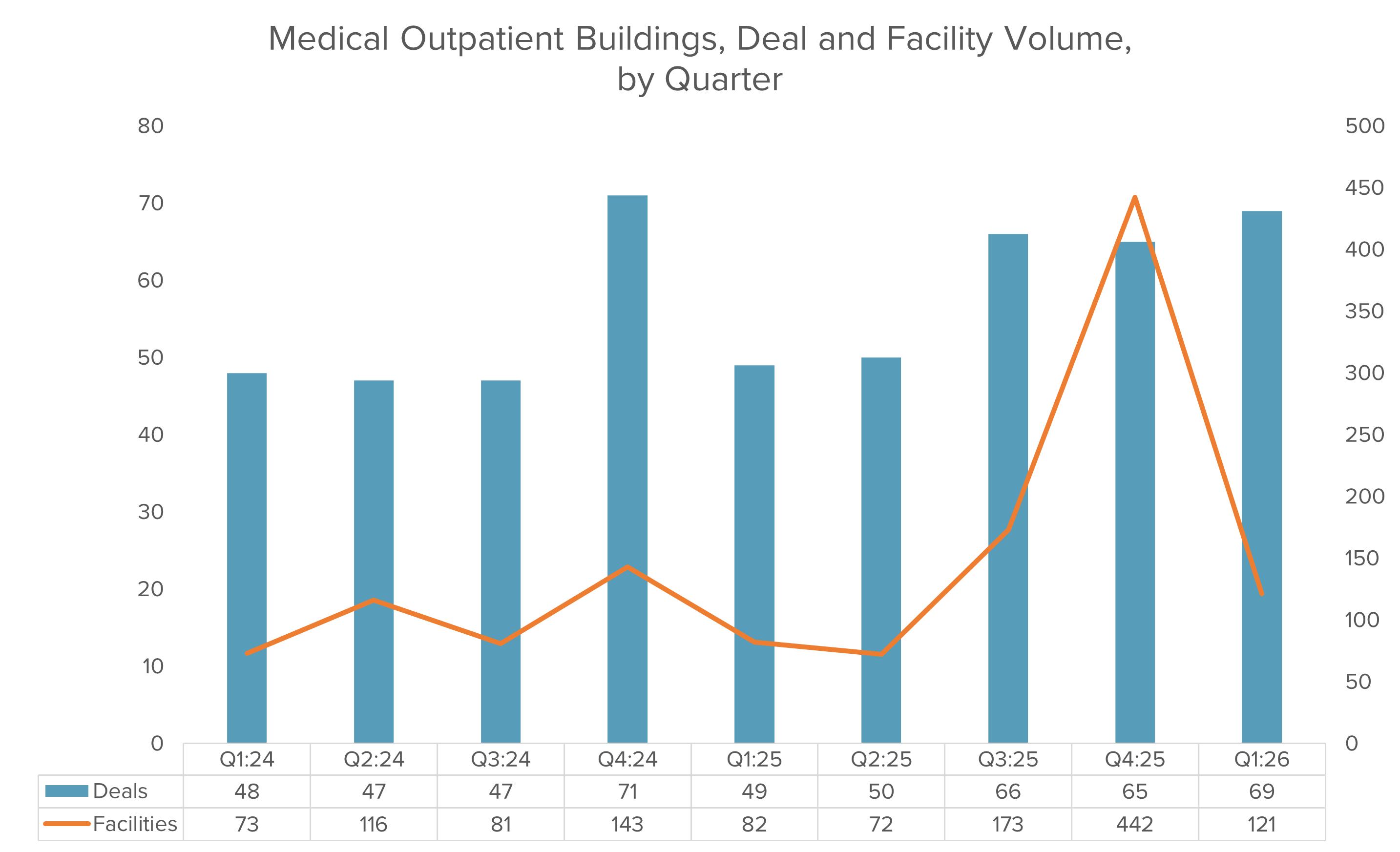
There were 20 Medical Outpatient Building (MOB) transactions captured in our LevinPro HC database for March. This is slightly more than the 17 reported in February 2026, and it is nearly double the 11 announced in March 2025. In total, there have been 69 MOB transactions reported since the start of the year.
In March, there were several regulatory and policy changes worth highlighting. A number of states continued legislative efforts to increase oversight of healthcare M&A, with specific focus on REITs, private equity and sale-leaseback arrangements.
Maine enacted a one-year moratorium that bars certain REIT transactions involving hospitals. Private equity deals were also included in the legislation. This was
a direct response to concerns about the financial stability of facilities post-sale-leaseback. In Washington, legislation that expands healthcare deal review requirements to specifically include sale-leaseback deals passed both legislation chambers and is headed to the governor. As these tighten the deal process, M&A volume may slow if the policies go into effect.
Disclosed spending totaled more than $491.6 million across eight transactions, notably more than the $118.3 million reported in February and the $52 million reported in March 2025.
The largest deal in the sector, by purchase price, was the acquisition of a San Jose, California facility for $340 million. The 10-story, 230,506-square-foot MOB was purpose-built to house a new Valley Health Center site for Santa Clara Valley Healthcare, the County of Santa Clara’s public hospital and healthcare system. The buyer was the County of Santa Clara and the seller was Harrison Street Asset Management.
IRA Capital also announced a deal for a 16-facility portfolio that comprises 517,680 square feet. The portfolio spans Texas, Florida, North Carolina and Indiana. It is anchored by a multitude of tenants including Ascension Health, UnitedHealth Group, Texas Health Resources, Memorial Hermann, Baylor Scott & White and Tenet Healthcare
The most active buyer was Montecito Medical Real Estate with three transactions. The MOBs total 93,318 square feet and are based in Georgia, Arizona and Virginia. Since the start of the year, Montecito has completed eight transactions for a total of 358,690 square feet.
There was one deal for a MOB by a health system in March. The Christ Hospital acquired a Cincinnati, Ohio MOB for an undisclosed price. The 15,000-squarefoot property includes 28 exam rooms and houses physicians specializing in primary care, obstetrics and gynecology and pulmonary medicine.
Top Deals March 2026
Home Health & Hospice
Family First Homecare Private Aveanna Healthcare NASDAQ: 3/12/2026 $175,500,000 Winter Park, FL Atlanta, GA AVAH
In Brief: Family First Homecare is a private-duty pediatric nursing provider with 27 locations in seven states (Florida, Illinois, Iowa, Pennsylvania, South Dakota, Texas and North Carolina). Family First Homecare was founded in 2012 and received a strategic minority investment from Trivest Partners, a leading growth investment firm, in 2021. The company is headquartered in Winter Park, Florida.
Top Deals March 2026 Hospitals
TARGET
4 CHS Hospitals Private Freeman Health System Not-for-Profit 3/5/2026 $112,000,000 Northwest Arkansas metro area Joplin, MO
In Brief: Community Health Systems is selling four hospitals in the northwest Arkansas metro area, including Northwest Medical CenterBentonville, Northwest Medical Center - Springdale, Willow Creek Women's Hospital and Siloam Springs Regional Hospital. Collectively, the four hospitals have 487 beds and generated $366.8 million in annual revenue.
Top Deals March 2026 Laboratories, MRI and Dialysis
TARGET
Biocare Medical
Pacheco, CA Santa Clara, CA
In Brief: Biocare Medical is a leading provider of immunohistochemistry (IHC) instrumentation and a full range of reagents for IHC and molecular testing. IHC provides increased confidence at critical diagnostic decision points, improving patient therapy while accelerating turnaround time.
Top Deals March 2026
TARGET
San Jose property N/A
San Jose, CA
Medical Outpatient Building
In Brief: The sale includes a medical outpatient building in San Jose, California. The 10-story, 230,506-square-foot property was purposebuilt to house a new Valley Health Center site for Santa Clara Valley Healthcare, the County of Santa Clara’s public hospital and healthcare system.
Top Deals March 2026
Palmetto Primary Care Physicians
North Charleston, SC Charleston, SC
Physician Medical Groups
In Brief: Palmetto Primary Care Physicians (PPCP) is the largest independent multi-specialty group practice in South Carolina. PPCP is comprised of more than 90 clinical providers with a wide range of expertise in primary and specialty care including endocrinology, gastroenterology, neurology and physical therapy. The company employs more than 400 clinical and non-clinical staff throughout South Carolina and provides medical care for patients through 30 physician’s offices in four counties.