IHLR NAPOMO ’26

NaPoMo 2026
Editor-in-Chief
LESLIE JILL PATTERSON
Interim Editor
JO ANNA GAONA
Poetry Editor GEFFREY DAVIS
Senior Managing Editor MARCOS DAMIÁN LEÓN
Managing Editors JENN JUSSEL NIMALAH BAAITH-DUCHARME
Translation Editor NAVEED ALAM
Associate Editors:
Saima Afreen, Michael Akuchie, Erin Allen, Ruby Carson, Rebecca dos Santos Freire, Maia Elgin, Maria Fischer, Kristyn Garza, Thomas Hamil, Olivia Jacobson, Shane Moran, Blue Nguyen, Damilola Oyedeji, Colleen Sanders, Amber Terranova, Sierra Voiles, Marcus Wilson
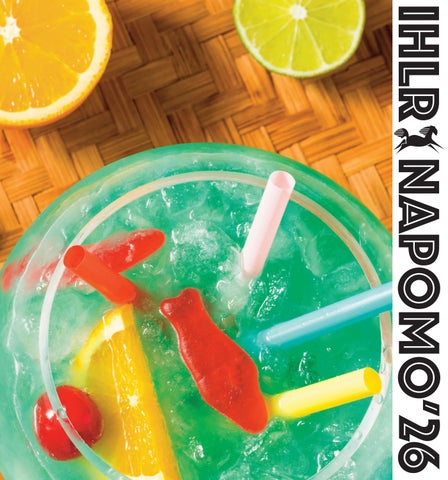
Cover Photo: Boozy Cold Blue Tiki (photograph), by Brent Hofacker
Copyright © 2026 Iron Horse Literary Review. All rights reserved. Iron Horse Literary Review is a national journal of fiction, poetry, and creative nonfiction. IHLR publishes three print issues and three electronic issues per year, at Texas Tech University, through the support of the TTU President’s Office, Provost’s Office, Graduate College, College of Arts & Sciences, and English Department. For more information, visit www.ironhorsereview.com.
National Poetry Month 2026
1
FINALISTS
Foreword / JO ANNA GAONA 5 June Poem / ALANA CRAIB
2,500 years ago, a man goes missing in Lille Vildmose / ALANA CRAIB
Elegy at the Chain Bridge, Washington, DC / MAJDA GAMA
From a Patio Across the Boulevard / JACK ANDERSON
Altar of Memory / KAECEY MCCORMICK
Boulder Problem / ALLISON FIELD BELL
Foe / ALLISON FIELD BELL
Alverdia Finds a Fox in the Neighbor’s Trap / TODD DAVIS WINNER
a promise of light
here we are, the sun is beginning to call children out of their homes like the Pied Piper, inviting them to follow its light to the ends of sidewalks, reminding them of its warmth and promise of summer. The Academy of American Poets is celebrating National Poetry Month with many events, one of which is the Dear Poet Project, that allows young people from grades five through twelve to write responses to poems and send them to the respective poets. Some of the poems on offer for this project include Eileen Myles’s “our happiness,” in which she writes about how light, no matter how little, is the happiness found in the darkness. Eleanor Wilner, in her poem “Of A Sun She Can Remember,” uses the memory of the sun’s light and warmth to imagine Helen Keller returning to a doll. The child in Wendy Xu’s “Looking at My Father” sees her father “half in sunlight.” At the end of the month, select responses will be chosen for inclusion in a summer booklet, and the poets themselves will write personal letters to the young writers of these chosen responses.
Back in February, I helped a student write a college transfer essay based on common tongue twisters—she sells seashells and Peter Piper and all that. Those childlike lines came as a delightful break to the dark and doldrums the waning winter months usher in. We had fun trying to break the words down. They made me think about how we put words together for all sorts of purposes: lessons in muscle improvement, to make meaning, to tell

jokes, to turn something upside down. And then how we put topics and themes and patterns and bodies and lives together to do those same things. We juxtapose and twist them, silence and hurt them, shout and carry them, break them open from the inside. We try someone or something else on for a while. We become children again and find our way to the light.
This month, Iron Horse has picked poems for our NaPoMo issue that illuminate the substances of life. Our winner, Todd Davis, reminds us that death can offer life, while our runners-up and finalists highlight the in-between: cycles, food, earth, brokenness, eating and dying and dying and eating, lullabies, the body, children, promises, blue skies. Here at Iron Horse, we celebrate our poets. We celebrate all the lives on offer in all the poems all over the world, the ones in our pages and the yet-to-be ones in our hearts, all worthy of acknowledgment, of honor, of existence. We celebrate as long as we have words to share. We celebrate to remind ourselves that flowers still bloom, that words can be untwisted, that the sun also rises. We celebrate to remember that, as James Baldwin chided, “[T]he children are always ours, every single one of them.” And to remember that children deserve the future we’ve heard tell about in songs and poems and promises.
National Poetry Month gives us a time to cast light on others’ existences, to connect (on social media through shared poems: #NationalPoetryMonth), to carry each other with us (by signing up to receive a poem a day), and to commune with each other by participating in many events throughout the whole month. This year’s poster features a design and illustration by Alfredo Richner; its central focus shows the back of a person reaching for a sword above them in the middle of a dark, medieval-like entryway. A swath of light comes in from the right side, at an angle, to cut through the shadows. Words from “The Chance” by Arthur Sze fall diagonally from the opposite corner, conveying the idea that darkness can surround us, but there is always a chance to shine where we are, even if only
IHLR NaPoMo 2026
for a little bit. The light and the words fall toward each other to meet in the middle above the sword.
Thirty years after the Academy of American Poets decided that April— new life, new growth, light after dark—should be the month that bursts with poems, we might be thinking that darkness has fallen on us, pervading everything, that the month can’t possibly hold the heaviness of the world anymore. We can fall into that abyss and keep falling, walk into the dark doorway and disappear. Or we can reach for the sword that will cut through the shadows. We can rage against so many things. We can let our love light shine and erupt like supernovas, however briefly. We can let the sun show us the way to the end. And we can remember that April will always come back around.
JO ANNA GAONA INTERIM EDITOR

ALANA CRAIB
June Poem

In summer I resolve to remember my existence / I watch the fruit rotting on the counter / I reorganize the underwear drawer again / and again and again and again and / until it is empty / I talk to the train conductor on the way to buy more underwear / the train is delayed, he is tired / I make lists on the fridge of ways to move my mouth:
clack teeth
use straws (paper kind)
harmonica
bird sounds
I consider the still heat of my bedroom / where it rests gently over my body / and the smell of unabashed sun in the afternoon / and the flowers: / they bloom quietly in that small hour / when the gold light falls in narrow rows through / the weathered garden wall / before the blue dusk comes / it all happens slowly and without ceremony / in the briefness of the day / but if I weren’t watching already the sunset / with my grief in my coffee I would miss it / yes, these small hours / where I seek to no longer cease. / It is an everyday practice / like lists / like breath / like forgetting / like loneliness / like flowers / like flowers / like flowers.
Finalist Alana Craib
2,500 years ago, a man goes missing in
Lille Vildmose
ALANA CRAIB

IHLR NaPoMo 2026

The potatoes are bubbling gently in the well of the red pot, bumping shoulders in a polite sort of boiling as if they are being cautious not to make a fuss and interrupt the day’s drowsy stillness.
I listen to the afternoon rain
sweet damp cobblestone, milky springtime coats closed to the graying, quiet light
Tara and Marnie softly discuss the sauce for dinner. To rest I have laid beneath the open window with my hand against my face I breathe deeply the smell of green onion between my skin lines and resist weeping. I indulge in a brief believing that we
will never leave again from this yellow house this red tin roof, paprika in the pan
the kindness of this kitchen threshold these cold roots dusting dirt upon this counter.
It is painful, a deep wanting of this-ness: to stay here forever. Yet my soul, stubbornly, still wanders

Finalist Alana Craib

lost somewhere in northern Denmark where the bog stretches open wide like a mouth to the sky; yawning, where the hand of the king was once sent out on some forgotten task. The men watched his dusky shadow sink beyond fog, beyond reason, beyond cartography’s insatiable greed, beyond knowing, beyond the weight of a body on the peat’s delicate, cavernous carcass tender, however, the decaying sphagnum

like flowers. I see its breath, this landscape and him: vast, ancient and terrible and yet it is a beautiful sight. Here, my heartbeat throbs in the soles of my feet against the earth. I watch a storm churn in the high ghosts a promise of clouds. The birds caw their warning to me in flight:
It is a welcome that sounds so much like a goodbye.

Elegy at the Chain Bridge, Washington, DC
MAJDA GAMA
Grief rode me bareback for a decade with chained kimberwick bit and spurs
Any broken horse knows how to submit to merge stillness with good nature
Here at the bank of the Potomac by the bronze understory and culled oaks
I once stood in the month of death I witness again its cyan blue
September, I want the reins back the cherry edge of wild sumac in my hair
Susurrus wave of clouds goodbye goodbye goodbye
What gall it is to survive it is the gall that witches the hazel
In the backyard of a river mansion a peace sign flickers on
And a caravan for Gaza sounds its mournful horns along the bridge

IHLR NaPoMo 2026


From a Patio Across the Boulevard
JACK ANDERSON

Southeast Wichita, Kansas
Sitting on my screened patio I heard the explosion and ran out and the young man ran from a patio
across the boulevard looked both ways to cross before hopping like a scared rabbit to the old Ford and its airbags gasoline sizzling on the pavement like it dropped in reverse around the bent bicycle but relieved he decided it came from the Ford then he snapped in the Ford driver’s ear hey sir hey sir and as if responding the driver rose from the back windshield like from an overgrown grave bloody gushing from his head a chunk of it gone like the oak tree now in front of my house its stripped bark stuck with headlight shards
Finalist Jack Anderson


then the driver lifted his arm not quite waving more reaching and the young man sank from the truck what should we do
what should we do can we get him out of there the airbags sank the driver sank too
I stared down scratched my beard at the clean bicycle except for its fatal kink the young man grew wrinkles in seconds
we stood there crossing our arms stood there crossing our arms while time sped faster faster oh man past us isn’t there a lesson somewhere in there but later the truck was gone and with the truck the lesson
then it was just a body which the paramedics covered with a tarp and enclosed in a mesh barrier left there on the concrete after they pulled the Ford away after they swept the metal scraps and glass from the road
after someone plucked a guitar in the distance after the last whisp of bark had fallen from the oak tree just a body lying and four hours later when the men in suits came the passing cars on the boulevard knew nothing of the Ford or bicycle or tree or driver any of it.
IHLR NaPoMo 2026


SHAKIBA HASHEMI
Aftermath

Another building is blown to smithereens.
The ground rumbles like a famished stomach ready to devour God’s will.
Birds sulk on the broken limbs of a sycamore tree watching the sun take its last breath.
Finalist Shakiba Hashemi

Light fades away like faith.

People dig through the rubble in search of food, while ants feast on the bloated carcass of a goat.
Another night with nothing to drink or eat.
An orphan girl cries in an alley where a mosque once stood, hungry for her mother’s touch.
Her hair tangled with shrapnel and sand, her sleeves torn like broken wings.
She swallows her tears and looks at the black sky holding the ghost of her dreams in her fist.

Finalist Shakiba Hashemi


MICHELLE ALEXANDER Black Earth *
After Audre Lorde
How each Taíno shimmered with care, making me. Whispering to me.
Their voices splurging, conucos . . .
On the good sweetsop, sugarapples: The largesse of me,
I remember how to be as abundant as their migratory waves, which grew bigger, boonful . . . soil rich. Undulating into me, fish bone and bone wands** with their hands.
I is that buried wealth
like a strain of feeling that is —incomplete and combusting from rage at genocide.
* Tennesen, speaking of the indigenous Arawaks as bearers of sophistication, writes, “There is also evidence that they modified the soil using various techniques such as deliberate burning of vegetation to transform it into ‘terra preta,’ or ‘black earth,’ which even today is famed for its agricultural productivity.” Tennesen, Michael. “Uncovering the Arawaks.” Archaeology 63.5 (2010): 51-56. JSTOR, http://www.jstor.org/stable/41780608. Accessed 21 May 2025.
** Term found in Menes, Orlando Ricardo. “Triptych Number 2: Carlos Enriquez.” Yale Review 109.3 (Fall 2021): 141-145.
Finalist Michelle Alexander
Not genocidal rage.
Yoboa, night herons black their crowns and I is also terra preta do indio, black earth of the native, pan-indigenous and entangled, unknotted into internal worlds.
Zum-Zum, hummingbirds wizzing aflur with news of genocidal epistemology: The schema plus scheme. The scheme appears not, its disappearance is a ritual of anthropogenic seeing, a schema.
As an owl drawing Night’s world of the dead with its wing, this is how I vertically rhyme their unburial.
Petroglyphs flickered under torchlight, animate. Resurrect in me bits of spine, redware, and papaya skin. Amazonian and Venezuelan vibrancy that cannot be shaken off still decomposes from the fever of the contraption— the Spanish . . . more dangerous than a cannibal a mind fiercely for itself.
IHLR NaPoMo 2026

Finalist Michelle Alexander
The slaughter. The fade. The disease like a jaw teaching differentials of precarity, takes me past blue holes and the caverns flood with my grief.
To say this World is “New” is to miss the only thing I need to hear. Their sounds have changed with the maturity of the grave. And I miss . . .
You know how they each were . . . hands sunk within me.
How each Taíno, each Amazonian Arawak, shimmered with care, making me. Whispering to me. Their voices splurging. On the good sweetsop, sugarap The largesse, I remember.
IHLR NaPoMo 2026

pples:


Directions for a Time to Come
DANIEL OOI
There was the day you started, and then the day you stopped
picking up after someone else, your smallness framed against a coast
plastic freckled and the helix skytrails of white-winged terns graphing an answer
and try, try to remember that story in the low tide of sand bubbler crabs

Finalist Daniel Ooi


etching concentric geometries, rolling the shoreline into map tacks,
here's a flower, here's a dragonfly, here are directions for a time to come.
Don't look too close, or they'll dissolve, bodies smaller than an eyewidth, or a watermoon. Doesn't everything, at last, turn into a crab? Along the horizon, a trawler
pins the surface like a comma. Everything is leaving, the tapirs, the sun bears

IHLR NaPoMo 2026
and you've barely just begun. The thing is how do you tell your daughter about the jellyfish? Imagine, sweetheart, plastic bags trailing behind a metaphor of optic fibers.

Finalist Daniel Ooi

KAECEY MCCORMICK
Altar of Memory
I once pretended I was in love—and so I was. After each kiss, it took days for the ache to leave my body.
I was awake all the dark night. No dreams, no peace— just a sharp edge of memory slicing like a knife through my body.
They breathed poems onto paper—images floated free, drifted into the quiet spaces of my body.
Fishers on the lake cast nets wide—deep livewells hold cells still dividing. Come, I cry. I have a ship that could be your body.

Runner-Up
Kaecey McCormick

IHLR NaPoMo 2026
Breath dissolves into the spaces between my bones— wind shaking the broken mast of my body.
When I let her go, when I handed over my baby, a vacant lot the span of the universe spread inside my body.
Sing me the lullaby of the empty body—nights are motion, vibrating, as night does, through the hollow chambers of my body.
No substance, no mass, no structure—only memory of movement, fluttering in the center of my body.

Runner-Up Kaecey McCormick

ALLISON FIELD BELL
Boulder Problem
In the desert, my partner asks what I do to feel powerful. Around us: the dense squat juniper, sharp blue blaze of sky, clumps of cacti hidden between rock. To feel powerful? I echo him. We are here to rock climb, to boulder. To feel powerful, he echoes me back. And we could go on forever like this. To feel powerful. I don’t think I do. Feel powerful. I just know I’m not. I do what I need to feel safe. We are talking about guns and why people use them. He says maybe it’s like highlining, that tightrope suspended above thousands of feet of valley, of earth. I say no. I disagree. Highlining can only hurt you in the end. I’m thinking of shootings now, because aren’t we always? That kind of power, those kinds of men. Power to take a life. I have no desire to feel that, never have. Maybe I am just a woman, I say. Maybe you just think too much, he says.
Maybe it is the body that desires power. Maybe women get theirs elsewhere. I hate to say baby, but maybe that’s true. Men want to take life

Runner-Up Allison Field Bell
because they can’t give it. Maybe nothing is that simple. Then my partner tells me, I wish everyone were a little less passionate. He’s talking about me. And I have to argue again. No, I say. Passion is important, and I like the way it feels on my lips: passion. The “p” of it. What, he says, about the people who are passionate about guns? How to answer. I am afraid, I say, I don’t know how to answer you. I try to say something else then, how we walk around in different bodies. He smiles and kisses me. Sorry to get so heavy, he says. The word heavy, the “h” of it. And around us, desert. Boulders scattered between trees. He wants me to climb to the top of one. Top-out, it’s called. But I can’t stop thinking about how it would feel to fall. What it’s like to pull a trigger, walk a highline. Power to top-out. The “p” of it. Pinetree. Prickly pear. And then somewhere across the desert, thunder.

IHLR NaPoMo 2026

Runner-Up Allison Field Bell

ALLISON FIELD BELL Foe
I.
My niece calls me when she learns a new word. Today is foe. She’s asking me who my enemies are. I think about the men who have passed through my life. Not like water, not like sand. More like the glue stick my niece uses to bedazzle things she shouldn’t. Her dresser, the dining table. The men of my life: lodged in places they don’t belong.
II.
My niece’s small voice on the phone. I want so much to preserve her. Like a doll. Keep her skin hardened against the world. How to explain foe? She says it rhymes with doe. And isn’t that something? Creature of grace.
III.
A hunter is a doe’s foe.
A buck’s too. But, today, on the phone, I am thinking about what it is like to be female. Dobbs just last week, and I’m in freefall. Foe.

45
Finalist Allison Field Bell

IV.
The last time I visited, my niece showed me her tool set. A red box with a measuring tape, a hammer, and two mallets. Why two? I asked. She looked at me like young girls do: hands on hips, two mallets before her. Why not two? And then she added, Who’s going to stop me? I smiled.
V.
I know that girls molt like lizards, like snakes. Their bodies growing, skin not hard as a doll’s but pliant. For once, I want the world to shed its skin for her.
VI.
I want to see what it would make of itself if it had to change, had to grow to house her and every little girl.
VII. Or I want the opposite: the world constricted. What if she wrapped her whole body around it and squeezed?


Alverdia Finds a Fox in the Neighbor’s Trap
TODD DAVIS
Because he’s negligent and seldom walks his lines, because the fox is already dead and I’ve been taught not to waste, because I’ve never tasted fox but have followed their scent, making of my arms another pair of legs to scamper a log and shuttle a briar thicket, my coat becomes a satchel to gather the red body and carry it home where I skin and cook it, season the sinews and joints with pepper and salt, pour molasses over the ridges of the delicate skull
Winner Todd Davis

IHLR NaPoMo 2026

that resembles the foothills just above our farm, this departed canine whose vanishing stains my hands, whose corpse I cream with morels and garlic, who caresses the dreams she sends me when her kits whimper, hungry to nurse my swollen nipples, rough tongues lapping milk that dribbles my belly and puddles my thighs.

Winner Todd Davis


FROM THE Horse’s Mouth
a conversation about death, environmental memory, and oral traditions with Todd Davis

IHLR: In your poem, “Alverdia Finds a Fox in the Neighbor’s Trap,” death has lost its finality through Alverdia’s consumption of the fox. We view this as a larger entrance into a conversation about what nature can provide us, even in death. How does nature feed memories that we would otherwise starve? How does memory, or memory-making, defy death?
DAVIS: As a professor of Environmental Studies, I work at showing students how deeply connected we are—all species, all ecosystems and bioregions—and that when we disturb one element within this tightly woven fabric, an unhealthy unraveling begins.
This unraveling might be imperceptible to some folks, especially in an age when fewer and fewer people are intimate with the greater-than-human world. It’s a simple fact that we cannot divorce ourselves from nature; although in the western world, many have tried to ignore or isolate themselves from these essential, biological relationships, pretending that such a divorce is possible, that our actions do not have consequences.
And so your question about memory is a good one. Often, as humans, we think memory is our sole possession, distinct to our species. But, of course, it’s not. The earth remembers. Individual species remember. Forests and streams remember. There is generational memory. Bodily memory. Planetary memory.
In an earlier poem of mine called “Gnosis,” published in Native Species (Michigan State UP, 2019), I ask this question:
IHLR NaPoMo 2026
A woman who is long dead told me that when a river passes away, it holds the memory of itself in the silt left behind. When our species is extinct, what animal will carry the memory of our lives?
While I don’t have an answer, I do think often about how the woods I spend most days in will remember my existence, how my passing back into that place with my death will change it, either for good or ill.
On a more upbeat note, memory-making, which for me and my family is mostly done in the telling of stories about what we have seen in the wild, is a way to carry forward not just our individual experiences, but also a way to carry forward the experience, the existence of another living being—whether that is an amazing patch of wild ginger or ginseng, a fisher scampering near where I sit while hunting, a mother bear with her cubs moving through a rhododendron thicket, or a bobcat leaping onto a downed log and holding on as dusk settles behind its silhouette. Our actions live on in the memory of others, but the stories we tell, the poems we make, our paintings or photos—all of these, to a certain extent, defy our singular deaths because they have the possibility of living on after us, becoming part of another’s life.
IHLR: In the larger conversation around nature, the theme of consumption is often prevalent, as it is in your work. However, the consumption of the fox is incredibly deliberate and signifies a moral lesson or understanding. Alverdia says, “I’ve been taught / not to waste.” What moral lessons can the act of consuming nature teach us that we would otherwise not learn?
DAVIS: Not all people choose or have the chance to grow their own food, to forage for wild edibles, to raise a cow or pig or goat to eat, or to hunt wild game. I wish more folks were in touch with where their food comes from, how what they eat impacts the planet, impacts their local ecosystems. How the food we bring to our mouths is a blessing, a gift, from the earth.
I come from a lineage of subsistence farmers, from people who grew their own food, who canned and made jams and jellies, who butchered and smoked their meats, who were intimate with the woods and who understood how the woods offer the grace of sustenance. I do not say all people should forage or hunt. The planet, with its present population, could not sustain that. But I do wish more folks would grow some of their own food, even if it’s as little as one potted tomato plant on the stoop each summer. There is no substitute for the experience of close contact with the earth, getting your hands dirty. We have to spend time together to fall in love, and love will call us to protect what is most vulnerable.
I don’t know what I would write about or how I would write without my daily rituals, my time in wildness, looking, observing, giving thanks for what is offered to sustain my life.
IHLR: You have described Alverdia as a composite figure of female family members and friends deeply connected to nature and impacted by their environment. As a character, she possesses a mythical quality in her attention to the natural world. You alternate between “I” and “she” when representing Alverdia, effectively telling a story both from her perspective and as witness to her—which adds to her myth. Why do you alternate between the two? What does one provide that the other does not?
DAVIS: There is an historical person named “Alverdia” in my family tree. She was born in 1887 and died in 1984 when I was nineteen years old, so I knew her when she was in her eighties and nineties. She fascinated me because of the breadth of what she had seen in her lifetime, the radical changes in technology, which she did not participate in much, staying close to the way she was raised in the late 19th and early 20th centuries. But I was drawn more to her because of her deep, abiding love for the natural world, which I witnessed in her daily actions. However, in my poems, she is a composite figure, based on two other women who have also passed, who spent much of their time in the woods or in wetlands (one of these women was a wetlands ecologist). All of them had a sexuality we might describe as queer today; one of them—the youngest of the three—lived in a time when she could come out as a lesbian and was able to marry her love, a dear woman she met at college.
IHLR NaPoMo 2026
My life was radically changed and enriched by all three of these women. They taught me so much about relationships, about flora and fauna, about the ways of thinking and feeling that go beyond simple human understanding. They showed me the paths toward wisdom and compassion and love. They were always amazed by the beauty of the world. They also showed me how laughter and good humor can heal so many of our hurts. Because of the grace and weight of their lives and because they died without being able to tell their own stories, I wanted to work on a book of poems that explored some of their histories, some of their lived experiences, and some of the beauty and strength of how they lived, despite and in response to the violence of sexism and homophobia, despite the ways the broader culture often dismisses those who refuse to conform.
I use both third-person and first-person perspectives throughout the book. Third person allows for some distance, as well as the ability to move in and out of time and place, to provide context or other material that Alverdia might not have had access to. First person provides a greater degree of intimacy and immediacy. It also grants me, even if fictitiously or imaginatively, a chance to see the world through Alverdia’s eyes. I think one of the greatest gifts of writing imaginatively—although we must consider issues of responsibility and rights as we do it—is to write beyond the borders of self. I’m a firm believer that the “self” is a fiction, whether we think of how our biological bodies are not our own, shared with other organisms in our gut or skin, or psychologically/emotionally/spiritually how we cannot divide our “self” from others. We are always “with,” even in moments where we might feel abandoned or isolated.
IHLR: Your lines are incredibly textured while providing balance and stability. How do you approach crafting such textured and musical lines—“pour / molasses over the ridges / of the delicate skull / that resembles the foothills / just above our farm, / this departed canine / whose vanishing stains / my hands”—as a poet who is concerned with narrative? How can form provide narrative while also providing an opportunity for musicality in storytelling?
DAVIS: I don’t mean to be flippant in my response, but the simplest answer is that this is how I hear the stories being told. I hear language this way because my grandparents and parents
Horse’s Mouth
came out of the rich oral tradition of storytelling in Appalachia. I also grew up in the church, listening to hymns and reading the bible. I listen for how words sound in the air, how they come out of the mouth, how they are formed in the lungs and throat and nose, on the tip of the tongue and in the clack of teeth.
I’ve always loved story, so narrative, even in my brief lyrics, enters what I write. Narrative provides certain kinds of structures and pacing and possible closure. But I wouldn’t be happy with a poem if it didn’t do all of that while paying attention to the music embedded in language.
IHLR: Fear can permeate nature for those of us who did not grow up in rural areas. We fear we will become the fox if we engage with nature: “Because he’s negligent and seldom / walks his lines.” How can we as novices engage with nature and “walk the line”? What advice do you have for young writers or poets who seek to incorporate nature into their work?
DAVIS: I’m glad you bring up the issue of fear in regard to rural or wild, green spaces. There are things to fear in nature, or maybe the better word would be to “respect” or “navigate” with care. And because humans are part of nature, too, there is the issue of fearing an encounter with the human animal in wild and green spaces. I certainly fear the human animal more than any other animal because of the irrational behaviors that can be driven by hate of all sorts, including racism.
Having said that, I have taken many students who have grown up in urban areas into wild spaces on the mountain near where I live. We talk about their fears before we go on these field trips—where these fears come from, their histories and origins. We talk about whether there is a credible basis for those fears or if the fears are coming from fraudulent, even harmful sources.
There are bear and beaver and timber rattlesnakes and porcupine and coyote and deer where we go together for these daylong field trips. There are several kinds of hawks we see, and osprey and bald eagles. They hear the calls and songs, if we are there in September, of migrating warblers. They encounter red efts and dusky salamanders. There are
IHLR NaPoMo 2026
berries—like tea berry—that we eat together, but there are also poisonous berries that we identify, then talk about their uses by the people who lived in these places long before us. We suck on black birch twigs and taste the sweet. We listen to the wind in the canopy and sit by a stream to notice how the rocks and the water make a kind of music together, a kind of language that differs from moment to moment.
I’ve been fortunate. All of these students have come away from the experiences not feeling afraid, many wanting more. There was one young woman from Newark, New Jersey, whose mother made her take the class. She was petrified before the first field trip, but within the first hour she was relaxed and leading the class in discovering things, noticing things. Sometimes we call this behavior of amazement in the natural world “childlike.” I really don’t think its exclusively the domain of childhood. I think it’s simply part of being a full human and recognizing our place in the vast world of living creatures.
As for incorporating nature into your work, it comes down to spending time with the natural (non-human) world. Learning names for everything you encounter, which is a process that would take many, many lifetimes. Observing without the goal of “using” nature for your own ends in the writing. If you cultivate an authentic relationship with nature, it will appear in your writing in authentic ways.
IHLR: What projects are you currently working on or do you have planned? Will we see Alverdia make an appearance in later collections?
DAVIS: My first book of creative nonfiction, Bloodlines: On Hunting, Fishing, Family, and the Grace of Wild Things, will be published by Storey Press in June 2027.
The Alverdia poem is part of my next book of poems. The entire book is devoted to Alverdia. I’m nearly done with the initial draft of that manuscript and am thankful the poems seem to be working for editors and readers at journals and magazines. I think I’m still about a year away from sending the manuscript to my editor at Michigan State University Press.
—NIMALAH BAAITH-DUCHARME, column editor
the Horse’s Mouth


with NATHAN XAVIER OSORIO

As a professor at Texas Tech University, Nathan Xavier Osorio is an encouraging mentor who hears and uplifts his students’ voices, celebrating the stories and styles that make their work unique. Osorio’s intentional practice of listening to the people and places around him also undergirds his debut poetry collection, Querida (U of Pittsburgh P, 2024). Melding personal with overheard dialogue, as well as Californian landscapes like the Mojave Desert and the San Gabriel Mountains with manmade highways, gas stations, and fast-food remnants, his poems are lyrical meditations on inheritance, migration, and capitalism. One look at Osorio’s writing desk exemplifies how voices and locations inspire his poems. Every item—books by other poets, a microphone for conducting interviews, a video camera for recording his encounters, movies for alternative perspectives, and a (very cute!) dog to encourage walking outside—facilitates his connections to the world beyond his office . . . and acts as example for all of us hoping to build the same communion.
—JENN
JUSSEL, column editor
Stack of Poetry Collections: I’m always writing alongside whatever collections I’m reading at the time. Other poets’ syntaxes and senses of prosody or the line feed my own poetic practice by nurturing or challenging whatever writerly habits I’m currently obsessed with or trying to shake off. Whenever I feel stuck, I go to a poem I admire and try to get a real sense of the machinery that makes it so evocative. I never feel alone at the writer’s desk. I’m always composing in concert with contemporary voices and those who came before me. Currently, I’m reading Raquel Gutierrez’s Southwest Reconstruction, Larry Levis’s collected Swirl & Vortex, and Aimee Nezhukumatathil’s Night Owl
Notebook: This might be every writer’s primary tool, and I’m no different. In my first poetry class, poet Susan Davis encouraged me to keep a notebook to jot down the turns of language, expressions, and other linguistic quirks that caught my attention
In the Saddle
4 5
during the day-to-day hustle. This training sharpened my ear to find the surprising music and saturation of feeling in unsuspecting places. In her essay “On Keeping a Notebook,” Joan Didion writes, “How it felt to me: that is getting closer to the truth about a notebook.”
Blue Microphone: In recent years, I’ve found great joy in conducting interviews with writers writing across the genres and living across the world—and even in other languages! The written word might be our bread and butter, but writers are often thought-provoking orators who embody the unique ways they sense their world. Like the books I keep on my desk, these conversations inspire my practice and remind me of the possibilities of language. I’ve been fortunate enough to chat with folks like Juan Felipe Herrera, Daniela Catrileo, and Oluwaseun Olayiwola—writers who imagine textuality as just yet another theater for their complex and multidimensional creative practices.
Filing Cabinets: I’m not a hoarder, but I’ll take any excuse to spend time with physical material—photos, videos, and texts—over digital. These are my—very heavy—filing cabinets, and they contain years’ worth of drafts, notebooks, and teaching materials. If I’ve drifted too far from a central feeling or image that I’ve been working to get onto the page for a long time, I’ll open one of these drawers to look for an earlier draft that can help get me back on the right track. Send me a sticker!
Sony Digital Handycam: I was very fortunate that for my fifth-grade culmination, my parents bought me a video camera. I’d spend hours walking around my backyard narrating stories and even spilling into the camera my boyish confessions. There was something about that experience of showing others how I saw the world that was moving, and empowering, and invited me to think deeply about storytelling, perhaps for the first time. I keep this camera nearby for when I need to return to this feeling and look at new things in old ways.
CRT TV with VCR and VHS Movies: Writing is hard work! Sometimes when I need a break, I throw on an old tape and watch a few minutes of a movie to create some brief psychic distance from the poem at hand so I can return to it feeling reset.
Shot of Double Espresso: A quick and respectable dose of caffeine has become my mainstay for a morning of writing.
Dodger: A pandemic puppy, this six-year-old pitbull-boxer has anchored me with emotional support through the writing of a doctoral dissertation, the final drafts of my debut collection of poetry, and the early stages of research for my next project. Writing has a funny way of becoming all-consuming, and if I’m not careful, I could spend an entire day at my desk, which hurts the body. Dodger keeps me honest by pawing at me for a treat when I’ve been sitting too long and demanding his regular walks. I love Dodger.
The Frost Place Baseball Hat: When I’m feeling stir crazy and my poetic output begins to stall, going outside for a walk is my go-to cure-all. The fresh air and ruckus of neighborhood streets reinvigorate my sensory system. When I’m experiencing joy on a brief walk through the neighborhood with my wife and dog, I know I’m preparing for the hard work on the page. In Wanderlust: A History of Walking, Rebecca Solnit writes: “Walking shares with making and working that crucial element of engagement of the body and the mind with the world, of knowing the world through the body and the body through the world.”
Bruce Bond (5.1) won the 2025 Action, Spectacle Prose & Poetry Chapbook Contest for Incursions of Light. He received $1,000, and Action, Spectacle will publish his collection of poems.
Tiana Clark (19.2 and 20.2) was a finalist for the National Book Award in Poetry for her collection Scorched Earth, published by Washington Square Press. She received $1,000. The National Book Awards honor books of poetry, fiction, nonfiction, young people’s literature, and translations published in the U.S. during the award year.
Around the Tracks
Cindy Juyoung Ok (22.2) won the 94th annual California Book Awards gold medal in poetry for her collection, Ward Toward. She received $1,000. The award medals are given to honor California writers for books of poetry, fiction, and nonfiction published during the previous year.
Carl Phillips (15.5 and 20.2) won the 2025 Zora Award for Poetry, sponsored by the Hurston/Wright Foundation, for his collection Scattered Snows, to the North, published by Farrar, Straus and Giroux. His collection was also a finalist for the Griffing Trust for Excellence in Poetry/Griffin Poetry Prize. Phillips received $10,000. The Griffin prize is given annually for a poetry collection written in or translated into English by a living poet or translator from anywhere in the world and published during the previous year.
Christopher Shipman (NaPoMo 2022) won the Brick Road Poetry Contest with his collection Mortar. He received $1,000, and the book was published by Brick Road in November 2025.
IHLR NaPoMo 2026
Contributors
Michelle Alexander is an American-Trinidadian poet and interdisciplinary practitioner. She graduated from New York University Gallatin School of Individualized Study, receiving the Herbert Rubin Prize in Poetry, and holds an MFA from Columbia College Chicago, where she was a Nathan Breitling Poetry Fellow. Her poetry collection, A Stone’s Throw from C R A Y, is debuting from New American Press as the recipient of the New American Prize. She is also the recipient of the Furious Flower Poetry Prize and the Breakwater Review Peseroff Prize. Among her publications are works that have appeared or are forthcoming in the journals Notre Dame Review, Oxford Poetry, Third Coast, and Puerto del Sol. She has served as a poet in residence for the Chicago Poetry Center and as a Visiting Teaching Artist for the Poetry Foundation’s “Forms and Features” series. She is an Interdisciplinary Humanities educator at the Odyssey Project and a cofounder and Emeritus Director of Interdisciplinary Arts at Unwoven Literary & Arts Magazine. Alexander shares that her poem “Black Earth” comprises “voices, bones, crops, and cosmologies worked into the soil. It takes its genesis from terra preta do índio— the black earth of Indigenous making—a technology of care, accumulation, and survival. A sense of its gleam also emerges from the lyric provocation of A$AP Rocky’s line, at least a nigga nigga rich, which reoriented my sense of wealth away from possession and toward what survives under conditions of dispossession. Audre Lorde’s ‘Coal’ provided both permission and pressure for the poem’s structural and ungrammatical moves, and is relationally astute. Within this field,
Contributors
Taíno and Amazonian Arawak presences appear not as metaphors but as precious instances of ‘survivance.’ They make the poem by whispering; they instruct abundance as relation rather than ownership, as shimmer, ongoing contribution, and sophisticated innovation.”
Jack Anderson is an MFA candidate in poetry at Wichita State University. His work has been published or is forthcoming in Door=Jar, Zaum Magazine, and Bicoastal Review. He was a finalist for the 16th annual Naugatuck River Review Narrative Poetry Contest. Instagram: @jack.anders0n.
About the inspiration for his poem, “From a Patio Across the Boulevard,” Anderson writes, “Last spring, I was sitting on my porch eating a popsicle with my friend when a pickup barreled into an oak tree across the street. I’ve never heard anything like it. The truck exploded and shot a cloud of debris in the air. Luckily, it was 2 p.m. on a Monday, so the roads were sparse, and no one else was injured by the debris. I ran to help the driver if I could. I’ll spare the details since they’re covered somewhat in the poem, but, unfortunately, I could not help the driver. My friend quickly called the police, and at this point, my neighbors had emerged from their houses to observe the scene or record from their phones or gawk. I stood there in front of the crumpled truck, racking my brain for something to do for him, but the dispatcher told us not to touch him. Medically, it made sense to leave him alone lest we hurt him even more, but it was an awful, helpless feeling. When the paramedics arrived and pronounced the driver dead, they left him on the street for a few hours. Then, just like that, he was gone. I couldn’t stop thinking about the driver.
“This poem took a few different turns. First, I wrote it from my point of view and then from the driver’s perspective (which I’d researched following the crash), but both drafts quickly became too sentimental, and I didn’t feel they reflected the gravity of the scene—or how I dealt with it. Then, I tried writing it from the perspective of someone I remember being there, one of my bearded neighbors who lives across the boulevard from me. The crash happened right in front of his house. This is the poem that resulted. Hopefully it reflects how we deal with death or trauma in a couple of different ways.”
IHLR NaPoMo 2026
Alana Craib is a writer and artist from upstate New York. Craib is a recipient of the 2024 Andrea K. Willison Poetry Prize and the 2025 Feldman Prize in Fiction. They hold a BA in Creative Writing and Literary History from Sarah Lawrence College. They currently live in Providence, Rhode Island, where they are an MFA candidate in fiction at Brown University. You can find more about their work at alanacraib.com as well as @dozy.girl on Instagram.
Craib writes that both of their poems originated in the bowl of summer: “In late June of 2025, I went on a research trip to various small towns in Jutland, Denmark, to observe and study the most well-preserved bog bodies in the world: the Tollund Man of Silkeborg and the Grauballe Man (who now rests at the Moesgaard Museum in Aarhus). Bog bodies, natural death, and decomposition have been topics of particular interest in my work for several years, and the biomes that support this ecological phenomenon of preservation become a method of haunting, memory, and permeation of the past. A bog, with its layers and layers of peat like a palimpsest, is a location of time-travel. When I visited the Lille Vildmose bog with my travel companions toward the end of my time in Denmark, the young man who worked at the wildlife preservation center told us a legend about a man who, long ago, was sent out by the king to survey the land and expand the kingdom. The young man disappeared into the bog and never returned. As we stood out in the bog (on a safe, constructed boardwalk because, despite the coarse foliage, if we were to step onto the bog itself, we would surely sink), which stretched impossibly far, I could not ignore the meters and meters of peat below our feet, and the potentiality of bog bodies never discovered, perfectly preserved. The sensation that, if you were to wander too far or take a wrong step, you’d be lost forever was difficult to ignore. Whether 2,500 years ago or today, a bog is a powerful landscape that cannot be controlled or modified: you can only observe and respect it or disappear into it. It was a beautiful and haunting experience—I wrote ‘2,500 years ago, a man goes missing in Lille Vildmose’ shortly after returning from that trip.
“‘June Poem’ was also, hence the title, written in June of 2025. I believe I wrote it at the beginning of the month, during a week in which I had returned
Contributors
to Providence after a difficult trip home to visit family and found myself particularly fixated on trying to start a garden in the backyard that had been neglected by my landlord. Knowing nothing about gardening, it was a bittersweet pursuit that did not necessarily succeed how I had hoped it would. The beginning of summer is steeped with melancholy, usually marking the ending of the academic year and a tentative hopefulness for renewal. In summer’s lull, I find the desire for small beauty in routine to be a reminder of the way we spend our days when no one is looking; even in grief, or sadness, or boredom, we still must hold ourselves and go to the store and eat lunch.”
Todd Davis is the author of eight books of poetry, most recently Ditch Memory: New & Selected Poems (2024) and Coffin Honey (2022), both published by Michigan State University Press. His writing has won several prizes, including the Midwest Book Award, the Gwendolyn Brooks Poetry Prize, and the Chautauqua Editor’s Prize. He teaches environmental studies at Pennsylvania State University’s Altoona College.
About his winning poem, “Alverdia Finds a Fox in the Neighbor’s Trap,” Davis writes, “Alverdia was an Appalachian relative of mine who was born in 1887 and died in 1984. I was nineteen when she passed, so I knew her as I grew up. In my manuscript, Alverdia is not simply herself. Rather she is a composite figure, comprised of two other women who altered the course of my life. All of these women were deeply committed to the natural world and moved through it with authentic intimacy. Put simply: I would not have been the teacher or writer I am without their guidance and mentorship, without the deep bonds of our friendships grounded in woods and streams. All these women have joined with the earth, the most recent dying a little more than a year ago. I feel their presence most every day, speak to them aloud when I see something in the woods that gives me pause or moves me: a speckled fawn lying down while the doe-mother forages to gain strength to nurse again; a bear in the midst of a grove of blooming laurel; a fisher scampering across November leaves to within a few feet of me as I sit, waiting for deer and the chance to feed my family. These three women were not given the opportunity to tell the stories that comprised their
IHLR NaPoMo 2026
lives. I carry them with me because of their generosity to share them while they lived. I hope my language and my imagination do them justice and allow them to live in another way as people read my poems.”
Read more about Davis’s work in this issue’s FROM THE HORSE’S MOUTH, pp. 54-59.
Allison Field Bell, a multi-genre writer from California, is the author of two forthcoming collections: Bodies of Other Women (fiction, Red Hen Press) and All That Blue (poetry, Finishing Line Press). She is also the author of three chapbooks, Stitch (flash fiction, forthcoming from Chestnut Review), Without Woman or Body (poetry, Finishing Line Press), and Edge of the Sea (nonfiction, CutBank). Her poetry has been published in Smartish Pace, Nimrod, Passages North, The Greensboro Review, The Pinch, RHINO Poetry, and elsewhere. Find her at allisonfieldbell.com.
Field Bell writes that in her poems “Foe” and “Boulder Problem,” she was thinking—as always these days—about the kind of world we’re living in and the kind of world we’re leaving for the next generations: “I’m terrified for my niece, my nephews. And for myself, too. Who gets to have power in this world? How am I complicit in the distribution of that power? We’re all guilty in our own special ways. So, the question is: What have I done specifically? And how can I undo it?
“My dear writer friend recently suggested that maybe I should quit writing about womanhood, about bodies. She’s probably right—she usually is—but I can’t help writing what moves me. I can’t help but think that sometimes writing about the thing directly is called for. Gun violence. Power. Women and the apparent controversy of our bodies. I don’t mean for artists to churn out propaganda ever. Period. I won’t shy away either; I won’t not write about the world. I won’t not write from the gut or the heart or whatever we want to call that place of feeling. The bottom line is that my heart will feel what my heart will feel. And right now, my heart is fucking furious.”
Majda Gama is an Arab-American poet born in Beirut to a Saudi father and American mother. Her American roots are in Northern Virginia, where her father was stationed in the 1970s. Gama is the author of In the House of Modern Upbringing for Girls (Wandering Aengus Press Prize for Poetry) and The Call of Paradise (Two
Sylvias Press Chapbook Prize). Her poetry has been honored with the GraybealGowen Prize for Virginia Poets from Shenandoah, a special mention from the Pushcart Prize, and the Gregory Djanikian Scholars award for poetry from Adroit. Her poems have appeared in AGNI, Ploughshares, POETRY, Prairie Schooner, Swamp Pink, Terrain, TriQuarterly, Under a Warm Green Linden, and Wildness. Gama writes that her poem “Elegy at the Chain Bridge, Washington, DC” was “drafted in September, the month of the year I dread the most, as the autumn equinox is the anniversary of my father’s death. September in the DC area is also filled with remembrance and mourning for the attacks on September 11th. The bridge, actually a viaduct, is not too ornate, with lampposts that hold bearded ravens at rest over the Potomac River. Mansions string along the clifftops, home to famous American families and diplomats. For two years, a car caravan for Gaza would drive at sunset along the road waving Palestinian flags and moving at the speed of a funeral cortege. So many griefs intersected at once there at the site of Union Army encampments, in the first year of Trump’s second term. And, as it always is in September, the sky was a blue that resisted definition; a saturated shade both beautiful and painful to witness.”
Shakiba Hashemi is an Iranian-American poet, artist, and teacher living in Southern California. She holds a BFA in Drawing and Painting from Laguna College of Art and Design. She is a winner of the 2023 Best of the Net Award, the Writer’s Digest Award, the Joy Harjo Poetry Award, and the Philadelphia Stories Editor’s Choice Award. She is the author of the chapbook Murmur, published in 2023 by Word Poetry. She has been nominated for the Pushcart Prize, and her work has appeared in New York Quarterly, Atlanta Review, Tipton Poetry Journal, Ibbetson Street Magazine, The Indianapolis Review, I-70 Review, Cream City Review, The Summerset Review, Roanoke Review, Third Wednesday, Breakwater Review, The Inflectionist Review, and elsewhere.
Hashemi writes that her poem “Aftermath” was inspired by her childhood memories of growing up in Iran during the Iran-Iraq War: “Although it has been decades since I lived in the Middle East, the region remains increasingly unstable as new wars emerge and existing conflicts deepen. Witnessing these current
IHLR NaPoMo 2026
Kaecey McCormick is a poet and fiction writer based in the San Francisco Bay Area. Her work has appeared in Poet Lore and The Baltimore Review, among other journals. She also has two collections, Pixelated Tears (2018) and Sleeping with Demons (2023). She served as Poet Laureate for the city of Cupertino, California, and her writing has received numerous awards.
McCormick writes that her poem “Altar of Memory” first began at Community of Writers 2025, after a craft talk by Anthony Cody: “In it, Cody spoke about altars, altering, and memory. A line he shared (Angel Dominguez’s ‘This may be said of all memory: A body is forgetful’) stayed with me, along with the idea that a poem can serve as both a site of remembrance and an act of re-remembering. That afternoon, I returned to my room and began freewriting. Because of the repetition I noticed, I chose a ghazal-like structure as a way to contain and shape the raw material, helping me listen more closely to what the poem wanted to say.”
Daniel Ooi, a Malaysian immigrant, grew up Pentecostal among Buddhist-Taoist relatives in a Muslim country and moved to Texas when he was seventeen. Poetry winner of Columbia Journal’s 2025 Print Contest judged by Victoria Chang, Ooi has poems published and forthcoming in Pleiades , The Madison Review , Cherry Tree, South Carolina Review, South Dakota Review, and elsewhere. He currently teaches creative writing for Abilene ISD, serving as faculty sponsor of the district’s literary journal, The Gallimaufry . Connect with Ooi on Instagram @danielooiszeharn.
On the origin of his poem “Directions for a Time to Come,” Ooi explains, “At the opening of Hammonds + West's ‘The Great Turning,’ an exhibition exploring the role of art in our ecological crisis, we were asked to write a short poetic response. I crumpled the image of plastic bag jelly fish into my suit pocket and went home. That germ grew into this poem. The first few lines, on the other hand, made their
Contributors events has resurrected old memories for me, which ultimately gave birth to this somber poem.”
way from a childhood memory in Malaysia. There was a coastline my family frequented, and one day, I decided I'd clean it up. (As children do.) It took me about a dozen trips and an aching back to conclude that, surely, it must be time to admire my handiwork. I clambered up a low wall. Before me was a clean patch the size of a small bedroom, then stretching out in both directions, splatters of litter as far as my eyes could see. I glanced at my patch. Then around. Then back at my patch.”
Nathan Xavier Osorio is the son of a Mexican grocer and Nicaraguan nurse. He holds a PhD in Literature from the University of California–Santa Cruz and an MFA in Poetry and Literary Translation from Columbia University’s School of the Arts. His work has appeared in BOMB, Gulf Coast, The Rumpus, Boston Review, U.S. LatinX Art Form, and elsewhere. Oliver de la Paz selected his chapbook, The Last Town Before the Mojave, for the Poetry Society of America’s 2021 Chapbook Fellowship. His debut collection of poetry, Querida (U of Pittsburgh P), won the 2024 Agnes Lynch Starrett Poetry Prize, selected by Shara McCallum. It was a finalist for the California Book Award in Poetry and was selected by Phillip B. Williams as a finalist for the Poetry Society of America’s Norma Faber First Book Award. He has been an Assistant Professor of Creative Writing at Texas Tech University since spring of 2025.
For more about Osorio’s writing process, see this issue’s IN THE SADDLE, pp. 60-63.
IHLR NaPoMo 2026
Winner of the 2024 Brick Road
Poetry Book Contest

Out Now
Christopher Shipman's MORTAR is about a family within a murder. Entry to a house, where the reader will absorb the sadness of the ghosts inside, all wearily waiting for permission—to be done with haunting. . . .
Iron Horse Literary Review would like to thank its supporters, without whose generous help we could not publish Iron Horse successfully. In particular, we would like to thank our benefactors and equestrian donors. If you would like to join our network of friends, please contact us at ihlr.mail@gmail.com for information on the various levels of support.
Benefactors ($300)
Wendell Aycock
Lon and Carol Baugh
Beverly and George Cox
Sam Dragga
Madonne Miner in memory of Gordon Weaver
Equestrian ($3,000 and above) in memory of Charles Patterson
TTU English Department, Chair Michael Faris
TTU College of Arts & Sciences, Dean Tosha Dupra
TTU Graduate School, Dean Mark Sheridan
TTU Provost’s Office, Provost Ronald L. Hendrick
TTU President’s Office, President Lawrence Schovanec