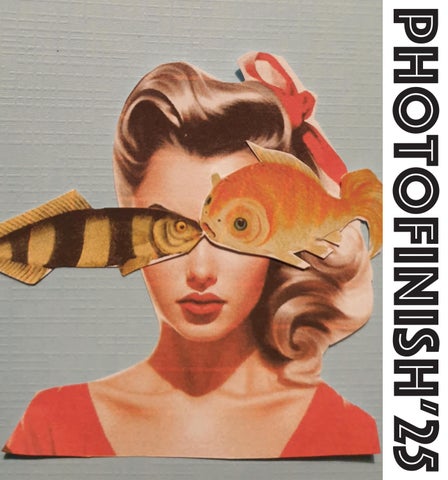
photofinish’25
Editor-in-Chief
Leslie Jill Patterson Fiction Editor
Marcus Burke Poetry Editor
Geoffrey Davis Nonfiction Editor
Elena Passarello Sr. Managing Editor
Jennessa Hester
PhotoFinish 2025
Managing Editors
Jenn Jussel Marcos Damián León
Cover Photo: Anna Covic Copyright © 2025 Iron Horse Literary Review. All rights reserved. Iron Horse Literary Review is a national journal of fiction, poetry, and creative nonfiction. IHLR publishes six annual issues—three print and three electronic—at Texas Tech University, Lubbock, Texas, through the support of the TTU President’s Office, Provost’s Office, Graduate College, College of Arts & Sciences, and English Department. Iron Horse accepts electronic submissions only. Unsolicited manuscripts are read between August 15 and April 15; information regarding thematic issues, production dates, and submission deadlines, as well as the submission portal itself, is available on our website: http://www.ironhorsereview.com. The opinions expressed in the journal are to be attributed to the writers, not to the editors nor to Texas Tech University.
NEW YEAR’S EVE
1
PHOTOFINISH 2025
Foreword / LESLIE JILL PATTERSON
WINNER
A Dunk in the Bucket / TRAVIS FLATT
4 FINALISTS
9 10
The Two-Headed Woman / KATY LUXEM
A Person You May Know / LAURA NAGLE
13 14 18 21 22 25
Photograph / TERRY DALRYMPLE
Gone Fishing / RACHEL LLOYD
Tale of the Girl and the Bucket / MARY QUADE
Fish Fishes Fisher Fishing / CHRIS ELLERY
A Feminine Touch Will Do the Trick / DEIRDRE GARR JOHNS
Seed Pearl / BARBARA LAWHORN
MISCELLANY Contributors
28
hen we selected the prompt for the 2025 IHLR PhotoFinish, we were initially attracted to the title Shutterstock assigned to it— “Eccentric Fisherman”—which started our imaginations spinning right away, but then we also saw so many objects in it that might take hold of a writer’s mind: the fishing rod, the bucket, the girl, the costume, and the stool that looks oddly like a spool of thread without the thread. We also noted what the picture only implied: a fish, water, and the photographer. We hoped the black-and-white texture of the image, the mood of an old 1920s film, would intrigue and fuel other writers. So many windows through which someone might enter the photograph and scout around for a story or poem to burgle.
W
This issue kicks off with Travis Flatt’s winning story, “A Dunk in the Bucket,” which focuses on the bucket, the splash of water it insinuates, a wife who’s reached her limit. Among the nine finalists, you’ll find a poem about a mother teetering between reality and the “freak of nature” known as “self” that will surely terrify her children and husband should they manage to catch a glimpse of her. There are other poems about fishing lures and bait that question who is catching whom. Haunted by the idea of the unseen photographer, other finalists wrote about selfies, photo booths, and flimflam villains luring women into scandalous poses.
1
Foreword
And our contributors didn’t forget the fish we cannot see in the prompt: this issue offers trophy fish, Leviathans, fabled catches, and delicacies plated and ready to eat. So many fascinating takes on this year’s prompt—we love how this issue always surprises us! It’s midnight at this very moment, and something about the necessity of closing one chapter to begin another leaves us feeling melancholy or maybe nostalgic—we aren’t sure. We leave 2025 grateful for our readers, contributors, and submitters—all the writers who make Iron Horse possible. We can only hope our friends and supporters are sharing champagne and watching the Times Square ball drop— whatever joy can be found on the heels of 2025. Let 2026 give us all the beautiful words—the poems, stories, and essays we long to write and read. May we be lucky enough to find the manuscripts we don’t yet know need to be written and shared. May we be smart enough to recognize them— LESLIE JILL PATTERSON EDITOR
IHLR PhotoFinish
2025
A Dunk
in the Bucket TRAVIS FLATT
Charles refuses to respect the bucket. Since the woman at the recreation center taught us Society ladies the bucket exercise, I’ve lost three pounds and not sprouted a single gray hair. Charles couldn’t be more oblivious to these results. As instructed, I go out every morning, dunk my face into the bucket, shout my worries, or hopes, into the cold water. It’s miraculous how much lighter one feels after a splash in the bucket. “I ought to drop a crab in there,” Charles said this morning, grinning behind his newspaper. “Snip your nose.” We shouldn’t change the water all week, the recreation center woman insisted. It would collect our dreams, our antagonisms. “Watch,” she said, “as it thickens.” “Hooey,” we whispered while she demonstrated, slopping water onto the tiles, but damned if we didn’t all try it. Rushed home and dug out our buckets from a shed or basement. “Now, what in the hell,” Charles said that first morning when he spied me in the garden, kneeling before my bucket in my bathing costume. First, he asked me to stop. Then demanded it. Said if I was out with a bucket, go pick some raspberries. That man and raspberries. The way he gazes at the neighbor’s bushes is lecherous. It treads the Tenth Commandment. I worry they’ll notice him at the window, nose to the glass, coveting their berries. I said, “The bucket stays; it makes me feel—” but he’d wandered off to smoke his pipe. The previous woman we brought before the Society suggested we take at least one stand
5
Winner/Fiction
Travis Flatt
a month against our husbands, then report back. It became a competition. I stood alone in the hall mumbling. Deflating. And now, like a school boy, Charles teases, belittles, threatens crustaceous pranks. He’s afraid, I’m sure, that our neighbors will see and think God knows what. That I’m trying to end it all? Charles will worry gossip! “His wife is attempting to drown herself,” they’ll say. “The poor woman’s anchored to an oaf with twenty years at the bank and no promotion. That woman’s surely unsatisfied somewhere.” But none of that I shout when I stick my face into the water, bubbles rising to my ears, popping and tickling, the water turning syrupy with frustrations, desires. I carry the bucket the four blocks to the bank, slopping my sludgy wish water onto the sidewalk as I go. Heads turn as I, still in my costume, haul it to Charles's desk. “Deposit!” I shout, and splash the bucket across my husband’s desk and into his stunned face. Gobs of put your hands on me once in a while drip from his mustache. Snickers from the tellers, the customers. Speak as a gentleman puddles and pools, soaking his papers. Snorts from the manager, who’s poked his head out from his office. And, with his fingers trembling, Charles struggles to wipe free what’s gunked and glued his eyes: Turn me to a raspberry; make me bright and bold and goddamned visible.
IHLR PhotoFinish
2025
6
7
Winner/Fiction
Travis Flatt
IHLR PhotoFinish
2025
8
The
Two-Headed Woman KATY LUXEM after Laura Gilpin
Tomorrow, when her children find this freak of nature, they will carry on as usual. No museum, just soccer practice and chocolate chip Eggos wrapped in whipped cream. But tonight, she is in the top-floor bathroom with her malt liquor, in the tub. It is a perfect evening, nothing but star fizz and to-do lists that wait like gods. By morning, this will all be gone, and so she folds herself in half, doubles so she is twice as many women, all at once.
9
Poetry
Katy Luxem
LAURA NAGLE
A Person
You May Know Behold how I pose on the riverbank Bold lip and direct-to-camera gaze Fishing for carp for catfish for compliments Would you recognize me after all this time If my photo weren’t captioned with my name And a list of our mutual acquaintances We could avoid each other forever with one click But you never hit REMOVE when you see me And I never hit REMOVE when I see you You get a cat and she’s gorgeous I finally come to embrace my natural curls We get new jobs find new homes pursue new dreams You post a photo of your proudest accomplishment I update my profile picture with a new shot of me, fishing
IHLR PhotoFinish
2025
10
11
Poetry
Laura Nagle
IHLR PhotoFinish
2025
Photograph TERRY DALRYMPLE
od how I loved you, Vivian, and how you loved me until you didn’t. Was it really just that one goofy photograph that drove you away? I guess I should have known. You were always concerned about whatever reputation you believed you had. You never wanted to do anything that was just flat fun, always afraid someone would see you and think you just a silly little twit. But it was my birthday gift, remember? You asked what I wanted, and I wanted to go to the fair. And then I wanted us to stop at the photographer’s spot where he was taking dress-up photos. I chose to be a cowboy wearing a pair of shorts and a ridiculously tiny cowboy hat, and I was riding a stick horse, tightly hanging on to the reins as if it were a bucking bronc. Of course, you didn’t want to pose, but I begged until you gave in. For three years, I looked at that photo every day, and it was only then that I noticed the look on your face. Your lips pressed tightly together with no hint of a smile. Your eyes rolled toward me accusingly, angrily. For three years, I waited for you to come back to me. Sometimes, I thought I heard you breathing, and I was sure you were returning. I thought I heard the rustle of your favorite red dress, and I was sure you were returning. I thought I heard your laughter, and I was sure you were returning. But I was a fool for believing that. Believing it was far sillier than fishing in a bucket. Now, sensible again, I am coming to hate you.
G
13
Fiction
Terry Dalrymple
RACHEL LLOYD
Gone Fishing assure her again that she will find no fish in that bucket. She turns on me, caught by surprise. I don’t know why what I’ve said is so surprising. After all, it’s a bucket. And while she may sit at it with a pole in her hands, she is not fishing. Because it’s a bucket. There’s no lake or ocean, not for miles. No body of water large enough to hold all she hopes for. But she won’t listen. She sits in the backyard, wearing her nightgown and a sleep cap, and whistles a tune I can’t decipher. I try to coax her away. “Come inside, Mom,” I say, because she’s been there for hours. She promises to come in later. She looks like a little girl: a woman in a children’s bonnet, playing children’s games. And yet, she looks much older than I remember. When I close my eyes against reality, I remember her face being smooth with the most heart-shaped lips. Those lips blew me kisses on the first day of school and made me believe there was a perfect heart swimming though the air, waiting for me to catch it. Now her lips are cracked and taut, a thin hook when she smiles. I almost can’t look at them.
I
IHLR PhotoFinish
2025
14
15
Fiction
Rachel Lloyd
For dinner that night, she serves sardines with tomato sauce; we eat them over rice. The next day, it’s cod with lemons and capers. The lemon slices are sundials on my plate. Then, spicy fish soup with haddock floating in it like buoys. It’s well cooked, tender, and light. At first bite, the flesh melts away. Salmon steaks with fried shallots and a honey and sherry reduction. She takes fish and makes them in ways I’ve never heard of: trout amandine, mackerel escabeche, coquilles Saint-Jacques. Every night, she comes in from the backyard bucket and fashions a feast from nothing. On the night she dishes up a whole steamed fish, I look from its eye to hers and say, “I thought you didn’t like fish.” “Usually not. Normally all you can find is fish that’s been on a truck for days, then in a grocery case for who-even-knows how long. But I like fish when it’s fresh.” She eats with more enthusiasm and energy than I’ve seen from her in years. Fresh? I think. We’re landlocked, hundreds of miles from the water. When she’s done, she takes our plates away to wash them. “Mom, have you ever seen the sea?” I ask. “No,” she says, “but that’s all right. You don’t need to see something to know it exists.” “Would you like to?” I ask. Her gray curls look translucent in the light coming from the window above the sink, like illuminated sea-foam. Her hair is so thin, it startles me. I gasp like a guppy, like a fish out of water. “Don’t worry,” she says. “I’m patient. I will see it all someday.”
IHLR PhotoFinish
2025
16
17
Fiction
Rachel Lloyd
Tale
an
Not Jill, that rock tumblin like a slap. Not dear Liza water to fix. This girl’s buc scaled silver tongues asw
hearts; their bodies thum inside these walls. Her ca slide beneath her eyelids she sees, dropping a line
beckons. Somewhere pe a path to resist, to escape If she were a fish, she wo momentum. The mouths
Her line unspools. Her lur she tells the snapping fish
IHLR PhotoFinish
2025
18
MARY QUADE
e of the Girl
nd the Bucket
ng after, pail-water sailing, landing , trapped by bucket holes needing fixing, needing cket bears a tornado, a forecast of fish circling, wirl. Even without peering in, she knows their
mp against the wooden staves. What waves echo aptivated—gills flapping, curls of waste stirred by fins— s. It is this easy to be in charge, to form an opinion, e into the storm. Somewhere a brook twists and
ebbles eddy, ricochet off her toes. A current is just e by wading ashore, where the stones need skipping. ould remember to dive. Everything alive obeys of the fish kiss the surface, a bucket of gasps.
re, a mirrored spoon. Only you, h, can make this barbed hook cruel.
19
Poetry
Mary Quade
IHLR PhotoFinish
2025
20
Fish
Fishes Fisher
g n i h Fis
Y LLER
SE HRI
C
Since you seem to have nothing to say, I will keep on fishing. My cork bobs in the silence. I’m not afraid of what I might catch. It’s a fine day for fishing. What can I think to lure you, Leviathan, to take my bait? What I am on my hook cannot move toward you. Therefore you must move toward me like a shark on the prowl. I can only become myself when you swallow me whole. I will keep a strong hold on the pole as you pull me from my boat into the real. In my alluring poverty of sea-foam cap and clothes I offer you body and soul. Why are you waiting, Leviathan? Everything falls to the bottom, carbon and crud. Come soon, before the bottom rises and traps me forever with the dregs of the sea.
21
Poetry
Chris Ellery
A Feminine Touch
Will Do the Trick Deirdre Garr Johns
No half-moon mud rings If only I could take off the soft under the fingernails or smudges frills and sport some overalls, boots, of old bait. But let’s leave and a touch of RBF, not this vacant something to the imagination. face like a deer in headlights. Let me Keep the bucket empty— show off my curves and dirty my hands it’s no wishing well. while you fiddle with the lighting Be a doll, darling. for that perfect shot. “Hold still,” you say. Be a dear. Holding a pose is like a magic trick Just another pretty face. I have perfected time and time again.
IHLR PhotoFinish
2025
22
23
Poetry
Deirdre Garr Johns
Seed Pearl BARBARA LAWHORN
n Easter bonnet advertisement for Sears-Robuck, the church organist said. He’d been a photographer in WWI, and the scar that split his face was all the proof my granny needed. He asked her to wear the white overalls he’d seen her cleaning the church in, then dismantled her broom, tied a cord to it, and grabbed the pail from the well, cutting it loose with his hunting knife. In the photograph, her breast is covered by her arm and the long sausage-curl ribbon of the bonnet. The light catches her leg fuzz, and you can see she’d never once shaved. He rolled up her shorts and instructed her to flex her feet like a dancer. She gripped the broomstick, and I saw the seed pearl ring on her index finger, mostly because it’s mine now and our fingers are genetic replicas. The mortician’s wife did her makeup and bobbed her hair 1920s flapper It-Girl. My Gran, a seventeen-year-old preacher’s kid, shoots a look that says, “Let me fish in a bucket in peace.” “Pearl,” she told me, hunched in her wheelchair as I brushed the tulle of her hair, “I had my church cleaning shirt on, but he shucked me out of it rough. It was cleaning rags from then on.” It was supposed to be
A
25
Fiction
Barbara Lawhorn
cheeky, something she did just for herself, but after the organist ran off with the church’s monthly collection, it also became a scandalous postcard. When it got back to her Baptist daddy, she couldn’t wear the overalls because that seeded pearl of sin had ripened. Whatever my face said, it had her patting my knee. “Now, Pearl, it was bound to happen.” My throat was packed with sand, not words. I wished like hell I could gut that organist. Save Gran. Run off. Seventeen-year-oldtwins free from the confines of time. Sandy, Nebraska: Where dreams lodged deep and life was a constant friction that made letting go impossible, and instead lacquered it all up with resentment. She wore the Easter bonnet she’d posed in when she was hitched to Stanley Keystone, her father’s trusted sixty-seven-year-old neighbor. “He doted on your ma, and as long as breakfast was hot and dinner was on time, he mostly let me be.” She was thirty-three when he died, a respectable widow, but she sold the farm and fled Nebraska for the wilds of the Pacific Northwest, vowing her fifteen-year-old daughter would have choices she didn’t. “I’d never once left Nebraska, and I found myself driving 1,300 miles. The darkness of South Dakota! It rained all through Wyoming.” I held her hand. Saw what mine would look like someday. I imagined her, gripping that steering wheel so hard the seed pearl ring cut into her skin. I squeezed to feel it bite mine. How could I convince her she held no sin when those ideas were planted at birth? I imagined her heartbeat syncing with the windshield wipers, both metronoming through the miles: Free. Free. Free.
IHLR PhotoFinish
2025
26
27
Fiction
Barbara Lawhorn
Contributors TERRY DALRYMPLE has published numerous short fictions. He is a member of the Texas Institute of Letters and is an Angelo State University Distinguished Professor Emeritus in English. He lives in San Angelo, Texas, with his wife Lorraine. On the inspiration behind his story “Photograph,” Dalrymple writes, “When I first studied the photograph provided by Iron Horse, my attention was drawn to the woman’s eyes and mouth. Clearly, she was not happy about posing for that photograph, and the way her eyes slanted, I felt sure that she was looking at whomever convinced her to sit for the photo. It seemed likely to me that the culprit was a man, which led me to the male narrator. When I began to write, I followed the narrator’s lead and ended up with the full story—after, of course, several drafts.”
CHRIS ELLERY is the author of five poetry collections, most recently One Like Silence and Canticles of the Body. A member of the Texas Institute of Letters, he has received the X. J. Kennedy Award for Creative Nonfiction, the Dora and Alexander Raynes Prize for Poetry, the Betsy Colquitt Award, and the Texas Poetry Award. On how his poem “Fish Fishes Fisher Fishing” was inspired by our photo prompt, Ellery writes, “I first saw the image while attending the Texas Association of Creative Writers annual conference, so it was natural to think of the IHLR PhotoFinish
2025
28
woman as a figure of the writer. Also, I listen to This Jungian Life and simultaneously saw the woman as the anima/animus in meditation. Both creativity and meditation involve a lot of active and patient waiting, being both the fisher and the bait eager to be swallowed whole. Leviathan is a complex biblical allusion offering many possibilities of interpretation. I primarily had in mind the leviathan of Psalm 104, where it is a symbol of God’s powerful and playful creativity.”
TRAVIS FLATT is an epileptic teacher living in Cookeville, Tennessee. His stories appear in Fractured Lit, Cleaver, Prime Number, 100 Word Story, The /t3mz/ Review, Variant Lit, and other places. On the origin of his story “A Dunk in the Bucket,” Flatt writes, “Early this year, or maybe last year, the idea came to me of a person shouting into a puddle or lake until it became soupy with their frustration. Sometimes, when something pops into my mind like that, I struggle with the next step: how do I get into—or begin—the story? When I saw the PhotoFinish prompt, I thought, ‘Perfect, now I have this wonderful character with their own transportable water, no less.’ She, in turn, inspired the setting, so it all fell into place.”
DEIRDRE GARR JOHNS is the author of Weathering the Storm (Palmetto Publishing, 2024) and Fallen Love (Finishing Line Press, 2025). Her work has appeared in Sylvia Magazine, South Carolina Bards Poetry Anthology, Eunoia Magazine, Nymeria Magazine, Silver Birch Press, Stone Poetry Quarterly, Sasee Magazine, and more. She participated in the Tupelo Press 30/30 Project in March of 2025. Her website is amuseofonesown.com. About her poem “A Feminine Touch Will Do the Trick,” Garr Johns writes, “Initially, I reflected for quite some time on the woman’s attire. I tried to see beyond the frills, but I could not escape the contrast between her attire and the rest of the objects in the photograph. I put myself in her shoes and imagined that she was likely very
29
Contributors
bored—waiting for what I imagined to be a very long time and missing the fun she could be having elsewhere. I created an internal dialogue for her and contrasted it with voices off camera to create a back-and-forth, but separate, conversation, highlighting how looks can be deceiving. What I was drawn to over and over was her pose, and I could not distance myself. How many times are we ‘put in place’ and silenced by others? In this poem, I wanted to show that despite others’ best efforts to control the scene, she is the one controlling it all.”
BARBARA LAWHORN teaches composition and creative writing at Western Illinois University. Her most recent poetry, creative nonfiction, and fiction can be found at Another Chicago Magazine, El Portal, Sand Hill Literary Review, Belmont Story Review, Santa Clara Review, Sierra Nevada Review, Poetry South, Dunes Review Literary Journal, and White Wall Review. She lives joyfully in the Midwest with her favorite creative endeavors ever: her sons, Mars and Jack. Lawhorn writes that her story “Seed Pearl” began as a writing prompt in her advanced fiction workshop: “We begin each class with a writing prompt, and I try to fold in a variety of modalities that encourage practice in terms of submitting work and the possibility of publication. The photo on the big screen allowed me to see three things: her downy leg hair, the pearl ring on her index finger, and the look on her face which struck me as startled and, beyond that, fearful. I wrote a draft in the ten minutes we had, long hand. In class, I was so taken by the stories the marvelous undergraduates shared, spurred by this intriguing photo. The following week, I shared a revised draft in my writing circle and then with my partner, asking for help. I was ninety-eight words beyond the limit. My partner is an incredible editor. I considered his wise cuts and came up with alternate phrasings when I simply could not bring myself to give up a weighty word.”
IHLR PhotoFinish
2025
30
RACHEL LLOYD is a Boston-based writer primarily of short stories and flash fiction. Her work has appeared in Moon City Review, The Capra Review, Vassar Review, Thimble Lit Mag, and others. Two of her stories have been nominated for Pushcart prizes. She is an editor for The Worcester Review. A late-to-the-literary-party dyslexic, Rachel is a voracious reader eager to make up for lost time. Lloyd describes her story “Gone Fishing” as “one of those rare stories that writers wait for, write for, fight for—the ones that fall on our heads like rain. I could see fish in that bucket. I imagined beneath it the full bulk and breadth of the sea, branching out from under like roots. But the core of the story came from that look on her face: those heart-shaped lips; her coy, surprised eyes; that glint of innocence and wisdom. I placed myself in her world, not as a viewer looking at her but as the person she is looking at. And yet the black-and-white image locked her in another time. I sensed intimacy. I sensed distance. To me, that is the essential tension of the story, and I tried to dramatize that tension.” KATY LUXEM lives in Salt Lake City with her spouse and three children. She is a graduate of the University of Washington and has a master’s degree from the University of Utah. Her work is anthologized in Love Is for All of Us (Hachette, 2025) and has appeared in Rattle, McSweeney’s, SWWIM Every Day, ONE ART, Poetry Online, and others. She is the author of Until It Is True (Kelsay Books, 2023). On the origin of her poem “Two-Headed Woman,” Luxem writes, “I love Laura Gilpin’s poem ‘The Two-Headed Calf’ and think of it often. When I originally saw the prompt photo, it was late at night, and I was getting into a hot bath. The subject seems quite youthful and innocent. But of course, there are multiple sides to every story. I wrote my response with duality in mind. A lot of my poetry focuses on motherhood, and it’s obvious this poem follows that topic. I often think about the expectations and weight we carry as women, the faces we present to society, and how those resonate within us. How could that not affect everything we do and are?”
31
Contributors
LAURA NAGLE is a fiction writer and a translator of prose and poetry from French, Spanish, and Irish. A past contributor to the IHLR PhotoFinish (fiction, 2022), she is delighted that Iron Horse Literary Review is now home to her first published poem. Her short fiction has recently appeared in The Common, North American Review, Stanchion, and Trash Cat Lit. Her translation of Confidences, the only novel by the Bolivian feminist poet Adela Zamudio, is forthcoming from Bucknell University Press. On the inspiration behind her poem “A Person You May Know,” Nagle writes, “I initially thought of the woman in the photo as a model and assumed that all these incongruous elements were chosen and placed in the frame by an unseen photographer. Returning to the prompt after scrolling on social media, I saw the subject in a different light. What if, instead of being someone’s muse, she is curating her own image? Why does she want to be observed fishing (without actually, you know, fishing)? Who is the intended audience for this photo?”
MARY QUADE is the author of two poetry collections, Guide to Native Beasts and Local Extinctions, and Zoo World: Essays, winner of the 2022 The Journal Non/Fiction Prize. She is the recipient of an Oregon Literary Fellowship and four Ohio Arts Council Individual Excellence Awards for both poetry and creative nonfiction. She teaches at Hiram College. On the origin of her poem “Tale of the Girl and the Bucket,” Quade writes, “The quaint bucket and crude fishing pole in the photo made me think of children’s stories and rhymes. At the same time, the woman’s pose suggested a familiar role—infantilized, sexualized, and silly. I wanted to rethink the dynamic in the situation and give her insightful power and an empathetic authority.”
IHLR PhotoFinish
2025
32
Iron Horse Literary Review would like to thank its supporters, without whose generous help we could not publish Iron Horse successfully. In particular, we would like to thank our benefactors and equestrian donors. If you would like to join our network of friends, please contact us at ihlr.mail@gmail.com for information on the various levels of support. Benefactors ($300) Wendell Aycock Lon and Carol Baugh Beverly and George Cox Richard Crider Madonne Miner in memory of Gordon Weaver Equestrian ($3,000 and above) in memory of Charles Patterson TTU English Department, Chair Michael Faris TTU College of Arts & Sciences, Dean Tosha Dupras TTU Graduate School, Dean Mark A. Sheridan TTU Provost’s Office, Provost Ronald L. Hendrick TTU President’s Office, President Lawrence Schovanec
Poem Title A UTHOR