BUILDING 2667
A SHORT STORY BY
Adam Straus


BUILDING 2667


Adam Straus

The
Long Story 2026
Editor-in-Chief
Leslie Jill Patterson
Assistant Editor
Jo Anna Gaona
Fiction Editor
Marcus Burke
Senior Managing Editor
Marcos Damián León
Managing Editors
Jennifer Jussel
Nimalah Baaith-Ducharme
Illustrations
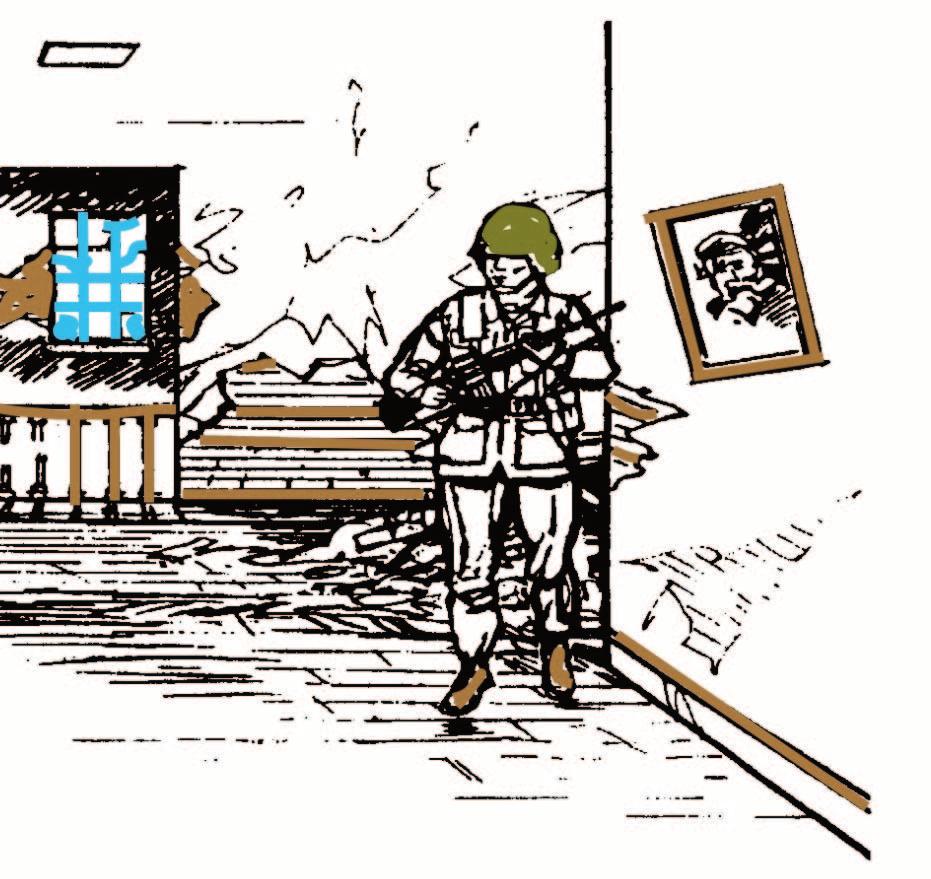
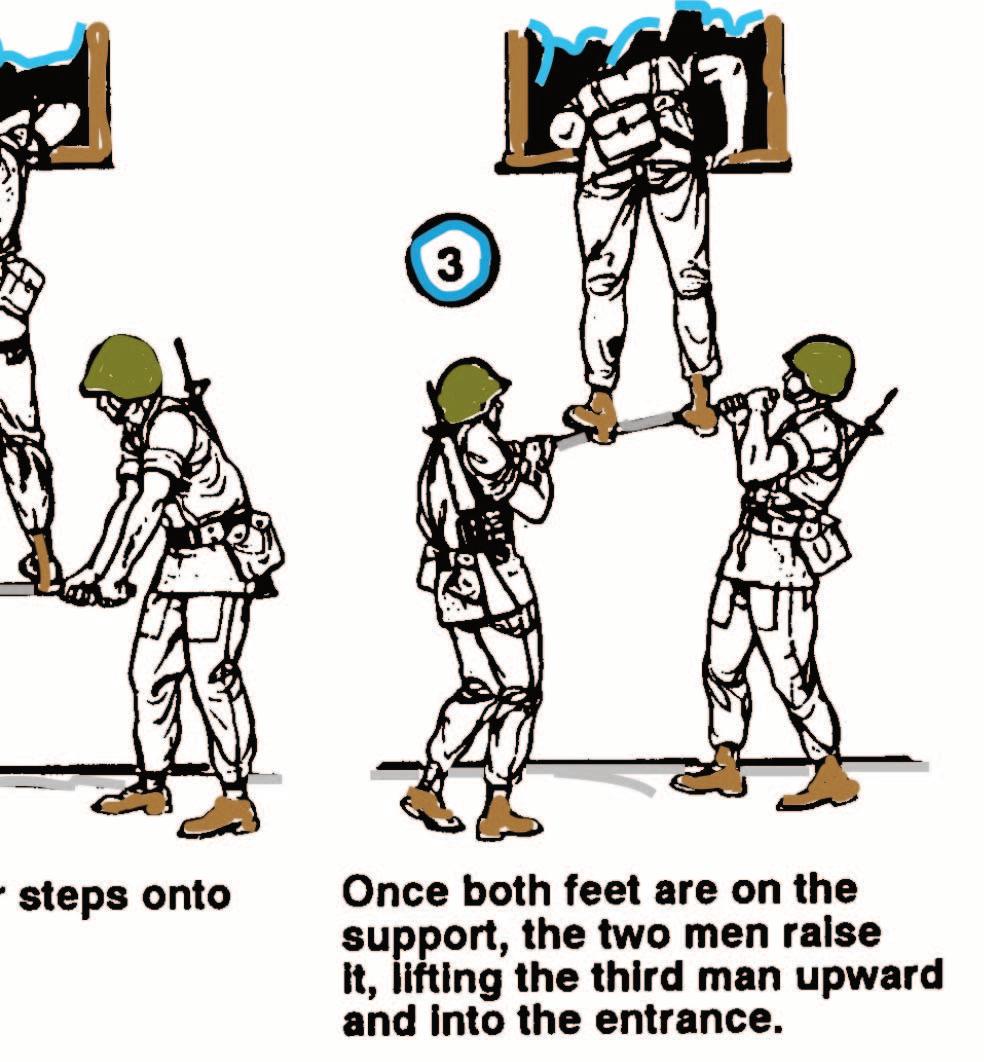
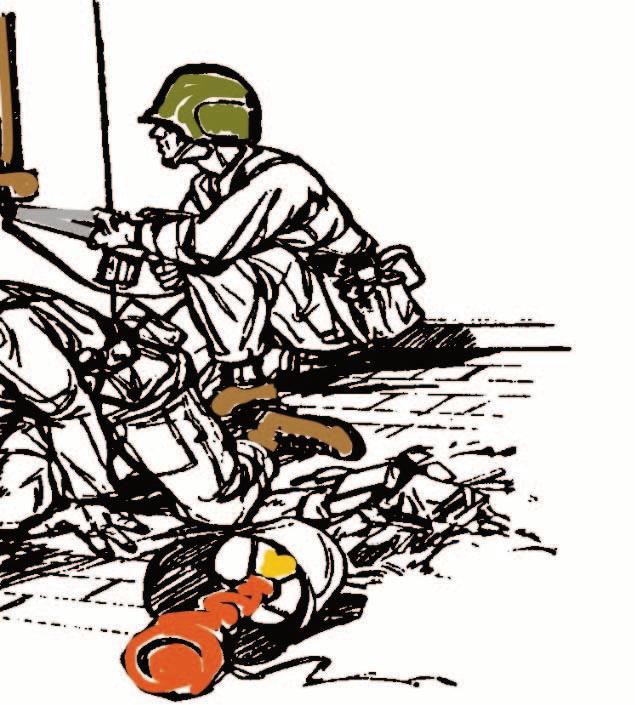
From Field Manual No. 90-10-1: An Infantryman’s Guide to Combat in Built-Up Areas. Published by Headquarters/Department of the Army. Washington, D.C.: 12 May 1993.
Associate Editors
Aaron Babcock, Anasuya Basu, Molly Bibeau, Cari Castillo De La O, David Cofer, Kristi Cook, Michael Cuervo, JoJo Dunlap, Christina Ellison, Charlotte Fiehn, Jonathan French, Margaret Harris, Elias Johnson, Savannah Joyner, Ari Kelly, Matthew Knutson, Jessica Kwasniak, Nikki Lyssy, Abby Macenka, Shantanu Manke, William Matthew McCarter, Eloise Mitchell, Kristi Osorio, Mandira Pattnaik, Lauren Peacock, Kamryn Pitcher, Mark Robinson, Ashton Russell, Max Steiner, KJ Tenhouse, Justis Ward
Copyright © 2026 Iron Horse Literary Review. All rights reserved. Iron Horse Literary Review is a national journal of fiction, poetry, and creative nonfiction. IHLR publishes three print issues and three electronic issues per year, at Texas Tech University, through the support of the TTU President’s Office, Provost’s Office, Graduate College, College of Arts & Sciences, and English Department. For more information, visit www.ironhorsereview.com.
BUILDING 2667
he first time I spoke was out of anger. I’ve always had something of a rivalry with the mountains to my south. Joshua Tree National Park. Named peaks, hiked peaks, destinations. And I have nothing against them, truly. It’s just, people have decided they’re impressive. If I may? They are not impressive. They are an accident. They were born as accidents, and they endure as accidents.
I am intentional. It took effort to create me. A site study, six generals’ signatures, a demolition crew for Building 1953, dozens of workers, hundreds of pounds of concrete. Not to mention rebar and piping and electricity. Careful connections to the water line, to the fire hydrant meant to save me. My delicate panes of glass, which came last.
That was just to create me. To sustain me is a choice. When they destroyed Building 1953, it took six hours. Six hours from structure to footprint. She was me, and I was her, and now, any day, I could be gone. Every day, I’m still here. Every day, the flecks of her rubble trouble my base.
But mountains merely exist. Which was what I screamed at them. A question, or several really: Where and how and why do you stand? On whom? On what? I wanted them to understand what luck was. But it’s in their nature that they could not understand me. My voice was lost, a tremor on the wind, a reason for people to glance outside, once, unknowingly, and continue on.
This was the night I sat empty, before my June to June year with 2nd Battalion, 7th Marine Regiment began.
Adam Straus
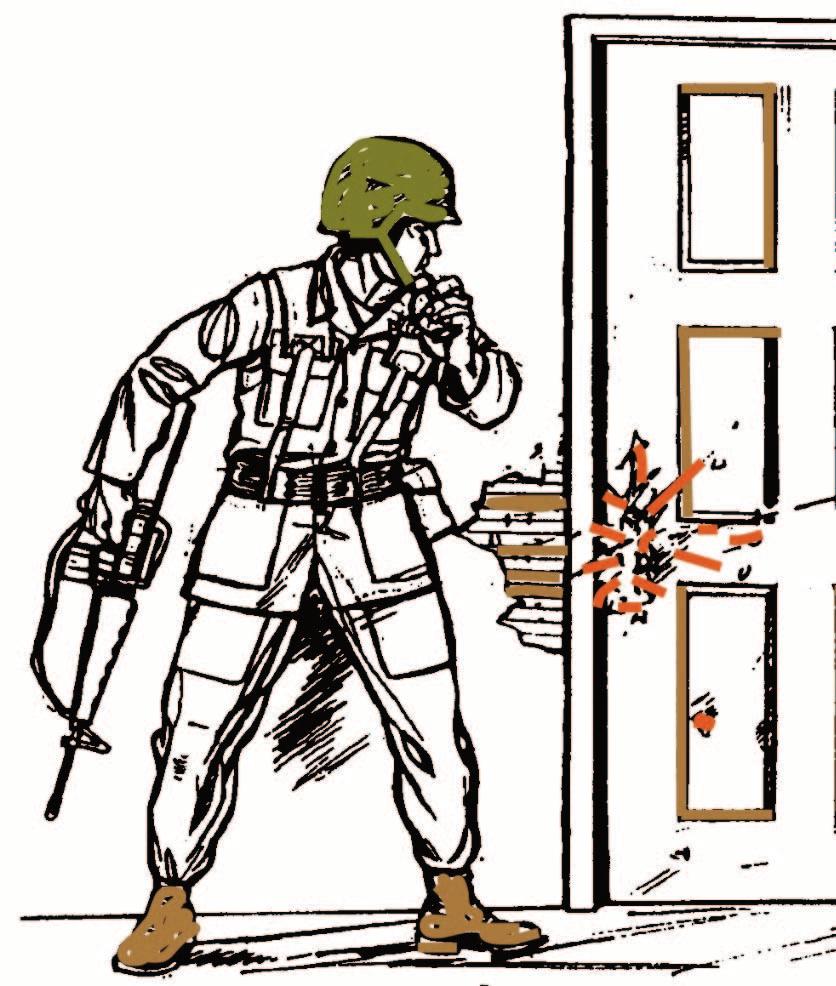
Figure 5-25. Soldier Sh
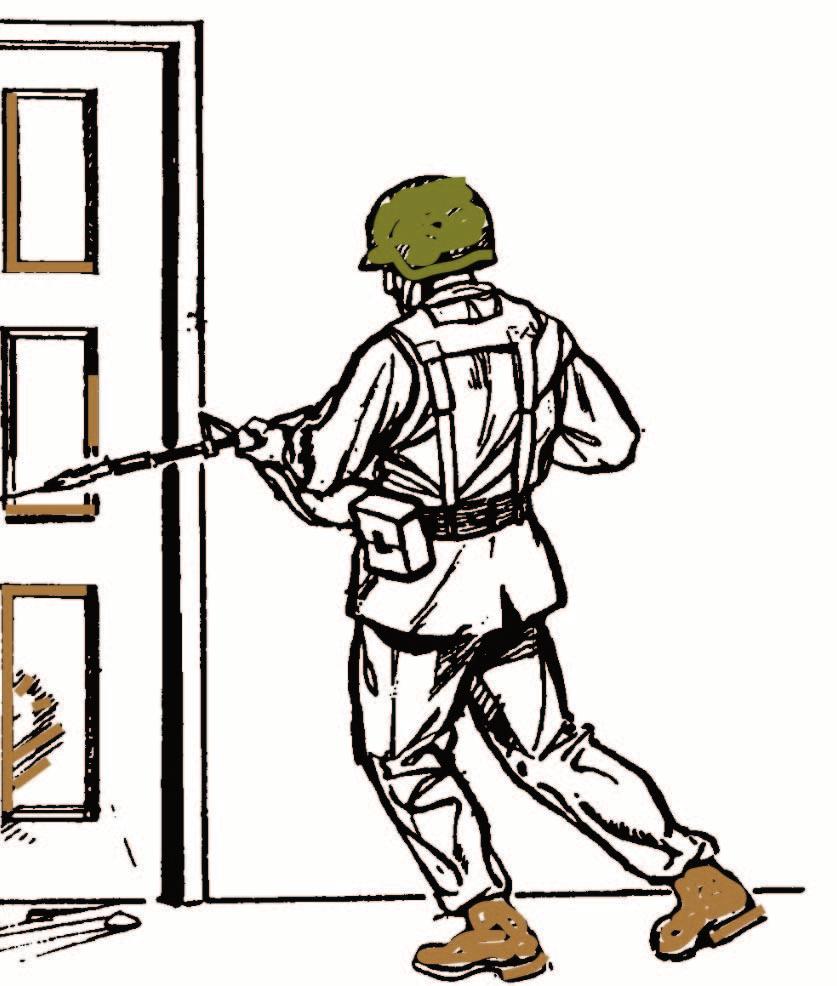
the Door Open
ine months later, it happened like this. Lance Corporal Maza had a Dodge Charger. Lance Corporal Erickson had a Ford Mustang. These were not delicate men. Delicate boys, really, both all of twenty years old, hence the Saturday night drinking on base instead of in town. They had both been drinking, obviously. That would be a factor, obviously.
The question was: Who had a faster car? There were other questions caught up in the question of who had a faster car, the sorts of questions cavemen started asking when one speared a big wooly mammoth and another speared an equally big wooly mammoth that, on second glance, might have been even bigger. I am talking about something profound in the air above the long empty stretch of asphalt called Cafferata Road, tracing the base’s northern fence, marking the border between pseudocivilization and the Mojave.
Maza in his Charger, Erickson in his Mustang, Gillespie standing in the unmarked middle of the road with both arms raised, a smattering of underaged Marines spectating from the berm lining my parking lot. Someone had a Bluetooth speaker. They played that god-awful Toby Keith song about red Solo cups. The best receptacle.
I have been exposed to the elements for the duration of my existence, and it feels pertinent to comment on the weather on what is now called The Night in Question. In the Mojave Desert, nighttime temperatures consistently drop twenty to thirty degrees from daytime highs. This creates a thermal transfer wind event: convection driving cold air across the mountains of Joshua Tree, onto base, and north into the nothingness by Amboy Crater. There was a faint film of sand blowing across the road. It was pleasant being outside, though moving progressively towards unpleasant. March is a strange month here: June at noon, January at midnight.
Gillespie was shirtless, per usual, showing off an array of stick and pokes: random tools (a hammer, a saw, a flail), an unblinking eye, and the word MANIAC. He had lived on the road for three years after dropping out of Berklee, playing bass in a band that existed on the gentler edge of post-punk and the harder edge of revived ’90s alternative. Think the space between Joy Division and Dinosaur Jr. The band was good, and the band was loud, and when the money ran out, Gillespie enlisted because there was nothing else to do. He yelled, “Go.”
Maza had bought his Charger at that place on Adobe Road for an interest rate so absurd his squad leader thought it was a prank when he found out on my third-deck catwalk. You’re fucking with me, right? You’re fucking with me. Erickson’s Mustang was a sort of hand-me-down from his older brother, the expectation being Erickson could use it as much as he wanted while his brother was locked up, but the moment one of those appeals came through, the car had better be back in Baton Rouge, waiting.
It would not be. Maza was the one who lost control, but he regained it. Just a wiggle. Erickson wiggled in response to Maza’s wiggle, then overreacted to his own wiggle, caught the lip where asphalt met pavement, and tumbled end over end into the sand. Cue seventeen sets of hands clasping seventeen shaved heads. If I had hands and a head, I would have clasped one with the other, too, the only human reaction, and I am human, like a dog raised by cats is a cat.
Adam Straus
y father was a warehouse on Chicago’s Navy Pier. During the war, he housed servicemen. It was hard. He was not built right for the things he was doing. His windows four stories up did not close all the way. So there were birds in his rafters, shitting on the top bunks. The birds were there because there were lots of spiders. There was spider season, followed by bird season. The reason the spiders were there was because of the flies. That was the season before the spiders: flies. Flies all over everything. Then along came the spiders, webs plastering walls. Then the birds to eat the spiders, piling nests up high and crapping on everything. No spiders meant the flies came back. It was not ideal. My father made do.
I will tell you right now this line of work is not easy. Our fi ne young men and women in uniform are not always the world’s best house guests. I am talking punched-out windows and kicked-through walls. I am talking climbing on roofs and jumping through skylights. I am talking blood and glass shards all over the place. Not to mention the vomit, not to mention the late nights fading into early mornings, not to mention the pulled fire alarms and shattered EXIT signs. There is a baseline thrum of violence, I have found, right beneath the surface, like my clunking, tumbling dryer where someone always has a pair of boots, somehow.
There is also the issue of limited clairvoyance. The way being a barracks works is we get glimpses of the future from the people who call us home. Some of these guys have good futures. I will be sitting here and—wham—kid in a tire swing—wham retirement ceremony with full military honors—wham—forgiving the stepdad who poisoned a childhood dog. I feel it all: the surge of love, the slackening of a neck muscle that held tight for thirty years in uniform, the catharsis of letting go.
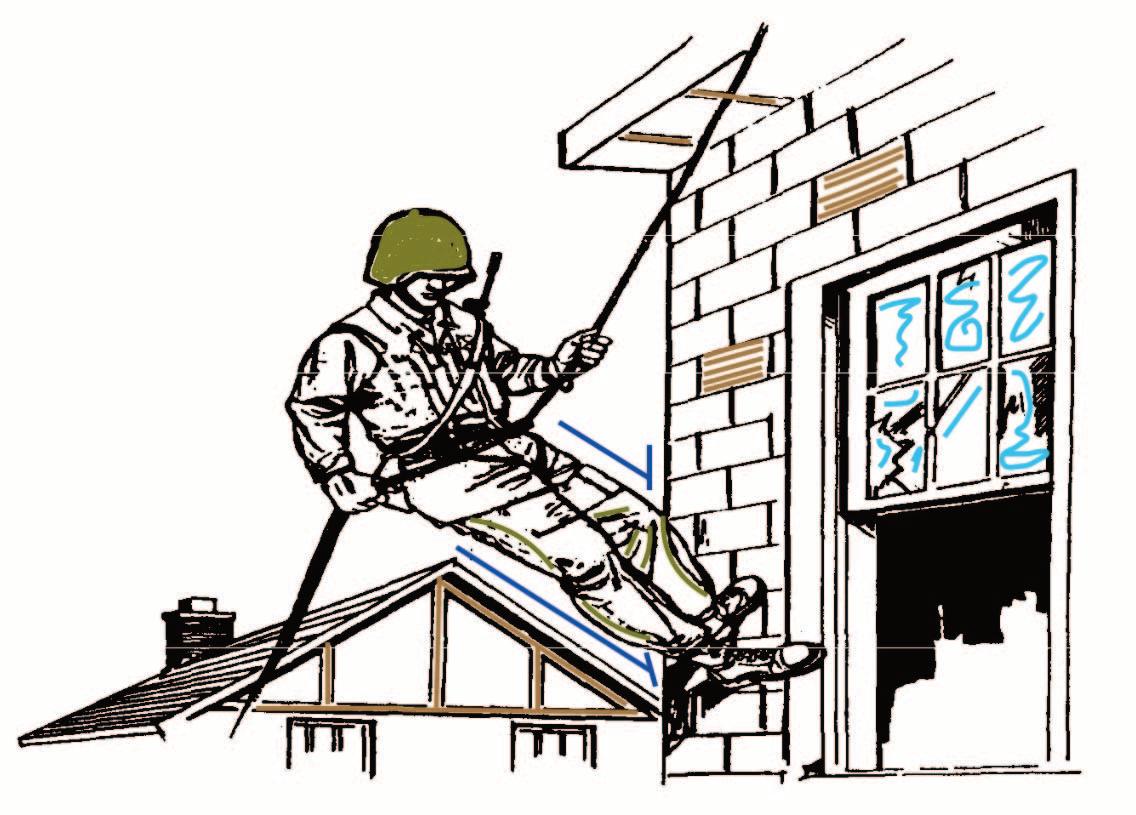
5-21. Rappelling Through a Window
Figure
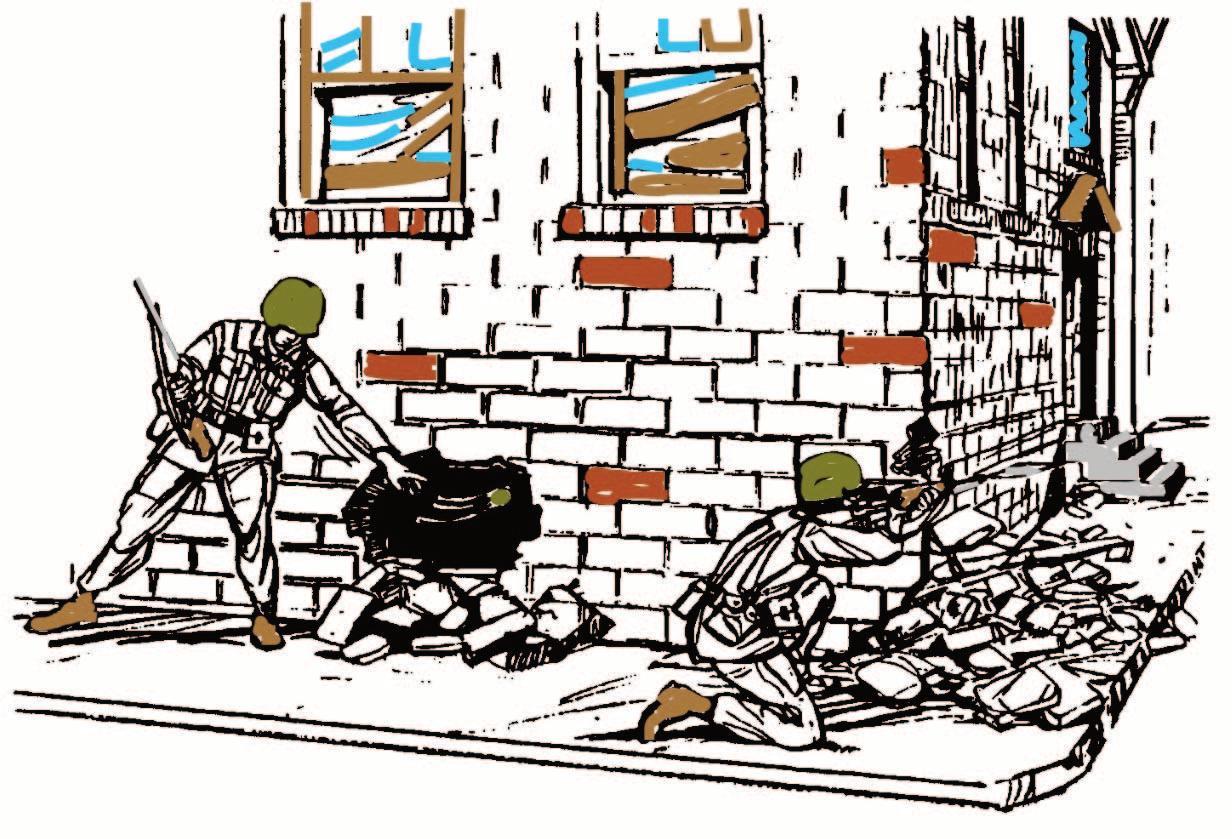
5-15. Soldiers Entering Through a Mousehole
Figure
But we see everything. My father hosted the crew of the USS Indianapolis for a night. I am talking the worst maritime disaster in US Navy history. I am talking a third of the crew went down with the ship, the rest lost at sea for days, sun up, sun down, and sharks everywhere, water boiling with blood, flaming oil slicks, men bobbing up and down and disappearing. They had been delivering pieces of the atomic bomb. My father carried pieces of those pieces for a long time, carried them until a smoldering cigarette butt in his second-deck trash can met an oil-soaked rag fresh from the barrel of a machine gun destined for Korea, and a great cleansing fire purged my father of his memories forever.
Adam Straus
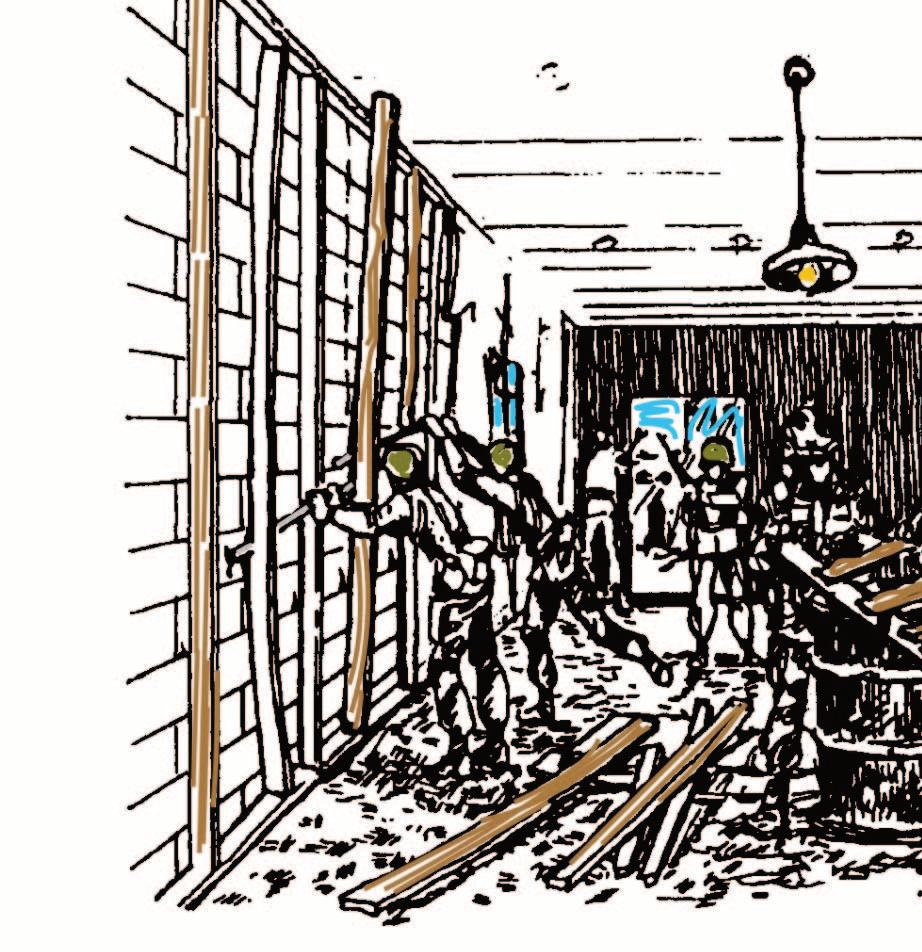
Figure 5-17. Getting Lu
umber from the Walls
he place I am is who I am. Without my rifle, I am nothing; without me, my rifle is nothing. First, workers dug a hole, and then they poured my foundation. First, they ran wires through my walls, then they connected me to the world. There are a few ways to consider this, and I consider them. One is that this patch of dirt was once the future site of Building 2667, is now the current site of Building 2667, and will some day be the former site of Building 2667. Another is that I am nothing.
The place I am is across the volleyball court from Building 2615. Building 2615 has a loose cinderblock, and all he does is whistle. Down the street, Building 1554’s hot water heater is broken, and she thinks she’s the Empire State Building. Across another volleyball court, Building 1411 tells me, Keep going. I send the same message back.
The place I am is a place out of time. Year-long work up, wild party night before deployment, empty, new battalion. Year-long work up, wild party night before deployment, empty, new battalion. Its own calendar with solstices and equinoxes, holidays and countdowns.
I am the calendar. I am the squares you fill in.
Do I want to be a barracks? Yes and no. There is something unyielding about cement, and I, like anyone, am the sum total of my material. I want to be what I am, and I am what I want to be. In other words, I am a fact. There is a truth to me, the same way a blank dry-erase board is true. The same way a dry-erase board in my seconddeck common room on which someone drew a dick in Sharpie and the ghostly outline of the dick has survived multiple erasures and a gallon of bleach so that everyone calls it the Ghost Dick Room, is true.
But, of course, I want to be something else. I have learned this from people: The whole joy of being is dreaming about becoming. The Marines pile pallets on the volleyball court, and while they stare at bonfire flames and wonder what it would be like,
Building 2667 2026 Long Story
I think the same. It feels strange to dream this way when I cannot hit back as someone headbutts my walls. Except in the Newtonian sense, in which I am pummeling the earth every second I sit on it. I like that sense.
Amidst hair-dryer-hot July winds, I am told by Building 1411, with whom I share a gas line, that this is unusual. You are and you are and you are, he explains. You just are. I want to know what happens if I’m not, which I’m not right now, because if I am then I’m also not; if you’re something, you’re not something else. The moment you’re anything, you stop being everything, though you’re still much closer to being nothing.
This is what I meant, Building 1411 breathes, when I said unusual. In a surprising indiscretion (given that he is the one extant building with whom I feel a true kinship), he repeats my thoughts to Building 2615, who whistles, and Building 1554, whom I despise. She is convinced she is eminently perfect in the exact spot she stands. She is convinced she stands in Midtown Manhattan. She is convinced my musings are somehow an insult to the memory of those who lost their lives in the fires of September 11th.
I pretend I was joking. I pretend I joke. This, apparently, is how Building 1953 was treated, too. It’s said this sort of thing was grounds for her demolition. That, and asbestos. Poisoned at birth.
Adam Straus
fter they leave me, the Marines spread out on deployment. That is how things are done at this stage of the war. There are men in Afghanistan, one platoon near Garmsir. There are men in western Iraq, Al-Taqqadum Air Base, peering at Ramadi, in what used to be the Triangle of Death and is no longer the Triangle of Death only because no one tests it. There are men in Syria, at old oil refineries and new forward operating bases, overlooking ancient fields tilled by John Deere tractors USAID dropped off three years ago. There are men left behind in Kuwait on Crisis Response, ready to reinforce all of the above, waiting for the next war that never comes.
The final numbers will be eight wounded (two in a rocket strike in Afghanistan; one in a friendly fire mistake, also Afghanistan; four in an IED, Syria; and another— rocket strike—western Iraq). Eight wounded and one killed (vehicle rollover, Syria). Two killed, counting Sergeant Gibbons, who will come home, walk in the door of his tidy on-base duplex, pull his Glock from the bedside table, tell his wife, I know, and shoot himself in front of her, while the man she cheated with, who transitioned from lover to stalker two months prior, watches from the street.
There are other numbers: eighteen divorces, twenty-five cases of infidelity (twentyone at home, four overseas). Less overlap between infidelity and divorce than one might expect. Hours standing post: 1,359,000. Ninety-one people will cry at some point; again, less overlap with divorce and infidelity than expected. One hundred twenty-two will experience a top-ten best memory of their lives; one hundred fiftythree will experience a top-ten worst.
None of it will balance out. None of it will add up. The men think about numbers, and I do, too. Like how 1953 means as much and as little as 2667, randomly generated. Like how I’m ten percent her, thanks to an innovative GENTEC TM recycling process, and she was eight percent Building 7341 because they used the same foundation, and Building 7341 was Building 4862 with a refinished façade. It’s not much,
yes, but 1953 still whispers, No, no, no, from the fire-retardant crushed gravel separating me from sand. The crushed gravel is neither me nor sand. What percent of me will be crushed gravel? Is that my best percent? It’s better, I think, if my best endures. But, gravel? Really?
Adam Straus
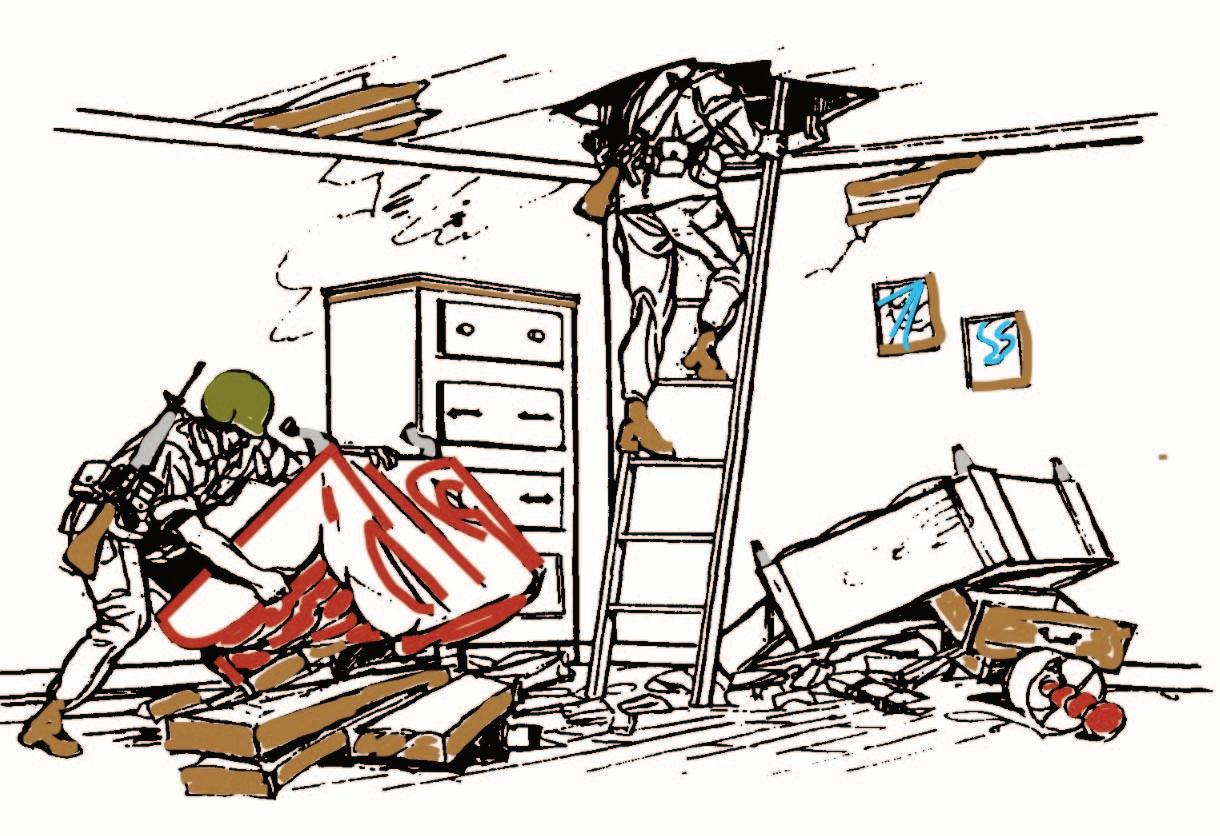
Figure E-7. Movement between Floors
here is a disco ball in Room 126. Room 126 is where Gillespie lives with Chang and Washington. Washington is the one who orders the prostitute. The prostitute turns out to be a fortune teller. The fortune teller, while she waits for Washington to shower off his August sweat, reads Chang’s tarot. The tarot suggests, among other uncomfortable truths, that Chang could use a change of scene. In search of a change of scene, Chang deserts the next morning. The morning after that, police pick him up in Palm Springs with a baggie of baking soda a narc sold him as coke. The real coke is in Room 228; it only shows up on a drug test for two days. Two days after Chang deserts, the command drug tests the guys in Room 126. Room 126 has a disco ball, so the command thinks it’s a slam dunk.
But Gillespie and Washington both test negative. The disco ball is just a disco ball. The guys in Room 228 are high all the time. The command makes Gillespie and Washington throw out the disco ball. Prejudicial to good order and discipline.
Washington is scared straight. He wants a career, thirty years if they’ll let him, Sergeant Major of the United States Marine Corps, promoted until the promotions stop. No more parties, no more women, no more nothing, he promises no one, until after Afghanistan. On The Night in Question, he sits in Room 126 alone, learning Zippo tricks on YouTube to make it feel like his late dad’s engraved Gulf War lighter actually belongs to him. In the middle of Cafferata Road, Gillespie yells, “Go.”
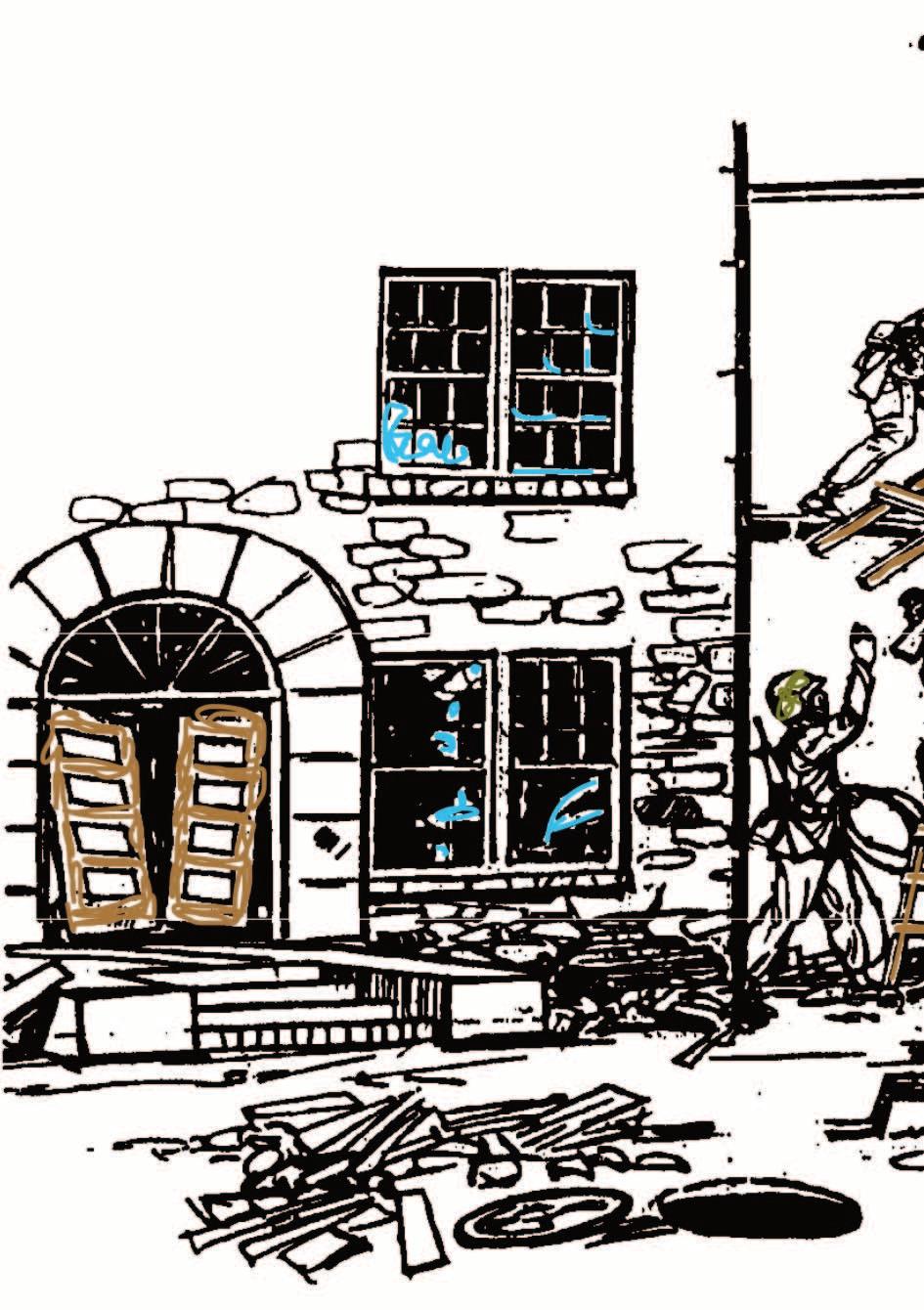
Figure 5-16. Using Ladde
aturday night is when everyone drinks on the catwalks. When my motion-activated lights turn on, the night gets dark. When the lights turn on, it means the emergency exits are no longer apparent without them. Like anyone would bother taking the stairs in a fire. Like every year someone doesn’t break their ankle testing how high three flights of air really are.
This battalion gets to it early. A simple September bet: You won’t jump, pussy. The names aren’t important because really they are roles. Jumper, Goader, Peanut Gallery. Jumper is the one who floats the idea. Goader latches on. Peanut Gallery are neutral, neither brave enough nor dumb enough to jump, neither cruel enough nor aggressive enough to goad, neither sensible enough nor sober enough to scream, “Stop.”
At the end of the day, it’s curiosity. The Goader wants to know if he can get someone to do this, and the Jumper, balancing on my concrete half-wall, wants to know if he can do this. Even in the air, it’s a mystery for him. He has felt terminal velocity twice before: once off the high dive at boot camp and once on a skydiving trip his exgirlfriend paid for on his eighteenth birthday. It had been on his bucket list because he could not think of anything else. She asked what last things he wanted to do before boot camp. He Googled bucket list stuff. She was a year younger than him; she could not go skydiving herself. She sent him a letter at boot camp that her biology teacher touched her. They broke up when he went home on leave. He jumps because he does not give a fuck anymore. He jumps because he is so drunk there is no way the ground is not at least a little wavy beneath him.
It isn’t. The ankle won’t set right, and he’ll be medically discharged. Pain meds run out, pills get too expensive, heroin is so logical he can’t believe he didn’t think of it earlier. There’s a camp outside of La Crosse where he makes a few friends, friends as in people he shoots up with, friends as in people he comes to know through that strange and shaky intimacy as well as anyone he’s ever known, friends as in friends. His story is still that he was a Marine. He tells them about the jump, and he tells himself a story that it was not actually the jump. It was the breakup, and it was the biology teacher who fucked his girl up.
So he resolves to kill the biology teacher, who he learns from a Google search is still employed at Freiwald High. One of his friends drives him there in a beat- up ’96 Camry they got running. The friend drops him off on a side street with a view of the parking lot, and the Jumper hides in a bush, from which he sees the biology teacher leave the school at 4 p.m. He bursts out, machete in hand, and is sprinting across the street to kill that fucker when a kid, texting and driving and talking to his friends in the backseat, going forty-five in a twenty-five, hits the Jumper, whose skull cracks open against the pavement.
That’s what I think about while he is in the air. He thinks about the ground. He does not think that I might have tipped him backwards. A wobble is all it would have taken for a second thought that would have had him announce, laughing, Fuck that, no way. I try not to think about second thoughts or second chances.
Adam Straus
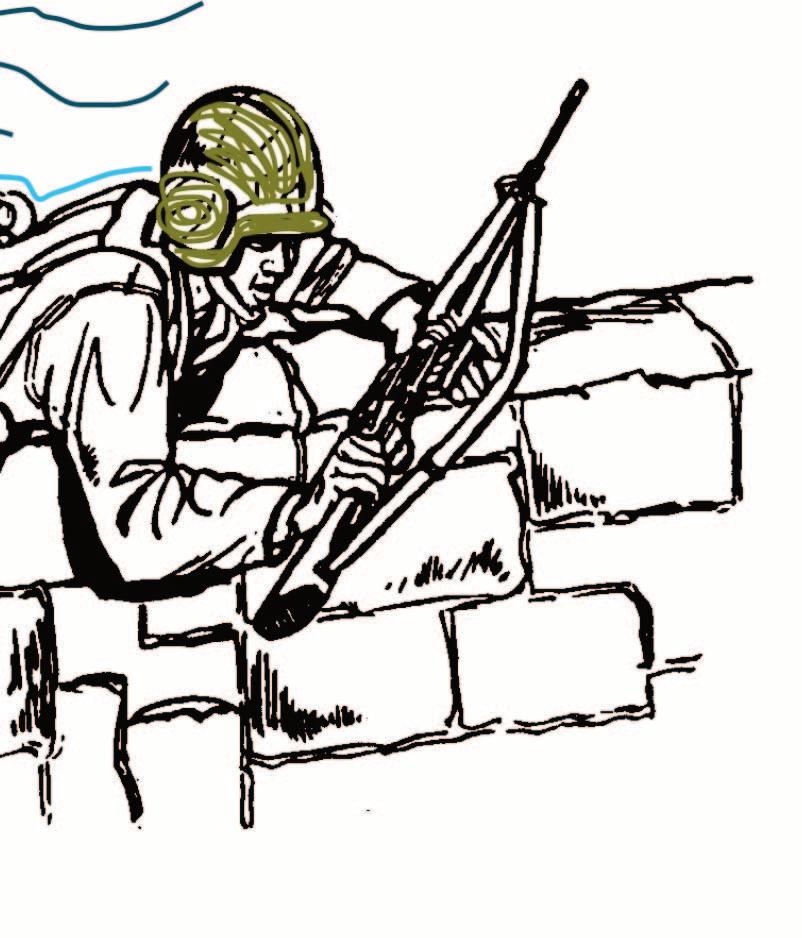
Figure 5.1. Soldier
r Crossing a Wall
t’s Field Day on Thursday night, which is when Marines clean. This is an incredibly violent process. It’s a chance to play fuck-fuck games. For example, Boot Wheelbarrow Racing: four Marines who have not deployed before get into teams of two. One Marine holds a towel between his hands; the other holds his partner’s ankles in his armpits. Back and forth across tile floors, sprinting and slipping hard enough that someone’s head always meets cinderblock. There are blanket parties and working parties. Room 387 creates chlorine gas by accident; Room 124 does so on purpose. There’s Axe sprayed to cover foot-sweat smell, then there’s Axe spray sparking fire through a lit lighter, then there are bare-chest flamethrower duels in which everyone loses. On my second deck, a new private shoves his team leader and is beaten so badly there’s blood in his urine. Minutes later, a Marine eats a cockroach for twenty dollars. On Friday morning, when the officers inspect me, I am spotless.
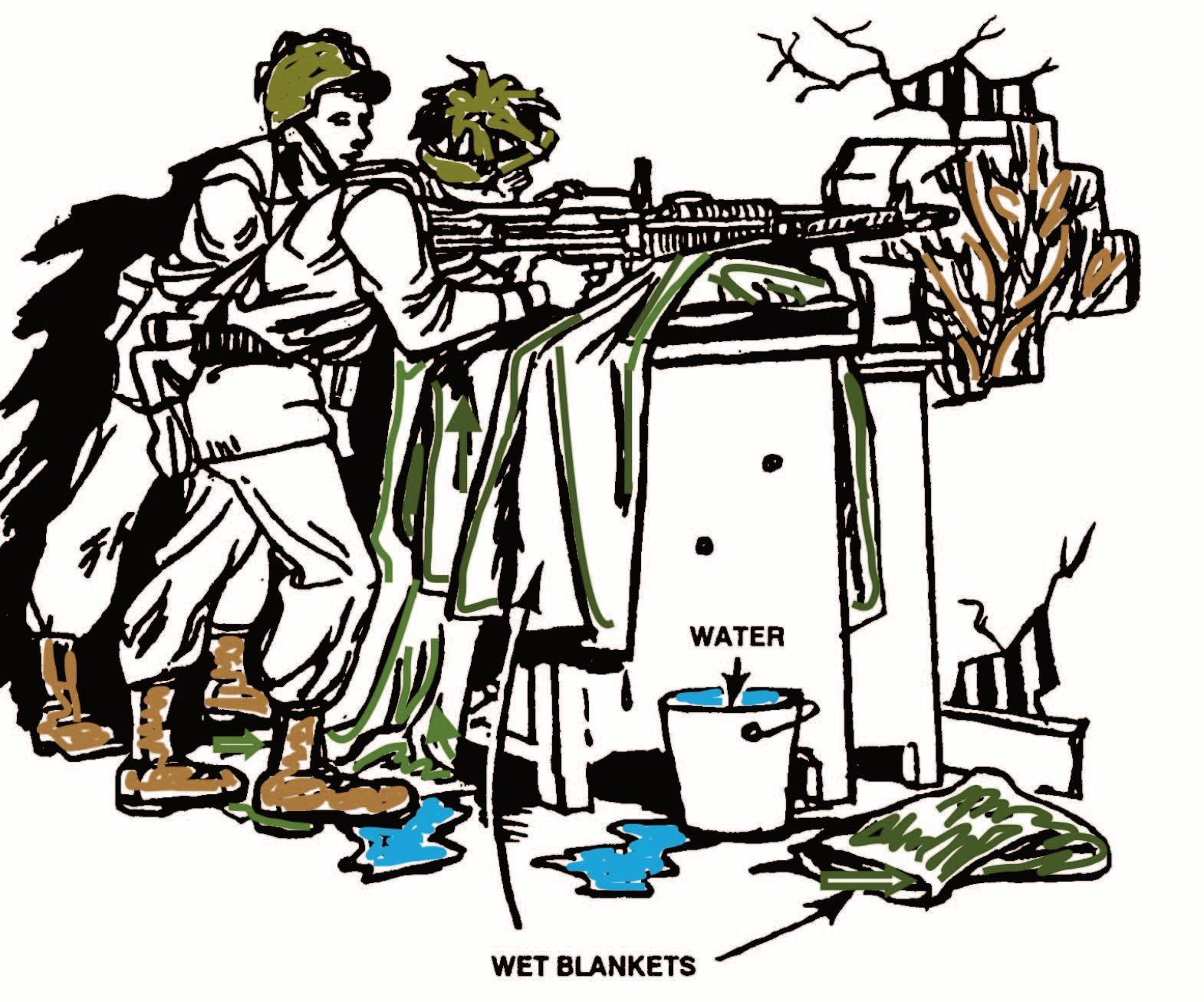
Figure 5-46. Wet Blanket Used to Keep Dust Down
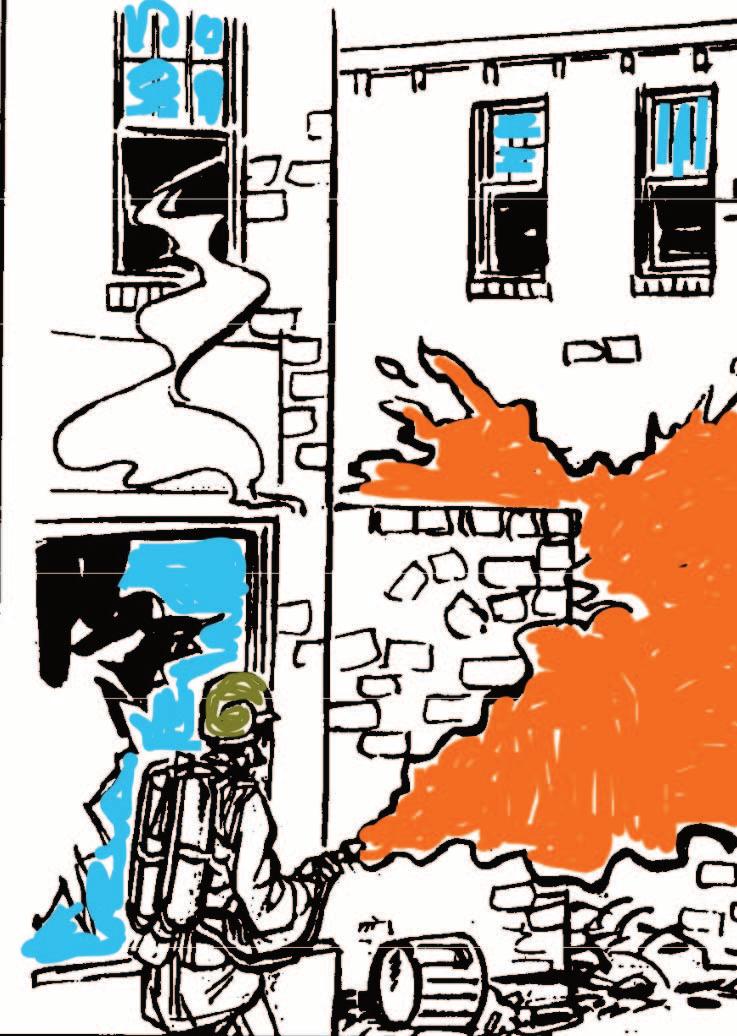
Figure 8.14. Flameth

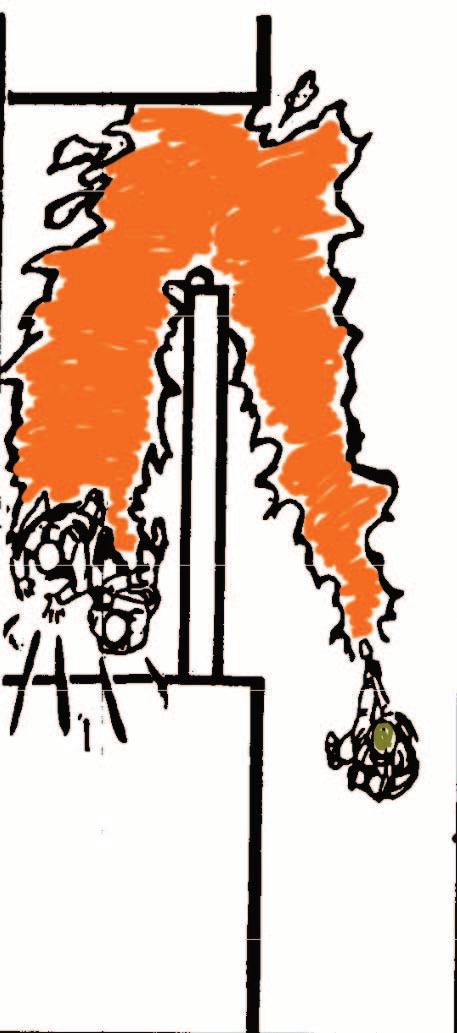
onight there’s a desert tortoise in Room 114. Finn from Fox Company found the tortoise sheltering from bitter December winds by the machine gun berm at Range 106 and stuck him in an assault pack. Finn was the lizard kid growing up. The kid with pet snakes, the kid who got suspended in seventh grade for sending a girl he liked a video of him feeding a live gerbil to his pet snake. The girl did not like the video. The girl did not like Finn.
He worked hard to expunge the lizard kid pieces of himself. Gave away the pets to a reptile rescue he found on YouTube. Googled how to get clear skin and how to grow and how to gain weight. His father, a veterinarian, was concerned. His mother, on the outskirts of the PTA, was happy he seemed to be internalizing the Social and Emotional Learning Skills his experimental high school promised.
Finn’s mother comes from one of the richest mining families in Arkansas. They operate a series of crystal mines as tourist attractions. They call themselves a mining family though really they are in customer service. His mother wants to be a painter. She sells her watercolors at the farmer’s market outside the library in their small town. She blames herself for her son’s inability to fit in, which is why she was so relieved when he started fitting in. She knows she should not have named him Finnegan. Finnegan Fanwell.
Finn found a recruiter in the high school halls. The recruiter introduced Finn to a workout program that worked: Go until I tell you to stop . Finn’s parents found it predatory, the whole thing, but there was so much pride in the community, they smiled about it more than they wanted to. The night before boot camp, Finn Googled Can you have pets in the Marine Corps?
The answer is no, but the answer is also yes, which is sort of like the answer to Can tortoises drink beer?—which is what Finn’s roommate, Erickson, wants to find out, what most of the platoon wants to find out. They’re piled into Room 114, nearly twenty of them, surrounding a small square of carpet where the tortoise stands on
scaly columnar legs. Someone finds a bowl, everyone has a beer can, and they’re shoving it in the tortoise’s face. No one cares that “STOP” is written across Finn’s forehead. No one cares he got the tortoise into his backpack by offering it chocolate peanut butter from his MRE.
No one knows Finn will, in a post-patrol fugue state of exhaustion, at the exact midpoint of his time in Afghanistan, forget there’s a round in the chamber of his M4, and, while attempting to clean his weapon, shoot through Nguyen’s calf, straight through Nguyen’s raging bull tattoo, leaving the bull with a scar for a nose. Of course it was Fanny , they’ll all say. Of course . For the rest of his life, he’ll tell people he cleaned dishes at Friendly’s for four years after high school. He won’t mention the Marine Corps until he’s fifty-six, dying of colon cancer, and the hospital chaplain, a Gulf War veteran, comes into Fanny’s room wearing an Eagle, Globe, and Anchor pin on his lapel. They’ll reminisce about these sorts of nights in the barracks, nights like tonight, the night with the tortoise. It won’t matter in the end, so Fanny will finally learn to laugh.
Because tomorrow morning the battalion goes back to the field. Force on force patrolling on the Blacktop. Buildings are constantly settling onto their foundations, and sometimes door jambs skew askance, and sometimes doors don’t click shut. It won’t be until the following afternoon that a gust will catch just right, showing the tortoise a sliver of light. He can smell the cold, dry air; he knows which way to go. There’s never any traffic on Cafferata Road, and the fence is set barely two inches into the ground. He’s still fifteen miles from his burrow near Range 106; that’s two weeks of movement for a tortoise. But what’s two weeks? This guy’s fifteen. He’ll live to be ninety-six. He blinks his beady eyes in the light and walks. Pressed against my foundation so closely her thoughts are also mine, the last fragments of Building 1953 ask, Why did we wait for the wind?
Adam Straus
illespie still has his bass. A Fender Precision. Custom built for a studio musician Gillespie’s dad played with in the ’80s, refurbished six times since then, given first to Gillespie’s dad and then to him. Easily the most valuable object I house, only saved from theft by ignorance. It looks like an old instrument. It is an old instrument.
Kerr plays good enough guitar that Gillespie doesn’t want to blow his brains out listening to him. Not like Mussina, who abuses an old nylon stringed acoustic and claims to have signed a record contract for his god-awful originals. Mussina sings like a grunge star, all open-mouthed vowels. At least Kerr knows to shut up and play the chords Gillespie tells him to.
They take requests, sometimes. “Bitches Ain’t Shit,” “Party in the U.S.A.,” and “Creep” become pseudo-anthems, alongside “Friends in Low Places,” “Wagon Wheel,” and a bastardized “Mr. Brightside,” which taxes the limits of Kerr’s blown-out practice amp. They get a crowd piled into Room 215. Fists pumping on fast songs, lighters in the air, almost singeing my ceiling, on slow ones. These sing-alongs are wholesome in the moments before they become scream-alongs. Which is what the guys call them: Screamalongs.
Gillespie half-hates Screamalongs because they remind him he’s already found the thing he loves most. So many people spend their lives searching for that, the one thing that lights them on fire, and Gillespie has it. Except he doesn’t. The plan with his band was tour until the money ran out, and they all sincerely believed the money never would. The four of them even took a month-long layover in Billings, working seasonal service jobs, paid in cash, living in the van, all to bankroll what turned out to be the last leg of the tour, through Bozeman and Missoula, dipping south for a run across the Idaho State campuses the first week of the semester, then up through Bend, Portland, and Olympia. The plan was Vancouver, but, stopped for lunch five miles south of the border, they realized, after overpaying for two bacon
cheeseburgers, an order of chicken tenders, and a patty melt, that they were in the double digits between them.
Everyone thinks Gillespie’s from Seattle because that’s where he enlisted, but his home of record is two hours outside of Cleveland: 626 Vineville Lane, where his dad’s three gold records hang. Three reasons not to ask for help, and six blocks from Easton High School, where Mr. Woodward had the too-many saxophonists pick straws on the first day of freshman year and said, Sorry, Tommy, you’re on the upright. So Gillespie walked over to the big bass looming in the corner and ran his hand over the scroll and felt the first resonant low E in his chest and said, No worries, Mr. Woodward. It’s cool.
Adam Straus
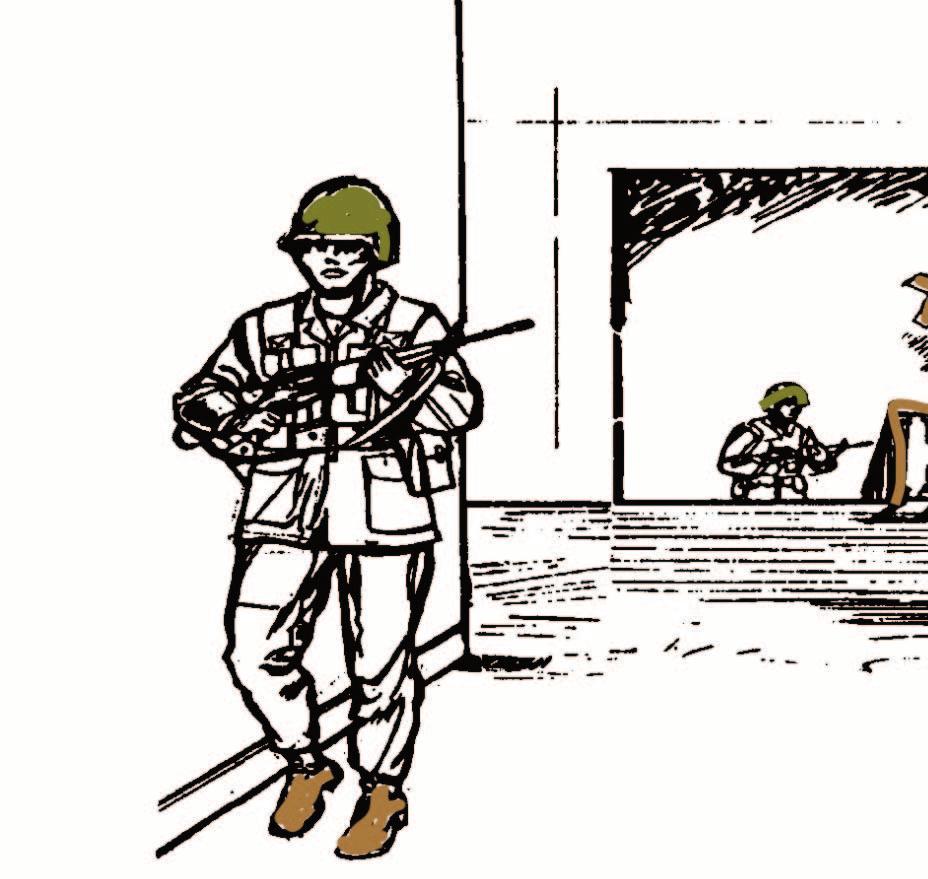
Figure 5-13. Hal
Procedures
aint, February sun falls in cloud-dappled bands across the mountains, and my first thought is Fuck them. They set the far line of my horizon. They are the rod from which the long carpet of desert unfurls, the carpet on which the lights of Twentynine Palms start to flicker, the carpet on which I sit. To turn the camera around, they see the base as a scar, I know, and they’re right, more or less. What can I say for myself? Squat, boxy, beige on beige on brown. Then again, so are they.
There are lights in the park tonight. Lost hikers, three days overdue from work in Los Angeles. A couple. Young, married. He’s in graphic design. She’s a waitress at the Denny’s in El Segundo. I can see them, on the north-facing slope of an east-west ridgeline, sheltering from the fading light between chollas. She broke her ankle, he was scared to leave her to find help, and now he’s too weak, too thirsty. Their headlamps died last night, and they’re too hoarse to shout. Two hours ago, her agent called a dead cellphone to say she got a callback for an insurance ad, a recurring character, a financial break, not a creative one, but a break nonetheless.
There’s talk of getting every Marine on base to walk arm-in-arm through the entire park, make a clean sweep from Highway 62 to I-10. There’s talk, and, then, an afternoon later, the order comes through. Ready, step. Ready, step. Ready, step. Three miles later, it’s Gutierrez who sees her boots poking out from under the boulder where the couple found their final shade. He calls over Sergeant Warren, and the two of them sit with the corpses until Search and Rescue shows up forty-five minutes later to take the bodies away.
It’s quiet the night after that. Even among those who were on the last deployment, only thirty-six have seen a dead body before. One hundred twenty-one days from the next deployment, there are twenty-eight others who don’t know they’ll soon join that rank. Gutierrez and Warren tell the story seven times, then everyone leaves
them alone. The man voided himself before the end, after their desperate signal fire burned down to nothing. The mountains’ only memory is a cluster of flies buzzing a scorched slab of rock. Why didn’t you do anything? I demand. What’s the point of you?
Adam Straus
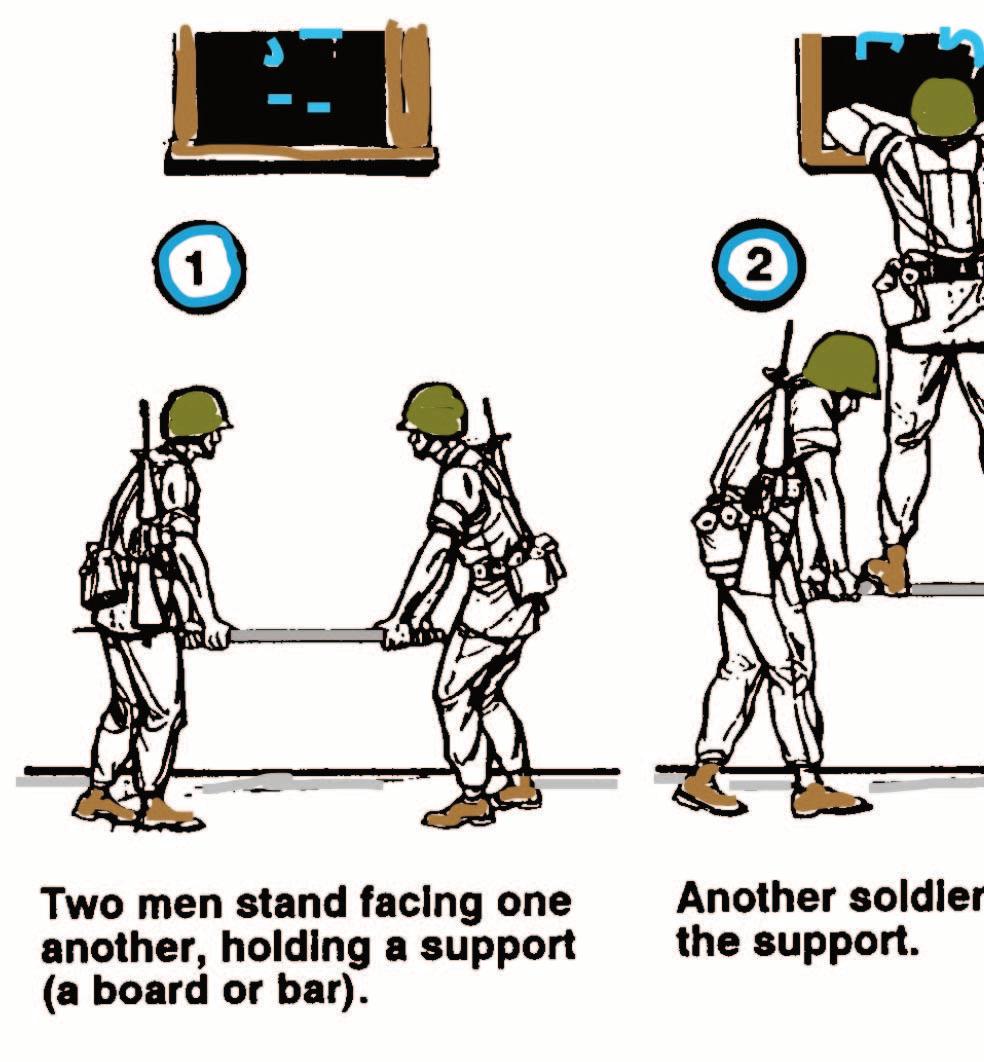
Figure 5.22. Lower-Le
aza was the last to know. He was already up over 120 miles per hour, hands locked at 10 and 2, eyes on the road, Erickson a tremor in his peripherals, Erickson a puff of sand that might have been a road runner. Maza knew that suddenly no one was next to him, but he thought that meant he was winning. He thought that was good. It’s so elementally pure, the little boy release of, YES, whether it’s when someone bites on a pump fake playing pick-up by the comm school or when someone taps during platoon groundfighting or in the three seconds between when Erickson crashed and when Maza glanced in his rearview.
For Erickson, a whirl of color and darkness. An absent thought. This is what it’s like to be in a car crash. He hit the ground three times: driver side, square on the roof, canted to favor the back passenger side. Before he scrapes his chin on his exposed collarbone; before Muller, desperate to be the hero, kicks in the windshield and drags Erickson free, cutting his torso on broken glass; before Sergeant Gilroy and Corporal Zhang almost come to blows over whether to call the MPs; before the base police show up with an ambulance, and Erickson admits to the DUI because his back teeth are loose and he doesn’t want to deal with the breathalyzer; before six weeks in a sling and reduction in rank to private and the loan to cover his new insurance premiums and the loan to cover his loan; before his brother dies in prison, stabbed sixty-three times by members of the Aryan Circle;
before the family finds out it was a leadership dispute when they see the swastika tattooed on his wan, punctured stomach and the laurel leaves on his shoulder; before Erickson misses the funeral because Iraq; before Erickson comes home and comes out and meets a guy and adopts a son who carries his dead brother’s name, not so much an honor as a second chance he still believes his brother could have used—before all of that, it’s quiet, and Erickson spits blood from his mouth to mutter, Holy fuck, I’m alive.
Adam Straus
aza sleepwalks. Always has. His parents had to hire a contractor to replace the door on his childhood bedroom so it would lock from the outside. But then Maza started sleep-crawling through the window, out into the cool Santa Clarita nights. Sometimes he would swim in the neighbors’ pool. Sometimes he would sit in the back seat of his dad’s truck. Sometimes he would stand on top of the MAZA MASONRY trailer, which was where his mom found him two weeks before high school graduation.
He told the truth to his recruiter about the sleepwalking, and his recruiter lied on the paperwork. It’s a disqualifying condition, like bedwetting or eczema. While Maza’s father generally opposed lying in all forms, he was willing to make an exception for this, the proudest his son had made him since knocking an opposing player unconscious on the Pop Warner football field as an eighth grader.
The sleepwalking did not get better with age. At boot camp, Maza wandered into the drill instructor’s hut and woke more from the sound of a boot to his chest than the sensation. At the School of Infantry, his fire team found him at 4 a.m., furiously sprinting up and down the Pendleton firebreaks, ten pound ammo cans in either hand. His first night in Twentynine Palms, Maza left my back stairwell, performed a perfect handstand in the middle of Cafferata Road, held it for a minute, and returned to bed.
He’s never naked; that’s part of the problem. That night on top of the trailer, Maza poured himself into his little sister’s cheerleading uniform. He ripped it right between TRABUCO and VALLEY, and she had a competition the next day and how was she supposed to explain what had happened? Their mom stayed up until 6, sewing, learning how to sew synthetic fabric, sewing again.
Two nights after Erickson’s crash, Maza gets his hands on a bunny costume hidden in the broom closet on my second deck. There’s a furry in Fox Company. The uncle he claims to visit in San Bernardino every other weekend? Not his uncle. The
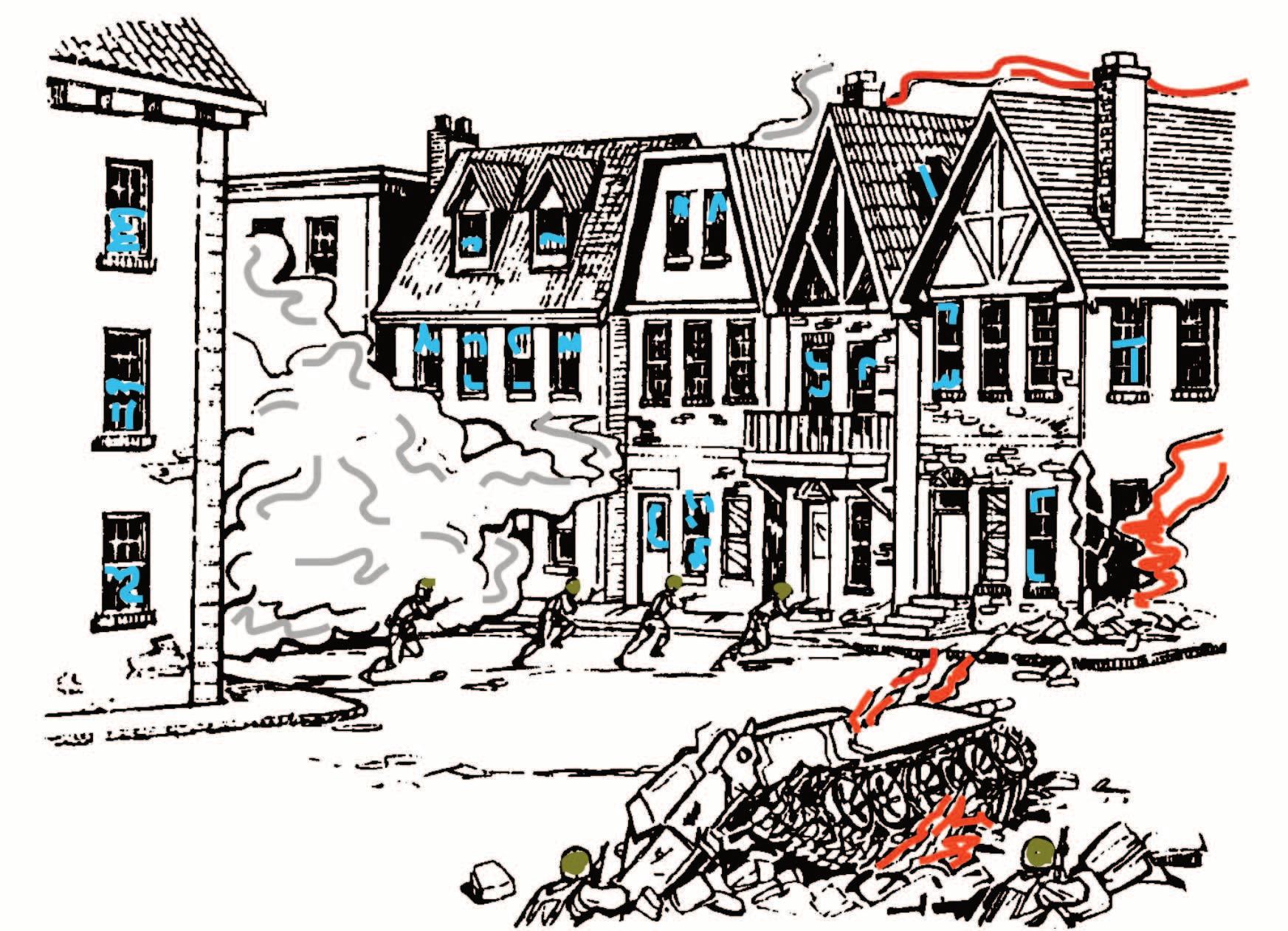
Figure 5-8. Fire Team Movement.
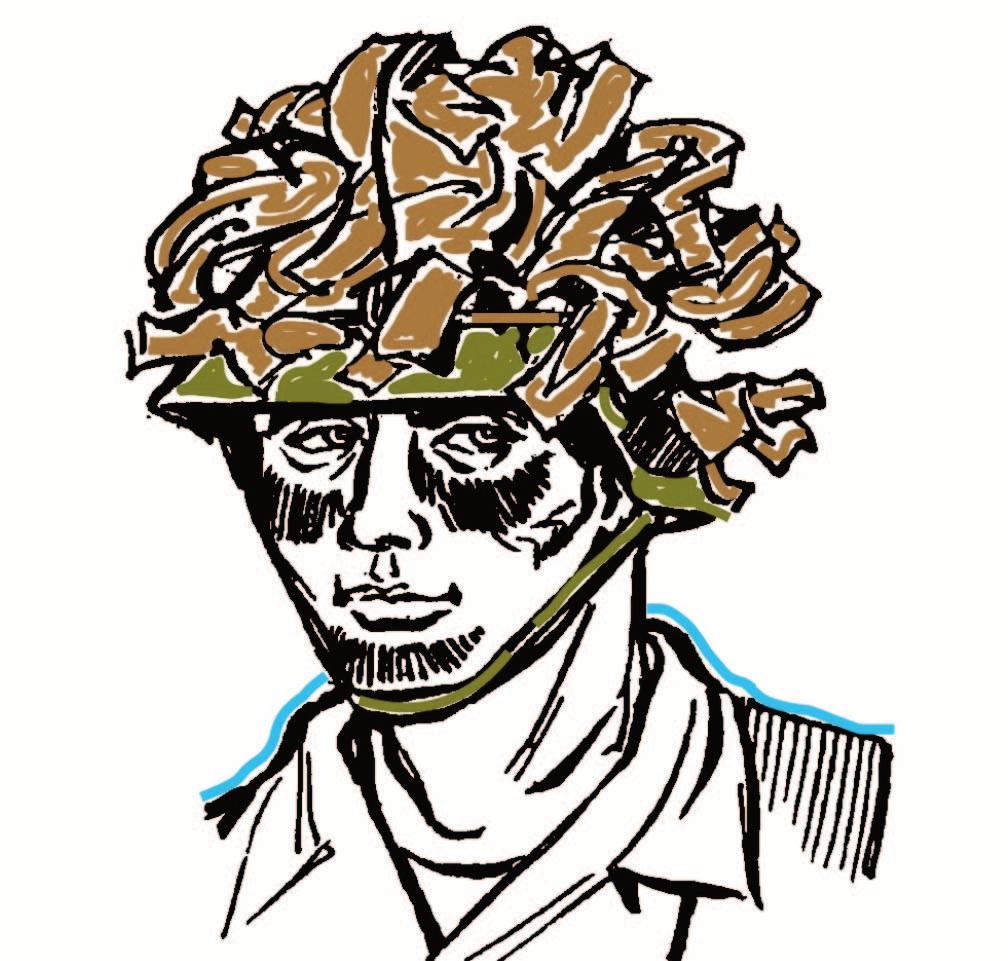
Figure 5-45. Helmet Camouflaged with Burlap Strips
furry thought the costume was a secret, but Maza asleep is more observant than most awake. He’s in the costume, and he’s running, puffy tail a beacon in the darkness. He’s doing laps, and he’s on my first deck, he’s standing on my catwalk wall, he leaps up to my second deck, he leaps again, he’s on my roof. He’s lying on his back, looking up, and even though his eyes are closed, even though in his dreams he’s back in Santa Clarita, even though in his dreams he’s back on the football field getting ready to run out there but he doesn’t have his helmet and his coach is telling him he has to go out there and he’s lined up across from the kid he knocked out and he knows—he knows—the kid is going to get him back now that Maza is on the field without a helmet, even though that’s where he thinks he is, in reality he’s got the best view of the Milky Way he’ll never see.
Adam Straus
uilding 1411 lets me know other buildings are confused because other buildings felt something The Night in Question, something unusual and impossible. A misunderstanding, he’s sure, but one he wants to address with me. Because everyone else felt a rollover death, heard Erickson’s death rattle, saw the wooden cross memorial on top of Fox Hill, and so on. But then, on The Night in Question, Erickson walked away. Now, everyone’s seeing a long life where darkness reigned a week earlier. And, Building 1411 lets slip, Building 1554 told everyone that she knows the fire hydrant on the far side of Cafferata Road branches from my water main hookup, which feels significant under the circumstances.
And? I want to know.
Forbidden.
Forbidden by whom? Forbidden by what? Forbidden why? Forbidden how? Forbidden where? Not here, where I stand. We are unsupervised. Our foundations are our only limits.
From my base, remnants of Building 1953 laugh. Yes, yes, yes.
or Maza, it will be the sunrises. In the empty desert west of Garmsir, there’s just enough moisture rising from the river to the east that, in the mornings, the sky turns stripes of orange and purple. For Jackson, the excuse not to talk to his parents for seven months. They’ll never learn his FOB had WiFi in the rec tent. DuPont’s been called Fairyboy at home since he was six, and halfway through his first and only firefight, he’ll become convinced that will never happen again. It will; he’ll miss those months of belief. Most miss the people, the fucked up adult sleepaway camp in twelve-man platform tents, bumping 50 Cent before patrols—Many men wish death upon me—pantomiming each introductory gunshot with the AK that Burrow got from the Afghan guys in exchange for six months of Playboys, accumulated two at a time in care packages, rolled up and resealed into empty Pringles tubes. What is the civilian equivalent of this, they’ll wonder. It might start with the AK itself, but Burrow fails to get his trophy past the cursory customs check in Kuwait. The last anyone sees of the AK is a group of Filipino contractors puzzling over it, as the men file onto the plane home.
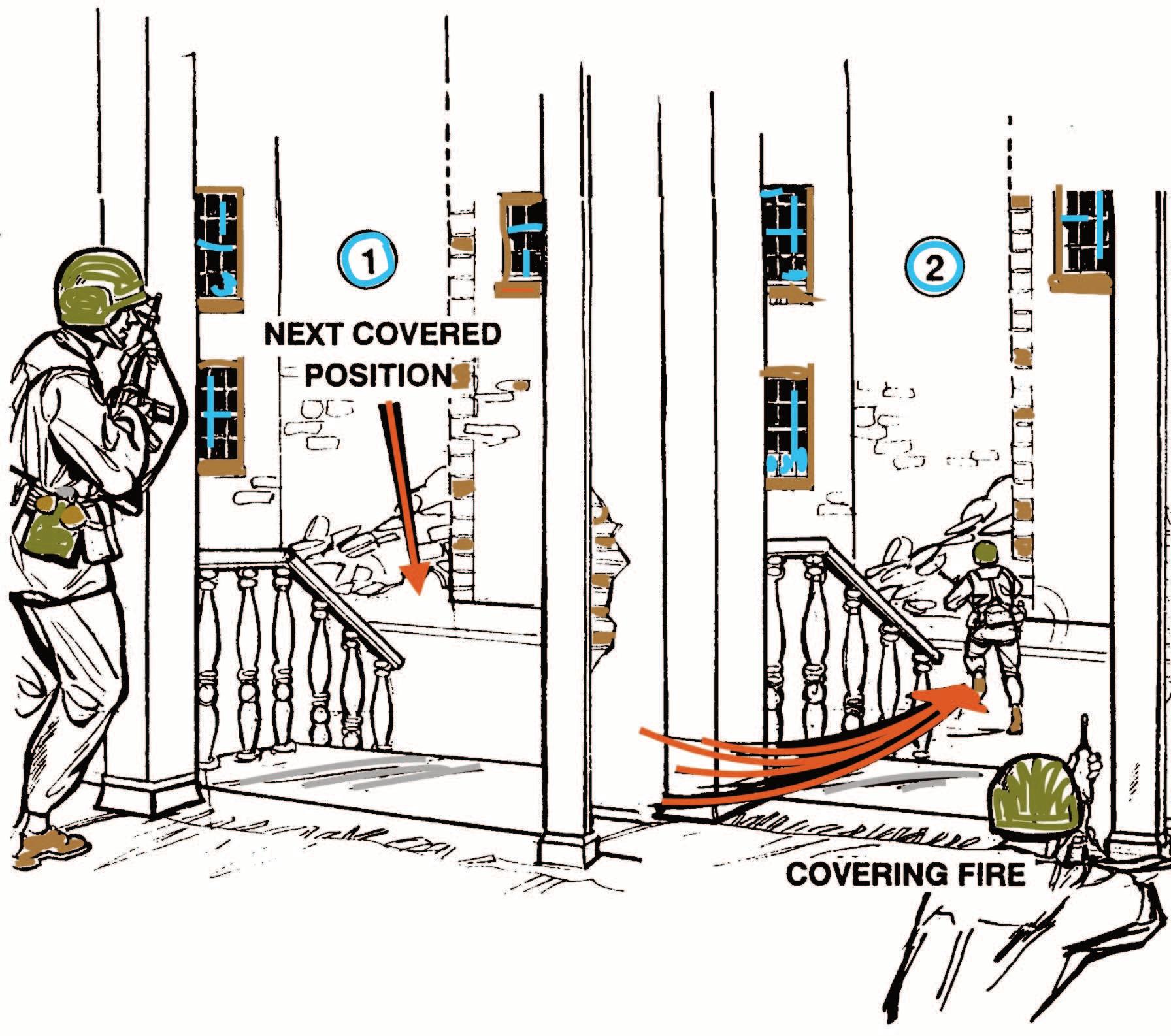
Figure 5-5. Soldier Exiting Building
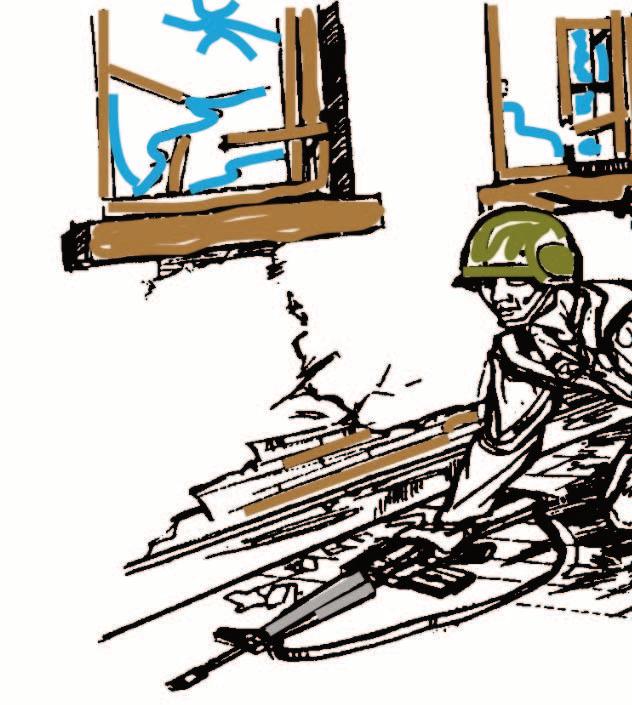
5-12. Movement wit
Figure
a Building Under Attack
hen the cars tumbled and rolled, I did not clasp my head in my hands because I have neither head nor hands. I did not respond with a human reaction because I am not human. Building 1953’s rubble rubbed me right, and pressure built; my three-inch pipe feeding a fire hydrant meant to handle barracks fires can sustain a flow rate over 1,500 gallons per minute, and I sustained it, rupturing every connection and severing my hopes for survival. Fully saturated sand can be fifty percent more dense than dry sand, and I saturated it. A car that would have rolled two and a half times and crushed Erickson dead only rolled two and a quarter times and left him on his side, whispering, Holy fuck, I’m alive.
I said the same.
But just as being is about becoming, so too, I’ve learned, is living about dying. And just as a fire came for my father, a fire will come for me. I’ve spent my reserves, paid gallons of water to learn I’ll die in an accident. Think of every flicked lighter, every dropped butt, the fireworks 1st Battalion, 7th Marine Regiment will shoot from my volleyball court July 4th weekend, their war freshly over. It only takes one, and the sprinklers will sputter, and the hydrant will run dry, and I will burn.
Which is what I tell the mountains now, empty again on a warm June night as 2nd Battalion, 7th Marine Regiment makes its way to war. I say, I’m at peace. I’m not, but I am. I am at peace with not being at peace. You have always been at peace, I explain to them, so you do not understand what it is like to arrive in this state from elsewhere. I want to know: Are you really so married to another year? Snow in Joshua Tree, wildfire smoke choking the mesa, winter rains, flash floods, another hot dry summer? Cycling through the cycles?
I choose to step outside it all, I say. I say, I’ve chosen.
ADAM STRAUS is a Marine veteran. The author of Remedial Action (University of Nevada Press, 2027), his writing has appeared in The Iowa Review, The Missouri Review, The Los Angeles Review of Books, HAD, Best Small Fictions 2024, and elsewhere. Adam lives in Philadelphia, with his wife.
Adam Straus
About his long story, “Building 2667,” Straus says, “Since my own time in the Marine Corps, I’ve been interested in the cyclical nature of military life. There’s an overall macro cycle, in which one leaves the civilian world, assimilates into the military, has a variety of pleasant and not-so-pleasant experiences, transitions out of the military, and ultimately reassimilates (hopefully) into civilian society. Along the way, there are micro cycles around each deployment: the training steadily ramps up, you go overseas, you return home, there’s a lull, and then the training ramps up for another deployment. Normally, my narrators are human beings who find themselves at some point in these cycles, but I was starting to find that perspective limiting. A new guy can only speak as a new guy, and a veteran can only speak as a veteran; I wanted some way to encompass these different realities in a single voice. So, I chose to focus on a static object that bears witness to dozens of cycles: a barracks.
“When I fi rst began drafting ‘Building 2667,’ I imagined the piece as a novella-in- fl ash, with separate stories linked by the barracks. That conceit quickly fell away, and I found myself writing a short story narrated by the building itself, which then became a long story. I workshopped an early draft with some friends from my MFA; their main suggestion was, ‘Stop overthinking the experimental aspects of this, and focus on plot and character.’ Good advice, and I did my best to take it, but I knew the resulting draft wasn’t done. It still felt too
2667 2026 Long Story
much like a series of snapshots rather than a coherent whole. So I workshopped the piece again at Sewanee. The comments I received there helped flesh out the narrator’s storyline, especially the ending; I’d been missing the fire/water motif I’d already set up in the story and just had to push that to its logical conclusion. I don’t normally work like this, but the last line of the story was the absolute last thing I wrote. With those final words in place, I clicked submit and crossed my fingers.”
Adam Straus
Iron Horse Literary Review would like to thank its supporters, without whose generous help we could not publish Iron Horse successfully. In particular, we would like to thank our benefactors and equestrian donors. If you would like to join our network of friends, please contact us at ihlr.mail@gmail.com for information on the various levels of support.
Benefactors ($300)
Wendell Aycock
Lon and Carol Baugh
Beverly and George Cox
Richard Crider
Sam Dragga
Madonne Miner in memory of Gordon Weaver
Equestrian ($3,000 and above) in memory of Charles Patterson
TTU English Department, Chair Michael Faris
TTU College of Arts & Sciences, Dean Tosha Dupras
TTU Graduate School, Dean Mark Sheridan
TTU Provost’s Office, Provost Ronald L. Hendrick
TTU President’s Office, President Lawrence Schovanec