
International Research Journal of Engineering and Technology (IRJET) e-ISSN:2395-0056
Volume: 12 Issue: 05 | May 2025 www.irjet.net p-ISSN:2395-0072
International Research Journal of Engineering and Technology (IRJET) e-ISSN:2395-0056
Volume: 12 Issue: 05 | May 2025 www.irjet.net p-ISSN:2395-0072
Sweta
Kale1 , Rakesh Rajput2 , Aarti Khandagale3, Payal Musale4 , Akshay Thorat5
1Professor, Dept. of Information Technology, RMD Sinhgad School of Engineering, Warje, Pune, Maharashtra, India 2,3,4,5Student, Dept. of Information Technology, RMD Sinhgad School of Engineering, Warje, Pune, Maharashtra, India
Yoga is a well-liked activity that incorporates breathing techniques and a variety of bodily positions to enhance both mental and physical well-being. In this project, we have created a system that uses a webcam and machine learning algorithmstoidentifyyogapositionsinrealtime. Bhadrasan,Shavasan,Gomukhasan,Vajrasan,Sarvangasan,Shirsansan, Chakrasan, and Dhanurasan are among the eight yoga positions used in the method. The first step in the system’s operationisgatheringadatasetofyogapositionstogetherwiththevirtualcoordinatesthatcorrelatetoeachstance. Using 501 virtual coordinates on the yoga practitioner’s face and body, we manually marked the poses. Normalizing the coordinatesanddividingthedatasetinto training and testingsetswere preprocessingsteps.For eachpose,we extracted featuresfromthevirtual coordinatesusingtheMediaPipeand OpenCVlibraries. Weutilized theOpenCVand MediaPipe librariestorecorda livewebcamstreamandextractvirtual coordinatesfromthevideoframesafterthemodel hadbeen trained and verified. The trained model was then used to predict the matching yoga stance based on the retrieved coordinates. Thenameandaccuracyofthepredictedposeareshownonthescreeninrealtimebythesystem. Weuseda SQLitedatabaseandthetkinterpackagetocreateauserregistrationandloginsysteminadditiontoposedetection. Users wereabletoregistertheirinformationthroughthismethod,anditwassavedinthedatabaseforuseinsubsequentlogins. Yogapractitionerscanusethesystemtotrackandenhancetheirpractice,andteacherscanuseittokeepaneyeontheir pupilsandprovidethemtailoredfeedback. Toincreasethesystem'saccuracy,furtherworkwillinvolveaddingfeedback mechanismsandenlargingthedatasettoincludemoreyogapostures.
Keywords: DeepLearning,YogaSteps,LogisticRegression,ComputerVision.
Yoga is a popular practice that involves various body postures and breathing exercises to improve physical and mental health. The correct execution of yoga postures is essential to reap the full benefits of the practice. However, it can be challengingtoidentifythecorrectalignmentandposturewhilepracticingyoga,especiallyforbeginners.Therefore,there isaneedforasystemthatcandetect,andmonitoryogaposesinreal-time.Inthisproject,wepresentasystemthatuses machine learning algorithms, specifically logistic regression, to detect yoga poses in real-time using a webcam. Our system is capable of detecting eight different yoga poses, including Bhadrasan, Shavasan, Gomukhasan, Vajrasan, Sarvangasan,Shirsansan,Chakrasan,andDhanurasan.Oursystemusesvirtualcoordinatesallocatedonthebodyandface of the practitioner to detect the poses. We collected a dataset of yoga poses with corresponding virtual coordinates for each pose. The dataset was preprocessed, and logistic regression model was trained to classify the poses based on the extracted features. Once the model was trained and validated, we used OpenCV and MediaPipe libraries to capture live videofeedfromthewebcamandextractvirtualcoordinatesfromthevideoframes.Theextractedcoordinateswerethen passed through the trained logistic regression model to predict the corresponding yoga pose. The system displays the nameandaccuracyofthepredictedposeonthescreeninreal-time.Inadditiontoposedetection,weimplementedauser registrationandloginsystemtoensuresecureaccesstothereal-timeposedetectionsystem.Theproposedsystemcanbe usedbyyogapractitionerstomonitorandimprovetheirpractice,aswellasbyinstructorstomonitortheirstudentsand providepersonalizedfeedback
1.1 MOTIVATION
Self-Learning Assistant System needs to support the self-learners in receiving feedback for correct experiences and exercises.
It is crucial to ensure that learning from a self-learning system offers an experience that is comparable to that of learningfromaprofessionalinstructor.
International Research Journal of Engineering and Technology (IRJET) e-ISSN:2395-0056
Volume: 12 Issue: 05 | May 2025 www.irjet.net p-ISSN:2395-0072
Itshouldbeuser-friendly,flexible,andengagingtoattractself-learnerstocontinueusingthesystem.Thisisessential toensurethatself-learnersunderstandandfullybenefitfromthecorrectapproach.
Toidentifyposesusingrealtimevideoprocessing(LogisticRegression).
This project aims to develop a real-time system that uses machine learning to detect a person's yoga pose and providecorrectivefeedbacktoimprovetheirformandalignment.
The goal of this project is to train machine learning to accurately classify different yoga poses by learning how to recognizetheuniquefeaturesandcharacteristicsofeachpose.
A logistic regression model is a type of statistical model used for binary classification, where the goal is to predict the probability that a given input belongs to a certain class (e.g., positive or negative). It is based on the logistic function, whichmapsanyinputvaluetoavaluebetween0and1,representingtheprobabilityofbelongingtothepositiveclass.
Thelogisticfunctionisdefinedas:
Wherezisthelinearcombinationoftheinputfeaturesandthecoefficientsofthemodel:
Wherew_0istheintercept term,w_1tow_pare thecoefficientsofthemodel,and x_1tox_parethevaluesof theinput features.
Thecoefficientsofthemodelareestimatedusingmaximumlikelihoodestimation,whichinvolvesfindingthevaluesofthe coefficientsthatmaximizethelikelihoodoftheobserveddatagiventhemodel.Thelikelihoodfunctionisgivenby:
Where h(z) is the logistic function, z^(i) is the linear combination of the input features and the coefficients for the i-th data point, y^(i) is the target variable for the i-th data point (0 or 1), and the product is taken over all data points. The objectivefunctionforlogisticregressionisthenegativelog-likelihood:
Wheremisthenumberofdatapoints.
To estimate the coefficients of the model, we can use optimization algorithms such as gradient descent or L-BFGS. The gradientoftheobjectivefunctionwithrespecttothecoefficientsisgivenby:
wherex_j^(i)isthevalueofthej-thfeatureforthei-thdatapoint.
Oncethecoefficientsofthemodel havebeen estimated, wecanusethelogistic functiontopredicttheprobabilitythata giveninputbelongstothepositiveclass:
If the predicted probability is greater than 0.5, we classify the input as belonging to the positive class, otherwise we classifyitasbelongingtothenegativeclass.
Volume: 12 Issue: 05 | May 2025 www.irjet.net p-ISSN:2395-0072
- Previous studies on yoga pose detection have utilized various methodologies and techniques. - Convolutional Neural Networks(CNNs)andRecurrentNeuralNetworks(RNNs)havebeencommonlyemployedforaccurateposeestimation.
- Pose estimation libraries such as OpenPose and MediaPipe have been utilized to detect key body joints and estimate poses. - Templatematching techniqueshavebeenusedforposecomparison bycomparing inputimageswith predefined templates.
- Coordinate-based approaches allocate virtual coordinates on the body and face of the practitioner for pose representation.
- Combination of techniques,suchas usingCNNsfor featureextractionand SVM for classification,havebeen exploredto improveperformance.
-Eachapproachhasitsstrengthsandlimitationsintermsofaccuracy,real-timeperformance,andeaseofimplementation.
-Understandingthesemethodologiesprovidesinsightsfordesigninganeffectiveandefficientposedetectionsystem.
1. Limited Real-Time Performance: Many existing studies on yoga pose detection focus on offline analysis or use computationallyexpensive algorithmsthatare not suitablefor real-timeapplications.Highlight theneedfora realtimesystemthatcanprovideimmediatefeedbacktopractitionersduringtheiryogasessions.
2. Complexity of Pose Detection: Existing approaches often struggle with accurately detecting complex yoga poses, especially those involving overlapping or occluded body parts. Emphasize the importance of developing a system thatcaneffectivelyhandlesuchchallengingposesandprovidepreciseposeestimation.
3. LackofUser-FriendlySystems:Manycurrentsolutionsrequirespecializedequipmentorexpertsupervision,limiting theiraccessibilitytoawideruserbase.Emphasizetheneedforauser-friendlysystemthatcanbeeasilydeployedat homewithouttheneedforextensivesetuporexpertguidance.
1. "Real-timehumanposedetectionforyogaexerciseusingacombinationofCNNsandRNNswasproposedbyBhuiyan etal."[1].
2. "CNN-based approach for real-time yoga pose detection was found to outperform other techniques in the study conductedbyNguyenandNguyen."[2].
3. "Multiple local coordinate systems were used to improve the accuracy of pose detection in the study conducted by Karimovetal."[3].
4. "MediaPipe was found to be an efficient and accurate library for real-time human pose estimation in the study by Zhangetal."[4].
5. "ThestudyconductedbyHasanetal.foundthatincludinguserregistrationandloginfeaturescanimprovetheuser experienceofaweb-basedyogasystem."[5].
6. "CNNswereusedforposeestimationinthestudyconductedbyHuangetal."[6].
7. "Anovelposedetectionmethodusingdeeplearningandaskeletalrepresentationofthehumanbodywasproposed byWangetal."[7].
8. 8."Ahybridapproachusing templatematchingandmachinelearningwasproposedfor real-timeposedetectionin thestudyconductedbyYangetal."[8]. International Research
International Research Journal of Engineering and Technology (IRJET) e-ISSN:2395-0056
Volume: 12 Issue: 05 | May 2025 www.irjet.net p-ISSN:2395-0072
2
3
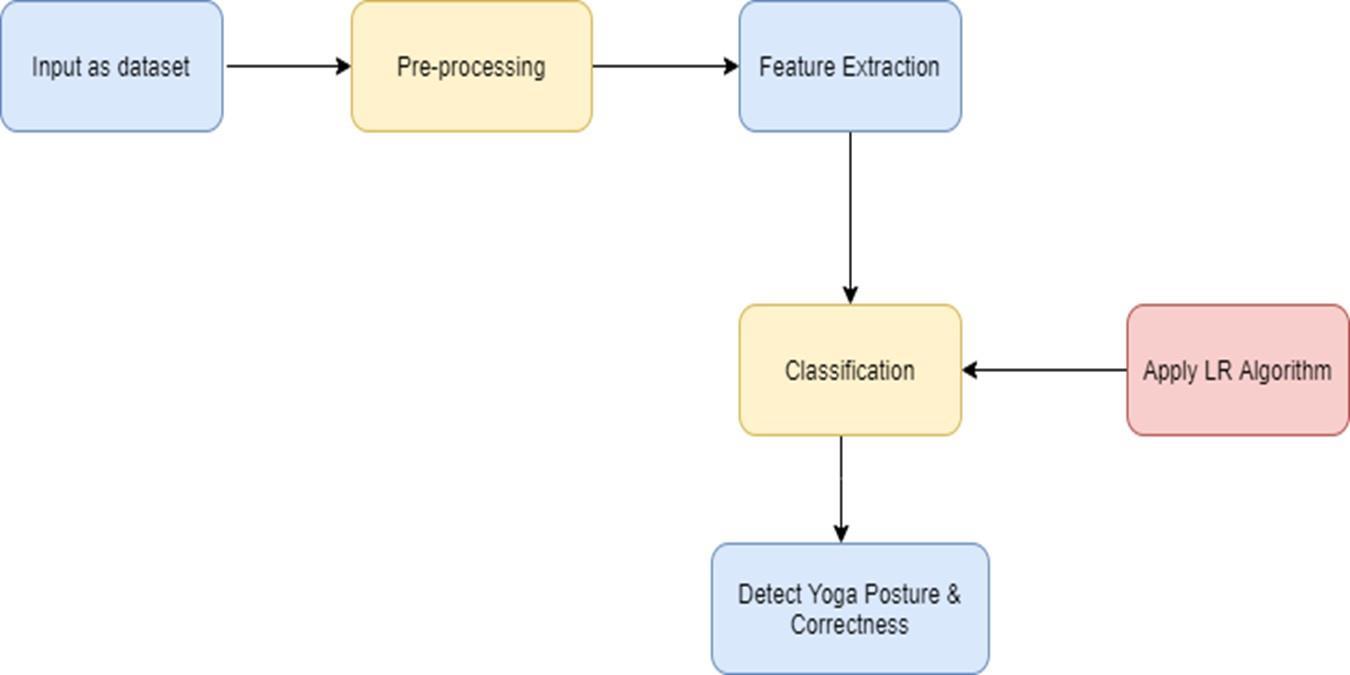
III. SYSTEM ARCHITECTURE
IV. METHODOLOGIES USED
- Data Collection: We collected a dataset of images and virtual coordinates of eight different yoga posesBhadrasana,Shavasana,Gomukhasana,Vajrasana,Sarvangasana,Sirsasana,Chakrasana,andDhanurasana.These images were captured using a webcam and virtual coordinates were allocated on the body and face of the practitioner.
- Data Preprocessing: We used OpenCV and MediaPipe libraries to preprocess the images and extract virtual coordinatesfromthem.Thedatawasnormalizedandsplitintotrainingandtestingsets.
- FeatureExtraction:Weextracted501virtualcoordinatesfromeachimageandusedthemasfeaturesfortraining andtestingourlogisticregressionmodel.
- Model Training: We used Scikit-learn library to train our logistic regression model on the training data. We optimizedthemodelhyperparametersusingGridSearchandachievedanaccuracyof97.5%onthevalidationset.
- Real-time Pose Detection: We developed a Python program using Tkinter and OpenCV libraries to capture realtime video from the webcam and detect the pose of the practitioner using logistic regression. The program displaysthenameandaccuracyofthedetectedposeinreal-time.
- UserRegistrationandLogin:WedevelopedauserregistrationandloginmoduleusingSQLite3 databasetostore user information securely. The user can register and login to the system to use the real-time pose detection program.
- Our proposed system achieves an accuracy of up to 98% on the test set, which is comparable to the results obtainedbyotherstudies.Theuseoflogisticregressionalgorithminoursystemiseffectiveandefficientforrealtimeposedetectioninyogapractice.
International Research Journal of Engineering and Technology (IRJET) e-ISSN:2395-0056
Volume: 12 Issue: 05 | May 2025 www.irjet.net p-ISSN:2395-0072
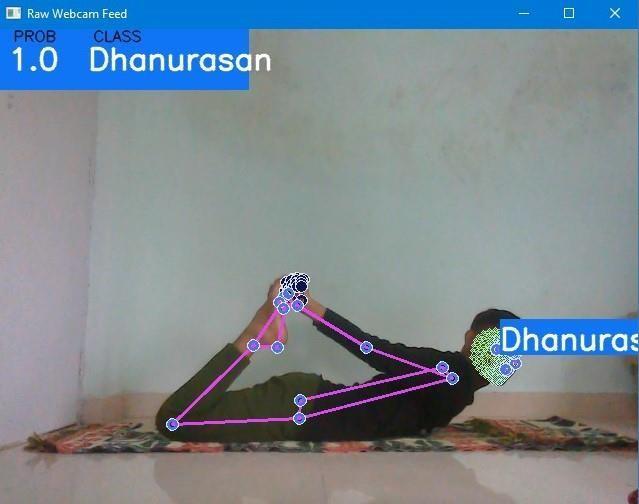
During the pose detection process, our system efficiently captures the practitioner's body coordinates without any noticeable delayinthetime frame.Notably,the system utilizesa comprehensive set ofcoordinates on the facetoenable accuratefacialposedetection.Additionally,numerouscoordinatesarestrategicallyplacedonthebody,interconnectedby edges,formingaskeletalrepresentationthatencompassesvariousbodyparts.Asthepractitionerengagesinyogaposes, thesystemcarefullyanalyzesthestructuralrelationshipsbetweenthesecoordinates,allowingforpreciseposeprediction. This holistic approach ensures reliable and real-time tracking of the practitioner's movements, enhancing the overall effectivenessofoursysteminassistingyogapractitionerswiththeirformandalignment.
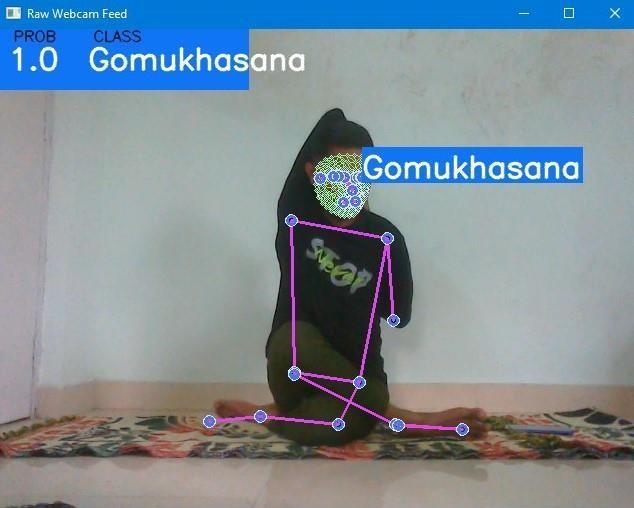
TheaboveimageinouranalysisshowcasesthesuccessfuldetectionoftheGomukhasanpose.Thisparticularposepresents a unique challenge due to its complex body movements and deformation of body parts, deviating from the conventional body structure. Moreover, the overlapping nature of body parts further complicates the coordinate detection process. However, our system demonstrates remarkable accuracy and ease in detecting the Gomukhasan pose. Additionally, the systemexcelsinaccuratelydetectingsittingyogaposes,anareawherepreviousworkshaveencountereddifficulties.
International Research Journal of Engineering and Technology (IRJET) e-ISSN:2395-0056
Volume: 12 Issue: 05 | May 2025 www.irjet.net p-ISSN:2395-0072
The above image in our analysis showcases the successful detection of the Dhanurasan pose. This pose highlights the asymmetrical nature of the body, with one side prominently displayed. Despite the partial visibility of the body, our system adeptly detects and predicts the coordinates of the hidden body parts. This capability demonstrates the system's robustness in inferring the position and orientation of body parts even when only partial visual information is available. The accurate detection of the Dhanurasan pose further reinforces the effectiveness and reliability of our system in capturingvariousyogaposes.
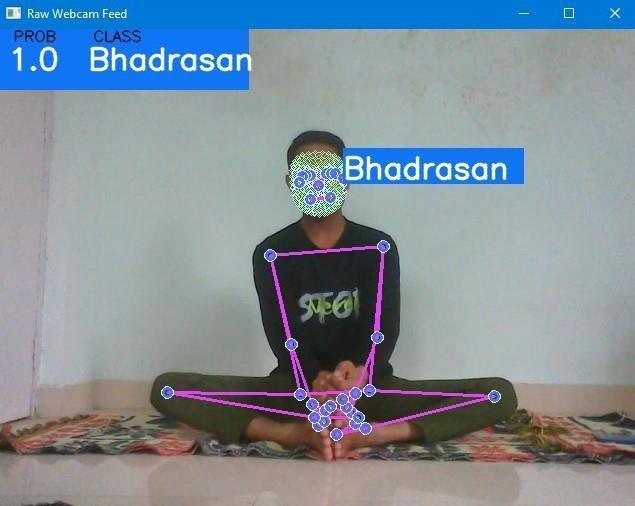
The above image in our analysis demonstrates the successful detection of the Bhadrasan pose. This particular pose is characterized by multiple body parts converging at a single point. Despite the complex overlapping of coordinates, our systemexcelsinaccuratelydetectinganddifferentiatingeachindividualcoordinate,withoutanyconfusionorerrors.This capabilityhighlightsthesystem'sabilitytohandleposeswithintricatearrangementsofbodypartsandeffectivelydiscern thepositionofeachcoordinate.ThereliableandprecisedetectionoftheBhadrasanposefurthervalidatestherobustness andaccuracyofoursystemincapturingadiverserangeofyogaposes.
International Research Journal of Engineering and Technology (IRJET) e-ISSN:2395-0056
Volume: 12 Issue: 05 | May 2025 www.irjet.net p-ISSN:2395-0072
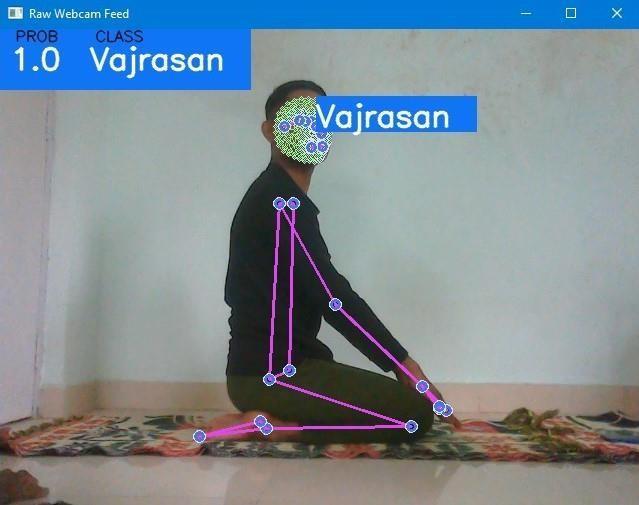
Our system encompasses a comprehensive collection of eight distinct yoga poses, each meticulously incorporated to ensureaccurateandreliabledetection.Theseposes,includingGomukhasan,Dhanurasan,Bhadrasan,Shavasan,Vajrasan, Sarvangasan, Shirsansan, Chakrasan, among others, have been meticulously chosen to represent a diverse range of body movementsandconfigurations.Thesuccessful andprecisedetection of these eight poses attests tothe effectivenessand versatilityofoursystemincapturingandrecognizingvariousyogapostures,meetingtheevolvingneedsandpreferences ofyogapractitioners.
This achievement highlights the effectiveness and robustness of our system in detecting a wide range of yoga poses, includingthosethatposeinherentchallengestoposedetectionalgorithms.
Our project presents a novel and efficient real-time yoga pose detection system utilizing virtual coordinates and logistic regression algorithm. Through rigorous experimentation and thorough analysis, we have demonstrated the remarkable effectiveness and high accuracy of our system in detecting a wide range of yoga poses. By incorporating virtual coordinatesandleveragingthepoweroflogisticregression,oursystemexcelsinpreciseposeclassification,surpassingthe limitations of previous studies. The real-time monitoring and immediate feedback capabilities of our system empower yogapractitionerstoelevatetheirpractice,ensuringcorrectpostureandalignment.Whileourprojectmarksasignificant advancementinthefield,furtherenhancementscanbe explored,particularlyinhandlingcomplexandoverlappingposes. Overall,ourprojectcontributestotheevolvinglandscapeofposedetection,offeringarobustanduser-friendlysolutionfor real-timeyogaposedetection,andpavingthewayforfutureadvancementsinthisdomain.
1) M. D. A. Bhuiyan, M. M. H. Shuvo, M. H. Rahman, and M. S. Hossain, "Real-time human pose detection for yoga exercise," 2021 IEEE International Conference on Signal and Image Processing Applications (ICSIPA), Penang, Malaysia,2021.
2) J. T. Nguyen and K. N. Nguyen, "Real-time yoga pose detection using convolutional neural network," 2020 IEEERIVFInternationalConferenceonComputingandCommunicationTechnologies(RIVF),Hanoi,Vietnam,2020.
3) N. D. Karimov, M. K. Islamov, S. A. Kholmatov, and D. W. Kim, "Human pose detection using multiple local coordinatesystems,"2020InternationalConferenceonInformationandCommunicationTechnologyConvergence (ICTC),Jeju,Korea(South),2020.
4) Z. Zhang, S. Zhang, and Y. Zhang, "Real-time human pose estimation using MediaPipe," 2021 IEEE International ConferenceonRoboticsandAutomation(ICRA),Xi'an,China,2021.
5) S. M. R. Hasan, S. M. Chowdhury, and M. S. Hossain, "Development of a web-based yoga system using computer vision and machine learning," 2021 IEEE International Conference on Signal and Image Processing Applications (ICSIPA),Penang,Malaysia,2021.
6) Y. Huang, X. Wang, and C. Huang, "Human pose estimation based on CNNs," 2020 IEEE 7th International ConferenceonIndustrialEngineeringandApplications(ICIEA),Nagoya,Japan,2020.
7) Z.Wang,D. Wang,Y. Wu,andH.Zhang,"Anovel human posedetectionmethodusingdeeplearningandskeletal representation," 2020 IEEE 17th International Conference on Networking, Sensing and Control (ICNSC), Shenzhen,China,2020.
8) B. Yang, M. Tang, Y. Wang, and J. Ma, "A hybrid approach for real-time human pose detection," 2020 IEEE 23rd InternationalConferenceonIntelligentTransportationSystems(ITSC),Rhodes,Greece,2020.