
International Research Journal of Engineering and Technology (IRJET) e-ISSN: 2395-0056
Volume: 11 Issue: 12 | Dec 2024 www.irjet.net p-ISSN: 2395-0072

International Research Journal of Engineering and Technology (IRJET) e-ISSN: 2395-0056
Volume: 11 Issue: 12 | Dec 2024 www.irjet.net p-ISSN: 2395-0072
(1) M.Tech. Student, Department of Environmental Engineering, Shivaji University, Maharashtra, India. (2) Associate Professor, Department of technology, Shvaji University, Maharashtra, India
Abstract:- In India the rivers are getting polluted due to mixing of untreated wastewater into the river directly Due to mixing of untreated wastewater and the non-availability of proper treatment system in villages it is necessary to reuse the treated wastewater for farming and other application and it is necessary to avoid the direct discharging of untreated wastewater into the rivers. The wastewater samples were collected from nalahs, river upstream and downstream for analyzing and comparing the quality with respect to pH, COD, BOD, TDS, TSS and total coliform. Based on the analysis report it has been observed that, due to directly mixing of untreated wastewater from village into the Dudhganga river, the concentration of COD and BOD in downstream is observed to be at increased level with respect to upstream concentration. An integrated approach is needed to manage the water and wastewater treatment so that water supply is kept clean and wastewater is recycled for beneficial use in agriculture with the use of low-cost treatment like in-situ nallah treatment with use of elephant grass and canna indica. Adopting such in-situ treatment with using natural resources is important to make the Zero Liquid Discharge villages in Maharashtra as well as in India to conserve the rivers.
Keywords: Sewage water treatment, River pollution, Low-cost treatment, Village wastewater management, In-situ treatment.
The state of Maharashtra which is located in the western region of India, is characterized by its diverse landscapes, rich cultural heritage, and rapid urbanization. Within this dynamic milieu, the management of wastewater poses a significant challenge, particularly in rural areas where infrastructure and resources are often limited. One such regiongrapplingwithwastewatermanagementissuesisthevillageofSiddhanerlisituatedinthedistrictofKolhapur.
The objective of this research paper is to comprehensively assess the wastewater management practices in Siddhanerli, evaluate the repercussions of untreated wastewater disposal into the Dudhganga river, and propose viable, low-cost treatment methods tailored to the community's needs. By undertaking this study, aimed to shed light on the criticalissueofwastewatermanagementatthegrassrootslevelandprovideactionableinsightsforsustainablesolutions. ThereviewofexistingwastewatermanagementpracticesinSiddhanerliwillserveasafoundationalstepinunderstanding thecurrentscenario.Thisanalysiswillencompassanexaminationoftheinfrastructure,policies,andcommunitypractices related to wastewater disposal and treatment. Additionally, it will highlight any gaps or inefficiencies in the existing wastewatermanagementsystemthatcontributetoenvironmentaldegradationandpublichealthrisks. Subsequently,the evaluation of the impact of untreated wastewater disposal into the river will illuminate the ecological and social consequences of this practice. By assessing water quality parameters, ecological health indicators, and community perceptions, we aim to quantify the extent of pollution and its ramifications on both the environment and human wellbeing.
Drawingupon the findings fromthe initial assessments, the research will thenfocusonidentifyingsuitablelowcost wastewater treatment methods tailored to the specific needs and constraints of the community. Emphasizing simplicity,affordability,andeffectiveness,thesemethodswillbeevaluatedbasedontheirtechnicalfeasibility,scalability, andsocio-economicimplications.
Finally, the research endeavors to facilitate coordination with the gram panchayat, the local governing body, for theeffectiveimplementationofthewastewatermanagementscheme.Throughstakeholderengagement,capacitybuilding, and participatory decision-making processes, we aim to foster community ownership and ensure the long-term sustainabilityoftheproposedinterventions.
Insummation,thisresearchpaperseekstoaddressthemultifacetedchallengesofwastewatermanagementinthe rural context of Maharashtra, with a specific focus on Siddhanerli village located in Kolhapur district. By undertaking a holistic approach encompassing assessment, evaluation, identification, preparation, and coordination, we aspire to contribute towards the realization of a cleaner, healthier, and more sustainable environment for present and future generations.
International Research Journal of Engineering and Technology (IRJET) e-ISSN: 2395-0056
Volume: 11 Issue: 12 | Dec 2024 www.irjet.net p-ISSN: 2395-0072
TheSiddhanerliVillageofMaharashtrastateissituatedonthebankofDudhagangaRiver.TheVillageliesbetweenlatitude 16°32' to 16°33' and longitude 74°14' to 74°16' with an elevation of 578 m above mean sea level. The location of Siddhanerli Village Figure and has an area of around 430000 m2 The climate of Siddhanerli is tropical and the annual rainfall ofthe district is 1200-1500 mm.The population under of Siddhanerli asper Census 2011 is 6152 and percapita watersupplytovillageasperlocalbodysourceis70LPD
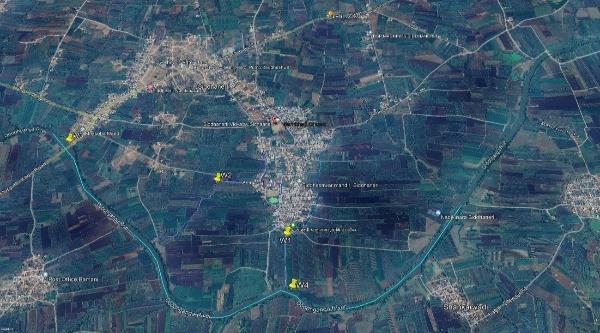
To understand the water quality of wastewater and river water the samples were collected from sewer lines and river upstreamanddownstream. The watersamplefrom damisalsocollectedto evaluatethevariationsin water qualitywith distance.Theanalysisresultsaretabulatedinfollowingtable.
Table:-Resultsofwastewateranalysis
ThepHwas6.98-7.37observedwithinrangeasprescribedinNGTorderdated30.04.2019.
However, as per the NGT order dated 30.04.2019 the village is exceeding the standard discharge limit of COD, BOD and TSS. As per the water quality standard there should not be the presence of COD and BOD in drinking water but due to
International Research Journal of Engineering and Technology (IRJET) e-ISSN: 2395-0056
Volume: 11 Issue: 12 | Dec 2024 www.irjet.net p-ISSN: 2395-0072
directlymixingofuntreatedwastewaterinriver,daybydaythethereisincreasingtheconcentrationofBODandCODin riverwater.AspertheanalysisreportofdamwaterthepresenceofCODandBODindamwaterisverylessascompareto the concentration of COD and BOD in Dudhganga river at Siddhanerli. Considering this increasing concentration of BOD and COD in river water it is necessary to take required action like Zero Liquid Discharge of wastewater from villages in riverbody.
Toevaluatetheimpactofuseofelephantgrassforinsitutreatmentofsewagewater,thenaturalnalahofambigalliareais selected for case study. With the help of local farmer the plantation of elephant grass along the 200 m road side of the nalah has been carried out. Based on nalah water the growth of elephant grass has been carried out. After 3 month of plantation the plant has been observed to be fully grow. To check the impact of elephant grass on reduction of contaminationofwastewater,thesampleatinletandoutletofnalahhasbeencollectedforanalysisofCODandBOD.Based ontheanalysisreport ithasbeenobservedthat around 39%reductioninBODconcentrationand32%reductioninCOD concentrationhasbeenobserved.
TheresultsobtainedfromtheanalysisarepresentedinthefollowingTable.
4. Conclusion
Basedonthecasestudyandanalysis,ithasbeenobservedthatthe riverwaterqualityisdeterioratingdaybydaydueto mixingofuntreatedwastewaterfromvillage.Consideringthenon-feasibilityforprovidingofwastewatertreatmentplant in village areas, it is necessary to find low-cost treatment options for Zero Liquid Discharge of sewage water in rivers. With using the technologies such as in-situ nallah treatment, it will provide the reduction of contamination without any majorcapitalexpenditures(CAPEX)andoperationalexpenditures(OPEX).PlantationsuchasCannaIndicaalongtheroad of nallah will help for providing aesthetical look to roads as well as for reduction of wastewater contamination and plantation of Elephant grass will help farmers for growing of grass for cattle’s and reduction of river contamination. By providing of such plants along the nallah of all area for wastewater treatment through in-situ nallah treatment can be directlyutilizedinfarmsforgrowingofsugarcane,rice,flowersetc.Thistypeofpracticewillalsoreducetheloadonriver insummerseasonsandwecanabletoachieveZeroLiquidDischarge(ZLD)village.
[1] AmericanPublicHealthAssociation(APHA),“StandardMethodsfortheExaminationofWaterandWastewater”,20th Edition,(1998).
[2] BureauofIndianStandard(BIS),“IndianStandardDrinkingWater –Specification(secondrevision)”,IS10500:2012, (2012).
[3] CentralPollutionControlBoard(CPCB),“GuidelinesforWaterQualityMonitoring”,(2008).
[4] MaharashtraPollutionControlBoard(MPCB),“StateofEnvironmentReport:Maharashtra”,(2005).
[5] World Health Organization (WHO), “Hardness in Drinking-water”, Background document for development of WHO GuidelinesforDrinking-waterQuality,(2011).
[6] TheHon’bleNGTorderdated30.04.2029inO.ANo1069of2018.
[7] Rahul shete and Radhika kommu (2022), “Panchganga river pollution-case study” International Research Journal of ModernizationinEngineeringTechnologyandScience.
[8] Ms. Puja Devkar and Prof. D. B. Desai (2020), “River Pollution: A Case Study of Panchaganga River”, International ResearchJournalofEngineeringandTechnology(IRJET)