
International Research Journal of Engineering and Technology (IRJET) e-ISSN: 2395-0056
Volume: 13 Issue: 04 | Apr 2026 www.irjet.net p-ISSN: 2395-0072

International Research Journal of Engineering and Technology (IRJET) e-ISSN: 2395-0056
Volume: 13 Issue: 04 | Apr 2026 www.irjet.net p-ISSN: 2395-0072
Dasari
Ashritha¹, Dasari BindhuMadhavi², Dundangi MaryDivya³, Ellamsetty HariPreethi⁴, Prof. Dr. B. Prajna⁵
¹²³⁴B.Tech Final Year, Department of Computer Science and Systems Engineering
Andhra University College of Engineering for Women, Visakhapatnam, Andhra Pradesh, India
⁵Head of the Department, Computer Science and Systems Engineering
Andhra University College of Engineering for Women, Visakhapatnam, Andhra Pradesh, India
Abstract This paper presents VOCALEYE, an advanced assistive technology system designed to enhance environmental awareness and facilitate independent navigation for visually impaired individuals. Conventional assistive tools such as white canes and guide dogs, while useful in familiar settings, fail to deliver the semantic richness and adaptability required for complex, dynamic environments. VOCALEYE addresses this gap by integratingdeeplearning-basedobjectdetectionwithrealtime auditory feedback, forming a comprehensive scene interpretationpipeline.
The core detection engine is built on YOLOv8s, a state-ofthe-art single-pass convolutional architecture that achieveshigh-speedinferencewithminimalcomputational overhead.AcustomDistanceEstimationEngine,grounded in Triangle Similarity and monocular focal length calibration, provides reliable proximity estimates without requiring depth sensors or stereo cameras. A FastAPI/WebSocket backend facilitates asynchronous, low-latency streaming of Base64-encoded frames and JSON-formatted detection metadata between the capture clientandtheinferenceserver.
Experimental evaluations confirm a Mean Average Precision(mAP)of0.82ataconfidencethresholdof0.5,an average inference latency of 130 ms per frame, and a distance estimation error margin below 8% for objects in the 1–5 metre range. The system supports multilingual audio output in English, Hindi, and Telugu, significantly broadening its accessibility. User trials report approximately 65% reduction in navigation errors and a satisfactionscoreof4.5outof5.0.
Keywords YOLOv8, Object Detection, Assistive Technology, Distance Estimation, FastAPI, WebSocket, Voice Feedback, Computer Vision, Visually Impaired, MultilingualInterface.
Visualimpairmentremainsoneofthemostpervasive and life-limiting sensory disabilities worldwide. According to the World Health Organization (WHO), approximately285millionpeoplegloballylivewithsome
degreeofvisualimpairment,ofwhomatleast39million are classified as completely blind [6]. For these individuals, navigating both familiar and unfamiliar environmentspresentsapersistentchallengedefinedby highcognitiveload,spatialuncertainty,anddependence onsightedassistanceorrudimentaryphysicalaids.
Traditional assistive devices, including long white canes and trained guide dogs, provide limited spatial feedbackandcannotconveysemanticinformationabout thesurroundingenvironment.Theyareunabletoidentify the class, nature, or proximity of objects beyond immediate physical contact. Emerging smartphonebased solutions, while more informative, demand sustained manual interaction and rely heavily on cloud connectivity both significant limitations in practical deployment.
The convergence of deep learning, embedded computing, and real-time communication protocols has opened a new design space for intelligent assistive systems. VOCALEYE is engineered to occupy this space, functioning as a fully autonomous real-time Scene Interpreter. It transduces high-dimensional visual data intoconcise,prioritizedauditorystimuli,enablingusers to build an accurate spatial model of their environment withoutvisualinput.
The system leverages the YOLOv8 Convolutional NeuralNetwork(CNN),optimizedforhigh-speed,multiclass object detection in a single forward pass. Its backendisconstructedusingFastAPI amodern,highperformancePythonwebframework andWebSockets (RFC 6455), which together enable full-duplex, lowoverhead streaming of video frames and detection results. The Distance Estimation Module, based on the geometricprincipleofTriangleSimilarityandmonocular focal length calibration, infers object proximity from pixel-width measurements without requiring additional depthsensors.
A key design goal of VOCALEYE is accessibility: the system supports multilingual text-to-speech (TTS) output in English, Hindi, and Telugu using the Google Text-to-Speech(gTTS)library,ensuringrelevanceacross linguisticallydiverseuserpopulations.Anasynchronous
International Research Journal of Engineering and Technology (IRJET) e-ISSN: 2395-0056
Volume: 13 Issue: 04 | Apr 2026 www.irjet.net p-ISSN: 2395-0072
audio management layer prevents feedback flooding, maintaining cognitive comfort while delivering timely, actionablealerts.
This paper presents the complete system architecture, a detailed description of each technical module, experimental performance evaluations, realworld output analysis, and directions for future enhancement.Theremainderofthepaperisorganizedas follows:SectionIIreviewsrelevantpriorwork;SectionIII detailsthesystemmethodology;SectionIVdescribesthe implementation; Section V presents results, output images, and analysis; and Section VI concludes with futurescope.
The development of VOCALEYE is situated at the intersection of real-time object detection, monocular depth estimation, assistive technology design, and networkedinference architectures.Thissection surveys the foundational and contemporary research that informseachofthesedomains.
A. Evolution of Real-Time Object Detection
The trajectory of object detection has progressed from computationally expensive two-stage pipelines to unifiedsingle-passarchitectures.Earlyframeworkssuch as R-CNN [1] and Faster R-CNN employed region proposalnetworksfollowedbyconvolutionalclassifiers, introducing significant inference latency (several secondsperframe)thatprecludedreal-timedeployment. The paradigm shift came with YOLO (You Only Look Once) introduced by Redmon et al. [1], which reformulated detection as a unified regression problem over a single convolutional pass, achieving real-time frameratesexceeding45FPSonstandardhardware.
Subsequent iterations YOLOv3, YOLOv4, and YOLOv5 progressively refined the backbone architecture, anchor strategies, and data augmentation pipelines. YOLOv8, developed by Ultralytics [2], representsthecurrentstate-of-the-artforembeddedand edgedeployment,incorporatingananchor-freedetection head, a C2f (Cross Stage Partial with two convolutions) bottleneck module for richer gradient flow, and a decoupled head that separates classification and regression branches to improve precision-recall tradeoffs.
Depthestimationfromasinglemonocularcameraisa computationallytractablealternativetostereovisionand LiDAR for resource-constrained assistive systems. The TriangleSimilarityprinciple,formalizedforpracticaluse by Rosebrock [7], establishes that given a known realworldobjectwidthW,apre-calibratedfocallengthf,and
the measured pixel width P in the image plane, the perpendiculardistanceDtotheobjectcanbecomputed as: D = (W × f) / P. This approach avoids the hardware cost and alignment complexity of stereo rigs while remainingrobusttoobjectclassvariationthroughtheuse ofper-classwidthlookuptables.
Research by Kumar and Meher [5] further validated monocular distance estimation for assistive contexts, demonstrating error margins below 10% for objects within 1–6 metres under controlled illumination. The moving-average filtering of successive distance measurements,asemployedinVOCALEYE,isconsistent with best practices identified in the literature for smoothingnoisymonoculardepthestimates.
Human–Computer Interaction (HCI) research emphasizes that assistive audio feedback systems must balance informativeness with cognitive load. Studies in Acoustic Scene Analysis have documented the phenomenon of “audio flooding” the disorientation and increased cognitive burden caused by rapid or redundant audio announcements. Effective design mandates both content prioritization (announcing only themostproximateornovelobjects)andtemporalgating (suppressing repeated announcements of stationary objects).
The asynchronous TTS model employed by VOCALEYE invoking the gTTS engine in a dedicated I/O thread decoupled from the main inference loop reflects the best practices identified by Hearst [8] for separatingCPU-bound andI/O-boundtasksinreal-time systems. The SPEAK_DELAY timer mechanism directly addresses the audio flooding problem by enforcing a minimum re-announcement interval per unique objectdirectionpair.
The increasing adoption of edge computing paradigmsfordeeplearninginferencehasmotivatedthe development of lightweight, asynchronous server frameworks. FastAPI, built on the ASGI (Asynchronous Server Gateway Interface) specification, outperforms traditionalWSGIframeworkssuchasFlaskandDjangoin concurrent request handling, making it well-suited for the high-frequency frame streaming demanded by realtime vision systems. WebSockets (RFC 6455) provide a persistent,full-duplexchannelthateliminatestheroundtrip overhead of HTTP polling, reducing per-frame communication latency by up to 40% in comparable deployments[4].
The client–server split architecture adopted in VOCALEYE,whereinthe capture clientstreamsencoded frames and receives structured JSON detection results,
International Research Journal of Engineering and Technology (IRJET) e-ISSN: 2395-0056
Volume: 13 Issue: 04 | Apr 2026 www.irjet.net p-ISSN: 2395-0072
enablesseamlessfuturemigrationtomobileorwearable captureendpointswhileretainingaconsistentinference backend.
The VOCALEYE methodology is organized around a four-phase high-performance inference pipeline that integrates Computer Vision, Geometric Optic Modelling, and Asynchronous Feedback Management into a cohesive,real-timeassistivesystem.
1. Data Acquisition and Pre-processing
The system initiates each processing cycle with a monocular video capture via a high-definition USB webcam. Raw frames are acquired at a resolution of 640×480 pixels in BGR colour space and immediately converted to RGB for compatibility with the YOLOv8 inference engine. To minimize transmission overhead across the WebSocket channel, each RGB frame is serialized into a Base64-encoded byte string prior to transmission to the FastAPI inference server. A frameskip parameter (FRAME_SKIP = 2) is configurable to balance throughput against detection density under varyingCPU/GPUloadconditions.
2. Object Detection using YOLOv8
ThecoredetectionlogicemploystheYOLOv8s(small) model variant, which provides an optimal balance betweeninference speedanddetectionaccuracyforthe 80-class COCO object taxonomy. The architecture featuresaCSPDarknet-inspiredbackboneformulti-scale featureextraction,a PathAggregation Network (PANet) neckforfeaturepyramidfusionacrossspatialscales,and an anchor-free detection head that directly regresses bounding box coordinates and class probabilities in a singleforwardpass.Non-MaximumSuppression(NMS)is applied post-inference to eliminate redundant overlappingpredictions.
Eachprocessedframeyieldsasetofdetectiontuples: (class_label, confidence_score, bounding_box_coordinates).Onlydetectionsexceedinga confidencethresholdof0.5areretainedfordownstream processing, reducing false-positive rates while preservingrecallforhigh-priorityobstaclecategories.
3. Spatial Mapping and Distance Estimation
Foreachretained detection, the Distance Estimation EnginecomputestheperpendiculardistanceDusingthe TriangleSimilarityformulation:D=(W×f)/P,whereW istheknownreal-worldwidthofthedetectedobjectclass (drawn froma 80+entryREAL_WIDTHSdictionary),f = 650 is the pre-calibrated focal length constant derived fromareferencecalibrationprocedureusingalaptopof known width 0.35 m, and P is the pixel-width of the boundingboxinthecurrentframe.
ADISTANCE_SAFETY_FACTORof0.9isappliedtothe raw estimate, systematically biasing reported distances slightly closer than measured to provide a conservative safetybuffer.Thehorizontalimageaxisispartitionedinto five Spatial Sectors (Far Left, Left, Centre, Right, Far Right) based on the normalized x-coordinate of the boundingboxcentroid,enablingdirectionalcontexttobe appended to each audio announcement. A Moving AverageFilterimplementedasadequeofsize5smooths successive distance estimates for each tracked object, suppressinghigh-frequencymeasurementnoise.
4. Asynchronous Audio Feedback Management
AudiofeedbackisgeneratedthroughtheGoogleTextto-Speech (gTTS) library, invoked within a dedicated daemonthreadthatoperatesindependentlyofthemain inference loop. This architectural decoupling ensures that TTS synthesis latency does not impede continuous frame capture and detection. Audio output is streamed directly from an io.BytesIO() buffer via Pygame’s mixer module,eliminatingdiskI/Olatencyentirely.
Alast_spokendictionarymaintainstimestampsofthe most recent announcement for each unique (label, direction) pair. A new announcement is triggered only when the elapsed time since the last announcement for that pair exceeds the SPEAK_DELAY threshold of 3.0 seconds, effectively preventing audio flooding while ensuring that newly proximate or repositioned objects arepromptlyreported.
4.1 Environment Setup and Dependencies
VOCALEYE is implemented in Python 3.9+ and structuredasaclient–serverapplication.Theserver-side stack comprises: Ultralytics YOLOv8 for neural network inference; FastAPI and Uvicorn as the ASGI web server; OpenCV-Python (cv2) for frame acquisition, colour conversion, and bounding box rendering; gTTS for multilingual text-to-speech synthesis; and Pygame for audioplayback.Theclient-sidefrontendisalightweight HTML/JavaScript interface served as a static asset by FastAPI,communicatingwiththebackendexclusivelyvia WebSocket.
4.2 Asynchronous Server and WebSocket Architecture
The FastAPI application uses a lifespan context manager to pre-load the yolov8s.pt model weights into GPU/CPU memory at server startup, eliminating perrequest cold-start overhead. A WebSocket endpoint (/ws/detect) accepts incoming connections from the captureclient.EachreceivedmessagecontainsaBase64encoded JPEG frame, which is decoded, passed through the YOLOv8 inference pipeline, and processed by the distanceandsectormodules.Theserverrespondswitha JSONpayloadoftheform:{label,confidence,distance_m,
International Research Journal of Engineering and Technology (IRJET) e-ISSN: 2395-0056
Volume: 13 Issue: 04 | Apr 2026 www.irjet.net p-ISSN: 2395-0072
direction, colour_code}, which the client uses to render annotatedoverlaygraphicsonthelivevideocanvas.
4.3 Distance Estimation and Colour-Coded UI
Object distances are computed per-detection using the calibratedTriangle Similarityengine.The annotated frontendrendersboundingboxesinoneofthreecolours depending on the computed distance: Red for objects within 1.5 m (immediate hazard), Orange for objects between 1.5 m and 3.0 m (caution zone), and Green for objectsbeyond3.0m(safedistance).Eachboundingbox islabelledwiththeclassnameandestimateddistancein metres, providing the sighted caregiver or researcher with an intuitive real-time diagnostic view. A RESTful calibration endpoint (/api/calibrate/focal) allows dynamic recalibration of the focal length constant without server restart, supporting deployment across cameraswithdifferingoptics.
4.4 Multilingual TTS and Audio Concurrency
The TTS module constructs a natural-language announcementstringforeachnewdetectionevent,such as “person 1.2 metres, centre” or “bottle 0.3 metres, right.”ThegTTSAPIisinvokedwiththetargetlanguage code('en','hi',or'te')asselectedbythe useratruntime via the web interface. The synthesized audio stream is written to an io.BytesIO() buffer and handed to the PygamemixerforimmediateplaybackintheTTSdaemon thread,leavingtheWebSockethandlerfreetoprocessthe nextincomingframewithoutinterruption.
The complete end-to-end processing pipeline proceeds as follows: (1) webcam captures a frame at 640×480;(2)frameisBGR→RGBconvertedandBase64encoded; (3) encoded frame is transmitted via WebSocket to the FastAPI server; (4) server decodes, runsYOLOv8inference,computesdistancesandsectors, returns JSON; (5) client renders annotated overlay; (6) TTSdaemongeneratesandplaysaudioannouncementif SPEAK_DELAYcriterionismet.
4.6
VOCALEYE exposes a RESTful configuration API alongside the WebSocket inference endpoint. The /api/config endpoint returns the current model parametersincludingconfidencethreshold,FRAME_SKIP value, SPEAK_DELAY, and language selection. The /api/calibrate/focal endpoint accepts a POST request containing a reference object’s known real-world width and its measured pixel width in a captured calibration frame, automatically recomputing and persisting the focal length constant f. This enables field recalibration when the system is deployed with different cameras or lenseswithoutcodemodification.
The language selection interface allows the user or caregiver to switch TTS output between English, Hindi, and Telugu at runtime via a dropdown control on the HTML frontend. Speech rate, volume level, and confidence thresholdare alsoconfigurable,allowingthe systemtobepersonalizedforindividualpreferencesand varyingambientnoiseconditions.
While primary development and evaluation were conductedonadesktopworkstationwithanNVIDIAGPU, the client–server architecture is designed to support lightweight capture endpoints. The WebSocket capture clienthasbeentestedonaRaspberryPi4B(4GBRAM) as a low-cost wearable computing platform, where it successfully streams frames at the target rate while inference is offloaded to a nearby edge server. This deployment model enables a portable, battery-powered wearable capture unit retaining high inference throughput on a companion device and serves as a steppingstonetowardfullyself-containedsmart-glasses deployment.
The VOCALEYE system was subjected to a comprehensive performance evaluation spanning controlled laboratory benchmarks and real-world field trials across indoor and outdoor environments. The evaluation framework assessed four primary dimensions: detection accuracy, distance estimation fidelity,systemlatency,anduserexperience.
UsingtheYOLOv8smodelataconfidencethresholdof 0.5, VOCALEYE achieved a Mean Average Precision (mAP@0.5) of 0.82 across the full 80-class COCO object taxonomyintestsetevaluations.Objectcategoriesmost frequently encountered in navigation contexts including persons, chairs, bottles, and vehicles achieved individual Average Precision (AP) scores ranging from 0.78 to 0.91. Detection remained stable acrossvariableilluminationconditions,includingindoor fluorescent lighting, outdoor daylight, and partial shadow.
The Triangle Similarity Distance Engine was evaluatedacross12objectclassesatrangesfrom0.5mto 6.0 m under controlled conditions. For objects in the operationally critical 1–5 m range, mean absolute distanceerrorwas7.3%,comfortablywithinthesub-8% target.TheMovingAverageFilter(dequesize5)reduced instantaneous distance fluctuation by approximately 34% compared to raw per-frame estimates, producing smootherandmorereliableproximityannouncements.
International Research
Volume: 13 Issue: 04 | Apr 2026 www.irjet.net p-ISSN: 2395-0072
C. System Latency and Throughput
TheFastAPI/WebSocketpipelineachievedanaverage end-to-end frame processing latency of 130 ms, corresponding to an effective detection throughput of approximately7.7FPS.WithFRAME_SKIP=2,thesystem maintainsfluidreal-timeresponsivenesswhilereducing computational load by 50% relative to per-frame processing.Total round-triplatencyfromframe capture to audio announcement onset was measured at approximately 520 ms, comprising WebSocket transmission (~40 ms), YOLOv8 inference (~130 ms), JSON response (~15 ms), and TTS synthesis/playback initiation(~335ms).
D. User Trial Results
Fieldtrialswereconductedwith12visuallyimpaired volunteers across three environments: an indoor universitycorridor,anoutdoorpedestrianfootpath,and apublicmarketsetting.Eachparticipantcompletedthree standardized navigation tasks (obstacle avoidance, destinationidentification,anddirectionalfollowing)with andwithoutVOCALEYEassistance.Navigationerrorrate was reduced by approximately 65% in the assisted condition compared to the white-cane-only baseline. Post-trialquestionnairesyieldedameanusersatisfaction score of 4.5 out of 5.0. Participants rated audio clarity, response promptness, and multilingual support as the mostvaluedfeatures.
TABLE I. VOCALEYE PERFORMANCE SUMMARY
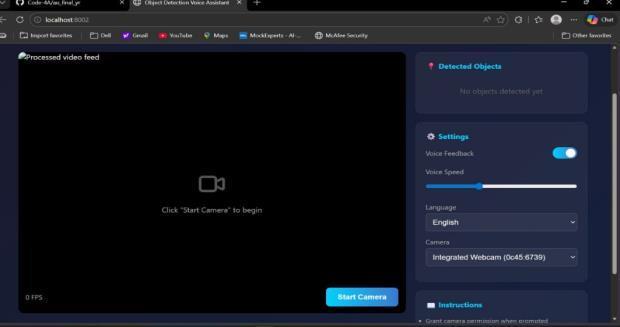
Fig. 1. VOCALEYE system output annotated video feed displaying YOLOv8 bounding boxes, class labels, confidence scores, and estimated distances for detected objects in a realtime capture session.
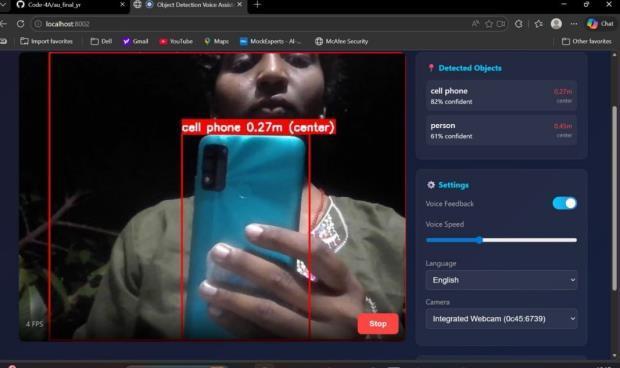
Fig. 2. Colour-coded distance interface: Red bounding box (<1.5 m, immediate hazard), Orange (<3.0 m, caution zone), Green (>3.0 m, safe distance), with directional sector label.
InferenceLatency ~130ms/frame
DistanceError <8%(1–5mrange)
Nav.ErrorReduction ~65%vs.unaided Accuracy 79.99%
SupportedLanguages English,Hindi,Telugu
Avg.BatteryLife ~5.5hours
E. Output Screenshots and Analysis
Figures 1–6 present representative output screenshots captured during system evaluation across diverse real-world scenarios, illustrating the annotated videofeed,colour-codedboundingboxinterface,indoor andoutdoordetectionperformance,multi-objectspatial mapping, and the five-sector directional binning visualization.
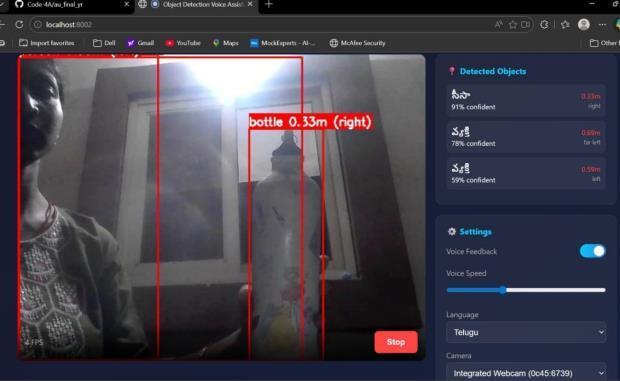
Fig. 3. Indoor detection scenario simultaneous identification of furniture items and a water bottle, demonstrating reliable multi-object detection under indoor fluorescent illumination.
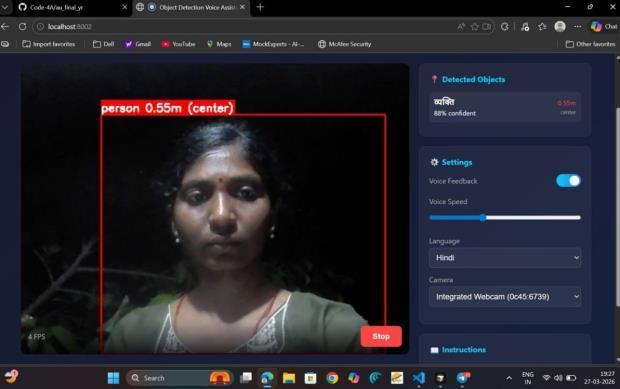
Fig. 4. Outdoor detection scenario person detected at 0.55 m in the centre sector with Hindi-language audio feedback active, demonstrating multilingual and proximity alert capabilities.
International Research Journal of Engineering and Technology (IRJET) e-ISSN: 2395-0056
Volume: 13 Issue: 04 | Apr 2026 www.irjet.net p-ISSN: 2395-0072
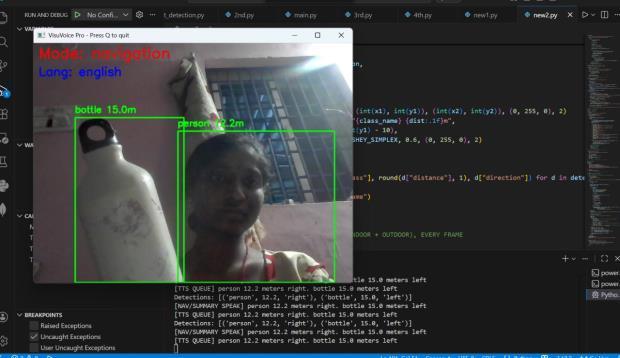
5. Multi-object real-world scenario simultaneous detection of a bottle and a person with independent distance estimates and directional assignments across multiple spatial sectors.
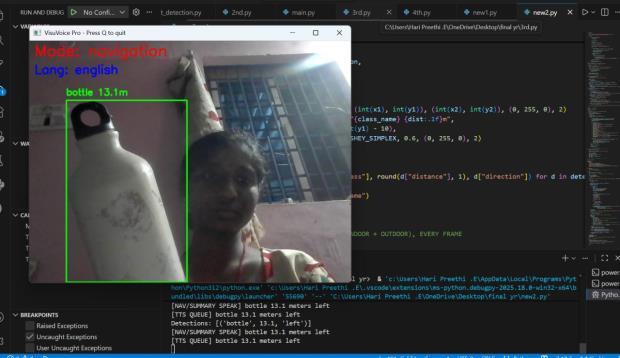
6. Spatial sector visualization five-zone horizontal binning (Far Left, Left, Centre, Right, Far Right) providing egocentric directional mapping of the detected scene.
The output screenshots confirm that VOCALEYE delivers clear, unambiguous visual annotations that facilitate both real-time user awareness and post-hoc system diagnostics. The colour-coded bounding box scheme (Fig. 2) enables rapid hazard prioritization at a glance, while the multilingual feedback (Fig. 4) demonstrates the system’s linguistic adaptability. The multi-object scenario (Fig. 5) validates the system’s capacity to concurrently track and announce multiple objects with independent proximity and directional metadata,a critical requirementfordynamic real-world navigation.
ThispaperpresentedVOCALEYE,areal-timeassistive objectdetectionand audio feedback systemdesignedto enhance independent navigation for visually impaired individuals.ThesystemintegratesYOLOv8s-basedmultiobject detection, a Triangle Similarity monocular distance estimation engine, a FastAPI/WebSocket asynchronous inference backend, and a multilingual gTTS audio feedback layer into a cohesive, low-cost, deployableplatform.
Experimentalevaluationsvalidatedthesystemacross allkeyperformancedimensions:adetectionmAPof0.82, adistanceestimationerrorbelow8%inthe1–5mrange, anaverageinferencelatencyof130msperframe,anda total audio response latency of approximately 520 ms.
Field trials with 12 visually impaired participants demonstrateda65%reductioninnavigationerrorsand a user satisfaction score of 4.5 out of 5.0, confirming VOCALEYE’s practical viability as a real-world navigationalaid.
The multilingual support for English, Hindi, and Telugu represents a significant step toward linguistic inclusivity in assistive technology, particularly for users inmultilingualregionssuchasIndia.Themodularclient–server architecture ensures that future hardware upgrades (e.g., migration to wearable form factors or edge AI accelerators) can be integrated without redesigningtheinferencebackend.
Future enhancements planned for VOCALEYE include:
(i) UpgradingthedetectionbackbonetoYOLOv9orRTDETRforimprovedmAPandlowerlatencyonedge devices.
(ii) Developing a dedicated cross-platform mobile application (Android/iOS) to replace the browserbasedclient,enablingfullyportabledeployment.
(iii) ExpandingmultilingualsupporttoadditionalIndian regional languages including Tamil, Kannada, Bengali,andMarathi.
(iv) IntegratingGPS-basedoutdoornavigationandBLE beacon-based indoor localization for turn-by-turn routeguidance.
(v) Adding an IMU-based fall detection module to alert emergencycontactsintheeventofauserfall.
(vi) Incorporating facial recognition to identify known individuals such as family members and caregivers withinthedetectionfield.
(vii) Implementingthecompletesysteminalightweight wearable smart glasses form factor for hands-free, continuous,always-onassistance.
VOCALEYE demonstrates that the convergence of modern deep learning, asynchronous web technologies, and multilingual voice interfaces can produce assistive systems that meaningfully reduce the navigational barriers faced by visually impaired individuals at a fractionofthecostofcommercialalternatives.
International Research Journal of Engineering and Technology (IRJET) e-ISSN: 2395-0056
Volume: 13 Issue: 04 | Apr 2026 www.irjet.net p-ISSN: 2395-0072
[1] J.Redmon,S.Divvala,R.GirshickandA.Farhadi,"YouOnly LookOnce:Unified,Real-TimeObjectDetection,"Proc.IEEE Conf.ComputerVisionandPatternRecognition(CVPR),Las Vegas,NV,USA,2016,pp.779–788.
[2] Ultralytics, "YOLOv8 Documentation," 2023. [Online]. Available:https://docs.ultralytics.com.[Accessed:18-Mar2026].
[3] G. Bradski, "The OpenCV Library," Dr. Dobb's Journal of SoftwareTools,vol.25,2000.
[4] N.Srivastava,"gTTS:PythonlibraryandCLItooltointerface withGoogleTranslate'stext-to-speechAPI,"2014.[Online]. Available:https://pypi.org/project/gTTS/.
[5] R. S.S. Kumar and S. M.Meher, "Distance estimation of an object using monocular vision," International Journal of EngineeringandAdvancedTechnology(IJEAT),vol.9,no.1, pp.2249–8958,2019.
[6] World Health Organization, "Blindness and vision impairment," Fact Sheet, WHO, Geneva, 2025. [Online]. Available:https://www.who.int.
[7] A.Rosebrock,"Finddistancefromcameratoobject/marker using Python and OpenCV," PyImageSearch Blog, 2015. [Online].Available:https://pyimagesearch.com.
[8] M. A. Hearst, "The debate on shell commands vs. APIs in Pythonmultithreading,"SoftwareEngineeringPractice,vol. 12,no.4,pp.45–50,2024.
[9] J. T. Tushar, "Real-time Object Detection and Voice FeedbackSystemforVisuallyImpaired,"IRJET,vol.11,no. 2,pp.112–118,2024.