
International Research Journal of Engineering and Technology (IRJET) e-ISSN: 2395-0056
Volume: 12 Issue: 04 | Apr 2025 www.irjet.net p-ISSN: 2395-0072
International Research Journal of Engineering and Technology (IRJET) e-ISSN: 2395-0056
Volume: 12 Issue: 04 | Apr 2025 www.irjet.net p-ISSN: 2395-0072
Sai Patil*1, Zoha Parkote*2, Chinmay Mirlekar*3, Susmita Mistry*4 , Deepti Janjani*5 , Sanjay Patil*6
*1,2,3,4 Student, Department of Artificial Intelligence and Data Science, Datta Meghe College of Engineering, Navi Mumbai, Maharashtra, India
*5 Assistant Professor, Department of Artificial Intelligence and Data Science, Datta Meghe College of Engineering, Navi Mumbai, Maharashtra, India
*6 Head of Department, Department of Artificial Intelligence and Data Science, Datta Meghe College of Engineering, Navi Mumbai, Maharashtra, India
Abstract - The accelerated development of artificial intelligence (AI) has brought about virtual assistants that simplify human-computer interaction. However, current systems are still limited by inadequate personalization, the absence of advanced task automation, and inadequate contextual retention from one interaction to another, which hinders their ability to provide truly seamless and intelligent user experiences. This work introduces VIVI, a cutting-edge virtual assistant that seeks to overcome these boundaries by bringing forth a combination of leading-edge technologies such as GenerativeAI andNaturalLanguageProcessing(NLP) to render dynamic, context-dependent answers and execute sophisticated tasks effortlessly. The architecture of VIVI includes a smart workflowthatstartswithsystemboot-upand hotword detection, then proceeds to command identification through speech or text inputs. These commands fallintotypes like system controls, media actions, web interactions, or AIpoweredtasks. Byenablingadvancedautomationoftasksand multi-platform compatibility, VIVI provides higher user flexibility, providing not only functional commands but also proactive and personalized outputs. VIVI reimagines the power ofvirtualassistants through enhanced userinteraction through intelligent decision-making complemented by a polished task accomplishment, positioning it as a very strong tool in personal and workspaces alike.
Key Words: Generative AI, Virtual Assistant, Task Automation, Natural Language Processing, AI-powered Systems,SpeechRecognition,PersonalizedUserExperience.
VIVI addresses the shortcomings of existing virtual assistants,particularlyintermsofpersonalizationandtask automation.VIVI,ourAI-poweredvirtualassistant,aimsto overcometheseshortcomingsbyemployingGenerativeAI, Natural Language Processing (NLP), and sophisticated automation techniques. With VIVI, users can expect personalized responses, contextual understanding, and smarttaskmanagementacrossmultipleplatforms,givinga morenaturalandpersonalizedexperience.
ThekeycontributionsofVIVIarethatitsupportskeeping contextual knowledge consistent across multiple interactions, allowing for more relevant and coherent
conversations. Unlike traditional virtual assistants, VIVI enablesdynamicuser-adaptiveanswersthroughGenerative AI, and conversations become more interactive and personalized. VIVI also supports higher-order task automation, and it is possible to run complex multi-step workflows and system administration tasks. Its design ensures seamless interoperability with third-party applications, allowing users to efficiently manage both personal and work-related tasks. Moreover, VIVI’s userfriendly interface, supporting both voice and text inputs, ensures flexibility and ease of use across a wide range of devicesandenvironments.
ThisprojectalsoelaboratesontheapplicationsofVIVIinthe futureforsmarthomes,offices,andIoTdevices,renderingit atremendousadvancementinvirtualassistanttechnology. By addressing current challenges in personalization and automation,VIVIcreatesanewstandardincontext-aware, intelligentvirtualassistants.
Mekni,Mehdi.(2021)proposedanAI-basedvirtualassistant using conversational agents. The virtual assistant was designedtosupportmultimodalcommunication,including textandvoice-basedinteraction,ensuringamoreintuitive user experience. The study explored the integration of NaturalLanguageProcessing(NLP)andMachineLearning (ML)techniquestoenhanceuserinteraction[1].A.Sudhakar Reddy M, Vyshnavi, C.and Saumya designed a virtual assistantusingNLPforspeechandtextinterpretationand MLforbetterresponses.Itautomatedtaskslikescheduling, emails, and smart home control, making user interactions easier and more efficient [2]. Baskaran, G., Raj, Harrish, Kumar,S.,andAnand,R.(2021)developedanAI-powered virtualassistantforWindowsOS.Itusedvoicecommandsto manageapplicationsviaacommandpromptandoptimized system performance with user-defined models. Reinforcementlearningimprovedadaptabilitybasedonuser interactions[3].
HarshitAgrawal,NiveditaSingh,GauravKumar,Dr.Diwakar Yagyasen,(2023)developedaPython-basedvoiceassistant toexecuteLinuxcommandsusingvoiceinput,reducingthe need for keyboards and mice. The system improved
International Research Journal of Engineering and Technology (IRJET) e-ISSN: 2395-0056
Volume: 12 Issue: 04 | Apr 2025 www.irjet.net p-ISSN: 2395-0072
accessibility, efficiency, and system usability while minimizing hardware costs [4]. Sahu, Ajay, Jha, Ashish, Bhargava,(2023)exploredtheroleofAIinvirtualassistants, emphasizing their growing significance in daily life. Their study highlighted the integration of AI-driven voice assistantsacrossvariousdevices,enablingintelligentsearch and task automation. The paper also discussed the challengesandopportunitiesofvirtualassistanttechnology, underlining its potential to transform human interactions and accessibility across multiple fields[5].Sinha & Siegert (2022) improved German voice assistant accuracy by combining ASR outputs using ROVER, reducing errors by 10% for clean speech but showing limited gains for noisy data[6].Kulhalli, Kshama V., Sirbi, Kotrappa & Patankar, Abhijit J. (2017) created a voice-based personal assistant thatworkswithorwithouttheinternet.Itunderstandsvoice and text commands, performs tasks, and makes mobile interactionseasierusingspeechrecognitionandNLP[7].
Jain, Sakshi R. & Jason, Feon (2023) developed a PythonbaseddesktopvoiceassistantusingNLP,machinelearning, and speech recognition APIs. It integrates tools like TensorFlow, NLTK, PyQt, and Web APIs for enhanced interaction.Ahealthcarecasestudyhighlighteditspotential to improve efficiency and patient care [8]. Chinchane, A., Bhushan, A., Helonde, A., & Bidua, K. (2022) introduced a Python-drivenvoiceassistantleveragingAI,NLP,andspeech recognition.Unlikecloud-dependentmodels,theirapproach emphasizeslocalprocessingforenhancedprivacyandfaster responses,pavingthewayforsmarter,autonomoussystems [9].Këpuska&Bohouta(2018)proposedanext-generation VirtualPersonalAssistant(VPA)modelusingmulti-modal dialoguesystems.UnliketraditionalassistantslikeSiriand Alexa, this model integrates speech, image, gesture, and video recognition to enhance human-machine interaction. The system is designed for applications in education, healthcare, robotics, home automation, and security, leveraging AI-driven conversational knowledge bases for improvedadaptabilityandefficiency[10].
The experimental setup for the VIVI AI project includes a systemequippedwithanAMDRyzen53500Uprocessor,8 GBRAM,andAMDRadeonGraphics,runningonWindows 11.Thishardwareconfigurationsupportsmultitasking,realtime AI processing, and system automation. The developmentiscarriedoutusingVisualStudioCode,withGit forversioncontrolandbrowserslikeChromeandEdgefor testing.Python3.10+isusedastheprimaryprogramming language, alongside SQLite3 for database operations and APIslikeOpenWeatherandHuggingFaceforreal-timedata andNLPintegration.
A variety of software libraries are used to power VIVI’s capabilities.Theseincludepyttsx3,speechrecognition,eel,
and pyautogui for voice interaction and GUI handling; selenium, requests, and webbrowser for web-based automation; and PIL, pytesseract, and numpy for image processing. System tasks are managed using os, psutil, subprocess, and related libraries. For AI functionalities, librariesliketorch,torchvision,diffusers,transformers,and hugchat are employed, enabling deep learning and conversational abilities. Clipboard operations, regular expressions,anddatabasehandlingaresupportedthrough pyperclip,re,andsqlite3.
The programming stack includes Python for backend developmentandAIlogic,HTML/CSSandJavaScriptforthe interface, and SQL for database management. This combination allows for a modular, intelligent virtual assistant with features like task automation, voice commands,imageprocessing,andreal-timeuserinteraction.
AstructuredmethodologywasusedtodevelopandtestVIVI as an AI-powered virtual assistant for optimizing performance in specific functionality like automation of tasksandpersonalizationaswellascontextrecognition.The methodologyisdividedintovariousstagesbeginningfrom system design through NLP integration to Generative AI implementation then task automation setup before user interactiontesting.
It also ensures if each user input is intelligently routed through intent identification and NLP processing. This enables VIVI to generate personalized, context-aware responsesbyleveragingitsAIengine,resultinginadynamic andefficientuserexperience
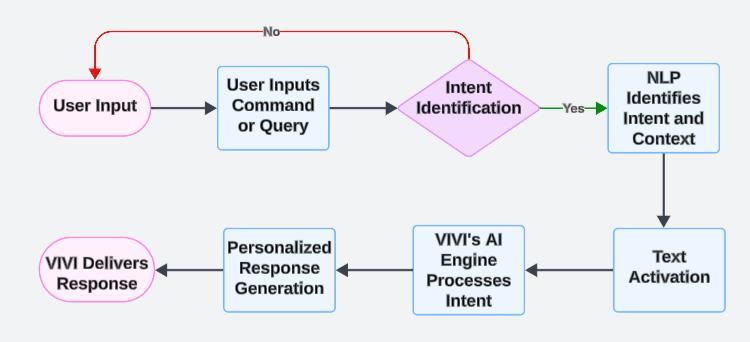
TheFigure1depictstheprocessflowthatisusedforVIVI,a personalizedvirtualassistant,initshandlingofuserinputs alongwiththegenerationofresponses.Thedefiniteprocess begins with "User Input." A specific command or query is entered at this location. If input isn't clear, the system repeats the entry process. Otherwise, then it proceeds onward to "Intent Identification," where the system determines whether it can fully understand all of the request. If such intent is truly not identified well enough, thenthatuserispromptedbyrefiningtheprovidedinput.If
International Research Journal of Engineering and Technology (IRJET) e-ISSN: 2395-0056
Volume: 12 Issue: 04 | Apr 2025 www.irjet.net p-ISSN: 2395-0072
theintentissuccessfullyrecognized,thesystemleverages multidimensional Natural Language Processing (NLP) to analyzethequery,identifyingitsintentaswellascontextual meaning.
Once the exact purpose and setting are known, the mechanism then goes to "Text Activation," and applicable dataishandled.Then,VIVI'sAIengineinterpretsuponthe intent for the purpose of determining the appropriate response. This particular information is routinely passed alongtothe"PersonalizedResponseGeneration"phase.This perpetually and always ensures that the response is customizedtoalloftheuser'sneeds.Finally,thegenerated responseisdelivereduponbacktotheuser,thusentirely completingthecycle.ThisplannedflowsurelyseesthatVIVI givespreciseandalsorelevantsupportwhenimprovinguser inputsespeciallyforgreaterproductivity.
The creation of VIVI, an intelligent virtual assistant, comprised several design, implementation, and testing stagestoassessitsperformance,functionality,andusability. This section is a comprehensive discussion of the major projectoutcomessuchasinterfacedesign,featureexecution through commands, and interactions based on artificial intelligence.Allthesubsectionscontainthepertinentvisual evidenceandexplanatorypointsthathighlightthefeatures ofVIVIduringreal-worldapplications.
Interface design and functionalities play a crucial role in shapingtheoveralluserexperience.Aclean,intuitive,and responsivelayoutisessentialtoensuresmoothnavigation andeffectiveinteractionthroughbothvoiceandtextinputs.
The visual and functional elements of VIVI’s UI are highlighted to demonstrate how users interact with the assistantacrossitscorefeatures,includinggenerallayout, settingsaccess,activation,andexitprocesses.
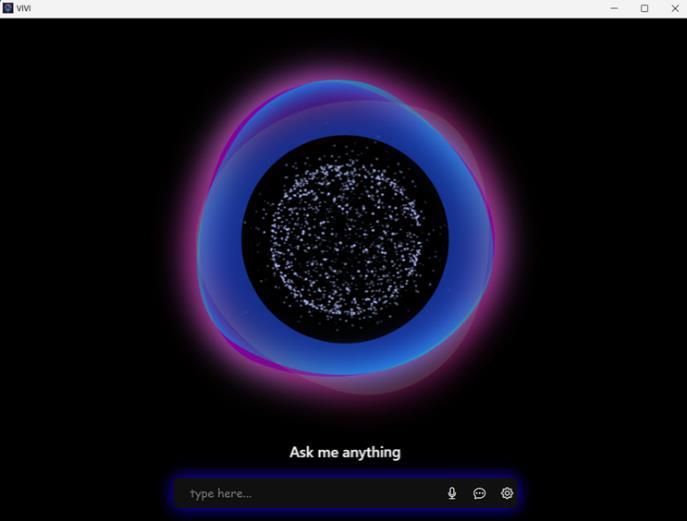
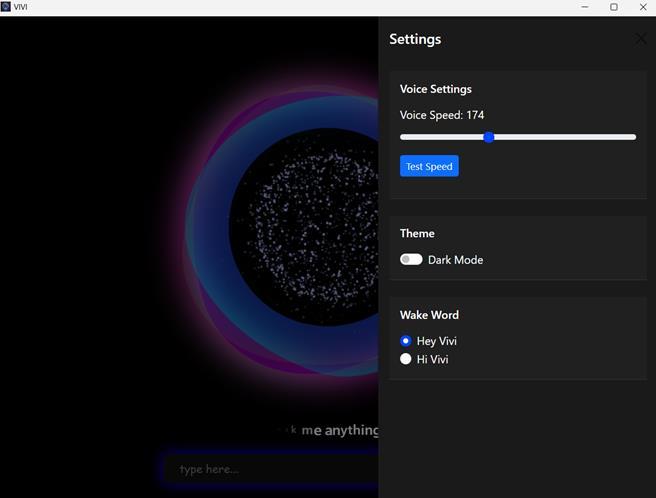

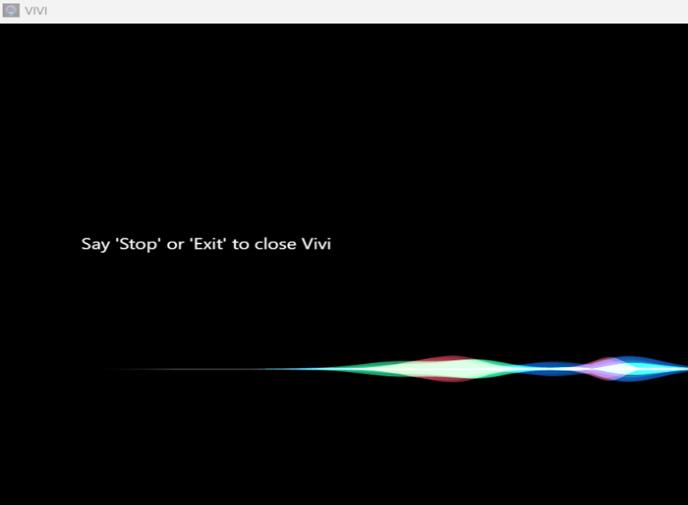
Figure2presentsthemaininterfaceofthevirtualassistant "VIVI", featuring a clean layout with a central circular animation that indicates active system status. It supports both voice and text input, guided by the prompt “Ask me anything,” which encourages interactive communication.
International Research Journal of Engineering and Technology (IRJET) e-ISSN: 2395-0056
Volume: 12 Issue: 04 | Apr 2025 www.irjet.net p-ISSN: 2395-0072
Figure3highlightsthesettingspanel,whereuserscanadjust voicespeed,testresponses,toggledarkmode,andselecta wake word either “Hey Vivi” or “Hi Vivi” to personalize activation.
Figure4illustrateshowVIVIrespondstoitswakewordwith a greeting and dynamic waveform animation, signaling readinesstoassist.Thisvisualcueensuresusersareaware whentheassistantislistening.Finally,Figure5showsthe assistant’sexitprompt,whereuserscansimplysay“Stop”or “Exit”toclosethesession.Thesedesignelementscollectively ensureasmooth,responsive,anduser-friendlyinteraction experience.
II. Command-Based Feature Activation
Command-based feature activation is central to VIVI’s functionality. This section highlights how the assistant handles essential actions from initiating the system and handlingcommunicationtaskstomanagingentertainment controlsandprovidingtimelyinformationalupdatessuchas launching from a fresh state, interacting with messaging platforms, managing media playback, and retrieving realtimeinformationlikeweatherupdates etc.Thesefeatures reflectVIVI’sabilitytounderstanduserintentandperform tasks efficiently, enhancing both usability and responsivenessinpracticalscenarios.


International Research
Volume: 12 Issue: 04 | Apr 2025 www.irjet.net p-ISSN: 2395-0072
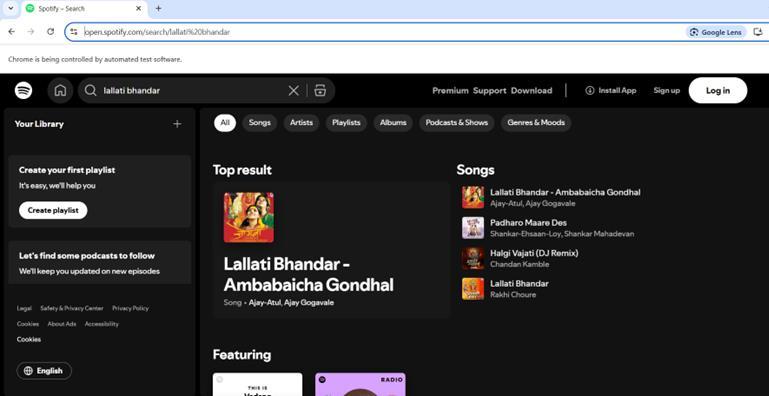
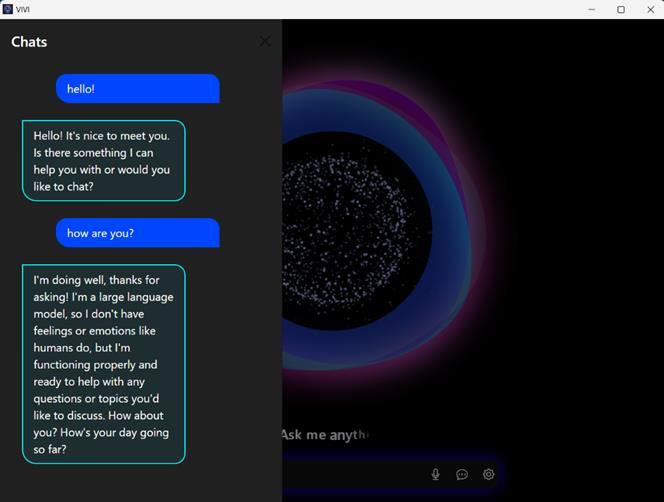
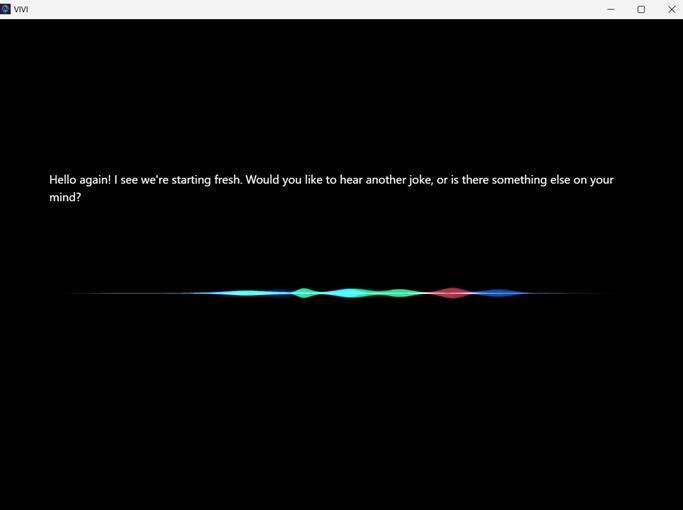
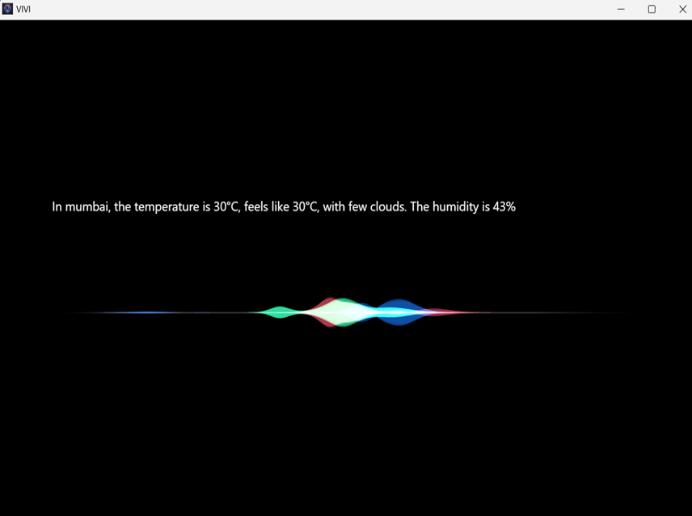
Figure 6 presents VIVI’s launch interaction, where the assistant welcomes the user with a friendly message and animatedwaveform,clearlyindicatingthatitisactiveand ready to assist. This responsive greeting helps establish a naturalandengaginguserexperience.AsshowninFigure7, VIVIrespondstoavoicecommandbydeliveringareal-time weatherupdate,includingtemperature,humidity,andsky conditions,offeringconvenient,hands-freeaccesstouseful information.
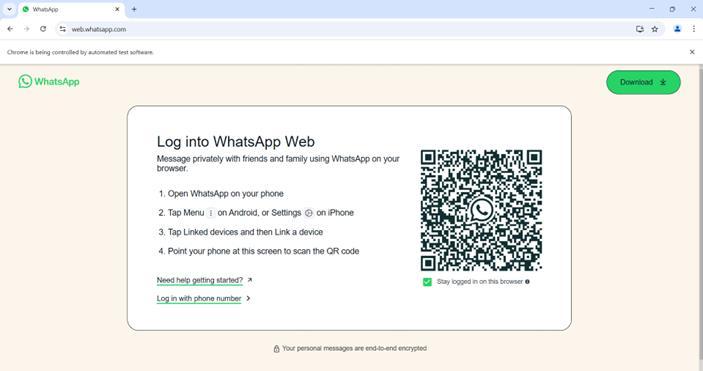
Figure 8 (a) and (b) demonstrates VIVI’s capability to manage communication tasks, where a simple command opensWhatsAppWebanddirectstheusertotheinterface, making messaging easier. In Figure 9 (a) and (b) , the assistanthandlesmediaplaybackbypromptingtheuserto select a platform such as Spotify or YouTube, and immediately opening it highlighting VIVI’s versatility in executingentertainment-relatedcommandsefficiently.
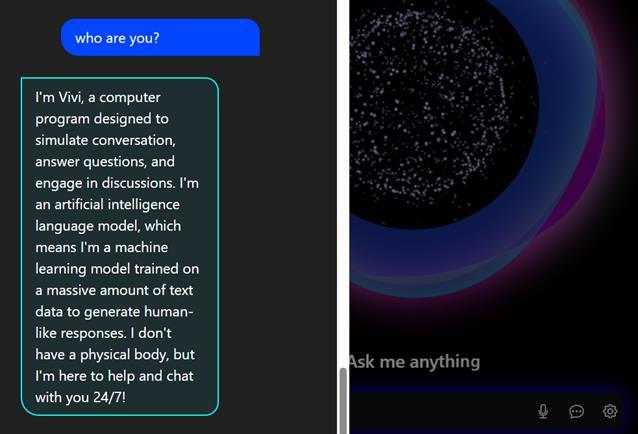
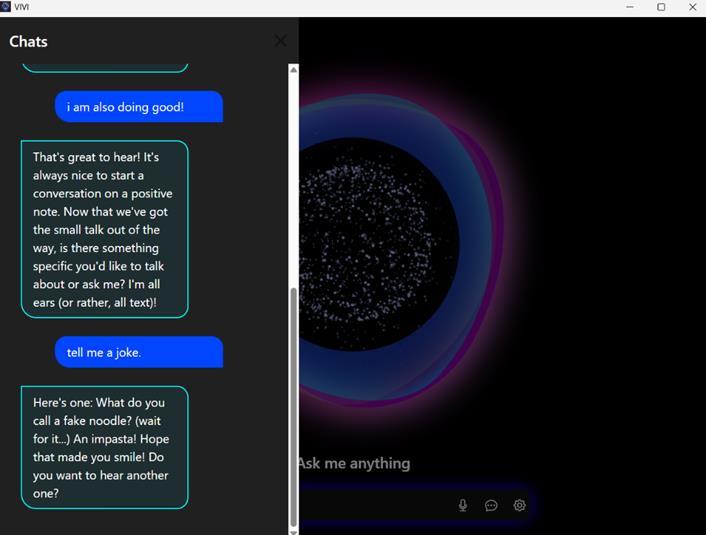
VIVI’s AI-driven capabilities are showcased through its abilitytohandlemoreadvanced,conversationalinteractions thatsimulatenaturaldialogue.Thissectionoutlineshowthe assistant processes diverse requests ranging from selfidentificationandstatusupdatestodeliveringjokes,offering cooking suggestions, and responding to location-specific inquiries. These interactions highlight VIVI’s capacity to interpret context, personalize responses, and provide meaningful engagement that extends beyond basic functionality,addingahuman-likedimensiontotheoverall userexperience.
International Research Journal of Engineering and Technology (IRJET) e-ISSN: 2395-0056
Volume: 12 Issue: 04 | Apr 2025 www.irjet.net p-ISSN: 2395-0072
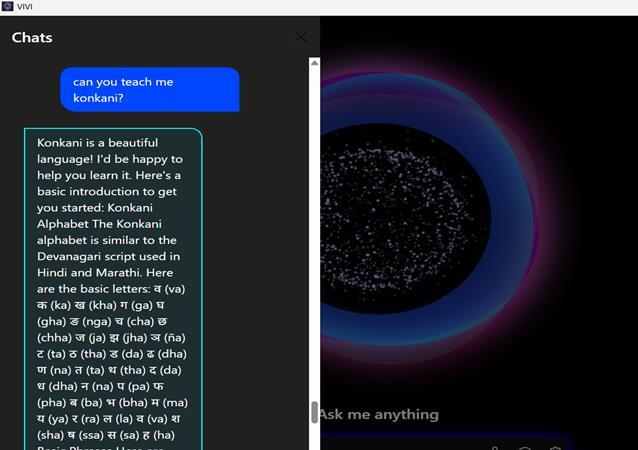
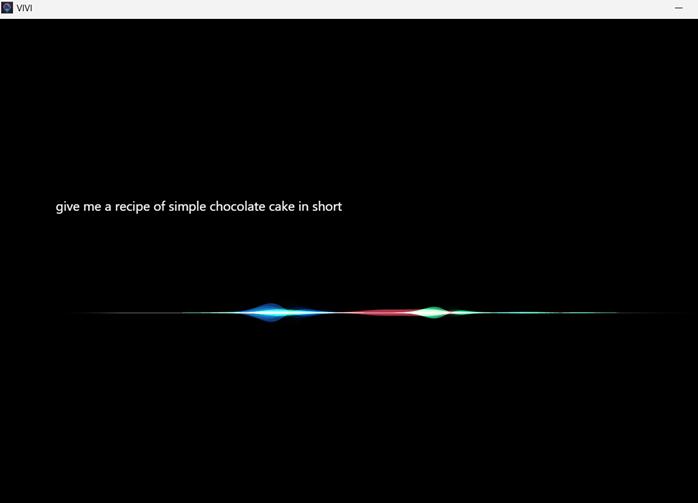
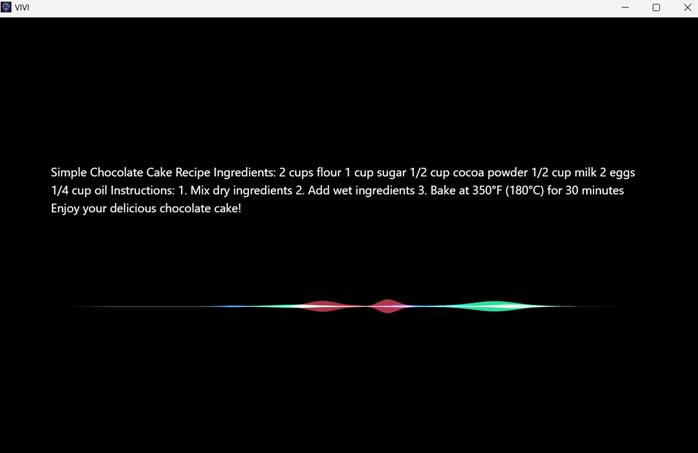
Figure10(a)and(b)shows VIVIintroducingitselfafter a usergreeting,respondinginafriendlyandinformativeway thatmakestheinteractionfeelmorenatural.InFigure11, VIVIrespondstoafuncommandbytellingajoke,addinga playfultouchtotheconversationandmakingtheexperience moreenjoyable.
Figure12showsVIVIansweringalocation-relatedquestion by providing information about the Konkani language, highlighting its ability to respond to specific cultural or regionalqueries.InFigure13(a)and(b),VIVIhelpswitha cooking task by sharing a quick and easy chocolate cake recipe,showinghowitcanassistuserswithdailyactivities.
Theresearchemphasizesthedesignandimplementationof an intelligent virtual assistant that can comprehend and react to user inputs via text and voice-based interactions. Emphasiswasondevelopingafriendlyinterface,withkey features such as messaging, entertainment control, information retrieval, and voice commands. The assistant was implemented with priority on real-time response, personalization, and simplicity, showing its capability to executevarioustaskseffectivelyinoneplatform.
The project reinforces the growing relevance of AI-driven toolsinsimplifyingroutinedigitaltasksandenhancinguser engagement. By successfully merging contextual understanding with command execution, the assistant deliversanexperiencethatfeelsbothnaturalandpractical. This research establishes a strong groundwork for expandingtheassistant’scapabilities,offeringopportunities for future enhancements in fields like automation, accessibility,andcross-platformintegration.
[1] Mekni, Mehdi. (2021). An Artificial Intelligence Based VirtualAssistantUsingConversationalAgents.Journalof Software Engineering and Applications. 14. 455-473. 10.4236/jsea.2021.149027.
[2] Sudhakar Reddy M, Vyshnavi, C. Raju Kumar, and Saumya,”VirtualAssistantUsingArtificialIntelligence” in J ETIR March 2020, Volume 7, Issue 3 ISSN-23495162.
[3] Baskaran, G & Raj, Harrish & Kumar, S & Anand, R. (2021).ToBuildAVirtualAssistantByUsingArtificial Intelligence.TheOpenArtificialIntelligenceJournal.2. 1134.10.6084/m9.figshare.14446467.
[4] Harshit Agrawal, Nivedita Singh, Gaurav Kumar, Dr. Diwakar Yagyasen, Mr. Surya Vikram Singh. "Voice AssistantUsingPython"AnInternationalOpenAccessrevied, Refereed Journal. Unique Paper ID: 152099, PublicationVolume&Issue:Volume8,Issue2,Page(s): 419-423.
[5] Sahu,AjayandJha,AshishandBhargava,RitikandPriya, Priyanshu and Kumari, Rupa, Voice Assistant Using ArtificialIntelligence(March10,2023).Proceedingsof theInternationalConferenceonInnovativeComputing &Communication(ICICC)2022.
International Research Journal of Engineering and Technology (IRJET) e-ISSN: 2395-0056
Volume: 12 Issue: 04 | Apr 2025 www.irjet.net p-ISSN: 2395-0072
[6] Sinha, Yamini & Siegert, Ingo. (2022). Improving the AccuracyforVoice-AssistantconversationsinGerman by combining different online ASR-API outputs. 10.6094/UNIFR/223823.
[7] Dr.Kshama,V.Kulhalli,Dr.KotrappaSirbi,Mr.AbhijitJ. Patankar, “Personal Assistant with Voice Recognition Intelligence,” International Journal of Engineering Research and Technology. vol 10, no.1, pp. 416-418, (2017).
[8] S.R.JainandF.Jason,"PersonalDesktopVoiceAssistant - Research Paper," International Journal of Advanced Research in Computer and Communication Engineering, vol. 12, no. 3, pp. 126, Mar. 2023. DOI: 10.17148/IJARCCE.2023.12324.
[9] Chinchane, A., Bhushan, A., Helonde, A., & Bidua, K. (2022). SARA: A Voice Assistant Using Python. International Journal for Research in Applied Science & Engineering Technology (IJRASET), 10(VI), 3567. https://www.ijraset.com
[10] V.KëpuskaandG.Bohouta,"Next-generationofvirtual personal assistants (Microsoft Cortana, Apple Siri, Amazon Alexa and Google Home)," 2018 IEEE 8th AnnualComputingandCommunicationWorkshopand Conference(CCWC),LasVegas,NV,USA,2018,pp.99103,doi:10.1109/CCWC.2018.8301638.