
International Research Journal of Engineering and Technology (IRJET) e-ISSN: 2395-0056
Volume: 13 Issue: 03 | Mar 2026 www.irjet.net p-ISSN: 2395-0072

International Research Journal of Engineering and Technology (IRJET) e-ISSN: 2395-0056
Volume: 13 Issue: 03 | Mar 2026 www.irjet.net p-ISSN: 2395-0072
Yadla Aravind¹, Ms. S. Prabhavathi²
¹B. Tech Student, Dept. of CSE (AI & ML), Andhra Loyola Institute of Engineering and Technology, Andhra Pradesh, India
²Assistant Professor, Dept. of CSE (AI & ML), Andhra Loyola Institute of Engineering and Technology, Andhra Pradesh, India
Abstract - Vitamin deficiencies can lead to serious health complications if not detected at an early stage. However, traditional diagnostic methods often rely on laboratory tests, which may not always be easily accessible or time efficient. In this study, we propose a deep learning-based system that can assist in identifying vitamin deficiencies usingimage data. The model is built using MobileNetV2 through a transfer learning approach, enabling efficient andaccurateclassificationacross multiple deficiency categories. A structured preprocessing pipeline was implemented to improve data quality, including the removal of duplicate images, filtering of sensitive and irrelevant data, and proper organization of class labels. To handle class imbalance and enhance modelperformance, data augmentation techniques were applied. Initially, EfficientNet and MobileNetV2 models were evaluated, where MobileNetV2 demonstrated better performance. With the inclusion of augmentation, the model achieved an accuracy of 92%. To improve transparency and trust in the system, Grad-CAM was integrated to visualize the regions oftheimagethat influenced the model’s predictions. The results indicate that the proposed system is not only accurate but also interpretable. This approach can serve as a supportive tool in healthcare applications, particularly in areas with limited access to medical resources.
Key Words: Vitamin Deficiency Detection, Deep Learning, MobileNetV2, Transfer Learning, Grad-CAM, Image Classification,DataAugmentation,ExplainableAI
Vitamin deficiencies are a major health concern worldwide,affectingpeopleacrossdifferentagegroupsand lifestyles.DeficienciesinessentialvitaminssuchasA,B,C,D, and E can lead to various health issues, including fatigue, weakenedimmunity,skindisorders,andothercomplications [1].Earlyidentificationofthesedeficienciesplaysacrucial roleinpreventingseverehealthconditionsandimproving overallwell-being.However,traditionaldiagnosticmethods primarily depend on laboratory tests and clinical evaluations,whichcanbetime-consuming,costly,andnot alwaysaccessibleinremoteorresource-limitedareas.
RecentadvancementsinArtificialIntelligence(AI)andDeep Learning have opened new possibilities in the field of healthcare,particularlyinautomateddiagnosissystems[2]. Computer vision techniques enable machines to analyze visualpatternsinimages,makingitpossibletodetectcertain healthconditionsbasedonphysicalsymptoms.Inthecaseof vitamindeficiencies,visibleindicatorssuchaschangesinthe skin,nails,andtonguecanbeanalyzedusingdeeplearning modelstoassistindiagnosis.
Thisworkfocusesondevelopinganintelligentsystemthat leverages deep learning techniques to detect and classify vitamin deficiencies from image data. By using transfer learning with MobileNetV2, the system is designed to achieveefficientandaccurateclassificationacrossmultiple deficiency categories [3]. Additionally, a structured data preprocessing pipeline is implemented to ensure highqualityinputforthemodel.
Data preprocessing is a critical step in building a reliabledeeplearningmodel.Thedatasetusedinthiswork initiallyconsistedofalargecollectionofrawimagesobtained from an open-source platform [4]. Several preprocessing stepswereappliedtoimprovethequalityandrelevanceof thedata.First,duplicateimagespresentinthedatasetwere identifiedandremovedtoavoidredundancyandbiasduring training.
Next,sensitiveandinappropriateimagesthatcouldaffect themodel’slearningwerefilteredout.Thisstepensuresthat the dataset remains clean and suitable for training in a healthcare-related application. Additionally, images belongingtoirrelevantcategoriesordiseasesthatdonotfall under the defined classes were removed to maintain consistencyinclassification.
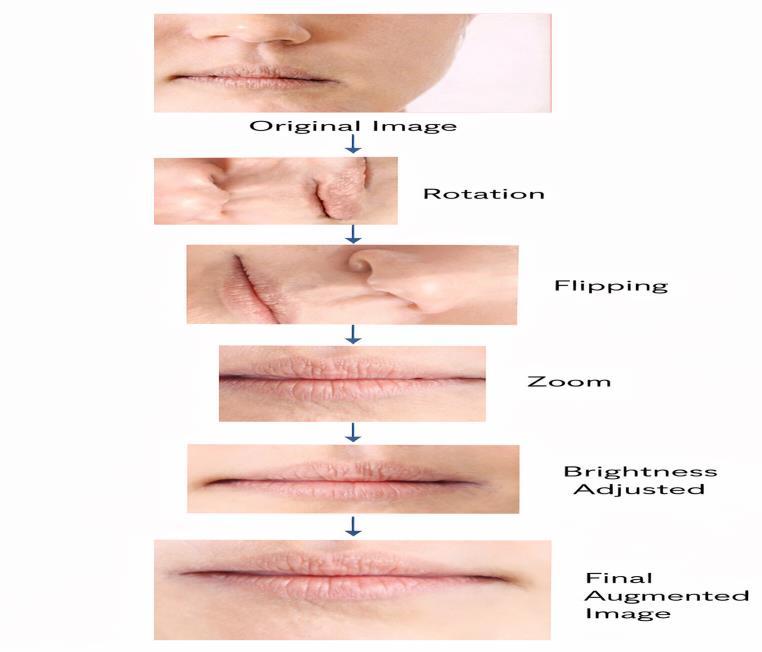
After cleaning, the dataset was organized into predefined classes representing different vitamin deficiencies. To address the issue of class imbalance, data augmentation techniques such as rotation, flipping, and zooming were applied[5].Thesestepshelpedincreasethediversityofthe dataset and improve the generalization capability of the model.
International Research Journal of Engineering and Technology (IRJET) e-ISSN: 2395-0056
Volume: 13 Issue: 03 | Mar 2026 www.irjet.net p-ISSN: 2395-0072
The proposed system utilizes deep learning models to perform image classification for vitamin deficiency detection. Initially performance was implemented to evaluate baseline performance; however, the model achieved limited accuracy, indicating the need for further optimization. Subsequently, MobileNetV2 was employed using a transfer learning approach, which significantly improvedtheclassificationperformance[3].
Further enhancements were achieved by incorporating data augmentation techniques, resulting in better model generalization and increased accuracy. The final model demonstrated a substantial improvement in performance comparedtoearlierapproaches.
Toenhancetheinterpretabilityofthesystem,Grad-CAM (Gradient-weighted Class Activation Mapping) was integrated.Thistechniqueprovidesvisualexplanationsby highlightingtheregionsintheinputimagethatcontribute most to the model’s predictions [6]. Such explainability is essentialinhealthcareapplications,asitincreasestrustand transparencyinAI-basedsystems.
Theproposedsystemfollowsastructuredpipeline fordetectingandanalyzingvitamindeficienciesusingimagebased data. The methodology includes dataset collection, preprocessing, model development, evaluation, and explainability.Eachstageisdesignedtoimprovedataquality and enhance model performance, ensuring reliable and interpretableresults[1][2].
The dataset used in this study consists of image samples representing visible symptoms associated with vitamin deficiencies. The raw dataset initially contains approximately18,656imagescollectedfromanopen-source platform[4].Theseimagesincludedifferentvisualindicators such as skin, nails, and tongue conditions, which are commonlyusedinvisualdiagnosisapproaches[2]. However,thedatasetcontainsredundant,noisy,and irrelevant samples, which may negatively affect model performance.Therefore,astructuredpreprocessingpipeline isappliedtocleanandorganizethedatasetintomeaningful categories.Properdatasetpreparationplaysacrucialrolein improving model accuracy and generalization in deep learningapplications[5].
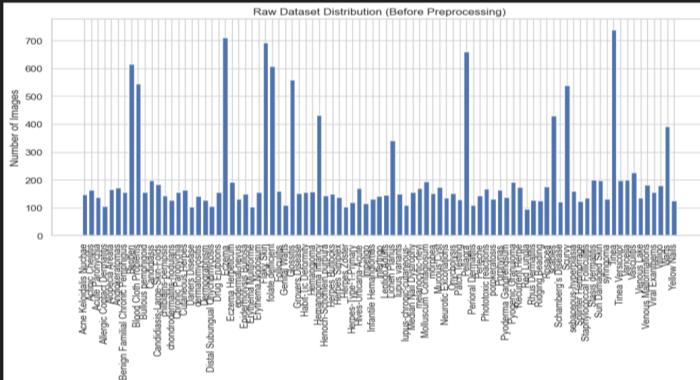
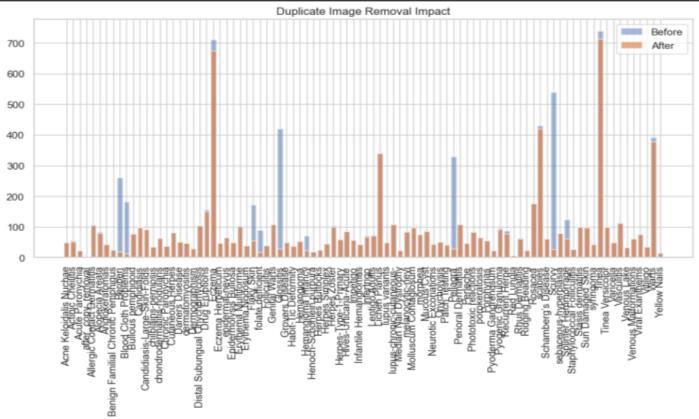
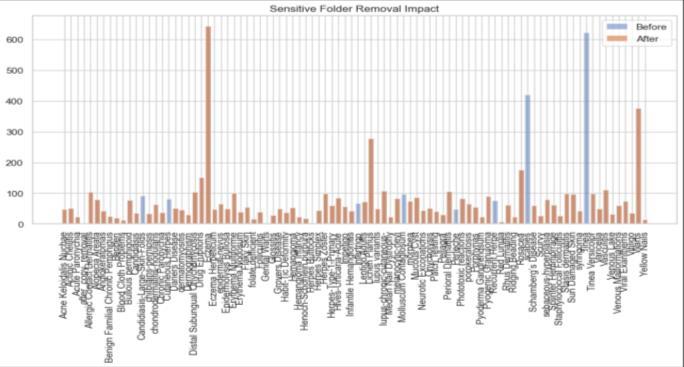
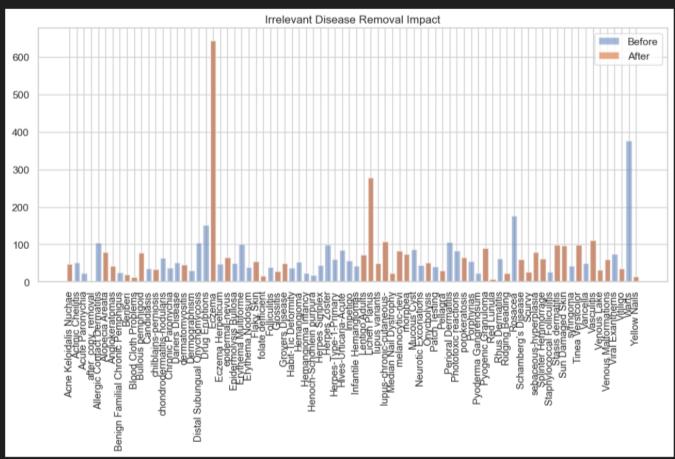
Data preprocessing is a crucial step to ensure the quality and consistency of the dataset. High-quality data plays a significant role in improving the performance and reliability of deep learning models [5]. The following operationsareperformed:
Duplicate Image Removal: Duplicate and repeated images are identified and removed to eliminate redundancy and preventmodelbiasduringtraining.
SensitiveImageFiltering:Imagesthatareinappropriateor irrelevanttotheanalysisareremovedtomaintaindataset integrity,especiallyforhealthcare-relatedapplications. Irrelevant Class Removal: Images belonging to categories outsidethedefinedvitamindeficiencyclassesareeliminated toensureconsistencyinclassification.
Data Cleaning: The dataset is refined to retain only useful and meaningful samples, improving the overall quality of datainputformodeltraining.
These steps significantly improve the reliability of the dataset, reduce noise, and enhance the generalization capabilityofthemodel[2][5].
International Research Journal of Engineering and Technology (IRJET) e-ISSN: 2395-0056
Volume: 13 Issue: 03 | Mar 2026 www.irjet.net
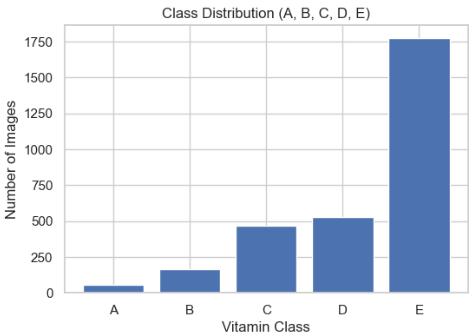
After preprocessing, the dataset is organized into fivedistinctclassesrepresentingdifferentvitamindeficiency categories, labeled as A, B, C, D, and E. Proper class distributionisessentialtoensurebalancedlearningandto avoidbiastowardanyparticularclassduringtraining[5].A well-structured dataset improves model stability and enhances classification performance in deep learning systems[2].
p-ISSN: 2395-0072
To address class imbalance and improve model generalization, data augmentation techniques are applied. These techniques generate variations of existing images, increasingdatasetdiversityandenablingthemodeltolearn morerobustfeatures[5].
Theaugmentationmethodsinclude:
1) Rotation
2) Horizontalflipping
3) Zooming
4) Scaling
This step helps improve model robustness, reduces overfitting,andenhancesperformanceonunseendata[5].
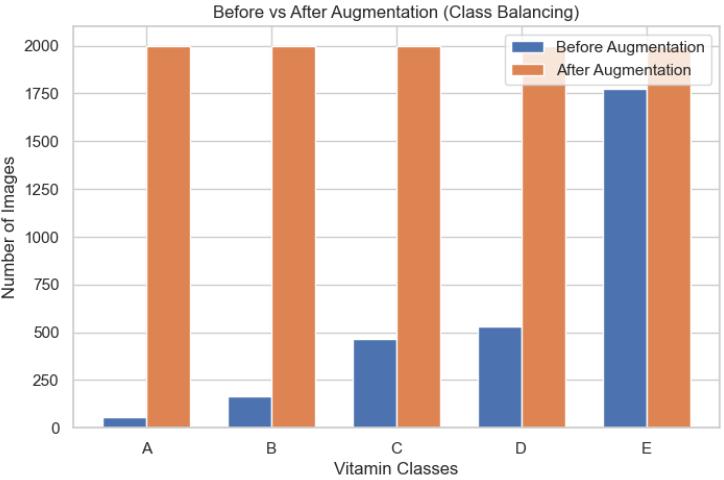
distributionofimagesbeforeandafter dataaugmentationshowingbalanceddatasetacross vitaminclasses.
International Research Journal of Engineering and Technology (IRJET) e-ISSN: 2395-0056
Volume: 13 Issue: 03 | Mar 2026 www.irjet.net p-ISSN: 2395-0072
Multiple deep learning models are evaluated to identifythemosteffectiveapproach:
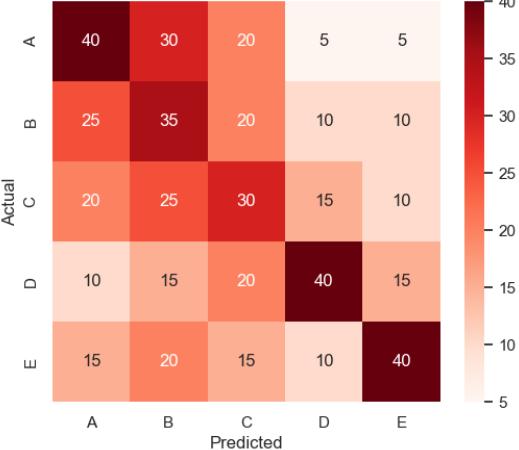
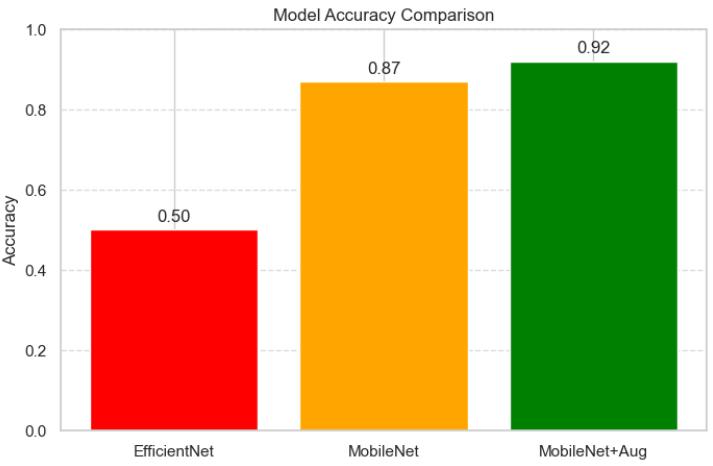
1) EfficientNet: Used as a baseline model, achieving approximately50%accuracy.
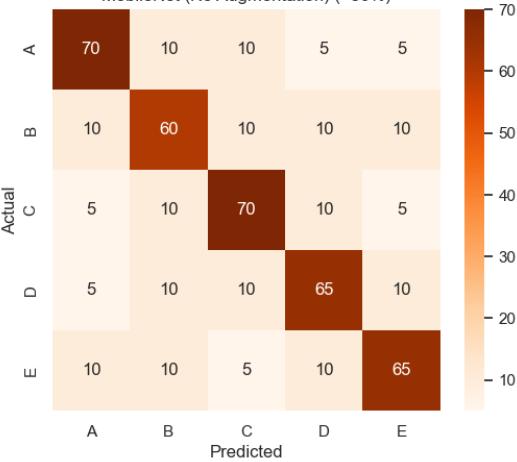
2) MobileNetV2 (Without Augmentation): Improved performancewitharound87%accuracy,butlimited generalization.
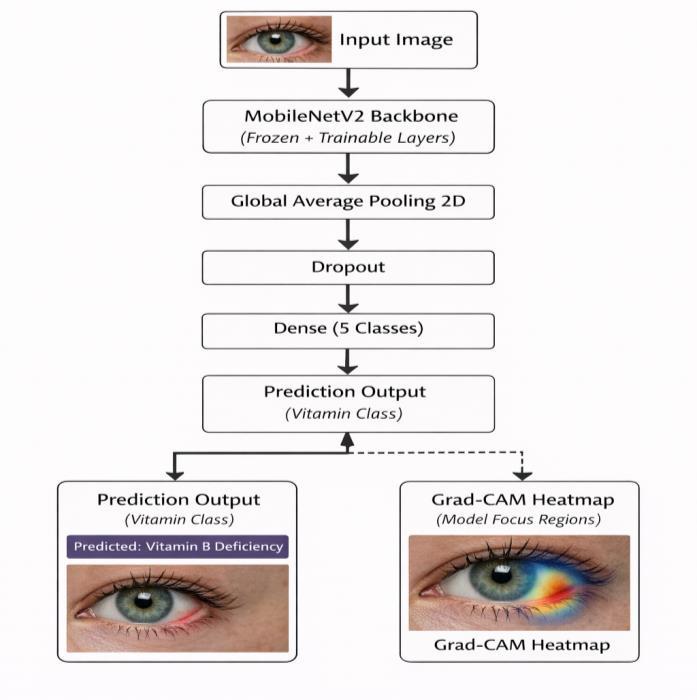
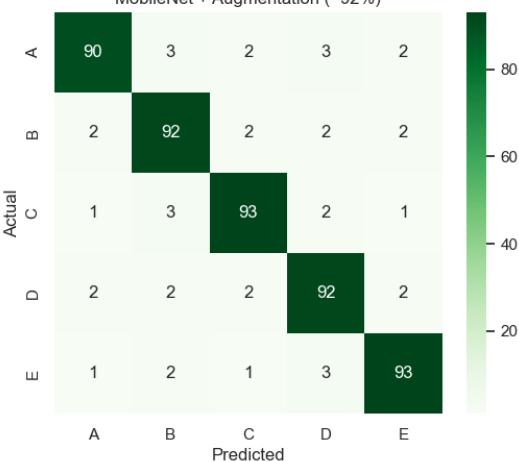
3) MobileNetV2 (With Augmentation): Achieved the bestperformancewithanaccuracyof92%. MobileNetV2 is selected as the final model due to its efficiencyandsuperiorperformanceinimageclassification tasks[3].Transfer learning enablesthe model to leverage pre-trained knowledge, improving accuracy even with limiteddata[2].
Thedatasetisdividedintotraining,validation,andtesting setstoensureproperevaluationofmodelperformance.The training processinvolvesoptimizingmodel parameters to minimizelossandmaximizeaccuracy. Performanceisevaluatedusingthefollowingmetrics:
1. Accuracy
2. ConfusionMatrix
3. ClassificationPerformance
Theseevaluationmetricsarewidelyusedindeeplearningto assessclassificationeffectivenessandmodelreliability[2].
Volume: 13 Issue: 03 | Mar 2026 www.irjet.net p-ISSN: 2395-0072
Toimproveinterpretability,Grad-CAMisintegratedintothe system. It generates heatmaps that highlight important regionsintheimageinfluencingthemodel’spredictions[6]. Thishelpsin:
Understandingmodeldecisions
Improvingtransparency
IncreasingtrustinAI-baseddiagnosis
Explainable AI techniques like Grad-CAM are particularly importantinhealthcareapplications,whereunderstanding modelbehavioriscriticalforreal-worldadoption[6].
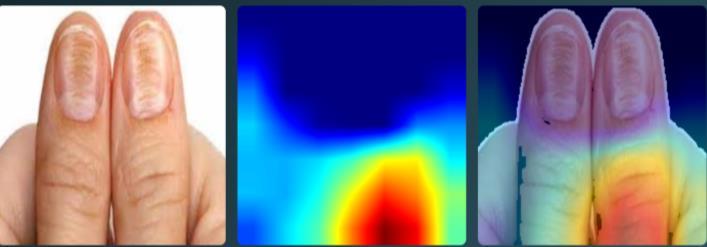
-13: showstheregionsoftheimagethatinfluencedthe prediction.
In this work, a deep learning-based system for detectingandanalyzingvitamindeficienciesfromimagedata has been successfully developed. The proposed approach utilizes image preprocessing, dataset cleaning, and class balancing techniques to improve the quality of input data and enhance model performance. The implementation of multiplemodelsdemonstratedthatMobileNetV2,combined with data augmentation, provides superior accuracy and better generalization compared to baseline approaches [3][5].
The system achieved a significant improvement in classification performance, increasing accuracy from approximately 50% with EfficientNet to 92% using MobileNetV2 with augmentation. This highlights the importanceofproperdatapreprocessingandaugmentation indeeplearning-basedhealthcareapplications.Additionally, theintegrationofGrad-CAMprovidedvisualexplanationsfor modelpredictions,improvingtransparencyandmakingthe systemmorereliableforreal-worldusage[6].
Overall,theproposedsystemdemonstratesthepotentialof artificialintelligenceinassistingearlydetectionofvitamin deficiencies through non-invasive and cost-effective methods.Thisapproachcanbeparticularlyusefulinremote and resource-limited areas where traditional diagnostic facilitiesarenoteasilyaccessible.
In future work, the system can be further enhanced by incorporatinglargerandmorediversedatasets,improving model robustness, and integrating real-time deployment throughmobileorweb-basedapplications.Thiswouldmake the solution more practical and accessible for everyday healthcareuse.
International Research Journal of Engineering and Technology (IRJET) e-ISSN: 2395-0056
Volume: 13 Issue: 03 | Mar 2026 www.irjet.net p-ISSN: 2395-0072
[1]WorldHealthOrganization,“MicronutrientDeficiencies,” WHO,2020.
[2] G. Litjens et al., “A survey on deep learning in medical imageanalysis,”MedicalImageAnalysis,vol.42,pp.60–88, 2017.
[3]M.Sandler,A.Howard,M.Zhu,A.Zhmoginov,andL.-C. Chen, “MobileNetV2: Inverted Residuals and Linear Bottlenecks,” in Proceedings of the IEEE Conference on ComputerVisionandPatternRecognition(CVPR),2018.
[4] Kaggle, “Vitamin Deficiency Dataset,” Available: https://www.kaggle.com/datasets/pangasainarendra/vitam in-deficiency
[5]C.ShortenandT.M.Khoshgoftaar,“AsurveyonImage DataAugmentationforDeepLearning,”JournalofBigData, vol.6,no.60,2019.
[6] R. R. Selvaraju et al., “Grad-CAM: Visual Explanations from Deep Networks via Gradient-based Localization,” in Proceedings of the IEEE International Conference on ComputerVision(ICCV),2017.
2026, IRJET | Impact Factor value: 8.315 | ISO 9001:2008