
International Research Journal of Engineering and Technology (IRJET) e-ISSN: 2395-0056
Volume: 13 Issue: 02 | Feb 2026 www.irjet.net p-ISSN: 2395-0072
International Research Journal of Engineering and Technology (IRJET) e-ISSN: 2395-0056
Volume: 13 Issue: 02 | Feb 2026 www.irjet.net p-ISSN: 2395-0072
Khushi Yadav1 , Mahek Bhatnagar2 , Muskan Motwani3 , Prachi Makheja4 , Priya Panchpande5 1,2,3,4
Students, Department of Computer Engineering, Vivekanand Education Society’s (Polytechnic), Mumbai, India
5Lecturer, Department of Computer Engineering, Vivekanand Education Society’s (Polytechnic), Mumbai, India
Abstract - Practical experimentation plays a vital role in Science, Technology, Engineering, and Mathematics (STEM) education by helping students understand theoretical concepts through hands-on experience. However, many educational institutions face challenges such as limited laboratory infrastructure, high equipment costs, safety risks, and restricted access to physical laboratory facilities. These limitations reduce opportunities for repeated practice and effective conceptual understanding.
This paper presents the design and development of a Web-Based Virtual STEM Lab Simulator, a digital platform that enables students to perform basic laboratory experiments in a simulated online environment. The system allows learners to observe circuit connections, analyse outputs, and simulate simple chemical reactions and scientific experiments through an interactive interface. The platform is developed using standard web technologies, ensuring accessibility through any modern web browser without requiring specialized hardware or software.
The proposed system provides structured experiment modules including aim, theory, formula, procedure, simulation interface, and result visualization. Students can input parameters, observe experiment behaviour, and repeat simulations multiple times for better understanding. By reducing infrastructure dependency and enhancing accessibility, the system serves as a costeffective and scalable solution to support practical learning in STEM education.
The Web-Based Virtual STEM Lab Simulator contributes to digital education by supplementing traditional laboratories with an interactive, safe, and flexible learning environment.
Key Words: Virtual STEM Lab, Web-Based Laboratory, Online Experiment Simulator, Simulation-Based Learning, Digital Education, Interactive Learning, Virtual Experiments.
STEMeducation, whichencompassesScience,Technology,Engineering,andMathematics,plays a vital rolein developing analyticalthinking,innovation,andproblem-solvingskillsamongstudents.Practicalexperimentationisacorecomponent of STEM learning, as it bridges the gap between theoretical knowledge and real-world application. However, traditional laboratoryenvironmentsoftenfacesignificantlimitations,includinghighsetupandmaintenancecosts,limitedequipment availability, safety risks, and restricted lab hours. These constraints reduce students’ opportunities to perform experimentsmultipletimesandfullyunderstandfundamentalconcepts.
In many institutions, especially in rural and semi-urban areas, inadequate laboratory infrastructure prevents effective hands-on learning. Additionally, the rapid growth in student enrollment makes it difficult to provide equal laboratory access to all learners. Physical laboratories also involve recurring expenses related to equipment maintenance, consumable materials, and safety compliance. These challenges highlight the need for a scalable and accessible digital solutiontoenhancepracticalSTEMeducation.
TheproposedWeb-BasedVirtualSTEMLabSimulatoraimstoaddressthesechallengesbyprovidinganinteractiveonline platform where students can perform simulated experiments anytime and anywhere. The system allows learners to observecircuitconnections,analyzeoutputs,andsimulatebasicscientificexperimentsthroughastructuredwebinterface. By using standard web technologies, the platform ensures ease of access without requiring specialized hardware or complexinstallations.
International Research Journal of Engineering and Technology (IRJET) e-ISSN: 2395-0056
Volume: 13 Issue: 02 | Feb 2026 www.irjet.net p-ISSN: 2395-0072
Unlike traditional laboratory setups, the virtual simulator eliminates safety hazards and reduces operational costs while maintaining the core objectives of experimental learning. Students can repeat experiments multiple times, analyze outcomes,andexplorevariationswithoutthefearofdamagingequipmentorconsumingphysicalresources.Furthermore, theplatformcanbeintegratedwithacademicsystemstosupportstructuredlearningandperformancemonitoring.
By combining interactive simulation techniques with modern web technologies, the Web-Based Virtual STEM Lab Simulator represents a practical step toward inclusive and technology-supported education, ensuring broader access to qualitypracticallearningexperiences.
PracticallaboratorylearningisanessentialcomponentofSTEMeducation,enablingstudentstounderstandtheoreticalconcepts through hands-on experimentation. Traditional laboratory environments provide real-world exposure; however, they require significant investment in infrastructure, laboratory equipment, maintenance, and safety supervision. Many educational institutions,particularlyinruralandsemi-urbanregions,facechallengessuchaslimitedlaboratoryfacilities,outdatedequipment, restrictedlabhours,andhighoperationalcosts.Theseconstraintsreducestudents’opportunitiesforrepeatedexperimentation andlimiteffectiveconceptualunderstanding.
Toaddresstheselimitations,variousvirtuallaboratoryplatformshavebeendevelopedtosimulatereal-worldexperimentsusing digital technologies. One notable example is PhET Interactive Simulations, which provides interactive simulations in physics, chemistry, and mathematics through web-based graphical models. These simulations enhance conceptual clarity by allowing studentstomanipulatevariablesandobservereal-timeoutcomes.
Similarly,theMinistryofEducationintroducedtheVirtualLabs initiativetoprovideremote-access laboratoryexperiments for engineering and science students. This platform allows learners to perform experiments online and access theoretical explanations and procedures. While such initiatives improve accessibility, many platforms focus primarily on experiment demonstrationratherthancustomizableinstitutionalimplementation.
CommercialplatformssuchasLabsterandPraxiLabsprovideadvanced3Dlaboratorysimulationswithguidedinstructionsand interactiveanimations.Thesesystemsenhanceengagementandrealism;however,theyareoftensubscription-basedandrequire highertechnicalinfrastructure,whichmaylimittheiradoptionincost-sensitiveeducationalenvironments.
Recentstudiesindigitaleducationemphasizetheimportanceofweb-basedsimulationplatformsthatarelightweight,accessible, and easy to deploy. Web technologies such as HTML, CSS, JavaScript, and server-side frameworks allow the development of interactivelaboratorysimulationsthatcanbeaccessedthroughstandardbrowserswithoutspecializedhardware.Suchsystems areparticularlysuitablefordiplomaandundergraduateinstitutionswhereaffordability,simplicity,andscalabilityareimportant factors.
Based on the review of existing systems, there is a clear need for a cost-effective and scalable Web-Based Virtual STEM Lab Simulator that focuses on accessibility, structured experiment presentation, and real-time simulation using standard web technologies. The proposed system aims to provide an interactive digital laboratory environment that supports repeated experimentation,safelearning,andeasyinstitutionaldeploymentwhilemaintaininglowinfrastructurerequirements.
1. Student/User Module – Allowsstudentstoaccesstheweb-basedsimulator,select availableSTEMexperiments, enterinputparameters,performvirtualexperiments,viewcalculatedresultsinstantly,analyzegraphicaloutputs (ifavailable),andrepeatexperimentsmultipletimesforbetterconceptualunderstanding.
2. Instructor Module (Future Scope) –Enablesinstructorstoguidestudents,reviewexperimentreports,monitor performance(ifloginsystemisintegrated),andprovidefeedbacktoimprovelearningoutcomes.
3. Experiment Selection Module – Provides a categorized list of available STEM experiments such as Ohm’s Law, Series and Parallel Circuits, and Logic Gates, including details like aim, theory, formula, and procedure for each experiment.
International Research Journal of Engineering and Technology (IRJET) e-ISSN: 2395-0056
Volume: 13 Issue: 02 | Feb 2026 www.irjet.net p-ISSN: 2395-0072
4. Interactive Simulation Module – Processes user-defined input values, applies predefined mathematical and logicalformulas,performsreal-timecalculationsusingJavaScript,andgeneratesaccurateexperimentaloutputs.
5. Result Visualization Module – Displays calculated results clearly on the interface and, where applicable, providesgraphicalrepresentationusingvisualizationlibrariestoenhanceconceptualclarity.
6. Backend Application Module – Manages RESTful API communication between frontend and data storage, retrievesexperimentdetails,andensuressmoothdataprocessingandmodularsystemoperation.
7. Database Module – Storesstructuredexperimentdata,userdetails,andsimulationresultsinaMySQLdatabase toensureefficientdatamanagement,consistency,andsecureaccess.
8. Web-Based User Interface – Provides a responsive and user-friendly frontend developed using HTML, CSS, Bootstrap,andJavaScript,ensuringaccessibilitythroughanystandardwebbrowserwithoutrequiringadditional softwareinstallation.
The methodology of the proposed Virtual STEM Lab Simulator focuses on the design and development of a lightweight, interactive, and scalable web-based platform that enables students to perform basic STEM experiments in a virtual environment. The system is implemented using standard web technologies to ensure ease of access, platform independence,andcost-effectivedeployment.
The development process begins with requirement analysis, where limitations of traditional laboratory systems such as high infrastructure cost, limited laboratory availability, safety concerns, and restricted hands-on practice are analyzed. Basedontheseobservations,avirtualsimulation-basedapproachisproposedtoprovideessentiallaboratoryexperiments throughawebinterface.
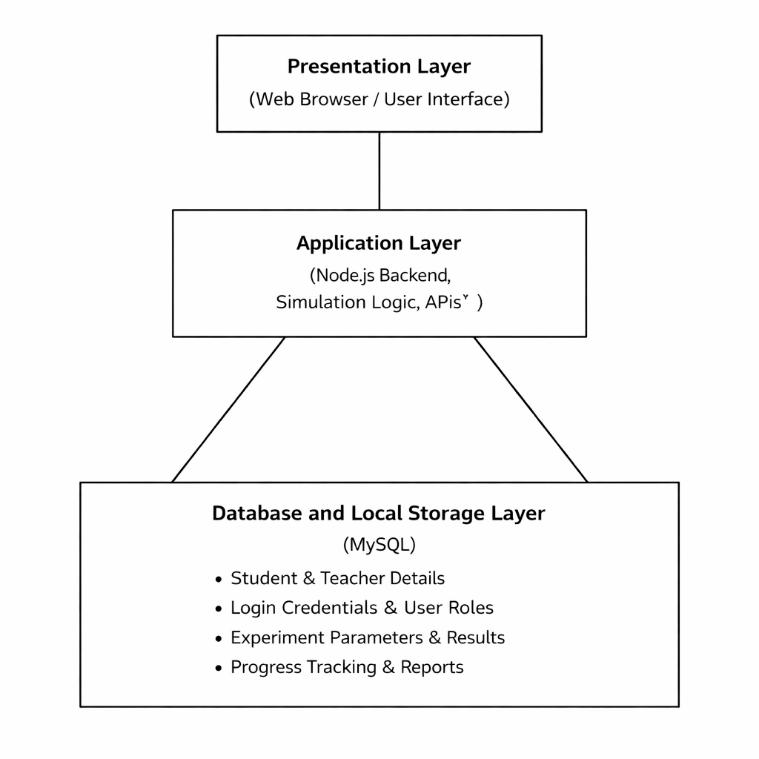
Thesystemfollowsathree-tierarchitectureconsistingofapresentationlayer,applicationlayer,anddatastoragelayerto ensuremodularity,scalability,andeaseofmaintenance.
The presentation layer is developed using HTML, CSS, and Bootstrap to create a clean, responsive, and user-friendly interface.JavaScriptisusedtoenabledynamiccontentrenderingandreal-timeinteraction.Thefrontendincludesahome page, experiment selection dashboard, and individual experiment pages structured into sections such as Aim, Theory, Formula, Procedure, Simulator, and Result. This structured layout helps users understand experiments clearly and performsimulationsstepbystep.
TheapplicationlayerisimplementedusingNode.jsandExpress.js,whichhandlesbackendprocessing,simulationcontrol, and API communication. This layer receives user inputs from the frontend, validates the data, and executes simulation logic based on predefined mathematical and scientific formulas. The calculated results are then returned to the user interface in real time. RESTful APIs are used to ensure structured and secure communication between the frontend and backendcomponents.
ThedatastoragelayerusesaMySQLdatabasetostorestructureddatasuchasuserdetails,experimentinformation, input parameters, simulation results, and progress records. All database operations are managed exclusively through the backend to ensure data security and integrity. This centralized storage approach allows easy updating and expansion of experimentcontentwithoutaffectingsystemfunctionality.
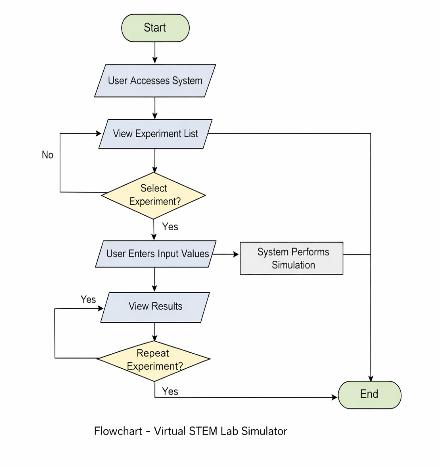
Figure 1 illustrates the operational workflow of the Virtual STEM Lab Simulator. The workflow begins when a user accesses the system and views the available experiment list. After selecting an experiment, the user enters the required inputparameters. Thesystemthen performsthesimulationusingbackendlogicanddisplays theresultstothe user.The usermayrepeattheexperimentwithdifferentinputsorexitthesystem.
Testing and validation are performed at each stage of development to ensure correct simulation behavior, accurate calculations,reliabledatabaseoperations,andsmoothuserinteraction.Performancetestingisalsoconductedtoverifyfast responsetimesandconsistentbehavioracrossdifferentwebbrowsers.
International Research Journal of Engineering and Technology (IRJET) e-ISSN: 2395-0056
Volume: 13 Issue: 02 | Feb 2026 www.irjet.net p-ISSN: 2395-0072 © 2026, IRJET | Impact Factor value: 8.315 | ISO 9001:2008 Certified Journal | Page800
By integrating an interactive frontend, a lightweight backend, and a structured MySQL database, the proposed methodology ensures real-time experiment execution, scalability, and accessibility through standard web browsers. This approachmakestheVirtualSTEMLabSimulatorapracticalandcost-effectivealternativetotraditionallaboratorysystems ineducationalinstitutions.
International Research Journal of Engineering and Technology (IRJET) e-ISSN: 2395-0056
Volume: 13 Issue: 02 | Feb 2026 www.irjet.net p-ISSN: 2395-0072
The Virtual STEM Lab Simulator is developed using a layered architecture to ensure proper separation of user interface, applicationlogic,anddatastorage.Thisarchitectureimprovessystemefficiency,security,andeaseofmaintenance.
1. Presentation Layer (Web Browser / User Interface)
The Presentation Layer provides an interactive web-based user interface for students and teachers. Through this layer, userscanregister,login,selectexperiments,enterinputvalues,andviewsimulationoutputsandreports.
This layer is responsible only for display and user interaction. All user requests are sent to the Application Layer using HTTP/HTTPSprotocols,andthereceivedresponsesareshownonthebrowser.
2. Application Layer (Node.js Backend, Simulation Logic, APIs)
The Application Layer acts as the core processing layer of the system. It is implemented using Node.js and contains the simulationlogic,businessrules,andRESTAPIs.
This layer validates user inputs, performs experiment-related calculations, manages simulation execution, and handles authentication and authorization. It also manages all communication between the Presentation Layer and the storage layers.
The Database and Local Storage Layer uses MySQL to store both structured and application-related data. This layer maintains:
Studentandteacherdetails
Logincredentialsanduserroles
Experimentparametersandresults
Progresstrackingandperformancereports
Using MySQL as centralized storage ensures data consistency, integrity, and secure access. All data operations such as insert,update,delete,andretrievalareperformedonlythroughtheApplicationLayertomaintainsecurityandcontrol.
WhenauserinteractswiththesystemthroughthePresentationLayer,the requestisforwardedtotheApplicationLayer. TheApplicationLayerprocessestherequest,executessimulationlogic,storesorretrievesdatafromtheMySQLdatabase, andsendstheprocessedresponsebacktothePresentationLayer.
TheWeb-BasedVirtualSTEMLabSimulatorpresentsapracticalandaccessiblesolutiontothechallengesassociatedwith traditional laboratory-based education. Physical laboratories often require significant infrastructure investment, regular maintenance, fixed schedules, and safety supervision, which can limit students’ opportunities for repeated experimentationandflexiblelearning.Theselimitationsareparticularlyevidentininstitutionswithrestrictedresources.
The proposed system addresses these issues by providing a web-based interactive platform that enables students to perform basic STEM experiments in a simulated digital environment. By utilizing standard web technologies such as HTML, CSS, JavaScript, Node.js, and MySQL, the system ensures ease of deployment, scalability, and accessibility through anymodernwebbrowserwithoutrequiringspecializedhardwareorsoftwareinstallations.
The platform offers structured experiment modules including aim, theory, formula, procedure, simulation interface, and result visualization. Students can input parameters, observe experimental behavior, and repeat experiments multiple timestostrengthenconceptualunderstanding.Thethree-tierarchitectureensuresclearseparationbetweenpresentation, applicationlogic,anddatabasemanagement,resultinginefficientsystemperformanceandmaintainability.
International Research Journal of Engineering and Technology (IRJET) e-ISSN: 2395-0056
Volume: 13 Issue: 02 | Feb 2026 www.irjet.net p-ISSN: 2395-0072
By reducing dependency on physical laboratory infrastructure and enabling safe, repeatable experimentation, the WebBased Virtual STEM Lab Simulator supports flexible, cost-effective, and inclusive learning. The system serves as a supportive tool for diploma-level and undergraduate education and contributes to the advancement of digital learning methodologiesinSTEMeducation.
The current system focuses on providing a web-based platform for performing basic STEM experiments through interactive simulations. In the future, the system can be enhanced with additional features to improve scalability, engagement,andlearningeffectiveness.
The platform can be expanded to include more advanced experiments across physics, chemistry, electronics, and engineeringdomains.Auserauthenticationsystemwithperformancetrackingandprogressanalyticscanbeintegratedto allowinstructorstomonitorstudentactivityandgeneratereports.
Futureimprovementsmayalsoincludedeploymentoncloudinfrastructuretoenablelarge-scaleaccessandbettersystem availability. Integration with Learning Management Systems (LMS) can further support structured academic usage. Additionally, graphical visualization enhancements and real-time data analysis features can be incorporated to make simulationsmoreinteractiveandclosertoreallaboratoryexperiences.
Withcontinuous development,theWeb-BasedVirtual STEMLabSimulatorhasthe potential to becomea comprehensive digitallaboratorysolutionforschools,polytechnicinstitutes,andhighereducationinstitutions.
[1]PhET Interactive Simulations, “PhET Interactive Simulations,” University of Colorado Boulder. [Online]. Available: https://phet.colorado.edu
[2]MinistryofEducation,“VirtualLabsInitiative,”GovernmentofIndia.[Online].Available:https://www.vlab.co.in
[3]Labster,“VirtualScienceSimulations.”[Online].Available:https://www.labster.com
[4]PraxiLabs,“3DInteractiveVirtualScienceLabs.”[Online].Available:https://praxilabs.com
[5] J. Ma and J. V. Nickerson, “Hands-on, simulated, and remote laboratories: A comparative literature review,” ACM ComputingSurveys,vol.38,no.3,pp.1–24,2006.
© 2026, IRJET | Impact Factor value: 8.315 | ISO 9001:2008 Certified Journal | Page802